
Dog breed profile
Labrador Price in India, Care and Full Breed Guide
What a Labrador actually costs in India, why published prices disagree by more than Rs 1,10,000, and why a gene deletion in a quarter of the breed makes Indian feeding habits the single biggest risk to your dog.
Quick answer
The Labrador price in India runs Rs 8,000 to Rs 1,20,000 in 2026, and no single figure is trustworthy because published Indian sources disagree by more than Rs 1,10,000 for the same breed. KCI-registered puppies are quoted at Rs 25,000 to Rs 90,000 depending on the source. The purchase price is also the least important number, because this breed's defining cost is lifelong weight management.
This guide is general information for Indian pet owners and is not a diagnosis. Always consult a registered veterinarian near you before acting on anything you read here, and treat any sudden change in your dog's condition as urgent.
Labrador Retriever at a glance
What a Labrador Retriever is
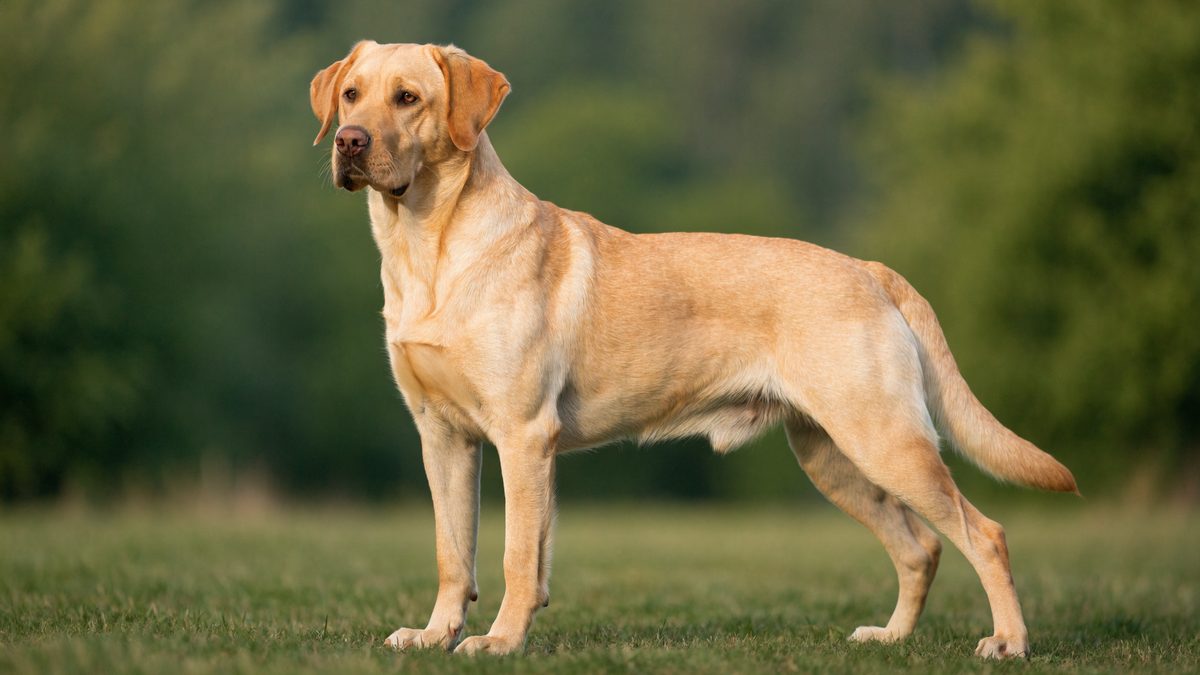
The Labrador Retriever is a strongly built, medium-sized, short-coupled gundog bred to retrieve waterfowl for long hours in difficult conditions, and that job description explains almost everything about the dog you bring home. It produced a soft mouth, an enormous appetite for work, a sociable temperament and a coat built for cold water. Three of those four traits suit Indian families. The fourth does not suit Indian summers.
Under the American Kennel Club standard, dogs stand 22.5 to 24.5 inches at the withers and bitches 21.5 to 23.5 inches. Any variance greater than half an inch above or below those heights is a disqualification. Approximate weight in working condition is 65 to 80 pounds for dogs and 55 to 70 pounds for bitches, and the standard specifies that Labradors are shown well-muscled and without excess fat.
| Attribute | Dog | Bitch |
|---|---|---|
| Height at withers | 22.5 to 24.5 in | 21.5 to 23.5 in |
| Weight in working condition | 65 to 80 lb | 55 to 70 lb |
| Coat | Short, straight, very dense | Short, straight, very dense |
| Recognised coat colour | Black, yellow, chocolate | Black, yellow, chocolate |
| Tail | Thick otter tail, no feathering | Thick otter tail, no feathering |
The coat is short, not thin
The standard describes the coat as short, straight and very dense, giving a fairly hard feeling to the hand, over a soft weather-resistant undercoat that protects from water, cold and ground cover. Woolly, silky and sparse slick coats are all severely penalised. This matters in India because owners read short and assume light. A Labrador has a genuine double coat. It is simply a short one.
Three colours, and only three
Recognised coat colour is black, yellow or chocolate. Any other colour or combination of colours is an explicit disqualification, and so are black with brindle markings, black with tan markings, and chocolate with brindle or tan markings. Yellow ranges from fox-red to light cream. A dog advertised in India as a silver Labrador at a premium is being sold outside the standard, whatever the seller claims. In the largest UK study of the breed, 44.6% of Labradors were black, 27.8% yellow and 23.8% chocolate.
Two working types circulate in India under one name. English or show-line Labradors are blockier and heavier through the body. American or field-line Labradors are leaner and taller with more drive. Neither is a separate breed and neither justifies a price premium on type alone. The Labrador is India's most popular imported breed, and popularity is exactly what dilutes breeding quality, because high demand pulls in sellers who have no reason to screen anything.
For comparison, the Golden Retriever is the breed Indian buyers cross-shop most often against this one. The head to head sits further down this page.
Labrador price in India
A Labrador puppy costs Rs 8,000 to Rs 1,20,000 in India in 2026, and the single most useful fact about that number is that published Indian sources disagree with each other by more than Rs 1,10,000 for the same breed in the same year. No one figure is trustworthy on its own.
Bonbeno compared the price bands published by the five Indian sources currently ranking on page one of Google for this query. They do not agree, and the gap is not small.
| Source | General range | Pet quality | KCI registered | Show or champion line |
|---|---|---|---|---|
| Mr n Mrs Pet | Rs 30,000 to Rs 1,20,000 | Rs 30,000 to Rs 60,000 | Rs 60,000 to Rs 90,000 | Rs 90,000 to Rs 1,20,000 |
| Pets Lifestyle | Rs 12,000 to Rs 50,000 | Rs 15,000 to Rs 25,000 | Rs 25,000 to Rs 45,000 | Rs 45,000 to Rs 70,000 |
| BARF India | Rs 15,000 to Rs 80,000 | Rs 15,000 to Rs 30,000 | Not separated | Rs 50,000 to Rs 80,000 |
| Wrapinfur | Rs 15,000 to Rs 40,000 | Rs 15,000 to Rs 25,000 | Rs 25,000 to Rs 45,000 | Rs 30,000 to Rs 50,000 |
| Supertails | Rs 8,000 to Rs 70,000 | Not separated | Not separated | Not separated |
Read the table across rather than down. One published source puts the floor at Rs 8,000 and another puts the same breed's ceiling at Rs 1,20,000. A KCI-registered puppy is quoted at Rs 25,000 by one site and Rs 90,000 by another. Four things drive that spread.
- Who is publishing. A site that also lists puppies for sale has a commercial reason to quote a high band, because the quote is the anchor for its own inventory. A content site with no inventory has a reason to quote a low band, because low numbers attract clicks from buyers hoping the breed is affordable.
- Registration status. KCI registration is the largest single documented step in every source that separates it. Mr n Mrs Pet puts the gap between basic and KCI-registered at Rs 30,000, while Pets Lifestyle puts it at Rs 10,000.
- City cost base. Metro prices sit higher because demand, rent and kennel running costs are higher there, not because the puppies are better. A breeder in Pune or Hyderabad can produce an equally healthy, equally well-socialised puppy at a lower price point.
- Coat colour demand. Chocolate carries the highest quoted premium in India and black the lowest, and the premium tracks demand rather than health or temperament.
Labrador price in India by city
| City | Pets Lifestyle | Wrapinfur |
|---|---|---|
| Delhi and NCR | Rs 18,000 to Rs 45,000 | Rs 18,000 to Rs 40,000 |
| Mumbai | Rs 20,000 to Rs 50,000 | Rs 20,000 to Rs 45,000 |
| Bangalore | Rs 18,000 to Rs 40,000 | Rs 18,000 to Rs 38,000 |
| Chennai | Rs 16,000 to Rs 35,000 | Rs 16,000 to Rs 35,000 |
| Pune | Rs 15,000 to Rs 38,000 | Rs 15,000 to Rs 35,000 |
| Hyderabad | Rs 15,000 to Rs 35,000 | Rs 15,000 to Rs 35,000 |
| Kolkata | Rs 14,000 to Rs 32,000 | Not stated |
| Tier 2 cities | Rs 12,000 to Rs 25,000 | Not stated |
These two sources agree closely on city bands and disagree sharply with Mr n Mrs Pet, which quotes Rs 30,000 to Rs 1,20,000 for every major Indian city including Hyderabad, Bangalore, Delhi, Chennai, Lucknow, Mumbai, Jaipur and Pune without variation. A source that publishes one identical band for eight different cities is describing its own price list, not the market.
Two sources independently flag Rs 2,000 to Rs 5,000 as the fraud and puppy-mill band, and a third sets the red-flag threshold at any purebred Labrador offered below Rs 8,000 with no vaccination record. The saving is not real. One source estimates that a puppy bought at Rs 8,000 from an unethical breeder costs Rs 30,000 to Rs 50,000 in veterinary bills within the first year, and Bonbeno notes that this is a publisher's estimate rather than a surveyed figure.
Bonbeno does not broker puppy sales and does not publish breeder listings. The figures above are reported from third-party sources so that buyers can see the disagreement for themselves.
Monthly cost of owning a Labrador in India
The purchase price is the smallest number in Labrador ownership, because a Labrador lives a median 12.0 years and recurring costs dominate the lifetime total. Published Indian monthly-cost estimates disagree by a factor of five, and none of the ranking sources states its method.
| Source | Monthly range | Stated period |
|---|---|---|
| Mr n Mrs Pet | Rs 3,000 to Rs 7,000 | Monthly average |
| Wrapinfur | Rs 6,000 to Rs 10,000 | Monthly maintenance |
| Pets Lifestyle | Rs 6,000 to Rs 12,000 | Monthly, responsible owner |
| BARF India | Rs 6,000 to Rs 16,000 | Monthly |
| BARF India, annual | Rs 72,000 to Rs 2,00,000 | Per year |
| Pets Lifestyle, first year | Rs 79,000 to Rs 1,76,000 | First year including purchase |
The honest position is that no verified India-wide monthly figure exists. Bonbeno is running an owner cost survey across eight metros and will publish the results with the sample size, the cities covered and the collection date stated. Until that is complete, this section sets out the cost structure rather than repeating an unsourced total.
What you actually pay for
- Food. A 32 to 35 kg adult is a large-breed eater, and food is the largest recurring line for most owners. Published Indian estimates run Rs 2,500 to Rs 5,000 a month for quality dry food.
- Preventive veterinary care. Core vaccination, annual boosters, quarterly deworming and tick and flea control. One Indian source puts routine veterinary care at Rs 4,000 to Rs 10,000 a year. Tick-borne disease pressure is high across most Indian metros.
- Ear care. Not a line item any Indian cost guide includes, and it should be. Ear infection is the most common disorder in the breed at 10.4% prevalence, and Indian humidity plus swimming raises the load further.
- Weight management. The Labrador-specific line. Prescription weight-management diets are quoted at Rs 4,000 to Rs 7,000 a month in India, and joint supplements at Rs 1,000 to Rs 2,500 a month.
- Orthopaedic provisioning. Surgical correction for hip dysplasia is quoted at Rs 40,000 to Rs 80,000 per joint in India. Budget for it from year one rather than hoping, because that is arithmetic and not pessimism.
When we publish cost figures we state the sample size, the cities covered and the collection date. Where we cannot verify a number we say so rather than repeating an unsourced estimate from another site. Every rupee figure on this page is attributed to the publisher that printed it, which is why you can see them disagree.
Can a Labrador handle the Indian climate
A Labrador manages the Indian climate less well than its short coat suggests, and Bonbeno rates its heat tolerance 2 out of 5 for three specific reasons rather than one. The coat is dense, the breed is built to work hard, and it is the most obesity-prone common breed in India. Heat risk compounds across all three.
Reason one, the coat is a double coat
The AKC standard calls for a short, straight, very dense coat over a soft weather-resistant undercoat. Indian veterinary advice is direct that Labradors can adapt but struggle in extreme heat because of that double coat. Peak summer temperatures cross 45 C in several parts of India.
Reason two, the breed runs hot when it works
This is the figure no Indian Labrador page publishes. Research at the Western College of Veterinary Medicine records that all exercising Labradors reach high body temperatures after strenuous activity, and that it is not unusual for perfectly healthy Labradors to exceed 41.7 C (107 F) after ten minutes of retrieving. Purina India places the heat-stroke danger threshold at 40.5 C. A healthy Labrador playing fetch clears that threshold in minutes, in a temperate country. India is not a temperate country.
The largest UK analysis of canine heat-related illness found that exertional heat illness, meaning heat illness triggered by exercise rather than by a hot car, accounted for 74.2% of events, with environmental exposure at 12.9% and vehicular confinement at 5.2%. Indian owners worry about parked cars. The data says worry about the evening game of fetch.
Reason three, weight multiplies the risk
Dogs at or above the mean adult bodyweight for their breed and sex had 1.42 times the odds of heat-related illness compared with dogs below that mean, and dogs over 50 kg had 3.42 times the odds compared with dogs under 10 kg. Every bodyweight group above 10 kg carried significantly higher odds than the lightest group. Purina India lists obesity and intense exercise together among the named risk factors for heat stroke. A breed genetically inclined to gain weight, in a country that feeds generously, in 45 C heat, is a stack of three risks rather than one.
| City type | Example cities | Dominant risk | What changes in practice |
|---|---|---|---|
| Hot and humid coastal | Mumbai, Chennai, Kochi | Panting works poorly in humid air | Shorter sessions, indoor scent work, aggressive drying after swims |
| Hot and dry inland | Delhi, Jaipur, Nagpur | Extreme peak temperature and hot pavement | Strict morning and post-sunset windows, pavement hand test every time |
| Moderate plateau | Bangalore, Pune | Owner complacency in a mild climate | Still no midday walk in April and May, still measured food |
| Monsoon months, all cities | June to September | Humidity and damp coat | Ear checks after every wetting, thorough drying to the skin |
What actually reduces the risk
- Walk between 5 am and 8 am and after sunset between 7 pm and 9 pm. Indian veterinary advice specifies those windows and says to keep pets indoors between 11 am and 4 pm.
- Keep the dog lean. Weight is the one heat-risk factor you fully control, and it is the one with a measured odds ratio attached.
- Stop the game before the dog wants to. A Labrador will retrieve past the point of safety, because drive overrides self-preservation in this breed.
- Do not shave the coat. Shaving off fur completely is not recommended for double-coated breeds, because fur acts as natural insulation.
- Give cool water, not ice-cold water. Indian guidance warns against suddenly offering refrigerated or ice-cold water, and Purina India advises cooling with cool rather than cold water and stopping at 39.4 C to avoid overshooting into hypothermia.
Severe panting, difficulty breathing, heavy salivating, vomiting, diarrhoea, a temperature of 40.5 C or above, blood in the urine, nose bleeds and finally collapse are the published signs. Move the dog to shade, sponge with cool water, use a fan, and get to a veterinarian. A closed car reaches 43 C within 25 minutes when the outside temperature is only 26 C. Do not wait to see whether the dog settles.
Acclimatisation, and why the air-conditioned Labrador is at more risk
Heat acclimatisation takes weeks to develop and requires increasing levels of exertion in a hot environment, and dogs with impaired thermoregulation from obesity or an underlying respiratory or circulatory condition develop severe heat illness at relatively low ambient temperatures and relatively low levels of exertion. Two Indian consequences follow. A Labrador kept in air conditioning through April and then taken on a long May walk is less acclimatised than a dog walked consistently, and a dog flown in from a cooler city has no acclimatisation at all. Build the load up gradually rather than in one weekend.
One caveat on all of this. The UK studies above were conducted in a temperate climate, and their own authors note that fatality rates reported from hotter countries are higher and should serve as a warning. Bonbeno could not find an equivalent Indian incidence study, so treat the UK figures as a floor rather than a forecast.
Temperament and household fit
The Labrador suits active Indian families who will exercise it properly and feed it by measure, and it suits almost nobody else. The breed standard asks for a kindly, outgoing, tractable nature, eager to please and non-aggressive towards man or animal, and states that any evidence of shyness in an adult should be severely penalised.
The retrieving background produced a dog that wants to work with a person rather than independently, and that wants company more than it wants space. The American Kennel Club describes the Labrador as the Peter Pan of retrievers, resilient and endlessly enthusiastic, against the Golden Retriever's habit of considering all the angles before it bursts into a new situation. The same source records a trainer's observation that the public finds an untrained Golden Retriever easier to live with than an untrained Labrador. Enthusiasm without training is the failure mode here.
Apartment reality in an Indian metro
A Labrador lives in an Indian apartment, and most Indian Labradors do. Floor area matters less than daily outlet and food discipline. What the breed needs is two structured sessions, mental work, a cool place to rest and a household that does not treat the kitchen as a buffet. What it does not tolerate is being left alone all day with nothing to do.
- Good fit. Active households with someone home for part of the day, families who will walk twice daily in any season, owners willing to weigh food rather than eyeball it.
- Poor fit. Homes empty ten hours a day, households where three people feed the dog independently, owners who want a guard dog, first-time owners unwilling to train through adolescence.
- Watch item. A 32 kg adolescent that has learned to jump up is a genuine hazard around grandparents and small children. Prevent it before six months rather than correct it at eighteen.
The standard requires non-aggression towards man or animal and penalises shyness. A well-bred Labrador greets an intruder. Indian buyers who want both a family dog and a deterrent are buying two incompatible traits in one animal, and the breed will disappoint them on the second.
Training a Labrador in India
Train a Labrador with reward-based methods from the first week home, because food motivation makes this one of the fastest breeds in the world to teach and the hardest to keep honest around food. The breed is highly biddable and highly trainable, and the training problem is almost never the dog.
Food motivation in this breed is partly genetic, and the effect is measurable. In the flat-coated retriever, the closely related breed that shares the same POMC deletion, each copy of the deletion allele raised food motivation by a mean of 7.4%. That is the single greatest training asset a Labrador gives you, and the single greatest household hazard it carries.
What this breed resists
Four things reliably go wrong, and none of them is about intelligence.
- Scavenging and counter-surfing. A dog wired to hunt calories will find the roti tin. Punishing it fights the genotype. Manage the environment, feed on a schedule, and train a reliable leave-it before the habit forms.
- Mouthing and carrying. A retriever bred to hold birds gently picks up everything. Redirect onto a permitted item, because the behaviour is not going away.
- Jumping up in greeting. Sociability plus 32 kg equals a dog greeting a guest at chest height. This is the most common complaint from Indian apartment owners and it is entirely preventable before six months.
- Pulling on lead. Labradors pull to reach the interesting thing faster. Loose-lead work is a first-month job, not a second-year one.
Realistic timelines
| Skill | Start | Reliable by |
|---|---|---|
| Name response | Week 1 home | 2 to 4 weeks |
| Sit, down, settle | Week 1 home | 3 to 5 weeks |
| Toilet training | Week 1 home | 4 to 6 months |
| Leave it, around food | Week 2 home | 6 to 12 months, then maintained for life |
| Loose-lead walking | Month 2 | 6 to 9 months |
| Reliable recall off-lead | Month 2 | 12 to 18 months |
| Calm greeting of visitors | Month 2 | 8 to 14 months |
Note the one row that never finishes. Leave-it around food is not a skill a Labrador masters and retires. It is maintained for the dog's life, because the motivation behind the behaviour is hard-wired.
Take the training treats out of the daily food ration rather than adding them on top. A Labrador will work all day for kibble it was going to eat anyway. Owners who train with extra biscuits are running a reward system and a weight-gain programme at the same time.
Labradors go through a genuine adolescent regression between roughly seven and fourteen months, where trained behaviours appear to vanish. Hold the line on reward-based methods. Owners who switch to harsher handling at this point do lasting damage to a breed selected for exactly the opposite.
How much exercise a Labrador actually needs
An adult Labrador needs 60 to 90 minutes of real exercise a day, split into a morning and an evening session, and in India that split is not optional because the middle of the day is unusable for most of the year. This is the highest-drive of the common family breeds kept in Indian cities.
Bonbeno could not find a peer-reviewed daily exercise figure for the breed, and says so plainly rather than dressing a rule of thumb as evidence. What is documented is the direction of the risk. Exertional heat illness accounted for 74.2% of UK canine heat events, and healthy Labradors routinely exceed 41.7 C after ten minutes of hard retrieving. In Indian conditions, the constraint on a Labrador's exercise is heat, not stamina.
Puppies need less, not more
This is where Indian owners most often cause permanent harm with good intentions. A large-breed puppy's growth plate sits at the end of each long bone and does not close until well into the second year. Repetitive impact before then, meaning stair marathons, jogging on tarmac and running alongside a bicycle, damages joints in a breed already carrying a 9.9% elbow dysplasia rate in screened populations. Build a puppy's load gradually and keep sessions short and frequent.
What counts in Indian conditions
- Let the dog swim wherever it is safe and clean. A water-retrieving breed in a hot country. Swimming delivers the load without the heat or the joint impact, and it is the single best exercise available to an Indian Labrador. Dry the ears afterwards.
- Substitute scent work for distance. Twenty minutes of nose work tires a Labrador more than twenty minutes of walking, and it can be done indoors during a heatwave.
- Skip the midday walk entirely from March to June. Indian veterinary advice says keep pets indoors between 11 am and 4 pm.
- Check the pavement with your palm. If you cannot hold your hand on it for five seconds, it will burn paw pads.
- Walk before you feed, not after. Standard practice for deep-chested breeds, and it also means the dog trains hungry.
Exercise-induced collapse, the risk Indian pages do not mention
Exercise-induced collapse is an inherited nervous-system disorder caused by a mutation in the dynamin-1 gene, and it is the most common reason a Labrador that seems entirely healthy between episodes collapses during exercise. Of the first 45,000 Labradors tested at the University of Minnesota as of October 2017, nearly 40% were carriers and approximately 6% were affected and susceptible to collapse.
Affected dogs are usually described as fit, muscular, excitable animals with lots of drive. Signs first appear between five months and three years, averaging fourteen months. Five to twenty minutes of strenuous exercise with excitement induces rear-limb weakness and then collapse, and symptoms commonly worsen for three to five minutes even after exercise stops. Most affected dogs recover fully within five to twenty-five minutes. Hot weather is not required to trigger an episode, but collapse is more likely when the temperature is very warm.
A severe episode of exercise-induced collapse can be fatal, and some affected dogs have died during collapse when owners allowed or encouraged the exercise to continue. Stop immediately at the first hint of incoordination or wobbliness. A DNA test on cheek swab is the only way to know a dog's status, and any Labrador with repeated exercise intolerance needs a full veterinary work-up, because heart, respiratory, metabolic and neurological causes all present similarly.
Grooming a Labrador in Indian humidity
Grooming a Labrador in India takes less brushing than most owners expect and far more ear attention than any of them expect. Brush the coat two to three times a week, and check the ears after every swim, every bath and every monsoon soaking.
The short double coat sheds year-round, with heavier moults twice a year. Indian published guidance puts the shedding peaks at March to May and October to November, and monthly baths plus quarterly professional sessions as sufficient. Compared with a Golden Retriever, the daily work is genuinely lower, because there is no feathering to mat and essentially nothing to trim.
Ears are the real grooming job
Ear infection is the single most common disorder recorded in the breed. Across 33,320 Labradors under UK primary veterinary care, otitis externa had a prevalence of 10.4%, ahead of overweight and obesity at 8.8% and degenerative joint disease at 5.5%. Chocolate Labradors fare worst, with 23.4% affected, against 17% of yellow and 12.8% of black dogs.
The colour-specific ear infection rates published by the Royal Veterinary College sit above the 10.4% overall prevalence reported in the paper itself, because the two figures are measured differently rather than because either is wrong Royal Veterinary College VetCompass. Bonbeno publishes both rather than picking the more convenient one. The direction is what matters for an Indian owner. Chocolate Labradors get roughly twice the ear disease of black Labradors, and Indian humidity is on the wrong side of that.
- Groom the ears every week, not the coat. Dry the ear canal after every wetting, because drop ears plus humidity plus water sport is the exact combination that produces otitis externa.
- Brush to the skin during the moult. Surface brushing leaves dead undercoat that traps heat and moisture against the skin.
- Dry the coat thoroughly after every bath. Damp undercoat in monsoon humidity drives hot spots. Pyo-traumatic dermatitis affected 4.0% of chocolate Labradors in the UK study.
- Keep tick and flea control continuous. Tick-borne disease pressure runs year-round across most Indian metros, unlike the seasonal pattern in temperate countries.
- Do not shave the coat for summer. It removes the natural insulation and exposes skin to direct sun.
Labrador health issues, screening and lifespan
The Labrador is a moderately healthy large breed with one dominant problem, and that problem is bodyweight. Median longevity across 33,320 Labradors under UK primary veterinary care was 12.0 years, and the breed screens better for hips than most large breeds. Its inherited weaknesses are specific, documented and testable.
Lifespan, and the chocolate finding
Median longevity was 12.1 years for non-chocolate Labradors and 10.7 years for chocolate Labradors, a gap of 1.4 years. Researchers attribute the pattern to breeding practice rather than to pigment itself. Chocolate is recessive, so a breeder targeting the colour must breed only from chocolate-carrying parents, and the resulting narrower gene pool may carry a higher proportion of genes conducive to ear and skin conditions. An Indian buyer paying the chocolate premium is paying more for the shorter-lived colour.
Among 147 Labrador deaths with a recorded cause, musculoskeletal disorder accounted for 24.5% and neoplasia for 21.1%. That ordering is the mirror image of the Golden Retriever, where cancer dominates.
Hip and elbow dysplasia, with the actual screening data
The Orthopedic Foundation for Animals holds the largest published screening dataset for both joints. Its Labrador Retriever figures are better than the breed's reputation suggests.
| Measure | Labrador Retriever | Golden Retriever |
|---|---|---|
| Hip evaluations recorded | 324,539 | 192,803 |
| Hips graded normal | 87.5% | 78.3% |
| Hips graded excellent | 21.7% | 5.9% |
| Hips graded dysplastic | 11.3% | 19.3% |
| Elbow evaluations recorded | 148,421 | 83,950 |
| Elbows graded normal | 90.0% | 88.0% |
| Elbows graded dysplastic | 9.9% | 11.8% |
Read that table before you accept the folk wisdom that Labradors are the hip dysplasia breed. In the OFA database, a Labrador is roughly four times as likely as a Golden Retriever to be graded excellent on hips, at 21.7% against 5.9%, and appreciably less likely to be graded dysplastic, at 11.3% against 19.3%. Two caveats apply. OFA data is voluntary, so it reflects dogs whose owners chose to screen, and it reflects North American breeding stock rather than Indian litters. It is still the best comparative screening evidence published anywhere, and no Indian Labrador page uses it.
The POMC deletion, the gene that defines this breed
Sequencing of candidate obesity genes in Labrador Retrievers identified a 14 base-pair deletion in the pro-opiomelanocortin (POMC) gene with an allele frequency of 12%. The deletion disrupts the coding sequences for beta-MSH and beta-endorphin, two neuroactive peptides involved in energy balance.
In a cohort of 310 Labradors, each copy of the deletion allele was associated with a mean increase of 1.90 kg in body weight and a 0.48-point rise in body condition score, an effect of 0.33 standard deviations per allele. That is more than three times the per-allele effect observed at the FTO locus in humans, the best-known human obesity gene. Of 383 UK Labradors genotyped, 78% were wild-type, 20% heterozygous and 2% homozygous for the deletion, and among 81 Labradors used as assistance dog breeding stock the allele frequency was markedly higher at 45%. The mutation was absent from 38 other breeds tested and present only in the closely related flat-coated retriever.
Later work at the University of Cambridge, published in Science Advances in 2024, put the carrier rate at roughly 25% of all Labradors and 66% of flat-coated retrievers, and added the mechanism. Studying 87 adult pet Labradors, researchers found no difference in the fullness threshold between mutation carriers and normal dogs, but significantly increased hunger between meals, and found that dogs carrying the mutation burn approximately 25% fewer calories at rest.
A quarter of Labradors are hungrier between meals and burn a quarter less energy at rest than their littermates. Lead researcher Eleanor Raffan states the practical consequence plainly, that Labradors with this mutation are looking for food all the time and that it is very difficult to keep these dogs slim, but that it can be done. The dog is not greedy or badly behaved. It is running a different metabolism, and the household has to run a different kitchen.
Other documented health issues
- Exercise-induced collapse. Roughly 40% of tested Labradors are carriers and 6% are affected. More than 80% of affected dogs collapse at least once by age four, and a severe episode can be fatal.
- Otitis externa. The most common disorder in the breed at 10.4% prevalence, and 23.4% in chocolate dogs Royal Veterinary College VetCompass.
- Degenerative joint disease. 5.5% prevalence in UK primary care, and the leading recorded category of death at 24.5%.
- Progressive retinal atrophy. A hereditary eye condition causing gradual vision loss with no cure. Parent dogs can be tested before breeding.
- Heat stroke. Danger threshold 40.5 C, with obesity and intense exercise named among the risk factors.
Ask a breeder for four documents on both parents. Hip scores, elbow scores, a progressive retinal atrophy result and an exercise-induced collapse DNA result. A POMC genotype is not standard practice anywhere yet, but a breeder who knows what POMC is has read the research, which tells you something in itself. A breeder who cannot produce hip and elbow scores is not a breeder you should buy from, whatever the price.
Feeding a Labrador in India
Feed a Labrador by weight, twice a day, from a measured portion, and count every treat against that portion. This is the single most consequential care instruction on this page, because Indian feeding culture and a food-motivated, obesity-prone breed are a bad combination that nobody warns Indian buyers about.
Start with the arithmetic. Overweight and obesity affected 8.8% of Labradors in UK primary care. In a household survey in Sao Paulo, combined overweight and obesity prevalence across all dogs was 40.5%, and among Labrador Retrievers specifically 70% were overweight. The gap between a clinical record and a physical assessment in the home is the gap between what owners report and what a scale measures.
The Indian feeding problem, stated plainly
Bonbeno could not locate a peer-reviewed Indian prevalence study for canine obesity that names the Labrador, and says so rather than manufacturing one. What exists is secondary. An Indian veterinary hospital guide attributes a 55.55% obesity prevalence in Labrador Retrievers to work at Guru Angad Dev Veterinary and Animal Sciences University, against 18.89% in Pugs and 8.33% in Beagles, and attributes to an Indian Veterinary Association survey the findings that 91.7% of Indian pet parents feed human food to their pets and that only 18% accurately measure portions.
Bonbeno could not open the underlying GADVASU or Indian Veterinary Association studies, and the page reporting them does not link either one. Treat 55.55% and 91.7% as indicative of scale rather than as verified national statistics. What they point at is consistent with the international evidence, which is that the breed with the food-motivation gene is the breed that gets fat, and that owners who do not measure portions cannot control the outcome.
Rules that actually work with this breed
- Weigh the food, do not scoop it. A kitchen scale costs less than one bag of prescription weight-management diet at Rs 4,000 to Rs 7,000 a month.
- Feed twice a day, never free-feed. Free feeding fails in this breed because the dog does not stop when full, it stays hungry between meals.
- Count rotis, rice and curry leftovers as food, not as affection. Human food fed on top of a full ration is the mechanism by which an Indian Labrador gains weight, and it is common practice.
- Appoint one person to feed the dog. Multi-generation Indian households routinely feed the same dog three times without anyone realising, and the food-motivated breed will never volunteer that information.
- Take training treats out of the daily ration. A Labrador works for its own kibble perfectly well.
- Use a large-breed puppy formulation through the growth period rather than an all-life-stages food, and keep the growing puppy lean to reduce load on developing joints.
- Score body condition monthly, not weight annually. You should feel the ribs easily under a thin fat cover and see a waist from above.
What the average adult should weigh
The AKC standard puts dogs at 65 to 80 lb (roughly 29.5 to 36.3 kg) and bitches at 55 to 70 lb (roughly 24.9 to 31.8 kg) in working condition, well-muscled and without excess fat. Mean adult bodyweight recorded in UK primary care was 35.2 kg for males and 30.4 kg for females. Compare those two lines. The average pet Labrador bitch under veterinary care sits at the top of the breed standard's working range, and the average male sits near its ceiling. Bonbeno notes one further disagreement worth flagging. The Royal Veterinary College's own press summary of that study gives the male mean as 32.5 kg rather than the 35.2 kg published in the paper McGreevy et al., Labrador retrievers…. Where a press release and its paper conflict, use the paper.
Feeding quantities depend on the individual dog's age, weight, body condition and activity. Set them with a registered veterinarian who has examined your dog, and review them after any change in exercise or after neutering, because neutering was significantly associated with higher body condition score in a household prevalence study.
Labrador puppy: month by month through the first year
A Labrador puppy reaches most of its adult frame by twelve months and finishes filling out through the second year, and the two mistakes that do permanent damage in that window are over-exercising the joints and overfeeding the dog. Both are easier to avoid than to reverse.
Bonbeno deliberately does not publish a month-by-month weight chart for this breed. Every widely circulated Labrador growth chart online traces back to breeder blogs and insurance marketing rather than to a primary source, the charts disagree with each other, and a chart is exactly the wrong instrument for a breed whose main risk is overfeeding to a number. Use body condition and your veterinarian's scale instead. The endpoints that are documented are the AKC standard's adult weights and the mean adult weights recorded in primary care McGreevy et al., Labrador retrievers….
The socialisation window closes before the vaccination course finishes
This is the most consequential decision of the first year and it lands in the first two months at home. The socialisation window in dogs closes at around sixteen weeks, and the core vaccination course typically runs across those same sixteen weeks. Waiting for the last vaccine before the puppy meets the world costs more in behaviour than controlled early exposure risks in infection. Talk to your veterinarian about managed low-risk exposure, and find a well-run puppy class if one exists in your city.
Month by month
- 8 to 12 weeks. Home, name, toilet routine, handling, crate. Core vaccines begin, covering distemper, parvovirus, hepatitis, leptospirosis and rabies across the first sixteen weeks. Start measuring food from day one, because habits set here. Socialise the puppy now, in managed low-risk settings, rather than waiting for the course to finish.
- 3 to 4 months. Teething, so mouthing peaks. Short frequent exercise sessions only. Begin leave-it work around food. If this falls in an Indian summer, the morning walk moves to 5 am to 8 am.
- 4 to 6 months. Vaccination course completes. Loose-lead work in earnest. Ear checks become routine, because swimming season and monsoon both raise otitis risk. Microchipping is quoted at Rs 800 to Rs 2,000 in India and is required by law in some states.
- 6 to 9 months. Adolescence begins and trained behaviours wobble. Discuss sterilisation timing with your vet, because in large breeds it interacts with growth-plate closure and with weight gain afterwards. Indian spay and neuter costs are quoted at Rs 8,000 to Rs 18,000.
- 9 to 14 months. Peak adolescence, and the earliest window in which exercise-induced collapse signs typically appear, averaging fourteen months. Still no jogging, stairs marathons or repetitive impact work.
- 14 to 18 months. Growth plates close and adult exercise load can be built up gradually. Re-set the food ration for a dog that has stopped growing, because this is where the weight creep usually starts.
One Indian source puts the total first year at Rs 79,000 to Rs 1,76,000 including the purchase price, vaccinations at Rs 5,000 to Rs 8,000, sterilisation at Rs 8,000 to Rs 18,000, supplies at Rs 5,000 to Rs 10,000, food at Rs 30,000 to Rs 60,000 and training at Rs 5,000 to Rs 20,000. That is one publisher's estimate, not a survey, but it is the only itemised first-year figure Bonbeno found for this breed in India, and it is roughly three times the median quoted purchase price.
Labrador vs Golden Retriever for an Indian home
Choose a Labrador over a Golden Retriever if grooming time is your constraint and you can control food, and choose a Golden if you want the more attentive dog and will do the coat work. Bonbeno covers this comparison from the Golden side on the Golden Retriever page. This side adds the evidence that comparison does not carry, which is the screening data, the lifespan data and the genetics.
Both breeds were bred to retrieve, both are similar in size, and both share trainability and a sociable temperament. The differences that change an Indian household's experience are grooming load, cause-of-death profile and one gene.
| Factor | Labrador Retriever | Golden Retriever |
|---|---|---|
| Coat | Short, straight, very dense double | Long, feathered, dense double |
| Day-to-day grooming | Lower. No feathering to mat, essentially nothing to trim | Higher. Brush 3 to 4 times a week, plus trimming |
| Shedding volume | Heavy, year-round | Heavy, year-round |
| Energy style | All-in enthusiasm, the Peter Pan of retrievers | Thoughtful, considers the angles first |
| Median longevity | 12.0 years, 33,320 dogs | 11.0 to 12.5 years, primary care |
| Leading recorded cause of death | Musculoskeletal, 24.5% | Cancer, 65% in one academic-centre study |
| Hips graded dysplastic, OFA | 11.3% of 324,539 | 19.3% of 192,803 |
| Hips graded excellent, OFA | 21.7% | 5.9% |
| Elbows graded dysplastic, OFA | 9.9% of 148,421 | 11.8% of 83,950 |
| POMC obesity deletion | Present, about 25% of the breed | Absent, mutation found in no other breed except flat-coated retrievers |
| Exercise-induced collapse mutation | About 40% carriers, 6% affected | Not found in Golden Retrievers tested |
| Heat tolerance in India | Poor. Dense double coat and very high drive | Poor. Dense double coat |
| Published price in India | Rs 8,000 to Rs 1,20,000 Mr n Mrs Pet, Labrador Retriever Puppies… | Rs 25,000 to Rs 1,20,000 |
Four of those rows are new to this comparison. The Labrador is the better-screened breed on both joints in the largest published dataset, and it is not close on hips. The Golden's dominant health risk is cancer, while the Labrador's is musculoskeletal disease driven substantially by bodyweight. The Labrador carries two breed-specific mutations the Golden does not, one for obesity and one for exercise collapse Western College of Veterinary Medicine. And the price floor is genuinely lower for the Labrador, which is not an advantage, because it is the floor at which unscreened litters sell.
Indian buyers often ask which of the two handles Indian summers better. Neither does. Both are double-coated imports, and the Labrador's higher work drive arguably makes it the riskier of the two in exertional heat, given that exertion triggered 74.2% of UK canine heat events. If heat tolerance is your deciding factor, the honest answer is a native breed such as the Indian Pariah Dog, not a choice between these two.
There is no better breed of the two in the abstract. Pick the Labrador if you will measure food and can accept a very high exercise requirement. Pick the Golden if you will brush four times a week and want the clingier dog.
Mistakes Indian Labrador owners actually make
The failure modes for this breed in India are predictable, well documented and mostly avoidable. These are the ones that show up repeatedly, ranked by how much damage they do.
- Feeding by eye instead of by scale. In a breed where a quarter of dogs are hungrier between meals and burn 25% fewer calories at rest, eyeballing the portion is not a small imprecision. It is the mechanism of the breed's main disease.
- Adding rotis, rice and leftovers on top of a full ration. Feeding human food is near-universal among Indian pet owners, and it is additive to the bowl unless someone subtracts it.
- Letting three family members feed the same dog. The most common cause of unexplained weight gain in a multi-generation Indian household, and the dog will never tell you.
- Playing fetch in the evening heat. Healthy Labradors exceed 41.7 C after ten minutes of retrieving, and Purina India puts the danger threshold at 40.5 C. The dog will not stop on its own.
- Continuing exercise when the dog wobbles. Some dogs affected by exercise-induced collapse have died because owners encouraged them to keep going. Stop at the first hint of incoordination.
- Skipping ear checks after swimming and through the monsoon. Ear infection is the most common disorder in the breed, and chocolate Labradors run roughly twice the rate of black ones.
- Assuming Labradors are healthy so screening is unnecessary. The breed screens well precisely because it has been screened. 11.3% of 324,539 evaluated hips were still dysplastic, and Indian litters are not in that dataset.
- Paying the chocolate premium. Chocolate is the highest-priced colour in India and the shortest-lived, at a median 10.7 years against 12.1 for the others.
- Buying a silver Labrador as a rare colour. Any colour other than black, yellow or chocolate is a disqualification under the breed standard.
- Running or cycling with a dog under 14 months. Growth plates are still open, and this breed already carries a 9.9% elbow dysplasia rate in screened stock.
- Shaving the coat for summer. Indian veterinary advice is explicit against shaving double-coated breeds, because fur acts as natural insulation.
- Treating a friendly breed as a self-training one. Sociability is not obedience. A 32 kg dog greeting guests at chest height is a problem regardless of how kind it is.
Letting the dog get fat is the mistake with the largest cumulative cost, because it lands as orthopaedic disease, as heat-stroke risk and as shortened life all at once. Musculoskeletal disorders were the leading recorded category of death in the breed at 24.5%, dogs at or above their breed mean bodyweight carried 1.42 times the odds of heat-related illness, and prescription weight-management diets in India run Rs 4,000 to Rs 7,000 a month. A kitchen scale prevents all three.
Buying responsibly, and the adoption alternative
Verify the breeder before you transfer money, and consider adoption before you buy at all. India's breeding trade is largely unregulated, the Labrador is the most heavily bred imported breed in the country, and price alone tells you nothing about how a litter was raised.
What KCI registration does and does not prove
The Kennel Club of India maintains breed standards and organises dog shows, and its registration certificate documents the pedigree of a puppy's parents and grandparents going back five generations, with champion bloodline names shown where they apply. Litter registration costs Rs 337 per puppy within 60 days of birth and Rs 562 per puppy between 61 and 120 days, with ownership transfer at Rs 100, and a litter not registered within 120 days cannot be registered at all.
KCI registration certifies pedigree, not health. It says nothing about hips, elbows, eyes or exercise-induced collapse status. Fraudulent certificates are common enough that many Indian buyers are not given a genuine one at all. Always request a separate veterinary health certificate in addition to registration papers, and verify the registration with the Kennel Club of India rather than trusting a photocopy.
Breeder checklist, Labrador specific
- Ask for hip and elbow scores on both parents. This is the single highest-value question, and the OFA dataset shows the breed responds to screening.
- Ask for a progressive retinal atrophy result on both parents.
- Ask for an exercise-induced collapse DNA result on both parents. Two carriers bred together produce roughly 25% affected puppies.
- Ask for vaccination records with a vet stamp and date, and the deworming schedule.
- See the dam with the litter in the place the puppies were raised.
- Decline any seller who will not let you visit, who meets in car parks, who delivers puppies younger than seven weeks, or who has multiple breeds available on demand.
- Treat any price below Rs 8,000 as a warning rather than a bargain.
Consider adoption first
Labradors and Labrador crosses turn up in Indian shelters and breed-specific rescue constantly, often surrendered when families underestimate the exercise requirement or when a young dog outgrows an apartment. Published Indian adoption fees disagree, as usual. One source gives Rs 500 to Rs 3,000 and typically includes vaccination, deworming and neutering, while another gives Rs 2,000 to Rs 5,000. Named organisations that rehome in Indian metros include CUPA in Bangalore, Friendicoes in Delhi and Welfare of Stray Dogs in Mumbai.
Adopting an adult removes the two largest unknowns in a puppy purchase, which are adult temperament and early health history, and it skips the demanding first year entirely. For most Indian families that is the more practical route rather than the sentimental one. Bonbeno covers Indian breeds and indie dogs separately, and the Indian Pariah Dog remains far better adapted to Indian heat than any imported double-coated breed.
Labrador questions Indians actually search
How much does a Labrador puppy cost in India?
Published Indian sources quote Rs 8,000 to Rs 1,20,000 in 2026 and disagree by more than Rs 1,10,000. Supertails puts the range at Rs 8,000 to Rs 70,000 while Mr n Mrs Pet puts it at Rs 30,000 to Rs 1,20,000. KCI-registered puppies are quoted anywhere from Rs 25,000 to Rs 90,000 depending on which source you read.
What is the monthly cost of owning a Labrador in India?
Published monthly estimates range from Rs 3,000 to Rs 16,000 across four Indian sources, and none states its method. Mr n Mrs Pet gives Rs 3,000 to Rs 7,000, Wrapinfur Rs 6,000 to Rs 10,000, Pets Lifestyle Rs 6,000 to Rs 12,000 and BARF India Rs 6,000 to Rs 16,000. No verified India-wide figure exists yet.
Can I adopt a Labrador cheaply in India?
Yes. Adoption from a registered rescue or shelter is quoted at Rs 500 to Rs 3,000 by one Indian source and Rs 2,000 to Rs 5,000 by another, and usually includes vaccination, deworming and sterilisation. CUPA in Bangalore, Friendicoes in Delhi and Welfare of Stray Dogs in Mumbai all rehome Labradors and Labrador crosses.
What should I avoid when buying a Labrador in India?
Avoid sellers quoting Rs 2,000 to Rs 5,000, sellers who refuse to share health records, sellers who will not let you see the puppy with its mother, and anyone delivering puppies younger than seven weeks. Ask specifically for hip scores, elbow scores, a progressive retinal atrophy result and an exercise-induced collapse DNA result on both parents.
Why are Labradors so prone to overeating?
A 14 base-pair deletion in the POMC gene, carried by roughly 25% of Labradors, disrupts beta-MSH and beta-endorphin production. Carriers are not less able to feel full, they are significantly hungrier between meals, and they burn approximately 25% fewer calories at rest. Each copy of the deletion is associated with about 1.90 kg more body weight.
Can Labradors be left alone for 8 hours?
No, not routinely. The Labrador is a high-drive, highly social breed that develops chewing, digging and nuisance barking when left alone all day with nothing to do. If your household is empty ten hours a day, this is the wrong breed, and daycare or a midday walker is a cost line rather than an optional extra.
Will a Labrador protect its owner?
No. The breed standard requires a kindly, outgoing, tractable nature that is non-aggressive towards man or animal, and it penalises any evidence of shyness in an adult. A correctly bred Labrador greets strangers rather than challenging them. Buyers who want a family dog and a deterrent are asking one animal for two incompatible traits.
What are the disadvantages of a Labrador Retriever?
Four, specifically. It is genetically inclined to obesity through the POMC deletion, it needs 60 to 90 minutes of daily exercise that Indian heat makes hard to deliver, ear infection affects 10.4% of the breed and roughly doubles in chocolate dogs, and it is useless as a guard dog. None of these is a reason not to buy one, but all four are budget and routine decisions.
Why say no to Silver Labs?
Because silver is not a recognised colour. The AKC standard lists black, yellow and chocolate only, and states that any other colour or a combination of colours is a disqualification. A seller charging an Indian buyer a premium for a rare silver Labrador is charging more for a dog that falls outside the breed standard.
What are the three types of Labrador Retrievers?
There is one breed and three recognised coat colours, which are black, yellow and chocolate. Separately, two working types circulate, the blockier English or show line and the leaner American or field line. Neither type is a separate breed and neither justifies a price premium on type alone.
Which breed of Labrador is best?
Colour makes no difference to temperament, but it does correlate with health outcomes. Chocolate Labradors had a median lifespan of 10.7 years against 12.1 years for black and yellow dogs, and 23.4% of chocolates had ear infections against 12.8% of blacks. In India chocolate is also the highest-priced colour, so buyers pay more for the shorter-lived option.
Do Labradors survive in Indian heat?
Yes, with active heat management, but less easily than the short coat suggests. The coat is short and very dense over a weather-resistant undercoat, and healthy Labradors exceed 41.7 C body temperature after ten minutes of retrieving. Walk between 5 am and 8 am and after 7 pm, keep the dog lean, keep it indoors from 11 am to 4 pm, and never shave the coat.
How long do Labradors live?
Median longevity was 12.0 years across 33,320 Labradors under UK primary veterinary care, split as 12.1 years for black and yellow dogs and 10.7 years for chocolate dogs. Among deaths with a recorded cause, musculoskeletal disorders accounted for 24.5% and neoplasia for 21.1%.
Labrador or Golden Retriever, which is better for India?
Neither handles Indian heat well, since both are double-coated. Choose the Labrador if grooming time is your constraint and you will measure food, because it needs far less brushing and screens better on hips, at 11.3% dysplastic against 19.3% for the Golden. Choose the Golden if you want the more attentive dog and will brush three to four times a week.
Are Labrador Retrievers a good family dog?
Yes, for an active Indian family that will exercise it properly and feed it by measure, and for almost nobody else. The breed standard asks for a kindly, outgoing, tractable nature, eager to please and non-aggressive towards man or animal, so a well-bred Labrador greets an intruder rather than deterring one. Poor fits are homes empty ten hours a day, households where three people feed the dog independently, and first-time owners unwilling to train through adolescence, because a 32 kg adolescent that jumps up is a hazard around grandparents and small children.
Is a Labrador a high maintenance dog?
High maintenance in time and food discipline, not in grooming. The coat needs brushing only two to three times a week, but the ears need checking after every swim, bath and monsoon soaking, because otitis externa is the most common disorder in the breed at 10.4 percent of 33,320 Labradors under UK veterinary care. Add 60 to 90 minutes of exercise a day split around Indian heat, and food weighed rather than eyeballed, because roughly 25 percent of Labradors carry the POMC deletion that drives overeating.
Is a Labrador dog good for home?
Yes, and most Indian Labradors live in apartments. Floor area matters less than daily outlet and food discipline: the dog needs two structured exercise sessions totalling 60 to 90 minutes, mental work such as scent games, a cool place to rest through the 11 am to 4 pm summer window, and one person controlling the food bowl. The breed standard's kindly, outgoing, tractable nature makes it a poor guard dog, so buy it as a companion for a home where someone is present for part of the day.
Compare with similar breeds
Labrador Retriever sits in 2 Bonbeno groups. Each one compares it directly against the breeds it is genuinely an alternative to, on the same figures.