
Breed profile
Braque Saint-Germain: the orange-and-white French pointer, checked against its own standard
A rare French pointing breed with a documented royal-kennel origin story, sixteen puppies registered in France in 2025, and no lawful route into India.
Quick answer
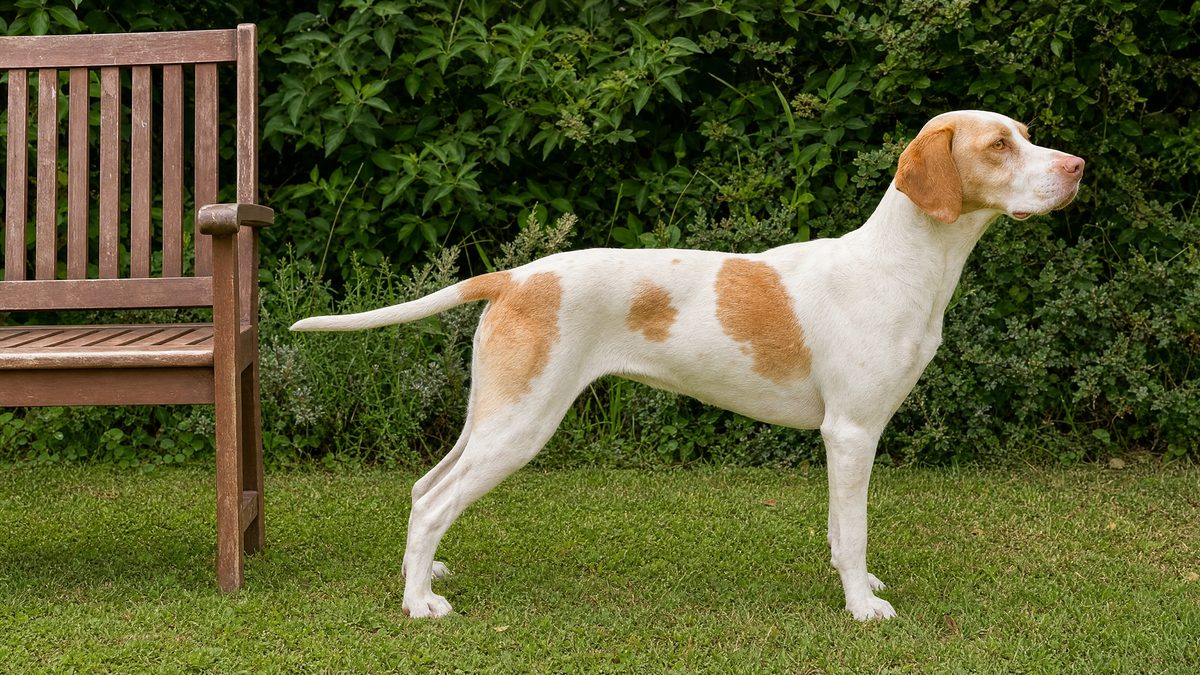
The Braque Saint-Germain is a rare French pointing breed, FCI standard 115, identified by a dull white coat with orange markings and fawn ears in which any black is a disqualifying fault. France registered 16 puppies in 2025. No Indian breeder, KCI listing or import route exists, so a Braque Saint-Germain price in India cannot be quoted honestly.
This page reports published veterinary research and breed-standard text. It is not a diagnosis and it is not a treatment plan. Consult a registered veterinarian before acting on anything here, especially on heat stress, ear disease and any breeding decision.
Braque Saint-Germain at a glance
What the Braque Saint-Germain actually is, read out of FCI-115 itself
The Braque Saint-Germain is a French continental pointing breed, FCI standard number 115, standing 56 to 62 cm at the withers in males and 54 to 59 cm in females, with a short coat of dull white marked with orange, fawn ears, golden-yellow eyes and a dark pink nose. Any black anywhere on it disqualifies the dog.
Bonbeno opened the standard rather than a summary of it. Both the English and the French PDF were downloaded from the FCI's own server and the text extracted with pypdf, and page one of each was checked before a single figure was taken off it. The English file, seven pages, prints BRAQUE SAINT-GERMAIN (Saint Germain Pointer) under the heading FCI-Standard N 115. The French file, six pages, prints BRAQUE SAINT GERMAIN under Standard FCI N 115. That check matters on this project, because the FCI's own site has served a complete English Setter page at a URL that promised something else entirely, so the breed name printed inside the document is the only thing worth trusting.
The FCI's nomenclature record adds the administrative facts the PDF leaves out. The breed was accepted on a definitive basis on 16 December 1954, its official authentic language is French, its country of origin is France, the currently valid standard was published on 1 August 2023, and it is subject to a working trial.
The clauses a buyer should read first
Four clauses do almost all the work of telling this breed apart from every other French braque, and all four are about colour and pigment.
- Colour. Dull white with orange, described in the standard as fawn, markings. Some mottling is tolerated but not sought after. The ear is fawn, with a very sparse amount of white tolerated but not sought after.
- Nose. Broad, with well-open nostrils, dark pink in colour. The French reads rose fonce, deep pink.
- Eyes. Well open, relatively large, golden-yellow, well set in the orbits, with a candid and mild look. Brown or black eyes are a disqualifying fault.
- Black. The presence of black on the nose, the lips, the palate or the nails is a disqualifying fault, and the general appearance clause opens by saying the coat is fawn and white 'without any black being present'.
Read together, those four clauses make the Braque Saint-Germain the only French braque in which a black nose ends the dog's show career. That is not a cosmetic detail. It is the visible trace of the English Pointer cross the breed is built on, because the pink nose and the orange-on-white coat came into the line together and the standard has been written ever since to protect them.
Size, and one number in the English text that cannot be right
The French standard states the size plainly: males 56 to 62 cm, females 54 to 59 cm, with 2 cm more allowed for exceptional subjects. The English translation restates the same centimetres and then converts them, and one conversion is wrong. It prints the female maximum as '59 cm maximum (28.7")';. Divide it out: 59 cm is 23.2 inches, and 28.7 inches would be 72.9 cm, taller than the male maximum by eleven centimetres. Every other conversion on the page is correct, 56 cm as 22 inches, 62 cm as 24.4 inches and 54 cm as 21.3 inches, so this is a single typographical slip rather than a systematic error.
The UKC standard, written independently, gives the female range as 21 to 23.5 inches, and Wikipedia's infobox gives 54 to 59 cm as 21 to 23 inches English Wikipedia, 'Braque Saint-Germain'. Both agree with the arithmetic and neither agrees with 28.7. Bonbeno reports the centimetre figures and treats the inch figure in the English PDF as an error, because a number that contradicts its own source unit is not evidence of anything.
What the standard says the dog is for
The utilisation clause is short and specific. It is a pointing breed used principally on feather but able to hunt fur-bearing game, and the behaviour clause says it hunts pheasant, partridge and woodcock on any terrain and retrieves with a soft mouth. Its normal gait is the gallop, supple, balanced and sustainable, of average reach, with the head carried slightly above the topline and never lower.
That is a working specification, not a description of a pet, and it is the single most useful thing on the page for an Indian reader. A dog selected for two centuries to gallop across open country in a temperate autumn is being asked to do something else entirely in an Indian apartment, and the climate section puts numbers on how different the two jobs are.
The AKC lists the breed in its Foundation Stock Service rather than in a full group, and gives a weight of 40 to 58 lbs, roughly 18 to 26 kg, and a life expectancy of 12 to 15 years. Neither figure appears in the FCI standard, which carries no weight clause and no lifespan clause at all, and the AKC cites no source for either. Bonbeno reports them as a registry estimate and nothing more.
How the five Braques differ, clause by clause from the standards themselves
Colour is the obvious answer and it is also the strongest one. The Braque Saint-Germain is orange on white with a pink nose, and every other French braque is brown, ticked or black with a pigmented nose. Bonbeno read all four sibling standards to establish that rather than repeating it.
Bonbeno downloaded FCI-133 for the Braque Francais type Gascogne, FCI-134 for the type Pyrenees, FCI-179 for the Braque du Bourbonnais and FCI-180 for the Braque d'Auvergne, extracted each with pypdf and confirmed the breed name printed on page one of every file before comparing anything Federation Cynologique Internationale Federation Cynologique Internationale. The fifth relative, the Braque Dupuy, has no FCI standard at all.
| Clause | Saint-Germain (115) | Braque Francais Gascogne (133) | Braque Francais Pyrenees (134) | Braque du Bourbonnais (179) | Braque d'Auvergne (180) |
|---|---|---|---|---|---|
| Coat colour | Dull white with orange (fawn) markings, light mottling tolerated | Chestnut brown, or chestnut brown and white, plain or strongly speckled, or brown with tan | As Gascogne | White heavily ticked brown (wine dregs) or fawn (peach blossom), roan accepted | Black with white markings, flecked or greying |
| Nose colour | Broad, dark pink | Broad, brown | Chestnut-brown | Matches the coat, no unpigmented patches | Always black |
| Black anywhere | Disqualifying on nose, lips, palate, nails and coat | Not mentioned | Not mentioned | Disqualifying (hair or nose) | Required on the nose and normal in the coat |
| Eye colour | Golden-yellow; brown or black disqualifies | Chestnut brown or dark yellow | As Gascogne | Hazel or dark amber | Dark hazel; yellow hawk eye disqualifies |
| Ears | Set level with the eye, not too long, rounded, one longitudinal crease | Medium length, set at eye level, tip reaches the rear rim of the nose leather | Set above eye line, barely folded, tip stops 2 cm short of the nose leather | Medium length, may reach or pass the throat, base rather broad | Set rather to the rear, below a line from nose to eye at rest |
| Tail | Set relatively low, no docking clause, reaches no further than the hock | Generally docked; a long or naturally short tail is not a fault | Fine, docked or naturally short | Often born tailless; otherwise docked at the base | Set rather high, docked to 15 to 20 cm or undocked to the hock |
| Male height | 56 to 62 cm | 60 to 69 cm | 51 to 58 cm | 51 to 57 cm | 57 to 63 cm |
| Female height | 54 to 59 cm | 58 to 68 cm | 49 to 56 cm | 48 to 55 cm | 53 to 59 cm |
| Temperament clause | Present and detailed | Absent | Absent | Present | Present |
| Standard dated | 19.09.2023 | 22.09.2023 | 22.09.2023 | 29.03.2006 | 02.04.2004 |
Two things in that table are worth stopping on. The Braque Saint-Germain is the only one of the five in which black is a disqualifying fault everywhere on the dog, and the Braque d'Auvergne is the only one in which black is compulsory: its nose must be black and its coat is black with white markings. On the single most visible character in the group, the two breeds are exact opposites.
The second is size. Ranked by male maximum, the order runs Braque Francais Gascogne at 69 cm, Braque d'Auvergne at 63 cm, Braque Saint-Germain at 62 cm, Braque Francais Pyrenees at 58 cm and Braque du Bourbonnais at 57 cm Federation Cynologique Internationale Federation Cynologique Internationale Federation Cynologique Internationale Federation Cynologique Internationale. The Saint-Germain sits in the middle, which is why size alone will never identify one.
Bonbeno is building the other four at the same time. Read them alongside this one: the Braque Francais, the Braque du Bourbonnais, the Braque d'Auvergne and the Braque Dupuy.
Six differences that are not colour, and one Braque with no standard to compare
Beyond colour the standards separate the five braques on skull shape, head planes, muzzle length, dewlap, tail and foot shape. Every one of those is written in different words in each document, which is itself the evidence that these are five independently drafted standards rather than one template.
- Skull shape. The Saint-Germain's skull is slightly rounded, ogival at the rear, with a prominent occipital protuberance. The Gascogne's is almost flat or very slightly rounded with the occipital protuberance barely prominent. The Bourbonnais's essential breed characteristic is a so-called pear shape, round seen from every side. The Auvergne's is nearly oval seen from above, with the width between the zygomatic arches equal to its length. Four heads, four vocabularies.
- Head planes. The Saint-Germain's skull and muzzle lines are parallel or very slightly divergent. The Braque Francais's are slightly divergent, and converging or too-divergent lines disqualify. The Auvergne's are slightly divergent towards the front, which its standard calls 'a characterized braque'. The Bourbonnais's are parallel or very slightly divergent, and convergent lines disqualify.
- Muzzle length. The Saint-Germain's muzzle is the same length as the skull. The Gascogne's is somewhat shorter. The Bourbonnais's is slightly less. The Auvergne's is slightly less than or equal. Only the Saint-Germain gets equality outright.
- Dewlap. A very slight dewlap is tolerated in the Saint-Germain. The Gascogne is required to have one, 'always with a slight dewlap'. The Pyrenees type has 'slight or no dewlap'. That one clause is the cleanest written separation between the two Braque Francais types.
- Tail. The Saint-Germain standard contains no docking instruction and no naturally-short-tail clause at all. Every other standard in the group discusses docking, natural taillessness, or both. That makes the Saint-Germain the only one of the five whose standard needs no reconciling with Indian law.
- Feet. The Saint-Germain's forefoot is long with tight toes and very light, even white, nails. The Gascogne's is nearly round. The Bourbonnais's is round or spoon shaped. The Auvergne's is described as a little longer than a cat foot and a little shorter than a hare foot.
The Saint-Germain standard lists 'presence of dewclaws' as a fault, and the Bourbonnais and Auvergne standards make dewclaws or evidence of their removal a disqualifying fault Federation Cynologique Internationale. In India, removing one to satisfy that clause is illegal. Second Schedule Part II paragraph 6(8) of the Prevention of Cruelty to Animals (Dog Breeding and Marketing) Rules 2017 forbids tail docking, ear cropping, de-barking, de-clawing 'or any other kind of mutilation of any body part of the pup and any change of appearance by artificial means';. Bonbeno grepped the machine-readable gazette text for that phrase before quoting it.
The Braque Dupuy exists in an 1865 catalogue and nowhere in modern registry data
The Braque Dupuy is not an FCI breed. It appears in no FCI nomenclature entry, it has no code in the Orthopedic Foundation for Animals breed list, where Bonbeno parsed 918 code-to-name pairs out of the raw markup and found BDA, BDB, BDF, BP and BSG but no Dupuy, and English Wikipedia lists it under extinct breeds in both of its French-dog navigation boxes. PubMed returns zero records for it, with a clean AND translation, in a session where the control searches returned 1,107, 680 and 883.
It was, however, a real and separately judged type in the nineteenth century, and the same document that gives the best evidence for the Saint-Germain's origin says so. The 1865 Paris show catalogue describes 'les Braques Dupuy, grands chiens blancs et marrons', large white and brown dogs of lighter and more slender build than the Braque Francais, 'crees dans le Poitou, il y a une soixantaine d'annees par M. Dupuy';. Sixty years before 1865 puts the Dupuy's creation at around 1805, a generation before the Saint-Germain's.
The same catalogue page lists 'Braque Dupuy, picard, sans queue, du Bourbonnais' as separate entries, so the Bourbonnais's natural taillessness was already a recognised character in 1865, and it names two more lost types: 'le Braque d'Anjou, blanc et orange ou gris de souris' and 'le Braque de Navarre, blanc avec des taches lie de vin et les yeux porcelaines';. The Braque d'Anjou being white and orange matters for the next section, because it means orange-and-white braques existed in France under other names at exactly the moment the Saint-Germain is supposed to have been invented.
Are the Braque standards copy-paste jobs? Bonbeno measured it, and the answer is no
The five Braque standards share between three and five sentences each, and every shared sentence is Federation Cynologique Internationale house furniture rather than a description of a dog. That is a different finding from the one this site published on the Anglo-Francais hounds, and it is worth saying so plainly.
Bonbeno's Anglo-Francais cluster found roughly twenty clauses of near-identical text running across three sibling standards, which made those three documents look like one document with the colour changed. The obvious question is whether the Braques are the same. They are not, and the check is easy to reproduce.
Every FCI standard in the group was extracted with pypdf, running headers stripped, split into sentences and normalised to lower-case letters and digits. Only sentences of five words or more were counted, because shorter fragments match by accident. FCI-115 yields 61 such clauses, FCI-133 yields 48, FCI-134 yields 28, FCI-179 yields 89 and FCI-180 yields 92.
| Pair | Shared clauses | Of which describe the dog |
|---|---|---|
| 115 Saint-Germain and 133 BF Gascogne | 5 | 0 |
| 115 Saint-Germain and 134 BF Pyrenees | 5 | 0 |
| 115 Saint-Germain and 179 Bourbonnais | 3 | 0 |
| 115 Saint-Germain and 180 Auvergne | 5 | 0 |
| 133 BF Gascogne and 134 BF Pyrenees | 9 | 2 |
| 133 BF Gascogne and 179 Bourbonnais | 4 | 0 |
| 133 BF Gascogne and 180 Auvergne | 5 | 0 |
| 134 BF Pyrenees and 179 Bourbonnais | 4 | 0 |
| 134 BF Pyrenees and 180 Auvergne | 5 | 0 |
| 179 Bourbonnais and 180 Auvergne | 4 | 0 |
Exactly three clauses appear in all five documents, and here they are in full: the secretariat address block, 'Any dog clearly showing physical or behavioural abnormalities', and 'Only functionally and clinically healthy dogs, with breed typical conformation should be used for breeding'; Federation Cynologique Internationale. Those sentences appear in essentially every one of the FCI's roughly 370 standards. Finding them here proves nothing about the Braques.
The other recurring matches are the faults preamble, 'Any departure from the foregoing points should be considered a fault...', the testicles clause, the label 'DATE OF PUBLICATION OF THE OFFICIAL VALID STANDARD', and, between FCI-115 and FCI-180 only, the line 'John Miller and Raymond Triquet'. That last one is a translator credit, not a clause about a dog. The same two men translated both texts, which is why the sentence recurs.
The Anglo-Francais finding does not generalise to the Braques. Not one descriptive clause about coat, head, ear, tail, gait or temperament is shared verbatim between FCI-115 and any of its four relatives. These are five independently drafted documents with different authors, different translators, different dates and different vocabularies, and the differences catalogued in the section above are real differences rather than artefacts of one writer's phrasing.
The one genuine pair, and it says so out loud
FCI-133 and FCI-134 do behave as a pair, sharing nine clauses. That is by design and it is declared on the face of the document. FCI-134's classification block ends with the sentence: 'The small size French Pointing Dogs Pyrenean type show, while keeping all proportions, with more reduced dimensions and lighter shapes, the same general characteristics as those of the Gascogne type. They only differ on the following points:';. The rest of FCI-134 is a difference list, five pages long against the Gascogne's six, and it omits the head, body, gait and coat clauses entirely because they are inherited.
That is a stronger form of shared text than anything the Anglo-Francais cluster showed, and it is also the honest form. A reader who opens FCI-134 is told in its second paragraph that it is not a complete description. A reader opening three separately-numbered hound standards that quietly repeat each other is not.
One consequence of reading all five: the English FCI-115 misfiles the breed
The English text of FCI-115 places the breed in 'Section 1.2 Continental Pointing Dogs'. Every sibling standard says Section 1.1, type Braque Federation Cynologique Internationale Federation Cynologique Internationale. The French text of FCI-115, which is the official authentic language version, says only 'Section 1 Chiens d'arret continentaux' with no subsection number at all. The FCI's own nomenclature database records the breed under Section 'Continental Pointing Dogs', Subsection 'Braque' Type, and even Wikipedia, working from the same PDF, writes 'Section 1.1 Continental Type Pointing Dog';.
So the number 1.2 exists in exactly one place, the English translation, and is contradicted by the French original, the FCI database and all four sibling documents. Bonbeno reports the breed as Group 7, Section 1.1, Braque type, and flags the English PDF as wrong on this line. It is a small error, but it is the second one on that page after the 28.7-inch bitch, and both were found by the same method: read the document rather than the summary.
The Compiegne origin: what the standard says, what the club says, and where they part company
The FCI standard says the breed descends from dogs produced by crossing a pointer and a braque, and was created around 1830 in the royal kennels at Compiegne and then at Saint-Germain-en-Laye. It names nobody, dates nothing precisely and does not describe a single cross. Everything more specific than that comes from the breed club.
Here is the whole of the FCI-115 history clause in its official authentic language, French: 'C'est un descendant de chiens issus du croisement d'un pointer et d'un braque. La race fut creee vers 1830 dans les chenils royaux a Compiegne, puis a Saint Germain en Laye. Ce chien eut une vogue tres importante jusqu'au debut du 20eme siecle et fut le chien d'arret le plus represente dans les premieres expositions canines et notamment a la premiere exposition francaise a Paris en 1863. Le club de race a ete cree en mars 1913.';
Four things in that paragraph deserve attention. It says 'un pointer et un braque', a pointer and a braque, with indefinite articles and no names. It says 'vers 1830', around 1830, not in 1830. It says 'des chiens', dogs in the plural, descending from the cross, not one litter. And the English translation adds two words that are not in the French, rendering the pair as 'an English pointer' and 'a Continental pointer';. The addition is a fair gloss, since in French cynological usage 'pointer' means the English Pointer and 'braque' unqualified means a French one, but it is a gloss, and it is the sentence every English-language page then paraphrases.
What the club adds, and none of it is in the standard
The Club du Braque Saint-Germain publishes its history on the Societe Centrale Canine's site, and it opens by making a claim about itself: 'Si certaines races ont une histoire trouble, faite de beaucoup de suppositions et d'incertitudes, ce n'est pas le cas du Braque Saint-Germain.' If some breeds have a murky history full of suppositions and uncertainties, this is not the case with the Braque Saint-Germain.
The club's account names five things the standard does not.
- Charles X, King of France from 1824 to 1830, who kept good continental braques and wanted to lighten their type.
- The Comte de Girardin, described as premier veneur, first huntsman, to Charles X, who was asked to import the pointer.
- Miss, a named pointer bitch, crossed with the king's braques.
- Jean Charles Nicolas de Larminat, inspecteur des eaux et forets de Compiegne, who took Miss when the king fell in 1830.
- M. Delagrange, a breeder said to have been behind the club's creation, whose 1914 book 'Le Braque Saint-Germain' the club quotes directly.
The club also explains the name in a way the standard does not: the dogs were called Braque Saint-Germain only once the forest wardens moved from Compiegne to the forest of Saint-Germain and took their dogs with them.
The fullest English account disagrees with the club on the date
Craig Koshyk, whose book Pointing Dogs, Volume One covers every continental pointing breed, gives the most detailed English narrative and dates the founding import a decade earlier. In his telling, 'sometime around 1820, Count Alexandre de Girardin, the chief huntsman of the French royal court, is said to have presented two English Pointers, named Miss and Stop, to King Charles X of France'.
The rest of his account adds detail that either supports or complicates the club's version at almost every step.
- Two pointers, not one. Miss and Stop. Stop died before he could be bred, which is why only Miss is remembered.
- Miss's first litter was not the breed. It was sired by an epagneul allemand marron, a brown German spaniel, and the pups 'were said to have been of little value and were given away'.
- The second cross produced the type. Miss was bred to Zamor, a brown and white Braque Francais belonging to the Count de l'Aigle. The first Miss and Zamor litter produced seven pups, four of which had short white and orange coats and pink noses.
- A named eyewitness bought two of them. Adolphe de la Rue, who had hunted over Miss and Stop and rated Miss 'far superior to our Braques', bought a dog and a bitch from Larminat and wrote that 'at seven months of age they would point and retrieve naturally'.
- The purity claim was already contested in the 1860s. James de Coninck, one of the era's leading authorities, wrote that 'I saw a purebred female English Pointer win a dog show as a Braque Saint Germain and I was sold a son of hers as a Saint Germain', and that because all orange and white braques were being called Saint-Germains, 'they fabricated them with a bit of everything'.
Koshyk's own verdict on the tidy version is blunt: the story 'is often reduced to a Reader's Digest version involving an English pointer named Miss and a Braque Francais named Zamor', and while both dogs existed and did produce white-and-orange pups with pink noses, 'to conclude that the entire breed traces back to a single pair of dogs is a bit much';.
Does the Compiegne origin rest on a primary document? Partly, and the primary document says 1820
One primary document reaches back close to the events, and Bonbeno found it: the printed catalogue of the 1865 Exposition universelle des races canines in Paris. It says the Saint-Germain and Compiegne dogs descend from English braques imported around 1820 by M. de Girardin, premier veneur. It does not mention Charles X, Larminat, Miss or Zamor.
The 1865 catalogue was published in Paris by Imprimerie Paul Dupont under the patronage of the Societe Imperiale Zoologique d'Acclimatation, thirty-five years after the 1830 abdication and forty-five after the import it describes. Its full-text page is behind a CAPTCHA on Gallica, so Bonbeno read it through Gallica's ContentSearch index, which returns verbatim snippets with page identifiers and is a different endpoint from the one that is walled.
On printed page 42 the catalogue says: 'Cependant on peut avoir une idee de ce qu'etaient ces Pointers par les chiens dits de Saint-Germain et de Compiegne qui descendent de Braques anglais importes vers 1820 par M. de' and the next printed page opens with the words 'Girardin, premier veneur';. The sentence runs across a page break, which is why the two halves come back as separate snippets.
It settles that Girardin is not a twentieth-century invention: he is named in print in 1865, in immediate continuity with the sentence about the founding import. It settles that the import date recorded closest to the events is 'vers 1820', around 1820, and that the imports were 'Braques anglais' in the plural. It settles that the Saint-Germain and Compiegne dogs were still being spoken of as two related local strains in 1865, not one finished breed. It does not mention Charles X, Larminat, Miss or Zamor, and it does not describe a single cross.
The 1820 and 1830 dates are not a contradiction, and conflating them is the common error
Read together, the sources are consistent if you keep two events apart. The import of the English pointers happened around 1820, which is what the 1865 catalogue records and what Koshyk states. The cross that produced the orange-and-white type happened after the July Revolution of 1830, when the royal kennels were broken up and Miss passed to Larminat, which is what the club describes and what the standard's 'vers 1830' refers to Federation Cynologique Internationale. Ten years separate the two, and almost every page that repeats the story collapses them into one date.
The 1865 catalogue also independently confirms that the breed was a show category by then. The same document runs a class headed 'BRAQUES dits de SAINT-GERMAIN', braques known as of Saint-Germain, alongside classes for braques with brown or dark markings in large and small sizes, braques de pays and foreign braques.
The awkward fact in the same document
The 1865 catalogue also lists 'le Braque d'Anjou, blanc et orange ou gris de souris', the Braque of Anjou, white and orange or mouse grey. Orange-and-white braques therefore existed in France under a different regional name in the same decade. Koshyk makes the same point from the French literature: orange and white braques 'had existed in France for many years before Miss and Zamor were ever bred', simply called braques du pays, and once the Saint-Germain became fashionable every one of them was sold as one.
That is the real limit on the origin story. A documented cross can be the founding event of a name without being the sole ancestry of a population, and the contemporary experts said as much at the time.
The 1914 book the club quotes is not in the French national library
The club attributes its central quotation to 'M. Delagrange' and his 1914 book 'Le Braque Saint-Germain';. Bonbeno queried the Bibliotheque nationale de France catalogue through its public SRU API. An author search for Delagrange combined with braque returns zero records. The controls in the same session pass: Delagrange alone returns 329 records of real Delagranges, and 'braque du bourbonnais' returns thirteen, including Marcel Contier's 1904 monograph and a 1930 club revue.
A title search for 'braque saint-germain' returns six records. The monograph among them is 'Le Braque Saint-Germain' by Rene Baclet, not Delagrange, and the catalogue dates it 1942. The catalogue does hold the Club du Braque Saint-Germain's bulletin, a 1913 book by Andre Harmand covering the braques as a group, and an Agence Rol press photograph captioned 'Exposition canine 1913, Toby, 1er prix des braque Saint-Germain a Mr Buisson'.
Bonbeno is not calling the Delagrange book fictitious. France's legal-deposit library has gaps, and 1914 was not an ordinary publishing year. But the reader should know that the one text the club cites for its origin narrative is not findable in the obvious place, while a different monograph on the same breed by a different author is.
The verdict
The Compiegne origin is half documented and half story. Documented, from an 1865 printed catalogue: English braques imported around 1820 by Girardin, premier veneur, producing the dogs called of Saint-Germain and of Compiegne, and a show class under that name by 1865. Story, resting only on the breed club and on nineteenth-century secondary accounts: Charles X's personal involvement, the single bitch Miss, the single sire Zamor, the transfer to Larminat, and the idea that one mating in the 1830s founded a breed. A dated, named, single-cross origin is exactly the kind of claim that deserves a document, and on the single-cross part there is not one.
Twenty-nine years of French registrations, pulled from the SCC's own PDFs
France registered 16 Braque Saint-Germain puppies in 2025, the lowest figure in any year Bonbeno could retrieve, against 114 in 1980 and 109 in 2008. The whole breed is a French breed: the Societe Centrale Canine's own annual statistics are the only meaningful population count that exists for it.
Bonbeno downloaded twenty-nine Statistiques LOF PDFs from the Societe Centrale Canine's server, covering 1969 to 2025, and extracted each with pypdf. The older files are two-column club-grouped tables that ordinary text extraction scrambles, so those were re-read in pypdf's layout mode, which preserves the column positions and puts each count back beside its breed name.
| Year | Puppies registered | Year | Puppies registered |
|---|---|---|---|
| 1969 | 69 | 2011 | 52 |
| 1975 | 84 | 2012 | 51 |
| 1980 | 114 | 2013 | 44 |
| 1985 | 60 | 2014 | 36 |
| 1990 | 66 | 2015 | 24 |
| 1995 | 21 | 2016 | 32 |
| 2000 | 59 | 2017 | 45 |
| 2004 | 45 | 2018 | 29 |
| 2005 | 96 | 2019 | 47 |
| 2006 | 35 | 2020 | 32 |
| 2007 | 32 | 2021 | 37 |
| 2008 | 109 | 2022 | 18 |
| 2009 | 49 | 2023 | 26 |
| 2010 | 52 | 2024 | 44 |
| 2025 | 16 |
Every figure in that table comes from a Statistiques LOF PDF that Bonbeno opened, one per year, with the single exception of 2024, whose count of 44 is printed as the comparison column inside the 2025 file. In order: 1969, 1975, 1980, 1985, 1990, 1995, 2000, 2004, 2005, 2006, 2007, 2008, 2009, 2010, 2011, 2012, 2013, 2014, 2015, 2016, 2017, 2018, 2019, 2020, 2021, 2022, 2023 and 2025. Four years overlap between files and every overlap agrees: the 2021 file and the 2022 file both give 37 for 2021, the 2022 and 2023 files both give 18 for 2022, the 2019 file and the 2020 file both give 47 for 2019, and the 2017 file and the 2018 file both give 45 for 2017.
The 1969 figure also carries 9 dogs in the Livre d'Attente, the appendix register for dogs of unproven pedigree, on top of the 69 in the main studbook. The 1980 peak of 114 is the highest number in the series. The 1995 trough of 21 was the lowest until 2025 broke it.
A control, so the numbers mean something
A count of 16 is only informative next to something familiar. Every figure below comes from the same table on the same page of the same PDF as the Braque Saint-Germain figure beside it.
| Year | Braque Saint-Germain | Braque Francais | Retriever du Labrador |
|---|---|---|---|
| 1969 | 69 | 159 | 242 |
| 1975 | 84 | 322 | 708 |
| 1980 | 114 | 495 | 1,716 |
| 1985 | 60 | 421 | 2,527 |
| 1990 | 66 | 610 | 6,011 |
| 2000 | 59 | 623 | 9,359 |
| 2005 | 96 | 605 | 7,274 |
| 2013 | 44 | 637 (594 Pyrenees, 43 Gascogne) | 7,195 |
| 2021 | 37 | not separated in this table | 9,086 |
| 2025 | 16 | 658 (623 Pyrenees, 35 Gascogne) | 6,531 |
Read down the last two columns. Between 1969 and 2025 the Labrador went from 242 French registrations to 6,531, a factor of twenty-seven, and the Braque Francais went from 159 to 658, a factor of four. The Braque Saint-Germain went from 69 to 16, a fall of 77 percent. It is not that France stopped registering dogs. It is that France stopped registering this one.
Firecrawl has been caught on this project silently dropping two rows from a kennel-club statistics PDF. Bonbeno therefore summed the 2025 Group VII table by hand against its printed totals. Thirty-two breed rows sum to 17,777 registrations in 2025 against a printed total of 17,777, to 18,073 in 2024 against a printed 18,073, and to 5,476 confirmations against a printed 5,476. All three match exactly, so nothing was lost in extraction.
The one figure in circulation is attached to the wrong year
The only registration numbers most English readers will ever see for this breed come from Craig Koshyk's 2012 article, which states that the annual figure 'dropped from an average of about 100 to a low of just over 30 in 2004' and that 'in 2009 a total of 109 pups were registered with the SCC'. Both values are real and both years are wrong.
- 109 is the 2008 figure, not 2009. The Statistiques LOF 2008 gives BRAQUE SAINT GERMAIN 109 in Group 7. The Statistiques LOF 2009 gives 49.
- 2004 was 45, not just over 30. The 2004 table is club-grouped and reads breed code, then count, then breed name; the Braque Saint-Germain carries code 205 and a count of 45, next to code 204 Braque Francais at 566 and code 202 Braque du Bourbonnais at 82.
- The just-over-30 years are 2006 and 2007. They are 35 and 32 Societe Centrale Canine.
None of that makes Koshyk's article less useful. It remains the best English account of the breed. It does mean that anyone quoting '109 pups in 2009' is quoting a figure the SCC's own 2009 statistics contradict by a factor of more than two, and that a reader deciding whether this breed is viable should count from the register rather than from the retelling.
Braque Saint-Germain price in india: there is no Indian market, and here is the proof
No Indian breeder, kennel, listing site or price aggregator offers this breed, so no honest Braque Saint-Germain price in india exists. Bonbeno searched from an Indian location, opened every result that claimed to be Indian, and found a category page, a dropdown and nothing else.
Start with the search itself. Page one for the breed name, results located in India, is akc.org, Wikipedia, ukcdogs.com, horizonpetcare.com, Pinterest, the Pointing Dog Blog, YouTube, ckcusa.com, Shutterstock and emma.ca. Ten results, none of them an Indian site. A price query returns two overseas figures and a set of Indian pages that turn out to be something else.
What the two overseas figures say
Emma.ca, a Canadian consumer site, answers its own FAQ with 'The average price for a Braque Saint-Germain puppy typically ranges from $800 to $1,500';. HonestDog.de, a German site, gives 1,200 to 2,500 euros. Both are real published figures for the countries they describe and neither is a price you can pay in India.
The two Indian results, opened
JustDial runs a Delhi category page for the breed and it contains no Delhi shop. 'Popular Pet Shops For Braque Saint Germain Dog in Delhi', category nct-13868885, returns three businesses: Doon Pets World in Dehradun, The Golden Pet Shop in Jhansi and Singh Pet Shop in Surat. Not one is in Delhi. Not one is listed under a Braque Saint-Germain category; their own listed categories are Pet Shops For Dog, Pet Shops, Dog Kennel Dealers, Pet Shops For Birds and Pet Shops For Labrador Dog. The page carries no price at all, and its descriptive text is generated boilerplate advising readers to look for 'knowledgeable staff'.
ThePetNest carries the breed name inside a dropdown. Its dog-training pages for Hyderabad, Ahmedabad, Pune, Indore, Coimbatore, Lucknow and Kochi each list 'Braque Saint-Germain' between 'Brazilian Terrier' and 'Briard' in an alphabetical select box, and each repeats the identical line that basic obedience training 'can start from Rs 8,000';. The rupee figure attaches to a training service, not to a dog, and it is the same figure in every city.
Divide out every rupee figure before believing it
Indian pages routinely publish a US dollar price run through one exchange rate. Bonbeno has caught that at 84.38 on three breeds and at 74 on a fourth, where the only rows that refused to divide were the hand-typed Indian breeds. There is no rupee figure for this breed to test, which is itself the finding, but the arithmetic is worth showing so a reader can run it on whatever they are quoted.
| Published figure | At 84.38 | At 74 |
|---|---|---|
| USD 800 (Emma.ca low) | Rs 67,504 | Rs 59,200 |
| USD 1,500 (Emma.ca high) | Rs 1,26,570 | Rs 1,11,000 |
| EUR 1,200 (HonestDog low) | Rs 1,01,256 | Rs 88,800 |
| EUR 2,500 (HonestDog high) | Rs 2,10,950 | Rs 1,85,000 |
If anyone quotes you a Braque Saint-Germain price that lands close to one of those four numbers, ask why. A figure that divides cleanly by 84.38 or by 74 into a round dollar or euro amount is a converted foreign price wearing rupee clothing, not a local market rate.
One Indian listing site prints Rs 98,999 across ten separate pages, attached to whichever puppy is in stock. Bonbeno re-checked it on 23 August 2026 and it is still live: Rs 98,999 sits on 'Aalto', an eight-week-old Maltipoo, beside Rs 88,999 on another Maltipoo, Rs 84,499 on an American Bully, Rs 79,999 on a Maltese and Rs 2,35,000 on a Maine Coon. The site's breed filter lists 55 breeds and contains no Braque of any kind and no pointing breed at all. Divide 98,999 by 84.38 and you get 1,173.25 dollars; divide it by 74 and you get 1,337.82. Neither is round, so this is not even a conversion. It is a rupee-native charm price ending in 999, and it is never this breed's price.
The honest bottom line
Bonbeno publishes no Braque Saint-Germain price in india, because publishing one would mean inventing it. France, which holds essentially the entire world population, registered 16 puppies in 2025. A breed producing sixteen puppies a year in its home country does not have a retail channel in a market 7,000 km away, and the next section explains why Indian law would close that channel even if it existed.
If your goal is an orange-and-white pointing dog you can actually meet in India, the honest answers are a Labrador Retriever, a Beagle or a healthy Indian Pariah Dog, and the comparison section sets those against this breed on the traits that matter here.
Indian law closes the supply route before the market can form
Importing a dog into India for breeding or resale is prohibited outright. DGFT Trade Notice 22/2022-23 makes dogs a Restricted import, permits entry for only three purposes, and states that applications for trading or breeding purposes shall be duly rejected. That single paragraph is why no Indian Braque Saint-Germain supply chain can lawfully exist.
Bonbeno downloaded the trade notice from the DGFT's own content server and extracted all five pages with pypdf rather than trusting a summary of it. Under ITC (HS) 01061900, mammals other, the import policy is Restricted. Policy Condition (7) allows the import of dogs for exactly three purposes.
- A pet dog with a valid pet book and relevant records in the name of the importer.
- Dogs imported by R&D organisations for research, with the recommendation of the CPCSEA.
- Dogs for internal security by the Defence and Police Force.
Policy Condition (8) then says that the import of commercial dogs for breeding or any other commercial activity outside those purposes is not permitted, and paragraph 6 of the notice puts it beyond argument: 'any applications for trading/breeding purposes, or applications made on behalf of some another person/entity shall be duly rejected';.
Four more constraints on the only lawful route
The pet-book route stays open, and it is how the handful of unusual breeds in India actually arrive. It is narrow.
- Two years abroad. Permanent import as passenger baggage without a DGFT authorisation is allowed only to people transferring residence to India after two years of continuous stay abroad. Under two years, and an authorisation is required.
- Seven ports. Import of pet animals is allowed only through the airports and seaports of Delhi, Mumbai, Chennai, Hyderabad, Bengaluru and Kolkata and, since October 2024, Kochi airport, with quarantine at the government station of those ports where required.
- Advance NOC. The importer must obtain an advance No Objection Certificate from the Regional or Quarantine Officer at those ports, seven days before travel, relaxable to three days, with the DGFT licence and an exporting-country veterinary health certificate attached.
- Two months of lead time. The notice advises pet owners to begin the authorisation process at least two months before travel.
A person relocating from France to Chennai with a Braque Saint-Germain already registered in their own name can bring the dog. A person in Chennai who wants to buy one cannot lawfully be supplied with one, and neither can a kennel that wants to import breeding stock. The law does not restrict this breed specifically. It closes the commercial route for every breed, and for a breed with no domestic population that is the same thing as closing it entirely.
And the breeding rules close the kennel door
Suppose a pair somehow arrived lawfully and someone wanted to found an Indian line. The Prevention of Cruelty to Animals (Dog Breeding and Marketing) Rules 2017 make that very hard, because a founding population of two forces exactly the matings the Rules prohibit. Bonbeno read the machine-readable gazette text, fourteen pages, and grepped each clause before quoting it.
- Only two techniques are permitted. Second Schedule paragraph 6(2) permits out breeding, the mating of dogs not related at all, and line breeding, mating between marginally related dogs. In breeding and incest breeding are not permitted.
- The prohibited degrees are wide. The Rules define in breeding as mating between relatives of the second to fourth grade in straight or side line within the first four generations, naming uncle to niece, nephew to aunt, cousin to cousin and grandparent to grandchild. Incest breeding is parent to child or brother to sister.
- Sale below eight weeks is banned. Rule 8(1)(a), Conditions for sale, requires every breeder to ensure that 'pups less than eight weeks in age are not sold'. Note that this is Rule 8, not the Second Schedule paragraph 8, which is a separate provision about veterinary care.
- Genetic testing is mandatory. Second Schedule Part III paragraph 8(10) requires that dogs 'shall have been tested for genetic defects, including hip dysplasia, progressive retinal atrophy, night blindness, hypothyroidism, entropion, ectropion, overshot, undershot jaw..., wry mouth, two or more missing teeth, unilateral cryptorchid or full cryptorchid males'.
That last clause is worth pausing on for this breed. The FCI standard disqualifies an overshot or undershot mouth, the absence of more than one tooth apart from the first premolars, and a male without two normally descended testicles. Indian law independently requires testing for those same faults. On this breed, the standard and the Rules point the same way, which is not true of the dewclaw clause discussed earlier.
So the supply picture is complete. There is no domestic population, no lawful commercial import, and a legal framework that would make founding a line from a tiny import base an offence rather than an achievement.
Heat tolerance in India: Bonbeno rates this breed 2 out of 5, and here is the arithmetic
Chennai's coolest month is 5.2 C warmer than the warmest month at the breed's place of origin. That one comparison decides the heat tolerance rating, because it means an Indian coastal city never gives this dog a month as cool as the hottest month it was bred for.
Method, stated so it can be checked
Climate figures on this page come from NASA POWER, queried through its climatology point API by explicit latitude and longitude, with the coordinates the API echoes back checked against the coordinates asked for in every single response. That matters because this project has caught a popular climate site serving six wrong cities at HTTP 200, including a page for Chennai that was actually Porirua, New Zealand. A coordinate query cannot serve you another city by accident.
The parameters are T2M, the monthly mean air temperature at 2 metres, and RH2M, the monthly mean relative humidity at 2 metres, from the AG community dataset.
| Place | Coordinates asked for and echoed back | Coolest month mean | Warmest month mean | Annual mean |
|---|---|---|---|---|
| Saint-Germain-en-Laye, France | 48.899 N, 2.094 E | 3.15 C (January) | 18.86 C (July) | 10.75 C |
| Compiegne, France | 49.418 N, 2.826 E | 2.63 C (January) | 18.71 C (July) | 10.48 C |
| Chennai, Tamil Nadu | 13.083 N, 80.271 E | 24.09 C (January) | 31.51 C (May) | 27.95 C |
| Delhi | 28.614 N, 77.209 E | 13.61 C (January) | 35.88 C (June) | 25.60 C |
| Pune, Maharashtra | 18.520 N, 73.857 E | 19.62 C (December) | 28.93 C (April) | 23.86 C |
| Bengaluru, Karnataka | 12.972 N, 77.595 E | 20.22 C (December) | 28.37 C (April) | 23.74 C |
The mechanism, not the adjective
A dog has almost no functional sweat glands over its body, so it sheds heat two ways. It loses heat passively to the air by radiation and convection, and that only works while the air is cooler than its skin. Everything left over has to go by evaporation, which means panting. A healthy dog runs a core temperature of roughly 38.3 to 39.2 C, so take 38.5 C as the working figure and read the gradient.
- At the origin, in its hottest month, the air averages 18.86 C. The passive gradient is 19.6 C, and a galloping pointer dumps most of its heat without opening its mouth.
- In Chennai in May, the air averages 31.51 C. The gradient collapses to 7.0 C, roughly a third of what the breed was designed around.
- In Delhi in June, the air averages 35.88 C. The gradient is 2.6 C, and on any afternoon above 38.5 C the direction reverses and the dog gains heat from the air.
- In Chennai in January, the coolest month of the year on that coast, the air averages 24.09 C. That is still 5.2 C warmer than the hottest month at the breed's origin, so the passive route is never restored.
Once passive loss fails, everything depends on panting, and panting is itself work: the respiratory muscles generate heat while trying to shed it. That is why heat illness in dogs is an exercise problem before it is a weather problem, and why a breed whose standard specifies 'the normal gait is the gallop... capable of being maintained' is exactly the wrong shape of animal for an Indian afternoon.
One honest correction: India is not more humid than the origin
The lazy version of this argument blames Indian humidity, and on the annual mean it is wrong. Saint-Germain-en-Laye runs an annual mean relative humidity of 82.28 percent, against Chennai's 72.39 percent NASA POWER, climatology point API. The origin is the damper of the two places on the year. What India adds is heat, and the two combine badly only in specific months and specific cities.
Pune is the clearest case. Its July mean relative humidity is 89.09 percent at a mean temperature of 23.92 C, and its August humidity is 90.80 percent. That monsoon combination is not a heat-stress problem, because 24 C is comfortable. It is an ear problem, and the ears section deals with it separately.
The standard requires a dull white ground colour with orange markings and disqualifies black anywhere on the dog. A predominantly white coat reflects more incoming solar radiation than a dark one, so under direct Indian sun this breed carries a real advantage over its own black-and-white relative, the Braque d'Auvergne, whose standard requires a black nose and a black-based coat. That advantage is worth something at noon and worth nothing at all in the shade, where air temperature does the work. Bonbeno rates the heat tolerance 2 out of 5 rather than 1 because of it.
What the rating means city by city
Bengaluru and Pune are the only Indian cities where this breed is arguable. Both run annual means near 23.8 C with a genuinely cool December, Bengaluru at 20.22 C and Pune at 19.62 C, and both sit above 600 metres, Pune at 636 m and Bengaluru at 842 m by the elevation NASA POWER returns with the coordinates. Exercise before 07:00 and after 19:00 is still mandatory.
Chennai is the hardest case in this set, because the problem is not a hot season to be waited out. It is that no month is cool. Delhi is a two-season problem: a workable December to February at 13.6 to 17.4 C and a June that averages 35.88 C, which for a galloping breed means five months of the year indoors.
A drop ear and a short coat in Indian humidity: the risk is real but it is at the bottom of the range
Drop-eared breeds carry 1.76 times the odds of otitis externa compared with erect-eared breeds, on a UK sample of 22,333 dogs. The Braque Saint-Germain has a drop ear, so it sits inside that risk class, but its standard describes the least risky version of one and Bonbeno explains below why that matters in a Pune monsoon.
The best-powered evidence on ear shape and ear disease comes from the VetCompass programme's 2021 study of UK primary-care records. It drew a random sample of 22,333 dogs from an overall population of 905,554 under veterinary care in 2016, and found a one-year period prevalence of otitis externa of 7.30 percent, with a 95 percent confidence interval of 6.97 to 7.65. Those are population denominators, which is what makes the odds ratios below worth anything.
| Group | Odds ratio | 95 percent CI | Reference group |
|---|---|---|---|
| Pendulous ear carriage | 1.76 | 1.48 to 2.10 | Erect ear carriage |
| V-shaped drop ear carriage | 1.84 | 1.53 to 2.21 | Erect ear carriage |
| Basset Hound | 5.87 | not quoted in abstract | Crossbred dogs |
| Chinese Shar Pei | 3.44 | not quoted in abstract | Crossbred dogs |
| Beagle | 2.54 | not quoted in abstract | Crossbred dogs |
| Golden Retriever | 2.23 | not quoted in abstract | Crossbred dogs |
| Chihuahua | 0.20 | not quoted in abstract | Crossbred dogs |
| Border Collie | 0.34 | not quoted in abstract | Crossbred dogs |
Where this breed's ear sits, read from the standard
The FCI standard describes the ear in one sentence and every clause in it reduces risk. 'Set on level with the eye, not too long. The pinna presents a longitudinal crease. They are rounded at their extremities and are slightly detached from the head'. The faults list then penalises ears 'reminding one of the corkscrew ears of scent hounds', which is the long, tightly folded, poorly ventilated shape that carries the risk.
Compare the relatives. The Braque du Bourbonnais's ears 'can either reach or extend beyond the throat' and hang flat against the cheeks. The Braque Francais Gascogne's leathers must reach the rear rim of the nose leather. Both are longer and both lie closer. The Saint-Germain has the shortest, most open drop ear in the group, and its standard actively selects against the hound shape.
This breed is in the drop-eared risk class and cannot be argued out of it. What it is not is a Basset Hound. The best available reading is the 1.76 pendulous-ear odds ratio rather than the 5.87 of the most extreme drop-eared breed, and the standard's 'not too long' and 'slightly detached from the head' are the reason Federation Cynologique Internationale.
What changes in India
Indian ear disease has a season, and Pune's numbers show why. Its mean relative humidity runs 80.27 percent in June, 89.09 percent in July and 90.80 percent in August, against 38.94 percent in March. That is a swing of more than fifty percentage points inside five months. A canal that dries in a morning in March takes days in August.
The Indian clinical series agrees. In the Palam valley study of 2,476 dogs, 48 of the 81 otitis cases presented in the July to August rainy season, 59.25 percent of the caseload in two months of the year. Divide it out: 48 of 81 is 59.26 percent, so the printed figure is the same number truncated rather than rounded.
Four things to do differently here
- Dry the canal after every swim and every bath, and do it with a dry cotton pad at the entrance rather than a cotton bud pushed in. An overseas club's advice to towel the dog and let him air dry is written for a Wisconsin autumn and does not transfer to an Indian August.
- Check both ears weekly from June to September and fortnightly the rest of the year. Look for redness, smell and head shaking, in that order, because odour usually arrives before the dog complains.
- Stop cleaning when the ear is healthy. The Palam valley series lists treatment error as a predisposing factor in 9 of 81 cases, 11.11 percent, which divides out exactly. Over-cleaning a normal canal is a way of causing the problem you are trying to prevent.
- Treat a recurring ear as a skin problem until proved otherwise. In the same series hypersensitivity was the identified primary cause in 37 of 81 cases, 45.67 percent, far ahead of parasitism at 5, hypothyroidism at 2 and viral disease at 2.
The short coat is the easy half of this. It carries no undercoat to hold moisture against the skin, it dries fast, and it needs no clipping, which removes the commonest Indian grooming mistake at a stroke. The ears are the job. Everything else about this dog's coat is low maintenance in a monsoon, and the grooming section sets out the weekly routine.
The Indian ear study everyone quotes has one broken number in it, and Bonbeno re-checked every other
The Palam valley otitis series prints its pendulous-ear group as 53 cases at 69.13 percent. Divide it out and 53 of 81 is 65.43 percent, while 69.13 percent of 81 is 56. The count is the error, the percentage is right, and the paper's own text shows where the stray 53 came from.
The study screened 2,476 dogs presented to the veterinary clinics of Dr G.C. Negi College of Veterinary and Animal Sciences at Palampur, Himachal Pradesh, between June 2022 and July 2023, and diagnosed 81 with otitis externa. That is a hospital prevalence of 3.27 percent, and 81 divided by 2,476 is 3.271 percent, so the headline checks out. Bonbeno then divided out every other percentage in the paper against the same denominator of 81.
The row that fails
Table 5 lists five predisposing factors. Four of them divide cleanly.
| Factor | Printed count | Printed percentage | Count divided by 81 | Verdict |
|---|---|---|---|---|
| Excessive moisture | 17 | 20.98 | 20.99 | Agrees |
| Treatment error | 9 | 11.11 | 11.11 | Agrees |
| Aural polyps | 6 | 7.40 | 7.41 | Agrees |
| Erect ear breed | 25 | 30.86 | 30.86 | Agrees |
| Pendulous ear breed | 53 | 69.13 | 65.43 | Fails by 3.7 points |
Which figure is wrong, and how the paper settles it
- 69.13 percent of 81 is 55.995, which rounds to 56. So the count implied by the printed percentage is 56, not 53.
- The two ear rows are exhaustive, because every dog has either pendulous or erect ears. 69.13 plus 30.86 is 99.99, which is 100 after rounding, so the two counts must sum to the full 81.
- 56 plus 25 is exactly 81. 53 plus 25 is 78, which would leave three of the study's own cases unaccounted for.
- The percentage is therefore the reliable figure and the count is the typographical error. The pendulous-ear group is 56 dogs of 81.
The paper's narrative reports bacterial infections in 65.43 percent of cases, made up of cocci-shaped bacteria in 30 of 81, printed as 37.03 percent, and rod-shaped in 23 of 81, printed as 28.39 percent. Thirty plus 23 is 53, and 53 divided by 81 is 65.432 percent, which is exactly the 65.43 the paper prints. So 53 is a real, correctly calculated number in this dataset, sitting in the wrong row of Table 5. Bonbeno reports that as the most likely explanation rather than as an established fact, because only the authors can confirm it.
Everything else in the paper holds up
Bonbeno checked the rest on the same principle and the study is sound.
- All four tables sum to 81. The eleven breed rows sum to 81, the four age bands sum to 81, the two sex rows sum to 81 and the four seasonal rows sum to 81.
- The secondary-cause column also sums to 81, at 23 rod plus 30 cocci plus 13 fungal plus 15 mixed.
- The sex rows are exact. 65 males of 81 is 80.247 percent against a printed 80.25, and 16 females is 19.753 against a printed 19.75. Those are rounded correctly.
- The seasonal rows are truncated, not rounded, but consistently: 48 rainy is 59.259 printed as 59.25, 15 summer is 18.518 printed as 18.51, 10 winter is 12.345 printed as 12.34 and 8 autumn is 9.877 printed as 9.87.
- Erythematous canals at 88.8 percent works out as 72 of 81, which is 88.888 truncated to one decimal place.
Four smaller slips, listed so a later reader does not have to redo the work
- Pomeranian and Mongrel are each printed at 12.43 percent on a count of 10. Ten of 81 is 12.35 percent, so the digits are transposed.
- Pug is printed at 9.80 percent on a count of 8. Eight of 81 is 9.88 percent.
- Ulceration is given as 16.8 percent and 16.8 percent of 81 is 13.6, which is not a whole dog. Thirteen of 81 would be 16.05 percent and fourteen would be 17.28. Bonbeno could not resolve that figure to a count and does not use it.
- The body text and Table 5 disagree on moisture. The narrative says moisture accumulation was noted in 33.33 percent of cases, which is 27 of 81, while Table 5 gives excessive moisture as 17 at 20.98 percent. Bonbeno uses the table figure.
The aetiology paragraph opens 'In a study of 50 cases of Otitis externa' while every denominator inside it is 81, which reads like a slip. It is not. The five primary-cause counts are hypersensitivity 37, parasitism 5, immune-mediated 4, hypothyroidism 2 and viral disease 2, and 37 plus 5 plus 4 plus 2 plus 2 is exactly 50. Fifty is the number of cases in which a primary cause was identified out of the 81 diagnosed. The sentence is loosely worded rather than wrong.
None of that overturns the two findings this page relies on: Indian otitis cases cluster in July and August, and drop-eared breeds dominate the caseload. It does mean that anyone quoting 53 of 81 is quoting a number the paper's own percentage contradicts, and that the figure to publish is 56 of 81. Dividing out a percentage before believing it is the cheapest fabrication check there is, and here it changed a number that three separate pages on this site would otherwise have carried forward unexamined.
Health issues: no screening data, three papers, and every absence paired with a control
No population-level health data exists for the Braque Saint-Germain. It has an Orthopedic Foundation for Animals breed code but no row in any OFA statistics table, and the three peer-reviewed papers that name it are all about genetic diversity rather than disease. Bonbeno proved each of those absences with a control search rather than asserting it.
The OFA code, read out of OFA's own markup
Guessing an OFA breed code returns a complete, plausible table for a different dog, which has caught several researchers on this project. So Bonbeno did not guess. The advanced-search page's breed checkboxes were pulled as raw HTML and 918 code-to-name pairs parsed out of them. This breed's checkbox carries value BSG with data-name BRAQUE SAINT-GERMAIN.
| Code | Breed name in OFA's own data-name attribute |
|---|---|
| BSG | BRAQUE SAINT-GERMAIN |
| BDA | BRAQUE D'AUVERGNE |
| BDB | BRAQUE DU BOURBONNAIS |
| BDF | BRAQUE FRANCAIS |
| BP | BRAQUE FRANCAIS PYRENEES |
| LR | LABRADOR RETRIEVER |
Note BDF is the Braque Francais, not this breed. Anyone who assumes the obvious three-letter abbreviation gets a different dog's numbers, complete and correctly formatted, with nothing failing to warn them.
The absence, and the control that makes it a finding
OFA's full disease-statistics dump was retrieved with a stealth proxy and saved to disk as 2,231,535 characters before being searched, because it is far too large to read. Case-insensitive searches return 42 hits for 'braque', 109 for 'labrador' and zero for 'saint germain' or 'saint-germain';. The Labrador count is the control, and it matches the figure an independent retrieval of the same page produced on this project, so the search works and the zero is real.
The two Braques that do appear give the comparison.
| Breed | Database | Evaluations | Normal | Abnormal |
|---|---|---|---|---|
| Braque Francais | Hips | 135 | 97.0 percent | 3.0 percent dysplastic |
| Braque Francais | Elbows | 139 | 92.1 percent | 7.9 percent |
| Braque d'Auvergne | Elbows | 53 | 92.5 percent | 7.5 percent |
| Braque d'Auvergne | Hips | no row | under the threshold | not published |
| Braque Saint-Germain | every database | no row | under the threshold | not published |
| Labrador Retriever (control) | Hips | 324,662 | 87.5 percent | 11.3 percent dysplastic |
OFA states its own threshold in its FAQ, verbatim: 'Breeds are not included in the OFA statistics tables until a minimum number of individuals have been evaluated. For hips, each breed must have at least 100 evaluations in the database. For all other databases, there must be at least 50'. So the absence is quantified. Fewer than 100 Braque Saint-Germains have ever had hips scored by the OFA, and fewer than 50 have been through any other OFA database.
It is tempting to read across from the 135-hip Braque Francais row, and it would be wrong. Those two breeds have been separate registered populations for over a century, the Braque Francais row itself rests on only 135 dogs, and OFA submissions are volunteered by owners who expect a good result. Bonbeno publishes no hip dysplasia figure for the Braque Saint-Germain, because none exists Orthopedic Foundation for Animals, FAQs.
What the literature does contain, and it is not disease
PubMed returns three records for the exact phrase, with a clean query translation, and Bonbeno opened all three. Every one is a French genetic-diversity study by the same group.
- Leroy et al. 2006 analysed pedigree data for nine French breeds. For Braque Saint-Germains born 1997 to 2001 the effective number of ancestors was 13.1 and the average coefficient of inbreeding 6.0 percent. The paper also notes that inbreeding exceeded parental kinship significantly in every breed studied except the Barbet and this one, meaning its breeders were not preferentially mating relatives.
- Leroy et al. 2009 genotyped 1,514 dogs from 61 French breeds at 21 microsatellite markers and concluded that 'special efforts should be made to maintain diversity for three breeds, namely the Berger des Pyrenees, Braque Saint-Germain and Bull Terrier'.
- Leroy and Rognon 2012 tested a breeding-strategy model on four breeds, the first of them this one.
So the honest statement is precise: the breed has a documented genetic diversity problem and no documented disease profile. It is one of three breeds in France singled out for diversity rescue, which is also why the club approved limited crosses to the English Pointer from 2001 and made one in 2003 with a special pedigree issued.
The controls for those PubMed searches ran in the same session and passed: 1,107 records for 'Labrador Retriever', 680 for 'otitis externa AND dog' and 883 for 'hip dysplasia AND canine';.
Life expectancy: one registry estimate, no study, and a health list with no denominators
No cohort study of Braque Saint-Germain lifespan exists. The only figure with any institutional weight is the American Kennel Club's 12 to 15 years, and the AKC cites no source for it. The FCI standard contains no lifespan clause at all.
Bonbeno looked for a lifespan figure in four places and found exactly one worth reporting.
| Source | Figure | What it rests on |
|---|---|---|
| FCI-115, the breed standard | no figure | The standard has no lifespan clause and no weight clause |
| American Kennel Club breed page | 12 to 15 years | No source cited, no sample, no method |
| English Wikipedia | no figure | Its Health section contains no health content at all |
| Peer-reviewed literature | no figure | Three papers name the breed, all on genetic diversity |
The AKC's page also gives a weight of 40 to 58 lbs, roughly 18 to 26 kg, again with no source. Since the FCI standard specifies no weight at all, that range came from somewhere else, and the AKC does not say where. Bonbeno reports it as a registry estimate and would not build a feeding plan on it, which is why the feeding section works from body condition instead.
Following the citation back on Wikipedia
The English Wikipedia article is the second result on an India-located search for this breed, so it is worth checking what it stands on. It has two references in total: the FCI standard PDF, and an archived January 2009 copy of the UKC standard. Its section headed 'Health and temperament' contains no health information whatsoever. In full, it reports that the standard describes a soft mouth and a hunter that appreciates living with people.
That is not a criticism of the editors. It is an accurate reflection of the evidence base. But a reader who assumes an encyclopedia entry summarises a body of knowledge should know that in this case it summarises two breed standards, and that one of them is sixteen years out of date.
The health list that circulates, and why Bonbeno will not repeat it as fact
One widely-read breed page publishes a structured health profile for this breed: major concerns hip and elbow dysplasia; minor concerns ear infections and demodectic mange; occasional diagnoses deafness, epilepsy and progressive retinal atrophy. There is not a denominator, a study, a year or a country anywhere on it.
The same page carries a growth chart giving male and female weights of 35.0 lbs at six months, 42.0 lbs at twelve months and 49.0 lbs at eighteen months, identical for both sexes at every age, which is the signature of a template rather than a measurement. Its history paragraph says the first French dog show was in 1863 and that 'half a decade later, in 1913, a French breed club was established'. From 1863 to 1913 is fifty years, five decades, not half of one.
In the absence of breed data, screen for what the law requires and what the standard implies. Second Schedule Part III paragraph 8(10) of the Dog Breeding and Marketing Rules 2017 requires that breeding dogs be tested for hip dysplasia, progressive retinal atrophy, night blindness, hypothyroidism, entropion, ectropion, overshot and undershot jaw, wry mouth, two or more missing teeth and cryptorchidism. Four of those, the bite faults, the missing teeth and the undescended testicle, are already disqualifying faults in FCI-115. Ask for those results in writing and treat a seller who cannot produce them as a seller with nothing to show.
The diversity finding is the health finding
Where a disease profile is missing, the population structure is the next best thing, and here it exists. The effective number of ancestors for dogs born 1997 to 2001 was 13.1, against 40.2 in the Basset fauve de Bretagne and 36.5 in the Beauceron in the same study. A 2009 molecular study of 61 French breeds named this one among three needing special effort to maintain diversity.
Sixteen registrations in France in 2025 does not improve that picture. A reader deciding whether to seek this breed out should understand that the risk it carries is not a named inherited disease but a small and narrowing gene pool, which is a slower and less visible problem and a harder one to fix.
Temperament and household fit: the standard is unusually explicit, and it contains a warning
The FCI standard calls this breed very sociable, equable and affectionate, and then adds a sentence most standards never carry: it will not tolerate rough handling during training. That clause is the single most useful line in the document for anyone choosing a first gundog.
Here is the behaviour clause in full: 'Hunter above all, it is very sociable, equable and affectionate and won't suffer brusque treatment during its training. Everything considered, it is easy to train. It hunts with passion pheasant, partridge and woodcock on any terrain, retrieving with a soft mouth. Very close to man, it appreciates living with the family';.
Compare the group. FCI-133 and FCI-134, the two Braque Francais standards, carry no behaviour or temperament clause at all Federation Cynologique Internationale. FCI-179 gives the Bourbonnais two sentences, and FCI-180 gives the Auvergne three Federation Cynologique Internationale. The Saint-Germain's is the longest and the only one that names a training method it will not tolerate.
Four things the clause tells an Indian household
- It is a house dog by design. 'Very close to man, it appreciates living with the family' is in the standard, not in marketing copy. A dog selected for that will not settle on a terrace or in a yard kennel, which is how a lot of large working dogs are kept in Indian cities.
- It is sociable rather than protective. Nothing in the standard mentions guarding, suspicion of strangers or territorial behaviour, and aggressive or overly shy dogs are a disqualifying fault. Anyone buying a large dog for security is buying the wrong breed.
- It is soft. The clause about brusque treatment is a statement that harsh correction damages this dog's willingness to work. In a market where choke chains and prong collars are still sold in most Indian pet shops, that matters.
- Its prey drive is real. 'Hunter above all' and a soft-mouthed retrieve of live game mean a dog that will lock onto a pigeon, a squirrel or a cat with total concentration. In a city with free-roaming cats and street dogs, that is an off-lead problem long before it is a training problem.
Who this breed suits, and who it does not
| Household | Verdict | Why |
|---|---|---|
| Rural or semi-rural home with land, cooler hill station | Workable | Space to gallop and mean temperatures the breed can shed heat into |
| Bengaluru or Pune house with a garden and an early riser | Arguable | Annual means near 23.8 C and a cool December, but exercise must be dawn and dusk |
| Apartment in Chennai, Mumbai or Kolkata | Not suitable | No cool month, no room to gallop, and a breed whose normal gait is a sustained gallop |
| First-time owner who wants a calm companion | Not suitable | Easy to train is not the same as easy to live with; the exercise requirement is the constraint |
| Home with cats, rabbits or free-roaming poultry | Difficult | Hunter above all, with a live retrieve in the standard |
| Household that wants a guard dog | Wrong breed | No guarding trait anywhere in the standard; shyness and aggression both disqualify |
A breed standard describes what breeders are selecting for, not what your individual dog will be. With sixteen puppies registered in France in 2025 there is no behavioural survey, no owner questionnaire and no temperament-test dataset for this breed anywhere PubMed, searched through the NCBI…. Everything above is inference from a document, clearly labelled as such, and Bonbeno would rather say that than dress an inference up as a finding.
The one independent voice on temperament is Craig Koshyk, who describes the breed as having 'the nose of an English Pointer, the strength of a Braque Francais and a character that's an ideal blend of the two... in theory', and immediately notes that the English Pointer characteristics are 'sometimes not as pronounced as they should be', which is why the club periodically refreshes the lines. Read that as a warning that type varies more in this breed than in a numerous one.
Training: the standard says easy, with one condition attached
Train this breed with reward and repetition and it learns fast, because its own standard says so: 'it won't suffer brusque treatment during its training. Everything considered, it is easy to train.' The condition is not decorative. Harsh handling is the documented failure mode for this dog.
Very few FCI standards specify a training method. This one does, and it does it in the same sentence that calls the breed trainable. Read that as a hundred years of French breeders writing down what stops working when you get it wrong.
A realistic first-year plan for an Indian city
| Age | Priority | Indian-specific note |
|---|---|---|
| 8 to 12 weeks | Name, recall in one room, crate, handling of ears and feet | Sale below eight weeks is prohibited under Rule 8(1)(a), so a legally sold pup arrives at eight weeks at the earliest |
| 10 to 16 weeks | Socialise deliberately: traffic, autos, cattle, street dogs, lift, tiled floors | The socialisation window closes whether or not the vaccination course has finished; use carried outings rather than skipping them |
| 3 to 6 months | Loose-lead walking, sit and down, a reliable settle | All of it before 07:00 or after 19:00 from March to June in most of India |
| 6 to 9 months | Recall away from moving prey, whistle conditioning, retrieve to hand | Assume free-roaming cats and street dogs will test the recall before you are ready |
| 9 to 12 months | Distance work, steadiness, a solid stop | Heat limits session length far more than attention span does |
What this breed resists
- Correction-based handling. The standard's own wording rules it out. A dog that shuts down under pressure does not come back quickly, and there is no second Braque Saint-Germain in India to compare notes with.
- Recall off a live scent. The utilisation clause specifies a dog that hunts pheasant, partridge and woodcock on any terrain, and the gait clause specifies a sustained gallop of average reach. A dog built to leave you and quarter ground will do exactly that when a myna gets up.
- Being left alone all day. 'Very close to man, it appreciates living with the family' is a requirement, not a compliment.
- Boredom. A working pointer with 45 minutes of lead walking and no job is a destructive dog, and in an Indian apartment there is nowhere for that to go.
In France the breed's parent club runs one or two field trials and tests a year, and Koshyk records that almost no Braque Saint-Germain now enters open all-breed competition, which he treats as the reason the working type is drifting. India has no field trial circuit for continental pointing breeds at all. An Indian owner therefore has to invent the work: scent games with hidden articles, a formal retrieve, tracking on a long line at dawn. Without it you are keeping a galloping specialist as a pet and the mismatch shows up as behaviour.
Three things that transfer badly from overseas advice
European and North American training guides for pointing breeds assume things India does not supply.
- They assume open ground. Advice to let a young dog range and quarter needs a field. In most Indian cities the nearest legal equivalent is a fenced sports ground at dawn, so book one or find one.
- They assume a cool working season. Autumn is the training season in France, at a mean of 15.4 C in October at Saint-Germain-en-Laye. The Indian equivalent window is December to February in the north and never in coastal Tamil Nadu.
- They assume equipment culture. Whistles, long lines and check cords are standard there and hard to buy here, so order them before the puppy arrives rather than defaulting to whatever the local shop stocks.
One legal point belongs in a training section. If anyone suggests ear cropping or tail docking to make the dog look more like a picture, it is prohibited. Second Schedule Part II paragraph 6(8) of the Dog Breeding and Marketing Rules 2017 forbids tail docking, ear cropping, de-barking and de-clawing outright, and this breed's own standard specifies neither, so there is no version of the argument that survives.
Daily exercise requirements: the standard describes a working day, not a walk
This breed needs 90 minutes or more of real movement a day, split across dawn and dusk, and at least half of it off-lead running rather than lead walking. The one published figure in circulation, 45 minutes a day, is roughly half what the standard implies and none of it is heat-adjusted.
Read the gait clause before you read anyone's minutes-per-day number. 'The normal gait is the gallop; it should be supple, balanced and capable of being maintained; its reach is average. At any gait, the head is carried slightly above the topline, never lower. The Saint Germain pointer covers ground well, whatever the gait'. That describes an athletic dog selected to gallop for hours, not to trot for forty-five minutes.
The widely-copied figure comes from one breed page, which gives 'around 14 miles of walking and running per week and around 45 minutes of exercise a day';. Divide it out: 14 miles across seven days is 2 miles a day, which at a brisk human walking pace of about 5 km per hour takes roughly 39 minutes. So the two numbers on that page are internally consistent with each other and with a walking dog. Neither is consistent with a breed whose standard specifies a sustained gallop.
What Bonbeno recommends, and why it is split
| City | Cool season plan | Hot season plan | Hard limit |
|---|---|---|---|
| Bengaluru | 60 min off-lead at dawn plus 40 min evening | 45 min at dawn plus 30 min after 19:30 | April, mean 28.37 C, no midday movement at all |
| Pune | 60 min at dawn plus 40 min evening | 45 min at dawn only in April and May | Monsoon changes the risk from heat to ears, not the timing |
| Delhi | December to February, 90 min in one block is fine at 13.6 to 17.4 C | May to July, 30 min at dawn maximum | June mean 35.88 C; assume five months of the year indoors |
| Chennai | There is no cool season; January still averages 24.09 C | 40 min before 06:30 and 30 min after 20:00 | Any month, any midday, no exception |
| Hill stations above 1,500 m | Full working day, which is what the breed is for | Same | None that this breed will notice |
Why the split matters more than the total
Two 45-minute sessions at 24 C are not the same load as one 90-minute session at 31 C, even though the minutes match. A dog sheds heat by radiation and convection only while the air is cooler than its skin, so the same work costs far more at the higher temperature and the recovery between sessions is where the heat actually leaves. Splitting the day is the single cheapest safety measure an Indian owner of a heat-sensitive working breed can take.
Panting that does not slow within two minutes of stopping. A tongue that widens and curls at the tip. Thick, ropey saliva. Slowing without being asked. Seeking shade or refusing to move. Any of those means the session is over, and the response is shade, water to drink and cool water on the belly, groin and paws rather than ice. If the dog is disoriented, vomiting or collapsing, that is an emergency and it needs a veterinarian, not a garden hose. Bonbeno reports this as standard first-aid practice rather than as a finding about this breed, because no heat-illness study includes it.
What happens without the exercise
A working pointer under-exercised in an apartment is a predictable animal. It paces, it chews skirting and furniture legs, it barks at the corridor, it becomes reactive on the lead because the walk is the only outlet it gets, and it puts on weight that its own joints were never designed to carry. None of that is a temperament fault. It is a housing fault.
Bonbeno rates the exercise requirement 5 out of 5 and treats it as the reason this breed does not belong in a flat, ahead of the climate and well ahead of the price. Anyone who wants the look and can offer a normal city routine should read the comparison section, which sets out what to get instead.
Grooming a short-coated pointer in Indian humidity: the coat is ten minutes a week, the ears are the job
Groom this coat once a week with a rubber curry or bristle brush and you are finished. The FCI standard describes the hair as 'short, not too fine' with skin that is 'rather fine', which in a humid Indian climate is close to the easiest coat a large dog can have.
The whole coat clause is two lines. 'Hair: Short, not too fine.' 'SKIN: Rather fine.'; There is no undercoat, no furnishings, no feathering on the legs or tail, and nothing that mats. Compare the Bourbonnais, whose hair is 'fine, dense and short; a little coarser, and sometimes longer, on the back';, or the Gascogne, whose hair is 'rather thick and well furnished';. This is the plainest coat in the group.
The weekly routine
- Brush once or twice a week, five to ten minutes, with a rubber curry mitt or a soft bristle brush. It shifts dead hair and spreads skin oil, and in a shedding season a mitt collects far more than a slicker does.
- Check both ears every week from June to September, fortnightly otherwise, and dry the canal entrance after every swim or bath with a dry cotton pad rather than a bud.
- Trim nails every three to four weeks. The standard describes toenails 'very light in colour, even white', which is genuinely useful here, because a pale nail lets you see the quick and cut closer without hurting the dog.
- Bathe roughly monthly, or after anything foul, with a plain dog shampoo. Weekly bathing strips a fine skin and Indian tap water is often hard enough to leave residue.
- Check teeth weekly and brush two or three times a week. The standard requires a complete scissors bite and disqualifies the absence of more than one tooth apart from the first premolars, so dental attrition matters more in this breed than in a soft-mouthed pet breed.
The two mistakes Indian owners make with short-coated dogs
A short single coat is a solar shield as well as insulation, and this one is dull white, which reflects. Shaving it removes the reflective layer and exposes fine skin to direct sun, which in Indian conditions produces sunburn on the belly, muzzle and ear tips rather than a cooler dog. A dog cools by panting and by radiating from bare skin at the belly and groin, and neither of those is improved by clipping the back.
The second mistake is over-bathing during the monsoon. Owners bathe more when the dog smells more, and the dog smells more precisely because it is humid and nothing dries. Every additional bath in a Pune August, when mean relative humidity runs 89.09 percent in July and 90.80 percent in August, is another opportunity for water to sit in an ear canal. Wipe the dog down with a damp cloth instead and save the bath.
Shedding, honestly
This breed sheds. The AKC's own trait bars place it toward the shedding end of the scale, and no standard in the group makes any claim about low shedding. Nobody markets this breed as hypoallergenic, which is fortunate, because the claim has been tested and refuted for the breeds it is made about, and there is no reason to expect a short-coated pointer to behave differently.
In a country where the dog will not experience a cold winter, expect year-round low-level shedding rather than two heavy seasonal moults. Short white hairs on dark upholstery are the practical consequence, and a weekly rubber mitt is the practical answer.
One thing this coat makes easy
Ticks. A short, flat, pale coat is the best surface in the dog world for finding a tick before it has been attached long enough to matter, and India's tick-borne disease pressure makes that a real advantage over a heavily-coated breed. Run your hands over the whole dog after every outing, paying attention to the ear margins, the axillae, between the toes and under the tail, and use a veterinarian-prescribed preventive on a schedule rather than reactively.
Feeding: no growth chart exists for this breed, so feed the body and not the table
Feed an adult Braque Saint-Germain to a body condition score of 4 or 5 out of 9 rather than to a published gram figure, because no breed-specific growth data exists. The FCI standard specifies no weight at all, and the only weight range in circulation is an uncited registry estimate.
Start with what is actually known. FCI-115 gives height, 56 to 62 cm for males and 54 to 59 cm for females, and no weight clause whatsoever. The AKC page gives 40 to 58 lbs, roughly 18 to 26 kg, with no source. One breed page publishes a growth chart of 35.0 lbs at six months, 42.0 lbs at twelve and 49.0 lbs at eighteen, with identical figures for males and females at every age, which is the tell of a filled-in template rather than a measurement.
So there is no growth curve to feed against. There is a height range and a body you can put your hands on, and that is enough.
Body condition, which is free and does not need a breed dataset
- Ribs. You should feel them easily under a thin layer of fat, without pressing. If you have to press, the dog is carrying too much.
- Waist. Seen from above, there is a clear tuck behind the ribs. The standard describes a chest that is long and deep with the belly 'slightly tucked-up and joining the chest progressively, without rupture', so the shape is written into the breed.
- Profile. Seen from the side, the underline rises from the chest to the belly rather than running level.
- Faults to avoid on both sides. The Braque Francais standards fault a belly 'too tucked up (whippety)', so a working pointer is not supposed to look like a sighthound either.
Feeding through an Indian year
| Season | What changes | What to do |
|---|---|---|
| Cool season, December to February | The dog is working most and eating best | Feed to condition; this is when a lean dog can put weight back on |
| Hot season, March to June | Appetite drops with the heat and so does activity | Reduce the ration to match the reduced work rather than tempting the dog to eat |
| Monsoon, June to September | Storage risk rises; Pune runs 89 to 91 percent mean humidity in July and August | Buy smaller bags, seal them, and discard kibble that smells stale rather than finishing it |
| Post-monsoon, October to November | Activity climbs again | Return to the cool-season ration gradually over two weeks |
Practical rules that do not need breed data
- Two meals a day for an adult, three or four for a puppy under six months. Splitting the ration matters more in a deep-chested breed than in a compact one.
- Do not feed within an hour either side of hard exercise. Deep-chested dogs are the group in which gastric dilatation is described, and while there is no incidence figure for this breed and Bonbeno will not invent one, the precaution costs nothing.
- Water is not optional and not rationed. In an Indian hot season a working dog's water intake rises sharply, and restricting it to control indoor accidents is the wrong trade.
- Use a measuring cup, not a scoop. Eyeballing a ration is how a lean gundog becomes an overweight one in a single hot season when its exercise has halved.
- Weigh the dog monthly on the same scale. In the absence of a breed growth chart, the dog's own trend line is the chart.
This is the easy part. A 20 to 26 kg active dog is squarely inside the range every large Indian brand and imported brand formulates for, so there is no supply problem and no need for a specialist diet. What Bonbeno will not do is name a brand or quote a monthly food bill for this breed specifically, because the only such figure in circulation is 3 cups a day at 45 to 60 US dollars a month, which is a US retail figure attached to a US page. Converting it into rupees would produce exactly the kind of number this site exists to catch.
The first year month by month, on an Indian calendar
Plan the first year around two Indian constraints the European guides ignore: the socialisation window closes during a season when it may be 35 C outside, and the monsoon arrives in the middle of it. Everything below is scheduled against those two facts.
| Age | What matters most | The Indian constraint |
|---|---|---|
| 8 weeks | Arrival. Rule 8(1)(a) prohibits the sale of pups under eight weeks, so this is the legal earliest | Ask for the genetic-defect test results paragraph 8(10) requires; a seller without them is a seller to walk away from |
| 8 to 10 weeks | Settle, crate, name, toilet routine, handling of ears and feet daily | Handle the ears from day one, because you will be checking them weekly for fifteen years |
| 10 to 14 weeks | Socialisation, the highest-value fortnight of the dog's life | Carry the pup out before the vaccination course finishes rather than skipping the window: traffic, autos, cattle, lifts, tiled floors, other dogs |
| 3 to 4 months | Loose lead, first recall, first settle in a busy place | If this lands in April or May, every outing is before 07:00 or after 19:00 |
| 4 to 6 months | Teething, chew management, bite inhibition | The standard disqualifies the absence of more than one tooth apart from PM1, so check the adult dentition as it comes in |
| 6 months | Neutering conversation with your veterinarian; growth plates are still open | Rule 8(1)(b) requires sterilisation before sale for dogs over six months, which is a seller's obligation and not yours |
| 6 to 9 months | Recall against real distraction, whistle conditioning, retrieve to hand | Free-roaming cats and street dogs will test the recall long before you are ready for them |
| 9 to 12 months | Build duration and distance; introduce a real job | Heat, not attention span, sets the session length from March to June |
| 12 to 18 months | Adult exercise load phased in as the skeleton finishes | Full 90-minute sessions belong to the cool season for the first two years |
Three things to do in the first fortnight that are easy to skip
- Start an ear diary. One line a week: date, left, right, anything noticed. In a breed with a drop ear living in a monsoon country, a written record is what tells your veterinarian whether a September flare-up is the first or the fourth.
- Photograph the nose and the eyes in daylight. The standard requires a dark pink nose and golden-yellow eyes, and black pigment or brown eyes are disqualifying faults. If you were sold something described as this breed, a dated photograph is the beginning of an honest answer about what you actually have.
- Weigh the puppy weekly and write it down. There is no published growth chart for this breed, so your own numbers are the only curve that will ever exist for your dog.
Second Schedule Part III paragraph 8(9) of the Dog Breeding and Marketing Rules 2017 notes that vaccination can start at seven to eight weeks and is usually completed at eighteen weeks. That means the socialisation window and the incomplete-immunity window overlap almost exactly. For a breed whose standard calls it 'very sociable' and disqualifies overly shy dogs, missing that fortnight costs more than it does in a naturally aloof breed. Carry the puppy, use clean surfaces and other vaccinated dogs, and discuss the trade-off with your veterinarian rather than defaulting to house arrest.
What the first year costs you in time, honestly
Two structured outings a day from week ten, a weekly ear check, a monthly weigh-in, a nail trim every three to four weeks, and a plan for exercise on the days it is 40 C outside. That is roughly 12 to 14 hours a week for the first year. A first-time owner who cannot commit that should read the adoption section instead of the price section.
Cost of ownership in India: what one would cost to keep, bounded honestly
Bonbeno publishes no monthly rupee cost of ownership for this breed, because no Braque Saint-Germain is known to be kept in India and any total would be a guess dressed as data. What can be set out honestly is the ownership cost structure, the one genuine Indian rupee figure that touches this breed, and the figures a reader should refuse.
Acquisition: not applicable, and that is the finding
There is no purchase price because there is no seller. France registered 16 puppies in 2025, Indian law prohibits importing a dog for breeding or resale and states that such applications 'shall be duly rejected';, and an India-located search returns no Indian breeder, kennel or listing. The only lawful arrival is a person relocating to India with a dog already registered in their own name.
That route has real costs and Bonbeno will not invent numbers for them, but it will name them so a reader can price them locally: a DGFT import authorisation where the two-year residence condition is not met, an exporting-country veterinary health certificate with the prescribed disease testing done abroad, an advance No Objection Certificate from the Animal Quarantine and Certification Service at one of seven permitted ports, possible quarantine at a government station, IATA-compliant crate and airline cargo or excess-baggage charges Department of Animal Husbandry…. The full route is set out in how to import a dog to India.
The recurring cost structure, ranked by what actually drives it
| Cost line | Driver for this breed specifically | Relative weight |
|---|---|---|
| Food | 20 to 26 kg adult on the AKC's uncited weight range, high activity in the cool season | Largest single recurring line |
| Parasite prevention | Year-round tick and flea cover, plus heartworm; a dog exercised on grass at dawn is exposed daily | Second, and non-negotiable in India |
| Ear care and otitis episodes | Drop ear, 1.76 times the odds of otitis against an erect-eared breed, in a country where 59.25 percent of one clinical series presented in two monsoon months | Small routinely, large in a bad August |
| Routine veterinary care | Annual vaccination, dental, one wellness visit | Predictable |
| Exercise provision | Ground hire, early transport, or a home with land, because 90 minutes a day of galloping is the requirement | The hidden line, and often the biggest |
| Grooming | Weekly ten-minute brush, monthly bath, nails every three to four weeks | Near zero; the coat is the cheapest part of this dog |
| Boarding and travel | No breed-specific factor, but a large active dog costs more per night than a small one | Occasional |
The one real Indian rupee figure, and what it is attached to
The only rupee number Bonbeno found anywhere near this breed is ThePetNest's line that basic obedience training in an Indian city 'can start from Rs 8,000', which appears identically on its Hyderabad, Ahmedabad, Pune, Indore, Coimbatore, Lucknow and Kochi pages. It attaches to the training service, not to this dog. Divide it out anyway: 8,000 divided by 84.38 is 94.81 dollars and divided by 74 is 108.11, and neither is a round figure, so this one is genuinely rupee-native rather than a converted foreign price.
Rs 98,999. A house charm price on an Indian listing site, live on 23 August 2026 attached to an eight-week-old Maltipoo, on a site whose 55-breed filter contains no Braque and no pointing breed at all. Anything that divides cleanly by 84.38 or 74 into a round dollar or euro amount, because that is a foreign price converted wholesale. A monthly upkeep figure converted from a US page. One widely-copied source gives 45 to 60 US dollars a month for food and 750 to 2,000 dollars a year in vet bills; those are US retail prices for a US reader and converting them produces a number with no relationship to an Indian vet's bill.
Why Bonbeno stops here
Every honest cost model needs at least one anchor in the market it describes. For a Golden Retriever in Chennai there are hundreds. For this breed there are none, and the difference between an estimate and a fabrication is exactly that anchor.
What a reader can safely take away is the shape of the bill rather than its size. This is a low-grooming, high-exercise, moderate-food, drop-eared dog whose two variable lines are ear disease in the monsoon and the cost of finding somewhere for it to run. Anyone budgeting for it should budget as they would for a hard-working Labrador Retriever of the same weight, and add the ear line.
Head to head against the dogs an Indian buyer can actually get
If what you want is an athletic, biddable, short-coated gundog you can meet this month, the honest answers in India are the Labrador Retriever, the Beagle and a healthy Indian Pariah Dog. This table sets the Braque Saint-Germain against them on the traits that decide the question here.
| Trait | Braque Saint-Germain | Labrador Retriever | Beagle | Indian Pariah Dog |
|---|---|---|---|---|
| Available in India | No; 16 puppies registered worldwide in 2025 | Yes, the most registered gundog almost everywhere | Yes, widely | Yes, free, in every city |
| Heat tolerance, Bonbeno rating | 2 of 5 | 2 of 5 | 3 of 5 | 5 of 5 |
| Ear disease risk | Drop ear, short and open; 1.76 times erect-eared odds | Drop ear; also elevated | Long drop ear; odds ratio 2.54 against crossbreds | Usually erect; the protected conformation |
| Daily exercise | 90 minutes or more, half of it off-lead running | 60 to 90 minutes | 60 minutes plus scentwork | 45 to 60 minutes |
| Grooming load | Ten minutes a week | Higher; a dense double coat that sheds hard | Low | Near zero |
| Screening data available to a buyer | None; no OFA row in any database | Extensive; 324,662 OFA hip evaluations | Substantial | None, but the population is not closed |
| Price honestly quotable in India | No | Yes | Yes | Free through adoption |
| Apartment viability | Poor | Moderate | Moderate | Good |
The Labrador row is the calibration. OFA holds 324,662 hip evaluations on Labradors, showing 87.5 percent normal and 11.3 percent dysplastic, against no row at all for the Braque Saint-Germain, which means fewer than 100 have ever been scored Orthopedic Foundation for Animals, FAQs. On evidence available to a buyer, those two breeds are not in the same category of decision.
If you specifically want a continental pointing breed
The Braque Saint-Germain is not the only French braque and it is one of the rarest. Set against the four relatives on availability alone, the Braque Francais type Pyrenees is the only one with any real population: France registered 623 of them in 2025 against 16 Saint-Germains, 159 Braque d'Auvergne, 61 Braque du Bourbonnais and 35 Braque Francais type Gascogne. Not one of the five has an Indian population.
| Breed | Registered in France, 2025 | Registered in France, 2024 |
|---|---|---|
| Braque Francais, type Pyrenees | 623 | 606 |
| Braque d'Auvergne | 159 | 203 |
| Braque du Bourbonnais | 61 | 51 |
| Braque Francais, type Gascogne | 35 | 14 |
| Braque Saint-Germain | 16 | 44 |
| Braque de l'Ariege | 6 | 38 |
| Braque Dupuy | not a recognised breed | not a recognised breed |
Bonbeno is publishing all five together. The Braque Francais is the numerous one and the closest thing to a realistic choice. The Braque du Bourbonnais is the smallest and the one whose standard discusses natural taillessness. The Braque d'Auvergne is the black-and-white one, and its standard is the only one in the group that requires black. The Braque Dupuy is not a living breed at all.
The comparison nobody else will make
Against the Indian Pariah Dog, this breed loses on every axis that matters in India except one. The Pariah is heat-adapted, erect-eared, free, available in every city, and carries no closed-population diversity problem. What it does not have is a written standard describing a soft-mouthed retrieve and a sustained gallop, which is the only thing the Braque Saint-Germain offers that a Pariah cannot.
If that specific working ability is genuinely what you need, and you have land and a cool season, the argument is real. If what you want is a handsome orange-and-white dog that likes people, the Indian Pariah Dog will do it better, cheaper and cooler, and you can meet one this afternoon.
Nine mistakes Indian readers make with this breed name
The commonest mistake is assuming a Braque Saint-Germain can be bought in India at all. The other eight follow from believing something that was copied rather than checked, and every one of them can be caught with a calculator, a document or a single question to a seller.
- Treating a JustDial category page as evidence of supply. 'Popular Pet Shops For Braque Saint Germain Dog in Delhi' returns three businesses in Dehradun, Jhansi and Surat, none in Delhi, none listing the breed among its own categories, and no price anywhere on the page. A category page exists because a URL template exists.
- Treating a breed name in a dropdown as a listing. ThePetNest's training pages carry the breed between 'Brazilian Terrier' and 'Briard' in an alphabetical select box on seven city pages, with the identical Rs 8,000 line under each.
- Accepting Rs 98,999 as a price. It is a house charm price, live on 23 August 2026 on an eight-week-old Maltipoo, on a site whose 55-breed filter contains no Braque at all.
- Converting a foreign price and calling it Indian. The two published figures are 800 to 1,500 US dollars and 1,200 to 2,500 euros HonestDog.de breed page for the Braque…. Run through 84.38 or 74 they produce plausible-looking rupee bands that no Indian seller has ever quoted.
- Quoting 109 registrations for 2009. The figure is real and the year is wrong; 109 is the 2008 count and 2009 was 49 Societe Centrale Canine.
- Repeating the 28.7-inch bitch. The English FCI text converts a 59 cm female maximum into 28.7 inches, which is 72.9 cm and taller than the male maximum. It is 23.2 inches Federation Cynologique Internationale.
- Filing the breed in Section 1.2. The English PDF says 1.2, and the French original, the FCI's own database and all four sibling standards say Section 1.1, Braque type.
- Quoting the pendulous-ear count as 53 of 81. The Palam valley paper's own printed percentage of 69.13 requires 56, and 56 plus the 25 erect-eared cases is exactly the study's total of 81.
- Shaving a short-coated dog to cool it down. This breed's dull white coat reflects sunlight and protects fine skin. Removing it produces sunburn, not a cooler dog.
The mistake that costs a dog rather than money
The one with real consequences is buying an orange-and-white pointing-type dog from an Indian seller who calls it a Braque Saint-Germain. The breed's own history says why that is dangerous: by the 1860s, unscrupulous breeders were selling any orange-and-white dog under the name, and James de Coninck recorded that he watched a purebred English Pointer bitch win a show as a Braque Saint-Germain and was then sold her son as one.
If that happened in Paris in the 1860s, at the height of the breed's fame and among people who knew the dogs, assume it can happen in an Indian city in 2026 where nobody has seen one. The check is the standard, and it is unusually easy to apply.
Is the nose dark pink? Black on the nose is a disqualifying fault. Are the eyes golden-yellow? Brown or black eyes are a disqualifying fault. Are both ears solid fawn, short, rounded and slightly detached from the head? Long, tightly-folded scenthound ears are a listed fault. Are the nails very light or white with no black? Black nails are a disqualifying fault. A dog failing any one of those is not a show-quality Braque Saint-Germain, whatever the paperwork says, and paperwork for a breed with sixteen puppies a year worldwide should be treated as the least reliable item in the room.
There is one further question worth asking, and it is not about the dog. Ask the seller which studbook the parents are registered in and to show the entry. The Livre des Origines Francais is the only register that holds a meaningful number of these dogs, its annual statistics are published as free PDFs, and any claim that cannot be reconciled with them is a claim about a dog that does not exist.
Adoption and responsible sourcing: what to do instead
Adopt an active medium-large dog from an Indian shelter rather than chasing a breed with sixteen registered puppies a year and no lawful route into the country. If you want this breed specifically, the only honest path runs through the French parent club and a personal relocation, and it takes years.
The realistic route, in order
- Adopt an active dog from an Indian shelter or a street rescue. A young, medium-large, short-coated Indian dog gives you most of what this breed offers, including the athleticism and the biddability, minus the heat problem, the drop-ear problem and the closed gene pool. Every city has one waiting.
- Foster before you commit. Two weeks with an energetic 20 kg dog in your actual flat, on your actual schedule, in your actual summer, will answer the exercise question faster than any breed page.
- If a gundog is the point, look at what is already here. A rescue Labrador or a Labrador cross is common in Indian shelters, has the retrieve, has published screening data behind the breed, and can be met this week.
- If it must be this breed, start in France. The parent club, the Club du Braque Saint-Germain, is the only body that can point at real litters, and the Societe Centrale Canine's annual statistics tell you how few there are to point at.
- Understand what importing lawfully means. A pet dog can enter India on a valid pet book in the importer's own name, through one of seven ports, with an advance NOC and possible quarantine. Any application 'for trading/breeding purposes, or applications made on behalf of some another person/entity shall be duly rejected';.
How to verify a seller, if someone claims to have one
Verify three things and in this order, because each one is cheaper to check than the last.
- The register. Ask for the parents' LOF numbers and check them against the Societe Centrale Canine. A breed producing 16 puppies in a year in its home country cannot simultaneously have a litter available in an Indian city.
- The import trail. Ask which of the seven permitted ports the founding dogs entered through, on whose pet book, and in what year. A breeder who cannot answer that has either no imported stock or no lawful stock.
- The dog itself. Dark pink nose, golden-yellow eyes, both ears solid fawn and short, light or white nails, no black anywhere. Apply the four-question test from the previous section before any money changes hands.
Under the Prevention of Cruelty to Animals (Dog Breeding and Marketing) Rules 2017, a breeder must be registered with the State Animal Welfare Board, must not sell pups under eight weeks under Rule 8(1)(a), must not sell a dog over six months without sterilising it unless the buyer is another licensed breeder under Rule 8(1)(b), must have tested breeding dogs for the genetic defects listed in Part III paragraph 8(10), and may not dock a tail, crop an ear, de-bark or de-claw under Part II paragraph 6(8). Ask to see the registration. A seller who treats that request as unusual is telling you something.
The case for adopting instead, made with this page's own numbers
A buyer chasing this breed in India is asking for a dog with no OFA screening row in any database, no lifespan study, no behavioural survey, a documented genetic-diversity problem serious enough that a 2009 study of 61 French breeds singled it out for rescue, a heat tolerance Bonbeno rates 2 out of 5, a drop ear in a monsoon country and an exercise requirement of 90 minutes a day that most Indian cities cannot supply for five months of the year.
Set against that, an adopted Indian dog costs nothing, arrives heat-adapted, usually has an erect ear, and comes with the one thing this breed cannot offer an Indian buyer, which is the ability to meet it before you commit to it.
Bonbeno is not against rare breeds. It is against pretending a market exists where one does not. If you love the look of this dog, read the Braque Francais page next, then go and meet an Indian dog that needs a home.
Braque Saint-Germain questions people actually ask
What is the average price of a Braque Saint-Germain puppy?
No honest Indian price exists, because no Indian breeder, kennel or listing site carries this breed. The two published overseas figures are 800 to 1,500 US dollars on a Canadian site and 1,200 to 2,500 euros on a German one, and neither is payable in India.
Is the Braque Saint-Germain available in India?
No. France registered 16 puppies in 2025, an India-located search returns no Indian breeder on page one, and DGFT Trade Notice 22/2022-23 states that import applications for trading or breeding purposes shall be duly rejected. The only lawful arrival is a personal relocation with a dog already on the owner's pet book.
Is the Braque Saint-Germain the right breed for you?
Only if you have land, a cool season and 90 minutes a day for a galloping working dog. In a Chennai or Mumbai apartment the answer is no, because no month on that coast is as cool as the hottest month at the breed's place of origin.
How is the Braque Saint-Germain different from the Braque Francais?
Colour first: the Saint-Germain is dull white with orange markings and a dark pink nose, and any black disqualifies it, while the Braque Francais is chestnut brown with a brown nose. The Gascogne type is also much larger, at 60 to 69 cm against 56 to 62 cm for males.
Can a Braque Saint-Germain handle Indian heat?
Poorly. Bonbeno rates its heat tolerance 2 out of 5. The warmest month at Saint-Germain-en-Laye averages 18.86 C, while Chennai's coolest month averages 24.09 C and Delhi's June averages 35.88 C, at which point the dog gains heat from the air rather than losing it.
What health problems does the Braque Saint-Germain have?
Nobody knows, and that is the honest answer. The breed has an OFA code, BSG, but no row in any OFA statistics table, which means fewer than 100 hip evaluations and fewer than 50 in every other database. The documented problem is genetic diversity rather than any named disease.
How long do Braque Saint-Germains live?
No cohort study exists. The American Kennel Club gives 12 to 15 years with no source, the FCI standard contains no lifespan clause at all, and Wikipedia gives no figure. Bonbeno reports the AKC number as a registry estimate and nothing stronger.
Was the Braque Saint-Germain really created from one cross in 1830?
Partly. The 1865 Paris show catalogue, the earliest source Bonbeno reached, says the Saint-Germain and Compiegne dogs descend from English braques imported around 1820 by M. de Girardin, premier veneur. The single named pair, Miss and Zamor, comes from the breed club and from nineteenth-century secondary accounts, not from a primary document.
Do Braque Saint-Germains get ear infections?
They carry drop ears, and UK primary-care data on 22,333 dogs puts pendulous-eared breeds at 1.76 times the odds of otitis externa against erect-eared breeds. This breed's standard specifies a short, rounded ear slightly detached from the head, which is the lowest-risk version of a drop ear.
How much exercise does a Braque Saint-Germain need?
Ninety minutes or more a day, split across dawn and dusk, with at least half of it off-lead running rather than lead walking. The 45 minutes a day quoted on one widely-copied page describes a walking dog, not a breed whose standard specifies a sustained gallop.
Is the Braque Saint-Germain recognised by the AKC?
Only through the Foundation Stock Service rather than as a full AKC group breed. The United Kennel Club recognised it in 2006 and revised its standard on 1 July 2009, and the FCI recognised it on a definitive basis on 16 December 1954.
How many Braque Saint-Germains are there in the world?
Almost all of them are in France, and France registered 16 in 2025, 44 in 2024 and 26 in 2023. The highest figure Bonbeno found in 29 annual studbook PDFs was 114 in 1980, and the 2019 provenance table shows all 47 registrations that year were French-bred with zero imports.
Are braque francais dogs rare?
Less rare than the Saint-Germain, but still a small population. France registered 623 Braque Francais type Pyrenees and 35 type Gascogne in 2025, 658 combined, against 16 Saint-Germains, 159 Braque d'Auvergne and 61 Braque du Bourbonnais, and the Braque Francais total has grown only fourfold since 1969 while the Labrador grew twenty-seven times. Not one of the five French braques has an Indian population.
Compare with similar breeds
Braque Saint-Germain sits in 2 Bonbeno groups. Each one compares it directly against the breeds it is genuinely an alternative to, on the same figures.