
Breed profile
Braque Dupuy: does the breed still exist?
A French pointing breed that the reference works call extinct, checked against the registries that would have to say so.
Quick answer
The Braque Dupuy is a French pointing breed from Poitou that every reference work records as extinct, and no registry contradicts them. It holds no FCI standard, appears on no FCI provisional list, and posts no registration in any of the 57 Societe Centrale Canine studbook editions from 1969 to 2025. Revival is discussed in the conditional tense by French sources, never evidenced.
This page reports published veterinary literature and registry data for general information. It is not a diagnosis and it is not a treatment plan. Consult a registered veterinarian about any individual animal before acting on anything you read here.
Braque Dupuy at a glance
What the Braque Dupuy was, and why its name is still in circulation
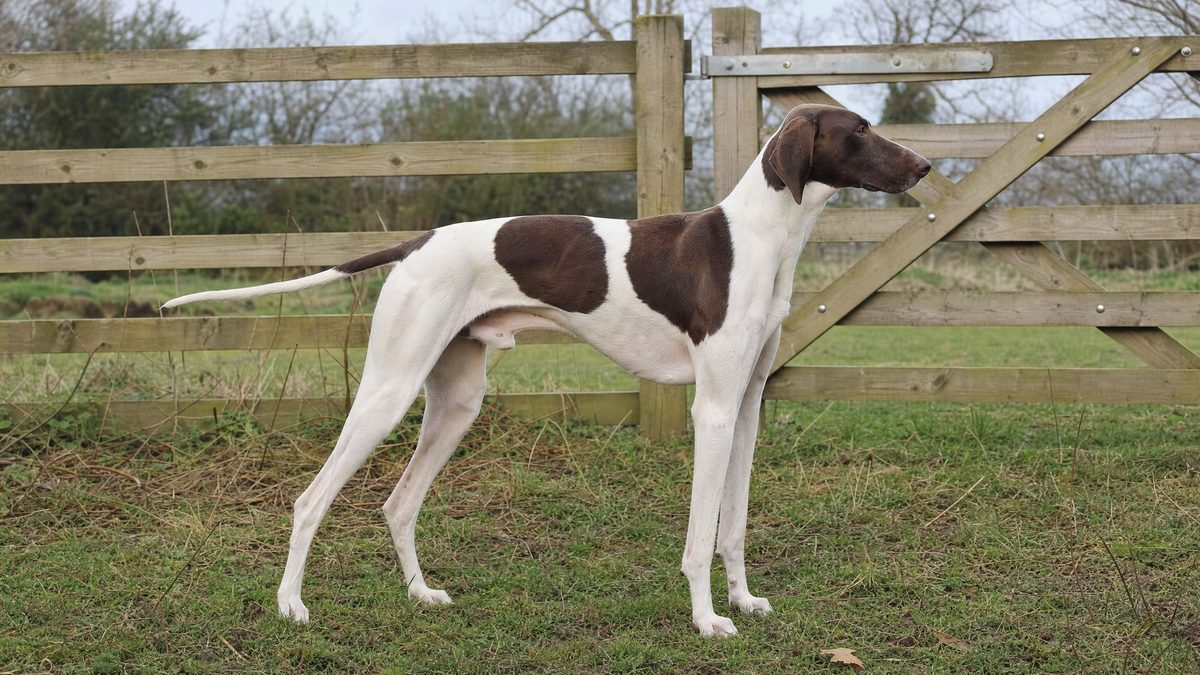
The Braque Dupuy was a French pointing dog from Poitou, the tallest of the French braques at 65 to 69 cm, mostly white with dark brown patches, and every reference work now records it as extinct Wikipedia, Braque Dupuy (French). It is not a rare breed you can buy. It is a name that outlived its dogs, and it is still attached to insurance quotes, genetic tests and phone apps.
Three things about this breed are settled and worth stating before anything else. It came from Poitou, in western France. It was very tall and built like a sighthound rather than a braque. And it was always rare, even in France, and almost unknown outside it.
The oldest description Bonbeno could open is also the plainest. Pertus, writing in Paris in 1893, gives the whole breed one sentence: "Le braque Dupuy. C'est un grand chien blanc et marron, plus leger que les braques francais, qui a ete cree, il y a soixante-cinq ou six ans, par M. Dupuy." A large white and brown dog, lighter than the French braques, created sixty-five or sixty-six years ago by Monsieur Dupuy. Subtract sixty-five or sixty-six from 1893 and you get 1827 or 1828.
The fullest contemporary description in English comes from Walter Esplin Mason's Dogs of All Nations, 1915, which files it as the Dupuy Pointer at page 48. Mason gives 27 inches, 50 pounds, and "pure white with small or large dull brown markings". He describes "a big upstanding dog with considerable elegance in his movements", a narrow long head, a prominent occipital bone, golden brown eyes with "a rather melancholy expression", and a stern "long, set low and carried like a greyhound's tail";.
The one detail that matters most for an Indian reader
Read Mason's French section in order and one thing jumps out. Of the French pointing breeds he lists, the French Pointer's stern "is generally docked" and the Pointer of Ariege's tail is "generally docked", while the Dupuy's tail is long and carried like a greyhound's. The Braque Dupuy is the French braque that was never docked. That matters in India, because the Prevention of Cruelty to Animals (Dog Breeding and Marketing) Rules 2017 forbid tail docking outright, and the Braque du Bourbonnais standard still in force today instructs that the tail "should be docked at its base"; Prevention of Cruelty to Animals.
Why the name keeps appearing on commercial pages
The Braque Dupuy has an unusually active afterlife for a dog nobody has bred in living memory. A pet insurer published a fresh breed page in June 2026 with a 12 to 14 year life expectancy and a quote button. A working genetics laboratory sells a 189 dollar hereditary-disease screening panel and a ten-year DNA banking service under the breed's name. A phone app offers to scan your dog and tell you whether it is one. None of those pages says the breed is gone.
If you searched this breed name hoping to buy a puppy, the useful answer is not a price. It is that no registry anywhere records a living Braque Dupuy, and that the pages offering you insurance, DNA tests and identification apps for one are template pages, not evidence.
The registry position, read off the FCI's own nomenclature rather than a summary
The Braque Dupuy holds no FCI recognition of any kind today. It is absent from the definitive nomenclature, absent from the provisional list, and absent from Group 7, and Bonbeno confirmed each of those against the FCI's own pages with the list title printed inside the document.
Check one, the alphabetical nomenclature. The FCI's B page lists six French braques: Braque d'Auvergne (180), Braque de l'Ariege (177), Braque du Bourbonnais (179), Braque Francais type Gascogne (133), Braque Francais type Pyrenees (134) and Braque Saint-Germain (115). There is no Braque Dupuy. Six siblings on the same page is the control. The search plainly works for the word braque.
Check two, the provisional list. This one has to be done carefully, because the obvious-looking URL at fci.be that appears to serve the provisional list actually returns a complete English Setter page. The real list sits at nomenclature/provisoire.aspx and prints its own heading, "Breeds recognised on a provisonal basis", typo included. It holds 21 breeds, the most recent four recognised on 2 November 2026, and the Braque Dupuy is not one of them.
Check three, the group. FCI Group 7, Pointing Dogs, section 1.1 "Braque" type, lists the same six French entries and nothing else from France. Across the whole of Group 7 there are 31 breeds and no Dupuy.
The claim that the FCI still lists it, and why it is now wrong
The best English-language writer on continental pointing dogs, Craig Koshyk, wrote in 2015 that "despite that fact that no one has actually bred a Braque Dupuy in over half a century, the FCI continues to publish the breed's official standard and still lists it in Group 7 for pointing dogs";. That sentence is quoted widely. It does not match the FCI's nomenclature as it stands in 2026.
Koshyk's own later work resolves it. In 2021 he wrote that France "has already lost two breeds of griffon (the Boulet and the Guerlain), two breeds of braque (the Dupuy and the Mirrepoix), and one breed of epagneul (the Larzac)", and in the same article he documents exactly how the FCI handles such breeds: it carried the Griffon Boulet's standard for years, and "in 1984 the breed was finally removed from the list of recognized breeds and its standard dropped";. Standards for extinct breeds get published for a while, then deleted.
The gap at 178 is the breed itself, and the FCI's own register says so. FCI standard numbers 177, 179 and 180 are all French braques and all live, and 178 sits between them returning a 404 on the standards server with no entry in any current group list. An earlier revision of this page reported that gap and drew no conclusion from it. The record is retrievable: the FCI's nomenclature server still answers for retired numbers, and 178 returns BRAQUE DUPUY, filed in Group 7, Continental Pointing Dogs, subsection Braque Type, under four names, DUPUY POINTING DOG in English, BRAQUE DUPUY in French, DUPUY-VORSTEHHUND in German and BRACO DUPUY in Spanish. Its date of acceptance on a definitive basis by the FCI is 29 June 1955, and its breed status field reads Cancelled. So the FCI did once recognise this dog, fully and definitively, which is why a careful writer in 2015 could say the breed was still listed. What is true today is narrower and it is the point: the record survives as a cancelled entry, the standard is gone, and the breed appears in no current nomenclature.
A French breed can be carried by the Societe Centrale Canine without holding FCI standing, and the mechanism Koshyk describes is explicitly the SCC's, not the FCI's. So the FCI answer above settles only half the question. The French studbook has to be read separately, and it turns out to hold the better evidence.
Fifty-seven editions of the French studbook, and the one line the Braque Dupuy appears in
Bonbeno downloaded every published Societe Centrale Canine LOF statistics edition from 1969 to 2025, 57 documents, extracted each one with pypdf, and searched all of them for the breed. The name appears twice in 57 documents, and never as a registration.
The controls first, because an absence is only worth reading if the search demonstrably works. The word braque appears between 6 and 31 times in every single edition, and every edition extracted to readable text with none coming back empty. Braque Saint-Germain, Braque du Bourbonnais, Braque d'Auvergne and Braque de l'Ariege all appear repeatedly across the run. The searches work.
Appearance one: the 2006 edition, at zero
The 2006 edition is one of the rare years in which the SCC printed its complete nomenclature rather than only the breeds with activity, 370 rows in all, including 106 rows at zero. In FCI group 7, between Braque du Bourbonnais and Braque Francais, sits the line "7 BRAQUE DUPUY 0 0 0";.
The three columns are Total Descendance Inscription, Total Livre d'Attente Inscription, and Total Inscription. Bonbeno checked the table against its own printed grand total of 169,823 descendance, 104 livre d'attente and 169,927 overall. The rows sum to exactly those figures once you account for a single row, TOSA at 29, that the page break splits across two lines. So the table is complete and the Dupuy row is real.
That second column is the important one. The Livre d'Attente is the appendix register through which a dog of unrecorded ancestry enters the French studbook, and it is the actual legal mechanism by which a lost French breed gets reconstituted. In 2006 the whole of France entered 104 dogs into it across every breed. None of them was a Braque Dupuy.
Appearance two: the 2002 demand table, one letter and no puppies
The 2002 edition carries a table of "Demandes de chiots parvenues a la SCC", puppy enquiries received by the French kennel club, ranked by breed and set against births. The Braque du Puy row reads 257, 1, 289. Rank 257 for demand, one enquiry, and a births rank of 289 in the band where the births column is blank.
The arithmetic on neighbouring rows confirms the reading. Braque de l'Ariege the same year shows 257, 1, 222, 6, 0.17, and one divided by six is 0.1667. So in 2002 exactly one member of the public wrote to the Societe Centrale Canine asking about a Braque Dupuy puppy, and the studbook recorded no births to point them at.
And then the line disappears
Bonbeno identified every edition that prints a full nomenclature with zero rows, which is 2006, 2007, 2013, 2014, 2015 and 2019. The Braque Dupuy line is present in 2006 and absent from all five later ones. The 2007 edition lists twelve braques where 2006 listed thirteen Societe Centrale Canine Societe Centrale Canine Societe Centrale Canine.
Michel Comte, credited with recreating the Braque du Bourbonnais, told Craig Koshyk that a breed thought extinct can stay listed as a way of "keeping the porch light on", so that a standard and judges exist if anyone tries to revive it, and that without that policy the Bourbonnais would never have been recreated. The French studbook shows both halves of that story. The porch light was on for the Braque Dupuy through the 2006 edition, at zero. It is off in every full edition since.
Extinct, or just unregistered? On this breed the two answers separate cleanly
The Braque Dupuy is extinct, not merely unregistered, and the difference is testable. An unregistered breed leaves traces outside the studbook, in breeder directories, classified adverts and club listings. Bonbeno looked for those traces and found none, while the same searches returned them for the sibling braques.
This distinction matters because Bonbeno has drawn the opposite conclusion elsewhere. On the Grand Anglo-Francais Blanc et Orange, a breed with no LOF registration in any edition from 2005 to 2025, the same registry still listed six breeder affixes, so the honest verdict was unregistered rather than extinct. Run the same tests on the Braque Dupuy and every one comes back empty.
Test one: does the French kennel club carry a breed page or a club?
No. The Societe Centrale Canine site has no breed page at le-chien-de-race/braque-dupuy, and a site-wide index search for braque returns Braque d'Auvergne, Braque du Bourbonnais, Braque Francais type Pyrenees, Braque italien, Braque slovaque, Braque de Weimar, Braque allemand and Braque hongrois, plus breed clubs for the Saint-Germain, the Bourbonnais, the Braque Francais, the Braque Allemand and the Braque Hongrois. Nine braque names come back and the Dupuy is not among them, which is a control and a result in one query.
Test two: does any live classified market list one?
No, and this test carries its own control on the same page. Trovacuccioli, a European puppy classifieds site, publishes an advert counter beside every breed category. Bracco Dupuy - Braque Dupuy reads (0). On the same list, Braque de Saint-Germain reads (4), Braque d'Auvergne (3), Braque Francais Type Pyrenees (3), Bracco Italiano (61) and Vizsla (74). The counter is working. There is simply nothing in the Dupuy category.
Test three: what do the people claiming otherwise actually say?
Four claims of survival circulate, and none of them names a dog, a breeder or a litter. Wikipedia's English article says the breed "is generally believed to be extinct today, although there are claims to the contrary", and that clause carries no citation at all. PagesJaunes says the breed has disappeared "mais des passionnes pourraient travailler a sa reconstitution", enthusiasts might work on reconstituting it, in the conditional tense and trailing into an ellipsis. Dog Breed Info says a few people believe the breed still exists in remote European towns and that breeders who claim to sell it are probably offering re-creations. MolosserDogs says some authors think it may be extinct "although this is not certain";.
The last dog anyone has named
One account does name a specific animal. Christophe Oriou, who researched the breed while living in Poitou in the 1990s, told Koshyk that the last Dupuy with a real pedigree belonged to a Mr Charpentier, a dentist in the village of St Jean de Sauves, and that the dog died in 1964. Oriou saw the widow's colour photographs of it. Bonbeno cannot independently verify that account, and reports it as testimony rather than record.
A French veterinary thesis reaches the same place from a different direction. Bertrand Michaud, writing at the Ecole Nationale Veterinaire de Lyon in 2005, argues that "il parait bien vain de vouloir recreer une race deja eteinte", that it seems quite futile to want to recreate an already extinct breed, gives the Braque de l'Ariege as his worked example of people trying to revive a breed "sur la foi de temoignages divers et d'apres certaines gravures", on the strength of assorted testimony and certain engravings, and then writes "on peut dire de meme du Braque Dupuy", the same can be said of the Braque Dupuy. He records both origin theories, confirms Poitou as the region of origin, and says the dog "aurait aujourd'hui disparu";.
That 2005 judgement is worth testing, because Michaud was wrong about one of his two examples. The Braque de l'Ariege holds FCI standard 177 and posted 38 French registrations in 2024 and 6 in 2025, so the revival he dismissed did in fact produce a registered breed. The Braque Dupuy produced nothing. Same author, same paragraph, two predictions, and the studbook separates them.
Working backwards from that date is instructive. Jean Castaing wrote in 1960 that any dog then being called a Braque Dupuy was "most often a bastard of unknown origins whose sighthound look is more or less of the Dupuy type", and that he did not believe an organised breeding programme existed. So the last pedigreed dog and the last contemporary judgement land within four years of each other, and both point the same way.
Bonbeno finds no registry, no directory, no classified listing, no club and no named living animal. Every survival claim is either uncited, in the conditional tense, or explicitly about re-creations rather than the breed. On that evidence the Braque Dupuy is extinct. What we cannot rule out is that somebody, somewhere, is breeding dogs of Dupuy type privately, because an unrecorded private effort is by definition not in any record we can search.
The origin story: five versions, and which of them rest on a document
Five separate origin stories circulate for the Braque Dupuy, and only one strand of them is supported by a source published while the breed was alive. The Sloughi named Zidar, the gamekeeper hiding dogs in an abbey during the Revolution and the Marquis de Rochelambert's two-hundred-year strain all appear first in modern retellings, not in the nineteenth-century literature Bonbeno could open.
Here are the five, as MolosserDogs and Wikipedia set them out Wikipedia, Braque Dupuy (English).
- Refined from a white-and-chestnut strain pure-bred for 200 years at the estate of the Marquis de Rochelambert, by a Poitou stock-breeder called Dupuy.
- An ancient French breed nearly wiped out in the Revolution, saved by dogs hidden in the Abbey of Argensois under a game warden called Dupuy.
- Created in the early nineteenth century by two gamekeeper brothers, Homere (or Omer) and Narcisse Dupuy, who mated their liver-and-white French Pointer bitch to a Sloughi called Zidar, imported from North Africa by a Lieutenant Roy of the 33rd Artillery Regiment.
- Created by a huntsman called Pierre Dupuy, who mated his bitch Leda to a dog of unknown ancestry called Mylord.
- Created by crossing an exceptional Poitou Pointer with an imported Greyhound.
MolosserDogs itself notices the problem. "The contrasting stories are all so specific and the surfeit of Dupuys is embarrassing";.
A sixth claim sits underneath all five and attracts far less argument. Wikipedia states that the breed "was more closely related to the Pointer than it was to the other French braque breeds" and that "its foundation stock was extensively outcrossed to the English Pointer";. MolosserDogs says the same, that the breed "was more strongly influenced than the other French pointers by the introduction of the English Pointer blood during its creation in the 19th century";. Project Upland's account of why the breed died supports it from the other side, describing a faction of supporters who wanted the dog to be "basically the French version of England's Pointer";. So the English Pointer outcross is the one ancestry claim on which the modern sources agree with each other, even though none of them dates it.
What the nineteenth-century sources actually say
Pertus, 1893, writing while the breed was still being shown, attributes it to a single "M. Dupuy", gives no first name, no brother, no sighthound and no date beyond "sixty-five or six years ago";. That same book discusses the Sloughi three pages earlier, at page 18, purely as the Algerian sighthound used by local hunters for jackal, hartebeest and gazelle, with no connection whatsoever to the Dupuy. The two entries sit in the same volume and the author draws no line between them.
Le Magazine du Chien de Chasse, writing in January 2025 and citing Gaston Hublot's nineteenth-century brochure on the breed, gives the same short version. "Le Braque Dupuy a ete cree dans le Poitou par Mr Dupuy, qui etait un grand chasseur au XIXe siecle. Comme il voulait un chien plus rapide que les autres Braques, il avait donc croise un Braque francais avec un Levrier";. One Monsieur Dupuy, a great hunter, who wanted a faster dog and crossed a Braque Francais with a levrier, the generic French word for a sighthound.
| Claim | Earliest source we could open | Verdict |
|---|---|---|
| Created in Poitou by a man named Dupuy | Pertus 1893; Hublot brochure via Le Magazine du Chien de Chasse | Supported by a contemporary source |
| Created around 1827 or 1828 | Pertus 1893, sixty-five or six years before publication | Supported, and it conflicts with the 1808 date |
| Crossed with a levrier, a sighthound of unstated breed | Hublot brochure via Le Magazine du Chien de Chasse; Larousse du chien 1974 via Wikipedia FR | Supported in general terms only |
| The sighthound was a Sloughi named Zidar | Modern breed-profile pages only | Repeated, not documented |
| Imported by a Lieutenant Roy, 33rd Artillery Regiment | Modern breed-profile pages only | Repeated, not documented |
| Two brothers, Omer and Narcisse Dupuy, from 1808 | Koshyk 2015 and modern pages | Repeated; conflicts with Pertus |
| Hidden in the Abbey of Argensois during the Revolution | Modern breed-profile pages only | Repeated, not documented |
| Pure-bred 200 years at the Marquis de Rochelambert's estate | Modern breed-profile pages only | Repeated, not documented |
There is a further wrinkle worth flagging. Koshyk's 2015 account has the foundation sire called Remus and the braque bitch called Leda, bred together; Wikipedia and MolosserDogs have Leda bred to a dog called Mylord Wikipedia, Braque Dupuy (English). The same bitch appears in two stories with two different mates.
Sighthound crossing into pointing stock is ordinary and undramatic. The Hublot version says levrier, meaning any sighthound, and PagesJaunes says greyhound. Naming the individual dog Zidar and the officer who imported him adds specificity without adding evidence, and specificity is exactly what makes an undocumented story sound documented.
Six published sources, six different dogs: what the figures actually disagree about
Published figures for the Braque Dupuy disagree on height by 7 cm, on weight by 14 kg, and on life expectancy by four years, and not one of the lifespan figures carries a source. For a breed with no living population, that spread is not measurement error. It is what happens when pages copy each other.
Bonbeno opened each of these and recorded what it prints.
| Source | Height | Weight | Life expectancy |
|---|---|---|---|
| Mason, Dogs of All Nations, 1915 (contemporary) | 27 in (68.6 cm) | 50 lb (22.7 kg) | not given |
| Wikipedia EN and FR | 65 to 69 cm | 22 to 28 kg | not given |
| PagesJaunes / Ooreka | 67 to 68 cm male, 65 to 66 cm female | 30 kg | 12 years |
| Petplan (insurer) | 62 to 68 cm | 22 to 28 kg | 12 to 14 years |
| Dog Breed Info Center | 63 to 69 cm | 35 to 55 lb (15.9 to 24.9 kg) | about 10 to 12 years |
| Google knowledge panel, India SERP | not given | 22 to 28 kg both sexes | not given |
Take the weight column on its own. Dog Breed Info's lower bound of 35 lb is 15.9 kg, and PagesJaunes gives 30 kg PagesJaunes / Ooreka. That is a factor of nearly two on the same breed, and Mason, the only source who could have weighed one, gives 50 lb.
Three life expectancies for a breed that has not produced a puppy in sixty years
Twelve years, twelve to fourteen years, and about ten to twelve years Petplan (pet insurance) Dog Breed Info Center, Braque De Puy. None of the three cites anything. There is no longevity study on this breed, no breed-club mortality survey, and no cohort to draw one from, so these numbers are not estimates of anything. Bonbeno publishes no life expectancy for the Braque Dupuy.
The tropical-heat quotation, followed back to a book that does not contain it
One line about this breed circulates more than any other on the question of hot climates. "I have seen a brace that would come to their points at awful distances, by a tropical heat; hence, for the hot departments of France they are admirably suited." It is attributed to Walter Esplin Mason, Dogs of All Nations, page 48, and copied onward from there.
Bonbeno downloaded the full text of Dogs of All Nations from the Internet Archive and searched it. The word tropical appears zero times in the entire 290,887-character book. So does the phrase "hot departments". The Dupuy Pointer entry at page 48 is 96 words long and is reproduced in full in the overview section above; it says nothing about climate at all.
The first block quotation in the same 2015 article, the one left unattributed, is the genuine Mason text and matches word for word. So the attribution has slipped by one quotation. Whatever source the tropical-heat line came from, it is not the book it is credited to, and Bonbeno could find no other printed source for it. Every page that repeats it is repeating an untraceable claim about the one thing an Indian buyer would most want verified.
Search Mason's 1915 text for "Braque" and you get zero hits, because the book calls every one of them a Pointer of somewhere. Search for "Dupuy Pointer" and the entry is there at page 48, between the French Pointer and the Pointer of Ariege. A zero from the first search would have been a manufactured absence, not a finding.
Braque Dupuy price in india: there is no price, and here is what you are shown instead
No Braque Dupuy price exists in India, because no Braque Dupuy exists anywhere. Search the breed name with price and rupees from an Indian location and you get generic dog-price listicles for other breeds, and the only object anyone will actually sell you under this name is a 1907 postcard.
Start with the scale of the thing. Google's India SERP for braque dupuy reports About 116 results for the entire indexed web. Position ten on that page is an eBay listing for a French lithograph postcard of a Braque Dupuy captioned "Diane, 1er Prix", at 9.99 dollars. At 84.38 rupees to the dollar that is about 843 rupees, and it is a picture.
The searches, and the controls that show they ran
Bonbeno searched from an India location for the breed name with price, rupees, puppies for sale and breeders. No result offered a Braque Dupuy at any price. The control is that the same searches returned plenty of Indian commerce, including Supertails' dog price list for India and a Wrap In Fur price list covering 50-plus breeds, so the query was demonstrably reaching Indian retail pages. It simply was not reaching this breed, because Indian retail does not carry it.
Rs 98,999 is a house price point, and here it is on the shelf
One rupee figure turns up on Indian puppy pages so often that it has become a tell. Bonbeno opened the Puppiezo listing carousel and found it live: Aalto, a Maltipoo, 8 weeks old, Rs 98,999, Platinum tier. Beside it in the same grid sit Rs 88,999, Rs 84,499, Rs 86,599, Rs 92,499, Rs 93,499, Rs 87,999 and Rs 87,499. If you meet Rs 98,999 attached to a breed name, it is the shelf price of whichever puppy is in stock, not a valuation of the breed.
Test whether that number is a converted dollar figure and it fails both ways. Divide by 84.38 and you get 1,173.25 dollars. Divide by 74 and you get 1,337.82 dollars. Neither is a price anyone would quote. The whole Puppiezo grid ends in 999, 499 and 599, which is rupee-native charm pricing rather than an American list run through a single exchange rate. So this particular carousel is not a conversion job, it is Indian retail inventing round-feeling numbers, and the numbers move with stock rather than with breed.
The other half of the check settles it. Puppiezo's own breed filter lists roughly fifty breeds, from Akita to Yorkshire terrier, and not one braque of any kind appears in it. The site that carries the Rs 98,999 price point does not claim to stock this breed at all.
| Rupee figure | Divided by 84.38 | Divided by 74 | Reading |
|---|---|---|---|
| Rs 98,999 | USD 1,173.25 | USD 1,337.82 | Neither is round, so it is rupee-native |
| Rs 84,499 | USD 1,001.41 | USD 1,141.88 | Close to 1,000 at 84.38 but not exact |
| Rs 235,000 | USD 2,784.55 | USD 3,175.68 | Neither is round |
Anybody quoting you a Braque Dupuy in India is not selling you this breed, because there is nothing to sell. Ask which registry the parents are entered in and check the answer against the FCI nomenclature and the French studbook yourself. Both are free and both are linked from the citations on this page. A pointing dog you can actually get and verify in India is a different and better conversation, and the Braque Francais is where it starts.
Indian import law would close this route even if the breed existed
Indian law makes importing a dog for breeding or trade impossible, so no supply chain for a revived Braque Dupuy could lawfully form here. Two documents settle it, and Bonbeno read both in full rather than relying on any summary of them.
DGFT Trade Notice 22/2022-23, dated 19 December 2022, sets the import policy for dogs. Under ITC(HS) 01061900 the import status is Restricted. Policy Condition (7) permits import only for three purposes, which are a pet dog with a valid pet book and records in the importer's own name, dogs imported by R&D organisations with a CPCSEA recommendation, and dogs for internal security by the Defence and Police Force. Policy Condition (8) states that import of commercial dogs for breeding or any other commercial activity outside those purposes is not permitted.
Paragraph 6 removes any ambiguity. "Any applications for trading or breeding purposes, or applications made on behalf of some another person or entity shall be duly rejected";.
The practical constraints are just as tight. Import is allowed only through the airports and seaports of Delhi, Mumbai, Chennai, Hyderabad, Bengaluru and Kolkata and, since October 2024, Kochi airport, with quarantine at the government station where required. The baggage route needs two years of continuous residence abroad. Everything else needs a DGFT authorisation, and the notice advises starting at least two months before travel. The full route is set out in how to import a dog to India.
And Indian breeding law forbids the reconstruction itself
This is the part no other page on this breed has connected. The Prevention of Cruelty to Animals (Dog Breeding and Marketing) Rules 2017 contain two provisions that a revival programme cannot satisfy.
- Second Schedule Part II paragraph 6(9) states that "breeding to create new breeds of dogs or unusual looks shall be strictly prohibited";. Reconstructing an extinct breed from unrelated stock is, in law, breeding to create a new breed.
- Second Schedule Part II paragraph 6(3) prohibits in-breeding within the first four generations, naming uncle to niece, nephew to aunt, cousin to cousin and grandparent to grandchild, and separately prohibits incest breeding between parents and offspring or between siblings. Every reconstruction from a handful of founders needs exactly the close breeding that clause bans.
- Rule 8, Conditions for sale, sub-rule (1)(a), requires that "pups less than eight weeks in age are not sold". This is Rule 8, not the Second Schedule paragraph 8, and the two are numbered separately in the same document.
- Second Schedule Part II paragraph 6(8) forbids tail docking, ear cropping, de-barking, de-clawing and "any other kind of mutilation of any body part of the pup";. The Braque Dupuy's undocked tail was already correct here; several of its surviving relatives' standards are not.
Read together, the two documents mean an Indian buyer cannot lawfully import breeding stock, and an Indian breeder cannot lawfully run the programme that would produce it. Between them they close the supply route at both ends.
The Department of Animal Husbandry copy of these Rules circulates as an image scan with no text layer, so any tidy paraphrase of it was generated rather than read. Bonbeno downloaded the machine-readable gazette text hosted by the Animal Welfare Board of India, extracted it with pypdf and grepped for each phrase quoted above before using it. Check the clause number against the document, not against a blog.
Cost of ownership: the only bills this breed name can actually generate today
Bonbeno publishes no monthly keeping cost for the Braque Dupuy, because there is no dog to keep and no Indian cost survey for it. What we can price precisely is the small set of products currently sold under the breed's name, and those prices are real.
Three commercial offers exist against this breed name right now, and each has a published or requestable price.
| Product | Vendor | Listed price | Approx. rupees at 84.38 |
|---|---|---|---|
| Screening for hereditary diseases and appearance traits, 340 markers | Genomia genetics laboratory | USD 189.00 | about Rs 15,900 |
| DNA banking, sample preserved 10 years | Genomia genetics laboratory | USD 22.00 | about Rs 1,860 |
| Premium SNP DNA profile, ISAG 2020 | Genomia genetics laboratory | USD 64.00 | about Rs 5,400 |
| Pet health insurance for a Dupuy Pointer | Petplan | quote only, no price published | not disclosed |
| Vintage lithograph postcard, Paris, circa 1907 | eBay seller | USD 9.99 | about Rs 843 |
The genetics prices come from Genomia's own breed page, which offers the full panel of coat-colour loci, a malignant hyperthermia test, allergy panels and clonality analysis for the Dupuy Pointer exactly as it does for every other breed in its list. There is no Dupuy-specific marker on that list, because no Dupuy-specific variant has ever been described. The page is a template.
Why we will not estimate a monthly figure
Feeding, grooming, vaccination and vet costs for a 65 to 69 cm short-coated gundog in India are knowable in principle, but publishing them here would create a false impression. It would imply somebody could acquire one and start paying them. The honest statement is that the recurring cost of owning a Braque Dupuy in India is undefined because ownership is not available, and that any page giving you a monthly figure has produced it by analogy without saying so.
For a reader who actually wants a French pointing dog and a real budget, the comparison to make is with a breed that has living dogs and a functioning club. Three of the four surviving French braques posted registrations in the 2025 French studbook, so their costs are at least anchored to a market that exists.
One cost that is certain and often forgotten
If a dog of this description ever did reach India, the ear bill would be the recurring line item, not the coat. A 68 cm dog with long thin drop ears folded against the cheek carries the classic anatomical risk factor for otitis externa, and Indian series put the peak firmly in the monsoon. The Palampur study recorded 48 of its 81 cases in July and August alone, which is 59.25 percent of a year's caseload landing in two months. Budget for cleaner, for vet visits in those two months, and for the fact that a course of treatment is not a cure if the underlying anatomy stays wet.
Before paying anybody anything under this breed name, spend nothing and check two free registries. The FCI nomenclature at fci.be lists six French braques and no Dupuy. The French studbook statistics at centrale-canine.fr are published as free PDFs for every year since 1969. Ten minutes there is worth more than any breeder's assurance.
Heat tolerance in India: Bonbeno rates this breed 3 of 5, and the rating describes a document
To judge the Braque Dupuy against Indian heat, compare its home climate with an Indian one using coordinates rather than place names. Poitiers, in Poitou, has an annual mean air temperature of 11.90 degrees. Chennai's is 27.95. Chennai's coldest month is warmer than Poitiers' warmest month.
Bonbeno queried NASA POWER by explicit latitude and longitude, so no place-name slug could quietly return a different city. Each query echoes back the coordinates it answered for, and we checked them.
| Location | Coordinates | Annual mean | Warmest month mean | Coldest month mean | Peak monthly humidity |
|---|---|---|---|---|---|
| Poitiers, Poitou, France | 46.5802 N, 0.3404 E | 11.90 | 20.59 (Jul) | 4.01 (Jan) | 92.9% (Dec) |
| Chennai | 13.0827 N, 80.2707 E | 27.95 | 31.51 (May) | 24.09 (Jan) | 82.3% (Nov) |
| Delhi | 28.6139 N, 77.2090 E | 25.60 | 35.88 (Jun) | 13.61 (Jan) | 74.9% (Aug) |
| Kolkata | 22.5726 N, 88.3639 E | 25.81 | 31.53 (May) | 17.31 (Jan) | 89.3% (Sep) |
| Pune | 18.5204 N, 73.8567 E | 23.86 | 28.93 (Apr) | 19.62 (Dec) | 90.8% (Aug) |
The three numbers that carry the argument
First, Chennai's coldest month averages 24.09 degrees and Poitiers' warmest averages 20.59 NASA POWER climatology. Subtract and the gap is 3.50 degrees the wrong way round. A dog bred in Poitou has no season in Chennai as cool as its home summer.
Second, the annual means differ by 16.05 degrees between Chennai and Poitiers, and by 13.70 between Delhi and Poitiers. Delhi's coldest month, at 13.61 degrees, is still 1.71 degrees warmer than the Poitou annual average.
Third, Delhi's June mean of 35.88 degrees sits 15.29 degrees above the warmest month this breed's home region ever produced. That is not a hot summer for a Poitou dog. It is a different thermal world.
Why the rating is 3 rather than 2
The described phenotype is genuinely well configured for shedding heat, and it would be dishonest to pretend otherwise. Mason gives 27 inches and 50 pounds, which is a very tall dog carrying very little mass, so the surface area available for radiative and convective loss is large relative to the body it has to cool. The coat is short and fine with no insulating undercoat. The chest is deep and narrow and the limbs are long. Set that beside the Braque du Bourbonnais, which the FCI standard describes as 51 to 57 cm, compact, muscular and tending towards brachymorphic type, and the Dupuy is the better-shaped of the two for a hot climate.
What pulls the rating down is everything conformation cannot fix. Dogs shed heat mainly by panting, and panting capacity is not a matter of outline. No population of this breed was ever selected under heat, none was ever acclimatised, and there is no dog alive to test. A predominantly white, fine coat over thin skin also burns, which matters in a country where the WHO runs public heat advisories.
The heat claim gets stronger every time it is retold
Follow the claim back through its sources and watch it grow. Le Magazine du Chien de Chasse, drawing on Gaston Hublot's own nineteenth-century brochure, says the dog was "tres dur a la fatigue", very hardy against fatigue, and says nothing at all about heat. PagesJaunes says it was "dur a la fatigue et supportant bien la chaleur", hardy and tolerating heat well. By the time it reaches the English-language pages it has become a brace of dogs pointing at awful distances in tropical heat, attributed to a 1915 book whose full text does not contain the word tropical.
Every other heat rating on Bonbeno describes a living animal that Indian owners keep. This one describes a nineteenth-century written description. We publish it because the description is specific enough to reason from, and we flag it because a reader should know the difference between a rating built on dogs and a rating built on a paragraph.
Long thin drop ears in Indian humidity, and what the denominators actually show
A pendulous ear roughly doubles a dog's odds of otitis externa, and the best-powered study puts the figure precisely. In a random sample of 22,333 UK dogs, pendulous-eared dogs made up 24.22 percent of otitis cases against 18.12 percent of non-cases, an odds ratio of 1.87 with a 95 percent confidence interval of 1.57 to 2.21.
The Braque Dupuy's ears are described consistently across every source that describes them at all. Mason, 1915, has them "set on rather high, very fine in texture, not too long, and folded backwards";. PagesJaunes has them "minces et etroites... tres fines et souples, plus longues que courtes, et papillotees", thin, narrow, fine, supple, longer than short, and curled. Le Magazine du Chien de Chasse, from the Hublot brochure, has them "bien plantees et papillotees";. A thin, folded, curled pinna lying against the cheek.
The UK denominators, in full
O'Neill and colleagues drew a random sample of 22,333 dogs from 905,554 under primary veterinary care across 784 UK clinics in 2016, and identified 1,631 otitis externa cases, a one-year period prevalence of 7.30 percent with a 95 percent confidence interval of 6.97 to 7.65. Divide 1,631 by 22,333 and you get 7.303 percent, so the headline figure reconciles.
| Ear carriage | Cases (percent) | Non-cases (percent) | Odds ratio | 95% CI |
|---|---|---|---|---|
| Erect | 220 (13.49) | 3,898 (18.83) | base | reference |
| Semi-erect | 276 (16.92) | 4,654 (22.48) | 1.05 | 0.88 to 1.26 |
| V-shaped drop | 299 (18.33) | 2,734 (13.21) | 1.94 | 1.62 to 2.32 |
| Pendulous | 395 (24.22) | 3,752 (18.12) | 1.87 | 1.57 to 2.21 |
| Variation within breed | 441 (27.04) | 5,664 (27.36) | 1.38 | 1.17 to 1.63 |
Two things in that table are worth pausing on. A V-shaped drop ear scores 1.94, slightly higher than a fully pendulous one at 1.87, which the authors flag as a novel finding rather than an expected one. And a semi-erect ear is statistically indistinguishable from an erect one, with a confidence interval straddling 1.00. So the risk is not a smooth gradient from up to down. It turns on whether the flap seals the canal.
One inconsistency inside the paper is worth naming. The results table gives the pendulous odds ratio as 1.87, while the discussion says pendulous breeds had "1.76 times the odds" compared with erect. Bonbeno quotes the table figure with its interval, because that is the one with a stated confidence range attached.
Why the Indian version of this problem is seasonal, not constant
In India the ear question is really a monsoon question. Pune's August mean relative humidity is 90.8 percent, Kolkata's September figure is 89.3 percent, and Palampur, where the Indian study below was run, hits 76.5 percent in August NASA POWER climatology NASA POWER climatology.
Against that, the Palampur series recorded 48 of 81 otitis cases in July and August, which is 59.25 percent of the year's caseload in two months, with summer at 18.51 percent, winter at 12.34 percent and autumn at 9.87 percent. Those four figures sum to 81 cases exactly and to 99.97 percent, which is rounding rather than error.
Overseas gundog guidance routinely says to towel a dog off and let the ears air dry. That is fine in Poitou, where August humidity averages 65.9 percent. It is wrong in Pune in August at 90.8 percent, where nothing air dries. Dry the ear canal mechanically, and plug the ears before any bath during the monsoon.
The Indian ear study everyone will quote has a broken number in it, and the count is the broken half
The Palampur otitis study reports 69.13 percent of its cases in pendulous-eared breeds and gives the count as 53. Those two numbers cannot both be right. Divide them out and 53 of 81 is 65.43 percent, while 69.13 percent requires 56, and three independent checks all point to 56.
The study is a cross-sectional analysis by Nainika and Pardeep Sharma at the Dr G.C. Negi College of Veterinary and Animal Sciences, CSK Himachal Pradesh Krishi Vishvavidyalaya, Palampur. It screened 2,476 dogs presented between June 2022 and July 2023 and diagnosed 81 with otitis externa, a hospital prevalence of 3.27 percent. Divide 81 by 2,476 and you get 3.271 percent, so the headline is sound.
Table 5 lists predisposing factors. The row reads Pendulous ear breed, n = 53, 69.13 percent. The row below reads Erect ear breed, n = 25, 30.86 percent.
Three checks, all agreeing on 56
- The percentage requires it. 53 divided by 81 is 65.43 percent, not 69.13. 56 divided by 81 is 69.14 percent, which is 69.13 truncated rather than rounded. The published percentage is consistent with 56 and with nothing else.
- The neighbouring row is correct. 25 divided by 81 is 30.864 percent, matching the printed 30.86 exactly. So the erect-ear row was computed properly, and the fault is confined to one cell.
- The sample closes on 56. Every dog has either a pendulous or an erect ear, so the two rows must sum to 81. 56 plus 25 is 81. 53 plus 25 is 78, leaving three cases with no ears at all.
Where the 53 came from, which is the satisfying part
The stray figure is not random. The paper's own results text states that "bacterial infections were present in 65.43 percent" of cases. Divide 53 by 81 and you get 65.432 percent. So 53 is the bacterial-infection count, and it has been typed into the pendulous-ear cell.
Table 5 makes the mechanism visible. One column to the left of the predisposing factors sit the secondary causes, where rod-associated infections number 23 and cocci-associated 30. Add them and you get 53. The number migrated one column across inside a single table.
| Row | Printed n | Printed percent | n divided by 81 | Verdict |
|---|---|---|---|---|
| Pendulous ear breed | 53 | 69.13 | 65.43 | Count is wrong; should read 56 |
| Erect ear breed | 25 | 30.86 | 30.86 | Correct |
| Hypersensitivity | 37 | 45.67 | 45.68 | Correct |
| Excessive moisture | 17 | 20.98 | 20.99 | Correct |
| Treatment error | 9 | 11.11 | 11.11 | Correct |
| Aural polyps | 6 | 7.40 | 7.41 | Correct |
Bonbeno checked every other table in the paper the same way. Breeds sum to 81, age groups sum to 81, sexes sum to 81 and seasons sum to 81, and each percentage divides out correctly. One further slip exists in the prose, where a sentence opens "In a study of 50 cases of Otitis externa" and then gives its figures as fractions of 81. Both errors are transcription, and neither touches the study's design.
Quote 56 of 81, or 69.13 percent, and say which. The percentage is the reliable half and the count as printed is not. Anyone repeating 53 of 81 as 69.13 percent is repeating a number that fails a two-second division, which is the cheapest fabrication check there is and the one this site runs on every n of N it meets.
Health: no screening data, no literature, and the searches that prove those absences
Bonbeno publishes no health prevalence figure and no life expectancy for the Braque Dupuy, because none exists. Two databases were searched with controls in the same session, and both returned genuine zeros for this breed while returning real numbers for its surviving relatives.
The Orthopedic Foundation for Animals holds nothing
OFA's disease-statistics page ships every breed table inline, and Bonbeno pulled the full document, 2,225,910 characters of it, and searched the whole thing case-insensitively. Dupuy returns zero. The controls make that meaningful: Labrador appears 109 times, German Shepherd 75, Pointer 166 and Braque 42.
Two French braques do appear with real numbers, which is the strongest control available. Braque Francais carries 139 hip evaluations with 97 rated excellent, 69.8 percent, and a 4.3 percent affected rate on another database from the same 139 dogs. Braque d'Auvergne carries 53 evaluations at 58.5 percent excellent, and one microphthalmos case in 53 tested, 1.9 percent. So OFA does index rare French pointing breeds when dogs are submitted. Nobody has submitted a Braque Dupuy, because there is none to submit.
A note on caution here. A first attempt at OFA using an ordinary fetch returned 49,168 characters in which Labrador appeared zero times. That is impossible, and it is the JavaScript shell rather than the data. Bonbeno discarded that result rather than reporting its zeros.
PubMed holds nothing, and the query translation says why
Searching PubMed through the NCBI E-utilities returns zero records for "Braque Dupuy", zero for "Dupuy Pointer" and zero for "Braque du Puy";. A bare count is not evidence, so Bonbeno read the query translations PubMed returns alongside them.
| Search term | Records | How PubMed translated it |
|---|---|---|
| "Braque Dupuy" | 0 | "braque"[All Fields] AND "dupuy"[All Fields] |
| "Dupuy Pointer" | 0 | "dupuy"[All Fields] AND ("pointer" OR "pointers")[All Fields] |
| "Braque Saint-Germain" | 3 | "Braque Saint-Germain"[All Fields], phrase preserved |
| "Braque francais" | 5 | "Braque francais"[All Fields], phrase preserved |
| "Braque du Bourbonnais" | 0 | decomposed to three separate All Fields terms |
| Labrador Retriever (control) | 1,811 | MeSH plus All Fields expansion |
| canine hip dysplasia (control) | 780 | MeSH term matched |
| dog otitis externa (control) | 680 | MeSH terms matched |
| Rajapalayam dog (control) | 1 | "Rajapalayam"[All Fields] AND dogs[MeSH] |
Read the translation column and the zeros become interpretable. For the Saint-Germain, whose three records can be opened individually and checked, and for the Braque Francais, PubMed recognised the breed name as an indexed phrase and returned records. For the Dupuy it did not, and even the loosest possible decomposition, braque AND dupuy anywhere in any field, still returns nothing. That is a real zero, not a query failure.
One honest caveat. Braque du Bourbonnais also returns zero, and it is a living FCI breed with 61 French registrations in 2025. Absence from PubMed proves an absence of research, not an absence of dogs. The OFA and studbook evidence is what carries the extinction finding; PubMed only shows that nobody has studied the breed.
What the ranking pages publish instead
PagesJaunes states flatly that "le braque Dupuy n'avait pas de maladies connues", the Braque Dupuy had no known diseases. For a breed with no health survey, no screening scheme and no registered population, that sentence means nobody looked, not that nothing was there. Petplan lists gastric dilatation-volvulus, ear infections and hip dysplasia as "common health problems of the Dupuy Pointer" and offers to insure against them. Those are the standard risks of a large deep-chested drop-eared dog, reasoned from the outline rather than measured in the breed.
The Dog Breeding and Marketing Rules 2017, Second Schedule Part III paragraph 8(10), require breeding dogs to be tested for a named list of genetic defects including hip dysplasia, progressive retinal atrophy, night blindness, hypothyroidism, entropion, ectropion, overshot and undershot jaw, wry mouth, missing teeth and cryptorchidism. No baseline exists for any of those in this breed, so a first Indian litter would be testing into the dark.
Temperament: what the old accounts describe, and the modern personality cards that invented the rest
Contemporary accounts of the Braque Dupuy describe a hunting temperament and nothing else. Every modern claim that it was gentle with children, timid with strangers or unsuited to apartments was written for a template, not observed in a dog, and the sources contradict each other on the basic question of whether it was bold or shy.
The nineteenth-century material is thin and consistent. Mason gives one temperament-adjacent detail, golden brown eyes with "a rather melancholy expression", and otherwise confines himself to structure. The Hublot-derived account calls it "tres dur a la fatigue et ne s'emportant jamais", very hardy against fatigue and never losing its head, and says it was genuinely valued by real French hunters. A letter from a Mr O. Pineau published in Le Chenil in June 1887 describes the working temperament in detail, saying the dog searches at a gallop when young and rested and drops to a fast trot when aged or tired.
Where the modern descriptions disagree with each other
PagesJaunes describes a dog "tres sage et prudent", very calm and cautious, "doux et soumis", gentle and submissive, and "plutot timide", rather timid, with its owner, and lists "parfois timide" and "parfois fuyant", sometimes timid and sometimes evasive, among its drawbacks. Dog Breed Info describes exactly the opposite dog, "stubborn and bull headed", not for everyone, and warns against leaving it with small animals. Google's own knowledge panel, drawing on neither, offers Lively, Agile, Intelligent, Dignified, Spirited and Swift.
Timid and submissive, or stubborn and bull headed. Both descriptions are written in the past tense about the same extinct dog, and neither cites anything.
The one household claim that is checkable, and it fails
PagesJaunes files the Braque Dupuy under "Chien de categorie 1: permis de detention et museliere obligatoires" and "Chien de categorie 2: port de la musiere obligatoire", France's regulated attack-dog and guard-dog categories. Those categories cover a short list of molossoid and terrier types. A French pointing dog is not in either. That line is template boilerplate printed on every breed page on the site, and it tells you how much of the rest to trust.
What a buyer should take from this
The only defensible temperament statement is a functional one. The Braque Dupuy was a specialist plains pointing dog, bred by hunters who wanted more speed than a Braque Francais offered, and every source that watched one work describes it hunting rather than living in a house Craig Koshyk, The Braque Dupuy. Nobody recorded what it was like as a family dog, because for most of its existence it was not kept as one.
If the temperament is what attracts you, look at a breed with living dogs whose owners can be asked. The Braque Francais and the Braque du Bourbonnais are both in the French studbook every year and both have active clubs, so their temperaments are observable rather than reconstructed.
Training: everything the record says, and it is one paragraph from 1887
The only training detail recorded by anyone who handled Braques Dupuy concerns retrieving. A Mr O. Pineau, who lived around the breed for most of his life, wrote in 1887 that the dogs retrieved quail and partridge naturally by copying other dogs, but often needed the force collar for hare and for strong-smelling waterfowl.
Pineau's letter, published in Le Chenil in June 1887, is worth quoting because it is the only first-hand training observation on record. "The Dupuy retrieves quail or partridge naturally when he has seen other dogs do it. But the use of the force collar is often necessary to make it retrieve a hare that it finds a bit heavy, or strong smelling waterfowl that it is not used to";.
Two things sit inside that sentence. Natural retrieve on light feathered game learned by observation, which is a real trainability signal. And a documented resistance to heavy or rank-smelling retrieves, which is a real limitation. Modern pages that call the breed "d'un dressage tres facile", very easy to train, are describing the first half and omitting the second.
The force collar is not an option in India, and should not be anywhere
The 1887 method should not be reproduced. Force-collar retrieving is aversive conditioning, and Indian owners reading a nineteenth-century French hunting text should treat it as historical record rather than instruction. Modern gundog practice reaches the same retrieve with shaping and marked reward, and no Indian owner needs a hare retrieve at all.
What the working style implies for a handler
Two contradictory working styles were promoted as the true Braque Dupuy, and Project Upland argues this is precisely what killed the breed. Some supporters wanted a fast, wide-ranging dog, essentially a French Pointer; others wanted a slow, close-working trotter, a taller thinner version of the old French braque. Press reports from the late 1800s and early 1900s show both types present, each promoted as the genuine article.
For a handler, those two dogs need opposite training. A wide-ranging galloper is trained around recall, a whistle-stop and range discipline. A close trotter is trained around pace and steadiness. A breed that could not decide which it was gave its owners no consistent programme to follow, and that is a training problem before it is a marketing one.
Socialisation, and why the window matters more here than usual
Any dog reconstructed from a tiny founder base carries unpredictable behaviour, because behaviour is heritable and a narrow founder pool samples it badly. If a Dupuy-type dog ever reached an Indian home, the honest advice would be to socialise harder than the breed literature suggests, not less, precisely because the literature describes animals nobody has observed for sixty years. Do not train the paragraph. Train the dog in front of you.
Train recall before you train anything else, and train it in the cool hours. A tall, light, fast dog that has decided to run in 40 degree heat is both harder to stop and in more danger when it does not stop. Delhi's June mean is 35.88 degrees and its June daily maximum climatology reaches 48.79. Recall is a heat-safety tool here, not an obedience nicety.
Exercise: the requirement was a hunting day, and India gives you about four usable hours
The Braque Dupuy was built to gallop across open plains for a working day, and no Indian walk substitutes for that. The binding constraint in India is not the dog's stamina but the thermal window, which in most Indian cities is roughly dawn to two hours after it, and an hour before dusk.
Every account agrees on what the dog was for. It was created because its founder "voulait un chien plus rapide que les autres Braques", wanted a dog faster than the other braques. Mason describes considerable elegance in movement and a greyhound-set tail. Pineau describes a young rested dog searching at a gallop. Dog Breed Info says these dogs "required a lot of exercise" and open space to run. PagesJaunes says plainly that it was a hunting dog exclusively and could not live a sedentary life.
The Indian thermal window, city by city
Work out when a large short-coated dog can actually run hard, and the answer is narrow for most of the year.
| City | Hardest months for exercise | Monthly mean at peak | What closes the window |
|---|---|---|---|
| Delhi | April to June | 35.88 C in June | Dry heat and 48.79 C daily maxima |
| Chennai | March to June, and no cool season | 31.51 C in May | Coldest month still averages 24.09 C |
| Kolkata | April to June, then humidity | 31.53 C in May | 89.3 percent humidity by September |
| Pune | March to May | 28.93 C in April | Mildest of the four, then 90.8 percent August humidity |
Pune is the outlier worth noting. At 636 metres its April mean of 28.93 degrees is the gentlest of the four, and its cool season is genuinely usable. What Pune substitutes is humidity, at 90.8 percent in August, which suppresses evaporative cooling from panting and turns a mild temperature into a hard one.
What under-exercising this outline would produce
There is no behavioural literature on this breed to cite, so Bonbeno will not invent a list of destructive behaviours. What can be stated mechanically is that a dog with this build, 65 to 69 cm and 22 to 28 kg, carries a large stride and very little insulating tissue, so its exercise need is high and its heat headroom is small. Those two facts pull in opposite directions in an Indian summer, and that tension, rather than any temperament trait, is the real management problem.
A workable structure, if the dog existed
- Run the hard session in the ninety minutes after first light, before the surface heats.
- Walk the second session after sunset, on grass or earth rather than road.
- Skip hard work entirely on any day the local heat advisory is active, and use scentwork indoors instead.
- Check paw pads after every session on tarmac, because a long-strided dog covers more hot ground per minute.
- Carry water for the dog on every outing longer than twenty minutes, not only the long ones.
This section describes how you would exercise a dog of this description. It is not a care guide for an animal you can obtain, and no page that presents it as one is being straight with you.
Grooming a short fine coat in Indian humidity: the coat is nothing, the ears are the whole job
The Braque Dupuy's coat needed almost no work, and every source that describes it says so. The grooming task on a dog of this description in India is not the coat at all. It is keeping a thin folded ear canal dry through a monsoon that runs at ninety percent humidity.
The coat descriptions are consistent and undemanding. Mason gives short and fine. Wikipedia gives short and fine, white with dark brown patches and some ticking. PagesJaunes says it "n'avait besoin que d'un coup de brosse de temps en temps", needed only an occasional brush. Petplan says weekly brushing is enough. On that one point every source agrees, and they are almost certainly right, because a single short coat with no undercoat is genuinely low maintenance.
One thing the coat description does change in India
A fine, predominantly white coat over pale skin is a sunburn coat. That is not a grooming task so much as a scheduling one, and it argues for the same dawn-and-dusk pattern the exercise section sets out. It also argues against the instinct to clip a short-coated dog shorter in summer, which removes what little solar protection the coat provides without improving heat loss.
The ear routine, and the overseas instruction that does not transfer
Gundog guidance written in temperate countries routinely tells you to towel the dog and let the ears air dry. In Poitou that is sound, because August relative humidity there averages 65.9 percent. In Pune in August the figure is 90.8 percent and in Kolkata in September it is 89.3 percent NASA POWER climatology. At those levels nothing air dries, and a folded pinna lying flat against the cheek keeps the canal at ambient humidity indefinitely.
The Indian evidence backs the concern. The Palampur series put 48 of 81 otitis cases into July and August, 59.25 percent of the year in two months, and identified excessive moisture as a predisposing factor in 17 cases and water entry in 20.98 percent. The UK cohort puts the odds ratio for a pendulous ear at 1.87 against an erect one. Anatomy and weather are multiplying, not adding.
- Plug the ears before any bath from June to September, and dry the canal mechanically rather than waiting for air.
- Lift and inspect both pinnae daily through the monsoon, not weekly, because the case peak is two months long.
- Clean with a veterinary ear cleaner rather than cotton buds, which push debris deeper into a long canal.
- Treat a recurring ear as an anatomy problem, not an infection problem, because a course of drops does not change the fold.
- Book the vet on the first head shake in July, not the third.
One grooming practice Indian law forbids outright
The Dog Breeding and Marketing Rules 2017 prohibit "dyeing, injecting substances to enhance visual appeal, performing a surgery or procedure to camouflage or hide any defect or infirmity or any other kind of mutilation of any body part of the pup and any change of appearance by artificial means";. Show-ring cosmetic work on a white-and-liver coat, which is exactly the coat most likely to tempt it, is not a grey area here.
A short single coat is the easiest coat there is to keep in Indian humidity, and it does not mat, hold water or need stripping. If the Braque Dupuy had a genuine claim on Indian suitability, the coat is where it would sit. The ears are what cancel it out.
Feeding: no growth chart exists for this breed, so feed the body rather than a table
There is no published growth curve, no breed feeding trial and no adult weight consensus for the Braque Dupuy, so no table of grams per day can honestly be printed. Published adult weights range from 15.9 kg to 30 kg, which is a factor of nearly two, and a feeding chart built on that spread would be fiction.
The weight disagreement is the whole problem. Dog Breed Info gives 35 to 55 pounds, which is 15.9 to 24.9 kg. Wikipedia and Google both give 22 to 28 kg Google India SERP for "braque dupuy". PagesJaunes gives a flat 30 kg. Mason, the only source who could have put a dog on a scale, gives 50 pounds, 22.7 kg. A daily ration calculated from 15.9 kg and one calculated from 30 kg differ by roughly ninety percent, and no source resolves which is right.
Body condition scoring is the answer, and it always was
For a dog of this outline the practical method is to feed to a visible condition rather than to a number. On a correctly conditioned deep-chested pointing dog the last two ribs are faintly visible in motion, the ribs are easily felt under a thin fat cover, there is an obvious waist behind the ribcage viewed from above, and a clear abdominal tuck viewed from the side. Adjust the ration by roughly ten percent in either direction and reassess after two weeks, because a tall light dog changes condition faster than a cobby one.
The one feeding risk the outline genuinely implies
Mason describes the chest as "deep and narrow";. Deep-chested conformation is the recognised anatomical risk factor for gastric dilatation and volvulus, and Petplan flags bloat as the first health concern on its Dupuy page and recommends splitting the daily ration into several meals. That advice is sound in general, even though it is being given about a dog nobody can buy. Split the ration, avoid hard exercise for an hour either side of a meal, and use a slow feeder for a fast eater.
Heat changes when, not how much
In an Indian summer the useful adjustment is timing rather than quantity. Feed the larger meal after the evening walk when the dog has cooled, keep the morning meal light and after the dawn session rather than before it, and make sure water is available and changed rather than merely present. In Delhi in June, with a monthly mean of 35.88 degrees, a dog eats less voluntarily and that is normal rather than a problem to correct.
Availability in India is not the constraint here
Large-breed adult and puppy diets from mainstream manufacturers are widely available in Indian metros and online, so a dog of this size would present no sourcing difficulty. That is worth stating only to make clear that food is the one part of this breed's care where India poses no obstacle at all. The obstacles are the registry, the law and the climate, in that order.
Several pages ranking for this breed give feeding guidance in confident detail. None of them can tell you the dog's adult weight to within 14 kg. A feeding table needs a denominator, this breed does not have one, and inventing the denominator to produce the table is exactly the failure this page exists to avoid.
The first year, month by month, on the only calendar that actually applies
No Braque Dupuy puppy timeline can be written from breed data, because no litter has been recorded in over sixty years. What can be set out precisely is the calendar an Indian household would face, which is a legal and seasonal calendar rather than a developmental one, and it starts before the puppy does.
Months minus two to zero: the paperwork that decides whether there is a puppy at all
DGFT advises beginning an import authorisation application at least two months before travel, and import is possible only through Delhi, Mumbai, Chennai, Hyderabad, Bangalore or Kolkata, with quarantine at the government station where required. DAHD added a seventh port, Cochin International Airport at Kochi, for pets arriving under the baggage rules in October 2024. An Advance No Objection Certificate from the port's quarantine officer must be obtained seven days before travel, relaxable to three. Applications made for breeding or trading purposes, or on behalf of another person, "shall be duly rejected";. For this breed the sequence terminates at step one, because there is no exporting registry to issue a pedigree.
Weeks 0 to 8: the period during which no lawful sale can happen
Rule 8(1)(a) of the Dog Breeding and Marketing Rules 2017 requires that pups under eight weeks of age are not sold. Anyone offering a six-week-old puppy of any breed in India is breaking that rule, and it is the single cheapest test of a seller's legitimacy available to a buyer.
Weeks 7 to 18: the vaccination window, set by the Rules themselves
The Second Schedule states that "all pups shall be vaccinated which can start at the age of seven-eight weeks, and are usually completed at the age of eighteen weeks";. That is the Indian regulatory expectation, and it overlaps almost exactly with the socialisation window, which is the scheduling tension every Indian puppy owner has to manage.
| Period | What actually governs it | The Indian-specific action |
|---|---|---|
| Weeks 8 to 16 | Socialisation window overlapping the vaccination course | Socialise on clean private surfaces and by carrying, do not wait for the final shot to start |
| Months 3 to 5 | Rapid long-bone growth in a tall breed | Avoid stairs, jumps and hard tarmac; a leggy dog's joints load differently |
| First monsoon, whatever month it falls in | 59.25 percent of one Indian otitis caseload lands in July and August | Daily ear checks, plug ears for baths, dry the canal mechanically |
| Months 5 to 7 | First Indian hot season | Shift all hard exercise to the ninety minutes after first light |
| Months 6 onward | Rule 8(1)(b), dogs over six months not sold without sterilisation unless to a licensed breeder | Discuss timing with your vet; the law shapes the resale market, not your dog's welfare |
| Months 9 to 12 | Adult height reached before adult muscle | Reassess body condition monthly rather than trusting any published weight |
What is deliberately missing from this timeline
No weight-for-age figures appear above. For a breed with four conflicting adult weights and no growth study, monthly weight targets would be invented numbers dressed as guidance. Weigh the puppy, plot your own curve, and let the vet judge the trajectory against the individual animal.
For the Braque Dupuy specifically, the honest first-year timeline is that month one ends with you unable to find a breeder, month two ends with the registries confirming why, and month three is when a good Indian shelter dog or a verifiable pointing breed becomes the better plan.
Head to head against the four French braques you can actually verify
Five French braques share the Dupuy's type and region, and four of them are alive, registered and obtainable. Setting them side by side is the fastest way to see what the Braque Dupuy is missing, because every column that has a number for the others is empty for it.
| Breed | FCI standard | LOF 2024 | LOF 2025 | OFA hip evaluations | Live classified adverts |
|---|---|---|---|---|---|
| Braque Francais, type Pyrenees | 134 | 606 | 623 | 139 (combined Braque Francais) | 3 |
| Braque d'Auvergne | 180 | 203 | 159 | 53 | 3 |
| Braque du Bourbonnais | 179 | 51 | 61 | none listed | listed, 0 adverts |
| Braque Saint-Germain | 115 | 26 to 44 | 16 | none listed | 4 |
| Braque de l'Ariege | 177 | 14 to 38 | 6 | none listed | listed, 0 adverts |
| Braque Francais, type Gascogne | 133 | 49 to 14 | 35 | see Braque Francais | 0 |
| Braque Dupuy | none | not listed | not listed | none | 0 |
The registration figures come from the Societe Centrale Canine's own 2024 and 2025 statistics Societe Centrale Canine, the OFA counts from its full disease-statistics dump, and the advert counts from a live European classifieds counter that displays 61 for the Bracco Italiano and 74 for the Vizsla on the same page.
What the comparison shows that a prose description cannot
Look along the Dupuy row. Every other breed has at least one non-zero cell somewhere. The Dupuy has none, in any column, in any source. That is the difference between a rare breed and an absent one, and it is visible in about four seconds.
Two of the survivors are in real trouble, and that is worth seeing too
The Braque de l'Ariege fell from 38 registrations in 2024 to 6 in 2025, and Project Upland names it, alongside the Pont Audemer Spaniel and the Stichelhaar, as "dangerously close to the point of no return" on genetic grounds Craig Koshyk, Extinction. The Braque Saint-Germain fell from 44 to 16 over the same year. These are the breeds where the extinction question is live, rather than settled.
The one that came back, and what it took
The Braque du Bourbonnais is the counter-example that makes the Dupuy's absence legible. Its FCI standard records that a 1930s insistence on a "faded lilac" coat and a naturally short tail "put the existence of the breed in danger", and that "in the 1970s, a team of breeders decided to work for the survival of the Bourbonnais Pointing Dog";. The French studbook shows exactly that: the breed first appears in the 1973 LOF edition and has appeared in every readable edition since, reaching 61 registrations in 2025.
So a French braque revival is possible, it has been done inside living memory, and it leaves an unmistakable trace in the studbook within a few years. Nothing resembling that trace exists for the Braque Dupuy in any of the 57 editions Bonbeno read.
The nearest obtainable thing to a tall, short-coated, white-and-liver French pointing dog is the Braque Francais, which posts over 600 French registrations a year. The nearest thing in temperament and working style is the Braque du Bourbonnais, the breed that proves revival works. The Braque d'Auvergne and the Braque Saint-Germain round out the set.
Nine mistakes Indian readers make with this breed name
Almost every error around the Braque Dupuy comes from treating a documented description as a currently available dog. Here are the nine Bonbeno saw most often while researching this page, each with the check that settles it.
- Treating a breed page as evidence the breed exists. An insurer, a genetics laboratory and an identification app all publish Braque Dupuy pages, and none of them states that the breed is gone Siwalu Software Dog Scanner, Braque Du Puy. A commercial breed page is a template, not a census.
- Reading Rs 98,999 as a Braque Dupuy price. That figure is a house price point on an Indian puppy carousel, currently attached to a Maltipoo called Aalto, on a site whose breed filter contains no braque at all.
- Quoting a life expectancy. Twelve years, twelve to fourteen, and ten to twelve all circulate, none with a source, for a breed with no cohort to measure Dog Breed Info Center, Braque De Puy.
- Repeating the tropical-heat line. It is attributed to Mason's Dogs of All Nations page 48, a book whose full text contains the word tropical zero times.
- Naming the Sloughi Zidar as fact. No source published while the breed lived mentions a Sloughi in connection with it, and the 1893 volume that describes both discusses them separately and unconnectedly.
- Assuming FCI recognition because a respected source said so in 2015. The FCI's Group 7 lists six French braques today and no Dupuy, and the same author listed the breed among France's losses in 2021 Craig Koshyk, Extinction.
- Checking the wrong FCI page for provisional recognition. The obvious-looking provisional URL on fci.be returns a complete English Setter page. Read the list at nomenclature/provisoire.aspx and confirm the heading printed inside it.
- Quoting the Palampur ear study as 53 of 81. The printed count is wrong, the percentage is right, and the correct count is 56, because 25 erect plus 56 pendulous is exactly the 81-case sample.
- Believing an Indian reconstruction programme could be legal. Second Schedule Part II paragraph 6(9) of the 2017 Rules prohibits "breeding to create new breeds of dogs or unusual looks", and Second Schedule Part II paragraph 6(3) prohibits the close breeding any small-founder revival requires.
The mistake behind all nine
Every one of these is a version of the same thing. The Braque Dupuy generated an unusually rich written record for a breed that was always rare, and that record is still being reprinted, translated and templated across the web. The record is real. The dog is not. Google's own India SERP returns About 116 results for the entire breed name, and the tenth of them is a 9.99 dollar postcard.
The check that catches most of them in one go
Ask of any claim about this breed: which register would show it, and does it? A price implies a seller, a seller implies a litter, a litter implies a studbook entry, and the studbook has published every year since 1969 and is free to read. Two searches settle almost everything on this page.
Do not read a firm extinction verdict as certainty that no dog of Dupuy type exists anywhere. Bonbeno can only search records. A private breeder with no registry, no advert and no web presence would be invisible to every method used here, and we say so rather than overclaim.
Adoption and responsible sourcing: what to do instead, and how to verify whoever you talk to
You cannot adopt or buy a Braque Dupuy, in India or anywhere else. What you can do is use the verification habits this page demonstrates on whichever dog you do bring home, and those habits work just as well on a Labrador from a Pune breeder as on an extinct French pointer.
The verification sequence, in the order that saves the most time
- Ask which registry the parents are entered in, and then read that registry yourself. The FCI nomenclature and the French studbook statistics are both free and public. A seller who cannot name a registry, or names one that does not list the breed, has answered the question.
- Check the puppy's age against Rule 8(1)(a). Pups under eight weeks cannot lawfully be sold in India. A seller pressing an earlier handover is telling you what kind of operation it is.
- Ask to see the dam, on the premises, with the litter. No document substitutes for this and it costs nothing.
- Ask which genetic tests were run. The 2017 Rules name a specific list including hip dysplasia, progressive retinal atrophy, night blindness and hypothyroidism. Ask for the reports, not the assurance.
- Look for docked tails or cropped ears in the kennel. Both are strictly forbidden under Second Schedule Part II paragraph 6(8), and their presence tells you the rules are optional there.
- Divide any suspicious rupee figure by 84.38 and by 74. A price that resolves to a round dollar amount was converted from an American list, and a price of Rs 98,999 is a shelf number rather than a valuation.
The adoption route that actually exists in India
India's shelters and street-dog rescue networks are full of medium and large dogs with short coats, high exercise drive and erect ears, which is a materially better ear-health profile than any drop-eared European gundog in a climate where one Indian series recorded 59.25 percent of its otitis caseload in July and August alone. A local rescue can also tell you how the individual dog behaves in heat, which is information no breed page about an extinct dog can give you.
If the appeal was specifically a pointing dog, three of the surviving French braques posted registrations in France in 2025 and have functioning breed clubs behind them Societe Centrale Canine. Import remains restricted and personal-pet-only under DGFT Trade Notice 22/2022-23, so this is a long and expensive route, but it is at least a real one.
What responsible interest in this breed looks like
There is one genuinely useful thing a reader can do with an interest in the Braque Dupuy, and it is not acquiring one. The historical record is scattered across nineteenth-century French hunting literature, much of it digitised and much of it unread. Gaston Hublot's brochure on the breed, cited by a French hunting magazine as recently as January 2025, is the primary document everything else derives from. Bonbeno could not obtain a full copy. Anyone who can read French and wants to contribute something real to this breed's record could start there.
The Braque Dupuy is extinct. Its standard is gone from the FCI, its line is gone from the French studbook, its last pedigreed dog is reported to have died in 1964, and every claim to the contrary is either uncited, conditional, or explicitly about re-creations. Bonbeno recommends no breeder, links no listing, and quotes no price, because there is nothing to recommend, link or quote.
Braque Dupuy questions people actually ask
Are braque francais dogs rare?
Yes, the Braque Francais is rare outside France, but it is not endangered inside it. The French studbook recorded 623 registrations of the Pyrenees type and 35 of the Gascogne type in 2025, and OFA holds 139 hip evaluations for the breed. That is a genuinely small breed with a functioning population, which is a different thing from the Braque Dupuy's zero.
Is the Braque Dupuy extinct?
Yes. It holds no FCI standard, appears in none of the 57 published French studbook editions from 1969 to 2025 as a registration, has no OFA records and no classified adverts anywhere, and the last dog anyone has named with a real pedigree is reported to have died in 1964. Every claim to the contrary is uncited or conditional.
What is the Braque Dupuy price in india?
There is no Braque Dupuy price in India because there is no dog. Anyone quoting one is not selling this breed. If the figure quoted is Rs 98,999, that is a recurring house price point on an Indian puppy carousel, currently attached to a Maltipoo, on a site whose breed filter contains no braque at all.
Was the Braque Dupuy really crossed with a Sloughi?
No source published while the breed lived says so. Pertus in 1893 attributes the breed to a single Monsieur Dupuy with no sighthound named, and discusses the Sloughi separately as an Algerian hunting dog with no connection. The Sloughi called Zidar and the officer who supposedly imported him appear only in modern breed-profile pages.
Is the Braque Dupuy recognised by the FCI?
No. FCI Group 7 lists six French braques, which are numbers 115, 133, 134, 177, 179 and 180, and the Braque Dupuy is not among them. It is also absent from the FCI list of breeds recognised on a provisional basis, which currently holds 21 breeds.
How tall was the Braque Dupuy?
Between 65 and 69 cm at the withers, which made it the tallest of the French braque breeds. Mason measured one at 27 inches, or 68.6 cm, in 1915. Published weights disagree far more than heights do, ranging from 15.9 kg on one page to 30 kg on another.
Could the Braque Dupuy handle Indian heat?
Its described build would handle heat better than most French braques, because a tall light dog with a short fine coat sheds heat efficiently. The gap is still enormous. Poitiers, in the breed's home region, averages 11.90 degrees a year, while Chennai averages 27.95 and its coolest month is warmer than Poitou's warmest.
How long did the Braque Dupuy live?
Nobody knows and Bonbeno publishes no figure. Three life expectancies circulate, at twelve years, twelve to fourteen years, and about ten to twelve years, and not one of the three cites anything. There is no longevity study and no cohort of dogs from which one could be drawn.
Can I import a Braque Dupuy to India?
No, on two separate grounds. There is no exporting registry to issue a pedigree, and DGFT Trade Notice 22/2022-23 restricts dog imports to a personal pet with a valid pet book, research with CPCSEA recommendation, or Defence and Police use, and states that applications for trading or breeding purposes shall be duly rejected.
Someone told me the FCI still publishes the Braque Dupuy standard. Is that true?
It was written in 2015 by a respected author and it does not match the FCI's nomenclature today. The same author listed the Dupuy among the breeds France has lost in 2021, and documented how the FCI dropped the Griffon Boulet's standard in 1984 after carrying it for years.
Is anyone trying to bring the Braque Dupuy back?
No named programme, breeder or litter exists in any source Bonbeno could open. A French veterinary thesis in 2005 called recreating an already extinct breed futile and named the Dupuy as an example, and a French directory says only that enthusiasts might work on it, in the conditional tense with no name attached.
What is the difference between an extinct breed and an unregistered one?
An unregistered breed still leaves traces outside the studbook, in breeder directories, club listings and classified adverts. Bonbeno checked all three for the Braque Dupuy and found nothing, while the same checks returned four adverts for the Braque Saint-Germain and three each for the Auvergne and the Braque Francais.
Which dog should I look at instead?
Three of the surviving French braques posted registrations in France in 2025 and have working breed clubs, so their temperament, health and price are observable rather than reconstructed. For an Indian household, a short-coated erect-eared shelter dog also carries a materially better ear-health profile through the monsoon.
Compare with similar breeds
Braque Dupuy sits in 2 Bonbeno groups. Each one compares it directly against the breeds it is genuinely an alternative to, on the same figures.