
Breed profile
Braque du Bourbonnais: the rebuilt French pointer, and the tail story India needs read carefully
The rebuilt French pointer with a tail story that Indian buyers are being told wrong, and a home climate cooler than any Indian winter.
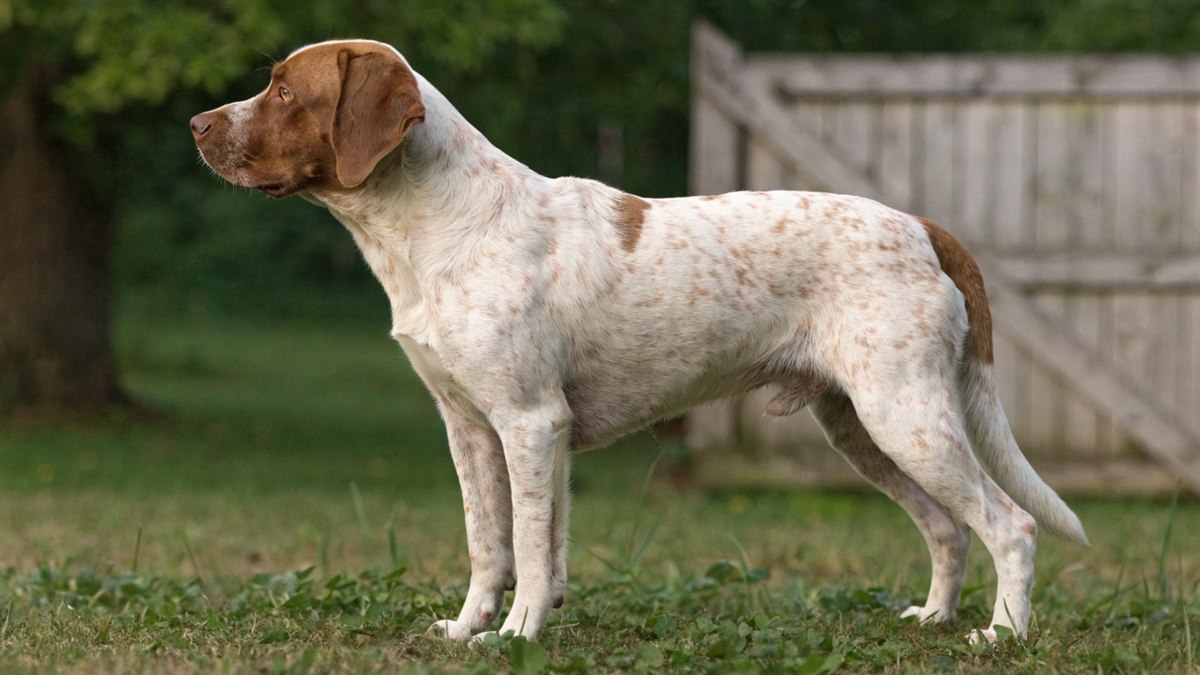
Quick answer
The Braque du Bourbonnais is a rare French pointing dog, FCI Standard No. 179, rebuilt in the 1970s from about six registered founders after ten years with no French registrations. It is not available in India and suits little of it: Chennai's coolest month is warmer than the hottest month in its home department. Its famous short tail is frequently docked, and docking is illegal here.
This guide is general information for Indian pet owners and is not a diagnosis. Consult your nearby vet, a registered veterinarian, before acting on anything you read here, and treat any sudden change in a dog's condition, especially collapse, laboured breathing, a distended abdomen, a painful ear or signs of heat stress, as urgent.
Braque du Bourbonnais at a glance
What the Braque du Bourbonnais actually is
The Braque du Bourbonnais is a medium-sized French pointing dog held to FCI-Standard No. 179, standing 51 to 57 cm at the withers in males and 48 to 55 cm in bitches, with a short white coat so finely ticked in brown or fawn that it reads as one dusty colour from across a field.
The FCI places it in Group 7, Pointing Dogs, Section 1.1, Continental Pointing Dogs of the Braque type, with a working trial requirement. The currently valid standard was adopted on 21 February 2006 and published in English on 29 March 2006, and the official language of the text is French. That last detail matters more than it looks, because the two most consequential sentences on the page are translations, and this guide quotes both languages where the wording carries weight.
The head is the breed marker, not the tail. FCI-179 opens its head section by naming the essential breed characteristic as the so-called pear shape, a skull rounded in every direction with well developed parietal bones and zygomatic arches, a moderately defined stop, and a muzzle slightly shorter than the skull tapering to a truncated cone. The UKC standard repeats the same wording almost verbatim. A judge looking at this breed is looking at that head first. Popular writing leads with the tail instead, which is the source of most of the confusion this page exists to clear up.
The coat has its own vocabulary, and black is not in it
Two coat colours exist, and French hunters gave both of them names older than the standard. Brown ticking was called lie de vin, wine dregs; fawn flecking was called fleur de pecher, peach blossom Braque du Bourbonnais archive. The white patching is described as very invasive, an intimate mix of white and coloured hairs giving an overall roan is accepted, and coloured patches are admitted only in small numbers and small size.
Any trace of black is a disqualifying fault, in the hair and on the nose, in the FCI text and in the UKC text alike United Kennel Club. The English Wikipedia article, which sits at position five on this query in India, describes the coat as ticked with "liver, fawn, black, or white";. That is wrong against both published standards, and the article's own Description section has carried a tag saying it cites no sources since February 2025. The AKC registers exactly two colours for the breed, Chestnut (code 070) and Fawn (code 082), with Ticked (code 013) as the marking.
What the standard measures, and what it pointedly does not
| Measure | FCI-Standard No. 179 (2006) | UKC (2006, revised 2009) | AKC breed page |
|---|---|---|---|
| Height, dogs | 51 to 57 cm, tolerance plus or minus 1 cm | 20 to 22.5 in, tolerance 0.5 in | 19 to 22.5 in, sexes combined |
| Height, bitches | 48 to 55 cm, tolerance plus or minus 1 cm | 19 to 21.5 in, tolerance 0.5 in | as above |
| Weight | Not stated anywhere in the standard | Not stated | 35 to 53 lb, about 16 to 24 kg |
| Life expectancy | Not stated | Not stated | 10 to 12 years |
| Black in coat or on nose | Disqualifying fault | Disqualifying fault | Not mentioned |
| Dewclaws | Disqualifying, including evidence of removal | Disqualifying, rear dewclaws or evidence of removal | Not mentioned |
Neither breed standard gives a weight. The Societe Centrale Canine's own breed record prints the weight field as "NP", not provided. So the 35 to 53 lb range every English page repeats comes from the AKC's own breed page and from nowhere in the standard. Use it as a rough guide and do not treat it as a rule, because a 16 kg bitch and a 24 kg dog are both inside it.
Both standards disqualify a dog for the presence of dewclaws OR for evidence of their removal. An Indian breeder cannot fix the first problem, because paragraph 6(8) of the Second Schedule, Part II of the Prevention of Cruelty to Animals (Dog Breeding and Marketing) Rules 2017 forbids "any other kind of mutilation of any body part of the pup and any change of appearance by artificial means";.
The breed is versatile in the field and the standard says so plainly: at home he is kind and affectionate, and when hunting his passion and intelligence let him adapt to the most varied terrains and game, carrying the head high to find scent. Everything else on this page follows from a compact, muscular, short-coated pointing dog built for temperate France. If you are cross-shopping, the four sibling French Braques are covered at Braque Francais, Braque d'Auvergne, Braque Saint-Germain and Braque Dupuy.
What FCI-179 really says about the tail
FCI-Standard No. 179 instructs that the tail should be docked. Its tail clause reads, in the FCI's own English translation, "Some dogs are born naturally without a tail. If this is not the case, the tail should be docked at its base. It is set rather low. In countries where docking is illegal, the long tail should be carried below the topline when the dog is standing";.
Read that sequence again, because the order of the sentences is the whole argument. Some dogs are born tailless. Otherwise, the tail is shortened. The natural bobtail is the exception the clause opens with, and docking is the default it prescribes for everything else. The official French is blunter still: "Certains chiens naissent anoures. Dans le cas contraire, la queue est écourtée à la base". Anoure means tailless. Écourtée means shortened, and the French for the surgery itself, caudectomie, appears in the next sentence.
The Société Centrale Canine's public breed record phrases it the same way with one clarifying gloss: "Certains chiens naissent anoures (dépourvus de queue). Dans le cas contraire, la queue est écourtée à la base à l'exception des chiens provenant de pays où la caudectomie est interdite";. Docked at the base, except for dogs coming from countries where tail docking is prohibited by law.
Every English page in the ranking set drops the second sentence
Wikipedia's opening line calls it "a breed of gundog sometimes born with a short tail" and its Short tail subsection says the breed "is sometimes born with a short tail (brachyury) or no tail at all (anury)";. True as far as it goes, and it stops one sentence early. Project Upland, the most thorough page in the set, does report the rest, and dates it: "As of 2006, cropping the tail became permitted. Dogs born with tails longer than 15 cm could now be cropped to fit within the breed standard";. Two thousand and six is exactly the year the current FCI standard was adopted. The same article quotes Nancy Anisfield of the Pheasants Forever and Quail Forever national board saying plainly, "Some breeders dock the tails to a short nub."
So the honest position is this. A short-tailed Braque du Bourbonnais in a photograph is one of two different animals, and you cannot tell which by looking at it.
The UKC wrote the clause differently, and the difference is instructive
| Registry | What the tail clause says | Default if the dog is born with a tail |
|---|---|---|
| FCI-179 (2006) | Some dogs are born naturally without a tail. If this is not the case, the tail should be docked at its base | Dock it |
| UKC (revised 2009) | Either natural, docked short or a natural bob tail. If natural, the tail should be held below the topline when the dog is standing | Leave it, no penalty |
| AKC breed page | No tail clause published on the breed page at all | Not stated |
The UKC, writing for a country where docking is lawful, chose not to prescribe it. Its standard closes with a general note that the club "is aware that the practices of cropping and docking have been forbidden in some countries" and that "no dog in any UKC event, including conformation, shall be penalized for a full tail or natural ears";. That is a registry looking at exactly the same breed and declining to make the cut a requirement.
Paragraph 6(8) of the Second Schedule, Part II of the Prevention of Cruelty to Animals (Dog Breeding and Marketing) Rules 2017, notified as G.S.R. 496(E), reads: "There shall be no tail docking, ear cropping de-barking, de-clawing, branding, dyeing, injecting substances to enhance visual appeal, performing a surgery or procedure to camouflage or hide any defect or infirmity or any other kind of mutilation of any body part of the pup and any change of appearance by artificial means is strictly forbidden." The missing comma after "ear cropping" is in the gazette text. Note which numbering this is: the Second Schedule is headed "[See rules 5(2) and 6]", and the docking prohibition sits under paragraph 6, Common breeding techniques, inside Part II, General requirements to be adhered to by breeders. It is not Rule 8, which is a separate provision on conditions for sale.
An Indian buyer should therefore refuse to accept a docked dog as normal for this breed, should never commission the procedure, and should treat any Indian breeder who offers to dock a litter to standard as advertising an offence. A Bourbonnais born with a full tail is a correct dog under UKC rules, is explicitly provided for in FCI-179's own final sentence, and is the only version of this breed an Indian household can lawfully produce.
Is the natural bobtail real, and can you prove it
The natural bobtail is real, it has a named mutation, and since 2009 there has been a cheek-swab test that settles any individual dog in about fifteen working days. The variant is c.189C>G in the T-box transcription factor T gene, inherited as an autosomal dominant, and the Braque du Bourbonnais sits on the UC Davis Veterinary Genetics Laboratory's list of breeds the test is validated for.
Haworth and colleagues described the mutation in 2001 in the bobtailed Pembroke Welsh Corgi. Hytönen and colleagues then looked for it in 23 other breeds in which naturally bobtailed dogs occur, testing 360 dogs of which 156 were natural short-tails. In the 17 breeds where C189G turned up, correlation with the short-tail phenotype was perfect. Six breeds carried neither that substitution nor any other mutation in the T gene coding regions, so at least one further bobtail mechanism exists and has not been found.
No dog in that study was homozygous. The authors conclude the homozygous condition is lethal, and UC Davis states the same in its clinical notes: BT/BT embryos are expected to terminate in utero, so a mating between two bobtailed dogs is predicted to give 50 percent bobtailed pups, 25 percent normal-tailed pups and a 25 percent reduction in litter size Hytonen MK, Grall A, Hedan B. Hytönen's team measured that effect directly in the Swedish Vallhund and found a 29 percent decrease in litter size when both parents were short tailed, which is within touching distance of the predicted 25 percent.
UC Davis records one report in the veterinary literature of two tailless Pembroke Welsh Corgi puppies with the BT/BT genotype that survived to term. Both showed severe developmental abnormalities incompatible with life, including anorectal atresia and spinal defects, and neither survived long after birth. They came from the same parents in different litters.
The tail may not be the only thing the variant does
In August 2026 Berg and colleagues published the first large study asking whether a bobtail comes with anything else attached. They read standardised ventrodorsal pelvic radiographs from 1,679 dogs screened through the Norwegian Kennel Club's hip dysplasia programme: 744 Brittany dogs and 935 Danish-Swedish Farmdogs. Lumbosacral transitional vertebra was present in 47.8 percent of the Brittany dogs and 14.9 percent of the Farmdogs. The bobtail phenotype occurred in 26.7 percent of the Brittanys and 11.0 percent of the Farmdogs.
In the Brittany, bobtailed dogs had roughly double the odds of a transitional vertebra compared with normal-tailed dogs, at an odds ratio of 2.04 (95 percent CI 1.47 to 2.85, P below 0.001), with the strongest association in the stump-tailed individuals. In the Farmdogs the same direction of effect appeared but did not reach significance, at 1.66 (0.99 to 2.76, P equal to 0.05).
That study is not about this breed, and this page will not pretend otherwise. It matters because the Brittany carries the same C189G variant, appears alongside the Braque du Bourbonnais on the UC Davis test panel, and is the closest published proxy that exists. The honest reading is that a naturally bobtailed pointing dog is not automatically a structurally normal one, that nobody has measured it in the Bourbonnais, and that a buyer should ask.
How common is the bobtail in this breed, really
The breed's own archive is the most precise source and it is more modest than the marketing. It records that the dog was called the short tail braque "because sometimes it is born without a tail (anury) or more often with a small tail of less than 15 cm (brachyury)", and adds that the characteristic "which was used during a long time as breed criteria is today a proof of the lineage with old lines". Two things follow. A true tailless birth is the rarer of the two outcomes, and the trait stopped being a breeding requirement long ago.
Michel Comte, who rebuilt the breed, put the purpose of the DNA test in one sentence: "It is hoped that by using the test, breeders can put the words naturally short-tailed on a dog's pedigree so that they can be shown in countries where docking is not allowed";. That is the practical answer for an Indian buyer. Ask for the VGL result, which costs 58 US dollars for a single test and reports N/N, N/BT or BT/BT. A pedigree annotation beats a photograph, because a stump on a dog says nothing about how it got there.
How the breed disappeared, and who says when
The Braque du Bourbonnais stopped being registered in France for ten consecutive years. Between 1963 and 1973 not one dog of the breed entered the Livre des Origines Français, and the club that had run it since 1925 had already ceased to function during the 1950s.
The FCI standard tells the cause in three sentences of its own historical summary, and they are worth quoting because they are the only part of this story that carries an FCI stamp. "The breeders of the 1930's wanted to impose a 'faded lilac' coloured coat along with the obligation of being born with a naturally short tail. This strict selection put the existence of the breed in danger. In the 1970's, a team of breeders decided to work for the survival of the Bourbonnais Pointing Dog";. The French original reads identically on the Société Centrale Canine's own pages.
Read that against the previous section and the irony lands. The single feature this breed is now marketed on, the tail, is the feature its own governing standard blames for nearly wiping it out. Selecting hard on a dominant variant with a lethal homozygote, in a small closed population, while also selecting hard on one narrow coat shade, is a good description of how to run a breed into the ground.
Four sources, four different dates for the decline
| Source | When it says the decline began | What it blames |
|---|---|---|
| FCI-Standard No. 179 | The 1930s | Breeders imposing a faded lilac coat and a compulsory short tail |
| United Kennel Club standard | The early 1900s | The same two fads, described as fads |
| The Royal Kennel Club, August 2026 | After the First World War | Not stated |
| The breed's own family archive | Club activity fell after the Second World War and stopped in the 1950s | Absence of leadership and disputes over coat colour |
The UKC's version is the most pointed: "In the early 1900s breeders attempted to introduce a new, faded lilac color to the breed and to produce natural bob tails. These fads put the existence of the breed in danger, but today the breed is in good hands";. The Royal Kennel Club's recognition release of August 2026 says only that "the breed declined after the First World War" and offers no mechanism. Treat the 1930s date as the best supported, because it is the one both the FCI and the SCC publish and the only one attached to a stated cause.
The documented history, in order
- 1925. Doctor Rigondet and Monsieur Léger found the first Club du Braque du Bourbonnais, which writes the first breed standard.
- 1925 to 1935. The club publishes 14 bulletins under its second president, Monsieur de Lachomette.
- 1938. De Lachomette is called to the presidency of the Société Centrale Canine and the club drifts.
- The 1950s. Club activity stops altogether, as recorded in a 1979 letter from the SCC.
- January 1967. Jean Castaing writes in Le Chasseur Français, number 839, that he has seen the two last Braques du Bourbonnais.
- 1963 to 1973. Zero registrations in the French studbook.
That list comes from one host, braquedubourbonnais.info, and this page names it precisely rather than calling it the club Braque du Bourbonnais archive. The site is copyright Michaël Comte, son of Michel Comte, the man who rebuilt the breed. It is a first-hand archive with scanned letters, pedigrees and bulletins, and it is also the family's own account of the family's own achievement. The official club today is the Club du Braque du Bourbonnais listed by the Société Centrale Canine. Where the archive is the only source for a claim, this page says so.
One independent element does corroborate the ten-year gap. English Wikipedia states "From 1963 to 1973, there were no dogs registered in the LOF", but that is not corroboration, because Wikipedia's Disappearance section has carried a template since February 2025 saying it cites no sources at all. Following that citation back leads nowhere, so the ten-year zero rests on the family archive alone and should be read as such until the SCC publishes pre-1969 studbook counts, which its public statistics series does not currently reach.
How the breed was rebuilt, dog by dog
The modern Braque du Bourbonnais was rebuilt from about six dogs first registered in 1973, and none of them came from a surviving pure line. Michel Comte, his brother Gabriel and a Saint-Priest veterinary surgeon, Doctor Monavon, went looking for survivors, found none, and worked instead from crossbred farm dogs that still carried the type.
The search itself is documented. They read the classified advertisements in an entire collection of Le Chasseur Français to find the addresses of former breeders, and discovered that the last kennel holding Bourbonnais in Registre Initial had been "de la Turne" in Lyon. One bitch from it was still alive, Junon, born in 1960, and she was sterile.
What they found instead were not purebred dogs and the archive says so. In its own words, "the numerous dogs founded were in fact bastards, which were called braques de pays (country braques), in which Bourbonnais blood was apparent through a few characteristics (short tail, size, color of the coat, shape of the head)". Project Upland reports the same, describing Comte searching rural areas for country braques that still showed short tails, the right coats and the right build. Comte himself called the result a "recreated breed", said it was not genetically identical to its ancestors, and argued it beats the old version on speed, stamina and trainability.
The founders, named
| Dog | Where it came from | What it contributed |
|---|---|---|
| Rasteau, called Pyrrhus | Spotted in Lyon by Doctor Bazin, president of the south-east Société Canine; owned by Madame Barrier-Chauvin; a pup of Pierre Perret's two unregistered dogs, Joséphine and Napoléon | Registered under Titre Initial and described as the first of a long line of born-again Bourbonnais |
| Igor, Joan, Junior, Java | Born in the Comte family's own litters | The core of the initial line |
| Quetty | Found by Doctor Monavon | Bourbonnais enough to register, but old, and produced only a few puppies |
| Lina, found as Gina | Seen on the bank of the Ardèche at Vogüé; owned by Monsieur Tahon | Two 1979 litters described as important for the breed |
| The braques de Mirepoix | Monsieur and Madame Poma, entered in Registre Initial | Different origins, used for outcrossing; produced the first spring field trial champion |
| Diane, registered as Piruit, and Max | Both from Paris, registered in 1980 | Late additions to the base |
The archive does not present this as a clean success. It records that Désiré Henri, a surviving member of the 1930s club, and Jean Castaing both "rightly warned us about the excessive in breeding" of the Mirepoix kennel, that those dogs "gave some crazy dogs" as well as a field trial champion, and that the first outcross was done in 1978 precisely because their origins were different. It then states the position in one sentence: "the reduced number of dogs didn't put the breed safe from a new extinction";. English Wikipedia, from a different direction, describes the same period as producing "some more or less inbred litters";.
From six dogs to a functioning club in twelve years
- 1973. The first Bourbonnais are entered in the LOF under the Titre Initial procedure, with further registrations in 1974 and 1975.
- September 1979. Michel Comte and Charles Combanaire gather 23 Braques du Bourbonnais born in the south east at Montluçon, judged by Doctor Régis Bazin.
- 6 July 1980. A field trial on quail at Tortezais brings in Jean-Paul Buot, the future secretary general.
- 1981. A constitutive meeting at Fréjus recreates the club; Comte lodges its statutes at the Draguignan town hall.
- 1982. The first bulletin appears numbered 15, continuing deliberately from the 1930s club's last bulletin, number 14.
- 1983. The Charroux field trial gathers 30 dogs from 23 owners.
- 1 October 1985. The club is officially affiliated to the Société Centrale Canine.
- 23 August 1985. The first Nationale d'Élevage is held at Néris-les-Bains.
The export chain is documented to the individual dog as well. In 1987 two American authors researching an atlas of dog breeds wrote to the SCC, the request reached Comte, and a Franco-American breeder in Louisiana, Christiane Bernard, was found. A young bitch called Valky, pregnant by Happiness Vulcain, was flown out in May 1988 with the club paying the transport, and produced Madame du Barry, the first Bourbonnais born in the United States. The AKC records the breed as first imported into the United States in 1988, entered in its Foundation Stock Service since May 2011, and approved for AKC performance events since 1 January 2012.
The gene pool question, answered with what exists
No published genetic study of the Braque du Bourbonnais exists. A PubMed search for the exact phrase returns zero records, and PubMed reports the reason itself: "Your search was processed without automatic term mapping because it retrieved zero results. Quoted phrase not found in phrase index: 'Braque du Bourbonnais'";.
That absence is earned, not assumed. A search returning nothing proves nothing unless the search itself is shown to work, so a control was run in the same session on the same tool. The query "Brittany" AND dog AND breed returned 26 records, and opening them confirms they are genuinely canine: a breed-specific vertebral heart scale study, a dystrophin-deficient muscular dystrophy report, and the 2026 bobtail and transitional-vertebra paper quoted earlier. PubMed works. It simply does not hold this breed's name.
Two further checks point the same way. The Orthopedic Foundation for Animals publishes about 5,373 statistics rows covering every breed it holds data on, and a case-insensitive search of the full 2.2 million character dump finds zero occurrences of "bourbonnais", against 109 for "labrador";. And the breed does have an OFA code, BDB, read out of OFA's own DNA-test ordering table rather than guessed. It has a code and no data.
The nearest published analogue is a sibling Braque
One French Braque has been characterised genomically. Mastrangelo and colleagues genotyped the Braque Français type Pyrénées on a 170K SNP array and estimated a recent effective population size of 51. They found moderate genetic diversity compared with the major breeds, a high degree of differentiation and only low levels of admixture, and they opened by naming the worry directly: that in an uncharacterised regional breed "few inbred bloodlines may dominate the breed";.
Effective population size is not a headcount. It is the size of an idealised, randomly mating population that would lose genetic variation at the same rate as the real one, and a recent value of 51 in a breed with several hundred births a year means a small number of animals are doing most of the reproducing.
The Braque Français type Pyrénées recorded 623 French registrations in 2025. The Braque du Bourbonnais recorded 61. That is 623 divided by 61, or 10.2 times as many dogs born in the same country in the same year. If the larger of the two breeds sits at an effective population size of 51, the smaller one has no plausible reason to sit higher. That is an inference from a sibling breed and not a measurement, and this page will not dress it up as one.
The people closest to the breed say the same thing in plainer words
The British Braque du Bourbonnais Club, writing on its own About page, states: "It is vital we strive to keep on track the good health of the genetic lines we have here and expand the gene in order to help us keep those clean lines. Health checks are imperative to the breed";. Project Upland reports that American breeders "import dogs as needed to maintain the quality of the gene pool" and puts the world population at fewer than 2,000 dogs, spread mainly across France, the United States, Finland, the Netherlands and Italy. That same article prints "about 2,000" in its prose and "Less than 2,000" in its data table, which is a reminder that the population figure is an estimate and not a count.
What Indian law does to the arithmetic
An Indian breeder of a small-gene-pool breed has fewer legal options than a French one. Paragraph 6 of the Second Schedule, Part II of the 2017 Rules permits only two mating techniques, out breeding and line breeding. Sub-paragraph 6(3) prohibits both in breeding, defined as "breeding between relatives of the 2nd to 4th grade in straight or side line within the first four generations e.g. uncle to niece, nephew to aunt, cousin to cousin, grandparents to grandchildren", and incest breeding, defined as mating between parents and children or between brother and sister. That is the same paragraph 6 that carries the docking prohibition at sub-paragraph 6(8), and this page names the sub-paragraph each time because the document numbers its clauses twice.
Ask any breeder, anywhere, for a coefficient of inbreeding on the proposed mating and the generation depth it was calculated over. A breed rebuilt from roughly six registered founders will carry a high baseline whatever the paperwork says, and a five-generation figure on a population this small flatters it.
Exactly how rare this breed is, in registry numbers
Sixty-one Braques du Bourbonnais were entered in the French studbook in 2025. That is the whole annual output of the breed's home country, published by the Société Centrale Canine in its Statistiques LOF 2025, and it is down from 86 in 2016 Societe Centrale Canine.
The series is short but it is official, and it is the only hard population data any page on this breed can offer. Take the counts straight from the Group VII tables.
| Year | Registrations | Change on the previous figure shown |
|---|---|---|
| 2016 | 86 | baseline |
| 2023 | 71 | down 17.4 percent on 2016 |
| 2024 | 51 | down 28.2 percent on 2023 |
| 2025 | 61 | up 19.6 percent on 2024, still down 29.1 percent on 2016 |
The 2024 document and the 2025 document agree on the overlapping year, both printing 51 for 2024, which is the cheap consistency check worth running on any two-year registry series.
Calibrated against dogs you have actually met
A raw 61 means nothing without a yardstick, so here is the same French table, same year, same page.
| Breed | 2025 registrations | Times the Bourbonnais total |
|---|---|---|
| Golden Retriever | 15,062 | 247 |
| Labrador Retriever | 6,531 | 107 |
| German Shepherd | 5,614 | 92 |
| English Setter, the biggest Group 7 breed in France | 5,086 | 83 |
| Brittany | 3,793 | 62 |
| German Shorthaired Pointer | 1,287 | 21 |
| Braque Français type Pyrénées | 623 | 10.2 |
| Braque d'Auvergne | 159 | 2.6 |
| Braque du Bourbonnais | 61 | 1 |
| Braque Français type Gascogne | 35 | 0.6 |
| Braque Saint-Germain | 16 | 0.26 |
For every Braque du Bourbonnais registered in France in 2025, 247 Golden Retrievers were registered. Group VII as a whole took 17,777 registrations that year, so this breed is 61 divided by 17,777, or 0.34 percent of every French pointing dog entered in the studbook. The Braque Dupuy does not appear in the table at all, which is the registry's way of recording an extinct breed.
One more figure from the same row is worth knowing. Of the 61 registrations in 2025, 23 dogs were confirmed, the French process in which an adult dog is examined against the standard before its pedigree becomes final. Twenty-three of 61 is 37.7 percent. The SCC computes that ratio within the calendar year, so it understates the true rate slightly, because a dog registered late in one year is usually confirmed in the next.
The registry picture is changing this year
On 1 October 2026 the Royal Kennel Club begins recognising the Braque du Bourbonnais, classified in the Gundog Group on the Imported Breed Register. Until an interim Royal Kennel Club breed standard is published, the breed cannot compete at Royal Kennel Club licensed breed shows. That announcement, made in August 2026, takes the number of breeds the RKC recognises to 230. As at the date this page was written, the breed does not yet appear in the RKC's published Gundog breed-standard index, which lists the Braque d'Auvergne but not the Bourbonnais.
In the United States the breed sits in the AKC's Foundation Stock Service rather than a full registry, so it has no AKC ranking and no published annual count. The AKC's own breed page claims that "some years there are more pups registered in the United States than its homeland of France." That claim cannot be checked, because FSS registration totals are not published breed by breed, and this page reports it as an unverifiable assertion rather than a fact.
Braque du Bourbonnais price in India, and why no such price exists
There is no Braque du Bourbonnais price in India, because there is no lawful supply of the breed in India and no evidence of a single dog here. Any rupee figure you are shown for this breed is either a converted foreign price, a house price point attached to whatever puppy is in stock, or an invention.
Start with the law, because it closes the question before the market gets a chance to open it. Under DGFT Trade Notice No. 22/2022-23 of 19 December 2022, live dogs sit under ITC(HS) 01061900 with an import policy of Restricted. Policy Condition 7 permits the import of dogs for exactly three purposes: a pet dog with a valid pet book and records in the importer's own name, dogs imported by research and development organisations on the recommendation of the CPCSEA, and dogs for internal security by the Defence and Police forces. Policy Condition 8 adds that "import of commercial dogs for breeding or any other commercial activities other than the purposes mentioned above is not permitted", and paragraph 6 of the notice states that applications for trading or breeding purposes "shall be duly rejected";.
Entry is further limited to the airports and seaports of Delhi, Mumbai, Chennai, Hyderabad, Bengaluru and Kolkata and, since October 2024, Kochi airport, seven ports in total, with quarantine and an advance No Objection Certificate from the Animal Quarantine and Certification Service Department of Animal Husbandry…. A commercial breeding pipeline for this breed cannot lawfully form in India. One returning family may bring one dog under transfer of residence after two years of continuous stay abroad. That is the whole legal route. The full route is set out in how to import a dog to India.
The search for Indian listings, and the control that makes the zero mean something
A search restricted to India for the breed name plus "puppy for sale india price rupees" returned no genuine Indian listing for the breed. That zero is only worth publishing because the control worked. In the same session and the same tool, "labrador retriever price in india" returned eight results carrying real, differing Indian price bands, including 30,000 to 1,20,000 rupees on one marketplace and 8,000 to 70,000 rupees on another. The search engine was answering. It simply has nothing to answer with for this breed.
A second attempted check must be reported as failed rather than as evidence. A DuckDuckGo HTML query returned an anti-bot challenge reading "Select all squares containing a duck" instead of any results. Zero results from a page that never ran a search is not a finding, and no conclusion on this page rests on it.
What Indian pages actually give you when you search this breed
- An auto-generated directory shell. Justdial publishes "Pet Shops For Braque Du Bourbonnais Dog in Palvancha", category nct-13868877, a page it evidently generates for every breed name it holds. Palvancha is in Telangana. The three shops it returns are in Jhansi, Dehradun and Surat. The first listing's own photograph filename reads pet-shops-for-psittacula-parrot, and the page's own description says what it really indexes: pet shops for dogs, for German Shepherds, for Labradors and for birds.
- A 404. One of India's larger puppy marketplaces has city-by-city price pages for Labrador Retrievers and no page at all for this breed.
- A house price point. Puppiezo's product pages carry an Other Available Pets carousel that prints Rs 98,999 three times, beside Rs 92,599, Rs 94,999, Rs 76,499 and Rs 1,20,000. The recurring animals are two Maltipoos, Fizey and Samy, and a Doxiepoo, Yoki. The carousel appears identically on the page for the Mudi, a Hungarian herding breed the site does not stock.
Run both division tests on it. 98,999 divided by 84.38 gives 1,173.25 US dollars, which is not a round figure anybody prices in. 98,999 divided by 74 gives 1,337.82, which is not either. So it is not a converted dollar price; it is a rupee-native charm price ending in 999, attached to whichever puppy is currently in stock. Treat it the same way anywhere you meet it.
The only published price band, and what it would look like converted
Overseas, the breed does have a market. Good Dog, a screened United States marketplace, lists six named kennels and states in its buyer's guide that "Nationally, prices usually range from $2,000 to $2,500";. Its own page headline says 40 or more puppies while its page title says 25, so even that source is not internally tidy.
| US published price | At 84.38 | At 74 |
|---|---|---|
| 2,000 dollars | Rs 1,68,760 | Rs 1,48,000 |
| 2,500 dollars | Rs 2,10,950 | Rs 1,85,000 |
Bonbeno reports these as editorial figures from a foreign market, not as an offer. We do not broker puppy sales and we do not recommend breeders. If an Indian household genuinely wants this breed, the honest answer is that the purchase price would be the small part of the cost, that a lawful private import under transfer of residence is the only route, and that a far better one is described in the adoption section below. The Indian pointing-dog buyer who wants a real market should look at the Labrador Retriever, the English Cocker Spaniel or the Indian Pariah Dog.
Monthly cost of ownership, bounded honestly
Bonbeno will not publish a monthly rupee total for a breed with no measurable Indian population, because that number would be manufactured. What can be given honestly are the five costs that are specific to this dog rather than to any 16 to 24 kg active dog, each with a real anchor you can price locally.
The generic costs are genuinely generic. A Braque du Bourbonnais eats, vaccinates and de-worms like any medium gundog, so use the recurring-cost work on the pages of breeds that actually exist here, such as the Labrador Retriever and the English Cocker Spaniel, and adjust for bodyweight. Everything below is the part those pages will not cover.
One. The tail DNA test, if you are buying
The UC Davis Veterinary Genetics Laboratory charges 58 US dollars for a single natural-bobtail test and 79 dollars for two coat, fur-type or bobtail tests on the same animal. At 84.38 rupees to the dollar that is about 4,894 rupees and 6,666 rupees respectively, before shipping cheek brushes internationally. Spend it once, on the parents' results rather than the puppy's, and you have a written answer to the only question about this breed that a photograph cannot settle.
Two. The import, which dwarfs the purchase price
A lawful private import runs through DGFT and is a process, not a purchase. The trade notice advises pet owners to begin the import authorisation application at least two months before travel, requires an Importer Exporter Code or use of the standing personal-use IEC, restricts entry to six ports, and requires an advance No Objection Certificate from the Animal Quarantine and Certification Service obtained seven days before travel, relaxable to three. DAHD added a seventh port, Cochin International Airport at Kochi, for pets arriving under the baggage rules in October 2024. Airfreight for a crated 20 kg dog on a long-haul route, quarantine, testing in the exporting country and the paperwork together comfortably exceed the 2,000 to 2,500 dollar purchase band that a US marketplace publishes for the dog itself.
Three. Ectoparasite control, twelve months a year, not seasonally
This is the largest genuinely breed-relevant recurring cost in India for a short-coated dog that goes outside. In a Chennai study of 230 free-ranging dogs, 229 of 230, or 99.6 percent, were infested with ticks, at a mean intensity of 5.6 ticks per dog, and 67.8 percent carried at least one vector-borne pathogen. Those were street dogs and an owned pet is a different risk, but the vector pressure they measure is the pressure your dog walks through. Budget for a year-round product rather than a monsoon-only one.
Four. Ear care consumables and vet visits
A drop-eared gundog in an Indian monsoon is an otitis externa candidate, and the arithmetic in the next section but one explains why. The consumable cost is trivial, a cleaner and cotton, but the vet visits are not, and recurrent otitis in a dog with an ear conformation that cannot be changed is a chronic bill rather than a one-off.
Five. Cooling, which is a capital cost, not a monthly one
The climate section below argues that Chennai's coolest month is warmer than the hottest month in the breed's home department. The practical consequence is a fan or an air-conditioned room the dog can reach unaided during the hot hours, which is a one-time spend plus electricity, and a willingness to shift exercise to a window that may be as narrow as an hour at each end of the day for four months of the year.
Several Indian pages publish tidy monthly ownership totals for breeds that have never been imported here. Those numbers are generated, not observed. Where we have no Indian data we say so, and this breed has none: it appears nowhere in the FCI's published Kennel Club of India statistics series, which reports 32,219 puppies registered nationally in 2025 without any breed breakdown.
One caution about that KCI series if you go looking at it yourself. Its cumulative row jumps from 1,126,797 pure-bred dogs registered since the studbook's creation in 2022 to 1,352,595 in 2023, a rise of 225,798 in a year when the annual registration figure was 47,679, and its approximate national dog-population row falls from 157,500,000 in 2017 to 15,794,584 in 2018. Two rows in that table are not internally consistent. Use the annual registration counts and leave the other two alone.
Suitability for the Indian climate, and heat tolerance rated 2 of 5
Chennai's coolest month is warmer than the hottest month in the department this breed comes from. That single comparison, drawn from two NASA POWER climatology queries made by explicit latitude and longitude, is the reason this page rates the Braque du Bourbonnais 2 out of 5 for heat tolerance rather than 3.
The breed is named for the Bourbonnais, today the Allier department, and Moulins is its prefecture. Querying NASA POWER's 2001 to 2020 climatology at 46.5646 degrees north, 3.3335 degrees east returns an elevation of 283.78 m, an annual mean air temperature of 11.16 degrees C, a warmest-month mean of 20.64 degrees C in July, and a January mean of 2.56 degrees C. That is the thermal environment this dog was selected in for four hundred years.
| Place and coordinates | Annual mean | Coolest month | Warmest month | Worst heat-plus-humidity month |
|---|---|---|---|---|
| Moulins, Allier, 46.5646 N 3.3335 E, 284 m | 11.16 C | 2.56 C in January | 20.64 C in July | July, 20.64 C at 65.6 percent RH |
| Chennai, 13.0827 N 80.2707 E, 49 m | 27.95 C | 24.09 C in January | 31.51 C in May | October, 27.40 C at 79.96 percent RH |
| Delhi, 28.6139 N 77.2090 E, 206 m | 25.60 C | 13.61 C in January | 35.88 C in June | August, 29.79 C at 74.90 percent RH |
| Pune, 18.5204 N 73.8567 E, 636 m | 23.86 C | 19.62 C in December | 28.93 C in April | June, 25.63 C at 80.27 percent RH |
| Bengaluru, 12.9716 N 77.5946 E, 842 m | 23.74 C | 20.22 C in December | 28.37 C in April | September, 23.15 C at 80.18 percent RH |
Why humidity is the axis that matters, not the peak temperature
Dogs do not sweat usefully. They shed heat by evaporative cooling through panting once the thermoregulatory set point is exceeded, and the rate of that cooling depends on ambient temperature, humidity and windspeed together. Evaporation is driven by the difference between the water vapour pressure at the respiratory surface and the vapour pressure of the air. Raise the humidity and you shrink that gradient, so the same dog panting at the same rate loses less heat per breath.
That is why the worst month column above is not the hottest month column. Delhi's May mean of 35.05 degrees C looks lethal and comes with 23.38 percent relative humidity, which is bone dry and lets panting work. Delhi's August pairs 29.79 degrees C with 74.90 percent, and that is the harder month for this dog. In Pune the monsoon does the same thing: August sits at only 23.30 degrees C but at 90.80 percent relative humidity, the highest single figure in the table.
Calibrating against the only large clinical dataset that exists
The VetCompass programme found the median ambient temperature on days when UK dogs presented with heat-related illness was 16.9 degrees C. Hold that number against the table. Every single month in Chennai, Pune and Bengaluru is warmer than the median UK heat-illness day, Chennai's coolest month by 7.19 degrees C. Ten of Delhi's twelve months are warmer than it. In Moulins, only June, July, August and September clear it.
The same programme puts the annual UK incidence of heat-related illness at 0.04 percent of dogs under veterinary care, with an event fatality rate of 14.18 percent, and reports that severe heat-related illness begins when core temperature passes 43 degrees C Hall EJ, Carter AJ. A cited review of military working dogs found three-quarters of their heat-illness events occurred above a wet bulb globe temperature of 26.7 degrees C, and the authors note those are fit, acclimatised dogs with non-extreme conformation, so an ordinary pet would be expected to fail at lower readings.
This is not a brachycephalic dog and it is not a heavy one. The VetCompass risk model found brachycephalic skull shape, bodyweight above the breed and sex mean, and a bodyweight over 50 kg all increased the odds of heat-related illness, and none of those describe a 16 to 24 kg mesocephalic pointer in good condition. Its airway and its frame are on its side. Its origin climate is not.
Bengaluru is the interesting exception and deserves naming. At 841.72 m its December mean of 20.22 degrees C sits 0.42 degrees C below Moulins' July mean, so it is the only major Indian city in this table whose coolest month is not warmer than the breed's hottest. A Braque du Bourbonnais would find a Bengaluru or Pune winter recognisable. It would find a Chennai year, where the mercury never drops to a French summer, relentless. Rate the city, not the country, and if you are in Chennai or coastal Kerala treat this breed as unsuitable rather than merely demanding.
Long ears in Indian humidity, and a published number that does not add up
The Braque du Bourbonnais carries a broad-based drop ear that hangs flat against the cheek, which is the single worst ear conformation for an Indian monsoon. FCI-179 specifies ears of medium length that can reach or extend beyond the throat, rather broad at the base, set at eye level or slightly above, hanging naturally against the cheeks, flat or slightly curled inwards.
An ear leather lying flat over the canal opening does two things at once. It blocks air movement, so the canal stays warm and wet, and it holds any water that gets in. The standard even lists ears that are "too long and too curled inwards" as a general fault, which tells you the breed's own judges recognise the conformation can be overdone.
The best recent Indian series, and why its headline figure is wrong
Nainika and Sharma screened 2,476 dogs presented to the veterinary clinics of CSK Himachal Pradesh Krishi Vishvavidyalaya at Palampur between June 2022 and July 2023. Eighty-one were diagnosed with otitis externa, a hospital prevalence of 3.27 percent, and 81 divided by 2,476 does indeed give 3.27 percent. The seasonal pattern is stark: 48 of the 81 cases, or 59.25 percent, fell in the rainy season of July and August, against 15 in summer, 10 in winter and 8 in autumn, and those four counts sum to exactly 81.
Their Table 5 then reports the predisposing factor this page most needs, and it is internally inconsistent. The table prints "Pendulous ear breed, 53, 69.13 percent". Divide it out and 53 of 81 is 65.43 percent, not 69.13 percent.
Three checks, and they all give 56
- Work backwards from the percentage. 69.13 percent of 81 is 55.995, which rounds to 56. No other whole number produces the printed percentage.
- Check the complement. The same row block gives "Erect ear breed, 25, 30.86 percent", and 25 of 81 is 30.864 percent, so the erect-ear line is arithmetically correct. If the two categories are exhaustive, the pendulous count must be 81 minus 25, which is 56. Fifty-three plus 25 comes to 78 and leaves three cases unaccounted for.
- Find where 53 came from. The number 53 appears correctly elsewhere in the same results section. The paper reports cocci-shaped bacteria in 30 of 81 cases and rod-shaped bacteria in 23 of 81; 30 plus 23 is 53, and it prints bacterial infections at 65.43 percent, which is exactly 53 of 81. The pendulous-ear row appears to have inherited the bacterial-infection count.
So the corrected figure is 56 of 81 cases of canine otitis externa in the Palam valley occurred in breeds with pendulous ears, which is 69.14 percent, against 25 of 81, or 30.86 percent, in erect-eared breeds. The paper's conclusion survives the correction intact and gets marginally stronger. Its headline count does not.
Its results text opens "In a study of 50 cases of Otitis externa" before giving denominators of 81 throughout, and it states moisture accumulation in 33.33 percent of cases where Table 5 gives excessive moisture as 17 cases at 20.98 percent. Thirty-three point three three percent of 81 would be 27. Divide out every n of N you are handed, in a journal as readily as on a blog.
What an Indian owner does about it
The mechanism the paper identifies is the one you can act on. Hypersensitivity was the commonest primary cause at 37 of 81 cases, 45.67 percent, and every one of the 81 dogs showed secondary bacterial or fungal overgrowth on cytology. Otoscopy found erythematous canals in 88.8 percent. Secondary overgrowth in a warm wet canal is what turns an itch into an infection, and that is the step humidity controls.
- Lift and look, daily, from July to September. Thirty seconds. You are checking for redness, smell and head-shaking, not waiting for discharge.
- Dry the canal after every bath and every swim, before the dog shakes itself dry and pushes water inward.
- Do not let the ear air-dry. Overseas breed-club grooming guidance written for temperate climates routinely says to towel off and let the dog dry naturally. That advice assumes low ambient humidity and does not transfer to an Indian August.
- Treat recurrence as a hypersensitivity question, not a cleaning question, and ask your vet about the underlying allergy rather than repeating the same ear drops.
The AKC's own care guidance for this breed says only that "Ears should be checked regularly to avoid a buildup of wax and debris, which can result in infection";. That is correct and it is written for a country where the summer relative humidity does not sit above 80 percent for four months. In Pune it reaches 90.80 percent in August.
Temperament and household fit
The Braque du Bourbonnais is a two-speed dog: quiet and affectionate indoors, and hard-driving the moment it is working. FCI-179 puts it in one sentence, "In the home he is kind and affectionate. When hunting, his passion and intelligence allow him to easily adapt to the most varied terrains and game";.
The UKC standard says the same thing in different words, describing "a kind and affectionate companion as well as a passionate and intelligent hunter, suitable to a variety of game and terrain";. Two independent registries converging on the same two-part description is about as close to a consensus temperament as any breed gets.
The people who live with them fill in the texture. The American breeder Shari Stueck told the dog historian Craig Koshyk, "They are calmer than many of the other hunting breeds. My Bourbonnais just love to lounge around the house. But they really move when they are hunting." Nancy Anisfield describes "a gentle disposition and ardent desire to please" alongside dogs "insatiable in their desire to train and hunt";. Read those two halves together and do not buy only the first one. The lounging is real and it is what the dog does after the work.
Who this breed suits
- Households with a person at home most of the day. This is a dog that attaches hard to its people. Wikipedia's description, which matches every owner account in the ranking set, is of a dog "very loyal to their family" that loves being at its owner's side.
- Owners who will supply a job. The British club lists members using the breed for scent work with cancer patients, truffling, agility, hoopers, mantrailing and therapy visiting as well as gundog work. That is a versatile, biddable dog looking for something to do.
- Homes with children. Both standards disqualify a dog that is aggressive or overly shy, and the breed's reputation is uniformly gentle. Supervise as you would with any 20 kg dog and a toddler.
Who should not buy one
- Anyone out of the house ten hours a day. A pointing dog that bonds this closely and has this much drive does not do well alone in a flat, and there is no Indian rescue network for the breed if it goes wrong.
- Anyone wanting a guard dog. Nothing in either standard describes protective behaviour, and a kind, affectionate, people-seeking gundog is a poor fit for the job.
- Anyone in Chennai or coastal Kerala without air conditioning, for the reasons set out in the climate section above.
- Anyone who wants the look. The tail and the peach-blossom coat are the two things this breed is sold on, and neither survives contact with the sections above as a reason to own one.
One trait needs naming because it shapes daily life. The archive describes a dog "with a very active temperament" that "is very linked to his master and forms a team with him", and Wikipedia notes it "shows a lot of activity, even if they do not go very far"; Wikipedia (English), Braque du Bourbonnais. That combination, busy but close-ranging, is easier in a flat than a wide-ranging hound would be. It is still a working gundog and the exercise section below sets the floor.
Training approach, and what this breed resists
Train a Braque du Bourbonnais with a soft hand and it learns fast; train it with pressure and it shuts down. Every first-hand account in the ranking set converges on this, and the AKC states it as breed guidance: "The Braque du Bourbonnais requires relatively gentle handling. He has the ability to sense the mood of the handler, seeking eye contact at all times";.
Nancy Anisfield puts the same point in working terms: "They take to water and tracking training well, but they can be considered fairly soft dogs that respond best to training methods that support their desire to please." Craig Koshyk and Shari Stueck agree that these are softer dogs that learn best when taught with a gentle hand, and Stueck adds that their speed of learning makes them workable for first-time handlers: "A lot of my pups go to first-time handlers, and they have all done really well with a little coaching from me. We have always selected for dogs that are easy to train; in fact, we have some dogs that almost train themselves";.
Soft does not mean fragile and it does not mean easy. A soft dog remembers a harsh correction longer than a hard dog does, so the cost of getting the tone wrong is higher, not lower. Mark and reward, keep sessions short, and stop while the dog still wants more.
What it resists
- Repetition without purpose. A dog bred to work varied terrain and varied game gets bored of the same twelve-metre recall lane. Change the ground.
- Correction-led methods. Anything built on aversives will produce a dog that avoids the handler rather than one that seeks eye contact, which is the exact trait the AKC identifies as its working asset.
- Being trained by two people with two sets of rules. A dog this attentive to handler mood reads inconsistency as pressure.
- Heat. The most common Indian training failure with any gundog is scheduling a session in a window where the dog physically cannot concentrate. See the climate section for the temperature and humidity table.
The pointing instinct arrives early and is not obedience
Stueck reports that Bourbonnais start to point at an early age, and that retrieving instincts also show young. Pointing is a hardwired predatory sequence that stalls before the chase, not a trick, and you cannot train it in or out. What you can train is the recall that governs what happens next. Build a bombproof recall before the dog is six months old, because in India you will be walking a pointing dog past street cattle, cats, poultry and free-ranging dogs, and a Braque that has locked on will not hear you.
The breed's field record shows what the drive is worth when directed. Its clubs run field trials and the SCC classifies the breed with a working-trial requirement, meaning a dog cannot become a full champion on looks alone. In the United States many breeders prove stock through North American Versatile Hunting Dog Association tests. In India there is no field trial circuit for pointing dogs, so an Indian owner must invent the job: scent games, mantrailing, and the retrieve work the breed takes to naturally.
How much exercise a Braque du Bourbonnais actually needs
Plan two working sessions a day, both outside the heat, and expect the dog to want a third. No published minute figure exists for this breed, so the honest way to set the requirement is from what the standard says the dog does at work: "at hunting the gait is a sustained gallop, balanced and supple", with strides of average reach.
The working profile is unusually specific for a rare breed. Project Upland records the range as close to medium and the pace as a medium gallop, quotes the working standard's requirement that the dog shift pace and direction suddenly, "recalling the maneuverability and stability of the polo pony", and reports dogs that "can stretch out to 200 yards but will check in frequently, averaging the distance to a workable range";. Wikipedia describes the same thing from the other end: "They show a lot of activity, even if they do not go very far";.
Translate that and you get a dog that needs intensity more than distance. Two hundred yards is 183 m, which is a close-working range by pointing-dog standards, and it means the exercise a Bourbonnais needs can be delivered in a park rather than on a ten-kilometre march. What it cannot be delivered by is a lead walk on a pavement at the dog's slowest gait.
The Indian complication is timing, not volume
In Chennai every calendar month has a mean air temperature above 24 degrees C, and the median ambient temperature on days when UK dogs presented to a vet with heat-related illness was 16.9 degrees C Hall EJ, Carter AJ. The monthly mean is not the temperature at any given hour, and dawn is reliably the coolest part of an Indian day, so the working rule is to move exercise to the ends of the day rather than to shorten it.
| City | Months you can work the dog freely | Months to restrict to first and last light | The month to be most careful in |
|---|---|---|---|
| Chennai | None; every month is above the UK median heat-illness day | All twelve, tightening from March to October | October, 27.40 C at 79.96 percent RH |
| Delhi | December and January | March to October | August, 29.79 C at 74.90 percent RH |
| Pune | December to February | March to October | June, 25.63 C at 80.27 percent RH |
| Bengaluru | November to January | February to October | September, 23.15 C at 80.18 percent RH |
The extremes in the same dataset are worth knowing for a different reason. The highest 2 m air temperature recorded at Moulins across 2001 to 2020 was 41.0 degrees C in July, so France is not incapable of heat. What it does not have is a mean of 27.95 degrees C sustained across a whole year, and it is the sustained average, not the annual spike, that a breed adapts to.
What happens without it
There is no breed-specific study of under-exercised Braques du Bourbonnais, and this page will not invent one. The general position is well established across working gundogs and holds here: a high-drive dog denied an outlet redirects it, most often into destructive chewing, vocalising, and self-directed behaviour. The breed's own advocates warn about the same thing from the positive side, describing dogs "insatiable in their desire to train and hunt";. A dog that insatiable, given nothing, does not become calm.
Do not build distance running into the first year. A medium-sized dog's growth plates are still open through most of it, and forced repetitive road work on a hard surface is the one exercise mistake that cannot be undone later. Free play on grass, in short bursts, with the puppy setting the pace, does the same job without the risk. The puppy timeline section below sets out the year month by month.
Grooming and coat care in Indian humidity
Grooming this breed takes about five minutes a week, and the ears take longer than the coat. FCI-179 describes hair that is "fine, dense and short; a little coarser, and sometimes longer, on the back", and finer and shorter still on the head and ears.
A short dense coat over a muscular frame is the easiest coat type there is to maintain. The AKC's guidance is correspondingly brief: "Beyond periodic brushing, the occasional bath will keep your Braque du Bourbonnais clean and looking his best", plus nails, ears and teeth. A rubber curry once a week lifts dead hair and, in an Indian climate, doubles as your weekly skin inspection for ticks.
Never shave it
The temptation in an Indian summer is to clip a short-coated dog shorter. Do not. The coat is a barrier against solar radiation and abrasion, and removing it exposes pale, thinly pigmented skin on a breed whose standard describes very invasive white patching over most of the body. Shade, water, timing and air movement lower a dog's heat load. Clipping does not.
Shedding, and the claim that always follows it
The FCI and UKC standards say nothing at all about shedding, which is the usual finding when you check United Kennel Club. One United States marketplace tags the breed "Low shedding" as a search filter. A short dense coat drops short stiff hairs continuously rather than in seasonal clumps, which is less visible on a floor and more persistent in upholstery, so "low shedding" describes what you notice rather than what the dog produces.
If anybody tells you a short-coated breed is safe for an allergic household, the evidence says otherwise. Vredegoor and colleagues measured the major dog allergen Can f 1 in 196 dogs of so-called hypoallergenic breeds against 160 control dogs. The hypoallergenic group came back HIGHER, not lower: hair 2.26 against 0.77 micrograms per gram, coat 27.04 against 12.98, with no difference in airborne allergen levels between groups. The authors conclude, "There is no evidence for the classification of certain dog breeds as being 'hypoallergenic'";.
The monsoon grooming checklist
- Towel the dog completely dry after rain or a swim, paying attention to the armpits, groin and between the toes where moisture sits and skin folds meet.
- Dry the ear canals separately, before the dog shakes. The otitis section above explains why this is the single highest-value two minutes in the routine.
- Run a tick check with the weekly brush. In a Chennai survey of 230 free-ranging dogs, 229 carried ticks at a mean intensity of 5.6. Check the ear margins, the neck under the collar, the axillae and between the toes.
- Trim nails on a schedule, not on a whim. The AKC specifically flags this breed's "strong, fast-growing nails" and the risk of overgrowth, splitting and cracking.
- Do not bathe more than the dog needs. Frequent shampooing in high humidity strips the coat and gives secondary yeast and bacteria an opening, which is exactly the mechanism the Palampur series found behind every one of its 81 otitis cases.
One more grooming point sits inside the standard and is worth repeating because it is also a legal point in India. Both standards disqualify a dog for the presence of dewclaws or for evidence of their removal, so an Indian owner cannot groom or surgically tidy this feature into compliance: removing one would be a mutilation under the 2017 Rules Ministry of Environment.
Health risks, screening and life expectancy
No health data exists for the Braque du Bourbonnais. Not a thin dataset, none: zero records in PubMed, zero rows across the whole of the Orthopedic Foundation for Animals statistics tables, and no breed-club health survey in any language this page could reach. Everything below is either what the absence itself tells you or what a carefully labelled proxy can.
The OFA check is worth showing because it is the kind of claim that is usually made lazily. The full disease-statistics page was retrieved as raw markdown, roughly 2.2 million characters holding several thousand table rows. A case-insensitive search finds zero occurrences of "bourbonnais". In the same document, "labrador" returns 109 hits, "braque francais" appears in a dozen tables and "braque d'auvergne" in a dozen more. The search works, it finds sibling Braques, and this breed is not there.
The breed is not missing because OFA has never heard of it. Its ordering table assigns the Braque du Bourbonnais the code BDB, read out of OFA's own markup rather than guessed. It has a registry code and no submissions.
What a sibling Braque's hip numbers look like, for calibration
| Breed | Evaluations | Percent normal | Percent dysplastic |
|---|---|---|---|
| Braque du Bourbonnais | no rows in any OFA table | no data | no data |
| Braque Français | 135 | 97.0 | 3.0 |
| German Shorthaired Pointer | 23,615 | 95.9 | 3.7 |
| Bracco Italiano | 362 | 88.1 | 11.0 |
| Labrador Retriever | 324,662 | 87.5 | 11.3 |
| Brittany | 23,789 | 85.1 | 13.8 |
Three percent of 135 evaluations is about four dysplastic dogs, so even the sibling figure rests on a handful of animals. Always read the sample size next to a live-register percentage, because these counts move as evaluations are added.
One structural observation from the same dump explains part of the gap. The Braque d'Auvergne appears in a dozen OFA tables with 53 evaluations but does not appear in the hip table, where the smallest Braque entry is the Braque Français at 135. OFA's hip database evidently requires more submissions before a breed is listed than its other databases do, so a rare breed can be genuinely screened and still be invisible.
The one condition the ranking set names, followed back
Project Upland's characteristics table lists a single entry under Health Issues: pulmonic stenosis. It is the only named breed-specific condition anywhere in the top ten results. Follow it back and there is no primary source attaching it to this breed. What there is, is context: in a review of 76,301 mixed-breed dogs, congenital heart disease had a prevalence of 0.13 percent, and pulmonic stenosis was the single most common defect, ahead of patent ductus arteriosus, aortic stenosis and ventricular septal defect. Pulmonic stenosis is the commonest congenital heart defect in dogs generally. Naming it as a breed issue, without a denominator, says very little.
The one finding that genuinely bears on this breed
The bobtail and transitional-vertebra study covered in the genetics section is the closest thing to a breed-relevant health signal that exists. In 744 Brittany dogs, a breed carrying the same T-gene variant, bobtailed dogs had an odds ratio of 2.04 for lumbosacral transitional vertebra against normal-tailed dogs, and lumbosacral transitional vertebra was present in 47.8 percent of the breed overall. Ask a breeder whether the sire and dam have been radiographed, and whether anyone has looked at the lumbosacral junction rather than only the hips.
Life expectancy: what can and cannot be said
The AKC publishes 10 to 12 years for this breed, unsourced. Neither the FCI nor the UKC standard gives a figure at all United Kennel Club. For an all-breed anchor, McMillan and colleagues followed 584,734 UK dogs including 284,734 deceased across 155 breeds and estimated median survival at 12.5 years overall, 12.7 years for purebreds and 12.0 years for crossbreds.
It would be neat to report that the Braque du Bourbonnais is absent from that 155-breed list. This page does not, because the check failed its own control. Searching the retrieved article text returned zero for "brittany", "vizsla", "weimaraner" and "pointer" as well, which is implausible for a UK dataset of 155 breeds and means the breed table did not come through in the text retrieved. An implausible control is a broken query, not a finding, so no conclusion is drawn from it.
Indian law adds a screening list of its own. Paragraph 8(10) of the Second Schedule, Part III of the 2017 Rules requires that dogs offered by a registered breeder "shall have been tested for genetic defects, including hip dysplasia, progressive retinal atrophy, night blindness, hypothyroidism, entropion, ectropion, overshot, undershot jaw (when incisors do not touch or mesh), wry mouth, two or more missing teeth, unilateral cryptorchid or full cryptorchid males". Two of those overlap the breed standard directly: overshot or undershot with loss of incisor contact is a disqualifying fault, and both standards require two apparently normal descended testicles United Kennel Club.
The Indian health risk nobody writes about: ticks, and a diagnostic trap
The realistic health threat to a short-coated pointing dog in India is not an inherited defect. It is a tick, and the trap is that the standard first-line test misses most of what it carries. In one Haryana study the same 120 dogs gave 12.5 percent positive on a stained blood smear and 64.16 percent positive by PCR.
Read that pair of numbers carefully, because it is the most useful thing on this page for an Indian owner of any outdoor dog. Nainika's group examined 120 dogs suspected of canine tick-borne disease in and around Hisar. Giemsa-stained peripheral thin blood smears found 15 infected dogs, which is 12.5 percent of 120. PCR on the same population found 77, which is 64.16 percent. PCR found 62 infections the smear did not, or about four in five of everything it detected.
The species breakdown by PCR was Hepatozoon canis at 35 percent, Ehrlichia canis at 25.8 percent, Babesia vogeli at 20 percent and Babesia gibsoni at 2.5 percent, with 56 of the 77 positives carrying one organism and 21 carrying two or more. The commonest co-infection was H. canis with E. canis at 7.5 percent. The authors conclude that PCR is more efficient than smear examination and recommend using both.
The apparent north-south disagreement is a method artefact
A separate southern study looks at first glance like a contradiction. Manoj and colleagues sampled 230 free-ranging dogs in four areas of Chennai between October and December 2018. They found 229 of 230, or 99.6 percent, infested with ticks at a mean intensity of 5.6, overwhelmingly Rhipicephalus sanguineus sensu lato, and 156 of 230, or 67.8 percent, positive for at least one vector-borne pathogen: Hepatozoon canis 37.8 percent, Anaplasma platys 22.6 percent, Ehrlichia canis 16.1 percent and Babesia vogeli 10 percent.
Put the two molecular figures side by side and they agree, not conflict. Haryana by PCR gives 64.16 percent; Tamil Nadu by PCR gives 67.8 percent, roughly 1,900 km apart. The outlier is the 12.5 percent smear result, and it is an artefact of the test, not of the state. The Chennai dogs were street dogs and the Hisar dogs were clinic cases, so neither is a prevalence figure for an owned pet. Both tell you the vector pressure your dog walks through.
If your dog is febrile, lethargic, bleeding from the nose or thrombocytopenic and the smear comes back clean, the smear has not ruled anything out. On the Haryana numbers, a negative smear in a suspected case still leaves roughly a four in five chance of a PCR-detectable infection. Ask your veterinarian whether a PCR panel is available and affordable in your city.
One thing the coat is genuinely good for
The Braque du Bourbonnais's short, fine, predominantly white coat is a real advantage here and it is worth naming, because almost nothing else about the breed suits India. A dark engorging tick on a pale short coat is visible from a metre away. On a dark long-coated dog it is not. Run the weekly brush as a tick inspection across the ear margins, under the collar, the armpits, the groin and between the toes, and the coat does half the work for you.
Year-round preventive treatment matters more here than seasonal treatment does. Rhipicephalus sanguineus sensu lato, which was 98.3 percent of the ticks found on the Chennai dogs, is a species that lives happily indoors in Indian houses and does not conveniently disappear in the cool months. The care advice on overseas breed-club pages assumes a tick season with a beginning and an end. In most of India there is not one.
Feeding, body condition and nutrition in India
Feed a Braque du Bourbonnais to keep it lean, and in India treat that as a heat intervention rather than a joint one. Carrying weight is one of the few risk factors for canine heat-related illness that an owner controls directly, and the VetCompass model found higher bodyweight relative to the breed and sex mean significantly increased the odds.
Neither breed standard says anything about feeding, and the Société Centrale Canine's own record prints the weight field as not provided, so there is no official target to feed towards. The AKC's guidance is short and correct: a high-quality food appropriate to the dog's life stage, and "Some dogs are prone to getting overweight, so watch your dog's calorie consumption and weight level";. The only published weight range for the breed, 35 to 53 lb or about 16 to 24 kg, comes from that same AKC page and covers both sexes, so it is a bracket rather than a target.
Score the body, do not chase a number
Because the standard gives no weight, condition scoring is the only sound method. Run your hands over the ribs: you should feel them easily under a thin layer of covering without pressing. Look down at the standing dog: there should be a visible waist behind the ribs. Look from the side: there should be an upward tuck from the chest to the belly, which the standard itself describes as an underline "progressively rising" with a flat, slightly raised flank. A dog that meets the standard's own outline is at the right weight, whatever the scale says.
Life stages, with the Indian legal markers
| Stage | What changes | The Indian marker |
|---|---|---|
| 8 to 16 weeks | Four meals a day of a growth diet, tapering to three | A pup below eight weeks cannot lawfully be sold under Rule 8(1)(a) of the 2017 Rules |
| 4 to 12 months | Three meals to two; growth diet throughout; resist overfeeding a fast-growing pup | Vaccination usually completed by 18 weeks under Second Schedule paragraph 8(9) |
| 12 months to 7 years | Two meals a day of an adult maintenance diet; adjust down in the hot months when activity drops | None |
| 7 years onward | Two meals; watch for muscle loss rather than fat gain; recheck condition monthly | None |
The heat interacts with the feeding schedule in a way temperate care guides never mention. An Indian dog exercises hard at dawn and again after dusk, and does very little in between, so its calorie requirement is genuinely lower in April than in December. Adjust the portion with the season, not just with the age. Feed the larger meal after the evening session, when the dog has cooled, rather than before the morning one.
Water, and why a panting dog drinks more than you expect
Panting is evaporative cooling, which means every degree of heat a dog sheds costs it water. In Chennai, where the annual mean air temperature is 27.95 degrees C and relative humidity sits between 64 and 82 percent all year, a working dog is panting for most of the day and losing water while doing it. Put out more than one bowl, in more than one room, refill twice a day rather than topping up, and carry water on every walk that runs longer than twenty minutes.
A 16 to 24 kg mesocephalic gundog has entirely ordinary nutritional requirements, and every reputable Indian dry and wet food in that category will meet them. There is no breed-specific formulation for this dog anywhere, and any seller offering one is selling a story. Where an Indian owner should spend instead is on the ectoparasite prevention set out above.
The French Braques, compared clause by clause
Two of the Braque du Bourbonnais's closest relatives disqualify a dog for having no tail. That is the sharpest single difference between the surviving French Braques, and it is invisible on every page that compares them by temperament and coat colour.
The FCI's own Group 7 nomenclature lists six French entries in Section 1.1, the Braque type: standards 115, 133, 134, 177, 179 and 180. Two of those, 133 and 134, are the Gascogne and Pyrenean types of one breed, the Braque Français, and one, 177, is the Ariège Pointer, which this site covers on its own page. The table below sets the Bourbonnais against the four other named Braques, including the one that no longer has a standard at all. Every clause was read out of the individual standard PDF, with the breed name printed at the top of each document checked before any figure was taken from it.
| Breed | FCI standard | Height, dogs | What the tail clause says | Nose colour required | 2025 French registrations |
|---|---|---|---|---|---|
| Braque du Bourbonnais | No. 179, 2006 | 51 to 57 cm | Some dogs are born naturally without a tail. If this is not the case, the tail should be docked at its base | Matches the coat; any black is disqualifying | 61 |
| Braque Français, type Pyrénées | No. 134, 2023 | 51 to 58 cm | Fine; can be docked or naturally short. No tail (anury) is a DISQUALIFYING fault | Chestnut-brown | 623 |
| Braque Français, type Gascogne | No. 133, 2023 | 60 to 69 cm | Generally docked, although the long tail, if well carried, is not a fault, no more than the naturally short tail. Absence of tail is a DISQUALIFYING fault | Brown | 35 |
| Braque d'Auvergne | No. 180, 2004 | 57 to 63 cm, ideal 60 | Docked, it has a length of 15 to 20 cm. Undocked, it reaches the point of the hocks without going further | Always black | 159 |
| Braque Saint-Germain | No. 115, 2023 | 56 to 62 cm | Set relatively low, doesn't reach further than the point of the hock, carried horizontally in action. No docking clause at all | Dark pink; black on nose, lips, palate or nails is disqualifying | 16 |
| Braque Dupuy | No FCI standard exists | no standard | no standard | no standard | absent from the table entirely |
The tail row is the one to read twice
Line up those five clauses and the picture is not a family with a shared quirk. It is five committees making five different decisions about the same feature. FCI-179 makes docking the default and taillessness the noted exception. FCI-134 permits a docked or naturally short tail and then disqualifies anury outright. FCI-133 says the same thing in longer words and lists "absence of tail" among its disqualifying faults. FCI-180 describes both a docked tail of 15 to 20 cm and an undocked one without preferring either. FCI-115 does not mention docking anywhere.
A tailless French pointer is therefore a Bourbonnais or it is a fault, and anyone in India shown a stub-tailed dog described loosely as a Braque Français is being shown something the Braque Français standard would exclude from the ring.
The near-twin, and the cheapest way to tell them apart
On size the Bourbonnais and the Braque Français type Pyrénées are almost the same dog: 51 to 57 cm against 51 to 58 cm in males, 48 to 55 cm against 49 to 56 cm in bitches FCI-Standard No. 134. Height will not separate them. Look at the nose first. A black nose means Auvergne. A dark pink nose means Saint-Germain. A chestnut-brown nose on a small dog means Braque Français type Pyrénées. A nose whose colour simply matches the coat, on a heavily ticked white dog with no black anywhere, means Bourbonnais.
FCI-115 gives the Braque Saint-Germain bitch a maximum height of "59 cm maximum (28.7")". Fifty-nine centimetres is 23.2 inches, not 28.7. The metric figure is the operative one, since French is the standard's official language, but it is a reminder that a published standard is a document with typographical errors in it like any other.
One of the five is not there any more
The Braque Dupuy appears in no FCI standard, has no number in the Group 7 nomenclature, and does not appear as a row in the Société Centrale Canine's 2025 Group VII registration table, which lists every other French Braque including the Saint-Germain at 16 dogs Societe Centrale Canine. English Wikipedia files it under extinct breeds. Two independent registries record the same thing by omission, which is as close to a death certificate as a dog breed gets. Our guides to the other four are at Braque Français, Braque d'Auvergne, Braque Saint-Germain and Braque Dupuy, with the sixth, the Ariège Pointer, covered separately.
What an Indian buyer is actually choosing between
None of the six French Braques is obtainable in India, so the real decision is not which Braque to buy. It is which available dog fills the same role. Four do, and each of them costs you something the Bourbonnais would have given you.
| Dog | Why it is the realistic substitute | The honest catch |
|---|---|---|
| Labrador Retriever | A real Indian market, a real breeder population, and the same biddable soft-mouthed temperament | A higher hip dysplasia rate than the Braque Français on OFA data, at 11.3 percent of 324,662 evaluations against 3.0 percent of 135 |
| English Cocker Spaniel | A drop-eared gundog of similar biddability at half the size, widely available and priced in the open | The same monsoon ear problem in a smaller package, and the same daily checks |
| Indian Pariah Dog | Adapted to this climate over millennia, free to adopt, and no import law involved at all | Not a pointing dog. If the point is what you want, this is not it |
| Rajapalayam | An indigenous white short-coated hound built for exactly this heat | A sighthound temperament rather than gundog biddability, and a much harder recall |
The comparison that matters most is the first row's second column, because it is counter-intuitive. On OFA's own tables the Labrador Retriever, the most screened breed in the world at 324,662 hip evaluations, records 87.5 percent normal and 11.3 percent dysplastic, while the Braque Français records 97.0 percent normal on 135 evaluations. That does not make the French dog healthier. It makes it unmeasured. One hundred and thirty-five evaluations is four dysplastic dogs, and a breed with almost no submissions cannot produce a bad number.
The same caution applies to every apparently reassuring statistic on a rare breed. Where the Labrador has a quarter of a million radiographs behind its figure and the Braque du Bourbonnais has none at all, the Labrador's worse-looking number is the more trustworthy one. An Indian buyer choosing between them is choosing between a known risk they can screen for and an unknown one they cannot.
The German Shorthaired Pointer is the pointing breed with both an Indian presence and a screened population, recording 95.9 percent normal hips on 23,615 OFA evaluations, which is close to the Braque Français figure on 175 times the sample. It is a larger, harder-driving dog than a Bourbonnais and it will need the same dawn-and-dusk schedule in an Indian summer, but it exists here and the French Braques do not.
The first year, month by month
Two things about a Braque du Bourbonnais puppy are already settled before you meet it: its tail, and whether anybody cut it. Docking is done in the first days of life, so a stub on an eight-week-old puppy was decided before you were involved, and in India it would have been an offence under paragraph 6(8) of the Second Schedule, Part II of the 2017 Rules.
| Age | What is happening | What you do |
|---|---|---|
| 0 to 3 weeks | With the dam. Tail phenotype is fixed at birth and any docking happens now | Nothing, except refuse in advance any offer to dock a litter |
| 3 to 7 weeks | Weaning; the UC Davis bobtail test becomes possible from three weeks | Ask the breeder for the parents' N/N, N/BT or BT/BT results in writing |
| 7 to 8 weeks | First vaccinations can begin | A pup below eight weeks cannot lawfully be sold in India under Rule 8(1)(a) |
| 8 to 12 weeks | The socialisation window is wide open and closing | Traffic, autorickshaws, cattle, poultry, doorbells, pressure cookers, umbrellas, wet floors, other dogs. Short exposures, all positive |
| 12 to 18 weeks | Vaccination course usually completes by 18 weeks | Start recall on a long line before the pointing instinct outranks you |
| 3 to 4 months | Pointing often appears; breeders report this breed points early | Do not correct it and do not reward it. Let it be, and train the recall around it |
| 4 to 6 months | Teething; adult dentition coming in | Check the bite. Both standards require complete dentition and a scissors bite, and the 2017 Rules screen for two or more missing teeth |
| 6 to 9 months | Adolescence; drive arrives and the recall you built gets tested | Indian law bars sale of a dog over six months without prior sterilisation, unless to another licensed breeder |
| 9 to 12 months | Most of the height is in; growth plates are still closing | No forced roadwork, no long runs on tarmac, free play on grass instead |
| 12 months onward | Adult. In France this is roughly when confirmation happens | Baseline radiographs, including a view of the lumbosacral junction if the dog is bobtailed |
The socialisation window is the part India changes
A puppy socialised in rural France meets tractors, livestock and quiet lanes. A puppy socialised in Pune or Delhi meets a completely different inventory, and the breed's sensitivity makes getting it right more important, not less. The AKC records that this dog "has the ability to sense the mood of the handler, seeking eye contact at all times", which is exactly the temperament that absorbs a frightening experience and keeps it. Socialise deliberately, in short positive doses, and never flood a soft puppy to get it over with.
In Delhi the mean June air temperature is 35.88 degrees C and in Chennai the mean May figure is 31.51 degrees C. A puppy that associates going outside with being uncomfortably hot learns the wrong lesson and learns it fast. Move the whole programme to first and last light for eight months of the year.
Two checkpoints specific to this breed
Get the tail on paper by three weeks. UC Davis recommends waiting until puppies are at least three weeks old before swabbing, and the result distinguishes a genuine natural bobtail from a docked one permanently. If both parents test N/BT, ask the breeder to explain the litter-size arithmetic: that pairing is predicted to lose a quarter of the litter in utero.
Ask about the lumbosacral junction at twelve months, not at five. The Brittany study found bobtailed dogs at twice the odds of a lumbosacral transitional vertebra, strongest in the stump-tailed. A standardised ventrodorsal pelvic radiograph taken for a hip score shows the junction anyway, so ask the radiographer to comment on it while the film is on the screen.
Mistakes Indian buyers make with this breed
The commonest mistake with a Braque du Bourbonnais in India is assuming the short tail on the photograph is natural. The second is assuming the short coat means the dog can handle Indian heat. Both are wrong, both are easy to check, and both are made by pages that rank on page one.
- Reading a stub tail as proof of a natural bobtail. FCI-179 instructs that the tail "should be docked at its base" when the dog is not born tailless, and an American board member of Pheasants Forever states plainly that some breeders dock to a short nub Zaldumbide G. Braque du Bourbonnais. A photograph cannot tell you which you are looking at. A UC Davis result can.
- Buying for the tail. The breed's own FCI standard blames the 1930s obligation to be born short-tailed for putting the breed's existence in danger. Buying on that feature repeats the mistake that nearly ended the breed, and the variant is a homozygous lethal into the bargain.
- Assuming a short coat means a heat-tolerant dog. Coat length is not the variable. Origin climate is. The mean annual air temperature at Moulins in the breed's home department is 11.16 degrees C; in Chennai it is 27.95 degrees C. A hardy dog in the Allier is not automatically a hardy dog in Tamil Nadu.
- Treating the monsoon as the only ear season. In the Palam valley series, 48 of 81 otitis cases, or 59.25 percent, fell in July and August, but the other 33 did not. Daily ear checks in the monsoon and weekly the rest of the year, not one or the other.
- Accepting a negative blood smear as an all-clear. In Haryana the same 120 dogs gave 12.5 percent positive by smear and 64.16 percent by PCR. A clean smear in a sick dog rules out very little.
- Shaving the dog in April. The white-patched skin under that thin coat is the part that burns, and clipping removes the barrier without improving evaporation, which is what actually sheds the heat.
- Copying overseas club care advice word for word. Guidance written for a temperate country assumes a dry towel and a dry room will finish the job. In Pune, August relative humidity averages 90.80 percent, and an ear left to air-dry does not dry.
- Paying any rupee price at all. There is no Indian supply chain for this breed and no lawful route to build one, because DGFT Trade Notice 22/2022-23 rejects applications for trading or breeding purposes outright. A quoted Indian price for this breed is a signal to walk away, and Rs 98,999 specifically is a house price point that appears on pages for breeds the seller does not stock.
- Confusing it with the Braque Français. The two are within a centimetre of each other on height, and the Braque Français standard disqualifies the very taillessness the Bourbonnais is known for. If a seller uses the names interchangeably, they do not have either dog.
- Expecting a watchdog. Neither standard describes protective behaviour, and both disqualify an aggressive or overly shy dog. This is a soft, people-seeking gundog.
Deciding this breed is wrong for your city is a correct answer, not a failure. A Braque du Bourbonnais in Bengaluru at 842 m, with a garden and an owner who trains at dawn, is a plausible dog. The same dog in a Chennai flat is not, and no amount of care makes it one.
Adoption and responsible sourcing
There is no Braque du Bourbonnais rescue in India, and searching for one returns American kennels in Wyoming, a Florida humane society's surrender form and a directory shell. With fewer than about 2,000 dogs worldwide and no lawful route to import one for breeding, an Indian breed rescue would have nothing to rescue.
That search is worth describing because of what it turned up sideways. One result was a Justdial page headed "Best Pet Shops For Akbash Dog Near me in Bardoli", cross-linking to "Pet Shops For Braque Du Bourbonnais Dog". The Akbash is a Turkish livestock guardian with no Indian presence either. Justdial generates the same shell for every breed name it holds, which is the single clearest demonstration that these pages index nothing at all.
What adoption actually means for an Indian reader here
If what draws you to this breed is a calm, affectionate, medium-sized dog that wants a job and wants to be near you, an Indian shelter has that dog today, in a body already adapted to the climate this page has spent three sections warning you about. The Indian Pariah Dog is the honest recommendation and it is free. Every major Indian city has a shelter network, and a mixed-breed adult comes with its temperament already visible rather than promised.
If it is specifically the pointing instinct you want, no shelter can supply it and no Indian breeder can either. That is the trade this page will not pretend around.
If you are importing one anyway, verify these seven things
- The bobtail DNA result for both parents. N/N, N/BT or BT/BT from a laboratory such as UC Davis, in writing, not described over a call.
- That neither parent is BT/BT and that a N/BT by N/BT mating was not used, or if it was, that the breeder can explain the expected 25 percent litter-size reduction.
- Hip radiographs, and a comment on the lumbosacral junction. Ask for the film, not the summary, and ask specifically about a transitional vertebra if the dog is bobtailed.
- A coefficient of inbreeding and the generation depth it was calculated over. A breed rebuilt from around six registered founders has a high baseline, and a five-generation figure understates it.
- That the dog is not docked. In India the procedure is strictly forbidden under paragraph 6(8) of the Second Schedule, Part II of the 2017 Rules, and a docked import is a dog you cannot lawfully have produced here.
- A DGFT import authorisation route that fits your circumstances, begun at least two months before travel, entering through one of the six ports the DGFT notice names.
- That nobody in the chain is describing this as a commercial breeding import. Applications for trading or breeding purposes are rejected outright, and building a breeding programme here from an imported pair is not a lawful plan.
What Indian law asks of anyone selling you a dog
If you buy any puppy in India, from any breeder, the 2017 Rules set the floor. A breeder must hold a certificate of registration from the State Animal Welfare Board for the establishment used. Rule 8(1)(a) prohibits selling a pup below eight weeks of age. Rule 8(1)(b) prohibits selling a dog over six months without prior sterilisation, unless the buyer is another licensed breeder. Paragraph 8(10) of the Second Schedule, Part III requires screening for a named list of genetic defects including hip dysplasia, progressive retinal atrophy, hypothyroidism, entropion and ectropion. Ask for the registration number. A breeder who cannot produce one is operating outside the Rules regardless of what the puppy looks like.
A stock photograph rather than a photograph of the actual dam. A price ending in 999 that also appears on the seller's pages for other breeds, as Rs 98,999 does across Maltipoo, Doxiepoo, Cockapoo and Mudi listings. And any offer to arrange a docked tail, which is both an offence in India and, on this breed specifically, a way of hiding whether the dog carries the variant at all.
Bonbeno does not sell animals, does not broker puppy sales and does not recommend individual breeders. The parent club is the Club du Braque du Bourbonnais listed by the Société Centrale Canine, and national clubs exist in the United Kingdom and the United States The British Braque du Bourbonnais Club. Start with a club, not with a marketplace, and be prepared for the honest answer that the right dog for your city is a different dog.
Braque du Bourbonnais: the questions Indian buyers ask
Is the Braque du Bourbonnais really born without a tail?
Sometimes. FCI-Standard No. 179 says some dogs are born naturally without a tail and that otherwise the tail should be docked at its base, so the breed's own standard treats the natural bobtail as the exception and docking as the default. The breed's family archive adds that a short tail under 15 cm is more common than a true tailless birth.
Is tail docking legal in India?
No. Paragraph 6(8) of the Second Schedule, Part II of the Prevention of Cruelty to Animals (Dog Breeding and Marketing) Rules 2017 states that there shall be no tail docking, ear cropping, de-barking or de-clawing, and that any other mutilation of any body part of the pup and any change of appearance by artificial means is strictly forbidden.
What is the Braque du Bourbonnais puppy price in India?
There is no Braque du Bourbonnais puppy price in India, because the breed has no Indian supply and no lawful route to create one. Any rupee figure you see is either a converted foreign price or a house price point. The only genuine published band is a United States marketplace range of 2,000 to 2,500 US dollars.
Can a Braque du Bourbonnais handle Indian heat?
Badly, in most Indian cities. NASA POWER climatology gives the mean annual air temperature at Moulins in the breed's home department as 11.16 degrees C against 27.95 degrees C in Chennai, where even the coolest month is 3.45 degrees C warmer than the hottest month in the Allier. Bengaluru at 842 metres is the least hostile option.
How rare is the Braque du Bourbonnais?
Very. The Societe Centrale Canine registered 61 in France in 2025, down from 86 in 2016. In the same French table the Golden Retriever took 15,062 registrations, so 247 Goldens were registered for every Bourbonnais. Project Upland estimates fewer than 2,000 of the breed worldwide.
What is the difference between a Braque du Bourbonnais and a Braque Francais?
Mainly the tail and the nose. They are within a centimetre of each other on height, but FCI-134 makes anury, complete taillessness, a disqualifying fault in the Braque Francais type Pyrenees, and requires a chestnut-brown nose. FCI-179 opens its tail clause by permitting taillessness and requires a nose matching the coat with no black anywhere.
Is the Braque du Bourbonnais hypoallergenic?
No dog breed is. Vredegoor and colleagues measured the major dog allergen Can f 1 in 196 dogs of so-called hypoallergenic breeds against 160 controls and found the hypoallergenic group higher, not lower, at 2.26 against 0.77 micrograms per gram in hair. They conclude there is no evidence for classifying any breed as hypoallergenic.
How long does a Braque du Bourbonnais live?
Nobody has measured it. The AKC publishes 10 to 12 years without a source, and neither the FCI nor the UKC standard gives a life expectancy at all. For a general anchor, a study of 584,734 UK dogs across 155 breeds put median survival at 12.5 years overall and 12.7 years for purebreds.
Was the Braque du Bourbonnais really extinct?
Close to it. No dog of the breed was registered in the French studbook between 1963 and 1973, and a writer recorded in Le Chasseur Francais in January 1967 that he had seen the last two. The rebuild started from crossbred country braques rather than surviving pure lines, and Michel Comte called the result a recreated breed.
Is the Braque du Bourbonnais recognised by the Kennel Club?
From 1 October 2026, yes. The Royal Kennel Club announced in August 2026 that it will recognise the breed in the Gundog Group on the Imported Breed Register, and that until an interim breed standard is published the breed cannot compete at Royal Kennel Club licensed breed shows.
Does the natural bobtail cause health problems?
Two copies of the variant are lethal before birth, so a mating between two bobtailed dogs is predicted to lose a quarter of the litter. A 2026 study of 744 Brittany dogs, which carry the same variant, found bobtailed dogs at roughly double the odds of a lumbosacral transitional vertebra, strongest in stump-tailed individuals.
Can I import a Braque du Bourbonnais into India?
Only as a personal pet, not for breeding or resale. DGFT Trade Notice 22/2022-23 classifies dogs as a Restricted import and permits entry only for a pet with a valid pet book in the importer's name, for CPCSEA-recommended research, or for Defence and Police use, through six ports. DAHD added a seventh port, Cochin International Airport at Kochi, for pets arriving under the baggage rules in October 2024. Trading and breeding applications are rejected.
Quel est le caractère du Braque du Bourbonnais ?
Google asks this breed's questions in French, and FCI-179 answers in one sentence: in the home he is kind and affectionate, and when hunting his passion and intelligence let him adapt to the most varied terrains and game. The UKC standard describes the same kind and affectionate companion and passionate, intelligent hunter, both standards disqualify an aggressive or overly shy dog, and the breed archive describes a very active dog that is very linked to its master and forms a team with him.
Quel est le Braque le plus calme ?
No source on this page ranks the French Braques by calmness, so Bonbeno does not. What the people who live with the Braque du Bourbonnais say is specific: the American breeder Shari Stueck told the historian Craig Koshyk that they are calmer than many of the other hunting breeds and love to lounge around the house but really move when they are hunting, and Nancy Anisfield describes a gentle disposition alongside dogs insatiable in their desire to train and hunt. The lounging is what the dog does after the work.
Qu'est-ce qu'un chien Braque ?
A Braque is a continental pointing dog of the Braque type, which the FCI files in Group 7, Pointing Dogs, Section 1.1, with a working trial requirement. The Braque du Bourbonnais is FCI-Standard No. 179, a medium-sized French pointer of 51 to 57 cm in males with a short white coat finely ticked in brown or fawn, and its four French siblings are the Braque Francais, the Braque d'Auvergne, the Braque Saint-Germain and the Braque Dupuy, each with its own standard.
Compare with similar breeds
Braque du Bourbonnais sits in 2 Bonbeno groups. Each one compares it directly against the breeds it is genuinely an alternative to, on the same figures.