
Breed profile
Braque Francais Type Gascogne: The Larger French Pointer, Checked Against India
Standard 133 is the base text both French pointing breeds are written from, and the ear it demands is a listed fault on its sibling. Here is what that means for a dog in India.
Quick answer
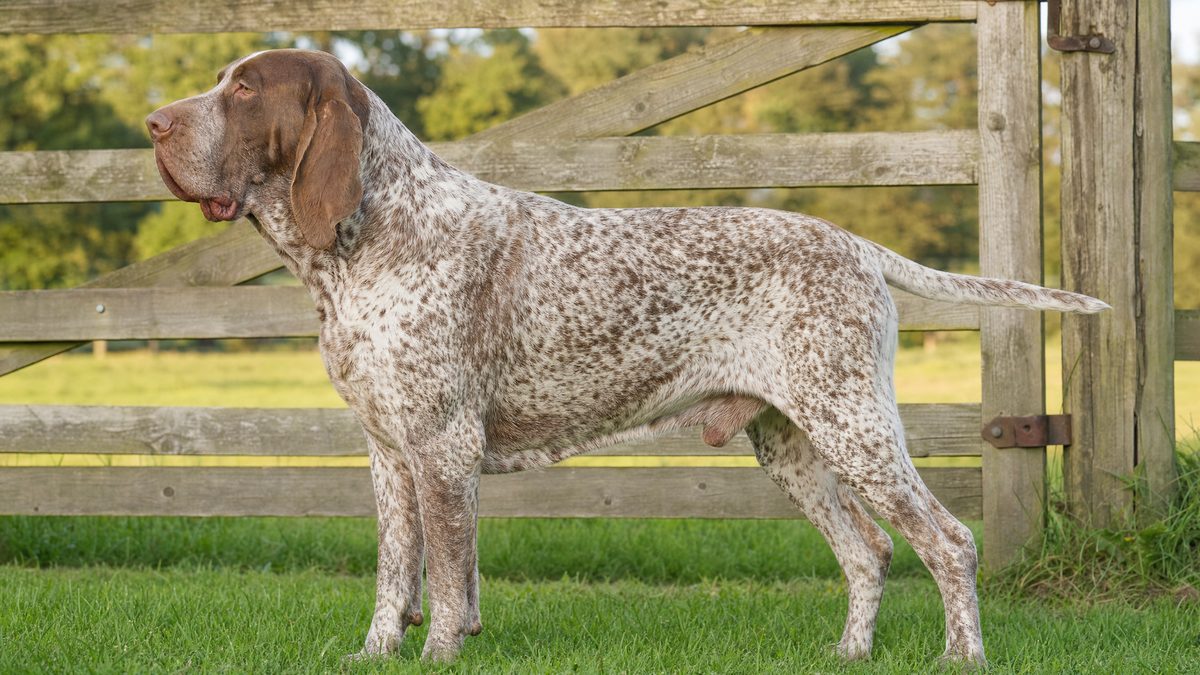
Braque Francais type Gascogne is FCI standard 133, the larger of the two French pointing breeds sharing the name, standing 60 to 69 cm in males and 58 to 68 cm in females. Its standard requires ear leathers reaching the rear rim of the nose leather, the very feature its sibling standard lists as a fault. France registered 35 in 2025, and no lawful purchase route exists in India.
This page reports published veterinary research and registry data for general information. It is not a diagnosis and it is not treatment advice. Consult a registered veterinarian about any individual dog, because breed-level statistics describe populations and not the animal in front of you.
Braque Francais type Gascogne at a glance
What the Braque Francais type Gascogne is
The Braque Francais type Gascogne is FCI breed standard 133, the larger of the two French pointing dog breeds that share the name Braque Francais, standing 60 to 69 cm in males and 58 to 68 cm in females.
It is a French pointing dog of Group 7, Section 1.1, Continental Pointing Dogs of « Braque » type, and it is registered with a working trial requirement. The standard describes a dog of medium proportions, powerful but without excessive heaviness, robust with strong bone structure, and it adds one line that most summaries drop: the skin is supple, quite loose. That loose skin is the thread running through the whole document. It produces the dewlap, the folded lip commissure, and the long ear that decides how this dog copes in India.
The name covers two breeds, not one. The FCI recognises standard 133 for the Gascogne type and standard 134 for the Pyrenean type, and the 133 text opens by saying so itself: "There are two different types of French Pointing Dogs: the large size « Gascogne type » and the small size « Pyrenean type ». Both types are originally from the South-West of France and the Central Pyrenees where they stayed in pure state."; North American breeders describe the split the same way, with Great Lakes Gun Dogs stating that there are two types and that the more common of the two is the Pyrenees. Our Braque Francais hub page covers why the single name causes so much confusion, and the Braque Francais type Pyrenees guide covers the smaller breed.
Breed history in one paragraph
The breed history the standard commits to is deliberately short. FCI 133 gives no founding date, no named founder and no development narrative, only the statement that both types come from south-west France and the central Pyrenees and stayed pure there. Popular accounts add more. Curafyt traces the breed to crosses of older European hunting dogs and points to descriptions in the medieval writings of Gaston Febus, and Royal Canin repeats a common claim that the original brown dog is the ancestor of most European pointers. Neither claim appears in the standard, and we report them as attribution rather than fact.
Size and weight
Males stand 60 to 69 cm and females 58 to 68 cm. The standard gives no weight at all. Every weight figure you will read for this breed comes from somewhere else, and they disagree: Curafyt prints 25 to 32 kg in its specification box and 25 to 35 kg in its own summary four paragraphs earlier, on the same page. Treat any weight quoted for the Gascogne as an estimate by a third party, because the recognising body has never published one.
| Point | 133 Gascogne | 134 Pyrenees |
|---|---|---|
| Male height | 60 to 69 cm | 51 to 58 cm |
| Female height | 58 to 68 cm | 49 to 56 cm |
| Skin | Supple, quite loose | Tighter than the Gascogne |
| Neck | Always with a slight dewlap | Slight or no dewlap |
| Ear set | At eye level | Above the eye line |
| Ear length | Must reach the rear rim of the nose leather | Must end 2 cm short of the nose leather |
| Coat | Rather thick and well furnished | Finer and shorter than the Gascogne |
| Nose colour | Brown | Chestnut-brown |
The colour list is short and closed. The standard permits chestnut brown, chestnut brown and white, chestnut brown and white strongly speckled, and chestnut brown marked with tan above the eyes, at the lips and on the legs. A black nose or a black-and-white dog is not this breed. Depigmentation of the nose and a split nose are both disqualifying faults.
The single most useful fact on this page is that standard 134 is written as a list of departures from standard 133. That makes 133 the base text for both breeds, and it means the Gascogne is not a variant of the Pyrenean. It is the other way round.
What FCI standard 133 requires in its own right
FCI standard 133 is a complete, self-contained breed standard that describes the Gascogne without reference to any other dog, and it is the base text from which the Pyrenean standard is drafted. Here is the whole of it, section by section.
The current English text is dated 22 September 2023 and the official valid standard it translates was published on 1 August 2023. The French original carries the same dates and is the governing version, because FCI standards are written in the language of the country of origin and translated afterwards.
Head, and the ear that matters
The head is "quite important but not too heavy", with the lines of the skull and muzzle slightly divergent in profile. The skull is almost flat or very slightly rounded, the median furrow is only lightly marked and the occipital protuberance is barely prominent. The stop is neither shallow nor accentuated. The nose is broad and brown with well-opened nostrils, the muzzle broad and rectangular and sometimes a little convex, and the lips are pendent with a labial commissure that is quite folded.
The ear clause is the one to read twice. "Leathers of medium length, set at eye level, not too broad at their set on, framing the head well, slightly folded and rounded at their tip. One or two vertical folds may be on the cheek at level and a little above the attachment of the ear. The tip of the leathers must reach the rear rim of the nose leather."; That is a requirement, not a tolerance. A Gascogne whose leathers stop short is faulted, because the fault list names "leathers flat and too short, or too curled";.
Eyes are well open and well set into the socket, chestnut brown or dark yellow, with a frank expression. Jaws and teeth must be complete and a pincer bite is tolerated, which is unusual wording; most pointing standards demand a scissor bite. Over- or undershot mouths are disqualifying.
Body, limbs and coat
The neck is of good length, slightly arched in its upper part, and always with a slight dewlap. The back is broad and straight, sometimes a bit long but always well sustained. The loin is short, muscled and slightly arched, the croup slightly oblique to the topline. The chest is broad from the front and long in profile, reaching to elbow level, with ribs rounded without exaggeration. The belly is flat and only slightly tucked up, and a belly too tucked up, which the standard calls whippety, is a fault.
Legs are vertical, straight and muscular front and rear. The shoulder is very muscular and moderately oblique, the elbow sits at the level of the sternum, and the feet are compact and nearly round with tight, well-arched toes, strong nails and thick fleshy pads. Hocks are moderately angulated and the tarsal and metatarsal region is rather short. The coat is rather thick and well furnished, finer on the head and ears.
The tail clause, and why it matters in India
The tail clause says the tail is "generally docked and continuing the convexity of the line of the rump, although the long tail, if well carried, is not a fault, no more than the naturally short tail";. Read that carefully, because it settles a question Indian buyers ask. The standard does not require docking. It explicitly says an undocked tail is not a fault. Docking is prohibited in India under the Prevention of Cruelty to Animals (Dog Breeding and Marketing) Rules 2017, whose Second Schedule Part II paragraph 6(8) states that tail docking, ear cropping, de-barking, de-clawing and "any other kind of mutilation of any body part of the pup and any change of appearance by artificial means is strictly forbidden". An Indian Gascogne with a full tail meets the breed standard exactly as written.
One apparent contradiction is worth naming. "Absence of tail" is a disqualifying fault in the same document that says the tail is generally docked. A docked tail is a shortened tail, not an absent one, so the two clauses do not conflict, but a dog born without a tail is disqualified while a dog born with a full one is not.
- Seven listed faults, including a dog too heavy or too light, an over-pronounced occipital protuberance, lips too thick or not let down enough, round eyes caused by exaggerated zygomatic and superciliary arches, short or curled leathers, a whippety belly and splayed feet
- Eight disqualifying faults, including aggression or excessive shyness, converging or over-divergent skull and muzzle lines, a split nose or pronounced depigmentation, an over- or undershot mouth, entropion, ectropion, pink spots on the eyelids, absence of tail, and syndactyly or surplus or missing toes
- No weight, no lifespan and no temperament rating anywhere in the document
The ten departures, and the ear that is required here and faulted there
Standard 134 is drafted as a list of departures from standard 133, which is why the Gascogne is the base breed. Its text states that the Pyrenean type shows "the same general characteristics as those of the « Gascogne type »" and that the two "only differ on the following points", then names ten.
The full sentence is worth quoting because it is the structural fact nothing on the results page reports. "The small size French Pointing Dogs « Pyrenean type » show, while keeping all proportions, with more reduced dimensions and lighter shapes, the same general characteristics as those of the « Gascogne type ». They only differ on the following points:"; Everything standard 134 does not mention is inherited from 133. The pincer-bite tolerance, the frank expression, the flat belly, the rounded ribs and the whole disqualification framework are Gascogne clauses that govern the Pyrenean by silence.
| # | Heading in 134 | What it changes from the Gascogne |
|---|---|---|
| 1 | General appearance | Rustic, not heavy but sufficiently muscled; skin tighter than the Gascogne |
| 2 | Head | Nose chestnut-brown; lips less pendent or less convex |
| 3 | Ears | Set on above the eye line, barely folded, tips ending 2 cm from the nose leather |
| 4 | Neck | Slight or no dewlap |
| 5 | Body | Belly less let down than the Gascogne |
| 6 | Tail | Fine, and may be docked or naturally short |
| 7 | Forequarters | Lighter than the Gascogne; shoulder moderately sloping; forefeet tight |
| 8 | Hindquarters | Hind feet tight |
| 9 | Coat | Hair finer and shorter than the Gascogne |
| 10 | Size | Males 51 to 58 cm, females 49 to 56 cm |
That count of ten is itself a change. The 1998 text of standard 134 carried nine headings, because a single line reading "Feet: Tight" sat under hindquarters. The 2022 revision split it into a forefeet clause under forequarters and a hind feet clause under hindquarters, making ten Federation Cynologique Internationale.
The sharpest divergence is the ear
FCI 133 requires the ear that FCI 134 lists as a fault. Standard 133 says "The tip of the leathers must reach the rear rim of the nose leather" and sets the leathers at eye level. Standard 134's fault list reads "Leathers set at eye level, too long (touching the nose)";. A single fault bullet on the sibling standard condemns both of the Gascogne's defining ear features at once, the eye-level set and the length reaching the nose.
We checked whether this is a recent drafting slip. It is not. The identical fault line appears in the 07.08.1998 text of standard 134, in the 11.08.2022 text and in the current 22.09.2023 text, unchanged word for word across all three Federation Cynologique Internationale. The same is true on the other side, where 133's requirement that the leathers reach the rear rim of the nose leather is present in all three generations Federation Cynologique Internationale. This is a deliberate 27-year-old distinction between two breeds, not an editing error.
The two standards disagree about how much ear a French pointing dog should carry, and they resolve the disagreement in opposite directions. In Gascony that is a judging question. In an Indian monsoon it is a health question, because ear carriage is an independent risk factor for otitis externa and the Gascogne standard mandates the higher-risk conformation. A buyer choosing between the two breeds on looks is also, unknowingly, choosing between two ear-disease risk profiles.
What else the two standards do not share
The fault lists differ in length. Standard 133 carries seven faults and eight disqualifying faults; standard 134 carries six and six Federation Cynologique Internationale. Standard 134 drops the Gascogne's disqualifications for converging or over-divergent skull and muzzle lines and for an over- or undershot mouth, so a bite fault that disqualifies a Gascogne is not listed as disqualifying on the Pyrenean. Standard 133 says "absence of tail" while 134 says "no tail (anury)", which is the same rule in different words.
One departure is easy to misread. Standard 134 gives the Pyrenean nose as "chestnut-brown" while 133 gives the Gascogne nose as "brown"; Federation Cynologique Internationale. Those are not obviously different colours, and the eyes in 133 are already described as chestnut brown. The distinction appears to be one of drafting precision rather than pigment, and no source we opened explains it.
Four of eight size limits moved, and almost every English page still prints the old ones
Four of the eight size limits across the two French pointing standards moved, all four of them minima, and the change opened a 2 cm gap where the two breeds used to meet exactly. It happened at the 11 August 2022 revision, not in 2023, and the English-language pages that rank for this breed still publish the superseded figures.
We pulled the archived FCI PDFs and diffed them line by line. The table below is the result.
| Standard and sex | 07.08.1998 text | Current text | Moved? |
|---|---|---|---|
| 133 Gascogne, male | 58 to 69 cm | 60 to 69 cm | Minimum, +2 cm |
| 133 Gascogne, female | 56 to 68 cm | 58 to 68 cm | Minimum, +2 cm |
| 134 Pyrenees, male | 47 to 58 cm | 51 to 58 cm | Minimum, +4 cm |
| 134 Pyrenees, female | 47 to 56 cm | 49 to 56 cm | Minimum, +2 cm |
Every maximum is untouched and every minimum moved Federation Cynologique Internationale Federation Cynologique Internationale Federation Cynologique Internationale. The effect on the boundary between the two breeds is the interesting part. Under the 1998 texts the ranges met at a single point in both sexes, because the Gascogne male minimum of 58 cm was exactly the Pyrenean male maximum of 58 cm, and the Gascogne female minimum of 56 cm was exactly the Pyrenean female maximum of 56 cm. A 58 cm male could satisfy either standard. Today there is a 2 cm gap in both sexes, 58 to 60 cm for males and 56 to 58 cm for females, and a dog landing in it fits neither breed's height clause.
The revision was 2022, not 2023
This site's Braque Francais hub page attributes the four moved limits to the 2023 revision. Our own diff shows that is wrong on the date, and we are correcting it here. The 11.08.2022 text, whose official valid standard is dated 16.06.2022, already carries 60 to 69, 58 to 68, 51 to 58 and 49 to 56 Federation Cynologique Internationale. A full diff of that text against the 22.09.2023 text finds only four differences in each document, and none of them is substantive: the revision date line, the valid-standard date, one whitespace change from "SIZE :" to "SIZE:", and the deletion of the trailing sentence "The latest amendments are in bold characters." The 2023 reissue changed nothing about either dog.
Two deleted clauses nobody reports
The 2022 revision also silently removed a preferred size from each standard. The 1998 Gascogne text carried "Preferred size : 61 to 63 cm" and the 1998 Pyrenean text carried "The size of 50 to 55 cm is the one to aim for which covers the most numerous utilizations";. Neither survives into the current documents Federation Cynologique Internationale. The same revision flipped both titles so the French name leads, promoted the ear clause from a sub-line under HEAD to a top-level EARS heading, renamed BELLY to "Underline and belly" and HAIR to "Coat", and fixed the misspelling "Aggresive".
What the ranking pages still publish
We checked the three most-cited English sources against the current text.
- Wikipedia gives the Gascogne as 58 to 69 cm for males and 56 to 68 cm for females, and the Pyrenean as 47 to 58 cm and 47 to 56 cm. Those are the 1998 numbers exactly, and they reproduce the old single-point overlap
- AKC lists only the Pyrenean and gives its height as 18.5 to 23 inches, which is 47 to 58 cm, again the 1998 range. The current standard starts at 51 cm, so AKC's floor sits about 4 cm low
- UKC gives the Gascogne, under the name Braque Francais de Grande Taille, as 23 to 27 inches for males and 22 to 26.5 inches for females, which is 58 to 69 cm and 56 to 67 cm. UKC also still carries "Preferred size is 24-25 inches", the 61 to 63 cm preferred size FCI deleted
Ask which standard a figure comes from and what date it carries. If a seller or a page quotes 58 cm as the Gascogne male minimum, it is quoting a text superseded in June 2022. The current minimum is 60 cm, and the gap between 58 and 60 cm belongs to neither breed.
How rare the Gascogne actually is, in French studbook numbers
The Societe Centrale Canine registered 35 Braque Francais type Gascogne in France in 2025 against 623 of the Pyrenean type, a ratio of about 18 to 1 in the sibling's favour. Across the six years we could retrieve, the aggregate is 199 Gascogne against 3,705 Pyrenees, or 18.6 to 1.
France is the right place to count, because it is the country of origin and the Societe Centrale Canine keeps the Livre des Origines Francais, the studbook that both breeds are registered in. The 2025 table's columns read "Races Varietes, Inscr 2024, Inscr 2025, Conf 2025, Conf / Inscr 2025, % inscr 2024-2025";.
| Year | Gascogne | Pyrenees | Pyrenees per Gascogne |
|---|---|---|---|
| 2009 | not split | not split | single row of 606 |
| 2016 | not split | not split | single row of 614 |
| 2019 | 34 | 500 | 14.7 |
| 2020 | 40 | 615 | 15.4 |
| 2022 | 27 | 752 | 27.9 |
| 2023 | 49 | 609 | 12.4 |
| 2024 | 14 | 606 | 43.3 |
| 2025 | 35 | 623 | 17.8 |
Read the ratio column with care. It swings from 12.4 to 43.3 across six years, and that volatility is an artefact of a tiny denominator rather than a real change in the breeds' relative popularity. Fourteen dogs in 2024 and 35 in 2025 is a 150 percent rise that means almost nothing, because two extra litters would produce it. The aggregate ratio of 18.6 to 1 over six years is the number to quote, not any single year. The 2019 and 2022 columns above are read from the previous-year column of the 2020 and 2023 tables respectively, because those two years' own PDFs were not retrievable, and both cross-check against the following year's table Societe Centrale Canine Societe Centrale Canine Societe Centrale Canine.
The registry only split the two lines recently
In 2009 and again in 2016 the LOF table carried a single undifferentiated row reading "BRAQUE FRANCAIS", worth 606 registrations in 2009 and 614 in 2016 Societe Centrale Canine. Separate Gascogne and Pyrenees rows appear by 2019. That matters for anyone reading older figures, because a pre-2019 "Braque Francais" number is not a Gascogne number.
The arithmetic tells you roughly how it was composed. The undifferentiated row ran 606 and 614, and the Pyrenees row alone has since run between 500 and 752, sitting at 606 in 2024 and 623 in 2025. The old combined total is almost exactly today's Pyrenees-only total, which means the Gascogne contributed something close to a rounding error to it even before the registry separated them.
Calibration, against breeds you already know
Percentages of a studbook are hard to feel, so here is the same year measured against familiar dogs in the same table. The Retriever du Labrador took 6,531 LOF registrations in 2025, which is 187 Labradors for every Gascogne. The Epagneul Breton, France's own most-registered gundog, took 3,793, or 108 per Gascogne. The Braque Allemand a poil court, the German Shorthaired Pointer, took 1,287, or 37 per Gascogne.
Within its own group the Gascogne is rare but not last. The 2025 pointing-dog group, Groupe VII Chiens d'arret, totals 17,777 registrations across 32 breeds, and we verified that figure by summing the individual rows, which come to exactly the printed total of 17,777 with the two Epagneul Breton colour varieties excluded so they are not double counted. Against that denominator the Gascogne's 35 dogs are 0.20 percent of the group and the Pyrenean's 623 are 3.50 percent. The Gascogne ranks 19th of the 32 pointing breeds by volume, above the Braque Saint-Germain at 16 and the Braque de l'Ariege at 6, and far below the Braque du Bourbonnais at 61.
Confirmation, the number behind the number
France distinguishes registration from confirmation, an adult assessment against the breed standard that a dog must pass before it can breed on. In 2025, 8 of the 35 Gascogne registered were confirmed, which is 22.9 percent, against 176 of 623 Pyrenees, or 28.3 percent. Both figures lag because confirmation happens at about a year old, so a given year's confirmations mostly belong to earlier registrations. The blunt reading is that the entire annual breeding intake of this breed in its home country is a single-figure number of dogs.
A breed producing roughly 35 puppies a year in the country that invented it has no export surplus. Waiting lists in Europe are measured in years, not months, and there is no scenario in which stock reaches India through a commercial channel. Treat any Indian listing claiming this breed as a misidentification until proven otherwise.
Price in India: there is no market, and the listings are something else
No Braque Francais type Gascogne price in India exists, because no verifiable Indian listing for the breed exists. Every Indian result that mentions the breed name turns out to be a dropdown option, a sidebar link, a search filter or a 1944 engraving, and we proved the search itself works before drawing that conclusion.
The honest answer to "what is the price in india" for this breed is that the question has no answer, so the useful thing this page can do is show you what you will actually be shown instead.
The absence, and the control that earns it
An India-located search for the breed name with price and rupee terms returned ten results. Not one was a listing for the breed. They were a Justdial page for Shih Tzu pet shops in Dehradun where the breed name appears only in a sidebar, a Greenfield Puppies Maltese page where it appears only in a filter dropdown, an Etsy listing for a 1944 colour engraving, two ThePetNest dog-training pages where it sits in a breed picker, an academic thesis citing a genetics paper, a PetzLover English Cocker Spaniel page, and a Dutch site's Thai Bangkaew page.
A zero result proves nothing unless the search is working, so we ran a control in the same tool, same session and same location. The query "Labrador Retriever puppy price in India" returned dense, real Indian commerce immediately, including a city-by-city price table quoting INR 30,000 to INR 1,20,000+ across Hyderabad, Bangalore, Delhi, Chennai, Lucknow, Mumbai, Jaipur and Pune. The tool works and India-located results are being returned. The Gascogne's absence is therefore a finding rather than a broken query.
What the Justdial pages actually are
Justdial carries pages titled "Top Pet Shops For Braque Francais Dog" for Indian cities. They are auto-generated per-breed templates, and three things give it away. The same template exists for the Burgos Pointer, the Basset Artesien Normand, the Cesky Terrier, the Bouvier des Flandres and the Bergamasco, none of which has an Indian population either. The breed name appears as a "similar category" sidebar link on unrelated pages in Surat, Balasore and Midnapore. And the Ludhiana page's listed businesses, Doon Pets World and The Golden Pet Shop, carry an address on Haridwar Road in Kuwawala, which is in Dehradun, about 350 km away in a different state. The breed name is a URL token. The shops are generic pet shops.
Rs 98,999 is a house price point, not a breed price
If you search rupee figures around Indian puppy listings you will meet Rs 98,999 repeatedly. We found it on puppiezo.com attached to a Newfoundland, to a Xoloitzcuintli and to a Rough Coat Jack Russell Terrier, where it is printed twice on the same page Puppiezo, Jack Russell Terrier Rough Coat…. Three unrelated breeds, one identical price, badged "Platinum" on one of them. It is a charm price attached to whatever is in stock, and it should never be reported as any breed's price, least of all this one.
Divide every suspicious rupee figure, by 84.38 and by 74
Indian pages routinely publish a US dollar price run through one exchange rate and presented as a local figure. Two rates catch most of them. Run the tests yourself on any number you are quoted.
| Figure | Divided by 84.38 | Divided by 74 | Reading |
|---|---|---|---|
| Rs 98,999 | 1,173.25 | 1,337.82 | Neither is round, so it is rupee-native. A charm price, not a conversion |
| EUR 1,100 (Curafyt low) | not applicable, already euros | not applicable | A euro figure from a Belgian site, not an Indian price |
| EUR 1,400 (Curafyt high) | not applicable, already euros | not applicable | As above |
The tests find nothing here for one simple reason: there is no Indian rupee price for this breed to test. That is itself the result. Where a breed has a fabricated Indian price, the division usually exposes it. Where a breed has no Indian market at all, as here, there is not even a fabricated number in circulation, which tells you how far outside Indian commerce this dog sits.
The only published prices are European
Curafyt, at position 7 for this term, quotes EUR 1,100 to EUR 1,400 for a puppy and EUR 90 to EUR 175 a month to run. That is a Belgian consumer-health retailer quoting a European market, and it is the only purchase figure we found anywhere for the Gascogne specifically. We report it as what it is, a European price from a commercial site, and we do not convert it into a rupee figure, because doing so would manufacture exactly the kind of number this section exists to warn you about.
Ask for the FCI or Societe Centrale Canine pedigree number and the import authorisation. France registered 35 of these dogs in 2025 and Indian law does not permit commercial import of dogs for breeding or sale, so a legitimate chain of custody would be extraordinary and fully documented. Far more likely, you are being offered a Pointer cross, a German Shorthaired Pointer, or an Indian pariah-type dog with a chestnut and white coat.
Cost of ownership, bounded honestly
The only published running cost for a Braque Francais type Gascogne is a European one, EUR 90 to EUR 175 a month, and it does not transfer to India. What does transfer is the cost structure, which for this breed is driven by size, by exercise needs and by one recurring ear expense most large-breed budgets leave out.
Curafyt breaks its European monthly figure into EUR 50 to 75 for food and EUR 20 to 50 for veterinary care, plus a one-off EUR 100 to 200 for training and accessories. We are not converting those into rupees. Indian food prices, vet fees and accessory costs bear no fixed relationship to Belgian ones, and a converted figure would look authoritative while meaning nothing.
What actually drives the cost of ownership here
Four things set the monthly bill for a dog of this size and type in India, and only the first is obvious.
- Food volume, set by bodyweight. No official weight exists for this breed, and third-party figures run from 25 to 35 kg. Budget from the top of that range for an entire male, because underfeeding an athletic pointing dog is the more common error
- Ear care, which is not optional here. A weekly check and a drying routine after every wetting is a permanent line item, not an occasional one, and it is cheaper than the ear infection it prevents
- Exercise infrastructure. In an Indian city, a dog needing 60 to 90 minutes daily outside the heat window usually means either a car to reach open ground or a paid dog-walker at pre-dawn hours
- Tick and flea prevention, year-round. Indian tick pressure does not have an off-season in most of the country, so this is twelve months of cost rather than a summer course
The ear budget, quantified
Otitis externa is not a rare event in this conformation. UK primary-care data puts the one-year prevalence of otitis externa across all dogs at 7.30 percent, and breeds with pendulous ear carriage carry 1.76 times the odds of it compared with erect-eared breeds. The Gascogne standard mandates pendulous leathers long enough to reach the nose leather, so this breed sits in the higher-odds group by definition rather than by chance.
An Indian series makes the seasonal shape of that cost visible. In 81 otitis cases at Palampur, 59.25 percent presented in the rainy season of July and August. Budget for the ear consultation you will probably need in the monsoon, and treat a clear year as a good outcome rather than the baseline.
Costs this breed does not impose
Grooming is genuinely cheap. The coat is short, described as rather thick and well furnished and finer on the head and ears, and it needs a rubber mitt rather than a salon. Royal Canin rates the breed as requiring only moderate grooming. There is no clipping cost, no de-matting cost and no stripping cost.
A monthly cost for a breed with no Indian population would be invented arithmetic dressed as research. The structure above is transferable and checkable. A number would not be. If you want a rupee benchmark for a dog of comparable size and energy, price a German Shorthaired Pointer or a Labrador locally, add the ear routine, and treat that as the floor.
Heat tolerance: what 22.6 °C at origin means in a 35.9 °C city
The Braque Francais type Gascogne comes from a place whose warmest month averages 22.6 °C, and Delhi's warmest month averages 35.9 °C, a gap of 13.3 °C. That is the whole heat tolerance argument, and it is a workload problem rather than a fragility problem.
We took the origin climate from NASA POWER, queried by explicit latitude and longitude rather than by place name, because a coordinate pair cannot silently return a different town. The query point is 43.646 N, 0.586 E, which is Auch in the Gers, the historic centre of Gascony, and the response echoes those exact coordinates back with an elevation of 231 m. Every Indian figure below comes from the same dataset queried the same way NASA POWER, Source Native Resolution….
| Location | Warmest month | Mean temp | Above Gascony |
|---|---|---|---|
| Auch, Gascony (origin) | August | 22.6 °C | baseline |
| Bengaluru | April | 28.4 °C | +5.8 °C |
| Pune | April | 28.9 °C | +6.4 °C |
| Mumbai | May | 31.2 °C | +8.6 °C |
| Chennai | May | 31.5 °C | +8.9 °C |
| Kolkata | May | 31.5 °C | +9.0 °C |
| Delhi | June | 35.9 °C | +13.3 °C |
Why this is a schedule problem, not a disqualification
The Gascogne has none of the anatomy that makes a breed inherently heat-sensitive. It is mesocephalic with a broad, rectangular, normally-proportioned muzzle and well-opened nostrils, so its airway is unobstructed. Its coat is short. Nothing in its build restricts panting, which is how a dog sheds heat.
What it does have is a job description. This is a pointing dog with a working trial requirement attached to its FCI registration, bred to quarter ground for hours. The UK heat-illness data is clear that the danger for dogs like this is exertion rather than ambient temperature. In a cohort of over 900,000 dogs, heat-related illness prevalence was 0.14 percent, and dogs at or above their breed and sex mean bodyweight carried 1.42 times the odds of an event; no breed type showed significantly reduced odds compared with the Labrador Retriever. A large, fit, willing gundog will run itself into trouble because it wants to, not because it cannot cope with a warm room.
Climate adaptation, city by city
Climate adaptation for this breed means moving the work, not reducing it. The practical schedule differs by city because the constraint differs.
- Delhi. The hardest city for heat and the easiest for ears. June averages 35.9 °C and peaks far higher, so all work moves to a pre-dawn window from roughly 5 to 7 am, and the April to June period is a genuine three-month restriction
- Bengaluru and Pune. The mildest heat gaps at +5.8 and +6.4 °C, and Bengaluru sits at 842 m, which helps. An early-morning and post-sunset split works most of the year
- Mumbai, Chennai and Kolkata. Moderate heat gaps of +8.6 to +9.0 °C, but these are the humidity cities, and humidity blunts evaporative cooling as well as attacking the ears. Treat the wet season as the real constraint here, not May
Note that this ranking inverts the obvious one. Delhi is the worst Indian city for this breed's heat and among the better ones for its ears; Mumbai and Pune are the reverse. A buyer choosing on temperature alone would pick the wrong city, which is why the next section handles humidity separately.
Never let this dog choose its own workload in Indian heat. A biddable, willing gundog with an intense desire to please will keep quartering past the point of safety because stopping is not in its temperament. The handler sets the limit, and the clock sets the handler's.
Long ears in Indian humidity, the real constraint on this breed
Gascony has no month that is simultaneously warm and humid, and Mumbai and Pune each have five. That mismatch, and not the temperature, is the strongest argument against keeping a Braque Francais type Gascogne in coastal or western India, because the breed standard requires the longest ear of any French pointing dog.
An ear canal minds warmth and moisture together. Either alone is tolerable. We therefore counted the months at each location that are both at or above 20 °C and at or above 75 percent mean relative humidity, using the same coordinate-queried NASA POWER climatology as the heat section.
| Location | Warm and humid months | Most humid month | That month's temp |
|---|---|---|---|
| Auch, Gascony (origin) | 0 | January, 85.4 percent | 5.7 °C |
| Delhi | 0 | August, 74.9 percent | 29.8 °C |
| Bengaluru | 0 (July and August reach 76.8 and 78.7 percent at 23.5 and 23.3 °C) | August, 78.7 percent | 23.3 °C |
| Chennai | 5 | November, 82.3 percent | 25.8 °C |
| Kolkata | 5 | August, 89.1 percent | 28.2 °C |
| Mumbai | 5 | August, 90.4 percent | 26.1 °C |
| Pune | 5 | August, 90.8 percent | 23.3 °C |
Gascony's wettest month is its coldest and its warmest months are its driest. August at the origin averages 22.6 °C at 61.2 percent humidity, and January averages 5.7 °C at 85.4 percent. The combination this ear has never had to handle is warm air at 90 percent humidity, which is exactly what Mumbai and Pune deliver for five consecutive months.
The Indian evidence, and an error in it we corrected
A cross-sectional study at Palampur screened 2,476 dogs presented to a veterinary clinic between June 2022 and July 2023 and diagnosed otitis externa in 81, a hospital prevalence of 3.27 percent. Cases peaked sharply in the rainy season, with 48 of 81, or 59.25 percent, presenting in July and August.
The paper's Table 5 reports the ear-carriage split as 53 pendulous-eared cases at 69.13 percent and 25 erect-eared cases at 30.86 percent. The 53 is a typographical error and the correct count is 56, which we established three ways. First, 56 divided by 81 is 69.1358 percent, which truncates to the printed 69.13, whereas 53 divided by 81 is 65.43 percent. Second, 56 plus 25 equals 81, exactly the case series, while 53 plus 25 leaves three cases in neither category, which is impossible for a binary split. Third, the two printed percentages sum to 99.99, so the categories are exhaustive and the counts must total 81.
We can also see where the wrong number came from. The same paper reports bacterial infection in 65.43 percent of cases, made up of 30 cocci-associated and 23 rod-associated, and 30 plus 23 is 53. The figure 53 is a real number in this study sitting on the bacterial row, and it appears to have been lifted into the ear row. The paper contains other digit-level typesetting slips that support this reading: Table 1 prints 10 cases as 12.43 percent twice, while Table 4 prints 10 cases as 12.34 percent, and 10 of 81 is 12.3457 percent, so 12.43 is a transposition of 12.34.
One phrase in the paper that is not an error
The same section opens "In a study of 50 cases of Otitis externa, the primary cause was identified in 45.67% (37/81) as hypersensitivity", which reads like a contradiction of the 81-case series. It is not. The five primary causes the paper lists are hypersensitivity 37, parasitism 5, immune-mediated conditions 4, hypothyroidism 2 and viral disease 2, and those sum to exactly 50. The 50 is the number of cases in which a primary cause was identified. The remaining 31 of 81 had none, and all five percentages are correctly computed over the full 81.
What this means for the Gascogne specifically
The Palampur figures describe a share of cases, not a risk ratio, so they cannot tell you how much more likely a pendulous-eared dog is to get otitis. The UK primary-care cohort can. Breeds with pendulous ear carriage carry 1.76 times the odds (95 percent CI 1.48 to 2.10) of otitis externa compared with erect-eared breeds, and V-shaped drop ears carry 1.84 times the odds. FCI 133 requires leathers reaching the rear rim of the nose leather, slightly folded and lying against the head, which places this breed in the 1.76 group.
European and American gundog guidance routinely says to towel a working dog down and let it air dry. In Gascony, where no month is both warm and humid, that is sound. In a Mumbai or Pune monsoon at 90 percent humidity it leaves a warm, closed, damp canal under a leather long enough to touch the nose. Dry inside the ear with cotton wool after every swim, bath and rain-soaking, and plug the ears before bathing.
Temperament and who should not buy one
Every source describes the Braque Francais type Gascogne as gentle, docile and strongly handler-focused, and the FCI standard says nothing about temperament at all beyond disqualifying aggression and excessive shyness. The honest position is that the character reports are consistent but none of them is a measured study.
Start with what the recognising body commits to. FCI 133's only temperament content is a disqualification: "Aggressive or overly shy", alongside a general disqualification for any dog showing physical or behavioural abnormalities. There is no rating for sociability, no note on children, no guidance on other dogs. Anyone quoting the FCI for this breed's personality is quoting a document that does not discuss it.
The descriptive sources agree with each other, which is worth something even without measurement. Royal Canin characterises the breed as loving, intelligent, quiet and even-tempered, and rates it patient with children and other animals. Curafyt describes a sensitive, intelligent and sociable dog that forms an exceptionally strong bond with its owner and does not respond well to harsh correction. Gun Dog Magazine describes the Braque Francais as a breed with a high prey drive combined with an intense desire to please and a very high level of trainability.
The sources disagree about whether it is calm
Royal Canin rates the breed "quiet" and "even-tempered";. A long-standing North American breeder quoted in Gun Dog Magazine says the opposite in as many words. "While much of what you read says they are calm, I say busy paws are happy paws. They are energetic, sensitive, well mannered, affectionate and intelligent."; Both cannot be right about the same dog in the same house, and the difference probably tracks exercise. A Braque that has quartered ground for an hour is quiet indoors. One that has not is not.
The two traits that pull against each other
High prey drive and high biddability in the same dog is the combination that defines this breed and the one that catches owners out. A dog that badly wants to please you is easy to teach. A dog with a strong hunting instinct is hard to recall off a scent. Together they produce an animal that is delightful in the house and unreliable off-lead until the recall is genuinely proofed, which takes longer than the biddability leads you to expect.
Who this breed suits in India
- Households with ground-floor or gated outdoor access, or a genuine daily commitment to reach open space before sunrise
- Owners who want an athletic, versatile dog that lives indoors with the family rather than a kennelled working animal
- First-time owners of a large breed, provided they accept the exercise and ear routines, because the biddability makes the training itself forgiving
- Families with children, on the descriptive sources' account, though no dog of this size should be left unsupervised with a small child
Who should not buy one
- Anyone in a lift-access flat without a reliable pre-dawn routine, because a pointing dog that cannot quarter ground finds its own work indoors
- Anyone who trains by correction. This is the single most repeated warning in the sources, and shutting a soft dog down is easy and slow to undo
- Households with free-roaming cats, rabbits or poultry, given the prey drive
- Anyone in Mumbai, Pune, Chennai or Kolkata who will not commit to the monsoon ear routine
- Anyone who wants a guard dog. A docile, people-focused gundog with no protective mandate in its standard is the wrong tool
None of the temperament claims on this page rests on a behavioural study of this breed. They are consistent descriptions from a pet-food brand, a supplement retailer and a hunting magazine, and the breed's tiny population means no one has measured it. We report the agreement and we flag that agreement between three descriptive sources is weaker evidence than one measurement.
Training: what works, and the one method that breaks this dog
Train a Braque Francais type Gascogne with reward and minimal correction, because every source that has handled the breed says heavy handling turns it shy and timid rather than defiant. This is a soft, biddable gundog, and the failure mode is shutdown, not rebellion.
The warning is unusually consistent across independent sources. Gun Dog Magazine states it plainly: "Braque Francais do not respond well to heavy-handed training. Strong handling and aggression can cause the Braque to become shy and timid and may seriously delay the dog's progression in the field. If you are considering this breed, plan to use minimal but effective correction and abundant praise."; Curafyt says the same in different words, that the breed thrives on positive reinforcement and that harsh correction produces shy behaviour.
There is a hard edge to this that owners miss. The FCI standard disqualifies a dog that is "overly shy";. So a handler who trains this breed by intimidation can produce, in a genetically sound dog, the exact temperament that disqualifies it from the ring. The method creates the fault.
What to train, in order
- Recall first and for longer than feels necessary. High prey drive plus an open Indian maidan is the combination that loses dogs. Proof it on a long line for months before trusting it off-lead
- Settle and place. A pointing dog confined by heat for eight hours a day needs a trained off-switch, not just a tired body
- Ear handling as a trained behaviour. Teach the puppy to accept its leathers being lifted, wiped and dried before it needs treatment, because a dog with a painful ear that has never been handled is a two-person job
- Loose-lead walking. A 30 kg dog that quarters instinctively will pull, and pre-dawn road walking in Indian traffic is not the place to discover it
- Retrieve and hold. The breed retrieves naturally on land and in water, which makes this the easiest thing on the list and a good confidence builder
Realistic timelines
Breeders report that the breed matures faster than many gundogs and has an above-average ability to accept training. Expect basic obedience to come quickly, within weeks, and expect proofed recall against live scent to take the better part of a year. That gap is the whole training story for this breed. Do not read early obedience success as a reliable recall.
Socialisation follows the standard window. Curafyt cites a 2022 review putting the period of most lasting effect at roughly three to twelve weeks of age. In India that collides with the vaccination schedule, so socialise deliberately in safe settings, carrying the puppy where necessary, rather than waiting for full cover and losing the window.
What this breed resists
It does not resist much, which is its own trap. A dog this willing will keep working through discomfort, heat and a sore ear to please its handler, so the handler has to notice what the dog will not tell them. The one genuine resistance is to abandoning a scent, and no amount of biddability overrides a fresh line in a dog bred with a working trial attached to its registration.
Exercise: 60 to 90 minutes, and what happens without it
Plan 60 to 90 minutes of real exercise daily in two sessions, both outside the Indian heat window, plus scent work indoors. A Braque Francais type Gascogne that does not get it does not become calm, it becomes destructive and vocal.
This is a dog built and registered to hunt. The FCI attaches a working trial requirement to the breed, and the standard describes a robust animal with strong bone, very muscular shoulders and moderately angulated hocks, which is the build of an animal expected to cover ground for hours Federation Cynologique Internationale. Curafyt calls for running, fetching and long walks combined with tracking and obedience work.
The Indian daily schedule
| City | Hard season | Morning window | Evening window |
|---|---|---|---|
| Delhi | April to June | 5:00 to 6:30 am | After 8:00 pm, ground heat permitting |
| Mumbai | March to May, plus the wet months for ears | 5:30 to 7:00 am | After 7:30 pm |
| Chennai | April to June | 5:15 to 6:45 am | After 7:30 pm |
| Pune | March to May | 5:45 to 7:15 am | After 7:00 pm |
| Bengaluru | March to April only | 6:00 to 7:30 am | After 6:30 pm |
Test the ground with the back of your hand for five seconds before every walk, and see our heat safety guide for dogs in India for the full timing rules. Asphalt holds heat long after air temperature falls, and a dog that will not complain is exactly the dog that burns its pads.
Substitutes that actually work
When the weather takes the outdoors away, replace the mental load rather than the distance. A pointing dog is tired by scent, not only by kilometres. Scatter-feed part of the daily ration across a room, hide a scented article and send the dog to find it, and use a snuffle mat during the worst of the pre-monsoon heat. Thirty minutes of nose work will settle this breed more effectively than an hour of pavement plodding.
Swimming is excellent for this breed and it retrieves in water willingly. In India it carries a cost, because water in the ear is a named contributor in the Indian otitis literature, where excessive moisture accounted for 20.98 percent of cases and water entry is separately implicated. Swim the dog, then dry the ear canal properly afterwards.
An under-exercised Gascogne does not sleep more. It patrols, it chews door frames, it barks at corridor noise in a flat, and it begins pointing at pigeons from the balcony for hours. Those are not behaviour problems to be corrected. They are a working dog finding work, and the fix is the schedule above.
Grooming: ten minutes a week on the coat, and a routine on the ears
Groom the coat of a Braque Francais type Gascogne with a rubber mitt twice a week and nothing more, because the coat is short and self-maintaining. The real grooming task on this breed is the ear, and in Indian humidity it is a weekly minimum rather than an occasional check.
The standard describes hair that is "rather thick and well furnished", finer on the head and ears. That is a slightly heavier coat than its sibling carries, since standard 134 specifies hair "finer and shorter than that of the Gascogne Type";, but it is still a short single coat with no undercoat to strip and no feathering to mat. Royal Canin rates the breed as requiring moderate grooming and Curafyt puts brushing at once a week.
The weekly coat routine
- Rubber curry mitt twice weekly, which lifts dead hair and distributes skin oil
- Bath only when actually dirty, using a mild dog shampoo, because over-bathing strips a short coat and dries the skin
- Nails every three to four weeks, since Indian city dogs walking on grass and soft ground do not wear them down
- Teeth two or three times a week
- A tick check after every walk in grass, run finger and thumb around the ear margins, between the toes and under the collar
The ear routine, which is the actual job
This breed's leathers are required to reach the rear rim of the nose leather and lie folded against the head. That creates a closed, poorly ventilated canal, which is why pendulous-eared breeds carry 1.76 times the odds of otitis externa.
- Lift and look weekly. Healthy is pale pink, dry and close to odourless. A yeasty smell precedes visible discharge
- Plug the ears before every bath. Cotton wool, removed straight afterwards. Water entering the canal during bathing is a named cause in the Indian literature
- Dry after every swim and every soaking. Wipe the visible canal with dry cotton wool. Never push a cotton bud down the canal
- Raise the frequency in the monsoon. In Mumbai and Pune, where five months run above 75 percent humidity at over 20 °C, check twice a week from June to October
- Stop and see a vet at head-shaking or pawing. Both were among the presenting signs in the Palampur series, alongside pruritus, pain, swelling and purulent discharge
Overseas gundog guidance says to towel a working dog and let it air dry, which is correct in a climate whose warm months are its driest. Gascony has no month that is both warm and humid; Mumbai and Pune have five. Air drying under a leather that reaches the nose, in 90 percent humidity, is how a preventable ear infection starts.
Health, lifespan and the screening data that does not exist for this breed
No health figure published anywhere is attributable to the Braque Francais type Gascogne alone. The only populated screening dataset sits under an undifferentiated breed label, the entry that names the Pyrenean type is empty, and no breed club has run a health survey. Here is exactly what does and does not exist.
The OFA data, and why we will not call it Gascogne data
The Orthopedic Foundation for Animals carries two relevant breed entries. We read both codes out of OFA's own selector markup rather than guessing them, where the checkbox attributes read value="BDF" data-name="BRAQUE FRANCAIS" and value="BP" data-name="BRAQUE FRANCAIS PYRENEES";. The same parse returned Labrador Retriever, Golden Retriever and German Shorthaired Pointer as controls, so the list is complete and the codes are not inferred.
| Entry | Hips | Eyes |
|---|---|---|
| BDF, page heading BRAQUE FRANCAIS | 135 evaluated, 131 normal (97.0 percent), 4 dysplastic (3.0 percent) | 139 evaluated, 128 normal (92.1 percent), 11 abnormal (7.9 percent) |
| BP, page heading BRAQUE FRANCAIS PYRENEES | No testing statistics found | No testing statistics found |
The hip grades break down as 33 excellent (24.4 percent), 91 good (67.4 percent) and 7 fair (5.2 percent), with 3 mild, 1 moderate and 0 severe among the dysplastic. Every one of those percentages divides out correctly against 135, and the sub-counts sum to their totals, so the table is internally consistent.
The problem is the label, not the arithmetic. The populated entry is called simply BRAQUE FRANCAIS, with no type qualifier on the page heading or in the page metadata. Its only registry cross-reference in OFA's markup reads "CKC Sporting Group (GASCOGNE BRAQUE FRANCAIS); UKC Gun Dog Group", and UKC recognises both types under de Grande Taille and de Petite Taille, so that mapping does not isolate one breed either. Any dog entered under the plain name before the separate Pyrenean entry existed lands in this bucket regardless of type. We therefore report these as Braque Francais figures of uncertain type composition, and we do not present 97.0 percent as the Gascogne's hip result.
The empty entry is informative in its own right. The BP page loads correctly, prints the heading BRAQUE FRANCAIS PYRENEES, and returns "No testing statistics found";. Same template, same mechanism, one full table and one empty, which is the internal control confirming the zero is real. Neither breed is in the CHIC programme and OFA records that no parent club has initiated a health survey for either.
Lifespan: the sources disagree by five years
FCI standard 133 gives no lifespan at all. The two commercial pages that rank for this breed disagree sharply. Royal Canin publishes 12 to 15 years and states that its key facts are sourced from the FCI, which cannot be right for this figure, because the FCI document contains no life expectancy. Curafyt publishes 10 to 12 years. AKC gives 12 to 15 years, but for the Pyrenean type, a different breed. We publish the disagreement rather than an average, because averaging a 10 to 12 and a 12 to 15 would invent a figure neither source supports.
Named health issues, and how well evidenced each is
- Otitis externa. Best evidenced. Pendulous ear carriage carries 1.76 times the odds against erect ears in 905,554 UK dogs, and the standard mandates that conformation
- Hip dysplasia. Named by both commercial sources and by Gun Dog Magazine, which notes breeders routinely screen for it. The OFA bucket shows 3.0 percent dysplastic across 135 evaluations, above OFA's 100-evaluation reporting floor but of uncertain type composition
- Eye conditions. 7.9 percent abnormal across 139 evaluations in the same bucket. Entropion, ectropion and pink eyelid spots are disqualifying faults in the standard, which suggests the breed has historically had to select against them
- Gastric dilatation-volvulus. Asserted by Curafyt on the general grounds that the breed is large and deep-chested. No breed-specific incidence figure exists. The standard does describe a chest long in profile and reaching the elbow
- Skin allergies. Asserted without a breed-specific figure
The OFA counts above were read on 23 August 2026 and they change as evaluations are submitted. Always quote the sample size beside the percentage, as we have, so a later reader can see whether the figure has drifted. A breed needs 100 hip evaluations, or 50 for the other databases, to appear in OFA's statistics at all.
Feeding a large, deep-chested working dog in India
Feed a Braque Francais type Gascogne two or more smaller meals a day rather than one large one, and never within an hour either side of hard exercise. That single rule matters more than brand choice for a large, deep-chested breed, and it is the one risk factor for bloat an owner can actually control.
Start from an uncomfortable fact. The FCI standard gives no weight for this breed, so there is no official target to feed towards. Third-party figures run from 25 to 35 kg, and the same page that prints 25 to 32 kg in its specification box prints 25 to 35 kg in its summary. Feed to body condition, not to a number.
Body condition beats the bathroom scale
Run your palms along the ribs. You should feel them easily under a thin layer of cover without pressing. Look down from above for a visible waist behind the ribs, and from the side for an abdominal tuck. The standard is specific that the belly should be "flat" and "only slightly tucked up", and it faults a belly "too tucked up (whippety)";. That gives you an unusually precise target: this dog should not look like a sighthound.
Keeping the dog lean is not cosmetic. In a cohort of over 900,000 UK dogs, animals at or above their breed and sex mean bodyweight carried 1.42 times the odds of heat-related illness. In Indian conditions that is a direct argument for holding this breed at the lean end.
Life-stage feeding
| Age | Meals per day | Priority |
|---|---|---|
| 8 to 16 weeks | 4 | Large-breed puppy formulation, controlled calcium, steady growth |
| 4 to 6 months | 3 | Avoid growth spurts, which stress developing joints |
| 6 to 12 months | 3 | Transition slowly to adult food towards the end of this window |
| 1 year and over | 2 | Never one large meal, given the deep chest |
| Senior, from about 8 years | 2 | Reduce calories, maintain protein, watch for weight creep as exercise falls |
Large-breed puppy food matters here specifically because of the joints. Hip dysplasia is named by every source that discusses this breed's health, and controlled growth is the one nutritional lever with an effect on it Curafyt, Braque Francais.
Indian availability and practicalities
Large-breed formulations from the mainstream brands are widely available across Indian metros and online, so no import is needed to feed this dog properly. Three Indian-specific adjustments apply. Water intake rises sharply in the pre-monsoon heat, so multiple bowls and refills matter more than in a temperate climate. Store kibble in an airtight container, because monsoon humidity spoils an opened sack faster than most owners expect. And if you feed a wet or home-prepared diet, do not leave it down in the heat.
The exercise schedule this breed needs in India puts its main walk at 5 to 7 am, and the bloat rule says do not feed around hard exercise. Resolve it by walking first and feeding about an hour afterwards, with the second meal well after the evening session. Do not feed before the morning walk to save time.
The first year, month by month
A Braque Francais type Gascogne puppy needs its socialisation done by twelve weeks, its ear-handling trained before it ever needs treatment, and its recall built on a long line for most of the first year. This timeline assumes an Indian household and an Indian climate.
| Age | Focus | Indian-specific note |
|---|---|---|
| 8 to 12 weeks | Socialisation window closing. Meet people, surfaces, sounds, vehicles, other vaccinated dogs | The window collides with the vaccination schedule, so carry the puppy to busy places rather than waiting |
| 8 to 12 weeks | Begin daily ear handling as a game, with a treat for every lift and wipe | Start before the first monsoon the puppy sees, not during it |
| 3 to 4 months | House training, crate or place training, name and basic recall indoors | Four meals a day; keep exercise to short free play, not forced walking |
| 4 to 6 months | Long-line recall outdoors. Lead manners. First vet ear check | Teething. Ground temperature checks become a habit now |
| 6 to 8 months | Recall against mild distraction. Introduce water and swimming, with ear drying every time | First full monsoon for a spring puppy. Twice-weekly ear checks in coastal cities |
| 8 to 10 months | Scent games and retrieve work. Growth plates still closing, so no repetitive road running or jumping | Heat conditioning is not a thing; simply avoid the heat |
| 10 to 12 months | Recall against live scent. Confirmation-level handling if the dog will ever be shown | Adult coat and adult exercise tolerance arrive together |
| 12 months and over | Two meals a day, full 60 to 90 minute schedule, hip screening discussion with your vet | Decide with your vet when to radiograph hips, given the breed's named risk |
Two things to get right early
Do not over-exercise a growing large-breed puppy. The temptation with a willing gundog is to build stamina from four months. Joint problems in this breed are named by every source that discusses its health, and forced repetitive exercise before the growth plates close is the avoidable contributor. Free play on soft ground, as much as the puppy chooses, and no enforced distance.
Train the ear before you need it. A puppy that has had its leathers lifted, wiped and dried every day since eight weeks will stand for treatment at three years. One that has not will associate the first ear infection with restraint, and every subsequent treatment gets harder. Given this breed's ear conformation and the Indian monsoon, treatment is likely rather than hypothetical.
No breed-specific developmental study exists for the Gascogne, because roughly 35 puppies a year are registered in the whole of France. This timeline applies general large-breed gundog practice to the specific conformation and climate constraints documented elsewhere on this page. It is reasoned guidance, not measured breed data, and we would rather say so.
Head to head against the dogs an Indian buyer actually has access to
An Indian buyer drawn to the Braque Francais type Gascogne is realistically choosing between the German Shorthaired Pointer, the Labrador Retriever and an Indian pointer-type rescue, because those three are obtainable here and the Gascogne is not. The comparison below is built on what each dog costs you in heat, in ears and in evidence.
| Braque Francais Gascogne | German Shorthaired Pointer | Labrador Retriever | Indian pointer-type rescue | |
|---|---|---|---|---|
| Available in India | No verifiable listing found | Yes, established | Yes, everywhere | Yes, free |
| Male height | 60 to 69 cm | 62 to 66 cm | 56 to 57 cm | Varies |
| Ear carriage | Pendulous, must reach the nose leather | Pendulous but shorter | Pendulous | Usually erect or semi-erect |
| Ear-disease odds vs erect ears | 1.76x | 1.76x | 1.76x | Baseline if erect |
| Screening data available | None attributable to this breed | Extensive | Extensive | None, but hybrid vigour |
| French registrations 2025 | 35 | 1,287 | 6,531 | Not applicable |
| Heat gap from origin | +13.3 °C in Delhi | Similar temperate origin | Similar temperate origin | Native, fully acclimatised |
| Realistic verdict | Not obtainable lawfully for purchase | The closest legitimate substitute | The safe default | The best-value choice for most homes |
Two rows carry most of the weight. The Gascogne has no screening data of its own, because OFA's populated entry is undifferentiated and the entry naming the Pyrenean type is empty, whereas a buyer choosing a German Shorthaired Pointer or a Labrador Retriever can look up hip and eye statistics for that exact breed. And the Indian rescue row wins on ears, because the erect or semi-erect ear typical of Indian pariah-type dogs sits in the reference group that the 1.76 odds ratio is measured against.
Against its own sibling
The comparison buyers most often want is with the Pyrenean type, and the honest answer is that the Pyrenean is the more practical dog almost everywhere outside France. It is 9 to 11 cm shorter, it carries tighter skin and slight or no dewlap, its coat is finer and shorter, and its standard requires the ear tips to stop 2 cm short of the nose leather rather than reaching it. Every one of those departures points the same way in a hot, humid climate. It also has an AKC Foundation Stock Service route and 623 French registrations against the Gascogne's 35 Societe Centrale Canine. Our Braque Francais type Pyrenees guide covers it in full.
Against the other French Braques
If it is specifically a French pointing dog you want, several others exist and all are rare. The Braque d'Auvergne took 159 French registrations in 2025, the Braque du Bourbonnais 61 and the Braque Saint-Germain 16, while the Braque Dupuy does not appear in the French studbook at all and is generally recorded as extinct. Three of the survivors, the Bourbonnais, the Saint-Germain and the Pyrenean, hold AKC Foundation Stock Service places; the Gascogne holds none. Our Braque Francais hub explains how the family divides.
Eight mistakes Indian buyers make with this breed
The commonest mistake with the Braque Francais type Gascogne in India is buying a dog that is not one. The rest follow from treating a specialised working conformation as a generic large gundog.
- Believing the listing. No verifiable Indian listing for this breed exists, and every result that mentions it is a dropdown, a sidebar or a filter. A chestnut and white pointer-type dog offered as a Gascogne is far more likely a German Shorthaired Pointer cross
- Quoting Rs 98,999 as its price. That figure is a house charm price that appears identically on a Newfoundland, a Xoloitzcuintli and a Jack Russell Terrier at one Indian listing site Puppiezo, Jack Russell Terrier Rough Coat…. It divides to neither a round dollar figure at 84.38 nor at 74, so it is not even a conversion
- Using the old size figures. Wikipedia, AKC and UKC all still publish the pre-2022 heights American Kennel Club United Kennel Club. The current Gascogne male range is 60 to 69 cm, not 58 to 69
- Confusing the two breeds. They share a name, not a standard. A 55 cm Braque Francais is a Pyrenean, and a 65 cm one is a Gascogne, and no dog is both
- Correcting the dog hard. Heavy handling makes this breed shy and timid, which is the disqualifying temperament in its own standard
- Letting the ears air dry. The overseas advice assumes a climate with no warm, humid months. India has five of them in Mumbai and Pune
- Judging the climate by temperature alone. Delhi is the hardest Indian city for this dog's heat and among the easiest for its ears; Mumbai and Pune are the reverse
- Expecting a docked tail. Docking is prohibited in India, and the standard says an undocked tail is not a fault anyway. A seller presenting a docked dog as correct is wrong on both counts
Indian law closes the purchase route, and mandates tests this breed would fail on
Indian law permits no lawful commercial import of a Braque Francais type Gascogne, because dogs are a Restricted import and applications for trading or breeding purposes are rejected outright. Read alongside the breeding rules, the effect is that no legitimate supply chain for this breed can form in India.
Import: three permitted purposes, none of them buying a dog
DGFT Trade Notice 22/2022-23 of 19 December 2022 sets the position. Under ITC(HS) 01061900 the import policy for other mammals including dogs is Restricted, subject to Policy Condition 6. Policy Condition (7) then states that "Import of dogs is allowed only for the following specific purposes", and lists three.
- A pet dog with a valid pet book and relevant records in the name of the importer
- Dogs imported by R&D organisations for research, with the recommendation of CPCSEA
- Dogs for internal security by the Defence and Police Force
Policy Condition (8) closes the gap in one sentence. "Import of commercial dogs for breeding or any other commercial activities other than the purposes mentioned above is not permitted." Paragraph 6 of the same notice adds that "any applications for trading/breeding purposes, or applications made on behalf of some another person/entity shall be duly rejected";.
Two practical details follow. Entry is permitted only through the airports and seaports of Delhi, Mumbai, Chennai, Hyderabad, Bangalore and Kolkata, six cities, and the notice advises owners to begin the import authorisation application at least two months in advance. DAHD added a seventh port, Cochin International Airport at Kochi, for pets arriving under the baggage rules in October 2024. Import as passenger baggage without DGFT authorisation is available only to people transferring their residence to India, and only for a limited number of pets. The full route is set out in how to import a dog to India.
Set that against 35 French registrations in 2025 and the conclusion is not close. A person relocating to India from France with their own registered Gascogne can bring it. Nobody can lawfully import one to sell you.
The 2017 breeding rules, and where they touch this breed
The Prevention of Cruelty to Animals (Dog Breeding and Marketing) Rules 2017, notified as G.S.R. 496(E) on 23 May 2017, govern anyone breeding dogs in India. Note that the document numbers its clauses twice, once in the Rules and again in the Second Schedule, so we name which is which.
- Rule 8, Conditions for sale, sub-rule (1)(a). "Every breeder shall ensure that pups less than eight weeks in age are not sold", and (1)(b) that dogs over six months are not sold unsterilised except to another licensee
- Second Schedule Part II, paragraph 6(8). "There shall be no tail docking, ear cropping de-barking, de-clawing, branding, dyeing, injecting substances to enhance visual appeal, performing a surgery or procedure to camouflage or hide any defect or infirmity or any other kind of mutilation of any body part of the pup and any change of appearance by artificial means is strictly forbidden."
- Second Schedule Part II, paragraph 6(9). "Breeding to create new breeds of dogs or unusual looks shall be strictly prohibited."
- Second Schedule paragraph 6(3). Only out breeding and line breeding are permitted. In breeding, defined as mating between relatives of the 2nd to 4th grade such as uncle to niece or cousin to cousin, and incest breeding, defined as mating between parents and children or brother and sister, are both prohibited
The mandated test list overlaps this breed's disqualifications almost exactly
Second Schedule Part III paragraph 8(10) requires that breeding dogs "shall have been tested for genetic defects, including hip dysplasia, progressive retinal atrophy, night blindness, hypothyroidism, entropion, ectropion, overshot, undershot jaw (when incisors do not touch or mesh), wry mouth, two or more missing teeth, unilateral cryptorchid or full cryptorchid males".
Compare that with FCI 133's disqualifying faults, which include entropion, ectropion, pink spots on the eyelids, and an over- or undershot mouth. Four of the conditions Indian law makes it compulsory to test for are conditions the breed standard already disqualifies. An Indian breeder of this breed, in the hypothetical world where one existed, would find the legal screening requirement and the standard pulling in the same direction, which is unusual and worth noting.
A breed producing 35 puppies a year in its home country has a small gene pool, and rare-breed clubs sometimes recommend close matings to manage it. Indian law does not permit that. Second Schedule paragraph 6(3) prohibits both in breeding within four generations and incest breeding outright, with no rare-breed exemption. Any overseas breeding advice for this dog should be checked against that clause before it is followed in India.
Adoption, and the honest sourcing answer
Adopt rather than hunt for a Braque Francais type Gascogne in India, because no lawful purchase route exists and the dogs actually available here will serve you better. If you want the Gascogne specifically, the only legitimate path runs through the French and Quebec breed communities and takes years.
What to adopt instead, and why it is not a consolation prize
The traits that draw people to this breed are a gentle, biddable, athletic, medium-to-large dog that lives indoors and wants a job. Indian shelters are full of dogs matching that description, and two of them beat the Gascogne on the constraints this page has documented.
- Indian pariah-type and pointer-cross rescues. Fully acclimatised to the local heat, and usually erect or semi-erect eared, which places them in the reference group rather than the 1.76-times-odds group for otitis externa
- Surrendered gundogs. Labradors and German Shorthaired Pointers reach Indian shelters regularly, often as adolescents surrendered when the exercise requirement became real. An adult of known temperament is a lower-risk choice than any puppy
- Breed-specific rescue in Europe or Quebec, if the Gascogne itself is non-negotiable. The Club Braque Francais Quebec maintains an active membership that hunts and breeds these dogs, and rehoming through a national club is the route that exists
If you are determined to source a Gascogne
Verify four things before any money moves, in this order.
- A Societe Centrale Canine LOF pedigree number, checkable against the French studbook. France registered 35 of these dogs in 2025 and confirmed 8, so any claimed dog should be traceable in a very small population
- Which type. Ask for the FCI standard number. 133 is the Gascogne and 134 is the Pyrenean, and a seller who cannot say which is selling neither
- Height against the current standard. A male under 60 cm does not meet standard 133 as it has read since June 2022, whatever a pedigree says
- The import authorisation. For a dog entering India, the DGFT route and paperwork must exist and must match one of the three permitted purposes. There is no lawful commercial route
What we will not do
Bonbeno does not recommend breeders, link puppy listings or quote a live price as an offer. On this breed we go further, because there is no Indian market to describe. The most useful advice we can give an Indian reader who wants this dog is that the dog is not available here, and that the closest legitimate alternative is a German Shorthaired Pointer or a rescue with the right temperament.
A breed that produces 35 puppies a year in France, has no screening data of its own, requires the longest ear of any French pointer, and cannot lawfully be imported for sale is a poor fit for an Indian first dog. A vetted local rescue is available today, costs nothing, and arrives already adapted to the climate.
Braque Francais type Gascogne, questions people actually ask
What is the history of the Braque Français, Gascogne type?
FCI standard 133 says only that the two French pointing dog types come from south-west France and the Central Pyrenees, where they stayed in pure state. It gives no founding date and no founder. Popular accounts add medieval references and Spanish pointer ancestry, but the recognising body commits to none of it.
How big and heavy does the French Braque, Gascony Type, get?
Males stand 60 to 69 cm and females 58 to 68 cm under the current FCI standard. There is no official weight at all, which surprises most buyers. Third-party figures range from 25 to 35 kg, and one ranking page prints two different weight ranges on the same page.
What health issues are common in the French Braque, Gascony Type?
Otitis externa is the best-evidenced risk, because the standard mandates pendulous ears carrying 1.76 times the odds against erect ears. Hip dysplasia and eye conditions are named by every source. No screening figure anywhere is attributable to this breed alone, because the only populated OFA entry is undifferentiated.
How much exercise does the French Braque need?
Plan 60 to 90 minutes daily across two sessions, both outside the Indian heat window, plus scent work indoors when the weather takes the outdoors away. Thirty minutes of nose work settles this breed more effectively than an hour of pavement walking, because scent tires a pointing dog faster than distance.
How much does it cost to keep a French Braque, Gascony type?
The only published figure is European, at 90 to 175 euros a month from a Belgian retailer, and it does not convert meaningfully into rupees. The Indian cost structure is driven by food volume for a 25 to 35 kg dog, a permanent ear routine, exercise logistics and year-round tick prevention.
Which training methods work best for this breed?
Reward-based training with minimal correction works, and heavy handling does not. Gun Dog Magazine warns that strong handling can make the Braque shy and timid and delay its field progress. Note that overly shy is itself a disqualifying fault in the breed standard, so harsh training creates the fault.
What coat care does the Braque Français, Type Gascogne require?
A rubber curry mitt twice a week handles the short coat, which the standard describes as rather thick and well furnished. Bath only when genuinely dirty. The ears are the real task, needing a weekly lift-and-look and a proper dry after every swim, bath or soaking.
What are suitable living conditions for this breed?
Ground-floor or gated outdoor access suits it best, and a flat can work only with a genuine daily commitment to reach open ground before sunrise. In Mumbai, Pune, Chennai or Kolkata add the monsoon ear routine, because those cities run five months above 75 percent humidity at over 20 degrees.
How sociable is the French Braque, Gascony Type, with other dogs?
Descriptive sources agree it is sociable with dogs and other pets when properly socialised, and Royal Canin rates it patient with children and other animals. No behavioural study of this breed exists, so treat consistent description from three commercial sources as weaker evidence than a measurement.
Why Braque Francais?
Owners choose it for a gentle, docile, handler-focused gundog that lives in the house and works hard in the field. The honest counterweight for an Indian reader is that the breed is rare, has no screening data of its own, and cannot lawfully be imported for sale into India.
Should You Consider This Breed?
Consider it only if you can supply pre-dawn exercise every day, commit to a monsoon ear routine, and accept that no Indian purchase route exists. A German Shorthaired Pointer gives you the same working temperament with published health screening data and actual availability here.
What is the Braque Francais type Gascogne price in India?
No price exists, because no verifiable Indian listing for the breed exists. Every Indian search result mentioning the name is a dropdown, a sidebar link or a filter, and we proved the search works by running a Labrador control that returned dense real listings immediately.
What is the difference between the Gascogne and Pyrenees Braque Francais?
They are two separate FCI breeds, 133 and 134, and standard 134 is written as ten departures from 133. The Gascogne is 9 to 11 cm taller, has looser skin and a slight dewlap, and its ears must reach the nose leather where the Pyrenean's must stop 2 cm short.
How long do Braque Francais live?
The FCI standard gives no lifespan. Royal Canin publishes 12 to 15 years and credits the FCI, which cannot be right because that document has no life expectancy in it. Curafyt publishes 10 to 12 years. We report the five-year disagreement rather than averaging it.
Are Braque Francais dogs rare?
Yes, and the Gascogne type is the rarer of the two. France, the country of origin, registered 35 Gascogne dogs in the Livre des Origines Francais in 2025 and confirmed 8 of them for breeding, which is 0.20 percent of the 17,777-dog French pointing group and 187 Labradors for every Gascogne. The Pyrenean type took 623 registrations in the same year.
What are the different types of French hunting dogs?
Among the French pointing dogs this page covers, the FCI recognises two Braque Francais breeds, the Gascogne type under standard 133 and the Pyrenean type under standard 134. France's other surviving braques are the Braque d'Auvergne with 159 French registrations in 2025, the Braque du Bourbonnais with 61 and the Braque Saint-Germain with 16, while the Braque Dupuy is generally recorded as extinct. The French studbook's pointing group carries 32 breeds in total.
Compare with similar breeds
Braque Francais type Gascogne sits in 2 Bonbeno groups. Each one compares it directly against the breeds it is genuinely an alternative to, on the same figures.