
Breed profile
Burgos Pointer (Perdiguero de Burgos): The Spanish Gun Dog, Checked Against India
Spain's own kennel club lists this breed as vulnerable, and its own breed club says the ancestry story told in English is patriotic enthusiasm. Here is the documented version, and what it means for a dog in India.
Quick answer
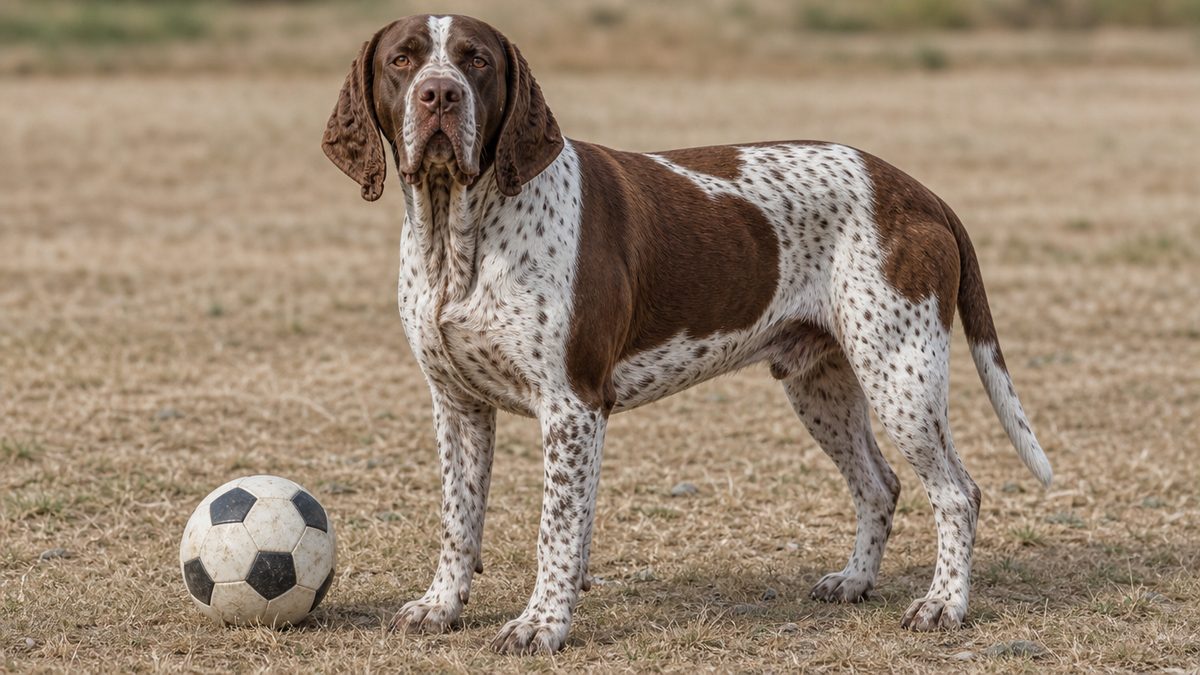
Burgos Pointer is FCI standard 90, a heavy-boned Spanish continental pointing dog standing 62 to 67 cm in males and 59 to 64 cm in females, with corkscrew ears, a double dewlap and a brown nose. Spain registered 309 across 2018 to 2022 and lists it as a vulnerable breed. There is no lawful purchase route in India, no published Indian price, and no OFA screening data of any kind.
This page reports published veterinary research and registry data for general information. It is not a diagnosis and it is not treatment advice. Consult a registered veterinarian about any individual dog, because breed-level statistics describe populations and not the animal in front of you.
Burgos Pointer at a glance
What a Burgos Pointer is, in one paragraph and three registries
The Burgos Pointer is FCI breed standard 90, a heavy-boned Spanish pointing dog of the Braque type, standing 62 to 67 cm in males and 59 to 64 cm in females, and listed by its own national kennel club among sixteen vulnerable Spanish breeds. It is a working gun dog with a corkscrew ear, a double dewlap and a brown nose, and there is no lawful way to buy one in India.
The full Spanish name is Perdiguero de Burgos. Its own parent club records two further synonyms, Perdiguero Burgales and Braco de Burgos, and classifies the breed's type as Bracoide. English writing usually calls it the Burgos Pointer or, loosely, the Spanish Pointer, and that second name causes trouble because it is also used for a different and older animal that this page separates out below.
Three registries recognise it, and they do not say the same things.
| Registry | Status | Size recorded | Weight recorded |
|---|---|---|---|
| FCI (standard 90) | Recognised on a definitive basis, 11 December 1954. Group 7 Pointing Dogs, Section Continental Pointing Dogs, subsection Braque type, with working trial | Males 62-67 cm, bitches 59-64 cm | None. The standard gives no weight at all |
| United Kennel Club | Recognised 1 January 1996, Gun Dog Group, standard revised 1 January 2020 | Males 24.5-26.5 in, females 23-25 in | None |
| Real Sociedad Canina de Espana | Registered in the Libro de Origenes Espanol, and listed vulnerable for 1 May 2025 to 30 April 2026 | Follows the FCI standard | None |
| Royal Kennel Club (UK) | Not listed in the Gundog A to Z | n/a | n/a |
| Orthopedic Foundation for Animals | No entry of any kind in the breed selector | n/a | n/a |
Two of those rows are the useful ones. The FCI standard prints no weight anywhere in its nine pages, which Bonbeno confirmed by extracting the PDF and reading every clause. The UKC standard prints none either. So the 25 to 30 kg figure that Wikipedia and a dozen aggregator pages give is not a standard figure, and Wikipedia carries no inline citation for it.
The Royal Kennel Club and OFA rows are absences, and both were checked with controls in the same session. The Royal Kennel Club's Gundog list, rendered in full, returns zero matches for either 'Burgos' or 'Perdiguero' while returning the German Longhaired, Shorthaired and Wirehaired Pointers, the Pointer, the Portuguese Pointer, the Slovakian Rough Haired Pointer, the Bracco Italiano, the Italian Spinone, the Weimaraner and the Labrador. OFA's breed selector runs BULLMASTIFF, BURMESE, BURMILLA, CA DE BOU with nothing in between, and PEMBROKE WELSH CORGI, PERRO DE PRESA CANARIO, PERSIAN CAT with nothing in between, while carrying six other continental Braque breeds and five Spanish breeds.
The one-line description that actually fits
FCI-Standard 90 opens by calling it a 'Pointing dog for fur and feather; much appreciated by the hunters who want a robust dog, resistant on any terrain and for any type of hunting, obedient, strong and above all endowed with a keen sense of smell.' It adds that although usually used on small game, 'he is not averse to the hunting of big game, a task where he shows great courage';. That is a rustic working brief, not a companion brief, and every honest description of the breed starts there.
The temperament clause is short and worth quoting because it is the part buyers actually respond to. The standard calls the breed 'Robust, balanced, calm and sedate', with a 'soft, very noble expression', and says it is a breed of 'excellent temperament, docility and intelligence';. Calm, docile and noble are the standard's own words, not marketing.
'Spanish Pointer' in old English hunting literature does not mean this breed. It means the old Iberian pointing dog, a different and earlier animal that this page treats separately, and confusing the two is the single most common error in English writing about the Perdiguero de Burgos.
The origin story every English page prints, and the two centuries it is out by
The Burgos Pointer is not a sixteenth-century breed. Its own Spanish parent club dates its formation to between 1735 and 1814, places the first unambiguous written naming in an 1814 army inventory, and says the breed acquired the name 'de Burgos' only in the nineteenth century.
Start with what the ranking pages say. Wikipedia states that the breed 'dates back to the 16th century';. The United Kennel Club says it 'has been in existence since the 1500s';. GoofyTails, at position 3 in India, prints 'traces its roots back to the 16th century' in its own meta description. Bing's AI summary for the term repeats 'It originated in the 16th century'. Facebook gun-dog pages go further and say 'dates back over 500 years'.
Now read the breed's own club. The Asociacion Espanola del Perro Perdiguero de Burgos publishes a history written by Jose Manuel Sanz Timon, a veterinary geneticist, and it opens by calling the breed's origin confused, saying that the absence of written data leads us to believe that, cynologically speaking, it is a relatively recent ethnic grouping compared with other dog breeds. That is the parent club saying the opposite of the aggregators.
The four errors the club names by name
Sanz Timon lists what he calls the most frequent errors that demonstrate poor research, and all four are errors the English-language pages commit.
- Associating the ordinary Spanish word perdiguero, meaning a partridge dog, with this particular breed.
- Assuming the pointing dogs described by the Spanish hunting classics were Perdigueros de Burgos and forgetting the other breeds.
- Calling the hunting dogs painted by artists from Velazquez to Goya Perdigueros de Burgos.
- Defining the Perdiguero de Burgos as the origin of the English Pointer, or, in a display of patriotic enthusiasm, as the father of all European braques.
The dating argument runs on absences, and the club earns them. Juan Valles in 1556 writes about mutilating the ears and tail of partridge dogs but names no Burgos breed. Martinez del Espinar in 1644 describes a slow, cylindrical dog with an excellent nose and calls it navarro or French. Juan Manuel de Arellano in 1745 says nothing about it. The English Sports-man's Dictionary of 1735, written twenty-three years after English officers returned from the War of the Spanish Succession, describes no Spanish breed at all.
The first positive record is 1814. An officer of the King's German Legion, a mercenary corps under Wellington that fought at Gamonal near Burgos and was garrisoned there, listed in his embarkation inventory the existence of a breed of hunting dogs in this area, bred under the name of Perdigueros de Burgos. Captain Schwertfeger's 1907 Geschichte der Koniglich Deutschen Legion records the same dogs as gifts from local patriots and gives the description the club had hunted for in vain in the classics: strong in body and head, white and brown, with patches and freckles.
From that the club concludes: 'We therefore date to 1814 the first racial denomination with the name and the description that unequivocally corresponds to the dog in question', and places the birth of the breed as a defined type between 1735 and 1814. Craig Koshyk, who travelled to Spain with the club to photograph the breed, reports the same finding in English and dates the first mention to sometime after 1808.
When it became 'de Burgos'
The provincial name is later still. The club's own account says the breed ended up being called perdiguero de Burgos in the nineteenth century, because the dogs shown at the first competitions came from Burgos, and gives five reasons the type crystallised there: more partridge country than its neighbours, a communications hub between the Castilian, Basque, Navarrese, Riojan and Cantabrian provinces, a stronger hunting tradition, numerous monasteries breeding hunting dogs, and less sabueso blood in the local perdiguero because it was used more on partridge.
The oldest photograph the club knows sits in Evero's Paginas de Caza Espanolas y Americanas and is captioned not 'perdiguero de Burgos' but 'perdiguero espanol', in 1898. Pachones and perdigueros were shown separately for the first time at the 1890 Madrid exhibition, with the pachones far outnumbering the perdigueros.
Because it is the cheapest possible test of whether a breed page did any work. Any page that prints '16th century' has copied Wikipedia without opening a single Spanish source, and a page that will not check a date is not a page to trust on health, price or climate either.
Ancestor of what? The claim, and the club's own rebuttal
The Burgos Pointer's own Spanish parent club calls the broad ancestry claim an error of patriotic enthusiasm. One narrow claim survives, that dogs exported to Germany in 1814 fed into the Wurttemberg pointing dog and from there into the German Shorthaired Pointer, and it rests on documents rather than on DNA.
The claim in its usual English form comes from the United Kennel Club, whose standard opens by calling the breed 'a large pointer that has contributed to the development of the other large pointing breeds';. Wikipedia softens it to 'It is very probable that the breed participated in the creation of other races of this group';. Gun-dog social media hardens it: one widely shared post calls the breed 'one of the foundation dogs that made the German Shorthaired Pointer'.
The parent club rejects the broad version outright. Sanz Timon's list of research errors includes defining the Perdiguero de Burgos as the origin of the English Pointer, or, in a display of patriotic enthusiasm, considering it also the father of all European braques. He then explains what he thinks did happen, and it involves a different animal.
The English Pointer descends from Navarre, not Burgos
The club's argument has three legs and each is checkable. First, after the 1713 Peace of Utrecht the English army brought numerous dogs home from Spain and Portugal, and those became the genetic nuclei of later selection toward the English Pointer. Second, William Arkwright, whose book The Pointer and his Predecessors took ten years of research including travel in Spain, states that the English Pointer descends from the Navarre breed. Third, and most damaging to the Burgos claim, Arkwright never mentions a dog from Burgos at all, which the club reads as proof the breed was still too local to notice at the end of the nineteenth century.
There is a physical argument too, and it is the sharpest one on this page. Arkwright's Spanish pointers are described with broad skulls and convergent cranial-facial lines, matching the 1768 Stubbs painting of a Spanish pointer. FCI-Standard 90 requires the Burgos Pointer's cranial-facial axes to be divergent, and lists 'Cranio-facial axes clearly convergent' as a disqualifying fault. The head geometry of the modern breed is the opposite of the head geometry of the dogs that founded the English Pointer.
Colour runs the same way. Early English references describe the old Spanish Pointer as often black or even tricoloured, while black coat is never admitted under standard 90 and black mucous membranes are excluded outright Federation Cynologique Internationale. Two independent physical characters both say the breeds are not the same population.
The one export the club does claim
The club's own positive claim is narrow and dated. The dogs the King's German Legion carried home in 1814 were taken to Germany and, it says, shortly gave rise to a breed called the short-haired pointing dog of Wurttemberg, which was one of the main genetic contributions to the selection of today's Kurzhaar, the German Shorthaired Pointer. That is a documentary claim built on a shipping inventory and a 1907 German regimental history, not a genetic one, and this page reports it as such.
Where the Burgos Pointer sits in a modern comparison of pointing breeds is easier to answer. Koshyk's tables put it in the closest two range bands and the two slowest speed bands, a trotting to medium-galloping dog that works Close to Medium, against the English Pointer and English Setter which occupy every band out to Dot on Horizon. That is a different job from the breeds it is said to have founded.
Bonbeno searched specifically for a claim that this breed founded pointing breeds in the Americas and found none, in English or in Spanish. The ancestry claims that do circulate are all Old World: the English Pointer, which the parent club rejects, and the German Shorthaired Pointer, which the parent club asserts through the 1814 Wurttemberg route. If you meet a New World version of the claim, treat it as unsourced until someone produces the document.
What peer-reviewed genetics can and cannot say about this breed
No peer-reviewed genetic study includes the Burgos Pointer. The one paper that compares pointing breeds sampled five of them in Spain and left Spain's own native pointing breed out, and the paper Wikipedia cites for the breed's ancestry is a scan that no automated reader can read.
The most relevant study is Parra, Mendez, Canon and Dunner, published in Animal Genetics in 2008 by a team at the Universidad Complutense in Madrid, comparing five modern pointing breeds using autosomal microsatellites, Y-chromosome markers and mitochondrial DNA sequence, and reporting 236 autosomal alleles, four Y-chromosome haplotypes and 18 mitochondrial haplotypes.
The five breeds were the English Setter, English Pointer, Epagneul Breton, Deutsch Drahthaar and German Shorthaired Pointer. Spain's own native pointing breed was not sampled, in a study run in Spain by Spanish authors, which tells you how peripheral the Burgos Pointer is even to the people best placed to include it.
What the study does report is still useful here. It found the modern English Setter, thought to have arisen from the Old Spanish Pointer, was the first breed to cluster independently on autosomal markers, and that it shares a common maternal origin with the English Pointer and German Shorthaired Pointer, either through common domestic females in the British Isles or through Old Spanish Pointer females taken there in the fourteenth and sixteenth centuries. The Old Spanish Pointer again, not the Burgos.
The citation Wikipedia uses cannot have been read
Wikipedia's ancestry sentence, that the breed descends from a mix of the Sabueso Espanol and the Pachon Navarro, cites Jordana, Piedrafita, Sanchez and Puig, Journal of Heredity 1992. Bonbeno downloaded the exact PDF Wikipedia links, an archived scan hosted by the Universitat Autonoma de Barcelona, and examined it with pypdf. Eight pages, each carrying a single CCITT fax image of about 2,511 by 3,180 pixels, no font resource on any page, and zero extractable characters in the entire file.
That does not make the claim false, because a human can read a scan. It does mean nothing downstream has read it, and the paper's own published abstract points the other way: after describing ten Spanish breeds studied across ancestral trunks, breeds and subpopulations, it concludes that 'These racial groupings, however, differ from the grouping obtained from historical, archeological, and morphological data';. A paper whose headline finding is that genetics disagrees with breed history is a strange citation for a breed-history claim.
Two other Iberian genetic surveys exist and neither settles the question either. Morera and colleagues published microsatellite variation in five Spanish dog breeds in the Journal of Heredity in 1999. Pires and colleagues sequenced 887 base pairs of mitochondrial DNA across eight Portuguese, one Spanish and two North African native breeds plus village dogs in 2006, found 49 haplotypes in 164 individuals, and reported that although Iberian and North African breeds carried breed-specific haplotypes, no significant geographic structure could be detected among them.
How we tested the absence
PubMed returns zero records for 'Perdiguero de Burgos' and zero for 'Burgos Pointer'. The control query 'Labrador Retriever', run in the same session against the same endpoint, returned 1,811 records, and 'Spanish dog breeds genetic diversity' returned 12, so the interface was working.
Read the query translation before trusting either zero, though. PubMed rewrote the Spanish name into an author-name search on 'de burgos', which is exactly the kind of silent rewrite that turns a meaningful question into a meaningless one. The honest summary is that no genuine records exist and the search was partly broken, so this page treats the literature as empty rather than proven empty.
A breed with no genetic study and no OFA entry has no published inherited-disease profile. Anyone selling you a Burgos Pointer on the strength of a health guarantee is guaranteeing against a risk nobody has measured, and this page says so again in the health section rather than borrowing another breed's numbers.
What FCI standard 90 requires, clause by clause
FCI-Standard 90 asks for a square, heavy-boned dog with a large powerful head, a skull to muzzle ratio of 6 to 5, divergent cranial-facial axes, a dark brown nose, corkscrew ears set at eye level, a double dewlap, and elastic skin that is specifically not loose. Height is 62 to 67 cm in males and 59 to 64 cm in females, and there is no weight clause anywhere.
The version in force is the English translation dated 09.11.1998 of an official valid standard published on 26 May 1982, with Spanish as the authentic language. That 1982 date is worth pausing on. The FCI recognised the breed on a definitive basis on 11 December 1954, so the breed spent twenty-eight recognised years without a valid standard, which fits Koshyk's report that there was no official standard until the 1950s and that the modern text came out of the recovery programme.
| Feature | What standard 90 requires | Fault status |
|---|---|---|
| Skull to muzzle | Ratio of 6 to 5 | Head small or not in balance with the body is a severe fault |
| Cranial-facial axes | Divergent | Parallel axes are a severe fault; clearly convergent axes are a disqualification |
| Nose | Dark brown, wet, large and wide with open nostrils | Split nose, black nose or partial depigmentation are disqualifications |
| Ears | Large, hanging, triangular, set at eye level, hanging in corkscrew at rest, reaching the corner of the lips but not the nose | Ears too long and too low set is a severe fault |
| Neck | A well defined double dewlap starting from both corners of the lips | Flews or dewlap exaggerated is a severe fault |
| Skin | Elastic without being loose, thick, abundant, pink without patches; all mucous membranes brown, never black | Albinism of coat and mucous membranes is a disqualification |
| Coat colour | White and liver, mixing irregularly into liver-marbled, greyish liver or liver-speckled | Black colour or tan markings above the eyes and on the legs are never admitted |
| Eyes | Medium, almond shaped, preferably dark hazel, lower lid as close as possible to the eyeball | Very pronounced entropion or ectropion is a severe fault |
| Bite | Scissor bite, all premolars present | Undershot mouth of any degree and excessively overshot mouth are disqualifications |
Two of those rows correct things this page's own briefing had wrong, and both matter. The skin clause does not say loose. The authentic Spanish reads 'Elastica pero no despegada, gruesa, abundante', which the FCI translates as 'Elastic without being loose, thick, abundant';. The loose-skinned impression comes from the double dewlap and the pendent lips, not from a skin clause, and a Burgos Pointer with genuinely slack skin is not to standard.
And the ears are shorter than the reputation. The standard says the leathers, without being drawn forward, must meet the corner of the lips but not the nose. That is a real distinction from the Braque Francais type Gascogne, whose standard requires the leathers to reach the rear rim of the nose leather. The Burgos ear is long and pendulous, but the standard caps it, and a leather reaching the nose would be moving toward the severe fault of ears too long and too low set.
Size and weight, and the number nobody can source
Height is the only measurement the standard gives: males 62 to 67 cm, bitches 59 to 64 cm, with a note that the breed shows a high degree of dimorphism, the males being more homogenous and the females of more variable sizes and much finer in general. The UKC converts this to 24.5 to 26.5 inches for males and 23 to 25 inches for females.
Weight is where the internet invents. Wikipedia prints 25 to 30 kg with no inline citation. GoofyTails prints 25 to 30 kg for males and 20 to 25 kg for females. Furrfam, the one Indian commerce page, prints 20 to 60 lbs, which is 9 to 27 kg, and a height of 15 to 24 inches whose maximum sits below the breed's own minimum. Craig Koshyk's comparison tables, built from the FCI standards, place the breed in the medium and large size bands, which is as far as a standard with no weight clause allows anyone to go.
Look for a weight figure. If a page gives you a confident kilogram range for the Burgos Pointer without saying where it came from, it did not open the standard, because the standard has no weight in it. That one check sorts the sourced pages from the copied ones faster than anything else on this breed.
The docking clause: what standard 90 demands and Indian law strictly forbids
FCI-Standard 90 requires the tail to be docked, with no exemption clause of any kind, and paragraph 6(8) of the Second Schedule of India's 2017 Rules calls tail docking strictly forbidden. An Indian owner therefore cannot present a Burgos Pointer that meets its own breed standard, and should not try.
The English text of the standard says of the tail: 'Thick at the root, set at medium height. Is docked to one third or to the half of its length';. The authentic Spanish is blunter still. It reads 'Se presenta amputada entre un tercio y la mitad de su longitud', using the word amputada, amputated. There is no bracketed clause about countries where docking is prohibited, which many FCI standards carry, and no alternative description of a natural tail.
Indian law is equally plain in the other direction. Bonbeno extracted the gazette text of notification G.S.R. 496(E) of 23 May 2017, the Prevention of Cruelty to Animals (Dog Breeding and Marketing) Rules, and read the clause directly. Second Schedule Part II paragraph 6(8) states that 'There shall be no tail docking, ear cropping, de-barking, de-clawing, branding, dyeing, injecting substances to enhance visual appeal, performing a surgery or procedure to camouflage or hide any defect or infirmity or any other kind of mutilation of any body part of the pup and any change of appearance by artificial means is strictly forbidden';.
| Document | Provision | What it says about the tail |
|---|---|---|
| FCI-Standard 90, English, 09.11.1998 | TAIL | Is docked to one third or to the half of its length |
| Standard FCI 90, Spanish, authentic text | COLA | Se presenta amputada entre un tercio y la mitad de su longitud |
| UKC standard, revised 1 January 2020 | Tail | Generally docked to one half or one third its length, with a note that no dog in any UKC event shall be penalised for a full tail or natural ears |
| India, G.S.R. 496(E) 2017 | Second Schedule Part II, para 6(8) | There shall be no tail docking ... strictly forbidden |
The UKC row is the interesting one, because it shows a registry solving the problem cleanly. Having described the docked tail, the UKC adds that as an international registry it is aware that cropping and docking have been forbidden in some countries, and states that no dog in any UKC event, including conformation, shall be penalised for a full tail or natural ears. The FCI standard offers no such accommodation.
What this means in practice for an Indian household
- Keep the tail natural. The 2017 Rules bind the breeder and the practitioner, and a docked puppy in India is evidence that somebody broke the law, not evidence of quality.
- Expect a conformation penalty in any FCI-rule show, because the standard as written has no clause protecting an undocked dog.
- Reject any breeder or importer who offers to dock, and any who has already docked. Paragraph 6(8) covers ear cropping, de-barking and de-clawing in the same sentence.
- Read the same paragraph's next line before commissioning any breeding at all: 6(9) prohibits breeding to create new breeds of dogs or unusual looks.
This matters more on this breed than on most, because the docked tail is genuinely part of how the Burgos Pointer is pictured. Every photograph in circulation, including the ones on the breed's own club site, shows a shortened tail, so an Indian reader looking at reference images is looking at a dog that could not lawfully be produced here. GoofyTails handles it with the phrase 'traditionally docked where permitted', which is accurate as far as it goes but does not tell an Indian reader that India is not a where-permitted.
The 2017 Rules number their clauses twice, so there is a Rule 8 on Conditions for sale and a separate Second Schedule paragraph 8 on Veterinary care. The docking prohibition is Second Schedule Part II paragraph 6(8), read from the machine-readable gazette text. The eight-week minimum sale age is a different provision entirely, Rule 8(1)(a), which says that pups less than eight weeks in age are not sold.
How rare the breed actually is, in Spanish studbook numbers
Spain registered 309 Perdigueros de Burgos across the five years 2018 to 2022, an average of 62 a year, against 20,183 English Setters in the same table. The breed's own country registers 65 English Setters for every Burgos Pointer, and the Real Sociedad Canina de Espana lists it as a vulnerable breed.
The right place to count is Spain, and the right document is the Real Sociedad Canina de Espana's Comparativo de Inscripciones en L.O.E. y R.R.C., its breed-by-breed table of entries in the Libro de Origenes Espanol and the Registro de Razas Caninas. Bonbeno retrieved the seven-page PDF, extracted it with pypdf and row-summed it. The Perdiguero de Burgos row, under FCI standard 90, reads 52, 77, 56, 57 and 67 for 2018 through 2022, with an accumulated total of 309, and those five figures sum to exactly the printed 309.
| Breed | 2018 | 2019 | 2020 | 2021 | 2022 | Five-year total | Per Burgos Pointer |
|---|---|---|---|---|---|---|---|
| Perdiguero de Burgos | 52 | 77 | 56 | 57 | 67 | 309 | 1.0 |
| Setter Ingles | 4,228 | 4,046 | 2,793 | 4,580 | 4,536 | 20,183 | 65.3 |
| Perro de Pastor Aleman | 4,361 | 3,711 | 3,081 | 4,829 | 3,969 | 19,951 | 64.6 |
| Labrador Retriever | 2,251 | 2,206 | 1,653 | 2,976 | 2,675 | 11,761 | 38.1 |
| Perro de Agua Espanol | 1,569 | 1,513 | 1,191 | 2,280 | 1,913 | 8,466 | 27.4 |
| Pointer | 864 | 1,199 | 691 | 1,164 | 1,150 | 5,068 | 16.4 |
| Braco Aleman (GSP) | 841 | 758 | 537 | 960 | 1,040 | 4,136 | 13.4 |
| Sabueso Espanol | 46 | 71 | 34 | 44 | 58 | 253 | 0.8 |
| Pachon Navarro | 10 | 7 | 7 | 13 | 23 | 60 | 0.2 |
| Perdiguero Portugues | 1 | 0 | 10 | 14 | 0 | 25 | 0.1 |
| All breeds, all rows | 57,841 | 55,459 | 40,646 | 69,545 | 64,488 | 287,979 | 932.0 |
Every row in that table was summed against its own printed total before it was published here, and the grand totals check too: 57,841 plus 55,459 plus 40,646 plus 69,545 plus 64,488 comes to exactly the printed 287,979, and the printed 2022-minus-2021 difference of minus 5,057 at minus 7.27 percent both divide out correctly.
Read the top two rows together, because that is the finding. Spain registers 65 English Setters for every one of its own native pointing breed, and 64 German Shepherds. The Perdiguero de Burgos is 309 dogs out of 287,979 registrations, or 0.107 percent of everything the Spanish studbook recorded in five years. The Spanish Water Dog, another native breed and another gun dog, took 8,466 in the same period, so this is not a story about Spaniards not registering native breeds. It is specific to this one.
Vulnerable, and the two breeds it is said to descend from are vulnerable too
The Real Sociedad Canina de Espana publishes a one-page list titled Razas espanolas consideradas vulnerables for 1 May 2025 to 30 April 2026. Bonbeno extracted it and counted sixteen names. The Perdiguero de Burgos is the sixth entry, and so are both of the breeds Wikipedia names as its ancestors, the Sabueso Espanol and the Pachon Navarro.
A separate RSCE statement, reported in January 2026, puts it more starkly: 73.9 percent of Spanish dog breeds are in serious danger of disappearing, affecting 17 of the 23 currently recognised Spanish breeds, and the perdiguero de Burgos is named among them. Bonbeno counted the printed list as exactly seventeen, and 17 divided by 23 is 73.91 percent, so the arithmetic holds. The seventeen-name press list and the sixteen-name official PDF differ by exactly one breed, the Majorero, which is on the press list and not on the vulnerable PDF for that period. The Spanish hunting press carried the same alert independently a fortnight later, reporting 17 of 23 recognised native breeds in a critical situation with reduced censuses and a worrying lack of control over their genealogy, and naming the perdiguero de Burgos among the most threatened.
One caveat the RSCE itself supplies, and it cuts both ways. The organisation's stated cause is that most individuals of these breeds are never entered in the Libro de Origenes Espanol or the Registro de Razas Caninas at all, which means 309 undercounts the living population. For an Indian reader that caveat changes nothing, because an unregistered Spanish farm dog with no pedigree cannot be registered by the Kennel Club of India on import in any case.
As of 24 August 2026 the RSCE's own statistics page offers exactly one download, the 2018 to 2022 comparative, and the page's modified date is 13 June 2024. So 2022 is the most recent year of Spanish registration data the national kennel club publishes, and anyone quoting a 2025 Spanish figure for this breed should be asked where they got it.
Burgos Pointer price in india: there is no number, and that is the answer
No Indian source publishes a price for the Burgos Pointer, not a range, not a single figure, not even a fake one. The usual test for a converted dollar price cannot be run here because there is no rupee figure to divide, and the only Indian commerce page for the breed leaves its own price field blank while asking for a twenty-five percent deposit.
This site normally opens a price section by comparing at least three published Indian figures and showing where they disagree. That is impossible here, and the impossibility is the useful finding. An India-located search for the breed name with 'price' and 'puppy for sale' returned, in order, an Amazon India listing for a book about the breed, Facebook posts, a YouTube video, a United States breed-directory page, an alphabetical list of purebred breeds, a UKC conformation standings table, and, at position seven, a rental flat on a street called Calle Perdiguero de Burgos in Burgos, Spain. Not one Indian litter, breeder or price.
That absence was earned against a control run in the same session with the same tool and the same India location. 'labrador retriever puppy price india' returned ten on-topic Indian commercial results, including a page carrying a city-by-city table of INR 30,000 to INR 1,20,000 across Hyderabad, Bangalore, Delhi, Chennai, Lucknow, Mumbai, Jaipur and Pune, and three explicit quality bands. The search works. There is simply nothing to find for this breed.
The conversion test cannot be run, and that is itself informative
Bonbeno routinely divides any suspicious Indian rupee price by 84.38 and by 74, because Indian breed pages frequently publish a United States dollar figure run through one exchange rate and presented as a local price. On this breed there is nothing to divide. No Indian page prints a rupee number for a Burgos Pointer at all, which means nobody has even bothered to fabricate one, which in turn is a reasonable proxy for how little Indian search demand exists. Bing India reports about 3,700 results for the whole query, against about 16,500 for the Labrador price query.
The search-volume signal points the same way. Bing India reports about 3,700 results for 'burgos pointer' against about 16,500 for 'labrador retriever price in india', and the Burgos page's 'People also search for' module carries exactly two terms where the Labrador control carries ten Bing India search results page…. Two related searches is the entire commercial query space this breed generates in India.
The one Indian page that offers to sell you one
Furrfam, at furrfam.in, runs a breed page for the Perdiguero de Burgos. Read as raw HTML, its own body text says: 'Perdiguero de Burgos is an FCI-recognized dog breed. A detailed profile for temperament, care, and suitability will be expanded in upcoming updates.' The Price Range field reads 'Contact for pricing' with no figure attached.
| Field | Furrfam | FCI-Standard 90 |
|---|---|---|
| Group | Non-Sporting Dogs | Group 7 Pointing Dogs, Section 1.1 Continental Pointing Dogs, Braque type, with working trial |
| Origin | FCI | Spain |
| Height | 15 to 24 inches | Males 62 to 67 cm, which is 24.4 to 26.4 inches |
| Weight | 20 to 60 lbs | No weight clause exists |
| Energy level | 3 out of 5 | A gun dog registered with a compulsory working trial |
| Price | Contact for pricing | n/a |
| Similar breeds | Aidi, Alpenlandische Dachsbracke | Alphabetical neighbours, not related breeds |
Read the height row twice. Furrfam's stated maximum, 24 inches, sits below the breed's own minimum for a male. Its origin field names a federation rather than a country. Its group is wrong by a whole functional category, and its 'Similar Breeds' are the two entries that happen to follow it in an alphabetical list of every FCI breed, which is the signature of a page generated from a nomenclature dump rather than from stock. The page nonetheless offers to 'Reserve, Secure with 25% deposit' and 'Doorstep delivery in major cities'; Federation Cynologique Internationale Federation Cynologique Internationale.
What a buyer is actually being sold
If an Indian seller offers you a Burgos Pointer, one of four things is true, and none of them is a Spanish import with papers. It is a mislabelled dog of another liver-and-white breed, most often a German Shorthaired Pointer or a pointer cross. It is a generic template page with no dog behind it. It is a listing built to collect a deposit. Or it is a genuinely imported personal pet being resold, which cannot lawfully be sold on for breeding and whose Indian registration depends on paperwork the seller is unlikely to have.
The highest-ranking Indian search result carrying both this breed's name and a price is a flat for rent at 700 euros a month on Calle Perdiguero de Burgos in the San Pedro de la Fuente district of Burgos, Spain. That is a street named after the breed, not a dog. When a breed's commercial search space is filled by a book, a car decal and a Spanish apartment, the market you are looking for does not exist.
Why no lawful Indian supply chain for this breed can form
Indian law closes every route by which a Burgos Pointer could reach a buyer here. Dogs are a Restricted import, applications for trading or breeding purposes are to be duly rejected, entry is limited to seven ports, and the only permitted private route is a pet already registered in the importer's own name. The full route is set out in how to import a dog to India.
DGFT Trade Notice No. 22/2022-23 of 19 December 2022 is the governing document, and Bonbeno extracted the five-page PDF and read it rather than summarising a summary. It records ITC(HS) 01061900, mammals other, as Restricted, then sets out the conditions.
- Policy Condition 7 allows import of dogs only for three purposes: a pet dog with a valid pet book and relevant records in the name of the importer, dogs imported by R&D organisations with the recommendation of CPCSEA, and internal security by the Defence and Police Force.
- Policy Condition 8 states that import of commercial dogs for breeding or any other commercial activities other than those purposes is not permitted.
- Paragraph 6 states that any applications for trading or breeding purposes, or applications made on behalf of some other person or entity, shall be duly rejected.
- Paragraph 7 limits entry to the airports and seaports of Delhi, Mumbai, Chennai, Hyderabad, Bangalore and Kolkata, with quarantine at the government station where required. DAHD added a seventh port, Cochin International Airport at Kochi, for pets arriving under the baggage rules in October 2024.
- Paragraph 8 requires an Advance No Objection Certificate from the AQCS Regional or Quarantine Officer, obtained seven days before travel and relaxable up to three days.
- The Animal Quarantine and Certification Services, the authority that issues that certificate, operates exactly six regional offices, at Delhi, Mumbai, Kolkata, Chennai, Bengaluru and Hyderabad, which matches the trade notice's port list precisely.
Put those together and the arithmetic of a supply chain fails. To breed Burgos Pointers in India you would need breeding stock, and an import authorisation applied for on breeding grounds is refused by paragraph 6. You cannot import two dogs as pets and then breed commercially from them, because Policy Condition 8 reaches the activity and not merely the shipment. Permanent import as passenger baggage without a DGFT authorisation is available only to a person transferring residence to India after two years of continuous stay abroad, and only for up to two animals.
The registration route closes too
Suppose a returning resident does bring one. The Kennel Club of India's checklist for registering an imported dog requires the original export pedigree issued by the exporting country's kennel club, alongside the import paperwork. For this breed that means a Libro de Origenes Espanol pedigree, and the RSCE's own explanation of why its native breeds are vulnerable is precisely that most individuals are never entered in the LOE at all. A Spanish farm-bred Perdiguero without papers is unregistrable here even after it lands.
And the source population has no surplus
Even with the law set aside, the numbers do not permit an export trade. Spain registered 309 of these dogs across five years, an average of 62 a year, against 20,183 English Setters in the same table. Craig Koshyk, who visited the Spanish clubs, describes the breed as still more or less unknown outside its native land, with only a few in Portugal and France, and his population chart places it in the Tiny and Small bands, the two lowest of four. A breed producing roughly sixty registered puppies a year in its home country has nothing to send anywhere.
The 2017 breeding Rules add a further constraint that bites unusually hard on a breed rebuilt from a handful of founders. Second Schedule Part II paragraph 6(3) prohibits in breeding, defined as mating between relatives of the second to fourth grade in straight or side line within the first four generations, giving uncle to niece, nephew to aunt, cousin to cousin and grandparents to grandchildren as examples, and separately prohibits incest breeding between parents and children or brother and sister. Only out breeding and line breeding are permitted. A founding population of a few dogs and seven bloodlines cannot be expanded in India under those rules.
There is no lawful commercial route to a Burgos Pointer in India, no registrable pedigree route for most Spanish dogs, and no export surplus in Spain to draw on even if both were solved. Treat any Indian listing for this breed as a misidentification or a template until somebody produces an LOE pedigree and a DGFT authorisation.
Cost of ownership, bounded honestly rather than invented
Monthly cost of ownership for a 25 to 30 kg short-coated gundog in an Indian city runs about INR 4,000 to 10,000 across two independently published Indian series, before import, insurance or anything going wrong. No Indian source publishes a cost figure for the Burgos Pointer itself, so this section borrows a comparable and says so.
Nobody has costed this breed in India, because nobody keeps one. What can be done honestly is to take the closest comparable that Indian sources actually price, a short-coated gundog of roughly the same height and mass, and report the spread between independent series rather than an average.
| Item | Series A (Fluffyn, May 2026) | Series B (WhatsTheCost, 2026) |
|---|---|---|
| Food | INR 3,500 to 6,000 | Included in the combined figure |
| Veterinary care | INR 800 to 2,000 | Included in the combined figure |
| Grooming | INR 500 to 1,000 | Included in the combined figure |
| Stated monthly total | INR 5,000 to 9,000 | INR 4,000 to 10,000 |
| One-off illness allowance | INR 5,000 to 15,000 | Not separately stated |
The two series overlap but do not agree, and the disagreement is the useful part: the floor differs by INR 1,000 a month and the ceiling by INR 1,000 the other way, so a household planning on the lower figure and meeting the higher one is out by INR 12,000 a year WhatsTheCost.in, 'Labrador Retriever Price…. There is also an internal check worth showing. Series A's itemised low ends sum to INR 4,800, not the INR 5,000 its own headline prints, which is a small error but a real one, and it is the kind of thing worth noticing before you trust a budget page.
What is different about this breed specifically
Three line items move against the comparable, and one moves in your favour.
- Ear care rises, and it is not optional. A weekly ear routine through the dry season and a twice-weekly one through the monsoon is the single highest-value habit on this breed, for reasons the ear section sets out. Budget for a veterinary-grade ear cleaner as a standing monthly line rather than an occasional purchase.
- Exercise substitution rises. A pointing dog that cannot be run in daylight for six months of the year needs indoor scent work, a long line, and often paid access to a fenced space, none of which appears in a Labrador budget.
- Veterinary uncertainty rises. No Indian vet will have seen the breed, so diagnosis defaults to general principles rather than breed-specific expectation, and second opinions cost money.
- Grooming falls. The coat is dense, of medium thickness, short, smooth and evenly distributed, and needs a rubber mitt twice a week rather than a salon.
Purchase price is where the comparison breaks down entirely and should not be forced. Indian sources put a comparable gundog anywhere from INR 8,000 for an unregistered pet-quality puppy to INR 1,20,000 for a champion bloodline, a spread of fifteen times across three published series that all claim to describe the same breed in the same country in the same year Mr n Mrs Pet, 'Labrador Retriever Puppies…. For the Burgos Pointer the equivalent number does not exist at any price, because the import route that would create it is closed.
A working pointing dog denied a job finds one. The realistic Indian cost of under-exercising this breed is not a training bill, it is replaced furniture, a repaired door frame and a neighbour complaint, and it lands in month four rather than month one. Budget the exercise, not the repairs.
Heat tolerance: 18.7 degrees C at origin against 35.9 degrees C in Delhi
The Burgos Pointer comes from a cold, dry, high plateau. NASA POWER gives Burgos an annual mean of 10.24 degrees C and a warmest month of 18.69 degrees C in August, against 35.88 degrees C in Delhi's warmest month, a gap of 17.2 degrees C. This is a breed that can be kept in India on a pre-dawn schedule and not otherwise.
Origin climate was queried by explicit latitude and longitude rather than by place name, because a climate site serving the wrong city is one of the easier ways to publish a confident and wrong heat rating. Burgos was requested at 42.3439 N, 3.6969 W, and the service echoed back longitude -3.697, latitude 42.344 and an elevation of 917.61 m. That elevation matters: Burgos is a high Castilian plateau town, not a Mediterranean one.
| Place | Elevation | Annual mean | Warmest month | Months averaging 25 C or more | Warm and humid months |
|---|---|---|---|---|---|
| Burgos, Spain | 918 m | 10.24 C | 18.69 C (Aug) | 0 | 0 |
| Delhi | 206 m | 25.60 C | 35.88 C (Jun) | 7 | 0 |
| Mumbai | 97 m | 26.77 C | 31.19 C (May) | 9 | 5 |
| Chennai | 49 m | 27.95 C | 31.51 C (May) | 10 | 5 |
| Bengaluru | 842 m | 23.74 C | 28.37 C (Apr) | 3 | 5 |
| Pune | 636 m | 23.86 C | 28.93 C (Apr) | 4 | 5 |
'Warm and humid months' counts months whose mean temperature reaches 20 degrees C and whose relative humidity reaches 75 percent, which is the combination an ear canal minds rather than the combination a dog minds. Burgos has none. Delhi has none either, because its hot season is dry, and that distinction runs through everything below NASA Langley Research Center POWER Project NASA Langley Research Center POWER Project NASA Langley Research Center POWER Project NASA Langley Research Center POWER Project.
One word does a lot of work in the aggregator descriptions of this breed, and it should not. Wikipedia says that if kept in its natural environment, care is rarely needed given its perfect adaptation to the environment, and Royal Canin's India page calls the breed Resilient Royal Canin India. Both are true of the environment the breed adapted to. Climate adaptation is not portable, and a dog adapted to a plateau that averages 10.24 degrees C does not arrive pre-adapted to a city that averages 27.95 degrees C. A Burgos Pointer can acclimatise to India over several months, in the ordinary physiological sense, and it will still be working against a 17 degree gap every summer NASA Langley Research Center POWER Project.
The Bengaluru comparison, which is the one to remember
Bengaluru sits at 841.72 m and Burgos at 917.61 m, within 76 m of each other, and Bengaluru is 13.5 degrees C warmer in annual mean NASA Langley Research Center POWER Project. Altitude is not the variable that makes a place feel like the Castilian plateau; latitude is. Bengaluru is nonetheless the kindest large Indian city for this breed on temperature alone, with only three months averaging 25 degrees C or more against Chennai's ten.
The breed is not brachycephalic and it is not double-coated, so it is not inherently heat-sensitive in the way a Chow Chow or a Bulldog is. Standard 90 describes a broad, deep chest reaching elbow level, an economical trot and a short, smooth coat. What it cannot do is work. A dog bred to quarter open ground for hours at 18 degrees C cannot be asked to do the same at 35 degrees C, and a Burgos Pointer in Delhi in June is a housebound dog with a working brain.
How to time the day, city by city
- Delhi: the hard case. Seven months average 25 degrees C or more and June averages 35.88 degrees C. Work the dog before sunrise, keep the second session after full dark, and treat April to September as a scent-work-indoors season.
- Chennai: ten months at or above 25 degrees C and the least seasonal relief of the five. Pre-dawn only, all year, and plan for the November to January window as the only genuinely comfortable stretch.
- Mumbai: nine months at or above 25 degrees C, and the humidity rather than the heat sets the limit, peaking at 90.36 percent relative humidity in August.
- Pune: four months at or above 25 degrees C, but the highest monthly humidity of any city checked here at 90.80 percent in August, so it is the best of the five on temperature and among the worst on ears.
- Bengaluru: the best overall compromise, three months at or above 25 degrees C, and a climate that lets a working dog acclimatise rather than merely survive.
The short, dense, evenly distributed coat the standard describes is the dog's own heat management, and clipping it to 'keep him cool' removes the layer that keeps solar load off the skin. Manage heat with timing, water and shade instead, and if a dog is panting hard, distressed or collapsing, treat that as a veterinary emergency rather than a training problem.
The pendulous ears in Indian humidity, the real constraint on this breed
Pendulous ears carry 1.76 times the odds of otitis externa against erect ears across 905,554 UK dogs, and the Burgos Pointer's standard requires large, hanging, corkscrew leathers that are soft and limp with fine skin. In five Indian cities the breed's origin has zero warm humid months and every one of those cities has five.
Read the ear clause of standard 90 as a risk description rather than a beauty description. It asks for leathers that are large and hanging, triangular, set at eye level, hanging gracefully in corkscrew at rest, meeting the corner of the lips but not the nose, and 'Soft and limp to the touch, with fine skin and hair, distinct plexus of veins';. Soft, limp, fine-skinned and folded into a corkscrew is a description of a canal that does not ventilate.
The best-powered risk figure comes from VetCompass. O'Neill and colleagues analysed a random sample of 22,333 dogs from an overall population of 905,554 under UK primary veterinary care in 2016, found a one-year period prevalence of otitis externa of 7.30 percent, and reported that compared with breeds with erect ear carriage, breeds with pendulous ear carriage had 1.76 times the odds, 95 percent confidence interval 1.48 to 2.10, and breeds with V-shaped drop ears 1.84 times the odds. Bonbeno pulled that sentence a second time from the open-access full text at the journal of record, to make sure the figure was not a summary artefact, and it reads identically there. Basset Hound topped the breed list at odds ratio 5.87.
The Indian denominators, and why we use the Bengaluru series
Two Indian hospital series bear on this and they are not equally sound.
| Series | Screened | Otitis cases | Prevalence | Rainy-season share | Rainy season defined as |
|---|---|---|---|---|---|
| Veterinary College, Hebbal, Bengaluru | 76,161 | 1,008 | 1.33 percent | 41.87 percent | July to October, four months |
| Dr G.C. Negi College, Palampur | 2,476 | 81 | 3.27 percent | 59.25 percent | July to August, two months |
The Bengaluru series is the sounder one and this page leans on it. It is 30 times larger, its tables row-sum correctly, and its ear-type split is significant at P less than 0.00001 with a chi-square of 26.4368. Of its 1,008 cases, 481 were drop-eared at 47.72 percent, 244 intermediate at 24.21 percent and 283 prick-eared at 28.07 percent, and those three counts sum to exactly 1,008.
One caveat has to travel with that split, because it is routinely misreported. 47.72 percent is a share of cases, not a risk. The paper gives no population denominator by ear type, so it cannot tell you how much more likely a drop-eared dog is to get otitis, only that drop-eared dogs made up nearly half the caseload. The risk statistic is the UK 1.76 odds ratio, and the two should never be blended Chaudhary M, Mirakhur KK. 'Non-descript….
The Palampur series is a three-page short communication and it fails an arithmetic check that matters. Its Table 5 prints the pendulous-ear count as n equals 53 at 69.13 percent, which cannot both be true: 53 of 81 is 65.43 percent, and 69.13 percent of 81 is 56.0. The correct count is 56, because 56 plus the printed 25 erect-eared cases is exactly the 81-case denominator while 53 plus 25 is 78. The 53 appears to be a bacterial-infection total copied into the wrong row, since the same paper states bacterial infection at 65.43 percent and gives cocci at 30 and rods at 23, which is 53. The same paper opens a paragraph with the phrase 'In a study of 50 cases' while every denominator in it is 81.
The season, where the two series genuinely disagree
Both find a rainy-season peak, but not the same size of one. Bengaluru's four-month rainy season carries 41.87 percent of cases against the 33.3 percent a flat distribution would give, an over-representation of about 1.26 times. Palampur's two-month rainy season carries 59.25 percent against a flat 16.7 percent, an over-representation of about 3.55 times Nainika and Sharma P. 'Otitis externa…. Different climates, different case mixes, and the honest reading is that the monsoon raises risk everywhere in India and the amount is not settled.
The mechanism has been documented since 1987. Hayes, Pickle and Wilson studied 8,975 dogs at 15 North American veterinary teaching hospitals and found that dogs with pendulous ears and heavy ear canal hair had significantly more otitis externa at P less than 0.01, and that monthly variation in ambient temperature, rainfall and relative humidity explains to a large extent the monthly variation in hospital prevalence.
Check both ears weekly in the dry season and twice weekly from June to October. Look for redness, smell and head shaking rather than waiting for scratching. Dry the canal entrance after every swim and after every bath, and never let a dog with corkscrew leathers air-dry, which is standard advice in Wisconsin and wrong in a Pune August at 90.8 percent relative humidity. Do not over-clean either: the VetCompass authors specifically recommend cautious, low-harm approaches and warn against overzealous ear-cleaning.
Temperament and who should not buy one
FCI-Standard 90 calls the Burgos Pointer robust, balanced, calm and sedate, with a soft, very noble expression and excellent temperament, docility and intelligence. That is a genuinely easy dog in the house and a demanding one outside it, and the households it fails are apartment households with no plan for the working half.
The standard's own words are worth keeping, because they are more restrained than the marketing. It describes the breed as 'Robust, balanced, calm and sedate', 'an excellent pointing dog, specializing in hunting feathered and small game', and 'With his soft, very noble expression, it is a breed with an excellent temperament, docility and intelligence';. Royal Canin's India page, drawing on the same source, lists Gentle, Quiet, Resilient, Hard-working, Obedient, Even-tempered and Intelligent.
Two temperament faults sit in the standard and both are informative. 'Unbalanced temperament' is a severe fault, and 'Aggressive or overly shy dogs' is a disqualification alongside 'Any dog clearly showing physical or behavioural abnormalities';. A breed that has to write down disqualifications for shyness is a breed where shyness has appeared, which is what you would expect of a population rebuilt from a handful of founders in the 1970s.
Who this breed suits in India
- A household with ground-level outdoor access, ideally fenced, in a city with a workable pre-dawn window.
- An owner who enjoys training and will run structured scent work indoors for the months when outdoor work is impossible.
- A family with children, because the calm, docile character the standard describes and the breed's reputation for predictability both point that way.
- Someone who wants a quiet house dog and accepts an intense outdoor dog, rather than someone who wants a low-energy dog full stop.
Who should not
- A lift-access flat with no daily off-lead option. Wikipedia puts it flatly: the breed 'does not do well in urban environments';.
- A first-time owner who read 'calm and sedate' and stopped reading. The FCI registers this breed with a compulsory working trial, which is the federation's way of saying the working brief is the breed.
- Anyone who wants a dog to leave alone all day. Koshyk's tables put the breed's field range in the Close and Medium bands, meaning it works near its handler by preference, and a dog bred to stay in contact with a person minds being left.
- Anyone buying on the strength of an Indian listing, for the reasons the price and import sections give.
The prey drive question
This is a dog whose standard says it is 'not averse to the hunting of big game, a task where he shows great courage' and which the Spanish club describes as inheriting from the Sabueso Espanol an appetite for fur game and big game, ease on a track, and voice Asociacion Espanola del Perro Perdiguero de…. In an Indian city that translates into a serious recall problem around street cats, monkeys and free-roaming dogs, and it is the reason a long line rather than an off-lead park is the honest default until recall is genuinely proofed.
The counterweight is that the same sabueso inheritance brought, in the club's words, a great part of its calm and sweet character, along with tenacity in work and physical stamina. This is not a reactive breed. It is a driven one with an off switch indoors, which is a much easier combination to live with than the reverse.
A calm, biddable breed still has to meet autorickshaws, festival drums, cattle and free-roaming dogs before sixteen weeks, because a temperament that is stable by breeding is not the same as a temperament that is stable in this environment. The standard disqualifies overly shy dogs; nothing in the standard prevents an under-socialised puppy from becoming one.
Training, and the one thing the breed club warns you may never appear
Train a Burgos Pointer with reward-based, structured work from eight weeks, because the breed is docile and intelligent by its own standard and shuts down rather than argues under pressure. The unusual warning here comes from the Spanish parent club, which records that some individuals never point at all, even on quail.
Start with what the breed is easy at. The standard's own description, docility and intelligence, translates in practice into a dog that learns household rules fast and holds them, which is why every ranking page calls the breed easy to train. GoofyTails lists early socialisation, positive reinforcement, basic obedience, recall, pointing and retrieving exercises and scent-based enrichment as the training menu, and that list is broadly right even where the rest of the page is not Federation Cynologique Internationale.
The pointing instinct is not guaranteed, and the club says so
This is the finding no English page carries. The AEPPB's own account of the breed's formation says that the Sabueso Espanol influenced the perdiguero negatively when it is viewed purely as a pointing dog, and has deprived many individuals of that genetic characteristic. It then reports that in interviews with old hunters about the perdiguero's field work, it was confirmed on several occasions that there are individuals that have never made a point in their lives, even on species as favourable as quail, limiting themselves to launching at the game before pointing it. The club adds that the absence of pointing has been observed to be closely linked to certain problems of character and lymphatism.
Read that as a buyer, not as a historian. If somebody in India ever does import this breed and sells it to you as a pointing dog, the parent club's own position is that the trait is not reliably fixed in the population. Ask to see the parents work. The AEPPB runs a Prueba de Aptitudes Naturales, a natural-aptitudes test, precisely to assess this, alongside a Monografica de Trabajo, a morphology test, a water retrieve and a track retrieve.
Those five tests are the closest thing this breed has to a field trial system, and they matter to a buyer because they are the only public record of whether an individual dog can actually do the job. The AEPPB has published annual bulletins carrying participants and scores since 1983, so a Spanish dog's working record is checkable in a way its health record is not.
A realistic first-year training timeline for an Indian household
| Age | Priority | Why now |
|---|---|---|
| 8 to 16 weeks | Socialisation to Indian streets, handling of ears and feet, name and recall games indoors | The socialisation window closes, and ear handling has to be neutral before the first infection makes it aversive |
| 4 to 6 months | Lead manners on a long line, place and settle, introduction to scent games | Prey drive comes online before recall is reliable, so the long line does the work the recall cannot yet |
| 6 to 9 months | Proofed recall away from cats and free-roaming dogs, retrieve to hand, water introduction | This is the window where an unproofed recall becomes a permanent management problem |
| 9 to 12 months | Structured field work if available, formal obedience, endurance built gradually in cool hours | Growth plates are closing; sustained running before this risks the joints of a heavy-boned breed |
| 12 months on | Tracking, water retrieve, scent discrimination as a year-round substitute for field work | Six Indian months are unworkable outdoors, and the brain still needs a job |
What breaks this dog
Harsh correction. A breed selected for docility and a soft expression does not fight back under pressure, it stops offering behaviour, and a Burgos Pointer that has stopped offering behaviour is very hard to restart. Use markers, food and access to scent as payment. The standard's own severe-fault list includes 'Unbalanced temperament' and its disqualification list includes overly shy dogs, so temperament damage is not a hypothetical risk in this population.
The second thing that breaks it is boredom in a flat. This is a dog the FCI registers with a compulsory working trial requirement, and Wikipedia records plainly that it does not do well in urban environments Wikipedia, 'Burgos Pointer'. A trainable dog with nothing to train on will train itself on your doors.
Feed at least one meal a day out of a scattered scent search rather than a bowl. It costs nothing, it uses the nose the standard calls the breed's defining quality, and it is the only form of work that stays available through a Chennai May and a Mumbai August.
Exercise: 90 minutes a day, and what happens without it
Plan 90 minutes of daily exercise in two sessions, both outside the Indian heat window, plus indoor scent work through the hot and monsoon months. Published guidance for the breed starts at 1.5 to 2 hours, and the FCI registers it with a compulsory working trial, so the requirement is a working requirement rather than a walk.
The published Indian-facing figure is 1.5 to 2 hours of daily physical activity, from the page that currently ranks third for the breed in India. Bonbeno's own reading of the standard supports the upper half of that. Standard 90 describes a dog 'much appreciated by the hunters who want a robust dog, resistant on any terrain and for any type of hunting', whose typical gait is a steady economical trot, flowing and powerful, and the FCI records the breed as subject to a working trial Federation Cynologique Internationale.
The style of the exercise matters as much as the quantity. Koshyk's comparison tables put the Burgos Pointer in the Close and Medium range bands and the Trot and Medium Gallop speed bands, against the English Pointer and English Setter which fill every band out to Dot on Horizon. That is good news in India: this is not a dog that needs a thousand-acre field. It is a dog that needs sustained, purposeful, nose-led movement near its handler.
| Season | Morning | Evening | Indoor supplement |
|---|---|---|---|
| Cool months | 45 to 60 minutes, long line or off-lead where safe, nose work built in | 30 to 45 minutes brisk walk plus retrieve | Optional |
| Hot dry months (Delhi April to June) | 40 minutes pre-dawn only | 30 minutes after full dark | 20 to 30 minutes scent work, twice daily |
| Monsoon | 40 minutes, dry the ears afterwards every time | 30 minutes, avoid standing water | 30 minutes, plus a full ear check twice a week |
| Coastal humid months (Mumbai June to October) | 35 to 45 minutes pre-dawn | Short, and skip it if the dog is still recovering from the morning | 40 minutes, treat this as the primary session |
Those timings are built on the origin comparison rather than on a rule of thumb. Burgos averages 18.69 degrees C in its warmest month and Delhi 35.88 degrees C in its, a gap of 17.2 degrees C, so a session that would be routine at origin is a heat-load event here. Bengaluru is the exception among the five cities checked, with only three months averaging 25 degrees C or more, and a Bengaluru household can run a much more normal schedule for most of the year.
What under-exercise looks like in month four
- Door frames, skirting boards and anything at nose height, because a scent dog with no scent job investigates the house.
- Barking at the corridor, which is the sabueso voice the parent club names as part of the breed's inheritance turning into a neighbour problem.
- Weight gain, which matters more here than on a light breed, because this is a heavy-boned dog and the joints carry it.
- A recall that quietly stops working, because the only interesting thing in the dog's day is the thing you are calling it away from.
One warning specific to the build. This is a deep-chested breed whose standard asks for a chest reaching elbow level with a thoracic perimeter equal to the height at the withers plus a quarter of it. Deep-chested dogs are the conformation associated with gastric dilatation and volvulus, so do not run this dog hard immediately before or after a large meal, and split the daily ration into two or three feeds rather than one.
The failure mode in India is not an under-exercised dog on a cool morning, it is an over-exercised dog at nine in the morning in May. Heat-related illness in dogs is overwhelmingly exertional rather than the dog-in-a-car scenario people picture. Move the session, do not shorten the life of the dog to keep the schedule.
Grooming in Indian humidity: ten minutes a week on the coat, and a routine on everything else
The coat is the easy part. Standard 90 describes hair that is dense, of medium thickness, short, smooth and evenly distributed, so a rubber mitt twice a week handles it. The grooming work on this breed is the ears, the lip folds and the dewlap, and in an Indian monsoon that work doubles.
The standard's coat clause is short: 'Dense, of medium thickness, short, smooth and evenly distributed all over the body down to the tissue between toes; finer on the head, the leathers and the legs';. Colour is white and liver mixing irregularly into liver-marbled, greyish liver or liver-speckled coat, often with a distinct white patch on the forehead, and the leathers are always spotted in self-coloured liver. Black colour and tan markings above the eyes and on the legs are never admitted.
That translates into the lowest coat workload of any dog this size. GoofyTails puts it at brushing once per week, occasional bathing, regular ear cleaning, nail trimming and routine dental care, with moderate year-round shedding. Bonbeno would move brushing to twice a week in India, not for the coat's sake but because a weekly hands-on pass is how you find ticks in a country where tick-borne disease is a live risk.
| Task | Dry season | Monsoon and coastal humid months | Why |
|---|---|---|---|
| Rubber mitt or hound glove | Twice a week, five minutes | Twice a week, plus a tick check | Short dense coat, moderate shedding |
| Ear check | Weekly | Twice weekly | Otitis externa cases peak in the rainy season in both published Indian series |
| Ear drying after water | Every time | Every time, and after rain walks too | Corkscrew leathers do not ventilate |
| Lip fold and dewlap wipe | Weekly | Twice weekly | Pendent lips and a double dewlap trap moisture and food |
| Nails | Every three weeks | Every three weeks | Cat feet with hard pads still overgrow on soft city ground |
| Bath | Every six to eight weeks | Only when needed, ears plugged and dried | Bathing without drying the ears is a named cause of otitis |
The imported advice worth ignoring is the air-dry instruction. Overseas gundog care guidance routinely says to towel a dog off and let it air-dry, which is sound in a Castilian autumn at 68 percent relative humidity and unsound in Pune in August at 90.80 percent, or Mumbai in August at 90.36 percent NASA Langley Research Center POWER Project NASA Langley Research Center POWER Project. Dry the ear entrances actively, every time.
The two folds the standard creates
Standard 90 asks for lips 'Hanging without being limp', with the upper lip well covering the lower and the lower lip forming a well defined labial corner, and for a neck underline 'with a well defined double dewlap starting from both corners of the lips';. Two skin folds, both under the head, both in the splash zone of a water bowl. In Indian humidity they need a weekly wipe and a dry, and in the monsoon a twice-weekly one, or they become the site of a low-grade dermatitis that owners mistake for a food allergy.
One thing not to do: do not confuse the dewlap with loose skin and start managing it as a wrinkle breed. The skin clause is explicit that the skin is 'Elastic without being loose';, and the Spanish original says 'Elastica pero no despegada';. A Burgos Pointer is not a Shar Pei and does not need fold cream.
The standard requires a dark brown nose and states that all mucous membranes should be brown, never black, with partial or total depigmentation of the nose listed as a disqualification. That makes pigment loss easy to spot on this breed, and a nose that loses pigment is worth a veterinary look rather than a cosmetic one.
Health: the screening data that does not exist, and the six defects Indian law names anyway
No breed-specific health data exists for the Burgos Pointer. It has no OFA entry at all, no peer-reviewed genetic study and no published breed health survey, and this page will not borrow another breed's numbers to fill the gap. What can be said is what its own standard faults, and six of those faults are named in the testing clause of Indian law.
The absence was tested rather than assumed. OFA's breed selector, rendered in full and searched case-insensitively, contains no entry for 'Burgos' or 'Perdiguero' anywhere. Its B sequence runs BULLMASTIFF, BURMESE, BURMILLA, CA DE BOU, and its P sequence runs PEMBROKE WELSH CORGI, PERRO DE PRESA CANARIO, PERSIAN CAT. The controls in the same retrieval are decisive: the list carries LABRADOR, six other continental Braque-type breeds including the Bracco Italiano and both Braque Francais types, the Portuguese Pointer, the Old Danish Pointer, and five Spanish breeds. The register loaded. This breed is simply not in it.
OFA's own threshold explains why. A breed needs a minimum number of evaluations before it appears in the statistics at all, and a breed with roughly sixty registered puppies a year in its home country and near-zero North American presence will never reach it. The Royal Kennel Club's Gundog list does not carry the breed either, checked with the same kind of control.
What the standard itself flags
A breed standard is not a health survey, but a fault list tells you what the breed's own judges have had to keep writing down.
| Condition | Status in standard 90 | Named in the 2017 Rules, Second Schedule Part III para 8(10) |
|---|---|---|
| Entropion or ectropion | Very pronounced entropion or ectropion is a severe fault | Yes, both named |
| Undershot jaw | Undershot mouth of any degree is a disqualification | Yes, undershot jaw named |
| Overshot jaw | Excessively overshot mouth is a disqualification | Yes, overshot named |
| Missing teeth | Absence of some premolar is a fault; absence of various premolars or canines is a severe fault | Yes, two or more missing teeth named |
| Cryptorchidism | The standard's N.B. requires two apparently normal testicles fully descended | Yes, unilateral or full cryptorchid males named |
| Progressive retinal atrophy | Not mentioned | Yes, named, along with night blindness |
| Hypothyroidism | Not mentioned | Yes, named |
| Hip dysplasia | Not mentioned | Yes, named |
Five of the eight rows are conditions this breed's own standard already faults or disqualifies, and Indian law independently requires a breeder to have tested for all eight Ministry of Environment. That convergence is the most useful health statement this page can make, because it gives an Indian buyer a concrete list to ask for in a country where no breed-club screening scheme exists.
The eyelid risk, in the only numbers that exist
Entropion and ectropion are worth putting a denominator on because the standard names them. O'Neill and colleagues analysed 2,250,417 dogs under UK primary veterinary care in 2019 and found an annual prevalence of 0.33 percent for entropion and 0.04 percent for ectropion across all dogs. The breeds at the top of the ectropion list are the heavy-headed ones with loose facial skin: Neapolitan Mastiff at 4.30 percent, Saint Bernard at 1.72 percent and Basset Hound at 1.59 percent. Surgery was carried out on 18.20 percent of incident entropion cases and 3.93 percent of incident ectropion cases.
The Burgos Pointer is not on that list, and this page is not going to place it there by implication. What it does share with those breeds is the conformational cluster: pendent lips, a well defined double dewlap, and a standard that has to warn against a lower lid not sitting close to the eyeball. That is a reason to check the eyes of any dog you are offered, not a prevalence figure.
GoofyTails lists hip dysplasia, elbow dysplasia, bloat, obesity, ear infections and progressive retinal atrophy as this breed's health concerns and cites nothing for any of them. Some of those are plausible on conformation grounds, and the deep chest does make gastric dilatation and volvulus a real anatomical concern. None of them has a published figure attached to this breed, and a list without denominators is a guess with formatting.
The bottleneck: a dozen dogs a year in the 1960s, and a rebuild Indian law would prohibit
Every living Burgos Pointer descends from a recovery programme begun in 1972, after the breed fell to about a dozen registrations a year and Spanish sporting magazines were running articles headed 'Farewell Burgos Pointer'. That history is the single most important health fact about the breed, and it explains why no screening scheme exists.
The modern record starts in 1912, when the first two Perdigueros were registered with the newly founded Real Sociedad Central de Fomento de las Razas Caninas en Espana. Craig Koshyk, working from the Spanish sources and the clubs, reports that the pedigree record of that period indicates breeders were practising either extremely tight inbreeding or crossing to other breeds, with the result that there was very little uniformity, and that no official standard existed until the 1950s. The FCI's own record fits: definitive recognition on 11 December 1954, but an official valid standard only from 26 May 1982.
The Civil War, and the dogs that left on aeroplanes
The 1930s were the first collapse. Koshyk records that many Burgos Pointers were taken out of Spain by German personnel stationed there, that members of the Condor Legion are said to have bought large numbers for shipment to Germany, and that there are several eyewitness accounts of planes being loaded with adult dogs and pups. At a 1982 symposium on Spanish dog breeds, Jose Manuel Sanz Timon presented an account from a Spanish military officer, Don Raul Garcia Bengoechea, who had seen the emigration first-hand: 'They bought adult females, pregnant (females) and puppies, as well as males. One can not say how many dogs the Germans took, but it is assumed that it was many and the best. The war was a hard blow to the breed.';
What survived was small and closely related. Koshyk reports that by the end of the war there were very few Burgos Pointers left in Spain, that those remaining were very heavily inbred, and that inbreeding depression became a serious issue. By the late 1960s only a dozen or so were registered each year with the Spanish Canine Society, and articles under titles such as 'Farewell Burgos Pointer' began appearing in the Spanish sporting press.
The rebuild, and how narrow it was
In 1972 Sanz Timon set out to save the breed. He searched Castilla y Leon for surviving specimens, found several that could serve as the pillars of a breeding programme, and by the early 1980s had developed seven separate bloodlines. In 1983 he and other supporters founded the Asociacion Espanola del Perro Perdiguero de Burgos with a long-term breeding and testing system aimed at raising field ability and conformation. Two further clubs followed, the CEAPPB and the AECPB, and Koshyk notes there has been a certain amount of mud-slinging between them. The AEPPB still publishes annual bulletins running from 1983 onward.
| Date | Event | Population signal |
|---|---|---|
| 1814 | First unambiguous naming, in a King's German Legion shipping inventory | Breed exists but is unknown outside its region |
| 1890 | First shown at Madrid, alongside pachones | Pachones far outnumber perdigueros |
| 1898 | Oldest known photograph, captioned 'perdiguero espanol' | Not yet named for Burgos |
| 1912 | First two registrations with the Spanish canine society | Two dogs |
| 1936 to 1939 | Civil War; Condor Legion purchases and exports | Described as a hard blow to the breed |
| Late 1960s | 'Farewell Burgos Pointer' articles appear | About a dozen registrations a year |
| 1972 | Sanz Timon begins the recovery programme | Several found specimens |
| Early 1980s | Seven separate bloodlines established | Seven lines |
| 1982 and 1983 | Official valid FCI standard; AEPPB founded | Formal recovery structure |
| 2018 to 2022 | 309 Spanish registrations across five years | About 62 a year |
| 2025 to 2026 | Listed among sixteen vulnerable Spanish breeds | Still vulnerable |
Set that against Indian law and something awkward appears. Second Schedule Part II paragraph 6(3) of the 2017 Rules prohibits in breeding, defined as mating between relatives of the second to fourth grade in straight or side line within the first four generations, naming uncle to niece, nephew to aunt, cousin to cousin and grandparents to grandchildren, and separately prohibits incest breeding between parents and children or brother and sister. Only out breeding and line breeding are permitted. A breed rebuilt from a handful of founders into seven lines could not lawfully have been rebuilt that way in India, and anyone proposing to establish it here would run into the same wall on the second litter.
A recent, severe bottleneck raises the probability that recessive conditions are concentrated in the population, and it is exactly the situation in which breed-level screening data would be most valuable. There is none. That combination, high prior risk and zero measurement, is the honest health headline for the Burgos Pointer, and it is a stronger reason to be cautious than any of the uncited conditions the aggregator pages list.
Lifespan: the figure everyone prints, and the source it does not come from
There is no lifespan study for the Burgos Pointer. The 12 to 14 years printed by Royal Canin and repeated across the aggregator pages is attributed to the FCI, and FCI-Standard 90 contains no life expectancy figure at all. The nearest defensible anchor is the UK all-dog life expectancy of 11.23 years.
Royal Canin's India page prints 'Avg life expectancy: 12-14 years' immediately under the line 'Source: key facts and characteristics sourced from Federation Cynologique Internationale (FCI)';. Bonbeno extracted all nine pages of FCI-Standard 90 and read every clause. It contains no lifespan, no life expectancy and no age figure of any kind. Whatever the 12 to 14 years is, it is not from the source the page names.
The same number then travels. GoofyTails prints 'Life Expectancy: 12-14 years';. Furrfam prints 10 to 14 years. Neither cites anything. That is the classic pattern of a figure that entered the corpus once and has been copied since, and on a breed with about 62 registered puppies a year in its home country there is no plausible dataset behind it.
| Source | Figure | Stated basis | Holds up? |
|---|---|---|---|
| Royal Canin India | 12 to 14 years | Attributed to the FCI | No. The FCI standard has no lifespan clause |
| GoofyTails | 12 to 14 years | None given | No basis stated |
| Furrfam | 10 to 14 years | None given | No basis stated, on a page that also gets the group and the height wrong |
| FCI-Standard 90 | None | n/a | The primary document is silent |
| UKC standard | None | n/a | Silent |
| Peer-reviewed literature | None | n/a | PubMed returns zero records for the breed |
The honest alternative is to give a reader a real number from a real population and label it as a proxy. Teng and colleagues built life tables from 30,563 dogs that died between 1 January 2016 and 31 July 2020 under UK primary veterinary care, and found a life expectancy at age 0 of 11.23 years, 95 percent confidence interval 11.19 to 11.27, with females at 11.41 years and males at 11.07. Breed variation in that study is enormous, from 12.72 years for the Jack Russell Terrier down to 4.53 for the French Bulldog, and no Spanish pointing breed appears among the breeds with their own life table.
So the defensible statement is this. A medium-to-large, mesocephalic, short-coated working gundog with no known breed-specific mortality data should be planned for at around the all-dog average of about eleven years, not the 12 to 14 the marketing prints. If it lives longer, that is a good outcome rather than a promise anyone made you.
What would move the number, up or down
- Body condition. This is a heavy-boned breed carried on cat feet and a deep chest, and excess weight lands on joints that were never surveyed for dysplasia.
- Heat management. Exertional heat-related illness is the failure mode for working breeds in India, and it kills quickly rather than slowly.
- The bottleneck. A population rebuilt from a handful of founders in 1972 carries whatever the founders carried, and nobody has measured it.
- Ear disease, which is not itself fatal but which drives chronic pain, repeated anaesthesia in severe cases and a measurable welfare cost across the dog's life.
Ask what population the number came from. A real lifespan figure names a cohort, a country and a date range, the way the UK life tables name 30,563 dogs between 2016 and 2020. A figure that names a kennel club that never published one is a copied number, and on this breed every published lifespan figure is.
Feeding a heavy-boned working gundog in India
Feed a Burgos Pointer twice or three times a day rather than once, on a large-breed growth diet through the first year, and never around hard exercise, because this is a deep-chested breed whose standard asks for a thoracic perimeter equal to the height at the withers plus a quarter. Indian food costs for a comparable gundog run INR 3,500 to 6,000 a month.
The build sets the feeding rules. Standard 90 asks for a chest that is 'Broad, deep, reaching elbow level, muscular and powerful' with a prominent point of sternum, ribs 'well developed, round, not flat', and a thoracic perimeter equal to the height at the withers increased by a quarter of that height. On a 65 cm male that is a girth of about 81 cm. Deep and capacious is the conformation associated with gastric dilatation and volvulus, so the meal structure matters more here than on a shallow-chested dog.
- Split the daily ration into two meals for an adult and three for a puppy under six months.
- Leave a clear hour either side of hard exercise, and longer in hot weather when the dog will drink heavily.
- Feed from the floor rather than a raised stand, and slow a fast eater with a puzzle bowl rather than by restricting the amount.
- Learn the signs of bloat before you need them: unproductive retching, a distended abdomen, restlessness and drooling are an emergency, not an overnight problem.
Life stages, and the growth window that decides the joints
The first twelve months are the ones that carry consequences. A heavy-boned breed with no published hip screening data is a breed where you manage joint risk through growth rate rather than through a hip score you cannot obtain. Use a large-breed puppy diet with controlled calcium and energy density, keep the puppy lean enough that you can feel ribs under light pressure, and resist the urge to build muscle early.
| Stage | Diet | Meals per day | The Indian adjustment |
|---|---|---|---|
| 8 weeks to 6 months | Large-breed puppy, controlled calcium | 3 | Feed the largest meal after the cool evening session, not before the pre-dawn one |
| 6 to 12 months | Large-breed puppy tapering to adult | 2 to 3 | Watch weight in the months when outdoor exercise is impossible |
| 12 to 24 months | Adult maintenance | 2 | Ration follows actual work done, and work drops sharply in hot months |
| Adult working seasons | Adult, higher energy density | 2 | Only in the cool months, and only if the dog is genuinely working |
| 7 years on | Senior, joint support | 2 | Body condition is the whole game on a heavy-boned dog with unscreened hips |
Availability is not a constraint. Every large-breed life-stage diet an Indian owner would want is sold here, and Indian cost series for a comparable short-coated gundog put food at INR 3,500 to 6,000 a month on premium kibble, which is the largest single line in a monthly budget of INR 5,000 to 9,000. A second Indian series puts the whole monthly figure at INR 4,000 to 10,000.
Water, and the one Indian-specific habit
A dog that trains before dawn in a Chennai May will drink hard afterwards, and a Burgos Pointer drinking hard is a Burgos Pointer dipping a double dewlap and two pendent lips into the bowl. Wipe and dry the folds after heavy drinking in the humid months, for the same reason the grooming section gives. Use a wide, shallow bowl rather than a deep one, which keeps the leathers out of the water.
Body condition is the metric to hold yourself to, not the scoop size. The breed has no official weight, so a target weight from a chart is guesswork by definition. Score the dog instead: ribs easily felt but not seen, a visible waist from above, and an abdominal tuck from the side, which the standard describes as a belly 'moderately tucked up towards the genitals'.
Scatter one meal a day across a room or a balcony rather than serving it. On a scent breed it converts a two-minute event into a twenty-minute job, slows a fast eater without a gadget, and is the only enrichment that works equally well in a Delhi June and a Bengaluru November.
The first year, month by month, in an Indian household
The first year of a Burgos Pointer runs on three clocks at once: a socialisation clock that closes at about sixteen weeks, a growth clock that governs how hard the dog may work, and an Indian weather clock that shuts the outdoors for months at a time. Plan all three together, and start the ear routine in week one.
One legal marker sits at the front of this timeline and is not negotiable. Rule 8, Conditions for sale, sub-rule (1)(a) of the 2017 Rules requires that pups less than eight weeks in age are not sold. A puppy offered at six or seven weeks is an unlawful sale regardless of breed, and on a breed with no Indian supply chain at all it is also a red flag about what you are actually being offered.
| Age | Development | What you do | Indian-specific note |
|---|---|---|---|
| 8 to 10 weeks | Home, vaccinations starting | Daily gentle handling of both ear leathers and all four feet; crate and toilet routine | Vaccination usually starts at seven to eight weeks and completes around eighteen weeks |
| 10 to 16 weeks | Socialisation window closing | Carry or walk the puppy to meet autorickshaws, cattle, festival noise, free-roaming dogs, lifts and tiled floors | This window may fall in the monsoon; do it anyway, and dry the ears every time |
| 4 to 5 months | Teething, prey drive appearing | Long line outdoors from now on; introduce scent games indoors | Do not extend walks in heat because the puppy seems willing |
| 5 to 7 months | Adolescent testing, growth fast | Hold recall training indoors and on the line; no forced running, no stairs drills | Heat window management starts to dominate the schedule |
| 7 to 9 months | Sexual maturity approaching | Proof recall around real distractions; begin retrieve to hand and water introduction | Water work is easiest in the post-monsoon months |
| 9 to 12 months | Growth plates closing | Start building endurance gradually, still in cool hours only | In Chennai and Mumbai this may mean pre-dawn only, all year |
| 12 to 18 months | Physical maturity | Full adult workload if the dog is sound; formal field or scent work | Confirm body condition rather than chasing a weight number, since the standard gives none |
Two habits started in the first month save the most trouble later, and both are specific to this breed's conformation. The first is neutral ear handling: lift, look inside and wipe the entrance of both leathers every single day from week one, so that by the time a monsoon ear needs treating the dog has no history of the ears being unpleasant. The second is settling on a mat, because the outdoor half of this dog's life will be shut down for months at a time and a dog that cannot switch off indoors becomes destructive.
The two things not to do to a Burgos Pointer puppy in India
Do not dock the tail, at any age, for any reason. Second Schedule Part II paragraph 6(8) of the 2017 Rules makes tail docking, ear cropping and any other mutilation strictly forbidden, and the breed standard's docking clause has no force in India. Any breeder who offers a docked puppy has broken the law before you met them.
Do not build the dog early. A heavy-boned breed with unscreened hips is the wrong animal to run alongside a bicycle at eight months, and the absence of any published hip data for this breed means you have no way to know what you are gambling with. Structured growth, lean condition and patience are the substitutes for a screening scheme that does not exist.
Around four months, ask yourself honestly whether the pre-dawn session is actually happening every day. That is the point at which an Indian household either builds the routine that makes this breed workable or quietly stops, and it is much easier to fix at four months than at fourteen.
Head to head against the gun dogs an Indian buyer can actually get
Compare the Burgos Pointer against the three gundogs an Indian buyer realistically has access to, and it loses on every practical axis except calmness indoors. It has no Indian availability, no screening data, no Indian price and no kennel-club route, while the German Shorthaired Pointer and Labrador have all four.
This table is built from the same registry and study sources used throughout this page, and it deliberately compares availability and evidence rather than temperament adjectives, because temperament is where every breed page already agrees.
| Burgos Pointer | German Shorthaired Pointer | Labrador Retriever | Indian Pariah Dog | |
|---|---|---|---|---|
| FCI standard | 90, Group 7, Braque type, with working trial | 119, Group 7 | 122, Group 8 | Not FCI recognised |
| Spanish registrations 2018-2022 | 309 | 4,136 | 11,761 | n/a |
| OFA screening data | No entry in the breed list at all | Extensive | Extensive | None |
| Royal Kennel Club listing | Not listed in the Gundog group | Listed | Listed | Not listed |
| Published Indian price | None at any price | Available | INR 8,000 to 1,20,000 across three published series | Free through adoption |
| Lawful Indian purchase route | None | Available | Available | Adoption |
| Heat tolerance for Indian conditions | Poor for work, workable pre-dawn | Moderate | Moderate | Excellent, native |
| Ear conformation risk | Pendulous, corkscrew, soft and limp | Pendulous | Pendulous | Usually erect |
| Grooming load | Low | Low | Low to moderate | Very low |
| Exercise requirement | 90 minutes plus scent work | High | 45 to 60 minutes | Moderate |
Read the Indian price row and the OFA row together, because between them they settle the question. A breed you cannot lawfully buy and whose inherited-disease risk nobody has measured is not a candidate, however much you like the look of it. The German Shorthaired Pointer is the closest functional substitute: same group, same job, same short liver-and-white coat in one of its varieties, and it took 4,136 Spanish registrations to the Burgos Pointer's 309 in the same table, so it is genuinely obtainable.
Where the Burgos Pointer would actually win
Two things, and they are real. The first is range. Koshyk's tables place the Burgos Pointer in the Close and Medium bands and the Trot and Medium Gallop bands, against the English Pointer and English Setter which fill every band out to Dot on Horizon. A close-working, trotting gundog is a far better fit for Indian conditions than a big-running one, because the handler can keep it in sight and out of trouble.
The second is the indoor temperament. Calm and sedate is the standard's own phrase, and the breed's reputation for predictability with children is consistent across sources Wikipedia, 'Burgos Pointer'. If somebody could lawfully supply this breed in India, it would suit a ground-floor household better than a German Shorthaired Pointer would. Nobody can.
The comparison nobody makes, and should
Against the Indian Pariah Dog the argument is uncomfortable and worth having. A native, heat-adapted, usually erect-eared dog with a pariah's disease resistance is better suited to a Chennai or Delhi household than any imported pointing breed, costs nothing to acquire, and carries no import paperwork. What it does not do is point, and if pointing is genuinely the requirement then a German Shorthaired Pointer with screening data behind it is the answer rather than an unobtainable Spanish breed with none.
If you want this breed's job, buy a German Shorthaired Pointer. If you want this breed's temperament in an Indian flat, you want a calmer dog than a working pointing breed. If you want this breed specifically, the honest answer is that you cannot have it, and the sections above show exactly which door is locked.
Nine mistakes Indian buyers make with this breed
Most mistakes on this breed happen before the dog arrives, because most of what circulates about it in English is copied rather than sourced. These nine are the ones that cost money, break the law, or damage the dog.
- Believing the sixteenth-century origin story. The breed's own Spanish parent club dates its formation to between 1735 and 1814 and calls the older claim an error of poor research. Any page printing '1500s' has not opened a Spanish source.
- Accepting a weight figure. FCI-Standard 90 has no weight clause at all, so every kilogram range you read for this breed is somebody's estimate presented as a specification.
- Trusting the 12 to 14 year lifespan. Royal Canin attributes it to the FCI and the FCI standard contains no lifespan. The nearest real number is the UK all-dog figure of 11.23 years.
- Paying a deposit to an Indian listing. The only Indian commerce page for this breed leaves its price field blank, files a gun dog under Non-Sporting, gives a maximum height below the breed's own minimum, and still asks for twenty-five percent up front.
- Assuming a Spanish dog can be registered here. The Kennel Club of India requires the original export pedigree from the exporting country's kennel club, and the RSCE's own explanation of why its native breeds are vulnerable is that most individuals are never entered in the Spanish studbook at all.
- Allowing a docked tail. Second Schedule Part II paragraph 6(8) of the 2017 Rules calls tail docking strictly forbidden, and the standard's docking clause has no force in India.
- Treating the dewlap as loose skin. The standard says the skin is elastic without being loose, and the Spanish original says elastica pero no despegada. Wipe and dry the folds; do not manage the dog as a wrinkle breed.
- Letting the ears air-dry. Overseas gundog guidance says to towel off and air-dry. In Pune in August at 90.80 percent relative humidity that is how otitis externa starts, and both published Indian series find a rainy-season peak.
- Expecting a guaranteed point. The parent club records that some individuals have never pointed in their lives, even on quail, and links the absence of pointing to problems of character.
The mistake behind the other eight
Every one of those errors traces to the same root: this breed's English-language corpus is a copy of a copy. Bing India returns about 3,700 results for the whole query and its second page onward is filled with aggregator pages that describe the breed in identical terms, one of which calls it a 'spaniel-type pointing dog' when the FCI files it in the Braque subsection Federation Cynologique Internationale. When the corpus is that thin, the only defence is to open a primary document.
The three primary documents that settle almost everything on this page are free and take ten minutes to read. FCI-Standard 90 for what the breed is meant to be. The RSCE's registration comparative for how rare it is. And DGFT Trade Notice 22/2022-23 for whether you can lawfully have one. Anybody quoting this breed to you who has not read those three is quoting Wikipedia.
Do not fill a data gap with a related breed's numbers. This page has no hip score, no elbow score, no eye-testing series and no mortality data for the Burgos Pointer, and it has not borrowed the German Shorthaired Pointer's. A page that quietly substitutes is more dangerous than a page that says the number does not exist.
Adoption, and the honest sourcing answer
Adopt rather than import, because there is no lawful route to a Burgos Pointer in India and no Indian rescue will ever have one. What Indian shelters do have, in large numbers, is exactly the working-gundog temperament most people want when they search for this breed, in dogs that already tolerate the climate.
Take the sourcing question in order, because each step closes a door and the last one opens the only real option.
- Buy from an Indian breeder. No Indian breeder has this breed. There is no lawful import route for breeding stock, because DGFT paragraph 6 says applications for breeding purposes shall be duly rejected.
- Import a puppy yourself. Permitted only as a pet dog with a valid pet book in your own name, and permanent import as baggage without a DGFT authorisation is available only to a person transferring residence after two years of continuous stay abroad.
- Import from Spain specifically. Spain registered 62 of these dogs a year on average across 2018 to 2022 and the RSCE classes the breed vulnerable, so there is no export surplus even for a lawful buyer.
- Register an imported dog here. The Kennel Club of India requires an original export pedigree from the exporting country's kennel club, which most Spanish dogs of this breed do not have.
- Adopt. This is the route that actually exists, and it is a better one than it sounds.
What to adopt instead, and why it is not a consolation prize
Work backwards from what people actually want when they search for a Burgos Pointer. They want a calm, docile, biddable, medium-to-large dog with a strong nose, a low grooming load and an off switch indoors. Indian shelters are full of dogs that fit that description, and unlike an imported pointing breed they arrive already acclimatised to a climate 15 degrees C warmer than Castile NASA Langley Research Center POWER Project.
| Trait you wanted | What to look for at the shelter | Why it transfers |
|---|---|---|
| Strong nose and a job | Any dog that works a scent trail rather than scanning visually | Scent work is trainable in almost any dog and is the enrichment that survives Indian summers |
| Calm indoors | A dog that settles within a few minutes of greeting you | Settling is temperament, not breed, and it is directly observable in a kennel visit |
| Low grooming | Short, smooth coat | Matches the standard's own coat description and needs a mitt rather than a salon |
| Heat tolerance | Erect or semi-erect ears and a native or mixed background | Erect ears carry lower otitis odds than pendulous ones, which is the breed's biggest Indian liability |
| Predictability with children | Meet the dog twice, on separate days, with the children present | Two visits tell you more than any breed label |
If somebody offers you one anyway
Ask for four documents before any money changes hands, and treat a missing one as the end of the conversation.
- The DGFT import authorisation, or evidence of transfer of residence after two years abroad, matching the seller's own name.
- The AQCS Advance No Objection Certificate for the port of entry, which must be one of Delhi, Mumbai, Chennai, Hyderabad, Bengaluru, Kolkata or, since October 2024, Kochi Department of Animal Husbandry….
- The original Libro de Origenes Espanol export pedigree, without which the Kennel Club of India cannot register the dog.
- A natural, undocked tail and natural ears, because a docked dog in India is evidence that paragraph 6(8) was broken.
Do the visual check yourself too, because a mislabelled dog is the likeliest outcome. The FCI standard's disqualifications are unusually easy to read at a glance: a black nose or a split nose disqualifies, any black in the coat is never admitted, and tan markings above the eyes or on the legs are never admitted United Kennel Club. A liver-and-white dog with a black nose is not a Burgos Pointer whatever the seller calls it.
Bonbeno does not sell dogs, broker litters or recommend breeders, and it will not link a listing. On this breed the editorial position is simple: the honest Indian answer is adoption, and anyone telling you otherwise has not read the trade notice.
Burgos Pointer, the questions the ranking pages leave unanswered
What is the price of a Burgos Pointer in India?
There is no price. No Indian source publishes a figure for this breed, not a range and not a single number. The one Indian commerce page that lists the breed leaves its price field reading 'Contact for pricing' while asking for a twenty-five percent deposit, and the import route that would create a market is closed under DGFT Trade Notice 22/2022-23.
Where can I buy Burgos pointer puppies?
Not lawfully in India. Dogs are a Restricted import, applications for trading or breeding purposes shall be duly rejected, and the only private route is a pet dog with a valid pet book in the importer's own name. Spain itself registered about 62 a year across 2018 to 2022 and classes the breed vulnerable, so there is no export surplus to draw on either.
How old is the Burgos Pointer breed?
Much younger than the internet says. The breed's own Spanish parent club places its formation between 1735 and 1814, dates the first unambiguous naming to an 1814 King's German Legion shipping inventory, and says the provincial name was only attached in the nineteenth century. The sixteenth-century claim that Wikipedia and the UKC print is two to three centuries early.
Is the Burgos Pointer the ancestor of the English Pointer?
Its own parent club says no, and names that claim as an error of poor research alongside calling the breed the father of all European braques. The club credits the English Pointer to Navarre dogs taken to Britain after 1713, and points out that William Arkwright, who researched the English Pointer for ten years including travel in Spain, never mentions a dog from Burgos at all.
How much does a Burgos Pointer weigh?
Nobody official has said. FCI-Standard 90 contains no weight clause anywhere in its nine pages, and neither does the UKC standard. The 25 to 30 kg figure circulating online carries no citation on Wikipedia, and the one Indian page prints 20 to 60 lbs alongside a maximum height that sits below the breed's own minimum for a male.
How long do Burgos Pointers live?
No lifespan study exists for this breed. Royal Canin prints 12 to 14 years and attributes its key facts to the FCI, but FCI-Standard 90 contains no life expectancy figure of any kind. The nearest defensible anchor is the UK all-dog life expectancy of 11.23 years at age zero, from life tables built on 30,563 dogs.
Is the Burgos Pointer a rare breed?
Yes, and its own national kennel club says so formally. The Real Sociedad Canina de Espana lists it among sixteen Spanish breeds considered vulnerable for 1 May 2025 to 30 April 2026. Spain registered 309 across five years against 20,183 English Setters in the same table, so Spain registers about 65 English Setters for every one of its own native pointing breed.
Can a Burgos Pointer handle the Indian climate?
Only on a pre-dawn schedule. Burgos averages 10.24 degrees C annually with a warmest month of 18.69 degrees C, against 25.60 degrees C annually and 35.88 degrees C in Delhi's warmest month. The dog is not brachycephalic and is not inherently heat-sensitive, but a breed selected to quarter open ground for hours at 18 degrees C cannot do that work here for most of the year.
Do Burgos Pointers get ear infections?
The conformation carries elevated risk and the Indian climate raises it further. Pendulous ear carriage carries 1.76 times the odds of otitis externa against erect ears across 905,554 UK dogs, and this breed's standard requires large hanging corkscrew leathers that are soft and limp with fine skin. Both published Indian series find a rainy-season peak in cases.
Is it legal to dock a Burgos Pointer's tail in India?
No. Second Schedule Part II paragraph 6(8) of the Prevention of Cruelty to Animals (Dog Breeding and Marketing) Rules 2017 states that tail docking, ear cropping and any other mutilation is strictly forbidden. FCI-Standard 90 requires the tail docked to between a third and a half of its length and offers no exemption clause, so an Indian owner cannot present a dog that meets its own standard.
Does the Burgos Pointer have hip or eye screening data?
None at all. The Orthopedic Foundation for Animals has no entry for this breed anywhere in its breed selector, checked against controls including six other continental Braque-type breeds, the Portuguese Pointer and five Spanish breeds, all of which are present. No peer-reviewed genetic study includes the breed either, and PubMed returns zero records for it.
Do all Burgos Pointers point?
No, and the parent club is the source for that. Its own history records that interviews with old hunters confirmed on several occasions that there are individuals which have never made a point in their lives, even on species as favourable as quail, and that the absence of pointing is closely linked to certain problems of character. It attributes the loss to sabueso blood in the breed's formation.
Is the Burgos pointer dog good with children?
The temperament described is well suited to a family. FCI-Standard 90 calls the breed robust, balanced, calm and sedate, with a soft and very noble expression and excellent temperament, docility and intelligence, and it disqualifies aggressive or overly shy dogs. The constraint is not the house, it is the ninety minutes of daily exercise the working brief demands.
Is the Burgos Pointer recognised by the Kennel Club of India?
Bonbeno could find no Kennel Club of India breed entry for it, and the club's published material is registration forms rather than a browsable breed register, so this page states what it verified rather than claiming an absence. What is documented is that registering an imported dog requires the original export pedigree issued by the exporting country's kennel club.
What is the difference between a Burgos Pointer and a Spanish Pointer?
In old English hunting literature the two are not the same animal. Spanish Pointer usually means the old Iberian pointing dog, which was often black or tricoloured and had convergent cranial-facial lines. The Burgos Pointer's standard requires divergent axes and never admits black, so the two breeds differ on exactly the characters that would matter in a descent claim.
How much exercise does a Burgos Pointer need?
Plan ninety minutes a day across two sessions, plus indoor scent work in the months when outdoor work is impossible. Published guidance starts at 1.5 to 2 hours, and the FCI registers the breed as subject to a working trial. Its field range is Close to Medium and its gait Trot to Medium Gallop, so it needs purposeful nose-led work rather than open acreage.
Is a pointer dog a good family dog?
This one, by its standard, yes. FCI-Standard 90 describes the Burgos Pointer as robust, balanced, calm and sedate, with a soft, very noble expression and an excellent temperament, docility and intelligence, and its reputation for predictability with children is consistent across sources. The conditions are a ground-floor home with outdoor access, ninety minutes of daily work plus indoor scent work, and socialisation before sixteen weeks, because a breed registered with a compulsory working trial is a driven dog with an off switch rather than a low-energy one.
Which pointer is the calmest?
The Burgos Pointer's own standard is built around the word. FCI-Standard 90 describes it as robust, balanced, calm and sedate, with a soft, very noble expression and excellent temperament, docility and intelligence, and the parent club credits its sabueso inheritance with a great part of its calm and sweet character. That calm is an indoor off switch, not low energy: the FCI registers the breed with a compulsory working trial, and Wikipedia states plainly that it does not do well in urban environments.
Are Pointers difficult dogs?
Not hard to handle, but easy to damage. The Burgos Pointer's standard asks for docility and a soft expression, and a dog selected for that does not fight back under harsh correction, it stops offering behaviour and is very hard to restart, so training runs on markers, food and access to scent. The difficulty is the workload: ninety minutes a day plus indoor scent work, a compulsory working trial attached to its FCI registration, and a breed that works near its handler by preference and minds being left alone.
Compare with similar breeds
Burgos Pointer sits in 2 Bonbeno groups. Each one compares it directly against the breeds it is genuinely an alternative to, on the same figures.