
Breed profile
German Roughhaired Pointer (Deutsch Stichelhaar): The India Guide
The rarest of Germany's four FCI pointing breeds, held as Standard No. 232, with 15 puppies registered in Germany in 2025 and an entire approved breeding population of 47 dogs that fits on one web page.
Quick answer
The german roughhaired pointer, or Deutsch Stichelhaar, is a rare German gundog held by the FCI as Standard No. 232 in Group 7, Section 1.1, standing 60 to 70 cm for males and 58 to 68 cm for females. It is a different breed from the German Wirehaired Pointer, which is standard 98. No recognised standard states a weight or a lifespan for it. The VDH registered 15 puppies in Germany in 2025 and the breed club lists 47 approved breeding dogs. Bonbeno found no Indian offer of the breed and publishes no rupee price.
This guide is general information for Indian pet owners and is not a diagnosis. Consult your nearby vet, a registered veterinarian, before acting on anything you read here, and treat any sudden change in a dog's condition, especially collapse, laboured breathing, a distended abdomen or a painful ear, as an emergency requiring immediate veterinary attention. This page deliberately publishes no health percentages for this breed, because no measured ones exist; that absence is not a substitute for veterinary advice on your own dog.
German Roughhaired Pointer at a glance
What the German Roughhaired Pointer actually is
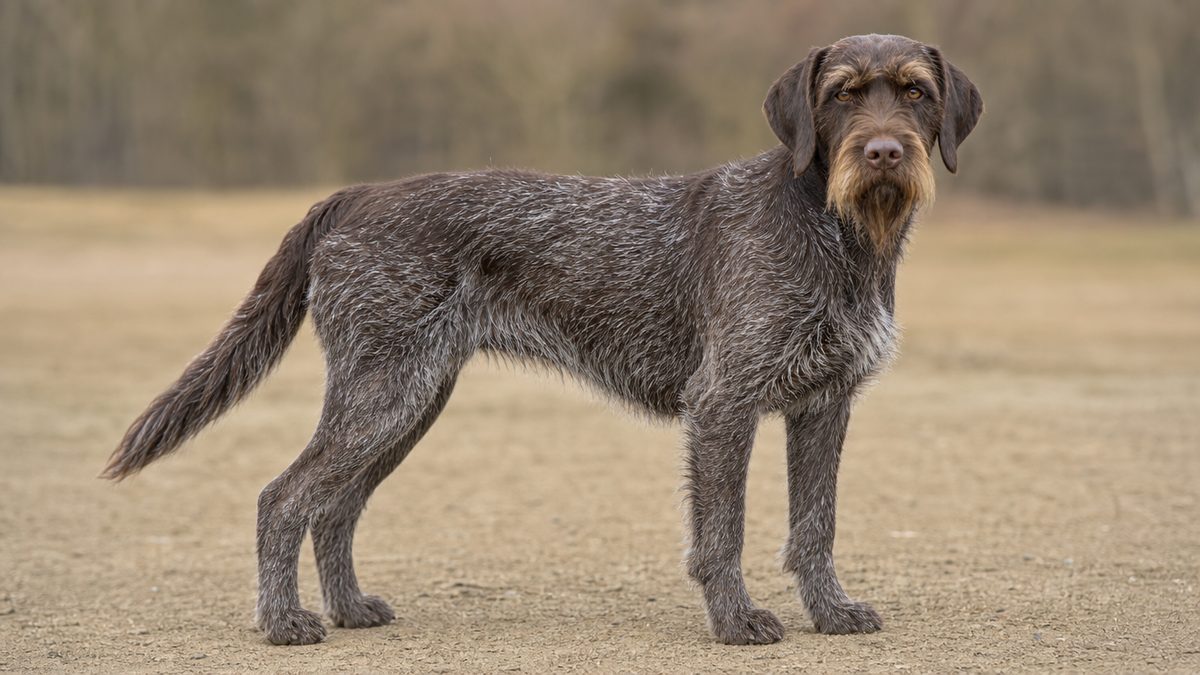
The German Roughhaired Pointer is FCI Standard No. 232, registered as the Deutsch Stichelhaar, and it is not the German Wirehaired Pointer. Its own standard files it in Group 7 Pointing Dogs, Section 1.1 Continental Pointing Dogs of the Braque type, with working trial, and describes a strong pointing dog of medium to large size with a stiff, hard coat, a moderate beard and pronounced eyebrows.
Start with the number, because the name is where every error on this topic begins. Germany has four FCI pointing breeds separated mainly by coat, and each holds its own standard: Kurzhaar at 119, Langhaar at 117, Drahthaar at 98 and Stichelhaar at 232 Federation Cynologique Internationale Federation Cynologique Internationale Federation Cynologique Internationale. Wirehaired is 98. Roughhaired is 232. One word apart in English, two different dogs.
The FCI nomenclature entry for this breed prints 'DEUTSCH STICHELHAAR ( 232 )' and 'Group : n°7 - Pointing Dogs' on its own face, and the standard PDF's title page prints the same name Federation Cynologique Internationale. That check matters more here than almost anywhere, because on fci.be the trailing number decides which document you are served and the breed name in the URL is discarded entirely.
What the breed standard actually specifies
The standard's opening description is unusually vivid: a strong pointing dog of medium to large size with stiff, hard coat and moderate beard, whose pronounced eyebrows give the dog a grim appearance. The coat clause is where the breed lives. On the body the hair should be stiff, harsh and bristly, lying loosely to the body, approximately 4 cm long, with slightly longer hair and some straight feathering on the shoulders and undersides. Rather frequently there is a hardly visible undercoat on the whole body.
| Item | What the standard says |
|---|---|
| FCI number | 232, Group 7 Pointing Dogs, Section 1.1 Continental Pointing Dogs Braque type, with working trial |
| Official valid standard published | 29 November 2001; English text dated 13 March 2008 |
| Height, males | 60 to 70 cm |
| Height, females | 58 to 68 cm |
| Weight | The standard gives no weight at all, for either sex |
| Lifespan | The standard gives no lifespan |
| Coat | Stiff, harsh and bristly, approximately 4 cm, with a hardly visible undercoat rather frequently present |
| Head furnishings | Moderate beard on the muzzle; bushy, strong eyebrows standing off in an oblique arch |
| Nose | Light brown to dark brown, not flesh-coloured; a flesh-coloured or black nose is a severe fault |
| Tail | Medium length; moderate docking permissible, and natural where docking is prohibited by law |
| Colour | Brown, brown roan or light roan, with or without white chest patch or brown patches |
Build follows from the work. The standard asks for a back that is straight, strong, well muscled and firm, a well muscled loin, a broad muscular upper thigh and a long, sinewy, muscular lower thigh, over legs that are straight and parallel with strong bone. It also asks that the length of the body be as close as possible to the height at the withers, exceeding it only slightly, so this is a squarely built dog rather than a long low one.
The two figures every commercial page invents
Three recognised bodies describe this breed and not one of them states a weight. The FCI standard has no weight clause, the UKC standard gives heights of 23.5 to 27.5 inches for males and 23 to 27 inches for females and no weight, and the VDH's own breed lexicon gives the heights and stops there Verband fuer das Deutsche Hundewesen. English Wikipedia, to its credit, prints no weight and no lifespan either.
Commercial pages print both anyway. Wisdom Panel gives Weight 60 to 70 lb and Lifespan 12 to 14 yr. An Indian retail page gives males 27 to 32 kg and the same 12 to 14 years. Convert the first and the second stops looking independent: 60 lb is 27.2 kg and 70 lb is 31.8 kg, so the Indian page's male band is the American page's pound figure carried into kilograms, and its female band of 22 to 27 kg appears in no source at all.
History, and the names the breed has carried
The FCI standard credits the modern breed to an 1888 finding by the cynologist Hans von Kadisch, who it says proved this was the rough-coated variety of the German partridge dog and not merely another variety of the shorthaired pointing dog, so the breed was re-developed from the few specimens still in the country rather than newly created. The VDH's club page dates depictions of the stichelhaarig pointing dog on woodcuts and copperplate engravings to 1539.
The breed has also been called the Deutscher Stichelhaariger Vorstehhund, Staufhaarig, the German Broken-Coated Pointer and, most usefully for placing it, the Hessischer Rauhbart, the Hessian rough-beard. That last name comes from Franz Bontant, who presented the first Stichelhaars at an international show in Hanover in 1882 and called his dogs Hessian rough-beards.
A brown or roan German gundog of 58 to 70 cm with a 4 cm bristly coat, a beard and heavy eyebrows, held by the FCI as standard 232, with no weight and no lifespan in any recognised standard, and 15 puppies registered in Germany in 2025.
Which registries recognise it, and which quietly do not
The German Roughhaired Pointer is recognised by the FCI as standard 232 and by the United Kennel Club, which admitted it in 2006 into its Gun Dog Group. It is absent from the American Kennel Club's register at every level and absent from the Royal Kennel Club's Breeds A to Z, and both absences were checked with controls rather than assumed.
Recognition for this breed is unusually lopsided, and the pattern tells you something real about how thin the population is outside Germany.
| Registry | Status | Evidence |
|---|---|---|
| FCI | Recognised, standard 232 | Nomenclature entry prints DEUTSCH STICHELHAAR ( 232 ), Group 7 |
| VDH (Germany) | Recognised; puppies registered annually | Breed lexicon entry and 15 registrations in 2025 |
| United Kennel Club | Recognised in 2006, Gun Dog Group | The UKC standard states the recognition year on its own page |
| American Kennel Club | Absent at every level | No entry in the 297-breed master list, which does carry Foundation Stock Service breeds |
| Royal Kennel Club (UK) | Absent | The A to Z's only Rough Haired entries are the Slovakian breed |
| Kennel Club of India | No per-breed register published | India is an FCI full member, so FCI nomenclature is the practical route |
Why the AKC absence points downward, not upward
A breed missing from a foundation register can mean it was promoted out, so the absence needs a direction. Here it does not. The AKC's own master breed list of 297 entries carries no German Roughhaired Pointer under any spelling, and the same list does include Foundation Stock Service breeds such as the German Longhaired Pointer, the Portuguese Pointer, the Pudelpointer, the Old Danish Pointer and the Slovakian Wirehaired Pointer. Because that list spans Foundation Stock Service, Miscellaneous and full recognition, absence from it means the breed has never entered the AKC register at any level rather than that it graduated out of one.
The British absence, and the trap inside it
The Royal Kennel Club's Breeds A to Z has six pointer entries and this breed is not one of them. They are the German Longhaired Pointer, the German Shorthaired Pointer, the German Wirehaired Pointer, the Pointer, the Portuguese Pointer (Imp) and the Slovakian Rough Haired Pointer (Imp). Search that register for 'rough haired' and you get two hits, both of them Slovakian. A reader who stopped there would conclude the German breed is British-registered when it is not.
Nor can the Royal Kennel Club's vulnerable native breeds list apply, whatever the population. The RKC states in its own words that 'Vulnerable native breeds are dog breeds of British and Irish origin that are considered to be vulnerable due to their declining registration numbers';. The word German appears on that page zero times. A German breed cannot qualify for the British list however few of it exist.
What recognition means for an Indian reader
India is a full member of the FCI, represented by the Kennel Club of India in Chennai, and the register prints the entry as 'INDIA ( Full member )';. Because the KCI issues pedigrees against FCI nomenclature, a breed holding an FCI standard number has a pedigree route into India on paper. On paper is the operative phrase, and the price section explains why.
One further recognition note that a buyer should know. The UKC's standard for this breed is a 2006 document that follows the FCI text closely, including the same disqualifying faults for undershot, overshot and wry mouth, for entropion and ectropion, and for a soft coat Federation Cynologique Internationale. Two registries, one description. That consistency is itself useful, because it means there is no second, looser standard for a seller to appeal to.
Ask for the FCI standard number, not the breed name. German Roughhaired Pointer is 232. If the answer is 98 you are being offered a German Wirehaired Pointer, which is a different breed with roughly 147 times as many puppies born each year.
How rare is it really? The registration numbers, with dates
The German Roughhaired Pointer is the rarest of the four German pointing breeds by a wide margin. The VDH registered 15 puppies in Germany in 2025, the lowest figure in its fifteen-year table, and 621 across the whole period from 2011 to 2025. That is 0.027 per cent of the 55,053 puppies the VDH registered across all breeds in 2025.
Rare is a word. These are numbers, and they were taken from a live fetch of the VDH's own registration table on 31 August 2026, with the page heading confirmed on the returned document.
| Year | Stichelhaar | Drahthaar | Kurzhaar | Langhaar | All VDH breeds |
|---|---|---|---|---|---|
| 2025 | 15 | 2,215 | 1,198 | 382 | 55,053 |
| 2024 | 46 | 2,587 | 1,236 | 358 | 56,851 |
| 2023 | 32 | 2,618 | 1,278 | 374 | 60,306 |
| 2022 | 44 | 3,119 | 1,304 | 468 | 69,381 |
| 2021 | 48 | 3,629 | 1,842 | 581 | 85,595 |
| 2018 (the 15-year high) | 72 | 3,007 | 1,202 | 352 | 75,038 |
| 2011 | 58 | 2,857 | 1,225 | 548 | 80,719 |
| Total 2011 to 2025 | 621 | 44,207 | 19,010 | 7,427 | - |
Three ratios come straight out of that table. Over fifteen years the Drahthaar produced 71 puppies for every one Stichelhaar, the Kurzhaar produced 31, and the Langhaar produced 12. In 2025 alone the Drahthaar to Stichelhaar ratio was 2,215 to 15, which is 148 to 1. The fifteen-year mean for the Stichelhaar is 41.4 puppies a year.
A figure that corroborates from a completely different direction
Craig Koshyk, who wrote Pointing Dogs, Volume One: The Continentals and visited the breed's club secretary in Germany, writes that breeders 'only produce about 40 pups worldwide in a good year';. The VDH's fifteen-year German mean is 41.4. Those two numbers were arrived at independently, one from a register and one from an author inside the breed, and they agree to within two puppies. When two unrelated sources land on the same figure, the figure is probably real.
The entire breeding population fits on one web page
This is the fact that makes the scale concrete. The Verein Deutsch Stichelhaar publishes every dog currently approved for breeding, stud dogs and brood bitches together, on a single page. Bonbeno fetched it on 31 August 2026 and counted the entries: 47 dogs, carrying 18 distinct kennel affixes.
| Kennel affix | Approved breeding dogs | Running share of 47 |
|---|---|---|
| vom Bodensee | 9 | 19.1 per cent |
| vom Rhinluch | 8 | 36.2 per cent |
| von den Heiligen Kuhlen | 6 | 48.9 per cent |
| vom Kanonenturm | 4 | 57.4 per cent |
| vom Thabrauck | 3 | 63.8 per cent |
| Four affixes with two dogs each | 8 | 80.9 per cent |
| Nine affixes with one dog each | 9 | 100 per cent |
Three kennels account for 23 of the 47 approved breeding dogs, which is 48.9 per cent, and five account for 30, which is 63.8 per cent. That is a gene pool narrow enough that any Indian buyer should assume close relatedness between almost any two dogs offered, and it is the arithmetic behind every warning about this breed's genetic base.
One caveat has to be stated. That page is the German club's approved list, not a world census. Austria has a separate club, and the population outside Germany is small but not zero. Read 47 as the size of the German breeding pool on 8 May 2026, the date the page itself records for its last update, rather than as the number of the breed alive.
Fifteen puppies in a year, from a breeding pool of 47 dogs in 18 kennels, of which three kennels hold nearly half. That is the whole argument, and no ranking page for this breed makes it.
Is it on any at-risk register? No, and the reason is not reassuring
No at-risk register lists the German Roughhaired Pointer. Germany's Rote Liste of old and endangered domestic breeds does not include it, and the British vulnerable native breeds list cannot include it. Neither absence means the breed has been assessed and found safe. It means no register covers it.
This is the question a reader arriving at a rare-breed page most wants answered, and it deserves a real answer rather than the word rare repeated.
The German instrument, and what it actually covers
Germany's equivalent of a vulnerable-breed list is the Rote Liste published by the Gesellschaft zur Erhaltung alter und gefaehrdeter Haustierrassen, and its January 2026 edition does carry a Hunde row. The row names eight breeds across its categories: the Altdeutscher Huetehund as the Westerwaelder Kuhhund and again in its southern and central German forms, the Grossspitz and the Mittelspitz, the Deutscher Pinscher, the salt-and-pepper Mittelschnauzer, and the Bergamasco and Bouvier des Ardennes as breeds from other countries.
The Deutsch Stichelhaar is not on it. That absence was checked rather than assumed: the same retrieval returned eight named dog breeds, so the page loaded and the query worked.
The comparison inside that list is the striking part. The GEH classifies the Deutscher Pinscher as gefaehrdet, endangered, and the VDH registered 288 Deutscher Pinscher puppies in 2025 Verband fuer das Deutsche Hundewesen e.V.. The Stichelhaar registered 15 in the same year and appears nowhere on the list. A breed producing nineteen times as many puppies is flagged and this one is not.
Why, and why it matters
The reason is scope, not oversight. The GEH's remit is old and endangered Haustierrassen, domestic and farm breeds, and its dog entries are herding dogs, spitze, pinschers and schnauzers, the working farm types that sit alongside its cattle, sheep, pig and poultry lists. A hunting gundog is outside the frame the list was built for, however few of it there are.
So the honest statement is that the German Roughhaired Pointer falls through the gap. It is too rare to be safe and too much of a gundog to be counted by the body that counts rare German domestic breeds. Nobody is monitoring it in the way the Deutscher Pinscher is monitored.
The British list cannot apply, and the RKC says so itself
It is worth killing this one explicitly, because a breed with 15 puppies a year would sail past the British threshold if the British list were open to it. It is not. The Royal Kennel Club states that 'Vulnerable native breeds are dog breeds of British and Irish origin that are considered to be vulnerable due to their declining registration numbers', and that the vulnerable list covers breeds with fewer than 300 registrations a year while the at-watch list covers 300 to 450. The word German appears on that page zero times, and the breed is absent from the RKC's Breeds A to Z altogether.
So a German breed cannot be a British vulnerable native breed by definition, no matter how few there are. Anyone who tells you the Stichelhaar is on a vulnerable-breeds list has confused two different instruments.
What is monitoring the breed instead
One thing is, and it is the breed club itself. The Verein Deutsch Stichelhaar publishes its complete approved breeding population publicly, which is a form of transparency larger clubs do not offer, and it makes the population countable by anyone. That page, plus the VDH's annual registration row, is the entire public monitoring apparatus for this breed.
No register lists this breed as at risk, and that is a gap in coverage rather than a clean bill of health. Fifteen puppies a year with no monitoring body is a worse position than 288 puppies a year with one.
German Roughhaired Pointer price in India, and what a search actually returns
There is no German Roughhaired Pointer price in India, because there is no Indian market for a breed that produced 15 puppies worldwide in its home register last year. Bonbeno searched, proved the search works with a control that returned ten live Indian listings for another breed, and found not one Indian offer of a Stichelhaar puppy. This page publishes no rupee figure for the breed.
That is the finding. Naming what a reader is actually being offered instead is more useful than any invented number, so here is exactly what came back.
What an India-located search for this breed returns
| What ranked | What it actually is |
|---|---|
| Etsy listing, priced in Norwegian kroner | A canvas wall-art print of the breed |
| eBay listing | A vinyl sticker decal |
| Bookswagon India, INR 975 | A paperback titled 'Deutsch Stichelhaar 20 Milestones', a book of selfie challenges |
| animalia.bio | A directory page listing dog breeds from Germany |
| puppyfinder letter-G index | An alphabetical breed index, no listings |
| Wikipedia list of dog breeds | An encyclopedia index |
| A European breeder site | Lists many breeds with 'Ask for price'; not India |
| A pet-selling site's support page | Its country dropdown happens to contain both the breed name and India |
| An Indian retail breed page | Editorial content with no dog for sale; its own product grid returns 'Showing -1 Results' |
| A Facebook group post | A question about the difference between short and long haired dogs |
The single India-priced commercial result for this breed's name is a book costing INR 975. Not a puppy, not a stud fee, not a breeder. A paperback.
The control that makes the zero mean something
An absence is only evidence if the search was working, so the same query shape was run in the same session with the same tool and the same India setting for a common breed. 'Labrador retriever puppy price in india' returned ten genuine Indian commercial pages carrying rupee figures, including Mr n Mrs Pet quoting INR 30,000 to 60,000 for basic quality, INR 60,000 to 90,000 for a KCI-registered dog and INR 90,000 to 1,20,000 for champion bloodline. The instrument works. The zero for this breed is real.
The Indian page that does rank, and what it is
One Indian page ranks in the top ten for this breed, an Indian pet retailer's breed profile. It is editorial rather than a listing, and it is worth reading carefully for two reasons. Its figures contradict the standard: it gives females 56 to 62 cm where the FCI standard says 58 to 68 cm, and it gives weights where the FCI, the UKC and the VDH all give none United Kennel Club Verband fuer das Deutsche Hundewesen.
And its own commerce section gives the game away. Below the breed copy the page runs a product grid that returns 'Showing -1 Results'; followed by 'We're sorry. There are no results'. A negative result count is a template seam: the breed page is bolted onto an empty product collection and the counter has gone below zero. It is a page about a breed, attached to a shop that stocks nothing for it, which is a fair summary of this breed's Indian commercial presence generally.
The law that keeps it that way
Live dogs are a Restricted import in India at ITC(HS) 01061900 under DGFT Trade Notice 22/2022-23, which permits entry only for a pet accompanying its owner with a valid pet book in the importer's name, for research with a CPCSEA recommendation, or for Defence and Police use, and states that applications for trading or breeding purposes shall be duly rejected. Any dog that arrives is inspected and certified by Animal Quarantine and Certification Services.
Put that beside a worldwide production of roughly 40 puppies a year and the conclusion is not close. There is no lawful route by which a commercial Indian supply of this breed could form, and there is not enough breed in existence to supply one if there were.
Ask for the FCI standard number and the exporting country's pedigree. Standard 232 has a worldwide annual output of about 40 puppies and a German breeding pool of 47 dogs. A rupee price for one needs an explanation, not a discount.
The breed standard permits tail docking. Indian law forbids it outright
The FCI standard for this breed states that moderate tail docking is permissible. India's Prevention of Cruelty to Animals (Dog Breeding and Marketing) Rules, 2017 state that there shall be no tail docking and that any change of appearance by artificial means is strictly forbidden. Those two sentences cannot both be followed in India, and no page ranking for this breed mentions it.
Take the standard first, quoted from the document itself. Under TAIL, FCI Standard No. 232 reads: 'Of medium length, strong at the root and set on not too low. Moderate tail docking is permissible. In countries where docking is prohibited by law, the tail may be left natural. It should reach to the hock joint and should be carried straight or at the most very slightly bent upwards'.
Now the Indian clause, located by string search in Bonbeno's own extraction of the gazette PDF. Second Schedule, Part II, paragraph 6(8) reads: 'There shall be no tail docking, ear cropping, de-barking, de-clawing, branding, dyeing, injecting substances to enhance visual appeal, performing a surgery or procedure to camouflage or hide any defect or infirmity or any other kind of mutilation of any body part of the pup and any change of appearance by artificial means is strictly forbidden'.
That is a Second Schedule paragraph, not a Rule, and it is worth citing it that way. The Rules' own Rule 6 is a different provision headed requirements to be met by breeders and establishments; what it does is make the Second Schedule binding, which is why paragraph 6(8) has force but is not itself a Rule.
The good news is that the standard already anticipates this
The FCI text does not require a docked tail. It permits one, and then adds explicitly that in countries where docking is prohibited by law the tail may be left natural. So a full-tailed Stichelhaar in India is a correct dog under its own standard, not a compromise. The UKC takes the same position for the same reason, stating that as an international registry it is aware that cropping and docking are forbidden in some countries and that no dog in any UKC event, including conformation, shall be penalised for a full tail or natural ears.
So there is no conflict for an owner. There would be one for anyone who imported the German practice along with the dog, and that is the sentence an Indian buyer needs.
The sharper collision is in the disqualifying-fault list
This breed's standard disqualifies four specific defects, and Indian law names the same four as genetic defects a breeding dog must have been tested for. Second Schedule, Part III, paragraph 8(10) requires that 'The dogs shall have been tested for genetic defects, including hip dysplasia, progressive retinal atrophy, night blindness, hypothyroidism, entropion, ectropion, overshot, undershot jaw (when incisors do not touch or mesh), wry mouth, two or more missing teeth, unilateral cryptorchid or full cryptorchid males'.
| Defect | FCI Standard 232 | India, Second Schedule Part III para 8(10) |
|---|---|---|
| Entropion | Disqualifying fault | Named as a genetic defect to test for |
| Ectropion | Disqualifying fault | Named as a genetic defect to test for |
| Overshot bite | Disqualifying fault | Named as a genetic defect to test for |
| Undershot bite | Disqualifying fault | Named, where incisors do not touch or mesh |
| Wry mouth | Disqualifying fault | Named as a genetic defect to test for |
| Missing teeth | Disqualifying, except for two premolars 1 | 'Two or more missing teeth' is itself the named defect |
| Cryptorchidism | N.B. requires two descended testicles | Unilateral or full cryptorchid males named |
One row in that table is a genuine mismatch rather than an alignment. FCI 232 disqualifies missing teeth except for two premolars 1, so a dog missing exactly two PM1 is a correct show dog under its own standard. India's paragraph 8(10) names 'two or more missing teeth' as a genetic defect a breeding dog must have been tested for. A dog can therefore be standard-legal in the ring and sit inside the Indian clause's own list at the same time.
That is not a prohibition, and this page will not overstate it. Paragraph 8(10) requires testing, not exclusion, and the word 'including' makes its list illustrative rather than closed, so a defect being absent from it does not put it outside the clause either. But an Indian breeder of this breed would have to record the finding, and a buyer is entitled to ask for it.
What the Rules do not contain
Two absences are worth knowing because breeders and sellers invent obligations that are not there. Bonbeno searched the full gazette text and found zero occurrences of BAER, of deaf and of patella. There is no Indian hearing-test requirement and no Indian patella-grading requirement for any breed.
Keep the tail. It is lawful under Indian law, correct under the FCI standard, and cannot be penalised at a UKC event. A docked Stichelhaar in India is a legal problem for whoever docked it.
Suitability for the Indian climate, and heat tolerance rated 2 of 5
The German Roughhaired Pointer comes from a cold, very humid corner of northern Germany, and India offers it the humidity without the cold. Chennai's coolest month is 5.64 degrees Celsius hotter on wet bulb than the hottest month in East Frisia, where the breed was rebuilt after 1945. Humidity is not what defeats this dog. Humidity at 28 degrees is.
Wet bulb temperature is the figure that matters for a dog, because a dog sheds heat by evaporating water from its airways. Dry heat it can survive. Humid heat removes the mechanism.
This is not a heat-tolerant breed, and the standard shows why indirectly by describing what the coat is for rather than by making any claim about temperature.
The origin point used here is chosen rather than assumed. The FCI standard gives the origin only as Germany, so this page uses Aurich in Ostfriesland, the East Frisian district where the VDH's own club record says a fresh breeding start was found in 1945 and where the club's public presence is still based Verband fuer das Deutsche Hundewesen. A second German point, Konstanz on Lake Constance, is included because the single largest kennel affix in the club's current breeding list is vom Bodensee.
| Place | Annual mean air temp (C) | Annual mean RH (%) | Warmest-month wet bulb (C) | Gap to Aurich's August peak |
|---|---|---|---|---|
| Aurich, Ostfriesland (53.4711 N, 7.4831 E) | 9.94 | 84.68 | 16.13 (August) | - |
| Konstanz, Lake Constance (47.6603 N, 9.1758 E) | 8.50 | 81.75 | 16.02 (July) | -0.11 |
| Bengaluru | 23.74 | 67.94 | 22.66 (May) | +6.53 |
| Pune | 23.86 | 66.80 | 23.56 (June) | +7.43 |
| Mumbai | 26.77 | 67.39 | 26.55 (June) | +10.42 |
| Chennai | 27.95 | 72.39 | 27.36 (May) | +11.23 |
| Delhi | 25.60 | 45.56 | 27.74 (July) | +11.61 |
| Kolkata | 25.81 | 73.93 | 27.86 (June) | +11.73 |
The finding that separates this breed from a desert dog
Look at the humidity column before the temperature one. East Frisia is more humid than Chennai. Aurich's annual mean relative humidity is 84.68 per cent against Chennai's 72.39, and Aurich sits above 90 per cent in November, December and January. This is a marsh and coastal-plain climate, and the breed's harsh outer coat and occasional undercoat are equipment for exactly that.
What East Frisia does not have is heat. Its annual mean air temperature is 9.94 degrees Celsius against Chennai's 27.95, a gap of 18.01 degrees. So the correct sentence is not that this breed cannot handle humidity. It can. It cannot handle humidity at Indian temperatures, because that combination is the one that stops evaporative cooling working.
The sentence that settles it
Chennai's coolest month for wet bulb is January at 21.77 degrees Celsius. Aurich's hottest is August at 16.13. So the mildest month Chennai offers this dog is 5.64 degrees hotter, on the measure that governs cooling, than the hottest month in the district where the breed was rebuilt. There is no Indian season that resembles an East Frisian summer.
Bengaluru, which Indian buyers reach for as the mild option, still peaks 6.53 degrees above the German figure, and its relative humidity of 67.94 per cent is well below what the breed's coat evolved in. It is the least bad Indian city on this list and it is not a good one.
What the coat does in Indian conditions
The standard asks for hair that is stiff, harsh and bristly, approximately 4 cm, lying loosely to the body, with a hardly visible undercoat rather frequently present on the whole body. Two of those words matter here. Loosely is good: a coat that stands off the skin traps a layer of moving air rather than clamping heat against the body, which is better in humidity than a close-lying coat. Rather frequently is honest: the undercoat is variable, so two dogs of this breed may not carry the same insulation.
The pigment is also in the dog's favour. The standard requires a nose from light brown to dark brown and never flesh-coloured, and the permitted colours are brown, brown roan and light roan, so this is not a pale-skinned breed at high risk of solar dermatitis. That keeps the heat rating off a 1.
Rated from the coat clause in the standard against NASA POWER wet bulb data. A bristly 4 cm coat with a variable undercoat, evolved in a climate more humid than Chennai and 18 degrees Celsius colder, on a dog of 58 to 70 cm bred to work hard. Good pigment and a loose-lying coat keep it off a 1; the wet bulb gap keeps it off a 3.
Exertion, not the parked car, is what actually kills
Exertion is the dominant recorded trigger of heat-related illness in dogs, accounting for 652 of the 879 UK events that had a trigger recorded. That is the risk profile a working gundog carries into an Indian summer, and neither of the two papers behind the figure modelled this breed, so no breed-specific odds ratio is claimed here.
The largest study is a VetCompass analysis of 905,543 UK dogs across 886 clinics in 2016. Its Animals paper records 1,259 heat-related illness events from 1,222 dogs. 380 of those events, 30.2 per cent, had no trigger recorded, leaving 879 with a recorded one, which split six ways: 652 exertional, 74.2 per cent, 113 environmental at 12.9 per cent, 46 from vehicular confinement at 5.2 per cent, 40 under the care of a clinic or groomer at 4.6 per cent, 24 from building confinement at 2.7 per cent and 4 from blanket entrapment at 0.5 per cent. Those six sum to 879 exactly, which is worth saying because the three headline categories alone come to 811 and quoting only those drops 68 events.
There is a denominator trap inside the paper's own abstract, which says exertional illness was the predominant trigger at 74.2 per cent of events. That is 74.2 per cent of the 879 events with a known trigger, not of all 1,259. Of all events it is 652 of 1,259, which is 51.8 per cent.
The companion Scientific Reports paper on the same cohort is a different analysis with a different case definition. It reports 395 confirmed events, an incidence risk of 0.04 per cent, and an event fatality rate of 14.18 per cent, 95 per cent confidence interval 11.08 to 17.96. Roughly one heat-illness event in seven ended in death, in a temperate country with a dense veterinary network.
Neither paper included this breed, and the reason is stated in the Scientific Reports methods: a breed was named individually only if it had at least five heat-illness cases or at least 5,000 dogs in the study population, and everything else was grouped into an 'other purebred' category. A breed with 15 German puppies a year is nowhere near that threshold, so an odds ratio imported onto it would be fabrication wearing a citation.
What transfers, and what does not
The mechanism transfers. Exertion is the dominant trigger, and this is a breed the standard describes as resistant and courageous, selected to work heavy cover and to face large game Koshyk C. 'Stichelhaar - German Rough…. A dog like that does not moderate its own effort, and a handler who waits for the dog to slow down has already waited too long.
The bodyweight finding transfers with a caveat. The Scientific Reports paper reports an odds ratio of 1.42, 95 per cent confidence interval 1.12 to 1.80, for dogs at or above their breed and sex mean bodyweight compared with dogs below it. That comparison is available to any owner. Its headline 3.42 figure for dogs over 50 kg is measured against dogs under 10 kg, not against the general population, so it is the wrong comparison for a gundog of this size.
A practical complication is specific to this breed: there is no published mean bodyweight to measure against, because no recognised standard states one Verband fuer das Deutsche Hundewesen. The workable substitute is your own dog's weight at peak fitness, recorded and held.
652 of 879. Exertion is not one risk among several, it is the risk, and it is the one entirely within an owner's control.
Temperament and household fit
The FCI standard describes the German Roughhaired Pointer as balanced, calm, resistant, courageous but self-controlled, neither shy nor aggressive, with a calm and even temperament. The breed club's own secretary, asked what one thing people should know about the breed, answered with a single German word: Ruhe, meaning calm.
The standard's temperament clause is the starting point and it says the same thing twice: 'Balanced, calm, resistant, courageous but self-controlled, neither shy nor aggressive. The temperament is calm and even';. The UKC's 2006 standard condenses it to 'Calm, courageous but self controlled, neither shy nor aggressive';.
The anecdote behind those clauses is worth having. Craig Koshyk asked Elso Kratzenberg, then secretary of the Deutsch Stichelhaar Verein, what one thing he would like people to know about the breed. The answer was one word, 'Ruhe', and in context he meant the breed should be known for a calm, cool and collected character.
The other half of the description
Calm is not the same as soft, and the same source is clear about that. Stichelhaars are described as strong, vigorous dogs with a lot of prey drive, very sharp on predators and fearless in heavy cover or when pursuing large game such as boar, combined with the laid-back steadiness required of a forester's dog. The breed has historically been selected for a strong protective nature, though there are no formal club-level tests for it.
So the honest picture is a self-possessed dog with serious drive underneath. That is a good combination for a handler who wants a working partner and a poor one for a household that reads calm as low-maintenance.
Who this breed suits
- Handlers who want a steady, versatile working dog rather than a fast, flashy one
- Households that will deliver two hours of daily activity in every season, indefinitely
- Owners with access to open ground, cover and water, which in urban India is the binding constraint
- People comfortable with a dog that has real prey drive around cats, poultry and small pets
- Anyone willing to be the only owner of this breed in their state
Who should not buy one
- First-time owners in an Indian metro apartment, where neither the exercise nor the climate works
- Households wanting a guard dog, because the protective reputation is untested and unquantified
- Anyone expecting a German Wirehaired Pointer, which is a different breed with a different standard
- Owners who will not run a lifelong weekly ear and beard routine
- Buyers who need veterinary familiarity with the breed, since no Indian practice has seen one
One temperament issue is documented rather than assumed and belongs here rather than in the health section. Gun-shyness and nervousness have been identified as problems in some lines, alongside the physical conditions covered later. In a breed with 47 approved breeding dogs, a temperament fault in one line is a larger share of the whole population than the same fault would be anywhere else.
If Ruhe is what you want, this breed genuinely offers it. If you also need the dog to be satisfied by a city walk in May, it does not, and calm will turn into destructive very quickly.
Training approach, and what this breed resists
Train a German Roughhaired Pointer with calm consistency and early socialisation, because the breed is described as relatively easy to train and its steadier character is said to suit less experienced handlers than some continental pointers. What it resists is not commands. It resists being asked to ignore game, and it resists boredom.
The evidence for the easy part is direct. Stichelhaars are said to be relatively easy to train, and their calmer, more laid-back character may make them well suited to less experienced handlers. The standard's own description of a self-controlled dog with an even temperament points the same way.
That does not make the breed easy to keep. The training problem in India is not obedience, it is finding legitimate outlets for a dog selected to search, point, track and work heavy cover, none of which an Indian city offers by default.
A realistic timeline
| Age | What to work on | What to avoid |
|---|---|---|
| Under 8 weeks | Nothing. Indian law forbids the sale of pups less than eight weeks in age | Do not accept a younger pup from any seller |
| 8 to 16 weeks | Socialise hard and wide. Handle ears, beard, feet and mouth every single day | Do not drill or enforce long stays |
| 4 to 6 months | Recall on a long line, crate and car comfort, calm water introduction, grooming tolerance | Do not correct a self-possessed dog harshly; it will simply disengage |
| 6 to 12 months | Steadiness, loose-lead work, controlled exposure to cats, poultry and livestock | Do not force the point, and do not begin hard conditioning |
| 12 to 18 months | Structured searching problems, retrieve work, scent games as the daily outlet | Do not treat an adult body as an adult mind |
| 18 months onward | Endurance built slowly, always in the cool hours | Do not build fitness during the Indian hot season |
The prey drive is the training project
This is the part an Indian household will actually spend its time on. A breed described as very sharp on predators and fearless in pursuit of large game is a breed that will chase. In an Indian residential setting that means cats, street dogs, poultry, monkeys and anything that moves fast in undergrowth, and a recall that works in a park will not survive it.
The workable approach is to build recall around a long line for months longer than feels necessary, to pay heavily for disengagement rather than for compliance, and to accept that off-lead freedom in an unfenced Indian space may never be safe. That is a management decision, not a training failure.
Train at dawn, and mean it
Heat discipline is a training rule, not a seasonal precaution. Chennai's May wet bulb averages 27.36 degrees Celsius and Delhi's July reaches 27.74, against 16.13 in the breed's East Frisian rebuilding ground. A session that would be routine in Germany becomes an exertional heat-illness risk in those numbers, and exertion is the trigger behind 652 of 879 recorded events.
Substitute problems for distance in the hot months. A dog bred to search methodically is satisfied by scent work, hidden retrieves and water work, and is not satisfied by a longer walk on hot tarmac.
Teach beard and ear handling as a trick before you ever need it medically. A bearded breed in Indian humidity needs both checked constantly, and a dog that offers them turns a five-minute fight into a thirty-second job.
How much exercise a German Roughhaired Pointer actually needs
Plan on two hours a day of genuine activity, moved around the heat, for the dog's whole adult life. The FCI standard defines the breed as a versatile, easily tractable working gundog, and a dog selected for that will not be satisfied by a lap of a residential colony.
The standard's utilization clause is short and it is a job description rather than a personality note: a versatile, easily tractable working gundog. The gait clause fills in what that means physically, asking for movement covering plenty of ground with good reach and powerful drive, parallel coming and going, with an upstanding stance.
The breed's own reputation is as a forester's dog, worked in heavy cover and on large game, with the endurance that implies. This is not a breed with a hidden low-energy setting.
A workable Indian pattern
| Time | What to do | Why |
|---|---|---|
| Pre-dawn to sunrise | The main session: 60 to 90 minutes of searching, running and retrieving on open ground | The only window in an Indian summer when wet bulb allows sustained exertion |
| Mid-morning to late afternoon | Nothing outdoors | Chennai's May air maximum reaches 42.70 C, Delhi's June 48.79 C, Kolkata's May 46.81 C |
| Afternoon indoors | Scent work, shaping, food puzzles, 20 to 30 minutes | Mental load substitutes for distance at no heat cost |
| After sunset | A second 30 to 45 minute walk with generous sniffing time | Wet bulb falls but not far, so keep this one steady rather than hard |
| Weekly | One long session on ground where the dog can quarter freely, plus safe clean water where available | The breed works water and cover, and a swim removes the heat load entirely |
What happens without it
Under-exercised working gundogs do not settle. They become destructive, vocal and difficult, and in this breed the energy has a prey-driven edge to it. The Indian retail page that ranks for the breed name reaches the same conclusion by a different route, listing under its own disadvantages that the breed can become destructive if bored or under-exercised and is not well suited to apartment living without sufficient exercise. That much of that page is sound.
The opposite failure is worse and faster. An owner trying to deliver two hours in the middle of an Indian day is running exactly the exertional risk that dominates the heat-illness data, in a breed with no published mean bodyweight to check itself against Federation Cynologique Internationale.
Swimming, and the cost that comes with it
Swimming is the best Indian exercise for this breed, because it satisfies the drive and removes the heat load at once. It carries one recurring cost. Every swim wets a beard and a set of medium-length hanging ears, and pendulous ear carriage is a recognised predisposing factor for canine otitis externa Federation Cynologique Internationale. Dry both after every swim and treat that as part of the exercise rather than as aftercare.
Move the work, do not cut it. This breed needs the same two hours in Chennai that it would get in Aurich; it simply cannot have them between nine in the morning and five in the evening for most of the year.
Grooming and coat care in Indian humidity
Groom a German Roughhaired Pointer weekly with a brush that reaches through a harsh 4 cm coat, and treat the beard and the ears as two separate jobs that never stop. The coat itself is low maintenance by design. The furnishings the standard requires, a moderate beard and bushy eyebrows, are what Indian humidity makes difficult.
Work from the standard rather than from a generic wire-coat routine. It asks for body hair that is stiff, harsh and bristly, lying loosely, approximately 4 cm long, all hairs on each part growing the same direction, with slightly longer hair and straight feathering on the shoulders and undersides. On the muzzle the hair forms a moderately developed beard; on the bridge of the nose it is short and harsh, neither long nor soft nor falling; on the skull it is close lying, short and harsh; the eyebrows are bushy and strong, standing off in an oblique arch.
Two clauses tell you what not to do. The head should be free from any soft, woolly or silky coat, and a soft or medium soft coat anywhere except the beard and eyebrows is a disqualifying fault United Kennel Club. So soft conditioners, frequent shampooing and heat drying all work against the coat the breed is judged on.
The weekly routine
- Brush the body once or twice weekly with a stiff brush that reaches the skin through a loose-lying 4 cm coat
- Comb the beard out daily in the monsoon and after every meal and every swim, because it holds water and food
- Check the eyebrows and the bridge of the nose for matting, since the standard wants this hair short and harsh
- Clean and dry both ears weekly, and after every swim or soaking without exception
- Hand-strip rather than clipping if the coat softens, because clipping changes texture and texture is a disqualifying fault
Do not follow the overseas advice to air dry
Northern European gundog guidance routinely says to towel the dog off and let it air dry. That is sound in Ostfriesland and poor advice in an Indian monsoon, because ambient humidity keeps a wet beard and a wet ear wet for hours. Chennai's relative humidity averages 82.33 per cent in November and stays above 76 per cent from September through January.
The Indian evidence supports the caution and disagrees with itself about timing, which is worth publishing rather than smoothing. A Palam Valley cross-sectional study screened 2,476 dogs and identified 81 otitis externa cases, with pendulous-eared breeds forming the large majority. A separate Indian series from Durg district in Chhattisgarh found prevalence peaking in summer rather than in the monsoon. Two Indian datasets, two different worst seasons. The safe reading for an owner of a bearded, hanging-eared breed is that no month is a month off.
The structural evidence behind both is UK primary-care work identifying pendulous ear carriage as a predisposing factor for canine otitis externa. This breed's standard specifies medium-length ears set on high and hanging smoothly and close to the sides of the head, so it inherits that risk by design.
Shedding, and a claim nobody should make
The coat is described as weather-resistant on commercial pages, and the standard's basis for that is the harsh, bristly, loose-lying outer coat and the hardly visible undercoat that is rather frequently present GoofyTails, 'German Roughhaired Pointer'. Weather-resistant in a North Sea marsh and comfortable in Chennai are different properties, and only the first is in the document. Nobody markets this breed as hypoallergenic, which is to its credit, and nothing here should be read as suggesting it is.
Buy a drying ear solution, not just a cleaner, and a beard comb. In Indian humidity the drying step is the one that prevents the problem, and towel drying alone reaches neither the ear canal nor the base of a beard.
Health: what is documented, and how little of it there is
The German Roughhaired Pointer's health issues cannot be quantified, because almost no independent data on the breed exists. It has no row in OFA's published statistics tables, no paper in PubMed, and no entry in the largest UK longevity study. Every one of those three absences was proved with a control that returned results in the same session, and none of them is filled here with a figure borrowed from another breed.
This is the honest position for a breed producing about 40 puppies a year worldwide, and stating it plainly is more useful than any borrowed percentage.
OFA holds no row for this breed
Bonbeno retrieved OFA's full disease-statistics payload, 5,887,106 characters covering 513 disease tables, saved it and searched it. GERMAN ROUGHHAIRED, ROUGHHAIRED, ROUGH HAIRED, ROUGH-HAIRED and STICHELHAAR each return zero rows.
The controls prove the file loaded and the search worked: LABRADOR returned 109 rows, GOLDEN RETRIEVER 101, GERMAN SHORTHAIRED 81 and GERMAN WIREHAIRED 40 in the same session. More tellingly, the only four breed labels containing the word POINTER anywhere in the whole payload are GERMAN LONGHAIRED POINTER, GERMAN SHORTHAIRED POINTER, GERMAN WIREHAIRED POINTER and POINTER. The Stichelhaar is simply not in the register.
The correct wording matters. This breed has no row in OFA's published statistics tables, which is not the same as being absent from the OFA database. OFA's own page prints a threshold sentence for tables with no qualifying breed, reading that no individual breeds have had 50 or more individuals tested. A breed with 47 approved breeding dogs in Germany was never going to clear that.
PubMed holds no paper, and the search that says otherwise is lying
PubMed was searched through the NCBI E-utilities endpoint specifically so the query-translation line could be read rather than only the result count. 'German Roughhaired Pointer' and 'German rough-haired pointer' each returned zero, flagged with quotedphrasesnotfound.
Then 'Deutsch Stichelhaar' returned 8,930 records, which looks like a literature. It is not. The translation line shows the phrase was discarded and only the word deutsch was searched, and the same response carried a quotedphrasesnotfound flag for the phrase. An agent trusting the count would have written the exact opposite of the truth. Controls in the same session were sane: 'Labrador Retriever hip dysplasia' returned 126 and 'German Shorthaired Pointer' returned 71.
So the genuine count is zero. There is no veterinary literature on this breed, and zero is a publishable finding.
No lifespan figure appears anywhere on this page
The largest UK longevity study covers 584,734 dogs and 155 breeds. Its supplementary Tables S3 and S6 were downloaded and read as raw document text, and the German Roughhaired Pointer has no row of its own in either. The control proves the search worked: the German Shorthaired Pointer is in both at a median survival of 13.4 years on 947 deaths, and the German Wirehaired Pointer at 13.0 years on 138 deaths.
The missing row is a merge, not an exclusion. Supplementary Table S5 records the analysed row labelled German Wirehaired Pointer as covering the German Roughhaired Pointer and the German Longhaired Pointer too, so the Stichelhaar's British dogs sit inside that 13.0-year median, pooled with two other breeds, and no separate figure can be read out of it.
That pooled number belongs to three breeds and this page will not print it as this one's. Wisdom Panel and an Indian retail page both print 12 to 14 years for the Stichelhaar; neither cites a study, and no recognised standard states a lifespan GoofyTails, 'German Roughhaired Pointer' Federation Cynologique Internationale. Where a page gives you a lifespan for this breed, ask which study it came from.
The one health account that exists, and what it is
One named authority reports specific problems from inside the breed. Craig Koshyk writes that in addition to the usual gundog issues, alopecia, a sort of genetic pattern baldness, seems to be on the increase in some Stichelhaar lines, and that dental problems and temperament issues such as gun-shyness and nervousness have also been identified.
That is a considered observation by the author of the standard English reference on continental pointing breeds, and it is the best evidence available. It is not a prevalence study, it attaches no percentage and no sample, and this page will not convert it into one. Read it as three things to ask a breeder about, not as three rates.
The alopecia observation carries a specific edge for this breed. A coat that is soft anywhere except the beard and eyebrows is a disqualifying fault, so coat quality is already under heavy selection pressure in a very small gene pool Verein Deutsch Stichelhaar e.V..
No OFA row, no paper, no lifespan entry. Those are not gaps in this page's research; they were each proved with a working control. They mean nobody has measured this breed, and a buyer should treat any confident health percentage for it as invented.
Monthly cost of ownership, bounded honestly
Bonbeno gives no monthly cost of ownership figure for a German Roughhaired Pointer in India, because the inputs that would make one real do not exist here. What follows is the cost structure, so you can price it against quotes you collect in your own city.
The reason is specific rather than evasive. A monthly figure needs an Indian food cost for a large working dog, Indian vet fees for this breed's screening, and Indian grooming rates for a harsh coat with a beard. The first and third can be sourced locally for any large gundog. The second cannot, because no Indian practice has seen this breed and there is no published screening regime to price against.
There is also no published bodyweight to size the food line against, which is the practical consequence of the FCI, the UKC and the VDH all declining to state one United Kennel Club Verband fuer das Deutsche Hundewesen. Any monthly figure would start from an invented weight.
The cost structure, item by item
| Cost line | What drives it for this breed | How to price it locally |
|---|---|---|
| Food | A strong dog of 58 to 70 cm with no published mean weight; a worked dog eats more than a walked one | Weigh your own dog, then price large-breed adult food by the kilogram at your usual retailer |
| Ear care | Medium-length hanging ears plus Indian humidity, the most predictable recurring cost | Cleaner, drying solution, and one vet consult per flare-up |
| Beard care | A moderate beard the standard requires, which holds water and food in monsoon air | A comb and time, plus occasional treatment for skin under the chin |
| Coat care | Harsh 4 cm coat; hand-stripping rather than clipping, since a soft coat is a disqualifying fault | Very low in money, moderate in time; clipping is the expensive mistake |
| Hip imaging | No breed-specific Indian regime exists, but hip dysplasia is named in India's own genetic-defect clause | Sedated radiographs at a referral hospital, a one-off rather than monthly |
| Transport | A dog bred to quarter cover for hours, in a country where that ground is not next door | Fuel or hired transport to open ground, several times weekly, forever |
Living conditions, and the line Indian owners underestimate
The living conditions this breed needs are the largest hidden cost, and even the Indian retail page that ranks for the term says so, listing houses with large securely fenced yards, rural or suburban homes, and access to forests, fields, lakes or open countryside as its ideal environments. In an Indian metro none of those is free. Getting the dog somewhere it can run is a repeating cost that no breed page prices and most owners discover in month three.
The second underestimated line is ears. Pendulous ear carriage is a recognised predisposing factor for canine otitis externa, and Indian series find real caseloads in pendulous-eared breeds with the peak season disputed between summer and the monsoon Nainika and Sharma P. 'Otitis externa… Roy Manju, Kashyap Roshan. Budget for consults rather than hoping for none.
Get three quotes in your own city: a month of large-breed food for your dog's actual weight, one ear consult, and one sedated hip radiograph. Add transport to open ground. Those four cover most of the variance, and none of them needs a breed-specific figure.
Feeding, body condition and what is available in India
Feed a German Roughhaired Pointer as a large working dog whose workload swings hard with the Indian season, and manage bodyweight against your own dog's fit weight rather than against a breed average, because no recognised standard publishes one.
That absence is the whole complication. The FCI standard gives heights of 60 to 70 cm for males and 58 to 68 cm for females and no weight at all; the UKC gives inches and no weight; the VDH's breed lexicon gives heights and stops United Kennel Club Verband fuer das Deutsche Hundewesen. English Wikipedia, correctly, prints no weight either.
Commercial pages fill the gap with numbers that do not agree. Wisdom Panel prints 60 to 70 lb. An Indian retail page prints 27 to 32 kg for males and 22 to 27 kg for females, and the male band is the American pound figure converted, since 60 lb is 27.2 kg and 70 lb is 31.8 kg. A third account, from an author who measured dogs himself, gives 60 to 74 pounds for males and 55 to 70 for females and says the current stud list shows an average male height around 65 cm. Three sources, three ranges, no standard behind any of them.
Why bodyweight is a heat variable here
The VetCompass analysis reports an odds ratio of 1.42, 95 per cent confidence interval 1.12 to 1.80, for heat-related illness in dogs at or above their breed and sex mean bodyweight compared with dogs below it. For most breeds an owner can look up that mean. For this one there is nothing to look up, so the substitute is your own dog's weight when it was demonstrably fit, written down and defended.
In Germany a slightly heavy Stichelhaar is a fitness question. In Chennai, where May wet bulb averages 27.36 degrees Celsius against 16.13 in East Frisia, it becomes a heat-safety question.
Life-stage feeding
| Stage | Priority | The Indian adjustment |
|---|---|---|
| 8 weeks to 6 months | Large-breed puppy food, controlled growth, four then three meals | Feed the largest meal after the dawn session, never before it |
| 6 to 12 months | Slow the growth curve; joints are still forming | Do not add calories to build a working dog before growth plates close |
| 12 to 18 months | Transition to adult food; conditioning begins | Increase work before increasing food, not the other way round |
| Adult, worked | Match intake to actual workload, which swings hard by Indian season | Cut intake in the hot months when the dog cannot work, or it gains weight |
| Adult, under-worked | Hold at the dog's own fit weight | The 1.42 odds ratio applies at or above the breed and sex mean, so err downward |
What is available in India
Nothing about this breed's nutrition is exotic. A large-breed adult food from any brand sold in Indian retail will meet it, and no Indian supplier stocks a breed-specific formulation because no Indian market exists for one. Buy on weight, activity and joint status rather than on the breed name.
Two Indian practicalities. Storage in monsoon humidity spoils fat faster than in a German pantry, so buy smaller bags more often. And a bearded dog fed a wet or oily food carries it in the beard for hours, so comb after meals or switch to a bowl the beard clears.
Weigh the dog monthly and write it down. With no published breed mean to check against, your own trend line is the only bodyweight evidence you will ever have for this breed.
The gene pool argument, and a club that has been fought over
The German Roughhaired Pointer's central problem is not popularity, it is a gene pool that a century of strict purity policy narrowed on purpose. That history is documented, and so is the fact that the breed's governance has been publicly contested in Germany more than once.
The history is unusually well recorded for such a small breed, and it explains the numbers in the rarity section better than any modern figure does.
| Date | What happened |
|---|---|
| 1539 | Depictions of the stichelhaarig pointing dog appear on woodcuts and copperplate engravings |
| 1882 | Franz Bontant presents the first Stichelhaars at an international show in Hanover, calling them Hessian rough-beards |
| 1888 | The competing origin theories are reconciled; the breed is declared the rough-haired form of the German Huehnerhund |
| 1892 | Club Stichelhaar is founded, committed to pure breeding and refusing all crosses to English pointing breeds |
| 1907 to 1913 | Stichelhaars are registered in the Griffon studbook founded by Eduard Korthals during a short period of cooperation |
| After 1913 | Separate registration resumes, with extremely stringent breeding requirements and a narrowing gene pool |
| 1945 | The Second World War and the division of Germany cause great losses; a fresh breeding start is found in Ostfriesland |
| 1976 | Klub Stichelhaar is renamed Verein Deutsch Stichelhaar |
| 2025 | 15 puppies registered in Germany, the lowest figure in the VDH's fifteen-year table |
The 1892 to 1913 stretch is the part that still matters. The club held that breeding without foreign blood would improve the breed, which led quickly to a dangerously limited gene pool, and many breeders left to work on the German Wirehaired Pointer instead, taking their best dogs with them. The FCI standard preserves the same policy in its own history section, recording that from the beginning the club refused all kinds of interbreeding to any of the English pointing breeds. What the standard presents as principle is also the mechanism that produced 47 approved breeding dogs.
The 1945 restart, and where it is still visible
The VDH's club record states that the war and the division of Germany caused great losses in breeding and that a fresh breeding start was found in 1945 in Ostfriesland, where the breed was still widespread. Koshyk's account agrees on the region and differs on the date, saying that at the war's end only a handful remained, mainly in northwest Germany, where a breed club was reformed in the early 1950s, and that a few were bred on in East Germany until reunification brought all Stichelhaars under one club in the 1990s.
Both accounts can be true, with a breeding restart in 1945 and a club reformed some years later, and this page names both rather than picking one. The East Frisian thread is still visible in the club's current breeding list, which carries a kennel affix from Victorburer Moor in that district.
A contested present, reported with its uncertainty
Koshyk writes that the breed now faces what may be its biggest challenge ever, and that a controversial crossbreeding programme involving the Cesky Fousek has split the club in two. That is a serious claim from the author of the standard English reference on continental pointing breeds, and it is the only account of the current situation Bonbeno could find in English.
It could not be independently confirmed. The Verein Deutsch Stichelhaar's own news page is password-protected and Bonbeno could not read it, and no public club statement setting out the position was found. Separately, a German hunting-forum thread from April 2012 records that a breakaway Stichelhaar-Klub was founded in July 2008 and had not achieved admission to the two breeding federations. Whether that 2008 split and the crossbreeding dispute Koshyk describes are the same event or two different ones is not something this page can establish.
So the position is stated as it stands. There is a documented history of contested governance, there is a named authority reporting a current split over outcrossing, and there is no primary club document Bonbeno could open to settle it. A buyer should ask the club directly which registry a given dog sits in.
With 47 approved breeding dogs in 18 kennels and three kennels holding nearly half of them, any two dogs offered are likely to be closely related. Ask for a pedigree going back four generations and read it, because in this breed the coefficient of relationship is the health question.
The first year, month by month
Plan a German Roughhaired Pointer's first year around one fixed legal date and one seasonal reality. Indian law forbids the sale of pups under eight weeks, and the Indian heat calendar decides when a growing dog can be worked at all.
Rule 8, Conditions for sale, of India's Prevention of Cruelty to Animals (Dog Breeding and Marketing) Rules, 2017 requires every breeder to ensure that pups less than eight weeks in age are not sold. That is a Rule in the operative part of the instrument, not a schedule paragraph, and it applies to any breed acquired in India.
| Age | What matters | What to have done |
|---|---|---|
| Under 8 weeks | The pup should still be with its litter; Indian law forbids sale below this age | Nothing. If you are offered a pup here, walk away |
| 8 to 12 weeks | Socialisation window. People, surfaces, sounds, vehicles, other dogs | Vaccination started; the Rules note it can begin at seven to eight weeks |
| 3 to 4 months | Daily beard and ear handling becomes a fixed habit. Long-line recall begins | Vaccination course completing, usually by about eighteen weeks |
| 4 to 6 months | Calm water introduction, crate and car comfort, grooming tolerance | A weekly ear and beard routine the pup accepts without a fight |
| 6 to 9 months | Steadiness, loose-lead work, controlled exposure to cats, poultry and livestock | Adult food transition planned; growth curve controlled |
| 9 to 12 months | Endurance built slowly, only in the cool hours. Heat discipline as a household rule | Hip imaging discussed with your vet if you intend to breed |
| 12 to 18 months | Real conditioning once plates close; structured searching problems | Your own fit-weight baseline recorded, since no breed mean exists |
The Indian legal frame around a puppy
Two further provisions apply to anyone acquiring a pup in India. Rule 8(1)(b) requires that dogs over six months in age are not sold without first being sterilised, unless they are being sold to another licensed breeder. And Second Schedule, Part III, paragraph 8(9) records that pup vaccination can start at the age of seven to eight weeks and is usually completed at eighteen weeks.
For a breed with a gene pool this narrow, one more clause is worth knowing before anyone considers breeding. Second Schedule, Part II, paragraph 6(3) prohibits two named techniques: in-breeding, defined as mating between relatives of the second to fourth grade in straight or side line within the first four generations, with uncle to niece, nephew to aunt, cousin to cousin and grandparents to grandchildren given as the clause's own examples; and incest breeding, mating between parents and children or between brother and sister. Paragraph 6(4) adds that female dogs shall not be mated after the age of eight years.
In a population of 47 approved breeding dogs from 18 kennels, avoiding a cousin-to-cousin pairing is not a formality. It is the constraint.
The heat calendar of a first year
A puppy born in November grows through the cool months and meets its first Indian summer at six or seven months, old enough to want to run and too young to have judgement about heat. A puppy born in June meets summer at eleven or twelve months, better able to regulate but strong enough to overdo it. Chennai runs above 24 degrees Celsius wet bulb from March to October, so heat discipline has to be a household habit from the first week rather than a summer measure.
Indian law sets eight weeks as the minimum sale age, and a responsible breeder of a versatile gundog usually holds pups longer. A seller offering a six-week-old pup is breaking Rule 8(1)(a) of the 2017 Rules, whatever the breed.
How it compares with the breeds it is mistaken for
Compare the German Roughhaired Pointer against the three breeds it is confused with on four things that genuinely differ: FCI standard number, coat, whether a weight is published, and how many puppies each produced in Germany in 2025. Those four separate them cleanly, and no ranking page for this term uses any of them.
Three of the top ten results for this breed's own name are about the German Wirehaired Pointer, which is FCI 98 rather than 232. That is not the reader's fault; the English names differ by one word and no page prints the number.
| Breed | FCI no. | Coat per the standard | Weight in the standard | German puppies 2025 | 15-year total |
|---|---|---|---|---|---|
| German Roughhaired Pointer (Deutsch Stichelhaar) | 232 | Stiff, harsh, bristly, about 4 cm, beard and bushy eyebrows | None given | 15 | 621 |
| German Wirehaired Pointer (Deutsch Drahthaar) | 98 | Wire | - | 2,215 | 44,207 |
| German Shorthaired Pointer (Deutsch Kurzhaar) | 119 | Short | - | 1,198 | 19,010 |
| German Longhaired Pointer (Deutsch Langhaar) | 117 | 3 to 5 cm, sleek, dense, good undercoat, feathered | Average 30 kg | 382 | 7,427 |
Two things fall out of that table. The Drahthaar produced 148 puppies for every one Stichelhaar in 2025, and 71 for every one across fifteen years. And the Langhaar is the only one of the four whose standard states a weight, which is why a weight quoted for the Stichelhaar has to have come from somewhere else Federation Cynologique Internationale.
Stichelhaar against Drahthaar, the pair actually being swapped
Both are rough-coated German pointers of similar size and colour, and both carry a beard. The differences are real but require looking. The head is the principal one: the Stichelhaar's is heavier and broader with hanging ears and particularly long eyebrows giving an almost threatening appearance, a trait attributed to shepherd forebears. Stichelhaars can also stand 2 or 3 cm taller than German Wirehaired Pointers, and the coat may be somewhat harsher.
Origin accounts differ too, and this page publishes the disagreement rather than choosing. The FCI standard says the 1888 finding proved the breed to be the rough-coated variety of the German partridge dog. English Wikipedia says old German shepherd dog blood was introduced at some point in the breed's development and that the name reflects it. Koshyk goes further, describing the 1888 head-shape analysis that settled the question as pseudoscience of its era that the breed's supporters accepted and used to remove the Wirehaired Pointing Griffon from a shared studbook. Three accounts, one event, and the FCI's is the one printed on the standard.
Against the breeds an Indian buyer can actually get
| Option | Available in India | Heat rating here | Honest note |
|---|---|---|---|
| German Roughhaired Pointer | No Indian offer found | 2 of 5 | About 40 puppies a year worldwide; no supply chain can form |
| German Longhaired Pointer | No Indian offer found | 2 of 5 | FCI 117, the sibling this breed is also confused with, at 382 German puppies in 2025 |
| German Shorthaired Pointer | Occasionally | See that page | FCI 119, short coat, and the German pointer most likely to appear in India |
| Labrador Retriever | Widely | See that page | INR 30,000 to 1,20,000 across Indian listings; the realistic gundog for Indian homes |
| Ariege Pointer | No | 3 of 5 | This site's other rare continental pointer with no Indian market |
| Burgos Pointer | No | See that page | A Spanish pointing breed handled the same way, with the price question answered rather than guessed |
Stichelhaar 232, bristly with a beard and heavy brows. Drahthaar 98, wire. Kurzhaar 119, short. Langhaar 117, long and feathered. Number first, coat second.
Mistakes Indian buyers make with this breed
The commonest mistake with the German Roughhaired Pointer is buying a German Wirehaired Pointer by accident, because the English names differ by one word and three of the top ten search results for this breed are about the other one. The rest follow from trusting a figure no standard publishes.
1. Reading the name instead of the number
Roughhaired is FCI 232. Wirehaired is FCI 98 Federation Cynologique Internationale. Search for this breed and the AKC's German Wirehaired Pointer page, the Royal Kennel Club's German Wirehaired Pointer page and a hunting-magazine feature on the German Wirehaired Pointer all appear in the top ten. Ask for the number.
2. Accepting a weight
The FCI standard, the UKC standard and the VDH breed lexicon all decline to state a weight for this breed, and English Wikipedia declines too United Kennel Club Verband fuer das Deutsche Hundewesen Wikipedia, 'German Roughhaired Pointer'. Wisdom Panel prints 60 to 70 lb and an Indian retail page prints 27 to 32 kg for males, which is the same range in different units. Neither traces to a standard.
3. Accepting a lifespan
The same two pages print 12 to 14 years, and no study supports it. The breed has no row of its own in either supplementary table of the largest UK longevity study, while the German Shorthaired and Wirehaired Pointers each have one. That is a merge rather than an exclusion, because Table S5 folds the Roughhaired and Longhaired Pointers into the Wirehaired Pointer row. Either way there is no measured lifespan for this breed on its own.
4. Accepting a height that is below the standard
One Indian page gives females as 56 to 62 cm. The FCI standard says 58 to 68 cm Federation Cynologique Internationale. That is not a rounding difference; it puts the bottom of the range below the standard's floor and the top of it 6 cm under the standard's ceiling.
5. Assuming a health percentage exists
It does not. The breed has no row in OFA's published statistics tables and no paper in PubMed, both checked with controls that returned results in the same session PubMed, searched through the NCBI…. Any confident percentage for hip dysplasia, eye disease or anything else in this breed has been invented, and the search that appears to show 8,930 papers is a query rewrite for the word deutsch.
6. Docking the tail because the standard permits it
The FCI standard says moderate tail docking is permissible, and India's Second Schedule Part II paragraph 6(8) says there shall be no tail docking and that any change of appearance by artificial means is strictly forbidden Ministry of Environment. The standard itself provides the answer, adding that where docking is prohibited by law the tail may be left natural, and the UKC will not penalise a full tail at any of its events.
7. Exercising at the wrong time of day
This is the one that kills dogs. Exertion accounted for 652 of the 879 recorded-trigger heat-illness events in the largest study available, 74.2 per cent, and Indian afternoons are far outside anything this breed was selected in. Delhi's June air maximum reaches 48.79 degrees Celsius and Chennai's May wet bulb averages 27.36 against East Frisia's 16.13. Move the work to dawn.
8. Letting the beard and ears air dry
Overseas gundog guidance says towel off and air dry, and in Indian humidity that is wrong. Chennai's relative humidity averages 82.33 per cent in November, pendulous ear carriage is a recognised predisposing factor for otitis externa, and Indian series find real caseloads with the worst season disputed between summer and the monsoon Roy Manju, Kashyap Roshan. Dry the canal and the beard actively, all year.
9. Clipping the coat to keep the dog cool
A soft or medium soft coat anywhere except the beard and eyebrows is a disqualifying fault under both the FCI and UKC standards, and clipping a harsh coat changes its texture permanently United Kennel Club. It also does not solve the heat problem, because the problem is wet bulb rather than insulation. Manage the hours, not the hair.
Almost every error here comes from reading a commercial page instead of a primary document. The standard, the register and the gazette are all free, and all three contradict the popular version of this breed.
Adoption and responsible sourcing
You will not find a German Roughhaired Pointer to adopt in India, and the useful advice is therefore about what to do instead: adopt the dog in front of you, or, if you specifically want a versatile gundog, choose one that exists here and can be verified.
The reasoning is the same as in the price section. No Indian offer of this breed was found, the import route is Restricted and closed to trading and breeding purposes, and worldwide production is about 40 puppies a year Koshyk C. 'Stichelhaar - German Rough…. A breed with no Indian population has no Indian breed rescue, and there is no Stichelhaar rescue network here to point you to.
What to do instead, in order
- Adopt an Indian shelter dog and give it the exercise you were planning to give a gundog, which is the outcome a dog actually benefits from
- Consider a Labrador Retriever or a German Shorthaired Pointer if you want a gundog you can verify in India
- If you must have this breed, ask any seller for the FCI standard number and the exporting country's pedigree before anything else
- Check the breeder against the 2017 Rules rather than against a website, since registration and record-keeping are legal requirements in India
- Walk away from any offer that cannot show where the dog physically came from
How to verify a breeder in India, whatever the breed
The 2017 Rules give a buyer a checklist that does not depend on trusting anybody. Rule 8 requires that pups under eight weeks are not sold and that dogs over six months are not sold without prior sterilisation unless the buyer is another licensed breeder. Second Schedule Part III paragraph 8 requires a consulting veterinarian, monthly medical examination of every dog at the establishment, and individual health records for animals above eight weeks.
Paragraph 8(10) is the one to put to a breeder of any pointing breed. It requires that the dogs shall have been tested for genetic defects, including hip dysplasia, progressive retinal atrophy, night blindness, hypothyroidism, entropion, ectropion, overshot, undershot jaw where the incisors do not touch or mesh, wry mouth, two or more missing teeth, and unilateral or full cryptorchid males. Five of those items are disqualifying faults in this breed's own standard, so an Indian breeder would be testing for defects the standard already rejects.
What the Rules do not require
Bonbeno searched the full gazette text of the 2017 Rules and found zero occurrences of BAER, of deaf and of patella. There is no Indian hearing-test requirement and no Indian patella-grading requirement for any breed, so anyone presenting either as a legal obligation is inventing one.
If you are importing one anyway
The route is narrow and it exists. DGFT Trade Notice 22/2022-23 permits a pet accompanying its owner with a valid pet book in the importer's name, and the dog is inspected and certified by Animal Quarantine and Certification Services on arrival Animal Quarantine and Certification…. Bring the four-generation pedigree, because in a breed with 47 approved breeding dogs relatedness is the health record. And accept before you begin that you will be the only owner of this breed your veterinarian has ever seen.
Bonbeno does not sell dogs, broker puppies or recommend breeders. Everything above is a way to check a claim yourself, which is the only kind of advice worth giving on a breed that produced fifteen registered puppies last year.
German Roughhaired Pointer questions Indian readers actually ask
What is the difference between the German Roughhaired Pointer and the German Wirehaired Pointer?
They are two separate breeds with two separate FCI standards. The Roughhaired Pointer is the Deutsch Stichelhaar, standard 232. The Wirehaired Pointer is the Deutsch Drahthaar, standard 98. The Stichelhaar has a stiff bristly coat about 4 cm long with a moderate beard and heavy bushy eyebrows on a broader head, and Germany registered 15 of them in 2025 against 2,215 Drahthaars.
How rare is the German Roughhaired Pointer?
It is the rarest of the four German pointing breeds by a wide margin. The VDH registered 15 puppies in Germany in 2025, the lowest figure in its fifteen-year table, and 621 in total from 2011 to 2025. The breed club publishes its entire approved breeding population on one page, which Bonbeno counted at 47 dogs from 18 kennel affixes.
How much does a German Roughhaired Pointer cost in India?
Bonbeno publishes no rupee price, because no Indian offer of the breed could be found. A control search for a Labrador Retriever in the same session with the same tool returned ten live Indian listings with rupee bands, so the search works and the zero is real. The one India-priced result for this breed's name was a paperback costing INR 975.
How much does a German Roughhaired Pointer weigh?
No recognised standard says. The FCI standard, the UKC standard and the VDH breed lexicon all state heights and no weight, and English Wikipedia prints none either. Commercial pages print 60 to 70 lb and 27 to 32 kg, which are the same range in different units and trace to no standard. The heights are 60 to 70 cm for males and 58 to 68 cm for females.
How long do German Roughhaired Pointers live?
No study has measured it on its own. The largest UK longevity analysis covers 584,734 dogs and 155 breeds, and this breed has no row of its own in either supplementary table. That is a merge rather than an exclusion: Table S5 records the German Wirehaired Pointer row as also covering the Roughhaired and Longhaired Pointers, so the Stichelhaar sits inside that row's 13.0-year median on 138 deaths. The 12 to 14 years commercial pages print cites no study.
What health problems do German Roughhaired Pointers have?
Nobody has measured them. The breed has no row in any of OFA's 513 published disease tables and no genuine paper in PubMed, both checked with controls that returned results in the same session. The one considered account comes from the author of Pointing Dogs, Volume One, who reports alopecia increasing in some lines plus dental problems and gun-shyness, without percentages.
Can a German Roughhaired Pointer live in India?
It can survive with heat discipline and will not thrive in most Indian cities. Its East Frisian rebuilding ground is more humid than Chennai at 84.68 per cent annual relative humidity, but 18 degrees Celsius colder. Chennai's coolest month is 5.64 degrees hotter on wet bulb than East Frisia's hottest, and even Bengaluru runs 6.53 degrees above it.
Is the German Roughhaired Pointer recognised by the AKC?
No, at any level. It is absent from the AKC's 297-entry master breed list, which does carry Foundation Stock Service breeds including the German Longhaired Pointer and the Pudelpointer, so the absence means the breed has never entered the register rather than that it was promoted out. The UKC recognised it in 2006 in its Gun Dog Group, and the FCI holds it as standard 232.
Is the German Roughhaired Pointer on a vulnerable or endangered breeds list?
No, and neither absence is reassuring. Germany's Rote Liste of old and endangered domestic breeds, January 2026 edition, has a dog row naming eight breeds and this is not one of them, though it does list the Deutscher Pinscher at 288 puppies a year. The British vulnerable native breeds list covers, in the Royal Kennel Club's own words, breeds of British and Irish origin, so a German breed cannot qualify.
Can I dock a German Roughhaired Pointer's tail in India?
No. The FCI standard says moderate tail docking is permissible, but India's Prevention of Cruelty to Animals (Dog Breeding and Marketing) Rules, 2017 state at Second Schedule, Part II, paragraph 6(8) that there shall be no tail docking and that any change of appearance by artificial means is strictly forbidden. The standard itself allows a natural tail where docking is prohibited by law.
How much exercise does a German Roughhaired Pointer need?
Two hours a day of genuine activity, for the dog's whole adult life. The FCI standard defines it as a versatile, easily tractable working gundog and asks for movement covering plenty of ground with good reach and powerful drive. Its reputation is as a forester's dog worked in heavy cover. In India that work has to happen before sunrise and after dark for most of the year.
What is the German Roughhaired Pointer's temperament?
The FCI standard calls it balanced, calm, resistant, courageous but self-controlled, neither shy nor aggressive, with a calm and even temperament. Asked what one thing people should know about the breed, the club's own secretary answered with a single word, Ruhe, meaning calm. Underneath that is real prey drive: the breed is described as very sharp on predators and fearless in heavy cover.
What is the German Roughhaired Pointer's FCI number?
232. The FCI nomenclature entry prints DEUTSCH STICHELHAAR ( 232 ), Group 7 Pointing Dogs, with the English standard published 13 March 2008 and the official valid standard dated 29 November 2001. The other three German pointing breeds hold 98 for the Drahthaar, 119 for the Kurzhaar and 117 for the Langhaar.
Is a German pointer a good dog?
The standard says the temperament is balanced, calm and even, neither shy nor aggressive, which is a good starting point, and the breed's own club summarises the character as calm. The practical limit is not temperament but energy and prey drive: a large gundog needing two hours of daily work is a poor fit for a household that cannot deliver it, whatever its character.
Can I import a German Roughhaired Pointer into India?
Only as your own pet, accompanying you, with a valid pet book in your name. DGFT Trade Notice 22/2022-23 classifies live dogs as a Restricted import at ITC(HS) 01061900 and states that applications for trading or breeding purposes shall be duly rejected. Any dog that arrives passes through Animal Quarantine and Certification Services inspection.
Compare with similar breeds
German Roughhaired Pointer sits in 2 Bonbeno groups. Each one compares it directly against the breeds it is genuinely an alternative to, on the same figures.