
Breed profile
Ca Me Mallorqui: The Complete India Guide
Mallorca's native pointing dog, named after a grazing lamb: about 200 alive, half of them unregistered, and four published population figures that nobody has ever set side by side.
Quick answer
The Ca Me Mallorqui is Mallorca's native pointing dog, 50 to 60 cm and 18 to 23 kg for a male, short-coated, docile and bred to hunt at a trot with its nose at mid height. About 200 are alive, essentially all on one Spanish island, and roughly half are unregistered. No price in India exists because no lawful route exists. Heat tolerance rates 3 of 5: Mallorca averages 18.76 C a year against Chennai's 27.95 C.
This page summarises published breed-standard text, registry data, government notifications and peer-reviewed veterinary research for general information. It is not a diagnosis and it is not treatment advice. Consult a registered veterinarian about your own dog before acting on anything here, and treat collapse, unsteadiness, vomiting during exertion or a tongue that turns dusky in heat as an emergency.
Ca Mè Mallorquí at a glance
What the Ca Me Mallorqui actually is
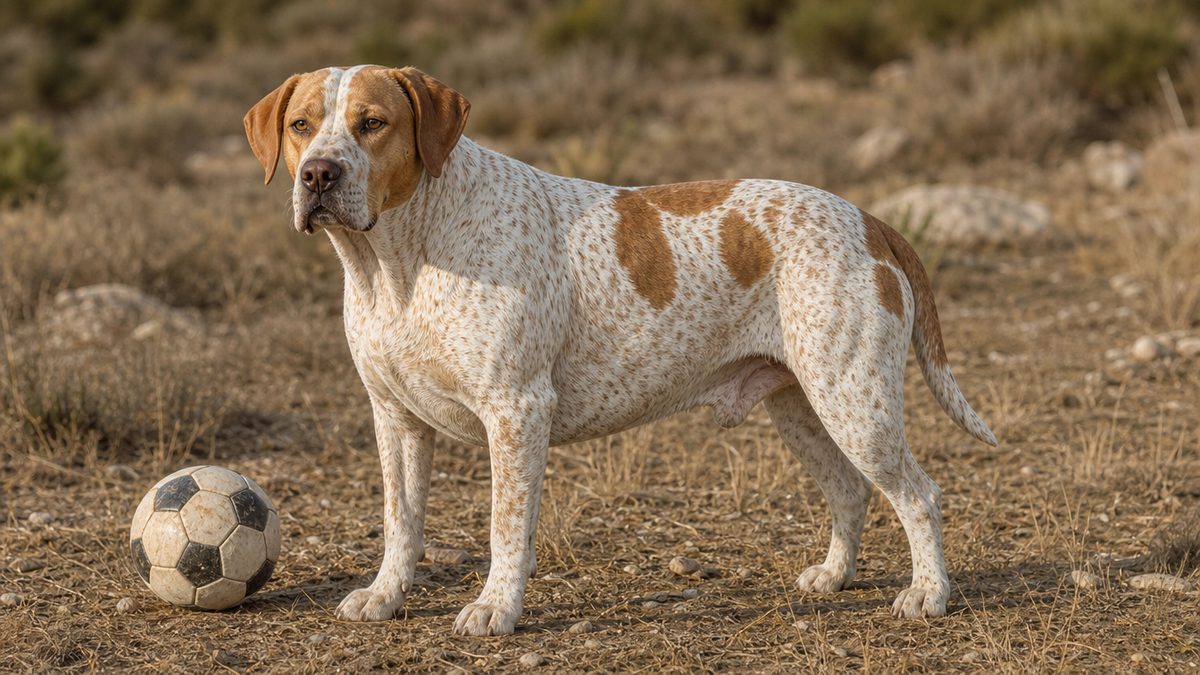
The Ca Me Mallorqui is Mallorca's native pointing dog, a medium-sized short-coated gundog of 50 to 60 cm and 18 to 23 kg for a male, recognised by the Spanish state in 2004 and by the Real Sociedad Canina de Espana in Grupo 11, and not recognised by the Federation Cynologique Internationale at all.
Four numbers describe this breed better than any adjective. The Balearic studbook has recorded 654 dogs in total. The breed club says the living census approaches two hundred. The Balearic press reported 70 dogs left in breeding production when the recovery programme began. And the one genetic study of the breed sampled 53. Those four figures do not contradict each other. They measure four different things, and no page anywhere sets them side by side, which is why the internet cannot agree whether this dog is nearly extinct or merely uncommon.
It is a pointing dog in the strict sense, one of only three of the bracoid trunk historically established in Spain alongside the Pachon Navarro and the Perdiguero de Burgos. Its job is locating, pointing and flushing game to be shot, then fetching it to the hunter. Partridge and woodcock are the usual quarry.
The short version for an Indian reader
- No Indian price exists, because no verifiable Ca Me Mallorqui exists in India. Every Indian page offering one is an auto-generated shell.
- No lawful supply chain can form. Dogs are a Restricted import under Indian law and breeding applications are rejected outright.
- Heat tolerance rates 3 of 5. Mallorca averages 18.76 C a year against 27.95 C in Chennai, but the coat is short rather than heavy and the working pace is a trot, not a gallop.
- The health record is almost empty. No screening register in the world carries this breed and no lifespan study of it has ever been published.
Where it sits among the Mallorcan breeds
Mallorca has four native dog breeds and this is the least known of them. The Ca de Bou is FCI-Standard 249, published in 1996. The Ca de Bestiar appears in the FCI's alphabetical index as MAJORCA SHEPHERD DOG, number 321. The Ca Rater Mallorqui and the Ca Me Mallorqui have neither. Of the six Balearic populations studied together in 2024, the Ca Rater's studbook census is 2,119 and the Ca Me's is 654, so even among rare island breeds this one is scarce.
| Breed | FCI number | Studbook census | Job |
|---|---|---|---|
| Ca de Bou | 249 | 243 | Guard, historically bull-catching |
| Ca de Bestiar | 321 | 507 | Shepherding and guarding |
| Ca Rater Mallorqui | None | 2,119 | Ratting and rabbiting |
| Ca Me Mallorqui | None | 654 | Pointing and retrieving |
The Balearic set as a whole matters more than it sounds. Together these breeds are reckoned to represent about 20 percent of Spain's entire canine heritage. This is not a curiosity from a small island. It is a working gundog with a documented presence in Mallorcan hunting since the thirteenth century, which almost disappeared inside living memory.
English Wikipedia states that the Ca Me Mallorqui is recognised by neither the FCI nor the Real Sociedad Canina de Espana. Half of that is now wrong. The RSCE's own breed index carries the Ca Me Mallorqui in Grupo 11, Razas no reconocidas por la FCI, with a full standard page and a photograph uploaded in June 2025Real Sociedad Canina de Espana. The FCI half is correct and this page verifies it below with controls.
Why the breed is named after a lamb
Me means lamb in Mallorcan Catalan, and the Ca Me is named for the way it hunts with its nose at mid height, the way a grazing sheep carries its head, rather than for anything about its appearance.
The Govern de les Illes Balears puts the etymology in one sentence on its native-breeds site. The ca me hunts at a very slow pace, with its nose at mid height, as sheep do when they graze, and from that comes the name me, always close to its owner, and it is very effective on broken ground and thick scrub. The Catalan edition of the same page says the same thing and adds that the name derives directly from that habit.
That is not a folk story bolted on afterwards. Diario de Mallorca reports that this head carriage was already being described in the nineteenth century, and compared then to the way lambs go out to pasture. Modern breeds of the same job carry the nose high into the wind; this one does not.
What the hunting style means in practice
A dog bred to work at a trot is a different animal from a dog bred to gallop. The Mallorcan magazine +Mallorca describes the technique precisely. The pace of action is the trot. The dog covers a great deal of ground, not by ranging wide but by zigzagging over every inch of a small area. It does not stray far from the hunter, works close, and depends on the instructions it is given.
Then comes the detail that decides how this breed behaves in a household. If the dog receives no orders, it circles the hunter to ask for them. Diario de Mallorca puts it the same way, saying the dog always wants to be guided and turns back to the hunter to request instructions when none come. A gundog that seeks out its handler rather than working away from him is unusually biddable, and it is the single most transferable thing about this breed for anyone who will never hunt with it.
The bite that carries the bird
The standard explains the head from the job backwards. It specifies strong, voluminous masseter muscles that contribute to the width of the skull and reflect the power and strength of the bite needed to carry retrieved game. The principal work of the breed, as the Mallorcan sources put it, is carrying the shot bird to the hunter in its mouth+Mallorca magazine, Fauna of Mallorca.
In Catalan the breed is Ca Me Mallorqui, written with a grave accent on the e. In Spanish it becomes Can me mallorquin, and older Spanish sources call it the Perdiguero Mallorquin. In English it is usually the Majorcan or Mallorcan Pointer. Google, asked for ca me mallorqui from India, offers the spelling correction did you mean ca me mallorquin, which tells you which spelling its index has more of.
The breed standard in numbers
The official Spanish prototipo racial gives males 50 to 60 cm and 18 to 23 kg, females 45 to 55 cm and 15 to 20 kg, with a square skull, triangular eyes, high-set forward drop ears and a short, smooth, thick and very dense coat.
Read the standard printed in the Boletin Oficial del Estado on 30 March 2004, not a summary of it. It runs to eleven numbered sections and it is unusually blunt about what the breed is for. Every physical characteristic set out below is quoted from that gazette rather than from a secondary description, because the secondary descriptions of this breed disagree with each other.
| Clause | What the standard says |
|---|---|
| Height at withers | Males 50 to 60 cm, females 45 to 55 cm |
| Weight | Males 18 to 23 kg, females 15 to 20 kg |
| Build | Rectilinear tending to subconvex, mediolineal, eumetric tending to subeumetric |
| Proportions | Length and height almost equal in males; females longer than tall, forming a rectangle |
| Skull | Square, width equal to length; muzzle a little shorter than the skull |
| Occiput | A pronounced crest or occipital button, with a furrow running forward between the eyes |
| Eyes | Not very large, triangular in shape, from light to dark honey |
| Ears | Medium, set high and wide and preferably forward, falling to the face, no folds, lower edge rounded |
| Tail | Relatively short, thick at the base, low set, never past the hock, very mobile |
| Coat | Short, smooth, thick, very dense, reaching down to the belly |
| Skin | Thick and slightly loose over the body, no folds except the dewlap |
The ear is the breed's signature and the standard says so
The standard opens its ear clause by calling the ear a very characteristic distinguishing mark of the breed. It then specifies a medium ear, set high and wide on the skull and preferably forward, falling towards the face without folds of any kind, with a rounded lower edge, and moving into a position perpendicular to the face when the dog is paying attention. Two of the fifteen listed faults concern exactly this: ears with folds, and ears of low insertion.
That matters in India for a practical reason rather than a cosmetic one. A drop ear that lies flat against the face and never lifts traps moisture, and this is a short-coated dog with a dense undercoat that dries slowly. See the grooming section for what that means in a Mumbai monsoon.
The full fault list, which is short and specific
Fifteen faults are listed, and they read as a corrective to real drift rather than a wish list. Ears with folds or set low. Poor thoracic capacity. A thin, long, high-carried neck. Straight shoulders. Excessive tibio-femoral angulation. A cut tail. A short, upright metacarpal region. Slenderness with a very tucked-up belly. Too large a muzzle, with drooling. A head too narrow and long. A split nose, palate or gum. Brevilineal type. Great nervousness. A tail with more than one vertebra. A fearful dog.
The list forbids a cut tail and, four items later, a tail with more than one vertebra. Those cannot both hold. The same standard's own tail clause describes a natural tail that is relatively short, thick at the base and never reaches past the hock, which plainly has more than one vertebra. The second entry is verbatim the fault listed for the Ratonero Mallorquin, a docked breed whose prototype is printed alongside it in the same gazette. The Catalan original published in 2002 has no such clause; its fault list ends at a cut tail. The RSCE reproduces the Spanish list including the contradiction. Read the tail clause, not the fault list.
What the Spanish translation dropped from the Catalan standard
The 2004 Spanish prototype is a translation of the 2002 Catalan standard, and three things the Catalan says about how this dog works did not survive the crossing.
Both texts are official and both are free to read, so the comparison is cheap. The Butlleti Oficial de les Illes Balears published the Catalan standard as Annex II of the Ordre of 18 December 2002. The Boletin Oficial del Estado published the Spanish prototype in Orden APA/807/2004. Set them side by side and the Spanish version is shorter in exactly the places that describe the job.
| Catalan, 2002 | Spanish, 2004 |
|---|---|
| Hunts with the nose at mid height, as woolled livestock do when grazing, always close to the owner, and is very suited to broken and thick ground | Slow hunting system, suited to ground that is not very flat and to thick vegetation |
| The shoulder is oblique, with marked scapulohumeral angulation, as befits a trotting dog | Oblique shoulder, with marked scapulohumeral angulation |
| A broad cranial cavity containing a large brain mass which gives good intelligence | Broad cranial cavity, containing a large brain mass |
The trotting-dog clause is the loss that matters. Com pertoca a un ca trotador, as befits a trotting dog, is the Catalan standard telling a judge why the front assembly is built the way it is. Strip it and the angulation becomes an unexplained measurement. The nose-at-mid-height clause is the other real loss, because it is the clause that explains the breed's name and its whole working method.
Why an Indian reader should care about a translation
You will almost certainly meet the Spanish version rather than the Catalan one. It is the text the Real Sociedad Canina de Espana reproduces on its own breed page, word for word, including the contradictory tail fault. It is the text that any English write-up is translated from. So the trotting dog, the sheep-grazing head carriage and the note about intelligence quietly vanish from the record twice over, once into Spanish and once into English.
What the Catalan text adds that nothing else records
The Catalan Annex II also carries a qualification scheme the Spanish prototype omits entirely. Adult dogs are assessed from twelve months of age against ten parameters: head and neck, shoulders withers and arms, chest thorax and belly, the dorso-lumbar region, croup and tail, forelimbs and their stance, hindlimbs and their stance, overall shape, temperament, and movement. Each is scored 1 to 10. A dog needs at least 60 points to enter the Auxiliary or Definitive registers, and fewer than 5 points on any single basic parameter disqualifies it outright regardless of the rest. Dogs scoring between 55 and 60 get one second chance within the following twelve months.
Two of the ten scored parameters are temperament and movement. That is a working-dog register rather than a beauty register, and it is consistent with a breed club whose stated aim is to select dogs that keep the breed's own way of hunting rather than only its shape.
Who recognises this breed, and on which date
Recognition came in two steps, from the Balearic government on 18 December 2002 and from the Spanish state in March 2004, and four different dates for that second step are in circulation because the sources genuinely disagree.
Start with the documents rather than the summaries. The Balearic step is the Ordre of the Conseller d'Agricultura i Pesca, Mateu Morro i Marce, of 18 December 2002, published in the Butlleti Oficial de les Illes Balears number 156 on 28 December 2002 at pages 23286 to 23289. It creates the Llibre genealogic de la raca Ca me mallorqui, sets out its rules, prints the breed standard as Annex II, and hands management of the studbook to the Club del Ca me mallorqui d'Espanya, itself recognised by the Conselleria by a Resolucio of 21 November 2002.
The Spanish step is Orden APA/807/2004 of 24 March 2004, published in the Boletin Oficial del Estado number 77 on 30 March 2004. It adds five Spanish canine breeds to the annex of Real Decreto 558/2001: the Alano Espanol, the Pastor Garafiano, the Ratonero Valenciano, the Ratonero Mallorquin and the Ca Me Mallorqui. The proposal had been accepted at a meeting of the Comite de Razas de Ganado de Espana on 22 April 2003.
| Date | What it actually is | Who says it |
|---|---|---|
| 22 April 2003 | Comite de Razas de Ganado meeting that accepted the proposal | The order's own preamble |
| 10 March 2004 | The date given for ministerial recognition | Govern de les Illes Balears, both language editions |
| 24 March 2004 | The date the order was signed by Arias Canete | Boletin Oficial del Estado |
| 30 March 2004 | The date the order was published and took effect the day after | Boletin Oficial del Estado |
The Balearic government's 10 March is the odd one out, and it appears in both the live Spanish page and the archived Catalan pageGovern de les Illes Balears. The order itself carries no such date. This page uses 24 March 2004 for the signature and 30 March 2004 for publication, because those are printed on the gazette, and reports the Balearic 10 March as a discrepancy rather than resolving it.
The breed club: 1995 or 1996
Three independent sources say 1996 and one says 1995, and the one that says 1995 cites one of the three. English Wikipedia states that the club was formed in 1995 and footnotes the Govern de les Illes Balears page for it. That page, in the exact 30 October 2020 archived Catalan capture Wikipedia links, reads L'any 1996 es constitui el Club del Ca Me Mallorqui. The live Spanish version says 1996. The club's own site says it was constituted in 1996 and dates its first gathering to August 1996 at Son Macia in Manacor, with more than thirty dogs present. Craig Koshyk, who visited the breed and photographed it, also gives 1996.
Wikipedia's 1995 is contradicted by the source Wikipedia itself cites for it, checked in the same archived capture Wikipedia links to. Every derivative page that copies the 1995 date is copying a citation that does not support it. The correct figure, from the government, the club and an independent field account, is 1996.
One more misattribution worth fixing
The best English-language account of this breed says the 2004 recognition was granted by the Minister of Agriculture of the Balearic Islands. The gazette shows otherwise. Orden APA/807/2004 is an order of the Spanish Ministerio de Agricultura, Pesca y Alimentacion, signed by the national minister, and it amends a national Real Decreto. The Balearic authority acted in 2002; the Spanish state acted in 2004. Getting those two apart is the whole point of the recognition question for this breed.
Why the FCI has exactly one Spanish pointing dog, and it is not this one
The Federation Cynologique Internationale does not recognise the Ca Me Mallorqui, definitively or provisionally, and its Group 7 nomenclature lists a single Spanish breed, the Perdiguero de Burgos.
Absence is a strong claim, so here is how it was checked, with controls run in the same session. The FCI's Group 7 Pointing Dogs page lists Section 1.1, the Braque type, country by country. Under country 8, SPAIN, there is one entry: PERDIGUERO DE BURGOS (90), Burgos Pointing Dog, valid from 26 May 1982. There is no second Spanish line. The Pachon Navarro is absent as well.
The provisional register was checked separately, because a breed missing from the definitive list can still be on it. The FCI's nomenclature page prints the complete provisional list, twenty breeds, with dates of provisional recognition running from the Australian Stumpy Tail Cattle Dog in 2005 to four breeds admitted on 2 November 2026. The Ca Me Mallorqui is not among the twenty.
The control that makes the absence mean something
The FCI's alphabetical index for the letter C was pulled in the same session and it does carry a Mallorcan Ca. CA DE BESTIAR appears there, linking to MAJORCA SHEPHERD DOG, number 321, alongside forty-three other breeds. So the index is working, it is genuinely alphabetical, and it does surface Balearic breeds whose names begin with Ca. It simply has no Ca Me Mallorqui. The Ca de Bou is present too, under its Spanish name, as FCI-Standard 249, Majorca Mastiff, Group 2 Section 2.1, origin Spain.
One of the 2004 five did make it
The five Spanish breeds added to the national annex together in 2004 have since diverged sharply. The Ratonero Valenciano is now on the FCI's provisional list as GOS RATER VALENCIA, number 370, provisionally recognised on 21 June 2022. The Ratonero Bodeguero Andaluz, a different Spanish ratter, followed as number 371 on 3 September 2024. The Alano Espanol, the Pastor Garafiano and the Ca Me Mallorqui remain outside.
| Breed | FCI status in August 2026 |
|---|---|
| Ratonero Valenciano (Gos Rater Valencia) | Provisionally recognised, number 370, since 21 June 2022 |
| Alano Espanol | Not recognised |
| Pastor Garafiano | Not recognised |
| Ratonero Mallorquin (Ca Rater Mallorqui) | Not recognised |
| Ca Me Mallorqui | Not recognised |
India is an FCI member country. An Indian national kennel club works inside the FCI nomenclature, and a breed that is not in that nomenclature has no pedigree route here at all. There is no Indian register a Ca Me Mallorqui could be entered in, no Indian judge qualified in the breed and no Indian show class for it. Combine that with the import position and the supply question answers itself.
The Spanish kennel club now lists this breed, and the English internet has not noticed
The Real Sociedad Canina de Espana carries the Ca Me Mallorqui in Grupo 11, Perros de Muestra Continentales, Tipo Braco, with a full standard page, which contradicts the sentence English Wikipedia still prints.
Open the RSCE's Razas Espanolas index and count. Grupo 11 is headed Razas no reconocidas por la FCI, breeds not recognised by the FCI, and it lists eleven: Majorero, Perro de Pastor Vasco, Perro de Pastor Garafiano, Perro Leones de Pastor, Valdueza, Alano Espanol, Podenco Andaluz, Maneto, Podenco Valenciano, Pachon Navarro and, last, Ca Me Mallorqui. The breed's own page gives its classification as Grupo 11, Perros de Muestra Continentales, Tipo Braco, origin Spain.
The page reproduces the full 2004 Spanish standard, clause by clause, from Aspectos Generales through to the fifteen faults. Its thumbnail was uploaded in June 2025 and its photographs in July 2026, which is the best available indication of when the breed was added. The RSCE does not issue its own standard number for these breeds; its index states plainly that the standards for Spanish breeds are those approved by the corresponding autonomous communities. So there is no RSCE standard number for the Ca Me Mallorqui to quote. The governing text remains the Balearic one of 2002 and its Spanish translation of 2004.
What the RSCE has not done
The RSCE also publishes a list of Razas Espanolas consideradas vulnerables, in force from 1 May 2026 to 30 April 2027, naming twenty-one breeds. The Ca de Bestiar, the Ca de Bou, the Ratonero Valenciano, the Podenco Ibicenco, the Pachon Navarro and the Alano Espanol are all on it. The Ca Me Mallorqui is not. Neither is any breed absent from the RSCE's own registration figures, which is the likeliest explanation for a breed admitted only months earlier, so treat this as an observation rather than a verdict on the breed's security.
That vulnerable list carries a concrete concession worth knowing. From 1 August 2026 to 31 July 2028, dogs of vulnerable Spanish breeds doing an initial registration enter the Registro de Razas Caninas without a DNA test, although DNA remains compulsory for any championship title and for a Pedigree Plus. A breed not on the list gets no such relief.
The download button on that page serves the wrong breed
Both Descargar ficha PDF buttons on the RSCE's Ca Me Mallorqui page link to the same file, Razas-espanolas-Majorero.pdf. Opening it returns a complete, correctly formatted one-page breed sheet headed Perro Majorero, Clasificacion RSCE Grupo 1 Seccion 1 Perro de trabajo, utilisation Pastoreo y guarda. The Majorero is a Canarian herding and guarding breed. It is not this dog, it is not a pointing dog, and it is not even in the same group.
Nothing about that download fails. The link resolves, the file is real, the layout is correct and the content is genuine. It is simply another breed's. Anyone building a breed page from the RSCE's downloadable sheets would end up describing a Canarian medium-sized herding dog under the name of a Mallorcan pointing dog. Check the breed name printed inside a document before you take a single figure off it.
Six centuries on one island, then a near miss
Pointing dogs are documented on Mallorca from the fourteenth century, the Ca Me had an international reputation by the 1860s, and by the end of the twentieth century it had been crossed to the edge of disappearance.
The oldest evidence is a ban. Royal ordinances restricting the use of pointing dogs by crossbow hunters on Mallorca were issued in 1383 and again in 1392, apparently because the practice was effective enough to be depressing game populations. Diario de Mallorca cites the 1392 record as the first bibliographic evidence of the breed's presence on the island. The breed club dates its racial grouping's presence in Mallorcan hunting to the thirteenth century.
The nineteenth-century reputation
One French doctor did more for this breed's fame than anyone. Jules Tallien de Cabarrus, a diplomat who hunted widely and was sent to Mallorca to recover from illness in the 1860s, wrote in Chasses et Voyages in 1863 that the Majorcan pointing dog is the best and most accomplished that one could possibly find. In El Mejor Perro de Muestra in 1882 he wrote that the Majorcan Pointer is worth more than all the beautiful spaniels, setters or pointers, adding that of the forty-nine dogs he had owned, twenty-nine had been of the Majorcan breed. Archduke Ludwig Salvator of Austria, who wrote a nine-volume work on the Balearics, recorded local hunters using pointing dogs on quail.
In the studbook, then out of it
The Real Sociedad Central de Fomento de las Razas Caninas en Espana, later the Real Sociedad Canina de Espana, was founded in 1911, and some of its earliest studbooks carry listings for Perdigueros Mallorquines. The breed then falls into near-complete obscurity, with a few mentions in Spanish sporting literature of the 1940s and 1950s and nothing organised until the 1990s. Read against the RSCE's Grupo 11 listing of 2025, that is a round trip of about 114 years out of and back into the same national kennel club.
What nearly finished it
The breed club is candid about the mechanism. Over the last forty years the Ca Me suffered crosses with other breeds, most frequently the Pointer, and those crosses altered its genetic purity, its morphology and its way of hunting. The genetic characterisation puts it in the same terms: a decline in regional standing caused by rising preference for international breeds of the same evolutionary group, the Pointer, the German Pointer and others, producing a genetic erosion that took the breed to the brink of extinction. Ultima Hora names the Pointer and the Setter as the fashions that displaced it.
Recovery had two stages and both were local. The Patronat de Races Autoctones de Mallorca began the work in the 1980s. The Club del Ca Me Mallorqui took it over in the 1990s, setting out to recover typical dogs and to set aside, so far as possible, animals whose genetic purity could not be checked or whose shape or hunting style did not fit. Since 1999 a club representative has sat on the hunting board of the Consell Insular de Mallorca's hunting office.
Asked about the future in 2013, club president Francesc Mir Tomas said the members knew it was a long-term project and wanted to do it properly, and that the important thing was to breed dogs born to hunt. Pedro Salva Vidal added that they were a patient bunch and would make progress poco a poco. The club's own site, more than a decade later, describes a very slow though constant process of recovery.
How many Ca Me Mallorqui exist, and why four different answers are all correct
Four published figures circulate for this breed, 654, about 200, 70 and 53, and they are not in conflict because each counts a different thing: the cumulative studbook, the living census, the breeding pool and the genetic sample.
This is the single question every page about the breed gets muddled, so take the numbers one at a time and label what each one measures.
| Figure | What it counts | Source and date |
|---|---|---|
| 654 | Studbook census: every dog entered in the genealogical book since it opened | Alanzor Puente et al., Animals, 2024 |
| About 200 | The living census the breed club estimates today | Club del Ca Me Mallorqui website |
| About 200 | The association secretary's estimate, with the caveat that an exact count is hard | Juan Sans, quoted in Ultima Hora, 2019 |
| 70 | Dogs left in breeding production when the genetic profile was built | Diario de Mallorca, 9 May 2017 |
| 53 | Hair samples genotyped at the University of Cordoba | Martinez, Vega and Delgado, 2019 |
The 654 is a cumulative total, not a headcount of living dogs. It comes from a 2024 study of the six Balearic breeds' studbooks, which sets the Ca Me Mallorqui at 654 against the Ca Rater Mallorqui at 2,119, the Ca Eivissenc at 1,037, the Ca de Bestiar at 507, the Ca de Conills at 316 and the Ca de Bou at 243. The same paper reckons that roughly seven to eight generations have passed since these studbooks were founded, assuming a three-year breeding age and a three-year generation length.
The number that should worry a breeder
Half of the population is not in the book. The genetic characterisation states it plainly: a few hundred individuals are estimated to exist, of which only half are registered, so the threat status is a reality and urgent conservation measures are needed. English Wikipedia condenses this to an estimate of several hundred, not all of which were registered in the studbook, which is accurate but drops the specific fraction that makes it alarming.
The 2017 figure is the one most often quoted out of context. Diario de Mallorca wrote that only 70 specimens remain in breeding production, and that the Consell de Mallorca's hunting department and the Govern's public company Semilla had analysed those 70 dogs and assessed their inbreeding. Seventy breeding animals inside a live population of roughly two hundred is a perfectly ordinary ratio. Seventy dogs in total would be a different and far worse story, and that is how the number usually gets repeated.
Twenty years, and the headline number has not moved
In March 2019 Juan Sans, secretary of the Associacio de Cacadors i Criadors del Ca Me Mallorqui, put the number at around 200, adding that an entirely accurate count is difficult because, despite the association's coordination efforts, hunting remains individualistic. The club's own site today says the census approaches two hundred animals and describes a very slow though constant recovery over the last fifteen years. Those two statements are seven years apart and give the same figure.
A breed can be endangered and stable at the same time. What the numbers here support is a population of roughly two hundred living dogs, about half of them unregistered, with perhaps seventy in active breeding, held steady rather than growing across seven or eight generations of studbook. What they do not support is either of the two versions the internet prefers: that the breed is down to seventy animals, or that it is comfortable at several hundred.
What the one genetic study found
Fifty-three Ca Me Mallorqui were genotyped at 21 microsatellite markers, and the breed came back with moderate to high diversity, no significant inbreeding signal and a clear identity of its own, sitting genetically nearer the Pointer and the Braco than any other Balearic breed.
There is exactly one genetic dataset for this breed in the world, and it has been published twice. Martinez, Vega and Delgado presented it in 2019 in the Societat d'Historia Natural de les Balears monograph series. The same figures reappear in the results of a 2024 paper in the International Journal of Molecular Sciences. Ultima Hora reported the work as it was published, describing hair-follicle samples from 53 dogs analysed at the University of Cordoba.
| Measure | Value |
|---|---|
| Mean number of alleles per locus | 6.5 |
| Mean effective number of alleles | 3.54 |
| Expected heterozygosity, He | 0.697 |
| Observed heterozygosity, Ho | 0.671 |
| Mean polymorphic information content | 0.643 |
| Inbreeding coefficient, FIS | 0.038, 95 percent CI minus 0.013 to 0.068, not significant |
| Hardy-Weinberg equilibrium | No marker out of equilibrium after Bonferroni correction |
| Marker with a significant excess of homozygotes | INU005, FIS 0.355 |
| Marker with a significant deficit of homozygotes | AHTh260, FIS minus 0.139 |
Do the arithmetic yourself and the table holds together. Expected heterozygosity minus observed, divided by expected, is 0.026 over 0.697, which is 0.037, and the paper reports 0.038. That is a population with essentially no measurable excess of homozygotes, which for a rare breed rebuilt from a small foundation is a better result than anyone had a right to expect.
Where it sits among its neighbours
The study compared the Ca Me against ten other breeds, using samples from the Balearics and beyond: Ca de Bestiar 78, Ca de Conills de Menorca 67, Ca de Bou 47, Ca Eivissenc 31, Podenco Andaluz 29, Pointer 26, Podenco Canario 25, German Shepherd 25, Braco 14 and Ca Rater Mallorqui 12. Across all eleven populations, FST came to 0.124. In the factorial correspondence analysis, axis 3 separates the Ca Me from every other breed in the study, and in the Neighbor-Net it falls in the same cluster as the Pointer and the Braco, although the authors note that the distances between those three are large.
The nearest neighbour by distance is not what most readers expect either. The smallest genetic distance from the Ca Me is to the Podenco Andaluz, DA 0.171 and FST 0.086; the largest is to the German Shepherd, DA 0.385 and FST 0.212. The 2024 study, using Reynolds distances across the six Balearic populations only, instead pairs the Ca Me most closely with the Ca Rater Mallorqui. Both results are correct; they use different comparison sets and different distance measures, and this page reports both rather than choosing.
Is it a distinct breed, genetically
Yes, and by a workable margin. In STRUCTURE the Ca Me forms its own cluster from K equals 4 upwards and keeps it at higher K, with about 87 percent of individuals assigning to that cluster and 85.6 percent at the statistically optimal K of 8. For scale, the German Shepherd in the same run assigned at 95.4 percent, the Ca Rater at 93.0, the Pointer at 92.0 and the Ca de Bestiar at 80.1. The authors add that a small group of animals does not fit the breed's genetic profile.
A 21-marker panel with a combined exclusion probability of 0.99992 lets the studbook do two things: verify parentage, and assign a dog of unknown ancestry to the breed. A dog assigned with better than 90 percent probability can be entered in the genealogical book without diluting the breed. In a population where half the dogs are unregistered, that is the tool that decides whether the other half can ever be recovered.
The published record, and the one abstract that contradicts its own results
Three peer-reviewed papers name this breed, no screening register anywhere carries it, and the most recent paper's abstract misreports its heterozygosity and asserts a Hardy-Weinberg deviation that the paper's own Results section denies.
Check the abstract against the body and the difference is not small. The 2024 International Journal of Molecular Sciences abstract states that the Ca Me exhibits moderate genetic diversity and deviations from equilibrium, similar to the Ca de Bou, with an average of 6.5 alleles and moderate PIC values, average Ho 0.598 and He 0.676. Section 2.1.5 of the same paper, headed Ca Me (CM), reports that the average values of He and Ho are 0.697 and 0.671, that all markers are highly informative except INU005 and INU030, that after Bonferroni correction no marker is out of Hardy-Weinberg equilibrium, and that the average FIS of 0.038 is not significantly different from zero, indicating no significant deviation from Hardy-Weinberg equilibrium.
| Breed | Abstract He / Ho | Results He / Ho | Results verdict on equilibrium |
|---|---|---|---|
| Ca de Bestiar | 0.761 / 0.754 | 0.728 / 0.743 | FIS 0.021, no significant deviation |
| Ca de Bou | 0.394 / 0.313 | 0.624 / 0.582 | FIS 0.081, low diversity |
| Ca Rater | 0.658 / 0.563 | 0.685 / 0.656 | FIS 0.044, no significant deviation |
| Ca Me | 0.676 / 0.598 | 0.697 / 0.671 | FIS 0.038, no significant deviation |
| Ca de Conills | 0.706 / 0.611 | 0.724 / 0.689 | FIS 0.048, no significant deviation |
Every row differs, and for the Ca de Bestiar the abstract even reverses the sign, printing observed below expected where the Results print observed above expected. The paper's inter-racial statistics carry a separate arithmetic problem: FIT is given as 0.149 with a confidence interval of 0.157 to 0.191, which does not contain its own point estimate.
Abstracts are what get indexed, scraped, quoted and fed to language models. The body text sits behind a click. If you ask a chatbot for this breed's heterozygosity today, the answer it is most likely to reach for is 0.598, a figure the paper's own Results section does not contain. Bonbeno publishes 0.671, the number printed in section 2.1.5, and flags the discrepancy rather than picking quietlyMartinez, A., Vega, J. L. and Delgado.
How thin the literature really is
PubMed, queried in the same session as a working control, returns no record naming this breed. The search phrase collapses: PubMed rewrites Ca Me Mallorqui into a query for the journal abbreviation ca, the MeSH subheading metabolism and the string mallorqui, and returns a 2010 paper on purifying erythropoietin from human plasma. The control query, golden retriever with hip dysplasia, returned twenty-five genuine records in the same session, so the tool was working. The only real dog record PubMed surfaces for any Mallorqui term is the 2022 genetic-structure paper on the sibling breed club's Ca Rater Mallorqui.
Europe PMC does better and is worth reporting precisely. It returns three records mentioning Ca Me Mallorqui, and controls run alongside them returned 90 records for Ibizan Hound and 12 for livestock guardian dog, so that database was working too. The three are the 2024 Balearic diversity paper, the 2024 Balearic studbook paper and the 2022 Ca Rater paperAlanzor Puente, J. M., Pons Barro, A. L.. There is no clinical literature on this breed at all: no case series, no lifespan study, no disease survey.
No screening register in the world carries it
The Orthopedic Foundation for Animals statistics dump was retrieved in full, 2,225,910 characters of tables, and searched case-insensitively. MALLORQ returns zero. So do CA ME, MAJORCA, PERDIGUERO, BURGOS and PODENCO. Controls in the same dump: LABRADOR 109 hits, POINTER 166, BEAGLE 61, SPINONE 48, BRACCO 33 and IBIZAN 50, including a complete IBIZAN HOUND row built on 77 evaluations. The register plainly does carry rare continental breeds and even a Balearic one. It simply carries no Spanish pointing dog of any kind, not this breed, not the Pachon Navarro and not even the FCI-recognised Perdiguero de Burgos.
It does not mean the breed is healthy. It means nobody has measured it. OFA needs a meaningful number of submissions before a breed appears at all, and a population of roughly two hundred dogs concentrated on one Mediterranean island will never generate them. Rarity here is unmeasured risk, not proven soundness, and that is the honest way to read every empty cell on this page.
Ca Me Mallorqui price in India
No Ca Me Mallorqui price in India exists, because no verifiable Ca Me Mallorqui exists in India, and no published purchase price for the breed exists in any country either.
Start with what is actually on offer. Searched from India on 24 August 2026, Google returned About 92 results for the breed name, which is Google's own estimate rather than an exact count, offered the spelling correction did you mean ca me mallorquin, and printed that an AI Overview was not available for the search. The ranked results are a breed-club site in Spanish, a YouTube video, a stock-photo library, Wikipedia, an encyclopaedia aggregator, a Consell de Mallorca leaflet, a Wikidata entry, an Instagram account with a few hundred followers, a Mallorcan magazine and the Balearic government. Not one is a listing, an advertisement or a breeder.
The only Indian pages are auto-generated
Justdial has built a category called Pet Shops For CA Me Mallorqui Dog, number nct-13850170, and renders it for city after city. It exists for Nanded, Delhi, Bangalore, Hyderabad, Chennai, Patna, Nagpur, Rajkot, Lucknow, Thrissur, Karnal, Panchkula, Sagar, Kangra, Chhindwara, Maihar, Murshidabad and more, and there is a Hindi edition too. The next section takes that page apart in detail. What matters here is that it lists no price for the breed anywhere, because none of the businesses on it has ever handled one.
Indian breed pages routinely publish a dollar price run through one exchange rate. Divide any rupee figure by 84.38 and by 74 before believing it. And treat Rs 98,999 as an immediate red flag: it is a recurring house charm price on one Indian listing site, attached to whichever puppy is in stock rather than to a breed, and it divides to 1,173.25 by the first rate and 1,337.82 by the second, so it is not even a conversion. If a seller quotes you any price for this breed, the useful question is not how much but which studbook, and the only studbook in the world that registers it is the Balearic one.
| Question | Honest answer |
|---|---|
| Price of a Ca Me Mallorqui in India | None exists. No verifiable dog, no listing, no breeder |
| Published purchase price anywhere in the world | None found in any language |
| Living dogs of the breed, worldwide | About 200, essentially all on Mallorca |
| Dogs in breeding production, 2017 | 70 |
| Studbooks that register the breed | One, the Balearic Llibre genealogic |
| Lawful route to import one to India for breeding | None, see the import section |
The scale comparison worth keeping
Two hundred dogs is the entire world population of this breed. India's four largest metros between them hold several million owned dogs. There is no arithmetic under which a meaningful number of Ca Me Mallorqui reach India, and the breed club's stated aim is the opposite of export: it exists to put the Ca Me back in the place it deserves on its own island.
One last framing. A price that does not exist is not the same as a price that is high. If you find this breed genuinely affordable somewhere, you have found something that is not this breed. Ask for the Balearic registration number and the microchip code, both of which the studbook rules require, and check them with the club.
The Indian supply for this breed is manufactured, and here is the receipt
Justdial generates a page titled Pet Shops For CA Me Mallorqui Dog for Indian cities across the country, complete with 1,200 words of breed advice, and not one business listed on it carries that category in its own profile.
The Nanded page was opened and read in full on 24 August 2026. It returns HTTP 200. It is headed Popular Pet Shops For CA Me Mallorqui Dog in Nanded, sits under category nct-13850170, shows a breadcrumb reading 2+ Listings, and then renders ten businesses with photographs, ratings and phone numbers. It closes with an averaged rating of 4.5 from 42 ratings as on 24/08/2026.
The tell is in the businesses' own category lists
Justdial prints, for each listed business, the categories that business is actually listed under. Across all ten on the Nanded page those categories are Pet Shops, Pet Shops For Dog, Pet Shops For Cat, Pet Shops For Birds, Pet Shops For German Shepherd Dog, Pet Shops For Labrador Dog, Pet Food Dealers, Poultry Feed Dealers, Veterinary Medicine Retailers and Pet Care Takers. Not one of the ten carries Pet Shops For CA Me Mallorqui Dog. The page is the generic Pet Shops listing with a breed name templated over the top, and every internal link on it confirms this: each carries oncatid=10360322, the plain Pet Shops category, with the breed name passed only as a display label.
The advice on that page describes the wrong kind of dog
Underneath the listings sits about 1,200 words of breed content, and it is generated rather than researched. It opens by saying that the CA Me Mallorqui dog has become a beloved companion for many families in Nanded and that demand for the breed is growing. It then describes the breed as medium-sized and characterised by its strong build and protective instincts. That is a description of a guarding breed. This is a pointing gundog whose own standard calls it noble, docile, obedient, affectionate and not at all violent. The page also promises grooming supplies suitable for their coat type without ever saying what the coat type is.
One customer review printed on that same page reads, in full, best dog, German Shepherd dog breeder in Nanded.
It is not one city, and it is not one language
The same category number renders across the country. Pages exist for Nanded, Delhi, Bangalore, Hyderabad, Chennai, Patna, Nagpur, Lucknow, Rajkot, Thrissur, Karnal, Panchkula, Sagar, Kangra, Chhindwara, Maihar and Murshidabad among others. Two of those pages, Nanded and Jabalpur, were opened and read in full for this page; the rest were observed as indexed URLs carrying the same category number, nct-13850170. The Jabalpur page was opened in the Hindi edition and returns the breed name transliterated into Devanagari in the H1 while the page's own keywords metadata still carries the English string Pet Shops For Ca Me Mallorqui Dog. The ten businesses it lists include a fish aquarium and an animal hospital.
| The page says | The page shows |
|---|---|
| A beloved companion for many families in Nanded | No business listed under the breed category at all |
| Demand for this breed is growing | Google shows about 92 results worldwide for the breed name |
| Strong build and protective instincts | A standard describing a docile, obedient, non-violent gundog |
| Grooming supplies suitable for their coat type | No coat type is ever named |
| Ten pet shops for the breed in one district city | Roughly 200 dogs of the breed exist, all on one Spanish island |
Auto-generated breed categories are not evidence that a breed is available near you. They are evidence that a directory has a wide breed taxonomy and a template. Before you ring any number on such a page, ask one question: has this shop ever handled this breed. If the answer is anything other than a registration number you can check, you are being sold a different dog under a borrowed name.
Why no lawful supply of this breed can form in India
Indian law makes dogs a Restricted import and permits entry only for a personal pet, for CPCSEA-recommended research or for Defence and Police use, and it states that applications for trading or breeding purposes shall be duly rejected.
The governing text is DGFT Trade Notice No. 22/2022-23 of 19 December 2022, issued by the Directorate General of Foreign Trade and signed by Deputy Director General Md. Moin Afaque. Read it rather than a summary of it. Under ITC (HS) 01061900, Mammals, Other, the import policy is Restricted, subject to Policy Condition 6 of the chapter.
- Policy Condition 7 permits import of dogs only for a pet dog with a valid pet book and relevant records in the name of the importer, for dogs imported by R&D organisations for research with the recommendation of CPCSEA, and for internal security by the Defence and Police Force.
- Policy Condition 8 states that import of commercial dogs for breeding or any other commercial activity other than the purposes above is not permitted.
- Paragraph 6 states that any applications for trading or breeding purposes, or applications made on behalf of another person or entity, shall be duly rejected.
- Paragraph 7 limits entry to the airports and seaports of Delhi, Mumbai, Chennai, Hyderabad, Bangalore and Kolkata, with quarantine at the government station of that port where required. DAHD added a seventh port, Cochin International Airport at Kochi, for pets arriving under the baggage rules in October 2024.
Two pets may come as passenger baggage without DGFT authorisation, but only for a person transferring residence to India after two years of continuous stay abroad. Anything else needs an authorisation, applied for on ANF-2M, either against your own Importer Exporter Code or against the standing IEC number IIHIE0153E for personal, non-trade imports. More than two animals goes to the Department of Animal Husbandry and Dairying for examination. The notice advises starting at least two months before travel, and an Advance NOC from the Animal Quarantine and Certification Service must be obtained seven days before the date of travel, relaxable to three.
Put that together with the recognition position
Two facts close the loop. First, breeding imports are refused outright, so there is no lawful route to bring a founding pair of Ca Me Mallorqui into India. Second, the breed is not in the FCI nomenclature, so even a lawfully imported pet could not be registered with an Indian kennel club working inside that nomenclature. Between them, those two mean no Indian population of this breed can lawfully form, in any number, at any price.
The one legal route, and what it costs in practice
The single lawful path is a returning resident who already owns the dog. Someone who has lived in Spain for more than two years, acquired a Ca Me Mallorqui there, and then moves to India could bring it as accompanied baggage with its pet book, vaccination record and pet passport. That is a real possibility for perhaps a handful of families in a decade. It is not a supply chain, and it produces exactly one dog per household, neutered or not, with no lawful onward breeding.
The trade notice lists a Certificate for Emotional Support among the mandatory documents for both permanent and temporary pet imports, alongside the vaccination book and the pet's passport. That requirement surprises most people who read the notice for the first time, so budget for it rather than discovering it at the counter.
Indian breeding law against this breed's own conservation plan
Indian law bans exactly the matings a two-hundred-dog gene pool needs, requires genetic tests for ten defects that have never been reported in this breed, and mandates none for the two that have.
The governing text is notification G.S.R. 496(E) of 23 May 2017, the Prevention of Cruelty to Animals (Dog Breeding and Marketing) Rules, 2017, published by the Ministry of Environment, Forest and Climate Change. It was extracted from the gazette PDF and read directly for this page, fourteen pages with a working text layer.
The mating rules a rare breed cannot satisfy
Second Schedule Part II, paragraph 6, names four breeding techniques and permits two. Out breeding, the mating of dogs not related to one another, is permitted. Line breeding, between dogs marginally related, is permitted. In breeding is prohibited, defined as breeding between relatives of the second to fourth grade in straight or side line within the first four generations, with uncle to niece, nephew to aunt, cousin to cousin and grandparent to grandchild given as the examples. Incest breeding, between parents and children or brother and sister, is also prohibited.
Now set that against the population. Roughly seventy dogs in breeding production, drawn from a foundation stock assembled in the 1990s, across seven to eight generations of studbookAlanzor Puente, J. M., Pons Barro, A. L.. In a closed pool that size, avoiding every relative within four generations is not a matter of care. It is arithmetically close to impossible. The breed's own conservation programme takes the opposite approach and manages consanguinity deliberately, recommending which males and females to cross rather than requiring unrelatedness.
This is not a reason to distrust the Mallorcan programme, which is doing careful work under a genetic profile built for exactly this problem. It is a reason to understand that the programme could not lawfully be run in India. An Indian breeder following the Consell de Mallorca's own breeding recommendations would in many cases be breaking Second Schedule Part II paragraph 6(3).
The one place Indian law and this standard agree
Docking is forbidden in India and this breed's standard already treats it as a fault. Second Schedule Part II paragraph 6(8) states that there shall be no tail docking, ear cropping, de-barking, de-clawing, branding, dyeing, injecting substances to enhance visual appeal, surgery to camouflage a defect, or any other mutilation or change of appearance by artificial means, and calls all of it strictly forbidden. The Ca Me Mallorqui standard lists cola cortada, a cut tail, among its faults.
Its Mallorcan sibling is in the opposite position. The Ratonero Mallorquin prototype, printed alongside it in the same 2004 gazette, describes the tail as habitually cut flush with the body or leaving one vertebra. The Ratonero Valenciano prototype in the same order says the tail is amputated without preserving any vertebra, or leaving only the first. Of the five breeds Spain recognised together in March 2004, the Ca Me Mallorqui is the one whose standard an Indian breeder could follow without breaking paragraph 6(8).
The mandatory test list, and what is missing from it
Second Schedule Part III paragraph 8(10) requires that dogs shall have been tested for genetic defects, and it names them: hip dysplasia, progressive retinal atrophy, night blindness, hypothyroidism, entropion, ectropion, overshot and undershot jaw, wry mouth, two or more missing teeth, and unilateral or full cryptorchid males. Deafness is not on that list. Neither is epilepsy.
Those are the only two conditions ever reported in this breed. Ultima Hora, reporting the launch of the breeding plan in 2019, wrote that not only are fewer Ca Me Mallorqui being born but that new litters increasingly show problems of epilepsy or deafness, and that the plan recommends which males and females to cross specifically to avoid those consanguinity-derived problems. That is a newspaper report of a programme, not a published study, and this page treats it as such. It is still the entire clinical record for the breed.
An Indian breeder of this breed would be legally required to screen for ten conditions with no published association in it, including two eyelid defects and a jaw fault, and legally required to screen for neither of the two conditions its own recovery programme is actively breeding against. Rules written for popular imported breeds do not fit a two-hundred-dog island population, and this is a clean example of why.
What a dog of this size and build costs to run in India
A 20 kg short-coated working gundog is a mid-cost dog in India, cheaper to groom than almost any comparable breed and more expensive to exercise properly, and the honest way to price it is by build rather than by breed.
No Indian cost data exists for this breed because no Indian Ca Me Mallorqui exists. What can be reasoned about honestly is the cost structure a dog of these specifications imposes, and the standard gives the specifications: males 18 to 23 kg, females 15 to 20 kg, a short smooth thick very dense coat, thick slightly loose skin, and a working build.
Where the money actually goes
- Food scales with body mass and workload. A 20 kg dog worked at a trot rather than kept as a couch companion eats materially more than a 20 kg sedentary dog. Budget by weight and activity, not by breed name.
- Grooming is close to the cheapest possible. The coat clause is five words long and specifies nothing that needs stripping, clipping or a professional. See the grooming section.
- Ectoparasite control is the recurring line that is not optional. Ticks were found on 53 percent of 525 dogs across four Indian cities, rising to 80 percent in Mumbai and 75.3 percent in Delhi. This is a monthly cost for the dog's whole life.
- Veterinary care carries a breed-specific penalty. No Indian vet has seen this breed, no Indian kennel club register holds it, and there is no breed-specific screening protocol to follow, so every consultation starts from first principles.
The costs nobody prices in
Two hidden costs dominate for a breed in this position. The first is the import process itself, which for the one lawful route means an authorisation, quarantine at one of seven designated ports, an Advance NOC obtained seven days before travel, testing in the exporting country and a two-month lead time Department of Animal Husbandry…. The second is the cost of being wrong: an Indian buyer who pays for a Ca Me Mallorqui is, on the evidence of this page, paying for something else, and the loss is the whole purchase price rather than a premium. The full route is set out in how to import a dog to India.
| Cost line | How it behaves for this breed |
|---|---|
| Purchase | No lawful Indian purchase exists at any price |
| Import | Authorisation, quarantine and NOC through one of seven ports, two months lead time |
| Grooming | Among the lowest of any gundog: short dense coat, no clipping, no stripping |
| Ectoparasite control | High and year-round; ticks on 53 percent of Indian dogs surveyed |
| Exercise provision | High: needs safe off-lead space or a long line, twice daily |
| Breed-specific veterinary care | No Indian precedent, no screening protocol, no register |
| Insurance and resale | Effectively unavailable for an unregisterable breed |
Coat maintenance. The standard asks for short, smooth, thick and very dense hair reaching to the belly, and nothing else. There is no furnishing to mat, no beard to dry, no undercoat to blow out twice a year at a salon. Against a Cocker Spaniel or a Poodle of similar weight, the lifetime grooming bill for a short-coated gundog is a fraction of the figure.
Heat tolerance: Mallorca measured against seven Indian cities
Heat tolerance rates 3 out of 5, because this is a coastal Mediterranean dog already used to high humidity but never to high humidity at high temperature, and its home island's hottest month averages 26.54 C against eight Indian months above that in Chennai and Ahmedabad.
Every figure here comes from NASA POWER, queried by explicit latitude and longitude so no wrong city can be served by accident, using the MERRA-2 twenty-year monthly climatology for January 2001 to December 2020. Palma de Mallorca was requested at 39.5696 north and 2.6502 east; the API returned longitude 2.65, latitude 39.57 and elevation 31.47 metres, which is Palma. Every Indian city returned its own coordinates and elevation in the same wayNASA POWER Climatology API.
| Place | Annual mean C | Hottest month C | Months above 26.54 C |
|---|---|---|---|
| Mallorca (Palma) | 18.76 | 26.54 in August | 0 |
| Bengaluru | 23.74 | 28.37 in April | 3 |
| Pune | 23.86 | 28.93 in April | 2 |
| Delhi | 25.60 | 35.88 in June | 6 |
| Kolkata | 25.81 | 31.53 in May | 7 |
| Mumbai | 26.77 | 31.19 in May | 5 |
| Ahmedabad | 27.57 | 35.06 in May | 8 |
| Chennai | 27.95 | 31.51 in May | 8 |
The headline gap is 9.19 degrees. Chennai averages 27.95 C across the year against Mallorca's 18.76 CNASA POWER Climatology API v2.9.7, MERRA-2. Put differently, Chennai's coolest month, January at 24.09 C, is warmer than nine of Mallorca's twelve months.
The humidity finding, which cuts the other way
This dog is not humidity-naive, and most breed pages get that wrong. Mallorca is a Mediterranean island and its annual mean relative humidity is 74.18 percent, never dropping below 69 percent in any month. A Ca Me Mallorqui has spent its whole evolutionary history in damp air. What it has never met is damp air that is also hot.
| Place and month | Mean temperature C | Mean relative humidity percent |
|---|---|---|
| Mallorca, August | 26.54 | 69.01 |
| Mumbai, August | 26.05 | 90.36 |
| Pune, August | 23.30 | 90.80 |
| Kolkata, August | 28.24 | 89.07 |
| Bengaluru, September | 23.15 | 80.18 |
| Chennai, October | 27.40 | 79.96 |
| Delhi, May | 35.05 | 23.38 |
| Ahmedabad, May | 35.06 | 35.98 |
Mumbai in August is the exact case worth holding on to. It delivers essentially Mallorca's hottest-month temperature, 26.05 against 26.54, at 90.36 percent relative humidity against 69.01NASA POWER Climatology API v2.9.7, MERRA-2. A dog cools by evaporating water from its respiratory tract, and evaporation into air that is already ninety percent saturated is close to useless. That is the novel physiological problem, and it is not visible in a temperature column.
Why the rating is 3 and not 2
Three things argue for this breed rather than against it. The coat is short and smooth rather than long or wire, so there is no insulating jacket to shed. The skin is thick and slightly loose over the body rather than tight, which gives surface area. And the working pace is a trot with the nose at mid height, close to the handler, not a wide gallop, so the metabolic heat load of the breed's own natural work is modestGovern de les Illes Balears.
Two argue against. The standard does not say short, it says short, smooth, thick and very dense, reaching down to the belly. Density is what traps heat, and a very dense short coat sheds heat worse than a sparse one. And the home baseline is genuinely cool: no Mallorcan month averages above 26.54 C, while Chennai and Ahmedabad each exceed that in eight months of twelve.
Bengaluru, on these numbers. It averages 23.74 C against Mallorca's 18.76, exceeds Mallorca's hottest month in only three months of the year, and never averages above 28.37 C in any month. Pune is close behind at 23.86 C and two months. Both sit above 600 metres, which is why. Chennai, Ahmedabad and Kolkata are the hardest, and Delhi adds a June mean of 35.88 C that no Mediterranean gundog has any reference for.
Running a Mediterranean trotting pointer through an Indian summer
Give up the middle of the day from March to June, work the dog before dawn and after dark, and treat the monsoon as a humidity problem rather than a temperature one.
The management plan follows from the climate numbers rather than from generic advice. Three windows matter and they differ by city.
- March to June, the dry heat window. Delhi and Ahmedabad both push monthly means above 32 C, with Delhi at 35.88 C in June and Ahmedabad at 35.06 C in May. Walk before sunrise and after full dark, and keep the dog indoors between about 10am and 5pm. Dry heat is survivable because panting still works; the danger is surface burns and dehydration rather than a cooling failure.
- June to September, the humid window. Mumbai, Pune and Kolkata all exceed 89 percent mean relative humidity in August. This is the harder period for this breed even though the temperature is lower, because panting stops clearing heat efficiently. Shorten sessions, watch respiratory rate rather than the clock, and stop at the first sign of laboured breathing.
- October to February, the usable window. Bengaluru and Pune run near or below 23 C for most of this stretch, which is genuinely comfortable for a dog built for a Mallorcan spring. Do the real training here.
How to cool this coat specifically
A short, very dense coat behaves differently from both a long coat and a sparse one. Water reaches the skin quickly, which is good, but the density holds it there, which is not. Cool the dog with water on the belly, the inner thighs, the groin and the paw pads, where the coat is thinnest and the vessels are close to the surface, then move air over it. Wetting the back of a dense-coated dog and leaving it in still air makes an insulating wet layer and can hold heat in rather than releasing it.
The standard describes a single dense short coat, not a double coat with a separate protective outer layer, and shaving it removes the dog's only barrier against direct sun on thin Mediterranean-adapted skin. A shaved short-coated dog in Indian April sun burns. Clip nothing, and use shade and timing instead.
The working style is your best heat tool
This breed's own method is unusually well suited to a hot country if you use it deliberately. A dog that quarters a small area at a trot, checking every inch, and comes back to the handler for instructions is doing high-value low-heat work. Twenty minutes of scent work in shade in the early morning will tire this dog more thoroughly than an hour of walking in the sun, and it generates a fraction of the heat. Scatter feeding, tracking a dragged article across a lawn and finding hidden objects all fit the breed's natural pattern.
The signs that mean stop, not slow down
- Panting that becomes noisy or effortful rather than rhythmic.
- A tongue that widens, flattens and darkens towards dusky red or purple.
- Unsteadiness on the hind limbs, or a dog that sits down and will not get up.
- Vomiting or diarrhoea during or shortly after exertion in heat.
- Gums that feel tacky rather than wet, which is dehydration rather than heat alone.
Any of those is a veterinary emergency, not a cue to rest in the shade for five minutes. Begin cooling immediately with cool, not iced, water over the belly and limbs, get air moving, and go to a veterinarian. This page carries a medical disclaimer for a reason: heat injury kills dogs faster than owners expect, and a breed with no Indian veterinary precedent gives your vet nothing to pattern-match against.
Temperament, and who this breed would actually suit
The standard describes a noble, docile, obedient and affectionate dog that is not at all violent, of great physical strength and not lymphatic, and every independent account of the breed at work agrees with it.
The temperament clause is one sentence and it is unusually specific for a breed standard. Noble, docile, obedient, affectionate, not at all violent, of great physical strength, and not lymphatic. That last word is doing real work: lymphatic in the Spanish zootechnical tradition means sluggish or phlegmatic, so the standard is saying the dog is calm without being dull.
Two independent descriptions of it working confirm the picture. Diario de Mallorca calls it a very calm dog, perfectly adapted to the Mediterranean climate, and notes that it always wants to be guided and turns back to the hunter to ask for instructions when none come. The Mallorcan magazine +Mallorca says the dog does not stray far, works close, depends on the instructions it is given, and circles the hunter in request if it receives none.
Who this breed fits
- Households that want a handler-focused dog. A gundog that comes back to ask what to do next is the opposite of an independent scent hound, and it is the easiest kind of dog to live with for a first-time owner of a working breed.
- Families with children. Nothing in the standard or in any account describes guarding, suspicion or reactivity, and the faults list treats great nervousness and a fearful dog as defects to be selected against.
- Owners with real outdoor time. This is a hunting dog with a working build. The exercise section sets out what that means in hours.
- People in Bengaluru, Pune or a hill station rather than Chennai or Ahmedabad, on the climate evidence.
Who it does not fit
- Anyone who wants a guard dog. The Justdial category page describes this breed as having protective instincts and it is simply wrong. A dog specified as not at all violent will not guard your gate.
- High-rise apartment life without outdoor access. The problem is not noise but the absence of anywhere to do the nose work this dog is built for.
- Households with poultry, and probably with cats. No source describes prey drive one way or the other, which is itself the point: an unstudied pointing breed's behaviour around small livestock is unknown, so manage it rather than trusting it.
- Anyone in India who wants one at all, because there is no lawful way to get one, which the price and import sections cover.
Everything above rests on a breed standard, two Mallorcan press accounts and a visiting photographer's notes. There is no behavioural study of this breed, no owner survey and no large sample. That is a much thinner evidence base than a Labrador page rests on, and an honest rare breed page says so instead of writing with the same confidence.
Training a dog that was bred to ask for orders
Train this breed with short, guided, reward-based sessions built around scent, because a dog selected for working close and requesting instructions is unusually trainable and unusually easy to shut down with pressure.
To train a Ca Me Mallorqui, start from what it was selected to do. Generations of Mallorcan hunters kept the dogs that stayed close, worked at a trot, quartered a small area thoroughly and looked back for directionMiquel Adrover, Salvando al ca me…. That selection produces a dog whose default behaviour is checking in, which is the single most useful raw material any trainer can be handed.
What works
- Reward the check-in before you train anything else. The breed offers it for free. Mark and pay it every time for the first month and you will have a recall that most gundog owners spend a year building.
- Use scent as the reward, not just food. Let a found article or a permitted sniff be the payment for compliance. A pointing breed values access to smell more than most trainers assume.
- Keep sessions short and frequent. Three sessions of eight minutes beat one of twenty-five, and in an Indian summer the shorter format is also the safer one.
- Train at the coolest hour, not the most convenient one. A dog that is thermally stressed cannot learn, and this breed's home climate never averages above 26.54 C in any month.
- Socialise deliberately and early. The breed standard lists great nervousness and a fearful dog among its faults, which tells you those temperaments occur and are selected against.
What this breed resists
Harsh handling is the obvious answer and the standard supports it. A dog described as noble, docile, obedient and not at all violent, whose fault list includes fearfulness, is not a dog that needs correction to comply. Pressure on a soft, handler-focused gundog produces avoidance rather than obedience, and avoidance in a breed whose whole value is checking in is a catastrophic loss.
Distance work is the other. This is not a wide-ranging pointer and it will not naturally take a long cast. If you want a dog that hunts out at two hundred metres, this breed is the wrong choice and no amount of training will make it one.
Realistic timelines
| Stage | Age | What is realistic |
|---|---|---|
| Name response and check-in | 8 to 12 weeks | Reliable indoors and in a quiet garden within days |
| Sit, down, wait | 10 to 16 weeks | Solid in low distraction, unreliable outdoors |
| Recall on a long line | 3 to 6 months | Good, and better than most gundogs of this age |
| Recall off lead in scent | 9 to 18 months | Workable, but keep a long line as the default for life |
| Settled adult attention span | 18 to 24 months | Full concentration; this is a slow-maturing working build |
The circling-back behaviour is the breed's inheritance and it is fragile. Every time you call this dog and then do something it dislikes, you spend a little of it. Call, reward, release. Do the unpleasant things by walking to the dog rather than making the dog come to you, and the trait that six centuries of Mallorcan hunters bred into it survives your ownership.
The daily exercise this breed needs, and what happens without it
Plan on 75 to 90 minutes a day across two sessions, with at least a third of it given to nose work rather than distance, because this dog was built to quarter ground thoroughly at a trot rather than to cover it fast.
The requirement follows from the working description rather than from a generic gundog figure. The breed covers a great deal of ground not by ranging widely but by zigzagging over every inch of a small area, at a trot, close to the handler. That is sustained low-intensity work with a very high cognitive load, and it is what the dog's body and brain expect.
| City | October to February | March to June | July to September |
|---|---|---|---|
| Bengaluru | Two sessions, 45 minutes each, any hour | Dawn and after dark, 40 minutes each | Watch humidity, 30 to 40 minutes each |
| Pune | Two sessions, 45 minutes each, any hour | Dawn and after dark, 40 minutes each | Humidity near 91 percent, shorten hard |
| Delhi | Two sessions, 45 minutes each | Dawn only plus indoor scent work | Dawn and late evening, 30 minutes each |
| Mumbai | Two sessions, 40 minutes each | Dawn and after dark, 30 minutes each | Humidity near 90 percent, indoor work |
| Kolkata | Two sessions, 40 minutes each | Dawn only plus indoor scent work | Dawn only, 30 minutes |
| Chennai and Ahmedabad | Two sessions, 40 minutes each | Dawn only, indoors otherwise | Dawn only, indoors otherwise |
Why nose work is not a substitute but the main event
For a pointing breed, scent work is the exercise. Twenty minutes of searching tires this dog more completely than an hour of lead walking and produces a fraction of the metabolic heat, which in an Indian summer is the difference between a workable routine and an unworkable one. Practical formats that fit this breed's natural pattern are scatter feeding across a lawn or terrace, a dragged article trail laid an hour earlier, hidden-object searches through a room, and a simple quartering pattern set with cones in a shaded yard.
What under-exercise looks like
- Persistent restlessness in the evening, which in a close-working breed shows as pacing and following rather than destruction.
- Self-directed searching, turning out bins, working along skirting boards, and obsessive sniffing of the same corners.
- Weight gain, which arrives fast on a dog built with a full belly line and a working appetite.
- Loss of the check-in behaviour, because a dog with unmet drive stops looking to you for direction and starts making its own decisions.
Space, and the honest apartment answer
An apartment can work if, and only if, you can reach safe outdoor ground twice a day. The Indian breeding rules put the same requirement on breeders in plain terms, requiring a fenced area for adequate exercise or provision for exercising the dog on a leash. For a private owner the standard should be higher than the minimum: a long line and an open field, or a securely fenced garden, because a pointing breed off lead in scent will not hear you until it has finished the thought.
A fifteen-metre biothane line gives this breed most of the freedom it needs to quarter and search, and removes the one failure mode a soft close-working gundog still has, which is a bird lifting fifty metres away at the wrong moment. Indian traffic, free-roaming dogs and unfenced land make that a bigger risk here than on a Mallorcan finca.
Grooming a short, very dense coat in Indian humidity
Grooming load is the lowest of any comparable gundog, a weekly rubber-mitt session and nothing else, but the drop ear and the dense coat make active drying after every wet walk the one non-negotiable job.
The coat clause is five words long. Short, smooth, thick, very dense, reaching down to the belly. There is no undercoat clause, no furnishing, no beard, no feathering and no instruction to strip or clip. The skin is described as thick and slightly detached from the body, without folds except the dewlap.
The weekly routine
- Rubber curry mitt, five minutes, once or twice a week. A dense short coat sheds continuously in a warm climate and a mitt lifts more than a brush does.
- Bath only when actually dirty, roughly every six to ten weeks. Frequent bathing on Mediterranean-adapted skin strips oils and invites the secondary infections that Indian humidity rewards.
- Nails every three to four weeks. The standard asks for short, broad, oval feet with strong nails and separated toes, which is a foot that wears well on rock and badly on tile.
- Hands-on tick check daily, not weekly. Ticks were found on 53 percent of 525 dogs across four Indian cities, and on 80 percent in Mumbai. A short coat makes this fast; do it anyway.
Drying, which is where overseas advice fails in India
Never let this dog air-dry after a bath or a wet walk. That advice is normal in Mallorca, where August humidity averages 69 percent, and wrong in Mumbai or Pune, where it averages above 90 percent in the same monthNASA POWER Climatology API. Air that is already saturated does not take water out of a dense coat. Towel hard, then use a cool blast from a dryer or a fan, working from the skin outward on the chest, the belly, the groin, the armpits and behind the ears.
The ear, which is the breed's specified feature and its weak point
The standard calls the ear a very characteristic distinguishing mark: medium in size, set high, wide, preferably forward, falling towards the face without folds of any kind, with a rounded lower edge. An ear that lies flat over the canal and lifts only when the dog is alert is a warm, dark, poorly ventilated space, and in a country where the monsoon runs for three months that is the classic setting for ear infection.
- Look inside both ears weekly, lifting the leather fully. Smell as well as look; yeast announces itself before it is visible.
- Plug or protect the ears before bathing and dry the canal entrance afterwards with cotton wool, never a cotton bud pushed inward.
- Treat head shaking, ear scratching or a tilted head as a veterinary visit, not a home-remedy problem.
- Do not clean a healthy ear on a schedule. Over-cleaning irritates the canal and creates the problem you were trying to prevent.
This is the cheapest coat in the gundog group to maintain. No professional grooming is required at any point in the dog's life. Spend the money you save on ectoparasite control instead, which for a dog in Delhi or Mumbai is the line item that actually protects it.
What is known about this breed's health, which is almost nothing
No published life expectancy exists for the Ca Me Mallorqui, no screening register carries it, no clinical study has ever been done on it, and the only health signal on record is a newspaper report of epilepsy and deafness appearing in recent litters.
Bonbeno publishes no life expectancy figure for this breed, because none traces to a real source. There is no cohort study, no insurance dataset, no breed-club mortality survey and no veterinary case series. Any page that gives you a number for this dog has borrowed it from a breed of similar size and hoped you would not check.
The one clinical signal there is
Ultima Hora, reporting the launch of the Consell de Mallorca and Semilla breeding plan in March 2019, wrote that not only are fewer Ca Me Mallorqui being born but that new litters increasingly reveal problems of epilepsy or deafness, attributing this to high consanguinity and uncontrolled crossing with other breeds. The breeding plan built from the University of Cordoba genetic study exists specifically to recommend which males and females to cross to avoid those problems.
It is a regional newspaper's account of a conservation programme, not a peer-reviewed prevalence study. No figure is given, no denominator, no diagnostic criteria and no follow-up. Bonbeno reports it because it is the entire clinical record for the breed and because a page that stayed silent about it would be hiding the only thing anybody has said. Treat it as a signal worth screening for, not as an established prevalence.
The screening registers, checked and empty
The Orthopedic Foundation for Animals dump was retrieved whole and searched case-insensitively. MALLORQ, CA ME, MAJORCA, PERDIGUERO, BURGOS and PODENCO all return zero, while controls in the same file return LABRADOR 109, POINTER 166 and a complete IBIZAN HOUND row on 77 evaluations. So there is no hip dysplasia figure for this breed, no elbow figure, no patella figure, no eye figure and no cardiac figure. Not a low one. None.
| Question | Answer |
|---|---|
| Published life expectancy | None exists in any source |
| Hip or elbow screening data | None; breed absent from the OFA statistics |
| Peer-reviewed clinical study of the breed | None; the three papers naming it are all population genetics |
| Reported hereditary conditions | Epilepsy and deafness, from a 2019 newspaper report of the breeding plan |
| Measured inbreeding coefficient | FIS 0.038, not significantly different from zero, on 53 dogs |
| Proportion of the population unregistered | About half |
What the genetics does and does not tell you about health
The genetic picture is better than the population size would suggest. Fifty-three dogs at 21 markers gave expected heterozygosity 0.697, observed 0.671 and an FIS of 0.038 that is not significantly different from zero, with no marker out of Hardy-Weinberg equilibrium after Bonferroni correction. That is a population without a measurable inbreeding signal at the marker level.
It does not follow that the breed is healthy. Microsatellite heterozygosity across twenty-one neutral markers says nothing about the frequency of any specific recessive disease allele, and a founder effect can fix a deleterious variant while leaving overall diversity untouched. A breed with two hundred living dogs, about half of them unregistered, and one genetic snapshot is a breed whose disease risk has not been measured.
If you ever meet this breed, screen as you would any 20 kg working gundog: hips and elbows, eyes, and a BAER hearing test given the deafness report. Indian law would require a longer and largely irrelevant list from a breeder, which the breeding-law section sets out. Talk to your veterinarian about what is worth doing for your own dog rather than working from a list written for other breeds.
A dog from Spain's highest leishmaniasis province, arriving in a different Leishmania
The Balearic Islands record the highest canine Leishmania infantum seroprevalence of any Spanish province at 57.1 percent, and a dog moving from there to India leaves a zone where dogs are the reservoir for one where the parasite is a different species with different epidemiology.
The Ca Me Mallorqui's home province is the worst in Spain for this disease. A national review of the peer-reviewed literature from 1985 to 2019, published alongside a cross-sectional survey of 1,739 dogs across 25 provinces, found the highest seroprevalence in the Balearic Islands at 57.1 percent, ahead of Ourense at 35.6, Malaga at 34.6 and Caceres at 34.2.
A Mallorcan sample makes it concrete. Testing dogs at the kennel of Inca on Mallorca found exposure to Leishmania infantum in 56.3 percent of 48 dogs, 37.5 percent by Western blot and 43.8 percent by PCR, and Toxoplasma gondii antibodies in 58.7 percent of 46 dogs. Only 30 percent of the infected dogs showed leishmaniasis-like lesions, which is the crucial detail: most infected dogs look well.
A Balearic breed that appears to resist it, and the question nobody has asked
One island breed has been studied for exactly this and it is not the Ca Me. Veterinarians in Mallorca had reported very few clinical cases in Ibizan Hounds while seeing a high incidence in other breeds, so 56 asymptomatic Balearic dogs were tested, 31 Ibizan Hounds and 25 of other breeds. Seventy-seven percent showed a specific immune response. Eighty-one percent of the Ibizan Hounds were positive on the delayed-type hypersensitivity test against 48 percent of the other dogs, a statistically significant association, while the humoral response did not differ. The authors concluded that the Ibizan Hound mounts a significant cellular response to infection.
Nobody has run that test on the Ca Me Mallorqui. It is a native breed of the same archipelago, exposed to the same sandflies for centuries, and whether it shares the Ibizan Hound's cellular bias is simply unknown. That is a genuine open question and this page will not answer it by analogy.
What changes on arrival in India
The two countries measure this genus in completely different populations, and that is the safest way to state the difference. Spain measures it in dogs: the national picture is built from canine seroprevalence surveys of Leishmania infantum, with 1,739 dogs from 74 locations across 25 provinces tested by indirect immunofluorescence at a titre of 1 in 100, mapped province by province. India measures it in people: the national kala-azar elimination programme counts human cases and human deaths, and in 2023 reported incidence reached the elimination threshold of fewer than one case per 10,000 population at subdistrict level. India's programme is built around active and passive human case detection, post-kala-azar dermal leishmaniasis, coinfection with HIV, relapse and vector control.
So an imported Mallorcan dog would arrive carrying a Mediterranean canine infection into a country whose surveillance for the same genus is not looking at dogs at all. That is not a claim that the Indian disease and the Mediterranean one are interchangeable, and this page does not have the sources to make one. It is a claim about who would notice, and the answer is nobody.
Any dog imported from a Mediterranean focus should be tested for Leishmania infantum before travel and monitored afterwards, because most infected dogs are asymptomatic and the infection can surface years later. DGFT's own process already requires testing for diseases prescribed in the health certificate in the exporting country, with test reports accompanying the animal. Ask your veterinarian to put leishmaniasis on that list explicitly rather than assuming it is there.
The Indian parasite pressure this breed has never met
Nearly half of Indian dogs tested by PCR across four cities carried at least one tick-borne pathogen, ticks were on 53 percent of them, and a low-slung gundog that works nose-down through scrub is the worst possible body plan for that.
The definitive Indian dataset is a survey of 525 dogs sampled across four deliberately different climate zones: Delhi, Mumbai, Sikkim and Ladakh. Blood smears found almost nothing, with Hepatozoon gamonts in twelve dogs, 2.3 percent. PCR found a completely different picture: 261 of 525 dogs, 49.7 percent, carried one or more canine tick-borne disease pathogen.
| Pathogen | Delhi (n=162) | Mumbai (n=162) | Sikkim (n=101) | Ladakh (n=100) |
|---|---|---|---|---|
| Ehrlichia canis | 39.5% | 27.2% | 0% | 0% |
| Hepatozoon canis | 38.3% | 43.8% | 0% | 24% |
| Mycoplasma haemocanis | 17.3% | 14.2% | 1% | 12% |
| Anaplasma platys | 13% | 8% | 0% | 0% |
| Babesia vogeli | 8.6% | 7.4% | 2% | 0% |
| Babesia gibsoni | 0% | 0% | 1% | 0% |
| Dogs carrying ticks | 75.3% | 80% | 17% | 11% |
Co-infection is the norm rather than the exception, and it is a metro phenomenon. Of the 261 positive dogs, 160 carried one pathogen, 75 carried two, 22 carried three and 4 carried four. Multiple infections were found only in dogs from Delhi and Mumbai. Of the 101 dogs with multiple infections, 50 were co-infected with Hepatozoon canis and Ehrlichia canis together.
Why this breed is unusually exposed
Three of this dog's defining features raise its exposure. It works with its nose at mid height rather than in the air, so its head and ears sweep vegetation at tick height. It quarters ground thoroughly by zigzagging rather than travelling in a straight line, so it contacts far more vegetation per hour than a walking dog. And its coat is short, so it collects ticks that a heavier coat would slow down, which is a mixed blessing because you can also find them faster.
The measured consequence is anaemia. Dogs infected with one or more pathogens had a mean packed cell volume of 29.7 percent against 35.8 percent in uninfected dogs, and tick-infested dogs were 3.3 times more likely to be PCR positive with a confidence interval of 2.2 to 4.8. Rhipicephalus was the dominant tick genus in Delhi, Mumbai and Ladakh, at 100 percent of ticks identified in each.
PCR found nearly half the dogs positive where blood smears found 2.3 percent. A negative smear in an Indian dog with vague lethargy and a low PCV is not a negative result. Ask specifically about molecular testing, and ask about co-infection rather than a single pathogen, because in Delhi and Mumbai the second organism is more likely present than absent.
What to actually do
- Year-round acaricide, not seasonal. Rhipicephalus sanguineus lives in and around housing rather than only in long grass.
- Daily hands-on tick check after any outdoor work, concentrating on the ear margins, between the toes, the axillae and the groin.
- Treat the environment as well as the dog. A brown dog tick population in a home or kennel is not solved by treating the animal alone.
- Baseline bloodwork on arrival and annually, so you have a PCV to compare against when something looks vague.
A Mallorcan dog has met ticks. What it has not met is this density of them across a whole year, in a country where nearly four dogs in five carry them in Mumbai, and where the pathogens travel in twos and threes.
Feeding a trotting gundog in an Indian climate
Feed to a body condition score rather than to a chart, because this breed's standard specifies a full belly line that hides weight gain, and split the daily ration around the two cool working windows rather than around your own mealtimes.
The standard sets the target shape and it is easy to misread. The body is specified with a broad, very deep chest, slightly arched ribs and a vientre lleno, a full belly, without appearing heavy. Slenderness with a very tucked-up belly is listed among the faults. So this is a breed that should not look racy, which means an overweight Ca Me Mallorqui looks correct to an untrained eye for far longer than an overweight Pointer would.
Use the score, not the scale
A nine-point body condition score is the tool, and it is what the Indian tick survey used on its 525 dogs, recording a mean of 3.83 with a mode of 3 in a free-roaming and shelter population. For an owned working dog you are aiming at 4 or 5 of 9: ribs easily felt under a thin fat cover, an obvious waist from above, and an abdominal tuck from the side that is present but modest. Run your hands over this dog weekly. On a short dense coat you will feel the change before you see it.
| Life stage | Meals per day | What matters most |
|---|---|---|
| 8 to 16 weeks | 4 | Growth food, small volumes, never around the hot hours |
| 4 to 8 months | 3 | Slow steady growth; a fast-grown working build stresses joints |
| 8 to 18 months | 2 to 3 | Transition to adult food at the vet's timing, not a fixed date |
| Adult, worked | 2 | Feed after the cool morning session and after the evening one |
| Adult, low activity | 2 | Cut volume before you cut meals; hunger drives the scavenging |
| Senior | 2 to 3 | Smaller, more frequent, and watch for weight loss masked by the coat |
The Indian summer adjustments
- Never feed a full meal immediately before or after hard exercise in heat. Leave an hour either side. Deep-chested breeds carry a known bloat risk and this standard specifies a broad, very deep chest.
- Shift meals earlier and later in April to June so the dog is not digesting through the hottest part of the day.
- Add water to dry food in the dry months. A dog eating kibble in Delhi in May at 23.38 percent mean humidity loses more water than the same dog in Mallorca.
- Expect appetite to drop in the hot months and rise in the cool ones. Adjust the ration rather than worrying, and weigh monthly.
Availability, which is the easy part
Nothing about this breed needs a special diet. It has no documented food intolerance, no breed-specific dietary requirement and no published nutritional research of any kind, because it has no published clinical research of any kind. Any complete food formulated for a medium-sized active dog is appropriate, and the Indian market has plenty. Feed the dog in front of you rather than the breed on the label.
Scatter feeding suits it better than a bowl. A pointing dog that quarters ground for a living will happily spend fifteen minutes finding its own dinner across a lawn or a terrace, which converts a meal into scent work, slows the eating and burns time in the cool hours. It is the cheapest enrichment available and it is exactly what this dog's nose was selected for.
The first year, month by month, in an Indian household
Plan the first year around two things this breed makes non-negotiable: the check-in behaviour, which must be rewarded from week eight, and the heat calendar, which decides when any of it can happen.
This timeline is built from the breed standard, the Indian legal minimums and the climate data, not from experience with Indian-bred puppies, because none exist. Treat it as the plan you would follow if you were the one household in a decade that lawfully brings this dog here.
| Age | Priority | The India-specific note |
|---|---|---|
| Before 8 weeks | Stays with the litter. Indian law prohibits selling a pup under eight weeks | Rule 8(1)(a) of the 2017 Rules |
| 8 to 10 weeks | Name, check-in, house routine, first vaccinations | Vaccination can start at seven to eight weeks under the Rules |
| 10 to 14 weeks | Socialisation window: surfaces, traffic, people, other dogs | Do it before 8am; the socialisation window and the hot hours collide |
| 3 to 4 months | Recall on a long line, first scent games, ear handling | Start the daily tick check now so it is never a fight later |
| 4 to 6 months | Vaccination course complete, controlled free running begins | Body condition score weekly; growth is easy to overshoot |
| 6 to 9 months | Quartering patterns, retrieve, impulse control | Avoid repetitive high-impact work on hard surfaces |
| 9 to 12 months | Recall in scent, longer sessions, first real endurance | Build endurance in the cool season only, October to February |
| 12 to 18 months | Adult food transition, full working routine | Eighteen months is the legal minimum breeding age in India either way |
The three windows that do not reopen
- Socialisation, roughly 3 to 14 weeks. This is a breed whose faults list includes great nervousness and a fearful dog, so the temperament you want is partly built in this window and cannot be retrofitted.
- The check-in habit, from week 8. Reward the dog for looking at you before you teach it anything else. The breed offers this behaviour spontaneously and every unrewarded offer weakens it.
- Ear and foot handling, from week 8. A drop-eared dog in a monsoon country needs weekly ear inspection for fifteen years, and a dog that learned at eight weeks that ears mean cheese will never fight you.
What Indian law fixes about the first year
Several dates in that table are legal rather than optional. A pup under eight weeks may not be sold. Vaccination can begin at seven to eight weeks and is usually complete by eighteen weeks. Dogs over six months may not be sold without first being sterilised, unless the sale is to another licensed breeder. Females may not be bred before their eighteenth month, males not before theirs, and both need a veterinary health certificate issued at least ten days before mating.
A growing dog cannot thermoregulate as well as an adult and has less body mass to buffer a heat load. In Delhi or Ahmedabad, a puppy's fourth to sixth month may fall entirely inside a period where the monthly mean exceeds 32 C. If your timing lands there, move the whole exercise plan indoors and replace distance with scent work rather than pushing through it.
Head to head against the breeds you will actually be offered
Anyone searching for a Ca Me Mallorqui in India will be offered a Pointer, a German Shorthaired Pointer, a Labrador or a village dog, and the honest comparison starts by admitting that only three of those four are actually obtainable here.
The comparison that matters is not between this breed and other rare Spanish ones. It is between the dog you cannot get and the dogs you can, judged on the things that decide daily life in India.
| Ca Me Mallorqui | English Pointer | Labrador Retriever | Indian Pariah Dog | |
|---|---|---|---|---|
| Available in India | No lawful route | Yes | Yes, everywhere | Free, from any shelter |
| FCI recognised | No | Yes, number 1 | Yes | No |
| Adult weight | 18 to 23 kg male | 20 to 30 kg | 25 to 36 kg | 15 to 25 kg |
| Coat | Short, smooth, very dense | Short, fine | Short, dense, double | Short, single |
| Working range | Close, at a trot | Wide, at a gallop | Close, retrieving | Not applicable |
| Heat tolerance, this site's rating | 3 of 5 | 3 of 5 | 2 of 5 | 5 of 5 |
| Grooming load | Very low | Very low | Moderate, sheds heavily | Very low |
| Published health data | None at all | Extensive | Extensive | Limited but growing |
| Cost of acquisition in India | Not obtainable | High | Moderate to high | Adoption fee or nothing |
Against the English Pointer
The Pointer is the breed that nearly finished this one, and it is the one an Indian buyer can actually have. The differences are real and they favour the Ca Me for most Indian households. The Pointer ranges wide and fast, which needs open country and a recall trained against a gallop. The Ca Me works close at a trot and comes back to ask for orders. If you want a gundog you can walk in a Bengaluru park rather than run across a field, the Mallorcan pattern is the better fit and the Pointer is the one you can get.
Against the Labrador
On heat, the Ca Me wins and it is not close. A Labrador carries a dense double coat built for cold water; this breed carries a single short one built for a Mediterranean summer. On availability, evidence and veterinary familiarity, the Labrador wins on every count, because there is a global literature on it and none whatsoever on this breed.
Against the dog most Indian readers should actually take home
The Indian Pariah Dog beats this breed on every India-specific measure and costs nothing. It is heat-adapted rather than heat-managed, it carries no imported parasite load, it is free from any shelter in any Indian city, and it is legal to own without a single form. If what attracted you to the Ca Me Mallorqui was a calm, handler-focused, short-coated medium dog, the pariah dog delivers three of those four traits and the fourth is a training outcome rather than a breed one.
Look at the Braque Francais type Pyrenees and the Braque Francais type Gascogne, both FCI-recognised with published standards, or the Ariege Pointer if rarity itself is the appeal. All three are French rather than Spanish, all three have working clubs and studbooks you can check, and all three at least have a lawful route into a pedigree register.
Mistakes Indian buyers make with this breed
The first mistake is believing the breed is available here at all, and every other mistake on this page follows from a page or a seller that has taken a real Mallorcan dog and pasted an Indian market on top of it.
1. Trusting an auto-generated directory category
Justdial's Pet Shops For CA Me Mallorqui Dog page exists for city after city and lists ten businesses per city, none of which carries that category in its own profile. A generated category is a taxonomy artefact, not a market signal. Verify by asking any listed business one question: have you ever handled this breed, and can you show me a registration number.
2. Believing the breed is a guard dog
That same generated page describes the breed as characterised by its strong build and protective instincts. The standard describes a dog that is noble, docile, obedient, affectionate and not at all violent. Buying a pointing gundog as a guard dog ends in a disappointed owner and a confused dog.
3. Copying the population figure without its unit
The 70 that circulates for this breed is 70 dogs in breeding production in 2017, not 70 dogs alive. The 654 is a cumulative studbook count since 2002, not a headcount. The living figure is about two hundred. Quoting any one of those without its unit produces a sentence that is technically sourced and completely misleading.
4. Taking the heterozygosity from an abstract
The 2024 abstract prints Ho 0.598 for this breed and its own Results section prints 0.671. If you are quoting a genetic figure for any rare breed, open the Results. The abstract is the version that gets indexed and it is the version that is wrong here.
5. Letting a dense short coat air-dry
This is the classic case of overseas care advice failing in India. Mallorca averages 69 percent humidity in August; Mumbai and Pune average above 90 percent in the same monthNASA POWER Climatology API. Towel and actively dry, especially the ears, the groin and the armpits, and never assume the air will do it.
6. Shaving the coat for summer
A single short dense coat is the dog's only barrier against direct sun on thin skin, and the standard specifies exactly that coat. Shaving it in April in Ahmedabad, where the monthly mean reaches 32.56 C, exposes the skin to burn without improving cooling. Manage heat with timing and shade.
7. Reading a negative blood smear as a negative result
In the Indian tick survey, smears found pathogens in 2.3 percent of dogs and PCR found them in 49.7 percent of the same dogs. A short-coated dog that quarters scrub nose-down is exactly the dog that collects ticks, and a clear smear in a lethargic dog with a low packed cell volume proves nothing.
8. Assuming the Ibizan Hound's leishmaniasis resistance transfers
The Ibizan Hound was shown to mount a strong cellular response, with 81 percent of 31 hounds positive on the delayed-type hypersensitivity test against 48 percent of 25 other dogs in the same Balearic study. Nobody has ever tested the Ca Me Mallorqui. Same islands is not the same immunology.
Paying for a Ca Me Mallorqui in India. There is no lawful breeding import, applications for breeding purposes are rejected outright, and the breed has no FCI listing and therefore no Indian pedigree routeFederation Cynologique Internationale. Anyone taking money for one in India is selling you a different dog. The correct response to a listing is not a lower offer; it is walking away.
Adoption, and the dog to look for instead
No Ca Me Mallorqui will ever appear in an Indian shelter, so the useful adoption advice is about the traits that drew you to this breed and where in India you can actually find them, free.
Be clear about the situation first. There is no rescue network for this breed anywhere outside Mallorca, no breed-specific rescue in India, and no realistic prospect of one appearing in an Indian shelter, because the total world population is about two hundred dogs on one island. If a shelter tells you it has one, it has a short-coated crossbreed and a hopeful guess.
The four traits people actually want from this breed
- A calm, handler-focused temperament. Common in Indian shelter dogs and entirely trainable. It is the single easiest of the four to find here.
- A short, low-maintenance coat. The default in India, not a rarity. Almost every free-roaming Indian dog has one.
- Medium size, 15 to 25 kg. Exactly the size range of the typical Indian pariah dog, and a far better apartment fit than a large gundog.
- Real heat tolerance. This is the one where India beats Mallorca outright, and where an imported Mediterranean breed can only ever be managed rather than suited.
Take those four together and you have described a well-socialised Indian street dog. The Indian Pariah Dog is heat-adapted rather than heat-managed, needs the same near-zero grooming, and is available in every Indian city for an adoption fee or nothing at all. If you want a specifically Indian breed with a hunting background instead, look at the Rajapalayam or the Chippiparai.
How to source responsibly if you are genuinely in Spain
- Go through the breed club. The Associacio de Cacadors i Criadors del Ca Me Mallorqui manages the studbook under the 2002 Balearic Ordre and is the only body that can confirm a dog is what it is said to beAssociacio de cacadors i criadors del ca me….
- Ask for the Llibre genealogic entry and the microchip number. Every registered dog must be identified by microchip under the studbook rules.
- Ask which register the dog sits in. Foundational, Auxiliary and Definitive are different things, and the Definitive register is the one requiring breed confirmation from twelve months of age.
- Ask whether the parents were genetically verified. The 21-marker panel exists and has a combined exclusion probability of 0.99992.
If you want to help this breed rather than own one
The bottleneck is not money, it is registration. About half the living dogs are unregistered, and the studbook has a tool, individual genetic assignment at better than 90 percent probability, that can bring an unregistered dog of good type into the book without diluting the breed. The Consell de Mallorca and the Govern's Semilla ran exactly that campaign in 2019, distributing a leaflet to hunters asking owners of unregistered Ca Me to join the programme. That is where the leverage is.
This page exists to tell you the truth about a dog you cannot have. The Ca Me Mallorqui is a real, documented, six-centuries-old Mallorcan pointing breed with about two hundred living representatives, a genuine recovery programme and a genetic profile that says it is worth saving. It is not an Indian dog, it will not become one, and the correct thing to do with an interest in it is to read about it, adopt something local, and let the Mallorcans get on with it.
Ca Me Mallorqui: the questions people actually ask
Which country is Majorca located in?
Spain. Majorca, spelled Mallorca in Catalan and Spanish, is the largest of the Balearic Islands in the western Mediterranean. This question is one of only four that Google's People Also Ask box returns for the search ca me mallorqui in India, and not one of the four is about the dog, which is the clearest evidence available that this breed has no Indian search demand at all.
Is Mallorca Spanish or German?
Spanish. Mallorca is part of Spain and the Ca Me Mallorqui is recognised as a Spanish breed by the Spanish Ministry of Agriculture, which published its standard in the Boletin Oficial del Estado in March 2004 alongside four other Spanish breeds. The question appears in Google's People Also Ask box for this breed name because Mallorca receives a very large number of German visitors, not because it has any bearing on the dog.
What language is spoken in Majorca?
Catalan and Spanish, and the breed's name is Catalan. Ca means dog and me means lamb in Mallorcan Catalan, and the Balearic government explains that the name comes from the dog hunting with its nose at mid height, the way sheep carry their heads when grazing. The Spanish form of the name is Can me mallorquin and older Spanish sources call it the Perdiguero Mallorquin.
Where is Majorca, Spain?
In the western Mediterranean, about 39.57 degrees north and 2.65 degrees east, which is the exact coordinate this page used to pull the island's climate data. That location matters for the dog: Palma averages 18.76 degrees a year against 27.95 in Chennai, and the island's hottest month averages 26.54 degrees, a figure Chennai and Ahmedabad each exceed in eight months of twelve.
What is the price of a Ca Me Mallorqui in India?
No price exists, because no verifiable Ca Me Mallorqui exists in India. There is no Indian listing, no breeder and no published purchase price for the breed in any country or any language. Indian law bars breeding imports outright and the breed has no FCI listing, so it has no Indian pedigree route either. If you are quoted a rupee figure, divide it by 84.38 and by 74 to check whether it is a converted dollar price, and treat Rs 98,999 as a recurring house charm price rather than a breed price.
Is the Ca Me Mallorqui recognised by the FCI?
No. The Federation Cynologique Internationale does not recognise this breed, definitively or provisionally. Its Group 7 Pointing Dogs nomenclature lists exactly one Spanish breed, the Perdiguero de Burgos, number 90, valid since 26 May 1982, and the complete 20-entry provisional list does not contain the Ca Me Mallorqui either. The FCI alphabetical index for C does carry a Mallorcan breed, the Ca de Bestiar, number 321, which confirms the index works and the absence is real.
Is the Ca Me Mallorqui recognised by the Real Sociedad Canina de Espana?
Yes, and this is where English Wikipedia is now out of date. The RSCE lists the Ca Me Mallorqui in Grupo 11, Razas no reconocidas por la FCI, classified as Perros de Muestra Continentales, Tipo Braco, with the full standard text on its own breed page and a photograph uploaded in June 2025. There is no separate RSCE standard number, because the RSCE states that the standards for Spanish breeds are those approved by the corresponding autonomous communities, which here means the Balearic text of 2002.
How many Ca Me Mallorqui are there?
About two hundred living dogs, essentially all on Mallorca. The breed club says the census approaches two hundred and the association secretary gave the same figure in 2019. Three other numbers circulate and each measures something different: the studbook has recorded 654 dogs in total since it opened in 2002, the Balearic press reported 70 dogs left in breeding production in 2017, and the one genetic study sampled 53. About half of the living population is not registered in the studbook at all.
When was the Ca Me Mallorqui breed club founded?
In 1996, not 1995. The Govern de les Illes Balears says 1996 in both its live Spanish page and the archived Catalan capture of 30 October 2020, the club's own website says it was constituted in 1996 and dates its first gathering to August 1996 at Son Macia in Manacor, and Craig Koshyk's field account gives 1996 as well. English Wikipedia prints 1995 and cites for it the very government page that says 1996.
How long does a Ca Me Mallorqui live?
Nobody knows, and this page publishes no figure. No lifespan study of this breed has ever been done, no insurance dataset covers it, no breed club mortality survey exists and the three peer-reviewed papers that name the breed are all population genetics rather than clinical work. Any page giving you a life expectancy for this dog has borrowed it from a breed of similar size.
Can a Ca Me Mallorqui handle Indian heat?
Partly, and this page rates heat tolerance 3 out of 5. The coat is short and smooth rather than long or double, the skin is thick and slightly loose, and the breed's natural working pace is a trot rather than a gallop, all of which help. Against that, the standard calls the coat very dense, and Mallorca's hottest month averages 26.54 degrees while Chennai and Ahmedabad exceed that in eight months of twelve. Bengaluru at 23.74 degrees annually is the most workable Indian city for this build.
What health problems does the Ca Me Mallorqui have?
The only conditions ever reported are epilepsy and deafness, and that report comes from a 2019 newspaper account of the Mallorcan breeding plan rather than from a study. No screening register in the world carries this breed: a case-insensitive search of the complete Orthopedic Foundation for Animals statistics returns zero hits while controls in the same file return 109 for Labrador and 50 for Ibizan. Indian law's mandatory genetic-defect list names ten conditions and includes neither deafness nor epilepsy.
Is the Ca Me Mallorqui a good family dog?
On temperament yes, on practicality in India no. The official standard describes a noble, docile, obedient, affectionate dog that is not at all violent, and independent accounts describe a dog that works close to its handler and circles back to ask for instructions when none come. It cannot lawfully be obtained in India, no Indian vet has ever seen one, and any Indian listing offering one is selling a different dog.
Is the Ca Me Mallorqui a guard dog?
No, and the claim that it is comes from an auto-generated Indian directory page. Justdial's Pet Shops For CA Me Mallorqui Dog category describes the breed as characterised by its strong build and protective instincts. The Spanish national standard describes the opposite, a dog that is noble, docile, obedient, affectionate and not at all violent, whose stated utility is a slow hunting system suited to broken ground and thick vegetation. It is a pointing gundog, not a guarding breed.
Can I import a Ca Me Mallorqui to India?
Only as your own existing pet, and never for breeding. DGFT Trade Notice 22/2022-23 makes dogs a Restricted import under ITC (HS) 01061900, permits entry only for a pet dog with a valid pet book in the importer's name, for CPCSEA-recommended research or for Defence and Police use, and states that applications for trading or breeding purposes shall be duly rejected. Entry is limited to the airports and seaports of Delhi, Mumbai, Chennai, Hyderabad, Bengaluru and Kolkata and, since October 2024, Kochi airport.
What is the difference between the Ca Me Mallorqui and the Ca Rater Mallorqui?
Job, size and tail. The Ca Me is a pointing gundog of 50 to 60 cm and 18 to 23 kg for a male, with a natural tail that never passes the hock and a standard that treats a cut tail as a fault. The Ca Rater is a ratting terrier of 32 to 36 cm and 3.5 to 5 kg whose standard describes the tail as habitually cut flush with the body or leaving one vertebra. Both standards were published in the same 2004 Spanish order, and both can be bred to standard in India. The Ratonero clause says the tail is *habitually* cut, which describes a custom rather than requiring one, and the same clause records dogs born tailless; a tail with more than one vertebra is listed in the mildest of that standard's three fault tiers, and the breed club states that dogs with and without tails are both admitted. See the Ca Rater Mallorqui page, which reads the gazette's fault table column by column.
Compare with similar breeds
Ca Mè Mallorquí sits in 1 Bonbeno group. Each one compares it directly against the breeds it is genuinely an alternative to, on the same figures.