
Breed profile
Pastor Garafiano: The Complete India Guide
La Palma's goat-herding dog, added to Spain's national canine annex in 2004 with a full state-published prototype: a breed whose own kennel club now publishes two irreconcilable standards for it, and whose island is smaller than the climate model that describes it.
Quick answer
The pastor garafiano has no price in india, because nobody breeds, imports or sells one here and Indian law forbids importing a dog to breed or sell. It is a medium to large herding dog from La Palma in the Canary Islands, with an abundant fawn or wolf-grey coat. Spain's four official and semi-official descriptions of it disagree by up to 9 kg on male weight, and it is a vulnerable breed at home.
This page summarises published breed-standard text, government gazettes, registry records and peer-reviewed veterinary research for general information. It is not a diagnosis and it is not treatment advice. Consult a registered veterinarian about your own dog before acting on anything here, and treat the single published case series on this page as three related animals rather than as a rate for the breed.
Pastor Garafiano at a glance
What the Pastor Garafiano is
The Pastor Garafiano is a Spanish herding breed from the island of La Palma, given a full racial prototype by the Spanish state in 2004 and filed by the national kennel body in its group of breeds the FCI does not recognise.
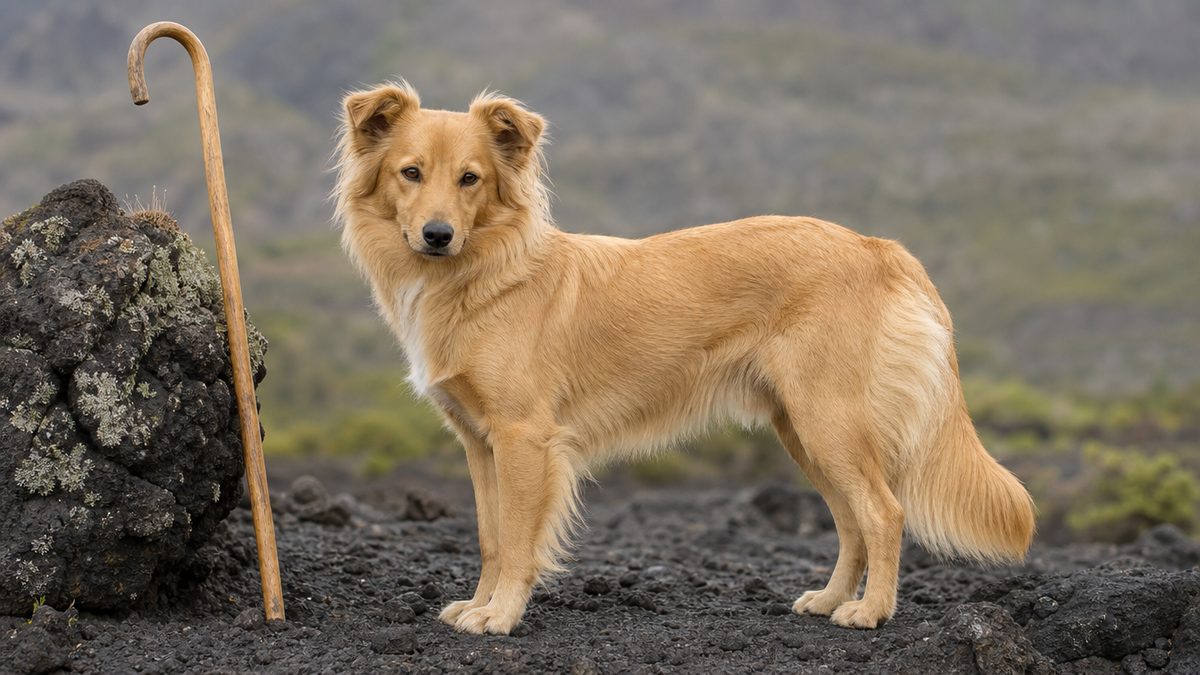
It is a herding dog built for one island. The Spanish state's own prototipo racial describes a lupoid dog, of medium or moderately long proportions, eumetric, medium to large in size, with the croup slightly higher than the withers, a rather short neck and a head that is small in relation to the body. Its stated fundamental aptitude is herding, though it takes any kind of training including guard work, and it makes an adequate companion.
The character clause is unusually specific and both Spanish texts carry it word for word. The dog is docile and self-confident, and it usually greets strangers with a typical attitude: loose intermittent barks while folding its ears back, wagging its tail and turning its head slightly to show the corner of its lips. That is a described appeasement display written into a legal standard, and it is a better guide to the breed's temperament than any adjective.
What the coat and the outline actually look like
The coat is abundant, more or less long, of soft texture in some dogs and rather harsh in others, concentrated at the base of the ears, the neck, the skirts, the tail, the rear edge of the front legs and between the toes, and smooth on the muzzle, the forehead, the front of the front legs and on the hind legs from the hock down. The colour is fawn or wolf-grey in its various shades, with melanistic individuals appearing exceptionally.
The RSCE's breed record adds a coat variant the state text does not name: dogs called *grajos*, whose coat is usually black with slight fawn shading on the legs, cheeks and perianal area. It also specifies honey-coloured eyes where the state prototype says chestnut, and it makes blue eyes or eyes of differing tone a disqualifying fault.
The outline is the part that identifies the breed at a glance and it is the opposite of the German Shepherd silhouette most people expect from a European herder. The croup sits higher than the withers, always by 1 to 3 cm in the state prototype's wording, and the RSCE makes an equal croup and withers a serious fault and a croup lower than the withers a disqualification Real Sociedad Canina de Espana. A dog with a sloping topline falling to the rear is not this breed.
The breed is vulnerable in Spain and absent everywhere else. The Real Sociedad Canina de España carries it on the list of Spanish breeds it considers vulnerable, on the current 2026-27 edition and the 2025-26 one before it Real Sociedad Canina de Espana. Its own association, meanwhile, says the breed is now abundant on La Palma itself, so the two statements are about different scales rather than in conflict.
Why one island produced and preserved this breed
La Palma covers 706 square kilometres and holds fewer than 80,000 people, and the Real Sociedad Canina de España names that isolation as the main reason the breed survived at all.
The RSCE's historical summary is blunt about it. The isolation the island has undergone, across 706 km² and a present-day population not over 80,000, has been the main reason this breed was maintained. The name comes from the villa of Garafía, a comarca dedicated mainly to livestock in the north-west of the island, where these dogs were abundant precisely because communications there were non-existent except on foot, on horseback or by boat Real Sociedad Canina de Espana.
That is a real mechanism rather than a romantic one. A population that cannot easily be crossed with incoming dogs stays homogeneous, and the RSCE says so directly: the lack of communication, until quite recently, allowed a large number of dogs of great purity to be found, and the current breed started from those.
What the dog was actually doing there
The work was goats, not sheep, and the terrain was vertical. The dog's job was to let a shepherd move flocks across the coasts, the summits and the ravines of a steep volcanic island, and Wikipedia records that it thrives on steep, rocky ground for exactly that reason Asociacion Espanola del Perro Pastor…. The croup-higher-than-withers construction, the hare foot and the strong curved nails all read differently once you know the ground.
The RSCE's own utilisation clause makes the intelligence point that matters for anyone thinking of owning one: it is in the care of the flocks that the true essence of the breed shows, because it does not only do what the shepherd indicates but in many cases takes its own decisions, directing the flock with notable ease. A dog selected to decide for itself is a different proposition from one selected to wait.
The island's own name before the conquest was Benahoare, renamed San Miguel de La Palma, and the aboriginal Auaritas practised pastoralism there before any European dog arrived. The association's history is careful on this point: the pastoral activity is not conceivable without a dog's help, whether practised by the Auaritas or afterwards, and the post-conquest arrivals contributed blood to a population that was already working.
For an Indian reader the useful transfer is this. This is not a mountain breed in the alpine sense and not a plains breed either. It is an Atlantic island dog that worked from sea level to the ridge on the same day, which is why its climate profile behaves so unusually and why the next sections spend so long on it.
It is also a genuinely hardy animal in the specific sense that its selection history produced: a dog kept by people who could not afford to feed a passenger, on an island where the alternative to working was not being kept at all. Hardiness here means functional durability on bad ground rather than resistance to cold, which is the assumption most European herding-breed descriptions carry.
The breed has a small following outside Spain, which is worth knowing because it is where a prospective owner in Europe would start. A Dutch site, garafiano.nl, ranks in the Indian result set for the breed and describes Garafiano as an abbreviation of *El Perro de Pastor Garafiano*, a breed from the north-western corner of the island. It and the Spanish association are the only two sites in that result set run by people who actually keep these dogs.
Where the breed came from, and what nearly ended it
The Pastor Garafiano descends from dogs brought by Galician, Portuguese, Majorcan, Basque and Flemish-trading settlers, and it came close to disappearing through crossbreeding from the 1960s.
The breed's own association sets out the settlement history in detail. European settlement of La Palma drew Galicians, Portuguese, Majorcans, Basques, Castilians and others, and a strong sixteenth-century commercial relationship with Flanders founded on the sugar trade. From that it concludes the probable presence on the island of Portuguese dogs such as the *cão da serra da estrela*, Basque shepherds, Iberian careas and possible ancestors of what later became the Belgian shepherd varieties.
English Wikipedia carries the same picture more briefly, dating the origin to pre-Hispanic times with post-conquest crossings of which Belgian shepherds were the most important. The two accounts agree, and the Belgian connection is the one that explains why the modern dog reads as a shepherd type to European eyes.
The selection that made the shape
The association is unusually candid about how the breed was actually made, and it is not a comfortable passage. Selection was drastic. The precariousness of a pastoral society allowed only the subsistence of the shepherd and his family, and keeping animals that provided no use was a luxury nobody could afford. Surplus pups from litters were destroyed, as were dogs that were not effective at their work or that could no longer do it through age, illness or the after-effects of accidents. No valuation and no concession at all were made to the animal's appearance.
The association draws the conclusion itself: given that, the homogeneity the breed shows is surprising, and it summarises the point in the aphorism *la función crea la forma*, function creates form. That is the honest explanation for why a landrace with no written standard until 2004 nevertheless looks like one thing.
The near-loss came from the opposite direction. Successive crosses, especially from the 1960s onward with other shepherd breeds, made recovery and selection necessary from the few pure specimens the island's shepherds still held Wikipedia, 'Pastor Garafiano'. A working group formed for that purpose became the Asociación Española del Perro Pastor Garafiano, whose honorary president is Antonio Manuel Díaz Rodríguez, and whose stated objectives include censuses, breeding nuclei and appearances at Canary and international shows.
The academic work sits alongside it. The ethnology department of the veterinary faculty of the Universidad de Las Palmas de Gran Canaria carried out several studies on the breed, presented at the Simposium de razas autóctonas held in Córdoba in March 1992. That is twelve years before the state prototype was published, and it is the groundwork the 2004 order rests on.
How the Pastor Garafiano became an official Spanish breed
Orden APA/807/2004 of 24 March 2004 added the Pastor Garafiano to Spain's canine annex together with a full state-published racial prototype, and the widely repeated date of 2003 refers to a committee meeting rather than to the order.
Bonbeno downloaded the gazette and extracted it rather than summarising a secondary account. Orden APA/807/2004, de 24 de marzo, appears in the Boletín Oficial del Estado number 77 of Tuesday 30 March 2004 at pages 13430 to 13435, reference BOE-A-2004-5652, signed by Arias Cañete. Its single article includes five Spanish canine breeds in the annex of Real Decreto 558/2001 with their racial prototypes: the Alano Español, the Pastor Garafiano, the Ratonero Valenciano, the Ratonero Mallorquín and the Ca Mè Mallorquí.
The full Prototipo racial del Pastor Garafiano is printed inside that order, running from the general appearance clause through head, neck, trunk, tail, limbs, coat, colour and size. It is a state document, published in the national gazette, and it is the reason this breed's paperwork is stronger than most in this cluster.
2003 or 2004, and why both dates circulate
The breed's own association and English Wikipedia both give 2003 as the recognition year. The order itself explains where that comes from: the preamble records that the inclusion was proposed and admitted at a meeting of the Comité de Razas de Ganado de España on 22 April 2003, and the order giving effect to that decision was made on 24 March 2004 and came into force the day after publication, on 31 March 2004.
So both dates are real and they answer different questions. 2003 is when the national livestock breeds committee approved the breed. 2004 is when the Minister of Agriculture actually put it in the annex. Bonbeno treats the 2004 order as the operative legal date and records the 2003 committee decision beside it, which is exactly the position this site took on the Alano Español, added by the same order on the same day.
In the annex itself the Pastor Garafiano sits seventeenth of 33, directly below the Pachón Navarro. That neighbour is the sharpest available comparison and this site has built its page too: the Pachón Navarro was added six years later, in 2010, by a one-page order that attached no prototype at all. Two breeds one line apart, admitted on entirely different terms.
Bonbeno compared the Prototipo racial del Pastor Garafiano as printed in the 2004 order against the version carried in the consolidated text of Real Decreto 558/2001, character by character. They are identical, the only differences being artefacts of PDF extraction at line breaks. This site looks for drift between documents and reports it when found; here there is none, and that is worth saying.
The wrong Spanish catalogue, and the La Palma animals that are in it
Spanish dog breeds are not in the official livestock catalogue, and La Palma makes the point better than anywhere else because three of the island's livestock breeds are in it while its dog is not.
The Catálogo Oficial de Razas de Ganado de España is Annex I of Real Decreto 45/2019. Bonbeno downloaded the consolidated 34-page text and extracted it. Its species headings are bovine, ovine, caprine, porcine, equine (horse), equine (ass), poultry, and a closing 'otras especies' holding the Camello Canario and two rabbits. There is no canine section, and Article 2 limits the decree's scope to the bovine, porcine, ovine, caprine and equine species.
Across the whole document the word *canina* appears exactly once and *canino* not at all, and that single occurrence is in the Disposición final primera, which does nothing but rewrite Real Decreto 558/2001's power to add new canine breeds to that other decree's annex. So the livestock catalogue's entire canine content is a pointer to a different instrument.
The check that makes it concrete
La Palma supplies the cleanest possible demonstration, and it is worth doing because it converts an abstract legal point into something a reader can look up. The Catálogo holds three breeds under the name Palmera, in the bovine, ovine and caprine lists, alongside the Majorera goat and the Camello Canario. The island's cattle, sheep and goats are all in Spain's official livestock catalogue. Its dog is not, and never could be, because the catalogue does not cover dogs.
The Pastor Garafiano's actual home is the ANEXO to Real Decreto 558/2001, headed RAZAS CANINAS ESPAÑOLAS, which opens 'Las razas caninas españolas son las que figuran a continuación' and lists 33 breeds. Anyone checking this breed's Spanish status needs that document and the ministerial orders amending its annex, and nothing else.
One small correction to a claim this site has published before, offered because accuracy about our own pages matters. The annex is often described as alphabetical. It is very nearly so, but not exactly: Presa Canario is printed before Podenco Andaluz, and Podenco Paternino after Podengo Galego. That is a detail rather than a defect, and it is the kind of thing you only see by reading the list rather than the description of it.
The reason to labour the catalogue point at all is that the error is everywhere, including in press coverage of Canary breed recognition. If a page tells you a Spanish dog was added to the Catálogo Oficial de Razas de Ganado de España, it has named a document containing eight species and no dogs, and everything else it says about that breed's legal status should be verified before you rely on it.
Four published documents, four different sizes
The Pastor Garafiano's height and weight differ across every official and semi-official source that publishes them, and the male weight ceiling ranges from 31 kg to 40 kg.
This is the single most useful thing on the page for a reader who wants to know how big this dog is, and no page anywhere sets the four sources side by side. All four were opened and read on 3 September 2026.
| Source | Male height | Female height | Male weight | Female weight |
|---|---|---|---|---|
| Spanish state prototipo racial, Orden APA/807/2004 | 57 to 64 cm | 55 to 62 cm | 28 to 35 kg | 24 to 30 kg |
| RSCE Standard No. 405, English PDF | 57 to 64 cm | 55 to 62 cm | 28 to 35 kg | 24 to 30 kg |
| RSCE breed record, modified 24 June 2026 | 54 to 60 cm (±2) | 50 to 56 cm (±2) | 24 to 31 kg | 18 to 25 kg |
| Guía de campo 2009, via Wikipedia's infobox | 57 to 65 cm | 55 to 63 cm | 30 to 40 kg | 24 to 30 kg |
| GoofyTails, served by Google as its own answer | 57 to 64 cm | 55 to 62 cm | 24 to 35 kg | 20 to 30 kg |
Read down the male weight column. The Real Sociedad Canina de España's current breed record caps a male at 31 kg. The Ministry's own 2009 field guide, as reproduced in Wikipedia's infobox, allows 40 kg Wikipedia, 'Pastor Garafiano'. That is a nine-kilogram disagreement about the top of the range for the same breed, and a 36 kg male is a correct Guía de campo Garafiano, an over-weight state-prototype Garafiano and five kilograms above the RSCE's ceiling.
The female figures diverge further in proportion. A 52 cm bitch is comfortably inside the RSCE's 50 to 56 cm and sits three centimetres below the state prototype's floor of 55 cm. A 20 kg bitch is normal under the RSCE and six kilograms under the state prototype's minimum. There is no reading of these documents on which one dog satisfies them all.
Wikipedia's infobox prints the Guía de campo figures, 57 to 65 cm and 30 to 40 kg for males, sourced to page 564. Its Characteristics section, two screens further down, says bitches stand 50 to 56 cm and weigh 18 to 25 kg with dogs some 4 cm taller and about 6 kg heavier, sourced to the RSCE. Those are the two ends of the range above, printed on one page, and the article carries maintenance banners asking for more citations dating from 2015 and 2021.
The GoofyTails row deserves attention because Google chose it. Asked 'How big do Garafian Shepherds get?' in India, Google answers with that site's table GoofyTails, 'Garafian Shepherd' breed page. Its heights are the state prototype's exactly. Its male weight range of 24 to 35 kg takes the RSCE's floor and the state's ceiling, and its female range of 20 to 30 kg appears in no Spanish document at all. So the figure an Indian searcher is handed as the answer is a splice of two standards plus something from neither.
The practical instruction is short. If you need a number for this breed, say which document it comes from, because there is no single correct answer. This page uses the state prototype where it is describing the legal breed and the RSCE record where it is describing what the kennel body currently applies, and it names the source every time.
The Real Sociedad Canina publishes two standards for this dog
The RSCE's downloadable Standard No. 405 and its own breed record describe the Pastor Garafiano differently on size, ears, teeth, eye colour and group, and one of them has no fault list at all.
Both documents are on rsce.es, both were retrieved on 3 September 2026, and they are not versions of one text. Standard No. 405, the English PDF, is a translation of the 2004 state prototipo racial: same heights, same weights, same 24 cm by 18 cm head, same permissive ear clause, same variable dentition, and no fault or disqualification list whatsoever. The web breed record, whose metadata gives a last modification date of 24 June 2026, is a substantially revised standard with full serious and disqualifying fault lists.
| Clause | Standard No. 405 (English PDF) | RSCE breed record (24 June 2026) |
|---|---|---|
| Classification | Group 1 Sheepdogs, Section 1, without working trial | Grupo 11 - Perros de Pastor |
| Male height | 57 to 64 cm | 54 to 60 cm, tolerance ±2 |
| Male weight | 28 to 35 kg | 24 to 31 kg |
| Ears | 'They can be split or with tendency to split forwards' | 'Nunca partidas desde la base'; split from the base is DISQUALIFYING |
| Teeth | 'certain variability, ... a larger or smaller number of teeth than usual' | Dentition must be complete; a missing premolar is a serious fault |
| Bite | 'Scissor bite in order to avoid injuries to the cattle' | En tijera |
| Eyes | Brown | Honey in various tones; blue or differing tone DISQUALIFYING |
| Tail length | 'does not usually surpass the hock joint' | May reach or slightly exceed the hock |
| Fault list | None at all | 12 serious faults, 9 disqualifying faults |
The ear row is a straight inversion and it matters, because ear carriage is how people identify this breed in a photograph. The state text and its RSCE translation both say the ears can be split. The RSCE's own current record says they are never split from the base, and makes ears split from the base a disqualifying fault Real Sociedad Canina de Espana. One RSCE document permits what the other RSCE document throws out of the ring.
The group number, and the same defect on a sibling breed
Standard No. 405 prints 'Classification RSCE: Group 1 Sheepdogs and Cattle Dogs (except Swiss Cattle Dogs). Section 1 Sheepdogs.' The RSCE's breed record prints 'Clasificación rSCE: Grupo 11 - Perros de Pastor'; Real Sociedad Canina de Espana. Grupo 11 is the RSCE's own honest label for breeds the FCI does not recognise; Group 1 is an FCI group number for a breed the FCI does not hold.
This is not a one-off. The same body does exactly the same thing to the Pachón Navarro, whose breed record says Grupo 11 and whose Standard No. 409 says Group 7. So the RSCE's standard PDFs systematically carry FCI group numbers while its web records carry the national group, and a reader who takes the group from the PDF will conclude the FCI recognises a breed it does not.
The durable rule this supports is one this site applies everywhere: an FCI group printed by anyone other than the FCI is that body's own filing. Here the same body files one breed two ways on one website on one day, which is about as clear a demonstration as the point will ever get.
Pincer or scissor: a translation that changed the dog's mouth
The Spanish state prototype specifies a pincer bite so the dog does not injure the livestock, and the RSCE's English standard translates that as a scissor bite while keeping the explanation.
Here is the clause in the state prototipo racial, verbatim: *'La dentición presenta cierta variabilidad, encontrándose ejemplares con mayor o menor número de piezas del normal. La mordida es en pinza a fin de evitar lesiones al ganado'*. The dentition shows a certain variability, with individuals found having more or fewer teeth than normal. The bite is a pincer bite so as to avoid injuring the livestock.
RSCE Standard No. 405 renders the second sentence as: 'Scissor bite in order to avoid injuries to the cattle';. The reason survives the translation and the bite does not. A pincer or level bite is the one where the incisors meet edge to edge, and it is the bite that would plausibly be selected in a dog that grips livestock. A scissor bite, where the upper incisors overlap the lower, is the ordinary cynological default and needs no functional justification at all.
Whether it is an error or a revision
Bonbeno cannot tell from the documents which it is, and says so rather than guessing. The RSCE's Spanish-language breed record also says *en tijera*, scissor, and additionally makes enognathism or prognathism in any degree a disqualifying fault. So the RSCE says scissor in both its languages while the state prototype says pincer in the only language it has.
Two readings are available. Either the English standard mistranslated *pinza* and the error later hardened into the Spanish record, or the RSCE deliberately revised the bite toward the cynological norm and the surviving 'in order to avoid injuries to the cattle' clause is a fossil of the older text. The second is more likely given the breed record's other revisions, but the first is what the documents look like, and this page publishes both readings.
Either way the practical position for a buyer is clear. If you are looking at a dog against the state prototype, a pincer bite is correct and is the functionally justified one. If you are looking at it against what the RSCE currently applies, a scissor bite is required and any degree of over- or undershot jaw disqualifies. Ask which standard a breeder works to before you judge a mouth.
This is the second translation defect found in the RSCE's English standards in one session. The other is on the Pachón Navarro, whose Spanish disqualifying colour is abarcinado, meaning brindle, and whose English standard renders it 'Fawn colours'. Fawn is a common and perfectly acceptable colour in several Spanish breeds. A standard is a primary source for what a body says, and it is a translation like any other where a language has been crossed.
Why the FCI absence decides the Indian question
The FCI does not hold the Pastor Garafiano, and because the Kennel Club of India issues pedigrees against FCI nomenclature, that absence settles whether the breed can be registered in India.
Bonbeno read the FCI's own Group 1 register with JavaScript enabled rather than trusting a summary or an assembled URL. Section 1, Sheepdogs, is listed country by country, and country 15, SPAIN, holds exactly two entries: GOS D'ATURA CATALÀ (87) and CA DE BESTIAR (321), both with a validity date of 5/26/1982. No Pastor Garafiano and no Garafian Shepherd appears anywhere in Group 1.
The in-document controls confirm this is the real register rather than a decoy served at HTTP 200, which is a failure this project has hit repeatedly on the FCI's own site. The Deutscher Schäferhund (166), the Border Collie (297), the Komondor (53), the Bergamasco (194) and the Maremmano (201) are all present under their own countries. Those are exactly the breeds a genuine Group 1 register must contain.
The consequence for India follows in one step. The FCI members register lists India as a full member represented by the Kennel Club of India, so the KCI issues pedigrees against FCI nomenclature. A breed the FCI does not hold has no KCI route, so a Pastor Garafiano in India could not be registered as a pedigree dog even if one arrived.
Do not read this as the KCI having considered and rejected the breed. The Kennel Club of India publishes no breed list at all, so a query there returns nothing for this breed and nothing for a control breed either. That is a broken instrument rather than a finding, and the FCI register is the checkable route. Say which you mean.
The RSCE's Grupo 11 is the honest counterpart. It is headed 'Razas no reconocidas por la FCI' and holds eleven breeds, including the Perro de Pastor Garafiano, the Majorero, the Perro de Pastor Vasco, the Alano Español, the Maneto and the Pachón Navarro. The FCI has ten groups, so an eleventh is a national register that a national body has labelled truthfully. That is a real status, and it is not FCI recognition.
Worth noting for context: the RSCE's Grupo 1 holds only two Spanish sheepdogs, the same two the FCI recognises, and one of them, the Catalan Sheepdog, was itself added to the RSCE's vulnerable list this year Real Sociedad Canina de Espana. Spanish herding breeds are not in robust health generally, recognised or not.
The teeth clause, and how Indian law reads it
Spain's state prototype tolerates a Pastor Garafiano with more or fewer teeth than normal, its kennel club calls a missing tooth a fault, and Indian law names two or more missing teeth as a genetic defect a breeding dog must have been tested for.
Three authorities, one trait, three positions, and this is the clearest example on the site of why an Indian reader cannot simply adopt a foreign standard. Set them out in order.
| Authority | Instrument | What it says about missing teeth |
|---|---|---|
| Spanish state | Prototipo racial, Orden APA/807/2004 | 'Cierta variabilidad', individuals with more or fewer teeth than normal |
| RSCE, English | Standard No. 405 | 'Certain variability', a larger or smaller number of teeth than usual |
| RSCE, current record | Breed record, 24 June 2026 | Dentition must be complete; a missing tooth is a fault, a missing premolar a SERIOUS fault |
| Indian law | Second Schedule Part III para 8(10) | 'Two or more missing teeth' is a genetic defect a breeding dog must have been tested for |
The Indian clause is worth quoting properly because it is routinely mis-cited. Second Schedule Part III paragraph 8(10) of the Prevention of Cruelty to Animals (Dog Breeding and Marketing) Rules, 2017 requires that dogs 'shall have been tested for genetic defects, including hip dysplasia, progressive retinal atrophy, night blindness, hypothyroidism, entropion, ectropion, overshot, undershot jaw (when incisors do not touch or mesh), wry mouth, two or more missing teeth, unilateral cryptorchid or full cryptorchid males'. Bonbeno extracted the fourteen-page gazette itself, because this document has handed several people invented rule numbers.
This is a Second Schedule paragraph, not a Rule. The Rules themselves run 1 to 13 and there is no Rule 14, so any citation of the form 'Rule 21' or 'Rule 8(10)' is wrong by construction, and a whitespace-tolerant search of the gazette returns zero hits for the string 'Rule 21'. The Second Schedule's paragraphs run continuously 1 to 30 across four Parts: Part I 1-4, Part II 5-6, Part III 7-9, Part IV 10-30.
The word to notice in the Indian clause is *including*, which makes the list illustrative rather than closed. So an Indian breeder cannot argue that a defect is outside the clause merely because it is unlisted, and cannot argue that variable dentition is acceptable because a Spanish gazette says so. The dog would have to have been screened for it.
There is a second collision in the same clause and it also lands on the mouth. Paragraph 8(10) names 'overshot, undershot jaw (when incisors do not touch or mesh)', and the RSCE's current record makes enognathism or prognathism in any degree a disqualifying fault. On that point the Indian rule and the Spanish kennel body agree, which is a genuine alignment rather than a conflict.
For a prospective owner outside breeding, none of this changes anything about keeping the dog. It matters for anyone who might breed one in India, and it matters as a warning about the general practice of importing a foreign standard wholesale. A standard is written for its own jurisdiction, and a clause that is permissive in Spain can be a testing obligation here.
The tail, where a Spanish standard and Indian law agree exactly
The Real Sociedad Canina de España makes an amputated tail a disqualifying fault, which lines up precisely with the Indian prohibition on tail docking.
The tail itself is described consistently across the Spanish documents: very bushy, carried in a sabre or slightly curled but never over the loin, with the state prototype saying its length does not usually pass the hock and the RSCE record allowing it to reach or slightly exceed it Real Sociedad Canina de Espana. The insertion follows the line of the trunk, and a high tail set is a serious fault.
The important clause is in the RSCE's disqualifying list: 'Cola amputada';, an amputated tail. A docked Pastor Garafiano cannot be shown or approved under the standard the Spanish kennel body currently applies.
Second Schedule Part II paragraph 6(8) of the 2017 Rules reads, verbatim: 'There shall be no tail docking, ear cropping, de-barking, de-clawing, branding, dyeing, injecting substances to enhance visual appeal, performing a surgery or procedure to camouflage or hide any defect or infirmity or any other kind of mutilation of any body part of the pup and any change of appearance by artificial means is strictly forbidden';. There is no exception for tradition or for a breed standard.
The Pastor Garafiano's standard disqualifies a docked tail and Indian law forbids docking, so the two agree. The Pachón Navarro sits one line above it in the same Spanish annex and its standard says that traditionally a third of the tail's total length is removed, which an Indian owner could not lawfully follow. Same country, adjacent entries, opposite answers to the same question.
One related detail deserves a note because it looks like a docking question and is not. Both Spanish texts say the front feet lack dewclaws and that the hind feet may or may not have them. That is a description of natural anatomy, not an instruction to remove anything. Removing a hind dewclaw to satisfy a standard would fall squarely inside paragraph 6(8)'s prohibition on de-clawing and on any change of appearance by artificial means.
The practical instruction for an Indian owner is the same as for every imported breed on this site. Never dock, never crop, never remove a dewclaw for appearance, and treat a seller offering a docked dog as someone working outside both the breed's own standard and Indian law. The hero image on this page was briefed to show a natural, undocked tail for exactly that reason.
Pastor Garafiano price in India
There is no Pastor Garafiano price in india, because nobody breeds, imports or sells one here, and the only Indian retail result for the breed is a book.
Bonbeno ran the commercial query on a Google India render whose control had already passed in the same session. 'Pastor garafiano price in india' returned HTTP 200 and 'About 1,080 results', and the single Amazon.in result was an activities-and-tricks book about the breed rather than an animal. No Indian breeder, no Indian classified listing, no Indian rescue and no Indian rupee figure attached to a living dog appeared anywhere in the result set.
Google's own AI answer does the thing this site has now documented on several breeds. It states that the Pastor Garafiano is not actively bred or commercially sold in India, so there is no standard domestic price range, and then prints a full estimated cost breakdown anyway.
The conversion rate that gives it away
Its puppy figure is a currency conversion rather than an observation. 'EUR 800 to EUR 1,500 (approx. Rs 75,000 to Rs 1,40,000)' works out at 93.75 and 93.33 rupees to the euro. On the same day, on the same engine, the equivalent answer for the Pachón Navarro converted euros at a flat 90.00. One engine, two Spanish breeds, two different euro rates, neither of them an Indian price. A table that cannot hold one rate across its own rows was produced by division rather than by pricing anything.
The same answer asserts that the breed 'will require 24/7 air conditioning' and attributes that to ResearchGate. ResearchGate hosts the Suárez 2013 genetics paper on five Canary Island dog breeds, which measures microsatellite alleles and mitochondrial haplotypes and says nothing whatever about air conditioning. That is a real citation sitting under a claim the source does not make.
Google printed 'About 185 results' for 'pastor garafiano dog' and 'About 182 results' for 'labrador retriever price in india' on the same render minutes apart. The rare Canary breed returned MORE results than the thickest commercial breed query in India. Never read an absolute count as evidence of demand. What evidences a thin market is composition, and the composition here is a book, a Dutch enthusiast site and an encyclopedia.
What the AI answer offers instead is worth recording because it is the honest part of it. It points an Indian reader at a German Shepherd at Rs 18,000 to Rs 65,000 or a Himalayan Gaddi Dog at Rs 5,000 to Rs 80,000, both sourced to a content site. Those are real Indian ranges for real Indian availability, and they answer the question this breed cannot. Bonbeno publishes no price for the Pastor Garafiano because none exists.
Whether you can import a Pastor Garafiano into India
You can bring a Pastor Garafiano to India only as your own pet under strict conditions, and you cannot lawfully import one to breed or to sell.
The governing instrument is DGFT Trade Notice 22/2022-23 of 19 December 2022, which Bonbeno downloaded and extracted rather than summarising. It places ITC(HS) 01061900, 'Mammals: Other', in the Restricted category subject to Policy Condition 6.
- Policy Condition 7 permits the import of dogs only for a pet dog with a valid pet book and relevant records in the importer's own name, for R&D organisations conducting research with a CPCSEA recommendation, or for internal security by the Defence and Police Force.
- Policy Condition 8 states that import of commercial dogs for breeding or any other commercial activity beyond those purposes is not permitted.
- Paragraph 6 states that any application for trading or breeding purposes, or made on behalf of another person or entity, shall be duly rejected.
- Paragraph 7 limits entry to the airports and seaports of Delhi, Mumbai, Chennai, Hyderabad, Bangalore and Kolkata, with quarantine at those ports where required. DAHD added a seventh port, Cochin International Airport at Kochi, for pets arriving under the baggage rules in October 2024.
- Permanent import as passenger baggage without a DGFT authorisation is open only to a person transferring residence to India after two years of continuous stay abroad.
Set that beside the FCI absence and the question closes. There is no pedigree route, because the KCI issues against FCI nomenclature and the FCI does not hold this breed. There is no lawful commercial import route, because the only permitted categories are a personal pet, licensed research and the security forces. Either fact alone would prevent a market forming.
One caution about the port list. The six ports above are the ones this notice names, and Bonbeno confirmed the strings Kochi and Cochin appear zero times in it. Personal pet import under the baggage rules runs on a separate instrument with its own port list, and the two should not be merged into a single sentence. If you need a current list for either route, read that route's own document.
So the realistic path is a relocation and nothing else. A family returning to India after two or more years abroad, with a Pastor Garafiano already registered in their own name in Spain and a complete pet book, can bring the dog through one of those six ports or, since October 2024, Kochi. Anyone offered a Garafiano puppy inside India should treat the offer as implausible: the breed's population sits on one Spanish island, and there is no route by which a litter could lawfully have reached an Indian seller. The full route is set out in how to import a dog to India.
For a returning family the practical checklist is short. Confirm the dog is registered in your own name before you move, keep the pet book complete and current, begin the import authorisation process at least two months before travel as the notice itself advises, and budget for quarantine at the port of entry.
Monthly cost of ownership for a 25 kg long-coated dog in India
Keeping a 24 to 35 kg dog with an abundant coat in an Indian metro runs roughly Rs 7,000 to Rs 14,000 a month, and the coat pushes the grooming line above what a short-coated breed costs.
There is no purchase price for this breed in India, but the running cost of ownership is real and published, and it is what an Indian reader actually needs. Every figure below comes from a named vendor's own page, read on 3 September 2026, and none is converted from a foreign currency.
| Line | Published figure | Source |
|---|---|---|
| Anti-rabies, single dose | Rs 699 | Vetic clinic |
| 9-in-1 DHPPiL | Rs 899 | Vetic clinic |
| Kennel cough | Rs 1,349 | Vetic clinic |
| Tick, flea and worm cover | Rs 1,103 a month | NexGard Spectra 15-30 kg, Supertails |
| Deworming, single dose | Rs 251 to Rs 377 | Drontal Plus, 1 tablet per 10 kg |
| Bath | from Rs 934 | Vetic grooming, Delhi |
| Complete bath and styling | from Rs 1,869 | Vetic grooming, Delhi |
| Boarding, 24 hours | Rs 899 | PawSpace, Bengaluru |
| Dog registration, Delhi | Rs 500 | MCD, new registration |
| Pet licence, Chennai | Rs 50 | Greater Chennai Corporation |
The grooming line is where this breed costs more than the Pachón Navarro or any short-coated dog of the same weight. An abundant coat with heavy furnishing at the ear bases, neck, skirts and between the toes is a professional groom rather than a home brush-down in a humid climate, and a complete bath and styling starts at Rs 1,869 at a Delhi clinic chain. Budget for that every six to eight weeks and the annual figure is meaningful.
Parasite cover is the other large predictable line and it is not optional in India. One monthly NexGard Spectra tablet at Rs 1,103 covers ticks and fleas together with roundworms and hookworms for a 15 to 30 kg dog, which is roughly Rs 13,200 a year. A dog above 30 kg needs the next weight band, so check the male weight against the pack rather than assuming.
Boarding deserves its own line for a herding breed, because these are not dogs that settle easily in a kennel. A Bengaluru operator publishes Rs 599 for four hours, Rs 799 for a ten-hour day and Rs 899 for a full 24 hours.
Greater Chennai Corporation licenses pet animals for Rs 50, issued 9,115 licences in 2024, and its six municipal pet clinics provide all treatment and anti-rabies vaccination free of cost. Delhi's MCD charges Rs 500 to register a pet dog, has issued 18,958 certificates since 2021, and rejected 71 of 1,006 applications in 2026-27.
No monthly cost for food appears in that table on purpose. A monthly kibble figure is arithmetic over a grams-per-day number rather than a quoted price, and this site has watched a single Indian retail listing change product within days. Weigh the food, check the pack against your own dog's weight, and re-price the bag yourself. Adding food to the lines above puts a 30 kg Garafiano in an Indian metro at roughly Rs 7,000 to Rs 14,000 a month.
Suitability for the Indian climate
The Pastor Garafiano is more heat-tolerant than almost any European herding breed, because its homeland is a subtropical Atlantic island rather than a cold one, and the coat rather than the temperature is what limits it in India.
Start with the number that surprises people. Sea-level La Palma runs an annual mean of 20.67 C, a September mean of 23.46 C and a February mean of 18.16 C. That is not a cold-climate breed. For comparison, the Pachón Navarro's Navarrese homeland runs an annual mean of 11.67 C, nine degrees colder, and Bengaluru runs 23.74 C.
| Place | Annual mean C | Annual RH % | Peak wet bulb C | Month |
|---|---|---|---|---|
| Santa Cruz de La Palma | 20.67 | 77.93 | 20.91 | August |
| Bengaluru | 23.74 | 67.94 | 21.86 | May |
| Pune | 23.86 | 66.80 | 22.97 | June |
| Mumbai | 26.77 | 67.39 | 25.77 | June |
| Chennai | 27.95 | 72.39 | 26.11 | May |
| Delhi | 25.60 | 45.56 | 26.50 | July |
| Kolkata | 25.81 | 73.93 | 27.09 | June |
Wet bulb is the measure that matters for a panting animal, because it caps how much heat evaporation can shed. La Palma's peak is 20.91 C in August. Bengaluru's is 21.86 C in May. Those are within a single degree of each other, which makes Bengaluru genuinely comparable to this breed's own coast in the way that matters physiologically. Chennai at 26.11 C and Kolkata at 27.09 C are five to six degrees beyond it, and that is a different proposition entirely.
The humidity figure inverts the usual advice about European breeds in India, and it is the second thing every page about this dog gets wrong. Sea-level La Palma runs 77.93 percent annual relative humidity, higher than Chennai at 72.39, Kolkata at 73.93, Mumbai at 67.39, Bengaluru at 67.94 and Delhi at 45.56. Damp air is this dog's native condition. Anyone warning that Indian humidity will overwhelm a Canary island breed has not looked at the Canaries.
The one Indian city this breed would notice least
The mean daily maximum sharpens the picture, and it can only be computed from the daily series rather than from a climatology summary. Averaged over 3,653 days from 2015 to 2024, Santa Cruz de La Palma's mean daily maximum is 21.60 C, rising to 24.19 C in September; Bengaluru's is 30.47 C rising to 36.31 C in April; Chennai's is 32.25 C; Delhi's is 32.59 C rising to 41.92 C in May.
One further figure from that series is worth knowing because it describes something India cannot offer. In its hottest month La Palma's mean daily maximum is 24.19 C against a mean daily minimum of 22.95 C, a swing of 1.24 degrees. Delhi's May swings 15.16 degrees between 41.92 C and 26.76 C. This is a breed that evolved with no thermal cycle at all, and in India its recovery will depend entirely on the cool night it never previously needed.
Why the climate model cannot see this island
La Palma is smaller than a single MERRA-2 grid cell, so NASA POWER returns one byte-identical series for the village of Garafía at 600 m and for the island's 2,426 m ridge.
This section exists because the numbers in the previous one need a health warning, and because publishing the limitation is more useful than quietly publishing the cell. Bonbeno queried POWER by explicit latitude and longitude and echoed the elevation POWER returns for each cell against the place's real elevation, on every point.
| Point | Real elevation | Cell elevation | Error |
|---|---|---|---|
| Santa Cruz de La Palma | 30 m | 33.60 m | +3.60 m |
| El Paso | 600 m | 99.06 m | -500.94 m |
| Garafía (the type locality) | 600 m | 61.40 m | -538.60 m |
| Roque de los Muchachos | 2,426 m | 61.40 m | -2,364.60 m |
Two tells fired together, which is what makes the diagnosis certain rather than suspected. The elevation for the Roque de los Muchachos is impossible: POWER reports a 2,426 m volcanic ridge as sitting 61.40 m above the sea. And Garafía and the Roque return byte-identical series, because they are one grid cell queried twice, 27 km apart horizontally and 1,826 m apart vertically.
The error of −2,364.60 m at the Roque is among the largest this site has ever recorded, and it is worse than every Indian hill station in our files. Ooty comes back 1,455 m too low and Shimla 1,302 m too low; La Palma's ridge comes back 2,365 m too low. An island narrower than the model's resolution gets one climate, and here it gets three cells that still cannot see the mountain between them.
Only the Santa Cruz de La Palma cell, whose elevation error is +3.60 m and which therefore genuinely describes sea-level La Palma. Every climate figure in the previous section comes from that cell and is labelled sea-level for that reason. Bonbeno publishes no figure for the ridge, because POWER cannot produce one and inventing a lapse-rate estimate for a 2,426 m summit would be arithmetic dressed as data.
For Garafía itself, the type locality at about 600 m, a lapse-rate correction is defensible if it is labelled as an estimate. Correcting the 61.40 m cell's 20.36 C annual mean to 600 m at the standard 6.5 C per 1,000 m gives roughly 16.9 C. Call that an estimate, not a measurement, and note that the marine inversion layer common in the Canaries can decouple the upper slopes from the coast in ways a single lapse rate does not capture.
The reason this matters for an Indian reader is practical rather than academic. The breed's working range ran from the coast to the high pasture on the same day, so its true thermal envelope is wider and cooler than the sea-level figures suggest. A Garafiano's ancestors could climb out of the heat. In Bengaluru or Chennai it cannot, and that is the honest difference the grid cell was hiding.
Temperament and household fit
The Pastor Garafiano is described in both Spanish texts as docile and self-confident with a distinctive greeting ritual, and it is a dog that makes its own decisions at work.
The temperament clause is the same in the state prototype and in the RSCE's record, and it is more useful than most because it describes behaviour rather than adjectives. The dog is docile and self-confident. It usually receives strangers with a typical attitude: loose intermittent barks while it folds its ears back, wags its tail and turns its head slightly to show the corner of its lips. It looks calm and settled, and becomes very active when working Real Sociedad Canina de Espana.
That greeting is an appeasement display, and it is diagnostic. A Garafiano that meets a stranger with a hard stare, a still tail or forward-carried ears is behaving outside its own standard, and the RSCE makes an unbalanced character, aggression or extreme timidity disqualifying, with excessive timidity a serious fault in its own right.
The independence that makes it hard in a flat
The RSCE's utilisation clause is the sentence a prospective owner should read twice: it is in the care of the flocks that the true essence of the breed shows, because it does not only do what the shepherd indicates but in many cases takes its own decisions, directing the flock with notable ease. A dog selected for initiative is not a dog that waits to be told, and in a household with nothing to organise it will find something.
Set against that, the state prototype says the breed's fundamental aptitude is herding although it assimilates any kind of training including guard work, and that it constitutes an adequate companion dog. Both things are true. It is a capable companion and it is a working dog with opinions, and which one you get depends almost entirely on what you give it to do.
- Suits: a house with land, or an owner who will do ninety minutes a day plus real mental work.
- Suits: a household that wants a dog that watches and reports, since guard work is within its stated aptitude.
- Does not suit: an apartment with a full-time-absent owner, which is the single worst combination for an independent herder.
- Does not suit: a first dog for someone who has not lived with a breed that solves problems on its own.
One honest limitation. There is no published behavioural research on this breed and the indexed literature holds only two papers about it, neither behavioural. Everything above comes from what the breed's custodians wrote down as their selection target, which is good evidence of intent and is not the same as a study of how the dogs actually behave.
Training an independent herding breed in India
Training a Pastor Garafiano means giving a decision-making herder a job it can complete, and in India that has to happen in the cool hours and mostly indoors or in shade.
The breed is trainable in the sense that matters, and both Spanish texts say so: it assimilates any kind of training, including guard work. What it is not is biddable in the Border Collie sense. The RSCE's own description of a dog that takes its own decisions while directing a flock is a description of a dog that will complete a task its own way if your way is slower.
The practical consequence is that training should be built around tasks with a clear end state rather than around repetition. A dog that can be shown the goal and left to work out the route will engage; the same dog drilled through twenty identical repetitions will disengage and start offering its own suggestions.
- Socialise hard through the first sixteen weeks. An independent guard-capable breed that meets the world late becomes a reserved adult, and Indian street density is a lot to introduce at six months.
- Teach an off-switch early. The standard describes a dog of calm appearance that becomes very active when working, so the settle is a trait to reinforce rather than one to install.
- Give it a job with an end. Carrying, finding, herding a ball into a corner, or a scent search with a defined find. Completion is what satisfies this brain.
- Train the recall before the dog is six months old, because an independent herder that has learned to make its own decisions about distance is much harder to retrain afterwards.
- Do not train in the heat. Any session in an Indian afternoon from March to October is teaching the dog that work is unpleasant, quite apart from the risk.
The guarding aptitude needs managing deliberately in an Indian setting. A breed whose standard permits guard work, living in a flat with a shared corridor and constant unfamiliar foot traffic, will bark. That is within the standard's own description of how it greets strangers, and the answer is early exposure and a reliable interrupt cue rather than correction after the fact.
Overseas herding-breed advice frequently recommends long off-lead runs and open-country work. In most Indian cities the off-lead space does not exist and the temperature window is two hours a day. Plan the dog's mental load indoors and its physical load at dawn, rather than assuming a foreign training routine will transfer.
Finally, socialise the dog to handling. This breed needs regular grooming that a short-coated dog does not, and a 30 kg independent herder that objects to having its feet and ear bases worked on is a problem you will meet every six weeks for a decade. Start the handling in the first month.
The daily exercise requirement
A Pastor Garafiano needs about ninety minutes of daily exercise plus mental work, and in most of India that has to be split across dawn and after dark.
This is a dog selected to move goats across coasts, ridges and ravines on a steep volcanic island, and the ninety-minute figure is a floor rather than a target. At least one of those sessions should engage the head as well as the legs, because the breed's defining working quality is judgement rather than speed.
The Indian scheduling constraint is set by the wet bulb rather than by the thermometer. Bengaluru's peak of 21.86 C sits within a degree of sea-level La Palma's 20.91 C, so a Bengaluru morning is genuinely workable for this breed year-round. Chennai at 26.11 C, Kolkata at 27.09 C and Delhi at 26.50 C are not, and hard exercise in those cities is a cool-season activity.
In a VetCompass cohort of 905,543 UK dogs, 652 of the 879 heat-related illness events with a recorded trigger, or 74.2 percent, were exertional rather than environmental or vehicular. Heatstroke in dogs is overwhelmingly something that happens while the dog is working or walking, and an independent herder with a job to finish is exactly the animal that will not stop when it should.
The statutory constraint is separate and specific. Second Schedule Part IV paragraph 21(1) of the 2017 Rules bars keeping in outdoor facilities, without the attending veterinary practitioner's written approval, dogs not accustomed to local temperatures, breeds that cannot tolerate them 'such as long-coated breeds in high temperature locations', and sick, infirm, aged or young animals. An abundant-coated island herder in Chennai is squarely inside the second limb of that clause.
- Bengaluru and Pune: workable year-round at 06:00 and after 19:00, and the closest Indian match to the breed's own wet-bulb envelope.
- Mumbai, Chennai and Kolkata: cool-season exercise only, with short shaded walks and indoor mental work from March to October.
- Delhi: excellent from November to February, effectively closed from April to June when the mean daily maximum reaches 41.92 C.
- Anywhere: carry water, walk on grass rather than tarmac, and cancel rather than shorten when the air is still and humid.
Swimming is a reasonable substitute in the hot months and this breed will usually take to it, but the coat is the complication. An abundant coat with heavy furnishing between the toes and at the ear bases holds water, and a dog left to dry in 78 percent humidity is a dog developing a skin problem. Swim it, then dry it properly, which is the subject of the next section.
Grooming and coat care in Indian humidity
The Pastor Garafiano's abundant coat needs brushing two or three times a week and deliberate drying after every wetting, and the hair between its toes is the specific Indian problem.
The coat is described identically in both Spanish texts: abundant, more or less long, of soft texture in some dogs and rather harsh in others, accumulated mainly at the base of the ears, the neck, the skirts, the tail, the rear edge of the front legs and between the toes, and smooth on the muzzle, the forehead, the front of the front legs and on the hind legs from the hock down.
Coat care for this breed in India is therefore not a single job but four small ones, and the between-the-toes hair is the one nobody plans for. Interdigital hair in monsoon mud collects grit and stays wet, and interdigital dermatitis in a dog that walks on wet ground is a common and entirely preventable presentation.
- Brush two or three times a week, more during a coat change, working the ear bases, the neck ruff, the skirts and the tail where the hair concentrates.
- Check and trim between the toes every few weeks, and dry the feet after every monsoon walk.
- Dry the ear bases deliberately rather than letting the dog air dry, because the heavy hair there holds water against the skin.
- Bathe every six to eight weeks, not more, and never leave the undercoat damp.
- Book a professional groom for the skirts and feet if you cannot manage them, at from Rs 1,869 for a complete bath and styling at a Delhi clinic chain.
The standard European instruction for a working herder is to towel the dog and let it air dry. That is sound in the Canaries at 20 C and poor advice in an Indian monsoon at 78 percent humidity and 28 C. This site's gundog cluster carries Indian veterinary series in which otitis cases cluster heavily in the monsoon, and a separate Indian series in which prevalence peaked in summer instead. The two disagree on the season, which is worth saying rather than smoothing over, but neither supports leaving a heavily coated dog wet.
One thing this breed does not need is clipping, and an Indian owner should resist the advice to shave it for the heat. An abundant double-textured coat insulates against heat as well as cold, and shaving removes that protection while exposing skin that has never seen direct tropical sun. Brush more, wash less, and dry properly instead.
The last coat point is a legal one and it belongs here rather than in the law section. Second Schedule Part II paragraph 6(8) prohibits dyeing and any change of appearance by artificial means alongside the mutilations. Colour-correcting a fawn coat to match a photograph is not a grooming choice in India; it is prohibited conduct.
Health risks and what is actually known
One inherited condition has been reported in the Pastor Garafiano, a collagen dysplasia resembling Ehlers-Danlos syndrome in three puppies from a single litter, and no life expectancy figure exists.
The indexed literature on this breed is two papers, and Bonbeno established that by reading the query-translation line on every search rather than the count, with controls that passed in the same session. Both papers come from the Universidad de Las Palmas de Gran Canaria, which is the institution that has done essentially all the scientific work on Canary Island dogs.
The health paper is Rodríguez and colleagues, 1996, in *Zentralblatt für Veterinärmedizin*. A connective tissue disease resembling human Ehlers-Danlos syndrome was reported in three Garafiano shepherd dogs from the same litter. The clinical signs were skin hyperextensibility and fragility, joint laxity and ocular lesions. Microscopy showed abnormalities in the packing of collagen into fibrils and fibres in the skin, and systemic connective tissue defects were demonstrated in one necropsied puppy.
This is one litter, reported thirty years ago, with no denominator and no follow-up. It does not establish that the breed carries an elevated risk of collagen dysplasia, and nobody should breed or buy on the strength of it. It is reported here because it is the only breed-specific inherited-disease report that exists for this dog, and because a reader deserves to know both that it exists and how little it can bear.
The modern genetic context is worth stating precisely, and it is a negative for this breed. Dermatosparactic Ehlers-Danlos syndrome in dogs, the form characterised by extreme skin fragility, is caused by biallelic ADAMTS2 mutations, and a 2022 paper reported two novel ADAMTS2 variants from whole-genome sequences of a Pit Bull Terrier and an Alapaha Blue Blood Bulldog. No Garafiano dog appears in that paper. The 1996 litter predates the availability of ADAMTS2 testing and no causal variant has ever been published for this breed.
The population-genetics paper is Suárez and colleagues, 2013, in *Animal Genetics*, covering five Canary Island dog breeds: the Canarian Warren Hound, the Canary Island Mastiff, the Garafiano Shepherd, the La Palma Rat-Hunter and the Lobito Herreño. It identified 168 alleles in autosomal microsatellites and 16 mitochondrial haplotypes, with observed heterozygosity ranging from 0.556 to 0.783 and expected from 0.737 to 0.943 across the five breeds.
Two honest limits on that paper. The abstract does not break the heterozygosity figures down per breed and Bonbeno could not obtain the per-breed row, so no figure specific to the Garafiano is published here. And of the three newly described haplotypes exclusive to a single breed, none belongs to the Garafiano Shepherd.
The figures that do not exist
There is no life expectancy for this breed and Bonbeno prints none, because no life-table study carries a row for it and no health survey has been published in a form this site could read. There is no screening scheme and no hip or elbow statistics, because a breed confined to one island will never reach the evaluation thresholds those registries require before publishing a row. Absence here is a property of the population, not evidence of soundness.
What the standards do tell you is which health issues the breed's own custodians treat as serious enough to exclude a dog. The RSCE disqualifies clear signs of physical or behavioural abnormality, an unbalanced character, aggression or extreme timidity, total or partial depigmentation of the nose, enognathism or prognathism in any degree, a croup lower than the withers, blue eyes or eyes of differing tone, an amputated tail, and monorchid or cryptorchid specimens. Those are the questions to ask a breeder, because they are what a Spanish judge would act on.
The Indian health risks that come with the country
An imported European dog in India meets a disease burden its homeland does not have, and tick-borne infection combined with a heavy coat is the largest part of it.
The Indian veterinary literature on tick-borne disease is substantial and the figures are large, and for a heavily coated dog that works in vegetation they matter more than any inherited risk.
| Place | Dogs tested | Finding |
|---|---|---|
| Andhra Pradesh | 442 | Ehrlichia canis 51 of 442, 11.54 percent by PCR |
| Odisha | 178 | Ehrlichia canis 56 of 178, 31.46 percent; 79 percent had a tick history |
| Kerala | 120 | Babesia 80 of 120, 66.7 percent; peak pre-monsoon, March to May |
| West Bengal | 584 | Babesia gibsoni 76.54 percent; 72.9 percent carried two or more pathogens |
Every one of those studies sampled clinically suspected dogs or a clinic caseload rather than a random population. The correct statement of the West Bengal figure is that 76.54 percent of dogs tested at veterinary clinics carried Babesia gibsoni, not that three quarters of Indian dogs do. The numbers remain the best Indian evidence available and they justify year-round control.
An abundant coat makes tick checking harder rather than easier, which is the breed-specific part of this. Ticks attach where the coat is densest and the skin is thin, and on this dog that means the ear bases, the neck ruff and between the toes, all of which are exactly where the standard says the hair concentrates. A visual check is not sufficient; you have to part the coat.
Year-round chemical cover is therefore the baseline, not a monsoon measure. A monthly NexGard Spectra tablet for a 15 to 30 kg dog costs Rs 1,103 and covers the tick and flea role together with roundworms and hookworms. Separate deworming with Drontal Plus runs Rs 251 to Rs 377 per dose at one tablet per 10 kg.
Rabies vaccination is the other non-negotiable and India offers a genuinely better public option than a private one in at least one city. Greater Chennai Corporation's six pet clinics provide all treatment and anti-rabies vaccination free of cost, against Rs 699 for a single anti-rabies dose at a private clinic chain Vetic Pet Clinic.
The third Indian problem is skin, and this breed's coat invites it. Bonbeno could not source an Indian prevalence figure for moist dermatitis in long-coated dogs, and rather than reach for a number that does not exist the honest instruction is behavioural: dry the ear bases and the feet after every wetting, part the coat weekly to inspect the skin underneath, and treat any hot spot early.
Feeding and body condition
Feed a Pastor Garafiano to the lower half of whichever weight range you follow, because bodyweight at or above the breed mean is an independent risk factor for exertional heat illness.
The most useful feeding fact for this breed in India is not a quantity. In a cohort of 905,543 UK dogs, being at or above the breed and sex mean bodyweight carried an odds ratio of 1.30 for exertional heat-related illness. In a country where the wet bulb is the binding constraint on this dog's life, a heavy Garafiano is measurably more at risk than a lean one.
The complication here is that nobody agrees what the breed mean is. Male weight is published as 28 to 35 kg by the Spanish state, 24 to 31 kg by the RSCE and 30 to 40 kg in the Ministry's field guide Wikipedia, 'Pastor Garafiano'. Because of that spread, feed to body condition rather than to a number: ribs palpable under a thin fat cover, a visible waist behind the ribs, and no roll over the loin.
- Weigh the food in grams rather than scooping it, because bag densities differ and the error compounds over months.
- Aim at the lower half of whichever published range you follow, given the heat-illness association with above-mean bodyweight.
- Split into two meals with a gap before and after exercise, which is ordinary large-breed caution.
- Re-price the bag yourself. Indian retail food listings change fast, and this site has watched one 15 kg listing change product within days.
- Increase free water in summer, because a dog eating dry food in a Delhi May needs more than the same dog on La Palma in August.
Growth matters in a breed that may reach 35 kg. Rapid growth on a high-calorie adult food is associated with orthopaedic problems across medium and large breeds generally, so use a puppy food formulated for the size band and refuse to push weight through the first year. There is no breed-specific Indian feeding study for the Pastor Garafiano and there will not be one, because there are no Indian dogs of the breed to study.
There is no published dietary intolerance, no breed-linked metabolic condition and no nutritional clause in any of the Spanish documents. So there is nothing special to buy. Feed a decent complete food appropriate to life stage and size, keep the dog lean, and put the attention and the money into parasite cover and heat management, where the evidence actually is.
Be sceptical of any product marketed as formulated for this breed. A breed with two papers in the indexed literature, neither of them nutritional, cannot have a nutritionally differentiated diet designed for it, and a claim to the contrary describes a marketing category rather than a formulation.
Month by month through the first year
A Pastor Garafiano puppy's first year is dominated by socialisation, coat handling and the Indian heat calendar, and Indian law sets a minimum sale age of eight weeks.
| Age | What happens | What matters in India |
|---|---|---|
| 0 to 8 weeks | With the dam and litter | Rule 8(1)(a): pups under eight weeks are not sold |
| 8 to 16 weeks | Core vaccination course | Socialise hard: traffic, crowds, other dogs, hard surfaces |
| 8 to 16 weeks | First coat handling | Teach feet, ears and skirts handling before the coat matters |
| 3 to 5 months | Growth | Start monthly tick and flea cover; short walks in cool hours only |
| 5 to 9 months | Adolescence | Recall training before independence sets; keep sessions short |
| 9 to 12 months | Adult coat coming in | Brushing moves to two or three times a week |
| 12 months | Adult booster | Reassess body condition; aim at the lower half of the range |
| 12 to 18 months | Physical maturity | Full ninety-minute load, still in the cool hours |
The Indian legal point in that table is worth citing correctly, because it is one of the few provisions that is genuinely a Rule. Rule 8(1)(a) of the 2017 Rules provides that pups less than eight weeks in age are not sold, and it sits in the main body of the Rules rather than in the Second Schedule, so it is cited differently from the docking and genetic-defect clauses used elsewhere on this page.
Vaccination is where first-year costs concentrate. Per-vaccine prices at a national clinic chain run Rs 699 for anti-rabies, Rs 849 for puppy DP, Rs 899 for the 9-in-1 and Rs 899 for canine corona, with kennel cough at Rs 1,349. The same vaccines through a Chennai municipal clinic cost nothing.
The two things you cannot make up later
The first is socialisation. An independent, guard-capable herding breed that meets Indian street density at six months instead of ten weeks becomes a reserved and reactive adult, and that is not a training problem you solve afterwards. Take the puppy out deliberately and often through the first sixteen weeks.
The second is coat handling. This dog will need its feet, ear bases and skirts worked on every few weeks for the rest of its life, and a 30 kg adult that has decided it dislikes having its feet held is a genuine welfare problem in a humid country where interdigital hygiene matters. Handle the feet daily from week eight, before there is any coat there to manage.
On heat, the puppy rule is stricter than the adult one and it is statutory. Second Schedule Part IV paragraph 21(1) names young animals expressly among those who may not be kept in outdoor facilities without the attending veterinary practitioner's written approval. A Garafiano puppy in an Indian summer belongs indoors during the day.
Head to head against the breeds an Indian buyer can actually get
An Indian reader drawn to the Pastor Garafiano is choosing between a dog nobody here has and three that are available, so that is the comparison worth making.
| Pastor Garafiano | Pachón Navarro | German Shepherd | Indian Pariah Dog | |
|---|---|---|---|---|
| Available in India | No | No | Yes | Yes, freely |
| FCI recognised | No | No | Yes, number 166 | No |
| KCI pedigree route | None | None | Yes | None |
| Homeland annual mean | 20.67 C sea level | 11.67 C | About 9 to 10 C | India |
| Peak homeland wet bulb | 20.91 C | 16.07 C | Lower still | n/a |
| Heat tolerance rating | 3 of 5 | 2 of 5 | 2 of 5 | 5 of 5 |
| Coat | Abundant, long | Short, hard | Double, medium | Short |
| Indian price | None exists | None exists | Rs 18,000 to Rs 65,000 published | Rs 0 to about Rs 3,000 adoption |
The Pachón Navarro is the closest structural comparison and this site has built its page in the same batch. The two sit one line apart in Spain's canine annex, neither is FCI-recognised, and neither can be obtained in India. Where they differ is instructive: the Garafiano's homeland runs nine degrees warmer, its peak wet bulb sits nearly five degrees higher, and on the climate question alone it is the more heat-tolerant of the two Spanish breeds by a clear margin.
The German Shepherd is what Google's own AI answer offers an Indian reader instead, at Rs 18,000 to Rs 65,000. It is the honest practical substitute for anyone who wants a large, trainable, guard-capable herding breed, and unlike the Garafiano it is FCI 166 with a KCI route and a real Indian breeding population.
The Indian Pariah Dog is the answer to the question this breed cannot answer at all. It is available everywhere, it costs an adoption fee rather than an international relocation, it is genuinely adapted to the climate the reader lives in, and it needs no import authorisation, no quarantine and no pedigree that does not exist.
The comparison inside Spain is worth one line too. The Majorca Shepherd Dog is one of the two Spanish sheepdogs the FCI does recognise, which is the clearest illustration of what recognition would actually change for the Garafiano: an FCI number, a KCI route, and the ability to be registered and shown outside Spain.
The Pastor Garafiano is a genuinely well-documented breed with a state-published prototype, a real history, two peer-reviewed papers and a functioning association on its home island. It is also a dog that no Indian reader can lawfully obtain to breed or sell, whose four published size ranges contradict each other, and whose only Indian retail presence is a book about it. Both halves are true, and a page that gives you only the first is not describing your options.
What Indian readers get wrong about this breed
Most errors about the Pastor Garafiano come from treating it as a cold-climate mountain dog and from quoting a size figure without naming its source.
- Calling it a mountain breed and warning about Indian humidity. Its homeland runs 77.93 percent annual relative humidity at sea level, higher than Chennai or Kolkata. Damp is native; heat plus damp is the problem.
- Quoting one size range as the breed's size. Four published documents give four answers, and male weight across them spans 24 to 40 kg. Always name which document a figure comes from.
- Trusting Wikipedia's infobox. Its infobox and its own body text disagree with each other on this breed, and the article carries maintenance banners from 2015 and 2021.
- Reading the RSCE's standard PDF for the group. Standard No. 405 prints FCI Group 1 for a breed the FCI does not hold; the RSCE's own breed record prints Grupo 11.
- Assuming 2003 is the recognition date. 2003 is the committee meeting; the ministerial order is 24 March 2004 and it came into force on 31 March 2004.
The sixth mistake is the expensive one. Anyone offered a Pastor Garafiano puppy in India should assume the offer is not what it says. The breed's population sits on one Spanish island of 706 km², there is no FCI route and therefore no KCI pedigree, and Indian import law duly rejects any application made for breeding or trading purposes Federation Cynologique Internationale. There is no lawful path by which an Indian litter could exist.
A related error is trusting an AI summary for anything on this breed. Google's answer for the Indian price says the dog is not commercially sold here and then prints a cost breakdown, converts euros at a rate it does not use for the neighbouring Spanish breed, and attributes an air-conditioning recommendation to a population-genetics paper that contains no such advice Suarez NM, Betancor E, Fregel R. Confidence is not sourcing.
Ask which standard they breed to, the 2004 state prototipo racial or the RSCE's current breed record, because the two disagree on size, ears, teeth, bite and eye colour. Ask whether the parents' ears are split from the base, since one document permits that and the other disqualifies it. And ask about skin fragility and joint laxity in the line, because the only inherited condition ever reported in this breed is a collagen dysplasia.
The last mistake is one about method rather than about dogs. Several readers will test a claim here by running the commercial search and drawing a conclusion from what comes back. Run the bare informational form instead: 'pastor garafiano dog' returned a clean, on-topic result set and a genuine People also ask box in the same session in which 'pastor garafiano price in india' returned three generic Indian dog-price questions Commercial-query instrument record.
Adoption and responsible sourcing
No Indian shelter or breeder has a Pastor Garafiano, so the honest sourcing advice points at the dogs an Indian reader can actually take home.
Adoption is the route this page recommends without qualification, and it is not a route to this breed. There is no Pastor Garafiano rescue in India, no breed club, no waiting list and no realistic prospect of one, because the breed's population sits on La Palma and there is no lawful supply chain to anywhere else for breeding or sale.
If what drew you here was a large, thinking, watchful herding dog, an Indian shelter will have shepherd-type mixes in numbers, and they will be adapted to the climate you live in. If what drew you here was the coat, be honest with yourself about brushing an abundant coat two or three times a week for a decade in a country where it will be wet for four months of the year.
Registration is the step most Indian owners skip and it is cheap. Delhi's Municipal Corporation charges Rs 500 for a new pet dog registration and Rs 500 to renew, with a late fee of Rs 100 a month, and it has issued 18,958 certificates since 2021 while rejecting 71 of 1,006 applications in 2026-27. Chennai charges Rs 50 and covers pet animals generally.
- Adopt an Indian Pariah Dog or a shelter mix. Rs 0 to about Rs 3,000, no import authorisation, no quarantine, and genuinely heat-adapted.
- Register the dog with your municipality: Rs 500 in Delhi, Rs 50 in Chennai, where six municipal clinics also vaccinate free.
- Budget honestly: roughly Rs 7,000 to Rs 14,000 a month for a 30 kg coated dog once food, monthly parasite cover, routine veterinary care and periodic grooming are counted.
- Start monthly tick cover on day one. Indian clinic series report Babesia in 66.7 to 76.5 percent of dogs tested, and that is the risk an imported-breed fantasy tends to ignore.
For readers in Spain, or Indians living in Spain who could genuinely source one, the responsible route runs through the association rather than a classified advertisement. The Asociación Española del Perro Pastor Garafiano exists precisely because the breed nearly vanished into crossbreeding from the 1960s, and its stated work is censuses and breeding nuclei rather than sales.
One live regulatory change is worth knowing before buying in Spain. From 1 August 2026 to 31 July 2028 the Real Sociedad Canina de España is accepting Initial Registrations of vulnerable Spanish breeds into the Registro de Razas Caninas without a DNA test, while keeping DNA obligatory for homologating a championship title and for a Pedigree Plus. The Pastor Garafiano is on the vulnerable list, so a dog registered under that concession has not been DNA-verified, and a buyer should ask.
Bonbeno does not broker sales, does not recommend breeders and does not link puppy listings. What this page can do is tell an Indian reader plainly that this dog is not obtainable here, that the reason is law rather than luck, that four official documents cannot agree how big it is, and what the same money and effort would buy instead. That is the useful answer, and it is the one no ranking page gives.
Pastor Garafiano questions Indian readers actually ask
What is a pastor dog?
Pastor is simply the Spanish word for shepherd, so a pastor dog is a herding or flock-guarding breed rather than a breed in itself. Google returns this question for the query pastor garafiano dog because it reads the first word as a category, which is the clearest sign of how thinly this breed is searched in India.
What is the Bedouin shepherd dog?
The Bedouin shepherd dog is a Middle Eastern landrace herding and guarding type, and it has no connection to the Pastor Garafiano beyond both being shepherds' dogs. Google offers it inside the People also ask box for this breed because the query resolves to the general category of shepherd dogs rather than to this island breed.
Which dog is the strongest dog in Nigeria?
This question has nothing to do with the Pastor Garafiano and Bonbeno records it because Google genuinely returned it for this breed. It is worth answering only to make the point that all four People also ask questions for this breed were off-breed, which is itself a finding about how the query is understood rather than a gap in this page.
What breed is a Rasta dog?
Rasta dog is not a recognised breed and usually describes a corded or dreadlocked coat, as seen in the Komondor, the Puli or the Bergamasco. The Pastor Garafiano has an abundant but uncorded coat and belongs to none of those groups, and the question appears here only because Google returned it for this breed.
How big does a Pastor Garafiano get?
That depends on which official document you read, and this is the most useful thing on the page. The Spanish state prototype gives males 57 to 64 cm and 28 to 35 kg; the Real Sociedad Canina de España's own breed record gives 54 to 60 cm and 24 to 31 kg. Across all four published sources male weight spans 24 to 40 kg.
Is the Pastor Garafiano recognised by the FCI?
No. The FCI's Group 1 register lists Section 1 country by country, and under Spain there are exactly two entries, the Gos d'Atura Català and the Ca de Bestiar, both accepted in 1982. The Real Sociedad Canina de España files this breed in its Grupo 11, which it labels breeds not recognised by the FCI.
When was the Pastor Garafiano officially recognised in Spain?
By Orden APA/807/2004 of 24 March 2004, published in the Boletín Oficial del Estado on 30 March 2004 and in force the following day. The breed's own association and English Wikipedia both give 2003, which is the date the national livestock breeds committee approved the inclusion at its meeting of 22 April 2003, not the date of the ministerial order.
How much does a Pastor Garafiano cost in India?
It has no price in india, because nobody breeds, imports or sells one here. The only Amazon.in result for the breed is an activities and tricks book. Google's own AI answer says the breed is not commercially sold in India and then prints an import estimate anyway, converting euros at 93.75 rupees while converting them at 90.00 for another Spanish breed the same day.
What health problems does the Pastor Garafiano have?
One inherited condition has been reported in the breed and only once. A 1996 paper from Las Palmas describes collagen dysplasia resembling Ehlers-Danlos syndrome in three puppies from a single litter, with skin hyperextensibility and fragility, joint laxity and ocular lesions. That is three related animals, not a prevalence rate, and no screening scheme exists.
How long does a Pastor Garafiano live?
No published life expectancy exists for this breed and Bonbeno prints none. The indexed literature contains exactly two papers about the breed, neither of them a longevity study, and no life-table study carries a row for it. Any lifespan figure you find for this dog online has no study behind it.
Can a Pastor Garafiano handle Indian heat?
Better than most European herding breeds and worse than any Indian one. Sea-level La Palma peaks at a 20.91 C wet bulb in August against Bengaluru's 21.86 C, so the two are within a degree, but Chennai reaches 26.11 C and Kolkata 27.09 C. The abundant long coat is the limiting factor rather than the temperature the breed evolved in.
Can you import a Pastor Garafiano into India?
Only as your own pet, never to breed or sell. DGFT Trade Notice 22/2022-23 places live dogs in the Restricted category and permits import only for a pet dog with a valid pet book in the importer's name, for research with a CPCSEA recommendation, or for Defence and Police use, with entry limited to six ports and breeding or trading applications duly rejected. DAHD added a seventh port, Cochin International Airport at Kochi, for pets arriving under the baggage rules in October 2024.
Why does the croup sit higher than the withers?
Because the breed was selected to work goats on the coasts, ridges and ravines of a steep volcanic island, and a rear end built higher than the front suits climbing. Both Spanish texts require it, the state prototype specifying that the croup always measures 1 to 3 cm more, and the RSCE makes a level croup a serious fault and a lower one disqualifying.
Is the Pastor Garafiano a rare breed?
It is vulnerable in Spain and absent everywhere else. The Real Sociedad Canina de España lists it among the Spanish breeds it considers vulnerable, on both the 2025-26 and the 2026-27 editions, and that list grew from 16 breeds to 21 over the year with five added and none removed. Its own association says the breed is now abundant on La Palma itself.
Compare with similar breeds
Pastor Garafiano sits in 1 Bonbeno group. Each one compares it directly against the breeds it is genuinely an alternative to, on the same figures.