
Dog breed profile
Alano Español (Spanish Alano): Full Breed Guide for India
Spain's bull-type catch dog, recognised at home and absent from the FCI list. What the two conflicting Spanish standards actually say, and why you cannot lawfully buy one in India.
Quick answer
The Alano Español dog breed is a Spanish bull-type catch dog recognised by the Real Sociedad Canina de España as Standard No. 406 and by Spanish law since 2004, but not recognised by the FCI. It is effectively unavailable in India. No Indian price data exists, it cannot be KCI-registered, and commercial import is not permitted.
This guide is general information for Indian pet owners and is not a diagnosis. Consult your nearby vet, a registered veterinarian who has examined your dog, before acting on anything you read here, and treat any sudden change in your dog's condition as urgent.
Alano Español at a glance
What the Alano Español actually is
The Alano Español is a Spanish bull-type catch dog of alaunt or molossoid type, also called the Spanish Alano or Spanish Bulldog. It was bred to grip and hold half-wild cattle so that they could be vaccinated, branded and handled, and to hold boar and deer in big-game hunting Alano Español, Wikipedia.
Start with the word the Spanish standard uses, because everything else follows from it. The traditional job is agarre, the catch and hold. The RSCE describes a dog used for catching fierce cattle in the mountains for their vaccination, branding and driving in general, in big game, and in the defence of farms and properties. That is a catch dog and a guard dog in one animal, and it explains the head, the skin, the jaw and the temperament.
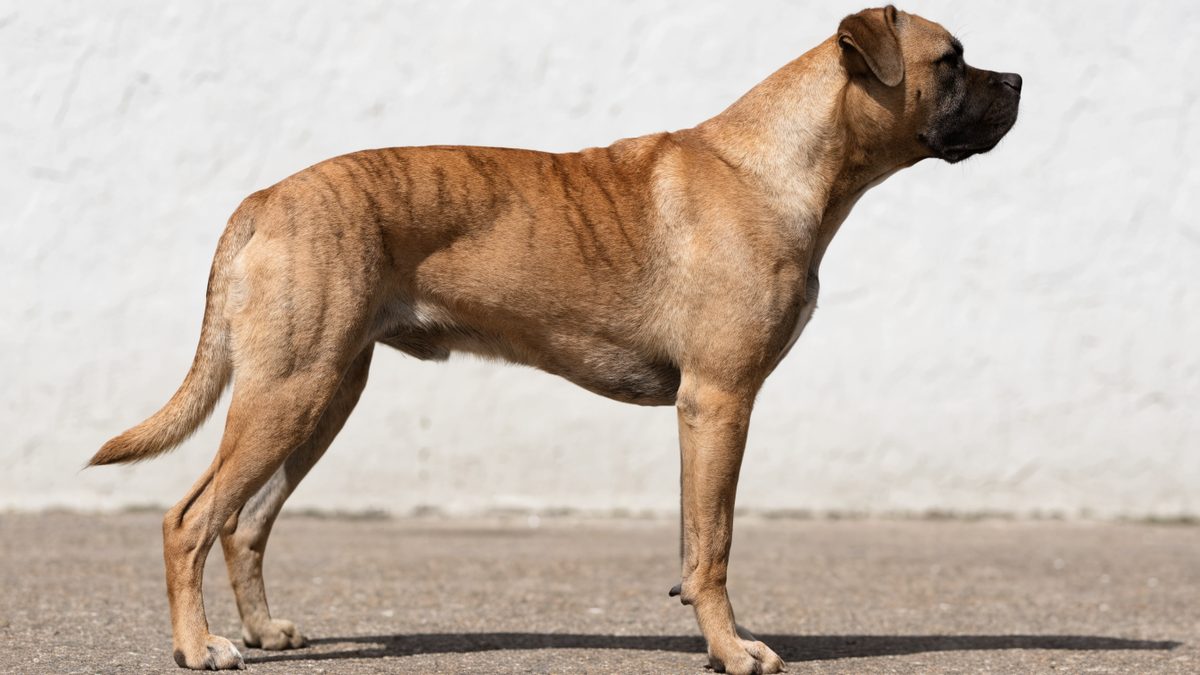
Physically the standard describes a molossoid with the constitution of a runner, great agility, speed and resistance, and elastic movements that recall those of a big cat. The head is a cube, the skull broad and strong, the stop very marked, the muzzle short, wide and deep. The skin is thick, close to the body but elastic, looser at the neck and head, with a slight double dewlap. Colour is brindle in all shades, fawn from sand to red, or black-and-brindle, with or without a black mask.
Two official Spanish documents, and they disagree
This is the part no other page prints. The Alano Español has two official descriptions in Spain, and they are not the same document. The Real Sociedad Canina de España publishes the breed standard, RSCE Standard No. 406. Separately, the Spanish state published a *prototipo racial* in Orden APA/807/2004, the instrument that added the breed to the national list of indigenous Spanish breeds. Bonbeno read both in full. They contradict each other.
| Attribute | RSCE Standard No. 406 | BOE state prototype, 2004 |
|---|---|---|
| Male height at withers | 58 to 63 cm | 60 to 65 cm |
| Female height at withers | 55 to 60 cm | 56 to 61 cm |
| Male weight | 30 to 40 kg | 38 to 45 kg |
| Female weight | 25 to 35 kg | 33 to 38 kg |
| Undercoat | Present. 'a short and thin subhair'; | Absent. 'No existe nunca subpelo', there is never any undercoat |
| Coat length | Not specified | 1 to 2.5 cm, sparser on the abdomen |
| Skull profile | Slightly convex | Concave |
| Rear dewclaws | Eliminatory fault if present or amputated | Total absence |
The weight gap is the largest. A male at the top of the state prototype is 45 kg, while the top of the RSCE standard is 40 kg, so the two documents differ by 5 kg on the same dog. The undercoat disagreement matters most for an Indian reader, because whether a short coat carries an insulating layer underneath is exactly the question that decides how a dog sheds heat. One official Spanish document says a short fine undercoat is present; the other says there is never any undercoat at all. Bonbeno cannot resolve that from the documents themselves, so both are recorded here rather than averaged into a comfortable middle.
History, from Alfonso XI to near-extinction
The history is unusually well documented for a rare breed. The first reliable literary reference is Gonzalo de Berceo in 1247, and one of the fullest early descriptions is in the *Libro de la Montería* of Alfonso XI of Castile, dated 1347. Dogs of this type travelled with Spanish expeditions to the Americas and were used as war dogs. Goya drew them in the bull-ring in his *La Tauromaquia* series of 1816.
Decline was fast and had several causes at once. The use of dogs in the bull-ring was prohibited in 1880, bullfighting on foot spread, hunting practice changed, imported foreign breeds took over, extensive cattle management retreated, and slaughterhouses modernised and stopped using dogs. The collapse is visible in the registration record. Between 1915 and 1930, just 37 Alanos were registered in Spain, alongside one perro de presa and five Mallorcan presas.
Recovery began in the 1980s, when enthusiasts searching the country found surviving populations in a group of northern valleys called Las Encartaciones, spanning parts of Cantabria, Castilla y León and the Basque Country. Those dogs had survived precisely because they still had a job, holding the semi-wild Monchina cattle used in local festivals. The Asociación Nacional de Criadores de Alano Español was constituted in 1995 and built the studbook Alano Español, Wikipedia.
ANCAE's own history states that the breed was officially recognised in March 2003. The statutory instrument that actually added the Alano Español to the annex of Real Decreto 558/2001 is Orden APA/807/2004, dated 24 March 2004, and it records that the Comité de Razas de Ganado de España proposed and admitted the inclusion at its meeting of 22 April 2003. Bonbeno treats the 2004 order as the operative legal date and notes that the breed club dates its recognition a year earlier. Both are recorded because we could not reconcile them from the documents.
One historical footnote is worth keeping, because it connects this breed to dogs Indian readers do know. A Spanish presa bitch called Flora was imported to Germany in 1887, and crossing her with a bulldog produced the first Boxer litter. A Spanish presa called Toro was imported to England from Madrid in 1873 to improve British bulldogs, recorded in *The Field* at 56 cm at the withers and 41 kg.
Alano Español price in India
There is no Alano Español price in India, because there is no Indian market for the breed. Bonbeno searched the Indian SERP for this breed and found no Indian breeder, no Indian listing, and no Indian price figure from any source we could verify. That is the finding, and we will not manufacture a range to fill the gap.
This section exists to answer the query honestly rather than to satisfy it. Indian buyers searching a price in india for a rare foreign breed usually land on a page quoting a confident band of rupees. For this breed, every such number Bonbeno could trace was either a foreign figure converted for effect or a template page with no dog behind it.
What the India SERP actually returns
Page one of an India-restricted search for this breed carries no Indian pet publisher at all. It returns a United States template breed page, three social video results, two Facebook group posts, a US breeder listing site, a US kennel-club entry, Wikipedia, and Etsy. The single result quoting a price in rupees was Etsy, selling Alano Español clipart files rather than dogs.
- Directory template pages. Indian local-search directories carry auto-generated pages titled along the lines of pet shops for Alano Espanol dog in a given city. The same sites carry identical pages for the Akbash and every other breed in the alphabet. The breed name is a URL variable, not an inventory.
- Marketplace dropdown values. Indian puppy-listing sites show the breed inside a navigation list of every breed they know about, on pages that are actually selling Siberian Huskies and Kangals. A name in a filter menu is not a dog for sale.
- One listing site could not be verified at all. The single Indian-facing marketplace URL that nominally targets this breed returned an HTTP 403 and a CAPTCHA wall when Bonbeno tried to open it. We therefore take no figure from it, and record that we could not read it rather than reporting numbers we never saw.
If a seller quotes you a rupee price for an Alano Español puppy in India, the first question is not how much. It is which dog, from where, and under what import authorisation. Given the import position set out below, a domestically advertised Alano Español is far more likely to be a mislabelled bull-type crossbreed than the breed on the RSCE register.
The published foreign figure, and why it does not transfer
The top-ranking page on this query, a United States template breed site, quotes an average puppy price of USD 600 to 2000. Bonbeno reports that only as what that page states. It carries no method, no sample, no date and no breeder source, and it describes a market on another continent. Converting it into rupees would produce a number that looks precise and means nothing, so we have not done it.
The honest comparison is with breeds Bonbeno has actually been able to price in India. The American Pit Bull Terrier and the Cane Corso both have real Indian markets with multiple published, conflicting sources, and Bonbeno compares those sources on their own pages. Do not borrow either figure for this breed. A Cane Corso price tells you what Cane Corsos cost in India. It tells you nothing about an animal that is not sold here.
Why the breed cannot be registered here
The kennel club of india is the only FCI-affiliated national kennel club in the country. It registered 33,880 pure-bred dogs with its studbook in 2025, from 7,412 litters, bringing its cumulative total since inception to 1,425,001 dogs. None of those can be an Alano Español with a full pedigree, because the FCI nomenclature does not contain the breed, as set out in the next section. A dog that cannot enter the studbook cannot carry the paperwork that Indian buyers use to price a purebred puppy, which removes the main mechanism by which an Indian price band forms at all.
Recognition: recognised in Spain, not recognised by the FCI
The Alano Español is recognised by the Real Sociedad Canina de España and by Spanish national law, and it is not recognised by the Fédération Cynologique Internationale. Bonbeno established both halves of that from the registries themselves rather than from secondary breed sites, because this is the single most misreported fact about the breed.
What the RSCE says, in its own words
The RSCE recognises the breed and publishes its breed standard. The header of that standard reads 'R.S.C.E. Standard No.406 (Not Accepted F.C.I.)';. The Spanish kennel club states the non-recognition on the face of its own standard document.
It goes further on the website. The RSCE's index of Spanish breeds sorts them into groups, and the Alano Español is not filed under Group 2 with the Mastín Español and the Presa Canario. It sits under a group the RSCE labels 'Grupo 11: Razas no reconocidas por la FCI', which translates as Group 11, breeds not recognised by the FCI. The breed's own page confirms the classification as Grupo 11. That is a national kennel club maintaining a dedicated bucket for its native breeds that the international federation has not accepted, and putting this breed in it.
The archived English translation of Standard No. 406 classifies the breed under 'Group 2 Pinscher and Schnauzer-Molossoid Breeds, Section 2.1 Molossoid Breeds, Mastiff type', which mirrors the FCI's own group structure. The RSCE's current live page instead classifies it as Grupo 11. The classification changed. Anyone citing the older English PDF for the group number is quoting a superseded figure, which is one reason the recognition position gets reported wrongly so often.
What the FCI list actually contains
Bonbeno read the FCI nomenclature for Group 2, which is where a Spanish molossoid would sit. Under Section 2, Molossian type, the FCI lists exactly two Spanish breeds, the Perro Dogo Mallorquín (249) and the Presa Canario (346). Under Section 2.2, Mountain type, it lists the Mastín del Pirineo (92) and the Mastín Español (91). The Alano Español appears nowhere in the group. Wikipedia's summary that the breed is not recognised by the FCI is therefore confirmed against the primary list.
Spanish national law, which is a separate question
Recognition under Spanish law is real and is often confused with FCI recognition. Orden APA/807/2004 of 24 March 2004 added five Spanish breeds to the annex of Real Decreto 558/2001, which governs official recognition of purebred dog breeder organisations. The five were the Alano Español, the Pastor Garafiano, the Ratonero Valenciano, the Ratonero Mallorquín and the Ca Mè Mallorquí. That order is what makes the breed an officially recognised indigenous Spanish breed with a published state prototype.
| Body | Position | Evidence |
|---|---|---|
| Real Sociedad Canina de España | Recognised. Standard No. 406, filed under Grupo 11 | RSCE standard and breed page Real Sociedad Canina de España |
| Spanish state | Recognised as an indigenous Spanish breed since 2004 | BOE Orden APA/807/2004 |
| Fédération Cynologique Internationale | Not recognised, on any basis | FCI Group 2 nomenclature, breed absent |
| Kennel Club of India | Not registrable, because the KCI follows FCI nomenclature | KCI is India's only FCI-affiliated club Fédération Cynologique Internationale |
The practical consequence for an Indian reader is simple. Recognition in Spain does not travel. A breed absent from the FCI nomenclature cannot be entered in the studbook of an FCI member club, and the KCI is an FCI member club. So there is no route to a KCI pedigree for this dog in India, whatever a seller claims.
Heat tolerance and the Indian climate
Rate the Alano Español a 3 out of 5 for heat tolerance in Indian conditions. That middling score hides a genuinely interesting split, because the coat argues one way and the skull argues the other, and the two Spanish standards do not even agree on the coat.
Take the favourable side first. This is a short-coated breed from the Iberian peninsula, selected to work cattle through Spanish summers in open country. The state prototype puts the hair at 1 to 2.5 cm, denser on the body, softer on the head, sparser on the abdomen, and states flatly that there is never any undercoat. If that description is right, the breed carries no insulating layer at all, which puts it in a completely different position from the double-coated imports Indian owners struggle with most.
That matters because coat is a measurable risk factor. In the largest primary-care study of heat-related illness in dogs, covering 905,543 dogs under UK veterinary care in 2016, the Chow Chow had the greatest risk of any study breed at an odds ratio of 16.17, and the authors attribute a large part of the Golden Retriever's 2.67 times odds against the Labrador to its thicker coat. A dog with little or no undercoat sheds heat better than either.
The RSCE standard describes the coat as short and thick, dense, with a short and thin subhair, meaning an undercoat is present. The Spanish state prototype says there is never any undercoat. This is not a translation quibble. It is the single most decision-relevant physical fact about keeping this breed in Indian heat, and Spain's two official documents disagree about it. Assume the worse case and plan for a dog that does carry some undercoat.
The skull, and why 'brachycephalic' needs unpacking
Now the unfavourable side. Both Spanish documents describe the breed as brachycephalic Orden APA/807/2004 de 24 de marzo. In the same UK study, dogs with a brachycephalic skull shape had 2.10 times the odds of heat-related illness compared with mesocephalic dogs, with a 95 percent confidence interval of 1.68 to 2.64. Dolichocephalic dogs showed no significant difference. On its face that is a real penalty.
But brachycephalic is two different measurements wearing one word, and the distinction decides how worried to be. The craniofacial ratio divides snout length by cranial length, and ratios below 0.3 are classed as extremely brachycephalic while 0.3 to 0.5 is moderately brachycephalic. Separately, the cephalic index divides skull width by skull length, and a dog with a relatively wide skull, such as the Staffordshire Bull Terrier, can be called brachycephalic on that basis alone. The Alano's cube-shaped, very broad skull is a cephalic-index description.
Its muzzle is not short in the extreme sense. The RSCE standard requires the muzzle to be 35 to 37 percent of the total length of the head. That figure uses total head length as its denominator, which is not the denominator the craniofacial ratio uses, so the two numbers cannot be compared directly. For scale, in the study that established the ratio as a risk factor, no dog with a ratio of 0.5 or longer was affected by brachycephalic obstructive airway syndrome, and the affected dog with the longest muzzle was a Staffordshire Bull Terrier at 0.49.
No published morphometric study has measured craniofacial ratio in a population of Alanos Españoles. We will not convert the standard's 37 percent figure into a craniofacial ratio and present the result as evidence, because that would be our arithmetic on a written standard rather than a measurement of real dogs. The honest position is that this breed's airway risk is unquantified, that its muzzle is plainly longer than a Bulldog's, and that later work has found nostril stenosis and neck girth to predict airway obstruction better than muzzle length does within a breed. Have your vet assess the individual dog's nostrils and breathing, not the breed label.
What actually decides the outcome in India
Two things outweigh the anatomy. The first is humidity. Spain's summer heat is largely dry, and panting works by evaporation, so a coastal Indian summer in Mumbai or Chennai strips away cooling capacity that the same dog would have in Andalusia at the same air temperature. The second is drive. This is a dog selected across centuries to grip and hold a bull and not let go, which is the opposite of the self-limiting behaviour that protects a pet from exertional heat stroke.
- Move all work to before 7 am and after 8 pm from March to June across most of India. The middle of the day is unusable for a dog of this mass.
- Never let it self-regulate. A catch-bred molossoid will keep working past the point of safety. You call the stop, not the dog.
- Watch for heat stroke signs and treat them as an emergency. Purina India sets out what to look for and the immediate steps before reaching a clinic. Referral case series have reported fatality rates far above primary-care figures, which reflects how sick referred cases already are.
- Keep it lean. Bodyweight at or above the breed and sex mean carried 1.42 times the odds of heat-related illness in the UK study.
- Check the pavement with your palm. A short-coated dog still burns its pads on Indian tarmac.
For scale on the risk itself, the UK study found an overall incidence of 0.04 percent and an event fatality rate of 14.18 percent, with 40 percent of all cases falling in a single hot July. That is a temperate-country baseline. Indian summers are hotter, longer and, on the coasts, far more humid.
Monthly cost of ownership in India
No reliable monthly cost figure exists for an Alano Español in India, because there is no Indian population of the breed to survey. This section sets out the cost structure a 30 to 45 kg working molossoid would carry in an Indian city, and refuses to publish a total that would be invented.
Bonbeno publishes monthly cost figures only where we can state the sample size, the cities covered and the collection date. For this breed we have none of those, so a rupee total here would be fiction dressed as research. What can be said honestly is which line items dominate, and why this animal sits at the expensive end of every one of them.
Where the money actually goes
- Food. The Spanish state prototype puts males at 38 to 45 kg and the RSCE standard at 30 to 40 kg. Either way this is a large, muscular, high-output dog, and food is the largest recurring line for most owners of dogs this size.
- Preventive veterinary care. Core vaccination, boosters, deworming and year-round tick control. Tick pressure in India is not a seasonal nuisance, it is the baseline. A PCR survey of 525 dogs across four Indian cities found 49.7 percent infected with at least one tick-borne pathogen.
- Climate control. For a dog with this head shape in an Indian summer, cooling is a health cost rather than a comfort. Budget for it the way you would budget for medicine.
- Containment and equipment. A catch-bred dog needs fencing, a secure gate protocol and properly rated harnesses and leads. This is a one-time cost that owners routinely underestimate and then pay twice.
- Professional training. Not optional for this breed in an Indian city. Budget for a competent trainer from month one rather than a behaviourist in year two.
- Import and quarantine, if the dog comes from abroad. Covered in the adoption section. It is the largest single number on this page and it is not a puppy price.
Where we publish a cost, we publish the method with it. Where we cannot verify a figure, we say so plainly instead of repeating an unsourced estimate from another site. For this breed in India, the honest answer is that no verified cost data exists, and the structure above is the most useful thing we can give you.
Grooming is the one line that is genuinely cheap. A coat of 1 to 2.5 cm with little or no undercoat needs almost no professional attention, which is a real saving against the double-coated breeds Indian owners more often buy.
Temperament and household fit
The Alano Español is described by its own standard as a gregarious and sociable molossoid, unusually tolerant of other dogs, affectionate with people and patient with children, wrapped around a serious guarding instinct and a catch dog's grip. Those two halves are both real, and the second one is why this is not a general-purpose family breed.
The RSCE standard is worth quoting closely, because it is more specific than most. In its work the Spanish Alano has always operated in teams with other adult dogs of the same sex and breed, or of other breeds, so it is a gregarious and sociable molossoid able to unite with other dogs which it lives with. It has great capacity to learn and excellent aptitudes as a working dog, combining functionality, beauty and firmness in work with an innate affection towards human beings. As a family dog it is easy to educate, very affectionate and patient with children, and all the seriousness of its physical aspect is in fact a noble and balanced character.
The dog-tolerance point is genuinely unusual
Pack-hunting history left this breed more tolerant of other dogs than most bull types. That is a real difference from the American Pit Bull Terrier, whose own breed standard records some level of dog aggression as characteristic, and it is worth knowing if you are cross-shopping bull-type breeds. It is not a guarantee about any individual animal, and unjustified aggressiveness towards other dogs or people is listed as an important fault in the standard rather than as an impossibility.
Animal fighting is a criminal offence in India
Any honest account of a bull-type catch breed has to deal with this directly. Forcing animals to fight is illegal in India. Section 11(1)(m)(ii) of the Prevention of Cruelty to Animals Act, 1960 makes it an offence, solely with a view to providing entertainment, to incite any animal to fight or bait any other animal. Section 11(1)(n) separately makes it an offence to organise, keep, use or act in the management of any place for animal fighting or for the purpose of baiting any animal, to permit or offer any place to be so used, or to receive money for admission to such a place.
The historical record on this page includes bull-catching in the Spanish ring, and Bonbeno reports that as breed background because it explains the animal's construction. It is history, not a recommendation, and the practice was prohibited in Spain in 1880. Bonbeno publishes nothing that instructs, encourages or assists animal fighting or baiting, and the historical material here is not a guide to using a dog that way.
Any seller who presents fighting ability, gameness or a fighting bloodline as a selling point is describing a criminal use of the animal under sections 11(1)(m)(ii) and 11(1)(n) of the PCA Act 1960. Walk away, and consider reporting the listing. A seller worth dealing with talks about temperament stability, health screening and placement suitability, and will refuse a sale to the wrong home.
Who this breed suits, and who it does not
- Good fit. Rural or semi-rural Indian households with secure land, prior experience of large working breeds, and a genuine daily job for the dog.
- Poor fit. Apartments, first-time owners, households that are empty all day, and anyone buying on appearance. An athletic 40 kg catch dog in a two-bedroom flat is a welfare problem before it is a training problem.
- Watch item. The breed guards farms and properties by tradition. In a dense Indian neighbourhood with constant footfall at the gate, that instinct needs active management rather than encouragement.
- Legal watch item. Ownership is legal across India, but municipal rules vary and can change. See the adoption section.
On breed and bite risk generally, Bonbeno follows the American Veterinary Medical Association, which opposes breed-specific legislation, notes that any dog can bite, and finds that socialisation, neutering and proper containment predict risk far better than breed does. Read carefully, that strengthens the case against this breed for a typical Indian flat rather than weakening it, because containment and daily outlet are exactly what such a household struggles hardest to supply.
Training an Alano Español
Train an Alano Español with reward-based methods from the first week home, and treat impulse control and a reliable stop as the two skills that matter more than anything else. The standard credits the breed with a great capacity to learn and excellent working aptitude, so the ceiling is high.
The training problem with this breed is not intelligence and it is not willingness. It is that centuries of selection rewarded a dog that commits to a decision under pressure and does not release it. Historical accounts describe an animal whose ancestral instinct is to take hold and sustain it. Everything useful in training follows from accepting that and building an off switch, rather than pretending the drive is not there.
What to train first, in order
- Name response and a reliable recall. Start week one. This is the skill that makes every other skill usable.
- A trained release. Teach a clean out or drop on cue with toys long before it is ever needed for anything else. In a catch-bred dog this is a safety behaviour, not a party trick.
- Impulse control around gates and doors. A guarding breed at an Indian gate with visitors, delivery riders and street dogs needs a rehearsed protocol, not improvisation.
- Loose-lead walking. You will not out-muscle a 40 kg dog. Do this work in month two, not year two.
- Settle on a mat. The single most underrated behaviour for a large working dog living in a busy household.
- Handling and muzzle conditioning. Condition a basket muzzle as a neutral, positive object early. It makes veterinary care safer and keeps options open.
Socialisation, and the Indian timing problem
Socialise the puppy deliberately and early, because a guarding breed that misses the window becomes a genuinely difficult adult. The practical Indian complication is that the socialisation period overlaps the vaccination course, and owners who isolate a puppy until the last shot lose the window. Discuss managed low-risk exposure with your vet rather than choosing between the two.
Three things reliably go wrong. Harsh corrections applied to a thick-skinned working dog escalate arousal instead of reducing it. Under-employment produces destruction rather than calm, because a dog bred to work does not idle well. And inconsistency at the gate teaches a guarding dog that the rules are negotiable, which is the one lesson you cannot afford it to learn.
Realistic timelines
| Skill | Start | Reliable by |
|---|---|---|
| Name response | Week 1 home | 3 to 4 weeks |
| Sit, down, settle | Week 1 home | 4 to 8 weeks |
| Toilet training | Week 1 home | 4 to 6 months |
| Trained release on cue | Month 1 | 6 to 10 months |
| Loose-lead walking | Month 2 | 8 to 12 months |
| Reliable recall off-lead | Month 2 | 12 to 24 months |
| Calm gate behaviour with visitors | Month 2 | 12 to 18 months |
Adolescence in a large guarding breed runs late and hits hard, typically from about 9 months into the second year. Trained behaviours wobble, the dog starts taking its own view of strangers, and owners who switch to harsher handling at that point do lasting damage. Hold the line and it passes.
Daily exercise requirement
An adult Alano Español needs a minimum of 90 minutes of real physical work a day, split across the cool ends of an Indian day, plus daily mental work. This is a functional working animal, and the standard describes a fast, elastic gallop with large extensions and flexions of the trunk, very quick and resistant.
Bonbeno states that 90-minute figure as an editorial judgement derived from the breed's described function, not as a published veterinary recommendation, because no exercise study exists for this breed. What is documented is what the animal was built to do, which is to hold half-wild cattle in mountain country and work big game across distance. A dog constructed for that does not get enough out of two short neighbourhood walks.
The Indian scheduling problem
The exercise requirement and the heat constraint collide directly, and this is the single hardest practical problem with keeping this breed in India. From March to June across most of the country, the usable window is before 7 am and after 8 pm. That is two sessions, and both of them have to count.
- Structured physical work in the cool windows. Long walks on varied terrain, controlled hill work, and drag or pulling work with proper equipment on a conditioned dog.
- Scent work substitutes for distance indoors. Twenty minutes of nose work tires a working molossoid more than twenty minutes of pavement, and it can be done inside during a heatwave or a monsoon downpour.
- Controlled tug with rules. For a catch-bred dog this is honest outlet, provided the release cue is solid and you decide when it starts and stops.
- Swimming where clean water is genuinely available. Load without heat or joint impact, though this is realistically an option for very few Indian households.
- Skip the midday session entirely. Two good sessions beat three that include one dangerous one.
Large-breed growth plates stay open well past the first birthday, and forced exercise before they close causes permanent orthopaedic damage. No jogging, no stairs marathons and no repetitive impact work with a puppy of a 40 kg breed. Build adult load gradually from around 18 months, and set the specific plan with your nearby vet, who can assess the individual dog.
What happens without it
Under-exercised working molossoids do not become calm house dogs. They become destructive, vocal, harder to handle at the gate and more reactive on lead, and in a large guarding breed each of those consequences is heavier than it would be in a small one. This is the most common route by which a dog of this type ends up rehomed, and it is entirely predictable at the point of purchase.
If the honest answer is that your household cannot supply 90 minutes a day, every day, for a decade, that is a reason to choose a different breed rather than a problem to solve later. The Indian Pariah Dog is a fraction of the work and far better adapted to the climate.
Grooming and coat care in Indian humidity
Grooming an Alano Español takes about ten minutes a week. The coat is short and needs almost nothing, so in Indian conditions the real work is the skin underneath it, particularly the neck folds and the dewlap through a humid monsoon.
The Spanish state prototype describes hair of 1 to 2.5 cm, dense on the body, softer on the head and sparser on the abdomen, with the tail hair harder and thicker in a spike shape. The RSCE standard describes it as short and thick, dense, with a short and thin subhair. Either way, a rubber curry brush once or twice a week lifts the dead hair and that is the whole coat routine.
The skin is the actual job
Both standards describe skin that is thick and hard, close to the body but somewhat elastic, looser at the neck and head, with some wrinkles on the face and folds at the neck, and a slight double dewlap. Folds plus Indian monsoon humidity is the classic recipe for skin fold dermatitis, because moisture sits in a warm crease where air does not circulate.
- Dry the neck folds properly after every bath and every soaking. Damp folds in humid weather are where infection starts.
- Check the folds weekly for redness, odour or discharge, and treat a smell as a reason to see a vet rather than to bathe more.
- Do not over-bathe. Stripping a rustic short coat of its oils creates the problem you were trying to prevent.
- Run tick control year-round, not seasonally. Rhipicephalus and Haemaphysalis ticks were found on 53 percent of dogs in an Indian survey.
- Check ears, feet and pads weekly. The standard describes strong, thick pads on a working foot, and Indian tarmac tests them.
Ear cropping is illegal in India
This breed carries a specific trap, and it comes straight out of the standard. The RSCE standard describes the ears as medium set, very separated, usually trimmed from its base, and adds that if they are not trimmed they are folded over the face. The Spanish state prototype likewise describes ears as dropped or cropped. In other words, the breed standard itself contemplates cropped ears as normal.
Ear cropping is not lawful in India. The Prevention of Cruelty to Animals (Dog Breeding and Marketing) Rules, 2017 provide that there shall be no tail docking or ear cropping or any other mutilation of any body part of a pup, and that any change of appearance by artificial means is strictly forbidden. Section 11 of the Prevention of Cruelty to Animals Act, 1960 separately makes it an offence to mutilate any animal. A cropped Alano Español in India is evidence of an illegal procedure, not of breed type, and a seller offering cropped puppies is advertising an offence.
This is one of the few places where following a foreign breed standard literally would put an Indian owner on the wrong side of the law. The correct reading is that the natural, uncropped ear is what you keep, and that a cropped dog conforms to a Spanish show convention at the cost of an Indian legal prohibition.
Health risks and lifespan
The Alano Español has no published breed-wide health survey, no compulsory screening scheme, and no peer-reviewed lifespan study. What it does have is a measured inbreeding problem, documented at 11.87 percent mean coefficient across a 227-dog population, and that is the single most useful health fact available for the breed.
Bonbeno will not import health figures from the Cane Corso, the American Pit Bull Terrier or any bullmastiff-type breed to fill this section. Those are different breeds with different founder populations, and borrowing their prevalence numbers would produce exactly the kind of confident, wrong page this encyclopedia exists to replace. What follows is what is actually documented.
The founder bottleneck, measured
This breed came within a very narrow margin of disappearing. Only 37 Alanos were registered in Spain across the fifteen years from 1915 to 1930. The modern population descends from a small group of survivors located in Las Encartaciones in the 1980s, rebuilt from named foundation dogs.
That bottleneck was measured. A 1999 study by two veterinary graduates of the University of Córdoba, working from the ANCAE studbook, analysed 227 Alanos Españoles, comprising 119 females and 108 males. The inbreeding coefficient was calculated for each individual and for the population. Mean population inbreeding was 0.1187, that is 11.87 percent.
For scale, a mating between full first cousins produces offspring with an inbreeding coefficient of 6.25 percent. A population mean of 11.87 percent is therefore well above cousin-level relatedness on average. The breed club responded by planning matings from co-ancestry tables and excluding crosses whose offspring would exceed 12.5 percent, and reported seven years later that this had produced acceptable homogeneity with no signs of inbreeding depression. That is a responsible answer to a real problem, and it is also an acknowledgement that the problem was real.
Population size, which is the context for everything above
ANCAE registered 711 Alanos in total up to the first quarter of 2006, split between 276 in the initial register and 435 with complete four-generation pedigrees, across 125 litters from 25 breeders at an average of 4.9 puppies per litter. The association estimated the living population under its control at around 400 dogs. Those are small numbers, and they are the reason genetic management matters more in this breed than a list of named conditions would.
Airway risk, honestly bounded
Because both Spanish documents describe the breed as brachycephalic Orden APA/807/2004 de 24 de marzo, airway function deserves attention even though no breed-specific study exists. Brachycephalic obstructive airway syndrome risk rises sharply and non-linearly as relative muzzle length shortens. Within brachycephalic breeds, however, later work found nostril stenosis and neck girth ratio to be better predictors than craniofacial ratio, and among dogs with open or only mildly stenotic nostrils just 25 percent were affected, against 70 percent of those with moderately or severely stenotic nostrils.
The practical translation is to assess the individual dog rather than the label. Ask your vet to look at the nostrils and listen to the breathing at rest and after exertion. Stenotic nostrils are visible, correctable and far more informative than any breed-level generalisation.
Lifespan
No peer-reviewed lifespan figure exists for the Alano Español. Bonbeno searched for one and did not find it. Popular breed sites publish lifespan ranges for this breed, but none we found cites a study, a registry dataset or a mortality survey, so we are not repeating those numbers here. Large working molossoids as a group are shorter-lived than small breeds, but converting that generalisation into a specific range for this breed would be a fabrication.
Nothing on this page is a diagnosis or a treatment plan. Consult your nearby vet, a registered veterinarian who has physically examined your dog, before acting on anything here, and treat sudden collapse, laboured breathing or suspected heat stroke as an emergency rather than something to watch overnight.
Feeding and nutrition
Feed an Alano Español as a large-breed working dog, with controlled growth through puppyhood and a lean adult body condition maintained for life. Growth rate matters more than total volume, because fast growth in a large breed loads developing joints at exactly the wrong time.
Adult targets come from the standards, and the two disagree. The RSCE standard puts males at 30 to 40 kg and females at 25 to 35 kg. The Spanish state prototype puts males at 38 to 45 kg and females at 33 to 38 kg. Feed the dog in front of you to a body condition score rather than to either chart, because a 5 kg disagreement between official documents tells you the chart is not the authority.
The lean-dog argument, which is a heat argument in India
Keeping this breed lean is not cosmetic. In the UK primary-care study, dogs at or above the mean bodyweight for their breed and sex carried 1.42 times the odds of heat-related illness, and dogs over 50 kg carried 3.42 times the odds of dogs under 10 kg. An Alano allowed to drift to the top of the heavier standard, in an Indian summer, is stacking a modifiable risk on top of an unmodifiable one.
- Use a large-breed puppy formulation through growth rather than an all-life-stages food.
- Split the daily ration across two meals rather than one, which is standard practice for deep-chested breeds. The standard describes a chest that descends to the elbow.
- Do not feed immediately before or after hard work. Deep-chested large breeds are the classic bloat risk profile.
- Score the body condition monthly by hand, feeling for ribs, rather than reading a weight off a scale in isolation.
- Expect appetite to drop in peak summer. Persistent inappetence is a veterinary matter, not a preference.
Feeding quantities depend on the individual dog's age, weight, body condition, health status and workload. Set them with a registered veterinarian who has examined your dog, and revisit them as the dog matures and as the season changes.
Alano Español puppy: the first year, month by month
An Alano Español puppy spends its first year doing two things that matter, growing a large frame safely and building a social map it will use for the rest of its life. Get the second one wrong in a guarding breed and no amount of later training fully repairs it.
Bonbeno publishes no month-by-month weight chart for this breed, because no published growth data exists for it and inventing a table of kilograms would be exactly the fabrication this page has refused elsewhere. What follows is a developmental timeline, which is genuinely transferable across large working breeds, with the breed-specific pressure points flagged.
- 8 to 12 weeks. Home, name, toilet routine, gentle handling of ears, feet and mouth. Vaccination course begins. Managed socialisation starts now, not after the last shot. Begin fold-checking and muzzle familiarisation as games.
- 3 to 4 months. Teething, so mouthing peaks, and in a catch-bred breed redirect it rather than punish it. Formal exercise stays very short. Introduce the release cue on toys. First real exposure to gate traffic under control.
- 4 to 6 months. Vaccination course completes. Loose-lead work in earnest while the dog is still liftable. If this window falls in an Indian summer, heat management becomes a daily discipline rather than an occasional worry.
- 6 to 9 months. Growth slows and adolescence begins. Guarding behaviour appears for the first time and often surprises owners. Sterilisation timing is a conversation to have with your vet, since in large breeds it interacts with growth-plate closure.
- 9 to 14 months. Peak adolescence. Trained behaviours wobble and the dog starts forming its own opinions about strangers. Growth plates are still open, so still no jogging or repetitive impact work.
- 14 to 18 months. Growth plates close. Build adult exercise load gradually from here. Re-proof recall and the release cue against real distractions.
- 18 months to 2 years. Physical and mental maturity arrive late in large molossoids. Expect the finished temperament around here rather than at the first birthday.
This is the highest-stakes decision of the first year for a guarding breed, and Indian owners get it wrong in good faith. Waiting until every vaccine is done means the sensitive period has largely passed, and a poorly socialised guarding molossoid is a lifelong management problem. Ask your vet specifically about controlled, low-risk exposure during the course rather than choosing between infection risk and behavioural risk.
One breed-specific note. Because the ears are naturally folded over the face when uncropped, and because cropping is illegal in India, get the puppy comfortable with routine ear handling and cleaning early. A drop-eared dog in a humid climate needs that access for its whole life.
Alano Español compared with the bull-type breeds Indians actually buy
Choose one of the breeds you can actually obtain in India rather than this one, unless you are a returning resident already living with an Alano abroad. The comparison below exists because the honest recommendation for almost every Indian reader is a different dog, and it helps to see why.
Bonbeno covers the bull-type group in depth, and the practical differences that matter in India are availability, registrability, dog tolerance and heat behaviour rather than temperament folklore.
| Factor | Alano Español | Cane Corso | American Pit Bull Terrier |
|---|---|---|---|
| Available in India | No. Effectively unavailable | Yes, an established market | Yes, a large market |
| FCI recognised | No Fédération Cynologique Internationale | Yes, standard 343 | No, UKC recognised |
| KCI registrable | No Fluffyn, KCI Registration Explained | Yes | No |
| Indian price data exists | No, none found | Yes, multiple conflicting sources | Yes, multiple conflicting sources |
| Tolerance of other dogs | Good. Standard calls it gregarious and sociable | Variable, guarding-typical | Dog-selective by its own standard |
| Skull type | Described brachycephalic, moderate muzzle | Brachycephalic | Mesocephalic |
| Named in the quashed 2024 circular | No | Yes | Yes |
| Ear cropping in the standard | Yes, cropping described | FCI standard requires natural ears | Cropping common, illegal in India |
The row that should decide it is the first one. Everything else is a comparison between a dog you can actually get and a dog you cannot.
One difference genuinely favours the Alano
Dog tolerance is the Alano's real distinguishing feature within this group, and it is not marketing. The breed was worked in mixed packs alongside villanos, warren hounds, tracking dogs and mastiffs, and its standard describes a molossoid able to unite easily with other dogs it lives with Alano Español, Wikipedia. That is a meaningfully different starting point from the Staffordshire Bull Terrier or the Bully Kutta, where dog-directed behaviour is the central management problem.
None of the three breeds in that table is a good heat choice for India, and the Alano is only relatively better because of its coat rather than absolutely good. If Indian summers are the constraint that actually matters to you, the honest answer is a native breed such as the Indian Pariah Dog or the Rajapalayam, which are adapted to the climate rather than managed through it.
Mistakes Indian buyers make with this breed
The failure modes here are unusual, because most of them happen before anyone owns the dog. This breed's Indian problem is misidentification and misinformation at the point of purchase, not day-to-day husbandry.
- Believing a seller who offers one in India. There is no Indian breeding population and commercial import of dogs for breeding or sale is not permitted. A domestically offered Alano Español is far more likely to be a mislabelled bull-type crossbreed. Verify the dog's origin documents before anything else.
- Assuming Spanish recognition means KCI papers. It does not. The FCI does not list the breed, and the KCI is an FCI-affiliated club, so no KCI pedigree is available for this dog at any price.
- Cropping the ears to match the standard. The Spanish standard describes cropped ears, and Indian law prohibits the procedure Section 11, The Prevention of Cruelty…. Following the standard here breaks the law.
- Reading 'short coat' as 'heat proof';. A short coat helps, and the two Spanish standards do not even agree on whether an undercoat exists. Skull shape and working drive matter at least as much.
- Letting the dog decide when to stop. A catch-bred molossoid will work past its own safe limit. Exertional heat stroke in India is an owner-timing failure, not a dog failure.
- Buying a 40 kg working breed for an apartment. The exercise requirement is not negotiable and the breed does not idle well.
- Borrowing another breed's health numbers. No breed-wide health survey exists for the Alano. Screening advice built on Cane Corso or Bullmastiff prevalence data does not transfer.
- Skipping year-round tick control because the coat looks easy. Half of dogs sampled in an Indian survey carried a tick-borne pathogen.
- Treating any seller who markets fighting ability as legitimate. That is a criminal use of the animal under the PCA Act 1960. Walk away.
Paying a premium for a dog described as a rare imported Alano Español, with no verifiable pedigree, no import paperwork and no registry that can confirm it. Because the breed cannot be registered through the FCI system, there is no document that proves what you bought. That absence is not a gap a seller can fill with a certificate, and any certificate offered should be treated as a reason for more scrutiny rather than less.
Legality, import reality and the adoption alternative
Owning an Alano Español is legal across India, and obtaining one lawfully is close to impossible unless you are already living with the dog abroad and moving home. There is no nationwide breed ban in India, and there is a hard import restriction, and those are two different things.
The legal position on bull-type breeds in India
There is no nationwide ban on any dog breed in India. The central circular of 12 March 2024, which listed 24 comma-separated entries where CBIC Instruction 05/2024-Customs of 14 March 2024 reproduces it in full, 23 in press reports that fold the closing Bandog clause in and 25 where Japanese Tosa and Akita is split, and directed states to stop issuing licences for their sale, breeding or keeping, was quashed by the Karnataka High Court on 10 April 2024 and set aside by the Delhi High Court on 16 April 2024 The Indian Express. The Karnataka court held that the Central government could not impose a blanket breed ban by circular without power under the Prevention of Cruelty to Animals Act, 1960 or the ABC Rules, that no stakeholders were heard, and that the circular travelled beyond the Rules. The Delhi court recorded that no private body had been heard before the circular issued. Three high courts had already stayed it in part before that.
The Alano Español was not named in that circular, unlike the Cane Corso and the American Pit Bull Terrier, both of which were. Bonbeno reports the law as at its research date, and this is not legal advice. Municipal rules are made locally, are not uniform across India, and can change, so ask your municipal body and your housing society in writing before acquiring any large bull-type dog and keep the reply.
Why you cannot simply import one
This is the section that actually answers the question. Under India's import policy, live dogs fall under ITC (HS) 01061900 and the import policy is Restricted. Policy Condition 7 allows import of dogs only for three purposes: a pet dog with a valid pet book and records in the name of the importer, dogs imported by R&D organisations with CPCSEA recommendation, and dogs for internal security by the Defence and Police Forces. Policy Condition 8 states that import of commercial dogs for breeding or any other commercial activity is not permitted.
| Route | Position |
|---|---|
| Buying a puppy from a Spanish breeder for sale or breeding in India | Not permitted. Applications for trading or breeding purposes shall be duly rejected |
| Bringing your own dog when you move to India | Up to two pets as passenger baggage without DGFT import authorisation, only for a person transferring residence after two years of continuous stay abroad |
| Stay abroad under two years, or not travelling as baggage | DGFT import authorisation required, applied for against an IEC |
| More than two pets | DGFT import authorisation required, examined by DAH&D on justification |
| Ports of entry | Only Delhi, Mumbai, Chennai, Hyderabad, Bangalore and Kolkata, with quarantine where required; DAHD added Kochi for pets arriving under the baggage rules in October 2024 |
| Lead time | Begin the authorisation process at least two months before travel |
An Advance No Objection Certificate must also be obtained from the Regional or Quarantine Officer at the port, supported by the DGFT licence and a health certificate from a veterinarian in the exporting country, with the prescribed disease testing done abroad and reports travelling with the animal. This is the honest answer to how to get an Alano Español in India. It is a relocation process for an existing owner, not a purchase route.
If you are set on a bull-type dog, adopt
Adopt rather than chase an unobtainable breed. Indian shelters and bull-breed rescues consistently hold bull-type dogs and bull-type crosses, surrendered when families underestimated the exercise, the size or the management. Adopting an adult also removes the two biggest unknowns in any puppy purchase, which are adult temperament and early health history.
- Ask the shelter for a behaviour assessment, particularly around other dogs and around gate and doorway behaviour.
- Meet the dog more than once, and walk it before deciding.
- Be honest about your daily schedule. A working-type dog in a household that cannot exercise it returns to the shelter.
- Ask about known health history and get an independent veterinary check before committing.
- Check your local municipal rules and society bye-laws in writing for any large bull-type breed.
If you are moving to India with an Alano already
You are the one reader this page can genuinely help with logistics. Start the DGFT process at least two months before travel, confirm your port of entry is one of the six ports the DGFT notice names, get the Advance NOC seven days before travel, and have the exporting-country health certificate and test reports travelling with the dog. A pet arriving under the baggage rules can also land at Kochi since October 2024. Then plan the heat management described above before the first Indian summer, not during it. The full route is set out in how to import a dog to India.
Because the Alano Español sits outside the FCI system, the usual verification chain that Indian buyers rely on does not exist for it. The RSCE publishes the standard and the breed club maintains the studbook in Spain Parra Gordillo FJ. El Alano Español, and neither of those produces a document an Indian registry will recognise. Treat that as the defining practical fact about the breed in India, and be sceptical of anyone who tells you otherwise.
Alano Español questions, answered from the registries
Is the Alano Español recognised by the FCI?
No. The Fédération Cynologique Internationale does not recognise the Alano Español on any basis. Its Group 2 nomenclature lists only four Spanish breeds, the Perro Dogo Mallorquín, Presa Canario, Mastín del Pirineo and Mastín Español, and the Alano is absent. The RSCE's own standard header reads 'Not Accepted F.C.I.'
Is the Alano Español a recognised breed at all?
Yes, in Spain. The Real Sociedad Canina de España recognises it under Standard No. 406 and files it in Grupo 11, which the RSCE labels breeds not recognised by the FCI. Spanish national law added it to the list of indigenous Spanish breeds by Orden APA/807/2004 of 24 March 2004.
What is the Alano Español price in India?
There is no Alano Español price in India, because there is no Indian market for the breed. Bonbeno found no Indian breeder, no verifiable Indian listing and no Indian price figure from any source. Any rupee figure you are quoted should be treated as a warning sign rather than a market rate.
Can I import an Alano Español into India?
Only as your own pet when you relocate. Live dogs are a Restricted import, and Policy Condition 8 states that import of commercial dogs for breeding or any other commercial activity is not permitted. Up to two pets travel as passenger baggage only for someone transferring residence after two years of continuous stay abroad.
Can an Alano Español be registered with the Kennel Club of India?
No. The Kennel Club of India is India's only FCI-affiliated national kennel club, and the FCI nomenclature does not contain this breed. There is therefore no route to a KCI pedigree for an Alano Español in India, whatever documentation a seller offers.
Is the Alano Español banned in India?
No. There is no nationwide ban on any dog breed in India, and the Alano Español was not among the 24 breeds named in the March 2024 central circular. That circular was quashed by the Karnataka High Court on 10 April 2024 and set aside by the Delhi High Court on 16 April 2024. Local municipal rules still apply.
Can an Alano Español handle Indian heat?
With active management, and with more risk than its short coat suggests. Bonbeno rates heat tolerance 3 out of 5. The short coat helps and the Iberian working origin helps, but both Spanish standards describe the breed as brachycephalic, and brachycephalic dogs carried 2.10 times the odds of heat-related illness in a 905,543-dog study.
Does the Alano Español have an undercoat?
Spain's two official documents disagree. The RSCE Standard No. 406 describes the coat as short and thick with a short and thin subhair, meaning an undercoat is present. The state prototype in BOE Orden APA/807/2004 states that there is never any undercoat. Bonbeno records both rather than picking one.
How long do Alano Españoles live?
No peer-reviewed lifespan study exists for this breed, and Bonbeno will not repeat the unsourced ranges published on popular breed sites. Large working molossoids as a group are shorter-lived than small breeds, but converting that generalisation into a specific figure for this breed would be a fabrication.
Is ear cropping on an Alano Español legal in India?
No. The Spanish breed standard describes ears that are usually cropped from the base, but the Prevention of Cruelty to Animals (Dog Breeding and Marketing) Rules, 2017 prohibit ear cropping and any change of appearance by artificial means. A cropped dog in India is evidence of an illegal procedure, not of breed type.
Is the Alano Español good with other dogs?
Better than most bull-type breeds, by the standard's own account. It was always worked in teams alongside other dogs, and the RSCE describes a gregarious and sociable molossoid able to unite easily with dogs it lives with. That is a starting point rather than a guarantee about any individual animal.
How rare is the Alano Español?
Genuinely rare. Only 37 Alanos were registered in Spain between 1915 and 1930, and the breed was rebuilt from survivors found in Las Encartaciones in the 1980s. ANCAE had registered 711 dogs in total by the first quarter of 2006 and estimated its living population at around 400.
What health problems does the Alano Español have?
No breed-wide health survey or compulsory screening scheme exists. The documented issue is genetic. A 1999 study of 227 dogs from the ANCAE studbook measured mean population inbreeding at 11.87 percent, well above first-cousin level. Consult your nearby vet about assessing an individual dog rather than relying on breed generalisations.
Was the Alano Español used for bull-baiting?
Dogs of this type were used in the Spanish bull-ring until the practice was prohibited in 1880, and Goya depicted them there in 1816. Bonbeno reports that as breed history. Animal fighting and baiting are criminal offences in India under sections 11(1)(m)(ii) and 11(1)(n) of the Prevention of Cruelty to Animals Act, 1960.
How big is a Spanish Alano dog?
Spain's two official documents disagree, so both are printed. RSCE Standard No. 406 gives males 58 to 63 cm at the withers and 30 to 40 kg, and females 55 to 60 cm and 25 to 35 kg. The Spanish state prototype in Orden APA/807/2004 gives males 60 to 65 cm and 38 to 45 kg, and females 56 to 61 cm and 33 to 38 kg, so the two differ by 5 kg on the same dog. The standard describes a molossoid with the constitution of a runner, a cube-shaped head, a short, wide, deep muzzle and thick elastic skin with a slight double dewlap.
What is a Spanish Bulldog?
The Spanish Bulldog is the Alano Español, a Spanish bull-type catch dog of alaunt or molossoid type also called the Spanish Alano. It was bred for agarre, the catch and hold: the RSCE describes a dog used for catching fierce cattle in the mountains for their vaccination, branding and driving, in big game, and in the defence of farms and properties. Dogs of this type were used in the bull-ring until the practice was prohibited in 1880, only 37 were registered in Spain between 1915 and 1930, and the breed was rebuilt from survivors found in Las Encartaciones in the 1980s. Spain recognises it under RSCE Standard No. 406; the FCI does not.
Compare with similar breeds
Alano Español sits in 1 Bonbeno group. Each one compares it directly against the breeds it is genuinely an alternative to, on the same figures.