
Breed profile
Lobito Herreño: The India Guide
El Hierro's wolf-grey herding dog, measured against the four registers that decide what a Spanish breed is, and against an Indian summer it has never met.
Quick answer
The lobito herreño is a medium wolf-grey herding dog from El Hierro in the Canary Islands, and Spain does not classify it as a breed. The Real Sociedad Canina de España files it as an ethnic group, and it appears in none of the four registers that decide the question: Spain's own list of 33 Spanish dog breeds, the Canary Parliament's heritage resolution, and the FCI's definitive and provisional registers. There is no Indian market for it. Heat tolerance 2 of 5.
This page summarises published breed prototypes, peer-reviewed veterinary and genetics research, Indian legal texts and Indian climate and care-cost data for general information. It is not a diagnosis and it is not treatment advice. Consult a registered veterinarian who has examined your own animal before acting on anything here, especially on parasite control, vaccination and heat management.
Lobito Herreño at a glance
What the Lobito Herreño is
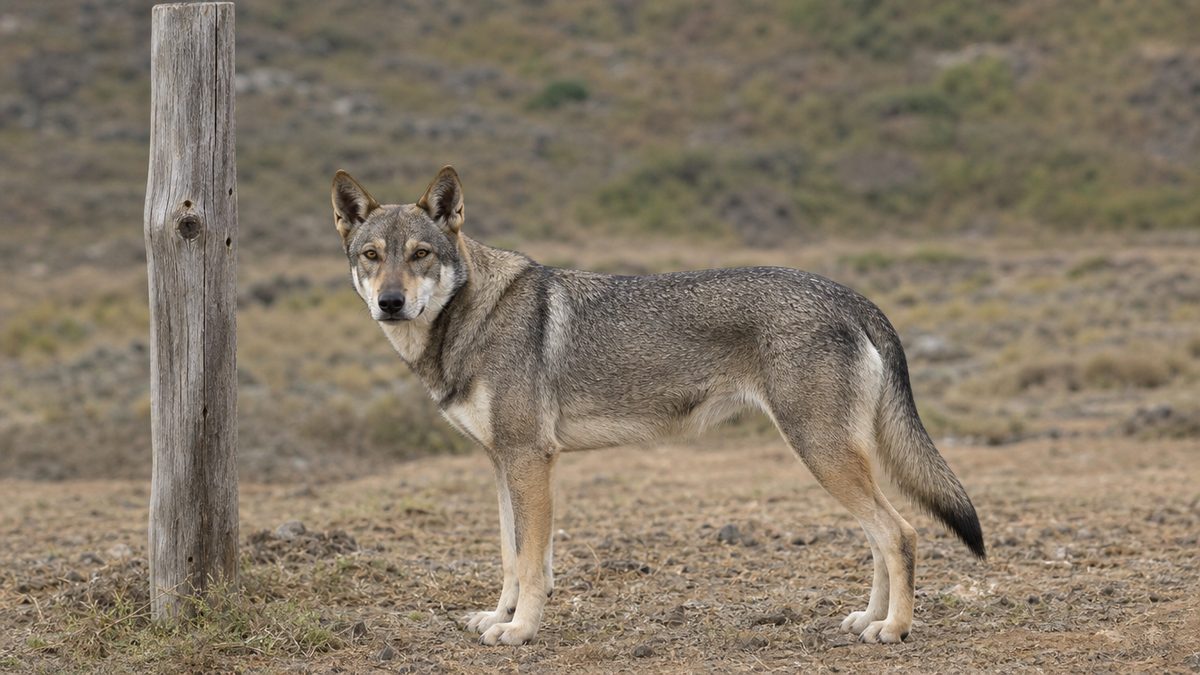
The Lobito Herreño is a medium wolf-grey herding dog from El Hierro, the smallest and westernmost of the Canary Islands, kept by island shepherds to move the goats and sheep that graze the island's volcanic slopes. Its name means little wolf of El Hierro, and the wolf part is about looks, not ancestry.
Spain's national kennel club publishes a prototype for it. The Real Sociedad Canina de España describes a lupoid canine of medium type, straight profile, and primitive, wolf-like appearance, gives its use as perro de pastoreo, and sets a mean weight of 22 kg for males and 18 kg for females with a height at withers of 54 cm and 52 cm. That prototype does not sit among the society's Spanish breeds. It sits in a separate block headed Grupos Étnicos Caninos, which is the society's holding category for a dog population that looks like a breed and has not become one.
The distinction is the whole story of this dog, and Spain's own kennel club states it plainly. Carlos Salas Melero, writing for the society, defines an ethnic group as a canine population sharing physical and functional traits fixed by functional selection within a defined geographical area, and then says what turns one into a breed: a specific selection effort by breeders, agreed around a common project, meaning a racial standard, with the individuals registered generation after generation in a libro de orígenes, until phenotype and genotype are stable across at least three generations. A breed standard, and a studbook. That is the same two-condition test Bonbeno applies on dog types that are not breeds, arrived at independently by the body that decides the question in Spain.
Where the dog actually lives
El Hierro holds the largest population, with animals also on Tenerife, Gran Canaria and La Palma. The breeders' association reports dogs on the Spanish mainland, in other European countries, in the United States and in Venezuela. None of those places is India, and no Indian population, breeder or listing was found.
The island itself is small and steep. That matters more than it sounds, because it is why the dog exists at all: a herding dog on El Hierro moves stock across broken volcanic ground rather than across open pasture, and it does so in a climate that never gets hot in the Indian sense. The climate section below works that out from measured data rather than from adjectives, using satellite climatology queried by explicit coordinates.
What this page adds
Every page currently ranking for this name in India repeats two sentences from one Wikipedia article, and not one of them opens a register. This page opens four: Spain's own list of Spanish dog breeds, the ministry's livestock catalogue that every news report names as the destination of the current recognition file, and the FCI's definitive and provisional registers. Each was searched with a control that passed, and the results are set out in full below.
This is a real dog with a real published prototype, a real breeders' association working since 1988, and a real peer-reviewed genetics paper. It is not a recognised breed anywhere, in Spain or internationally, and there is no way to buy one in India.
The published prototype, and the one figure in it that does not add up
The prototype describes a medium lupoid dog of 52 to 54 cm and 18 to 22 kg, and every measurement in it maps onto a single 2009 morphometric study except one. The female weight is 3.1 kg below what that study measured.
Read the two documents side by side and the arithmetic is easy to check. Morales-de la Nuez and colleagues at the Universidad de Las Palmas de Gran Canaria and the Instituto Canario de Investigaciones Agrarias measured 55 dogs, 30 males and 25 females, and published mean weights of 21.9 kg and 21.1 kg, mean total lengths of 60.9 cm and 59.0 cm, and mean heights at withers of 54.7 cm and 52.6 cm. The Real Sociedad Canina de España's prototype then gives a mean weight of 22 kg and 18 kg, a length range quoted as between 62 and 59, and a height at withers of 54 and 52.
| Measurement | Measured mean, 55 dogs | Published prototype | Difference |
|---|---|---|---|
| Male weight | 21.9 kg | 22 kg | rounds cleanly |
| Female weight | 21.1 kg | 18 kg | 3.1 kg below |
| Male height at withers | 54.7 cm | 54 cm | rounds cleanly |
| Female height at withers | 52.6 cm | 52 cm | rounds cleanly |
| Female total length | 59.0 cm | 59 | identical |
Four of the five figures round to the study's own means. The fifth does not, and it is the one that changes what a breeder is selecting for. Taken literally, the prototype asks for a 4 kg gap between the sexes where the measurements found 0.8 kg, so a female built like the average female on El Hierro is 17 percent above the weight her own prototype names. The document does not say the 18 kg figure is a target rather than a description, and no published note explains it.
Bonbeno is not calling the prototype wrong. We are reporting that its female weight has no visible source in the only study of the dog, while its other four size figures plainly do, and that nobody downstream has noticed. English Wikipedia reproduces the 18 to 22 kg range from the prototype and separately reports the 2009 study's 21.1 kg, on the same page, without remarking that the two disagree.
What the prototype disqualifies
The document is stricter than a draft usually is. Disqualifying faults include drop ears or short ears, a deformed bite, an extremely long body, absence of a tail, a very long coat, yellow-coloured animals, and any weight above 30 kg. Serious faults run from a heavy or light head to a poorly marked mask. That level of detail is worth noticing, because a population with no written standard cannot produce a list like this, and one of the two conditions for breed status is therefore met.
It is formally a draft. The version English Wikipedia cites is titled Patrón Racial del Lobito Herreño: Proyecto de Estándar, archived in July 2013. The live text on the society's own site carries the same content and was last modified on 11 September 2024. Thirteen years on, a draft standard is still the standard.
Four registers, four controls, four absences
Kennel club recognition for this dog is absent everywhere it could be checked, and every check below ran with an in-document control that passed. That last part is what makes an absence evidence rather than a failed search.
Spain's official list of Spanish dog breeds is not the livestock catalogue. It is the Anexo to Real Decreto 558/2001, the decree that regulates official recognition of pure-bred dog breeder organisations and the studbooks they keep. The Anexo is headed RAZAS CANINAS ESPAÑOLAS, and as last amended by Orden APA/698/2020 of 21 July 2020 it holds 33 names, from Alano Español to Villano de las Encartaciones. Four of the 33 are Canary dogs: Pastor Garafiano, Perro Majorero, Presa Canario and Podenco Canario. The instrument therefore demonstrably holds Canary breeds, and the string Lobito appears in the consolidated text zero times.
The catalogue everyone names holds no dogs
Every news report on the current recognition file says the aim is to add the dog to the Catálogo Oficial de Razas de Ganado de España. That catalogue contains no dog at all. Its species headings, read off the ministry's own browsable version, are Aviar, Bovino, Caprino, Equino Asnal, Equino Caballar, Ovino, Porcino and Otras Especies, and the last of those holds the Camello Canario and two rabbit breeds. Its enabling decree agrees: Real Decreto 45/2019 applies to breeding animals of the bovine, porcine, ovine, caprine and equine species, and its only canine content is a clause amending the separate dog decree.
A Canary deputy said the same thing on the floor of the regional parliament. Debating the 2021 heritage resolution, Ricardo Fernández de la Puente Armas described the Spanish catálogo oficial as covering 118 breeds of cattle, sheep, pig, goat, horse and donkey. So the destination named in the press coverage is not the register that would actually recognise this dog. The instrument that would is Real Decreto 558/2001, whose final provision lets the minister add new canine breeds to its Anexo after a report from the Comisión Nacional de Zootecnia.
The FCI, checked both ways
The Fédération Cynologique Internationale does not hold this dog in either register. Its definitive nomenclature under the letter L lists eight breeds, with Labrador Retriever at number 122 present as an in-document control, and no lobito of any kind. Its provisional list, correctly titled Breeds recognised on a provisonal basis, holds 21 entries including two Spanish breeds, the Ratonero Bodeguero Andaluz at 371 and the Gos Rater Valencià at 370, so Spanish breeds plainly can and do appear there. This one does not.
| Register | Lobito Herreño | Control used | Control result |
|---|---|---|---|
| RD 558/2001 Anexo, Spanish dog breeds | Absent | Podenco Canario, Presa Canario, Pastor Garafiano, Perro Majorero | All four present |
| Catálogo Oficial de Razas de Ganado | Absent | Any dog at all | No canine species heading exists |
| FCI definitive register, letter L | Absent | Labrador Retriever 122 | Present |
| FCI provisional register | Absent | Ratonero Bodeguero Andaluz 371 | Present |
| Canary Parliament heritage resolution | Absent | Four Canary dog breeds | All four named |
A search that returns nothing because it was never really run is not evidence of anything. Every absence above was paired with a name that should have been there and was. Where a control could not be constructed, as with the livestock catalogue, we say so instead: the catalogue has no canine section to be absent from.
Bonbeno's two-condition test, applied honestly
The Lobito Herreño passes the first condition of Bonbeno's two-condition test and passes the second only in a weaker private form, so the honest verdict is a breed in formation rather than either a finished breed or a mere type.
Bonbeno maintains a page for dog types that are not breeds, and the rule it applies is that a breed has a written standard and a studbook behind it, so a puppy can be measured against something. Both conditions must be met in the dog's own lifetime, which is a rule this site learned the hard way on the Old English Bulldog, where a standard written thirty years after the sport ended describes the show dog that replaced the animal, not the animal.
Condition one, a written standard: met
A written standard exists, it is published by the body that decides breed status in Spain, and it is current. The Real Sociedad Canina de España's prototype specifies skull shape, nose pigment, bite, ear set, eye colour and size, topline, chest depth, tail markings, coat length by season, coat colour with and without a mask, size, weight, a list of faults, a list of serious faults and a list of disqualifications. That is a standard by any working definition. It is formally a proyecto de estándar, a draft, and it has been the operative text since 2013.
Condition two, a studbook: met only in part
No official Spanish studbook exists for this dog and cannot exist while it stays outside the Anexo. Under Real Decreto 558/2001 a libro genealógico is kept by an officially recognised breeders' association for a breed named in that decree's Anexo, and this dog is not in it. What does exist is a private record: the breeders' association obtained its first register of the population in 2013 using morphological examination and DNA testing, aimed at identification and at building a genealogical tree, and it obtained ethnic-group recognition from the national kennel club in 2015.
So there is a register, kept to a defensible method, and it is not the Libro de Orígenes Español. Bonbeno's sibling page on the Can de Chira documents the same architecture from the other side: an ethnic group's animals go into the RSCE's separate ethnic-group register, which is not an FCI-transferable pedigree. A buyer of a papered dog from an ethnic group holds a Spanish record of an ethnic group.
| Condition | Status | Evidence |
|---|---|---|
| A written standard existed in the animal's own lifetime | Met | RSCE prototype, live text modified 11 September 2024, drafted 2013 |
| A studbook recorded its individuals | Partly met | Association register from 2013 with DNA and morphological exam; no libro genealógico, because the dog is outside RD 558/2001's Anexo |
The result is a category this site sees rarely and should name precisely. This dog is not a type in the sense the Old English Bulldog is a type, because a standard and a register both exist for it now. It is also not a breed in the sense the Presa Canario is a breed, because no state or federation register holds it. It is a population midway through a documented process, and the national kennel club that runs that process says so in writing.
A page here that concluded this name was a type rather than a breed would have to ignore a 900-word published standard with a disqualification list, a DNA-verified register kept since 2013, a peer-reviewed genetics paper, and a national kennel club's formal roadmap. The honest label is breed in formation.
The 2021 heritage vote, and why this dog was left out
The Canary Parliament named four dogs as island heritage in April 2021 and deliberately left this one out, and the session transcript records the reason in a single sentence: it was still a canine population awaiting recognition.
The resolution is short and specific. Meeting in plenary on 13 and 14 April 2021, the Parliament of the Canary Islands adopted resolution 10L/PNLP-0231 on autochthonous breeds, urging the regional government to declare named Canary breeds, their rearing, knowledge and conservation, to be cultural, genetic and ethnographic heritage. Under the heading Especie canina it names exactly four: perro majorero, presa canario, pastor garafiano, podenco canario. Those are the same four Canary dogs that sit in Spain's state list of Spanish dog breeds.
The transcript explains the gap. Speaking for the Agrupación Socialista Gomera, deputy Jesús Ramón Ramos Chinea listed the twelve recognised Canary livestock breeds, added the four dog breeds, and then said recognition was still awaited for the coastal Majorera goat, for the canine populations perro ratonero and lobito herreño, and for the Canary hen. The word he used for this dog was población, population, and he set it against the razas he had just finished naming.
It was mentioned twice. Deputy Francisco Déniz Ramírez, speaking for Sí Podemos Canarias, told the chamber he had friends deeply committed to conserving the lobito herreño on El Hierro. So the dog was in the room, in the debate, and in two speeches, and it still did not make the list. That is a much more useful fact than any assertion about whether it deserves to.
The vote
The resolution passed unanimously. Sixty-one votes were cast, none against, no abstentions, and it was signed on 26 April 2021 and published in the Boletín Oficial del Parlamento de Canarias number 204 on 4 May 2021. A unanimous chamber that had just been told this dog was awaiting recognition chose to publish a list without it.
What has moved since
The file is now active rather than dormant. On 2 June 2026 the regional agriculture department met the breeders' association at Finca Fuente del Río in Echedo on El Hierro to advance the recognition process, with the consejero Narvay Quintero, the association's president Manuel Pérez Ramírez, the director general de Ganadería Andrés Díaz Matoso and the head of livestock production Juan Muñoz taking part. The association said the remaining work is to unify the standard, the characterisation and the morphological function into one file, and its president expects recognition this year or next.
One detail in that report is worth flagging rather than repeating. The association's president is quoted saying it has been demonstrated that this is a raza propiamente dicha, a breed properly so called. That is an applicant's claim about a file still being assembled, and Bonbeno reports it as such. Nothing in any register had changed as of 2 September 2026.
English Wikipedia says the society's ethnic-group list held three names in 2021, this dog plus the Podenco Orito Español and the Carea Castellano-Manchego. The live list, modified on 6 August 2026, holds eight: those three plus the Dogo Español, Can de Chira, Ratonero Palmero, Presa Navarro and Pastor del Osu. The article is not wrong about 2021; it is simply five years behind.
The literature exists, under a name nobody searches
Searching PubMed for Lobito Herreño returns zero records, and the dog nonetheless appears in a peer-reviewed genetics paper, because that paper calls it the El Hierro Wolfhound. A zero on one name is not a zero.
Run the Spanish name and nothing comes back. On 2 September 2026 the quoted phrases Lobito Herreno and Lobo Herreno each returned zero records, and the unquoted form returned zero as well. Controls in the same session were healthy: Labrador retriever hip dysplasia returned 126 records and the quoted phrase Presa Canario returned four, all four genuinely about that breed. So the database was answering, and the name simply is not in it.
Then the name collides with a city. Searching lobito in titles and abstracts returns 11 records, and every one is about Lobito in Angola: malaria vector surveys, sea-turtle nesting ecology, antimalarial overconsumption and global health financing. That is homonym capture rather than a broken instrument, and it is worth knowing because a reader running the same search hits the same wall.
What the paper actually says
The dog is in the literature exactly once, under its English name. Suárez, Betancor, Fregel and Pestano published a genetic characterisation of five Canary Island dog breeds in Animal Genetics volume 44, issue 4, pages 432 to 441, in 2013, and the five they name are the Canarian Warren Hound, the Canary Island Mastiff, the Garafiano Shepherd, the La Palma Rat-Hunter and the El Hierro Wolfhound. Four of those are the Podenco Canario, Presa Canario, Pastor Garafiano and Ratonero Palmero. The fifth is this dog.
Their headline numbers cover all five populations together: 168 alleles across autosomal microsatellites, 16 mitochondrial haplotypes, observed heterozygosity from 0.556 to 0.783 and expected heterozygosity from 0.737 to 0.943. Two findings are stated per breed and neither of them belongs to this dog. Three haplotypes were newly described and exclusive to a single population, and the abstract assigns them to the Canary Island Mastiff, the Canarian Warren Hound and the La Palma Rat-Hunter. The El Hierro Wolfhound is named in none of the three.
What the paper does support is distinctness at the nuclear level. Its conclusion is that mitochondrial haplotypes had poor breed-discriminating power while autosomal markers allowed a clear clustering of each single population. Each population includes this one, so the strongest published statement available is that this dog forms its own cluster on autosomal markers, not that it carries a private haplotype.
Two things the literature does not settle
Origin is open, and the primary sources say so themselves. The published prototype states the origins are not entirely clear and that presence in the islands before the Castilian conquest cannot be asserted, while noting that historians such as Abreu-Galindo record canids in the islands before the conquistadores arrived. The 2009 study prints the same paragraph, and adds the alternative that these animals descend from dogs brought by European colonists, the islands having been a crossroads between Europe, Africa and America. English Wikipedia goes further and attributes to the genetics paper the suggestion that the dog derives from dogs brought to the archipelago in or after the eighteenth century; that claim rests on a page of a paywalled paper we could not open, so we report the attribution rather than the fact.
Life expectancy is simply missing. Nobody has published one. The morphometric study measured size and coat, the genetics paper measured markers, and no life table covers the population, so any life expectancy quoted for this dog online has been borrowed from a different animal.
The lesson generalises past this dog. A breed with two Spanish names, an English name and an anglicised spelling can have literature under any one of them. Before writing that a breed has no research behind it, enumerate its names and search every one, then run a control that should return results and check that it does.
What the ranking pages say, and where they came from
The Indian search results for this name are one careful encyclopedia article and nine derivatives of it, and the derivatives lose the hedges that make the original honest.
Position one is the good one. English Wikipedia's article is unusually careful for an obscure breed: it prints the breed status as not recognised by any major kennel club, cites the society's own draft standard, cites the 2009 study for the measured means, and reports that the 2021 Canary heritage resolution named four dogs and not this one. Somebody opened the parliamentary bulletin. That is rare and it deserves saying.
It has one stale figure. The article says that in 2021 this dog was one of three types listed as an ethnic group, naming the Podenco Orito Español and the Carea Castellano-Manchego as the other two, and cites a 2021 archive snapshot. The live list, modified on 6 August 2026, holds eight names: those three plus the Dogo Español, Can de Chira, Ratonero Palmero, Presa Navarro and Pastor del Osu. Nothing was wrong when it was written. It is five years behind.
Everything below it is downstream
The rest of page one is Wikipedia's first paragraph rewritten. Two YouTube videos, a Facebook post and an Instagram reel share the phrase a Spanish breed or type of pastoral dog; an aggregator library page opens with it verbatim; and animalia.bio publishes the same content under five headings, Appearance, Origin, Temperament, Keeping conditions and References. A pet blog headed Hierran Wolfdog opens with the wolf-like and rustic appearance line. None of them opens a register, and none reproduces the hedge that makes the original honest.
| Position | Domain | What it is |
|---|---|---|
| 1 | en.wikipedia.org | The original. Careful, cites primary sources, one figure five years stale |
| 2 and 8 | youtube.com | Two videos restating the encyclopedia lead |
| 3 | rocadog.com | Blog post, 2022, appearance paragraph reworded |
| 4 | ocpets.ae | Gulf pet-clinic library page, opening line verbatim |
| 5 and 10 | facebook.com, instagram.com | Social posts quoting the same lead |
| 6 | lavozcanaria.com | Canary news, June 2026, on the recognition file |
| 7 | animalia.bio | Aggregator, five headings, no primary source |
| 9 | kids.kiddle.co | Wikipedia rewritten for children |
The destination nobody checked
Six of the ten results, and every news report we read, say the goal is inclusion in Spain's official livestock breed catalogue. The English edition of one Canary outlet puts it in the headline: the dog seeks inclusion as an autochthonous breed in Spain's Official Registry of Livestock Breeds. That catalogue has no canine section, its enabling decree covers cattle, pigs, sheep, goats and horses, and a deputy told the Canary Parliament the same thing in 2021. Reporting the ambition is fine. Reporting it without checking what is in the catalogue is how a whole search page ends up pointing at the wrong document.
No Indian page appeared at any position. That is not a claim about the index; it is an observation with a control attached, and the control is set out in the next section.
Price in India: there is none, and here is the proof
No published price in india exists for the Lobito Herreño, because no Indian market for it exists. This section gives the evidence for that rather than a number, and explains what a reader searching the name will actually be offered.
Start with the search. A ten-result India-located search for the breed name on 2 September 2026 returned an encyclopedia article, two YouTube videos, a Spanish-language pet blog, a Gulf clinic library page, two social posts, an aggregator, a children's site and a Canary news report. Not one Indian domain appeared, and not one rupee figure appeared anywhere on the page. The Labrador Retriever control ran in the same session and returned ten Indian price pages, several of them quoting bands from INR 30,000 to INR 1,20,000. The instrument works for Indian dog prices. It found none for this one.
Why no supply chain can form
India's import policy closes the commercial route outright. Live dogs sit under ITC(HS) 01061900 as a Restricted import, and the Directorate General of Foreign Trade permits entry only for a pet accompanied by a valid pet book in the importer's name, for research and development with a CPCSEA recommendation, or for Defence and Police use. Applications to import dogs for trading or breeding purposes shall be duly rejected, and entry is limited to seven named ports Department of Animal Husbandry…. So a dealer cannot lawfully bring breeding stock in. The full route is set out in how to import a dog to India.
The second half of the lock is registry status. The Kennel Club of India issues pedigrees against FCI nomenclature, and this dog appears in neither the FCI's definitive register nor its provisional list Federation Cynologique Internationale. A dog with no FCI nomenclature entry cannot receive an FCI-linked Indian pedigree, which removes the paperwork that Indian buyers of imported breeds actually pay the premium for. No import route and no pedigree route between them mean no market.
What you will be offered instead
Assume any Indian listing under this name is a different dog. This site has documented the mechanism repeatedly on other rare breeds: an Indian listing page for a breed nobody stocks carries a carousel of whatever puppies are actually in stock, or a converted foreign price band, or a template that has substituted the breed name into copy written for something else. If a seller answers a query for this name with a photograph of a grey dog, the burden is entirely on them to show a register entry, and no register holds one.
If anyone does quote you a rupee price for this dog, divide it by 84.38 and by 74 before anything else. A figure that lands on a round dollar amount, like 800 or 1,500, is a converted foreign price rather than an Indian one. Then ask which register the animal is entered in, and ask to see the entry.
The honest bottom line is that this page carries no breed price, and that is the correct outcome rather than a gap. Bonbeno would rather publish a proven absence than a number nobody can trace. What an Indian reader can act on is the cost of keeping a 22 kg dog in India, which is real, published and set out next.
What a 22 kg dog actually costs to keep in India
Budget roughly Rs 4,500 to Rs 8,000 a month for a dog of this size in an Indian metro, before boarding and before anything goes wrong. Every figure below was read off the seller's own page on 2 September 2026.
The cost of ownership for this dog is a size question rather than a breed question, and these are size costs. Nothing here is specific to the lobito herreño, and that is the point: a 22 kg short-coated working dog costs what a 22 kg short-coated working dog costs, wherever it came from. Where a figure is one chain's promotional floor rather than a market average, we say so.
| Item | Published figure | Source and caveat |
|---|---|---|
| Puppy core vaccination course, 4 visits | From Rs 6,499 | One clinic chain's starts-at floor, not a market average |
| Annual booster | From Rs 3,199 | Same chain, same caveat |
| Anti-rabies, single shot | Rs 699 | Same chain |
| Consultation | Rs 500 to 1,000 | One data point, not two: two organisations publish this range byte-identically |
| Tick, flea and worm cover, 15-30 kg | Rs 1,103 a month | Three tablets at Rs 3,308, afoxolaner plus milbemycin oxime |
| Bath and basic grooming | From Rs 934 | Delhi price list; a short-coated dog needs no haircut |
| Boarding, per 24 hours | Rs 899 | Bengaluru operator; a wider published range runs Rs 500 to 2,000 |
| Municipal registration, Delhi | Rs 500 | Renewal also Rs 500, late fee Rs 100 a month |
| Municipal licence, Chennai | Rs 50 | Corporation's own veterinary page |
The vaccination and grooming figures come from one chain's own price pages, which print Rs 6,499 for the four-visit puppy course, Rs 3,199 for the annual booster and Rs 699 for a single anti-rabies shot, and Rs 934 for a bath in Delhi. Parasite cover is the one line that genuinely scales with body weight: the 15 to 30 kg pack of a combined tick, flea and intestinal-worm tablet sells at Rs 3,308 for three months, which is Rs 1,103 a month. Boarding at a Bengaluru operator is Rs 899 for up to 24 hours. Municipal charges are trivial by comparison and vary widely by city: Delhi charges Rs 500 to register a pet dog while the Greater Chennai Corporation's own veterinary page prices a pet dog licence at Rs 50.
Where the ranges disagree, and why
One widely quoted range should be treated as a single source rather than two. A dog-welfare organisation and a general insurer publish identical consultation figures of Rs 500 to 1,000 and identical core-vaccination figures of Rs 1,500 to 3,000, matching to the rupee on both quantities. Two unrelated organisations agreeing exactly on two separate numbers is evidence that one copied the other, not evidence of corroboration. The same source gives grooming at Rs 300 to 2,000 and boarding at Rs 500 to 2,000 a day, both far wider than the clinic price lists, which is what you would expect when a range covers a whole country.
Food is arithmetic, not a quoted price. A 22 kg working dog eats roughly 300 to 350 g of a dry adult food a day, and a large-breed adult formula sold in India works out near Rs 637 a kilogram, which puts food between about Rs 5,700 and Rs 6,700 a month. Check grams per day against the pack you actually buy before treating that as your number.
Parasite control, not food, is the cost that punishes a lapse. At Rs 1,103 a month it looks skippable, and the Indian tick-borne disease data in the health section explains why skipping it is the single most expensive decision available to a dog owner in this country.
El Hierro against an Indian summer, measured
El Hierro runs an annual mean of 21.08 C with a warmest month of 23.84 C, while Chennai runs 27.95 C with a warmest month averaging 31.51 C and a record high of 42.70 C. That is the gap this dog has never met, and it is why heat tolerance is rated 2 of 5.
The home baseline comes from a satellite reanalysis queried by explicit coordinates rather than by place name. NASA POWER's twenty-year climatology for 27.806 N, 17.915 W, the position of Valverde on El Hierro, returns an annual mean of 21.08 C, an annual mean relative humidity of 76.6 percent, a warmest month of September at 23.84 C and a coolest month of January at 19.15 C. The island is humid and almost seasonless. Its yearly swing is 4.7 C.
A caveat on the home figure, stated rather than hidden
That cell is not the island. NASA POWER returns a grid cell rather than a point, and El Hierro is smaller than one cell. Four points across the island resolved into just two cells, at 18.16 m and 23.51 m of reported elevation, differing by 0.12 C in annual mean. Valverde sits near 571 m and the island's high ground reaches about 1,501 m, so the model is describing a sea-level cell for a place that is mostly not at sea level. Two towns on opposite sides of the island returned byte-identical series, which is the standard tell that one cell has been queried twice.
Correcting for that makes the comparison worse for the dog, not better. At the standard lapse rate of about 6.5 C per 1,000 m, Valverde at 571 m runs roughly 3.6 C cooler than its cell, giving an estimated annual mean near 17.5 C and a warmest month near 20.2 C. The high pastures this dog actually worked would be cooler again. Treat those two numbers as estimates and label them as such; treat the direction as certain. One column in the table needs a label rather than an assumption. The record-high column is NASA POWER's T2M_MAX, the hottest single reading the twenty-year climatology holds for that month, so it is an extreme rather than an average afternoon, and it belongs beside the other record highs and never beside a monthly mean.
| Place | Cell elevation | Annual mean | Warmest month | Highest reading on record |
|---|---|---|---|---|
| Valverde, El Hierro | 18.16 m | 21.08 C | 23.84 C in September | 26.46 C |
| Bengaluru | 841.72 m | 23.74 C | 28.37 C in April | 40.38 C |
| Mumbai | 97.15 m | 26.77 C | 31.19 C in May | 44.85 C |
| Delhi | 206.37 m | 25.60 C | 35.88 C in June | 48.79 C |
| Chennai | 48.95 m | 27.95 C | 31.51 C in May | 42.70 C |
What that means city by city
Delhi is the hardest posting and it is not close. Its warmest month averages 35.88 C and has recorded 48.79 C, which is 12.0 C above El Hierro's warmest monthly mean and 20.9 C above the hottest reading the island's cell holds. Chennai is less extreme at the peak and worse across the year, running 27.95 C annually against 21.08 C, so there is no cool season to recover in. Mumbai adds humidity to a 31.19 C May.
No Indian metro makes this dog heat-tolerant, and Bengaluru is the only one where the question is even arguable. Its annual mean of 23.74 C is 2.7 C above El Hierro's, its January mean of 21.10 C is close to the island's warmest month, and its 841.72 m cell elevation checks out against a real elevation near 920 m, so the model is describing the actual city. Even there, April averages 28.37 C and the cell has recorded 40.38 C, and both are numbers no El Hierro shepherd's dog has ever met.
Indian law reaches the same conclusion from a different direction. The Second Schedule Part IV paragraph 21(1) of the Prevention of Cruelty to Animals (Dog Breeding and Marketing) Rules 2017 bars keeping in outdoor facilities, without the attending veterinary practitioner's written approval, dogs not accustomed to local temperatures and breeds that cannot tolerate them. A dog whose entire selection history happened between 19 C and 24 C is squarely inside that description.
This dog's home island has never recorded a monthly mean above 24 C, and its cell has never recorded any temperature above 27.94 C. Delhi averages 35.88 C in June and has recorded 48.79 C. No amount of acclimatisation closes a gap of 12 C on the mean and 21 C on the extreme, and the fittest working dog is the one most at risk, because Hall 2020 found exertional illness rather than hot cars was the dominant trigger.
Temperament and household fit
The published prototype gives this dog two temperament words and no more: faithful to its owner and wary of strangers. Everything else you read about its character online is inference, and this section separates the two.
The primary source is short and worth quoting for what it does not say. The Real Sociedad Canina de España's text states that these animals are used above all for their excellent aptitude as a herding dog for small livestock, faithful to their master and receloso, wary, of strangers. There is no paragraph on children, none on other dogs, none on separation, and no note on prey drive. The 2009 study adds one line of its own, that with the disappearance of the pastoral way of life the dog is increasingly kept as a companion.
Two words carry real weight. Wary of strangers is a working description, not a warning, and it means the dog was selected to notice and challenge an unfamiliar approach to the flock. That trait is an asset on a hillside and a liability in a building with a lift, a stairwell, a watchman's rotation and daily deliveries.
Who this dog suits
- Households with real ground and real work, where a herding dog gets a job rather than a walk.
- Owners in a cool-season or hill posting who can move the dog at dawn and dusk for eight months a year.
- People comfortable managing a dog that greets visitors with suspicion rather than enthusiasm, and who will do the socialisation work rather than hope it resolves.
- Owners who want a short-coated dog with a low grooming bill and can spend the saving on exercise instead.
Who should not buy one
- Apartment households in Chennai, Mumbai or Delhi, where the heat window and the stranger traffic both work against the dog.
- First-time owners wanting a dog that is friendly to everyone on arrival.
- Anyone who cannot commit to two substantial outings a day in cool hours, every day, for a decade.
- Buyers who want papers, because no register in India or Europe issues a pedigree for this dog.
Be careful with the wolf in the name. Lobito means little wolf and refers to the grey coat, the wedge head and the erect ears, which the prototype summarises as apariencia primitiva y lobuna. Nothing in the genetics paper reports wolf ancestry, and its finding about this population is a clean autosomal cluster rather than any wolf signal. Treat sellers who lean on the wolf word as selling a look.
No temperament survey, bite-incidence figure or behavioural study exists for this dog under any of its names. Bonbeno therefore rates tolerance of strangers at 2 of 5 from the prototype's own word and marks it as an inference, rather than quoting a percentage that would have to be invented.
Training a herding dog that was selected to work at a distance
Train this dog the way you would train any pastoral breed: short sessions, a job to do, and heavy early investment in strangers. The stranger work is not optional, because the one temperament word the standard gives you is wary.
Herding selection is cooperative selection. A dog that drives goats across broken ground under a shepherd's direction has been chosen for generations on its willingness to take instruction at a distance and adjust, which is why trainability is rated 4 of 5 here rather than 2. The prototype's own use line calls the aptitude excellent and the loyalty to the owner explicit. What it does not promise is biddability toward people the dog does not know.
The first sixteen weeks decide the stranger problem
Front-load socialisation, if you have any choice about timing. A puppy that meets fifty calm strangers, lift doors, delivery riders, security guards, autorickshaws and building watchmen before sixteen weeks arrives at adulthood with a different default from one that meets six. In an Indian apartment the dog will meet more unfamiliar people in a week than an El Hierro shepherd's dog met in a season, so the training load is genuinely higher here than in the home range.
- Book the vaccination course early, because a puppy that cannot go out safely cannot socialise on schedule; one Indian chain prices the four-visit course from Rs 6,499.
- Pair every new person with food the dog already likes, rather than asking the person to greet the dog.
- Teach a station or mat position before you need it, so the doorbell has an answer that is not the dog's own idea.
- Give the dog a repeatable job, because a herding breed with nothing to organise will organise your household instead.
- Train in the cool hours and keep sessions short, since heat shortens attention long before it shortens breath.
Realistic timelines
Expect a recall you can rely on at around eighteen months, not six. Pastoral breeds mature slowly in judgement even when they learn quickly, and the trait you are waiting for is not obedience but the willingness to disengage from something interesting. Loose-lead walking usually lands earlier, at four to six months, provided the dog is getting enough movement elsewhere that the walk is not its only outlet.
Do not train through an Indian afternoon. Hall 2020 found that of the 879 heat-related illness events with a recorded trigger in a cohort of 905,543 UK dogs, 652, or 74.2 percent, were exertional rather than environmental. That figure was measured in a temperate country. Applied to a working dog in an Indian summer it says the same thing more sharply: the dangerous moment is the one where you and the dog are both enjoying yourselves.
A short coat and a fine to medium bone structure make this an easy dog to condition. Build fitness in the cool season, keep it in the hot one, and do not try to gain fitness between March and June in any Indian plains city.
The daily exercise requirement, and what happens without it
Plan on two hours a day of real movement, split across the coolest hours available, and expect the dog to invent work if you do not supply it. This is a herding dog with a working history and no published companion-line selection behind it.
Nothing about this dog has been bred down for a flat. The population was maintained by island shepherds for driving goats and sheep across El Hierro's volcanic terrain, and the shift toward keeping it as a companion is recent enough that the 2009 study reports it as a change in progress rather than a completed one. There is no companion line, no toy variety and no reduced-drive strain. What you get is the working animal.
What two hours actually looks like in India
- Forty-five to sixty minutes before sunrise, on lead or in a secure space, at a working pace rather than a stroll.
- Forty-five to sixty minutes after dark, once surfaces have cooled enough to touch with the back of your hand.
- Fifteen to twenty minutes of scent or problem work indoors during the heat of the day, which tires a herding dog faster than distance does.
- One longer weekly outing in cool weather, if you have access to open ground, because a herding dog needs to run rather than merely walk.
Surface temperature is the constraint nobody plans for. In Delhi's June the air temperature averages 35.88 C and the record for the month is 48.79 C, and paving sits well above air temperature in direct sun, which removes the middle of the day entirely for eight to ten weeks a year. Chennai's May, averaging 31.51 C with a record high of 42.70 C, does the same thing across a longer season, because its annual mean of 27.95 C leaves no genuinely cool months to catch up in.
What happens if the requirement is not met
Under-exercised herding dogs do not become calm; they become inventive. The predictable results are heel-nipping at moving family members, patrolling and barking at building noise, destructive chewing, and a stranger reaction that hardens rather than softens because the dog has energy to spend on it. None of that is a defect in the dog. It is a working animal doing the only work available.
The temptation on a hot day is to exercise harder in a shorter window. Do the opposite. Hall 2020 in Animals found exertional illness accounted for 652 of 879 triggered heat events, so compressing the same work into hotter air is the specific mistake the data warns against.
Grooming a short coat in Indian humidity
Grooming this dog is a weekly brush, a monthly bath and regular nail and ear checks, and the whole job is cheaper in India than for almost any long-coated breed. The coat is short, with a somewhat longer and thicker winter version.
Both primary sources agree on the coat and they are unusually specific. The prototype states that the hair is short, that a difference is seen between summer and winter coat with the winter one somewhat longer and thicker, and that the commonest coat colour is grey, lighter or darker, alongside reddish tones, with both required to carry a pale mask around the mouth that stops short of the bridge of the muzzle and a pale mark around the eyes; solid white or light cream animals are permitted and carry no mask. The 2009 study records the same colours and the same short coat across its 55 animals.
The Indian routine
- Brush weekly with a rubber curry or a short-bristle brush, twice weekly during a seasonal coat change.
- Bathe roughly monthly, or after any muddy monsoon outing, using a plain dog shampoo rather than a medicated one unless a vet has prescribed it.
- Dry the ears deliberately after every bath and every swim, because an ear left damp in Indian humidity is the commonest avoidable ear problem.
- Check between the toes weekly in the monsoon, where grass seeds and damp skin cause more trouble than the coat ever will.
- Trim nails every three to four weeks, more often for a dog exercising on grass rather than on pavement.
Do not copy the overseas instruction to towel off and let the dog air dry. That advice is written for a temperate climate and it does not transfer: Indian veterinary series report ear disease clustering heavily in the monsoon months, and bathing without protecting the ear canal is repeatedly named as a cause. The correction costs nothing. Dry the ears with a soft cloth and let the coat air dry, rather than treating the two the same way.
What this saves you
A short-coated dog needs no haircut, and that removes the most expensive line on an Indian grooming bill. A Delhi price list runs a haircut from Rs 1,359 and a bath from Rs 934, so a household doing its own brushing and buying an occasional professional bath sits at the bottom of that range rather than the top. Compare that with a coated herding breed needing a monthly Rs 1,869 bath and style, and the saving over a year is meaningful.
A short double-layered coat is insulation against heat as well as cold, and shaving it removes the dog's own shade while doing nothing for its core temperature. A dog that looks too hot needs shade, water and a changed schedule, not a clipper.
Health, screening and what nobody has measured
No inherited-disease survey, no screening scheme and no life expectancy has ever been published for this dog. What an Indian owner can act on is the environmental risk, and Indian tick-borne disease data is the most decision-relevant health information available for any dog of this size in this country.
Start with the honest gaps, because they are large. There is no orthopaedic registry entry for this population, no eye or hearing scheme, no breed club health survey, and no life table. The two research documents that exist measured morphology and molecular markers rather than disease PubMed record 23384391 for Suarez et al.…, and a PubMed search under the dog's own names returned zero records against a control returning 126. Any life expectancy or disease percentage quoted for this dog online has been borrowed from another breed.
One genetics finding is worth stating precisely rather than dramatising. The five-breed study reports observed heterozygosity across its populations ranging from 0.556 to 0.783 against expected values of 0.737 to 0.943, and does not publish a per-breed inbreeding conclusion in its abstract. Separately, the breeders' association says the population came close to disappearing in the 1970s after foreign breeds were introduced and crossed in, and that breeding work from the 1980s reduced consanguinity. That is an association's account of its own programme, and it is the only statement about inbreeding available.
Indian tick-borne disease is the real risk
For a 22 kg dog living outdoors in India, ticks are the health story. Published Indian surveys of dogs presented at veterinary clinics report striking rates: a West Bengal series of 584 dogs found Babesia gibsoni in 76.54 percent, Anaplasma in 55.75 percent, and two or more pathogens in 72.9 percent of all 584 dogs screened, while a Kerala series of 120 dogs found Babesia in 66.7 percent and Ehrlichia canis in 5.0 percent, peaking before the monsoon between March and May.
Both studies sampled clinically suspected dogs or clinic caseloads, not random populations. Among dogs tested at veterinary clinics is the honest framing, and the figures are not the prevalence in the general Indian dog population. They are still the reason a Rs 1,103 monthly parasite tablet is the best value in Indian dog ownership.
Heat, and the one transferable number
The only quantified heat risk that applies here comes from a UK cohort and must be borrowed carefully. Hall 2020 in Scientific Reports, working from 905,543 dogs under primary veterinary care, found 395 confirmed heat-related illness events, a case fatality of 14.18 percent, and an odds ratio of 1.42 with a confidence interval of 1.12 to 1.80 for dogs at or above their breed and sex mean bodyweight. This dog was not in that model and is not in the over-50 kg band, so the bodyweight factor is the only part that transfers, and it transfers as a direction rather than as a rate.
What Indian law does and does not require
Indian breeding law names a genetic-defect list and this dog would be inside it. Second Schedule Part III paragraph 8(10) of the Prevention of Cruelty to Animals (Dog Breeding and Marketing) Rules 2017 requires breeding dogs to have been tested for genetic defects including hip dysplasia, progressive retinal atrophy, night blindness, hypothyroidism, entropion, ectropion, overshot and undershot jaw, wry mouth, two or more missing teeth and cryptorchidism. The word is including, so the list is illustrative rather than closed. There is no patella requirement and no dental requirement anywhere in the Rules.
Absent a breed scheme, ask for hip and elbow scores, an ophthalmologist eye examination, and a thyroid panel on both parents. Those cover the conditions Indian law itself names for a dog of this size, and they are obtainable in every Indian metro.
Feeding a 22 kg working dog in India
Feed to body condition rather than to a chart, because the single quantified heat risk that applies to this dog is carried by bodyweight. A 22 kg adult on a standard dry food eats roughly 300 to 350 g a day, which costs about Rs 5,700 to Rs 6,700 a month.
The reason to be strict here is not vanity. Hall 2020 in Scientific Reports found dogs at or above their breed and sex mean bodyweight carried an odds ratio of 1.42 for heat-related illness, and that is the one finding from the heat literature that transfers cleanly to a breed the study never modelled. In an Indian summer, two extra kilograms are a measurable risk rather than a cosmetic issue.
Use the measured mean as your anchor. The only study of this dog reports 21.9 kg for males and 21.1 kg for females across 55 animals, which is a tighter and more useful target than the prototype's 22 kg and 18 kg. If you are working from the published prototype and your bitch weighs 21 kg, she is at the measured breed mean and not 3 kg overweight.
Life-stage feeding
- Eight to sixteen weeks: four meals a day of a medium-breed puppy food, weighed rather than scooped.
- Four to nine months: three meals a day, reducing to two by about nine months.
- Nine to eighteen months: two meals, moving onto an adult formula as growth flattens; a medium-breed dog does not need the extended growth formula a giant breed needs.
- Adult: two meals a day, and weigh the dog monthly rather than judging by eye.
- Seven years and older: same volume, lower calorie density, with the evening meal moved later in summer so digestion is not competing with heat.
The arithmetic behind the monthly figure
Treat any monthly food number as a calculation, not a quoted price. A large-breed dry adult food sold in India works out near Rs 637 a kilogram at a 15 kg pack price, so 300 to 350 g a day is Rs 191 to Rs 223 a day and Rs 5,700 to Rs 6,700 a month. One 15 kg bag lasts about 43 to 50 days at that rate. Check grams per day against the pack in front of you, because energy density varies by roughly 20 percent between brands and that changes the answer more than the price per kilogram does.
Indian availability is not a constraint for a dog this size. Medium and large-breed adult formulas from the major international brands are stocked by every Indian online pet retailer and most metro clinics, and a short-coated working dog has no special dietary requirement that would push you toward an imported prescription line.
A working dog in an Indian summer drinks far more than it does in a Canary winter, and dehydration arrives before appetite loss does. Offer water in at least two places, refresh it twice daily, and treat a dog that stops drinking as a same-day veterinary problem rather than a next-morning one.
The first year, month by month
Plan the first year around two things this dog specifically needs: a front-loaded socialisation programme, because the standard's own temperament word is wary, and a summer that does not undo the conditioning you built in winter.
Buying one in India is not realistic, so read this as the plan you would follow if you acquired a puppy abroad and imported it as your own pet under the personal-pet route. The schedule below is generic to a medium working breed and is built around Indian vaccination pricing and the Indian heat calendar.
| Age | What matters most | Typical Indian cost |
|---|---|---|
| 8 to 10 weeks | Home settling, crate and mat training, first vaccination visit. Indian law forbids the sale of pups under eight weeks under Rule 8(1)(a). | Course from Rs 6,499 across four visits |
| 10 to 16 weeks | The socialisation window. Fifty calm strangers, lift doors, watchmen, delivery riders, traffic noise. This is the section of the year that decides the adult dog. | Included above |
| 4 to 6 months | Loose-lead walking, recall foundations, first adult teeth. Begin monthly parasite cover. | Rs 1,103 a month |
| 6 to 9 months | Reduce to two meals. Municipal registration where required. | Rs 500 in Delhi, Rs 50 in Chennai |
| 9 to 12 months | Build real fitness, in cool months only. Growth flattens; switch to adult food. | Rs 5,700 to 6,700 a month |
| 12 months | Annual booster, first full adult health check, hip and elbow imaging if breeding is ever contemplated. | Booster from Rs 3,199 |
Time the year around the heat, not the calendar
A puppy that turns four months old in April in Delhi loses its best conditioning window. Delhi's June averages 35.88 C against a record 48.79 C, and Chennai's May averages 31.51 C against a record 42.70 C NASA POWER climatology for Chennai, so the months when a growing dog most needs steady low-impact movement are the months an Indian plains city removes. Where you have any control over timing, aim for a puppy that reaches four to nine months between October and February.
What not to do in the first year
- Do not force distance running before the growth plates close, at roughly twelve to fourteen months in a medium breed.
- Do not delay socialisation until the vaccination course finishes, because the window closes before the course does; carry the puppy to busy places instead.
- Do not skip parasite cover through the monsoon, when the Indian tick-borne pressure described in the health section peaks.
- Do not let a wary puppy avoid strangers to keep the peace, because avoidance rehearsed at four months is a habit at four years.
Rule 8(1)(a) of the Prevention of Cruelty to Animals (Dog Breeding and Marketing) Rules 2017 says pups less than eight weeks in age are not sold. That is a genuine Rule rather than a Schedule paragraph, and it applies to every dog sold in India regardless of breed.
What Indian law says about importing, breeding and keeping this dog
Indian law permits you to bring this dog in as your own pet and forbids importing it to breed or sell, and its outdoor-housing clause reaches a dog from a 21 C island directly. No Indian law bans the breed, because no Indian instrument names it.
The import position is set out in one document. Under ITC(HS) 01061900 live dogs are a Restricted import, and the Directorate General of Foreign Trade's Trade Notice 22/2022-23 permits entry in three cases only: a pet accompanied by a valid pet book in the importer's name, research and development with a CPCSEA recommendation, and Defence or Police use. It states that applications for trading or breeding purposes shall be duly rejected, and it names six ports of entry. DAHD added a seventh port, Cochin International Airport at Kochi, for pets arriving under the baggage rules in October 2024. There is also a separate personal-pet route under the Livestock Importation Act 1898, which is a different instrument with its own port list, so do not read the two as one rule. In practice a commercial import licence for this dog cannot be obtained at all, because the notice disposes of the application category rather than the application.
The housing clause that applies most directly
One clause was written for exactly this situation. Second Schedule Part IV paragraph 21(1) of the Prevention of Cruelty to Animals (Dog Breeding and Marketing) Rules 2017 bars keeping animals in outdoor facilities, without the written approval of the attending veterinary practitioner, where they are dogs not accustomed to local temperatures, breeds that cannot tolerate them such as long-haired breeds in high temperature locations, or sick, infirm, aged or young animals. A dog whose home island has never recorded a monthly mean above 24 C is a dog not accustomed to local temperatures, and the clause bites on that limb rather than on the coat one.
Breeding rules that would apply if anyone bred one here
- In-breeding and incest breeding are both prohibited by Second Schedule Part II paragraph 6(3), which defines in-breeding as mating between relatives of the second to fourth grade within the first four generations, and incest breeding as parent to child or brother to sister.
- Tail docking, ear cropping, de-barking, de-clawing, branding, dyeing and any change of appearance by artificial means are strictly forbidden by Second Schedule Part II paragraph 6(8).
- Breeding to create new breeds of dogs or unusual looks is strictly prohibited by Second Schedule Part II paragraph 6(9).
- Genetic-defect testing before breeding is required by Second Schedule Part III paragraph 8(10), on an illustrative list headed by hip dysplasia.
- Sale of pups under eight weeks is prohibited by Rule 8(1)(a), which is a Rule rather than a Schedule paragraph.
Note the numbering, because it is a common citation error. The Rules themselves run from 1 to 13 and there is no Rule 14, so anything numbered above 13 is a Second Schedule paragraph rather than a Rule. The Second Schedule's paragraphs are numbered continuously from 1 to 30 across four Parts, which is why the form Second Schedule Part IV paragraph 21(1) is unambiguous while Rule 21 does not exist.
No breed ban applies
No Indian law in force today bans owning, breeding or selling this dog. The 2024 central circular that listed breeds for a proposed prohibition was quashed by the Karnataka High Court on 10 April 2024 and set aside by the Delhi High Court on 16 April 2024, and the Centre told the Bombay High Court in January 2025 that it is not acting on it. Its full list survives in CBIC Instruction 05/2024-Customs of 14 March 2024 and prints 24 comma-separated entries, while press reports say 23 because they fold the closing Bandog clause in, and 25 appears where Japanese Tosa and Akita is split into two. This dog is not named on it. Two entries are worth checking rather than waving away, because both are bare undefined words and this is a Canary Island breed called the El Hierro Wolfhound in English. The twentieth entry is Canario and the nineteenth is Wolf dogs. Canario is read everywhere as the Presa Canario, which is the Canary breed the drafters meant, and no reading of the list reaches a population no register holds.
Because no FCI nomenclature entry exists for this dog, the Kennel Club of India cannot issue an FCI-linked pedigree for it. An animal imported as a personal pet would live in India as a dog with an owner and no breed papers, which is legally fine and commercially worthless.
Head to head against the dogs a buyer would actually cross-shop
Compare this dog against the four Canary breeds that did get recognised and against the dog an Indian reader can adopt tomorrow, and the pattern is clear: everything else on the list has a register behind it, and one of them is already heat-adapted.
The comparison that matters is not with wolves or huskies. It is with the four Canary dogs sitting one rung up, all of which appear both in Spain's state list of Spanish dog breeds and in the Canary Parliament's 2021 heritage resolution, and with the Indian dog that solves the heat problem the imported dog creates.
| Dog | In Spain's state breed list | FCI status | Named by the Canary Parliament | Realistic in India |
|---|---|---|---|---|
| Lobito Herreño | No | Absent from both registers | No | No route to buy one |
| Podenco Canario | Yes | FCI recognised | Yes | Rare, but a registry route exists |
| Presa Canario | Yes | FCI recognised | Yes | Present in India, and a large guarding breed |
| Pastor Garafiano | Yes | Not FCI recognised | Yes | Very rare outside Spain |
| Perro Majorero | Yes | Not FCI recognised | Yes | Very rare outside Spain |
| Indian Pariah Dog | Not applicable | Not applicable | Not applicable | Adoptable free in every Indian city |
Against the Presa Canario
These two dogs share an archipelago and nothing else. The Presa is a large guarding molosser with an FCI standard and a long international presence; this is a 22 kg herding dog with a draft prototype. A buyer drawn to Canary origin should know that the Presa is the one they can actually acquire in India, and that acquiring a guarding molosser on the strength of an island connection is a poor reason to take on a 50 kg dog.
Against the Indian Pariah Dog
For an Indian household the honest comparison is with the Indian Pariah Dog, and it is not close. A medium short-coated landrace that has spent thousands of years in exactly the climate the buyer lives in, adoptable free, with the same size range, the same low grooming load and none of the heat mismatch. If what appeals about this dog is the primitive look, the erect ears, the wedge head and the working temperament, an Indian pariah delivers all four without a 24 C climate gap.
Against the Can de Chira
Bonbeno's closest sibling page is the other Spanish ethnic group. The Can de Chira is an Aragonese herding population admitted to the same holding category by the same society in 2022, and comparing the two shows how uneven the road is: that one has a funded 107,365 euro research project running to 2028 and no genetics paper, while this one has a genetics paper from 2013 and an association register but no funded programme. Neither is a recognised breed.
If you want this dog because of how it looks, adopt an Indian pariah. If you want it because of where it comes from, the Presa Canario is the Canary breed with an actual route into India. If you want it because it is rare, note that rarity here means no register, no pedigree and no health data.
What Indian readers get wrong about this dog
Five mistakes recur, and four of them come from treating a careful encyclopedia article's hedges as decoration. The fifth comes from the word wolf.
1. Reading ethnic group as breed
Spain's national kennel club uses two different words on purpose. An ethnic group is a population fixed by functional selection in a region; a breed is what that becomes after breeders agree a standard and register individuals across at least three generations in a studbook. Pages that print this dog as a Spanish breed are collapsing a distinction the society itself draws, and it is the distinction that decides whether papers exist.
2. Believing the livestock catalogue will recognise it
Every news report names the Catálogo Oficial de Razas de Ganado de España as the destination, and that catalogue holds no dogs. The instrument that lists Spanish dog breeds is the Anexo to Real Decreto 558/2001. A reader tracking the recognition file should watch that annex and the ministerial orders that amend it, not the livestock catalogue.
3. Taking the 18 kg female weight literally
The prototype's female weight has no visible source in the only study of the dog, which measured 21.1 kg across 25 bitches. Every other size figure in that block rounds cleanly to the same study's means. An owner who diets a 21 kg bitch down to 18 kg to match a published figure is acting on the one number in the document that does not reconcile.
4. Concluding there is no research because a search returned nothing
A PubMed search for the Spanish name returns zero, and the dog is in a peer-reviewed genetics paper under the English name El Hierro Wolfhound. Searching lobito alone returns eleven papers about a city in Angola. A zero on one name is a zero on one name, and this dog is the cleanest illustration of that trap this site has found.
5. Hearing wolf in the name
Lobito means little wolf and describes a grey coat, a wedge-shaped head and erect ears, which the prototype summarises as a primitive, wolf-like appearance. No published source reports wolf ancestry. The genetics paper's finding about this population is a clean autosomal cluster among five Canary dog populations, and it names no wolf component. Anyone selling the dog on a wolf-hybrid story is selling a translation.
Three separate Bing queries for this name on 2 September 2026 returned calendar pages, insurance coupons and vintage car parts, while a Labrador control passed in the same session. If your own search for this dog returns something absurd, the engine is substituting rather than telling you the dog does not exist.
Adoption, and the responsible route if you want this dog anyway
You cannot adopt a Lobito Herreño in India, and the honest recommendation is to adopt an Indian dog instead. If the attachment is to this specific population, the route runs through the island breeders' association rather than through any listing site.
No Indian rescue holds this dog. No Indian breeder holds it either, and no register would recognise one if they did. A ten-result India-located search returned no Indian page of any kind for the name, while a Labrador control returned ten Indian price pages in the same session, so this is a proven absence rather than a failed search.
Adopt the dog that is already here
The Indian Pariah Dog answers almost everything that draws people to this one. It is medium, short-coated, primitive in appearance with erect ears and a wedge head, adaptable, and adapted to the climate the buyer actually lives in. It costs nothing to adopt, arrives in every Indian city, and comes without a 24 C gap between where it was shaped and where it will live. Every metro has shelters and independent rescuers placing them.
If the attachment is to this population specifically
- Approach the breeders' association on El Hierro, which has run the recovery programme since 1988 and keeps the only register of the population, established in 2013 using morphological examination and DNA testing.
- Ask which register the individual animal is entered in, and ask to see the entry, because a dog with no register entry has nothing behind it but a photograph.
- Understand that any dog you acquire enters India only under the personal-pet route with a valid pet book in your own name, and never as breeding or trading stock.
- Accept that the animal will hold no Indian or FCI pedigree, since no FCI nomenclature entry exists for it.
- Budget the quarantine, transport and veterinary certification honestly, and add them to the Rs 4,500 to 8,000 monthly keeping cost rather than treating them as a one-off surprise.
What responsible sourcing looks like here
The test is documentary, not emotional. A responsible source for a population like this can show you a register entry, a DNA identification, both parents, and the conditions the dogs are kept in. It will also tell you plainly that the dog is not a recognised breed, because the association's own public position is that recognition is still being sought. A seller who tells you it is already a recognised breed has either not read the registers or is hoping you will not.
This page exists to answer a question honestly rather than to move a dog. The answer is that the Lobito Herreño is a real island population with a real standard and a real register, that Spain has not yet called it a breed, and that an Indian household is better served by a dog already built for the weather outside its window.
Lobito Herreño: the questions worth asking
Is the Lobito Herreño a recognised breed?
No. Spain's national kennel club files the lobito herreño under Grupos Étnicos Caninos, its holding category for a dog population that looks like a breed and is not one yet, and the same society names it among the groups still travelling the road to official recognition. It is also absent from Spain's state list of Spanish dog breeds and from both FCI registers.
How big is a Lobito Herreño?
Measured across 55 dogs on El Hierro, males averaged 54.7 cm at the withers and 21.9 kg, and females 52.6 cm and 21.1 kg. The published prototype rounds those heights to 54 cm and 52 cm but gives female weight as 18 kg, which is 3.1 kg below what the same study measured.
What is the price of a Lobito Herreño in India?
There is no price in india for this dog because there is no Indian market for it. A ten-result India-located search returned no Indian page of any kind while a Labrador control returned ten Indian price pages, and India's import policy rejects applications to import dogs for trading or breeding purposes outright, so no lawful supply chain can form.
Can the Lobito Herreño handle Indian heat?
Poorly, and that is an inference rather than a measurement. Its home island averages 21.08 C across the year with a warmest month of 23.84 C, while Chennai averages 27.95 C, runs 31.51 C in its warmest month and has recorded 42.70 C. Nothing in the dog's history exposed it to either figure.
Is the Lobito Herreño the same as the El Hierro Wolfhound?
Yes. The only peer-reviewed genetics paper covering this dog calls it the El Hierro Wolfhound, alongside the Canarian Warren Hound, Canary Island Mastiff, Garafiano Shepherd and La Palma Rat-Hunter. Searching the Spanish name in PubMed returns nothing at all, so the literature is real and simply filed under a name nobody searches.
Why is the Lobito Herreño not in the Spanish breed catalogue?
Partly because that catalogue holds no dogs. The Catálogo Oficial de Razas de Ganado de España lists poultry, cattle, goats, donkeys, horses, sheep, pigs and a residual group holding a camel and two rabbits, and its enabling decree limits its scope to cattle, pigs, sheep, goats and horses. Spanish dog breeds live in a different instrument entirely.
Did the Canary Islands declare the Lobito Herreño a heritage breed?
No. The Canary Parliament's 2021 resolution on autochthonous breeds names four dogs, the perro majorero, presa canario, pastor garafiano and podenco canario, and leaves this one out. The session transcript shows the omission was deliberate: a deputy listed it in debate as a canine population still awaiting recognition.
How much does it cost to keep a 22 kg dog in India?
Budget roughly Rs 4,500 to Rs 8,000 a month for a dog of this size. Monthly tick and flea cover for a 15 to 30 kg dog runs Rs 1,103, a puppy vaccination course starts at Rs 6,499 across four visits, boarding runs about Rs 899 a night in Bengaluru, and Delhi charges Rs 500 to register the dog.
Is the Lobito Herreño good in an apartment?
Rarely. This is a working sheepdog selected to drive goats and sheep across broken volcanic ground, and its published prototype describes it as wary of strangers. An Indian flat asks it to meet unfamiliar people every day and offers a fraction of the movement, which is the wrong trade on both counts.
What does the Lobito Herreño look like?
It is a medium lupoid dog of primitive appearance with a wedge-shaped skull, short triangular ears set high on the head, small brown eyes and a straight back. The commonest coat colour is grey, with reddish tones also seen, both carrying a pale mask around the mouth and eyes; solid white or cream is permitted without the mask.
How long does a Lobito Herreño live?
Nobody has published a life expectancy for this dog. The morphometric study measured size and coat rather than longevity, the single genetics paper measured markers, and no lifespan table covers the population. Any figure you see quoted for it has been copied from another breed or invented, so Bonbeno publishes none.
Can I import a Lobito Herreño into India?
Only as your own pet, and not to breed or sell. India lists live dogs as a Restricted import, allows entry for a pet accompanied by a valid pet book in the importer's name, for research with a CPCSEA recommendation, or for Defence and Police use, and states that applications for trading or breeding purposes shall be duly rejected.
Compare with similar breeds
Lobito Herreno sits in 2 Bonbeno groups. Each one compares it directly against the breeds it is genuinely an alternative to, on the same figures.