
Breed profile
Old English Bulldog: the extinct dog sold under two other names
The bull-baiting dog of Georgian England, extinct for roughly two centuries, tested against Bonbeno's own two-condition rule and against what an Indian search for the name actually returns.
Quick answer
The Old English Bulldog is extinct and cannot be bought at any price in India. It was the English bull baiting dog of the seventeenth to early nineteenth centuries, and it disappeared within decades of the Cruelty to Animals Act 1835 ending the sport it was bred for. On Bonbeno's two-condition test it is not a breed, because no written standard and no studbook was ever made for it. Indian searches for the name return the modern English Bulldog or a separate American recreation, the Olde English Bulldogge.
This page is general information for Indian pet owners and is not veterinary advice. It cannot diagnose, treat or replace an in-person examination. Any short-faced dog showing noisy breathing at rest, blue or grey gums, collapse, or laboured panting that does not settle within minutes of reaching shade needs a registered veterinarian immediately, and any breeding, screening or feeding decision should be discussed with your own vet before you act on anything written here.
Old English Bulldog at a glance
What the Old English Bulldog was, and why nobody has one
The Old English Bulldog was the English bull baiting dog of roughly the seventeenth to early nineteenth centuries, and it is extinct. English Wikipedia's own infobox gives its breed status as Extinct, its origin as England, and files it under Category:Extinct dog breeds. No kennel club anywhere registers it, no breeder anywhere produces it, and no price for it exists in India or in any other market. If you searched this name hoping to buy a puppy, the useful answer is the first one: there is nothing to buy, and the dog you will be offered instead is a different animal with different problems.
The most detailed contemporary description of the dog comes from William Hamilton Maxwell's *The Field Book* of 1833, which Bonbeno read directly in the scanned volume rather than taking from a summary. It opens by naming the animal *Canis Molossus*, "a dog of particular form, remarkable for his courage", and then describes a specific shape: "low in stature, deep-chested, and strongly made about the shoulders and thighs, the muscles of both of which are extremely developed. His head is broad, his nose short, and the under jaw projects beyond the upper";.
Two things in that sentence do most of the work on this page. The short nose and the projecting under jaw are the first written evidence that the ancestor of the modern bull breeds already carried the shortened face, so the flat-faced conformation is not a Victorian show-ring invention layered onto a healthy dog. And "low in stature"; meant short compared with a mastiff, not low-slung in the sense a modern Bulldog is low-slung, because the same passage describes an animal that attacked a bull head-on and hung on against its efforts to throw him.
The size figure everyone repeats, and what is wrong with it
The figure you will see on almost every page about this breed is about 15 inches and 45 pounds, roughly 38 cm and 20 kg, attributed to the Philo-Kuon standard of 1865. Treat it as unverified. On the Wikipedia article that is its usual source, that exact sentence carries a citation-needed tag dated February 2021, and the article as a whole carries a needs-additional-references banner dated September 2019. So the single most-repeated measurement of this breed is flagged as unsourced on the page every other site copies it from, and Bonbeno could not find a primary document giving it.
There is a second problem with quoting 1865 at all. Philo-Kuon was written for the Bulldog that replaced this dog, not for this dog. By 1865 the bull baiting the breed existed for had been illegal for thirty years, and a written standard is what the show-ring successor got, which is precisely what the older population never had.
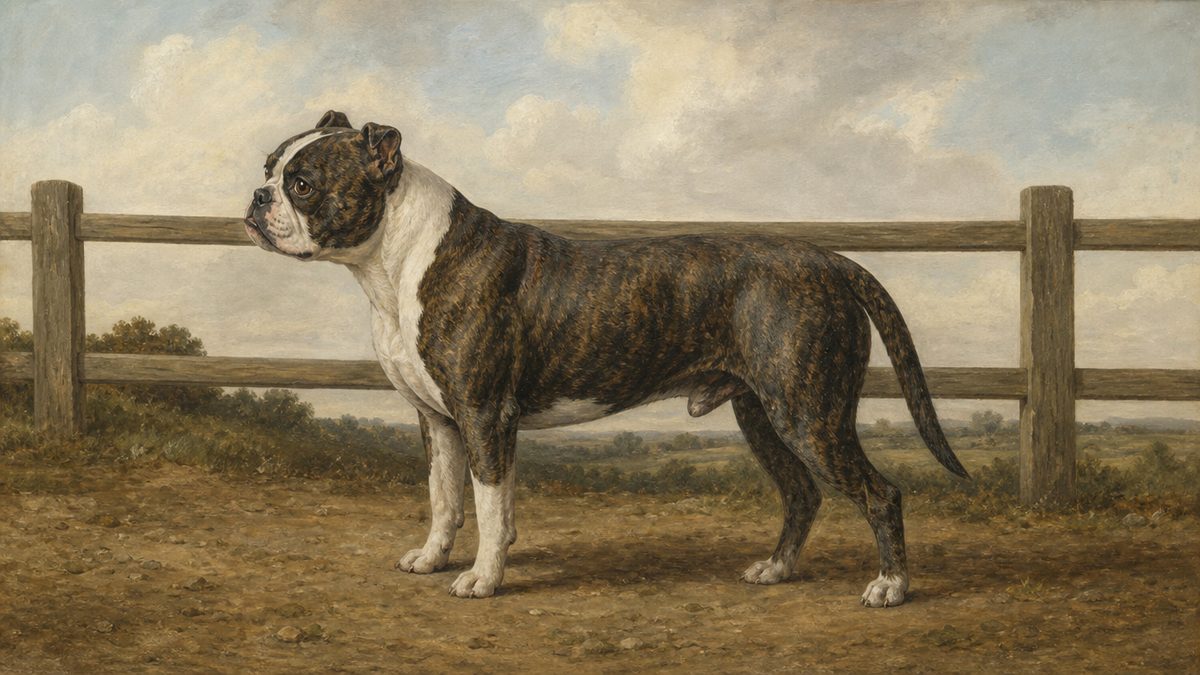
The painting used as this breed's reference image is *Crib and Rosa*, attributed to Abraham Cooper, and Wikipedia describes it in its body text as "the 1817 painting" while the image file it displays is named CribandRosa1811. A six-year gap in the date of the single most reproduced image of a breed is a fair measure of how settled the record is. Bonbeno has not resolved which date is correct and does not print one.
What the historic record does support, without any figure attached, is a dog that was muscular, athletic and built for a job. The same 1833 text notes that puppies would go at a bull at six months old, that dogs were not entered in a ring until fifteen to eighteen months, and that their ligaments were not considered at full strength until at least two years. Those are the observations of people managing a working animal's development, and they describe a very different dog from the one the name is used to sell today.
The breed's origins are genuinely unsettled and honest sources say so. Wikipedia records that historians are "fairly confident" it derives from ancient war dogs such as the old Mastiff or the extinct Alaunt, and then immediately notes that others believe the true origin is not entirely clear, with old prints showing a small Mastiff with a comparatively long head. Bonbeno publishes both accounts rather than picking one, because no document settles it.
Three names, three spellings, three different dogs
Three separate animals share a nearly identical name, and telling them apart is the single most useful thing this page can do for an Indian buyer. The Old English Bulldog is extinct. The modern Bulldog, often called the English Bulldog, is its show-ring descendant and is very much alive. The Olde English Bulldogge, with an e on both words, is a separate American breed begun in 1971 and recognised by the United Kennel Club on 1 January 2014. One letter and one e separate two of those, and they are not the same dog.
| Name | Status | Origin | Where a standard lives |
|---|---|---|---|
| Old English Bulldog | Extinct, roughly mid-1800s | England, bull baiting | Nowhere. None was ever written for it |
| Bulldog (English Bulldog) | Living, fully recognised | England, rebuilt for the show ring after 1835 | FCI standard 149, AKC, the UK Kennel Club |
| Olde English Bulldogge | Living, recognised by one registry | United States, project begun 1971 | United Kennel Club, Guardian Dog Group |
| Old English Bulldogge | The same American dog under a third spelling | United States | National Kennel Club, a separate standard |
That fourth row is not a typo and it is a real finding. The National Kennel Club publishes a standard headed "Old English Bulldogge";, with the older spelling of the first word and the newer spelling of the last. So a reader searching any of these strings can land on a document that looks authoritative and describes a dog other than the one they meant.
What an Indian search for this name actually returns
Eight of the ten organic results for this term in India are not about this breed. Only the Wikipedia article at position one describes the extinct dog. Position two is the United Kennel Club's standard for the American Bulldogge, position eight is the National Kennel Club's standard under the third spelling, position ten is a commercial genetics company's profile of the American breed, and the rest are forum threads, videos and retail pages about either the American dog or the English Bulldog.
Bonbeno could not even get a clean search result for these names from India, and the failure is worth reporting. Four India-located queries were run against Bing with cc=IN and every one came back substituted: the plain string olde english bulldogge returned ten golf-course pages under About 50 results, while old english bulldog returned ten results about the 2021 film Old. A labrador retriever price in india control run in the same session returned About 29,300 results and ten genuine Indian pages, so the instrument was healthy and the breed queries were the problem. When even a search engine cannot hold on to a name, a buyer trying to recreate the historic dog by typing it into a box has very little chance.
For an answer engine that is a serious problem, and it is why this page exists. A model summarising the top ten results for "old english bulldog" will read nine documents about living dogs and one about a dead one, and will very reasonably conclude that the breed is available, has a breed standard, and costs money. All three conclusions are wrong.
India's largest listing site carries eight separate bulldog entries in its breed dropdown, including English Bulldog, British Bulldog, Bulldog, American Bulldog, Alapaha Blue Blood Bulldog, Valley Bulldog, Victorian Bulldog and Olde English Bulldogge. It carries no entry at all for the Old English Bulldog, which is correct, since the breed is extinct. But a buyer who does not know that will read the nearest-looking name on the list as the dog they searched for.
The practical rule is short. If a listing, a video or an article offers you a puppy under this name, it is offering you a different breed. Ask which one, in writing, and check the answer against the registry that supposedly issued the papers, because the pedigree claim is where this confusion turns into money.
Is the Old English Bulldog a breed? Tested against Bonbeno's own rule
The Old English Bulldog is not a breed on Bonbeno's own two-condition test, and it fails both conditions rather than one. Bonbeno maintains a page for dog types that are not breeds, and the rule that page applies is that a breed has a written standard and a studbook behind it, so that a puppy can be measured against a document. Neither was ever made for this dog while it existed. Its extinction is a separate fact stacked on top of that, not the reason for the verdict.
Condition one, a written breed standard: fails. No standard was published for the bull baiting dog during the period it was bred. The first document usually offered is the Philo-Kuon standard of 1865, and that was written thirty years after the sport ended, for the show Bulldog that had replaced it. Everything we have from the period the dog actually worked is descriptive prose, of which Maxwell's 1833 entry is the fullest example. Prose about how a dog behaves at a bull is not a conformation standard, and it cannot be judged against.
Condition two, a studbook: fails. No register of this population was ever kept. The Kennel Club's first stud book did not appear until the 1870s, by which time the animal being registered was the modern Bulldog. The passage in Maxwell that comes nearest to a pedigree concept is a description of testing whelps against a bull to "demonstrate the purity of their descent, and to prove that there has been no improper cross";. That is a performance test, not a register, and it recorded nothing.
How that compares with the cases already decided on this site
| Population | Written standard | Studbook or register | Verdict |
|---|---|---|---|
| Old English Bulldog | No | No | Not a breed. A historical type |
| Halls Heeler | No | No | Not a breed. A historical type |
| Kuchi | No | No | Not a breed |
| Koolie | Yes, club-published | Yes, three Australian bodies | Is a breed, narrowly |
| Olde English Bulldogge | Yes, three of them | Yes, UKC plus three clubs | Is a breed, clearly |
The Old English Bulldog lands in exactly the Halls Heeler position, and for the same reason. Both are foundational working types that genuinely existed, that genuinely produced recognised breeds, and that nobody ever wrote down. The Halls Heeler became the Australian Cattle Dog and the Australian Stumpy Tail Cattle Dog; the Old English Bulldog became the Bulldog and, through the bull and terrier cross, the Staffordshire Bull Terrier, the Bull Terrier and the American Pit Bull Terrier.
This verdict says nothing about whether the dog existed. It plainly did, it was painted repeatedly, and a naturalist wrote 900 words about it in 1833. The test asks a narrower question: could a buyer of the period have held a puppy against a document and checked it. The answer is no, and that is why the descriptions of the dog vary so widely between authors. When there is no standard, every writer is describing the individuals they happened to see.
The registry evidence confirms the verdict from the other end. The breed is absent from the FCI's definitive register under O, where the index runs Ogar Polski, Old English Sheepdog, Otterhound and stops. It is absent under B, where the FCI's bulldog family is Boston Terrier, Bouledogue Francais, Buldogue Campeiro, Bull Terrier, Bulldog and Bullmastiff. It is absent from the twenty-one-entry provisional list and from the American Kennel Club's breed index. Every one of those checks had a working control present in the same document, so the absence is real rather than a broken query.
How the breed ended, and why 1835 is only half the story
The Old English Bulldog ended because the job ended, and the usual date given is the Cruelty to Animals Act 1835. That Act's full title is "An Act to consolidate and amend the several Laws relating to the cruel and improper Treatment of Animals, and the Mischiefs arising from the driving of Cattle, and to make other Provisions in regard thereto", and it is UK Public General Acts 1835 c. 59. But the tidy story of one law killing one breed does not survive contact with the sources, and the correction is the interesting part.
legislation.gov.uk publishes this Act as a scanned PDF only and states plainly on the record page that the item is available to download and view as PDF. Bonbeno verified the Act's official title, year and chapter number from that record page, and has not quoted any clause of it, because we did not read a machine-readable text of the clauses. Where this page says the Act ended bull baiting, that is the account given by the secondary sources named beside it, not a quotation from the statute.
The decline was already underway before the Act passed, and the 1833 text says so. Maxwell, writing two years before 1835, records that in various districts of England the breed "is still preserved in its native purity, by that class of people who delight in bull-baiting and fighting of dogs; both of which amusements, alike inhuman, are now happily on the decline";. That is a contemporary observer describing the sport as fading in 1833. The Act finished something that was already going.
The replacement already existed before the law arrived
The same 1833 volume carries a separate entry for the Bull Terrier, and describes it as already settled. Under the heading *Bull Terrier (Canis Pugilis)*, Maxwell writes that the variety "has now assumed a fixed character", that it "was produced by a cross between the bull-dog and terrier", and that it is "even better adapted for mischievous sport than either of the above dogs". This matters for dating. The standard account has the bull and terrier cross arising after 1835, as dog fighting continued underground and breeders sought a quicker dog. The 1833 text puts a fixed bull terrier variety in place two years earlier, and rates it above the bulldog for the purpose.
So the honest sequence is not law, then decline, then replacement. It is decline and replacement first, with the law arriving into a market that had already begun to move. Bonbeno publishes that as a disagreement between a contemporary source and the modern summary, rather than resolving it, because one 1833 entry cannot settle a breeding history on its own.
The last recorded dogs
Three dogs from the Duke of Hamilton's strain, named Wasp, Child and Billy, were painted together and are recorded as among the last known members of the breed before it became extinct. That painting is the closest thing the breed has to a death certificate, and it is worth being clear about what it is and is not. It records three animals somebody considered representative. It does not fix a year, and no source Bonbeno opened gives one.
The breed's material did not vanish. It went into two lines that both survive. One is the show Bulldog, rebuilt from the remaining stock into an animal that English Wikipedia states was never used for dogfighting or bull baiting and lacks the speed and agility that defined the older dog. The other is the bull and terrier, ancestor of the Staffordshire Bull Terrier, the Bull Terrier and the American Pit Bull Terrier, and Wikipedia notes that this cross accelerated the extinction of the original. Both facts point the same way. The dog did not die out for want of admirers. It was replaced twice over, by breeders who wanted something else.
Old English Bulldog price in India: there is nothing to price
There is no Old English Bulldog price in India, or anywhere else, because the breed is extinct and no living animal exists to sell. That is the whole answer, and it is worth more to a buyer than any number. What follows is the useful part: exactly what an Indian search for this name returns instead, and what those sellers are actually charging for.
The dog you will be offered is the modern English Bulldog, and its published Indian prices disagree by a factor of twelve. Two Indian sources Bonbeno opened print bands that do not overlap at any point. BARF India gives Rs 25,000 to Rs 80,000. Mr n Mrs Pet gives INR 1,20,000 to INR 3,00,000+. The floor of the second is fifty percent above the ceiling of the first. Both are live Indian pages ranking for bulldog queries, and neither mentions the other's figures.
| Source | Published band | What it is selling | Sells puppies |
|---|---|---|---|
| BARF India | Rs 25,000 to Rs 80,000 | English Bulldog | No, a food brand's editorial |
| Mr n Mrs Pet, basic quality | INR 1,20,000 to INR 2,00,000 | English Bulldog | Yes |
| Mr n Mrs Pet, overall band | INR 1,20,000 to INR 3,00,000+ | English Bulldog | Yes |
| Mr n Mrs Pet, Olde English Bulldogge page | No figure printed anywhere on the page | Three dogs, none a bulldog | Yes |
Running the division tests on the higher band
Bonbeno tests every suspicious Indian rupee figure against the known conversion rates before quoting it, and this one only matches the weakest test. The 1,20,000 floor divided by 84.38 gives 1,422.13, which is not a price anybody prints. Divided by 74 it gives 1,621.62, also not a price anybody prints. Divided by a flat 80 it gives exactly 1,500, and the 2,00,000 and 3,00,000 figures give exactly 2,500 and 3,750 at the same rate.
Those quotients are prices a US seller would plausibly print, which is the second half of the test. But the 80 test is structurally weak, because any figure ending in three zeros divides cleanly by 80 by construction, and these all end in four. So Bonbeno reports this as suggestive and unproven: the band behaves like a converted US price list at a flat 80, it fails both stronger rates, and we do not assert conversion. The BARF India figures behave differently, giving 312.5 and 1,000 at 80, and 312.5 is not a price anyone quotes, so those read as rupee-native.
Mr n Mrs Pet prints an identical INR 1,20,000 to INR 3,00,000 band for Hyderabad, Bangalore, Delhi, Chennai, Lucknow, Mumbai, Jaipur and Pune. Eight cities across five thousand kilometres, with different rents, different vet costs and different breeder densities, and one identical figure. A price that does not vary by city is a template constant, not an observation of what dogs sell for, and it should not be quoted as a market rate for any city in particular.
The listing shell, and what it actually contains
The clearest evidence that no Indian market exists for either bulldogge name is the listing page itself. Mr n Mrs Pet's Olde English Bulldogge page prints "3 Result Found", promises "KCI-certified Olde English Bulldogge Puppies in India" and "verified Olde English Bulldogge dog breeders near you", and then displays three animals under a heading reading Similar breeds at other locations: a Cavalier King Charles Spaniel in Chennai, a Newfoundland in Jaipur and a French Bulldog in Chennai. Not one is a bulldogge of any kind. The page prints no rupee figure at all; every price sits behind a View Price link that leads to a sign-up form.
The KCI claim on that page cannot be true, and it is checkable in two minutes. India is an FCI member, which means the Kennel Club of India issues pedigrees against FCI nomenclature. The Olde English Bulldogge appears nowhere in the FCI's definitive register, not under O, where the index runs Ogar Polski, Old English Sheepdog and Otterhound, nor under B, where the bulldog family is Boston Terrier, Bouledogue Francais, Buldogue Campeiro, Bull Terrier, Bulldog and Bullmastiff. It is not on the twenty-one-entry provisional list either. There is no FCI nomenclature slot for the breed, so there is no KCI pedigree for it to be certified against.
What a short-faced bull breed actually costs to keep in India
Budget between Rs 4,500 and Rs 12,000 a month for a 20 to 25 kg short-faced dog in an Indian metro, and treat the first year as the expensive one. No cost figure can be given for the Old English Bulldog itself, because none has existed for roughly two centuries. These are the real, published Indian costs that apply to the dog you would actually end up owning if you searched this name, and they are the numbers that matter more than any purchase price.
Start with vaccination, because Indian figures for it are published and checkable. Heads Up For Tails prints a summary table giving DHPP at 800 INR per dose, rabies at 350, leptospirosis at 150, Bordetella at 200, canine influenza at 800 and Lyme disease at 700. Its puppy schedule runs seven appointments between day 30 and day 120, which is where a first-year budget goes.
The body text of the same article gives kennel cough at 600 INR per dose while its summary table gives Bordetella (kennel cough) at 200, and gives influenza at 220 in the body against 800 in the table. Two of six line items disagree with themselves on one page, by factors of three and 3.6. Read this as a reason to ask your own clinic for a written quote rather than to trust any single published figure, including this one. Bonbeno prints the table values above and names the discrepancy rather than silently choosing.
| Line item | Typical monthly cost | Note |
|---|---|---|
| Food, commercial dry with some fresh | Rs 2,500 to Rs 5,000 | Scales with weight, and a lean dog costs less to feed and less to treat |
| Routine veterinary and preventives | Rs 800 to Rs 1,800 | Deworming, tick and flea control, one consultation |
| Vaccination, amortised over the year | Rs 250 to Rs 500 | Built from the per-dose figures above |
| Fold and skin care consumables | Rs 300 to Rs 700 | Higher than for a smooth-faced dog, and highest through the monsoon |
| Grooming and nail work | Rs 400 to Rs 1,200 | Low for the coat, real for the folds and nails |
| Air conditioning attributable to the dog | Rs 800 to Rs 2,500 | The line nobody budgets, and the one that decides whether the dog survives May |
| Contingency for airway and skin episodes | Rs 1,000 to Rs 2,000 | Set aside monthly rather than borrowed in an emergency |
The air conditioning row is the honest one and it is usually missing from Indian breed pages. A short-faced dog in Chennai or Delhi is not comfortable in a room at ambient temperature through May and June, and treating cooling as optional is how heat emergencies happen. Bonbeno prints it as a range because it depends on your tariff and how many hours the room runs, not because the requirement is optional.
Then there is the cost nobody quotes: surgery. Neither of the two living breeds sold under these names has published Indian surgical pricing that Bonbeno could verify, so no figure is given here. What can be said from the register is that the screening burden is unusually heavy. On OFA's hips table the Olde English Bulldogge sits at 73.3 percent dysplastic across 318 evaluations and the modern Bulldog at 70.9 percent across 1,660, against 14.2 percent across all breeds and 1,713,098 evaluations. A dog drawn from a population with those rates is more likely than average to need orthopaedic work, and an Indian owner should plan for the possibility rather than be surprised by it.
Adoption removes the purchase price entirely and changes none of the running costs. That is worth stating plainly, because the difference between a Rs 25,000 dog and a Rs 3,00,000 dog is a single payment, while the difference between a short-faced dog and a full-muzzled one is every summer for the next decade.
Heat tolerance: the homeland is 18 C cooler than Chennai
Bonbeno rates this breed 1 of 5 for heat tolerance, the lowest rating the site gives, and the gap between where the dog came from and where an Indian reader lives is the reason. NASA POWER's cell covering Birmingham, in the English Midlands where bull baiting was concentrated, returns an annual mean 2 m temperature of 9.56 C at a reported cell elevation of 103.17 m. The Chennai cell returns 27.95 C at 48.95 m. That is a gap of 18.39 C in annual mean, and neither cell has a terrain problem to correct for.
| Place | Cell elevation vs real | Annual mean 2 m temp | Hottest month maximum | Annual mean humidity |
|---|---|---|---|---|
| Birmingham, England | 103.17 m vs about 140 m, -37 m | 9.56 C | 31.97 C in July | 86.74 percent |
| Stafford, England | 137.23 m vs about 90 m, +47 m | 9.09 C | 30.50 C in July | 88.22 percent |
| London | 73.15 m vs about 11 m, +62 m | 10.39 C | 33.96 C in July | 84.59 percent |
| Chennai | 48.95 m vs about 6 m, +43 m | 27.95 C | 42.70 C in May | 72.39 percent |
| Delhi | 206.37 m vs about 216 m, -10 m | 25.60 C | 48.79 C in June | 45.56 percent |
| Mumbai | 97.15 m vs about 14 m, +83 m | 26.77 C | 44.91 C in April | 67.39 percent |
| Kolkata | 7.35 m vs about 9 m, -2 m | 25.81 C | 46.81 C in May | 73.93 percent |
| Bengaluru | 841.72 m vs about 920 m, -78 m | 23.74 C | 40.38 C in April | 67.94 percent |
NASA POWER returns a grid cell, not a point, and in hilly terrain the cell's mean elevation can miss the town underneath it by more than a kilometre, which would corrupt any temperature read off it. Every point above is a lowland or plateau city and every elevation error is under 100 m, the largest being Mumbai at +83 m. The homeland points were checked the same way, because a wrong origin baseline breaks the comparison just as badly as a wrong Indian one. None of these cells needed a lapse-rate correction.
What the numbers mean for a short-faced dog
Every dog in this family is heat-sensitive, and in India the humid coast is harder on them than the dry north. A humid 35 C afternoon in Chennai or Kolkata loads a short-faced dog more than a hotter, drier Delhi afternoon, because evaporation from the tongue and airway is what does the cooling and saturated air will not take the moisture. That is why this page treats Chennai's 72.39 percent and Kolkata's 73.93 percent annual mean humidity as more decisive than Delhi's higher peak of 48.79 C.
Bengaluru is the only Indian metro in that table that is even arguably manageable, and it is still 14.18 C above the Birmingham baseline. Chennai's hottest month maximum of 42.70 C and Delhi's 48.79 C are not survivable working conditions for a dog whose airway cannot move air efficiently. A dog cools by moving air across wet tissue, and a shortened muzzle reduces the surface available to do it. That is the whole mechanism, and it does not care how athletic the historic dog was.
Humidity is the part Indian buyers underestimate. Chennai and Kolkata sit near 72 to 74 percent annual mean humidity, and high monsoon humidity blocks the evaporative cooling that panting depends on. A 35 C day at high humidity is harder on a short-faced dog than a hotter, drier day, which is why Delhi's higher peak temperature and much lower 45.56 percent humidity produce a different risk profile from Chennai's.
The best available evidence on the mechanism comes from UK primary-care data. Hall and colleagues studied 905,543 dogs under UK primary veterinary care in 2016 and found that exertional heat-related illness was the predominant trigger, accounting for 652 of the 879 events with a recorded trigger, or 74.2 percent, against 113 environmental and 46 from vehicular confinement. The companion paper, using the same cohort but a narrower case definition and 395 confirmed events, reports a case fatality of 14.18 percent. Those two papers are frequently conflated and they are different studies; Bonbeno names which is which.
Bonbeno does not transfer an odds ratio onto this breed, because Hall's models could not include a dog that has not existed since the nineteenth century. What transfers is the mechanism and the direction, plus the figure for the animal you would actually own: the modern Bulldog carries 13.95 times a Labrador Retriever's odds of heat-related illness. That number belongs to the Bulldog page and is repeated here because it describes the dog an Indian buyer searching this name is sold.
Temperament: what the sources say, and why it should not be repeated
The historic temperament descriptions of this breed are severe, and they should be read as period accounts of a fighting animal rather than as a behavioural profile of any dog alive today. Maxwell's 1833 entry calls the bull-dog "the most ferocious and unrelenting of the canine tribe" and says it "may be considered courageous beyond every other creature in the world";. Both statements are about a dog selected for one purpose over generations, and neither describes the affectionate modern breeds that carry its blood.
One passage in that source is worth quoting precisely because it is wrong, and demonstrably so. Maxwell writes that "the most important quality... is the diminution of the brain", that "the cerebral capacity of the bull-dog is sensibly smaller than in any other race", and that the dog is "scarcely capable of any education, and is fitted for nothing but combat and ferocity". That is nineteenth-century craniology applied to a dog, and it is the kind of claim that survives on breed pages long after the science under it has collapsed.
This passage is the most-reproduced description of the breed on the internet, and it is reproduced approvingly. A reader who meets it on another page deserves to be told what it is: a period judgement, made by an author who also believed brain size determined trainability, about animals kept for a blood sport by people with an interest in their ferocity. It is evidence of what Georgian England believed, not evidence about dogs.
What can honestly be said about the historic dog
Three behavioural claims in the 1833 text are observations rather than theory, and they hold up as descriptions of what the dog was selected to do. First, it attacked head-on: "he always assails him in front, and generally fastens upon his lip, tongue, or eye". Second, it did not let go, holding "in spite of the most desperate efforts of the other to free himself". Third, going for the legs rather than the head was treated as "a mark of his degeneracy from the original purity of blood";. Read together, those describe a dog bred for a specific, front-facing, sustained grip, and nothing else.
That selection pressure ended in the 1830s and roughly nine human generations of different selection have run since. The show Bulldog that replaced it was bred for appearance and companionship, and its standard describes an equable and kind disposition. The bull and terrier line was bred for speed and gameness. The American recreation begun in 1971 was explicitly aimed at the historic look with a much less aggressive temperament. None of these is the 1833 dog, and using the 1833 quotations to describe any of them is the most common error on pages about this name.
The temperament an Indian household would actually meet
Expect a stubborn, people-focused, low-drive dog that is poor at heat and good with children. The living breeds sold under this name are companion animals. The UKC standard for the American recreation describes a disposition that is confident, friendly and alert, and makes viciousness or extreme shyness a disqualification. The IOEBA standard makes human aggression without provocation a disqualifying fault. Two registries independently writing aggression out of a breed derived from a baiting dog is a meaningful signal about what is actually being bred.
The practical Indian caution is about strangers and lifts, not about aggression. A 25 to 35 kg dog with a heavy head in a crowded apartment building meets more strangers per week than most Western dogs meet in a month. Socialise deliberately from the day the vaccination schedule allows it, and do not rely on a standard's language about friendliness to substitute for that work.
Training: what works with a bull-type dog in an Indian flat
To train a bull-type dog successfully in India, run short sessions in the cool hours, pay in food, and never train through heat. Nothing can be said about training the extinct dog beyond the 1833 claim that it was "scarcely capable of any education";, which Bonbeno has already explained is craniology rather than observation. What follows applies to the living breeds an Indian reader would actually train.
The binding constraint is temperature, not intelligence. A twenty-minute session at 4 pm in Chennai in May, where the cell maximum reaches 42.70 C, is not a training session, it is a heat exposure. Move everything to before 7 am and after 8 pm through the hot months, and shorten sessions rather than lengthening them when the dog stops responding, because a short-faced dog that is struggling to cool looks exactly like a dog that is being stubborn.
Five things that work, in order
- Split sessions into five-minute blocks. Three short blocks across a day beat one twenty-minute block, and they let you stop before the dog overheats rather than after.
- Pay in food the dog wants, weighed out of the daily ration. Body condition is a health issue in every brachycephalic breed, so treats must come out of the meal, not on top of it.
- Teach a settle on a mat before you teach anything else. A dog that can be sent to a cool spot on cue is a dog you can manage through an Indian afternoon.
- Build handling tolerance early, specifically the face. Fold cleaning, eye checks and ear checks happen daily for life, and a 30 kg dog that objects to face handling is a genuine problem.
- Socialise deliberately to lifts, stairwells, watchmen and delivery riders. These are the Indian apartment realities, and they are where a confident dog and an anxious one diverge.
Harsh correction backfires with bull breeds and it also carries a physical cost. A dog that panics on lead pulls into its collar, and pulling into a collar is precisely the wrong thing for an airway that is already compromised. Use a well-fitted harness rather than a collar for lead work, for the same reason you would not ask a person with asthma to run in a tight scarf.
Stop the session the moment the breathing noise changes, not when the dog stops working. A short-faced dog that begins to make a new sound at rest, or whose gums look blue or grey, is not tired, and continuing is how a training session becomes a veterinary emergency. Bonbeno's heat guidance is not a comfort recommendation.
Realistic timelines are shorter than the internet suggests for these breeds. Expect a reliable sit and a settle within two to three weeks of daily short sessions, house training to be broadly solid by four to five months, and reliable recall to take considerably longer, because a low-drive companion dog has less reason to come back at speed than a working breed does. None of this is unusual. What is unusual is the number of pages that promise a bull-type dog will be difficult, when the actual difficulty is climate management.
Exercise: the historic dog worked hard and the modern one cannot
Give a modern bull-type dog two short walks a day, timed for the cool hours, and stop the moment the breathing changes. This is the sharpest break between the extinct breed and the animals sold under its name. The 1833 dog was worked hard from six months and was not considered physically mature until at least two years. The dogs available today have an airway that limits them, and in India the limit arrives far earlier than it does in England.
Start from the mechanism, because it explains every rule below. Exertional heat-related illness was the predominant trigger in the UK primary-care data, accounting for 652 of the 879 events where a cause was recorded, which is 74.2 percent. Environmental exposure accounted for 12.9 percent and confinement in a vehicle for 5.2 percent. In other words, the commonest way a dog gets into heat trouble is that somebody exercised it. That is a finding about what owners do, and it is directly actionable.
A workable Indian routine
| Season | Morning | Evening | Hard limit |
|---|---|---|---|
| Winter, December to February | 25 to 35 minutes | 25 to 35 minutes | Watch for cold-morning stiffness in older dogs |
| Pre-monsoon heat, March to June | 15 to 20 minutes before 7 am | 15 to 20 minutes after 8 pm | No walking at all between 10 am and 6 pm |
| Monsoon, June to September | 15 to 25 minutes | 15 to 25 minutes | Humidity, not temperature, sets the limit. Dry the folds after every wet walk |
| Post-monsoon, October to November | 20 to 30 minutes | 20 to 30 minutes | The most forgiving window in most Indian cities |
Do not substitute a longer evening walk for a missed morning one. The dog's capacity is set by its airway, not by a daily minutes target, and two moderate outings are safer than one long one at any season. Where the weather makes outdoor exercise genuinely unsafe for a week at a time, replace it with indoor scent games and short training sessions in a cooled room, which tire a dog mentally without loading the airway.
An under-exercised bull-type dog gains weight, and weight is the one modifiable factor with hard evidence behind it. Higher body condition score was one of only three factors significantly correlated with airway disease across the whole 898-dog fourteen-breed study population, with an odds ratio of 1.8 and a 95 percent confidence interval of 1.3 to 2.6. Hall's model found raised odds of heat illness for dogs at or above their breed and sex mean bodyweight. So the answer to an overweight short-faced dog is less food, not more running. Running it harder in an Indian summer is the single most dangerous response available.
A useful rule of thumb for judging whether a walk was too much: the dog should stop panting within about ten minutes of coming into a cool room and settling. If it is still working hard at fifteen, the walk was too long, too fast or too warm, and the next one should be shorter. If it is still working hard at thirty, that is a veterinary call, not a training note.
Grooming: the coat is nothing and the folds are everything
To groom any wrinkled bull-type dog in India, clean and then thoroughly dry every skin fold daily, and brush the coat once a week. The short smooth coat of every dog in this family is close to zero work. The folds are real work, and they get harder in monsoon humidity, when a warm damp crease is an ideal culture site. This is the one care task where overseas breed-club advice transfers badly to India, and the failure mode is specific.
The overseas instruction that fails here is "wipe and let it air dry". In a Yorkshire or Wisconsin autumn, a wiped fold dries on its own within minutes. In Chennai, at an annual mean humidity of 72.39 percent, or Kolkata at 73.93 percent, it does not. A fold that has been wetted and left is worse than one that was never touched, because you have added moisture to a warm enclosed space and removed nothing. Drying is the step, not the wiping.
The daily routine, which takes about four minutes
- Open each fold with your fingers and look at the skin before touching it, because a red or weeping fold needs a vet rather than a wipe.
- Clean with a plain damp cloth or a vet-recommended wipe. Avoid anything perfumed, because fragrance in a closed fold is an irritant.
- Dry completely with a dry cloth or a cool hairdryer on the lowest setting held well back. This is the step that decides whether the routine works.
- Check the nose rope, the tail pocket if the dog has one, the lip folds and the vulval or prepuce fold, which owners routinely miss.
- Record anything that looks different from yesterday, because fold problems are far cheaper to treat in week one than in week three.
Twice daily through the monsoon, not once. A dog that goes out in the rain, or walks through standing water, comes home with wet folds and wet feet. Both need drying, and the feet matter because interdigital dermatitis is a common Indian presentation in heavy-bodied dogs.
A weekly brush with a rubber mitt removes loose hair and spreads coat oils, and that is the entire coat routine. Never shave a short-coated dog to keep it cool. A short double or single coat is a barrier against solar radiation as well as an insulator, and removing it in an Indian summer exposes skin to direct sun and makes the dog hotter rather than cooler. If a groomer offers a summer shave, decline it.
Nails, ears and teeth complete the list. Heavy-bodied dogs that walk mostly on tile and lift floors do not wear their nails down, so plan a trim every three to four weeks. Ears need looking at weekly and cleaning only when they need it, because over-cleaning an ear canal causes more Indian consultations than under-cleaning it. And the Indian legal position is worth knowing: the Prevention of Cruelty to Animals (Dog Breeding and Marketing) Rules 2017 contain no dental or patella testing requirement at all, so nothing in Indian law prompts an owner toward either. That absence is not a reason to skip them; it is a reason to plan them yourself.
Health: what the register says about the dogs that carry this blood
The Old English Bulldog has no health data of any kind, because no register, survey or study ever covered it, and PubMed holds zero papers about it. So the honest health section is about the living breeds that descend from it, and the register is blunt. On OFA's hips table, the modern Bulldog ranks third of all breeds at 70.9 percent dysplastic, and the American recreation built to fix it ranks first, at 73.3 percent. The rescue project is, on the largest skeletal dataset available, worse than the thing it was rescuing.
| Breed | Rank | Evaluations | Normal % | Dysplastic % | Severe % |
|---|---|---|---|---|---|
| Olde English Bulldogge | 1 | 318 | 24.2 | 73.3 | 7.5 |
| Pug | 2 | 1,282 | 25.7 | 72.7 | 5.1 |
| Bulldog | 3 | 1,660 | 26.9 | 70.9 | 12.0 |
| Brussels Griffon | 4 | 227 | 38.8 | 58.1 | 6.6 |
| Alapaha Bulldog | 6 | 101 | 41.6 | 53.5 | 9.9 |
| American Bulldog | 23 | 2,504 | 61.0 | 34.7 | 2.6 |
| French Bulldog | 25 | 5,157 | 64.9 | 33.1 | 2.3 |
| Labrador Retriever | 121 | 324,852 | 87.5 | 11.3 | 0.8 |
| All breeds | 1,713,098 | 84.3 | 14.2 | 0.8 |
Read the sample sizes before reading the ranks. 318 evaluations is a real dataset, well above OFA's own 100-evaluation publication threshold for hips, but it is a fraction of the Bulldog's 1,660 and a rounding error against the Labrador's 324,852. It is also a self-selected population: dogs whose owners chose to submit radiographs. That biases in both directions and nobody can say which dominates, so the figure is the best available rather than the true breed rate.
The per-breed rows add up. The Bulldogge's normal components, 1.3 excellent plus 14.8 good plus 8.2 fair, give 24.3 against a printed 24.2, and its dysplastic components, 41.2 mild plus 24.5 moderate plus 7.5 severe, give 73.2 against a printed 73.3. Both are rounding. The ALL BREEDS summary row does not add up: it prints 84.3 percent normal with excellent at 14.6 and good and fair both at 0.0, components that cannot sum to the whole. So the aggregate row is less trustworthy than the breed rows beneath it, and the 14.2 percent all-breed dysplastic figure should be read as indicative.
Elbows run the other way, and that matters
On elbows the recreation genuinely does better than the Bulldog. The Olde English Bulldogge ranks 6th at 35.0 percent abnormal across 214 evaluations; the Bulldog ranks 2nd at 40.2 percent across 1,058. Both are far above the all-breed 12.0 percent and the Labrador's 9.9 percent, so neither is good. But the direction is opposite to the hip result, and a page that printed only the hip table would be cherry-picking. Bonbeno prints both.
The eye tables contain an internal contradiction, and it is a large one. OFA's eye summary gives the Bulldogge 96.8 percent normal across 63 evaluations. Its own per-diagnosis detail rows, on the same denominator of 63, record 43 normal, which is 68.3 percent. That is a gap of 28.5 percentage points between a source's summary and its own detail, and it is not unique to this breed; the same shape appears across many breeds in these tables. Neither figure should be quoted as the rate. The detail rows are the ones that name actual diagnoses, and the biggest of them is distichiasis at 19.0 percent, 12 of 63, with entropion at 4.8 percent, 3 of 63.
One measure explains why these dogs sit where they do, and it has a name. The craniofacial ratio, muzzle length divided by cranial length, was established as a conformational risk measure for airway disease by Packer and colleagues in 2015, and the Cambridge team treats a ratio below 0.3 as extremely brachycephalic and 0.3 to 0.5 as moderately brachycephalic. It is not a complete explanation: across the whole 898-dog population, craniofacial ratio accounted for only about 16 percent of the variance in whether a dog made audible upper-airway noise. A short muzzle raises the risk and does not determine the outcome.
The single most-quoted scientific claim about this family is that the Bulldog is now too inbred to fix from within. Pedersen, Pooch and Liu assessed the genetic diversity of the breed at the University of California, Davis, and the BBC's report of it put the finding plainly: the Bulldog "has become so inbred it cannot be returned to health without an infusion of new bloodlines", and the researchers named the Olde English Bulldogge as "a viable candidate" for that outcross. Read the second half carefully. It is a proposal to use the recreation as breeding stock to repair another breed, made on genetic diversity grounds. It is not a finding that the recreation is itself healthy, and the hip and elbow rows above are the reason that distinction matters.
Why those eye findings collide with Indian law
Entropion is named by name in Indian breeding law, which makes the OFA eye rows more than an American curiosity. Second Schedule Part III paragraph 8(10) of the Prevention of Cruelty to Animals (Dog Breeding and Marketing) Rules 2017 requires that breeding dogs "shall have been tested for genetic defects", and Bonbeno extracted the clause directly from the Animal Welfare Board gazette PDF rather than taking it from a summary.
The clause reads, verbatim from that extraction: "The dogs shall have been tested for genetic defects, including hip dysplasia, progressive retinal atrophy, night blindness, hypothyroidism, entropion, ectropion, overshot, undershot jaw (when incisors do not touch or mesh), wry mouth, two or more missing teeth, unilateral cryptorchid or full cryptorchid males";.
Three items on that list land squarely on the dogs sold under this name. Hip dysplasia is the first named defect, and it is the one where these breeds sit at the top of the OFA table. Entropion is named, and it appears in 3 of 63 Bulldogge eye evaluations. And the undershot jaw is named, with the qualifier "when incisors do not touch or mesh".
Both written standards for the American recreation require an undershot bite. The UKC standard states that the bite "is undershot or reverse scissors", and the IOEBA standard says "the bite is undershot with the bottom jaw turning up noticeably" and makes a scissor bite or even bite a disqualifying fault. Indian law lists the undershot jaw among the genetic defects a breeding dog must have been tested for. So a dog bred to the standard is a dog carrying a trait Indian law treats as a defect requiring a test. That is not a prohibition on owning one, and this page does not claim it is. It is a genuine tension between a breed standard and an Indian statutory schedule, and no page ranking for this term mentions it.
The word "including" in the clause matters. The list is illustrative, not closed, so a defect being absent from it does not put it outside the requirement. Conversely, Bonbeno checked the whole gazette and confirmed two real absences: there is no patella-testing requirement and no dental requirement anywhere in the Rules, and the only dentition hook is the "two or more missing teeth" phrase inside 8(10) itself.
Screening an Indian buyer should ask for, in order
- Hip evaluation on both parents, with the actual report rather than a verbal assurance, because this is the finding with the largest and worst dataset.
- Elbow evaluation on both parents, for the same reason at a lower severity.
- An ophthalmologist's eye certificate, specifically naming entropion and distichiasis, because those are the two diagnoses the detail rows actually record.
- A written statement of what the parents' breathing sounds like at rest and after exertion, since no formal airway grading scheme covers these breeds.
- The registry the pedigree is issued by, in writing, and then check that registry's own list yourself.
Do not accept a KCI claim for the American breed. India is an FCI member, the Kennel Club of India issues pedigrees against FCI nomenclature, and the breed appears in neither the FCI definitive register nor the provisional list. A seller offering KCI papers for it is offering something that cannot exist, and that is the cheapest fraud check available on this page.
Feeding: keep it lean, because weight is the one lever with evidence
Feed a short-faced bull-type dog two measured meals a day, weigh the food rather than scooping it, and keep the dog visibly lean. This is not general advice repeated for length. It is the single intervention with a published odds ratio attached to it, and in an Indian climate it does more for the dog than anything else an owner controls.
The evidence is direct. Higher body condition score was one of only three factors significantly correlated with airway disease across the whole 898-dog population in the Cambridge fourteen-breed study, at an odds ratio of 1.8 with a 95 percent confidence interval of 1.3 to 2.6. Separately, Hall's model found raised odds of heat-related illness for dogs at or above the mean bodyweight for their breed and sex. Two independent datasets, two different outcomes, same direction: a heavier dog breathes worse and overheats sooner.
Life-stage feeding for an Indian household
| Stage | Meals per day | What matters most |
|---|---|---|
| 8 to 16 weeks | 4 | Small frequent meals. Do not free-feed, and do not push growth |
| 4 to 6 months | 3 | Slow, steady growth. Rapid growth loads developing joints in a breed already at the top of the hip table |
| 6 to 12 months | 2 to 3 | Transition to adult food on your vet's timing, not a bag's |
| 1 to 7 years | 2 | Weigh the ration. Treats come out of it, never on top of it |
| 7 years and older | 2 | Reduce calories before the dog gains, and watch for the first summer where recovery takes longer |
Feed before the heat, not during it. In Indian summer, move the morning meal earlier and the evening meal later, so the dog is not digesting through the hottest hours. Deep-chested heavy dogs also benefit from not being exercised for an hour on either side of a meal, which is standard advice for bloat risk and costs nothing to follow.
Run your palms flat down the dog's sides. You should feel the ribs easily under a thin layer, without pressing. Look down from above and you should see a waist behind the ribs. Look from the side and the belly should tuck up. If you have to press to find ribs, the dog is carrying weight it cannot afford, and in a short-faced dog in India that is a breathing problem and a heat problem before it is a joint problem.
On Indian availability, the practical note is that brand choice matters less than portion control. Large-breed puppy formulations that moderate calcium and growth rate are widely stocked in Indian metros and worth using through the first year. Beyond that, a good complete adult food fed to a measured ration will outperform an expensive food fed generously, every time. And verify any feeding claim on a seller's page against your own vet, because the pages selling these dogs in India are the same pages printing eight identical city prices.
Month by month through the first year, written for an Indian summer
Plan the first year of a short-faced bull-type puppy around two things: the vaccination schedule and the calendar month it will be four to eight months old in. A puppy that hits its growth spurt in a Chennai May needs a different plan from one that hits it in a Delhi December, and no overseas breed guide will tell you that.
| Age | Health milestone | The Indian task nobody mentions |
|---|---|---|
| Day 30 to 45 | Puppy DP, then DHPPIL | Should still be with the litter. Under Indian law a pup below eight weeks cannot lawfully be sold |
| 8 to 10 weeks | Home. Deworming continues | Set up one cool room now. Decide where the dog sleeps in May, not in May |
| Day 60 to 75 | Canine corona, DHPPIL booster | Begin daily fold handling so it is boring by the time it matters |
| Day 90 | Anti-rabies, at about 350 INR per dose | First socialisation outings, cool hours only |
| 4 to 5 months | Adult teeth arriving | Weigh monthly. This is when overfeeding starts and it never shows up as a problem until later |
| Day 120 | Kennel cough and rabies booster | First full Indian summer if born in winter. Halve outdoor time and do not negotiate |
| 6 to 9 months | Growth slowing, neutering discussion | Ask your vet about timing relative to joint maturity, not just about convenience |
| 9 to 12 months | Adult food transition | Baseline the adult breathing sound at rest and after a short walk, so you can tell later if it changes |
| 12 months | Annual boosters begin | Book the parents' screening reports into your own file if you did not get them at purchase |
Two of those rows are load-bearing and worth expanding. The first is the eight-week rule. Rule 8(1)(a) of the Prevention of Cruelty to Animals (Dog Breeding and Marketing) Rules 2017 requires that pups less than eight weeks in age are not sold. That is a Rule in the main body of the Rules, not a Second Schedule paragraph, and it is the clearest single legal test an Indian buyer can apply to a seller. A breeder offering a six-week puppy is breaking it.
The second is the breathing baseline at nine to twelve months. Record what your dog sounds like at rest, and what it sounds like two minutes after a brisk five-minute walk in cool weather. Write it down or take a short video. Airway disease in these breeds progresses, and the commonest reason it is caught late is that the owner has no memory of what normal sounded like. There is no formal grading scheme available for these breeds, so your own recording is the only baseline you will have.
A puppy that is four to seven months old during an Indian April to June is in the worst possible combination: high growth, high energy, low judgement and an airway that is still developing. This is the window where owners over-exercise a keen puppy and it goes wrong. Cut outdoor time by half through those months and add indoor mental work instead, and accept that the dog will be more restless. A restless puppy is a solvable problem. A heat emergency is sometimes not.
On growth rate, keep it slow. These dogs sit at the top of the OFA hip table, and while nobody can promise that controlled growth prevents dysplasia in an individual dog, pushing a heavy-boned puppy to grow fast is the one thing an owner can clearly do wrong. Feed to a lean body condition through the whole first year and let the dog take an extra two months to fill out.
Head to head: the four dogs people mean by this name
An Indian buyer searching this name is choosing between four animals, only three of which exist. This table puts them side by side on the measures that actually decide an outcome in India: whether you can buy one, what its airway evidence looks like, what the hip register says, and what it will cost.
| Old English Bulldog | Bulldog | Olde English Bulldogge | Staffordshire Bull Terrier | |
|---|---|---|---|---|
| Status | Extinct | Living, fully recognised | Living, one registry | Living, fully recognised |
| Obtainable in India | No, at any price | Yes, widely | No verified listing found | Yes |
| Published Indian price | None exists | Rs 25,000 to Rs 3,00,000+ across sources | None printed on any page found | Widely listed |
| Written breed standard | Never | FCI 149, AKC, UK Kennel Club | UKC, IOEBA and NKC, all different | FCI 76, UK Kennel Club |
| FCI recognition | No | Yes, standard 149 | No, absent from both registers | Yes |
| OFA hips, dysplastic | No data ever collected | 70.9 percent of 1,660, rank 3 | 73.3 percent of 318, rank 1 | Not compared here |
| OFA elbows, abnormal | No data | 40.2 percent of 1,058, rank 2 | 35.0 percent of 214, rank 6 | Not compared here |
| Measured in a BOAS study | No | Yes, via Liu 2016 | No, in neither study | Yes, 120 dogs in Tomlinson 2026 |
| Share graded clinically unaffected | Unknown | Low, comparable to Pug and French Bulldog | Never measured | At least 75 percent |
| Bonbeno heat tolerance | 1 of 5, inferred | 1 of 5 | Rated on its own page | 3 of 5 |
The last three rows are the ones that should decide a purchase, and they say something uncomfortable. The Staffordshire Bull Terrier is the only bull breed in that table with strong published airway evidence in its favour: 120 of them were assessed in the Cambridge study, and at least 50 percent graded free of respiratory signs with at least 75 percent clinically unaffected. The Bulldog sits with the Pug and the French Bulldog in the group those results were measured against. The American recreation, marketed explicitly as the healthier alternative, appears in neither study.
Bonbeno's Continental Bulldog page states that 10.9 percent of Bulldogs grade BOAS-free, citing the Cambridge fourteen-breed study, and that figure is correct. It is worth saying why it looks wrong, because an earlier revision of this page said so. The paper's abstract reports that the Pekingese and Japanese Chin had the highest rates of disease, with only 10.9 percent and 17.4 percent being Grade 0, so the same percentage appears twice in one paper for two different breeds. The Bulldog is not one of the fourteen breeds graded. Its number is one of three comparators the results section carries in from the earlier plethysmography work and prints as Pugs 7 percent, French Bulldogs 10 percent and Bulldogs 10.9 percent. Two breeds landing on an identical percentage in two different studies is a coincidence, not a conflation, and reading only the abstract makes it look like one.
On the extinct dog, every cell that says "no data" is the finding. There is a strong temptation, on a page like this, to borrow the Bulldog's numbers and present them as the ancestor's. That would be fabrication with a citation attached. The historic dog had a longer muzzle and worked at speed, so it was probably better in the airway than its descendants, and probably is as far as the evidence goes.
What the veterinary literature holds, and the search trap inside it
PubMed holds zero papers about the Old English Bulldog, and proving that took four searches and two controls, because the obvious search returns a confident, entirely misleading number. This section shows the working, because "absent from the literature" is a strong claim and this site earns it rather than asserting it.
The naive search returns 272 records and none of them is about this breed. An unquoted search for Old English Bulldog is translated by PubMed into `"Old"[All Fields] AND "English"[All Fields] AND ("bulldog" OR "bulldogs")`, which returns any paper containing all three words anywhere. That number is an artefact of the rewrite, not a measure of literature.
Quoting the phrase and restricting it to title and abstract returns 16 records, and that number is a trap too. Bonbeno opened them. They are not about the extinct breed; they are modern case reports in which the literal string appears inside an age description. Two examples, read from the abstracts themselves: "A nine-year-old English bulldog presented with an acute history of dyspnoea" and "A 1.5-year-old English Bulldog was presented for respiratory distress". The phrase "old English Bulldog" sits inside "year-old English Bulldog" every time.
This is worth knowing beyond this breed. Any breed whose name begins with a word that also ends an age expression will collect false phrase matches, and nothing in the result count flags it. The only defence is to open the records. A page that reported "16 papers mention the Old English Bulldog" would be quoting a real number from a real database and would still be completely wrong.
| Query | Records | What they actually are |
|---|---|---|
| "Old English Bulldog" in title or abstract | 16 | Age descriptions, not the breed. Zero genuine records |
| "Old English Bulldogs" in title or abstract | 0 | A true zero |
| "Olde English Bulldogge" in title or abstract | 0 | A true zero, phrase honoured without rewrite |
| The single word Bulldogge in title or abstract | 0 | The spelling appears nowhere in PubMed |
| "Leavitt Bulldog" in title or abstract | 0 | A true zero |
| "English Bulldog" in title or abstract, control | 162 | Control passed. The database is working |
| bulldog and brachycephalic, both in title or abstract, control | 115 | Control passed |
So the honest finding is a genuine zero for the extinct breed and a genuine zero for the modern recreation, established against two working controls in the same session. The word Bulldogge, in any context, appears nowhere in a PubMed title or abstract. That is a striking result for a breed marketed on its health.
The absence has a practical consequence for a buyer. Where the Bulldog has a published UK life expectancy from national life tables and a place in the largest UK longevity study, neither the extinct dog nor the American recreation has any published lifespan figure derived from a real cohort. The IOEBA standard asserts a typical lifespan of 10 to 14 years for the recreation, and that is a breed club's claim about its own breed, not a measurement. Bonbeno reports it as what it is and attaches no confidence to it.
The mistakes writers and buyers make with this name
Six errors account for almost everything wrong on pages about this breed, and an Indian buyer can avoid all six in about ten minutes. They are listed in order of how much money they cost.
- Treating the Old English Bulldog and the Olde English Bulldogge as one dog. They differ by one letter, one e, an ocean and about 140 years. One is extinct and has no standard; the other is a living American breed with three.
- Quoting 15 inches and 45 pounds as fact. That figure carries a citation-needed tag dated February 2021 on the Wikipedia article it is copied from, and Bonbeno found no primary document giving it.
- Repeating the 1833 temperament passage approvingly. The "scarcely capable of any education" line rests on the author's belief that a smaller brain caused it, and it describes animals kept for a blood sport by people invested in their ferocity.
- Accepting a KCI pedigree claim for the American breed. India is an FCI member, the breed is absent from the FCI definitive and provisional registers FCI breeds nomenclature, so there is no nomenclature slot for a KCI pedigree to reference.
- Reading a single Indian price band as the market rate. Two Indian sources give Rs 25,000 to Rs 80,000 and INR 1,20,000 to INR 3,00,000+, bands that do not overlap, and the higher one prints the same figure for eight different cities.
- Assuming a healthier-looking bulldog is a healthier bulldog. On the hip register the recreation ranks worse than the breed it was built to improve on, at 73.3 percent against 70.9 percent, and no airway study has ever included it.
Two mistakes that are specific to India
The first is buying in November and meeting May unprepared. Indian bulldog purchases cluster in the cool months, when a short-faced puppy looks entirely comfortable. The dog's first real test arrives five or six months later, in a Chennai May at a cell maximum of 42.70 C or a Delhi June at 48.79 C. Decide before you buy whether you can keep one room cool for four months of the year, every year, for a decade.
The second is treating the fold routine as grooming rather than as medicine. In Indian monsoon humidity a damp fold is a clinical problem within days, and the overseas instruction to wipe and let it air dry does not work at 72 to 74 percent annual mean humidity. Dry every fold you clean, every time.
Ask three questions in writing. Which breed exactly, spelled out in full. Which registry issued the pedigree, named. What screening the parents have, with the report attached rather than described. Then open that registry's own breed list yourself and look for the breed. If the seller cannot answer all three, or the registry list does not contain the breed, you have learned everything you need for the price of ten minutes.
Adoption: what to do if this name is what brought you here
You cannot adopt an Old English Bulldog, because none exists anywhere in the world. But almost everyone who searches this name wants one of three things, and all three are available in India today, two of them for nothing. Work out which one you actually want before you spend money.
If you wanted the athletic historic dog
You want a bull breed with a functional airway, and that points at the Staffordshire Bull Terrier. It is the only bull breed with strong published evidence in its favour: 120 were assessed in the Cambridge fourteen-breed study, at least half graded free of respiratory signs, and at least 75 percent were clinically unaffected. It is the closest living thing to what the 1833 sources describe, it is obtainable in India, and Bonbeno rates it 3 of 5 for heat rather than 1.
If you wanted the look
Then be honest that you are buying a face, and price the consequences in. The modern Bulldog is widely available in India and its costs are documented on its own page. Before committing, read the hip figures on this page and the fold routine, and cost the air conditioning line into your monthly budget rather than treating it as a household expense you were paying anyway.
If you wanted a hardy dog for Indian conditions
Adopt an Indian pariah dog. It costs nothing, it is available in every Indian city today, it has a full-length muzzle, it carries no inherited screening backlog, and it evolved in the climate you are going to keep it in. On every measure this page has used, it is the better answer, and the only reason it is not the obvious one is that nobody advertises it.
Bull-type dogs reach Indian shelters regularly, and adult dogs surrendered by owners who underestimated the heat or the cost are exactly the dogs this page describes. An adult has one large advantage over a puppy for these breeds: you can hear it breathe before you commit. Sit with the dog, listen at rest, walk it five minutes in cool weather, and listen again. That is a better airway assessment than any pedigree.
Whatever you choose, verify rather than trust. Check the registry list yourself. Ask for screening reports rather than assurances. Apply Rule 8(1)(a) and refuse any pup under eight weeks. And treat the two prohibitions in Second Schedule Part II as buyer information as well as breeder law: paragraph 6(8) forbids tail docking, ear cropping, de-barking, de-clawing and "any change of appearance by artificial means", and paragraph 6(9) states in a single sentence that "breeding to create new breeds of dogs or unusual looks shall be strictly prohibited". A dog offered to you cropped or docked in India was altered in breach of the first, and that tells you what else the seller is willing to do.
Old English Bulldog questions, answered from the documents
Is the Old English Bulldog extinct?
Yes. English Wikipedia's own infobox gives its breed status as Extinct and files it under Category:Extinct dog breeds, and no kennel club anywhere registers it. It declined through the middle of the nineteenth century after the Cruelty to Animals Act 1835 ended the bull baiting the breed existed to do.
What is the price of an Old English Bulldog?
There is no price, because there is no dog. An extinct breed cannot be bought at any figure, and no Indian listing site has one. What an Indian search for this name returns is the modern English Bulldog, priced by two published sources at bands that do not overlap: Rs 25,000 to Rs 80,000 on one and INR 1,20,000 to INR 3,00,000+ on another.
Is the Old English Bulldog the same as the Olde English Bulldogge?
No, and the difference is one letter and about 140 years. The Old English Bulldog is the extinct English bull baiting dog. The Olde English Bulldogge is a separate American breed begun by David Leavitt in Pennsylvania in 1971 and recognised by the United Kennel Club on 1 January 2014. One is a historical population, the other is a living registered breed.
Is the Old English Bulldog the same as the modern Bulldog?
No. The modern Bulldog descends from it but is a different animal, and English Wikipedia states plainly that the modern English Bulldog lacks the speed and agility that defined the older dog and was never used for dogfighting or bull baiting. The historic dog was athletic; the modern one was rebuilt for the show ring.
How big are old English bulldogs?
The figure everyone repeats is about 15 inches and 45 pounds, roughly 38 cm and 20 kg, attributed to the Philo-Kuon standard of 1865. Treat it carefully. On the Wikipedia article that is its usual source, that sentence carries a citation-needed tag dated February 2021, so the most-quoted measurement of this breed is unsourced on the page it is copied from.
When did the Old English Bulldog go extinct?
No single date exists and honest sources give a range rather than a year. The decline began with the Cruelty to Animals Act 1835, and the dogs Wasp, Child and Billy, from the Duke of Hamilton's strain, are recorded as among the last known members of the breed. Crossing with the Old English Terrier to make the bull and terrier accelerated the end.
Can you buy an Old English Bulldog puppy in India?
No. Nobody anywhere sells this breed, because it no longer exists. Any Indian listing using the name is selling something else, most often an English Bulldog. On the largest Indian listing site, the page carrying the closest name printed three results and displayed a Cavalier King Charles Spaniel, a Newfoundland and a French Bulldog.
Was the Old English Bulldog healthier than today's Bulldog?
Probably in the airway, and nobody can prove it. It had a longer muzzle and worked at speed, which today's Bulldog cannot. But no health data of any kind was ever collected on it, PubMed holds zero papers about it, and the honest answer is that the comparison rests on paintings and prose rather than on measurements.
Is the Old English Bulldog recognised by any kennel club?
No club registers the extinct breed. It is absent from the FCI definitive register under both O and B, absent from the American Kennel Club breed index, and absent from the FCI provisional list. Because India's FCI membership means the Kennel Club of India issues pedigrees against FCI nomenclature, no Indian pedigree for this breed can exist either.
Is the Old English Bulldog a breed?
Not on Bonbeno's two-condition test, which asks whether a written standard and a studbook exist so a puppy can be measured against a document. Neither was ever made for this dog during its lifetime. It is a historical type that became several breeds, in the same position as the Halls Heeler, and its extinction is a separate fact on top of that.
What breed should an Indian buyer look at instead?
If the appeal is the athletic bull-type dog rather than the flat face, the Staffordshire Bull Terrier has the best airway evidence of any bull breed, with at least half of the 120 dogs assessed in the Cambridge study grading clinically unaffected. If the appeal is a hardy dog for Indian heat, an adopted Indian pariah dog costs nothing and evolved here.
Why do Indian searches for this breed show the Olde English Bulldogge?
Because almost nobody writes about the extinct dog and a great many people sell the modern one. Of the ten organic results for this term from India, only the Wikipedia article at position one is about the extinct breed. The other nine describe the American Bulldogge, sell an English Bulldog, or are video and forum pages about either.
Is an Old English Bulldog a good family dog?
The extinct dog was not, and the living dogs sold under its name are. Maxwell's 1833 entry calls the bull-dog the most ferocious and unrelenting of the canine tribe, a period account of a baiting animal. The breeds an Indian household would actually meet are companion animals: expect a stubborn, people-focused, low-drive dog that is poor at heat and good with children. The UKC standard for the American Bulldogge describes a confident, friendly and alert disposition and makes viciousness a disqualification, and the IOEBA standard disqualifies unprovoked human aggression.
What's the difference between an English Bulldog and an Olde English bulldog?
About 140 years and an ocean. The modern Bulldog, often called the English Bulldog, is the show-ring descendant of the extinct baiting dog, rebuilt for appearance with an equable and kind disposition. The Olde English Bulldogge is a separate American breed begun by David Leavitt in Pennsylvania in 1971 to recreate the historic look with a much less aggressive temperament, recognised by the United Kennel Club on 1 January 2014 and absent from every FCI register. On OFA's hips table the Bulldogge is 73.3 percent dysplastic against the Bulldog's 70.9; on elbows it does better, at 35.0 against 40.2.
Compare with similar breeds
Old English Bulldog sits in 3 Bonbeno groups. Each one compares it directly against the breeds it is genuinely an alternative to, on the same figures.