
Extinct variety
Toy Bulldog: A Weight Limit With a Club Attached, and Why It Was Never a Breed
Its own club adopted the Bulldog's standard and changed one number. Here is what that means for the breed question, what the 1903 and 1910 documents actually say, why two different dogs were called Toy Bulldogs at once, and what an Indian reader is being sold instead.
Quick answer
No Toy Bulldog price in India exists, because the Toy Bulldog is extinct and was never a separate breed. Its own parent club adopted the Bulldog Club's standard of points unchanged and altered only the weight ceiling, so on this site's two-condition test it is a register without a standard rather than a breed. The living dogs it turned into, the French Bulldog and the Bulldog, are both sold in India and both sit near the top of the veterinary heat-illness risk tables.
This guide summarises nineteenth and early twentieth century kennel club and breed club documents, peer-reviewed veterinary literature on the living breeds this one turned into, Indian import and breeding law, published Indian care costs and satellite climate data, as general information for Indian pet owners. It is not a diagnosis and it is not treatment advice. Consult your nearby vet before acting on anything you read here, and treat noisy breathing at rest, blue or grey gums, collapse, or panting that will not settle in shade as an emergency rather than something to read about.
Toy Bulldog at a glance
What a Toy Bulldog was, and the one sentence that settles it
The Toy Bulldog was a miniature English Bulldog kept in Britain from the mid-nineteenth century to the early twentieth, and its own parent club adopted the full-sized Bulldog's standard of points unchanged, altering only the weight ceiling.
One sentence in a 1903 reference book decides what this animal was, and nobody quotes it. "The Toy Bulldog Club, of which the Hon. Mrs. Bailie, of Dochfour, is the Honorary Secretary, has adopted the standard of points as set forth by the Bulldog Club Incorporated, the sole difference being in the weight: 20lb. is considered by the Toy Bulldog Club to be the utmost that a Toy Bulldog should weigh."
A club that adopts another breed's scale of points and changes one number has created a weight limit, not a breed standard. That is the whole finding, and everything else on this page follows from it.
Where the dogs came from
Small Bulldogs appeared in two ways and the sources agree on both. Drury: the Toy Bulldog "is a British Bulldog in miniature, obtained sometimes by a freak of nature and sometimes by long and persistent breeding". Leighton, writing seven years later, dates the fashion: "Fifty or sixty years ago, Toy, or, rather, as a recent edict of the Kennel Club requires them to be dubbed, Miniature, Bulldogs were common objects of the canine country-side."
Both name the same place. The lace workers of Nottingham made a cult of these dogs, and Leighton calls them "bantams". Drury reproduces a letter from a Nottingham correspondent describing "a continual stream of people going from Nottingham to Calais and St. Quintin, lace-makers, Notts men, many of them taking a dog back with them". That single migration is the origin of both this variety and the French Bulldog.
Google's AI answer for this breed says English kennel clubs refused to recognise the toy variety. Leighton's 1910 text says something different and more specific: a recent edict of the Kennel Club REQUIRED the dogs to be called Miniature rather than Toy. A body that issues an edict about what to call a class of dog is regulating that class, not refusing to see it. What the Kennel Club had not done, as of 1903, was register the rival FRENCH toy bulldog as a separate breed. Those are two different facts about two different dogs and the internet has merged them.
Why an Indian reader should care about a dog that has been gone for a century
Because two of its living relatives are sold here in large numbers and both sit near the top of the veterinary heat-illness tables. In UK primary-care records covering 905,543 dogs, the Bulldog carried 13.95 times the odds of heat-related illness against the Labrador Retriever, and the French Bulldog 6.49 times. This page's history is British. Its warning is not.
The three documents this page rests on, and what each can settle
Three sources carry almost everything knowable about this variety, and one of them is the single reference English Wikipedia's article uses.
Wikipedia's Toy Bulldog article is a stub of two sentences with exactly one reference: Drury 1903, pages 621 and 622. Everything else ranking for this term paraphrases those two sentences. The chapter those pages sit in runs from 618 to 625 and settles several questions the ranking pages leave open, so this page reads the chapter rather than the citation.
| Source | Date | What it settles | Control counts in the same file |
|---|---|---|---|
| W. D. Drury (ed.), British Dogs, Chapter LXI | 1903 | The Toy Bulldog Club's adoption of the Bulldog's points, the 20 lb ceiling, the two rival dogs sharing the name, and the club secretary | Bulldog 153, Toy Bulldog 29 in the same scan |
| Robert Leighton, Dogs and All About Them | 1910 | The Kennel Club edict renaming Toy as Miniature, the 1898 revival and the Toy Bulldog Club, and a weight of 22 lb and under | Clydesdale 12, Skye 40, Yorkshire 32 in the same scan |
| Edward C. Ash, Dogs: Their History and Development | 1927 | The Kennel Club's non-sporting list filing 'Bulldog, and miniature' as one entry, the toy classification decision of 4 May 1898, and a champions appendix filing Miniatures with the years 1911-13 | Volume 2 holds French Bulldog 24 times, Skye 123, Yorkshire 60 |
What none of them can do
None gives a registration count, a population figure, a last-litter date or a single health observation, and none reports a life expectancy. That is what the record contains, not a gap in the research. Where this page gives a figure it names the book and the page; where no figure exists it says so.
A scale of points totalling 100, with Size 20 and Colour 25, sits on the page immediately before the words CHAPTER LXI THE TOY BULLDOG in the scan. It is tempting to read it as the Toy Bulldog's. It is not: it belongs to Chapter LX, the Italian Greyhound. Adjacent rows and adjacent blocks are the single easiest thing to conflate in an OCR text, and this page checked which chapter that table belonged to before deciding the Toy Bulldog had no points of its own.
Bonbeno's two-condition test, and the verdict this one actually earns
To count as a breed on this site an animal needs two documents, a written breed standard of its own and a studbook. The Toy Bulldog had show classes, a club and a Kennel Club edict about its name, and it never had a standard of its own, so the verdict is a register without a standard.
Run the test properly and the answer is neither of the two answers the internet offers. This was not a breed, and it was also not an unrecognised nobody.
| Condition | Verdict | Evidence, with the document named |
|---|---|---|
| A written breed standard of its own | NOT MET | Drury 1903: the Toy Bulldog Club "has adopted the standard of points as set forth by the Bulldog Club Incorporated, the sole difference being in the weight". Leighton 1910 says the same: the points are "simply that of the big ones writ small", and the only breed-specific clause is that the general appearance "must as nearly as possible resemble that of the Big Bulldog" |
| A scale of points of its own | NOT MET | No separate scale was ever published. Both sources describe the Bulldog Club's scale being used unchanged |
| A register or show classification | MET | Kennel Club show classes existed, Ash's 1927 champions appendix files Miniatures between Bulldogs and French Bulldogs, and the Kennel Club issued an edict requiring the name Miniature rather than Toy |
| A parent club | MET | The Toy Bulldog Club, started in 1898, with the Hon. Mrs. Bailie of Dochfour as honorary secretary |
| Filed as a toy breed by the Kennel Club | NOT MET | A Kennel Club sub-committee decided on 4 May 1898 which breeds should be classified as toys, naming twelve including black-and-tan under 7 lb and bull-terriers under 8 lb. The Toy Bulldog is not on that list, in the same year its club was founded |
| Verdict | REGISTER WITHOUT STANDARD | A size class of the Bulldog with a club, show classes and a name regulated by the Kennel Club, and no standard of its own at any point |
Why that verdict is worth having
It changes what the extinction means. A breed that ends has lost a standard, a register and a population. A size class that ends has lost only a rule, and the dogs it described simply fell back into the parent breed or into the rival one. That is why no dramatic extinction event exists to point at, and why every page that tries to supply one has to invent a mechanism.
The contrast on this site is exact. The Paisley Terrier had a written standard from the Clydesdale Club with its own 100-point scale, and a Kennel Club Stud Book classification, and that page's verdict is breed. The turnspit dog had neither, at any point in five centuries, and its verdict is a working category. This one sits between them, and the middle is where it belongs.
Somebody could argue that a weight ceiling IS a standard clause, and that a club with show classes and a Kennel Club edict about its name has everything that matters. That is a reasonable position and this page does not pretend otherwise. What decides it here is that the Toy Bulldog Club itself never claimed to have written a standard. It adopted somebody else's and said so. A body that describes its own document as adopted from another breed has answered the question about itself.
Two different dogs were called Toy Bulldogs at once, and that is the contest
In 1903 the name Toy Bulldog covered two animals that a contemporary editor said had little in common except the name: the miniature British Bulldog, and a French importation the Kennel Club had not authorised. The second one survived and is now the French Bulldog.
Drury states the problem in his opening paragraph and it is the most quotable sentence in the chapter. There are, he writes, "two Richmonds in the field: the one the dog above described, the other a French importation which has little in common with the British Bulldog except its name, and this unauthorised by the ruling body of English Dogdom, the Kennel Club."
| Feature | Miniature British Bulldog | French importation |
|---|---|---|
| Ears | Rose ears, folded back | Bat or tulip ears, carried erect. Drury judges the erect ear itself "probably of English origin", exaggerated by French breeders |
| Under jaw | Wide and undershot, with an upward sweep protruding considerably beyond the upper jaw | "There being little or no projection of the under jaw; and in some cases the French dog is actually overshot" |
| Back | Roach or wheel back | Rarely carries it |
| Tail | Small, straight screw or crank, set on low | Rarely the low set-on |
| Brisket and front | Depth of brisket, good set-on of shoulder | "Rarely possesses the shoulders and front with the depth of brisket" |
| Kennel Club position in 1903 | Show classes provided | Not registered as a separate breed, and its club, The French Toy Bulldog Club of England, not permitted official registration |
Drury's own conclusion is blunt and it is worth reproducing because it is the opposite of what the internet now says. "Sometimes one hears 'the two types' of Toy Bulldogs spoken of; there are no two types, but one only, and that is the miniature British Bulldog." He was arguing a case, and he lost it. Within a few years the Kennel Club separated the two and the French dog got its own name.
The cross Drury spent three pages arguing against
A named contemporary writer, Mrs. Carlo F. C. Clarke, had recommended mating small English-bred bitches to French dogs to get size down faster. Drury argues against it on grounds that read strangely now and precisely then: "the introduction of the mongrelised blood of the French Bulldog" would harm the English variety, and "the two breeds should be kept entirely apart, or incalculable harm to the English Toy Bulldog will result".
Leighton, in 1910, records that the cross happened anyway and in the other direction. "Prior to 1902 French Bulldogs were imported into this country with the object of resuscitating the strain of bantam Bulldogs, which in course of years had been allowed to dwindle in numbers, and were in danger of becoming extinct." He then records the resolution: "disputes as to their essential differences led the Kennel Club to intervene and the types have since been kept rigidly apart, the smart little bat-eared Bulldogs of France receiving recognition under the breed name of Bouldogues".
Both dogs could not keep the name, and the one that kept a name kept a future. The French Bulldog is FCI standard 101 today and one of the most-bought small dogs in India. The miniature British Bulldog got an edict telling it to call itself Miniature, and then it stopped. When a page tells you the Toy Bulldog became the French Bulldog, that is half right in a way that matters: the French Bulldog descends from the same Nottingham dogs, but by a different route and after crosses Drury says included the Pug.
The weight limit: three figures circulate and only two came from a club
The Toy Bulldog Club set 20 lb as the utmost a Toy Bulldog should weigh, Leighton records the figure as later fixed at 22 lb and under, and Google's knowledge panel prints 11 to 18 kg, which is above both.
The weight was the only clause this variety owned, so getting it right is the whole of its standard. Three numbers are in circulation and they do not agree.
| Source | Figure | In kilograms | What kind of claim it is |
|---|---|---|---|
| Toy Bulldog Club via Drury, 1903 | 20 lb as the utmost | 9.1 kg | The club's own rule, reported by a named editor |
| Leighton, 1910 | 22 lb and under, "finally fixed" after "much heated discussion and sundry downs and ups" | 10.0 kg | A later reading of the same club's rule, seven years on |
| English Wikipedia, 2026 | 9 kg (20 lb) | 9 kg | Drury's figure, correctly cited to pages 621 and 622 |
| Google knowledge panel, 2026 | Male 11 to 18 kg, female 11 to 17 kg | 11 to 18 kg | 24 to 40 lb, above every figure any club ever set, with no source shown |
Google's figure is wrong on its face and it does not need a source to disprove it. A variety whose entire defining rule was a ceiling of 20 or 22 lb cannot have a published weight range that starts at 24 lb and reaches 40 lb. Whatever that panel is describing, it is not this variety's own rule.
The detail that explains the extinction better than any theory
Drury names the two best specimens in England and then undercuts them in the same sentence. The most perfect, in his opinion, were Mrs. Schlafermann's Little Knot and Mr. Jones's Highgate Dot, "though unfortunately both these dogs are a pound or so above the maximum limit weight of the Toy Bulldog Club". Little Knot is the dog in the 1903 photograph Wikipedia still uses.
A variety whose two finest living examples both break its only rule has a structural problem rather than a fashion problem. Drury records the consequence: dogs a few pounds over were "practically useless from a show point of view" except when committees provided classes for the "outcasts", weighing between 20 lb and 25 lb.
Drury's feeding advice for Toy Bulldogs ends with a warning that says more about the trade than any of his praise: "on no account should puppies be under fed or dosed with gin, as some disreputable breeders do in their ignorant cruelty." Underfeeding and dosing puppies with gin to keep them under a show weight is what a hard ceiling on a bulldog produced in 1903. In India today both practices would engage the Prevention of Cruelty to Animals Act, and the pursuit of an artificially small bulldog would engage Second Schedule Part II paragraph 6(9) of the 2017 Rules directly.
When the Toy Bulldog actually ended, dated from the documents
No last registration for this variety is retrievable, so the honest answer is a documented decline: a fashion by the 1850s, faded to France, revived in 1898, still shown in 1910, holding championship certificates in 1911-13, and absent from the same appendix's 1923-25 window.
A size class does not go extinct in one event, so a single year would be a fiction. What the record supports is a sequence with dates on it.
| Date | What the record shows | Source |
|---|---|---|
| about 1850s | "Fifty or sixty years ago" from 1910, Toy Bulldogs "were common objects of the canine country-side", with the Nottingham lace workers making a cult of them | Leighton 1910 |
| 1860s to 1880s | "A wave of unpopularity overwhelmed them, and they faded across the Channel to France", carried by lace workers emigrating to Normandy | Leighton 1910 |
| 4 May 1898 | A Kennel Club sub-committee decides which breeds are classified as toys and lists twelve. The Toy Bulldog is not among them | Ash 1927, volume 1 |
| 1898 | "A small but devoted band of admirers revived them in England", and the Toy Bulldog Club starts | Leighton 1910 |
| before 1902 | French Bulldogs are imported into England "with the object of resuscitating the strain of bantam Bulldogs, which in course of years had been allowed to dwindle in numbers, and were in danger of becoming extinct" | Leighton 1910 |
| 1903 | The variety has a club, a weight rule and show classes, and its two best specimens are both over the club's own limit | Drury 1903 |
| by 1910 | The Kennel Club has issued an edict requiring the dogs to be called Miniature rather than Toy, and the weight is "finally fixed at twenty-two pounds and under" | Leighton 1910 |
| 1911 to 1913 | Ash's champions appendix files Miniatures between Bulldogs and French Bulldogs, annotated with that year range | Ash 1927, volume 2 |
| 1923 to 1925 | The same appendix covers a second window and the Miniatures entry carries only the earlier years | Ash 1927, volume 2 |
On the show bench the variety was always thin. Drury in 1903 can name only two specimens he regards as most perfect in the whole country, and both break the club rule, while Leighton in 1910 is describing a class that is already rare enough to be a curiosity rather than a fixture. A size class that never filled its own classes has no reservoir to draw on when fashion moves.
A last Kennel Club registration would settle this and it could not be obtained here. The Kennel Club Stud Book volumes for the relevant years are not available in a machine-readable form that could be searched in this session, and the Royal Kennel Club's public site publishes no retired-breeds register. The 1911-13 annotation above was read from Ash's CONTENTS page for the appendix rather than from the appendix tables themselves, which did not survive the scan legibly, so treat it as a strong indication rather than as a registration record. Anyone with the Stud Book series could close this question properly.
The mechanism, which is not the one the internet gives
Google's AI answer for this query says the variety died of "severe health and fertility problems caused by inbreeding" and because "English kennel clubs refused to officially recognize the toy variety", and cites a YouTube short, a pet insurer's blog and two aggregator pages for it. The first half has real support in the sources; the second half is contradicted by them, because the Kennel Club gave the variety classes and then issued an edict about its name.
What the documents actually describe is simpler. The rule was 20 lb, the best dogs were over it, the methods for getting under it ranged from careful multi-generation breeding to starving puppies and dosing them with gin, the safest route to small size ran through a French dog the purists refused to use, and a rival name was available that carried none of those problems. The French Bulldog took the market and the English miniature stopped being worth the trouble.
What a Toy Bulldog looked like, from the required qualities rather than a photograph
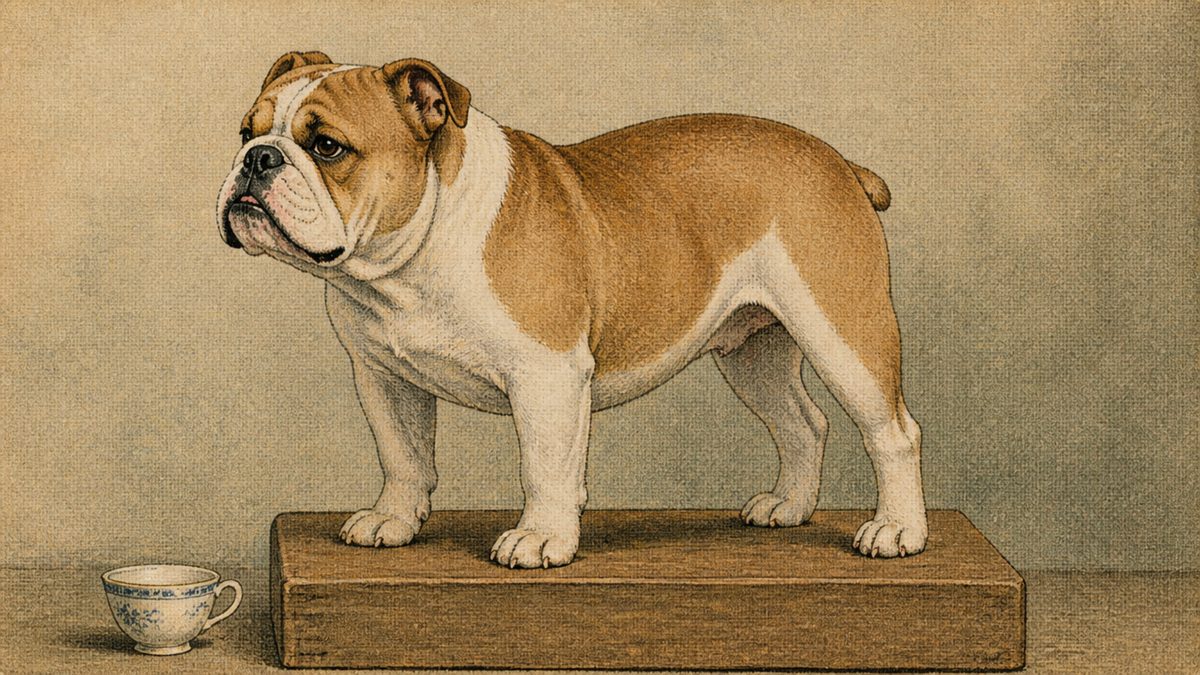
A Toy Bulldog was a full English Bulldog reduced in size, with rose ears, a wide undershot jaw, a roach back and a low-set screw tail, weighing 20 lb or under by its club's rule.
Because the variety had no standard of its own, its appearance is defined by the Bulldog's clauses. Drury's own list of what should be found in a Toy Bulldog is the practical summary and it is worth quoting because it doubles as the rejection list for this page's image brief.
"In a Toy Bulldog should be found all those qualities most valued in the larger dog: expression, the rose ears, the wide under jaw, with its upward sweep protruding considerably beyond the upper jaw, lay-back, a big black nose and well defined stop, depth of brisket, a good set-on of shoulder, strength of bone, the roach back and a small tail, straight screw or crank set on low."
- Ears. Rose, folded back. Erect bat ears belong to the French dog and are the single commonest error in modern illustrations of this variety.
- Jaw. Wide and undershot, sweeping upward well beyond the upper jaw. Drury's puppy-selection advice is to lift the lips and check: if the jaws are level or inclined to be overshot, "the puppy should be discarded".
- Back. Roach or wheel back, which the French dog rarely carries.
- Tail. Small, straight screw or crank, set on as low as possible. "A long-tailed Bulldog is an eye-sore, whether he be of full size or a Toy."
- Size. 20 lb or under by the club's rule, or 22 lb and under by Leighton's later reading, so roughly 9 to 10 kg.
The one surviving likeness, and what it is
One photograph is reproduced across the whole internet for this variety: Mrs. Schlafermann's Little Knot, figure 130 in Drury 1903. It is the image Wikipedia uses and it is dated 1903. Drury names that dog as one of the two most perfect specimens in England and, in the same sentence, says it is over the club's weight limit. So the definitive picture of the variety is of a dog that did not qualify under its own rule.
No modern photograph of a Toy Bulldog can exist and this page will not present one. The hero image here is generated as a period-style plate from the clauses above and is labelled a reconstruction. Its brief specifically rejects bat ears, a level jaw, a long or curled tail and any exaggeratedly flattened muzzle, because the page's own argument is that extreme brachycephaly is what makes these dogs dangerous in India and an image should not celebrate it.
The French Bulldog descent claim, and what the primary source actually supports
The French Bulldog and the Toy Bulldog share the same Nottingham origin rather than descending one from the other, and the primary sources say so in two places.
Every ranking page says the french bulldog descends from the Toy Bulldog. The 1903 chapter supports a more precise and more interesting claim, and it names its source.
Drury reproduces a letter printed in *Our Dogs*, signed R. Hill, Parliament-street, Nottingham, describing the trade in small Bulldogs between Nottingham and France: "a continual stream of people going from Nottingham to Calais and St. Quintin, lace-makers, Notts men, many of them taking a dog back with them". Drury's own reading of that letter is that the so-called French Bulldog is "a mongrelised and dwarfed member of the Bulldog family, which, exported to France years ago from England, has lately been reintroduced into this country, after having been crossed with the Pug and probably other breeds of which no records have been kept".
| Claim | Support | How strong |
|---|---|---|
| Small English Bulldogs were taken to France by Nottingham lace workers | A named contemporary letter from Nottingham, reproduced in 1903, and Leighton's independent 1910 account of the same migration to Normandy | Strong. Two sources, one of them a first-hand trade account |
| The French Bulldog's bat ear came from English stock | Drury: the bat or tulip ear "is probably of English origin", because the dogs exported "were mostly possessed of erect ears, a point which no doubt the French breeders strove to perpetuate and exaggerate" | Moderate. Drury hedges it with "probably" and "no doubt" |
| The French dog was crossed with the Pug | Drury states it, and states that no records were kept or revealed | Weak as documentation, and Drury says so himself |
| The French Bulldog descends from the English Toy Bulldog specifically | Not supported. Both descend from the same small English Bulldogs. The Toy Bulldog Club's variety was a parallel English project, and Drury argues at length that the two should not be crossed | Rejected as stated. The shared ancestor is the small English Bulldog, not this club's variety |
| French Bulldogs were later used to rebuild the English bantams | Leighton 1910: imported before 1902 "with the object of resuscitating the strain of bantam Bulldogs" | Strong, and it runs the opposite way to the usual claim |
So the honest sentence is that the two are siblings rather than parent and child, both descended from the small Bulldogs of Nottingham, and that gene flowed from France back into England as well as out. The French Bulldog is FCI standard 101 today. Its English sibling holds nothing.
Registry recognition today: none anywhere, checked with controls
No kennel club holds the Toy Bulldog or the Miniature Bulldog today, and four registers were read with in-document controls to establish that rather than assumed.
An absence is a strong claim, so every row carries a control that returned in the same document in the same session.
| Register | Found? | Controls that returned in the same document |
|---|---|---|
| The Royal Kennel Club, complete Breeds A to Z | No. Toy Bulldog 0 | Bulldog 4 occurrences covering the Bulldog and French Bulldog, plus Skye, Yorkshire, Silky, Dandie, Cairn, Labrador, Beagle and King Charles |
| FCI nomenclature, letter B index | No. 44 entries and none is a Miniature Bulldog | BULLDOG 149, BOULEDOGUE FRANCAIS 101, BOSTON TERRIER 140, BULDOGUE CAMPEIRO 374, BULLMASTIFF 157 |
| FCI nomenclature, letter T index | No. 10 entries | TAIWAN DOG 348, TIBETAN TERRIER 209, TOSA 260 |
| United Kennel Club, all nine groups in one page | No, in none of the nine | English Bulldog and French Bulldog in Companion Dog; American Bulldog and Olde English Bulldogge in Guardian Dog; Bloodlines Listing Service Group of 10 |
A retrieval warning this session produced
The Royal Kennel Club's index was fetched twice and the first fetch was worthless. Excluding anchor tags to keep the payload small emptied the breed list, because the index is a list of links, and the page still returned HTTP 200 with the correct title while every control returned zero. An absence read off that fetch would have been right by accident here and wrong on any breed the register does hold. A failing control is never a finding.
What this means for a buyer in India
There is no Indian pedigree route for this name. India is a full member of the Federation Cynologique Internationale, represented by the Kennel Club of India at Anna Nagar, Chennai, so an Indian pedigree is issued against FCI nomenclature. FCI nomenclature holds the Bulldog at 149 and the Bouledogue Francais at 101, and holds nothing under either of this variety's names. Anyone in India offering registration papers for a Toy, Mini or Teacup English Bulldog is describing a document that cannot be issued.
This variety is unrecognised today, and it is worth being precise about what changed. It is not a dog that never reached a registry. It reached one, held show classes, appeared in a champions appendix and had its name changed by Kennel Club edict, and then the dogs ran out. A registry class is an event with a date attached rather than a permanent property, which is the same lesson the Paisley Terrier page draws from the opposite direction.
Toy Bulldog price in India: the search returns soft toys, and that is the whole answer
No Toy Bulldog price in India exists, because the variety is extinct. What the Indian search for this name actually returns is a shop full of stuffed animals priced from Rs 105 to Rs 10,786.
This is the clearest example of a contamination mechanism this site has recorded, and it is caused by one word. Google India's organic results for "toy bulldog" are dominated by plush toys. The second organic result on 10 September 2026 was a stuffed bulldog at Rs 899 from a craft retailer, and Google returned a Popular products carousel spanning Meesho, Flipkart, Amazon.in, Zepto, JioMart and FirstCry.
| Listing | Price | What it is |
|---|---|---|
| Meesho, bulldog soft toy | Rs 105 | A plush toy |
| Amazon.in, plush dog toy | Rs 249 | A plush toy |
| JioMart, mini bull dog stuffed animal | Rs 299 | A plush toy |
| Flipkart, Babyjoys bulldog 25 cm | Rs 466 | A plush toy |
| Itsy Bitsy, bulldog with stocking 20 cm | Rs 899 | A plush toy, and the second organic result on the page |
| Amazon.in, giant English Bulldog | Rs 7,458 | A plush toy |
| desertcart.in, plush toy dog | Rs 10,786 | A plush toy |
Not one of those is a dog. Any Indian page quoting a rupee figure for a Toy Bulldog is either quoting one of these or inventing one. This is the merchandise trap this site has recorded before, where the only rupee figure attached to an extinct breed was a downloadable poster, and here the word "toy" makes the entire commercial result set merchandise by construction.
The historical price, and what Drury says a breeder actually needed
Drury gives no purchase price, but he gives something more useful: the equipment a would-be breeder needed. "The equipment of the would-be Toy Bulldog breeder should be, say, three, more if possible, bitches weighing from 28 lb. to 35 lb., and bred from a stock which has always inclined to smallness." He adds that "to attempt to build up a strain of Toys is practically an impossibility when the breeder is possessed of only one bitch".
That is a capital requirement, not a puppy price, and it explains the economics better than any figure would. The variety needed a kennel of at least three full-sized bitches to produce occasional undersized puppies, most of which would be too big to show.
Ask which registry holds that variety, and the conversation ends there, because none does. The Royal Kennel Club, the FCI and the UKC were all read for this page and none holds a Toy or Miniature Bulldog under any name. A Bulldog sold as miniature in India is either a small Bulldog, a cross, or a dog bred down by methods the 2017 Rules reach. Read the law section on this page before paying a premium for smallness in a brachycephalic dog.
Monthly cost of ownership in India for a small brachycephalic dog
A 9 to 12 kg brachycephalic dog costs roughly Rs 4,000 to Rs 9,000 a month to keep properly in an Indian metro, and the line most owners underestimate is not food but the cost of managing heat and airway problems.
The arithmetic is worth doing even for a dog you cannot buy, because it is what an Indian reader considering a Bulldog or a French Bulldog actually needs. Every figure below was read from the seller's or the municipality's own page and re-check any row before budgeting on it.
| Item | Published price | Notes |
|---|---|---|
| Royal Canin Mini Adult dry food, 8 kg | Rs 5,861, MRP Rs 6,660 | Rs 73 per 100 g at this pack size |
| The same food, 800 g pack | Rs 810, MRP Rs 880 | Rs 101 per 100 g, a 38 percent unit-price penalty for buying small |
| Anti-rabies vaccine | Rs 699 | Vetic clinic list price, per dose |
| 9-in-1 DHPPiL | Rs 899 | Vetic clinic list price, per dose |
| Kennel cough | Rs 1,349 | Vetic clinic list price. Relevant here, because a compromised airway tolerates a cough badly |
| Deworming, Drontal Plus | Rs 125.67 per tablet | One tablet per 10 kg, so one tablet covers this size |
| Boarding, 24 hours | Rs 899 | PawSpace Bengaluru overnight rate |
| Delhi MCD pet dog registration | Rs 500 | Renewal also Rs 500, late fee Rs 100 a month |
| Chennai GCC pet licence | Rs 50 | Six municipal clinics also give treatment and anti-rabies vaccination free of cost |
| Microchipping, Chennai | Rs 1,250 | SKS Veterinary Hospital's own transacted price |
Food is modest for a dog this size. At Rs 73 per 100 g, every 100 g a feeding chart specifies costs about Rs 2,190 a month, and the 800 g pack costs 38 percent more per 100 g than the 8 kg pack for an identical product. Buy the largest pack the dog will finish inside its shelf life.
What is missing from that table is the line this body plan actually generates, and no Indian rate card for it could be obtained. Airway surgery, emergency cooling and caesarean section are the costs that decide the lifetime bill for a brachycephalic dog, and Indian published prices for them were not obtainable in this session, so this page publishes none rather than guessing. Ask your nearby vet for a written estimate before you buy the dog rather than after. Three one-off costs sit outside the monthly figure and are worth planning for: municipal registration at Rs 500 in Delhi, microchipping at Rs 1,250 in Chennai, and boarding at Rs 899 for an overnight stay at one Bengaluru operator's published rate.
Greater Chennai Corporation's six pet clinics provide treatment and anti-rabies vaccination free of cost, and the corporation issued 9,115 pet licences in 2024 at Rs 50 each. Delhi's MCD has issued 18,958 pet dog certificates since 2021 at Rs 500. For a reader comparing cities, a free municipal rabies route is a larger practical saving than any discount on kibble, and neither figure moves next quarter.
Could a Toy Bulldog handle the Indian climate? The heat tolerance answer
Bonbeno rates the Toy Bulldog 1 of 5 for heat tolerance, and unlike most extinct pages this rating rests on measured data about the living dogs that share its skull shape rather than on inference alone.
Start with the two numbers that matter. Nottingham's warmest month averages 16.13 C. Chennai's coolest month averages 24.09 C. NASA POWER climatology, 2001-2020 The gap is 7.96 degrees, and it runs in the direction that kills: India's mildest coastal month is eight degrees hotter than the hottest month this variety's home city ever managed.
| Place | Cell elevation | Annual mean C | Annual RH % | Warmest month | Peak wet bulb C |
|---|---|---|---|---|---|
| Nottingham | 112.05 m | 9.30 | 87.28 | Jul 16.13 | 13.94 (Jul) |
| Bengaluru | 841.72 m vs 920 m | 23.74 | 67.94 | Apr 28.37 | 21.86 (May) |
| Hyderabad | 494.59 m | 26.10 | 60.30 | May 33.30 | 23.35 (Jun) |
| Delhi | 206.37 m vs 216 m | 25.60 | 45.56 | Jun 35.88 | 26.50 (Jul) |
| Chennai | 48.95 m vs about 6 m | 27.95 | 72.39 | May 31.51 | 26.11 (May) |
| Kolkata | 7.35 m | 25.81 | 73.93 | May 31.53 | 27.09 (Jun) |
The measured half, which no other extinct page on this site can offer
This variety's skull shape is shared with two breeds that a large modern study measured directly. Hall and colleagues examined 905,543 UK dogs under primary veterinary care in 2016 and identified 395 confirmed heat-related illness events, with an incidence of 0.04 percent and an event fatality rate of 14.18 percent. The odds ratios below are from that paper's Table 2, read from the source rather than from a summary, with the Labrador Retriever as the comparator.
| Category | Odds ratio | 95 percent CI | p |
|---|---|---|---|
| Chow Chow | 16.61 | 6.21 to 44.44 | <0.001 |
| Bulldog | 13.95 | 8.01 to 24.29 | <0.001 |
| French Bulldog | 6.49 | 3.62 to 11.63 | <0.001 |
| Dogue de Bordeaux | 5.31 | 1.99 to 14.21 | 0.001 |
| Greyhound | 4.26 | 1.88 to 9.70 | 0.001 |
| Cavalier King Charles Spaniel | 3.45 | 1.86 to 6.42 | <0.001 |
| Pug | 3.24 | 1.67 to 6.29 | <0.001 |
| Golden Retriever | 2.65 | 1.40 to 5.01 | 0.003 |
| Boxer | 2.26 | 0.95 to 5.34 | 0.064, not significant |
| Brachycephalic skull shape | 2.10 | 1.68 to 2.64 | <0.001 |
| Bodyweight 50 kg or more | 3.42 | 1.54 to 7.57 | 0.002 |
The Bulldog is second in that table and the French Bulldog third, and both are sold in India. Bengaluru is the mildest Indian city on this site and it is still 14.44 degrees above Nottingham on the annual mean. Hyderabad, which Indian owners often describe as dry rather than hot, still reaches 33.30 C in May. For a heat-sensitive body plan there is no Indian city that reads as mild. The brachycephalic row is the one that transfers to this extinct variety, because skull shape rather than breed name is what it shared: a brachycephalic dog carried 2.10 times the odds regardless of which flat-faced breed it was.
- Walk before sunrise and after dark from March to June in any plains city, and test the pavement with the back of your hand first.
- Judge the month by its wet bulb rather than its temperature. Kolkata's June peak of 27.09 C is the highest figure in the climate table above and Kolkata is not the hottest city in it.
- Stop the moment a flat-faced dog's breathing changes pitch. Noisy breathing at rest is not a bulldog being a bulldog; it is a narrowed airway working harder.
- Never leave a brachycephalic dog without shade, water and moving air, and treat a dog panting in shade that does not settle within five minutes as an emergency.
India's Dog Breeding and Marketing Rules 2017, Second Schedule Part IV paragraph 21(1), bar outdoor housing without the attending veterinary practitioner's written approval for dogs not accustomed to local temperatures and for breeds that cannot tolerate them. For a dog with this airway, an Indian summer courtyard is not a housing choice.
Humidity, wet bulb, and why damp is the wrong thing to worry about
Nottingham runs 87.28 percent annual relative humidity, higher than any Indian city on this site, so damp air was this variety's native condition. What it never met is heat, and heat is what a compromised airway cannot manage.
The reflex warning on a British breed page is that Indian humidity will overwhelm the dog. The measurement says otherwise and it is worth stating clearly.
| Place | Annual RH % | Annual mean C |
|---|---|---|
| Nottingham | 87.28 | 9.30 |
| Kolkata | 73.93 | 25.81 |
| Chennai | 72.39 | 27.95 |
| Bengaluru | 67.94 | 23.74 |
| Hyderabad | 60.30 | 26.10 |
| Delhi | 45.56 | 25.60 |
Nottingham is 13.35 percentage points more humid than Kolkata, the dampest Indian city in the table, and nearly twice as humid as Delhi. These dogs came out of damp air.
Wet bulb is where the two places separate, and for this airway it is decisive
A wet bulb temperature combines heat and humidity into the number that decides whether an animal can shed heat by evaporation at all. A dog sheds heat almost entirely by panting, which is evaporation across the airway, so a narrowed airway and a high wet bulb are the same problem arriving from two directions.
| Place | Peak wet bulb C | Month | Gap from Nottingham |
|---|---|---|---|
| Nottingham | 13.94 | July | baseline |
| Bengaluru | 21.86 | May | +7.92 |
| Hyderabad | 23.35 | June | +9.41 |
| Chennai | 26.11 | May | +12.17 |
| Delhi | 26.50 | July | +12.56 |
| Kolkata | 27.09 | June | +13.15 |
Delhi makes the point inside one city. Its hottest month is June at 35.88 C with 36.42 percent humidity, giving a wet bulb of 24.40 C, but its highest wet bulb is 26.50 C in July at 32.27 C and 62.72 percent, and August reaches 26.16 C on air that has cooled to 29.79 C. The air cools by six degrees from June to August while the wet bulb rises by 1.76. A flat-faced dog that copes with a dry June afternoon can fail in a humid August one that reads cooler on a thermometer.
Of 879 UK heat-related illness events with a recorded trigger, 652 were exertional, 113 environmental and 46 vehicular confinement. The hot-car form that owners fear is the smallest of the three. For a brachycephalic dog in an Indian city the decision that matters is the time of the walk, and it belongs entirely to the owner. Consult your nearby vet about exercise limits for any flat-faced dog before an Indian summer rather than during it.
Temperament: what the record says, and who was saying it
Every surviving description of this variety's temperament was written to sell it, and what they describe is an affectionate, greedy, quiet house dog rather than a working animal.
Leighton's account is the fullest and reads as breed-club copy, which is what it is. Miniature Bulldogs "are faithful, fond, and even foolish in their devotion, as all true friends should be. They are absolutely and invariably good-tempered, and, as a rule, sufficiently fond of the luxuries of this life, not to say greedy, to be easily cajoled into obedience."
He adds two things that are genuinely useful because they are specific. The dogs took "a keen interest in all surrounding people and objects, without, however, giving way to ceaseless barking", and were "remarkably intelligent, and caring enough for sport to be sympathetically excited at the sight of a rabbit without degenerating into cranks on the subject like terriers". A quiet, food-motivated, people-focused dog is a plausible description of a bull breed and it matches the living ones.
What transfers and what does not
- Food motivation transfers, and it is a double-edged tool. It makes training easy and it makes weight control hard, and excess bodyweight is an independent risk factor for heat-related illness in the UK data.
- The quietness transfers, and matters in an Indian flat. A dog that watches rather than barks is a genuinely better neighbour than most terriers.
- The temperament described here is not evidence about a living Bulldog. A hundred and twenty years of separate selection sit in between, and Drury's own chapter says the Fancy was "comparatively too young for the effects of systematic breeding to be yet visible". Read the living breed's own page for the living breed's behaviour.
Training a food-motivated flat-faced dog, and the one thing that is different
Train a bull-type dog with food and short sessions, and build one behaviour no other breed needs as urgently: a reliable stop that works when the dog does not want to stop.
No training manual for this variety exists. What Leighton describes is a dog "easily cajoled into obedience" by food, which is the same lever that works on its living relatives.
The genuinely breed-specific requirement is the opposite of a trick. A brachycephalic dog will keep working past the point where it can cool itself, because excitement and airflow pull in different directions, and the owner is the only brake.
- Train a settle on a mat, so a hot or over-excited dog has a trained alternative to pacing and panting.
- Train a recall you can use to end play, and practise it when the dog is mildly excited rather than only when it is calm.
- Train handling of the face and folds early, because a wrinkled face needs cleaning weekly for life and a dog that objects makes it a fight.
- Train tolerance of a cooling routine. Wetting the groin, armpits and paws with cool water and standing the dog in moving air is what a vet will ask you to do, and a dog that has never had it done will resist at the worst possible moment. Ask your nearby vet to show you the technique on your own dog.
"Choose, therefore, the healthiest rather than the very smallest puppy in the litter." Drury spends a page arguing against picking the smallest, warning that a weedy puppy is "poor in bone, feeble in its actions, and lacking stamina generally" and that "his early death is almost a certainty". That is 1903 advice against exactly the impulse that sells teacup dogs in India in 2026, written by someone whose own book was promoting a miniature variety.
Exercise: short, cool, and stopped early
A dog of this build needs two short walks a day and no sustained exertion in heat, and in an Indian city the constraint is the hour rather than the distance.
No exercise record exists for this variety, so what follows is what the modern data supports for a small brachycephalic dog in India. Exertional heat illness accounted for 652 of the 879 UK events with a recorded trigger, which is 74.2 percent, against 46 attributable to vehicular confinement.
- Two walks of 15 to 20 minutes, before sunrise and after dark from March to June in any plains city.
- No running, no fetch and no stairs as exercise in the hot months. Sustained effort is the trigger category that dominates the data.
- Carry water on every outing, and offer it before the dog looks like it needs it.
- Stop for the day when breathing does not settle within five minutes in shade. That is a threshold, not a guideline.
- Keep the dog lean. Bodyweight at or above the breed and sex mean was an independent risk factor in the same UK cohort.
Leighton's own advice, oddly, points the same way for a different reason: he recommends that a serious breeder "accustoms his dogs to an out-door life" with "fresh air and exercise", while warning against pampering and coddling. In an English climate that is sound. In India the fresh-air half survives and the outdoor-housing half is barred without written veterinary approval by the 2017 Rules.
Grooming a short coat and a wrinkled face in Indian humidity
The coat needs almost nothing and the face needs weekly work, because in Indian humidity a warm damp skin fold is an infection waiting to happen.
Bull-type coats are short, smooth and undemanding. What this body plan actually costs in grooming time is the face, and it is a job Indian owners of Pugs, Bulldogs and French Bulldogs already know.
| Task | Frequency | Why it matters here |
|---|---|---|
| Clean and DRY every facial fold and the nose roll | Weekly, more in the monsoon | A warm damp fold is the commonest site of skin infection in flat-faced dogs in a humid climate |
| Dry the tail pocket and any tail fold | Weekly | A screw tail sits in a pocket that stays damp and is easy to miss entirely |
| Check the skin in daylight for ticks | Weekly | Short coat makes this easy, and given the Indian tick burden it is ten valuable minutes |
| Brush the teeth | Daily | An undershot jaw crowds the incisors, and crowding is what drives periodontal disease |
| Trim nails | Every 2 to 3 weeks | A heavy-boned short-legged dog does not wear nails down on Indian pavements |
| Bathe and dry to the skin | As needed | Never air dry a dog with folds in Indian humidity. Towel, then cool air, then check every fold is dry |
Drury describes moulding a puppy's ears into the correct rose carriage with "the fingers and thumb being only used, without the assistance of so-called ear appliances or adhesive matter". The finger-moulding he describes is mild, but ear appliances and adhesives to set a puppy's ear carriage would engage Second Schedule Part II paragraph 6(8) of India's 2017 Rules, which forbids any change of appearance by artificial means. If a seller tells you a puppy's ears are being set, that is a reason to walk away rather than a sign of care.
Health and life expectancy: nothing is known about the variety, and that took work to establish
No health data of any kind exists for the Toy Bulldog. PubMed returns 27 records across three query forms and not one is about this variety, which is a harder absence to establish than a zero would have been.
This is the section where a content farm invents a disease list, so here is exactly what was searched and exactly what came back.
| Query | Records | Query PubMed actually ran | What the records are about |
|---|---|---|---|
| "Toy Bulldog"[tiab] | 3 | "Toy"[All Fields] AND "Bulldog"[Title/Abstract] | Atopic dermatitis in Korea, calcaneus shape analysis, a congenital porto-pulmonary shunt |
| "Toy Bulldogs"[tiab] | 4 | "Toy"[All Fields] AND "Bulldogs"[Title/Abstract] | Ophthalmic conditions in Japan, lung volume equations, intervertebral disc disease, calcaneus shape |
| "Miniature Bulldog"[tiab] | 20 | miniature expanded into a MeSH term including miniaturization, AND "Bulldog"[Title/Abstract] | Semen analysis, hemilaminectomy outcomes, mammary tumours in Sweden, and so on |
| Genuine on-breed records | 0 | Established by opening records, not by reading a count |
A non-zero count is not proof a search worked, and this is the clearest instance of that on the site. PubMed silently split every quoted phrase and searched the words separately, so three queries returned 27 records that look like a literature and are not one. The honest figure is zero, and it took reading the titles to get there.
So this page publishes no lifespan, no disease list and no screening advice for the Toy Bulldog itself. There is no life expectancy figure for it anywhere, and any page giving one has generated it.
What the living dogs that share this skull do carry
The transferable health issues belong to the breeds a reader can actually buy, and they are serious enough that this page states them rather than gesturing at them.
- Heat-related illness. Bulldog 13.95 times the Labrador's odds, French Bulldog 6.49, Pug 3.24, brachycephalic skull shape alone 2.10, with a 14.18 percent fatality rate across 395 confirmed events.
- Exertional trigger dominance. 652 of 879 UK events with a recorded trigger were exertional.
- Whelping risk. Drury's own 1903 text warns that mating two small Bulldogs risks producing puppies too large for the dam, "with infinite danger to the mother, who would in all probability succumb to the exertion of bringing them into the world". That is a contemporary account of the breeding practice killing bitches, written by someone advocating the variety.
It is as wrong to assume the 1903 Toy Bulldog had a modern Bulldog's airway as to assume it was healthy. Muzzle length in this group has shortened considerably since 1903, and no measurement of these dogs survives. What is safe to say is that the skull shape was already flat enough to be the defining feature of the parent breed, and that flat-faced dogs are measurably worse at shedding heat. Anything more specific would be invention. Consult your nearby vet about any living flat-faced dog rather than reasoning from a Victorian book.
The two Indian health risks a small flat-faced dog would actually face
Two risks dominate for a small dog living in India, and for a brachycephalic dog one of them is far worse than average: exertional heat illness, and tick-borne disease.
Tick-borne disease is the largest documented threat to any dog in India. Three molecular studies give the scale.
| State | Dogs screened | Finding |
|---|---|---|
| West Bengal | 584 | Babesia gibsoni in 76.54 percent; Anaplasma in 55.75 percent; 72.9 percent of the 584 screened carried two or more pathogens |
| Kerala | 120 | Babesia in 66.7 percent, 80 of 120; Ehrlichia canis in 5.0 percent; peak in the pre-monsoon months of March to May |
| Odisha | 178 | Ehrlichia canis in 31.46 percent, 56 of 178; 79 percent of infected dogs had a tick history |
Every one of these studies sampled dogs presented at veterinary clinics or clinically suspected animals, not a random population of Indian dogs. So 76.54 percent is the proportion among dogs tested at clinics, and it is materially misleading without that qualifier. What they do establish is that these pathogens are common and often present together in Indian dogs sick enough to be tested.
The Kerala series is the most useful for timing, peaking in the pre-monsoon months of March to May rather than in the monsoon. The Odisha series is the most useful for behaviour: 79 percent of infected dogs had a recorded tick history, so the exposure is visible and preventable. Short-coated dogs make the weekly tick check easy, which is the one genuine advantage this body plan has in India.
Deworm on a schedule rather than when you remember. Drontal Plus is dosed at one tablet per 10 kg of bodyweight at Rs 125.67 a tablet, so a 9 to 12 kg dog needs one to two. Combine that with a year-round tick preventive your vet chooses for your city.
Heat, and why it is worse for this shape than for any other
The second risk is exertional and it is the owner's decision rather than the dog's. A brachycephalic dog cools itself through a narrowed airway, so the same walk that a mesocephalic dog manages leaves a flat-faced dog with less margin. The UK data quantifies the difference at 2.10 times the odds for skull shape alone and 13.95 times for the Bulldog specifically. In a country where Chennai's coolest month is warmer than Nottingham's hottest, that margin matters every day rather than on a few afternoons a year.
Vaccination is cheap relative to the risk. Anti-rabies is Rs 699 and 9-in-1 DHPPiL Rs 899 at Vetic's published list prices, while Greater Chennai Corporation's six municipal clinics give anti-rabies vaccination free of cost. Consult your nearby vet on the schedule your city and your dog's history actually need.
Feeding a 9 to 12 kg bull-type dog in India, and the one habit that matters most
Feed a bull-type dog to a body condition score rather than to a chart, because bodyweight at or above the breed mean is an independent risk factor for heat-related illness and this group is food-motivated by temperament.
No feeding record for the Toy Bulldog exists beyond Drury's warning against underfeeding. What follows is what a living dog of that size costs to feed properly in India, priced from a seller's own page on 10 September 2026.
| Pack | Price | MRP | Per 100 g |
|---|---|---|---|
| 800 g | Rs 810 | Rs 880 | Rs 101 |
| 2 kg | Rs 1,883 | Rs 2,140 | Rs 94 |
| 4 kg | Rs 3,388 | Rs 3,850 | Rs 84 |
| 8 kg | Rs 5,861 | Rs 6,660 | Rs 73 |
| 16 kg, 2 x 8 kg | Rs 11,722 | Rs 13,320 | Rs 73 |
The 800 g bag costs 38 percent more per 100 g than the 8 kg bag for an identical product from the same seller on the same day, and none of those figures divides cleanly by 84.38, 80 or 74, so this is a rupee-native price list rather than a converted American one.
At Rs 73 per 100 g, every 100 g a day costs about Rs 2,190 a month. Read the feeding chart on the pack for your dog's weight and multiply. This page publishes no grams-per-day figure because it did not obtain the chart, and a monthly cost built on a guessed feeding rate is a guess with a decimal point.
- Keep the dog lean, and be strict about it. This is the single highest-value thing an Indian owner of a flat-faced dog can do, because excess weight and a narrowed airway compound.
- Split into two meals for an adult, three for a puppy, and never one large meal.
- Do not free-feed in monsoon humidity. Food spoils faster than owners expect and free-feeding hides the appetite change that is often the first sign of illness.
- Use food as the training currency, because Leighton's "easily cajoled into obedience" is still true and it is cheaper than any equipment.
The first year, month by month, and why this timeline is not about a Toy Bulldog
No month-by-month timeline for a Toy Bulldog puppy can be honest, because no source describes one. What follows is the first year of a small flat-faced puppy in India, anchored on the dates Indian law and Indian veterinary practice set.
Every date below comes from an Indian instrument or an Indian price list rather than from a breed history, which is why it is usable.
| Age | What happens | Where the date comes from |
|---|---|---|
| Under 8 weeks | The puppy may not lawfully be sold. Rule 8(1)(a) of the Dog Breeding and Marketing Rules 2017 provides that pups less than eight weeks in age are not sold | Indian gazette, Rules 1 to 13 |
| 8 to 10 weeks | Home. Begin daily handling of the face, folds and feet in two-minute sessions | |
| 8 to 16 weeks | Core vaccination course. Vetic's published per-dose prices are Rs 849 for puppy DP, Rs 899 for 9-in-1 DHPPiL and Rs 699 for anti-rabies | Vetic clinic list, read 10 September 2026 |
| 3 to 4 months | Register the dog with the municipality. Delhi MCD Rs 500, Greater Chennai Corporation Rs 50 | The municipalities' own pages |
| 3 to 4 months | Microchip if your city requires it. Chennai's mandate is live and a clinic's own price is Rs 1,250 | SKS Veterinary Hospital, Chennai |
| 4 to 6 months | Ask your vet to assess the airway at rest and after gentle exercise, and to record it. An early baseline is what makes a later change detectable | |
| 6 months | Adult teeth are in. Start or continue daily brushing, because an undershot jaw crowds the incisors | |
| 6 to 12 months | First Indian hot season. Fix the walking hours now and keep them, rather than discovering the limit in May | |
| 12 months | Body condition review. A lean adult is the cheapest heat-illness prevention available |
Rule 8(1)(a) is a Rule of the 2017 Rules rather than a Second Schedule paragraph, and it is enforceable. Ask the date of birth and do the arithmetic. A seller offering a six-week-old flat-faced puppy has answered every other question you were going to ask.
Indian law: breeding for smallness, and why no import authorisation exists
Three Indian provisions reach this variety's story directly. Import policy makes any dog a Restricted import, the 2017 Rules prohibit breeding for unusual looks or new breeds, and the same Rules prohibit the in-breeding the variety's own foundation story describes.
There is no import route, and there is nothing to import
Dogs enter India under ITC(HS) 01061900 as a Restricted import, entry is limited to seven named ports, and anything outside the personal pet allowance is routed through the Exim Facilitation Committee. An import authorisation for a commercial or breeding consignment is not something an ordinary buyer obtains, and for this variety the question never arises because nothing exists to import. The full route is set out in how to import a dog to India.
Breeding for smallness is what the Rules actually reach
Second Schedule Part II paragraph 6(9) reads: "Breeding to create new breeds of dogs or unusual looks shall be strictly prohibited." A programme to produce a Bulldog under 20 lb is a programme to produce an unusual look, and it is exactly what is being sold in India today under names like Mini and Teacup English Bulldog. The text does not carve out an exception for a variety that once had a club.
Paragraph 6(3) prohibits two named mating techniques: in-breeding, defined as breeding between relatives of the second to fourth grade within four generations, and incest breeding between parents and children or brother and sister. That clause meets this variety's own foundation story head-on. The Nottingham letter Drury reproduces says of the city's best small Bulldog: "It was bred from brother and sister. Every good dog in the city was descended from it." A named contemporary describing the founding gene pool as a brother-sister mating is as direct a collision between a breed's history and Indian law as this site has published.
| Provision | What it says | Why it applies here |
|---|---|---|
| Rule 8(1)(a) | Pups less than eight weeks in age are not sold | The one enforceable date any Indian puppy buyer can check |
| Second Schedule Part II para 6(3) | In-breeding within four generations and incest breeding are prohibited | The variety's own foundation is described as a brother-sister mating |
| Second Schedule Part II para 6(8) | No docking, cropping, de-barking, de-clawing, branding, dyeing, and no change of appearance by artificial means | Reaches ear appliances and adhesives used to set a puppy's ear carriage |
| Second Schedule Part II para 6(9) | Breeding to create new breeds of dogs or unusual looks is strictly prohibited | Reaches any modern Mini or Teacup Bulldog programme |
| Second Schedule Part III para 8(10) | Breeding dogs must have been tested for named genetic defects, the list opening with the word including | The list is illustrative rather than closed, so an unlisted airway defect is not outside it |
| Second Schedule Part IV para 21(1) | Bars outdoor housing without written veterinary approval for dogs not accustomed to local temperatures or unable to tolerate them | Reaches any flat-faced dog kept outdoors in an Indian summer |
The 2017 Rules run 1 to 13 and stop. Everything numbered above 13 is a Second Schedule paragraph, not a Rule, and the Schedule's paragraphs run continuously 1 to 30 across four Parts. "Rule 21" does not exist and appears zero times in the gazette; the outdoor-housing clause is Second Schedule Part IV paragraph 21(1). Enforcement is a separate question from what the text says, and this page does not claim these provisions are actively policed.
Head to head: what an Indian buyer can actually get instead
Nobody can sell you a Toy Bulldog, so the useful comparison is between the living bull breeds available in India, ranked by the one measure that matters here.
Compare these on heat risk first and on looks last, because in an Indian city the heat is the part that decides how the dog's life goes.
| Breed | In India | Heat-illness odds vs Labrador | Note |
|---|---|---|---|
| Toy Bulldog | No, extinct | Not modelled | Shares the brachycephalic row at 2.10, and nothing more specific is knowable |
| Bulldog | Yes, widely | 13.95 (8.01 to 24.29) | Second highest of 35 categories in the UK model. Its standard is the one this variety adopted |
| French Bulldog | Yes, widely | 6.49 (3.62 to 11.63) | The sibling that survived, FCI standard 101 |
| Pug | Yes, very widely | 3.24 (1.67 to 6.29) | India's commonest small flat-faced dog, and one Drury says was crossed into the French imports |
| Boston Terrier | Yes, uncommonly | Not separately modelled | Named in the study's brachycephalic list, so it was in the cohort but has no breed-level odds ratio |
| Staffordshire Bull Terrier | Yes | 1.50 (0.84 to 2.68), not significant | A bull breed that is not brachycephalic, and the difference shows |
The honest recommendation
If the appeal is a small, quiet, food-motivated companion, look outside the flat-faced group entirely. The temperament Leighton describes is not unique to a brachycephalic dog and is available in breeds that can cool themselves. If the appeal is specifically a bull breed, the Staffordshire Bull Terrier sits at 1.50 and is not statistically distinguishable from the Labrador, which is a very different proposition from 13.95.
If what attracted you was the history rather than the dog, read the Old English Bulldog page for the stock this variety came from, and the Paisley Terrier page for a Victorian show breed that reaches the opposite verdict on the same two-condition test.
What Indian readers get wrong about the Toy Bulldog, in order of cost
Seven mistakes recur, ordered by what each one costs the person making it.
- Buying a Mini or Teacup English Bulldog because this variety once existed. No registry holds any such variety, and the breeding methods used to reach very small sizes are what the 2017 Rules reach.
- Taking a rupee figure from the search results. Every price Google India returns for this name is a plush toy, from Rs 105 to Rs 10,786.
- Believing the Kennel Club refused to recognise it. The Kennel Club gave it show classes and then issued an edict requiring the name Miniature rather than Toy. What it declined to register in 1903 was the rival FRENCH toy bulldog.
- Believing the French Bulldog descends from it. Both descend from the same small Nottingham Bulldogs, and gene flow ran back into England as well as out.
- Trusting Google's weight of 11 to 18 kg. Every club figure was 20 or 22 lb, which is 9 to 10 kg. The panel figure is above both.
- Reading a PubMed count as a literature. Three query forms return 27 records and not one is about this variety, because PubMed split every quoted phrase.
- Assuming Indian humidity is the problem. Nottingham runs 87.28 percent annual humidity, higher than Kolkata. Heat is the problem, and for a flat-faced dog it is the whole problem.
A scale of points totalling 100 sits immediately before the Toy Bulldog chapter heading in Drury's scan, and it would have made a satisfying exhibit for a page arguing about standards. It belongs to the previous chapter, the Italian Greyhound. Adjacent blocks in an OCR text are the easiest thing in this kind of research to conflate, and the check that catches it is confirming which chapter a table sits under before quoting it.
Adoption: what to do instead, and how to verify whatever you are offered
You cannot adopt a Toy Bulldog, so the useful advice is what to do with the interest that brought you here, and for an Indian reader flat-faced dogs reach shelters for reasons this page has already explained.
Pugs, Bulldogs and French Bulldogs reach Indian shelters and rescue networks steadily, and the commonest reasons are the ones on this page: the dog could not cope with the climate, or the airway or skin problems cost more than the owner expected. A person who has read the heat table is exactly the person who should adopt one, because they will make the right decisions about walking hours from day one.
Where to look
- Municipal and NGO shelters in your own city first. Greater Chennai Corporation runs six pet clinics providing treatment and anti-rabies vaccination free of cost, which lowers the cost of taking on an adult dog of unknown history.
- Breed-specific rescue networks, which in India operate city by city rather than nationally.
- Foster-to-adopt, which is the only honest way to find out whether you can manage a flat-faced dog through one Indian summer before committing for a decade.
How to verify a seller, if you buy a living breed instead
- Ask the date of birth and do the arithmetic. Rule 8(1)(a) provides that pups under eight weeks are not sold.
- Ask which registry holds the variety, and read the breed name printed on any paperwork. An Indian pedigree is issued against FCI nomenclature, which holds the Bulldog at 149 and the Bouledogue Francais at 101 and holds no miniature version of either.
- Ask to see both parents breathing at rest, and listen. Noisy breathing in a resting adult is the most informative thing you will observe in the whole visit, and it is heritable in a way a certificate is not.
- Verify health claims against a document. Ask which tests were done, by which laboratory, on which parent and on what date. Second Schedule Part III paragraph 8(10) requires breeding dogs to have been tested for named genetic defects and the list opens with the word including, so it is illustrative rather than closed.
- Screen your own expectations before you screen the seller. If you cannot commit to walking before sunrise for four months of the year, the honest answer is a different dog.
The Toy Bulldog is the clearest worked example this site has of a size fashion running ahead of the animal. It had a club, show classes, a Kennel Club edict about its name and two celebrated specimens, and the two celebrated specimens were both over its only rule. Getting under that rule meant either years of careful breeding across three or more bitches, or the methods Drury condemns: starving puppies and dosing them with gin. India in 2026 has the same fashion under new names, the same methods behind some of it, and a statute that speaks to it directly. That is what makes a dead English variety worth an Indian reader's ten minutes.
Toy Bulldog: the questions people actually ask
Why did the toy bulldog go extinct?
Its own documents give a better answer than the internet does. The Toy Bulldog Club set a weight ceiling of 20 lb, and in 1903 the two best specimens in England, Little Knot and Highgate Dot, were both over it. Drury also records that mating two very small Bulldogs risked killing the dam, and that a French import with a different head was competing for the same name. A variety that cannot reliably produce dogs inside its own weight rule, at that cost, does not last.
Is there a toy bulldog breed?
No, and there never was one in the strict sense. The Toy Bulldog Club adopted the standard of points of the Bulldog Club Incorporated with, in Drury's words, the sole difference being in the weight. A club that adopts another breed's standard and changes one number has created a size class, not a breed, and the Kennel Club later required the dogs to be called Miniature Bulldogs rather than Toy.
How many rupees of Bulldog?
For a Toy Bulldog, no rupee figure exists at all, because the variety is extinct. For a living Bulldog or French Bulldog in India, read Bonbeno's own pages for each, which carry the current price picture and the source disagreements behind it. What the Indian search for 'toy bulldog' actually returns is soft toys, priced from Rs 105 on Meesho to Rs 10,786 on desertcart, and not one of them is a dog.
What is the smallest type of Bulldog?
Among living dogs registered by a major kennel club, the French Bulldog is the smallest of the bull breeds, and the Boston Terrier is smaller again if you count it as one. The Toy Bulldog was smaller than either on paper, at 20 lb or under by its own club's rule, but no living example exists to compare, and dogs advertised today as Mini or Teacup English Bulldogs are not a recognised variety of anything.
Was the Toy Bulldog the same dog as the French Bulldog?
No, and in 1903 that was an active argument rather than a settled question. Drury writes that there were two Richmonds in the field: the miniature British Bulldog, and a French importation which had little in common with the British Bulldog except its name. He describes the French dog as having bat ears and little or no projection of the under jaw, both of which the English variety required, and urges breeders not to cross the two.
What weight was a Toy Bulldog supposed to be?
Two contemporary sources give two different answers and this page prints both. Drury in 1903 reports that the Toy Bulldog Club considered 20 lb to be the utmost a Toy Bulldog should weigh. Leighton in 1910 writes that the weight, after much heated discussion and sundry downs and ups, was finally fixed at twenty-two pounds and under. Google's own knowledge panel prints 11 to 18 kg, which is 24 to 40 lb and above both.
Could a Toy Bulldog have lived in India?
Poorly, and the evidence is about the head rather than the size. In UK primary-care data across 905,543 dogs the Bulldog carried 13.95 times the odds of heat-related illness against the Labrador Retriever and the French Bulldog 6.49 times, with brachycephalic skull shape alone carrying 2.10. Nottingham's warmest month averages 16.13 C against Chennai's coolest at 24.09 C.
Is there any health data for the Toy Bulldog?
None. A PubMed audit run on 10 September 2026 returned 27 records across three query forms and not one is about this variety, because PubMed split every quoted phrase and searched the words separately. The three records under 'Toy Bulldog' are about atopic dermatitis in Korea, calcaneus shape analysis and a congenital porto-pulmonary shunt. The honest count is zero, and it took opening the records to establish it.
Can I get a Toy Bulldog pedigree in India?
No, and no route could exist. India is a full member of the Federation Cynologique Internationale represented by the Kennel Club of India in Chennai, so an Indian pedigree is issued against FCI nomenclature, and the FCI holds no Toy Bulldog under letter T and no Miniature Bulldog under letter B. Anyone offering paperwork with this name is describing a document nobody can issue.
Are Mini or Teacup English Bulldogs the same thing?
No, and the difference matters because those dogs are sold in India. A Mini English Bulldog is a marketing description rather than a registered variety, and no kennel club anywhere holds it. The Toy Bulldog at least had a club, show classes and a Kennel Club edict about its name. A modern teacup label has none of that, and the breeding practices used to reach very small sizes are what Drury was warning about in 1903.
What did the Kennel Club actually do about this variety?
More than most sources admit. It provided show classes, it issued an edict requiring the dogs to be called Miniature rather than Toy, and Ash's 1927 champions appendix files Miniatures between Bulldogs and French Bulldogs with the years 1911-13 attached. What it did not do, as of 1903, was register the rival French Toy Bulldog as a separate breed or permit the official registration of its club.
Which living dog should an Indian buyer look at instead?
Look at a mesocephalic small dog rather than a small brachycephalic one, and read the heat table on this page before deciding. If you are set on a bull-type dog, the Bulldog and the French Bulldog are the living descendants, they are both freely available in India, and they sit second and third in the UK heat-illness risk table with the Labrador as the baseline. That is a decision to make with your eyes open, in a country where May in Chennai is warmer than any month Nottingham has ever averaged.
Compare with similar breeds
Toy Bulldog sits in 2 Bonbeno groups. Each one compares it directly against the breeds it is genuinely an alternative to, on the same figures.