
Extinct breed in formation
Toy Trawler Spaniel: A Written Standard, No Register, and One Stuffed Dog Left
It had a written standard, a scale of points that sums exactly to 100, a disqualification list and show classes, and the woman who wrote the standard called it the unregistered breed. Here is what the 1911 and 1919 documents say, when the last one died, and which living dog an Indian reader is actually being pointed at.
Quick answer
No Toy Trawler Spaniel price in India exists, because the breed died out around 1920 and one preserved specimen is all that survives. It had a full written standard and a scale of points totalling 100, published in 1911 and again in 1919, but its own author called it the unregistered breed, so it never reached a studbook. The living dog an Indian reader is actually being pointed at is the Cavalier King Charles Spaniel.
This guide summarises early twentieth century breed documents, peer-reviewed veterinary literature on the living breeds this one sat beside, Indian import and breeding law, published Indian care costs and satellite climate data, as general information for Indian pet owners. It is not a diagnosis and it is not treatment advice. Consult your nearby vet before acting on anything you read here, and treat fainting, a new cough at rest, sudden hind-limb lameness or collapse as an emergency rather than something to read about.
Toy Trawler Spaniel at a glance
What a Toy Trawler Spaniel was, and the phrase that settles its status
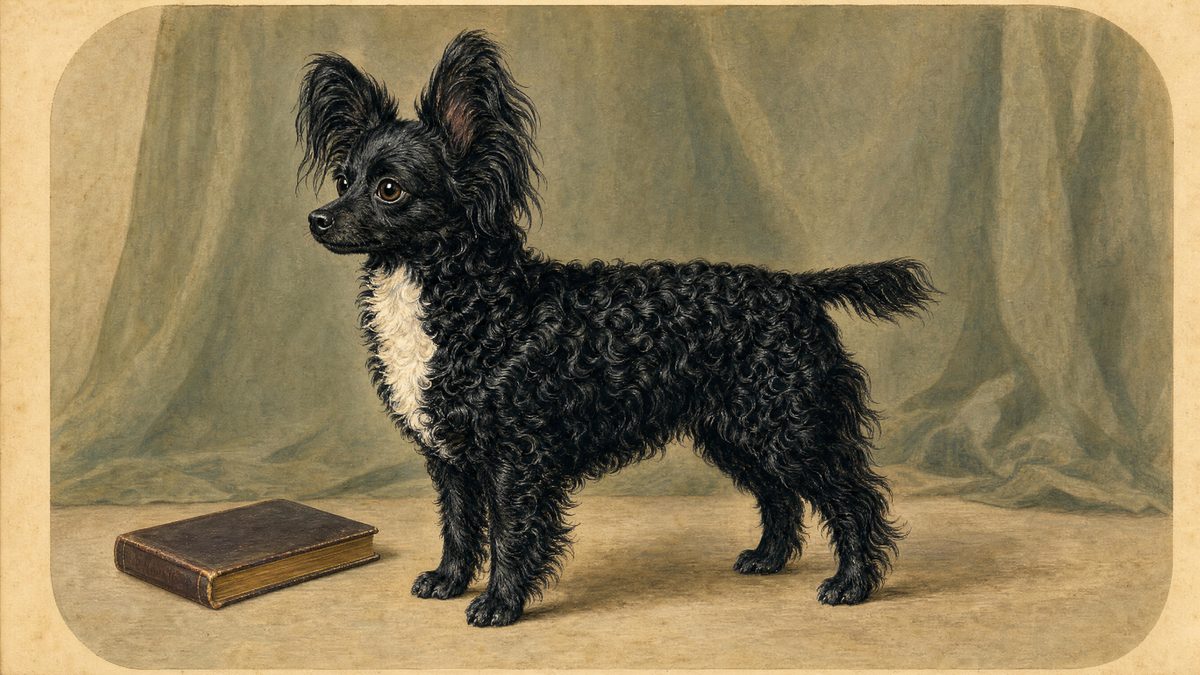
The Toy Trawler Spaniel was a small curly-coated English toy spaniel of 11 to 13 inches at the shoulder, given a complete written standard and a 100-point scale in 1911, never entered in any kennel club register, and extinct by about 1920.
Its own author settles the question in six words. Writing in 1911, the Hon. Mrs. Neville Lytton calls it "the unregistered breed known as the Miniature Toy Trawler". That is the clearest self-description any extinct dog on this site has left behind, and it is why this page reaches a different verdict from every page ranking above it.
The contemporary name was Miniature Toy Trawler, not Toy Trawler Spaniel. Lytton uses it throughout, Leighton heads his section "The Miniature Trawler Spaniel", and Mrs. Leslie Williams's later manual heads hers "The Toy Trawler Spaniel". The modern form is the one that stuck, and this page uses it while recording that the sources do not.
What it was for, and what it was not
It began as a sporting dog and ended as a toy, and Leighton says so in one sentence: "Probably in early times it was used solely as a sporting dog, but at present it is regarded also as a toy, and kept as such in growing numbers." He then argues against his own filing: "Possibly, after all, it is an error to place him among the toys, for, unlike most toys, he is a game little chap, with decidedly sporting instincts and an excellent ratter and rabbiter."
Both he and Williams take care to separate it from one particular breed. Leighton: "This breed is sometimes confounded with the Cocker Spaniel, but this is a great mistake, as it is of entirely different type." Williams, at the end of the same standard: "They must not be confounded with Cockers, being a totally different type." Two writers making the same correction is a sign that the confusion was common.
Not one of the three contemporary sources says what Trawler means in this breed's name, and this page will not guess. Lytton, Leighton and Williams all use it as an established term needing no gloss, which is how writers treat a name their readers already know. That is a real gap in the record rather than a gap in the research, and a page that supplies a fishing-boat etymology is inventing one.
Why an Indian reader should care
Because Google itself answers this query with a question about India. The People also ask module for this breed, captured on an Indian search on 10 September 2026, asked "Is the Cavalier King Charles Spaniel available in India?" The search engine has already worked out that a person reading about a dog that died in 1920 is really deciding about a living toy spaniel, and that is the dog this page spends most of its length on.
The three documents this page rests on, and why they matter more than usual
Three contemporary sources carry this breed, and between them they preserve a complete standard, a scale of points, a measurement table, a numbered breeding experiment and a dated show record, which is more than almost any extinct dog leaves.
Wikipedia's article on this breed is better sourced than the pages that copy it, and the sources it names are the ones nobody opens. All three were read directly for this page.
| Source | Date | What it settles | Controls in the same file |
|---|---|---|---|
| Hon. Mrs. Neville Lytton, Toy Dogs and Their Ancestors, pp. 80 to 82 and 159 to 161 | 1911 | The phrase 'the unregistered breed', the full written standard, the measurement table, the scale of points, and nine numbered breeding crosses with results | Trawler 28, King Charles 235, Blenheim 315, Marlborough 57 in the same scan |
| Robert Leighton, The New Book of the Dog, p. 440 | 1911 printing | The Horsham show record of three classes and 27 entries, two named dogs, the Continental distribution, and the hedged descent claim | Trawler 7, all on or indexed to page 440 |
| Mrs. Leslie Williams, A Manual of Toy Dogs | 1919 | A legible scale of points totalling exactly 100, nine disqualifications, nine undesirable points, and a sixteen-row measurement table | The same standard text as Lytton, independently set |
Two independent printings of one standard, which is what makes the transcription checkable
The Lytton scan is heavily degraded in exactly the place it matters, the scale of points, where OCR turns most of the headings into noise. Williams reprints the same scale legibly, and the thirteen values sum to exactly 100. That arithmetic is the check: a transcription of a points scale that closes on its own printed total is very unlikely to be corrupt.
The measurement tables cross-confirm each other too. The Lytton scan yields readable fragments of 13, 13, 4, 6, 6, 19, 10 and a half, 6 and three quarters, and 4 and a quarter; Williams's table gives height at shoulders 13, length from shoulder to tail root 13, length of ears 4, breadth at shoulders 6, breadth at quarters 6, girth 19, circumference of skull 10.5, circumference of muzzle 6.75 and space between ears 4.25. Mrs. Leslie Williams Two independently set printings agreeing digit for digit is the strongest form of verification available for a 1911 table.
None gives a registration figure, a population count, a lifespan or a single health observation, and none names a parent club. This breed had a standard without an institution behind it, which is precisely the state the verdict section calls a breed in formation. Where this page gives a figure it names the book and the page; where no figure exists it says so.
Bonbeno's two-condition test, and a verdict this site has not used before
To count as a breed on this site an animal needs two documents, a written breed standard and a studbook. The Toy Trawler Spaniel had the first in unusual detail and never had the second, so the verdict is a breed in formation.
This is the third verdict in three pages built in this batch, and the three together are what make the test worth having. The Paisley Terrier had both documents. The Toy Bulldog had a register and no standard of its own. This one is the exact inverse of the Toy Bulldog.
| Condition | Verdict | Evidence, with the document named |
|---|---|---|
| A written breed standard of its own | MET, in unusual detail | POINTS OF THE MINIATURE TOY TRAWLER SPANIEL, Lytton 1911 pages 159 to 161, reprinted in Williams's Manual of Toy Dogs. It runs from head through nose, stop, skull, muzzle, ears, eyes, nose colour, neck, back, tail, carriage, legs, build, action, coat, feathering, colour, size, feet, expression and temperament |
| A scale of points | MET | Thirteen headings summing to exactly 100: general appearance 12, coat 10, head and expression 15, eyes 6, curve and proportion of muzzle 6, set on of ears 5, legs and feet 5, colour 5, action and soundness of limb 10, size 5, compactness and levelness of back and set of tail 10, boldness and alertness 8, soundness of teeth 3 |
| A disqualification list | MET | Nine named disqualifications, from a flesh-coloured nose to bad action, plus nine separately listed undesirable points |
| Show classes | MET | Leighton records three classes and 27 entries at Horsham, won by Mrs. Covey's Goblin. Williams opens his chapter by saying the dog has 'had some classes given for it at shows' |
| A studbook or register | NOT MET | Lytton 1911 calls it 'the unregistered breed known as the Miniature Toy Trawler'. No kennel club register has ever held the name, then or now |
| A parent club | NOT MET | None is named in any of the three sources. Williams names a Northern Toy Spaniel Club for toy spaniels generally, not for this breed |
| Verdict | BREED IN FORMATION | A written standard, a points scale, a fault list and show classes, with no register and no club. That is a breed being assembled, caught at the moment it stopped |
Why the verdict is not simply breed
A standard describes what a breeder is aiming at. A register records which animals actually exist and who their parents were. Without the second there is no way to say whether the dogs at Horsham in one year were the ancestors of the dogs at Horsham in the next, and no gene pool can be described because nobody was writing down who bred to whom. Lytton's nine numbered crosses are the closest thing to a pedigree record this breed has, and they are experiments rather than a register.
The Paisley Terrier had a written standard from the Clydesdale Club and a Kennel Club Stud Book classification from 1888: verdict BREED. The Toy Bulldog had Kennel Club show classes, a club, and a standard adopted wholesale from the Bulldog with only the weight changed: verdict REGISTER WITHOUT STANDARD. The Toy Trawler Spaniel had a detailed standard of its own and no register at all: verdict BREED IN FORMATION. Three extinct dogs, three different failures, and the test tells them apart. That is what a test is for.
The standard itself, which is the most detailed document on any extinct page here
The written standard specifies the nose curving slightly upwards, a deep stop, a flat non-domed skull, long ears carried pricked forward, extremely large dark eyes set straight, and a very curly but not woolly coat, and it names nine disqualifications.
This is worth quoting rather than summarising, because it is the whole of what the breed was.
The head, which is where the standard spends most of its words
"Head small and light, with very pointed, rather short nose, fine and tapering, with a very slight curve upwards of tip of nose. A curve downwards (as in the Borzoi) should be an absolute disqualification. The 'stop' well marked, and the skull rather raised, but flat on the top, not dome-shaped. Muzzle just finished, not overshot. Long ears, set high, and carried pricked forwards, framing the face. Large dark eyes, set wide apart, and showing the white when turned. They must be set perfectly straight, not obliquely, in the head. Whatever colour the dog may be, the nose and lips must be black."
The standard even gives a geometry check: "if the total length of head be about 6 inches, the ears should be set about 4 inches apart", and "the whole head, seen from a bird's-eye point of view, should be a triangle, with the tip of nose as apex".
The coat, and the sentence that puts shape above colour
"The action should be smart and prancing, coat very curly, but not woolly. It should be rather silky in texture, and very glossy. Liberal feathering, waistcoat, and breechings. Shape is all important; colour a secondary matter. Best colour a brilliant black, with white waistcoat. Next, red with white waistcoat, black and white, and red and white." Lytton adds an observation from her own kennel: "The Reds are usually smaller and have less curly coats."
| Heading | Points |
|---|---|
| Head and expression | 15 |
| General appearance, including condition and smartness | 12 |
| Coat | 10 |
| Action and soundness of limb | 10 |
| Compactness, levelness of back, and set of tail | 10 |
| Boldness and alertness | 8 |
| Eyes | 6 |
| Curve and proportion of muzzle | 6 |
| Set on of ears | 5 |
| Legs and feet | 5 |
| Colour | 5 |
| Size | 5 |
| Soundness of teeth | 3 |
| Total | 100 |
The nine disqualifications, and the nine faults
Disqualifying: a flesh-coloured nose; a downward curve of muzzle; no stop; hanging lips; crooked forelegs; light-coloured eyes; slanting eyes; a very long body; bad action. Very undesirable: timidity; a straight coat; low set ears; exaggeratedly short or long legs; sluggishness; exaggeration of any kind; a drooping tail; showing teeth or tongue; an apple head.
That single phrase is the most useful thing this breed left behind, and it is worth carrying into any Indian buying decision made in 2026. A century ago a toy-dog manual listed exaggeration itself as a fault, alongside apple heads and legs that were too short or too long. The Indian market today sells teacup sizes, flatter faces and shorter legs as premium features. A standard that named the tendency as a defect before it had a name is not a curiosity; it is a benchmark.
The King Charles and Sussex descent claim, and what its own sources say about it
All three contemporary sources state the King Charles by Sussex descent claim and all three explicitly refuse to stand behind it, using the words without any certainty, nothing is known of its origin, and there is no certainty in this.
Wikipedia's lead says the breed "is considered to have descended from the original King Charles Spaniel, and the older variety of the Sussex Spaniel", and Google's knowledge panel repeats it verbatim. Here is what the sources those sentences rest on actually say.
| Source | The claim | The hedge, in the source's own words |
|---|---|---|
| Leighton, page 440 | Descended from the original curly King Charles and the old-fashioned curly Sussex Spaniel | "It is supposed, without any certainty, to be descended from ... but the precise derivation is not known" |
| Lytton 1911 | A throwback to the original King Charles | "The unregistered breed known as the Miniature Toy Trawler appears to be a throw back to the original King Charles. Nothing is known of its origin" |
| Williams | Supposed to descend from the original curly King Charles Spaniel and the old-fashioned curly Sussex Spaniel, now extinct | "There is no certainty in this" |
Three writers, three refusals, and the modern web reporting it as settled. That inversion is this page's central correction.
What Lytton did instead of asserting it, which is the interesting part
She tested it. Lytton records receiving a letter from a gentleman claiming to have produced exactly this type by crossing the King Charles with the small old-fashioned curly Sussex Spaniel, and says she "persistently advertised for a bitch, hoping to verify this statement, but could not procure one". She then ran her own crosses and published all nine, with results.
| No. | Cross | Result as published |
|---|---|---|
| 1 | Black Cocker with Miniature Toy Trawler sire | Black-and-white progeny |
| 2 | Black Cocker with Marlborough Blenheim sire | Very poor type, chiefly yellow-and-white, no resemblance to the Toy Trawler |
| 3 | Water Spaniel with Toy Trawler sire | Large heavy puppies, two only taking after the sire in size |
| 4 | Blenheim with Toy Trawler sire | Very bad mongrel type, no uniform type |
| 5 | Field Spaniel with Toy Trawler sire | Ugly heavy type of nondescript puppies |
| 6 | Field Spaniel with Blenheim sire | Ordinary looking cross-bred puppies, no type |
| 7 | Old-fashioned Sussex with Toy Trawler sire | Puppies handsome and uniform in type, mostly all black, but larger, except two at five and seven pounds full grown |
| 8 | Black Toy Trawler with Black Toy Trawler | Always uniform in type, whole black or whole red with or without white breasts |
| 9 | Long-nosed black-and-tan King Charles with Toy Trawler | Pure Miniature Toy Trawler type except for the colour, which had tan above the eyes |
Two results carry real weight. Cross 8 shows the breed reproducing itself true, which is the definition of a fixed type and the strongest evidence that this was a breed rather than a collection of similar dogs. Cross 9 shows a King Charles crossed onto it producing pure Toy Trawler type, which is exactly what a throwback hypothesis predicts. She also observes that "with all breeds the puppies follow the Miniature Toy Trawler sire in size more than the dam".
Lytton states that these experiments "were made for scientific purposes only", and a century later that framing does not help. Second Schedule Part II paragraph 6(9) of India's Prevention of Cruelty to Animals (Dog Breeding and Marketing) Rules, 2017 provides that breeding to create new breeds of dogs or unusual looks shall be strictly prohibited. A numbered programme of nine crosses run to establish or restore a type is that activity, described in its own author's words. The law section on this page sets out the provisions in full.
When the Toy Trawler Spaniel ended, and the one dog that dates it
The breed died out around 1920, and the evidence is unusually concrete for an extinct dog: a named individual, Robin, born in 1911 and dead in 1920, preserved as a museum specimen at Tring.
Most extinct-breed pages have to date an ending from silence. This one has a body.
| Date | What the record shows | Source |
|---|---|---|
| by 1907 | The breed is more popular in mainland Europe than in Britain, especially in the Netherlands and Italy. Leighton: "Many of these active little dogs are now kept on the Continent; Holland and Italy being especially their homes" | Leighton, page 440 |
| around 1907 to 1911 | Three classes are open for the breed at Horsham with 27 entries, won by Mrs. Covey's Goblin. The Hon. Mrs. Lytton's Luck of St. Anthony is named as a well-known example | Leighton, page 440 |
| 1911 | A complete written standard, measurement table and scale of points are published, and the breed is described as kept "in growing numbers". Robin is born, bred by Lady Wentworth | Lytton 1911; Tring specimen record |
| 1919 | Mrs. Leslie Williams reprints the standard, opening with the observation that the dog has "had some classes given for it at shows" | Williams, Manual of Toy Dogs |
| 1920 | Robin dies. The breed is described at that point as "nearly extinct" | Tring specimen record via Wikipedia |
| today | One preserved specimen at the Natural History Museum at Tring. No register ever existed to close | Wikipedia, citing the museum specimen |
How good is the Robin record, honestly
It is the best dated evidence available and it is not a registry document, so this page states its provenance rather than laundering it. Wikipedia sources the Robin details to an archived page from a defunct breed-listing site rather than to the museum's own catalogue, while sourcing the physical existence of a Tring specimen to the museum itself. The specimen is real and the dates should be treated as a strong secondary claim rather than as a catalogue entry, and anyone who can pull Tring's own accession record would settle it.
What makes the Robin record valuable even at that grade is the chain around it. Robin was bred by Lady Wentworth, which is the later title of Judith Blunt-Lytton, the same person who published the breed's standard as the Hon. Mrs. Neville Lytton in 1911 and whom Leighton independently names as the owner of a well-known Toy Trawler called Luck of St. Anthony. Robert Leighton, The New Book of the Dog Three documents converge on one real, publicly documented person, which is not something an invented provenance does.
Why a breed with a good standard died in under a decade
The documents suggest three things at once, and none of them is a disease or a scandal.
- No register, so no institution. A standard tells breeders what to aim at. A register is what survives the breeders. When the handful of people keeping these dogs stopped, nothing recorded that they had existed.
- The population was already mostly abroad. Leighton records the breed as commoner in Holland and Italy than in Britain, and the standard was being written in Britain. A breed whose numbers and whose paperwork are in different countries is fragile.
- The 1914 to 1918 war fell exactly across it. British toy-dog breeding contracted sharply in that decade, and this page states that as context rather than as a sourced cause, because none of the three sources says it. What the sources do show is a breed being written up as growing in 1911 and described as nearly extinct by 1920.
There is no last registration to find, because there was never a register. That is the honest and slightly unusual position here: on most extinct pages the missing document is a stud book entry nobody can reach, and on this one the missing document never existed. What could be improved is the Robin record. The Natural History Museum at Tring holds the specimen, and its own accession data would upgrade the birth and death years from a strong secondary claim to a primary one.
What a Toy Trawler Spaniel looked like, in inches
A Toy Trawler Spaniel was a square-built curly black toy spaniel of 11 to 13 inches at the shoulder, weighing about 15 lb at the top of that range, with a white waistcoat, long pricked-forward feathered ears and a slightly upturned pointed nose.
This breed's appearance is better documented than most living rare breeds, because a full table of measurements survives.
| Measurement | Inches |
|---|---|
| Height at shoulders | 13 |
| Length from top of shoulders to root of tail | 13 |
| Girth | 19 |
| Length of forelegs to elbow | 7.5 |
| Circumference of skull | 10.5 |
| Circumference of muzzle under eyes | 6.75 |
| Breadth at shoulders | 6 |
| Breadth at quarters | 6 |
| Feathering on tail flag | 6 |
| Breadth of skull at eyes | 5 |
| Space between ears when not pricked | 4.25 |
| Length of ears (leather) | 4 |
| Length of skull | 4 |
| Waistcoat feathering | 4 |
| Length of nose | 2.5 |
| Space between eyes | 1.75 |
Height at shoulders and length from shoulder to tail root are both 13 inches, and the standard states the rule behind that: "the height at shoulders should just about equal the length from top of shoulders to root of tail". A square dog, in other words, and the measurement table proves the standard was written from a real animal rather than from an ideal.
Size, and the sentence that shows how carefully it was thought about
"Best size from 11 to 13 inches at shoulder ... The size should not be judged by weight, but by height, as they should weigh heavily for their size. A dog about 13 inches high should weigh about 15 lbs. Very small specimens, i.e., under 9 inches high, are only desirable if the type, soundness, compactness, and sturdiness are unimpaired."
Read that against the Toy Bulldog page, where the entire standard was a weight ceiling. Here the author explicitly rejects weight as the measure and sets a floor condition on smallness: a very small dog is acceptable only if nothing has been given up for it. That is a more sophisticated rule than most modern toy standards carry.
The tail clause, which does not transfer to India
The standard requires a docked tail: "Tail set on a level with the back, and carried gaily, though not straight up in the air, or curled over the back like a Pomeranian. It should be docked to about 4 or 5 inches, and well furnished with long feathering." Tail docking is prohibited in India by Second Schedule Part II paragraph 6(8) of the 2017 Rules, which also forbids any change of appearance by artificial means. This page's own image brief accordingly requires a short naturally carried tail rather than a depicted dock.
The image that circulates for this breed is of Mrs. Covey's Goblin, the dog Leighton records as winning first honours at the Horsham show. Leighton also records the judge's reservation in the same sentence: Goblin was "a good specimen, although perhaps too long in the fore face to be perfectly typical". So the single most reproduced picture of this breed is of a dog its own contemporaries thought slightly off type, which is worth knowing before anyone treats the photograph as the standard.
Registry recognition: none today, and none ever
No kennel club has ever held the Toy Trawler Spaniel, and three registers were read with in-document controls to confirm the modern half of that.
This section is shorter than its equivalent on most extinct pages, because the answer never changed. Lytton called it the unregistered breed in 1911 and it is unregistered now.
| Register | Found? | Controls that returned in the same document |
|---|---|---|
| The Royal Kennel Club, complete Breeds A to Z | No. Trawler 0 | Skye, Yorkshire, Silky, Dandie, Cairn, Labrador, Beagle, Bulldog and King Charles all present |
| FCI nomenclature, letter T index | No. 10 entries and none is this breed | Taiwan Dog 348, Tibetan Spaniel 231, Tibetan Terrier 209, Tosa 260 |
| United Kennel Club, all nine groups in one page | No, in none of the nine | Cavalier King Charles Spaniel, English Toy Spaniel and Japanese Chin in Companion Dog; Cocker, English Cocker, Field and Sussex Spaniels in Gun Dog |
A retrieval note worth recording
The Royal Kennel Club index was fetched twice. The first fetch stripped anchor tags to reduce payload and emptied the breed list entirely while still returning HTTP 200 with the correct page title, so every control returned zero. Reported without a control, that fetch would have produced a correct absence for entirely the wrong reason. Wikipedia's own article also returned HTTP 403 with a Wikimedia rate-limit notice on the first attempt and served normally on the second, which is why this page records what happened on each attempt rather than declaring anything unreachable.
What this means for a buyer in India
No Indian pedigree route exists for this name and none ever could. India is a full member of the Federation Cynologique Internationale, represented by the Kennel Club of India at Anna Nagar, Chennai, so an Indian pedigree is issued against FCI nomenclature. The FCI's letter T index holds ten breeds and this is not one of them. Any paperwork offered in India under this name describes a document that cannot be issued.
This breed was never refused by a registry. It was never submitted to one. Its people wrote a standard, held classes at shows, published a scale of points and kept dogs to it, and then the dogs ran out before anyone opened a book. Calling it 'not recognised by any kennel club' is technically true and misses what actually happened, which is that a breed was being built and stopped roughly halfway.
Toy Trawler Spaniel price in India: one listing exists and it is a book
No Toy Trawler Spaniel price in India exists, because the breed has been gone for about a century. The single Indian commercial listing that returns for this name is a print-on-demand paperback of the Wikipedia article.
Search Google India for this breed and the only thing you can buy is a book about it. Flipkart lists a Betascript Publishing paperback titled Toy Trawler Spaniel, 152 mm by 229 mm, author given as unknown. Betascript is one of a family of imprints that print Wikipedia articles as physical books, which is why the author field is empty.
That is a cleaner version of a trap this site has documented repeatedly. On another extinct breed the only Indian rupee figure attached to the name was a downloadable poster; on the Toy Bulldog page the entire Indian result set is plush toys. Here the merchandise is a book generated from the very article that would otherwise be your source. A reader who buys it has paid for the Wikipedia page.
What a Toy Trawler cost when it existed, which nobody records
None of the three sources gives a price. Leighton records a show with 27 entries and Lytton records a breeding programme, and neither mentions money. Hon. Mrs. Neville Lytton This page therefore publishes no historical price, because inventing one would be the easiest possible thing to do and the hardest to detect.
Ask which registry holds the breed. None does, none ever did, and Lytton said so in print in 1911. Any dog offered under this name in India is a small black curly-coated spaniel of some other breeding, most likely a Cocker cross, which is precisely the confusion Leighton and Williams both warned about a hundred years ago. The correct response is not to negotiate a price but to look at the Cavalier King Charles Spaniel page instead.
What an Indian buyer is actually being pointed at
The Cavalier King Charles Spaniel, and Google says so itself. The People also ask module for this query asked "Is the Cavalier King Charles Spaniel available in India?", which is the only genuinely actionable question on the whole results page. It is available here, it is the closest living relative of this breed, and it has a large modern health literature that the health section below sets out. Read that section before any price.
Monthly cost of ownership in India for a 7 to 9 kg feathered toy spaniel
A 7 to 9 kg spaniel with a feathered coat costs roughly Rs 4,000 to Rs 8,500 a month to keep properly in an Indian metro, and grooming plus ear care is what separates it from a smooth-coated dog of the same size.
Every figure below was read from the seller's or the municipality's own page on 10 September 2026. Retail prices move, so re-check any row before budgeting on it.
| Item | Published price | Notes |
|---|---|---|
| Royal Canin Mini Adult dry food, 8 kg | Rs 5,861, MRP Rs 6,660 | Rs 73 per 100 g at this pack size |
| The same food, 800 g pack | Rs 810, MRP Rs 880 | Rs 101 per 100 g, a 38 percent unit-price penalty for buying small |
| Anti-rabies vaccine | Rs 699 | Vetic clinic list price, per dose |
| 9-in-1 DHPPiL | Rs 899 | Vetic clinic list price, per dose |
| Kennel cough | Rs 1,349 | Vetic clinic list price, per dose |
| Deworming, Drontal Plus | Rs 125.67 per tablet | One tablet per 10 kg, so one tablet covers this size |
| Professional grooming, haircut | from Rs 1,359 | Vetic Delhi. For a feathered coat, every 6 to 8 weeks |
| Professional bath and styling | from Rs 1,869 | Vetic Delhi |
| Boarding, 24 hours | Rs 899 | PawSpace Bengaluru overnight rate |
| Delhi MCD pet dog registration | Rs 500 | Renewal also Rs 500, late fee Rs 100 a month |
| Chennai GCC pet licence | Rs 50 | Six municipal clinics also give treatment and anti-rabies vaccination free of cost |
| Microchipping, Chennai | Rs 1,250 | SKS Veterinary Hospital's own transacted price |
At Rs 73 per 100 g, every 100 g a feeding chart specifies costs about Rs 2,190 a month, so food is the smaller half of the bill for a dog this size. Grooming at Rs 1,359 to Rs 1,869 a visit every six to eight weeks adds roughly Rs 700 to Rs 1,250 a month, and for a heavily feathered spaniel it is not optional in an Indian climate.
Three one-off costs sit outside the monthly cost and are worth planning separately: municipal registration at Rs 500 in Delhi, microchipping at Rs 1,250 in Chennai, and boarding at Rs 899 for an overnight stay at one Bengaluru operator's published rate.
Greater Chennai Corporation's six pet clinics provide treatment and anti-rabies vaccination free of cost, and the corporation issued 9,115 pet licences in 2024 at Rs 50 each. Delhi's MCD has issued 18,958 pet dog certificates since 2021 at Rs 500. A free municipal rabies route is a larger practical saving than any discount on food, and neither figure moves next quarter.
Could a Toy Trawler Spaniel handle the Indian climate? The heat tolerance answer
Bonbeno rates the Toy Trawler Spaniel 2 of 5 for heat tolerance, and the reason it is not the floor is the muzzle: this was a normal-nosed spaniel that could pant properly, unlike the flat-faced toys it competed against.
NASA POWER was queried by explicit latitude and longitude for Horsham in West Sussex, 51.0629 north and 0.3260 west, because that is the one place a documented gathering of this breed actually happened.
| Place | Cell elevation | Annual mean C | Annual RH % | Warmest month | Peak wet bulb C |
|---|---|---|---|---|---|
| Horsham, West Sussex | 51.11 m | 10.95 | 84.82 | Jul 17.77 | 14.92 (Aug) |
| Bengaluru | 841.72 m vs 920 m | 23.74 | 67.94 | Apr 28.37 | 21.86 (May) |
| Mumbai | 97.15 m | 26.77 | 67.39 | May 31.19 | 25.77 (Jun) |
| Delhi | 206.37 m vs 216 m | 25.60 | 45.56 | Jun 35.88 | 26.50 (Jul) |
| Chennai | 48.95 m vs about 6 m | 27.95 | 72.39 | May 31.51 | 26.11 (May) |
| Kolkata | 7.35 m | 25.81 | 73.93 | May 31.53 | 27.09 (Jun) |
The gap, in one number
Horsham's warmest month averages 17.77 C. Chennai's coolest month averages 24.09 C. The difference is 6.32 degrees, and it is the smallest homeland-to-India gap of the three extinct British dogs built in this batch, because Sussex is the mildest of the three homelands. It is still a gap that runs the wrong way in every month of the year.
Bengaluru is the best Indian case and it is 12.79 degrees above Horsham on the annual mean. Mumbai is 15.82 above it. For a heat-sensitive dog carrying a heavily feathered curly coat there is no Indian city that reads as mild.
The muzzle is why this rating is 2 rather than 1
A dog sheds heat by panting, and panting works across the surfaces of a normal-length airway. This breed's standard demands "very pointed, rather short nose, fine and tapering" and makes an apple head an undesirable point, so it was selected away from the flattened head that its rivals were selected towards. That is a real advantage and it is worth naming, because it separates this dog from the Pug, the Pekingese and the modern King Charles Spaniel.
The nearest living relative is still not comfortable in India. In UK primary-care data across 905,543 dogs the Cavalier King Charles Spaniel carried 3.45 times the Labrador Retriever's odds of heat-related illness, with a 95 percent confidence interval of 1.86 to 6.42 and p below 0.001, and the study's overall event fatality rate was 14.18 percent of 395 confirmed events.
- Walk before sunrise and after dark from March to June in any plains city, and test the pavement with the back of your hand first.
- Judge the month by its wet bulb rather than its temperature. Kolkata's June peak of 27.09 C is the highest figure in the table above and Kolkata is not the hottest city in it.
- Get a feathered dog dry to the skin after every wetting. In India the coat is a skin problem before it is a heat problem.
- Stop when panting does not settle within five minutes in shade, and treat that as a threshold rather than a guideline.
India's Dog Breeding and Marketing Rules 2017, Second Schedule Part IV paragraph 21(1), bar outdoor housing without the attending veterinary practitioner's written approval for dogs not accustomed to local temperatures and for breeds that cannot tolerate them, naming long-haired breeds in high temperature locations explicitly. A liberally feathered spaniel is inside that description.
Humidity, wet bulb, and the assumption this breed disproves
Horsham runs 84.82 percent annual relative humidity, more than any Indian city on this site, so damp air was this breed's native condition. Heat is what it never met, and heat combined with humidity is what a curly feathered coat handles worst.
The reflex on a British breed page is to warn about Indian damp. The measurement says otherwise, again.
| Place | Annual RH % | Annual mean C |
|---|---|---|
| Horsham, West Sussex | 84.82 | 10.95 |
| Kolkata | 73.93 | 25.81 |
| Chennai | 72.39 | 27.95 |
| Bengaluru | 67.94 | 23.74 |
| Mumbai | 67.39 | 26.77 |
| Delhi | 45.56 | 25.60 |
Horsham is 10.89 percentage points more humid than Kolkata and almost twice as humid as Delhi. A dog bred in the Weald came out of genuinely wet air, and a curly coat is what wet air produces in a working spaniel.
Wet bulb is where the two places separate
A wet bulb temperature combines heat and humidity into the single figure that decides whether an animal can shed heat by evaporation at all.
| Place | Peak wet bulb C | Month | Gap from Horsham |
|---|---|---|---|
| Horsham, West Sussex | 14.92 | August | baseline |
| Bengaluru | 21.86 | May | +6.94 |
| Mumbai | 25.77 | June | +10.85 |
| Chennai | 26.11 | May | +11.19 |
| Delhi | 26.50 | July | +11.58 |
| Kolkata | 27.09 | June | +12.17 |
Kolkata's peak sits 12.17 degrees above Horsham's, and even Bengaluru is 6.94 above it. That is the honest statement of the problem and it is about heat load rather than about damp.
The standard asks for a coat that is very curly but not woolly, silky in texture and very glossy, with liberal feathering, a waistcoat and breechings, and it names a straight coat as a fault. A correct dog is therefore a heavily coated one. A curly coat holds water against the skin far longer than a straight one and dries from the outside in, which is the exact condition Indian monsoon skin disease needs. The practical rule for any curly or feathered dog in India is the same: towel, then cool air, then check the skin under the feathering is genuinely dry before the dog is left alone.
Temperament: bold rather than sweet, and it is written into the standard
The standard requires boldness and makes timidity a fault that should count against a dog in the ring, which is an unusual thing for a toy breed to demand and the most distinctive temperament claim this breed leaves.
"The expression of face should be very alert, and very sweet. The dogs should be very bold and courageous. Timidity is a great fault, and should tell against them in the ring." The scale of points backs it with real weight: boldness and alertness carries 8 of 100, more than colour, size, ears or legs and feet.
Leighton independently confirms the working temperament rather than the show one: "unlike most toys, he is a game little chap, with decidedly sporting instincts and an excellent ratter and rabbiter". Williams's version of the standard carries the same sentence: "They are excellent ratters and rabbiters."
What transfers, and what does not
- A toy dog with real prey drive is a different animal to live with. It wants to hunt, and in an Indian flat that shows up as intense interest in geckos, squirrels, crows and anything moving on a balcony. That is manageable and it needs planning.
- Boldness written into a standard is a selection instruction, not a description. Judges were being told to penalise shy dogs, which means shy dogs existed and were being bred from. Read it as evidence about what breeders wanted rather than about what every dog was.
- None of this transfers to a living breed. A century of separate selection sits between this dog and the Cavalier King Charles Spaniel, and no behavioural study of the Toy Trawler exists to compare against. Read the living breed's own page for the living breed's behaviour.
A standard that penalises timidity in the show ring is doing something modern toy-breed marketing rarely does: treating temperament as a structural point rather than as a personality note. If you are choosing a toy dog in India, watch how the puppy handles a new room and a dropped object before you look at its coat. A hundred and fifteen years ago that was worth 8 points out of 100.
Training a small dog with a real prey drive
Train recall and an off-switch first, because this breed's own standard describes a bold ratter in a toy body and that combination fails in exactly one predictable way.
No training record exists for this breed and inventing one would be dishonest. What the standard establishes is temperament: bold, alert, courageous, and an excellent ratter. Those are training inputs.
- Train a recall that works against movement. A small dog that chases is a small dog on a road. Practise it against increasing distraction rather than only in a quiet room.
- Train a settle on a mat, which is the off-switch a bold dog needs and rarely gets.
- Train coat handling from week one. A liberally feathered dog will be brushed and combed for its whole life, and a dog that objects turns a ten-minute job into a fight and a Rs 1,869 grooming visit into a sedation conversation.
- Train ear handling separately. Long pendulous feathered ears need looking into weekly in an Indian climate, and dogs refuse this more often than they refuse body brushing.
- Screen your own routine before choosing the dog. If your walks cannot move before sunrise for four months a year, that is the decision, not the training plan.
Neither Lytton, Leighton nor Williams describes how these dogs were trained, housed day to day, or fed, beyond general toy-dog advice. That silence is worth naming rather than filling. Edwardian breed writing describes what a dog should look like and who was winning with it, and it is thin on daily life, which is why the practical half of this page is anchored on modern Indian veterinary practice instead.
Exercise: short, cool, and shaped around the prey drive
A dog of this size needs two short walks a day plus something to hunt for indoors, and in an Indian city the constraint is the hour rather than the distance.
The standard describes an active dog. "General carriage very smart and gay ... The action should be smart and prancing", and the scale of points gives action and soundness of limb 10 of 100. This was not a lap ornament.
- Two walks of 20 to 25 minutes, before sunrise and after dark from March to June in any plains city.
- A daily scentwork or food-puzzle session. A terrier-tempered spaniel that cannot use its nose finds its own job, and in a flat that usually means barking or destroying something.
- Carry water on every outing and offer it before the dog looks like it needs it.
- Stop for the day when panting does not settle within five minutes in shade.
The modern data explains why the hour matters more than the distance. Of 879 UK heat-related illness events with a recorded trigger, 652 were exertional, 113 environmental and 46 vehicular confinement. The hot-car form that owners worry about is the smallest of the three categories, and the walk is the one the owner controls entirely.
There is a second reason to keep sessions short and controlled for any dog of this build. Australian primary-care data on the closest living relative gives a ten-year patellar luxation prevalence of 12.5 percent across 321,517 records, and dogs with bilateral luxation were more likely to be higher grade. Repetitive jumping off furniture is the kind of load that shows up later, and it is easy to design out early.
Grooming a curly feathered coat in Indian humidity
This coat needs work three or four times a week and the ears need checking weekly, because a curly coat with liberal feathering holds water at the skin and pendulous feathered ears hold it in the canal.
The standard is explicit about what the coat had to be: "coat very curly, but not woolly. It should be rather silky in texture, and very glossy. Liberal feathering, waistcoat, and breechings", with a straight coat listed among the undesirable points. A correct dog is a heavily coated dog by design.
| Task | Frequency | Why it matters here |
|---|---|---|
| Line brushing to the skin through the feathering | 3 to 4 times a week | Curly coats mat at the skin while the surface still looks glossy |
| Comb check after brushing | Every session | The comb is the test. If it will not pass to the skin, the brush did not do its job |
| Dry to the skin after every bath and every wet walk | Every time | Never air dry a curly coat in Indian humidity. Towel, cool dryer, then check under the feathering |
| Look inside both ears in daylight | Weekly | Long pendulous feathered ears trap moisture, and the monsoon is when Indian ear problems start |
| Trim feathering off the floor and behind the ears | Every 6 to 8 weeks | A working length is not a failure, it is what makes the coat survivable in a monsoon |
| Professional groom | Every 6 to 8 weeks | Rs 1,359 for a haircut and Rs 1,869 for a full bath and styling at Vetic Delhi list prices |
Ear care is the part Indian owners of feathered spaniels underestimate. A drop ear covered in feathering keeps the canal warm and damp, and Bonbeno's English Cocker Spaniel page carries the Indian ear evidence in full. For this breed the standard makes it worse rather than better, because it demands ears "set high, and carried pricked forwards, framing the face" with long feathering, so a correct dog carries hair over a partly covered opening.
The standard requires a tail docked to four or five inches. Tail docking is prohibited in India by Second Schedule Part II paragraph 6(8) of the 2017 Rules, along with ear cropping, de-barking, de-clawing, branding, dyeing and any change of appearance by artificial means. A 1911 grooming and presentation instruction is not a licence, and a seller who describes docking as breed-standard practice is describing an offence.
Health and life expectancy: nothing is known, and the zero is a strong one
No health data of any kind exists for the Toy Trawler Spaniel. PubMed returns zero records under both name forms, and in both cases the engine had already broadened the query, which makes the zero stronger rather than weaker.
This is where content farms invent a disease list, so here is exactly what was run.
| Query | Records | Query PubMed actually ran |
|---|---|---|
| "Toy Trawler Spaniel"[tiab] | 0 | ("Toy"[All Fields] AND ("trawler"[All Fields] OR "trawlers"[All Fields])) AND "Spaniel"[Title/Abstract] |
| "Trawler Spaniel"[tiab] | 0 | ("trawler"[All Fields] OR "trawlers"[All Fields]) AND "Spaniel"[Title/Abstract] |
| "King Charles Spaniel"[tiab], control | 224 | "king charles spaniel"[Title/Abstract] |
| "Sussex Spaniel"[tiab], control | 4 | "sussex spaniel"[Title/Abstract] |
A broadened query that returns zero is a stronger negative than a narrow one. PubMed did not merely fail to match the exact phrase; it split the phrase, expanded trawler to trawler or trawlers, and searched the words separately, and still found nothing. Both controls returned in the same session. There is no life expectancy figure for this breed anywhere, and any page giving one has generated it.
What the closest living relative carries, which is what a reader can act on
The Cavalier King Charles Spaniel is the dog an Indian buyer is actually choosing between, and its literature is large and specific. These are the health issues to plan for.
| Finding | Figure | Study |
|---|---|---|
| Patellar luxation, ten-year prevalence | 12.5 percent (95% CI 0.12 to 0.13) across 321,517 Australian primary-care records | Son 2026, VetCompass Australia |
| Highest patellar luxation risk, by neuter status | Neutered dogs, odds ratio 3.00 (1.97 to 4.71) | Son 2026 |
| Highest patellar luxation risk, by weight | Dogs 11 to under 13 kg, odds ratio 2.52 (1.49 to 4.39) | Son 2026 |
| Highest patellar luxation risk, by colour | Ruby-coloured dogs, odds ratio 2.04 (1.37 to 3.04) | Son 2026 |
| Myxomatous mitral valve disease | The breed's defining cardiac problem, with genetic variants under active study in a 105-dog Polish cohort | Lewicki 2026 |
| Heat-related illness | 3.45 times the Labrador Retriever's odds (1.86 to 6.42), p<0.001 | Hall 2020, Scientific Reports |
Two of those are directly actionable in India. Weight is a modifiable risk factor for patellar luxation and the highest-risk band in the Australian data is 11 to under 13 kg, so keeping a Cavalier lean is not cosmetic. And mitral valve disease is what a vet listens for, which means an annual cardiac auscultation from middle age is the single highest-value routine appointment for this breed. Ask your nearby vet at what age to start it for your dog.
It is as wrong to assume this breed carried mitral valve disease as to assume it was healthy. Its standard selected for a pointed, slightly upturned nose and against an apple head, which is close to the opposite of the selection that produced the modern Cavalier's skull, and no measurement of these dogs' hearts or knees was ever taken. Naming what is unknown is more useful than filling it in. Consult your nearby vet about any living dog rather than reasoning from a 1911 standard.
The two Indian health risks a small feathered dog would actually face
Two risks dominate for a small dog in India and neither is inherited: tick-borne disease and exertional heat illness. A feathered coat makes the first harder to detect.
Tick-borne disease is the largest documented threat to a dog in India. Three molecular studies give the scale.
| State | Dogs screened | Finding |
|---|---|---|
| West Bengal | 584 | Babesia gibsoni in 76.54 percent; Anaplasma in 55.75 percent; 72.9 percent of the 584 screened carried two or more pathogens |
| Kerala | 120 | Babesia in 66.7 percent, 80 of 120; Ehrlichia canis in 5.0 percent; peak in the pre-monsoon months of March to May |
| Odisha | 178 | Ehrlichia canis in 31.46 percent, 56 of 178; 79 percent of infected dogs had a tick history |
Every one of these studies sampled dogs presented at veterinary clinics or clinically suspected animals, not a random population of Indian dogs. So 76.54 percent is the proportion among dogs tested at clinics, and it is materially misleading without that qualifier. What they establish is that these pathogens are common and often present together in Indian dogs sick enough to be tested.
The Kerala series peaks in the pre-monsoon months of March to May rather than in the monsoon, which is earlier than most Indian owners expect. The Odisha series records that 79 percent of infected dogs had a tick history, so the exposure is visible rather than mysterious.
For a feathered dog the problem is detection. A tick on a smooth coat is visible; a tick under feathering on the ear, the elbow or the breeching is not. The weekly daylight skin check in the grooming section is the whole defence, together with a year-round preventive your vet chooses for your city. Deworm on a schedule: Drontal Plus is one tablet per 10 kg at Rs 125.67 a tablet, so a 7 to 9 kg dog needs one.
Heat, and the form that actually kills
The second risk is exertional and it belongs to the owner. Of 879 UK events with a recorded trigger, 652 were exertional. Move the walk earlier, shorten it in May, and stop when the dog stops. Vaccination is cheap against the risk: anti-rabies is Rs 699 and 9-in-1 DHPPiL Rs 899 at Vetic's published list prices, and Greater Chennai Corporation's six municipal clinics give anti-rabies vaccination free of cost. Consult your nearby vet on the schedule your city and your dog's history need.
Feeding a 7 to 9 kg dog in India, and the pack-size trap
Feed a small dog to a body condition score rather than to a chart, and buy the largest pack it will finish inside the shelf life, because small-breed food carries a 38 percent unit-price penalty in small bags.
No feeding record for this breed exists. What follows is what a living dog of that size costs to feed properly in India, priced from a seller's own page on 10 September 2026.
| Pack | Price | MRP | Per 100 g |
|---|---|---|---|
| 800 g | Rs 810 | Rs 880 | Rs 101 |
| 2 kg | Rs 1,883 | Rs 2,140 | Rs 94 |
| 4 kg | Rs 3,388 | Rs 3,850 | Rs 84 |
| 8 kg | Rs 5,861 | Rs 6,660 | Rs 73 |
| 16 kg, 2 x 8 kg | Rs 11,722 | Rs 13,320 | Rs 73 |
The 800 g bag costs 38 percent more per 100 g than the 8 kg bag for an identical product from the same seller on the same day, and none of those figures divides cleanly by 84.38, 80 or 74, so this is a rupee-native price list rather than a converted American one.
At Rs 73 per 100 g, every 100 g a day costs about Rs 2,190 a month. Read the feeding chart on the pack for your dog's weight and multiply. This page publishes no grams-per-day figure because it did not obtain the chart, and a monthly cost built on a guessed feeding rate is a guess with a decimal point.
- Feed to body condition, not to the bag. For a feathered dog you must feel for the ribs and the waist, because the coat hides the outline completely.
- Keep a toy spaniel lean. In the Australian Cavalier data the 11 to under 13 kg band carried the highest patellar luxation odds, and weight is the one risk factor an owner controls outright.
- Split into two meals for an adult, three for a puppy, and never one large meal.
- Do not free-feed in monsoon humidity. Food spoils faster than owners expect and free-feeding hides the appetite change that is often the first sign of illness.
The first year, month by month, and why this timeline is not about a Toy Trawler
No month-by-month timeline for a Toy Trawler Spaniel puppy can be honest, because no source describes one. What follows is the first year of a small feathered puppy in India, anchored on the dates Indian law and Indian veterinary practice set.
Every date below comes from an Indian instrument or an Indian price list rather than from a breed history.
| Age | What happens | Where the date comes from |
|---|---|---|
| Under 8 weeks | The puppy may not lawfully be sold. Rule 8(1)(a) of the Dog Breeding and Marketing Rules 2017 provides that pups less than eight weeks in age are not sold | Indian gazette, Rules 1 to 13 |
| 8 to 10 weeks | Home. Begin daily handling: lie the puppy on its side, comb sections of coat, look in both ears, handle every foot | |
| 8 to 16 weeks | Core vaccination course. Vetic's per-dose prices are Rs 849 puppy DP, Rs 899 9-in-1 DHPPiL, Rs 699 anti-rabies | Vetic clinic list, read 10 September 2026 |
| 3 to 4 months | Register the dog with the municipality. Delhi MCD Rs 500, Greater Chennai Corporation Rs 50 | The municipalities' own pages |
| 3 to 4 months | Microchip if your city requires it. Chennai's mandate is live and a clinic's own price is Rs 1,250 | SKS Veterinary Hospital, Chennai |
| 4 to 6 months | First professional grooming visit, before the feathering is long enough to matter. The point is the experience, not the haircut | |
| 6 months | Adult coat comes through and matting rates rise sharply. Move from brushing to line brushing plus a comb check | |
| 6 to 12 months | Design out repetitive jumping off furniture. Patellar luxation is common in this group and load is modifiable | Son 2026 |
| 12 months | Body condition review, and ask your vet when to start annual cardiac auscultation for the breed you actually own |
Rule 8(1)(a) is a Rule of the 2017 Rules rather than a Second Schedule paragraph, and it is enforceable. Ask the date of birth and do the arithmetic. A seller offering a six-week-old toy puppy has answered every other question you were going to ask.
Indian law: the docked tail, the breeding experiment, and no import authorisation
Three Indian provisions reach this breed's story directly. The standard's docking clause is prohibited here, its author's numbered breeding programme is the activity paragraph 6(9) forbids, and import policy makes any dog a Restricted import.
There is no import route, and nothing to import
Dogs enter India under ITC(HS) 01061900 as a Restricted import, entry is limited to seven named ports, and anything outside the personal pet allowance is routed through the Exim Facilitation Committee. An import authorisation for a breeding consignment is not something an ordinary buyer obtains, and for this breed the question never arises. The full route is set out in how to import a dog to India.
The standard's own tail clause is unlawful here
"It should be docked to about 4 or 5 inches." Second Schedule Part II paragraph 6(8) of the 2017 Rules provides that there shall be no tail docking, ear cropping, de-barking, de-clawing, branding, dyeing, injecting substances to enhance visual appeal, or any other kind of mutilation, and that any change of appearance by artificial means is strictly forbidden. A breed standard from 1911 is not an exemption, and this page's image brief accordingly requires a naturally carried tail.
The breeding experiment is the activity 6(9) prohibits
Paragraph 6(9) reads: "Breeding to create new breeds of dogs or unusual looks shall be strictly prohibited." Lytton's nine numbered crosses were run, in her own words, to test a theory about a type and were made "for scientific purposes only", and she says elsewhere that she is "working hard" to bring back the pointed-nosed King Charles from the Papillon. Whatever one thinks of that project in 1911, in India in 2026 the text speaks to it directly, and the same clause reaches every modern proposal to recreate an extinct breed.
Paragraph 6(3) prohibits in-breeding, defined as breeding between relatives of the second to fourth grade within four generations, and incest breeding between parents and children or brother and sister. Any recreation of a breed from a handful of founders needs exactly those matings, which is a second and independent bar.
| Provision | What it says | Why it applies here |
|---|---|---|
| Rule 8(1)(a) | Pups less than eight weeks in age are not sold | The one enforceable date any Indian puppy buyer can check |
| Second Schedule Part II para 6(3) | In-breeding within four generations and incest breeding are prohibited | Any revival from few founders requires the matings this bars |
| Second Schedule Part II para 6(8) | No docking, cropping, de-barking, de-clawing, and no change of appearance by artificial means | Reaches this breed's own tail clause directly |
| Second Schedule Part II para 6(9) | Breeding to create new breeds of dogs or unusual looks is strictly prohibited | Reaches Lytton's nine crosses and any modern revival |
| Second Schedule Part III para 8(10) | Breeding dogs must have been tested for named genetic defects, the list opening with the word including | Illustrative rather than closed, so an unlisted defect is not outside it |
| Second Schedule Part IV para 21(1) | Bars outdoor housing without written veterinary approval for dogs not accustomed to local temperatures, naming long-haired breeds in high temperature locations | A liberally feathered spaniel is inside that description |
The 2017 Rules run 1 to 13 and stop. Everything numbered above 13 is a Second Schedule paragraph, not a Rule, and the Schedule's paragraphs run continuously 1 to 30 across four Parts. "Rule 21" does not exist and appears zero times in the gazette; the outdoor-housing clause is Second Schedule Part IV paragraph 21(1). Enforcement is a separate question from what the text says, and this page does not claim these provisions are actively policed.
Head to head: what an Indian buyer can actually get instead
Nobody can sell you a Toy Trawler Spaniel, so the useful comparison is between the living toy and small spaniels available in India, judged on coat load and health record rather than on looks.
Compare these on what they cost to keep in an Indian climate and on what their own literature says, because both are knowable and looks are not a decision.
| Breed | In India | Coat and muzzle | What the record says |
|---|---|---|---|
| Toy Trawler Spaniel | No, extinct since about 1920 | Very curly, liberally feathered; pointed slightly upturned nose | A full written standard and a 100-point scale, no register, zero health data |
| Cavalier King Charles Spaniel | Yes, widely | Silky feathered; moderately shortened muzzle | Patellar luxation 12.5 percent over ten years in Australian primary care; mitral valve disease; heat-illness odds 3.45 against the Labrador |
| King Charles Spaniel | Very rarely | Silky feathered; markedly shortened muzzle | A different and much rarer breed from the Cavalier despite the name |
| English Cocker Spaniel | Yes | Feathered, longer muzzle, long pendulous ears | The ear-care burden is the defining Indian problem for this breed |
| Sussex Spaniel | Very rarely | Dense, moderately feathered | Only 4 PubMed records, including pyruvate dehydrogenase deficiency and a mitochondrial myopathy |
| Maltese | Yes | Long straight silky, single coat | The closest living comparison for what heavy coat maintenance costs in an Indian monsoon |
The honest recommendation
If a small curly bold spaniel is what appealed, the Cavalier King Charles Spaniel is the living answer and its health section is the part to read first. It is available in India, it is what Google itself points an Indian searcher at from this query, and the patellar luxation and mitral valve findings are specific enough to plan around rather than vague warnings.
If it was the history that appealed rather than the dog, the two pages worth reading next are the Toy Bulldog, which reaches the exact opposite verdict on the same test, and the Paisley Terrier, which had both documents and died anyway.
What Indian readers get wrong about the Toy Trawler Spaniel, in order of cost
Seven mistakes recur, ordered by what each one costs the person making it.
- Paying for a dog offered under this name. The breed died out around 1920 and never had a register. Any dog sold as a Toy Trawler Spaniel in India is something else, most likely a small curly cross, which is exactly the Cocker confusion Leighton and Williams both warned about.
- Buying the Flipkart listing thinking it is about the breed. It is a Betascript print-on-demand paperback, which is a Wikipedia article bound as a book. The article is free and this page cites the same three sources it does.
- Reading the King Charles by Sussex descent as settled. All three contemporary sources state it and all three refuse to stand behind it, in words as blunt as "there is no certainty in this".
- Calling it merely unrecognised. It was never refused by a registry. It was never submitted to one, and it had a fuller written standard than many breeds that were.
- Assuming Indian humidity is the problem. Horsham runs 84.82 percent annual relative humidity, higher than Kolkata. Heat is the problem, and wet bulb is how to measure it.
- Copying the docking clause. The standard requires a tail docked to four or five inches. That is prohibited in India under Second Schedule Part II paragraph 6(8).
- Believing a lifespan figure for this breed. PubMed returns zero on broadened queries under both name forms, with 224 and 4 as controls. Any life expectancy quoted for it was generated.
The Lytton scan places a scale of points immediately before a section on the Papillon, and the OCR mangles most of the headings. Taking that scale at face value, from that position, is how an adjacent-block conflation happens. What settled it was Williams's independent printing of the same scale in legible form, and the fact that its thirteen values sum to exactly 100. When a points table closes on its own printed total, you are holding the right table.
Adoption: what to do instead, and how to verify whatever you are offered
You cannot adopt a Toy Trawler Spaniel, so the useful advice is what to do with the interest that brought you here, and for an Indian reader that starts at a shelter.
Small feathered spaniels reach Indian shelters and rescue networks steadily, and the reasons are the ones this page has already set out: the coat turned out to be a weekly job, the ears kept getting infected, or the dog could not cope with the summer. A person who has read the grooming and climate sections above is exactly the person who should adopt one.
Where to look
- Municipal and NGO shelters in your own city first. Greater Chennai Corporation runs six pet clinics providing treatment and anti-rabies vaccination free of cost, which lowers the cost of taking on an adult dog of unknown history.
- Breed-specific rescue networks, which in India operate city by city rather than nationally.
- Foster-to-adopt, which is the only honest way to find out whether you can keep up with a feathered coat through one Indian monsoon before committing for a decade.
How to verify a seller, if you buy a living breed instead
- Ask the date of birth and do the arithmetic. Rule 8(1)(a) provides that pups under eight weeks are not sold.
- Ask which registry holds the breed, and read the name printed on the paperwork. An Indian pedigree is issued against FCI nomenclature. If the document names a breed the FCI does not hold, it does not mean what the seller says it means.
- Ask to hear both parents' hearts. For any Cavalier or Cavalier-type dog, a murmur in a breeding parent is the most informative thing available to you, and it is a question a good breeder will welcome.
- Verify health claims against a document rather than a sentence. Ask which tests were done, by which laboratory, on which parent and on what date. Second Schedule Part III paragraph 8(10) requires breeding dogs to have been tested for named genetic defects, and the list opens with the word including, so it is illustrative rather than closed.
- Screen your own routine before you screen the seller. A feathered dog needs three or four coat sessions a week for its whole life. If that is not going to happen, choose a smooth-coated breed and be glad you worked it out first.
The Toy Trawler Spaniel is the clearest case this site has of a breed that had everything except an institution. Somebody wrote it a careful standard, thought hard enough about size to reject weight as the measure, listed exaggeration itself as a fault, and ran nine documented crosses to test where the dogs came from. Then the people stopped and there was no book to keep the record. One stuffed dog at Tring is what a breed looks like when the paperwork never happened. For an Indian buyer in 2026 the transferable lesson is small and practical: the registry document is not a formality, it is the only part of a dog's identity that outlives the person selling it.
Toy Trawler Spaniel: the questions people actually ask
What is the calmest spaniel breed?
Among living spaniels the Cavalier King Charles Spaniel is the one usually named, and it is also the closest living relative of the breed this page is about. Worth knowing before you choose it for calmness: UK primary-care data puts the Cavalier at 3.45 times the Labrador Retriever's odds of heat-related illness, and Australian primary-care data puts its ten-year patellar luxation prevalence at 12.5 percent. Calm is not the same as low-maintenance.
Is the Cavalier King Charles Spaniel available in India?
Yes, the Cavalier King Charles Spaniel is bred and sold in India, and Bonbeno has a full page on its Indian price, health and care. It is the living dog this page points you to, because the Toy Trawler Spaniel died out around 1920. Read the Cavalier's health section before its price section: myxomatous mitral valve disease and patellar luxation are the two findings that decide what that dog costs over a lifetime.
How big do toy spaniels get?
The Toy Trawler Spaniel's own standard asks for 11 to 13 inches at the shoulder, about 28 to 33 cm, with a 13 inch dog weighing about 15 lb or 6.8 kg. It also says size should be judged by height rather than weight, because these dogs were meant to weigh heavily for their size. Living toy spaniels sit in a similar band, and the Cavalier is usually a little heavier.
Are English toy spaniels good pets?
English toy spaniels are companion dogs and were bred for it, so temperament is rarely the problem. What decides the experience in India is heat and health rather than character. A feathered toy spaniel coat needs weekly work in humidity, and the group's flatter-faced members lose heat poorly. Ask your nearby vet about heat management before an Indian summer rather than during it.
Was the Toy Trawler Spaniel a real breed?
It was a breed in formation, which is a real answer rather than a hedge. It had a complete written standard printed twice, a scale of points totalling exactly 100, nine named disqualifications and a table of measurements, and it had show classes. What it never had was a register, and its own author says so: she calls it "the unregistered breed known as the Miniature Toy Trawler".
Who wrote the Toy Trawler Spaniel standard?
The Hon. Mrs. Neville Lytton, later Judith Blunt-Lytton, 16th Baroness Wentworth, published it in Toy Dogs and Their Ancestors in 1911 at pages 159 to 161. Mrs. Leslie Williams reprinted the same standard in her Manual of Toy Dogs, attributing it to "a lady who has introduced it". Leighton independently names Lytton as the owner of a well-known example of the breed, Luck of St. Anthony.
When did the last Toy Trawler Spaniel die?
The best-dated individual is Robin, a preserved specimen at the Natural History Museum at Tring, bred by Lady Wentworth, born in 1911 and dead in 1920, at which point the breed was described as nearly extinct. That is a named animal with two dates and a physical body, which is stronger evidence than most extinct breeds leave. No last registration exists to check it against, because there was never a register.
What is a Toy Trawler Spaniel price in India?
There is none, and no seller can honestly quote one. The breed has been gone for about a century. The only Indian commercial listing that returns for this name is a Flipkart entry for a print-on-demand paperback from Betascript Publishing, which is a house that prints Wikipedia articles as books. That is a book about a dog, not a dog.
Did the Toy Trawler Spaniel really descend from the King Charles and the Sussex Spaniel?
Every contemporary source that states the claim also refuses to stand behind it, which is the opposite of how the internet reports it. Leighton writes it is "supposed, without any certainty" to descend from the curly King Charles and the old-fashioned curly Sussex. Lytton writes "nothing is known of its origin". Williams writes "there is no certainty in this". Wikipedia and Google now print it as settled.
Could a Toy Trawler Spaniel have lived in India?
Poorly, and for the coat and the climate rather than for the face. Horsham in West Sussex, where the breed's best-recorded show was held, averages 10.95 C across the year and 17.77 C in July, while Chennai's coolest month averages 24.09 C. A very curly, silky, heavily feathered coat in a monsoon is a skin problem waiting to happen, and the standard names a straight coat as a fault.
Is there any health data for the Toy Trawler Spaniel?
None at all. PubMed returns zero records for both Toy Trawler Spaniel and Trawler Spaniel, and in both cases the engine had already broadened the query by splitting the phrase, which makes the zero stronger rather than weaker. Same-session controls returned 224 for King Charles Spaniel and 4 for Sussex Spaniel. No life expectancy figure for this breed exists anywhere.
Can I get a Toy Trawler Spaniel pedigree in India?
No, and there is nothing to be registered even in principle. India is a full member of the Federation Cynologique Internationale represented by the Kennel Club of India in Chennai, so an Indian pedigree is issued against FCI nomenclature, and the FCI's letter T index holds ten breeds and none of them is this one. The breed had no register when it was alive either.
What did Lytton actually do with these dogs?
She ran a numbered breeding experiment and published it, cross by cross, which almost no breed of that era left behind. Nine crosses are listed with their outcomes, including Toy Trawler to Toy Trawler producing dogs "always uniform in type", and a long-nosed black-and-tan King Charles to a Toy Trawler producing "pure Miniature Toy Trawler type except for the colour". She states the experiments were made for scientific purposes only.
Compare with similar breeds
Toy Trawler Spaniel sits in 2 Bonbeno groups. Each one compares it directly against the breeds it is genuinely an alternative to, on the same figures.