
Breed profile
Sussex Spaniel: The India Guide to Britain's Rarest Land Spaniel
Britain's rarest land spaniel, down to fifteen Kennel Club registrations in 2025 from forty-nine in 2016. A long, low, heavily coated gundog with an undercoat, lobular ears and a metabolic disease that took twenty-seven years to name. No verifiable Indian price exists, and no lawful commercial route into India does either.
Quick answer
The sussex spaniel is Britain's rarest land spaniel, with 15 Kennel Club registrations in 2025 against 49 in 2016. It stands 38 to 41 cm and weighs about 23 kg under the Kennel Club breed standard, carries a golden liver coat with an undercoat, and reached a median 13.5 years in the largest UK longevity study. No verifiable Indian price exists for it, and no lawful commercial import route exists either.
This guide is general information for Indian pet owners and is not a diagnosis. Consult your nearby vet, a registered veterinary practitioner, before acting on anything here, and treat sudden weakness, collapse or laboured breathing after exercise in the heat as an emergency rather than as a training problem. Exercise intolerance in this breed has a specific metabolic cause that only a vet can investigate, and a dog that tires abnormally needs blood lactate and pyruvate work, not a longer walk.
Sussex Spaniel at a glance
What a Sussex Spaniel is, according to its own breed standard
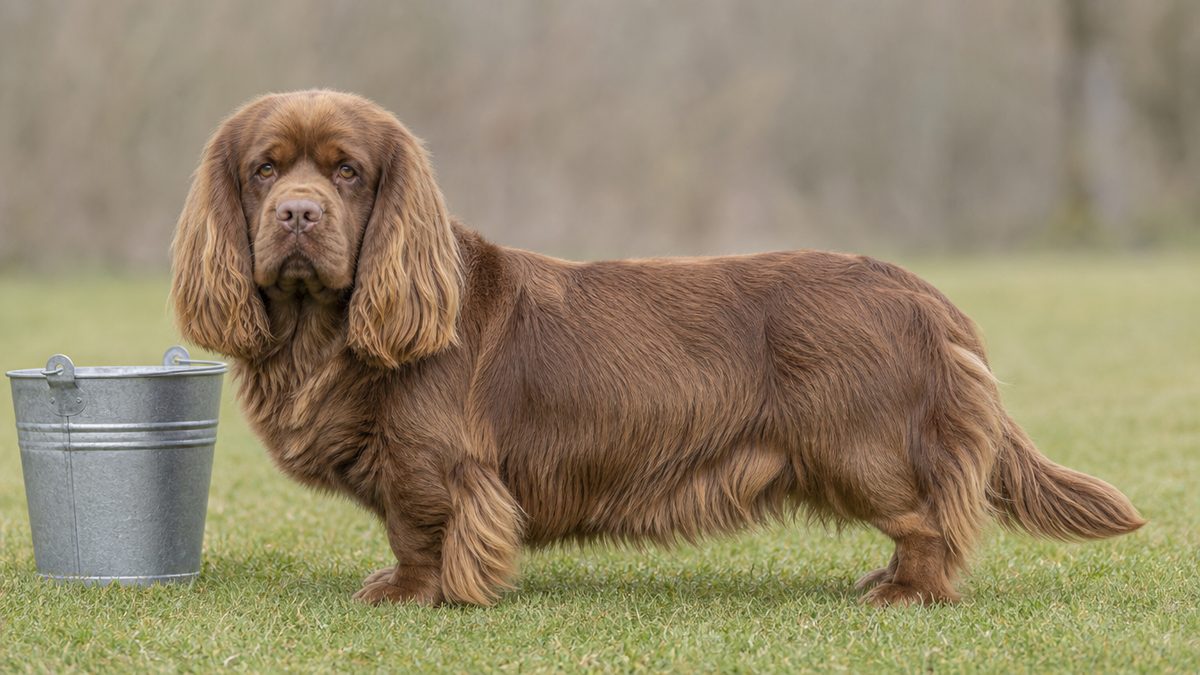
A Sussex Spaniel is a long, low, strongly built British gundog of about 23 kg standing 38 to 41 cm at the withers, carrying an abundant flat coat with ample undercoat in one permitted colour, rich golden liver. The Royal Kennel Club files it in the Gundog group as Spaniel (Sussex) and calls it the rarest of the land spaniels.
Read the breed standard rather than the marketing copy and the dog resolves quickly. The Royal Kennel Club's standard, last updated on 1 April 2025, opens with a general appearance of strongly built, active, energetic dog, whose characteristic movement is a decided roll, and unlike that of any other Spaniel. The American Kennel Club, describing the same animal, says it looks like a cross between a Cocker Spaniel and a torpedo, and calls it massive despite topping out at fifteen inches.
| Point | Royal Kennel Club (UK) | American Kennel Club (US) |
|---|---|---|
| Height at withers | 38 to 41 cm, given as the ideal | 33 to 38 cm, printed as 13 to 15 inches |
| Weight | Approximately 23 kg | 15.9 to 20.4 kg, printed as 35 to 45 pounds |
| Colour | Rich golden liver, gold predominating. Any other colour unacceptable | Golden Liver, registration code 097 |
| Coat | Abundant and flat, no tendency to curl, ample undercoat for weather resistance | Abundant and feathery |
| Ears | Thick, fairly large and lobular, set moderately low just above eye level | Wavy-coated |
| Tail | Undocked: set low, medium length, never above the level of the back | Not specified on the breed page |
| Life expectancy | Over 10 years | 13 to 15 years |
| Group | Gundog | Sporting |
The two registries do not overlap on weight, and that is not a rounding difference. A dog at the British ideal of 23 kg stands 2.6 kg above the American ceiling of 45 pounds American Kennel Club. Nothing on either page acknowledges the other, and every aggregator page an Indian buyer meets picks one silently. Google's own knowledge panel for the breed, sourced to an app rather than to a registry, prints a mass of 16 to 20 kg, which is below both.
The one thing that makes it unlike any other spaniel
The Sussex is the only spaniel that gives tongue while it works, and the standard makes that a defining characteristic rather than a fault. Under Characteristics the standard reads, in full, natural working ability, gives tongue at work in thick cover. The Royal Kennel Club's breed record explains what it was for: the dog is low to ground and powerfully built with a thick protective skin to get through the densest undergrowth, and giving tongue let the handler keep track of it when it was out of sight. Some accounts attribute that voice to hound blood.
That matters more in Bengaluru than it did in Sussex. A breed characteristic is not a habit you train away, and an Indian buyer choosing a calm, slow, affectionate housedog is also choosing a dog that was selected for two centuries to make noise in cover.
Colour is the strictest clause in the standard
One colour is permitted and the standard says so twice. It specifies rich golden liver and hair shading to golden at tip; gold predominating, marks dark liver or puce as undesirable, and then adds a separate emphasised line: any other colour or combination of colours is unacceptable. The Royal Kennel Club files the breed at Colour Watch Category 0, meaning it has no non-breed-standard colour registration options at all. A liver-and-white, black or roan dog offered to you as a Sussex Spaniel is not one.
The standard carries both a docked and an undocked description, because the breed was previously customarily docked to 13 to 18 cm. In India that history is not an option. Second Schedule Part II paragraph 6(8) of the Prevention of Cruelty to Animals (Dog Breeding and Marketing) Rules 2017 states that there shall be no tail docking, ear cropping, de-barking, de-clawing, branding, dyeing, or any other kind of mutilation of any body part of the pup, and that any change of appearance by artificial means is strictly forbidden. A docked Sussex puppy in India is evidence of an offence, not of type.
How rare the Sussex Spaniel actually is, in registry numbers
The Kennel Club registered 15 Sussex Spaniels in the whole of 2025, against 49 in 2016. That is a fall of 69 percent in the published decade and the breed's lowest figure in that table, and it places the Sussex sixth from the bottom of the 39 breeds on the vulnerable native breeds list.
Rarity is the first thing every page about this breed asserts and the last thing any of them counts. The Royal Kennel Club publishes the count itself, in a table it maintains for exactly this purpose. Two documents carry it, a web table and a PDF titled 10 year VULNERABLE BREED STATS, and for this breed they agree cell for cell The Royal Kennel Club.
| 2016 | 2017 | 2018 | 2019 | 2020 | 2021 | 2022 | 2023 | 2024 | 2025 |
|---|---|---|---|---|---|---|---|---|---|
| 49 | 56 | 34 | 52 | 44 | 30 | 44 | 27 | 24 | 15 |
The Kennel Club's two bands are worth stating precisely, because they are routinely confused. A breed is vulnerable below 300 registrations a year, and at watch between 300 and 450. At 15 the Sussex is not near a boundary. The 2025 list holds 39 vulnerable breeds and 8 at watch breeds, and only five vulnerable breeds sit below the Sussex: the Bloodhound and Foxhound at 5, the Harrier at 7, and the Greyhound and Otterhound at 10.
The rarest of six native spaniels, and it is not close
| Breed | 2025 | 2016 | Change |
|---|---|---|---|
| Spaniel (Welsh Springer) | 213 | 299 | down 29 percent |
| Spaniel (Clumber) | 160 | 171 | down 6 percent |
| King Charles Spaniel | 56 | 84 | down 33 percent |
| Spaniel (Field) | 48 | 80 | down 40 percent |
| Spaniel (Irish Water) | 40 | 116 | down 66 percent |
| Spaniel (Sussex) | 15 | 49 | down 69 percent |
Where the breed club and the registry disagree
The Sussex Spaniel Association publishes its own version of the same table, and it does not match. The club gives 2024 as 22; the Kennel Club's own PDF and web table both give 24 The Royal Kennel Club. Two dogs is a trivial gap on a Labrador and an eight percent gap here. The club also adds a qualification the Kennel Club's page does not: its numbers include registered imports. Neither figure is published here as the truth. Both are published because at these numbers the difference between them is a real fraction of a year's entire breeding output.
The club's table also stops at 2024, leaving 2025 blank, while the Kennel Club has published 15. That is worth knowing if you meet a page quoting a 2024 figure as current.
Fifteen registrations means an Indian reader will almost certainly never be offered a real one. That is the finding, not a failure of the research. Knowing the number is what lets you recognise that the Rs 98,999 attached to a Sussex Spaniel listing in Delhi cannot be describing a Sussex Spaniel, because there is no supply chain on earth that could put one there.
History, and the ten dogs the breed came through
The Sussex Spaniel was developed in the English county of Sussex in the eighteenth century to work heavy clay under dense cover, nearly died out twice, and passed through a bottleneck so narrow that the modern population descends from a handful of animals. The American Kennel Club recognised it in 1878 and admitted it among the first ten breeds in its Stud Book in 1884.
The founding kennel is named in the registry's own record. The Royal Kennel Club credits Mr A E Fuller of Rosehill Park, near Hastings in Sussex, who developed a spaniel for the dense cover of his local terrain, and records that when Fuller died in 1847 his dogs were sold and the breed became scarce. The American Kennel Club dates the breed's development to the 1700s, to hunt feathered game while plowing through the region's heavy clay soil.
The build follows directly from that job. Short legs, a level back with no waistiness, a deep chest, heavy bone and a thick protective skin are not aesthetic choices; they are what gets a dog through blackthorn without stopping The Royal Kennel Club.
The Second World War bottleneck
The near-extinction event is the twentieth century's, not the nineteenth's. English Wikipedia, a secondary source and treated here as one, states that the breed nearly became extinct during the Second World War, that all modern Sussex Spaniels descend from dogs saved by one breeder, and that in 1947 only ten Sussex Spaniels were registered with the English Kennel Club. The Sussex Spaniel Association corroborates the general picture, citing an ITV documentary first broadcast on 16 January 1994 and titled *The Dog Breed That Nearly Went Extinct*.
Set the two numbers side by side and the shape of the problem is clear. Ten registrations in 1947, at the bottom of a near-extinction. Fifteen in 2025, after seventy-eight years of recovery effort. The breed did not fail to recover; it recovered and then declined again, and the decline is recent. It was still running at 49 to 56 a year in 2016 and 2017.
What a bottleneck means for a buyer, anywhere
A population rebuilt from a handful of founders carries every deleterious allele those founders happened to hold, at a frequency the founders happened to set. That is the honest explanation for why this breed's screening numbers look the way they do later on this page, and it is why the Royal Kennel Club's single Good Practice recommendation for the breed is not a disease test at all. It is prioritising genetic diversity.
That is an unusual recommendation and worth pausing on. For most breeds the club's Good Practice list names conditions. For the Sussex, the club's judgement is that the most urgent thing a breeder can do is widen the gene pool, with eye testing under the BVA, Kennel Club and ISDS scheme and hip testing under the BVA and Kennel Club scheme listed one tier down as Best Practice.
The Royal Kennel Club places the Sussex Spaniel at Breed Watch Category 1, meaning no points of concern specific to this breed have been identified for special attention by judges beyond what the standard already covers. For a heavily built, low-slung, long-eared breed that is a genuinely good sign, and it deserves saying as loudly as the rarity numbers.
Sussex Spaniel price in India, and why no rupee figure survives a check
No verifiable Sussex Spaniel price in India exists. Every rupee figure on page one of the Indian search results for this breed either belongs to a different dog, comes from a template row shared with an unrelated breed, or is attached to merchandise. That absence is the finding, and it is the most useful thing this section can tell an Indian buyer.
Eight Indian and international listing routes were tested on 8 September 2026. The results are more informative than a price would have been. Two of them fail in ways a status check alone would miss: petbuy.in returns a clean HTTP 404, while Mr n Mrs Pet answers HTTP 200 and then lands on a page whose own title reads 404 Page Not Found.
| Route | Response | What the page actually contains |
|---|---|---|
| petbuy.in | HTTP 404 | No page for the breed at all |
| mrnmrspet.com | HTTP 200, then redirected | Lands on /404-page-not-found with the title 404 Page Not Found |
| puppiezo.com | HTTP 200 | A real breed page pricing eight animals, none of them a Sussex Spaniel |
| poodles.in | HTTP 200 | Rs 50,000 to Rs 1,00,000, on a cost table shared with the Welsh Terrier |
| royalcanin.com/in | HTTP 200 | A genuine India-localised breed page carrying no rupee figure at all |
| etsy.com/in-en | HTTP 403 to this session | A merchandise market page, ranked position 6 for the India price query |
| justdial.com | 14-byte body | A generated Top Pet Shops For Sussex Spaniel Dog in Lucknow page |
| dogbreedslist.info | HTTP 200 | USD 2,000 to 3,000, and no rupee figure anywhere |
Eight priced puppies, and not one of them is a Sussex Spaniel
Puppiezo serves a page titled Buy Sussex Spaniel Puppies for Sale in India at Best Prices, whose meta description promises puppies from KCI registered, responsible breeders. Its Other Available Pets carousel then prints eight animals with prices: Samy and Fizey, both Maltipoos, and Yoki, a Doxiepoo, all at Rs 98,999; Kuzo and Dugu, both Poodles, at Rs 92,599; Kazuka, a Cane Corso, at Rs 94,999; Tugi, a Rottweiler, at Rs 76,499; and Doir, a Goldendoodle, at Rs 1,20,000. No Sussex Spaniel appears anywhere in it, and no Sussex Spaniel price appears anywhere on the page.
Rs 98,999 is a house price point, not a breed price. Bonbeno has now recorded the identical figure on breed pages across this listing site, always attached to whatever puppy is in stock. It divides to USD 1,173.25 at 84.38, so it is not even a disguised conversion; it is a rupee-native charm price. If you are quoted Rs 98,999 for a Sussex Spaniel, you are being quoted the shop's default.
The one Indian rupee band, and the control that kills it
Poodles.in publishes Rs 50,000 to Rs 1,00,000 as the Sussex Spaniel's buying price in india. Run the division tests and nothing conclusive comes back: neither figure divides cleanly at 84.38 or at 74, and both divide cleanly at 80 purely because any round rupee number ending in three zeros does. That test proves nothing by construction, so the figures are rupee-native rather than converted.
What does settle it is the same-site control. The identical page template gives the Welsh Terrier a band of Rs 30,000 to Rs 70,000 and the Welsh Springer Spaniel Rs 30,000 to Rs 60,000, while printing all three breeds' cost tables from the same small set of preset lines. The buying price is a hand-set field on a page whose surrounding numbers are boilerplate. Treat it as an asking price a shop would type, not as an observation of a market.
The only real published prices are foreign
| Source | Published price | At 84.38 to the US dollar |
|---|---|---|
| Dogbreedslist.info | USD 2,000 to 3,000 | Rs 1,68,760 to Rs 2,53,140 |
| Poodles.in (India) | Rs 50,000 to 1,00,000 | Not a conversion; a hand-set field |
| Puppiezo (India) | None published for this breed | Not applicable |
| Royal Canin India | None published | Not applicable |
That conversion is arithmetic performed here and labelled as such. It is not an Indian price and no Indian seller is offering it. Dogbreedslist's own page carries no rupee figure at all. Nor does Royal Canin's India-localised page for the breed, which is a genuine Indian commercial page about this dog that declines to price it.
The Kennel Club registered fifteen Sussex Spaniels in 2025, and Indian import law states that any application made for trading or breeding purposes shall be duly rejected. A market cannot form between a global supply of fifteen puppies and a legal route that excludes commerce, so a rupee price for a Sussex Spaniel is not a price that is hard to find. It is a price that does not exist.
Monthly cost of ownership in India, built from figures you can check
Bonbeno publishes no single monthly cost figure for a Sussex Spaniel, because every Indian page that does is printing a template row shared with unrelated breeds. What is real is the component cost of keeping a 23 kg dog in an Indian city, and each line below was read live from the provider's own page on 8 September 2026.
Start with the reason the usual number is worthless. Poodles.in gives the Sussex Spaniel a monthly cost of Rs 4,650 to Rs 6,600, built from food Rs 2,250 to 3,000, grooming Rs 1,200 to 1,800 and health Rs 1,200 to 1,800. Its Welsh Terrier page prints all four of those lines byte-identically to the rupee.
The clincher is inside the site's own text. The same page says a Sussex Spaniel does well on around 1,000 calories a day and the Welsh Terrier thrives on around 700, and then gives both dogs the identical Rs 2,250 to 3,000 food line Poodles.in, Welsh Terrier Price in India. Its Welsh Springer Spaniel page states 1,200 to 1,300 calories a day and carries the same food line again inside a different total of Rs 3,550 to Rs 5,400. One food figure spans a 700 to 1,300 calorie range and two different monthly totals, which is what a preset looks like.
What the components actually cost, read live
| Line | Figure | Source and caveat |
|---|---|---|
| Puppy vaccination course | From Rs 6,499 | Vetic national page, against a struck-through Rs 8,111 |
| Annual booster | From Rs 3,199 | Vetic, against a struck-through Rs 3,806 |
| Anti-rabies, single | Rs 699 | Vetic |
| 9-in-1 (DHPPiL), single | Rs 899 | Vetic |
| Kennel cough | Rs 1,349 | Vetic |
| Tick and flea plus worming | Rs 1,103 a month | NexGard Spectra 15-30 kg, 3 tablets Rs 3,308, MRP Rs 3,375 |
| Bath, 60 minutes | From Rs 934 | Vetic Delhi, list price Rs 1,099 |
| Full groom and styling | From Rs 1,869 | Vetic Delhi, list price Rs 2,199 |
| Boarding, 24 hours | Rs 899 | PawSpace Bengaluru, plus 25 to 30 percent in festive season |
| Daycare, up to 10 hours | Rs 799 | PawSpace Bengaluru |
Boarding is the line most Indian owners forget until a wedding: PawSpace Bengaluru prints Rs 899 for 24 hours and warns on the same page that festive season rates run 25 to 30 percent higher. Two further caveats belong with that table rather than in a footnote. Vetic quotes different course prices on different city pages on the same day, so the figures above are its national page and a Mumbai reader should expect to pay more. And Supertails' own unit label on the NexGard listing reads Rs 3,308 per 100 g for a pack of three tablets, which is a broken template field rather than a price.
What this breed adds on top
- Ear care, not optional. A weekly clean and a dry after every bath and every wet walk, on a dog whose standard specifies thick, lobular ears lying close to the skull. Budget for a vet visit rather than a shop product the first time an ear smells.
- Hip screening before you breed, and a hip-aware budget after. OFA records 38.1 percent of 396 Sussex Spaniel evaluations as dysplastic. Orthopaedic work is the single largest plausible unplanned cost on this breed.
- A DNA test that costs once and settles a question forever. Pyruvate dehydrogenase phosphatase deficiency has a specific test, and OFA's own testing records 10.9 percent carriers among 92 dogs Orthopedic Foundation for Animals.
- Air conditioning in summer, treated as a running cost. This is a dog whose breed standard mandates ample undercoat living in a country where 74.2 percent of the heat-illness events with a recorded trigger were exertional.
Compare the component lines to the rupee against one unrelated breed on the same site. If food, grooming and health match exactly, you are reading a preset table, and the total tells you nothing about your dog. On poodles.in the Sussex Spaniel and the Welsh Terrier match on all four lines while their stated calorie requirements differ by 300 a day.
Heat tolerance in India, argued from the coat the standard mandates
A Sussex Spaniel can live in India and cannot be worked here in summer. Its breed standard mandates ample undercoat for weather resistance, and its homeland runs an annual mean of 11.07 C against Chennai's 27.95 C. The gap that matters is heat, not humidity, and the correct response is a schedule rather than a haircut.
Start with the coat, because it is the one thing about this dog that is written down rather than inferred. Under Coat the Kennel Club standard reads abundant and flat with no tendency to curl and with ample undercoat for weather resistance. Weather resistance is the stated purpose. An undercoat is insulation, and insulation is what the breed definition asks for.
The homeland, by explicit latitude and longitude
The figures below come from NASA POWER queried at 50.8552 N, 0.5729 E for the 2001 to 2020 climatology, rather than from a slug on a climate website. The cell it returns sits at 35.43 m against a real elevation near 15 m, an error of about 20 m, which is small enough to trust on the coast. One honest limitation: a second query at Brightling, near Fuller's Rosehill Park, returns the byte-identical series, so POWER is describing one cell and cannot distinguish the two places.
| Place | Annual mean T2M | Hottest month | Annual relative humidity | Peak wet bulb |
|---|---|---|---|---|
| Hastings, East Sussex | 11.07 C | 17.38 C (August) | 84.95 percent | 15.15 C (August) |
| Bengaluru | 23.74 C | 28.37 C (April) | 67.94 percent | 21.86 C (May) |
| Pune | 23.86 C | 28.93 C (April) | 66.80 percent | 22.97 C (June) |
| Delhi | 25.60 C | 35.88 C (June) | 45.56 percent | 26.50 C (July) |
| Kolkata | 25.81 C | 31.53 C (May) | 73.93 percent | 27.09 C (June) |
| Mumbai | 26.77 C | 31.19 C (May) | 67.39 percent | 25.77 C (June) |
| Chennai | 27.95 C | 31.51 C (May) | 72.39 percent | 26.11 C (May) |
Wet bulb is computed here from T2M and RH2M using the Stull approximation, not read off a maximum-temperature field, because pairing a period extreme with humidity produces impossible numbers. Every value above sits well inside the physically observed range.
The humidity argument is the wrong argument, and this is the proof
Sussex is more humid than any Indian city on this page. Hastings runs 84.95 percent annual relative humidity; Chennai runs 72.39, Kolkata 73.93, Bengaluru 67.94, Mumbai 67.39 and Delhi 45.56. A page telling you that Indian humidity will finish this coastal English breed has the reasoning backwards. What this dog has never met is heat, and heat combined with moisture, which is what the wet-bulb column measures.
Read that column across and the real gap appears. Hastings peaks at a wet bulb of 15.15 C in August. Kolkata peaks at 27.09 C in June, Delhi at 26.50 C in July, Chennai at 26.11 C in May. That is roughly 11 to 12 degrees of wet-bulb load the breed has no evolutionary history with, and no amount of shade fixes it.
What the heat-illness evidence says about a dog like this one
The largest UK dataset is unambiguous about the trigger. Of the 1,259 heat-related illness events recorded across 905,543 dogs in 2016, 879 had a recorded trigger, and 652 of those 879, or 74.2 percent, were exertional rather than a hot car or a hot day alone. Environmental heat accounted for 113 of 879 and vehicular confinement for 46. The companion paper puts case fatality at 14.18 percent and gives an odds ratio of 1.42 for dogs at or above their breed and sex mean bodyweight.
Neither paper models the Sussex Spaniel, and it is not in the over-50 kg band that carries an odds ratio of 3.42. What transfers honestly is the bodyweight factor and the exertional finding. A Sussex kept lean and walked in the dark half of the day is not carrying the risk factor those papers measured; a heavy one taken out at 11 am in Nagpur is.
Second Schedule Part IV paragraph 21(1) of the Dog Breeding and Marketing Rules 2017 bars keeping certain dogs in outdoor facilities without the attending veterinary practitioner's written approval, and names them: dogs not accustomed to the temperatures prevalent in the area, dog breeds that cannot tolerate the temperatures prevalent in the area or region in question, such as long-haired breeds in high temperature locations, and sick, infirm, aged or young animals. A double-coated English gundog in an Indian summer is squarely inside the second limb. Note the citation form: the Rules themselves stop at Rule 13, and the string Rule 21 appears nowhere in the gazette.
The practical schedule, city by city
- Bengaluru and Pune, the two most workable cities. Peak wet bulb 21.86 and 22.97 C, hottest months April rather than May. Two walks a day are realistic for most of the year, with April and May moved to before 7 am and after 8 pm.
- Mumbai and Chennai, manageable with discipline. Peak wet bulb 25.77 and 26.11 C. The coastal minimum never drops, so the dog never gets a cool night to recover in; air conditioning stops being a luxury from March to October.
- Delhi, the hardest of the six. It is the driest city here at 45.56 percent, which helps evaporative cooling, and it still hits 35.88 C in June and a July wet bulb of 26.50 C when the monsoon arrives. Delhi's problem is a summer that is hot and then hot and wet.
- Kolkata, the highest wet-bulb load measured here at 27.09 C in June. Treat any summer exertion as a veterinary risk rather than a fitness question.
The lobular ears in Indian humidity, and the best measured evidence there is
Ear infections are the most likely thing to go wrong with a Sussex Spaniel in India, and the reason is written into the breed standard. It specifies ears thick, fairly large and lobular, set moderately low and lying close to the skull, which is a design for holding moisture against the canal.
The standard's wording is worth quoting because it is unusually specific: thick, fairly large and lobular, set moderately low, just above eye level. Lying close to skull. Every clause in that sentence reduces airflow. English Wikipedia's health section reaches the same conclusion from the other direction, noting that otitis externa is common across spaniels because long floppy ears trap moisture.
No Sussex-specific prevalence figure exists, so here is the closest that does
There is no published otitis externa prevalence for the Sussex Spaniel. Publishing one would mean inventing it. What exists instead is a genuinely large clinical survey of four related spaniels, and its headline result is buried under the wrong title.
Kaimio and colleagues reviewed the 2010 medical records of 55 private veterinary clinics in Finland, covering 98,736 dogs. The paper is titled as a survey of American Cocker Spaniels. Its actual finding is that the highest otitis externa prevalence of any breed it studied was the Welsh Springer Spaniel.
| Breed | Affected of total | Prevalence | 95 percent CI |
|---|---|---|---|
| Welsh Springer Spaniel | 149 of 468 | 31.8 percent | 27.6 to 36.0 |
| American Cocker Spaniel | 89 of 329 | 27.0 percent | 22.2 to 31.7 |
| English Springer Spaniel | 96 of 491 | 19.6 percent | 16.1 to 23.1 |
| English Cocker Spaniel | 231 of 1,467 | 15.7 percent | 13.8 to 17.6 |
Every one of those percentages reproduces from its own counts, which is the first thing to check on any figure of this shape. The Sussex Spaniel is not in that study, and none of those four numbers is its number. They are quoted because a dog whose ears are thicker and lower-set than any of the four is not plausibly at less risk, and because a Finnish clinic year is a cool, dry baseline that India will not improve on.
The same research group's gonioscopy work on the Welsh Springer Spaniel is a reminder that spaniel screening findings are breed-specific rather than transferable. The Finnish study's most actionable finding is about age, not breed. Among the American Cockers surveyed, 46 percent of 72 showed their first signs before one year of age, and early onset raised the odds of end-stage disease by 3.8 times (95 percent CI 1.1 to 13.6). Sixteen percent of 85 affected dogs eventually needed surgery or were euthanised.
What to actually do, in an Indian monsoon
- Dry the ears after every bath, every swim and every wet walk. Not towel-and-air-dry. An overseas breed club telling you to let a dog air dry is giving Wisconsin advice, and it does not transfer to a Mumbai August at 90 percent humidity.
- Clean weekly with a veterinary ear cleaner, not a home remedy, and clean before the ear smells rather than after.
- Lift and check both ears every day from June to September. A lobular ear lying close to the skull hides an early infection completely.
- Treat a first-year ear infection as urgent rather than routine, because the Finnish data ties early onset to end-stage disease.
- Ask your vet about the ear canal specifically at every visit. Recurrent otitis in a spaniel is managed, not cured, and the management starts before the first surgery is on the table.
Indian clinic studies find heavy tick-borne disease pressure: Ehrlichia canis in 56 of 178 dogs tested in Odisha, 31.46 percent, with 79 percent of infected dogs having a tick history, and Babesia in 80 of 120 dogs tested in Kerala, 66.7 percent, peaking pre-monsoon in March to May. Those are clinically suspected dogs at veterinary clinics, not random populations, so read them as pressure rather than as a population rate. A thick lobular ear leather is the single easiest place on this dog for a tick to go unnoticed.
Temperament and household fit, and who should not buy one
A Sussex Spaniel is calm, affectionate and slow indoors, and loud outdoors by breed definition. The Kennel Club's temperament clause is one line, kindly disposition with aggression unacceptable, and the American Kennel Club's summary is placid, affectionate, even-tempered, true-blue and loyal. The voice is the trait that decides most Indian households.
The registries agree on the character and that is worth noting, because they disagree about almost everything else on this breed. The Kennel Club standard's Temperament clause reads in full: kindly disposition, aggression unacceptable. The American Kennel Club calls the breed a slow-but-steady hunter and a congenial housedog, and describes a somber, frowning expression delightfully at odds with an innately cheerful nature.
The Sussex Spaniel Association's own description is less formal and more useful: the breed is loyal, rarely boring to live with, full of character, and will take a mile if given an inch.
The one trait that is written into the breed and cannot be trained out
This is the only spaniel whose breed standard makes barking a characteristic. Under Characteristics: natural working ability, gives tongue at work in thick cover. The Royal Kennel Club's own record explains the function, that the Sussex is the only spaniel to give tongue while working, which let a handler follow it in cover. Google's own People Also Ask box for the breed asks whether Sussex spaniels bark a lot, which suggests owners notice.
In a Sussex Bank Holiday wood that is a feature. Behind a shared wall in a Mumbai building with a resident welfare association, it is the thing that ends the arrangement. If you cannot tolerate a vocal dog, this is the wrong breed, and no amount of training changes a characteristic the standard names.
Who this breed genuinely suits in India
- A ground-floor or independent house with a garden, which is what the Royal Kennel Club's own filing asks for: small house, large garden, country rather than town.
- A household that is home most of the day. This is a companion breed that bonds hard and does not do well left alone for long stretches.
- Owners who want a calm dog rather than a quiet one. Those are different things and this breed is the first without being the second.
- Families with children. The standard's kindly disposition clause and the AKC's description both point the same way, and a slow, heavy, low-slung dog is harder for a child to knock over than a springer.
- Not for a high-floor flat with shared walls, for the reason above.
- Not for a first-time owner who wants an easy dog. The AKC's own note is that a Sussex can be stubborn, has a long memory, and will never forget nor forgive rough handling.
- Not for anyone who cannot commit to a dawn-and-dusk exercise schedule for eight months of an Indian year.
- Not for anyone buying on looks. At fifteen registrations worldwide in 2025, the dog you are shown in India is far more likely to be something else.
The Sussex Spaniel Club of America's home page carries a heading that reads, in full, No Designer Sussex, and beneath it: never breed a Sussex to another breed, because Sussex Spaniels are a rare and venerable breed preserved through the diligent efforts of British and American breeders. If you are offered a Sussex cross in India, the breed's own parent club has already told you what it thinks.
Training approach, and what this breed actively resists
Train a Sussex Spaniel with clarity and praise, and never with corrections. The American Kennel Club's own guidance is that the breed can be stubborn, has long memories, and will never forget nor forgive rough handling, which makes aversive methods counterproductive rather than merely unkind.
The parent-club advice is short and it is the whole method: owners should strive to convey clearly what they want and give the dog lots of praise when it gets it right. That is not generic positive-reinforcement copy. It is a specific instruction attached to a specific claim about memory, and it is the difference between a Sussex that works with you at four and one that has stopped trying.
Three things this breed is slower at than a Labrador
- Recall in cover. A dog bred to work independently in dense undergrowth, giving tongue so the handler can find it, is not a dog bred to check in. Build recall on a long line before you trust it in a park.
- Speed of response. The breed's characteristic movement is a decided roll and the AKC's own framing is slow-but-steady. A handler who reads deliberation as defiance will start correcting, which is the one thing that does not work here.
- Anything taught under pressure. Long memory cuts both ways. A single frightening session in a hot Indian afternoon can cost months.
The Indian training schedule problem nobody writes about
Most Indian training classes and most owner free time sit between 10 am and 6 pm. For eight months of the year that window is unusable for this breed, because a heavily coated dog exercising in the heat is exactly the profile behind the finding that 652 of 879 UK heat-illness events with a recorded trigger were exertional. Plan to train in short sessions indoors during the day and do the physical work at dawn and after dark.
There is a genuine upside. Scent work, mantrailing and food-puzzle work suit a dog with an outstanding nose and a slow, methodical style far better than they suit a fast retriever, and all of it can be done on a cool floor at 3 pm. The AKC's own note is that the Sussex, though lacking the speed of the Springers and Cockers, has an extraordinarily good nose.
Socialise early, and mind the growth plates
Socialise a Sussex puppy in the ordinary way and on the ordinary timetable, but keep the physical load low while you do it. The AKC is explicit: a Sussex should not have strenuous exercise before at least twelve months because the breed grows slowly and early exercise can damage the growth plates, and jumping and agility work should not start before eighteen months. Puppies should be allowed to self-exercise by playing.
A Sussex Spaniel that tires abnormally fast, weakens on exercise or collapses is not a fitness problem and must not be trained through. Pyruvate dehydrogenase phosphatase deficiency produces exactly that picture, and the published Sussex case was a two-year-old presented with exercise intolerance whose diagnosis rested on pre- and post-exercise lactate and pyruvate concentrations and urinary organic acid screening. Consult your nearby vet rather than adding conditioning work.
Daily exercise requirement, and what happens without it
The Royal Kennel Club files the Sussex Spaniel at more than two hours of exercise a day. In India the binding constraint is not the amount but the clock, because almost all of it has to happen before about 8 am and after about 7 pm for eight months of the year.
Two hours is the registry's own figure and it sits in the breed's characteristics block alongside the note that it wants a large garden and a country rather than a town setting. That is more than most Indian buyers expect from a dog described everywhere as calm and slow, and it is the number to plan against.
What the exercise should be
- Long steady walking on soft ground, which is what the build is for. A level back, heavy bone and short legs are a working chassis, not a couch design.
- Swimming where it is genuinely available and clean. The AKC records that adult Sussex love to swim. In India that usually means a safe lake or a pool, and it means drying the ears afterwards without exception.
- Scent and nose work, which uses this dog's best faculty and can happen indoors in the middle of a hot day.
- No jumping or agility before eighteen months, on the parent club's own instruction.
The Indian timetable, written out
| Season | Morning | Evening | Middle of the day |
|---|---|---|---|
| November to February | 45 to 60 minutes from 6.30 am | 45 to 60 minutes from 6 pm | Free, in most cities |
| March to May | 60 minutes, finished by 7.30 am | 45 minutes, after 7.30 pm | Indoors only, scent work |
| June to September | 45 minutes, watching wet-bulb load | 45 minutes after dark | Indoors, and dry the ears |
| October | 60 minutes from 6.30 am | 45 to 60 minutes from 6.30 pm | Shortening restriction |
Wet bulb is the number to watch in the monsoon, not the thermometer. Kolkata peaks at 27.09 C wet bulb in June and Delhi at 26.50 C in July, against 15.15 C in the breed's homeland. A 30 C afternoon in a Kolkata July is a materially harder workload for a double-coated dog than a 35 C afternoon in a dry Delhi May.
What happens without it
An under-exercised Sussex is not a destructive dog in the terrier sense. It becomes heavy, and weight is the one heat-illness risk factor from the UK data that genuinely transfers to this breed: dogs at or above their breed and sex mean bodyweight carried an odds ratio of 1.42 for heat-related illness. On a dog that already carries 38.1 percent breed-level hip dysplasia in OFA's tables, extra weight is also the cheapest way to turn a manageable joint into a painful one.
It also gets louder. A breed selected to give tongue in cover, with nothing to work, gives tongue at the corridor.
Grooming and coat care in Indian humidity
Brush a Sussex Spaniel two or three times a week to the skin, keep the feathering and the feet trimmed, and never shave it down. The coat is abundant and flat with ample undercoat, so the Indian job is drying and dematting rather than styling, and the single highest-value habit is drying the ears.
The standard describes what you are working with: abundant and flat, no tendency to curl, ample undercoat for weather resistance, ears covered with soft wavy hair but not too profuse, and forequarters and hindquarters moderately well feathered. Feet are round, well padded and well feathered between the toes. That last clause is the one Indian owners underestimate.
The two warnings the parent club gives that no Indian page repeats
Do not shave a Sussex Spaniel. The AKC's grooming note is that the coat should not be shaved down unless absolutely necessary because it takes a long time to recover. Indian groomers offer summer shaves as heat management and it is the wrong intervention here: a double coat that has been clipped loses its insulating and its reflective function together, and this breed's regrows badly.
Expect the coat to change after neutering. The same note records that a neutered Sussex grows a coat that becomes fuzzy and cotton-candy like and is much harder to deal with. That is a real grooming cost attached to a routine decision, and it deserves to be part of the conversation before the surgery rather than after.
An Indian grooming routine that reflects the monsoon
- Brush to the skin two or three times a week from June to September, and weekly the rest of the year. An undercoat that stays damp under a flat topcoat is where hot spots start.
- Trim the hair on the underside of the feet. The AKC gives a specific reason: it keeps the dog from slipping. On Indian tile and marble that matters more than it does on grass.
- Dry the ears and the leg feathering after every wash and every wet walk, with a towel and then with air movement, not by leaving the dog to drip.
- Bathe roughly every three to four weeks, or sooner after a muddy monsoon walk, and plug the ears before you start.
- Check between the toes and under the ear leather for ticks at every brush, given the Indian tick-borne disease burden.
What professional grooming costs in India
Read live on 8 September 2026 from Vetic's Delhi page: Pet Bathing, 60 minutes, from Rs 934 against a list price of Rs 1,099; Complete Bath and Hair Styling, 120 minutes, from Rs 1,869 against Rs 2,199; and Haircut for Pets, 120 minutes, from Rs 1,359 against Rs 1,599. A Sussex Spaniel does not need the haircut tier. A monthly bath and blow-dry plus home brushing is the honest requirement, which puts professional grooming near the bottom of this breed's Indian cost stack rather than the top.
Care guidance written by breed clubs in Britain and North America routinely says to towel a spaniel and let it air dry. That is sound in a cool, dry climate and wrong in an Indian monsoon, where an ear canal under a thick lobular leather at 90 percent ambient humidity does not dry on its own. Dry actively, every time.
Health issues, screening and what the numbers actually say
Screen a Sussex Spaniel's hips, elbows and eyes, and DNA test for pyruvate dehydrogenase phosphatase deficiency. OFA records 38.1 percent of 396 Sussex Spaniel hip evaluations as dysplastic, which ranks the breed 17th worst of 222 breeds, and its elbow figure of 25.4 percent abnormal of 205 evaluations ranks 16th.
These are the live numbers, read from OFA's own statistics tables on 8 September 2026 rather than from a summary. The breed code was read out of OFA's own markup rather than guessed, which matters here because SU is the Sussex Spaniel while the neighbouring SUS belongs to a different breed entirely. OFA publishes a breed only once it holds 100 hip evaluations, or 50 for its other databases, so a Sussex Spaniel row exists at all because the American population has been screened for decades.
| Screen | Evaluations | Result | Rank | All breeds |
|---|---|---|---|---|
| Hip dysplasia | 396 | 38.1 percent dysplastic | 17th of 222 | 14.2 percent of 1,713,372 |
| Elbow dysplasia | 205 | 25.4 percent abnormal | 16th | not comparable |
| Eyes, summary line | 222 | 90.1 percent normal | 22nd | not comparable |
| Eyes, detail rows | 222 | 142 normal, 64.0 percent | not ranked | not comparable |
| Congenital cardiac | 97 | 100.0 percent normal | 148th | not comparable |
| PDP1 DNA test | 92 | 89.1 normal, 10.9 carrier, 0 affected | 2nd of 2 breeds | 89.2 percent of 526 |
The hip figure has moved, and the ranking pages have not
English Wikipedia tells readers that OFA surveys showed 41.5 percent of Sussex Spaniels affected by hip dysplasia and that the breed ranked 9th worst of 157 breeds. Read live today, OFA gives 38.1 percent of 396 evaluations and a rank of 17th of 222. Neither is wrong. A live register drifts as evaluations are added, and OFA's breed list has grown from 157 to 222, which moves a rank without any dog changing.
The honest reading is that the underlying picture has not changed much and the headline has. This is a breed with a genuinely high hip dysplasia rate, roughly 2.7 times the all-breed figure of 14.2 percent across 1,713,372 evaluations. Always publish the sample size beside the percentage, because that is what lets a later reader tell whether a number has moved.
OFA's eye table contradicts itself, and this breed is no exception
The eye summary line reports 90.1 percent normal of 222 evaluations. The per-diagnosis detail rows, on the same denominator of 222, report 142 dogs normal, which is 64.0 percent. That is a gap of 26.1 points, and it is not rounding. Bonbeno has now recorded this contradiction on more than a dozen breeds, so treat it as a property of OFA's tables rather than a finding about the Sussex.
Neither figure should be quoted as the breed's eye rate. What the detail rows do give you is a list of what actually gets recorded, and it is useful: persistent hyaloid artery in 20 of 222 dogs (9.0 percent), retinal dysplasia folds in 16 (7.2 percent), ectropion in 11 (5.0 percent) and distichiasis in 10 (4.5 percent). Ectropion and distichiasis are both in Indian law's own list of genetic defects a breeding dog must have been tested for, under Second Schedule Part III paragraph 8(10).
What the registries recommend, and where they contradict themselves
The Royal Kennel Club's Good Practice recommendation for this breed is a single item and it is not a disease test: prioritising genetic diversity. Eye testing under the BVA, Kennel Club and ISDS scheme and hip testing under the BVA and Kennel Club scheme sit one tier below, as Best Practice.
The American Kennel Club's page contains a plain internal contradiction. Its Health paragraph states that a genetic test is now available for pdp1, allowing breeders to identify carriers and avoid producing affected offspring. Its Recommended Health Tests From the National Breed Club block, three lines below, reads: no recommended health tests. An Indian buyer reading only the second block would conclude no screening exists for this breed.
Three more things worth knowing before you commit
- Breeding is genuinely difficult. The AKC records that bitches often skip seasons, re-absorb puppies and need caesarean sections, and that puppies are fragile until about two weeks of age. Wikipedia's health section agrees that whelping sometimes requires a caesarean. This is part of why fifteen puppies were registered in 2025.
- Intervertebral disc disease is the risk the shape implies. Wikipedia's health section gives it its own subsection, describing disc herniation into the vertebral canal and noting that surgery can restore sensation after paralysis with a success rate that depends on severity. No breed-specific Sussex prevalence figure exists, and none is invented here. A long back on short legs is the classic conformation for it.
- Cardiac screening looks clean so far. OFA's congenital cardiac table records 97 Sussex Spaniel evaluations at 100.0 percent normal. That is a small denominator and a good result, and it is worth saying because the AKC's health note lists heart problems among the things responsible breeders screen for.
Nothing on this page is a diagnosis. Take a Sussex Spaniel that tires abnormally, weakens on exercise, drags a hind limb, or holds its head to one side to a registered veterinary practitioner rather than adjusting its routine, because three of this breed's characteristic problems (a metabolic disease, disc herniation and deep ear infection) all first present as a dog that has simply gone quiet.
The metabolic disease that took twenty-seven years to name
The Sussex Spaniel's most distinctive health problem is pyruvate dehydrogenase phosphatase deficiency, an inherited metabolic disease that causes profound exercise intolerance. It was first described in the breed in 1980, characterised clinically in 2004, traced to a null mutation in PDP1 in 2007, and now has a DNA test that has roughly halved the carrier rate.
Three of the four papers that name this breed in PubMed's title or abstract fields are one story. That is worth stating plainly, because the entire searchable veterinary literature on the Sussex Spaniel is four records Abramson CJ, Platt SR Cameron JM, Maj MC, Levandovskiy V Li Z, Wang Z, Chen Z, Voegeli H.
| Year | Paper | What it added |
|---|---|---|
| 1980 | Houlton and Herrtage, Mitochondrial myopathy in the Sussex spaniel, Veterinary Record 106(9):206 | The first description of the syndrome in the breed |
| 2004 | Abramson, Platt and Shelton, Pyruvate dehydrogenase deficiency in a Sussex spaniel, J Small Anim Pract 45(3):162-165 | A clinical case, a diagnostic route and a dietary therapy |
| 2007 | Cameron and colleagues, Identification of a canine model of pyruvate dehydrogenase phosphatase 1 deficiency, Mol Genet Metab 90(1):15-23 | The gene, the carrier rate, and a restriction enzyme test |
| 2023 | Li and colleagues, BMC Genomics 24(1):302 | A broad genomic screen naming the breed |
What the disease does
PDP1 is the phosphatase enzyme that switches on the pyruvate dehydrogenase complex, the step that lets a cell burn pyruvate aerobically. Without it, a working muscle cannot make energy properly and lactate accumulates. Cameron and colleagues describe the result as profound exercise intolerance, and place it alongside the classic exercise-intolerance syndromes of glycolysis and fatty-acid oxidation.
The published Sussex Spaniel case shows what that looks like in a living dog. A two-year-old intact female presented with exercise intolerance; pre- and post-exercise serum lactate and pyruvate concentrations and urinary organic acid screening supported the diagnosis; six months of dietary therapy produced no clinical deterioration. A year after diagnosis, and six months after the diet was stopped, she had more severe exercise intolerance and evidence of central nervous system dysfunction.
That sequence is the single most useful clinical fact on this page for an Indian owner. The diet is not optional maintenance, and stopping it is not neutral.
The carrier rate, and the strongest evidence of screening working that this site has recorded
Cameron and colleagues reported in 2007 that 20 percent of the then-current Clumber and Sussex Spaniel population were carriers of the PDP1 null mutation, and that knowledge of the molecular defect allowed a rapid restriction enzyme test for selective breeding. OFA's current DNA table, read live on 8 September 2026, records 10.9 percent carriers among 92 Sussex Spaniels tested, with zero affected.
Those two figures are nineteen years apart and they are not in conflict. The obvious reading is that the genetic test worked: a breed community that could suddenly identify carriers stopped producing affected dogs and roughly halved the carrier frequency. That is an interpretation rather than a measurement, and it is labelled as one, because the two denominators are different populations. But zero affected dogs among 92 tested is a real number and it is the kind of result health screening is supposed to produce.
The part that is genuinely remarkable
The dog came first. Cameron and colleagues describe the Clumber and Sussex Spaniel finding explicitly as a canine model, and note that the human mutation described shortly before was a single amino-acid loss that made it impossible to work out the role of the second phosphatase isoform, while the null mutation in dogs did allow it. Two years later the same lead author published the human counterpart, reporting that a PDP1 null mutation produces a lethal infantile phenotype.
A British gundog down to double-digit annual registrations contributed the model organism for a fatal human metabolic disease. No page ranking for this breed in India mentions it.
Ask for the PDP1 result on both parents, by name, in writing. The test is a DNA test with three outcomes: normal, carrier, affected. Two carriers should not be bred together; a carrier bred to a normal dog produces no affected puppies. OFA lists the condition as affecting Clumber and Sussex Spaniels specifically, so it is not a general spaniel screen and a seller who has never heard of it has not screened for it.
Life expectancy, and four published answers that disagree
The best evidence puts Sussex Spaniel median survival at 13.5 years, with a 95 percent confidence interval of 12.6 to 15.1 years, computed on 34 deaths in the largest UK longevity study. Four other published figures circulate, ranging from 10 years to 15, and they do not agree with each other.
McMillan and colleagues' 2024 study in Scientific Reports is the strongest instrument available, and the Sussex Spaniel has a real row in it rather than an absence. Table S3 gives the breed 108 dogs, 34 deaths, a median survival of 13.5 years with a confidence interval of 12.6 to 15.1, and a hazard ratio of 0.79 (0.56 to 1.1) at p 0.16 against the crossbred baseline. Table S5 confirms the breed was included in the survival analysis, flagged Y with no phylogeny reclassification.
Read the hazard ratio honestly. At p 0.16 it does not reach significance, so the correct statement is that this study found no significant difference in mortality risk between the Sussex Spaniel and a crossbred dog, not that the breed lives longer. Thirty-four deaths is a small denominator and the interval is correspondingly wide.
The paper disagrees with itself about the sample size
Table S3 gives 108 dogs; Table S6 gives 57 alive, 34 deceased and 91 total McMillan et al. 2024. The death count is identical in both at 34. Bonbeno has now found this same pattern across many breeds, always with the deaths agreeing and the totals differing, and the operative rule does not depend on solving it: build the sentence on the death count and the median with its interval, and name the disagreement rather than averaging it.
| Source | Figure | Basis |
|---|---|---|
| McMillan et al. 2024, Table S3 | 13.5 years median (12.6 to 15.1) | 34 deaths, UK, the strongest instrument here |
| American Kennel Club | 13 to 15 years | Breed page, basis not stated |
| Google knowledge panel | 12 to 15 years | Attributed to DogPack App |
| The Royal Kennel Club | Over 10 years | A band rather than a figure |
| Puppiezo (India) | 10 to 12 years | A retail listing page |
The Indian retail figure is the outlier and it is the one an Indian buyer meets first. Puppiezo's spec card gives 10 to 12 years, three years below the study median, on the same card that gives a weight of 16 to 20 kg against the Kennel Club's approximately 23 kg The Royal Kennel Club. A spec card that is wrong about the weight is not a source for the lifespan.
One correction that does not apply here, and one that does
McMillan and colleagues issued an Author Correction in April 2024. It changes exactly one value, a Miniature Dachshund median in a figure legend, and touches no supplementary table. Reading Table S3 directly, as this page does, avoids the issue entirely.
What does apply is that these are UK survival figures. They describe dogs living in a country whose annual mean is 11.07 C, with year-round veterinary access and no tick-borne disease burden resembling India's. Nothing here should be read as a predicted Indian lifespan, and no Indian lifespan study of this breed exists to substitute. The companion UK life-table work by Teng and colleagues covers the national dog population rather than this breed, so it cannot fill the gap either.
Feeding, body condition and what is actually available in India
Feed a Sussex Spaniel to a lean body condition on a complete diet appropriate to its life stage, and weigh the food rather than scooping it. Weight is the one heat-illness risk factor from the UK evidence that transfers cleanly to this breed, and it is also the cheapest way to make a 38.1 percent breed-level hip dysplasia rate worse.
There is no Sussex Spaniel feeding study and no published Indian requirement for the breed. What exists is a life-stage rule, a body-condition rule, and one breed-specific exception that matters more than either.
The exception first, because it is the important one
A Sussex Spaniel diagnosed with pyruvate dehydrogenase phosphatase deficiency is on a therapeutic diet for life, and stopping it is not neutral. The published case ran six months of dietary therapy with no clinical deterioration, then deteriorated to more severe exercise intolerance with central nervous system signs six months after the diet was withdrawn. Cameron and colleagues describe the dietary therapy that followed from the genetic work as having proven beneficial. This is a veterinary prescription, not a shelf product, and it belongs with your vet rather than with a feeding chart.
For every other Sussex Spaniel
- Feed to life stage. Puppy, adult or senior, on a complete diet, which is the AKC's own guidance for the breed.
- Weigh, do not scoop. A 23 kg dog on short legs shows weight gain late, because the coat hides the waist that the standard says should not be there anyway.
- Slow growth is normal and should not be pushed. The AKC calls the Sussex a very slow-growing breed and warns that early strenuous exercise damages growth plates. Feeding a puppy up to hurry it along works against the same joints.
- Keep fresh water available at all times, and in an Indian summer put out more bowls than you think are needed, in shade, at floor level for a short-legged dog.
- Check the ears after every meal. Feathered ear leathers reach into a food bowl. A raised or narrow bowl solves it.
One useful observation, and one warning about where it comes from
The AKC records that intact Sussex are almost never overweight, as they tend to only eat as much as they need. That is a genuinely useful and unusual claim, and it deserves two caveats. It applies to intact dogs, and neutering changes both the metabolism and, on this breed, the coat. And the same paragraph on the same page contains a plain template error: it reads The Yorkshire Terrier should do well on a high-quality dog food in the middle of the Sussex Spaniel's nutrition section.
That is worth naming rather than quietly working around. If the world's largest kennel club is serving another breed's sentence inside this breed's care advice, the smaller aggregator pages that copy it are not going to have caught it either.
What an Indian owner can actually buy
The practical Indian answer is that a Sussex Spaniel is a medium breed at roughly 23 kg and is served by the ordinary medium-adult and medium-puppy lines that every Indian retailer stocks. Bonbeno publishes no monthly kibble figure here, because retail prices in India move fast enough that a figure quoted today misleads within weeks, and because the one Indian page that does publish one gives this breed the identical food line it gives a Welsh Terrier eating 300 fewer calories a day Poodles.in, Welsh Terrier Price in India.
Run both hands flat down the ribcage. You should feel the ribs easily under a thin layer, without pressing. On a coated breed this beats looking, and on a breed carrying elevated hip and elbow dysplasia rates plus a bodyweight-linked heat-illness odds ratio of 1.42, it is the single highest-value minute of care in the week.
Month by month through the first year in India
A Sussex Spaniel puppy grows slowly and must be allowed to. Indian law sets the earliest lawful sale at eight weeks, the vaccination course usually completes around eighteen weeks, and the breed's own parent club says no strenuous exercise before twelve months and no jumping or agility before eighteen.
Two of those dates come from the gazette rather than from a breeder. Rule 8(1)(a) of the Prevention of Cruelty to Animals (Dog Breeding and Marketing) Rules 2017 states that pups less than eight weeks in age are not sold, and Second Schedule Part III paragraph 8(9) states that all pups shall be vaccinated, which can start at the age of seven to eight weeks and is usually completed at the age of eighteen weeks.
| Age | What happens | The Indian specific |
|---|---|---|
| Under 8 weeks | Stays with the litter. Sale before this is unlawful in India | Ask to see the dam. A seller who will not show her is not a breeder |
| 8 to 10 weeks | Home. Core vaccination begins | Vetic prices a puppy course from Rs 6,499 nationally; expect more in Mumbai |
| 10 to 14 weeks | Socialisation window. Short, positive, frequent outings | Do it at 6.30 am and after dark from March to October |
| 14 to 18 weeks | Vaccination course completes | Start a weekly ear-cleaning habit now, before the first monsoon |
| 4 to 6 months | Teething, growth spurt, lead manners | Trim the hair under the feet early; Indian tile is slippery |
| 6 to 9 months | Adolescence. Recall gets worse before it gets better | Long-line work only. This is a breed that hunts away from you |
| 9 to 12 months | Adult coat comes in, undercoat thickens | First full Indian summer. Watch weight and watch the ears |
| 12 months | Strenuous exercise may begin | Do not bring it forward. The parent club's line is at least twelve months |
| 18 months | Jumping and agility work may begin | Hip and elbow screening becomes meaningful around now |
The three habits to build in the first six months
- Ear handling, daily. Lift both leathers, look, and reward. A dog that resents ear handling at four months is a dog whose first infection gets found late.
- Dry after water, every time. Build it into bathing from week one so it is not a fight later. This is the habit that most reduces this breed's biggest Indian risk.
- Heat routine, from the first summer. Walks in the dark half of the day, water available, and no games that raise the dog's core temperature between 9 am and 6 pm, given that exertion caused 652 of the 879 UK heat-illness events with a known trigger.
What to screen and when
Hip and elbow screening under the BVA and Kennel Club schemes is the club-recommended route, and it is meaningful once the dog is skeletally mature. Eye testing under the BVA, Kennel Club and ISDS scheme is the other Best Practice item. The DNA test for pyruvate dehydrogenase phosphatase deficiency is different: it can be run at any age and it never needs repeating. If the parents' results were not supplied, run it on your own dog.
A docked Sussex Spaniel puppy offered in India is evidence that Second Schedule Part II paragraph 6(8) has been broken, which states that there shall be no tail docking, ear cropping, de-barking, de-clawing, branding, dyeing or any other kind of mutilation of any body part of the pup. The Kennel Club standard's undocked description is the one that applies here: set low, of medium length, tapering, moderately feathered, and never carried above the level of the back.
Head to head against the breeds an Indian buyer actually cross-shops
Nobody in India chooses between a Sussex Spaniel and another Sussex Spaniel. The realistic comparison set is the English Cocker Spaniel, which is available here, and the three other British spaniels the Sussex is confused with. On every axis that decides the purchase, the Sussex is the harder option.
Every figure in the table below was read from the same instruments, so the columns are comparable rather than assembled from different sources. Registrations come from the Kennel Club's own vulnerable-breeds PDF, medians and deaths from McMillan Table S3, and hips from OFA's statistics tables.
| Breed | KC registrations 2025 | Median survival | Deaths behind it | OFA hips dysplastic |
|---|---|---|---|---|
| Sussex Spaniel | 15 | 13.5 years (12.6 to 15.1) | 34 | 38.1 percent of 396 |
| Clumber Spaniel | 160 | 12.3 years (11.7 to 13.9) | 85 | 38.8 percent of 1,533 |
| Welsh Springer Spaniel | 213 | 14.0 years (13.3 to 14.3) | 162 | 10.7 percent of 3,043 |
| English Cocker Spaniel | Not on the vulnerable list | 13.3 years (13.2 to 13.3) | 7,584 | 6.0 percent of 10,133 |
| Labrador Retriever | Not on the vulnerable list | 13.1 years (13.0 to 13.1) | 16,155 | 11.3 percent of 324,905 |
What that table actually says
Longevity is not the differentiator. All five breeds sit between 12.3 and 14.0 years and the confidence intervals overlap heavily. Anybody selling you a Sussex Spaniel on lifespan is selling you a rounding difference.
Hips are the differentiator. The Sussex at 38.1 percent and the Clumber at 38.8 percent sit at ranks 17 and 16 of 222 breeds, while the English Cocker sits at rank 172 with 6.0 percent. A Sussex Spaniel carries roughly 6.4 times the English Cocker's rate of hip dysplasia in OFA's tables, and about 3.4 times the Labrador's. That is the single largest practical difference between owning this breed and owning the spaniel an Indian buyer can actually find.
Availability is absolute rather than relative. Fifteen registrations against a Cocker Spaniel population that does not need a vulnerable list at all.
The four dogs a Sussex Spaniel gets confused with
- Clumber Spaniel. The other heavy, low British spaniel and the closest thing to a true peer. It is white with lemon or orange markings rather than golden liver, it is larger, and it carries the same PDP1 null mutation, at 89.1 percent normal of 430 dogs tested in OFA's table.
- Field Spaniel. Taller, longer in the leg, usually black or liver without the golden shading, and also on the vulnerable list at 48 registrations in 2025.
- Golden or liver English Cocker Spaniel. Much smaller, higher on the leg, domed skull. This is the dog most Indian sellers will actually have, and it is a perfectly good dog. It is not a Sussex Spaniel.
- Irish Water Spaniel. Curly, topknotted, and rarer still at 40 registrations. Confused with the Sussex only in text, never in a photograph.
If you want a calm, affectionate, moderately active spaniel in an Indian city, the English Cocker Spaniel gives you the same temperament with a sixth of the hip risk, a real supply chain, a verifiable Indian price and a lighter coat. The reason to want a Sussex Spaniel specifically is that you want a Sussex Spaniel. That is a legitimate reason, and it is the only one this page can support.
Mistakes Indian buyers and owners actually make with this breed
Seven mistakes account for almost everything that goes wrong with a Sussex Spaniel in India, and five of them happen before the dog arrives. The most expensive one is believing that a dog offered to you in India is a Sussex Spaniel at all.
Before you buy
- Believing the dog is a Sussex Spaniel. Fifteen puppies were registered worldwide in 2025 and Indian law rejects any import application made for trading or breeding Directorate General of Foreign Trade. The realistic prior on a Sussex Spaniel offered in an Indian city is that it is a golden or liver Cocker, a Cocker cross, or a photograph.
- Taking Rs 98,999 as a price. It appears three times on the same Puppiezo page, attached to two Maltipoos and a Doxiepoo, and nowhere on that page is a Sussex Spaniel priced at all.
- Trusting a spec card that fails on the weight. The retail card giving 16 to 20 kg is describing something lighter than the Kennel Club's approximately 23 kg The Royal Kennel Club. A card that is wrong about the weight is not a source for the lifespan or the exercise figure either.
- Accepting a docked puppy. Docking is strictly forbidden in India under Second Schedule Part II paragraph 6(8), and the current Kennel Club standard describes the undocked tail as the norm.
- Not asking for the PDP1 result. It is a one-off DNA test with three outcomes and it is specific to this breed and the Clumber. A seller who has never heard of it has not run it.
After the dog arrives
- Shaving the coat for summer. The parent club's own instruction is that the Sussex should not be shaved down unless absolutely necessary because the coat takes a long time to recover. Manage heat with the clock and with air conditioning, not with clippers.
- Letting the ears air dry. Overseas care guidance says to towel and air dry. In a Mumbai August at 90 percent ambient humidity that leaves a thick lobular leather sitting on a wet canal, and ear disease is this breed's likeliest Indian problem The Royal Kennel Club.
- Reading exercise intolerance as unfitness. A Sussex Spaniel that tires abnormally may have a diagnosable metabolic disease, and the published case deteriorated to central nervous system signs when its diet was stopped. Conditioning is the wrong response; blood lactate and pyruvate work is the right one.
- Exercising in the middle of an Indian day. Exertion accounted for 652 of the 879 UK heat-illness events with a recorded trigger, on a cohort of 905,543 dogs in a country whose annual mean is 11.07 C NASA POWER, Prediction Of Worldwide Energy….
- Letting the dog get heavy. Bodyweight at or above the breed and sex mean carried an odds ratio of 1.42 for heat-related illness, on a breed already carrying 38.1 percent hip dysplasia in OFA's tables.
- Buying it for a high-rise flat because it is described as calm. Calm and quiet are different. The standard makes giving tongue in cover a breed characteristic.
Reading a number on an Indian page and assuming it describes this dog. On page one of the Indian search results for this breed, the top result is about the Cocker Spaniel, the second prices eight animals none of which is a Sussex Spaniel, the sixth sells merchandise, and the ninth is a generated pet-shop directory for Lucknow Etsy India storefront Justdial, Top Pet Shops For Sussex Spaniel…. Not one of them is wrong on purpose. All of them are wrong.
Adoption, import law and responsible sourcing
Adopting a Sussex Spaniel in India is not realistically possible, and importing one is lawful only as your own pet. The honest route for an Indian reader who wants this kind of dog is a spaniel or spaniel cross from an Indian shelter, and this section sets out both paths with the law that governs them.
What the law permits, precisely
Dogs enter India under ITC(HS) 01061900 as a Restricted import. Policy Condition 7 allows exactly three purposes: a pet dog with a valid pet book and relevant records in the importer's own name, dogs imported by research organisations with the recommendation of the CPCSEA, and dogs for internal security by the Defence and Police Force. Policy Condition 8 states that import of commercial dogs for breeding or any other commercial activity other than those purposes is not permitted.
Paragraph 6 of the same trade notice is blunter still: any applications for trading or breeding purposes, or applications made on behalf of some other person or entity, shall be duly rejected. Paragraph 7 limits entry to the airports and seaports of Delhi, Mumbai, Chennai, Hyderabad, Bangalore and Kolkata, with quarantine at the government station where required. DAHD added a seventh port, Cochin International Airport at Kochi, for pets arriving under the baggage rules in October 2024. The full route is set out in how to import a dog to India.
Put that beside fifteen registrations in 2025 and the conclusion is arithmetic rather than opinion. There is no lawful commercial supply chain into India for this breed, and there is almost nothing to supply.
The adoption route that actually exists
- Indian shelters and breed-adjacent rescue. Spaniels and spaniel crosses do reach Indian shelters, most often Cockers surrendered when the grooming and ear care turned out to be real work. A liver or golden Cocker cross gives an Indian household most of what draws people to this breed.
- Breed rescue abroad, understood honestly. The Sussex Spaniel Club of America runs a rescue contact, and the Sussex Spaniel Association in Britain is the equivalent. Neither will place a dog into India, and an adoption is not a route around Policy Condition 8.
- Never a broker. Bonbeno does not recommend breeders and does not link puppy listings. A seller who can produce a Sussex Spaniel in India on demand is telling you something about the dog.
If you are genuinely importing your own dog
- Start the import authorisation at least two months before travel, which is the trade notice's own advice.
- Register the dog in your own name on the pet book. Policy Condition 7 requires the records to be in the importer's name, and an application made on behalf of somebody else is refused.
- Plan around the seven permitted ports and the quarantine station attached to them.
- Bring the health paperwork the breed needs, specifically the PDP1 DNA result and any hip, elbow and eye scores.
- Register the dog locally once here. Municipal pet registration is a real requirement in Indian cities and is separate from import.
What responsible sourcing looks like for a breed at fifteen
The Royal Kennel Club's single Good Practice recommendation for this breed is prioritising genetic diversity, ahead of any disease test. That is what a bottlenecked population needs, and it tells you what to ask. Ask for the inbreeding coefficient of the proposed mating, not just the parents' scores. Ask what the breeder is doing to widen the pool. And take seriously what the breed's own parent club puts at the top of its home page: never breed a Sussex to another breed.
You will not get a Sussex Spaniel, and that is not a failure of your search. Fifteen puppies were registered in the entire United Kingdom in 2025. If what drew you here was a calm, affectionate, heavy-coated spaniel with a good nose and a sense of humour, an English Cocker Spaniel from an Indian shelter delivers it with a sixth of the hip risk and none of the legal problem.
Sussex Spaniel questions Indian readers actually ask
Are Sussex spaniels good dogs?
Yes, for the right household. The Kennel Club breed standard asks for a kindly disposition and calls aggression unacceptable, and the breed is calm and affectionate indoors. Two things disqualify most Indian homes rather than the dog: it is the only spaniel whose standard makes giving tongue a breed characteristic, so it is loud, and it carries an undercoat that Indian summers punish.
Do Sussex spaniels bark a lot?
Yes, more than other spaniels, and it is written into the breed rather than being a training failure. The Kennel Club standard lists giving tongue at work in thick cover among the breed's characteristics, and the Royal Kennel Club's own breed record explains that the Sussex is the only spaniel to give tongue while working so a handler can track it in dense undergrowth.
How much is a cocker spaniel in India?
Google asks this instead of the Sussex question, which is itself the answer to the Sussex question. Indian pages quote wide and disagreeing Cocker Spaniel bands, and no equivalent exists for the Sussex Spaniel at all: the top Indian result for the Sussex price query is a Cocker Spaniel page, and the Sussex listing that does rank prices eight animals, none of which is a Sussex Spaniel.
Which is the calmest spaniel?
Among the British spaniels the Sussex and the Clumber are the two the registries themselves describe as slow and steady rather than busy. The American Kennel Club calls the Sussex a slow-but-steady hunter and a congenial housedog, and the Royal Kennel Club files it at more than two hours of exercise a day, which is less than the working springers and setters need.
What is the price of a Sussex Spaniel in India?
No verifiable Indian price exists. Petbuy.in returns HTTP 404 for the breed, Mr n Mrs Pet answers 200 and then redirects to a page titled 404 Page Not Found, and Puppiezo's Sussex Spaniel page prices eight animals of which none is a Sussex Spaniel. The only published prices are foreign: Dogbreedslist gives USD 2,000 to 3,000, and Royal Canin's own India page quotes nothing.
Is Rs 98,999 a fair price for a Sussex Spaniel?
It is not a price for this breed at all. Rs 98,999 appears on Puppiezo's Sussex Spaniel page three times, attached to two Maltipoos named Samy and Fizey and a Doxiepoo named Yoki, beside a Rottweiler at Rs 76,499 and a Goldendoodle at Rs 1,20,000. It is a house price point attached to whatever puppy is in stock. If you are quoted it, you have been quoted the shop's template.
How rare is the Sussex Spaniel?
The Kennel Club registered 15 Sussex Spaniels in 2025, against 49 in 2016, a fall of 69 percent in a decade. Of the 39 breeds on the vulnerable native breeds list, only the Bloodhound and Foxhound at 5, the Harrier at 7 and the Greyhound and Otterhound at 10 sit lower. It is the rarest of the native land spaniels by a wide margin.
How long does a Sussex Spaniel live?
The largest UK study puts median survival at 13.5 years, with a 95 percent confidence interval of 12.6 to 15.1 years, computed on 34 deaths. That is a small denominator and the hazard ratio of 0.79 does not reach significance at p 0.16, so treat the median as a good estimate rather than a settled figure. The American Kennel Club says 13 to 15 years and Puppiezo says 10 to 12.
What health problems does the Sussex Spaniel have?
Three worth screening for. Hip dysplasia is the big one, at 38.1 percent of 396 OFA evaluations, ranking 17th worst of 222 breeds. Elbow dysplasia runs 25.4 percent abnormal of 205. And pyruvate dehydrogenase phosphatase deficiency, a metabolic disease causing severe exercise intolerance, has a DNA test: OFA's testing finds 10.9 percent carriers of 92 dogs with none affected.
Can a Sussex Spaniel survive the Indian climate?
It can be kept alive in India and it cannot be worked here in summer. The breed standard mandates ample undercoat, its homeland cell averages 11.07 C a year against Chennai's 27.95 C, and exertional heat illness accounted for 652 of the 879 UK heat-illness events with a recorded trigger. The practical rule is that all real exercise happens before 8 am and after 7 pm from March to October.
Why do the Kennel Club and the American Kennel Club disagree about the size?
Because they publish different standards and nobody reconciles them. The Kennel Club gives an ideal 38 to 41 cm and approximately 23 kg. The American Kennel Club gives 13 to 15 inches, which is 33 to 38 cm, and 35 to 45 pounds, which is 15.9 to 20.4 kg. The weight ranges do not overlap: a dog at the British ideal is 2.6 kg above the American maximum.
Is a Sussex Spaniel a good first dog in an Indian flat?
Rarely, and voice is the reason more often than space. The dog is calm and slow indoors and the Royal Kennel Club files it as suitable for a small house, but it is bred to bark while working and that instinct does not switch off behind a shared wall. Add two hours of daily exercise that must happen in the dark half of an Indian day, and most flats fail on schedule rather than on square feet.
Can I legally import a Sussex Spaniel into India?
Only as your own pet, never to sell or breed. Dogs sit at ITC(HS) 01061900 as a Restricted import, Policy Condition 8 bars the import of commercial dogs for breeding or any other commercial activity, and paragraph 6 states that any application made for trading or breeding purposes shall be duly rejected. Entry is limited to the airports and seaports of Delhi, Mumbai, Chennai, Hyderabad, Bengaluru and Kolkata and, since October 2024, Kochi airport.
How much does it cost to keep a Sussex Spaniel in India each month?
Bonbeno publishes no single monthly figure for this breed, because the Indian tables that do are template rows. What is real and sourceable is the component cost of keeping any 23 kg dog here: a Vetic puppy vaccination course from Rs 6,499 and an annual booster from Rs 3,199, monthly parasite cover in the low four figures, and Bengaluru boarding at Rs 899 for 24 hours, rising 25 to 30 percent in festival season.
Do I need to worry about ticks with a Sussex Spaniel in India?
Yes, and the long lobular ears make checking harder. Indian clinic studies find heavy tick-borne disease burdens: Ehrlichia canis in 56 of 178 dogs tested in Odisha, 31.46 percent, with 79 percent of infected dogs having a tick history, and in West Bengal 72.9 percent of the 584 dogs screened carried two or more pathogens. Those are clinic caseloads, not random samples, so read them as pressure rather than as a population rate.
Compare with similar breeds
Sussex Spaniel sits in 1 Bonbeno group. Each one compares it directly against the breeds it is genuinely an alternative to, on the same figures.