
Breed profile
Saint-Usuge Spaniel (Epagneul de Saint-Usuge): The India Guide
A real breed by both tests and not an FCI one. The Société Centrale Canine published a written standard in 2003 and entered the breed in the French studbook on 8 January 2003; 58 puppies were registered in 2025. It is seven times more numerous than the Pont-Audemer Spaniel and yet Royal Canin, the AKC and an Indian retailer all serve a page for that breed and a 404 for this one.
Quick answer
The saint-usuge spaniel is a French pointing dog from the Bresse, recognised by the Société Centrale Canine on 8 January 2003 with a written standard and an entry in the French studbook, and not recognised by the FCI. Males stand 45 to 53 cm and females 41 to 49 cm, the coat is brown and white and the tail is undocked. France registered 58 in 2025, seven times the Pont-Audemer Spaniel's eight.
This guide is general information for Indian pet owners and is not a diagnosis. Consult your nearby vet, a registered veterinary practitioner, before acting on anything here. No veterinary literature exists on this breed at all and no screening scheme covers it, so nothing here is a breed-specific prevalence figure. A breed reconstructed in the second half of the twentieth century from a small and deliberately mixed founder base is a reason to screen individually rather than to rely on breed averages that do not exist.
Saint-Usuge Spaniel at a glance
What a Saint-Usuge Spaniel is, according to its own breed standard
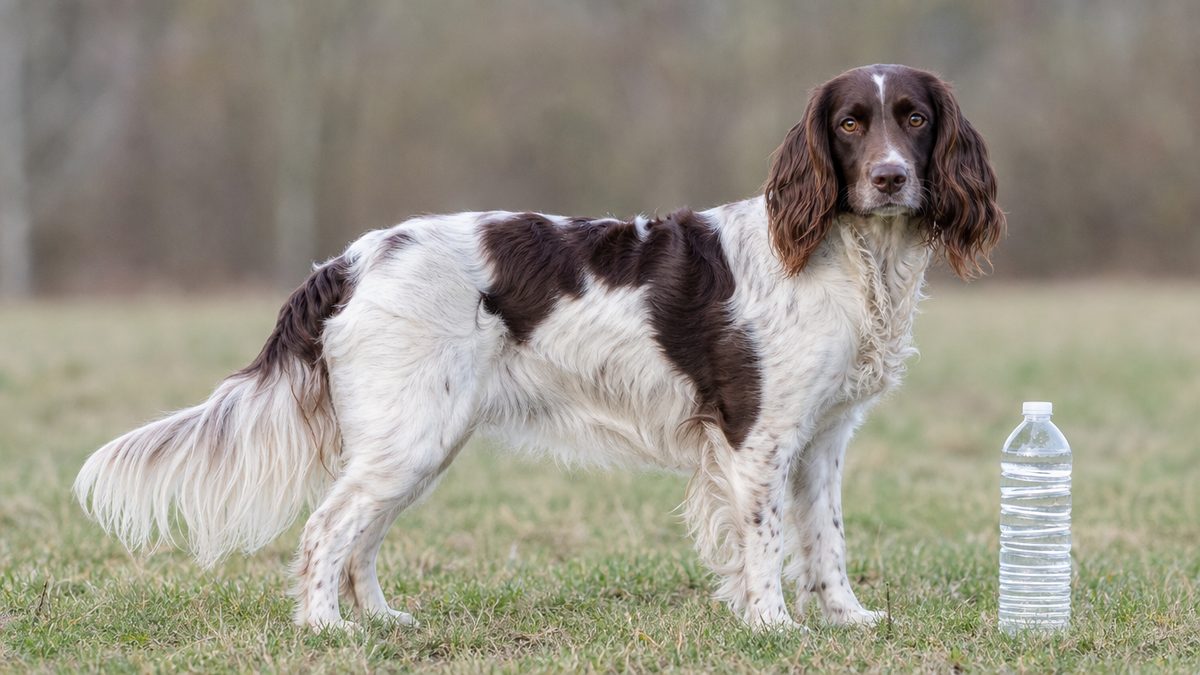
A Saint-Usuge Spaniel is a small French pointing dog from the Bresse, 45 to 53 cm at the withers for males and 41 to 49 cm for females, with a semi-long slightly wavy brown and white coat, low-set triangular fringed ears and an undocked sabre tail. The Société Centrale Canine published its standard in 2003.
The document to read is the Société Centrale Canine's own SCC Standard (2003), which exists in French and in an official English text. Its general appearance clause reads: Spaniel type pointing dog with hair of medium length, soft, flat and silky, with a balanced, elegant appearance. Medium build, muscular and resistant, docile with a gentle expression.
| Point | What the standard says |
|---|---|
| Height, males | 0.45 to 0.53 m at the withers |
| Height, females | 0.41 to 0.49 m at the withers |
| Weight | Not specified at all |
| Proportions | Rectangular, 9 to 10. Height at withers 9, body length 10 |
| Temperament | Mild, tractable, balanced, affectionate, very sensitive, no game shyness, alert and passionate, easily trained |
| Head | Lines of the skull and the muzzle divergent. Skull slightly domed, medium width |
| Nose | Brown pigmentation, in harmony with the coat |
| Eyes | Round, wide open, not protruding, hazel, darker colours sought after |
| Ears | Set below the eye line. Flat, triangular, well feathered, with feathers reaching to the tip of the muzzle |
| Coat | Semi-long, slightly wavy, well furnished. Shorter on head and limbs. No mention of undercoat |
| Colour | Bicoloured: brown with white markings, without white patches, with or without a white star on the forehead in adulthood |
| Tail | Reaching the hocks, feathered into a plume, undocked, carried sabre fashion |
| Utilisation | Pointing dog, with working trial |
The clause every Indian reader should notice first
The tail is undocked, and the standard says so as a positive requirement rather than as an alternative. Its exact words: reaching the hocks, feathered and forming a lovely plume. The tail is undocked and carried sabre fashion. A naturally short, deviated or broken tail, or a dog born without one, is a disqualifying fault.
An undocked tail is therefore the breed standard, not a concession to it. That matters because the other rare French spaniel in this batch, the Pont-Audemer, has a standard describing a tail generally docked to one third of its length, which collides directly with Indian law. This standard does not. Second Schedule Part II paragraph 6(8) of the Dog Breeding and Marketing Rules 2017 forbids tail docking outright, and here the breed's own registry agrees with it.
A white star that disappears
The colour clause carries a detail no aggregator page reproduces: puppies are all born with a white star that may disappear in adulthood. An adult may have it or not, and both are correct.
The colour rules are otherwise strict. Bicoloured brown with white markings, without solid white patches. A tricoloured coat, tan markings or white patches are disqualifying faults. The SCC's own commentary explains why: tan markings were still permitted in the 1991 standard and were removed in the 1996 revision specifically to distance the breed from the Picardy Spaniel's coat.
The head is the typicity test
The SCC's commentary by the judge Jean-Pierre Duverne is unusually direct about what makes this dog itself: the Saint-Usuge Spaniel has a fine head, which differentiates it from the Picardy and Brittany Spaniels for example, which have broader heads. It is an important criterion of typicity. He adds that the first standard spoke of a fox muzzle, the expression hunters used at the time.
The ear set is the second test, and it is also comparative: Duverne notes that when the dog is alert the ears lift, so it is at rest that you can see the low set, lower than in the Munsterlander for example, or other spaniels.
The SCC's own standard prints an FCI-CLASSIFICATION row reading Group 7 Pointing dogs, Section 1.2 Continental pointing dogs, Spaniel type, With working trial. The FCI does not hold this breed: it is absent from the FCI's own Group 7 index, which lists five French spaniels as in-document controls. That row is the Société Centrale Canine's own filing, using FCI vocabulary because FCI group names are the shared language of judging. It is not a grant, and it is discussed in full in the next section.
Is the Saint-Usuge Spaniel a breed? Both tests, with the documents
Yes. A written standard exists, published by the Société Centrale Canine in French and English and dated 2003, and a studbook entry exists, in the Livre des Origines Français, official since 8 January 2003, with published annual registrations. Both halves of the test are met by the same national kennel club. The FCI does not recognise the breed.
Bonbeno applies a two-condition test to any breed whose status is contested: is there a written standard anywhere, and is there a studbook anywhere. Both can be met by different bodies on different continents. Here both are met by one body, which makes this an unusually clean case.
| Condition | Verdict | The document |
|---|---|---|
| A written breed standard exists | Met | SCC Standard (2003), published by the Société Centrale Canine in French and in an official English text |
| A studbook entry exists | Met | Livre des Origines Français, official from 8 January 2003, with published annual registration and confirmation counts |
| FCI recognition | Not met | Absent from the FCI's Group 7 index, which carries five French spaniels as in-document controls |
| A second national kennel club | Reported met | The Dutch Raad van Beheer, per the SCC's own notice, with a caveat set out below |
The path to recognition, dated by the club itself
The breed club publishes a chronology that most breeds in this position cannot produce, and it is worth reproducing because it is what a real recognition process looks like.
| Date | Step |
|---|---|
| 21 October 1989 | First presentation of Epagneuls de Saint-Usuge at the Mervans fair |
| 18 May 1990 | Club created by Serge Bey; statutes deposited |
| 28 May 1991 | Dog register created |
| 15 November 1994 | First affiliation dossier submitted to the Société Centrale Canine |
| 15 March 1995 | First official SCC examination of the dossier |
| 15 June 1995 | The standard is definitively settled and becomes official |
| 24 January 1996 | Dossier presented to the Commission Zootechnique in Paris |
| 4 July 2002 | Expertise of the breeding stock at Savigny-en-Revermont by Professor Jean-Francois Courreau and the judge Jacques Goubie |
| 8 January 2003 | The breed is officially recognised by the Société Centrale Canine |
| 30 January 2010 | The club obtains definitive affiliation to the SCC |
Twenty years and one month from the club's founding to its definitive affiliation. English Wikipedia independently gives the same recognition date, January 8, 2003, citing the club.
Three dates for the standard, and this page does not force them into one
The sources give three years for the standard and they are not obviously contradictory, but they are not obviously reconcilable either. The club says the standard was definitively settled and became official on 15 June 1995. The SCC's commentary refers to the standard of 1991 and to its 1996 revision, which removed the tricolour coat. The standard document itself is headed SCC Standard (2003).
A plausible reading is a 1991 draft, finalised in 1995, revised in 1996 and reissued on recognition in 2003. That is a reconstruction rather than a sourced fact, and it is labelled as one.
The FCI classification row, and why it is not recognition
The SCC's own standard prints an FCI-CLASSIFICATION row: Group 7, Section 1.2, with working trial. Read alone it looks like FCI recognition. It is not.
The FCI's Group 7 nomenclature index, read on 8 September 2026, lists exactly five French breeds in Section 1.2: the Blue Picardy Spaniel at 106, the Brittany at 95, the French Spaniel at 175, the Picardy Spaniel at 108 and the Pont-Audemer Spaniel at 114. The Saint-Usuge Spaniel appears nowhere in it, and those five are the control that proves the document rendered rather than failing silently.
This is a well-documented pattern rather than anything unusual. A national body prints an FCI group because FCI group names are the vocabulary of judging in every FCI member country, and the row describes where that body files the breed. English Wikipedia states the position plainly and adds that a recognition dossier is in progress.
The Dutch recognition, and a source that contradicts itself
The Société Centrale Canine published a notice on 10 January 2022 headed L'épagneul de Saint-Usuge reconnu aux Pays-Bas, whose opening line states that at the end of 2021 the Raad van Beheer, the Dutch kennel club, recognised the breed.
The body of the same article says something different. It records that it will be a great moment for the Dutch club when the breed is officially recognised in the Netherlands, and that the Dutch kennel club recently asked the SCC for documents in order to be able to recognise the dogs, which will take effect very shortly. The article notes that it is an adaptation of a letter from the Dutch club, which is the likely explanation: a headline written after the event sitting above a body written before it.
Bonbeno publishes both readings rather than picking one. Either way the substantive fact is unaffected and is stated in the same article: all of the Dutch club's members' dogs are registered in the LOF in France. The French studbook is the register whatever the Dutch position is.
The Saint-Usuge Spaniel is a breed, nationally recognised by the Société Centrale Canine since 8 January 2003, with a published standard, a studbook entry, a club affiliated since 2010 and 58 registered births in 2025. It is not FCI-recognised, and any page telling you it is has read the SCC's own classification row without checking the FCI's register.
History, and the parish priest who rebuilt the breed
The Saint-Usuge Spaniel comes from the Bresse in eastern France, with origins reported back to at least the sixteenth century, and was nearly extinct by the end of the Second World War. It was rebuilt in the second half of the twentieth century through the efforts of Father Robert Billard, parish priest of Savigny-en-Revermont.
The account below comes from English Wikipedia, which cites the breed club and a diocesan biography, and is treated here as a secondary source.
Robert Billard (1912 to 2000) was appointed curé of Savigny-en-Revermont, a small commune in Saône-et-Loire on the edge of the Bresse, in 1939. He was a prisoner of war from 1939 to 1945. On his return he was an active hunter, began looking for a suitable hunting dog, and was told of a local breed known as the Epagneul de Saint-Usuge.
The breed club's own record picks the story up at the other end: the first presentation of Saint-Usuge Spaniels at the Mervans fair on 21 October 1989, which Billard attended, leading directly to the club's founding the following May. The club named one of its two challenge trophies after him in 1995, five years before his death.
What the Société Centrale Canine says about how the breed was made
This is the most honest paragraph any French registry has written about a rare breed, and it is worth quoting rather than paraphrasing. The SCC's own standard-and-commentary page opens: the Épagneul de Saint-Usuge is the product of a work of re-creation as much as of preservation, using founders of diverse origin whose choice corresponded to a guiding line in terms of functionality and morphotype.
It then explains what the club did next: taking over from Abbé Billard, the breed club worked to homogenise the Saint-Usuge's appearance and to individualise it relative to the breeds whose genetic material it had been able to use.
The characteristics deliberately bred out, and what each one was distancing
| Rejected | What it was distancing the breed from |
|---|---|
| Tricolour coat with tan markings | The Picardy Spaniel. Still permitted in the 1991 standard, removed in the 1996 revision |
| Black coat | Not stated |
| Long ears | Not stated |
| Long muzzle | Not stated |
| The topknot | The Pont-Audemer Spaniel |
| White patches | The Petit Munsterlander |
Duverne adds a caveat that most breed histories would omit: the oldest description of the Saint-Usuge does mention tan markings, so removing them was a deliberate choice to differentiate the breed rather than a return to a purer type. He estimates the tan was eradicated from the stock before the 1990s, over roughly a decade, but says testimony about that episode of the selection is lacking.
That is a registry publishing the limits of its own historical record, and it is the reason this page can be confident about the breed's status and careful about its ancestry.
The sixteenth-century claim, handled honestly
Wikipedia and Google's knowledge panel both say the breed's origins date back to at least the sixteenth century. The SCC's own material is more cautious: a related SCC page describes the Saint-Usuge as what is said to be the old French spaniel preserved in its primitive state in the Bresse countryside, using the French hedge *dit-on*.
Carry the hedge across. A sixteenth-century origin for a landrace type is a plausible claim about a region's dogs and not a documented pedigree, and the modern breed is on its own registry's account a reconstruction.
Because the club wrote it down as it happened, with dates, and the national kennel club published a commentary that names what it does not know Société Centrale Canine. Compare the Picardy Spaniel, where three sources give three different years for the same club merger. A breed recognised in 2003 has a paper trail that a breed recognised in 1954 does not.
How rare the Saint-Usuge Spaniel is, in French studbook numbers
The French studbook registered 58 Saint-Usuge Spaniels in 2025, down from 117 in 2024. That is seven times the Pont-Audemer Spaniel's eight and about a third of the Picardy Spaniel's 168, and the club reports more than 1,200 dogs bred since 1990.
Rarity is asserted everywhere and counted in one place, the Société Centrale Canine's Statistiques LOF 2025. The Saint-Usuge sits in its Groupe VII table alongside the FCI breeds, which is itself worth noticing: the SCC counts it with the pointing dogs because that is where the SCC files it.
| Breed | FCI status | 2024 | 2025 | Confirmations 2025 |
|---|---|---|---|---|
| Epagneul Breton | FCI 95 | 3,953 | 3,793 | 1,036 |
| Epagneul Francais | FCI 175 | 344 | 236 | 125 |
| Epagneul Picard | FCI 108 | 145 | 168 | 41 |
| Epagneul Bleu de Picardie | FCI 106 | 142 | 84 | 39 |
| Epagneul de Saint Usuge | Not FCI-recognised | 117 | 58 | 42 |
| Epagneul de Pont Audemer | FCI 114 | 19 | 8 | 9 |
| Groupe VII total | 18,073 | 17,777 | 5,476 |
The confirmation rate is the highest in the group
Forty-two confirmations against 58 registrations is 72 percent, and that is a strikingly high ratio. Confirmation is the French adult examination against the breed standard, taken at about a year old, and it is optional for a pet-homed dog. Compare the Picardy Spaniel at 41 confirmations against 168 registrations, which is 24 percent, and the Brittany at 1,036 against 3,793, which is 27 percent.
Read it carefully rather than as a quality claim. Confirmations lag registrations by about a year, so 42 in 2025 largely describes the 117 dogs registered in 2024, which is 36 percent. Either way it is above the group norm, and it is what a breed maintained by a small, organised, working-dog community looks like: most of the dogs get presented.
There is a second reason particular to this breed. A dog that is not confirmed cannot be used to breed registered stock, and for a population this size and this recently recognised, confirmation is how the club controls type.
The 2025 fall, and how to read it
Registrations halved, from 117 to 58. On a population this small a handful of kennels not breeding in a year moves the national total by that much, so a single year's fall is not a trend. What can be said is that the Saint-Usuge fell in 2025 alongside the Blue Picardy (down 41 percent), the French Spaniel (down 31 percent) and the Pont-Audemer, while the Picardy Spaniel rose 16 percent and the group as a whole fell 2 percent.
The cumulative figure, which is the more useful one
The club reports more than 1,200 dogs bred since its founding in 1990, with secondary populations in Germany, Switzerland, Austria, Canada and the United States. The Dutch club alone accounts for a documented 33 puppies bred in the Netherlands, of which six live in Germany, France and Luxembourg.
That is a breed with an international footprint, all of it registered in one national studbook.
The Kennel Club calls a British native breed vulnerable below 300 registrations a year and at watch between 300 and 450. France operates no equivalent list, so no official body applies a label to this breed. If the British threshold were applied, 58 would sit well inside the vulnerable band, roughly four times the Sussex Spaniel's 15 and a quarter of the Welsh Springer Spaniel's 213.
Saint-Usuge Spaniel price in india, and the 404 that explains everything
No Saint-Usuge Spaniel price exists in India or anywhere else. Seven routes were tested and none carries the breed, including three that all serve live pages for the Pont-Audemer Spaniel, a breed that produced eight puppies in France last year against this one's fifty-eight.
This is the cleanest result in this batch of six breeds and it makes an argument no other page makes. Petbuy.in returns a clean HTTP 404 for the breed, and Puppiezo, which generates a priced page for almost every breed it can name, returns HTTP 404 here too.
| Route | Saint-Usuge Spaniel | Pont-Audemer Spaniel, for comparison |
|---|---|---|
| Royal Canin India | HTTP 404 | HTTP 200, a live India-localised breed page |
| American Kennel Club | HTTP 404 | HTTP 200, a live breed page with a spec card |
| GoofyTails (Indian retailer) | HTTP 404 | HTTP 200, a live Indian breed guide |
| Good Dog (US marketplace) | HTTP 404 | HTTP 404 |
| Puppiezo | HTTP 404 | HTTP 404 |
| Poodles.in | HTTP 200, titled Dog Breed Not Found | HTTP 200, titled Dog Breed Not Found |
| Petbuy.in | HTTP 404 | HTTP 404 |
| French studbook registrations, 2025 | 58 | 8 |
Recognition decides visibility, not population
Read the first three rows against the last one. Royal Canin India, the American Kennel Club and an Indian pet retailer in Delhi all publish a page about the Pont-Audemer Spaniel, of which France registered eight puppies in 2025, and all three return a 404 for the Saint-Usuge Spaniel, of which France registered fifty-eight GoofyTails, an Indian pet-products retailer… Société Centrale Canine.
The difference between the two breeds is not how many dogs exist. It is that one is FCI-recognised and the other is not. Breed-content infrastructure is built from registry lists, so a breed that is not on the list does not exist to it, however many dogs are actually being born.
That is the most useful thing this page can tell an Indian reader, and it generalises well beyond this dog: when a breed is missing from the commercial internet, ask whether it is missing from a registry list before concluding anything about the animal.
No price exists anywhere, foreign included
Unlike the Picardy Spaniel, which has a Good Dog buyers guide range of USD 3,000 to 3,500 read from that site's raw source, this breed has no published price on any marketplace this session could reach. There is no dollar figure to convert and no rupee figure to check.
Bonbeno therefore publishes no price and performs no conversion. If a rupee figure appears for this breed in future, divide it by 84.38 first: a clean quotient would mean somebody converted a foreign band rather than observing an Indian market, and there is no foreign band to convert.
France registered 58 of these dogs in 2025, the breed is not FCI-recognised so the Kennel Club of India cannot register it against FCI nomenclature, and Indian import law states that any application made for trading or breeding purposes shall be duly rejected. Between those three facts there is no route by which a Saint-Usuge Spaniel could lawfully and traceably reach an Indian buyer.
Monthly cost of ownership in India, built from figures you can check
No Indian site publishes a monthly cost for this breed because none carries it. What is real is the component cost of keeping a 41 to 53 cm working gundog in an Indian city, and each line below was read live from the provider's own page on 8 September 2026.
This is the smallest breed in this batch of six, which matters for cost: dose bands, food volumes and grooming times all scale with size, and a 20 kg dog is at the bottom of most Indian pricing tiers rather than the top.
| Line | Figure | Source and caveat |
|---|---|---|
| Puppy vaccination course | From Rs 6,499 | Vetic national page, against a struck-through Rs 8,111 |
| Annual booster | From Rs 3,199 | Vetic, against a struck-through Rs 3,806 |
| Anti-rabies, single | Rs 699 | Vetic |
| 9-in-1 (DHPPiL), single | Rs 899 | Vetic |
| Kennel cough | Rs 1,349 | Vetic. Relevant if the dog boards |
| Tick and flea plus worming | Rs 1,103 a month | NexGard Spectra 15-30 kg, 3 tablets Rs 3,308, MRP Rs 3,375 |
| Bath, 60 minutes | From Rs 934 | Vetic Delhi, list price Rs 1,099 |
| Full groom and styling | From Rs 1,869 | Vetic Delhi, list price Rs 2,199 |
| Boarding, 24 hours | Rs 899 | PawSpace Bengaluru, plus 25 to 30 percent in festive season |
| Daycare, up to 10 hours | Rs 799 | PawSpace Bengaluru |
Two caveats belong with that table. Vetic quotes different course prices on different city pages on the same day, so these are its national figures. And Supertails' own unit label on the NexGard listing reads Rs 3,308 per 100 g for a pack of three tablets, which is a broken template field rather than a price.
What this breed adds on top, and what it does not
- Ear care as a weekly habit. The standard's ear is set below the eye line, flat, triangular and well feathered, so the fringe holds water even though the leather is smaller than a Picardy Spaniel's.
- Screening you must arrange yourself. No breed scheme exists, no OFA statistics row and no published prevalence data, so hips, elbows and a full eye examination are a conversation with your own vet.
- No clipping bill. There is no clip pattern and no colour maintenance, and the coat is semi-long rather than curly, so professional grooming here is a bath rather than a styling appointment.
- Daycare or a walker, because a pointing dog with a working trial classification does not sit out a ten-hour Indian working day.
On the two British spaniels in this batch, the Indian monthly figure that ranks turned out to be a preset row identical to the rupee across unrelated breeds eating hundreds of calories a day apart. Here no such row exists, because Poodles.in serves a Dog Breed Not Found page for this dog. A site that admits it has no data is more useful than the number it would otherwise have printed.
Heat tolerance in India, with a grid cell that has to be corrected first
A Saint-Usuge Spaniel can live in India and cannot be worked here in summer. Its homeland in the Bresse is genuinely cold, and the NASA POWER cell for it is 399 metres too high, which makes the raw figures colder still. Corrected, the homeland annual mean is near 11.9 C against Chennai's 27.95 C.
This is the one page in this batch where the climate model needs correcting before it can be used, and saying so is part of the answer.
Saint-Usuge sits on the Bresse plain in Saône-et-Loire at roughly 190 m. Queried at 46.6690 N, 5.3140 E for the 2001 to 2020 climatology, NASA POWER returns a grid cell at 588.62 m, an error of about plus 399 m. The cell is picking up the Jura foothills to the east rather than the plain the dog comes from.
| Place | Annual mean T2M | Hottest month | Coldest month | Annual RH | Peak wet bulb |
|---|---|---|---|---|---|
| Saint-Usuge cell, raw at 588.62 m | 9.29 C | 18.84 C (July) | minus 0.01 C (January) | 82.66 percent | 15.45 C (July) |
| Saint-Usuge, corrected estimate | about 11.9 C | about 21.4 C (July) | about 2.6 C (January) | not corrected | not corrected |
| Bengaluru | 23.74 C | 28.37 C (April) | 20.22 C (December) | 67.94 percent | 21.86 C (May) |
| Pune | 23.86 C | 28.93 C (April) | 19.62 C (December) | 66.80 percent | 22.97 C (June) |
| Delhi | 25.60 C | 35.88 C (June) | 13.61 C (January) | 45.56 percent | 26.50 C (July) |
| Kolkata | 25.81 C | 31.53 C (May) | 17.31 C (January) | 73.93 percent | 27.09 C (June) |
| Mumbai | 26.77 C | 31.19 C (May) | 23.19 C (January) | 67.39 percent | 25.77 C (June) |
| Chennai | 27.95 C | 31.51 C (May) | 24.09 C (January) | 72.39 percent | 26.11 C (May) |
The correction is a lapse-rate estimate and is labelled as one. Temperature falls with altitude at roughly 6.5 C per 1,000 m, so a cell sitting 399 m too high reads about 2.6 C too cold, and adding that back gives an annual mean near 11.9 C. That is an estimate, not a measurement, and the raw cell value is printed beside it so a reader can see what was done.
Publishing the divergence rather than the cell is the point. A page that quietly reported 9.29 C would be describing the Jura, not the Bresse.
The humidity argument is backwards here too
The Bresse is more humid than any Indian city on this page. The cell returns 82.66 percent annual relative humidity against Chennai's 72.39, Kolkata's 73.93, Mumbai's 67.39 and Delhi's 45.56. This is a damp inland plain of ponds and hedgerows, which is what a spaniel from it is built for.
What it has never met is heat. Even on the corrected estimate, Chennai's coolest month at 24.09 C is warmer than the Bresse's hottest. Peak wet bulb runs about 15.45 C at home against 27.09 C in Kolkata.
What the heat-illness evidence supports
Of the 1,259 heat-related illness events recorded across 905,543 UK dogs in 2016, 879 had a recorded trigger, and 652 of those 879, or 74.2 percent, were exertional. The companion paper puts case fatality at 14.18 percent and gives an odds ratio of 1.42 for dogs at or above their breed and sex mean bodyweight.
Neither paper models this breed and it is far below the over-50 kg band with an odds ratio of 3.42. What transfers is the bodyweight factor and the exertional finding. Since the SCC files this breed with a working trial and calls it alert and passionate, the exertional category applies.
Its size is a genuine advantage. At 41 to 53 cm this is the smallest dog in this batch, and a smaller body has a better surface-area-to-mass ratio for shedding heat than the 23 kg Sussex Spaniel or the 57 to 62 cm Picardy.
Second Schedule Part IV paragraph 21(1) of the Dog Breeding and Marketing Rules 2017 bars keeping certain dogs in outdoor facilities without the attending veterinary practitioner's written approval, and names dogs not accustomed to the temperatures prevalent in the area and breeds that cannot tolerate them, such as long-haired breeds in high temperature locations. Note the citation form: the Rules stop at Rule 13 and the string Rule 21 appears nowhere in the gazette.
The practical schedule
- Bengaluru and Pune are the two workable cities, at peak wet bulbs of 21.86 and 22.97 C and hottest months in April.
- Mumbai and Chennai need air conditioning and a hard rule on midday exercise.
- Delhi is the hardest, at 35.88 C in June and a July wet bulb of 26.50 C.
- Kolkata carries the heaviest wet-bulb load at 27.09 C in June. Treat summer exertion as a veterinary risk rather than a fitness question.
The ear leather, the fringe, and Indian humidity
The Saint-Usuge Spaniel's ear is set below the eye line, flat, triangular and well feathered, and it is the fringe rather than the leather that must reach the tip of the muzzle. That is a smaller ear than the Picardy Spaniel's and a less ventilated one than the Pont-Audemer's, and no prevalence figure exists for any of the three.
The standard is precise and the precision matters: Ears: set below the eye line. Flat, triangular, well feathered, with feathers reaching to the tip of the muzzle. The French text and Duverne's commentary sharpen it further: it is the tip of the FRINGE, not of the ear, that must reach the muzzle tip.
That is a genuinely different specification from the Picardy Spaniel's, whose standard requires the leather itself to reach the tip of the muzzle. A triangular leather with a long fringe is less material over the canal and more material hanging beside it.
| Breed | What the standard says | Implication |
|---|---|---|
| Pont-Audemer Spaniel | Set on rather low, kept away from the cheeks | Best ventilated of the four |
| Saint-Usuge Spaniel | Set below the eye line, flat, triangular, the FRINGE reaching the muzzle tip | Small leather, long fringe |
| Welsh Springer Spaniel | Comparatively small, hanging close to cheeks, vine-leaf shaped | Small leather, held against the cheek |
| Picardy Spaniel | Rather thick, framing the skull, the LEATHER reaching the muzzle tip | A long thick leather over the canal |
No figure exists, and here is the closest one that does
There is no published otitis externa prevalence for this breed. PubMed returns zero records across three name forms, against controls returning 1,109 and 369 in the same session.
The closest measured evidence is a Finnish survey of the 2010 clinical records of 55 veterinary practices covering 98,736 dogs, comparing four other spaniels.
| Breed | Affected of total | Prevalence | 95 percent CI |
|---|---|---|---|
| Welsh Springer Spaniel | 149 of 468 | 31.8 percent | 27.6 to 36.0 |
| American Cocker Spaniel | 89 of 329 | 27.0 percent | 22.2 to 31.7 |
| English Springer Spaniel | 96 of 491 | 19.6 percent | 16.1 to 23.1 |
| English Cocker Spaniel | 231 of 1,467 | 15.7 percent | 13.8 to 17.6 |
Every percentage reproduces from its own counts. The Saint-Usuge Spaniel is not in that study and none of those figures is its figure. They are quoted because a range of 15.7 to 31.8 percent across four spaniels in a cool, dry, well-served country is the right order of magnitude to plan against, and because the Welsh Springer's result shows that a small ear is no protection.
The study's transferable finding is about timing: among the American Cockers surveyed, 46 percent of 72 showed their first signs before one year of age, and early onset raised the odds of end-stage disease by 3.8 times.
What to actually do, in an Indian monsoon
- Dry the ear fringes actively after every bath and every wet walk. A long fringe holds water against the head even when the leather itself is small.
- Clean weekly with a veterinary ear cleaner, before there is a smell.
- Lift and check both ears daily from June to September.
- Treat a first-year ear infection as urgent, because early onset is tied to end-stage disease in the closest comparable data.
- Check the fringes and between the toes for ticks at every brush, given Indian tick-borne disease pressure.
Indian clinic studies find heavy burdens: Ehrlichia canis in 56 of 178 dogs tested in Odisha, 31.46 percent, with 79 percent of infected dogs having a tick history; Babesia in 80 of 120 dogs tested in Kerala, 66.7 percent, peaking pre-monsoon; and in West Bengal, 72.9 percent of the 584 dogs screened carrying two or more pathogens. These sampled clinically suspected dogs at veterinary clinics rather than random populations, so read them as pressure rather than as a population rate.
Health issues, and what a confirmation exam screens out
Nothing has been published about this breed's health. PubMed returns zero records, OFA holds no statistics row and lists the breed under a misspelling, and the largest UK longevity study never considered it. What does exist is unusual and useful: a disqualifying-fault list that functions as a screening programme.
Three instruments were run against this breed's health issues, each with a control that passed in the same session, and all three came back empty.
| Instrument | Result for this breed | Control in the same session |
|---|---|---|
| PubMed, three name forms | 0 records each | Labrador Retriever[tiab] 1,109, Cocker Spaniel[tiab] 369 |
| OFA statistics tables | No row under either spelling | LABRADOR RETRIEVER 109 rows, BERGAMASCO 1 |
| McMillan 2024 breed list | Absent entirely, unlike the Picardy and Pont-Audemer which are listed and excluded | 344 breeds listed, 155 flagged Y |
The OFA misspelling, which manufactures a false absence
OFA holds this breed as SAINT-USAGE SPANIEL, code SUS, with an A where the U should be. A correctly spelled search of OFA's own records therefore returns nothing, and a researcher who searched only the correct name would report the breed absent from OFA entirely rather than absent from its published statistics.
The same misspelling appears on at least one ranking page, which titles the breed Saint Usage Spaniel. It is worth searching both forms of the name wherever you look this dog up.
Note also that SUS sits one character from SU, which is OFA's code for the Sussex Spaniel. A guessed three-letter code would serve a different breed's statistics, which is exactly the failure this site guards against by reading codes out of the registry's own markup.
The disqualifying-fault list is the closest thing to a health scheme
In the absence of prevalence data, what the breed community actually screens for at confirmation is the most useful information available, and it is published. The SCC standard's disqualifying faults are:
- Weak temperament, gun or game shyness. A behavioural screen, unusual to see enforced at this level.
- Overshot or undershot bite, wry mouth. Duverne's commentary says prognathism is currently the commonest reason for failing confirmation, and that in the reconstruction phase it was not selected against.
- Missing teeth except P1.
- Entropion, ectropion. Both are named in Indian law's own genetic-defect list under Second Schedule Part III paragraph 8(10).
- Naturally short, deviated or broken tail, or absence of tail.
- Lack of pigmentation.
- Eyes of different colours.
- Any coat other than the standard's, a tricoloured coat, or white patches.
Forty-two dogs passed confirmation in 2025 against 58 registrations. That is a functioning screen on a small population, and it is why this breed's status is better documented than its health.
What the standard tells you about structural risk
- No exaggeration anywhere. No brachycephaly, no skin folds, no dwarfism, no extreme angulation, no mandated malocclusion. The standard's serious faults are all soundness faults: sway back, roach back, cow hocks, pacing movement, short stiff gait.
- A small, light, rectangular dog at 41 to 53 cm, which is the least structurally stressed build in this batch.
- A moderate ear, discussed in its own section above.
- One internal inconsistency worth knowing. The forequarters and hindquarters clauses describe feet that are long, not splayed and moderately tight, while the separate FEET clause calls them small, round and compact. Long and round are not the same shape, and the document says both.
Nothing here is a diagnosis, and on this breed there is no prevalence data of any kind. Screening decisions are a conversation with a registered veterinary practitioner rather than a checklist from a breed club, and hips, elbows and a full eye examination are the sensible baseline for a working gundog. The breed is on its own registry's account a reconstruction from a small, deliberately mixed founder base, which is a reason to screen the individual dog rather than to rely on breed averages that do not exist.
Life expectancy, and why this page publishes no figure
Bonbeno publishes no life expectancy for the Saint-Usuge Spaniel because none has been measured, and this breed is absent from the evidence base more completely than the two FCI French spaniels beside it. It does not appear in the largest UK longevity study's breed list at all.
McMillan and colleagues' 2024 study is the strongest longevity instrument available for dogs. Its Supplementary Table S5 lists 344 breeds and flags each Y or N for inclusion: 155 Y and 189 N.
The Picardy Spaniel is in that list, flagged N. So is the Pont-Audemer Spaniel. The Saint-Usuge Spaniel is not in it at all.
That distinction is small and real. The other two were considered and had too few UK dogs to analyse. This one was never on the list of breeds to consider, which is what happens to a breed that no international registry recognises: it does not appear in the breed vocabularies that studies are built from.
| Source | Result |
|---|---|
| McMillan et al. 2024 | Absent from the 344-breed list entirely |
| PubMed | Zero records across three name forms, against working controls |
| OFA | No statistics row under either spelling of the name |
| Société Centrale Canine | Publishes births and confirmations, not deaths |
| American Kennel Club | No page for the breed at all |
| The UK life-table study | Covers the national dog population, not any single breed |
The UK life-table work by Teng and colleagues covers the national dog population rather than any single breed and cannot fill the gap either.
Ask where it came from. For this breed the honest possibilities are that somebody carried it across from the Brittany or the Picardy Spaniel, that a template filled a required field, or that it was invented. None of those is a measurement of this dog. A page telling you a Saint-Usuge Spaniel lives 12 to 14 years is telling you what a small gundog usually lives, which may be right and is not evidence.
Temperament and household fit, and who should not buy one
The Saint-Usuge Spaniel's own standard gives it the fullest temperament description of any breed in this batch: mild, tractable, balanced, affectionate, very sensitive, no game shyness, alert and passionate, easily trained. Weak temperament and gun or game shyness are disqualifying faults.
Most standards give temperament a line. This one gives it a list, and each item is doing work.
| What the standard says | What it means for an owner |
|---|---|
| Mild, tractable | Not a hard dog. It will not push back the way a terrier does |
| Balanced | Not reactive. Stable in unfamiliar situations |
| Affectionate | A companion gundog. It wants to be with you |
| Very sensitive | The important one. It trains fast on encouragement and shuts down under pressure |
| No game shyness | A working requirement, and it is enforced: gun or game shyness is a disqualifying fault |
| Alert and passionate | It is a hunting dog. The off switch is indoors, not permanent |
| Easily trained | The registry's own words, and unusually direct for a standard |
Very sensitive is the clause that decides the household
A very sensitive dog is easy to live with and easy to damage. It means one harsh correction costs more here than it would with a Labrador, and it means the breed suits a calm household better than a chaotic one. It also means shouting works badly and food and praise work well.
The SCC pairs that sensitivity with a hard behavioural filter at confirmation: weak temperament, gun or game shyness is the first disqualifying fault on the list. So the breed community is actively selecting for a dog that is sensitive without being nervous, which is a narrow target.
Who this breed genuinely suits in India
- A calm household that is home most of the day. The sensitivity and the affection point the same way.
- An owner who will do the exercise. This is a pointing dog with a working trial classification, in the smallest body in this batch.
- A flat, at a stretch. At 41 to 53 cm this is the only breed in this batch where the size is not itself the problem.
- A first-time owner willing to train positively, since the standard's own word is easily trained.
- Not for a household away ten hours a day.
- Not for anyone who corrects harshly. Very sensitive is a warning as much as a compliment.
- Not for anyone who cannot exercise at dawn and after dark for eight months of an Indian year.
- Not for anyone buying on looks. At 58 puppies a year in the world's only studbook for the breed, the brown-and-white dog offered to you in India is something else.
Anything negative. Across the SCC standard, the SCC commentary, the club's material and Wikipedia, nothing describes this dog as stubborn, snappy, difficult or neurotic Société Centrale Canine English Wikipedia. The registry's own words are mild, tractable, balanced, affectionate and easily trained. That is a good report and it is worth stating as plainly as the availability problem.
Training approach, and what this breed resists
Train a Saint-Usuge Spaniel positively and never with pressure. Its own standard calls the breed easily trained and very sensitive in the same sentence, and those two words together are the whole method: it learns fast on encouragement and stops trying when handled hard.
The Société Centrale Canine's behaviour clause is the instruction: a mild, tractable disposition, balanced, affectionate, very sensitive, no game shyness, alert and passionate, easily trained. There is no hedging in it anywhere.
Three priorities, in order
- Build the relationship before the obedience. A very sensitive dog works for a handler it trusts and disengages from one it does not. Time spent on this in the first three months is repaid for a decade.
- Socialise the puppy to Indian street life from week eight. Traffic, delivery riders, building staff, cattle, other dogs. The breed is selected against nervousness at confirmation, and socialisation is how that selection is realised.
- Recall on a long line before the hunting drive matures. This is a pointing dog described as alert and passionate.
The Indian schedule problem
Most Indian training classes and most owner free time fall between 10 am and 6 pm. For eight months of the year that window is wrong for a working gundog, because exertion accounted for 652 of the 879 UK heat-illness events with a recorded trigger. Do the physical work at dawn and after dark and the mental work indoors in the middle of the day.
That split suits this breed particularly well. A pointing dog with a good nose is a scent-work dog, and scent games on a cool floor genuinely tire it in a way that a lead walk does not.
What to avoid
- Any aversive method. Very sensitive is the standard's own word, and a shut-down soft gundog is very hard to rebuild.
- Training in the heat. See above.
- Loud, crowded, chaotic first outings. Build up to Indian street noise rather than starting there.
- Assuming a small dog needs less work. At 41 to 53 cm this is still a pointing dog the SCC files with a working trial.
In France a Saint-Usuge Spaniel is presented at about a year old for confirmation, the adult examination against the breed standard, and 42 dogs passed it in 2025 against 58 registrations. The first disqualifying fault on the list is weak temperament, gun or game shyness. So the breed's own community tests temperament formally, which is unusual, and it is part of why the standard can call the dog easily trained without hedging.
Daily exercise requirement, and what happens without it
Plan for a working pointing dog in a small body. The Société Centrale Canine files the Saint-Usuge Spaniel with a working trial, describes it as muscular and resistant, alert and passionate, and its club runs field trials and natural-aptitude tests. Its size does not reduce its workload.
No registry publishes an hours-per-day figure for this breed. What exists is the classification and the description: pointing dog, with working trial, on a dog the standard calls muscular and resistant with a lithe smooth gait of average reach.
What the exercise should be
- Long steady off-lead work in a secure space, which is what the gait clause describes and what a lead walk cannot substitute for.
- Scent and tracking games, which use the dog's job and can run indoors on the hottest days.
- Swimming where it is clean and safe, which is the only high-intensity option that does not raise core temperature.
- Two sessions rather than one, split across dawn and after dark for most of the Indian year.
The Indian timetable, written out
| Season | Morning | Evening | Middle of the day |
|---|---|---|---|
| November to February | 45 to 60 minutes from 6.30 am | 45 minutes from 6 pm | Largely free in most cities |
| March to May | 60 minutes, finished by 7.30 am | 45 minutes after 7.30 pm | Indoors only: scent work, puzzles |
| June to September | 45 minutes, watching wet-bulb load | 45 minutes after dark | Indoors, and dry the ear fringes |
| October | 60 minutes from 6.30 am | 45 to 60 minutes from 6.30 pm | Restriction shortening |
Wet bulb is the monsoon number to watch. Kolkata peaks at 27.09 C wet bulb in June and Delhi at 26.50 C in July, against about 15.45 C in the Bresse. A working dog will not stop itself, and in a Kolkata July it needs to be stopped.
What happens without it
An under-exercised Saint-Usuge Spaniel gets heavy and gets anxious, and on a very sensitive breed the anxiety shows first. Weight then carries a specific penalty: bodyweight at or above the breed and sex mean gave an odds ratio of 1.42 for heat-related illness in the UK data. Since the standard publishes no weight at all, there is no breed mean to compare against, so body condition by hand is the only usable test.
Grooming and coat care in Indian humidity
Brush a Saint-Usuge Spaniel through the feathering two or three times a week in the monsoon and weekly the rest of the year, and dry the ear fringes actively. The coat is semi-long, slightly wavy and silky, with no clipping pattern and no colour maintenance, which makes this the lowest-maintenance coat in this batch.
The standard describes what you are working with: semi-long, slightly wavy, well furnished on the body. Shorter on the head, as well as on the limbs, which are well feathered. The ears and tail are well feathered. Hair on chest is well furnished and underline is feathered. No undercoat is mentioned anywhere.
The SCC's commentary adds a texture note and a reassurance: the hair is silkier than the Picardy Spaniel's, and Saint-Usuges often carry lighter tufty bourre on the flanks, which combs out with a slicker and is described as a purely cosmetic minor fault that may affect a final placing but never the award of a qualification.
An Indian routine
- Brush through the feathering two or three times a week from June to September, weekly otherwise. The feathered areas are the ears, tail, legs, chest and underline.
- Dry the ear fringes and the leg feathering actively after every wash and every wet walk. Overseas gundog guidance that says to towel and air dry is written for a cool dry climate.
- Comb out the flank bourre with a slicker when it appears, which the SCC's own commentary says is normal and cosmetic.
- Check between the toes after every walk, for grit and for ticks.
- Bathe roughly monthly, or after a muddy monsoon walk, plugging the ears first.
- Do not clip the coat for summer. There is no clipping pattern in the standard and no evidence clipping helps a working dog in heat; manage heat with the clock and air conditioning.
What professional grooming costs in India
Read live on 8 September 2026 from Vetic's Delhi page: Pet Bathing, 60 minutes, from Rs 934 against a list price of Rs 1,099, and Complete Bath and Hair Styling, 120 minutes, from Rs 1,869 against Rs 2,199.
This breed needs the cheaper tier. A monthly bath and blow-dry plus home brushing is the honest requirement, which puts grooming near the bottom of this dog's Indian cost stack, unlike the curly-coated Pont-Audemer Spaniel where it sits near the top.
Drying the ear fringes. Not brushing, not bathing, not product choice. The standard specifies a fringe long enough to reach the tip of the muzzle, and in an Indian monsoon a long wet fringe lying beside a canal is the single controllable input to this breed's most likely problem.
Feeding, body condition and what is actually available in India
Feed a Saint-Usuge Spaniel to a lean body condition on a complete diet appropriate to its life stage, and judge the amount by hand. The Société Centrale Canine standard gives heights and no weight at all, so there is no published target and no aggregator figure to check it against either.
No source publishes a weight for this breed. The SCC standard gives 45 to 53 cm for males and 41 to 49 cm for females and stops. Unlike the Pont-Audemer Spaniel, where the AKC and Wikipedia supply two disagreeing weight ranges, here there is not even a disputed figure: the American Kennel Club has no page for the breed at all.
That makes body condition the only measure, which is true for every dog and unavoidable for this one.
What governs the amount
- Life stage. Puppy, adult or senior, on a complete diet.
- Actual workload. A dog doing real off-lead work eats meaningfully more than one getting two lead walks, and in an Indian summer the workload legitimately falls. Adjust the food when the exercise drops.
- Body condition by hand. Run both hands flat down the ribcage; you should feel the ribs easily under a thin layer without pressing. The feathering hides outline, so looking is unreliable.
- The dog's own trend. Weigh monthly and track the direction, because there is no chart to compare against.
Two breed-specific points
The ear fringes reach the bowl. The standard specifies fringes long enough to reach the tip of the muzzle, which is long enough to trail in wet food twice a day and then stay damp. A narrow or raised bowl, or a snood at feeding time, removes one controllable input to ear disease.
Keeping it lean matters more here than usual, because bodyweight at or above the breed mean gave an odds ratio of 1.42 for heat-related illness, because no screening data exists to say whether this breed's joints tolerate extra weight, and because there is no published weight to notice the drift against.
What an Indian owner can actually buy
This is a small to medium breed by height, served by the ordinary medium-adult and medium-puppy lines every Indian retailer stocks, and at the lower end of most dosing and portion bands. Bonbeno publishes no monthly kibble figure, because Indian retail prices move fast enough that a figure quoted today misleads within weeks, and because no Indian site publishes one for this breed to check against.
Month by month through the first year in India
Indian law sets the earliest lawful sale at eight weeks and expects the vaccination course to complete around eighteen weeks. For this breed the two things to build early are trust, because the standard calls it very sensitive, and an ear-drying habit, because the fringes are long.
Two of those dates come from the gazette rather than from a breeder. Rule 8(1)(a) of the Prevention of Cruelty to Animals (Dog Breeding and Marketing) Rules 2017 states that pups less than eight weeks in age are not sold, and Second Schedule Part III paragraph 8(9) states that all pups shall be vaccinated, which can start at seven to eight weeks and is usually completed at eighteen weeks.
| Age | What happens | The Indian specific |
|---|---|---|
| Under 8 weeks | Stays with the litter. Sale before this is unlawful in India | Ask for the LOF pedigree; this is a French studbook breed with no FCI equivalent |
| 8 to 10 weeks | Home. Core vaccination begins. Alone-time training starts | Vetic prices a puppy course from Rs 6,499 nationally |
| 10 to 14 weeks | Socialisation window. Calm, positive, frequent outings | Do it at 6.30 am and after dark from March to October |
| 14 to 18 weeks | Vaccination course completes | Start weekly ear cleaning before the first monsoon |
| 4 to 6 months | Teething, lead manners, long-line recall | The white forehead star may begin to fade; both outcomes are correct |
| 6 to 9 months | Hunting drive matures. Recall gets worse before better | Long line only near crows, cats and cattle |
| 9 to 12 months | Adult coat and feathering come in. First full Indian summer | Watch weight, and dry the ear fringes every time |
| About 12 months | In France this is when a dog is presented for confirmation | Not available in India, so arrange your own screening instead |
| 12 months onward | Full working exercise load builds | Two sessions a day in the dark half of the day for most of the year |
The three habits to build in the first six months
- Trust, deliberately. The standard's word is very sensitive. Everything else in this breed's training rests on the dog believing that working with you is safe.
- Ear handling and fringe drying, daily. Lift, look, reward, dry. Early-onset ear disease is tied to end-stage disease in the closest comparable data.
- Alone-time, from week eight, built in short steps before the dog learns that you never leave.
What to screen and when
There is no breed screening scheme available outside France, no OFA statistics row and no published prevalence data PubMed searches run 8 September 2026…. Arrange it yourself: hips, elbows and a full eye examination once the dog is skeletally mature. The breed's own disqualifying-fault list is a good checklist to start from, since it already covers entropion, ectropion, dentition, pigmentation and heterochromia, and Indian law's genetic-defect list under Second Schedule Part III paragraph 8(10) overlaps with it.
Docking. Unlike the Pont-Audemer Spaniel, whose standard describes a tail generally docked to one third of its length, this breed's standard requires an undocked tail reaching the hocks and carried sabre fashion, and treats a short or absent tail as a disqualifying fault. On this point the breed's own registry and Indian law agree.
Head to head against the breeds an Indian buyer actually cross-shops
The realistic comparison set is the three FCI-recognised French spaniels and the English Cocker Spaniel that is actually available in India. On population the Saint-Usuge beats two of the three French breeds; on visibility it loses to all of them, and the reason is recognition rather than numbers.
All the registration figures come from one document, the Société Centrale Canine's Statistiques LOF 2025, so the columns are comparable.
| Breed | FCI status | France 2025 | Royal Canin India page | AKC page |
|---|---|---|---|---|
| Epagneul Breton | FCI 95 | 3,793 | Yes | Yes |
| Epagneul Francais | FCI 175 | 236 | Yes | Yes |
| Epagneul Picard | FCI 108 | 168 | Yes | Yes, as a related breed |
| Epagneul Bleu de Picardie | FCI 106 | 84 | Yes | Yes |
| Epagneul de Saint Usuge | Not recognised | 58 | No, HTTP 404 | No, HTTP 404 |
| Epagneul de Pont Audemer | FCI 114 | 8 | Yes | Yes |
The row that makes the argument
The Saint-Usuge Spaniel produced more than seven times as many puppies as the Pont-Audemer Spaniel in 2025 and has less than a seventh of its internet presence. Royal Canin India and the American Kennel Club both publish a page about the eight-puppy breed and both return a 404 for the fifty-eight-puppy one American Kennel Club Société Centrale Canine.
The only variable that separates them is FCI recognition. That is worth knowing whenever you judge a breed by how much has been written about it.
How to tell it apart from its neighbours
- Against the Picardy Spaniel: the Saint-Usuge has a FINE head, which its own registry calls a key point of typicity and contrasts explicitly with the Picardy's broader one; it is brown and white rather than grey-mottled with tan; and it is much smaller, at 41 to 53 cm against 55 to 62 Société Centrale Canine.
- Against the Brittany: also a fine-head comparison, and the Brittany is often naturally bobtailed while a short tail is a disqualifying fault here.
- Against the Pont-Audemer Spaniel: no contest visually. That breed is curly-coated with a curly topknot; this one is semi-long, slightly wavy and silky.
- Against the Small Munsterlander: the SCC's commentary says the ear set is lower here, and that the Munsterlander's white patches were deliberately bred out of the Saint-Usuge.
Against the spaniel an Indian buyer can actually get
The English Cocker Spaniel is available in India at a verifiable price and carries a far larger evidence base: a measured otitis prevalence of 15.7 percent of 1,467 dogs in the Finnish survey and a real position in the largest UK longevity study. The Saint-Usuge has no health data of any kind.
If you want a small, sensitive, affectionate, easily trained gundog in an Indian city, the English Cocker Spaniel gives you that with a real supply chain, a verifiable price and a body of evidence about what goes wrong. The reason to want a Saint-Usuge Spaniel specifically is that you want a Saint-Usuge Spaniel, and that is a legitimate reason for a breed whose paperwork is this good and whose availability is this bad.
Mistakes Indian buyers and owners actually make with this breed
Five mistakes account for most of what goes wrong, and two of them are research mistakes rather than dog mistakes. The commonest is concluding from the FCI's silence that this is not a real breed, and the second commonest is concluding from the SCC's own classification row that the FCI recognises it.
Before you buy
- Concluding it is not a breed because the FCI does not list it. A written standard exists, published by the Société Centrale Canine in French and English, and a studbook entry exists in the Livre des Origines Francais since 8 January 2003 Club de l'Épagneul de Saint-Usuge, Le Club. Both halves of the test are met.
- Concluding the opposite from the SCC's own standard. That document prints an FCI-CLASSIFICATION row reading Group 7, Section 1.2, which is the SCC's own filing; the FCI's Group 7 index does not contain the breed, with five French spaniels present as controls Fédération Cynologique Internationale.
- Searching only the correct spelling. OFA holds the breed as SAINT-USAGE SPANIEL and at least one ranking page uses the same misspelling, so a correctly spelled search of either returns nothing.
- Believing the dog on offer is this breed. France registered 58 in 2025, and seven listing and reference routes tested in India carry no page for it at all Poodles.in, probed….
After the dog arrives
- Correcting a very sensitive dog harshly. The standard's own words are mild, tractable and very sensitive, and gun or game shyness is a disqualifying fault the breed is actively selected against. Pressure undoes that work.
- Letting the ear fringes stay wet. The fringe reaches the muzzle tip by design and holds water against the head.
- Exercising in the middle of an Indian day. Exertion accounted for 652 of the 879 UK heat-illness events with a recorded trigger.
- Assuming a small pointing dog needs less exercise. The SCC files it with a working trial at 41 to 53 cm.
- Skipping screening because no scheme exists. No scheme is a reason to arrange it yourself, and the breed's own disqualifying-fault list is a usable checklist.
Judging a breed's reality by its internet footprint. Royal Canin India, the American Kennel Club and an Indian pet retailer all publish pages about the Pont-Audemer Spaniel, of which eight puppies were born in France last year, and all three return a 404 for the Saint-Usuge Spaniel, of which fifty-eight were American Kennel Club GoofyTails, an Indian pet-products retailer… Société Centrale Canine. The internet is describing a registry list, not a population.
Adoption, import law and responsible sourcing
Adopting a Saint-Usuge Spaniel in India is not possible, and importing one is lawful only as your own pet, with a wrinkle no other breed in this batch has: because the FCI does not recognise the breed, the Kennel Club of India has no route to register an imported dog against FCI nomenclature.
What the law permits, precisely
Dogs enter India under ITC(HS) 01061900 as a Restricted import. Policy Condition 7 allows three purposes only: a pet dog with a valid pet book and records in the importer's own name, dogs imported by research organisations with a CPCSEA recommendation, and dogs for internal security by the Defence and Police Force. Policy Condition 8 states that import of commercial dogs for breeding or any other commercial activity other than those purposes is not permitted.
Paragraph 6 states that any applications for trading or breeding purposes, or made on behalf of some other person or entity, shall be duly rejected, and paragraph 7 limits entry to the airports and seaports of Delhi, Mumbai, Chennai, Hyderabad, Bangalore and Kolkata. DAHD added a seventh port, Cochin International Airport at Kochi, for pets arriving under the baggage rules in October 2024. The full route is set out in how to import a dog to India.
The registration wrinkle that is specific to this breed
India is a full FCI member represented by the Kennel Club of India, which issues pedigrees against FCI nomenclature. For the Picardy Spaniel and the Pont-Audemer Spaniel that answers the Indian recognition question, because both are FCI breeds.
For the Saint-Usuge Spaniel it does not, because the breed is not in FCI nomenclature at all. An imported dog would arrive with a French LOF pedigree and no Indian registry equivalent. That is not a legal obstacle to owning the dog, and it does mean the animal would sit outside the Indian show and registration system entirely.
Say that plainly rather than implying the dog is unregistrable: it is fully registered, in France, in the studbook that is the world's register for the breed.
The adoption route that actually exists
- Indian shelters. Small brown-and-white spaniel crosses reach Indian shelters regularly. A Cocker cross gives an Indian household much of what draws people to this dog, at a size that suits an Indian flat.
- The French club, understood honestly. The Club de l'Épagneul de Saint-Usuge exists, is affiliated to the Société Centrale Canine and runs the confirmation and testing system. It will not place a dog into India, and contact with it is not a route around Policy Condition 8.
- Never a broker. Bonbeno does not recommend breeders and does not link puppy listings. A seller who can produce a Saint-Usuge Spaniel in India on demand is telling you something about the dog.
If you are genuinely importing your own dog
- Start the import authorisation at least two months before travel, which is the trade notice's own advice.
- Register the dog in your own name on the pet book, because an application on behalf of somebody else is refused.
- Plan around the seven permitted ports and the quarantine station attached to them.
- Ask for the LOF pedigree and the confirmation result. Forty-two of the breed's dogs were confirmed in 2025, so a confirmed dog is a meaningfully documented one.
- Expect no Indian registry equivalent, and keep the French paperwork safe, because it is the only record that exists.
What responsible sourcing means for a reconstructed breed
It means asking about the founder base and the coefficient of inbreeding rather than about colour. The Société Centrale Canine's own commentary describes the breed as a work of re-creation as much as of preservation, using founders of diverse origin, and the club reports more than 1,200 dogs bred since 1990. The Dutch club's practice is a good model: it contacts the French club for inbreeding information before planning a mating.
You will not get a Saint-Usuge Spaniel, and that is not a failure of your search. Fifty-eight puppies were registered in France in 2025, and seven Indian and international routes tested carry no page for the breed at all. If what drew you here was a small, sensitive, easily trained brown-and-white gundog, an English Cocker Spaniel from an Indian shelter delivers most of it, immediately and lawfully.
Saint-Usuge Spaniel questions Indian readers actually ask
What is the calmest breed of spaniel?
Among the working spaniels the Sussex and the Clumber are the two their registries describe as slow and steady. The Saint-Usuge Spaniel is not one of them, though it is close to the calmest of the French pointing spaniels indoors: its own standard calls it mild, tractable, balanced, affectionate and very sensitive, while also calling it alert and passionate and filing it as a pointing dog with working trial.
What is the most Catholic dog breed?
Google asks this because it is reading the word Saint in Saint-Usuge as a religious title rather than as half of a French place name, and the mis-parse is worth knowing because you will hit it too. Saint-Usuge is a commune in Saone-et-Loire. There is a genuine clerical connection, though: the breed was resurrected by Father Robert Billard, the parish priest of nearby Savigny-en-Revermont.
What dog breed was Zeus?
Not this one, and Google asked it because it had no question about this breed to offer. That absence is the point: the informational query returns about 97 results and a People Also Ask box in which not one of the four questions names the Saint-Usuge Spaniel. For a breed with a published national standard and 58 registered puppies last year, that is a striking gap in the English-language internet.
Is a spaniel a good family dog?
Most are, and this one comes with an unusually explicit endorsement. The Société Centrale Canine standard's behaviour clause reads: a mild, tractable disposition, balanced, affectionate, very sensitive, no game shyness, alert and passionate, easily trained. Weak temperament and gun or game shyness are disqualifying faults. The condition attached is exercise: this is a working pointing dog filed with a working trial.
Is the Saint-Usuge Spaniel a real breed?
Yes, on both of the tests that matter. A written standard exists, published by the Société Centrale Canine in French and English and dated 2003. A studbook entry exists, in the Livre des Origines Francais, official since 8 January 2003, with published annual registrations of 117 in 2024 and 58 in 2025. What it is not is FCI-recognised, and the FCI's own Group 7 index confirms that with five French spaniels present as controls.
Why is the Saint-Usuge Spaniel not recognised by the FCI?
Bonbeno cannot answer why, and says so rather than guessing. What is documented is the state of play: the breed is absent from the FCI's Group 7 nomenclature index, and English Wikipedia reports that a recognition dossier is in progress. The Société Centrale Canine's own standard nonetheless prints an FCI-classification row reading Group 7, Section 1.2, with working trial, which is the SCC's own filing using FCI vocabulary rather than an FCI grant.
How rare is the Saint-Usuge Spaniel?
France registered 58 in 2025, down from 117 in 2024. That is more than seven times the Pont-Audemer Spaniel's eight and about a third of the Picardy Spaniel's 168, in the same table and the same year. For a British comparison, the Kennel Club's vulnerable band is under 300 registrations a year, and it registered 15 Sussex Spaniels in 2025.
What is the price of a Saint-Usuge Spaniel in India?
None exists, and the absence is the most complete in this batch. Seven routes were tested and none carries the breed: Puppiezo returns 404, Poodles.in returns a Dog Breed Not Found title, Petbuy.in returns 404, and so do Good Dog, the American Kennel Club, Royal Canin India and the Indian retailer GoofyTails. The last three all serve live pages for the far rarer Pont-Audemer Spaniel.
How big is a Saint-Usuge Spaniel?
The Société Centrale Canine standard gives 45 to 53 cm at the withers for males and 41 to 49 cm for females, and no weight at all. English Wikipedia collapses that into 16 to 21 inches, or 41 to 53 cm, which is a fair summary of the same two ranges. The SCC's own commentary notes that many males now sit at 51 to 53 cm and warns breeders to avoid pairing two tall dogs.
Does the Saint-Usuge Spaniel have a docked tail?
No, and its standard says so explicitly, which is unusual and useful for an Indian reader. The tail clause reads: reaching the hocks, feathered and forming a lovely plume, the tail is undocked and carried sabre fashion. A naturally short, deviated, broken or absent tail is a disqualifying fault. Compare the Pont-Audemer Spaniel's standard, which describes a tail generally docked to one third of its length.
How long does a Saint-Usuge Spaniel live?
Nobody has measured it. The breed does not appear at all in the 344-breed list of the largest UK longevity study, unlike the Picardy and Pont-Audemer Spaniels which are both listed and excluded, so it was never even considered. PubMed carries zero records across three name forms against working controls, and no registry publishes mortality data. Any figure you meet is an estimate carried over from another breed.
Can a Saint-Usuge Spaniel handle the Indian climate?
It can be kept here and it cannot be worked here in summer. The Bresse grid cell returns an annual mean of 9.29 C, and even correcting for a 399 metre elevation error the estimate is near 11.9 C against Chennai's 27.95 C. It is the smallest and lightest-coated of the three French spaniels in this batch, which helps, and it is still a working pointing dog in a country where exertion caused 652 of the 879 UK heat-illness events with a recorded trigger.
Can I legally import a Saint-Usuge Spaniel into India?
Only as your own pet, never to sell or breed, and the FCI position adds a wrinkle. Dogs sit at ITC(HS) 01061900 as a Restricted import and Policy Condition 8 bars import of commercial dogs for breeding or any other commercial activity. Because the breed is not FCI-recognised, the Kennel Club of India cannot register it against FCI nomenclature, so an imported dog would carry a French LOF pedigree with no Indian registry equivalent.
What health problems does the Saint-Usuge Spaniel have?
Nobody has published anything. PubMed returns zero records against working controls, OFA holds no statistics row and lists the breed under a misspelling, and the largest longevity study never considered it. What the standard does tell you is what the breed community screens against at confirmation: entropion, ectropion, prognathism, missing teeth, lack of pigmentation and heterochromia are all disqualifying faults, and the SCC's own commentary says prognathism is currently the commonest reason for failing confirmation.
How much does it cost to keep a Saint-Usuge Spaniel in India each month?
Bonbeno publishes no monthly figure and no Indian site publishes one either, because none carries the breed. The real components are checkable: a Vetic puppy vaccination course from Rs 6,499, an annual booster from Rs 3,199, parasite cover around Rs 1,103 a month, a bath from Rs 934, and Bengaluru boarding at Rs 899 for 24 hours, rising 25 to 30 percent in festive season.
Compare with similar breeds
Saint-Usuge Spaniel sits in 1 Bonbeno group. Each one compares it directly against the breeds it is genuinely an alternative to, on the same figures.