
Breed profile
Blue Picardy Spaniel (Epagneul Bleu de Picardie): The India Guide
A French pointing dog separated from the Picardy Spaniel in 1938 on coat and pigment colour, with 84 French studbook registrations in 2025, no OFA data, no PubMed literature and no lawful commercial route into India. Its own standard mandates no undercoat, which is the one thing about it that helps in Chennai.
Quick answer
The blue picardy spaniel is a rare French pointing dog held by the FCI as Standard No. 106, standing 57 to 62 cm for males and 55 to 60 cm for females, with a black nose and a blue roan coat. Its French studbook recorded 84 registrations in 2025 against 3,793 Brittanys in the same table. It rates 3 of 5 for Indian heat, and Indian law bars every commercial import route.
This guide is general information for Indian pet owners and is not a diagnosis. Consult your nearby vet, a registered veterinarian, before acting on anything you read here, and treat any sudden change in a dog's condition, especially collapse or laboured breathing after exercise in the heat, a head held tilted, or a painful ear the dog will not let you touch, as urgent.
Blue Picardy Spaniel at a glance
What a Blue Picardy Spaniel is, according to its own breed standard
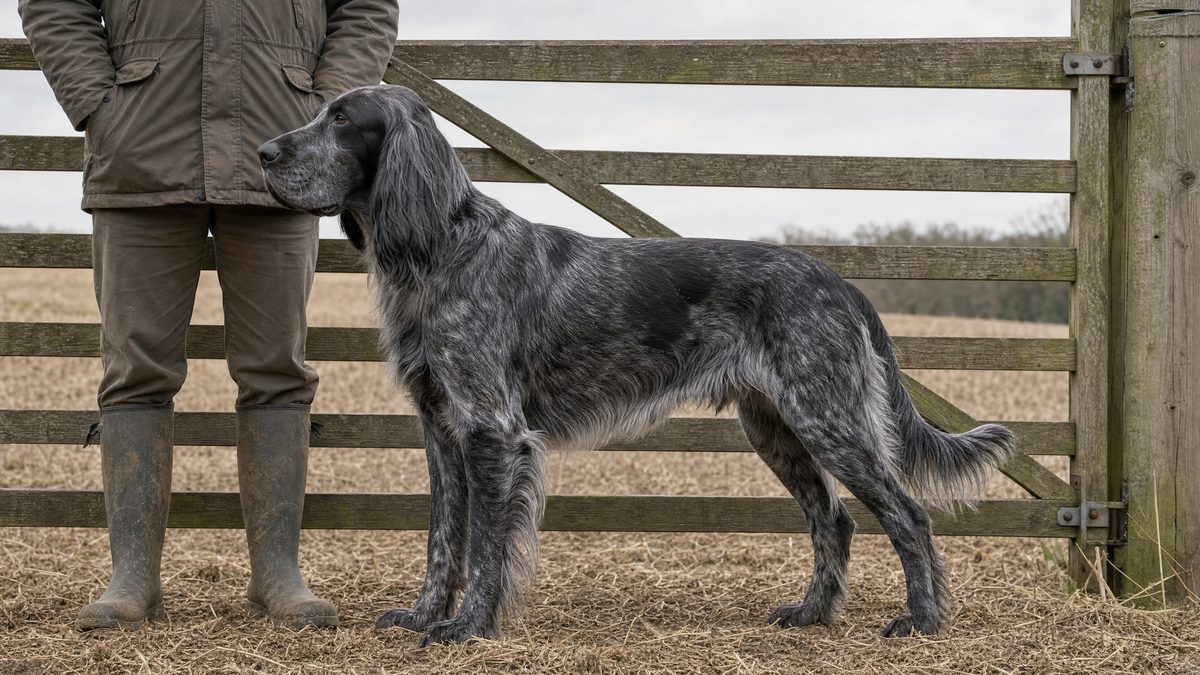
A Blue Picardy Spaniel is a French pointing dog of medium proportions held by the FCI as Standard No. 106, standing 57 to 62 cm at the withers for males and 55 to 60 cm for females, with a black nose, large dark eyes, long silky-haired ears set at eye level, and a flat or slightly wavy coat of silver grey to grey black speckling that reads as blue roan.
The governing document is short and worth reading in the original, because almost every English page about this breed paraphrases a version that has been superseded. The official valid standard was published on 8 June 2023, and the English translation carries the date 10 August 2023. Wikipedia still cites the 07.09.1998 text. The FCI accepted the breed on a definitive basis on 6 December 1954, places it in Group 7 Pointing Dogs, Section 1.2 Continental Pointing Dogs of spaniel type, and makes it subject to a working trial, which means a show championship in FCI countries requires proof the dog can do the job.
The standard's own words for the dog are "quite low to the ground dog, well built for the job", quoting the description registered in 1938, and it says the singularity and elegance of the breed stem from the typical colour of the coat. Utilization is one word, pointing dog. It is a contact dog for chases within firing range, adapts to all sorts of small game hunting, and is described as particularly skilled at woodcock.
The measurements, and where the published figures stop agreeing
The FCI gives height and gives no weight at all. That single omission is why the internet cannot agree on how heavy this dog is, and the spread is wide enough to matter to anyone budgeting food or booking a cargo crate.
| Source | Height, male | Height, female | Weight |
|---|---|---|---|
| FCI Standard No. 106 (2023) | 57 to 62 cm, tolerance plus or minus 2 cm | 55 to 60 cm, tolerance plus or minus 2 cm | Not specified |
| Canadian Kennel Club | 22 to 24 in (56 to 61 cm) | Slightly smaller, no range given | About 45 lb (20.5 kg) |
| United Kennel Club (1996) | 22.5 to 23.5 in (57 to 60 cm) | Slightly less, no range given | Not specified |
| American Kennel Club | 22 to 24 in | 21 to 23 in | 50 to 55 lb male, 45 to 50 lb female |
| Wisdom Panel | 20 to 24 in, sexes combined | 20 to 24 in, sexes combined | 40 to 51 lb |
| Wamiz | 22 to 24 in | 22 to 27 in | 33 to 40 lb, both sexes |
Two of those rows describe a dog the standard would disqualify. Wisdom Panel's floor of 20 inches is 50.8 cm, below the 53 cm absolute minimum a female reaches with full tolerance, and size outside the limits of tolerance is a disqualifying fault. Wamiz makes females larger than males, at 22 to 27 inches against 22 to 24, where 27 inches is 68.6 cm and no Blue Picardy Spaniel of either sex may exceed 64 cm. The weight range across the five sources that give one runs from 33 lb to 55 lb, which is 15 kg to 25 kg, a 67 percent spread on a figure no standard sets.
The head, and the two clauses that identify the breed
Two clauses do the identifying work. The nose must be black, broad, with well open nostrils, and any nose colour other than black is a severe fault. The coat colour is silver grey to grey black speckled forming a bluish shade, with or without black patches, which the standard glosses in the traditional French classification as mixed black-and-white and black-and-white speckling. White patches or brown patches are a disqualifying fault, so a Blue Picardy Spaniel with liver anywhere on it is not one.
The rest of the head reads like a working gundog. The skull is oval and relatively wide with no prominent parietal bones and only a slightly visible occipital protuberance, the stop is well marked, the muzzle is long and quite broad and equal in length to the skull, and the lips are wide, thick and pendulous, forming a distinctly square muzzle. Ears sit approximately at eye level, are quite thick, frame the head, carry beautiful wavy silky hair, and the leather stretched along its length must reach the tip of the muzzle. That last measurement is the one an Indian owner will think about most, and the ear section below explains why, using the same Indian dataset Bonbeno applied to the American Cocker Spaniel.
Two registries state independently that Blue Picardy Spaniel puppies are born white, or mostly white and grey, with black patches, and that the roan fills in as they mature Canadian Kennel Club breed standard…. For an Indian buyer this matters more than it does anywhere else: colour is the breed's defining feature, and at eight weeks the colour is not there yet. A photograph of a white-and-black puppy is not evidence of anything.
Blue Picardy Spaniel against Picardy Spaniel, clause by clause
To separate the two Picardy breeds, start with the sentence both FCI standards print verbatim: the main difference between the Blue Picardy Spaniel and the Spaniel of Picardy, the two Picardy breeds, is the colour of the coat. That sentence is true and it is also incomplete, because eleven other clauses differ, and one of them decides how the dog copes with an Indian summer.
Both standards were revised together and published on the same day, 8 June 2023, by the same revisers, Iris Borianne and Professor Claude Guintard. Both sit in Group 7, Section 1.2, spaniel type, with a working trial. Both give males 57 to 62 cm and females 55 to 60 cm with the same plus or minus 2 cm tolerance. Both use the identical wording for important proportions, for gait, and for the general fault clause. Read side by side they are visibly one document forked in two.
Where they fork is set out below, taken from the English texts of the two standards read in full.
| Clause | Blue Picardy Spaniel (106) | Picardy Spaniel (108) |
|---|---|---|
| Nose | Black. Any other colour is a severe fault | Brown. Any other colour is a severe fault |
| Eyes | Dark, large, well open, calm expression | Dark amber, well opened, frank and friendly |
| Colour | Silver grey to grey black speckled, bluish shade, with or without black patches | Grey mottling with dark brown patches, usually tan on head and limbs, traditionally called autumn leaves |
| Disqualifying coat | White or brown patches | White or black patches |
| Hair | Flat or slightly wavy. No undercoat mentioned | Dense and not too silky. Often with undercoat |
| Skull | Oval, no prominent parietal bones, occipital protuberance slightly visible | Moderately wide and rounded, prominent occipital protuberance |
| Cranial sides | Almost parallel; skull and muzzle axes parallel or slightly convergent | Flat at the sides |
| Stop | Well marked | Sloping to the muzzle, not at right angle |
| Lips | Wide, thick and pendulous, distinctly square muzzle | Medium thickness, slightly let down, not hanging too much |
| Neck | Well set. A slight dewlap is permitted | Well let into the shoulders, muscular. No dewlap clause |
| Angulation | Shoulder 50 degrees, upper arm 60, upper thigh 65 to 70 | No angles specified |
| Skin | Supple and close fitting | Rather fine and supple |
So are they two breeds, or one breed in two colours
They are two breeds by registry decision and one breed by anatomy, and the honest answer is to say both. Every clause in that table except two is a matter of degree in the same body: a rounder skull against an oval one, thicker lips against thinner ones. The Blue standard alone gives angulation in degrees, which reflects who revised what rather than a difference in dogs. The two genuinely separating clauses are nose colour and the undercoat.
Nose colour is not cosmetic. Black against brown is the B locus, the same pigment switch that separates a black Labrador from a chocolate one, and it acts on the nose leather, the eye rims, the pads and the base coat together. FCI 106 twice ties pigment to coat, requiring the colour of the nostrils to accord with the coat and the pads to accord with the coat's genetic colours. The UKC standard puts it plainly, saying the Blue Picardy Spaniel was classified as a separate breed because of its distinctive coat and skin colour. The two standards then disqualify each other in mirror image: brown patches disqualify a Blue, black patches disqualify a Picard Fédération Cynologique Internationale. Two closed populations fixed at opposite alleles of one locus are, in practice, two breeds.
The undercoat clause is the one that should change an Indian buyer's decision. FCI 108 says the Picardy Spaniel's coat is often with undercoat. FCI 106 does not mention an undercoat anywhere. The word appears exactly once across the two English texts and it is not in the Blue's, and neither the English nor the French text of Standard 106 contains any word for undercoat, climate, weather, temperature or hardiness Fédération Cynologique Internationale Fédération Cynologique Internationale. Wamiz's spec table independently describes the Blue's coat as single layered.
Of the two Picardy breeds, the Blue is the one whose standard mandates no insulating layer. That is a small advantage and a real one, and it is the reason this page rates heat tolerance a point higher than Bonbeno rated the Berger Picard, whose standard requires a harsh 5 to 6 cm coat over a fine dense undercoat. Nobody ranking for this term mentions it.
Where it sits among the four French spaniels
The Blue Picardy Spaniel is one of four FCI-recognised French spaniels in Group 7, Section 1.2, and coat is what tells them apart in every case. Read together, the four standards show a set of regional gundogs of near-identical build that French cynology chose to separate on hair and pigment rather than on function.
All four were read in full for this page, and the breed name printed on page one of each PDF was checked before any figure was taken from it. That check is not decoration. The obvious guess for the Pont-Audemer Spaniel, FCI Standard 107, serves a complete and correct standard for the Korthals Griffon instead; the Pont-Audemer is 114.
| Breed | FCI no. | Nose | Coat | Height | LOF 2025 |
|---|---|---|---|---|---|
| Blue Picardy Spaniel | 106 | Black | Flat or slightly wavy, silver grey to grey black speckled | 57 to 62 cm male | 84 |
| Picardy Spaniel | 108 | Brown | Dense, not too silky, often with undercoat, brown mottled with tan | 57 to 62 cm male | 168 |
| Pont-Audemer Spaniel | 114 | Brown | Curly and slightly ruffled, with a curly topknot wig | 52 to 58 cm, sexes combined | 8 |
| French Spaniel | 175 | Brown | Flat, silky, long and wavy on ears and legs, white and brown | Not compared here | 236 |
Three of the four have a brown nose. The Blue is the only one required to be black, and it is the only one whose disqualifying colour list bans brown Fédération Cynologique Internationale Fédération Cynologique Internationale Fédération Cynologique Internationale. Seen that way, the Blue Picardy Spaniel is the black-pigmented outlier in a family of liver-pigmented dogs, which fits its documented history exactly: the black came in from English Setters, and the Canadian and United Kennel Club standards both name blue Belton English Setters and Gordon Setters as the crossing stock United Kennel Club.
One club holds three of them
The four are not administered as four separate projects. The Club des Épagneuls de Picardie et Pont-Audemer, founded at Amiens in 1921 by the breeder Léon Flandre, holds the Picardy Spaniel, the Blue Picardy Spaniel and the Pont-Audemer Spaniel together, and has done since it absorbed the Blue's own club in 1937 and the Pont-Audemer club in 1980. The Société Centrale Canine lists that single club as the breed club for all three, registered at 75 rue de Menchecourt, Abbeville, in the Somme.
That arrangement is the strongest institutional argument that the Picardy pair are closer to varieties than to distinct breeds. It is also the reason the Blue's numbers are legible at all: one club, one national breeding show, one set of statistics. The Société Centrale Canine's own breed page for the Epagneul bleu de Picardie names that same club as the breed's club and describes the dog as elegant though powerful and quite close to the ground, perfectly adapted to hunting.
What this means if you are trying to identify one in India
An Indian buyer shown a photograph has four checks available, and none of them requires a pedigree.
- Check the nose. Black means Blue Picardy Spaniel. Brown or liver means one of the other three, whatever the seller calls it.
- Check for brown or tan anywhere. Tan on the head and limbs is the Picardy Spaniel's normal marking and a disqualifying fault in the Blue.
- Check the coat texture. Curls and a topknot mean Pont-Audemer. Flat or slightly wavy with feathering means Blue or French Spaniel.
- Check the height against a doorway. At 57 to 62 cm this is not a small dog, and it is routinely confused online with the blue roan English Cocker Spaniel, which stands around 39 to 41 cm.
The last one matters most, because blue roan is a colour the Indian market already knows from the Cocker. A blue roan puppy in an Indian listing is far more likely to be an English Cocker Spaniel than a Blue Picardy Spaniel, and at eight weeks the two are separated mainly by leg length and by ear leather that reaches the tip of the muzzle.
The Pont-Audemer Spaniel recorded 8 registrations in the whole of France in 2025, down from 19 the year before, and 32 in 2021 Société Centrale Canine. On a nine-year view the Blue Picardy Spaniel is not the endangered one of the four. It is the one whose decline is steepest.
History, and the one date the internet gets wrong
The Blue Picardy Spaniel was made by British quarantine law. Around the mouth of the Somme, the Authie and the Canche, British sportsmen hunting the Picardy marshes could not take their setters home without quarantine, so they boarded them on local farms, and the boarded English Setters bred with the local Picardy spaniels. The black and blue-grey coat that resulted is the whole breed.
The dates that are well attested are these. The first black, blue-grey coated spaniel was recorded in 1875. The spaniel breeds of France separated formally in 1907, and the Picardy Spaniel standard was drafted in 1908. The Club de l'Épagneul Picard was formed in 1921 at Amiens by the breeder Léon Flandre. The club merged with the separate Club de l'Épagneul Bleu de Picardie in 1937 UK Picardy Spaniel Club. The Blue's own standard was officially registered in 1938, and the FCI's current text still quotes the general appearance recorded in that year.
Wikipedia's 1907 club date does not survive being followed back
Wikipedia states that the Picardy Spaniel and Blue Picardy Spaniel Club was formed in 1907. That sentence carries a better-source-needed tag, and the reference behind it is a dead page, an archived 2009 capture of bluepicardy.com belonging to a kennel called Alex Cyrill Sporting Dogs. Three sources that are not each other put the club at 1921 instead: the French club's own history page, the UK Picardy Spaniel Club, and the United Kennel Club's official breed standard.
Use 1921. What happened in 1907 was the separation of the French spaniel breeds generally, not the founding of this club, and the two facts have been collapsed into one by pages copying each other.
1937 or 1938, and why both dates are right
Royal Canin's India page says the Blue was "not being recognised separately by the breed club until 1937";. The FCI standard says the standard was officially registered in 1938. Wamiz says the breed was recognised as separate in 1938. These are not in conflict once you notice that 1937 is the year the two clubs merged. A merger that keeps both breeds on the books is itself a recognition that there are two, and the paperwork followed a year later.
There is a small irony in it. The moment the Blue Picardy Spaniel was formally acknowledged as its own breed is also the moment its club stopped existing as a separate body, and the breed has been administered ever since by a club named for the other one.
The parts of the origin story that are legend
The Canadian Kennel Club standard opens with a claim that the first French spaniels began in the Middle East, brought back by French knights whose pointers and hounds interbred with Arabian Greyhounds. No source is offered, no date is given, and the claim is the sort of medieval-crusade origin myth attached to dozens of European breeds. Bonbeno does not repeat it as fact. The FCI's own historical summary makes no such claim and starts in nineteenth-century Picardy with black or black-and-white spaniels called épagneuls du Nord.
The English Setter cross is a different matter. It is stated by the Canadian Kennel Club, the United Kennel Club, Wisdom Panel, Wamiz and Wikipedia, it explains the black pigment that the Picardy Spaniel does not carry, and the AKC's own related-breed link from its Blue Picardy Spaniel page points at the English Setter United Kennel Club Wisdom Panel, Blue Picardy Spaniel breed… American Kennel Club. The Gordon Setter contribution is named by two registries and not by the FCI.
| Body | Status | Date |
|---|---|---|
| Société Centrale Canine | Standard officially registered | 1938 |
| Fédération Cynologique Internationale | Accepted on a definitive basis, Group 7 | 6 December 1954 |
| Canadian Kennel Club | Recognised, Sporting Group | 1 June 1995 (Wikipedia, citation needed) |
| United Kennel Club | Recognised, Gun Dog Group | 1 January 1996 |
| Fédération Cynologique Internationale | Current standard published | 8 June 2023 |
| American Kennel Club | Approved into Foundation Stock Service | May 2024 Board Meeting |
The AKC records that Lieutenant-Colonel John McCrae, the Canadian military doctor who wrote In Flanders Fields, kept a Blue named Bonneau as his companion during the First World War. Picardy was the ground that poem describes, and the breed's near-collapse and the war are the same story.
How rare it is, in real French studbook registrations
The Blue Picardy Spaniel recorded 84 studbook registrations in France in 2025, down 41 percent from 142 the year before. That is the whole annual output of the breed in the country that holds nearly all of it, and it comes from the Société Centrale Canine's own published table rather than from any estimate.
Every figure in this section is read from the SCC's Statistiques LOF PDFs, Groupe VII, Chiens d'arrêt. The table's columns are labelled Inscr for the year, Conf for confirmations, Conf/Inscr, and percentage change against the prior year. Because the same table lists every pointing breed in France, the comparison below is not an apples-to-oranges assembly from different registries. It is one table, one year, one methodology.
| Breed | 2024 | 2025 | Confirmations 2025 | Change |
|---|---|---|---|---|
| English Setter | 4,900 | 5,086 | 1,828 | plus 4% |
| Brittany (Epagneul breton) | 3,953 | 3,793 | 1,036 | minus 4% |
| German Shorthaired Pointer | 1,138 | 1,287 | 343 | plus 13% |
| Weimaraner | 801 | 829 | 171 | plus 3% |
| French Spaniel | 344 | 236 | 125 | minus 31% |
| Picardy Spaniel | 145 | 168 | 41 | plus 16% |
| Blue Picardy Spaniel | 142 | 84 | 39 | minus 41% |
| Pont-Audemer Spaniel | 19 | 8 | 9 | not printed |
| Group VII total | 18,073 | 17,777 | 5,476 | minus 2% |
The whole breed produced 84 registered dogs in France in 2025, which is 0.47 percent of the 17,777 pointing dogs France registered that year. The English Setter, the breed that made the Blue's coat colour in the first place, produced 5,086, which is just over 60 times as many. The Brittany produced 3,793, or 45 for every one Blue Picardy Spaniel.
For a reader who wants a number they already have a feel for, the same registry's Group VIII table records 15,062 golden retrievers and 6,531 Labrador Retrievers in France in 2025. Spread across the year, France registers a golden retriever roughly every 35 minutes and a Blue Picardy Spaniel roughly every four and a half days.
The trend, and why 2025 is not a blip
One bad year proves nothing. Nine years of the same table do.
| Year | Registrations | Source document |
|---|---|---|
| 2016 | 171 | Statistiques LOF 2016 |
| 2019 | 196 | Statistiques LOF 2019 |
| 2020 | 161 | Statistiques LOF 2021 |
| 2021 | 153 | Statistiques LOF 2021 |
| 2022 | 147 | Statistiques LOF 2023 |
| 2023 | 125 | Statistiques LOF 2023 |
| 2024 | 142 | Statistiques LOF 2025 |
| 2025 | 84 | Statistiques LOF 2025 |
From its 2019 peak of 196 the breed has fallen to 84, a drop of 57 percent in six years Société Centrale Canine. Against 2016's 171 the fall is 51 percent. Every intervening year is available and the direction only reverses once, in 2024. The Picardy Spaniel across the same published years ran 176 in 2016, 169 in 2019, 181 in 2020, 261 in 2021, 213 in 2022, 159 in 2023, 145 in 2024 and 168 in 2025, and is now twice as numerous as the Blue Société Centrale Canine Société Centrale Canine Société Centrale Canine Société Centrale Canine.
The 1,000-puppies figure is wrong by an order of magnitude
Wamiz, a page that carries a Checked by animal care professional badge and ranks in India for this breed's price query, states under Good to know that "Around a 1,000 Blue Picardy Puppies are born in France every year";. The French studbook's highest figure in any year checked here is 196. A claim of 1,000 is between five and twelve times the registry's own published number, depending on the year you pick.
The generous reading is that some French litters go unregistered. Even granting that, the confirmation column limits how far it can stretch: only 39 of the 84 dogs registered in 2025 went on to be confirmed, which is 46 percent by our own division of 39 by 84, and confirmation is the step that turns a registration into a dog approved for breeding.
Wikipedia says only that the breed is found in its greatest numbers in France and Canada, with no figure at all. Dogbreedslist says it is rare in America, Australia, Asia and Africa but available in Europe. Neither is checkable. The SCC's table is a government-recognised studbook publishing a count with a denominator, a confirmation column and a nine-year run, and it is free to download. When a breed page tells you a dog is rare, ask which register it is rare in.
Blue Picardy Spaniel price in India, and why no rupee figure survives a check
No verifiable Blue Picardy Spaniel price in India exists. Two Indian URLs return HTTP 200 for the breed and neither of them can name the dog it is selling, no Indian site publishes a rupee band for it at all, and the only genuine published prices are foreign. That absence is the finding, and it is the useful thing this section has to tell an Indian buyer.
The check was run on every Indian listing site that carries breed-level pages, and the results are more interesting than a price would have been.
| Site | Response | What the page actually contains |
|---|---|---|
| petbuy.in | HTTP 404 | No page for the breed at all |
| gooddog.com/blue-picardy-spaniel | HTTP 404 | No page, on the largest United States marketplace |
| call4dog.com | HTTP 200 | Availability: 12 Left in Stock, Order on whatsapp, Pay Now. The words Blue Picardy appear nowhere on it |
| breednbreeder.com | HTTP 200 | An enquiry form. The breed is absent from its own 296-name dropdown |
| puppiezo.com | Connection closed | House price of Rs 98,999 on Weimaraner, Anatolian Shepherd and Shar Pei pages alike |
| mrnmrspet.com | HTTP 403 | Not reachable from this session |
| goofytails.com | HTTP 200 | A real breed guide from a Delhi pet-food retailer, with no puppy and no price |
Twelve left in stock, of a dog the page cannot name
Call 4 Dog, a Janakpuri, Delhi shop, serves a URL ending in blue-picardy-spaniel that returns HTTP 200 and renders Availability: 12 Left in Stock beside an Order on WhatsApp button and a Pay Now button. The rendered text of that page never contains the words Blue Picardy. The fourteen puppy cards it does render are Rottweiler, Siberian Husky, Golden Retriever, German Shepherd, Doberman, Belgian Malinois, Dogo Argentino, Akita, Labrador Retriever, American Bully, Boxer, Samoyed, Cardigan Welsh Corgi and Chinese Shar-Pei, each of them labelled Small Dog Breed on a page headed Medium Breed Puppies.
Breed n Breeder does the same thing more quietly. Its Blue Picardy Spaniel page for Delhi returns HTTP 200, and the page is an enquiry form wrapped around a breed selector whose own list of 296 options contains Berger Picard and ten spaniels and does not contain the Blue Picardy Spaniel. The URL exists because the URL pattern exists.
The Rs 98,999 that is not a price
Anyone searching Indian puppy sites long enough meets Rs 98,999. It is not a Blue Picardy Spaniel price and it is not a price for any specific breed. Puppiezo prints the identical Rs 98,999 headline on its Weimaraner, Anatolian Shepherd Dog and Shar Pei pages. It is a house price point attached to whatever puppy is in stock, and Bonbeno has now caught it on five breed pages. If you are quoted Rs 98,999 for a Blue Picardy Spaniel, you are being quoted the shop's default, not the dog.
The only real published prices are foreign, and they disagree
| Source | Published price | At 84.38 to the dollar or 106 to the pound |
|---|---|---|
| Dogbreedslist.info | USD 900 to 1,200 | Rs 75,942 to Rs 1,01,256 |
| Wamiz | Upwards of GBP 800 | Roughly Rs 84,800 and up |
| Any Indian source | None published | Not applicable |
Dogbreedslist's USD 900 to 1,200 is the most-cited figure and its only listed reference is a YouTube video. Wamiz is the single ranking page that handles the question honestly, stating outright that "We do not have enough data to set an average price, but you can expect to pay upwards of £800 for a well-bred puppy";. Good Dog, which carries 25 Picardy Spaniel listings, returns a 404 for the Blue.
The one Indian site on page one that publishes real breed content, GoofyTails, a pet-food retailer in Okhla Industrial Area Phase 2 in New Delhi, runs its Blue Picardy Spaniel page as content marketing and quotes no puppy price at all. That is the correct behaviour and it is also the tell: an Indian business that actually sells things to Indian dog owners has nothing to sell here.
Neither foreign figure is a price you can pay in India, and neither is affordable by Indian pedigree-dog standards either. Running the 84.38 test the other way round is what matters here: because no Indian rupee figure exists for this breed at all, there is nothing to divide, and any rupee number that appears in future should be divided by 84.38 first to see whether it resolves to a round dollar amount. That test has caught four dressed-up dollar prices on this site already.
France registered 84 of these dogs in 2025, and Indian law rejects outright any import application made for trading or breeding purposes. A market cannot form between a supply of 84 and a legal route that excludes commerce, so a rupee price for a Blue Picardy Spaniel is not a price that is hard to find. It is a price that does not exist.
Monthly cost of ownership, honestly bounded
No Indian cost figure specific to the Blue Picardy Spaniel exists, because no Indian owner base exists to survey. What can be stated honestly is the cost structure a 20 to 25 kg feathered gundog imposes in an Indian city, and which lines of it are bigger for this breed than for a Labrador Retriever of similar weight.
Bonbeno does not publish an invented monthly total for a breed with no Indian population. Two published figures exist and both are foreign: Wamiz puts the running cost of a dog this size at GBP 70 to 100 a month covering food, insurance and incidentals. That is a British figure for a British dog in a British climate and it converts to nothing useful.
What transfers is the shape of the spend. Four lines are structurally different from the Labrador Retriever an Indian household is more likely to be comparing against.
- Ear care is a recurring line, not an occasional one. A dog whose ear leather reaches the tip of its own muzzle, in a country where one hospital series put 59.25 percent of canine ear cases in July and August, needs weekly checks and a cleaner in the cupboard twelve months a year.
- Grooming is low but not zero. The coat is flat or slightly wavy with feathering on ears, legs, underside and tail, and both the Canadian Kennel Club and Wamiz prescribe a weekly brush rather than a salon visit. Budget for a brush and a comb, not for a monthly groomer.
- Tick and flea control is the biggest non-food line in most Indian cities. A survey of 525 dogs across four Indian cities found 261, or 49.7 percent, PCR-positive for at least one tick-borne pathogen. A dog that works cover pushes that exposure up, not down.
- Exercise has a cash cost in an Indian metro. Two hours a day of off-leash work for a hunting breed means either a car to somewhere it is possible or a paid open space, and in the hot months it means doing it before sunrise, which is a labour cost if you are hiring a walker.
The costs that are actually smaller than you expect
Three lines are genuinely cheaper than for the breeds Indian buyers cross-shop. There is no undercoat to blow twice a year, so no de-shedding package. There is no coat to clip, because the standard describes a natural flat coat and no trimming pattern. And the dog is mesocephalic with no skin folds, so it does not carry the airway or dermatology bills a brachycephalic breed does.
The line nobody budgets, and the one that dominates
For this breed the dominant cost is not monthly at all. It is acquisition and legal compliance, and for almost every Indian reader it is prohibitive by design. Import of dogs into India is Restricted, and Policy Condition (8) of the DGFT's own trade notice states that import of commercial dogs for breeding or any other commercial activity is not permitted, while paragraph 6 states that applications made for trading or breeding purposes shall be duly rejected. The only lawful route is a pet dog with a valid pet book in the importer's own name, which means a household relocating to India with a dog it already owns, applying at least two months before travel through one of seven named ports Department of Animal Husbandry…. The full route is set out in how to import a dog to India.
An honest monthly budget therefore looks like this: a normal 20 to 25 kg dog's food and vaccination cost, plus a permanent ear-hygiene line, plus year-round ectoparasite control, plus whatever the household spends to give a working gundog two hours a day outside the heat. What it does not include is a purchase price, because there is no lawful Indian channel to pay one into.
Where we publish an Indian cost figure we state the sample size, the cities and the collection date. For this breed we have none of those, so we publish the structure and refuse the number. A page that gives you a confident monthly rupee total for a breed with zero Indian registrations has made it up, and you can test that by asking it where the sample came from.
Heat tolerance, argued from the coat the standard mandates
The Blue Picardy Spaniel rates 3 of 5 for Indian heat, which is one point better than Bonbeno gave the Berger Picard and two points short of a dog that belongs here. The argument is mechanical: the standard mandates a flat single coat with no undercoat, which helps, and the breed was selected in a place whose annual mean temperature is 10.2 C, which does not.
Start with what the document actually says. FCI Standard No. 106 describes the hair as flat or slightly wavy with fringes on the legs and tail, and mentions no undercoat anywhere. Searched in both the English and the official French text, the words for undercoat, climate, weather, temperature, hardiness and heat return zero occurrences in either. The Picardy Spaniel's standard, by contrast, says the coat is often with undercoat. Wamiz's own spec table independently calls the Blue's coat single layered.
That single-layer coat is the whole of the breed's heat advantage, and it is real. A dog with no insulating undercoat loses heat through its skin surface far more readily than a double-coated breed of the same weight, and it has no dense underlayer to trap moisture against the skin in a Mumbai August.
The origin climate, queried by coordinates
Every temperature on this page comes from NASA POWER's climatology API, MERRA-2 reanalysis, 2001 to 2020, queried by explicit latitude and longitude. One source, one methodology, one query form for every location. The coordinate query was chosen deliberately: this project has caught climate-data.org serving a complete Lokory, Indonesia page at HTTP 200 for an Amiens, France URL, which was found on the Berger Picard build, and six other wrong-city documents besides. A latitude and longitude cannot silently return a different town.
The origin point used here is Abbeville, 50.1058 N, 1.8358 E, on the Somme a few kilometres from the estuary where the breed was made, and the town where its breed club is registered.
| Location | Annual mean T2M | Hottest month T2M_MAX | Annual mean RH2M |
|---|---|---|---|
| Abbeville, Somme | 10.2 C | 34.5 C (July) | 85.9% |
| Amiens, Picardy | 10.1 C | 35.4 C (July) | 85.5% |
| Bengaluru | 23.7 C | 40.4 C (April) | 67.9% |
| Pune | 23.9 C | 43.2 C (April) | 66.8% |
| Delhi | 25.6 C | 48.8 C (June) | 45.6% |
| Kolkata | 25.8 C | 46.8 C (May) | 73.9% |
| Mumbai | 26.8 C | 44.9 C (April) | 67.4% |
| Chennai | 28.0 C | 42.7 C (May) | 72.4% |
Three things fall straight out of that table.
- Every Indian city's hottest month beats Abbeville's hottest month. The mildest of the six, Bengaluru at 40.4 C, still runs 5.9 C above the 34.5 C peak the breed's home reaches, and Delhi runs 14.3 C above it.
- The annual means are not close. Abbeville sits at 10.2 C and Chennai at 28.0 C, a gap of 17.8 C. The breed's working year happens at a temperature an Indian city touches only on winter mornings.
- Abbeville is more humid than any of them. At 85.9 percent annual mean relative humidity it is above Kolkata's 73.9, Chennai's 72.4, Bengaluru's 67.9, Mumbai's 67.4 and Pune's 66.8.
The third point is the one that changes the advice
Damp is not the new variable. Warm damp is. This is a marsh dog from an estuary; it was selected in permanent moisture and its coat and ears handle wet perfectly well at 10 C. What India adds is not water, it is 30 degrees of heat on top of the same water, and both of the mechanisms that hurt this breed run on that combination rather than on either alone. Microbial growth in a damp ear canal accelerates with temperature, which is exactly what Hayes and colleagues found across 8,975 dogs when they showed that monthly variation in ambient temperature, rainfall and relative humidity explains, to a large extent, the monthly variation in otitis externa prevalence.
Royal Canin's India page states the breed "is renowned for its hardiness, which allows it to withstand extreme climates", and credits its key facts to the FCI. No such sentence exists in FCI Standard 106 in either language. Wamiz says Picardy Spaniels have no problems dealing with warmer weather, and on the same page says these hardy dogs have dense, insulating coats designed to keep them warm, contradicting its own spec table two screens above, which calls the coat single layered. An Indian buyer reading either page would conclude the heat is handled. It is not.
The long ears in Indian humidity, and the Indian paper that does not add up
The single most predictable health problem for a Blue Picardy Spaniel in India is otitis externa, because the standard requires an ear leather long enough to reach the tip of the muzzle and India supplies the heat and moisture that turn a covered canal into a culture. The evidence is good, it is partly Indian, and one of the Indian percentages everyone quotes is wrong.
The conformation risk is quantified. In a random sample of 22,333 dogs drawn from 905,554 under UK primary veterinary care, breeds with pendulous ear carriage had 1.76 times the odds of otitis externa (95 percent CI 1.48 to 2.10) against breeds with erect ears, and the one-year period prevalence across all dogs was 7.30 percent (95 percent CI 6.97 to 7.65). Earlier, across 8,975 dogs at 15 North American teaching hospitals, dogs with pendulous ears and heavy ear canal hair had significantly more otitis externa at P less than 0.01.
The FCI standard puts this breed squarely in that category, and adds hair. Ears set approximately at eye level, quite thick, framing the head, carrying wavy silky hair, with the leather reaching the tip of the muzzle, and forefeet and hind feet well furnished with hair in tightly closed interdigital spaces. The breed also has the two feet you would design for fungal problems in a wet season.
The Indian numbers, and where they disagree with each other
Two Indian hospital series with published denominators bear on this, and they do not agree about the season, which is worth saying out loud rather than choosing one.
| Series | Denominator | Cases | Peak season | Check |
|---|---|---|---|---|
| Palam Valley, Himachal Pradesh, Jun 2022 to Jul 2023 | 2,476 dogs screened | 81 (3.27%) | Rainy, July to August, 48 cases (59.25%) | 81/2,476 = 3.27%; 48/81 = 59.26% |
| Durg, Chhattisgarh, 2018 | 281 dogs examined | 51 (18.14%) | Summer, March to June, 21 cases (41.18%) | 51/281 = 18.15%; 21/51 = 41.18% |
The Palam Valley series peaks in the monsoon, the Durg series peaks in summer, where Durg gave 21 of 51 cases (41.18 percent) in summer against 17 of 51 (33.33 percent) in the monsoon Roy Manju, Kashyap Roshan and Roy Suhsovan. Both divide out. The question of whether Indian ear season is the rains or the heat is not settled, and a Blue Picardy Spaniel owner in Raipur should treat both as high season rather than picking the one that suits.
The figure to stop quoting, and what it should be
The Palam Valley paper's Table 5 prints "Pendulous ear breed, 53, 69.13%". That does not divide: 53 of 81 is 65.43 percent, not 69.13. Bonbeno has previously flagged this pair and declined to use it. Working it out settles which half is wrong.
- 69.13 percent implies 56 dogs, because 56 divided by 81 is 69.1358, which truncates to 69.13 under the convention the rest of the paper follows.
- The complementary row confirms it. The paper prints erect ear breed as 25 cases, 30.86 percent, and 25 of 81 is 30.8642. 56 plus 25 is exactly 81. 53 plus 25 is 78, which would leave three dogs in no category at all when the paper offers only two.
- The breed table reconstructs the same split independently. Table 1's only erect-eared entries are German Shepherd 12, Pomeranian 10 and Husky 3, which sum to exactly 25. Everything else, Labrador 19, Mongrel 10, Pug 8, Beagle 5, Gaddi 4, Crossbreed 4, Golden Retriever 3 and Rottweiler 3, sums to exactly 56.
- The stray 53 has an obvious home elsewhere in the same paper. Cocci-associated infection is 30 cases and rod-associated is 23, and 30 plus 23 is 53, which the paper reports as bacterial infection in 65.43 percent of cases. The pendulous-ear cell appears to have been filled with the bacterial count.
So the correct reading is 56 of 81 cases, 69.13 percent, in pendulous-eared breeds, and the count rather than the percentage is the typo. Bonbeno uses the percentage and states the count as 56, and flags that the printed 53 is not usable.
Pomeranian and Mongrel are each printed at 12.43 percent, where 10 of 81 is 12.34, a transposed digit. Pug is printed at 9.80 where 8 of 81 is 9.87. The prose opens a section with "In a study of 50 cases" while every denominator in it is 81, and gives moisture in the ear canal as 33.33 percent while the table labels 20.98 percent as excessive moisture. The seasonal table is clean, the sex and age tables are clean, and the counts all sum to 81, so the paper is usable. Its typesetting is not.
The AKC tells Blue Picardy Spaniel owners that the breed has long ears and "keeping them clean and dry will prevent any ear infections";. In Raleigh that is a maintenance note. In a Chennai August, where the ambient air itself sits at 72 percent mean relative humidity, "dry" is not a state you can leave an ear in. The instruction has to become active drying after every bath and every swim, with the canal dried rather than the pinna, and the ear checked weekly rather than when it smells. Bonbeno reached the same conclusion about the American Water Spaniel parent club's advice to let the dog air dry.
How to run the dog in the heat, from the heat-illness evidence
Run a Blue Picardy Spaniel in the dark. The largest study of canine heat-related illness ever published found that exertion, not parked cars and not weather alone, causes almost three quarters of cases with a known trigger, and this is a breed whose ranking pages recommend up to two hours of intense activity a day.
The numbers are from VetCompass, drawn from 905,543 UK dogs under primary veterinary care in 2016. Of 1,259 heat-related illness events, 380 had no trigger recorded; of the remaining 879, exertional heat illness accounted for 652, which is 74.2 percent, against environmental at 113 (12.9 percent) and vehicular confinement at 5.2 percent. The companion paper puts the 2016 incidence of confirmed heat-related illness at 0.04 percent of 905,543 dogs (95 percent CI 0.04 to 0.05) with an event fatality rate of 14.18 percent (95 percent CI 11.08 to 17.96).
Roughly one dog in seven that develops heat-related illness dies of it. That fatality rate is the number worth carrying, and it is from a country whose hottest month is cooler than a Bengaluru April.
Where this breed sits on the measured risk factors
| Measured factor | Finding | This breed |
|---|---|---|
| Bodyweight over 50 kg | 3.42 times the odds (95% CI 1.54 to 7.57) of dogs under 10 kg | Not applicable. 18 to 25 kg across published sources |
| Brachycephaly | 2.10 times the odds (95% CI 1.68 to 2.64) of mesocephalic dogs | Not applicable. Muzzle equal in length to the skull |
| Exertional trigger | 652 of 879 events with a known trigger, 74.2 percent | Directly applicable. A pointing dog with a working trial requirement |
| Coat type | Not retrievable from the records; the authors say so | No published finding either way |
Two of the four measured factors let this breed off, which is why it earns a 3 rather than a 1. The third is the one that will actually put an Indian Blue Picardy Spaniel in a clinic, and it is entirely under the owner's control.
The schedule, by city, from the same climatology
The practical rule follows from the monthly maxima. Delhi's monthly maximum sits above 40 C in seven months of the year, March through September. Kolkata and Mumbai clear it in four months each, Chennai and Pune in three, and Bengaluru, the mildest of the six, in one, April at 40.4 C.
- Move both sessions outside daylight from March to June everywhere, and through the monsoon in Chennai and Kolkata where the humidity keeps evaporative cooling from working even when the thermometer drops.
- Treat April as the worst month in Bengaluru, Mumbai and Pune, May in Chennai and Kolkata, and June in Delhi, because that is where each city's peak monthly maximum falls.
- Replace distance with scent work indoors on the worst days. A pointing dog's brain is satisfied by finding things, not by covering ground, and a hidden-food search in a cool room does more for it than a shortened hot walk.
- Carry water and wet the dog before it looks hot, wetting the belly, groin and paws rather than the back, because water sitting on a feathered topcoat insulates instead of cooling.
- Stop the session on panting that does not settle, not on collapse. Exertional heat illness in this dataset is a working-dog problem, and working dogs do not self-limit.
The one thing not to do
Do not shave the coat. The reasoning that applies to a double-coated breed applies here too, for a different reason: this coat is a single flat layer over skin that the standard describes as supple and close fitting, and removing it exposes that skin to direct sun in a country where the sun is the problem. Clip the feathering on the ears and between the toes if it is trapping damp, and leave the body coat alone.
The Madras Canine Club's joint championship schedule for August 2026, which lists the Blue Picardy Spaniel under Group 7 Section 1.2 of the FCI system the KCI directs its clubs to follow, carries a printed warning that the club will not be responsible for the show being stopped by excessive rain or heat. Indian dog shows are held in a hill station in August and still hedge on the weather. That is the ambient reality a Picardy gundog would be living in.
Temperament and household fit, and who should not buy one
The FCI standard describes a flexible and gentle dog with an even temperament, well adapted to family life, which should come out as placid and never aggressive. Every registry that has written its own description agrees, and the disagreement worth reading is not about whether the dog is nice. It is about how much company and work it needs to stay that way.
The standard's behaviour clause is unusually warm for an FCI text and it is short enough to quote whole: "Flexible and gentle dog with an even temperament, well adapted to family life; should come out as placid and never aggressive. An athletic dog, the Blue Picardy Spaniel enjoys a daily walk to work off his energy";. Aggressive or overly shy dogs are a disqualifying fault, so temperament is judged in the ring, not assumed.
The Canadian Kennel Club calls it docile with a calm demeanour, patient, well-mannered and very adaptable, good with other dogs and animals, gentle and playful with children, though it will announce the presence of strangers. The UKC has it gentle, intelligent and willing to please with a strong natural hunting instinct. The AKC calls it obedient, brave and even-tempered, playful, calm and friendly, and notes that although generally quiet, a Blue will let you know if a stranger comes around.
Where the sources actually diverge
Two claims sit badly together on the same ranking pages, and an Indian buyer needs to see both.
| Question | Wamiz | Dogbreedslist |
|---|---|---|
| Suitable for a first-time owner | Highly recommended | Not addressed |
| Apartment living | Moderately compatible with a flat | 1 star. Not recommended unless actively working |
| Exercise | Up to two hours a day, lots of off-leash time | 5 stars. Daily extensive exercise, best with acreage |
| Time alone | Cannot tolerate being left alone | Very active indoors if underexercised or bored |
| Watchdog value | Bad watchdog, will ask an intruder for cuddles | 3 stars |
Both of those columns can be true, and together they describe a dog that is easy to live with and hard to accommodate. Wamiz's own page recommends the breed to first-time owners two sections after telling them it needs up to two hours of intense activity every single day and cannot tolerate solitude. Dogbreedslist rates apartment friendliness at one star out of five and says the breed does best with acreage. For an Indian flat-dwelling household working office hours, the honest reading is the second one.
Who this dog suits in India
- A household with someone home most of the day. Separation intolerance is the most consistently reported behavioural risk, and it produces the destructiveness both sources mention.
- A household with pre-dawn habits. Two sessions a day, both moved out of the heat, is a lifestyle rather than a chore, and it is the only way to run this breed safely in a city that clears 40 C.
- A household with children. Every registry independently reports the breed as gentle with children, and the AKC and CKC both say so without qualification.
- A household without a resident cat, unless they grow up together. This is a dog selected to find and point small moving things, and it is described as having a high prey drive and a tendency to run away.
Who should not buy one
Anyone buying it for the colour. Blue roan is the entire visual proposition and it is also the only reason the breed exists as a separate registry entry, which makes it exactly the sort of dog people acquire as an object and then cannot exercise. Anyone wanting a guard dog should look elsewhere, because a breed described as ready to defend the family by one registry is described by another as a hapless guardian who will ask an intruder for affection Wamiz, Blue Picardy Spaniel: Training. And anyone in a one-bedroom flat with a ten-hour workday should read the exercise section before going further.
Every description above comes from France, Canada, the United States or the United Kingdom. There is no Indian behavioural data on this breed, because there is no Indian population to collect it from. Temperament is also the trait most changed by how a dog is kept, and a gundog kept without work in a hot flat is not the dog these standards describe. Read the whole section as a description of the breed at its best.
Training approach, and what this breed resists
Train a Blue Picardy Spaniel in short, cooperative sessions and it learns quickly, because willingness to please is the trait every registry independently records. What it resists is not commands. It resists recall in the presence of scent, and it resists being left alone, and both of those are the consequences of what it was bred to do.
The registries agree unusually closely here. The UKC standard's character clause reads gentle, intelligent and willing to please, very adaptable, and possessing a strong natural hunting instinct. The CKC calls it an easily trained sporting dog that relishes having a job to do. Wamiz rates it very easy to train and prescribes sessions that are short, fun and challenging. Dogbreedslist rates trainability three of five and intelligence three of five, which is the outlier in that set. Read together, four of the five sources describe a highly trainable dog and one describes an average one.
The three things that will actually go wrong
- Recall fails on scent, not on obedience. The AKC's own care note tells owners a fenced yard is recommended because these are hunting dogs that may leave the property to follow scent, and a leash is recommended for the same reason. Wamiz records a tendency to run away and advises securing all outdoor areas. In an Indian city with unfenced parks and traffic, treat the long line as permanent equipment rather than a training phase.
- Separation distress produces the destructiveness. The breed is reported as unable to tolerate long periods of solitude and as doing silly things when left too long without distraction. Build alone-time deliberately from the first week, in minutes, before the dog needs it.
- Food motivation cuts both ways. Described as very greedy and likely to eat as much as it is given, this dog is easy to reward-train and easy to make fat. Weigh the daily ration and take training treats out of it rather than adding them to it.
Socialisation, and the Indian window
Socialise early and socialise to India specifically. A dog that will spend its life in an Indian city has to be neutral about autorickshaw horns, free-roaming dogs on the street, cattle, firecrackers in October and November, building-site noise, and being handled by strangers in a lift. None of that is in a French gundog's default experience.
Indian law sets the floor for when that work can start. Rule 8(1)(a) of the Prevention of Cruelty to Animals (Dog Breeding and Marketing) Rules, 2017 requires that pups less than eight weeks in age are not sold, under the heading Conditions for sale. A puppy offered at six weeks is being sold in breach of that rule, and separately is being taken out of the litter during the window in which dogs learn bite inhibition from their siblings.
What to train instead of distance work
The breed is a pointing dog subject to an FCI working trial, which means its championship in France requires demonstrated field ability. In India there is no field trial circuit for continental pointing breeds to enter, and there is no lawful commercial supply, so almost no Indian owner will ever run this dog on game. The instinct still needs an outlet.
- Scent games indoors. Hide-and-find with food or a scented article satisfies the searching drive in a cool room, which matters from March to June.
- Retrieve to hand. A soft dummy in a corridor teaches the delivery half of the job without any heat exposure.
- Place and settle. A mat behaviour is the single most useful thing to teach a dog that cannot be left alone, because it converts idle time into a trained behaviour rather than an anxiety.
- Handling drills. Teach the dog to offer an ear, a paw and a mouth for inspection. For a breed whose ear leather reaches the tip of its own muzzle, weekly ear handling is a health intervention, not a trick.
Exertional heat illness accounted for 652 of the 879 UK heat-illness events with a known trigger, 74.2 percent. Training is exertion. A biddable dog will keep working past the point where it should stop, precisely because it is biddable, so the handler has to be the one who calls it. Train before sunrise or after dark from March onward, and shorten sessions in the monsoon in Chennai and Kolkata, where the humidity blunts panting.
Daily exercise requirement, and what happens without it
Published guidance for this breed spans 40 minutes a day to two hours, a threefold disagreement between sources that all claim to describe the same dog. The defensible reading is the upper half, because the FCI makes the breed subject to a working trial, and a trial dog is not satisfied by a walk.
Here is the spread, and it is worth seeing before anyone commits.
| Source | Guidance | Daily total |
|---|---|---|
| American Kennel Club | A vigorous walk, good run or game of fetch for 20 minutes twice a day | 40 minutes |
| Canadian Kennel Club | Regular moderate exercise to maintain its workmanlike build | Not quantified |
| Dogbreedslist | 5 stars. Daily extensive exercise including a walk or jog, best with acreage | Not quantified |
| Wamiz | Up to two hours each day, with lots of time off the leash | 120 minutes |
Take the two hours as the target and the 40 minutes as the floor for a bad week. The FCI classification is the tiebreaker: Standard 106 is a breed subject to a working trial, meaning a French show championship requires proof of field ability. The standard itself calls it an athletic dog and a contact dog for chases within firing range, particularly skilled in woodcock hunting, which is a description of a dog quartering ground in front of a gun for hours.
What that means in an Indian week
Two hours of intense activity, both sessions moved out of daylight for four to seven months of the year depending on the city, is the real commitment. That is not a walk around the block twice. Broken down honestly it looks like a pre-dawn hour of off-leash running or long-line work in an open space, an evening session after dark, and a scent or retrieve game indoors on the days when neither is possible.
- Off-leash access is the constraint, not time. A dog with a documented tendency to follow scent off the property cannot be let go in an unfenced Indian park, so most owners will need a long line and a large space, or a genuinely enclosed one.
- Swimming is the best hot-weather option and the worst for the ears. The breed was made on the Somme marshes and takes to water. Every swim must be followed by drying the ear canal, not just the pinna, for the reasons set out above.
- Mental work counts, physical work cannot be replaced by it. Scent games satisfy a pointing dog's brain but do not condition a working body. Use them to fill gaps, not to substitute.
- Never make up a missed day by doubling the next one in the heat. Exertion caused 74.2 percent of UK heat-illness events with a known trigger, and a compensatory long run in April is exactly that mechanism.
What under-exercise produces
Dogbreedslist states the consequence plainly: if under-exercised or bored, they can be very active indoors. Wamiz adds destructiveness driven by solitude rather than by energy alone. Combined with a breed described as very food motivated and at significant risk of weight gain, the failure mode is a bored, overweight, destructive dog rather than an aggressive one.
Weight gain is the part that compounds. A heavier dog carries more metabolic heat load in a climate that is already the binding constraint, so an under-exercised Blue Picardy Spaniel in Chennai gets less tolerant of the heat each month, which makes it harder to exercise, which makes it heavier.
Wamiz says the breed is moderately compatible with a flat as long as it gets plenty of outdoor walking; Dogbreedslist rates apartment friendliness one star out of five and says the breed does best with acreage Dogbreedslist.info. Both are describing the same fact from opposite ends. The flat is not the problem. The problem is that a flat in an Indian metro usually comes with no enclosed outdoor space, and this breed's exercise has to happen off the property, at hours when most households are asleep.
Grooming the feathered coat in Indian humidity
Groom a Blue Picardy Spaniel with a pin brush and a comb once a week, and raise that to two or three times a week from June to September. The coat itself is genuinely low-maintenance by design, and everything that goes wrong in India goes wrong at the feathering, in the ears, and between the toes.
The standard describes the coat in one line: hair flat or slightly wavy, legs and tail well furnished with fringes, with the rear of the forelegs carrying wavy medium-long feathers above the elbow and distinctly longer feathers on the forearm down to the metacarpus, profuse fringes on the lower thighs, and fringes from the hock to the foot. The skin is supple and close fitting. There is no undercoat clause, no trimming pattern and no colour maintenance to do.
The registries prescribe accordingly. The Canadian Kennel Club says a weekly session with a brush and comb should keep the Blue Picardy presentable. The AKC says regular weekly brushing to maintain the soft texture and avoid matting, with a monthly bath, and specifies a good pin brush and a comb. Wamiz says a weekly brush to avoid knots, and to check the dog over after any hunts or forest walks. Dogbreedslist says brushing twice a week, bathing or dry-shampooing when necessary, trimming the hair on the bottom of the feet, and calls the breed an average shedder.
Where the overseas schedule stops working
The technique transfers. The frequency does not. A weekly brush is a sensible baseline in Picardy, where the annual mean is 10.2 C. In India the same coat spends four months in an environment where fungal and bacterial skin disease measurably spikes.
At the Belgachia Veterinary Clinics in Kolkata, 1,420 of 19,668 dogs, 7.22 percent, were diagnosed with dermatoses over a year. By season that ran 418 of 4,487 (9.32 percent) in the rains, 365 of 4,874 (7.49 percent) in summer, 328 of 4,495 (7.30 percent) in autumn and 309 of 5,812 (5.31 percent) in winter, with the worst single month July at 176 of 1,569, or 11.21 percent, against 4.97 percent in March. Every one of those percentages divides out against its own counts, and the four seasonal counts sum exactly to 1,420 of 19,668, which is why this page uses that paper without hedging.
A dog is more than twice as likely to be presented for a skin problem in a Kolkata July as in a Kolkata March. For a breed carrying profuse fringes on the lower thighs, from the hock to the foot, and between tightly closed toes, that is where the problem will be.
The monsoon routine, in order
- Part the coat, do not skim it. Brush down to skin on the chest, the belly, behind the elbows and inside the thighs, which are the places that stay damp and the places nobody looks.
- Dry the feathering after every wet walk. Towel the fringes on the forearms, lower thighs and tail properly, and do not leave the dog to air dry, which is Wisconsin advice and not Indian advice.
- Dry the ear canal, not the pinna. Cotton wool held gently in the canal opening, never a bud pushed in, after every bath and every swim.
- Check between the toes weekly. The standard requires hair in the interdigital spaces, so this breed carries the mat and the moisture where a short-coated dog does not.
- Comb out ticks by hand as well as treating. With 261 of 525 dogs across four Indian cities PCR-positive for a tick-borne pathogen, chemical control is necessary and a comb through the feathering is what actually finds the tick.
Shedding, and the allergy question
This is a moderately shedding, single-coated breed. Dogbreedslist calls it an average shedder and rates shedding level three of five; Wamiz rates shedding average and calls it a moderate shedder Wamiz, Blue Picardy Spaniel: Training. FCI Standard 106 says nothing at all about shedding, as breed standards generally do not.
Nobody markets this breed as hypoallergenic, which is a small mercy, and Dogbreedslist prints Hypoallergenic: No on its own spec card. If a seller ever tells you otherwise, the answer is settled and does not depend on the breed. Vredegoor and colleagues measured the major dog allergen Can f 1 in 196 dogs of so-called hypoallergenic breeds against 160 non-hypoallergenic and control dogs, and the hypoallergenic group came back higher, at a geometric mean of 2.26 micrograms per gram in hair against 0.77 and 27.04 against 12.98 in coat samples, with no difference in airborne levels. Their conclusion is that there is no evidence for the classification of certain dog breeds as being hypoallergenic.
There is no undercoat to blow, no clipping pattern to maintain and no colour to preserve, so a Blue Picardy Spaniel needs no salon appointment at all in India. Everything above is done at home with a pin brush, a comb, a towel and cotton wool. Budget the time, not the money.
Health, and the honest answer about how little is known
There is no breed-specific health data for the Blue Picardy Spaniel. OFA holds no record of it, PubMed returns zero, and the one paper Europe PMC associates with it is a screening study that computed frequencies only for breeds with at least twelve samples. That is a finding, it is checkable, and it is the opposite of what the ranking pages tell you.
Every absence below was tested with a control in the same session, because an unproven absence is a broken query rather than evidence.
OFA holds nothing, and the search demonstrably worked
Retrieved in full through a stealth proxy on 23 August 2026, OFA's complete disease-statistics page runs to 2,231,535 characters covering every breed it tracks. Searched case-insensitively, the strings Picardy and Picardie return zero matches anywhere on it.
| Search term | Matches | What it proves |
|---|---|---|
| labrador | 109 | The file loaded and common breeds are present |
| berger picard | 56 | The search is not defeated by the word Picard |
| english setter | 33 | The breed's documented ancestor is present |
| epagneul breton | 14 | French breed names are indexed under their French names |
| french spaniel | 2 | A rare French spaniel is present |
| picardy | 0 | No Blue Picardy Spaniel data exists at OFA |
| picardie | 0 | Nor under the French spelling |
That control set matters more than the zero. The Epagneul Breton appears in OFA tables with cohorts as small as 44 tested dogs, so this is not a threshold effect where OFA hides small breeds. The register simply holds no Blue Picardy Spaniel evaluations at all, which is what you would expect of a breed the AKC only admitted to its Foundation Stock Service in May 2024 Orthopedic Foundation for Animals.
The literature returns zero, and the query translations prove it searched
PubMed was queried four ways on 23 August 2026 and every one returned a count of 0: "Blue Picardy Spaniel", "Epagneul bleu de Picardie", "Picardy Spaniel" and "Epagneul picard". The returned query translation for the first is "blue"[All Fields] AND ("picardie"[All Fields] OR "picardy"[All Fields]) AND ("spaniel"[All Fields] OR "spaniels"[All Fields]), which shows the breed terms were genuinely searched rather than silently dropped. Controls in the same session returned 276 for Border Collie and 78 for English Setter AND dog.
Europe PMC, control 2,559 for Border Collie, returns exactly 2 documents mentioning the breed: a Saunders veterinary dictionary entry, and Broeckx and colleagues' nine-disorder screening study of a Belgian, Dutch and German dog population. That study genotyped 476 blood samples and calculated allele and genotype frequencies only for the eight breeds with at least twelve samples each, and the words Picardy and Picardie do not appear in its main text at all. There is no prevalence figure in it for this breed.
Dogbreedslist states that "The breed has no known genetic health issues";. That sentence is technically true and practically misleading. Nothing is known because nothing has been looked for. A breed with 84 registrations a year, no OFA cohort and no literature has no known genetic health issues in exactly the way an unexamined patient has no known disease.
What the registries do say, without numbers
The AKC says Blue Picardy Spaniels are generally healthy dogs and that responsible breeders screen their breeding stock for elbow and hip dysplasia. Wamiz lists ear infections, arthritis, obesity and hunting injuries as common illnesses. Neither attaches a prevalence, a sample size or a source.
The only condition on those lists that has an Indian evidence base behind it is the ear, covered above, where breeds with pendulous ear carriage carry 1.76 times the odds of otitis externa (95 percent CI 1.48 to 2.10).
A related-breed figure, clearly labelled as such
Because the AKC names hip and elbow screening without giving a rate, one comparison is offered here for context only, from a different breed. The French Spaniel, FCI 175, the nearest relative in the same FCI section with an OFA cohort, records 314 hip evaluations at 88.5 percent normal and 9.9 percent dysplastic, and 100 elbow evaluations at 96.0 percent normal and 4.0 percent Grade 1. The dysplastic components sum correctly, at 6.1 mild plus 3.5 moderate plus 0.3 severe equalling 9.9.
Those are French Spaniel numbers and they are not this breed's numbers. Do not quote them as Blue Picardy Spaniel figures. They are here only to give an order of magnitude for a mid-sized continental pointing dog.
With no breed screening scheme to point at, the questions that still work are generic and specific at once. Ask for hip and elbow scores on both parents from whichever scheme their country uses, ask for an ophthalmologist's certificate on both parents, ask how many litters the dam has had and at what age, and ask what the coefficient of inbreeding is on the proposed mating, because in a population producing 84 registered dogs a year that number is the one that will matter in ten years.
Life expectancy, and five published answers that disagree
Five sources publish a life expectancy for the Blue Picardy Spaniel and no two of them agree, with the range running from 11 years to 14. None of them is a study. There is no mortality dataset for this breed anywhere, so the honest answer is a range with the disagreement shown rather than a single number.
Here is every figure this page could find, with who published it.
| Source | Life expectancy | Evidence offered |
|---|---|---|
| American Kennel Club | 11 to 12 years | None stated |
| Royal Canin India | 12 to 13 years | Key facts credited to the FCI |
| Dogbreedslist | 12 to 14 years | One YouTube video, as its sole reference |
| Wisdom Panel | 12 to 14 years | None stated |
| Wamiz, spec table | 12 to 14 years | None stated |
| Wamiz, health section | An average lifespan of 13 years | None stated |
| FCI Standard No. 106 | Not stated | Breed standards do not give lifespan |
| Canadian Kennel Club standard | Not stated | Breed standards do not give lifespan |
The lowest and highest published figures differ by three years, which is roughly a quarter of the dog's life. Wamiz manages to disagree with itself on one page, giving 12 to 14 in its specification table and an average of 13 in its health section. The AKC's 11 to 12 is the outlier at the bottom, and it is also the only figure from a body that registers the breed.
Royal Canin's figure credits a source that does not contain it
Royal Canin's India page gives an average life expectancy of 12 to 13 years and states on the same page that its key facts and characteristics are sourced from the Fédération Cynologique Internationale. FCI Standard No. 106 contains no life expectancy in either the English or the French text Fédération Cynologique Internationale. Breed standards describe conformation, not mortality. The attribution is wrong even though the number may be reasonable.
Why no study exists, and what would be needed
A breed lifespan figure worth the name comes from one of three places: a national kennel club health survey with a stated response rate, an insurance dataset, or a primary-care records study such as VetCompass. None of the three exists for this breed, and the reason is arithmetic. A population producing 84 registered dogs a year in its home country cannot generate a mortality cohort large enough to publish. PubMed returns zero records for every spelling of the name.
So Bonbeno publishes the range and the spread rather than an average. Expect 11 to 14 years, and treat any page giving you a single confident number as having chosen one of the five above.
What actually shortens the life of this dog in India
With no inherited-disease data to work from, the modifiable risks are the ones that apply to any medium gundog in this climate, and they are not small.
- Heat-related illness carries an event fatality rate of 14.18 percent (95 percent CI 11.08 to 17.96) in the UK dataset, and 74.2 percent of events with a known trigger were exertional. This is the single largest avoidable mortality risk for a working breed in India.
- Tick-borne disease is endemic and heavily prevalent. 261 of 525 dogs sampled across four Indian cities were PCR-positive for at least one tick-borne pathogen, 49.7 percent, led by Hepatozoon canis at 30 percent and Ehrlichia canis at 20.6 percent.
- Obesity compounds both. The breed is described as very food motivated with a significant risk of weight gain, and weight gain in a hot climate reduces exercise tolerance, which reduces exercise, which increases weight.
- Untreated chronic otitis is rarely fatal but is the most likely cause of persistent pain in this breed, and pain that an owner has stopped noticing is a welfare cost that does not appear in any lifespan table.
Ask three questions of any published figure. How many dogs was it measured on, who collected the deaths, and over what period. If the page cannot answer all three, the number is a house style rather than a finding. For this breed, no page anywhere can answer any of the three, which is why five sources produce four different answers.
Feeding, body condition and what is actually available in India
Feed a Blue Picardy Spaniel a measured ration for its life stage, weigh it rather than eyeball it, and take training treats out of the daily allowance instead of adding them to it. This is a breed reported as very greedy with a significant risk of weight gain, and weight is the one health variable an Indian owner fully controls.
No breed-specific nutritional research exists, and no French club ration is published for this breed the way one is for some others. What is published is generic and consistent. The AKC directs owners to a diet formulated for the dog's life stage; Wisdom Panel adds that a food made for medium-size breeds carries the appropriate nutrient blend and warns that all dogs are at risk of obesity if they overeat Wisdom Panel, Blue Picardy Spaniel breed….
The target weight is itself contested, which makes body condition scoring more useful than any number on a bag. Published adult weights run from 33 lb to 55 lb across five sources, and the FCI standard gives no weight at all Wamiz, Blue Picardy Spaniel: Training. Feed to the ribs, not to the chart. You should feel the ribs easily under a thin layer of fat, see a waist from above and see an abdominal tuck from the side.
Life stages, and the one that matters most
| Stage | Food | The Indian adjustment |
|---|---|---|
| 8 weeks to 4 months | Medium-breed puppy food, 3 to 4 meals a day | Keep food out of the heat of the day; wet food spoils fast at 30 C plus |
| 4 to 12 months | Medium-breed puppy food, 3 meals then 2 | Do not free-feed. This is where the greed shows |
| 12 months onward | Adult medium-breed maintenance, 2 meals | Cut the ration in the hottest months, when activity drops |
| 7 years onward | Senior formulation, 2 meals | Watch for weight creep as the dog slows |
The Indian adjustment that matters is seasonal. From March to June this dog will do less, because you will be running it less, and a ration that was correct in December will make it fat by May. Reduce the measured amount when you reduce the exercise, and put it back when the weather does.
Availability in India
Nothing about this breed's feeding requires an imported food. Medium-breed puppy, adult and senior formulations from the major brands sold in India cover it, and there is no breed-specific formulation for the Blue Picardy Spaniel from any manufacturer, including Royal Canin, whose India site publishes a breed page for it and no breed diet. Any seller offering a breed-specific Blue Picardy Spaniel food is inventing a product.
The two feeding decisions that interact with the climate
- Do not feed a full meal before a session. A pointing breed in India can only be exercised early or late, which is also when it is hungriest. Feed after the session, and leave at least an hour.
- Water is a feeding decision. A feathered dog exercising in the dark in a Chennai May still needs water carried, and a dog that drinks only at home will not drink enough. Offer water in small amounts during and after work rather than one large volume afterwards.
- Treat weight loss in the hot season as a red flag, not a success. A dog that stops eating in the heat is a dog to watch, and if it is also lethargic, that is a veterinary question rather than a diet question.
- Never restrict food to control coat shedding. The two are unrelated, and this breed sheds moderately regardless.
There is no OFA data, no lifespan study and no genetic panel for this breed PubMed (NCBI E-utilities esearch. Body condition is the only major health variable an owner can measure at home, control completely and see the effect of. In a climate where heat tolerance is already the binding constraint, and where dogs over 50 kg carried 3.42 times the odds of heat-related illness in the largest study available, keeping this dog lean is not cosmetic.
Month by month through the first year
Plan the first year around three things: the colour arriving, the ears becoming a weekly job, and the growth plates closing before any distance work starts. A Blue Picardy Spaniel puppy is born white with black patches, so for the first months you are raising a dog that does not yet look like its own breed.
The colour point is not a curiosity. Two registries state independently that puppies are born white, or mostly white and grey, with black patches, and that the roan fills in as they mature Canadian Kennel Club breed standard…. Wisdom Panel says the same. Since blue roan is the defining feature of the breed, a photograph of an eight-week-old proves nothing about what you are buying.
| Age | What is happening | What you do |
|---|---|---|
| Before 8 weeks | Still with the litter. Rule 8(1)(a) of the 2017 Rules requires that pups under eight weeks are not sold | Refuse any puppy offered earlier, and say why |
| 8 to 10 weeks | Home. Coat still largely white with black patches | Vaccination course. Start ear handling on day one, before it is needed |
| 10 to 16 weeks | The socialisation window. Roan beginning to appear | Autorickshaws, cattle, lifts, free-roaming dogs, strangers, all in short positive doses |
| 4 to 6 months | Rapid growth. Ears now full length | Weekly ear check becomes permanent. No forced running, no stairs games |
| 6 to 9 months | Adolescence. Recall degrades as scent drive switches on | Long line becomes standard equipment. Retrieve and scent games indoors |
| 9 to 12 months | Growth plates closing. Adult colour largely in | Begin building distance, only before sunrise or after dark |
| 12 to 18 months | Adult conditioning | Build toward the two-hour daily target, seasonally adjusted |
The Indian calendar changes the plan
A puppy that arrives in October has a cool, dry socialisation window and reaches its first hot season at around eight months, already conditioned. A puppy that arrives in March spends its socialisation window indoors in a Delhi April at 45.6 C, which is the worst possible timing for a breed that has to learn the outside world in its first sixteen weeks.
If you have any choice at all, take a puppy in the second half of the year. If you do not, do the socialisation at 5.30 in the morning and accept that you will be doing a lot of it in a car park.
The three things to get right in the first sixteen weeks
- Ear handling before ear disease. Teach the puppy to offer an ear and hold still while you look, dry and clean. Doing this before the first infection is what makes treatment possible later. A breed with pendulous ear carriage carries 1.76 times the odds of otitis externa, and an Indian July is where that shows up Nainika and Sharma P. Otitis externa….
- Alone time, in minutes, deliberately. This breed is reported as unable to tolerate long solitude, and the separation problem is far cheaper to prevent than to treat.
- A recall that is paid every single time. Recall is the behaviour that fails on scent in adolescence, and the deposits have to be made before the scent drive arrives.
What Indian law requires of whoever bred it
If the puppy was bred in India, the Prevention of Cruelty to Animals (Dog Breeding and Marketing) Rules, 2017 apply to the breeder in full. Females may be bred only from eighteen months, only after certification by a veterinary practitioner ten days before mating, no more than one litter a year, never in two consecutive seasons, no more than five litters in a lifetime and never after the age of eight. Second Schedule Part I paragraph 6(3) prohibits in breeding within the first four generations and incest breeding, permitting only out breeding and line breeding.
Second Schedule Part III paragraph 8(10) requires that breeding dogs have been tested for genetic defects including hip dysplasia, progressive retinal atrophy, night blindness, hypothyroidism, entropion, ectropion, overshot and undershot jaw, wry mouth, two or more missing teeth and cryptorchidism.
FCI Standard 106 disqualifies an overshot or undershot bite, and disqualifies a dog missing one canine, two incisors or more than two other teeth apart from PM1 and M3. Indian law's mandatory genetic-defect testing list names overshot and undershot jaw and two or more missing teeth. Two of this breed's own disqualifying faults are things an Indian breeder is legally required to test for anyway, which makes them the easiest questions to ask.
Head to head against the breeds an Indian buyer actually cross-shops
Almost nobody in India is choosing between a Blue Picardy Spaniel and another French pointing dog, because none of them is available. The realistic comparison is against the blue roan spaniel Indian buyers can actually find, the gundogs that are common here, and the breed on this site that shares its region.
Two of the four comparisons below exist to answer a question the buyer is really asking, which is what to do instead.
| Blue Picardy Spaniel | English Cocker Spaniel | Labrador Retriever | Berger Picard | |
|---|---|---|---|---|
| Height, male | 57 to 62 cm (FCI 106) | 39 to 41 cm (FCI standard) | 57 to 62 cm (AKC standard) | 60 to 65 cm (FCI 176) |
| Coat | Flat or slightly wavy, single, feathered | Flat, silky, feathered | Short dense double | Harsh 5 to 6 cm over dense undercoat |
| Blue roan available | Always, it defines the breed | Yes, a recognised colour | No | No |
| Ears | Pendulous, leather reaches muzzle tip | Pendulous, long | Pendulous, shorter | Naturally erect |
| Heat tolerance, Bonbeno rating | 3 of 5 | See its own page | See its own page | 2 of 5 |
| French registrations 2025 | 84 | Not compared here | 6,531 | 240 |
| Available in India | No lawful commercial route | Widely | Very widely | No lawful commercial route |
| Verifiable Indian price | None exists | Yes | Yes | None exists |
Against the English Cocker Spaniel, the one people actually mean
If what you want is a blue roan spaniel in India, you want an English Cocker Spaniel. Blue roan is a standard Cocker colour, the breed is established here, it has a verifiable Indian price, and it is roughly a third of the weight. It carries the same pendulous-ear liability and the same monsoon ear risk, which is not an advantage, but it is at least a liability you can manage with a vet who has seen the breed before.
The confusion is understandable and it is worth naming, because at eight weeks a blue roan Cocker puppy and a Blue Picardy Spaniel puppy are separated mainly by leg length. A Blue Picardy Spaniel stands 57 to 62 cm at the withers and a Cocker around 40. Anyone in India offered a blue roan puppy described as a Blue Picardy Spaniel should assume it is a Cocker until the adult height proves otherwise.
Against the Labrador Retriever
The Labrador Retriever is the comparison that decides most Indian purchases, and it wins on every practical axis. It is available, it is priced, Indian vets have seen ten thousand of them, and it carries a documented Indian owner base. What the Blue Picardy Spaniel offers against it is a single coat with no undercoat and a quieter temperament, and neither is worth an import authorisation.
France registered 6,531 Labradors and 84 Blue Picardy Spaniels in 2025, a ratio of 78 to 1 in the breed's own home country.
Against the Berger Picard, the other dog from Picardy
The Berger Picard is the useful comparison because Bonbeno has already run the same analysis on it. Both are French, both are rare, both are unavailable in India, and both were built for a climate averaging around 10 C. The differences that matter are the coat and the ears.
- Coat. The Berger Picard's standard mandates a harsh 5 to 6 cm outer coat over a fine dense undercoat and severe-faults anything under 4 cm. The Blue Picardy Spaniel's standard mandates no undercoat at all. That is why this page rates heat tolerance 3 and the Picard page rates it 2.
- Ears. The Berger Picard's ears are naturally erect and well ventilated. This breed's reach the tip of its own muzzle and seal the canal, which reverses the advantage in the monsoon.
- Numbers. 240 Berger Picards against 84 Blue Picardy Spaniels in the 2025 French studbook, and the Picard is rising while the spaniel fell 41 percent.
- Job. A herding brain against a pointing brain. Both need work; only one of them will follow a scent off the property.
An Indian Pariah Dog costs nothing, is available in every Indian city from a shelter today, and is the only dog in this comparison actually evolved for the climate it will live in. It is not a pointing dog and it will not point. If what draws you to this breed is a calm, biddable, medium, low-maintenance companion rather than the colour, that requirement is met a great deal closer to home.
Mistakes Indian buyers actually make with this breed
The mistakes cluster in one place, which is believing that a page returning HTTP 200 for a breed name means the breed is available. Seven of the eight errors below are made before the dog arrives, and the eighth is made every monsoon after it does.
1. Reading an availability signal into a URL
Two Indian sites return HTTP 200 for a Blue Picardy Spaniel page, and neither can name the dog. Call 4 Dog prints Availability: 12 Left in Stock on a page whose text never contains the words Blue Picardy, beside puppy cards for fourteen entirely different breeds. Breed n Breeder serves an enquiry form for a breed missing from its own 296-name dropdown. A URL is not inventory. The test takes ten seconds: search the page for the breed name.
2. Paying Rs 98,999 for a house price point
Rs 98,999 appears identically on Puppiezo's Weimaraner, Anatolian Shepherd and Shar Pei pages. It is the shop's default headline, not a valuation of any breed, and Bonbeno has now caught it on five separate breed pages. If a seller quotes it for a Blue Picardy Spaniel, they have quoted you their template.
3. Buying a blue roan Cocker and being told it is a Picardy
Blue roan is a recognised English Cocker Spaniel colour and Cockers are everywhere in India. A Blue Picardy Spaniel stands 57 to 62 cm and a Cocker around 40, but at eight weeks that difference is invisible, and this breed's puppies are born mostly white anyway, so the colour you are buying it for is not present yet Canadian Kennel Club breed standard….
4. Trusting the brown nose
A liver or brown nose disqualifies the breed. FCI 106 requires a black nose and severe-faults any other colour, while the Picardy Spaniel requires brown. A brown-nosed dog sold as a Blue Picardy Spaniel is, at best, the other breed.
5. Believing the climate claim on an India-hosted page
Royal Canin's India page tells Indian readers the breed's hardiness allows it to withstand extreme climates, and credits the FCI. The FCI standard contains no such statement in either language, and no word for climate, weather, temperature or hardiness at all Fédération Cynologique Internationale. Wamiz says the breed has dense insulating coats two screens after its own table calls the coat single layered.
6. Believing the breed is common because a page says 1,000 puppies a year
Wamiz, carrying a Checked by animal care professional badge, states that around 1,000 Blue Picardy puppies are born in France every year. The French studbook recorded 84 in 2025 and has not exceeded 196 in any year checked back to 2016 Société Centrale Canine.
7. Assuming an import can be arranged
It cannot, unless you are moving to India with a dog you already own. Policy Condition (8) of DGFT Trade Notice 22/2022-23 states that import of commercial dogs for breeding or any other commercial activity is not permitted, and paragraph 6 states that applications for trading or breeding purposes shall be duly rejected. Anyone offering to arrange one is describing something the notice explicitly refuses.
8. Relaxing about the ears when the temperature drops
The most common ongoing mistake, and the only one on this list made after purchase. Indian owners tend to relax in the rains because it is cooler. For a dog whose ear leather reaches the tip of its own muzzle, the monsoon is the high season, not the rest. The Palam Valley series put 48 of 81 canine ear cases, 59.25 percent, in July and August alone, and Kolkata dermatoses peaked at 176 of 1,569 dogs, 11.21 percent, in July.
The monsoon peak is not universal in India. The Durg series in Chhattisgarh found the opposite, with 21 of 51 otitis cases (41.18 percent) in summer against 17 of 51 (33.33 percent) in the monsoon. Both figures divide out. Treat summer and the rains as two ear seasons rather than one, and do not let a page that names only one of them, including this one, talk you out of checking in April.
9. Shaving the coat in May
This is a single-layer coat over skin the standard calls supple and close fitting. Removing it puts an Indian sun directly on that skin. Clip the ear fringes and the hair between the toes if damp is collecting there, and leave the body alone.
Adoption, import law and responsible sourcing
You cannot lawfully buy a Blue Picardy Spaniel into India, and you will not find one to adopt here either. What you can do is read the two documents that close every route, verify anything you are offered against them, and then decide honestly whether the dog you actually want is available a great deal closer.
What the import law says, read in full
DGFT Trade Notice No. 22/2022-23, dated 19 December 2022, was downloaded and its text extracted for this page rather than summarised from another site. It sets ITC(HS) 01061900, Mammals: Other, as Restricted, and then narrows it further.
- Policy Condition (7) allows import of dogs only for a pet dog with a valid pet book and relevant records in the name of the importer, for R&D organisations conducting research with a CPCSEA recommendation, or for internal security by the Defence and Police Force.
- Policy Condition (8) states that import of commercial dogs for breeding or any other commercial activity other than those purposes is not permitted.
- Paragraph 6 states that any applications for trading or breeding purposes, or made on behalf of another person or entity, shall be duly rejected.
- Paragraph 7 allows entry only through the airports and seaports of Delhi, Mumbai, Chennai, Hyderabad, Bangalore and Kolkata, with quarantine where required. DAHD added a seventh port, Cochin International Airport at Kochi, for pets arriving under the baggage rules in October 2024.
- Paragraph 5 advises applicants to begin at least two months before travel.
The only unrestricted route is baggage, and it is narrow: up to two pets, permanent import, only for a person transferring residence to India after two years of continuous stay abroad. Everything else needs a DGFT authorisation examined by DAH&D.
Put that beside the supply. France, which holds nearly the whole breed, registered 84 in 2025. A legal route that excludes commerce and a supply of 84 dogs a year cannot produce an Indian market, and that is why no Indian price exists. It is not scarcity. It is structure.
Is there a KCI route
Not in practice. The Kennel Club of India registered 32,219 puppies with its studbook and appendix in 2025 across 7,412 litters, and has registered 1,425,001 pure-bred dogs since the studbook began. The breed does appear in Indian show paperwork: the Madras Canine Club's joint championship schedule lists the Blue Picardy Spaniel under Group 7, Section 1.2 Spaniel type, in the FCI ten-group system the KCI directs its clubs to follow.
Appearing in a show classification is not evidence that a dog exists here. That schedule lists the full FCI nomenclature because KCI shows are run on it, and it requires a xerox copy of the KCI registration certificate with every entry. A class can be listed and never filled.
The 2017 Rules, if a dog is ever bred in India
Should a Blue Picardy Spaniel ever be bred in India, the Prevention of Cruelty to Animals (Dog Breeding and Marketing) Rules, 2017 govern it completely, and three provisions matter most for a breed with a tiny gene pool.
- Second Schedule Part I paragraph 6(2) and 6(3). Only out breeding and line breeding are permitted. In breeding, defined as mating relatives of the 2nd to 4th grade in straight or side line within the first four generations, and incest breeding between parents and children or brother and sister, are prohibited.
- Rule 8(1)(a). Pups less than eight weeks in age are not sold, under the heading Conditions for sale.
- Second Schedule Part II paragraph 6(8). Tail docking, ear cropping, de-barking, de-clawing, branding, dyeing and any other kind of mutilation, and any change of appearance by artificial means, are strictly forbidden.
The first of those would bite hard here. A population of 84 registered dogs a year cannot support close breeding without accumulating risk fast, and Indian law removes the shortcut a small-population breeder in another country might reach for.
The adoption route that actually exists
There are no Blue Picardy Spaniels in Indian rescue. Wamiz, which lists adoption profiles by breed, returns none. What Indian shelters do have, in every city, today, is medium-sized, calm, biddable, short-coated dogs already adapted to the climate. The Indian Pariah Dog is the obvious answer for anyone whose real requirement is temperament rather than colour.
If the requirement is genuinely a feathered gundog with a blue roan coat, the English Cocker Spaniel exists in Indian rescue and in Indian breeding, in that colour, with an Indian price and an Indian veterinary base behind it. It carries the same pendulous-ear liability, so read the ear section before deciding.
Ask for the import authorisation number and the port of entry, since only seven ports are permitted. Ask for the LOF or CKC registration papers of the parents, since the breed exists almost nowhere else. Check the nose is black. Check the adult height against a doorway, because 57 to 62 cm rules out a Cocker. And ask which of the seven permitted ports the dog cleared, because an answer that is not one of Delhi, Mumbai, Chennai, Hyderabad, Bengaluru, Kolkata or, since October 2024, Kochi ends the conversation.
Blue Picardy Spaniel questions Indian readers actually ask
What is the price of a Blue Picardy Spaniel in India?
No verifiable Indian price exists. Petbuy.in returns HTTP 404 for the breed, Call 4 Dog and Breed n Breeder return HTTP 200 for pages that never name it, and no Indian site publishes a rupee band. The only published prices are foreign: USD 900 to 1,200 from Dogbreedslist, which converts at 84.38 to roughly Rs 75,942 to Rs 1,01,256, and upwards of GBP 800 from Wamiz.
Is Rs 98,999 a fair price for a Blue Picardy Spaniel?
It is not a price for this breed at all. Rs 98,999 appears identically on Puppiezo's Weimaraner, Anatolian Shepherd Dog and Shar Pei pages, so it is a house price point attached to whatever puppy is in stock. Bonbeno has now caught the same figure on five separate breed pages. If you are quoted it, you have been quoted the shop's template rather than a valuation.
What is the difference between a Blue Picardy Spaniel and a Picardy Spaniel?
Both FCI standards say the main difference is coat colour, and both were published on the same day with identical heights and classification. The Blue has a black nose and a silver grey to grey black speckled coat; the Picard has a brown nose and brown mottling with tan. Twelve other clauses differ, and the one that matters in India is the undercoat: FCI 108 says the Picard is often with undercoat, and FCI 106 does not mention an undercoat at all.
Are blue picardy spaniels rare?
The French studbook recorded 84 registrations in 2025, down 41 percent from 142 in 2024 and down 57 percent from the 2019 peak of 196. In the same official table the Brittany recorded 3,793 and the English Setter 5,086, so France registers 45 Brittanys for every one Blue Picardy Spaniel. The breed is 0.47 percent of all pointing dogs registered in France that year.
Blue Picardy Spaniel: Price, Temperament, Life span
No Indian price exists and the foreign ones run USD 900 to 1,200. Temperament is consistent across registries: flexible, gentle, even-tempered, placid, docile and good with children, with a strong hunting instinct and poor tolerance of being left alone. Life expectancy is genuinely unsettled, with five sources publishing 11 to 12, 12 to 13, 12 to 14 and 13 years, and no study behind any of them.
Can a Blue Picardy Spaniel handle Indian heat?
It manages better than most European gundogs and still needs managing. Bonbeno rates heat tolerance 3 of 5, because the standard mandates no undercoat and the breed is neither brachycephalic nor over 50 kg, the two risk factors the largest heat-illness study actually measured. Against that, Abbeville averages 10.2 C a year and Chennai 28.0 C, and every Indian city compared here has a hottest month above Abbeville's 34.5 C peak.
Do Blue Picardy Spaniels get ear infections?
They are built for it, and India makes it worse. The standard requires an ear leather that reaches the tip of the muzzle, and breeds with pendulous ear carriage carry 1.76 times the odds of otitis externa against erect-eared breeds in a UK sample of 22,333 dogs. One Himachal Pradesh series put 48 of 81 canine ear cases, 59.25 percent, in July and August alone, while a Chhattisgarh series peaked in summer instead.
What health problems does the Blue Picardy Spaniel have?
Nobody knows, and that is the honest answer. OFA holds zero records for the breed across a 2.2 million character dump in which Labrador returns 109 matches and Berger Picard 56. PubMed returns zero on four spellings while controls return 276 and 78. The AKC says responsible breeders screen for hip and elbow dysplasia without giving a rate, and Wamiz lists ear infections, arthritis, obesity and hunting injuries with no numbers attached.
How long do Blue Picardy Spaniels live?
Expect 11 to 14 years and treat any single number with suspicion. The AKC says 11 to 12, Royal Canin India 12 to 13, Dogbreedslist and Wisdom Panel 12 to 14, and Wamiz gives 12 to 14 in its table and 13 in its health section on the same page. No mortality study of this breed exists anywhere, because a population producing 84 registered dogs a year cannot generate a publishable cohort.
Can you import a Blue Picardy Spaniel to India?
Only as your own pet, if you are transferring residence. DGFT Trade Notice 22/2022-23 sets dogs as a Restricted import, Policy Condition (8) states that import of commercial dogs for breeding or any other commercial activity is not permitted, and paragraph 6 states that applications for trading or breeding purposes shall be duly rejected. Entry is limited to Delhi, Mumbai, Chennai, Hyderabad, Bengaluru, Kolkata and, since October 2024, Kochi.
Is the Blue Picardy Spaniel hypoallergenic?
No, and no dog breed is. Vredegoor and colleagues measured Can f 1 in 196 dogs of so-called hypoallergenic breeds against 160 controls and found the hypoallergenic group carried more allergen in hair and coat, not less, with no difference in airborne levels. Dogbreedslist prints Hypoallergenic: No on its own spec card for this breed, and rates it a moderate shedder.
Why is my Blue Picardy Spaniel puppy white?
Because that is what they look like at birth. The AKC states that puppies are born white with black patches before developing their characteristic wavy blue roan coats, and the Canadian Kennel Club says they are born mostly white-grey with the colour filling in as they mature. This matters when buying, because blue roan is the entire visual identity of the breed and it is not present at eight weeks.
How much exercise does a Blue Picardy Spaniel need?
Published guidance runs from 40 minutes to two hours a day, and the upper half is the defensible reading for a breed the FCI subjects to a working trial. The AKC recommends 20 minutes twice a day, Wamiz up to two hours with lots of off-leash time, and Dogbreedslist rates exercise need five of five. In India both sessions have to move outside daylight from March onward.
Is the Blue Picardy Spaniel a good first dog?
Probably not in an Indian flat, despite what one ranking page says. Wamiz calls it highly recommended for a first-time owner two sections after saying it needs up to two hours of intense daily activity and cannot tolerate being left alone. Dogbreedslist rates apartment friendliness one star of five and says the breed does best with acreage. The temperament is easy; the logistics are not.
How much is a Blue Picardy Spaniel?
No Indian price exists, and the only real published prices are foreign and disagree. Dogbreedslist quotes USD 900 to 1,200, which is Rs 75,942 to Rs 1,01,256 at 84.38 rupees to the dollar, and Wamiz says only that a well-bred puppy costs upwards of GBP 800, roughly Rs 84,800 and up. No Indian site publishes a rupee band, the two Indian URLs that return a page cannot name the dog they are selling, and the Rs 98,999 that appears on one Indian site is a house price printed identically on its Weimaraner, Anatolian Shepherd and Shar Pei pages.
Are Picardy Spaniels good family dogs?
Yes, on every registry's description. FCI Standard No. 106 calls the Blue Picardy Spaniel a flexible and gentle dog with an even temperament, well adapted to family life, placid and never aggressive, and the Canadian Kennel Club and AKC both report it gentle and playful with children without qualification. The condition is company and work: it cannot tolerate being left alone, needs up to two hours of activity a day, rates one star out of five for apartment living, and is a poor guard dog.
How big is a Picardy Spaniel?
Medium sized. FCI Standard No. 106 gives the Blue Picardy Spaniel 57 to 62 cm at the withers for males and 55 to 60 cm for females, with a tolerance of plus or minus 2 cm, and the Picardy Spaniel's standard No. 108 carries identical heights, the two standards differing mainly in coat colour. Neither standard specifies a weight, which is why published figures run from 33 to 55 lb, 15 to 25 kg, and the AKC's 50 to 55 lb for males and 45 to 50 lb for females is the most-cited band.
Compare with similar breeds
Blue Picardy Spaniel sits in 1 Bonbeno group. Each one compares it directly against the breeds it is genuinely an alternative to, on the same figures.