
Breed profile
Pont-Audemer Spaniel (Epagneul de Pont-Audemer): The India Guide
France registered eight Pont-Audemer Spaniels in 2025, down from nineteen. A curly-coated, topknotted French water gundog held by the FCI as Standard 114, rescued after the Second World War by outcrossing to the Irish Water Spaniel, and carrying two standard clauses that describe procedures Indian law strictly forbids.
Quick answer
The pont-audemer spaniel is a rare French water gundog held by the FCI as Standard No. 114, standing 52 to 58 cm with a curly coat and a curly topknot that joins the ear hair to frame the head. The French studbook recorded just eight registrations in 2025, down from nineteen in 2024. It has no verifiable Indian price, and two of its standard clauses describe procedures Indian law forbids.
This guide is general information for Indian pet owners and is not a diagnosis. Consult your nearby vet, a registered veterinary practitioner, before acting on anything here. No veterinary literature exists on this breed at all, so nothing here is a breed-specific prevalence figure, and any health claim you meet elsewhere that cites one should be traced to its source. A breed rebuilt from a very small number of founders carries whatever those founders carried, which is a reason to screen rather than a reason to worry.
Pont-Audemer Spaniel at a glance
What a Pont-Audemer Spaniel is, according to its own breed standard
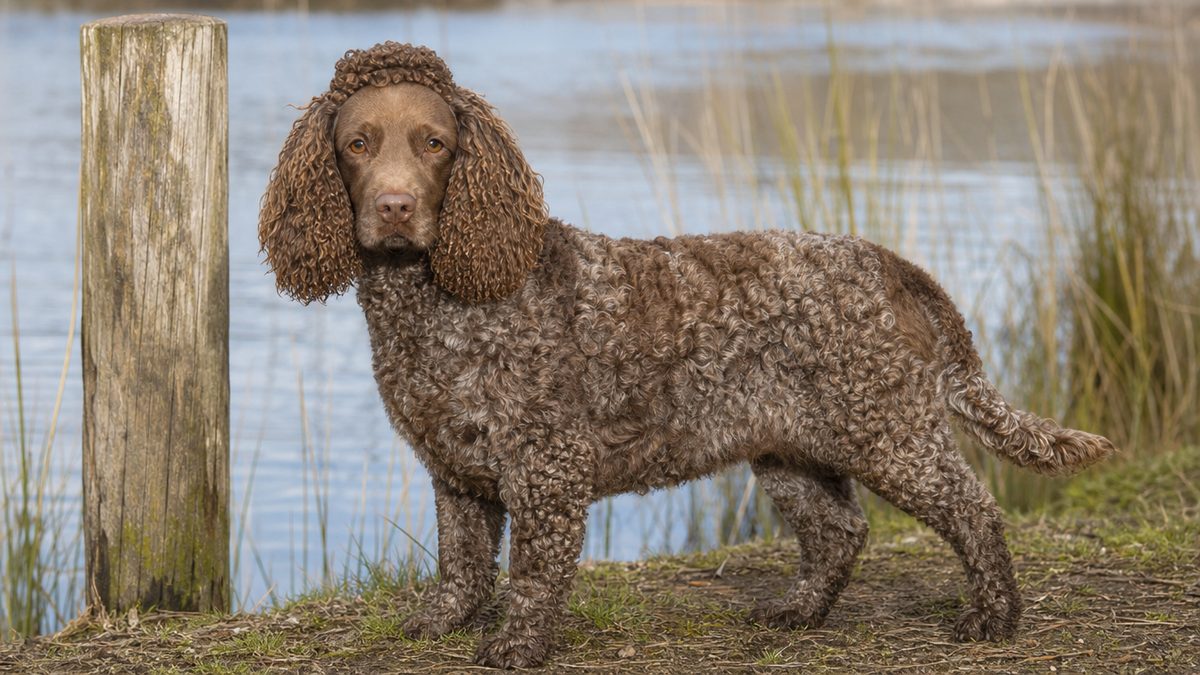
A Pont-Audemer Spaniel is a stocky, vigorous French water gundog standing 52 to 58 cm at the withers, with a curly and slightly ruffled brown coat and a very curly topknot on the top of the skull that leaves the forehead bare and joins the ear hair into what its standard calls a beautiful curly wig framing the head.
FCI Standard 114's general appearance clause is four words long: stocky and vigorous dog. Almost everything distinctive about the breed is in the head and coat clauses instead, and they are worth reading in full because no aggregator page reproduces them.
| Point | What the standard says |
|---|---|
| Size | 52 to 58 cm. One range, no sex distinction, no tolerance clause |
| Weight | Not specified at all |
| Skull and topknot | Round, prominent occipital crest; forehead rising towards a topknot that must be very curly and leave the forehead bare |
| Nose | Brown, protruding perceptibly above the front of the lips, rather pointed |
| Eyes | Dark amber or hazel, rather small, well set into the socket, kind and frank |
| Ears | Medium thickness, flat, set on rather low in such a way as to keep them away from the cheeks, long, with long silky very curly hair joining the topknot |
| Coat | Curly and slightly ruffled |
| Colour | Brown, preferably brown and grey mottled, with dead leaf glints |
| Legs | Rather short, the dog rather low to the ground, yet without falling into the Cocker type |
| Tail | Generally docked to one third of its length. Undocked: medium length, carried a little curved |
| Dewclaws | To be avoided |
| Disqualifying faults | Only aggression or extreme shyness, and clear physical or behavioural abnormality |
The topknot is the breed, and the faults list proves it
No other spaniel standard spends this much text on a hairstyle. The skull clause requires a topknot very curly and well placed on the top of the skull, leaving the forehead bare; the ear clause requires long silky very curly hair joining the topknot to show a beautiful curly wig really framing the head.
Then the faults list defends it from three directions: lack of topknot, topknot reaching to the superciliary arches, topknot formed by hanging hair, and topknot not curly or falling as in the Poodle. A registry that lists four separate ways to get a topknot wrong is telling you what it considers the breed's defining feature.
The ear clause is the opposite of every other spaniel in this batch
Set on rather low in such a way as to keep them away from the cheeks, with thick or folded ears listed as faults. Compare the Sussex Spaniel's standard, which asks for ears lying close to skull, and the Welsh Springer's, which asks for ears hanging close to cheeks.
That is a small anatomical difference with a real Indian consequence, and this page returns to it later: an ear held off the cheek is a ventilated ear, and ventilation is what an Indian monsoon takes away from every other spaniel.
What the standard does not disqualify
Standard 114's disqualifying faults are only aggressive or overly shy dogs and any dog clearly showing physical or behavioural abnormalities. There is no colour disqualification, no size disqualification and no dentition disqualification, which is unusual: the Picardy Spaniel's Standard 108 disqualifies atypical coat, missing teeth, an overshot or undershot bite and size outside tolerance.
That is worth knowing rather than glossing. A standard with almost no disqualifications is a standard written for a breed that cannot afford to exclude breeding stock, and the population figures in the next section are why.
The tail clause says the tail is generally docked to one third of its length, and the United Kennel Club's version adds that dewclaws should be removed. Second Schedule Part II paragraph 6(8) of the Prevention of Cruelty to Animals (Dog Breeding and Marketing) Rules 2017 states that there shall be no tail docking, ear cropping, de-barking, de-clawing, branding, dyeing, injecting substances to enhance visual appeal, performing a surgery or procedure to camouflage or hide any defect or infirmity or any other kind of mutilation of any body part of the pup, and that any change of appearance by artificial means is strictly forbidden. Both clauses get their own section on this page.
Eight puppies: how rare the Pont-Audemer Spaniel really is
The French studbook registered eight Pont-Audemer Spaniels in 2025, down from nineteen in 2024. That is 0.045 percent of the 17,777 registrations in the whole French pointing-dog group, and roughly half the annual output of Britain's rarest native spaniel.
Rarity is asserted on every page about this breed and counted on none of them. The number is public, in the Société Centrale Canine's Statistiques LOF 2025, whose Groupe VII table lists every French pointing breed with its 2024 and 2025 registrations and its confirmations.
| Breed | 2024 | 2025 | Confirmations 2025 |
|---|---|---|---|
| Setter Anglais | 4,900 | 5,086 | 1,828 |
| Epagneul Breton | 3,953 | 3,793 | 1,036 |
| Epagneul Francais | 344 | 236 | 125 |
| Epagneul Picard | 145 | 168 | 41 |
| Epagneul Bleu de Picardie | 142 | 84 | 39 |
| Epagneul de Saint Usuge | 117 | 58 | 42 |
| Epagneul de Pont Audemer | 19 | 8 | 9 |
| Groupe VII total | 18,073 | 17,777 | 5,476 |
What eight actually means
- 0.045 percent of the French pointing-dog group. Eight of 17,777.
- 474 Brittanys to every one of these dogs, in the same table, in the same year.
- Roughly half of Britain's rarest native spaniel. The Kennel Club registered fifteen Sussex Spaniels in 2025.
- A 58 percent fall in one year, from nineteen to eight. On numbers this small a single kennel not breeding changes the national total.
The confirmation row that reads backwards
The table records nine confirmations against eight registrations. More dogs passed the French adult examination against the breed standard in 2025 than were born in it.
That is not an error and it is worth explaining, because it is the sort of line that gets quoted as one. Confirmation happens at about a year old, so a given year's confirmations mostly describe the previous year's puppies, and 2024 produced nineteen. The lag is visible here precisely because the numbers are small enough to see it.
It also tells you something encouraging: nine of the nineteen dogs born in 2024, roughly half, were presented and passed. That is a much higher rate than the Picardy Spaniel's 41 confirmations against 168 registrations, and it is what a breed kept alive by a small number of committed people looks like.
Against the Kennel Club's own definition of vulnerable
The Kennel Club calls a British native breed vulnerable below 300 registrations a year and at watch between 300 and 450. France operates no equivalent list, so no official body applies a label to this breed. If the British threshold were applied to it, eight would be about one thirty-seventh of the vulnerable ceiling.
Eight puppies in the world's main population means that a Pont-Audemer Spaniel offered for sale in India is, on the arithmetic alone, not a Pont-Audemer Spaniel. Indian import law separately rejects any application made for trading or breeding purposes. Between those two facts there is no route by which one could lawfully reach an Indian shop.
History, and the Irish Water Spaniel that saved the breed
The Pont-Audemer Spaniel originated in nineteenth-century Normandy from water spaniel stock, and after the Second World War so few remained that its breed club deliberately outcrossed to other breeds, including the Irish Water Spaniel, to avoid inbreeding what was left. Its own club was absorbed by the Picardy Spaniel club in 1980.
The outcross is the most important thing about this breed and it is recorded independently by two sources that are not copying each other.
The United Kennel Club's standard history reads: descended from the Picardy spaniel and possibly the Barbet and the Poodle, the Epagneul de Pont-Audemer has always been a rare breed, and so few existed after the Second World War that it was necessary to breed them with Irish Water Spaniels to keep the breed alive.
English Wikipedia, treated here as a secondary source, records the same programme from the club's side: following the Second World War the breed's numbers dropped so low that the breed club decided to allow cross breeding with other breeds, including the Irish Water Spaniel, because of fears of the existing stock becoming overly inbred.
That is where the curly coat and the topknot come from, or at least where their modern intensity comes from. A reader looking at this dog and thinking it resembles an Irish Water Spaniel is not imagining it.
1980, and the end of the breed's own club
Wikipedia records that the breed's population remained low and that in 1980, at the recommendation of the Société Centrale Canine, the Pont-Audemer breed club was merged with that of the Picardy Spaniel. The Picardy club's own page confirms the date from the other side: it annexed the Club de l'Épagneul de Pont-Audemer in 1980.
The two accounts agree on the year and differ in tone, which is instructive. One says merged at the recommendation of the national body; the other says annexed. Both describe the same event, and the Société Centrale Canine's own directory now lists a single affiliated club holding all three breeds.
Three breeds, one club, nine days apart at the FCI
| Breed | FCI number | Accepted on a definitive basis | 2025 French registrations |
|---|---|---|---|
| Epagneul Bleu de Picardie | 106 | 6 December 1954 | 84 |
| Epagneul Picard | 108 | 8 December 1954 | 168 |
| Epagneul de Pont-Audemer | 114 | 15 December 1954 | 8 |
All three were accepted inside nine days in December 1954 Fédération Cynologique Internationale. Seventy-one years later their populations differ by a factor of twenty-one. One club, one country, one FCI section, three completely different outcomes.
The nickname, and what it says about the job
The United Kennel Club records that the breed is called the little clown of the marshes in France, and describes it as a water specialist also used to point and flush. The FCI classifies it as a pointing dog subject to a working trial.
That combination, a water dog that also points, is why the breed exists and why it never spread: it was built for a specific Normandy wetland and, unlike the Brittany, nobody exported the job.
It means the modern breed is a deliberate reconstruction rather than an unbroken line, and it means the founder base is very small. Neither of those is a criticism: outcrossing was the responsible choice and the breed exists because somebody made it. It does mean that any Pont-Audemer Spaniel today carries a narrow genome, and that screening decisions matter more here than in a breed with 3,793 births a year to choose from.
Two breed-standard clauses that describe offences in India
Both breed standards for this dog instruct procedures that are strictly forbidden in India. The FCI says the tail is generally docked to one third of its length; the United Kennel Club repeats that and adds that dewclaws should be removed. Indian law forbids tail docking and de-clawing by name.
This is the clearest legal collision in this batch of six breeds, and no page that ranks for this dog mentions it.
| Procedure | FCI Standard 114 | United Kennel Club | Dog Breeding and Marketing Rules 2017 |
|---|---|---|---|
| Tail docking | Generally docked to one third of its length; undocked alternative described | Generally docked to one third of its length; undocked alternative described | There shall be no tail docking |
| Dewclaw removal | Dewclaws to be avoided | Dewclaws should be removed | There shall be no de-clawing |
| Any cosmetic alteration | Not addressed | Not addressed | Any change of appearance by artificial means is strictly forbidden |
The Indian clause is Second Schedule Part II paragraph 6(8) and it reads, verbatim: There shall be no tail docking, ear cropping, de-barking, de-clawing, branding, dyeing, injecting substances to enhance visual appeal, performing a surgery or procedure to camouflage or hide any defect or infirmity or any other kind of mutilation of any body part of the pup and any change of appearance by artificial means is strictly forbidden.
Note the citation form. The Rules themselves run 1 to 13 and the string Rule 21 appears nowhere in the gazette, so this is a Second Schedule paragraph rather than a Rule, and citing it as Rule 6(8) misdirects anyone who looks it up.
The United Kennel Club anticipates the conflict, in a note nobody quotes
The same UKC page that says dewclaws should be removed carries this, at the bottom: the docking of tails and cropping of ears in America is legal and remains a personal choice. However, as an international registry, the United Kennel Club is aware that the practices of cropping and docking have been forbidden in some countries. In light of these developments, the United Kennel Club feels that no dog in any UKC event, including conformation, shall be penalized for a full tail or natural ears.
That is a registry solving the problem for its own judges. It does not solve it for the standard's dewclaw sentence, which is still an instruction, and it does not reach the FCI's tail clause at all.
What this means in practice for an Indian owner
- The lawful Indian dog is undocked and has its dewclaws. Both standards describe an undocked alternative, so an intact dog is within type, not a compromise.
- A docked Pont-Audemer Spaniel puppy offered in India is evidence of an offence. So is a puppy with dewclaws removed.
- Do not let a seller cite a breed standard as justification. The standard is a description written for another jurisdiction; Indian law is not optional and paragraph 6(8) names both procedures.
- If a dog was legally docked abroad before import, that is a different situation from commissioning it here, and the import is governed separately by the DGFT trade notice.
Because the collision is invisible unless somebody reads both documents. A breeder or buyer following FCI Standard 114 in good faith would dock a tail to one third, and a breeder following the UKC standard would also remove the dewclaws. Both would be committing an offence in India. The playbook rule this page follows is simple: check any breeding, docking, cropping or minimum-age advice against the 2017 Rules before repeating it.
Pont-Audemer Spaniel price in india, and the marketplace that has no page for it
No Pont-Audemer Spaniel price exists anywhere, in rupees or otherwise. Three Indian routes return a 404 or a Dog Breed Not Found title, no Indian domain publishes a rupee figure, and Good Dog, the largest United States puppy marketplace, returns HTTP 404 for the breed while serving a live page for the Picardy Spaniel.
For most rare breeds this section has to unpick a fabricated rupee band. For this one there is nothing to unpick, and the shape of the absence is the content. Petbuy.in returns a clean HTTP 404, and Puppiezo, which generates a priced page for almost every breed it can name, returns HTTP 404 here too.
| Route | Response | What the page actually contains |
|---|---|---|
| puppiezo.com | HTTP 404 | Title: Page not found. The same site generates priced pages for the Sussex and Welsh Springer |
| poodles.in | HTTP 200 | Title: Dog Breed Not Found. A soft 404 that a status check passes |
| petbuy.in | HTTP 404 | No page for the breed |
| gooddog.com | HTTP 404 | No page at all on the largest US marketplace, which does serve the Picardy Spaniel |
| goofytails.com | HTTP 200 | A real Indian breed guide from a Delhi retailer, with no price |
| royalcanin.com/in | HTTP 200 | A genuine India-localised breed page carrying no rupee figure |
| akc.org | HTTP 200 | A breed page whose popularity and group fields render as unfilled template values |
The Good Dog 404 is the strongest single data point
Good Dog is the largest puppy marketplace in the United States and it has no Pont-Audemer Spaniel page. That matters because the same site does serve a live Picardy Spaniel page with a buyers guide range of USD 3,000 to 3,500 read out of its own raw source. So the absence is breed-specific rather than a gap in the site's coverage of rare French gundogs.
Its /saint-usuge-spaniel and /russian-spaniel paths return 404 as well, which makes the Picardy the only one of the four rare breeds tested that the American market has any presence for at all.
The soft 404 worth naming
Poodles.in answers HTTP 200 for this breed with the title Dog Breed Not Found, 32,944 bytes of page, and the breed name nowhere in the body. A tool that checks status codes records that as a live page. The same site publishes full monthly cost tables for the Sussex Spaniel and the Welsh Springer Spaniel, so this is a genuine gap in its data.
The two figures that do exist, and what they are worth
Two genuine Indian pages about this dog exist and neither quotes a price: GoofyTails, a Delhi pet-products retailer running the breed guide as content marketing, and Royal Canin's India-localised breed page. Both are the correct behaviour and both are the tell. The only numbers attached to this breed anywhere are the American Kennel Club's spec card and Google's knowledge panel, and neither is a price.
- The AKC gives height 20 to 23 inches, weight 38 to 48 pounds for males and 33 to 40 for females, and a life expectancy of 12 to 14 years. Its breed-popularity field prints Ranks of 210 with no rank filled in and its Group field renders empty, so two of the card's own fields are unfilled template values.
- Google's knowledge panel prints 20 to 27 kg, which is Wikipedia's figure. FCI Standard 114 gives no weight at all.
- No rupee figure exists on any Indian page, and none is invented here. Any that appears in future should be divided by 84.38 first to see whether it resolves to a round dollar amount.
France registered eight of these dogs in 2025, and Indian import law states that any application made for trading or breeding purposes shall be duly rejected. A market cannot form between a global supply of eight puppies and a legal route that excludes commerce. There is no Indian price for a Pont-Audemer Spaniel because there is no Pont-Audemer Spaniel.
Monthly cost of ownership in India, built from figures you can check
No Indian site publishes a monthly cost for this breed, because none carries it at all. What is real is the component cost of keeping a 52 to 58 cm curly-coated working dog in an Indian city, and each line below was read live from the provider's own page on 8 September 2026.
On two of the British spaniels in this batch, the Indian monthly figure that ranks turns out to be a preset row shared with unrelated breeds. Here there is no row at all, which removes the trap and leaves the honest question.
| Line | Figure | Source and caveat |
|---|---|---|
| Puppy vaccination course | From Rs 6,499 | Vetic national page, against a struck-through Rs 8,111 |
| Annual booster | From Rs 3,199 | Vetic, against a struck-through Rs 3,806 |
| Anti-rabies, single | Rs 699 | Vetic |
| 9-in-1 (DHPPiL), single | Rs 899 | Vetic |
| Kennel cough | Rs 1,349 | Vetic. Relevant if the dog boards |
| Tick and flea plus worming | Rs 1,103 a month | NexGard Spectra 15-30 kg, 3 tablets Rs 3,308, MRP Rs 3,375 |
| Bath, 60 minutes | From Rs 934 | Vetic Delhi, list price Rs 1,099 |
| Full groom and styling | From Rs 1,869 | Vetic Delhi, list price Rs 2,199 |
| Boarding, 24 hours | Rs 899 | PawSpace Bengaluru, plus 25 to 30 percent in festive season |
| Daycare, up to 10 hours | Rs 799 | PawSpace Bengaluru |
Boarding deserves its own note on a breed with this exercise requirement: PawSpace Bengaluru prints Rs 899 for 24 hours and warns on the same page that festive season rates run 25 to 30 percent higher. Two further caveats belong with that table. Vetic quotes different course prices on different city pages on the same day, so these are its national figures. And Supertails' own unit label on the NexGard listing reads Rs 3,308 per 100 g for a pack of three tablets, which is a broken template field rather than a price.
What this breed adds on top, and it is more than the others
- Grooming as a real recurring line, not an occasional one. This is the only curly-coated breed in this batch. The standard asks for curly hair between the toes on all four feet, a curly fringe at the back of the hocks, culottes, curly tail feathering and a topknot that must not fall like a Poodle's. In Indian humidity that is line-brushing two or three times a week, and a professional groom at Rs 1,869 is a realistic monthly rather than quarterly item.
- Swimming access, if you want a happy dog. The United Kennel Club calls it a water specialist, and swimming is the only high-intensity exercise in an Indian summer that does not raise core temperature.
- Screening you will have to arrange and pay for yourself. No breed scheme exists anywhere, no OFA statistics row and no published prevalence data, so hips, elbows and eyes are a conversation with your own vet.
- Air conditioning treated as a running cost, because this is a marsh dog from a place whose annual mean is 10.91 C.
Because no Indian page publishes a cost table for this breed, there is no preset row here to be misled by. On two other spaniels in this batch the ranking Indian monthly figure turned out to be a shared template line, identical to the rupee across breeds eating between 700 and 1,300 calories a day. A site that admits it has no data is more useful than the number it would otherwise have printed.
Heat tolerance in India, argued from a curly coat and a marsh
A Pont-Audemer Spaniel can live in India and cannot be worked here in summer. Its Normandy homeland returns an annual mean of 10.91 C and a hottest month of 17.68 C against Chennai's 27.95 C, and while its standard mentions no undercoat, a curly coat traps air by construction.
Start with the coat clause, which is two words: curly and slightly ruffled. Unlike the Picardy Spaniel's standard, it does not mention an undercoat anywhere, which is a genuine and small advantage. Against that, curl is itself insulation, and this is a dog bred to work cold water.
The homeland, by explicit latitude and longitude
Pont-Audemer in Normandy, queried at 49.3530 N, 0.5130 E for the 2001 to 2020 climatology, returns a grid cell at 81.50 m against a real elevation near 10 m, an error of about 72 m. That overstates altitude and therefore very slightly understates temperature, which is the safe direction for this argument and small enough to use on the Normandy plain.
| Place | Annual mean T2M | Hottest month | Coldest month | Annual relative humidity | Peak wet bulb |
|---|---|---|---|---|---|
| Pont-Audemer, Normandy | 10.91 C | 17.68 C (August) | 4.59 C (January) | 84.60 percent | 15.31 C (August) |
| Bengaluru | 23.74 C | 28.37 C (April) | 20.22 C (December) | 67.94 percent | 21.86 C (May) |
| Pune | 23.86 C | 28.93 C (April) | 19.62 C (December) | 66.80 percent | 22.97 C (June) |
| Delhi | 25.60 C | 35.88 C (June) | 13.61 C (January) | 45.56 percent | 26.50 C (July) |
| Kolkata | 25.81 C | 31.53 C (May) | 17.31 C (January) | 73.93 percent | 27.09 C (June) |
| Mumbai | 26.77 C | 31.19 C (May) | 23.19 C (January) | 67.39 percent | 25.77 C (June) |
| Chennai | 27.95 C | 31.51 C (May) | 24.09 C (January) | 72.39 percent | 26.11 C (May) |
The humidity argument is the wrong one, and this breed proves it hardest
Normandy is more humid than any Indian city on this page. Pont-Audemer runs 84.60 percent annual relative humidity against Chennai's 72.39, Kolkata's 73.93 and Delhi's 45.56. This is a wetland dog from a wet place; damp air is its native condition.
What it has never met is heat. Chennai's coolest month, at 24.09 C, is 6.4 degrees warmer than Pont-Audemer's hottest. Peak wet bulb runs 15.31 C at home against 27.09 C in Kolkata, a gap of nearly 12 degrees.
What the heat-illness evidence supports
Of the 1,259 heat-related illness events recorded across 905,543 UK dogs in 2016, 879 had a recorded trigger, and 652 of those 879, or 74.2 percent, were exertional. Environmental heat accounted for 113 and hot cars for 46. The companion paper puts case fatality at 14.18 percent and gives an odds ratio of 1.42 for dogs at or above their breed and sex mean bodyweight.
Neither paper models this breed, and it is nowhere near the over-50 kg band carrying an odds ratio of 3.42. What transfers is the bodyweight factor and the exertional finding, and since the FCI classifies this dog as subject to a working trial, the exertional category is the relevant one.
The one genuine advantage: this dog swims
Swimming is the only high-intensity exercise that removes heat rather than adding it, and this is the only breed in this batch of six that a registry calls a water specialist. Where clean, safe water is available in India, that solves most of the summer exercise problem in a way that a lead walk cannot.
It creates one: a curly coat and a topknot that have been wet need active drying, and so does an ear canal.
Second Schedule Part IV paragraph 21(1) of the Dog Breeding and Marketing Rules 2017 bars keeping certain dogs in outdoor facilities without the attending veterinary practitioner's written approval, and names dogs not accustomed to the temperatures prevalent in the area and dog breeds that cannot tolerate them, such as long-haired breeds in high temperature locations. Note the citation form: the Rules stop at Rule 13 and the string Rule 21 appears nowhere in the gazette.
The one spaniel ear built to stay off the cheek
The Pont-Audemer Spaniel's standard asks for ears set on rather low in such a way as to keep them away from the cheeks, and lists thick or folded ears as faults. That is the opposite instruction from every other spaniel in this batch, and it is a genuine structural advantage in an Indian monsoon.
Set the three ear clauses side by side and the difference is not subtle.
| Breed | What its standard says about the ear | Implication |
|---|---|---|
| Pont-Audemer Spaniel | Medium thickness, flat, set on rather low in such a way as to keep them away from the cheeks. Thick or folded ears are faults | The canal is not sealed against the head |
| Sussex Spaniel | Thick, fairly large and lobular, lying close to skull | The canal is covered by a thick leather |
| Welsh Springer Spaniel | Comparatively small, hanging close to cheeks, vine-leaf shaped | Small leather, but held against the cheek |
| Picardy Spaniel | Rather thick, framing the skull, leather reaching the tip of the muzzle | A long thick leather over the canal |
A registry that writes in such a way as to keep them away from the cheeks is specifying ventilation, whether or not that was the intent. For a working water dog whose ears are wet several times a day, that reads as a functional requirement rather than a cosmetic one.
It is still a spaniel ear, and there is no prevalence figure
The advantage is relative, not absolute. This is still a long ear leather with long silky very curly hair, on a dog that swims. Curly hair around a canal holds water more stubbornly than flat hair does, which partly cancels the airflow benefit.
No otitis externa prevalence figure exists for this breed. PubMed returns zero records on it, and the nine hits on the town name were opened individually and are a paper mill, a physiotherapy survey and two physics papers. The closest measured comparators are four other spaniels in a Finnish clinical survey of 98,736 dogs, running from 15.7 percent in the English Cocker to 31.8 percent in the Welsh Springer. None of those numbers is this breed's number.
What to actually do, in an Indian monsoon
- Dry the ear hair and the topknot actively after every swim, bath and wet walk. Curly hair holds water and this dog is meant to be in it.
- Clean weekly with a veterinary ear cleaner, before there is a smell.
- Part the curls and look at the canal daily from June to September. Curl hides an early infection better than a flat leather does.
- Treat a first-year ear infection as urgent. In the closest comparable data, early onset raised the odds of end-stage disease by 3.8 times.
- Check the ear hair and between the toes for ticks at every brush, given the Indian tick-borne disease pressure.
Indian clinic studies find heavy burdens: Ehrlichia canis in 56 of 178 dogs tested in Odisha, 31.46 percent, with 79 percent of infected dogs having a tick history; Babesia in 80 of 120 dogs tested in Kerala, 66.7 percent, peaking pre-monsoon; and in West Bengal, 72.9 percent of the 584 dogs screened carrying two or more pathogens. These sampled clinically suspected dogs at veterinary clinics rather than random populations, so read them as pressure rather than as a population rate. A curly coat with feathering between the toes is a difficult surface to tick-check, and that is the practical point.
Health, and what a very small founder base actually means
Nothing has been published about this breed's health. PubMed returns zero records, the breed holds an OFA code with no statistics row, and the largest UK longevity study considered it and excluded it. What is known and specific is that the modern population descends from a very small number of dogs plus a deliberate outcross programme.
Three instruments were run against this breed's health issues, each with a control that passed in the same session, and all three came back empty.
| Instrument | Result for this breed | Control in the same session |
|---|---|---|
| PubMed, Pont-Audemer Spaniel[tiab] | 0 records | Labrador Retriever[tiab] returned 1,109 |
| PubMed, Epagneul de Pont-Audemer[All Fields] | 0 records | Cocker Spaniel[tiab] returned 369 |
| PubMed, Pont Audemer[All Fields] | 9 records, all the French town, each opened and read | See below |
| OFA statistics tables | No row, though the breed holds code PAS | LABRADOR RETRIEVER returned 109 rows |
| McMillan 2024 survival analysis | Listed in Table S5 and flagged N, so excluded | 155 breeds flagged Y in the same table |
The nine-record result is worth explaining, because a count is not a finding. Searching the town name returns a physiotherapy workforce survey, a paediatric inflammatory bowel disease study, a paediatrics staffing letter, a livestock zoonoses review, a hospital music paper, two thermodynamics papers where Pont is an author surname, an end-of-life ethics essay, and a 1968 paper on occupational hazards at the paper mills of Pont-Audemer. Every one was resolved individually. Not one is about a dog.
The genuine health story is the founder base
Two independent sources record that after the Second World War so few Pont-Audemer Spaniels existed that the breed club outcrossed to other breeds, including the Irish Water Spaniel, specifically because of fears of the existing stock becoming overly inbred English Wikipedia.
That is the most useful health fact available about this breed, and it points two ways. Outcrossing was the right decision and it widened a genome that had collapsed. The base is still very narrow, and the French studbook recorded eight births in 2025, so the effective population today is small enough that any deleterious allele a founder carried is likely to be widespread.
Nobody has looked. There is no breed health survey, no DNA test panel specific to the breed, and no screening scheme. The breed does hold an OFA code, PAS, read out of OFA's own markup rather than guessed, but holding a code and appearing in the statistics tables are different things.
What the standard tells you about structural risk
- No exaggeration anywhere. Standard 114 mandates no brachycephaly, no skin folds, no dwarfism, no extreme angulation and no mandated malocclusion, and it explicitly warns against the dog falling into the Cocker type. That is a good structural report.
- A ventilated ear, which is unusual among spaniels and discussed in its own section above.
- Curly hair between the toes on all four feet, which in Indian conditions means interdigital checking after every walk.
- A water dog's exposure profile, which in India means leptospirosis and waterborne pathogens are a conversation to have with your vet before the dog swims anywhere.
What Indian law requires anyway
Second Schedule Part III paragraph 8(10) of the Dog Breeding and Marketing Rules 2017 states that dogs shall have been tested for genetic defects, including hip dysplasia, progressive retinal atrophy, night blindness, hypothyroidism, entropion, ectropion, overshot, undershot jaw, wry mouth, two or more missing teeth and cryptorchidism. The word including makes that list illustrative rather than closed, and for a breed with no screening scheme of its own it is a reasonable starting checklist.
Nothing here is a diagnosis, and on this breed there is less to go on than on almost any dog this site covers. Because no prevalence data exists, screening decisions are a conversation with a registered veterinary practitioner rather than a checklist from a breed club. Hips, elbows and a full eye examination are the sensible baseline, and anything unusual in a dog from a population this small is worth investigating rather than attributing to the breed.
Life expectancy, and why this page publishes no figure
Bonbeno publishes no life expectancy for the Pont-Audemer Spaniel because none has been measured. The largest UK longevity study lists the breed and flags it for exclusion, PubMed carries zero records on it, and the one figure in circulation comes from a breed page whose other fields are unfilled template values.
McMillan and colleagues' 2024 study is the strongest longevity instrument available for dogs. Its Supplementary Table S5 lists 344 breeds and flags each Y or N for inclusion in the survival analysis: 155 Y and 189 N. The Pont-Audemer Spaniel is present, flagged N, with reclassification NA, FCI group Pointing Dogs, body size Medium, cephalic index Mesocephalic.
That is a considered exclusion. There were too few of these dogs in UK primary veterinary care to compute a median, which is unsurprising for a breed producing eight puppies a year in its home country.
| Source | Figure | What else that source gets wrong on the same card |
|---|---|---|
| American Kennel Club | 12 to 14 years | Its breed-popularity field prints Ranks of 210 with no rank, and its Group field renders empty |
| McMillan et al. 2024 | None | The breed is flagged N and excluded from the survival analysis |
| PubMed | None | Zero records on the breed; nine town-name hits, all unrelated |
| French studbook | None | It records births and confirmations, not deaths |
The AKC's 12 to 14 years may well be about right for a medium unexaggerated gundog. It is not a measurement of this breed, its basis is not stated, and it sits on a card with two visibly unfilled fields. Bonbeno reports it as circulating rather than as evidence.
The companion UK life-table work covers the national dog population rather than any single breed and cannot fill the gap either.
Ask where it came from. For this breed the honest possibilities are that somebody carried it across from the Picardy Spaniel or the Irish Water Spaniel, that a template filled a required field, or that it was invented. None of those is a measurement of this dog. A page that tells you a Pont-Audemer Spaniel lives 12 to 14 years is telling you what a medium gundog usually lives, which may be right and is not evidence.
Temperament and household fit, and who should not buy one
The Pont-Audemer Spaniel is gentle, affectionate and hard working, and its French nickname is the little clown of the marshes. Its FCI standard disqualifies only aggression and extreme shyness, and lists no hardness, stubbornness or suspicion anywhere.
The United Kennel Club's characteristics clause is the fullest description available: called the little clown of the marshes in France, the breed is hardy and hard working, but has the spaniel traits of being gentle, affectionate and easy to train.
FCI Standard 114 says less and what it says is negative space, which is informative in its own way. Its only disqualifying faults are aggressive or overly shy dogs and any dog clearly showing physical or behavioural abnormalities. There is no temperament paragraph warning about independence, wilfulness or guarding instinct, which every standard for a difficult breed contains.
The clown, and what a nickname tells you
Little clown of the marshes is not a description of a serious, biddable heel-walker. It is what handlers call a dog that is funny to work with: busy, expressive, and happy in conditions that are miserable for the human. Combined with the FCI's working-trial classification, the picture is a cheerful working dog rather than a quiet companion.
Who this breed genuinely suits in India
- A household with access to clean, safe swimming water. This is the one breed in this batch where that changes the whole Indian equation.
- A ground-floor or independent house with outdoor space, used twice a day.
- An owner who will keep a curly coat. Line-brushing two or three times a week is not optional on a coat the standard requires to stay curly.
- Families. Nothing in any source suggests otherwise, and the registries describe a gentle, affectionate dog.
- Not for a flat with no water access and a ten-hour empty day.
- Not for an owner who wants a wash-and-wear coat. This is the highest-maintenance coat in this batch.
- Not for anyone who cannot commit to dawn-and-dusk exercise for eight months of an Indian year.
- Not for anyone buying on looks. At eight puppies a year worldwide, the curly brown dog offered to you in India is something else.
Nothing negative. There is no folklore about the Pont-Audemer Spaniel being snappy, stubborn, neurotic or hard to live with, because there is barely any folklore about it at all. That absence is not evidence of a perfect dog; it is evidence of a breed that almost nobody outside Normandy has owned.
Training approach, and what this breed resists
Train a Pont-Audemer Spaniel with water, scent and cooperation. The United Kennel Club describes a breed with the spaniel traits of being gentle, affectionate and easy to train, and the FCI classifies it as a pointing dog subject to a working trial, so the raw material is willing and the workload is real.
The registry language is unambiguous and unusually consistent: gentle, affectionate and easy to train, with an FCI standard that lists no temperament fault except aggression and extreme shyness.
Three priorities, in order
- Water introduction, early and positively. This is a water specialist and in India water is also the summer exercise solution. A dog that is confident in water at six months has a very different Indian life from one that is not.
- Socialise the puppy to Indian street life from week eight. Traffic, delivery riders, building staff, cattle and other dogs.
- Recall on a long line before the hunting drive matures, because a pointing dog worked in cover is bred to range away from the handler.
The Indian schedule problem
Most Indian training classes and most owner free time fall between 10 am and 6 pm. For eight months of the year that window is wrong for a working gundog, because exertion accounted for 652 of the 879 UK heat-illness events with a recorded trigger. Do the physical work at dawn and after dark, and use the middle of the day for scent games and food puzzles on a cool floor.
This breed's job description makes that split easy. A dog used to point and flush is a nose dog, and nose work indoors genuinely tires it.
What to avoid
- Heavy-handed correction. Every source describes a gentle, cooperative dog and none suggests it needs pressure.
- Training in the heat. See above.
- Assuming a water dog will swim on command. Confidence in water is trained, not automatic, and a bad first experience is expensive to undo.
- Letting the coat mat as a discipline problem. Grooming tolerance is a training goal on this breed, not a chore, and it starts in week nine.
There is no reputation to unlearn. Unlike most rare breeds, nothing in the English-language material about the Pont-Audemer Spaniel warns of a difficult temperament, and its own registries use the words gentle, affectionate and easy Fédération Cynologique Internationale. The difficulty with this breed is finding one, not living with it.
Daily exercise requirement, and what happens without it
Plan for a working water gundog. The FCI classifies the Pont-Audemer Spaniel as subject to a working trial, the United Kennel Club calls it a water specialist also used to point and flush, and its French nickname places it in a marsh rather than on a lawn.
There is no published hours-per-day figure for this breed, because no registry publishes one for it. What exists is the classification, and the FCI's Group 7 index marks this breed CACIB and working-trial alongside the other four French spaniel-type pointing dogs. It is unambiguous: subject to a working trial according to the FCI Breeds Nomenclature. That is a field test, and a breed expected to pass one needs a working dog's exercise.
What the exercise should be
- Swimming, wherever clean and safe water exists. This is the breed's speciality and the only high-intensity option that removes heat rather than adding it.
- Long steady off-lead work in a secure space, on a dog described as stocky and vigorous.
- Nose and retrieve games, which use the dog's job and can run indoors on the hottest days.
- Two sessions rather than one, split across dawn and after dark for most of the Indian year.
The Indian timetable, written out
| Season | Morning | Evening | Middle of the day |
|---|---|---|---|
| November to February | 60 minutes from 6.30 am | 45 to 60 minutes from 6 pm | Largely free in most cities |
| March to May | 60 minutes, finished by 7.30 am | 45 minutes after 7.30 pm | Swimming if available, otherwise indoors |
| June to September | 45 to 60 minutes, watching wet bulb | 45 minutes after dark | Indoors, and dry the coat and ears |
| October | 60 minutes from 6.30 am | 60 minutes from 6.30 pm | Restriction shortening |
Wet bulb is the monsoon number to watch. Kolkata peaks at 27.09 C wet bulb in June and Delhi at 26.50 C in July, against 15.31 C in Normandy. A curly-coated dog working in a Kolkata July is carrying a load nothing in its evolutionary history prepared it for.
What happens without it
An under-exercised Pont-Audemer Spaniel gets heavy and gets bored, and on this breed weight carries a specific penalty: bodyweight at or above the breed and sex mean gave an odds ratio of 1.42 for heat-related illness in the UK data. Since FCI Standard 114 publishes no weight at all, there is no breed mean to compare against, so body condition assessed by hand is the only usable test.
Grooming a curly coat in Indian humidity
This is the highest-maintenance coat in this batch of six. The standard requires a coat that is curly and slightly ruffled, a topknot that must stay curly rather than falling like a Poodle's, curly hair between the toes on all four feet, a curly fringe at the back of the hocks and curly feathering surrounding the tail.
Read the standard's coat requirements together and the grooming load becomes obvious. Hair: curly and slightly ruffled. Topknot very curly and leaving the forehead bare. Ears with long silky very curly hair joining the topknot. Forefeet and hindfeet furnished with long curly hairs between the toes. Hocks furnished especially at the back with a curly fringe. Thighs with culottes. Tail well feathered with curly hair which should surround it completely.
The faults list then protects the curl from both directions: a coat too flat, too curly, too hard or too fine is a fault, and so is a topknot not curly or falling as in the Poodle. This is a coat with a narrow correct range, which is exactly the kind that punishes neglect.
An Indian routine
- Line-brush to the skin two or three times a week, and more in the monsoon. Curl mats at the base first, where you cannot see it.
- Dry the topknot, the ear hair and the leg feathering actively after every swim, bath and wet walk. Curly hair holds water far longer than flat hair, and this dog is meant to be wet.
- Check between the toes after every walk, because the standard puts curly hair there on all four feet and Indian streets put grit and ticks in it.
- Do not clip the coat short for summer. There is no evidence it helps a working dog in heat, the curl regrows unevenly, and the standard's own fault list treats coat texture as a breed characteristic. Manage heat with the clock, water and air conditioning.
- Bathe roughly monthly, or after any swim in questionable water, plugging the ears first.
What professional grooming costs in India
Read live on 8 September 2026 from Vetic's Delhi page: Pet Bathing, 60 minutes, from Rs 934 against a list price of Rs 1,099; Complete Bath and Hair Styling, 120 minutes, from Rs 1,869 against Rs 2,199; and Haircut for Pets, 120 minutes, from Rs 1,359 against Rs 1,599.
Unlike the other spaniels in this batch, this breed will genuinely use the middle tier monthly. A curly coat that is line-brushed at home and bathed and blown out professionally once a month is the realistic plan, which puts grooming near the top of this dog's Indian cost stack rather than the bottom.
Matting behind the ears and under the topknot, in the monsoon, on a dog that has been swimming. It happens quietly, it is painful before it is visible, and shaving it out costs the breed's defining feature for months. Brush those two areas specifically, every time the dog gets wet.
Feeding, body condition and what is actually available in India
Feed a Pont-Audemer Spaniel to a lean body condition on a complete diet appropriate to its life stage, and judge the amount by hand. FCI Standard 114 gives no weight at all, so there is no published target to feed towards and three other sources disagree about what the dog should weigh.
The absence of a standard weight is the starting point. FCI Standard 114 specifies 52 to 58 cm and no weight, and the United Kennel Club standard gives a height and no weight either. The two figures in circulation come from elsewhere and do not agree.
| Source | Weight | Note |
|---|---|---|
| FCI Standard 114 | Not specified | The registry that defines the breed gives no weight |
| United Kennel Club | Not specified | Height only |
| American Kennel Club | 17.2 to 21.8 kg males, 15.0 to 18.1 kg females | 38 to 48 and 33 to 40 pounds |
| Google knowledge panel | 20 to 27 kg | Wikipedia's figure, from an unstated source |
Those two ranges barely overlap. The AKC's male ceiling of 21.8 kg is only 1.8 kg above Wikipedia's floor of 20 kg, and the AKC's female range sits entirely below it. A feeding chart keyed to either is keyed to a number the breed's own registries decline to publish.
What actually governs the amount
- Life stage. Puppy, adult or senior, on a complete diet.
- Actual workload. A dog swimming and working eats meaningfully more than one getting two lead walks, and in an Indian summer the workload legitimately falls.
- Body condition by hand. Run both hands flat down the ribcage; you should feel the ribs easily under a thin layer without pressing. On a curly-coated dog this is the only reliable method, because the coat hides outline completely.
- The dog's own trend. Weigh monthly and track the direction rather than comparing against a chart nobody agrees on.
Two breed-specific points
The ears reach the bowl. Long, curly ear hair joining a topknot trails into wet food twice a day and then stays damp. A narrow or raised bowl, or a snood at feeding time, removes one controllable input to ear disease.
Keeping it lean matters more here than usual, because bodyweight at or above the breed mean gave an odds ratio of 1.42 for heat-related illness, because no screening data exists to say whether this breed's joints can carry extra weight, and because there is no agreed breed weight to notice the drift against.
What an Indian owner can actually buy
This is a medium breed by height, served by the ordinary medium-adult and medium-puppy lines every Indian retailer stocks. Bonbeno publishes no monthly kibble figure, because Indian retail prices move fast enough that a figure quoted today misleads within weeks, and because no Indian site publishes one for this breed to check against.
Month by month through the first year in India
Indian law sets the earliest lawful sale at eight weeks and expects the vaccination course to complete around eighteen weeks. For this breed the two things to build early are grooming tolerance, because the coat needs handling for life, and water confidence, because water is the Indian summer solution.
Two of those dates come from the gazette rather than from a breeder. Rule 8(1)(a) of the Prevention of Cruelty to Animals (Dog Breeding and Marketing) Rules 2017 states that pups less than eight weeks in age are not sold, and Second Schedule Part III paragraph 8(9) states that all pups shall be vaccinated, which can start at seven to eight weeks and is usually completed at eighteen weeks.
| Age | What happens | The Indian specific |
|---|---|---|
| Under 8 weeks | Stays with the litter. Sale before this is unlawful in India | Check the tail and the dewclaws are intact, which is what Indian law requires |
| 8 to 10 weeks | Home. Core vaccination begins. Grooming handling starts now | Vetic prices a puppy course from Rs 6,499 nationally |
| 10 to 14 weeks | Socialisation window | Do it at 6.30 am and after dark from March to October |
| 14 to 18 weeks | Vaccination course completes | Start weekly ear cleaning and daily curl checks before the first monsoon |
| 4 to 6 months | Teething, lead manners, first water introductions | Talk to your vet about leptospirosis before the dog swims anywhere |
| 6 to 9 months | Adult curl comes in. Matting risk rises sharply | Line-brush two or three times a week; this is when owners fall behind |
| 9 to 12 months | First full Indian summer | Swim if you can, watch weight, dry the topknot every time |
| 12 months onward | Full working exercise load builds | Two sessions a day in the dark half of the day for most of the year |
The three habits to build in the first six months
- Grooming tolerance, daily. Line-brushing a resistant adult with a matted curly coat is a two-person job. Ten minutes a day from week nine prevents it.
- Ear handling and drying. Part the curls, look, reward, dry. The standard's ventilated ear set is an advantage only if the hair around it is dry.
- Water confidence, positively and without pressure. A water specialist that is frightened of water has lost the one Indian summer advantage it had.
What to screen and when
There is no breed screening scheme for this dog anywhere, no OFA statistics row and no published prevalence data PubMed searches run 8 September 2026…. Arrange it yourself: hips, elbows and a full eye examination once the dog is skeletally mature. Indian law's own genetic-defect list under Second Schedule Part III paragraph 8(10) is a reasonable checklist to start from.
Both are evidence that Second Schedule Part II paragraph 6(8) has been broken, which forbids tail docking and de-clawing by name and states that any change of appearance by artificial means is strictly forbidden. Do not accept a breed standard as justification: FCI Standard 114 describes an undocked alternative and the United Kennel Club's own page says no dog shall be penalised for a full tail United Kennel Club.
Head to head against the breeds an Indian buyer actually cross-shops
The realistic comparison set is the two breeds this one shares a club with, the Irish Water Spaniel that rescued it, and the English Cocker Spaniel that is actually available in India. On every measure of availability the Pont-Audemer loses, and on ear ventilation it wins.
All the registration figures below come from one document, the Société Centrale Canine's Statistiques LOF 2025, so the columns are comparable.
| Breed | 2024 | 2025 | FCI accepted | Distinguishing feature |
|---|---|---|---|---|
| Epagneul de Pont-Audemer | 19 | 8 | 15 Dec 1954 | Curly coat, curly topknot, ears held off the cheek |
| Epagneul Picard | 145 | 168 | 8 Dec 1954 | Grey-mottled with tan, brown nose, wavy coat |
| Epagneul Bleu de Picardie | 142 | 84 | 6 Dec 1954 | Blue roan, black nose, no tan |
| Epagneul de Saint Usuge | 117 | 58 | Not FCI-recognised | Black and white or black roan, from Burgundy |
| Epagneul Breton, for scale | 3,953 | 3,793 | 1954 | The French spaniel that exists in numbers |
What that table says
Three breeds accepted by the FCI in nine days in December 1954 now differ in population by a factor of twenty-one Fédération Cynologique Internationale Société Centrale Canine. The Picardy Spaniel grew 16 percent in 2025, the Blue Picardy fell 41 percent, and the Pont-Audemer fell from 19 to 8. One club, one country, one section of one group.
The Pont-Audemer is the rarest by a wide margin, and rarer than any of the six British native spaniels on the Kennel Club's vulnerable list except by comparison with the Sussex Spaniel at 15, which is still nearly twice as many.
Where this breed genuinely wins
- Ear ventilation. Its standard is the only one in this batch that asks for the ears to be kept away from the cheeks. The Sussex, Welsh Springer and Picardy standards all ask for the opposite.
- Swimming. The only breed here a registry calls a water specialist, which in an Indian summer is a real advantage rather than a hobby.
- No coat disqualification and no size disqualification in its standard, which makes it a forgiving dog to own rather than to show.
Where it loses
- Availability, absolutely. Eight puppies a year, no US marketplace page, no Indian listing.
- Grooming load. The only curly coat in this batch, and the standard defends the curl from four directions.
- Evidence base. Zero PubMed records, no OFA statistics row, excluded from the largest longevity study.
- Legal friction. Two standard clauses describe procedures that are offences in India.
If you want a gentle, affectionate, water-loving gundog in an Indian city, the English Cocker Spaniel gives you the temperament with a real supply chain, a verifiable Indian price and a genuine evidence base. If what you specifically want is a curly-coated water dog, the Irish Water Spaniel and the Lagotto Romagnolo both exist in numbers and neither requires you to work around a docking clause. The reason to want a Pont-Audemer Spaniel is that you want a Pont-Audemer Spaniel.
Mistakes Indian buyers and owners actually make with this breed
Five mistakes account for most of what goes wrong. The first is believing the dog is a Pont-Audemer Spaniel at all, and the second is following the breed standard's own tail and dewclaw clauses in a country where both describe offences.
Before you buy
- Believing the dog is this breed. France registered eight in 2025, the largest US marketplace has no page for it, and Indian law rejects any import application made for trading or breeding Good Dog, probed at /pont-audemer-spaniel… Directorate General of Foreign Trade. A curly brown dog offered in India is far more likely to be a Lagotto cross, a Poodle cross or an Irish Water Spaniel.
- Following the standard's tail clause. Both the FCI and the United Kennel Club describe the tail as generally docked to one third of its length, and Indian law forbids docking outright Government of India.
- Following the UKC's dewclaw clause. It says dewclaws should be removed; Second Schedule Part II paragraph 6(8) forbids de-clawing by name Government of India.
- Taking a weight from a spec card. The two registries that define the breed publish no weight at all, and the two figures in circulation barely overlap English Wikipedia.
After the dog arrives
- Underestimating the coat. This is the only curly coat in this batch and the standard defends the curl from four directions. Line-brushing two or three times a week is the requirement, not a suggestion.
- Letting the topknot and ear hair stay wet. On a water dog in an Indian monsoon that is how matting and ear disease both start.
- Exercising in the middle of an Indian day. Exertion accounted for 652 of the 879 UK heat-illness events with a recorded trigger.
- Skipping screening because no breed scheme exists. No scheme is a reason to arrange it yourself, not a reason to skip it, and this breed's founder base is unusually narrow.
- Trusting a health or lifespan figure you find online. Nothing has been published on this breed at all, and the circulating lifespan sits on a card whose own popularity and group fields are unfilled.
Reading a breed standard as a manual. FCI Standard 114 and the United Kennel Club standard are accurate descriptions of what the breed should look like in the countries that wrote them. In India, two of their clauses describe criminal conduct. The United Kennel Club's own page acknowledges that cropping and docking are forbidden in some countries and says no dog shall be penalised for a full tail, which is the registry telling you the same thing this page is.
Adoption, import law and responsible sourcing
Adopting a Pont-Audemer Spaniel in India is not possible, and importing one is lawful only as your own pet. With eight registrations in the world's main studbook in 2025, the honest route for an Indian reader who wants this kind of dog is a curly-coated spaniel or spaniel cross from an Indian shelter.
What the law permits, precisely
Dogs enter India under ITC(HS) 01061900 as a Restricted import. Policy Condition 7 allows three purposes only: a pet dog with a valid pet book and records in the importer's own name, dogs imported by research organisations with a CPCSEA recommendation, and dogs for internal security by the Defence and Police Force. Policy Condition 8 states that import of commercial dogs for breeding or any other commercial activity other than those purposes is not permitted.
Paragraph 6 states that any applications for trading or breeding purposes, or applications made on behalf of some other person or entity, shall be duly rejected, and paragraph 7 limits entry to the airports and seaports of Delhi, Mumbai, Chennai, Hyderabad, Bangalore and Kolkata, with quarantine at the government station where required. DAHD added a seventh port, Cochin International Airport at Kochi, for pets arriving under the baggage rules in October 2024. The full route is set out in how to import a dog to India.
Put that beside eight French registrations in 2025 and a 404 on the largest United States marketplace Good Dog, probed at /pont-audemer-spaniel…. There is no lawful commercial supply chain into India and nothing to supply it with.
Where the breed is registered
The Pont-Audemer Spaniel is held by the FCI on a definitive basis as Standard 114, and India is a full FCI member represented by the Kennel Club of India, so the KCI issues pedigrees against FCI nomenclature. That answers the India recognition question without needing a KCI breed list, which matters because the KCI publishes no breed list at all and an absence from its site is a limit of the instrument rather than a statement about the breed.
The paperwork itself comes from France. The Livre des Origines Français is the studbook, the Société Centrale Canine publishes it, and the Club des Épagneuls de Picardie et Pont-Audemer has been the affiliated club for this breed since it absorbed the breed's own club in 1980 Club des Épagneuls de Picardie et….
The adoption route that actually exists
- Indian shelters. Curly-coated crosses reach Indian shelters regularly, usually surrendered when the coat turned out to be work. A Cocker or Poodle cross gives an Indian household a great deal of what draws people to this dog.
- Irish Water Spaniels and Lagotto Romagnolos, if the curly water dog is the point. Both exist in far larger numbers and neither carries this breed's legal friction.
- Never a broker. Bonbeno does not recommend breeders and does not link puppy listings. A seller who can produce a Pont-Audemer Spaniel in India on demand is telling you something about the dog.
If you are genuinely importing your own dog
- Start the import authorisation at least two months before travel, which is the trade notice's own advice.
- Register the dog in your own name on the pet book, because an application on behalf of somebody else is refused.
- Plan around the seven permitted ports and the quarantine station attached to them.
- Insist on an undocked dog with dewclaws intact. Both standards describe an undocked alternative, and importing a dog altered abroad does not make the practice acceptable here.
- Ask for the LOF pedigree and the confirmation result, and ask specifically about the outcross ancestry, because the modern breed was rebuilt with Irish Water Spaniel blood.
What responsible sourcing means at eight puppies a year
It means asking about coefficient of inbreeding rather than about colour. A breed rescued by a deliberate outcross programme and now producing eight registered puppies a year in its home country has a very narrow effective population Société Centrale Canine, and genetic diversity is the thing a buyer can actually reward.
You will not get a Pont-Audemer Spaniel, and that is not a failure of your search. Eight puppies were registered in France in 2025, the largest United States marketplace has no page for the breed, and no Indian site carries it. If what drew you here was a cheerful curly-coated water dog with a good nose, an Indian shelter and a Lagotto or Cocker cross will get you most of the way, legally and immediately.
Pont-Audemer Spaniel questions Indian readers actually ask
What is the calmest breed of spaniel?
Among the working spaniels the Sussex and the Clumber are the two the registries themselves describe as slow and steady. The Pont-Audemer Spaniel is not one of them: the FCI files it as subject to a working trial and the United Kennel Club calls it a water specialist, hardy and hard working. Its French nickname, the little clown of the marshes, is not a description of a calm dog.
What is a rare French dog breed?
By registration count, this one. The French studbook recorded eight Pont-Audemer Spaniel births in 2025 out of 17,777 in the whole pointing-dog group, which is 0.045 percent. In the same table the Blue Picardy Spaniel recorded 84, the Saint-Usuge Spaniel 58 and the Picardy Spaniel 168, against 3,793 Brittanys. Eight is the smallest French spaniel figure in the document.
Which dog loves his owner the most?
No breed answers that, and the honest reply is that Google asked it because it had no question about this breed to offer. What the registries do say about the Pont-Audemer Spaniel is narrower and checkable: the United Kennel Club describes the spaniel traits of being gentle, affectionate and easy to train, and the FCI standard disqualifies only aggression and extreme shyness.
Is a spaniel a good family dog?
Most are, and this one comes with a workload attached. The United Kennel Club calls the Pont-Audemer gentle, affectionate and easy to train, which is a family description, and the FCI simultaneously classifies it as subject to a working trial, which is not. In an Indian city the family question is really a schedule question: two exercise sessions a day, both in the dark half of the day for most of the year.
How rare is the Pont-Audemer Spaniel?
France registered eight in 2025, down from nineteen in 2024. That is 0.045 percent of the French pointing-dog group and a ratio of 474 Brittanys to every one of these dogs in the same table. For scale against Britain's rarest spaniel, the Kennel Club registered fifteen Sussex Spaniels in the same year, so the Pont-Audemer is roughly half as numerous as the rarest native British spaniel.
What is the price of a Pont-Audemer Spaniel in India?
No verifiable price exists anywhere, let alone in India. Puppiezo returns HTTP 404, Poodles.in answers 200 with the title Dog Breed Not Found, Petbuy.in returns 404, and Good Dog, the largest United States marketplace, has no page for the breed at all while serving a live one for the Picardy Spaniel. No Indian domain publishes a rupee figure for it.
Why does the Pont-Audemer Spaniel have a curly coat and a topknot?
Because it was rescued with an Irish Water Spaniel. The United Kennel Club records that so few Pont-Audemers existed after the Second World War that it was necessary to breed them with Irish Water Spaniels to keep the breed alive, and Wikipedia records the same outcross programme independently, saying the club allowed cross breeding because of fears the existing stock was becoming overly inbred. The curl and the topknot are the visible result.
Is docking a Pont-Audemer Spaniel legal in India?
No, and both breed standards describe it as normal. FCI Standard 114 says the tail is generally docked to one third of its length, and the United Kennel Club standard repeats it and adds that dewclaws should be removed. Second Schedule Part II paragraph 6(8) of the Dog Breeding and Marketing Rules 2017 states there shall be no tail docking, de-clawing or any other kind of mutilation of any body part of the pup, and that any change of appearance by artificial means is strictly forbidden.
How big is a Pont-Audemer Spaniel?
The FCI standard gives 52 to 58 cm at the withers, a single range with no sex distinction, no tolerance clause and no weight at all. The United Kennel Club gives 20.5 to 23 inches, which is 52.1 to 58.4 cm and agrees closely. The American Kennel Club gives 20 to 23 inches and adds weights the FCI does not have, and Google's knowledge panel prints 20 to 27 kg, which comes from Wikipedia.
How long does a Pont-Audemer Spaniel live?
Nobody has measured it. The largest UK longevity study lists the breed and flags it N for exclusion from its survival analysis, so no breed-specific median exists. PubMed carries zero records on the breed, and nine hits on the town name turned out to be a paper mill, a physiotherapy survey and two physics papers. The American Kennel Club prints 12 to 14 years without saying where it came from.
Does the Pont-Audemer Spaniel get ear infections?
Probably less than most spaniels, and the standard says why. FCI 114 asks for ears set on rather low in such a way as to keep them away from the cheeks, and lists thick or folded ears as faults. That is the opposite instruction from the Sussex Spaniel's lying close to skull. No prevalence figure exists for this breed, but the closest comparators run 15.7 to 31.8 percent across four spaniels in a Finnish clinical survey.
Can a Pont-Audemer Spaniel handle the Indian climate?
It can be kept here and it cannot be worked here in summer. Pont-Audemer in Normandy returns an annual mean of 10.91 C and a hottest month of 17.68 C, against Chennai's 27.95 C annual mean, and this is a curly-coated marsh dog. Because exertion caused 652 of the 879 UK heat-illness events with a recorded trigger, the practical rule is dawn and after dark, plus swimming wherever clean water is safe.
Can I legally import a Pont-Audemer Spaniel into India?
Only as your own pet, never to sell or breed. Dogs sit at ITC(HS) 01061900 as a Restricted import, Policy Condition 8 bars import of commercial dogs for breeding or any other commercial activity, and paragraph 6 states that any application made for trading or breeding purposes shall be duly rejected. Entry is limited to the airports and seaports of Delhi, Mumbai, Chennai, Hyderabad, Bengaluru and Kolkata and, since October 2024, Kochi airport.
What health problems does the Pont-Audemer Spaniel have?
Nobody has published anything on this breed's health, and the useful answer is structural rather than statistical. PubMed returns zero records against working controls, the breed has no OFA statistics row despite holding code PAS, and it was excluded from the largest UK longevity study. What is known is that the population was rebuilt from very few founders with a deliberate outcross programme, which is a reason to screen carefully rather than a diagnosis.
How much does it cost to keep a Pont-Audemer Spaniel in India each month?
Bonbeno publishes no monthly figure, and no Indian site publishes one either because none carries the breed. The real components are checkable: a Vetic puppy vaccination course from Rs 6,499, an annual booster from Rs 3,199, parasite cover around Rs 1,103 a month, a bath from Rs 934, and Bengaluru boarding at Rs 899 for 24 hours. Add grooming, because a curly coat is the highest-maintenance in this batch.
Compare with similar breeds
Pont-Audemer Spaniel sits in 2 Bonbeno groups. Each one compares it directly against the breeds it is genuinely an alternative to, on the same figures.