
Breed profile
Irish Water Spaniel in India: Price, Coat, Ears and Heat
One Indian page quotes Rs 50,000 to Rs 1,00,000 for this breed, another calls its coat hypoallergenic, and a third prints a Basset Hound heading in the middle of its Irish Water Spaniel guide. Here is what the FCI, Kennel Club and AKC standards actually specify, what the breed's six published papers actually found, and why a curly-coated water dog with long lobe-shaped ears is a difficult proposition in an Indian monsoon.
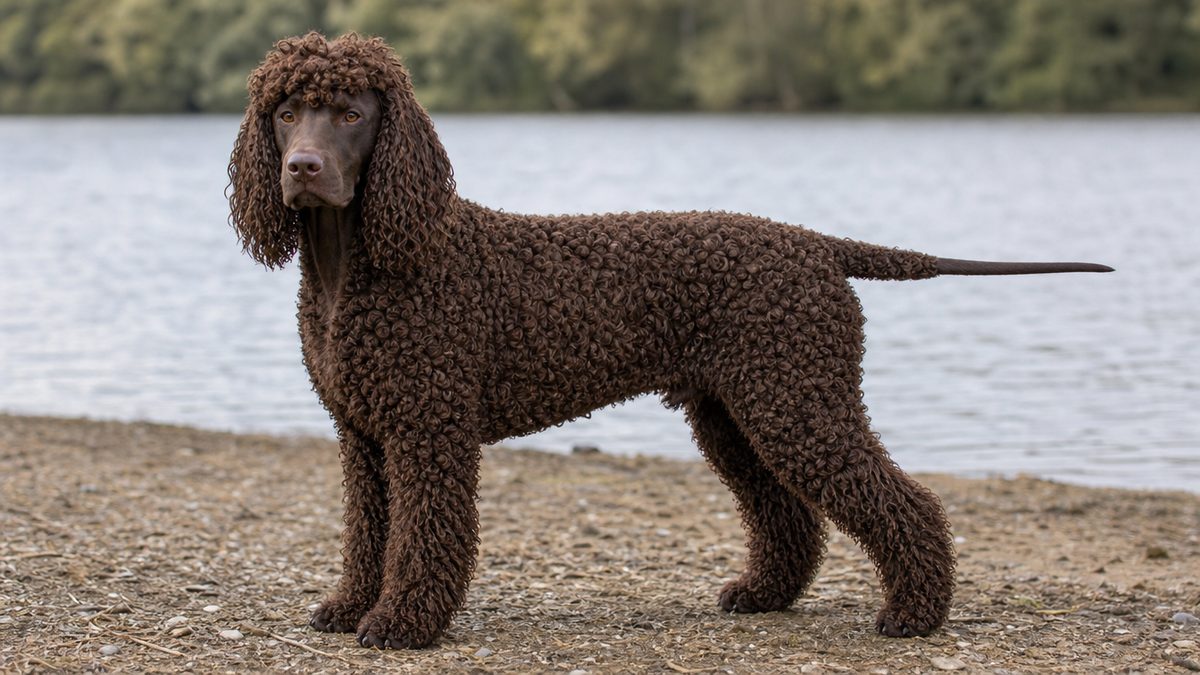
Quick answer
Irish Water Spaniel price in India is quoted at Rs 50,000 to Rs 1,00,000 on the one Indian page that publishes a figure, and every page ranking for the term shows zero Irish Water Spaniels for sale. The breed is rare everywhere: the Royal Kennel Club recorded just 40 puppy registrations in 2025, down from 116 in 2016.
This page reports published veterinary research and registry data for general information. It is not a diagnosis and it is not treatment advice. Ear disease, coat and skin disorders, hip screening and heat management all need a veterinarian who has examined your own dog. If your Irish Water Spaniel is shaking its head, scratching one ear, holding the head tilted, or has a discharge or smell from an ear, see a veterinarian rather than treating it at home.
Irish Water Spaniel at a glance
What an Irish Water Spaniel is, and what the standard says
The Irish Water Spaniel is a curly-coated liver-coloured water dog from Ireland, registered by the FCI as standard 124 in Group 8, Section 3 Water Dogs, accepted on a definitive basis on 28 December 1954 and subject to a working trial. Its breed standard opens in four words: smart, upstanding, strongly built, compact or cobby.
Two features define the dog and both are in the standard. The first is the coat: dense, tight, crisp ringlets, entirely free from woolliness but with a natural oily quality, with the throat smooth and the smooth hair forming a V-shaped patch from the back of the lower jaw to the breastbone. The topknot is long loose curls growing down into a well defined peak between the eyes, and the standard is explicit that it should not be in the form of a wig, meaning growing straight across.
The second is the tail, and the standard treats it as the breed's identifying evidence. It is smooth, strong and thick at the root where it is covered for 3 to 4 inches, 7.5 to 10 cm, with short curls, then tapers to a fine point, and should not be long enough to reach the hock joint. The standard's own history section says there is no real evidence of the ancestry of the Irish Water Spaniel except in its most peculiar feature, the rat tail, that this feature appears in no similar dog, and that it has given rise to the names Whip Tail and Rat Tail.
Colour, ears and the faults that follow from them
Colour is a single shade: a very rich puce liver, with white on the chest listed as objectionable. The eyes are comparatively small, almond-shaped, dark amber or dark hazel. The ears are very long and lobe-shaped in the leather, set low, hanging quite close to the cheeks and covered with long, twisted curls of hair. Hold that last sentence in mind, because the ear section below is built on it.
The listed faults tell you what breeders are selecting against, and two of them matter to a buyer. Paleness of coat and woolliness of coat are both faults. Woolliness is the opposite of the crisp ringlet the breed needs to shed water, so a soft, fluffy Irish Water Spaniel is not a variety, it is a dog outside its own standard. Other faults are white on chest, light eye, splay feet, feather on the front of the hocks and feather on the face.
A gait no other spaniel has
The standard records one movement peculiarity: the gait has a characteristic peculiar to the breed, a rolling motion produced by the barrel-shaped ribcage. The body is described as proportionate enough to give a barrel-shaped appearance accentuated by the springing of the ribs. Purina India adds a detail the standard leaves out, that the breed has webbed feet, which help it excel at swimming.
History, and one dog born in 1834
The standard says the exact origins remain obscure, that water spaniels are generally thought to have evolved from dogs that originated in Persia and came to Ireland via Spain, and that the first Irish reference to water dogs that pursue water fowl dates from 1600. The Irish Water Spaniel Club was formed in 1890 to promote the interests of the breed.
Purina India fills in the part that matters genetically. The breed's original name was the Irish Water Dog, and the first documented example was a dog called Boatswain belonging to a Dubliner, Justin McCarthy. All modern Irish Water Spaniels descend from that one dog, born in 1834. Its ancestry is thought to include the Poodle, the Portuguese Water Dog and the Barbet. A breed founded on a single documented dog and now producing 40 registered puppies a year in its strongest market is, by construction, a narrow gene pool, and that is the background to the inherited coat problem set out further down.
The FCI describes a loyal dog with a specific edge to it: proud, combining great intelligence and endurance with a bold and dashing eagerness of temperament, immense stamina and loyalty, and a good family dog with a sense of humour but discerning with strangers. Discerning with strangers is the standard's own phrasing, and it is the trait most Indian sales pages leave out.
Recognition, rarity, and two registration tables that agree
Four registries recognise the Irish Water Spaniel and the Irish Kennel Club counts it as one of the nine native dogs of Ireland. It is also a vulnerable native breed on the Royal Kennel Club's list, and its registration series has fallen to 40 puppies a year.
Start with the country of origin. The Irish Kennel Club's own page states that there are nine Native Dogs of Ireland: two Hounds, the Irish Wolfhound and the Kerry Beagle; three Gundogs, the Irish Water Spaniel, the Irish Red Setter and the Irish Red and White Setter; and four Terriers, the Irish Terrier, the Irish Glen of Imaal Terrier, the Irish Soft Coated Wheaten Terrier and the Kerry Blue Terrier. Bonbeno's Irish Wolfhound and Glen of Imaal Terrier pages cover two of the other eight.
Three standards, three different sets of numbers
| Registry | Dogs | Bitches | Weight stated? |
|---|---|---|---|
| FCI standard 124, published 13.03.2001 | 21/23 inches (53/59 cm) | 20/22 inches (51/56 cm) | No |
| The Royal Kennel Club, updated 1 April 2025 | 53-58 cm (21-23 ins) | 51-56 cm (20-22 ins) | No |
| American Kennel Club | 22-24 inches (55.9-61.0 cm) | 21-23 inches (53.3-58.4 cm) | Yes: 55-68 lb and 45-58 lb |
| Purina India breed panel | 53-58 cm | 51-56 cm | Yes: 20-30 kg |
Two differences there are real and one is arithmetic. The arithmetic one is the top of the male range: the FCI and the Kennel Club both print 23 inches, but 23 inches is 58.42 cm, and the FCI rounds it up to 59 while the Kennel Club rounds it down to 58 The Royal Kennel Club. Same dog, same inch, a one-centimetre disagreement created entirely by rounding in opposite directions.
The real difference is the AKC's, which runs a full inch taller than both European standards at every boundary, 22 to 24 inches for dogs against 21 to 23 Federation Cynologique Internationale. And the more useful fact is what is absent: neither the FCI nor the Kennel Club states a weight for this breed at all The Royal Kennel Club. Four Indian and international pages nonetheless print four different weight ranges, 20 to 30 kg on Purina India and Asia Pets, 25 to 30 kg on the Indian guide that carries the price band, 18 to 27 kg on the page ranking first and 45 to 65 lb on the United States reference Happy Pet, Irish Water Spaniel Puppiezo, Irish Water Spaniel Price… Dog Breeds List, Irish Water Spaniel. Those figures did not come from a standard, because the two governing standards do not contain one.
The registration series, and two documents that agree
The Royal Kennel Club treats a British or Irish native breed as vulnerable when fewer than 300 puppies are registered in a year, and the Irish Water Spaniel has been well under that threshold for the whole decade.
| 2016 | 2017 | 2018 | 2019 | 2020 | 2021 | 2022 | 2023 | 2024 | 2025 |
|---|---|---|---|---|---|---|---|---|---|
| 116 | 69 | 111 | 69 | 57 | 116 | 84 | 76 | 53 | 40 |
That series was checked in two independent Royal Kennel Club documents, because this site has previously found the club's web tables and its group PDFs disagreeing on individual cells. Here they do not. The vulnerable-native-breeds web table and the Comparative Tables of Registrations for the Years 2016-2025 Inclusive for the Gundog group print the same ten numbers, cell for cell The Royal Kennel Club. The Gundog PDF also reconciles against itself: summing its 38 breed rows reproduces the printed column total in all ten columns, from 84,780 in 2016 to 74,960 in 2025, once the Barbet's short row is aligned to the years in which it has figures. Agreement is the finding here, and it is worth reporting as plainly as a discrepancy would be.
The trajectory is the part a buyer should read. From 116 registrations in 2016 to 40 in 2025 is a fall of two thirds, and 2021's 116 was a pandemic-year spike rather than a recovery. The AKC tells the same story from the other side, ranking the breed 169 of 210 and recording its recognition in 1878.
What that means for India
The Kennel Club of India is the FCI's full member for India, so the KCI issues pedigrees against FCI nomenclature and the breed's FCI status effectively answers the Indian recognition question. The KCI publishes no browsable breed list, so a query there returns nothing for this breed and nothing for a control breed either, which is a limit of the instrument rather than a finding about the breed. Indian sales pages nonetheless advertise KCI registered stock, which is a claim about paperwork on a dog none of them is showing.
Irish Water Spaniel price in India: one band, zero dogs
Irish Water Spaniel price in India is published on exactly one page, at Rs 50,000 to Rs 1,00,000, and that page has no Irish Water Spaniel for sale. The page ranking first for the term prints no rupee figure for the breed at all, and the page ranking second prints Showing 0 results.
| Source | Quoted price | Irish Water Spaniels actually shown |
|---|---|---|
| Happy Pet, position 3 | Rs 50,000 to Rs 1,00,000 | None. No listings feature on the page |
| Puppiezo, position 1 | No Irish Water Spaniel price printed | Zero of eight animals in its carousel |
| Asia Pets, position 2 | No rupee figure printed | Showing 0 results |
| Purina India, position 4 | No price. A breed library entry, not a listing | Not a sales page |
| Dog Breeds List, position 6, United States | USD 1,500 to USD 2,000 | Not a sales page |
That is the whole published Indian price literature for the breed: one band, on one page, beside no dogs. For comparison, Bonbeno's Irish Wolfhound page found four Indian sources quoting figures for that breed and the same result behind them.
Run the currency tests, then read the quotient
Indian pages often publish a dollar figure run through one exchange rate and present it as rupees, so both Indian figures were divided by the three rates this site has caught in circulation. The presence of a co-ranking United States page quoting USD 1,500 to USD 2,000 makes that test worth doing carefully.
| Rupee figure | Divided by 84.38 | Divided by 74 | Divided by 66.67 |
|---|---|---|---|
| Rs 50,000 | 592.56 | 675.68 | 749.96 |
| Rs 1,00,000 | 1,185.11 | 1,351.35 | 1,499.93 |
| Rs 98,999 (Puppiezo carousel figure) | 1,173.25 | 1,337.82 | 1,484.91 |
One cell in that table looks like a hit and is not. Rs 1,00,000 divided by 66.67 is 1,499.93, and the co-ranking United States page prints USD 1,500 as its low figure. Before treating that as evidence, note two things. First, 66.67 is 200 divided by 3, so every rupee figure that is a multiple of 1,000 lands within five hundredths of a round dollar number by construction, whatever its origin. Second, the ranges do not map: the American high of USD 2,000 would be Rs 1,33,340 at that rate, not the Rs 1,00,000 the Indian page prints. A converted range converts at both ends.
Neither Indian figure divides to a whole dollar at 84.38, the rate that caught converted price lists on three earlier Bonbeno pages, and neither divides cleanly at 74. The honest conclusion is that Rs 50,000 and Rs 1,00,000 are rupee-native round numbers, typed by a person as a plausible-looking band, rather than an American price list run through a converter. Nobody converted anything here. Nobody sold anything either.
Where the Rs 98,999 comes from, and it is not this breed
The page ranking first carries an Other Available Pets carousel holding eight named animals at Rs 98,999, Rs 92,599, Rs 92,599, Rs 94,999, Rs 1,20,000, Rs 98,999, Rs 76,499 and Rs 98,999. They are two Maltipoos called Fizey and Samy, two Poodles called Kuzo and Dugu, a Cane Corso called Kazuka, a Goldendoodle called Doir, a Rottweiler called Tugi and a Doxiepoo called Yoki. None is an Irish Water Spaniel.
The decisive detail is that this is the same carousel, animal for animal and price for price, that the same site serves on its Irish Wolfhound page. Rs 98,999 is not this breed's price and it is not the Irish Wolfhound's price either. It is a house price point attached to whichever puppy is in stock, and it appears three times on a single page.
Nothing about this breed in India is affordable or unaffordable, because nothing is on offer. A band with no dog behind it cannot be negotiated, compared or verified. If a seller quotes you Rs 50,000 for an Irish Water Spaniel, the useful next question is not about the price. It is where the dam is, and whether you may see her.
What the ranking pages are made of, tested with a control
Test the ranking pages rather than trusting them, and the Indian guide carrying the price band turns out to have another breed's name inside it. The test that proves what that means is cheap: fetch a second breed's page from the same site and see which headings change.
The Happy Pet guide for this breed prints, in the middle of its health section, a subheading reading Health Issues of Basset Hound Breed. Its lead image carries alt text describing a medium-sized fluffy Icelandic Sheepdog with tan and white fur and a curled tail, on a page about a liver-coloured curly-coated spaniel whose standard specifies a smooth tapering tail. Its section heading reads Prerequisites to pet a Irish Water Spaniel, with the article left ungrammatical, which is the signature of a template filling a breed name into a slot.
Fetching the same site's Greyhound page as a control settles what those errors mean. The control page carries the identical templated heading, Prerequisites to pet a Greyhound, so that heading is auto-filled site-wide. But its health heading reads Common Health Problems in Greyhounds, correctly named. The site can therefore fill that heading properly, which makes the Basset Hound line a paste error specific to the Irish Water Spaniel page rather than a site-wide failure. That is the seam between what the software filled in and what a person pasted.
The monthly figures survive the control, and one detail does not
| Line | Irish Water Spaniel | Greyhound (control) | Premium as a multiple of basic |
|---|---|---|---|
| Food | Rs 3,000 to Rs 4,500 | Rs 3,000 to Rs 4,500 | 1.50 on both |
| Veterinary | Rs 1,500 to Rs 2,250 | Rs 1,200 to Rs 1,950 | 1.50 vs 1.625 |
| Grooming | Rs 1,200 to Rs 1,800 | Rs 700 to Rs 1,200 | 1.50 vs 1.714 |
| Monthly total | Rs 5,700 to Rs 8,550 | Rs 4,900 to Rs 7,650 | 1.50 vs 1.561 |
| Ideal weather | 10 to 24 degrees Celsius | 15 to 24 degrees Celsius | differs by breed |
Both pages reconcile internally, which is more than most Indian cost pages manage: Rs 3,000 plus Rs 1,500 plus Rs 1,200 is exactly the Rs 5,700 printed, and the premium column sums to exactly Rs 8,550. The control's figures reconcile the same way. The ideal-weather field differs between the two breeds, so it is a real per-breed value rather than a site constant, which is why this page uses it below.
One detail does not survive. On the Irish Water Spaniel page every premium figure is exactly 1.5 times its basic figure, on all three lines and the total. On the Greyhound control the multiples are 1.5, 1.625 and 1.714 Happy Pet, Greyhound Dog Breed Guide. A uniform 1.5 across every line is what a formula produces, not what three separately researched estimates produce. Treat the Irish Water Spaniel's premium column as the basic column times one and a half.
Two carousels, and what they hold instead
Asia Pets prints Showing 0 results, then a heading reading Here are available pets of the same breed from other locations, then three cards: a Chihuahua, a Yorkshire Terrier and a Toy Pom. Those are the same three animals the site serves under that heading on its Irish Wolfhound page, which means the phrase the same breed is doing no work at all. The page's own marketing copy says it has been helping families across India find their perfect Irish Water Spaniel companion for years, and that every single dog you see, Irish Water Spaniels included, is available right now.
The search result itself was substituted
One check on the SERP is worth recording, because a poisoned result set proves nothing in either direction. Google's own results page could not be retrieved from this environment. Bing India, with the country set to IN, returned About 50 results for irish water spaniel price in india and ten organic results all belonging to expressoil.com, an American oil-change and tyre chain, with related searches offering iphone price in india.
The same instrument in the same session returned a genuine, on-topic result set with a working People Also Ask box for the sibling query irish wolfhound price in india. So the tool was working and this particular result set was substituted. Bonbeno therefore records no People Also Ask questions for this breed and claims neither their presence nor their absence, rather than inventing four plausible ones to fill the gap.
Purina India's breed library entry is not a sales page and is written by people who know the breed. It is also the source of the two most useful sentences on this SERP, that the breed requires grooming every other day and that it needs a home with a decent-sized garden and secure fencing. It is also, as the coat section below sets out, the page making the one claim about this breed that the published evidence contradicts outright.
Cost of ownership in India: the one page that shows its working
The cost of ownership for an Irish Water Spaniel in India can be quoted, unusually for a rare breed, because one Indian page publishes a monthly expenses breakdown that adds up. It puts the total at Rs 5,700 to Rs 8,550 a month, built from food, veterinary and grooming lines.
| Line | Basic | Premium | Note |
|---|---|---|---|
| Food | Rs 3,000 | Rs 4,500 | Same figure the same site gives a Greyhound |
| Veterinary | Rs 1,500 | Rs 2,250 | Higher than the Greyhound's Rs 1,200 to Rs 1,950 |
| Grooming | Rs 1,200 | Rs 1,800 | Nearly double the Greyhound's Rs 700 to Rs 1,200 |
| Monthly total | Rs 5,700 | Rs 8,550 | Components sum exactly to both totals |
Two things make those numbers worth using. The components reconcile: Rs 3,000 plus Rs 1,500 plus Rs 1,200 is exactly Rs 5,700, and the premium column sums to exactly Rs 8,550. And the grooming line is nearly double what the same site allows a short-coated Greyhound, which is the correct direction for a breed whose own manufacturer's panel asks for grooming every other day.
One caution, set out in the section above: on this breed's page every premium figure is exactly 1.5 times its basic figure, on all three lines, while the Greyhound control uses three different multiples. So treat Rs 5,700 as the researched number and Rs 8,550 as that number multiplied by one and a half.
The line the Indian pages leave out
Vaccination is a real, published, first-year Indian cost and none of the breed pages carries it. Supertails puts a full puppy vaccination programme at an Indian private clinic at Rs 5,500 to Rs 8,000 paid visit by visit in 2026, built from three DHPPi and Lepto4 doses at Rs 1,200 to Rs 1,800 each, two anti-rabies doses at Rs 400 to Rs 700 each and one kennel cough dose at Rs 1,000 to Rs 1,500.
Check that against its own components before using it. Three doses at Rs 1,200 plus two at Rs 400 plus one at Rs 1,000 is Rs 5,400, a hundred rupees under the stated floor. At the top the components sum to Rs 8,300 against a stated ceiling of Rs 8,000, so the published range understates its own worst case by Rs 300. Budget against Rs 8,300 and nothing will surprise you.
What this breed adds that a Labrador does not
- Ear care, repeatedly. Long lobe-shaped ears carrying twisted curls, on a dog bred to swim, in a country where 59.25 percent of one Indian otitis series presented in the two monsoon months. Budget for consultations, not just for ear cleaner.
- Grooming every other day, which is Purina India's own instruction and roughly fifteen sessions a month.
- Hip and elbow screening before any breeding decision, on a breed with 11.5 percent dysplastic hips across 1,768 OFA evaluations.
- Drying equipment. A towel is not enough for a dense double coat with a natural oiliness in 90 percent humidity, and an air-dried curly coat is the mechanism behind the ear numbers.
- Cooling. Household-specific, and not a breed figure, but the Second Schedule's own standard is a fair one to budget against.
Rs 5,700 a month is a credible Indian floor for this breed and it comes from a page that shows its arithmetic. Add Rs 5,500 to Rs 8,300 in the first year for vaccination, and treat ear care as a recurring line rather than an occasional one. Bonbeno prints no figure for cardiac or specialist work because none is published for this breed in India.
Heat tolerance: a coat built to stay wet in a cold country
Heat tolerance in this breed is limited by the thing that defines it. The FCI describes a coat of dense, tight, crisp ringlets with a natural oiliness, which is a double coat engineered to hold body heat while the dog swims in cold Irish water. In an Indian summer it is insulation the dog cannot take off.
One Indian page states the constraint directly, and it is the most useful number on this SERP. Happy Pet gives the breed's ideal weather as 10 to 24 degrees Celsius. That field is genuinely per-breed rather than a site constant, because the same site gives a Greyhound 15 to 24 degrees. So the test is simple: which Indian city's climate sits inside 10 to 24 degrees?
| Place | Cell elevation, m | Annual mean, C | Hottest month mean, C | Annual humidity, % | Inside 10-24 C? |
|---|---|---|---|---|---|
| Dublin, Ireland (homeland) | 46.03 | 10.05 | 15.11 (July) | 87.64 | Yes, at the floor |
| Bengaluru | 841.72 | 23.74 | 28.37 (April) | 67.94 | Annual mean only, just |
| Delhi | 206.37 | 25.60 | 35.88 (June) | 45.56 | No |
| Mumbai | 97.15 | 26.77 | 31.19 (May) | 67.39 | No |
| Chennai | 48.95 | 27.95 | 31.51 (May) | 72.39 | No |
| Ooty, as the grid cell reports it | 784.64 | 23.50 | 27.44 (April) | 72.73 | Cell only, see below |
| Ooty, corrected for elevation (estimate) | about 2,240 actual | about 14.0 | about 17.9 | not adjusted | Yes |
Of the four large Indian cities, only Bengaluru's annual mean of 23.74 degrees falls inside the band the Indian page itself specifies, and it does so by 0.26 of a degree while its April mean of 28.37 sits four degrees outside it. Chennai runs 17.90 degrees warmer than Dublin on the annual mean. There is no Indian metro in which this breed is living inside its stated comfort range for most of the year.
Why the Ooty row is printed twice
NASA POWER returns a grid cell rather than a point, and for Udhagamandalam the cell is wrong about where the town is. POWER returned an elevation of 784.64 m for Ooty's coordinates, against a town at roughly 2,240 m. The cell sits about 1,455 m below the town, and air temperature falls at roughly 6.5 degrees Celsius per 1,000 m, so the raw figure reads about 9.5 degrees too warm. The corrected estimate of about 14.0 degrees is labelled an estimate because that is exactly what it is.
The plains cities need no correction and the elevations prove it: Chennai's cell came back at 48.95 m against a town at roughly 10 m, Delhi's at 206.37 m against roughly 216 m, Mumbai's at 97.15 m against roughly 14 m and Bengaluru's at 841.72 m against roughly 920 m. Small errors in flat terrain, a 1,455 m error in the hills. If the place is a hill station, check the elevation before trusting the temperature.
Humidity is the part that bites this breed specifically
Dublin runs at 87.64 percent annual relative humidity, higher than Chennai's 72.39 or Mumbai's 67.39, so damp air is not new to this coat. What is new is damp air at 28 degrees rather than 10. A curly, oily coat that stays wet in cold air dries slowly and harmlessly; the same coat staying wet in warm air is a growth medium, and it sits directly over the ear canals described in the ears section below.
What the heat evidence does and does not transfer
Two UK studies published in 2020 give heat-related illness odds ratios, and this breed appears in neither. The strings Irish Water and Water Spaniel appear zero times in both papers, so no breed-specific figure exists and none is borrowed here. What does transfer is the bodyweight band. At a published 20 to 30 kg, an Irish Water Spaniel sits in the 20 to under 30 kg band, which carried an odds ratio of 2.13, 95 percent CI 1.51 to 3.02 for heat-related illness against dogs under 10 kg, and 2.27 in the exertional model.
Note what is not claimed. This breed is nowhere near the over-50 kg band that carried an odds ratio of 3.42, and that figure belongs on Bonbeno's Irish Wolfhound page rather than this one. Being purebred carried 1.86 against crossbreds, and carrying weight at or above the breed and sex mean carried 1.42. A heat-sensitive working coat plus a mid-weight body is the honest description, not a giant-breed risk profile.
Second Schedule Part IV paragraph 21(1) of the 2017 Rules bars keeping outdoors, without the attending veterinary practitioner's written approval, dogs that are not accustomed to the temperatures prevalent in the region, breeds that cannot tolerate them such as long-haired breeds in high temperature locations, and sick, infirm, aged or young animals. It binds breeders rather than owners, but a dense oily double coat in an Indian summer is precisely the case it describes. Note the citation form: this is a Second Schedule paragraph, not a Rule. The Rules stop at Rule 13 and the string Rule 21 appears zero times in the gazette.
Temperament: a clown that is standoffish with strangers
Temperament in this breed has two halves that Indian sales pages tend to report only one of. Purina India describes a fun and affectionate pet at home that is aloof and standoffish with strangers, even-tempered and confident once mature. The FCI puts the same thing as a good family dog with a sense of humour but discerning with strangers.
Asia Pets lists the breed's temperament as alert, intelligent, quick, inquisitive, active and clownish, and the clown reputation is real: a United States reference calls it the clown of the spaniel family, a dog that will do ordinary things in extraordinary ways. What follows from that is a dog that entertains itself when bored, which in an apartment means it entertains itself with your belongings.
Two panels that contradict each other
| Trait | Purina India | Dog Breeds List (United States) |
|---|---|---|
| Barking | Chatty and vocal dog | Barking tendencies 1 star, described as rare |
| Guarding | Not a guard dog | Watchdog ability 4 stars |
| Strangers | Aloof and standoffish with strangers | Stranger friendly 2 stars, which agrees |
| Children | Better with older, quieter children and teenagers | Child friendly 5 stars, good with kids |
Bonbeno takes Purina India's readings on the first two rows and says why. Purina's panel is written as instructions to an owner rather than as star ratings for comparison, and its two claims are consistent with each other: a vocal dog that is not a guard dog is exactly what an alert, standoffish gundog is. A page rating the same dog rare-barking and a four-star watchdog has described neither.
The child rating deserves the same care. Purina India does not say the breed is bad with children. It says it is ideal for the active family who enjoy long walks, outdoor activity and training, better with older, quieter children and teenagers, and a little too sensitive for very young families with small children or very busy, noisy households. That is a sensitivity warning, not a temperament warning, and it is the more useful framing for an Indian joint-family household.
Who this breed suits in India
- Households with a fenced garden in a quiet area, because Purina India asks for a decent-sized garden with secure fencing and says the breed does not cope well with busy, frantic or noisy environments.
- Families with older children or teenagers who want to do something with the dog rather than simply own it.
- Owners with some previous dog experience, which is Purina India's own first need-to-know line.
- People in cooler parts of the country, since only one Indian metro's annual mean falls inside the 10 to 24 degree band an Indian page sets for the breed.
- Owners who will actually do the coat, every other day, for the dog's whole life.
Who should not buy one
- Anyone wanting a guard dog. Purina India says plainly that this is not one.
- Anyone in a flat with no outdoor access. A dog asked to walk more than two hours a day and given a 5-star exercise rating does not decompress on a balcony Dog Breeds List, Irish Water Spaniel.
- Anyone buying for a hypoallergenic coat. The claim is unsupported and the coat section below sets out the evidence.
- Anyone unwilling to dry ears after every swim and bath, on a breed whose ear anatomy and Indian ear-disease data are set out below.
- Anyone paying against a price band on a page with no dog in it Asia Pets, Irish Water Spaniel Puppies….
Training: clever, sensitive, and easy to over-face
To train an Irish Water Spaniel, use kindness, patience and plenty of reward, and do less than you think in the first year. Purina India describes a sensitive yet clever breed that takes to training well on those terms, and warns explicitly not to over-face the young dog with too much work or difficult tasks.
That warning is the whole method. Purina adds that as puppies they can be sensitive and slow to mature, so care must be taken not to overwhelm them, and that the right order is to build a strong bond of trust and co-operation first, after which the dog can take part in anything from walks that end in the pub to high levels of competition. A United States reference puts the same trait less kindly, saying the breed learns quickly but will refuse to obey a handler whose authority it does not recognise. Both describe a dog that will not be drilled.
Socialise early, and in the cool hours
Socialise the puppy across surfaces, people, traffic noise, water and other dogs inside the first sixteen weeks. The Indian complication is scheduling: a socialisation window falling in an Indian summer collides with a breed whose stated comfort band tops out at 24 degrees Celsius, in cities whose hottest months average 28 to 35 NASA POWER, Source Native Resolution…. A puppy that can only go out before sunrise gets fewer exposures per week than one in Ireland, so plan for more weeks rather than longer sessions.
Purina India also flags that the breed may require training to live with other pets, and a co-ranking reference rates it 2 out of 5 for cat friendliness and 2 out of 5 for dog friendliness. Introduce other animals deliberately and early rather than assuming a gundog is automatically sociable.
Five things to get done in the first year
- Teach a settle on a mat before anything else, because a busy, vocal dog that can switch off indoors is the difference between a good flat-mate and a bad one.
- Practise lead walking from 12 weeks in short, repeated, low-stakes sessions rather than long ones.
- Handle the ears daily from the day the puppy arrives, so that drying and inspecting them later is routine rather than a fight.
- Introduce water early and on the dog's terms, because this is a water dog that will be happier for it and because a dog that swims willingly is easier to exercise in Indian heat.
- Book the vaccination course on time, since the 2017 Rules record that all pups shall be vaccinated starting at seven to eight weeks and usually completed at eighteen weeks.
Do not use a harsh correction to fix a problem you created by asking too much of a nine-month-old. Purina India's guidance is explicit that over-facing a young Irish Water Spaniel is the error to avoid, and on a breed described in its own standard as proud and in its own literature as sensitive, a heavy hand produces a dog that shuts down rather than one that complies.
Exercise: three published figures, and an Indian clock
The daily exercise requirement for an Irish Water Spaniel is published as three different numbers by three pages ranking for this term, and the highest of them comes from the most authoritative source. Purina India asks for two or more hours a day.
| Source | Daily requirement | Energy rating |
|---|---|---|
| Purina India | Enjoys walking more than two hours a day | Enjoys vigorous walks |
| Puppiezo, position 1 | 1 to 2 hours daily | High |
| Happy Pet, position 3 | 60 to 90 minutes | High |
| Dog Breeds List, United States | A daily long, brisk walk, jog or run, plus retrieving and swimming | Exercise needs 5 of 5 |
Take the two-hour figure. It comes from the breed's own manufacturer library rather than a listing page, it matches the five-star rating the United States reference gives, and it is consistent with a dog whose standard describes immense stamina and great endurance Dog Breeds List, Irish Water Spaniel Federation Cynologique Internationale. Planning for 60 minutes and discovering you needed 120 is the commonest way an active gundog becomes a destructive one.
The sentence that does not transfer to India
Purina India's exercise paragraph asks for two or more hours out and about, exploring the countryside and covering distance in whatever the weather happens to be doing, because the breed has a waterproof, weatherproof coat. That is sound advice in Ireland, where the annual mean is 10.05 degrees Celsius and the hottest month averages 15.11. Served unchanged on an Indian domain, it tells an owner in Chennai to walk a dense-coated dog through a May whose mean is 31.51 degrees and whose recorded maximum is 42.70.
Weatherproof means the coat keeps water out. It does not mean the dog sheds heat. Rewrite the instruction for the country you are in: the distance requirement stands, and the window shrinks to before sunrise and after dark.
| City | Hottest month mean, C | Peak recorded max, C | Practical approach |
|---|---|---|---|
| Delhi | 35.88 (June) | 48.79 | Pre-dawn only from April to June. Two hours is not achievable outdoors in daylight |
| Chennai | 31.51 (May) | 42.70 | Pre-dawn and post-sunset, split into two sessions |
| Mumbai | 31.19 (May) | 44.91 | August humidity of 90.36 percent is the binding limit, not the temperature |
| Bengaluru | 28.37 (April) | 40.38 | The most workable large Indian city for this breed |
| Ooty, elevation-corrected estimate | about 17.9 | not adjusted | The only Indian analogue that fits the breed's stated band |
Swimming is the Indian answer, with one condition
This is a water dog with webbed feet, and swimming solves the heat problem and the exercise problem at once. A dog that will swim can get its two hours in without the thermal load of a two-hour walk. The condition is the ears. Every session in water has to end with the ear leathers dried, for the reasons set out below, and an owner who will not do that consistently should not use swimming as the main exercise route.
An under-exercised Irish Water Spaniel does not get fat and quiet. It gets loud and inventive, on a breed Purina India already describes as chatty and vocal and a United States reference calls the clown of the spaniel family. In an Indian apartment block, that is a neighbour problem as much as a welfare one.
Grooming a curly oily coat in Indian humidity
Groom an Irish Water Spaniel every other day, which is Purina India's own instruction, and expect roughly fifteen sessions a month for the life of the dog. That is the highest grooming load of any breed Bonbeno has covered in the gundog group.
The same Purina page contains a softer instruction in its opening paragraph, saying the coat looks best with occasional brushing and trimming. Those two sentences are on one page and they are not the same instruction. Bonbeno takes the panel, because the panel is the operational line and because a coat of dense, tight, crisp ringlets carrying a natural oiliness is not an occasional-brushing coat in a country with an eight-week monsoon.
What the standard actually asks you to maintain
- The topknot, long loose curls growing down into a well defined peak between the eyes, which the standard says must not become a wig growing straight across.
- The ear curls, long and twisted, covering ears already described as very long and lobe-shaped and set low. This is the highest-risk area on the dog in India.
- The beard, a narrow line of hair forming at the back of the lower jaw on an otherwise perfectly smooth face. It holds food and water.
- The V-shaped smooth patch from the back of the lower jaw to the breastbone, which is smooth by design and should not be allowed to fluff.
- The feet, large, round and spreading, well covered with hair both over and between the toes, which traps moisture and grit.
Two grooming instructions written for another climate
A United States reference gives two pieces of advice that need rewriting before an Indian owner follows them. The first is that excessive grooming will cause the coat to fluff, which is undesirable. That is true and it is consistent with the standard's treatment of woolliness as a fault, so brush to keep the coat clear rather than to make it look fuller.
The second is the problem. The same page advises that after brushing, the Irish Water Spaniel should be washed or allowed to swim, which will help retain its naturally curly texture. In a temperate climate that is harmless. In an Indian monsoon it is an instruction to keep a drop-eared dog wet, and Bonbeno's American Water Spaniel page documents the same failure in the same breed group, where a parent club's advice to towel the dog and let him air dry meets Indian ear-disease data.
The Indian correction is narrow and specific. Wetting the coat to keep its texture is fine. Letting it air dry with water still in the ear canals is not. Dry the ear leathers and the base of the ears every time, and let the body coat do what it likes.
Never clip it short for the summer
The oil in the coat is what makes it water-resistant, and paleness and woolliness are both listed faults. Clipping a working coat to the skin removes insulation against solar gain and exposes skin on a dog whose coat is a single dark liver shade. Trim to shape, manage heat by timing and shade, and treat the coat as equipment rather than decoration. Indian grooming for this breed is published at Rs 1,200 to Rs 1,800 a month, nearly double what the same source allows a short-coated Greyhound.
A high-volume dryer, not a hair dryer. The single highest-value grooming purchase for this breed in India is something that drives water out of a dense curly coat and out from behind the ear leathers quickly. Everything in the ears section below follows from whether that happens or not.
The hypoallergenic claim, and the coat problem nobody mentions
The Irish Water Spaniel is not hypoallergenic, and the evidence settling that is a decade old. Purina India calls the coat hypoallergenic twice on its own page, in its opening paragraph and again in its need-to-know panel, and a co-ranking United States reference prints Hypoallergenic: Yes.
The study that answers it measured Can f 1, the major dog allergen, across 196 dogs of breeds marketed as hypoallergenic against 160 control dogs. The marketed group came back higher, not lower: 2.26 against 0.77 micrograms per gram in hair, and 27.04 against 12.98 in coat samples, with no meaningful difference in airborne allergen in the home. The authors' conclusion is a single sentence: there is no evidence for the classification of certain dog breeds as being hypoallergenic.
Note what the breed's own standard says on the subject. The FCI's coat section describes hair, curl, oiliness and colour, and says nothing at all about shedding or allergy. The hypoallergenic claim is not a standard's claim. It is a marketing claim attached to curly-coated breeds, and this one has attracted it.
The same search result contradicts itself
| Source | Shedding claim | Allergy claim |
|---|---|---|
| Purina India | Not stated | Hypoallergenic breed |
| Dog Breeds List, United States | Shedding level 1 of 5, minimal shedding | Hypoallergenic: Yes |
| Happy Pet, position 3 | Low shedding | A better choice for some allergy sufferers |
| Puppiezo, position 1 | Shedding: Yes | Not stated |
The page ranking first for the term prints Shedding: Yes on its own breed panel while three other pages on the same result sell the coat as low-shedding or allergy-friendly. A buyer paying a premium for an allergy-safe dog in India is being sold a claim that one of the sellers on the same page contradicts, and that a 356-dog study contradicts outright.
The coat problem that is real, and specific to this breed
While the allergy claim is unsupported, the Irish Water Spaniel does have a documented coat disorder, and it is most of what the breed's small literature consists of. A study of 20 Irish Water Spaniels with hair loss described a nonpruritic, noninflammatory, regionalised hair loss affecting the same body areas in both sexes. Hormonal testing showed features suggestive of an abnormality of steroidogenesis, and histopathology resembled canine recurrent flank alopecia and follicular dysplasia with abnormal melanisation.
The companion paper looked at inheritance. Across four family pedigrees it found a familial predisposition suggesting a dominant mode of inheritance. A dominant pattern is the reason the adoption checklist on this page tells you to ask a breeder directly whether any dog in the line has lost coat, rather than only asking for hip papers.
Two honest limits on that evidence. Both papers are around a quarter of a century old, and the 20-dog study reported that dietary modification improved most cases without the mechanism being pursued further. So this is a documented, heritable, breed-associated coat problem with an incompletely understood cause, which is a more useful thing for a buyer to know than a hypoallergenic label.
This breed sheds less visible hair than most, which is a comfort claim. It is not an allergy claim, and the evidence that it is not is a study of 356 dogs. If someone in the household has a dog allergy, spend time with an adult Irish Water Spaniel before buying, and do not treat the coat as a solution.
Health and lifespan: a small literature and a short median
The breed's health issues divide into three: joints, ears and coat. Its life expectancy is the most surprising number on this page, because the measured median of 10.8 years is the shortest of any gundog it competes with and every ranking page prints something longer.
| Source | Figure | What it rests on |
|---|---|---|
| McMillan 2024, Supplementary Table S3 | Median survival 10.8 years, 95% CI 10.4 to 11.9 | 68 recorded deaths within 584,734 UK dogs |
| American Kennel Club | 12-13 years | Not stated |
| Asia Pets | 12-13 years | Not stated |
| Purina India | 10-12 years | Not stated |
| Happy Pet panel | 10-12 years | Not stated |
| Happy Pet FAQ, same page | 10 to 13 years | Not stated |
| Dog Breeds List, United States | 10-12 years | Not stated |
The study behind that first row followed 584,734 UK dogs, of which 284,734 were deceased, across 155 recognised purebreds, and reports a median survival for the crossbred reference group of 12.0 years. Only the first row is a measurement. The rest are breed-book conventions, and one page manages to print two different figures on itself, 10-12 in its panel and 10 to 13 in its FAQ. Working through McMillan's table breed by breed puts the Irish Water Spaniel 21st shortest of 155 purebreds, with a hazard ratio of 1.33 against the crossbred reference and a p value of 0.02.
The two supplementary tables disagree, so quote the deaths
McMillan's own supplementary tables give two different sample sizes for this breed. Table S3 prints 174 against 68 deaths. Table S6, headed sample sizes regarding alive, deceased and total individuals per breed, prints 115 alive, 68 deceased and 183 total McMillan et al. 2024. The totals differ by nine dogs. The death count is identical at 68 in both, which is why every sentence here is built on deaths and on the median with its confidence interval rather than on a headline N. The paper carries an Author Correction that changes only a Miniature Dachshund figure in a figure legend and does not touch this breed.
One caution about the interval. At 10.4 to 11.9 years it is wide, because 68 deaths is a small evidence base, and a rare breed will always have one. Read 10.8 as a direction of travel rather than a precise expectancy, and read the hazard ratio, whose interval of 1.05 to 1.68 does not cross 1, as the firmer finding.
Joints, eyes and thyroid: what the OFA registries hold
The Orthopedic Foundation for Animals holds four usable Irish Water Spaniel tables, and the hip row is the one a buyer should act on. Hip dysplasia runs at 11.5 percent across 1,768 evaluations, nearly three times the Irish Wolfhound's rate on a dog less than half the weight.
| Registry | Evaluations | Normal | Abnormal | Breakdown |
|---|---|---|---|---|
| Hips | 1,768 | 87.5 percent | 11.5 percent dysplastic | Excellent 20.2, Good 57.2, Fair 10.1; mild 5.6, moderate 5.0, severe 1.0 |
| Elbows | 917 | 86.3 percent | 13.5 percent | Grade 1 10.1, grade 2 2.7, grade 3 0.7 |
| Eyes | 585 | 96.6 percent | 3.4 percent | Breeder option 0.0 percent |
| Thyroid | 634 | 89.0 percent | 0.7 percent across three categories | Equivocal 10.4; autoimmune thyroiditis 0.2 |
Check the arithmetic, which is the cheapest way to catch a misread table. On hips, 20.2 plus 57.2 plus 10.1 is exactly 87.5, and the dysplastic components 5.6 plus 5.0 plus 1.0 come to 11.6 against a printed 11.5, a rounding difference worth noting rather than hiding. On elbows, 10.1 plus 2.7 plus 0.7 is exactly 13.5.
Read together those rows say something a buyer can act on. Hip dysplasia at 11.5 percent of 1,768 evaluations is nearly three times the Irish Wolfhound's 4.3 percent, on a dog less than half the weight, and elbow dysplasia at 13.5 percent of 917 is in the same territory. Both samples are large. Purina India reaches the same conclusion from clinical experience, naming hereditary eye disorders and hip dysplasia as the breed's concerns and saying that eye testing and hip scoring before breeding is important. Screen both parents.
The eye registry contradicts itself, so here are both numbers
OFA's eye summary for this breed reports 96.6 percent normal and 3.4 percent abnormal across 585 evaluations. Its per-diagnosis detail rows run on the same 585 tested, and one of them records 154 affected, 26.3 percent. A part cannot exceed its whole: 26.3 percent of dogs cannot carry a single diagnosis if only 3.4 percent are abnormal overall. The two figures are not measuring the same thing and neither should be quoted as the breed's eye rate. Bonbeno prints both with the arithmetic and draws no conclusion from either, and Bonbeno's Clumber Spaniel page documents the same defect in the same registry.
Six papers, and what they are
The breed's entire indexed literature is six PubMed records for the exact phrase Irish Water Spaniel, with the query translation preserved and no rewrite warning, run in the same session as a Labrador control that returned normally and a sibling breed query that returned 80. Four of the six are single-animal case reports: a longitudinal colonic torsion causing tenesmus, a perineal cystic hamartoma causing constipation, an intracranial meningioma and an epitheliotropic lymphoma. The other two are the coat papers above Cerundolo R et al. Studies….
That absence was tested against every name the breed has, because a zero on one name is not a zero. Purina India records the breed's other names as Whiptail, Shannon Spaniel, Rat Tail Spaniel and Bog Dog, and its original name as the Irish Water Dog. Searching those returned no indexed phrase matches; the engine decomposed the query and surfaced the same six records plus unrelated noise, and a separate search on Whiptail returned 95 records about lizards, catfish and a DNA construct. So the literature really is six papers, and there is no hidden body of work filed under another name.
It does not mean the breed is healthy. It means almost nobody has studied it, which is the normal condition of a breed producing 40 registered puppies a year. The two things that are documented, a heritable coat disorder and a hip rate near 12 percent, are both worth acting on before you buy.
The ears: this breed's defining Indian risk
The single biggest medical risk of keeping an Irish Water Spaniel in India is otitis externa, and it follows directly from the standard. The FCI specifies ears that are very long and lobe-shaped in the leather, set low, hanging quite close to the cheeks and covered with long, twisted curls of hair. That is a design for keeping water out of a swimming dog's ear canal, and it also keeps warm moisture in.
The Indian evidence is specific enough to plan around. A cross-sectional study at Palampur, Himachal Pradesh, screened 2,476 dogs presented between June 2022 and July 2023 and diagnosed 81 cases of otitis externa, a hospital prevalence of 3.27 percent. The seasonal breakdown is the part that matters here.
| Season | Cases | Share |
|---|---|---|
| Rainy (July to August) | 48 | 59.25 percent |
| Summer (April to June) | 15 | 18.51 percent |
| Winter (December to March) | 10 | 12.34 percent |
| Autumn (September to November) | 8 | 9.87 percent |
| Total | 81 | 99.97 percent |
Those four counts sum exactly to 81 and the percentages sum to 99.97, so the seasonal table reconciles and can be used without qualification. Nearly six in ten Indian ear cases arrived in two months of the year. For a dog bred to be wet, that is not a coincidence of climate; it is the same mechanism arriving from the sky instead of a lake.
Two findings that name this breed's exact anatomy
The study reports that 20.98 percent of cases were linked to water entry into the ear. That is the single most transferable figure on this page for an owner of a water dog, because water entry is the one predisposing factor an Irish Water Spaniel owner controls completely and encounters most often.
The second finding needs quoting carefully, because the paper contains an internal error. Its predisposing-factors table prints Pendulous ear breed 53 (69.13 percent). Those two figures do not agree: 53 of 81 is 65.43 percent, not 69.13, and 69.13 percent of 81 is 56. The percentage is the figure consistent with the rest of the table, since 56 plus the 25 erect-eared cases at 30.86 percent balances to 81 while 53 plus 25 gives 78. Bonbeno therefore reports the roughly 69 percent share and states plainly that the printed count of 53 does not reconcile with it. Either way the direction is unambiguous: drop-eared breeds carry most of the Indian ear-disease burden.
Where this breed sits against the Indian data
The Palampur breed list is headed by Labrador Retrievers at 23.45 percent of cases, German Shepherds at 14.81 percent and Pomeranians at 12.43 percent. No Irish Water Spaniel appears, for the obvious reason that there are none to present. So this page does not claim an Indian prevalence figure for the breed. What it claims is narrower and defensible: the breed carries the anatomy that the Indian data associates with most cases, plus a working history that puts water in the ear deliberately, in a country where the peak season is the monsoon.
What to actually do
- Dry the ear leathers and the ear base after every swim and every bath, using a dryer rather than a towel, because a towel cannot reach through twisted curls.
- Check both ears weekly for smell, discharge, redness or heat, and handle the ears daily from puppyhood so that checking is uneventful.
- Keep the curls over the ear opening trimmed to shape rather than stripped, so air can move without breaching the standard's coat description.
- Raise the monsoon threshold. In July and August, treat head-shaking or one-sided scratching as a reason to see a veterinarian that week, not to wait.
- Never pour a home remedy into an ear you have not had examined, because a discharging ear can have a ruptured drum behind it.
No page ranking for this breed in India connects its ear anatomy to Indian ear-disease data. The Indian guide that publishes the price band lists the breed's common health issues as bloat, canine influenza, distemper, heartworm, hip dysplasia, kennel cough, leptospirosis, parasites and ringworm, which is a list of things any dog can get, and does not mention ears at all.
Feeding: body condition, twice a day, and a weight nobody publishes
Feed an Irish Water Spaniel at least twice daily, to body condition rather than to a chart. Purina India's instruction is exactly that: a balanced diet with all the main nutrient groups, a constant supply of fresh water, regular body condition scores, and feeding at least twice daily in accordance with the guidelines on the particular food.
The complication is that the target weight is not in either governing standard. Neither the FCI nor the Royal Kennel Club states a weight for this breed The Royal Kennel Club, so every published feeding calculation for it rests on a number somebody chose. Purina India uses 20 to 30 kg, the Indian page carrying the cost breakdown uses 25 to 30 kg, and the page ranking first uses 18 to 27 kg Puppiezo, Irish Water Spaniel Price…. Across those three, the floor moves by 7 kg, which is a quarter of the dog.
That is why body condition scoring beats arithmetic here. A dog at the bottom of one published range and the top of another cannot be fed from a table, and an owner who feeds to a printed kilogram figure is feeding to a guess.
| Item | Published figure | Check |
|---|---|---|
| Monthly food cost | Rs 3,000 to Rs 4,500 | Same as the site gives a 27-40 kg Greyhound |
| Calories, adult | 1,300 kcal per day in the panel | Its own prose says 1,000 to 1,400, so the panel sits inside its stated range |
| Calories, puppy | 1,500 kcal per day | Higher than the adult figure, which is the right direction for a growing dog |
| Protein share | 25 percent in the panel | Its prose says about 22 to 30 percent, so the two agree |
| Macro breakdown | Protein 25, fats 15, carbohydrate 45, fibre 5, vitamins 5, minerals 5 | Sums to exactly 100 |
Those figures reconcile internally, which is more than the same page's health section manages, and they are usable as a starting point. Treat the calorie numbers as a rough anchor and adjust against the ribs.
Three Indian adjustments
- Feed to the coat as well as the ribs. A dull, sparse or patchy coat on this breed is worth a veterinary conversation rather than a supplement, given the documented follicular dysplasia literature and the finding that dietary modification improved most cases in the 20-dog study.
- Water is not optional in an Indian summer. Purina India asks for a constant supply of fresh water, and on a dense-coated dog in a city averaging 31.51 degrees in its hottest month, that means carrying water on every walk.
- Split the ration across two meals minimum, which is Purina India's own floor, and keep food away from the two-hour exercise session in both directions.
Do not add calcium or joint supplements to a complete growth food on the assumption that a breed with 11.5 percent dysplastic hips needs help. Hip dysplasia in this breed is inherited and screened for, not fed away, and unprescribed supplementation of a balanced growth diet is a known way to make skeletal development worse rather than better.
The first year, month by month, with the Indian dates in it
An Irish Water Spaniel's first year runs from a legal floor of eight weeks to a dog that is still, in Purina India's own words, slow to mature Prevention of Cruelty to Animals. The calendar below is built around the two Indian dates no overseas guide contains: the vaccination window in the 2017 Rules, and the monsoon.
| Age | What is happening | What you do |
|---|---|---|
| Birth to 8 weeks | With the dam | Nothing. Rule 8(1)(a) of the 2017 Rules requires that pups less than eight weeks in age are not sold |
| 7 to 8 weeks | Vaccination course can begin | The 2017 Rules record that all pups shall be vaccinated, starting at seven to eight weeks |
| 8 to 12 weeks | Home, socialisation window open, coat still soft | Short exposures in the cool hours. Begin handling the ears daily. Start the Rs 5,500 to Rs 8,300 vaccination programme |
| 12 to 16 weeks | Peak socialisation | Lead work in short sessions. Introduce water calmly. Do not over-face the puppy |
| 18 weeks | Primary vaccination course usually complete | The 2017 Rules note the course is usually completed at the age of eighteen weeks |
| 4 to 6 months | Adult curl begins replacing puppy coat | Grooming moves to every other day and stays there for life |
| 6 months | Sale restriction changes | Rule 8(1)(b) bars the sale of dogs over six months without prior sterilisation, unless to another licensed breeder |
| 6 to 9 months | First monsoon for most puppies | The highest-risk ear period of the dog's life. Dry after every wetting, check weekly |
| 9 to 12 months | Still filling out, still sensitive | Build the two-hour exercise habit around a pre-dawn window. Baseline veterinary check |
Two dates that are not on any overseas timeline
The first is the vaccination window. The 2017 Rules state that all pups shall be vaccinated, which can start at the age of seven to eight weeks and is usually completed at the age of eighteen weeks. That aligns with the Indian private-clinic programme costed at Rs 5,500 to Rs 8,000 across three DHPPi and Lepto4 doses, two rabies doses and one kennel cough dose. The Indian breed page carrying the price band publishes a different schedule, DHPP at 6-8 weeks, 10-12 weeks and 14-16 weeks with rabies at the third visit, and attaches a disclaimer telling readers to consult a qualified veterinarian. Follow your own veterinarian rather than either table.
The second is the monsoon. A puppy brought home in April in a city like Mumbai meets its first heavy rain at around five months old, in the middle of the period when its adult coat is coming through and while its owner is still learning the ears. If you have any control over timing, take a puppy in the post-monsoon months and give yourself a dry season to build the ear routine before the wet one tests it.
What not to rush
Purina India's warning applies most strongly in this window: as puppies they can be sensitive and slow to mature, and care must be taken not to overwhelm them. Growth-plate loading matters too, on a breed with 11.5 percent dysplastic hips and 13.5 percent abnormal elbows across large OFA samples. Free play, swimming and short lead walks build a young Irish Water Spaniel. Forced distance on hard surfaces does not.
Against the other gundogs, this breed is the outlier
Compared head to head against the breeds it sits beside in the gundog group, the Irish Water Spaniel is the short-lived one, and by a wide margin. Every other gundog in the table below has a median survival between 12.2 and 14.0 years and a hazard ratio at or below 1.0. The Irish Water Spaniel alone records 10.8 years and a hazard ratio of 1.33.
| Breed | Median survival, years | 95% CI | Recorded deaths | Hazard ratio vs crossbred | p |
|---|---|---|---|---|---|
| Irish Water Spaniel | 10.8 | 10.4 to 11.9 | 68 | 1.33 (1.05 to 1.68) | 0.02 |
| Crossbred reference | 12.0 | 12.0 to 12.1 | 72,445 | reference | reference |
| Curly Coated Retriever | 12.2 | 11.2 to 12.8 | 66 | 0.96 (0.75 to 1.22) | 0.74 |
| Clumber Spaniel | 12.3 | 11.7 to 13.9 | 85 | 0.99 (0.80 to 1.23) | 0.94 |
| Gordon Setter | 12.4 | 12.1 to 12.8 | 138 | 0.85 (0.72 to 1.01) | 0.06 |
| Irish Setter | 12.9 | 12.6 to 13.1 | 547 | 0.74 (0.68 to 0.80) | <0.001 |
| Portuguese Water Dog | 13.0 | 11.5 to 14.9 | 36 | 0.85 (0.61 to 1.18) | 0.32 |
| English Setter | 13.1 | 12.7 to 13.6 | 238 | 0.70 (0.62 to 0.80) | <0.001 |
| Field Spaniel | 13.1 | 12.5 to 13.4 | 136 | 0.83 (0.70 to 0.98) | 0.03 |
| Sussex Spaniel | 13.5 | 12.6 to 15.1 | 34 | 0.79 (0.56 to 1.10) | 0.16 |
| Welsh Springer Spaniel | 14.0 | 13.3 to 14.3 | 162 | 0.60 (0.51 to 0.70) | <0.001 |
Read the hazard-ratio column and the picture sharpens. A hazard ratio below 1 means the breed is at lower risk of death at any moment than a crossbred dog, and nine of the ten comparator gundogs sit below 1. The Irish Water Spaniel is the only one above it, at 1.33 with a confidence interval of 1.05 to 1.68 that does not cross 1, and a p value of 0.02. It is 1.4 years below the next shortest-lived gundog in the set.
Against the Portuguese Water Dog, one of its own ancestors
Purina India's history section names the Poodle, the Portuguese Water Dog and the Barbet among the breeds behind the Irish Water Spaniel. The Portuguese Water Dog records a median of 13.0 years in the same table, 2.2 years longer, though on only 36 deaths and with a very wide interval of 11.5 to 14.9. Two curly-coated water dogs of similar size, two different outcomes, and the comparison is only usable because both figures come from the same study.
Rarity, measured against its own group
| Breed | 2016 | 2025 | Change |
|---|---|---|---|
| Spaniel (Sussex) | 49 | 15 | down 34 |
| Irish Red & White Setter | 63 | 22 | down 41 |
| Retriever (Curly Coated) | 83 | 25 | down 58 |
| Spaniel (Irish Water) | 116 | 40 | down 76 |
| Spaniel (Field) | 80 | 48 | down 32 |
| Gordon Setter | 263 | 93 | down 170 |
| Spaniel (Clumber) | 171 | 160 | down 11 |
| English Setter | 285 | 176 | down 109 |
| Spaniel (Welsh Springer) | 299 | 213 | down 86 |
The Royal Kennel Club treats a British or Irish native breed as vulnerable below 300 registrations a year. Every breed in that table qualifies, and the Irish Water Spaniel has fallen to a third of its 2016 figure. Bonbeno's Gordon Setter and English Setter pages cover two of the others.
None of this says the Irish Water Spaniel is a bad dog. It says that a buyer choosing between curly-coated gundogs on the basis of published Indian pages is choosing without the one number that separates them, and that number happens to run against this breed. The Curly Coated Retriever and the Welsh Springer both live longer on the same evidence.
Eight mistakes Indian buyers make with this breed
The commonest mistake is treating a low-shedding coat as a low-maintenance one. The rest follow from reading Irish care instructions as though they were written for an Indian city.
- Believing the hypoallergenic claim. Purina India's page calls this a hypoallergenic breed twice, in its opening paragraph and its need-to-know panel, and a co-ranking United States reference prints Hypoallergenic: Yes. A study measuring Can f 1 across 196 dogs of hypoallergenic-marketed breeds against 160 control dogs found the marketed group had higher allergen levels, 2.26 against 0.77 micrograms per gram in hair, and concluded there is no evidence for the classification of certain dog breeds as being hypoallergenic.
- Confusing low shedding with low grooming. Purina India's own page contains both instructions: the coat looks best with occasional brushing and trimming, and, in the panel below it, requires grooming every other day. Take the second. Dense tight crisp ringlets with a natural oiliness mat when they stay damp.
- Letting the ears stay wet. The standard specifies very long, lobe-shaped ears set low, hanging quite close to the cheeks and covered with long twisted curls of hair. In an Indian series of 81 otitis externa cases, 48 of them, 59.25 percent, presented in the two monsoon months, and 20.98 percent were linked to water entry. Dry inside the ear leather after every swim and after every bath.
- Taking the exercise instruction literally. Purina India asks for two or more hours a day, covering distance in whatever the weather happens to be doing, because the breed has a waterproof, weatherproof coat. That sentence assumes Irish weather. In a city whose hottest month averages 31.51 degrees Celsius it has to be rewritten around a pre-dawn window.
- Clipping the coat short for the summer. The oil in the coat is what makes it water-resistant, and the standard treats woolliness as a fault and paleness of coat as a fault. Trim to shape, never strip the dog bare, and manage heat by timing and shade instead.
- Planning around a 12 to 13 year lifespan. Four ranking pages print figures in that range Happy Pet, Irish Water Spaniel. The measured median is 10.8 years from 68 recorded deaths, and the breed is the only gundog in its comparison set with a hazard ratio above the crossbred reference.
- Skipping hip and elbow paperwork because the dog is medium-sized. OFA records 11.5 percent dysplastic across 1,768 hip evaluations and 13.5 percent abnormal across 917 elbow evaluations for this breed. Both samples are large enough to act on, and both are worse than most buyers assume for a 25 kg dog.
- Paying against a band on a page with nothing in it. The one Indian page publishing a rupee figure quotes Rs 50,000 to Rs 1,00,000, the page ranking first prints no Irish Water Spaniel price at all, and the page ranking second prints Showing 0 results Asia Pets, Irish Water Spaniel Puppies….
The mistake the pages make, not the buyer
One error on this search result is worth naming because it tells you how the page was assembled. The Indian guide that publishes the price band carries, in the middle of its health section, a subheading reading Health Issues of Basset Hound Breed. Its lead image carries alt text describing a medium-sized fluffy Icelandic Sheepdog with tan and white fur and a curled tail, on a page about a liver-coloured curly-coated spaniel with a smooth tapering tail.
Fetching the same site's Greyhound page as a control settles what that means. The control page's equivalent heading reads Common Health Problems in Greyhounds, correctly named. So the site can fill that heading properly, and the Basset Hound line is a paste error specific to the Irish Water Spaniel page rather than a site-wide template failure. Treat the surrounding health list accordingly.
Ask to see the sire's and dam's hip and elbow scores with dates, and ask whether either parent or any littermate has had coat loss. The breed has published alopecia literature with a familial pattern, and a breeder who has never been asked that question will tell you something useful either way.
Adoption, and how to verify a seller who says they have one
Adopt rather than buy, because the Indian purchase route for this breed leads to pages with nothing behind them and the worldwide supply is tiny. Only 40 Irish Water Spaniel puppies were registered with the Royal Kennel Club in the whole of 2025.
Take that number seriously before assuming an Indian litter exists. A breed producing 40 registered puppies a year in its strongest overseas market is not producing surplus stock for export to a country where no Indian page ranking for its name has one in stock. Bonbeno found no Irish Water Spaniel rescue operating in India and says so rather than inventing one. If a curly-coated, water-loving, biddable dog is what you want, the Indian Pariah Dog will not give you the coat, but it is free to adopt, native to the climate, and prick-eared, which removes the single biggest medical risk on this page.
The five documents, and why each one exists
| Ask for | Why this breed needs it |
|---|---|
| Hip scores on both parents, dated | 11.5 percent of 1,768 OFA hip evaluations for this breed were dysplastic, of which 5.6 percent mild, 5.0 percent moderate and 1.0 percent severe |
| Elbow evaluations on both parents | 13.5 percent of 917 OFA elbow evaluations were abnormal, at grade 1 in 10.1 percent |
| An eye examination certificate | Purina India names hereditary eye disorders and hip dysplasia as the breed's health concerns and says eye testing and hip scoring before breeding is important |
| A direct question about coat loss in the line | Twenty affected Irish Water Spaniels have been described in the literature with regionalised, nonpruritic hair loss, and a four-family pedigree study found a dominant pattern |
| Written confirmation the pup is at least eight weeks old | Rule 8(1)(a) of the 2017 Rules requires that pups less than eight weeks in age are not sold |
Two of those come from the breed's own small literature. The alopecia study examined 20 Irish Water Spaniels with a nonpruritic, noninflammatory, regionalised hair loss affecting the same body areas in both sexes, with histopathology resembling canine recurrent flank alopecia and follicular dysplasia with abnormal melanisation. The companion pedigree study of four families found a familial predisposition suggesting a dominant mode of inheritance. The eye and hip guidance is Purina India's own.
What Indian law asks of the seller, not of you
The Prevention of Cruelty to Animals (Dog Breeding and Marketing) Rules, 2017 bind breeders rather than buyers, and they give you a standard to hold a seller to. Rule 8(1)(a) requires that pups less than eight weeks in age are not sold, and Rule 8(1)(b) requires that dogs over six months in age are not sold without first being sterilised unless they go to another licensed breeder. Second Schedule Part III paragraph 8(10) requires that dogs shall have been tested for genetic defects, including hip dysplasia, progressive retinal atrophy, night blindness, hypothyroidism, entropion, ectropion, overshot and undershot jaw, wry mouth, two or more missing teeth and cryptorchidism.
That clause is worth reading twice for this breed, because two of the defects it names, hip dysplasia and hypothyroidism, are exactly the two the OFA data flags. The word is including, so the list is illustrative rather than closed. Note the citation form as well: these are numbered paragraphs of the Second Schedule, not Rules. The Rules themselves stop at Rule 13, and the string Rule 21 appears zero times in the gazette text.
An Irish Water Spaniel is an intelligent, energetic, clownish water dog with a curly, oily, crisp coat that needs work every other day, ears built to trap moisture in a country where most ear disease arrives with the monsoon, a measured median lifespan of 10.8 years that is the shortest of any gundog it competes with, and no verifiable Indian supply. Buyers who know all four things and still want the dog, and who have a fenced garden in a quiet, cooler place, will get a wonderful companion. Buyers who bought a hypoallergenic low-maintenance dog are going to be surprised twice.
Irish Water Spaniel questions Indian buyers actually ask
How much is an Irish Water Spaniel?
One Indian page publishes a figure, Rs 50,000 to Rs 1,00,000, and it shows no Irish Water Spaniel for sale. The page ranking first prints no rupee price for the breed at all, and the page ranking second prints Showing 0 results. Treat that band as an advertised range rather than a price anyone in India has paid.
Is the Irish Water Spaniel hypoallergenic?
No. Purina India calls the coat hypoallergenic twice on its own page, and a co-ranking United States reference prints Hypoallergenic: Yes. A 2012 study measured Can f 1 across 196 dogs of hypoallergenic-marketed breeds against 160 controls and found the marketed group higher, 2.26 against 0.77 micrograms per gram in hair, concluding there is no evidence for classifying any breed as hypoallergenic.
How long do Irish Water Spaniels live?
The measured median is 10.8 years, 95 percent confidence interval 10.4 to 11.9, from 68 recorded deaths in a UK study of 584,734 dogs. Ranking pages print 10-12, 12-13 and 10-13 years. The measured figure is the shortest of any gundog in its comparison set and the only one with a hazard ratio above the crossbred reference.
Do Irish Water Spaniels get ear infections?
The breed is built for it. Its standard specifies very long, lobe-shaped ears set low, hanging close to the cheeks and covered in long twisted curls. In an Indian series of 81 otitis externa cases, 48 of them, 59.25 percent, presented during the two monsoon months, and 20.98 percent were linked to water entering the ear.
How much grooming does an Irish Water Spaniel need?
Purina India's page contains both answers. Its opening paragraph says the coat looks best with occasional brushing and trimming, while its need-to-know panel on the same page says the breed requires grooming every other day. Take the panel. Dense, tight, crisp ringlets carrying a natural oiliness mat quickly when they stay damp in humid weather.
Can an Irish Water Spaniel handle the Indian climate?
Poorly in most of the country. One Indian page puts the breed's ideal weather at 10 to 24 degrees Celsius. Dublin, its homeland, averages 10.05 degrees a year. Chennai averages 27.95, Mumbai 26.77, Delhi 25.60 and Bengaluru 23.74, so only Bengaluru's annual mean falls inside that stated band at all.
Are Irish Water Spaniels a rare breed?
Very. The Royal Kennel Club registered 40 Irish Water Spaniel puppies in the whole of 2025, down from 116 in 2016, and classes any British or Irish native breed under 300 registrations a year as vulnerable. Its peer-reviewed literature amounts to six PubMed records, four of them single-animal case reports.
Does the Irish Water Spaniel have hip problems?
Yes, more than its size suggests. The Orthopedic Foundation for Animals records 11.5 percent dysplastic across 1,768 hip evaluations for this breed, split 5.6 percent mild, 5.0 percent moderate and 1.0 percent severe, plus 13.5 percent abnormal across 917 elbow evaluations. Ask for hip and elbow paperwork on both parents.
How big does an Irish Water Spaniel get?
The FCI gives dogs 21 to 23 inches, 53 to 59 cm, and bitches 20 to 22 inches, 51 to 56 cm. The Kennel Club gives the same inches but converts the top to 58 cm rather than 59. The AKC runs an inch taller at both ends. Neither the FCI nor the Kennel Club states a weight at all.
Why is the Irish Water Spaniel called a rat tail dog?
Because of its tail, which its own FCI standard calls the breed's most peculiar feature. The tail is thick at the root and covered for 7.5 to 10 cm with short curls, then becomes smooth and tapers to a fine point. That feature appears in no similar dog and gave rise to the names Whip Tail and Rat Tail.
Is the Irish Water Spaniel recognised in India?
Effectively yes, through the FCI. The Kennel Club of India is the FCI's full member for India and issues pedigrees against FCI nomenclature, and the Irish Water Spaniel is FCI standard 124 in Group 8, Section 3 Water Dogs, accepted on a definitive basis in December 1954 and subject to a working trial.
Is an Irish Water Spaniel a good first dog?
Purina India says the breed suits owners with some experience and asks for a home with a decent-sized garden and secure fencing, adding that it does not cope well with busy, frantic or noisy environments so a rural or quiet suburban home is best. That is a demanding specification for a first-time owner in an Indian metro.
Is an Irish Water Spaniel a good family dog?
Yes for the right family, and the standard says so in its own words: the FCI describes a good family dog with a sense of humour but discerning with strangers. Purina India fills in the rest, a fun and affectionate pet at home that is aloof and standoffish with strangers, ideal for the active family who enjoy long walks, outdoor activity and training, better with older, quieter children and teenagers, and a little too sensitive for very young families or busy, noisy households. It also asks for a decent-sized garden, secure fencing and a rural or quiet suburban home, which is a demanding specification in an Indian metro.
Do Irish Water Spaniels bark a lot?
More than the star ratings suggest. Purina India describes the breed as chatty and vocal, which fits an alert, standoffish gundog, while a United States reference rates the same dog one star for barking, described as rare, and four stars as a watchdog, a pair of claims that describe neither. Under-exercised, the breed does not get fat and quiet; it gets loud and inventive, and in an Indian apartment block that is a neighbour problem as much as a welfare one. Teach a settle on a mat before anything else.
Compare with similar breeds
Irish Water Spaniel sits in 1 Bonbeno group. Each one compares it directly against the breeds it is genuinely an alternative to, on the same figures.