
Breed profile
Gordon Setter in India: Price, rcd4 PRA, Hips and Heat
The only black and tan setter, down to 93 UK registrations in 2025, carrying an rcd4 PRA carrier rate of 28.5 percent in 771 tested dogs, and sold in India on a price band published beside zero listings.
Quick answer
Gordon Setter price in India is published as Rs 12,000 to Rs 50,000 by one Indian directory, which prints the words Listings 0 on the same page. No Indian marketplace, breeder directory or national price table has a single Gordon Setter in it. India's oldest breeder directory states plainly that no breeders are listed under this breed. In the United Kingdom the breed fell to 93 registrations in 2025.
This page is reference information, not veterinary advice. Progressive retinal atrophy, hip and elbow dysplasia, hereditary ataxia, gastric dilatation and heat stress all need hands-on assessment by a veterinarian. Consult a registered veterinarian before acting on anything here, and treat a bloated abdomen, unproductive retching, collapse or sudden loss of vision as an emergency.
Gordon Setter traits, rated for India
What a Gordon Setter is, and what the standard actually says
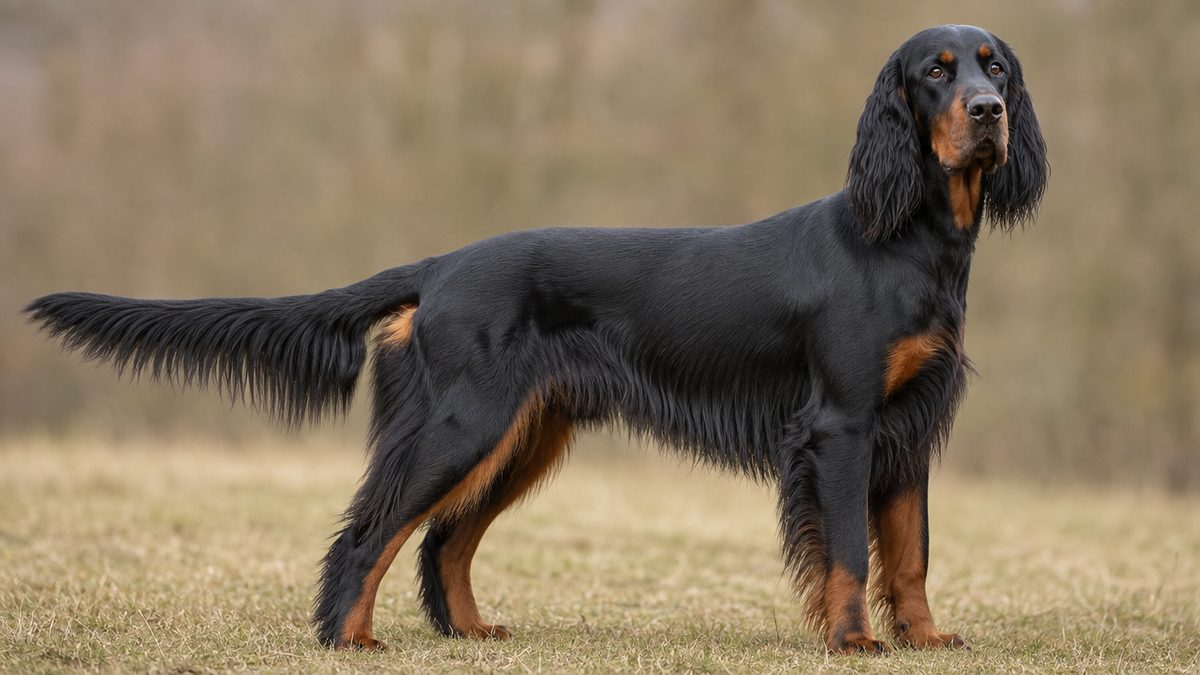
A Gordon Setter is the black and tan member of the setter group, the heaviest of the three, and a pointing dog registered by the Federation Cynologique Internationale as Standard No. 6 in Group 7, Section 2.2 Setters, with working trial.
Origin on the standard's own face is Great Britain, and the currently valid text was published on 04.04.2016. The FCI nomenclature page returned for number 6 prints the breed name GORDON SETTER in its own title, which is the check this site runs every time, because an FCI URL resolves on its trailing number and will serve a different breed's document without erroring.
Size, and where the two standards disagree
The FCI standard gives single figures rather than ranges, and the American standard gives ranges. Both are correct for their own registry and neither is a measurement of live dogs, so a buyer comparing a puppy against one of them should know which one they are holding.
| Measure | FCI Standard No. 6 | AKC official standard |
|---|---|---|
| Height, males | 66 cm (26 in), a single figure | 24 to 27 inches (61 to 69 cm) |
| Height, females | 62 cm (24.5 in), a single figure | 23 to 26 inches (58 to 66 cm) |
| Weight, males | 29.5 kg (65 lb), a single figure | 55 to 80 pounds (25 to 36 kg) |
| Weight, females | 25.5 kg (56 lb), a single figure | 45 to 70 pounds (20 to 32 kg) |
| Tail | Straight or slightly scimitar, not below hocks | Short, not below the hocks, not docked |
Purina India reproduces the FCI figures exactly, giving adult males 29.5 kg and 66 cm and adult females 25.5 kg and 62 cm. The AKC text adds the sentence that explains the breed's build: the weight-to-height ratio makes him heavier than other Setters.
The colour, in the standard's own words
The colour is where this breed is unambiguous. The FCI standard requires deep, shining coal black, without rustiness, with markings of chestnut red, i.e. lustrous tan, and ends the colour clause with the sentence No other colour permissible. The tan markings are specified down to size: two clear spots over the eyes not over 2 cm in diameter, a stripe around the end of the muzzle, tan on the throat, two large clear spots on the chest, tan on the inside of the hindlegs and up to the elbows behind on the forelegs The Royal Kennel Club.
The Royal Kennel Club's own colour list for the breed contains exactly one entry, Black & Tan, and it places the breed in Colour Watch Category 0, meaning there are no non-breed-standard colour registration options at all. A Gordon Setter puppy offered in India in any other colour is not a Gordon Setter under either standard.
The history, and a date the sources do not agree on
Both authorities credit the Duke of Gordon and Gordon Castle in Scotland, and they date it differently. The Royal Kennel Club says the Duke began developing Setters seriously between 1800 and 1820 at Gordon Castle. Purina says the breed was popular in Scotland in the late 1700s, when it was known as the black and tan setter, and credits the 4th Duke. Bonbeno prints both rather than splitting the difference.
The two agree on the part that matters more. The Duke's kennel held setters of several colours, including black and white, red and white and tricolour, and the black and tan form was fixed later. The Royal Kennel Club attributes that to selective breeding, and Purina says plainly that colour was not an issue to the Duke, that dark dogs were harder to see in the hunting field, and that it was the breed's success in the show ring that set the preference.
The Purina India entry for this breed prints ALSO KNOWN AS: Irish Setter, English Setter. Those are two separate breeds with separate FCI standards, separate registration series and, as this page shows, very different health profiles. It is the clearest single sign of how thin Indian-served information on this breed is, on a page from a global brand. Read the English Setter guide alongside this one and the two dogs are not interchangeable.
A vulnerable native breed, and the 93 dogs behind that label
The Gordon Setter is a UK vulnerable native breed, and in 2025 it fell to 93 registrations, the lowest figure in its ten-year series and less than a third of the threshold that defines the list.
The Royal Kennel Club sets the thresholds itself, in its own words. It created the vulnerable native British and Irish breeds list (breeds with fewer than 300 registrations a year) and the 'at watch' list (breeds with between 300 and 450 registrations a year), and it defines the category as dog breeds of British and Irish origin that are considered to be vulnerable due to their declining registration numbers. Origin is a gate, not a description: a rare breed from anywhere else cannot appear on this list at all.
The series, from the group PDF rather than the web table
Figures below are read from Comparative Tables of Registrations for the Years 2016 to 2025 Inclusive, gundog group, the Royal Kennel Club's own PDF, whose file properties give a creation date of 9 March 2026. It was extracted with pypdf rather than a scraping tool, because an extraction layer has silently dropped rows from a Kennel Club statistics PDF before.
| Breed | 2016 | 2018 | 2020 | 2021 | 2022 | 2023 | 2024 | 2025 |
|---|---|---|---|---|---|---|---|---|
| Gordon Setter | 263 | 172 | 268 | 244 | 251 | 137 | 165 | 93 |
| English Setter | 285 | 290 | 140 | 293 | 212 | 250 | 185 | 176 |
| Irish Setter | 775 | 724 | 645 | 935 | 825 | 684 | 647 | 480 |
| Irish Red & White Setter | 63 | 51 | 83 | 46 | 77 | 46 | 49 | 22 |
Across the full decade the Gordon Setter accounts for 2,091 registrations, an average of 209 a year, and the 2025 figure of 93 is 64.6 percent below its own 2016 figure of 263. In the same year the Labrador Retriever recorded 29,919, which is 322 Labradors for every Gordon Setter.
The pandemic year is the tell
2021 was the year British puppy registration exploded, and this breed did not take part. The whole gundog group went from 95,652 in 2020 to 144,265 in 2021, a rise of 50.8 percent, and the English Setter more than doubled from 140 to 293. The Gordon Setter went from 268 to 244, a fall of 9.0 percent in the one year demand was easiest to find. A breed that cannot grow in a boom is not simply unfashionable, it is short of breeding stock.
The web table and the PDF were cross-checked, and they agree
This site has recorded that the Royal Kennel Club's web tables and its group PDFs disagree in nine cells across seven breeds, with two breeds transposed in two separate years, so the check was run again here rather than assumed. For the Gordon Setter the two documents agree in all ten cells, 263, 255, 172, 243, 268, 244, 251, 137, 165 and 93, on both the vulnerable-native-breeds web table and the gundog group PDF.
The gundog group's own arithmetic also holds. Summing all 38 breed rows in the PDF reproduces the printed column total exactly in all ten columns, from 84,780 in 2016 to 74,960 in 2025, once the Barbet's eight-value row is aligned to 2018 through 2025 rather than to 2016. The known bad cells on this document set are in the terrier and toy groups, not here, and reporting agreement is as useful as reporting a discrepancy.
One more check the Royal Kennel Club has failed elsewhere. Its Gordon Setter breed page carries Vulnerable native breed in its own breed characteristics panel, which is consistent with the breed appearing on the vulnerable list, unlike the Foxhound, whose breed page prints the opposite of its own table.
Ninety-three puppies a year in the breed's own home country, spread across an entire nation of breeders, is the supply that would have to feed every export market on earth. It is the reason the Indian half of this page reads the way it does, and it is why no amount of searching produces an Indian Gordon Setter. Compare the Labrador Retriever at 29,919, or the Golden Retriever at 9,976.
Gordon Setter price in India: one band, printed beside zero listings
Gordon Setter price in India is published as Rs 12,000 to Rs 50,000 by a single Indian directory, PetBuy, and the same page prints Listings 0 and a live average of a dash. That is the entire published Indian market for this breed, and the puppy price a buyer is quoted on the phone cannot be checked against anything.
Nine of the ten results on page one for this query were opened and read. Four are Indian commercial listing pages, and between them they contain zero Gordon Setters Breed n Breeder, Gordon Setter Puppies…. Two are foreign reference pages giving real prices for other countries. One is a global brand's breed library with no price. One is India's oldest breeder directory, which says in plain words that it has no breeders for this breed.
| Source | Price given | What the page actually holds |
|---|---|---|
| Asia Pets, position 1 | none | Prints Showing 0 results, then a Chihuahua, a Yorkshire Terrier and a Toy Pom |
| Mr n Mrs Pet, Chennai, position 2 | none visible | Three puppies shown: Cavalier King Charles Spaniel, Border Collie, Newfoundland |
| Puppiezo, position 3 | none for the breed | Eight animals, none a setter, three of them at the same Rs 98,999 |
| Breed n Breeder, position 4 | none | A shell page with a breed dropdown, a phone number and no listing |
| Purina India, position 6 | none | Breed library entry, no commerce |
| Dog Breeds List, position 7 | USD 1,000 to USD 2,000 | A United States page ranking on page one in India |
| Wamiz, position 8 | GBP 900 to GBP 930 | A United Kingdom page |
| PetBuy, position 9 | Rs 12,000 to Rs 50,000 | The band, printed directly above Listings 0 |
| DogsIndia, position 10 | none | There are no breeders listed currently under this breed |
The carousel proof, again
Puppiezo's Gordon Setter page carries an availability block headed Other Available Pets, and its eight animals are Fizey a Maltipoo at Rs 98,999, Kuzo a Poodle at Rs 92,599, Dugu a Poodle at Rs 92,599, Kazuka a Cane Corso at Rs 94,999, Doir a Goldendoodle at Rs 1,20,000, Samy a Maltipoo at Rs 98,999, Tugi a Rottweiler at Rs 76,499 and Yoki a Doxiepoo at Rs 98,999. Not one is a setter, and the figure Rs 98,999 appears three times on this single page. The page's own meta description promises KCI registered Gordon Setter puppies from trusted breeders in Delhi NCR.
Asia Pets is blunter still. Its page prints Showing 0 results, then a block headed available pets of the same breed from other locations, and the three animals under that heading are a Chihuahua, a Yorkshire Terrier and a Toy Pom. Three toy dogs are offered as the same breed as a 66 cm gundog.
The division tests on the only Indian band
Breed n Breeder, at position 4, is the third pattern. Its Gordon Setter page carries a dropdown of every breed name the site knows, a state selector, a city selector, a phone number and the line Mr. Vansh will connect with you to discuss the Gordon setter puppies price, and not one rupee figure or listing anywhere on it. Mr n Mrs Pet's Chennai page is the fourth: its three visible puppies are a Cavalier King Charles Spaniel, a Border Collie and a Newfoundland.
| Rupee figure | Divided by 84.38 | Divided by 74 | Divided by 80 | Divided by 66.67 |
|---|---|---|---|---|
| Rs 12,000, floor | 142.21 | 162.16 | 150.00 | 179.99 |
| Rs 50,000, ceiling | 592.56 | 675.68 | 625.00 | 749.96 |
| Rs 98,999, the carousel price | 1,173.25 | 1,337.82 | 1,237.49 | 1,484.91 |
Nothing divides cleanly at 84.38, the strong test, and nothing divides cleanly at 74. Both ends resolve to whole dollars at 80, and that proves nothing, because 1,000 divided by 80 is 12.5, so any rupee figure ending in three zeros passes at 80 by construction, and both of these do. Read the quotients instead: USD 150 is not a price any seller anywhere quotes for a rare pointing dog, and the United States page ranking three positions above it in the same result set says USD 1,000 to USD 2,000 PetBuy, Gordon Setter Dog Breed.
So the band is rupee-native and arbitrary rather than a converted dollar list. Rs 98,999 is not a conversion either, dividing to 1,173.25 dollars, and this site has now recorded it on eleven separate pages of the same Indian listing site attached to whichever puppy is in stock.
What the breed costs where it exists
Two foreign figures are real and are worth stating in their own currency. Dog Breeds List puts United States puppies at USD 1,000 to USD 2,000 and adds that Gordon Setters are relatively rare in the United States, so finding a breeder is the biggest hardship. Wamiz puts the United Kingdom at GBP 930 for a Kennel Club registered dog and GBP 900 for one that is not.
Bonbeno will not convert USD 1,000 to USD 2,000 or GBP 900 to GBP 930 into rupees and publish the result as a Gordon Setter price in India, and will not average them with Rs 12,000 to Rs 50,000 to manufacture a middle figure. Both moves produce a number that exists in no market. The breed is neither affordable nor expensive in India, because nothing is for sale DogsIndia, Gordon Setter breed page….
Why there is no Indian supply, proved with a working control
No lawful commercial supply chain for the Gordon Setter exists in India, and the proof runs through three separate documents rather than through an empty search result Wrapinfur, Dog Price List in India 2026 Directorate General of Foreign Trade.
The breeder directory, with the control that makes the zero mean something
DogsIndia has carried Indian breeder listings since long before the marketplaces existed. Its Gordon Setter page returns HTTP 200, prints the breed name in its own title, and under Breeders' List reads: There are no breeders listed currently under this breed.
That zero is worth something only because the same site's English Setter page, fetched in the same session, does carry a live breeder listing, in Erode in Tamil Nadu, complete with the note that the puppies are NOT KCI REGISTERED. The directory publishes setter breeders when it has them. It has none for this one.
The same control discipline applies to India's most comprehensive published price table. Wrapinfur's Dog Price List in India 2026 covers more than 50 breeds, and a case-insensitive search of the page returns zero occurrences of the word Setter, against 27 for Labrador and 15 for Golden Retriever. The table is working. It has no setter row of any kind.
KCI registration, and the honest limit on what can be checked
The Kennel Club of India publishes no per-breed register that a reader or a researcher can query, so a KCI registration search returns nothing for this breed and nothing for every control breed too, which makes it a broken instrument rather than a finding. The route that does work is the FCI members register, which lists INDIA (Full member), Kennel Club of India, Nr 28, AA Block First street, Anna Nagar, Chennai. India's national kennel club issues pedigrees against FCI nomenclature, and the Gordon Setter holds FCI Standard No. 6.
So the breed is recognisable in India in principle, and a KCI pedigree for one is possible in principle. What cannot be verified from any public source is whether any KCI-registered Gordon Setter litter has ever been bred here. Any seller promising KCI papers should be asked to show the registration certificate for both parents before a rupee changes hands, and the marketplace pages that advertise KCI registered Gordon Setter puppies in their meta descriptions are the same pages carrying zero Gordon Setters Asia Pets, Gordon Setter Puppies for Sale….
Import law closes the last route
DGFT Trade Notice No. 22/2022-23 of 19 December 2022 sets the policy. Dogs sit under ITC (HS) 01061900, Mammals: Other, Import Policy Restricted. Policy Condition (7) says: Import of dogs is allowed only for the following specific purposes: i. Pet dog with valid pet book and relevant records/documents in the name of importer. ii. Dogs imported by the R&D Organisations for conducting research with the recommendation of CPCSEA. iii. For the internal security by the Defence and Police Force.
Policy Condition (8) closes the door on commerce: Import of commercial dogs for breeding or any other commercial activities other than the purposes mentioned above is not permitted. Paragraph 6 repeats it as an instruction to the officer, saying any applications for trading or breeding purposes, or made on behalf of another person or entity, shall be duly rejected.
- Route one, the pet route. Up to two pets may enter as passenger baggage without a DGFT authorisation, but only for a person transferring residence to India after two years of continuous stay abroad.
- Route two, an import authorisation. Required for a shorter stay, for a temporary import, or for more than two animals, and applied for at least two months before travel.
- Route three, breeding stock. Does not exist. It is the case the notice names and rejects.
- Entry points. Import of pet animals is allowed only through the airports and seaports of Delhi, Mumbai, Chennai, Hyderabad, Bengaluru and Kolkata and, since October 2024, Kochi airport, with an advance NOC from the AQCS quarantine officer at that port Department of Animal Husbandry….
An Indian household that genuinely wants this breed brings its own dog home under the pet route after living abroad, or does not have one. That is not a gap in the market waiting to be filled. It is the law working as written, on a breed producing 93 puppies a year in its home country The Royal Kennel Club.
Monthly cost in India: the lines you can name, and the total nobody can source
No published Indian monthly cost estimate for a Gordon Setter exists, and Bonbeno prints no rupee total rather than inventing one. What can be named honestly is the cost structure, which for this breed is driven by four things: a 29.5 kg body, a feathered coat needing attention every other day, a drop ear in a humid country, and cooling Federation Cynologique Internationale.
Start with the only published monthly figure that exists anywhere for the breed, and note that it is not an Indian one. Wamiz puts United Kingdom food at GBP 50 to GBP 60 a month and total monthly costs at around GBP 80 to GBP 130, before insurance and neutering. That is a British estimate for British prices and it is reported here as a reference point, not converted.
PetBuy, the one Indian page that publishes a purchase band, publishes no monthly figure at all, and its care paragraph is generic template prose that would fit any large breed. Between every Indian page ranking for this term, the number of Indian monthly cost estimates for a Gordon Setter is zero.
The five lines this breed actually generates
| Line | Why this breed generates it | Sourceable in rupees? |
|---|---|---|
| Food | A 29.5 kg male on the FCI standard, plus a large-breed nutrient balance and smaller, more frequent meals to reduce bloat risk | No breed-specific Indian figure published |
| Grooming | Purina India puts the requirement at grooming every other day, on a coat with long silky feathering on ears, belly, chest and the backs of all four legs | No breed-specific Indian figure published |
| Ear care | A low-set drop ear. Drop-eared dogs carried 47.72 percent of 1,008 Indian otitis externa cases against 28.07 percent for prick ears | No breed-specific Indian figure published |
| Cooling | A Scottish gundog whose origin averages 7.6 degrees Celsius against 23.7 to 27.9 across seven Indian metros | Household-specific, not a breed figure |
| Screening | An rcd4 DNA test is a one-off. Hip and elbow scoring exists as a UK scheme with no Indian equivalent | No Indian laboratory price could be sourced |
The grooming line is the one Indian buyers underestimate
Every Indian page that describes this coat calls it medium and moves on. The Royal Kennel Club's own breed panel says coat length medium and grooming more than once a week, while its breed standard describes feather on the upper portion of the ears long and silky, on the backs of the legs long, fine, flat and straight, and fringes on the belly that may extend to chest and throat. Purina India, serving the same country the buyer lives in, says requires grooming every other day.
Those two are not the same instruction, and in an Indian monsoon the difference is not cosmetic. Feathering that stays damp mats, and matted feathering over the ear canal is the mechanism behind the otitis figures in the health section below. Budget grooming against the every-other-day figure, and treat a weekly brush as the floor rather than the plan.
Two lines Indian law effectively puts on the bill
The Prevention of Cruelty to Animals (Dog Breeding and Marketing) Rules, 2017 bind breeders rather than pet owners, but they name this breed's cost drivers precisely. Second Schedule Part IV paragraph 15, headed Ambient and comfortable temperature, requires that the temperature within indoor housing facilities for animals shall be ambient and comfortable, depending on the breeds of dogs that are housed insides. Paragraph 16 allows that ventilation may be met by means of windows, doors, vents or air conditioning.
Paragraph 21(1) goes further and names the category this dog belongs to. It bars keeping outdoors, without written veterinary approval, dog breeds that cannot tolerate the temperatures prevalent in the area or region in question, such as long-haired breeds in high temperature locations. A pet owner is not the addressee of that rule, but the standard it sets is a fair one to budget against.
Bonbeno could produce a confident-looking monthly figure by converting the British estimate or by copying a generic large-breed Indian number, and both would be fiction attached to a citation. The honest answer is that this breed has no Indian cost literature because it has no Indian population. Cost this dog by pricing the five lines above with your own vet and groomer, and treat any quoted all-in monthly figure for a Gordon Setter in India as unsourced PetBuy, Gordon Setter Dog Breed.
Heat tolerance: a 7.6 degree homeland against a 27.9 degree city
Rate the Gordon Setter 1 out of 5 for heat tolerance in India, because Gordon Castle at Fochabers in Moray, where the Duke of Gordon built the breed, averages 7.6 degrees Celsius across the year while Chennai averages 27.9, and Bengaluru's coolest month is warmer than a Moray July.
The origin point here is specific rather than national, because the Royal Kennel Club names it: the Duke of Gordon developed the breed at Gordon Castle in Scotland. Queried at 57.633 N and 3.098 W, elevation 185 m, NASA POWER's 2001 to 2020 climatology returns an annual mean 2 m air temperature of 7.6 degrees Celsius, a July mean of 13.8, a January mean of 2.4, and an annual mean relative humidity of 87.5 percent. Coordinates were supplied explicitly so that no place name could be substituted by accident.
| Place | Annual mean | Warmest month | Coolest month | Annual mean RH | Peak monthly wet-bulb |
|---|---|---|---|---|---|
| Gordon Castle, Moray | 7.6 C | 13.8 C (July) | 2.4 C (January) | 87.5% | 11.9 C (July) |
| Bengaluru | 23.7 C | 28.4 C (April) | 20.2 C (December) | 67.9% | 21.9 C (May) |
| Pune | 23.9 C | 28.9 C (April) | 19.6 C (December) | 66.8% | 23.0 C (June) |
| Delhi | 25.6 C | 35.9 C (June) | 13.6 C (January) | 45.6% | 26.5 C (July) |
| Kolkata | 25.8 C | 31.5 C (May) | 17.3 C (January) | 73.9% | 27.1 C (June) |
| Hyderabad | 26.1 C | 33.3 C (May) | 20.8 C (December) | 60.3% | 23.3 C (June) |
| Mumbai | 26.8 C | 31.2 C (May) | 23.2 C (January) | 67.4% | 25.8 C (June) |
| Chennai | 27.9 C | 31.5 C (May) | 24.1 C (January) | 72.4% | 26.1 C (May) |
Bengaluru's coolest month, December, averages 20.2 degrees Celsius, which is 6.4 degrees warmer than the warmest month Moray offers. Chennai in January, its coolest month, sits 10.3 degrees above a Gordon Castle July. There is no Indian city and no Indian month inside this breed's origin range, and the mildest option is not close.
Humidity is the wrong number. Wet-bulb is the right one
Moray is wetter than India. At 87.5 percent annual mean relative humidity, Gordon Castle is more humid than every Indian city in the table, including Kolkata at 73.9 percent. Raw humidity therefore misleads, because a dog sheds heat by evaporation and evaporation depends on temperature and humidity together. Wet-bulb figures above are computed from the NASA POWER monthly means using Stull's 2011 approximation.
Gordon Castle's peak monthly wet-bulb is 11.9 degrees Celsius. Kolkata's is 27.1, Delhi's 26.5 and Chennai's 26.1 Stull R. Wet-Bulb Temperature from Relative…. Kolkata's peak is 2.28 times the Scottish one. Even Bengaluru, the mildest large Indian city on the list, sits 10.0 degrees above it. A 29.5 kg dog under a long feathered coat has roughly half the evaporative headroom its body plan assumes.
How dogs actually get heat illness, from 905,543 records
Reviewing 905,543 UK dogs under primary veterinary care in 2016, Hall and colleagues identified 1,259 heat-related illness events from 1,222 dogs. Of 1,259 events, 380 had no trigger recorded, and of the remaining 879, exertional heat illness accounted for 652, or 74.2 percent. Environmental heat accounted for 113 events at 12.9 percent, and confinement in a vehicle for 46 at 5.2 percent. The paper's own conclusion is that in the UK exertional heat illness affects and kills more dogs than hot cars do.
That matters more for this breed than for most, because the standard advice attached to it is an exercise instruction. Purina tells owners to expect several hours of dog exercise, including walking and some free running daily, regardless of the weather. Written in Britain, that sentence is sound. Applied in Hyderabad in May, at a 23.3 degree wet-bulb, it is the most direct route there is to the commonest form of heat illness in the largest study there is.
One sibling comparison closes the point. The English Setter is named after Belton in Northumberland, which averages 8.9 degrees Celsius, so the Gordon Setter's own origin at Gordon Castle is 1.3 degrees colder still. Neither dog is built for this country, and of the two, the Gordon comes from the colder place.
Managing the heat, city by city, and what Indian law already says
Manage this breed's heat load by moving the whole day rather than by trimming the walk, because the largest study of canine heat illness found exertion, not sunshine and not cars, to be the commonest trigger.
Indian law is unusually specific about dogs like this one. The Prevention of Cruelty to Animals (Dog Breeding and Marketing) Rules, 2017, Second Schedule Part IV paragraph 21(1), bar keeping certain dogs in outdoor facilities without written approval from the attending veterinary practitioner, and paragraph 21(1)(ii) names dog breeds that cannot tolerate the temperatures prevalent in the area or region in question, such as long-haired breeds in high temperature locations. A long-coated Scottish gundog in an Indian metro is the textbook case of that clause.
Paragraph 15 of the same Schedule, headed Ambient and comfortable temperature, requires indoor temperature to be ambient and comfortable, depending on the breeds of dogs that are housed insides, and paragraph 16 accepts air conditioning as a means of meeting the ventilation requirement. The Rules bind registered breeders rather than pet owners, but they establish that Indian law already treats a coat type as a housing variable.
City by city, for this breed
- Bengaluru and Pune are the only workable Indian cities, at annual means near 23.8 degrees Celsius and peak wet-bulbs below 23.
- Delhi is the split case, giving this breed a genuine working winter at a 13.6 degree January and the worst summer on the list at a 35.9 degree June.
- Chennai, Mumbai and Kolkata are the hardest, because the floor never drops. Chennai's coolest month averages 24.1 degrees Celsius, so no month offers relief.
- Hyderabad sits between the two groups, with a 20.8 degree December and a 23.3 degree wet-bulb peak in June.
What actually works
- Move exercise to the coolest hour of the day, every day, all year. In Chennai and Mumbai that is before sunrise, because the coolest monthly means are 24.1 and 23.2 degrees Celsius.
- Cut duration before intensity in the hot months. Purina's several hours a day, regardless of the weather, is written for a British summer and does not transfer.
- Give the dog airflow rather than a cold floor alone. Ventilation by fan or air conditioning is what the Rules themselves name.
- Dry the feathering and the ear after every wash and every wet walk. Damp feathering over a low-set drop ear is the mechanism behind the otitis externa figures below.
- Treat a hard pant that does not settle within minutes of stopping as an emergency. Case fatality in the UK series was not trivial and exertional events were the largest group.
The flat, silky coat both standards describe insulates against radiant heat as well as cold, and clipping a feathered gundog strips that protection while exposing thin skin to Indian sun American Kennel Club. Shade, airflow, water and a shifted schedule cool this dog. Clippers do not, and no grooming decision makes this breed heat-tolerant in an Indian city.
Temperament: bold, dignified, slow to grow up, and not a guard dog
The Gordon Setter's temperament is set out in one line of the breed standard: Bold, outgoing, of a kindly even disposition, with characteristics given as Intelligent, able and dignified The Royal Kennel Club. Everything an Indian household needs to decide follows from three practical facts sitting underneath that line.
One, it matures slowly and it is sensitive when it gets there
Purina puts it plainly: the breed is slow to mature and with a sensitive nature as adults, and juvenile Gordon Setters can be quite a handful, needing patient work to instil manners without squashing the dog's affectionate, dignified nature. An Indian buyer who expects an adult brain at twelve months has bought the wrong dog. Plan for a large, clumsy, well-meaning adolescent through most of the second year.
The same source describes a dog that is sociable and friendly with family and known friends but needs a little time to warm up to strangers. In a country where the doorbell brings deliveries several times a day, that warm-up period is worth engineering deliberately rather than discovering at the door.
Two, it is a gundog and it will carry things
This is a pointing dog with a working trial attached to its FCI classification, and the instincts arrive whether or not anyone hunts. Purina names two specifically: the dog will always be prone to being distracted by birds, and it has a strong desire to carry objects around. Neither is a fault, and both need managing rather than punishing. A Gordon that learns that carrying something earns a confrontation learns to guard it instead.
Three, it is not a guard dog, whatever the listing says
Purina's own need-to-know panel for this breed lists Not a guard dog and Quiet dog. Puppiezo's Indian sales page for the same breed lists its top five traits as Loyal, Energetic, Intelligent, Affectionate and Protective. Only one of those two is a breed reference, and the difference matters, because in India a large dog is very often bought as security.
| Question | Royal Kennel Club and Purina | Indian sales pages |
|---|---|---|
| Town or country? | Country | Ideal space, medium to large |
| Size of home | Large house, large garden | Not stated |
| Guarding | Not a guard dog | Protective, listed as a top-five trait |
| Noise | Quiet dog | Barking scale, unlabelled |
| Children | Better suited to homes with older children | Good with children |
| Other pets | May require training to live with other pets | Not stated |
The United States reference page that ranks on page one in India rates the breed 1 star out of 5 for apartment friendliness and says flatly that the Gordon Setter is not recommended for apartment life. It adds the nuance that a Gordon which gets enough outdoor activity is relatively inactive indoors, which is true and is not the same as saying a flat will do.
Who should buy one, and who should not
- Buy one if you live in Bengaluru, Pune or a hill station, have a garden or daily access to secure open ground, and want an elegant, biddable, independent-minded gundog rather than a guard.
- Buy one if you can wait out a two-year adolescence with patience rather than correction, and can groom a feathered coat every other day.
- Do not buy one for a Chennai, Mumbai or Kolkata flat, where the coolest month averages 23.2 degrees Celsius or higher and there is no season of relief.
- Do not buy one as a guard dog, because the breed reference for it says it is not one.
- Do not buy one from any Indian page in the current result set, because none of them has a Gordon Setter to sell.
Of all the traits on the Purina panel, Quiet dog is the one that most helps an Indian owner, because a large breed on a shared apartment wall usually is not. It does not make the breed a flat dog, since heat and exercise rule that out, but it does mean the neighbours are not the problem here.
One word to retire before it does damage: hardy. The Gordon Setter is a hardy dog on a Scottish grouse moor, where the annual mean is 7.6 degrees Celsius, and hardiness in that sense does not travel to a country whose mildest large city never drops below a 20.2 degree monthly mean The Royal Kennel Club. Toughness in cold and wet is not toughness in heat.
Training: take it at the dog's pace, and finish recall before anything else
To train a Gordon Setter, work at the dog's pace rather than yours, because this is an intelligent but slow-maturing breed and rushing it produces what Purina calls a confused dog who fools around rather than learns, which owners then misread as stubborn or wilful.
The breed is trainable and biddable, and it is not obedient in the biddable-Labrador sense. Purina's own note explains why: the Gordon Setter was bred to work away from people and make their own decisions, so it has an independent mind and forms its own opinions easily. That is a working requirement in a pointing dog, and it does not switch off in a suburb.
Recall is the one skill that has to be finished
A dog that points and retrieves, and that Purina says will always be prone to being distracted by birds, is a dog whose recall is tested by the environment rather than by the handler. In India the distraction set is larger than in Britain, because free-roaming dogs, cattle, cats and crows are all present on an ordinary walk. Recall against a live bird is the benchmark, and until it holds, the long line stays on.
| Window | What to train | What to expect |
|---|---|---|
| 8 to 16 weeks | Name, lead, crate, handling of ears and feet, meeting people calmly | Fast learning, no reliability. Socialise deliberately |
| 4 to 8 months | Recall on a long line, trade games for carried objects, settle on a mat | Attention comes and goes. Sessions stay short |
| 8 to 18 months | Recall against real distraction, loose lead at adult strength, grooming tolerance | The hardest phase. This is the handful Purina warns about |
| 18 months to 3 years | Consolidation, scent work or gundog activities, off-lead freedom where legal and safe | Judgement arrives. The dog becomes the adult described in the standard |
What this breed resists
- Drilling. Repetition without purpose produces the clowning Purina describes, not compliance.
- Confrontation over carried objects. The breed has a strong desire to carry things, and a dog that is chased for it learns to run and then to guard.
- Correction-heavy handling. The standard's own word for the adult is dignified, and the sensitive adult temperament is the thing harsh handling damages first.
- Hot-weather sessions. Exertional heat illness was the trigger in 652 of the 879 UK events with a recorded trigger, so a training session in an Indian afternoon is a health decision as much as a training one.
Give the brain a job that is not obedience
Purina recommends dog sports and activities that use the breed's endurance, scenting and retrieving ability, and adds that any activity you have the patience to train will be beneficial to a Gordon's mental and physical wellbeing. In Indian conditions the practical versions are scent games indoors in the hot months, retrieve work in a secure garden at first light, and tracking on cool mornings. All three let the dog point, search and retrieve without asking it to run in a 26 degree wet-bulb.
Handling tolerance is a trained skill on this breed and it pays back daily. A dog that accepts its ears being lifted, its feathering being combed and its feet being handled from eight weeks is a dog whose ear checks actually happen in the monsoon, which is when they matter Purina India, Gordon Setter Dog Breed….
Exercise: two hours a day, and the sources disagree by a factor of two
Plan more than two hours of exercise a day for an adult Gordon Setter, which is the Royal Kennel Club's own figure on its breed page, and note that the published estimates for this breed range from one hour to several.
| Source | Stated requirement | What it is |
|---|---|---|
| Royal Kennel Club breed page | More than 2 hours per day | The breed's home registry |
| Purina India, need-to-know panel | Enjoys walking one to two hours a day | Global brand, Indian site |
| Purina India, exercise section | Several hours, including free running, regardless of the weather | Same page, a different figure |
| Puppiezo, Indian sales page | 1 to 2 hours daily | A page with no Gordon Setters on it |
| PetBuy, Indian breed page | Exercise needs: Moderate | Beside a lifespan of 12 to 15 years that no registry gives |
Two of those figures sit on the same Purina page, one saying one to two hours and the other saying several hours regardless of the weather. Bonbeno reports the disagreement rather than averaging it, and recommends planning against the Royal Kennel Club's more than two hours, because that is the figure published by the registry that holds the breed standard The Royal Kennel Club.
It is not distance, it is ground
The Royal Kennel Club's own breed panel asks for a large house, a large garden and country rather than town, and the AKC standard describes a dog with strength, stamina and enormous endurance built for Scottish grouse moors. What that dog needs is not more pavement. It needs space to gallop, cast about and use its nose, which is why the United States reference page rates it 1 out of 5 for apartment life.
What happens without it
- Adolescent destructiveness. A breed with a strong desire to carry objects, under-exercised, redirects onto the house.
- Weight gain on a deep-chested frame. Body condition is the most controllable variable in this breed's health, and the WSAVA nine-point chart is how to score it rather than by eye.
- Loss of the recall you built. A gundog with unspent drive takes it out on the environment, and the birds win.
- Nothing good in a hot month. Cutting exercise in an Indian May is correct. Cutting it in December is how the problem starts.
Split it. Ninety minutes at first light, when Chennai and Mumbai are at their coolest, and a short scent or retrieve session indoors in the evening. That delivers the Royal Kennel Club's requirement without asking a long-coated dog to work at a 26 degree wet-bulb NASA POWER Source Native Resolution….
Grooming a feathered coat in Indian humidity
Groom a Gordon Setter every other day in India, not once a week, because Purina's Indian breed library puts the interval at grooming every other day while the Royal Kennel Club's panel says more than once a week, and in a humid climate the shorter interval is the one that keeps the feathering out of trouble.
The coat itself is described identically by both standards. On the head, the front of the legs and the tips of the ears it is short and fine. Everywhere else it is of moderate length, flat and free from curl or wave. The feather on the upper portion of the ears is long and silky, on the backs of the legs it is long, fine, flat and straight, and the fringes on the belly may extend to the chest and throat. The AKC adds that the coat is soft and shining, straight or slightly waved, but not curly.
The Royal Kennel Club records shedding for this breed as Yes, so nobody should buy one expecting a low-shedding house. Nor is it hypoallergenic: Purina's own panel prints Non hypoallergenic breed Purina India, Gordon Setter Dog Breed….
The five places that mat, in order
- Behind and under the ear leather, where the long silky feather meets a low-set drop ear and stays damp.
- The armpits and the elbow folds, where movement plus moisture makes felt in days.
- The belly fringe, which the standard says may extend to chest and throat, and which collects everything the dog walks through.
- The backs of the hind legs and the breeches, the longest feathering on the dog.
- Between the toes, where the standard specifies plenty of hair, and where Indian grass seeds and grit lodge.
The monsoon routine
The overseas grooming instruction for a feathered gundog is usually to towel the dog and let it air dry. That is written for a British summer and it does not transfer. In an Indian series of 1,008 otitis externa cases at the Veterinary College, Hebbal, Bengaluru, drawn from 76,161 dogs, the rainy season accounted for 41.87 percent of cases against 32.83 percent in winter and 25.30 percent in summer, and the authors attribute it directly to humidity, temperature and moisture altering the ear canal microenvironment.
- Comb, then brush. A brush alone rides over a mat that a wide-tooth comb finds.
- Dry the ear feathering actively after every wash and every wet walk. Air drying is the instruction that does not transfer.
- Lift and check both ears every second day in the monsoon, which is when the Indian case curve peaks.
- Trim the hair between the pads, which the standard describes as plentiful and which holds water.
- Never clip the body coat down, because a flat silky coat is radiant-heat protection as well as insulation.
Indian law's own sale conditions require a breeder to screen prospective purchasers for their potential to take proper care of the breed, especially if it is a large one, to attend to its grooming, socialising, spatial and veterinary needs. That is Rule 8(3) of the Prevention of Cruelty to Animals (Dog Breeding and Marketing) Rules, 2017, in the main Rules under the heading Conditions for sale, not a Second Schedule paragraph. On a 29.5 kg feathered gundog in a humid country, that clause describes real work rather than a formality.
Health: hips, elbows and a lifespan the biggest study calls ordinary
The Gordon Setter's two biggest orthopaedic numbers are 18.7 percent dysplastic across 7,198 hip evaluations and 14.2 percent abnormal across 1,594 elbow evaluations, both read from the Orthopedic Foundation for Animals under breed code GSE, taken from OFA's own markup rather than guessed.
The code matters. A reasoned guess of GS returns a complete, plausible statistics page for the German Shepherd Dog, and nothing errors. The Gordon Setter is GSE, read from the attribute pair value="GSE" data-name="GORDON SETTER" in OFA's own breed selector, and every table below was confirmed to print the breed name GORDON SETTER on the row itself before a figure was taken from it.
| Register | Evaluations | Result | Rank |
|---|---|---|---|
| Hips | 7,198 | 79.9% normal, 18.7% dysplastic | 59 of 220 |
| Elbows | 1,594 | 85.4% normal, 14.2% abnormal | 37 of 166 |
| Eyes, summary line | 903 | 95.3% normal, 4.7% abnormal | 105 of 237 |
| rcd4 progressive retinal atrophy | 771 | 70.0% normal, 28.5% carrier, 1.4% affected | 2 of 9 |
| Thyroid | 262 | 90.5% normal, 7.3% equivocal | 80 of 128 |
| Patella | 73 | 98.6% normal | 104 of 173 |
| Dentition | 100 | 83.0% normal, 17.0% abnormal | 11 of 73 |
| Congenital cardiac | 95 | 100.0% normal | 121 of 157 |
The hip figure, checked against real controls
The Gordon Setter's hip row adds up: Excellent 10.6, Good 52.0 and Fair 17.3 sum to exactly the printed 79.9 percent normal, and Mild 11.2, Moderate 6.7 and Severe 0.8 sum to exactly the printed 18.7 percent dysplastic. Against controls pulled in the same session, that is worse than most of its relatives.
| Breed | Evaluations | Normal % | Dysplastic % |
|---|---|---|---|
| Gordon Setter | 7,198 | 79.9 | 18.7 |
| Golden Retriever | 192,946 | 78.3 | 19.3 |
| English Setter | 13,431 | 83.3 | 15.3 |
| Irish Setter | 13,508 | 87.3 | 11.7 |
| Labrador Retriever | 324,780 | 87.5 | 11.3 |
The Gordon Setter's dysplastic rate is 7.0 points above the Irish Setter's and 7.4 above the Labrador's, and it is the worst of the three setters in this table. The elbow row is the one to read carefully: OFA prints 14.2 percent abnormal, while its own grade columns of 12.4, 1.3 and 0.4 sum to 14.1, a one-tenth rounding gap worth naming rather than hiding.
The ALL BREEDS summary row on the hips table prints 84.3 percent normal with Excellent 14.6, Good 0.0 and Fair 0.0, components that cannot sum to that whole. Every individual breed row checked here does sum correctly. Use the per-breed rows as the baseline, not the aggregate, and note that OFA counts move as evaluations are added, so quote the sample size beside the percentage.
Life expectancy: 12.4 years, and one Indian page that disagrees with every registry
The largest UK longevity study, covering 584,734 dogs including 284,734 deaths, gives the Gordon Setter a median survival of 12.4 years, 95 percent confidence interval 12.1 to 12.8, built on 138 deaths, against a crossbred median of 12.0 years McMillan et al. 2024. Its hazard ratio is 0.85 with a confidence interval of 0.72 to 1.01 and a p-value of 0.06, so the breed's mortality is not statistically distinguishable from a crossbred's at the conventional threshold.
The paper's two supplementary tables disagree on how many dogs that is. Table S3 gives 393 and Table S6 gives 272 alive plus 138 deceased for a total of 410 McMillan et al. 2024. The death count of 138 is identical in both, which is why the sentence above is built on deaths and the median rather than on a sample size the authors report two ways.
| Source | Figure | Basis |
|---|---|---|
| McMillan et al. 2024 | Median 12.4 years (12.1 to 12.8) | 138 recorded deaths in a UK dataset |
| Royal Kennel Club breed page | Over 10 years | A registry category, not a measurement |
| Purina India | 10 to 12 years | Breed library entry |
| Dog Breeds List | 10 to 12 years | United States reference page |
| Puppiezo, Indian sales page | 10 to 12 years | A page carrying no Gordon Setters |
| PetBuy, Indian breed page | 12 to 15 years | No registry or study supports the upper bound |
Life expectancy is where the Indian pages part company with the evidence. PetBuy prints 12 to 15 years, an upper bound no registry and no study supports, while the Royal Kennel Club says over 10 years and Purina India, Dog Breeds List and Puppiezo all say 10 to 12 Purina India, Gordon Setter Dog Breed… Dog Breeds List, Gordon Setter, Price Puppiezo, Gordon Setter Puppies For Sale. The measured figure, from 138 recorded deaths, is a median of 12.4 years.
rcd4 progressive retinal atrophy: 28.5 percent carriers in 771 tested dogs
The defining inherited disease of this breed is rod-cone degeneration 4, or rcd4, a late-onset progressive retinal atrophy, and in the OFA register 28.5 percent of 771 tested Gordon Setters are carriers, with a further 1.4 percent affected, placing the breed second of the nine breeds published in that table.
It has a DNA test, and the Royal Kennel Club runs an official scheme for it. On the Royal Kennel Club Health Standard the breed's Good Practice tests are three: prioritising genetic diversity, a DNA test for progressive retinal atrophy (PRA rcd4), and hip testing under the BVA/KC Hip Dysplasia Scheme. Its Best Practice tests add eye testing under the BVA/KC/ISDS Eye Scheme and elbow testing under the BVA/KC Elbow Dysplasia Scheme.
Where the mutation came from
Downs and colleagues at the Kennel Club Genetics Centre found it with a genome-wide association study using 16 Gordon Setter PRA cases and 22 controls, identifying a novel locus on CFA17 which they named rcd4, and a frameshift mutation in the gene C2orf71 inside a 3.2 Mb region homozygous within cases. The variant was homozygous in 19 of 21 PRA cases and the paper estimates its frequency in the Gordon Setter population at approximately 0.37.
Two details from that paper matter to a buyer. First, the same variant is present in Irish Setters with PRA at an estimated allele frequency of 0.26, which is why the two breeds share the test. Second, about 10 percent of cases, 2 of 21, were not explained by this mutation, so PRA in this breed is genetically heterogeneous and caused by at least two mutations. A clear rcd4 result is not a guarantee of clear eyes.
A follow-up screen of 231 PRA-affected dogs across 36 breeds sharpened that. In 15 of the 21 breeds where a PRA-associated mutation is known to segregate, cases were found carrying none of the 17 known mutations, and one Standard Poodle turned up homozygous for the rcd4 mutation previously reported only in Gordon and Irish Setters.
The arithmetic, and what it does and does not show
OFA's 771 tested dogs break down as 70.0 percent clear, 28.5 percent carrier and 1.4 percent affected, which sums to 99.9 and rounds correctly. Those genotype proportions imply a mutant allele frequency of about 0.157 in the tested population, against the 0.37 the 2013 paper estimated for the breed.
| Genotype | OFA register, 771 dogs | Expected at an allele frequency of 0.37 |
|---|---|---|
| Clear | 70.0% | 39.7% |
| Carrier | 28.5% | 46.6% |
| Affected | 1.4% | 13.7% |
| Implied allele frequency | about 0.157 | 0.37 |
State the limit plainly. OFA's register is a self-selected sample of dogs whose owners chose to test them, not a random sample of the breed, so this is a description of the tested population rather than proof that the breed-wide frequency has halved. What it does show is that a large screened population exists, that carriers remain common in it at more than one dog in four, and that the affected proportion inside it is low, which is what a DNA test is supposed to achieve.
Indian law already names this exact disease
The Prevention of Cruelty to Animals (Dog Breeding and Marketing) Rules, 2017, Second Schedule Part III paragraph 8, headed Veterinary care, sub-paragraph (10), reads verbatim: The dogs shall have been tested for genetic defects, including hip dysplasia, progressive retinal atrophy, night blindness, hypothyroidism, entropion, ectropion, overshot, undershot jaw (when incisors do not touch or mesh), wry mouth, two or more missing teeth, unilateral cryptorchid or full cryptorchid males.
That clause is a Second Schedule paragraph, not a Rule, and it should be cited that way. Read against this breed it is unusually well aimed: progressive retinal atrophy, night blindness, hip dysplasia, entropion and ectropion are five of the conditions the Gordon Setter is actually screened for, and the word the clause uses is including, so the list is illustrative rather than closed.
Ask for both parents' rcd4 DNA results and both parents' hip scores, in writing, with the dogs' registered names on them. rcd4 is recessive, so a carrier bred to a clear dog produces no affected puppies and a carrier bred to a carrier does. Any seller who cannot produce those two documents is selling a dog whose two best-documented risks have not been screened.
The eye register contradicts itself, so here are both numbers
OFA's eye register reports two incompatible answers for this breed on the same denominator of 903 examinations: the summary line says 95.3 percent normal, and the detail rows say 665 of 903, which is 73.6 percent, normal. Bonbeno publishes both with the arithmetic and quotes neither as the rate.
The gap is 21.7 percentage points, far too wide to be rounding, and it is not unique to this breed. This site has now recorded the same shape on the Field Spaniel, English Shepherd, Entlebucher, Dandie Dinmont, Clumber Spaniel and Dogo Argentino, always with a high summary percentage sitting above much lower detail rows on the same or a near-identical denominator.
Here the contradiction is provable from inside the table. The summary says 4.7 percent abnormal, while a single detail row, persistent pupillary membranes running iris to iris, records 76 of 903, which is 8.4 percent. A part cannot exceed its whole, so the two lines are not measuring the same thing.
| Finding | Dogs | Percent |
|---|---|---|
| Normal | 665 | 73.6 |
| Persistent pupillary membranes, iris to iris | 76 | 8.4 |
| Cataract, significance unknown | 47 | 5.2 |
| Other, suspected as not inherited | 41 | 4.5 |
| Persistent pupillary membranes, lens pigment foci, no strands | 37 | 4.1 |
| Distichiasis | 17 | 1.9 |
| Retinal dysplasia, folds | 12 | 1.3 |
| Ectropion | 11 | 1.2 |
| Entropion | 6 | 0.7 |
| Retinal atrophy, generalized | 2 | 0.2 |
Read the detail rows and the practical picture is different from the summary's reassurance. Persistent pupillary membranes are the commonest single finding at 8.4 percent, most of them the iris-to-iris form, which is usually of little clinical consequence. Cataract of unknown significance sits at 5.2 percent. Generalized retinal atrophy appears in only 2 of 903 examinations, which is consistent with a late-onset disease being caught by a DNA test before it reaches an eye clinic Downs LM, Bell JS, Freeman J, Hartley C.
Entropion at 0.7 percent and ectropion at 1.2 percent are both low, and both are named by Indian law as genetic defects a breeding dog must have been tested for, under Second Schedule Part III paragraph 8(10) Orthopedic Foundation for Animals.
Writing that 95 percent of Gordon Setters have normal eyes uses a summary line that its own detail rows contradict. Writing that only 73.6 percent do treats detail rows as if they were a clean prevalence. Quote both, show the division, and say the source is inconsistent.
Two more risks: hereditary ataxia and a deep chest
Two further conditions belong on a Gordon Setter buyer's list, and they are very different in character: a juvenile-onset hereditary ataxia with a known gene, and gastric dilatation and volvulus, where the breed's own reference page and the best available evidence do not quite line up.
RAB24 hereditary ataxia
Old English Sheepdogs and Gordon Setters share a juvenile-onset, autosomal recessive form of canine hereditary ataxia primarily affecting the Purkinje neurons of the cerebellar cortex. Linkage and genome-wide association work in Old English Sheepdogs identified a region on CFA4, and targeted sequencing found an A to C single nucleotide polymorphism at position 113 in exon 1 of the autophagy gene RAB24 that segregated with the phenotype.
Genotyping six further affected breeds found the same polymorphism only in affected Gordon Setters, where it segregated perfectly with the phenotype, and genome-wide SNP genotyping showed a 1.9 Mb region with a haplotype identical to the affected Old English Sheepdogs. A 2025 paper describing a second RAB24 variant in an unrelated family restates the position, noting that RAB24 p.Glu38Pro was previously reported to cause a clinically similar form of cerebellar ataxia in Gordon Setters and Old English Sheepdogs.
OFA publishes a cerebellar degeneration table with only two breeds in it, and the Gordon Setter is one of them: 140 evaluations, 98.6 percent normal, 1.4 percent carrier and no affected dogs. That is a small tested population and a low carrier rate, and it is a screen worth asking about in any line that has produced a case.
Bloat, and an honest reading of the evidence
Purina's Indian breed library says the Gordon Setter is a deep chested breed which can be prone to bloating and recommends smaller, more frequent meals. The two best studies of gastric dilatation and volvulus do not confirm a breed-specific risk for it, and saying so is more useful than repeating the claim.
- Glickman's prospective cohort of 1,637 dogs covered eleven breeds and the Gordon Setter was not one of them. Akita, Bloodhound, Collie, Great Dane, Irish Setter, Irish Wolfhound, Newfoundland, Rottweiler, Saint Bernard, Standard Poodle and Weimaraner were.
- The UK emergency-care study of 77,088 dogs found an overall gastric dilatation prevalence of 0.64 percent, with the highest odds ratios in the Great Dane at 114.3, the Akita at 84.4 and the Dogue de Bordeaux at 82.9. The Gordon Setter is not among the breeds it names.
- What does transfer are the non-breed risk factors. Glickman found increasing age, having a first-degree relative with a history of the condition, faster eating speed and a raised feeding bowl all significantly associated with increased risk, and attributed roughly 20 percent of large-breed cases to the raised bowl alone.
- Outcome data are worth knowing before it happens. Of cases presented alive in the UK series, 49.7 percent survived to discharge overall, rising to 79.3 percent of those managed surgically.
The single cheapest thing an Indian owner of a large, deep-chested dog can do is not use a raised bowl, because that is the one modifiable factor Glickman's cohort quantified. Unproductive retching, a swollen tight abdomen and restlessness after a meal are a surgical emergency, and every hour counts.
Feeding: a large-breed diet, several small meals, and no raised bowl
Feed a Gordon Setter as a large breed on smaller, more frequent meals, which is Purina's own instruction for this dog and is given specifically because it is prone to bloating, and score the result against the WSAVA nine-point body condition chart rather than by eye.
Purina's nutrition note for the breed is short and it says two things. Large breed dogs benefit from a different balance of nutrients including minerals and vitamins compared with smaller dogs, and because the Gordon Setter is prone to bloating and stomach problems, smaller, more frequent meals can help minimise this risk. Both are actionable in India, where large-breed formulations are widely available.
Growth rate is the lever that touches the hips
This is a slow-maturing large breed with 18.7 percent dysplastic hips across 7,198 OFA evaluations, so the growth phase is where feeding decisions have the longest reach. Feed to a lean body condition rather than to the top of the bag's chart, weigh the food rather than scooping it, and re-score the dog monthly through the first eighteen months.
| Rule | Reason | Source |
|---|---|---|
| Split the daily ration into several meals | Reduces the volume in a deep chest at any one time | Purina, for this breed |
| Feed from the floor, never a raised bowl | A raised bowl was one of four factors significantly associated with increased risk | Glickman, 1,637 dogs |
| Slow a fast eater | Faster speed of eating was significantly associated with increased risk | Glickman, 1,637 dogs |
| Score body condition monthly on a 9-point chart | Lean growth protects hips and reduces heat load | WSAVA Global Nutrition Committee |
| Do not free-feed in hot months | Appetite drops in heat, and a topped-up bowl hides it | Practical, from the climate data above |
Water and heat
A dog whose origin climate peaks at an 11.9 degree wet-bulb and which now lives at 21.9 to 27.1 loses far more water to panting than its body plan assumes. Keep more than one water station, refresh it during the day rather than topping it up, and expect intake to move with the season rather than staying flat.
The only monthly food figure published anywhere for a Gordon Setter is a British one, GBP 50 to GBP 60 a month. Bonbeno does not convert it, because a converted British food bill is not an Indian food bill. Price a large-breed diet at your own retailer against the daily gram figure on the pack for a 29.5 kg dog.
The first year, month by month, with the Indian legal dates in it
Plan a Gordon Setter's first year around three fixed points: no lawful sale below eight weeks, a vaccination course that Indian law expects to start at seven to eight weeks and finish around eighteen weeks, and a brain that will not be adult until well after the body is.
Two of those dates come from the Prevention of Cruelty to Animals (Dog Breeding and Marketing) Rules, 2017, and it is worth saying which part of the document each sits in, because the Rules number their clauses twice. Rule 8, Conditions for sale, sub-rule (1)(a) requires every breeder to ensure that pups less than eight weeks in age are not sold. Second Schedule Part III paragraph 8(9), under Veterinary care, says All pups shall be vaccinated which can start at the age of seven-eight weeks, and are usually completed at the age of eighteen weeks.
| Age | What happens | What you do |
|---|---|---|
| 8 weeks | The earliest a puppy may lawfully be sold in India | Collect the vaccination record and both parents' rcd4 and hip papers |
| 8 to 12 weeks | Socialisation window. Handling tolerance is cheap to build now | Comb ears and feet daily so grooming is never a fight later |
| 12 to 18 weeks | Vaccination course usually completes around eighteen weeks | Short lead walks. Do not add distance to a growing large breed |
| 4 to 6 months | Rapid growth. Coordination lags behind size | Weigh food. Score body condition monthly. No forced running |
| 6 months | Indian law bars sale of a dog over six months without sterilisation, other than to a licensed breeder | Discuss timing with your vet for a large slow-maturing breed |
| 6 to 12 months | Feathering starts to come in. Adolescence begins | Recall on a long line, every session, against real distraction |
| 12 to 18 months | The handful phase Purina describes. Peak clowning | Keep sessions short and stay off correction |
| 18 months onward | Judgement arrives. Hip and elbow scoring becomes possible in adulthood | Screen before any breeding decision, under the BVA/KC schemes |
Rule 8(1)(b) adds the six-month line, requiring that dogs over six months in age are not sold without first being sterilised, unless they are being sold to another licensed breeder. An Indian buyer offered an unsterilised eight-month-old by a commercial seller is being offered a sale the Rules do not permit.
What the first year will not tell you
rcd4 progressive retinal atrophy is late-onset, so a puppy's eyes look normal whatever its genotype, and the eye clinic cannot substitute for the DNA test. The RAB24 ataxia is the opposite case, being juvenile in onset, so a puppy that is unsteady, hypermetric or losing coordination in its first year needs a neurological opinion rather than reassurance.
Both parents' rcd4 DNA certificates, both parents' hip scores, the puppy's own vaccination and deworming record with the attending veterinary practitioner's name, and the KCI registration application if one is claimed. Indian law requires the breeder to hand over the inoculation and deworming record with the veterinary practitioner's name and address, so asking for it is asking for something you are owed The Royal Kennel Club.
Gordon Setter against the breeds a buyer actually cross-shops
Compared head to head against the other two setters and against the Labrador Retriever, the Gordon Setter is the rarest of the four, has the worst hips of the four, carries by far the highest rcd4 carrier rate, and is the only one of the four whose lifespan is not statistically distinguishable from a crossbred's McMillan et al. 2024 The Royal Kennel Club.
| Measure | Gordon Setter | English Setter | Irish Setter | Labrador Retriever |
|---|---|---|---|---|
| UK registrations, 2025 | 93 | 176 | 480 | 29,919 |
| UK vulnerable native breed? | Yes | Yes | No | No |
| OFA hips, evaluations | 7,198 | 13,431 | 13,508 | 324,780 |
| OFA hips, dysplastic | 18.7% | 15.3% | 11.7% | 11.3% |
| OFA elbows, abnormal | 14.2% of 1,594 | 14.8% of 4,950 | 2.8% of 1,387 | 9.9% of 148,654 |
| OFA thyroid, normal | 90.5% of 262 | 60.4% of 2,265 | 82.2% of 2,314 | 89.5% of 1,453 |
| rcd4 carriers | 28.5% of 771 | no OFA rcd4 row | 3.2% of 466 | 0.0% of 136 |
| Median survival (McMillan) | 12.4 yr, 138 deaths | 13.1 yr, 238 deaths | 12.9 yr, 547 deaths | 13.1 yr, 16,155 deaths |
| Hazard ratio vs crossbred | 0.85, p = 0.06 | 0.7, p < 0.001 | 0.74, p < 0.001 | 0.8, p < 0.001 |
| Findable in India | No | One directory listing | Rare | Yes, everywhere |
Read the hazard-ratio row carefully, because it is the least intuitive figure on the page. The English Setter, Irish Setter and Labrador Retriever all live significantly longer than the crossbred reference group at p below 0.001. The Gordon Setter's 0.85 has a confidence interval of 0.72 to 1.01 that crosses 1, so on the largest UK longevity dataset there is, its advantage over a crossbred is not established McMillan KM, Bielby J, Williams CL.
Where the Gordon wins
The thyroid row is the clearest win, and it is a large one. The English Setter ranks first of 128 breeds in the OFA thyroid register, with only 60.4 percent of 2,265 evaluations normal, while the Gordon Setter sits at 90.5 percent of 262, above the all-breeds figure of 84.8 percent. On the single condition that defines the English Setter's health profile, the Gordon Setter is comfortably better.
It also has a cleaner elbow picture than its own hip picture suggests, and a congenital cardiac row reading 100.0 percent normal across 95 evaluations. Small sample, but a clean one.
Where it loses
- Hips. 18.7 percent dysplastic is the worst of the four and 7.4 points above the Labrador.
- rcd4 carriers. 28.5 percent against the Irish Setter's 3.2 percent, on comparable denominators of 771 and 466.
- Availability. 93 UK registrations against the Labrador's 29,919, and no Indian supply at all.
- Heat. Its origin at Gordon Castle averages 7.6 degrees Celsius, 1.3 colder than the English Setter's Belton.
A Labrador Retriever or a Golden Retriever gives you the trainable, retrieving, family-tolerant dog most buyers are actually describing, with a real Indian supply chain, real Indian veterinary familiarity and screening data built on hundreds of thousands of evaluations rather than hundreds The Royal Kennel Club.
Nine mistakes Indian buyers make with this breed
Most Gordon Setter mistakes in India happen before the dog arrives, because the commonest one is paying a deposit against a listing page that has no Gordon Setters on it PetBuy, Gordon Setter Dog Breed.
- Paying against a page that prints Showing 0 results. Asia Pets, the top-ranking Indian result, does exactly that, then offers a Chihuahua, a Yorkshire Terrier and a Toy Pom as pets of the same breed.
- Treating Rs 98,999 as a Gordon Setter price. On Puppiezo's Gordon Setter page that figure is attached to a Maltipoo, a second Maltipoo and a Doxiepoo, and this site has now recorded it on eleven pages of the same listing site.
- Accepting KCI registered as a claim rather than a document. The marketplace pages advertising KCI registered Gordon Setter puppies carry zero Gordon Setters. Ask to see both parents' registration certificates.
- Buying it as a guard dog. Purina's own panel for the breed reads Not a guard dog, and an Indian sales page listing Protective as a top-five trait is not a breed reference.
- Assuming the three setters are interchangeable. Purina India's own page prints ALSO KNOWN AS: Irish Setter, English Setter. They are three FCI standards with three registration series and three different health profiles.
- Grooming weekly. The Indian-served instruction from Purina is every other day, and a feathered coat in monsoon humidity is where the ear problems start.
- Towelling the dog and letting it air dry. That instruction is written for a British summer. In the Bengaluru series the rainy season carried 41.87 percent of 1,008 otitis externa cases.
- Exercising regardless of the weather. It is the literal wording on the breed's own reference page, and exertional heat illness was the trigger in 652 of the 879 UK events with a recorded trigger.
- Using a raised feeding bowl for a deep-chested dog. Glickman's cohort attributed roughly 20 percent of large-breed gastric dilatation cases to it.
One more, for owners rather than buyers
Treating a clear rcd4 certificate as a lifetime guarantee of clear eyes is the mistake that costs sight. About 10 percent of PRA cases in the original study were not explained by the rcd4 mutation, and a later screen found unexplained cases in 15 of 21 breeds where a PRA mutation is known to segregate. A DNA test and a periodic eye examination do different jobs.
Check whether the numbers on a breed page are breed-agnostic. PetBuy gives this breed a lifespan of 12 to 15 years, which no registry and no study supports, and lists its similar breeds as the Spanish Mastiff, Bichonpoo, Poodle, American Pit Bull Terrier, Great Dane and Maltipoo. A similar-breeds list that spans a mastiff and a Bichon cross is template furniture, not a comparison.
Adoption and responsible sourcing, when the breed is not here
There is no Gordon Setter rescue in India, and there is nothing to rescue, because India's oldest breeder directory records no breeders listed currently under this breed and no marketplace in the ranking set has one in stock. What follows are the three honest routes and the one route that does not exist.
Route one, adopt an Indian dog instead
Most people who want this breed are describing a temperament rather than a coat colour. They want a large, gentle, biddable, non-guarding companion that will walk for two hours and settle indoors. Indian shelters have those dogs, they are already acclimatised to the wet-bulb figures in the climate table, and no import authorisation is involved Directorate General of Foreign Trade. If a specifically Indian breed appeals, the Rajapalayam guide covers a large native sighthound built for this heat.
Route two, breed rescue in the country where the breed exists
The Royal Kennel Club runs a network of breed-specific rescue services, and for a household relocating to or from the United Kingdom that is a real option, since the breed genuinely exists there at 93 registrations a year plus an existing adult population The Royal Kennel Club. A rehomed adult also removes the two biggest unknowns of a puppy purchase, because an adult's temperament is visible and its hips can be scored.
Route three, bring your own dog when you move
The pet route under DGFT Trade Notice No. 22/2022-23 permits a pet dog with valid pet book and relevant records/documents in the name of importer, and allows up to two pets as passenger baggage without a DGFT authorisation for a person transferring residence after two years of continuous stay abroad. Entry is through Delhi, Mumbai, Chennai, Hyderabad, Bengaluru, Kolkata or, since October 2024, Kochi, with an advance NOC from the quarantine officer at that port Department of Animal Husbandry…. The full route is set out in how to import a dog to India.
The route that does not exist
Importing a Gordon Setter to breed from or to sell is not a difficult route, it is a rejected one. Policy Condition (8) says import of commercial dogs for breeding or any other commercial activities other than the purposes mentioned above is not permitted, and paragraph 6 instructs that applications for trading or breeding purposes shall be duly rejected. Anyone offering to source Gordon Setter breeding stock into India commercially is describing something the notice forbids.
If you are buying anyway, verify these five things
- Both parents' rcd4 DNA certificates, with the registered names matching the pedigree.
- Both parents' hip scores, because 18.7 percent of 7,198 OFA evaluations in this breed are dysplastic.
- The puppy's inoculation and deworming record, naming the attending veterinary practitioner, which Indian law requires the breeder to provide.
- Proof the puppy is at least eight weeks old, because Rule 8(1)(a) bars the sale of pups below that age.
- Sight of the dam with the litter, in person, on the premises where the puppies were raised.
Nothing on this page is an offer, a recommendation of any seller, or a link to a puppy listing. The commercial pages named above are cited as evidence of what the Indian market for this breed actually contains, which is nothing, and naming that honestly is more useful to a buyer than any price would be DogsIndia, Gordon Setter breed page….
Gordon Setter questions Indian buyers actually ask
What is the price of a Gordon Setter in India?
One Indian page publishes a band, PetBuy, which gives Rs 12,000 to Rs 50,000 and prints Listings 0 and a live average of a dash on the same screen. No Indian marketplace in the ranking set has a Gordon Setter in stock, so that band cannot be checked against a single real transaction.
Is a Gordon Setter a good family dog?
Purina describes it as an excellent family companion that is better suited to homes with older children, because young Gordons are boisterous and clumsy and love to pick up and carry things. It is explicitly not a guard dog, and it is rated a quiet dog on the same panel.
How do I buy a healthy Gordon Setter in India?
Ask for both parents' rcd4 DNA certificates and both parents' hip scores in writing, see the dam with the litter, and collect the inoculation and deworming record naming the attending veterinary practitioner, which Indian law requires the breeder to hand over. Without those documents, the breed's two best-evidenced risks are unscreened.
Are Gordon Setters rare?
Yes. The Royal Kennel Club classifies the Gordon Setter as a vulnerable native breed, meaning fewer than 300 UK registrations a year, and the breed recorded 93 registrations in 2025, its lowest figure in the ten-year series and 64.6 percent below its own 2016 total of 263.
Can a Gordon Setter live in an Indian apartment?
No. The Royal Kennel Club's own breed panel asks for a large house, a large garden and country rather than town, the United States reference page rates the breed 1 out of 5 for apartment friendliness, and no Indian city has a month inside the breed's origin temperature range.
How long do Gordon Setters live?
The largest UK longevity study gives a median survival of 12.4 years with a 95 percent confidence interval of 12.1 to 12.8, built on 138 recorded deaths. Its hazard ratio against crossbred dogs is 0.85 with a p-value of 0.06, so the advantage is not statistically established.
What is rcd4 PRA in Gordon Setters?
rcd4 is rod-cone degeneration 4, a late-onset progressive retinal atrophy caused by a frameshift mutation in the gene C2orf71, found through a study using 16 Gordon Setter cases and 22 controls. It is recessive, it has a DNA test, and the Royal Kennel Club runs an official scheme for it.
Do Gordon Setters shed?
Yes. The Royal Kennel Club records shedding for this breed as Yes and coat length as medium, with grooming needed more than once a week, while Purina's Indian breed library puts the grooming requirement at every other day on a coat with long silky feathering.
Are Gordon Setters hypoallergenic?
No. Purina's own need-to-know panel for the breed prints Non hypoallergenic breed, and the Royal Kennel Club records the breed as shedding. No coat length or grooming routine changes that, and no dog breed is reliably allergy-safe.
Is the Gordon Setter the same as an Irish Setter?
No, and Purina India's own page for the breed wrongly prints ALSO KNOWN AS: Irish Setter, English Setter. They are three separate FCI standards with separate registration series. The Gordon is the only black and tan setter and the heaviest of the three.
How much exercise does a Gordon Setter need?
The Royal Kennel Club's breed page says more than two hours per day. Purina's own page gives two different figures, one to two hours in its panel and several hours in its exercise section, so plan against the registry figure and split it around the coolest hours in India.
Can I import a Gordon Setter into India?
Only as your own pet. DGFT Trade Notice 22/2022-23 makes dogs a Restricted import and permits entry only for a pet dog with a valid pet book in the importer's name, for CPCSEA-recommended research, or for Defence and Police use. Applications for trading or breeding shall be duly rejected.
Do Gordon Setters bark a lot?
No, by the one breed reference that rates it. Purina's need-to-know panel for the breed lists Quiet dog, and on the same panel Not a guard dog, which on a shared Indian apartment wall is unusually good news for a large breed. Treat the Indian sales pages differently: Puppiezo lists Protective among the breed's top five traits and prints an unlabelled barking scale, and only one of those two sources is a breed reference. In India a large dog is very often bought as security, and this one is not that dog.
Are Gordon Setters high maintenance?
Yes, on exercise, coat and space. The Royal Kennel Club's breed page asks for more than two hours of exercise per day, a large house, a large garden and country rather than town, and records the breed as shedding on a medium coat that needs grooming more than once a week; Purina's Indian library puts grooming at every other day on the long silky feathering. Purina also calls it an excellent family companion better suited to homes with older children, because young Gordons are boisterous and clumsy and love to pick up and carry things.
Do Gordon Setters have health problems?
Yes, and the two biggest are orthopaedic. The Orthopedic Foundation for Animals records 18.7 percent dysplastic across 7,198 Gordon Setter hip evaluations and 14.2 percent abnormal across 1,594 elbow evaluations, under breed code GSE, ranking 59 of 220 breeds on hips. The breed's own eye disease is rcd4 progressive retinal atrophy, a late-onset PRA caused by a frameshift mutation in C2orf71, recessive and DNA-testable, with 28.5 percent of 771 tested dogs carriers and 1.4 percent affected. Ask a breeder for both parents' rcd4 certificates and hip scores in writing.
Compare with similar breeds
Gordon Setter sits in 2 Bonbeno groups. Each one compares it directly against the breeds it is genuinely an alternative to, on the same figures.