
Breed profile
Kerry Blue Terrier Price in India: The Rupee Figure Is a Dollar Figure
Ireland's blue working terrier, priced in India by dividing an American list by 74, and carrying health data no Indian page reports.
Quick answer
Ask for a Kerry Blue Terrier price in India and you are told Rs 1,48,000, in a band of Rs 88,800 to Rs 1,85,000. Divide all three by 74 and they land on exactly 2,000, 1,200 and 2,500 US dollars, the American price on a co-ranking page. No Indian seller ranking for the term holds one. Budget instead for the vaccination course and for clipping every four to six weeks, for life.
This page reports published veterinary research, registry data and legal text for general information. It is not a diagnosis and it is not treatment advice for your dog. Screening percentages describe populations, not individuals, and a breed-level risk says nothing certain about one animal. Consult a registered veterinarian before acting on anything here, and show a veterinarian promptly any wobbliness or head tremor in a young puppy, any prolonged bleeding after a minor injury or a routine procedure, and any swelling, ulcer or lameness involving a single toe or nail bed.
Kerry Blue Terrier at a glance
What a Kerry Blue Terrier actually is
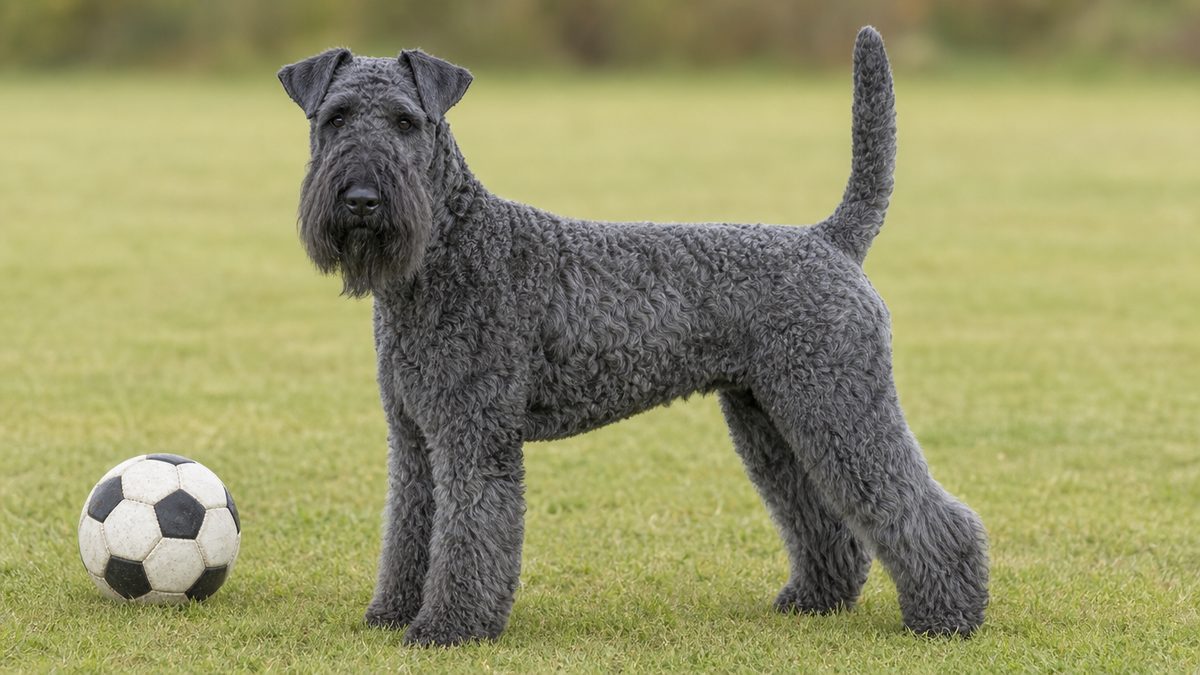
The Kerry Blue Terrier is a medium, long-legged Irish working terrier of 44.5 to 49.5 cm and 15 to 18 kg, carrying a soft, dense, wavy coat in any shade of blue. It is not a small dog, it is not a wire-coated dog, and it is not a low-maintenance one.
The Federation Cynologique Internationale holds it as standard number 3, in Group 3 Terriers, Section 1 Large and medium sized Terriers, without working trial, with the current text published on 19 April 2005. That standard gives dogs 45.5 to 49.5 cm and 15 to 18 kg, and bitches 44.5 to 48 cm with weight proportionately less. The American standard puts the ideal at 18.5 inches at the withers and the most desirable weight at 33 to 40 pounds, and sets hard limits of 20 inches for a dog and 19.5 for a bitch.
The FCI describes the job it was built for in one sentence: "Used in the hard job of tackling otters in deep waters, to engage badger underground and hunt vermin. A good watch dog and loyal companion";. Purina India adds the Irish version of the story, that peasants developed the Kerry as an answer to nobility using Irish Wolfhounds to guard hunting grounds, and that the dog let them hunt those grounds quietly. Treat that as tradition rather than record. The FCI's own historical note is more careful and says the first probable literary reference dates from 1847, describing a bluish slate-coloured dog marked with darker blotches, and that few references exist before the twentieth century.
The coat is the whole animal
Both standards make coat texture a scoring matter rather than a preference. The FCI asks for hair that is "Soft, plentiful, and wavy" and faults a "Hard, wire or bristle coat";. The AKC goes further and says a harsh, wire or bristle coat "should be severely penalized";. That single line decides your Indian grooming bill, because a soft dense coat that does not shed itself clear has to be combed and cut instead.
Colour is the other rule, and it moves with age. Coat clearing is the process by which a puppy that looks black at birth becomes mature blue-grey, passing through very dark blue and through shades and tinges of brown on the way, and the time it takes varies with each dog. The FCI permits black only up to 18 months, as it permits a shade of tan. The AKC turns the same fact into a disqualification: a black dog aged 18 months or older is disqualified, and white markings on such a dog do not count as clearing.
A near-black Kerry Blue puppy is normal and expected. A near-black two-year-old is not a rare colour variant, it is a dog that failed to clear, and under the American standard it cannot be shown. Nobody selling you one in India will mention this, because the clearing rule appears on none of the pages ranking for the breed here.
Two details in the standard that matter in India
Two lines in FCI standard 3 collide with Indian law, and both are worth reading before you buy. The first is the tail: "Thin, well placed and carried erect and gaily";. The American text is similar, asking for a tail set on high, of moderate length, carried gaily erect. Neither standard uses the word docked. So an undocked Kerry Blue is fully correct, which matters because docking is forbidden in India.
The second is the feet. Both standards require black toenails, and the AKC asks for feet "strong, compact, fairly round and moderately small, with good depth of pad free from cracks, the toes arched, turned neither in nor out, with black toenails". The FCI lists "White or bone coloured toe nails" as a fault. Hold that thought: the health section returns to it, because black-nailed, dark-coated dogs of this size are exactly the group with a raised risk of nail-bed cancer.
The FCI also faults "Dewclaws on hind legs, or marks of their removal";. That is a fault a breeder in India cannot lawfully correct, and the legal section below explains why.
Names, and why they matter to a search
The breed answers to three names, and the literature splits across them. Dog Breeds List records the alternatives as Kerry and Irish Blue Terrier, and Purina India gives Irish Blue Terrier as the also-known-as. We searched PubMed under all of them before saying anything about the breed's literature, because a zero on one name is not a zero. The phrase "Kerry Blue Terrier" returns 17 records, the looser combination returns 21, and "Irish Blue Terrier" returns a single record that is already inside the larger set.
Kerry Blue Terrier price in India, and the division that explains it
There is no verifiable Kerry Blue Terrier price in India, and the figure everyone quotes is an American price with a division done to it. Pet House NCR's table gives an average of Rs 1,48,000 and a range of Rs 88,800 to Rs 1,85,000. Divide each by 74 and you get exactly 2,000, 1,200 and 2,500 US dollars.
That would be a coincidence worth ignoring if it happened once. It does not. We tested every rupee figure in that 155-breed table, 462 of them across averages and ranges, against four exchange rates. 453 of 462 divide to an exact whole number of dollars at 74.00. None divides at 84.38. Two hundred and six appear to divide at 80.00, which proves nothing, because 1,000 divided by 80 is 12.5 and any figure ending in three zeros passes at that rate by construction.
| Figure as printed | Divided by 74.00 | Divided by 84.38 | Verdict |
|---|---|---|---|
| Rs 1,48,000 average | USD 2,000.00 | USD 1,753.97 | Exact at 74 |
| Rs 88,800 floor | USD 1,200.00 | USD 1,052.38 | Exact at 74 |
| Rs 1,85,000 ceiling | USD 2,500.00 | USD 2,192.46 | Exact at 74 |
The source of the dollars is on the same results page
Dog Breeds List sits at position five in the Indian result set for this term, two places above Pet House NCR at ten. Its Kerry Blue Terrier page prints "Puppy Prices: Average $2000 - $2500 USD" and adds that an average pup "can easily go for around $2,000";. The Indian ceiling of Rs 1,85,000 is that page's 2,500 dollars. The Indian average of Rs 1,48,000 is its 2,000 dollars. A buyer in Chennai comparing the two tabs is reading one number twice.
The nine figures that refuse to divide are the tell
The strongest evidence is not the 453 that matched. It is the nine that did not. Every failing figure belongs to an Indian breed: the Indian Pariah Dog at Rs 2,000, the Rajapalayam at Rs 15,000 with a range of Rs 9,500 to Rs 20,000, the Indian Spitz at Rs 15,000 with Rs 4,000 to Rs 20,000, and the Caravan Hound at Rs 11,000 with a ceiling of Rs 12,000. Their quotients at 74 are 27.03, 202.70, 128.38, 270.27, 54.05, 148.65 and 162.16, which are not prices anybody quotes.
One further detail settles it beyond argument. The Caravan Hound's floor is printed on the live page as Rs 8,ooo, with two lowercase letter o's where the zeros should be. A script converting a dollar list does not make that mistake. A person typing local breeds into a converted table does.
In the same table, nineteen unrelated breeds carry an average of exactly Rs 74,000, which is 1,000 US dollars, and thirteen more carry exactly Rs 1,48,000, which is 2,000. The Kerry Blue Terrier sits in that second group alongside the Irish Wolfhound, the Goldendoodle, the Staffordshire Bull Terrier and the Tibetan Terrier. Those are not five market rates. They are one American number, converted once.
What the marketplaces are actually offering you
Two Indian puppy marketplaces rank first and second for this term, and neither holds the breed. Puppiezo's Kerry Blue Terrier page carries an "Other Available Pets" carousel of eight animals: two Maltipoos named Fizey and Samy at Rs 98,999, two Poodles named Kuzo and Dugu at Rs 92,599, a Cane Corso named Kazuka at Rs 94,999, a Goldendoodle named Doir at Rs 1,20,000, a Rottweiler named Tugi at Rs 76,499 and a Doxiepoo named Yoki at Rs 98,999. None of the eight is a Kerry Blue Terrier.
Mr n Mrs Pet does the same thing with different furniture. Its Kerry Blue Terrier page prints "3 Result Found", then shows a Bernese Mountain Dog in Pune, a Newfoundland in Jaipur and a French Bulldog in Madurai under the heading "Similar breeds at other locations";. Its own Most Popular Breeds counter runs from Shih Tzu at 650 down to Cane Corso at 134, and the Kerry Blue appears nowhere on it.
Asia Pets is the one ranking page that prints a different band, Rs 40,000 to Rs 80,000. Those two figures divide at a flat 80 to give 500 and 1,000 dollars, which are numbers a seller might genuinely print, so we cannot call that one converted with confidence. What we can say is that it disagrees with Pet House NCR by more than a lakh at the top, that it attaches no source, and that it sits on a site whose own Kerry Blue listing page we could find no dog on.
So the honest answer to the price question has three parts. No Indian breeder we could verify holds this breed. The rupee figure ranking first for it is a dollar figure. And the money you will actually spend is not the purchase price at all, which is what the next section is for.
What a Kerry Blue Terrier costs to keep in India each month
Grooming is the monthly cost that defines this breed, and no other line comes close. A breed-specific haircut runs Rs 1,349 to Rs 1,599 in Gurugram and a full groom Rs 1,849 to Rs 2,199, and this coat needs one every four to six weeks for the dog's entire life.
Work that out and the arithmetic is uncomfortable. At a full groom every five weeks you are paying for roughly 10.4 sessions a year. At the Gurugram floor of Rs 1,849 that is about Rs 19,200 a year, and at the ceiling of Rs 2,199 about Rs 22,900. Spread monthly, grooming cost alone lands between roughly Rs 1,600 and Rs 1,900 before you have bought a single kilogram of food. A wider Indian survey puts a medium dog's full groom at Rs 1,200 to Rs 2,000 and notes Bengaluru medium breeds start around Rs 2,000, so the Gurugram figures are not an outlier.
| Item | Published Indian range | Frequency | Rough monthly equivalent |
|---|---|---|---|
| Full groom, bath plus cut plus nails plus ears | Rs 1,849 to Rs 2,199 | Every 4 to 6 weeks | Rs 1,600 to Rs 1,900 |
| Breed-specific haircut only | Rs 1,349 to Rs 1,599 | Alternative to the above | Rs 1,170 to Rs 1,380 |
| Nail trimming | Rs 299 | Every 3 to 4 weeks if not bundled | Rs 300 |
| Ear cleaning | Rs 299 to Rs 400 | Monthly in the monsoon | Rs 300 to Rs 400 |
| Medicated or anti-tick bath | Rs 1,000 to Rs 1,500 | As advised, seasonal | Varies |
| De-matting surcharge | Charged extra, amount not published | Whenever brushing has been skipped | Avoidable |
The first year, and what it is not
First-year veterinary costs are the one part of Indian dog ownership with well-published rupee figures. A full core puppy vaccination course across the first 16 weeks runs Rs 3,000 to Rs 6,000, made up of DHPPi doses at Rs 500 to Rs 1,200 each and an anti-rabies dose at Rs 300 to Rs 600, with a consultation or injection charge of Rs 300 to Rs 800 on top of each visit. The annual booster afterwards is one DHPPi plus one rabies, usually Rs 1,000 to Rs 2,000 all in.
Set that against the alternative. The same vet-reviewed guide puts a parvo hospital stay at Rs 15,000 to Rs 50,000, which is between three and sixteen times the whole first-year vaccine bill. Skipping the course to save money is the most expensive saving available to an Indian dog owner.
The final puppy dose has to land at or after 16 weeks whatever came before it, because the mother's fading antibodies can quietly neutralise an earlier shot, and an unfinished pup should stay off unknown ground until about a week after that last booster. Indian law expects something similar of breeders: paragraph 8(9) of the 2017 Rules says all pups shall be vaccinated starting at seven to eight weeks and usually completed at eighteen weeks.
Two costs specific to this breed that budgets miss
The first is dental. The Kerry Blue is one of very few breeds with published segregation analyses of missing teeth, and the 2017 Rules name "two or more missing teeth" among the genetic defect items a breeding dog must have been tested for. A dog with a reduced premolar formula is not in pain, but it changes what your vet will want to look at, and it is a reason to have the mouth examined properly rather than glanced at.
The second is surgery. Factor XI deficiency in this breed produces a mild tendency to post-traumatic and post-operative bleeding in both homozygous and heterozygous dogs, and the index case in the published series needed fresh-frozen plasma on four consecutive days to control haemorrhage after an operation. Routine Indian surgery, including the sterilisation that Rule 8(1)(b) requires before a dog over six months is sold, is the moment that matters. Ask your vet to run a coagulation profile before any elective procedure, and budget for it.
An honest bottom line
Bonbeno will not print a single monthly figure for this breed, because the two largest variables are things we cannot verify for you: what your city's salon charges for a scissored terrier trim, and whether your dog inherits a bleeding tendency. What we can say with sources is that grooming will cost you between roughly Rs 1,200 and Rs 1,900 a month for life, that the first-year vaccination course is Rs 3,000 to Rs 6,000, and that neither figure is the number on the marketplace page you arrived from.
If those recurring costs look large next to a purchase price you saw quoted, that is the correct reaction. The purchase price was a converted American figure. The grooming bill is real, it is Indian, and it arrives every month.
How rare the Kerry Blue Terrier really is, and where it is registered
The Kerry Blue Terrier is a Royal Kennel Club vulnerable native breed, and its British registrations fell from 168 in 2016 to 57 in 2025, a drop of 66.1 percent The Royal Kennel Club. That is the number an Indian buyer should hold in mind when a marketplace claims to stock it.
The Royal Kennel Club splits its rarity table into two tiers. Breeds in the main vulnerable section register at or below roughly 300 dogs a year; a second block headed "AT WATCH" holds breeds approaching that line. The Kerry Blue Terrier sits in the first block, alongside the Bedlington Terrier, the Dandie Dinmont, the Glen of Imaal Terrier, the Manchester Terrier and the Soft Coated Wheaten Terrier. The Irish Terrier, by contrast, sits in the At Watch block at 308.
| Year | Registrations | Year | Registrations |
|---|---|---|---|
| 2016 | 168 | 2021 | 156 |
| 2017 | 152 | 2022 | 122 |
| 2018 | 117 | 2023 | 96 |
| 2019 | 108 | 2024 | 77 |
| 2020 | 161 | 2025 | 57 |
We checked the cells rather than trusting them
Bonbeno treats Kennel Club registration figures as contested, because its own documents have disagreed with each other before. So we compared the Kerry Blue Terrier's numbers across three separate Royal Kennel Club publications, and the result is worth reporting plainly: all three agree, cell for cell, on all ten years. The ten-yearly Terrier group table and the vulnerable-breeds table print the identical row, and the quarterly table's four 2025 quarters read 5, 23, 7 and 22, which sum to exactly 57 and match the annual figure in both other documents The Royal Kennel Club.
That agreement is not universal in the same group, and we found the disagreements while looking. The ten-yearly Terrier table gives the Dandie Dinmont Terrier 123 in 2021 while the vulnerable-breeds table gives 124, and it gives the Soft Coated Wheaten Terrier 277 in 2021 while the vulnerable-breeds table gives 227, a 50-dog gap. Both documents are Royal Kennel Club PDFs, both are current, and we cannot tell you which is right The Royal Kennel Club.
The ten-yearly Terrier table prints a 2023 group total of 18,211. Its own 27 breed rows sum to 18,209. Every other column in the table balances exactly, so the defect is confined to one cell in one year. We extracted the PDF with pypdf rather than a web parser precisely so the rows could be counted The Kennel Club, Breed registration….
The breed's collapse against its own group
The Terrier group as a whole fell from 19,436 registrations in 2016 to 14,963 in 2025, down 23.0 percent. The Kerry Blue fell 66.1 percent over the same decade, nearly three times as fast. Only the Soft Coated Wheaten Terrier, down from 326 to 92, and the Australian Terrier, down from 44 to 12, fell comparably hard. The Jack Russell Terrier is the only breed in the group that clearly grew, from 150 to 503.
So the Kerry Blue is not merely uncommon. It is contracting faster than the terrier world around it, in the country that has the most of them outside Ireland. A breed registering 57 dogs a year in Britain does not have a surplus to export, and that is the structural reason no Indian supply exists.
Is it KCI registered, and what does that mean
The Kennel Club of India route is checkable, but not the way most buyers assume. The Kennel Club of India publishes no breed list of its own, so asking whether a breed appears on one returns nothing for every breed and proves nothing. The FCI's members register, though, lists India as a full member represented by the Kennel Club of India at Anna Nagar, Chennai. A KCI registered pedigree is therefore issued against FCI nomenclature, and FCI standard 3 is the document a Kerry Blue would be judged against in an Indian ring.
Read a marketplace's KCI claim in that light. "KCI registered" describes paperwork, not a health screen, not a temperament assessment and not proof the animal in the photograph is the animal you will receive. When two of the sites making that claim for this breed have no Kerry Blue Terrier on the page at all, the claim is doing no work Mr n Mrs Pet, Kerry Blue Terrier Puppies….
American popularity tells the same story from another angle. Dog Breeds List records the breed's AKC rank sliding from 124th in 2015 to 146th in 2022, moving in one direction across eight straight years. This is a rare dog everywhere, and India is not the exception.
Heat tolerance: County Kerry against seven Indian cities
Heat tolerance is this breed's weakest point, and the gap is 18.14 degrees Celsius. NASA POWER queried at Killarney's own coordinates returns an annual mean air temperature of 9.81 degrees against Chennai's 27.95. Chennai's coolest month is warmer than Killarney's hottest.
We queried NASA POWER by explicit latitude and longitude rather than by place name, because place-name climate lookups have served this project six wrong documents. POWER returns a grid cell rather than a point, so the cell elevation each query reported is printed beside every place below and checked against the real town.
| Place | Cell elevation, m | Annual mean, C | Hottest month mean, C | Annual humidity, % | Warmer than Killarney by |
|---|---|---|---|---|---|
| Killarney, Co. Kerry (52.0599 N, 9.5044 W) | 142.94 | 9.81 | 14.73 (July) | 88.98 | baseline |
| Tralee, Co. Kerry (52.2713 N, 9.7016 W) | 30.07 | 11.13 | 15.32 (August) | 84.80 | 1.32 C |
| Cork (51.8985 N, 8.4756 W) | 142.87 | 9.71 | 14.82 (July) | 89.54 | -0.10 C |
| Bengaluru | 841.72 | 23.74 | 28.37 (April) | 67.94 | 13.93 C |
| Pune | 635.99 | 23.86 | 28.93 (April) | 66.80 | 14.05 C |
| Delhi | 206.37 | 25.60 | 35.88 (June) | 45.56 | 15.79 C |
| Kolkata | 7.35 | 25.81 | 31.53 (May) | 73.93 | 16.00 C |
| Hyderabad | 494.59 | 26.10 | 33.30 (May) | 60.30 | 16.29 C |
| Mumbai | 97.15 | 26.77 | 31.19 (May) | 67.39 | 16.96 C |
| Chennai | 48.95 | 27.95 | 31.51 (May) | 72.39 | 18.14 C |
Two things the elevation column is doing
The elevation column is not decoration. POWER reports a cell mean, and in hilly ground that can miss the town underneath by a long way. Killarney's cell sits at 142.94 m against a town elevation near 30 m, about 113 m high, which at the standard lapse rate of 6.5 degrees per 1,000 m makes the returned figures roughly 0.7 degrees cooler than the town itself. Tralee's cell, at 30.07 m against a town near 10 m, is essentially the town.
Cork's cell repeats a finding a sibling Bonbeno page recorded independently, and reproduces it to the centimetre. Cork's cell sits at 142.87 m against a city elevation near 10 m, about 133 m high, worth roughly 0.9 degrees of correction. We publish the cell value and the correction rather than pretending the model is standing in the city, and we note that the Irish Terrier page reached 142.87 m for Cork on its own query.
The Indian cells behave well, which is the useful half of the check. Delhi's cell is 206.37 m against about 216, Chennai's 48.95 against about 7, Bengaluru's 841.72 against about 920, Mumbai's 97.15 against about 14 and Pune's 635.99 against about 560. Those are plains errors of tens of metres, not the kilometre-scale errors that appear at hill stations.
The comparison that actually decides it
Set Killarney's warmest month against each Indian city's coolest and the argument finishes itself. Killarney's hottest month averages 14.73 degrees. Chennai's coolest month, January, averages 24.09. The gentlest month Chennai offers is 9.36 degrees warmer than the fiercest month the breed's home county produces. Delhi is cooler in winter, at 13.61 degrees in its coldest month, but reaches a June mean of 35.88 and a monthly mean maximum of 48.79.
Humidity does not rescue the comparison, it complicates it. Killarney runs 88.98 percent annual relative humidity, which is higher than every Indian city on the list. The breed is adapted to wet air. What it is not adapted to is wet air at 30 degrees, because a dog sheds heat by evaporation and evaporation depends on temperature and humidity together. Cool and humid is Ireland. Warm and humid is Chennai, and it is the harder problem.
What to do about it
Hall and colleagues, working from 905,543 UK dogs under primary veterinary care in 2016, found that exertional heat-related illness dominates: 652 of the 879 events with a recorded trigger, 74.2 percent, were exertional, against 113 environmental and 46 from vehicular confinement. The companion paper on the same cohort reports a bodyweight at or above the breed and sex mean carrying an odds ratio of 1.42 with a confidence interval of 1.12 to 1.80.
Two cautions on borrowing those numbers. Hall's over-50 kg band does not apply here, because a 15 to 18 kg terrier is nowhere near it. And we cannot tell you whether the Kerry Blue itself met the papers' inclusion threshold, so we claim only the transferable factor: a Kerry Blue carrying more than its breed mean weight is at raised risk, and the risk is created by exercise rather than by weather alone.
The practical rule follows directly. Walk before sunrise or well after sunset, cancel midday activity rather than shortening it, and treat any Indian afternoon above about 30 degrees as off. This is a heat-sensitive breed doing the wrong job in the wrong climate, and the fix is scheduling, not equipment.
Temperament, and who should not buy one
The Kerry Blue Terrier is a confident, vocal, dog-aggressive working terrier that guards, and those four words decide whether it fits your household. Purina India rates it a dog for experienced owners, chatty and vocal, a guard dog that barks and alerts, and one that may require socialisation training to live with other pets or with children.
Start with the trait that ends most Indian purchases. Dog Breeds List scores the breed 2 out of 5 for dog friendliness and 2 for cat friendliness, against 4 for child friendliness and 5 for watchdog ability, and says plainly that the dog "is apt to be aggressive toward other dogs and small animals" and "must be trained to ignore its natural inclination to fight other dogs";. Asia Pets lists "Can be dog-aggressive" as the first of its five stated drawbacks and scores strangers and other pets 2 out of 5 each.
Now put that dog in an Indian apartment block. A shared lift, a shared stairwell and a society garden mean unplanned close-quarters meetings with other dogs several times a day, initiated by neither owner. That is the single hardest environment you could pick for a breed with this trait, and it is where most Indian Kerry Blue ownership would actually happen.
The noise problem is documented, not speculative
Purina India is unusually direct about it. The breed is "better suited to a quieter home or more rural environment", and "the constant stimulation in a busy, city or town household may well result in a very loud, stressed dog who cannot relax";. Dog Breeds List rates barking tendencies 4 out of 5 and describes them as "Frequent";. Puppiezo's own spec card, on the page selling the breed, rates barking toward the loud end of its scale.
In a standalone house with a garden that is a feature. In a flat sharing a wall with two neighbours it is a complaint, and in many Indian housing societies a complaint is the beginning of a rehoming.
What the breed is good at
The positive case is real and specific. The FCI describes "Terrier character throughout" with a keen, alert expression as the all-important factor. Purina India calls the breed fierce, intelligent, charming and trustworthy, an independent thinker, and notes it was built as an all-round farm dog that guarded, killed vermin and went into water after otters. Dog Breeds List rates adaptability 5 out of 5, watchdog ability 5, and places the breed 35th on its intelligence ranking.
So this is a clever, biddable-when-convinced, genuinely protective dog that will alert you to anything unusual and will not back down from a perceived threat. If that is what you want, and you have the space, it delivers.
Children, and the honest version
The two best sources disagree here, and the disagreement is worth publishing rather than averaging. Dog Breeds List rates the breed 4 out of 5 with children and calls it "a suitable breed for kids" that is playful, energetic and affectionate around them. Purina India takes the opposite view and places it with "families without children or with older teenagers", warning it "is unlikely to tolerate the wobbliness of toddlers or the noise of babies well";.
Both can be true of different dogs, and the useful reading is the split itself. A well-socialised adult Kerry Blue in a calm home is good with children who know how to behave around a dog. The same dog in a loud flat with a toddler is being asked for something the breed does not reliably give. Purina's version is the one to plan around, because it fails safe.
Skip it if you live in a flat, if you already have a dog or a cat, if you have a child under about eight, if this is your first dog, if nobody at home can commit to a groomer every four to six weeks for a decade, or if your daily walk has to happen between 9 am and 6 pm. Each of those is a documented mismatch rather than a preference, and five of the six describe the median Indian metro household.
A stubborn dog, not a disobedient one
Purina India puts the mechanism well: the Kerry Blue is an independent thinker, and "if left untrained may make decisions by themselves that lead owners into trouble";. That is not defiance. It is a dog bred to work at distance from a handler, deciding for itself what to do about a rat, and it means a Kerry Blue with no job invents one. The training section covers what to do about that.
Training a Kerry Blue Terrier in an Indian household
To train a Kerry Blue Terrier, work with positive reinforcement and make every exercise look like the dog's own idea. Purina India puts it exactly that way: they "respond well to positive reinforcement and are quick learners once they believe that what you want from them was their idea in the first place".
Dog Breeds List rates trainability 4 out of 5 and calls it easy training with one condition attached: "Its handler must be very confident";. Read those two sources together and the picture is consistent. This is not a hard dog to teach. It is a hard dog to boss, and an owner who tries force gets a stubborn standoff instead of a trained terrier.
The three jobs, in order
- Socialise to other dogs first, and treat it as the priority above every other exercise. This is the trait most likely to end the placement in an Indian flat, and the window closes early.
- Train a reliable recall second, because a terrier bred to chase vermin will leave you for a squirrel, a cat or a monkey, and Indian streets punish that quickly.
- Screen the environment third by managing lifts, stairwells and society gardens deliberately rather than hoping for the best.
- Verify progress in the situation that matters, not in an empty park, because a dog that ignores another dog at fifty metres has not yet passed the lift test.
Purina India is explicit that "Early socialisation to other dogs, children and livestock is essential", and equally explicit about the limit: "even then, they are unlikely to mix well with cats", and may treat a resident cat as prey outdoors or when their predatory instincts are aroused. Take that seriously. Socialisation reduces the problem; it does not remove it, and no Indian trainer can promise otherwise.
Give it the job it was built for
The most useful training advice for this breed is not obedience at all. Purina India recommends "Any activity that can recreate hunting and catching rats", and specifically names scent-based work: tracking, scent discrimination and man-trailing. Dog Breeds List adds that the breed "has a knack for sports such as catch and agility training";.
That translates well to India, because scent work needs almost no space and no heat. A five-minute find-the-treat game across a flat, run twice a day at 6 am and 9 pm, does more for a Kerry Blue's behaviour than a longer walk in the sun would. It is also the one enrichment that a Mumbai monsoon cannot cancel.
The grooming table is a training venue
One Indian-specific point that no ranking page makes. This dog will stand on a grooming table for an hour, every four to six weeks, for its entire life, and will have scissors near its face and clippers near its feet every time. A Kerry Blue that has not been taught to accept handling turns each of those appointments into a fight, and Indian salons charge extra for a dog that needs extra handling.
So make handling a formal training goal from week nine. Brush the puppy daily for two minutes whether or not the coat needs it. Touch the feet, lift each ear, part the beard, and pay for all of it. The return on that habit is measured in rupees as well as in behaviour.
Indian mornings are quiet in a way European mornings are not. A 5:30 am walk in most Indian metros gives you empty streets, cool air and very few other dogs, which is simultaneously the correct heat management and the ideal setting for early recall and dog-neutrality work. Use it while the puppy is young, because the same street at 8 am is a different training problem.
What not to do
Do not use a shock collar, a prong collar or a physical correction on this breed. Beyond the welfare argument, the practical one is that a confident terrier that decides you are a threat stops cooperating altogether, and Dog Breeds List's own note that it "exhibits very protective behavior, acts fearless toward any aggressor" describes a dog that will not fold. And do not board a poorly socialised Kerry Blue in a busy Indian kennel, where paragraph 23 of the 2017 Rules allows up to twelve adult dogs in one primary enclosure and requires that dogs with a vicious or aggressive disposition be housed separately.
Daily exercise, and what an Indian day actually allows
A Kerry Blue Terrier needs an hour of exercise a day as a floor, and Purina India calls that the bare minimum: "An hour a day of dog exercise, walking and free running is the bare minimum, ideally much more, particularly training that engages the Kerry Blue's exceptional brain".
Puppiezo's own spec card on the page selling the breed gives a shorter figure, 45 to 60 minutes a day with a high energy level, and names a farmhouse as the ideal space. Dog Breeds List rates exercise needs 4 out of 5 and describes a sporty dog that enjoys long walks. Take the higher figure and plan for at least an hour.
The Indian problem is not the hour. It is which hour. The climate table above puts Chennai's May mean at 31.51 degrees and its monthly mean maximum at 42.70, Delhi's June mean at 35.88 against a monthly mean maximum of 48.79, and Kolkata's May mean maximum at 46.81. A dog adapted to a July mean of 14.73 degrees cannot work in any of that.
| City | Hottest month mean, C | Monthly mean maximum, C | What this means in practice |
|---|---|---|---|
| Bengaluru | 28.37 (April) | 40.38 | The most workable large Indian city for this breed, still 13.93 C above Killarney |
| Pune | 28.93 (April) | 43.20 | Workable early morning; afternoons off from March to May |
| Mumbai | 31.19 (May) | 44.91 | Humidity is the limiter, not the peak; evaporative cooling fails first |
| Chennai | 31.51 (May) | 42.70 | Hardest of the seven; even January averages 24.09 C |
| Kolkata | 31.53 (May) | 46.81 | Hot and humid together, the worst combination for this coat |
| Hyderabad | 33.30 (May) | 45.00 | Dry heat, so shade and water help more than they do in Chennai |
| Delhi | 35.88 (June) | 48.79 | Genuine winter relief at 13.61 C, then four unusable months |
Split the hour, do not shorten it
The evidence points to a specific structure rather than a general caution. Hall and colleagues found that 652 of the 879 UK heat-related illness events with a recorded trigger, 74.2 percent, were exertional, against 113 environmental and 46 from confinement in a vehicle. Heat illness in dogs is overwhelmingly something the dog was doing, not something the weather did to a resting animal.
So the Indian answer is two short outings rather than one long one, both outside daylight, plus indoor work in between.
- Walk 30 to 40 minutes before sunrise, which in most Indian metros means leaving by 5:30 am in summer.
- Walk 25 to 35 minutes at least an hour after sunset, once pavement stone has released its heat.
- Run 10 to 15 minutes of scent work indoors at midday, which Purina India recommends specifically for this breed.
- Cancel the outdoor session outright when the day's mean is near the city's hottest-month figure above, rather than trimming it by ten minutes.
Fencing, and why it matters more here
Purina India is blunt about containment: the breed "does need a garden with secure fencing, they are agile and determined in pursuit of quarry and will jump over, dig under or squeeze through inferior fencing";. Indian society compounds fail this test routinely, and the quarry is not theoretical. Cats, monkeys, squirrels and free-roaming dogs are all present in the average Indian residential compound, and all of them will move a working terrier through a gap you thought was closed.
That has a second-order health consequence. A loose Kerry Blue meets free-roaming dogs, and free-roaming Indian dogs carry tick-borne infection at high rates: a survey of 525 dogs across four Indian cities found 261, or 49.7 percent, infected with at least one tick-borne pathogen, and found Rhipicephalus or Haemaphysalis ticks on 278 of the dogs examined, 53 percent.
It is the most common Indian instinct with a dense-coated breed and it is the wrong one. The FCI and AKC standards both require a soft, dense, wavy coat and penalise a harsh or wire one severely, and a clipped-to-skin Kerry Blue loses the layer that shades its own skin without gaining meaningful airflow American Kennel Club. Manage heat with timing, water and shade. Manage the coat with scissors, at length.
One last point about the week without exercise. Dog Breeds List notes the breed "can go the occasional week without strenuous exercise";. That is true and it is a trap. A Kerry Blue tolerates a quiet week; it does not tolerate a quiet year, and the failure mode is not obesity but noise, digging and reactivity in a household that has already told you the barking is a problem.
Grooming a soft, dense, wavy coat in Indian humidity
Grooming a Kerry Blue Terrier means combing twice a week and cutting the coat every four to six weeks, forever. Dog Breeds List rates grooming 5 out of 5 and spells out the schedule: the coat "must be brushed daily and trimmed and shampooed every four to six weeks", combed twice a week to prevent mats, with the shape maintained by regular scissoring, usually monthly.
Purina India shortens it to "Requires grooming every other day";. Both agree on the point that matters: this is a coat that has to be maintained by a human, because it does not shed itself clear. The FCI asks for hair that is "Soft, plentiful, and wavy" and faults a hard, wire or bristle coat; the AKC says a wire coat "should be severely penalized" and asks that in show trim the body be well covered but tidy, with the head except for the whiskers, and the ears and cheeks, clear American Kennel Club.
Why Indian humidity makes this harder, not easier
A soft wavy coat mats when it is wet and then dried without being combed through. Killarney runs 88.98 percent annual relative humidity and the coat evolved there, but Irish humidity comes at 9.81 degrees, where a wet dog dries slowly and cleanly. Indian monsoon humidity comes at 27 to 31 degrees, where a wet coat is a warm, closed, damp environment against the skin for hours.
That has two consequences an Indian owner should plan for. Mats form faster in the monsoon than in the dry season, particularly behind the elbows, under the ears and in the beard. And the ear canal, sitting under a small V-shaped ear "carried forward close to the cheeks", stays damp after every bath and every wet walk.
Breed care written for Ireland or Wisconsin assumes a dog that dries in cool air. In an Indian monsoon it does not. Dry the dog properly with a dryer rather than letting it air dry, plug or protect the ears before every bath, and dry inside the ear afterwards. Indian salons price ear cleaning separately at Rs 299 to Rs 400, which is worth paying monthly through the wet months rather than annually.
The clipping decision, and what it costs
You have three practical routes in India, and they are not equivalent.
| Route | Published Indian cost | What you get | Honest drawback |
|---|---|---|---|
| Full groom at a salon | Rs 1,849 to Rs 2,199 per visit | Bath, cut, nails and ears together, plus a coat and skin check by a trained eye | The highest recurring cost of owning this breed |
| Breed-specific haircut only | Rs 1,349 to Rs 1,599 per visit | The scissored outline the standard describes, without the bundled hygiene work | You still owe nails at Rs 299 and ears at Rs 299 to Rs 400 |
| Learn to clip at home | One-off tools, then your time | Full control of frequency, which matters most in the monsoon | A soft wavy coat is genuinely hard to scissor well, and a bad cut grows out over months |
Whichever route you take, the home half is not optional. Brush and comb right down to the skin twice a week, not just over the surface. A surface brush on this coat leaves the mat underneath and hides it, and Indian salons add a de-matting surcharge precisely for the dog that arrives that way.
The hypoallergenic claim, tested
Three pages ranking in India sell this breed as hypoallergenic. Asia Pets lists "Hypoallergenic" as its first stated advantage and answers its own FAQ with "Yes, their soft, wavy coat does not shed and is considered hypoallergenic". Dog Breeds List prints "Hypoallergenic: Yes";. Purina India writes that "The breed's coat is hypoallergenic but needs regular brushing and trimming";.
The evidence does not support the category. Vredegoor and colleagues measured the Can f 1 allergen across 196 dogs of so-called hypoallergenic breeds against 160 control dogs and found the hypoallergenic group higher, not lower: 2.26 against 0.77 micrograms per gram in hair and 27.04 against 12.98 in coat samples, with no difference in airborne allergen. Their conclusion is that there is no evidence for classifying certain dog breeds as hypoallergenic.
One honest qualification. The Kerry Blue Terrier was not among the breeds that study tested, so we are not reporting a measurement of this dog. We are reporting that the category being sold to you has been tested and did not hold, and that neither the FCI nor the AKC standard says anything at all about shedding or allergens American Kennel Club. Note too that Puppiezo's own spec card, on the page selling the breed, prints "Shedding: YES (minimal)";.
If someone in your household has a dog allergy, the correct step is an allergy consultation and time spent with an adult Kerry Blue before any commitment, not a premium paid for a label.
Health issues, lifespan and what the screening data actually says
The Kerry Blue Terrier's median lifespan is 12.4 years, not the 13 to 15 every Indian page repeats. McMillan and colleagues, working across 155 recognised purebreds, give a median survival of 12.4 years with a 95 percent confidence interval of 11.9 to 13.0, computed on 168 recorded deaths McMillan KM, Bielby J, Williams CL.
Purina India prints 13 to 15 years, Dog Breeds List 12 to 15, Asia Pets 12 to 15 and Puppiezo 12 to 15 Dog Breeds List, Kerry Blue Terrier breed… Asia Pets, Kerry Blue Terrier breed… Puppiezo, Kerry Blue Terrier Puppies…. None cites a study. The measured figure is lower than all four, and the confidence interval's upper bound of 13.0 sits at or below the floor of every one of them.
One check before quoting that median
We ran a specific test before publishing it, because that paper's Table S5 silently merges some breeds. Its phylogeny reclassification column folds separately recognised breeds into a single row: the Wire Fox Terrier's row absorbs both Fox Terrier varieties, and the Irish Setter's row absorbs the Irish Red and White Setter, which is why that breed's Bonbeno page carries no median at all. The Kerry Blue Terrier's row reads NA in that column, so its 12.4 years is a genuine single-breed figure and can be quoted as one.
A second check, on the sample size. Table S3 gives the breed 368 dogs; Table S6 gives 222 alive plus 168 deceased for a total of 390. The two disagree by 22 and we cannot reconcile them. The death count is 168 in both, which is why the sentence above is built on deaths rather than on either N. The paper also carries an Author Correction, which changes only a Miniature Dachshund figure in a figure legend and touches nothing here.
For context, that paper's crossbred median is 12.0 years on 72,445 deaths, and the Kerry Blue's hazard ratio against crossbreds is 0.93 with a confidence interval of 0.80 to 1.08 and a p-value of 0.31. In plain terms, a Kerry Blue is not measurably longer-lived than a mixed-breed dog. Among Ireland's own terriers it sits second from the bottom: the Soft Coated Wheaten reaches 13.7 years, the Irish Terrier 13.5 and the Glen of Imaal Terrier 12.1. The same UK dataset family also publishes annual life tables for companion dogs, which is the right place to look for age-specific expectancy rather than a single median.
The screening numbers, read from OFA's own tables
We read the Orthopedic Foundation for Animals figures from the rendered statistics tables, after taking the breed code out of OFA's own markup rather than guessing it. OFA lists the Kerry Blue Terrier under KT, which is confirmable in the raw attribute `value="KT" data-name="KERRY BLUE TERRIER"`. A guessed two-letter code returns another breed's table with nothing that looks wrong.
| Database | Evaluations | Result | All-breeds row for comparison |
|---|---|---|---|
| Hips | 1,930 | 93.8% normal (Excellent 14.7, Good 64.8, Fair 14.4), 5.3% dysplastic | 84.3% normal, 14.2% dysplastic |
| Elbows | 322 | 90.7% normal, 9.3% dysplastic (Grade I 8.7, II 0.6, III 0.0) | 87.8% normal, 12.0% dysplastic |
| Patella | 66 | 100.0% normal | 96.5% normal |
| Congenital cardiac | 58 | 100.0% normal | 98.9% normal |
| Thyroid | 122 | 91.8% normal, 7.4% in the final column | 84.8% normal, 10.0% |
| Eyes, summary line | 273 | 97.4% normal, 2.6% abnormal | 93.4% normal |
| Degenerative myelopathy, DNA | 649 | 53.9% clear, 37.3% carrier, 8.8% at risk | 65.5% clear, 21.3% carrier, 13.2% at risk |
| Von Willebrand disease, DNA | 148 | 89.9% clear, 8.1% carrier, 2.0% affected | 93.3% clear, 5.9% carrier, 0.8% affected |
| Canine multiple system degeneration, DNA | 199 | 98.5% clear, 1.5% carrier, 0.0% affected | 97.9% clear |
| Factor XI deficiency, DNA | 116 | 97.4% clear, 2.6% carrier, 0.0% affected | 97.5% clear, of 118 total |
Three things that table is telling you
Hip dysplasia is not this breed's problem. At 5.3 percent dysplastic across 1,930 evaluations the Kerry Blue is well below the 14.2 percent all-breeds figure, and roughly a fifth of the Glen of Imaal Terrier's 25.2 percent on 436 evaluations. Indian pages that lead with hip dysplasia for this breed are reciting a generic list.
Degenerative myelopathy is worse than average and is the one number in that table that should change a buying decision. At 8.8 percent at risk and 37.3 percent carriers of 649 tested, the breed ranks 22nd of the breeds OFA publishes for this disease. Note carefully what a DNA at-risk result means: it is a genotype, not a diagnosis, and many at-risk dogs never develop signs. Screen for it anyway, because the test is cheap and the result is permanent information.
The eye summary line says 97.4 percent of 273 Kerry Blue Terriers were normal. OFA's own detail table headed NORMAL (OTHER .000) records 227 of 273, which is 83.2 percent. That is a 14.2-point gap on the same denominator. It is not specific to this breed: the same table gives the Soft Coated Wheaten 97.2 against 75.3, the Labrador Retriever 95.7 against 80.2 and the Irish Terrier 91.0 against 70.8. Bonbeno publishes both figures and quotes neither as the rate.
The individual eye findings, all on the same 273 evaluations, are: persistent pupillary membranes iris to iris 11 dogs (4.0 percent), distichiasis 8 (2.9 percent), cataract of unknown significance 7 (2.6 percent), corneal dystrophy 4 (1.5 percent), and three separate punctate cataract categories at 3, 3 and 1 dogs. None of those is alarming on its own. Together they are why an eye examination belongs on the list of things to ask a breeder for.
One arithmetic note on the all-breeds row, because we checked it rather than trusting it. OFA's ALL BREEDS hips line prints 84.3 percent normal with Excellent 14.6, Good 0.0 and Fair 0.0, components that cannot sum to the whole, while every individual breed row sums correctly. Use the breed rows, not the aggregate.
The neurological disease this breed is famous for, and the test that ends it
Canine multiple system degeneration is the Kerry Blue Terrier's defining inherited disease, it kills puppies, and since 2024 there has been a DNA test for it. Signs begin between 9 and 16 weeks of age, and the mode of inheritance is autosomal recessive.
The disease has been described under several names across fifty years, which is why it is easy to miss on a breed page. Older literature calls it hereditary cerebellar cortical and extrapyramidal nuclear abiotrophy, progressive neuronal abiotrophy, hereditary striatonigral and cerebello-olivary degeneration, or simply cerebellar ataxia of the Kerry Blue Terrier. They are the same condition.
What the original description found
de Lahunta and Averill published the defining account in 1976: ten Kerry Blue Terriers from a kennel in New York and three from a kennel in California developed a progressive cerebellar disorder with onset between 9 and 16 weeks of age. Nine sequential necropsies showed progressive cerebellar cortical degeneration with loss of Purkinje cells, and as the disease advanced, bilateral symmetric degeneration of the olivary nuclei followed by degeneration of the substantia nigra and the caudate nucleus. The dogs in the two kennels were related, and the authors proposed autosomal recessive inheritance.
That sequence is what the modern name describes. It is not a cerebellar disease that stays in the cerebellum; it moves into the movement-control nuclei, and the clinical course is one-way.
The gene, and why the 2024 paper matters to a buyer
O'Brien and colleagues mapped the locus in 2005, working from a 51-dog pedigree of Kerry Blue Terriers, Chinese Crested dogs and their crosses. They showed the same fatal disease segregating in both breeds as an autosomal recessive, established that the two breeds' mutations were allelic because affected dogs appeared among first-generation crosses, and narrowed the locus to a 15 Mb segment of canine chromosome 1.
Zeng and colleagues finished the job in 2024. Whole-genome sequencing of an affected dog from each breed found a nonsense variant in exon 15 of SERAC1 in the Kerry Blue Terrier, and a 4 base-pair deletion at the exon 4 acceptor splice site in the Chinese Crested, which causes exon 4 to be skipped. Genotyping large cohorts of both breeds showed complete concordance between genotype and disease phenotype, and only compound heterozygotes from crosses between the two breeds were affected.
Ask for the sire's and dam's SERAC1 results, by name, in writing. Complete genotype-phenotype concordance means a clear-by-parentage or clear-by-test puppy cannot develop this disease. Any breeder who cannot answer that question is not testing, and a recessive disease in a breed registering 57 dogs a year in Britain travels fast through a small gene pool.
What the screening data shows about progress
OFA publishes results for the disease under its own heading, and the Kerry Blue Terrier is the second-ranked breed in that database with 199 dogs tested: 98.5 percent clear, 1.5 percent carriers and 0.0 percent affected. On 199 dogs, 1.5 percent is about three carriers. That is a small number and a genuinely encouraging one, and it is the argument for asking: the test works, breeders are using it, and the disease is being pushed out of the tested population.
Two cautions on reading that. A DNA carrier is a healthy dog that can produce affected puppies only when mated to another carrier, so a carrier result is a breeding decision rather than a health problem. And 199 tested dogs worldwide is a small slice of a small breed, so the true carrier rate in untested lines is unknown.
The human parallel, and why the research continues
Variants in human SERAC1 cause a group of disorders with a range of ages of onset and patterns of signs, all characterised by movement abnormalities similar to the dogs';. The 2024 authors argue canine multiple system degeneration could serve as a model for elucidating SERAC1-deficiency disorders and for evaluating treatments. The 2005 mapping paper had already noted that the target region contains PARK2, the parkin gene, mutations in which cause the commonest familial form of Parkinson's disease.
None of that changes what an Indian owner should do, which is simply to ask for the test result. But it explains why a rare Irish terrier has a better-characterised neurological disease than most common breeds.
What this means if you are buying in India
It means the single most important document is not the KCI paper. It is the SERAC1 result for both parents, and in India you are unlikely to get it, because no Indian breeder we could verify holds this breed at all Mr n Mrs Pet, Kerry Blue Terrier Puppies…. A puppy sold to you as a Kerry Blue Terrier in India, with no parental DNA results, is a dog whose most serious inherited disease you cannot rule out, at a price derived from an American list.
Two bleeding disorders, and why they matter more in India
The Kerry Blue Terrier carries two separate inherited bleeding tendencies, factor xi deficiency and von Willebrand disease, and the surgery that exposes them is one Indian law requires before a dog over six months is sold Prevention of Cruelty to Animals.
Start with the striking fact about the OFA database. Its Factor XI deficiency table holds 118 evaluations across all breeds, and 116 of them are Kerry Blue Terriers. The breed is effectively the entire database, because it is the breed the disorder was described in. Of those 116, 97.4 percent were clear and 2.6 percent were carriers, which is about three dogs.
What the original series found
Knowler and colleagues described the disorder in 1994. The index case was a nine-year-old female Kerry Blue Terrier with postoperative haemorrhage and prolonged activated partial thromboplastin and activated clotting times, and she needed transfusions of fresh-frozen plasma on four consecutive days to bring the clotting values back into range and control the bleeding.
The important line for a buyer is what they found in the other dogs. Data from ten further factor XI-deficient Kerry Blue Terriers with a tendency to mild post-traumatic or postoperative bleeding suggested an autosomal mode of inheritance, with that mild tendency present in both homozygous and heterozygous dogs. A carrier of most recessive disorders is clinically normal. A factor XI carrier in this breed is not necessarily normal, and that is what makes the disorder worth planning around rather than merely testing for.
The authors also note the mechanism plainly: factor XI deficiency is the only contact-phase protein defect that causes a bleeding disorder in animals, because thrombin is more efficient than factor XIIa at activating factor XI.
The second one, which is worse than average
Von Willebrand disease is the more common canine bleeding disorder, and the Kerry Blue's DNA figures are worse than the all-breeds baseline in both directions. Of 148 dogs tested, 89.9 percent were clear, 8.1 percent carriers and 2.0 percent affected, against 93.3, 5.9 and 0.8 percent across all breeds in the same table. Two percent of 148 is about three affected dogs, and 8.1 percent is about twelve carriers.
Two independent bleeding tendencies in one small breed is unusual, and neither appears on any page ranking for this breed in India.
Why India sharpens both of them
The Indian complication is tick-borne disease, because several of the common pathogens destroy platelets. A survey of 525 dogs across four Indian cities found 261, or 49.7 percent, infected with at least one tick-borne pathogen. Ehrlichia canis, whose classic presentation includes thrombocytopenia and bleeding, was found in 20.6 percent (95% CI 17.2 to 24.3). Hepatozoon canis was commonest at 30 percent, Mycoplasma haemocanis 12.2 percent, Anaplasma platys 6.5 percent and Babesia vogeli 5.5 percent. Concurrent infection with more than one pathogen occurred in 39 percent of cases, and potential vector ticks were found on 278 of the dogs examined, 53 percent.
Put the two together. A dog with an inherited mild bleeding tendency, living where half the dog population carries a platelet-consuming infection, has less margin than the same dog in Ireland. That is not a claim about a specific interaction, and no study we found has tested one. It is a claim about margin, and it argues for two concrete things.
- Test for both disorders, or obtain the parents' results, before any elective surgery.
- Ask your veterinarian for a coagulation profile and a platelet count before spaying, neutering, a dental procedure or any dewclaw or lump removal.
- Run year-round tick control rather than seasonal, because the same survey found ticks on 53 percent of dogs examined across four cities.
- Treat prolonged bleeding from a small wound, a nosebleed, or bruising after routine handling as a same-day veterinary matter rather than a curiosity.
Rule 8(1)(b) of the 2017 Rules requires that dogs over six months in age are not sold without first being sterilised, unless they are being sold to another licensed breeder. For most breeds that is straightforwardly good. For a breed with two inherited bleeding tendencies it means the first surgery may happen at a breeder's chosen vet, before you own the dog and before anyone has run a coagulation profile. Ask what was done, by whom, and whether any pre-surgical clotting test was performed.
One more note on Indian law and this breed. The 2017 Rules list the genetic defects a breeding dog must have been tested for, and the list is illustrative rather than closed: it opens "tested for genetic defects, including hip dysplasia, progressive retinal atrophy, night blindness, hypothyroidism, entropion, ectropion, overshot, undershot jaw...". Neither factor XI deficiency nor von Willebrand disease is named. That does not put them outside the clause, because of the word including, but it does mean nobody will ask a breeder for them unless you do.
Two cancers this breed leads, and the one the standard helps cause
The Kerry Blue Terrier is the highest-risk breed for mammary tumour in a Swedish insurance cohort of more than 600,000 dogs, at a relative risk of 4.72 with a 95 percent confidence interval of 2.58 to 7.92. No page ranking for this breed in India mentions it.
Engdahl and colleagues studied dogs insured with Agria in Sweden between 2011 and 2016. The study population was just over 600,000 dogs, and 13,109 females had veterinary care claims for mammary tumours, giving an incidence rate of 157 cases per 10,000 dog-years at risk with a confidence interval of 154 to 160.
Against that background the breed ranking is what stands out. The Kerry Blue Terrier came top at a relative risk of 4.72, ahead of the English Springer Spaniel at 3.32 (95% CI 3.02 to 3.63). At the other end the German Spitz sat at 0.06 and the English Bulldog at 0.07. The median age at first diagnosis across the whole cohort was 8.94 years, with an interquartile range of 7.43 to 10.5, and the Irish Wolfhound was the second-youngest breed at diagnosis at 6.42 years.
The study also found much higher odds of mammary tumour in bitches with a history of pseudopregnancy, at an odds ratio of 2.10, and in those with a history of acute mastitis, at 4.93, both with p-values below 0.001. If you own a female Kerry Blue in India, the reproductive history is not a footnote, it is the risk factor, and the conversation to have with your veterinarian is about spaying and about monitoring the mammary chain from middle age, not from old age.
One honest limit. A relative risk of 4.72 with an interval running from 2.58 to 7.92 is a wide interval, which is what happens when a rare breed contributes few dogs to a large study. The direction is clear and the effect is large; the precise multiplier is not. And it is a Swedish insured population, so it describes a breed's biology rather than an Indian clinic's caseload.
The nail-bed cancer, and the standard that selects for it
Subungual squamous cell carcinoma is a cancer of the nail bed, and it has a strong breed pattern that maps almost exactly onto coat and nail colour. Chiu and colleagues reviewed 278,812 canine biopsy submissions in Canada between 2003 and 2021, including 1,518 subungual squamous cell carcinomas.
| Breed | Odds ratio |
|---|---|
| Giant Schnauzer | 56.7 |
| Standard Schnauzer | 20.3 |
| Gordon Setter | 18.3 |
| Black Standard Poodle | 11.1 |
| Kerry Blue Terrier | 9.4 |
| Rottweiler | 7.0 |
The authors' conclusion names the pattern directly: "Moderately large black, or black and tan, dogs have a marked increase in the prevalence of subungual squamous cell carcinomas";. Now read the breed standards again. The FCI requires "toe nails black" and faults "White or bone coloured toe nails"; the AKC requires feet "with black toenails"; American Kennel Club. The colour that both standards mandate is the colour associated with the risk.
That is not an accusation of negligence, and no study we found has shown the nail pigment itself to be causal rather than a marker for something else. It is a plain observation worth making on a breed page: the phenotype the standard selects for is the phenotype the cancer follows, and a Kerry Blue owner should therefore watch the toes.
The good news in the same paper
The prognosis is much better than the word carcinoma suggests. In that series there were no local postoperative recurrences, and the risk of detecting metastatic disease within five years of diagnosis was very low at 4 percent. The real risk is a second tumour on a different toe: in Giant Schnauzers and black Standard Poodles specifically, the chance of developing additional tumours on additional digits was 56 percent, and the authors advise owners of a large black dog to expect that possibility within two or three years.
So the practical instruction is short. Look at the feet during every grooming session, which for this breed is every four to six weeks anyway. A swollen toe, a lost or deformed nail, a persistent ulcer at the nail bed or a sudden lameness in one digit is a same-week veterinary appointment, not a wait-and-see. Caught early this is a curable cancer, and the Kerry Blue's grooming schedule happens to give you ten inspections a year for free.
What we could not find
We found no Indian study of either cancer in this breed, and we will not substitute one. The literature on the Kerry Blue Terrier is small: a phrase search of PubMed returns 17 records and a looser search 21, and the majority are the neurological papers, the four Russian dental papers and single case reports. Everything above comes from Canada and Sweden, and applies to an Indian dog only in so far as breed biology travels.
Feeding a Kerry Blue Terrier in India, and the teeth nobody checks
Feed a Kerry Blue Terrier twice a day on a complete diet matched to its life stage, and score the body condition monthly rather than watching the bowl. Purina India's guidance is exactly that: a balanced diet with all the main nutrient groups, constant fresh water, regular body condition scores, and at least twice-daily feeding in line with the food's own guidelines.
There is no published Kerry Blue-specific nutritional requirement, and we will not invent one. What the breed does have is a documented dentition problem that changes how you should look at its mouth, and a weight target that matters more than usual because of the heat.
Weight is a heat-risk variable, not a vanity one
Hall and colleagues, on 905,543 UK dogs, found that a bodyweight at or above the breed and sex mean carried an odds ratio of 1.42 for heat-related illness, with a confidence interval of 1.12 to 1.80. That is not obesity; it is simply being on the heavy side of normal for the breed. The FCI puts dogs at 15 to 18 kg and bitches proportionately less, and the AKC's most desirable weight for a fully developed dog is 33 to 40 pounds American Kennel Club.
In an Indian summer that finding turns feeding into heat management. Keeping a Kerry Blue at the lower half of its breed range is one of the few heat interventions an owner fully controls, and it costs nothing.
The dentition finding, which is genuinely unusual
The Kerry Blue Terrier is one of a small number of breeds with published formal genetic analyses of missing teeth. Three Russian studies, all in Genetika, worked the problem through one large pedigree.
- Kniazev and colleagues built a database of 480 individuals from 96 litters and studied premolar oligodontia across inbred and outbred crosses, concluding the anomaly is inherited and needs a search for the responsible genes.
- Aksenovich and colleagues determined dental formulas in 598 of 911 animals united into one large complex pedigree and ran integrated segregation analysis, finding heterogeneous genetic control: absence of the second premolars fits a recessive major-gene model, while agenesis of the fourth premolars does not.
- Zorkaltseva and colleagues then measured the cost of it. Mean litter size was 5.72 puppies when both parents had normal dentition and 3.64 when the parents had hypodontia, a fall of 36.4 percent, and the authors concluded the drop cannot be fully explained by inbreeding and is most probably a pleiotropic effect of the tooth-development genes on embryonic viability.
A dog missing premolars is not in pain and does not need a special diet, but it does chew differently, and the teeth it does have carry more of the work. Ask your veterinarian to count the premolars at the first full examination and to write the formula in the record. It costs nothing at the time and it tells you which teeth to watch over the next decade.
There is an Indian legal angle too, and it is sharper than it looks. The 2017 Rules list the genetic defects a breeding dog must have been tested for, and that list explicitly names "two or more missing teeth"; alongside overshot and undershot jaw and wry mouth. So the one breed with a published segregation analysis of missing premolars is a breed whose Indian breeders are, on the face of the Rules, required to have tested for exactly that.
Life stages, plainly
| Stage | Meals a day | What to watch |
|---|---|---|
| 8 weeks to 4 months | 3 to 4 | Steady growth, formed stools, and a puppy that is neither ribby nor round |
| 4 to 12 months | 2 to 3 | Growth slowing; do not overfeed to "finish" a terrier that is meant to be lean and muscular |
| Adult, 1 to 8 years | 2 | Body condition monthly; keep to the lower half of the 15 to 18 kg range through summer |
| Senior, 8 years and over | 2 | Weight, dental comfort, and the mammary chain in an entire bitch |
Two Indian practicalities that apply to any dog and matter here. Fresh water has to be genuinely constant in an Indian summer, refilled rather than topped up, because a bowl that sits all day in 35-degree air grows biofilm. And deworming runs on its own clock rather than the vaccination clock, starting at two to three weeks of age and repeating more often through the first months, because worms are near-universal in Indian pups.
Finally, do not free-feed this breed. A terrier that decides mealtimes are negotiable becomes a terrier that guards the bowl, and Dog Breeds List already rates it 5 out of 5 for watchdog ability and describes very protective behaviour. Two fixed meals, picked up after fifteen minutes, is the simplest structure that avoids the argument.
Month by month through the first year
The Kerry Blue Terrier's first year has three dates that matter more than the rest: the eight-week floor for legal sale, the 16-week close of the core vaccination course, and the 9 to 16 week window in which the breed's inherited neurological disease first shows de Lahunta A, Averill DR Jr. Hereditary….
Those three overlap, which is the point of setting them out together. The weeks in which you are collecting a puppy, finishing its vaccinations and starting its socialisation are the same weeks in which canine multiple system degeneration would begin, if the parents were untested.
| Age | What happens | What you do |
|---|---|---|
| 2 to 3 weeks | First deworming, at the breeder | Ask for the deworming record when you collect |
| 6 to 8 weeks | First DHPPi dose; Indian law's floor for sale | Rule 8(1)(a) says pups less than eight weeks in age are not sold. Walk away from an earlier offer |
| 9 to 16 weeks | The window in which cerebellar signs would appear if present | Watch for wobbliness, a wide-based stance, head tremor or overstepping. Any of these is a same-day veterinary visit |
| 9 to 11 weeks | Second DHPPi booster | Start handling training: feet, ears, beard, two minutes daily |
| 12 to 14 weeks | Third DHPPi plus first anti-rabies | Begin controlled dog-to-dog socialisation with known, vaccinated adults |
| 14 to 16 weeks | Final puppy booster; anti-rabies completed | Keep off unknown ground until about a week after this dose |
| 4 to 5 months | Coat begins its long clearing from black toward blue | First salon visit, short and positive, before the coat needs real work |
| 6 months | Rule 8(1)(b) sterilisation threshold for sale | Before any elective surgery, ask for a coagulation profile |
| 6 to 9 months | Adolescent testing of boundaries; reactivity to other dogs often appears here | Do not stop socialisation because the puppy classes ended |
| 9 to 12 months | Adult coat texture settles; grooming moves to its lifelong 4 to 6 week cycle | Lock the grooming budget in: Rs 1,349 to Rs 2,199 a visit |
| 12 to 24 months | Coat clearing completes for most dogs | A dog still black at 18 months is disqualified from the AKC ring |
The eight-week rule, and which clause it lives in
Indian law sets the floor precisely, and it is worth citing correctly because two different numbering systems run through the same document. The eight-week minimum is Rule 8(1)(a) of the Prevention of Cruelty to Animals (Dog Breeding and Marketing) Rules, 2017, headed "Conditions for sale", which states that every breeder shall ensure that "pups less than eight weeks in age are not sold";. The same document also has a Second Schedule paragraph 8, which is a different provision about veterinary care, so the clause number alone is ambiguous unless you say which.
The vaccination requirement sits in that second numbering system: Second Schedule Part III paragraph 8(9) says all pups shall be vaccinated, which can start at seven to eight weeks and is usually completed at eighteen weeks.
de Lahunta and Averill's thirteen affected Kerry Blue Terriers all developed signs between 9 and 16 weeks of age, and the course was progressive with loss of Purkinje cells followed by degeneration of the olivary nuclei, substantia nigra and caudate nucleus. A puppy that is unsteady, that places its feet too wide, that overshoots when it reaches for a bowl, or that tremors when it concentrates, needs a veterinary neurological examination immediately. This is the reason the SERAC1 result for both parents is the single most valuable document a Kerry Blue breeder can give you.
What the first year costs, roughly
Two published Indian figures anchor it. The core vaccination course across the first 16 weeks runs Rs 3,000 to Rs 6,000 all in, with consultation or injection charges of Rs 300 to Rs 800 on top of each visit. Grooming begins somewhere between four and six months and runs Rs 1,349 to Rs 2,199 a visit thereafter, which over the back half of the first year is perhaps six visits.
Everything else, food, a crate, a lead, parasite control and the sterilisation, is common to any 15 to 18 kg dog in India and is not breed-specific, so we do not put a Kerry Blue number on it.
One habit to build in the first year and keep for the next twelve
Handle the feet every single grooming session and look at each nail bed. The breed carries an odds ratio of 9.4 for subungual squamous cell carcinoma, a cancer with an excellent prognosis when caught early and no local recurrence after removal in the published series. A puppy taught at ten weeks to lie still while somebody holds a paw is an adult you can examine ten times a year without a fight. That is the cheapest health intervention on this page.
Kerry Blue Terrier against the breeds Indian buyers actually cross-shop
An Indian buyer looking at a Kerry Blue Terrier is usually choosing between four dogs: this one, the Irish Terrier, the Airedale Terrier and a Poodle. The Kerry loses on availability to all four and wins on nothing an Indian household needs.
| Measure | Kerry Blue Terrier | Irish Terrier | Airedale Terrier | Soft Coated Wheaten Terrier |
|---|---|---|---|---|
| UK registrations 2025 | 57 | 308 | 420 | 92 |
| UK registrations 2016 | 168 | 326 | 654 | 326 |
| Ten-year change | down 66.1% | down 5.5% | down 35.8% | down 71.8% |
| RKC rarity status | Vulnerable native breed | At Watch | At Watch | Vulnerable native breed |
| Median survival, McMillan 2024 | 12.4 years | 13.5 years | 12.0 years | 13.7 years |
| Deaths that median rests on | 168 | 146 | 556 | 173 |
| OFA hips, % dysplastic | 5.3% of 1,930 | not extracted by us | not extracted by us | 5.0% of 7,801 |
| OFA degenerative myelopathy, % at risk | 8.8% of 649 | not extracted by us | not extracted by us | 18.5% of 480 |
| Coat work | Scissor or clip every 4 to 6 weeks | Hand stripping 2 to 4 times a year | Stripping plus trimming | Trimming every 6 to 8 weeks |
| Findable in India | No | No | Rare | No |
Against the Irish Terrier, its nearest relative in the ring
These two are the long-legged Irish terriers, and the differences that matter are not the ones a photograph shows. The Irish Terrier lives about a year longer, at a median of 13.5 years against 12.4, and both figures come from the same table computed the same way. The Irish Terrier registers five times as many dogs a year in Britain and is only At Watch rather than vulnerable.
The coats differ in cost as well as texture. An Irish Terrier's wiry jacket is hand stripped two to four times a year. A Kerry Blue's soft wavy coat is cut every four to six weeks, which is roughly ten paid appointments a year against three or four. Over a decade in an Indian city that difference is substantial, and it runs entirely in the Irish Terrier's favour.
One thing they share exactly: both carry an Indian price band derived from an American list divided by 74. The Irish Terrier's row on the same Pet House NCR table reads Rs 1,55,400 average with Rs 66,600 to Rs 2,59,000, which divide to 2,100, 900 and 3,500 dollars. Neither breed has an Indian price; both have the same converted one.
Against the Airedale Terrier, the one people confuse it with
A clipped Kerry Blue and a clipped Airedale read similarly in outline to a buyer scrolling a marketplace, and the Airedale is the larger dog and the more findable one in India. But the Airedale's median survival is 12.0 years on 556 deaths, the shortest of the four, against the Kerry Blue's 12.4. If you were choosing on longevity alone the Kerry Blue is marginally ahead, and the confidence intervals overlap, so "marginally" is doing real work in that sentence.
Against a Poodle, which is the honest alternative
Most Indian buyers who reach a Kerry Blue Terrier page arrived because they want a medium, low-shedding, clever dog. A Poodle is that dog, it is genuinely available in India, and its grooming schedule is the same four to six week cycle at the same Indian prices, so the cost is not a differentiator. What differs is temperament: the Kerry Blue scores 2 out of 5 for dog friendliness and 2 for cat friendliness, and is a guarding, vocal terrier bred to fight vermin.
There is one caution on the low-shedding half of that comparison. The black Standard Poodle carries an odds ratio of 11.1 for subungual squamous cell carcinoma, higher than the Kerry Blue's 9.4, and 56 percent of affected Standard Poodles develop a second tumour on another digit. The nail-bed risk is a feature of large dark dogs, not of this breed alone.
The Kerry Blue Terrier's true genetic partner is not a terrier at all. Canine multiple system degeneration has been found in exactly two breeds, this one and the Chinese Crested Dog, and crosses between carriers of the two produced affected compound heterozygotes, proving the mutations are allelic Zeng R, Guo J, Bullock G, Johnson GS. Two breeds that could hardly look less alike share one disease locus.
So the summary is short. If you want an Irish terrier and can find one, the Irish Terrier lives longer and costs less to groom. If you want a low-shedding companion in an Indian flat, a Poodle does the job with a temperament that suits the setting. The Kerry Blue Terrier is the right answer only for a household with space, no other pets, older children, and a genuine attachment to this specific dog.
Indian law and this breed's own standard, where they collide
Two lines in the Kerry Blue Terrier's breed standard describe things Indian law forbids, and one describes something Indian law requires a breeder to test for. The Prevention of Cruelty to Animals (Dog Breeding and Marketing) Rules, 2017 is the instrument, and we read the AWBI gazette copy ourselves rather than a summary of it.
Before the substance, a note on how to cite this document, because it numbers clauses twice and that has produced real errors elsewhere. The Rules themselves run from Rule 1 to Rule 13 and stop there. Everything numbered above 13 is a Second Schedule paragraph, not a Rule. Any citation reading "Rule 21" for this instrument is wrong by construction, and the string appears zero times in the gazette.
One: the tail, which neither standard actually asks you to cut
Second Schedule Part II paragraph 6(8) is the mutilation clause, and its wording is broad: "There shall be no tail docking, ear cropping de-barking, de-clawing, branding, dyeing, injecting substances to enhance visual appeal, performing a surgery or procedure to camouflage or hide any defect or infirmity or any other kind of mutilation of any body part of the pup and any change of appearance by artificial means is strictly forbidden".
Here the standard and the law agree, which is the good news and is worth stating because most breed pages assume otherwise. FCI standard 3 asks for a tail "Thin, well placed and carried erect and gaily" and the AKC for a tail "set on high, of moderate length and carried gaily erect, the straighter the tail the better". Neither text contains the word docked American Kennel Club. An Indian Kerry Blue Terrier with a full natural tail is not a compromise; it is correct under both standards and lawful under the Rules.
Two: the dewclaw, where they do not agree
The FCI lists among its faults: "Dewclaws on hind legs, or marks of their removal";. Read that twice. The standard faults the dewclaw and it faults the evidence of having taken the dewclaw off.
Now set it beside paragraph 6(8), which names de-clawing explicitly and then closes with "any other kind of mutilation of any body part of the pup and any change of appearance by artificial means is strictly forbidden". Removing a hind dewclaw from an Indian-bred puppy to satisfy a show standard is a change of appearance by artificial means, done for appearance.
An Indian-bred Kerry Blue Terrier born with hind dewclaws carries a fault it cannot lawfully have corrected. That is not a loophole to work around; it is the correct outcome, and it is a reason to prefer a line that does not throw hind dewclaws rather than a breeder who removes them. If an Indian seller tells you a puppy's dewclaws were removed "as standard", they have described an offence under paragraph 6(8) Federation Cynologique Internationale.
Three: the jaw, where standard and law point the same way
Second Schedule Part III paragraph 8(10) lists the defects a breeding dog must have been tested for, verbatim: "The dogs shall have been tested for genetic defects, including hip dysplasia, progressive retinal atrophy, night blindness, hypothyroidism, entropion, ectropion, overshot, undershot jaw (when incisors do not touch or mesh), wry mouth, two or more missing teeth, unilateral cryptorchid or full cryptorchid males".
The Kerry Blue's standards agree with every relevant item. The AKC asks for teeth "either level or with the upper (incisors) teeth slightly overlapping the lower teeth" and says "An undershot mouth should be strictly penalized"; the FCI faults "Teeth undershot or overshot"; Federation Cynologique Internationale. On this breed, unlike some, the show ring and Indian law are asking for the same mouth. And "two or more missing teeth" is the item to press on, because this is one of the few breeds with published segregation analyses of missing premolars.
Note the word including. The list is illustrative rather than closed, so a breeder cannot argue that factor XI deficiency or the SERAC1 variant sits outside the clause merely because it is unlisted.
Four: heat, and the clause almost everyone miscites
The outdoor-housing heat clause is Second Schedule Part IV paragraph 21(1), headed "Outdoor housing facilities". It bars keeping in outdoor facilities, without the attending veterinary practitioner's written approval, three categories: "(i) dogs that are not accustomed to the temperatures prevalent in the area or region in question; (ii) dog breeds that cannot tolerate the temperatures prevalent in the area or region in question, such as long-haired breeds in high temperature locations; and (iii) sick, infirm, aged or young animals".
A Kerry Blue Terrier in an Indian summer meets category (i) on the numbers, and arguably (ii). A dog whose home county averages 9.81 degrees a year is not accustomed to Chennai's 27.95. So an Indian breeding establishment housing this breed outdoors needs written veterinary approval, and a buyer visiting a kennel is entitled to ask whether it exists.
What the Rules do not contain
Two absences are worth knowing, because they stop you asking for the wrong document. Across all 14 pages of the gazette, "patella" appears zero times and "dental" appears zero times, and "teeth" appears exactly once, inside paragraph 8(10)'s "two or more missing teeth";. There is no Indian patella-testing requirement and no separate dental requirement. Never let a seller tell you otherwise, and never write that Indian law mandates a patella grade.
Two further provisions worth quoting to an Indian breeder. Paragraph 6(3) prohibits in breeding, defined as breeding between relatives of the second to fourth grade within the first four generations, and incest breeding, defined as mating between parents and children or between brother and sister. Paragraph 6(4) says female dogs shall not be mated after the age of eight years. In a breed registering 57 dogs a year in Britain, the in-breeding clause is the one that bites hardest, because a tiny gene pool is exactly where close matings become tempting.
What Indian owners actually get wrong with this breed
Six mistakes account for most bad Kerry Blue Terrier outcomes in India, and five of them are made before the dog arrives. They are, in order of cost: paying a converted price, skipping the SERAC1 question, buying into a flat, budgeting the purchase and not the grooming, shaving the coat for heat, and treating the hypoallergenic label as a medical fact.
One: paying a rupee figure that is a dollar figure
The most-quoted Indian price for this breed, Rs 1,48,000 with a band of Rs 88,800 to Rs 1,85,000, divides at 74.00 to give exactly 2,000, 1,200 and 2,500 US dollars, and a page ranking in the same Indian result set prints the breed's American price as 2,000 to 2,500 dollars Dog Breeds List, Kerry Blue Terrier breed…. Anyone quoting you a number in that band is quoting an American list, and the only figures on that table that refuse to divide are the four Indian breeds.
Two: not asking for the SERAC1 result
This is the one that costs a puppy rather than money. Canine multiple system degeneration begins between 9 and 16 weeks and is progressive, and a DNA test with complete genotype-phenotype concordance now exists. Ask for both parents' results in writing. A seller who cannot produce them is selling you a dog whose worst inherited disease is unresolved, and the two marketplaces ranking for this term hold no Kerry Blue Terriers at all, so there is nobody to ask Mr n Mrs Pet, Kerry Blue Terrier Puppies….
Three: putting a dog-aggressive guarding terrier in a flat
Dog Breeds List scores the breed 2 out of 5 for dog friendliness and 2 for cat friendliness and says it must be trained to ignore its natural inclination to fight other dogs; Purina India says it is better suited to a quieter or rural home and that a busy city household may produce a very loud, stressed dog that cannot relax Purina India, Kerry Blue Terrier dog breed…. An Indian apartment block delivers unplanned close-range dog meetings several times daily. That is the environment this breed handles worst.
Four: budgeting the purchase and forgetting the coat
The grooming schedule is not seasonal and does not end. A breed-specific haircut runs Rs 1,349 to Rs 1,599 and a full groom Rs 1,849 to Rs 2,199 in Gurugram, every four to six weeks, for the dog's life. Over twelve years at ten visits a year that is between roughly Rs 1.6 lakh and Rs 2.6 lakh of grooming alone, before food, vaccination or a single illness. Owners who budget only the purchase price start skipping appointments in year two, and a skipped appointment on this coat produces mats, a de-matting surcharge and eventually a shave-down.
Five: shaving the coat because it is hot
It is the standard Indian instinct with a dense-coated dog and it is wrong here. Both standards require a soft, dense, wavy coat and penalise a harsh one severely, and the coat shades the skin it sits on American Kennel Club. Heat-related illness in dogs is overwhelmingly exertional rather than environmental, 652 of 879 events with a recorded trigger. The intervention that works is moving the walk, not removing the coat.
Six: buying it for a person with allergies
Three ranking Indian pages sell this breed as hypoallergenic and one, on the page selling it, simultaneously prints "Shedding: YES (minimal)" on its own spec card Puppiezo, Kerry Blue Terrier Puppies…. The category has been tested: 196 dogs of so-called hypoallergenic breeds carried more Can f 1 in hair than 160 controls, 2.26 against 0.77 micrograms per gram, with no difference in airborne allergen. Neither breed standard mentions shedding or allergens at all.
None of these three ends an ownership on its own, and all three are common enough in India to be worth naming. Each one is fixed by knowing a single fact in advance.
- Panicking at a black puppy. Kerry Blues are born apparently black and clear to blue over months, passing through dark blue and brown tinges. A near-black puppy is normal; a near-black dog at 18 months is a show disqualification.
- Skipping the coagulation check before neutering. Factor XI deficiency produces a mild bleeding tendency in heterozygotes as well as homozygotes, and the published index case needed plasma on four consecutive days after surgery.
- Letting the ears air dry after a monsoon bath. A small forward-folded ear over a damp canal in 30-degree humidity is a predictable ear problem, and Indian salons price ear cleaning at Rs 299 to Rs 400 Furrvana, What Does Pet Grooming Cost….
The pattern behind all nine is the same. Every Indian page ranking for this breed describes a generic medium terrier and attaches a converted price. None of them describes the dog that actually exists: a vulnerable, contracting, dog-aggressive, high-maintenance Irish working terrier with a well-characterised recessive brain disease, two bleeding disorders and the highest mammary tumour risk in a 600,000-dog study Engdahl K, Ronnberg H, Saellstrom S. Buy the real dog or do not buy it.
Adoption, responsible sourcing and how to verify what you are being sold
To adopt a Kerry Blue Terrier in India, start from the position that you almost certainly cannot, and let that shape the search. The breed registered 57 dogs in the whole United Kingdom in 2025, and the two Indian marketplaces ranking first and second for its price term hold none Mr n Mrs Pet, Kerry Blue Terrier Puppies….
That is not a counsel of despair. It is the honest starting point, and it points at three real routes rather than at a marketplace form.
- Take an Indian street dog or a shelter dog instead, if what you wanted was a medium, clever, alert companion. That dog exists in every Indian city, needs no import, needs no clipping every four weeks, and is already acclimatised to a climate 18 degrees warmer than County Kerry.
- Take a rehomed adult of a similar type through a breed-specific rescue or a general rescue, which is how most Kerry Blue Terriers change hands even in countries that have them. An adult tells you its temperament and its coat honestly, and this is a breed whose two hardest traits, dog-aggression and grooming tolerance, are visible in an adult and invisible in a puppy.
- Wait, and use the waiting, if only this breed will do. Learn what the parents' health results should say, price the grooming, and be prepared to travel. A breed contracting 66.1 percent in a decade does not produce surplus puppies for an export market.
How to verify a listing that claims to have one
Run these six checks before any money moves. Each one is cheap, and each one has caught something on the pages currently ranking for this breed.
| Check | How to run it | What it caught here |
|---|---|---|
| Count the actual dogs | Look at every animal shown, not the heading | Puppiezo's Kerry Blue page shows eight animals and none is the breed |
| Read the result count against the results | Compare the number claimed with the photographs | Mr n Mrs Pet prints 3 Result Found above a Bernese Mountain Dog, a Newfoundland and a French Bulldog |
| Divide the price by 74, then 84.38, then 80 | Any calculator | Rs 1,48,000 divided by 74 is exactly 2,000 US dollars |
| Look for a recurring house price | Check whether the same figure appears on unrelated breeds | Rs 98,999 appears three times in one eight-animal carousel |
| Ask for the parents' SERAC1 and coagulation results | In writing, by name | Nobody could produce them, because nobody holds the breed |
| Verify the dog physically before paying | A visit, or a live video call showing the dog with today's newspaper | Not testable remotely, which is exactly the point |
What a real breeder will show you without being asked
A breeder worth buying from produces documents before you request them. For this breed the list is short and specific: both parents' SERAC1 results for canine multiple system degeneration, a factor XI and von Willebrand status, an OFA or equivalent hip and elbow report, a recent eye examination, and the dam's age and litter history Knowler C, Giger U, Dodds WJ Orthopedic Foundation for Animals.
Indian law backs several of those. Paragraph 8(10) requires that breeding dogs have been tested for genetic defects including hip dysplasia, entropion, ectropion and two or more missing teeth; paragraph 8(2) requires a consultant veterinary practitioner to examine every dog at the establishment at least once a month with records kept; and paragraph 6(5) requires the breeder to furnish proof of the breeding female's age certified by a veterinary practitioner. A breeder who cannot show a monthly veterinary record is not meeting the Rules.
Bonbeno does not sell dogs and has no interest in whether you buy one. But on the specific facts of this breed, the case for adopting instead is unusually strong: there is no verified Indian supply, the advertised price is an American number, the climate is 18 degrees wrong, the grooming bill runs to lakhs over a lifetime, and the breed's most serious inherited disease cannot be ruled out without documents no Indian seller can produce Pet House NCR, Dog Price List In India Furrvana, What Does Pet Grooming Cost… Zeng R, Guo J, Bullock G, Johnson GS.
If you already own one
None of the above is an argument against the dog on your sofa. A Kerry Blue Terrier already living in India needs four things this page can give you concretely: a grooming appointment every four to six weeks, walks scheduled outside daylight, a coagulation profile before any surgery, and ten minutes a year spent looking closely at its toes Hall EJ, Carter AJ Knowler C, Giger U, Dodds WJ Chiu O, Wilcock BP, Wilcock AE.
And if you have a bitch, talk to your veterinarian about the mammary chain from middle age rather than from old age, because this is the highest-risk breed for mammary tumours in a cohort of more than 600,000 insured dogs, with a median age at first diagnosis of 8.94 years across all breeds. That single conversation is the most valuable thing on this page for an owner who already has the dog.
Kerry Blue Terrier in India: the questions the ranking pages leave open
How much is a Kerry Blue dog?
No verifiable Indian price exists. The most-quoted figure, Rs 1,48,000 with a band of Rs 88,800 to Rs 1,85,000, comes from a 155-breed table in which 453 of 462 rupee values divide to an exact whole number of US dollars at 74.00. Those three divide to 2,000, 1,200 and 2,500, and a US page in the same result set prints the breed's American price as 2,000 to 2,500 dollars.
Are Kerry Blue Terriers hypoallergenic?
No dog breed is hypoallergenic, and the Kerry Blue is sold on that claim by three pages ranking in India. Vredegoor and colleagues measured the Can f 1 allergen across 196 dogs of so-called hypoallergenic breeds against 160 controls and found the hypoallergenic group higher, not lower, at 2.26 against 0.77 micrograms per gram of hair. The Kerry Blue was not one of the four breeds tested, so the honest statement is that its coat sheds little and that low shedding has never been shown to mean low allergen.
How long do Kerry Blue Terriers live?
The largest UK study puts the median at 12.4 years, with a 95 percent confidence interval of 11.9 to 13.0, computed on 368 dogs and 168 recorded deaths. Every Indian page repeats 12 to 15 or 13 to 15 years instead. The study's crossbred median is 12.0 years, and the Kerry Blue's hazard ratio of 0.93 has a p-value of 0.31, so it is not statistically distinguishable from a crossbred dog.
Can a Kerry Blue Terrier handle Indian heat?
Badly, and the numbers are stark. NASA POWER queried at Killarney's own coordinates returns an annual mean of 9.81 degrees Celsius and a July mean of 14.73, while Chennai returns 27.95 and a May mean of 31.51. Chennai's coolest month, at 24.09 degrees, is 9.36 degrees warmer than the hottest month the breed's home county produces.
Are Kerry Blue Terriers rare?
Yes, and formally so in Britain. The Royal Kennel Club lists it as a vulnerable native breed, and its registrations fell from 168 in 2016 to 57 in 2025, a drop of 66.1 percent. Its four 2025 quarters read 5, 23, 7 and 22, which sum to exactly 57, so the two Kennel Club documents agree on that cell.
What health problems does the Kerry Blue Terrier have?
Four matter most, and none is the hip dysplasia most breed pages lead with. Canine multiple system degeneration is the classic inherited neurological disease of the breed and now has a DNA test. Factor XI deficiency causes post-surgical bleeding. The breed carries the highest mammary tumour risk of any breed in a 600,000-dog Swedish cohort at a relative risk of 4.72. And subungual squamous cell carcinoma of the toe runs at an odds ratio of 9.4.
What is progressive neuronal abiotrophy in the Kerry Blue Terrier?
It is the historical name for canine multiple system degeneration, first described by de Lahunta and Averill in 1976 across thirteen Kerry Blue Terriers from two kennels. Signs begin between 9 and 16 weeks of age with progressive cerebellar failure, followed by degeneration of the olivary nuclei, substantia nigra and caudate nucleus. It is autosomal recessive, and a nonsense variant in exon 15 of SERAC1 was identified in 2024 with complete genotype-phenotype concordance.
How much does it cost to keep a Kerry Blue Terrier in India each month?
Grooming dominates the bill in a way it does not for most breeds. A breed-specific haircut runs Rs 1,349 to Rs 1,599 in Gurugram and a full groom Rs 1,849 to Rs 2,199, and this coat needs one every four to six weeks for life, so grooming alone lands between roughly Rs 1,000 and Rs 2,200 a month before food, parasite control or a vet visit.
Are Kerry Blue Terriers good with other dogs?
No, and this is the trait that makes an Indian flat difficult. The AKC's own description says the dog must be trained to ignore its natural inclination to fight other dogs, and rates it 2 stars out of 5 for dog friendliness and 2 for cat friendliness. Purina India adds that it is unlikely to mix well with cats and may treat a resident cat as prey outdoors.
Can you dock a Kerry Blue Terrier's tail in India?
No. Second Schedule Part II paragraph 6(8) of the Prevention of Cruelty to Animals (Dog Breeding and Marketing) Rules, 2017 states that there shall be no tail docking, ear cropping, de-barking, de-clawing, branding, dyeing or any other kind of mutilation, and that any change of appearance by artificial means is strictly forbidden. Neither the FCI nor the AKC standard asks for a docked tail, so a natural tail is fully correct.
Is the Kerry Blue Terrier recognised by the Kennel Club of India?
Effectively yes, through the FCI. The FCI's members register lists India as a full member represented by the Kennel Club of India in Chennai, so a KCI registered pedigree is issued against FCI nomenclature, and FCI standard 3 is the document a Kerry Blue would be judged against in India. The KCI publishes no breed list of its own, so that route is the checkable one.
Why does the Kerry Blue Terrier turn from black to blue?
Puppies are born apparently black and clear to mature blue-grey over months to a couple of years, passing through very dark blue and shades of brown on the way. The AKC standard makes this clearing a hard rule: a black dog aged 18 months or older is disqualified from the show ring, and white markings on such a dog do not count as clearing.
How many Kerry Blue Terriers are for sale in India?
None that we could verify on the pages that rank for the term. Puppiezo's Kerry Blue Terrier page shows a carousel of eight animals, two Maltipoos, two Poodles, a Cane Corso, a Goldendoodle, a Rottweiler and a Doxiepoo, and not one Kerry Blue. Mr n Mrs Pet prints 3 Result Found and shows a Bernese Mountain Dog in Pune, a Newfoundland in Jaipur and a French Bulldog in Madurai.
Is a Kerry Blue a good family dog?
For one specific family, yes: a household with space, no other pets, older children and a genuine attachment to this dog. The Kerry Blue Terrier is a confident, vocal, dog-aggressive working terrier that guards, and Purina India rates it a dog for experienced owners, places it with families without children or with older teenagers, and warns it is unlikely to tolerate the wobbliness of toddlers or the noise of babies well. Dog Breeds List takes the opposite view, 4 out of 5 with children; both can be true of different dogs, and Purina's version is the one to plan around because it fails safe. Early socialisation to other dogs, children and livestock is essential, and even then it is unlikely to mix well with cats.
What kind of dog is a Kerry Blue Terrier?
An Irish working terrier from County Kerry, held by the FCI as standard number 3 in Group 3 Terriers, Section 1 large and medium sized terriers, without working trial, with dogs at 45.5 to 49.5 cm and 15 to 18 kg. It has a soft, dense, wavy coat that needs a breed-specific haircut every four to six weeks, is born apparently black and clears to blue-grey over months to a couple of years, and carries a natural tail that neither the FCI nor the American standard asks to be docked. In temperament it is a confident, vocal terrier bred to fight vermin, rated 2 out of 5 for friendliness to other dogs and to cats.
Compare with similar breeds
Kerry Blue Terrier sits in 1 Bonbeno group. Each one compares it directly against the breeds it is genuinely an alternative to, on the same figures.