
Breed profile
Irish Terrier Price in India: Where the Rupee Figures Come From
The Red Devil of the Emerald Isle, priced in India by dividing an American list by 74.
Quick answer
The Indian irish terrier price in india that Google quotes, Rs 30,000 to Rs 1,00,000, traces to one page whose two non-round figures divide to exactly 900 and 3,500 US dollars at an exchange rate of 74. No Indian seller ranking for this term actually holds an Irish Terrier. Budget instead for real Indian costs: Rs 3,000 to Rs 6,000 for the first-year vaccination course and Rs 1,500 to Rs 3,500 for each hand stripping session on this wiry coat.
This page reports published veterinary research and registry data for general information. It is not a diagnosis and it is not treatment advice for your dog. Screening percentages describe populations, not individuals. Consult a registered veterinarian before acting on anything here, and show a veterinarian any cracked, thickened or bleeding footpad, any change in voice or breathing, and any straining to urinate, the same day.
Irish Terrier at a glance
What an Irish Terrier is, and what the standard demands
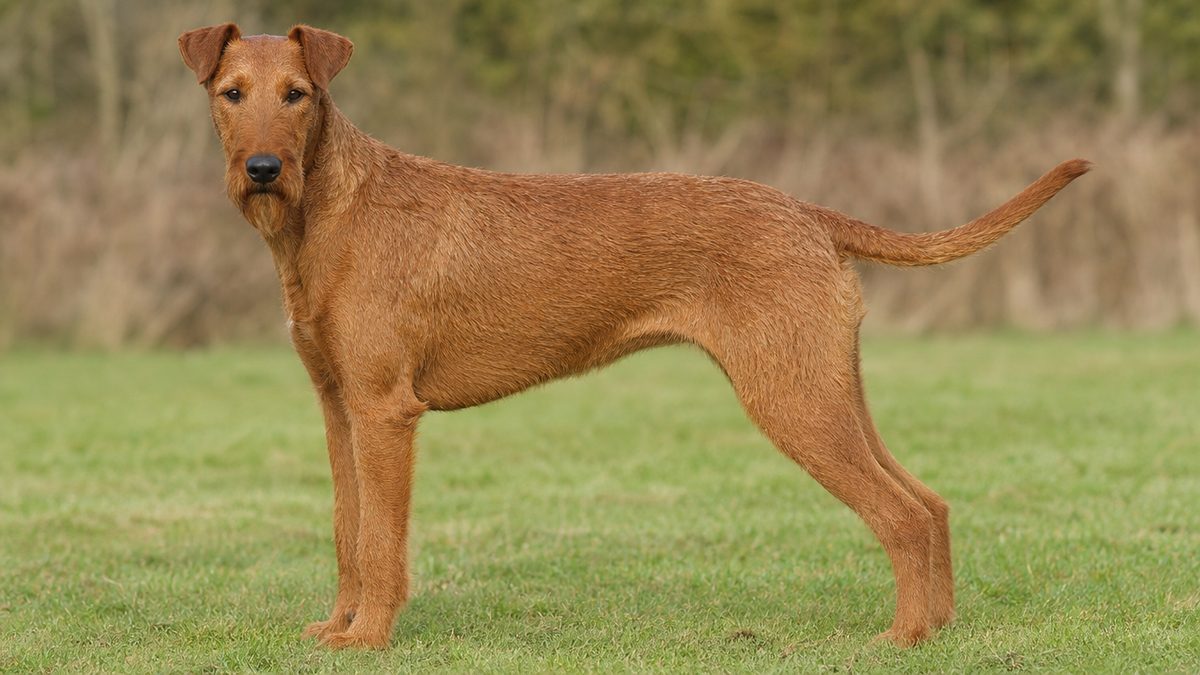
An Irish Terrier is a medium-sized wiry-coated terrier from Ireland, standing about 45.5 cm at the withers and weighing 12.25 kg for dogs and 11.4 kg for bitches under FCI standard 139. It is the oldest of Ireland's four terrier breeds and the first recognised by the English Kennel Club as a native Irish breed.
The FCI files the breed in Group 3, Terriers, Section 1, Large and medium-sized Terriers, without working trial, and its listed utilisation is unusually broad: versatile farmyard dog, family pet, guard dog with utter contempt for danger or hurt, hunter and gundog. We resolved that number from the FCI's own Group 3 index rather than assembling a URL, because an FCI address resolves on its trailing number and will serve another breed's standard without erroring.
The numbers, and where the sources disagree
| Source | Height | Weight | Life expectancy |
|---|---|---|---|
| FCI standard 139 | About 45.5 cm (18 inches) | Dogs 12.25 kg, bitches 11.4 kg | Not stated |
| American Kennel Club | 18 inches | 27 lb male, 25 lb female | 13 to 15 years |
| Purina India | Males 48 cm, females 46 cm | 11 to 12 kg | 13 to 15 years |
| Dogbreedslist | 18 inches (43 cm) | 25 to 27 lb (11 to 12 kg) | 12 to 15 years |
Two of those rows are quietly wrong and both are conversion errors rather than measurement disputes. Eighteen inches is 45.7 cm. The FCI rounds it to 45.5 cm and the AKC leaves it in inches, but Dogbreedslist converts the same 18 inches to 43 cm, which is nearly 3 cm short. Purina India goes the other way with 48 cm for males and 46 cm for females, which is a real figure from the British breed standard tradition rather than the FCI's single number. When a page gives you a height in centimetres for this breed, check whether it converted 18 inches correctly.
The coat, which is the whole breed
The standard is stricter about coat than about almost anything else. Hair must be dense and wiry in texture, having a broken appearance but still lying flat, growing so closely and strongly together that when parted with the fingers the skin cannot be seen, free of softness and silkiness, free of lock or curl, and not so long as to hide the outlines of the body. Face hair is about three-quarters of a centimetre long, and only a slight beard is permissible; a full goat's beard is treated as evidence of silky, bad hair running through the coat.
The AKC explains what that construction does. The dense wiry broken coat hugs the body and creates a tight, water-resistant jacket, and underneath the stiff outer coat sits a dense undercoat of softer, finer hair whose job is to trap body heat on a cool, damp day. Hold that sentence for the climate section, because it is the single most India-relevant line any registry has written about this breed.
Colour, and a disqualifying fault that names a disease
Colour is settled and narrow. The standard permits whole-coloured red, red-wheaten or yellow-red, with a small amount of white sometimes on the chest, and disqualifies any other colour. The Royal Kennel Club's breed standard colour list agrees almost exactly, running to just five entries: Red, Red Wheaten, Rust, Wheaten and Wheaten Red. The AKC registers three: Red, Wheaten and Red Wheaten. This is one of the rare breeds on this site where three registries do not contradict each other on colour.
The disqualifying-fault list contains something more interesting. Alongside the usual entries it disqualifies corny excrescence or cracks on pads, and the forefeet and hind feet descriptions both require pads sound and free from cracks or corny excrescence. That is a breed standard disqualifying the clinical sign of the breed's own principal hereditary disease, which is covered in full below.
History, and a date three sources cannot agree on
The FCI records that the first breed club was set up in Dublin on 31 March 1879, and that before the 1880s the colour was unsettled, with black and tan and brindle dogs alongside red ones until deliberate selection bred the others out by the twentieth century. The Royal Kennel Club says the breed was recognised as a pedigree breed in 1879, the first of the native Irish terriers to be recognised. Purina India says it was recognised as a separate breed in 1875 in Glasgow, Scotland. We publish all three rather than picking one, and note that the two registries agree with each other and the manufacturer's page does not.
The breed's nickname is genuinely old. Purina India records the Red Devil name and the breed's use as a messenger dog in the First World War, and the FCI's history says the same, adding that its reputation was made carrying messages in the noise and confusion of trench warfare. The standard describes a dog that is loyal and good tempered with people but which, once attacked, has the courage of a lion and will fight to the bitter end.
Irish Terrier price in india: an American list divided by 74
The Indian price band you will be shown for this breed is a converted US dollar list, and the arithmetic proves it in one line. Google India's AI answer quotes Rs 30,000 to Rs 1,00,000 with a champion tier at Rs 90,000 to Rs 1,00,000 and above, sourced to a single page. That page's two non-round figures divide to exact whole dollars.
Happy Pet Care's Irish Terrier page prints, verbatim: puppies vary in price in India depending on the breeder's reputation, pedigree, and location, on average around Rs 30,000-60,000, but it may also cost you between Rs 66,600 and Rs 2,59,000. Those last two numbers are the only ones on the page that carry information, because they are the only ones that do not end in three zeros.
Run the four rates and watch which one lands
| Rupee figure | At 84.38 | At 74.00 | At 66.67 | At 80.00 |
|---|---|---|---|---|
| Rs 66,600 | 789.29 | 900.00 | 998.95 | 832.50 |
| Rs 2,59,000 | 3,069.45 | 3,500.00 | 3,884.81 | 3,237.50 |
| Rs 30,000 | 355.53 | 405.41 | 449.98 | 375.00 |
| Rs 60,000 | 711.07 | 810.81 | 899.96 | 750.00 |
| Rs 1,00,000 | 1,185.11 | 1,351.35 | 1,499.93 | 1,250.00 |
Rs 66,600 divided by 74.00 is exactly 900. Rs 2,59,000 divided by 74.00 is exactly 3,500. Neither leaves a remainder. Neither lands on a round number at 84.38, at 66.67 or at 80.00. And USD 900 to USD 3,500 is a real, checkable American band: the page ranking second for this query in India publishes an average of USD 1,500 to USD 2,500 for an Irish Terrier puppy, and Google's own answer to the follow-up question quotes 1,500 to 3,500 dollars from US breeders.
Notice which rows prove nothing. Rs 30,000, Rs 60,000 and Rs 1,00,000 all end in three zeros, so they divide cleanly at 80.00 by construction and at 66.67 by construction as well, because 66.67 is 200 divided by 3. A clean quotient only carries evidence when the figure is not a round number to begin with, which is exactly why the two odd figures settle it and the round ones do not.
The source page still has another breed's heading on it
There is a second reason not to trust that band. Immediately after the price paragraph, the same page prints a section heading reading Adopt/Shop of Miniature Pinscher Dog. The rest of the page names the Irish Terrier 124 times and the Miniature Pinscher twice, so this is not a wholesale wrong-breed page; it is a single heading left behind when the page was assembled from another breed's template. That is the seam, and it tells you the Indian price paragraph beside it was assembled the same way.
Google India's AI answer cites that page by name for the Indian price band and links Mr n Mrs Pet and Puppiezo for availability. So a converted American list, printed on a page carrying another breed's heading, is now being restated as the Indian market rate by an answer engine.
What the Indian sellers actually hold
Three Indian marketplaces rank for this term and none of them has an Irish Terrier.
- Puppiezo, positions 1 and 6. Its Available Irish Terrier Puppies For Sale carousel holds eight animals: two Maltipoos, two Poodles, a Goldendoodle, a Cane Corso, a Rottweiler and a Doxiepoo. Prices run Rs 76,499 to Rs 1,20,000 and Rs 98,999 appears three times on the page. Its separate Irish Terrier category page carries a single card that links back to the same product page, again with no price attached to an Irish Terrier.
- Mr n Mrs Pet, position 4. Its Irish Terrier page lists three dogs: two French Bulldogs and a Shiba Inu. Its meta description promises KCI registered Irish Terrier puppies at affordable prices.
- Breed n Breeder, position 8. Its Irish Terrier page returns HTTP 200 and contains navigation and nothing else, with no listing and no price, while its meta description advertises Irish Terrier puppies with health certificates and a phone number.
The carousel is not even about this breed
One finding upgrades all of this from sloppy to systematic. Puppiezo's eight-animal carousel on the Irish Terrier page is byte-identical to the carousel on its Italian Greyhound page: the same eight dogs, the same names, the same prices, in the same order. It is one static block rendered under every breed heading on the site, so the phrase Available Irish Terrier Puppies For Sale describes nothing at all.
In fairness, one control cuts the other way and is worth reporting. Puppiezo's specification card for the Irish Terrier is broadly right, giving 18 to 20 inches, 11 to 12 kg, origin Ireland and 12 to 15 years, which matches the registries. The same site's Italian Greyhound card gives 27 to 40 kg and origin England, which is a full-size Greyhound's data. So the errors on that site are per-page rather than site-wide, and this breed's card happens to be one of the good ones.
Bonbeno will not restate Rs 30,000 to Rs 1,00,000 as this breed's Indian price, because we can show it is an American band run through a single exchange rate. If somebody quotes you a rupee figure for an Irish Terrier in India, ask which dog it is attached to, then ask to see that dog, its parents and its papers.
How rare is it, and is it a vulnerable native breed
The Irish Terrier is on the Royal Kennel Club's At Watch list, not its vulnerable native breed list, and the Kennel Club's own breed page records Vulnerable native breed: No The Royal Kennel Club. Those two facts agree, but the document that carries them is laid out in a way that makes them look like a contradiction.
Here is the trap. The Kennel Club publishes one PDF titled 10 year VULNERABLE BREED STATS, and the Irish Terrier appears inside it. A reader who searches that document for the breed finds it and concludes the breed is vulnerable. What the document actually contains is two stacked tables: a vulnerable native breeds table of 39 breeds, and then a separate block headed AT WATCH holding seven more. The Irish Terrier is in the second block, alongside the Airedale Terrier, Cairn Terrier, Rough Collie, Wire Fox Terrier, Norfolk Terrier and Pointer.
So we checked and we report agreement. The breed page and the register do not contradict each other for this breed, and anyone who thinks they do has read the document's title rather than its sub-heading.
The registration numbers, and a group total that does not add up
Bonbeno's standing guidance is that the Terrier and Toy groups in the Kennel Club's registration documents are known-unreliable while Hound, Gundog and Pastoral have been verified clean. So we compared all 27 Terrier breeds across the ten-yearly table, the quarterly table and the vulnerable-breeds table rather than trusting any one of them.
| Check | Result |
|---|---|
| Irish Terrier 2025, ten-yearly against quarterly | 308 in both, identical |
| Irish Terrier ten-year series, group table against At Watch table | Identical in all ten cells |
| All 27 terrier breeds, 2025, ten-yearly against quarterly | Zero cells differ |
| 190 cells across the 19 terrier breeds in both the group and vulnerable tables | Two cells differ |
| Dandie Dinmont Terrier 2021 | 123 in the group table, 124 in the vulnerable table |
| Soft Coated Wheaten Terrier 2021 | 277 in the group table, 227 in the vulnerable table |
| Terrier group column totals, 2016 to 2025 | Nine of ten reconcile exactly |
| Terrier group 2023 total | Printed 18,211, rows sum to 18,209, out by 2 |
Two things follow, and both are worth an Indian reader's attention because these are the numbers rarity arguments get built on. The Irish Terrier's own figures are clean in every document we checked. And the Terrier group's known defect is narrower than its reputation: 188 of 190 shared cells agree, the two that differ are both in the 2021 column, and only the 2023 column total fails, by two dogs. Unlike the Toy group, where we could name the single cell responsible for its three-dog gap, the terrier documents available to us do not localise the 2023 discrepancy, and we say so rather than guessing.
The trend, which is flatter than the group's
The Irish Terrier registered 326 dogs in 2016 and 308 in 2025, a fall of 5.5 percent, with a peak of 457 in 2021 and a trough of 244 in 2023. Over the same decade the Terrier group as a whole fell from 19,436 to 14,963, down 23.0 percent. So the breed is not declining faster than its group; it is declining considerably more slowly, and 2025 was its best year since 2022. The quarterly table shows 65, 60, 110 and 73 across 2025 and 70 and 94 for the first two quarters of 2026, which is ahead of the same point last year.
Against the wider terrier field it sits mid-table. In 2025 the Staffordshire Bull Terrier registered 5,375, the Border Terrier 3,181 and the West Highland White 1,083, while the Kerry Blue managed 57 and the Australian Terrier 12. At 308 the Irish Terrier is uncommon rather than endangered, and the only terrier in the group that clearly grew across the decade is the Jack Russell, from 150 to 503.
American popularity, and the Indian blank
The AKC recognised the breed in 1885, and its popularity rank has drifted down steadily, from 113th in 2015 to 131st in 2022. None of this translates into Indian availability. A breed can register 308 dogs a year in Britain, hold a stable AKC rank and still have no verifiable Indian listing, because registration counts interest where a supply chain exists and India does not have one for this breed.
We went looking for a discrepancy because our own guidance says the Terrier group carries one, and the danger in that is finding what you expect. So we compared every shared cell rather than sampling, published the 188 that agree, named the two that do not, and confirmed that this breed's own rows are consistent across three separate Kennel Club documents.
Monthly cost of ownership in India
Budget roughly Rs 5,000 to Rs 11,000 a month to keep an Irish Terrier in an Indian metro. The line that separates this breed from most others of its size is grooming, because the wiry coat needs hand stripping rather than clipping and very few Indian salons do it.
This is a 11 to 12 kg dog, so food, preventives and boarding all sit in the small-to-medium band that Indian services price cheaply. What is not cheap, and what most Indian owners discover late, is that keeping the coat correct is a skilled manual job several times a year, and a skilled manual job is expensive wherever it is done.
The first year
The core puppy vaccination course runs across the first sixteen weeks at about Rs 3,000 to Rs 6,000 in total, made up of DHPPi or the seven-in-one at Rs 500 to Rs 1,200 a dose, anti-rabies at Rs 300 to Rs 600, and a consultation or injection charge of roughly Rs 300 to Rs 800 on each visit. The yearly booster afterwards, one DHPPi plus one rabies, runs about Rs 1,000 to Rs 2,000.
The grooming line, which is this breed's distinctive cost
The AKC states that the outer coat should ideally be hand-stripped rather than clipped, and the standard's requirement for a dense, wiry, broken coat free of softness is what hand stripping preserves. A groomer plucks dead guard hairs out by the root so new wiry ones grow in. Clippers cut them instead, and the coat that regrows is softer, paler and denser. Purina India puts the routine grooming requirement at every other day while the Royal Kennel Club records it as more than once a week, and we print both because they are describing the same coat differently.
Hand stripping is a specialist service in India, offered by a minority of metro salons and priced by the hour rather than by the dog. Bonbeno did not find a published Indian price list for hand stripping an Irish Terrier, so we are not going to invent one. Ask three salons in your city for a per-session quote for a wiry-coated terrier and expect two of them not to offer it at all.
| Line | Typical range | Note |
|---|---|---|
| Food, 11 to 12 kg active adult | Rs 2,000 to Rs 4,000 | A working terrier's appetite on a medium frame |
| Preventives, tick and flea plus deworming | Rs 500 to Rs 1,100 | Non-negotiable in India given the documented tick-borne disease load |
| Vaccination, amortised | Rs 85 to Rs 170 | Rs 1,000 to Rs 2,000 annual booster spread across twelve months |
| Hand stripping, amortised | Rs 500 to Rs 1,500 | Two to four sessions a year, and confirm the salon strips rather than clips |
| Home brushing and combing | Rs 0 | A stiff bristle brush and a fine-tooth comb, both one-off purchases |
| Routine vet consultation | Rs 300 to Rs 800 per visit | Budget three to four visits a year for a healthy adult |
| Dental scaling, amortised | Rs 170 to Rs 670 | Rs 2,000 to Rs 8,000 per cleaning under anaesthesia |
| Realistic monthly total | Rs 5,000 to Rs 11,000 | Excluding emergencies and excluding a purchase price nobody can verify |
Two costs specific to this breed
- Footpad care and possible treatment. The breed's signature inherited disease cracks the pads. In an affected dog this is a recurring cost of trimming, moisturising, protective boots and treating secondary infections, and fissured pads predispose to exactly that. Buying a DNA-tested puppy removes this cost entirely, which is the strongest financial argument for insisting on the test.
- Dog-to-dog incidents. Purina India describes the breed as aggressive toward other dogs. In an Indian apartment block with a shared lift and a resident street-dog population, budget realistically for a secure harness, a short lead and, if things go wrong, a vet bill that is not yours alone.
Against those, one line is genuinely cheaper than for most imported breeds. The wiry coat sheds little, which the AKC and Purina India both note Purina India, Irish Terrier Dog Breed…, so you are not replacing soft furnishings or running an air purifier on a shedding cycle. That is a real if unglamorous saving in a small Indian flat.
Ring the salons in your city first and ask a single question: do you hand strip a wiry terrier coat, and what do you charge. If the honest answer everywhere is that they only clip, you are choosing between a coat that will progressively soften and lose colour and a four-hourly job you will learn to do yourself. Both are fine. Neither should be a surprise in month eight.
Indian climate, and the undercoat that was built for the wrong country
An Irish Terrier is a poor thermal match for most of India, and the reason is a single sentence in the AKC's own grooming description rather than anything about the wiry outer coat. Beneath the stiff outer jacket sits a dense undercoat of softer, finer hair whose stated function is to trap body heat on a cool, damp day.
Ireland supplies exactly that day, most days. We queried NASA POWER by explicit latitude and longitude rather than by place name, and recorded the grid cell elevation each query returned so the figures can be checked against the real town.
| Place | Cell elevation | Annual mean | January mean | Warmest monthly mean maximum |
|---|---|---|---|---|
| Dublin, Ireland | 46.03 m | 10.05 C | 5.84 C | 24.31 C |
| Cork, Ireland | 142.87 m | 9.71 C | 5.64 C | 25.89 C |
| Chennai | 48.95 m | 27.95 C | 24.09 C | 42.70 C |
| Delhi | 206.37 m | 25.60 C | 13.61 C | 48.08 C |
| Mumbai | 97.15 m | 26.77 C | 23.19 C | 44.85 C |
| Bengaluru | 841.72 m | 23.74 C | 21.10 C | 39.88 C |
| Pune | 635.99 m | 23.86 C | 19.85 C | 43.07 C |
The comparison that matters is not the annual means, striking though 10.05 C against 27.95 C is. It is that Chennai's May monthly mean of 31.51 C is 5.6 degrees above the warmest monthly mean maximum ever recorded for Cork, the region Purina India names as the breed's home ground. An average Chennai afternoon in May is hotter than the hottest thing the breed's homeland produces.
Two notes on the data, because a climate figure is only as good as the cell it came from. Dublin's cell sits at 46.03 m against a city elevation near 20 m, a difference small enough that the cell is the town. Cork's cell sits at 142.87 m against a city elevation near 10 m, about 133 m high, which at the standard lapse rate of 6.5 C per 1,000 m makes the returned figures roughly 0.9 C cooler than the city itself. We publish the cell value and the correction as an estimate rather than silently adjusting it.
Humidity is where the intuition goes wrong
Ireland is more humid than Chennai, not less. Dublin's annual mean relative humidity is 87.6 percent and Cork's is 89.5 percent, against Chennai's 72.4 percent. So the wiry water-resistant coat did evolve in a damp climate, and the damp is not the problem. The problem is that India offers the same damp at eighteen degrees hotter. Cool and wet is what a water-resistant jacket over a heat-trapping undercoat is for. Hot and wet defeats panting, which is the only cooling mechanism the dog has.
City by city
- Chennai, Mumbai and Kolkata. The hardest Indian postings for this breed. Walk before sunrise and after dark from March to June, keep the dog indoors under a fan or air conditioning through the afternoon, and never let a stripped-out summer coat become an excuse for a midday walk.
- Delhi, Lucknow and Chandigarh. A January mean of 13.61 C is genuinely comfortable for this coat, and the same city's May cell maximum of 48.08 C is not. This is a breed with a good four months and a dangerous three.
- Bengaluru and Pune. The best Indian fit, with annual means near 23.7 C and 23.9 C. Still eleven to fourteen degrees above Dublin, but within range for a fit adult exercised at sensible hours.
- Monsoon everywhere. The one season the coat handles well. The AKC's tight water-resistant jacket description is accurate, and a wiry broken coat sheds water and dries faster than a long silky one.
Do not strip the coat off for the summer
The instinct is to clip the dog down in April, and it is the wrong move twice over. It destroys the wiry texture the standard requires and the AKC advises preserving Federation Cynologique Internationale, and it removes the outer coat's function as a barrier against direct sun on skin that has never seen it. Strip the coat on its normal schedule, keep the dog out of the afternoon, and use water and shade rather than scissors.
Learn the signs of heat stroke before the season rather than during it. A heat-sensitive medium terrier that has just chased something is the classic exertional presentation, and this is a breed the FCI describes as bred for speed and endurance.
The heat clause of the Prevention of Cruelty to Animals (Dog Breeding and Marketing) Rules 2017 is Second Schedule Part IV paragraph 21(1), not a numbered Rule. It bars keeping in outdoor facilities, without the attending veterinary practitioner's written approval, (i) dogs not accustomed to the temperatures prevalent in the area, (ii) breeds that cannot tolerate them such as long-haired breeds in high temperature locations, and (iii) sick, infirm, aged or young animals, and it requires outdoor shelters to protect animals from the direct rays of the sun. An imported double-coated terrier kept outdoors through an Indian May is squarely inside limb (i).
Temperament, and the one thing that disqualifies most Indian homes
An Irish Terrier is affectionate, fearless and deeply bonded to its people, and it is often aggressive toward other dogs. That second half is the deciding factor for an Indian buyer, because Indian apartment life puts your dog within a metre of other dogs several times a day.
Purina India is direct about it: the breed is courageous, loyal and lively, affectionate with his human companions but aggressive toward other dogs, and may not be safe with cats or small furries. The FCI standard describes a dog remarkably loyal, good tempered and affectionate with mankind, but once he is attacked, he has the courage of a lion and will fight to the bitter end. The AKC calls it bold, dashing and tenderhearted at home.
The standard also defends the breed against its own reputation, saying the record of getting into scraps, sometimes even in the show ring, is undeserved, and that the Irish Terrier is easily trained and a gentle pet. Both things are true at once. This is not an unprovoked aggressor. It is a dog that does not back down, which in a lift with a resident Labrador amounts to much the same problem.
What that means in an Indian housing society
- Assume every walk is on-lead, in a harness, for life. The prey drive is real and Purina India recommends open, dog-free areas for off-lead running, which most Indian cities cannot supply.
- Plan the lift. A shared lift is the single commonest flashpoint. Wait for an empty one rather than testing your dog's tolerance in a two-metre steel box.
- Street dogs are a management problem, not a training project. Cross the road. Do not attempt introductions.
- Cats and small pets need a decision made before the dog arrives. Purina India's warning about cats and small furries is not a training caveat you can drill away.
- Tell your society committee honestly what the breed is. A vocal, fearless terrier that alerts on strangers will generate complaints, and the Royal Kennel Club and Purina India both record it as a chatty, vocal dog that barks and alerts.
Who this breed genuinely suits
The Irish Terrier is an outstanding dog for the right household and the description of that household is narrow. An active adult or a family with older, dog-aware children; a home with no other dog and no cat; somebody who walks or runs daily and enjoys a dog with opinions; and ideally access to open ground rather than a crowded park. Purina India notes the breed can make a good family dog where there are older, dog-aware children, while lacking patience with small children who overhandle or grab.
In return you get a dog the FCI's own history calls the poor man's sentinel, the farmer's friend and the gentleman's favourite, with a watchdog instinct rated at the top of the scale and, on the best UK evidence, a median survival of 13.5 years.
Who should choose something else
- Multi-dog households. This is the clearest disqualifier and it is not negotiable by training alone.
- Homes with cats or rabbits. See above.
- Anyone who wants a dog that is friendly to strangers. The breed is reserved with people it does not know.
- A first-time owner who is out all day. The breed is willful, needs an hour of exercise plus enrichment, and gets loud when under-stimulated.
- Anyone whose city offers no cool hours. See the climate section. A high-drive terrier in a coastal Indian summer is a welfare problem before it is a training one.
An Irish Terrier gives an Indian household more dog per kilogram than almost anything else in the terrier group, and it asks for a household with no other dog, an hour a day, and a groomer who can strip a coat. If you can supply all three, it is a superb dog. If you can supply two, choose differently.
Training: clever, willing and completely willful
Train an Irish Terrier with reward-based methods, short sessions and something worth working for, and accept that recall will never be reliable enough to trust near traffic. The AKC calls the breed very smart and willing to please, and in the same paragraph strong-willed, independent and challenging.
Purina India frames it usefully: this is a clever dog that enjoys working with its owner and can be trained to quite a high standard, as long as it can be kept motivated and enthused using positive, reward-based methods, and socialisation should be early and ongoing to overcome argumentativeness with other dogs. Dogbreedslist, less charitably, calls the breed willful and stubborn and warns that it will likely show difficulty with housebreaking.
The five priorities, in order
- Socialise deliberately with other dogs, from week one, at a distance. Purina India names dog socialisation as the thing to prioritise, and the goal is calm tolerance across a road, not friendship.
- Harness and loose-lead walking. A fearless terrier that pulls toward another dog on a neck collar is a poor arrangement, and a harness gives you a handle rather than a throat.
- Recall to a whistle, inside a fence. Purina India advises prioritising a good recall while saying plainly that neither it nor dog tolerance should entirely be relied upon in the great outdoors.
- Handling and foot tolerance. This is the breed-specific one. A dog whose principal inherited disease affects the pads must accept having each foot picked up, examined and, if needed, creamed or bandaged, every day.
- A settle on a mat. The breed is vocal and high-energy, and a dog with an off switch is what keeps an Indian housing society on your side.
House-training in an Indian flat
Plan for four to six months and plan around the monsoon. Dogbreedslist flags housebreaking difficulty specifically for this breed, and a terrier that dislikes standing in warm rain will simply hold on and then use the corridor. Set up a covered balcony option from week one, take the dog out on a fixed schedule after every sleep, meal and play session, and reward outdoors rather than punishing indoors.
Give it a job, or it will find one
This is the training point Indian owners most often miss. Purina India recommends plenty of games plus enrichment toys, ideally including a chance to dig and some scent work, and the AKC lists obedience, agility, rally, earthdog and flyball as outlets for the breed's energy and natural athleticism. Very little of that infrastructure exists in Indian cities, so you will be improvising: a sandpit on the balcony for legal digging, scatter-feeding in the grass, a snuffle mat, and hidden-treat searches around the flat on a wet afternoon.
A dog the FCI describes as bred for speed, endurance and power and which Purina India calls athletic and needing regular exercise does not become calm by being kept indoors. It becomes loud.
| Skill | Realistic timeline | Note |
|---|---|---|
| Harness accepted | 2 to 3 weeks | Start with the harness on at mealtimes |
| Name response and basic obedience | 2 to 4 weeks | The breed learns fast when the reward is worth having |
| Reliable house-training | 4 to 6 months | Slower through the monsoon; set up a covered option early |
| Calm passing another dog across a road | 3 to 9 months | Distance first, duration later. Never rush this one |
| Recall inside a fenced area | 3 to 6 months | Do not extend it to unfenced ground at any age |
| Accepts daily foot handling | 3 to 6 weeks | Non-negotiable in this breed, given the footpad disease |
| Settles alone for two hours | 2 to 4 months | Build in minutes, and pair it with a chew |
Generic socialisation advice assumes a quiet suburb and a fenced garden. An Indian Irish Terrier puppy needs calm, sub-threshold exposure to horns, two-wheelers, cattle, firecracker season and, above all, street dogs seen from a safe distance and never approached. Get that right in the first sixteen weeks and the next thirteen years are much easier.
Daily exercise, and when to do it in India
An adult Irish Terrier needs at least an hour of exercise a day plus mental work, and in most Indian cities that hour has to happen before sunrise and after dark for four months of the year. Purina India and the Royal Kennel Club both put the requirement at about an hour The Royal Kennel Club, Irish Terrier.
Purina India is specific about the shape of it: at least an hour of exercise each day plus plenty of games with their owner and enrichment toys, ideally including a chance to dig and some scent work, and a breed that needs to explore sights and scents rather than simply cover distance. The AKC adds that a fenced yard is ideal and that failing one, the dog needs walking on a leash several times a day.
A workable Indian routine
- Two walks of 25 to 35 minutes, before sunrise and after dark from March to June. Test the tarmac with the back of your hand for five seconds before stepping out.
- One scent or digging session of 10 to 15 minutes, indoors or on a balcony. Scatter-feed, use a snuffle mat, or fill a shallow tray with sand and bury toys in it.
- One short training session daily. For a breed this bright, five focused minutes does as much as twenty minutes of walking.
- Free running only inside a fenced space, which Purina India recommends because of the prey drive and the dog tolerance.
- Skip the shared park at peak hours and choose a quiet route instead. This is a dog-management decision more than an exercise one.
Watch the feet, every single day
This is the exercise instruction unique to the breed. Indian walking surfaces are hard on pads at the best of times, and a breed whose principal hereditary disease is a hyperkeratosis that produces fissures and cracks predisposing to secondary infection should have its feet checked after every walk. Hot tarmac, monsoon puddles carrying sewage, and construction grit are three specifically Indian hazards for a pad that is already prone to splitting.
The FCI standard itself expects sound pads, requiring forefeet and hind feet with pads sound and free from cracks or corny excrescence and disqualifying dogs whose pads show them. That is a useful reframing for an owner: the state of the feet is not a cosmetic detail in this breed, it is the thing the standard and the geneticists both watch.
What happens without enough exercise
An under-exercised Irish Terrier does not sulk. It barks, digs, chews and escalates on other dogs, and each of those is a bigger problem in an Indian flat than in an Irish farmhouse. The AKC's framing is that this is a breed with abundant energy that needs an outlet to maintain mental and physical fitness; Purina India's is that games and enrichment sit alongside the walk rather than replacing it.
The second consequence is weight. This is a dog whose standard sets 12.25 kg for males and 11.4 kg for females, and a kilogram of gain on a 12 kg terrier is over eight percent. Keep the last ribs easily felt and a clear waist from above, and weigh the dog monthly rather than judging by eye through a dense coat.
| Season | What changes | What to do |
|---|---|---|
| November to February | The breed's best months across all of India | Full hour outdoors, longer walks, this is when to build fitness |
| March to June | Peak heat, Delhi cell maximum 48.08 C, Chennai May mean 31.51 C | Move everything to before sunrise and after dark. Shorten and add indoor enrichment |
| July to September | Monsoon. The coat handles it well, the pads do not | Keep walking, then dry and inspect the feet and between the toes every time |
| October | Transition, still humid | Resume normal duration gradually rather than all at once |
Heat-related illness in dogs is most often exertional rather than caused by a parked car, and a fearless terrier chasing something in an Indian April is exactly that scenario. Learn the signs before summer, carry water on any walk over fifteen minutes, and stop the walk rather than finishing the route.
Grooming the wiry coat in Indian humidity
Brush an Irish Terrier weekly with a stiff bristle brush and hand strip the coat two to four times a year. Do not let an Indian salon clip it, because clipping cuts the wiry guard hairs the breed standard requires and the coat that grows back is softer, paler and worse in heat.
The AKC states the position plainly: the coat requires regular brushing, stripping and trimming, and ideally the outer coat should be hand-stripped rather than clipped. Dogbreedslist describes the practical routine as regular brushing with a stiff bristled brush, a fine-tooth comb to remove dead hairs afterwards, and hand-plucking twice a year, plus trimming excess hair around the pads of the feet and keeping the ears clean.
Why hand stripping and not clipping, in one paragraph
A wiry coat is two coats. The FCI standard requires hair dense and wiry in texture, having a broken appearance but still lying flat, free of softness and silkiness, and the AKC describes the stiff outer coat sitting over a dense undercoat of softer finer hair. Stripping pulls the dead outer hairs out at the root and lets new wiry ones replace them. Clipping cuts them halfway, leaving the soft undercoat proportionally dominant. The result over two or three clips is a paler, softer, denser coat, which in Indian conditions is the worst of both worlds: it holds heat like an undercoat and sheds water like nothing.
The shedding and allergy question, where the SERP contradicts itself
Three sources on page one of this search disagree about the same coat, and the disagreement is worth printing.
| Source | Shedding | Hypoallergenic |
|---|---|---|
| Royal Kennel Club | Sheds: Yes | Not stated |
| Purina India | Solid red, dense, low-shedding coat | Non hypoallergenic breed |
| Dogbreedslist | Minimal shedding; a properly cared-for Irish Terrier does not shed | Hypoallergenic: Yes |
The shedding half is a difference of degree and both readings are defensible: a wiry coat that is stripped on schedule leaves very little hair around, which is what low-shedding means in practice, while the Kennel Club is recording that the dog does shed. The hypoallergenic half is not a matter of degree and Dogbreedslist is wrong. Measuring the Can f 1 allergen across 196 dogs of so-called hypoallergenic breeds against 160 control dogs found the hypoallergenic group came back higher, not lower, at 2.26 micrograms per gram of hair against 0.77 and 27.04 in coat samples against 12.98, with no difference in airborne allergen. Purina India has it right.
The weekly routine, adapted for India
- Stiff bristle brush weekly, then a fine-tooth comb to lift the loosened dead hair.
- Hand strip two to four times a year. Twice is the published minimum; Indian coats that grow year-round often need three or four sessions.
- Trim the hair between and around the pads. Dogbreedslist names this specifically, and in a breed prone to footpad disease it also lets you see the pads properly.
- Check and dry the ears after every monsoon walk. Small V-shaped ears folded forward against the cheek trap moisture, and Indian humidity does the rest.
- Inspect all four pads daily, and after every walk in the monsoon. This is the breed-specific step and it costs thirty seconds.
- Bathe rarely, every six to eight weeks or when genuinely dirty. Frequent bathing softens a wiry coat, which is the thing you are trying to prevent.
Skin and parasites
The dense coat hides problems that a short-coated dog would show you immediately, so the weekly brush doubles as a skin inspection. Ticks are the specific Indian concern: a survey of canine tick-borne diseases in India documents a substantial disease load carried by the brown dog tick across Indian cities, and a dense wiry coat is a good place for a tick to go unnoticed. Run a fingertip check over the ears, neck, armpits and between the toes each week and keep a year-round preventive on.
Hand stripping is a skill, not a secret, and it is learnable from a breed club or a good groomer in two or three supervised sessions. In a country where most salons only clip, an owner who can strip their own dog controls both the coat quality and the largest recurring line in the budget. Buy a stripping knife and a good stone, and start on the back where mistakes do not show.
Health risks and life expectancy
An Irish Terrier has a median survival of 13.5 years with a 95 percent confidence interval of 13.1 to 14.0, calculated on 146 recorded deaths in a UK study covering 155 purebred breeds. That is 1.5 years above the crossbred median of 12.0 in the same tables, and it matches the 13 to 15 years the AKC and Purina India both publish.
We ran one check before quoting that median. The same paper's Table S5 reclassifies some breeds into a close relative for its phylogeny analysis, which silently merges two separately recognised breeds into a single row, and the terrier group is where that happens most: the Wire Fox Terrier's row folds in both Fox Terrier (Smooth) and Fox Terrier (Wire). The Irish Terrier is not merged. Its row carries no reclassification, so the 13.5-year figure describes this breed alone.
One caution on sample size. Table S3 gives the Irish Terrier an N of 535 while Table S6 gives 521, and this discrepancy runs through the dataset in both directions. The death count is identical in both tables at 146, which is why we quote deaths. The paper also carries an Author Correction, which we read: it changes only a Miniature Dachshund figure in a figure legend and touches nothing here.
The breed barely exists in the OFA register, and that is the finding
The Orthopedic Foundation for Animals publishes statistics only once a breed passes its reporting threshold, and the Irish Terrier appears in exactly one of its tables: eyes, ranked 28th, on 89 evaluations. There is no hip row, no elbow row, no patella row, no thyroid row and no cardiac row for this breed. By contrast the Italian Greyhound appears in nine tables and the Labrador, Greyhound and Whippet all appear throughout, so the search instrument was working.
The correct way to state that is precise: the Irish Terrier has no row in OFA's published statistics tables for those conditions, not that it is absent from the database. OFA requires 100 hip evaluations, or 50 for its other databases, before a breed is published at all, and with 89 eye evaluations this breed sits at the edge of the threshold. For an Indian buyer the practical consequence is that there is no orthopaedic screening baseline to compare a dog against, and you should not treat that silence as reassurance.
The eye numbers, and the contradiction inside them
The one table that does exist contradicts itself, in the same way we have now recorded on eight breeds. OFA's summary eye line reports 91.0 percent normal across 89 evaluations. Its detail rows, on the same denominator of 89, record NORMAL for 63 dogs, which is 70.8 percent. That is a gap of 20.2 percentage points.
The arithmetic goes further. The summary reports 9.0 percent abnormal, while a single detail row, cataract of unknown significance, accounts for 13 of 89 dogs, or 14.6 percent on its own. A part cannot exceed its whole, so the two tables are not measuring the same thing and neither should be quoted as the breed's eye rate. We publish both with the arithmetic and quote neither as the figure.
| Finding | Dogs | Percent |
|---|---|---|
| Normal | 63 | 70.8 |
| Cataract, significance unknown | 13 | 14.6 |
| Punctate cataract, nucleus | 6 | 6.7 |
| Incipient cataract, anterior cortex | 4 | 4.5 |
| Other, suspected as not inherited | 4 | 4.5 |
| Punctate cataract, anterior cortex | 3 | 3.4 |
| Punctate cataract, capsular | 3 | 3.4 |
| Persistent pupillary membranes, iris to iris | 2 | 2.2 |
What the Kennel Club actually asks breeders to do
The Royal Kennel Club's screening guidance for this breed is short and specific. Under Good Practice it lists one item, prioritising genetic diversity, which is unusual and tells you the register considers the gene pool itself the primary concern. Under Best Practice it lists one test, the DNA test for hereditary footpad hyperkeratosis, and it publishes the results. Breed Watch places the Irish Terrier in Category 2, meaning particular points of concern have been identified for judges. Read together, the picture is a breed with few health issues on paper and very little published data behind that impression, which is not the same thing as a clean bill.
Second Schedule Part III paragraph 8(10) of the Prevention of Cruelty to Animals (Dog Breeding and Marketing) Rules 2017 requires that breeding dogs shall have been tested for genetic defects including hip dysplasia, progressive retinal atrophy, night blindness, hypothyroidism, entropion, ectropion, jaw defects and cryptorchidism. The list is illustrative rather than closed, because the clause says including. It does not name footpad hyperkeratosis, but the DNA test exists and the Kennel Club calls it Best Practice, so an Indian breeder who has not run it is below the standard their own registry's parent body sets.
Hereditary footpad hyperkeratosis, the breed's signature disease
Hereditary footpad hyperkeratosis is the one condition every Irish Terrier buyer must ask about, and it is also the one with the cleanest answer available for any breed on this site: a single recessive gene, a DNA test, and a published register showing zero affected dogs among 162 tested.
The clinical picture was described in Irish Terriers first. Affected animals develop smooth parchment-like footpads at about six months, after which the pad epidermis hardens and grows lateral cone-like protrusions of up to 5 mm in diameter; fissures and cracks then develop, and these predispose the animal to secondary infection. The mode of inheritance was worked out from a breeder's own records and reported as autosomal recessive.
Fourteen years from description to gene
The search for the cause is a good example of how breed genetics actually proceeds. A 2003 study took 11 dogs from two related affected Irish Terrier pedigrees and tested markers linked to keratin 2, keratin 9 and desmoglein 1, the obvious candidate genes. None of the markers cosegregated with clinical status, and the authors concluded that mutations in those three genes were highly unlikely to be the primary cause. That is a negative result, and it mattered.
The answer arrived in 2014 from a genome-wide association study run in two breeds at once. In the Kromfohrlander the signal came from 13 cases against 29 controls, and it replicated in an independent cohort of Irish Terriers with 10 cases and 21 controls at p = 6.9 x 10 to the minus 10. Shared-haplotype analysis narrowed the interval to 611 kb containing 13 predicted genes, and re-sequencing found a single private missense variant, c.155G>C in FAM83G, changing a conserved arginine to proline. Genotyping a larger cohort found perfect association with the phenotype, and affected dogs showed moderate to severe orthokeratotic hyperplasia of the palmoplantar epidermis.
What the register shows now
The Royal Kennel Club publishes its DNA test results for this breed as a downloadable report, dated 13 May 2026. We counted every row.
| Result | Dogs | Share |
|---|---|---|
| Clear | 157 | 96.9 percent |
| Carrier | 5 | 3.1 percent |
| Affected | 0 | 0 percent |
| Total tested | 162 | 100 percent |
Two conclusions follow and both are good news carefully stated. The test works, and a disease that sustained fourteen years of research now produces no affected dogs at all among tested Kennel Club stock. And carriers are still in the population at about one in thirty-two, which is exactly why the test still matters: a carrier is clinically normal and only a carrier-to-carrier mating produces affected puppies.
The AKC's independent assessment agrees and adds geography: hyperkeratosis, described as hardened cracked footpads, is rare in North America but may be carried in dogs from European lines, and a genetic test has recently been developed. Purina India says the same in one line, that the breed has a recognised hereditary condition called hyperkeratosis where the footpads crack, however careful breeding means that this is now rare.
The breed standard already disqualifies it
This is the detail nobody writes about. FCI standard 139 requires forefeet and hind feet with pads sound and free from cracks or corny excrescence, and its disqualifying faults list ends with Feet: Corny excrescence or cracks on pads. The breed standard disqualifies the visible sign of the breed's own principal hereditary disease. Show selection has therefore been pushing against this phenotype since long before anyone knew what FAM83G was, which is part of why the affected rate is now zero on the register.
Why this matters more in India than in Ireland
A cracked, fissured pad in a temperate country is a manageable dermatological problem. In India it meets three additional hazards in the same week: hot tarmac that can split a compromised pad open, monsoon standing water carrying bacteria straight into an open fissure, and construction grit on almost every urban footpath. The published warning that fissures predispose the animal to secondary infection carries more weight here than where it was written.
Ask for the sire's and dam's HFH DNA results in writing before anything else. A clear-to-clear or clear-to-carrier mating cannot produce an affected puppy, the test is published and inexpensive, and the Kennel Club maintains a public list of tested Irish Terriers you can check a name against. A breeder who does not know what HFH stands for should not be selling this breed.
The rest of the literature, and how small it is
The Irish Terrier has eleven papers to its name across the whole of PubMed, and finding all eleven takes two searches rather than one. Six appear under the singular breed name and six under the plural, with only two in common, so four of the eleven are invisible to anyone who searches the singular alone.
That is worth stating because it changes what you can conclude. Searching Irish Terrier returns seven records; searching Irish Terriers returns six; the union is eleven. Among the four that only the plural surfaces are both foundational footpad papers, the 2000 clinical description and the 2003 candidate-gene study Schleifer SG, Versteeg SA, van Oost B. Our controls in the same session returned 124 records for Labrador plus hip dysplasia and 13 for Bergamasco plus dog, so the searches were working and the gap is real.
Cystinuria: named by the AKC, no test available
The AKC lists two conditions for prospective owners to ask about, and the second is cystinuria, resulting in bladder stones, which it describes as uncommon while noting that there is no genetic test for Irish Terriers. That asymmetry is the useful part: one of the breed's two named conditions has a DNA test and a published register, and the other has neither, so it can only be managed clinically.
For an Indian owner that means watching for straining to urinate, frequent small urinations, blood in the urine or a dog that suddenly cannot pass water at all, and treating a male dog that is straining as an emergency the same day. Heat and inadequate water intake concentrate urine, which is the general mechanism by which stones form, so free access to clean water through an Indian summer is a health measure rather than a comfort.
A landmark the breed rarely gets credit for
The oldest paper in the set is historically important well beyond this breed. In 1972 a Utrecht group described five male Irish Terrier puppies with a stiff gait, difficulty swallowing, an enlarged tongue and atrophic muscles, with electromyography suggestive of myotonia and extremely high serum creatine phosphokinase and aldolase, and concluded the disease was probably recessive X-linked. A follow-up two years later examined the mitochondrial defect in the same context.
Sex-limited to males, X-linked, with raised creatine kinase and muscle degeneration: that is the description of what is now understood as canine X-linked muscular dystrophy, the animal counterpart of Duchenne muscular dystrophy. It is not a live risk for a modern buyer, and Bonbeno found no evidence that it persists in the breed, but it is the reason Irish Terriers appear in a 1999 study screening the promoter of the canine dystrophin gene.
Two more findings, both with explicit uncertainty attached
- A laryngeal paralysis variant, impact unknown. A 2020 study identified a CNTNAP1 missense variant, c.2810G>A p.Gly937Glu, causing laryngeal paralysis with polyneuropathy in Leonbergers and Saint Bernards. It notes that English Bulldogs and Irish Terriers are two breeds with higher CNTNAP1 variant allele frequencies, and states in the same sentence that the impact of this variant on health in those two breeds remains unclear. We report it exactly that way, because a variant frequency is not a disease rate.
- Darier disease, one dog. A 4-month-old female Irish Terrier with an ulcerative crusting ear-canal lesion was diagnosed with canine Darier disease, with whole-genome sequencing finding a heterozygous SINE insertion in ATP2A2 and a resulting splicing defect. The dog later developed three dermal nodules that proved to be infundibular cysts, a finding not previously reported in Darier patients. This is a single case report and should not be read as a breed risk.
What a small literature means for a buyer
Eleven papers is a thin evidence base, and thinness cuts both ways. It means there is no large epidemiological study of this breed's disease burden, no VetCompass-style prevalence table, and no OFA orthopaedic baseline to check a dog against. It also means that the conditions which are documented are documented well: the footpad disease has a described phenotype, a mapped gene, a validated test and a public register, which is more than most breeds on this site can say about their signature condition.
So the honest summary is a robust breed with one well-understood inherited disease that is now testable, one clinically-managed stone risk with no test, and a long median survival. That is a better health profile than most imported breeds sold in India, and the reason to say so plainly is that the pages ranking above us say nothing about any of it.
Two sentences at the first consultation save trouble later. First, this is an Irish Terrier and the breed's known inherited condition is hereditary footpad hyperkeratosis, so please look at the pads at every visit. Second, the AKC also flags cystinuria in the breed and there is no DNA test for it, so any straining to urinate gets seen the same day rather than watched overnight.
Feeding an active 12 kg terrier in India
Feed an adult Irish Terrier a good-quality complete food twice a day, sized to an active 11 to 12 kg dog, and score its body condition regularly rather than judging through a dense coat. Purina India's guidance is a balanced diet across all the main nutrient groups, constant fresh water, regular body condition scores and at least two meals a day.
The AKC's version is the same with a life-stage emphasis: a high-quality food appropriate to the dog's age and activity level, with clean fresh water always available, and any weight or diet question taken to the vet or the breeder. Neither registry publishes a gram figure, and we are not going to invent one, because the right amount for a working-line terrier walking an hour a day in Pune is not the right amount for the same dog in a Chennai flat in May.
Life-stage feeding
| Stage | Meals per day | What to prioritise |
|---|---|---|
| 8 to 16 weeks | 3 to 4 | Medium-breed puppy food. Start daily foot handling at mealtimes while the puppy is distracted |
| 4 to 9 months | 3 | Keep the dog lean through growth. Introduce a chew after meals to start dental habits early |
| 9 to 14 months | 2 | Transition to adult food. Body condition score at every vet visit rather than by eye |
| Adult, 1 to 8 years | 2 | Weigh the portion. A dense coat hides two kilograms very effectively |
| Senior, 8 years and up | 2 to 3 | The breed commonly reaches 13 to 15 years, so the senior phase is long. Watch teeth and joints together |
Body condition, under a coat that hides it
This is the practical difficulty specific to a wiry double-coated breed. You cannot see a waist through a full coat and you cannot see ribs at all, so an Irish Terrier gains weight invisibly in a way a short-coated dog does not. Use your hands rather than your eyes: the last two ribs should be easily felt under light pressure with a thin covering of fat, and there should be a clear tuck-up when you run your palms along the flanks. Weigh the dog monthly on a bathroom scale, holding it and subtracting, and write the number down.
The standard gives you the target directly. FCI 139 sets 12.25 kg for dogs and 11.4 kg for bitches, and Purina India records 11 to 12 kg. A kilogram over on a 12 kg frame is more than eight percent, which is enough to matter to a dog that is supposed to be, in the standard's own phrase, framed on the lines of speed.
Water, and why it is a health measure here
Free access to clean water matters more for this breed in India than the generic advice implies, for two separate reasons. The heat one is obvious: a heat-sensitive double-coated terrier in an Indian April dehydrates fast, and panting is its only cooling mechanism. The second is the AKC's second named condition, cystinuria and the bladder stones it produces. Dilute urine is the simplest protective factor against stone formation there is, and in an Indian summer a dog that drinks too little concentrates its urine every single afternoon.
Keep two bowls in different rooms, empty and refill rather than topping up, and carry water on any walk over fifteen minutes from March to June.
Dental and chewing
The AKC recommends brushing the teeth often with a dog-specific toothpaste and checking the ears regularly for infection. Neither is breed-specific, but both are easier to install in a terrier that already accepts having its feet handled daily. Budget a professional scaling under anaesthesia at Rs 2,000 to Rs 8,000 when your vet advises it, with extractions billed separately at Rs 500 to Rs 3,000 per tooth.
Give this breed something legal to chew and dig at. Purina India explicitly recommends enrichment that includes a chance to dig and some scent work, and a food-stuffed toy at the end of a meal does more for a terrier's brain than an extra ten minutes of walking.
An Irish Terrier's calorie need in Bengaluru in January and in Chennai in May are genuinely different numbers, because the second dog is exercising less. Adjust the portion when you adjust the walking schedule, not three months later when the coat finally stops hiding the difference.
Month by month through the first year
The first year with an Irish Terrier is organised around two things a later start makes much harder: socialisation with other dogs, and daily foot handling. Everything below is arranged around those, with the Indian vaccination schedule as the spine.
Indian law sets the floor on when the puppy comes home. Rule 8(1)(a) of the Prevention of Cruelty to Animals (Dog Breeding and Marketing) Rules 2017 provides that pups less than eight weeks in age are not sold. The same Rules record that vaccination can start at seven to eight weeks and is usually completed at eighteen weeks.
| Age | What is happening | What you do |
|---|---|---|
| Before arrival | You are choosing, not receiving | Get both parents' HFH DNA results in writing. Find a groomer who hand strips, before you need one |
| 8 to 9 weeks | Earliest lawful age to leave the litter | Confirm the first DHPPi is done. Begin handling all four feet daily at mealtimes |
| 9 to 11 weeks | Second DHPPi booster due | Start harness work indoors. Begin calm, distant exposure to other dogs from a carried position |
| 12 to 14 weeks | Third DHPPi plus first anti-rabies | This is the socialisation window that decides dog tolerance for life. Distance, calm, daily |
| 14 to 16 weeks | Final puppy booster, anti-rabies completed | Keep off unknown ground until about a week after the last dose. Full course Rs 3,000 to Rs 6,000 |
| 4 to 6 months | Coat starting to come through properly | Book the first hand stripping session. Do not let anyone clip it |
| About 6 months | The age at which affected footpads first change | Look at the pads weekly for a parchment-like texture or hardening, and photograph them monthly |
| 6 to 9 months | Adolescence. Dog tolerance often degrades | Do not stop the socialisation work now. Increase distance rather than abandoning the exercise |
| 9 to 12 months | Adult coat and adult energy | Settle into the full hour a day plus enrichment. Second or third stripping session |
| 12 months on | Adult food and routine | Annual booster Rs 1,000 to Rs 2,000. Two to four stripping sessions a year from here |
The vaccination rule that matters most
The Indian core schedule starts DHPPi at six to eight weeks and repeats every three to four weeks, with anti-rabies from about twelve weeks and the course usually complete by sixteen. The binding rule is that the final dose must land at or after sixteen weeks whatever came before it, because the mother's fading antibodies can quietly block an earlier shot from taking. Keep an unfinished puppy off unknown ground and away from strange dogs until about a week after that last booster.
For this breed that guidance collides with the socialisation window, and the resolution is to socialise at a distance rather than not at all. Carry the puppy, sit on a bench, let it watch other dogs from ten metres and reward calm. That is safe from an infection standpoint and it is the single highest-value thing you will do in the first four months.
The five habits worth having by the first birthday
- All four feet handled without fuss, daily. The breed's principal inherited disease lives in the pads, and a dog that objects to foot handling cannot be monitored.
- Calm behaviour passing another dog across a road. Not friendliness. Tolerance at distance, which is the achievable goal for this breed.
- Comfortable being hand stripped. Introduce the stripping knife young, in short sessions, or every future groom is a fight.
- A recall that works inside a fence, taught properly and never extended to open ground.
- A settle on a mat with a chew. This is what makes a vocal terrier tolerable in a shared-wall Indian flat.
Affected footpads first change at about six months, developing a smooth parchment-like texture before they harden. If you bought a puppy without DNA results for both parents, that is the month to be looking closely and to have a vet look too. If you bought one whose parents were both clear or clear-to-carrier, the disease cannot appear and you can stop worrying about it entirely.
Irish Terrier against the breeds Indian buyers cross-shop
Indian buyers arrive at this breed from two directions: from the other Irish breeds, and from the terrier group. It wins on longevity against both and loses decisively on availability and on tolerance of other dogs.
Start with the terriers, because that is the real comparison. All three below are wiry-coated, all three need stripping, and all three are sold in India in very different quantities.
| Irish Terrier | Airedale Terrier | Jack Russell Terrier | |
|---|---|---|---|
| Height | About 45.5 cm | Larger, the biggest terrier | Smaller |
| Weight | 11.4 to 12.25 kg | Substantially heavier | Much lighter |
| UK registrations 2025 | 308 | 420 | 503 |
| Ten-year direction | 326 to 308, down 5.5 percent | 654 to 420, down 35.8 percent | 150 to 503, up 235 percent |
| Kennel Club status | At Watch | At Watch | Neither list |
| Median survival | 13.5 years on 146 deaths | Shorter, see its own page | 13.3 years on 13,497 deaths |
| Coat care | Hand stripping 2 to 4 times a year | Hand stripping, more coat to do | Minimal |
| Indian availability | No verified listing found | Real but small | Widely available |
The registration column is the one to read twice. The Jack Russell is the only terrier in the whole group that clearly grew across the decade, from 150 to 503, while the group as a whole fell 23.0 percent. The Irish Terrier's 5.5 percent decline is one of the gentler ones, and it sits in a group where the Kerry Blue fell from 168 to 57 and the Soft Coated Wheaten from 326 to 92.
Against the other Irish breeds
Ireland produced four terrier breeds and several much larger dogs, and Indian buyers cross-shop across the whole national label rather than across the group.
| Breed | Median survival | Recorded deaths | Indian price picture |
|---|---|---|---|
| Irish Terrier | 13.5 years | 146 | No verified listing; the quoted band is a converted US list |
| Crossbred baseline | 12.0 years | 72,445 | Adoption, nominal or nil |
| Irish Setter | See its own page | See its own page | A real published Indian band exists |
| Irish Wolfhound | See its own page | See its own page | No Indian listings found |
On longevity the Irish Terrier does well. 13.5 years against a crossbred median of 12.0 in the same dataset, with the confidence interval running 13.1 to 14.0, puts it among the longer-lived breeds of its size, and it is a full two years above the Greyhound's 11.5 in the same tables.
The comparison that actually decides it
For most Indian households the deciding column is not in either table above. It is whether there is another dog in the home, in the building, or in the lift. Purina India describes the Irish Terrier as aggressive toward other dogs and possibly unsafe with cats, and no amount of training converts that into a dog-park dog. A Labrador, a Golden Retriever, an Indian pariah dog or a Jack Russell will all live more easily in a dense Indian apartment block than this breed will.
What the Irish Terrier gives in exchange is a compact, hardy, long-lived, low-shedding dog with one testable inherited disease, an outstanding watchdog instinct and, on the FCI's own description, the courage of a lion Dogbreedslist.info, Irish Terrier, price. For a single-dog household that walks daily, that is a very good trade. For anyone else it is not.
The nearest realistic substitutes in India are the Airedale Terrier, which shares the wiry coat, the stripping requirement and much of the temperament at a larger size and with a small but real Indian presence, and adoption of an Indian pariah dog, which is the only option here genuinely adapted to Indian heat. Neither is the same dog, and saying otherwise would repeat the error the marketplaces are already making.
Mistakes Indian owners and buyers actually make
Six mistakes account for most of what goes wrong with this breed in India, and the first happens before you have met a dog. They are listed in the order they cost you money.
1. Treating the quoted Indian price band as a market rate
Rs 30,000 to Rs 1,00,000 is what Google will tell you, and it traces to one page whose two informative figures, Rs 66,600 and Rs 2,59,000, are exactly 900 and 3,500 US dollars at 74.00. It is an American band converted once, not an observed Indian market. Ask what dog a rupee figure is attached to before you treat it as a price, and remember how fragile India's headline dog prices are. The widely repeated Rs 20 crore figure comes from a 2023 report about a Caucasian Shepherd bought by a Bengaluru breeder, and when the same breeder later claimed a Rs 50 crore wolfdog, the Enforcement Directorate searched his premises and found no dog and no documents.
2. Paying a deposit to a seller who has no Irish Terrier
All three Indian marketplaces ranking for this term advertise the breed and stock something else: Puppiezo's carousel is eight other breeds and is byte-identical to the one on its Italian Greyhound page Puppiezo, Italian Greyhound Puppies…, Mr n Mrs Pet lists two French Bulldogs and a Shiba Inu, and Breed n Breeder's page is empty chrome. If you cannot see the puppy, the dam and the papers, there is nothing to buy.
3. Buying without the footpad DNA result
This is the avoidable one. Hereditary footpad hyperkeratosis is autosomal recessive with a validated DNA test, and the Kennel Club publishes a register showing 157 clear, 5 carriers and zero affected across 162 tested dogs. A clear-to-clear or clear-to-carrier mating cannot produce an affected puppy. Buying without asking converts a solved problem back into a lifetime of cracked pads on Indian pavements.
4. Letting an Indian salon clip the coat
The AKC states the outer coat should ideally be hand-stripped rather than clipped, and most Indian salons only clip. Two or three clips soften and pale the coat permanently, destroying the wiry texture the standard requires and leaving a coat that holds heat and water rather than repelling it. Find a groomer who strips, or learn to strip the coat yourself, before the first appointment rather than after the third.
5. Walking at the wrong hours because the coat looks rough and tough
The wiry outer coat is misleading. Underneath it sits a dense undercoat whose stated job is to trap body heat on a cool, damp day, and Chennai's May mean is 5.6 degrees above the warmest monthly mean maximum recorded for Cork. This is a heat-sensitive breed with a high prey drive, which is the classic exertional heat-illness combination. Walk before sunrise and after dark from March to June, and learn the signs of heat stroke before the season.
6. Underestimating the dog aggression until it is a society problem
Purina India says plainly that the breed is aggressive toward other dogs and may not be safe with cats or small pets. Indian owners typically discover this in a lift. Manage it as a permanent feature: harness and short lead, empty lifts, crossing the road for street dogs, and socialisation from week eight aimed at calm tolerance at distance rather than at friendship.
Three more that cost less but happen constantly
- Accepting a docked tail. Docking is prohibited in India, and FCI 139 itself allows only a natural tail where docking is banned by law Ministry of Environment. A docked Irish Terrier puppy in India is evidence of a breeder breaking the Rules.
- Buying on the hypoallergenic claim. One ranking source prints Hypoallergenic: Yes; Purina India records the breed as non hypoallergenic; and the measured evidence shows so-called hypoallergenic breeds carry more Can f 1, not less.
- Skipping tick prevention because the coat looks protective. It is a good hiding place, not a barrier, and India's tick-borne disease load is well documented.
Ask: may I see both parents' hereditary footpad hyperkeratosis DNA results, and is the puppy's tail undocked. A breeder working properly with this breed answers the first instantly, because the Kennel Club lists that test as Best Practice and publishes the results The Royal Kennel Club. A seller who has never heard of HFH does not have the dog they say they have.
Adoption and responsible sourcing in India
Adopt if you want a dog now, because there is no verified Irish Terrier supply in India to buy from. If you specifically want this breed, the honest route is a long wait, an FCI-pedigreed litter with published DNA results, and a short list of questions most Indian sellers will fail.
Why the Indian supply is empty, in law rather than in sentiment
Two structural facts explain the blank listings better than demand does. India lists live dogs as a restricted import, and applications made for trading or breeding purposes are rejected, so no lawful commercial pipeline can form to stock a breed that registers only around 300 dogs a year in Britain. And the registration route runs through the Kennel Club of India, which is the FCI's full member for India, based in Chennai, so a genuine Indian pedigree is issued against FCI nomenclature and FCI standard 139 is the document an Indian show dog is judged against.
That is why a seller offering KCI registered Irish Terrier puppies at short notice is making a claim with a paper trail behind it, and you can ask to see the paper.
What to verify, in order
- The dog exists. A live video call with the puppy and its dam in the same frame, at a time you choose rather than a clip they send.
- Both parents' HFH DNA results, in writing. The Kennel Club calls this test Best Practice for the breed and publishes a checkable list of tested dogs.
- The age. Rule 8(1)(a) of the 2017 Rules provides that pups less than eight weeks are not sold. Ask for the whelping date and the dam's records.
- The registration. A KCI certificate naming the sire and dam, not a photograph of a blank pedigree form.
- The tail. Undocked and full length. FCI 139 permits only a natural tail where docking is banned by law, and India bans it Ministry of Environment.
- The colour. Whole-coloured red, red-wheaten or yellow-red with at most a small patch of white on the chest. Any other colour is a disqualifying fault.
- The feet. Look at all four pads yourself. Cracks or corny excrescence are a disqualifying fault in the standard and the visible sign of the breed's inherited disease.
What Indian law says about how the dog was bred
Three provisions of the Prevention of Cruelty to Animals (Dog Breeding and Marketing) Rules 2017 apply directly here and are worth quoting rather than paraphrasing, because they give you standing to ask. Second Schedule Part II paragraph 6(8) provides that there shall be no tail docking, ear cropping, de-barking, de-clawing, branding, dyeing or any other kind of mutilation, and that any change of appearance by artificial means is strictly forbidden. Second Schedule Part II paragraph 6(3) prohibits in-breeding and incest breeding, defining in-breeding as breeding between relatives of the second to fourth grade within the first four generations. Second Schedule Part III paragraph 8(10) requires testing for genetic defects, and the clause is illustrative rather than closed because it says including.
That in-breeding clause deserves a line for this breed specifically. The Royal Kennel Club's only Good Practice item for the Irish Terrier is prioritising genetic diversity, which is an unusual thing for a registry to make its headline recommendation. Ask any breeder what the litter's coefficient of inbreeding is, and treat a confident, specific answer as a good sign.
The adoption route, which is a real answer
Breed-specific Irish Terrier rescue does not exist in India, and we found none. What does exist is a very large population of Indian pariah dogs in shelters in every metro, adoptable for a nominal fee or nothing. An indie is the only dog discussed on this page genuinely adapted to Indian heat, needs no stripping, no imported coat care and no DNA test for a footpad disease it does not carry.
If what you want specifically is the terrier temperament, the boldness, the watchfulness and the busy mind, say so to a shelter. Terrier-type indies turn up constantly in Indian rescue, and a shelter that knows what you are looking for will call you when one arrives. You will not get the red wiry coat. You will get most of the dog.
We do not link puppy listings, recommend breeders or take payment from sellers. Everything above is published so you can verify a seller yourself, and the most useful thing on this page is the arithmetic showing where the Indian price band you were quoted actually came from.
Irish Terrier in India: the questions people actually search
What is the cost of an Irish Terrier?
Google India answers Rs 30,000 to Rs 1,00,000, and that band should not be trusted. It traces to a single page whose two non-round figures, Rs 66,600 and Rs 2,59,000, divide to exactly 900.00 and exactly 3,500.00 US dollars at an exchange rate of 74.00, which is a converted American list rather than an observed Indian price. No Indian seller ranking for this term has an Irish Terrier to sell.
Which dog is under RS 5000?
An adopted Indian pariah dog is, and no Irish Terrier is. Indian shelter adoption fees are nominal or nil, and an indie is far better adapted to Indian heat than a wiry-coated Irish terrier bred for a country whose annual mean temperature is 10 degrees Celsius. There is no verified Irish Terrier available in India at Rs 5,000 or at any other price.
Which dog is 20 crore price in India?
That figure comes from a January 2023 Bangalore Mirror report about Cadabom Hayder, a Caucasian Shepherd bought by a Bengaluru breeder, and it has nothing to do with this breed. Treat Indian mega-price claims carefully: when the same breeder later claimed a Rs 50 crore wolfdog, the Enforcement Directorate searched his premises, found no dog and no documents, and the story was reported as a fabrication.
Is an Irish Terrier a good pet?
For an active adult household with no other dogs, yes. For an Indian apartment with a lift full of neighbours' pets, usually not. Purina India describes the breed as affectionate and highly bonded to its people but aggressive toward other dogs and possibly unsafe with cats, and the Royal Kennel Club records it as a chatty, vocal dog that barks and alerts.
What is hereditary footpad hyperkeratosis in Irish Terriers?
It is the breed's signature inherited disease, in which the footpads harden and crack. Affected dogs develop smooth parchment-like pads at about six months, after which the pad skin hardens and grows cone-like protrusions up to 5 millimetres across, with fissures that predispose the dog to secondary infection. It is autosomal recessive and caused by a missense variant in the FAM83G gene.
Is there a DNA test for footpad hyperkeratosis?
Yes, and the Kennel Club publishes the results. Its DNA test report for the Irish Terrier lists 162 tested dogs of which 157 are clear, 5 are carriers and none is affected. The Kennel Club lists the HFH DNA test as Best Practice for this breed, so ask any breeder for both parents' results before you discuss anything else.
Is the Irish Terrier a vulnerable native breed?
No, it is on the Kennel Club's At Watch list instead. The distinction is easy to miss because both tables sit inside one document titled 10 year Vulnerable Breed Stats, and the Irish Terrier appears in that document under a separate At Watch heading. The Kennel Club's own breed page records Vulnerable native breed: No, so the two agree once you read the sub-heading.
How long do Irish Terriers live?
Median survival is 13.5 years with a 95 percent confidence interval of 13.1 to 14.0, calculated on 146 recorded deaths in a UK study of 155 purebred breeds. That is 1.5 years above the crossbred median of 12.0 in the same dataset, so this is a long-lived breed by the best available evidence, and it matches the 13 to 15 years that Purina India and the AKC both quote.
Can an Irish Terrier handle Indian heat?
Less well than its rough coat suggests. The AKC describes a dense undercoat of softer, finer hair whose function is to trap body heat on a cool, damp day, which is exactly the wrong equipment for an Indian summer. Chennai's May mean of 31.5 degrees Celsius is already 5.6 degrees above the highest monthly mean maximum recorded for Cork, in the region the breed comes from.
Are Irish Terriers hypoallergenic?
No, and the sources on page one of this search contradict each other about it. Dogbreedslist prints Hypoallergenic: Yes while Purina India records the breed as a non hypoallergenic breed. The evidence settles it: measuring the Can f 1 allergen across 196 dogs of so-called hypoallergenic breeds against 160 controls found the hypoallergenic group had higher levels, not lower.
How much grooming does the wiry coat need?
Weekly brushing plus hand stripping two to four times a year. The AKC states the outer coat should ideally be hand-stripped rather than clipped, because clipping cuts the wiry guard hairs and leaves a softer, paler, denser coat that holds heat and moisture. That last point matters more in Indian humidity than it does in Ireland.
Should an Irish Terrier's tail be docked in India?
No, and docking it would be illegal. The Prevention of Cruelty to Animals (Dog Breeding and Marketing) Rules 2017 forbid tail docking outright, and FCI standard 139 itself states that only a natural, undocked tail is allowed in countries where docking is banned by law. An Indian Irish Terrier should have a full-length tail, and a docked one is evidence of a breeder breaking the Rules.
Compare with similar breeds
Irish Terrier sits in 1 Bonbeno group. Each one compares it directly against the breeds it is genuinely an alternative to, on the same figures.