
Breed profile
Irish Wolfhound in India: Price, Lifespan, Heart and Heat
The Indian pages ranking for this query quote Rs 20,000 to Rs 1,40,000 for a breed none of them has in stock. Here is what the FCI, Kennel Club and AKC standards actually say, why they disagree, and what the largest UK longevity study records for a dog that Royal Canin's own Indian site calls senior from five years old.
Quick answer
Irish Wolfhound price in India is quoted between Rs 20,000 and Rs 1,40,000 across the pages ranking for the term, and every one of those pages shows zero Irish Wolfhounds actually for sale. No page on this search result prints the figure that matters more: a median survival of 9.9 years in the largest UK longevity study, the eleventh shortest of 155 breeds measured.
This page reports published veterinary research and registry data for general information. It is not a diagnosis and it is not treatment advice. Cardiac screening, anaesthesia, heat emergencies and growth management in a giant breed all need a veterinarian who has examined your own dog. If your Irish Wolfhound is panting hard and will not settle, retching without producing anything, or has a swollen abdomen, treat it as an emergency and contact a veterinarian immediately.
Irish Wolfhound at a glance
What an Irish Wolfhound is, and what the standard actually says
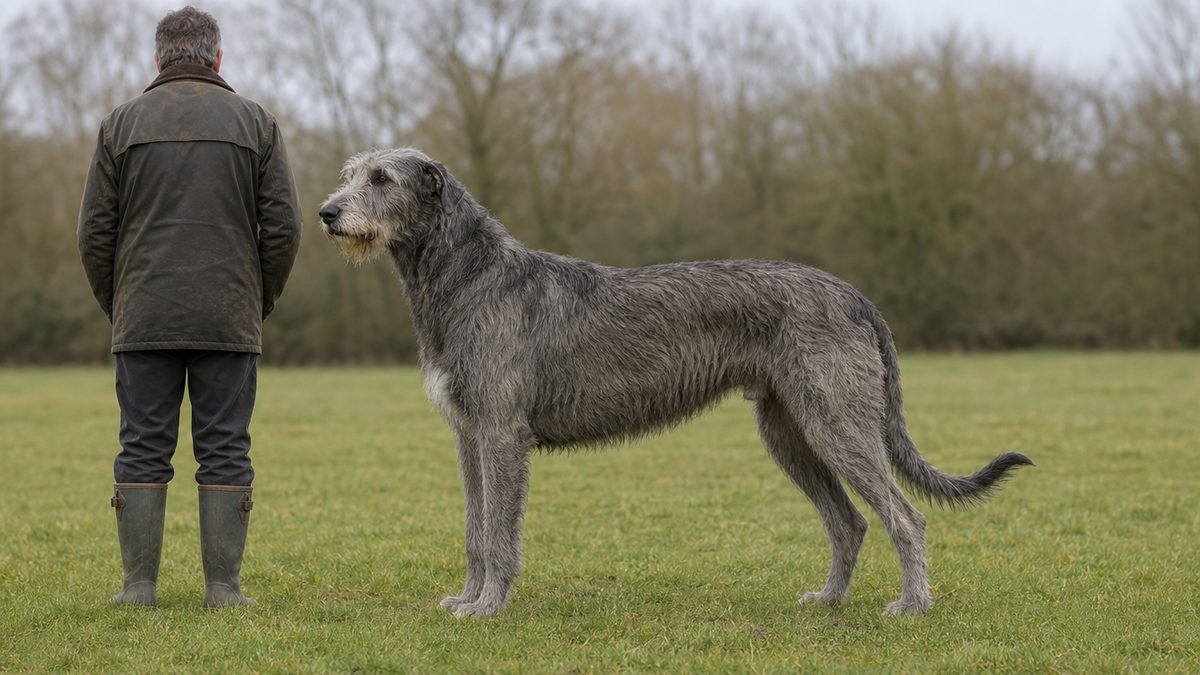
The Irish Wolfhound is a giant rough-coated sighthound from Ireland, registered by the FCI as standard 160 in Group 10 Section 2, Rough-haired Sighthounds, and accepted on a definitive basis on 26 April 1955. Its own breed standard opens by calling it the largest and tallest of the sighthounds, a rough coated hound of great size and commanding appearance, very strong and muscular though gracefully built.
Read the standard rather than a sales panel and two things stand out. The first is that the FCI expresses size as a floor and an aspiration rather than a range. The desired minimum height is 79 cm for males and 71 cm for females, and the minimum weight expected is 54.5 kg for a male at 79 cm and 40.5 kg for a female at 71 cm, with the note that this weight must increase proportionally with increasing size. Above that, the standard states a separate ambition: it is desired to firmly establish a breed that shall have a minimum average height of 86 cm in the male.
The second is a sentence no Indian page reproduces. The standard says plainly that a smaller, lighter, parallel type, so called of sport, is in no way either accepted or compliant with the breed standard. There is no lightweight version of this dog. Anyone offered a compact Irish Wolfhound is being offered something else.
Coat, colour and the things that are faults
The coat is rough and hard on body, legs and head, with the hair over the eyes and beard especially wiry. Royal Canin's Indian breed page describes the same thing from the other side, as a double coat consisting of a harsh, wiry outer layer covering a soft undercoat. Only seven colours are recognised: grey, brindle, red, black, pure white, fawn and wheaten, with white markings acceptable only on fore-chest, toes and the tip of the tail.
Ears are small rose ears set on high, eyes dark and oval, and the standard asks for complete dentition with a scissor bite ideal and a level bite acceptable. Among the listed faults are large ears hanging flat to the face, a short neck with full dewlap, crooked forelegs, and a nose or lips of any colour other than black.
A temperament clause written as a proverb
The behaviour section is one of the shortest in FCI nomenclature and one of the most quoted. It reads: a Gentle kind loyal hound with a friendly nature towards people and other dogs, A Lamb in the Home and Lion in the Chase, a loyal companion. Royal Canin India rates the breed 5 out of 5 for compatibility with other pets and 5 out of 5 for kid-friendliness, and 1 out of 5 for drooling tendencies.
History, and the man who rebuilt the breed
The standard records that Irish Wolfhounds were well established in Ireland in the first century AD, that the first written account of the breed appears in 391 AD, that the first breed standard was written in 1885, and that the first classes for the breed were given at the Dublin kennel club show in 1879. It also states that the Irish Wolfhound is one of the five official symbols of Ireland and has been granted heritage status by the Government of Ireland.
Royal Canin's account fills the gap between those dates. As wolves died out in Ireland the breed itself faced extinction, and a British Army captain, George Augustus Graham, gathered the remaining dogs he could find in the 19th century and set out to standardise and promote the breed. Every Irish Wolfhound alive descends from that reconstruction, which is the background to the genetic findings in the health sections below.
At the FCI's desired minimum average of 86 cm at the withers, an adult male stands roughly waist-high to an adult human at the shoulder and higher than a kitchen counter at the head. That is the practical meaning of the phrase largest and tallest of the sighthounds, and it is the single fact that decides whether an Indian flat can hold one.
Four registries, four different minimum sizes
Four registries recognise the Irish Wolfhound and they do not agree on how big the smallest acceptable one is. The gap between the FCI's minimum female and the AKC's is about 5 cm in height and roughly 7 kg in weight, which is a larger disagreement than any Indian page on this query acknowledges exists.
Establish the country of origin first, because it decides the rest. The Irish Kennel Club's own page states that there are nine Native Dogs of Ireland, and lists two Hounds, the Irish Wolfhound and the Kerry Beagle, three Gundogs, the Irish Water Spaniel, the Irish Red Setter and the Irish Red and White Setter, and four Terriers, the Irish Terrier, the Irish Glen of Imaal Terrier, the Irish Soft Coated Wheaten Terrier and the Kerry Blue Terrier. The Irish Wolfhound is the first name on that list, and the Glen of Imaal Terrier page covers another of the nine.
| Registry | Male minimum height | Female minimum height | Male minimum weight | Female minimum weight |
|---|---|---|---|---|
| FCI standard 160, published 10.04.2026 | 79 cm | 71 cm | 54.5 kg | 40.5 kg |
| The Royal Kennel Club, updated 1 August 2025 | 79 cm (31 in) | 71 cm (28 in) | 54.5 kg (120 lb) | 40.9 kg (90 lb) |
| American Kennel Club | 32 in (81.3 cm) | 30 in (76.2 cm) | 120 lb (54.4 kg) | 105 lb (47.6 kg) |
| Royal Canin India breed panel | 79 to 86 cm | 71 to 86 cm | up to 54.5 kg | up to 40.5 kg |
Two of those differences are trivial and one is not. The 40.5 against 40.9 kg gap between the FCI and the Kennel Club is a rounding artefact: the Kennel Club prints 90 lb and converts it to 40.9 kg, while the FCI rounds the same 40.82 kg down to 40.5 Federation Cynologique Internationale. The AKC's figures are a genuine substantive difference. Its minimum for a bitch is 30 inches and 105 pounds, which is 76.2 cm and 47.6 kg against the FCI's 71 cm and 40.5 kg Federation Cynologique Internationale. An FCI-legal bitch can be seven kilograms lighter than an AKC-legal one and still be inside her standard.
The desired-average clause is the other real disagreement
The Kennel Club's standard says it is desired to firmly establish a breed that shall average from 81 to 86 cm, 32 to 34 inches, in dogs. The FCI takes the top of that range and makes it a floor, asking for a minimum average height of 86 cm in the male. Same sentence, same origin, different target. Anyone comparing an Indian seller's claimed height against a standard needs to say which standard.
What recognition means in India
The Kennel Club of India is the FCI's full member for India, so the KCI issues pedigrees against FCI nomenclature and the Irish Wolfhound's FCI status effectively answers the Indian recognition question. The KCI publishes no browsable breed list, so a query there returns nothing for this breed and nothing for a control breed either. That is a limit of the instrument, not a finding about the breed, and this page states it that way rather than reporting the breed as unrecognised in India.
Tailsbuddy, the one ranking page that engages with registration at all, splits Indian prices into three tiers, Basic, KCI Registered and Show Quality, and explains that Basic covers dogs not registered to any kennel club including KCI. That is a reasonable description of how the Indian market prices paperwork, and it is worth reading alongside the section below on whether any of those dogs exist.
AKC position, read from the page rather than a summary
The AKC places the Irish Wolfhound in the Hound Group, gives a life expectancy of 6 to 8 years, records that the breed was recognised in 1897, and prints a current breed popularity ranking of 75 of 210. That ranking matters for a reason Indian buyers rarely consider: a breed sitting in the middle of the American register has enough registered dogs to generate the screening databases this page relies on, which is why the health evidence below is unusually good for a breed nobody in India sells.
A vulnerable native breed, and two tables that nearly agree
The Royal Kennel Club lists the Irish Wolfhound as a vulnerable native breed, the category it applies to British and Irish native breeds registering fewer than 300 puppies a year. The breed has been under that threshold every year since 2018.
| Source | 2016 | 2017 | 2018 | 2019 | 2020 | 2021 | 2022 | 2023 | 2024 | 2025 |
|---|---|---|---|---|---|---|---|---|---|---|
| Vulnerable native breeds web table | 256 | 372 | 239 | 225 | 195 | 198 | 238 | 191 | 165 | 197 |
| Hound group 10-yearly PDF | 256 | 372 | 239 | 229 | 195 | 198 | 238 | 191 | 165 | 197 |
Nine of those ten columns agree exactly. The 2019 cell does not: the web table prints 225 and the group PDF prints 229, a four-dog gap. Neither document flags a revision, and Bonbeno takes neither as correct. The point of publishing both is that a rarity argument built on a single cell from a single table is weaker than it looks, and this site builds rarity arguments on these numbers.
The trend is unaffected by that one cell. Registrations fell from 372 in 2017 to 165 in 2024 before recovering slightly to 197 in 2025. For comparison, Bonbeno's Gordon Setter page covers a fellow vulnerable native breed that fell to 93 in the same year, and the Irish Water Spaniel, the gundog on the same Irish Kennel Club native-breed list, fell to 40.
Irish Wolfhound price in India: four bands, and nothing behind them
Irish Wolfhound price in India is quoted between Rs 20,000 and Rs 1,40,000 across the pages ranking for this term, a seven-fold spread for the same breed, and not one of those pages has an Irish Wolfhound for sale. That second fact is the more useful one, so this section leads with it.
| Source | Quoted price | Irish Wolfhounds actually shown |
|---|---|---|
| PetBuy breed page | Rs 20,000 to Rs 90,000 | Listings: 0, printed on the same page |
| Tailsbuddy, Basic tier | Rs 60,000 to Rs 80,000 | None; no listings feature |
| Tailsbuddy, KCI Registered tier | Rs 80,000 to Rs 1,00,000 | None |
| Tailsbuddy, Show Quality tier | Rs 1,00,000 to Rs 1,40,000 | None |
| Puppiezo, position 1 | No Irish Wolfhound price printed | Zero of eight animals in its carousel |
| Asia Pets, position 2 | No rupee figure printed | Showing 0 results |
| Mr n Mrs Pet, position 3 | No rupee figure printed | Three cards, none an Irish Wolfhound |
| Justdial Delhi, position 4 | Figures appear only in the search snippet | Two shops, both in Tamil Nadu |
PetBuy prints a typical low of Rs 20,000 and a typical high of Rs 90,000, and immediately beneath them prints Live Avg (PetBuy) as a dash and Listings as 0. Tailsbuddy prints the three-tier ladder above and adds, in its own words, that the breed's price in India is not very affordable and that Irish Wolfhounds have a subpar availability in most parts of India. Those two pages are the entire published Indian price literature for this breed.
Run the currency tests, and then read the quotient
Indian pages routinely publish a United States dollar figure run through one exchange rate and presented as rupees, so every figure above was divided by the three rates this site has caught in circulation. None of them behaves like a converted list.
| Rupee figure | Divided by 84.38 | Divided by 74 | Divided by 66.67 |
|---|---|---|---|
| Rs 20,000 | 237.02 | 270.27 | 299.99 |
| Rs 60,000 | 711.07 | 810.81 | 899.96 |
| Rs 80,000 | 948.09 | 1,081.08 | 1,199.94 |
| Rs 90,000 | 1,066.60 | 1,216.22 | 1,349.93 |
| Rs 1,00,000 | 1,185.11 | 1,351.35 | 1,499.93 |
| Rs 1,40,000 | 1,659.16 | 1,891.89 | 2,099.90 |
| Rs 98,999 (Puppiezo house figure) | 1,173.25 | 1,337.82 | 1,484.91 |
Read the 66.67 column carefully, because it looks like a clean result and is not one. 66.67 is 200 divided by 3, so 1,000 rupees divides to 15.00 dollars by construction and any multiple of 1,000 lands within five hundredths of a round figure whatever its origin. Every rupee price for this breed is a multiple of 1,000, so every one of them passes that test automatically. The test proves nothing here and is printed only so a reader can see why.
The two tests that carry information both fail. Nothing divides to a whole dollar at 84.38, the rate that caught converted price lists on three earlier Bonbeno pages, and nothing divides cleanly at 74 either. The honest conclusion is that these are rupee-native asking prices, round numbers typed by a person, rather than an American price list run through a converter. That is a different contamination mechanism and it needs saying differently: nobody converted anything, and nobody sold anything either.
The Rs 98,999 figure is not this breed's price
Google's result snippet for the page ranking first advertises a price of Rs 98,999 against the query Irish Wolfhound puppies for sale in India. Opening the page shows where that figure lives. It sits in an Other Available Pets carousel alongside Rs 92,599, Rs 94,999, Rs 76,499 and Rs 1,20,000, attached to eight named animals: two Maltipoos called Fizey and Samy, two Poodles called Kuzo and Dugu, a Cane Corso called Kazuka, a Goldendoodle called Doir, a Rottweiler called Tugi and a Doxiepoo called Yoki. Rs 98,999 appears three times on that one page, on Fizey, Samy and Yoki. Zero of the eight animals is an Irish Wolfhound.
The page ranking first for irish wolfhound price in india contains a breed panel, a feeding-warning graphic, a tier comparison chart and a replacement guarantee, and not one Irish Wolfhound for sale. Its replacement guarantee reads that if your pet perishes because of a health concern within the guarantee period, confirmed by a licensed vet, a replacement is offered. Read that sentence twice before you send a deposit anywhere on this search result.
What the ranking pages are actually made of, tested with a control
Test the ranking pages rather than trusting them, and three of the five turn out to be templates with the breed name substituted in. The test is cheap: fetch a second, unrelated breed page from the same site and see which sentences change.
PetBuy's Irish Wolfhound page opens with a paragraph of history: like most established breeds, the Irish Wolfhound was shaped by the needs of the people who first kept it, from work and protection to companionship, and today the Irish Wolfhound is enjoyed by Indian families who appreciate its personality and presence. That paragraph names no wolf, no Ireland, no Captain Graham and no date. It could be about any dog, and the reason is visible the moment you fetch a control page from the same site.
| Field | Irish Wolfhound page | Affenpinscher page |
|---|---|---|
| Grooming | Low | Low |
| Shedding | Low | Low |
| Barking | Low | Low |
| Good With | Families, Children | Families, Children |
| Trait chips | Friendly, Playful, Devoted | Friendly, Playful, Devoted |
| Listings | 0 | 0 |
| Lead description | One generic sentence about Indian pet lovers | The literal string hfghfghfgh |
| Price paragraph | Identical wording with the breed name swapped | Identical wording with the breed name swapped |
| Similar breeds shown | Redbone Coonhound, Affenpinscher, Norwegian Elkhound, German Spitz, Great Pyrenees, Gordon Setter | American Eskimo, Golden Shepherd, American Pit Bull Terrier, Culture Pomeranian, Peekapoo, Border Terrier |
The control settles it. A site that describes a 55 kg rough-coated sighthound and a 4 kg toy terrier with the identical trait chips, the identical three FAQ answers and the identical price paragraph is filling a template, not writing about dogs. The Affenpinscher page's description field, which on the Wolfhound page holds a bland sentence, holds the literal keyboard string hfghfghfgh in live production. That is a placeholder nobody removed, and it is the clearest possible evidence that no human wrote either page.
PetBuy's Irish Wolfhound page also prints a lifespan of 9 to 12 years, grooming Low and shedding Low. Every other source on this search result gives 6 to 8 years Asia Pets, Irish Wolfhound Puppies for Sale… Tailsbuddy, Irish Wolfhound Dog and Puppy… Puppiezo, Irish Wolfhound Puppies For Sale…, and the largest measured estimate is 9.9 years. Its Explore Similar Breeds row places an Affenpinscher and a German Spitz next to a giant sighthound.
Three carousels, and what each one holds instead
Asia Pets prints Showing 0 results, then a heading reading Here are available pets of the same breed from other locations, then three cards: a Chihuahua, a Yorkshire Terrier and a Toy Pom. That is worse than a stock shortage, because the site explicitly labels three toy dogs as the same breed as an Irish Wolfhound. The same page's marketing copy says the site has been helping families across India find their perfect Irish Wolfhound companion for years, and that every single dog you see, Irish Wolfhounds included, is available right now.
Mr n Mrs Pet prints 3 Result Found under an Irish Wolfhound heading, and the only three animals shown are a French Bulldog in Guwahati, an English Bulldog in Hyderabad and a Border Collie in Ahmedabad, under a heading reading Similar breeds at other locations. Page 1 of 1. No Irish Wolfhound is displayed and no Irish Wolfhound price is printed anywhere on it.
Justdial's page is titled Popular Irish Wolfhound Dog Wholesalers in Delhi. The two businesses it lists are Crazy Pets Vet Care in Madurai and Kgp Pets in Coimbatore, both in Tamil Nadu and roughly two thousand kilometres from Delhi. Kgp Pets' own category tags read Dog Wholesalers and Labrador Dog Wholesalers, and the page's meta description lists Shih Tzu, Rottweiler, Dog Chain and Labrador wholesalers. Neither business is described as dealing in this breed.
The Justdial result advertises, in Google's snippet, that mid-range Irish Wolfhound puppies are typically priced between Rs 40,000 and Rs 70,000, and premium puppies from Rs 80,000 to Rs 1,50,000. A live raw-HTML fetch of that exact URL on 31 August 2026 returned 326,219 characters. The word Wolfhound appears in it 101 times. The strings 40,000, 70,000, 80,000 and 1,50,000 appear zero times each. Whatever the snippet is drawn from, it is not the page the reader lands on.
One check on the search results themselves is worth recording, because this site has been fooled by poisoned result sets before. Google's own results page could not be retrieved from this environment, so the People Also Ask questions answered below were harvested from Bing India with the country set to IN. That result set was genuinely about this breed rather than substituted, listing Mr n Mrs Pet, Tailsbuddy and Supertails among ten organic results, and its People Also Ask block rendered four real questions while printing Loading and Unable to load answer in place of the answers. Bonbeno therefore answers those four questions verbatim and claims no knowledge of what Google's own box contains.
Cost of ownership in India: what can be sourced and what cannot
The recurring cost of ownership for an Irish Wolfhound in India cannot be quoted as a single monthly figure, because no published Indian estimate for this breed exists and Bonbeno will not invent one. What can be sourced honestly are the Indian care costs that apply to any dog, scaled by the fact that this one weighs 54.5 kg at its standard minimum.
Start with the line that is genuinely published in rupees. Supertails, an Indian pet-care company, puts a full puppy vaccination programme at a private clinic at Rs 5,500 to Rs 8,000 paid visit by visit in 2026, built from three DHPPi and Lepto4 doses at Rs 1,200 to Rs 1,800 each, two anti-rabies doses at Rs 400 to Rs 700 each and one kennel cough dose at Rs 1,000 to Rs 1,500.
Check that arithmetic before using it, because a total should reconcile with its own components. Three doses at Rs 1,200 plus two at Rs 400 plus one at Rs 1,000 is Rs 5,400, which is Rs 100 under the stated floor and close enough. At the top the components sum to Rs 8,300 against a stated ceiling of Rs 8,000, so the published range slightly understates its own worst case. Budget against Rs 8,300 rather than Rs 8,000 and you will not be surprised.
That figure is breed-independent. Everything below it scales with the dog, and this is where a giant differs from a Labrador.
| Line | Why this breed generates it | Sourceable in rupees? |
|---|---|---|
| Vaccination, first year | Standard Indian schedule, unaffected by size | Yes: Rs 5,500 to Rs 8,000 at private clinics |
| Food | A male at the FCI floor of 54.5 kg, fed as three meals a day rather than one to reduce bloat risk | No breed-specific Indian figure published |
| Cooling | A dog whose homeland averages 10.05 degrees Celsius, kept in a city averaging 23.7 to 28.0 | Household-specific, not a breed figure |
| Cardiac screening | Annual echocardiography and ECG on a breed with 8.9 percent atrial fibrillation prevalence | No Indian clinic price could be sourced |
| Holter monitoring | Recommended for any Irish Wolfhound with a ventricular premature complex on a surface ECG | No Indian price could be sourced |
| Anaesthetic care | A sighthound with lower fibrinogen and weaker clot formation than control dogs | No Indian price could be sourced |
| Transport and access | A 55 kg dog does not fit an autorickshaw or most hatchbacks in an emergency | Household-specific |
The line nobody prices, and why it is the big one
Cardiac monitoring is the cost that separates this breed from every other giant, and no Indian page mentions it at all. The 2026 follow-up study of breeding-age Irish Wolfhounds concludes that a Holter monitor is recommended for all Irish Wolfhounds with ventricular premature complexes noted on a surface ECG. Ten of the 24 dogs it followed, 41.6 percent, developed arrhythmias needing medical therapy during the study. Anti-arrhythmic medication is a recurring monthly cost with no end date, and it is the likeliest large veterinary line item this breed will hand an Indian owner.
Second, cooling. The 2017 Rules do not price it but they do describe the standard. Second Schedule Part IV paragraph 15 requires that the temperature within indoor housing facilities shall be ambient and comfortable depending on the breeds of dogs housed inside, and paragraph 16 allows ventilation to be met by means of windows, doors, vents or air conditioning. Those clauses bind breeders rather than pet owners, but they set a fair benchmark to budget against for a breed rated 1 out of 5 for warm weather on its own manufacturer's Indian site.
Bonbeno prints no monthly rupee total for this breed because none is published and none can be derived without inventing a food price. What can be said is the shape: one large fixed first-year cost of Rs 5,500 to Rs 8,000 for vaccination, a food line that scales with a 54.5 kg body, and a cardiac line that most Indian owners will not have budgeted for at all.
Heat tolerance: a 10 degree homeland against a 28 degree city
Heat tolerance in this breed is rated 1 out of 5 by Royal Canin on its own Indian site, and the climate data explains why. Dublin's annual mean air temperature is 10.05 degrees Celsius. Chennai's is 27.95. The gap is 17.90 degrees, and Chennai's coolest month is still warmer than Dublin's hottest.
Every figure below was pulled from NASA POWER by explicit latitude and longitude rather than a place-name slug, because place-name climate lookups have served this project six wrong documents. POWER returns a grid cell rather than a point, so the cell elevation is printed beside each city and checked against the real town.
| Place | Cell elevation, m | Annual mean, C | Hottest month mean, C | Annual relative humidity, % | Warmer than Dublin by |
|---|---|---|---|---|---|
| Dublin, Ireland (homeland) | 46.03 | 10.05 | 15.11 (July) | 87.64 | reference |
| Chennai | 48.95 | 27.95 | 31.51 (May) | 72.39 | 17.90 C |
| Mumbai | 97.15 | 26.77 | 31.19 (May) | 67.39 | 16.72 C |
| Delhi | 206.37 | 25.60 | 35.88 (June) | 45.56 | 15.55 C |
| Bengaluru | 841.72 | 23.74 | 28.37 (April) | 67.94 | 13.69 C |
| Ooty, as the grid cell reports it | 784.64 | 23.50 | 27.44 (April) | 72.73 | 13.45 C |
| Ooty, corrected for elevation (estimate) | about 2,240 actual | about 14.0 | about 17.9 | not adjusted | about 3.9 C |
Why the Ooty row carries two numbers
The Ooty row is printed twice because the grid cell is wrong about where Ooty is. POWER returned an elevation of 784.64 m for the coordinates of Udhagamandalam, a town that actually sits at roughly 2,240 m. The cell is about 1,455 m below the town, and air temperature falls at roughly 6.5 degrees Celsius per 1,000 m, so the raw figure reads about 9.5 degrees too warm. The corrected estimate of about 14.0 degrees is labelled an estimate because that is what it is.
The five plains cities need no such correction, and the check is what proves it. Chennai's cell came back at 48.95 m against a town at roughly 10 m, Delhi's at 206.37 m against roughly 216 m, Mumbai's at 97.15 m against roughly 14 m and Bengaluru's at 841.72 m against roughly 920 m. Those are small errors in flat terrain. The rule is simple: if the place is a hill station, verify the elevation before you trust the temperature.
The comparison that actually decides it
Set Dublin's hottest month against each Indian city's coolest and the picture stops being about averages. Dublin's warmest month, July, averages 15.11 degrees Celsius. Chennai's coolest month, January, averages 24.09 degrees. Chennai's coldest month is 8.98 degrees warmer than Dublin's hottest. There is no month anywhere in the five Indian cities above that falls inside the Irish Wolfhound's home range, and only a lapse-rate-corrected hill station comes within four degrees of it.
Humidity moves in the opposite direction and that is the one small mercy. Dublin runs at 87.64 percent annual relative humidity, higher than Chennai's 72.39, Bengaluru's 67.94 or Mumbai's 67.39. A rough double coat evolved in a wet, cold maritime climate is not meeting damp air for the first time in India. It is meeting damp air seventeen degrees warmer, which is a different problem and a much worse one.
If you query two nearby hill stations and POWER returns identical numbers to the decimal, you have queried one grid cell twice and cannot use the result to choose between them. That is a limit of the instrument. It is also why the Ooty figure above is published with its elevation attached rather than presented as a finding about Ooty.
So the breed is heat-sensitive in the precise sense that matters to a buyer: not fragile in the abstract, but living every Indian month outside the temperature band its coat and body mass were selected in. That is a fact about geography rather than about the individual dog, and no amount of care changes it.
What the heat evidence says, and which odds ratio actually applies
Two separate UK studies published in 2020 give heat-related illness odds ratios for large dogs, and they are different papers with different case definitions. Applying the wrong one, or applying either to a breed the authors never modelled, is the commonest error on giant-breed pages.
The first is Hall, Carter and O'Neill in *Scientific Reports* 10:9128. From the clinical records of 905,543 UK dogs under primary veterinary care in 2016 it identified 395 confirmed heat-related illness events, an incidence of 0.04 percent and an event fatality rate of 14.18 percent. Its bodyweight ladder is the part that matters here.
| Bodyweight band | Odds ratio | 95% CI | p |
|---|---|---|---|
| Under 10 kg | base | ||
| 10 to under 20 kg | 1.82 | 1.31 to 2.53 | <0.001 |
| 20 to under 30 kg | 2.13 | 1.51 to 3.02 | <0.001 |
| 30 to under 40 kg | 1.74 | 1.14 to 2.65 | 0.010 |
| 40 to under 50 kg | 1.76 | 0.91 to 3.40 | 0.093 |
| 50 kg and over | 3.42 | 1.54 to 7.57 | 0.002 |
Notice where the jump is. The 40 to under 50 kg band is not statistically significant at all, with a confidence interval crossing 1 and a p value of 0.093. The 50 kg and over band nearly doubles the odds of the band below it and is significant. That threshold is the reason this page checked the breed standard before quoting anything.
The 50 kg check, done properly
The FCI's minimum expected weight for a male Irish Wolfhound is 54.5 kg at 79 cm, and the standard adds that this weight must increase proportionally with increasing size. So every male inside his own standard sits above the 50 kg threshold, and the 3.42 odds ratio applies to him on bodyweight grounds. A female is a different case: the FCI minimum is 40.5 kg and the AKC's is 105 lb, about 47.6 kg American Kennel Club. Neither figure clears 50 kg, so a bitch at her standard minimum sits in the 40 to under 50 kg band, where the study found no significant effect.
That distinction is worth making because it is checkable and because the alternative is sloppy. A recent Bonbeno page on another giant breed declined to use the 3.42 figure at all after finding that its FCI standard caps the breed at 47 kg. Here the standard clears the threshold for males and does not for females, and the page says so rather than applying one number to both sexes.
The breed itself was not modelled, and that limit is stated
The word Wolfhound appears zero times in either Hall 2020 paper Hall EJ, Carter AJ. The breeds the first paper singled out for elevated odds were the Chow Chow, Bulldog, French Bulldog, Dogue de Bordeaux, Greyhound, Cavalier King Charles Spaniel, Pug, English Springer Spaniel and Golden Retriever, compared against Labrador Retrievers. The Irish Wolfhound is not among them. So what transfers to this breed is the bodyweight factor and the purebred factor, at odds ratio 1.86 against crossbreds, and not a breed-specific figure, because none exists.
The second paper, and why its numbers are lower
The companion paper, in *Animals* 10(8):1324, uses the same 905,543-dog cohort but a wider case definition, identifying 1,259 heat-related illness events from 1,222 dogs. Of those, 380 had no trigger recorded, leaving 879 events with a recorded trigger, of which 652 were exertional, 74.2 percent, 113 environmental at 12.9 percent, 46 vehicular confinement at 5.2 percent, 40 under veterinary or grooming care at 4.6 percent, 24 building confinement at 2.7 percent and 4 blanket entrapment at 0.5 percent. Those six counts sum exactly to 879.
In that exertional model the bodyweight bands behave differently. Every band from 10 kg upwards sits between 2.15 and 2.52, and the 50 kg and over band returns an odds ratio of 2.21, 95 percent CI 1.02 to 4.79. Bodyweight at or above the breed and sex mean returns 1.30, 1.09 to 1.55. So for exercise-triggered heat illness specifically, being enormous is no worse than being merely large. It is the all-cause model where 50 kg stands out.
The 74.2 percent figure is 652 of the 879 events that had a trigger recorded, not 652 of 1,259 and not a share of 905,543 dogs. Written the wrong way it implies 934 exertional events, which is not what the paper found. Indian law reaches the same conclusion from a different direction: Second Schedule Part IV paragraph 21(1) of the 2017 Rules bars keeping outdoors, without the attending veterinary practitioner's written approval, dogs that are not accustomed to the temperatures prevalent in the region, breeds that cannot tolerate them, and sick, infirm, aged or young animals.
Temperament: a lamb in the home, and who should not buy one
Temperament in this breed is the least contested thing about it. Its own FCI standard describes a gentle, kind, loyal hound with a friendly nature towards people and other dogs, and Royal Canin India rates it 5 out of 5 for kid-friendliness and 5 out of 5 for compatibility with other pets.
What the sales pages leave out is the shape of that gentleness. Royal Canin describes a dog that is not always on high-energy mode and can be quite content lolling around close to its people at home, but which needs an enclosed garden with a high fence, free from smaller creatures that might otherwise bear the brunt of that ancient chasing instinct. A calm indoor dog with a live prey drive is a specific combination, and it decides where the dog can live rather than how pleasant it is to live with.
Who this breed suits in India
- Households with ground-floor space and a securely fenced yard, because Royal Canin India rates apartment living 1 out of 5 and the fence has to be high.
- Families with children, given a 5 out of 5 kid-friendly rating and a standard describing a friendly nature towards people, with the usual caveat that no dog of this size is left unsupervised with a small child Federation Cynologique Internationale.
- Owners already keeping other dogs or cats, on a 5 out of 5 rating for compatibility with other pets, subject to the prey-drive caveat about smaller animals outdoors.
- People in the cooler parts of the country, because no Indian metro has a month inside the breed's home temperature range.
- Owners who can absorb a short relationship, since the largest UK estimate is a median of 9.9 years and Royal Canin India classes the breed as senior from five years old Royal Canin India.
Who should not buy one
- Anyone in a flat. Rated 1 out of 5 for apartment suitability by the breed's own food manufacturer on its Indian site, and Tailsbuddy, a page selling the breed, says the same thing.
- First-time dog owners. Tailsbuddy, again a seller rather than a critic, states the breed is not a very good option for a novice or first-time dog parent.
- Anyone who wants a guard dog. The standard asks for a friendly nature towards people, and Royal Canin rates the breed 2 out of 5 for being able to stay alone Royal Canin India.
- Anyone buying on a price band. Every rupee figure published for this breed in India sits on a page with no Irish Wolfhound in it.
- Anyone who cannot fund cardiac work. Ten of 24 breeding-age dogs in a 2026 study needed anti-arrhythmic medication within the study period.
One further point belongs here rather than in the health section, because it is a question about what you are signing up to feel. A dog that Royal Canin's own Indian life-stage table calls senior from five years, mature from two to five, and adult only from eight months, spends a smaller fraction of its life as a healthy adult than almost any other pet you could choose. That is the honest emotional cost of a short-lived giant, and it belongs in the decision rather than in a footnote.
Training: patient, early, and finish before the dog outweighs you
To train an Irish Wolfhound, start in the first four months and finish the manners work before the dog is heavier than the person holding the lead. Royal Canin India notes that these big dogs stay puppy-like for an extended period and do not mature until around 18 months, which leaves plenty of time for puppyish mischief.
The good news is in the same paragraph: Irish Wolfhounds are intelligent, and with patient, positive and consistent training, starting early, along with socialisation, you should see progress. This is not a stubborn breed. It is a slow-maturing one, which is a different problem with a different solution.
The arithmetic that makes timing urgent
A Labrador puppy that pulls at six months weighs perhaps 20 kg. An Irish Wolfhound at the same age is on a trajectory towards a standard minimum of 54.5 kg. Lead manners, door manners and settling on cue have to be reliable while correcting them is still a matter of technique rather than strength. Every month of delay makes the same lesson physically harder to teach.
Socialise early, and do it in the cool hours
Socialise the puppy across surfaces, people, traffic noise and other dogs in the first sixteen weeks, and schedule that work for early morning or after dark. This is the one Indian complication that no overseas training guide mentions: a socialisation window that falls in an Indian summer collides with a breed rated 1 out of 5 for warm weather. A puppy that can only be taken out at 6 am gets fewer exposures per week than one in Dublin, so plan for more weeks rather than longer sessions.
Recall is the one thing to manage rather than train
This is a sighthound, defined by the FCI as such and bred until the end of the 17th century for hunting wolves, wild boar and deer in Ireland. Royal Canin describes the same instinct in the present tense, warning that the enclosed garden should be free from smaller creatures that might otherwise bear the brunt of that ancient chasing instinct. Train a recall, and then behave as though it will fail in sight of a moving animal, because a dog at full stride covering ground on sight is not listening.
- Teach a settle on a mat before you teach anything else, because a calm 55 kg dog in a room is the whole game.
- Practise lead walking at 12 to 20 weeks, on a flat collar or harness, in short repeated sessions.
- Book the puppy's vaccination course early, since the 2017 Rules record that all pups shall be vaccinated starting at seven to eight weeks and usually completed at eighteen weeks.
- Build a reliable name response and a hand touch before any off-lead work.
- Fence first and train second. A high, secure boundary is equipment, not an alternative to obedience.
Do not use a heavy correction collar to compensate for a dog you left untrained until nine months. On a breed with documented low fibrinogen concentrations and weaker clot formation than control dogs, and a neck the standard describes as rather long and very strong, force is both ineffective and unnecessary. Start earlier instead.
Exercise: space to gallop, not distance on pavement
The daily exercise requirement for an Irish Wolfhound is regular rather than extreme, and Royal Canin India rates physical activity needs at 3 out of 5. What the breed needs is not mileage but a safe enclosed space to run in, plus long walks on a lead.
Royal Canin's own wording is worth quoting because it contradicts the Indian sales pages. Irish Wolfhounds are not the most energetic breed and can be content just lounging around when at home, but regular exercise is important because those extraordinary muscles need to be used if they are to stay in good condition, and long walks on a lead combined with opportunities to play in a safe, enclosed space are ideal. Puppiezo's panel puts the requirement at one hour daily with a moderate energy level, which is in the same territory.
The Indian constraint is the clock, not the distance
Exertional heat-related illness was the predominant trigger in the UK data, accounting for 652 of the 879 events with a recorded trigger, and those events occurred year-round rather than only in summer. In a city whose hottest month averages 31.51 degrees Celsius and peaks at 42.70, the practical rule is that all structured exercise happens before sunrise or well after sunset, and that midday activity is cancelled rather than shortened.
| City | Hottest month mean, C | Peak recorded max, C | Practical approach |
|---|---|---|---|
| Delhi | 35.88 (June) | 48.79 | Pre-dawn only from April to June, indoor rest by 8 am |
| Chennai | 31.51 (May) | 42.70 | Pre-dawn and post-sunset, humidity limits evaporative cooling |
| Mumbai | 31.19 (May) | 44.91 | Coastal humidity of 90.36 percent in August is the binding limit |
| Bengaluru | 28.37 (April) | 40.38 | The most workable large Indian city for this breed, still 13.69 C above Dublin |
| Ooty, elevation-corrected estimate | about 17.9 | not adjusted | The closest Indian analogue found, and still warmer than Dublin |
What happens without it
An under-exercised Irish Wolfhound does not usually become destructive in the way an under-exercised working breed does. It becomes soft, heavy and stiff, and that matters more here than it would in a smaller dog. Bodyweight at or above the breed and sex mean carried an odds ratio of 1.42 for heat-related illness in the all-cause UK model and 1.30 in the exertional model Hall EJ, Carter AJ. On a breed already over the 50 kg threshold, letting a dog run heavy stacks a second risk factor on top of the one it was born with.
The growth-phase caveat is the important counterweight. Royal Canin notes that giant-sized puppies, whose growth period is long and intense, are especially susceptible to skeletal and joint problems including limb defects, bone deformities and joint lesions. Free play on grass in a fenced space is the right exercise for a growing Wolfhound. Forced distance work on hard surfaces is not.
Grooming a harsh double coat in Indian humidity
Grooming an Irish Wolfhound takes about one brush a week, which is far less than an Indian buyer expects from a shaggy giant. Royal Canin India says the double coat consists of a harsh, wiry outer layer covering a soft undercoat and that the dog needs brushing once a week or so to stay clean and keep the coat in good condition.
The coat's harshness is what saves it. The FCI standard describes hair that is rough and hard on body, legs and head, with the hair over the eyes and beard especially wiry. A harsh coat sheds water and debris rather than holding it, which is why this breed does not generate the matting problem that a feathered gundog coat does in an Indian monsoon. Compare the Gordon Setter page, where Purina India asks for grooming every other day on a silky feathered coat.
Royal Canin rates shedding 3 out of 5 and drooling 1 out of 5, and its own FAQ says the breed sheds a moderate amount, less than you might expect given its shaggy appearance. PetBuy's page, by contrast, rates both grooming and shedding as Low, the same two values it prints on its Affenpinscher page PetBuy, Affenpinscher Dog Breed page. Take the manufacturer's rating over the template's.
Never clip this coat
The instruction that matters most in India is a negative one. The outer coat is insulation against solar gain as well as cold, and removing it exposes lightly pigmented skin on a dog whose recognised colours include pure white, wheaten and fawn. A clipped Irish Wolfhound is not a cooler Irish Wolfhound. Manage heat with shade, timing, ventilation and water, which is what the 2017 Rules themselves describe when they allow ventilation to be met by windows, doors, vents or air conditioning.
The four places to actually check
- Beard and eyebrows. The standard calls this hair especially wiry, and it traps food and water. Wipe after meals in humid months.
- Ears. The standard specifies small rose ears set on high, which ventilate far better than a drop ear. That is a real advantage in Indian humidity and it is worth knowing, because heavy-eared breeds carry most of the Indian otitis burden.
- Feet. Moderately large and round with well arched, closed toes and very strong curved nails. Check pads for hot-surface damage after any daytime walk on tarmac.
- Belly and elbows. A 55 kg dog lying on hard floors develops pressure calluses. Give it a bed it actually fits on.
For a giant breed, this is a low-maintenance coat: one weekly brush, no clipping, no stripping schedule, and no professional appointment that a normal Indian household could not do at home. If a seller quotes you a large monthly grooming figure for an Irish Wolfhound, ask what it is for.
Health and lifespan: the best-documented thing about this breed
The breed's health issues divide into three: a short lifespan, an inherited cardiac load, and bone cancer. Unusually for a breed nobody sells in India, all three are well measured, and PubMed returns 80 records for the exact phrase Irish Wolfhound against a control query that behaved normally in the same session.
Start with life expectancy, because it is the breed's defining welfare issue and because the published Indian figures disagree with each other. The AKC gives 6 to 8 years, Asia Pets, Tailsbuddy and Puppiezo all give 6 to 8 Tailsbuddy, Irish Wolfhound Dog and Puppy… Puppiezo, Irish Wolfhound Puppies For Sale…, and PetBuy alone gives 9 to 12. None of them is a measurement. Two measurements exist and they are set out below with their cohorts named.
| Study | Cohort | Estimate | What it rests on |
|---|---|---|---|
| McMillan 2024, Supplementary Table S3 | 584,734 UK dogs, 284,734 deceased, 155 purebreds | Median survival 9.9 years, 95% CI 9.2 to 11.0 | 210 recorded Irish Wolfhound deaths |
| Orleifson 2017, Acta Veterinaria Scandinavica | 105 Swedish Irish Wolfhounds, 38 percent questionnaire response rate | Median lifespan 2,720 days, about 7.5 years | Owner-reported, single-breed, single-country |
Those two are not in conflict, they are measuring different populations by different methods. The UK figure is a survival estimate from primary-care records across a whole country; the Swedish figure is an owner survey of one breed with a 38 percent response rate. The Swedish study adds a sex difference the UK one does not report: males lived a median 2,523 days and females 2,836 days, P equals 0.02.
Where the breed actually ranks, and a claim to retire
Working through McMillan's Supplementary Table S3 breed by breed puts the Irish Wolfhound eleventh shortest of the 155 purebreds it measures, and seventh of the 82 breeds with at least 200 recorded deaths. Shorter medians belong to the Caucasian Shepherd Dog at 5.4 years, Presa Canario at 7.7, Cane Corso at 8.1, Mastiff at 9.0, Affenpinscher, Bloodhound, Neapolitan Mastiff and Saint Bernard at 9.3 each, and both Bulldog and French Bulldog at 9.8. So the common claim that this is the shortest-lived dog breed is simply not what the largest dataset says.
The two supplementary tables disagree, so quote the deaths
McMillan's own supplementary tables give two different sample sizes for this breed. Table S3 prints 509 against 210 deaths. Table S6, headed sample sizes regarding alive, deceased and total individuals per breed, prints 259 alive, 210 deceased and 469 total McMillan et al. 2024. The totals differ by 40 dogs. The death count is identical at 210 in both, which is why every sentence on this page builds on deaths and on the median with its confidence interval rather than on a headline N. The paper also carries an Author Correction, which changes only a Miniature Dachshund figure in a figure legend and does not touch this breed.
What Irish Wolfhounds actually die of
The Swedish survey recorded the commonest causes of death as neoplastic disease at 24 percent, cardiac disease at 18 percent and respiratory disease at 16 percent. The 2026 cardiology study states separately that cardiac disease is the second leading cause of death in Irish Wolfhound populations at 15.27 percent. Those two cardiac figures, 18 and 15.27 percent, come from different populations and this page prints both rather than choosing.
The respiratory finding deserves its own line because it is specific to this breed and absent from every Indian page. Pneumonia occurred in 37 percent of the Swedish dogs, and 53 percent of those affected had recurrent episodes. Dogs that had pneumonia lived a median 2,629 days against 2,804 days for those that did not, P equals 0.04. A recurring lower-airway problem in a country with Indian air quality is worth knowing about before you buy.
Joints: the OFA rows, read from the printed breed label
| Registry | Evaluations | Normal | Abnormal | Breakdown |
|---|---|---|---|---|
| Hips | 3,131 | 95.4 percent | 4.3 percent dysplastic | Excellent 27.9, Good 60.0, Fair 7.4; mild 2.7, moderate 1.5, severe 0.1 |
| Elbows | 1,948 | 85.5 percent | 14.4 percent | Grade 1 11.4, grade 2 2.4, grade 3 0.6 |
| Eyes | 1,427 | 93.3 percent | 6.7 percent | Breeder option 0.0 percent |
| Thyroid | 126 | 96.0 percent | 0.0 percent | Equivocal 4.0; autoimmune thyroiditis 0.0 |
Every one of those rows adds up, which is the cheap check that catches a misread table. On hips, 27.9 plus 60.0 plus 7.4 is 95.3 against a printed 95.4, a rounding difference, and 2.7 plus 1.5 plus 0.1 is exactly 4.3. On elbows, 11.4 plus 2.4 plus 0.6 is exactly 14.4.
Read together the two joint rows say something specific. Hip dysplasia is not this breed's problem, at 4.3 percent of 3,131 evaluations. Elbow dysplasia is, at 14.4 percent of 1,948, and that is the number to screen for. The thyroid row rests on only 126 evaluations, which is a small sample, and it should be read alongside the sighthound thyroid caveat set out on Bonbeno's Greyhound page before anyone draws a clinical conclusion from it.
OFA publishes further Irish Wolfhound rows whose disease label could not be read reliably out of the page's own markup in this session, including three tables reporting normal, equivocal and abnormal percentages. They are not quoted here, because a statistics row without a confirmed disease label is exactly the kind of figure this site has published wrongly before. The four tables above are quoted because each one is identified by its own column headers.
The heart: atrial fibrillation, and why screening is not optional
The Irish Wolfhound's cardiac load is the most decision-relevant fact about owning one, and no Indian page ranking for this query mentions it. Atrial fibrillation was found in 8.9 percent of 645 adult North American Irish Wolfhounds, 95 percent CI 6.6 to 11.2, with Irish Wolfhound cardiomyopathy present in 1.8 percent, CI 0.72 to 2.8.
Those dogs were screened rather than presented as sick, which is what makes the figure alarming. The authors conclude that atrial fibrillation is common in North American Irish Wolfhounds, that it occurs in association with structural cardiac disease but also in its absence. A healthy-looking dog can already be in atrial fibrillation.
It is inherited, and the mode is dominant
A pedigree analysis of 327 affected and 136 unaffected Irish Wolfhounds over eight years estimated the heritability of atrial fibrillation in the breed at 0.69, 95 percent confidence interval 0.50 to 0.86, with a pedigree pattern consistent with a dominant mode of inheritance. A heritability near 0.7 with a dominant pattern means parental screening is the single most useful thing a buyer can demand, and it is why the adoption checklist on this page leads with dated cardiac results on both parents.
What dilated cardiomyopathy costs in months
The largest clinical series of the disease in this breed followed 151 Irish Wolfhounds with dilated cardiomyopathy in three groups: 35 with preclinical DCM in sinus rhythm, 87 with preclinical DCM plus atrial fibrillation, and 29 in congestive heart failure with DCM and atrial fibrillation. Those three groups sum exactly to 151.
| Group | Dogs | Median survival |
|---|---|---|
| Preclinical DCM, sinus rhythm | 35 | 29.1 months |
| Preclinical DCM with atrial fibrillation | 87 | 21.9 months |
| Congestive heart failure with DCM and atrial fibrillation | 29 | 7.3 months |
The gap between the top and bottom rows, 29.1 months against 7.3, is the entire argument for screening a dog that looks well. Of the 151, cardiac causes accounted for 73 deaths and non-cardiac causes for 62, with 16 alive at the study's end, which again sums exactly to 151.
A 2026 follow-up, and an arithmetic error worth flagging
The most recent study prospectively followed 24 breeding-age Irish Wolfhounds that had a normal echocardiogram but at least one ventricular premature complex on a one-minute ECG, each with a 24-hour Holter monitor placed within 90 days, followed for at least a year. Its findings: three of the 24 developed structural changes or atrial fibrillation consistent with DCM, ten of 24 developed arrhythmias needing medical therapy, and there was no significant association between the complexity of ventricular premature complexes and the development of DCM.
Two things follow. First, the practical conclusion, which is the authors' own: a Holter monitor is recommended for all Irish Wolfhounds with ventricular premature complexes noted on a surface ECG. Second, a caution about the paper's own arithmetic. The abstract prints three of 24 as 16.67 percent. Three divided by 24 is 12.5 percent; 16.67 percent would be four of 24. The companion figure, ten of 24 at 41.6 percent, is correct. Bonbeno quotes the counts rather than the percentage for that reason, and readers should do the same.
A resting ECG detects atrial fibrillation. It does not reliably detect intermittent ventricular ectopy, which is what the 24-hour Holter is for. On a breed with an atrial fibrillation prevalence of 8.9 percent in screened adults and an AF heritability of 0.69, annual cardiac auscultation plus an ECG is the floor and echocardiography is the standard.
Bone cancer and a sighthound clotting profile
Osteosarcoma is highly heritable in this breed, at an estimated heritability of 0.65 from deep pedigree information on 5,110 Irish Wolfhounds including 332 affected cases and 360 controls. Neoplastic disease was also the commonest recorded cause of death in the Swedish survey, at 24 percent.
A heritability of 0.65 means most of the variation in whether an Irish Wolfhound develops osteosarcoma is explained by its genetics rather than by how it is kept. That is unusually high for a cancer, and it puts the question squarely back on the pedigree. It also means an Indian owner cannot manage the risk away with diet or exercise, which is worth stating plainly against the sales-page framing that good care prevents most problems.
The practical signal is lameness. A giant-breed dog that becomes lame on one limb without a clear injury, and stays lame, needs radiographs rather than rest and an anti-inflammatory. That is not treatment advice for a specific dog, it is the reason to see a veterinarian early rather than late.
The clotting profile, and why it matters before surgery
The Irish Wolfhound is a sighthound, and sighthounds do not read normal on standard canine reference intervals. A 2024 study compared 27 Irish Wolfhounds against 27 age-matched control dogs using tissue plasminogen activator-augmented viscoelastic testing and found that the Irish Wolfhounds had lower fibrinogen concentrations and formed weaker clots than the controls. The fibrinolysis results were mixed: the Irish Wolfhounds were hyperfibrinolytic against controls on whole-blood viscoelastic assays but hypofibrinolytic on plasma assays when tissue plasminogen activator was added.
Read that carefully, because it is genuinely equivocal and this page is not going to tidy it into a slogan. What the study establishes is that this breed's coagulation and fibrinolysis differ measurably from control dogs. What it does not establish is a single direction of bleeding risk. The reason to know it is that a veterinarian planning a spay, a gastropexy or a biopsy on an Irish Wolfhound should be treating the breed as a sighthound rather than as a generic large dog, and Bonbeno's Greyhound page sets out the wider sighthound clinical-pathology picture that this finding sits inside.
Bloat, and the one thing Royal Canin asks you to do about it
Royal Canin's Indian page names gastric dilatation volvulus directly, describing it as serious and even life-threatening, thought to be brought on by eating or drinking large quantities quickly and then exercising, with symptoms including a bloated abdomen, restlessness, retching, drooling and whining or sudden stillness, and immediate veterinary help needed. Its single preventive instruction is the meal split covered in the feeding section: three meals a day rather than one, kept into adult years.
- Watch for unproductive retching, a distending abdomen and restlessness, and treat that combination as an emergency rather than as indigestion.
- Split the daily ration across three meals for the whole of the dog's life, not only puppyhood.
- Separate feeding from exercise by a clear margin in both directions.
- Know your nearest clinic that can operate at night, before you need it, because this is a condition measured in hours.
- Verify that any breeder you approach has screened both parents for the cardiac and joint conditions above.
Osteosarcoma heritability 0.65 across 5,110 pedigree dogs, atrial fibrillation heritability 0.69 across 463 pedigree dogs. Two of this breed's three leading killers are strongly heritable, which makes the pedigree the intervention and makes an unscreened litter a very poor purchase at any price.
Feeding: three meals, giant-breed formulation, and the pulse-diet question
Feed an Irish Wolfhound as three meals a day rather than one, on a giant-breed formulation, and keep that routine into adult life. Royal Canin India gives the reason explicitly: giant-sized breeds have a higher risk of gastric dilatation volvulus, where the stomach becomes overstretched and rotated because of excess gas usually caused by overfeeding during a meal.
The growth phase is where most of the damage is done. Royal Canin's page notes that the first part of growth, up to eight months, is mainly concerned with bone development, so a puppy that takes in too much energy will put on too much weight and grow too quickly, and that giant-sized breed puppies are more sensitive to excessive calcium intake. It adds a warning worth repeating verbatim in an Indian context: adding any ingredients to a complete food formulated for the growth phase is at best unnecessary and at worst dangerous for the animal, unless prescribed by a veterinarian.
That last sentence exists because home supplementation with calcium is common. On a breed whose adult minimum weight is 54.5 kg and whose growth period Royal Canin calls long and intense, it is the single most consequential feeding mistake available.
The pulse-diet finding, and how far it actually goes
Grain-free and pulse-heavy diets have been linked to canine dilated cardiomyopathy in the general veterinary literature, and this breed has its own study. Researchers compared 97 Irish Wolfhounds eating high-pulse or low-pulse diets, 35 in the high-pulse group and 62 in the low-pulse group. There were no significant differences between the diet groups in echocardiographic measurements. What differed was electrical: 6 of 35 dogs, 17 percent, in the high-pulse group had ventricular premature complexes, against 1 of 62, 2 percent, in the low-pulse group.
State what that does and does not show. It is a difference in arrhythmia frequency in apparently healthy dogs, not a demonstration that pulse-heavy food causes dilated cardiomyopathy in this breed, and the echocardiographic measurements did not differ. On a breed where ventricular premature complexes are already the thing owners are told to Holter-monitor, that is enough to justify caution about pulse-heavy diets without overclaiming.
| Stage | Age | What changes |
|---|---|---|
| Baby | Birth to 2 months | With the dam. Rule 8(1)(a) of the 2017 Rules bars the sale of pups under eight weeks |
| Puppy to adult | 2 to 8 months | Bone development phase. Giant-breed growth formula, three meals, no calcium supplementation |
| Adult | 8 months to 2 years | Still filling out; the breed does not mature until about 18 months |
| Mature | 2 to 5 years | Peak adult condition, the shortest window of the four |
| Senior | From 5 years | Royal Canin India's own boundary. Joint, cardiac and body-condition monitoring become routine |
Two further points from the same page. Royal Canin recommends omega-3 fatty acids including EPA and DHA for skin, glucosamine and chondroitin for joints given the stress body weight places on them, and an adapted taurine content to support healthy heart function. And it asks owners to keep clean fresh water available at all times, bringing water along in hot weather and during exercise, and notes that energy intake may have to be adapted to climatic conditions. In an Indian summer that last clause is not a footnote.
The first year, month by month, with the Indian dates in it
The Irish Wolfhound's first year runs from a legal floor of eight weeks to a dog that is still not mature at twelve months. Royal Canin India's own life-stage table puts adult age at eight months to two years and says the breed does not mature until around 18 months, so the calendar below deliberately ends before the dog is finished.
| Age | What is happening | What you do |
|---|---|---|
| Birth to 8 weeks | With the dam. Royal Canin classes this the baby stage | Nothing. Rule 8(1)(a) of the 2017 Rules requires that pups less than eight weeks in age are not sold |
| 7 to 8 weeks | Vaccination course can begin | The 2017 Rules record that all pups shall be vaccinated, starting at seven to eight weeks |
| 8 to 12 weeks | Home, and the socialisation window is open | Short exposures in the cool hours only. Begin the Rs 5,500 to Rs 8,000 vaccination programme |
| 12 to 16 weeks | Peak socialisation, rapid frame growth | Lead manners on grass, never forced distance. No calcium supplementation |
| 18 weeks | Primary vaccination course usually complete | The 2017 Rules note the course is usually completed at the age of eighteen weeks |
| 4 to 8 months | Bone development phase, the highest-risk growth period | Giant-breed growth formula, three meals daily, free play in a fenced space |
| 6 months | Sale restriction changes | Rule 8(1)(b) bars the sale of dogs over six months without prior sterilisation, unless to another licensed breeder |
| 8 to 12 months | Royal Canin's adult stage begins, muscle fills in | Baseline cardiac auscultation and ECG. Establish the annual screening habit now |
| 12 to 18 months | Still maturing; the breed is not finished | Gradually increase controlled exercise. Recheck body condition monthly |
Two Indian dates that are not on any overseas timeline
The first is the vaccination window. The 2017 Rules state that all pups shall be vaccinated, which can start at the age of seven to eight weeks, and are usually completed at the age of eighteen weeks. That aligns with the Indian private-clinic programme costed at Rs 5,500 to Rs 8,000 across three DHPPi and Lepto4 doses, two rabies doses and one kennel cough dose.
The second is the summer. A puppy that comes home in March in Delhi has its entire socialisation window inside a period whose hottest month averages 35.88 degrees Celsius, on a breed rated 1 out of 5 for warm weather. If you have any control over timing, bring an Irish Wolfhound puppy home in the cool season and give it a full socialisation window it can actually use.
Growth mistakes are permanent
Royal Canin is explicit that giant-sized puppies, whose growth period is long and intense, are especially susceptible to skeletal and joint problems including limb defects, bone deformities and joint lesions, and that a puppy taking in too much energy will put on weight and grow too quickly. The OFA elbow row, 14.4 percent abnormal across 1,948 evaluations, is the population-level consequence of getting this wrong at scale. Feed to body condition, not to the bag.
Irish Wolfhound against the giants Indian buyers cross-shop
Compared head to head against the other giants, the Irish Wolfhound is neither the shortest-lived nor the longest-lived, and the popular claim that it dies youngest of any breed is wrong. In the largest UK longevity dataset it sits eleventh shortest of 155 purebreds at a median of 9.9 years, behind the Mastiff at 9.0 and the Saint Bernard at 9.3.
Every row below comes from the same supplementary table of the same study, so the numbers are comparable in a way that figures scraped from different breed pages never are. The study followed 584,734 UK dogs, of which 284,734 were deceased, and reports a median survival for the crossbred reference group of 12.0 years McMillan et al. 2024.
| Breed | Median survival, years | 95% CI | Recorded deaths | Hazard ratio vs crossbred |
|---|---|---|---|---|
| Mastiff | 9.0 | 8.9 to 9.2 | 1,419 | 2.32 (2.20 to 2.44) |
| Saint Bernard | 9.3 | 9.0 to 9.8 | 509 | 1.66 (1.52 to 1.81) |
| Irish Wolfhound | 9.9 | 9.2 to 11.0 | 210 | 1.53 (1.34 to 1.75) |
| Leonberger | 10.0 | 9.5 to 10.3 | 321 | 1.61 (1.44 to 1.79) |
| Bernese Mountain Dog | 10.1 | 9.8 to 10.4 | 449 | 1.42 (1.30 to 1.56) |
| Scottish Deerhound | 10.5 | 9.7 to 11.3 | 191 | 1.43 (1.24 to 1.65) |
| Great Dane | 10.6 | 10.4 to 11.0 | 864 | 1.20 (1.13 to 1.29) |
| Newfoundland | 11.0 | 10.9 to 11.6 | 633 | 1.20 (1.11 to 1.30) |
| Greyhound | 11.5 | 11.4 to 11.6 | 3,025 | 1.19 (1.14 to 1.23) |
| Crossbred reference | 12.0 | 12.0 to 12.1 | 72,445 | reference |
| Labrador Retriever | 13.1 | 13.0 to 13.1 | 16,155 | 0.80 (0.78 to 0.81) |
Read the confidence interval, not just the median
The Irish Wolfhound's interval is unusually wide, 9.2 to 11.0 years, because it rests on 210 deaths rather than the Mastiff's 1,419. A wide interval means the true breed median could sit anywhere in that band, so a Wolfhound and a Deerhound are not reliably separable on this evidence even though their point estimates differ by 0.6 years. The Labrador's interval spans 0.1 years because it rests on 16,155 deaths. Treat a narrow interval as a firm number and a wide one as a direction of travel.
The hazard ratio is the more useful column for a buyer. It compares the breed's risk of death at any moment against a crossbred dog, holding the study period constant. At 1.53 the Irish Wolfhound carries about half again the crossbred risk. The Mastiff at 2.32 carries more than twice it. The Labrador at 0.80 carries less.
Where the Deerhound comparison actually lands
The Scottish Deerhound is the comparison most Irish buyers make and most Indian pages ignore. It is the closest structural relative, it is also a rough-coated Group 10 sighthound, and its median survival of 10.5 years sits 0.6 years above the Wolfhound's with overlapping intervals. The honest reading is that the two are not distinguishable on lifespan in this dataset. What separates them is bulk: the Wolfhound's FCI minimum expected weight for a male is 54.5 kg, which puts every standard male over the 50 kg threshold that carried 3.42 times the odds of heat-related illness in a 905,543-dog UK cohort Hall EJ, Carter AJ.
Against the Great Dane, and a warning about mixing studies
Bonbeno's own Great Dane page reports a median longevity of 6.0 years, and this page reports 10.6 years for the same breed. Both are correct and they are not in conflict. The 6.0-year figure comes from a different English primary-care study with a Great Dane sample of 23 dogs; the 10.6-year figure comes from McMillan 2024 with 864 recorded deaths. Two studies, two cohorts, two denominators. This is exactly why every figure on this page names its study and its sample size, and why you should never place a number from one longevity paper beside a number from another as though they were rivals.
The Irish Wolfhound is widely described as the shortest-lived dog breed. In the largest published UK dataset it is not. Ten breeds have a shorter median, headed by the Caucasian Shepherd Dog at 5.4 years, the Presa Canario at 7.7 and the Cane Corso at 8.1. The breed's problem is real, but it is a problem it shares with every giant, not a record it holds alone.
Nine mistakes Indian buyers make with this breed
The commonest mistake is paying a deposit against a price quoted on a page that has no Irish Wolfhound in stock. The other eight follow from treating a giant Irish sighthound as though it were a larger Labrador.
- Paying against an advertised band instead of a named dog. Five ranking pages quote rupee figures and none shows an Irish Wolfhound. PetBuy prints a band beside a listings count of 0, Asia Pets prints Showing 0 results, and Puppiezo's carousel holds two Maltipoos, two Poodles, a Cane Corso, a Goldendoodle, a Rottweiler and a Doxiepoo. Ask for the dog before you ask for the price.
- Believing the 9 to 12 year lifespan one Indian page prints. PetBuy gives 9 to 12 years. The AKC, Asia Pets, Tailsbuddy and Puppiezo all give 6 to 8 Asia Pets, Irish Wolfhound Puppies for Sale… Tailsbuddy, Irish Wolfhound Dog and Puppy… Puppiezo, Irish Wolfhound Puppies For Sale…, and the largest measured estimate is a median of 9.9 years with 210 deaths behind it. Plan for the shorter numbers.
- Skipping cardiac screening because the puppy looks healthy. Atrial fibrillation was found in 8.9 percent of 645 apparently sound North American Irish Wolfhounds, and cardiomyopathy in 1.8 percent, on screening rather than on symptoms. A dog with no signs can already be affected.
- Exercising a young Wolfhound like an adult. The breed does not mature until about 18 months and its growth phase is long and intense, which is when skeletal and joint problems are generated. Forced distance work on a growing giant is the mistake that produces the elbow numbers below.
- Feeding one large meal. Royal Canin's Indian page asks for the daily allowance split into three meals for puppies, kept into adult years, specifically because giant breeds are at higher risk of gastric dilatation volvulus from overfeeding at a sitting. One bowl a day on a deep-chested 55 kg dog is the highest-risk feeding pattern there is.
- Walking at the wrong hour. Exertional heat-related illness accounted for 652 of the 879 UK events with a recorded trigger, 74.2 percent, and it happened year-round rather than only in summer. In an Indian city the exercise window is early morning and late evening, and it is not negotiable in May.
- Clipping the coat to keep the dog cool. The coat is rough and hard on body, legs and head, with especially wiry hair over the eyes and beard, and it is a double coat with a soft undercoat beneath a harsh outer layer. Removing it removes insulation against solar gain and gives you a sunburnt dog, not a cooler one. Brush it about once a week and leave it alone.
- Assuming a recall will hold. This is a sighthound bred to run down wolves and deer by sight and speed. Off-lead freedom belongs inside a high, enclosed fence. Treat a road-side recall as a thing you manage, not a thing you train away.
- Reading a low thyroid result as disease. Bonbeno's Greyhound page sets out in full why sighthound bloodwork reads abnormal against standard canine reference intervals. Indian law compounds it: Second Schedule Part III paragraph 8(10) of the 2017 Rules requires breeding dogs to have been tested for genetic defects including hypothyroidism, on a group in which a low reading is often normal.
The mistake that is not the buyer's fault
One error on this search result is manufactured rather than chosen. Google's snippet for the Justdial page advertises that mid-range Irish Wolfhound puppies are priced between Rs 40,000 and Rs 70,000 and premium ones from Rs 80,000 to Rs 1,50,000. A live raw-HTML fetch of that page on 31 August 2026 returned 326,219 characters in which the word Wolfhound appears 101 times and each of those four figures appears exactly zero times. A buyer who clicks through looking for the advertised price will not find it, because it is not on the page.
Ask the seller for the sire's and dam's cardiac screening results, with dates, and for the dam's address. A breeder screening for atrial fibrillation on a breed whose AF heritability is 0.69 with a dominant pattern will have the paperwork and will be pleased you asked. A seller who has no Irish Wolfhound will change the subject to a different puppy, which is what every carousel on this search result already does.
Adoption, and how to verify a seller who says they have one
Adopt rather than buy, because the Indian purchase route for this breed currently leads to pages with nothing behind them. If you still want to buy, the verification below is the minimum, and it is built around the breed's own documented risks rather than around a generic checklist.
Start with the honest position on rescue. Bonbeno found no Irish Wolfhound-specific rescue operating in India, and says so rather than inventing one. What exists is breed-agnostic: municipal shelters, the large city rescue networks, and the fact that an adult giant surrendered by an owner who underestimated the dog is exactly the animal these organisations are full of. If size and gentleness are what you want, the Indian Pariah Dog is free to adopt, native to the climate you actually live in, and carries none of the inherited cardiac load described above.
Tailsbuddy, one of the pages ranking for this query, does put adoption before purchase and offers to connect readers to adoption centres. That is worth acknowledging, because most of this search result does the opposite.
The five documents, and why each one exists
| Ask for | Why this breed needs it |
|---|---|
| Cardiac screening on both parents, dated, with the method named | Atrial fibrillation reached 8.9 percent of 645 screened North American Irish Wolfhounds and its heritability is 0.69 with a dominant mode of inheritance |
| A Holter recording if either parent has ever had a premature beat noted | The 2026 follow-up study recommends a Holter monitor for all Irish Wolfhounds with ventricular premature complexes on a surface ECG |
| Hip and elbow evaluations on both parents | OFA holds 3,131 hip and 1,948 elbow evaluations for the breed, and 14.4 percent of the elbow results were abnormal |
| Sight of the dam with the litter, at the address | The only defence against a carousel page. Every ranking site here shows animals of other breeds under an Irish Wolfhound heading |
| Written confirmation the pup is at least eight weeks old | Rule 8(1)(a) of the 2017 Rules requires that pups less than eight weeks in age are not sold |
Two of those come straight from the literature. The 2026 Journal of Veterinary Cardiology study concludes that a Holter monitor is recommended for all Irish Wolfhounds with ventricular premature complexes noted on a surface ECG, and the pedigree analysis behind the 0.69 heritability figure used 327 affected and 136 unaffected dogs over eight years. The elbow figure is OFA's own, 14.4 percent abnormal across 1,948 evaluations, of which 11.4 percent were grade 1, 2.4 percent grade 2 and 0.6 percent grade 3.
What Indian law asks of the seller, not of you
The Prevention of Cruelty to Animals (Dog Breeding and Marketing) Rules, 2017 bind breeders rather than buyers, but they give you a standard to hold a seller to. Rule 8(1)(a) requires that pups less than eight weeks in age are not sold, and Rule 8(1)(b) requires that dogs over six months in age are not sold without first being sterilised unless they go to another licensed breeder. Second Schedule Part III paragraph 8(9) states that all pups shall be vaccinated, which can start at the age of seven to eight weeks and is usually completed at eighteen weeks.
Note the citation form. These are numbered paragraphs of the Second Schedule, not Rules. The Rules themselves stop at Rule 13, and the string Rule 21 appears zero times in the gazette text. Anyone quoting you a Rule numbered 14 or higher is quoting something that does not exist.
An Irish Wolfhound is a gentle, calm, loyal giant that Royal Canin's own Indian site rates 1 out of 5 for warm weather and 1 out of 5 for apartment living, whose largest measured median survival is 9.9 years, and which no page ranking for this query in India currently has for sale. Buyers who know all three things and still want the dog, and who have a shaded, enclosed, ground-floor space in a cooler part of the country, tend to make excellent owners. Buyers who learn them in year four are how an eight-year-old giant ends up in a shelter.
Irish Wolfhound questions Indian buyers actually ask
How much does an Irish Wolfhound cost in India?
Published Indian figures run from Rs 20,000 to Rs 1,40,000, but every page printing them shows zero Irish Wolfhounds for sale. PetBuy quotes Rs 20,000 to Rs 90,000 beside a listings count of 0, and Tailsbuddy quotes three tiers from Rs 60,000 to Rs 1,40,000 with no listings feature at all. Treat those as advertised bands, not as prices anyone has paid.
Is an Irish Wolfhound a good pet in India?
It is a gentle, child-friendly dog in a climate it was not built for. Royal Canin's Indian site rates the breed 1 out of 5 for warm weather and 1 out of 5 for apartment living, its homeland averages 10.05 degrees Celsius against Chennai's 27.95, and its largest measured median survival is 9.9 years. Suitable for a shaded, fenced, ground-floor home in a cooler region, and not otherwise.
How much does a dog cost in India in 2026?
For this breed the honest answer is that no verified transaction price exists in India, because no ranking page has one in stock. What is sourceable is care cost: a full puppy vaccination programme at an Indian private clinic runs Rs 5,500 to Rs 8,000 in 2026, built from three DHPPi and Lepto4 doses at Rs 1,200 to Rs 1,800 each, two rabies doses at Rs 400 to Rs 700 and one kennel cough dose at Rs 1,000 to Rs 1,500.
Where can I buy a dog in India?
Adopt rather than buy, and if you do buy, do it from a named breeder with the dam visible at her address. Bonbeno does not recommend breeders and does not broker sales. For this breed specifically, the five sites ranking for the query showed a Chihuahua, a Yorkshire Terrier, a Toy Pom, a French Bulldog, an English Bulldog, a Border Collie, two Maltipoos, two Poodles, a Cane Corso, a Goldendoodle, a Rottweiler and a Doxiepoo, and no Irish Wolfhound.
What is the life expectancy of an Irish Wolfhound?
The largest measurement is a median survival of 9.9 years, 95 percent confidence interval 9.2 to 11.0, from 210 recorded deaths in a UK study of 584,734 dogs. A Swedish owner survey of 105 Irish Wolfhounds gave a median of 2,720 days, about 7.5 years. Registry pages generally print 6 to 8 years. Royal Canin India classes the breed as senior from five years old.
Is the Irish Wolfhound the shortest-lived dog breed?
No. In the 155-breed UK dataset it ranks eleventh shortest at a median of 9.9 years, and seventh among the 82 breeds with at least 200 recorded deaths. Shorter medians belong to the Caucasian Shepherd Dog at 5.4 years, the Presa Canario at 7.7, the Cane Corso at 8.1, the Mastiff at 9.0 and the Saint Bernard at 9.3, among others.
Can an Irish Wolfhound handle Indian summers?
Poorly, and the numbers say why. Dublin's annual mean is 10.05 degrees Celsius and its hottest month averages 15.11, while Chennai's coolest month averages 24.09, which is 8.98 degrees warmer than Dublin's hottest. Dogs over 50 kg carried 3.42 times the odds of heat-related illness in a UK study of 905,543 dogs, and every male inside the FCI standard exceeds 50 kg.
Do Irish Wolfhounds have heart problems?
Yes, and this is the breed's defining medical issue. Atrial fibrillation was found in 8.9 percent of 645 screened adult North American Irish Wolfhounds, with cardiomyopathy in 1.8 percent, in dogs that looked healthy. The heritability of atrial fibrillation in the breed is 0.69 with a dominant mode of inheritance, so demand dated cardiac screening on both parents before buying.
How big does an Irish Wolfhound get?
The FCI sets a desired minimum of 79 cm at the shoulder for a male and 71 cm for a female, with minimum expected weights of 54.5 kg and 40.5 kg. It then asks that the breed average a minimum of 86 cm in males. The AKC prints higher minima still, 32 inches and 120 pounds for a male and 30 inches and 105 pounds for a female.
Is an Irish Wolfhound good for an apartment?
No. Royal Canin India rates apartment suitability 1 out of 5 for this breed and asks for an enclosed garden with a high fence, and Tailsbuddy, a page selling the breed, says the same thing. A dog whose standard asks it to average 86 cm at the shoulder needs floor space, shade and a secure boundary rather than a balcony.
Do Irish Wolfhounds shed a lot?
Moderately, less than the shaggy appearance suggests. Royal Canin rates shedding 3 out of 5 and describes a double coat of harsh wiry outer hair over a soft undercoat needing a brush about once a week. Never clip that coat in India: it is insulation against solar gain as well as cold, and removing it exposes lightly pigmented skin.
Is the Irish Wolfhound recognised in India?
Effectively yes, through the FCI. The Kennel Club of India is the FCI's full member for India and issues pedigrees against FCI nomenclature, and the Irish Wolfhound is FCI standard 160 in Group 10 Section 2, accepted on a definitive basis in 1955. The KCI publishes no browsable breed list, so a direct query there returns nothing for this breed and nothing for a control breed either.
Compare with similar breeds
Irish Wolfhound sits in 1 Bonbeno group. Each one compares it directly against the breeds it is genuinely an alternative to, on the same figures.