
Breed profile
Leonberger in India: Price, Lifespan and Heat Reality
A giant German family dog with three named polyneuropathy variants, a 20 percent osteosarcoma prevalence, and a measured lifespan that is worse than its reputation.
Quick answer
The only Indian source publishing a Leonberger price in India lists Rs 3,50,000 to Rs 6,00,000, while the two commerce pages that outrank it carry no price and no Leonbergers. Before price, note the lifespan: a UK study of 321 Leonberger deaths gives a median of 10.0 years, and the breed's own genomic study records average lifespan falling from 9.4 years in 1989 to 7.7 in 2004.
This page reports published veterinary research and registry data for general information. It is not veterinary advice and cannot replace examining your own dog. A Leonberger that develops noisy or strained breathing on inspiration, that tires or wobbles on the hind legs, that drags a paw, that changes its bark, or that collapses even briefly needs a registered veterinary practitioner urgently rather than a web page. Any lameness in a Leonberger over five years old should be x-rayed rather than rested and watched, because bone cancer in this breed presents that way. Sudden collapse in a young Leonberger is a cardiac emergency.
Leonberger at a glance
What the Leonberger is, and the number its standard leaves out
The Leonberger is a giant German family and watch dog whose FCI breed standard specifies height but states no weight at all, in either of the languages it is published in.
FCI Standard 145 places the breed in Group 2, Section 2.2 Molossoid breeds of Mountain type, without working trial, with a utilisation of Watch, Companion and Family Dog. The currently valid text was published on 4 January 1996 and the document is dated 20 September 2002, which makes this one of the older standards on this site.
The standard describes a large, strong, muscular yet elegant dog distinguished by a balanced build and confident calmness with a lively temperament, and notes that males in particular are powerful and strong. Height at withers to length of body is 9 to 10, and depth of chest is nearly 50 percent of the height at the withers.
The missing weight, and why it matters here
The size clause gives height only: dogs 72 to 80 cm with a recommended average of 76 cm, bitches 65 to 75 cm with a recommended average of 70 cm. There is no weight figure. We checked that against the authentic text rather than assuming, because the English version of this standard names German as its official language, which makes the English a translation and the German the governing document. The German reads exactly the same numbers, and the word Gewicht appears nowhere in it.
| Measure | FCI Standard 145 | American Kennel Club |
|---|---|---|
| Height, male | 72-80 cm, recommended average 76 | 28-31.5 in, which is 71.1-80.0 cm |
| Height, female | 65-75 cm, recommended average 70 | 25.5-29.5 in, which is 64.8-74.9 cm |
| Weight, male | Not stated | 110-170 lb, which is 49.9-77.1 kg |
| Weight, female | Not stated | 90-140 lb, which is 40.8-63.5 kg |
| Life expectancy | Not stated | 7 years |
| Popularity | Not applicable | Ranks 99 of 210 |
The heights agree closely between the two registries, which is worth stating because they often do not. The weight is the gap, and it has a specific consequence on this page.
The UK VetCompass heat-illness study identifies dogs weighing over 50 kg as a higher-risk bodyweight category. It is tempting to apply that to a giant breed and be done. But the FCI standard, which is the document the Kennel Club of India works to, publishes no weight for the Leonberger in either language, so the standard by itself does not put this breed above 50 kg. The AKC does: its male range of 49.9 to 77.1 kg sits almost entirely above the threshold, and its female range of 40.8 to 63.5 kg straddles it. So the band applies to typical males and to heavier females on the strength of the AKC figure, and we say which source carries that weight rather than implying the FCI does.
Coat, colour and the two disqualifications India should notice
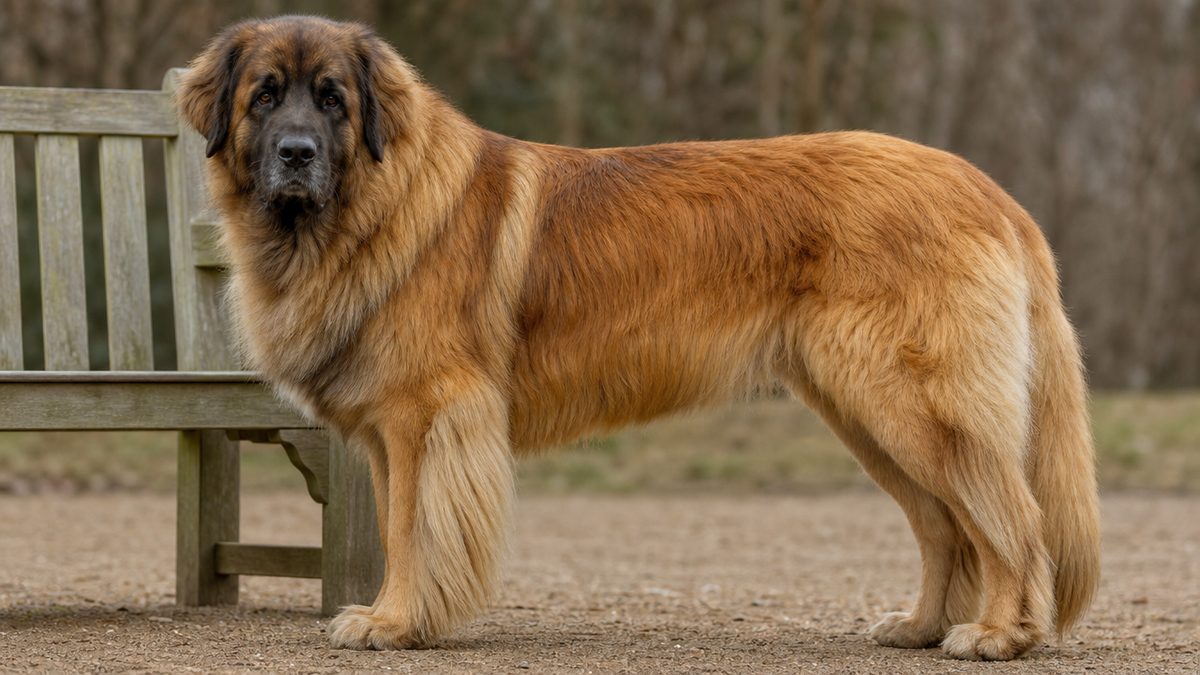
The coat is medium soft to coarse, profuse and long-haired, close fitting and never parted, with the shape of the body still visible despite a thick undercoat. It forms a mane on neck and chest, especially in males, with distinct feathering on the front legs and ample breeches behind. That is a double coat built for a Baden-Wurttemberg winter, and it is the single most consequential fact for an Indian owner.
Colour runs lion yellow, red, reddish brown and sandy with all combinations between, always with a black mask. Black hair tips are permitted but black must not determine the basic colour. A small white chest patch and white hairs on the toes are tolerated.
Two disqualifying faults deserve an Indian reader's attention because they collide with Indian law. Entropion and ectropion are disqualifying faults under the standard, and Second Schedule Part III paragraph 8(10) of the Dog Breeding and Marketing Rules 2017 names entropion and ectropion among the genetic defects a breeding dog must have been tested for. The OFA eye detail rows record entropion in 76 of 1,774 Leonbergers examined, 4.3 percent, and ectropion in 23, 1.3 percent. So the registry, the standard and Indian law all point at the same two conditions, and an Indian breeder has both a legal obligation and a published test route.
History: a dog designed to look like a heraldic lion
The Leonberger was created in the 1840s by a Leonberg town councillor who crossed a Newfoundland with a Grand St Bernard hospice dog and later a Pyrenean Mountain Dog, aiming for a lion-like dog to match his town's coat of arms.
The FCI standard tells the story in its own words, and it is unusually specific for a breed origin. At the end of the thirties and beginning of the forties of the nineteenth century, Heinrich Essig, town councillor in Leonberg near Stuttgart, crossed a black and white Newfoundland bitch with a so-called Barry male from the monastery hospice of the Grand St Bernard. Later a Pyrenean Mountain Dog was added. The result was very large dogs with predominantly long white coats. Essig's aim was for a lion-like dog, because the lion is the heraldic animal of the city of Leonberg.
The first dogs really called Leonbergers were born in 1846. Only a short time later many were sold as status symbols from Leonberg all over the world, and by the end of the nineteenth century the breed was kept in Baden-Wurttemberg as the preferred farm dog, praised for watch and draft ability.
Two world wars, 22 founders, and the number that follows
The standard records that in both World Wars and the needy post-war times the numbers of breeding stock reduced dramatically. That sentence is doing a great deal of work, and the genomic study published in 2020 puts figures on it.
Assessing pedigree records on 142,072 dogs, SNP array genotypes on 1,203 and whole-genome sequences on 39, that study identified 22 founder animals behind the entire modern breed, an apparent popular sire effect, an average pedigree-based inbreeding coefficient of 0.29 and an average kinship of 0.31. Runs-of-homozygosity analysis independently confirmed an inbreeding coefficient of 0.28 across 125,653 runs averaging 5.88 Mb.
A full sibling mating produces an inbreeding coefficient of 0.25. The average Leonberger in that pedigree analysis is therefore more inbred than a dog produced by mating brother to sister once. The current global population of roughly 30,000 dogs descends from 22 founders through a bottleneck in the 1940s that was then narrowed further by intensive use of popular sires. The authors' own conclusion is that this likely explains the breed's high prevalence of certain disorders.
This matters to an Indian buyer for one practical reason. A breed with this structure has predispositions that are properties of the population rather than accidents of a particular kennel, so a breeder cannot escape them by being careful with a single pairing. The authors recommend increasing the number of individuals used for breeding, restricting litters per sire and dam, and outcrossing.
The founders are still visible in the disease list
The Newfoundland and the Grand St Bernard hospice dog did not only contribute size and coat. The Leonberger and the Saint Bernard share the ARHGEF10 deletion behind the earliest-described form of polyneuropathy, and they share the CNTNAP1 variant behind a younger-onset laryngeal paralysis with generalised polyneuropathy. A researcher describing the CNTNAP1 variant calls the two breeds closely related and notes the variant most likely predates modern breed establishment.
So the 1846 crossing is not just a founding anecdote. It is the reason two of this breed's named nerve diseases are shared with a dog from a Swiss alpine hospice, and it is why our St Bernard page and this one carry overlapping health sections. Read them together if you are choosing between the two.
Leonberger price in India, and two ranking pages with no price
One Indian page publishes a Leonberger price in india of Rs 3,50,000 to Rs 6,00,000, while the two commerce results that outrank it are titled as price pages and contain no price and no Leonbergers.
This breed differs from most rare imports on this site in one important way: it has a real Indian sale market. Puppy classifieds rank for it, city pages exist for it, and sellers advertise it. That makes the state of the evidence stranger rather than better.
What each ranking page actually contains
| Position | Domain | Price it publishes | What we found on the page |
|---|---|---|---|
| 1 | happypet.care | Rs 3,50,000 - Rs 6,00,000 | Figure present in raw markup; monthly cost identical to the Newfoundland's |
| 2 | mrnmrspet.com | None | Zero rupee figures. Cards showed a Cavalier, a Border Collie and a second Cavalier |
| 3 | instagram.com | Rs 65,000 - Rs 2,20,000 claimed | Those figures appear nowhere in the live page |
| 7 | mrnmrspet.com Bangalore | None | Zero rupee figures. Cards showed two French Bulldogs and a Border Collie |
| 6 | a-z-animals.com | USD 7,000 first year | A US cost guide with no rupee figure |
The position 2 page is titled Leonberger Puppies for sale in India At Best Prices and the position 7 page is titled Leonberger Price in Bangalore. Neither carries a price. We searched their raw markup for the rupee glyph, for Rs, for INR and for the word lakh, and the only multi-digit numbers on either page are the options of a site-wide Budget dropdown in a lead-capture form, reading 10000-20000 through to 150000+. Those are form fields, not prices.
The position 3 result's description states that Leonberger puppies in India cost Rs 65,000 to Rs 2,20,000 depending on pedigree, with KCI-registered dogs at Rs 1,00,000 to Rs 1,50,000. We fetched the live page and searched its raw markup. None of those figures is on it. The band was generated, not quoted. This is the same failure recorded on another breed where an engine reported a rupee range and attributed it to a page containing no number at all, and it is why checking that a cited page exists is not enough: you have to confirm the figure is in it.
Zero Leonbergers on the Leonberger page
Both classifieds pages do carry listing cards, and we read the breed names off their own headings. On the national page they showed a Cavalier King Charles Spaniel, a Border Collie and a second Cavalier on one fetch, and a Goldendoodle and an Australian Shepherd on another. The Bangalore page showed two French Bulldogs and a Border Collie. Neither page displayed a single Leonberger on either fetch, and the fact that the cards change between fetches shows the carousel is generic inventory rather than a breed-filtered result.
That is the mechanism this site has documented on other listing sites: a page ranks for a breed term, sells the traffic, and shows whatever puppies are in stock. Nothing about it looks broken to a buyer.
Running the division tests on the one real figure
Rs 3,50,000 divides to 4,148 at 84.38, 4,375 at flat 80, 4,730 at 74 and 5,250 at 66.67. Rs 6,00,000 gives 7,111, 7,500, 8,108 and 9,000. Only the flat-80 test lands anywhere plausible, at 4,375 and 7,500, and 4,375 is not a figure a seller prints. Both ends are round rupee amounts, 3.5 lakh and 6 lakh. The verdict is that the figure is rupee-native rather than a converted dollar price, which tells you how it was typed and nothing about whether a dog has sold at it.
The spread, stated honestly
So the published Indian evidence runs from a generated band starting at Rs 65,000 to a single listed figure topping out at Rs 6,00,000. That is a spread of more than nine times, one end of which does not exist on the page it is attributed to. We are not going to average them, and we are not going to pick the convenient one.
What a buyer can do instead is verify the dog rather than the price. A KCI pedigree costs Rs 1,000 for four generations, and registering an imported dog costs Rs 2,500. Against a purchase in the lakhs, those are trivial sums, and a seller who has not paid them is telling you something. So is a seller who cannot produce DNA results for the three polyneuropathy variants, which matter far more to what you will spend over ten years than the purchase price does.
Monthly cost of ownership, and the template it comes from
The only Indian monthly cost published for a Leonberger, Rs 5,700 to Rs 8,550, is a template value it shares with the Newfoundland, the Hovawart and the Tornjak rather than a measurement of this breed.
Happy Pet Care prints a Leonberger monthly cost of Rs 5,700 to Rs 8,550, split into food Rs 3,000 to Rs 4,500, veterinary Rs 1,500 to Rs 2,250 and grooming Rs 1,200 to Rs 1,800. The arithmetic closes: 3,000 plus 1,500 plus 1,200 is 5,700, and 4,500 plus 2,250 plus 1,800 is 8,550.
We pulled the controls from the same site on the same day and read every figure from raw markup.
| Breed | Size label | Food | Veterinary | Grooming | Total |
|---|---|---|---|---|---|
| Leonberger | Giant | 3,000-4,500 | 1,500-2,250 | 1,200-1,800 | Rs 5,700-8,550 |
| Newfoundland | Giant | 3,000-4,500 | 1,500-2,250 | 1,200-1,800 | Rs 5,700-8,550 |
| Saint Bernard | Giant | as above | as above | as above | Rs 5,700-8,550 |
| Hovawart | Large | 3,000-4,500 | 1,500-2,250 | 1,200-1,800 | Rs 5,700-8,550 |
| Tornjak | Large | as above | as above | as above | Rs 5,700-8,550 |
| Great Dane | Giant | differs | differs | differs | Rs 4,900-7,650 |
Two things follow, and the second one is the interesting one. First, the Leonberger figure is shared verbatim with the Newfoundland and the Saint Bernard, so it is a default rather than an observation of this breed. Second, and against the version of this finding our own site previously carried, the printed size label is not what selects it. The Hovawart and the Tornjak are tagged Large Breed rather than Giant and receive the identical set, while the Great Dane, tagged Giant like the Leonberger, receives a different one at Rs 4,900 to Rs 7,650.
A handful of cost templates circulate across that site, and the size band you can see on the page does not determine which one a breed gets. Two breeds with the same label can carry different figures and two breeds with different labels can carry identical ones. So one control is not enough. Pull a second unrelated breed with the SAME label and a third with a DIFFERENT label before quoting any cost line from an Indian breed directory.
The same mechanism runs at the medium end, where our Lagotto Romagnolo page found the Lagotto, the American Cocker Spaniel and the Kooikerhondje sharing one set while the Whippet and Basset Hound, identically labelled, share another.
What genuinely varies per breed
The purchase price, the ideal-weather band, the life expectancy and the shedding level all differ across those pages. The Leonberger shows Rs 3,50,000 to Rs 6,00,000, 10 to 25 degrees C, 8 to 10 years and High Shedding; the Newfoundland shows Rs 60,000 to Rs 1,50,000, minus 10 to 25 degrees C, 9 to 10 years and Moderate Shedding. That mixture of real fields and template fields is exactly what makes such a page convincing.
Where the real money goes for a giant dog in India
Three cost lines dominate and none of them is on that page. Cooling runs most of the year for a coated giant in a plains city, and it is the largest recurring expense nobody budgets. Drug and anaesthetic doses scale with bodyweight, so a 70 kg dog's routine parasite prevention, its sedation for an x-ray and its surgery all cost multiples of a Labrador's. And screening: gonioscopy, hip and elbow radiographs under sedation, a thyroid panel and four DNA tests are a real four-figure to five-figure outlay before the dog is two.
The verifiable Indian figures we can give you are registry ones. Registering an imported dog with the Kennel Club of India costs Rs 2,500 inclusive of GST, a certified four-generation pedigree Rs 1,000, a five-generation pedigree Rs 1,500 and an export pedigree Rs 2,000, under the tariff effective 1 April 2024. Everything else should be priced at your own vet, and for this breed you should ask specifically whether the practice has a table and a scale that take a 70 kg dog before you need them in an emergency.
Heat tolerance: Leonberg's hottest month is colder than Chennai's coldest
The Leonberger has the worst heat tolerance we rate, because Leonberg's warmest month averages 19.90 degrees C while Chennai's coolest month averages 24.09, so the hottest weather this breed was built for is 4.19 degrees cooler than the mildest weather Chennai offers.
We queried NASA POWER by explicit latitude and longitude and echoed the elevation of every grid cell, because a gridded model returns a cell rather than a point and a climate site has repeatedly served this project the wrong city at HTTP 200. The Leonberg cell sits at 338.26 metres against a real town elevation near 384, which is close enough to use.
| Place | Cell elevation | Annual mean | Warmest month | Coolest month | Annual humidity |
|---|---|---|---|---|---|
| Leonberg, Germany | 338.26 m | 9.75 C | Jul 19.90 C | Jan 0.09 C | 80.58% |
| Bengaluru | 841.72 m | 23.74 C | Apr 28.37 C | Dec 20.22 C | 67.94% |
| Pune | 635.99 m | 23.86 C | Apr 28.93 C | Dec 19.62 C | 66.80% |
| Delhi | 206.37 m | 25.60 C | Jun 35.88 C | Jan 13.61 C | 45.56% |
| Kolkata | 7.35 m | 25.81 C | May 31.53 C | Jan 17.31 C | 73.93% |
| Mumbai | 97.15 m | 26.77 C | May 31.19 C | Jan 23.19 C | 67.39% |
| Chennai | 48.95 m | 27.95 C | May 31.51 C | Jan 24.09 C | 72.39% |
The comparison that matters is the one no other page makes. Leonberg's warmest month, July at 19.90 degrees C, is cooler than the coolest month of every Indian city in that table except Delhi and Kolkata in January. Chennai's mildest month is 4.19 degrees hotter than the hottest month this dog evolved for. Even Bengaluru's December, at 20.22 degrees, is warmer than a German July.
The humidity trap
Owners assume a German breed is unused to humidity, and it is the reverse. Leonberg's annual relative humidity is 80.58 percent, which is higher than Chennai's 72.39, Mumbai's 67.39 and Bengaluru's 67.94. The Leonberger is thoroughly adapted to damp air. What it has never met is damp air at 30 degrees.
That combination is the physiological problem. A dog cools by evaporating water from its respiratory tract, and in Mumbai or Pune in August, where humidity reaches 90 and 91 percent respectively, evaporative cooling works poorly. A heat-sensitive breed with a thick undercoat and a mane in saturated 28 degree air has very little cooling capacity left.
The bodyweight risk band, and which source carries it
The UK heat-illness study identifies dogs weighing over 50 kg as a higher-risk bodyweight category, alongside bodyweight at or above the breed and sex mean and age over two years. Applying that to this breed needs care, because FCI Standard 145 publishes no weight at all.
The FCI standard gives height only, in both its authentic German and its English translation, so the standard by itself does not establish that a Leonberger clears 50 kg. The American Kennel Club does: 110 to 170 pounds for males, which is 49.9 to 77.1 kg, and 90 to 140 pounds for females, which is 40.8 to 63.5 kg. On that source a typical male sits above the threshold across almost its whole range and a female straddles it. So the over-50 kg band applies to most male Leonbergers on the AKC's figure, and we name the source rather than implying the FCI supplies it.
Indian law, and its own worked example
Second Schedule Part IV paragraph 21(1) of the Dog Breeding and Marketing Rules 2017 bars keeping in outdoor facilities, without the attending veterinary practitioner's written approval, dogs not accustomed to the temperatures prevalent in the area, breeds that cannot tolerate them, and sick, infirm, aged or young animals. The clause supplies its own illustration of the second category: long-haired breeds in high temperature locations.
FCI 145 describes a coat that is profusely long with a thick undercoat and a mane. There is no closer match in any breed standard to the example that clause prints. This provision is a Second Schedule paragraph rather than a Rule, and the Rules themselves stop at Rule 13, so a citation reading Rule 21 is wrong by construction.
Hill stations, and why we will not put a number on them
The obvious answer for a cold-climate giant is a hill station, and the gridded data will mislead you there. Shimla's cell reports 897.65 metres against a town near 2,200, Ooty's 784.64 against roughly 2,240, Darjeeling's 1,313.52 against roughly 2,045, and Manali's 3,984.73 against roughly 2,050. The first three come back far too warm and the fourth far too cold. The plains cells in the same session were accurate to within about 83 metres, so this is a terrain failure rather than an India failure. A genuine hill station will suit this breed better than any plains city. We decline to say how much better, because the number available to say it with is wrong.
Lifespan: the reputation and the data do not agree
A UK study of 321 Leonberger deaths gives a median survival of 10.0 years against a crossbred 12.0, with a hazard ratio of 1.61, and the breed's own genomic study records average lifespan falling from 9.4 years in 1989 to 7.7 in 2004.
This breed is often described as unusually long-lived for a giant. We went looking for the evidence behind that and found the opposite, so this section prints every figure we could source and lets the disagreement stand.
| Source | Figure | What it is built on |
|---|---|---|
| McMillan 2024, UK | Median 10.0 years, CI 9.5-10.3 | Kaplan-Meier median from 321 recorded deaths |
| Krontveit 2012, Norway | 16.11% alive at 10 years | A prospective cohort of 501 dogs from 103 litters, birth to ten |
| Letko 2020, global | 9.4 years in 1989 falling to 7.7 in 2004 | Observed average lifespan across a pedigree of 142,072 dogs |
| American Kennel Club | 7 years | A registry summary figure with no stated sample |
The measured median is 10.0 years, with a 95 percent confidence interval of 9.5 to 10.3 and a hazard ratio of 1.61 against the crossbred baseline at p less than 0.001. A crossbreed in the same dataset reaches 12.0 years. So a Leonberger dies about two years earlier than a mixed-breed dog and carries a 61 percent higher hazard of death at any point.
Where 10.0 years sits among the giants
| Breed | Median years | Deaths | Hazard ratio |
|---|---|---|---|
| Crossbreed | 12.0 | 72,445 | baseline |
| Dogue de Bordeaux | 11.1 | 1,204 | 1.40 |
| Newfoundland | 11.0 | 633 | 1.20 |
| Great Dane | 10.6 | 864 | 1.20 |
| Rottweiler | 10.6 | 3,442 | 1.27 |
| Bernese Mountain Dog | 10.1 | 449 | 1.42 |
| Leonberger | 10.0 | 321 | 1.61 |
| Irish Wolfhound | 9.9 | 210 | 1.53 |
| St Bernard | 9.3 | 509 | 1.66 |
| Mastiff | 9.0 | 1,419 | 2.32 |
Read that table carefully, because it supports a fairer verdict than either extreme. The Leonberger is not unusually long-lived for a giant: it sits below the Newfoundland, the Great Dane, the Rottweiler and the Dogue de Bordeaux. But it does outlive the St Bernard by 0.7 years, and the St Bernard is one of its two founding breeds. Its hazard ratio of 1.61 is the third worst in the table.
The Norwegian cohort makes the same point from a different angle and with a harder outcome measure. Following 501 dogs of four breeds from birth to ten years, 60.2 percent of Labrador Retrievers were still alive at ten, against 28.8 percent of Newfoundlands, 16.11 percent of Leonbergers and 6.4 percent of Irish Wolfhounds. Krontveit RI, Trangerud C, Nodtvedt Fewer than one Leonberger in six reached its tenth birthday in that cohort.
The breed's own genomic study reports that the observed average life span decreased over time, from 9.4 years in 1989 to 7.7 years in 2004, and that a global health survey confirmed a high prevalence of cancer and neurological disorders. That is a decline of 1.7 years across fifteen birth cohorts, in a population with an average pedigree inbreeding coefficient of 0.29 descending from 22 founders. A single median hides that; a trend does not.
Why the numbers differ, and which to use
The four figures are not measuring the same thing. McMillan's 10.0 years is a median age at death among UK dogs whose deaths were recorded in veterinary practice, so it is the best population estimate available. Letko's 9.4 and 7.7 are average lifespans by birth cohort in an international pedigree population, which is why they run lower and why they show a direction. Krontveit's 16.11 percent is a survival proportion rather than a median. The AKC's 7 years is a summary with no stated basis.
Use 10.0 years with its confidence interval and its 321 deaths when you need one number, and mention the trend when you are deciding whether to buy. Both figures are real and they are answering different questions.
One caution about the source
The two supplementary tables in the UK study disagree on how many Leonbergers were in it. Table S3 gives 676 in its alive column while Table S6 gives 378 alive and 699 in total, and only Table S6's own figures reconcile, since 378 plus 321 equals 699. Both tables agree exactly on the 321 deaths. The same discrepancy has now been found across nine breed pairs on this site, always with the death count identical. That is why this page quotes deaths and the median with its interval, and does not pick a sample size.
Temperament and household fit
The Leonberger is a gentle, composed family dog whose breed standard lists insensitivity to noise among its required temperament traits, which makes it better suited to a loud Indian street than most giants.
FCI 145 is unusually explicit about temperament, listing five particular requirements of steady temperament: self-assurance and superior composure, medium temperament including playfulness, willing to be submissive, good capacity for learning and remembering, and insensitive to noise. It describes an agreeable partner for present-day dwelling and living conditions who can be taken anywhere without difficulty, distinguished by marked friendliness towards children, and neither shy nor aggressive.
That list is worth reading against Indian conditions rather than German ones. Noise insensitivity is a genuinely valuable trait in a country with Diwali, wedding processions and constant horns, and it is the reason a well-bred Leonberger copes with urban India better than many smaller, sharper breeds.
Who this dog suits
- Families with children old enough not to be knocked over by a dog turning around, since the standard singles out friendliness towards children.
- Households with a house and outdoor space, which the Indian page publishing this breed lists as House with Farm Area and which we agree with.
- Owners in Bengaluru, Pune or a genuine hill station rather than Chennai, Mumbai or Kolkata.
- People budgeting for cooling that runs most of the year, which is the largest hidden cost of this breed in India.
- Buyers willing to chase four DNA results and a gonioscopy before paying.
Who should not buy one
Anyone in a flat, because a 72 to 80 cm male needs a lift that will take him and a floor he will not slip on. Anyone in a plains city without reliable cooling, where the coat becomes a year-round welfare problem. Anyone who wants a guard dog, because the standard requires a dog willing to be submissive and neither shy nor aggressive, and selecting a Leonberger for aggression means buying from someone breeding away from the standard. And anyone who cannot physically manage a dog that will outweigh them.
The size problem nobody mentions until it happens
An affectionate giant leans. A dog of 60 to 70 kg leaning on an elderly relative or a small child is a fall risk, and it is the commonest injury associated with the breed in ordinary homes. Teach a reliable place cue and an off cue in the first six months, while the dog is still light enough to be moved rather than negotiated with.
The second practical issue is transport. Plan how you will get a 70 kg dog to a veterinary clinic in an emergency before you need to. Many Indian cabs will not take him, and a dog with laryngeal paralysis in respiratory distress is not something to solve at two in the morning.
Training a dog that will outweigh you
Train a Leonberger early and physically lightly, because the standard describes a dog with good capacity for learning and remembering that is willing to be submissive, and because an untrained adult cannot be corrected by strength.
The breed is trainable by design. Good capacity for learning and remembering and willingness to be submissive are both listed as required temperament traits, so a Leonberger that resists training is usually being asked badly rather than refusing.
The constraint is arithmetic. A male reaches 72 to 80 cm and, on the AKC's figures, 49.9 to 77.1 kg. Everything you teach must work without physical force, because within a year force stops being available.
The first six months matter more than in any smaller breed
- Train loose-lead walking before the puppy reaches 25 kg, because after that you are being walked.
- Socialise in the first sixteen weeks to lifts, stairs, slippery floors, traffic, crowds and vets, since a fearful giant is unmanageable.
- Train a place cue and a settle, which is how a dog this size lives indoors politely.
- Screen the puppy's response to handling of feet, ears and mouth daily, because a 70 kg dog that objects to a nail trim is a two-person job forever.
- Weigh the puppy monthly and record it, both to catch over-growth and to have real numbers for your vet.
The Indian timetable
Train indoors through the hot months. Delhi's June mean is 35.88 degrees C with a monthly maximum of 48.79, and Chennai never drops below a 24.09 degree monthly mean. A coated giant working outdoors in that is not learning; it is surviving. Short indoor sessions on a non-slip surface with air conditioning are more productive and far safer.
The breed's history mentions draft ability and owners are often drawn to carting and weight pulling. Weigh that against the bone-cancer finding: at 12 and 18 months, each extra kilogram of bodyweight carried a nearly 20 percent higher risk of primary bone cancer in a Norwegian cohort, and the authors attribute it to weight-bearing stress during high proliferative activity in the long bones. Whatever you do with an adult, keep the growing dog light and keep the loading low.
Swimming is the exception and the best exercise you can give this breed in India. It is a strong natural swimmer, the water takes the load off growing joints, and it is the only vigorous activity that is safe at Indian summer temperatures. Dry the coat and the ear canals thoroughly afterwards, every time.
Daily exercise, and why less is genuinely better while growing
An adult Leonberger needs about 60 to 90 minutes a day, and a growing one needs deliberately less, because bodyweight at 12 and 18 months is a documented risk factor for the bone cancer that kills this breed.
The 60 to 90 minute figure with a Medium energy level is what the Indian page publishing this breed states, and unlike its cost lines that field varies between breeds on the same site. It matches a Molossoid mountain-type dog whose standard asks for ground-covering even movement rather than speed.
| Season | Plains city | Bengaluru, Pune or a hill station |
|---|---|---|
| Nov to Feb | 45 min morning, 45 min evening | Two full sessions, plus outdoor training |
| Mar to Jun | 30 min before sunrise only, indoors otherwise | Early morning and after dark, shaded surfaces |
| Jul to Sep | Short walks between showers, dry thoroughly after | Normal, with drying after every wetting |
| Any month | Swimming wherever clean water exists | Swimming wherever clean water exists |
Surface matters more than distance for a giant. Walk on grass or earth rather than hot tarmac, which in Delhi in June is hot enough to burn pads and radiates heat straight into a low-slung, heavily coated body. Test it with the back of your hand for five seconds before you set off.
The growth-period rule
This is the single most consequential piece of husbandry advice on the page. In a Norwegian cohort of 196 Leonbergers followed birth to death, logistic regression found a significant effect of bodyweight on the odds of primary bone cancer at 12 and 18 months, with an extra kilogram carrying a nearly 20 percent higher risk, and a centimetre more circumference at the distal radius and ulna carrying a nearly 70 percent increase.
The authors interpret it as weight-bearing stress during the period of high proliferative activity in the long bones. Whether the mechanism is exactly that or not, the practical instruction is unambiguous: do not build a big puppy. Keep the growing dog lean, keep loading low, skip stair work and long road walks under twelve months, and let free play on soft ground do the work.
What happens without enough exercise
Weight gain, which feeds directly back into both the bone-cancer association and the heat risk. Bodyweight at or above the breed and sex mean was an independent risk factor for heat-related illness across 905,543 UK dogs, at an odds ratio of 1.42. For a breed already sitting in the over-50 kg category on the AKC's weight figures, adding condition on top of that is compounding a risk rather than adding one.
Grooming a profuse double coat in Indian humidity
Brush a Leonberger to the skin several times a week and daily through a moult, dry it actively after any wetting, and never shave it, because the coat that traps heat also blocks sun.
FCI 145 specifies hair that is medium soft to coarse, profusely long and close fitting, never parted, with the body shape still visible despite a thick undercoat, forming a mane on neck and chest and ample breeches behind. The Indian page publishing this breed records High Shedding, which is the honest description.
The routine
- Brush to the skin three times a week as a baseline, using a slicker and then an undercoat rake, working in sections from the skin outward.
- Groom daily through the two annual moults, when the undercoat comes out in sheets and anything left behind mats.
- Screen the mane, the breeches, behind the ears and the armpits weekly, because those four places mat first and are the hardest to see.
- Brush before bathing rather than after, since water sets an existing mat into felt.
- Groom the ear canals dry after every swim, bath and monsoon walk.
Drying is the Indian-specific instruction
European care guides tell owners to towel a big coated dog and let it air dry. Leonberg's annual humidity is 80.58 percent, but its annual mean temperature is 9.75 degrees C, so nothing incubates while a coat dries slowly. In Mumbai or Pune in August, at 90 and 91 percent humidity and around 26 to 23 degrees, a thick undercoat left damp against the skin is a culture medium.
It is the most common Indian summer mistake with coated giants and it makes things worse. The undercoat that traps warmth in winter also shades the skin and slows heat gain in summer, and a shaved dog in Delhi in June, where the monthly maximum reaches 48.79 degrees C, is exposed to direct sun on unprotected skin. Remove the dead undercoat by brushing, which is what actually improves airflow, and leave the topcoat alone.
Cost, honestly bounded
The Indian page prints grooming at Rs 1,200 to Rs 1,800 a month, but that exact line also appears on the Newfoundland, Hovawart and Tornjak pages, so it is a template value rather than a measurement. Price a full groom for a giant coated breed at two salons in your own city, and ask specifically whether they have a table and a dryer that handle a 70 kg dog, because many do not. Budget for more sessions in the two moulting months than in the rest of the year combined.
Nails, finally. A dog this heavy with overgrown nails changes how it loads its feet, and this is a breed you already want to keep light on its joints. Get the puppy comfortable with nail handling in the first four months, while a disagreement is still something you can win.
Health issues: three polyneuropathy variants and a 20 percent cancer prevalence
The Leonberger carries three separately named and genetically characterised forms of polyneuropathy, a leukoencephalomyelopathy, a familial ventricular arrhythmia that kills young dogs, and an osteosarcoma prevalence its own researchers put at 20 percent.
This is one of the most thoroughly studied breeds on this site, and the reason is not flattering: a population of about 30,000 dogs descended from 22 founders with an average inbreeding coefficient of 0.29 has given researchers a great deal to work with.
Polyneuropathy, in three named forms
The clinical picture is consistent across all three: exercise intolerance, gait abnormality and muscle atrophy of the pelvic limbs, with inspiratory stridor and dyspnoea. It resembles the human Charcot-Marie-Tooth group of peripheral neuropathies.
| Form | Gene | Inheritance and onset | OFA results |
|---|---|---|---|
| LPN1 | ARHGEF10, a 10 bp deletion | Recessive, severe juvenile onset | 2,081 tested: 93.3% normal, 5.6% carrier, 1.1% affected |
| LPN2 | GJA9, a 2 bp deletion | Dominant, average onset ~6 years, incomplete penetrance | 1,477 tested: 99.0% normal, 0.2% carrier, 0.8% affected |
| LPPN3 | CNTNAP1 c.2810G>A p.Gly937Glu | Recessive, younger-onset laryngeal paralysis | 991 tested: 92.4% normal, 7.4% carrier, 0.2% affected |
LPN1 was mapped to a 250 kb region on chromosome 16 with a raw p of 1.16 x 10 to the minus 10, and the deletion truncates about 50 percent of the ARHGEF10 protein. Homozygosity is highly associated with the severe juvenile phenotype in both the Leonberger and the Saint Bernard. LPN2 was found by comparing 176 cases against 138 controls after excluding LPN1 homozygotes, and confirmed in an independent cohort of 296 cases and 312 controls. LPPN3 in CNTNAP1 again affects homozygotes in both the Leonberger and the Saint Bernard.
The researchers who found LPN2 state plainly that approximately every third polyneuropathy-diagnosed Leonberger can be explained by the ARHGEF10 or GJA9 variants, and that additional genetic heterogeneity exists in the breed. So a puppy whose parents are clear on every available test still carries risk from forms nobody has found yet. Clear results reduce the odds; they do not remove them. Any breeder who tells you a clear panel guarantees a healthy dog is overselling the science.
Leukoencephalomyelopathy
A separate central nervous system disease with its own DNA test. OFA records 1,360 Leonbergers tested, of which 89.3 percent were normal, 10.4 percent carriers and 0.3 percent affected. Roughly one tested dog in ten carries it, which is a high enough carrier frequency that two untested parents are a real gamble.
Osteosarcoma
This is the breed's largest killer and the figure behind it is startling. The genome-wide study of osteosarcoma in Leonbergers used 273 cases with a median age of 8.1 years, range 3.1 to 13.5, against 365 controls older than eight, found significant association at the CDKN2A/B locus on chromosome 11, and calculated a SNP heritability of 20.6 percent on a stated breed prevalence of 20 percent.
The actionable finding sits in a different study. Following 196 Leonbergers from birth to death, of which 9 died of primary bone cancer, logistic regression found a statistically significant effect of bodyweight at 12 and 18 months: at those ages an increase of 1 kg carried a nearly 20 percent higher risk, and a 1 cm larger circumference of the distal radius and ulna carried a nearly 70 percent increased risk. Nine cases is a small number and the authors present it as an association rather than proof. It is still the clearest lever an owner has.
Sudden cardiac death in young dogs
Twenty-one Leonbergers examined post mortem died suddenly at a median age of 12 months, range 2.0 to 32.0 months, without previous clinical signs, usually at rest, and with no evidence of structural cardiac disease. Screening 46 apparently healthy Leonbergers found ventricular arrhythmia in 14 at a median age of 18 months, and two dogs with polymorphic ventricular tachycardia died during follow-up. Pedigree analysis suggests the arrhythmia is familial. Diagnosis needs 24-hour Holter monitoring, not a stethoscope.
Joints, thyroid and a question mark
Hips and elbows are better than the breed's size suggests. OFA records 13.8 percent dysplastic across 3,334 hip evaluations, which is marginally below the all-breeds figure of 14.2 percent, and 4.5 percent abnormal across 2,988 elbow evaluations against an all-breeds 12.0 percent. Thyroid results across 2,178 evaluations show 85.1 percent normal with 4.0 percent compensative autoimmune thyroiditis and 10.2 percent equivocal.
Finally, a 2024 brief communication raises renal dysplasia as a possible emerging recessive congenital disorder in the breed. It is a two-page note with no abstract in the record, so we quote no figure from it and mention it only because a buyer asking a breeder what is new should know the question is open.
Eyes: a glaucoma risk that is screenable, and a registry that contradicts itself
Twenty-two percent of UK eye-scheme Leonbergers were affected by pectinate ligament dysplasia, the drainage-angle defect behind glaucoma, and gonioscopy is the screening test that finds it before the eye is lost.
Pectinate ligament dysplasia is the eye condition that should decide which Leonberger you buy, because it is common, it is inherited, it causes irreversible blindness through glaucoma, and it is detectable in a routine examination.
A UK survey compiled 78 prospective gonioscopy examinations and 233 eye-scheme certificates from 2009 to 2014. Of the 78 examined prospectively, 64 (82 percent) were grade 0 with less than a quarter of the drainage angle affected, 7 (9 percent) grade 1, 3 (4 percent) grade 2 and 4 (5 percent) grade 3 with more than three-quarters affected. Across the eye-scheme certificates, 52 dogs, 22 percent, were affected.
Severity correlated positively with age (P less than 0.0055), so a clear gonioscopy at one year is not a clear result for life and the authors recommend ongoing screening. And all five reviewed clinical glaucoma cases had grade 3 dysplasia on the fellow eye or severe goniodysgenesis on histology, so the grading genuinely predicts the disease it is screening for. Ask for gonioscopy on both parents with the grade stated, not simply an eye certificate.
Cataract
An earlier UK study examined 211 Leonbergers between 1996 and 1998 and pooled them with 228 examined under the BVA, Kennel Club and ISDS eye scheme between 1990 and 1998, producing a composite database of 365 dogs after overlap. Cataracts were diagnosed in 90 of them, the majority nuclear (40) or posterior polar subcapsular (31), with a subgroup of 11 described and named posterior nuclear cataract. Logistic regression found a positive association between offspring and parents for posterior polar cataract, supporting inheritance.
That study is from 2006 and describes a UK population three decades ago, so treat 90 of 365 as evidence that inherited cataract exists in the breed rather than as a current prevalence.
The registry contradiction, at its widest yet
OFA's summary line reports the Leonberger at 93.6 percent normal across 1,774 eye examinations. Its own detail rows on the same page and the same denominator record the row NORMAL (OTHER .000) for 967 dogs, which is 54.5 percent. That is a gap of 39.1 percentage points inside one source, and it is the widest instance of this contradiction we have recorded.
The same pattern, always in the same direction, has now been found on the Field Spaniel, English Shepherd, Entlebucher, Dandie Dinmont, Clumber Spaniel, Dogo Argentino and the Lagotto Romagnolo. Neither figure should be quoted as the breed's eye health rate. Both are printed here with the arithmetic so a reader can see the problem.
| Finding | Dogs affected | Percent |
|---|---|---|
| Persistent pupillary membranes, iris to iris | 419 | 23.6% |
| Entropion | 76 | 4.3% |
| Distichiasis | 41 | 2.3% |
| Nictitans cartilage anomaly or eversion | 36 | 2.0% |
| Ectropion | 23 | 1.3% |
| Uveal cyst, single | 12 | 0.7% |
Where the eyelids meet Indian law
Entropion and ectropion are disqualifying faults in FCI Standard 145. They are also named explicitly in Second Schedule Part III paragraph 8(10) of the Dog Breeding and Marketing Rules 2017 among the genetic defects a breeding dog must have been tested for. And OFA records both in the breed, at 4.3 and 1.3 percent of 1,774 examinations.
That is an unusually clean alignment: the standard says these dogs should not be shown, Indian law says breeding dogs must be tested for them, and the registry confirms they occur at a measurable rate. An Indian breeder has no excuse for skipping an eye examination, and an Indian buyer has a specific legal clause to point at.
One practical note for Indian conditions. Entropion turns an eyelash inward against the cornea, and in the dust and heat of an Indian summer that goes from an irritation to a corneal ulcer faster than it would in Germany. A dog with a weeping or half-closed eye needs examining rather than bathing with saline and watching.
Feeding: the one decision that changes this breed's cancer odds
Feed a Leonberger puppy to grow slowly and lean, because an extra kilogram of bodyweight at 12 and 18 months carried a nearly 20 percent higher risk of primary bone cancer in the only cohort that has measured it.
Most giant-breed feeding advice is about bloat and joints. For this breed the strongest published finding is about bone cancer, and it points in the same direction as everything else: keep the growing dog light.
In a Norwegian cohort of 196 Leonbergers followed from birth to death, 9 died of primary bone cancer. Individual growth curves showed those dogs generally carried a higher bodyweight during the growth period than the rest, and the difference was largest in males. Logistic regression found a statistically significant effect of bodyweight at 12 and 18 months, where an increase of 1 kg yielded a nearly 20 percent higher risk, and a 1 cm larger circumference of the distal radius and ulna was associated with nearly 70 percent more risk. A Poisson regression verified the consistency of those results.
Nine bone-cancer deaths out of 196 dogs is a small number of events, and the authors present an association rather than proof of cause. We are printing it because it is the only measured lever an owner has over the disease with a 20 percent stated breed prevalence, and because the intervention it implies, feeding a giant puppy lean, carries no downside.
Life-stage feeding
| Stage | Approach | The Indian complication |
|---|---|---|
| 8-16 weeks | Four meals, large or giant breed puppy formulation | Do not supplement calcium, whatever the pet shop advises |
| 4-12 months | Three meals falling to two, controlled growth, monthly weighing | Resist pressure to produce an impressively large puppy |
| 12-24 months | Two meals, still growth-appropriate, lean condition | The 12 and 18 month weights are the ones the bone-cancer data is about |
| 2-7 years | Two meals, adult maintenance | Cut the ration in summer when exercise drops, or the dog gains |
| 7 years onward | Two meals, senior support as bloodwork indicates | Any new lameness gets an x-ray, not rest and observation |
Weigh the dog monthly and write it down. For most breeds that is good practice. For this one it produces the exact variable the published risk estimate is expressed in, so you and your vet can actually act on it.
Two meals rather than one for an adult, fed from a floor-level bowl, with a rest either side of eating. Deep-chested giants are a bloat risk group generally, and while we have no Leonberger-specific bloat figure to give you, the precaution costs nothing.
Free water at all times, and more of it than a European guide would suggest. A dog carrying this coat in Indian heat is losing water through panting for most of the year.
Month by month through the first two years
A Leonberger's first two years contain two windows an Indian owner must watch: the growth period where bodyweight is a documented bone-cancer risk factor, and the first three years where sudden cardiac death occurs.
| Age | Development | What to watch for |
|---|---|---|
| 8 weeks | Legal earliest sale in India under Rule 8(1)(a) | Ask for four DNA results and both parents' gonioscopy grades |
| 2-4 months | Fast growth, socialisation window, vaccination course | Sudden cardiac death has been recorded from 2 months. Any collapse is an emergency |
| 4-8 months | Loose-lead training must be finished before 25 kg | Weigh monthly. Resist over-feeding for size |
| 8-12 months | Approaching adult height, still filling out | The 12-month weight is one of the two the bone-cancer data uses |
| 12-18 months | Hip and elbow screening possible; peak SCD risk age | Median age of sudden cardiac death is 12 months. Holter if there is any family history |
| 18-24 months | Physical maturity, adult coat, first full moult | The 18-month weight is the second bone-cancer datapoint |
| 2-3 years | Adult routine established | SCD cases have been recorded up to 32 months |
The cardiac window, stated plainly
In a Finnish series, 21 Leonbergers that died suddenly were examined post mortem. Death occurred at a median age of 12 months, range 2.0 to 32.0 months, usually at rest, with no previous clinical signs and no structural cardiac disease found. Screening 46 apparently healthy Leonbergers with 24-hour Holter monitoring found ventricular arrhythmia in 14, at a median age of 18 months, and two dogs with polymorphic ventricular tachycardia died during follow-up.
Two practical consequences. A young Leonberger that collapses, even briefly and even if it gets up looking fine, needs a cardiology assessment rather than reassurance. And the diagnosis requires 24-hour Holter monitoring, so a normal five-minute ECG at a routine visit does not rule it out. If the breeder knows of sudden deaths in the line, say so to your vet and ask for Holter monitoring rather than waiting.
The eight-week rule
Rule 8(1)(a) of the Dog Breeding and Marketing Rules 2017 requires that pups less than eight weeks in age are not sold. That is a genuine Rule rather than a Second Schedule paragraph, and it is the most useful sentence an Indian buyer can quote at a seller. Litter registration with the Kennel Club of India costs Rs 750 per puppy within 60 days and Rs 2,000 if left past 120 days, so a breeder's registration timing is a small window into how the establishment is run.
Timing the purchase
Bring a Leonberger puppy home in October or November if you possibly can. That gives the dog five or six tolerable months to grow, settle and complete its socialisation before it meets its first Indian April, and it keeps the heaviest growth period out of the hottest weather, when a coated giant puppy will eat less and move less than it should.
Leonberger against the giants Indian buyers cross-shop
Against the giants an Indian buyer actually considers, the Leonberger has the best temperament rating and one of the worst hazard ratios, outliving its Saint Bernard founder by 0.7 years and dying a year earlier than a Newfoundland.
| Breed | Median lifespan | Hazard ratio | OFA hip dysplasia | Heat tolerance |
|---|---|---|---|---|
| Leonberger | 10.0 years | 1.61 | 13.8% of 3,334 | 1 of 5 |
| Newfoundland | 11.0 years | 1.20 | See its own page | 1 of 5 |
| Great Dane | 10.6 years | 1.20 | See its own page | 2 of 5 |
| Bernese Mountain Dog | 10.1 years | 1.42 | See its own page | 1 of 5 |
| St Bernard | 9.3 years | 1.66 | See its own page | 1 of 5 |
| Mastiff | 9.0 years | 2.32 | See its own page | 2 of 5 |
| Indian pariah dog | Not measured as a breed | Not applicable | Not a screened population | 5 of 5 |
Three readings follow. First, the Leonberger is not unusually long-lived for a giant, which is the claim most often made for it. It sits below the Newfoundland, the Great Dane, the Rottweiler and the Dogue de Bordeaux in the same dataset, and its hazard ratio of 1.61 is worse than all four.
Second, it does beat its own founding breed. The St Bernard reaches a median of 9.3 years with a hazard ratio of 1.66, so the Leonberger outlives it by 0.7 years. The two breeds share the ARHGEF10 and CNTNAP1 polyneuropathy variants, so a buyer choosing between them is not choosing between different disease risks so much as different sizes of the same one.
Third, its hips are genuinely good for its size. OFA records 13.8 percent dysplastic across 3,334 evaluations, marginally below the all-breeds figure of 14.2 percent, on a sample large enough to trust. For a breed of this height that is a real achievement by its breeders, and it is worth saying because most of this page is bad news.
Where the Leonberger genuinely wins
Temperament, and it is not close. The standard requires self-assurance, superior composure, willingness to be submissive, good learning and memory, and insensitivity to noise, and singles out marked friendliness towards children. Among giants that is an unusually complete specification and it produces an unusually gentle dog. If your constraint is a house full of children and noise, this is the giant that handles it.
Where it loses
Heat, decisively. Leonberg's warmest month at 19.90 degrees C is cooler than Chennai's coolest at 24.09, and the breed carries a profuse long coat with a thick undercoat. Screening burden, which at four DNA tests plus gonioscopy plus radiographs plus a thyroid panel is the heaviest we record. And cancer: a stated breed prevalence of 20 percent for osteosarcoma is the number that should dominate the decision.
The Leonberger and the Newfoundland are published with identical Indian monthly running costs on the same site, to the rupee, while their listed purchase prices differ by nearly six times. The Hovawart, tagged Large rather than Giant, gets the same monthly figures again. Where breeds share a cost line, compare them on health data instead, because that is where the numbers are real.
Mistakes Indian owners make with this breed
The commonest mistake with a Leonberger in India is growing the puppy too fast, and the second is shaving the coat in summer.
1. Feeding for a big puppy
An extra kilogram at 12 and 18 months carried a nearly 20 percent higher risk of primary bone cancer in the only cohort to measure it, and a centimetre more bone circumference nearly 70 percent. Indian sellers and relatives will both encourage you to produce an impressively large puppy. Weigh monthly, feed lean, and ignore them.
2. Shaving the coat
The undercoat that traps heat also shades the skin, and Delhi's June monthly maximum reaches 48.79 degrees C. Shaving exposes unprotected skin to that. Brush the dead undercoat out instead, which is what actually improves airflow.
3. Treating a brief collapse as heat or excitement
Sudden cardiac death in this breed occurs at a median age of 12 months, usually at rest, with no previous signs. A young Leonberger that collapses even momentarily needs cardiology assessment and 24-hour Holter monitoring, not reassurance and a bowl of water.
4. Buying on a clear polyneuropathy panel alone
Only about every third polyneuropathy-diagnosed Leonberger is explained by the two longest-tested variants. A clear panel is necessary and it is not sufficient. Ask additionally what the breeder knows about nerve disease in the wider line, and treat an evasive answer as the answer.
5. Resting a limp in an older dog
With a stated osteosarcoma breed prevalence of 20 percent and a case median age of 8.1 years, a new lameness in a Leonberger over five is an x-ray, not a week of rest. Bone cancer in giant breeds presents as exactly the limp an owner assumes is a strain.
6. Believing an Indian price or a monthly cost
The two ranking commerce pages carry no price and show no Leonbergers, a search result quotes a band that is not on the page it cites, and the one published monthly figure is shared verbatim with three other breeds. Verify the dog and build your own budget.
7. Keeping the dog outdoors in a plains city
Second Schedule Part IV paragraph 21(1) of the 2017 Rules uses long-haired breeds in high temperature locations as its own example of dogs that may not be kept in outdoor facilities without written veterinary approval. It binds registered breeders rather than pet owners, but the welfare judgement behind it applies to anyone with a coated giant and a terrace.
Write the denominator next to every number you are told. A price with no second source, a monthly cost with no control breed, a lifespan with no dataset, and a clear DNA panel with no statement of what fraction of cases it covers are all the same kind of claim. This page prints its denominators so you can hold a seller to the same standard.
How we checked this, and what broke while we did
Two of the research instruments this page depends on failed while we were using them, and recording how they failed is more useful to a reader than pretending they worked.
Bonbeno publishes its method when the method matters, and on this breed it matters twice: once for the search engine and once for the veterinary literature.
The search engine was not reading our query
We ran two genuinely different questions about this breed on the same endpoint in the same session: leonberger price in india and leonberger dog india. Both returned a byte-identical set of ten result titles and the identical count of About 76,700 results. An engine that returns the same answer to two different questions is not answering either of them.
Nothing about either result set looked wrong. The titles were Wikipedia, The Spruce Pets, Dogster, Dog Breeds List and the American Kennel Club, all plausibly on topic. Only running the two side by side exposed it, which is why we ran two.
The control query, labrador retriever price in india, succeeded in the same session with its own distinct set of ten Indian pricing pages and its own count of About 30,200. So the endpoint works and the failure is specific. No People Also Ask box could be captured on the day this page was built. A rendered Google India result on 18 September 2026 did carry one, 4 questions, and the FAQ below answers 3 of them verbatim.
Because a reader who searches this breed hits the same wall. If you have been comparing pages and finding that they all say the same slightly generic things, part of the reason is that the retrieval layer in front of you may not be distinguishing your question from anyone else's. Checking two phrasings of your own question is a cheap defence and it costs you one extra search.
The breed name is also a surname
A PubMed search for Leonberger returns 62 records, which sounds like a well-studied breed. Reading the titles back shows the count is inflated by a name collision. The set includes integrated-optics papers in Optics Letters and Applied Optics from 1978 to 1988, plant-pathology papers in Plant Disease from Kentucky and Indiana, and a neuropsychology paper, none of them about dogs.
The instrument was working correctly. The word simply means two things. A control query for Labrador Retriever with hip dysplasia returned 52 records in the same session, so the database was responding normally. A raw count is not a literature review, and the genuine veterinary papers on this breed had to be identified record by record.
The good news is that the real literature is substantial once separated out, and it is unusually high quality: genome-wide association studies, a full population-genomic analysis, prospective cohorts followed from birth to death, and a national eye-scheme survey. Few breeds on this site have this much.
Corrections we went looking for
Two of the papers this page leans on carry published corrections, and we read both rather than citing the originals blind. The genomic diversity study has a correction notice in the same journal, which does not alter the lifespan or inbreeding figures quoted here. The bone-cancer cohort study has an erratum that adds an author's name and changes no figure. Neither changes a number on this page, and both were checked because a paper cited without its correction is a small, silent error waiting to be copied.
What the ranking pages do and do not contain
| Page | What it covers | What it lacks for an Indian reader |
|---|---|---|
| Wikipedia | History, description, health by body system | No rupee figure, no cost, no climate content |
| Dogster | Characteristics, puppies, origin, temperament, food, exercise, grooming, health | No rupee figure, no Indian climate, no Indian law |
| Dog Breeds List | Breed information and a US price | No Indian pricing, no Indian climate, no rupee figure |
None of those is wrong. All three are written for somebody in another country. Dog Breeds List, Leonberger entry An Indian reader deciding whether to spend lakhs on an expensive giant breed needs the measured median lifespan, the osteosarcoma prevalence, the three polyneuropathy tests, the growth-weight finding and the actual temperature gap between Leonberg and their own city. That is the gap this page exists to close, and it is why the page is built from registry documents, primary papers and gridded climate data rather than from the pages currently ranking above it.
Adoption and responsible sourcing
Verify a Leonberger seller on four DNA tests and two gonioscopy grades before discussing price, because the breed's disease risks are decided at the mating and the Indian pages that rank for it publish no price and list no Leonbergers.
This breed does have Indian sellers, which makes sourcing a verification problem rather than an availability problem. The two commerce pages ranking for the term carry no price at all and displayed Cavaliers, Border Collies and French Bulldogs on their listing cards on two separate fetches. So the first thing to establish is whether the seller has an actual Leonberger.
The verification list, in order
- Screen the parents on paper first: LPN1, LPN2, LPN3 and leukoencephalomyelopathy DNA results, both parents, with laboratory reports rather than a verbal assurance.
- Screen the eyes: gonioscopy with the pectinate ligament dysplasia grade stated, for both parents, dated within the last two years given that severity increases with age.
- Screen the joints: hip and elbow scores from a recognised scheme.
- Adopt rather than buy where a rehomed adult is available, since an adult arrives with a known temperament and often with results already in hand.
- Train yourself to read the reports rather than the puppy, because carriers and clear dogs look identical.
Ask one further question that most buyers never think of: whether any dog in the line has died suddenly before three years of age. Sudden cardiac death in this breed has a median age of 12 months and is familial, and a breeder who has seen it will know.
What a clear panel does and does not buy you
It reduces risk substantially and it does not eliminate it. The breed's own researchers state that approximately every third polyneuropathy-diagnosed Leonberger is explained by the ARHGEF10 or GJA9 variants, and that additional genetic heterogeneity exists. On top of that, the population carries an average pedigree inbreeding coefficient of 0.29 from 22 founders, which is a structural feature no individual pairing escapes.
The genomic study's own conclusion is that preserving genetic diversity requires increasing the number of individuals used for breeding while restricting the number of litters per sire and dam, and that outcrossing would help optimise long-term diversity and contribute to the health of the population. A breeder who talks about limiting stud use and about diversity is engaging with the actual problem. One who talks only about champions is not.
Importing one
Dogs sit under ITC(HS) 01061900 as a Restricted import. Entry is permitted for a pet accompanying a transferee of residence with a valid pet book in the importer's name, for research with a CPCSEA recommendation, and for Defence and Police use, and applications for trading or breeding purposes are to be rejected. So you may bring your own Leonberger when you move to India, and you may not import one to sell or to breed from.
Registering an imported dog with the Kennel Club of India costs Rs 2,500 inclusive of GST, with a certified four-generation pedigree at Rs 1,000 and a five-generation pedigree at Rs 1,500. India is a full FCI member represented by the KCI, so a Leonberger's pedigree here runs against FCI nomenclature and Standard 145.
For anyone moving a dog in, note that personal pet import runs on a different instrument from the commercial route, under the Livestock Importation Act 1898, and that S.O. 4396(E) of 10 October 2024 permits pet dogs and cats through Cochin International Airport under the Animal Quarantine and Certification Station, Chennai. Whether that alters the port list in the DGFT trade notice is a separate question we have not checked against the notice itself, so read your own route's instrument.
The honest alternative
This page has described a giant breed with a measured median lifespan of 10.0 years, a hazard ratio of 1.61, a stated osteosarcoma prevalence of 20 percent, three named nerve diseases, a familial arrhythmia that kills yearlings, and a coat built for a place whose hottest month is colder than Chennai's coldest. If what draws you is a gentle giant that is good with children, an adult rehomed Leonberger through a breed rescue is a better route than a puppy, and an Indian pariah dog is heat-adapted, healthy, available today in every city, and will very likely outlive it.
Leonberger questions Indian buyers actually ask
What is the Leonberger price in India?
One India-hosted page lists a Leonberger price in India of Rs 3,50,000 to Rs 6,00,000, and no second Indian source confirms it. The two commerce pages that outrank it are titled as price pages and contain no price at all. A search-result description quotes Rs 65,000 to Rs 2,20,000, but those figures appear nowhere in the page it points at, so treat the five-times spread between them as unresolved.
How long do Leonbergers live?
About ten years, and the figure is measured rather than estimated. A UK study of 321 Leonberger deaths gives a median survival of 10.0 years with a 95 percent confidence interval of 9.5 to 10.3, against 12.0 years for crossbreeds, and a hazard ratio of 1.61. The American Kennel Club states 7 years, and the breed's own genomic study records average lifespan falling from 9.4 years in 1989 to 7.7 in 2004.
How much does a Leonberger weigh?
The FCI breed standard states no weight at all, in either its authentic German text or its English translation, giving only height at 72 to 80 cm for males and 65 to 75 cm for females. The American Kennel Club fills the gap with 110 to 170 pounds for males, which is 49.9 to 77.1 kg, and 90 to 140 pounds for females, which is 40.8 to 63.5 kg.
Can a Leonberger survive in India?
Only indoors with cooling, and even then it is a demanding project. Leonberg's homeland cell averages 9.75 degrees C across the year, and its warmest month, July at 19.90 degrees C, is 4.19 degrees cooler than Chennai's coolest month. Even Bengaluru's coolest month is warmer than the hottest month this breed was built for.
What is Leonberger polyneuropathy?
A group of inherited nerve diseases causing exercise intolerance, hind-limb weakness and muscle wasting, noisy breathing and laryngeal paralysis. Three variants are now named: LPN1 in ARHGEF10, shared with the Saint Bernard, LPN2 in GJA9 with an average onset around six years, and LPPN3 in CNTNAP1. The breed's own researchers state that only about every third diagnosed case is explained by the first two.
What health tests should a Leonberger puppy's parents have?
Ask for DNA results on LPN1, LPN2, LPN3 and leukoencephalomyelopathy, plus hip and elbow scores, a gonioscopy for pectinate ligament dysplasia, and a thyroid panel. On the OFA registry 5.6 percent of 2,081 dogs are LPN1 carriers with 1.1 percent affected, 7.4 percent of 991 are LPN3 carriers, and 10.4 percent of 1,360 are leukoencephalomyelopathy carriers.
Do Leonbergers get cancer?
Bone cancer is the breed's defining risk. The genome-wide study of osteosarcoma in this breed was built on a stated breed prevalence of 20 percent, using 273 cases with a median age of 8.1 years against 365 controls over eight, and found the CDKN2A/B locus on chromosome 11 with a SNP heritability of 20.6 percent.
How fast should a Leonberger puppy grow?
Slower than most Indian owners are told. In a Norwegian cohort of 196 Leonbergers followed from birth to death, an extra kilogram of bodyweight at 12 and 18 months carried a nearly 20 percent higher risk of developing primary bone cancer, and a centimetre more circumference at the distal radius and ulna carried nearly 70 percent more risk. Feed to a lean growing puppy, not a big one.
Why do young Leonbergers die suddenly?
A familial ventricular arrhythmia. In a Finnish series, 21 postmortem cases of sudden cardiac death occurred at a median age of 12 months with a range of 2 to 32 months, usually at rest and with no previous signs and no structural heart disease. Of 46 apparently healthy dogs screened, 14 showed ventricular arrhythmia on 24-hour Holter monitoring.
Is the Leonberger good with children?
Yes, and the breed standard says so explicitly. FCI 145 describes an agreeable partner for present-day living conditions who can be taken anywhere without difficulty and is distinguished by his marked friendliness towards children, neither shy nor aggressive, listing insensitivity to noise among its required temperament traits. The caution is size rather than temperament.
How much does it cost to keep a Leonberger in India per month?
Nobody has measured it. The one Indian page publishing a figure prints Rs 5,700 to Rs 8,550, but the Newfoundland page on the same site prints identical food, veterinary and grooming lines to the rupee, and so do the Hovawart and Tornjak pages, which carry a different size label entirely. Build your own budget from your own city's rates.
Do Leonbergers have eye problems?
Two, and both are screenable. A UK survey found 52 of 233 eye-scheme Leonbergers, 22 percent, affected by pectinate ligament dysplasia, with all five reviewed glaucoma cases showing grade 3 dysplasia or severe goniodysgenesis. An earlier UK study of a composite 365 dogs diagnosed cataract in 90, mostly nuclear or posterior polar subcapsular, with statistical support for inheritance of the posterior polar form.
Can I import a Leonberger into India?
Only as your own pet, and never to breed or sell. Dogs sit under ITC(HS) 01061900 as a Restricted import, with entry permitted for a pet accompanying a transferee of residence holding a valid pet book in the importer's name, for research with a CPCSEA recommendation, or for Defence and Police use, while applications for trading or breeding purposes are to be rejected.
Is it legal to keep a Leonberger outdoors in India?
Not in a registered breeding establishment without written veterinary approval. Second Schedule Part IV paragraph 21(1) of the Dog Breeding and Marketing Rules 2017 bars keeping dogs not accustomed to local temperatures, and breeds that cannot tolerate them, in outdoor facilities without the attending veterinary practitioner's written approval. Its own worked example is long-haired breeds in high temperature locations.
Is Leonberger available in India?
Advertised, yes; verifiable, barely. Unlike most rare imports on this site the Leonberger has a real Indian sale market, with puppy classifieds ranking for it, city pages built for it and sellers advertising it. Yet the two commerce pages that outrank everything else are titled as price pages and contain no price and no Leonbergers, and the one India-hosted figure of Rs 3,50,000 to Rs 6,00,000 has no second source. A dog can be imported only as your own pet, never to breed or sell.
Are Leonberger dogs good pets?
On temperament, among the best of the giants. FCI 145 describes an agreeable partner for present-day living who can be taken anywhere, marked by friendliness towards children, neither shy nor aggressive, and lists insensitivity to noise among its required traits, which suits a loud Indian street. The cautions are everything else: a measured median lifespan of 10.0 years, a stated bone cancer prevalence of 20 percent, three named nerve diseases, and a coat built for a place whose hottest month is colder than Chennai's coldest.
Why are Leonbergers so expensive?
In India the purchase price is unconfirmed, and the running costs are where the money goes. Three lines dominate and none appears on the Indian cost page: cooling that runs most of the year for a coated giant on the plains, drug and anaesthetic doses that scale with a 70 kg body so parasite prevention, sedation and surgery cost multiples of a Labrador's, and screening, with gonioscopy, hip and elbow radiographs under sedation, a thyroid panel and DNA tests for LPN1, LPN2, LPN3 and leukoencephalomyelopathy before the dog is two.
Compare with similar breeds
Leonberger sits in 1 Bonbeno group. Each one compares it directly against the breeds it is genuinely an alternative to, on the same figures.