
Breed profile
Moscow Watchdog: price, size and Indian climate fit
A Soviet state-programme guard dog built from three breeds, not two, and refused by the FCI. What the Russian standard says, what the Indian pages get wrong, and why the heat is the whole answer.
Quick answer
The Moscow Watchdog is a Russian guarding breed from the Red Star kennel, built from three breeds rather than the two English pages name: Caucasian Shepherd, St Bernard and Russian Piebald Hound. Russia recognises it nationally and the FCI does not list it at all. Males start at 68 cm and 55 kg with no upper limit. No verified Moscow Watchdog price in india exists, and its long dense double coat rules out most of the country on heat.
This page is general information for Indian pet owners, not veterinary advice. Nothing here diagnoses, treats or replaces an examination. A giant guarding breed in Indian heat can move from panting to a genuine emergency in under an hour, so if your dog is distressed, collapsing, bloating, straining unproductively to vomit, or simply not itself, call a registered veterinarian immediately rather than reading further.
Moscow Watchdog traits, rated for Indian conditions
What the Moscow Watchdog actually is
The Moscow Watchdog is a Russian guarding breed built from three breeds at a military kennel outside Moscow from the late 1940s, standardised nationally in Russia, and refused by the FCI to this day Federation Cynologique Internationale.
Its Russian name is Московская сторожевая, Moskovskaya storozhevaya, and the name is the job description. The RKF standard opens by saying the breed name already states its purpose: a guard dog, a watch dog and a companion. Everything else about the animal follows from that brief.
Three foundation breeds, not two
The standard names three foundation breeds, and almost every English page names two. The RKF text says the breed was created by reproductive crossing of the Caucasian Shepherd, the St Bernard and the Russian Piebald Hound, and it gives the founding sire a name: Orslan. Russian Wikipedia repeats all three. The page ranking first in India for this term says only that breeders began with the Caucasian Ovtcharka and added the Saint Bernard, and English Wikipedia's own description of the breed as a combination of the St. Bernard and the Caucasian Shepherd Dog carries a citation-needed tag.
That third breed is not a footnote. A Russian scenthound in the mix explains the piebald coat pattern the standard insists on, and it is why the breed reads as a hound-marked mountain dog rather than a shaggy St Bernard. If you are trying to identify one, the marking is the tell.
Bonbeno follows the RKF standard, which names three foundation breeds. If a seller or a blog tells you the Moscow Watchdog is simply a St Bernard crossed with a Caucasian Shepherd, they are repeating an English summary that Wikipedia itself marks as unsourced. Ask what document they are reading.
Why the Soviet army wanted it
The programme existed because the war had emptied the country of working dogs. Shortly after 1945 the Ministry of Defence ordered the Central Military School of Working Dogs, the Red Star kennel in Moscow Oblast, to rebuild the service-dog population and supply the civilian economy. The brief was specific: large, strong, heavy-boned, well-muscled, harmoniously built, with guarding qualities, easy to train, undemanding to keep, and able to work in conditions from Siberia to Central Asia, with all of it breeding true.
The named people matter, because this is one of the few breeds whose creation has a paper trail. In the late 1940s the head of the breeding kennel, N. I. Bortnikov, working under the biologist Professor N. A. Ilyin and the school's commander, Major General G. P. Medvedev, began the interbreeding.
The dates, in the order they happened
| Year | What happened | Source |
|---|---|---|
| late 1940s | Cross-breeding begins at the Red Star kennel under Bortnikov, Ilyin and Medvedev | Russian Wikipedia |
| 1958 | First standard description of the breed group, published in the catalogue of the 22nd Moscow City service-dog show | RKF standard and Russian Wikipedia Wikipedia (Russian) |
| 1985 | The breed group is recognised as a breed and a further standard is published | RKF standard |
| 1990 | All-Union breed club founded and registered with the Federation of Service Dog Breeding | National Breed Club |
| 17 April 1992 | Modern standard approved by the Federation of Service Dog Breeding of Russia | RKF standard |
| 1992 | Club renamed All-Russian; first monobreed show held at Dmitrov on 5 to 6 September with 35 dogs | National Breed Club |
| 1995 | The All-Russian club becomes the National Breed Club | National Breed Club |
| 1997 | Standard with minor amendments approved by the RKF and adopted by the Department of Animal Husbandry and Breeding of the Russian Ministry of Agriculture | RKF standard |
| 23 April 2008 | The standard in force today is approved by the Presidium of SOKO RKF | RKF standard |
Note what that table does not contain: an FCI date. There is no FCI recognition in this breed's history, and the next section shows how to check that for yourself rather than taking anyone's word for it.
What it looks like, from the standard
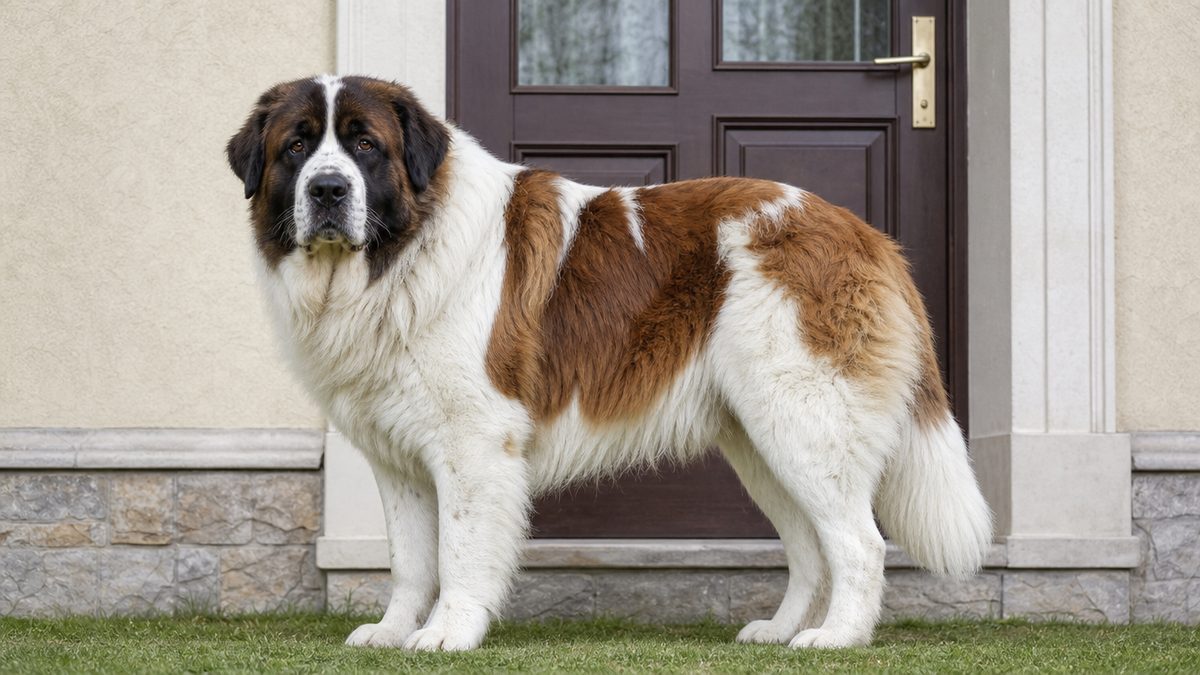
A massive, broad-bodied, slightly elongated dog of coarse strong type, active and mobile, with strongly marked sexual dimorphism. The head is large and broad, with a short well-defined stop and a black nose. The ears are small, triangular, rounded at the tip, dropped on the cartilage and lying against the cheek, set above the eye line. The tail is broad and thick, reaching the hock, hanging at rest and raised in a sickle above the back when the dog is roused.
The coat is the part an Indian reader should read twice. It is dense, long and thick with a well developed undercoat and straight guard hair, longer on the neck as a mane and feathered behind all four legs. That is a cold-climate double coat on a dog that starts at 55 kg, and it is the single fact that governs everything on the rest of this page.
Is the Moscow Watchdog FCI recognised? No, and here is how to check
To check FCI recognition for any breed, read the FCI's own register and confirm a control breed appears on the same document; done that way, the Moscow Watchdog is absent from both the definitive nomenclature and the provisional list Federation Cynologique Internationale.
This matters more than it sounds, because the breed's own Russian standard prints a line reading FCI Classification: Group 2, Pinschers, Schnauzers, Molossoids, mountain and Swiss cattle dogs; Section 2.2, Molossoids; without working trial. Read alone, that row says the FCI has placed this breed. It has not.
The register, with controls
The FCI's nomenclature index for the letter M returns eleven breeds. Macedonian Shepherd Dog Karaman, Magyar Agar, Maltese, Manchester Terrier, Mastiff, Mastin del Pirineo, Mastin Espanol, Mastino Napoletano, Miniature American Shepherd, Miniature Bull Terrier and Mudi. There is no Moscow Watchdog and no Moskovskaya. The controls prove the page loaded and is the document it claims to be: Mastiff sits there as standard 264 and Mastino Napoletano as 197, both real Group 2 molossoids of exactly the kind this breed would join.
The provisional register is a separate document and it was checked separately. Its twenty entries run from Macedonian Shepherd Dog Karaman at 378 down to Australian Stumpy Tail Cattle Dog at 351, and include Kazakh Tazy, Lancashire Heeler and Transmontano Mastiff. No Moscow Watchdog. Checking the provisional list matters because a breed can be provisionally accepted for years before definitive recognition, and reading only the main register would miss it.
The Caucasian Shepherd Dog, one of this breed's own foundation breeds, IS on the FCI register, filed under its Russian name as KAVKAZSKAIA OVTCHARKA, standard 328. So the parent breed is recognised and the descendant is not. That pairing rules out any suggestion that the FCI simply does not list Russian breeds.
What the FCI classification row on the Russian standard really means
That row is the RKF's own internal filing using FCI group names, and a control settles it. The RKF publishes a standard for the East European Shepherd, approved by its Presidium on 15 October 2014, whose header reads in full: approved by the Presidium of the RKF, for judging on the territory of the Russian Federation. That standard prints FCI Classification: Group 1, Sheepdogs and Cattle Dogs; Section 1; with working trial. The East European Shepherd is absent from the FCI's letter E index, which returns sixteen breeds including English Setter, Eurasier and Estonian Hound and no East European anything.
So two RKF standards, for two breeds the FCI does not recognise, both carry an FCI classification row, and the second one states on its face that it governs judging inside Russia. The row records where the RKF files a breed, not what the FCI has granted. Any page that reads it as FCI recognition has the answer exactly backwards.
The breed's own club agrees with the register
The strongest evidence is not ours. The National Breed Club for the Moscow Watchdog writes, in its own history, that in Russia the Moscow Watchdog, not being a breed recognised by the FCI, may be shown at all-Russian and regional shows of CAC rank, whereas in Czechia, Poland and Hungary participation presents definite difficulties, and that not all clubs abroad are willing to register the breed. That is the people who run the breed saying plainly that it is unrecognised internationally.
| Body | Status | How it was established |
|---|---|---|
| Russian Kynological Federation | Recognised nationally, standard of 23.04.2008 in force | The standard document itself |
| Russian Ministry of Agriculture | Standard adopted by the Department of Animal Husbandry and Breeding in 1997 | Stated in the RKF standard's history |
| FCI, definitive register | Absent | Letter M index, with Mastiff and Mastino Napoletano as controls |
| FCI, provisional register | Absent | Provisional list of 20 breeds read in full |
| National Breed Club's own position | States the breed is not FCI recognised | Club history page |
| Russian Wikipedia's categorisation | Filed under breeds not recognised by the FCI | Category on the article |
Why an Indian buyer should care
India is a member country of the FCI, listed in its members and contract partners register alongside Japan, Australia and South Africa. Pedigrees issued in India run against FCI nomenclature, which means a breed the FCI does not carry has no FCI pedigree route here at all. You cannot verify a Moscow Watchdog's papers the way you could a Labrador's, because the paperwork the Indian system issues does not have a slot for it.
That is not a reason to think badly of the breed. Plenty of good dogs sit outside the FCI. It is a reason to be extremely careful about anyone in India selling you one with a certificate, because whatever that certificate is, it is not an FCI-nomenclature pedigree, and a document that looks official is the easiest thing in this market to produce.
Moscow Watchdog price in India
There is no verified Moscow Watchdog price in india, and the single rupee band in circulation comes from a page whose running-cost table is demonstrably boilerplate shared with an unrelated breed Happy Pet, Saint Bernard breed page.
Say that first, because the honest answer is more useful than a number. No Indian kennel, classifieds listing or breed club that this page could open sells a Moscow Watchdog. What exists is a handful of pages that generate a price because the template has a price field.
Searching for this breed in India is itself unreliable, so the searching was tested before anything was concluded from it. A Bing India query for moscow watchdog dog breed returned About 102,000 results and ten pages about KOLKATA tourism, not one about a dog. In the same session the control query for labrador retriever price in india returned About 29,300 results and ten genuine Indian pricing pages, so the search engine was working and the breed query was being captured by the word Moscow. A second engine was tried and disqualified itself, returning HTTP 202 and a Select all squares containing a duck challenge. So this page claims no Indian absence from search-result counts. It rests instead on what the pages that DO exist actually contain.
Every figure in circulation, and where it comes from
| Figure | Source and position | What it survives |
|---|---|---|
| Rs 25,000 to Rs 80,000 | happypet.care, position 2, the only Indian rupee band | Fails division at 84.38 (296 and 948) and at 74 (338 and 1,081). At a flat 80 the top gives exactly USD 1,000 but the floor gives USD 312.50, which no seller prints, so the pair is rupee-native rather than converted |
| USD 2,000 to USD 2,500 average | dogbreedslist.info, position 1 | Quoted in dollars, so no conversion is implied. It does not correspond to the rupee band at any rate |
| Rs 2,000 to Rs 45,000 | petzlover.com snippet, position 7 | UNVERIFIABLE. The live page returned HTTP 403 behind a CAPTCHA wall, so the figure could not be confirmed in the page's own markup and is not published here as a price |
| No price | wuuff.dog, position 3 | States outright that no Moscow Watchdog puppies are currently available |
A search summary showed a rupee band and a listing count for petzlover.com. Fetching the page returned HTTP 403 and a challenge reading 'Complete the CAPTCHA verification to prove you are not a robot'. A number that cannot be confirmed in the page it is attributed to does not get published, whatever the snippet says. That rule exists because a citation can be real while the figure inside it is not.
The boilerplate test, run in this session
The one Indian page with rupee figures shares its entire running-cost table with the Saint Bernard, to the rupee. All three pages below were pulled on the same day and compared line by line.
| Line | Moscow Guard | Saint Bernard | Pug |
|---|---|---|---|
| Food, basic to premium | Rs 3,000 to Rs 4,500 | Rs 3,000 to Rs 4,500 | Rs 1,200 to Rs 1,800 |
| Veterinary, basic to premium | Rs 1,500 to Rs 2,250 | Rs 1,500 to Rs 2,250 | Rs 300 to Rs 750 |
| Grooming, basic to premium | Rs 1,200 to Rs 1,800 | Rs 1,200 to Rs 1,800 | Rs 700 to Rs 1,200 |
| Monthly total | Rs 5,700 to Rs 8,550 | Rs 5,700 to Rs 8,550 | Rs 2,200 to Rs 3,750 |
Six lines out of six match between a Russian guarding breed and a Swiss rescue breed, and the Pug, pulled as a second control, prints a different set entirely. That is a preset cost tier being attached to a size class, not an observation of what a Moscow Watchdog costs in India. The purchase price on the same page does vary between breeds, which is precisely what makes the page look breed-specific while its cost of ownership table is shared.
So when that page tells you a Moscow Watchdog costs Rs 5,700 a month to keep, it is telling you what it also tells Saint Bernard buyers, Leonberger buyers and Newfoundland buyers. The figure may even be roughly right for a giant dog. It is simply not evidence about this breed.
What the page ranking first gets wrong
The English page at position one deserves a closer look, because it is the one an AI answer engine is most likely to quote. It prints a height of 25 to 27 inches, 64 to 69 cm, and a weight of 100 to 150 pounds, 45 to 68 kg. The breed's own standard sets a male minimum of 68 cm, a preferred 77 to 78 cm and no upper limit, with males from 55 kg upward and no ceiling.
Read together, the ranking page's ceiling is the standard's floor. Its entire height range sits below the height the standard calls preferred, and its weight floor of 45 kg is the female minimum being presented as the breed minimum. Its popularity table prints the year labels 2015 to 2022 with no numbers behind any of them, its breed-group cell is empty, and its single listed reference is a YouTube video.
What you would actually be buying
Assume for a moment a dog is offered to you in India as a Moscow Watchdog. The realistic possibilities, in order of likelihood, are a Saint Bernard cross, a Caucasian Shepherd cross, a large Indian pariah-type mix with a heavy coat, or a genuine import at a price that will not resemble Rs 25,000. The marking is your best check: the standard demands a white ground with red or red-black patches, a compulsory red tint, obligatory white chest, white front legs to the elbow and hind legs to the hock, a white tail tip, and dark spectacles around both eyes with black on the ears.
A solid-coloured dog is not this breed. A dog with no red in the marking is not this breed. Neither is a dog whose eye rings are missing, one-sided or lack the black border, all of which the standard lists as serious faults. Those checks cost nothing and they are more reliable than any certificate you will be shown.
What a giant guarding breed really costs to keep in India
Budget between Rs 3,000 and Rs 10,000 a month for any dog kept properly in India, and expect a 55 kg-plus dog to sit at the top of that range on food alone, because VOSD puts large working breeds past Rs 5,000 a month for food by itself.
Those are real published Indian figures for real Indian dogs. They are not this breed's numbers, because nobody has measured this breed in India, and this page will not invent a table to fill the gap. What follows applies to a dog of this size and coat wherever the pedigree came from.
The recurring bill, from Indian sources
| Item | Published Indian range | Source |
|---|---|---|
| Total monthly cost of keeping a dog well | Rs 3,000 to Rs 10,000 | VOSD |
| Food, large and working breeds | Rs 5,000 or more per month | VOSD |
| Routine veterinary consultation | Rs 500 to Rs 1,000 per visit | VOSD |
| Annual vaccinations | Rs 1,500 to Rs 3,000 | VOSD |
| Preventive care done properly | Rs 5,000 to Rs 8,000 per year | VOSD |
| Full puppy vaccination course | Rs 3,000 to Rs 6,000 across all visits | Dog With Blog |
| Single anti-rabies dose | Rs 300 to Rs 600 | Dog With Blog |
| DHPPi or 7-in-1 per dose | Rs 500 to Rs 1,200 | Dog With Blog |
| Consultation or injection charge on top of the vaccine | Rs 300 to Rs 800 | Dog With Blog |
| Annual booster, DHPPi plus rabies | Rs 1,000 to Rs 2,000 | Dog With Blog |
| Grooming session, large long-coated dog | Up to Rs 2,000 | VOSD |
| Boarding, per day | Rs 500 to Rs 2,000 | VOSD |
| Professional training, basic course | Rs 5,000 to Rs 15,000 | VOSD |
| Behaviourist assessment and programme | Rs 3,000 to Rs 10,000 | VOSD |
| Dental cleaning under anaesthesia | Rs 3,000 to Rs 8,000 | VOSD |
| Hospitalisation, one to three days | Rs 8,000 to Rs 30,000 | VOSD |
| Orthopaedic intervention | Rs 30,000 to Rs 80,000 | VOSD |
| Lifetime total, 10 to 15 years | Rs 3 lakh to Rs 10 lakh or more | VOSD |
The three lines a giant breed inflates
Three costs scale with the dog and one scales with its coat. Drug dosing is by bodyweight, so a 60 kg dog's monthly tick and flea prevention, its dewormer and its anaesthetic are simply multiples of a 12 kg dog's. VOSD makes the same point plainly: large breeds eat more, need larger doses and face higher surgical costs, and their food bill alone can be double or triple a smaller breed's.
- Food. A dog starting at 55 kg, not the 20 kg average an Indian food budget assumes. Expect the top of every published range rather than the middle.
- Anaesthesia and surgery. Priced partly on drug volume, so a giant breed's dental clean sits at the Rs 8,000 end of the Rs 3,000 to Rs 8,000 band rather than the Rs 3,000 end.
- Boarding. Many Indian facilities price by size or refuse giant guarding breeds outright, so the Rs 2,000 per day ceiling is your planning figure, not the Rs 500 floor.
- Grooming. A dense long double coat in Indian humidity needs professional help more often than a short-coated dog, and VOSD puts a full session for a large long-haired dog at up to Rs 2,000.
The number nobody budgets for
VOSD's own operating figure is worth reading twice, because it comes from an organisation actually paying the bills rather than estimating them. Across more than 1,800 dogs on a seven-acre facility as of January 2026, with over 100 staff including 20 dedicated caregivers, its average cost of upkeep is over Rs 5,000 per dog per month. That is at charity scale, with bulk purchasing and in-house veterinary capacity. A single household keeping one giant dog does not beat that number.
For a 55 kg-plus long-coated dog in a metro, plan Rs 8,000 to Rs 12,000 a month in normal months, and hold a reserve of at least Rs 50,000 for the year in which something goes wrong. That is Bonbeno reading VOSD's published Indian ranges and taking the top of each because of the dog's size, and it is labelled as an estimate rather than a measurement.
VOSD names the consequence of getting this wrong, and it is not abstract. It describes families managing year one, finding costs climbing by year two, meeting an unprepared-for medical emergency by year three, and then the quiet unravelling of skipped vaccinations, poor diet and no vet visits, ending in surrender or abandonment. A giant guarding breed with no local supply chain, no breed rescue and no vet who has seen one before is a fast route into exactly that pattern.
Heat tolerance: which Indian cities this breed can actually live in
The Moscow Watchdog has the lowest heat tolerance this site rates, and the cleanest way to show it is arithmetic: Moscow's annual mean is 4.28 degrees Celsius while Chennai's is 27.95, a gap of 23.67 degrees, both figures pulled from NASA POWER by explicit latitude and longitude.
Every figure below was queried by coordinate rather than by place name, because climate sites serve the wrong city at HTTP 200 more often than anyone expects. The elevation each grid cell reports is printed alongside, so you can see the model was standing in the right place.
The homeland baseline, checked first
Moscow at 55.7558 N, 37.6173 E returns a cell elevation of 184.06 m against a real city elevation near 156 m, an error of 28 m. That is a plains cell describing a plains city, so the baseline is sound. The same check on Dmitrov, the Moscow Oblast town where the breed's first monobreed show was held, returns 160.73 m against roughly 190 m, out by 29 m. Two sound cells.
That check is not a formality. Run against Shimla the same API returns a cell elevation of 897.65 m for a town at about 2,200 m, and against Manali it returns 3,984.73 m for a town at about 2,050 m. Those two cells are wrong by 1,302 m and 1,935 m in opposite directions, which is why no hill-station figure appears in the table below without that warning attached.
Moscow against the Indian metros
| Place | Cell elevation | Annual mean | Warmest month mean | Coolest month mean |
|---|---|---|---|---|
| Moscow, 55.7558 N 37.6173 E | 184.06 m | 4.28 C | 19.0 C (July) | -10.7 C (January) |
| Delhi, 28.6139 N 77.2090 E | 206.37 m | 25.6 C | 35.9 C (June) | 13.6 C (January) |
| Mumbai, 19.0760 N 72.8777 E | 97.15 m | 26.77 C | 31.2 C (May) | 23.2 C (January) |
| Chennai, 13.0827 N 80.2707 E | 48.95 m | 27.95 C | 31.5 C (May) | 24.1 C (January) |
| Bengaluru, 12.9716 N 77.5946 E | 841.72 m | 23.74 C | 28.4 C (April) | 20.2 C (December) |
| Pune, 18.5204 N 73.8567 E | 635.99 m | 23.86 C | 28.9 C (April) | 19.6 C (December) |
| Kolkata, 22.5726 N 88.3639 E | 7.35 m | 25.81 C | 31.5 C (May) | 17.3 C (January) |
Moscow's warmest month, July at a 19.0 degree mean, is COOLER than Bengaluru's coolest month, December at 20.2 degrees. Bengaluru is the mildest large city in this table. The breed's homeland never reaches, in its hottest month, the temperature India's mildest metro sits at in its coldest.
Scored against the ranking page's own ideal band
The Indian page that ranks for this breed states its ideal weather as 10 to 24 degrees Celsius. Rather than argue with that number, this page counted how many months of the year each city's mean actually sits inside it, using the coordinate-verified data above.
| City | Months in band | Which months | Months above the band |
|---|---|---|---|
| Bengaluru | 8 of 12 | Jan, Feb, Jul, Aug, Sep, Oct, Nov, Dec | 4 |
| Pune | 8 of 12 | Jan, Feb, Jul, Aug, Sep, Oct, Nov, Dec | 4 |
| Delhi | 5 of 12 | Jan, Feb, Mar, Nov, Dec | 7 |
| Kolkata | 4 of 12 | Jan, Feb, Nov, Dec | 8 |
| Mumbai | 2 of 12 | Jan, Dec | 10 |
| Chennai | 0 of 12 | None | 12 |
| Moscow, for comparison | 5 of 12 | May, Jun, Jul, Aug, Sep | 0 |
Chennai never enters the band in any month. Its coolest month, January, averages 24.1 degrees, which is already above the 24-degree ceiling that page prints. That is not Bonbeno's opinion against a seller's; it is the seller's own number checked against a public dataset, and anyone can rerun it.
Bengaluru and Pune are the honest answers, and note what they have in common: elevation. Bengaluru's cell sits at 841.72 m and Pune's at 635.99 m, and both still spend four months above the band, with April means of 28.4 and 28.9 degrees. Even the best Indian city for this dog has a hot season it has to be managed through.
The humidity half, which the temperature table hides
Temperature is only half the problem for a dog that loses heat by panting. Pune's August mean relative humidity is 90.8 percent and Mumbai's is 90.4, against Moscow's July figure of 80.2. A humid 28 degrees defeats evaporative cooling in a way a dry 35 does not, which is why Pune, a city this page has just recommended, becomes harder for this breed in the monsoon than in April.
Monsoon humidity is therefore the second reason this breed struggles here, and it lands on the coat rather than the thermometer. Delhi shows the opposite pattern: its May relative humidity is 23.4 percent against 74.9 in August, so a Delhi owner faces extreme dry heat in one season and a skin-and-ear problem in another.
What the law says about the obvious workaround
The obvious answer to a 60 kg guarding dog in an Indian house is to keep it outside, and Indian law restricts exactly that. Second Schedule Part IV paragraph 21(1) of the 2017 Rules bars keeping in outdoor facilities, without the attending veterinary practitioner's written approval, dogs not accustomed to the temperatures prevalent in the area, and dog breeds that cannot tolerate the temperatures prevalent in the area or region in question, such as long-haired breeds in high temperature locations.
That clause reads as though it were drafted with this dog in mind. A long-haired breed from a 4-degree homeland, in a 28-degree city, is the textbook case it describes. Paragraph 15 of the same Part adds that the temperature within indoor housing shall be ambient and comfortable depending on the breeds of dogs housed inside, and such as provides for their health and well-being. In practice, for this breed in most of India, that means air conditioning is not an indulgence but the condition of keeping the dog lawfully and humanely.
Temperament and who should not buy one
The Moscow Watchdog is described by its own standard as obedient, self-confident, balanced and intelligent among guard dogs, with a strongly expressed watch instinct, devoted to the whole family and showing no unmotivated aggression.
Read that sentence carefully, because it is a narrower claim than friendly. A dog with a strongly expressed guarding instinct and no unmotivated aggression will still challenge a stranger at your gate. The standard is promising that the aggression has a trigger, not that it is absent.
Russian Wikipedia adds detail the English pages do not carry: the breed is self-reliant and contactable, it assesses a situation and chooses a response rather than reacting, and unusually for a guarding breed it does not typically select one person as its owner but attaches to the whole household. It also says these dogs know no fear and never retreat, which is a warning as much as a compliment.
The three faults the standard disqualifies on
Temperament is written into the standard as a hard gate. Cowardice or excessive excitability is a disqualifying fault, alongside a male in bitch type and full or unilateral cryptorchidism. Lethargy and excessive excitability also appear in the serious-faults list that caps a dog at a rating of good. A breed that disqualifies on nerves is telling you that nerves are the failure mode to watch for.
Who this breed suits
- Households with real ground. Russian Wikipedia says the breed needs a large amount of free space and is unsuited to a flat or a small house without a roomy yard.
- Owners who will train, not just feed. The same source states that an untrained dog of this size is simply hard to manage, and that training is needed for obedience rather than for protection work, which the dog already has.
- People at home. A protective dog left alone all day with a gate and a street outside rehearses guarding without supervision, which is how a manageable dog becomes an unmanageable one.
- Owners of one dog, usually. The standard's temperament section is written around territory, and two giant territorial dogs in an Indian plot is a specialist project, not a beginner one.
Who should not buy one, plainly
First-time owners should not. Apartment dwellers should not. Anyone in Chennai or coastal Tamil Nadu should not, for the reasons the climate section sets out in numbers. Anyone who wants a dog that greets guests should not, because that is not what this animal was made for, and a guarding breed asked to be a greeter is a dog set up to fail.
There is a quieter reason too. Because no verified Indian population exists, there is no local rescue, no breed-experienced trainer network and no vet who has managed the breed before. Every problem you hit, you hit alone. That is a heavier ask than the temperament itself.
The Indian page ranking for this breed rates its barking mid-scale and calls the dog energetic and fearless. A guarding breed is vocal by design: barking at a boundary is the behaviour it was selected for, not a training failure. In an Indian apartment complex or a dense colony, that single trait causes more owner-surrender than aggression does.
The socialisation window is the whole game
The socialisation window closes long before the dog is big enough to be a problem. A guarding breed that has met delivery riders, autos, cattle, festival drums, children and other dogs before roughly four months old will treat all of them as background. One that has not will treat each as an intrusion at 60 kg, and by then persuasion is physically difficult.
Indian law helps here in one narrow way. Rule 8(1)(a) of the 2017 Rules requires that pups less than eight weeks in age are not sold, which protects the earliest part of that window by keeping the puppy with its litter. Anyone offering you a six-week-old puppy is breaking a rule that exists precisely to prevent the temperament problem you would inherit.
Training a Moscow Watchdog, and what it resists
To train a Moscow Watchdog, spend the first year on obedience and exposure rather than on protection, because the standard already credits the breed with an innate guarding instinct and calls it well trainable and suited to work as companion, protection, service and guard dog.
Russian Wikipedia puts the priority in one sentence: the breed needs training, but not to develop protective instincts, which are already excellent, rather to learn commands, and an untrained dog of this breed is hard to cope with because it is very large. That is the whole training philosophy for the breed, written by the people who kept it.
What works
- Start recall and a settle before 16 weeks. Both become negotiations once the dog outweighs you.
- Train handling early. Ears, feet, mouth and coat, every day, so grooming and veterinary care are not a wrestling match at 60 kg.
- Socialise on the boundary specifically. Have visitors arrive, be greeted calmly and leave, repeatedly, so arrival at the gate stops being an event.
- Use a muzzle-conditioning programme early. Not because the dog is dangerous, but because an Indian vet examining an unfamiliar giant guarding breed will ask, and a dog that finds a muzzle normal is a dog that gets treated promptly.
- Keep sessions short and cool. In most Indian cities the dog's working window is dawn and after dark, which the exercise section covers.
What it resists
It resists repetition without purpose. The standard describes an independent dog that assesses situations, and Russian sources describe it as self-reliant and contactable rather than biddable. Drilling a sit forty times will get you a dog that has decided the exercise is pointless. It also resists correction-heavy handling, which in a breed disqualified for excessive excitability is a fast route to the exact temperament the standard rejects.
It resists being asked to switch off its guarding. You cannot train out the behaviour the breed exists for. What you can do is control when it happens, which is a different and achievable goal.
A realistic Indian timeline
| Age | Focus | Realistic outcome |
|---|---|---|
| 8 to 16 weeks | Socialisation, handling, house routine, name and recall | Puppy accepts strangers arriving and being touched all over |
| 4 to 8 months | Loose-lead walking before the weight arrives, settle on a mat, crate or den | Walkable on lead; guarding starts appearing at the gate |
| 8 to 14 months | Impulse control, boundary manners, formal obedience course | Reliable recall indoors and in the yard; not yet reliable outside |
| 14 to 24 months | Proofing under distraction; the dog matures late as giants do | An adult that holds territory but defers to you at the gate |
Budget for professional help rather than assuming you will manage alone. VOSD puts a basic Indian training course at Rs 5,000 to Rs 15,000 and a behaviourist assessment and programme at Rs 3,000 to Rs 10,000. For a giant guarding breed with no local breed knowledge, the training line is not the place to economise.
Do not buy protection training for this dog in India. The breed already has the instinct the standard describes, no Indian trainer is likely to have worked the breed before, and bite work on a 60 kg dog with an unproven pedigree and no breed rescue behind it produces a liability you cannot rehome. Spend the same money on obedience and socialisation instead.
One legal point belongs here. Nothing in Indian law bans owning or training this breed: the 12 March 2024 central circular that listed breeds was quashed by the Karnataka High Court on 10 April 2024 and set aside by the Delhi High Court on 16 April 2024, and this breed was never on any version of that list anyway. Ordinary obligations still apply, including the breeding and sale rules in the 2017 Rules.
Daily exercise needs, and the Indian timing problem
Plan 45 to 90 minutes a day of low-intensity work split across the two coolest hours of an Indian day, which is the requirement the one Indian page ranking for the breed gives and the only figure in circulation.
The RKF standard sets no exercise figure, as breed standards generally do not. What it does say shapes the answer: characteristic gaits are a moderately sweeping trot and a heavy gallop, and movement is balanced and unhurried. This is not a dog built to run. It is built to cover ground steadily and then stop.
Why the clock matters more than the distance
Exercise heat, not exercise duration, is what kills large dogs. In a UK cohort of 905,543 dogs under primary veterinary care in 2016, exertional heat-related illness was the largest trigger category: 652 of the 879 events with a recorded trigger, 74.2 percent, were exertional, against 113 environmental and 46 from vehicular confinement. Dogs die on walks far more often than in cars, and that finding was published under the title Dogs Don't Die Just in Hot Cars for exactly that reason.
The size effect is separate and it is large. In the companion Scientific Reports paper from the same cohort, dogs over 50 kg had 3.42 times the odds of heat-related illness, with a 95 percent confidence interval of 1.54 to 7.57, and dogs at or above their breed and sex mean bodyweight had 1.42 times the odds, interval 1.12 to 1.80. A Moscow Watchdog male starts at 55 kg, so it sits inside that over-50 kg band by definition.
Hall 2020 modelled UK dogs and did not study the Moscow Watchdog, which appears in neither paper. What transfers is the bodyweight finding, because it is about mass rather than breed, and the trigger split, because it is about activity. Bonbeno quotes those and does not pretend the breed itself was measured. The UK study also ran in a far cooler country than India, so it is a floor on the risk here, not a ceiling.
The Indian daily schedule that actually works
| City | Hardest months | Practical walking window | Note |
|---|---|---|---|
| Chennai | March to September, every month above 24 C mean | Before 06:00 and after 21:00 only | Never inside the ideal band in any month |
| Mumbai | March to November | Before 06:30 and after 21:00 | August humidity of 90.4 percent defeats panting |
| Delhi | April to September | Before 06:00 and after 21:30 | June mean 35.9 C; monthly maxima reach 48.8 C |
| Kolkata | March to October | Before 06:00 and after 21:00 | May monthly maximum 46.8 C |
| Pune | March to June | Before 06:30 and after 20:30 | Eight months in band, but August humidity 90.8 percent |
| Bengaluru | March to May | Before 07:00 and after 20:00 | The mildest option, 8 of 12 months in band |
What happens without it
A giant guarding breed that is under-exercised does not become hyperactive. It becomes heavy, stiff and territorial. Weight gain is the first consequence and it compounds every other risk on this page, because Hall's bodyweight odds ratio is measured against the breed and sex mean: a dog carrying extra weight moves itself into the higher-risk group without changing breed.
The second consequence is behavioural. A dog with nothing to do and a boundary to watch will watch the boundary all day, and the barking, patrolling and gate-charging that follows is the most common reason large guarding dogs are rehomed in Indian cities.
- Shade every part of the yard the dog can reach, and check it again at 14:00 when the sun has moved.
- Walk on grass or shaded pavement, never on midday tar, which holds heat long after the air has cooled.
- Carry water on every walk, not just long ones.
- Replace one walk with scent work indoors during April and May; a giant dog tires as well from twenty minutes of nose work as from a kilometre of pavement.
- Stop at the first hard pant, and treat gum colour, staggering or a refusal to move as an emergency rather than tiredness.
Grooming a dense double coat in Indian humidity
To groom a Moscow Watchdog in India, brush the undercoat out two or three times a week year round, dry the dog completely after every wash, and never shave it, because the standard describes dense long straight guard hair over a well developed undercoat with a mane and feathering.
Russian sources treat the coat as low-maintenance, and for Russia they are right. Russian Wikipedia says the dog does not need fussy care, that regular brushing and bathing as needed are enough, that it sheds but not heavily, and that the thick coat protects it perfectly from any bad weather. It then adds the sentence that matters most for this page: in northern regions with a colder climate the coat is thicker and somewhat longer than in southern ones.
That Russian guidance assumes a Russian winter. The same coat in Pune in August, where the mean relative humidity is 90.8 percent, is a different object: a dense undercoat that stays damp is a hot moist bed against the skin, which is where Indian coat problems start. Do not simply copy overseas grooming advice for a northern breed. The brushing frequency has to go up here, not down.
The routine, adapted for India
- Brush two to three times weekly, minimum, working to the skin with an undercoat rake rather than skimming the guard hair. A slicker alone leaves the packed undercoat in place.
- Brush daily through the two shedding pushes, which in Indian conditions arrive less predictably than in a temperate climate.
- Check behind the ears, the mane, the armpits, the groin and the feathering behind all four legs, which is exactly where the standard says the longest hair sits and where mats form first.
- Dry to the skin after every bath and every monsoon soaking. A towel and air drying is adequate in a Russian kennel and inadequate in an Indian August.
- Dry the ear canal after bathing. Drop ears lying against the cheek, as this standard specifies, trap moisture, and ear infection is the commonest Indian consequence of a wet long coat.
- Trim nothing to the skin. Feet and sanitary tidying only.
Why shaving is the wrong answer
Never shave a double coat to cool the dog. The undercoat is insulation that works in both directions, and the guard hair is what keeps direct sun off skin that has never seen it. Shaving removes the sun barrier, leaves the dog no better at losing heat, and in a dog with this much undercoat the guard coat frequently grows back patchy. The Indian page ranking for this breed rates it high shedding and notes the thick double coat needs proper grooming to keep the skin healthy and prevent matting, which is right even where the rest of that page is template output.
What it costs here
VOSD puts a basic Indian grooming wash at Rs 300 and a full session for a large long-haired breed at up to Rs 2,000. On a dog of this size, in this climate, budget the top of that range every four to six weeks in the humid months and do the weekly maintenance yourself, because the professional session is for the deep de-shed and the thorough dry, not for the routine.
Treat the Rs 1,200 to Rs 1,800 monthly grooming line on the one Indian page for this breed with the caution the price section explains: the identical figures appear on that site's Saint Bernard page and a different set on its Pug page, so the number is a size-tier preset rather than a measurement of this coat Happy Pet, Pug breed page.
The thing Indian owners miss
Ticks. A dense undercoat is the hardest coat in India to inspect, and the mane and leg feathering this standard requires are exactly where ticks attach unseen. Build the check into the brushing rather than treating it separately: ears, ear margins, between the toes, the armpits, the groin and under the mane, every session. On a short-coated dog you would see the problem; on this one you have to look for it.
Health risks, screening and why this page quotes no lifespan
No veterinary study anywhere names the Moscow Watchdog, so this section gives transferable evidence about size and coat and says so at every step, rather than borrowing a relative's numbers.
The literature search, and why its zero is real
Seven name forms were searched in PubMed and none of them is indexed as a phrase. Moscow Watchdog, Moscow Watchdogs, Moscow Watch Dog, Moskovskaya storozhevaya, Moskovskaia storozhevaia, Moscow guard dog and the Cyrillic form were each run. Every English form triggered the quoted-phrase-not-found warning and was silently broadened; the transliterated forms collapsed to a single word, so Moskovskaya storozhevaya was searched as moskovskaya alone and returned 119 records about Russian institutions.
The records that did come back settle it. The three hits behind the Moscow Watchdog query are a review of P62/SQSTM1 in laboratory and domestic animals, a Malaysian retrospective on canine demodicosis, and a paper on hypospadias and sex reversal in dogs. Not one is about the breed. Controls run in the same session behaved correctly: Newfoundland dog returned 23 records with no rewrite warning, Saint Bernard with dog returned 72, and Labrador retriever with hip dysplasia returned 126.
The two Cyrillic queries returned zero WITH AN EMPTY QUERY TRANSLATION LINE, which means PubMed did not run them rather than running them and finding nothing. Those two zeros prove nothing and are not counted as evidence here. The finding rests on the five Latin-script forms, whose translations PubMed did print.
What this page will not do
It will not print a lifespan. English pages give 9 to 11 years while citing a YouTube video as the page's only reference, and the one Indian page gives 10 to 12 years. Neither traces to a study. The large UK life-table and longevity work that does exist, Teng 2022 and McMillan 2024, covers many breeds and not this one, so borrowing a Saint Bernard or Caucasian Shepherd median and attaching it here would be fabrication with a citation on it.
It will not print an OFA screening percentage either. OFA's disease-statistics page was fetched directly in this session and returned 49,168 characters in which the Labrador control appeared zero times, meaning the tables had not loaded. A control that fails tells you the instrument is broken, not that the breed is absent, so no OFA figure and no OFA absence is claimed here.
What genuinely transfers
| Risk | Evidence | Why it transfers |
|---|---|---|
| Heat-related illness | Dogs over 50 kg had 3.42 times the odds, CI 1.54 to 7.57 | The finding is about bodyweight, and males of this breed start at 55 kg |
| Exertional heatstroke specifically | 652 of 879 triggered events, 74.2 percent, were exertional | About activity and heat, not about breed |
| Carrying weight above the breed mean | 1.42 times the odds, CI 1.12 to 1.80 | Applies to any dog above its own breed and sex mean |
| Hip dysplasia | Named in Indian law as a genetic defect breeding dogs must be tested for | A statutory expectation for any dog bred in India, whatever the breed |
| Gastric dilatation and volvulus | Listed as bloat among this breed's common issues by the ranking Indian page | A deep-chested giant risk; the standard describes a deep, long, broad chest |
| Ear disease | Drop ears lying against the cheek in cities at 90 percent August humidity | Anatomy plus climate, not breed-specific research |
What Indian law requires you to screen for
Hip dysplasia is not optional in India, it is in the Rules. Second Schedule Part III paragraph 8(10) of the 2017 Rules states that dogs shall have been tested for genetic defects, including hip dysplasia, progressive retinal atrophy, night blindness, hypothyroidism, entropion, ectropion, overshot, undershot jaw when incisors do not touch or mesh, wry mouth, two or more missing teeth, and unilateral or full cryptorchid males. The word is including, so that list is illustrative rather than closed.
Two of those items connect directly to this standard. It disqualifies full and unilateral cryptorchidism and requires two fully developed testicles in the scrotum, and it disqualifies any deviation from a scissor bite and any missing tooth from the full complement of 42. So a breeder meeting the Russian standard is already screening for three of the defects Indian law names, which is a rare case of a foreign standard and the Indian Rules pulling the same direction.
Ask any seller for the hip result on both parents in writing, and for the testing that paragraph 8(10) requires. If a dog has no such paperwork, you are not buying an unscreened dog from a careless breeder, you are buying from someone who has not met a statutory requirement, and that tells you what else to expect.
Feeding a giant breed through an Indian year
To feed a Moscow Watchdog, use a large or giant-breed growth diet for the whole first two years, weigh the food rather than scooping it, and judge the dog by body condition rather than by the bag's chart, because a giant breed's skeleton is damaged more by fast growth than by slow growth.
The RKF standard gives no feeding guidance, as standards do not, and no published feeding trial exists for this breed. What follows is standard giant-breed practice plus the Indian specifics, and it is labelled as such rather than dressed up as breed research.
The rule that matters most in the first year
Grow the puppy slowly. A dog whose adult males start at 55 kg with no ceiling written into the standard spends eighteen to twenty-four months building a skeleton, and pushing calories or calcium during that window is how giant breeds acquire joint disease that no adult diet fixes. Feed a diet formulated for large or giant-breed growth, which controls calcium and energy density for exactly this reason, and resist every instinct to make the puppy bigger faster.
The corollary is that a lean puppy is a correct puppy. You should be able to feel ribs under a light cover without pressing. On this coat you will have to use your hands, because the mane and feathering hide the outline entirely.
How much, and how to check
The one Indian page for this breed puts adults at about 2,200 kcal a day and puppies at 1,800, and its monthly food line at Rs 3,000 to Rs 4,500. Treat the rupee figures as the template constants the price section demonstrates, since the identical food line appears on that site's Saint Bernard page. Treat the calorie figures as a starting point only: energy needs vary with the individual dog, its neuter status, its activity and the season.
Weigh the food. A measuring cup varies by more than 20 percent depending on how it is filled, and on a giant breed that error compounds into kilograms. Weigh the dog too, monthly on the same scale, and record it. VOSD's Indian consultation range of Rs 500 to Rs 1,000 makes a quarterly weight check at a clinic affordable if you have no scale at home.
| Stage | Approach | Indian specifics |
|---|---|---|
| 8 weeks to 6 months | Large or giant-breed growth diet, 3 to 4 meals daily | Keep food out of the heat; Indian kitchens spoil wet food fast |
| 6 to 18 months | Same growth diet, 2 to 3 meals, lean condition maintained | Growth slows in the hot months as appetite drops; do not force it |
| 18 months to 2 years | Transition to adult, still 2 meals | Reassess in October when appetite returns after the monsoon |
| Adult | 2 meals daily, never one large meal | Food bill for a large working breed exceeds Rs 5,000 a month |
| Senior, from about 7 | Reduced energy, joint support, more frequent weighing | Indian dental work costs Rs 3,000 to Rs 8,000 under anaesthesia |
Two meals, never one, and why
Split the daily ration into at least two meals and leave an hour of quiet either side of each. A deep-chested giant is the classic gastric dilatation and volvulus shape, and the standard describes precisely that chest: deep, long and broad, with the lower line at or below the elbow. The Indian page for the breed lists bloat among its common health issues. Nobody has measured the rate in this breed, so treat the anatomy as the reason rather than a statistic that does not exist.
A dog that is restless, drooling, with a swelling belly, retching without bringing anything up, is a surgical emergency measured in hours, not a stomach upset. Find out now which clinic near you does emergency abdominal surgery at night, and what it costs, because VOSD puts an Indian hospitalisation of one to three days at Rs 8,000 to Rs 30,000 and surgery on top of that. That call is not one to make while looking it up.
The Indian availability question
Giant-breed formulas are the thinnest part of the Indian pet food shelf. Large-breed lines are widely stocked; true giant-breed growth diets are not, and in smaller cities you may be choosing between ordering online and using a large-breed formula instead. Plan the supply chain before the puppy arrives, because switching a giant puppy's food abruptly at four months to whatever the shop has is a worse outcome than picking a slightly imperfect diet and staying on it.
The first year, month by month
Expect a Moscow Watchdog puppy to spend its first year adding most of its adult frame while its mind matures far more slowly, so the first twelve months are about exposure and structure rather than about obedience polish.
Nobody has published growth curves for this breed, so the milestones below are giant-breed practice anchored to the standard's adult figures and to Indian law and climate. They are labelled as guidance, not as measurements of this breed.
| Age | What is happening | What you do |
|---|---|---|
| 0 to 8 weeks | With the litter. Indian law forbids sale below eight weeks under Rule 8(1)(a) | Do not accept a puppy earlier, whatever reason is given |
| 8 to 10 weeks | Home. First vaccinations begin; the puppy course runs Rs 3,000 to Rs 6,000 across all visits | Name, house routine, handling every day, crate or den introduced |
| 10 to 12 weeks | Second DHPPi due; the socialisation window is wide open | Carry or cart the puppy to see traffic, markets and strangers before it can walk there |
| 12 to 16 weeks | Third DHPPi and rabies. Immunity completes around 16 to 18 weeks | Meet delivery riders, autos, cattle, children, drums. This is the month that decides the adult |
| 4 to 6 months | Rapid frame growth. Teething. Guarding not yet visible | Loose-lead work now, while you still outweigh the dog. Keep exercise low-impact |
| 6 to 9 months | Adolescent testing. Territory awareness appears at the gate | Hold the boundary routine. Book the obedience course, Rs 5,000 to Rs 15,000 |
| 9 to 12 months | Close to adult height, well short of adult weight and mind | Proof recall under distraction. Sterilisation timing discussed with your vet, not by default |
| 12 to 24 months | Slow filling out toward a 55 kg-plus adult male | Maintain lean condition; the joints are still finishing |
The two Indian months that need planning
Whichever month the puppy arrives, its first hot season and its first monsoon are the two events to plan for. A puppy that reaches four months in April in Delhi will spend the period when it should be meeting the world unable to go outside between 07:00 and 21:00, which quietly costs you the socialisation window. If you can choose, take a puppy that will be twelve to sixteen weeks old in the cool months of your city.
The monsoon costs you the coat. A dense undercoat on a growing puppy, repeatedly soaked and never dried to the skin, is where the first ear and skin problems start, and in a puppy those become habits of resistance to handling that outlast the infection.
What Indian law gives you at purchase
Rule 8 of the 2017 Rules is titled Conditions for sale, and 8(1)(a) requires that pups less than eight weeks in age are not sold, while 8(1)(b) requires that dogs over six months in age are not sold without first being sterilised unless sold to another licensed breeder. Second Schedule Part III paragraph 8(9) adds that all pups shall be vaccinated, starting at the age of seven to eight weeks and usually completed at eighteen weeks.
Those are checkable, dated obligations, and they double as a seller test. A breeder who cannot show you an eight-week date, a vaccination record consistent with paragraph 8(9), and the genetic-defect testing paragraph 8(10) requires is a breeder failing statutory duties, not one cutting corners on paperwork.
Because no verified Indian population exists, most first years with a dog sold as a Moscow Watchdog will actually be a first year with a large crossbred dog of uncertain parentage. That is not a disaster and the dog is not lesser for it. It does mean you should plan around the animal in front of you, weigh it monthly, and let its actual growth rather than a breed chart set the schedule.
Moscow Watchdog against the breeds Indian buyers actually cross-shop
Against the giant breeds an Indian buyer realistically chooses between, the Moscow Watchdog loses on every practical axis except one, and the one it wins is a temperament that is easier than its Caucasian parent's.
The comparison below uses only sourced figures, and where a figure does not exist it says so rather than filling the cell.
| Point | Moscow Watchdog | Caucasian Shepherd Dog | St. Bernard |
|---|---|---|---|
| FCI status | Absent from both registers Federation Cynologique Internationale | Recognised, standard 328 | Recognised, a long-established Group 2 breed |
| Male minimum height | 68 cm, preferred 77 to 78 cm, no upper limit | 68 cm minimum under FCI 328 | Tall giant, breed standard sets its own minima |
| Male weight floor | From 55 kg, no ceiling written | 50 kg minimum under FCI 328 | Giant, well above the 50 kg heat threshold |
| Coat | Long, dense, double, with mane and feathering | Long or short varieties exist | Long and short varieties exist |
| Indian availability | None verified | Genuinely sold in India | Genuinely sold in India |
| Published Indian purchase price | Rs 25,000 to Rs 80,000, template output only | Widely published Indian bands exist | Widely published Indian bands exist |
| Monthly cost printed by the same Indian site | Rs 5,700 to Rs 8,550 | Not compared here | Rs 5,700 to Rs 8,550, identical line for line |
| Breed-specific veterinary literature | None under any name form | Some | Substantial |
| Temperament versus the other | Balanced, no unmotivated aggression, attaches to the family Wikipedia (Russian) | Markedly more suspicious of strangers | Notably softer, not a guarding breed |
The comparison Russian owners actually make
Russian Wikipedia recommends against this breed on cost grounds, in favour of two others. It says that if the dog is being acquired to guard a plot or a warehouse, a cheaper alternative is the East European Shepherd or the Caucasian Shepherd, because they are less demanding about food, considerably less voracious and less bulky. That is the breed's own national encyclopedia telling a buyer to consider something else for the job the breed is named after.
It also positions the dog between its parents: currently the breed is intermediate between the St Bernard and the Caucasian Shepherd, combining the best qualities inherited from both, and significantly exceeds the St Bernard in bone strength, in fore and hind limb structure and in muscle development.
The Red Star siblings, which are the more interesting comparison
The same programme produced four breeds and they did not fare alike. The Black Russian Terrier became internationally recognised. The Moscow Watchdog became a national Russian breed with no FCI route. The Moscow Water Dog failed certification and is extinct. A Moscow Great Dane is named in the same accounts and left no breed behind.
The Moscow Watchdog is the quiet middle case, and it is the one that shows how thin the English record is. When a British dog paper wrote up the Black Russian Terrier's UK launch in 2001, its correspondent recorded that the Moscow Diver was named at the symposium as a major ancestor of that breed, then went home and looked the dog up because the name was new to her. Twenty-five years later the English-language account of all four Moscow breeds still rests substantially on that one article, which is examined in full on the Moscow Water Dog page.
| Breed | Built from | Outcome |
|---|---|---|
| Black Russian Terrier | Fourteen breeds including the Moscow Water Dog in later stages | The programme's success; internationally recognised |
| Moscow Watchdog | Caucasian Shepherd, St Bernard, Russian Piebald Hound | Living Russian national breed, outside the FCI |
| Moscow Water Dog | Newfoundland with German Shepherd, then Caucasian Shepherd blood | Failed breed-group certification; extinct |
| Moscow Great Dane | German Shepherd and Great Dane | No surviving breed |
The honest recommendation
If you want a guarding dog in India, buy a breed that exists here, that your vet has seen, that has a rescue behind it and whose papers you can verify. If you want a giant, the Great Dane and the St. Bernard have real Indian supply. If you specifically want a heavy guarding temperament, the Caucasian Shepherd Dog is the parent breed, and it is the one the FCI actually recognises. If what draws you is the Soviet programme story, the Black Russian Terrier is the same story with a living, recognised breed at the end of it.
Common mistakes Indian owners make with this breed
The most expensive mistake with a Moscow Watchdog in India is believing you have bought one, because no verified Indian supply exists and every check you can run is cheaper than the one you skip.
1. Taking a rupee price as a market
One Indian page prints Rs 25,000 to Rs 80,000 and a monthly cost of Rs 5,700 to Rs 8,550. Pulled the same day, that site's Saint Bernard page prints the identical six-line cost table to the rupee while its Pug prints a different one. A number that is the same for a Russian guarding breed and a Swiss rescue breed is a size-tier preset. Treat it as furniture, not as a market.
2. Believing the size figures on the top-ranking page
The page ranking first gives 64 to 69 cm and 45 to 68 kg. The breed's own standard sets a male floor of 68 cm, a preferred 77 to 78 cm, no upper height limit and a male weight floor of 55 kg with no ceiling. Buyers who plan a house, a car, a crate and a budget around 45 kg are planning for a different animal, and they discover it at about fourteen months.
3. Reading the FCI row on the Russian standard as recognition
The standard prints FCI Classification: Group 2, Section 2.2, and the breed is on neither FCI register Federation Cynologique Internationale. The row is the RKF's own filing, proved by the same row appearing on the East European Shepherd standard, which is equally absent from the FCI Federation Cynologique Internationale. Anyone selling you the dog as an FCI breed is either mistaken or counting on you not to check.
4. Following the breed standard into an offence
The standard requires a procedure Indian law forbids. It states that dewclaws must be removed, and it lists the presence of dewclaws among its disqualifying faults. Second Schedule Part II paragraph 6(8) of the 2017 Rules states there shall be no tail docking, ear cropping, de-barking, de-clawing, branding, dyeing, injecting substances to enhance visual appeal, performing a surgery or procedure to camouflage or hide any defect or infirmity or any other kind of mutilation of any body part of the pup, and that any change of appearance by artificial means is strictly forbidden.
The word dewclaw does not appear anywhere in the gazette. Checked directly against the 14-page AWBI text with a pattern that tolerates the mid-word splits pypdf introduces, dewclaw and dew claw each return zero occurrences, while de-clawing, mutilation and change of appearance by artificial means each return one, all inside paragraph 6(8). So do not write that Indian law names dewclaw removal. Write what it does say, which is that de-clawing and cosmetic alteration are forbidden, and let the reader see how that lands on this standard.
The collision is real either way: a litter bred in India to the letter of this standard cannot be produced lawfully, and a Moscow Watchdog shown in Russia with its dewclaws intact is disqualified. The history compounds it. Russian Wikipedia records that in the early years the Red Star cynologists cropped the dogs' tails and ears while searching for an appearance that distinguished the new breed from its founders, and both procedures are now named in the first line of paragraph 6(8).
5. Shaving the coat in April
Covered in the grooming section and repeated here because it is the single most common well-meant error with any northern double coat in India. Shaving removes the sun barrier without improving heat loss, and on this coat it frequently grows back wrong. Brush the undercoat out instead, and move the walks rather than the hair.
6. Keeping the dog outdoors because it is too big for the house
This is the mistake that is also an offence. Paragraph 21(1) of Part IV bars keeping in outdoor facilities, without the attending veterinary practitioner's written approval, dogs not accustomed to local temperatures and breeds that cannot tolerate them, such as long-haired breeds in high temperature locations. A long-haired breed from a 4.28 degree homeland living outdoors in Chennai is the case that clause describes.
7. Quoting a lifespan or a health rate that does not exist
Nine to eleven years and ten to twelve years both circulate Happy Pet, Moscow Guard Dog: Price, Health, and neither traces to a study, because no study names this breed. If a seller quotes you a lifespan, a hip score or a disease rate for this breed, ask which paper. There is not one, and the answer will tell you how the rest of their claims were made.
Adoption and responsible sourcing in India
To adopt a dog like this in India, look for a large guarding-type crossbreed in a metro shelter rather than for the breed by name, because no Moscow Watchdog rescue exists here and no verified Indian population exists for one to draw on.
That is the honest starting point, and it is more useful than a list of breeders. India has an estimated 62 million stray dogs, many without access to basic medical care. Among them, in every city, are large heavy-coated guarding-type dogs that need exactly the household this page has been describing: ground, structure, an owner at home, and someone willing to adopt an animal whose ancestry nobody can certify.
What adoption actually gets you here
- A known adult temperament. With a giant guarding breed that is worth more than a pedigree, because you are seeing the finished dog rather than predicting it.
- A dog already adapted to the climate, which for a northern double-coated breed is the single hardest thing to buy.
- Lower risk of funding a template. No Indian seller can show you a verifiable Moscow Watchdog pedigree, because the FCI does not carry the breed and India issues pedigrees against FCI nomenclature.
- A cost you can plan. VOSD puts Indian adoption at around Rs 2,000 against up to Rs 1,50,000 or more for a pedigreed puppy, and notes the purchase price tells you very little about what comes next.
If you are determined to buy, verify these things
Verify documents against law rather than against a seller's assurance. The 2017 Rules give you dated, checkable obligations, and a seller who fails them is telling you something.
| Ask for | The provision | What a refusal means |
|---|---|---|
| Proof the pup is at least eight weeks old | Rule 8(1)(a), Conditions for sale | A statutory breach, not a formality |
| Genetic-defect testing on both parents, hip dysplasia included | Second Schedule Part III para 8(10) | The breeder has not met a legal requirement |
| A vaccination record starting at seven to eight weeks | Second Schedule Part III para 8(9) | Either no record exists or it was written today |
| Confirmation that no docking, cropping or de-clawing was done | Second Schedule Part II para 6(8) | Note this conflicts with the RKF standard's dewclaw removal requirement |
| Individual health records for the pup | Second Schedule Part III para 8(3), for animals above eight weeks | Records were never kept |
| The parents, seen in person, in their housing | Part IV housing standards, paras 10 to 30 | The strongest single signal in the whole list |
The registration question, answered plainly
Ask what registry any offered papers come from. India is an FCI member country, and the FCI does not list this breed on either register Federation Cynologique Internationale. The breed's own Russian national club states that outside Russia not all clubs are willing to register it and that showing it abroad presents definite difficulties. So a certificate offered in India for a Moscow Watchdog is not an FCI-nomenclature pedigree. It may still be an honest record from somewhere; it is simply not the document most buyers think they are getting.
If what appeals is a big, calm, family-attached guarding dog, that description fits a great many large Indian shelter dogs, and they come climate-adapted, temperament-known and without a paperwork question. If what appeals is the Soviet programme history, read the Moscow Water Dog and the Black Russian Terrier pages, then buy neither and adopt.
Before you commit
Read the cost section again, and then read VOSD's account of what happens when the budget was wrong: a manageable first year, climbing costs by year two, an unprepared-for emergency by year three, then skipped vaccinations, poor diet and no vet visits, and in the worst cases surrender or abandonment. A giant guarding breed with no Indian supply chain, no breed rescue, no breed-experienced vet and a climate working against it is the highest-risk version of that story available.
If after all of that you still want this dog, you are probably the right owner for a large shelter guardian. That is not a consolation prize. In India, for this type of dog, it is the better outcome for both of you.
Moscow Watchdog questions Indian buyers actually ask
Is the Moscow Watchdog recognised by the FCI?
No. The Moscow Watchdog appears on neither the FCI's definitive nomenclature nor its provisional list, checked in the same session as controls that did appear, including Mastiff, Mastino Napoletano and Maltese under the same letter. Its own national breed club says the same thing in writing.
Why does the Russian standard print an FCI classification then?
Because that row is the Russian Kynological Federation's own filing using FCI group names, not an FCI grant. The proof is a control: the RKF prints the same kind of row on the East European Shepherd, headed for judging on the territory of the Russian Federation, and that breed is absent from the FCI register too.
What breeds is the Moscow Watchdog made from?
Three, according to the standard rather than the blogs. The RKF text names Caucasian Shepherd, St Bernard and Russian Piebald Hound, and gives the founding sire as a dog called Orslan. Almost every English page names only the first two and English Wikipedia flags even that pairing as needing a citation.
How big does a Moscow Watchdog get?
Bigger than the ranking pages say. The standard sets a male minimum of 68 cm at the withers, a preferred 77 to 78 cm, and states explicitly that there is no upper height limit; male weight starts at 55 kg with no ceiling written. Females start at 66 cm and 45 kg.
What is the Moscow Watchdog price in India?
There is no verified Indian price. One Indian page prints Rs 25,000 to Rs 80,000, and the same page's monthly running cost is shared line for line with its Saint Bernard, so its numbers are template output rather than observation. Bonbeno publishes no price it cannot trace.
Can a Moscow Watchdog survive Indian heat?
In most of India, no, and the arithmetic is public. Moscow's annual mean is 4.28 degrees Celsius against Chennai's 27.95, and Moscow's warmest month is cooler than Bengaluru's coolest. Dogs over 50 kg had 3.42 times the odds of heat-related illness in a 905,543-dog UK study.
Is the Moscow Watchdog legal to own in India?
Yes. No Indian law in force bans owning, breeding or selling this breed, and it was never named in the 2024 circular that was quashed by the Karnataka High Court and set aside by the Delhi High Court. Ordinary breeding and sale rules still apply.
Does the breed standard conflict with Indian law?
On one point it does. The RKF standard requires that dewclaws be removed and makes their presence a disqualifying fault, while the 2017 Rules forbid de-clawing and any change of appearance by artificial means. A dog bred in India to the letter of that standard would breach para 6(8).
How much does it cost to keep a giant breed in India per month?
Between Rs 3,000 and Rs 10,000 for a dog in general, with large working breeds pushing food alone past Rs 5,000, according to VOSD. Add boarding at Rs 500 to Rs 2,000 a day and a full grooming session at up to Rs 2,000 for a large long-haired dog.
Are there Moscow Watchdog health studies?
None that name the breed. Seven PubMed name forms returned either zero or a silently broadened search whose records were about autophagy, demodicosis and sex reversal, while controls such as Newfoundland dog and Saint Bernard returned real, on-topic literature in the same session.
How long does a Moscow Watchdog live?
No breed-specific figure exists from any study. English pages print 9 to 11 years and cite a YouTube video for the whole page. UK life-table work covers many breeds but not this one, so Bonbeno quotes no lifespan rather than borrowing a relative's number.
Is the Moscow Watchdog the same as the Moscow Water Dog?
No, and confusing them is common. Both came out of the Red Star kennel in the same decade, but the watchdog is a living guarding breed built on the Caucasian Shepherd, while the water dog was a Newfoundland-based experiment that failed certification and is extinct.
Are Moscow Watchdogs good family pets?
For an experienced household with ground, yes; for most Indian homes, no. The RKF standard describes the breed as obedient, self-confident, balanced and intelligent among guard dogs, devoted to the whole family and showing no unmotivated aggression, and Russian Wikipedia adds that it attaches to the whole household rather than one person. It is still a 55 kg-plus guarding breed that will challenge a stranger at the gate, so first-time owners, apartment dwellers and anyone who wants a dog that greets guests should not buy one.
What is a Russian guard dog?
Usually one of three breeds. The Moscow Watchdog is a Russian guarding breed built at the Red Star military kennel from the Caucasian Shepherd, the St Bernard and the Russian Piebald Hound, recognised nationally in Russia and not by the FCI. Its parent, the Caucasian Shepherd, is on the FCI register as Kavkazskaia Ovtcharka. Russian Wikipedia itself says that for guarding a plot or a warehouse the East European Shepherd or the Caucasian Shepherd is the cheaper choice, being less bulky and far less voracious.
Why did the Moscow water dog go extinct?
Because it failed breed-group certification. The Red Star kennel's post-war programme produced four breeds and they did not fare alike: the Black Russian Terrier became internationally recognised, the Moscow Watchdog became a national Russian breed with no FCI route, the Moscow Water Dog, built on the Newfoundland with German Shepherd and then Caucasian Shepherd blood, failed certification and is extinct, and the Moscow Great Dane left no breed behind. Bonbeno's Moscow Water Dog page examines the record in full.
Compare with similar breeds
Moscow Watchdog sits in 1 Bonbeno group. Each one compares it directly against the breeds it is genuinely an alternative to, on the same figures.