
Dog breed profile
Saint Bernard in India: Price, Heat Risk and Full Breed Guide
What a Saint Bernard costs in India once you price the food properly, why Bonbeno rates the breed 1 of 5 for heat tolerance, what the OFA hip register and the UK lifespan data actually say, and which numbers about this breed have never been published at all.
Quick answer
The Saint Bernard price in India runs Rs 12,000 to Rs 1,50,000 in 2026, with published sources disagreeing by more than twelve times for the same breed. Bonbeno rates the St Bernard 1 of 5 for heat tolerance. Food alone costs about Rs 14,200 a month for a 75 kg adult, the OFA hip register grades 49.9 percent of evaluated dogs dysplastic, and the UK median lifespan is 9.3 years.
This guide is general information for Indian pet owners and is not a diagnosis. Always consult a registered veterinarian near you before acting on anything you read here, and treat any sudden change in your dog's condition as urgent.
Saint Bernard at a glance
What a Saint Bernard is
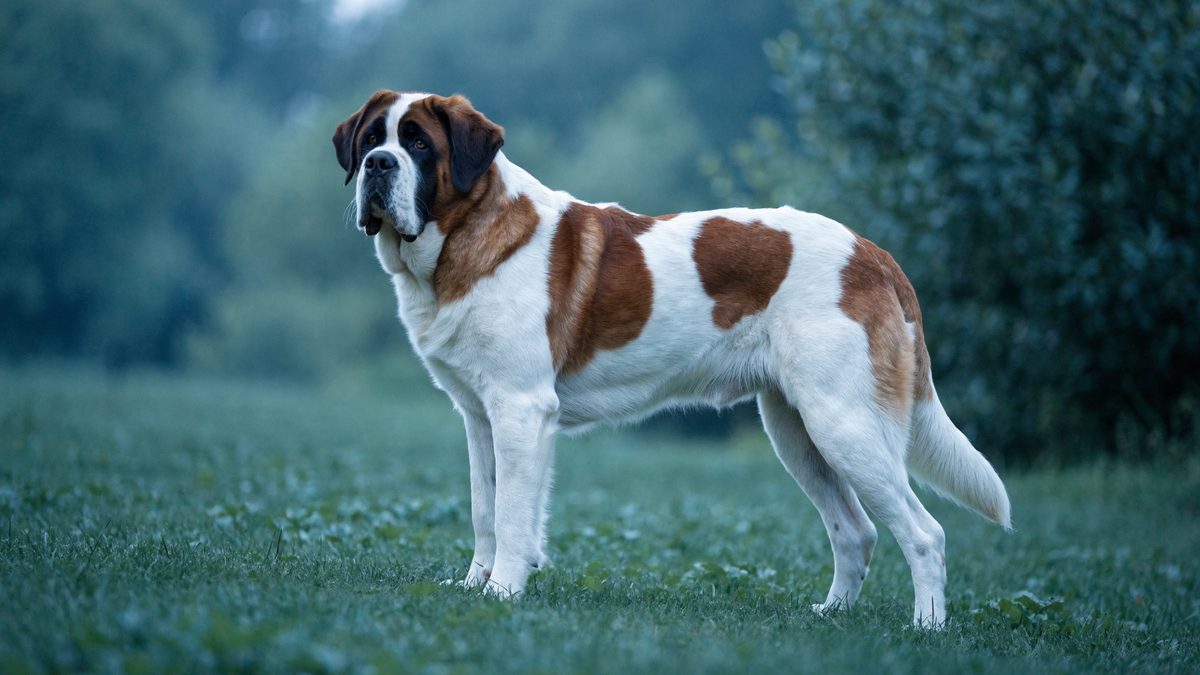
The Saint Bernard is a giant Swiss mountain rescue dog built for snow, standing a minimum of 70 cm at the withers for males under the FCI standard and weighing 64 to 82 kg as a typical adult male. Everything that makes the breed famous, the mass, the dense double coat and the calm low-gear temperament, is an adaptation to an alpine pass at 2,469 metres. India is the opposite environment, and that single mismatch drives almost every practical decision on this page.
Two registries define the breed and they define it differently, which matters when a seller in India tells you a dog is 'standard quality'. Under FCI Standard No. 61, published 4 April 2016, males stand a minimum of 70 cm and a maximum of 90 cm at the withers, and females a minimum of 65 cm and a maximum of 80 cm. Dogs above the maximum are not penalised provided the general appearance stays balanced and the movement stays sound. The AKC standard, approved 13 April 1998, sets only a floor: 27.5 inches minimum for dogs and 25.5 inches minimum for bitches, and it specifies no weight at all.
The weight figures every Indian listing quotes do not come from a breed standard. They come from the AKC's breed page, which gives 140 to 180 pounds for males and 120 to 140 pounds for females, along with a life expectancy of 8 to 10 years. Converted, that is 64 to 82 kg for a male and 54 to 64 kg for a female, which is exactly the range the largest Indian sales platform reproduces in its specification table. Knowing the number is a typical-size guide rather than a rule is useful, because a breeder who says a puppy will 'make 90 kg' is not quoting any standard.
| Attribute | FCI Standard No. 61 | AKC breed standard | AKC breed page |
|---|---|---|---|
| Male height | 70 cm minimum, 90 cm maximum | 27.5 in minimum, no maximum | 28 to 30 in |
| Female height | 65 cm minimum, 80 cm maximum | 25.5 in minimum, no maximum | 26 to 28 in |
| Male weight | Not specified | Not specified | 140 to 180 lb |
| Female weight | Not specified | Not specified | 120 to 140 lb |
| Life expectancy | Not specified | Not specified | 8 to 10 years |
Neither standard gives a weight, so any weight claim you are shown is an estimate. Treat the AKC breed page range as the working number and ignore anything higher unless the seller can show you the parents.
The coat, and why it decides the rest of this page
The Saint Bernard comes in two coat varieties and both carry heavy undercoat. The FCI describes the short-haired variety as Stockhaar, a true double coat with a dense, smooth, close-lying, coarse topcoat and 'plenty of undercoat'. The long-haired variety has a straight topcoat of medium length, again with plenty of undercoat, feathering on the front legs and a bushy tail. The AKC wording is the same in substance, calling the coat 'very dense, short-haired, lying smooth, tough'.
The UK Kennel Club lists the breed's coat length as short and confirms it sheds, while rating grooming at more than once a week. Short does not mean thin. A short-coated Saint Bernard carries roughly the same insulating undercoat as the long-coated one, which is why the assumption that the smooth variety copes better with Indian heat has no support in either standard.
The FCI lists ectropion and entropion as eliminating faults, alongside wall eye and a distinctly undershot mouth. In other words, the world registry treats loose or inturned eyelids as disqualifying, and the breed's own American club names entropion as a hereditary defect that breeders should screen for, noting that a dog which has had corrective surgery cannot be shown under AKC rules. Hold that thought until the health section, because the OFA eye register shows how common these are in practice.
Where the breed came from, and where the sources disagree
The hospice on the Great St. Bernard Pass sits at 2,469 metres on the route from Switzerland into Italy, and large mountain dogs have been kept there since the middle of the 17th century for guarding and protection. Their existence is documented pictorially from 1695 and in a written record at the hospice in 1707. The dogs moved into rescue work for travellers lost in snow and fog, and the legendary dog Barry became the emblem of the rescue dog. Heinrich Schumacher of Holligen near Bern began issuing genealogical documents for his dogs in 1867.
The founding date of the hospice itself is reported three different ways by three authorities, and Bonbeno prints all three rather than picking one.
| Source | Date given | Attribution |
|---|---|---|
| Saint Bernard Club of America | The year 980 | The Augustinian monk Bernard de Menthon, on the mountain called Mons Jovis in Roman times |
| The Kennel Club | 10th century | The monk the breed is named after |
| FCI Standard No. 61 | 11th century | Monks, as a refuge for travellers and pilgrims |
The registry record is firmer than the founding legend. The Swiss Dog Stud Book opened in February 1884 and its very first entry was a St. Bernard called Leon, with the following 28 registrations also St. Bernards. The Swiss St. Bernards-Club was founded in Basle on 15 March 1884, and an international canine congress recognised the St. Bernard as a Swiss breed on 2 June 1887. The Kennel Club adds that the breed was called the Alpine Mastiff well into the 19th century and that the modern name was adopted in 1888.
The image of a rescue Saint Bernard with a cask of brandy round its neck is not a working practice. The Kennel Club states plainly that it is a romantic invention created by the Victorian artist Edwin Landseer, who painted the first two St Bernards to arrive in London. Alcohol given to a hypothermic person increases heat loss, so the picture was always wrong on the medicine as well as the history.
Why so many Indians want one
Films move breed demand, and that is a measured effect rather than a hunch. A PLOS ONE study located 87 movies featuring dogs, of which 63 featured a breed with usable AKC registration data, and found that the ten films with the largest impact were associated with more than 800,000 additional registrations in the ten years after release than pre-release trends predicted. The effect persisted for up to a decade.
Applied to this breed, the honest position is narrower than the internet's. No published study measures what the Beethoven films did to Saint Bernard numbers specifically, and India publishes no national breed registration series of any kind, so nobody can say how many Saint Bernards live in the country or how demand has moved. Any Indian page quoting a national population figure for the breed is guessing. What the evidence supports is the general mechanism: a giant, gentle, comedic screen dog creates buyers who have never met the animal, and the buyers arrive faster than the reality checks do.
Saint Bernard price in India
The Saint Bernard price in India runs from Rs 12,000 to Rs 1,50,000 and above in 2026, a spread of more than twelve times for the same breed. The most useful fact about that range is where the two ends come from. The cheapest listings sit on classified marketplaces and on the breeder page that ranks first in India for this exact query, and the most expensive sits on a platform that sells puppies. Neither end is audited by anyone.
Bonbeno pulled the top ten organic results for 'saint bernard price in india' with India localisation on 15 August 2026 and read every page that publishes a figure. Put side by side, the disagreement is not a rounding error. It is the entire market.
| Source and SERP position | Published price | What kind of page it is |
|---|---|---|
| IndiaMART, King Kennel, New Delhi | Rs 12,000 per puppy | Classified listing, describes the puppy as show quality with all-India delivery |
| Rolling Rotts Kennel, Haldwani, position 1 | Rs 16,000, Rs 25,000 and Rs 40,000 tiers | Breeder's own shop page, reduced from Rs 18,000, Rs 30,000 and Rs 45,000 |
| TradeIndia, Bhatia Kennel, Karnal, position 5 | Rs 20,000 per unit | B2B marketplace listing, minimum order one unit |
| Supertails, position 3 | Rs 40,000 to Rs 1,00,000 | Editorial guide published by a pet e-commerce company |
| Marshalls Petzone, position 8 | Rs 45,000 to Rs 50,000 | Pet retailer, single nationwide range |
| Mr n Mrs Pet, position 4 | Rs 55,000 to Rs 1,50,000 and above | Marketplace with three quality tiers and pan-India delivery |
Read that table twice. The page ranking first quotes Rs 16,000. The page ranking fourth starts at Rs 55,000. They are describing the same breed in the same country in the same month, and they differ by Rs 39,000 at the floor. A buyer who reads only the top result and a buyer who reads only the fourth result will walk into completely different conversations.
The classified end is stranger still. A New Delhi listing advertises Saint Bernard puppies at Rs 12,000 each, describes the animal as a 'show quality puppy fully active and healthy', offers free home delivery across Delhi NCR and all-India delivery, and gives a mobile number as the only contact route. Compare that with the champion-bloodline tier at Rs 1,00,000 to Rs 1,50,000, which is also described as show or breeding stock from imported or award-winning parents. The same two words, 'show quality', are attached to prices that differ by a factor of more than twelve.
The tiered price, and what each tier actually buys
Only one source breaks the price into tiers with stated criteria, and it is worth reading closely because it is also the source with the strongest commercial interest in the number.
| Tier | Published range | What the seller says it includes |
|---|---|---|
| Basic or pet quality | Rs 55,000 to Rs 75,000 | Purebred companion, no show or breeding rights |
| KCI registered | Rs 75,000 to Rs 1,00,000 | Kennel Club of India certification, verified lineage, complete vaccinations, vet health check |
| Champion bloodline | Rs 1,00,000 to Rs 1,50,000 | Imported or award-winning parents, superior genetics for breeding and shows |
A Kennel Club of India paper documents pedigree. It is not a health certificate, and it does not mean the parents were hip scored, elbow scored or eye tested. The breed's own American club recommends five separate screening tests before breeding, covering hips at 24 months, elbows at 24 months, an eye examination by a boarded ophthalmologist at 22 months, a cardiac evaluation at 24 months and a degenerative myelopathy DNA test. Nothing in the Indian tier descriptions maps onto any of that. You are paying Rs 20,000 to Rs 25,000 more for a registration certificate, not for a screened dog.
City-wise prices, and one table that says nothing
Two sources publish city-level figures and only one of them contains information.
| City | Supertails | Mr n Mrs Pet |
|---|---|---|
| Delhi | Rs 50,000 to Rs 1,00,000 | Rs 55,000 to Rs 1,50,000 |
| Bangalore | Rs 50,000 to Rs 1,00,000 | Rs 55,000 to Rs 1,50,000 |
| Hyderabad | Rs 45,000 to Rs 90,000 | Rs 55,000 to Rs 1,50,000 |
| Kerala | Rs 40,000 to Rs 85,000 | Not listed |
| Mumbai | Not listed | Rs 55,000 to Rs 1,50,000 |
| Chennai | Not listed | Rs 55,000 to Rs 1,50,000 |
| Pune | Not listed | Rs 55,000 to Rs 1,50,000 |
| Jaipur | Not listed | Rs 55,000 to Rs 1,50,000 |
| Lucknow | Not listed | Rs 55,000 to Rs 1,50,000 |
Mr n Mrs Pet publishes an identical Rs 55,000 to Rs 1,50,000 range for all eight cities it lists, which means its city table carries no city-level information whatsoever. Supertails at least varies its four cities, putting Delhi and Bangalore at the top and Kerala at the bottom, and explains the gap as demand and breeder concentration. Neither is a market survey. Treat both as one publisher's estimate.
What the law says about the cheap end
India regulates dog breeding, and the rules are specific. Under the Animal Welfare Board of India's Dog Breeding and Marketing Rules, all breeders of dogs must be registered with the AWBI, and breeding without registration is an offence that can result in confiscation of breeding stock and puppies plus a fine of up to Rs 5,000 per un-sterilized bitch. A certificate of registration issued by the State Board is valid for two years, is non-transferable, and may be renewed on application.
- Age at sale. No puppy may be sold until it has reached 8 weeks of age and is fully weaned.
- Microchip. All puppies must be microchipped before sale, and all breeding stock must be microchipped.
- Vaccination. All puppies must receive their first vaccination at 6 weeks against distemper, parvovirus, adenovirus and leptospirosis, and must be sold with a signed vaccination certificate.
- Kennel club registration. The various kennel clubs in India shall not register any pup or adult dog which has not been registered with the AWBI, and registering animals from a non-registered breeder is itself an offence.
- Temperament and genetics. The registered veterinary doctor must certify in the stock control register that the animals to be mated are fit and healthy, are neither aggressive nor nervous, and have no serious genetic defects.
Run a Rs 16,000 Saint Bernard against that list. Microchipping, an 8-week hold, a full first vaccination course, an AWBI registration at Rs 500 per animal and a veterinary fitness certificate before every mating are real costs. A litter produced to those standards from screened parents does not reach the buyer at Rs 16,000, and the source that publishes the lowest editorial floor says the same thing in softer language, warning that low prices often signal unethical breeding and that dogs from such sources may have health or behavioural issues later.
The Rs 16,000 Saint Bernard on the page ranking first is not a bargain, it is an arithmetic warning. Royal Canin India's own feeding table puts a 75 kg dog at medium activity on 670 g of Giant Adult per day, and the 15 kg pack retails in India at Rs 10,592, or roughly Rs 706 per kilogram. That is about Rs 14,200 of food a month. A Rs 16,000 purchase buys thirty-four days of that dog's adult diet, and the Rs 12,000 classified listing buys twenty-five days. Whatever you save at the front is gone inside six weeks.
Bonbeno does not broker puppy sales, does not publish breeder listings and does not recommend any seller named on this page. Every figure above is reported from a third party so you can see the disagreement for yourself and price it into your own decision.
Monthly cost of keeping a Saint Bernard in India
Food alone costs roughly Rs 14,200 a month for an adult male Saint Bernard in India, which is more than the entire monthly budget published by either page currently ranking for this query. That figure is not an opinion. It is the manufacturer's own feeding chart multiplied by the manufacturer's own Indian retail price, and it is the number that decides whether you can keep this dog.
Every competing page publishes a monthly cost figure and none of them shows its working. Bonbeno shows the working, because with a giant breed the arithmetic is the argument.
Step one: how much a Saint Bernard actually eats
Royal Canin publishes a daily feeding table for Giant Adult on its Indian site, graded by bodyweight and activity level. These are the manufacturer's numbers for its own food, not an estimate.
| Weight of dog | Low activity | Medium activity | High activity |
|---|---|---|---|
| 55 kg | 459 g | 531 g | 603 g |
| 65 kg | 520 g | 602 g | 684 g |
| 75 kg | 579 g | 670 g | 761 g |
| 85 kg | 636 g | 736 g | 836 g |
A 75 kg male at medium activity eats 670 g a day, which is 20.1 kg a month. A 55 kg female at medium activity eats 531 g a day, or 15.9 kg a month. Weigh your dog before you use this table, because guessing high wastes money and guessing low starves a growing giant.
Step two: what that food costs in India
The same food retails in India at Rs 10,592 for the 15 kg pack, discounted from an MRP of Rs 12,050, which works out at about Rs 706 per kilogram. The smaller 4 kg and 8 kg packs cost Rs 3,071 and Rs 6,142, or roughly Rs 768 per kilogram, so buying small packs adds about nine percent. Multiply the daily ration by the price per kilogram and the monthly cost stops being a guess.
| Adult weight and activity | Grams per day | Kg per month | Cost per month at Rs 706 per kg |
|---|---|---|---|
| 55 kg female, medium | 531 g | 15.9 kg | About Rs 11,250 |
| 65 kg, medium | 602 g | 18.1 kg | About Rs 12,750 |
| 75 kg male, low | 579 g | 17.4 kg | About Rs 12,250 |
| 75 kg male, medium | 670 g | 20.1 kg | About Rs 14,200 |
| 85 kg male, medium | 736 g | 22.1 kg | About Rs 15,600 |
At 670 g a day a 15 kg pack lasts 22 days, so you buy roughly seventeen bags a year. Twelve months of food for a 75 kg Saint Bernard on this diet comes to about Rs 1,70,000, which is more than the top of the champion-bloodline purchase price published by the largest Indian marketplace. The dog is not the expensive part. The dog is the deposit.
Step three: how that compares with the published estimates
| Line item | Supertails | Mr n Mrs Pet | Bonbeno calculation |
|---|---|---|---|
| Food | Rs 6,000 to Rs 10,000 | Included in the total below | Rs 11,250 to Rs 15,600 depending on weight |
| Veterinary care | Rs 2,500 to Rs 5,000 | Included in the total below | Use the published range, no Indian breed-specific data exists |
| Grooming | Rs 1,000 to Rs 3,000 | Included in the total below | Use the published range |
| Toys and training | Rs 1,000 to Rs 3,000 | Included in the total below | Use the published range |
| Cooling and electricity | Not costed | Not costed | Not costed by anyone, see below |
| Stated monthly total | Rs 10,500 to Rs 21,000 | Rs 5,000 to Rs 10,000 | Rs 15,750 to Rs 26,600 before cooling |
The gap is not subtle. Mr n Mrs Pet's entire monthly budget of Rs 5,000 to Rs 10,000 is lower than the food bill on its own, and Supertails' food line stops Rs 4,200 short of the calculated figure for a 75 kg dog. Both estimates are published by companies that also sell the food, so neither is guessing out of ignorance. The likeliest explanation is that the figures were written for a large breed rather than a giant one, and nobody went back and multiplied.
Cooling is a real and large line item for a double-coated alpine dog in India, and it is the single biggest omission in every published Indian estimate. The Saint Bernard Club of America's own hot-climate guidance describes keeping an air-conditioned kennel that dogs disappear into during the heat and emerge from at cooler times, and says outdoor dogs need some form of cooling in an insulated shelter. Bonbeno still publishes no rupee figure, because no verified measurement of the electricity cost of cooling a 75 kg dog in an Indian home exists, and inventing one would be worse than leaving the row blank. Budget for it as a real cost you will have to measure yourself, not as zero.
The costs that scale with bodyweight
Almost every veterinary cost for a giant breed is a multiplication problem, because drugs are dosed by weight. The Saint Bernard Club of America's own care notes give the pattern plainly, describing a monthly heartworm dose calculated at one tenth of a cc per 40 pounds of bodyweight. A 75 kg dog is roughly four times a 19 kg dog, so four times the parasite preventive, four times the antibiotic course, four times the anaesthetic and four times the intravenous fluids.
- Parasite prevention. Dosed by weight, every month, for life.
- Anaesthesia. Dosed by weight, and giant breeds carry additional anaesthetic risk that a heavy dog cannot avoid.
- Joint and pain medication. Dosed by weight, and likely to run for years given the hip and elbow figures in the health section.
- Emergency surgery. Gastric dilatation-volvulus is a same-night surgical emergency in a deep-chested giant, and the surgical bill does not wait for your salary date.
- Transport. A 75 kg dog does not fit in an autorickshaw. Getting to the vet is a logistics problem before it is a medical one.
The honest summary is this. Budget Rs 16,000 to Rs 27,000 a month before electricity, plus a genuine emergency reserve, plus a cooling bill nobody has measured. If those numbers do not fit your household, the answer is not a cheaper Saint Bernard. It is a different dog.
Heat tolerance, and what the evidence actually shows
Bonbeno rates the Saint Bernard 1 of 5 for heat tolerance, the lowest rating on this site. That rating is a judgement built from mechanisms, not from a breed-specific number, because the breed-specific number does not exist. The largest study of heat-related illness in dogs ever conducted contains no odds ratio for the Saint Bernard at all, and saying so plainly is more useful than inventing one.
Start with what is measured. In 2020 a study of 905,543 dogs under UK primary veterinary care identified 395 confirmed heat-related illness events, giving an annual incidence of 0.04 percent and an event fatality rate of 14.18 percent. Nine breeds carried significantly higher odds than the Labrador Retriever, and the pattern in that list is the whole argument for this section.
| Breed | Odds ratio | 95 percent confidence interval |
|---|---|---|
| Chow Chow | 16.61 | 6.21 to 44.44 |
| Bulldog | 13.95 | 8.01 to 24.29 |
| French Bulldog | 6.49 | 3.62 to 11.63 |
| Dogue de Bordeaux | 5.31 | 1.99 to 14.21 |
| Greyhound | 4.26 | 1.88 to 9.70 |
| Cavalier King Charles Spaniel | 3.45 | 1.86 to 6.42 |
| Pug | 3.24 | 1.67 to 6.29 |
| English Springer Spaniel | 2.74 | 1.25 to 6.01 |
| Golden Retriever | 2.65 | 1.40 to 5.01 |
| Saint Bernard | Absent from the table | No breed-level estimate published |
The Saint Bernard is not in that list, and the reason is not that it is safe. Breeds entered the analysis only if they had at least five heat-related illness cases or at least 5,000 dogs in the study population, and the Saint Bernard is too uncommon in the UK to clear either bar. It fell into the pooled 'other purebred' category, which returned an odds ratio of 1.28 with a confidence interval of 0.76 to 2.14, a result that means nothing on its own. No study anywhere has published a breed-level heat risk figure for the Saint Bernard. Any page that gives you one has made it up.
What the study did find, and why it points at this breed
The two mechanisms the same study identified as significant both describe the Saint Bernard exactly.
- Coat thickness drives risk independently of skull shape. The Chow Chow, described by the authors as a breed with a very thick coat, carried the greatest risk of all the study breeds. The Golden Retriever, another double-coated breed, carried 2.65 times the odds of the Labrador Retriever despite being of similar size, temperament and purpose. Coat, not just a flat face, is a heat risk factor in its own right.
- Bodyweight drives risk. Dogs at or above the mean bodyweight for their breed and sex carried 1.42 times the odds of heat-related illness compared with dogs below that mean, with a confidence interval of 1.12 to 1.80. A larger body generates more heat and sheds it across proportionally less surface area.
- Exercise is the leading trigger, not hot cars. In the 2022 UK emergency-care follow-up study of 167,751 records, exercise accounted for 51.46 percent of the 384 heatstroke cases, a hot environment for 31.02 percent and hot vehicles for only 12.41 percent. The dog most Indian owners picture dying is the one shut in a car. The dog that actually dies is the one taken for a walk.
The Saint Bernard is a double-coated giant that sits at the top of the bodyweight distribution for any breed. Both of the mechanisms the evidence supports apply to it at maximum strength. That is why Bonbeno rates it 1 of 5, and that is also why the rating is presented as a judgement rather than as a statistic.
Why the UK fatality rate understates the Indian risk
The 14.18 percent fatality figure comes from a temperate country. The study's own authors flag this, noting that the largest heatstroke series published to date, 126 dogs presenting to a hospital in Israel, reported a case fatality of 53 percent, that earlier reports ranged from 36 to 50 percent, and that the comparatively higher fatality rates in hotter countries should serve as a warning. The UK emergency-care study, which by design saw sicker dogs, found that 26.56 percent of dogs presenting with heatstroke died.
India publishes no equivalent series. There is no Indian VetCompass, no national canine heat-illness registry and no published Indian case-fatality rate for heatstroke in dogs. When an Indian page tells you how many dogs die of heat here every year, ask where the number came from.
The Indian temperature reality, city by city
IMD bulletins for the April to May 2026 heat season put the season's highest observed temperature at 47.6 C at Banda in Uttar Pradesh on 27 April 2026, roughly 8 C above the climatological norm, with Akola in Maharashtra at 46.9 C the same day. Earlier in April, Akola recorded 43.1 C and Kalaburagi in Karnataka 44 C, and on 20 May maximum temperatures exceeded 42 C in Delhi, Ahmedabad and Nagpur.
The same analysis makes a point that matters for anyone deciding where to keep this dog. IMD described heat wave conditions as occurring in 'isolated pockets' rather than as a pan-India event, and parts of north-east India, south India and coastal India recorded normal or below-normal maximum temperatures on the same days. India is not thermally uniform.
The obvious answer to an alpine breed in India is to keep it in the hills, and the 2026 data weakens that answer. During April 2026 hill stations recorded unusually high temperatures, with Mussoorie and Nainital reaching up to 30 C and Shimla 27 C, and IMD's seasonal outlooks for both 2025 and 2026 projected above-normal maximum and minimum temperatures across Jammu and Kashmir, Himachal Pradesh and Uttarakhand. Thirty degrees is manageable for this breed. It is not the sub-zero pass the coat was built for, and the trend is going the wrong way.
What the law already says about moving one in summer
India's Dog Breeding and Marketing Rules contain a temperature limit that almost nobody quotes. No animal may be transported in a vehicle where the temperature rises above 35 C or falls below 5 C, and the same limit applies to transport by water. Road vehicles must protect against extremes of heat and cold, must be well ventilated, and the animals must be checked every two hours.
Now read the second-ranked commercial result for this query, which advertises pan-India doorstep delivery and states that depending on location, weather and the puppy's health it chooses air, road or rail. In a month when Banda hit 47.6 C and Nagpur passed 42 C, a road journey across central India with a giant double-coated puppy in the back is difficult to reconcile with a 35 C ceiling. If you are buying at distance in summer, ask in writing how the 35 C rule will be met, and treat a vague answer as your answer.
The management protocol that actually works
- Walk before 7 am and after 8 pm. The RVC's guidance is to restrict exercise on warm days and walk early in the morning or later in the evening. Exercise is the single largest heatstroke trigger.
- Test the pavement with your hand. If the surface is too hot for you to hold your hand on, it is too hot for your dog's paws.
- Give the dog cool hard floors. Saint Bernard owners in hot climates report that the dogs seek out tile and cool hard flooring, and that Saints become more active at night in hot dry weather.
- Keep water everywhere. The mouth is one of the largest cooling surfaces on a Saint Bernard, and the dogs swish water around their mouths to cool down even when they are not really drinking.
- Never shave the coat. The AKC's position is that shaving a dog can make it hotter in summer and creates health risks, and that grooming and safety measures are the correct response instead.
- Watch for the early signs. Panting progressing to distressed or noisy breathing, restlessness or pacing, drooling, red gums or tongue, raised heart rate, vomiting or diarrhoea. The advanced stage is lethargy, confusion, weakness or collapse, and seizures.
The RVC's first-aid instruction for a dog with suspected heatstroke is cool first, transport second. Move the dog somewhere cool and ventilated, offer small sips of water without forcing, and start cooling immediately. Cold water immersion is effective for young healthy dogs; for older dogs or dogs with underlying problems, pour water that is cooler than the dog over it and combine that with air movement from a fan or breeze. Do not use ice-cold water, which reduces blood flow to the skin and can trigger shivering that generates more heat. Call the vet once cooling has started, and have the dog checked even if it seems to recover. In a humid Indian summer, evaporative cooling works less well than it does in dry heat, so start earlier and do not wait to see whether it passes.
Temperament, and who should not buy one
The Saint Bernard is friendly by nature with a temperament described in the world breed standard as calm to lively and watchful, and aggressive or overly shy dogs are an eliminating fault. That is a companion and watch dog, not a guard dog, and the difference matters because a large share of Indian buyers are told the opposite.
The FCI classifies the breed's utilisation as companion, watch and farm dog, describes the temperament as 'friendly by nature, temperament calm to lively, watchful', and lists aggressive or overly shy dogs and weak temperament among the eliminating faults. The AKC standard adds that a dog with a dark mask can look stern but is 'never ill-natured'. Both registries are describing a gentle animal whose job was to find people, not to keep them away.
Indian sales pages stretch this. One ranking page tells buyers that Saint Bernards are 'natural guardians and will always look out for their families', and another lists 'Loyal and Protective' among the reasons to buy one. A watchful dog barks when someone arrives. A guard dog engages. If you want security, this breed is a very expensive alarm and a poor deterrent once anyone tests it.
Temperament is a breeding variable, and India regulates it
The Saint Bernard Club of America lists bad temperament alongside hip dysplasia, elbow dysplasia, entropion, epilepsy and heart defects as a hereditary defect that breeders should screen for. India's rules go further and make it a legal requirement: the registered veterinary doctor must certify in the stock control register that the animals to be mated are fit and healthy, that they are neither aggressive nor nervous, and that they are of good temperament.
The preamble to those rules explains why. It states directly that breeders using dogs of undesirable, aggressive or nervous temperament create serious risks to the public through dog bites, and that unwanted dogs and puppies dumped on the streets breed with local dogs and adversely affect their normally placid nature. Temperament screening in India is not a nicety. It is the stated purpose of the regulation.
The physics of a 75 kg family dog
A male Saint Bernard weighs 64 to 82 kg and a female 54 to 64 kg. That is heavier than most Indian adults. Nothing about the breed's intentions changes the consequences of a heavy dog turning quickly in a small flat, leaning on a toddler, or pulling on a lead at a road crossing. The sales pages that call the breed 'excellent with kids' are describing the intent accurately and skipping the mass entirely.
- Supervise every interaction with children under six. The risk is accidental impact, not aggression.
- Fit a harness and teach loose-lead walking before the dog passes 30 kg. After that you are negotiating, not training.
- Give the dog an exit. A giant breed with nowhere to retreat to becomes a stressed giant breed.
- Budget for drool. The strongly developed upper flews described in both standards mean drooling is a design feature, not a fault to be fixed.
First-time dog owners. Anyone in a flat without reliable cooling, because the UK Kennel Club lists the ideal home for this breed as a large house with a large garden and even the marketplace selling them rates apartment friendliness as low and notes it requires space and climate control. Anyone whose monthly budget cannot absorb Rs 16,000 to Rs 27,000 before electricity. Anyone buying for security. Anyone who wants a dog for ten to fifteen years, because the published life expectancy is 8 to 10 years and the UK primary-care median is lower still.
Training a Saint Bernard, on an Indian clock
To train a Saint Bernard successfully in India, finish the physical-control work before the dog passes 30 kg and schedule every session outside the heat of the day. The breed is not difficult in temperament. It is difficult in mass and in timing, and both problems have deadlines rather than techniques.
The training window is short because the growth is fast. A puppy that will finish at 64 to 82 kg spends only a few months at a weight you can physically manage. Loose-lead walking, a reliable recall, a solid settle, gate manners and tolerance of handling all have to be installed while correction is still a matter of technique rather than strength.
| Approximate weight | What must already be working | Why the deadline is real |
|---|---|---|
| Under 15 kg | Name response, hand feeding, tolerance of ear, paw, mouth and eyelid handling | Eye and ear checks run for life in this breed, so handling has to be neutral before it is needed |
| 15 to 30 kg | Loose-lead walking on a harness, settle on a mat, wait at doors and gates | This is the last stage at which an adult can physically restrain the dog without a struggle |
| 30 to 50 kg | Recall under mild distraction, calm greetings, car or lift entry and exit | Greeting behaviour that is charming at 20 kg knocks people over at 50 kg |
| Over 50 kg | Maintenance and generalisation only | New physical-control training against a dog of this size is negotiation, not teaching |
The socialisation window closes before the heat does
Indian law puts the puppy in your home no earlier than 8 weeks, because no puppy may be sold until it has reached 8 weeks of age and is fully weaned. That leaves a narrow period for early exposure, and in much of India it collides with a season in which the puppy should not be outdoors during daylight at all.
Work around it rather than through it. Do exposure work at dawn and after dark, use car journeys with the air conditioning on to expose the puppy to traffic and noise safely, and bring people to the dog rather than taking the dog to people during April, May and June. The Saint Bernard Club of America's own basic-care booklet lists housetraining, crate training, grooming, bloat, exercise and socialisation as the core topics for new owners, and every one of those can be worked on indoors.
What this breed resists, and what it does not
The standards describe a dog that is friendly, calm to lively and watchful, with aggression and extreme shyness written in as eliminating faults. In practice that means you are not fighting a suspicious or reactive temperament, which is a genuine advantage over several other giant breeds. What you are fighting is inertia and heat. A dog built to work in cold at low speed does not offer you fast, repetitive, high-arousal training sessions, and in an Indian summer it should not be asked to.
- Keep sessions short and cool. Five to ten minutes, indoors, several times a day beats one long session outdoors.
- Reward with food you have already counted. Training treats come out of the daily ration, not on top of it, because this breed cannot carry spare weight over those hips.
- Train the vet visit deliberately. Muzzle acceptance, standing still for an eye examination, and lying calmly on one side are worth more in this breed than any trick.
- Never use physical correction on a growing giant. Joint disease risk in this breed is high enough without adding force to it.
The Saint Bernard Club of America urges new owners to select a veterinarian as soon as the puppy arrives, specifically one experienced in the special requirements of the giant breeds and who in general 'likes big dogs'. In India, do this before you buy. Confirm that the practice can physically handle a 75 kg dog on a table, has anaesthetic capability for that weight, and can perform emergency abdominal surgery at night. If the nearest clinic that can do all three is two hours away, that is a fact about the breed's suitability for your address, not a detail.
Daily exercise, and the trap inside it
A Saint Bernard needs up to one hour of exercise a day according to the UK Kennel Club, which is low for a dog of this size and is the most misleading useful fact on this page. The hour is easy. Finding an hour cool enough to use it is the problem, and exercise is the single largest cause of canine heatstroke in the published data.
The UK Kennel Club lists daily exercise for the St. Bernard at up to one hour per day, alongside a large house and a large garden as the ideal home. Both Indian ranking pages agree in substance, describing the breed as laid-back and low energy indoors and content with moderate walks, and as not particularly energetic though still needing regular walks to stay healthy. For once the competing pages and the registry are aligned.
The trap is that one hour of exercise sounds like the easy part of owning a giant breed, and in India it is the dangerous part. In the 2022 UK emergency-care study, exercise triggered 51.46 percent of heatstroke cases, more than four times the share caused by hot vehicles. A dog that is calm indoors and enthusiastic outdoors will overheat on a walk it wanted to take.
The Indian exercise schedule
| Season | Usable window | What to do instead of a walk |
|---|---|---|
| October to February | Most of the day | Take the full hour outdoors, build fitness now |
| March and September | Before 7 am and after 8 pm | Split the hour into two shorter sessions |
| April to June | Before 6.30 am and after 9 pm, if at all | Indoor scent work, short lead walks on grass, no running |
| Monsoon | Variable, humidity is the limiting factor not temperature | Shorten sessions, dry the coat thoroughly afterwards |
The RVC's rule is to restrict exercise on warm days and to walk early in the morning or later in the evening, and to test the pavement with the back of your hand first. Saint Bernard owners in hot climates report the same behavioural shift from the dogs themselves, who become more active at night when it is cooler. Follow the dog's clock rather than yours.
Why under-exercising is also a heat risk
Cutting exercise to avoid heatstroke creates a second heat problem, because weight is itself a risk factor. Dogs at or above the mean bodyweight for their breed and sex carried 1.42 times the odds of heat-related illness in the UK primary-care study. A Saint Bernard that spends an Indian summer indoors and gains eight kilograms is a worse heat risk in September than it was in March.
The answer is to move calories, not activity. Reduce the ration when the exercise window shrinks, and confirm with a body condition assessment every fortnight rather than with the scale alone. The long-term case for keeping a giant breed lean is strong: in a paired feeding study of 48 Labrador Retrievers, dogs fed 25 percent less than their pair-mates from 8 weeks of age until death weighed less, carried less body fat, lived significantly longer at the median, and had the onset of chronic disease delayed.
- Never run a Saint Bernard on tarmac. Heat radiates upward and this breed sits closest to it by mass.
- Avoid forced repetitive exercise before 18 months. With 49.9 percent of OFA-evaluated Saint Bernards graded dysplastic on the hips, Bonbeno's position is that growing joints get free movement on soft ground and nothing else.
- Swim if you can access clean water. It is the only high-effort, low-heat, low-impact option available to this breed in India.
- Carry water on every walk, and offer it before the dog asks.
Grooming a double coat in Indian humidity
Groom a Saint Bernard more than once a week, brush the undercoat out rather than clipping the topcoat off, and never shave the dog for summer. The UK Kennel Club sets the frequency, the AKC sets the prohibition, and one of the pages currently ranking for this query gets the coat type itself wrong in a way that leads owners straight into a clipper.
The UK Kennel Club rates grooming for this breed at more than once a week, lists the coat length as short, and confirms that it sheds. Short is a description of the guard hair, not of the total coat. Both FCI varieties carry 'plenty of undercoat', and the short-haired variety is explicitly a double coat described as Stockhaar, with a dense, smooth, close-lying, coarse topcoat over that undercoat. The AKC calls the same coat 'very dense, short-haired, lying smooth, tough'.
The FAQ on the marketplace page ranking fourth for this query states that Saint Bernards 'have dense, curly coats that need trimming every 4 to 6 weeks to prevent matting' and that this trimming keeps them cool in Indian weather. Both breed standards contradict it. The AKC describes the long-haired variety as 'plain to slightly wavy, never rolled or curly' and lists rolled or curly hair as faulty, and the FCI lists curly coat among the faults. There is no curly-coated Saint Bernard, there is no six-weekly trim in this breed, and the AKC's published position is that shaving a dog can make it hotter in summer and creates health risks. An owner who follows that FAQ will clip the insulating layer off a dog in an Indian April.
The routine that actually works
- Brush at least twice a week, daily during shedding. Work an undercoat rake down to the skin rather than skimming the topcoat, because the dead undercoat is what blocks airflow.
- Groom outdoors or in a room you can sweep. A giant double-coated dog sheds in volumes that surprise first-time owners.
- Dry the coat completely after every bath and after monsoon walks. A dense undercoat that stays damp in humid air is the setup for skin trouble, and no Indian study quantifies how common that is in this breed, so treat drying as prevention rather than as a cure you can count on.
- Never shave for summer. The AKC is unambiguous that shaving can make a dog hotter and creates health risks, and recommends grooming and safety measures instead. The RVC's heat guidance says the same in one line: keep the pet regularly groomed as advised for its breed.
- Check the eyes every single day. On the OFA eye register, 22.2 percent of 415 examined Saint Bernards were recorded with entropion and 23.6 percent with ectropion. Daily inspection is not optional in a breed with those numbers.
Drool is a standard feature, not a fault
The AKC standard describes flews of the upper jaw that are strongly developed and slightly overhanging, while specifying that the flews of the lower jaw must not be deeply pendant. The FCI describes the same structure as strongly developed, firm and not too pendulous. That architecture produces drooling, and drooling increases in heat because the mouth is doing thermoregulatory work.
Saint Bernard owners in hot climates note that the mouth area is one of the largest cooling surfaces on the whole dog, and that Saints swish water around their mouths to cool down even when they are not really drinking. Expect wet walls, keep a towel by the water bowl, and read a sudden increase in drooling on a hot day as an early heat sign rather than a nuisance, because drooling appears in the RVC's early-warning list for heatstroke.
| Period | Priority | What changes |
|---|---|---|
| October to February | Routine brushing twice a week | Easiest months, use them to build tolerance of handling |
| March to June | Daily undercoat raking | Removing dead undercoat improves airflow to the skin without removing insulation |
| Monsoon | Drying and skin checks | Humidity, not temperature, is the problem; check skin folds, ears and between toes |
| All year | Daily eye and eyelid check | Entropion and ectropion are recorded in over a fifth of examined dogs |
Health, lifespan and the numbers nobody publishes in India
The Saint Bernard carries one of the worst hip records of any breed on the OFA register, with 49.9 percent of 2,965 evaluated dogs graded dysplastic against an all-breed rate of 14.2 percent, and a UK primary-care median lifespan of 9.3 years against 12.5 years for dogs overall. Those two figures are the honest headline of this page, and no Indian page currently ranking for this query publishes either of them.
Lifespan, from the largest dataset that exists
A 2024 study of 584,734 UK dogs, including 284,734 deceased animals across 155 breeds, put the median survival for all dogs at 12.5 years, for purebreds at 12.7 years, for crossbreds at 12.0 years and for large-sized breeds at 11.9 years. Against that baseline, the St Bernard appears in the paper's own list of breeds most at risk from early death, with a median of 9.3 years and a hazard ratio of 1.7 with a confidence interval of 1.5 to 1.8.
| Group | Median survival | Difference against all dogs |
|---|---|---|
| All dogs in the study | 12.5 years | Baseline |
| All purebred dogs | 12.7 years | Plus 0.2 years |
| All crossbred dogs | 12.0 years | Minus 0.5 years |
| Large-sized breeds | 11.9 years | Minus 0.6 years |
| St Bernard | 9.3 years | Minus 3.2 years |
| Mastiff | 9.0 years | Minus 3.5 years |
| Cane Corso | 8.1 years | Minus 4.4 years |
Three separate authorities land in the same place. The AKC gives a life expectancy of 8 to 10 years, the UK Kennel Club records the breed's lifespan as under 10 years, and the Indian marketplace selling the dogs states 8 to 10 years in its own specification table. This is a genuinely short-lived breed, and the figures agree closely enough that there is no disagreement to publish.
Hip dysplasia, the number that should decide the purchase
The Orthopedic Foundation for Animals publishes evaluation results by breed, and on the hip register the Saint Bernard ranks eighth worst of every breed listed.
| Measure | Saint Bernard | All breeds |
|---|---|---|
| Evaluations recorded | 2,965 | 1,711,498 |
| Rank, worst first | 8 | Not applicable |
| Normal | 47.9 percent | 84.3 percent |
| Excellent | 4.2 percent | Not stated separately at all-breed level |
| Dysplastic | 49.9 percent | 14.2 percent |
| Mild | 27.7 percent | 8.8 percent |
| Moderate | 18.6 percent | 4.6 percent |
| Severe | 3.6 percent | 0.8 percent |
Read the severity split, not just the headline. Nearly one in five evaluated Saint Bernards is graded moderately dysplastic and one in twenty-eight severely dysplastic. That is 3.5 times the all-breed dysplastic rate and roughly 4.5 times the all-breed severe rate. These are dogs whose owners paid to have them radiographed, which is a self-selecting group of people who care about hips, so the true population rate is unlikely to be better than this.
Elbow dysplasia follows the same shape at lower intensity, with 15.4 percent of 857 evaluated Saint Bernards graded abnormal, split 11.1 percent grade 1, 3.2 percent grade 2 and 1.2 percent grade 3. Both the Saint Bernard Club of America and the UK Kennel Club therefore ask breeders to screen hips and elbows before breeding.
A second, independent hip dataset says the same thing
The OFA is an American register, so a fair reader should ask whether the UK scheme agrees. It does. The BVA and Kennel Club Hip Dysplasia Scheme, established in 1965, scores each hip on nine parameters, with a minimum of 0 and a maximum of 53 per hip, giving a total range of 0 to 106 where lower is better. The scheme requires the dog to be at least 1 year old, permanently identified by microchip, and radiographed under anaesthesia or heavy sedation, and a single submission starts from GBP 82.50 including VAT.
| Breed | Dogs tested, 15 years | 15-year mean | 15-year median |
|---|---|---|---|
| Saint Bernard | 517 | 21 | 14 |
| Dogue de Bordeaux | 939 | 21 | 14 |
| Mastiff | 172 | 16 | 12 |
| Great Dane | 622 | 11 | 10 |
| Golden Retriever | 16,325 | 13 | 10 |
| Labrador Retriever | 49,137 | 11 | 9 |
| Rottweiler | 2,650 | 10 | 8 |
| Siberian Husky | 1,231 | 8 | 7 |
The Saint Bernard's UK median of 14 is double the Siberian Husky's 7 and more than half again the Labrador's 9, and its five-year worst recorded score was 80 out of a possible 106. Two independent national screening schemes on two continents put this breed in the same place, which removes the usual excuse that one register is unrepresentative.
A PLOS ONE analysis calculated estimated breeding values from 760,455 hip scores and 135,409 elbow scores across 1,264,422 dogs from 74 breeds over 40 years of American screening data. Incidences of hip dysplasia across those 74 breeds ranged from 0.07 percent to 6 percent, with the Boykin Spaniel and the St. Bernard having the highest and the Siberian Husky and Afghan Hound the lowest. More striking still, while breeds such as the Akita, German Shorthaired Pointer, Labrador Retriever, Siberian Husky and Weimaraner showed steady genetic improvement, the St. Bernard showed deteriorating hip genetic quality, with the highest annual genetic deterioration rate of any breed in the study at minus 0.0077 against the Akita's fastest improvement of plus 0.010. Four decades of screening moved most breeds forward. On hips, it moved this one backwards.
Entropion and ectropion, the faults the standard already disqualifies
The FCI lists ectropion and entropion as eliminating faults, and the OFA eye register shows how far practice sits from that ideal. Of 415 Saint Bernards examined, 92 were recorded with entropion, 22.2 percent, and 98 with ectropion, 23.6 percent. On ectropion, only the Neapolitan Mastiff at 45.9 percent is worse. On entropion, only the Chinese Shar-Pei at 36.0 percent and the Neapolitan Mastiff at 35.7 percent are worse.
The OFA's summary eyes table records the Saint Bernard as 92.3 percent normal and 7.7 percent abnormal across the same 415 dogs, while its detailed condition tables record entropion in 22.2 percent, ectropion in 23.6 percent, and only 46.7 percent of the 415 as fully normal under the 'other' category. Bonbeno prints both because both are published on the same page and the page does not reconcile them. The summary grade and the condition-level records are clearly counting different things. What is not in dispute is the ranking: whichever table you use, this breed sits near the top of the eyelid-disease list.
The Saint Bernard Club of America names entropion among the hereditary defects breeders should screen for, and adds a detail worth knowing before you buy a show-quality puppy at a premium: a dog that has undergone corrective surgery cannot be shown under AKC rules. Practically, budget for the possibility of eyelid surgery and check the eyes daily for life.
Bloat, and the number that has never been calculated
Gastric dilatation-volvulus is the emergency owners of deep-chested giant breeds fear most, and the AKC names it directly on the breed page, describing bloat as a life-threatening condition where the stomach distends and twists. The breed-level risk is well measured. The lifetime risk is not, and that gap is the single most under-reported fact about this breed.
A case-control study using the Veterinary Medical Data Base compared 1,934 dogs with gastric dilatation-volvulus against 3,868 controls across 12 hospitals from 1980 to 1989. Case fatality was 28.6 percent for gastric dilatation alone and 33.3 percent for dilatation with volvulus. Purebred dogs carried 2.5 times the odds of mixed-breed dogs, and risk rose with both age and weight. Among the five highest-risk breeds, the Saint Bernard placed third with an odds ratio of 4.2, confidence interval 2.3 to 7.4, behind the Great Dane at 10.0 and the Weimaraner at 4.6.
| Breed | Odds ratio | 95 percent confidence limits |
|---|---|---|
| Great Dane | 10.0 | 6.4 to 15.6 |
| Weimaraner | 4.6 | 2.3 to 9.2 |
| Saint Bernard | 4.2 | 2.3 to 7.4 |
| Gordon Setter | 4.1 | 1.8 to 9.3 |
| Irish Setter | 3.5 | 2.4 to 5.0 |
A later prospective study of large and giant breed dogs found a cumulative incidence of 6 percent over the study period, with incidences of 23 and 26 cases per 1,000 dog-years at risk for large and giant breeds respectively. The factors significantly associated with increased risk were increasing age, having a first-degree relative with a history of GDV, faster speed of eating, and having a raised feeding bowl. Approximately 52 percent of GDV cases among giant breed dogs were attributed to a raised feed bowl, against about 20 percent among large breeds. The authors estimated incidence could be reduced by roughly 60 percent if the resulting advice were followed.
A decision analysis on gastropexy estimated lifetime GDV risk for five breeds, ranging from 3.9 percent in the Rottweiler to 36.7 percent in the Great Dane. For three further breeds, the Collie, the Irish Wolfhound and the Saint Bernard, the estimates of median longevity rested on fewer than ten dogs, so lifetime risk of GDV was not estimated at all. If a page tells you a Saint Bernard has an X percent lifetime chance of bloating, it is quoting a figure that does not exist in the literature. The same analysis found that prophylactic gastropexy reduces lifetime mortality from GDV to 0.3 percent regardless of breed risk, but is likely to be cost-effective only in dogs whose lifetime GDV risk is 34 percent or higher. Discuss it with a vet who does the surgery, and understand that you are deciding without a breed-specific number.
Bone cancer, and where the evidence is thinner than the internet suggests
Osteosarcoma is a genuine giant-breed concern, and the strongest recent dataset does not contain this breed. A VetCompass study of UK primary-care records found a one-year period prevalence of 0.037 percent overall, with the highest annual prevalence in the Scottish Deerhound at 3.28 percent, the Leonberger at 1.48 percent, the Great Dane at 0.87 percent and the Rottweiler at 0.84 percent, and eleven breeds showing significantly increased risk. Median age at diagnosis was 9.64 years. The Saint Bernard does not appear among them.
Earlier literature does implicate the breed. A Norwegian population survey of canine primary bone tumours notes that the Great Dane, St. Bernard and Greyhound have been observed at high risk of primary bone tumours in earlier work, and cites a report of female Saint Bernards being affected more frequently than males. The honest reading is that the breed is plausibly at raised risk on body-size grounds, that older studies support it, and that the largest modern primary-care dataset simply does not carry a Saint Bernard figure.
The screening panel to demand before you buy
The breed's parent club publishes exactly what should have been done to both parents. Ask for the certificates, not the assurances.
| Test | Minimum age | Accepted method |
|---|---|---|
| Hip dysplasia | 24 months | OFA evaluation or PennHIP evaluation |
| Elbow dysplasia | 24 months | OFA evaluation |
| Eye examination | 22 months | Examination by a boarded ACVO ophthalmologist |
| Cardiac evaluation | 24 months | Congenital, advanced or basic cardiac exam by a boarded cardiologist |
| Degenerative myelopathy | Not specified | DM DNA test from an approved laboratory |
| Autoimmune thyroiditis | Not specified | OFA evaluation from an approved laboratory, optional but recommended |
The UK Kennel Club's pre-breeding recommendations point the same way, naming the BVA/KC Hip Dysplasia Scheme, the BVA/KC Elbow Dysplasia Scheme and the BVA/KC/ISDS Eye Scheme as minimum tests because the evidence indicates these conditions are a significant concern in the breed. It also places the St. Bernard in Breed Watch Category 3.
Two pieces of reassurance are worth recording, because a balanced page reports the good numbers too. On the OFA basic cardiac register, 98.8 percent of 164 evaluated Saint Bernards were normal with zero percent abnormal, and on the degenerative myelopathy DNA register 91.5 percent of 469 dogs were clear, 7.7 percent carriers and 0.9 percent at risk. The inherited burden in this breed is concentrated in joints and eyelids, not spread evenly across every organ.
In a paired feeding study of 48 Labrador Retrievers, one dog in each pair was fed 25 percent less than its pair-mate from 8 weeks of age until death. The restricted dogs weighed less, carried less body fat, had lower serum triglycerides, insulin and glucose, lived significantly longer at the median, and had the onset of clinical signs of chronic disease delayed. That study was not done in Saint Bernards, so read it as a principle rather than a breed figure. Given a 49.9 percent dysplastic hip rate and a 9.3-year median lifespan, keeping this dog lean for its whole life is the highest-value thing an Indian owner can control.
Feeding a Saint Bernard in India
Feed a Saint Bernard from the floor, in two or three measured meals a day, at a quantity taken from the manufacturer's weight-based chart rather than from a scoop. The most important feeding decision you will make in this breed is not the brand. It is the height of the bowl, because a raised feed bowl was the factor behind roughly 52 percent of bloat cases among giant breed dogs in the largest prospective study of the condition.
Put the bowl on the floor
Indian pet shops sell elevated feeders to owners of large dogs as a comfort and posture upgrade. The evidence points the other way. In a prospective study of large and giant breed dogs, the factors significantly associated with increased risk of gastric dilatation-volvulus were increasing age, having a first-degree relative with a history of GDV, faster speed of eating, and having a raised feeding bowl. Roughly 52 percent of GDV cases among giant breed dogs and 20 percent among large breed dogs were attributed to the raised bowl, and the authors calculated that incidence could be cut by about 60 percent if their resulting advice were followed.
- Bowl on the floor. Not on a stand, not on a stool, not in a raised frame.
- Slow the eating. Faster speed of eating was an independent risk factor, so use a slow-feeder bowl or spread the meal across a large flat tray.
- Split the daily ration. Two or three meals rather than one large one, which also suits a dog eating over 600 g of dry food a day.
- Ask about the family history. A first-degree relative with GDV raises risk, which is a question worth asking a breeder before you buy.
How much, by weight, not by eye
Use the manufacturer's chart and the dog's actual weight. Royal Canin's Indian feeding table for Giant Adult puts a 55 kg dog at medium activity on 531 g a day, a 65 kg dog on 602 g, a 75 kg dog on 670 g and an 85 kg dog on 736 g. Low activity drops each figure by roughly 14 percent and high activity raises it by roughly the same, which matters in India because your dog's activity level changes with the season rather than with its personality.
Weigh the dog monthly and adjust. In an Indian summer, when the exercise window collapses to two short cool periods a day, most Saint Bernards move from the medium column to the low column. A 75 kg dog kept on the medium ration through May is being fed for exercise it is not getting, and dogs at or above their breed and sex mean bodyweight carry 1.42 times the odds of heat-related illness.
What that costs, and how to buy it sensibly
The 15 kg pack of Giant Adult retails in India at Rs 10,592, working out at about Rs 706 per kilogram, while the 4 kg and 8 kg packs work out at roughly Rs 768 per kilogram. Buying the largest pack saves about nine percent, which on 20 kg a month is roughly Rs 1,240 a year. Store it properly, because a 15 kg bag opened in an Indian monsoon and left in a warm kitchen will not stay good for the 22 days it takes to finish.
| Pack size | Price | Price per kg | How long it lasts |
|---|---|---|---|
| 15 kg | Rs 10,592 | About Rs 706 | About 22 days |
| 8 kg, sold as 2 x 4 kg | Rs 6,142 | About Rs 768 | About 12 days |
| 4 kg | Rs 3,071 | About Rs 768 | About 6 days |
Life stages
- Weaning to 8 weeks. Indian rules require that weaning puppies receive regular small feeds throughout the day as directed by the registered veterinary doctor, and that no puppy is sold before 8 weeks and full weaning. This stage belongs to the breeder, and you should ask what the puppy was eating so you can continue it.
- Puppy to 18 months. Use a giant-breed puppy formulation and resist the urge to push growth. The paired feeding study that found a longer median lifespan and delayed chronic disease began its 25 percent restriction at 8 weeks of age, and with half of evaluated Saint Bernards graded dysplastic on the hips, slower growth is the conservative choice.
- Adult, 18 months to 6 years. Move to the adult formulation and the weight-based chart. Re-check the ration every season.
- Senior, from about 6 years. With a median lifespan of 9.3 years, a Saint Bernard is old earlier than most owners expect. Six is the age to start twice-yearly veterinary checks, not eight.
Water, treats and body condition
Fresh clean water must be available at all times, which is both veterinary advice and, in India, a legal requirement under the breeding rules, which also forbid using deprivation of food or water to train, punish or move an animal. In a breed that uses its mouth as a primary cooling surface, water is a thermoregulatory tool as much as a nutrient.
The AKC's own breed guidance warns that Saint Bernards can gain weight, that calorie consumption and weight level need watching, and that treats given in excess cause obesity. Count treats against the daily ration rather than adding them to it.
Assess body condition by hand every two weeks against the WSAVA nine-point chart rather than by eye. At the ideal score of 5, the ribs are palpable without excess fat covering, a waist is observed behind the ribs when viewed from above, and the abdomen is tucked up when viewed from the side. At 6 the ribs are palpable with a slight excess fat covering and the waist is discernible but not prominent, and by 9 there are massive fat deposits over the thorax, spine and tail base with the waist and abdominal tuck absent altogether. A dog that passes the three checks at score 5 is at the right weight whatever the scale says.
Body condition scoring is known to be subjective when performed by non-professionals such as owners, and a study of 24 dogs found that chest and abdominal girth measured with a tape were significantly correlated with body condition score, with the difference and the ratio between the two girths highly correlated. The authors proposed tape measurement as an effective way for non-professionals to monitor their own dog's fat accumulation. That study was done in Beagles, so treat the method rather than any specific number as transferable. For an Indian owner of a giant breed with no scale that goes past 60 kg, a tape and a notebook every fortnight is a workable substitute, and it beats guessing.
The first year, month by month
A Saint Bernard puppy arrives at 8 weeks by law and reaches most of its adult frame inside twelve months, which compresses every decision an owner has to make. Plan the first year around three deadlines: the socialisation window, the weight at which you lose physical control, and the first Indian summer.
Bonbeno publishes no month-by-month weight curve for this breed, because no registry, no breed club and no Indian source publishes a verified one, and a fabricated growth chart would be worse than none. Weigh your puppy on the same scale every month, write the number down, and take the curve to your vet. What follows is a task timeline, which is the part that can be stated accurately.
| Age | What must happen | Why now |
|---|---|---|
| 6 weeks, at the breeder | First vaccination against distemper, parvovirus, adenovirus and leptospirosis | Required under the Indian breeding rules before any sale |
| 8 weeks | Earliest legal collection, fully weaned, microchipped, signed vaccination certificate in hand | No puppy may be sold before 8 weeks and full weaning, and all puppies must be microchipped before sale |
| 8 to 12 weeks | Handling tolerance for ears, paws, mouth and eyelids. Crate and house training. Vet registered | Eyelid checks run for life in a breed with over 22 percent entropion on the OFA register |
| 3 to 4 months | Loose-lead walking on a harness, settle on a mat, door and gate manners | Physical control must be installed before the dog outweighs the handler |
| 4 to 6 months | Recall under mild distraction, calm greetings, car and lift practice, floor-level feeding habit fixed | The raised-bowl risk applies for life and is easiest to avoid from the start |
| First summer, whatever the age | Cool-hours-only routine, daily water discipline, no daytime walks, heat first-aid plan written down | Exercise triggers over half of all canine heatstroke cases |
| 6 to 9 months | Move off puppy portions gradually, hold body condition, no forced repetitive exercise | Joint disease risk is the highest single health burden in this breed |
| 9 to 12 months | Adult vet baseline, discuss neutering timing and whether prophylactic gastropexy is appropriate | Gastropexy reduces lifetime GDV mortality to 0.3 percent, and this breed has no published lifetime risk figure |
| 18 months | Switch fully to the adult weight-based feeding chart | Royal Canin's Giant Adult chart is written for the finished frame |
| 22 to 24 months | Hip, elbow, eye and cardiac screening if you intend to breed | The parent club sets minimum ages of 22 months for eyes and 24 months for hips, elbows and heart |
What to check on collection day
- The AWBI registration of the breeder. All breeders must be registered, and breeding without registration is an offence carrying confiscation and a fine of up to Rs 5,000 per un-sterilized bitch.
- The certificate of registration itself. It is issued by the State Board, is valid for two years and is non-transferable, so check the dates and the name.
- The microchip number, matched against the paperwork rather than just quoted to you.
- The signed vaccination certificate from the registered veterinary doctor.
- The parents' screening certificates. Hips, elbows, eyes and heart, in the parents' names, from the schemes the parent club specifies. Verify the numbers against the issuing register rather than accepting a photograph.
- The dam's own record. Indian rules cap a bitch at five litters in her lifetime, forbid breeding her in her first season, forbid mating her in the season following a litter, and forbid breeding a bitch that has had two caesareans.
Owners brace for the first summer and then relax, and the data says that is the wrong way round. In the 2022 UK emergency-care study, dogs aged 4 to 6 years and 8 to 10 years had a significantly greater risk of heat-related illness than dogs under 2 years old, and male dogs were at greater risk than females. The 2016 primary-care study found the same shape, with elevated odds in the 2 to under 4, 6 to under 8 and 12-plus age bands. Your Saint Bernard's most dangerous Indian summer is probably its fifth, not its first, and by then the careful routine has usually slipped.
One last thing about the first year. Indian summers arrive in April and the puppy you collect in February will be four months old and full of energy when the temperature first passes 42 C in Delhi, Ahmedabad or Nagpur. Plan the collection date around the season if you can. A puppy that arrives in October gets six workable months of socialisation and training before its first real heat.
Saint Bernard against the breeds Indians cross-shop
Indian buyers who consider a St Bernard almost always also consider a Great Dane, a Siberian Husky, a Golden Retriever or a Rottweiler. Compared on published data rather than on temperament adjectives, the Saint Bernard's distinguishing feature is that it stacks joint risk, bloat risk and a short lifespan together, while its heat risk is the one number nobody has measured.
Where the Saint Bernard sits on the OFA hip register
The OFA publishes hip evaluations ranked worst first, and the company the Saint Bernard keeps at rank eight tells you what kind of problem this is.
| Rank | Breed | Evaluations | Normal | Dysplastic |
|---|---|---|---|---|
| 5 | Dogue de Bordeaux | 1,013 | 40.0 percent | 57.2 percent |
| 6 | Alapaha Bulldog | 100 | 42.0 percent | 53.0 percent |
| 7 | Tosa | 101 | 47.5 percent | 50.5 percent |
| 8 | Saint Bernard | 2,965 | 47.9 percent | 49.9 percent |
| 9 | Caucasian Shepherd | 117 | 46.2 percent | 49.6 percent |
| 10 | Neapolitan Mastiff | 277 | 47.3 percent | 49.5 percent |
| All breeds | Baseline | 1,711,498 | 84.3 percent | 14.2 percent |
Note the sample sizes. Most of the breeds around the Saint Bernard have a few hundred evaluations, while the Saint Bernard has 2,965, second only to the Dogue de Bordeaux in this group by an order of scale. Its position is not a small-sample artefact.
The UK scheme ranks the same breeds in the same order. On the BVA and Kennel Club fifteen-year breed medians the Saint Bernard scores 14, level with the Dogue de Bordeaux, against 12 for the Mastiff, 10 for the Great Dane and the Golden Retriever, 9 for the Labrador Retriever, 8 for the Rottweiler and 7 for the Siberian Husky. Whichever cross-shopped breed you were considering, the Saint Bernard is the worse hip bet in both national datasets.
Head to head on the numbers that exist
| Breed | Median lifespan, UK | GDV odds ratio | Heat-illness odds vs Labrador | Osteosarcoma annual prevalence |
|---|---|---|---|---|
| Saint Bernard | 9.3 years | 4.2 | Not published, breed absent from the model | Not published, breed absent from the study |
| Great Dane | Not listed among the at-risk breeds reported | 10.0, the highest of any breed | Not published | 0.87 percent, odds ratio 34.24 |
| Rottweiler | Not listed among the at-risk breeds reported | Not in the top five | 0.86, not significant | 0.84 percent, odds ratio 26.67 |
| Siberian Husky | Not listed among the at-risk breeds reported | Not in the top five | 1.18, not significant | Not among the eleven at-risk breeds |
| Golden Retriever | Not listed among the at-risk breeds reported | Not in the top five | 2.65, significant | Not among the eleven at-risk breeds |
| Chow Chow | Not listed among the at-risk breeds reported | Not in the top five | 16.61, the highest of any breed | Not among the eleven at-risk breeds |
| Mastiff | 9.0 years | Not in the top five | Not published | Not among the eleven at-risk breeds |
| Cane Corso | 8.1 years | Not in the top five | Not published | Not among the eleven at-risk breeds |
Every 'not published' in that table is a real gap in the literature rather than an omission by Bonbeno. It is worth staring at for a moment, because it is the reason Indian breed content is so unreliable. When a page tells you a Saint Bernard is twice as likely to overheat as a Labrador, or that it has a 30 percent lifetime chance of bloat, it is filling those blanks with confidence rather than data.
How to read the comparison
- Against the Great Dane, the Saint Bernard is the safer bloat bet on odds ratio, 4.2 against 10.0, and the Great Dane has a published lifetime GDV risk of 36.7 percent where the Saint Bernard has none. Neither is a comfortable choice.
- Against the Siberian Husky, the Saint Bernard is heavier, shorter-lived and far worse on hips, but needs one hour of exercise a day rather than the multi-hour requirement of a working sled breed. The husky's measured heat tolerance odds ratio of 1.18 was not statistically significant, which is a reminder that thick-coated breeds are under-represented in the evidence rather than proven safe.
- Against the Golden Retriever, the Golden has a measured and significant heat-illness odds ratio of 2.65 and half the bodyweight. If your reason for wanting a Saint Bernard is a gentle family dog, the Golden delivers most of that at a quarter of the food bill.
- Against a heat-adapted Indian dog, there is no contest on climate, cost or lifespan, and there is also no comparable dataset. India publishes no breed-level hip, lifespan or heat-illness statistics of any kind, for any breed, which is precisely why the adoption section below matters.
Ten mistakes Indian Saint Bernard owners make
The mistakes that hurt Saint Bernards in India are not exotic. Nine of the ten below come from following advice that is printed on the pages currently ranking for this query, and every one of them has a published source that says otherwise.
1. Using a raised feeding bowl
Elevated feeders are sold to owners of large dogs as an ergonomic upgrade. In the prospective study of large and giant breed dogs, a raised feed bowl was the factor behind roughly 52 percent of gastric dilatation-volvulus cases in giant breeds. Put the bowl on the floor and feed two or three smaller meals.
2. Clipping or shaving the coat for summer
One ranking page tells Indian owners this breed has a curly coat needing a trim every four to six weeks to keep it cool. Both standards describe a straight, dense double coat and list curly hair as a fault, and the AKC's position is that you should not shave a dog because it may make them hotter and creates health risks. Rake the dead undercoat out instead.
3. Budgeting from a monthly estimate instead of the feeding chart
The published Indian monthly totals of Rs 5,000 to Rs 10,000 and Rs 10,500 to Rs 21,000 both sit below what the manufacturer's own chart and the manufacturer's own Indian retail price produce for a 75 kg dog Supertails, Royal Canin Giant Adult Dog Dry…. Do the multiplication before you commit, not after.
4. Buying the cheapest listing on the first page
The result ranking first for this query advertises Saint Bernards from Rs 16,000, and a New Delhi classified listing goes lower still at Rs 12,000, while calling the puppy show quality and offering all-India delivery. The editorial page ranking third warns in its own words that low prices often signal unethical breeding and can mean health or behavioural problems later. Microchipping, an 8-week hold, a full first vaccination course and AWBI registration are not free.
5. Treating a KCI certificate as a health certificate
The Kennel Club of India tier is priced Rs 20,000 to Rs 25,000 above pet quality and is described as bringing certification, verified lineage and a vet health check. It documents ancestry. It does not tell you the sire and dam had OFA or PennHIP hips, OFA elbows, an ACVO eye examination and a cardiologist's report, which is what the parent club actually asks for.
6. Walking the dog in daylight
Exercise is the largest single trigger of canine heatstroke, accounting for 51.46 percent of cases in the UK emergency-care study, against 12.41 percent for hot vehicles. The RVC's guidance is to restrict exercise on warm days and to walk early in the morning or later in the evening.
7. Relaxing after the first summer
Dogs aged 4 to 6 and 8 to 10 years carried significantly greater heat-illness risk than dogs under 2 in the 2022 study, and the 2016 primary-care study found elevated odds in several middle and older age bands. The routine has to hold for the dog's whole life, which in this breed has a median of 9.3 years.
8. Cooling an overheating dog with ice-cold water
Ice-cold water reduces blood flow to the skin, which reduces the dog's ability to shed heat, and can cause shivering that generates more heat. Use cool water plus air movement, or cold water immersion in a young healthy dog, and remember the sequence is cool first, transport second.
9. Having a puppy shipped across India in May
India's breeding rules state that no animal may be transported in a vehicle where the temperature rises above 35 C, and that animals must be checked every two hours in transit. In April and May 2026 maximum temperatures passed 42 C in Delhi, Ahmedabad and Nagpur and reached 47.6 C at Banda. A pan-India doorstep delivery in those conditions needs a written answer about the 35 C limit before you pay a deposit.
10. Letting the dog carry extra weight
Dogs at or above the mean bodyweight for their breed and sex carried 1.42 times the odds of heat-related illness, the AKC warns that this breed gains weight and that excess treats cause obesity, and the strongest lifespan evidence in dogs comes from a 25 percent food restriction that lengthened median life and delayed chronic disease. Weigh the dog monthly and act on the number.
Buying a Saint Bernard for security. The FCI classifies the breed as a companion, watch and farm dog, describes it as friendly by nature, and makes aggression an eliminating fault. An Indian ranking page nonetheless tells buyers Saint Bernards are natural guardians who will always look out for their families. A watchful dog announces visitors. If you need a dog that does more than announce, this breed is the wrong purchase and an expensive one to be wrong about.
Adoption, and how to verify a seller if you buy
Adopt an adult Saint Bernard if you can find one, because this is the rare breed where adopting an adult removes most of the risk rather than adding to it. You can see the finished size, the temperament, the way the dog moves on its hips and the state of its eyelids before you commit, and none of those is visible in an eight-week-old puppy.
Both pages currently ranking for this query already recommend adoption, which is worth crediting. One lists 'Consider Adoption' among its four buying tips and notes that shelters and rescue groups do have Saint Bernards, that fees are lower and that they often include vaccination and sterilisation. The other calls adoption a noble choice, particularly for buyers open about breed or inclined towards indies. Bonbeno goes further and says it is the better first option for this specific breed, for reasons that are arithmetic rather than moral.
Why adopting an adult is rational in this breed specifically
- You can see the hips. With 49.9 percent of OFA-evaluated Saint Bernards graded dysplastic, watching a four-year-old dog rise, turn and walk tells you more than any puppy pedigree can.
- You can see the eyelids. Entropion is recorded in 22.2 percent and ectropion in 23.6 percent of examined dogs. Both are visible from a metre away in an adult.
- You can see the adult size. A finished dog weighs what it weighs, so your food budget stops being a projection.
- You lose less time than you think. With a median lifespan of 9.3 years and a published expectancy of 8 to 10, adopting a three-year-old still gives you most of the dog's life, and it skips the year in which the joints are most vulnerable.
- You skip the cash spent on unverifiable claims. The Rs 20,000 to Rs 25,000 premium between pet quality and a Kennel Club of India certificate buys paperwork, not screened parents.
Bonbeno cannot tell you how many Saint Bernards are surrendered in India each year, how many are relinquished for heat or cost reasons, or which cities see the most, because no Indian body publishes breed-wise shelter, surrender or abandonment statistics. The only formal route the rules describe is enforcement: where animals are judged at risk of neglect or abuse, the Animal Welfare Board of India asks the local magistrate to confiscate them on veterinary recommendation and they are handed to a local shelter recognised by the AWBI, with all confiscated animals sterilised and any puppies homed on strict terms that they will be sterilised and not bred. That is the system. There is no dataset behind it that the public can read.
What to check on an adopted adult
- Gait on a hard floor. Watch the dog stand up from lying, take a corner, and climb two steps. Reluctance in any of the three is worth a radiograph before you sign.
- Both eyes, in daylight. Look for inturned or drooping lower lids, discharge and rubbing. A dog that has already had corrective eyelid surgery is a perfectly good pet, though it could not be shown under AKC rules.
- Body condition by hand. Ribs easily felt, waist visible from above, tuck visible from the side.
- Any history of bloat or gastropexy. If the dog has already had a gastropexy, lifetime GDV mortality drops to about 0.3 percent, which is genuinely valuable information.
- Behaviour around food and around strangers. The standard describes a friendly, calm to lively, watchful dog, so anything markedly outside that is worth understanding before you take it home.
If you buy instead, verify these six things
Buying is a legitimate choice and Bonbeno does not moralise about it. It does insist you verify the seller against the rules that already exist, because in India the paperwork is the only leverage a buyer has.
| What to ask for | What good looks like | Source of the requirement |
|---|---|---|
| AWBI breeder registration | Current registration in the breeder's own name for the premises you are visiting | All breeders must be registered, and breeding without registration is an offence |
| The certificate of registration | Issued by the State Board, within its two-year validity, in the seller's name and not transferred | Certificates are valid two years and are non-transferable |
| Puppy age at handover | Eight weeks or older and fully weaned, with no pressure to collect earlier | No puppy may be sold before 8 weeks |
| Microchip and vaccination record | Microchip number matched to the paperwork, vaccination certificate signed by the registered veterinary doctor | Both are mandatory before sale |
| Parent screening certificates | Hips and elbows at 24 months or older, ACVO eye examination at 22 months or older, cardiac evaluation, DM DNA result | Parent club health screening recommendations |
| Dam's breeding history | Not her first season, not the season after a litter, fewer than five lifetime litters, no two caesareans | All four are requirements under the Indian rules |
The Saint Bernard Club of America publishes a breeder directory whose members must have been members for five consecutive years and have bred or owned at least two champions, and it still states in capitals that the listing is not to be construed as an endorsement, that the club cannot guarantee the quality or health of puppies or breeding stock, and that the sale is a contract between buyer and seller to which the club is not a party. If the breed's own national club declines to stand behind a listing, no Indian marketplace's 'verified breeder' badge should be read as one either.
The alternative worth naming
If the cooling budget, the Rs 14,200 monthly food bill and the 9.3-year median are the parts that do not work for your household, the honest alternative is a heat-adapted native Indian dog, available through adoption in every Indian city for a nominal fee. Bonbeno will not pretend there is a published dataset comparing Indian street-descended dogs with the Saint Bernard on lifespan or joint disease, because no such dataset exists for any Indian breed. What is not in dispute is the climate arithmetic: a short-coated dog that evolved in this heat does not need an air-conditioned room, and the Saint Bernard, on the evidence of its own breed standard, does.
Whatever you decide, decide it on the numbers on this page rather than on the film. Bonbeno does not sell dogs, does not broker sales and does not take breeder listings.
Saint Bernard questions Indians actually search
What is the price of St. Bernard in India?
Published prices run from Rs 12,000 to Rs 1,50,000 and above in 2026, and the sources disagree by more than twelve times. The page ranking first in India lists Saint Bernards at Rs 16,000, Rs 25,000 and Rs 40,000, while the largest marketplace starts its pet-quality tier at Rs 55,000 and tops out above Rs 1,50,000 for champion bloodlines.
What is the cheapest Saint Bernard price?
The cheapest advertised figure Bonbeno found across the whole India result set is Rs 12,000, on a New Delhi classified listing that describes the puppy as show quality and offers all-India delivery. The page ranking first lists Rs 16,000. Treat both as warnings rather than bargains, because a Rs 12,000 dog buys about twenty-five days of its own adult food and none of the mandatory microchipping, eight-week hold or vaccination course is free.
How much does it cost to maintain a Saint Bernard in India monthly?
Budget Rs 16,000 to Rs 27,000 a month before electricity. Food alone comes to about Rs 14,200 for a 75 kg adult at medium activity, using Royal Canin's own Indian feeding chart of 670 g a day against the 15 kg pack price of Rs 10,592. Published Indian estimates of Rs 5,000 to Rs 10,000 do not cover the food bill on its own.
Can a Saint Bernard survive in Indian heat?
Yes, with continuous cooling, cool hard floors and walks only before 7 am and after 8 pm, but Bonbeno rates the breed 1 of 5 for heat tolerance. No study has ever published a breed-level heat-illness odds ratio for the Saint Bernard. The two mechanisms the largest UK study did find significant, a very thick coat and above-average bodyweight, both apply to it at full strength.
How long do Saint Bernards live?
A UK study of 584,734 dogs put the St Bernard median at 9.3 years against 12.5 years for all dogs and 11.9 for large breeds, with a hazard ratio of 1.7. The AKC publishes a life expectancy of 8 to 10 years and the UK Kennel Club records the breed's lifespan as under 10 years, so all three sources agree.
Do Saint Bernards get hip dysplasia?
Yes, at one of the highest rates of any breed. On the OFA hip register the Saint Bernard ranks eighth worst of all breeds, with 49.9 percent of 2,965 evaluated dogs graded dysplastic against an all-breed rate of 14.2 percent. Of those, 18.6 percent were moderate and 3.6 percent severe. Elbow dysplasia runs at 15.4 percent abnormal across 857 evaluations.
Are Saint Bernard hips getting better with screening?
No, and this breed is the exception that proves the rule. A PLOS ONE analysis of 760,455 hip scores across 74 breeds over 40 years of American screening found that while breeds such as the Akita, Labrador Retriever and Siberian Husky improved steadily, the St. Bernard showed deteriorating hip genetic quality and had the worst annual genetic deterioration rate of any breed studied.
Do Saint Bernard require professional grooming?
No, and the trimming advice circulating on Indian sales pages is wrong for this breed. Both breed standards describe a straight, dense double coat and list curly hair as a fault, so there is no four to six weekly trim. Brush more than once a week, rake the undercoat out daily in summer, and never shave the dog, because shaving can make it hotter.
Is a St. Bernard a good family dog?
By temperament yes, by physics carefully. The FCI describes a friendly, calm to lively, watchful dog and makes aggression an eliminating fault. The complication is mass: males weigh 64 to 82 kg and females 54 to 64 kg, which is heavier than most Indian adults, so every interaction with a child under six needs supervision against accidental impact rather than aggression.
What should I check before buying a Saint Bernard puppy in India?
Six things. The breeder's AWBI registration, the State Board certificate within its two-year validity, the puppy being at least eight weeks old and fully weaned, the microchip number matched to the paperwork, a signed vaccination certificate, and the parents' hip, elbow, eye and cardiac screening results from the schemes the parent club specifies.
Should I buy or adopt a Saint Bernard?
Adopt an adult if you can find one, because in this breed adoption removes risk instead of adding it. A four-year-old dog shows you its hips, its eyelids, its temperament and its finished size before you commit, and with a median lifespan of 9.3 years you still get most of the dog's life. Both pages ranking for this query also recommend considering adoption.
Do Saint Bernards get bloat?
Yes, and the breed carries the third highest published odds ratio of any breed at 4.2, behind the Great Dane at 10.0 and the Weimaraner at 4.6. Case fatality in that study was 33.3 percent for dilatation with volvulus. The lifetime risk has never been calculated for this breed, because the decision analysis that estimated it for five other breeds had fewer than ten Saint Bernards.
Is a Saint Bernard good for a flat in India?
Rarely. The UK Kennel Club specifies a large house with a large garden as the ideal home, and the Indian marketplace selling the breed rates apartment friendliness as low and notes it requires space and climate control. Add a dog of 64 to 82 kg, a shedding double coat and a continuous cooling requirement, and a flat becomes a difficult place to do this well.
Which is better in India, a Saint Bernard or a Great Dane?
Neither is a comfortable choice, and they fail differently. The Great Dane carries a bloat odds ratio of 10.0 with a published lifetime GDV risk of 36.7 percent and an osteosarcoma odds ratio of 34.24. The Saint Bernard carries a lower bloat odds ratio of 4.2 but a far worse hip record at 49.9 percent dysplastic, plus a heavier coat in the same heat.
Compare with similar breeds
St. Bernard sits in 2 Bonbeno groups. Each one compares it directly against the breeds it is genuinely an alternative to, on the same figures.