
Dog breed profile
Rottweiler in India: Price, Legal Status and Full Breed Guide
What a Rottweiler costs in India, what the law actually says after two High Courts struck down the 2024 circular, and what the OFA and VetCompass data show about elbows, bone cancer and lifespan.
Quick answer
The Rottweiler price in India runs Rs 15,000 to Rs 3,00,000 in 2026, and the five Indian pages publishing detailed bands disagree by up to Rs 40,000 on the same tier. No nationwide ban is in force. The 12 March 2024 central circular listing the breed as ferocious was quashed by the Karnataka High Court on 10 April 2024 and set aside by the Delhi High Court on 16 April 2024. The real risks here are orthopaedic and oncological, not legal.
This guide is general information for Indian pet owners and is not a diagnosis. Always consult a registered veterinarian near you before acting on anything you read here, and treat any sudden change in your dog's condition as urgent.
Rottweiler at a glance
What a Rottweiler is
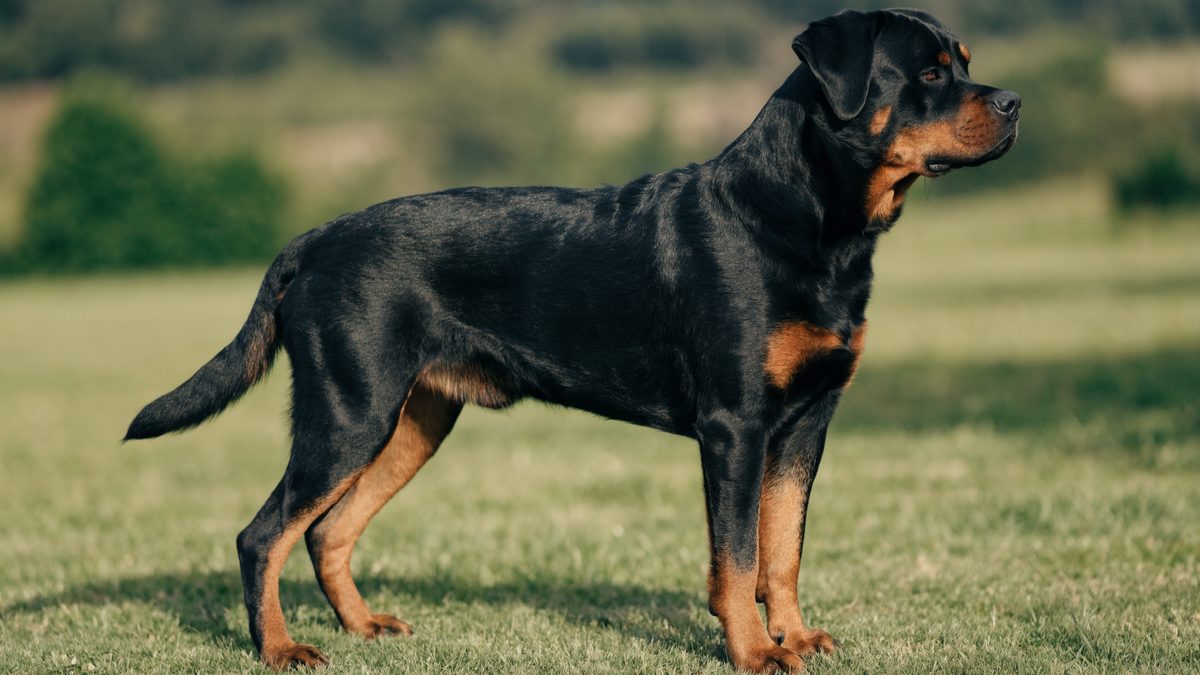
The Rottweiler is a medium large, robust and powerful German working dog, black with clearly defined rust markings, built to drive cattle and guard property. That description comes from the breed standard itself, and it already contradicts most of what the Indian market says about the breed. The standard does not describe an attack dog. It describes a calm, confident and courageous animal with a wait-and-see attitude, and it disqualifies a dog that attacks a person in the show ring.
Under the American Kennel Club standard approved on 10 May 2022 and effective from 8 August 2022, dogs stand 24 to 27 inches at the withers and bitches 22 to 25 inches, with the preferred size mid-range in each sex. Correct proportion matters more than absolute size, the height to length ratio should be 9 to 10, and depth of chest is approximately fifty percent of the height of the dog. Lack of proportion, undersize and oversize are all serious faults.
The Royal Kennel Club in Britain publishes a slightly different height range for the same breed, at 63 to 69 cm (25 to 27 in) for dogs and 58 to 64 cm (23 to 25 in) for bitches. Bonbeno prints both rather than averaging them, because an Indian buyer being shown a 23-inch male by a breeder is looking at a dog inside the RKC female range and below the AKC male minimum.
| Attribute | AKC standard, 2022 | Royal Kennel Club standard, 2025 |
|---|---|---|
| Height, dogs | 24 to 27 in | 63 to 69 cm (25 to 27 in) |
| Height, bitches | 22 to 25 in | 58 to 64 cm (23 to 25 in) |
| Weight | Not specified in the standard | Not specified in the standard |
| Height to length | 9 to 10 | 9 to 10 |
| Depth of chest | About 50 percent of height | Not more, and not much less, than 50 percent of shoulder height |
| Rust markings | Must not exceed 10 percent of body colour | Must not exceed 10 percent of body colour |
| Coat | Straight, coarse, dense, medium length, lying flat | Top coat medium length, coarse and flat, over an undercoat |
Neither standard specifies a weight. The AKC breed page separately quotes 95 to 135 pounds for males and 80 to 100 pounds for females, with a life expectancy of 9 to 10 years. Real-world data lands close to that. Across 5,321 Rottweilers under UK primary veterinary care, median adult bodyweight was 44.9 kg overall, 48.5 kg for males and 41.5 kg for females. One Indian page publishes 45 to 60 kg for adult males and 35 to 48 kg for females, which is broadly consistent at the lower end and optimistic at the top.
The coat, and why it is not a husky problem
The Rottweiler carries a short, flat, medium-length top coat over an undercoat that is present on the neck and thighs, and the undercoat should not show through the outer coat. The AKC standard adds a line that matters enormously in India and that no competing Indian page quotes: the amount of undercoat is influenced by climatic conditions. A Rottweiler raised in Chennai will not carry the same undercoat as one raised in a German winter. The Royal Kennel Club calls the undercoat essential on the neck and thighs and describes the coat length as short.
A long coat is a disqualification under the AKC standard, and a long or excessively wavy coat is highly undesirable under the Royal Kennel Club standard The Royal Kennel Club. If an Indian seller offers you a fluffy or long-haired Rottweiler at a premium, you are being sold a disqualifying fault as a feature.
Where the breed came from
The Rottweiler descends from mastiff-type herding dogs taken north by the Roman army, which travelled with cattle for meat and with the dogs that drove them. In the southwest German town of Rottweil, a livestock market town for centuries, cattle dealers and farmers crossed those dogs with sheepdog blood to make a strong drover that could also guard against robbers. Farmers returning from market tied their money bags to the dog's collar, which is where the breed's reputation as a property guardian actually begins.
The industrial revolution nearly ended the breed by removing its job, and the Rottweiler was revived in the 1900s as a police and armed forces dog, appearing at Crufts in 1936. Then it became fashionable. UK Kennel Club registrations fell from 4,257 in 2007, which was 1.6 percent of all registrations, to 1,494 in 2016, which was 0.7 percent. India publishes no comparable national registration series, so nobody can tell you how many Rottweilers are in the country. Any Indian page quoting a national Rottweiler population figure is guessing.
Read the temperament clause as written. The Rottweiler is basically a calm, confident and courageous dog with a self-assured aloofness that does not lend itself to immediate and indiscriminate friendships, responding quietly and with a wait-and-see attitude to influences in his environment. The Royal Kennel Club version is shorter and blunter: good natured, not nervous, aggressive or vicious, courageous, biddable, with natural guarding instincts. An aloof or reserved dog is not to be penalised. A dog that in the judge's opinion attacks any person in the ring is disqualified. The breed standard is on the side of the calm dog, and against the marketing.
The Royal Kennel Club states the problem in its own breed history. The breed has often suffered from bad press, it became very popular often with those seeking a macho image, and it needs responsible and intelligent owners who can harness the Rottweiler's intelligence and activity. That sentence describes the Indian market for this breed better than anything written in India.
You can watch the distortion happen in the words Indian sellers choose. Indian listings and breed pages open on powerful, loyal, muscular, protective and fearless, and one Indian pet platform lists Aggressive among the breed's top five traits. A B2B marketplace selling Rottweiler puppies describes the breed as loyal, protective and intelligent, and markets it for companionship and security purposes in the same sentence. Now read the registry language again. The AKC standard says calm, confident and courageous, with a wait-and-see attitude, and the Royal Kennel Club adds a calm gaze that should indicate good humour The Royal Kennel Club. Loyal, muscular and protective are all accurate. Aggressive is not in either standard, and a dog that attacks a person is disqualified from the ring. The gap between those two vocabularies is what an Indian buyer is actually navigating.
Tail docking and ear cropping, in Indian law
Docking is where the standard and Indian law part company. The AKC standard permits a docked tail left with one or two vertebrae, and the Royal Kennel Club records the breed as previously customarily docked and now describes an undocked tail as standard The Royal Kennel Club. In India, the Animal Welfare Board of India's dog breeding and marketing rules state that no animal will undergo tail docking, ear cropping or any other form of mutilation carried out for cosmetic reasons, and that any person carrying out cosmetic mutilation will be prosecuted and any veterinary doctor involved reported to the Veterinary Council of India and the State Veterinary Council.
Docked Rottweiler puppies are still routinely advertised in India. If you are shown one, you are being shown the result of a procedure that those rules prohibit for cosmetic reasons. Bonbeno reports that as fact, not as advice on what to do about a dog already docked.
Rottweiler price in India
A Rottweiler puppy costs Rs 15,000 to Rs 3,00,000 in India in 2026, and the most useful thing about that spread is that five Indian pages publishing detailed tiers disagree with each other by up to Rs 40,000 on the same tier. The floor is set by a marketplace and by a pet-products retailer. The ceiling is set by a page that also runs a vet-consult funnel. Nobody is auditing any of it.
Bonbeno compared the published price bands from the Indian pages currently ranking for this query. Set them side by side and the disagreement is impossible to miss.
| Source | Pet quality | KCI registered | Show quality | Champion or import |
|---|---|---|---|---|
| Supertails | Rs 20,000 to Rs 55,000 | Rs 55,000 to Rs 1,00,000 | Rs 1,00,000 to Rs 2,00,000+ | German import Rs 1,50,000 to Rs 3,00,000+ |
| DS Pet Store | Rs 25,000 to Rs 45,000 | Rs 40,000 to Rs 70,000 | Rs 70,000 to Rs 1,00,000 | Rs 1,00,000 to Rs 1,20,000+ |
| Wrap In Fur | Rs 15,000 to Rs 30,000 | Rs 30,000 to Rs 70,000 | Rs 70,000 to Rs 1,50,000+ | Not stated |
| PawSpace | Rs 20,000 to Rs 40,000 | Rs 35,000 to Rs 70,000 | Rs 75,000 to Rs 1,50,000+ | Not stated |
| Happy Pet | Rs 15,000 to Rs 80,000, single band | Not separated | Not separated | Not stated |
| Mr n Mrs Pet | Rs 45,000 to Rs 70,000 | Rs 70,000 to Rs 1,00,000 | Not separated | Champion Rs 1,00,000 to Rs 1,20,000 |
The gaps are specific. On pet quality, the top of the band ranges from Rs 30,000 to Rs 70,000, and the floor from Rs 15,000 to Rs 45,000 Mr n Mrs Pet, Rottweiler Puppies For Sale…. On KCI registered, the floor ranges from Rs 30,000 to Rs 70,000 and the ceiling from Rs 70,000 to Rs 1,00,000 Supertails, Rottweiler Dog Price In India… Mr n Mrs Pet, Rottweiler Puppies For Sale…. Only one source separates a German import tier at all, and it puts it at Rs 1,50,000 to Rs 3,00,000 or more.
Read the table across rather than down and the labels fall apart. A basic quality Rottweiler at one Indian seller starts at Rs 45,000, which is more than the starting price of a KCI registered puppy at two other sellers, quoted at Rs 30,000 and Rs 40,000 DS Pet Store, Rottweiler Price in India. Meanwhile a B2B marketplace carries live Rottweiler listings from around Rs 15,000 to Rs 25,000, including a 21-day-old male puppy at Rs 15,000, which is below every editorial floor on this page and below the minimum lawful sale age of 8 weeks Animal Welfare Board of India. The tier names are marketing labels, not a market standard. Buy on documented health screening, not on the word printed above the price.
City-wise price, and what it is worth
Two sources publish a city-wise price breakdown, and they do not agree either.
| City | Supertails, pet quality | Supertails, KCI registered | Wrap In Fur, single band |
|---|---|---|---|
| Delhi NCR | Rs 30,000 to Rs 60,000 | Rs 60,000 to Rs 1,20,000 | Rs 30,000 to Rs 80,000 |
| Mumbai | Rs 35,000 to Rs 65,000 | Rs 65,000 to Rs 1,25,000 | Rs 40,000 to Rs 90,000 |
| Bengaluru | Rs 30,000 to Rs 55,000 | Rs 55,000 to Rs 1,10,000 | Rs 35,000 to Rs 80,000 |
| Hyderabad | Rs 25,000 to Rs 50,000 | Rs 50,000 to Rs 95,000 | Rs 30,000 to Rs 70,000 |
| Chennai | Rs 25,000 to Rs 50,000 | Rs 50,000 to Rs 90,000 | Rs 35,000 to Rs 75,000 |
| Kolkata | Rs 20,000 to Rs 45,000 | Rs 45,000 to Rs 85,000 | Rs 25,000 to Rs 65,000 |
| Pune | Rs 25,000 to Rs 50,000 | Rs 50,000 to Rs 95,000 | Rs 35,000 to Rs 75,000 |
| Ahmedabad | Rs 25,000 to Rs 48,000 | Rs 48,000 to Rs 90,000 | Rs 25,000 to Rs 60,000 |
A third source publishes a Bengaluru figure of Rs 25,000 to Rs 80,000 or more, which straddles both of the columns above. Neither publisher states a sample size or a collection method, and one of them describes its figures as compiled from breeder networks without naming any of them. Treat the city-wise price table as a comparison of estimates, not a market survey.
What the price is actually tracking
- KCI registration. A Kennel Club of India certificate documents pedigree and lineage. One source states plainly that KCI registration does not guarantee health or temperament. It is not a health certificate, it does not mean the parents were screened for hips or elbows, and it does not mean anyone tested them for JLPP.
- Bloodline and pedigree. Puppies from champion bloodline parents cost more because the breeder invested in titles. A title is a conformation or working result. Verify health screening separately.
- Health screening. Ethical breeders who pay for OFA hip and elbow scores and cardiac clearance charge for that work. This is the single line item on the price sheet that reliably buys you something, and it is the one Indian buyers most often skip.
- Age of the puppy. Most puppies are sold between eight and twelve weeks. No puppy may lawfully be sold before it has reached 8 weeks of age and is fully weaned.
- City and transport. Metro cities are quoted 15 to 25 percent higher than tier 2 cities on demand, breeder density and transport cost.
- Who is publishing. Four of the five detailed price sources also sell pet products, run vet-consult funnels or offer training services. That is a commercial interest in the number, disclosed here because none of those pages discloses it itself.
German Rottweiler, Roman Rottweiler and the oversize premium
Indian classified listings routinely split the breed into German, Roman and American types, and one Indian page prices them at Rs 80,000 to Rs 3,00,000 or more, Rs 35,000 to Rs 1,20,000, and Rs 90,000 to Rs 2,50,000 respectively. The same page then says the important part out loud: the Roman Rottweiler is not a separate breed, it is a breeder marketing term for oversized dogs, and it is recognised by neither KCI nor FCI.
The breed standard treats oversize as a serious fault and says any structural fault that detracts from the working dog must be penalised to the extent of the deviation. The published Indian veterinary caution is that extremely large Rottweilers carry a higher risk of hip and elbow dysplasia. The primary data supports the concern: in a study of 905,552 UK dogs, increasing adult bodyweight was associated with increasing odds of osteosarcoma, and dogs at or above the mean for their breed had 1.65 times the odds of dogs below it. An oversize premium is a premium on measurable disease risk.
Indian marketplace listings advertise Rottweiler puppies from around Rs 15,000, and one specialist page describes suspiciously cheap pricing with no justification as a breeder red flag. Breeding dogs without registration with the Animal Welfare Board of India is an offence that can result in confiscation of breeding stock and puppies plus a fine of up to Rs 5,000 per unsterilised bitch. A price far below market usually means no registration, no screening and no records.
Bonbeno does not broker puppy sales and does not publish breeder listings. Every figure above is reported from a third party so you can see the disagreement yourself and price the uncertainty into your own decision.
Monthly cost of owning a Rottweiler in India
Published Indian monthly cost estimates for a Rottweiler sit between Rs 4,900 and Rs 25,000, and the four-fold gap between the lowest and highest total is not a rounding error. It is the difference between a page that counts food, vet and grooming only, and a page that counts training, insurance and enrichment as well. Neither is a survey.
Four Indian sources publish a monthly cost structure for this breed. Read them together and you can see exactly which lines each publisher chose to include.
| Line item | Supertails | DS Pet Store | PawSpace | Happy Pet |
|---|---|---|---|---|
| Food | Rs 4,000 to Rs 8,000 | Rs 4,000 to Rs 8,000 | Rs 4,000 to Rs 10,000 | Rs 3,000 to Rs 4,500 |
| Veterinary care, averaged | Rs 800 to Rs 1,500 | Rs 500 to Rs 2,000 | Rs 1,000 to Rs 5,000 | Rs 1,200 to Rs 1,950 |
| Vaccination, year 1 amortised | Rs 400 to Rs 700 | Not separated | Not separated | Not separated |
| Grooming | Rs 500 to Rs 1,500 | Rs 300 to Rs 1,000 | Rs 1,000 to Rs 3,000 | Rs 700 to Rs 1,200 |
| Training, first year | Rs 2,000 to Rs 5,000 | Rs 2,000 to Rs 8,000 | Not costed | Not costed |
| Accessories and enrichment | Rs 500 to Rs 1,500 | Rs 500 to Rs 2,000 | Rs 1,000+ | Not separated |
| Pet insurance, optional | Rs 500 to Rs 1,500 | Rs 500 to Rs 2,000 | Not costed | Not costed |
| Stated monthly total | Rs 8,700 to Rs 19,700 | Rs 8,000 to Rs 25,000+ | Not totalled | Rs 4,900 to Rs 7,650 |
A fifth source puts the monthly cost at Rs 5,000 to Rs 12,000, which overlaps the bottom of two of the tables above and the top of none of them. Not one of these publishers states a sample size, a city, or a collection date. Bonbeno's honest position is that no reliable India-wide monthly cost figure exists for this breed, and that the table above compares estimates rather than answering the question.
The first-year cost lines most guides leave out
- Core vaccination course, Rs 4,000 to Rs 8,000 in year one. This is a published Indian figure and it covers the standard puppy series, not titre testing.
- Group obedience classes, Rs 3,000 to Rs 8,000 for eight sessions. For a 45 kg dog this is not a luxury line.
- Annual insurance for a large breed, Rs 6,000 to Rs 18,000 depending on coverage. Read the exclusions for hip and elbow dysplasia before you buy, because those are the two conditions this breed is most likely to need.
- Hip and elbow radiographs under sedation. Neither the price of the images nor the price of the sedation appears on any Indian Rottweiler page Bonbeno reviewed. Ask your veterinarian for a written quote before the dog is 12 months old.
- A cardiac evaluation. The American Rottweiler Club requires a cardiac evaluation from a minimum age of 24 months for breeding stock. If you are buying, this is a cost the breeder should already have paid, not one you inherit.
- Orthopaedic surgery contingency. Cruciate ligament rupture was reported in 6.5 percent of dogs in the Finnish breed association's 2019 health survey, and degenerative joint disease was recorded in 4.69 percent of UK Rottweilers under primary veterinary care. Budget as if one orthopaedic event is likely across a 9 to 10 year life.
When we publish cost figures we state the sample size, the cities covered and the collection date. Where published sources disagree, as they do here by more than four times on the monthly total, we print all of them rather than averaging them into a number that no source supports. Bonbeno is running a verified owner cost survey across eight Indian metros and will publish the method alongside the result.
The shape of the budget is not in dispute even where the totals are. Food is the largest recurring line for a 40 to 50 kg dog and rises as the puppy grows O'Neill DG, Seah WY, Church DB. Grooming is genuinely cheap because the coat is short. Veterinary spending is back-loaded, because the conditions that define this breed, which are elbow dysplasia, hip dysplasia and osteosarcoma, present in middle age rather than in puppyhood. A monthly average flatters the early years and understates the last three.
Indian climate suitability: why heat tolerance is rated 3 of 5
Bonbeno rates the Rottweiler 3 of 5 for heat tolerance, and that is a deliberately higher score than the Indian consensus. The largest primary-care study of heat-related illness in dogs measured the Rottweiler directly and found it at 0.86 times the odds of a Labrador Retriever, a difference that was not statistically significant. What raises the risk in India is not the breed label. It is the black coat, the 50 kg bodyweight band, and a genetic airway disease this breed carries at the highest rate of any breed tested.
Start with the actual evidence, because no Indian page cites it. Hall and colleagues examined the clinical records of 905,543 UK dogs under veterinary care in 2016 and identified 395 confirmed heat-related illness events, with an event fatality rate of 14.18 percent (95 percent CI 11.08 to 17.96). Nine breeds showed significantly higher odds of heat-related illness than the Labrador Retriever, and the list is Chow Chow, Bulldog, French Bulldog, Dogue de Bordeaux, Greyhound, Cavalier King Charles Spaniel, Pug, English Springer Spaniel and Golden Retriever. The Rottweiler was in the model and returned an odds ratio of 0.86 (95 percent CI 0.20 to 3.69, p = 0.841).
The confidence interval runs from 0.20 to 3.69, which is wide. That means the study could not rule out a fourfold increase in risk any more than it could rule out a large protective effect. The honest reading is that the Rottweiler is not one of the breeds the evidence flags, and that the evidence is not strong enough to call it safe either. What the same study does establish is that dogs weighing over 50 kg were at greater risk, and that dogs at or above their breed and sex mean bodyweight had 1.42 times the odds of dogs below it. Median male Rottweiler bodyweight in UK primary care is 48.5 kg. This breed sits on the edge of the size band the data flags.
The three things that actually raise heat risk in an Indian Rottweiler
- A black coat absorbs more solar radiation. Indian veterinary guidance lists dark or thick coats among the elevated-risk factors for heat stroke, alongside obesity and age extremes. The Rottweiler is always black by standard, with rust markings capped at ten percent of body colour. There is no light-coated version of this breed to buy instead.
- Excess bodyweight compounds it. Adipose tissue insulates and reduces heat dissipation, and obese pets overheat two to three times faster than lean pets. Overweight or obesity was the second most commonly recorded disorder in UK Rottweilers, at 7.06 percent of dogs. Weight control is the single most effective heat intervention available to an Indian owner.
- Laryngeal paralysis destroys panting, and this breed carries the gene. Indian heat guidance names laryngeal paralysis explicitly as a pre-existing disease that impairs panting and raises heat stroke risk. The Rottweiler ranks first among all breeds tested by OFA for juvenile laryngeal paralysis and polyneuropathy, with 13.5 percent carriers and 0.3 percent affected across 8,888 dogs tested. Panting is the dog's primary cooling mechanism, and India routinely exceeds 45 C in the north. No competing Indian page connects those two facts.
The temperature thresholds that matter in India
| Ambient temperature | Risk level | What it means in practice |
|---|---|---|
| Below 28 C | Low | Normal activity with shade and water |
| 28 to 35 C | Moderate | Shorten walks to 15 to 20 minutes, early morning and late evening only |
| 35 to 42 C | High | Outdoor activity contraindicated. Asphalt reaches 60 C and above |
| Above 42 C | Extreme | Heat stroke possible within 10 to 15 minutes outdoors. Indoor temperatures without cooling can be fatal |
One Indian pet platform publishes the Rottweiler's ideal weather as 15 to 25 C. That range is below the daytime average of almost every Indian city for most of the year, which is a useful way of understanding what you are managing rather than a reason to avoid the breed. Humidity changes the arithmetic further, because panting works by evaporation and humid air blocks it, so a 35 C day at 90 percent humidity is more dangerous than a 42 C day at 20 percent humidity.
Summer heat management
- Walk only before 7 am or after 8 pm from April to September, and keep each walk to 15 to 20 minutes even in those windows. One Indian source puts the same rule at before 8 am and after 7 pm for April to June.
- Run fans or air conditioning continuously above 32 C indoors, because indoor temperature above 32 C is dangerous for a dog at rest.
- Do the 7-second pavement test. Place the back of your hand on the pavement for seven seconds. If you cannot hold it, asphalt at 60 C will burn paw pads within about 30 seconds, and grass runs 10 to 15 C cooler.
- Keep the dog lean. Overweight dogs overheat two to three times faster, and this breed already carries a 7.06 percent recorded prevalence of overweight or obesity.
- Never confine the dog to a balcony above 30 C. Concrete balconies are heat traps with no shade and no airflow.
- Plan for power cuts. Load shedding peaks exactly when cooling demand peaks, so keep a battery fan, frozen packs and a fallback location ready.
- Refuse summer transport. Under the Indian dog breeding rules, no animal may be transported in a vehicle where the temperature rises above 35 centigrade. If a breeder proposes shipping a puppy to you across the country in May, that rule is the reason to say no.
Heat stroke is a life-threatening condition that occurs when the body's temperature rises too high and cannot be cooled effectively, causing severe organ damage and death, and Cornell's Riney Canine Health Center names older and overweight dogs among those at risk alongside short-faced breeds. Indian guidance puts the threshold at a core temperature above 40 C from environmental exposure, with direct thermal injury, disseminated intravascular coagulation and acute kidney injury beginning above 41 to 42 C. Cool the dog with room-temperature water, not ice water or ice packs, because ice causes cutaneous vasoconstriction that traps core heat. Get air moving across the wet coat, target 39.5 C, and drive to a clinic while cooling continues. Prognosis depends on how high the temperature went and how long it stayed there, so early recognition is what changes the outcome. Heat-related illness carried an event fatality rate of 14.18 percent even in the temperate UK.
Monsoon care
The monsoon is the season this breed's own disorder data tells you to worry about. Dermatological problems were the second most common disorder group in UK Rottweilers at 10.96 percent of dogs, otitis externa was the third most common single disorder at 6.14 percent, and pyotraumatic dermatitis, which is the hot spot, affected 4.05 percent of males against 1.76 percent of females. Humid Indian conditions in Mumbai and Kolkata create exactly the environment for skin infections and paw problems, so dry the dog thoroughly after every wet walk, check between the paw pads, and treat persistent scratching as a veterinary matter rather than a grooming one.
Bengaluru and the hill stations are the easiest Indian postings for this breed on climate grounds, because peak summer stays closer to the 35 C band than to the 42 C band AlcoVet Healthcare. Delhi gives a genuinely comfortable winter and a punishing April to June. Chennai, Kolkata and coastal Kerala offer high humidity for most of the year, and there the cooling and the drying routine both have to be in place before the dog arrives.
Temperament, household fit and the honest bite conversation
The Rottweiler suits an experienced, physically capable owner who trains consistently and is present daily, and it suits almost nobody who wants a low-effort family dog. The breed standard describes a calm, confident and courageous dog with a self-assured aloofness. The largest population study of the breed records aggression as its single most commonly diagnosed disorder. Both statements are true, and the gap between them is where Indian ownership succeeds or fails.
Take the standard first. The Rottweiler is described as self-confident, responding quietly and with a wait-and-see attitude to influences in his environment, with an inherent desire to protect home and family, intelligent, of extreme hardness and adaptability, and with a strong willingness to work. An aloof or reserved dog is not to be penalised because that reflects accepted breed character, and an aggressive or belligerent attitude towards other dogs is not to be faulted. The Royal Kennel Club describes the temperament as good natured, not nervous, aggressive or vicious, courageous, biddable, with natural guarding instincts.
What the population data actually records
Now the data. Across 5,321 Rottweilers under UK primary veterinary care, at least one disorder was recorded in 60.31 percent of dogs, and aggression was the most prevalent single disorder at 7.46 percent (95 percent CI 6.40 to 8.64). Undesirable behaviour as a disorder group affected 7.96 percent of dogs. For comparison from the same research programme using the same method, aggression did not appear among the 25 most common disorders in Pugs, where undesirable behaviour reached 1.29 percent.
| Measure | Males | Females | Significance |
|---|---|---|---|
| Median adult bodyweight | 48.5 kg | 41.5 kg | p < 0.001 |
| Median longevity | 8.7 years | 9.5 years | p = 0.002 |
| Aggression recorded | 9.36 percent | 5.47 percent | p = 0.001 |
| Pyotraumatic dermatitis | 4.05 percent | 1.76 percent | p = 0.001 |
| Aggression, neutered vs entire females | No difference in males, 9.6 vs 9.0 percent, p = 0.773 | 7.5 percent neutered vs 3.1 percent entire | p = 0.003 in females |
That male vs female table is the most practically useful thing on this page for a first-time buyer, and no Indian Rottweiler page publishes it. A female Rottweiler is on average 7 kg lighter, lives about 9 months longer, and has roughly 40 percent lower recorded prevalence of aggression than a male. If you are choosing between littermates for an Indian apartment, that is a data-backed reason to consider the bitch.
The bite conversation, without the panic
The authors of that study are careful, and Bonbeno will be too. They record that US studies reported 16.3 percent of dog attacks on children and 16.4 percent of human dog bite-related fatalities involving Rottweilers, and that the breed has scored high for aggression on behaviour questionnaires. They then list the reasons those numbers must be read with care. Aggression covers a suite of behaviours that are difficult to characterise reliably. Other studies have not found the predisposition. Owners of larger, more powerful dogs are more likely to report problems and seek professional help because the risk of injury is greater, which inflates recorded prevalence. Behaviour professionals hold ingrained beliefs about breed aggression that colour their interpretation, and one study observed that many dog professionals around the world consider the Rottweiler a very aggressive breed.
Their own plain English summary says it directly: negative media stories may unfairly prime the public to perceive the breed as excessively aggressive. The same paper reports that selective breeding programmes in the Netherlands against unwanted fear and aggression offer a real route to reducing these tendencies by excluding affected dogs from the Rottweiler breeding population. Selection works. Bans have not been shown to.
India recorded 37,17,336 dog bite cases and 54 suspected human rabies deaths in 2024, compiled by the National Centre for Disease Control under the National Rabies Control Programme. The government's own annexures tabled in the Lok Sabha give a slightly different total of 37,15,713 for 2024, against 30,52,521 in 2023 and 21,89,909 in 2022, with 54, 50 and 21 human rabies deaths respectively. Bonbeno prints both government figures rather than picking one. What neither contains is a breed breakdown. Until March 2024 the surveillance system did not even separate bites by pet dogs from bites by street dogs, and the Director General of Health Services had to issue an order directing states to record them separately. The Animal Welfare Board of India had argued for exactly that, pointing out that in the absence of segregated data there was an assumption that most bites are predominantly caused by street dogs. Anyone who tells you what share of Indian dog bites involve Rottweilers is making it up.
Household fit, stated plainly
- Good fit. An experienced owner in a house with a secure fenced boundary and a large garden, which is the ideal home the Royal Kennel Club specifies, with someone home much of the day and a household that agrees on the rules.
- Poor fit. A first-time owner buying for protection, a household where one adult can physically manage the dog and the others cannot, and any home where the dog will be left alone ten hours a day.
- Watch item. A 45 kg dog can knock a small child over without any aggressive intent at all. Supervision around young children is a physics rule before it is a temperament rule.
- Apartment living. Possible but hard. The Royal Kennel Club lists the ideal home as a large house with a large garden and exercise at more than two hours per day. Bonbeno rates apartment suitability 2 of 5 for this breed on that basis.
Under section 11 of the Prevention of Cruelty to Animals Act, 1960, it is an offence to incite any animal to fight or bait any other animal, and to organise, keep, use or act in the management of any place for animal fighting, or to receive money for admission to such a place. Bonbeno publishes nothing that supports fighting, baiting, or training a dog to produce aggression, and nothing on this page should be read that way. The penalties in the section itself are a fine from ten to fifty rupees for a first offence and up to one hundred rupees or three months' imprisonment for a repeat offence within three years, which is a widely criticised level of deterrence and a fact worth knowing when you assess how well India polices this.
Training a Rottweiler
Train a Rottweiler with reward-based methods, start on the day the puppy arrives, and expect the breed to learn quickly, because trainability is not this breed's weakness. The standard credits it with intelligence, extreme hardness and adaptability and a strong willingness to work, and the Royal Kennel Club calls it biddable. What fails in Indian homes is not the dog's capacity. It is owner consistency across a household, and it is the gap between a puppy you can lift and an adult you cannot.
The AKC standard describes an intelligent dog of extreme hardness and adaptability with a strong willingness to work, especially suited as a companion, guardian and general all-purpose dog. The Royal Kennel Club says the breed needs responsible and intelligent owners who can harness the Rottweiler's intelligence and activity, and that a well-trained Rottweiler makes a wonderful family companion. Indian sources agree that professional training is strongly recommended and that without proper training the breed becomes difficult to manage Wrap In Fur, Rottweiler Dog Price in India… PawSpace, Rottweiler Dog Price in India.
The socialisation window is the whole game
Socialise the puppy early, widely and deliberately. Under the Indian breeding rules a puppy may not lawfully be sold before 8 weeks of age, and the weeks immediately after that are the ones that set adult responses to strangers, other dogs, lifts, traffic and handling. The breed standard expects a dog that can be examined by a stranger, handled around the mouth and testicles, and remain controlled, willing and adaptable. That is a trained outcome, not a spontaneous one.
There is a specific Indian complication worth naming. The recorded prevalence of aggression in this breed is real at 7.46 percent, and Indian urban walking routes commonly bring a leashed dog into contact with free-ranging street dogs. Plan routes, use a strong flat collar or well-fitted harness with a short lead, and do not let a large guarding breed learn that lunging works.
Realistic timelines
| Skill | Start | Realistic outcome |
|---|---|---|
| Name response | Week 1 home | Reliable indoors in 2 to 3 weeks |
| Sit, down, settle | Week 1 home | 3 to 6 weeks. This breed learns fast |
| Toilet training | Week 1 home | 3 to 5 months |
| Handling and mouth examination | Week 1 home | Daily practice, never stop |
| Loose-lead walking | Month 2 | 4 to 9 months, then maintain against 45 kg of pulling power |
| Reliable recall in a fenced space | Month 2 | 6 to 12 months with consistent reinforcement |
| Calm greeting of strangers at the gate | Month 2 | 9 to 18 months, and it needs staged practice |
| Muzzle conditioning | Month 3 | 4 to 8 weeks of short sessions. Do it before you need it |
| Settled behaviour in a lift | Month 3 | 3 to 6 months in an apartment building |
Indian municipal and housing-society rules vary widely, and published Indian guidance for Rottweiler owners recommends using a leash and muzzle in public spaces as both legally prudent and considerate of other residents. A muzzle a dog has been positively conditioned to wear is a neutral piece of equipment. A muzzle strapped onto an adult Rottweiler for the first time during a confrontation is a welfare failure and it will not help you. Train it at four months, in ninety-second sessions, with food.
What this breed resists
- Inconsistency across the household. A self-assured dog that gets three different answers to the same question will pick the one it prefers. Agree the rules in writing before the puppy arrives.
- Harsh handling. The standard calls for a controlled, willing and adaptable dog and disqualifies one that attacks a person. Confrontational methods on a physically powerful guarding breed produce exactly the outcome you were trying to avoid.
- Boredom. This is a working breed with a documented mental stimulation requirement. Indian sources list interactive toys and enrichment as essential on days when heat limits outdoor exercise.
- Being taught to guard. Nothing on this page recommends protection or bite work. The Rottweiler has natural guarding instincts by standard; adding trained aggression to a 45 kg dog in a dense Indian city is how a manageable dog becomes an unmanageable one.
- Late starts. Group obedience classes cost Rs 3,000 to Rs 8,000 for eight sessions in India. Book them at four months, not at fourteen months when the dog outweighs your ability to correct it.
How much exercise a Rottweiler actually needs
The Royal Kennel Club puts the Rottweiler's requirement at more than 2 hours of exercise per day, in a large house with a large garden. Indian pages publish 60 to 90 minutes. That is not a small difference, it is a doubling, and it is the single most consequential number an Indian buyer will get wrong.
Bonbeno prints the disagreement rather than picking the convenient figure.
| Source | Stated daily requirement |
|---|---|
| Royal Kennel Club, UK | More than 2 hours per day |
| Supertails, India | At least 60 to 90 minutes |
| Happy Pet, India | 60 to 90 minutes |
| PawSpace, India | Regular exercise, no figure given |
| Wrap In Fur, India | Daily exercise, no figure given |
Treat the Royal Kennel Club figure as the standard and the Indian figure as the floor. The Indian scheduling problem is that in most of the country, from April to September, the whole requirement has to fit before 7 am and after 8 pm. Two hours split across two cool windows is achievable. Two hours attempted in one block at 6 pm in May is a heat emergency waiting to happen.
Growing joints change the rules for the first eighteen months
This is where the exercise question stops being about energy and starts being about orthopaedics. Elbow dysplasia affects 38.8 percent of OFA-evaluated Rottweilers, the third worst rate of any breed in the registry. Hip dysplasia affects 21.1 percent of 108,918 OFA-evaluated Rottweilers. Predisposition to cruciate ligament disease, hip and elbow dysplasia and osteochondritis dissecans in this breed has been linked to the rapid growth and large body size typical of it.
- Do not force-exercise a Rottweiler puppy. Repetitive high-impact work on a growing large-breed skeleton is the intervention you can control, and the joint data is the reason to control it.
- Avoid stairs, jumping from height and long runs on hard surfaces before the growth plates close. Indian sources recommend joint supplementation from around 12 months for large breeds, but supplements do not substitute for load management.
- Swimming is genuinely ideal. It is low impact and gentle on the joints, and it delivers load without heat. In an Indian summer it is also the only outdoor option that reliably cools rather than heats.
- Two structured leash walks plus playtime in a secured space is the published Indian delivery model, and it is the right shape. Add a third short session rather than lengthening one.
- Use enrichment on days the outdoors is closed. Interactive toys and scent work are recommended precisely for days when extreme heat or heavy rain limits outdoor exercise.
An under-exercised Rottweiler in an Indian flat gets heavier, and weight is the multiplier on every other risk this breed carries. Overweight or obesity was recorded in 7.06 percent of UK Rottweilers. Dogs at or above their breed mean bodyweight had 1.65 times the odds of osteosarcoma and 1.42 times the odds of heat-related illness. Musculoskeletal disorders were already the most common disorder group in the breed at 12.01 percent. Exercise in this breed is not about behaviour management. It is disease prevention with a measurable effect size.
The behavioural cost is real too. This is a working breed with high mental stimulation needs, and Indian sources describe the predictable failure pattern of an unexercised Rottweiler as leash pulling, dominance behaviour, over-protectiveness and poor social behaviour. None of that is a breed defect. It is a working dog with no work.
Grooming a short coat in Indian humidity
Groom a Rottweiler weekly with a rubber curry or bristle brush, dry the coat completely after every wet walk, and clean the pendant ears on a schedule. The Royal Kennel Club sets grooming at once a week and describes the coat as short. That makes this one of the cheapest large breeds to maintain in India, at a published Rs 300 to Rs 3,000 a month, and it is also the reason owners neglect the two things that actually go wrong.
The coat is a straight, coarse, dense top coat of medium length lying flat, with an undercoat on neck and thighs whose quantity is influenced by climatic conditions. The Rottweiler is to be exhibited in its natural condition with no trimming, and any trimming that alters the length of the natural coat is a serious fault. Shedding is moderate year round with seasonal increases, and weekly brushing controls it Supertails, Rottweiler Dog Price In India….
The standard prohibits trimming that alters the coat, and Indian veterinary guidance is explicit that the undercoat provides insulation protecting from both cold and heat, that shaving exposes skin to sunburn, and that the coat may grow back patchy or incorrectly. Regular brushing to remove dead undercoat and improve air circulation to the skin is the correct summer intervention, not clipping. On a black-coated dog, removing the coat also removes the only barrier between Indian sun and unpigmented skin.
The two things that actually go wrong in India
Both of them are in the breed's own disorder data, and neither is about coat length.
- Ears. The Rottweiler's ears are medium, pendant and triangular, hanging forward with the inner edge lying tightly against the head. That is a sealed, warm, humid ear canal by design. Otitis externa was the third most common disorder in UK Rottweilers at 6.14 percent (95 percent CI 5.18 to 7.23), and floppy ears accumulate debris so regular ear cleaning is required. In an Indian monsoon this moves from a chore to the main grooming task.
- Skin. Dermatological disorders were the second most common disorder group at 10.96 percent, and pyotraumatic dermatitis, the acute hot spot, affected 4.05 percent of males against 1.76 percent of females. Monsoon humidity in Mumbai and Kolkata creates the conditions for skin infections and paw problems, so dry thoroughly after every wet walk and check between the paw pads for mud.
The Indian grooming schedule
- Brush weekly, more during seasonal shedding. Once a week is the Royal Kennel Club baseline, and Indian guidance adds a professional bath every six to eight weeks.
- Dry to the skin after monsoon walks. A damp coat over a dense undercoat on the neck is where hot spots start.
- Clean and dry the ears on a fixed schedule, and treat head-shaking or odour as a veterinary visit rather than a cleaning problem.
- Brush the teeth at least three times a week with dog-specific toothpaste, starting in puppyhood. Dental problems were the single most reported issue in the Finnish breed association's 2019 health survey at 8.8 percent of dogs.
- Trim nails short. The standard calls for nails short, strong and black, and on a 45 kg dog long nails change the way the foot loads the joints you are already trying to protect.
- Check the eyes at every groom. OFA eye examinations recorded 9.7 percent abnormal across 7,886 Rottweilers, with entropion in 0.7 percent and distichiasis in 0.6 percent. Entropion and ectropion are both disqualifications under the breed standard.
The genuine upside is cost. Published Indian grooming spend for this breed runs Rs 300 to Rs 3,000 a month depending on whether you do it yourself, which is a fraction of what a double-coated import costs to maintain in the same climate. A short-coated black dog is cheap to groom and expensive to cool. Budget accordingly.
Health risks, health screening and lifespan
The Rottweiler is a short-lived breed with a heavy orthopaedic and oncological burden, and that is the most important finding on this page. Median lifespan under UK primary veterinary care is 9.0 years. Elbow dysplasia affects 38.8 percent of OFA-evaluated dogs, the third worst rate of any breed. The breed carries 26.67 times a crossbred's odds of osteosarcoma and makes up 18.43 percent of all osteosarcoma cases in a study of 905,552 dogs. None of that is on any Indian page ranking for this query.
Lifespan, where the sources broadly agree
| Source | Figure | What it is measuring |
|---|---|---|
| VetCompass UK, 5,321 dogs | 9.0 years median (IQR 7.2 to 10.5) | Recorded deaths in primary veterinary care |
| VetCompass UK, by sex | Males 8.7 years, females 9.5 years | Recorded deaths, p = 0.002 |
| Royal Kennel Club | Under 10 years | Breed-club expectation |
| American Kennel Club | 9 to 10 years | Breed-club expectation |
| Earlier UK studies, via McMillan et al. | 8.0 and 8.4 years median | Two prior published median estimates |
| Wrap In Fur, India | 8 to 10 years | Unsourced editorial estimate |
| Happy Pet, India | 8 to 10 years | Unsourced editorial estimate |
| Mr n Mrs Pet, India | 8 to 11 years | Unsourced editorial estimate |
This is unusual. On most breeds the registry expectation and the recorded mortality data diverge by years. Here they agree, and every source lands between 8 and 11 years. A 2024 analysis of 584,734 UK dogs including 284,734 deceased animals across 155 breeds singled the breed out for exactly this reason, contrasting median estimates of 12.7 and 13.5 years for West Highland White Terriers against Rottweiler estimates that were substantially lower at 8.0 and 8.4 years. Those two Rottweiler figures are earlier studies that the 2024 paper quotes, not its own result. Its own Rottweiler row is higher: median survival 10.6 years, with a 95 percent confidence interval of 10.4 to 10.7 years, from 3,442 recorded deaths, and a hazard ratio of 1.27 (1.23 to 1.32) against the crossbred group at p<0.001. Whichever figure you take, this is a short-lived large breed. The VetCompass authors state the conclusion in one line: Rottweilers are relatively short-lived and neoplasia is a common cause of death. The recorded causes of death were neoplasia at 33.0 percent, inability to stand at 16.0 percent and mass-associated disorder at 7.1 percent. Cancer and collapse account for half of all deaths in the breed.
Elbow dysplasia is the headline orthopaedic risk, not hips
Every Indian page lists hip dysplasia. The registry data says elbows are worse, and it is not close.
| Screening | Evaluations | Result | Breed rank |
|---|---|---|---|
| Elbow | 27,327 | 60.8 percent normal, 38.8 percent abnormal (grade 1 29.8, grade 2 7.8, grade 3 1.2) | 3rd worst of all breeds |
| Hips | 108,918 | 76.9 percent normal, 21.1 percent dysplastic (mild 10.7, moderate 8.9, severe 1.5), 9.0 percent excellent | 49th |
| JLPP DNA test | 8,888 | 86.2 percent normal, 13.5 percent carrier, 0.3 percent affected | 1st, highest of any breed tested |
| Advanced cardiac | 2,725 | 93.4 percent normal, 3.5 percent equivocal, 3.2 percent abnormal | 70th |
| Congenital cardiac | 9,265 | 99.3 percent normal, 0.3 percent abnormal | 51st |
| Eyes, ACVO | 7,886 | 90.3 percent normal, 9.7 percent abnormal | 24th |
| Thyroid | 1,526 | 88.5 percent normal, 1.8 percent compensative autoimmune thyroiditis, 9.2 percent equivocal | 79th |
| Neuroaxonal dystrophy DNA | 713 | 94.7 percent normal, 5.3 percent carrier | 3rd |
| Leukoencephalomyelopathy DNA | 561 | 95.2 percent normal, 4.8 percent carrier | 2nd |
OFA figures come from dogs whose owners chose to submit radiographs, which usually means breeding stock from breeders who care enough to screen. A peer-reviewed cohort study of 431,483 dogs whelped between 1989 and 2003 named that limitation explicitly, noting the self-selection bias because owners of animals likely to be classified dysplastic may simply not submit the radiographs, so the results cannot be generalised to the entire dog population. That population is therefore expected to look better than the general population, not worse. A 38.8 percent abnormal elbow rate among screened Rottweilers is a floor, not a ceiling. Norway requires breeding dogs to be free of hip and elbow dysplasia, Sweden approves only elbow grade 0 for breeding, and Finland makes both screens mandatory before a litter can be registered. India has no equivalent requirement.
The same study is worth reading for a second reason, because it puts the Rottweiler's hips in context against the breeds Indian buyers cross-shop. Among the breeds most commonly evaluated by OFA, which were Labrador Retrievers, Golden Retrievers, German Shepherds, Rottweilers and Bernese Mountain Dogs, Rottweilers had the highest percentage of mild, moderate or severe radiographic hip dysplasia at 16.9 percent, while Labrador Retrievers had the highest percentage of good hips at 59.8 percent and excellent hips at 19.4 percent. Across the registry as a whole, the proportion of purebred dogs classified as radiographically dysplastic has been falling over time, which is what selective breeding on published scores is supposed to achieve. It only works where the screening actually happens.
Osteosarcoma, the finding that should change how you buy
Bone cancer is where this breed's numbers stop being a general large-breed story. In a VetCompass study of 905,552 UK dogs under veterinary care in 2016, 331 osteosarcoma cases were confirmed, giving an overall one-year period prevalence of 0.037 percent. The Rottweiler's annual prevalence was 0.84 percent (95 percent CI 0.64 to 1.07), the fourth highest of any breed behind only the Scottish Deerhound, Leonberger and Great Dane.
After multivariable modelling, the Rottweiler carried 26.67 times the odds of osteosarcoma compared with crossbred dogs (95 percent CI 18.57 to 38.29). The Rottweiler was also the single most common breed among all osteosarcoma cases in the study, at 61 dogs or 18.43 percent of the entire caseload. Median age at diagnosis across all breeds was 9.64 years, which is roughly the median lifespan of the breed.
A historical cohort study of 683 Rottweilers in North America, followed for 71,004 dog-months, diagnosed bone sarcoma in 12.6 percent of the cohort. Male and female dogs gonadectomised before 1 year of age had an approximate one in four lifetime risk of bone sarcoma, and were significantly more likely to develop it than sexually intact dogs, with a relative risk of 3.8 (95 percent CI 1.5 to 9.2) in males and 3.1 (95 percent CI 1.1 to 8.3) in females. There was a highly significant inverse dose-response relationship between duration of lifetime gonadal exposure and bone sarcoma incidence, independent of adult height or bodyweight. A separate VetCompass Australia analysis found Rottweilers neutered before 1 year of age had an expected lifespan 1.5 years shorter in males and 1 year shorter in females than intact counterparts. Discuss neuter timing with your veterinarian, weighing these findings against pyometra and mammary tumour risk in females, and do not let a clinic default you into a six-month spay because that is the schedule for small dogs.
Heart, and the conditions the breed clubs actually prioritise
The Rottweiler is among the breeds with a reported predisposition to subvalvular aortic stenosis, one of the most common congenital heart defects in dogs, with an overall prevalence reported at 4.7 percent in a large veterinary referral hospital population. The mode of inheritance has been described in the Rottweiler alongside the Bullmastiff, Bouvier des Flandres, Dogue de Bordeaux, Golden Retriever and Newfoundland. Finnish breed association survey data reports that approximately 5 percent of dogs had been diagnosed with heart failure or heart disease, that a congenital murmur was found in about half of those, and that half of the diagnosed dogs died of cardiac arrest.
- Elbow dysplasia. 38.8 percent abnormal in OFA evaluations, third worst of all breeds.
- Hip dysplasia. 21.1 percent dysplastic across 108,918 OFA evaluations.
- Osteosarcoma. 26.67 times the odds of a crossbred, and 18.43 percent of all cases in a 905,552-dog study.
- Juvenile laryngeal paralysis and polyneuropathy (JLPP). 13.5 percent carriers, the highest rate of any breed OFA has tested. This is a monogenic autosomal recessive disorder with a reliable DNA test.
- Subvalvular aortic stenosis. Reported predisposition with described inheritance in the breed.
- Cruciate ligament rupture. 6.5 percent in the Finnish breed association's 2019 survey, and the Swedish and Finnish clubs both advise against breeding affected dogs.
- Leukoencephalomyelopathy (LEMP). Population testing of more than 200 US Rottweilers indicates a carrier rate of about 8 percent; the OFA registry records 4.8 percent carriers in 561 dogs.
- Degenerative joint disease. 4.69 percent of UK Rottweilers under primary veterinary care.
- Eye disease. 9.7 percent abnormal on ACVO examination, with cataract of unknown significance in 7.3 percent.
The health screening to demand from a breeder
Screen the parents, not the puppy. The OFA, working with the American Rottweiler Club, sets the CHIC requirements, and they are specific.
- Hip dysplasia evaluation by OFA.
- Elbow dysplasia evaluation by OFA. Given the 38.8 percent abnormal rate, treat a missing elbow score as disqualifying.
- Eye examination by a board-certified ACVO ophthalmologist, with a minimum age of 24 months as requested by the American Rottweiler Club effective 1 August 2016.
- Cardiac evaluation, congenital, advanced or basic, also from a minimum age of 24 months.
- JLPP DNA test. The American Rottweiler Club requires at least one parent to be JLPP clear by DNA testing or by parentage before breeding, with results registered with OFA.
In Britain, the Royal Kennel Club places the JLPP DNA test, BVA/KC elbow screening and BVA/KC hip screening in its Good Practice tier, and the LEMP-2 DNA test and BVA/KC eye screening in its Best Practice tier. Nordic clubs go further: breeding dogs must be at least 24 months old in Finland, and the maximum recommended inbreeding coefficient for a litter is 7 percent in Sweden and 6.25 percent in Norway and Finland.
This is not a robust breed, and the pages telling Indian buyers otherwise are not reading the registries. A median lifespan of 9.0 years, neoplasia causing a third of deaths, 38.8 percent abnormal elbows and 26.67 times a crossbred's odds of bone cancer describe a dog that will cost you veterinary money and will not be with you as long as a Labrador. If you want this breed, the two levers you genuinely control are buying from parents with published hip, elbow, cardiac, eye and JLPP results, and keeping the dog lean for its whole life.
Feeding a Rottweiler in India
Feed a Rottweiler to a visible waist, control the growth rate through the first eighteen months, and treat body condition as the single most important health decision you make for this breed. Overweight or obesity was the second most commonly recorded disorder in UK Rottweilers at 7.06 percent, and excess weight raises the odds of the two things most likely to kill this dog, which are bone cancer and joint failure.
Indian published portion guidance for this breed is thin. One source puts food at Rs 4,000 to Rs 8,000 a month for premium dry kibble and calls it the largest recurring expense. Another publishes daily calorie estimates of roughly 2,000 kcal for puppies and 1,800 kcal for adults, fed twice daily in adulthood. Treat those as starting points and adjust against the dog in front of you, because a 41 kg female and a 55 kg male have materially different requirements.
Body condition beats the chart
- Score body condition weekly by hand. Ribs should be easy to feel under light pressure, with a visible waist from above. Feed to that, not to a number printed on a bag.
- Weight is the multiplier on this breed's worst risks. Dogs at or above their breed mean bodyweight had 1.65 times the odds of osteosarcoma and 1.42 times the odds of heat-related illness, and overweight pets overheat two to three times faster.
- Control the growth rate, not just the adult weight. Rapid growth and large body size have been linked to the musculoskeletal predispositions in this breed, including cruciate ligament disease, hip and elbow dysplasia and osteochondritis dissecans. A puppy that grows slower is not a puppy that ends up smaller.
- Split the daily ration across two meals in adulthood, and time them away from exercise and away from the hottest part of the day.
- Do not free-feed. With a 7.06 percent recorded obesity prevalence in the breed, measured meals are not a preference.
- Avoid the toxic list. Onions, garlic, grapes, chocolate and alcohol are named as toxic in Indian guidance for this breed and are worth repeating because Indian home-cooked diets frequently contain the first two.
- Keep multiple water stations refreshed two to three times a day. Water heats up fast in an Indian flat and dehydration dramatically increases heat stroke risk.
Indian sellers commonly push calcium syrups for large-breed puppies, and Indian retail listings for exactly those products sit alongside Rottweiler content. Over-supplementing calcium during rapid growth is a recognised risk factor for developmental orthopaedic disease in large breeds, and this is the breed with a 38.8 percent abnormal elbow rate. A complete large-breed puppy food is already balanced. Add nothing without a registered veterinarian who has examined your dog and reviewed the diet.
Feeding through the Indian summer
Appetite dips in peak summer are normal, and a persistent loss of appetite is a veterinary matter rather than a feeding preference. Move both meals into the cool windows that already frame the walks, before 7 am and after 8 pm. Feed the smaller meal before exercise and the larger one well after, and never exercise a large deep-chested dog immediately after a full meal.
One genuine advantage worth knowing is that the Finnish breed association's health survey put dental problems at the top of the reported issues at 8.8 percent of dogs, which is a nutrition-adjacent problem you can attack directly. Brush the teeth at least three times a week from puppyhood with dog-specific toothpaste.
Feeding quantities depend on the individual dog's age, weight, body condition and activity level. Set them with a registered veterinarian who has examined your dog, and review them at each life stage change, especially at the transition off puppy food and again at the start of each Indian summer when activity drops.
Rottweiler puppy: the first year, month by month
A Rottweiler puppy's first year in India is organised around four deadlines, which are the vaccination course, the socialisation window, the growth-rate window and the neuter-timing decision. Get the fourth one wrong and you have measurably shortened the dog's life, because the primary data on neuter timing in this exact breed is unusually strong.
Bring a Rottweiler puppy home in October or November if you have any choice in the matter. That gives the dog the cool months for the socialisation window, house training and early lead work, and it means the first Indian summer arrives when the puppy is six to eight months old and already settled indoors. It also avoids the transport problem entirely, since no animal may be moved in a vehicle where the temperature rises above 35 centigrade.
- 8 to 12 weeks. Home, name, toilet routine, crate, daily handling. No puppy may lawfully be sold before 8 weeks of age and full weaning, and every puppy must be microchipped before sale and hold a signed vaccination certificate from the breeder's registered veterinary doctor. The published Indian year-one core vaccination cost is Rs 4,000 to Rs 8,000. Start managed socialisation now.
- 3 to 4 months. Teething, so mouthing peaks. Book group obedience classes at Rs 3,000 to Rs 8,000 for eight sessions. Begin muzzle conditioning in short positive sessions, because published Indian guidance recommends a leash and muzzle in public spaces for this breed. Establish the cool-window walking routine so it is normal before it becomes compulsory.
- 4 to 6 months. Vaccination course completes. Loose-lead work in earnest, before the dog has the strength to win. Register the dog with your local municipal corporation and keep the dated registration certificate, which published Indian guidance calls the single most important legal document a Rottweiler owner holds.
- 6 to 9 months. Adolescence, and the point where a Rottweiler stops being a puppy you can physically manage. Hold the line on growth rate: rapid growth and large body size are linked to this breed's musculoskeletal predispositions. Avoid forced running, stairs and jumping from height.
- 9 to 12 months. The neuter-timing conversation, and it is not routine for this breed. Dogs gonadectomised before 1 year of age carried an approximate one in four lifetime risk of bone sarcoma, against a 12.6 percent cohort rate overall, and Rottweilers neutered before 1 year had an expected lifespan 1.5 years shorter in males and 1 year shorter in females. Take that evidence to your veterinarian and decide together.
- 12 to 18 months. Build exercise volume toward the adult requirement of more than 2 hours per day, delivered across the cool windows. Indian sources recommend starting joint supplementation for large breeds from around 12 months; discuss it rather than assuming it.
- 24 months onward. If you intend to breed, this is when the screening becomes possible. The American Rottweiler Club sets a minimum age of 24 months for both the ACVO eye examination and the cardiac evaluation, alongside OFA hip and elbow evaluations and JLPP DNA testing. Nordic clubs require breeding dogs to be 24 months old. Under Indian rules no stud dog may be bred from until it has reached 18 months of age.
The first summer
Set the cooling plan up before the puppy's first April rather than during it. That means fans or air conditioning working and running above 32 C indoors, curtains blocking direct sun during peak hours, water stations refreshed two to three times a day, and a written fallback for power cuts. A puppy under six months has immature thermoregulation and sits in the elevated-risk category on its own, before the black coat is counted.
Place the back of your hand on the pavement for seven seconds. If you cannot hold it there, do not walk the dog on it. Asphalt reaches 60 C and above in direct sun and causes third-degree paw burns within about 30 seconds, while grass runs 10 to 15 C cooler in the same sun.
What a good Indian breeder should already have done
The Indian dog breeding rules set a floor that most Indian buyers never check. All breeding stock must be microchipped and vaccinated against rabies, canine distemper virus, canine parvovirus, canine adenovirus, canine influenza and leptospira, with certificates available for inspection. A registered veterinary doctor must certify, before mating, that the parents are in fit healthy condition, that they are neither aggressive nor nervous and are of good temperament, and that they have no serious genetic defects, with that certification valid for 21 days. No bitch may be bred in her first season, no bitch more than five times in her lifetime, and no stud dog before 18 months. Ask to see the stock control register.
Rottweiler vs Labrador Retriever vs Indian Pariah Dog
Choose a Labrador Retriever over a Rottweiler if you want a large family dog with lower bite-risk stigma and easier public acceptance in Indian housing societies, and choose an Indian Pariah Dog if climate fit, cost and lifespan are your deciding factors. Choose the Rottweiler only if you specifically want a powerful guarding breed, you have the house, the time and the veterinary budget, and you have read the elbow and osteosarcoma numbers.
These are the two breeds Indian buyers most often cross-shop against a Rottweiler, one imported and one native. Bonbeno's full profile of the native alternative is at Indian Pariah Dog.
| Factor | Rottweiler | Labrador Retriever | Indian Pariah Dog |
|---|---|---|---|
| Origin | Rottweil, Germany, drover and guard | Newfoundland via Britain, gundog | Indian subcontinent, native landrace |
| Coat | Short, coarse, flat, always black with rust | Short dense double coat | Short, smooth, single |
| Heat tolerance, Bonbeno rating | 3 of 5 | 3 of 5 | 5 of 5 |
| Median adult bodyweight | 44.9 kg | Roughly 30 to 36 kg | Roughly 15 to 25 kg |
| Daily exercise | More than 2 hours | More than 2 hours | Moderate, roughly an hour |
| Elbow dysplasia, OFA abnormal | 38.8 percent, 3rd worst breed | Lower, and screened widely | No registry data exists |
| Osteosarcoma odds vs crossbreds | 26.67 times | Not among the 11 elevated-odds breeds | No breed-level data exists |
| Median lifespan | 9.0 years | Roughly 12 years | 12 to 16 years |
| Purchase cost | Rs 15,000 to Rs 3,00,000 | Broadly similar entry band in India | Usually free to adopt |
| Published monthly cost | Rs 4,900 to Rs 25,000 DS Pet Store, Rottweiler Price in India | Comparable, slightly lower on food | Substantially lower |
| Named in the 2024 ferocious-breeds circular | Yes, and the circular was struck down | No | No |
| Suitable for first-time owners | No The Royal Kennel Club, Rottweiler Wrap In Fur, Rottweiler Dog Price in India… | Yes | Yes |
The osteosarcoma comparison is drawn from a single study and is precise for the Rottweiler because that breed made up 18.43 percent of all cases, giving it enormous statistical power in that dataset. The Labrador contributed 38 cases, or 11.48 percent, and did not reach the study-wide significance threshold. The Indian Pariah Dog column is the weakest, because it is a landrace rather than a registered breed and there is no breed-level epidemiology for it at all. Bonbeno flags that asymmetry rather than presenting three equally evidenced columns.
Where the Rottweiler genuinely wins
Three things are true in the breed's favour. Grooming is cheap and simple, at once a week on a short coat, which in Indian humidity is a real advantage over any double-coated import. Trainability is high, with the standard crediting intelligence, extreme hardness and adaptability and a strong willingness to work and the Royal Kennel Club calling the breed biddable. And the guarding instinct is genuine and natural rather than trained, so the deterrent effect Indian buyers want is available without any protection work at all.
The comparison is not Rottweiler versus Labrador in the abstract. It is whether your specific household can supply a large house or its functional equivalent, more than two hours of daily exercise inside two narrow cool windows, a genuine veterinary budget for a breed with 38.8 percent abnormal elbows and a 9.0 year median lifespan, and the social capital to manage a large guarding breed in an Indian housing society. If the answer is yes, the Rottweiler is a workable and rewarding choice. If any part of it is uncertain, the other two columns give you more dog-years for less money and less friction.
Mistakes Indian Rottweiler owners actually make
The failure modes for this breed in India are predictable, documented and mostly avoidable. These are ranked by how much damage they do, not by how often they are discussed.
- Buying without elbow screening on the parents. Elbow dysplasia affects 38.8 percent of OFA-evaluated Rottweilers, the third worst rate of any breed, against 21.1 percent for hips. Indian pages list hip dysplasia and almost never mention elbows PawSpace, Rottweiler Dog Price in India. Ask for both scores, and treat a missing elbow score as a reason to walk away.
- Neutering at six months because that is the clinic default. Rottweilers gonadectomised before 1 year of age had an approximate one in four lifetime risk of bone sarcoma and an expected lifespan 1 to 1.5 years shorter than intact dogs. This decision deserves a real conversation with your veterinarian, not a calendar reminder.
- Paying a premium for an oversize 'Roman' Rottweiler. It is not a separate breed, it is a breeder marketing term for oversized dogs recognised by neither KCI nor FCI, oversize is a serious fault under the standard, and heavier dogs carry 1.65 times the odds of osteosarcoma.
- Letting the dog get heavy. Overweight or obesity was the second most common recorded disorder in the breed at 7.06 percent, and weight raises the odds of bone cancer, heat-related illness and joint disease simultaneously Hall EJ, Carter AJ AlcoVet Healthcare.
- Believing the breed is banned, or believing nothing applies. No nationwide ban is in force after the Karnataka and Delhi High Courts dealt with the 2024 circular The Indian Express, but municipal registration, sterilisation and vaccination records, and your housing society's pet policy all still apply and vary locally.
- Under-exercising to 60 minutes because an Indian page said so. The Royal Kennel Club says more than 2 hours per day against 60 to 90 minutes on Indian pages Happy Pet, Rottweiler: Description, Price. The difference is a bored, heavy, frustrated 45 kg dog.
- Skipping the socialisation window and then hiring a trainer at fourteen months. Group classes cost Rs 3,000 to Rs 8,000 for eight sessions and are recommended from puppyhood. Retrofitting social confidence onto an adult Rottweiler is a much harder and more expensive project.
- Ignoring the ears until they smell. Otitis externa affected 6.14 percent of UK Rottweilers, and pendant ears lying tight against the head in Indian monsoon humidity are a predictable problem Happy Pet, Rottweiler: Description, Price.
- Accepting a docked or cropped puppy as normal. Tail docking, ear cropping and any other cosmetic mutilation are prohibited under the Indian dog breeding rules, with prosecution and a report to the Veterinary Council of India specified for those who carry them out.
- Buying from an unregistered breeder. All dog breeders must be registered with the Animal Welfare Board of India, and breeding without registration can result in confiscation of the breeding stock and puppies plus a fine of up to Rs 5,000 per unsterilised bitch. Most Indian buyers never ask to see the registration.
- Buying a male because it looks more impressive. Male Rottweilers are 7 kg heavier, live about 9 months less, and have nearly double the recorded prevalence of aggression compared with females. For a first Rottweiler in an Indian city, that is an argument for the bitch.
- Treating KCI papers as a health guarantee. KCI registration confirms pedigree and does not guarantee health or temperament. The screening that matters is OFA hips, OFA elbows, an ACVO eye examination, a cardiac evaluation and a JLPP DNA test, and none of it is implied by a registration certificate.
The costliest mistake is buying on the purchase price and discovering the operating reality later. A dog bought for Rs 40,000 that needs more than two hours of daily exercise, a genuine large-breed veterinary budget, municipal registration, a housing-society conversation and a household that agrees on the rules is a very different commitment from the one most Indian buyers think they are making Supertails, Rottweiler Dog Price In India…. That mismatch, not cruelty, is what puts adult Rottweilers on Indian rescue lists.
Legal status in India, adoption and buying responsibly
The Rottweiler is legal in India in 2026 and no nationwide ban is in force. The 12 March 2024 circular from the Ministry of Fisheries, Animal Husbandry and Dairying, which listed the Rottweiler among 24 breeds described as ferocious and dangerous, was quashed by the Karnataka High Court on 10 April 2024 and set aside by the Delhi High Court on 16 April 2024. What remains in force is local: municipal registration, sterilisation and vaccination records, and whatever your housing society's pet policy says.
Is a Rottweiler legal in india, precisely
On 12 March 2024 Dr O P Chaudhary, Joint Secretary in the Union Ministry of Fisheries, Animal Husbandry and Dairying, wrote to the chief secretaries of all states and union territories directing them to ensure that no licences or permissions were issued for the sale, breeding or keeping of certain dog breeds described as dangerous for human life. The recommendations came from an expert committee formed under the chairmanship of the Animal Husbandry Commissioner, acting after representations including one from PETA India and public concern about dog attacks and illegal dog fighting. The list named the Pitbull Terrier, Tosa Inu, American Staffordshire Terrier, Fila Brasileiro, Dogo Argentino, American Bulldog, Boerboel, Kangal, Central Asian Shepherd Dog, Caucasian Shepherd Dog, South Russian Shepherd Dog, Tornjak, Sarplaninac, Japanese Tosa and Akita, Mastiffs, Rottweiler, Terriers, Rhodesian Ridgeback, Wolf Dogs, Canario, Akbash, Moscow Guard, Cane Corso and every dog of the type commonly known as Bandog. That list survives in full in CBIC Instruction 05/2024-Customs of 14 March 2024, which reproduces the Department's letter and prints 24 comma-separated entries; press reports say 23 because they fold the closing Bandog clause in, and 25 appears where Japanese Tosa and Akita is split into two.
The circular did not stop at sale and breeding. It also directed that dogs already kept as pets shall be sterilised so that further breeding did not take place. That single line is the reason this page treats the episode as more than a legal curiosity, and it is dealt with below.
| Court and date | Bench and petition | Order | Stated reasoning |
|---|---|---|---|
| Karnataka High Court, stay 19 March 2024, quashed 10 April 2024 The Hindu, Karnataka High Court quashes… | Justice M. Nagaprasanna, on a plea by a professional dog handler and Rottweiler owner, King Solomon David and another | Stayed, then quashed the circular | The Central government could not impose a blanket ban on dog breeds through a circular in the absence of any such power under the Prevention of Cruelty to Animals Act, 1960 or the Animal Birth Control Rules. None of the stakeholders were heard, including the Kennel Club of India. The committee's composition was not in consonance with the rules framed under the PCA Act. The circular travels beyond what is found in the ABC Rules, and its pan-India effect could be devastating for the listed breeds |
| Calcutta High Court, 21 March 2024 | Justice Sabyasachi Bhattacharya, in Tanmay Dutta vs State of West Bengal | Partial stay | Pets had been directed to be mandatorily sterilised, which is not sanctioned by any norm of animal sciences before a particular age, so even young puppies might have to be sterilised, which may prove fatal to them. The stay did not extend to the ban on import and sale because of the commercial connotation of those activities. The Centre was directed to file an affidavit naming the expert committee members and their credentials |
| Kerala High Court, 31 March 2024 | On a writ petition by three owners of listed breeds | Partial stay | Stayed the operation of the 12 March 2024 notification except with regard to the prohibition on import and selling of the specified breeds, relying on the interim orders already granted by the Karnataka and Calcutta High Courts |
| Delhi High Court, 16 April 2024 | Acting Chief Justice Manmohan and Justice Manmeet Pritam Singh Arora | Set aside the circular | The Centre submitted that other than government bodies, no private body was heard before the circular was issued, and its counsel had no objection to the circular being set aside. The court directed a public notice in a national newspaper and on the official website inviting written objections to any draft notification within two weeks, to be examined before a final notification issues |
This is the connection nobody has made, and it belongs on a Rottweiler page more than on any other breed's. The circular ordered existing pets of the listed breeds to be sterilised The Hindu, Kerala High Court stays circular…. For the Rottweiler specifically, that is the intervention with the strongest published evidence of harm. A cohort of 683 Rottweilers found that dogs gonadectomised before 1 year of age carried an approximate one in four lifetime risk of bone sarcoma, with a relative risk of 3.8 in males and 3.1 in females against intact dogs, and a highly significant inverse dose-response relationship between lifetime gonadal exposure and bone sarcoma incidence. A separate analysis found early-neutered Rottweilers lost 1 to 1.5 years of expected lifespan. A blanket sterilisation order aimed at reducing bite risk would have measurably shortened the lives of the dogs it applied to. The Calcutta High Court reached the same destination from animal-science first principles, holding that mandatory sterilisation is not sanctioned by any norm of animal sciences before a particular age. Policy written without breed-level evidence produces exactly this kind of error.
Two further points matter and are usually left out. The Karnataka High Court expressly gave the Central government liberty to re-impose a ban after amending the rules, provided it hears all the stakeholders, meaning the organisations certifying dog breeds and animal welfare bodies rather than every individual pet owner. And the Delhi High Court clarified that it had neither commented upon nor dealt with the Karnataka High Court's judgment, leaving the rights and contentions of the parties open.
Not in force: any nationwide prohibition on owning, breeding, selling or importing a Rottweiler, and no obligation to sterilise one because of its breed. Four High Courts intervened within five weeks, and the Karnataka and Delhi benches removed the 12 March 2024 circular from the field outright The Indian Express The Hindu, Kerala High Court stays circular…. Existing owners are not required to surrender their dogs. Still in force and locally variable: municipal pet licensing and registration, sterilisation and vaccination requirements, leashing rules in public spaces, individual state orders, and housing society pet policies which are independent of central or state law. Bonbeno reports the position as at its research date and this is not legal advice. Verify current rules with your local municipal authority before you buy.
The rule India already has, and does not enforce
The most interesting document in this entire debate is not the circular. It is the Animal Welfare Board of India's dog breeding and marketing rules, whose preamble states the problem in terms no breed list can: breeders use dogs of undesirable, aggressive or nervous temperament for breeding, this results in serious risks to the public through dog bites, and the public needs to be protected from the risk of being attacked by dogs that have been deliberately bred from aggressive or nervous animals.
The rules then act on that. A registered veterinary doctor must certify, before every mating, that the animals are in fit healthy condition, that they are neither aggressive nor nervous and are of good temperament, and that they have no serious genetic defects. Every breeder must be registered with the Board, may hold no more than six breeding bitches and two stud dogs, and may keep no more than two breeds. Kennel clubs in India are not to register any dog that has not been registered with the Board. Establishments are to be inspected at least once a year and before registration.
That is temperament selection written into Indian law in 2017, and it is precisely the mechanism the VetCompass authors point to when they note that Dutch selective breeding programmes against unwanted fear and aggression offer a route to reducing those tendencies in the Rottweiler population. India already has the better tool. It is a compliance problem, not a legislative gap.
Adopting a Rottweiler in India
Adopt rather than buy if this breed is what you want and you can meet its requirements. Adult Rottweilers do appear in Indian shelters and breed-specific rescues, usually surrendered when the owner underestimated the size, the exercise requirement or the training commitment. Published Indian adoption fees run Rs 2,000 to Rs 15,000, typically including vaccination, sterilisation and a basic health check, against Rs 15,000 to Rs 3,00,000 to buy. Rescued dogs are usually adults, past the difficult puppy phase and often house-trained.
- Ask for a professional temperament assessment before you commit, especially in a home with young children. Published Indian veterinary advice recommends exactly this for a rescue Rottweiler with an unknown history.
- Get an independent veterinary examination, with specific attention to elbows, hips and gait given the 38.8 percent and 21.1 percent OFA abnormal rates.
- Ask why the dog was surrendered. Size, exercise and training failure are the usual three, and each tells you something specific about whether your household is different.
- Ask the dog's age. With a median lifespan of 9.0 years and a median osteosarcoma diagnosis age of 9.64 years, adopting a seven-year-old Rottweiler is a different commitment from adopting a two-year-old, and both are worth making with eyes open.
- Register the adopted dog with your municipal corporation and keep the dated registration certificate, sterilisation certificate and vaccination record together.
If you buy, verify these six things
- The breeder's registration with the Animal Welfare Board of India. Breeding without it is an offence carrying confiscation and a fine of up to Rs 5,000 per unsterilised bitch. Ask to see the certificate and the stock control register.
- Both parents' OFA hip and elbow evaluations. Given a 38.8 percent abnormal elbow rate across 27,327 evaluations, this is the non-negotiable one.
- Both parents' cardiac evaluation and ACVO eye examination, each from a minimum age of 24 months as the American Rottweiler Club requires.
- A JLPP DNA result for at least one parent, registered with OFA, which is the American Rottweiler Club's pre-breeding requirement. With 13.5 percent carriers, this is the highest carrier rate of any breed OFA has tested.
- The puppy's age and microchip. No puppy may be sold before 8 weeks and full weaning, and all puppies must be microchipped before sale.
- A vaccination certificate signed by the breeder's registered veterinary doctor, showing full vaccination against canine distemper virus, canine parvovirus, canine adenovirus, canine influenza and leptospira.
If this is your first dog in an Indian metro, the Rottweiler is not the right choice, and both a national kennel club and an Indian pet publisher say so in as many words Wrap In Fur, Rottweiler Dog Price in India…. If you already own one, none of this page is an argument for giving the dog up. It is a specification for keeping it well, and the five things that matter most are elbow and hip awareness, lifelong weight control, more than two hours of daily exercise in the cool windows, an evidence-led neuter-timing decision, and municipal registration you can produce on demand.
Bonbeno does not sell animals and does not broker puppy sales. If you want a dog that suits Indian conditions by default, the Indian Pariah Dog is free to adopt, better adapted to the heat, and lives substantially longer.
Rottweiler questions Indians actually search
Is Rottweiler legal in India?
Yes. No nationwide ban is in force. The 12 March 2024 central circular listing the Rottweiler among the 24 breeds the customs instruction prints was quashed by the Karnataka High Court on 10 April 2024, which held that the government had no power to impose a blanket breed ban by circular, and set aside by the Delhi High Court on 16 April 2024. Municipal registration, sterilisation, vaccination and housing society rules still apply and vary locally.
What is the average price of a Rottweiler dog breed in India?
Published Indian sources put a Rottweiler puppy between Rs 15,000 and Rs 3,00,000 in 2026, and they disagree with each other by up to Rs 40,000 on the same tier. Pet quality tops out anywhere from Rs 30,000 to Rs 55,000 depending on which page you read, KCI registered runs Rs 30,000 to Rs 1,00,000, and only one source separates a German import tier at Rs 1,50,000 and above.
What is the average monthly cost of owning a Rottweiler dog?
Published Indian monthly totals range from Rs 4,900 to Rs 25,000, a four-fold spread driven by whether the publisher counts training and insurance. Food is the largest line at Rs 3,000 to Rs 10,000, grooming is cheap at Rs 300 to Rs 3,000 because the coat is short, and no publisher states a sample size, so no reliable India-wide figure exists.
Are Rottweilers available to adopt in India?
Yes. Adult Rottweilers appear in Indian shelters and breed-specific rescues, usually surrendered when owners underestimated the size or the exercise requirement. Published adoption fees run Rs 2,000 to Rs 15,000 and typically include vaccination, sterilisation and a basic health check. Ask for a professional temperament assessment and an independent veterinary examination before committing.
How long does a Rottweiler live?
Median lifespan is 9.0 years, measured from recorded deaths across 5,321 Rottweilers under UK primary veterinary care. Females live longer than males, at 9.5 years against 8.7 years. The Royal Kennel Club puts life expectancy under 10 years and the American Kennel Club at 9 to 10 years. Neoplasia caused 33.0 percent of recorded deaths in the breed.
Is Rottweiler dog aggressive?
Aggression was the single most commonly recorded disorder in UK Rottweilers, at 7.46 percent of dogs, and it was recorded in 9.36 percent of males against 5.47 percent of females. The study authors caution that owners of large powerful dogs report problems more often, that professionals hold breed stereotypes, and that negative media stories may unfairly prime the public. The breed standard itself describes a calm, confident dog with self-assured aloofness.
Are Rottweilers good guard dogs?
The Royal Kennel Club breed standard credits the Rottweiler with natural guarding instincts, and the American standard describes an inherent desire to protect home and family. That deterrent effect comes with the breed and needs no protection training. Bonbeno recommends against any bite or protection work on a 45 kg dog in a dense Indian city, and the standard disqualifies a dog that attacks a person in the ring.
What to keep in mind when looking for a Rottweiler breeder?
Demand five documents on both parents: OFA hip evaluation, OFA elbow evaluation, a cardiac evaluation from 24 months, an ACVO eye examination from 24 months, and a JLPP DNA result registered with OFA. Elbow dysplasia affects 38.8 percent of OFA-evaluated Rottweilers, so a missing elbow score is a reason to walk away. Also verify the breeder's registration with the Animal Welfare Board of India.
Is a Rottweiler good for first-time owners?
No. The Royal Kennel Club states the breed needs responsible and intelligent owners who can harness its intelligence and activity, and Indian sources agree it suits experienced owners. It needs more than two hours of daily exercise, a large house with a large garden, consistent training across a household, and a genuine veterinary budget for a breed with a 9.0 year median lifespan.
Are Rottweilers heavy shedders?
No. Shedding is moderate year round with seasonal increases, and the Royal Kennel Club sets grooming at once a week on a short coat. Published Indian grooming spend runs Rs 300 to Rs 3,000 a month, cheaper than any double-coated import. Never shave the coat: Indian veterinary guidance warns it removes insulation, exposes skin to sunburn and may cause patchy regrowth.
Why are some Rottweiler puppies much more expensive?
Price tracks KCI registration, bloodline titles, health screening on the parents, the puppy's age and the city. Health screening is the only line that reliably buys something measurable, because elbow dysplasia affects 38.8 percent of OFA-evaluated Rottweilers. Beware the oversize premium: the Roman Rottweiler is a breeder marketing term recognised by neither KCI nor FCI, and heavier dogs carry 1.65 times the odds of osteosarcoma.
Is KCI registration necessary?
KCI registration documents pedigree and lineage, and one Indian source states plainly that it does not guarantee health or temperament. It is not a substitute for OFA hip and elbow scores, a cardiac evaluation, an ACVO eye examination or a JLPP DNA test. Under the Indian dog breeding rules, kennel clubs are not to register any dog whose breeder is not registered with the Animal Welfare Board of India.
Can a Rottweiler survive in Indian heat?
Yes, with disciplined scheduling and weight control. Bonbeno rates heat tolerance 3 of 5, higher than the Indian consensus, because the largest UK heat-illness study measured the Rottweiler at 0.86 times the odds of a Labrador, which is not significant. The real risks are the black coat, the 50 kg bodyweight band the same study flagged, and the breed's 13.5 percent JLPP carrier rate, since laryngeal paralysis destroys panting.
When should I neuter my Rottweiler?
Not at six months by default. A cohort of 683 North American Rottweilers found that dogs gonadectomised before 1 year of age carried an approximate one in four lifetime risk of bone sarcoma, with a relative risk of 3.8 in males and 3.1 in females against intact dogs. A separate Australian analysis found early-neutered Rottweilers had an expected lifespan 1.5 years shorter in males. Take both findings to your veterinarian.
Is a Rottweiler a good family dog?
Yes for an experienced, physically capable owner in a house with a secure fenced boundary and a large garden, someone home much of the day, and a household that agrees on the rules. No for a first-time owner buying for protection or a home where the dog is alone ten hours a day. The breed standard describes a calm, confident and courageous dog with a wait-and-see attitude, and the largest population study records aggression as its most common single disorder at 7.46 percent of 5,321 dogs. A 45 kg dog can also knock a small child over without any aggressive intent, so supervision is a physics rule before it is a temperament rule.
What is the weakness of a Rottweiler?
A short life and a heavy orthopaedic and cancer burden. Median lifespan under UK primary veterinary care is 9.0 years, with neoplasia causing 33.0 percent of deaths. Elbow dysplasia is abnormal in 38.8 percent of OFA-evaluated dogs, the third worst rate of any breed, and hips are dysplastic in 21.1 percent. The breed carries 26.67 times a crossbred's odds of osteosarcoma and made up 18.43 percent of all bone cancer cases in a study of 905,552 dogs. It is also the breed with the highest JLPP carrier rate OFA has tested, at 13.5 percent, which is why the parents' screening file matters more than the puppy's price.
What are Rottweiler dogs known for?
Driving cattle and guarding property, in that historical order. The breed descends from mastiff-type herding dogs the Roman army took north, and in the German market town of Rottweil cattle dealers crossed them with sheepdog blood to make a strong drover that could also guard against robbers; farmers tied their money bags to the dog's collar on the way home, which is where the guardian reputation begins. It was revived in the 1900s as a police and armed forces dog. The standard describes a medium large, robust, powerful dog, black with clearly defined rust markings, calm, confident and courageous, with natural guarding instincts.
Compare with similar breeds
Rottweiler sits in 2 Bonbeno groups. Each one compares it directly against the breeds it is genuinely an alternative to, on the same figures.