
Dog breed profile
American Bulldog Price in India: Johnson, Scott and the Law
What an American Bulldog actually costs in India, how the Johnson and Scott types differ on measurements you can check, and why this breed is neither the English Bulldog nor the American Bully.
Quick answer
The American Bulldog price in India runs Rs 50,000 to Rs 3,20,000 across published sources in 2026, and the two Indian sources that both publish a band disagree by Rs 2,00,000 at the top of it. This breed is not the English Bulldog and not the American Bully. The UKC recognises two types, Johnson and Scott, separated by muzzle length. Gurugram and Chandigarh prohibit the breed by name.
This guide is general information for Indian pet owners and is not a diagnosis. Consult your nearby vet, a registered veterinarian, before acting on anything you read here, and treat any sudden change in your dog's breathing, gait, skin or alertness as urgent.
American Bulldog at a glance, rated for India
What an American Bulldog actually is
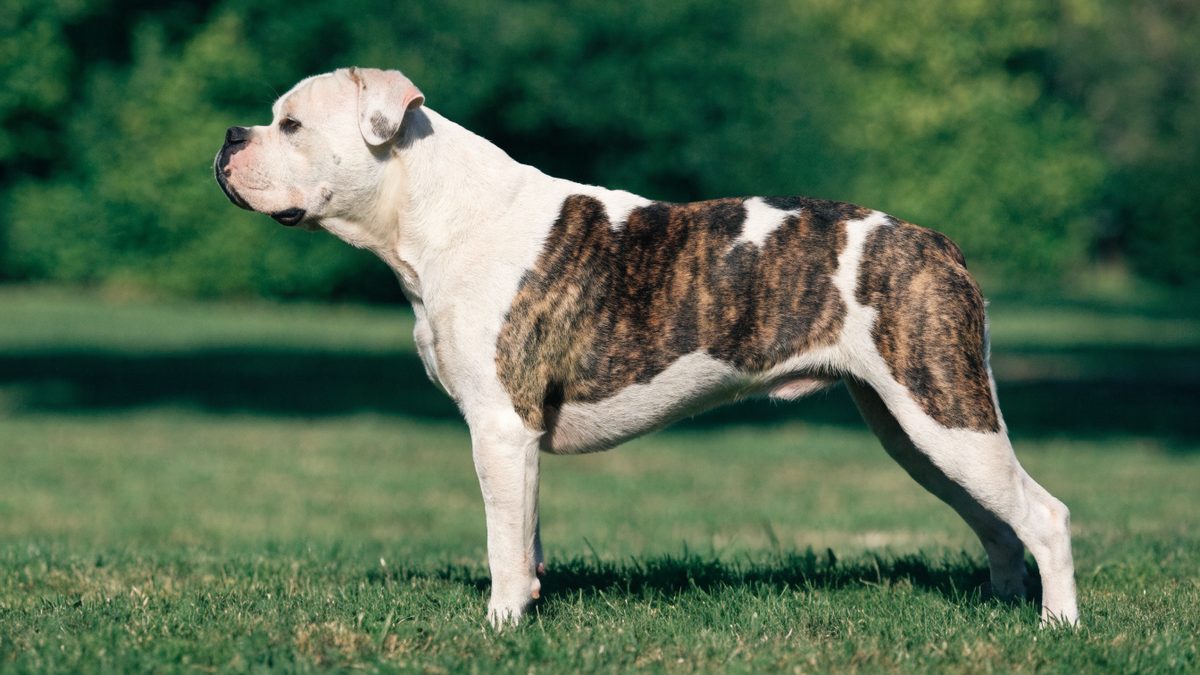
The American Bulldog is a large, short-coated working bulldog from the American South, recognised by the United Kennel Club in the Guardian Dog Group on 1 January 1999. It is not the English Bulldog and it is not the American Bully. Those are three separate breeds with three separate standards, three separate registry positions and three very different sets of joint data, and an Indian buyer who cannot tell them apart is the buyer this market is built for.
Start with the history, because it explains the dog. Bulldogs in England were working dogs that drove and caught cattle and guarded property, and when bull baiting was outlawed the original type disappeared from Britain and was replaced by the shorter, stockier, less athletic dog we now know as the English Bulldog. The original working type survived because working-class immigrants took their dogs to the American South, where small farmers and ranchers used them as all-round farm dogs. By the end of the Second World War the breed was almost extinct. John D. Johnson, a returning war veteran, set out to resurrect it, and with Alan Scott and several other breeders bred carefully from what was left.
Johnson and Scott, the split every Indian seller leaves out
Two named lines came out of that revival and the UKC standard describes both. Scott dogs, commonly called standard, are the performance type: athletic, sleeker, less bone, longer muzzles, a more moderate stop and a less extreme undershot bite. Johnson dogs, commonly called bully, are bulkier in body and heavier in bone, with larger heads, more stop, a shorter muzzle, a more pronounced undershot bite and generally more muscle mass. Many modern dogs cross two or more of the original lines and the standard calls those hybrid in type. The UKC publishes separate reference photographs captioned Scott type and Johnson type on its breed page, which is as plain as a registry gets.
The useful part is that the standard puts a number on the difference. Muzzle length in the bully type is 25 to 35 percent of overall head length. In the standard dogs it is 30 to 40 percent. That is a measurement you can take with a tape at the viewing, and it is the single most useful thing on this page, because it separates the two types from each other and separates both from the English Bulldog and the American Bully in one go.
| Point | Johnson (bully) type | Scott (standard) type |
|---|---|---|
| Muzzle as share of head length | 25 to 35 percent | 30 to 40 percent |
| Skull shape | Box-shaped to rounded | Box or wedge shaped |
| Stop | More definitive | More moderate |
| Wrinkles | More than the standard type | Fewer |
| Bone and muscle | Heavier bone, more muscle mass | Less bone, sleeker |
| Preferred bite | Undershot about a quarter inch, 1/8 to 1/2 inch acceptable | Reverse scissors preferred, moderate underbite up to a quarter inch acceptable |
| Overall impression | Thicker and more powerful | Leaner and more athletic |
Neither type is a separate breed and neither commands a legitimate premium on type alone. Both are judged against the same standard, and the standard is explicit that the American Bulldog should be evaluated as a working dog, with exaggerations penalised in proportion to how much they interfere with the dog's ability to work.
Size, and the weight figure that does not exist
Desirable height in a mature male ranges from 22 to 27 inches and in a mature female from 20 to 25 inches. Read the next line of the standard carefully, because Indian sellers skip it: in all types, weight should be in proportion to height. The UKC publishes no weight range for this breed at all. Every kilogram figure you will see on an Indian listing is therefore somebody's estimate, not a standard.
That matters because the estimates disagree. Mr n Mrs Pet publishes 19.5 to 27.5 inches and 27 to 58 kg. Puppiezo publishes 20 to 28 inches and 27 to 54 kg. PetMD, reviewed by a veterinarian, gives up to 25 inches and 60 to 100 pounds, which is roughly 27 to 45 kg. The top of the Indian weight claims sits 13 kg above the top of the American veterinary estimate, and the bottom of the Indian height claims sits below the female minimum in the standard.
Coat, colour and the two things India forbids
The coat is short, close and one inch or less in length, varying from soft to stiff. A coat longer than one inch, any feathering, or a wavy coat is a disqualification. Colour is open apart from four exclusions: solid black, solid blue, merle and tricolour are disqualified, a full black mask is unacceptable, and less than 10 percent white markings is a serious fault. A seller offering you a merle or a solid blue American Bulldog is offering a dog the registry disqualifies.
Two cosmetic points on the standard do not travel to India. The UKC permits cropped ears while stating that natural ears are preferred, and permits a docked tail while stating that the natural tail is preferred. In India both procedures are forbidden to the breeder. Rule 8 of the Prevention of Cruelty to Animals (Dog Breeding and Marketing) Rules, 2017 states that there shall be no tail docking, ear cropping, de-barking, de-clawing, branding, dyeing, injecting substances to enhance visual appeal, performing a surgery or procedure to camouflage or hide any defect or infirmity or any other kind of mutilation of any body part of the pup, and that any change of appearance by artificial means is strictly forbidden. A cropped Indian puppy was produced in breach of the rules that govern its breeder. Walk away.
The UKC standard disqualifies unilateral or bilateral deafness and any dog that exhibits difficulty breathing while in the ring. Both are worth knowing before you pay. A puppy that snores heavily at rest, or that does not orient to a sound made out of its line of sight, is a puppy to have examined by a veterinarian before money changes hands, not after.
Which registries actually recognise it
Registry position is where the Indian market gets loosest, so here it is from the registries themselves. The UKC fully recognises the breed and publishes the standard quoted throughout this page. The American Kennel Club does not: it records the American Bulldog in the Foundation Stock Service, the programme for rare breeds being recorded rather than fully registered, and its breed page links to FSS rather than to any AKC group. The Federation Cynologique Internationale does not list the breed at all: its letter A nomenclature carries the American Akita, American Cocker Spaniel, American Foxhound, American Staffordshire Terrier and American Water Spaniel, and no American Bulldog.
| Registry | Position | What that means for an Indian buyer |
|---|---|---|
| United Kennel Club | Fully recognised, Guardian Dog Group, since 1 January 1999 | The only published breed standard worth measuring a puppy against |
| American Kennel Club | Foundation Stock Service only | No AKC breed standard exists, so 'AKC lines' claims mean little |
| Federation Cynologique Internationale | Not in the nomenclature | The FCI has no standard for this breed in any language |
| Kennel Club of India | Publishes registration forms and a tariff sheet, not a breed list | Ask the KCI directly whether a specific dog is registered, rather than trusting a photocopy |
The FCI point has a practical edge in India. Indian sellers advertise KCI registered American Bulldogs freely. The Kennel Club of India publishes downloadable litter, single-dog and prefix registration forms and a Revised Tariff Sheet effective 1 April 2024. Before you pay a registration premium on this breed specifically, ask the KCI in writing whether it registers the American Bulldog and under what breed name, because the international federation to which Indian pedigree work is oriented does not list it.
The catch-work history, stated plainly
The standard describes what this dog was built to do without decoration: the essential characteristics are those which enable it to work as a hog and cattle catching dog, and a protector of personal property, and it names a dog fearless enough to face an angry bull or a human intruder. Bonbeno reports that as history and as working conformation, not as a recommendation.
Under section 11 of the Prevention of Cruelty to Animals Act, 1960 it is an offence, solely with a view to providing entertainment, to incite any animal to fight or bait any other animal, and to organise, keep, use or act in the management of any place for animal fighting or for baiting any animal, or to permit or offer any place to be so used, or to receive money for the admission of any person to a place kept or used for such purposes. Nothing on this page is guidance for fighting, baiting, catch work, bite work or producing aggression in a dog, and nothing here should be read that way. If you are looking for that, this is the wrong site.
American Bulldog price in India
An American Bulldog costs Rs 50,000 to Rs 3,20,000 in India in 2026 across the published sources Bonbeno could find, and the honest headline is that only three Indian pages publish a number at all. Two of those three disagree by Rs 2,00,000 at the top of the range and by Rs 40,000 at the bottom, and the third is a kennel blog whose American Bulldog heading links to a British Bulldog page.
This is a thinner market than the SERP suggests. Of the ten organic results Google India returns for this query, the page in first place publishes no price at all, the page in fifth has no American Bulldog row in a 40-breed price table, and the page in sixth is titled 'At Best Prices' while listing no American Bulldog and no price. Bonbeno prints every published band side by side rather than averaging them, because averaging three numbers that describe three different research efforts is not a price.
| Source | Published band | What the source actually is |
|---|---|---|
| Mr n Mrs Pet, Bulldog page | Rs 90,000 to Rs 3,20,000 | Filed as a 'type of Bulldog' under a spec table headed Bulldog (English Bulldog), Origin England |
| Karmakar Kennel | Rs 67,000 to Rs 2,50,000 | Kolkata and Delhi online pet shop. Its American Bulldog heading links to a British Bulldog URL |
| Happy Pet | Rs 50,000 to Rs 1,20,000 | The only ranking breed guide with a price. Its price paragraph is about Cavapoos |
| Mr n Mrs Pet, American Bulldog listing page | Not published | Ranks first in India. Nine listings, every price behind a sign-up wall |
| Puppiezo | Not published | Page title says 'At Best Prices'. No American Bulldog is listed on it |
| Supertails, Top 40 Breeds | No row for this breed | Lists Bulldog (English) at Rs 50,000 to Rs 1,50,000 and Pitbull (APBT) at Rs 20,000 to Rs 1,50,000 |
Read the three published bands properly
Each of the three numeric sources has a specific defect worth naming, because a buyer who knows the defect can weigh the number.
- Mr n Mrs Pet, Rs 90,000 to Rs 3,20,000. The highest band and the most detailed, but it appears on a page whose own specification table reads 'BREED NAME: Bulldog (English Bulldog), ORIGIN: England, BREED GROUP: Non-Sporting Group'. The American Bulldog is not English, is not in the Non-Sporting Group, and belongs to the UKC Guardian Dog Group. The same page tells readers that 'Bulldog have dense, curly coats that need trimming every 4 to 6 weeks to prevent matting';, which describes no bulldog of any kind and contradicts a standard that disqualifies a wavy coat.
- Karmakar Kennel, Rs 67,000 to Rs 2,50,000. A Kolkata and Delhi online pet shop, published 23 August 2024 and modified 31 August 2025. Its American Bulldog section heading is hyperlinked to a British Bulldog price URL, and the same page runs a promotional banner offering a 'Bulldog (High Quality Bloodline)' from Rs 20,000. A Rs 20,000 banner beside a Rs 2.5 lakh editorial figure on one page is a signal about the page, not about the breed.
- Happy Pet, Rs 50,000 to Rs 1,20,000. Updated 6 August 2025, and the only ranking breed guide that states a band. Directly under the heading 'Price of American Bulldog' the explanatory sentence reads 'The average price of Cavapoos can vary from Rs 50,000 to Rs 1,20,000 in India';. That is a template left unfilled, which tells you how much breed-specific work went into the figure above it.
The gap between Rs 1,20,000 and Rs 3,20,000 is not a quality gradient anyone has defined. No Indian source publishes what separates a Rs 90,000 American Bulldog from a Rs 3,20,000 one, and none of the three mentions the Johnson and Scott types, which is the only type distinction the breed's own registry recognises. When a seller quotes you the top of the range, the question to ask is not 'why so high' but 'which type, what does the muzzle measure, and where are the parents' hip and elbow scores'.
The cheaper number that keeps appearing next door
Search this term in India and the results fill with a different breed. Positions eight, nine and ten on the page Bonbeno pulled are American Bully pages, and the American Bully is cheaper here. Mr n Mrs Pet prices the American Bully at INR 45,000 to INR 1,00,000 plus, with the Pocket variety at INR 55,000 to INR 80,000 and the Standard at INR 45,000 to INR 80,000 across eight cities. So the same seller prices the American Bully from Rs 45,000 and the American Bulldog from Rs 90,000, which gives an Indian seller a direct commercial reason to let a buyer confuse them in the profitable direction.
That is why the comparison section of this page carries measurements rather than adjectives. If you cannot tell the two apart at the viewing, the price difference is doing the talking for you.
What a legal Indian breeder has to fund
Before judging any of these numbers as high, note what the Rules require of a lawful breeder. No breeder shall carry on or continue any breeding activity or own or house dogs for breeding and sale of dogs and pups, unless the breeder has obtained a certificate of registration. Only normal, healthy, mature female dogs that have reached their eighteenth month shall be bred, and only one litter shall be produced in one year. Pups less than eight weeks in age are not to be sold. A breeder honouring an eighteen-month breeding age, one litter a year and eight weeks of rearing has a real cost base, and the very low quotes in this market usually indicate that none of it was honoured.
Bonbeno does not broker puppy sales and does not publish breeder listings. Every figure above is reported from a third-party source so buyers can see the disagreement for themselves.
Monthly cost of owning an American Bulldog in India
Budget for a 35 to 45 kg dog rather than for a bulldog, because the word bulldog is what makes Indian cost estimates for this breed wrong. Only two published Indian figures exist, they were written for different animals, and neither one states its method.
Happy Pet puts monthly expenses at Rs 4,900 for a basic lifestyle and Rs 7,650 for a premium one, split as Rs 3,000 to Rs 4,500 food, Rs 1,200 to Rs 1,950 veterinary and Rs 700 to Rs 1,200 grooming. Mr n Mrs Pet answers the question 'How much does it cost to maintain a Bulldog in India monthly?' with INR 8,000 to INR 10,000, covering quality food, grooming, vet visits and routine care. The two disagree by roughly a factor of two, and the second answer is written on a page whose specification table describes the English Bulldog.
Neither figure is a survey. Bonbeno is running a verified owner cost survey across eight metros and will publish the results with the sample size, the cities and the collection date stated. Until that is done, the honest position is that no reliable India-wide monthly figure exists for this breed, so this section sets out the cost structure rather than inventing a total.
The five lines that actually move
- Food, and it is the big one. This is a 35 to 45 kg working dog with high energy needs, not a 20 kg couch bulldog. Happy Pet's own nutrition panel puts an adult at about 2,100 kcal a day and a puppy at about 1,500. Feeding a large-breed dog properly is where most of the monthly money goes and it is the line Indian estimates most often size for the English Bulldog instead.
- Preventive veterinary care. Core vaccination, annual boosters, deworming and year-round tick and flea control. A PCR survey of 525 dogs across four Indian sites found 49.7 percent infected with at least one tick-borne pathogen and ticks on 53 percent of dogs examined, rising to 80 percent in Mumbai and 75.3 percent in Delhi. That is a recurring cost, not an occasional one.
- Skin management. The coat costs nothing. The skin can cost a great deal, because this breed carries a documented inherited ichthyosis and Indian humidity is the worst possible setting for a defective skin barrier. Budget for medicated shampoo and emollients as a standing line if your dog is affected, since the published case that responded well needed continuous topical treatment to maintain the improvement.
- Orthopaedic provisioning. OFA has graded 2,504 American Bulldog hips and 34.7 percent came back dysplastic, with elbows at 19.8 percent of 783. Roughly one graded dog in three has dysplastic hips. Setting money aside for that is arithmetic, not pessimism.
- Registration, licensing and the legal overhead. Municipal registration is real money in some cities and is covered in the adoption section below. Chandigarh charges Rs 500 to register a pet dog with a Rs 50 renewal every five years. The Gurugram consumer forum directed a licence fee of not less than Rs 12,000 a year with a renewal of not less than Rs 10,000 a year.
When we publish cost figures we state the sample size, the cities covered and the collection date. Where we cannot verify a number we say so rather than repeating an unsourced estimate from another site. Two disagreeing estimates written for a different breed do not become one reliable figure by being averaged.
The cost nobody prices
The largest financial risk in this breed is not monthly. It is the purchase decision. A puppy bought without the parents' hip and elbow scores and without the two DNA tests OFA lists for the breed carries a materially higher chance of orthopaedic surgery, lifelong skin management or a progressive neurological disease. Every one of those is more expensive than the price difference between a screened litter and an unscreened one, and every one of them arrives years after the receipt.
Can an American Bulldog handle the Indian climate
An American Bulldog can live across most of India with disciplined heat management, and Bonbeno rates its heat tolerance 3 out of 5. That is meaningfully better than the English Bulldog, which this site rates 1 of 5, and meaningfully worse than a heat-adapted native dog. The reasoning matters more than the number, so here it is in full.
Why 3 and not 1: the airway is not the English Bulldog's airway
Get this right, because Indian pages get it wrong in both directions. The American Bulldog is not brachycephalic in the way the English Bulldog is. The UKC standard sets muzzle length at 25 to 35 percent of head length in the bully type and 30 to 40 percent in the standard type. A dog with a third of its head as muzzle has a functioning nasal passage to move air across. The standard also disqualifies any dog that exhibits difficulty breathing while in the ring, which is a working-dog registry actively selecting against airway compromise rather than tolerating it.
The screening registers say the same thing in a different language. OFA's CHIC requirements for the American Bulldog are hips, elbows, an NCL 10 DNA test and an ichthyosis DNA test, with cardiac and hyperuricosuria optional. There is no respiratory item on the list at all. The English Bulldog's CHIC list, by contrast, includes a radiographic evaluation for tracheal hypoplasia as a core requirement and the Respiratory Function Grading Scheme for brachycephalic obstructive airway syndrome as an option, and OFA has 2,340 English Bulldog tracheal evaluations on file against 232 RFGS screenings of which 27.2 percent were abnormal. Two registries, two completely different airway conversations, one word in common.
Bonbeno's flat-faced breeds group covers the Pug, Bulldog, French Bulldog, Pekingese, Boxer, Shih Tzu, Shar Pei and Staffordshire Bull Terrier, and the American Bulldog is not in it. Nothing here contradicts that page. Brachycephalic dogs carried 2.10 times the odds of heat-related illness against mesocephalic dogs in the largest published study, and that finding stands. It simply is not the reason this breed struggles in Indian summer. The reason is below.
Why 3 and not 5: mass, drive and a white coat
Three things pull the rating down, and none of them is the face.
- Bodyweight. In the VetCompass study of 905,543 UK dogs, dogs over 50 kg carried 3.42 times the odds of heat-related illness compared with dogs under 10 kg. A large Johnson-type male reaches that band. Even at 40 kg, a heavily muscled dog generates far more metabolic heat than it can shed by panting on a humid Chennai evening.
- Exercise drive. This is a catch dog that needs one to two hours a day. Exertional heat illness is the pattern that kills fit dogs, not sunbathing, and the usable exercise window in most of India is small. A breed that must be worked hard in a country where the safe window is narrow is a breed whose owner has to be disciplined.
- Coat colour and skin. The standard makes less than 10 percent white markings a serious fault, so most American Bulldogs are predominantly white with patches. White coat over unpigmented skin means real sunburn risk on the muzzle, eyelids and belly under Indian sun, and a dog carrying the ichthyosis variant has a compromised skin barrier on top of that.
The numbers to run your summer by
Indian veterinary guidance sets usable thresholds. AlcoVet's bands run safe below 28 C, caution 28 to 35 C, danger 35 to 42 C where outdoor activity is contraindicated, and extreme above 42 C, with heatstroke defined by a core temperature above 40 C and multi-organ failure beginning within minutes once it passes 41 C. Purina India gives 40.5 C or above as the raised-temperature danger signal and 39.4 C as the point at which to stop active cooling.
| Ambient | AlcoVet band | What an American Bulldog owner does |
|---|---|---|
| Below 28 C | Safe | Normal activity. Most of the year in Bengaluru and Pune mornings |
| 28 to 35 C | Caution | Shorten sessions, add water breaks, watch gum colour and panting rate |
| 35 to 42 C | Danger | Outdoor activity contraindicated. Indoor scent work and training replaces the walk |
| Above 42 C | Extreme | Do not take the dog out at all. This is a life-threatening exposure |
Two practical rules follow. Walk only before 7 AM or after 8 PM from April to September, and run the 7-second pavement test before every walk, because asphalt reaches 60 C. The pavement test matters more for this breed than for most, because a 40 kg dog puts more load per pad than a 10 kg one.
City by city, where the difference actually shows
- Delhi and the north. Dry heat with extreme peaks. The danger is the peak-hour walk and the parked car. Air conditioning during May and June is not a luxury for a 40 kg dog, it is the plan.
- Mumbai and Chennai. Lower peaks, brutal humidity. Panting is evaporative cooling, and evaporative cooling fails in humid air, so a coastal 33 C is harder on this dog than an inland 38 C. This is also where the skin problems land hardest.
- Bengaluru and Pune. The most workable Indian cities for this breed. Morning temperatures sit in the safe band for much of the year, which makes the one to two hour requirement achievable without heroics.
- Kolkata and the east. Heat plus humidity plus a long monsoon. Plan the skin routine from day one rather than after the first hot spot.
- Hill stations and the north-east. Comfortable for the dog. Watch the opposite problem, which is a short-coated dog with minimal insulation in a genuinely cold winter.
Heat stroke is a veterinary emergency. Purina India lists severe panting, difficulty breathing, severe salivating, vomiting, diarrhoea, blood in the urine, nose bleeds and ultimately collapse and coma. Move the dog into shade or air conditioning, spray or sponge with cool but not cold water, use a fan, gently massage the legs and body, and stop cooling at 39.4 C. Do not plunge the dog into cold water or an ice bath, because that prevents the core temperature coming down. Then get to a clinic. Consult your nearby vet the same day even if the dog seems to recover.
American Bulldog temperament and who should not buy one
The American Bulldog is a gentle, loving family companion who is fearless enough to face an angry bull or a human intruder, in the exact words of its own breed standard. Both halves of that sentence are true at once, and an Indian buyer who reads only the first half or only the second half will mishandle the dog. This section separates what the registry actually says from what the breed's reputation says.
Read the standard's characteristics clause in full, because it is the most reliable temperament description published anywhere for this breed. The essential characteristics are those which enable it to work as a hog and cattle catching dog and a protector of personal property, and those tasks require a powerful, agile, confident dog with a large head and powerful jaws. The general-appearance clause gives that temperament the body to carry it out, describing a powerful, athletic, short-coated dog that is strongly muscled and well boned, with males typically larger and more muscular than females. The standard then names the family role directly, and it closes the history section by describing the modern dog as an all-purpose working dog, a fearless and steady guard dog, and a loyal family companion. The American Kennel Club, which records the breed only in its Foundation Stock Service, describes it as loyal and self-confident.
The 18-month clause, and why it is the most useful line on the page
One sentence in the standard predicts more first-year owner anxiety than anything else, so here it is verbatim. It is common for young American Bulldogs to be somewhat standoffish with strangers, and judges should not penalise this. By the time the dog is around 18 months of age, however, the breed's normal confidence asserts itself. A registry telling its own judges not to mark a young dog down for reserve is a registry saying that reserve is normal development, not a fault and not aggression.
That matters in India specifically. An Indian household typically meets more unannounced visitors than the households this standard was written for, because domestic help, delivery staff, building maintenance, milk and courier arrivals and extended family are all routine. A ten-month-old American Bulldog that goes stiff at the gate is behaving as the standard predicts. The mistake is to read that as either a fault to punish or a guarding instinct to encourage. It is a window to socialise through, and it closes.
The UKC disqualifies viciousness or extreme shyness and cowardice in this breed. A dog that is genuinely vicious and a dog that is genuinely terrified are both outside the standard, and both are usually the product of breeding or rearing rather than of the breed. Ask to meet the dam. A dam that cannot be handled calmly in front of you is the single most informative thing you will see at a viewing.
Household fit, stated as plainly as the evidence allows
PetMD, reviewed by Molly Price, DVM, reports the breed as generally outgoing and friendly, notes that a loyal dog may bark to alert the household when something seems out of the ordinary, and states that a well-trained and socialised American Bulldog can typically get along with other pets and with young children. The same page notes that because of their working and guardian history, American Bulldogs may be guarded around new people at first. Those two statements sit together comfortably and describe a dog whose behaviour with strangers is a training variable rather than a fixed setting.
| Household | Workable | What it takes |
|---|---|---|
| Independent house with a yard, adult-led exercise routine | Yes, the best fit | One to two hours of daily work and a secure boundary |
| 3BHK apartment, one committed adult handler, permissive society | Yes, with discipline | Two real outings a day at safe hours, plus indoor scent work in summer |
| Studio or 1BHK, long working hours, nobody home | No | PetMD names the studio-apartment homebody as the wrong fit for this breed |
| Household with toddlers, first dog for the family | Not as a first dog | A 40 kg dog with guarding heritage needs an experienced handler present |
| Home in Gurugram or Chandigarh | Prohibited by name | Both municipalities name this breed The Times of India |
| Home where the dog is bought for protection | No | A protective dog produced by isolation is a liability, not security |
Socialisation, the one investment that decides the adult dog
Socialise this puppy from the day it arrives, if you want the confident adult the standard describes. PetMD's guidance is direct: begin socialising an American Bulldog puppy as soon as you bring it home, because early exposure to new people, environments, animals and other stimuli helps the puppy grow into a confident and well-mannered dog. The socialisation window in a puppy closes long before the dog looks adult, which is the trap in a breed that keeps growing until two.
- Count the exposures. Aim for a written list of new people, surfaces, sounds and situations each week rather than a vague intention to get the puppy out.
- Stage the gate. Have visitors arrive, be greeted calmly and leave, on purpose, several times a week. The gate is where an Indian guarding dog rehearses its worst habit.
- Use the lift. Apartment dogs meet strangers in a metal box. Practise it while the dog weighs 12 kg, not 42 kg.
- Book the vet visit that is not a vet visit. Walk in, take a treat, walk out. A 45 kg dog that fears the clinic is a dog that gets examined less often than it should.
- Keep sessions short. Five good minutes beat forty minutes that end badly, because the last thirty seconds are what the puppy stores.
Same-sex tension is worth planning for rather than assuming. Bonbeno found no published study of dog-to-dog tolerance specific to the American Bulldog, and says so rather than borrowing a figure from a related breed. What the evidence does support is the practical response, which costs nothing: feed dogs separately, introduce new dogs on neutral ground with both on lead, and do not leave two mature dogs of the same sex together unsupervised until you have watched them for months. Read the American Pit Bull Terrier and American Bully pages for how the same question is handled in the neighbouring breeds.
A dog bought as a weapon is a dog that gets isolated, and an isolated guarding breed becomes unpredictable rather than reliable. The standard's own model is a confident dog that lives with its family, not a dog kept apart from it. Nothing on this page is guidance for producing aggression, and animal fighting is a criminal offence under section 11 of the Prevention of Cruelty to Animals Act, 1960. If a seller markets a puppy on its bite, its 'game' bloodline or its catch heritage, that seller is describing a criminal use and should be left alone.
Training an American Bulldog in India
Train an American Bulldog with short, consistent, reward-based sessions started the week the puppy arrives, because this is a smart and eager-to-please breed that picks up training cues quickly when sessions are done consistently, patiently and with positive reinforcement. The breed does not need force. It needs an owner who does the boring work early, while the dog still weighs less than the handler can hold.
Bonbeno rates trainability 3 of 5 for this breed, which is a deliberate middle. The dog is willing and it learns fast, which pushes the rating up. It is also independent, physically overwhelming by eighteen months and bred to make its own decisions at the moment of contact with livestock, which pulls the rating down. A Labrador forgives an inconsistent first year. This breed converts an inconsistent first year into a 45 kg management problem.
A realistic Indian training timeline
| Age | The one thing that must be working | Why it is that thing |
|---|---|---|
| 8 to 12 weeks | Name, food-bowl calm, handling of feet, ears and mouth | A dog you cannot touch is a dog no vet can examine at 45 kg |
| 3 to 4 months | Loose-lead walking before the dog outweighs the walker | Lead manners learned at 12 kg hold at 42 kg. The reverse does not |
| 4 to 6 months | Gate routine and settle-on-mat with visitors arriving | The standoffish phase is starting and needs a rehearsed alternative |
| 6 to 9 months | Reliable recall and a solid leave-it | Adolescence arrives with a body that can already drag an adult |
| 9 to 15 months | Holding the trained behaviours through the testing phase | This is where owners quit and where the adult dog is decided |
| 15 to 24 months | Maintenance, plus a job the dog does weekly | The standard's confidence asserts itself around 18 months |
What this breed resists, and what it does not
This dog does not resist learning. It resists three specific things, and naming them saves an owner a year.
- Repetition without purpose. Forty sit repetitions bore a working breed. Ten repetitions that end in a game of tug hold its attention, and PetMD lists tug-of-war among the activities the breed genuinely enjoys.
- Correction-heavy handling. A confident guarding breed handled with force learns that hands predict conflict. That is the exact wrong lesson in a dog that must be handled by vets, groomers and children.
- Inconsistency between family members. One adult allowing the dog on the sofa and another not is how a large dog learns to test each person separately.
- Being left out. This is a breed bred to work alongside people. A dog tied in a yard or confined to a balcony does not become obedient, it becomes reactive.
What works instead is short, frequent, food-paid sessions, plus a job. Nose work is the highest-value activity for an Indian owner of this breed, because PetMD lists it first among suitable activities and it is the only serious outlet that can be run indoors at 2 PM in May. Agility, obedience work, dock diving, lure coursing, hiking, swimming and tug are the rest of the published list. Between April and September, plan for at least half the dog's mental work to happen indoors.
Train five minutes, three times a day, seven days a week. That is 105 minutes a week and it beats a single weekend hour by a wide margin, because a working breed consolidates on frequency rather than duration. It also fits the Indian summer, since three five-minute indoor sessions need no safe walking window at all.
Two India-specific training items nobody mentions
Muzzle conditioning is a practical skill here, not a stigma. The Gurugram directions require dogs in public to be leashed and muzzled, and a dog conditioned to a basket muzzle as a puppy wears one calmly for life. Teach it as a game with food through the front of the muzzle long before it is ever needed, because a muzzle first introduced at a clinic in an emergency is a muzzle the dog will fight.
Train the housing-society interaction, not just the dog. Most Indian conflict over a large breed happens in a lift, a lobby or a stairwell in front of a neighbour who is frightened. A dog that sits and holds position while people pass does more for the breed's reputation in your building than any argument at a residents' meeting. Check your society's bylaw before you buy, not after, because a rule written against 'aggressive breeds' is usually applied on sight rather than on paperwork.
This page carries no guidance on bite work, protection training, catch work or building aggression, and no such guidance belongs on a general breed page. Inciting an animal to fight or bait another animal is an offence under section 11 of the Prevention of Cruelty to Animals Act, 1960, as is organising, keeping, using or managing any place for animal fighting. If a trainer offers protection work for a pet dog in an Indian city, decline it. The dog you actually need is one that ignores the gate.
How much exercise an American Bulldog actually needs
A healthy adult American Bulldog needs one to two hours of exercise every day, which is the figure PetMD publishes under veterinary review and which Puppiezo repeats on its Indian page. That is the requirement, not the ideal. Bonbeno rates exercise needs 5 of 5 for this breed, the highest rating on the page, and the rating is the reason most Indian buyers should not own one.
Two published Indian descriptions of this breed understate it. Heads Up For Tails lists the American Bulldog at medium energy in its nine-breed bulldog roundup. Happy Pet frames the breed inside a general bulldog care template. Neither figure sits comfortably beside a standard describing a dog that must be sufficiently powerful and agile to chase, catch, and bring down free-ranging livestock. When an Indian page tells you this dog is medium energy, it is describing the English Bulldog's needs and attaching them to a different animal.
What the hour actually has to contain
Distance alone does not satisfy this breed. Split the daily requirement across three kinds of work, because a dog bred to sprint, grip and think gets bored by a flat walk long before it gets tired.
- 40 to 60 minutes of locomotion. Two walks at a real pace, or one walk plus a structured off-lead session in a secure space. Long walks are on PetMD's list of what this breed loves.
- 15 to 20 minutes of effort. Tug, controlled fetch, hill work or swimming. PetMD names tug-of-war, agility, dock diving and swimming as suitable outlets.
- 10 to 20 minutes of thinking. Nose work, a puzzle feeder, a snuffle mat or a training session. PetMD suggests feeding through a slow feeder, puzzle toy or snuffle mat for mental stimulation.
- One weekly outing that is genuinely different. A new route, a hike, a beach at low tide. Novelty does more for a working dog than another lap of the same park.
Fitting one to two hours into an Indian day
The Indian problem is not willingness, it is the clock. AlcoVet's guidance puts the usable walking windows before 7 AM and after 8 PM from April to September, and rates 35 to 42 C as a band in which outdoor activity is contraindicated. So for roughly half the year in most of the country, the entire daily requirement has to fit into two windows at the ends of the day, and the middle of the day has to be filled indoors.
| Time | October to March | April to September |
|---|---|---|
| Early morning | 45 to 60 minute walk plus effort work | Before 7 AM. The main session of the day, front-loaded |
| Midday | Short garden session or training | Indoors only. Scent work, puzzle feeder, obedience |
| Afternoon | Free time in shade | Rest with air conditioning or a fan. No outdoor activity |
| Evening | 30 to 45 minute walk | After 8 PM, and run the 7-second pavement test first |
| Weekly | One long hike or swim | One early swim, which cools while it works |
Puppy exercise and the growth plate rule
Do not run, jump or force-march an American Bulldog puppy, because a large-breed skeleton finishes late. The growth plate is the soft cartilage zone at the end of a long bone where growth happens, and it stays open through most of the first year in a big dog. Free play on grass that the puppy starts and stops by itself is the safe default. Repetitive forced exercise on hard surfaces is not, and neither is stair work or jumping down from height in a breed where 34.7 percent of 2,504 OFA-graded hips came back dysplastic.
The practical version is simple. Until about 12 months, replace distance with variety: five short outings beat one long one, and swimming loads the joints least. Ask your nearby vet when your individual dog's growth plates have closed before you start road running with it, because that answer depends on the dog rather than on the breed.
An under-exercised American Bulldog does not become a calm American Bulldog. PetMD states plainly that these dogs will not do well in a low-energy home without outlets for their physical energy and that they need a pet parent dedicated to exercising and training them. In an Indian apartment the shortfall shows up as destroyed furniture, barking that triggers a society complaint, weight gain that loads already-suspect hips, and a dog that redirects its unspent drive at the gate. Every one of those is an owner problem wearing a dog costume.
One honest note on the heat. Exertional heat illness is what harms fit, willing dogs, because a dog bred to work will keep working past the point where it should stop. In the VetCompass study of 905,543 UK dogs, dogs over 50 kg carried 3.42 times the odds of heat-related illness compared with dogs under 10 kg. Watch the dog, not the clock, and stop the session at the first change in panting rhythm rather than at the end of the planned route.
Grooming an American Bulldog through an Indian monsoon
Groom this breed for its skin, not for its coat. The short coat is one inch or less in length, close, and disqualified by the standard if it is longer than an inch, feathered or wavy, so it needs a weekly brush and nothing more. The skin underneath is where an Indian owner spends real time and real money, because this breed carries a documented inherited ichthyosis and the Indian climate is the worst possible setting for a defective skin barrier.
Bonbeno rates grooming needs 2 of 5, which is low, and that rating misleads people. The number is low because coat maintenance is genuinely trivial. The work is skin inspection, fold hygiene, ear care and parasite control, and none of that is optional in India. PetMD sets the expectation correctly: this breed requires a moderate level of grooming, and while the short coat is easier to maintain than a long-haired dog's, their wrinkles and skin need lots of attention.
A weekly routine built for Indian conditions
- Brush once a week. A short-coat tool lifts loose hair and, more usefully, forces you to run your hands over every inch of the dog. PetMD notes that grooming time is the chance to check for cuts, fleas, ticks, lumps and bumps and rashes.
- Wipe the folds. Johnson-type dogs carry more wrinkles than standard-type dogs by the standard's own description, and PetMD warns that facial folds need to be kept clean of dirt and debris or skin infections can occur, sometimes needing a wipe-down through the day for food crumbs.
- Clean the ears weekly. American Bulldogs can be susceptible to ear wax buildup, so PetMD recommends weekly cleaning with a vet-recommended cleanser, and treats recurring ear infections as a sign of a larger underlying issue such as allergies.
- Check the white skin. Most dogs of this breed are predominantly white, because the standard makes less than 10 percent white markings a serious fault. White coat over unpigmented skin sunburns, so inspect the muzzle, eyelids, ear edges and belly through the summer.
- Dry the dog properly in monsoon. A short coat dries fast and that is the advantage. Use it. A dog put away damp after a rainy walk is a dog whose folds and ear canals stay wet for hours.
Ichthyosis, the reason skin care is not optional
Autosomal recessive congenital ichthyosis in this breed is associated with a NIPAL4 (ichthyin) deficiency, established by Mauldin and colleagues in Veterinary Pathology in 2015. Their screen of 545 American Bulldog DNA samples found 32 dogs homozygous for the variant. PetMD describes the clinical picture in plain terms: a genetic mutation that prevents the outer layer of skin developing properly, causing the skin to flake and become itchy, ranging from moderate to severe.
The care burden scales with severity and it is worth knowing before you buy. PetMD reports that dogs with mild cases need more frequent bathing with medicated shampoo, while dogs with severe cases need to be bathed and oiled every day. A published case in an American Bully with a NIPAL4 deletion responded well to topical therapy but needed continuous topical treatment to maintain the improvement. Daily bathing and oiling in a humid Indian city is a standing commitment measured in years, and it is precisely why the DNA test matters more here than where the research was done.
OFA lists a DNA based ICH test from an approved laboratory among the basic health screening requirements for this breed, alongside hips, elbows and the NCL 10 DNA test. Ichthyosis here is recessive, so two clear parents cannot produce an affected puppy. Ask for both parents' ichthyosis results in writing before you pay. Consult your nearby vet about arranging testing and about managing an affected dog, because the treatment plan is individual rather than generic.
Allergy, humidity and the itch that is not fleas
Allergic skin disease is the second recurring complaint in this breed. PetMD, citing the American Bulldog Association, reports allergies caused by an overactive immune system, with itchy skin and scratching, fur loss, excessive licking, red skin, recurring skin infections and ear infections as the signs to watch for, and advises contacting a veterinarian if you notice them. In an Indian monsoon those signs arrive together and are easy to mistake for one problem when they are several.
The practical discipline is to escalate rather than to experiment. A dog that has been itching for more than a week, has a smell coming off the skin, or has an ear that is warm and painful needs a veterinary examination rather than another shampoo. Repeated over-the-counter bathing is how a treatable infection turns into a chronic one, and how an owner spends more than the consultation would have cost.
Ticks, which are a grooming task in India
Tick control belongs in the weekly routine here in a way it does not in the countries this breed's care advice is written for. A PCR survey of 525 dogs across four Indian sites found 49.7 percent infected with at least one tick-borne pathogen, with ticks found on 53 percent of dogs examined, rising to 80 percent in Mumbai and 75.3 percent in Delhi. Tick-borne disease is therefore a routine risk rather than an unlucky one, and a short-coated white dog makes the inspection easy.
- Check the four places ticks hide. Inside the ear flaps, between the toes, in the armpits and around the tail base.
- Keep year-round prevention going. Discuss the product and the interval with your nearby vet, because the right choice depends on your city and your dog.
- Never shave this dog. A one-inch coat is protection against sun and abrasion, and removing it does nothing for cooling.
- Log what you find. A tick-heavy patch on the daily route is information. Change the route.
Two smaller items complete the routine. White-faced dogs can develop brown tear staining, which gentle cleaning with an eye-cleaning solution helps to minimise. And nails on a dog that exercises on soft ground grow faster than the walking wears them down, so trim on a schedule rather than waiting to hear them on the floor.
American Bulldog health issues, screening and lifespan
The American Bulldog's four documented health issues are hip dysplasia, elbow dysplasia, neuronal ceroid lipofuscinosis (NCL 10) and congenital ichthyosis, which is exactly the list OFA publishes as the breed's basic health screening requirements. Two of the four have a DNA test that gives a clean yes or no. All four are checkable before you pay, and none of them is checkable after. Consult your nearby vet before acting on anything in this section, because it is general information rather than a diagnosis for your dog.
Start with what makes this breed's health record unusual. OFA publishes no health survey for the American Bulldog at all, stating on the breed's own statistics page that the parent club has not initiated one. So the numbers below come from dogs whose owners chose to submit results, which is a self-selected group of serious breeders rather than a random sample. Read every percentage as a floor rather than a population rate.
| Test | Dogs tested | Normal or clear | Abnormal, dysplastic or at risk | Carriers |
|---|---|---|---|---|
| Hips | 2,504 | 61.0% | 34.7% | Not applicable |
| Elbows | 783 | 80.2% | 19.8% | Not applicable |
| NCL 10 (DNA) | 444 | 92.8% | 0.2% | 6.3% |
| Degenerative myelopathy (DNA) | 57 | 70.2% | 19.3% | 10.5% |
| Congenital cardiac | 126 | 100% | 0% | Not applicable |
| Patella | 105 | 96.2% | 3.8% | Not applicable |
| Basic cardiac | 76 | 100% | 0% | Not applicable |
Hip dysplasia, the number that should decide your purchase
Hip dysplasia is the breed's largest orthopaedic risk and it is the single most useful figure on this page for a buyer. Of 2,504 American Bulldog hips graded by OFA, 34.7 percent came back dysplastic, against 61.0 percent normal and 4.3 percent equivocal. Roughly one graded dog in three has hips that are not sound, in a self-selected sample of dogs whose breeders cared enough to submit radiographs.
Break the dysplastic group down, because the severity distribution changes the practical picture. 20.7 percent were mild, 11.5 percent moderate and 2.6 percent severe. On the normal side, 5.3 percent graded Excellent, 36.3 percent Good and 19.4 percent Fair. So the common outcome is a mildly dysplastic hip that may never need surgery but will shorten the dog's comfortable working life, particularly in a heavy Johnson-type male.
OFA's birth-year trend for this breed shows dysplastic hips falling from 50.0 percent in dogs born up to 1990 to 22.6 percent in dogs born from 2021 onwards. Excellent grades rose over the same period from 0 percent to 14.3 percent. Screening works, and a breeder who screens is buying you into the better half of that curve. This is the strongest argument on the page for paying more for a screened litter.
Elbow dysplasia is the smaller but real second joint problem. Of 783 elbows graded, 19.8 percent were dysplastic, split as 14.2 percent grade 1, 4.7 percent grade 2 and 0.9 percent grade 3. PetMD, under veterinary review, names both hip and elbow dysplasia as conditions this breed is prone to, describes them as joints that do not fit together properly, warns they cause pain and can lead to arthritis if untreated, and states that responsible breeders screen for them.
OFA's own protocol tells you what to ask for. A hip evaluation is done either as an OFA evaluation at a minimum age of 24 months or a PennHIP evaluation from a minimum age of 4 months, and elbows are an OFA evaluation at a minimum age of 24 months. A breeder showing you a hip certificate for a 14-month-old dog is showing you a preliminary, not a final grade.
NCL 10, the neurological disease with a clean DNA test
Neuronal ceroid lipofuscinosis in this breed traces to a mutation in the cathepsin D gene (CTSD), identified by Awano and colleagues in Molecular Genetics and Metabolism in April 2006. Affected dogs were homozygous for the A allele of a G to A transition that converts methionine-199 to isoleucine, and brain samples from affected dogs carried 36 percent of the cathepsin D enzymatic activity found in control dog brains. The disease is a progressive neurodegeneration, and the study's authors noted the clinical course in American Bulldogs was less severe than in mice and sheep that lack cathepsin D entirely, more closely resembling many human forms.
Two numbers from that paper matter to a buyer. The A allele was found only in American Bulldogs, with only the G allele detected across 131 randomly selected dogs representing 108 other breeds. And its frequency among 123 genotyped American Bulldogs was 0.28. That research figure is far higher than the 6.3 percent carrier rate OFA reports across 444 DNA-tested dogs, and Bonbeno publishes both rather than picking one, because the two samples are not measuring the same thing. The 2006 figure comes from a research pedigree assembled around affected dogs. The OFA figure comes from breeders submitting results two decades later, after the test existed. The honest reading is that the true rate sits between them and that screening has been pushing it down.
NCL 10 is recessive, so two clear parents cannot produce an affected puppy. A DNA based NCL 10 test result from an approved laboratory is one of OFA's four basic screening requirements for this breed. Ask for both parents' results in writing. A breeder who cannot produce them for a breed with a validated test for a fatal neurological disease is not screening, whatever else they tell you.
Ichthyosis, and why it matters more in India
Congenital ichthyosis in the American Bulldog is associated with NIPAL4 (ichthyin) deficiency, established by Mauldin and colleagues in Veterinary Pathology in July 2015. The study describes a moderate form of autosomal recessive congenital ichthyosis in an extended pedigree of American Bulldogs, presenting as a dishevelled coat shortly after birth, generalised scaling, and adherent brown scale with reddening of the abdominal skin. Affected dogs carried an insertion upstream of the gene and showed a complete absence of ichthyin in the epidermis.
Of 545 American Bulldog DNA samples screened, 32 dogs were homozygous for the variant, with all affected dogs homozygous and their parents heterozygous. The Indian relevance is direct. A dog whose skin barrier does not form properly lives in a country with a four-month monsoon, and the published case in a related dog that responded to topical therapy needed continuous treatment to maintain the improvement. Full details of the daily care burden are in the grooming section above.
What the airway data says, and what it does not
This breed is not screened for airway disease and the reason is structural rather than an oversight. OFA's basic screening list for the American Bulldog contains no respiratory item. The English Bulldog's list carries a radiographic evaluation for tracheal hypoplasia as a core requirement and the Respiratory Function Grading Scheme as an option, with 2,340 tracheal evaluations on file and 27.2 percent of 232 RFGS screenings abnormal. The UKC standard for the American Bulldog goes further and disqualifies any dog that exhibits difficulty breathing while in the ring.
That said, watch for it anyway in an Indian summer. A dog that snores heavily at rest, that has noticeably narrowed nostrils, or that recovers slowly after mild exertion needs a veterinary examination regardless of what its breed's screening list says. Individual dogs vary, and an exaggerated Johnson-type head bred away from the standard is a real thing in a market where nobody measures muzzles.
Lifespan, and the study that does not exist
No published lifespan study for the American Bulldog exists. The 155-breed life expectancy table published by Dogs Trust alongside the 2024 Scientific Reports analysis, drawn from 584,734 dogs, has no American Bulldog row. So every lifespan figure you will read for this breed is an editorial estimate rather than a measured median, and the estimates disagree.
| Source | Claimed lifespan | What it rests on |
|---|---|---|
| PetMD, reviewed by Molly Price, DVM | 10 to 12 years | Veterinary-reviewed editorial estimate, the narrowest claim |
| Puppiezo, India | 10 to 15 years | Indian seller page, method not stated |
| Heads Up For Tails, India | 10 to 15 years | Indian retailer roundup of nine bulldog breeds |
| Happy Pet, India | 10 to 16 years | The widest claim, on the page whose price text is about Cavapoos |
| Dogs Trust 155-breed table | No figure | 584,734 dogs. The breed is not in the dataset |
Take the narrowest, best-sourced claim as the planning figure and treat the rest as marketing. A six-year gap at the top of the range, between 10 and 16, is not a difference of opinion about dogs. It is a difference in how much work went into the sentence.
Ask a breeder for: the sire's and dam's OFA or PennHIP hip results, their elbow results, both parents' NCL 10 DNA results, both parents' ichthyosis DNA results, the dam's age at breeding, and how many litters she has had this year. The Prevention of Cruelty to Animals (Dog Breeding and Marketing) Rules, 2017 require breeding only from healthy mature females that have reached their eighteenth month and only one litter in a year. Six answers, obtainable by message, and they separate a screened litter from an unscreened one before you travel. Consult your nearby vet about interpreting the certificates you are shown.
Feeding an American Bulldog in India
Feed an American Bulldog a large-breed formulation, rich in protein with limited carbohydrates, at three meals a day as a puppy and two meals a day as an adult, which is the guidance PetMD publishes under veterinary review. Feed to a target body condition rather than to a number on a bag, because a healthy dog of this breed is lean and well muscled with little fat and no ribs showing.
One published Indian calorie figure exists for this breed and it is worth stating before anything else. Happy Pet's nutrition panel puts an adult American Bulldog at about 2,100 kcal a day and a puppy at about 1,500 kcal. Treat that as a starting estimate to adjust from, not as a prescription, because the actual requirement moves with the individual dog's weight, age, neuter status and how much of the one to two hour exercise requirement it is genuinely getting.
Body condition beats bodyweight, and it is free to check
Assess the dog rather than the scale, because there is no weight standard for this breed to weigh against. The UKC publishes height ranges of 22 to 27 inches for a mature male and 20 to 25 inches for a mature female, and then says only that weight should be in proportion to height in all types. The registry deliberately declines to give a kilogram figure. So does every honest assessment, and the substitute is a hands-on body condition check your nearby vet can teach you in one visit.
- Ribs. You should feel them easily under a thin fat cover without seeing them standing out.
- Waist. Viewed from above, there is a clear narrowing behind the ribs.
- Tuck-up. Viewed from the side, the flank rises. The standard describes a moderately tucked-up and firm flank as correct.
- Muscle. The dog is described in the standard as strongly muscled and well boned, so a soft, heavy dog is not the same thing as a powerful one.
Weight control matters more in this breed than in most, for a reason that has nothing to do with looks. 34.7 percent of 2,504 OFA-graded American Bulldog hips came back dysplastic. Every extra kilogram loads joints that are statistically likely to be imperfect. Extra weight also worsens heat tolerance in a country where dogs over 50 kg carried 3.42 times the odds of heat-related illness in the largest published study. A lean American Bulldog is a cooler and sounder American Bulldog, and that is measurable rather than aesthetic.
Life stages, and what changes at each
| Stage | Meals per day | What to get right |
|---|---|---|
| 8 weeks to 6 months | 3 | Large-breed puppy formulation. Steady growth beats fast growth in a big skeleton |
| 6 to 12 months | 3 moving to 2 | Still a puppy formulation. Do not switch early to accelerate muscle |
| 12 to 24 months | 2 | Transition to a large-breed adult diet on your vet's timing |
| 2 to 7 years | 2 | Hold body condition through the low-exercise Indian summer months |
| 7 years onward | 2 | Senior formulation, and watch for weight creep as exercise drops |
Two rules from PetMD apply at every stage. Choose a food meeting Association of American Feed Control Officials (AAFCO) nutrition standards and matched to the dog's life stage, and keep treats to no more than 10 percent of daily calorie intake. A dog on a complete and balanced commercial diet should not need supplements unless a veterinarian recommends them, and joint supplements, fish oil and probiotics are all decisions to take with your nearby vet rather than off a shop shelf.
Indian availability, and the things that actually go wrong here
Large-breed food is the easy part in urban India. Every major metro carries large-breed puppy and adult formulations from several international brands, and online delivery has largely closed the gap for tier 2 cities. What is harder is consistency, because a dog switched between whatever is in stock develops loose stools that get blamed on the breed.
- Buy one brand and stay on it. Change food over seven to ten days when you must change it at all.
- Feed at the cool ends of the day in summer. A heavy meal immediately before or after exertion is poor practice in a deep-chested breed.
- Keep water available and cool. Panting is the cooling system and it costs water. AlcoVet's Indian heat guidance treats water access as a core prevention measure.
- Skip table scraps. PetMD warns they may be dangerous to a dog's health, and Indian home food is salted and spiced for people.
- Use the food as work. A slow feeder, puzzle toy or snuffle mat turns a two-minute meal into ten minutes of mental exercise, which is exactly what an Indian summer afternoon needs.
Happy Pet's Indian estimate puts food at Rs 3,000 to Rs 4,500 a month for this breed, inside a total of Rs 4,900 basic to Rs 7,650 premium. Mr n Mrs Pet answers the same question with INR 8,000 to INR 10,000 a month, on a page whose specification table describes the English Bulldog. Neither is a survey. Budget for a 35 to 45 kg working dog on a large-breed diet and you will be closer than either published figure, and Bonbeno will publish measured numbers when its own owner cost survey is complete.
Stop adjusting the diet yourself and consult your nearby vet if the dog loses or gains weight without a change in feeding, refuses food for more than a day, vomits repeatedly, has diarrhoea lasting more than 48 hours, or shows the itching, fur loss and recurring ear infections that PetMD lists as signs of allergy in this breed. Food allergy and environmental allergy present similarly and cannot be separated by guesswork at home.
The first year with an American Bulldog puppy, month by month
An American Bulldog puppy must be at least eight weeks old before it can lawfully be sold in India, because Rule 8 of the Prevention of Cruelty to Animals (Dog Breeding and Marketing) Rules, 2017 forbids the sale of pups under that age. Everything else in the first year follows from two facts: the socialisation window closes early, and the skeleton finishes late.
This section is deliberately structured around decisions rather than milestones, because a buyer can look up when teeth fall out. What nobody publishes for this breed in India is which month a specific mistake becomes permanent.
| Age | What is happening | The decision that cannot wait |
|---|---|---|
| Before you collect | Litter still with the dam | Get both parents' hip, elbow, NCL 10 and ichthyosis results in writing |
| 8 weeks | Earliest lawful sale age | Refuse any younger puppy, whatever reason the seller gives |
| 8 to 12 weeks | Socialisation window wide open | Start structured exposure the day it arrives |
| 3 months | Growing fast, still liftable | Loose-lead walking, plus handling of feet, ears and mouth daily |
| 4 months | Teething, testing | Lock in the gate routine before the standoffish phase starts |
| 5 to 6 months | Outweighs a child | Confirm the housing society position in writing if you have not |
| 6 to 9 months | Adolescence, growth plates still open | No road running or repeated jumping. Free play and swimming instead |
| 9 to 12 months | Strength arrives before judgement | Hold the training routine. This is where most owners quit |
| 12 months | Looks adult, is not | Ask your vet whether growth plates have closed before starting road work |
| 18 months | Confidence asserts itself | Earliest lawful breeding age for a female, if that ever arises |
| 24 months | Skeleton mature | Final OFA hip and elbow grading becomes possible |
Months one to three, the window that does not reopen
Spend the first eight weeks at home on exposure, not on obedience. PetMD's instruction is to begin socialising the puppy as soon as you bring it home, because early exposure to new people, environments, animals and other stimuli produces a confident and well-mannered adult. In a breed whose own standard warns that young dogs are commonly standoffish with strangers until around 18 months, this is the highest-return work of the entire year and it is free.
The Indian version of that work is specific. Lifts, gates, watchmen, delivery riders, autos, temple bells, firecrackers, cows in the road, monsoon thunder and the family's own domestic help are the stimuli this dog will actually meet. Write them down and tick them off. Feeding through the exposure, so each new thing predicts food, does more than any amount of reassurance.
The socialisation window and the primary vaccination course overlap, which is a genuine conflict rather than a detail. Consult your nearby vet on how to socialise safely before the course is complete, because the answer depends on the disease pressure in your city and on your individual puppy. Carrying the puppy to watch the world from your arms, and visiting clean homes with known vaccinated dogs, are commonly used compromises. Bonbeno does not publish a vaccination schedule for your dog, because that is a veterinary decision and not an editorial one.
Months four to nine, where the dog outgrows the handler
This is the stretch that decides the adult. A four-month-old American Bulldog can still be physically managed by most adults. A nine-month-old often cannot, and every skill not installed by then has to be taught against a much stronger dog. Front-load lead manners, recall and settle-on-mat into this window rather than planning to fix them later.
Exercise discipline matters just as much. Growth plates in a large breed stay open through most of the first year, so free play the puppy starts and stops itself is safe and repetitive forced exercise on hard surfaces is not. Swimming, which PetMD lists among this breed's suitable activities, loads the joints least and cools the dog while it works. In a breed where nearly one graded dog in three has dysplastic hips, that restraint is an investment rather than a limitation.
Months ten to twelve, and the two mistakes that show up here
- Reading adolescence as dominance. A ten-month-old testing a rule is a normal adolescent, not a dog making a bid for leadership. Force-based responses at this age damage the handling relationship you will need for the next decade of vet visits.
- Stopping the socialisation because the dog now looks intimidating. Owners quietly stop taking a large adolescent out, the dog meets fewer strangers, and the reserve the standard describes as temporary hardens into something permanent. Keep going, at quieter times and on wider routes if you need to.
- Letting summer erase the routine. From April to September the safe walking windows are before 7 AM and after 8 PM. An adolescent that gets no outlet for five months is where destructive behaviour and society complaints come from.
- Skipping the final health baseline. Hip and elbow grading becomes possible at 24 months. Even if you never breed the dog, knowing its joint status shapes how you exercise it for the rest of its life.
Condition the puppy to a basket muzzle as a game, long before anyone needs it. The Gurugram directions require dogs in public to be leashed and muzzled, and a muzzle first introduced during an emergency at a clinic is a muzzle the dog will fight for life. Ten minutes a week with food through the front of the muzzle, starting at ten weeks, and the dog treats it as ordinary equipment.
American Bulldog vs English Bulldog vs American Bully
These are three separate breeds with three separate registry positions and three completely different sets of joint and airway data, and the fastest way to tell them apart is to stop reading adjectives and start reading numbers. Indian sellers file all three under the word bulldog, so this section gives you the figures that separate them and the two measurements you can take yourself at a viewing.
The confusion is documented rather than alleged. Mr n Mrs Pet files the American Bulldog as a type of Bulldog under a specification table headed Bulldog (English Bulldog), Origin England, Non-Sporting Group. Heads Up For Tails groups nine bulldog breeds in one article and never mentions the Johnson and Scott split. Supertails runs a 40-breed price table with a Bulldog (English) row and a Pitbull (APBT) row and no American Bulldog row at all. Even PetMD's own FAQ repeats an Animal Humane Society position that the term pit bull refers to a group of breeds including American Bulldogs. Four sources, four different ways of not naming the breed.
| Point | American Bulldog | English Bulldog | American Bully |
|---|---|---|---|
| Weight, per PetMD | 60 to 100 lb, roughly 27 to 45 kg | 40 to 50 lb | No figure in this source |
| Height, per its own standard | 22 to 27 in male | No cited figure here | No cited figure here |
| Energy, per PetMD | One to two hours daily | Relatively low-energy | No figure in this source |
| OFA hips dysplastic | 34.7% of 2,504 | 70.8% of 1,656 | 43.8% of 913 |
| OFA hips graded severe | 2.6% | 12.1% | 1.4% |
| OFA elbows dysplastic | 19.8% of 783 | 40.2% of 1,054 | 38.7% of 850 |
| Airway item in the CHIC core list | None | Tracheal hypoplasia, required | None |
| Published Indian price band | Rs 50,000 to Rs 3,20,000 Happy Pet, American Bulldog Breed Guide | Rs 50,000 to Rs 1,50,000 | Rs 45,000 to Rs 1,00,000 plus |
What the registries screen for, which is the cleanest tell of all
Compare the three CHIC lists and the argument settles itself, because a screening list is a registry stating in public what it thinks a breed's actual problems are.
- American Bulldog. Hips, elbows, an NCL 10 DNA test and an ichthyosis DNA test, with cardiac and hyperuricosuria optional. No respiratory item anywhere on the list.
- English Bulldog. Patellar luxation, a cardiac evaluation and a radiographic tracheal hypoplasia evaluation are the required core, with the Respiratory Function Grading Scheme for brachycephalic obstructive airway syndrome offered as an option. Hips and elbows are optional rather than core.
- American Bully. Hips, elbows and an OFA advanced cardiac exam, with the breed only entering the CHIC programme as of 18 March 2025.
Three lists, barely overlapping. The American Bulldog is screened as a large working breed with joint and DNA risks. The English Bulldog is screened as a brachycephalic breed with airway, kneecap and heart risks, so much so that its registry does not even require the hip radiograph on which it scores worst. The American Bully is screened as a joint-and-heart breed with a screening record barely a year old. Anyone telling you these are the same dog in different sizes has not read any of the three.
Measure the muzzle against the head. The UKC puts muzzle length at 25 to 35 percent of overall head length in the Johnson type and 30 to 40 percent in the Scott type. A dog whose muzzle is a fifth of its head or less is not an American Bulldog of either type. Measure the height at the withers. A mature male should stand 22 to 27 inches and a mature female 20 to 25 inches. Two minutes with a tape does more than an hour of conversation about bloodlines, and no Indian seller page publishes either number.
Why the confusion runs in one financial direction
Follow the money and the pattern is obvious. The same seller prices the American Bully from INR 45,000 and the American Bulldog from INR 90,000 Mr n Mrs Pet, Bulldog Puppies For Sale…. So an American Bully sold as an American Bulldog is the profitable error, and an American Bulldog sold as an American Bully is not. Confusion that costs money in exactly one direction is rarely accidental.
The health consequence is real rather than theoretical. A buyer who thinks the two breeds are interchangeable will not ask for the NCL 10 and ichthyosis DNA results, because the American Bully's screening list carries neither. Those are the two tests that make a fatal neurological disease and a lifelong skin disease entirely avoidable in this breed. The cheaper dog is only affordable until the vet bills start.
And against the dogs Indian buyers actually cross-shop
| If you are also considering | How it differs in practice |
|---|---|
| English Bulldog | Half the weight, far lower energy, and a required airway screening the American Bulldog does not have Orthopedic Foundation for Animals |
| American Bully | Cheaper here, worse elbows in the OFA data, and no DNA screening requirement |
| American Pit Bull Terrier | Lighter and more agile. Both breeds were named in the quashed March 2024 circular |
| Rottweiler | Heavier coat and a different guarding style. Also named in the same quashed circular |
| Cane Corso | Larger again, and a breed whose standard describes cropped ears that India forbids |
| Bully Kutta | A native South Asian breed, heat-adapted, with no comparable published screening data |
| Labrador Retriever | The default Indian family dog. Easier temperament, easier legal position, easier resale of the decision |
| Indian Pariah Dog | Free to adopt, genuinely heat-adapted, and the breed this site recommends first for most Indian homes |
One honest closing comparison. If what attracts you to this breed is the look rather than the work, the Indian Pariah Dog will cost nothing, tolerate the climate better and live in your city without a municipal bylaw problem. If what attracts you is a large, willing working dog and you have the hours, the yard and the legal clearance, the American Bulldog is a genuinely good dog. The wrong reason to buy one is that it looked like a cheaper English Bulldog on a listing page.
Mistakes Indian American Bulldog owners actually make
Nine mistakes account for most of what goes wrong with this breed in India, and eight of the nine are made before the dog arrives. That is the useful part. A buying decision taken with the right six questions in hand removes most of what this section describes, and none of the nine requires expertise to avoid.
1. Buying a bulldog budget for a 40 kg working dog
The word bulldog sets the wrong expectation for every line of the budget. PetMD puts the English Bulldog at 40 to 50 pounds and describes it as relatively low-energy, against 60 to 100 pounds and one to two hours of daily exercise for the American Bulldog. An owner who budgeted food, crate size, transport and vet costs for the first animal has under-provisioned for the second by a wide margin. Size the plan to the dog, not to the word.
2. Skipping the two DNA tests that make two diseases avoidable
This is the most expensive mistake on the list and it costs nothing to avoid. OFA's basic screening requirements for this breed include a DNA based NCL 10 test and a DNA based ichthyosis test, both from approved laboratories. Both conditions are recessive, so two clear parents cannot produce an affected puppy Mauldin EA, Wang P, Evans E, Cantner CA. A buyer who does not ask has accepted an avoidable risk of a progressive neurological disease and of a skin disease whose severe form needs daily bathing and oiling for life.
3. Believing the lifespan number on the listing
Indian pages publish 10 to 15 and 10 to 16 years for this breed Heads Up For Tails Happy Pet, American Bulldog Breed Guide. The 155-breed life expectancy table drawn from 584,734 dogs contains no American Bulldog row at all, and the best-sourced estimate, from a veterinary-reviewed page, is 10 to 12 years. Planning a fifteen-year commitment around a marketing figure is a mistake that only becomes visible at year eleven.
4. Paying a type premium without knowing the type
No Indian source publishing a price for this breed mentions the Johnson and Scott types, even though those are the only type distinctions the breed's own registry recognises. So a buyer paying at the top of a Rs 90,000 to Rs 3,20,000 band is paying a premium nobody has defined. Ask which type, then measure the muzzle against the head and check it against the standard's 25 to 35 and 30 to 40 percent bands.
5. Accepting a cropped or docked puppy
Ear cropping and tail docking are prohibited in India. Rule 8 of the Prevention of Cruelty to Animals (Dog Breeding and Marketing) Rules, 2017 forbids tail docking, ear cropping, de-barking, de-clawing, branding, dyeing and any other mutilation of any body part of the pup, and forbids changing appearance by artificial means. The UKC standard itself states that natural ears are preferred and the natural tail is preferred. A cropped Indian puppy was produced in breach of the rules governing its breeder, and paying for it funds the practice.
6. Buying a colour the standard disqualifies
Solid black, solid blue, merle and tricolour are disqualifications in this breed, a full black mask is unacceptable, and less than 10 percent white markings is a serious fault. Rare-colour premiums in India are therefore premiums for dogs the registry will not place. Rule 9 of the 2017 Rules also addresses breeding for unusual looks. If a seller is charging extra for merle, the extra is buying you a disqualification.
7. Reading the heat risk off the face instead of the body
Owners make this error in both directions. Some assume the breed shares the English Bulldog's airway problem, which the screening data contradicts, since OFA's list for the American Bulldog carries no respiratory item while the English Bulldog's carries a required tracheal hypoplasia evaluation Orthopedic Foundation for Animals. Others conclude from that the dog is heat-safe, which is worse. Bodyweight is the risk factor here, and dogs over 50 kg carried 3.42 times the odds of heat-related illness in a study of 905,543 dogs. Run the summer by the temperature bands, not by the muzzle.
8. Checking the housing society and the municipal bylaw after paying
This is the mistake with no remedy. Gurugram has prohibited eleven breeds including the American Bulldog since 15 November 2022, and the Municipal Corporation of Chandigarh's 2025 bylaws prohibit seven breeds including this one, with a 45-day window for existing owners. Housing society rules are a separate and often stricter layer. Verify both in writing before any deposit changes hands, because a dog bought into a city that prohibits it becomes a rehoming problem rather than a paperwork problem.
9. Buying this dog to be a guard
A dog bought as security gets managed as security, which means less socialisation, more isolation and more rehearsal at the gate. That produces an unpredictable adult rather than a reliable one. The standard's own model is a gentle, loving family companion whose confidence asserts itself around 18 months in a dog that lives with its people. Buy the family dog and the alert behaviour comes free. Buy the guard and you get neither.
Any purchase made with catch work, bite sport or fighting in mind is outside what this page will help with. Under section 11 of the Prevention of Cruelty to Animals Act, 1960 it is an offence to incite any animal to fight or bait any other animal, and to organise, keep, use or act in the management of any place for animal fighting, to permit or offer any place to be so used, or to receive money for admission to such a place. Bonbeno reports this breed's farm history as history. It publishes nothing that would assist in any of the above, and a seller who markets on that history should be reported rather than paid.
Before you pay: sire and dam hip results, sire and dam elbow results, both parents' NCL 10 results, both parents' ichthyosis results, the dam's age and litter count for the year Prevention of Cruelty to Animals, the breeder's registration certificate under Rule 3, the puppy's age in weeks, your society's written position, and your municipality's current bylaw. Nine items, all obtainable before you travel, and together they remove eight of the nine mistakes above.
Legal status in India, adoption and buying responsibly
There is no nationwide ban on the American Bulldog in India, and two cities prohibit the breed by name. Both statements are true, and every page ranking for this query gets at least one of them wrong. The central circular that named this breed in March 2024 was quashed by the Karnataka High Court and set aside by the Delhi High Court within five weeks. The municipal prohibitions in Gurugram and Chandigarh are a separate matter and they are in force.
Is the American Bulldog one of the banned dog breeds in India
No, not nationally. The American Bulldog was named in the Department of Animal Husbandry and Dairying circular of 12 March 2024, appearing sixth in a list of 24 comma-separated entries, as CBIC Instruction 05/2024-Customs of 14 March 2024 reproduces it in full The Indian Express. That circular no longer stands. Three things happened to it in eight weeks, and Indian pages listing banned dog breeds routinely report the first event and none of the rest.
| Date | What happened | Source |
|---|---|---|
| 12 March 2024 | DAHD circular issued, listing 24 entries. The American Bulldog is sixth | Reproduced in full |
| 10 April 2024 | Karnataka High Court quashes the circular, Justice M. Nagaprasanna | The Hindu |
| 16 April 2024 | Delhi High Court sets the circular aside, division bench of Acting Chief Justice Manmohan and Justice Manmeet Pritam Singh Arora | The Indian Express |
| Reported 3 May 2024 | DAHD public notice states the 12 March 2024 proceedings shall not be enforced until further orders, with comments invited by 1 June 2024 | The Hindu |
The Karnataka petition was brought by King Solomon David and Mardona Jones, and the court's reasoning matters to anyone reading a future headline about this: a blanket ban could not be imposed by circular in the absence of enabling power, with liberty left to the government to amend the rules after hearing stakeholders. So the position is not that these breeds were declared safe. The position is that the instrument was defective and was withdrawn from enforcement.
Supertails, one of India's largest pet publishers, still lists the American Bulldog sixth among twenty banned dog breeds in India, in an article dated 21 November 2024, seven months after both High Court orders, with no mention of the Karnataka judgment, the Delhi judgment or the abeyance notice. Bonbeno does not think that page is dishonest. It simply was not updated. But a prospective owner reading it concludes that owning this dog is illegal, and a current owner reading it panics, and neither conclusion is correct.
Where a prohibition genuinely does apply
Two municipalities name this breed, and both are verifiable from primary reporting rather than from aggregator pages.
- Gurugram, effective 15 November 2022. Eleven breeds including the American Bulldog were prohibited under the municipal directions, which also set a licence fee of not less than Rs 12,000 a year with a renewal of not less than Rs 10,000 a year, and require dogs in public to be leashed and muzzled.
- Chandigarh, under the 2025 pet bylaws. The Municipal Corporation of Chandigarh's Pet and Community Dog Bylaws prohibit seven breeds including the Rottweiler and the American Bulldog, set registration at Rs 500 with a Rs 50 renewal every five years, and gave existing owners a 45-day window.
Bonbeno lists only prohibitions it could verify from a primary report. Other Indian cities are frequently named in listicles without a traceable bylaw, and this page will not repeat those. Check your own municipal corporation's current rules and your housing society's bylaw in writing before you buy, because both change and neither is searchable after the fact.
Adopting an American Bulldog in India
Adopt rather than buy where you can, and be realistic about what is available. Bonbeno found no published count of American Bulldogs in Indian shelters and will not invent one. What is reliably true is that large bull-type dogs are surrendered in Indian cities for predictable reasons, and this breed carries every one of them: the dog outgrew the flat, the society objected, the family could not meet a one to two hour daily requirement, or the owner moved to a city where the breed is prohibited The Times of India.
- Ask breed-specific rescues and large-dog fosters, not just general shelters. Bull-type dogs are often held in foster rather than listed publicly.
- Take the adult over the puppy if you are experienced. An adult's temperament, size and joint status are visible facts rather than projections.
- Ask for the surrender reason in writing. A dog surrendered for a housing society problem is a very different proposition from one surrendered for a bite history.
- Get a veterinary examination before you commit. Gait, skin and hearing are the three things to have checked in this breed specifically.
- Consider the Indian Pariah Dog. Free, heat-adapted, widely available and not named in any bylaw. For most Indian homes it is the better answer, and it is the most affordable one by a wide margin.
If you buy, verify these seven things
Buying is legal and can be done responsibly, and the Rules tell you exactly what a lawful breeder looks like. Verify each item below and keep the evidence.
- The breeder's registration. No breeder may carry on breeding activity or house dogs for breeding and sale without a certificate of registration under Rule 3. Ask to see it and note the number.
- The puppy's age. Pups under eight weeks may not be sold. Ask for the whelping date, not an approximation.
- The dam's breeding record. Only healthy mature females that have reached their eighteenth month may be bred, and only one litter may be produced in a year.
- Both parents' hip and elbow results. OFA grading is done from 24 months, or PennHIP from four months. A certificate for a younger dog is a preliminary.
- Both parents' NCL 10 and ichthyosis DNA results, from an approved laboratory. These are the two that make two diseases avoidable.
- A veterinary health certificate for the puppy, plus its vaccination and deworming record. A health certificate issued by a registered veterinarian is a document you should hold before payment, not after.
- Registration paperwork, verified at source. Indian sellers advertise KCI registered dogs freely. The Kennel Club of India publishes its own registration and transfer forms and a Revised Tariff Sheet effective 1 April 2024. Confirm any claimed registration with the KCI in writing, particularly for a breed the FCI does not list in its nomenclature at all.
Bonbeno is an independent reference. We do not sell animals, we do not broker puppy sales, we do not recommend breeders and we do not link puppy listings. Every price and every legal position on this page is reported from a third-party or primary source so you can check it yourself, and the citations below carry the exact document, date and finding in each case. Where sources disagree, we print the disagreement rather than choosing between them. And for anything touching your dog's health, consult your nearby vet, because a page cannot examine an animal.
American Bulldog questions Indians actually ask
Are American Bulldogs good family dogs?
Yes, with the right household. The UKC standard describes a gentle, loving family companion, and PetMD reports that a well-trained and socialised American Bulldog can typically get along with other pets and with young children. It is not a good first dog, because a 40 kg guardian breed needing one to two hours of daily exercise punishes an inexperienced or absent owner.
What kind of exercise is the best for this breed?
Split one to two hours daily across three kinds of work: 40 to 60 minutes of walking, 15 to 20 minutes of real effort such as tug or swimming, and 10 to 20 minutes of thinking such as nose work or a puzzle feeder. PetMD lists nose work, agility, dock diving, lure coursing, obedience, hiking, swimming and tug-of-war as suitable activities.
Is grooming an American Bulldog a lot of work?
The coat is almost no work and the skin is real work. A one-inch coat needs a weekly brush, but the folds need wiping, the ears need weekly cleaning, and this breed carries an inherited ichthyosis whose severe form needs bathing and oiling every day. In Indian humidity, skin management is the whole job.
What is the average price of a Bulldog in India?
There is no reliable single average, and Bonbeno will not invent one. Published Indian bands for the American Bulldog run Rs 50,000 to Rs 3,20,000 across three sources that disagree by Rs 2,00,000 at the top. Supertails separately lists the English Bulldog at Rs 50,000 to Rs 1,50,000 in its 40-breed table.
How much does it cost to maintain a Bulldog in India monthly?
Two published Indian figures exist and they disagree by roughly a factor of two. Happy Pet puts monthly expenses at Rs 4,900 basic to Rs 7,650 premium, while Mr n Mrs Pet answers the same question with INR 8,000 to INR 10,000. Neither is a survey, and the second was written on a page describing the English Bulldog.
Should I buy or adopt a Bulldog?
Adopt first if you can, because large bull-type dogs are surrendered in Indian cities for exactly the reasons this breed generates: outgrew the flat, society objected, exercise requirement unmet, or the family moved somewhere the breed is prohibited. If you buy, buy only from a breeder registered under Rule 3 of the 2017 Rules who can produce both parents' hip, elbow, NCL 10 and ichthyosis results.
Which dog breeds are banned in India?
None nationally, as of now. The Department of Animal Husbandry and Dairying circular of 12 March 2024 listed 24 breeds including the American Bulldog, but the Karnataka High Court quashed it on 10 April 2024 and the Delhi High Court set it aside on 16 April 2024. The department then said in a public notice that the proceedings shall not be enforced until further orders. Gurugram and Chandigarh do prohibit named breeds at municipal level.
Are banned dog breeds dangerous?
The question rests on a list that no longer stands. The Karnataka High Court quashed the March 2024 circular on the ground that a blanket ban could not be imposed by circular without enabling power, rather than on any finding about the dogs. Bonbeno found no Indian dataset assigning bite risk by breed, so any confident answer either way is unsourced. Handling, socialisation and supervision are what the available evidence actually supports.
Where can I buy a Bulldog puppy from?
Bonbeno does not recommend breeders, link puppy listings or broker sales, and this page is editorial rather than a marketplace. What we can tell you is what a lawful Indian seller looks like: registered under Rule 3 of the 2017 Rules, selling no puppy under eight weeks, breeding only from females over eighteen months, and producing screening certificates for both parents on request.
What should I check before buying a Bulldog puppy in India?
Check nine things: the breeder's Rule 3 registration certificate, the puppy's age in weeks, the dam's age and litter count this year, both parents' hip results, both parents' elbow results, both parents' NCL 10 DNA results, both parents' ichthyosis DNA results, a veterinary health certificate with the vaccination record, and your municipality's and housing society's current position in writing.
Is the American Bulldog the same as the English Bulldog?
No. They are separate breeds with separate standards and very different data. PetMD puts the English Bulldog at 40 to 50 pounds and calls it relatively low-energy, against 60 to 100 pounds and one to two hours of daily exercise for the American Bulldog. OFA has 70.8 percent of 1,656 English Bulldog hips dysplastic against 34.7 percent of 2,504 American Bulldog hips.
What is the difference between Johnson and Scott American Bulldogs?
Muzzle length is the measurable difference. The UKC puts the muzzle at 25 to 35 percent of overall head length in the Johnson or bully type and 30 to 40 percent in the Scott or standard type. Johnson dogs carry heavier bone, larger heads, more stop, more wrinkles and a more pronounced undershot bite. Scott dogs are sleeker and more athletic. Neither is a separate breed.
Can an American Bulldog handle Indian heat?
Yes with discipline, and Bonbeno rates its heat tolerance 3 out of 5. This breed is not brachycephalic the way the English Bulldog is, and OFA's screening list for it carries no respiratory item at all. The risk is bodyweight rather than the face, since dogs over 50 kg carried 3.42 times the odds of heat-related illness in a study of 905,543 dogs. Walk before 7 AM and after 8 PM from April to September.
How long do American Bulldogs live?
No published lifespan study for this breed exists, which is the honest answer. The 155-breed life expectancy table drawn from 584,734 dogs has no American Bulldog row. Published estimates run from 10 to 12 years on a veterinary-reviewed page up to 10 to 16 years on an Indian seller page, and the narrowest, best-sourced figure is the one worth planning around.
Is the American Bulldog recognised by the Kennel Club of India?
Ask the KCI directly rather than trusting a photocopy. The UKC fully recognises the breed in its Guardian Dog Group, the American Kennel Club records it only in the Foundation Stock Service, and the Federation Cynologique Internationale does not list it in its nomenclature at all. Indian sellers advertise KCI registered American Bulldogs freely, so confirm any claimed registration in writing before paying a premium for it.
Compare with similar breeds
American Bulldog sits in 1 Bonbeno group. Each one compares it directly against the breeds it is genuinely an alternative to, on the same figures.