
Dog breed profile
Alapaha Blue Blood Bulldog: Full Breed Guide for India
A Georgia farm bulldog with two competing standards, no major kennel club behind it, and no lawful route into India. Here is what the registries actually say.
Quick answer
The Alapaha Blue Blood Bulldog is a rare American catch bulldog from southern Georgia, kept by the Lane family for generations and registered today by the Alapaha Blue-Blood Bulldog Association and the Continental Kennel Club. No major kennel club recognises it. It is unavailable in India, cannot be KCI-registered, and no Indian price data exists.
This guide is general information for Indian pet owners and is not a diagnosis. Consult your nearby vet, a registered veterinarian who has examined your dog, before acting on anything you read here, and treat any sudden change in your dog's condition as urgent.
Alapaha Blue Blood Bulldog at a glance
What the Alapaha Blue Blood Bulldog actually is
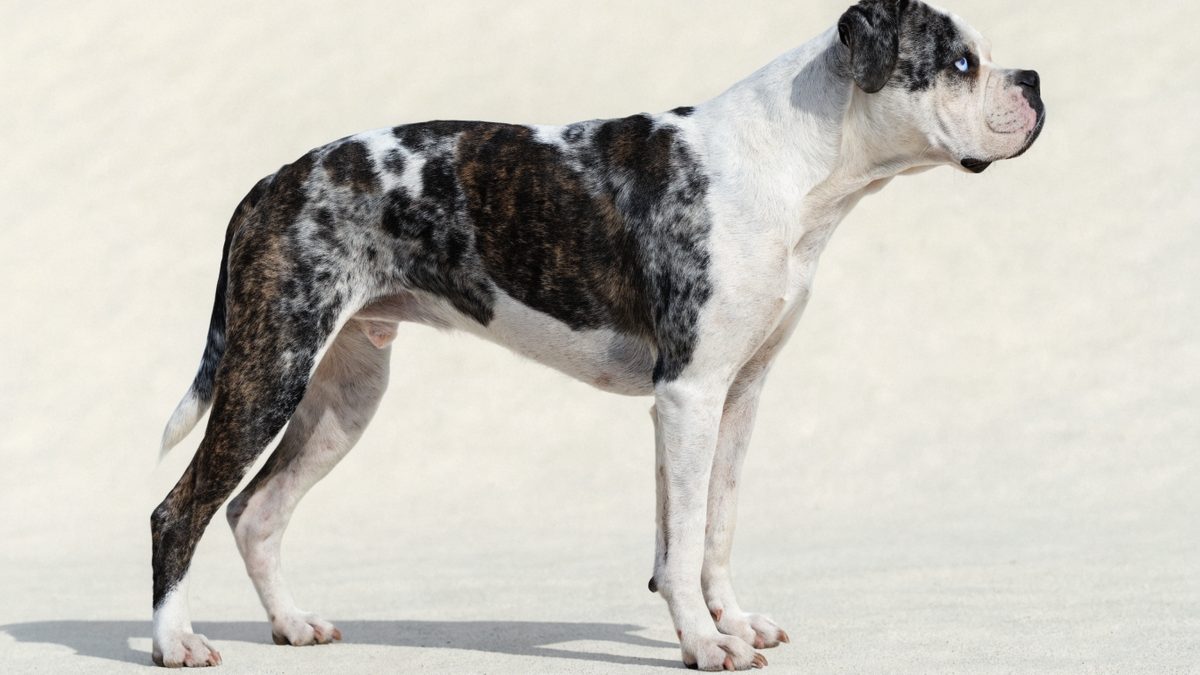
The Alapaha Blue Blood Bulldog is a rare American bulldog-type breed from the Alapaha River country of southern Georgia, bred to catch and hold unruly cattle, work free-range hogs and guard a farm. It is a muscular dog with a large head, a short coat that is usually white with coloured patches, and a natural undocked tail.
Start with the job, because every physical feature follows from it. The breed's own standard says it was selected for physical capability and working efficiency rather than for appearance or intimidation, strong enough to catch and hold aggressive cattle and agile enough to manage free-range hogs. That is a catch dog and a guard dog in one animal. It is also why the standard describes a functional, well-balanced bulldog rather than an exaggerated one.
The short coat is close, glossy and stiff to the touch, and the preferred pattern is at least 50 percent white with patches of colour. The Continental Kennel Club describes the same coat as a single coat of one inch or less that should never show fringing, wave or furnishings. The breed club adds that in cold climates the dog grows a winter undercoat which it sheds in late spring, and that the shedding is barely noticeable. For an Indian reader that last point matters more than it looks, and the climate section returns to it.
Two published standards, and they contradict each other
This is the part no other page prints. The Alapaha Blue Blood Bulldog has two separate published breed standards, one from the Alapaha Blue-Blood Bulldog Association and one from the Continental Kennel Club, and they do not describe the same dog. Bonbeno read both in full. A dog that meets the preferred bite in one is disqualified under the other.
| Attribute | ABBA official standard | CKC official standard |
|---|---|---|
| Male height | 20 to 24 inches | 22 to 25 inches |
| Male weight | 70 to 90 lb | 70 to 110 lb |
| Female weight | 55 to 75 lb | 65 to 75 lb |
| Bite | Undershot 1/8 to 1/4 inch preferred. Scissors or even bite disqualified | Scissor, level, reverse-scissor or undershot by 1/8 inch or less |
| Rose ears | A fault | Permitted, if small |
| Muzzle specification | Absolute, 2 to 4 inches | Proportional, 40 percent of head length |
| Cropped ears | Disqualified in the show ring | Incorrect for the breed |
| Docked tail | Disqualified in the show ring | Incorrect for the breed |
The bite row is the sharp one. The ABBA standard prefers a definite undershot of 1/8 to 1/4 inch and disqualifies a scissors or even bite outright. The CKC standard accepts a scissor bite and caps undershot at 1/8 inch or less. A quarter-inch undershot dog is the ABBA ideal and outside the CKC range. Bonbeno prints both rather than picking the convenient one, because there is no higher authority to appeal to. Neither body is recognised by the FCI, the AKC or the Kennel Club of India.
The two standards agree on the things that matter most to a buyer here. Both call cropped ears incorrect, and both call a docked tail incorrect Continental Kennel Club. Wikipedia's reference works record the same, that the tail is kept undocked. Mutilating an animal is separately an offence under section 11(1)(l) of the Prevention of Cruelty to Animals Act, 1960. On this breed, the foreign standards and Indian law point the same way, which is unusual and worth knowing.
Three incompatible origin stories
The history of this breed is genuinely disputed, and its own registry says so first. The ABBA states plainly that the origin is undocumented and unverifiable before 1979, and that authorities differ so completely that the name itself is in dispute. That is a remarkable sentence to find on a breed club's own site, and it is more honest than anything the ranking pages say.
- The ABBA account. The breed descends from an extinct type known as the Mountain Bulldog, Old Southern White and Old Country Bulldog, brought to America in the early 18th century, and the modern breed was named by a small group of Southerners who founded the ABBA in 1979 as its breed club and founding registry. Named founding breeders include Papa Buck Lane and William Chester of Georgia, and Cecil Evans and Kenny Houston of Florida.
- The template-page account. The breed results from three generations of one breeding programme run by PaPa Buck Lane of Rebecca, Georgia, continued by his granddaughter Lana Lou Lane until her death in 2001, and the Animal Research Foundation was the first all-breed registry to register it, in 1986.
- The reference-book account. For multiple generations the breed was bred solely by the Lane family of Rebecca, Georgia, who eventually started a breed registry with a foundation dog named Otto.
Those cannot all be true, and the ABBA says so in blunt terms. Its FAQ states that Lana Lou Lane was not the originator but the association's first secretary, that she was banned from the ABBA and joined the Animal Research Foundation in 1986 for merit-registration purposes, and that she merit-registered more than 300 dogs out of roughly 800 she bred. The ABBA calls that practice fraud in capital letters on its own website. Bonbeno reports the dispute as a dispute. We have no way to adjudicate it and we will not pretend otherwise.
A breed with 120 to 150 living dogs at the start of this century and two registries that call each other's dogs unauthentic has no single agreed studbook. The ABBA will not register a dog without heritage traceable to the first 50 dogs recorded in 1979. So a pedigree from one body is not accepted by the other. For a buyer, that means the word purebred carries less information for this breed than for almost any other on this site.
One more physical claim deserves scrutiny because it is repeated everywhere. Wikipedia's reference works state that sexual dimorphism is common, with males typically twice the weight of females. Neither published standard supports that. The ABBA puts males at 70 to 90 lb and females at 55 to 75 lb, a difference of roughly a quarter, not double. Where a written standard and a secondary summary disagree on arithmetic, Bonbeno reports the standard and flags the summary.
Alapaha Blue Blood Bulldog price in India
There is no Alapaha Blue Blood Bulldog price in India, because there is no Indian market for the breed. Bonbeno ran an India-restricted search for the breed and for its price, opened the pages that ranked, and found no Indian breeder, no Indian dog and no verifiable Indian figure. That is the finding, and we will not manufacture a range to fill it.
Say the useful part first. Availability in India is effectively zero, and the reason is structural rather than accidental. The breed has no FCI listing, so it cannot enter the Kennel Club of India studbook, and Indian import policy does not permit bringing dogs in to breed or sell. Between those two facts, no lawful domestic supply chain can form. The next two sections set out the evidence for each.
What the top-ranking India price page actually returns
The page that ranks first in India for this breed's price query is a marketplace listing page on Mr n Mrs Pet. Bonbeno opened it. It reports 3 Result Found, and the three dogs it then displays are a Cavalier King Charles Spaniel in Bangalore, a Newfoundland in Pune and an English Bulldog in Kavaratti. Not one is an Alapaha Blue Blood Bulldog.
The breed name on that page is a value in a dropdown filter that runs alphabetically from Affenpinscher to Yorkshire Terrier and includes entries such as Alabai, American Tundra Shepherd and Culture Pomeranian. A name in a filter menu is not a dog for sale. The same site publishes city variants of the page for places including Ahmedabad and Deogarh, generated the same way.
The page states that it provides healthy, purebred KCI-certified Alapaha Blue Blood Bulldog puppies in India, and its meta description offers KCI registered puppies of the breed. No such certificate can exist. The Kennel Club of India is India's only FCI-affiliated national kennel club, it registered 33,880 pure-bred dogs with its studbook in 2025 from 7,412 litters, and the FCI nomenclature does not contain this breed. Treat a KCI claim for an Alapaha as a reason to walk away, not as reassurance.
The published foreign figures, and why they do not transfer
Foreign prices exist and Bonbeno reports them as what those pages state, nothing more. They are not an Indian price in india and converting them into rupees would produce a number that looks precise and means nothing.
| Source and market | Quoted price | What it is based on |
|---|---|---|
| Dogbreedslist.info, United States | USD 1,500 to 2,500 average | No method, no sample, no date stated |
| Dogbreedslist.info, farm-bred | USD 1,500 to 1,800 | Described as a normal breeding farm price |
| Dogbreedslist.info, pedigreed with breeding rights | USD 2,500 to 3,000 and rising | No registry named for the pedigree |
| Pets4Homes, United Kingdom | GBP 300 to 500 | Individual breeders, no Kennel Club premium as the breed is unrecognised |
| India, every source checked | No figure exists | No Indian breeder, no Indian listing, no verifiable price |
Look at the spread rather than the midpoint. The same breed is quoted at roughly USD 2,000 in the United States and roughly GBP 400 in the United Kingdom, which is a gap of about four times for an animal with the same paperwork behind it, which is to say almost none. That spread is what a price looks like when no registry underwrites it.
The United Kingdom page is worth one further look, because its own live adverts undercut its price section. Alongside a stated GBP 300 to 500 puppy range, the two adverts running on the page were a four-year-old bitch at GBP 100, described by her owner as very nervous and very reactive, and a three-year-old being rehomed at GBP 300. The real market in a country with no breeding base is a rehoming market, and that is the honest signal in those numbers.
We will not borrow a price from the American Pit Bull Terrier, the American Bully or the Bulldog, all of which have real Indian markets with multiple conflicting published sources that we compare on their own pages. Those figures describe dogs that are actually sold here. They tell you nothing about an animal that is not.
Recognition: which bodies register this breed, and which do not
No major kennel club recognises the Alapaha Blue Blood Bulldog. Bonbeno checked the FCI, AKC, UKC, OFA and KCI positions against those bodies' own published lists rather than against breed sites, because recognition is the single most misreported fact about this breed.
The claim you will see repeated is that the breed is recognised by the ARF, the CKC and sometimes the UKC. Two of those are real registries with published breed entries. None of the three is a national kennel club of the kind that produces a pedigree an Indian buyer can verify.
What each body's own list says
| Body | Position | Evidence Bonbeno read |
|---|---|---|
| Fédération Cynologique Internationale | Not recognised, not listed | FCI nomenclature letter A runs Affenpinscher to Azawakh with no Alapaha entry |
| American Kennel Club | Not recognised, and not in the Foundation Stock Service standards | The AKC's alphabetical FSS Breed Standards compilation of 25 June 2026 opens at the Alaskan Klee Kai, which sorts after Alapaha |
| United Kennel Club | Listed only under the Bloodlines Listing Service, no standard, cannot be shown | UKC's own page states no breed standard exists and the breed is not eligible for UKC Conformation events United Kennel Club |
| Kennel Club of India | Not registrable, because the KCI follows FCI nomenclature | The KCI is India's only FCI-affiliated national club Fédération Cynologique Internationale |
| Alapaha Blue-Blood Bulldog Association | Recognised. Founding breed club and registry since 1979 | ABBA publishes the official standard and operates the online registry Alapaha Blue-Blood Bulldog Association |
| Continental Kennel Club | Recognised. Breed Group 3, Molossoids and Mastiffs | CKC publishes a full breed standard and a breeder marketplace for the breed |
| Animal Research Foundation | Recognised in 1986, and disputed | Reported as the first all-breed registry to recognise the breed, a claim the ABBA rejects |
| Orthopedic Foundation for Animals | Accepts submissions under the name ALAPAHA BULLDOG | Listed in the OFA browse-by-breed index |
The UKC row is the one that corrects the most misinformation. The UKC recognises over 300 breeds and files this one in a group called the Bloodlines Listing Service, alongside the Armenian Gampr and the Phu Quoc Ridgeback. Its page for the breed states, in its own words, that no breed standard exists for the Alapaha Blue Blood Bulldog and that the breed is not eligible to compete in UKC Conformation events. A dog can be recorded there. It cannot be judged there.
The ABBA's own website names the ARF, the ACA, the NKC, the CKC, the IOEBA, the OREBA, the URBA, the FIC, the DRA and the WWKC as create-a-breed registries, states that great damage has been done to the breed by cross-breeding registered through them, and describes the practice of merit-registering unrelated dogs as fraud Alapaha Blue-Blood Bulldog Association. The Continental Kennel Club, which is on that list, publishes a detailed standard for the breed and runs a breeder marketplace for it. Bonbeno takes no side. We record that the breed's own founding club regards a second registry's dogs as not the breed.
Wikipedia's infobox summarises the position as not recognised as a breed by any major kennel club, citing two reference encyclopedias. The United Kingdom marketplace page reaches the same conclusion for 2025, that the breed remains unrecognised by major registries including the Kennel Club. Bonbeno confirmed both against the FCI, AKC and UKC lists directly American Kennel Club United Kennel Club.
The practical consequence for an Indian reader is short. There is no route to a KCI pedigree for this dog at any price. The KCI is FCI-affiliated and the FCI does not list the breed. Any certificate offered with an Indian Alapaha is therefore a reason for more scrutiny, not less.
Heat tolerance and the Indian climate
Bonbeno rates the Alapaha Blue Blood Bulldog 3 out of 5 for heat tolerance in Indian conditions. That is better than the flat-faced bulldogs it is routinely confused with and well short of a native Indian breed, and the reasoning below sets out exactly what earns each part of the score.
Take the favourable side first, because it is stronger than the breed's name suggests. This is a short-coated dog with a single coat of an inch or less that never carries furnishings, and the breed club states that an undercoat develops only in cold climates and is shed in late spring. A dog kept in Chennai or Nagpur therefore carries far less insulation than the northern double-coated imports Indian owners struggle with most.
The breed's own history explains why, and it is the single most India-relevant fact on this page. The ABBA writes that the original European bulldog was acclimated to a much cooler climate than the rural southern United States, that this produced an inherent lack of tolerance to heat, and that southern stockmen therefore crossed bulldogs with local cur types to get a better all-round dog. The outcrossing that created this breed was, by its own registry's account, partly a heat adaptation. No other bull breed on this site can say that.
How brachycephalic is it, really
Now the unfavourable side, stated precisely rather than by analogy. Wikipedia's reference works describe the breed as having a large head and a brachycephalic muzzle, and the breed club accepts the label, writing that the undershot bite is part of its bulldog heritage and that you will never see a dog with a brachycephalic muzzle without one. So the word applies. The question is how far it applies.
Both standards answer that, and both answer it in the direction of a working muzzle. The ABBA requires a medium-length muzzle of 2 to 4 inches and makes a muzzle under 2 inches a structural fault, meaning a fault that affects agility, endurance and strength. The CKC goes further and states outright that an overly brachycephalic skull resembling that of an English Bulldog is incorrect for any variety of the breed, that the jaws must never appear excessively brachycephalic or flat-faced, and that dogs showing any sign of breathing or locomotive difficulty are disqualified from the show ring.
The CKC standard sets an ideal muzzle-to-skull ratio of between 1:4 and 2:3 and an ideal muzzle length of 40 percent of total head length. Those are written targets, not measurements of living dogs. No published morphometric study has measured craniofacial ratio in a population of Alapaha Blue Blood Bulldogs, and no airway grading scheme covers the breed. Bonbeno will not convert a number in a standard into a risk estimate and present the result as evidence. The honest position is that this breed's airway risk is unquantified, that its standards actively resist the extreme flattening seen in the Bulldog, and that you should have a vet assess the individual dog's nostrils and its breathing at rest and after exertion rather than trusting the breed label in either direction.
The breed club overstates the case in the other direction, and that deserves the same scepticism. Asked whether the Alapaha has inherent breathing problems like the English Bulldog, the ABBA answers no, and says its ability to run in all types of weather is well documented. No document is cited. There is no published study of exercise tolerance, airway function or heat-related illness in this breed. A confident no from a breed club is not evidence, any more than a confident yes from a listicle would be.
What the population-level evidence does say
The largest primary-care study of heat-related illness in dogs examined 905,543 dogs under UK veterinary care in 2016 and identified 395 confirmed events. Incidence was 0.04 percent and the event fatality rate was 14.18 percent, with a 95 percent confidence interval of 11.08 to 17.96 percent. Three of its risk factors apply directly to this breed: a brachycephalic skull shape, a bodyweight higher than the breed and sex mean, and being over two years of age. Dogs weighing over 50 kg were also at greater risk.
Read those against the CKC weight range of 70 to 110 lb for males, which tops out at roughly 50 kg. A heavy male at the top of that range sits at the boundary of the highest-risk weight band in the only large study available. That is a body condition argument as much as a breed argument, and body condition is the part an owner controls.
The Indian variables that the UK study cannot capture
- Humidity beats temperature. Panting sheds heat by evaporation, so a humid coastal day in Mumbai, Chennai or Kochi removes cooling capacity that the same dog would keep in dry Rajasthan heat at the same air temperature.
- Drive overrides self-preservation. A dog selected to catch and hold cattle keeps working past the point where a pet would stop. You call the stop, not the dog.
- The usable window is narrow from March to June. Across most of India, move all real work to before 7 am and after 8 pm and treat the middle of the day as unusable for a 40 kg dog.
- Check the pavement with your palm. A short coat does nothing for paw pads, and the CKC standard describes tough pads on a working foot rather than an armoured one.
- Learn the early signs of heat stroke before you need to recognise them, and treat a suspected case as an emergency rather than something to watch overnight. Consult your nearby vet about a written plan for the hot months.
Compared across this site, a 3 puts the Alapaha above the Bulldog and the Pug, roughly level with other short-coated guarding molossoids, and clearly below the Indian Pariah Dog, which is adapted to this climate rather than managed through it. If Indian summers are the constraint that actually decides your choice, the honest answer is a native breed.
Monthly cost of ownership in India
No reliable monthly cost figure exists for an Alapaha Blue Blood Bulldog in India, because there is no Indian population of the breed to survey. This section sets out the cost structure a 32 to 50 kg guarding bulldog would carry in an Indian city, and refuses to publish a rupee total that would be invented.
Bonbeno publishes a monthly cost only where we can state the sample size, the cities covered and the collection date. For this breed we have none of those. What can be said honestly is which line items dominate and why, and where this breed is cheaper than the imported bulldogs Indian buyers actually own.
Where the money goes, in order of size
- Food. The two standards put adult males between 70 and 110 lb, which is 32 to 50 kg Continental Kennel Club. Food is the largest recurring line for any dog of that mass, and a lean muscular working build does not eat less than a fat one.
- Preventive veterinary care. Core vaccination, boosters, deworming and year-round tick control. A PCR survey of 525 dogs across four Indian cities found 261 of them, or 49.7 percent, infected with at least one tick-borne pathogen, most commonly Hepatozoon canis at 30 percent and Ehrlichia canis at 20.6 percent. Ticks were found on 53 percent of the dogs examined.
- Cooling. For a dog of this mass in an Indian summer, cooling is a health cost rather than a comfort. Budget for it the way you would budget for medicine.
- Containment. A territorial guarding breed needs real fencing and a rehearsed gate protocol. Owners routinely underestimate this and then pay for it twice.
- Professional training. Not optional for a guarding breed in an Indian city. Budget for a competent reward-based trainer from month one rather than a behaviourist in year two.
- Hearing and joint screening. The breed club's own advice is to buy from a breeder who screens for hip dysplasia by OFA or PennHIP and for deafness by BAER. Neither test is universally available in India and both cost real money where they are.
- Import and quarantine, if the dog comes from abroad. Covered in the adoption section. It is the largest single number on this page and it is not a puppy price.
Where we publish a cost, we publish the method with it. The United Kingdom marketplace page for this breed quotes GBP 40 to 50 a month for food and GBP 100 to 180 a month for routine veterinary care and insurance. Those are British costs on a British veterinary market and Bonbeno is not converting them into rupees, because the exchange rate is the least important difference between the two markets.
One line is genuinely cheap, and it is the one buyers worry about most. Grooming costs almost nothing. A short, close, glossy single coat needs a rubber mitt once or twice a week and no professional attention at all. Against a double-coated import, that is a real recurring saving in an Indian city where a full groom is a monthly appointment.
Temperament and household fit
The Alapaha Blue Blood Bulldog is described by both its standards as loyal, intelligent, highly trainable and naturally protective, wary of strangers, and assertive with other dogs. Those two halves are both real, and the second is why this is not a general-purpose family breed.
The ABBA standard is worth quoting closely because it is specific. Alapahas are possessive and attentive, establish their territory at a young age and demand attention, are not suited for kennel life, thrive where they can interact with their families, and are naturally protective and wary of strangers, benefiting from early training and socialisation. Disposition should be alert and outgoing with a self-assured demeanour, and shyness is a disqualification.
The CKC standard adds a useful correction for anyone imagining an easy dog. It warns that with management potential comes a personality that likes to self-appoint, so the dog must understand its role in the family or it will take over control of every job, and it notes that adults may develop aloofness toward strangers, which is not to be penalised. Unprovoked aggressive or fearful behaviour toward people is incorrect for the breed.
Territorial is not the same as dog-aggressive, and the club draws the line
Asked directly whether Alapahas are aggressive toward other dogs, the ABBA answers that they are territorial rather than dog-aggressive, defines dog aggression as unabated aggression toward another dog whether it is a threat or not, and describes a well-bred Alapaha as dog dominant, defending its territory when it perceives a confrontation. That is a more careful distinction than most breed clubs draw, and it is still a management problem in an Indian neighbourhood with free-roaming street dogs.
The ranking pages are less careful. The top template page rates dog friendliness at 1 star out of 5 and stranger friendliness at 1 star out of 5, while rating child friendliness at 4. The CKC standard permits same-sex intolerance and asks only that disruptive dogs be excused from the show ring. Read together, plan for a dog that needs active management around other dogs and take the child-friendly rating as conditional on supervision.
Animal fighting is a criminal offence in India
Any honest account of a bull-type catch breed has to deal with this directly, and this breed's recorded history includes bull baiting and bear baiting before it became a cattle and pig herder. Bonbeno reports that as breed background because it explains the animal's construction. It is history, not a recommendation.
Forcing animals to fight is illegal in India. Section 11(1)(m)(ii) of the Prevention of Cruelty to Animals Act, 1960 makes it an offence, solely with a view to providing entertainment, to incite any animal to fight or bait any other animal. Section 11(1)(n) separately makes it an offence to organise, keep, use or act in the management of any place for animal fighting or for baiting any animal, to permit or offer any place to be so used, or to receive money for admission to such a place. Bonbeno publishes nothing that instructs, encourages or assists animal fighting or baiting.
Catch work on livestock is what this breed was built for and it is a legitimate agricultural history. Fighting another dog is not, and the two get deliberately blurred by bad sellers. Any seller who presents fighting ability, gameness or a fighting bloodline as a selling point is describing a criminal use of the animal under sections 11(1)(m)(ii) and 11(1)(n) of the PCA Act 1960. Walk away, and consider reporting the listing. A seller worth dealing with talks about temperament stability, BAER and hip screening, and placement suitability, and will refuse a sale to the wrong home.
Who this breed suits, and who it does not
- Good fit. Rural or semi-rural Indian households with secure land, prior experience of large guarding breeds, someone home most of the day, and a genuine daily job for the dog.
- Poor fit. Apartments, first-time owners, households empty all day, and anyone buying on appearance. The breed club states plainly that Alapahas are not suited for kennel life and thrive on family interaction.
- Watch item. Territory is established young. In a dense Indian neighbourhood with delivery riders, domestic staff and street dogs at the gate, that instinct needs active management rather than encouragement.
- Legal watch item. Ownership is legal across India and this breed was not named in the March 2024 central list. Municipal rules are made locally and can change, so ask in writing.
Training an Alapaha Blue Blood Bulldog
Train an Alapaha Blue Blood Bulldog with reward-based methods from the first week home, and treat impulse control and calm gate behaviour as the two skills that decide how the next decade goes. Both standards credit the breed with high trainability and real intelligence, so the ceiling is high.
The breed club makes one statement that is more useful than anything else written about training this dog. Asked when a puppy should start showing signs of being a protection dog, the ABBA answers that suspicion or assertiveness appears at about 5 to 8 months in females and 9 to 12 months in males, that this is a juvenile facade, and that it can only be enhanced through training. It then states in capitals that there is no breed that exists today or ever existed that was a natural guardian. Take that seriously. It means guarding behaviour in this breed is produced by what you do, not by what you bought.
What to train first, in order
- Name response and a reliable recall. Start week one. This is the skill that makes every other skill usable.
- A trained release. Teach a clean out or drop on cue with toys long before it is ever needed for anything else. In a catch-bred breed this is a safety behaviour, not a party trick.
- Gate and doorway protocol. A territorial dog at an Indian gate with constant footfall needs a rehearsed routine rather than improvisation.
- Loose-lead walking. You will not out-muscle a 40 kg dog. Do this in month two, not year two.
- Settle on a mat. The most underrated behaviour for a large dog in a busy household.
- Handling and muzzle conditioning. Condition a basket muzzle as a neutral, positive object early. It makes veterinary care safer and keeps options open.
- Sound and touch work for a possibly deaf dog. In a breed with this much white, build hand signals alongside voice cues from day one. The health section explains why.
Socialisation, and the Indian timing problem
Socialise the puppy deliberately and early, because a guarding breed that misses the window becomes a genuinely difficult adult. The practical Indian complication is that the sensitive period overlaps the vaccination course, and owners who isolate a puppy until the last shot lose the window. Discuss managed low-risk exposure with your vet rather than choosing between infection risk and behavioural risk.
Three things reliably go wrong. Harsh correction applied to a self-assured working dog escalates arousal instead of reducing it, and the CKC standard is explicit that positive reinforcement outperforms dominance approaches for this breed's temperament. Under-employment produces destruction rather than calm, because a dog bred to patrol does not idle well. And inconsistency at the gate teaches a territorial dog that the rules are negotiable, which is the one lesson you cannot afford it to learn.
Realistic timelines
| Skill | Start | Reliable by |
|---|---|---|
| Name response | Week 1 home | 3 to 4 weeks |
| Sit, down, settle | Week 1 home | 4 to 8 weeks |
| Toilet training | Week 1 home | 4 to 6 months |
| Trained release on cue | Month 1 | 6 to 10 months |
| Loose-lead walking | Month 2 | 8 to 12 months |
| Calm gate behaviour with visitors | Month 2 | 12 to 18 months |
| Reliable recall off-lead | Month 2 | 12 to 24 months |
Adolescence lands in the same window the breed club identifies for the first guarding behaviour, from about 5 months in females and 9 months in males. Trained behaviours wobble, the dog starts forming its own view of strangers, and owners who switch to harsher handling at that point do lasting damage. Hold the line and it passes.
Daily exercise requirement
Plan on 60 to 90 minutes of real work a day for an adult, split across the two cool ends of an Indian day, plus daily mental work. Bonbeno states that as an editorial judgement derived from the breed's described function, not as a published veterinary recommendation, because no exercise study exists for this breed and the published figures disagree wildly.
Look at the disagreement before you accept any number. The United Kingdom marketplace page says the breed needs around 20 to 40 minutes of daily exercise and calls its needs moderate. The top United States template page rates exercise needs 3 out of 5, says the demand is average, and calls the dog very inactive indoors. The breed's own standard describes an athletic dog bred to catch and hold aggressive cattle and manage free-range hogs across a farm. Those three cannot all describe the same animal.
The breed club adds a detail that resolves part of it. It says conformation varies between strains because the jobs varied, that guard-dog breeders favour dogs around 90 lb, and that catch-dog breeders favour dogs of 70 to 80 lb that are longer legged with longer muzzles so they can breathe while coursing game. A guarding-line Alapaha and a catch-line Alapaha genuinely have different exercise requirements, which is why a single published figure was always going to be wrong.
The Indian scheduling problem
The exercise requirement and the heat constraint collide, and this is the hardest practical problem with keeping the breed here. From March to June across most of India, the usable window is before 7 am and after 8 pm. That is two sessions, and both have to count.
- Long structured walks on varied terrain in the cool windows, rather than one lap of the block twice.
- Scent work indoors when it is too hot or the monsoon is running. Twenty minutes of nose work tires a working bulldog more than twenty minutes of pavement.
- Controlled tug with rules, which is honest outlet for a catch-bred dog provided the release cue is solid and you decide when it starts and stops.
- Weight-pull or drag work with proper equipment on a conditioned adult, never on a growing puppy.
- Skip the midday session entirely. Two good sessions beat three that include one dangerous one.
Large-breed growth plates stay open well past the first birthday, and forced exercise before they close causes permanent orthopaedic damage. No jogging, no stair marathons and no repetitive impact work with a puppy of a 32 to 50 kg breed. Build adult load gradually from around 18 months and set the specific plan with your nearby vet, who can assess the individual dog.
What happens without it
Under-exercised guarding bulldogs do not become calm house dogs. They become destructive, harder to handle at the gate and more reactive on lead, and the breed club's own warning about a dog that will self-appoint and take over every job in the household describes exactly what an under-employed one does. This is the most common route by which a dog of this type ends up rehomed, and it is entirely predictable at the point of purchase.
If the honest answer is that your household cannot supply an hour a day, every day, for a decade, choose a different breed rather than treating it as a problem to solve later. The Indian Pariah Dog needs a fraction of the structure and handles the climate better.
Grooming and coat care in Indian humidity
Groom an Alapaha Blue Blood Bulldog for about ten minutes a week. The coat is a short, close, glossy single coat of an inch or less that is stiff to the touch, so a rubber curry mitt once or twice a week is the entire coat routine.
The useful detail for India is what the coat does not have. The CKC standard specifies a single coat with no fringing, wave or furnishings, and the breed club states that a winter undercoat develops only in cold climates and is shed in late spring, barely noticeably. A dog living its whole life in Pune or Hyderabad is therefore carrying close to no insulating layer, which is the opposite of the problem a Siberian Husky owner has here.
The template page rates grooming 1 out of 5 and shedding minimal, and calls it low maintenance. On this point the ranking pages and the standards agree, and Bonbeno agrees with them. The work in Indian conditions is on the skin, the ears and the parasites rather than the hair.
The monsoon checklist
- Run tick control year-round, not seasonally. Ticks of the genera Rhipicephalus and Haemaphysalis were found on 278 of 525 dogs, or 53 percent, in an Indian survey, and 49.7 percent of those dogs carried at least one tick-borne pathogen.
- Dry the neck and any dewlap folds properly after every bath and every soaking. Both standards permit a slight dewlap, and a damp crease in monsoon humidity is where skin infection starts.
- Check the ears weekly. Ear carriage varies between drop, button and rose in the CKC standard, and a folded ear in a wet season needs the access that early handling training gives you.
- Do not over-bathe. Stripping a stiff working coat of its oils creates the skin problem you were trying to prevent.
- Check pads and nails weekly. Indian tarmac tests the tough working foot the standard describes.
- Watch pink-skinned white dogs in the sun. A breed whose preferred pattern is at least 50 percent white carries unpigmented skin, and unpigmented skin burns.
There is no trimming, stripping or clipping in either standard, and the CKC is explicit that the coat should never show fringing or furnishings. Ignore any Indian groomer who suggests shaving a short-coated dog for summer. On a single-coated breed it removes sun protection without improving cooling, and it is the wrong intervention for the wrong reason.
Health risks and lifespan
The Alapaha Blue Blood Bulldog has no published breed health survey, no compulsory screening scheme and no peer-reviewed lifespan study. What it does have is a breed club that names its own risks, a colour preference that stacks two known deafness risk factors together, and a gene pool that everybody describing the breed calls small.
Bonbeno will not import health figures from the Bulldog, the American Pit Bull Terrier, the American Bulldog or any other bull breed to fill this section. Those are different breeds with different founder populations, and borrowing their prevalence numbers would produce exactly the confident, wrong page this encyclopedia exists to replace. What follows is what is actually documented for this breed, and what plainly is not.
What the breed club itself names
Asked what the health concerns are given such a limited gene pool, the ABBA answers directly. It advises buyers to go with a breeder who screens for hip dysplasia by OFA or PennHIP, for deafness by BAER, and for blindness, skin disorders and entropion. It also tells buyers to get a written guarantee, to ask whether the breeding stock is health screened, to ask for a three-generation pedigree and to ask for at least five references. That is a real screening list from the founding breed club, and it is the single most useful health document available for this breed.
What it does not contain is a single prevalence figure. There is no published percentage for hip dysplasia, deafness, entropion or skin disease in this breed, because no survey has been done. Bonbeno records the screening advice and states plainly that the underlying rates are unknown.
Congenital deafness, which is the risk the standards create
This is where the evidence is strongest, and it comes from the breed's own colour preference rather than from a borrowed statistic. The ABBA standard prefers a pattern of at least 50 percent white, permits any shade of merle, and states that all-white dogs are acceptable but require proper pigmentation to avoid genetic defects like deafness, blindness or skin issues. Blindness and deafness are separately listed as disqualifications. The CKC standard permits merle across most colours and warns that large amounts of white indicating a homozygous merle genotype are undesirable and should be avoided in breeding programmes.
Both warnings are correct, and the published numbers show why. In a study of dogs carrying the merle allele, overall deafness prevalence was 4.6 percent unilateral and 4.6 percent bilateral. Split by genotype, single merles were 2.7 percent unilaterally deaf and 0.9 percent bilaterally deaf, while double merles were 10 percent unilaterally deaf and 15 percent bilaterally deaf. The same paper records that deafness prevalence in dogs homozygous for recessive alleles of the piebald locus, which is what produces extreme white, can be as high as 30 percent for unilateral and bilateral deafness combined.
| Pattern | Published deafness prevalence | What the Alapaha standards say |
|---|---|---|
| Single merle (Mm) | 2.7% unilateral, 0.9% bilateral | Merle permitted in both standards Continental Kennel Club |
| Double merle (MM) | 10% unilateral, 15% bilateral | CKC calls the phenotype undesirable and says avoid it in breeding |
| Extreme white piebald breeds | Up to 30% combined in some breeds | ABBA prefers at least 50% white |
| All-white dogs | Highest risk group in pigment-linked deafness | ABBA accepts them with a pigmentation caveat |
The template page that ranks for this breed tells readers that the preferred colours are blue merle, brown merle or red merle trimmed in white, and that glass eyes, meaning blue eyes, and marble eyes are also preferred. Congenital sensorineural deafness in dogs is associated with exactly these pigmentation genes, and homozygous merles are usually nearly solid white and may be deaf, blind with microphthalmic eyes, and sterile Strain GM, Clark LA, Wahl JM, Turner AE. A page telling Indian buyers to seek out merle-on-white with blue eyes is steering them toward the highest-risk phenotype in the breed. Ask for a BAER hearing test result on the puppy and on both parents before any money changes hands.
Lifespan, where three sources disagree and none is a study
No peer-reviewed lifespan figure exists for the Alapaha Blue Blood Bulldog. Bonbeno searched for one and did not find it. Three published claims exist and they do not agree.
- 12 to 13 years, from the breed club, which adds that a physically sound dog should give at least 10 active years.
- 12 to 15 years, from the top-ranking template page, with no source given.
- 12 to 15 years, from the United Kingdom marketplace page, also with no source given.
None of the three cites a mortality survey, a registry dataset or a veterinary study. Bonbeno prints the spread rather than averaging it, and states clearly that the figure is a claim rather than a finding. A breed with an estimated 120 to 150 living dogs at the start of this century has no population large enough for a lifespan study to have been possible.
Claims Bonbeno could not verify
The United Kingdom marketplace page lists hip dysplasia, congenital deafness in predominantly white dogs, entropion, cherry eye, skin allergies, hyperuricosuria, bloat and Ehlers-Danlos syndrome as breed-specific conditions, and recommends BVA hip scoring, BAER testing and genetic screening for hyperuricosuria. Bonbeno does not repeat that list as established. No study, registry dataset or breed survey is cited for any of it, and several items are generic large-breed or generic bulldog conditions rather than findings about this breed. The deafness item is the one independently supported, and the entropion item matches the breed club's own screening advice.
The Orthopedic Foundation for Animals does list ALAPAHA BULLDOG as a selectable breed name in its browse-by-breed index, so submissions can be recorded under it. Being listed is not the same as having a CHIC panel or a meaningful sample, and Bonbeno publishes no OFA percentage for this breed because we could not establish one we would stand behind.
Nothing on this page is a diagnosis or a treatment plan. Consult your nearby vet, a registered veterinarian who has physically examined your dog, before acting on anything here, and treat sudden collapse, laboured breathing or suspected heat stroke as an emergency rather than something to watch overnight. On a breed with no published health data, an individual examination is not a second-best option. It is the only real information you will get.
Feeding and nutrition
Feed an Alapaha Blue Blood Bulldog as a large working breed, with controlled growth through puppyhood and a lean adult body condition maintained for life. Growth rate matters more than total volume, because fast growth in a large breed loads developing joints at exactly the wrong time.
Adult targets come from the standards, and the two disagree. The ABBA puts males at 70 to 90 lb and females at 55 to 75 lb. The CKC puts males at 70 to 110 lb and females at 65 to 75 lb. That is a 20 lb gap at the top of the male range, roughly 9 kg on the same dog. Feed the animal in front of you to a body condition score rather than to either chart, because a disagreement that large tells you the chart is not the authority.
A third and fourth figure exist and widen the picture further. The template page states a male weight of 100 lb and a female weight of 78 lb as single numbers rather than ranges, and the United Kingdom page gives 30 to 45 kg for males and 25 to 30 kg for females. Wikipedia's reference works give 50 to 90 lb across both sexes. Five published sources, five different adult weights. Print the spread; do not average it.
The lean-dog argument is a heat argument in India
Keeping this breed lean is not cosmetic. In the largest primary-care study of heat-related illness in dogs, a bodyweight higher than the mean for the breed and sex was an independent risk factor, and dogs weighing over 50 kg were at greater risk than lighter dogs. A male allowed to drift to the top of the CKC range sits at that threshold. Body condition is the one risk factor on that list an Indian owner fully controls.
- Use a large-breed puppy formulation through growth rather than an all-life-stages food.
- Split the daily ration across two meals. Both standards describe a deep chest with the brisket to the elbow, which is the classic deep-chested profile.
- Do not feed immediately before or after hard work, for the same reason.
- Score the body condition monthly by hand, feeling for ribs, rather than reading a weight off a scale in isolation.
- Expect appetite to drop in peak summer. Persistent inappetence is a veterinary matter, not a preference.
- Watch the skin if you change food. Skin disorders are on the breed club's own screening list.
Feeding quantities depend on the individual dog's age, weight, body condition, health status and workload. Set them with a registered veterinarian who has examined your dog, and revisit them as the dog matures and as the season changes. Consult your nearby vet before adding any supplement, particularly calcium, to a growing large-breed puppy.
The first year, month by month
Raise an Alapaha Blue Blood Bulldog puppy on controlled growth, deliberate socialisation inside the first three months, and heat management from the first summer. No breed-specific growth chart exists, so the timeline below is anchored on the two standards' adult weights, on Indian law, and on published veterinary guidance that applies to any large guarding breed American Veterinary Society of Animal….
One honest caveat sits above the whole section. There is no Indian breeding base for this breed, so almost nobody reading this will raise an Alapaha puppy in India. The timeline exists because the questions it answers are the ones that decide whether a large guarding bulldog turns out well anywhere, and because the Indian legal steps in months zero to two apply to any puppy bought here, whatever the seller calls it.
Weeks 0 to 8, what Indian law requires before a puppy may change hands
Six requirements in the Prevention of Cruelty to Animals (Dog Breeding and Marketing) Rules 2017 govern the sale of any pup in India, and Bonbeno read the Gazette text rather than a summary of it. Ask for each in writing.
- Registration first. No breeder may carry on breeding, or own or house dogs for breeding and sale, without a certificate of registration from the State Board, and the certificate must be prominently displayed at the establishment.
- Eight weeks minimum. Pups less than eight weeks in age are not to be sold.
- Microchip and records. Each pup sold must be micro-chipped, with a complete record of treatment and vaccination maintained, and a sale receipt retained carrying the micro-chip number.
- Parents at least eighteen months. Only mature dogs that have reached their eighteenth month may be bred, and both the female and the male must be certified healthy by a veterinary practitioner at least ten days before mating.
- No mutilation. Tail docking, ear cropping, de-barking, de-clawing, branding, dyeing and any other change of appearance by artificial means are strictly forbidden. Both Alapaha standards independently call cropped ears and a docked tail incorrect, so a cropped puppy fails the law and the standard at once Continental Kennel Club.
- No novelty breeding. Breeding to create new breeds of dogs or unusual looks is strictly prohibited. That rule bears directly on a breed whose own founding club accuses rival registries of manufacturing dogs.
Months 2 to 3, the window you cannot get back
Socialise hardest in the first three months, because that is the period the evidence identifies as decisive. The American Veterinary Society of Animal Behavior states that the primary and most important time for puppy socialisation is the first three months of life, and that it should be the standard of care for puppies to receive that socialisation before they are fully vaccinated. The same statement asks owners to expose puppies to as much variety as can be achieved safely and without causing excessive fear, withdrawal or avoidance.
In India that guidance collides with a real disease risk, and the AVSAB text already contains the resolution. It recommends classes on surfaces that are easily cleaned and disinfected, indoor environments where possible, every puppy up to date on vaccination and free of disease and parasites, and it says visits to dog parks or other areas that are not sanitised or are heavily used by dogs of unknown vaccination status should be avoided. A clean terrace and invited, vaccinated dogs beat the neighbourhood park, and the choice is not between infection risk and behavioural risk.
The breed club states that suspicion and assertiveness surface at about 5 to 8 months in females and 9 to 12 months in males, that this is a juvenile facade, and that guarding behaviour is produced by training rather than born into the dog. Both standards separately describe a dog that is naturally wary of strangers and that establishes its territory young Continental Kennel Club. A protective breed that misses its socialisation window does not become a neutral adult, and by the time the behaviour appears the window has closed.
| Age | What is happening | What you do |
|---|---|---|
| 0 to 8 weeks | With the breeder. Sale before eight weeks is not permitted | Verify the State Board registration, the microchip, the vaccination record and both parents' health certificates |
| 8 to 12 weeks | The core of the socialisation period, which the evidence puts at the first three months | Controlled exposure on clean surfaces, hand signals alongside voice cues, name response, handling and crate work |
| 3 to 4 months | Teething, rapid growth, first hot season for a spring litter | Start the gate routine, year-round tick control, short frequent outings in the cool windows only |
| 4 to 6 months | Adult teeth in, strength outpacing judgement | Loose-lead work while the dog is still liftable, trained release on cue, settle on a mat |
| 5 to 8 months, females | First suspicion of strangers, which the breed club calls a juvenile facade | Hold the reward-based approach. Harsher handling here does lasting damage |
| 9 to 12 months, males | The same window, later and usually stronger | Same answer, plus more structure and more mental work rather than more force |
| 12 to 18 months | Growth plates closing, adult muscular frame filling out toward 32 to 50 kg Continental Kennel Club | Build adult exercise load gradually. No forced running or repetitive impact before this |
Neutering age, where the evidence does not cover this breed
The largest breed-by-breed analysis of neutering age assessed joint disorders, cancers and urinary incontinence and published suggested guidelines for 35 breeds, including the Bulldog, the Boxer, the Rottweiler and the Great Dane. The Alapaha Blue Blood Bulldog is not one of the 35. Bonbeno will not transplant the Bulldog row onto this page, because the whole point of a breed-specific analysis is that the answer differs by breed, and borrowing a row would destroy the only thing that makes the study useful.
So the honest position is that no published neutering-age guidance exists for this breed. Decide it with a registered veterinarian who has examined your dog, using its adult size, its body condition and its individual health as the inputs. Consult your nearby vet before booking the surgery rather than after.
Hearing. In a breed whose preferred pattern is at least 50 percent white with merle permitted, a BAER test result on the puppy and both parents is the single most valuable document you can ask for, and it is the breed club's own advice. Build hand signals from week one regardless, because a deaf dog trained on hand signals from the start is not a difficult dog. Heat. A puppy's first Indian summer is the highest-risk one, and bodyweight above the breed and sex mean is an independent risk factor for heat-related illness. Keep the dog lean going into March and agree a hot-weather plan with your vet before you need it.
Alapaha compared with the breeds buyers confuse it with
The breed an Indian buyer most often confuses with the Alapaha Blue Blood Bulldog is the American Bulldog, and the two are separated by four documented differences: colour, adult size, muzzle proportion and legal listing. Bonbeno read all three standards side by side, and no page ranking for this term prints the comparison Continental Kennel Club United Kennel Club.
Start with why the confusion happens. Both are short-coated American farm bulldogs bred to catch cattle and hogs and to guard property, both come from the American South, and both carry a large square head on a muscular frame. The differences are real and they are written down.
Two rows do more work than the rest. The merle row is the one a buyer should act on. Merle is permitted in both Alapaha standards and is an outright disqualification in the American Bulldog standard, which also disqualifies deafness in either ear. The closest recognised relative to this breed therefore excludes, by rule, the exact pigmentation that the published prevalence data links to congenital deafness. That is not proof the Alapaha standards are wrong, and it is a serious disagreement between two bodies describing near-identical dogs.
The muzzle row settles the flat-face question with arithmetic rather than adjectives. The CKC sets the Alapaha's ideal muzzle at 40 percent of head length, which is the top of the American Bulldog's longer-muzzled standard type range and above the whole of its shorter-muzzled bully type range United Kennel Club. On the written targets, this breed asks for a longer muzzle than a Johnson-type American Bulldog, not a shorter one. Both standards separately disqualify any dog that shows difficulty breathing in the ring.
The 12 March 2024 circular named 24 entries, opening with Pitbull Terrier and including American Bulldog, Mastiffs, Terriers, Rottweiler, Cane Corso and every dog of the type commonly known as a Bandog. The Alapaha Blue Blood Bulldog appears nowhere in it. It makes no practical difference, because the circular no longer stands, and the adoption section below sets out exactly what happened to it. It matters for a different reason: a seller who tells you this breed is banned in India, or that it is exempt where the American Bulldog is not, is wrong on both counts.
Against the bull breeds India actually buys
Compare on what data exists rather than on temperament adjectives, because that is where these breeds genuinely separate. Every other breed in the table below has an Indian market, published Indian prices that Bonbeno compares on its own page, and in most cases a registry route. This one has none of the three.
| Breed | Available in India | KCI-registrable | Breed-specific health data published |
|---|---|---|---|
| Alapaha Blue Blood Bulldog | No verified listing found | No, not in FCI nomenclature | None. No survey, no lifespan study, no screening scheme |
| American Bulldog | Yes | No, not in FCI nomenclature | UKC standard with disqualifications, covered on its own page |
| American Pit Bull Terrier | Yes, widely | No | Yes, including OFA joint statistics and named DNA tests |
| American Bully | Yes, at the top of the price ladder | No | Yes, including OFA joint statistics |
| Bulldog | Yes | Yes, FCI Standard No 149 | Yes, large VetCompass primary-care studies |
| Staffordshire Bull Terrier | Yes | Yes | Yes, including a published disorder profile |
Read that table as a statement about evidence, not about quality. A breed with no published health data is not thereby healthy, and a breed with a long disorder list is not thereby worse. It means that for five of these six dogs an Indian buyer can ask a specific, checkable question before paying, and for the sixth there is nothing to check against.
And against the dog that already suits India
The comparison that actually answers most Indian searches is against the Indian Pariah Dog. It is short-coated, athletic, medium-sized, people-friendly, adapted to 45 degree summers rather than managed through them, named on no prohibited list anywhere in the country, and free or near-free to adopt. If the Alapaha's appeal is a short-coated athletic guarding dog with a big head, the Indie matches most of that description and matches it without an import authorisation, a disputed studbook or a pedigree no Indian body will issue.
Where the Alapaha genuinely differs is in deliberate guarding aptitude and in size, and the breed club is honest that the guarding half is trained rather than innate. If a trained protection dog is the actual requirement, a recognised breed with a real Indian population, a verifiable pedigree and published health data serves that purpose better than a rare import nobody here can screen, source or replace.
Mistakes Indian buyers make with this breed
Nine mistakes account for almost everything that goes wrong with the Alapaha Blue Blood Bulldog in India, and eight of them happen before the dog arrives. That is the unusual shape of this breed's risk profile. With no Indian population to speak of, the damage is done at the point of purchase rather than over a decade of ownership.
1. Believing a KCI certificate is on offer
The India-facing marketplace page that ranks first for this breed's price query advertises healthy, purebred KCI-certified Alapaha Blue Blood Bulldog puppies. No such certificate can be issued. The Kennel Club of India is India's only FCI-affiliated national kennel club, it registered 33,880 pure-bred dogs from 7,412 litters with its studbook in 2025, and this breed is absent from the FCI nomenclature that the KCI follows. A registration claim that cannot be true is the strongest single signal on the page, and it points at the seller rather than at the dog.
2. Choosing the highest-risk coat pattern on purpose
The top-ranking template page tells readers the preferred colours are blue, brown or red merle trimmed in white, and that glass eyes and marble eyes are also preferred. Published prevalence data runs the other way. Double merle dogs were 10 percent unilaterally deaf and 15 percent bilaterally deaf, against 2.7 and 0.9 percent for single merles, and deafness in dogs homozygous for recessive piebald alleles reaches as high as 30 percent combined in some breeds. The CKC standard itself warns that large amounts of white indicating a homozygous merle genotype are undesirable and should be avoided in breeding. Ask for a BAER result. Do not shop by colour.
3. Filing it mentally with the English Bulldog
This is the mistake that runs in both directions and both versions are wrong. Assuming an English Bulldog airway leads owners to write the breed off for India, when the CKC standard states outright that an overly brachycephalic skull resembling that of an English Bulldog is incorrect and that the jaws must never appear excessively flat-faced, and the ABBA makes a muzzle under 2 inches a structural fault. Assuming the opposite, that a longer muzzle makes the dog heat-proof, is equally wrong. No morphometric study, airway grading scheme or heat-tolerance measurement exists for this breed. Bonbeno rates it 3 out of 5 and says why, rather than borrowing a rating from the Bulldog.
4. Thinking the breed is banned, or that any bull breed is
There is no nationwide ban on this breed in India, and there is no nationwide ban on any dog breed. The 12 March 2024 circular from the Department of Animal Husbandry and Dairying listed 24 entries and this breed is not among them High Court of Karnataka at Bengaluru. The circular itself no longer stands, and the adoption section sets out the three court orders that ended it. Sellers use ban talk in both directions, either to create urgency or to imply that a rare breed is a legal workaround. Neither is accurate.
5. Planning to import one to breed or sell
Dogs are a Restricted item under ITC (HS) 01061900, and the DGFT trade notice permits import only for a pet dog with a valid pet book in the importer's own name, for research by an R&D organisation with a CPCSEA recommendation, or for internal security by the Defence and Police Forces. Import of commercial dogs for breeding or any other commercial activity is not permitted, and the notice states that applications for trading or breeding purposes, or made on behalf of another person or entity, shall be duly rejected. Anyone proposing to found an Indian line of this breed is describing an application that fails on the face of the rules.
6. Treating one registry's paper as settling the question
A pedigree from either body is a statement by that body and nothing more. The ABBA will not register a dog without heritage traceable to the first 50 dogs recorded in 1979, names the CKC among registries it calls create-a-breed registries, and describes merit-registering unrelated dogs as fraud. The CKC publishes a full standard for the breed and runs a breeder marketplace for it. Ask which registry, then read what that registry says about the other one before you decide what the paper is worth.
7. Borrowing another breed's health numbers
Indian buyers routinely research this breed by reading pit bull and bulldog material, and sellers encourage it. Those are different breeds with different founder populations. No breed health survey, no lifespan study and no screening scheme exists for the Alapaha Blue Blood Bulldog, and the three published lifespan claims of 12 to 13 and 12 to 15 years all come from sources that cite no study Pets4Homes, Alapaha Blue Blood Bulldog Dogs…. The breed is also absent from the 35-breed neutering-age analysis that covers the Bulldog, Boxer and Rottweiler. Where the data does not exist, the correct action is a thorough individual veterinary care assessment, not a substitute statistic. Consult your nearby vet.
8. Buying it as a ready-made guard dog
The breed club is blunter about this than any seller will be. It states that suspicion and assertiveness appearing at 5 to 8 months in females and 9 to 12 months in males is a juvenile facade that can only be enhanced through training, and that no breed that exists today or ever existed was a natural guardian. Buying a guarding outcome instead of building one produces an under-socialised adult in a dense Indian neighbourhood, which is the single most predictable bad ending for this type of dog.
9. The four small ones that show up in the first year
- Seasonal tick control. Run it year-round. Ticks were found on 53 percent of 525 Indian dogs surveyed and 49.7 percent carried at least one tick-borne pathogen.
- Shaving the coat for summer. A single short coat of an inch or less carries no undercoat to remove, so shaving strips sun protection from skin that is often unpigmented under a mostly white dog.
- Accepting a cropped or docked puppy. Rule 5(8) of the 2017 breeding rules forbids tail docking, ear cropping and any change of appearance by artificial means, and both standards call both procedures incorrect Continental Kennel Club.
- Letting a male drift to the top of the weight range. Bodyweight above the breed and sex mean is an independent risk factor for heat-related illness, and dogs over 50 kg carried greater risk. Keep the dog lean going into March.
Forcing animals to fight is a criminal offence in India. Section 11(1)(m)(ii) of the Prevention of Cruelty to Animals Act, 1960 makes it an offence, solely with a view to providing entertainment, to incite any animal to fight or bait any other animal, and section 11(1)(n) makes it an offence to organise, keep, use or manage any place for animal fighting or baiting, to permit or offer a place to be so used, or to receive money for admission. Catch work on livestock is this breed's documented agricultural history and it is a different thing. Any seller who offers gameness, fighting ability or a fighting bloodline as a feature is advertising a criminal use of the animal.
Legal status in India, adoption and responsible sourcing
Adopt an Alapaha Blue Blood Bulldog in India and you will find nothing to adopt, because the breed has no Indian population. Owning one is entirely lawful, it was never named in the March 2024 central circular, and that circular no longer stands in any case. The two useful things this section can give an Indian reader are the exact legal position and the one lawful route by which such a dog can arrive here.
Is the Alapaha Blue Blood Bulldog legal in India
Yes, and no dog breed is banned nationally in India. On 12 March 2024 the Department of Animal Husbandry and Dairying wrote to the chief secretaries of all states and union territories asking that no licences or permits be issued for the sale, breeding or keeping of breeds an expert committee had identified as ferocious and dangerous for human life, and that dogs already kept as pets be sterilised. The list carried 24 entries, opening with Pitbull Terrier and running through American Bulldog, Boerboel, Kangal, Mastiffs, Rottweiler, Terriers, Rhodesian Ridgeback, Wolf dogs, Akbash dog, Moscow Guard dog, Cane corso and every dog of the type commonly known as a Bandog.
The Alapaha Blue Blood Bulldog does not appear on that list. Bonbeno checked the enumerated list in the Department's own notice and in CBIC Instruction 05/2024-Customs of 14 March 2024, which reproduces it in full at 24 comma-separated entries, and the breed is named in neither. The Karnataka High Court judgment is not a safe place to check a name against, because its reproduction of the list is abridged and drops six entries, among them Rottweiler and Rhodesian Ridgeback. Its close relative the American Bulldog is named, which is why the confusion between the two breeds has a legal edge as well as a physical one.
| Court and date | Outcome | What the record says |
|---|---|---|
| Karnataka High Court, 10 April 2024 | Circular quashed | Writ Petition No. 8409 of 2024, Justice M. Nagaprasanna, reserved 8 April and pronounced 10 April. The order reads that the writ petition is allowed and the circular dated 12-03-2024 stands quashed, with the quashment not preventing the Government from acting in accordance with law |
| Delhi High Court, 16 April 2024 | Circular set aside | A division bench of Acting Chief Justice Manmohan and Justice Manmeet Pritam Singh Arora took note of the Centre's submission that other than Government bodies no private body was heard, and set the circular aside, directing a public notice in a national newspaper and on the official website inviting written objections within two weeks |
| DAHD public notice, 2 May 2024 | Not to be enforced | The Department's own notice, file V-11/1/2024, records the Karnataka order of 10.04.2024 and the Delhi order of 16.04.2024 and clarifies that the letter of 12.03.2024 prohibiting the import, breeding and selling of twenty four dog breeds shall not be enforced until further order, inviting comments by 1 June 2024 |
The Karnataka reasoning is worth reading rather than summarising, because it is the part that will decide what happens next. The court held that the composition of the committee is statutorily determined, that the impugned circular emanated from an improperly constituted committee contrary to the Act and the Rules, and that any recommendation by an improperly constituted committee would be a nullity in law. It went further on the substance, observing that it is not only dogs branded ferocious that can inflict harm, that any dog can become ferocious, that a dog bite is a dog bite whether from a branded ferocious dog or any other dog, and that in its considered view breed bans have never resulted in responsible pet ownership. The Hindu reported the same conclusion, that the Centre could not impose a blanket ban by circular in the absence of any such power under the Prevention of Cruelty to Animals Act, 1960 or the Animal Birth Control Rules.
Settled. There is no central prohibition on owning, breeding, selling or importing this breed, and no central obligation to sterilise a dog because of its breed. The 12 March 2024 circular was quashed on 10 April 2024, set aside on 16 April 2024, and the Department itself has confirmed it shall not be enforced until further order Department of Animal Husbandry…. Still open. The Karnataka court expressly left the Government free to act in accordance with law, and the Delhi court directed a fresh public notice inviting written objections to a draft notification. Local rules are separate. Prohibited-breed lists made by municipal corporations exist in some Indian cities, they survive independently of anything the Centre does, and Bonbeno has found no Indian municipal list that names this breed. The lists that do exist name other bull breeds and are set out on the American Pit Bull Terrier page. Verify your own municipal rules in writing. This is reporting, not legal advice.
The only lawful route into India, and what it costs in paperwork
One route exists and it is narrow. Dogs sit under ITC (HS) 01061900 as Restricted, and the DGFT trade notice permits import for three purposes only: a pet dog with a valid pet book and relevant records in the name of the importer, dogs imported by R&D organisations for research on the recommendation of the CPCSEA, and dogs for internal security by the Defence and Police Forces. Import of commercial dogs for breeding or any other commercial activity is not permitted.
- Baggage route. Permanent import as passenger baggage without a DGFT authorisation is allowed only to a person transferring residence to India after two years of continuous stay abroad, and only cats and dogs may come under the baggage rules.
- Authorisation route. A DGFT import authorisation is required if the stay abroad was under two years, if the pet is not travelling as passenger baggage, or for more than two pets, in which case the application goes to the Department of Animal Husbandry and Dairying for examination.
- Apply early. Owners are advised to start the authorisation process at least two months before travel, using form ANF-2M against their own IEC or the permanent IEC number IIHIE0153E for personal, non-trade imports.
- Seven ports only. Entry is permitted only through the airports and seaports of Delhi, Mumbai, Chennai, Hyderabad, Bengaluru and Kolkata and, since October 2024, Kochi airport, and where required the animal is quarantined at the government quarantine station of that port Department of Animal Husbandry…. The full route is set out in how to import a dog to India.
- Advance NOC. An advance No Objection Certificate must be obtained from the Regional or Quarantine Officer (AQCS), after submitting the DGFT import licence and a health certificate from a veterinarian in the exporting country, seven days before travel and relaxable up to three days.
- Testing happens abroad. Disease testing prescribed in the health certificate is to be conducted in the exporting country, with all test reports accompanying the animal.
Two facts close the loop. Applications for trading or breeding purposes, or made on behalf of another person or entity, shall be duly rejected. And with the breed absent from FCI nomenclature there is no KCI registration route for any dog that does arrive. A lawful commercial supply chain therefore cannot form, which is the structural reason behind the empty search results rather than a temporary shortage. Anyone offering Indian-bred Alapaha puppies is describing something the import rules do not allow to exist at scale.
What adopting actually looks like
In India, adopting this breed is not an option, and the honest redirection is to the dogs that are actually in Indian shelters. The Indian Pariah Dog is short-coated, athletic, heat-adapted and free or near-free to adopt, and it needs homes now. Bonbeno treats that as the real answer to most searches that arrive on this page, not as a consolation.
Abroad, the market for this breed is largely a rehoming market and the numbers show it. Alongside a stated puppy range of GBP 300 to 500, the two live adverts running on the United Kingdom marketplace page were a four-year-old bitch at GBP 100, described by her owner as very nervous and very reactive, and a three-year-old being rehomed at GBP 300. In a country with no breeding base, adult dogs needing new homes are what the market actually contains, and that is worth knowing before paying a premium for a puppy.
If you are sourcing one abroad, verify these seven things
The breed club publishes its own buyer checklist and it is the most useful document available for this breed, so Bonbeno reports it rather than writing a substitute.
- BAER hearing results on the puppy and both parents, given a colour preference of at least 50 percent white with merle permitted.
- Hip evaluation by OFA or PennHIP on both parents, which is the breed club's own screening advice.
- An eye examination, covering blindness and entropion, both named by the club.
- A three-generation pedigree, and the name of the registry that issued it, so you can read that registry's own position on the others.
- At least five references from previous buyers, which the club asks for by name.
- A written health guarantee, again the club's own recommendation.
- Natural ears and a natural undocked tail, which both standards require and which Indian law separately mandates for any dog bred or sold here Ministry of Environment.
Two things this page will not do. It will not recommend a breeder or link a puppy listing, because Bonbeno reports published prices as editorial content and does not broker sales. And it will not help with animal fighting, which is a criminal offence under section 11 of the Prevention of Cruelty to Animals Act, 1960 and is dealt with plainly in the temperament section above. Our editorial standards explain how these pages are sourced.
The closing judgement is short. For almost every Indian household asking about this breed, the correct answer is that it is not available, cannot be registered here, has no published health data to check, and is being advertised by pages that return other breeds. If the appeal is a short-coated, athletic, big-headed guarding dog, a recognised breed with an Indian population and verifiable paperwork will serve you better, and an Indie will serve you better still.
Alapaha Blue Blood Bulldog questions Indian readers ask
Is the Alapaha Blue Blood Bulldog available in India?
No. Bonbeno ran an India-restricted search for the breed and for its price, opened every page that ranked, and found no Indian breeder, no Indian dog and no verifiable Indian listing. The page that ranks first for the India price query returns three dogs, and none of them is an Alapaha.
How much does an Alapaha Blue Blood Bulldog cost?
No Indian price exists, because there is no Indian market. Published foreign figures are USD 1,500 to 2,500 in the United States and GBP 300 to 500 in the United Kingdom, a gap of roughly four times for a dog with no registry underwriting it. Converting either into rupees would produce a number that looks precise and means nothing.
Is the Alapaha Blue Blood Bulldog recognised by the AKC, the FCI or the Kennel Club of India?
No, by none of them. The FCI nomenclature for letter A runs Affenpinscher to Azawakh with no Alapaha entry, the AKC Foundation Stock Service standards compilation opens at the Alaskan Klee Kai, and the Kennel Club of India follows FCI nomenclature. No KCI pedigree for this breed can exist at any price.
Which registries do recognise the Alapaha Blue Blood Bulldog?
Three bodies register it and they do not agree with each other. The Alapaha Blue-Blood Bulldog Association has been the founding breed club and registry since 1979, the Continental Kennel Club publishes a full standard under Breed Group 3, and the Animal Research Foundation recognised it in 1986, a claim the ABBA rejects. The United Kennel Club lists the breed under its Bloodlines Listing Service with no breed standard at all.
Is the Alapaha Blue Blood Bulldog banned in India?
No. The breed was not named in the 12 March 2024 central circular, which listed 24 entries beginning with Pitbull Terrier. That circular was quashed by the Karnataka High Court on 10 April 2024 and set aside by the Delhi High Court on 16 April 2024, and the Department itself confirmed on 2 May 2024 that it shall not be enforced until further order.
Can I import an Alapaha Blue Blood Bulldog into India?
Only as your own pet, and only under narrow conditions. Dogs are a Restricted import permitted for a pet dog with a valid pet book in the importer's name, for CPCSEA-recommended research, or for Defence and Police use. Applications for trading or breeding purposes shall be duly rejected, and entry is limited to seven ports with quarantine where required.
Can an Alapaha Blue Blood Bulldog handle Indian heat?
Bonbeno rates it 3 out of 5 for heat tolerance in Indian conditions. A short single coat, an undercoat that develops only in cold climates, and standards that fault an English Bulldog skull all help. Against that, no airway study or heat-tolerance measurement exists for this breed, and humid coastal air defeats panting whatever the muzzle length.
Is the Alapaha Blue Blood Bulldog a brachycephalic breed?
Partly, and less so than the bulldogs it is grouped with. Reference works describe a brachycephalic muzzle and the breed club accepts the label, but the ABBA standard requires a 2 to 4 inch muzzle and faults anything shorter, while the CKC standard calls an overly brachycephalic English Bulldog skull incorrect and sets an ideal muzzle at 40 percent of head length.
Is the Alapaha Blue Blood Bulldog the same as an American Bulldog?
No, they are separate breeds with separate standards. The American Bulldog is UKC-recognised since 1999 and disqualifies merle colour and deafness outright, while both Alapaha standards permit merle. The American Bulldog was named in the quashed March 2024 central circular and the Alapaha was not.
Are Alapaha bulldogs aggressive?
The breed club calls them territorial rather than dog-aggressive, defining dog aggression as unabated aggression toward another dog whether or not it is a threat, and describing a well-bred Alapaha as dog dominant when it perceives a confrontation. Both standards permit aloofness with strangers and treat unprovoked aggression toward people as incorrect. Plan for active management around other dogs.
Do Alapaha Blue Blood Bulldogs go deaf?
The risk is real and it comes from the colour the standards prefer. In published data, double merle dogs were 10 percent unilaterally deaf and 15 percent bilaterally deaf against 2.7 and 0.9 percent for single merles, and extreme white piebald patterns reach as high as 30 percent combined in some breeds. Ask for a BAER test result on the puppy and both parents.
How long does an Alapaha Blue Blood Bulldog live?
No peer-reviewed lifespan study exists for this breed. The breed club claims 12 to 13 years and two commercial pages claim 12 to 15 years, none citing a mortality survey, registry dataset or veterinary study. With an estimated 120 to 150 living dogs at the start of this century, no population large enough for such a study has existed.
How much exercise does an Alapaha Blue Blood Bulldog need?
Plan on 60 to 90 minutes of real work a day for an adult, split across the two cool ends of an Indian day. Published figures range from 20 to 40 minutes to long daily walks, a spread wide enough to show that nobody has measured it, and guarding lines and catch lines genuinely differ.
Are Alapaha Blue Blood Bulldogs good with children?
Every source describes them as affectionate and patient with children of their own household, and the top-ranking template page rates child friendliness 4 out of 5. Size and strength still make supervision non-negotiable with toddlers, because a 32 to 50 kg dog does not need intent to knock a small child over.
Compare with similar breeds
Alapaha Blue Blood Bulldog sits in 1 Bonbeno group. Each one compares it directly against the breeds it is genuinely an alternative to, on the same figures.