
Breed profile
American Staffordshire Terrier Price in India: The AmStaff, Verified
What an AmStaff costs in India, why the top result for this query prints Staffordshire Bull Terrier figures on an AmStaff page, and the registry fact that settles the AmStaff versus pitbull argument.
Quick answer
The American Staffordshire Terrier price in India runs Rs 12,000 to Rs 1,00,000 across five published Indian sources, and the page ranking first for this query publishes no price at all. The AmStaff is recognised by the American Kennel Club since 1936 and by the FCI as standard 286, and it is not on the United Kennel Club's breed list, where the same shared ancestry is registered as the American Pit Bull Terrier instead.
This page reports published veterinary and registry data for general information. It is not veterinary advice and it cannot account for your individual dog. Consult your nearby vet before acting on anything here, especially on screening, vaccination, heat management, diet changes or any symptom your dog is showing. In a suspected heatstroke emergency, begin cooling and get to a veterinarian immediately.
American Staffordshire Terrier at a glance
What an American Staffordshire Terrier is, and why three registries call it three things
The American Staffordshire Terrier is a medium-sized American bull-and-terrier breed the American Kennel Club accepted into its stud book in 1936, and the confusion an Indian buyer runs into comes from the fact that no two major registries recognise the same set of names. The AKC recognises the AmStaff and does not recognise the American Pit Bull Terrier. The United Kennel Club recognises the American Pit Bull Terrier and has no American Staffordshire Terrier entry at all. Both dogs descend from the same nineteenth-century bull-and-terrier crosses. That is the whole argument, and everything a seller tells you about the two names should be checked against it.
Start with what each registry actually publishes, because this is documented rather than argued. The AKC accepted these dogs for registration in 1936 as Staffordshire Terriers, and revised the breed name to American Staffordshire Terrier effective 1 January 1972. The parent club, the Staffordshire Terrier Club of America, gives the reason in one sentence: breeders in the United States had developed a type heavier in weight than the Staffordshire Bull Terrier of England, and the name change was to distinguish them as separate breeds. The official AKC standard the club publishes carries the line "Approved June 10, 1936" and has not been revised since.
Now look at the United Kennel Club. UKC's own breed standards index lists every one of the 300-plus breeds it recognises, and its Terrier Group contains the American Pit Bull Terrier and the Staffordshire Bull Terrier. It contains no American Staffordshire Terrier. UKC was the first registry to recognise the American Pit Bull Terrier, and founder C. Z. Bennett assigned registration number 1 to his own dog, Bennett's Ring, in 1898. So the two registries are mirror images of each other, and neither one lists both names.
AmStaff versus American Pit Bull Terrier, registry by registry
| Registry | American Staffordshire Terrier | American Pit Bull Terrier | Where this is published |
|---|---|---|---|
| American Kennel Club | Recognised. Stud book 1936 as Staffordshire Terrier, renamed 1 January 1972 | Not recognised. No AKC breed page exists for it | AKC breed listing and the STCA parent club Staffordshire Terrier Club of America |
| United Kennel Club | Not listed. The Terrier Group has no AmStaff entry | Recognised since 1898, Terrier Group, standard revised 1 May 2017 | UKC breed standards index and the UKC APBT standard United Kennel Club |
| Federation Cynologique Internationale | Recognised on a definitive basis, standard 286, accepted 10 June 1936 | Not in the FCI nomenclature at all | FCI nomenclature entry 286 and the Group 3 Section 3 list Federation Cynologique Internationale |
| Kennel Club of India | The FCI Full member for India, so the FCI 286 standard is the one that applies here | No FCI standard exists for this name anywhere in the KCI system | FCI members register, India entry |
| Orthopedic Foundation for Animals | Separate entry, breed code STA, inside the CHIC health programme | Separate entry, breed code PBT, and OFA states it is not yet part of the CHIC programme | OFA breed statistics pages Orthopedic Foundation for Animals |
That table is the single most useful thing an Indian buyer can be handed, because it converts a naming argument into a document check. The Kennel Club of India is the FCI Full member for India, listed at Anna Nagar, Chennai. FCI recognises the American Staffordshire Terrier as standard number 286, Group 3 Terriers, Section 3 Bull type Terriers, accepted on a definitive basis on 10 June 1936. FCI's Bull type Terriers section contains exactly four breeds, the Bull Terrier, the Miniature Bull Terrier, the Staffordshire Bull Terrier and the American Staffordshire Terrier. There is no American Pit Bull Terrier in it.
A KCI-registered American Staffordshire Terrier is a claim you can check, because the FCI system KCI belongs to publishes a numbered standard for that exact name Federation Cynologique Internationale. A KCI-registered American Pit Bull Terrier is a claim with nothing behind it, because that breed name does not appear anywhere in the FCI nomenclature. Ask to see the registration certificate, read the breed printed on it, and compare it to the standard for that breed. Do not accept the two names being used interchangeably in the same conversation.
Does dual registration actually happen
Dual registration between AKC and UKC is not a route either registry advertises today, and the honest answer is that the shared population, not a live paperwork loophole, is what produces the confusion. The historical position is documented by the parent club: these dogs arrived in America from about 1870 and were known there as Pit Dog, Pit Bull Terrier, later American Bull Terrier and later still Yankee Terrier, before the AKC opened its stud book to them in 1936 under a new name. One population, several names, and the 1936 registration event is where the split becomes formal. Individual dogs of shared ancestry can therefore appear on different registers under different breed names, which is exactly why a name alone proves nothing and a certificate naming a registry and a breed proves something.
Bonbeno has published separate pages on all three breeds the term pit bull actually covers, because they are three breeds and not three words for one animal. Compare the American Pit Bull Terrier, the Staffordshire Bull Terrier and this page side by side before you pay anything. The American Bully is a fourth, separate breed the UKC recognised in 2013 and is not a size of any of them.
What the breed standard actually describes
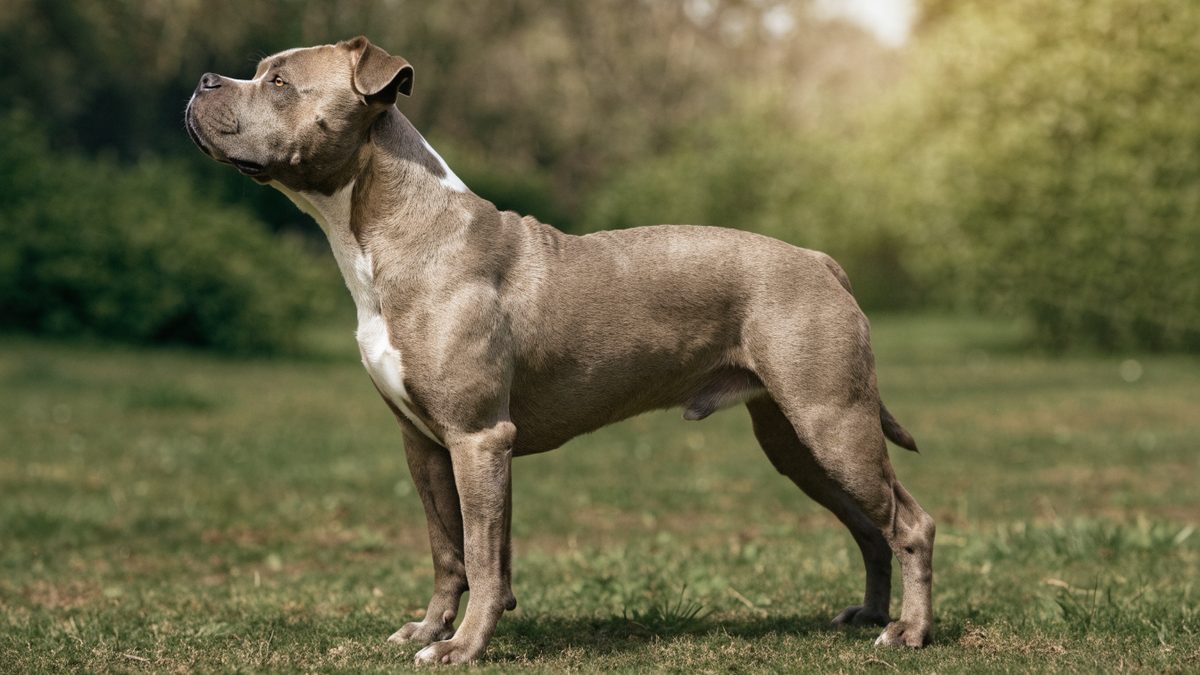
The AKC standard describes a dog of great strength for its size, stocky rather than long-legged or racy, muscular but agile and graceful, and keenly alive to its surroundings. On size it says height and weight should be in proportion, and gives a preferable height of about 18 to 19 inches at the shoulder for the male and 17 to 18 inches for the female. The standard names no weight at all. The FCI version repeats the same heights in metric, 46 to 48 cm for males and 43 to 46 cm for females, and also names no weight.
That absence matters in India, because Indian pages fill it in with numbers of their own and they do not agree. The AKC breed page gives breed averages of 55 to 70 pounds for males and 40 to 55 pounds for females, which is roughly 25 to 32 kg and 18 to 25 kg. Purina India publishes 25 to 31 kg for males and 18 to 28 kg for females. Asia Pets publishes a flat 25 to 35 kg with no split by sex. A Delhi NCR seller's own table gives 24 to 31 kg for males and 18 to 24 kg for females. The top of the Asia Pets range, 35 kg, sits about 3 kg above the top of the AKC breed average for a male and has no standard behind it in any registry.
| Source | Male height | Male weight | Female weight |
|---|---|---|---|
| AKC official standard, approved 1936 | About 18 to 19 in preferable | Not stated in the standard | Not stated in the standard |
| FCI-Standard 286 | 18 to 19 in (46 to 48 cm) | Not stated in the standard | Not stated in the standard |
| AKC breed page averages | 18 to 19 in | 55 to 70 lb (25 to 32 kg) | 40 to 55 lb (18 to 25 kg) |
| Purina India | 45 to 48 cm | 25 to 31 kg | 18 to 28 kg |
| Asia Pets, India | 43 to 48 cm, not split by sex | 25 to 35 kg, not split by sex | 25 to 35 kg, not split by sex |
| Dav Pet Lovers, Delhi NCR | 18 to 19 in | 24 to 31 kg | 18 to 24 kg |
Coat, colour and the two things the standard forbids
The coat is short, close, stiff to the touch and glossy, which is the same description in the AKC and the FCI text Federation Cynologique Internationale. On colour both standards permit any colour, solid, parti or patched, then add that all white, more than 80 per cent white, black and tan, and liver are not to be encouraged Federation Cynologique Internationale. So a seller charging a premium for a mostly white AmStaff is charging extra for a colour the breed's own standard discourages, and a seller charging extra for black and tan is doing the same thing.
Two more lines are worth reading before you pay. The nose should be definitely black, and a Dudley nose, meaning a flesh-coloured or unpigmented one, is a listed fault in both standards Federation Cynologique Internationale. The tail is short in comparison to the dog's size, low set and tapering to a fine point, and both standards say in terms not docked Federation Cynologique Internationale. The AKC standard permits cropped or uncropped ears and states that uncropped is preferred. The FCI version does not mention cropping at all.
Ear cropping and tail docking are prohibited in India under the Prevention of Cruelty to Animals (Dog Breeding and Marketing) Rules, 2017, and no Indian reader should be shown a cropped AmStaff as the breed's normal appearance. This costs you nothing at the show ring either, because the AKC standard already prefers uncropped ears and both standards already say the tail is not docked Federation Cynologique Internationale. A puppy offered to you in India with cropped ears has been through a procedure the rules do not allow, and that tells you something about the seller before you get to the price.
Where the breed came from, and one thing this page will not help with
The breed came from crosses between the Bulldog and a game terrier in nineteenth-century Britain, and the parent club's own account is that the resulting dog was called the Bull-and-Terrier Dog, Half and Half, and at times Pit Dog or Pit Bullterrier, before England settled on Staffordshire Bull Terrier. The club is direct about what that history contained and about not celebrating it, writing that in mentioning the gameness of the Staffordshire, it is not the intention to tag him as a fighting machine, or to praise this characteristic.
Under section 11 of the Prevention of Cruelty to Animals Act, 1960, it is an offence, solely with a view to providing entertainment, to incite any animal to fight or bait any other animal, and separately to organise, keep, use or act in the management of any place for animal fighting, to permit or offer any place to be so used, or to receive money for admission to such a place. Nothing on this page is guidance for fighting, baiting, bite work or producing aggression in a dog, and nothing here should be read that way. The history is reported because a breed page that hides where a breed came from is not an encyclopedia entry.
The modern record is a sports and companion record. The AKC lists the breed in the Terrier Group and describes AmStaffs as highly trainable, agile and graceful in movement, and lovable personality dogs around the house. Purina India records the breed competing in agility, conformation, obedience and tracking. That is the honest frame for an Indian family deciding whether to buy one.
American Staffordshire Terrier price in India, five sources compared
The American Staffordshire Terrier price in India runs Rs 12,000 to Rs 1,00,000 across the five published Indian sources Bonbeno could open and read, and the floors alone differ by nearly three times. One kennel prices a pet-quality puppy at Rs 12,000 in Agra while a content site sets its basic tier at Rs 35,000 nationally. Bonbeno prints all five bands side by side rather than averaging them, because an average of five numbers describing five different grading systems is not a price.
Start with the headline bands, because that is where the disagreement is sharpest.
| Source | Lowest published price | Highest published price | What the source is |
|---|---|---|---|
| Black Star Kennels | Rs 12,000 pet quality, in Agra, Jaipur, Dehradun, Gurugram and Rohtak | Rs 50,000 KCI certified | A Punjab kennel that sells this breed |
| Asia Pets | Rs 30,000 | Rs 80,000 | Indian directory that also lists puppies for sale |
| Happy Pet | Rs 30,000 | Rs 1,00,000 | Indian pet content and app, updated 31 August 2025 |
| Dogbreedo | Rs 35,000 basic | Rs 85,000 show quality | Content site, no puppy sales |
| Puppiezo, position 1 in Google India | No price of any kind on the page | No price of any kind on the page | Online pet shop, Delhi NCR |
| Mr n Mrs Pet | 3 listings nationwide, every price behind a sign-up wall | Same | Broker that sells the puppies it writes about |
| Dav Pet Lovers | Product page with a price field reading 0.00 | No band in the copy | Online pet shop, Delhi NCR |
The four sources with a band produce a floor spread of Rs 12,000 to Rs 35,000 and a ceiling spread of Rs 50,000 to Rs 1,00,000 Asia Pets, American Staffordshire Terrier Happy Pet, American Staffordshire Terrier… Dogbreedo, American Staffordshire Terrier…. Neither the highest nor the lowest publishes a sample size, a date range or a method, so neither can be checked and Bonbeno reports both.
Three of the five sources contradict themselves on their own page
This is the finding that should change how an Indian buyer reads any of these numbers. Bonbeno checked each price page against itself, and three failed.
| Source | What it says in one place | What the same page says elsewhere |
|---|---|---|
| Dogbreedo | The KCI certified variant would be priced between Rs 45,000 and Rs 60,000 | Its own FAQ says KCI certified versions are between Rs 40,000 and Rs 60,000 |
| Black Star Kennels | Lifespan 12 to 16 years, in its breed overview table | Its own FAQ says the average lifespan is typically around 10 to 12 years |
| Black Star Kennels | Males 55 to 70 pounds, 25 to 32 kg, in its breed overview table | Its own FAQ says both breeds typically weigh between 30 to 60 pounds, 14 to 27 kg |
| Black Star Kennels | The average price starts from Rs 20,000 to Rs 30,000 for an excellent quality dog | Its own 29-city table prices show quality between Rs 20,000 and Rs 35,000 and pet quality between Rs 12,000 and Rs 16,000 |
| Puppiezo | Heading reads American Staffordshire Terrier | Body publishes origin England, 14 to 16 inches and 11 to 17 kg, which are Staffordshire Bull Terrier figures |
Puppiezo held position 1 in Google India for "american staffordshire terrier price in india" on 19 August 2026 with a page titled "American Staffordshire Terrier Puppies For Sale in India At Best Prices". That page carries no price. It publishes an origin of England, a height of 14 to 16 inches and a weight of 11 to 17 kg, and its Did You Know panel says the breed is often referred to as a Staffy and that the Staffordshire Bull Terrier is a courageous and affectionate breed. Those are Staffordshire Bull Terrier figures printed under an American Staffordshire Terrier heading. The AmStaff standard gives 18 to 19 inches for a male, and FCI records the country of origin as the United States of America Federation Cynologique Internationale. The top result for this query is selling one breed while describing another.
City-wise pricing, where only one source publishes a table
Black Star Kennels is the only Indian source publishing a city table for this breed, covering 29 cities across nine states and splitting each into pet quality and show quality. Its own headline band does not match it, which is why the table is worth reading as a spread rather than as a quotation.
| City | Pet quality | Show quality |
|---|---|---|
| Mumbai | 15,000 | 30,000 |
| Pune | 16,000 | 32,000 |
| Kolkata | 14,000 | 25,000 |
| Jaipur | 12,000 | 20,000 |
| Ahmedabad | 14,000 | 25,000 |
| Lucknow | 15,000 | 25,000 |
| Patna | 15,000 | 27,000 |
| Bhopal | 15,000 | 25,000 |
| Gurugram | 12,000 | 20,000 |
| Margao, Goa | 16,000 | 35,000 |
Two things stand out. The table's own ceiling of Rs 35,000 in Goa is below the floor that two other Indian sources publish for the breed at all Happy Pet, American Staffordshire Terrier…. And the table lists no southern metro at all, no Chennai, no Bengaluru and no Hyderabad, which fits its own statement that availability of the breed in India is quite low and that buyers should look to Punjab.
The same broker prices the Staffy and refuses to price the AmStaff
Mr n Mrs Pet is the clearest natural experiment here, because one company publishes both pages. On its Staffordshire Bull Terrier page it publishes a headline band of Rs 3,50,000 to Rs 8,00,000 and repeats that identical range for Hyderabad, Bangalore, Delhi, Chennai, Lucknow, Mumbai, Jaipur and Pune in a city table. On its American Staffordshire Terrier page it publishes no band, no city table and no figure, only three listings with the price replaced by a link that routes to a sign-up form.
A city table that gives eight different cities the same number to the rupee is not measuring anything, it is a template. The AmStaff page has no such table because the breed is rare enough in India that nobody built one. That is more truthful than a fabricated table and still leaves the buyer with nothing.
What the listings themselves say
Three national listings is the whole visible supply on that platform, and their own labels contradict the breed field. One listing sits under the breed American Staffordshire Terrier and is titled Staffordshire Bull Terrier. A second is titled AMSTAFF and describes an import champion father and a mother of Indian champion lineage. A third is marked KCI Registered. When a national platform holds three AmStaff listings and one of them carries a different breed name, the practical problem is identification, not price.
The Delhi NCR seller page is worth reading for the same reason. Its description is the American Kennel Club's own breed copy reproduced word for word, down to "AmStaffs are stocky, muscular bull-type terriers standing 17 to 19 inches at the shoulder", and its health section reproduces the AKC parent-club testing list including the NCL DNA test American Kennel Club. None of that is knowledge of the dog in the kennel, and none of it is a price.
What a defensible premium actually pays for, and what it does not
The line worth paying for is documented parent screening, and not one Indian price page prices it. The AmStaff is inside the OFA's CHIC programme, which means the parent club has published a specific test panel: a hip evaluation by OFA radiograph or PennHIP, a cardiac evaluation, an autoimmune thyroiditis evaluation which the Staffordshire Terrier Club of America recommends annually, and a DNA test for NCL-A, the cerebellar ataxia mutation. An eye examination and an elbow evaluation are listed as optional. A dog whose parents carry all four results on the public register is a genuinely different purchase from one whose parents carry none, and that difference is invisible inside every band above.
| What you may be charged extra for | Is it defensible | What the primary source says |
|---|---|---|
| Both parents with OFA hip, cardiac, thyroid and NCL results on the public register | Yes, the only line that changes the dog you get | These are the four CHIC requirements the parent club set for the breed |
| Mostly white or all-white coat | No | All white and more than 80 per cent white are not to be encouraged in both standards |
| Black and tan colouring | No | Black and tan is not to be encouraged in both standards Federation Cynologique Internationale |
| A heavier, wider, more massive dog | No | The standard asks for stocky but agile and graceful, and names no weight at all |
| Cropped ears | No, and it is prohibited here | Uncropped is preferred in the AKC standard, and the 2017 rules prohibit cropping in India Prevention of Cruelty to Animals |
| Show quality, at roughly double pet quality | Only against a written explanation of what makes it show quality | One kennel's table doubles the price for show quality in every one of 29 cities without stating a single criterion |
| Import or champion parentage claimed in a listing | Only against paperwork you can read | A listing claiming an import champion sire publishes no certificate number |
Two Indian sources price a KCI-certified dog above an uncertified one, at Rs 35,000 to Rs 50,000 and at Rs 45,000 to Rs 60,000, so registration is roughly a Rs 15,000 to Rs 25,000 line item in this market Dogbreedo, American Staffordshire Terrier…. The Kennel Club of India publishes downloadable forms for litter registration, single dog registration, transfer of ownership, prefix and affix and annual returns, plus a revised tariff sheet effective 1 April 2024, and it publishes no breed-level registration counts of any kind. So no Indian buyer can check how many AmStaffs KCI has registered, and no seller's rarity claim can be tested against a public number. What you can do costs nothing: ask to see the certificate, confirm the breed printed on it reads American Staffordshire Terrier and not Pitbull or Staffordshire Bull Terrier, and confirm it is in the breeder's name before money moves.
Bonbeno reports these published ranges as editorial content. They are not offers, Bonbeno does not broker puppy sales, and no seller named on this page is endorsed. Where a source could not be opened and read directly, no figure from it appears here, which is why a widely repeated Bengaluru band visible only in a search snippet has been left out rather than printed.
Monthly cost of ownership in India, where the sources disagree by four times
Running an American Staffordshire Terrier in India costs between Rs 3,550 and Rs 15,000 a month depending on which published Indian source you believe, and the gap between the lowest and highest estimate is more than four times. Bonbeno prints all three budgets side by side, then prints the three costs none of them carries, because a monthly figure that ignores screening, heat management and tick control is not a cost of ownership in this country.
Three Indian sources publish monthly expenses for this breed and no two agree.
| Line item | Happy Pet, basic to premium | Dogbreedo | Black Star Kennels |
|---|---|---|---|
| Food | Rs 2,250 to Rs 3,000 | Not itemised | Rs 3,000 to Rs 5,000 |
| Veterinary | Rs 600 to Rs 1,200 | Not itemised | Rs 1,500 to Rs 3,000 |
| Grooming | Rs 700 to Rs 1,200 | Not itemised | Rs 500 to Rs 1,000 |
| Toys and accessories | Not itemised | Not itemised | Rs 500 to Rs 1,000 |
| Training | Not itemised | Not itemised | Rs 2,000 to Rs 5,000 |
| Published monthly total | Rs 3,550 to Rs 5,400 | Rs 4,500 to Rs 5,500 | Rs 8,000 to Rs 15,000 or more |
The difference is almost entirely one line. Black Star Kennels is the only source that budgets for training at all, at Rs 2,000 to Rs 5,000 a month, and it also runs food and veterinary care roughly double the other two. On a breed whose own parent club calls puppy training classes a necessity rather than a nicety, a budget with no training line is not a cheaper way of owning the dog. It is an incomplete budget.
Sense-check the range against an Indian organisation that actually feeds dogs at scale. VOSD, which runs a seven-acre facility housing more than 1,800 dogs as of January 2026, states that the average cost of a dog's upkeep is over Rs 5,000 per month at the scale it operates, averaged across the animal's lifetime and including round-the-clock staffing and medical care. A sanctuary buying in bulk lands above the lowest published household figure. Treat Rs 3,550 as a floor rather than a forecast.
Three costs the published budget does not carry
The published grooming line is the one that is genuinely low, and for once that is right rather than optimistic. A short, close, stiff coat needs a bristle brush and nothing else in the ordinary course, so Rs 700 a month for grooming on this breed is closer to a bathing and nail-trimming budget than a coat budget. The costs that are missing sit elsewhere.
- Screening, which is a one-time cost on the parents and not on your dog. The four CHIC tests the parent club set for the breed are a hip evaluation, a cardiac evaluation, an autoimmune thyroiditis evaluation and an NCL-A DNA test. You do not pay for these monthly. You pay for them once, in the purchase price, by refusing to buy from a litter whose parents have none, and that is the cheapest money you will ever spend on this dog.
- Heat management, which is a summer capital cost in most Indian cities. Exertional heat illness was the trigger in 74.2 percent of heat-related illness events in the largest UK primary-care study of the problem, ahead of environmental heat at 12.9 percent and hot vehicles at 5.2 percent. The equipment that prevents it is a cooling mat, a shaded run and a fan or air conditioner during the hottest hours, and none of that appears in any Indian budget for this breed.
- Tick prevention, which is not optional here. A four-city Indian PCR survey of 525 dogs found ticks of the genus Rhipicephalus or Haemaphysalis on 278 of them, which is 53 percent. Year-round tick control is a recurring Indian line item that the imported budget template does not contain.
How the food line scales with a working-weight dog
Happy Pet's food line is built on a stated daily energy figure of 1,600 kcal for puppies and 1,300 kcal for adults. Those are the numbers underneath Rs 2,250 to Rs 3,000 a month, so if your dog sits at the top of the published Indian weight ranges, at 31 to 35 kg rather than 25, the food line moves proportionally and the premium column becomes the realistic one rather than the aspirational one. A heavier dog is more expensive to feed every single month for twelve to sixteen years, which is another reason the Indian habit of paying more for a bigger AmStaff is expensive twice over.
The AKC gives a life expectancy of 12 to 16 years for this breed, and Happy Pet, Asia Pets and Dogbreedo all publish the same 12 to 16 year range for India Happy Pet, American Staffordshire Terrier… Asia Pets, American Staffordshire Terrier Dogbreedo, American Staffordshire Terrier…. At the lowest published rate of Rs 3,550 a month, twelve years of ownership is roughly Rs 5,11,000 in running costs before a single emergency. At the highest published rate of Rs 15,000 a month, sixteen years is roughly Rs 28,80,000 Black Star Kennels. Both totals dwarf the Rs 12,000 to Rs 1,00,000 purchase price, the lower one by five times and the higher one by nearly thirty Happy Pet, American Staffordshire Terrier…. If the purchase price is the number you are optimising, you are optimising the smallest line in the budget.
One genuine Indian saving deserves naming, because this breed has a real advantage over the coated breeds it is often cross-shopped against. There is no undercoat to strip, no seasonal blow-out to pay a groomer for, and no monsoon matting to clip out. Against a double-coated breed of similar size in Chennai or Mumbai, the AmStaff's grooming bill is genuinely lower rather than nominally lower Happy Pet, American Staffordshire Terrier….
Heat tolerance in India, rated 3 out of 5 and shown working
The American Staffordshire Terrier rates 3 out of 5 for heat tolerance in Indian conditions, which puts it clearly above the flat-faced bull breeds and clearly below a heat-adapted Indian breed. The rating rests on four mechanical facts you can check rather than on an impression, and the single most important one is that this dog has a normal muzzle. Every point it gains comes from that, and every point it loses comes from muscle mass and drive.
Work through the evidence in the order it actually matters.
One, a normal muzzle removes the biggest single penalty
Brachycephalic dogs had greater odds of all three types of heat-related illness compared with mesocephalic dogs in the largest UK study of the problem, covering environmental, exertional and vehicular triggers alike. The breeds carrying the highest one-year incidence in the companion study were the Chow Chow at 0.50 percent, the Bulldog at 0.42 percent, the French Bulldog at 0.18 percent and the Dogue de Bordeaux at 0.17 percent, against an all-breed incidence of 0.04 percent. The AmStaff standard describes a medium-length muzzle, not a shortened one, and unlike the UKC standard for its cousin it contains no eliminating fault for a muzzle so short it interferes with breathing, because the breed does not go there. This breed is not on that list and structurally should not be. That is why the rating is 3 and not 2.
A Punjab kennel's AmStaff page lists "Brachycephalic Syndrome" among the breed's health concerns and states that AmStaffs have a short muzzle which can lead to breathing difficulties. That is wrong, and getting it wrong in an Indian summer is dangerous in both directions. The AKC and FCI standards both describe a medium-length muzzle, and the FCI standard describes it as medium length, rounded on the upper side to fall away abruptly below the eyes. The AmStaff is a mesocephalic dog. An owner who believes their AmStaff is brachycephalic may either panic-restrict a dog that can safely be exercised in the cool hours, or assume a genuinely brachycephalic breed like the Bulldog is no worse off than theirs. Neither error helps. Confirm your own dog's airway with your nearby vet rather than with a seller's page.
Two, it is nowhere near the bodyweight bracket that raises risk
Dogs over 50 kg in bodyweight had 3.42 times the odds of heat-related illness compared with dogs weighing under 10 kg. An AmStaff at 18 to 32 kg sits well inside that gap. A Tibetan Mastiff or a Saint Bernard in Chennai is fighting a different battle from this dog.
Three, it is exactly the profile that gets exertional heat illness
This is where the rating stops climbing. Exertional heat-related illness was the predominant trigger at 74.2 percent of events, ahead of environmental at 12.9 percent and vehicular confinement at 5.2 percent, and young male dogs had greater odds of exertional heat-related illness. In the UK, exertional heat illness affects more dogs and kills more dogs than confinement in a hot vehicle. The AmStaff is a young, powerful, high-drive dog that the AKC describes as game for anything and that Happy Pet puts on a 60 to 90 minute daily exercise routine Happy Pet, American Staffordshire Terrier…. It does not self-limit at 38 degrees. It will keep playing fetch until it collapses, which is the whole mechanism.
Four, the surface-area problem is real and rarely stated
A dog sheds heat across its surface and generates it inside its mass, so a compact, thickly muscled 30 kg dog has less skin per kilogram than a rangy 30 kg dog and cools more slowly at the same air temperature. The AKC standard asks for a stocky, muscular dog with a deep and broad chest, which is precisely the compact geometry. Add the fact that a short glossy coat gives almost no shade against direct Indian sun on a dark dog, and the practical result is a dog that is fine in the shade at 34 degrees and in genuine trouble working in the open at the same temperature.
Happy Pet publishes an ideal weather band of 15 to 25 degrees Celsius for this breed in India. Read that honestly. In Chennai, Hyderabad, Mumbai, Delhi and almost every other Indian city where this dog is sold, the daytime maximum sits above 25 degrees for most of the year. The breed is not unkeepable here and nothing in the evidence says it is. It means the owner, not the climate, is doing the work, every day, for twelve to sixteen years.
What this actually changes about your day, city by city
| Indian condition | What it does to this breed | What you change |
|---|---|---|
| Dry summer heat, north and central India | Manageable in shade, dangerous during exertion, because exertional triggers cause 74.2 percent of events | Move both walks outside 10 am to 5 pm. Do not run this dog at noon in May, whatever it looks like it wants |
| Coastal humidity, Chennai, Mumbai, Kochi | Worse than the temperature suggests, because panting cools by evaporation and humid air evaporates less | Shorten sessions, add water breaks, judge by the dog's recovery time rather than the thermometer |
| Monsoon, everywhere | Best exercise window of the year for this breed, and the worst window for skin | Take the exercise. Dry the dog properly afterwards, especially skin folds and between the toes |
| Apartment living without a balcony | Workable, because Purina India lists the breed as suitable for apartments, but only if the exercise happens outdoors | Two structured outings a day, not one long one, so heat exposure is split |
| Terrace or open yard in summer | The highest-risk setup in India, because a dog left out cannot choose an air-conditioned room | Never leave this dog on an unshaded terrace. Section 11 of the PCA Act also makes failing to shelter an animal an offence |
The event fatality rate for heat-related illness in the UK primary-care study was 14.18 percent, with a 95 percent confidence interval of 11.08 to 17.96 percent. That is roughly one in seven affected dogs, in a temperate country. Frantic panting that does not settle with rest, bright red or very pale gums, staggering, vomiting, or a dog that stops responding to you are all reasons to begin cooling immediately with room-temperature water over the body and to get to a veterinarian at once. Do not wait to see whether it passes. Consult your nearby vet in advance about what they want you to do on the way in, because the drive is the part you cannot shorten later.
One Indian advantage is worth stating plainly against the coated breeds. This dog carries no undercoat, so it does not trap a layer of insulating air the way a Husky or a Golden Retriever does, and it never needs shaving, which is the single most common well-meant Indian mistake with a coated dog. A short-coated, mesocephalic, moderately sized dog is a reasonable choice for an Indian city if, and only if, the owner controls the clock.
Temperament and household fit, including the one warning the parent club prints
The American Staffordshire Terrier is a confident, people-oriented, affectionate dog that suits an experienced household and does not suit a household looking for a low-effort pet, and the single most important temperament fact carries a specific warning rather than a reassurance. Dog aggression can develop even in a well-socialised AmStaff. That sentence comes from the breed's own AKC-side literature, not from its critics, and an Indian buyer who is told the opposite is being sold something.
Take the positive side first, because it is well documented and it is why people keep this breed. The AKC describes AmStaffs as smart, confident, good-natured companions whose courage is proverbial, keenly aware of their surroundings, game for anything, and lovable personality dogs around the house. Purina India calls the breed friendly, intelligent and loyal, a people-oriented breed that thrives as part of the family and when given a job to do. The AKC standard itself opens on temperament by saying the dog should be keenly alive to his surroundings and that his courage is proverbial.
The OFA health survey, which collects owner reports rather than clinical records, gives a rough picture of how owners describe their own dogs. Of 175 dogs reported, 144 were described as confident, 34 as hyperexcitable, 12 as timid, 11 as aggressive and 7 as fearful, with percentages summing above 100 because owners could tick more than one. Read that with the caveat OFA itself prints: respondents are self-selected, there is no verification of responses and no duplicate checking. It is a survey of committed owners, not a random sample. What it does show is that hyperexcitable was reported roughly three times as often as timid.
The AKC breed-club training guidance, reproduced verbatim on an Indian seller's own product page, reads: "It must be noted that dog aggression can develop even in well socialized Am Staffs; an AmStaff should never under any circumstances be left alone with other dogs"; American Kennel Club. That warning is printed on the page of a company trying to sell you the dog, and it is still the part Indian buyers do not hear. It is not a claim that the breed is dangerous to people. It is a claim about other dogs, and it is the difference between a manageable pet and an incident in a shared apartment lift.
Dog aggression is a separate axis from people aggression
The two are not the same trait and conflating them produces bad decisions in both directions. The UKC standard for the closely related American Pit Bull Terrier is explicit about the split, stating that because most dogs of the type exhibit some level of dog aggression the breed requires an owner who will carefully socialise and obedience train the dog, and in the same paragraph that the breed is not the best choice for a guard dog because they are extremely friendly, even with strangers, and that aggressive behaviour toward humans is uncharacteristic and highly undesirable. Viciousness or extreme shyness is a disqualification in that standard, and aggressive or overly shy dogs are a disqualifying fault in the FCI standard for the AmStaff Federation Cynologique Internationale.
So the breed's own governing documents disqualify human aggression while openly flagging dog aggression. An Indian buyer should plan around both of those facts at once: this is a dog you can take to a family gathering and a dog you cannot leave unsupervised with the neighbour's Labrador.
Who this breed suits in an Indian household
| Household | Verdict | Why |
|---|---|---|
| Experienced owner, 60 to 90 minutes a day, no other dogs at home | Good fit | Matches the published exercise routine and removes the one documented risk axis Dav Pet Lovers, American Staffordshire… |
| Family with school-age children, adult present, structured routine | Good fit with supervision | Purina India rates the breed a great family dog and good with children, and the AKC describes it as people-oriented American Kennel Club |
| Apartment in a metro, with real outdoor exercise | Workable | Purina India lists the breed as suitable for apartments, and grooming is a weekly bristle brush |
| Household with a resident dog of the same sex | High risk | Dog aggression can develop even in well-socialised AmStaffs, and the guidance is never to leave them alone together |
| First-time owner, long working hours, dog alone all day | Poor fit | Purina India rates the breed as suitable for experienced owners, and VOSD names isolation as a direct route to a reactive dog Voice of Stray Dogs (VOSD) |
| Wanted as a guard dog for a gate or shop | Wrong breed and a welfare problem | The related standard states the type is extremely friendly even with strangers and a poor guard choice, and chaining a dog without exercise is an offence under section 11 Section 11, The Prevention of Cruelty… |
What Indian ownership actually determines
VOSD, which houses more than 1,800 dogs in India and sees the failures rather than the successes, puts the causal chain plainly. Chaining a bully-breed dog in a yard, leaving it isolated for hours every day, using it as a guard dog without training and rewarding aggression are named as a guaranteed path to a dangerous animal, producing fear-based reactivity and frustration aggression. The same source notes that a poorly raised dog of this type causes more harm than a poorly raised small dog purely because of physical strength, which is an argument for responsible ownership rather than against the breed.
Two of those four failure modes are also offences in India. Section 11 of the Prevention of Cruelty to Animals Act, 1960 makes it an offence for an owner to neglect to exercise, or cause to be exercised reasonably, any dog habitually chained up or kept in close confinement, and separately to keep any animal chained or tethered for an unreasonable time on an unreasonably short or unreasonably heavy chain. The penalties are trivially small, a fine of not less than ten rupees rising to fifty for a first offence, but the legal characterisation is not.
An AmStaff will be affectionate, confident and genuinely easy with your family, and it will still need managing around other dogs for its whole life. Both halves are true at once. A page that gives you only the first half is selling, and a page that gives you only the second half is scaremongering Dav Pet Lovers, American Staffordshire… Voice of Stray Dogs (VOSD).
Training an AmStaff, what works and what this breed resists
To train an American Staffordshire Terrier, start puppy classes early, use food-motivated positive reinforcement, and treat controlled exposure to other dogs as a lifelong management skill rather than a puppyhood box to tick. The breed's intelligence and desire to please make ordinary obedience genuinely easy. Two things are genuinely hard, and the breed literature names both: chewing and digging resist resolution, and dog tolerance cannot be trained in once and left alone.
The AKC parent-club guidance is unusually blunt about why classes are not optional here. Early socialisation and puppy training classes are recommended for all breeds, but given the AmStaff's strong will, physical strength and exuberance they are described as a necessity American Kennel Club. The same guidance says the breed's intelligence and desire to please make training a fun, easy process, and then names the exception in the next line: certain behaviours, such as chewing and digging, may be hard to resolve.
Purina India's summary is consistent and slightly softer, listing the breed under "some training required" and "dog suitable for experienced owners", and noting it may require training to live with other pets. Asia Pets lists "strong and needs firm training" and "requires early socialisation" among its considerations, alongside intelligent and trainable among its advantages.
What works, in the order it works
- Start classes before sixteen weeks. Puppy classes are named a necessity for this breed specifically, not a nicety.
- Pay in food. VOSD records that positive reinforcement works extremely well with bully-breed dogs because they are eager to please and highly food-motivated.
- Give the dog a job. Purina India describes the breed as thriving when given a job to do, and lists agility, conformation, obedience and tracking as its activities.
- Train recall before you need it. The related UKC standard notes the breed's natural agility makes it one of the most capable canine climbers, so good fencing is a must. In an Indian housing society, a dog that clears a low gate is your problem twice over.
- Redirect chewing rather than punish it. Chewing and digging are the two named behaviours that may be hard to resolve, so plan enrichment and accept some management rather than expecting elimination.
- Keep socialising past the first year. Because dog aggression can develop even in well-socialised AmStaffs, socialisation is maintenance and not a one-time course.
Realistic timelines for an Indian household
| Age | What is realistic | What is not |
|---|---|---|
| 8 to 16 weeks | Name, sit, crate comfort, handling, first vaccinations and controlled introductions to people, surfaces and traffic noise | Reliable recall in an open Indian street. Do not test it |
| 4 to 6 months | Loose-lead walking on a flat collar or harness, settling on a mat, structured puppy-class attendance | Off-lead freedom around unknown dogs |
| 6 to 12 months | Solid sit, down, stay and leave-it. Adolescent testing arrives and obedience gets worse before it gets better | Assuming the dog aggression question is settled because nothing has happened yet |
| 12 to 24 months | Adult manners, real recall in controlled spaces, agility or obedience if you want a sport | A dog that can be left unsupervised with another dog |
| Lifelong | Managed, structured exposure to other dogs on lead, in the open, with distance you control | Dog parks and unsupervised society play groups |
Nothing here is guidance for protection work, bite sports, guarding, or building aggression in a dog. Under section 11 of the Prevention of Cruelty to Animals Act, 1960, inciting any animal to fight or bait any other animal, solely with a view to providing entertainment, is an offence, as is organising, keeping, using or acting in the management of any place for animal fighting. If a trainer in India offers to sharpen your AmStaff, walk out.
The Indian-specific training problem nobody writes about
The hardest training environment for this breed in India is not the park. It is the lift, the stairwell and the society gate, because those are narrow spaces where two dogs meet at a distance neither owner chose. A breed whose own literature says it should never be left alone with other dogs needs a rehearsed protocol for exactly that geometry. Teach a solid sit-and-face-the-wall in the lift, walk the stairs during peak hours, and carry the dog's attention with food rather than tightening the lead, because a tight lead adds tension to a meeting that was already tight.
The second Indian problem is free-roaming dogs. Bonbeno's page on the Indian Pariah Dog covers the population your AmStaff will meet on almost every Indian walk. Plan the route so those encounters happen at a distance you can control, and never let a first meeting happen in a dead-end lane.
Daily exercise requirement, and what happens in an Indian flat without it
An American Staffordshire Terrier needs 60 to 90 minutes of real exercise a day according to the Indian source that publishes a figure, and Purina India's own summary describes a dog that enjoys vigorous walks and enjoys walking an hour a day. The number is achievable in an Indian city. The constraint is not the total, it is the clock, because the hours when this dog most wants to run are the hours an Indian summer makes dangerous.
Happy Pet publishes an exercise routine of 60 to 90 minutes and rates the breed's energy level as high. Purina India lists "enjoys vigorous walks" and "enjoys walking an hour a day" while rating the breed's energy as medium, which is the one place the two Indian sources disagree, and Bonbeno prints the disagreement rather than splitting it. Asia Pets simply lists "needs daily exercise" among its considerations without a duration.
The AKC parent-club guidance explains why the total is only half the answer: an athletic, energetic dog such as the American Staffordshire Terrier requires a lot of exercise, and leaving the dog out in the yard all day is expressly named as the wrong approach, because the AmStaff is a people-oriented dog who thrives when made part of the family and long play sessions with the owner develop his physical and psychological health. Yard time is not exercise for this breed. Time with you is.
A realistic Indian daily split
| Session | Timing in Indian summer | Content | Minutes |
|---|---|---|---|
| Morning | Before 8 am | Brisk lead walk plus 10 minutes of training in the shade | 35 to 45 |
| Midday | Indoors, air-cooled if you have it | Scentwork, a food puzzle, a chew, or a short obedience session | 10 to 15 |
| Evening | After 6.30 pm | Second walk, off-lead work only in a genuinely enclosed space | 25 to 35 |
| Monsoon and winter bonus | Any daylight hour | Fetch, agility, hill walks, the sessions you cannot run in May | Add 20 to 30 |
The midday indoor block is the part Indian owners skip and the part that does most of the work. Purina India describes the breed as chatty and vocal and as a dog that thrives when given a job, and Asia Pets records the breed as needing early socialisation and firm training Asia Pets, American Staffordshire Terrier. Fifteen minutes of scentwork on a hot afternoon costs nothing, generates no heat load, and reliably empties a dog that a second walk would only overheat.
What happens without it
VOSD is direct about the failure mode and it is worth quoting in substance: without sufficient physical exercise and mental stimulation these dogs do not simply become bored, they become destructive, anxious and difficult to manage, and a daily walk around the block is not enough. The AKC-side guidance adds the specific behaviours to expect, naming chewing and digging as the ones that are hard to resolve once established.
In an Indian two-bedroom flat, an under-exercised 28 kg AmStaff does not become a quiet problem. It becomes a destroyed sofa, a complaint from a neighbour, a reactive dog in the lift, and eventually a dog that is rehomed at eighteen months. That sequence is the most common way this breed ends up in an Indian rescue.
Section 11 of the Prevention of Cruelty to Animals Act, 1960 makes it an offence for an owner to neglect to exercise, or cause to be exercised reasonably, any dog habitually chained up or kept in close confinement. The same section covers keeping an animal chained or tethered for an unreasonable time on an unreasonably short or heavy chain, and confining an animal in a cage that does not permit a reasonable opportunity for movement. The Dog Breeding and Marketing Rules, 2017 require even a registered breeding establishment to provide a fenced area for adequate exercise, or provision for exercising the dog on a leash. If a licensed kennel must provide that, a flat should too.
Exercise and the heat, in one rule
Do not let this dog decide when to stop. Exertional heat-related illness was the trigger in 74.2 percent of heat events in the largest study of the problem, ahead of environmental heat at 12.9 percent, and young male dogs carried the greatest odds of the exertional type. An AmStaff chasing a ball is a young powerful dog in exactly that category. Set a timer, watch the recovery rate rather than the enthusiasm, and end the session while the dog still wants more. On a 40 degree Delhi afternoon, the correct amount of fetch is zero.
One protective structural point is worth repeating here from the climate section: this is a mesocephalic breed, and brachycephalic dogs carried greater odds of all three types of heat-related illness. The AmStaff can genuinely be exercised in India in a way a French Bulldog or a Bulldog cannot. The rule is about timing, not about capability.
Grooming and coat care in Indian humidity
Grooming an American Staffordshire Terrier takes one weekly pass with a soft bristle brush, and that is very nearly the whole coat routine. The short, close, stiff, glossy coat described in both the AKC and FCI standards is genuinely low-maintenance, which makes this one of the easier imported breeds to keep in Chennai or Kolkata. The work in India is not the coat. It is the skin under it, and the ticks on it.
The AKC parent-club guidance says taking care of the AmStaff's short, stiff coat is remarkably easy: a quick once-over with a soft bristle brush every week is usually enough to remove dirt or other foreign matter, and a good brushing distributes skin oils through the coat to keep it healthy. Bathing can wait until the dog gets into something messy or develops a doggy smell. Purina India rates the breed as requiring grooming once a week and notes some drool. Happy Pet rates shedding as moderate and suggests raising brushing to two or three times a week during seasonal sheds.
Note what the standards do not permit, because it protects you from a bad purchase. Both the AKC and FCI standards describe the coat as short, close, stiff to the touch and glossy Federation Cynologique Internationale. A fluffy or long-coated dog offered as an AmStaff is not one, and the related UKC standard for the American Pit Bull Terrier goes further and makes a long coat an outright disqualification.
The Indian routine, and why it is shorter than most
| Task | Frequency | Why it matters here |
|---|---|---|
| Bristle-brush the whole dog | Once a week, two or three times in a seasonal shed | Distributes skin oils and removes loose hair, the whole coat routine Happy Pet, American Staffordshire Terrier… |
| Full tick check by hand | Every day in tick season, after every walk | Ticks were found on 53 percent of dogs in a four-city Indian survey |
| Bath | Only when dirty or smelly | Over-bathing strips the oils the weekly brush is meant to distribute |
| Dry thoroughly after monsoon walks | Every wet walk | Skin disorders were the most reported health category in the OFA owner survey, at 22 percent of respondents |
| Check ears | Weekly | Named in the parent-club guidance alongside regular tooth brushing |
| Trim nails | Every 3 to 4 weeks | Overly long nails are painful and cause problems walking and running |
A four-city Indian PCR survey of 525 dogs found that 261 of them, 49.7 percent with a 95 percent confidence interval of 45.4 to 54.1, carried at least one tick-borne pathogen, and potential tick vectors were found on 278 dogs, which is 53 percent. Hepatozoon canis was most common at 30 percent, followed by Ehrlichia canis at 20.6 percent, and concurrent infection with more than one pathogen occurred in 39 percent of cases. On a double-coated breed you cannot see a tick without working through the coat. On a short, close, glossy AmStaff coat you can run both hands over the whole dog in ninety seconds and find one. Use that advantage every single day, and talk to your nearby vet about a year-round preventive suited to your city.
Skin, which is where the Indian problems actually are
Skin was the most reported health issue in the OFA breed health survey, with 35 of 162 respondents, 22 percent, reporting a skin disorder in their dog. Within that group, seasonal allergies accounted for 18 reports, food or medicine allergies for 8, demodectic mange for 5, atopic dermatitis for 5 and seborrhea for 3. Read those with the caveat OFA prints, that respondents are self-selected and unverified. The AKC parent-club summary reaches the same conclusion from a different direction, listing skin and coat allergies alongside hip dysplasia and cardiac disease as the conditions a responsible breeder screens for. Two Indian sources independently name skin allergies among the breed's main health concerns, which is the one health claim the Indian pages get right Happy Pet, American Staffordshire Terrier….
Two Indian factors sharpen this. Monsoon humidity keeps skin damp for weeks at a stretch, which favours the bacterial and yeast overgrowth that turns a mild allergy into a hot spot. And a heavy tick burden means repeated bites on a thin-coated dog, which is itself an itch source before any pathogen is involved. The practical routine is unglamorous: dry the dog properly, check the elbows, groin, armpits and between the toes weekly, and take a spreading red patch to a vet in days rather than weeks.
There is no reason to shave an American Staffordshire Terrier and one good reason not to. The coat is already short, close and stiff, so it holds almost no insulating air and shaving removes no meaningful heat load. What it does remove is the only barrier between direct Indian sun and a thin, often lightly pigmented skin. Owners who shave a heat-sensitive dog in May generally make sunburn and skin irritation more likely, not less. Consult your nearby vet before any clipping that is not medically indicated.
One genuinely small win to close on. A weekly bristle brush, a monthly nail trim and a bath when the dog smells is a grooming budget of Rs 700 to Rs 1,200 a month in India, which is at the bottom of the range for any dog of this size. Against a Golden Retriever or a Siberian Husky in the same city, that is a real saving every month for the dog's whole life.
Health risks, screening and life expectancy, with the sample sizes shown
The American Staffordshire Terrier carries one inherited disease you can eliminate with a single DNA test and one orthopaedic risk you can only reduce by screening the parents, and the numbers behind both come from the breed's own register. Of 961 AmStaffs tested for neuronal ceroid lipofuscinosis, 24.9 percent were carriers. Of 4,298 hips evaluated, 25.7 percent were dysplastic. Those two figures, with those two sample sizes, are the most useful health facts an Indian buyer will read about this breed.
Every figure in this section was read off the Orthopedic Foundation for Animals breed page for breed code STA on 19 August 2026, with the breed name AMERICAN STAFFORDSHIRE TERRIER confirmed printed on the returned document. OFA is a live register and the counts move as evaluations are added, so the sample size is published beside every percentage and a later reader should re-check rather than assume these are fixed.
| Test | Total tested | Normal or clear | Abnormal | Carrier |
|---|---|---|---|---|
| Hips | 4,298 | 3,101 (72.1%) | 1,103 dysplastic (25.7%) | not applicable |
| Elbows | 1,609 | 1,307 (81.2%) | 294 dysplastic (18.3%) | not applicable |
| Congenital cardiac | 2,029 | 1,962 (96.7%) | 20 (1.0%) | not applicable |
| Neuronal ceroid lipofuscinosis (NCL) | 961 | 713 (74.2%) | 9 affected (0.9%) | 239 (24.9%) |
| Patella | 742 | 737 (99.3%) | 5 (0.7%) | not applicable |
| Thyroid | 644 | 545 (84.6%) | 34 (5.3%) | not applicable |
| Advanced cardiac | 515 | 447 (86.8%) | 26 (5.0%) | not applicable |
| Eyes | 285 | 279 (97.9%) | 6 (2.1%) | not applicable |
| Degenerative myelopathy | 170 | 143 (84.1%) | 16 affected (9.4%) | 11 (6.5%) |
| AmStaff laryngeal paralysis / polyneuropathy | 86 | 79 (91.9%) | none reported | 7 (8.1%) |
Neuronal ceroid lipofuscinosis, the disease you can test away completely
NCL-A, also called cerebellar ataxia in this breed, is a late-onset inherited neurological disease and it is the single most important health fact on this page, because it is both common in the gene pool and completely avoidable. The causal mutation was identified in 2010: a worldwide breed-specific variant in exon 2 of the Arylsulfatase G (ARSG) gene, causing a p.R99H substitution near the enzyme's catalytic domain, which reduced sulfatase activity by 75 percent in transfected cells and in leukocytes from affected dogs. The study confirmed that the late-onset form segregates recessively in American Staffordshire Terrier pedigrees in the United States and France.
Recessive is the word that matters. A carrier dog is clinically healthy for life. Two carriers bred together can produce affected puppies. A carrier bred to a clear dog cannot. The Staffordshire Terrier Club of America's advice, published on the OFA breed page, is exactly that: two NCL carriers should never be bred together, and affected dogs should never be bred. First-generation offspring of tested dogs are eligible for a Clear By Parentage designation, which means once a breeder has done the work, their next generation is covered without retesting every puppy.
Of 961 American Staffordshire Terriers with an NCL result recorded with OFA, 239 were carriers, which is 24.9 percent, and 9 were affected, which is 0.9 percent. A carrier rate near a quarter means a random pairing of two untested AmStaffs has a real chance of being carrier to carrier. The disease it produces is not mild: the study describing it records progressive loss of motor coordination, a wide-based stance in a five-year-old affected dog and visible cerebellar atrophy on MRI in a six-year-old. Ask for both parents' NCL results in writing before you pay. It is one test, it is definitive, and it is the difference between a healthy dog and one that begins to fail neurologically in middle age. Discuss the result with your nearby vet if you are unsure how to read it.
Hip dysplasia, and how this breed compares with its cousin
One in four evaluated AmStaff hips is dysplastic. Of 4,298 hips evaluated, 1,103 were graded dysplastic, which is 25.7 percent, split into 800 mild at 18.6 percent, 277 moderate at 6.4 percent and 26 severe at 0.6 percent. On the normal side, 170 were excellent at 4.0 percent, 1,829 good at 42.6 percent and 1,102 fair at 25.6 percent. The breed ranks 31st on OFA's hip list.
The direction of travel is genuinely good. Broken out by birth year, the dysplastic rate ran 31.2 percent for dogs born up to 1990, 24.5 percent for 1996 to 2000, 26.1 percent for 2006 to 2010, 23.8 percent for 2016 to 2020 and 17.9 percent for dogs born in 2021 or later. Screening works, and the improvement is visible in the register.
| Measure | American Staffordshire Terrier (STA) | American Pit Bull Terrier (PBT) |
|---|---|---|
| Hips evaluated | 4,298 | 1,184 |
| Hips dysplastic | 25.7% | 22.2% |
| Hips excellent | 4.0% | 9.0% |
| Elbows evaluated, dysplastic | 1,609, 18.3% | 582, 17.2% |
| Congenital cardiac normal | 96.7% of 2,029 | 97.9% of 534 |
| Degenerative myelopathy affected | 9.4% of 170 | 23.0% of 200 |
| NCL testing recorded | 961 dogs, 24.9% carriers | No NCL row exists for this breed |
| In the CHIC health programme | Yes, with four required tests | No. OFA states the breed is not yet part of CHIC |
The American Staffordshire Terrier is inside OFA's Canine Health Information Center programme, which means the parent club has published a defined test panel and a dog meeting it receives a CHIC number that anyone can look up. The American Pit Bull Terrier is not: OFA's page for breed code PBT states in terms that the breed is not yet part of the CHIC programme. So a buyer who insists on the AmStaff name is not being fussy about paperwork. They are buying into the only one of the two names that has a published, checkable health standard behind it. The AmStaff also has 3.6 times as many hips on the register as the APBT despite being the far less common breed in most markets, which is what a parent club with a screening programme produces Orthopedic Foundation for Animals.
The four tests to demand, and what each one is
| Screening | How it is done | Note from the parent club |
|---|---|---|
| Hip dysplasia | OFA radiographic hip evaluation, or a PennHIP evaluation registered with OFA | Required |
| Cardiac evaluation | Basic cardiac exam by a cardiologist, or an advanced cardiac exam | Required |
| Autoimmune thyroiditis | OFA evaluation from an approved laboratory | The club recommends annual testing |
| NCL-A, cerebellar ataxia | DNA test from an approved laboratory, result registered with OFA | Two carriers should never be bred together, affected dogs never bred. First-generation offspring of tested dogs are eligible for Clear By Parentage |
| ACVO eye examination | ACVO examination, result registered with OFA | Optional |
| Elbow dysplasia | OFA radiographic elbow evaluation | Optional |
Life expectancy, and what the numbers actually rest on
The AKC gives a life expectancy of 12 to 16 years, and both Indian sources that publish a figure give the same 12 to 16 year range Happy Pet, American Staffordshire Terrier… Asia Pets, American Staffordshire Terrier. Bonbeno could find no peer-reviewed longevity study reporting a median age at death specifically for this breed, so treat 12 to 16 as a breed-club and breed-page figure rather than as a study result, and note that the three Indian and American sources agreeing does not make it three independent measurements when two of them cite the AKC.
The only mortality data Bonbeno could verify is the OFA owner survey, and it is small. Of 19 dogs reported as deceased, 7 died between 8 and 10 years, 6 between 11 and 13 years, 3 between 5 and 7 years, 2 over 14 years and 1 between 2 and 5 years. Nineteen self-selected reports is not a life table and Bonbeno is not presenting it as one. It does suggest that the top of the 12 to 16 year range is a best case rather than a typical outcome.
The rest of the risk picture
Cardiac disease sits behind the required cardiac exam and the numbers are reassuring at the congenital level and less so on advanced screening. Of 2,029 congenital cardiac evaluations, 96.7 percent were normal and only 1.0 percent abnormal, while of 515 advanced cardiac evaluations 86.8 percent were normal, 5.0 percent abnormal and 8.2 percent equivocal. Thyroid testing of 644 dogs returned 84.6 percent normal, 5.3 percent abnormal and 10.1 percent equivocal, which is why the club asks for annual rather than one-time testing.
Two smaller registers are worth knowing about because they are breed-specific. OFA runs a test named AmStaff laryngeal paralysis and polyneuropathy, and of 86 dogs tested 7 were carriers at 8.1 percent. Degenerative myelopathy testing of 170 dogs found 16 at-risk at 9.4 percent and 11 carriers at 6.5 percent, which is notably better than the 23.0 percent at-risk rate recorded across 200 American Pit Bull Terriers. Cone rod dystrophy testing of 65 dogs and hyperuricosuria testing of 91 dogs both returned 100 percent clear.
Everything above is published register data and peer-reviewed literature, reported for general information. It is not a diagnosis and it cannot account for your individual dog. Consult your nearby vet before acting on any of it, particularly on which screening tests to prioritise, on vaccination and tick prevention appropriate to your Indian city, and on any symptom your dog is showing now. Indian veterinary practitioners should also be aware that co-infection with more than one tick-borne pathogen occurred in 39 percent of positive cases in the four-city survey, so one diagnosis does not rule out a second.
Feeding, body condition and what is actually available in India
Feed an American Staffordshire Terrier to a visible waist rather than to a number on a bag, because the single feeding fault the breed literature names is weight gain and the single Indian consequence of weight gain is a hotter dog. The one Indian source publishing energy figures gives 1,600 kcal a day for puppies and 1,300 kcal a day for adults, and the honest use of those numbers is as a starting point you adjust against the dog in front of you.
The AKC parent-club guidance is short and worth following exactly. The AmStaff should do well on a high-quality dog food, whether commercially manufactured or home-prepared with your veterinarian's supervision and approval, and any diet should be appropriate to the dog's age, meaning puppy, adult or senior. It then names the risk: some dogs are prone to getting overweight, so watch calorie consumption and weight level, and treats can be an important training aid but too many cause obesity. Clean, fresh water should be available at all times.
Happy Pet publishes the Indian numbers underneath its food budget: 1,600 kcal a day for puppies and 1,300 kcal a day for adults, at Rs 2,250 to Rs 3,000 a month, with a macronutrient split of roughly 30 percent protein, 15 percent fats and 40 percent carbohydrates. Treat those as a bag-label starting point. A 20 kg young female in an air-conditioned Bengaluru flat and a 31 kg working male in Pune are not eating the same amount, and no published Indian figure distinguishes them.
Life-stage feeding, in the order it happens
| Stage | Meals a day | The priority | The mistake to avoid |
|---|---|---|---|
| 8 to 16 weeks | 4 | A large-breed-appropriate puppy food and steady, unhurried growth | Free feeding, and calcium supplements added on top of a complete food without veterinary advice |
| 4 to 12 months | 3, then 2 | Lean growth. This is a muscular breed, and muscle is built by exercise, not by extra food | Pushing weight to make a young dog look impressive |
| 12 months to 7 years | 2 | Body condition held constant, treats counted into the daily total | Feeding by the bag chart and never re-weighing the dog |
| From about 7 years | 2 | Slightly fewer calories as activity drops, joints monitored | Assuming a senior needs the same intake as at three |
Happy Pet notes that from around age seven most AmStaffs start slowing down, though many stay playful well into their senior years. That is the point to re-measure intake rather than to keep pouring the same scoop.
Why body condition matters more on this breed than on most
Two independent reasons stack. First, higher bodyweight relative to the breed and sex mean was a significant risk factor for heat-related illness in the largest primary-care study of the problem, alongside breed and being over two years of age. An overweight AmStaff in an Indian May is carrying a measurable heat penalty that a lean one is not. Second, one in four evaluated hips in this breed is dysplastic, and carrying extra weight on a dysplastic hip is the difference between a dog that manages and a dog that limps.
The practical test needs no scale. You should be able to feel the ribs easily under a thin layer of cover without pressing, see a waist when you look down at the dog from above, and see a tuck-up when you look from the side. The AKC standard already asks for a loin that is slightly tucked, which is a conformation description that doubles neatly as a body-condition target.
The Indian market prices a heavier, wider AmStaff above a moderate one, and owners then feed toward that look. The breed standard asks for a dog that is stocky but agile and graceful, muscular but not massive, and it names no weight at all to be reached. The related UKC standard for the American Pit Bull Terrier goes further and makes an overly massive body style that impedes working ability a Very Serious Fault. Feeding a dog toward a fault, in a climate where extra weight raises heat risk, on hips that are dysplastic a quarter of the time, is three problems bought with one habit Orthopedic Foundation for Animals.
Indian availability and Indian food mistakes
Availability is not a constraint for this breed. Happy Pet lists dry dog food, fresh meat, fresh fish, fruits, vegetables and chicken among suitable options, all of which are widely available across Indian metros. VOSD notes that bully-breed dogs do well on high-protein diets supporting muscle maintenance and recovery, and that low-grade kibble filled with fillers does not give them what they need.
The Indian-specific errors are the ones worth listing, because they are household habits rather than nutrition failures.
- Sharing fried and spiced Indian snacks. Pakoras, samosas and anything deep-fried or heavily spiced are named specifically as foods not to feed.
- Giving mithai, ice cream and large amounts of paneer. Sugary and dairy-heavy foods are on the same avoid list.
- Feeding cooked bones or rawhide. Both are named as unsafe chews.
- Overlooking the standard toxic list. Onions, garlic, chocolate, grapes, raisins, xylitol and caffeine appear on both Indian sources' never-feed lists.
- Adding a calcium supplement to a complete puppy food. Calcium matters for a growing bully-breed skeleton, but supplementing on top of a balanced food is a veterinary decision, not a default.
Ask your nearby vet to set a target weight in kilograms for your individual dog at twelve months and to re-check it twice a year. That single number, revisited, does more for an AmStaff's twelve to sixteen years than any brand choice will.
Month by month through the first year
The first year with an American Staffordshire Terrier has four dated checkpoints that are set by law, by the vaccination schedule, by the socialisation window and by the breed's own genetics, and missing any one of them costs more later than everything else on this page combined. The first checkpoint arrives before you take the puppy home: under Indian rules, a pup less than eight weeks in age is not to be sold.
Rule 8(1)(a) of the Prevention of Cruelty to Animals (Dog Breeding and Marketing) Rules, 2017 states that every breeder shall ensure pups less than eight weeks in age are not sold. Rule 8(1)(e) requires that each pup sold is micro-chipped and a complete record of treatment and vaccination maintained, and rule 8(2) requires the breeder to furnish the purchaser in writing with details of feeding, dates of inoculations and de-worming, and the name and address of the attending veterinary practitioner. Those three are your handover checklist, and they are obligations on the seller rather than favours.
| Age | What happens | What you do | Source anchor |
|---|---|---|---|
| Before 8 weeks | The puppy must not be sold to you at all | Walk away from any earlier handover, however healthy the pup looks | Rule 8(1)(a), 2017 Rules |
| 6 to 8 weeks | First core vaccination, distemper, parvovirus and adenovirus, given at the breeder | Ask for the written record, not a verbal assurance | Indian vaccination schedule |
| 8 to 9 weeks | Handover. Microchip, health record and written feeding and de-worming details change hands | Verify the microchip number against the receipt, and read the breed printed on the KCI certificate | Rules 8(1)(e), 8(1)(g) and 8(2) |
| 10 to 12 weeks | Second core dose plus rabies | Begin controlled socialisation with people, surfaces, traffic noise and household routine | Indian vaccination schedule |
| 12 to 16 weeks | Third core dose. The socialisation window is closing | Enrol in puppy class. For this breed the parent club calls it a necessity, not an option | AKC parent-club training guidance |
| 4 to 6 months | Growth accelerates. Chewing begins in earnest | Redirect chewing early, because it is one of two behaviours named as hard to resolve later | AKC parent-club training guidance |
| 6 months | First Indian summer for a spring puppy | Move both walks outside 10 am to 5 pm and hold that habit for life | Exertional heat illness is 74.2 percent of events |
| 6 to 9 months | Adolescence. Obedience gets visibly worse | Keep training short, keep paying in food, do not escalate corrections | Positive reinforcement works on this type |
| 9 to 12 months | Adult size approached. Dog tolerance may change | Stop assuming the dog-aggression question is settled. Manage introductions from here on | Dog aggression can develop even in well-socialised AmStaffs |
| 12 months | Adult. Set a target weight | Ask your vet for a target weight in kg and re-check it twice a year | Bodyweight above the breed mean raises heat risk |
| 12 to 24 months | The age at which hips can first be formally evaluated on most schemes | If you intend to breed, this is when hip, cardiac and thyroid screening starts | OFA CHIC requirements |
| 3 to 5 years | The window in which untested NCL disease would first appear | Nothing, if you bought from tested parents. That is the point of testing before purchase | Late-onset NCL, cerebellar signs from middle age |
Rule 8(1)(b) of the 2017 Rules says dogs over six months in age are not sold without first being sterilised, unless they are being sold to another licensed breeder. That is a rule about the seller's obligation at the point of sale, not veterinary advice about the best age to neuter your particular dog. In the OFA owner survey, 42 of 102 dogs reported as altered were altered at less than one year of age, 33 between one and two years and 27 older than two, so practice varies widely even among committed owners. Timing on a large, muscular, orthopaedically at-risk breed is a conversation to have with your nearby vet, not a default.
The three things that go wrong in an Indian first year
First, the socialisation window collides with the vaccination schedule. The third core dose lands at 14 to 16 weeks and many Indian owners keep the puppy indoors until then, which spends the entire critical window in a flat. The workable compromise is controlled exposure without ground contact in unvaccinated areas: carry the puppy to a busy street corner, sit with it, let it watch traffic, autos and people. That is socialisation and it carries no infection risk.
Second, the first summer arrives before the owner has built the habit. A puppy born in December meets its first serious heat at six months, when it is at its most energetic and least sensible. Set the walk timings in March, before you need them, because a habit built in a crisis does not hold.
Third, owners treat twelve months as the finish line. It is not. Purina India lists the breed as suitable for experienced owners and notes it may require training to live with other pets, and dog tolerance in this breed is a lifelong management task rather than a puppy course Dav Pet Lovers, American Staffordshire…. The AKC's own list of activities the breed excels at, including obedience, agility and dock diving, exists partly because a structured adult job is what keeps a dog like this settled.
AmStaff versus the three breeds Indian buyers cross-shop it against
The American Staffordshire Terrier is cross-shopped against exactly three breeds in India, and they separate on measurements you can check rather than on opinion. The Staffordshire Bull Terrier is roughly half its weight. The American Pit Bull Terrier is a different registry's dog with no CHIC programme behind it. The American Bully is a separate breed the UKC recognised in 2013. Any seller using two of these four names in one sentence is either confused or hoping you are.
Set the four side by side on figures taken from each breed's own governing document.
| American Staffordshire Terrier | American Pit Bull Terrier | Staffordshire Bull Terrier | American Bully | |
|---|---|---|---|---|
| Recognised by | AKC since 1936, FCI standard 286 Federation Cynologique Internationale | UKC since 1898. Not AKC, not FCI Federation Cynologique Internationale | The Kennel Club and FCI standard 76, also UKC United Kennel Club, Breed Standards index | UKC since 2013. Not AKC, not FCI Federation Cynologique Internationale |
| Height in the standard | 18 to 19 in male, 17 to 18 in female | 18 to 21 in male, 17 to 20 in female, as a guideline | Listed by UKC at 14 to 16 in | Divided into size classes rather than one range |
| Weight in the standard | Not stated. Standard says height and weight in proportion | 35 to 60 lb male, 30 to 50 lb female desirable | Roughly half the AmStaff's mass at 14 to 16 in | Varies by size class |
| Inside the OFA CHIC programme | Yes, four required tests | No. OFA states not yet part of CHIC | Separate OFA entry | Separate OFA entry |
| Hips dysplastic on OFA | 25.7% of 4,298 | 22.2% of 1,184 | Separate OFA entry, see the Staffy page | Separate OFA entry, see the Bully page |
| Breed-specific DNA test buyers should demand | NCL-A, ARSG p.R99H, 24.9% carriers of 961 Abitbol M, Thibaud JL, Olby NJ, Hitte C | No NCL row on the OFA register | L-2-HGA and HC, see the Staffy page | See the Bully page |
| Named in the quashed March 2024 DAHD letter | Yes, third on the list | Yes, as Pitbull Terrier | No, not named | No, not named |
| Named on the Gurugram municipal list | No Firstpost, Gurugram bans 11 dog breeds | Yes | No Firstpost, Gurugram bans 11 dog breeds | No Firstpost, Gurugram bans 11 dog breeds |
| Named on the Chandigarh 2025 bylaws list | No The Times of India | Yes, as American Pitbull and Pitbull Terrier | No The Times of India | No The Times of India |
| Published Indian price band | Rs 30,000 to Rs 1,00,000 Asia Pets, American Staffordshire Terrier | See the APBT page for six conflicting sources | One broker publishes Rs 3,50,000 to Rs 8,00,000 | See the Bully page |
AmStaff versus Staffordshire Bull Terrier, the one Indian sellers get wrong most
These are two breeds separated by roughly four inches and roughly half the bodyweight, and India's top-ranking AmStaff page confuses them outright. UKC lists the Staffordshire Bull Terrier at 14 to 16 inches, against 18 to 19 inches in the AmStaff standard. The parent club states the reason for the 1972 name change in one line: American breeders had developed a type heavier in weight than the Staffordshire Bull Terrier of England, and the name change existed to distinguish them as separate breeds.
So when Puppiezo's American Staffordshire Terrier page publishes an origin of England, a height of 14 to 16 inches and a weight of 11 to 17 kg, it has printed the smaller English breed's figures on the larger American breed's page. FCI records the American Staffordshire Terrier's country of origin as the United States of America. Read the Staffordshire Bull Terrier page before you accept a Staffy-sized dog as an AmStaff, or an AmStaff price for a Staffy.
AmStaff versus American Pit Bull Terrier, the choice this page exists to settle
Choose the AmStaff when you want a checkable health programme, and choose on documents rather than on looks. The two breeds share ancestry, and their OFA hip figures are close, at 25.7 percent dysplastic of 4,298 evaluations for the AmStaff against 22.2 percent of 1,184 for the APBT Orthopedic Foundation for Animals. What separates them for a buyer is not the dog, it is the infrastructure. The AmStaff is in CHIC with four named tests and an NCL DNA screen showing 24.9 percent carriers of 961 dogs tested. OFA's page for the APBT states the breed is not yet part of the CHIC programme, and no NCL row exists for it at all Orthopedic Foundation for Animals.
The second difference is legal and it runs the other way from what most Indian buyers assume. The APBT is named by name on both the Gurugram and Chandigarh municipal lists, and the AmStaff is on neither The Times of India. Full detail on the APBT's own figures is on the American Pit Bull Terrier page.
AmStaff versus American Bully
The American Bully is a separate breed the UKC recognised in 2013 and lists in its Companion Dog group rather than its Terrier group, which is the clearest possible statement that it is not a size of terrier. It is also not in the FCI nomenclature, so like the APBT it has no standard inside the system the Kennel Club of India belongs to Federation Cynologique Internationale. Indian sellers market Bully-type dogs under names like XL and XXL pitbull at the top of the price ladder. Bonbeno's American Bully page carries that breed's own OFA figures.
Ask the seller: "Which registry is this dog registered with, and what breed name is printed on the certificate?" A straight answer names one registry and one breed. If the answer moves between pitbull, AmStaff and Staffy inside a single conversation, the seller does not know what the dog is, and neither will you. The AmStaff is the only one of the four with both an FCI standard applicable in India and a published CHIC test panel, which makes it the one name where a certificate and a health claim can both be checked against a document Orthopedic Foundation for Animals.
Two other Indian cross-shops deserve a line. Against a Rottweiler or a Cane Corso, the AmStaff is a smaller, lighter, shorter-coated dog with a much lower grooming bill and a better heat position, and it is also the only one of the three not named on the Chandigarh bylaws list. Against the Indian Pariah Dog, the AmStaff loses on heat adaptation, on price, on disease resistance and on availability, and wins only if you specifically want this breed's temperament and structure. That is a real trade and the page will not pretend otherwise.
Mistakes Indian owners actually make with this breed
Indian owners make eight repeatable mistakes with the American Staffordshire Terrier, and the most expensive one happens before the dog arrives: accepting the words pitbull, AmStaff and Staffy as interchangeable. Every other error on this list is cheaper to fix. This one determines which animal you get, which law applies to you and which health tests you should have demanded.
One, treating the breed name as a synonym
The three names describe three breeds with three different governing documents, and Indian listings mix them freely. A national platform's American Staffordshire Terrier listing page returns three results, one of which is titled Staffordshire Bull Terrier and another AMSTAFF. The page ranking first for this query prints Staffordshire Bull Terrier figures under an AmStaff heading. Insist on the breed name printed on a registration certificate and compare it to the standard for that exact name Staffordshire Terrier Club of America.
Two, believing a nationwide ban exists, or believing no restriction exists anywhere
Both beliefs are wrong and both cause bad decisions. The American Staffordshire Terrier was named, third in the list, in the Department of Animal Husbandry and Dairying letter of 12 March 2024 seeking to prohibit the import, breeding and selling of twenty four dog breeds. That letter no longer operates. The Karnataka High Court dealt with it on 10 April 2024, the Delhi High Court on 16 April 2024, and DAHD's own Public Notice of 2 May 2024 states in terms that the letter of 12 March 2024 shall not be enforced until further order. There is no nationwide ban on this breed in India.
The other half is equally important. Municipal lists exist, they are made locally, and they are not uniform. Bonbeno checked the two most cited ones against their published breed lists. The Gurugram consumer forum order effective 15 November 2022 names eleven breeds: American Pit-bull terriers, Dogo Argentino, Rottweiler, Neapolitan mastiff, Boerboel, Presa Canario, Wolf dog, Bandog, American Bulldog, Fila Brasileiro and Cane Corso. The Chandigarh 2025 pet bylaws name seven: American Bulldog, American Pitbull, Pitbull Terrier, Bull Terrier, Cane Corso, Dogo Argentino and Rottweiler, with existing owners permitted to keep their pets if they register within 45 days. The American Staffordshire Terrier is not named on either list.
Chandigarh prohibits "American Pitbull" and "Pitbull Terrier";. Gurugram prohibits "American Pit-bull terriers";. If your dog's paperwork says American Staffordshire Terrier, you are outside those words. If your seller sold it to you as a pitbull, your paperwork may not say that at all. This is the practical reason the naming problem is not academic in India. A loosely worded municipal list plus a seller who uses names interchangeably is how an owner discovers at a society meeting that they cannot prove what they own. Get the certificate, and read it, before the money moves. Verify the current position with your own municipal corporation before you buy, because these lists are made locally and change locally.
Three, exercising at the wrong hour
Exertional heat-related illness was the trigger in 74.2 percent of heat events, ahead of environmental heat at 12.9 percent and hot vehicles at 5.2 percent, and young male dogs carried the greatest odds of the exertional type. Indian owners walk at 8 am in summer because the alarm is set for 8 am, not because 8 am is safe in June. Move the clock, not the dog.
Four, buying the biggest puppy in the litter
Indian sellers price size upward and buyers reward it. The standard names no weight to be reached and asks for a dog that is stocky but agile and graceful. The related UKC standard for the same ancestry makes an overly massive body style that impedes working ability a Very Serious Fault, and states that UKC is unwilling to condone the validity of using exaggerated specimens in a breeding programme. A heavier dog also costs more to feed monthly and carries higher heat risk relative to the breed mean Happy Pet, American Staffordshire Terrier….
Five, skipping the NCL test because the puppy looks fine
The puppy will look fine. That is the disease. NCL in this breed is late-onset and recessive, so a carrier is healthy for life and an affected dog does not show cerebellar signs until middle age. Of 961 AmStaffs on the OFA register, 239 were carriers, which is 24.9 percent. Ask for both parents' results in writing, not for a look at the puppy.
Six, cropping the ears
Ear cropping and tail docking are prohibited in India under the Prevention of Cruelty to Animals (Dog Breeding and Marketing) Rules, 2017. It also gains nothing at a show, because the AKC standard prefers uncropped ears and both the AKC and FCI standards say the tail is not docked Federation Cynologique Internationale. A cropped puppy on offer in India tells you what the seller is prepared to do.
Seven, keeping the dog as a gate guard
This is the mistake that produces the incidents the breed gets blamed for. VOSD names chaining a bully-breed dog in a yard, isolating it for hours, using it as a guard dog without training and rewarding aggression as a guaranteed path to a dangerous animal, producing fear-based reactivity and frustration aggression. The related UKC standard is blunt that the type is not the best choice for a guard dog because they are extremely friendly, even with strangers. And section 11 of the Prevention of Cruelty to Animals Act, 1960 makes it an offence to keep an animal chained or tethered for an unreasonable time on an unreasonably short or heavy chain, and separately for an owner to neglect to exercise reasonably any dog habitually chained up or kept in close confinement.
Eight, assuming dog tolerance is finished at one year
It is not, and this is the failure that ends most Indian AmStaff placements. Dog aggression can develop even in well-socialised AmStaffs, and the guidance is that an AmStaff should never under any circumstances be left alone with other dogs. Purina India separately notes the breed may require training to live with other pets. Manage lifts, stairwells and society gates for the whole of the dog's twelve to sixteen years.
Read the certificate before paying. Check your own municipal list rather than a national headline. Walk before 8 am and after 6.30 pm in summer. Buy the moderate puppy, not the biggest. Demand both parents' NCL results in writing. Refuse a cropped puppy. Keep the dog indoors with your family rather than at a gate. Manage other-dog contact for life. Seven of those eight cost nothing at all.
Adoption and responsible sourcing in India
Adopting a bull-breed dog in India is realistic and adopting a papered American Staffordshire Terrier is not, and the honest advice depends on which of those two you actually want. If you want this specific breed with checkable parentage, you are buying, and this section is a verification checklist with rule numbers. If you want a dog of this type and temperament, adoption is genuinely the better route, and the supply is enormous.
Start with the availability picture, because it decides everything else. Happy Pet states plainly that finding an AmStaff in India is not always straightforward and that adoption opportunities are rare, though they do appear through breed-specific or multispecies rescue groups. India's largest sanctuary operator records an estimated 62 million stray dogs nationally. Those two facts together describe the real Indian market: almost no papered AmStaffs to adopt, and an unlimited supply of dogs who need homes.
If you are adopting
- Adopt for temperament and structure, not for a breed label. A shelter dog of bull-breed type will not have a registry certificate and no shelter can honestly give you one. If a rescue tells you a street-origin dog is a pedigree AmStaff, that claim has nothing behind it in the FCI system KCI belongs to.
- Ask what the dog is like with other dogs, specifically. This is the one axis where this type carries a documented, lifelong management requirement, and a shelter that has housed the dog for weeks can tell you what it has actually seen.
- Ask about tick-borne disease history and current treatment. Half of Indian dogs in a four-city PCR survey carried at least one tick-borne pathogen, and 39 percent of positive cases carried more than one. This is a question worth asking of any Indian adoption.
- Expect no health screening, and budget for a baseline vet workup. Nothing in the OFA CHIC panel will have been done on a rescued dog. Ask your nearby vet what baseline is appropriate for the dog's estimated age.
- Take the adult rather than the puppy if you can. With this type, an adult's temperament around other dogs is already visible, which removes the single biggest unknown.
If you are buying, here is the checklist the law already gives you
You do not have to invent standards for an Indian breeder. The Prevention of Cruelty to Animals (Dog Breeding and Marketing) Rules, 2017 already set them, and every item below is a rule the breeder is bound by rather than a favour you are asking for.
| Ask to see | What the rule requires | Rule |
|---|---|---|
| The certificate of registration, displayed at the establishment | No breeder may carry on breeding, or own or house dogs for breeding and sale, without a certificate of registration from the State Board, and it must be prominently displayed | Rule 3(1) and 3(2) |
| The premises themselves | The establishment must be kept open for inspection by a person authorised in writing by the State Board, and inspected at least once each year | Rule 3(3) and Rule 7 |
| The dam's age and pre-mating health certificate | Only normal, healthy, mature females that have reached their eighteenth month shall be bred, certified healthy by a veterinary practitioner at least ten days before mating | Rule 5(2) |
| The litter history of the dam | No female shall be bred in two consecutive breeding seasons, none shall whelp within twelve months of her last litter, and only one litter per year is permitted | Rules 5(3), 5(4) and 5(5) |
| The puppy's age | Pups less than eight weeks in age are not sold | Rule 8(1)(a) |
| The microchip number and the vaccination record | Each pup sold is micro-chipped and a complete record of treatment and vaccination is maintained | Rule 8(1)(e) |
| A written receipt naming the microchip number | A receipt for sale must be provided to each purchaser, with a copy retained recording the microchip number and the purchaser's details | Rule 8(1)(g) |
| Written feeding, inoculation and de-worming details plus the vet's name | The breeder shall furnish these to the purchaser in writing, including the name and address of the attending veterinary practitioner | Rule 8(2) |
| Sire and dam records | Records must include breed, microchip number, and the names and microchip numbers of sire and dam | Rule 9(2) |
| The exercise area | A fenced area for adequate exercise, or provision for exercising the dog on a leash, must exist | Schedule, general requirements |
Rule 5(5) states that artificial or unnatural techniques such as artificial insemination and rape stands shall not be used to impregnate dogs. Rule 8(1)(f) states that pups are not to be displayed in public places for the purpose of immediate sale. A puppy being sold to you off a pavement, out of a car boot or at a weekend market is being sold in breach of the rules regardless of how healthy it looks, and a breeder who cannot show you a State Board registration certificate is operating outside rule 3. Walk away, and do not negotiate the price down instead.
The two breed-specific questions to add on top
Everything above applies to any Indian puppy. Two questions are specific to this breed and neither is optional.
- "May I see both parents' NCL-A results?" One in four tested AmStaffs is a carrier, at 239 of 961 dogs, and two carriers bred together can produce affected puppies. A written result for each parent, or a Clear By Parentage designation, settles it permanently.
- "May I see both parents' hip, cardiac and thyroid results?" Those are the other three CHIC requirements the Staffordshire Terrier Club of America set for this breed, and the dysplastic rate across 4,298 evaluated hips is 25.7 percent. A breeder who has done the work will produce them immediately, because the whole point of putting results in a public register is that they can be shown.
What Bonbeno will not do
Bonbeno does not recommend breeders, does not link puppy listings, does not broker sales and does not quote a live price as an offer. The sellers named on this page are named because their published pages are evidence about the state of the Indian market, not because they are endorsed. Every price here is reported editorial content.
If the AmStaff's specific structure and temperament are what you want, and you can produce four screening results and a certificate before you pay, buy carefully and keep the dog for its full twelve to sixteen years. If what you actually want is a confident, affectionate, short-coated, people-oriented dog that handles an Indian city, consider the Indian Pariah Dog as well before you decide. It is better adapted to this heat, costs a fraction as much, and is available in every city in the country. Both are good answers. Only one of them requires a certificate.
American Staffordshire Terrier in India, questions buyers actually ask
How much does an AmStaff Terrier cost?
In India, five published sources put the American Staffordshire Terrier price between Rs 12,000 and Rs 1,00,000. A Punjab kennel's city table starts pet quality at Rs 12,000 in Agra and Jaipur, while Happy Pet publishes Rs 30,000 to Rs 1,00,000 and Dogbreedo sets its basic tier at Rs 35,000 rising to Rs 85,000 for show quality. No source publishes a sample size or a method, so treat every band as a claim rather than a market rate.
Where to buy American Staffordshire Terrier in India?
Availability in India is genuinely low. One national broker returns only three American Staffordshire Terrier listings for the whole country and hides every price behind a sign-up wall, and a Punjab kennel states outright that availability of the breed in India is quite low and recommends buyers look to Punjab. Whoever you approach, the rules require a State Board certificate of registration displayed at the establishment, a puppy at least eight weeks old, a microchip and a written vaccination record. Bonbeno does not recommend or link breeders.
Is an American Staffordshire Terrier a working dog?
It is a working-origin dog now competing as a sports and companion breed rather than in a working role. Purina India records the breed in agility, conformation, obedience and tracking, and the AKC parent club adds search and rescue and dock diving. FCI classifies it in Group 3 Terriers, Section 3 Bull type Terriers, and marks it as not subject to a working trial.
Are Staffordshire Terriers good dogs?
Yes for the right household, with one documented caveat. The AKC describes AmStaffs as smart, confident, good-natured companions, and Purina India rates the breed a great family dog that is good with children. The caveat is printed in the breed's own literature: dog aggression can develop even in well-socialised AmStaffs, and an AmStaff should never be left alone with other dogs.
Is the American Staffordshire Terrier banned in India?
No. The breed was named third in the Department of Animal Husbandry and Dairying letter of 12 March 2024 seeking to prohibit twenty four breeds, but that letter no longer operates. The Karnataka High Court dealt with it on 10 April 2024, the Delhi High Court on 16 April 2024, and DAHD's own Public Notice of 2 May 2024 states that the letter shall not be enforced until further order. The breed is also not named on either the Gurugram or the Chandigarh municipal list.
Is an American Staffordshire Terrier the same as a pitbull?
It is one of the breeds the informal word pit bull covers, and it is not the same breed as the American Pit Bull Terrier. The AKC recognises the AmStaff and not the APBT. The UKC lists the APBT and has no AmStaff entry at all. FCI recognises the AmStaff as standard 286 and has no APBT in its nomenclature. They share ancestry, and they are registered as different breeds by different bodies.
Can a KCI certificate say American Pit Bull Terrier?
It should not, because the Kennel Club of India is the FCI Full member for India and the FCI nomenclature contains no American Pit Bull Terrier. FCI's Bull type Terriers section holds exactly four breeds: the Bull Terrier, the Miniature Bull Terrier, the Staffordshire Bull Terrier and the American Staffordshire Terrier. A KCI-registered American Staffordshire Terrier is therefore a claim you can check against a numbered standard.
What health tests should I ask for before buying an AmStaff in India?
Four, and they are set by the breed's own parent club rather than invented by Bonbeno. Ask for both parents' hip evaluation, cardiac evaluation, autoimmune thyroiditis evaluation and NCL-A DNA test. The NCL test matters most: 239 of 961 AmStaffs on the OFA register are carriers, which is 24.9 percent, the disease is recessive, and two carriers bred together can produce affected puppies. Discuss any result you do not understand with your nearby vet.
Can an American Staffordshire Terrier survive Indian heat?
Yes, with managed timings, and Bonbeno rates it 3 out of 5 for heat tolerance. It is a mesocephalic breed, so it avoids the airway penalty that puts the Chow Chow, Bulldog and French Bulldog at the top of the heat-illness incidence list, and at 18 to 32 kg it is far below the over-50 kg bracket that carries 3.42 times the odds. The real risk is exertional, which caused 74.2 percent of heat events, so move both walks outside 10 am to 5 pm.
How big does an American Staffordshire Terrier get?
The AKC and FCI standards both give a preferable height of 18 to 19 inches for males and 17 to 18 inches for females, which is 46 to 48 cm and 43 to 46 cm. Neither standard names a weight at all. AKC breed averages are 55 to 70 pounds for males and 40 to 55 pounds for females, roughly 25 to 32 kg and 18 to 25 kg, and one Indian source publishes a wider 25 to 35 kg that has no standard behind it.
What is the difference between an AmStaff and a Staffordshire Bull Terrier?
Size, origin and registry. The Staffordshire Bull Terrier is a British breed listed by UKC at 14 to 16 inches, while the AmStaff is an American breed at 18 to 19 inches. The parent club gives the reason for the 1972 name change directly: American breeders had developed a type heavier in weight than the Staffordshire Bull Terrier of England, and the new name existed to distinguish them as separate breeds.
Is it legal to crop an American Staffordshire Terrier's ears in India?
No. Ear cropping and tail docking are prohibited in India under the Prevention of Cruelty to Animals (Dog Breeding and Marketing) Rules, 2017. It also gains nothing at a show, because the AKC standard states that uncropped ears are preferred and both the AKC and FCI standards say the tail is not docked. A cropped puppy offered to you in India tells you something about the seller before you reach the price.
How long do AmStaffs live?
Twelve to sixteen years is the figure the AKC publishes and that three Indian sources repeat, though one Indian kennel's own FAQ contradicts its own table by saying ten to twelve. Bonbeno found no peer-reviewed study reporting a median age at death for this breed, so treat 12 to 16 as a breed-club figure rather than a study result. Of 19 deceased dogs in the OFA owner survey, 7 died between 8 and 10 years.
Are American Staffordshire Terriers good with other dogs?
This is the breed's one documented weak point and it needs lifelong management rather than a training course. The AKC parent-club guidance states that dog aggression can develop even in well-socialised Am Staffs and that an AmStaff should never under any circumstances be left alone with other dogs. Purina India separately notes the breed may require training to live with other pets. Aggression toward humans is a different axis and is a disqualification in the standards.
What is the monthly cost of an American Staffordshire Terrier in India?
Between Rs 3,550 and Rs 15,000 a month, and the three Indian sources publishing a figure disagree by more than four times. Happy Pet gives Rs 3,550 to Rs 5,400 across food, veterinary and grooming. Dogbreedo gives Rs 4,500 to Rs 5,500. A Punjab kennel gives Rs 8,000 to Rs 15,000 and is the only one budgeting for training, at Rs 2,000 to Rs 5,000 a month.
Compare with similar breeds
American Staffordshire Terrier sits in 2 Bonbeno groups. Each one compares it directly against the breeds it is genuinely an alternative to, on the same figures.