
Breed category explainer
Bull-Type Terrier: A Category, Not a Breed
The phrase names a shelf in a registry, not a dog. Four FCI breeds sit on that shelf, their standards contradict each other, their inherited diseases are entirely different, and India's law reached for the word type in 2024 before two High Courts struck the attempt down.
Quick answer
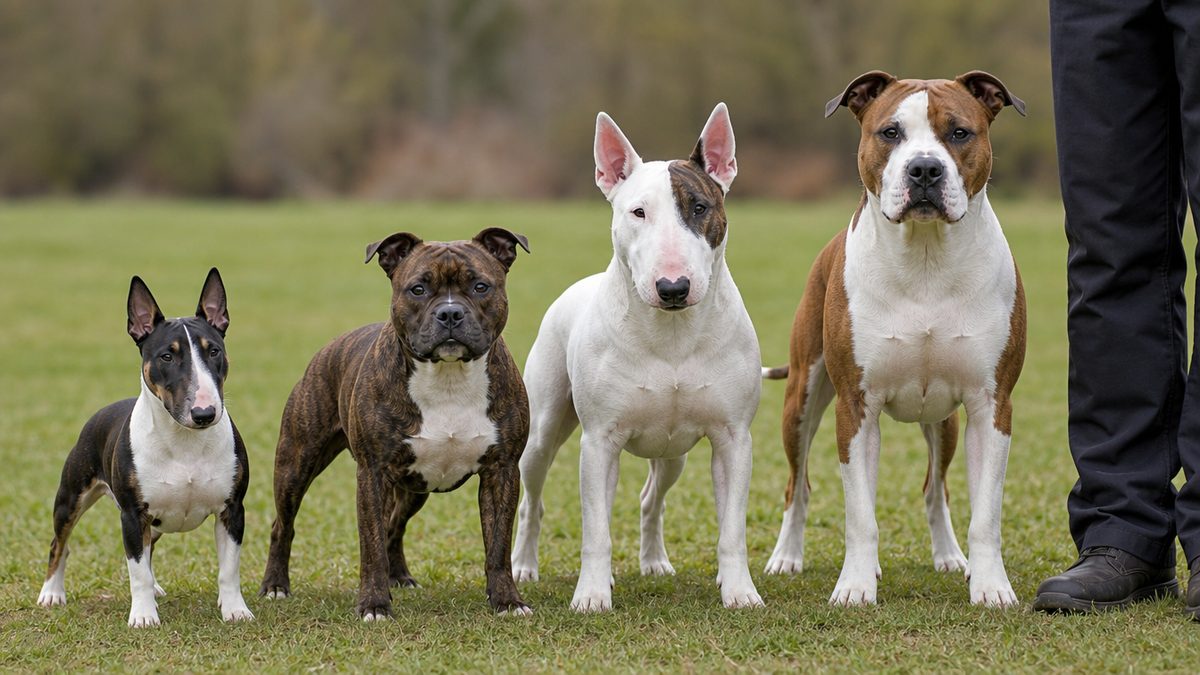
A bull type terrier is not a breed. It is the FCI's name for Group 3 Section 3, which holds four separate breeds: Bull Terrier, Miniature Bull Terrier, Staffordshire Bull Terrier and American Staffordshire Terrier. Everyday use adds the American Pit Bull Terrier, which the FCI does not recognise at all. No kennel club issues a pedigree for a bull type terrier, so an Indian buyer should ask which of the five breeds a dog is, and which FCI number is on its paperwork.
This guide is general information for Indian pet owners and is not a diagnosis. Consult a registered veterinarian near you before acting on anything you read here, ask which screening applies to your specific breed rather than to the category, and treat collapse, disorientation or laboured breathing after exercise in hot weather as an emergency rather than something to observe.
Bull-type terrier at a glance
What a bull type terrier is, and why it is not a breed
A bull type terrier is a registry CATEGORY covering several separate breeds, not a breed you can buy, register or pedigree. The Federation Cynologique Internationale uses the phrase as the formal name of Group 3 Section 3, and no kennel club anywhere issues a pedigree for a dog called a bull type terrier.
Start with the document that settles it. The FCI's breeds nomenclature divides Group 3 Terriers into four sections, and the third is printed as "Section 3 : Bull type Terriers". That section holds exactly four breeds: Bull Terrier (FCI 11), Miniature Bull Terrier (FCI 359), Staffordshire Bull Terrier (FCI 76) and American Staffordshire Terrier (FCI 286). Each of those four has its own standard, its own number and its own studbook. The section itself has none of those things, because a section is a filing shelf, not a dog.
Every one of the four standards confirms the same thing on its own face. Open FCI-Standard No. 11 and the classification line reads "Group 3 Terriers. Section 3 Bull type Terriers";. Open No. 76 and it reads the same. The phrase names the shelf the breed sits on. It is the canine equivalent of "sedan", not of "Honda City".
The alphabetical register makes the point the other way round. The FCI's list of every recognised breed beginning with B runs 42 entries, from Barbet to Bullmastiff, and includes Bull Terrier, Bulldog, Bullmastiff, Boston Terrier and the Brazilian Campeiro Bulldog. There is no entry for Bull Type Terrier, because there is nothing to enter.
Where the phrase actually comes from
The category is older than any of the breeds inside it. Nineteenth-century British breeders crossed bulldogs with terriers to make fighting and baiting dogs, and the resulting animals were called bull and terriers, half-and-halfs or half-breds. Those crosses were never standardised. As Wikipedia puts it, "The bull and terrier was never a bona fide breed; rather, it referred to a heterogeneous group of dogs that may include purebreds involving different breeds, as well as dogs believed to be crosses of those breeds";. Its infobox records the breed status as "Not recognised as a breed by any major kennel club";.
From that unstandardised pool, separate registries later carved out separate breeds: the Bull Terrier, the Miniature Bull Terrier, the Staffordshire Bull Terrier, the American Pit Bull Terrier, the American Staffordshire Terrier and the Dogo Argentino. The category term survived the carving. That is why it is still in use, and why it still does not name a dog. Wikipedia's terrier navigation box makes the grammar explicit, listing under "Types" the entry "Bull-type terriers (and pit bulls)" alongside feists, Fell Terriers, Fox Terriers and working terriers. Types, not breeds. And the general reference disagrees with the registry about membership as readily as the registries disagree with each other: the same navigation box's "Bull-type breeds" row holds eight entries, adding the American Bully, the American Pit Bull Terrier, the American Staffordshire Terrier and the Boston Terrier to the bull and terrier and the three British ones. That is twice the size of the FCI's four-breed section, and it includes a Boston Terrier that the FCI files in Group 9 and the UKC files under Companion Dog United Kennel Club, Breed Standards index.
The five breeds an Indian buyer will actually meet under this label
- Bull Terrier, FCI 11, Great Britain. Egg-shaped downfaced head, small erect ears, no height or weight limit in the standard at all.
- Miniature Bull Terrier, FCI 359, Great Britain. The same standard text as the Bull Terrier with one sentence added: height must not exceed 35.5 cm.
- Staffordshire Bull Terrier, FCI 76, Great Britain. Short broad head with a distinct stop, rose or half-pricked ears, 35.5 to 40.5 cm and 11 to 17 kg.
- American Staffordshire Terrier, FCI 286, United States. Medium-length head, 46 to 48 cm for a male, and an AKC standard approved in 1936 that still permits cropped ears.
- American Pit Bull Terrier, not FCI recognised at all. Registered by the United Kennel Club since 1898, males 35 to 60 lb and 18 to 21 inches.
Nobody can sell you a bull type terrier, because no registry issues that pedigree. If a seller in Mumbai, Delhi or Hyderabad uses the phrase on a listing, ask which of the five breeds above the dog actually is, and ask for the breed named on the paperwork rather than the category. A category on a receipt is a way of not answering the question.
Four registries, four different answers, all read in full
Which breeds count as bull type terriers depends entirely on which registry you ask, and the four major registers disagree with each other about membership, about grouping and about whether two of the breeds exist at all. Every register below was retrieved in full and checked against a control on the same document.
Kennel club recognition is the first thing an Indian buyer asks about, so start with the plain answer: no kennel club recognition exists anywhere for a breed called the bull type terrier, and the four registers below cannot even agree on which breeds belong in the group. An absence is only worth publishing when the search that produced it can be shown to work, so each row below names a control taken off the same document in the same session, and every control was present.
FCI: the only registry that uses the phrase officially
The FCI is the only one of the four that has a formal bull type category, and it is a section rather than a breed. Group 3 Terriers holds 34 breeds across four sections: 15 large and medium sized terriers, 12 small sized terriers, 4 bull type terriers and 3 toy terriers. Control: Airedale Terrier, Jack Russell Terrier and Yorkshire Terrier all appear in their expected sections, so the page is the complete Group 3 nomenclature rather than a fragment.
The Royal Kennel Club: 227 breeds, no bull type section, no AmStaff
Britain's kennel club recognises 227 breeds and prints that total on the page as "Showing 227 results";. They split into seven groups, and the arithmetic checks out: Gundog 38, Hound 39, Pastoral 42, Terrier 27, Toy 24, Utility 30 and Working 27, which sums to exactly 227. Britain uses no sub-sections at all, so there is no bull type shelf, and the phrase appears nowhere on the register.
Three of the five members are on it, under British names: Bull Terrier, Bull Terrier (Miniature) and Staffordshire Bull Terrier. Note the naming: Britain writes "Bull Terrier (Miniature)", while the FCI and the AKC both write "Miniature Bull Terrier". Neither the American Staffordshire Terrier nor the American Pit Bull Terrier appears anywhere in the 227, and the string "American Staffordshire" returns zero across the whole register while "Staffordshire" returns the Staffordshire Bull Terrier as the control.
AKC: no pit bull at all
The American Kennel Club's own breed selector lists every breed it knows, including its Foundation Stock Service and Miscellaneous entries, and the searches on it are decisive. Bull Terrier, Miniature Bull Terrier and Staffordshire Bull Terrier are all present, and American Staffordshire Terrier appears four times across the page. The strings "Pit Bull", "American Bully" and "Bull-type" each return zero. The AKC does not recognise the American Pit Bull Terrier, and it has no bull type grouping.
UKC: recognises the pit bull and not the AmStaff
The United Kennel Club recognises "over 300 separate breeds" arranged in eight groups plus a Bloodlines Listing Service, and none of the eight is a bull type group. Its Terrier group holds 45 breeds including the American Pit Bull Terrier, Bull Terrier, Miniature Bull Terrier and Staffordshire Bull Terrier. The American Staffordshire Terrier is absent from the Terrier group and from the whole UKC breed list, while American Bully sits in the Companion Dog group and American Bulldog in the Guardian Dog group.
Read those last two paragraphs together. America's two large registries each recognise exactly one of the two American breeds, and it is not the same one. The AKC has the American Staffordshire Terrier and not the pit bull; the UKC has the pit bull and not the AmStaff.
| Breed | FCI | Royal Kennel Club | AKC | UKC |
|---|---|---|---|---|
| Bull Terrier | Yes, no. 11, Section 3 | Yes, Terrier group | Yes, Terrier group | Yes, Terrier group |
| Miniature Bull Terrier | Yes, no. 359, Section 3 | Yes, as Bull Terrier (Miniature) | Yes | Yes, Terrier group |
| Staffordshire Bull Terrier | Yes, no. 76, Section 3 | Yes, Terrier group | Yes | Yes, Terrier group |
| American Staffordshire Terrier | Yes, no. 286, Section 3 | No, absent from all 227 | Yes | No, absent from the list |
| American Pit Bull Terrier | No, not recognised | No, absent from all 227 | No, zero hits for Pit Bull | Yes, registered since 1898 |
| A breed called Bull Type Terrier | No, it is a section | No such grouping | No, zero hits | No such group |
FCI: Bull Terrier, Bulldog and Bullmastiff all present under B, so the alphabetical index loaded. Royal Kennel Club: seven group counts sum exactly to the printed total of 227, so the register is complete rather than truncated. AKC: American Staffordshire Terrier returns four hits on the same page where Pit Bull returns zero, so the search string works. UKC: American Pit Bull Terrier appears twice, in the dropdown and in the Terrier group list, on the same page where American Staffordshire appears in neither.
The members contradict each other in their own breed standards
Inside the FCI's single bull type terrier section, one breed standard demands stiffly erect ears and another calls pricked ears highly undesirable, so the category contains a direct contradiction about what the dog should look like. Height inside the same four breeds runs from a 35.5 cm ceiling to a 48 cm preference.
These are not interpretations. They are the four documents the FCI publishes, read side by side.
Ears: required in one member, penalised in another
The Bull Terrier standard says ears should be "Small, thin and placed close together. Dog should be able to hold them stiffly erect, when they point straight upwards";. The Staffordshire Bull Terrier standard says ears should be "Rose or half pricked, not large or heavy. Full, drop or pricked ears highly undesirable";. A pricked ear is mandatory in one and a fault in the other, and both breeds are filed on the same shelf.
Colour: pure white is correct in one and disqualifying in another
The AKC splits the Bull Terrier into two show varieties. In the White variety, colour "Is white though markings on the head are permissible";. In the Colored variety, "A dog which is predominantly white shall be disqualified";. So one breed disqualifies a predominantly white dog in one variety and requires it in the other. Meanwhile the American Staffordshire Terrier standard treats the same trait as a mild preference, saying "all white, more than 80 per cent white, black and tan, and liver not to be encouraged". Three rules for one colour, inside one category.
Size: one member has no limits at all
The Bull Terrier standard is unusual and says so deliberately: "There are neither weight nor height limits, but there should be the impression of maximum substance for size of dog consistent with quality and sex";. The Miniature Bull Terrier standard reproduces that Bull Terrier text word for word and then adds the single differing sentence: "Height should not exceed 35,5 cms", with "no weight limit";. Two FCI breeds, two breed numbers, one document, one sentence between them.
| Clause | Bull Terrier (11) | Mini Bull Terrier (359) | Staffordshire BT (76) | AmStaff (286) |
|---|---|---|---|---|
| Standard in force since | 05.07.2011 | 05.07.2011 | 24.06.1987 | 03.09.1996 |
| Head | Egg-shaped, downfaced | Egg-shaped, downfaced | Short, broad, distinct stop | Medium length, broad, distinct stop |
| Ears | Stiffly erect | Stiffly erect | Rose or half pricked; pricked highly undesirable | Not specified in the FCI text |
| Height, male | No limit stated | Not to exceed 35.5 cm | 35.5 to 40.5 cm | About 46 to 48 cm |
| Weight, male | No limit stated | No limit stated | 12.7 to 17 kg | In proportion to height |
| Coat | Short, flat, harsh | Short, flat, harsh | Smooth, short, close | Short, close, stiff, glossy |
Read the height row across. A correctly bred Miniature Bull Terrier tops out at 35.5 cm; a correctly bred American Staffordshire Terrier is preferred at 46 to 48 cm; and a correctly bred Bull Terrier has no ceiling written down anywhere. Those are three different dogs by any practical measure, and an Indian flat that suits the first will not suit the third.
Two things all four do agree on
Every one of the four FCI standards lists the same two disqualifying faults: "Aggressive or overly shy dogs" and "Any dog clearly showing physical or behavioural abnormalities"; FCI-Standard No. 359 FCI-Standard No. 76 FCI-Standard No. 286. That wording is FCI boilerplate applied across the register, so it is not evidence about this category specifically. What it does mean is concrete: a bull type terrier that shows aggression in the ring is disqualified under its own breed's rules, in all four cases.
The American Staffordshire Terrier standard says "Tail: ... Not docked" and the American Pit Bull Terrier standard makes a bobbed tail an Eliminating Fault United Kennel Club. Both align with Indian law, which forbids docking outright. Ear cropping is the opposite case and the grooming section returns to it.
Breed identification by eye is unreliable, and that is a measured finding
Visual breed identification of bull type terriers fails often enough to be useless as evidence, and four peer-reviewed studies have measured exactly how badly. This is not an opinion about labelling; it is a set of published numbers with denominators, and every Indian buyer, shelter and housing society should know them.
The single most important study is Olson and colleagues, published in The Veterinary Journal in 2015. Sixteen staff members across four American shelters each recorded suspected breeds for 30 dogs, giving 120 dogs assessed by eye, and the same dogs were blood-tested for breed DNA. The study defined "pit bull-type breeds" as American pit bull terrier, American Staffordshire terrier, Staffordshire bull terrier, pit bull and their mixes, which is close to this page's category.
The results are stark. "Whereas DNA breed signatures identified only 25 dogs (21%) as pit bull-type, shelter staff collectively identified 62 (52%) dogs as pit bull-type";. Sensitivity for identifying these dogs ranged from 33 percent to 75 percent depending on which staff member was judging, and specificity from 52 percent to 100 percent. The median kappa for agreement with DNA ranged from 0.1 to 0.48, which the authors describe as poor to moderate.
Two of the paper's own summary points are worth quoting because they cut both ways: "One in five dogs genetically identified with pit bull heritage breeds were missed by all shelter staff" and "One in three dogs lacking DNA for pit bull heritage breeds were labeled pit bull-type dogs by at least one staff member";. The authors conclude that "visual identification of pit bull-type dogs was unreliable";.
The same dog is a different breed in a different country
Hoffman and colleagues showed 20 photographs to shelter workers in the United States and the United Kingdom and asked what breed each dog was. Their finding is the category problem in one line: "UK participants frequently labeled dogs commonly considered by U.S. participants to be pit bulls as Staffordshire bull terriers";. Same photograph, same dog, two different breed names, decided by which side of the Atlantic the assessor works on.
The study also found something that should make anyone treating shelter breed labels as data stop and think: "41% affected by BSL indicated they would knowingly mislabel a dog of a restricted breed, presumably to increase the dog's adoption chances";.
The public cannot do it either, and neither can DNA at depth
Webster and Farnworth surveyed the British public on the four types the Dangerous Dogs Act prohibits. Identification of banned breeds was significantly worse than identification of other breeds, F(1, 20) = 57.746, p < .001, and identification of bull breeds was also significantly worse, F(1, 20) = 9.293, p = .006. People working in a dog-related profession did better than others, but the authors still concluded that "public understanding of dangerous dogs is poor";.
Gunter and colleagues then tested 919 shelter dogs genetically, 459 in Phoenix and 460 in San Diego. Only 4.9 percent were purebred, 125 distinct breeds turned up, and the single most common breed signature in the whole sample was the American Staffordshire Terrier. Staff matched at least one breed in a dog's genetic heritage 67.7 percent of the time, but "their agreement fell to 10.4% when asked to identify more than one breed".
| Study | Sample | Key measured result |
|---|---|---|
| Olson 2015, Vet J | 120 dogs, 16 assessors, 4 shelters | DNA said 25 of 120 (21%) were pit bull-type; staff said 62 (52%) |
| Olson 2015, Vet J | same | Sensitivity 33% to 75%, specificity 52% to 100%, kappa 0.1 to 0.48 |
| Hoffman 2014, JAAWS | 20 photos, US and UK shelter workers | UK workers called US-labelled pit bulls Staffordshire bull terriers |
| Hoffman 2014, JAAWS | same | 41% of those under breed law would knowingly mislabel a restricted dog |
| Webster 2019, JAAWS | 762 respondents, 187 dog professionals | Banned-breed recognition significantly worse, p < .001 |
| Gunter 2018, PLoS ONE | 919 shelter dogs, DNA tested | 4.9% purebred; staff agreement 10.4% once more than one breed asked |
If four peer-reviewed studies find that trained shelter staff cannot reliably identify these dogs from a photograph or in the flesh, a resident welfare association committee cannot either. A rule written against a look rather than a behaviour will catch dogs it did not mean to catch and miss dogs it did. Ask for the KCI pedigree, which names one breed, rather than accepting a category assigned by eye.
Why legislation reaches for the word type instead of a breed name
Dangerous dogs law uses type language because a statute cannot name a breed that no registry recognises, and Britain's Dangerous Dogs Act 1991 is the clearest example: it prohibits "any dog of the type known as the pit bull terrier", a phrase chosen precisely because no British kennel club registers such a breed.
Section 1 of the Act is headed "Dogs bred for fighting" and applies to "(a) any dog of the type known as the pit bull terrier; (b) any dog of the type known as the Japanese tosa; and (c) any dog of any type designated for the purposes of this section by an order of the Secretary of State, being a type appearing to him to be bred for fighting or to have the characteristics of a type bred for that purpose";. The word is type, three times in one subsection.
The Act's own long title makes the drafting choice explicit. It is "An Act to prohibit persons from having in their possession or custody dogs belonging to types bred for fighting";. Two further types were designated in 1991, the Dogo Argentino and the Fila Braziliero, and the XL Bully was designated for England and Wales from 31 December 2023 and for Scotland from 23 February 2024.
The line runs through the category, not around it
Here is the part that matters for anyone using bull type terrier as a risk label. Britain prohibits the pit bull terrier type and the XL Bully type. It does not prohibit the Bull Terrier, the Bull Terrier (Miniature) or the Staffordshire Bull Terrier, all three of which sit on the Royal Kennel Club's register of 227 breeds and can be shown at Crufts Dangerous Dogs Act 1991 c.65, section 1.
Breed-specific legislation of this kind is now widespread, and Wikipedia's own article on the pit bull devotes separate sections to identification, to breed-specific legislation, to liability insurance and to air carrier restrictions, which is a fair map of where the label actually bites in daily life. So the legal boundary cuts straight through the middle of the category. Three members are ordinary registered pedigree breeds in Britain and one member is a banned type, and Hoffman's photographs show that British assessors routinely call the banned one by the registered one's name. That is a law and an identification problem colliding, and it is why the type framing exists in the first place: the statute needed to catch dogs that no studbook had ever recorded.
What the bite literature does with breed, and what it cannot do
The best-sourced study of fatal dog attacks anywhere is Patronek and colleagues in the Journal of the American Veterinary Medical Association, covering 256 dog bite-related fatalities in the United States between 2000 and 2009. Its authors went past media reports to homicide detectives, animal control reports and investigator interviews, and they were explicit about the denominator problem.
Three of their numbers should end the argument about using breed as a screening tool. First, "Valid breed determination was possible for only 45 (17.6%) DBRFs; 20 breeds, including 2 known mixes, were identified". Second, "For 401 dogs described in various media accounts, reported breed differed for 124 (30.9%)";. Third, "for 346 dogs with both media and animal control breed reports, breed differed for 139 (40.2%)";.
What the study did find, with denominators, was a cluster of husbandry factors. No able-bodied person present to intervene in 223 of 256 cases (87.1 percent), no familiar relationship between victim and dog in 218 (85.2 percent), owner failure to neuter in 216 (84.4 percent), and dogs kept isolated from regular positive human interaction in 195 (76.2 percent). Four or more of those factors co-occurred in 206 deaths, or 80.5 percent. The authors' conclusion is one sentence: "Most DBRFs were characterized by coincident, preventable factors; breed was not one of these";.
The finding is not that bull type terriers are harmless. It is narrower and more useful. In the most carefully investigated series available, breed could not even be established in 82.4 percent of fatal cases, so no honest conclusion about breed can be drawn from that dataset at all, in either direction. Anyone quoting a breed percentage from media-derived bite data is quoting a figure whose own source says it disagreed with animal control 40.2 percent of the time.
India's 2024 circular named two members of this category, then two High Courts struck it down
No nationwide breed ban is in force in India as of August 2026, because the 12 March 2024 circular that named Pitbull Terrier and American Staffordshire Terrier was quashed by the Karnataka High Court on 10 April 2024 and set aside by the Delhi High Court on 16 April 2024. The headline said ban. The legal position is that it was obliterated.
The sequence matters, so here it is from the court records rather than the news cycle.
December 2023: a PIL asks Delhi to ban Terriers as a class
The whole episode started with a Public Interest Litigation in the Delhi High Court, Writ Petition (C) No.15673 of 2023, decided on 6 December 2023. The Karnataka judgment reproduces the Delhi bench's order in full, and the list of dogs the petitioners wanted banned begins "Pitbull, Terriers. American Bulldog, Rottweiler, Japanese Tosa, Bandog (Bandog is a cross between American Pit Bull Terrier or American Bulldog and a Neapolitan Mastiff or a Mastiff)" and continues through Wolf Dog, Boerboel, Presa Canario, Fila Brasileiro, Tosa Inu, Cane Corso and Dogo Argentino "and the cross breeds of the above-mentioned dogs";.
Read the second word. Not Bull Terrier, not Staffordshire Bull Terrier, but "Terriers", as a bare class. That is a petition asking India to ban the entire terrier group, which at the FCI holds 34 breeds including the Yorkshire Terrier and the West Highland White Terrier. The Union of India told the court it would consult all stakeholders before deciding, and the court held it bound by that undertaking.
March 2024: the circular, and what it actually listed
On 12 March 2024 the Department of Animal Husbandry and Dairying issued the circular. The Karnataka judgment quotes the expert committee list, but its reproduction is abridged and drops six entries. The complete text survives in CBIC Instruction 05/2024-Customs of 14 March 2024, which reads "breeds (including mixed and cross breeds) like Pitbull Terrier, Tosa Inu, American Staffordshire Terrier, Fila Brasileiro, Dogo Argentino, American Bulldog, Boerboel, Kangal, Central Asian Shepherd Dog (ovcharka), Caucasian Shepherd Dog (ovcharka), South Russian Shepherd Dog (ovcharka), Tornjak, Sarplaninac, Japanese Tosa and Akita, Mastiffs (boerbulls), Rottweiler, Terriers, Rhodesian Ridgeback, Wolf dogs, Canario, Akbash dog, Moscow Guard dog, Cane corso and every dog of the type commonly known as a Ban Dog (or Bandog)";.
Two of this page's five members were named: the Pitbull Terrier and the American Staffordshire Terrier. Three were not named individually, the Bull Terrier, the Miniature Bull Terrier and the Staffordshire Bull Terrier. That distinction is thinner than it looks, because the seventeenth entry is the bare word Terriers, which the instrument never defines and which on its face reaches every breed on this page. The count is settled too. The customs instruction prints 24 comma-separated entries, which is the number the Delhi High Court used, while press reports say 23 because they fold the closing Bandog clause in, and 25 appears where Japanese Tosa and Akita is split into two The Indian Express.
April 2024: both courts strike it down
The circular never really took effect. The Karnataka High Court records that "This Court in terms of its order dated 19-03-2024 granted an interim order of stay of the Circular insofar as it concerns the State of Karnataka", and adds that "the other High Courts have also granted such stay after the interim order granted by this Court";. So the circular was stayed within a week of being issued. The same court then allowed the writ petition on 10 April 2024 and ordered that the "Circular dated 12-03-2024, issued by the 1st respondent stands quashed". Its findings were that no stakeholder had been heard despite the undertaking, that the committee was not constituted in accordance with the Rules, and that "The Union of India by the impugned circular could not have imposed a blanket ban, in the teeth of the Rules in force";.
The judge went further, in language worth quoting in full: "In the considered view of this Court, breed bans have never resulted in responsible pet ownership", and "A dog bite is a dog bite, be it from a branded ferocious dog or any other dog";. He directed that any future attempt must hear stakeholders including the Kennel Club of India, "which is said to be the sole registering Authority";.
Six days later, on 16 April 2024, a Delhi High Court division bench of Acting Chief Justice Manmohan and Justice Manmeet Pritam Singh Arora set the same circular aside, recording the Centre's admission that "other than Government bodies, no private body was heard before the impugned circular was issued". The court directed a public notice inviting written objections before any final notification.
The Centre issued its public notice seeking objections on 2 May 2024, and on 24 January 2025 it told the Bombay High Court that it is not acting on the March 2024 circular at present and will decide after considering the objections. So the position is not that the question is closed. It is that no national breed prohibition is currently operative, a fresh notification remains possible after consultation, and separate municipal or state rules and individual housing-society bye-laws are a different matter that this page does not cover. Check your own city and your own society, in writing, before you buy.
Bull type terrier price in india, member by member
There is no single bull type terrier price in india, because there is no single breed to price, and the published Indian bands for the members run from Rs 35,000 to Rs 1,50,000 depending on which of the five dogs a seller actually has. Every rupee figure below was checked for the exchange-rate artefact that fakes Indian prices, and this group passes that test.
Bonbeno reports published price ranges as editorial content. It does not sell dogs, broker puppies or recommend a breeder, and no listing on this page is an offer.
What Indian sellers publish
One large Indian listing site prints a Bull Terrier band of "INR 55,000 to INR 1,50,000+" and breaks it into three tiers: Basic quality INR 55,000 to 90,000, KCI Registered INR 90,000 to 1,20,000, and Champion Bloodline INR 1,20,000 to 1,50,000. The same site prints the identical INR 55,000 to INR 1,50,000 range for Hyderabad, Bangalore, Delhi, Chennai, Lucknow, Mumbai, Jaipur and Pune, all eight cities. A price that does not move between Chennai and Lucknow is a template, not a market observation.
A second Indian seller prices the Staffordshire Bull Terrier separately, at "₹35,000 to ₹45,000 or more, depending on factors like pedigree and breed". So on Indian retail pages the cheapest member of this category starts at roughly a quarter of what the most expensive one tops out at.
| Breed | Published Indian band | Source | Divides by 84.38? | Divides by 74? |
|---|---|---|---|---|
| Bull Terrier, basic | Rs 55,000 to 90,000 | Mr n Mrs Pet | No, gives 651.8 and 1,066.6 | No, gives 743.2 and 1,216.2 |
| Bull Terrier, KCI registered | Rs 90,000 to 1,20,000 | Mr n Mrs Pet | No, gives 1,066.6 and 1,422.1 | No, gives 1,216.2 and 1,621.6 |
| Bull Terrier, champion line | Rs 1,20,000 to 1,50,000 | Mr n Mrs Pet | No, gives 1,422.1 and 1,777.7 | No, gives 1,621.6 and 2,027.0 |
| Staffordshire Bull Terrier | Rs 35,000 to 45,000 | Puppiezo | No, gives 414.8 and 533.3 | No, gives 472.9 and 608.1 |
| Bull Terrier, headline figure | Rs 98,999 | Puppiezo | No, gives 1,173.25 | No, gives 1,337.8 |
Not one of those figures resolves to a round dollar amount at either rate, so unlike several rare breeds on this site, these are rupee-native prices rather than an American list run through a converter. That is worth saying plainly: the Indian market for bull type terriers is real, and the numbers are not imported.
The Rs 98,999 problem, caught again
One figure on that table is not a Bull Terrier price at all. Puppiezo's Bull Terrier page carries a live carousel of eight puppies, and the price attached most often is Rs 98,999. Bonbeno has recorded that exact number on ten separate pages of the same site, for breeds it does not stock, and this retrieval confirms why.
Not one of the eight puppies listed on the Bull Terrier page is a Bull Terrier. They are Fizey, a Maltipoo at Rs 98,999; Samy, a Maltipoo at Rs 98,999; Yoki, a Doxiepoo at Rs 98,999; Kuzo, a Poodle at Rs 92,599; Dugu, a Poodle at Rs 92,599; Kazuka, a Cane Corso at Rs 94,999; Doir, a Goldendoodle at Rs 1,20,000; and Tugi, a Rottweiler at Rs 76,499. Rs 98,999 is a house charm price attached to whichever puppy is in stock. Never accept it as any breed's price.
The same page collapses two FCI breeds into one product
The category error is not only a search term problem; it is on the invoice. That same Indian product page prints a single spec card reading "Height 21-22 inches (Standard), 10-14 inches (Miniature)" and "Weight 24-38 kg (Standard), 9-15 kg (Miniature)". Two FCI breeds with two separate breed numbers, sold under one heading. And the FCI Bull Terrier standard states there are neither weight nor height limits, so the 21 to 22 inch figure has no basis in the breed standard it claims to describe.
Ask the seller: which FCI breed number is on the KCI pedigree, 11, 359, 76 or 286? A Bull Terrier is 11, a Miniature Bull Terrier is 359, a Staffordshire Bull Terrier is 76, an American Staffordshire Terrier is 286, and an American Pit Bull Terrier has no FCI number at all so it cannot hold a KCI pedigree. If the answer is a category rather than a number, you are not being sold a registered dog.
What a bull type terrier actually costs to keep in India
Recurring cost for these breeds is driven by body weight and by veterinary screening, not by the purchase price, and the weight spread inside this one category is roughly four to one. A Miniature Bull Terrier capped at 35.5 cm and an American Staffordshire Terrier preferred at 46 to 48 cm do not eat the same amount of anything.
Bonbeno does not publish a single monthly rupee figure for this page, and the reason is structural rather than evasive. There is no such thing as the cost of a bull type terrier, because the category holds a 12.7 kg dog and a dog with no upper weight limit written into its standard at all FCI-Standard No. 11, Bull Terrier. Any monthly number you are shown for the category is a number for one of the five breeds, quietly generalised.
The four cost drivers that do generalise
- Food scales with adult weight. The published Staffordshire Bull Terrier weight band is 12.7 to 17 kg for dogs and 11 to 15.4 kg for bitches, while the American Staffordshire Terrier standard gives no weight and asks only that height and weight be in proportion at 46 to 48 cm FCI-Standard No. 286. Budget by the weight of the dog in front of you, never by the category.
- Screening is breed-specific and non-optional. Each member carries a different inherited risk with a different test, and the health section below sets out which. Skipping the test that matters for your breed is the single most expensive economy available.
- Skin and ear care rises in the monsoon. All five are short-coated single-coated dogs, so grooming cost is low, but humidity-driven skin and ear problems are a recurring vet line rather than a one-off.
- Neutering is a documented risk factor, not a cost to defer. Owner failure to neuter co-occurred in 216 of 256 American fatal-attack cases, or 84.4 percent. Whatever else that dataset cannot establish, this is one of its clearest signals.
The pedigree market is shrinking, and that changes what you should pay for
The FCI publishes the Kennel Club of India's own returns, and they show a market in sharp contraction. Pure-bred dogs registered with the KCI studbook peaked at 89,571 in 2021, then fell to 76,011 in 2022, 47,679 in 2023, 38,592 in 2024 and 33,880 in 2025. That is a fall of 62 percent in four years. Over the same period the number of member clubs slipped from 82 to 80 and CACIB all-breed shows ran at two a year.
The practical consequence for a buyer is uncomfortable. A shrinking registry means fewer registered litters chasing steady demand, which is exactly the condition in which unregistered dogs get sold as registered ones. It is also why the KCI-registered tier commands roughly Rs 90,000 to Rs 1,20,000 against Rs 55,000 to Rs 90,000 for basic quality on the same Indian listing page.
| Year | Pure-bred dogs registered | Litters registered | Member clubs |
|---|---|---|---|
| 2019 | 44,702 | 6,320 | 86 |
| 2020 | 55,512 | 6,520 | 84 |
| 2021 | 89,571 | 8,500 | 82 |
| 2022 | 76,011 | 7,520 | 84 |
| 2023 | 47,679 | 6,850 | 84 |
| 2024 | 38,592 | 7,828 | 81 |
| 2025 | 33,880 | 7,412 | 80 |
One caution about that table. These are self-reported national figures, and the same FCI page carries an obviously broken row where the approximate total number of dogs in India drops from 157,500,000 in 2017 to 15,794,584 in 2018, a factor of ten. Treat the studbook and litter columns, which move smoothly and plausibly, as usable, and treat the population columns as unusable.
Spend less on the tier label and more on the two things that are verifiable: a pedigree naming one FCI breed number, and the screening result that matters for that specific breed. A champion-bloodline receipt tells you about a show record. An OFA or equivalent screening result tells you about the hips, eyes or heart of the dog you are taking home.
Heat tolerance: every breed in this category was standardised in a cold place
All five bull type terriers were developed and standardised in places far cooler than any Indian city, and the arithmetic is blunt: Birmingham, where the Bull Terrier was first shown in 1862, has a warmest month averaging 16.39 C, which is colder than Chennai's coolest month at 24.09 C. Their short coats help; their origin climate does not.
Four of the five breeds are British, and the Bull Terrier's own FCI standard records that "The breed was first shown in its present form at Birmingham in 1862";. So Birmingham is the right comparison point, and it can be queried without ambiguity.
NASA POWER was asked for a 20-year climatology at latitude 52.4862 and longitude -1.8904, and it echoed back coordinates 52.486 and -1.89, which is Birmingham. The dataset is the January 2001 to December 2020 MERRA-2 monthly climatology.
The single comparison that decides this
Birmingham's warmest month averages 16.39 C in July. Chennai's coolest month averages 24.09 C in January. The hottest month at the origin is 7.7 C colder than the coolest month in Chennai. Bengaluru, the mildest large Indian city in this comparison, has a coolest month of 20.22 C, still 3.8 C above Birmingham's peak.
The humidity argument does not rescue it either, and it fails in an interesting direction. Birmingham's annual mean relative humidity is 86.74 percent, higher than Chennai at 72.39 percent, Mumbai at 67.39 percent and Bengaluru at 67.94 percent. These are dogs adapted to cool damp air, not to warm damp air, and the two are different physiological problems. Cool and humid means little evaporative load; hot and humid means panting becomes less effective exactly when the dog needs it most.
| Place | Coordinates returned | Annual mean C | Warmest month C | Annual RH % | Months at or above 28 C |
|---|---|---|---|---|---|
| Birmingham, UK | 52.486, -1.89 | 9.56 | 16.39 | 86.74 | 0 |
| Bengaluru | 12.972, 77.595 | 23.74 | 28.37 | 67.94 | 1 |
| Pune | 18.520, 73.857 | 23.86 | 28.93 | 66.80 | 2 |
| Delhi | 28.614, 77.209 | 25.60 | 35.88 | 45.56 | 6 |
| Mumbai | 19.076, 72.878 | 26.77 | 31.19 | 67.39 | 4 |
| Ahmedabad | 23.023, 72.571 | 27.57 | 35.06 | 48.32 | 7 |
| Chennai | 13.083, 80.271 | 27.95 | 31.51 | 72.39 | 7 |
What actually helps, and what does not
Three things in these standards genuinely help in Indian heat. All four FCI standards in Section 3 describe a short, close, smooth single coat with no undercoat requirement beyond "a soft textured undercoat may be present in winter", so there is no insulating mat to trap heat FCI-Standard No. 76. None of the five is brachycephalic in its standard: the Bull Terrier has a long head "deep right to end of muzzle", and the American Pit Bull Terrier standard makes a "Muzzle so short and blunt as to interfere with normal breathing" an Eliminating Fault United Kennel Club. And the light body mass of the smaller members sheds heat faster than a coated giant breed would.
What does not help is what the market is doing to these dogs. The UKC standard warns judges twice against "Overly large, heavy heads" and "Overly massive body style that impedes working ability", and makes "Chest so wide as to interfere with normal movement" an Eliminating Fault. A heavy, wide, thick-necked bull type dog of the kind sold as impressive in Indian cities is the version least able to cope with a Chennai May.
Chennai and Ahmedabad both run seven months at or above 28 C, so exercise happens before sunrise and after dark for over half the year, every year. Delhi runs six such months plus a 35.88 C peak, so the risk there is acute rather than chronic. Bengaluru at one month and Pune at two are the two cities where a bull type terrier can be walked at ordinary hours for most of the year. Mumbai's four months are the hardest to manage because the humidity stays high throughout.
Temperament: what the standards ask for, and what they quietly admit
Every bull type terrier standard asks for a dog that is affectionate with people and disqualifies aggression toward people, and one of them says openly that dog-to-dog aggression is normal for the breed. That split, friendly to humans and difficult with other dogs, is the single most useful thing to understand before buying one in an Indian city.
Take the standards at their word first. The Bull Terrier is "Courageous, full of spirit, with a fun loving attitude. Of even temperament and amenable to discipline. Although obstinate is particularly good with people";. The Staffordshire Bull Terrier is "Traditionally of indomitable courage and tenacity. Highly intelligent and affectionate especially with children. Bold, fearless and totally reliable";. The American Staffordshire Terrier standard opens on physique and adds only that "His courage is proverbial";.
The one standard that tells you the truth about other dogs
The UKC's American Pit Bull Terrier standard is unusually candid, and it is the most useful document in this section. "The essential characteristics of the American Pit Bull Terrier are strength, confidence, and zest for life. This breed is eager to please and brimming over with enthusiasm. APBTs make excellent family companions and have always been noted for their love of children";.
Then comes the sentence buyers need: "Because most APBTs exhibit some level of dog aggression and because of its powerful physique, the APBT requires an owner who will carefully socialise and obedience train the dog";. The standard adds a formal note repeating it: "Although some level of dog aggression is characteristic of this breed, handlers will be expected to comply with UKC policy regarding dog temperament at UKC events";.
It is equally clear about people. "The APBT is not the best choice for a guard dog since they are extremely friendly, even with strangers. Aggressive behavior toward humans is uncharacteristic of the breed and highly undesirable";. Viciousness or extreme shyness is a Disqualification.
Two more practical warnings inside the same document
The UKC standard flags a physical trait with direct housing consequences: "The breeds natural agility makes it one of the most capable canine climbers so good fencing is a must for this breed";. In an Indian context that means a balcony grille, a terrace parapet and a society gate are all things this dog can get over, and a two-foot compound wall is decorative rather than functional.
The second is about drive. These are dogs selected for gripping and holding, and while none of the four FCI standards uses the phrase prey drive, all four describe strength, tenacity and determination as breed-defining FCI-Standard No. 76. A high prey drive around Indian street cats, community dogs, goats and poultry is the practical translation.
Who should and should not buy one
- Suitable for an experienced owner with a ground-floor home or a genuinely secure compound, no resident cat, and the discipline to walk before dawn and after dark for most of the Indian year.
- Suitable for a household that will pay for structured obedience work in the first year rather than improvising it, because these are strong dogs whose mistakes are expensive.
- Not suitable for a first-time dog owner, on any of the five breeds, given the combination of physical power and normal dog-directed reactivity.
- Not suitable for a multi-dog flat, a home with free-roaming cats, or a society where the dog will meet other dogs in a lift.
- Not suitable for anyone buying on looks. The heaviest, widest, thickest-necked version is the one both the UKC standard and the Indian climate penalise hardest.
Two of these standards specifically praise the dogs around children, and the Staffordshire Bull Terrier's says "affectionate especially with children";. That is the breed clubs' considered view and it deserves weight. It is also not a substitute for supervision, because the evidence on child bites points at management rather than breed: in the most thoroughly investigated fatal-attack series, no able-bodied person was present to intervene in 87.1 percent of cases.
Training a bull type terrier in India, and the one legal trap in the advice
To train a bull type terrier, start socialisation in the first sixteen weeks, train for calm around other dogs rather than obedience for its own sake, and expect the obstinacy the standards themselves name. Overseas advice on these breeds regularly recommends equipment that Indian breeding law does not contemplate, so read the source before you copy it.
Begin with what the breed's own documents concede. The Bull Terrier standard describes a dog that is "amenable to discipline" and in the same sentence "obstinate";. That is not a contradiction; it is an accurate description of a dog that understands what you want and negotiates about it. These breeds are highly trainable and reliably stubborn at the same time, and Indian owners who expect Labrador-style biddability are the ones who give up in month five. Training a bull type terrier is a compliance problem, not a comprehension problem.
Socialise first, obey second
The UKC standard states the training priority plainly: because most of these dogs "exhibit some level of dog aggression" and are physically powerful, the breed "requires an owner who will carefully socialise and obedience train the dog";. Note the order in that sentence. Socialisation comes first.
For an Indian city that means specific, unglamorous work in the first four months. Walk the puppy where it can see other dogs at a distance without meeting them. Reward calm rather than interaction. Practise passing a community dog on the far side of a road repeatedly, every day, for weeks. The goal is a dog that finds other dogs boring, not a dog that greets them.
Three things Indian owners of these breeds should train early
- Muzzle conditioning, taught as a game with food long before it is needed. A basket muzzle is what lets a strong dog be walked safely past a school gate, ride in a lift and be examined by a vet who has never met it. Under the Dangerous Dogs Act a prohibited type in Britain must be muzzled and leashed in public, which tells you how routine the equipment is.
- A reliable recall and a solid drop, trained on a long line, because the UKC standard specifically warns that this is "one of the most capable canine climbers" and escapes are a design feature rather than an accident.
- Loose-lead walking before adolescence, because a 17 kg Staffordshire Bull Terrier or a 21-inch American Pit Bull Terrier that pulls will decide the route for a large part of your household.
Where overseas advice does not transfer
This is the seam that repays checking on every imported breed. Care and training material written for American bull type terriers is written under American law, and the UKC says so itself: "The docking of tails and cropping of ears in America is legal and remains a personal choice";. In India, Second Schedule Part II paragraph 6(8) of the Prevention of Cruelty to Animals (Dog Breeding and Marketing) Rules 2017 states that "There shall be no tail docking, ear cropping de-barking, de-clawing, branding, dyeing, injecting substances to enhance visual appeal, performing a surgery or procedure to camouflage or hide any defect or infirmity or any other kind of mutilation of any body part of the pup and any change of appearance by artificial means is strictly forbidden";.
The UKC has already recognised the mismatch and written it into the standard: "as an international registry, the United Kennel Club is aware that the practices of cropping and docking have been forbidden in some countries. In light of these developments, the United Kennel Club feels that no dog in any UKC event, including conformation, shall be penalized for a full tail or natural ears";. An Indian owner keeping a natural-eared American Pit Bull Terrier is following both Indian law and the breed's own registry.
The AKC's American Staffordshire Terrier standard, approved on 10 June 1936 and unchanged since, still reads "Ears - Cropped or uncropped, the latter preferred". The preference already points the right way, but the permission is the part an Indian breeder must not act on.
A cropped-eared bull type terrier in India is evidence of a procedure that paragraph 6(8) forbids outright, and it is not a mark of quality or of an imported bloodline. Walk away from the litter, and do not accept the explanation that the ears were done abroad. The same Rules require a breeder to keep records including the dog's breed and micro-chip number, so ask to see them.
Daily exercise, and why the clock matters more than the distance
Plan 60 to 90 minutes of daily exercise for an adult bull type terrier, split into two sessions, and in most Indian cities schedule both outside daylight for more than half the year. These are athletic dogs whose standards describe free, powerful, driving movement, and an under-exercised one becomes destructive rather than calm.
The standards agree about the engine even when they disagree about the body. The Bull Terrier moves "smoothly covering ground with free, easy strides and with a typical jaunty air" with "great thrust" behind. The Staffordshire Bull Terrier's gait is "Free, powerfull and agile with economy of effort" with "Discernible drive from hindlegs";. The American Pit Bull Terrier "moves with a jaunty, confident attitude" and its gait should be "effortless, smooth, powerful, and well coordinated, showing good reach in front and drive behind";.
The Indian scheduling problem, in months
The constraint in India is not the dog's capacity. It is the thermometer. Chennai and Ahmedabad each run seven months of the year with a mean monthly temperature at or above 28 C, Delhi six, Mumbai four, Pune two and Bengaluru one. In the first two cities that is more than half the calendar spent working around the heat, every year.
Compare that to the origin. Birmingham has zero months at or above 28 C and a warmest month of 16.39 C, so the exercise regime these breeds were selected under assumed you could simply take the dog out whenever you liked. British and American care guides written on that assumption transfer badly, and copying their timings verbatim is how Indian owners get into trouble.
| City | Months at or above 28 C | Hot-season plan | Cool-season plan |
|---|---|---|---|
| Bengaluru | 1 | Early morning plus evening, 45 min each | Flexible, most daylight hours workable |
| Pune | 2 | Before 07:00 and after 19:00 | Flexible for about ten months |
| Mumbai | 4 | Before 06:30 and after 20:00, humidity is the limit | Morning and evening, shade still needed |
| Delhi | 6 | Before 06:00 and after 20:30, peak 35.88 C in May | Comfortable roughly November to February |
| Chennai | 7 | Before 06:00 and after 20:00 for most of the year | Only December and January are genuinely easy |
| Ahmedabad | 7 | Before 06:00 and after 20:30, peak 35.06 C | Comfortable roughly December to February |
What to do with the time
- Walk on a harness and a lead, always. These are strong, agile dogs that the UKC calls capable climbers, and off-lead work in an unfenced Indian park is not a realistic option.
- Add scent work indoors during the hot months. Hiding food around a flat for twenty minutes tires a bull type terrier more reliably than a hot walk and carries no heat risk.
- Use tug and flirt-pole games with strict start and stop rules, which channel the gripping drive these breeds were built for into something you control.
- Avoid repetitive high-impact fetch on hard surfaces, given the elbow figures in the health section below.
- Never exercise a bull type terrier in the middle of an Indian afternoon, and treat collapse, disorientation or laboured breathing afterwards as an emergency rather than something to watch.
A Miniature Bull Terrier capped at 35.5 cm and an American Staffordshire Terrier preferred at 46 to 48 cm do not need the same amount of work, and the category will not tell you which you have FCI-Standard No. 286. Set the plan by the individual dog's weight and condition, and adjust when your vet tells you the body condition score has moved.
Grooming: the easiest coat in the encyclopedia, and one skin problem that is not
Grooming a bull type terrier takes about ten minutes a week, because all five members carry a short, close, single coat that every standard describes in almost identical words. The real Indian coat cost is not brushing; it is monsoon skin and ear care, and sun damage on the white ones.
The four FCI standards in Section 3 agree on the coat more closely than on anything else. The Bull Terrier's hair is "Short, flat, even and harsh to touch with a fine gloss", with "A soft textured undercoat may be present in winter";. The Staffordshire Bull Terrier's is "Smooth, short and close";. The American Staffordshire Terrier's is "Short, close, stiff to the touch, glossy";. The American Pit Bull Terrier's is "glossy and smooth, close, and moderately stiff to the touch", and a long coat is an outright Disqualification.
The weekly routine, and it really is this short
- Rubber curry mitt once a week, five to ten minutes, working with the lie of the coat. There is nothing to strip, hand-pluck or de-mat on any of these breeds.
- Dry the ears after every bath and every soaking. All five have folded or partly folded ear carriage in at least some individuals, and the Staffordshire Bull Terrier's rose ear folds over the canal.
- Check the skin folds and the tail base weekly during the monsoon, when Indian humidity keeps the skin surface damp for weeks at a time.
- Clip nails every three weeks. These are heavy-boned dogs with compact feet, and an overgrown nail changes the foot angle on a dog whose standard asks for well-arched toes.
- Never shave a bull type terrier. The single coat is already the shortest thing available, and removing it exposes skin that has no protection at all.
Sunburn is a real cost on the white ones
This category contains genuinely white dogs by design, and that is an Indian problem. The AKC Bull Terrier standard's White variety requires a coat that "Is white though markings on the head are permissible", and any markings elsewhere "are to be severely faulted";. The FCI standard adds that for White dogs, "Skin pigmentation and markings on head not to be penalised";, which tells you that unpigmented skin is normal and accepted in this breed.
Unpigmented skin under a very short white coat, in a country with seven months above 28 C in Chennai and a 35.88 C peak month in Delhi, burns. Ask your vet about a dog-safe sunblock for the nose, ear tips and any thinly-coated belly, and time walks as the exercise section sets out. Coloured Bull Terriers, brindle Staffordshire Bull Terriers and patched American Staffordshire Terriers do not carry this cost to the same degree.
What you must not do to the ears, whatever the standard says
Ear cropping is prohibited in India, without exception and without a cosmetic carve-out. Second Schedule Part II paragraph 6(8) of the 2017 Rules forbids "tail docking, ear cropping de-barking, de-clawing, branding, dyeing, injecting substances to enhance visual appeal" and any "change of appearance by artificial means";.
That matters here more than on most breed pages, because two of the five members' standards still contemplate cropping. The AKC American Staffordshire Terrier standard says "Ears - Cropped or uncropped, the latter preferred";, and the UKC American Pit Bull Terrier standard says ears "may be natural or cropped without preference";. Neither is a permission that operates in India. A natural-eared dog is the correct and lawful appearance here, and both American registries explicitly accept natural ears in the ring.
A short single coat sheds. It leaves fine hairs on clothes and car seats rather than drifts, and the heaviest few weeks come before the monsoon. Neither the FCI standards nor either American registry has ever described any bull type terrier as hypoallergenic, and one Indian retail page for the Bull Terrier prints "Shedding: Yes" on its own spec card. If a seller tells you otherwise, they are describing a dog that does not exist.
Health issues: four breeds, four different diseases, one useless category
There is no such thing as bull type terrier health, and the Orthopedic Foundation for Animals proves it: inside this one category, hip dysplasia runs from 7.5 percent to 25.7 percent, cardiac abnormality runs from 0.8 percent to 21.5 percent, and each member carries a different named genetic disease with its own OFA table. Screen for your breed, never for the category.
The figures below come from a single full retrieval of OFA's disease statistics, which returned 2,225,910 characters covering 290 separate disease tables. Live registers drift as evaluations are added, so every percentage is printed with the sample size it rests on.
Cardiac: the Bull Terrier ranks worst of every breed OFA lists
In OFA's Advanced Cardiac table, which holds 114 breed rows, the Bull Terrier ranks first for abnormal findings at 21.5 percent of 247 evaluations. The Miniature Bull Terrier ranks fourth at 13.8 percent of 385. The American Staffordshire Terrier ranks 42nd at 5.0 percent of 515, and the Staffordshire Bull Terrier ranks 107th at 0.8 percent of 131. That is a 27-fold spread inside one FCI section.
The Congenital Cardiac table tells the same story in the same direction. Bull Terrier 2.7 percent of 298 at rank 8 of 158, Miniature Bull Terrier 1.5 percent of 334, American Staffordshire Terrier 1.0 percent of 2,029, American Pit Bull Terrier 0.6 percent of 534, and Staffordshire Bull Terrier 0.0 percent of 247.
Hips and elbows: the ranking reverses
Now watch the order flip. In the Hips table, which holds 221 breed rows, the American Staffordshire Terrier is 25.7 percent dysplastic of 4,298 evaluations at rank 31, the American Pit Bull Terrier 22.2 percent of 1,184 at rank 41, and the Staffordshire Bull Terrier 16.1 percent of 1,484 at rank 77. The Bull Terrier sits at rank 155 with 7.5 percent of 133, which is better than the Labrador Retriever's 11.3 percent of 324,662.
Elbow dysplasia follows the same order as the hips. The Staffordshire Bull Terrier is 21.9 percent abnormal of 933 evaluations, the American Staffordshire Terrier 18.3 percent of 1,609 and the American Pit Bull Terrier 17.2 percent of 582, against the Labrador Retriever at 9.9 percent of 148,542. All three sit well above the Labrador benchmark, so elbow dysplasia is one of the few risks this category does broadly share, and even then the two egg-headed members are absent from the table entirely. So the breed that is worst in this category for the heart is best for hips, and the breeds that are best for the heart are worst for joints.
| Breed | Hips dysplastic | Elbows abnormal | Advanced cardiac abnormal | Eyes abnormal |
|---|---|---|---|---|
| Bull Terrier | 7.5% of 133 | Not listed | 21.5% of 247 | 11.3% of 53 |
| Miniature Bull Terrier | Not listed | Not listed | 13.8% of 385 | 5.4% of 260 |
| Staffordshire Bull Terrier | 16.1% of 1,484 | 21.9% of 933 | 0.8% of 131 | 2.9% of 1,521 |
| American Staffordshire Terrier | 25.7% of 4,298 | 18.3% of 1,609 | 5.0% of 515 | 2.1% of 286 |
| American Pit Bull Terrier | 22.2% of 1,184 | 17.2% of 582 | 7.1% of 99 | 1.8% of 109 |
| Labrador Retriever (control) | 11.3% of 324,662 | 9.9% of 148,542 | 3.8% of 9,653 | 4.3% of 101,233 |
Read that table across rather than down. There is no row in it that describes a bull type terrier, only five rows describing five different dogs, and the screening bill for each is different from the others.
Each member carries a different genetic disease, with its own OFA table
Every breed in the bull type terrier category has its own signature inherited disease, and they do not share them, which is the finding that ends the category as a health concept. OFA maintains separate tables for four of these diseases and one of those tables is named after a single member breed.
- Miniature Bull Terrier: primary lens luxation. It ranks first of 23 breeds, and of 2,748 dogs tested only 44.9 percent were clear, 48.0 percent were carriers and 7.1 percent were affected. No other member of this category appears in that table at all.
- American Staffordshire Terrier: neuronal ceroid lipofuscinosis. It ranks first of 10 breeds, with 961 tested, 24.9 percent carriers and 0.9 percent affected. OFA also runs a table titled AMSTAFF LARYNGEAL PARALYSIS / POLYNEUROPATHY, in which the breed shows 8.1 percent carriers of 86 tested.
- American Pit Bull Terrier: degenerative myelopathy. It ranks 7th of 112 breeds with 23.0 percent at-risk genotypes of 200 tested, against 9.4 percent for the AmStaff and 2.3 percent for the Staffordshire Bull Terrier.
- Bull Terrier: lethal acrodermatitis. It ranks first, and of 50 dogs tested 30.0 percent were carriers. OFA also runs a four-breed Kidney table in which the Bull Terrier ranks first with 167 evaluations and the Miniature Bull Terrier second with 188.
- Staffordshire Bull Terrier: L-2-hydroxyglutaric aciduria. It ranks first of two breeds listed, with 547 tested and 0.2 percent carriers.
Some members are missing from some tables, and that is a real finding rather than a broken query. The Miniature Bull Terrier is absent from Hips, and the Bull Terrier and Miniature Bull Terrier are both absent from Elbows. The reason is a reporting threshold, and it can be derived from the data itself: the smallest sample OFA prints in the Hips table is 101 and in the Elbow table is 100. Controls in the same retrieval: the Labrador Retriever appears in every table checked, the Hips table carries 221 breed rows and the Elbow table 167, and searching in capitals returned 125 BULL TERRIER rows and 109 LABRADOR rows across the dump.
Feeding by life stage, sized to the breed rather than the category
Feed a bull type terrier by its adult target weight and its body condition, and get that target from the breed standard of the specific breed you own rather than from the category. The gap between the two ends of this category is roughly four to one, so a single feeding chart for bull type terriers cannot be right for more than one of them.
The published targets are the starting point. The Staffordshire Bull Terrier standard gives 12.7 to 17 kg for dogs and 11 to 15.4 kg for bitches at 35.5 to 40.5 cm. The American Staffordshire Terrier standard gives no weight and asks that "Height and weight should be in proportion" at a preferred 46 to 48 cm for a male. The American Pit Bull Terrier standard gives a desirable 35 to 60 lb for a mature male and 30 to 50 lb for a female. The Bull Terrier standard gives nothing at all, stating there are "neither weight nor height limits";.
That last case is the one to think about. On a breed with no published weight, the only thing that can tell you whether your dog is the right size is body condition assessed by a veterinarian, not a number from the internet.
Life-stage plan
- 8 to 16 weeks. Four meals a day of a complete puppy food matched to expected adult size. Indian law requires that "pups less than eight weeks in age are not sold", so a puppy that arrives younger has already come through an unlawful sale.
- 4 to 6 months. Three meals a day. Keep the puppy lean through this window, because the elbow figures for three members of this category are well above the Labrador benchmark and rapid growth loads developing joints.
- 6 to 12 months. Two meals a day. Adolescence is where owners of powerful breeds over-feed to get the look, and it is the single most avoidable mistake on this page.
- Adult. Two meals a day, portioned to body condition rather than to the bag. Weigh monthly for the first two years.
- Senior. Two meals, reduced calories, with joint and cardiac monitoring guided by which of the five breeds you own, since the risks are not shared.
Feeding in Indian heat
Three adjustments matter in a climate where Chennai and Ahmedabad each run seven months at or above 28 C. Move the larger meal to the cooler end of the day, because digestion generates heat. Keep water available in more than one room, since a short-coated dog panting through a Mumbai afternoon loses fluid fast. And never feed immediately before or after exercise in a deep-chested dog; the standards describe all four FCI members as deep through the brisket FCI-Standard No. 76.
The body-condition test that beats any chart
Use the standards themselves as the target physique, because they are unusually explicit that these should not be heavy dogs. The Bull Terrier's shoulders should be "strong and muscular but without heaviness";. The American Staffordshire Terrier "should be stocky, not long-legged or racy in outline" but is asked to be "muscular, but agile and graceful";. The UKC standard is the firmest of all, listing as a Very Serious Fault any "Overly massive body style that impedes working ability" and as an Eliminating Fault a "Chest so wide as to interfere with normal movement";.
In plain terms: you should be able to feel the ribs easily under a thin fat cover, see a waist from above, and see a tuck-up from the side. If your bull type terrier looks like the dogs in Indian breeder marketing photographs, it is probably carrying weight its own registry would fault it for.
The 2017 Rules require that a breeder ensure "dogs over six months in age are not sold without first being sterilised, unless they are being sold to another licensed breeder";. If you are buying an older dog, that provision tells you what the paperwork should show. A neutered dog's energy requirement drops, so re-check portions with your vet a month after the procedure rather than keeping the old amount.
What India's own bite data says, and what it does not record
India's community dog-bite evidence contains no breed field at all, so it cannot support or refute any claim about bull type terriers, and the best Indian community study found a dog-bite rate of 25.2 per 1,000 people a year in Delhi slums while only 23 of 500 surveyed households kept a pet dog. Indian bite risk is overwhelmingly a street-dog and public-health question, not a pedigree question.
Sharma and colleagues surveyed 500 households covering 2,887 individuals across one rural and one urban slum of North West Delhi, using systematic random sampling. It remains one of the few genuinely community-based Indian dog-bite studies rather than a hospital series.
The numbers, with their confidence intervals
The dog-bite rate for the previous year was 25.2 per 1,000 people, with a 95 percent confidence interval of 20.2 to 31.7. The urban slum rate was 30.1 per 1,000 (22.5 to 40.6) and the rural slum rate 19.6 per 1,000 (14.2 to 29.4), and the difference between them was not statistically significant at P equals 0.09. Lifetime prevalence, people ever bitten by a dog, was 63.4 per 1,000 overall.
For comparison the paper cites the WHO-sponsored national multicentric survey of 2003, which put the figure at 17 per 1,000, and a 2005 Delhi study at 4 per 1,000. Those three numbers do not agree with each other, and the authors say so, noting "large disparities in dog bite incidence rates in different areas of the country";. Bonbeno reports the disagreement rather than picking the most convenient figure.
The field that is missing
Read the paper looking for breed and you will not find it. It records the bite rate, the age and sex of victims, wound washing, anti-rabies vaccine coverage, tetanus coverage and knowledge of rabies. It does not name a single dog breed anywhere, because breed is not what the study was measuring and not what Indian bite surveillance collects.
The reason is visible in the paper's own household data. Only 23 of the 500 households surveyed kept a pet dog at all, and among those the proportion vaccinated was 50 percent in the rural slum and 38.5 percent in the urban slum. The authors note that the proportion of households keeping pet dogs was "much lower" than in the United States or Australia, because "these slums already have overcrowded houses due to their lower socioeconomic status where it is not possible to keep a pet dog";. They also observe that males are bitten more often because they "are outside their homes for relatively longer periods and so have higher risk of exposure to stray dogs";.
| Measure | Value | 95% CI or denominator |
|---|---|---|
| Population surveyed | 2,887 individuals | 500 households |
| Dog bites in the past year, overall | 25.2 per 1,000 | 20.2 to 31.7 |
| Urban slum | 30.1 per 1,000 | 22.5 to 40.6 |
| Rural slum | 19.6 per 1,000 | 14.2 to 29.4 |
| Ever bitten by a dog | 63.4 per 1,000 | 55.1 to 72.9 |
| Households keeping a pet dog | 23 | of 500 |
| Did not wash the wound with soap and water | 42.1% | 77 of 183 |
| Breed of biting dog recorded | Not collected | no breed field in the study |
What follows from an absent variable
An absent variable supports no conclusion in either direction, and this page will not pretend otherwise. Nobody can say from Indian data that bull type terriers bite more, and nobody can say they bite less, because Indian bite surveillance does not record breed. The one Indian claim that has circulated in litigation, quoted in the Karnataka judgment from the original petition, was that "while Pitbull and terriers make up only 6% of the dog population in the US, they are responsible for 68% of dog attacks and 52% of dog-related deaths since 1982", attributed to a news magazine with no study cited. That is a US figure, in an Indian court, with no denominator and no primary source.
Wash the wound with soap and water, because 42.1 percent of bite cases in that study did not. Get post-exposure prophylaxis promptly, because around one in five cases received no anti-rabies vaccine. And vaccinate your own dog, because fewer than half the pet dogs in the surveyed households were vaccinated. None of those three depends on knowing the breed.
The first year, month by month
The first year with a bull type terrier is decided in the first four months, because that is when socialisation around other dogs is cheap and after which it becomes expensive. What follows is a month-by-month plan built around Indian law, the Indian climate and the specific risks these five breeds carry.
Weeks 8 to 12: the legal floor and the social ceiling
Take no puppy home before eight weeks. Rule 8(1)(a) of the 2017 Rules requires every breeder to ensure that "pups less than eight weeks in age are not sold", and a breeder offering a six-week-old puppy is telling you what else they ignore. Confirm the microchip number and the recorded breed, both of which the Rules require the breeder to keep.
In these first four weeks at home, prioritise controlled exposure over obedience. Carry the puppy to see traffic, lifts, delivery riders and other dogs at a distance. This is the window in which the dog-directed reactivity the UKC standard describes as characteristic can be shaped rather than fought.
Months 3 to 6: build the habits you will need at 20 kg
- Month 3. Start muzzle conditioning as a food game. It takes ten minutes a day and it is far easier now than when the dog is strong enough to object.
- Month 4. Establish loose-lead walking on a harness. Fit the walks around the heat: in Chennai and Ahmedabad that already means before 06:00 and after 20:00 for most of the year.
- Month 5. Introduce a long line and a recall game in a genuinely enclosed space. The UKC calls this one of the most capable canine climbers, so test your own fencing before you trust it.
- Month 6. Discuss sterilisation timing with your veterinarian. Indian law already requires that dogs over six months are not sold unless sterilised, which tells you the age at which the question becomes live.
Months 6 to 12: adolescence, and the screening that matters
Adolescence in a bull type terrier is where the dog re-tests every rule and where owners over-feed for the look. Keep the dog lean, keep the two daily sessions, and expect a temporary regression in recall between roughly seven and ten months.
This is also when breed-specific screening becomes relevant, and the tests differ by breed rather than by category. Ask your vet which of the following applies to the dog you actually own.
| If your dog is a | Ask first about | Because OFA data shows |
|---|---|---|
| Bull Terrier | Cardiac evaluation and kidney function | Ranks 1st of 114 breeds for advanced cardiac abnormality, 21.5% of 247 |
| Miniature Bull Terrier | Primary lens luxation DNA test and cardiac | 48.0% carriers and 7.1% affected of 2,748 tested |
| Staffordshire Bull Terrier | Elbows and L-2-hydroxyglutaric aciduria | 21.9% elbow abnormal of 933; ranks 1st for L-2-HGA |
| American Staffordshire Terrier | Hips, elbows and neuronal ceroid lipofuscinosis | 25.7% hip dysplastic of 4,298; 24.9% NCL carriers of 961 |
| American Pit Bull Terrier | Hips and degenerative myelopathy | 22.2% hip dysplastic of 1,184; 23.0% at-risk DM of 200 |
Indian law adds a baseline that applies whatever the breed. Second Schedule Part III paragraph 8(10) of the 2017 Rules requires that dogs "shall have been tested for genetic defects, including hip dysplasia, progressive retinal atrophy, night blindness, hypothyroidism, entropion, ectropion, overshot, undershot jaw (when incisors do not touch or mesh), wry mouth, two or more missing teeth, unilateral cryptorchid or full cryptorchid males". Notice that primary lens luxation, neuronal ceroid lipofuscinosis and degenerative myelopathy are not on that list, so the legal minimum misses the diseases that actually define three of these five breeds.
Complete the primary vaccination course on your vet's schedule and keep rabies boosters current. In the Delhi slum survey, only 50 percent of pet dogs in the rural area and 38.5 percent in the urban area were vaccinated, and around one in five human bite cases received no anti-rabies vaccine. A vaccinated dog protects your household and everyone your dog meets.
Head to head: which bull type terrier, and against what else
Choose between the five bull type terriers on three things an Indian buyer can actually verify: adult size, the specific inherited disease each carries, and whether a KCI pedigree is legally possible. Only four of the five can hold a KCI pedigree at all, because the American Pit Bull Terrier has no FCI standard.
The Kennel Club of India is the FCI's Indian member body and registers dogs of FCI-recognised breeds. The Karnataka High Court described it as "the sole registering Authority" in India when directing that it be heard on any future breed rules. Since the FCI publishes standards 11, 359, 76 and 286 but nothing for the American Pit Bull Terrier, a KCI pedigree exists for four of these five breeds and cannot exist for the fifth.
| Breed | Adult male size | KCI pedigree possible | Signature inherited risk | Best Indian fit |
|---|---|---|---|---|
| Bull Terrier | No limit in the standard | Yes, FCI 11 | Cardiac, 21.5% of 247 | Experienced owner, ground floor, no other dogs |
| Miniature Bull Terrier | Up to 35.5 cm | Yes, FCI 359 | Primary lens luxation, 7.1% affected of 2,748 | The only one a small flat can realistically hold |
| Staffordshire Bull Terrier | 35.5 to 40.5 cm, 12.7 to 17 kg | Yes, FCI 76 | Elbows, 21.9% of 933 | Families wanting the type at manageable weight |
| American Staffordshire Terrier | 46 to 48 cm preferred | Yes, FCI 286 | Hips 25.7% of 4,298, NCL 24.9% carriers | Large secure home, experienced handler only |
| American Pit Bull Terrier | 18 to 21 inches, 35 to 60 lb | No, no FCI standard | Degenerative myelopathy, 23.0% at risk of 200 | Named in the quashed 2024 circular; check local rules |
Against the breeds Indian buyers actually cross-shop
Most people searching this category are choosing between a bull type terrier and one of three other things: a Labrador, a Rottweiler or an Indian street-descended dog. The honest comparison is not about character; it is about verifiable numbers.
| Comparison | Hip dysplasia, OFA | Elbow abnormal, OFA | Coat load in Indian humidity | Recognition in India |
|---|---|---|---|---|
| Staffordshire Bull Terrier | 16.1% of 1,484 | 21.9% of 933 | Very low, short single coat | KCI, FCI 76 |
| American Staffordshire Terrier | 25.7% of 4,298 | 18.3% of 1,609 | Very low, short single coat | KCI, FCI 286 |
| Labrador Retriever | 11.3% of 324,662 | 9.9% of 148,542 | Moderate, dense double coat | KCI, most-registered group |
| Bulldog (a bull breed, not a bull type terrier) | 70.8% of 1,656 | 40.2% of 1,054 | Low coat, high skin-fold load | KCI, FCI 149 |
| Indian Pariah Dog | No OFA data exists | No OFA data exists | Lowest of all, locally adapted | Not an FCI breed; adopt rather than buy |
Two readings of that table deserve saying out loud. First, the Bulldog is a bull breed but not a bull type terrier, sitting in FCI Group 2 rather than Group 3 Section 3, and its 70.8 percent hip dysplasia rate of 1,656 evaluations is in a different league from anything in this category. Anyone lumping all bull breeds together is combining that with a Bull Terrier at 7.5 percent.
Second, the Labrador's figures rest on 324,662 hip evaluations against 133 for the Bull Terrier. A percentage built on 133 dogs is a much softer number than one built on three hundred thousand, and any Bull Terrier hip figure should be read with that in mind.
Read the Staffordshire Bull Terrier page first, because it is the smallest, lightest and best-documented of the four registrable members, and the Indian Pariah Dog page second, because it is the short-coated, genuinely heat-adapted dog that most buyers drawn to this category should compare against. Both are honest alternatives to buying a category name.
Mistakes Indian owners make with this category, in order of cost
The most expensive mistake with a bull type terrier is treating the category as a breed, because it hides which of five different dogs you have bought and which of five different diseases you should be screening for. The rest of the list follows from that one.
1. Buying a category instead of a breed
A listing that says bull type terrier, bully breed or pit bull type is not naming a breed, and no registry will issue a pedigree in those words. The one page currently ranking in India that does treat the term as a category is a Czech dog-collar retailer, and its guide names four members while the FCI's own section names a different four, which is a fair measure of how loosely the phrase is used commercially Federation Cynologique Internationale The Royal Kennel Club, Breeds A to Z American Kennel Club, Dog Breeds United Kennel Club, Breed Standards index. One Indian retail page goes further and sells the Bull Terrier and the Miniature Bull Terrier as a single product, printing both size ranges on one spec card. Those are two FCI breeds with two breed numbers. Insist on the number.
2. Screening for the wrong disease
Owners read one care guide for the category and screen for one thing. The OFA data shows five members with five different signature risks, and the Indian legal minimum in Second Schedule Part III paragraph 8(10) does not name primary lens luxation, neuronal ceroid lipofuscinosis or degenerative myelopathy at all Ministry of Environment. A Miniature Bull Terrier screened only for hips has been screened for the wrong thing.
3. Paying the Rs 98,999 number
Bonbeno has now recorded Rs 98,999 as a recurring house price on one Indian listing site across many breeds, and this retrieval found it on the Bull Terrier page attached to three puppies, none of which was a Bull Terrier: two Maltipoos and a Doxiepoo. It is a charm price, not a breed price. Ask what the price is for the specific dog whose pedigree you are being shown.
4. Accepting a cropped-eared dog as premium
Ear cropping is strictly forbidden in India under Second Schedule Part II paragraph 6(8), alongside docking, de-barking, de-clawing, dyeing and "any change of appearance by artificial means";. Two of the five breeds' American standards still permit cropping, which is where the Indian market gets the idea, but neither permission operates here, and the UKC has already said no dog should be penalised for natural ears United Kennel Club.
5. Believing the ban headline in either direction
Half the Indian internet says these breeds are banned and the other half says nothing happened. Both are wrong. A circular naming Pitbull Terrier and American Staffordshire Terrier was issued on 12 March 2024, quashed by the Karnataka High Court on 10 April 2024 and set aside by the Delhi High Court on 16 April 2024, and the Centre told the Bombay High Court in January 2025 that it is not acting on it while objections are considered The Indian Express. No national ban is operative, and the matter is not finished.
6. Exercising on a British schedule
The care guides these breeds come with were written where the warmest month averages 16.39 C. Copying their timings into Chennai, which has seven months at or above 28 C, is the most common physical mistake Indian owners of short-coated imported breeds make.
7. Under-fencing an animal its own registry calls a climber
The UKC standard states that "The breeds natural agility makes it one of the most capable canine climbers so good fencing is a must for this breed";. Indian balcony grilles, low parapets and society gates are not fencing in that sense.
8. Treating shelter or society breed labels as facts
A label assigned by eye is unreliable at a measured rate. Shelter staff called 62 of 120 dogs pit bull-type when DNA found 25, and one in three dogs with no pit bull heritage DNA was labelled pit bull-type by at least one staff member. If a housing society tells you your dog is a banned type, ask what evidence that judgement rests on.
Breeding to create a new look inside this category is prohibited in India. Second Schedule Part II paragraph 6(9) states that "Breeding to create new breeds of dogs or unusual looks shall be strictly prohibited", and paragraph 6(3) prohibits in breeding and incest breeding, permitting only out breeding and line breeding. Much of what is marketed in India as an exotic bull type line is exactly what those two paragraphs forbid.
Adoption and responsible sourcing for a category nobody can verify by eye
Adopt a bull type terrier rather than buying one wherever you can, because the category's central problem, that nobody can reliably tell these dogs apart by appearance, cuts in the adopter's favour: the shelter dog labelled a pit bull mix is very often not one, and it costs nothing to find out.
The evidence for that opening claim is unusually direct. Gunter and colleagues DNA-tested 919 American shelter dogs and found only 4.9 percent were purebred anything, with 125 distinct breeds present. Olson's team found that shelter staff labelled 62 of 120 dogs pit bull-type when DNA identified 25. And Gunter found that dogs with pit bull-type ancestry "waited longer to be adopted than other dogs";.
So a large share of the dogs carrying this label in shelters are wearing a guess, and they are being passed over because of it. That is the single strongest adoption argument on this page, and it is measured rather than sentimental.
How to adopt sensibly in an Indian city
- Ask the shelter what the label rests on. If the answer is appearance, treat it as a description of the dog's look and nothing more, and assess the individual animal in front of you.
- Meet the dog three times before deciding, ideally once in the shelter, once on a walk outside and once near another dog on a lead. Dog-directed reactivity is the trait that decides whether this dog fits an Indian society, and it does not show up in a kennel run.
- Get a full veterinary examination, and ask specifically about cardiac auscultation, since the two Bull Terrier types carry the highest cardiac abnormality rates OFA records.
- Confirm the rabies vaccination status in writing. In the Delhi slum survey, under half the pet dogs in the surveyed households were vaccinated.
- Sort the housing question before the dog comes home. No national breed prohibition is operative, but society bye-laws and municipal rules are separate, so get the position in writing from your committee first.
If you buy instead, buy against documents
Bonbeno does not recommend breeders and does not link puppy listings. What it can do is tell you which documents exist and what they are supposed to say.
A lawful Indian breeder is registered with the State Animal Welfare Board, is inspected at least once a year, and must keep records for every dog including "(a) breed", the micro-chip number, sex, colour and markings, date of birth, and the names and microchip numbers of sire and dam. Ask to see those records. They are not optional and they are not private.
The Rules also settle three things buyers argue about. Pups under eight weeks may not be sold, under Rule 8(1)(a). Dogs over six months may not be sold unless sterilised, unless sold to another licensed breeder. And in breeding and incest breeding are prohibited outright, with only out breeding and line breeding permitted.
Importing one is almost certainly not an option
Dogs are a Restricted import into India under ITC (HS) 01061900. Policy Condition (7) allows import only for a "Pet dog with valid pet book and relevant records/documents in the name of importer", for research by organisations with a CPCSEA recommendation, or "For the internal security by the Defence and Police Force", and Policy Condition (8) states that import of commercial dogs for breeding or any other commercial purpose "is not permitted";.
The trade notice is blunter still at paragraph 6: "any applications for trading/breeding purposes, or applications made on behalf of some another person/entity shall be duly rejected";. Import is allowed only through the airports and seaports of Delhi, Mumbai, Chennai, Hyderabad, Bengaluru and Kolkata and, since October 2024, Kochi airport Department of Animal Husbandry…. If somebody offers to import a bull type terrier for you, they are describing an application that the DGFT says it will reject. The full route is set out in how to import a dog to India.
You cannot adopt or buy a bull type terrier, because no such dog exists as a breed. You can adopt a specific dog whose behaviour you have assessed yourself, or buy a specific registered breed whose pedigree names one FCI number and whose parents were screened for that breed's own disease. Anything between those two is a category standing in for information.
Bull type terrier questions Indian buyers actually ask
What breeds belong to bull-type dogs?
The FCI's Group 3 Section 3, titled Bull type Terriers, holds exactly four: Bull Terrier (11), Miniature Bull Terrier (359), Staffordshire Bull Terrier (76) and American Staffordshire Terrier (286). The American Pit Bull Terrier is usually counted too in everyday use, but the FCI does not recognise it at all.
Is the bull type terrier a real breed?
No. It is a registry category, not a breed. The FCI uses the phrase as the formal name of a section inside its terrier group, and no kennel club anywhere issues a pedigree for a dog called a bull type terrier. There is no such entry in the FCI's alphabetical register of breeds.
What characteristics define bull and terrier dog breeds?
Historically, crosses of bulldogs with terriers made in Britain in the early 1800s for baiting and fighting. Wikipedia records that the bull and terrier "was never a bona fide breed" but a heterogeneous group, and that its descendants include the Bull Terrier, Staffordshire Bull Terrier and American Pit Bull Terrier.
Are bull breeds dangerous?
Nobody has data good enough to answer that by breed. In the most thoroughly investigated series of 256 American fatal dog attacks, valid breed determination was possible in only 45 cases, or 17.6 percent, and the authors concluded that "breed was not one of" the preventable factors they found.
How much does a bull type terrier cost in India?
There is no single price, because there is no single breed. Published Indian bands run from Rs 35,000 to Rs 45,000 for a Staffordshire Bull Terrier up to Rs 55,000 to Rs 1,50,000 for a Bull Terrier, split into basic, KCI registered and champion bloodline tiers.
Are bull type terriers banned in India?
No national ban is currently in force. The 12 March 2024 circular naming Pitbull Terrier and American Staffordshire Terrier was quashed by the Karnataka High Court on 10 April 2024 and set aside by the Delhi High Court on 16 April 2024, and the Centre told the Bombay High Court in January 2025 that it is not acting on it.
Can a bull type terrier be registered with the Kennel Club of India?
Four of the five can, because the KCI is India's FCI member body and the FCI publishes standards numbered 11, 359, 76 and 286 for them. The American Pit Bull Terrier cannot, because the FCI has no standard for it, so no KCI pedigree can exist for that breed.
What is the difference between a Staffordshire Bull Terrier and an American Staffordshire Terrier?
Size and country, mostly. The Staffordshire Bull Terrier standard gives 35.5 to 40.5 cm and 12.7 to 17 kg for a male; the American Staffordshire Terrier standard prefers 46 to 48 cm. Britain's Royal Kennel Club recognises the Staffordshire Bull Terrier and not the American Staffordshire Terrier, and the United Kennel Club does not list the American Staffordshire Terrier either.
Can people tell these breeds apart just by looking?
Measurably not. Across 120 shelter dogs assessed by 16 staff, DNA identified 25 as pit bull-type while staff identified 62, sensitivity ranged from 33 to 75 percent and the authors concluded that visual identification of pit bull-type dogs was unreliable.
Why does British law say type instead of breed?
Because no British registry recognises a breed called the pit bull terrier, so the statute could not name one. Section 1 of the Dangerous Dogs Act 1991 applies to "any dog of the type known as the pit bull terrier" and to types designated by order, which now include the XL Bully.
Can a bull type terrier handle Indian heat?
Partly. The short single coat and long muzzle help, but every one of these breeds was standardised in a place far cooler than India. Birmingham's warmest month averages 16.39 C, which is 7.7 C below Chennai's coolest month, and Chennai has seven months at or above 28 C.
What health tests should a bull type terrier have?
Different ones for each breed, which is the point. A Miniature Bull Terrier needs a primary lens luxation DNA test, an American Staffordshire Terrier needs hips and neuronal ceroid lipofuscinosis, an American Pit Bull Terrier needs degenerative myelopathy, and a Bull Terrier needs cardiac evaluation.
Is ear cropping legal for these breeds in India?
No. Second Schedule Part II paragraph 6(8) of the 2017 Rules forbids ear cropping, tail docking, de-barking, de-clawing, dyeing and "any change of appearance by artificial means". Two of the five breeds' American standards still permit cropping, but that permission does not operate in India.
Can I import a bull type terrier into India?
Only as your own pet. Dogs are Restricted under ITC (HS) 01061900, permitted for a pet dog with a valid pet book in the importer's name, for CPCSEA-recommended research or for Defence and Police use, and applications for trading or breeding "shall be duly rejected".
How much does a Pitbull puppy cost in India?
Indian sellers publish American Pit Bull Terrier bands that overlap the other members of this category, but no KCI pedigree can exist for that breed because the FCI publishes no standard for it. A registered pit bull in India is a document that cannot be issued.
Is a bull type terrier good for a flat in India?
Only the Miniature Bull Terrier realistically, and only with secure fencing. The UKC calls these dogs among the most capable canine climbers, most exhibit some level of dog aggression, and an Indian society lift is a confined space full of other dogs, children and delivery riders.
What dog breeds are similar to Bull Terriers?
Its own FCI section holds the closest relatives. The Miniature Bull Terrier, FCI 359, shares the same standard text with one sentence added, that height must not exceed 35.5 cm; the Staffordshire Bull Terrier, FCI 76, and the American Staffordshire Terrier, FCI 286, sit in the same Section 3, Bull type Terriers; and the American Pit Bull Terrier is registered by the United Kennel Club only. All descend from the nineteenth-century bull and terrier crosses, and the egg-shaped downfaced head with stiffly erect ears separates the two Bull Terriers from the other three.
Is a Bull Terrier a friendly dog?
By its standard, yes with people. FCI standard 11 describes the Bull Terrier as courageous, full of spirit, with a fun loving attitude, of even temperament and amenable to discipline, and although obstinate particularly good with people. The category as a whole carries dog-directed reactivity, which is why this site rates it unsuitable for a first-time owner, a multi-dog flat or a home with free-roaming cats, and praise around children in a standard is not a substitute for supervision.
Is a Bull Terrier a pitbull?
No. The Bull Terrier is FCI breed 11, recognised by the FCI, the Royal Kennel Club, the AKC and the UKC, with an egg-shaped downfaced head, stiffly erect ears and no height or weight limit in its standard. The American Pit Bull Terrier is not FCI recognised at all, has been registered by the United Kennel Club since 1898, and is absent from the FCI, Royal Kennel Club and AKC lists. Both descend from the same unstandardised nineteenth-century bull and terrier crosses, which is the only sense in which they are related.
Is a pit bull terrier a good family dog?
The breed's own registry says yes, with a condition. The UKC standard states that APBTs make excellent family companions and have always been noted for their love of children, that they are extremely friendly even with strangers, and that aggressive behaviour toward humans is uncharacteristic and highly undesirable. The same standard says most APBTs exhibit some level of dog aggression and require an owner who will carefully socialise and obedience train the dog, and that good fencing is a must because it is one of the most capable canine climbers.
Compare with similar breeds
Bull-type terrier sits in 2 Bonbeno groups. Each one compares it directly against the breeds it is genuinely an alternative to, on the same figures.