
Breed profile
Bull Arab in India: Price, Recognition, Heat and Health
No kennel club anywhere recognises this breed, its parent club's own history page is an unfinished sentence, its code of ethics is copied from a body it does not belong to, OFA holds zero records across a 2.2 million character dump, PubMed holds zero records containing the phrase, and the Queensland origin turns out to be more humid than Chennai but cooler than everywhere in India except Guwahati.
Quick answer
No bull arab price in india can be verified, because no Indian seller lists the breed and Google's India results for the query return pit bull, Bull Terrier and Bulldog pages instead. The only real price is Australian, and the page that ranks for it contradicts itself inside three paragraphs, quoting 500 to 600 dollars and then 1,500 to 3,000 dollars. Dogs are a Restricted import into India and no kennel club recognises the breed, so no lawful supply chain exists.
This guide is general information for Indian pet owners and is not a diagnosis. Consult a registered veterinarian near you before acting on anything you read here, and treat collapse, disorientation or laboured breathing after exercise in hot weather as an emergency rather than something to observe.
Bull Arab at a glance
What a Bull Arab actually is
A Bull Arab is a large short-coated Australian working dog begun in Queensland in 1972 to find, chase and hold feral pigs, and it is recognised as a breed by no kennel club anywhere in the world.
The name describes the job, not an Arabian ancestor. There is no Arabian horse, no Saluki and no Middle Eastern dog anywhere in this animal's stated foundation. Wikipedia records that the breed "was originally established through the crossing of 50% Bull Terrier, 25% Greyhound, and 25% German Shorthaired Pointer". The Bull half is the Bull Terrier. What the Arab refers to has never been documented by any of the breed's own bodies, and neither the parent club's breed history nor the most detailed breeder account of the breed's origins offers an explanation Klement Working Dogs.
The purpose is unambiguous and it shapes everything else on this page. A pig-hunting dog locates a feral pig by scent, runs it down, and holds it by the ear until a hunter arrives. Wikipedia records that the breed "is able to locate pigs as far as 4-6 kilometers (2.5-3.7 mi) away by smell";. Orr and colleagues, in the only peer-reviewed review of these dogs' welfare, describe the mechanics plainly: "Generally, two or three dogs bite and hold onto a pig, with two on each ear and sometimes a third dog biting a leg or other extremity";. That is the animal, and no Indian apartment changes it.
What the breed standard actually says
The only written breed standard for this dog is published by the Australian Bullarab Breeder's Association, which states that "All Australian Bullarabs must comply with the official BREED STANDARD to be registered";. It is a short document and it is worth reading closely, because it is unlike most standards you will meet.
It opens by describing balance rather than type. "The Bullarab presents a balanced image between power and speed. Everything about the Bullarab should be moderate and balanced, it is not a Bullarab of extremes";. Then comes a line no show standard contains: "Scars resulting from wounds received while working are not to be penalized";. A standard that has to say that is describing a dog expected to come home damaged.
On temperament the standard asks for a dog that is "Kind and loyal, balanced and placid nature, intelligent and independent, Strong drive and determination when worked and a busy work ethic", and then adds a sentence in unusually forceful terms: the dog "Must not show any signs of aggressiveness towards other dogs and under no circumstance towards other people";. Standards do not write that sentence unless the problem exists somewhere in the population.
Size and weight, coat colour, and what the standard rules out
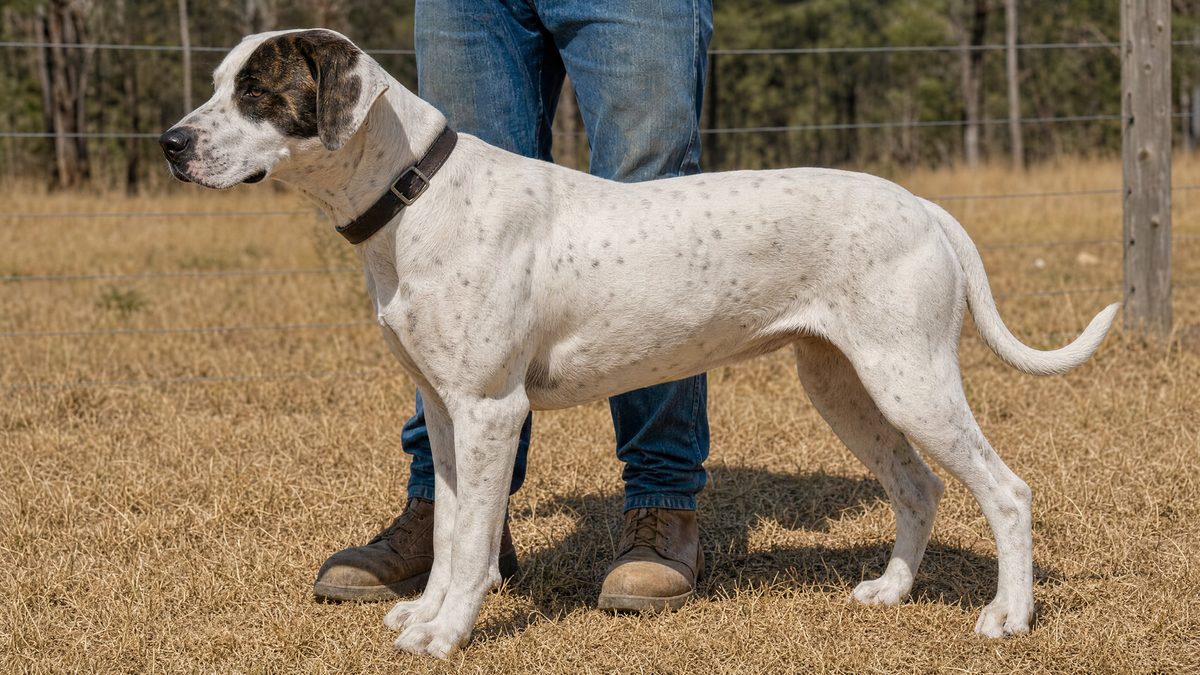
The ABBA breed standard gives a male Bull Arab an ideal height of 63 to 69 cm and an ideal weight of 32 to 42 kg, and the two other published sources both print a wider 30 to 50 kg band as though it were one dog.
A breed standard is the only document that describes what this dog is supposed to look like, and this one is short enough to read in full. What follows is what it actually says, alongside the two other published descriptions and where they disagree.
The standard gives ideals rather than limits. Males should stand 63 to 69 cm and weigh 32 to 42 kg; females 61 to 66 cm and 30 to 40 kg. Wikipedia's infobox instead prints a weight of "30-50kg (66-110lb)", sourced to a hunting magazine. The Australian price page that ranks for the breed repeats the wider band, saying "a healthy Bull Arab will weigh between 30kg - 50kg";. So the top of the published range is 8 kg above what the parent club calls ideal for a male, and that 8 kg is roughly a Beagle.
| Source | Height, male | Weight, male | Weight, female |
|---|---|---|---|
| ABBA breed standard (ideal) | 63 to 69 cm | 32 to 42 kg | 30 to 40 kg |
| Wikipedia infobox | Not stated | 30 to 50 kg, sexes not split | 30 to 50 kg, sexes not split |
| Pets Online Australia | Not stated | 30 to 50 kg, sexes not split | 30 to 50 kg, sexes not split |
On coat colour the standard is precise and it rules things out. "Acceptable colours include: black, brindle and tan with a liver opposite to those colours. Bullarabs are full coloured with patches of white";. Crucially it then states that "The majority of Bullarabs will have more white than colour (giving the appearance of a predominately white Bullarab)", and that "Coloured flecking on white is common and acceptable";. Four colours are named unacceptable outright: "Harlequin, Merle, silver and dilute recessives";. If you are shown a merle Bull Arab, you are being shown something the breed's own registry would refuse.
The build clauses are worth quoting because they explain the outline. "The strong, muscular neck is of moderate length with a slight arch", the chest "is not too big, nor too shallow", and the hindquarters are "Muscular, thigh muscles well developed, strait when viewed from behind, well angled when viewed from the side";. The tail is "set low, thick at the base and tapers to a point" with "a slight upward curve when standing in a relaxed stance", which is a natural undocked tail described in detail.
The coat itself is the simplest thing about the dog. "The coat must be smooth and short. A soft textured undercoat may be present in cold weather. Double coats: shaggy coats and feathering on the tail are not to be accepted";. That single sentence explains why grooming this breed is close to free and why its heat tolerance is better than a Rottweiler's, and it is the one part of the breed an Indian buyer can genuinely verify by looking.
The standard's disqualification list runs: "Unilateral or Bilateral Cryptorchid. Viciousness or extreme shyness. Albinism. Hip and elbow dysplasia. Incorrect colour or incorrect coat. Any abnormal physical deformities or evidence of deformities in off spring";. Hip and elbow dysplasia are disqualifying, which sounds strong until you notice that the standard names no test, no scoring scheme, no threshold and no screening body by which a breeder would ever detect them. The health section of this page returns to that.
Breed history: one man, one decade, and four incompatible accounts
The Bull Arab's breed history begins with Mike Errol Hodgens in Queensland in 1972, and every detail after that name is contested by the breed's own sources, including the year he stopped, the third foundation breed, and whether Bloodhound was in the mix from the start or added a decade later.
Start with what all sources agree on. A man called Mike Errol Hodgens began crossing dogs in Queensland in the early 1970s to make an animal that could find and hold feral pigs across rough Australian country, and the resulting dog became, in one breeder's words, "the number 1 Pig Hunting breed in Australia in terms of popularity and notoriety";. Wikipedia dates the start to 1972 and names Hodgens directly. After that the accounts separate.
Disagreement one: was it a German Shorthaired Pointer or an English Pointer
The most-repeated formula is 50 percent Bull Terrier, 25 percent Greyhound and 25 percent German Shorthaired Pointer. A long-established Australian Bull Arab breeder gives the same three parts and then immediately flags the dispute: "They are comprised of 50% English Bull Terrier, 25% Greyhound and 25% German Short Pointer. Although another well known breeder will tell you 25% English Pointer was added instead of German Short Pointer";.
That is not a trivial quarrel. The German Shorthaired Pointer and the English Pointer are different breeds with different coats, different heads and different working styles, and a quarter of an animal is a quarter. Nobody has ever settled it, because there is no studbook from 1972 to consult.
Disagreement two: when Bloodhound entered, and whether it is foundation or addition
Wikipedia treats Bloodhound as a later regional addition made by some breeders and not others, listing "Great Dane, Bloodhound and Mastiff" among "later additions in certain bloodlines";. The breeder account is more specific and dates it: "Peter Paulsen from QLD bought original dogs from Mike Hodgens in 1982. Like Gary Anderson, he too added other breed/s to the mix for the purposes of his own plan and ideas. This breed is known as the Bloodhound";.
The parent club tells it the other way round. The Australian Bullarab Breeder's Association writes that the founding cross "was made up of Greyhound, English Bull Terrier and German Short Haired Pointer", and then: "In the early 70's Blood Hound was added to the mix and so 'The Australian Bullarab ~ Australia's Working Dog' was born";. On the club's own account the breed does not exist until Bloodhound is in it, in the early 1970s. On the breeder's account Bloodhound arrives in 1982, ten years later, as one man's private refinement of an already-established breed.
Both cannot be right, and the difference matters to a buyer, because it decides whether a Bull Arab without Bloodhound is a Bull Arab at all.
Disagreement three: the parent club's history does not mention the founder
The Australian Bullarab Breeder's Association's Breed History page describes the founding cross, prints photographs captioned as "THE ORIGINAL DOGS that were crossed all those years ago", and names not one person. Mike Hodgens, the man every other source credits with creating the breed, does not appear on the parent club's account of where the breed came from. His name appears nowhere on the club's Breed History, About Us, Association Format or Code of Ethics pages Australian Bullarab Breeder's Association Australian Bullarab Breeder's Association Australian Bullarab Breeder's Association.
The reason is not hidden. Wikipedia records that Hodgens "faced significant personal and legal challenges during this time, including animal seizures and disputes with authorities, which ultimately led him to step away from breeding in 1989";. The breeder account, which is explicit that it is based on "a research interview I had with him in 2009", gives a different pair of dates: "He stopped breeding Bull Arabs in 1981 and all other dogs in 1989";. That same page carries an unusual disclaimer: "I am not in business with Mike/Errol Hodgens and do not support, or have any contact with, this person";.
| Question | Wikipedia | Klement (breeder) | ABBA (parent club) |
|---|---|---|---|
| Founder named | Mike Errol Hodgens | Mike Hodgens | Nobody named |
| Start year | 1972 | around 1972 | pre 1970 |
| Third foundation breed | German Shorthaired Pointer | German Short Pointer, English Pointer disputed | German Short Haired Pointer |
| Bloodhound | Later addition, some lines only | Added by Peter Paulsen in 1982 | Added early 1970s, part of the founding |
| Founder stopped breeding | 1989 | Bull Arabs 1981, all dogs 1989 | Not mentioned |
Because the disagreement is the reason you cannot verify what you are buying. When four sources cannot agree on which breeds are in the foundation or when they went in, no test, pedigree or photograph can tell you whether a given dog is a Bull Arab or simply a large white crossbred. That problem is the subject of the next two sections, and it is the single biggest practical risk this breed carries.
What a Bull Arab registration actually buys you
A Bull Arab registration costs AUD 15.00 once, for the dog's life, from a club that decides pedigree by committee opinion rather than by document and states that DNA "will not be actively perused".
The Australian Bullarab Breeder's Association publishes its own terms, and they are unusually candid. "Each member can register their dog for life for $15.00AUD", and membership itself is free: "Each person will gain free membership upon the registering of their first dog";. For an Indian reader used to a Kennel Club of India pedigree costing several times that and resting on a parent-verified studbook, fifteen Australian dollars once is the whole cost of a lifetime registration.
The registry decides lineage by opinion, and says so
Point four of the registration terms is the one to read twice. "Proof of linage is the most important factor in determining eligibility for registration. If the dog does not come from two registered parents, then linage will need to be verified. The executive Committee has full discretion on validity of linage and their knowledge will take precedence on acceptance or decline of registration";. The Association Format repeats it in stronger terms: "It is the executive committee's decision on which dogs are eligible for registration and which dogs are not", and "The executive committee have full authority to register and de-register dogs according to their discretion";.
So a Bull Arab pedigree is a statement that a committee, using its own knowledge, accepted a dog. That is a real thing and it is not worthless; on a landrace with no studbook, expert eyes are the only tool anyone has. But it is not what a pedigree means at a kennel club, and a buyer paying a premium for "registered" should understand which of the two they are getting.
DNA is explicitly not pursued
Point six is blunt: "DNA will not be actively perused by the association unless otherwise instructed by the executive";. The typo is in the original; the meaning is that DNA is not the verification route.
A rival Australian breeder sets out the reasoning at length, and it is a genuine argument rather than an evasion. Commercial breed-detection panels, he writes, cannot resolve depth of ancestry: "if Labrador was found in the so called 'distant relatives' in the test we will not know if it is 1/8 (great grandparent) or 10 or 20 generations back because the test is not accurate enough to distinguish the difference", and "the Australian company responsible for testing has definite profiles for approximately 40 breeds";. His conclusion is that "until DNA testing becomes more accurate and specific and tailored to Regions it has no place in determining whether a dog is a Bull Arab or not in Australia";.
The consequence, whichever side you take, is the same for a buyer. There is no test that will tell you whether the dog in front of you is a Bull Arab.
The breed's own people say the market is full of fakes
This is not an outside criticism. The parent club states as its first purpose that "It is a primary goal of ABBA to eliminate or at the very least highlight imitators, cross breeds and near enough is good enough dogs from the Bullarab linage";. The breeder page is harsher: "Many backyard breeders claim they breed purebred Bull Arabs but the truth is - they don't", and "dogs that are cross-Bull Arabs are being sold as Purebreds";.
Wikipedia records the same thing from the shelter end: "Many dogs referred to as 'Bull Arabs' in media and shelters are not Bull Arabs recognized by ABBA, and are instead only crosses or mixed breed dogs that loosely resemble the breed", and notes that this "complicates efforts to track behavior or welfare outcomes specific to the registered breed";. RSPCA Queensland's own surrender ranking is careful to say "Bull Arab cross", not Bull Arab.
If you cannot verify a breed by pedigree, by DNA or by appearance, and the breed's own club and its leading breeders both say the market is full of misrepresented dogs, then in India, where there is no club, no registry office and no expert committee at all, the word Bull Arab on a listing carries no information whatsoever.
Three things on the parent club's own website that nobody has reported
The Bull Arab's parent club publishes an association history that stops mid-sentence, a code of ethics copied wholesale from a kennel council it does not belong to, and a policy clause whose wording says the opposite of what it plainly means.
These are not gotchas. Each one changes what a reader should conclude about how far along the breed's institutional project actually is, and each is checkable in under a minute on the club's own pages.
One: the Association History page is an unfinished sentence
The Australian Bullarab Breeder's Association's site carries a page headed "Association History". Its entire body text reads: "The Association was founded in...";. There is nothing after the ellipsis. No year, no founders, no place.
The club was launched in 2007 with the stated aim of achieving Australian National Kennel Council recognition, and its own Association Format lists as objective one to "Maintain a long term goal of officially registering the Bullarab with the ANKC as an Australian pure bred dog";. Nearly two decades on, the body pursuing that goal has not filled in the sentence describing its own founding. A kennel club evaluating a breed for recognition asks first for the parent club's records.
Two: the Code of Ethics belongs to a body the club is not a member of
The club's Code of Ethics opens with this line: "Each member, upon being elected or re elected to membership of a Member Body of the ANKC shall be bound by the ANKC Code of Practice subject to each States relevant legislation";. It then runs 29 numbered clauses, and those clauses refer throughout to machinery that does not exist for this breed.
Clause 12 says a member shall not breed a bitch "unless the bitch has reached adequate maturity for that breed as determined by the member's Member Body". Clause 15 forbids mating a purebred to "a dog not on the Main Register without the prior approval of the members Member Body". Clause 22 excepts "those breeds listed in ANKC Regulation Part 6, Section 6.2";. Member Body, Main Register and ANKC Regulation Part 6 are all Australian National Kennel Council instruments. The Bull Arab is not on the ANKC's register, as the recognition section of this page proves in full, so none of those bodies, registers or approval routes is available to a Bull Arab breeder. The code binds members to a process they cannot enter.
One clause does look edited rather than copied. Clause 9 reads: "A member shall not participate in nor support any activity in that involves cruelty or damage to animals, excluding legal hunting activities";. The trailing carve-out for hunting is exactly what a pig-hunting breed club would need to add, and it is the one place the borrowed text has been shaped to the breed.
Three: the policy clause that inverts itself
The Association Format's health policy reads: "Only healthy animals free from genetic abnormalities shall be bred from. Any animals suspected of genetic defects shall not be de-registered and their offspring shall be de-registered";. Read literally, a dog suspected of a genetic defect keeps its registration while its innocent puppies lose theirs. Almost certainly a stray negative; but this is the operative health-policy sentence of the breed's only registry, and it has stood uncorrected.
| Club document | What it says | What it means |
|---|---|---|
| Association History | "The Association was founded in..." and stops | No documented institutional record |
| Code of Ethics | Binds members to the ANKC Code of Practice | The club is not an ANKC member body |
| Registration Information | AUD 15.00 for life, DNA not pursued | Pedigree rests on committee opinion |
| Association Format | Committee has full discretion to register and de-register | No appeal route, no documentary standard |
| Association Format | Suspect dogs "shall not be de-registered", offspring shall be | Health policy as written is self-contradictory |
A club with an unfinished history page can still keep good dogs, and the people doing this work are volunteers on a landrace that no institution has ever helped them organise. The point is narrower and it is about you. Every claim of pedigree, health screening or breed purity you will be offered for a Bull Arab in India traces back through these documents, and these documents cannot support the weight.
Kennel club recognition: four registers opened, four controls passed, four absences
No kennel club recognition exists for the Bull Arab at Dogs Australia, the Federation Cynologique Internationale or the Kennel Club of India, and each register below was retrieved in full and checked against a control rather than searched from a distance.
An absence is a strong claim, so every one is paired with a control taken off the same document in the same session. If the control is missing, the query is broken and the absence proves nothing. Every control here was present.
Dogs Australia recognises 231 breeds and none of them is a Bull Arab
The Australian National Kennel Council, which now trades as Dogs Australia, publishes its complete breed register as a paginated list. Requesting all pages at once returns 231 distinct breed names in a single document. Not one contains the string "Arab", and the only three beginning with "Bul" are Bull Terrier, Bull Terrier (Miniature) and Bullmastiff.
The controls settle what the absence means. The register contains the Australian Cattle Dog, the Australian Kelpie, the Australian Stumpy Tail Cattle Dog and the Tenterfield Terrier, so Dogs Australia plainly does recognise Australian-developed working breeds, including small and recent ones. Labrador Retriever is present, so the list is complete rather than truncated.
Then comes the detail that makes this more than an administrative fact. Every breed named in the Bull Arab's own foundation is on that register: Bull Terrier, Greyhound, German Shorthaired Pointer and Bloodhound, plus Great Dane and Mastiff for the later regional additions Wikipedia, Bull Arab. Australia's kennel council recognises every ingredient and does not recognise the dish.
The FCI holds no Bull Arab standard under B or under A
The Federation Cynologique Internationale's nomenclature under B, read in full, lists 42 breeds from the Ariege Pointing Dog to the White Swiss Shepherd Dog. It includes Bull Terrier, Bullmastiff, Bulldog, French Bulldog and the Brazilian Campeiro Bulldog. There is no Bull Arab and no Bullarab.
Because the breed is also written Australian Bull Arab, the A list was checked too. It carries 23 breeds and includes five Australian ones: Australian Cattle Dog, Australian Kelpie, Australian Shepherd, Australian Silky Terrier, Australian Stumpy Tail Cattle Dog and Australian Terrier. The FCI therefore registers Australian breeds. It has no file on this one.
Why that closes the Kennel Club of India route completely
The Kennel Club of India is India's FCI member body, and it registers dogs of FCI-recognised breeds against FCI standards. There is no FCI Bull Arab standard, so there is no breed number, no group allocation and no basis on which the KCI could issue a pedigree. The FCI's Australian member is the Australian National Kennel Council, which does not recognise the breed either, so there is no national body from which recognition could ever be forwarded.
That is a closed loop, and it has a practical consequence. Anyone in India offering you a "KCI registered Bull Arab" is offering something that cannot exist.
| Register | Read | Bull Arab | Control used | Control result |
|---|---|---|---|---|
| Dogs Australia (ANKC) | 231 breeds, complete list | Absent | Labrador Retriever, Australian Kelpie, Tenterfield Terrier | All present |
| FCI nomenclature, B | 42 breeds | Absent | Bull Terrier, Bullmastiff, Bulldog | All present |
| FCI nomenclature, A | 23 breeds | Absent | Australian Cattle Dog, Australian Terrier | Both present |
| Kennel Club of India | Registers FCI breeds only | No route exists | Depends on FCI standard | No FCI standard published |
None of this is contested by the breed's own people. The Australian Bullarab Breeder's Association lists ANKC recognition as a long-term goal it is still pursuing, and Wikipedia's infobox states the position flatly under Breed status: "Not recognised as a breed by any major kennel club";. On this point the primary documents and the internet agree.
The breed standard a peer-reviewed paper cited has disappeared from the internet
The only Bull Arab breed standard ever cited in the peer-reviewed literature lived at bullarab.com.au, and that domain now has no DNS record at all, so the reference in a 2019 scientific paper points at nothing.
When Orr and colleagues published their review of pig-hunting dog welfare in the journal Animals in 2019, they needed a source for what a Bull Arab is. Their reference 49 reads: "Bull Arabs Australia Bull Arab Standard 2019. [(accessed on 20 June 2019)]; Available online: http://www.bullarab.com.au/bull-arab-standard";.
Two things about that reference are worth noticing. First, the organisation is not the Australian Bullarab Breeder's Association, whose site is bullarabsaustralia.com. "Bull Arabs Australia" at bullarab.com.au was a separate body publishing a separate standard, which means that as recently as 2019 there were at least two competing written standards for this breed in Australia.
Second, that domain no longer resolves. A DNS lookup for bullarab.com.au and www.bullarab.com.au returns no A record whatsoever, while control lookups performed in the same session for bullarabsaustralia.com, dogsaustralia.org.au and ankc.org.au all resolve normally. The domain is not slow, not blocking, and not behind a firewall. It is gone.
What that means, and what it does not
It does not mean the standard was wrong or that the paper was careless. Orr's team accessed it on 20 June 2019 and cited it correctly on that date. Domains lapse.
What it means is that the documentary trail behind this breed is thinner than it looks from a citation list. A reader following the peer-reviewed literature to its source for what a Bull Arab is will arrive at a dead domain, and the only surviving written standard is the one published by a different organisation with an unfinished history page. For a breed whose central problem is that nobody can verify what a Bull Arab is, losing one of its two standards is not a footnote.
The same rot has reached the general sources
It is not an isolated case. Wikipedia's description of the breed's temperament as "loyal, gentle, and sweet natures" cites a page titled "What's a Bull Arab?" at bullarabrescue.com.au/about1. That URL now returns HTTP 404 with the text "ERROR: PAGE NOT FOUND" and a noindex robots tag, while the rescue's homepage at the same domain loads normally in the same session. So the specific page is gone, not the site.
Bull Arab Rescue Australia Ltd itself is real and operating. Its homepage advertises adoption and foster programmes, states that "All our dogs are desexed, vaccinated, microchipped and up to date with all worm, flea and tick treatments", and runs a community Facebook group for Bull Arab owners across Australia. A breed with a dedicated national rescue organisation and no national kennel club recognition is an unusual combination, and it tells you where the population actually is.
This costs thirty seconds and it applies to every breed claim you will ever be shown. Open the URL yourself rather than trusting the citation, and confirm the page names the breed on its own face. A dead domain, a 404, or a page about a different dog all look identical inside a footnote, and all three turned up inside the small published literature on this one breed.
Bull Arab price in India, checked result by result
No bull arab price in india exists, because no Indian seller lists the breed, and Google's own India results for that exact query return pit bull, Bull Terrier, Bullmastiff and Bulldog pages instead of Bull Arab ones.
Twelve organic results were pulled for "bull arab price in india" on the India locale on 24 August 2026. Three are about the Bull Arab. Nine are about a different breed.
Position one is an Indian sales page quoting French Bulldog puppies at Rs 73,000 to Rs 75,000 and Bullmastiff bands, and it does not mention the Bull Arab at all. Position two is an Instagram tag page for "Pitbull Dog Prices In India", quoting Rs 65,000 to Rs 1,45,000 for KCI-registered puppies in metros. Position three is a YouTube video on Bull Terrier price in India. Position four is a Quora thread putting Pitbull puppies at Rs 25,000 to Rs 30,000, rising to Rs 100,000 for show quality. Position five sells American Pit Bull Terrier puppies at INR 35,000 to INR 1,00,000 plus. Position eight and eleven are the same American Pitbull trade listing at 25000 INR per piece, returned twice. Position ten is a pit bull price guide. Position twelve quotes Bulldog puppies from Rs 10,000 to Rs 60,000.
Read as a set, that is a search engine resolving "bull arab" to "pit bull". Every rupee figure the query returns in India belongs to a different animal, and none of them is a Bull Arab puppy price.
The one Indian page that names the breed sells nothing
Position seven is a Justdial category page headed "Popular Pet Shops For Bull Arab Dog in Baran", under numeric category id nct-13866323. It is worth taking apart, because it is the shape most "Indian availability" for an absent breed takes.
Ten businesses are listed. Nine of them are not in Baran. They are in Jhansi, Jaipur, Bhopal, Bhopal again, Agra, Hoshangabad, Mathura, Rewari and Faridabad. The page's own comparison table prints each business's Listed Categories, and not one of the ten is filed under any Bull Arab category. They are filed under Pet Shops, Pet Accessory Dealers, Pet Food Dealers, Pet Shops For Dog, Dog Trainers, Pet Clinics, Pet Shops For Birds, Pet Shops For Rabbit, Pet Shops For Labrador Dog, Pet Shops For Pitbull Dog and Pet Shops For Indian Bully Dog.
No rupee figure appears anywhere on the page. The descriptive text is auto-generated and vague enough to fit any dog, telling readers the Bull Arab is "a mix of several breeds, including the Bull Terrier and various hounds" and that owners should look for "Durable Toys" and "Sturdy leashes and collars";. The customer reviews attached are about a Labrador puppy, a pet shop's packaging and one line reading "Bahut mast shop ha bhai";.
| Position | Domain | Breed the page is about | Price quoted |
|---|---|---|---|
| 1 | marshallspetzone.com | French Bulldog, Bullmastiff | Rs 73,000 to Rs 75,000 |
| 2 | instagram.com | Pitbull | Rs 65,000 to Rs 1,45,000 |
| 3 | youtube.com | Bull Terrier | Not stated |
| 4 | quora.com | Pitbull | Rs 25,000 to Rs 100,000 |
| 5 | mrnmrspet.com | American Pit Bull Terrier | INR 35,000 to 1,00,000 plus |
| 6 | petsonline.com.au | Bull Arab, in Australia | AUD 500 to 600 and 1,500 to 3,000 |
| 7 | justdial.com | Bull Arab, category shell | None anywhere on the page |
| 8 and 11 | tradeindia.com | American Pitbull | 25000 INR per piece |
| 9 | youtube.com | Bull Arab | USD 1000 to 3000 |
| 10 | ithinkpets.com | Pitbull | Not stated |
| 12 | petsworld.in | Bulldog | Rs 10,000 to Rs 60,000 |
Ask them which of the twelve results above it came from. There is no Indian market for this breed, so any figure you are handed is either a converted Australian number, a price for a different bull-named breed, or an invention. A seller with a real Bull Arab to sell in India would be able to show you an import authorisation, and the next section explains why they will not have one.
The only real price is Australian, and the page that ranks for it contradicts itself
The one genuine Bull Arab price page in the entire India result set is Australian, and it quotes two incompatible prices three paragraphs apart, prints the same heading twice, and both asserts and denies that the breed is registered with Dogs Australia.
The page is Pets Online Australia's "Bull Arab Prices In Australia", carrying a named veterinary reviewer, and it is position six on the India SERP. It is the closest thing to a real puppy price this breed has, so it deserves a careful reading rather than a quotation.
Its first answer, under the heading "How Much Does a Bull Arab Cost in Australia?", is: "The Bull Arab is a relatively average-priced dog to purchase and you can expect to pay anywhere between $500 to $600";.
Three paragraphs later, under the same heading, it says: "You can expect to pay between $1,500 and $3,000 for a Bull Arab puppy from a reputable breeder, and this price reflects the breeder's investment in health checks and early socialisation". Adoption is given separately at "$250 - $600";.
Six hundred dollars and three thousand dollars are a factor of five apart, in the same section, under the same heading, with no acknowledgement that both numbers are on the page. The independent YouTube guide that ranks at position nine gives a third band, USD 1000 to 3000.
The page contradicts itself on recognition too
Under "Breeder Reputation & Lineage" the page says: "a Bull Arab puppy from champion bloodlines registered with Dogs Australia will cost more than a puppy from non-competitive parents";. In the very next paragraph it says: "while Bull Arabs are not a Dogs Australia / Australian National Kennel Council recognised breed, they are often bred with working abilities in mind";.
Both sentences are on the same page, under the same subheading. The second is correct, and this site verified it independently by reading all 231 breeds on the Dogs Australia register. The first describes a document that cannot be issued. A buyer paying the top of a AUD 1,500 to 3,000 band because a puppy has champion bloodlines "registered with Dogs Australia" is paying for a thing that does not exist.
The page also prints its H2 "Factors Influencing the Cost of a Bull Arab" twice, with different content under each, which is what happens when two drafts are merged without a final read.
Running the currency test on the Australian figures
Indian pages routinely publish a "price" that is a foreign figure run through one exchange rate, so it is worth checking whether the Australian numbers have been converted into anything. Divide the quoted band by the two rates this site checks. AUD 1,500 at 84.38 is 17.78 and at 74 is 20.27; AUD 3,000 gives 35.55 and 40.54. Those are not the round rupee bands any Indian listing site prints, and no Indian page in the result set quotes a Bull Arab figure at all. So there is nothing to convert, which is itself the finding. The rupee figures on this SERP were not converted from a Bull Arab price; they were written for pit bulls.
| Figure | Source | Country | Status |
|---|---|---|---|
| AUD 500 to 600 | Pets Online Australia | Australia | Contradicted lower down the same page |
| AUD 1,500 to 3,000 | Pets Online Australia | Australia | Contradicts the figure above it |
| AUD 250 to 600 | Pets Online Australia | Australia | Adoption fee, not purchase |
| USD 1000 to 3000 | YouTube breed guide | Unstated | No sourcing given |
| Any rupee figure | None found | India | Does not exist |
Bonbeno publishes no Bull Arab price in India, because none exists. In Australia the published band runs from AUD 250 for an adoption to AUD 3,000 for a working-bred puppy, and the single page carrying those figures disagrees with itself inside one section. That spread, and that disagreement, are the honest answer.
Why no lawful Bull Arab supply chain can form in India
Two independent facts close the route: dogs are a Restricted import into India and commercial import for breeding "is not permitted", and no kennel club recognises the breed, so there is no pedigree route through which imported stock could ever be registered here.
Take the import rule first, from the text of the notice itself rather than a summary of it. DGFT Trade Notice No. 22/2022-23, dated 19 December 2022, sets the policy for pet animals under ITC (HS) 01061900, "Mammals: Other", and marks the import policy "Restricted", subject to Policy Condition 6.
Policy Condition 7 is the operative one and it is exhaustive. "Import of dogs is allowed only for the following specific purposes: i. Pet dog with valid pet book and relevant records/documents in the name of importer. ii. Dogs imported by the R&D Organisations for conducting research with the recommendation of CPCSEA. iii. For the internal security by the Defence and Police Force";. Policy Condition 8 closes the remaining door: "Import of commercial dogs for breeding or any other commercial activities other than the purposes mentioned above is not permitted";.
So there are exactly three lawful reasons to bring a dog into India, and buying one to breed from is not among them. A Bull Arab could arrive only as your own pet, which the notice further restricts.
What the pet route actually requires
For a permanent import of up to two pets, the notice says import "is allowed as passenger baggage, without DGFT authorisation, only to persons transferring their residence to India after two years of continuous stay abroad. Only cats and dogs can be imported under baggage rules";. If your continuous stay abroad was under two years, or the pet is not travelling as your baggage, or it cannot come under baggage rules, you need a DGFT authorisation. More than two pets always needs one, and the application goes to the Department of Animal Husbandry and Dairying for examination.
The mandatory documents for a permanent import are a Vaccination Book, Pet Passport or Pet Book, a Certificate for Emotional Support, and the Passport of the Pet. Applications go in against an Importer Exporter Code, or against the permanent IEC number IIHIE0153E for persons and institutions without one.
In plain terms: an Australian working-dog breeder cannot sell you a Bull Arab puppy into India, and an Indian breeder cannot lawfully import breeding stock to found a line here.
The second lock, and why it matters even more
Even if a Bull Arab did arrive as somebody's genuine returning pet, nothing could be built on it. The Kennel Club of India registers dogs of FCI-recognised breeds against FCI standards, and the FCI publishes no Bull Arab standard, as the A and B nomenclature lists confirm when read in full Federation Cynologique Internationale. Dogs Australia, the FCI's Australian member, does not recognise the breed either across all 231 breeds on its register.
An AUD 15.00 lifetime registration from the Australian Bullarab Breeder's Association travels no better. It carries no weight with the KCI, no weight with any Indian municipal authority, and no weight in any Indian pedigree.
| Route | Permitted | Where it stops |
|---|---|---|
| Buy a puppy from an Australian breeder | No | Policy Condition 8, commercial import for breeding not permitted |
| Import breeding stock to found an Indian line | No | Policy Condition 8, same clause |
| Bring your own dog on transfer of residence | Yes, conditionally | Needs 2 years continuous stay abroad, pet book in your name |
| Import for research | Yes | Needs a CPCSEA recommendation, R&D organisations only |
| Import for Defence or Police | Yes | Internal security use only |
| Register the resulting dog with the KCI | No | No FCI standard exists for the breed |
Either fact alone would make the breed scarce here. Together they make a lawful Indian supply chain impossible to build, because you cannot import breeding stock and you could not register its puppies if you did. That is why the price section found no Indian listing rather than an expensive one.
The Bull Arab could not lawfully have been created in India
Second Schedule Part II paragraph 6(9) of India's 2017 dog breeding rules states that "Breeding to create new breeds of dogs or unusual looks shall be strictly prohibited", and creating a new breed from three others is precisely what Mike Hodgens spent the 1970s doing.
The Prevention of Cruelty to Animals (Dog Breeding and Marketing) Rules 2017 were notified in the gazette as G.S.R. 496(E). The text quoted below was extracted directly from the machine-readable gazette PDF rather than from any summary of it.
Paragraph 6(9) of the Second Schedule, Part II, reads in full: "Breeding to create new breeds of dogs or unusual looks shall be strictly prohibited";. There is no exemption for working dogs, no exemption for pest-control purposes, and no grandfathering clause.
Set that against what the breed's own sources say happened. Wikipedia records that Hodgens' "original breeding formula combined 50% Bull Terrier, 25% Greyhound, and 25% German Shorthaired Pointer", with the goal of creating "a dog capable of locating, chasing, and holding feral pigs". The breeder account records that he then spent roughly a decade at it, and that Gary Anderson and Peter Paulsen later added English Mastiff and Bloodhound respectively to make regional variants. That is the deliberate creation of a new breed, and paragraph 6(9) prohibits it outright.
The prohibition is still live for this breed, not merely historical. The Australian Bullarab Breeder's Association's stated objective one remains to "Maintain a long term goal of officially registering the Bullarab with the ANKC as an Australian pure bred dog";. The breed is still being made.
The docking clause, and a Bull Arab line that would fail it
The same paragraph 6(8) is unusually comprehensive: "There shall be no tail docking, ear cropping de-barking, de-clawing, branding, dyeing, injecting substances to enhance visual appeal, performing a surgery or procedure to camouflage or hide any defect or infirmity or any other kind of mutilation of any body part of the pup and any change of appearance by artificial means is strictly forbidden";.
This breed has a documented collision with that clause. Describing the New South Wales lines of the 1980s, a leading breeder writes that other people continued breeding Bull Arabs there, "and some of these people include Joe Cauchi. Joe Cauchi's dogs were easily identified as their tails were cut to give a stumpy tail appearance";. A line whose identifying feature is a cut tail is a line whose identifying feature is prohibited in India.
The other clauses an Indian Bull Arab owner is bound by
Rule 8, Conditions for sale, opens: "Every breeder shall ensure that (a) pups less than eight weeks in age are not sold; (b) dogs over six months in age are not sold without first being sterilised, unless they are being sold to another licensed breeder";.
Second Schedule Part III paragraph 8(10) sets the mandatory testing list, and it maps unusually well onto this breed's own disqualifications: "The dogs shall have been tested for genetic defects, including hip dysplasia, progressive retinal atrophy, night blindness, hypothyroidism, entropion, ectropion, overshot, undershot jaw (when incisors do not touch or mesh), wry mouth, two or more missing teeth, unilateral cryptorchid or full cryptorchid males";. Hip dysplasia and cryptorchidism are both disqualifying under the ABBA standard, so Indian law and the breed's own club agree on what to screen for. Indian law simply also requires that you screen.
Paragraph 8(9) sets the vaccination window: "All pups shall be vaccinated which can start at the age of seven-eight weeks, and are usually completed at the age of eighteen weeks";. Rule 6 restricts breeding between "parents and children or between brother and sister, i.e. 1st grade relatives", and adds that "Female dogs shall not be mated after the age of eight years";.
Rule 9 states that "Dogs shall not be euthanised just because they can no longer breed or can not be sold and therefore not commercially viable";. Orr and colleagues record that in Australia "It is legal for farmers and working dog owners in Australia to destroy their dogs humanely when they are no longer wanted, with most using a single gunshot to the head", and that a survey of Australian farm dogs found 21 percent "were euthanased upon retirement";. What is lawful practice in the breed's home country is prohibited in India. If you take on a working breed here, you are taking it on for its whole life.
The real cost of ownership for this dog in India
Nobody can quote you an Indian cost of ownership for a Bull Arab from experience, because there is no Indian Bull Arab population to observe, so the honest approach is to price the dog by what it is: a 35 to 42 kg short-coated working animal on year-round parasite prevention.
This page will not invent rupee figures. What it can do is name every cost line this specific breed generates and say which are large, which are small and which are unusual, so you can price them locally with your own veterinarian and feed retailer.
The lines that are small for this breed
Grooming is close to zero. The standard requires a coat that is "smooth and short" and rejects double coats and feathering, so there is no professional groom, no de-shedding treatment and no clipping. A rubber curry brush and a bottle of shampoo is the annual kit.
Coat-related veterinary costs are correspondingly low outside the monsoon. There is no matting, no hot-spot risk from a dense undercoat, and no clipper-related skin trauma.
The lines that are large for this breed
Food is the biggest recurring cost, and it scales with the dog. The Australian price page estimates that an adult "will need around 800g - 1,200g of food every day" at 30 to 50 kg. Whatever your local kibble costs per kilogram, multiply by roughly one kilogram a day and that is your feed line. Orr's team note that these dogs have high energy expenditure and that "care must be taken to avoid dogs becoming underweight";, so this is not a breed to economise on.
Parasite prevention is the second large line, and for this breed it is the one that must never be cut. Year-round heartworm prophylaxis plus monthly tick and flea control, given the 34 percent Indian heartworm figure and the Indian Ehrlichia range of 0.35 to 50 percent depending on region and method. Budget it as a fixed monthly cost, not a seasonal one.
Containment is a capital cost most Indian buyers do not anticipate. A 40 kg dog with the prey drive described in the temperament section needs a genuinely secure boundary, and the cost of building or upgrading one is real. It is also cheaper than the alternative.
The lines that are unusual for this breed
Training is likely to cost more than for an average large dog, because the behaviours you need are recall and impulse control around live animals rather than sit and stay. That is specialist work in India and it is worth paying a qualified, force-free trainer for. The Australian page prices specialised behaviour sessions at AUD 500 to 1,500 each, which indicates the order of magnitude even though the Indian market is different.
Boarding is harder and dearer than for a common breed. Many Indian boarding facilities decline large unrecognised dogs, and those that accept them charge accordingly. Establish this before you buy, not before your first trip.
Insurance is largely unavailable in India for a breed no insurer's schedule recognises, so plan to self-insure. A single orthopaedic surgery on a 40 kg dog is the size of risk you are carrying.
| Line | Size | Notes for this breed |
|---|---|---|
| Food | Largest recurring | Roughly 800g to 1,200g daily for an adult |
| Heartworm and tick prevention | Large, non-negotiable | Year-round, never seasonal |
| Secure fencing or containment | Large one-off | Prey drive makes this a safety cost |
| Specialist training | Moderate to large | Recall and impulse control, not obedience |
| Routine veterinary care | Moderate | Vaccination, deworming, annual exam |
| Boarding | Moderate, and hard to find | Confirm availability before buying |
| Grooming | Near zero | Home care only, no professional groom |
| Insurance | Unavailable | Self-insure for orthopaedic risk |
Two hours a day, every day, for the dog's whole life, done by an adult, at dawn and after dark. That is roughly 700 hours a year. It is the largest thing this breed will ever cost you and it does not appear on any price page, including the one that ranks for the breed.
Heat tolerance, argued from the coat and from the origin
The Bull Arab's heat tolerance is better than most large imports and worse than its Australian reputation suggests, because the coat is genuinely well suited to hot work while the country the breed was made in turns out to be cooler than almost every Indian city.
Start with what helps. The ABBA standard requires that "The coat must be smooth and short", and rejects double coats, shaggy coats and feathering outright. A single short coat sheds heat far better than the double coat of a Husky or a German Shepherd, and there is no undercoat trapping humidity against the skin. Orr and colleagues describe pig-hunting dogs generally as "robust, large breed, short-coated dogs that live outdoors";.
So the fair summary is that a Bull Arab is more heat-tolerant than a double-coated northern breed and less heat-tolerant than its Australian passport implies. It is also an energetic dog that will not stop when it should, which turns a moderate physiological advantage into a real risk in an Indian summer.
The head helps too. The standard asks for "well formed jaw muscles running into a moderate to longer muzzle", with the head "of a moderate length and breadth in proportion to foreface";. That is a mesocephalic skull, and a dog that pants efficiently. Nothing about this breed is brachycephalic, which alone puts it ahead of every Bulldog and Pug on an Indian summer afternoon.
Then the frame. At an ABBA ideal of 32 to 42 kg for a male, this is a large dog, and mass is the enemy of heat loss. It is lighter than a Rottweiler or a Mastiff and considerably heavier than an Indian Pariah Dog. The lean build is not incidental: Orr's team record that "Running upwards of 40 km a day means that many pig-hunting dogs have lean musculature" and that they "rarely encounter health conditions such as obesity that are common in neutered pet dogs";.
Now the part that changes the answer
Every page that calls this dog heat-hardy does so because it is Australian. That reasoning does not survive checking the actual coordinates.
The towns to check are not guesses. When Orr and colleagues sampled Australian pig-hunting dogs for their 2020 heartworm study, they named exactly where those dogs live: "towns across Central and North Queensland, Australia. Locations included Sarina, Clermont, Proserpine, Charters Towers, Innisfail, Tully, Malanda and Atherton";. That is the breed's real working country, evidenced by a peer-reviewed sampling frame rather than by a breed page.
Querying NASA POWER by explicit latitude and longitude for six of those places, and echoing the coordinates the service returns, gives a result that is not what the reputation predicts.
| Place | Lon, lat returned | Annual mean C | Annual RH % | Months at or above 28 C | Hottest month mean C |
|---|---|---|---|---|---|
| Innisfail, QLD | 146.029, -17.524 | 24.84 | 78.00 | 0 | 27.42 (Feb) |
| Mackay, QLD | 149.182, -21.142 | 24.07 | 75.43 | 0 | 27.25 (Feb) |
| Proserpine, QLD | 148.584, -20.401 | 23.88 | 73.44 | 0 | 27.04 (Jan) |
| Sarina, QLD | 149.220, -21.426 | 23.31 | 73.95 | 0 | 26.65 (Jan) |
| Charters Towers, QLD | 146.261, -20.077 | 23.43 | 64.28 | 1 | 28.17 (Dec) |
| Clermont, QLD | 147.639, -22.824 | 22.49 | 58.26 | 0 | 27.90 (Dec) |
Five of those six towns do not have a single month whose mean temperature reaches 28 C. The sixth reaches it once, in December, by 0.17 C.
The humidity is the surprise, and it cuts the other way
Innisfail runs 78.00 percent relative humidity across the year, and 83.06 percent in its hottest month. Chennai, India's benchmark for oppressive coastal humidity, runs 72.39 percent. The breed's origin is more humid than Chennai.
So the honest split is this. A Bull Arab is genuinely adapted to working hard in very humid air. It is not adapted to working hard in sustained heat, because its home has almost none. The Indian problem is that most of our cities deliver both at once, and the next section puts the numbers side by side.
Australia is a continent with alpine snowfields and a central desert, so "an Australian breed" tells you nothing about heat. The Queensland coast where this dog was made is subtropical and wet, not arid and baking. Charleville, in inland Queensland, does run 3 months at or above 28 C, but at 41.91 percent humidity in January, which is a different kind of heat again.
Queensland against nine Indian cities, on one dataset
Coastal Queensland is more humid than Chennai and cooler than every Indian city on this page except Guwahati, which means a Bull Arab arriving in India meets a combination of heat and humidity its origin never produces.
Every figure below comes from the same NASA POWER climatology endpoint, queried by explicit latitude and longitude, with the returned coordinates echoed so a reader can repeat the query. Using coordinates rather than place names matters, because a place-name lookup can silently serve you a different city and this site has been caught by that before.
| Place | Annual mean C | Annual RH % | Months at or above 28 C | Hottest month mean C |
|---|---|---|---|---|
| Innisfail, QLD (origin region) | 24.84 | 78.00 | 0 | 27.42 |
| Mackay, QLD (origin region) | 24.07 | 75.43 | 0 | 27.25 |
| Chennai | 27.95 | 72.39 | 7 | 31.51 |
| Ahmedabad | 27.57 | 48.32 | 7 | 35.06 |
| Mumbai | 26.77 | 67.39 | 4 | 31.19 |
| Hyderabad | 26.10 | 60.30 | 4 | 33.30 |
| Kolkata | 25.81 | 73.93 | 5 | 31.53 |
| Delhi | 25.60 | 45.56 | 6 | 35.88 |
| Pune | 23.86 | 66.80 | 2 | 28.93 |
| Bengaluru | 23.74 | 67.94 | 1 | 28.37 |
| Guwahati | 22.94 | 77.29 | 0 | 27.89 |
What the table actually says
Chennai runs 3.11 C hotter than Innisfail across the year and has seven months at or above 28 C against Innisfail's zero. Ahmedabad and Delhi are hotter still in their peak months, at 35.06 C and 35.88 C mean, against a Queensland peak of 27.42 C. On the heat axis alone, this dog moving to Chennai is moving into a climate 20 percent warmer by annual mean with an extra seven months of sustained load.
On the humidity axis the picture inverts. Innisfail's 78.00 percent beats Chennai, Kolkata, Mumbai, Bengaluru and Pune, and only Guwahati at 77.29 percent comes close. Humid air is what stops evaporative cooling working, so a dog from a very humid origin arrives with the right physiology for the wrong half of the problem.
Where in India this breed is least unreasonable
Guwahati is the closest match on this dataset and it is not close on anything else. It runs 22.94 C annual mean with 77.29 percent humidity and zero months at or above 28 C, which is genuinely comparable to Mackay and Proserpine. Bengaluru at 23.74 C with one such month and Pune at 23.86 C with two are the next best, and both are workable with a dawn-and-dusk routine.
Chennai, Ahmedabad, Delhi and Kolkata are the hard ones, each for a different reason. Chennai and Kolkata pair high heat with high humidity. Delhi and Ahmedabad pair extreme peak heat with dry air, which is more survivable but delivers hottest-month means above 35 C that no part of Queensland approaches.
The practical rule this produces
Treat 28 C as the line where a Bull Arab's origin experience runs out, because in five of its six home towns the monthly mean never crosses it. Above that, this is a dog operating outside anything its ancestors were selected in.
- Exercise before sunrise and after full dark, every month of the year, in every city in the table except Guwahati.
- Test the pavement with the back of your hand for five seconds before every walk from March to October.
- Carry water on any outing over fifteen minutes, and offer it whether or not the dog asks.
- Watch for laboured breathing, a wide flat tongue, unsteadiness or a refusal to move, and treat any of them as an emergency.
- Cool with room-temperature water on the belly, groin and paws, never ice, and get to a veterinarian.
- Never shave the coat. A short single coat is sun protection, and this is often a predominantly white dog whose skin burns.
Orr's review lists heat exhaustion first among the risks these dogs face during hunts, alongside "poisoning, vehicular trauma, snake bite, accidental shooting and dehydration";. A dog selected to run 40 km a day will not stop because it is hot. In an Indian summer the owner is the thermostat, and the dog will keep going long past the point where it should have.
Temperament and household fit: a friendly dog with an unfriendly job
The Bull Arab is described by its own standard as kind, loyal, placid and independent, and it is simultaneously the highest prey-drive dog this site has profiled, which is the whole tension an Indian household has to manage.
Both halves of that sentence come from the same document. The ABBA breed standard asks for a dog that is "Kind and loyal, balanced and placid nature, intelligent and independent, Strong drive and determination when worked and a busy work ethic", and requires that it "must not show any signs of aggressiveness towards other dogs and under no circumstance towards other people";.
The breeder accounts say the same. One describes "an extremely versatile breed that is good natured around family and children, yet when taken Pig hunting turns into a high drive dog that wants to work";. Orr's review notes that "It has been reported that pig-hunting dogs are very 'stoic' and safe around children", while immediately adding that "there have also been reports of pig-hunting dogs attacking humans and other dogs", and concluding that "It is likely, given the diverse nature of the activity, that the socialisation of pig-hunting dogs varies widely";.
That last sentence is the honest summary of this breed's temperament. It is not one thing, because it is not one population.
The prey drive is the part that does not negotiate
Whatever a Bull Arab is like with your family, it was built to find a large animal by scent, run it down and hold it. Orr's team describe the method: dogs "are required to chase, find, bail, and then lug or hold onto a pig for restraint. Generally, two or three dogs bite and hold onto a pig, with two on each ear and sometimes a third dog biting a leg or other extremity";. Wikipedia records a scenting range of 4 to 6 kilometres.
In Queensland the target is a feral pig. In a Chennai apartment block the same machinery fires at a street dog, a cat on a wall, a goat at the gate or a child on a bicycle running past. Fifty years of selection does not switch off because the address changed, and no training programme deletes it. It can be managed, and management is a lifetime commitment rather than a puppy-class module.
Who this dog genuinely suits
- Owners with real ground, a secure fence and a rural or semi-rural property, not a flat.
- Households with an adult who will do two hours of structured work daily, at dawn and after dark, all year.
- People who have already lived with a large high-drive dog and know what a recall failure costs.
- Homes with no cats, no poultry, no rabbits and no small pets, permanently.
- Owners willing to accept that a dog they cannot verify the ancestry of may not match any published description.
Who should not buy one
- First-time dog owners, without exception.
- Apartment households, in any Indian metro, at any floor.
- Families wanting a dog that can be left with children unsupervised, which is true of no breed.
- Anyone who travels often and would need to board a 40 kg unrecognised working dog.
- Anyone attracted by the guarding reputation rather than the exercise commitment.
Kelly and Hoffman record that in 87 of 171 facial bite cases, 51 percent, "the dog was identified as a family member", that most incidents happened at the victim's own home, and that 64 of the documented cases occurred "whilst playing with the dog";. Sulaiman's Sydney series found the family dog most likely to offend at 49 percent. The dog that bites a child in India will almost certainly be that child's own dog, in that child's own house, during play. Supervision is the intervention, not breed choice.
Dog bite evidence: what the Australian hospital data actually records
Australia hospitalises about 2,061 people a year for dog bite injuries, and not one of the peer-reviewed Australian hospital series that names breeds names the Bull Arab, because the national dataset carries no breed field at all and the hospital studies that do record breed record something else.
This breed carries a public reputation for attacking people, and it is fair to ask what the evidence is. The answer is that the evidence is thinner than the reputation, and the reason is methodological rather than exculpatory. Nothing below argues that a Bull Arab cannot injure someone. A 40 kg dog bred to hold a boar obviously can.
The national picture, with denominators
Rajshekar and colleagues took the Australian Institute of Health and Welfare's public hospital records for dog bite injuries coded ICD 10-AM W54.0 across 2001 to 2013. They found that "on average, 2,061 persons were hospitalised each year for treatment for dog bite injuries at an annual rate of 12.39 (95%CI 12.25-12.53) per 100,000";.
The age gradient is steep. "The highest annual rates of 25.95 (95%CI 25.16-26.72) and 18.42 (95%CI 17.75-19.07) per 100,000 were for age groups 0-4 and 5-9 years respectively", and the rate rose across the period to 16.15 (95%CI 15.78-16.52) per 100,000 in 2011-13.
The critical point for a breed page: W54.0 is an external-cause code meaning "bitten or struck by dog". It has no breed field. Australia's national dog-bite hospitalisation dataset, the one every headline figure comes from, cannot tell you which breed did anything, because it never asked.
The hospital series that do record breed
Four Australian hospital studies record biting breeds, and the Bull Arab appears in none of them.
Sulaiman and colleagues reviewed a decade at Sydney Children's Hospital: "A total of 628 patients presented to SCH with dog bites during the study period", of whom 273 (43.5 percent) were treated in the emergency department only and 355 (56.5 percent) were admitted. Facial and other head and neck injuries made up 64.4 percent. "Pitbull, Labrador and Rottweiler were the most commonly documented offending breeds (25%) with the family dog most likely to offend (49%)", at a mean clinical cost of $2968 per injury.
Kelly and Hoffman reviewed 171 facial dog bite injuries at a Newcastle level 1 trauma centre serving over 950,000 people, from January 2017 to January 2022. "Dog breed was recorded in 108 (63%) cases", and the ten most frequent were Pitbull types (26), Border Collie (10), Cattle dog types (10), Rottweiler (9), Mastiff types (8), Great Dane (7), German Shepherd (6), Jack Russell (6), Dachshund (3) and Doberman (3). No Bull Arab.
Chiam and colleagues reviewed 277 children at a South Australian tertiary children's hospital across 2009 to 2011, of whom 141 (51.0 percent) were admitted. "Dogs from the bull terrier group (20.0%) and Jack Russell Terriers (11.0%) were the two most documented breeds".
Pekin and colleagues studied 1,616 emergency presentations across four public hospitals in Brisbane Metro South from 1 July 2013 to 30 June 2017. That is Queensland, the state where this breed was created and where its population is largest. The study recorded no breed data at all.
Three further Australian datasets round out the picture and none of them changes it. Briotti and colleagues reviewed 207 dog-bite presentations to Broome Regional Hospital in regional Western Australia across two years, roughly four a week, with a median patient age of 32 and dogs known to the patient in 74 percent of cases. Heyward and colleagues studied 459 dogs and cats presented to four Melbourne emergency hospitals after dog attacks in 2018, finding that being cross-bred raised the odds of presenting as a victim (OR 1.4, 95% CI 1.07-1.84) and that cats survived to discharge only 46.3 percent of the time against 91.8 percent for dogs. And Byard and Langlois searched the Forensic Science SA autopsy database across fifteen years from 2005 to 2019 and found only two deaths caused by dog-related activity in the whole period, neither of them a mauling by a large working dog.
| Study | Where | n | Breed recorded | Bull Arab named |
|---|---|---|---|---|
| Rajshekar 2017 | National, AIHW | 2,061 per year | No breed field in ICD-10-AM W54.0 | No |
| Sulaiman 2022 | Sydney Children's Hospital | 628 | Pitbull, Labrador, Rottweiler top 3 | No |
| Kelly 2024 | Newcastle, facial injuries | 171 | 108 of 171, top 10 listed | No |
| Chiam 2014 | Adelaide, children | 277 | Bull terrier group 20.0%, Jack Russell 11.0% | No |
| Pekin 2021 | Brisbane Metro South | 1,616 | None collected | No |
| Briotti 2024 | Broome, regional WA | 207 | Not reported in abstract | No |
It does not show the Bull Arab is safe. It shows that the Australian hospital evidence base cannot answer breed questions about this dog, and that where it can answer breed questions at all, it names other breeds. Anyone telling you the literature proves this breed is dangerous, or proves it is not, has not read the denominators. The next section explains why the breed field is the weakest part of all of it.
Breed identification is the weakest link, and the researchers say so themselves
Every Australian dog bite study that records a biting breed records it from what a clinician typed into a medical record, and the Queensland researchers state plainly that this classification "might not be accurate".
This matters more for the Bull Arab than for almost any other dog, because the breed has no pedigree route, no DNA verification and no agreed standard, so a large white crossbred and a registered Bull Arab are indistinguishable to anyone filling in a hospital form.
What the researchers actually wrote
Pekin and colleagues are the most explicit. In their limitations they write that their data "reveal significant gaps in the way ED clinicians record epidemiological data on dog bites with a significant proportion of the data missing information (in some instances >80% missing data) on the characteristics of the offending dog", and then: "In this study dog size was determined by the UK Kennel Club classifications, based on the breeds described in the electronic record which might not be accurate";.
The missingness is severe and it is worth quoting with its denominator. "There was no information recorded on dog size in 1393 (86.2%) cases", and "The dog was known to the victim in 202 (12.5%) cases, unknown to the victim in 111 (6.9%) cases, and was not recorded in 1303 (80.6%) cases";. Only 223 of 1,616 Brisbane cases carried any information about the dog's size, and none carried a verified breed.
Kelly and Hoffman had breed for 63 percent of cases and used visual type categories throughout, writing of "Pitbull types", "Cattle dog types" and "Mastiff types" rather than breeds, with size "Based on the average weight of the breed" rather than measured on the dog. Their acknowledged limitations include "inaccurate and/or absent data available for collection";.
The RSPCA makes the same point with pictures
RSPCA Queensland published a breed-comparison image showing five lookalike dogs, captioned "Johnson's American Bulldog / American Staffordshire Bull Terrier / English Staffordshire Bull Terrier / Scott's American Bulldog / American Pit Bull Terrier", under the question "Can you actually identify the breed of dog based solely on its appearance?";.
That article also gives the single most-cited Bull Arab welfare statistic, and it is worth reading precisely. The top three breeds surrendered to the RSPCA are listed as "1. English Staffordshire Bull Terrier cross, 2. American Staffordshire Bull Terrier cross, 3. Bull Arab cross";. All three entries say cross. The third most surrendered dog in Queensland is not the Bull Arab; it is dogs that somebody looked at and called a Bull Arab cross.
The RSPCA's own position is stated in the same piece: "there has been no scientific evidence to support that certain dog breeds are more dangerous than others. Rather, the responsibility lies purely with the dog owner to ensure that their pet is socialised, trained and treated appropriately";.
Two null results worth more than any breed ranking
Kelly and Hoffman tested whether their most frequent category actually predicted severity. It did not: "Whilst the Pitbull types were the most common breed both overall and in severe injuries, there was no statistical significance between them and severe injuries, X2 (1, n = 108) = 2.2, P = .14. Furthermore, there was no association between injury severity and the size of the dog, X2 (2,n = 108) = .2, P = .90";.
Pekin's Brisbane data produced a result that inverts the usual assumption entirely. "Attacks by small dogs were more likely to inflict head wounds than large dogs (OR 6.12, P < 0.001)", with a multivariable confidence interval of 2.92 to 12.76.
Kelly and Hoffman also record the Australian Veterinary Association's finding that "breed-specific legislation against certain 'aggressive breeds' had no impact to reduce the frequency of dog bites in Australia", and that approximately 80 percent of Australian attacks occur "in the domestic environment with the dog known to the victim";.
Wikipedia states that a 2022 analysis of "682 dog bite related injuries" at Sydney Children's Hospital attributed no bites to Bull Arabs. The published paper says 628 patients, not 682, and Kelly and Hoffman independently cite the same study as "628 patients"; Kelly SKM, Hoffman GR. The K9-Teen…. The paper's abstract names only the three most common breeds and does not state that no Bull Arab appeared. The digit is transposed and the conclusion is stronger than the source supports, and both errors have been copied onward.
Australian law does not restrict this breed, but New South Wales restricts its job
No Australian jurisdiction lists the Bull Arab as a restricted breed, and in New South Wales a Bull Arab kept for pig hunting is a dangerous dog by statutory definition anyway, because the law targets what the dog is used for rather than what it is.
This is the most misunderstood thing about the breed's legal position, and it is worth getting exactly right, because it is also the clearest example anywhere of legislation reaching past breed labels.
New South Wales: the job makes the dog dangerous, not the breed
Section 33 of the Companion Animals Act 1998 defines a dangerous dog. Subsections (a) and (b) are the ones you would expect, covering dogs that have attacked or repeatedly threatened. Then comes subsection (d): a dog is dangerous if it "is kept or used for the purposes of hunting";.
There is one carve-out, and it does not help a pig dog. "A dog is not, for the purposes of subsection (1) (d), to be regarded as being kept or used for the purposes of hunting if it is used only to locate, flush, point or retrieve birds or vermin. Vermin for the purposes of this subsection includes small pest animals only (such as rodents)";. A gundog retrieving quail is exempt. A dog holding a feral pig is not.
The Act then makes one concession to practicality. Section 51(3), headed "Exemption from being on lead and muzzled while hunting", provides that for "a dog that has been declared dangerous on the ground that it is kept or used for the purposes of hunting", the lead and muzzle requirements "do not apply while the dog is actually engaged in lawful hunting";. Orr and colleagues summarise the position bluntly: "Under the NSW Companion Animals Act (1998), pig-hunting dogs are a declared dangerous dog";.
The restricted breed list, read in full, and what is not on it
Section 55 of the same Act sets out the restricted dogs, and it names five breeds: "(a) American pit bull terrier or pit bull terrier, (b) Japanese tosa, (c) dogo Argentino, (c1) Perro de Presa Canario or Presa Canario, (d) fila Brasileiro";. It then adds three catch-alls: any dog whose importation into Australia is prohibited under the Customs Act 1901, any dog declared restricted by a council's authorised officer, and any breed prescribed by regulation.
The Bull Arab is not among the five named breeds. The list is populated with real entries, so the absence is a finding rather than an empty document. But note the third catch-all carefully: a council authorised officer can declare an individual dog restricted regardless of its breed. Not being on the list is not the same as being safe from the list.
Queensland repealed its breed list in 2024, and what the dogs may lawfully do differs by state
Queensland abolished its breed-based restricted-dog category entirely in 2024, leaving a behaviour-only scheme, and what a pig dog is permitted to do to a pig still differs sharply between New South Wales and Victoria.
Queensland is the Bull Arab's home state, and its law has just changed in a way almost nothing written about this breed reflects.
Queensland is the breed's home state and its law has just changed in a way almost nothing online reflects. Under the current reprint of the Animal Management (Cats and Dogs) Act 2008, section 60 now reads: "A regulated dog is (a) a declared dangerous dog; or (b) a declared menacing dog", as amended by Act 17 of 2024. Sections 63, 64 and 66, which carried the restricted-dog breed machinery, are all marked repealed and omitted by that same 2024 Act.
So Queensland's regulated-dog scheme is now behaviour-based only. "Restricted dog" survives in the Act solely in transitional provisions about registers kept "until the deferred date";. The word "Arab" does not appear anywhere in the Act. RSPCA Queensland's 2018 article stating that "One restricted breed in Queensland is the American Pit Bull Terrier" was correct when written and has been overtaken.
The clause that ties Queensland law to this page's recognition findings
Section 63A of the Queensland Act, headed "Provisions for deciding what is a breed of dog", lists what counts as evidence that a dog is of a stated breed: "(a) a pedigree certificate from the Australian National Kennel Council; (b) a pedigree certificate from a member body of the Australian National Kennel Council; (c) a pedigree certificate from a national breed council registered with the Australian National Kennel Council; (d) a certificate signed by a veterinary surgeon";.
Three of those four routes require the ANKC, and the ANKC's 231-breed register contains no Bull Arab. So in the breed's own home state, the only way to prove in law that a dog is a Bull Arab is a vet's signed certificate, which is one professional's visual opinion. The identification problem this page has traced through the registry, the standards and the hospital data is written into Queensland's statute book.
What the dogs are actually allowed to do, state by state
The RSPCA's own summary sets out the contrast that the acts themselves bury. "The regulations concerning hunting pigs with dogs vary between states and territories. For example, in Victoria, dogs may be used to 'point or flush pigs' but not to 'attack or hold pigs'. However, in NSW, dogs are permitted to be used for 'locating, holding or bailing pigs'";. It adds a numerical limit that appears nowhere on any breed page: "In NSW, lone hunters are permitted to use a maximum of three dogs, while groups of hunters can use up to five dogs";.
That is the same split Orr's team record, where New South Wales "has some of the most generous animal welfare exemptions for pig hunting in the country, allowing dogs to bite and hold (or 'lug') onto pigs during hunts";. The RSPCA's position on the whole activity is unambiguous: "hunting of pigs with dogs is a legal activity in some parts of Australia" and "The RSPCA is opposed to recreational hunting";.
India has no breed-specific dog legislation of this kind, and this page found no Indian rule naming the Bull Arab. What binds you here is the 2017 breeding rules and your local municipal by-laws on licensing, leashing and nuisance. The Australian position is still worth knowing, because it is the clearest demonstration anywhere that a dog's purpose, not its label, is what actually predicts the risk.
Training a dog bred to work away from you
To train a Bull Arab, build the recall first and treat everything else as secondary, because this is an animal selected to make its own decisions at distance and the peer-reviewed record on how these dogs are usually trained is not encouraging.
The ABBA standard names the trait that decides the training plan. It asks for a dog that is "intelligent and independent" with "Strong drive and determination when worked";. Independent is not a compliment about cleverness; it means the dog was bred to work out of sight, out of earshot and out of your control, and to keep going.
The foundation breeds pull in opposite directions. The German Shorthaired Pointer quarter contributes genuine biddability and a wish to work with a handler. The Bull Terrier half contributes tenacity and a well-earned reputation for deciding it has finished. What you get is a dog that learns quickly and complies selectively.
What the literature says about how these dogs are usually trained
Orr and colleagues looked at this directly, and the finding is unflattering. "A survey of working dog owners, which included hunters, found the use of electronic shock collars and other aversive training techniques was common among handlers who hadn't received any formal dog training qualifications";.
They then set out why that matters: "research shows that electronic shock collars are detrimental to dog learning and owners using them in working dogs are less likely to have successful dogs. Electronic shock collars and other aversive training techniques rely on the use of punishment and fear to curb behaviour and are frequently criticised for their adverse impact on dog welfare, including increasing anxiety and aggression as well as reducing motivation";.
Read that last clause again if you are considering a shock collar for a dog you are worried about. The tool increases aggression and reduces motivation, and the dogs trained with it work worse.
The socialisation window, and what is known about whether these dogs get one
Orr's team give the window precisely: "The peak socialisation period for all puppies is between 3 and 12 weeks-of-age. During this time, dogs learn about conspecifics and become desensitised to environmental stimuli. A deprived socialisation period, such as prolonged periods in a barren kennel, will result in puppies with heightened anxiety, fear and apprehension towards novel stimuli";.
Then they say the thing that should govern how you buy: "It is unknown what socialising, if any, pig-hunting puppies currently receive";. For a breed whose adult temperament is contested, the single most decision-relevant variable in the first year is undocumented across the entire population.
Indian law helps here in a way the breed's home country does not. Rule 8(1)(a) of the 2017 Rules prohibits selling pups under eight weeks, which lands the puppy with you at the start of the second half of the socialisation window rather than before it.
A realistic Indian training plan
- Weeks 8 to 12: socialise deliberately and daily, to lift traffic, scooters, cattle, street dogs, delivery riders, the security guard and the sound of a pressure horn.
- Weeks 8 to 16: build a name response and a hand-touch to fluency indoors before any of it is tested outdoors.
- Months 3 to 6: put the long line on and never take it off in an unfenced space. Not at six months, not at two years.
- Months 4 to 12: train an emergency stop separately from recall, because a dog running toward a cat is easier to freeze than to turn.
- Months 6 to 18: socialise with known adult dogs in controlled settings, and stop expecting off-lead dog-park sociability.
- Throughout: pay for behaviour you want with food and access, and never use a shock collar, a prong collar or a scruff shake.
Teach a bombproof recall and an emergency stop, and accept that the recall will still fail against a live animal at close range. That is not a training failure, it is the breed working as designed. The long line and a secure fence are what stand between the design and an incident on an Indian street.
Exercise needs: what 40 kilometres a day means for a flat in Pune
A Bull Arab needs about two hours of real daily activity split across the cool ends of the day, because the peer-reviewed description of these dogs at work has them running upwards of 40 km a day and being lean because of it.
Orr and colleagues give the working figure directly: "Running upwards of 40 km a day means that many pig-hunting dogs have lean musculature, and rarely encounter health conditions such as obesity that are common in neutered pet dogs";. They also describe the energy pattern, which matters more than the distance: "Hunting requires dogs to expend energy in short, intense bursts during chases and in longer, sustained periods when searching for quarry in dense vegetation, similar to the activity patterns of working sheep dogs";.
Nobody is asking an Indian owner to provide 40 km. The point is what the animal was selected for, and therefore what happens when it gets a twenty-minute walk twice a day. What happens is a 40 kg dog with unspent drive in a flat, and drive that finds no legitimate outlet becomes destruction, barking, fence-running, reactivity through a gate, and eventually a rehoming.
The Australian price page reaches the same conclusion from the other direction, calling them "energetic canines" that "should eat food that consists of all of the necessary nutrients and vitamins to keep them healthy", and noting that a Bull Arab "is a big canine that requires quite a bit of food to sustain it";. A dog you have to feed like an athlete is a dog you have to exercise like one.
The Indian clock is the real constraint
The climate section of this page establishes that five of the six Queensland towns where pig-hunting dogs were sampled have no month averaging 28 C or more, against seven such months in Chennai and six in Delhi. That does not reduce the exercise requirement. It reduces the hours in which the requirement can safely be met.
From roughly March to October in most Indian cities, the usable window is before sunrise and after full dark. That is a genuine daily commitment of about an hour at each end, made by an adult, in the dark, every day, in the monsoon as well.
| Season | Morning | Evening | Mental work |
|---|---|---|---|
| Cool months | 60 min walk plus 15 min recall work | 45 to 60 min walk | 15 min scentwork or a food puzzle |
| Hot months | 60 min before sunrise | 45 to 60 min after full dark | 30 min indoors, scentwork preferred |
| Monsoon | 45 min, dry the ears after | 45 min, dry the ears after | 30 to 45 min indoors |
| Peak heat days | 45 min pre-dawn only | Skip if pavement fails the hand test | 45 min indoors, split into blocks |
Scentwork does more for this dog than distance
This is a breed with a working nose. Wikipedia records a scenting range of 4 to 6 kilometres, and the German Shorthaired Pointer and, in some lines, the Bloodhound are in the foundation for exactly that reason Klement Working Dogs. Twenty minutes of structured searching for hidden food in a flat tires this dog more thoroughly than an hour of pavement walking, and it can be done at two in the afternoon in May when nothing outdoors can.
Use it deliberately. Scatter feeding across a room, food hidden in cardboard, a scent trail laid down a corridor, and a find-it game with a specific toy all engage the machinery the breed was built around, indoors, safely, in the heat.
Orr's review lists heat exhaustion first among the risks these dogs meet at work. A high-drive dog does not self-regulate, and a Bull Arab chasing something will run past the point of collapse. Stop the session while the dog still looks keen, carry water on every outing over fifteen minutes, and treat unsteadiness, a wide flat tongue or refusal to move as an emergency rather than as tiredness.
Grooming a short coat through an Indian monsoon
Grooming a Bull Arab takes about ten minutes a week, because the breed standard requires a coat that is smooth and short and rejects double coats, shaggy coats and feathering, which leaves nothing to trim, strip or de-mat.
The standard is short and decisive on this: "The coat must be smooth and short. A soft textured undercoat may be present in cold weather. Double coats: shaggy coats and feathering on the tail are not to be accepted";. There is no professional groom in this dog's schedule and no reason to book one.
The Australian price page recommends full grooms at AUD 50 to 100 and hydrobaths at AUD 20 to 50, while acknowledging on the same page that the breed has a short low-maintenance coat and that owners "could also take the time to learn how to groom them at home";. For an Indian owner the honest advice is the second one. Buy a rubber curry brush and a mild dog shampoo and you have bought the entire grooming kit.
The weekly routine
- Brush once weekly with a rubber curry mitt, twice or three times through the pre-monsoon shed.
- Bathe every six to eight weeks, or after any swim in a lake, tank or nala.
- Dry the ears completely after every bath, swim and monsoon soaking.
- Check and trim nails monthly, because pavement walking wears them unevenly.
- Brush teeth two or three times a week from puppyhood.
- Inspect the skin weekly for ticks, hot spots and sunburn on the white areas.
Two Indian problems the Australian advice does not cover
The first is the ears. The standard permits two ear types, "a nice even drop of moderate flat size and a laid back curved ear flowing to a drop";. Both are drop ears, and a drop ear over a warm humid canal is the classic setup for otitis externa in an Indian monsoon. Overseas grooming guidance routinely says to towel a dog and let it air dry, which is reasonable advice in a Queensland winter and poor advice in Mumbai in July. Dry inside the ear flap with cotton wool after every soaking, and see a veterinarian at the first head shake, odour or brown discharge rather than reaching for a leftover ear drop.
The second is the sun, and it is specific to this breed's colour. The standard states that "The majority of Bullarabs will have more white than colour (giving the appearance of a predominately white Bullarab)";. White skin under a thin white coat burns, and a lightly pigmented nose, eyelids and ear tips burn first. Keep this dog out of direct sun between about 10am and 4pm from March to October, and ask your veterinarian about a dog-safe sunscreen for the nose and ear tips if it must be outdoors.
Never shave it
A short single coat is not insulation to be removed; it is the dog's sun barrier and its main defence against ectoparasites. Shaving a Bull Arab in an Indian summer exposes pale skin to direct sun, does nothing useful for cooling in a breed with no undercoat to trap heat, and creates a burn risk on an animal that is mostly white. The coat stays.
Total annual grooming cost for a Bull Arab in India, done at home, is a rubber curry brush, a bottle of shampoo and a nail clipper. Compare that with a Golden Retriever's monthly professional groom or a Siberian Husky's blow-out schedule. Whatever this breed costs you, it will not be grooming.
Health issues: a standard that disqualifies dysplasia and a register that holds nothing
The Bull Arab's breed standard disqualifies hip and elbow dysplasia outright, and there is no published screening data on the breed anywhere, because the Orthopedic Foundation for Animals holds zero records for it and no breed health survey has ever been run.
Start with what the breed's own registry says is disqualifying: "Unilateral or Bilateral Cryptorchid. Viciousness or extreme shyness. Albinism. Hip and elbow dysplasia. Incorrect colour or incorrect coat. Any abnormal physical deformities or evidence of deformities in off spring";.
That is a serious list, and it names the right things. Hip and elbow dysplasia are exactly what you would worry about in a 40 kg athletic dog, and cryptorchidism is a real heritable problem. But the standard names no scoring scheme, no radiographic protocol, no age at screening, no threshold and no evaluating body. It disqualifies a condition without providing any means of detecting it, and the same club states elsewhere that "DNA will not be actively perused";.
The OFA holds zero records, proven with two controls
The Orthopedic Foundation for Animals publishes statistics tables covering hips, elbows, patellas, eyes, hearts, thyroids and more, across every breed with enough evaluations to appear. Retrieving that page in full returns 2,225,910 characters of table data.
A case-insensitive search of that entire dump for the string "arab" returns zero matches. The only breed labels beginning with "Bull" anywhere in it are BULL TERRIER, BULLDOG and BULLMASTIFF.
Two controls run on the same document in the same session confirm the search works: LABRADOR returns 109 rows and BULL TERRIER returns 125. So the absence is real, not a broken query. There is no OFA hip figure for this breed, no elbow figure, no patella figure and no cardiac figure, because not enough Bull Arabs have ever been evaluated to reach OFA's reporting threshold.
PubMed holds zero records containing the breed's name, and the 790 you will find are not real
Searching PubMed for the exact phrase "Bull Arab" in all fields returns 0 records. Searching for "Bull Arabs" returns 0.
A bare, unquoted search for bull arab returns 790 records, and it is worth understanding why, because anyone quoting that number has been fooled. PubMed reports its own query translation, and for this term it is: cattle[MeSH Terms] OR cattle[All Fields] OR bull[All Fields], AND arabs[MeSH Terms] OR arabs[All Fields] OR arab[All Fields]. PubMed silently rewrote "bull" into cattle and "arab" into Arab people. Those 790 papers are about livestock and about human populations in the Arab world. None is about this dog.
The controls prove the search itself works. In the same session, "Bull Terrier" returned 228 records with a clean translation, "Labrador Retriever" returned 1,107, and "Australian Kelpie" returned 16. The tool is fine. The breed simply does not appear in any PubMed-indexed title or abstract.
| Source | Records for this breed | Control | Control result |
|---|---|---|---|
| OFA disease statistics, full dump | 0 | LABRADOR / BULL TERRIER | 109 / 125 rows |
| PubMed, exact phrase | 0 | Bull Terrier / Labrador Retriever | 228 / 1,107 records |
| Breed club screening scheme | None published | ABBA standard names no test | Confirmed |
| Breed health survey | None found | n/a | n/a |
| Published lifespan study | None found | n/a | n/a |
There is no scheme against which a Bull Arab's hips can be scored, no database in which its results could be recorded, and no breed average to compare a result against. A seller offering health-tested Bull Arab parents is offering something that has no reference range. What you can insist on is Indian law's own list, and the health section below sets out exactly what that requires.
Life expectancy: one number, no study behind it
The only published life expectancy for the Bull Arab is 12 to 15 years, it appears on a single commercial page, and no cohort study, insurance dataset or breed-club mortality survey exists behind it anywhere.
The figure comes from the Australian price page: "They also have a lifespan of 12 - 15 years, so you'll be spending money on these ongoing expenses for quite a long time". It is presented without a source, and no source exists to check it against.
Wikipedia's infobox for the breed gives weight, coat and colour and no life expectancy at all. The ABBA breed standard gives height and weight and says nothing about lifespan. There is no OFA data, no PubMed record and no breed health survey to draw from PubMed E-utilities esearch.
Twelve to fifteen years would be a long life for a 32 to 42 kg dog. Large breeds generally run shorter than small ones, and a range whose bottom equals what many medium breeds achieve deserves more evidence than one uncited sentence on a page that contradicts itself on price and on registration.
What the working literature suggests instead
Orr's review does not give a lifespan, and says so implicitly by giving retirement figures instead. "The average age of retirement for Australian farm dogs was found to be 10 years, but it is unknown at what age pig-hunting dogs are retired. A NZ study reported that the average age of active hunting dogs was three years, suggesting a disproportionate number of younger dogs in work";.
It is also candid about how these lives end. "Approximately 31% of Australian farm dogs in one survey died during their working career", and "Pig-hunting dogs encounter many risks during their hunting expeditions, including heat exhaustion, poisoning, accidental shooting, traumatic injuries, snake bites, and vehicular accidents. Considering the many risks facing these dogs, death during or as a result of hunting expeditions is probably not an uncommon ending to a pig-hunting dog's life";.
A further 21 percent of Australian farm dogs "were euthanased upon retirement";. None of that is a lifespan, and none of it transfers to a pet Bull Arab in Bengaluru that never sees a pig. It does explain why nobody has ever measured the number.
What Bonbeno publishes
This page publishes no life expectancy for the Bull Arab. The one figure in circulation rests on a single commercial sentence with no study behind it, and repeating it would give an Indian buyer false precision about a fifteen-year commitment.
What can be said honestly is that a lean, non-brachycephalic, structurally moderate 35 kg dog with no exaggerated features has none of the conformational problems that shorten lives in Bulldogs, Great Danes or Dobermanns. The ABBA standard's insistence that "it is not a Bullarab of extremes" is a genuine protective factor. Whether that translates into twelve years or eight, nobody has counted.
Ask what it was measured on. A real figure names a cohort, a sample size and a median, as veterinary mortality studies do for Labradors and Golden Retrievers. A figure given as a bare range on a sales page has usually been copied from another sales page. This one has no cohort, no n and no median anywhere behind it.
Heartworm: the one disease with real numbers attached to this breed
Heartworm is the only disease ever measured in a Bull Arab population, at 13 of 104 Queensland pig-hunting dogs, and the same study found that being a Bull Arab predicted nothing while age and coastal living predicted a great deal.
Orr and colleagues tested 566 dogs across eastern Australia for Dirofilaria immitis antigen, in four cohorts. Cohort 1 was 104 pig-hunting dogs from Central and North Queensland, sampled from August to November 2018 across Sarina, Clermont, Proserpine, Charters Towers, Innisfail, Tully, Malanda and Atherton.
The result: "All 13 antigen positive results were from pig-hunting dogs in Queensland (Cohort 1), comprised of nine males and four females (13/104; 13%; 95% CI: 6.5-18.9%)";. The abstract states the same result as 12.5 percent, which is what 13 divided by 104 actually gives, while the Results section rounds it to 13. Both carry the same confidence interval, and the arithmetic favours the abstract.
In one region the figure was higher: "Considering this region alone, 12/57 dogs tested antigen positive (21%, 95% CI: 12.3-33.4%)", covering Sarina, Proserpine and Clermont in the Mackay and Whitsundays area.
The comparison cohorts are what give those numbers meaning. "No dogs tested in NSW (Cohorts 2-4, n = 462) returned a positive antigen test result". Zero of 462 remote community dogs, urban pets and ex-racing Greyhounds, against 13 of 104 pig-hunting dogs.
Being a Bull Arab predicted nothing at all
This is the only peer-reviewed study in existence that has tested "Bull Arab" as a variable, and the result deserves quoting exactly. The authors modelled "type ('Bull Arab' or 'Bull Arab crossbreed' versus others)" alongside age, sex and location.
The finding: "Seropositivity was not associated with sex (P = 0.37; male versus female) or type (P = 0.6; Bull Arab and crossbreds versus others)";.
What did predict infection was age and geography. "The odds of being > 5 years versus <= 5 years was 3.73-times (95% CI: 1.1-12.5) greater in seropositive versus seronegative dogs", and "the odds of being coastal versus inland was 3.89-times (95% CI: 1.2-12.8) higher in antigen positive versus antigen negative dogs";.
So in the one place science has ever asked whether being a Bull Arab makes a difference to anything measurable, the answer was no. Where the dog lives, and how long it has lived there, is what mattered.
Why these dogs get it
The authors are direct about the mechanism, and every clause of it applies to a pet Bull Arab too. "Pig-hunting dogs are generally robust, large breed, short-coated dogs that live outdoors, increasing their risk of being bitten by mosquitoes and thereby developing canine heartworm disease", and "Pig-hunting dogs are thought to receive minimal veterinary and preventative health care and often travel widely with their owners";.
They also note that in Cohort 1, "only intermittent canine heartworm prophylaxis was used, if at all";. That is the modifiable factor, and it is the whole intervention.
Very good, by the standards of anything on this breed. It is a controlled cross-sectional study with 566 dogs, four cohorts, published confidence intervals and two diagnostic assays. Nothing else written about the Bull Arab comes close to it, which is why this page leans on it rather than on breed pages.
The Indian heartworm picture is worse, and thinner
The one Indian post-mortem series ever published found 34 percent of 240 dogs carrying heartworm, nearly three times the Queensland pig-hunting figure, and none of those infected dogs showed clinical signs on inspection.
Megat Abd Rani and colleagues reviewed the Indian canine vector-borne disease literature and found remarkably little of it. Their heartworm figure comes from a single study: "post-mortem examination of 240 indigenous dogs at a local slaughterhouse (for dogs) in northeast India revealed 34% of dogs harboured heartworm infection";.
The follow-on sentence is the one that should change your behaviour: "The authors noted that among the heartworm-positive dogs, 35% had non-patent infections and none of the animals demonstrated overt clinical signs of disease on brief ante-mortem inspection";. A third of a dog population was infected and every one of them looked fine.
A separate post-mortem series in Orissa found Dirofilaria immitis in 57 percent, 4 of 7 dogs. The denominator is far too small to lean on and is reported here only because it points the same direction.
| Population | Positive / tested | Prevalence | Method |
|---|---|---|---|
| Queensland pig-hunting dogs | 13 / 104 | 12.5% (95% CI 6.5-18.9) | Antigen ELISA and rapid test |
| Mackay and Whitsundays subset | 12 / 57 | 21% (95% CI 12.3-33.4) | Antigen ELISA and rapid test |
| NSW remote, urban and Greyhound dogs | 0 / 462 | 0% | Antigen ELISA and rapid test |
| Northeast India, indigenous dogs | count not stated / 240 | 34% | Post-mortem examination |
| Orissa, India | 4 / 7 | 57% | Post-mortem examination |
Do not assume your city is safe
The review's most useful passage for an Indian owner is a warning against exactly that assumption. "Despite the limited number of surveys performed, veterinarians in India strongly believe that heartworm is confined to the northeast and D. repens to southern India. This assumption is debatable since competent mosquito vectors for D. immitis are present throughout central and southern India";.
It names them. "Aedes albopictus, a competent vector for D. immitis, is present in Maharastra, Karnataka and Pondicherry, and heartworm is yet to be reported in dogs from these areas. Moreover, the tropical climate of these regions have average temperature ranges from 20 C in winter to 37 C in summer and this provides a suitable environment for D. immitis development within the vector";. Absence of reports is not absence of disease when nobody has looked.
The review is blunt about how thin the whole evidence base is: "Despite the combination of favourable climate for parasites and vectors, and large populations of stray dogs, information concerning the epidemiology, diagnosis and management of canine vector-borne diseases in India is limited";.
Why this collides with the exercise plan on this page
The climate section of this page recommends exercising a Bull Arab before sunrise and after full dark for most of the Indian year, because those are the only safe hours. Dawn and dusk are also peak activity for the mosquito genera that carry heartworm.
That is not an argument against the schedule, because heat kills faster than heartworm. It is an argument for treating prophylaxis as non-negotiable rather than seasonal, since the timing you are forced into by the heat is the timing that maximises the exposure.
Year-round veterinary heartworm prophylaxis from puppyhood, with an antigen test before starting and an annual test thereafter. This is a large short-coated dog bred to live outdoors and exercised at dawn and dusk, in a country whose one published prevalence figure is 34 percent, in a population that showed no clinical signs. Ask your veterinarian which product and which interval, and never lapse over a monsoon Orr B, Ma G, Koh WL et al. Pig-hunting dogs….
The Indian health risks nobody in Queensland has to think about
An outdoor-living Bull Arab in India faces a tick-borne disease load, a monsoon skin and ear load and a parasite exposure that has no Australian equivalent, and the Indian data on all three is thin enough that the review reporting it calls for better surveillance.
The pattern behind everything below is the same. The breed has no health data of its own, so the sensible approach is to take the risks documented for outdoor-kept dogs in India and apply them to a dog whose whole design assumes it lives outdoors.
Tick-borne disease, with the Indian numbers that exist
Ehrlichia canis is the one to worry about first. Megat Abd Rani and colleagues report Indian prevalences "between 0.35% in Punjab and 18.9% in Nagpur" by blood smear, and note that the single study using species-specific nested PCR "found 46/98 (50%) privately owned dogs in Chennai positive for E. canis compared to 19% by microscopy";. The gap between 19 percent and 50 percent on the same dogs is the point: smear microscopy misses most infections.
Babesia figures are less consistent. "Only 0.1% of dogs (n = 5,832) in Chennai were found positive for Babesia gibsoni microscopically. Other studies found 9% and 22% of dogs in Uttar Pradesh and Assam to be infected with Babesia spp.", and the review is candid that "it is unclear which genotypes of Babesia were harboured by these dogs";. Hepatozoon canis runs at "a prevalence ranging from 3-9%" as a subclinical infection.
All three ride on Rhipicephalus sanguineus, the brown dog tick, which the review describes as "widespread across tropical and subtropical regions";. Tick control is not optional on a dog that spends its life outdoors here.
Skin and ears through the monsoon
The breed has drop ears under the ABBA standard and a thin single coat, which is a good combination for heat and a poor one for humidity. A warm wet ear canal is where otitis externa starts, and the mostly-white coat means sunburn on top of that in the dry months.
The practical routine is in the grooming section. The clinical rule is simpler: a Bull Arab that shakes its head, scratches an ear, smells sour or produces brown discharge needs a veterinarian and a cytology, not a leftover ear drop from the last dog.
What Australian working dogs get that Indian pets do not, and vice versa
Orr's welfare review lists the exposures these dogs meet at work, and several of them simply do not arise for an Indian household dog: snake bite, accidental shooting, vehicular trauma on remote roads, and the tusk injuries that come from holding a boar, since "feral pigs often have sizeable tusks that can penetrate a dog's chest or abdomen during an encounter";.
Others transfer directly. Orr records that pig-hunting dogs risk exposure to Brucella suis, Leptospira species, Coxiella burnetii and Echinococcus granulosus, largely through raw feral pig meat, and that "Most of these diseases are zoonotic, with hunters also potentially exposed through contact with either feral pigs or their dogs";. An Indian owner feeding raw meat of unknown provenance is reproducing that exposure without the hunting.
The screening list Indian law already gives you
With no breed scheme to fall back on, use the one the 2017 Rules require. Second Schedule Part III paragraph 8(10) mandates testing for "hip dysplasia, progressive retinal atrophy, night blindness, hypothyroidism, entropion, ectropion, overshot, undershot jaw (when incisors do not touch or mesh), wry mouth, two or more missing teeth, unilateral cryptorchid or full cryptorchid males";.
Two of those, hip dysplasia and cryptorchidism, are also disqualifying under the ABBA standard. So Indian law and the breed's own club agree on what matters, and Indian law is the only one of the two that requires you to actually look.
Year-round heartworm prophylaxis and annual antigen testing. Monthly tick and flea control without seasonal gaps. Core vaccination starting at seven to eight weeks and completing around eighteen weeks, as paragraph 8(9) of the 2017 Rules describes. Deworming on your veterinarian's schedule. Hip and elbow radiographs at around eighteen months if breeding is even a distant thought, and desexing otherwise. Weekly skin and ear checks, and a body condition score every month.
Feeding to body condition, because there is no chart for this breed
Feed a Bull Arab to a visible waist and easily felt ribs rather than to any published chart, because no breed-specific feeding data exists and the only quantity figure in circulation spans a 30 to 50 kg weight range as if it were one dog.
The single published figure is from the Australian price page: an adult "will weigh between 30kg - 50kg and they'll need around 800g - 1,200g of food every day";. That is a useful order of magnitude and nothing more. A 30 kg female and a 50 kg male are different animals, and the ABBA standard's ideal for a male is 32 to 42 kg, so the top of that weight band is above what the breed's own club considers correct.
Body condition scoring is the answer, and it is free. You should be able to feel the ribs easily under a thin layer of covering without pressing, see a waist when looking down, and see an upward tuck from chest to belly when looking from the side. Adjust the quantity to hold that, weekly.
What the working literature says about condition
Orr and colleagues describe the working phenotype directly: "Running upwards of 40 km a day means that many pig-hunting dogs have lean musculature, and rarely encounter health conditions such as obesity that are common in neutered pet dogs";. Then the warning that matters more for a pet: "Due to the high energy expenditure of hunting dogs, care must be taken to avoid dogs becoming underweight";.
Both failure modes are real in India. A desexed Bull Arab in a flat, exercised for forty minutes a day and fed on a working-dog quantity, will gain weight fast. A dog genuinely worked for two hours in the heat and fed to a pet schedule will lose it.
Life-stage feeding in Indian conditions
| Stage | Meals per day | Focus | Watch for |
|---|---|---|---|
| 8 to 16 weeks | 4 | Large-breed puppy formulation | Do not over-supplement calcium |
| 4 to 6 months | 3 | Steady growth, not fast growth | Rapid growth stresses joints |
| 6 to 14 months | 2 to 3 | Transition toward adult | Loose stools during the change |
| Adult | 2 | Hold body condition | Weight gain once desexed |
| Senior, 8 years plus | 2 | Joint support, lower calorie | Muscle loss disguised as thinness |
Split every meal. Never feed one large meal a day to a deep-chested 40 kg dog, and leave at least an hour either side of hard exercise. Bloat risk is not documented in this breed specifically, because nothing about this breed is documented specifically, but the conformation is the one that carries it.
Raw feeding, and a warning that is specific to this breed's culture
Bull Arab owners in Australia commonly feed raw game, and Orr's review addresses it directly: "many hunters choose to supplement commercial diets with, or feed entirely, raw game such as feral pig and kangaroo. Feeding raw offal and muscle to dogs from hunted wild animals or fallen stock has potential health risks";.
The named risks are serious. "In Australia, dogs fed raw feral pig are potentially exposed to echinococcosis caused by tapeworm Echinococcus granulosus, sparganosis caused by Spirometra erinaceieuropaei, and bacterial agents of gastrointestinal disease including Salmonella spp. and Escherichia coli", and the review adds that in New Zealand "an idiopathic myopathy in dogs known as 'Go Slow' has been linked to the feeding of raw feral pig";.
In India, where cold-chain integrity for meat is variable and Echinococcus is present in livestock populations, importing that feeding culture along with the breed is a poor idea. If you feed raw, source from a supplier you can audit and discuss the parasite risk with your veterinarian first.
This is one area where the breed presents no Indian problem at all. Large-breed puppy and adult formulations from mainstream brands are widely available in Indian metros and online, and there is nothing breed-specific about what a Bull Arab needs. A good large-breed food fed to body condition is the whole answer.
The population problem: 156,000 dogs, 780,000 puppies, and nobody counting
Australia has an estimated 156,000 adult pig-hunting dogs and possibly 780,000 puppies born to them each year, and both figures are derived from other studies rather than counted, because these dogs are largely unregistered and the practice has escaped formal study.
Orr and colleagues built the estimate step by step and published their working, which is the honest way to do it. "In 1982, it was estimated that between 100,000 and 200,000 people engaged in pig hunting in Australia, and in 2016 it was determined that 52% of pig hunters in Australia use dogs. As per above conservative estimates, 52,000 pig hunters in Australia own dogs";.
From there: "A recent NZ study found pig hunters owned on average three adult hunting dogs, with some hunters owning up to eight dogs. This means there are more than 156,000 adult pig hunting dogs in Australia, at an average of three adult dogs per hunter, with 15 puppies born per annum";. And the headline: "Going by these estimates, which exclude infant mortality, neutered dogs and breeding not done by all owners, 780,000 pig-hunting dog puppies might be born annually in Australia";.
The authors flag their own uncertainty throughout, and their conclusion is candid: "As hunting pigs with dogs occurs out of view of the public, often at night and in rural areas using unregistered dogs, pig hunting is a practice that has largely escaped formal study and scrutiny";.
Why so many are surrendered
The population dynamics explain the shelter numbers. "As most pig-hunting dogs are sexually entire, unintended mating during hunts and subsequent accidental litters are possible", and "Most pig-hunting dogs are entire, which is a trend replicated in the wider working dog population";.
The review is explicit that surplus is expected: "it is likely that, with a large population of entire animals, some dogs are bred as surplus for replacement requirements. Indeed, overbreeding and high numbers of culled animals are a problem across Australia's working dog industries, with significant 'wastage' occurring in young animals. The primary driver of this wastage is behavioural incompatibility including a lack of drive";.
RSPCA Queensland's surrender data is the visible end of that. "The top 3 dog breeds surrendered to the RSPCA: 1. English Staffordshire Bull Terrier cross 2. American Staffordshire Bull Terrier cross 3. Bull Arab cross";. Wikipedia notes the RSPCA attributes this partly to "a perceived rise in pig hunting, with hunters not desexing their animals, resulting in litters often being dumped";.
How these dogs are usually housed, and why it matters to you
Orr's team record that "Single kennels are the most common form of housing for pig-hunting dogs in Australia. Other types of housing include single tethering and living in residential backyards", and that "It is currently unknown whether pig-hunting dogs kept in kennels have access to bedding or enrichment items, although research into other working dogs in Australia has found that most dogs are kept in barren kennels";.
They also note that in some Australian states codes of practice exist for keeping working dogs, "although these are just recommendations and are not legally enforceable", and that the general recommendation is "to provide 30 min to 2 h outside the kennel every 24 h";.
This matters to an Indian reader in one specific way. A puppy from that system may arrive with the deprived socialisation the training section warned about, and the review is clear it does not know how common that is.
The protective gear argument, and why it is unresolved
Owners of these dogs commonly answer welfare criticism by pointing at equipment. The RSPCA records the claim and rejects it: hunters "would like the public to believe that their dogs do not maul or attack pigs and their dogs do not get injured (they claim that the protective chest plates and collars prevent this)";. It adds that "Pig hunting dogs often suffer from severe injuries and do not always receive prompt and adequate veterinary attention. Sometimes the wounds sustained by dogs during pig hunting are fatal";.
Orr's peer-reviewed assessment lands in the same place but states the uncertainty rather than the conclusion: "Although many hunters now use armour such as chest plates made from leather, the efficacy of these protective devices is unknown, and many injuries are still reported by veterinarians who treat these dogs";. Nobody has measured whether the gear works, which is the honest position and the one this page adopts.
None of the above is a claim that Bull Arabs are bad dogs. It is a description of a working population that no institution has ever registered, counted or regulated, and every problem in it is a problem of systems rather than of the animals. The dogs in Bull Arab Rescue Australia's care are the survivors of that system, and the adoption section explains why they are the ones worth thinking about.
The first year, month by month, with Indian law attached
Plan a Bull Arab's first year around three things: the socialisation window that closes at twelve weeks, the recall that will take the whole year, and the Indian legal requirements that attach at eight weeks, eighteen weeks and six months.
The dates below come from the 2017 Rules and from the socialisation evidence in the peer-reviewed literature, not from breed folklore.
| Age | What happens | What you do |
|---|---|---|
| Under 8 weeks | Sale prohibited. Rule 8(1)(a): "pups less than eight weeks in age are not sold" | Refuse any puppy offered earlier, and report the seller |
| 8 to 12 weeks | The socialisation window is closing. Peak period is 3 to 12 weeks | Daily controlled exposure to traffic, cattle, street dogs, guards, delivery riders |
| 7 to 18 weeks | Vaccination course. Para 8(9): starts at seven-eight weeks, usually completed at eighteen | Follow your veterinarian's schedule exactly, do not skip the last one |
| 8 to 16 weeks | Foundation training | Name response, hand touch, crate, handling for ears and paws |
| 3 to 6 months | Prey drive becomes visible | Long line goes on outdoors and does not come off |
| 4 months | Start heartworm prophylaxis | Year-round from here, never seasonal |
| 6 months | Rule 8(1)(b): dogs over six months not sold without sterilisation | Discuss desexing timing for a large breed with your veterinarian |
| 6 to 9 months | Adolescent testing of every boundary | Hold the rules, do not escalate to aversives |
| 9 to 14 months | Growth plates closing | No forced running, no stairs drilling, no weight work |
| 12 to 18 months | Adult size reached | Hip and elbow radiographs if breeding is even a consideration |
The socialisation window is the part you cannot redo
Orr's team set it out precisely: "The peak socialisation period for all puppies is between 3 and 12 weeks-of-age. During this time, dogs learn about conspecifics and become desensitised to environmental stimuli. A deprived socialisation period, such as prolonged periods in a barren kennel, will result in puppies with heightened anxiety, fear and apprehension towards novel stimuli";.
Indian law delivers your puppy at eight weeks at the earliest, which leaves you four weeks of the window. Use every one of them. On a breed with the prey drive this one carries, a fearful adult is a far more dangerous animal than a confident one.
What to do in months three to twelve
- Walk in the cool hours only, from the first week, so the habit is built before the first summer.
- Feed three to four times daily on a large-breed puppy formulation, and resist making the puppy grow fast.
- Introduce the long line at three months and treat it as permanent equipment, not a training phase.
- Book the vaccination course and the first heartworm test before you collect the puppy, not after.
- Teach an emergency stop separately from recall, and rehearse it weekly for the whole year.
- Handle ears, paws, mouth and tail daily, so a monsoon ear check is not a wrestling match at eight months.
A puppy under eight weeks, which Rule 8(1)(a) prohibits. And a docked tail, which paragraph 6(8) of the Second Schedule Part II calls "strictly forbidden" alongside ear cropping, de-barking and de-clawing. A Bull Arab line identifiable by cut tails existed in New South Wales in the 1980s, so this is a live risk with this breed rather than a theoretical one.
Against the breeds an Indian buyer is actually choosing between
An Indian buyer drawn to a Bull Arab is usually choosing between it, a Pit Bull type, a Rajapalayam and an Indian Pariah Dog, and on availability, verifiability and legal position the Bull Arab loses to all three.
The comparison below is deliberately not about which dog is nicer. It is about which claims a buyer can check before handing over money, because that is the axis on which this breed is weakest.
| Bull Arab | Pit Bull type | Rajapalayam | Indian Pariah Dog | |
|---|---|---|---|---|
| Recognised by any kennel club | No | Partly, depends on the type | Yes, KCI | Yes, KCI |
| FCI standard exists | No | No | No | No |
| Available in India | No listings found | Widely listed | Yes, regionally | Yes, everywhere |
| Published Indian price | None exists | Rs 25,000 to Rs 1,45,000 | Regional bands published | Adoption, near zero |
| Can you verify what you bought | No route at all | Poorly | KCI pedigree | Not applicable |
| Health screening scheme | None | Limited | Limited | None needed |
| OFA records | 0 | Present under other labels | 0 | 0 |
| Heat tolerance in India | Moderate | Moderate | High | Highest |
| Daily exercise | About 2 hours | 1 to 2 hours | 1 to 2 hours | 1 hour |
| Grooming | Minimal | Minimal | Minimal | Minimal |
| Suits a flat | No | Rarely | No | Often |
Against the Pit Bull type
This is the comparison Google itself makes, since nine of twelve results for the Bull Arab's price query in India are about pit bulls. They are not the same dog. The Bull Arab is taller, leaner, longer in the muzzle, hound-influenced and bred to find and hold livestock at distance; the pit bull types are shorter-coupled, broader-headed and bred from a different tradition. Neither the American Pit Bull Terrier nor any pit bull type is in the Bull Arab's stated foundation, and Wikipedia notes this explicitly.
The legal position differs sharply too. The American pit bull terrier is a restricted dog under section 55 of the NSW Companion Animals Act; the Bull Arab is not on that list. In India neither is restricted by name, and pit bull types are the ones you can actually buy.
Against the Rajapalayam
If what attracts you is a large, powerful, predominantly white, short-coated hunting dog, India already has one, and it has something the Bull Arab does not: a Kennel Club of India route. The Rajapalayam has a documented Indian presence, a local supply chain and generations of adaptation to Indian heat. It carries its own problems, including a real deafness risk associated with the white coat, which is exactly the kind of breed-specific risk that is documented for it and undocumented for the Bull Arab.
Against the Indian Pariah Dog
For most Indian households drawn to the Bull Arab's look and toughness, this is the right answer and it costs nothing. A short-coated, lean, mesocephalic, genuinely heat-adapted dog with no inherited disease load worth naming, available from every shelter in the country, at a fraction of the exercise requirement and none of the legal or verification problems. It is smaller and it will not look impressive at the gate. It will also still be alive and sound at twelve.
If you want this breed for the work it was made for, you are in the wrong country, because there is no lawful route to import breeding stock. If you want it as a family dog, an Indian Pariah Dog or a shelter cross gives you the same short coat and the same toughness with none of the verification, legal or heartworm-exposure problems. If you specifically want a large white hunting-type dog with papers, look at the Rajapalayam.
Eight mistakes Indian buyers make with this breed
Most Bull Arab mistakes in India start from the same root: treating an unverifiable working landrace as though it were a recognised pedigree breed with published data behind it.
One: believing a rupee price you were quoted
There is no Indian Bull Arab market. Nine of the twelve results Google returns in India for this breed's price query are about pit bulls, Bull Terriers, Bullmastiffs or Bulldogs. Any rupee figure you are given is a price for a different dog, a converted Australian number, or an invention. Ask which of those it is.
Two: accepting a KCI pedigree for the breed
It cannot exist. The KCI registers FCI-recognised breeds, the FCI publishes no Bull Arab standard under A or B Federation Cynologique Internationale, and Dogs Australia does not recognise the breed across all 231 on its register. A document offered as a KCI Bull Arab pedigree is not what it claims to be.
Three: assuming Australian means heat-hardy
It does not. Five of the six Central and North Queensland towns where pig-hunting dogs were sampled have no month averaging 28 C or more, against seven in Chennai and six in Delhi. The breed is adapted to humid work in the mid-twenties, not to sustained Indian heat.
Four: skipping heartworm prophylaxis
This is the expensive one. The only Indian post-mortem series found 34 percent of 240 dogs infected, and "none of the animals demonstrated overt clinical signs of disease on brief ante-mortem inspection". A large outdoor dog exercised at dawn and dusk needs year-round prevention, and a healthy-looking dog proves nothing.
Five: buying a dog for its guarding reputation
The breed standard asks for a dog that "must not show any signs of aggressiveness towards other dogs and under no circumstance towards other people";. Buying this breed to be a deterrent selects for the exact temperament its own registry disqualifies, and produces a 40 kg animal with a prey drive and a fear problem.
Six: taking a shock collar recommendation
Orr's team record that aversive tools including electronic shock collars are common among handlers without formal training qualifications, and that "research shows that electronic shock collars are detrimental to dog learning and owners using them in working dogs are less likely to have successful dogs";. The tool makes both the behaviour and the working ability worse.
Seven: accepting a docked tail
Second Schedule Part II paragraph 6(8) of the 2017 Rules states that tail docking, ear cropping, de-barking and de-clawing are "strictly forbidden". A Bull Arab line identified by cut tails existed in New South Wales, so this is a live risk. A docked Bull Arab puppy in India is evidence of an offence.
Eight: repeating the bite statistics you read online
Both directions of this are wrong. Australia's national dog-bite hospitalisation dataset codes by ICD-10-AM W54.0 and carries no breed field at all, the Brisbane emergency study collected no breed data, and the Newcastle series found no significant association between its most frequent breed category and injury severity, at P = .14. Nobody has the data to convict or acquit this breed, and the honest position is to say so.
Treating "Bull Arab" as though it names a verifiable thing. It names a landrace with two competing standards, one of which has vanished from the internet, a registry that decides pedigree by committee for AUD 15.00, and a shelter population its own welfare body labels "Bull Arab cross";. Every downstream error follows from expecting the label to carry information it does not carry.
Adoption, and how to verify what you are actually being offered
Adopt rather than buy, because the Bull Arab has a dedicated national rescue in Australia and no lawful purchase route into India at all, and because a shelter dog is the one Bull Arab whose temperament somebody has actually assessed.
Bull Arab Rescue Australia Ltd exists specifically for this breed. It runs adoption and foster programmes and states that "All our dogs are desexed, vaccinated, microchipped and up to date with all worm, flea and tick treatments";. A breed with a national rescue organisation and no national kennel club recognition tells you exactly where the population actually sits.
RSPCA Queensland's surrender ranking puts "Bull Arab cross" third among all breeds coming into its care, and Orr's welfare review explains the pipeline behind that: mostly entire dogs, accidental litters, and "significant 'wastage' occurring in young animals" driven by behavioural incompatibility. There is no shortage of these dogs needing homes. There is only a shortage of them in India.
What adoption looks like from India
It does not, and this is worth saying plainly rather than burying. You cannot adopt a Bull Arab from an Australian rescue into India as a stranger. Dogs are a Restricted import, and the only permanent pet route is "persons transferring their residence to India after two years of continuous stay abroad", with a pet book in the importer's name. Adopting a dog in Australia specifically in order to import it would not satisfy that.
If you are already resident in Australia and returning to India with a Bull Arab you adopted there, that is the one route that works, and it is a genuine one. Start the DGFT and DAH&D paperwork early, and read Trade Notice 22/2022-23 in full rather than relying on a summary.
What to do instead, in India
Indian shelters are full of large short-coated crossbred dogs, and some of them look exactly like the pictures that brought you to this page. That resemblance is not a coincidence and it is not a problem. The RSPCA's own breed-comparison image asks the right question about five lookalike breeds: "Can you actually identify the breed of dog based solely on its appearance?";. If a dog in a Pune shelter has the build, the coat and the temperament you wanted, the label on the kennel card is the least useful thing about it.
Adopting also removes the entire verification problem this page has spent nine sections describing. You are not being asked to believe a pedigree that cannot exist, or a health screening scheme that has never been established, or a price that no Indian market supports. You are meeting the actual dog.
If you are offered a Bull Arab in India anyway, verify this way
- Ask to see the DGFT import authorisation or the pet book in the previous owner's name. Without one of those, the dog did not enter India lawfully as this breed.
- Ask which registry issued any pedigree, then check it. An ABBA certificate is real but costs AUD 15.00 for life and rests on committee discretion. A KCI Bull Arab pedigree cannot exist.
- Ask the puppy's date of birth and refuse anything under eight weeks, which Rule 8(1)(a) prohibits.
- Look at the tail. A docked tail is evidence of a procedure that paragraph 6(8) calls strictly forbidden.
- Look at the ears. They should be natural drop or rose ears, as the standard describes. Cropped ears are equally prohibited.
- Ask to see the dam with the litter, and watch how she behaves with strangers. On a breed with no temperament data, the mother is the best evidence available.
- Ask what the puppy has been socialised to, and expect a specific answer. Orr's team note it is unknown what socialising these puppies receive, so a vague answer is the common one and a bad sign.
- Ask for the heartworm and parasite treatment record, and start prophylaxis immediately whatever it says.
The desexing question
Rule 8(1)(b) of the 2017 Rules provides that "dogs over six months in age are not sold without first being sterilised, unless they are being sold to another licensed breeder". Beyond the legal position, the whole welfare problem Orr's review documents traces to a population of entire dogs producing accidental litters. Desex your dog, and discuss the timing for a large athletic breed with your veterinarian rather than defaulting to six months.
Do not try to buy a Bull Arab in India. There is no lawful supply chain, no way to verify what you are given and no Indian market to price it against. If the working-dog look and the short coat are what you want, adopt a large crossbred from an Indian shelter, and put the money you saved into a secure fence, a good trainer and year-round heartworm prevention. That is the same dog with none of the fiction attached.
Bull Arab questions Indian buyers actually ask
How much does a Bull Arab cost in India?
Nothing verifiable, because there is no Indian market. Nine of the twelve results Google returns in India for this query are about pit bulls, Bull Terriers, Bullmastiffs or Bulldogs, and the only genuine Bull Arab price page in the set is Australian. Any rupee figure you are quoted belongs to a different breed or was invented.
Is the Bull Arab recognised by any kennel club?
No. Dogs Australia's complete register was read in full and holds 231 breeds, none of them a Bull Arab, while Labrador Retriever, Australian Kelpie and Tenterfield Terrier are all present as controls. The FCI nomenclature under A and under B holds no Bull Arab either, and the breed's own parent club still lists ANKC recognition as a long-term goal.
Can a Bull Arab be registered with the Kennel Club of India?
No. The KCI is India's FCI member body and registers dogs of FCI-recognised breeds against FCI standards. The FCI publishes no Bull Arab standard, so there is no breed number, no group allocation and no basis for a KCI pedigree. Anyone offering you a KCI registered Bull Arab is offering a document that cannot exist.
What breeds make up a Bull Arab?
The most-repeated formula is 50 percent Bull Terrier, 25 percent Greyhound and 25 percent German Shorthaired Pointer, begun by Mike Errol Hodgens in Queensland in 1972. One leading breeder flags that another well-known breeder says English Pointer was used instead of German Shorthaired Pointer, and the parent club puts Bloodhound in the founding while that breeder dates it to 1982.
Can I import a Bull Arab into India?
Only as your own pet. DGFT Trade Notice 22/2022-23 makes dogs Restricted under ITC (HS) 01061900 and permits import only for a pet dog with a valid pet book in the importer's name, for R&D with a CPCSEA recommendation, or for Defence and Police use. Policy Condition 8 states that commercial import for breeding is not permitted.
Can a Bull Arab handle Indian heat?
Moderately, and not for the reason usually given. The short single coat and long muzzle genuinely help, but the Queensland towns where pig-hunting dogs were actually sampled have almost no month averaging 28 C or more, against seven in Chennai. The origin is very humid, at 78.00 percent at Innisfail, and much cooler than India.
Are Bull Arabs dangerous dogs?
Nobody has the data to answer that, in either direction. Australia's national dog-bite hospitalisation dataset codes by ICD-10-AM W54.0 and carries no breed field, the Brisbane emergency study of 1,616 presentations collected no breed data, and the Newcastle facial-injury series found no significant association between its commonest breed category and severity at P equals .14.
Is the Bull Arab a restricted breed anywhere?
Not by breed. Section 55 of the NSW Companion Animals Act names five restricted breeds and the Bull Arab is not among them, and Queensland repealed its breed-based restricted-dog category entirely in 2024. New South Wales does something different: section 33(1)(d) makes any dog kept or used for hunting a dangerous dog by definition.
How long do Bull Arabs live?
Nobody has measured it. The only published life expectancy is 12 to 15 years and it appears on a single commercial page with no source, no cohort and no sample size behind it. There is no OFA data, no PubMed record and no breed health survey, so Bonbeno publishes no life expectancy for this breed rather than repeat an unsourced one.
What health tests should a Bull Arab have?
Use the list Indian law already requires, because the breed has no scheme of its own. Second Schedule Part III paragraph 8(10) of the 2017 Rules mandates testing for hip dysplasia, progressive retinal atrophy, night blindness, hypothyroidism, entropion, ectropion, jaw defects, missing teeth and cryptorchidism. Hip dysplasia and cryptorchidism are also disqualifying under the breed standard.
Why does OFA have no data on Bull Arabs?
Because too few have ever been evaluated to reach OFA's reporting threshold. A full retrieval of OFA's disease statistics returned 2,225,910 characters and zero matches for the string arab, while control searches in the same session returned 109 LABRADOR rows and 125 BULL TERRIER rows, so the absence is real rather than a broken query.
Why does PubMed show 790 results for Bull Arab?
Because PubMed silently rewrote the query. Its reported translation for the unquoted term expands bull into cattle and arab into Arabs, so those 790 papers are about livestock and human populations. Searching the exact phrase Bull Arab returns zero, while Bull Terrier returns 228 and Labrador Retriever returns 1,107 as controls in the same session.
Do Bull Arabs get heartworm?
Yes, and it is the one disease with real numbers behind it. Orr and colleagues found 13 of 104 Queensland pig-hunting dogs antigen positive, 12.5 percent, rising to 12 of 57 in Central Queensland, against zero of 462 dogs across three New South Wales cohorts. India's one published post-mortem series found 34 percent of 240 dogs infected.
Does being a Bull Arab make a dog more likely to get sick?
In the only study that ever tested it, no. Orr and colleagues modelled type as Bull Arab or Bull Arab crossbreed versus others in 104 pig-hunting dogs and found no association with heartworm infection at P equals 0.6. Age over five years and coastal living were significant, at odds ratios of 3.73 and 3.89 respectively.
How much exercise does a Bull Arab need?
About two hours a day of real activity, split across dawn and after dark for most of the Indian year. Orr and colleagues record that pig-hunting dogs run upwards of 40 km a day at work, which is why they carry lean musculature and rarely become obese. Without that outlet you get destruction, barking and reactivity in a 40 kg dog.
Are Bull Arabs good with children?
Its own standard asks for a kind, loyal, placid dog that must never show aggression toward people, and breeders describe it as good natured around children. But Australian hospital data shows most child bites come from the family's own dog during play, at 51 percent in Newcastle and 49 percent in Sydney, so supervision is the intervention rather than breed choice.
Is a Bull Arab suitable for an apartment in India?
No. This is a 32 to 42 kg dog with the highest prey drive this site rates, needing two hours of structured daily work, in buildings full of cats, street dogs, delivery riders and children. The breed was built to find a feral pig by scent from kilometres away, run it down and hold it, and that machinery does not switch off indoors.
How do I know a Bull Arab is really a Bull Arab?
You cannot, and the breed's own people say so. The parent club charges AUD 15.00 for lifetime registration, decides lineage by executive committee discretion and states that DNA will not be actively pursued. Its stated primary goal is to eliminate imitators and cross breeds from the lineage, and Australian shelters label these dogs Bull Arab cross.
Is a Bull Arab a good family dog?
Its own standard says yes, with a caveat about what it was built for. The ABBA standard asks for a kind, loyal, balanced and placid dog that must not show any signs of aggressiveness towards other dogs and under no circumstance towards other people, and a breeder account calls it good natured around family and children yet a high-drive dog when taken pig hunting. Orr's review adds that the socialisation of pig-hunting dogs varies widely, so supervision around children is the intervention rather than breed choice, and this site rates it unsuitable for an Indian apartment.
Is a Bull Arab a pitbull?
No. The Bull Arab's stated foundation is 50 percent Bull Terrier, 25 percent Greyhound and 25 percent German Shorthaired Pointer, with no pit bull type in it, and it is taller, leaner, longer in the muzzle and hound-influenced where pit bull types are shorter-coupled and broader-headed. The confusion is Google's: nine of the twelve India results for the breed's price query are about pit bulls. The law separates them too, because the American pit bull terrier is a restricted dog under section 55 of the NSW Companion Animals Act and the Bull Arab is not on that list.
Are Bull Arab dogs aggressive to other dogs?
Not by the standard, and the evidence is thin either way. The ABBA standard requires that the dog must not show any signs of aggressiveness towards other dogs and under no circumstance towards other people, a sentence standards do not write unless the problem exists somewhere in the population. Orr's review records reports of pig-hunting dogs attacking humans and other dogs alongside reports that they are stoic and safe around children, and concludes that their socialisation varies widely. No Australian hospital bite series names the Bull Arab at all.
What is a Bull Arab mix dog?
Usually a dog that looks like a Bull Arab but has no registered lineage behind it. Wikipedia records that many dogs called Bull Arabs in media and shelters are not Bull Arabs recognised by the parent club and are instead crosses or mixed-breed dogs that loosely resemble the breed, RSPCA Queensland's surrender ranking is careful to say Bull Arab cross rather than Bull Arab, and the only peer-reviewed study to test the breed modelled Bull Arab or Bull Arab crossbreed as one category. The breed itself is already a composite of Bull Terrier, Greyhound and German Shorthaired Pointer.