
Dog breed profile
Doberman in India: Price, Heart Screening and Full Breed Guide
What a Doberman costs in India, why dilated cardiomyopathy is the single most important fact about the breed, what Indian law actually says about ear cropping, and how the guard-dog marketing compares with the temperament evidence.
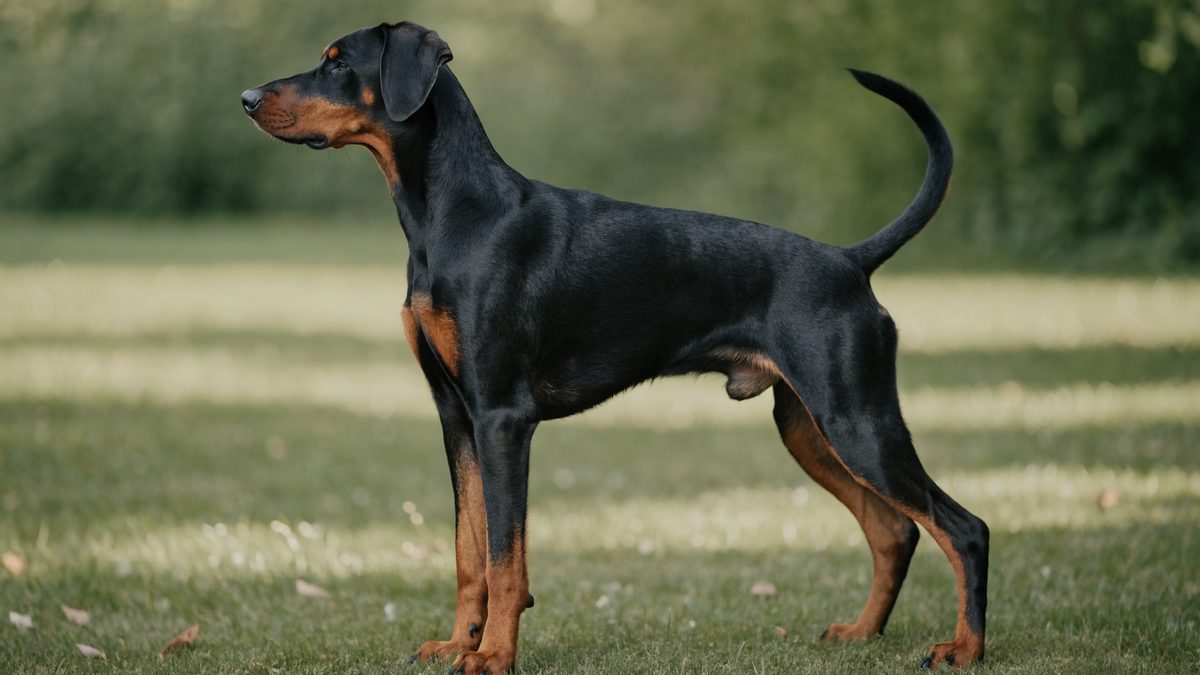
Quick answer
The Doberman price in India runs Rs 15,000 to Rs 3,50,000 in 2026, and published sources disagree more than twenty-fold about the same breed. Bonbeno rates the Dobermann 3 of 5 for heat tolerance, better than any double-coated import but not heat-proof. The number that should decide your purchase is not the price. It is 58.2 percent, the cumulative prevalence of dilated cardiomyopathy in a study of 412 Dobermans, and the annual heart screen that catches it early.
This guide is general information for Indian pet owners and is not a diagnosis. Always consult a registered veterinarian near you before acting on anything you read here, and treat any sudden change in your dog's condition as urgent.
Dobermann at a glance
What a Dobermann is
The Dobermann is a medium to large German working dog bred in the 1870s to be a companion, protection and working dog, and the FCI describes it in exactly those three words. Every argument on this page follows from that job description. The breed was assembled for alertness, courage and trainability, and the modern standard insists that all three come with a calm, family-devoted temperament rather than a hair trigger.
The Dobermann is the only German breed that carries the name of its original breeder. Friedrich Louis Dobermann, who lived from 2 January 1834 to 9 June 1894, worked as a tax collector, an offal abattoir manager and a part-time dog catcher legally entitled to seize stray dogs. He bred from that reservoir of animals in the 1870s, selecting the particularly sharp ones, and used the so-called butcher's dogs, an early type of Rottweiler crossed with a black and rust shepherd dog from Thuringia, as the foundation. The result was recognised officially as a police dog by the beginning of the twentieth century, which earned the breed the nickname Gendarme dog. The American Kennel Club recognised the breed in 1908.
Under FCI-Standard No. 143, valid from 13 November 2015, males stand 68 to 72 cm at the withers and weigh about 40 to 45 kg, while females stand 63 to 68 cm and weigh about 32 to 35 kg. The body is almost square, with length no more than 5 percent greater than height in males and 10 percent in females. This is a muscular, athletic dog built on elegant lines rather than a heavy one.
| Standard | Males | Females |
|---|---|---|
| FCI No. 143, the standard that applies in India | 68 to 72 cm, about 40 to 45 kg | 63 to 68 cm, about 32 to 35 kg |
| American Kennel Club | 26 to 28 in, ideal about 27.5 in | 24 to 26 in, ideal about 25.5 in |
| AKC breed page weight | 75 to 100 lb | 60 to 90 lb |
| Royal Kennel Club, ideal height | 69 cm (27 in) | 65 cm (25.5 in) |
The three standards agree closely on size and disagree on almost nothing except the ears and the tail, which is where this page gets interesting later.
Which standard actually applies in India
The FCI standard is the one that governs a KCI-registered Doberman in India. The Kennel Club of India is listed by the Fédération Cynologique Internationale as a full member, based at Anna Nagar in Chennai. A full member adopts FCI breed standards, so the description that applies to an Indian pedigree Dobermann is the German one, not the American one. That matters because the two documents say opposite things about ears and tails, and almost every Indian page quotes the American version without noticing.
The FCI standard says the ears are left natural and of appropriate size, set at the highest point of the skull and ideally lying close to the cheeks, and that the tail is left natural and ideally carried high in a slight curve. The AKC standard, approved on 6 February 1982, says the opposite: ears normally cropped and carried erect, tail docked at approximately the second joint. The Royal Kennel Club describes only natural ears, small, neat, set high and dropped close to the cheeks, and gives separate wording for docked and undocked tails because docking is now restricted in the United Kingdom.
The FCI standard requires hair that is short, hard and dense, lying tight and smooth, and states plainly that undercoat is not allowed, with visible undercoat listed as a disqualifying fault. That single line is the reason a Dobermann is a more sensible import than a Siberian Husky or a Golden Retriever for an Indian household. The Royal Kennel Club sets grooming at once a week and coat length as short. There is no coat blow, no rake, no undercoat mat, and no seasonal hair storm.
Coat colour under the standards
Coat colour is where the standards diverge again, and where Indian sellers make money. The FCI recognises only two colour varieties, black or brown with clearly defined rust red markings, placed on the muzzle, as a spot on the cheeks and above each eye, on the throat, as two spots on the forechest, on the pasterns and feet, on the inner thigh and under the tail. The AKC allows four, black, red, blue and fawn (Isabella), and disqualifies dogs not of an allowed colour. The Royal Kennel Club allows black, brown, blue or fawn and calls white markings of any kind highly undesirable.
Read those three together and a fact drops out that no Indian price page states. A blue or fawn Doberman is not an FCI colour. It is allowed by the AKC and by the Royal Kennel Club, but the standard that a KCI dog is bred to recognises black and brown only. Indian sellers quote a premium of Rs 35,000 to Rs 80,000 for a blue dog. You are paying extra for a colour outside the standard your registry follows.
Temperament, as the standard defines it
The FCI temperament paragraph is worth quoting almost in full, because it contradicts the marketing that sells this breed in India. The disposition of the Dobermann is friendly and calm, very devoted to the family. Medium temperament and medium sharpness are desired, a medium threshold of irritation is required, and good contact with the owner is expected. The dog should be easy to train, enjoy working, and show courage, hardness, self-confidence and intrepidness, together with adaptability and attention to the social environment.
Then comes the line that settles the argument. Under disqualifying faults, the FCI lists aggressive or overly shy dogs, alongside any dog clearly showing physical or behavioural abnormalities. An aggressive Dobermann is not a good specimen of the breed. It is a disqualified one. The AKC standard reaches the same place by a different route, instructing the judge to dismiss from the ring any shy or vicious Doberman, and the Doberman Pinscher Club of America puts it flatly in its illustrated standard: temperament is paramount in the breed, and without good temperament you do not have a Doberman.
For working intelligence the breed sits near the top of every published ranking. The American Kennel Club, summarising Stanley Coren's working and obedience intelligence ranking, places the Doberman Pinscher fifth of all breeds, behind the Border Collie, Poodle, German Shepherd and Golden Retriever. Indian pages routinely print sixth. It is fifth, and the correction matters only because it shows how little of what you read about this breed has been checked.
Doberman price in India
A Doberman puppy costs somewhere between Rs 15,000 and Rs 3,50,000 in India in 2026, and that absurd spread is the most honest sentence anyone can write about the market. Five Indian pages that all rank for this query publish five different answers, the lowest floor is less than half the highest floor, and not one of them cites a source for a single number.
Bonbeno opened every Indian page currently ranking for this query and put their published bands side by side. Read them together and the disagreement is impossible to miss.
| Source | Headline range | Pet or unregistered | KCI registered | Show or champion | European line |
|---|---|---|---|---|---|
| Supertails | Rs 20,000 to Rs 80,000 | Rs 10,000 to Rs 25,000 | Rs 25,000 to Rs 50,000 | Rs 50,000 to Rs 1,00,000+ | Rs 1,00,000 to Rs 1,50,000+ |
| Mr n Mrs Pet | Rs 35,000 to Rs 1,20,000+ | Rs 35,000 to Rs 70,000 | Rs 70,000 to Rs 1,00,000 | Rs 1,00,000 to Rs 1,20,000 | Rs 75,000 to Rs 3,50,000 |
| Zoodle | Rs 15,000 to Rs 60,000 | Rs 15,000 to Rs 25,000 | Rs 25,000 to Rs 45,000 | Rs 50,000 to Rs 1,00,000+ | Not stated |
| PatMyPets | Rs 30,000 to Rs 50,000 | Rs 20,000 to Rs 35,000 by city | Not stated | Rs 38,000 to Rs 80,000 by city | Not stated |
| Asia Pets | Rs 15,000 to Rs 45,000 | Not stated | Not stated | Not stated | Not stated |
The gap is not a rounding difference. Mr n Mrs Pet's floor of Rs 35,000 sits above Asia Pets' ceiling of Rs 45,000 by only Rs 10,000, and its European ceiling of Rs 3,50,000 is nearly eight times Asia Pets' top figure Asia Pets, Doberman Pinscher. Supertails calls anything below Rs 15,000 for a claimed purebred Doberman a serious red flag, while Zoodle sets its own pet-quality floor at Rs 15,000. One page's warning line is another page's entry price.
Four of the five sources above sell puppies, broker puppy sales or sell pet products. None of them discloses that interest next to the price. Bonbeno discloses it here because a seller-published price band is a marketing position, not a market survey. Treat every figure on this page as reported, not as verified market data, because no independent body audits Indian puppy prices at all.
City-wise Doberman price, and why most of those tables are worthless
Only two of the five sources publish a genuinely differentiated city-wise breakdown. Mr n Mrs Pet prints a city-wise table for eight cities in which every single city shows the identical range of Rs 35,000 to Rs 1,20,000. That is a table with no information in it. PatMyPets is the only source that separates pet quality from show quality city by city.
| City | Pet quality | Show quality |
|---|---|---|
| Delhi NCR | Rs 25,000 to Rs 35,000 | Rs 45,000 to Rs 75,000 |
| Mumbai | Rs 22,000 to Rs 30,000 | Rs 50,000 to Rs 80,000 |
| Bangalore | Rs 24,000 to Rs 32,000 | Rs 45,000 to Rs 70,000 |
| Chennai | Rs 20,000 to Rs 28,000 | Rs 40,000 to Rs 65,000 |
| Hyderabad | Rs 22,000 to Rs 30,000 | Rs 45,000 to Rs 70,000 |
| Kolkata | Rs 23,000 to Rs 30,000 | Rs 42,000 to Rs 68,000 |
| Pune | Rs 21,000 to Rs 29,000 | Rs 40,000 to Rs 65,000 |
| Ahmedabad | Rs 20,000 to Rs 27,000 | Rs 38,000 to Rs 60,000 |
| Chandigarh | Rs 25,000 to Rs 35,000 | Rs 50,000 to Rs 70,000 |
| Jaipur | Rs 22,000 to Rs 30,000 | Rs 42,000 to Rs 65,000 |
Cross-check that against the other city list and the two do not agree. Supertails puts Mumbai at Rs 25,000 to Rs 1,00,000, Bengaluru at Rs 30,000 to Rs 70,000, Delhi at Rs 25,000 to Rs 55,000, Hyderabad at Rs 25,000 to Rs 60,000, Chennai at Rs 25,000 to Rs 55,000, Kolkata at Rs 22,000 to Rs 50,000, Pune at Rs 28,000 to Rs 65,000, Kerala at Rs 25,000 to Rs 60,000 and Guwahati at Rs 18,000 to Rs 45,000. Zoodle publishes a third set again, with Mumbai at Rs 25,000 to Rs 65,000 and tier-2 cities at Rs 12,000 to Rs 30,000. Bonbeno prints all three rather than averaging them, because an average of three unsourced estimates is a fourth unsourced estimate.
European Doberman price in India, and the documentation that should come with it
The European Doberman commands the largest premium in the Indian market and carries the least verification. Mr n Mrs Pet prices European lines at Rs 75,000 to Rs 3,50,000 against Rs 50,000 to Rs 1,20,000 for American lines. Supertails puts verified European working lines at Rs 80,000 to Rs 1,50,000 and above, and says outright that the term European bloodline is widely misused by Indian breeders as a premium-charging justification, with the only real test being FCI-registered pedigree documentation traceable to European kennels.
That test is checkable and you should apply it. Ask to see the export pedigree, the FCI registration of the sire and dam, and the kennel name. If the seller cannot produce them, you are paying a European bloodline premium for a claim. Verify the paperwork before the money moves, not after.
- Ask for the FCI export pedigree, not a photograph of a foreign dog. A genuine European line traces to a named kennel in a named FCI member country.
- Ask for the parents' cardiac results. A European working-line premium without a Holter and echocardiography record on both parents is money spent on appearance.
- Ask for the KCI registration and understand what it does and does not certify. It documents pedigree. It is not a health certificate.
- Ask for the von Willebrand DNA test result on both parents, because the mutant allele frequency measured in one studied Doberman population was 0.41.
- Ask for the breeder's certificate of registration from the State Animal Welfare Board, which Rule 3 of the 2017 Rules makes compulsory before any breeding activity.
What the price is actually tracking
- KCI registration status. Registration is quoted as adding roughly 20 to 40 percent to the price of a Doberman puppy. It documents lineage. It certifies nothing about the heart.
- Coat colour. Blue Dobermans are quoted at Rs 35,000 to Rs 80,000 and white or albino dogs at Rs 80,000 to Rs 1,50,000 and above, with the same source warning that white dogs carry documented skin, vision and cancer risks and that responsible breeders generally do not recommend them.
- Claimed bloodline. The European premium is the largest single lever on Indian pricing and the least documented.
- Training already done. A basic obedience trained adult is quoted at Rs 40,000 to Rs 80,000, advanced guard training at Rs 80,000 to Rs 1,50,000, and personal protection or sport-titled imports far above that.
- Age at sale. Puppies of 8 to 12 weeks are quoted highest, with older puppies discounted and adults cheaper again. Note that selling a puppy under eight weeks is prohibited outright.
Under the Prevention of Cruelty to Animals (Dog Breeding and Marketing) Rules, 2017, dated 23 May 2017, no breeder may carry on any breeding activity or house dogs for breeding and sale without a certificate of registration from the State Board, and Rule 8 requires that pups less than eight weeks in age are not sold, that each pup sold is micro-chipped, and that only dogs in good health that have received their medical inoculations are sold. A price far below the market usually means none of that happened.
Bonbeno does not broker puppy sales and does not publish breeder listings. Every figure above is reported from a third party so you can see the disagreement for yourself and price the uncertainty into your own decision.
Monthly cost of owning a Doberman in India
The monthly cost of a Doberman in India is published as anything from Rs 3,000 to Rs 18,000, a six-fold spread, and the reason for the spread is that the cheap estimates leave out the two lines that actually define this breed. Those are professional training and annual cardiac screening. Budget for both from the start or the number you planned for will be wrong.
Four Indian sources publish a monthly or annual cost structure. They do not agree, and the disagreement is systematic rather than random.
| Line item | Supertails, monthly | Zoodle, monthly | Mr n Mrs Pet, monthly | PatMyPets, annual |
|---|---|---|---|---|
| Food | Rs 3,500 to Rs 7,000 | Rs 3,000 to Rs 6,000 | Not itemised | Rs 25,000 to Rs 40,000 |
| Grooming | Rs 500 to Rs 1,500 | Rs 800 to Rs 1,500 | Not itemised | Rs 3,000 to Rs 6,000 |
| Veterinary care | Rs 1,500 to Rs 4,000 | Rs 500 to Rs 1,500 | Not itemised | Rs 5,000 to Rs 10,000 |
| Vaccination | Included in vet | Included in vet | Not itemised | Rs 2,000 to Rs 4,000 |
| Training | Rs 8,000 to Rs 25,000 in year one | Rs 2,000 to Rs 5,000 | Not itemised | Rs 5,000 to Rs 15,000 |
| Parasite control | Not itemised | Rs 300 to Rs 600 | Not itemised | Not itemised |
| Exercise and enrichment | Rs 500 to Rs 1,500 | Rs 500 to Rs 1,000 | Not itemised | Rs 3,000 to Rs 5,000 |
| Stated total | Rs 9,000 to Rs 18,000 a month | Rs 7,000 to Rs 15,000 a month | Rs 3,000 to Rs 7,000 a month | Rs 53,000 to Rs 1,10,000 a year |
Mr n Mrs Pet's monthly figure of Rs 3,000 to Rs 7,000 is less than half the Supertails floor and roughly a third of its ceiling. Bonbeno flags a second problem with that source. The same page claims Dobermans have dense, curly coats that need trimming every four to six weeks to prevent matting, which is contradicted by the FCI standard, which calls for hair that is short, hard and dense with no undercoat allowed, and by the Royal Kennel Club, which lists coat length as short and grooming as once a week. A page that gets the coat that wrong should not be trusted on the grooming bill.
The two lines that make a Doberman different
Two costs belong on a Doberman budget that do not belong on a Labrador budget, and only one Indian source counts either of them properly.
- Annual Holter monitoring and echocardiography, from age three. Supertails puts a Holter test at Rs 3,000 to Rs 8,000 and says budgeting for annual cardiac monitoring from age two is part of responsible ownership. Zoodle prices annual cardiac screening at Rs 2,000 to Rs 5,000. The European Society of Veterinary Cardiology recommends both tests, every year, for the life of the dog. Two tests a year, every year, for ten years is a real line item and nobody in India prints it as one.
- Professional training in year one. Supertails puts it at Rs 8,000 to Rs 25,000, Zoodle at Rs 2,000 to Rs 5,000 a month, PatMyPets at Rs 5,000 to Rs 15,000 a year. For a dog the AKC warns can become pushy, destructive and unmanageable if not raised properly, this is not discretionary spending.
First-year setup costs
- Full puppy vaccination course, Rs 4,000 to Rs 9,000, run across the first sixteen weeks. Zoodle puts the post-purchase completion at Rs 5,000 to Rs 8,000 over three to four months.
- Microchipping, Rs 800 to Rs 2,000. Rule 8 of the 2017 Rules requires that each pup sold is micro-chipped in any case.
- Spay or neuter, Rs 6,000 to Rs 18,000.
- Essential setup, Rs 5,000 to Rs 12,000, and for this breed specifically a proper harness, because pull strength and neck structure make collar-only lead control risky for dog and handler.
- Realistic first-year total including purchase, Rs 60,000 to Rs 2,00,000 and above depending on breeder tier and city. Zoodle puts the annual total for a well-cared-for adult at Rs 1,00,000 to Rs 1,50,000.
Where published sources disagree, as they do here by a factor of six, we print all of them and name the reason for the gap rather than averaging them into a number no source supports. No independent Indian owner cost survey for this breed exists. Until one does, the honest answer is a range with its sources attached, and the two lines above are the ones a Doberman budget usually misses.
Add the cardiac protocol to the mid estimate and a realistic Indian Doberman runs around Rs 9,000 to Rs 18,000 a month plus roughly Rs 5,000 to Rs 13,000 once a year for the heart screen from age three. That is the number to plan against. Read how we test and cost things for what a Bonbeno figure does and does not claim.
Climate suitability: why heat tolerance is rated 3 of 5
Bonbeno rates the Dobermann 3 of 5 for heat tolerance, and the rating is deliberately in the middle because both of the popular Indian positions on this breed are wrong. It is not a heat-proof dog, and it is not a heat-fragile one. It is a lean, short-coated, dark, large, high-drive animal, and each of those five words pulls in a different direction.
Start with the one genuine advantage. The FCI standard requires short, hard, dense hair lying tight and smooth, and states that undercoat is not allowed, with visible undercoat listed among the disqualifying faults. That is a real, structural difference from every double-coated import Indians buy. The Royal Kennel Club records coat length as short and grooming as once a week. There is no insulating undercoat to trap heat against the skin and no coat blow to manage.
What the largest heat study actually found
Here is where Bonbeno parts company with every Indian page ranking for this query. The largest primary-care study of heat-related illness in dogs covered 905,543 UK dogs and identified 395 confirmed events in 2016, an incidence of 0.04 percent with an event fatality rate of 14.18 percent. The Doberman is not named anywhere in that study, in the risk tables or in the discussion.
That absence must be read correctly, and the study itself supplies the reading. Nine breeds carried higher odds of heat-related illness than the Labrador Retriever, and the authors state plainly that no breed types had significantly reduced odds compared with the Labrador. There is no protected group in this dataset. The idea that a short coat makes a dog safe in heat is not in the evidence.
| Breed or factor | Odds ratio | 95 percent confidence interval |
|---|---|---|
| Chow Chow | 16.61 | 6.21 to 44.44 |
| Bulldog | 13.95 | 8.01 to 24.29 |
| French Bulldog | 6.49 | 3.62 to 11.63 |
| Dogue de Bordeaux | 5.31 | 1.99 to 14.21 |
| Greyhound | 4.26 | 1.88 to 9.70 |
| Golden Retriever | 2.65 | 1.40 to 5.01 |
| Bodyweight 50 kg and above | 3.42 | 1.54 to 7.57 |
| Purebred against crossbred | 1.86 | 1.39 to 2.49 |
| Long-muzzled (dolichocephalic) skull shape | 1.08, not significant | 0.74 to 1.58 |
| Doberman Pinscher | Not present in the study | Not measurable |
The most useful line in that whole paper, for a Doberman owner in India, is about the Greyhound. The authors write that it has been suggested racing Greyhounds rarely exhibit heat-related illness, but their results showed pet Greyhounds at 4.26 times the odds of the Labrador, and they attribute it to a high lean muscle mass which has been associated with increased risk of post exercise hyperthermia. A Greyhound is lean, short-coated and long-muzzled. So is a Dobermann. The nearest measured analogue for this breed came out at elevated risk, not protected.
The Dobermann is missing from the UK risk tables because there were not enough of them in that population to measure, not because they were measured and found safe. What the data does show is that protection tracks small body size, not coat length: the authors explain that smaller dogs have a high heat storage to radiative surface area ratio that results in more rapid heat loss compared with larger dogs. A 40 kg dog is on the wrong side of that. Absence of evidence is not evidence of absence, and Bonbeno will not claim a heat advantage the literature does not contain.
The heart connection nobody makes
Purina India lists the risk factors that raise a dog's chance of heat stroke, and one of them belongs on this page more than on any other breed page on this site. Alongside lack of water, enclosed space, excessive humidity, obesity, intense exercise, old age and lack of acclimatisation, it names cardiovascular disease or respiratory disease. A Dobermann with occult dilated cardiomyopathy has reduced cardiac output before it takes a single step outdoors, and reduced cardiac output means reduced ability to move blood to the skin and dissipate heat.
That is the argument for annual cardiac screening restated as a summer safety argument. An unscreened Doberman in an Indian April is carrying a hidden risk factor for the country's most common preventable summer emergency. No page ranking for this query connects those two facts, and it is the single most useful thing on this page.
Indian temperature thresholds and what to do about them
| Ambient temperature | Risk level | What it means in practice |
|---|---|---|
| Below 28 C | Low | Normal activity with shade and water |
| 28 to 35 C | Moderate | Shorten the walk to 15 to 20 minutes, early morning and late evening only |
| 35 to 42 C | High | Outdoor activity contraindicated. Asphalt reaches 60 C and above |
| Above 42 C | Extreme | Heat stroke possible within 10 to 15 minutes outdoors, and indoor temperatures without cooling can be fatal |
Humidity changes the arithmetic. A 35 C day at 90 percent humidity, typical of the Mumbai monsoon, is more dangerous than a 42 C day at 20 percent humidity in Delhi, because panting works by evaporation and humid air blocks it. A Doberman in Chennai, Kochi or coastal Kerala is under more thermal load than the thermometer suggests. Bonbeno rates this breed 3 of 5 rather than 4 largely because of the coastal humid belt, where the short coat buys much less than owners expect.
- Walk only before 7 am or after 8 pm from April to September, which are the only windows in which ambient temperature is reliably below 30 C.
- Do the seven-second pavement test before every summer walk. If you cannot hold the back of your hand on the pavement for seven seconds, it will burn paw pads, and asphalt in direct sun reaches 60 C.
- Keep indoor temperature below 32 C. Above that, a dog at rest is at risk, and fans or air conditioning should run continuously.
- Never confine the dog to a balcony above 30 C. Concrete balconies are heat traps with no shade and no airflow.
- Cut vigorous exercise entirely in the hot months. Purina warns that a dog can develop heat stroke in as little as 30 minutes of vigorous exercise in hot weather, whatever its coat.
- Plan for power cuts, because load shedding peaks exactly when cooling demand peaks.
A raised temperature of 40.5 C or above is one of the signs of heat stroke. Move the dog to the coolest available place, wet the whole body with room-temperature water, get air moving across the wet coat, and drive to a clinic while cooling continues. Stop active cooling once temperature returns to about 39.4 C so the dog does not become hypothermic, and never plunge a dog into cold water or an ice bath, which prevents the core temperature coming down.
The other Indian climate problem: ticks
A short coat is easier to check for ticks and does nothing to stop them. The largest Indian survey of canine tick-borne disease sampled 525 dogs across four climatic zones in Sikkim, Ladakh, Delhi and Mumbai between June and September 2008, and found that 49.7 percent carried at least one tick-borne pathogen by PCR. Hepatozoon canis was most common at 30 percent, followed by Ehrlichia canis at 20.6 percent, Mycoplasma haemocanis at 12.2 percent, Anaplasma platys at 6.5 percent and Babesia vogeli at 5.5 percent, with co-infection in 39 percent of cases.
The city split is the part Indian owners should act on. Tick infestation was found on 80 percent of dogs in Mumbai and 75.3 percent in Delhi, against 17 percent in Sikkim and 11 percent in Ladakh, and Ehrlichia canis reached 39.5 percent in Delhi and 27.2 percent in Mumbai while registering zero in the two cooler sites. Dogs carrying ticks were 3.3 times more likely to test positive for a pathogen. A Chennai study of 230 free-ranging dogs in 2018 found 99.6 percent tick-infested and 67.8 percent positive for at least one pathogen.
Both Indian tick studies sampled stray and shelter dogs, and neither recorded breed or coat type at all Manoj RRS, Latrofa MS, Mendoza-Roldan JA. Nothing in them says a Doberman is more or less likely to pick up a tick than any other dog. What they establish is the environmental pressure your dog lives in, and for a breed with a clotting disorder in its gene pool, a tick-borne disease that lowers packed cell volume is a compounding problem rather than a separate one. Infected dogs in the 2011 survey averaged a PCV of 29.7 percent against 35.8 percent in uninfected dogs.
One genuine cold-weather caveat closes this section. A coat with no undercoat is a poor insulator in the other direction, so a Doberman in Shimla, Srinagar, Gangtok or a Delhi January needs a coat on the dog rather than a fan. This is the rare imported breed in India whose winter needs more thought than its summer in the north.
Temperament, and the gap between the marketing and the evidence
The Dobermann is sold in India as a guard dog and described by its own breed standard as friendly and calm and very devoted to the family. Both statements are true, and the distance between them is where most Indian Doberman problems begin. The breed was built to be a protection dog with an off switch, and the buyers who want the protection without the off switch are the ones who create dangerous animals.
Read the standards first, because they are unusually explicit. The FCI requires a friendly and calm disposition, very devoted to the family, with medium temperament and medium sharpness, a medium threshold of irritation and good contact with the owner. Under disqualifying faults it lists aggressive or overly shy dogs. The Royal Kennel Club is shorter and says the same thing: characteristics intelligent and firm of character, loyal and obedient; temperament bold and alert; shyness or viciousness unacceptable.
The American standard adds a distinction Indian buyers should know. It instructs judges to dismiss any shy or vicious Doberman, defines viciousness as a dog that attacks or attempts to attack the judge or its handler, and then states that an aggressive or belligerent attitude towards other dogs shall not be deemed viciousness. Dog-directed and human-directed behaviour are separate traits in this breed, and Indian owners who read one as a proxy for the other get caught out at the lift.
What measured temperament data shows
Three sets of numbers exist, and none of them supports the reputation this breed carries in either direction.
| Measure | Doberman figure | Comparison | Source |
|---|---|---|---|
| ATTS temperament test pass rate, as of January 2023 | 80.1 percent of 1,870 dogs tested | German Shepherd 85.7 percent, Golden Retriever 85.9 percent, Labrador 92.4 percent | American Temperament Test Society |
| FCI breed standard, disqualifying faults | Aggressive or overly shy dogs are disqualified | The desired disposition is friendly and calm, very devoted to the family, with medium sharpness | FCI-Standard No. 143 |
| US paediatric dog-bite systematic review | One of eight breeds each under 1.5 percent of bites | Pit Bull 27.2 percent, German Shepherd 10.5 percent, Labrador 7.2 percent, Rottweiler 3.9 percent | Systematic review of paediatric dog bites |
Take each on its own terms. The ATTS figure puts the Doberman lowest of those four breeds, and ATTS itself disowns the interpretation people reach for: the pass-fail rate is not a measure of a breed's aggression, the data is raw and is not a scientific study, there is no control over who brings a dog to the test, and results are cumulative since 1977. Aggression is also judged against each breed's own standard, so a protection-trained dog lunging at the stranger may pass where an untrained companion breed would fail. Bonbeno prints the number and its caveats together because printing either alone is misleading.
The bite data deserves the same care as the temperament test. In the paediatric systematic review the Doberman falls among eight breeds each accounting for under 1.5 percent of bites, well behind the Pit Bull at 27.2 percent and the German Shepherd at 10.5 percent. The reviewers themselves caution against reading a league table into that, because the size of the underlying population of each breed is unknown, so a common breed generates more bites than a rare one at identical individual risk. Bonbeno prints the number and the caveat together, because the number on its own would flatter this breed about as unfairly as its reputation condemns it.
No dataset Bonbeno could find places the Doberman among the high-aggression or high-bite breeds. In a US paediatric dog-bite systematic review it sits in the tail of breeds each accounting for under 1.5 percent of bites, and the reviewers themselves warn that breed conclusions cannot be drawn because the underlying dog population is unknown. The reputation is older and louder than the data. That is not a licence to treat the breed casually, because a 40 kg protection-bred dog does not need to be statistically dangerous to be individually dangerous when badly raised.
The traits that actually shape Indian household fit
Purina India's own breed description is more candid than the Indian sales pages. It notes that Dobermanns often tend to be a one-man dog and will usually belong more to one person in the family than to the whole family, that they are often suspicious of strangers, human and canine, and that by merit of size, strength, activity level and guarding tendencies they are not for the inexperienced or for those who cannot put in the time to exercise and train them.
That maps onto four specific Indian frictions.
- Domestic staff and delivery. An Indian urban home sees cooks, cleaners, drivers, couriers and gas cylinder deliveries daily. A dog that is suspicious of strangers by breeding needs those people introduced deliberately, repeatedly and calmly, not managed by shutting the dog in a room.
- Lifts and stairwells. Shared vertical space forces close encounters with strangers and other dogs. The AKC standard's separation of dog-directed from human-directed behaviour matters here in practice.
- One-person bonding in a joint family. A dog that attaches hardest to one adult can become protective around that person specifically. Spread the handling, feeding and walking across the household from week one.
- Being left alone. Supertails warns that a Doberman left alone for eight or more hours daily develops separation anxiety, destructive behaviour and excessive territorial aggression, and the AKC says the dog should always live inside the home with its people rather than outdoors.
Bonbeno publishes nothing on producing aggression, sharpening a dog for confrontation, or preparing an animal for a fight. Under section 11(1)(m) of the Prevention of Cruelty to Animals Act, 1960, it is an offence, solely with a view to providing entertainment, to incite any animal to fight or bait any other animal, and under section 11(1)(n) it is an offence to organise, keep, use or act in the management of any place for animal fighting. If a trainer or seller offers you either, walk away and report it.
- Good fit. An experienced owner in a house with a secure boundary, someone home for most of the day, and a genuine commitment to daily training and two hours of exercise.
- Poor fit. A first-time owner, a flat left empty ten hours a day, a household that wants a deterrent rather than a dog, or anyone buying because the breed looks intimidating.
- Watch item. The dog is strong enough to knock an adult over without meaning to. Supervise around small children on physics rather than on temperament.
Training a Doberman
Train a Doberman with reward-based methods from the day it arrives, and expect it to learn faster than you can teach. This breed is ranked fifth of all breeds for working and obedience intelligence, and the FCI standard calls it easy to train with good working ability. The risk is not that it will fail to learn. The risk is that it will learn the wrong lesson perfectly.
Two authorities set the frame. The AKC warns that Dobermans are very strong dogs and can become pushy, destructive and unmanageable if not raised properly. Supertails puts it more directly for the Indian market: training is not optional for a Doberman, an untrained Doberman in a mixed household is a genuine liability, and punishment-based methods produce fear-based aggression in a breed that already has strong instincts.
That last point is the one Indian owners most often get wrong. The market here still sells compulsion training for guard breeds, and it is exactly the wrong tool. A dog selected for courage and hardness does not fold under pressure; it escalates. Reward-based training in this breed is not a soft option, it is the method that produces a controllable adult.
Realistic timelines
| Skill | Start | Realistic outcome |
|---|---|---|
| Name response | Week 1 home | Reliable indoors in 1 to 2 weeks. This breed is fast |
| Sit, down, settle | Week 1 home | 2 to 4 weeks |
| Toilet training | Week 1 home | 3 to 5 months |
| Stranger greeting protocol at the door | Week 1 home | Ongoing for life, never finished |
| Loose-lead walking on a harness | Month 2 | 3 to 6 months, then maintenance |
| Reliable recall in a fenced space | Month 2 | 4 to 8 months |
| Settling calmly while strangers move through the house | Month 2 | 6 to 12 months of deliberate rehearsal |
| Adolescent boundary testing | Month 6 | Expect it from 6 to 18 months and plan for it |
The Indian socialisation plan
Socialise this breed to the specific Indian environment it will live in, not to a generic checklist. That means people in uniform, people carrying loads on their heads, hand carts, cycle rickshaws, autorickshaws, cows, street dogs behind a barrier, temple bells, firecrackers, the building watchman, the lift, the metal gate and the courier at the door. Every one of those is a stimulus a Doberman will otherwise meet for the first time as an adult with a guarding instinct already switched on.
- Book socialisation into the cool windows. From April to September a puppy can only be out before 7 am and after 8 pm, which halves your available exposure time and means it has to be planned rather than improvised.
- Pay the staff to feed the dog. The single most effective intervention in an Indian household is having the cook, the cleaner and the driver hand-feed the puppy from week one. It converts the daily stranger stream from a threat into a routine.
- Train a door protocol before the dog is big. Decide now what happens when the bell rings, and rehearse it three times a day. At six months this becomes far harder to install.
- Use a harness, not a collar alone. Pull strength and neck structure make collar-only lead control risky for both dog and handler in this breed.
- Give the dog a job. The FCI describes a dog that enjoys working and needs good working ability, and the AKC recommends obedience, tracking and agility as exercise for mind and body. Scent games and structured obedience run indoors during the heat.
A well-socialised Doberman is already a deterrent, because size, colour and reputation do that work without any training at all. Formal protection work is a specialist sport requiring a qualified decoy, and in an Indian residential setting it adds risk rather than security. Zoodle publishes advanced obedience with guard training at Rs 80,000 to Rs 1,50,000 and personal protection at Rs 1,50,000 to Rs 4,00,000 and above. For a family dog in a flat, the money is better spent on early socialisation and a good pet trainer.
One correction worth making, because it is repeated on nearly every Indian page. The Doberman is not the sixth most intelligent breed. The American Kennel Club's own summary of the working and obedience intelligence ranking places it fifth, behind the Border Collie, Poodle, German Shepherd and Golden Retriever. It is a small error, and it tells you how carefully the rest of that page was checked.
How much exercise a Doberman actually needs
The Royal Kennel Club puts the Dobermann's requirement at more than two hours of daily exercise, with the ideal home listed as a large house with a large garden. That is the only hard number published by a national kennel club, it is the same figure the same body gives the German Shepherd, and it is a figure no Indian commercial page prints at all.
The gap in the sourcing is stark. Of the five Indian price pages Bonbeno opened, not one states a daily exercise requirement in hours. Mr n Mrs Pet says only that Dobermans are active, alert and athletic and enjoy regular walks, training, play sessions and interactive challenges. Supertails puts it at one to two hours in its conclusion and Zoodle at at least one to two hours. Even Purina India contradicts itself on its own page, with a summary bullet saying the breed enjoys walking one to two hours a day and the exercise section on the same page recommending two-plus hours of daily exercise for an adult.
| Source | Stated daily requirement |
|---|---|
| Royal Kennel Club, UK | More than 2 hours per day |
| Purina India, exercise section | Two-plus hours for an adult |
| Purina India, summary bullet on the same page | One to two hours a day |
| Supertails, India | 1 to 2 hours |
| Zoodle, India | At least 1 to 2 hours |
| American Kennel Club | No number given, long daily walks plus a large fenced area |
| Mr n Mrs Pet, India | No number given |
Bonbeno treats the Royal Kennel Club's more than two hours as the standard and the Indian one to two hours as the floor, and prints the disagreement rather than picking the convenient one. The AKC adds the qualitative half: a Doberman is an energetic athlete who needs a lot of exercise and free play, a large fenced area where it can run is vital for physical and mental wellbeing, and canine sports such as obedience, tracking and agility provide exercise for mind and body.
Two hours of daily exercise has to fit before 7 am and after 8 pm for roughly six months of the year across most of India. That is the structural fact that quietly breaks Doberman households here. It is not about willingness. It is about whether two adults can reliably deliver two outings a day, every day, for ten to twelve years, and whether the household has a plan for the months when the only safe hours are before sunrise and after dinner.
What counts when the outdoors is closed
- Scent work and puzzle feeding indoors. Twenty minutes of nose work tires a working breed more than twenty minutes of walking, and it runs in a cooled room during a heatwave.
- Structured obedience in short blocks. A breed ranked fifth for working intelligence gets more from ten focused minutes than from an hour of aimless walking.
- Tug and retrieve games with rules. Impulse control practice disguised as play, and it costs nothing.
- Swimming where clean, safe water exists. Load without heat and without joint impact.
- Stair work and hill work in the cool season only, and never in a dog with a known cardiac abnormality until a veterinarian has cleared it.
- Skip the midday walk entirely from March to October and accept two cool sessions over three that include one dangerous one.
Sudden exercise intolerance, fainting, weakness or collapse in an otherwise healthy Doberman is a cardiac emergency, not a fitness problem. In a breed where the cumulative prevalence of dilated cardiomyopathy reached 58.2 percent in a longitudinal study, a dog that suddenly stops wanting its walk is telling you something. Have a clinic number ready before you need it.
A Doberman that does not get its outlet redirects the energy into the house, and the failure pattern in Indian flats is predictable: destroyed furniture, barking at every lift arrival, pacing, and a dog that becomes progressively harder to handle at the door. None of that is a behavioural disorder. It is an unemployed working dog inventing a job.
Grooming a Doberman in Indian humidity
Groom a Doberman once a week with a rubber curry brush and you are finished. This is the lowest-maintenance coat of any large imported breed sold in India. The Royal Kennel Club lists grooming as once a week and coat length as short, and the FCI standard requires hair that is short, hard and dense with undercoat not allowed.
The coat lies tight and smooth and is equally distributed over the whole surface. The AKC describes it as smooth-haired, short, hard, thick and close lying, permitting only an invisible grey undercoat on the neck. There is no double coat, no seasonal coat blow, no undercoat rake and no de-shedding tool. The breed still sheds, and the Royal Kennel Club records it as a shedding breed, but the hair is short and comes off as a fine scatter rather than in clumps.
One Indian seller page states that Dobermans have dense, curly coats that need trimming every four to six weeks to prevent matting. That is wrong on every count. The FCI standard specifies short, hard, dense hair lying tight and smooth with undercoat not allowed, and the Royal Kennel Club records the coat as short with grooming once a week. A Doberman never needs clipping, and a groomer who suggests it has not looked at the dog.
The weekly routine, adapted for Indian conditions
- Brush once a week with a rubber curry, in the direction of the coat, then wipe down with a damp cloth. Five minutes satisfies the Royal Kennel Club requirement in full.
- Bathe rarely. A short coat with no undercoat does not hold odour the way a double coat does, and over-bathing in humid weather strips oils and invites skin trouble.
- Check for ticks every day through the monsoon and after every walk. Half of Indian dogs surveyed carried a tick-borne pathogen, with ticks found on 80 percent of Mumbai dogs and 75.3 percent of Delhi dogs. A short coat makes that check quick, which is the real grooming advantage in India.
- Dry the dog properly after a wet walk, paying attention to elbows, groin and between the toes, where humid warmth and friction start hot spots.
- Trim nails monthly. The FCI standard specifies short black nails and cat-like arched toes, and long nails change how a heavy dog loads its forelimbs.
- Clean the ears weekly. A natural ear that lies close to the cheek is warmer and less ventilated than a cropped one, and in Indian humidity that is a reason to check the ear rather than a reason to crop it.
Coat colour and skin, where grooming becomes a health question
Two colour-linked skin conditions matter here, and both are reasons to think hard before paying a premium for a rare coat colour.
Colour dilution alopecia affects blue and fawn dogs, which carry a recessive variant of the MLPH gene. A study of 57 blue or fawn Doberman Pinschers found hair loss typical of colour dilution alopecia in 42 of them, confirmed by skin biopsy in 11 dogs and by light microscopy of plucked hairs in 6. That is the primary figure and it pools blue and fawn together, which matters because the study reported no separate rate for each colour. Per-colour splits circulate widely in breed forums and in secondary texts, and Bonbeno could not trace a single one of them back to a primary study with a stated sample size and country. So this page prints the pooled figure of 42 in 57 and leaves the blue-against-fawn split open rather than repeating whichever number suits the argument.
The underlying genetics are clean even where the prevalence is not. Coat colour dilution is inherited as an autosomal recessive trait, and a single nucleotide polymorphism in the non-translated first exon of the canine MLPH gene showed perfect association with the dilute phenotype across 65 dilute dogs from seven breeds, with dilute animals carrying only about 25 percent of the normal MLPH transcript.
The white or cream Doberman carries oculocutaneous albinism caused by a 4,081 base pair deletion removing part of exon 7 of the SLC45A2 gene, traced back to a single female born in 1976 University of California Davis Veterinary…. In the study that identified the mutation, cutaneous melanocytic tumours were found in 12 of 20 white Dobermans against 1 of 20 standard-coloured controls, and every white dog over five years of age was affected, 8 of 8. All twenty white dogs showed photophobia outdoors in full sunlight that resolved indoors. Indian sellers price white Dobermans at Rs 80,000 to Rs 1,50,000 and above. In a country with this much sunlight, that premium buys a dog with a documented tumour burden.
The authors state their own caveat, which Bonbeno repeats rather than hides. The number of dogs from which tumours were obtained was low, and they cannot rule out bias in which masses were selected for biopsy. The finding is strong enough to act on and not strong enough to quote as a settled population rate. Note also that the documented problem is photophobia, meaning the dogs avoided bright light, and Bonbeno found no study measuring sunburn or actinic skin damage in white Dobermans.
For the standard colours the picture is simple. Black and rust and brown and rust are the only two varieties the FCI recognises, neither carries a dilution or albinism risk, and both need nothing more than the weekly five minutes described above.
Health problems, screening and life expectancy
One number should govern your decision to buy a Doberman, and it is not the price. It is 58.2 percent, the cumulative prevalence of dilated cardiomyopathy found in a longitudinal study of 412 Doberman Pinschers examined 775 times with echocardiography and 24-hour Holter monitoring. No other breed commonly sold in India carries a single inherited risk of that size, and a screening protocol exists that you can ask a breeder for by name.
Dilated cardiomyopathy, the defining disease of the breed
Dilated cardiomyopathy in Doberman Pinschers is an inherited disease of the heart muscle in which the walls thin, contraction weakens and the ventricles dilate. It progresses silently for years. The definitive prevalence work followed 412 dogs in a prospective longitudinal cohort, examining each with echocardiography and a 24-hour ECG, and treating more than 100 ventricular premature contractions in 24 hours or abnormal echocardiography as diagnostic.
| Age group | Prevalence |
|---|---|
| 1 to under 2 years | 3.3 percent |
| 2 to under 4 years | 9.9 percent |
| 4 to under 6 years | 12.5 percent |
| 6 to under 8 years | 43.6 percent |
| Over 8 years | 44.1 percent |
| Cumulative prevalence, all dogs | 58.2 percent |
Read the jump between the third and fourth rows. Prevalence more than triples between the four-to-six band and the six-to-eight band. A Doberman that is clear at four is not clear for life, which is exactly why a single screening is worthless. The same study found an equal sex distribution but a different disease course by sex, with male dogs showing earlier echocardiographic changes and female dogs showing significantly more ventricular premature contractions.
The screening protocol to ask for by name
The European Society of Veterinary Cardiology convened a task force and published a screening guideline for exactly this breed in 2017. Take these six points to the breeder or the clinic.
- Start screening at three years of age, using Holter monitoring and echocardiography together. The earlier prevalence study recommended starting at two, so anywhere between two and three is a defensible conversation with your vet.
- Repeat every year for the life of the dog, because a one-time screening is not sufficient to rule out future development of DCM.
- Ask for Simpson's method of discs, the preferred echocardiographic method, which measures left ventricular volume rather than relying on a quick eyeball assessment.
- Fewer than 50 single ventricular premature complexes in 24 hours is considered normal in Dobermans, although detection of any number is cause for concern.
- More than 300 VPCs in 24 hours, or two recordings within a year each showing between 50 and 300, is diagnostic of occult DCM regardless of what the echocardiogram shows.
- Where annual Holter and echo are genuinely unavailable, the guideline lists ancillary tests, namely cardiac troponin I, NT-proBNP and a five-minute resting ECG, and is explicit that these sit outside the standard screening protocol.
Biomarker tests are the realistic fallback in Indian cities where a Holter is hard to find, and the guideline explicitly provides for that situation. Indian pages price a Holter at Rs 3,000 to Rs 8,000 and annual cardiac screening more broadly at Rs 2,000 to Rs 5,000. Against a purchase price of Rs 30,000 to Rs 1,00,000, an annual heart screen is the highest-value money you will spend on this breed, and almost nobody in India spends it.
The genetic tests, and their honest limits
Two DNA tests exist and both are available to Indian owners by post on a cheek swab. DCM1 detects a 16 base pair deletion in the PDK4 gene and DCM2 a missense variant in the titin gene, both inherited as autosomal dominant with incomplete penetrance. For DCM1 the risk of developing cardiac disease is reported as seven-fold for dogs carrying one or two copies, the relative risk for DCM2 has not been determined, and dogs carrying both are reported at the highest risk. Puppies can be tested from three weeks of age and results registered with the Orthopedic Foundation for Animals.
Now the caveats, which matter more than the tests. A European cohort found the DCM1 mutation not as correlated with disease risk as in the original American study population, and not all Doberman Pinschers with dilated cardiomyopathy carry either variant, so further unidentified variants are involved. A 2023 genome-wide study in European Dobermanns identified two further independent loci on canine chromosome 5 and highlighted the candidate genes RNF207 and PRKAA2, then followed the discovery into human DCM cohorts.
This is the most consequential misunderstanding in the Doberman market. A breeder showing you DCM1 and DCM2 clear results has shown you that the dog lacks two known variants, in a disease where the known variants do not account for all cases and where one of them performed poorly in European dogs Niskanen JE et al. Identification of novel…. The genetic test does not replace the annual Holter and echocardiogram. Ask for both, and treat a breeder who offers only the DNA panel as having done half the job.
What screening changes, in survival terms
Early detection is not academic, because a treatment exists that works in the preclinical phase. The PROTECT study randomised 76 client-owned Dobermans at ten centres in the UK and North America to pimobendan or a visually identical placebo, blinded, and followed them to onset of congestive heart failure or sudden death.
| Outcome | Pimobendan | Placebo |
|---|---|---|
| Median time to heart failure or sudden death | 718 days, IQR 441 to 1152 | 441 days, IQR 151 to 641 |
| Median survival time | 623 days, IQR 491 to 1531 | 466 days, IQR 236 to 710 |
| Proportion of dogs reaching the primary endpoint | Not significantly different between the groups | Not significantly different between the groups |
The nuance is worth keeping. The proportion of dogs reaching the endpoint did not differ significantly, but the time to it did, and so did survival. The authors conclude that giving pimobendan to Dobermans with preclinical DCM prolongs the time to onset of clinical signs and extends survival. You cannot access that benefit without finding the disease first, which is the whole argument for the annual screen.
The alternative to screening is what the earlier literature describes. In 66 Doberman Pinschers presenting with overt congestive heart failure of two weeks' duration or less, mean survival was 9.65 weeks and median survival 6.5 weeks, with sudden death in 13 dogs, or 20 percent. By the time an unscreened Doberman looks ill, the clock is measured in weeks.
The Indian evidence, such as it is
India publishes almost nothing on this breed, and the one usable study is worth knowing. A prevalence study at two Hyderabad veterinary hospitals between 2017 and 2020 screened 9,369 dogs presented with systemic disease, identified 309 with signs suggestive of heart failure, and confirmed heart failure in 146 using ECG, thoracic radiography and echocardiography, an overall prevalence of 1.55 percent.
Breed-wise, the confirmed cases were Labrador Retriever 39.72 percent, Pomeranian 26.71 percent, Spitz 13.01 percent, Doberman 6.16 percent, Boxer 4.11 percent, cross-breed 4.11 percent, Cocker Spaniel 2.74 percent, Pug 2.05 percent and Dachshund 1.37 percent. The authors attribute the pattern largely to the local popularity of each breed, and note the familial predisposition to DCM in Doberman Pinschers and Boxers specifically.
The Doberman was the fourth most represented breed among 146 confirmed canine heart-failure cases in Hyderabad, on a base of 9,369 dogs. That is not a breed prevalence rate, and it is not corrected for the Doberman population of Hyderabad, which nobody has counted. It is, as far as Bonbeno can establish, the only published Indian dataset in which this breed appears in a cardiac context at all, and we print it with its limits attached rather than converting it into a percentage it does not support.
von Willebrand disease, the second inherited risk with a DNA test
von Willebrand disease type 1 is the most common inherited bleeding disorder in dogs and is closely associated with this breed. It is a quantitative deficiency of von Willebrand factor, accounts for more than 95 percent of all canine cases, and in Dobermans is linked to a single G to A change at the last base of exon 43 of the vWF gene. Cornell classifies the Doberman as type 1 and states plainly that von Willebrand disease is a distinct disorder and is not haemophilia.
| Population | Figure | What was measured |
|---|---|---|
| Buenos Aires, 89 dogs | Mutant allele frequency 0.41; 36 percent clear, 46 percent carrier, 18 percent homozygous | Genotype, by pyrosequencing |
| United States, 5,554 Dobermans | 73 percent had abnormal von Willebrand factor antigen in 1988 | Phenotype, antigen below 50 percent |
| OFA DNA registry, 1,942 dogs | 59.0 percent normal, 34.5 percent carrier, 6.5 percent affected | Genotype, voluntary submissions |
| Reported range across countries | About 50 percent United Kingdom, 73 percent United States, about 30 percent Brazil | Mixed methods, not comparable |
Penetrance is the reassuring half of the story. In the Argentine cohort, three of five homozygous mutant dogs showed no clinical signs at all, and only six of 27 heterozygous dogs did. Most carriers never bleed. The risk concentrates at the moment of surgery or trauma, and the medical records in that same study list ear cropping and tail docking among the surgeries recorded. A cosmetic operation on a puppy of unknown von Willebrand status, performed for appearance alone, is exactly the wrong risk to take.
Wobbler syndrome, the third breed-defining condition
Cervical spondylomyelopathy, commonly called wobbler syndrome, is compression of the spinal cord in the neck that produces a wobbling, uncoordinated gait, and Dobermans and Great Danes are the breeds most commonly affected. A survey of the Veterinary Medical Database found the disease present in 5.5 percent of Dobermans, against 4.2 percent of Great Danes.
The form matters. The version Dobermans get is the disc-associated one, in which the compression sits in the lower neck and the dogs are typically middle-aged or older rather than young. In a referral series of 63 dogs with disc-associated disease, 60 of 63, or 95 percent, were large breeds, with Doberman Pinschers and males over-represented at 70 percent, and the mean age at diagnosis was 7.25 years across a range of 0.41 to 12 years. Chronic signs were present in 83 percent of the dogs, proprioceptive ataxia was the most common of them, and the main site of spinal cord compression was usually C6-7 or C5-6. Most dogs younger than six years had a single affected site, while 57 percent of the series had compression at more than one level.
The early signs are a wobbly, drunken-looking hind end, scuffed nails from dragging the back feet, reluctance to lower the head to the bowl, and a short, choppy front-leg stride. Onset is usually gradual and usually after six years of age. It is not a training problem and it is not simple arthritis. Ask for a referral to a veterinary neurologist and get it imaged.
Hypothyroidism, hepatitis and narcolepsy
Three more conditions belong on an honest Doberman page, and one of them is commonly misdescribed.
- Hypothyroidism. In a study of 905,553 UK dogs the standard Doberman Pinscher was the most strongly predisposed breed of all, with an odds ratio of 17.02, 95 percent confidence interval 12.8 to 22.64, ahead of the Tibetan Terrier at 11.25 and the Boxer at 10.44. The same paper notes that fewer than 30 percent of Dobermans with hypothyroidism test positive for thyroglobulin autoantibodies, so the mechanism in this breed is not straightforwardly autoimmune. Signs are weight gain, lethargy and coat or skin change, and it is cheap to treat once diagnosed.
- Chronic hepatitis. Doberman hepatitis is a chronic progressive inflammatory liver disease that mainly affects female dogs. In a screening study of 106 randomly selected three-year-old Doberman Pinschers, liver samples from 65 dogs revealed subclinical hepatitis in 22, of which 19 were female and 3 male. Liver copper was significantly higher in the affected dogs, at a mean of 419 micrograms per gram of dry matter against 197 in dogs without liver disease, and in the six dogs whose hepatitis persisted it kept rising to a mean of 939. Note the authors' own wording, because it is carefully hedged. They conclude that the results suggest a relationship among copper storage, hepatocellular damage and hepatitis in Doberman Pinschers. Bonbeno repeats that hedge rather than upgrading a suggested relationship into a proven cause.
- Narcolepsy. The Doberman is the animal in which canine narcolepsy was solved. It is caused by a 226 base pair insertion disrupting the hypocretin receptor 2 gene, inherited as a single autosomal recessive trait with full penetrance. Affected dogs typically show signs between four and six months of age, occasionally as early as one month, and the signs do not progress after one year. A DNA test exists and no prevalence figure for the general pet population has been published.
The screening panel a responsible breeder can produce
The Orthopedic Foundation for Animals runs the CHIC programme, and for the Doberman Pinscher it requires six things. Ask for all six by name, and note that a CHIC number also requires the dog to be permanently identified by microchip or tattoo.
| Required screening | Accepted method | OFA registry result |
|---|---|---|
| Cardiac evaluation | Advanced cardiac, must include both echocardiography and Holter | 4,813 evaluated, 93.7 percent normal, 3.7 percent abnormal |
| Hip dysplasia | OFA radiographic evaluation or PennHIP | 22,509 evaluated, 6.8 percent dysplastic against 14.2 percent across all breeds |
| Autoimmune thyroiditis | Evaluation from an approved laboratory | 4,541 evaluated, 82.0 percent normal, 14.0 percent equivocal |
| von Willebrand's disease | DNA-based test from an approved laboratory | 1,942 tested, 59.0 percent normal, 34.5 percent carrier, 6.5 percent affected |
| Working aptitude | Working Aptitude Evaluation issued by the Doberman Pinscher Club of America | Not a health registry statistic |
| Eye examination | ACVO ophthalmologist examination | 3,768 evaluated, 96.2 percent normal |
Two things stand out. Hip dysplasia at 6.8 percent dysplastic is less than half the all-breed rate of 14.2 percent, and elbow dysplasia sits at 0.9 percent against 12.0 percent across all breeds. Indian pages routinely list hip dysplasia as a headline Doberman risk ZoodleApp, Doberman Dog Price in India. The registry data does not support treating it as one. The joints are not this breed's problem. The heart is.
A second correction is due on the thyroid. The Doberman is not over-represented for autoimmune thyroiditis specifically. OFA records autoimmune thyroiditis in 0.6 percent of tested Dobermans against 0.4 percent across all breeds, and compensative autoimmune thyroiditis in 2.6 percent against an all-breed 4.5 percent, and a survey of 287,948 sera did not place the breed in the ten breeds with the highest prevalence of thyroid hormone autoantibodies. What the breed is over-represented for is diagnosed hypothyroidism, at an odds ratio of 17.02. Those are two different claims and only one of them is true.
Read the OFA figures as a floor rather than a population estimate. They come from voluntary submissions by breeders who chose to test and chose to publish, which biases them toward better results, and OFA publishes no data cut-off date for the tables.
Life expectancy, where the sources disagree by three and a half years
Published life expectancy figures for this breed vary more than for almost any other, and the variation is methodological rather than random.
| Source and method | Figure | Sample |
|---|---|---|
| UK multi-source registry, Kaplan-Meier survival | Median 11.2 years, 95 percent CI 11.0 to 11.5, hazard ratio 1.14 | 3,531 Dobermanns, 1,623 deceased |
| VetCompass primary-practice records, England | Median 9.2 years, interquartile range 6.2 to 11.0 | 37 recorded deaths |
| Kennel Club owner survey, UK | Median 7.67 years, the shortest of all 25 breeds surveyed | 99 deceased dogs |
| Finnish registry mortality data 2013 to 2022, via IPFD | Average 7 years 11 months, heart disease deaths at 7 years 6 months | Sample size not stated |
| American Kennel Club breed expectation | 10 to 12 years | Breed-club estimate, not a mortality dataset |
| Royal Kennel Club breed expectation | Over 10 years | Breed-club estimate, not a mortality dataset |
The spread between 7.67 and 11.2 years reflects two different populations rather than a contradiction. The Kennel Club survey polled owners of registered, largely show-line dogs and found the Dobermann the shortest-lived of 25 breeds, naming cardiomyopathy as the cause of death at higher proportional mortality. The broad registry cohort of 3,531 dogs drawn from 18 sources produced 11.2 years, with a hazard ratio of 1.14 against the crossbred baseline. The Finnish registry sits close to the Kennel Club figure and names heart disease as a leading specified cause of death at an average of 7 years 6 months.
Every figure in the table above is British, Finnish or American. No Indian dataset exists, because the Kennel Club of India publishes no breed-level statistics of any kind. Any Indian page quoting a Doberman lifespan for India is quoting a foreign number without saying so, or inventing one. Bonbeno prints the foreign figures with their countries and methods attached, and states the gap plainly rather than filling it.
One qualification on the Royal Kennel Club's own guidance, because it surprised us. The RKC lists a DNA test for von Willebrand disease as its minimum Good Practice recommendation for Dobermann breeders, with eye testing and hip scoring as Best Practice, and does not list cardiac screening at all. The European Society of Veterinary Cardiology guideline and the OFA CHIC requirement both do Orthopedic Foundation for Animals. Where a national kennel club and a cardiology society disagree on the heart, follow the cardiologists.
Feeding a Doberman in India
Feed a Doberman a high-protein large-breed diet split across two meals, keep it visibly lean, and treat body condition as a cardiac and heat decision rather than a cosmetic one. Published Indian guidance puts an adult of 35 to 45 kg at roughly 400 to 600 grams of quality large-breed dry food daily at a cost of Rs 3,500 to Rs 7,000 a month.
The breed standard sets the target you are feeding to. The FCI describes a dog whose underline is noticeably tucked up from the bottom of the breastbone to the pelvis, with a chest depth of approximately 50 percent of the height at the withers, well-muscled loin and back, and pronounced withers. A Doberman in correct condition looks lean. If the tuck-up has gone, so has the condition.
Why weight matters more in this breed than in most
Two separate pieces of evidence make body condition a health intervention rather than a preference. The UK heat-related illness study found that dogs at or above the mean adult bodyweight for their breed and sex had increased odds of heat-related illness compared with dogs below it, and that dogs weighing 50 kg or more carried 3.42 times the odds of dogs under 10 kg. Purina India lists obesity directly among the factors that raise heat stroke risk, alongside cardiovascular disease.
Put those together with a breed whose cumulative DCM prevalence reached 58.2 percent and the logic closes. An overweight Doberman in an Indian summer is carrying two compounding risk factors for the same emergency. Feeding to a lean body condition is the cheapest cardiac and heat intervention available to you.
| Life stage | Published guidance | Source |
|---|---|---|
| Puppy, 8 weeks to about 18 months | Large-breed puppy formula, because adult food does not carry the correct calcium to phosphorus ratio for large-breed bone development | Supertails |
| Adult, 35 to 45 kg | Roughly 400 to 600 g of quality large-breed dry food daily, split across two meals | Supertails |
| Adult monthly food cost | Rs 3,500 to Rs 7,000 | Supertails |
| Adult monthly food cost | Rs 3,000 to Rs 6,000 for a 25 to 30 kg dog | Zoodle |
| Annual food cost | Rs 25,000 to Rs 40,000 | PatMyPets |
Note that the three Indian sources disagree by roughly a factor of two on the monthly food bill, and that one of them is quoting for a 25 to 30 kg dog while the FCI standard puts an adult male at 40 to 45 kg ZoodleApp, Doberman Dog Price in India. Bonbeno prints both and flags the mismatch rather than reconciling it.
The Indian practicalities
- Score body condition by hand every week. Ribs should be easy to feel under light pressure with a visible waist from above and a clear tuck-up from the side, which is the standard's own description of correct condition.
- Split the ration across two meals and time them away from the hottest part of the day.
- Feed a large-breed puppy formula until about 18 months, because the calcium to phosphorus ratio in adult food is wrong for a growing large-breed skeleton.
- Expect appetite to drop in peak summer. A mild seasonal dip is normal. Persistent inappetence in a Doberman is a veterinary matter, and in an adult it deserves a cardiac question.
- Keep multiple water stations refreshed two to three times a day, because water heats fast in an Indian flat and dehydration raises heat stroke risk sharply.
- Do not start supplements on the basis of a web page. Taurine, carnitine and omega-3 come up constantly in Doberman forums. Set any supplement with a veterinarian who has examined your dog and, if the heart is the concern, run the screening protocol first.
If your Doberman is diagnosed with chronic hepatitis, diet becomes part of treatment rather than maintenance, and copper content is the live question. A Dutch study of 106 three-year-old Dobermans found subclinical hepatitis in 22 of the 65 dogs whose livers were examined, 19 of them female, with liver copper significantly higher in the affected dogs at a mean of 419 micrograms per gram of dry matter against 197. The authors put that no higher than a suggested relationship among copper storage, hepatocellular damage and hepatitis, so the diet decision belongs with your vet and a liver biopsy result rather than with a web page.
Feeding quantities depend on the individual dog's age, weight, body condition and activity level. Set them with a registered veterinarian who has examined your dog, and review them at the start of each summer when activity drops and requirements change.
Bonbeno reviews Indian pet food brands separately and tests products first-hand before publishing a verdict. See our testing method for what a Bonbeno food review does and does not claim.
Doberman puppy: the first year, month by month
A Doberman puppy's first year in India is organised around four deadlines, which are the vaccination course, the socialisation window, the first summer and the arrival of adolescence at around six months. Miss the socialisation window with this breed and you spend the next decade managing what you could have prevented in eight weeks.
Bring a Doberman puppy home in October or November if you have any choice. That gives the dog the cool months for the socialisation window, house training and early lead work, and means the first Indian summer arrives when the puppy is six to eight months old and already settled, rather than at eight weeks old and learning everything at once.
- 8 to 12 weeks. Home, name, toilet routine, crate, handling. A puppy under eight weeks must not have been sold to you at all under Rule 8 of the 2017 Rules, and the pup should already be micro-chipped and inoculated. Begin managed socialisation immediately rather than waiting for the last vaccine. Have the household staff hand-feed the puppy from day one.
- 3 to 4 months. Teething, so mouthing peaks. Introduce the harness now, since collar-only control is unsuitable for this breed's pull strength. Complete the vaccination course, published at Rs 4,000 to Rs 9,000 across the first sixteen weeks. Rehearse the doorbell protocol daily.
- 4 to 6 months. Loose-lead work in earnest and the first real exposure to lifts, traffic, market noise and other dogs at a distance. Establish the habit of walking only in the cool windows before it becomes compulsory in April.
- 6 to 9 months. Adolescence. Expect boundary testing, selective hearing and a sudden increase in reactivity at the gate. This is the stage at which most Indian owners give up on training, and it is precisely the stage that decides the adult dog.
- 9 to 12 months. Build exercise volume toward the adult requirement of more than two hours a day, spread across the cool windows. Book the first ACVO eye examination and confirm the parents' screening results are on file.
- 12 months onward. Move to adult food at around 18 months. Diarise the cardiac screen. The European Society of Veterinary Cardiology puts the first Holter and echocardiogram at three years and yearly thereafter, and the prevalence study behind it recommended starting at two.
The first summer
Set the cooling plan up before the puppy's first April rather than during it. That means fans or air conditioning working, curtains blocking direct sun during peak hours, water stations refreshed two to three times a day, and a written fallback for power cuts. A puppy under six months has immature thermoregulation and sits in an elevated risk category on its own.
Place the back of your hand on the pavement for seven seconds before every summer walk. Asphalt reaches 60 C and above in direct sun and burns paw pads within about 30 seconds, while grass runs 10 to 15 C cooler in the same sun. A short-coated dog gives you no extra margin here. Paw pads do not care about coat length.
What a Doberman puppy costs to start
Beyond the purchase price, the published first-year additions are vaccination at Rs 4,000 to Rs 9,000, microchipping at Rs 800 to Rs 2,000, spay or neuter at Rs 6,000 to Rs 18,000, essential setup at Rs 5,000 to Rs 12,000 and professional training at Rs 8,000 to Rs 25,000, for a realistic first-year total including purchase of Rs 60,000 to Rs 2,00,000 and above. Budget for the training line before you budget for the crate. It is the one that determines what kind of adult dog you get.
Doberman vs German Shepherd in India
Choose a Doberman over a German Shepherd if grooming load and Indian heat are your deciding factors, and choose the German Shepherd if inherited cardiac risk is what worries you most. Those are the two breeds Indian buyers genuinely cross-shop when they type guard dog into a search box, and the honest comparison splits cleanly rather than favouring one throughout.
Both breeds carry the same headline requirement from the same authority. The Royal Kennel Club puts both the Dobermann and the German Shepherd Dog at more than two hours of daily exercise, both in a large house with a large garden, and both with a lifespan of over 10 years The Kennel Club, German Shepherd Dog. Where they part company is coat, heart and heat.
| Factor | Dobermann | German Shepherd Dog |
|---|---|---|
| Coat | Short, hard, dense, undercoat not allowed | Short and long varieties, double coat |
| Grooming, Royal Kennel Club | Once a week | More than once a week |
| Daily exercise, Royal Kennel Club | More than 2 hours | More than 2 hours |
| Ideal home, Royal Kennel Club | Large house, large garden | Large house, large garden |
| Heat tolerance, Bonbeno rating | 3 of 5 | 2 of 5, a double-coated breed named among heat-retaining coats |
| Defining inherited risk | Dilated cardiomyopathy, cumulative prevalence 58.2 percent | Hip and elbow dysplasia, plus degenerative myelopathy, per the kennel club screening list |
| Pre-breeding screening the kennel club recommends | von Willebrand DNA test, then eyes and hips | Hip and elbow scoring, then degenerative myelopathy DNA test and eye testing |
| Odds of heat-related illness in the largest UK study | Breed not present in the risk tables | Lower odds of exertional heat illness than the Labrador |
| Share of a US paediatric dog-bite review | Under 1.5 percent | 10.5 percent |
| Published price in India | Rs 15,000 to Rs 3,50,000 across sources Mr n Mrs Pet, Doberman Puppies For Sale… | Compared on our German Shepherd profile |
Read the bite row carefully, because it cuts against the common assumption. In the paediatric dog-bite systematic review, the German Shepherd accounted for 10.5 percent of bites and the Doberman sat among eight breeds each accounting for under 1.5 percent. The reviewers state plainly that breed conclusions cannot be drawn from this because the underlying dog population is unknown, and Bonbeno repeats that caveat rather than using the row as a scoreboard.
There is no Indian dataset for either breed. Every comparison above rests on British, American and European evidence, because the Kennel Club of India publishes no breed statistics and reports only aggregate all-breed registration totals to the FCI. Bonbeno flags that asymmetry rather than presenting an Indian-sounding comparison built entirely on foreign data.
The third option most Indian buyers never consider
If what you want is a dog that will alert the household and live comfortably through an Indian summer, the Indian Pariah Dog does both, is free to adopt and carries no comparable inherited cardiac burden. It will not deter anyone by reputation, which is exactly what many Doberman buyers are actually paying for. That is a legitimate preference and it should be stated honestly rather than dressed up as a practical requirement.
For readers cross-shopping other large imports, Bonbeno's Rottweiler, Labrador Retriever and Siberian Husky profiles apply the same sourcing method to the same questions. The husky page is the useful contrast: rated 1 of 5 for heat tolerance against the Doberman's 3, and with a far lighter inherited disease burden.
The comparison is not Doberman against German Shepherd in the abstract. It is whether your household can supply more than two hours of daily exercise inside two narrow windows, daily socialisation with a stream of strangers, and an annual cardiac screen for ten years. If the answer is yes, the Doberman is a genuinely excellent Indian dog with a light grooming load. If the answer is uncertain, nothing about this breed gets easier later.
Mistakes Indian Doberman owners actually make
The failure modes for this breed in India are predictable and mostly avoidable, and the first one on this list is the one the entire Indian market gets wrong. They are ranked by the damage they do rather than by how often they are discussed.
1. Cropping the ears, or buying a dog that has been cropped
Ear cropping and tail docking are cosmetic mutilations, and the standard that governs an Indian pedigree Doberman does not permit either. The FCI standard for the Dobermann states that the ears are left natural and that the tail is left natural and ideally carried high in a slight curve. The Kennel Club of India is a full member of the FCI, so a cropped, docked Doberman in India is not conforming to a breed standard, it is departing from the one that applies to it.
The legal position in India is more tangled than any Indian page admits, and Bonbeno will state it accurately rather than conveniently. Here is what the record actually shows.
| Date | What happened | Status |
|---|---|---|
| September 2011 | The Animal Welfare Board of India issued an advisory to veterinary councils, state boards and kennel clubs describing non-therapeutic tail docking and ear cropping as mutilation amounting to cruelty under the Prevention of Cruelty to Animals Act, and directing kennel clubs to stop registering cropped or docked dogs and to bar them from shows | Advisory. Bonbeno could not locate the original document on the AWBI website and quotes it from a secondary source |
| 11 November 2011 | The Veterinary Council of India issued a notice, F. No. 8-20/2008-VCI/4094, naming the Doberman first among breeds subjected to cosmetic tail docking and ear cropping | Superseded |
| 8 February 2013 | The Madras High Court quashed that notice in Kennel Club of India v. Union of India, W.P. No. 1750 of 2012, holding that dog owners cannot be accused of mutilating dogs in an unnecessarily cruel manner under section 11(1)(l), and that without a direction from the Central Government under section 38, cropping and docking could not be prevented by the AWBI and VCI | The ban was set aside |
| 2019 | An appeal by the AWBI was disposed of after counsel informed the court that, in view of the Prevention of Cruelty to Animals (Dog Breeding and Marketing) Rules, 2017 and the Pet Shop Rules, 2018, such unnecessary mutilations are prohibited by law, so the appeal had become infructuous | Reported by PETA India. Bonbeno did not obtain the order itself |
Several Indian pages state flatly that ear cropping is illegal in India under the Prevention of Cruelty to Animals Act, 1960 and that the Madras High Court confirmed the ban. The judgment Bonbeno read says the opposite of the second half: the Madras High Court quashed the Veterinary Council notice in 2013 and allowed the writ petition, which had been brought by the Kennel Club of India. What is on record since is a 2019 appeal disposed of as infructuous on the basis that the 2017 and 2018 Rules now prohibit such mutilations. Bonbeno's position is that the ethical case against cropping is settled and the litigation history is not, and that a page which misreports a High Court judgment is not helping anyone.
The ethical and veterinary case does not depend on the litigation at all, and it is unanimous. The American Veterinary Medical Association opposes ear cropping and tail docking of dogs when done for cosmetic or non-therapeutic purposes and encourages the elimination of both from breed standards. The British Veterinary Association calls ear cropping a painful and illegal mutilation involving cutting off part of the ear flap, often without anaesthesia or pain relief, and on tails cites research in the Veterinary Record finding that approximately 500 dogs would need to be docked to prevent a single tail injury.
The RSPCA names this breed directly. Ear cropping is generally done on puppies between six and 12 weeks, and other breeds, such as Dobermans, have their ears cropped and splinted, taped to a cardboard or wood splint to encourage the ears to grow upright. There is no evidence of any benefit to cropping or taping a dog's ears unless done for medical reasons. The RSPCA also recorded a 621 percent increase in reports of ear cropping over six years, with 279 reports to its emergency line between 2015 and 2020.
There is a specific reason a Doberman is the wrong breed on which to perform an elective cosmetic surgery. Published von Willebrand mutant allele frequency in one studied Doberman population was 0.41, with 18 percent of dogs homozygous, and most carriers show no signs until they are cut. The medical records in that same study list ear cropping and tail docking among the surgeries performed on the dogs examined. Cropping the ears of an eight-week-old puppy whose von Willebrand status nobody has tested is an avoidable bleeding risk taken for appearance.
If you already own a cropped Doberman, none of this is directed at you. The dog has what it has and nothing on this page is an argument for treating it differently. What Bonbeno asks is that you do not commission the procedure, do not reward a breeder who offers it, and do not choose a puppy on the basis of how its ears will look at six months.
The other nine mistakes
- Buying the dog for protection and skipping the socialisation. The FCI lists aggressive or overly shy dogs as a disqualifying fault and describes the correct disposition as friendly and calm and very devoted to the family. A Doberman that cannot be handled by a stranger is a failure of raising, not a success of breeding.
- Using punishment-based training. It produces fear-based aggression in a breed that already has strong instincts. A dog selected for courage and hardness escalates under pressure rather than folding.
- Skipping the annual cardiac screen. Cumulative DCM prevalence reached 58.2 percent in the definitive study, prevalence more than triples between four and eight years of age, and a one-time screen is explicitly stated to be insufficient.
- Treating a clear DNA panel as a clear heart. Not all affected Dobermans carry DCM1 or DCM2, and DCM1 correlated poorly with disease in a European cohort.
- Paying a premium for a rare coat colour. Blue and fawn dogs are outside the FCI colour standard and carry documented colour dilution alopecia risk, and white Dobermans showed cutaneous melanocytic tumours in 12 of 20 dogs against 1 of 20 controls.
- Leaving the dog alone all day. The AKC says the Doberman should always live inside the home with its people rather than outdoors, and eight or more hours alone daily is described as producing separation anxiety, destructive behaviour and excessive territorial aggression.
- Under-delivering exercise. The Royal Kennel Club says more than two hours a day. Indian pages publish one to two hours or nothing at all Mr n Mrs Pet, Doberman Puppies For Sale…. The difference is a bored, destructive dog.
- Letting the dog get heavy. Dogs at or above the mean bodyweight for their breed and sex carried increased odds of heat-related illness, and obesity is a named heat stroke risk factor.
- Buying from an unregistered breeder. Carrying on breeding without a certificate of registration from the State Board is prohibited under Rule 3 of the 2017 Rules, which also require health and vaccination records in Form V, a copy of those records given to the purchaser, and retention of all records for at least eight years. Almost no Indian buyer asks to see any of it.
The most expensive error is buying on the purchase price and discovering the operating cost later. A dog bought for Rs 40,000 that needs Rs 9,000 to Rs 18,000 a month, more than two hours of daily exercise, and an annual Holter and echocardiogram for a decade is a very different commitment from the one most Indian buyers think they are making Wess G, Domenech O, Dukes-McEwan J. That mismatch, not cruelty, is what fills rescue lists.
Adoption, responsible sourcing and the Indian data gap
Adopt an adult Doberman if the breed is what you want, because adoption removes the two largest unknowns in a puppy purchase, which are adult temperament and early health history. Indian sources put adoption at Rs 2,000 to Rs 5,000 against Rs 30,000 to Rs 1,00,000 for a puppy, and name Friendicoes in Delhi, CUPA in Bengaluru and Blue Cross of India in Chennai as organisations that occasionally have adult Dobermans.
Nobody knows how many Dobermans are in India
This deserves stating plainly because every Indian page implies otherwise. The Kennel Club of India publishes no breed-level registration statistics of any kind. Its website offers only downloadable forms for litter registration, prefix registration, transfer of ownership and judge contracts. The only Indian registration figures in existence are the aggregate all-breed totals the KCI reports to the FCI, which show 32,219 puppies registered in 2025, down from a peak of 88,261 in 2021, against a cumulative studbook total of 1,425,001 dogs.
Compare that with the United Kingdom, where the Dobermann's exact annual registration count is published to the quarter: 1,288 in 2016, a peak of 1,906 in 2021, a ten-year low of 984 in 2024 and 1,037 in 2025. No equivalent number exists for India, at any level of precision, for any breed.
Nobody can honestly tell you how many Dobermans are registered in India, where the breed ranks in Indian popularity, how many end up in shelters, or what proportion are rehomed. Any Indian page quoting such a figure is inventing it. Bonbeno states the gap rather than filling it, and will publish real numbers if and when a registry or shelter network releases them. For context, the American Kennel Club ranks the Doberman Pinscher 15th of 210 breeds by registration in the United States.
Is the Doberman banned anywhere in India?
No. This question ranks in Indian autocomplete and deserves a direct answer. In March 2024 the Department of Animal Husbandry and Dairying wrote to states recommending a prohibition on the import, breeding and sale of a list of breeds described as ferocious. The list, reproduced in full in CBIC Instruction 05/2024-Customs of 14 March 2024 at 24 comma-separated entries, names the Pitbull Terrier, Tosa Inu, American Staffordshire Terrier, Fila Brasileiro, Dogo Argentino, American Bulldog, Boerboel, Kangal, Central Asian Shepherd Dog, Caucasian Shepherd Dog, South Russian Shepherd Dog, Tornjak, Sarplaninac, Japanese Tosa and Akita, Mastiffs (boerbulls), Rottweiler, Terriers, Rhodesian Ridgeback, Wolf Dogs, Canario, Akbash, Moscow Guard Dog, Cane Corso and every dog of the type commonly known as a Ban Dog. Press reports say 23 because they fold that closing Bandog clause in, and 25 appears where Japanese Tosa and Akita is split into two. The Doberman is not on it on any reading The Indian Express.
That circular was in any case set aside. The Delhi High Court set it aside on 16 April 2024, recording the Union of India's own statement that no private body had been heard before it was issued, and directing that a public notice inviting written objections be published instead. The petitioners had told that court that the same circular had already been quashed by the Karnataka High Court on 10 April 2024 in a separate writ petition.
Municipal lists tell the same story. Gurugram's list of eleven prohibited breeds, effective 15 November 2022, names the American Pit Bull Terrier, Dogo Argentino, Rottweiler, Neapolitan Mastiff, Boerboel, Presa Canario, Wolf Dog, Bandog, American Bulldog, Fila Brasileiro and Cane Corso. Chandigarh's 2025 pet bylaws name seven, the American Bulldog, American Pitbull, Pitbull Terrier, Bull Terrier, Cane Corso, Dogo Argentino and Rottweiler. Neither names the Doberman.
The restriction an Indian Doberman owner is most likely to meet is not a statute but a resident welfare association rule. As one Indian source puts it, whether you can keep a Doberman in a flat will depend on the bylaws of the society, and large guard breeds may not be allowed in some societies. Read your society's pet policy before you pay a deposit on a puppy, not after.
Adopting an adult Doberman
- Ask why the dog was surrendered. Exercise, cost and a bite incident are the three usual answers, and each tells you something specific about whether your household is different.
- Ask for a full behavioural history with strangers, because a breed described as often suspicious of strangers, human and canine, needs a known baseline before it meets your building.
- Get an echocardiogram and a Holter before you commit if the dog is three or older, because the disease is silent and the prevalence curve rises steeply after six.
- Get a von Willebrand test done before any surgery, including neutering.
- Budget the same operating cost as for a puppy. Adoption reduces the purchase price and changes nothing about food, exercise or the annual heart screen.
If you buy, verify these six things
- Verify the breeder's certificate of registration from the State Animal Welfare Board. Rule 3 of the Prevention of Cruelty to Animals (Dog Breeding and Marketing) Rules, 2017 prohibits carrying on breeding or housing dogs for sale without one, and requires the certificate to be displayed prominently at the establishment.
- Ask for both parents' advanced cardiac results, which under OFA CHIC must include echocardiography and Holter, not one or the other.
- Ask for both parents' von Willebrand DNA results. This is the Royal Kennel Club's minimum Good Practice recommendation for the breed and an OFA CHIC requirement.
- Ask for the hip evaluation and the ACVO eye examination.
- Ask for the health and vaccination record in Form V, which the breeder must maintain for every pup and must give a copy of to the purchaser.
- Confirm the puppy is at least eight weeks old and micro-chipped, both of which Rule 8 requires. Walk away from any breeder offering to crop the ears, whatever they tell you about the law.
If a seller or trainer offers to prepare a Doberman for fighting, or to sharpen it for confrontation, that is a criminal matter and not a training service. Under section 11(1)(m) of the Prevention of Cruelty to Animals Act, 1960 it is an offence, solely with a view to providing entertainment, to incite any animal to fight or bait any other animal, and under section 11(1)(n) it is an offence to organise, keep, use or act in the management of any place for animal fighting, or to permit or offer any place to be so used. Report it to the local animal welfare authority and buy your dog elsewhere.
A Doberman is a workable and in some ways excellent Indian dog for an experienced owner. The coat suits the climate better than any double-coated import, the grooming load is trivial, and the breed is trainable enough to reward every hour you put in. The reasons to walk away are specific and financial: an inherited cardiac risk that reached 58.2 percent cumulatively, a screening protocol that costs money every year for a decade, and a daily exercise requirement of more than two hours that has to fit around Indian heat AlcoVet Healthcare. If you cannot commit to all three, choose differently.
Bonbeno does not sell animals and does not broker puppy sales. If you want a dog suited to Indian conditions by default, the Indian Pariah Dog is free to adopt, better adapted to the heat, and carries no comparable inherited disease burden. Our editorial standards explain how these pages are sourced and reviewed.
Doberman questions Indians actually search
What is the Doberman price in India in 2026?
Published Indian prices run from Rs 15,000 to Rs 3,50,000, and the sources disagree wildly. Supertails puts the range at Rs 20,000 to Rs 80,000, Zoodle at Rs 15,000 to Rs 60,000, and Mr n Mrs Pet at Rs 35,000 to Rs 1,20,000 and above, with European lines reaching Rs 3,50,000. No independent body audits any of these figures.
Is ear cropping legal in India for Dobermans?
The position is more tangled than Indian pages admit. The Madras High Court quashed the Veterinary Council of India notice against cropping and docking in 2013, and a 2019 appeal was disposed of on the basis that the 2017 and 2018 Rules now prohibit such mutilations. Ethically it is settled. The AVMA opposes cosmetic cropping and docking, and the FCI standard that applies to a KCI dog requires natural ears and an undocked tail.
Is doberman banned in india?
No. The March 2024 central letter on so-called ferocious breeds named 24 breeds including the Pitbull Terrier, Rottweiler and Cane Corso, and the Doberman is not among them. That circular was in any case set aside by the Delhi High Court on 16 April 2024 and quashed by the Karnataka High Court on 10 April 2024. The Gurugram and Chandigarh municipal lists do not name the Doberman either.
What health problems do Dobermans face in India?
Dilated cardiomyopathy first, by a wide margin. Cumulative prevalence reached 58.2 percent in a longitudinal study of 412 Dobermans, rising from 12.5 percent at four to six years to 43.6 percent at six to eight. After that come von Willebrand disease, wobbler syndrome, hypothyroidism and chronic hepatitis. Hip dysplasia, which Indian pages list as a headline risk, sits at 6.8 percent dysplastic against an all-breed 14.2 percent.
How long do Dobermans live in India?
No Indian life expectancy data exists for this breed. Foreign figures range from a median of 7.67 years in a UK Kennel Club owner survey to 11.2 years in a 3,531-dog UK registry cohort, with Finnish registry data at 7 years 11 months and heart-disease deaths at 7 years 6 months. The AKC quotes 10 to 12 years as a breed expectation rather than a mortality measurement.
What is the monthly cost of owning a Doberman in India?
Published monthly estimates run Rs 3,000 to Rs 18,000, a six-fold spread. Supertails says Rs 9,000 to Rs 18,000, Zoodle says Rs 7,000 to Rs 15,000 and Mr n Mrs Pet says Rs 3,000 to Rs 7,000. Add roughly Rs 5,000 to Rs 13,000 a year from age three for the Holter and echocardiogram this breed specifically needs, which no Indian page includes in its monthly cost total.
Can a Doberman Pinscher tolerate extreme summer temperatures in India?
Better than any double-coated import, but not as well as Indian pages claim. The FCI standard forbids undercoat, which genuinely helps. The largest UK heat study of 905,543 dogs found no breed with reduced odds, put dogs of 50 kg and above at 3.42 times the odds of small dogs, and found the lean short-coated Greyhound at 4.26 times the Labrador. Bonbeno rates heat tolerance 3 of 5.
Is doberman a good guard dog?
Yes, and mostly by reputation rather than by training. The FCI describes a companion, protection and working dog with medium sharpness, and Purina India notes the breed is often suspicious of strangers, human and canine. Formal protection work adds risk in an Indian residential setting. A well-socialised Doberman already deters through size and presence without any bite training at all.
Are Dobermans aggressive?
The measured data does not support the reputation. The FCI standard lists aggressive or overly shy dogs as a disqualifying fault. In a US paediatric dog-bite systematic review the Doberman was one of eight breeds each accounting for under 1.5 percent of bites, against 10.5 percent for the German Shepherd. It passed the ATTS temperament test at 80.1 percent of 1,870 dogs, and ATTS itself says that rate is not a measure of a breed's aggression.
Is a Doberman Pinscher suitable for first-time dog owners in India?
Rarely. Purina India says the breed is not for the inexperienced or for those who cannot put in the time to exercise and train it, citing size, strength, activity level and guarding tendencies. The AKC warns that Dobermans can become pushy, destructive and unmanageable if not raised properly. A first-time owner faces daily socialisation, more than two hours of exercise and an annual cardiac screen all at once.
How much exercise does a Doberman require daily in an Indian home?
The Royal Kennel Club says more than two hours per day, the same figure it gives the German Shepherd. Indian pages publish one to two hours or no number at all, and Purina India contradicts itself on a single page, with one bullet saying one to two hours and its exercise section saying two-plus. In India that load has to fit before 7 am and after 8 pm for roughly six months of the year.
What is the European Doberman price in India?
Mr n Mrs Pet prices European lines at Rs 75,000 to Rs 3,50,000 and Supertails at Rs 80,000 to Rs 1,50,000 and above. Supertails also says plainly that the term European bloodline is widely misused by Indian breeders as a premium-charging justification, and that the only real test is FCI-registered pedigree documentation traceable to European kennels. Ask for the export pedigree before paying the premium.
What is the blue or white Doberman price in India?
Blue Dobermans are quoted at Rs 35,000 to Rs 80,000 and white or albino dogs at Rs 80,000 to Rs 1,50,000 and above. Neither coat colour is recognised by the FCI standard that applies to a KCI dog. Of 57 blue and fawn Dobermans studied, 42 showed colour dilution alopecia, and in the study identifying the albino mutation, cutaneous melanocytic tumours were found in 12 of 20 white dogs against 1 of 20 controls.
Does a Doberman need its heart checked, and how?
Yes, every year for life, starting at three years of age. The European Society of Veterinary Cardiology recommends Holter monitoring and echocardiography together, using Simpson's method of discs, and states that a one-time screening is not sufficient. More than 300 ventricular premature complexes in 24 hours is diagnostic of occult disease regardless of the echocardiogram. Indian pages price a Holter at Rs 3,000 to Rs 8,000.
Is the Dobermann a good family dog?
Yes, in an experienced household that delivers the exercise and the socialisation. The FCI standard describes a dog that is friendly and calm and very devoted to the family, and the Doberman Pinscher Club of America states that temperament is paramount in the breed. The complications in Indian homes are the daily stream of domestic staff and couriers, shared lifts, and the breed's tendency to bond hardest to one adult.
Which is better for the Indian climate, a Doberman or a German Shepherd?
The Doberman on coat, the German Shepherd on inherited heart risk. The Royal Kennel Club gives both more than two hours of daily exercise and a large house, but sets Doberman grooming at once a week against more than once a week for the double-coated German Shepherd. Set that against a cumulative dilated cardiomyopathy prevalence of 58.2 percent in Dobermans and the choice stops being obvious.
Is a Doberman a safe dog?
On the measured data, safer than its reputation. The FCI standard lists aggressive or overly shy dogs as a disqualifying fault. In a US paediatric dog-bite systematic review the Doberman was one of eight breeds each accounting for under 1.5 percent of bites, against 10.5 percent for the German Shepherd, and it passed the ATTS temperament test at 80.1 percent of 1,870 dogs, though ATTS itself says that rate is not a measure of a breed's aggression. The FCI describes a companion, protection and working dog with medium sharpness, so the safety in an Indian home rests on the socialisation and exercise the household delivers.
Is a Doberman dog legal in India?
Yes. The March 2024 central letter on so-called ferocious breeds named 24 breeds including the Pitbull Terrier, Rottweiler and Cane Corso, and the Doberman is not among them. That circular was in any case set aside by the Delhi High Court on 16 April 2024 and quashed by the Karnataka High Court on 10 April 2024. The Gurugram and Chandigarh municipal lists do not name the Doberman either. Ear cropping is the legal question that does attach to this breed in India, and it is more tangled than most Indian pages admit.
Compare with similar breeds
Dobermann sits in 2 Bonbeno groups. Each one compares it directly against the breeds it is genuinely an alternative to, on the same figures.