
Breed profile
Beauceron in India: Price, Law, Heat and the Dewclaw Rule
FCI-Standard No. 44 read from the FCI's own French and English PDFs, the double dewclaw rule traced through three separate registries, the Dog Breeding and Marketing Rules 2017 quoted from the machine-readable gazette text rather than a summary, the heat argument built from one climate dataset on one methodology, and every rupee figure on the ranking pages opened, divided by 84.38 and checked.
Quick answer
No verified beauceron price in india exists. The Indian retail page ranking first for this query lists zero Beaucerons and offers eight other breeds instead, being two Maltipoos, two Poodles, a Cane Corso, a Goldendoodle, a Rottweiler and a Doxiepoo, priced from Rs 76,499 to Rs 1,20,000. DGFT Trade Notice 22/2022-23 requires import applications made for breeding or trading to be duly rejected, so no lawful Indian supply chain can form.
This guide is general information for Indian pet owners and is not a diagnosis. Consult a registered veterinarian near you before acting on anything you read here, and treat a distended abdomen with unproductive retching, sudden collapse, staggering, or heavy open-mouth panting that does not settle as an emergency rather than as something to watch overnight.
Beauceron at a glance
What a Beauceron actually is
A Beauceron is a large French herding and guarding dog, registered by the Federation Cynologique Internationale as Standard No. 44 under the name Berger de Beauce, placed in Group 1, Section 1, Sheepdogs, with a working trial. The standard states its purpose in two words, Sheepdog and Guard Dog, and that is the whole breed in one line.
France accepted the breed on a definitive basis on 25 November 1963, and the current standard was published on 1 August 2023 with French as the official authentic language. Three names describe the same dog. Berger de Beauce is the formal one. Beauceron is the common one. Bas-Rouge, or Red-Stocking, comes from the tan markings on the lower legs that nineteenth-century shepherds used as the identifying mark.
The FCI describes a big, solid, hardy, powerful, well built and muscular dog, but adds the qualifier that matters, without lumber. The Royal Kennel Club puts the same idea as large and solid, unexaggerated, powerful, muscular build, without heaviness. Read those two together and the picture is a working athlete, not a mastiff. This is a herding dog scaled up, and the breed's own French parent club states plainly that the Beauceron is the largest of the dogs of the first group, the group that now gathers all the shepherd dogs.
The measurements, from the standards themselves
| Registry | Male height | Female height | Weight |
|---|---|---|---|
| FCI Standard No. 44 (2023) | 65-70 cm | 61-68 cm | not specified |
| Royal Kennel Club (2025) | 65-70 cm (25.5-27.5 in) | 61-68 cm (24-27 in) | not specified |
| AKC standard (2006) | 25.5-27.5 in | 24-26.5 in | not specified in the standard |
| AKC breed page | 25.5-27.5 in | 24-26.5 in | 70-110 lb (about 32-50 kg) |
The weight figure is worth pausing on, because it is the number Indian listing pages get wrong most often. Neither the FCI standard nor the Royal Kennel Club standard sets a weight The Royal Kennel Club (United Kingdom). The AKC's breed page gives 70 to 110 pounds, which is roughly 32 to 50 kg. The French club describes carrying a dog of some fifty kilos that wants to climb on you for affection. Against that, the Indian retail page ranking first for this breed prints 30 to 40 kg on its spec card. A buyer planning for a 35 kg dog and receiving a 50 kg one has mis-sized every cost on this page, from food to airline crate to the vet's dose chart.
Coat and colour
The coat is a genuine double coat and the standard makes the undercoat obligatory rather than optional. The outer hair runs 3 to 4 cm, smooth on the head, short, thick, firm and lying close to the body, over an undercoat that is short, fine, dense and downy, preferably mouse grey, very close, and cannot be seen through the top coat. The AKC expresses the same thing in inches, an outer coat of 1.25 to 1.5 inches over a mouse-gray undercoat that does not show through. That obligatory dense undercoat is the single most important physical fact for an Indian owner, and the climate sections below work through why.
Two colours are permitted. Black and tan is the classic, with pure black and squirrel-red markings placed above the eyes, on the sides of the muzzle, on the chest as two preferred spots, under the neck, under the tail and on the legs, never covering more than one third of the leg. Harlequin is blue-mottled with tan, grey and black in equal parts with the same tan pattern. Any other colour is a disqualifying fault, and the Royal Kennel Club words it as any other colour or combination of colours unacceptable. Indian sellers advertising a merle Beauceron are describing the harlequin variety under a different word, or describing a different dog. Bing India's own related searches for this breed include both merle beauceron puppies for sale and harlequin beauceron puppies for sale, which suggests buyers are already confused about it.
The FCI's historical summary records these as ancient French sheepdogs of the plains, bred and selected for their aptitude to conduct and guard flocks of sheep. The tan markings at the extremities of the four legs led breeders of the period to call them Red-Stockings. The summary also records that their ears were normally cropped at the time, which is history rather than instruction, and the sections below explain why that distinction matters in India.
The double dewclaw rule, read from the standards
FCI-Standard No. 44 disqualifies a Beauceron that does not carry double dewclaws on both hind legs. The descriptive clause is gentle and traditional, but the disqualifying-fault list is not, and it is the fault list that decides what happens in a ring.
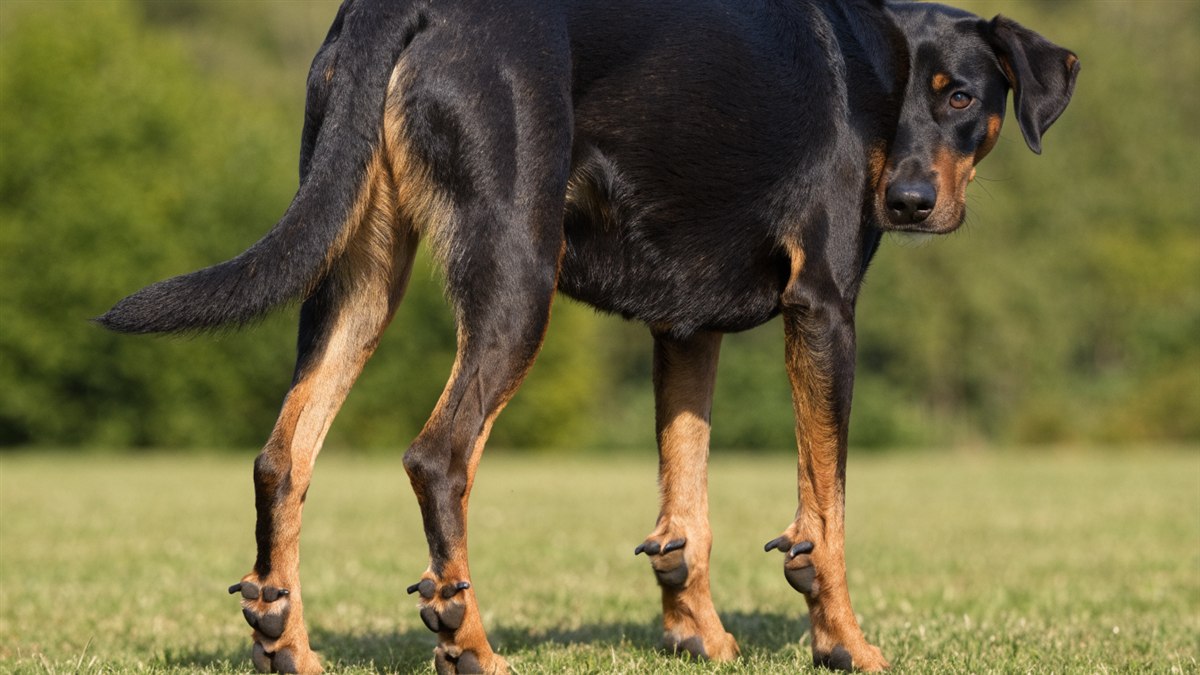
The standard says the same thing twice, in two different registers. In the Hindquarters section it reads Dewclaws: By tradition, shepherds are much attached to the conservation of double dewclaws. The dewclaws form well separated 'thumbs' with nails, placed rather close to the foot. That sentence describes a custom. Six paragraphs later, in the list headed DISQUALIFYING FAULTS, the same feature reappears as Simple dewclaws or absence of dewclaws on hind legs. A custom you can lose points for is a rule.
French is the official authentic language of this standard, so the French text governs where the two differ. The French runs Ergots : Par tradition, les bergers ont tenu a conserver le double ergot. Les ergots forment des pouces bien separes avec ongles, assez pres du pied, and the disqualifying fault is Ergot simple ou absence totale d'ergots aux membres posterieurs. Two conditions disqualify, not one. A single dewclaw disqualifies. Total absence disqualifies. There is no partial credit.
Three registries, one answer
| Registry | Descriptive clause | Consequence of not having them |
|---|---|---|
| FCI Standard No. 44, 2023 | By tradition, shepherds are much attached to the conservation of double dewclaws | Disqualifying fault: simple dewclaws or absence of dewclaws on hind legs |
| AKC standard, 2006 | Double dewclaws form well separated thumbs with nails, placed rather close to the foot | Disqualification: anything less than double dewclaws on each rear leg |
| Royal Kennel Club, 2025 | Double dewclaws set close to foot | Lack of double dewclaws unacceptable, and an unacceptable feature must not be rewarded in the show ring |
The American wording is the strictest of the three and the most useful to quote, because it closes the gap the others leave open. Anything less than double dewclaws on each rear leg is a disqualification. That covers a dog with doubles on one leg and a single on the other, which the FCI phrasing arguably does not reach as cleanly. The Royal Kennel Club words it as Lack of double dewclaws unacceptable, and states on the same page that a dog possessing a feature described as unacceptable must not be rewarded in the show ring.
What a double dewclaw is, and what it is not
A dewclaw is the first digit, the equivalent of a thumb, sitting higher up the leg than the four weight-bearing toes. Most dogs have them on the front legs and many have nothing on the hind legs. The Beauceron standard requires two on each hind leg, and specifies that they form well separated 'thumbs' with nails rather than sitting as a fused lump. Wikipedia adds that the doubles are connected by bone unlike most breeds, which is a claim about anatomy rather than about the standard, and the standard itself says nothing about bone.
Whether they do anything is genuinely unsettled, and the honest answer is that nobody has demonstrated a function. One ranking page asserts flatly that although they serve no function, they were perhaps at one time associated with the best herders, and are now a breed trademark, and that page's entire reference section consists of two YouTube videos. Another ranking page says the opposite, that the purpose of twin dewclaws, according to some, is to help the dog with stability, making actions like herding more efficient. Neither cites a study. Bonbeno found no peer-reviewed work on hind dewclaw function in this breed, and reports that as an open question rather than picking the more convenient answer.
The dewclaws are not decoration and they are not optional. They are the one feature that identifies the breed at a glance, and the French parent club says so directly: the Beauceron is a country gentleman right to the tip of the nail of its double dewclaw. If a seller shows you a Beauceron with clean hind legs, you are either looking at a disqualified specimen or at a different dog.
The dewclaw rule and Indian law point the same way
Indian law protects the exact feature FCI-Standard No. 44 requires, so an Indian Beauceron owner faces no conflict here. This is the reverse of the usual situation, where a breed standard permits something India forbids, and it is worth stating precisely rather than dramatically.
The Indian instrument is the Prevention of Cruelty to Animals (Dog Breeding and Marketing) Rules, 2017, notified as G.S.R. 496(E) on 23 May 2017. The relevant clause sits in the Second Schedule, which is headed [See rules 5(2) and 6], in Part II, General requirements to be adhered to by breeders, inside paragraph 6, Common breeding techniques, at sub-paragraph (8). Bonbeno extracted the gazette text and searched it rather than reading a summary of it. The clause reads, in full:
There shall be no tail docking, ear cropping de-barking, de-clawing, branding, dyeing, injecting substances to enhance visual appeal, performing a surgery or procedure to camouflage or hide any defect or infirmity or any other kind of mutilation of any body part of the pup and any change of appearance by artificial means is strictly forbidden.
De-clawing is named in that list. In dogs, the procedure that phrase reaches is removal of the dewclaws, which many breeders elsewhere perform on newborn puppies as a matter of routine. Even setting the word aside, the same sentence forbids any other kind of mutilation of any body part of the pup and any change of appearance by artificial means. Removing a digit the breed standard requires is a change of appearance by artificial means on any reading. The clause therefore reaches the procedure twice over.
Who the clause binds, and who it does not
State the scope accurately, because overstating it helps nobody. Paragraph 6(8) sits in the part of the Second Schedule addressed to breeders, and it speaks of the pup. Rule 6 of the Rules proper provides that every breeder shall comply with the standards and requirements set out in the Second Schedule. So the clause is a condition on breeders operating under these Rules. It is not, on its face, a general prohibition addressed to every dog owner in India, and this page does not claim that it is.
The practical effect for a buyer is still clear. A breeder in India cannot lawfully hand you a Beauceron pup whose hind dewclaws were removed for appearance, because that removal is precisely what paragraph 6(8) forbids. And you would not want one, because the same removal is a disqualifying fault under FCI-Standard No. 44, under the AKC standard and under the Royal Kennel Club's standard. Law and standard agree. That agreement is unusual enough to be worth noticing.
Removal for a genuine veterinary reason is a different thing
Do not read paragraph 6(8) as forbidding treatment. The clause targets cosmetic and concealing procedures, naming docking, cropping, de-barking, dyeing, branding, injecting substances to enhance visual appeal and surgery to camouflage or hide any defect or infirmity. A registered veterinarian amputating a dewclaw that has been torn off, has become infected, or carries a tumour is treating a medical problem, not enhancing appearance and not hiding a defect. Nothing on this page should be used to argue against necessary surgery, and the decision belongs to the vet who has the dog in front of them.
Two consequences follow, and an owner should know both. First, a dog treated that way has still lost a feature the standard requires, so it can no longer be shown under FCI rules whatever the reason for the loss. Second, keep the paperwork. A veterinary record explaining why a dewclaw was removed is the only thing that distinguishes treatment from the procedure the Rules forbid, and it is worth asking for at the time rather than reconstructing later.
Nothing here asks anything of you except that you do not have the dewclaws removed for looks and that you keep the nails on them trimmed. Because a hind dewclaw does not touch the ground, its nail never wears down, so it keeps growing and can curl into the pad. Cutting those two nails on each hind leg is a routine task the ranking pages mention only in passing and Indian owners routinely forget.
Docking, cropping and what happens in a show ring
Tail docking is not practised on this breed anywhere, ear cropping still is in the United States, and India forbids both. For a Beauceron the Indian prohibition costs the owner nothing, because the FCI standard already wants a whole tail and natural ears.
Take the tail first. FCI-Standard No. 44 describes it as Whole, carried low, it reaches at least to the hock, without deviating, forming a slight hook in the form of a 'J', and lists Shortened tail or tail carried over the back among the disqualifying faults. The AKC standard uses almost identical words and disqualifies a Docked tail, or tail carried over the back. The Royal Kennel Club describes a tail carried low and hanging straight, reaching at least to hock and with a loose hook at end. Docking a Beauceron would disqualify it in every ring on earth, so nobody does it, and India's prohibition on tail docking in paragraph 6(8) simply agrees with the breed standard.
Ears are the one real seam, and it runs through America
Ear cropping is a live practice in this breed, and only one of the three registries still permits it. The AKC standard reads The ears are set high, and may be cropped or natural, and goes on to describe how a correctly cropped ear should be carried. The FCI's 2023 standard offers no cropped option at all, describing ears that are half-pricked or drop-ears, flat and rather short, half the length of the head. The Royal Kennel Club gives only Dropped, flat, not set close to head. Cropping survives in this breed as a historical habit rather than a requirement, and the FCI's own history section records it in the past tense, noting that these nineteenth-century plains sheepdogs had ears that were normally cropped.
In India, paragraph 6(8) forbids ear cropping in the same sentence as tail docking. So an Indian breeder cannot crop, and an Indian buyer should never be shown a cropped Beauceron puppy as the breed's normal appearance. Wikipedia notes that ear cropping is no longer allowed in most countries, which matches what the three standards now say. The practical instruction is short. Natural ears are correct, natural ears are legal, and a cropped puppy offered in India is a question you should ask hard about before anything else.
The asymmetry nobody mentions
FCI show rules make an explicit allowance for docked and cropped dogs and make no allowance at all for missing dewclaws. The Regulations for FCI Dog Shows, valid from 1 January 2026, state that Dogs with docked tails or cropped ears are to be admitted in accordance with the legal regulations of their home countries and those of the country where the show takes place, and that judging docked and undocked or cropped and uncropped dogs must be done without any discrimination and solely in accordance with the valid breed standard. That is a deliberate accommodation for countries whose law differs from an old convention.
Bonbeno searched all 23 pages of those regulations for the word dewclaw and found zero occurrences. There is no parallel clause. So the disqualification for hind dewclaws has no local-law escape hatch, and it does not need one, because no country requires their removal. The regulations define the outcome directly: DISQUALIFIED must be awarded to a dog which does not correspond to the type required by the breed standard, and the rating should furthermore be awarded to dogs that show disqualifying faults in regard to the breed standard, with the reason stated in the judge's report.
| Procedure | FCI Standard 44 | Indian law, para 6(8) | Result for an Indian owner |
|---|---|---|---|
| Tail docking | Disqualifying fault | Strictly forbidden | No conflict. Keep the tail whole. |
| Ear cropping | No cropped option offered | Strictly forbidden | No conflict. Natural ears are correct. |
| Hind dewclaw removal | Disqualifying fault if absent or single | De-clawing strictly forbidden | No conflict. Law protects what the standard requires. |
None of this is likely to arise for an Indian owner in practice, because there is almost nothing to enter. The Kennel Club of India's site was retrieved on 20 August 2026 as a placeholder carrying the line Temporary Arrangement as the new website is being deployed, with a list of downloadable registration forms and no searchable breed register or recognised-breed list published on it. Bonbeno therefore makes no claim about whether the KCI recognises this breed, in either direction.
Beauceron price in India, checked page by page
No verified Beauceron price in India exists. Bonbeno opened every page ranking in India for this query on 21 August 2026 and not one of them gives a rupee figure for a Beauceron. That is the finding, and it is more useful than a number would have been.
Start with the page whose title promises exactly what you searched for. AnimalJankari publishes a page whose H1 reads Beauceron Dog Cost In India. Searched in full, it contains no rupee figure of any kind. Its only price statement is that Beauceron puppies can cost anywhere from $1,200 to $1,500 on average, but a high-quality pup can cost up to $2,500. It sits in a family of auto-generated sibling URLs with titles like Beauceron Dog Male Baby Price In Haryana and Beauceron Dog Clothes Online Price In India, which is the signature of a template stamped out for every breed rather than a page anyone researched.
What the top two results actually offer you
The retailer holding the first two positions on the India SERP lists zero Beaucerons. Puppiezo's Beauceron product page carries an Available Beauceron Puppies For Sale block that is empty. Every priced animal on it sits under a separate heading reading Other Available Pets, and every one is a different breed. Its category page for the breed returns no product listings at all.
| Name | Breed actually offered | Price | Age listed |
|---|---|---|---|
| Doir | Goldendoodle | Rs 1,20,000 | 8 weeks |
| Fizey | Maltipoo | Rs 98,999 | 8 weeks |
| Samy | Maltipoo | Rs 98,999 | 8 weeks |
| Yoki | Doxiepoo | Rs 98,999 | 8 weeks |
| Kazuka | Cane Corso | Rs 94,999 | 8 weeks |
| Kuzo | Poodle | Rs 92,599 | 8 weeks |
| Dugu | Poodle | Rs 92,599 | 8 weeks |
| Tugi | Rottweiler | Rs 76,499 | 8 weeks |
An earlier read of the same page found seven priced animals; the 21 August read found eight, with a Doxiepoo added. The breed on the label has still never appeared. Meanwhile the page's own meta description advertises Beauceron puppies that are KCI registered, vaccinated, and delivered pan-India, a claim about animals the page does not list.
The two Indian price lists that rank for this query do not contain the breed
Two of the top ten Indian results are general dog-price-list articles, and neither mentions the Beauceron once. WrapInFur's Dog Price List in India 2026 covers more than fifty breeds. Bonbeno retrieved 567,128 bytes yielding 36,178 characters of text and searched the whole of it: zero occurrences of Beauceron, against eleven occurrences of Labrador and five of Rottweiler. Supertails' Dog Price List in India 2026: Top 40 Breeds delivered 43,321 characters of text, again with zero occurrences of the breed name and ten of Labrador. Both pages loaded and both control breeds were present, so the absence is real rather than a failed fetch.
Two further results in the top ten are not dogs at all. Positions eight and ten are Amazon.in listings for B-Paiva Chicken Flavour Dry Dog Food, whose product line happens to be named Beauceron. A fifth Indian result, Call4Dog, gives a specification card and a Request a call back form where a price would go.
PetzLover's Beauceron Puppies for Sale in India page holds position three and returned HTTP 403 with a page headed PetzLover - Verify You Are Human, asking for a CAPTCHA. No listing data was delivered. This page therefore draws no conclusion from it in either direction, because a search that was never run is not evidence that there is nothing there.
Running the dollar test on every rupee figure
Divide every rupee figure on this query by 84.38 and none of them resolves to a round dollar amount, so the Indian prices that do exist are genuine rupee prices rather than converted American ones. That is a negative result and it is worth publishing, because Bonbeno has caught the opposite three times on other breeds.
Indian breed pages routinely publish a price in india that is a United States figure run through one exchange rate. The tell is that the rupee number divides cleanly by roughly 84.38 into something round, like 600 or 1,500. Bonbeno has caught this on three separate breeds. So the test gets run on every rupee figure here before any of it is repeated.
| Rupee figure | Source | Divided by 84.38 | Round dollar amount? |
|---|---|---|---|
| Rs 1,20,000 | Puppiezo, Goldendoodle | 1,422.14 | No |
| Rs 98,999 | Puppiezo, Maltipoo and Doxiepoo | 1,173.25 | No |
| Rs 94,999 | Puppiezo, Cane Corso | 1,125.85 | No |
| Rs 92,599 | Puppiezo, Poodle | 1,097.40 | No |
| Rs 76,499 | Puppiezo, Rottweiler | 906.60 | No |
| Rs 20,000-60,000 | WrapInFur, Rottweiler band | 237.02-711.07 | No |
| Rs 15,000-45,000 | WrapInFur, Doberman band | 177.77-533.30 | No |
Every one of those comes back as an untidy decimal, so the test finds nothing. The Indian rupee prices published against this query are real rupee prices for real animals. They are simply prices for other breeds WrapInFur, 'Dog Price List in India 2026 -….
What the foreign figures would convert to
The dollar figures are worth converting in the other direction, so a reader can see the scale of what the overseas pages describe. Apply the same 84.38 and the picture is stark.
- $300, the Adopt a Pet figure for adopting rather than buying, converts to about Rs 25,314.
- $1,000, the bottom of the Lancaster Puppies band, converts to about Rs 84,380.
- $1,200, the bottom of both the Adopt a Pet and AnimalJankari bands, converts to about Rs 1,01,256 AnimalJankari, page whose H1 and title both….
- $2,000, the bottom of the DogBreedsList band, converts to about Rs 1,68,760.
- $2,500, the top of the DogBreedsList, Lancaster and AnimalJankari bands, converts to about Rs 2,10,950 Lancaster Puppies AnimalJankari, page whose H1 and title both….
Those conversions are arithmetic, not an Indian price. Nobody in India is selling a Beauceron at Rs 2,10,950 or at any other figure, and a page that presented the conversion as a market rate would be inventing one. The point of running the sum is the opposite. It shows a reader what a converted number looks like, so that when a listing appears quoting Rs 1,68,760 or Rs 1,01,256 for this breed, the reader can divide it themselves and see where it came from.
The published foreign bands, and how far apart they are
| Source | Country | Published band | Notes |
|---|---|---|---|
| DogBreedsList | United States | $2,000-$2,500 | Its entire references section is two YouTube videos |
| Lancaster Puppies | United States | $1,000-$2,500 | A puppy marketplace, price varies by breeder and lineage |
| Adopt a Pet | United States | $1,200-$2,000 to buy | Gives about $300 to adopt instead |
| AnimalJankari | India, in dollars | $1,200-$1,500, up to $2,500 | Published under the headline Beauceron Dog Cost In India |
The spread across those four runs from $1,000 to $2,500, which is a factor of two and a half on the same breed in the same country. Bonbeno publishes the disagreement rather than averaging it, because an average of four unsourced numbers is a fifth unsourced number Lancaster Puppies Adopt a Pet, 'How much does a Beauceron… AnimalJankari, page whose H1 and title both….
Why no lawful Indian supply chain can form
India makes dogs a Restricted import and rejects outright any application to import one for breeding or trade, so nobody can lawfully build a Beauceron breeding population in India from imported stock. That single fact explains the empty listing pages better than any market analysis.
The governing document is DGFT Trade Notice No. 22/2022-23, dated 19 December 2022 and signed by Md. Moin Afaque, Deputy Director General of Foreign Trade. Bonbeno downloaded the five-page PDF and extracted the text rather than reading a summary. It classifies ITC (HS) 01061900, mammals other, as Restricted, subject to Policy Condition 6 of the chapter.
Policy Condition (7) then narrows it to three purposes and no others. Import of dogs is allowed only for a Pet dog with valid pet book and relevant records/documents in the name of importer, for Dogs imported by the R&D Organisations for conducting research with the recommendation of CPCSEA, and For the internal security by the Defence and Police Force. Policy Condition (8) closes the remaining gap: Import of commercial dogs for breeding or any other commercial activities other than the purposes mentioned above is not permitted.
It may be noted that any applications for trading/breeding purposes, or applications made on behalf of some another person/entity shall be duly rejected.
Read those three provisions together and the conclusion is structural rather than rhetorical. A person may bring their own dog. A research body may import with CPCSEA backing. Defence and Police may import for internal security. A breeder may not import breeding stock, and an agent may not import on somebody else's behalf. Without lawful founder animals there is no lawful breeding population, and without a breeding population there is nothing for a retail page to list.
What a genuine personal import involves
The route that does exist is narrow and slow, and it is worth setting out so a reader can judge whether it applies to them. Import as passenger baggage without DGFT authorisation is open only to persons transferring their residence to India after two years of continuous stay abroad, for up to two pets, and only cats and dogs qualify under the baggage rules. Everything else needs an import authorisation from DGFT, examined by the Department of Animal Husbandry and Dairying against the applicant's justification and supporting documents.
- Start early. The Trade Notice advises pet owners to begin the import authorisation process at least 2 months in advance of travel.
- Apply on ANF-2M, against your own Importer Exporter Code, or against the permanent IEC number IIHIE0153E reserved for persons importing for personal use not connected with trade.
- Carry the documents named, being the Vaccination Book or Pet Passport or Pet Book, a Certificate for Emotional Support, and the Passport of the Pet.
- Obtain an Advance NOC from the Regional or Quarantine Officer of the Animal Quarantine and Certification Service, seven days before travel, relaxable up to three days.
- Arrive at one of seven ports. Entry is allowed only through the airports and seaports of Delhi, Mumbai, Chennai, Hyderabad, Bengaluru and Kolkata and, since October 2024, Kochi airport, where the animal may also be quarantined Department of Animal Husbandry…. The full route is set out in how to import a dog to India.
The second half of the problem is the register
There is no visible domestic registry route either. The Kennel Club of India's website was retrieved again on 21 August 2026 and delivered 73,150 bytes yielding 1,293 characters of visible text, consisting of the line Temporary Arrangement as the new website is being deployed, a list of downloadable registration forms, and a Chennai postal address at New No. 28, AA Block, First Street, Anna Nagar. The word breed appears zero times on it. That is a control result as much as a finding: because the site publishes no breed list at all, the absence of the word Beauceron proves nothing about recognition, and this page makes no claim either way.
So a seller advertising a KCI registered Beauceron in India, as the top-ranking retail page does in its own meta description, is making a claim that cannot be checked against any published register. Ask for the registration number and the pedigree document, and verify them with the club directly by post or phone rather than accepting the word on a product page.
What a dog this size costs to keep in India
Food dominates the running cost of any 45 kg dog in India, and pack size changes that cost by about 54 percent for identical food. Because no Indian Beauceron market exists, this section prices the dog rather than the purchase, using live Indian retail figures a reader can check today.
Take one widely stocked large-breed dry food and read its Indian shelf price by pack size. Royal Canin Maxi Adult on Supertails, re-read on 21 August 2026, prices out as follows.
| Pack | Listed price | Rupees per kg | Premium over the 20 kg pack |
|---|---|---|---|
| 20 kg (2 x 10 kg) | Rs 13,816 | Rs 690.80 | baseline |
| 10 kg | Rs 6,903 | Rs 690.30 | none, marginally cheaper |
| 12 kg (3 x 4 kg) | Rs 9,531 | Rs 794.25 | 15.0 percent |
| 4 kg | Rs 3,176 | Rs 794.00 | 14.9 percent |
| 1 kg | Rs 965 | Rs 965.00 | 39.7 percent |
| 220 g | Rs 234 | Rs 1,063.64 | 54.0 percent |
The 220 g pack costs 54.0 percent more per kilogram than the 20 kg pack for the identical product. On a dog eating half a kilogram a day that difference alone is worth thousands of rupees a month, and it is the single easiest saving available to an Indian owner of a large dog. Buy the largest pack your storage and the monsoon will allow, and keep it sealed and off the floor.
Do the food arithmetic on your own vet's ration
Bonbeno found no breed-specific published daily ration for a Beauceron that it could verify, so this page gives the multiplication rather than inventing a requirement. Ask your vet what your dog should eat, then apply Rs 690.80 per kilogram from the 20 kg pack.
- 400 g a day costs Rs 276.32 daily, about Rs 8,290 a month.
- 500 g a day costs Rs 345.40 daily, about Rs 10,362 a month.
- 600 g a day costs Rs 414.48 daily, about Rs 12,434 a month.
- 500 g a day bought in 1 kg packs costs Rs 482.50 daily, about Rs 14,475 a month, which is Rs 4,113 a month more for the same food.
Set those against what Indian price-list pages publish as total monthly maintenance for comparable large breeds. WrapInFur gives a Rottweiler Rs 4,500 to Rs 8,500 a month, a Doberman Rs 4,000 to Rs 7,500, a Labrador Rs 4,000 to Rs 8,000, and a Siberian Husky Rs 6,000 to Rs 12,000. Premium dry food alone at 500 g a day already exceeds the top of the published Rottweiler and Doberman bands before a single vet visit, tick preventive or grooming session. Treat those published monthly figures as describing a smaller or more cheaply fed dog than the one this page is about.
The costs the price lists leave out
- Tick and flea prevention, year-round. India's tick-borne disease pressure does not have an off season in most of the country, and the health sections below give the prevalence figures.
- Vaccination and boosters, which the 2017 Rules note can start at seven to eight weeks and are usually completed at eighteen weeks.
- Emergency surgical capacity. A gastric dilatation volvulus is an out-of-hours abdominal surgery, and survival depends on getting to a theatre, not on a payment plan.
- Hip and elbow radiographs, which the Swiss club requires from a minimum age of 15 months.
- Air conditioning or at least reliable fans and shade, which for this coat in this climate is a running cost rather than a luxury.
Bonbeno reports published price ranges as editorial content and does not broker sales. For this breed there is no Indian range to report, so the honest thing to price is the part of ownership that is real and checkable. Every figure above came off an Indian retail page on a named date and will move.
Heat tolerance, argued from the standard rather than asserted
A Beauceron carries two physical disadvantages in Indian heat and one real advantage, and the three are worth separating because the ranking pages collapse them into an adjective. The coat and the body mass work against the dog. The skull works for it.
Disadvantage one, the undercoat is not optional
FCI-Standard No. 44 makes the undercoat compulsory, not incidental. The outer hair is short, thick, firm and lying close to the body at 3 to 4 cm, and beneath it sits an undercoat that is short, fine, dense and downy, preferably mouse grey, very close, and cannot be seen through the top coat. The AKC describes the same construction in inches, 1.25 to 1.5 inches of coarse dense outer coat over a mouse-gray undercoat that does not show through. A layer dense enough to be invisible through the guard hairs is a layer dense enough to trap a boundary of still air against the skin, which is exactly what insulation is. That is a double coat doing its intended job, and its intended job was a French plain, not a Chennai May.
This also settles a related question buyers ask. The breed is not hypoallergenic and no dog is. Vredegoor and colleagues measured Can f 1 across 196 dogs of breeds marketed as hypoallergenic against 160 control dogs and found the marketed group higher, at 2.26 against 0.77 micrograms per gram in hair and 27.04 against 12.98 in coat, with no difference in airborne allergen. Their conclusion is that there is no evidence for classifying certain dog breeds as hypoallergenic. The Indian retail page selling this breed prints Shedding: Yes on its own specification card, and Purina India rates the breed non hypoallergenic outright.
Disadvantage two, the geometry of a 50 kg animal
Heat leaves a dog through its surface and is generated throughout its volume, and those two quantities do not scale together. Double an animal's linear dimensions and its volume rises eightfold while its skin area rises only fourfold, so the larger animal has roughly half the skin per kilogram of heat-producing tissue. A Beauceron sits at the heavy end of the working-dog range, 70 to 110 pounds on the AKC's own breed page, which is about 32 to 50 kg, and the French parent club describes carrying a dog of some fifty kilos. A large, muscular, deep-chested dog therefore loads heat faster and sheds it slower than the smaller dogs most Indian flats are used to.
The advantage, and it is a real one
The Beauceron's cooling apparatus is intact, which separates it decisively from the flat-faced breeds. A dog cools mainly by panting, evaporating water off the tongue and the lining of a long nasal passage, so muzzle length is the variable that matters. The standard specifies that the skull and muzzle are of equal length, that the whole head is 2/5 the height at the withers, and that the muzzle is neither narrow or pointed. The AKC puts the head at about 40 percent of the height at the withers with skull and muzzle of equal length. That is a textbook mesocephalic skull with a full-length nasal chamber. This dog can pant properly. A Pug cannot.
Heatstroke in dogs is not a discomfort, it is a mortality event. Segev and colleagues studied 126 client-owned dogs diagnosed with heatstroke at a veterinary teaching hospital and recorded an overall mortality rate of 53 percent. More than half the dogs that reached a referral hospital with heatstroke did not leave it. Treat heavy open-mouth panting that will not settle, staggering, or collapse as an emergency and cool the dog on the way to the vet rather than after arriving.
Put the three together and the verdict is specific rather than alarmist. The Beauceron is heat-sensitive because of its coat and its mass, not because of its face. That matters, because a coat and a body mass can be managed with timing, water, shade and airflow, whereas a shortened airway cannot be managed at all. The breed is workable in much of India by an owner who reorganises the day around the temperature. It is not workable by an owner who plans to walk it at four in the afternoon.
The Beauce plain against nine Indian cities
In six of nine Indian cities checked, the coolest month of the year is warmer than the hottest month in the region this breed was selected on. That is the cleanest way to state the problem, and it comes from one dataset queried on one methodology so the numbers are comparable to each other.
Bonbeno queried NASA's POWER climatology API for the 2001 to 2020 period at ten coordinates, taking mean temperature at 2 metres and relative humidity at 2 metres. Chartres, in the Beauce plain that gives the breed its name, returns an annual mean of 10.63 C, a July mean of 18.78 C and a January mean of 3.11 C. Every Indian figure below is compared against that 18.78 C July, because a dog's hardest month at home is the fairest benchmark for its easiest month abroad.
| Location | Annual mean | Warmer than Beauce annually by | Coolest month | Against Beauce's July |
|---|---|---|---|---|
| Chartres, Beauce plain | 10.63 C | baseline | Jan, 3.11 C | baseline 18.78 C in July |
| Chennai | 27.95 C | 17.32 C | Jan, 24.09 C | 5.31 C warmer |
| Ahmedabad | 27.57 C | 16.94 C | Jan, 19.93 C | 1.15 C warmer |
| Mumbai | 26.77 C | 16.14 C | Jan, 23.19 C | 4.41 C warmer |
| Hyderabad | 26.10 C | 15.47 C | Dec, 20.76 C | 1.98 C warmer |
| Kolkata | 25.81 C | 15.18 C | Jan, 17.31 C | 1.47 C cooler |
| Delhi | 25.60 C | 14.97 C | Jan, 13.61 C | 5.17 C cooler |
| Pune | 23.86 C | 13.23 C | Dec, 19.62 C | 0.84 C warmer |
| Bengaluru | 23.74 C | 13.11 C | Dec, 20.22 C | 1.44 C warmer |
| Shimla | 21.15 C | 10.52 C | Jan, 10.78 C | 8.00 C cooler |
Read the last column and the country splits in two. In Chennai, Mumbai, Hyderabad, Bengaluru, Ahmedabad and Pune, the coldest month of the year is still warmer than the hottest month in the Beauce. There is no recovery season. In Kolkata, Delhi and Shimla there is a genuine winter window, and Delhi's is the widest of the three, its January mean of 13.61 C sitting 5.17 C below the Beauce July.
Humidity flips the answer for the coastal cities
The temperature table alone would make Mumbai look easier than Delhi, and for this coat it is not. The Beauce is a humid place, at an annual mean relative humidity of 82.47 percent, higher than any Indian city checked here. Humidity only becomes a problem when it is paired with warmth, because it is warmth plus moisture that stops evaporation off a panting tongue from carrying heat away. So the month to fear is the warm humid one, not the hot dry one.
- Mumbai's worst month for this breed is July, not April. July runs a mean of 26.6 C at 90 percent humidity, against April's 30.7 C at 52 percent. The cooler month is the more dangerous one.
- Pune peaks the same way, at 23.3 C and 91 percent humidity in August, its most humid month of the year.
- Kolkata gets both barrels, a May mean of 31.5 C at 67 percent humidity, then August at 28.2 C and 89 percent.
- Chennai never really lets go, holding 80 to 82 percent humidity through October and November while still sitting above 25 C.
- Delhi and Ahmedabad are dry when they are hottest, Delhi at 35.9 C and 36 percent in June, Ahmedabad at 35.1 C and 36 percent in May, so panting still works even though the numbers look worse.
Delhi, Kolkata and the hill stations give this breed a real off-season and a dry summer where evaporative cooling still functions. Mumbai, Chennai, Pune, Bengaluru, Hyderabad and Ahmedabad do not give it an off-season at all, and Mumbai and Pune add a monsoon window where the air is too wet for panting to clear heat efficiently. None of that makes the breed impossible anywhere in India. It does mean the walk happens before sunrise and after dark for most of the year, in most of the country.
Temperament, and who should not buy one
A Beauceron is a confident, strong-willed guarding dog that makes its own decisions, and every registry and club that describes it says the same thing in different words. Nobody who publishes on this breed recommends it to a first-time owner, and that unanimity is itself the most useful data point on the page.
The standards set the baseline. FCI-Standard No. 44 calls for a frank approach and self-assured dog whose expression is candid, never mean timid or worried, and whose character should be gentle and fearless. Both aggressive and overly shy are disqualifying faults, so the standard rejects the two failure modes symmetrically. The Royal Kennel Club compresses it to three words, bold, fearless, intelligent, and describes the breed's characteristic as a versatile, working/sheep herding dog.
The AKC standard is the most expansive and the most honest about the difficulty. It describes a dog that is discerning and confident, with spirit and initiative, wise and fearless with no trace of timidity, that retains a high degree of his inherited instinct to guard home and master, and adds the sentence that matters most, Some will display a certain independence. The AKC's breed page puts the same trait in a memorable form, asking you to imagine a Border Collie's brain in a 100-pound body.
What the French parent club says, which is blunter
The Club des Amis du Beauceron describes a one-master dog and warns that any unjustified constraint will be unacceptable to it, while adding that an owner who is fair with it will always get the maximum in return. The club also states directly that community sociability must be settled during the first months, because a Beauceron can become either an insupportable ruffian or an irreplaceable companion, and there is not much middle ground. It notes the dark, frank, severe, even hard gaze that has earned the breed a reputation for aggression in some regions, then observes that this large black dog goes soft with children and does not know how to show its affection except by climbing on them, which is a powerful fifty kilos landing in a lap.
The club supplies one figure worth more than any adjective. A Beauceron bitch rehomed at eleven months took more than six months to re-adapt, and a year later still greeted her original owner differently from her new family. Indian large-dog ownership involves a lot of relocation, for jobs, for a smaller flat, for a landlord who changes the rules. This is not a breed that absorbs that easily.
Purina India's own assessment, on the .in domain
- Dog suitable for experienced owners, and explicitly not suited to first time dog owners.
- Strong willed and capable of independent decision making, which is the trait that makes it a working dog and a difficult pet.
- Naturally a little suspicious of strangers because of its livestock guardian history, so it needs early and thorough socialisation.
- Chatty and vocal, and a guard dog that barks and alerts, which is a flat-specific problem in Indian housing societies.
- May require training to live with other pets and may require training to live with kids, phrased as conditions rather than reassurances.
- Dislikes being left alone too long and benefits greatly from having a job to do.
You have never owned a dog before. You want a protective dog primarily for the gate and expect it to sort out strangers on its own. Your household has heavy daily traffic of domestic staff, delivery agents and visitors that you cannot manage introductions for. Nobody is home for most of the day. You live in a housing society with a barking complaint history. You cannot commit to two hours of exercise every day for ten to twelve years. Any one of those is a reason to choose differently, and choosing differently is a better outcome than a rehomed guarding dog.
Training a dog that argues back
Train a Beauceron by being consistently fair rather than consistently firm, because the French parent club states that any unjustified constraint will be unacceptable to it. This is a trainable breed that resists compulsion specifically, which makes the choice of Indian trainer the single highest-stakes decision an owner makes.
The raw material is excellent. The AKC standard describes a dog that is intelligent, easily trained, faithful, gentle and obedient, possessing an excellent memory and an ardent desire to please his master. Purina India calls it bold, courageous and quick to learn, a people dog and a working dog that will excel with those who enjoy training and canine sports. The FCI classifies the breed with working trial, and the nomenclature entry confirms it is subject to a working trial according to the FCI Breeds Nomenclature Federation Cynologique Internationale. This is a breed the international registry expects to work, not merely to stand still and be looked at.
The complication sits in the same standards. The AKC adds that some will display a certain independence, and Purina India describes a dog that is strong willed and capable of independent decision making. Put beside the club's warning about unjustified constraint, the picture is a dog that will do difficult things willingly and refuse trivial ones on principle.
The method the parent club actually prescribes
The Club des Amis du Beauceron gives the rule in one line. If the master is fair with the dog, it will always do its maximum to satisfy him, and a caress will be the finest of rewards. That is a reward-based, relationship-first prescription written by the breed's own French club, and it sits badly against the compulsion-heavy methods still sold in India under the label of guard-dog training. An Indian owner who hands this breed to a trainer promising results through corrections is running directly at the one thing the club says the dog will not accept.
The window that closes
The club is specific about timing rather than vague about it. Community sociability must be settled during the first months, because the Beauceron can become either an unbearable ruffian or an irreplaceable companion. Purina India makes the same point from the other side, noting the breed is naturally suspicious of strangers thanks to its livestock guardian history and needs early and thorough socialisation and habituation. Miss that window with a fifty-kilo guarding dog and you do not get a second one.
What Indian socialisation has to cover
- Household traffic. Domestic staff, cooks, drivers and cleaners arriving daily are not strangers to you and are strangers to the dog. Introduce each one deliberately, repeatedly, and while the dog is under control.
- Delivery and gate contact. Couriers, gas cylinder deliveries and society watchmen arrive unpredictably at the boundary the dog thinks it owns. Practise the doorbell as a cue to go to a mat rather than to the door.
- Street dogs. Free-roaming dogs are a daily reality in most Indian neighbourhoods and a herding-guarding breed will not ignore them. Build a reliable recall and a reliable heel before you need either.
- Noise. Horns, construction, and festival firecrackers are the Indian equivalent of the gunfire habituation European working lines get, and they arrive without warning.
- Livestock and traffic together. Cattle on a road with two-wheelers around them will switch on the herding instinct in exactly the worst place for it.
Schedule the work around the heat rather than around your convenience. In the six cities where the coolest month is still warmer than the Beauce's hottest, a midday training session is a heat exposure with obedience attached to it. Short sessions before sunrise and after dark, indoors in air conditioning during May and June, and scent or puzzle work substituted for physical drilling on the worst days will teach more per hour than a long hot session ever does.
Purina India records that the breed dislikes being left alone too long and benefits greatly from having a job to do. In India that job rarely means livestock. It can mean scent games, a daily carrying task, competitive obedience, tracking in a park at dawn, or a structured routine the dog can predict. An unemployed Beauceron will invent work, and its choices will not be yours.
The daily exercise requirement, and where the sources disagree
Published requirements for an adult Beauceron run from one hour a day to three, and the sources that say the most about the breed say the most hours. Bonbeno prints the spread rather than averaging it, because the low figure comes from the page trying to sell you the dog.
| Source | Stated requirement | What the source is |
|---|---|---|
| Puppiezo specification card | 1-2 hours daily | An Indian retail page listing no Beaucerons |
| Purina India | Two hours per day, plus training and mental stimulation | A manufacturer breed library on the .in domain |
| Purina India need-to-know | Enjoys walking more than two hours a day | The same page's summary panel |
| AnimalJankari | Two to three hours of strenuous physical exercise every day | An Indian content page carrying no rupee prices |
Those four figures come from the Puppiezo specification card, from Purina India in two places on one page, and from AnimalJankari. The lowest figure is on the page with a commercial interest in the number being small, and the highest is on a page with none. The AKC standard describes what the breed was built to do and settles the argument by implication: Beaucerons were used to move herds of 200 to 300 head traveling up to 50 miles per day without showing signs of exhaustion. The FCI adds that the dog should have an extended trot with long reaching movement. Plan for two hours and treat one as the floor on a bad day, not the target.
Two hours collides with the temperature, and the temperature wins
The scheduling problem is arithmetic rather than opinion. In Chennai, Mumbai, Hyderabad, Bengaluru, Ahmedabad and Pune the coolest month of the year already runs warmer than the Beauce plain's hottest. There is no season in which a midday two-hour session is safe in those cities, and heatstroke carried a 53 percent mortality rate across 126 hospitalised dogs in the study Bonbeno relies on here. So the two hours get split and moved rather than reduced.
- Move the bulk of it before sunrise. The lowest ambient temperature of an Indian day sits shortly before dawn, and that is when a double-coated 45 kg dog can actually work.
- Take the second block after full dark, once radiant heat has come off tarmac and concrete. Test the surface with the back of your hand before you walk on it.
- Substitute mental work on the worst days. Scent games, food puzzles and obedience indoors under a fan or air conditioning discharge a working dog's need for a job without loading heat.
- Carry water on every outing and offer it before the dog asks. A dog that has stopped panting efficiently is already in trouble.
- Watch the humid months, not just the hot ones. Mumbai in July at 26.6 C and 90 percent humidity is a worse evaporative environment than Mumbai in April at 30.7 C and 52 percent.
Restrict it deliberately while the dog is growing
Growth rate is not a neutral variable for a large breed. The Swiss Beauceron club states that hip dysplasia's heritability generally sits between 20 and 40 percent, meaning 60 to 80 percent of the risk is influenced by environmental factors including diet, exercise and growth rate. That is the club's own framing and it points at the owner rather than the breeder for most of the risk. Forced running, stair repetition, jumping from height and long road work on a growing Beauceron are the levers that sit inside that 60 to 80 percent.
Purina India rates this a large dog needing a large space, and the Indian retail card says ideal space large. Neither is quite the point. A Beauceron in a two-bedroom flat whose owner delivers two hours across dawn and night will do better than one with a garden it is left alone in all day, because the breed dislikes being left alone too long and needs a job rather than a lawn.
Grooming a double coat in Indian humidity
Brush a Beauceron to remove dead undercoat rather than to tidy the outer coat, because the dense downy layer the standard makes obligatory is the layer that traps moisture against the skin in an Indian monsoon. The job is short, and the consequences of skipping it are not.
The coat is easy to describe and easy to underestimate. Three to four centimetres of short, thick, firm outer hair lies close to the body over an undercoat that is short, fine, dense and downy and cannot be seen through the top coat, with obligatory light fringing on the buttocks and the underside of the tail. Wikipedia adds that the woolly undercoat grows thick in cold weather, especially if the dog sleeps outdoors, which is the same layer responding to a stimulus most of India never provides.
Everyone agrees it sheds heavily. Purina India rates the breed as requiring grooming every other day and non hypoallergenic. The Indian retail page selling the breed prints Shedding: Yes on its own card. AnimalJankari describes seasonal shedding as so extreme that weekly brushing becomes daily during peak shedding. So budget a brush every other day as the baseline and daily during a moult.
The monsoon problem the overseas guides do not have
Care advice written for France or Britain assumes a coat that dries. In Mumbai in July the ambient air sits at 90 percent relative humidity, in Pune in August at 91 percent, and in Kolkata in August at 89 percent. A dense undercoat that has been wetted by rain, a bath or a swim in those conditions does not dry by standing around in it. It stays damp against the skin, and warm damp skin under an insulating layer is the standard setup for bacterial skin disease and hot spots.
- Towel down to the skin, not the surface. Push the towel through the guard hairs into the undercoat, especially over the loin, the base of the tail and behind the elbows.
- Finish with moving air. A fan, a blaster or a cool setting on a dryer takes the residual moisture the towel cannot. Air drying is correct advice in a European autumn and poor advice in a Konkan monsoon.
- Bath less, brush more. Removing dead undercoat mechanically does more for a wet-season coat than another bath does, and it does not add water.
- Dry the ears deliberately after any bath or swim, and never let water sit in the canal.
- Check the skin while you brush. You are feeling for damp patches, heat, and the small crusted lesions that precede a hot spot.
Ticks hide in exactly this coat
A dense invisible undercoat is an excellent place for a tick to attach unnoticed, and Indian tick-borne disease pressure is not theoretical. A molecular survey of 719 canine blood samples in Punjab found multiplex PCR prevalences of Babesia gibsoni 8.9 percent, Hepatozoon canis 5.1 percent, Ehrlichia canis 2.6 percent and Babesia vogeli 1.1 percent, against microscopy figures of 5.0, 1.0, 1.4 and 0.1 percent respectively, and found breed, sex and location significantly associated with Babesia gibsoni infection. Microscopy missed most of it. So will your eyes, if you only look at the outer coat.
Run the tick check with your fingers rather than your eyes, every day in season, working systematically through the ears, the neck, the armpits, the groin, between the toes and around both sets of hind dewclaws. Keep the dog on a year-round preventive your vet chooses, because in most of India there is no month in which the pressure genuinely stops.
Nails, and the two everyone forgets
The hind dewclaws do not touch the ground, so their nails never wear and simply keep growing until they curl into the pad. AnimalJankari puts it correctly and bluntly, don't forget to cut the back legs' twin dewclaws. That is four extra nails on a Beauceron rather than two, and they are the ones that cause the abscess nobody saw coming.
The AKC standard states the Beauceron is exhibited in the natural condition with no trimming, and disqualifies a shaggy coat. That is a show rule rather than a welfare finding. Bonbeno looked for a controlled study on clipping double-coated dogs in tropical climates and found none it could cite, so this page gives no verdict on shaving and recommends you take that decision with a vet who has seen the dog's skin. What is not in doubt is that removing dead undercoat by brushing is safe, effective, and the thing most Indian owners of this coat type do too little of.
Inherited risk, and the claim that there is none
Wikipedia states that the Beauceron has no breed-specific health problems, and the peer-reviewed literature contradicts it twice. Two published papers name this breed specifically, one identifying a genetic deafness variant and the other describing a liver disease in it for the first time, so the health issues set out below are documented rather than assumed.
The claim itself is worth quoting exactly, because it is the first thing many buyers read. Wikipedia's health section consists of the single sentence The Beauceron has no breed-specific health problems, attached to one reference which the article's own markup flags as dead. A one-sentence health section resting on a dead link is not evidence of a healthy breed. It is evidence of an unwritten health section.
Congenital deafness, with a named variant and a carrier rate
Abitbol and colleagues identified a non-syndromic deafness in Beauceron dogs in 2023, characterised by bilateral hearing loss in puppies that is not linked to coat colour, with pedigree analysis suggesting autosomal recessive transmission. Combining homozygosity mapping with whole genome sequencing, they identified a CDH23:c.700C>T variant predicted to cause a deleterious change in a protein sitting near the tips of the inner ear's hair-cell stereocilia. Genotyping a cohort of 90 control Beaucerons sampled in France, they found a 3.3 percent carrier frequency, which is three carriers in that cohort of ninety.
That last sentence is the whole point of the paper for a buyer. The authors state the allele is easily detectable with a genetic test to avoid at-risk matings. A breed-specific, autosomal recessive, testable disease is the opposite of no breed-specific health problems, and it matters most in a small population where relatives get mated.
Copper-associated hepatitis, first described in this breed in 2020
Rodrigues and colleagues reviewed 17 dogs with copper-associated hepatitis confirmed by rhodanine staining at a veterinary referral hospital in Paris. Median age at presentation was 8 years, with a range of 4 to 11. Terriers accounted for 4 of the 17 and German Shepherd Dogs for 3 of 17. The authors then record that American Staffordshire Terriers and Beauceron had not previously appeared in case reports on CAH, and that two of each breed were identified in this study, concluding that this is the first description of CAH in Beauceron and American Staffordshire Terrier dogs.
Read that honestly rather than alarmingly. Two dogs in a series of seventeen at one referral hospital is a case description, not a prevalence estimate, and nobody has established how common this is in the breed. What it does establish is that the breed appears in the veterinary literature under its own name, which is precisely what the Wikipedia sentence denies. The clinically useful detail is that increased liver enzymes may be the only clinical finding, reflecting the silent progression of the disease, so an unexplained liver-enzyme rise in a middle-aged Beauceron is worth pursuing rather than repeating in six months.
Hips and elbows, where the clubs put their effort
Both European clubs run formal joint screening, which is itself evidence that the joints matter. The French parent club requires digital radiographs only, read by a single named official reader, Professeur Denise Remy, submitted by the owner's vet through the myvetsxl.com portal, and notes that from cotation 2 upwards, DNA tests must be registered with the SCC. The Swiss club's breeding regulation admits only dogs graded A, B or at most C, requires a C-graded dog to be mated only to an A or B dog, and sets a minimum radiograph age of 15 months.
The American parent club's Health Award of Merit requires a fuller panel, and it is a good checklist to hold a breeder to anywhere. It asks for an OFA CHIC number, an OFA or Penn Hip number, an OFA Elbow number, an OFA Cardiac number, an OFA CERF eye number, and a temperament evaluation through AKC TT, ATTS, BH, the Journee or an equivalent, with all tests verified through the OFA database.
Three independent sources give the same figure of 10 to 12 years, the AKC breed page, the Indian retail card and DogBreedsList. None of them cites a mortality study. Bonbeno found no published lifespan study for this breed and therefore reports 10 to 12 years as the consistent published expectation rather than as a measured finding. Consistency across three sources that may all be copying one another is not the same as evidence.
How much research exists on this breed, and the trap in the number
A PubMed search for Beauceron returns 367 records and the breed has almost no veterinary literature, because Beauceron is also a French surname on particle-physics author lists. The count is real and the coverage it implies is not.
Very little, and the count needs reading carefully. A PubMed search for Beauceron returns 367 records, which looks like a well-studied breed until you read the query translation. PubMed resolves it to `"Beauceron"[All Fields]`, and Beauceron is also a French surname that appears on large particle-physics collaboration author lists, so the top results are papers on the Higgs boson rather than on dogs. Restricting the query to Beauceron AND dog returns 7 records, of which three carry usable breed data. Control queries run in the same session behaved correctly, gastric dilatation volvulus in dogs returning 271 records and canine hip dysplasia returning 780, both with proper MeSH translations, so PubMed was working and the small number is a real finding rather than a broken search.
Seven records restricted to dogs, three of them usable, is the entire published evidence base on this breed's health. Anyone quoting you a confident prevalence figure for a Beauceron condition is either citing one of those three papers or making it up. Ask which.
The three things most likely to kill this dog in India
Heatstroke, bloat and infectious disease are the acute risks for a large deep-chested dog in India, and none of them is breed-specific to the Beauceron. Every figure below carries its study and its denominator, and where no Beauceron figure exists this page says so rather than borrowing one.
Gastric dilatation volvulus, with the denominators
No published gastric dilatation volvulus figure exists for the Beauceron, and this page will not invent one by borrowing from a similar breed. What exists is good data on large breeds generally, and it is worth knowing exactly what it does and does not say.
O'Neill and colleagues ran a VetCompass cross-sectional study across 77,088 dogs attending 50 Vets Now emergency clinics between 1 September 2012 and 28 February 2014. They recorded 492 presumptive gastric dilation-volvulus diagnoses, giving a prevalence of 0.64 percent, with a 95 percent confidence interval of 0.58 to 0.70 percent. That is a prevalence among dogs already attending emergency care, not a lifetime risk for a pet dog, and the distinction matters when reading it.
The breeds with the highest odds against cross-bred dogs were the Great Dane at an odds ratio of 114.3, the Akita at 84.4 and the Dogue de Bordeaux at 82.9. The Beauceron is not among the breeds that study names. Glickman's earlier prospective cohort followed 1,637 dogs aged six months or more across eleven named breeds, being the Akita, Bloodhound, Collie, Great Dane, Irish Setter, Irish Wolfhound, Newfoundland, Rottweiler, Saint Bernard, Standard Poodle and Weimaraner, and recorded a cumulative incidence of 6 percent during the study. The Beauceron is not among those eleven either. So the honest position is that this breed has the body shape associated with the condition and no measured risk of its own.
The management advice from Glickman is transferable regardless, because it concerns behaviour rather than breed. Risk rose with increasing age, with having a first-degree relative with a history of GDV, with faster eating speed, and with a raised feeding bowl, and roughly 20 percent of cases in large breeds and 52 percent in giant breeds were attributed to the raised bowl. The raised bowl finding is worth repeating in India, where elevated feeders are widely sold to owners of large dogs as a health product.
Of the cases presented alive in the VetCompass study, 49.7 percent survived to discharge overall, but 79.3 percent of surgical cases survived. The gap between those two numbers is surgery, and surgery is time-dependent. A distended abdomen with unproductive retching, restlessness and collapse means the nearest clinic with an operating theatre, tonight, not the regular vet tomorrow morning. Know now which clinic near you does out-of-hours abdominal surgery.
Heatstroke, which is the India-specific one
Heatstroke is where the coat, the mass and the Indian climate meet. Segev and colleagues studied 126 client-owned dogs diagnosed with heatstroke at a veterinary teaching hospital and recorded an overall mortality rate of 53 percent. That is a majority of dogs that reached a referral hospital. It is not a study of Beaucerons and it is not an Indian study, and both limitations are stated here rather than glossed, but the mortality figure is the reason this page argues the climate question mechanically rather than with an adjective.
Infectious pressure, from Indian data
Canine parvovirus is a genuine Indian volume problem rather than a footnote. An eight-year analysis of Teaching Veterinary Hospital records at Madras Veterinary College, Chennai, found that among 6,105 suspected cases, 4,258 dogs were diagnosed with canine parvoviral enteritis, a positivity rate of 69.75 percent, with winter and the month of July identified as higher-incidence periods. That is a positivity rate among suspected cases at a referral teaching hospital, so it describes case pressure rather than population prevalence, but it tells an Indian puppy owner where the risk sits.
The 2017 Rules note that vaccination can start at the age of seven-eight weeks, and are usually completed at the age of eighteen weeks. Between those two dates a puppy is partly protected, and July in Chennai is not the month to be casual about where it walks. Tick-borne disease runs alongside it, at the Punjab prevalences given in the grooming section.
Screening, the OFA gap, and what Indian law forgets to test for
Indian law mandates genetic-defect testing for eleven named conditions and does not name deafness, which is the one confirmed, testable, breed-specific genetic disease in the Beauceron. That mismatch is the most useful thing on this page for anyone contemplating breeding the dog in India.
What the Rules actually require a breeder to test for
The Second Schedule of the Dog Breeding and Marketing Rules 2017, Part III, paragraph 8(10), states that the dogs shall have been tested for genetic defects, including hip dysplasia, progressive retinal atrophy, night blindness, hypothyroidism, entropion, ectropion, overshot, undershot jaw (when incisors do not touch or mesh), wry mouth, two or more missing teeth, unilateral cryptorchid or full cryptorchid males. Note where that sits. It is Part III of the Second Schedule, headed Health related requirements, and it is a different paragraph 8 from Rule 8 of the Rules proper, which governs conditions for sale.
Deafness does not appear in that list, and neither does BAER testing. For most breeds that omission is unremarkable. For this one it is precisely backwards, because congenital deafness in the Beauceron has a named variant, an autosomal recessive inheritance pattern, a measured carrier frequency of 3.3 percent in a cohort of 90 French dogs, and an available genetic test. An Indian breeder complying fully with paragraph 8(10) would screen for night blindness and wry mouth and never test for the one thing the peer-reviewed literature has actually pinned down in this breed.
The word including in the clause does leave the list open rather than closed, so a conscientious breeder can add tests. The practical instruction for a buyer is simpler. Ask for the CDH23 result by name, and treat a breeder who has never heard of it as a breeder who has not read anything published about the breed since 2023.
The OFA route did not work, and the control proves it
Bonbeno could publish no OFA hip or elbow statistics for this breed, and the reason is a broken route rather than an absent breed. The OFA disease-statistics page was retrieved on 21 August 2026 as 49,169 bytes delivering 1,754 characters of visible text, whose only substantive content was the line Searching Database, Please wait. The advanced-search page returned the same empty shell at 47,309 bytes and 1,676 characters, and the browse-by-breed URL returned HTTP 404.
The control settles the interpretation. Searching the delivered markup for Labrador and for Golden Retriever, two breeds that certainly carry OFA statistics, returned zero occurrences of each, exactly as Beauceron did. A page that cannot find a Labrador has not told you anything about a Beauceron. So this page reports the route as broken and publishes no OFA percentage, rather than reporting the breed as absent from a register it never reached.
How large the population is, and how it is bred
The French studbook gives the clearest picture of the world population, because France is where the breed lives. The Societe Centrale Canine's 2023 statistics record 2,987 Berger de Beauce registrations in 2022 falling to 2,642 in 2023, a change of minus 12 percent, with 571 confirmations in 2023, a confirmation-to-registration ratio of 22 percent. For scale, the same table gives the Berger Allemand 7,462 and the Malinois 8,104 in 2023. This is a real but modest population, and it is shrinking.
Leroy and colleagues analysed pedigree data for nine French breeds including the Beauceron, coded BEN. For dogs born from 1997 to 2001 the effective number of ancestors was 36.5 and the average coefficient of inbreeding with both parents known was 5.4 percent, significantly higher than the average coefficient of kinship between those parents, which the authors read as revealing an usual practice of mating between related animals.
Rule 6 of the 2017 Rules permits only out breeding and line breeding. It prohibits in breeding, defined as breeding between relatives of the second to fourth grade in straight or side line within the first four generations, naming uncle to niece, nephew to aunt, cousin to cousin and grandparents to grandchildren, and it prohibits incest breeding between parents and children or between brother and sister. So an Indian breeder cannot lawfully reach for the close matings a small population elsewhere has habitually used, and would have to source unrelated stock, which brings the whole question back to the import rules.
Feeding a large breed slowly and off the floor
Feed a Beauceron from a bowl on the ground, in more than one meal, and slowly, because a raised feeding bowl and a fast eating speed are two of the four risk factors Glickman's cohort identified for bloat. The Indian complication is that elevated feeders are marketed here as a health product for exactly this size of dog.
The evidence is specific rather than folkloric. Glickman and colleagues followed 1,637 dogs aged six months or more and found that risk of gastric dilatation volvulus rose with increasing age, with having a first-degree relative with a history of GDV, with a faster speed of eating, and with a raised feeding bowl. Roughly 20 percent of cases among the large breeds and 52 percent among the giant breeds were attributed to the raised bowl. Read that last number twice before buying a stand.
- Put the bowl on the floor. The elevated feeder is the single modifiable factor with the largest attributable fraction in that study.
- Slow the dog down. A slow-feeder bowl, a snuffle mat or scattered kibble converts a thirty-second meal into a ten-minute one and removes a named risk factor.
- Split the daily ration across at least two meals rather than one large one.
- Ask about the family history. A first-degree relative with a GDV history is a risk factor, which makes it a fair question to put to any breeder.
- Keep water available at all times. The 2017 Rules require breeders to provide an adequate supply of fresh, clean drinking water in a safe receptacle, dish or container and available at all times, which is a reasonable standard for a home too.
Growth rate is a health decision, not a vanity one
Feeding a large-breed puppy for maximum growth is the wrong target. The Swiss Beauceron club puts 60 to 80 percent of hip dysplasia risk in the environmental bucket, naming diet, exercise and growth rate as the factors involved, against a heritability of only 20 to 40 percent. Purina India makes the nutritional point from the manufacturer's side, noting that large breed dogs, as well as having large appetites, benefit from a different balance of nutrients including minerals and vitamins compared to smaller-breed dogs. Use a large-breed-specific growth formulation, and let your vet set the rate rather than the bag.
The standards define the target silhouette better than any chart
The breed standards penalise both directions, which makes them a usable body-condition guide. The FCI wants a dog that is big, solid, hardy, powerful, well built and muscular, but without lumber. The AKC is blunter in both directions, requiring a dog powerful, well built, well muscled, without any sign of heaviness or clumsiness, and adding that dogs lacking substance should be severely penalized. A muscular Beauceron you can feel ribs on without seeing them is what both texts describe. A heavy one carries the joint load into the 60 to 80 percent environmental bucket above.
Indian availability and what it costs
Large-breed dry food is available in India but not reliably in the size you want. On the day Bonbeno read the Supertails listing for Royal Canin Maxi Adult, the 20 kg, 12 kg, 10 kg, 4 kg, 1 kg and 220 g packs were purchasable while the 15 kg, the 9 kg plus 1 kg, the 5 kg and the 2.5 kg were all sold out. Plan for that. Buying the same food in 220 g packs because the big bag was out of stock costs 54.0 percent more per kilogram, which on a 45 kg dog is the difference between a manageable monthly bill and an unpleasant one.
A 20 kg bag of dry food sitting open through a Mumbai July at 90 percent relative humidity is a different product by week three than it was on day one. Decant into airtight containers, keep them off the floor and out of the sun, and buy the large pack only if you can store it properly. The saving is real, and it evaporates the moment you throw half a bag away.
The first eighteen months, with the Indian legal dates on it
Indian law fixes four dates in a puppy's first eighteen months, and the breed clubs fix two more. Between them they give a Beauceron owner a timeline built out of documents rather than out of general puppy advice.
| Age | What happens | Where the date comes from |
|---|---|---|
| Under 8 weeks | Cannot lawfully be sold in India | Rule 8(1)(a) of the 2017 Rules |
| 7-8 weeks | Vaccination can begin | Second Schedule Part III, para 8(9) |
| 8 weeks | Individual health records must exist | Second Schedule Part III, para 8(3) |
| At transfer | Health records must accompany the animal | Second Schedule Part III, para 8(4) |
| First months | Socialisation window closes | Club des Amis du Beauceron |
| 18 weeks | Vaccination usually completed | Second Schedule Part III, para 8(9) |
| Over 6 months | Cannot be sold unsterilised except to a licensed breeder | Rule 8(1)(b) |
| 15 months | Earliest hip and elbow radiographs accepted | Club Suisse des Amis du Beauceron |
| 18 months | Earliest lawful breeding age, either sex | Rule 5(2) and Rule 5(7) |
Weeks 8 to 18, the part that cannot be redone
Rule 8(1)(a) provides that pups less than eight weeks in age are not sold. Worth noticing that every animal listed on the Indian retail page ranking first for this breed is priced at exactly 8 weeks, which is the legal floor rather than a considered choice. Vaccination can start at the age of seven-eight weeks, and are usually completed at the age of eighteen weeks, so a puppy leaving at the legal minimum arrives with ten more weeks of partial protection ahead of it.
That is the same window in which the socialisation work has to happen, and the French club is unambiguous that community sociability must be settled during the first months or the dog becomes an unbearable ruffian rather than an irreplaceable companion. In India those two requirements pull against each other, because a partly vaccinated puppy in a city with a 69.75 percent parvovirus positivity rate among suspected cases at one Chennai teaching hospital should not be meeting street dogs. Resolve it by socialising to people, surfaces, sounds and household traffic in controlled settings rather than by socialising to unknown dogs in public parks.
Two checks worth making early
Hearing. Congenital deafness in this breed presents as bilateral hearing loss in puppies and is not linked to coat colour, so there is no visual clue to go on. A puppy that startles inconsistently to sound out of its line of sight deserves a proper assessment rather than a wait-and-see. Paperwork. The Rules require that individual health records be maintained for all animals above the age of eight weeks, or that have been weaned, or that have been treated with a medical procedure, whichever comes first, and that those records shall accompany all animals upon transfer of ownership. If no records arrive with the dog, that is a compliance failure and a fair reason to walk away.
Six months to eighteen months, the joint window
This is when the 60 to 80 percent of hip dysplasia risk that the Swiss club attributes to diet, exercise and growth rate is actually spent. Keep the growth rate moderate, keep forced running and repetitive stair work off the schedule, and do not let an Indian summer push all the activity into short frantic bursts in the evening. Radiographs cannot settle the question early either, because the Swiss club's minimum radiograph age is 15 months.
The French parent club records a Beauceron bitch who changed owners at eleven months and took more than six months to re-adapt, and who a year later still greeted her first owner differently from her new family. Eleven months is roughly when an adolescent large dog becomes inconvenient in an Indian flat, and it is the worst possible moment to move this particular breed. Decide before the puppy arrives, not at eleven months.
Beauceron against the Dobermann it gets mistaken for
The Beauceron and the Dobermann look alike in a photograph and are built on opposite principles, and the difference that matters most in India is the undercoat. FCI-Standard No. 44 makes it obligatory. FCI-Standard No. 143 makes a visible one a disqualifying fault.
The confusion is understandable. Both are large, black and tan, short-coated, upright, serious-looking dogs bred for guarding, and a photograph shows almost none of the differences. Then the two standards diverge on nearly everything a buyer would care about.
| Beauceron | Dobermann | |
|---|---|---|
| FCI standard | No. 44, 2023 | No. 143, 2015 |
| Origin | France | Germany |
| FCI group | Group 1, Sheepdogs and Cattle Dogs | Group 2, Pinscher and Schnauzer |
| Stated utilization | Sheepdog and Guard Dog | Companion, protection and working dog |
| Undercoat | Obligatory, dense, cannot be seen through the top coat | Not allowed. A visible undercoat is a disqualifying fault |
| Outer coat | 3-4 cm, thick and firm | Short, hard, dense, lying tight and smooth |
| Hind dewclaws | Double, on each leg. Absent or single disqualifies | No dewclaw requirement in the standard |
| Male height | 65-70 cm | 68-72 cm |
| Published weight | 70-110 lb, about 32-50 kg, from the AKC breed page | About 40-45 kg for males, in the standard itself |
| Body proportion | Slightly longer than tall | Almost square, particularly in males |
| Ears in the FCI standard | Half-pricked or drop, no cropped option | Left natural |
| Tail in the FCI standard | Whole, carried low, slight J hook | Left natural, carried high in a slight curve |
The undercoat line is the one to act on. FCI-Standard No. 143 states plainly that undercoat is not allowed, and lists visible undercoat among the Dobermann's disqualifying faults. FCI-Standard No. 44 requires the opposite, an undercoat so dense it cannot be seen through the top coat. Two dogs of roughly the same size and colour, one built with an insulating layer and one built without. In an Indian summer that is not a detail, it is the whole comparison.
Where the two histories disagree
Purina India states that the Beauceron is thought to be closely related to the long-coated Briard and one of the founding breeds of the Doberman Pinscher. FCI-Standard No. 143's own historical summary tells it differently, tracing the breed to butcher's dogs that were an early type of Rottweiler, mixed with a type of shepherd dog that existed in Thuringen as a black dog with rust red markings, bred by Friedrich Louis Dobermann in the eighteen seventies. The Beauceron is not mentioned anywhere in it. Bonbeno publishes both accounts rather than picking one, and notes that a Thuringian black-and-rust shepherd dog is not the same animal as a French plains sheepdog even though the description sounds similar.
What the cross-shopped breeds cost in India, and this one does not
The practical comparison for an Indian buyer is a price comparison, and it is one-sided. WrapInFur's Indian price list publishes a Doberman at Rs 15,000-45,000 with Rs 4,000-7,500 monthly maintenance, a Rottweiler at Rs 20,000-60,000 with Rs 4,500-8,500 monthly, a German Shepherd at Rs 20,000-75,000, and a Siberian Husky at Rs 40,000-1,00,000. The same page, covering more than fifty breeds, contains zero occurrences of the word Beauceron. So the cross-shop is between four breeds with published Indian bands and one with none at all.
If you want this look and this temperament and you live in Chennai, Mumbai, Hyderabad, Bengaluru, Ahmedabad or Pune, the Doberman Pinscher is the better-suited of the two by its own breed standard, because it is built without the insulating layer the Beauceron is built with. It also has a published Indian price, an existing Indian population and a supply chain that does not depend on an import route the DGFT closes to breeders. None of that makes the Beauceron a bad dog. It makes it a dog that is hard to obtain lawfully here and harder to keep cool.
What Indian buyers get wrong about this breed
The commonest mistake is buying a photograph. Nearly every error below starts with a buyer who has seen an image of a black-and-tan working dog, decided they want one, and then accepted whatever an Indian seller attached that name to.
1. Taking the label on the page at face value
The top-ranking Indian page for this breed lists no Beauceron and offers eight other breeds under the heading Other Available Pets. Its category page returns no listings at all. The correct response to a Beauceron page with no Beauceron on it is to leave, not to ask what else is available. Verify the breed before discussing the price, and ask for the hind legs to be photographed.
2. Believing a rupee price that no source publishes
Nobody publishes an Indian price for this breed. Not the page titled Beauceron Dog Cost In India, which quotes only dollars. Not WrapInFur's fifty-breed list, nor Supertails' forty-breed list, neither of which mentions the breed once Supertails, 'Dog Price List in India 2026. If a seller quotes you a rupee figure, divide it by 84.38 and see whether a round dollar amount falls out. Rs 1,68,760 is $2,000. Rs 1,01,256 is $1,200.
3. Assuming the dewclaws are cosmetic and can go
They cannot go, and removing them for appearance is forbidden to Indian breeders under Second Schedule Part II paragraph 6(8) as de-clawing and as a change of appearance by artificial means. It also disqualifies the dog under all three published standards American Kennel Club The Royal Kennel Club (United Kingdom). The opposite mistake is just as common. Owners keep the dewclaws and forget the nails on them, which never touch the ground and therefore never wear.
4. Treating this as a gate dog you install and leave
Purina India rates the breed as needing an experienced owner, as not suited to first time dog owners, and as one that dislikes being left alone too long. The French club warns that community sociability must be settled in the first months or the dog becomes unbearable. A protective breed left in a yard to develop its own opinions about visitors is the origin of most serious incidents with guarding dogs, and this one weighs up to fifty kilos.
5. Walking it at the wrong hour, all year
In Chennai, Mumbai, Hyderabad, Bengaluru, Ahmedabad and Pune the coldest month is warmer than the Beauce plain's hottest. There is no winter to relax in. Owners who treat November as safe because it is not May are working from a European mental model, and heatstroke carried 53 percent mortality across 126 hospitalised dogs.
6. Buying a raised feeding bowl because the dog is tall
Elevated feeders are sold across India as a comfort product for large breeds. Glickman's cohort of 1,637 dogs attributed roughly 20 percent of gastric dilatation volvulus cases in large breeds and 52 percent in giant breeds to a raised feed bowl. Put the bowl on the floor and slow the dog down instead.
7. Letting the coat air dry in the monsoon
Overseas grooming guidance is written for climates where a coat dries on its own. It does not dry on its own at 90 percent relative humidity in Mumbai in July or 91 percent in Pune in August. Towel into the undercoat and finish with moving air, every time.
8. Reading one line on Wikipedia and stopping
The sentence the Beauceron has no breed-specific health problems rests on a single reference the article itself flags as dead. Two peer-reviewed papers name this breed, one identifying a CDH23 deafness variant with a 3.3 percent carrier rate in 90 French dogs and one describing copper-associated hepatitis in it for the first time. Screen properly rather than trusting a dead citation.
Between the DGFT rejecting import applications made for breeding, the KCI publishing no searchable register, and Second Schedule Part II paragraph 6(3) prohibiting the close matings a small population elsewhere relies on, there is no straightforward lawful path to breeding this dog in India. Anyone selling you a breeding pair is selling you a problem.
Adoption, and how to verify anything you are offered
Adopt rather than buy wherever the option exists, because the breed's own parent clubs run rescue and charge a fraction of a purchase price. Where the breed exists in numbers, adoption costs about $300 against $1,200 to $2,500 to buy, and the dog arrives already neutered, vaccinated and microchipped.
The American Beauceron Club runs a rescue programme and states its terms plainly. Occasionally, through no fault of their own, a Beauceron will end up in Rescue, and the club commits to finding those dogs permanent homes. Every dog is spayed or neutered, up to date with age-appropriate vaccinations, and microchipped. There is no application fee, and the adoption fee for all of our dogs is $300. Adopt a Pet independently gives the same $300 figure for adopting the breed, against $1,200 to $2,000 to buy. At 84.38 that adoption fee is about Rs 25,314.
Beauceron Club UK does the same at smaller scale. The club was founded on 8 February 2009 when 15 enthusiasts met at The Cheeserollers pub in Shurdington, Gloucestershire, became a Kennel Club recognised breed club on 16 February 2010, and saw the breed transferred from the Import Register to the Breed Register and moved from the Working Group to the Pastoral Group with effect from 1 July 2014. It also maintains a fund for any future Beaucerons that need to be rescued, and records that sadly a few unwanted Beaucerons have crossed our path and that the club has helped rehome them. Even where the breed is established and small in number, it produces rescue cases.
Bonbeno searched for Beauceron rescue in India and will not report the result, because the control failed. A parallel search for Labrador Retriever rescue in India, run in the same session with the same India location setting, returned only American organisations in Indiana, and Labrador rescue in India unquestionably exists in volume. The tool was matching India to Indiana. A search that was never really run in India is not evidence about India, so no conclusion is drawn here in either direction.
The realistic Indian route
For most Indian readers the honest recommendation is not a Beauceron at all. India's shelters are full of dogs that need homes, that are already adapted to the climate this page has spent two sections describing, and that cost nothing like Rs 1,00,000. If what attracted you to this breed was a large, alert, protective, trainable working dog, that description fits a great many dogs already sitting in Indian shelters and several established Indian breeds such as the Rajapalayam. The Indian Pariah Dog is already adapted to every climate problem this page has described. Start there before starting an import conversation.
If you are offered a Beauceron in India, verify these nine things
- See both hind legs, close up, in a photograph you asked for. Double dewclaws forming well separated thumbs with nails are the breed's identifying feature and their absence is a disqualifying fault.
- Check the ears are natural. Cropping is prohibited in India under Second Schedule Part II paragraph 6(8), and the FCI standard offers no cropped option.
- Check the tail is whole and carried low. A shortened tail is a disqualifying fault and docking is prohibited in India.
- Confirm the colour is black and tan or harlequin. Anything else is a disqualifying fault.
- Demand the health records. The Rules require that health records accompany the animal on transfer of ownership.
- Confirm the age is eight weeks or more. Sale below eight weeks is prohibited by Rule 8(1)(a).
- Ask for the CDH23 deafness test result by name.
- Ask for a hip grade with the reader named. The French club uses one official reader and the myvetsxl portal; the Swiss club will not accept radiographs before 15 months Club Suisse des Amis du Beauceron (CSAB).
- Ask how the dog or its parents lawfully entered India, given that DGFT Trade Notice 22/2022-23 requires trading and breeding applications to be duly rejected.
If the seller cannot answer the last one, that is the answer. Bonbeno does not recommend breeders, does not link puppy listings and does not quote a live price as an offer, and it is not telling you to buy this dog. It is telling you what to check if somebody tries to sell you one.
Beauceron questions Indian buyers actually ask
What is a Beauceron dog?
A Beauceron is a large French herding and guarding dog, registered as FCI-Standard No. 44 under the name Berger de Beauce, in Group 1, Section 1, Sheepdogs, with a working trial. The standard gives its utilization in three words, Sheepdog and Guard Dog, and males stand 65 to 70 cm at the withers.
Where did the Beauceron breed come from?
The Beauceron comes from the plains of France, and the FCI accepted it on a definitive basis on 25 November 1963 with French as the official authentic language of its standard. The FCI's historical summary describes ancient French sheepdogs of the plains bred and selected to conduct and guard flocks of sheep.
How big does a Beauceron get?
A male Beauceron stands 65 to 70 cm at the withers and a female 61 to 68 cm under FCI-Standard No. 44. Neither the FCI nor the Royal Kennel Club specifies a weight, but the AKC breed page gives 70 to 110 pounds, which is roughly 32 to 50 kg.
What makes a Beauceron a good dog?
An excellent memory and an ardent desire to please, according to the AKC standard, combined with the intelligence the AKC breed page describes as a Border Collie's brain in a 100-pound body. The same standard notes that some will display a certain independence, which is what makes the breed rewarding and difficult in equal measure.
Are Beauceron hypoallergenic?
No. Vredegoor and colleagues measured Can f 1 across 196 dogs of breeds marketed as hypoallergenic against 160 control dogs and found the marketed group higher, not lower, concluding there is no evidence for classifying any breed as hypoallergenic. Purina India rates the Beauceron a non hypoallergenic breed and the Indian retail card prints Shedding: Yes.
Are Beaucerons healthy?
Wikipedia says the breed has no breed-specific health problems, citing one reference its own markup flags as dead, and the peer-reviewed literature contradicts that twice. A 2023 paper identified a CDH23 deafness variant with a 3.3 percent carrier rate in 90 French Beaucerons, and a 2020 paper described copper-associated hepatitis in the breed for the first time.
Are Beaucerons good family dogs?
Only in an experienced household. Purina India rates the breed as suitable for experienced owners, explicitly not suited to first time dog owners, and notes it may require training to live with kids and with other pets. The French parent club says community sociability must be settled in the first months or the dog becomes unbearable.
How long do Beaucerons live?
Three sources give 10 to 12 years, being the AKC breed page, the Indian retail specification card and DogBreedsList. None of them cites a mortality study, and Bonbeno found no published lifespan study for this breed, so treat 10 to 12 years as the consistent published expectation rather than a measured finding.
What is the Beauceron price in India?
No verified Beauceron price in India exists. The page titled Beauceron Dog Cost In India quotes only dollars, the two Indian dog-price-list pages ranking for the query contain zero occurrences of the breed name across more than fifty and forty breeds, and the top-ranking retailer lists eight other breeds instead of a Beauceron.
Can you import a Beauceron into India?
Only as your own pet, not as breeding stock. DGFT Trade Notice 22/2022-23 makes dogs a Restricted import, allows entry only for a pet dog with a valid pet book in the importer's name, for R&D with CPCSEA recommendation, or for Defence and Police internal security, and states that applications for trading or breeding purposes shall be duly rejected.
Is it legal to remove a Beauceron's dewclaws in India?
No, not for appearance. Second Schedule Part II paragraph 6(8) of the Dog Breeding and Marketing Rules 2017 forbids breeders from de-clawing, from any other kind of mutilation of any body part of the pup, and from any change of appearance by artificial means. Removal for a genuine veterinary reason, decided by a vet, is a different matter.
Can a Beauceron handle Indian heat?
With management, in most of India, but not without it. The standard requires a dense undercoat that cannot be seen through the top coat, and in Chennai, Mumbai, Hyderabad, Bengaluru, Ahmedabad and Pune the coolest month of the year is warmer than the hottest month in the breed's home region. The muzzle is full length, so panting still works.
What is the difference between a Beauceron and a Doberman?
The undercoat settles it. FCI-Standard No. 44 makes the Beauceron's undercoat obligatory and dense, while FCI-Standard No. 143 states that undercoat is not allowed in the Dobermann and lists visible undercoat as a disqualifying fault. The Beauceron is a Group 1 French sheepdog with mandatory double hind dewclaws; the Dobermann is a Group 2 German pinscher with no dewclaw requirement.
Are merle or harlequin Beaucerons a separate variety?
Harlequin is one of the two colours FCI-Standard No. 44 permits, described as blue-mottled with tan, grey and black in equal parts with the same tan markings as the black and tan. Merle is not a term the standard uses for this breed, and any colour other than black and tan or harlequin is a disqualifying fault.
Compare with similar breeds
Beauceron sits in 3 Bonbeno groups. Each one compares it directly against the breeds it is genuinely an alternative to, on the same figures.