
Dog breed profile
Cimarrón Uruguayo in India: Ears, Heat, Law and the Real Evidence
What Uruguay's national dog actually is, what its FCI standard says about ears against what Uruguayan custom does to them, and why a breed from a place cooler than Shillong is a hard fit for the Indian plains.
Quick answer
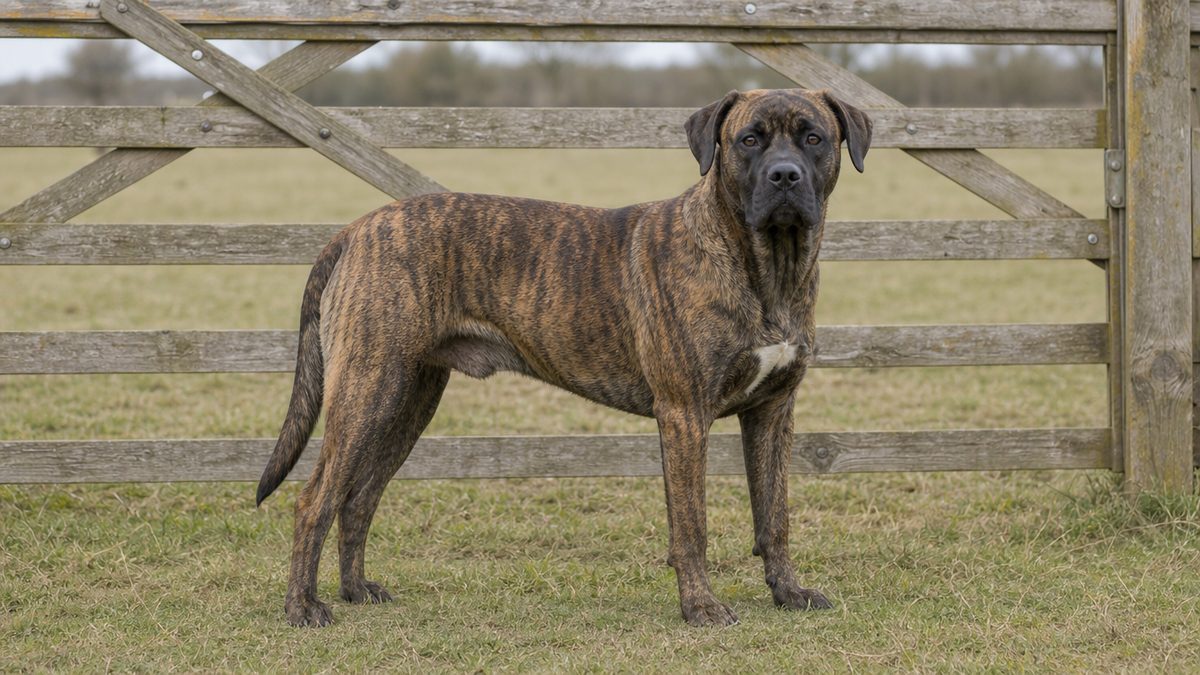
The cimarron uruguayo is Uruguay's only native dog breed, a 38 to 45 kg molossoid guardian recognised as FCI-Standard No. 353 and definitively accepted on 7 November 2017. Its standard describes natural triangular drop ears and merely notes that Uruguay crops traditionally, and cropping is prohibited in India. Bonbeno rates heat tolerance 2 of 5, because the breed's home department averages 16.6 C against Chennai's 27.9 C.
This guide is general information for Indian dog owners and is not a diagnosis. Consult a registered veterinarian near you before acting on anything you read here, and treat heat collapse, sudden weakness or a swollen abdomen in a deep-chested dog as an emergency.
Cimarrón Uruguayo at a glance
What the Cimarrón Uruguayo actually is
The Cimarrón Uruguayo is a medium-sized molossoid guardian and big game hunting dog from Uruguay, recognised by the Fédération Cynologique Internationale as Standard No. 353 in Group 2, Section 2.1, Molossoid, Dogue type, without working trial. The FCI accepted it provisionally on 21 February 2006 and definitively on 7 November 2017, and the United Kennel Club registered it in 2006 in its Guardian Dog Group.
Read the recognition off the register rather than off a breed blog, because on this breed the registers and the aggregators do not agree. The FCI nomenclature record lists the country of origin as Uruguay, names Spanish as the official authentic language, and dates the currently valid standard to 16 June 2022. That single line about the authentic language matters more than it looks, and the ears section below explains why.
The standard's own summary of the breed's job is one sentence: excellent for herding, big game hunting and guard. That is three working roles, not one, and none of them is companionship. An Indian buyer should read that line as the manufacturer's description of what the machine was built to do.
Size, and the aggregator that gets it wrong
The Cimarrón is a medium-sized dog, not a giant one, and the largest English-language page on the SERP says the opposite. FCI-Standard No. 353 opens by calling it "a medium sized dog of dogue type, strong, compact, with good bone, well muscled and agile";. English Wikipedia's first line under Appearance says the breed is "large in size";. The height and weight figures on both pages are identical, so the disagreement is purely about the label, and the label is what a buyer remembers.
| Measure | FCI-Standard No. 353 | Measured in Uruguay |
|---|---|---|
| Height at withers, males | 58 to 61 cm, 2 cm tolerance | 61.40 cm mean, SD 2.36, n=33 |
| Height at withers, females | 55 to 58 cm, 2 cm tolerance | 58.38 cm mean, SD 2.25, n=48 |
| Weight, males | 38 to 45 kg | 40.1 kg mean, SD 4.8, n=21 |
| Weight, females | 33 to 40 kg | 33.7 kg mean, SD 5.7, n=42 |
| Chest girth, males and females | Not specified | 83.6 cm and 79.3 cm |
Notice what the middle column and the right-hand column do to each other. A biometric survey of 81 registered adults measured between 1998 and 2001 found mean heights of 61.40 cm in males and 58.38 cm in females, and the authors state plainly that these means "slightly exceeded the limits established as maxima in the breed standard" of 61 cm and 58 cm. In other words the average registered Cimarrón was already at or past the ceiling within a decade of the standard being written. Treat published size ranges for this breed as a target the population has drifted above, not as a promise.
Coat, colour and the things that disqualify
The coat is short, smooth, lying close to the body, and it carries an undercoat. That undercoat is the detail Indian buyers most often miss, because a short-coated dog looks like a hot-climate dog and this one is insulated underneath. A Uruguayan survey found the undercoat present in 83.9 percent of dogs examined, and linked it to the hardiness of a population that adapted to living in the hill country and scrub of north-eastern Uruguay.
Colour is brindle or fawn in every shade, including bluish brindle and bluish fawn, with or without a mask, and fawns may carry black shading. White is tolerated only under the jaw, on the throat, forechest, abdomen and the lower legs, and no higher than the wrist or halfway up the metatarsus. In the Uruguayan survey 92.0 percent of dogs were brindle and only 8.0 percent fawn, and the researchers flagged that as a conservation problem rather than a preference, warning that losing the fawn coat would cost the breed founding variability it cannot get back.
- Disqualified on temperament. Aggressive or overly shy dogs, and any dog clearly showing physical or behavioural abnormalities.
- Disqualified on coat. Long hair, and any colour not named in the standard.
- Disqualified on pigment. An unpigmented nose, and genetic brown or chocolate colouring with brown nose and gums and light eyes.
- Disqualified on bite. Undershot and overshot.
- Severely faulted on size. Any dog under or over the stipulated height, tolerance included.
The pigment rule is not cosmetic trivia in India. Every dog in the Uruguayan sample had a fully pigmented nose and mucous membranes, and the researchers note that where other breeds tolerate partial depigmentation, the Cimarrón standard penalises it. A brown-nosed, light-eyed puppy offered to you as a rare colour is a disqualifying fault being sold as a premium.
The FCI utilisation clause reads "Excellent for herding, big game hunting and guard";, and the Uruguayan literature describes urban Cimarrones being kept for guarding, defence and companionship while rural ones work cattle and hunt wild boar. Nothing in either document describes an apartment dog. Buy on the working description, not on the photograph.
How a hunted feral dog became Uruguay's national breed
The Cimarrón Uruguayo is the only native dog breed in Uruguay, and it exists because a few hundred animals survived two organised extermination campaigns in the hills of Cerro Largo Llambí Dellacasa S. Its studbook has been open since 1989, the FCI accepted it provisionally in 2006 and definitively on 7 November 2017, and its history explains most of its temperament.
Trace the ancestry first. Uruguayan researchers put the breed's origin in the mastiffs and sighthounds that Spanish and Portuguese colonisers brought for hunting and war, noting that mastiffs arrived on Columbus's first voyage as combat animals, wearing armour. The likeliest single ancestor is the Alano Español, a gripping dog used on cattle, and a marker study found 75 percent similarity between the band patterns of the two breeds.
Then came the abandonment. As cattle multiplied across the Banda Oriental and their owners stopped keeping fixed homes, dogs separated from people and went feral. The word cimarrón itself was applied across the Americas to anything domestic that returned to the wild. Natural selection did the rest, and the FCI standard's own historical summary says so plainly: only the fitter, stronger and more clever individuals survived.
Two exterminations, and the refuge that saved the breed
| When | What happened |
|---|---|
| 16th century | Historians already record the dogs multiplying and causing damage, with a price put on their heads |
| Mid-1788 | The Cabildo de Buenos Aires approves the extermination of cimarrones. Mandibles and jaws had to be submitted to keep count of the dogs killed, and domestic dogs were culled too, leaving a fixed number per establishment |
| 1795 | The first organised sweep, or batida, on the eastern bank of the Uruguay |
| Early 19th century | In a single sweep commanded by Artigas, thirteen thousand dogs are killed. A large number of mothers with their young escape to the woods of the Olimar, the Sierra de Otazo and the Cerros Largos |
| 1840 to 1850, the Guerra Grande | A second persecution takes the breed close to disappearance, first with poison and then through the fencing of the countryside. A few individuals survive in rough country in Cerro Largo and Treinta y Tres |
| 1970s | Recovery work begins in Cerro Largo and spreads to the rest of the country |
The genetics confirm the story rather than merely illustrating it. When the Uruguayan team ran a population structure analysis on dogs sampled from the north-eastern origin zone and from the southern population centre, the software could not divide them: every animal belonged to a single population. The authors read that as confirmation that today's Cimarrones descend from the one nucleus that reached the north-eastern refuge. A separate microsatellite study of 30 dogs found the two regional groups genetically close as well.
From feral survivor to registered breed
- 12 October 1988. The Sociedad de Criadores de Perros Cimarrones is founded, the breed standard is written for the first time, and national recognition is applied for.
- 1989. The Asociación Rural del Uruguay and the Kennel Club Uruguayo recognise the breed officially. The first official register is drawn up, foundation dogs are selected and their offspring tattooed with a registration number. The studbook has stayed open since.
- 21 February 2006. The FCI accepts the breed provisionally, opening a five-year probation, and the United Kennel Club registers it the same year in its Guardian Dog Group.
- 7 November 2017. The FCI grants definitive recognition. The currently valid standard was published on 16 June 2022.
Registration numbers show how fast the recovery ran. The Uruguayan volume records 930 dogs registered in October 1997 rising to more than 6,000 by February 2008, an increase of over six and a half times, and concludes on that trend that the breed is not endangered. Two of its own chapters print slightly different totals for the same date, 6,069 in one and 6,079 in the other, and the pedigree study published separately analysed 6,079 animals born between 1979 and 2008. We print the discrepancy rather than splitting it.
The Artigas quotation, which comes in three versions
Every popular account of this breed carries a line attributed to José Gervasio Artigas about fighting on with an army of cimarrón dogs, and the university volume prints three different versions of it. Spanish Wikipedia gives a fourth wording again. More usefully, the Uruguayan authors deflate it themselves, writing that the phrase never amounted to more than a symbolic one given how aggressive the dogs were. Quote it as folklore, which is what it is.
Both Wikipedias state that the Cimarrón is the symbol and mascot of the National Army of Uruguay, with a place in the annual 18 July military parade where a Blandengues soldier leads a riderless horse alongside a cimarrón Spanish Wikipedia, Perro cimarrón uruguayo. That claim is not made anywhere in the 106-page Universidad de la República volume on the breed, which searches clean for any mention of the army. We report it as Wikipedia reports it, sourced to an archived Uruguayan Army page, and note that the academic literature does not corroborate it.
Ear cropping: what the standard says against what Uruguay does
The FCI standard for the Cimarrón Uruguayo describes a natural, medium-sized, triangular drop ear, and then adds one sentence noting that the breed is traditionally cropped at home. Cropping is therefore a local custom the standard acknowledges, not a specification the standard imposes, and the two registries that publish a standard for this breed do not take the same position on it.
Get the distinction right, because almost every English page about this breed gets it wrong in one direction or the other. Some print photographs of cropped show dogs with no comment, leaving a reader to assume the crop is the breed. Others state flatly that the standard requires cropped ears, which it does not. Here is what the documents actually say, quoted from the documents themselves.
| Document | What it says about ears | Does it authorise cropping? |
|---|---|---|
| FCI-Standard No. 353, English, 08.07.2022 | "Medium size, set neither too high nor too low, triangular, drooping but not close to the cheeks or in rose shape. Traditionally cropped in country of origin." | No. It describes a drop ear and notes a custom |
| FCI-Standard No. 353, Spanish, 08.07.2022, the official authentic text | "De tamaño mediano, implantación ni demasiado alta ni demasiado baja, triangulares cayendo a los lados, separadas de las mejillas o en forma de rosa. Tradicionalmente cortadas en el país de origen." | No. Same drop ear, same note about a custom |
| Sociedad de Criadores de Cimarrón Uruguayo, standard text dated 23.11.2017 | Identical Spanish wording to the FCI text above, published by the national breed society itself | No. The breed society publishes the description, not a cropping instruction |
| UKC Official Breed Standard, 2006 | "The ears are medium-sized and triangular in shape; dropped, but they do not hang close to the cheeks. The ears may be cropped in a rounded shape such as like a puma ear. There should not be more than half the ear removed." | Yes, explicitly, with a named shape and a stated limit |
The two registries do not agree, and only one of them permits the knife
Read the right-hand column again. The FCI never permits cropping and never prohibits it; it records that the practice exists in Uruguay. The United Kennel Club goes considerably further, writing a permission into its standard, naming the traditional shape as a rounded "puma ear", and capping the amount of tissue removed at half the ear. That is the only registry text in this set that tells anyone how to crop this breed.
The practical consequence is straightforward. A Cimarrón shown under UKC rules in the United States may lawfully appear cropped. A Cimarrón shown under FCI rules is judged against a description of a drop ear. And a Cimarrón kept in India must be uncropped, for reasons the next section sets out, because Indian law does not care what either registry says.
A translation discrepancy worth knowing about
The FCI's own two language versions of standard 353 differ on one detail, and the FCI's nomenclature record names Spanish as the official authentic language for this breed. The Spanish authentic text lists the ear as "triangulares cayendo a los lados, separadas de las mejillas o en forma de rosa", which reads most naturally as permitting a rose-shaped carriage as an alternative. The English translation renders the same clause as "drooping but not close to the cheeks or in rose shape", which excludes it.
Both versions agree on everything that matters to a buyer: the ear is medium-sized, triangular, dropped and carried away from the cheek, and neither asks for it to be cut. They disagree only on the rose ear, and on that point the Spanish is the text with standing. Anyone judging or importing on the English translation alone should know it is a translation.
Why a cropped Cimarrón is illegal in India, and where the custom came from
Ear cropping is prohibited in India under Second Schedule Part II para 6(8) of the Prevention of Cruelty to Animals (Dog Breeding and Marketing) Rules, 2017, which forbids it by name along with tail docking and every other cosmetic mutilation. No exception exists for a breed whose country of origin crops traditionally, and the FCI standard does not ask for a crop in any case.
Here is the provision verbatim, taken from the gazette text rather than from any summary of it. Second Schedule Part II para 6(8) reads: "There shall be no tail docking, ear cropping, de-barking, de-clawing, branding, dyeing, injecting substances to enhance visual appeal, performing a surgery or procedure to camouflage or hide any defect or infirmity or any other kind of mutilation of any body part of the pup and any change of appearance by artificial means is strictly forbidden";.
Cite it as a Schedule paragraph, never as a Rule
Call it Second Schedule Part II para 6(8) and not "Rule 6(8)". The Rules' own Rule 6 is a different provision, headed "Requirements to be met by breeders and establishments used for breeding or housing dogs for breeding", and what it does is make the Second Schedule binding by providing that "Every breeder shall comply with the standards and requirements set out in the Second Schedule";. The paragraph has force through Rule 6; it is not itself Rule 6. A reader who looks up "Rule 6(8)" finds the wrong text and can reasonably conclude the ban does not exist.
The neighbouring paragraph closes the obvious loophole. Second Schedule Part II para 6(9) provides that "Breeding to create new breeds of dogs or unusual looks shall be strictly prohibited";. A cropped ear is an unusual look produced artificially, and para 6(8) already forbids "any change of appearance by artificial means", so no reading of the Rules leaves room for a cosmetic crop.
- What it means when you view a litter. Natural ears on every pup, or walk away. A cropped eight-week-old is direct evidence that the breeder broke para 6(8).
- What it means for imports. A dog cropped lawfully abroad is still a dog whose appearance was altered artificially, and presenting one in India as the breed's correct look misinforms every buyer who sees it.
- What it means for photographs. Most Cimarrón images circulating in English show cropped dogs, because that is the Uruguayan and North American show look. They are not a guide to what your dog should look like.
Where the puma-ear story comes from, and what it rests on
The popular explanation is that cropping honours the century when cimarrones were hunted for bounty and their ears handed in as proof of the kill. The evidence for that story is considerably weaker than its repetition suggests, and the two accounts split on the crucial detail.
- The academic account names jaws, not ears. The Universidad de la República's own volume on the breed records that after the Cabildo de Buenos Aires approved the extermination of cimarrones in mid-1788, "se tenían que remitir las mandíbulas y quijadas", the mandibles and jaws, in order to keep count of the dogs killed. Across the whole 106-page book the phrase "oreja de puma" appears zero times and ear cropping is not discussed at all.
- The popular account adds ears. Spanish Wikipedia states that proof of death required presenting "la quijada o el par de orejas", the jaw or the pair of ears, and derives the characteristic puma-ear crop from that practice. It cites nothing for it.
- The English account rests on a dead link about a different country. English Wikipedia's cropping sentence is sourced to an article on dog fighting in an English-language Bulgarian magazine, quoted as saying "Ear cropping is another fighting-dog feature". We fetched that URL on 26 August 2026. It returns a bare server directory listing with no article behind it, so the claim's only support is now unreadable.
One part of the folklore does check out independently. The United Kennel Club's standard, written in 2006 from Uruguayan practice, names the traditional crop "a rounded shape such as like a puma ear" and limits it to no more than half the ear. So the puma ear is a documented shape with a registry description behind it. What has no primary source is the claim that the shape commemorates a bounty paid on ears, and the one academic source describing those bounties says the proof required was jaws and mandibles. A tradition can be genuine and its explanation invented.
Is a Cimarrón Uruguayo legal to own in India?
Yes. The Cimarrón Uruguayo has never been named in any Indian breed restriction, and no national breed ban is in force in 2026 in any case, because the 12 March 2024 circular that listed 24 breeds was quashed by the Karnataka High Court and set aside by the Delhi High Court within five weeks of being issued. What follows still matters, because several of this breed's close relatives were on that list and a 40 kg brindle molossoid does not get judged on its pedigree at a society gate.
What the 2024 list actually said, and who was on it
The Department of Animal Husbandry and Dairying's letter of 12 March 2024 asked states to stop issuing licences or permits for the sale, breeding and keeping of a list of breeds, and directed that dogs already kept as pets be sterilised. It was circulated to customs through CBIC Instruction No. 05/2024-Customs of 14 March 2024, which reproduces the list in full.
The Cimarrón Uruguayo does not appear on it. Neither does the Bully Kutta or the Alangu. Several close molossoid relatives do.
| Named on the list | Not named |
|---|---|
| Pitbull Terrier, Tosa Inu, American Staffordshire Terrier, Fila Brasileiro, Dogo Argentino, American Bulldog, Boerboel, Kangal, Central Asian Shepherd Dog, Caucasian Shepherd Dog, South Russian Shepherd Dog, Tornjak, Sarplaninac, Japanese Tosa and Akita, Mastiffs (boerbulls), Rottweiler, Terriers, Rhodesian Ridgeback, Wolf dogs, Canario, Akbash dog, Moscow Guard dog, Cane corso, and every dog of the type commonly known as a Ban Dog | Cimarrón Uruguayo, Bully Kutta, Alangu |
Note two things about that list. It covers "mixed and cross breeds" of the named types, and it includes bare category words such as "Terriers" and "Mastiffs";, which is part of why the courts found it unworkable. "Canario" appears without its full name, so it is a probable rather than certain reference to the Presa Canario.
What the courts did to it
- Karnataka High Court, 10 April 2024. Quashed. In Writ Petition No. 8409 of 2024, Justice M. Nagaprasanna ordered that the "Circular dated 12-03-2024, issued by the 1st respondent stands quashed", having granted an interim stay on 19 March 2024. The reasoning is the durable part: "The Union of India by the impugned circular could not have imposed a blanket ban, in the teeth of the Rules in force. The Circular travels beyond what is found in the Rules";.
- Delhi High Court, 16 April 2024. Set aside. Counsel for the Union admitted that "other than Government bodies, no private body was heard before the impugned circular was issued", and the court set it aside on that basis.
- Calcutta High Court, March 2024. Partially stayed, with the restriction on import and selling left standing pending the outcome.
- The Centre stood down. On 2 May 2024 the department put the proceedings in abeyance and invited objections, and The Hindu reported that six different High Courts had by then nullified or suspended the circular.
As of today the department's own Animal Welfare Division page lists the Acts and Rules in force and carries no breed-restriction instrument of any kind, only the Dog Breeding and Marketing Rules 2017 and the Pet Shop Rules 2018. We could not find evidence that a fresh, procedurally compliant notification was ever issued after the objection window closed, and we could not find a document formally abandoning the process either. Treat the position as settled for now and not as permanently settled.
Municipal rules, where the real friction is
- Delhi. Pet dog registration is mandatory under section 399 of the Delhi Municipal Corporation Act, 1957, at Rs 500 new and Rs 500 on renewal with a Rs 100 per month late fee. There is no breed ban, no cap on numbers and no muzzle rule in the MCD's own documents.
- Mumbai. Licensing is statutory under sections 191A and 191B of the Mumbai Municipal Corporation Act, 1888, and the BMC's own guidelines go further than most owners realise, stating that "trying to ban pets or limit their number, is against the fundamental freedom guaranteed to the citizens of India" and that housing associations "cannot insist that 'Small Sized' dogs are acceptable and 'Large sized' dog are not";. If a Mumbai society tries to bar a large guardian, this is the document to quote.
- Chandigarh. A notified 2025 pet bye-law is reported to carry a breed ban covering the American Bulldog, Pitbull, Bull Terrier, Cane Corso, Dogo Argentino and Rottweiler, plus caps on dog numbers by plot size. The Cimarrón is not among the named breeds. We could not open the bye-law text itself, so treat the detail as press-reported.
- Goa. An Animal Breeding and Domestication Act was passed and notified in 2025 with real criminal penalties, but its breed list has not yet been notified and the five breeds under consideration do not include the Cimarrón.
Nothing above will help you at the moment a resident welfare association looks at your dog. A 40 kg brindle molossoid reads to a lay observer as a Dogo Argentino or a Presa Canario, both of which were on the 2024 list. Carry the FCI standard, the registration papers and the Mumbai guideline language if you are in Maharashtra Brihanmumbai Municipal Corporation…, and accept that you will have this conversation repeatedly. Owning a rare guardian breed in an Indian city is partly a documentation exercise.
Cimarrón Uruguayo price in India: there isn't one
No Indian page publishes a rupee price for the Cimarrón Uruguayo, and that absence is a finding rather than a gap in our research. We searched Indian dog-selling sites and general web results with a working control in the same session: "labrador retriever price in india" returned roughly fifteen Indian pages carrying rupee bands, while every Cimarrón query returned zero. The reason is legal, and it is worth understanding before anyone offers you one.
Why no Indian market can lawfully form
Dogs are a Restricted import into India. DGFT Trade Notice No. 22/2022-23 of 19 December 2022 places ITC (HS) 01061900, "Mammals: Other", under Restricted import policy subject to Policy Condition 6. Policy Condition (7) then states that "import of dogs is allowed only for the following specific purposes", and lists exactly three: a pet dog with a valid pet book and relevant records in the name of the importer, dogs imported by R&D organisations for research with the recommendation of CPCSEA, and dogs for internal security by the Defence and Police Force.
Policy Condition (8) closes the commercial door: "Import of commercial dogs for breeding or any other commercial activities other than the purposes mentioned above is not permitted";. Paragraph 6 of the same notice removes any ambiguity about what happens if you try anyway: "any applications for trading/breeding purposes, or applications made on behalf of some another person/entity shall be duly rejected".
- Only seven entry points. Import of pet animals is allowed only through the airports and seaports of Delhi, Mumbai, Chennai, Hyderabad, Bengaluru and Kolkata and, since October 2024, Kochi airport, with quarantine at a government station where required Department of Animal Husbandry….
- Baggage import is for returning residents only. Permanent import as passenger baggage without DGFT authorisation is allowed only to persons transferring residence to India after two years of continuous stay abroad, and only cats and dogs qualify under the baggage rules.
- Apply two months ahead. The notice advises owners to start the authorisation process at least two months before travel.
- No breeding founder stock. Put those together and the only Cimarrón that can lawfully enter India is one person's own pet, coming home with them. You cannot lawfully import a breeding pair, so no Indian breeding population can form.
What the one India-facing page actually offers
One Indian site ranks for this breed, and it is a template. Furrfam's Cimarrón page prints no price at all: the field reads "Contact for pricing", followed by "Price may vary based on KCI/non-KCI, size, coat, color, bloodline, availability, and location";. Its entire descriptive text is one sentence, "CimarrÓn Uruguayo is an FCI-recognized dog breed. A detailed profile for temperament, care, and suitability will be expanded in upcoming updates";.
| What the page prints | What the register says | What it means |
|---|---|---|
| Weight 20 to 60 lbs, about 9 to 27 kg | 38 to 45 kg for males, 33 to 40 kg for females | The page understates the dog by more than half |
| Origin: FCI | Country of origin: Uruguay | A registry has been printed in the country field |
| Lifespan 10 to 14 years | The FCI standard contains no lifespan | Sourced from nowhere |
| "Family Friendly, great with kids and other pets"; | Excellent for herding, big game hunting and guard | The working description has been replaced with a sales line |
| Identical body text on the American Akita page | Two unrelated breeds | One template, name substituted, including a shipped bug that prints "provideprovide" |
The decisive detail is that this site can print rupee prices when it has data. Its Labrador Retriever page shows a band of Rs 15,000 to Rs 60,000 alongside genuinely breed-specific copy about the three Labrador colours. So the blank on the Cimarrón page is not a policy of discretion. It is an empty field on a stub spun up for every breed in the FCI nomenclature.
The only published prices anywhere, and how to test one
Outside India, HonestDog lists a puppy price of 1,500 to 2,500 euro while simultaneously stating it has no verified breeders for the breed and carries a "No Health Tests Available" notice. That is the most honest commercial page on the SERP, and it is still quoting a band for a dog it cannot source.
If you ever do meet an Indian rupee figure for this breed, test it before believing it. Indian pages routinely publish a US dollar price run through one exchange rate, and the tell is that the rupee figure divides to a round dollar number. Divide by 84.38 first, because that is the strong test, then try 74.00, then 80.00, and treat a match at 80 as weak evidence because any figure ending in three zeros divides cleanly at 80 by construction.
Take Furrfam's Labrador band of Rs 15,000 to Rs 60,000. Rs 15,000 divided by 84.38 is 177.77, by 74.00 is 202.70, by 80.00 is 187.50. Rs 60,000 divided by 84.38 is 711.07, by 74.00 is 810.81, by 80.00 is 750.00. Not one of those lands on a figure a seller would print. Both ends are round rupee numbers instead, which is what an authentic Indian price looks like. Run the same three divisions on any Cimarrón price you are quoted, and if it resolves to a clean 1,000 or 1,500 or 2,000 dollars, you are looking at a converted foreign list rather than an Indian market.
What it would actually cost, and the costs nobody itemises
No Indian cost-of-ownership figure exists for the Cimarrón Uruguayo, because there is no Indian keeping base to measure. What can be stated exactly is the regulatory cost of doing this lawfully, because those fees are printed in the rules, and the physical cost drivers, because those follow from a 38 to 45 kg working dog Prevention of Cruelty to Animals.
The statutory costs, which are the ones people miss
| Item | Amount | Source |
|---|---|---|
| Breeder registration with the State Animal Welfare Board | Rs 5,000, non-refundable, valid two years | Dog Breeding and Marketing Rules 2017, Rule 4(2) |
| Breeder registration renewal | Rs 5,000 | Rule 4(9) |
| Pet shop registration, for retail sale | Rs 5,000, non-refundable | Pet Shop Rules 2018, G.S.R. 844(E) |
| Pet dog registration, Delhi | Rs 500 new, Rs 500 renewal, one year, tied to the vaccination date | MCD, under section 399 of the Delhi Municipal Corporation Act, 1957 |
| Late registration penalty, Delhi | Rs 100 per month | MCD pet dog SOP |
| Dog licence, Mumbai | Statutory requirement under sections 191A and 191B of the Mumbai Municipal Corporation Act, 1888 | BMC Veterinary Health Department guidelines |
Two of those matter more than their size suggests. Registration is not optional for a breeder: Rule 13 of the 2017 Rules provides that there is no licence without registration. And Rule 8(3) requires every breeder to "screen prospective purchasers to ascertain their potential to take proper care of the breed, especially if it is a large one". A Cimarrón is squarely a large one, so a seller who takes your money without asking you a single question is not merely careless, they are non-compliant.
The recurring cost drivers, honestly bounded
We will not publish a monthly rupee total for this breed, because doing so would mean inventing one. What we can do is name the drivers and their direction, so you can price them against quotes you actually get in your own city.
- Food is the largest line and scales with bodyweight. A 40 kg working dog eats roughly four times what a 10 kg dog eats. Price a large-breed adult formulation in your city and multiply, rather than trusting a per-month figure written for a different animal.
- Veterinary care scales too. Most canine drugs are dosed per kilogram, so every deworming, every course of antibiotics and every anaesthetic on a 40 kg dog costs multiples of the same treatment on a small breed.
- Parasite prevention is a year-round line in India, not a seasonal one. Half the dogs in a four-zone Indian survey carried at least one tick-borne pathogen, and tick infestation ran at 80 percent in Mumbai and 75.3 percent in Delhi. Budget for continuous tick control, not a summer course.
- Cooling is a real capital and running cost in most of India. In Chennai every month of the year sits above this breed's evolutionary wet-bulb ceiling, so climate control stops being comfort and becomes husbandry.
- Hip and elbow radiographs at 12 to 18 months, under sedation, on a large dog. The breed's own country treats a severe hip dysplasia diagnosis as a breeding disqualification.
- Professional behaviour support, budgeted from the outset rather than after an incident. The Montevideo referral data puts this breed second by share of aggression cases, and a territorial guardian in an Indian city is the exact scenario that generates one.
- Third-party liability. A 40 kg guardian that bites creates a civil exposure most Indian pet insurance does not cover well. Read the policy wording on third-party liability before you need it.
The genuinely scarce resource for this breed in India is veterinary familiarity. Your vet has seen hundreds of Labradors and, in all probability, zero Cimarrones. The useful thing you can do is arrive with the primary literature: breed-specific echocardiographic reference values exist, normative brainstem auditory-evoked response latencies exist, and a cranial cruciate ligament case series exists. Three papers in a folder are worth more to a clinician than any amount of breed-forum opinion.
Can a Cimarrón Uruguayo handle the Indian climate?
A Cimarrón Uruguayo handles Indian humidity better than almost any European guardian and handles Indian heat worse than its South American label suggests, and the two facts are separable. Bonbeno rates heat tolerance 2 of 5 on the plains, on the basis of NASA POWER climatology queried by explicit latitude and longitude for the breed's home department and for seven Indian locations.
Test the claim rather than repeating it. The Cimarrón's founding population survived in the hill country of Cerro Largo and Treinta y Tres in north-eastern Uruguay Llambí Dellacasa S, so that is the climate to measure. At Melo, the departmental capital of Cerro Largo, the 1991 to 2020 annual mean air temperature is 16.6 C and the annual mean relative humidity is 81.1 percent.
Hold those two numbers next to Chennai, where the annual mean is 27.9 C and mean relative humidity is 72.2 percent. The breed's homeland is nine percentage points more humid than Chennai and eleven degrees cooler. That is the whole finding in one line, and it is why calling this a subtropical South American breed misleads Indian buyers.
Why we compare wet-bulb and not air temperature
Wet-bulb temperature combines heat and humidity into the single number that governs whether an animal can shed heat by evaporation, which is exactly what a panting dog is doing. Air temperature alone flatters humid places and slanders dry ones. Compare on wet-bulb and the picture changes in both directions.
| Location | Annual mean air temp | Annual mean humidity | Hottest month, wet-bulb | Months above the Uruguayan peak |
|---|---|---|---|---|
| Melo, Cerro Largo, Uruguay | 16.6 C | 81.1 % | 19.8 C, January | Reference |
| Treinta y Tres, Uruguay | 16.1 C | 82.4 % | 19.7 C, January | Reference |
| Montevideo, Uruguay | 16.7 C | 78.9 % | 20.1 C, January | Reference |
| Artigas, northern Uruguay | 18.5 C | 76.1 % | 21.3 C, January | Reference |
| Shillong, Meghalaya | 17.9 C | 80.3 % | 21.6 C, July | 4 of 12 |
| Bengaluru | 23.6 C | 68.1 % | 22.6 C, May | 7 of 12 |
| Pune | 23.7 C | 66.6 % | 23.5 C, June | 7 of 12 |
| Delhi | 25.6 C | 44.0 % | 27.7 C, July | 5 of 12 |
| Mumbai | 26.6 C | 67.4 % | 26.4 C, June | 9 of 12 |
| Chennai | 27.9 C | 72.2 % | 27.3 C, May | 12 of 12 |
The Chennai row is the one to sit with. Chennai's coolest month is hotter than the hottest month this breed ever evolved in. January in Chennai carries a mean wet-bulb of 21.7 C against 19.8 C for January in Melo, and every one of the twelve Chennai months clears the Uruguayan annual peak. There is no season of relief. A Cimarrón in Chennai is thermally out of range all year.
The objection that Uruguay also hits 40 C, and why it does not help
Uruguay does reach Indian peak temperatures, and it does not matter. The hottest monthly maximum in the Melo grid cell is 40.4 C, and at Artigas in the north it is 43.3 C, which exactly equals Chennai's NASA POWER meteorological climatology…. What separates the two places is not the peak, it is the baseline. Uruguay spikes and recovers; the Indian plains sustain. A dog survives a hot afternoon it can cool off from overnight. It cannot acclimatise its way out of a year with no cool season.
City by city, what this means in practice
- Shillong and the Meghalaya and Himalayan belt. The only genuine match on this list. Shillong's annual mean of 17.9 C and 80.3 percent humidity sit within 1.3 degrees and one humidity point of Melo, and only four months of the year exceed the Uruguayan peak. A Cimarrón would be a rustic, well-suited dog here.
- Bengaluru and Pune. Workable with discipline. Peak wet-bulb of 22.6 C and 23.5 C runs 3 to 4 degrees above the breed's ceiling, for five to seven months a year. Walk at dawn and after sunset only, from March to October.
- Delhi and the northern plains. Seasonally split, and both halves are hard. Delhi's January wet-bulb of 6.8 C is colder than anything Uruguay offers, which the coat handles easily; its July wet-bulb of 27.7 C is the highest figure in this whole table. Plan for two different dogs in one year.
- Mumbai, Kolkata and Chennai. Nine, eight and twelve months a year above the breed's evolutionary ceiling. Air conditioning stops being a luxury and becomes the animal's habitat.
A Cimarrón is not a Caucasian Shepherd. Its coat is short, smooth and close to the body with a light undercoat rather than a mountain double coat, and at 38 to 45 kg it sits below the giant-breed bodyweight band. That earns it a 2 rather than the floor, and makes it the more heat-tolerant of the imported guardians. It does not earn it a pass. The dog is dark-coated, deep-chested, built for endurance rather than sprinting, and comes from a place whose hottest month is cooler than a Bengaluru winter.
Temperament and household fit, on the only real data that exists
The Cimarrón Uruguayo is a territorial working guardian whose FCI standard calls it "balanced, intelligent and of great courage" and disqualifies aggressive or overly shy dogs outright. The only clinical behaviour data ever collected on the breed, from Montevideo veterinary referrals, places it second by share of aggression cases and third on breed risk factor behind the Rottweiler. Both of those are true, and an Indian buyer needs to hold them together.
Start with what the sources disagree about, because the spread is enormous. English Wikipedia calls the breed "a very friendly dog with children and other animals" and "rather calm and stable";. DogZone describes "an impressively strong dog with a tendency towards aggression" that is "unsuited to life as a family pet";. Neither cites anything. The gap between them is the whole reason this section exists.
The Montevideo referral data, and what it actually found
Between 2005 and 2007 a group at the Universidad de la República recorded canine behaviour-problem diagnoses referred from more than thirty veterinary clinics in central Montevideo, a total of 179 cases. Aggression was the most frequent problem at close to 60 percent of referrals, with inappropriate elimination a distant second at 9 percent.
| Measure | Finding |
|---|---|
| Share of aggression cases by breed | Cimarrón ranked second, in both record systems used |
| Breed risk factor, aggression share divided by population share | Rottweiler first, Cimarrón third |
| Frequency in the Montevideo dog population | Fifth most common pure breed at 3.6 percent. 42 percent of Montevideo dogs are crossbreds |
| Sex pattern within the breed | Females showed a higher frequency of aggression cases than males |
| Commonest aggression type within the breed | Territorial |
| Dog attacks on people in Uruguay | 300 to 350 a year across all breeds |
Two things in that table deserve more weight than the rest. First, the breed's risk factor is calculated as its share of aggression cases divided by its share of the dog population, so it is not an artefact of the Cimarrón simply being common in Montevideo. Second, the sex pattern inverts. In that registry, across all breeds, 70 to 80 percent of aggression toward people came from males; within the Cimarrón the authors report that females were the more frequent presenters. If you have been told that a female is the safer choice in a guardian breed, this is the one breed where the published data says otherwise.
The Uruguayan team labels these results preliminary and says explicitly that the breed "has not been considered in international clinical ethology studies" for mainly demographic reasons. A referral registry is also a biased sample by construction, because dogs reach it only when an owner has a problem. This page reports it as the best evidence available rather than as a settled prevalence, and it is still an enormous amount more than any ranking page has.
What territorial means in an Indian building
Territorial aggression is not general aggression, and the difference decides whether this dog works in your household. A territorially motivated guardian is usually settled and unbothered inside the family and reactive at the boundary. In Uruguay that boundary is a fenced estancia and the intruder is a stranger on horseback or a wild boar. In an Indian city the same instinct meets a delivery rider at the gate twice an hour, a society guard who changes every shift, a house help who arrives daily, a plumber, a courier and a dozen free-ranging street dogs.
The dog is not confused about any of that. It is doing exactly what five hundred years of selection built it to do, on a boundary that has fifty crossings a day instead of one a month. That mismatch, not any defect of character, is what turns a functional Uruguayan guardian into an Indian liability case.
Who should and should not take one on
- Suited to a fenced independent house or farm with a controlled entrance, an owner who has run a large guardian breed before, and a household where every regular visitor can be formally introduced.
- Unsuited to any apartment or gated society with shared corridors, lifts and common areas, because a territorial guardian cannot be given a boundary it can defend without also giving it fifty daily provocations.
- Unsuited to first-time owners, however committed. The Uruguayan registry found 57 percent of dogs showing their first signs of aggression toward owners inside the first year of life, which is a window a novice will not recognise in time.
- Unsuited to households with young children who will have friends visiting, and to homes where a second entire dog of the same sex already lives.
The trait the standard actually guarantees
One quality is reliably documented across every source: this is an independent, self-directed animal rather than a biddable one. The FCI describes great courage; the Uruguayan literature describes a breed that in the countryside works cattle and hunts wild boar largely on its own initiative and in the city serves as a guard, defence and companion animal. A protective dog of this weight succeeds or fails on whether it was socialised in the right window, which the training section covers. A survey of Uruguayan owners found 64.6 percent of registered dogs living in cities and 35.4 percent in the countryside, so urban keeping is normal there. It is normal on a Montevideo plot with a wall, which is not the same thing as a Mumbai flat.
Training a Cimarrón Uruguayo, and what it resists
To train a Cimarrón Uruguayo, spend your effort on the boundary and on introductions rather than on obedience polish, because the breed's documented problem is territorial aggression and not disobedience. The single highest-return intervention is handling the puppy daily between the third and twelfth week, which a Uruguayan experiment on Cimarrón litters showed produced measurably less fear and stress toward novel stimuli and strangers than in unhandled controls.
The socialisation window is the whole training programme
The socialisation window for this breed runs from the third to the twelfth week of life. That is the period in which a guardian puppy decides what category the world's strangers belong to, and it closes before most Indian buyers have even collected the dog. Indian law makes the arithmetic tight on purpose: Rule 8(1)(a) of the 2017 Rules forbids the sale of pups under eight weeks, so on a lawful purchase you get the puppy at week eight with four weeks of the window left.
That means the breeder does most of this work, not you. Ask what was done in weeks three to eight, and treat a vague answer as disqualifying. Indian law already requires breeding establishments to plan for socialising as a documented activity: Second Schedule Part IV para 24(6)(e) sets out socialising with people at intervals totalling at least three hours a day for an adult and five hours a day for a pup under four months, and para 24(5) requires positive physical contact with humans at least once daily where a dog has no sensory contact with another dog.
What actually needs training in an Indian household
- A formal greeting protocol at the gate. Every regular visitor, meaning the house help, the milk delivery, the society guard and the courier, gets introduced deliberately while the dog is on lead and under handler control. Repeat it after every staff change.
- A place command that outranks the doorbell. The dog should go to a mat when the gate opens, not to the gate. This is the one exercise worth drilling to fluency.
- Muzzle conditioning before you need it. Condition it as a neutral object at twelve weeks. A 40 kg territorial dog will eventually need a vet visit, a lift ride or a boarding stay.
- Lead manners at full adult weight. A dog of 38 to 45 kg that pulls is not walkable by every adult in the house, and the person who ends up walking it will not always be you.
- Recall away from a chase. This breed hunts wild boar in its home country. Assume the prey drive is real and assume a street dog triggers it.
What the breed resists
An independent working dog resists repetition without purpose, and this one was selected for exactly that independence in a feral population where the individuals that thought for themselves survived. Expect a dog that learns quickly, complies once it sees the point, and quietly stops complying when a session runs long. Short blocks, real consequences, no nagging.
Expect the reverse of the usual advice on sex, too. The Uruguayan registry found females presenting more often than males for aggression within this breed, against a 70 to 80 percent male skew across all breeds in the same dataset. Whichever sex you take on, do not let anybody tell you the bitch will be the easy one here.
FCI-Standard No. 353 places the Cimarrón in Group 2 without working trial, so no temperament or working test is required for FCI showing. The ring screens only the extremes: aggressive or overly shy dogs are a disqualifying fault, as is any dog clearly showing behavioural abnormalities. A champion parent tells you about conformation. It tells you almost nothing about whether the dog will settle in a flat with a shared corridor.
How much exercise a Cimarrón Uruguayo actually needs in India
Give an adult Cimarrón Uruguayo two sessions of 30 to 45 minutes a day, both outside daylight heat for most of the Indian year, and take every minute of it inside a fence or on a lead with a person on the other end. That structure is not a preference. Second Schedule Part IV para 24(6) of the 2017 Rules names exercising for at least thirty minutes twice per day and adequate exercise either in a fenced area or on a leash as acceptable ways of meeting the exercise obligation.
Match the workload to the job the standard describes. The FCI lists the breed as excellent for herding, big game hunting and guard, and Uruguayan surveys show rural dogs working cattle and hunting wild boar while urban dogs guard and accompany. Every one of those is endurance work at a trot, not sprint work. This is a dog that patrols and covers ground, not one that fetches a ball for an hour.
It is also not a livestock guardian in the Anatolian or Caucasian sense, and the distinction changes the exercise plan. A flock guardian lives with the stock and barely leaves it. A Cimarrón worked cattle alongside a mounted handler and hunted with people, so it expects to move with you rather than to be left in a field. Isolation in a rear compound is how this breed turns into a fence-line barker.
The heat constraint, city by city
| City | Hardest stretch | Workable window | What changes |
|---|---|---|---|
| Chennai | All twelve months | Before 06:00 and after 21:00, year round | There is no easy season. January is the least bad month and is still above the breed's ceiling |
| Mumbai and Kolkata | April to September | Before 06:00 and after 21:00 | Monsoon lowers air temperature and raises humidity, so the wet-bulb barely moves |
| Delhi | April to July | Before 05:30 and after 21:30 in summer | December to February is genuinely comfortable and the dog can work in daylight |
| Bengaluru and Pune | March to May NASA POWER meteorological climatology… | Before 07:00 and after 19:30 | The mildest metros. November to February is close to normal service |
| Shillong and the hill belt | June to August only | Most of the day, most of the year | The one Indian climate this breed was effectively built for |
Rules that do not change by city
- Test the ground with the back of your hand for five seconds before every walk. If you cannot hold it, the dog cannot stand on it.
- Carry water on every outing, not only long ones, and offer it before the dog looks like it needs it.
- Wet the groin, armpits and paw pads, never the back. Water sitting on a coat with undercoat traps heat instead of releasing it.
- Keep the dog lean. Body condition is the single heat variable an owner controls, and a 45 kg Cimarrón carrying an extra five is a materially higher-risk animal.
- Substitute scentwork and structured problem-solving from March to June. A guardian breed needs its head tired more than its legs, and thinking generates far less heat than running.
Heat stroke in a dog bred not to quit presents late, which is exactly the problem. Watch for frantic or noisy panting that does not settle within a few minutes of stopping, brick-red or unusually pale gums, thick ropey drool, staggering, vomiting or diarrhoea, and any collapse. Move the dog into shade, wet the underside and the paws with cool rather than iced water, get air moving over it, and go to a veterinarian immediately, calling ahead. Do not wait to see whether it improves in the car.
Grooming a short-coated guardian in Indian humidity
Groom a Cimarrón Uruguayo once a week with a rubber curry and a stiff bristle brush, and never clip or shave it, because the standard specifies a short, smooth coat lying close to the body with undercoat. A Uruguayan survey found that undercoat present in 83.9 percent of dogs examined, so the insulation is real even though the dog looks bare.
This is the lowest-maintenance coat in the guardian group and it is still not a no-maintenance coat. Weekly brushing during most of the year, stepping up to every second day through the two seasonal sheds, keeps dead undercoat out of the jacket. Dead undercoat trapped against the skin in Indian humidity is what turns a clean dog into a hot, itchy one.
Why shaving is the wrong instinct here
Do not clip the coat down for summer, however sensible it feels in a Chennai May. A coat with an undercoat works as insulation in both directions, and removing it exposes pigmented skin to direct sun while destroying the air layer that helps the dog manage radiant heat. Long hair is a disqualifying fault in this breed, which tells you the working coat was always meant to be short and dense rather than clipped short.
The one genuine advantage this breed has under Indian sun is pigment. The standard requires a fully pigmented nose and disqualifies an unpigmented one outright, and disqualifies genetic brown or chocolate colouring with brown nose and gums and light eyes. Every single dog in the Uruguayan sample carried full pigmentation of the nose and mucous membranes. A black-pigmented nose is materially less prone to solar damage than a pink one, so a correctly-bred Cimarrón starts ahead of many pale-nosed breeds here.
Ears, and a detail in the standard most people miss
The FCI describes the ear as triangular and dropping but not close to the cheeks. That is a ventilation specification whether or not it was written as one. An ear that hangs away from the head dries far better after a monsoon walk than an ear that seals flat against the skull, which is the anatomy that makes some drop-eared gundogs so prone to trouble in Indian rain.
So the Cimarrón's correct natural ear is already a reasonably well-ventilated ear, and the common argument that cropping is done for ear health does not hold up against the standard's own description. Dry the ear canal opening after every wet walk and after every bath, and never let water sit inside it. In India that habit matters more than the brush does.
| Task | Frequency | Why it matters here |
|---|---|---|
| Rubber curry and bristle brush | Weekly, every second day when shedding | Removes dead undercoat before humidity mats it against the skin |
| Dry the ear opening | After every wet walk, bath or swim | The ear hangs away from the cheek but still traps monsoon moisture |
| Check between the toes and in the groin | Weekly, and after any grass walk | Where ticks attach first, and where humid dermatitis starts |
| Nails | Every three to four weeks | A 40 kg dog on hard urban surfaces still overgrows the dew claw |
| Bath | Every six to eight weeks, or when genuinely dirty | Over-bathing a short coat with undercoat strips it and worsens itch |
| Teeth | Two or three times a week | The standard asks for a strong, well-aligned, preferably complete bite |
FCI-Standard No. 353 describes the skin as "thick and supple";, which is a working animal's hide rather than the loose, folded skin of a heavy mastiff. There are no facial folds to clean, no wrinkle dermatitis and no skin-fold pyoderma sites on a correct Cimarrón. If you are looking at a heavily wrinkled dog with a loose dewlap, note that excessive dewlap is a listed fault in this breed and ask what else in the pedigree is not what it claims to be.
Health and lifespan: five real studies, and one number nobody has
Five peer-reviewed studies examine the Cimarrón Uruguayo's health directly, and none of them reports a lifespan. The breed is absent from the largest companion-dog longevity study ever published and absent from the OFA statistics tables, both absences proved with controls rather than assumed. What does exist is better than most rare breeds get, and this section separates the measured from the asserted.
Lifespan: four published numbers, no source under any of them
Every ranking page prints a lifespan and none can source one. Zoomalia gives 9 to 11 years, DogBreedInfo about 10 to 14, HonestDog 12 to 14. That is a five-year spread with nothing underneath it.
We checked the obvious place a real figure would live. McMillan and colleagues' 2024 longevity analysis covers 155 recognised purebred groups in Supplementary Tables S3 and S6. Searching those tables for the breed returns zero, while Labrador, Retriever, Mastiff and Bulldog all return hits in the same files, so the absence is real rather than a broken search. Bonbeno therefore publishes no lifespan for this breed, and will not borrow a Cane Corso or Dogo Argentino figure to fill the gap.
What five studies actually found
| Study | Sample | What it found |
|---|---|---|
| Mondino, Gutiérrez and Delucchi 2018, hearing | 46 dogs, 4 months to 5 years | No bilateral deafness detected. With about 5,000 living registered dogs in Uruguay, prevalence of sensorineural deafness is below 6.3 percent at 95 percent confidence, lower than the lowest prevalence in affected breeds. One dog had reduced acuity in the right ear |
| Fumagalli and colleagues 2023, cranial cruciate ligament | 15 surgical cases | 66.7 percent male, mean age 4.9 years, males 41.1 kg and females 36.2 kg. 47 percent presented grade 2 lameness. Authors suggest a possible genetic predisposition in the breed and stress the small sample |
| Pisón and colleagues 2011, cardiac | 63 dogs, 21 males and 42 females | Breed-specific echocardiographic reference ranges. Fractional shortening and ejection fraction sat inside the normal canine range, so no breed-level cardiac abnormality was found |
| Gagliardi, Llambí and Arruga 2015, drug metabolism | Four breeds compared | MDR-1, CYP1A2 and CYP2B11 polymorphisms examined in the Uruguayan Cimarron against Border Collie, Labrador and German Shepherd |
| UdelaR veterinary hospital oncology audit, 2018 to 2023 | 963 neoplasms, 41 breeds | The Cimarrón accounted for 3.3 percent of neoplasms, 32 of 963, level with the Boxer. In appendicular osteosarcoma it was 3 of 38 purebred cases, 7.9 percent, behind the Rottweiler at 18.4 percent |
Read the oncology row carefully. It is a hospital caseload share with no breed denominator, so it tells you what walks into one Montevideo teaching hospital, not what proportion of Cimarrones get cancer. In a country where the breed is the fifth most common pure breed, a 3.3 percent share of cases is close to what population share alone would predict.
The deafness result deserves more attention than it gets
Congenital sensorineural deafness has been identified in more than 90 breeds at prevalences from 6.9 to 30 percent. A Uruguayan team screened 46 Cimarrones by brainstem auditory-evoked response and found no bilateral deafness at all, establishing a ceiling of 6.3 percent. For a mostly brindle breed that is a genuinely good result, since deafness clusters with unpigmented coat patterns and this breed's standard disqualifies an unpigmented nose outright.
It also produced the first normative BAER latency and amplitude values for the breed, which means an Indian veterinary neurologist now has a reference table to compare a patient against. Worth knowing, because Indian law never mentions deafness: across the whole 2017 gazette, hearing appears once and it refers to an appeal hearing, not an auditory test.
Hips, and a proven absence
Hip dysplasia is the breed's one established gate. Since 1 January 2007, Uruguayan breeders have not considered dogs with a severe hip dysplasia diagnosis suitable for breeding. No prevalence figure has been published anywhere we can verify.
The Orthopedic Foundation for Animals holds no statistics row for this breed. We searched the complete disease-statistics dump, roughly 2.2 million characters covering about 215 breeds, and found zero occurrences of Cimarron or Uruguay while Labrador returned 109. The dump does carry other rare non-AKC breeds including the Fila Brasileiro and Dogo Argentino, so this is not a coverage gap. OFA's own explanation: "For hips, each breed must have at least 100 evaluations in the database. For all other databases, there must be at least 50";.
Absence from the OFA tables means the breed has not reached the publication threshold. It does not mean no Cimarrón has ever been hip-scored, and nothing we retrieved distinguishes zero evaluations from a count below 100. Anyone telling you the breed has no hip problems because OFA lists none is reading a publication rule as a health result.
The Indian disease pressure this breed has never met
An imported guardian in India faces three exposures its home country barely tests it against: sustained heat, year-round tick-borne disease, and monsoon skin and ear disease. India has good published evidence on two of those three, and almost none on the first, which is itself the finding.
Heat: what the evidence actually supports for a 40 kg dog
The largest study of canine heat stroke followed 905,543 dogs across 886 UK primary-care clinics in 2016, recording 395 heat-related illness events with an incidence risk of 0.04 percent and an event fatality rate of 14.18 percent, 95 percent confidence interval 11.08 to 17.96. Forty percent of cases, 158 of 395, fell in July alone.
Now be precise about where this breed sits, because it is easy to overstate. The study's headline weight finding is that dogs over 50 kg had 3.42 times the odds of heat-related illness against dogs under 10 kg. A 38 to 45 kg Cimarrón is not in that band. It falls in the 40 to under 50 kg band, whose odds ratio is 1.76 with a confidence interval of 0.91 to 3.40 and a p value of 0.093, which is not statistically significant. Bonbeno will not attach the 3.42 figure to this breed.
| Risk factor | Odds ratio | Applies here? |
|---|---|---|
| Bodyweight 40 to under 50 kg vs under 10 kg | 1.76 (0.91 to 3.40), not significant | Yes, and honestly it is a weak signal |
| Bodyweight over 50 kg vs under 10 kg | 3.42 (1.54 to 7.57) | No. A correct Cimarrón does not reach 50 kg |
| Brachycephalic vs mesocephalic skull | 2.10 (1.68 to 2.64) | No. The muzzle is only slightly shorter than the skull |
| Purebred vs crossbred | 1.86 (1.39 to 2.49) | Yes |
| Bodyweight at or above the breed and sex mean | 1.42 (1.12 to 1.80) | Yes, and this is the one you control |
| Age 12 years and over vs under 2 | 1.75 (1.14 to 2.70) | Yes, eventually |
The companion paper matters more for how you exercise the dog. Of 879 heat-related illness events with a recorded trigger, 652, or 74.2 percent, were exertional, against 113 environmental and just 46 from vehicular confinement. The paper's title says it: dogs do not die just in hot cars. The Indian owner's real risk is a walk taken an hour too late, not a locked car.
India's own evidence base on canine heat stroke is close to empty. A structured literature search found no Indian clinical or epidemiological study of canine heat-related illness, only a two-case clinical report and laboratory hyperthermia work from the 1970s. Treat any Indian heat-stroke percentage you see online as untraceable.
Ticks, and a genuinely serious Indian exposure
A survey of 525 dogs across four Indian climatic zones found that 49.7 percent carried at least one tick-borne pathogen, with Hepatozoon canis at 30 percent, Ehrlichia canis at 20.6 percent, Mycoplasma haemocanis at 12.2 percent, Anaplasma platys at 6.5 percent and Babesia vogeli at 5.5 percent. Thirty-nine percent of infected dogs carried more than one.
The geography is stark. Tick infestation on visual inspection ran at 80 percent in Mumbai and 75.3 percent in Delhi, against 17 percent in Sikkim and 11 percent in Ladakh, and Ehrlichia canis reached 39.5 percent of Delhi dogs while registering zero in both hill sites. Tick-infested dogs were 3.3 times more likely to test positive. A short-coated dog patrolling a boundary in long grass is a tick magnet.
One further parasite is worth naming because it links the two countries. The first Uruguayan case of trypanosomiasis caused by Trypanosoma evansi was reported in a Cimarrón Uruguayo. T. evansi, or surra, is endemic across India, so this is one disease the breed demonstrably can contract and that an Indian dog is far more likely to meet.
Monsoon skin and ear disease, where the Indian literature disagrees with itself
- Palampur, Himachal Pradesh, otitis externa. Of 2,476 dogs presented between June 2022 and July 2023, 81 were diagnosed with otitis, a hospital prevalence of 3.27 percent, and the incidence peaked in the rainy season at 59.25 percent of cases. Read 59.25 percent as a case share compressed into a short monsoon window, not as a prevalence rate.
- Palampur, dermatological disorders. Across 2,671 cases, 227 were dermatological, 8.40 percent, and the maximum fell in monsoon at 46.69 percent against 22.46 percent in winter, 16.29 in summer and 14.53 in autumn. Bacterial, fungal and flea dermatitis all peaked in monsoon, but Demodex peaked in winter at 41.46 percent, so not everything follows the rain.
- Thrissur, Kerala, pyoderma. A longitudinal study of 178 affected dogs found an overall pyoderma prevalence of 7.5 percent, with a statistically significant difference between seasons, commonest at one to three years of age and more frequent in females at 53.37 percent.
- Andhra Pradesh, the counter-example. In 442 dogs screened for tick-borne co-infections, the authors report the incidence of infection was less in the rainy season. Southern India does not behave like the northern hills, and a page that reports only the monsoon-peak studies is telling you half the picture.
The Cimarrón's ear hangs away from the cheek rather than sealing against it, which is a real advantage in an Indian monsoon compared with a tight-eared spaniel. It is not immunity. Dry the ear opening after every wet walk, check the groin and between the toes weekly for ticks, and expect your highest-risk months to be the monsoon in the north and something closer to year-round in Mumbai and Chennai Abd Rani PAM, Irwin PJ, Coleman GT.
The genetic argument two Uruguayan papers are still having
Two peer-reviewed 2011 studies of this breed reached opposite-sounding conclusions about its genetic health, and both are correct about what they measured. A microsatellite study called the Cimarrón's genetic diversity high; a pedigree study of the entire studbook found loss of founder genotypes and an inbreeding rate above the accepted band. Publishing the disagreement is more useful than resolving it.
The case for high diversity
Gagliardi and colleagues genotyped 30 Cimarrones, 13 from north-eastern Uruguay and 17 from the south, at nine microsatellite markers. Observed heterozygosity came out at 0.624 and expected heterozygosity at 0.649, which the authors describe as high given that only nine markers were used, and they conclude the breed has high genetic diversity compared with other breeds.
Their own comparison table is what makes the number mean something.
| Breed | Dogs | Markers | Observed heterozygosity | Expected heterozygosity |
|---|---|---|---|---|
| Cimarrón Uruguayo | 30 | 9 | 0.624 | 0.649 |
| Greyhound | 50 | 19 | 0.333 | 0.357 |
| Labrador | 50 | 19 | 0.352 | 0.481 |
| German Shepherd | 50 | 19 | 0.310 | 0.431 |
| Kintamani dog, Bali | 40 | 31 | 0.681 | 0.700 |
| Chow Chow | 20 | 31 | 0.640 | 0.649 |
The explanation the authors give is the interesting part. The dogs that took refuge in north-eastern Uruguay during the extermination campaigns kept their variability because nothing was selecting them except survival, and the breed is recent enough not to have gone through the intense selective pressure that shaped older breeds. Feral centuries, on this reading, did the breed a genetic favour.
The case for a narrowing base
Martínez and colleagues ran the entire available pedigree, 6,079 animals born between 1979 and 2008, through ENDOG. The picture from the studbook is less comfortable.
| Parameter | Total population | Live breeding population |
|---|---|---|
| Animals analysed | 6,079 | 1,455 |
| Founders | 689 | 259 |
| Effective number of founders | 31 | 37 |
| Effective number of ancestors | 25 | 31 |
| Ancestors explaining 50 percent of genetic variability | 11 | 14 |
| Mean inbreeding coefficient, F | 0.03 | 0.03 |
| Average relatedness, AR | 0.04 | 0.04 |
| Animals with F above 0.12 | 547, or 9.0 percent | 118, or 8.1 percent |
Read the fourth row twice. Eleven ancestors explain half the genetic variability in the whole registered population. The ratio of effective founders to actual founders comes out at 0.05 for the total population, which the authors read as loss of founder genotypes, and they attribute it to over-representation of a few popular sires.
The rate matters more than the level. The effective population size for the live breeding population was 56.9 with a standard deviation of 1.40, and the increase in the inbreeding coefficient per equivalent generation was 1.7 percent. The authors quote Leroy and colleagues to the effect that effective size should not fall below 50 and that a generational inbreeding increase of 0.5 to 1 percent is acceptable. So the breed clears the first threshold and misses the second, and 41.7 percent of the total population is inbred to some degree, with individuals as high as F = 0.38 coexisting with dogs at zero.
A microsatellite panel measures the diversity currently present in sampled animals. A pedigree measures how that diversity is being transmitted. A population can hold high heterozygosity today and still be funnelling itself through eleven ancestors, which is precisely what a rising inbreeding rate on a stable mean F looks like. Martínez and colleagues say as much, noting that their genealogical data had not been cross-checked against DNA and that mating advice should therefore be given with caution. Both papers share authors from the same Montevideo laboratory, so this is one research group reporting two views of its own breed, not a fight.
Why this is a legal problem in India, not just a genetic one
Second Schedule Part II para 6(2) of the 2017 Rules permits only out breeding and line breeding, and para 6(3) prohibits in breeding and incest breeding by name. The prohibition is defined precisely: in breeding means "breeding between relatives of the 2nd to 4th grade in straight or side line within the first four generations e.g. uncle to niece, nephew to aunt, cousin to cousin, grandparents to grandchildren", and incest breeding means mating between parents and children or between brother and sister.
Now put that beside the pedigree study's own figure for how much pedigree exists. The mean number of equivalent generations known was 2.6 for the total population and 2.8 for the live breeding population. A four-generation prohibition cannot be verified against a two-and-a-half-generation pedigree. An Indian breeder of this breed would be legally required to prove an absence of relatedness across four generations, using a studbook that on average does not go back that far. That is not an argument against the breed. It is a specific, checkable reason why importing a rare foreign breed into an Indian regulatory regime is harder than importing the dog.
Feeding a Cimarrón Uruguayo through the Indian year
Feed a Cimarrón Uruguayo to hold it at the lean end of its breed weight, which is 38 to 45 kg for a male and 33 to 40 kg for a female under FCI-Standard No. 353. Body condition is the one heat variable an Indian owner fully controls, and on a deep-chested dog it is also the variable that governs how a meal is best split.
Uruguayan measurements give a useful reality check on those bands. An echocardiographic study of registered Cimarrones recorded mean live weights of 40.1 kg in males with a standard deviation of 4.8 and 33.7 kg in females with a standard deviation of 5.7. In other words a correct adult male sits in the low forties, not the fifties. If your dog is heading past 48 kg, it is not a big specimen of the breed, it is an overweight one.
What Indian law already requires
Second Schedule Part IV para 25 of the 2017 Rules sets the floor, and it is a sensible one. Food must be "uncontaminated, wholesome, palatable and of sufficient quantity and nutritive value to maintain the normal condition and weight of the animal", and "the diet shall be appropriate for the individual animal's age and condition";. Bowls must be readily accessible, positioned to minimise contamination by excreta, protected from rain, and made of a durable material that can be cleaned and sanitised. That last clause is written for kennels and is worth copying at home during the monsoon.
Life stage by life stage
| Stage | Meals per day | What to prioritise |
|---|---|---|
| 8 to 16 weeks | 4 | A large-breed puppy formulation with controlled calcium. Slow, steady growth beats fast growth in a 40 kg adult |
| 4 to 8 months | 3 | Keep ribs easily felt. Adolescent joints on a heavy frame do not benefit from a plump puppy |
| 8 to 18 months | 2 | Transition to adult food toward the end of this window. Indian law treats eighteen months as the earliest a male is mature enough to be bred |
| Adult | 2, morning and evening | Feed both meals outside the heat of the day, and never within an hour either side of hard exercise |
| Senior | 2, smaller | Watch for weight creep as activity drops. A stoic guardian hides stiffness |
The deep chest, and what is and is not established
The FCI standard describes a chest that is "deep, reaching at least to the elbow", broad and well developed, with well sprung ribs. Deep-chested conformation is the anatomy associated with gastric dilatation and volvulus across large breeds, and DogZone lists gastric torsion among five conditions it attributes to this breed. It cites nothing for any of the five, and no study of gastric torsion in the Cimarrón exists, so treat the anatomy as documented and the breed-specific risk as unmeasured DogZone.com, Cimarrón Uruguayo Breed….
The practical handling is the same either way and costs nothing. Split the daily ration across two meals rather than one, keep the bowl on the floor rather than raised, avoid a large meal immediately before or after exertion, and learn what a distended, tight abdomen with unproductive retching looks like. That combination in a deep-chested dog is a same-hour emergency.
Indian practicalities
- Store dry food in an airtight container, not the opened bag. Indian summer and monsoon humidity spoil kibble fats faster than the printed date suggests.
- Offer water constantly and refresh it twice daily. A 40 kg dog panting through a Chennai afternoon drinks far more than a temperate-climate feeding chart assumes.
- Weigh the dog monthly on the same scale. Body condition scoring by eye fails on a short-coated muscular breed, because muscle and fat both read as bulk.
- Do not free-feed a guardian breed. Meal structure is one of the few daily rituals that reinforces who controls the resource in the house.
Uruguayan researchers sequenced 36 Cimarrones for the MDR1 mdr1-1delta mutation, the deletion that makes some breeds dangerously sensitive to ivermectin, and did not detect it in a single dog, while Collies in the same comparison did carry it. That matters in India, where ivermectin is used routinely for mange and parasite control. The authors note the sample is small and call for more animals to be tested, so this is encouraging rather than conclusive. Tell your veterinarian what the evidence actually is rather than assuming either way.
The first year, month by month, with the legal milestones marked
The first year of a Cimarrón Uruguayo has two clocks running at once. One is developmental and closes early: the socialisation window runs from the third to the twelfth week. The other is legal, and the 2017 Rules mark out four dates that decide whether a puppy was lawfully bred, lawfully sold and lawfully kept.
| Age | What is happening | The rule that applies |
|---|---|---|
| Weeks 3 to 8 | The socialisation window opens and most of it passes in the breeder's hands. Handled Cimarrón litters showed less fear and stress toward strangers than unhandled controls | Second Schedule Part IV para 24(6)(e): socialising with people totalling at least five hours a day for a pup under four months |
| Weeks 7 to 8 | Vaccination begins | Second Schedule Part III para 8(9): all pups shall be vaccinated, which can start at seven to eight weeks and is usually completed at eighteen weeks |
| Week 8 | The earliest lawful handover | Rule 8(1)(a): pups less than eight weeks in age are not sold. Rule 8(1)(e): each pup sold is micro-chipped |
| Weeks 8 to 12 | The last four weeks of the window are yours. Every category of person the dog will meet for life should be met now | Rule 8(2): the breeder must give you, in writing, feeding details, inoculation and de-worming dates and the attending veterinarian's name and address |
| Weeks 12 to 16 | Vaccination course completes. Structured exercise begins | Second Schedule Part IV para 24(4)(a): dogs over twelve weeks shall be provided the opportunity for exercise regularly |
| 4 to 6 months | Rapid frame growth toward an adult 58 to 61 cm. Teething, and the first territorial noticing of the gate | Second Schedule Part IV para 23(4): pups under four months shall not be housed with adult dogs other than their dam or foster dam |
| 6 months | Adolescence begins in earnest | Rule 8(1)(b): dogs over six months in age are not sold without first being sterilised, unless sold to another licensed breeder |
| 6 to 12 months | Guarding behaviour consolidates. The Montevideo registry found 57 percent of dogs showing their first signs of aggression toward owners inside the first year | No specific rule. This is where an owner either gets professional help or does not |
| 12 to 18 months | Physical maturity. Males reach the low forties in kilograms | Second Schedule Part II paras 5(2) and 5(7): neither sex may be bred before the eighteenth month, and each must be certified healthy by a veterinary practitioner at least ten days before mating |
The three things that actually decide the outcome
- Weeks three to twelve, and nothing else comes close. This is the only intervention with published breed-specific evidence behind it, from a handling experiment run on Cimarrón litters in Uruguay. Everything after week twelve is management of a decision already made.
- Month six to twelve, when the guarding switches on. A territorial guardian does not become territorial gradually and politely. It becomes territorial in adolescence, at 30 kg, usually over a specific trigger such as the gate or a delivery. Book a behaviour professional before you need one.
- Month twelve to eighteen, when strangers start reading the dog differently. An adult of 40 kg with a broad head is treated as a threat by people who ignored the puppy, and the dog reads their fear. The greeting protocol you built at week nine is what carries you through this.
Screening dates worth putting in the calendar
Uruguay's own breeders screen for one thing specifically. Since 1 January 2007, dogs with a severe diagnosis of hip dysplasia have not been considered suitable for breeding in the Cimarrón population. That is the breed's single established health gate, and it is a good template for an Indian owner: radiograph the hips at around 12 to 18 months, before any breeding decision and before the dog's exercise plan is set for adult life.
You should leave with a micro-chipped pup of at least eight weeks, a written record of feeding, inoculation and de-worming dates, the attending veterinarian's name and address, and a sale receipt whose copy the breeder keeps with your name, address and phone number against the microchip number. Rule 8(3) also requires the breeder to screen prospective purchasers, so a seller who asks you nothing at all is telling you something about how they operate. If any of that paperwork is missing, the transaction is not compliant, whatever the puppy looks like.
Cimarrón Uruguayo against the breeds you are actually choosing between
Compare the Cimarrón Uruguayo against the other Iberian and South American molossoids and it comes out the smallest of the group, which is the opposite of what most English pages imply. Compare it against what is genuinely obtainable in India and the choice stops being about the dog at all.
Uruguayan researchers published the comparison themselves, in a table of five related molossoid breeds compiled from the breed literature. Their conclusion is that all five are hypermetric and all exceed 55 cm at the withers, but within that group the Cimarrón sits at the bottom of both scales.
| Breed | Weight, male | Weight, female | Height, male | Height, female |
|---|---|---|---|---|
| Cimarrón Uruguayo | 38 to 45 kg | 33 to 40 kg | 58 to 61 cm | 55 to 58 cm |
| Alano Español | 38 to 45 kg | 33 to 38 kg | 60 to 65 cm | 56 to 61 cm |
| Dogo Argentino | 40 to 45 kg | 40 to 43 kg | 62 to 68 cm | 60 to 65 cm |
| Fila Brasileiro | Over 50 kg | Over 40 kg | 65 to 75 cm | 60 to 70 cm |
| Presa Canario | 45 to 57 kg | 40 to 50 kg | 61 to 66 cm | 57 to 62 cm |
The Alano Español row is the interesting one. It is the breed the Cimarrón most likely descends from, and a microsatellite study found 75 percent similarity between the band patterns of the two. Five hundred years of feral selection in South America produced a dog that is 2 to 4 cm shorter than its Spanish ancestor and no lighter. Read that as a compaction, not a shrinking.
The comparison that matters in India
Set the Cimarrón beside the guardians an Indian buyer can genuinely get, and the honest answer is that three of the four alternatives are better decisions here.
| Breed | Origin climate | Obtainable in India | The specific problem |
|---|---|---|---|
| Cimarrón Uruguayo | Annual mean 16.6 C, peak monthly wet-bulb 19.8 C at Melo | No established supply. Dogs are a Restricted import and no FCI or KCI route exists into an Indian pedigree | Cooler origin than Shillong, a documented territorial aggression profile, and a cropping custom that is illegal here |
| Rajapalayam | Tamil Nadu. Evolved in the same heat you will keep it in | Yes, from within India, including rescue | Sighthound temperament, not a house-friendly guard. Needs space to run |
| Kombai | Tamil Nadu hill country | Yes, though good stock is regional | A genuine guarding breed with the same intensity issues and none of the import problem |
| Bully Kutta | Punjab and Sindh plains | Yes | Far heavier than the Cimarrón, and carries the same legal and public-liability exposure |
| Indian Pariah Dog | The Indian subcontinent itself | Yes, free, from any shelter | Not a specialist guardian. It is, however, the only option on this table adapted to the climate you actually live in |
Front-load the conclusion. If you want a large territorial guardian in India, the Cimarrón is not a better dog than a Kombai; it is a harder one to obtain, a worse fit for the climate, and no better documented on health. The one thing it has that the Indian breeds do not is an FCI standard and a national studbook, and neither of those makes a dog cooler in a Chennai May.
Against the imported guardians already in India
The closer contest is against the imported guardian breeds that already have Indian breeders, and there the Cimarrón's argument is genuinely better than people expect.
- Against the Cane Corso and the Boerboel. The Cimarrón is lighter, shorter-muzzled without being brachycephalic in the flat-faced sense, and carries less loose skin. Where a heavy mastiff struggles, a 40 kg compact dog struggles slightly less.
- Against the Caucasian Shepherd Dog and the Tibetan Mastiff. No contest on coat. Those two carry heavy double coats built for sub-zero mountains; the Cimarrón's coat is short and close with a light undercoat Llambí Dellacasa S. It is the more heat-tolerant of the three by a wide margin, which is a low bar cleared rather than a recommendation.
- Against the Rottweiler. This is the uncomfortable one. In the Montevideo clinical behaviour registry the Rottweiler ranked first on breed risk factor for aggression and the Cimarrón third, and the Cimarrón ranked second by share of aggression cases. If you would hesitate over a Rottweiler on temperament grounds, the Uruguayan data says you should hesitate here too.
- Against the Dobermann and the Boxer. Same cropping trap, same law. All three are shown cropped somewhere in the world and all three must be kept natural-eared in India.
The Cimarrón Uruguayo is a well-made, genuinely functional, medium-sized guardian with a real standard and a real national studbook behind it Martínez M, Armstrong E, Gagliardi R. None of that is in dispute. What is in dispute is whether importing one into a country where its origin climate does not exist, its registry papers do not transfer, and its traditional appearance is unlawful, is a decision anybody should make. On the evidence assembled here, no.
Nine mistakes Indian readers make about this breed
Most Cimarrón Uruguayo mistakes in India are made before anyone owns one, because they are mistakes about what the sources say. Nine come up repeatedly, and eight of them are correctable by reading one primary document instead of five aggregator pages.
1. Cropping the ears because the show dogs have them cropped
Do not crop a Cimarrón's ears in India, whatever a photograph of a Uruguayan champion shows you. Second Schedule Part II para 6(8) of the Prevention of Cruelty to Animals (Dog Breeding and Marketing) Rules, 2017 states that there shall be no tail docking, ear cropping, de-barking, de-clawing, branding, dyeing or any other kind of mutilation, and that any change of appearance by artificial means is strictly forbidden. The FCI standard does not require cropped ears; it describes drop ears and adds a note that the breed is traditionally cropped in its country of origin. Those are two different statements and only one of them is a specification.
2. Taking the friendly-with-everyone line at face value
English Wikipedia says the Cimarrón "is a very friendly dog with children and other animals" and is "rather calm and stable";. Uruguayan clinical ethologists, working from 179 behaviour referrals across more than thirty Montevideo veterinary clinics between 2005 and 2007, placed the breed second by share of aggression cases and third on breed risk factor, behind the Rottweiler. Both statements are published. Only one of them is based on case records.
3. Assuming a South American breed is heat-adapted
Uruguay is humid and it is not hot. The breed's home department has an annual mean air temperature of 16.6 C and a peak monthly wet-bulb of 19.8 C, against 27.9 C and 27.3 C for Chennai NASA POWER meteorological climatology…. Every month of the Chennai year is more thermally stressful than the hottest month the Cimarrón evolved in. The breed is humid-adapted, which is not the same thing as heat-tolerant, and conflating the two is the most consequential error on this page.
4. Reading a short coat as no coat
The standard specifies a short, smooth coat lying close to the body with undercoat, and a Uruguayan survey found the undercoat present in 83.9 percent of dogs examined. A Cimarrón is insulated. It simply does not look insulated, which is worse, because owners under-estimate the cooling it needs.
5. Quoting a lifespan
There is no study-derived lifespan for this breed, and the pages that print one contradict each other. Zoomalia gives 9 to 11 years, DogBreedInfo gives about 10 to 14, HonestDog gives 12 to 14. That is a five-year spread with no source underneath any of it. The 106-page university volume on the breed, which reports its karyotype, its cardiac reference values and its pedigree structure, contains no lifespan figure at all.
6. Believing a litter-size number
The most-quoted litter figure for this breed is "about 4 to 10 puppies";. The only real dataset says something different and says why it cannot be trusted. Across 710 registered births in Uruguay between 1997 and 2006, 42 percent of records showed a single puppy per litter, which the authors call biologically improbable for a large polytocous breed and attribute to owners registering only some of each litter because registration costs money. So the honest position is that no usable mean litter size exists, and the researchers holding the data are the ones saying so.
7. Assuming the female is the safer choice
In most breeds and in this same Montevideo registry overall, 70 to 80 percent of aggression incidents toward people involved males. For the Cimarrón specifically the authors report the reverse: "females showed a higher frequency of aggression cases than males", with territorial aggression the commonest type in the breed. The finding is explicitly preliminary. It is still the only breed-specific behaviour data that exists, and it points the opposite way to the usual advice.
8. Missing the socialisation window
Socialise a guardian puppy inside the third to twelfth week or accept a harder dog for life. Uruguayan students ran a handling experiment on Cimarrón litters and the handled puppies showed less fear and stress response to novel stimuli and to strangers than the controls. In an Indian city, where a large territorial dog will meet delivery riders, society guards, construction workers and street dogs every single day, that window is the whole ballgame.
9. Trusting an Indian page that offers you one
Verify any Indian listing for this breed against the register before you send money. The one India-facing page in the ranking set is a template shell that exists in the same form for breeds with no Indian presence at all, complete with a KCI-or-non-KCI pricing disclaimer for a dog it has no route to supply. Bonbeno's position is simple: we report published prices as editorial content, we do not link listings, and on this breed we could not find an Indian price that survives being checked.
Natural ears, always. Assume territorial rather than friendly, and train for it from week three. Treat the coat as insulated even though it looks bare. Do not quote a lifespan, a litter size or an Indian price, because none of the three has a source. And weigh the whole decision against a Kombai or a Rajapalayam, which give you the same job done by a dog that already lives in your weather.
Adoption, verification, and the study somebody is selling you
Adopt the temperament rather than the passport. There is no Cimarrón Uruguayo rescue network in India, no Indian breeder with a lawful route to founder stock, and no verified Indian listing, so the realistic ways an Indian household ends up with this breed are two: bringing your own dog home from abroad, or being sold something that is not a Cimarrón at all.
The one lawful route, and what it requires
The lawful route is a pet dog with a valid pet book and relevant records in the importer's own name, entering through one of seven ports. If you have lived abroad for at least two continuous years and are transferring residence, up to two pets come in as passenger baggage without a DGFT authorisation; otherwise you need one, and you should start at least two months before you travel. Any application framed as trading or breeding, or made on somebody else's behalf, is rejected. The full route is set out in how to import a dog to India.
If you are not in that situation, the honest answer is that this breed is not available to you in India, and no amount of searching will change the legal position that created the shortage.
How to verify a dog that is offered to you as a Cimarrón
- Check the ears first. Natural, medium, triangular, dropping, held away from the cheek. A cropped puppy in India is evidence of an offence under Second Schedule Part II para 6(8), whatever the seller says about tradition.
- Weigh the parents. A correct adult male is 38 to 45 kg at 58 to 61 cm, and Uruguayan measurements put real males around 40 kg Llambí Dellacasa S. A 55 kg parent is a different dog or a crossbred one.
- Look at the coat and the pigment. Short, smooth, close, with undercoat. Brindle or fawn. A fully pigmented black nose. Long hair, chocolate pigment, light eyes or a depigmented nose are all disqualifying faults.
- Ask for the import paperwork. A genuine Indian Cimarrón has a pet book in a named importer's name and a DGFT trail. There is no other lawful way it got here.
- Ask what happened in weeks three to eight. The socialisation window is the whole ballgame in this breed, and the only intervention with breed-specific evidence behind it.
- Expect to be screened yourself. Rule 8(3) of the 2017 Rules requires a breeder to screen prospective purchasers, especially for a large breed. Being asked nothing is a red flag, not a convenience.
A paid study about this breed that you should not buy
One document circulating for this breed deserves naming. A PDF titled "Eliminating Hip Dysplasia in Cimarrón Uruguayo Dogs: The Shocking Kennel Effect Revealed" is sold for 69 euro, advertising "A 1,385-Dog Study", an "81.39 percent HD-A nationwide" figure and a chi-squared statistic. It has no named author, no journal, no DOI and no peer review, it is sold by an anonymous seller under a kennel's name with a "Only 50 copies released" countdown and a no-refunds policy.
Set that against what the genuine literature contains. No study of hip dysplasia in this breed exists in PubMed or Europe PMC, and the OFA holds no statistics row for it, an absence we proved with a control Orthopedic Foundation for Animals. Do not cite or pay for the 81.39 percent figure. A breed with 1,385 hip-scored dogs would clear OFA's 100-evaluation publication threshold many times over.
On the Kennel Club of India, an honest non-answer
We cannot tell you whether the KCI registers this breed, and we are not going to guess. The KCI's live site is a temporary holding page carrying downloadable forms and a tariff sheet, with no published breed list of any kind. Every registration form uses a free-text breed field. We ran the control: Labrador Retriever, German Shepherd and Golden Retriever are equally absent from the site, so an absence there proves nothing about the Cimarrón.
What can be said is indirect but solid. The KCI is India's FCI Full Member, and FCI Statutes Article 8.3 obliges full members "to recognize all of the FCI breeds (provisional or definitive)" and "to respect the FCI breed standards and breeds nomenclature";. Since the FCI recognises the Cimarrón definitively as standard 353, the KCI is contractually obliged to recognise it. Whether it has ever registered one is a different question, and no public studbook exists to answer it.
If what you want is a large, brave, territorial guardian that works in Indian weather, adopt or buy an Indian one. The Kombai and the Rajapalayam do the same job in the climate they evolved in, come without an import problem, and need the visibility far more than a Uruguayan breed does. If what you want is a companion and the guarding was never the point, the Indian Pariah Dog is free from any shelter and is the single best-adapted dog on this page. Bonbeno does not broker sales, does not link listings, and has no interest in whether you buy anything at all.
Cimarrón Uruguayo questions, answered from the register
Is the Cimarron Uruguayo recognised by the FCI?
Yes. The Fédération Cynologique Internationale recognises it definitively as FCI-Standard No. 353, in Group 2, Section 2.1, Molossoid, Dogue type, without working trial. It was accepted provisionally on 21 February 2006 and definitively on 7 November 2017, and the currently valid standard was published on 16 June 2022. The United Kennel Club registered it separately in 2006 in its Guardian Dog Group.
Does the Cimarron Uruguayo standard require cropped ears?
No. FCI-Standard No. 353 describes ears that are medium sized, triangular and drooping but not close to the cheeks, then adds a single sentence noting that the breed is traditionally cropped in its country of origin. That is a note about a custom, not a requirement. The UKC standard is the only registry text that actually permits cropping, describing a rounded puma-ear shape and limiting removal to no more than half the ear.
Is ear cropping legal in India?
No. Second Schedule Part II para 6(8) of the Prevention of Cruelty to Animals (Dog Breeding and Marketing) Rules, 2017 states that there shall be no tail docking, ear cropping, de-barking, de-clawing, branding, dyeing or any other kind of mutilation, and that any change of appearance by artificial means is strictly forbidden. Cite it as a Second Schedule paragraph, never as Rule 6(8), because the Rules' own Rule 6 is a different provision.
What is the Cimarron Uruguayo price in India?
No Indian page publishes a rupee price for this breed. We searched Indian dog-selling sites with a working control in the same session, and while a Labrador query returned roughly fifteen Indian pages with rupee bands, every Cimarron query returned zero. Dogs are a Restricted import and DGFT Trade Notice 22/2022-23 states that any application for trading or breeding purposes shall be duly rejected, so no Indian breeding market can lawfully form.
How long does a Cimarron Uruguayo live?
Nobody knows, and Bonbeno publishes no figure. Four published sources give 9 to 11, 10 to 13, 10 to 14 and 12 to 14 years, none with a source. Royal Canin India prints 10 to 13 years and credits the FCI, but the FCI standard contains no lifespan at all. The breed is also absent from Supplementary Tables S3 and S6 of the largest companion-dog longevity study, an absence we proved with controls.
Can a Cimarron Uruguayo handle Indian heat?
Poorly on the plains. Bonbeno rates heat tolerance 2 of 5. The breed's home department in Cerro Largo has an annual mean of 16.6 C and a peak monthly wet-bulb of 19.8 C, while Chennai runs 27.9 C and 27.3 C. Every one of Chennai's twelve months is hotter by wet-bulb than the hottest month this breed evolved in. The Meghalaya and Himalayan belt is the one Indian climate that genuinely fits.
Is the Cimarron Uruguayo aggressive?
The FCI standard calls the temperament balanced and disqualifies aggressive or overly shy dogs, but the only clinical data tells a harder story. In 179 behaviour referrals from more than thirty Montevideo veterinary clinics between 2005 and 2007, the Cimarron ranked second by share of aggression cases and third on breed risk factor behind the Rottweiler, with territorial aggression the commonest type and females presenting more often than males. The authors call the result preliminary.
Is the Cimarron Uruguayo the national dog of Uruguay?
It is Uruguay's only native dog breed and is widely treated as a national symbol. Royal Canin describes it as a member of the national breed in its native country, and both Wikipedias state it is the mascot of the National Army of Uruguay with a place in the 18 July military parade. The 106-page Universidad de la Republica volume on the breed makes no mention of the army, so we report the claim rather than confirming it.
How big does a Cimarron Uruguayo get?
Males stand 58 to 61 cm at the withers with a 2 cm tolerance and weigh 38 to 45 kg; females stand 55 to 58 cm and weigh 33 to 40 kg. It is a medium-sized dog of dogue type, not a giant, and English Wikipedia calling it large in size contradicts the standard it cites. Uruguayan measurements of 81 registered adults found means already slightly above the standard maxima.
Is the Cimarron Uruguayo banned in India?
No. It has never been named in any Indian breed restriction, and no national breed ban is in force in any case. The 12 March 2024 circular listing 24 breeds was quashed by the Karnataka High Court on 10 April 2024 and set aside by the Delhi High Court on 16 April 2024, and the department kept it in abeyance from 2 May 2024. Several of the breed's molossoid relatives were on that list.
Can you keep a Cimarron Uruguayo in an apartment?
It is a poor fit. A territorial guardian works by defending a boundary, and a shared corridor gives it fifty provocations a day and no defensible boundary. Bonbeno rates apartment suitability 1 of 5. A fenced independent house or farm with a controlled entrance is the realistic minimum, and Mumbai's own municipal guidelines confirm a housing society cannot lawfully bar a dog simply for being large.
Is the Cimarron Uruguayo good with children?
Only in an experienced household, and the sources disagree sharply. English Wikipedia calls it a very friendly dog with children and other animals, while DogZone calls it unsuited to life as a family pet. Neither cites anything. The Uruguayan clinical registry that does have data found territorial aggression to be the breed's commonest presentation, which makes visiting children the specific risk rather than resident ones.
What is a puma ear crop?
It is the traditional Uruguayan ear crop for this breed, a rounded shape named in the United Kennel Club standard, which permits it and specifies that no more than half the ear should be removed. The folklore says it commemorates bounties paid on the ears of hunted cimarrones, but the Universidad de la Republica's own account says the proof required was jaws and mandibles, and never mentions ears or the puma shape.
Is the Cimarron Uruguayo related to the Dogo Argentino?
Both descend from European dogs brought to South America, and a genetic study of Native American dog breeds explicitly groups them together as breeds with historical origins in European dogs that are not putatively indigenous. The Cimarron's likeliest single ancestor is the Alano Espanol, with 75 percent similarity between marker band patterns. The Dogo is the larger of the two at 62 to 68 cm against 58 to 61 cm.
Does the Kennel Club of India recognise the Cimarron Uruguayo?
We cannot establish it either way and will not guess. The KCI's live website is a temporary holding page with no published breed list, and Labrador Retriever, German Shepherd and Golden Retriever are equally absent from it, so an absence proves nothing. Indirectly, the KCI is India's FCI Full Member and FCI Statutes Article 8.3 obliges full members to recognise all FCI breeds, which would include standard 353.
Is the Cimarron Uruguayo sensitive to ivermectin?
Probably not, on the evidence so far. Uruguayan researchers sequenced 36 Cimarrones for the MDR1 mdr1-1delta deletion, the mutation that causes dangerous ivermectin sensitivity, and did not detect it in a single dog, while Collies in the same comparison did carry it. The authors call the sample small and ask for more testing. That matters in India, where ivermectin is used routinely for mange and parasite control.
Compare with similar breeds
Cimarrón Uruguayo sits in 1 Bonbeno group. Each one compares it directly against the breeds it is genuinely an alternative to, on the same figures.