
Breed profile
Bedlington Terrier in India: Price, Copper Toxicosis and Heat
The copper toxicosis genetics read from the primary papers rather than repeated, carrier and affected rates given with their denominators and their years, India's mandatory genetic screening list checked clause by clause against the gazette, and every Indian page claiming to sell this breed opened to see what it actually lists.
Quick answer
No Indian page that ranks for bedlington terrier price in india publishes an actual rupee figure. Bonbeno opened all ten and found template shells, a listing page whose three results are two French Bulldogs and a Border Collie, and spun text carrying another breed's meta tags. India's largest 40-breed price list omits the breed entirely. The real question is copper toxicosis, and India's mandatory screening list does not name it.
This guide is general information for Indian pet owners and is not a diagnosis. Consult a registered veterinarian before acting on anything here, and treat sudden jaundice, dark or red-brown urine, collapse, repeated vomiting or a swollen abdomen in a Bedlington Terrier as an emergency rather than as something to watch overnight, because acute copper toxicosis can kill within days.
Bedlington Terrier at a glance
What a Bedlington Terrier actually is
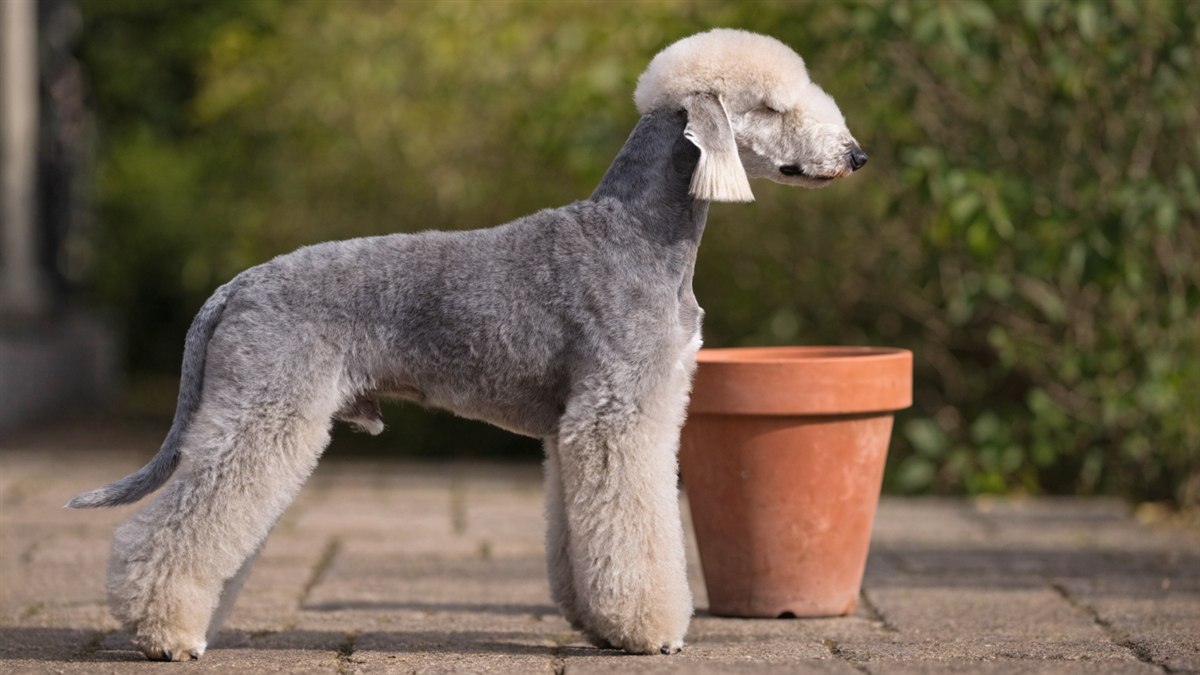
A Bedlington Terrier is a small British terrier of about 41 cm at the withers and 8 to 10 kg, built with an arched loin, a pear-shaped skull with no stop, and a thick linty coat that stands out from the skin. Both recognising registries describe the same dog, and neither says anything at all about shedding.
The Royal Kennel Club, the breed's home registry, sets height at about 41 cms (16 ins) at the withers and weight at 8 to 10 kgs (18 to 23 lbs), allowing slight variation below in a bitch and above in a dog. The Federation Cynologique Internationale registers the same animal as FCI-Standard No. 9, in Group 3 Terriers, Section 1 Large and medium sized Terriers, accepted on a definitive basis on 20 June 1963, country of origin Great Britain, and not subject to a working trial. The two standards are close to word-identical because the FCI text is the British one, published in its current valid form on 13 October 2010.
The head is the breed, and it matters more than it looks
The skull clause is the most consequential sentence in the whole standard for an Indian buyer. It requires a narrow skull, deep and rounded, a long tapering jaw, and no stop at all, so that the line from occiput to nose end runs straight and unbroken, with nostrils large and well defined. That is a full-length muzzle over a wide airway. McMillan and colleagues classified the breed as Small and Dolichocephalic in the supplementary data of their 584,734-dog UK study, which is the formal way of saying long-skulled. Every heat judgement further down this page rests on that classification, because a dog cools by moving air over a wet respiratory surface and a long muzzle is a longer evaporative surface.
The coat clause, in full, because it is short
The coat clause reads 'Very distinctive. Thick and linty, standing well out from skin, but not wiry. A distinct tendency to twist, particularly on head and face';. The FCI prints the identical sentence. That is the complete official description of the coat. It contains no reference to shedding, no reference to allergies, no reference to an undercoat and no reference to clipping. Anyone telling you the standard calls this breed hypoallergenic has not read it.
| Point | Royal Kennel Club | FCI Standard No. 9 |
|---|---|---|
| Height at withers | About 41 cms (16 ins) | About 41 cms |
| Weight | 8-10 kgs (18-23 lbs) | Between 8-10 kgs |
| Stop | There must be no 'stop' | There must be no stop |
| Ears | Filbert shaped, set on low, hanging flat to cheek | Filbert-shaped, set on low, hanging flat to cheek |
| Tail | Moderate length, gracefully curved, set on low | Moderate length, gracefully curved, set on low |
| Coat | Thick and linty, standing well out from skin | Thick and linty, standing well out from skin |
| Colour | Blue, liver, or sandy with or without tan | Blue, liver, or sandy with or without tan |
| Shedding | Not mentioned | Not mentioned |
Note the tail clause. The standard describes a natural tail of moderate length, gracefully curved and set on low, never carried over the back. Nothing in this breed is docked or cropped, so an Indian owner never has to weigh a breed tradition against Indian law here, which is not true of the Dobermann or the Boxer.
Where it came from
The breed is named for the Northumberland mining town of Bedlington and was known further north as the Rothbury Terrier. The FCI's historical summary claims the Bedlington can boast a longer traceable pedigree than any other terrier, records that an association was started for the breed in 1877, and describes its original job as catching rabbits for the family pot. The lamb-like silhouette is a by-product of the arched loin, the tucked-up underline and the trimmed coat, not of any relationship to sheep. Royal Canin's Indian breed page, drawing its facts from the FCI, notes the breed is able to gallop at high speed and gives an average life expectancy of 14 to 16 years.
A breed standard describes conformation, not disease. Nothing in either standard mentions copper toxicosis, and copper toxicosis is the reason this breed is famous in veterinary medicine. Read the next three sections before you read anything else on this page.
Copper toxicosis: exactly what the mutation is
Copper toxicosis in the Bedlington Terrier is caused by a 39.7 kb deletion on dog chromosome 10 that removes exon 2 of the COMMD1 gene, formerly called MURR1. The deletion is inherited as a simple autosomal recessive, it destroys the protein completely, and the dog then cannot excrete copper into bile, so copper accumulates in the liver from about one year of age.
The gene was found by positional cloning in 2002. Van de Sluis and colleagues mapped the locus to dog chromosome region 10q26, narrowed it to under 500 kb by linkage disequilibrium mapping using DNA from privately owned dogs, and then reported that exon 2 of the MURR1 gene 'is deleted in both alleles of all affected Bedlington terriers and in single alleles in obligate carriers';. That single sentence is the whole inheritance pattern. Two deleted copies and the dog is affected. One deleted copy and the dog is a carrier that will never itself be ill.
The deletion, measured
Forman and colleagues defined the breakpoints in 2005. They sit at 65.3091 Mb and 65.3489 Mb of dog chromosome 10, one in intron 1 and one in intron 2 of COMMD1, and the span between them is a deletion of 39.7 kb. Subtract the two coordinates yourself and you get 0.0398 Mb, which is 39.8 kb; the published 39.7 kb is the same number after the coordinates are rounded to four decimal places, so the arithmetic holds. The two breakpoints share sequence homology, which suggests homologous recombination caused the deletion in the first place. Labgenvet describes the same lesion as a 39.7 kb deletion spanning introns 1-2 and 2-3 and removing exon 2.
The gene has been renamed since. MURR1 in the 2002 and 2003 literature is COMMD1 in everything written after about 2005, and the two names refer to one gene. An Indian owner reading a 2003 paper and a 2024 lab report is looking at the same thing under two labels.
What the missing protein does to a dog
COMMD1 sits on dog chromosome 10 and encodes a protein that regulates copper metabolism and homeostasis, and deleting exon 2 leads to the complete absence of that protein. Without it, biliary excretion of copper fails. Copper then accumulates predominantly in hepatocellular lysosomes. Dogs deposit that copper centrilobularly, in zone 3 of the liver lobule, which is different from human Wilson disease patients, who start periportally. The practical consequence is that this is a liver disease and only a liver disease. Human Wilson patients get neuropsychiatric and ocular signs; dogs with copper toxicosis get hepatic disease alone.
| Age | What is happening | What an owner can see |
|---|---|---|
| Birth to 1 year | Copper begins to accumulate in the liver | Nothing |
| From about 1 year | Copper accumulation is detectable on liver sampling | Nothing |
| 2 to 6 years | Acute form can present with enlarged liver, jaundice, haemolytic anaemia | Sudden, severe illness |
| 3 to 4 years | Typical age at which clinical signs of copper toxicity appear | Lethargy, anorexia, vomiting, increased drinking and urination |
| 3 to 7 years | Untreated dogs develop liver disease and die | Jaundice, weight loss, ascites, hepatic encephalopathy |
Labgenvet dates copper accumulation as detectable from one year of age and clinical signs at three to four years. The Royal Kennel Club puts it more bluntly: without treatment, affected dogs develop liver disease and die, usually between 3 and 7 years of age, and 'This disease does not typically show any signs in the earlier stages'. Kim and colleagues split the presentation in two. The acute form brings non-specific signs including an enlarged liver, jaundice and haemolytic anaemia, usually between 2 and 6 years of age. The chronic form produces progressive liver damage in middle-aged and older dogs with less severe signs.
An affected Bedlington puppy looks exactly like a clear one. It plays, eats, grows and passes every ordinary check-up while copper accumulates. By the time an Indian owner notices jaundice or a swollen belly, the liver has been loading for two to five years. This is why the genetic test exists and why buying an untested puppy is a gamble with a delayed result.
Does the COMMD1 test catch every case? No, and four registries say so
A clear COMMD1 genetic test is not a clean bill of health. Bedlington Terriers with copper toxicosis and without the exon 2 deletion have been documented since 2003, and by 2023 the same research group that first characterised the disease concluded the deletion 'is no longer the primary cause' of it. The test rules out one cause. It does not rule out the disease.
Read the wording of the founding papers carefully and the caveat is already there. Forman and colleagues wrote that the exon 2 deletion 'was shown to be the major cause of copper toxicosis';. Major, not sole. Kim and colleagues, reporting a national screening programme, note in their own discussion that 'the COMMD1 gene mutation is not the single cause' of the disease.
2003: affected dogs without the deletion
Coronado and colleagues assembled a collection of Bedlingtons for haplotype analysis and found the exception immediately. In their words, 'our collection also included affected 1-1 homozygotes and 1-2 heterozygotes, and these dogs did not have the homozygous deletion'. They also found a recombinant haplotype in a North American pedigree in which the old C04107 marker allele 2 is not linked with the deletion at all, and a fourth haplotype carrying a splice site variant which, although it looks like a normal variant, 'is present in two affected dogs, which do not carry homozygous deletions of MURR1';. That was 2003, two years before the commercial deletion test was even designed.
2016 and 2023: the same laboratory, two different answers
Haywood and colleagues went looking for the missing gene in 2016. They ran a genome-wide association study on 30 non-COMMD1 Bedlington Terriers, equal numbers of copper-toxicosis cases and controls, and found a significantly associated region on chromosome 37 containing ABCA12. Their opening premise is worth quoting because it settles the question on its own: 'Bedlington terriers with CT and lacking this mutation are also recognised';.
Seven years later the same lead author tested that finding on a larger set of 24 affected and 10 unaffected Bedlingtons with liver samples as well as DNA, plus 144 dogs of other breeds. The ABCA12 single nucleotide polymorphisms 'showed no differences between groups';. The 2016 result did not replicate. What did associate was the Labrador Retriever variant ATP7B:c.4358G>A, which was significantly more frequent in affected than unaffected Bedlingtons, and which 35 of the 144 dogs of other breeds also carried in one or two copies, or 24.3 percent of them. Bonbeno publishes both papers rather than the convenient one. A 2016 finding that its own authors failed to confirm in 2023 is exactly the kind of thing a breed page should show a reader instead of quietly dropping.
The finding that should change how you read a test certificate
Haywood's 2023 paper reports that the COMMD1 deletion was less frequent in affected dogs after 2001 than before it, and concludes flatly that 'The COMMD1 deletion remains present in Bedlington terriers but is no longer the primary cause of CT';. That is what two decades of testing did. Breeders removed the deletion from the population, the deletion's share of the remaining disease fell, and the disease did not disappear with it.
| Authority | Its own words |
|---|---|
| Royal Kennel Club | 'While the test for this mutation is definitive, it is possible that there are other genetic causes of CT not yet identified' |
| Orthopedic Foundation for Animals | 'Note that there may be other mutations that could cause copper toxicosis. If your dog is exhibiting signs consistent with copper toxicosis but is not homozygous for the COMMD1 mutation, please contact us' |
| Labgenvet, Universite de Montreal | 'DNA tests for the COMMD1 mutation have reduced but not eliminated copper toxicosis in Bedlington Terriers, indicating that mutations in other genes must also be involved' |
| Haywood et al. 2023, Veterinary Record | 'The COMMD1 deletion remains present in Bedlington terriers but is no longer the primary cause of CT' |
| Veterinary Genetics Laboratory, UC Davis | 'Dogs with an N/N genotype have no copies of the ATP7B variant... however other yet unknown variants cannot be ruled out by this genetic test' |
Labgenvet states the position that follows from all of this: 'Copper toxicosis in the dog remains a polygenic disease with environmental contributions';. Environmental means dietary copper, which is the one variable an Indian owner controls directly.
A COMMD1-clear result means your dog does not have two copies of the 39.7 kb exon 2 deletion. It does not mean your dog cannot develop copper toxicosis. Treat it as one risk removed, keep dietary copper sensible for life, and if a Bedlington ever shows jaundice, ascites or unexplained vomiting, tell the vet the breed history even if the DNA test came back clear.
How common is it? The real carrier frequency, with denominators
The carrier frequency for copper toxicosis in Bedlington Terriers has fallen from roughly two dogs in five to under one in two of a small screened population, and every published figure comes with a country, a sample size and a year. A percentage without a denominator is not a fact, so here are all three published datasets in full, including the arithmetic that does not add up.
Three studies carry usable numbers. They were done in different countries, in different decades, by different methods, and the honest way to present them is together rather than as one headline figure.
West Europe, 1999, 130 dogs, diagnosed by liver biopsy
Rothuizen and colleagues took liver biopsies from 130 Bedlington Terriers at least one year of age, 62 from the Netherlands, 35 from Belgium and 33 from Germany, and stained them histochemically or cytochemically for copper. Fifty-one dogs were obligate carriers and 25 had copper toxicosis. Divide those out against 130 and you get 39.2 percent carriers and 19.2 percent affected, so at least 58.5 percent of the sampled population carried a disease allele. The remaining 54 dogs were phenotypically healthy and the paper does not split them into clear and carrier, since a healthy dog there could be either, so the true carrier rate in that sample is 39.2 percent or higher rather than exactly 39.2 percent. The disease-allele frequencies they measured were 0.33 in Dutch dogs, 0.31 in German dogs and 0.57 in Belgian dogs. This is the pre-DNA-test baseline, and it is grim.
Korea, published 2016, 105 dogs, diagnosed by multiplex PCR
Kim and colleagues genotyped 105 Bedlington Terriers from private clubs and kennels across Korea, aged two months to eleven years, of which 74 were under two years old. Fifty-two were wild-type homozygotes at 49 percent, 47 were heterozygote carriers at 45 percent, and 6 were affected homozygotes at 6 percent, giving a mutant allele frequency of 28 percent. Check the arithmetic and it holds: 52 of 105 is 49.5 percent, 47 of 105 is 44.8 percent, 6 of 105 is 5.7 percent, and the allele frequency works out at 59 of 210 alleles, or 28.1 percent.
| Population | Reported year | Dogs tested | Clear | Carrier | Affected | Disease allele frequency |
|---|---|---|---|---|---|---|
| Korea | 2016 | 105 | 52 (49%) | 47 (45%) | 6 (6%) | 28% |
| Australia | 2007, as reproduced in 2016 | 147 printed, counts sum to 149 | 60 (40%) | 47 (32%) | 42 (28%) | 44% |
| Belgium | 1999, as reproduced in 2016 | 51 | 10 (20%) | 24 (47%) | 17 (33%) | 57% |
| Netherlands, Belgium and Germany | 1999, from the source paper | 130 | 54 healthy, genotype not split out | 51 (39.2%) | 25 (19.2%) | 0.33 NL, 0.31 DE, 0.57 BE |
Two numbers in that table do not survive a calculator
The Australian row is reproduced from Lee, Filippich and Hyun's 2007 screening study. Its three genotype counts are 60, 47 and 42, which sum to 149, against a printed total of 147. The allele frequency of 44 percent is consistent with either total, so the likely explanation is a transcription error in one of the two figures rather than fabricated data, but Bonbeno cannot verify which because the PubMed record for the source paper carries no abstract at all. Treat the Australian counts as approximate.
The Belgian row is attributed to Rothuizen 1999, and it does not match that paper. Rothuizen sampled 130 dogs of which 35 were Belgian, and reported 51 obligate carriers across the whole three-country set. The reproduced row gives a Belgian total of 51 dogs with genotypes 10, 24 and 17. Run Hardy-Weinberg on the published Belgian allele frequency of 0.57 against 51 animals and you get expected counts of 9.4, 25.0 and 16.6, which round to exactly 10, 24 and 17. That row is very probably a calculated expectation rather than 51 Belgian dogs someone actually genotyped, and the number 51 is the same 51 as Rothuizen's carrier count. Do not quote it as an observed Belgian survey.
The trajectory, which is the part that matters
Read in date order, the numbers fall. A 1999 West European biopsy series found 19.2 percent of tested dogs already affected. A Korean population screened after the DNA test existed found 5.7 percent affected. Kim's own reading is that other countries have kept mutant gene frequency low by excluding dogs with the genetic defect from breeding, while Korea's carrier rate stayed high because 'some of the terriers introduced were not tested or were tested by inaccurate methods';. Haywood's 2023 series adds the other half of the story: the COMMD1 deletion was less frequent in affected dogs after 2001 than before it, because testing worked on that mutation specifically.
Kim's group warned that eliminating every carrier at once would shrink genetic diversity in a small population, and recommended breeding quality carrier dogs to clear dogs, then replacing the carrier parent with a clear offspring. The Orthopedic Foundation for Animals gives the same advice: a carrier bred to a clear dog produces no affected puppies while keeping the gene pool wide. Since this is an inherited recessive condition, a buyer only needs one parent verified clear to be safe from the COMMD1 form.
Can you get the test done in India? Partly, and the gap matters
An Indian owner can buy a canine genetic test in India for about Rs 4,500, and the published panel includes Wilson disease and Menkes disease, which in dogs are the ATP7B and ATP7A copper-transport variants. What no Indian laboratory Bonbeno could find offers by name is the Bedlington-specific COMMD1 deletion test, and the two do not substitute for each other.
Start with what the overseas registries sell, because that is what a breeder abroad will have run. The Royal Kennel Club sells a COMMD1 DNA test directly and names it the single Good Practice health test for the breed. The Orthopedic Foundation for Animals runs a Bedlington-only COMMD1 test whose samples are processed by the Small Animal Molecular Genetics Lab at the University of Missouri, collected at home on a buccal swab with no veterinary appointment needed. Labgenvet in Canada lists the same mutation.
What is actually sold in India
Urban Animal, based in Bangalore, sells a Trace Test at Rs 4,500, reduced from Rs 7,500, covering what it calls 130-plus genetic conditions plus 20 physical traits, with free pan-India shipping and sample pickup, a four to six week turnaround and a complimentary consultation with its geneticist and vets. Its backend laboratory is GeneTech in Hyderabad, an NABL-accredited lab that says it pioneered genetic testing in India in 1998 and prices a canine traits and disorders test at Rs 7,000 with an 18-day turnaround. Divide either rupee figure by 84.38 and you get 53.33 and 82.96 dollars, neither of them a round number, so these are prices set in rupees rather than an unconverted American figure.
Bonbeno read Urban Animal's published condition list in full. It contains 'Menkes Disease' and 'Wilson Disease' next to each other, alongside Thrombopathia, Von Willebrand disease types I, II and III, Hypothyroidism, Progressive Retinal Atrophy and Congenital Stationary Night Blindness. Search that list for COMMD1 and you find nothing. Search it for the phrase copper toxicosis and you find nothing.
Why Wilson disease on a dog panel is not the Bedlington test
In canine genetics, Menkes and Wilson are the standard labels for two copper-transport genes. The Veterinary Genetics Laboratory at UC Davis sells them as one test called Copper Toxicosis (Menkes and Wilson diseases), where ATP7A c.980C>T is the Menkes variant governing intestinal copper absorption and ATP7B c.4358G>A is the Wilson variant governing biliary copper excretion. That laboratory states that 'the ATP7B variant is also appropriate for Doberman Pinschers, Black Russian Terriers and Bedlington Terriers', and then prints the warning that decides this whole question: 'This assay does not detect the COMMD1 variant';.
Bonbeno has not confirmed with Urban Animal that its Wilson disease entry is that same ATP7B assay, and says so plainly rather than assuming it. What is certain is that COMMD1 is not on the published Indian list, and that a Wilson disease result on any canine panel is an ATP7B result, not a COMMD1 result.
| Test | Gene | Where to buy it | Indicative price | What it does not cover |
|---|---|---|---|---|
| COMMD1 deletion test | COMMD1 exon 2, 39.7 kb deletion | Royal Kennel Club, OFA via University of Missouri, Labgenvet | Overseas, not found on an Indian panel | ATP7B, and any cause not yet identified |
| Copper toxicosis panel | ATP7A and ATP7B | UC Davis Veterinary Genetics Laboratory | USD 58 single test | Stated explicitly: does not detect the COMMD1 variant |
| Trace Test, 130+ conditions | Includes Wilson and Menkes entries | Urban Animal, Bangalore, laboratory in Hyderabad | Rs 4,500 | COMMD1 is not on the published list |
The twist that makes the Indian panel more useful than it looks
Haywood's 2023 series found the ATP7B variant significantly more frequent in affected Bedlingtons than unaffected ones, and UC Davis summarises the same study as having identified affected Bedlingtons carrying two copies of ATP7B and no copies of the COMMD1 deletion at all. On that evidence an ATP7B screen is not a poor substitute for the COMMD1 test. It is the other half of the picture, and arguably the currently more informative half. The honest answer for an Indian buyer is that you want both, and that neither is a guarantee: UC Davis warns that a clear ATP7B result cannot rule out 'other yet unknown variants', and Urban Animal's own FAQ says a negative result 'does not imply that the dog cannot get that particular disease';.
Ask the Indian laboratory one question: does your panel test the COMMD1 exon 2 deletion, and if not, which copper genes does the Wilson disease entry cover. Ask any seller a second question: show me the COMMD1 certificate for both parents, with the dog's microchip number on it. A verbal assurance that a litter is tested means nothing when the mandatory Indian screening list does not include this disease at all, which is the next section.
India's mandatory screening list does not name copper toxicosis
India does compel registered dog breeders to screen for genetic defects, and the list of defects is written out in full in the gazette. Copper toxicosis is not on it. The word copper does not appear anywhere in the Prevention of Cruelty to Animals (Dog Breeding and Marketing) Rules, 2017, and neither does liver.
The operative clause is Second Schedule Part III paragraph 8(10), which sits under the heading Veterinary care. Bonbeno downloaded the 14-page machine-readable gazette copy, extracted 51,953 characters of text with pypdf, and read the clause rather than a summary of it. It says in full: 'The dogs shall have been tested for genetic defects, including hip dysplasia, progressive retinal atrophy, night blindness, hypothyroidism, entropion, ectropion, overshot, undershot jaw (when incisors do not touch or mesh), wry mouth, two or more missing teeth, unilateral cryptorchid or full cryptorchid males';.
The search, and the control that proves it ran
Searching a document for a word you expect to be absent is only evidence if you first prove the search works. Bonbeno counted occurrences in the extracted text. Copper appears 0 times. Toxicosis appears 0 times. Liver appears 0 times. The control terms in the same file, in the same run, returned dog 140 times and veterinar 33 times. The extraction worked and the search worked. The absence is real.
| Named in Second Schedule Part III para 8(10) | What kind of defect it is |
|---|---|
| Hip dysplasia | Orthopaedic |
| Progressive retinal atrophy | Ocular, inherited |
| Night blindness | Ocular, inherited |
| Hypothyroidism | Endocrine |
| Entropion and ectropion | Eyelid conformation |
| Overshot and undershot jaw | Bite conformation |
| Wry mouth | Jaw conformation |
| Two or more missing teeth | Dentition |
| Unilateral or full cryptorchid males | Reproductive conformation |
| Copper toxicosis | Not listed |
Nine of the eleven items on that list are things a judge could see in a show ring. The list is a conformation and soundness list with an endocrine test bolted on. It contains no breed-specific inherited metabolic disease of any kind, and the one disease this particular breed reliably dies of is therefore outside the scope of India's mandatory breeder screening. That is worth publishing plainly rather than hedging: an Indian breeder who follows the Rules to the letter is fully compliant while selling an untested Bedlington Terrier puppy.
The clause in the same Rules that does help, without meaning to
Second Schedule Part II paragraph 6(3) prohibits in-breeding, defined as mating between dogs related within the first four generations including uncle to niece, nephew to aunt, cousin to cousin and grandparent to grandchild, and also prohibits incest breeding between parents and children or brother and sister. Only out breeding and line breeding are permitted. That is the most useful copper-toxicosis provision in Indian law, and it never mentions copper. A recessive disease surfaces when two carriers meet, and close relatives are the fastest way to make that happen. Kim's team noted that their six affected Korean dogs were not genetically related to each other within three generations, which is what an outbred population looks like.
Two more clauses a Bedlington buyer should hold a seller to
- Rule 8(1)(a): pups less than eight weeks in age are not sold. A Bedlington offered at six weeks is an illegal sale, whatever the seller says about the puppy being ready.
- Rule 8(1)(e) and 8(1)(g): each pup sold must be micro-chipped, with a complete record of treatment and vaccination maintained, and the receipt must be retained against the microchip number. Insist the microchip number appears on the health certificate and on any DNA test result, so the certificate is tied to the actual dog.
- Rule 8(2): the breeder must furnish, in writing, details of feeding, dates of inoculations and de-worming, and the name and address of the attending veterinary practitioner. Ask for that document and call the vet.
- Second Schedule Part II para 6(8): tail docking, ear cropping, de-barking, de-clawing, branding, dyeing and 'any other kind of mutilation of any body part of the pup' are strictly forbidden. This bites here. The Indian page holding position one for this breed tells readers that in the Bedlington, 'Dewclaws are normally expelled', which is advice to perform a procedure Indian law prohibits.
The 2017 Rules number clauses twice. There is a Rule 8, headed Conditions for sale, and a separate Second Schedule Part III paragraph 8, headed Veterinary care. The genetic screening list is the Second Schedule one, at paragraph 8(10). The eight-week sale ban is Rule 8(1)(a). Quoting the wrong 8 is how people end up reporting a real rule as absent.
Bedlington Terrier price in India: what the ranking pages actually publish
No verified Bedlington Terrier price in India exists. Bonbeno opened all ten pages that rank in India for this query plus three more that Bing surfaces, and between thirteen pages carrying the words price or cost in India in their titles, exactly one rupee figure appears anywhere.
This is the finding, so it goes first rather than at the bottom. Four of the top ten are empty template shells. One prints a result count above dogs of other breeds. One has an Open Graph price field reading 0.00. One is a manufacturer's breed page with no commercial offer. India's largest published dog price list, which holds page one for the head term and tabulates 40 breeds from the Labrador Retriever at Rs 8,000 to Rs 80,000 down to the adopted indie at Rs 0 to Rs 3,000, does not contain the Bedlington Terrier at all.
| Position | Page | Rupee price published | What it actually is |
|---|---|---|---|
| 1 | Poddarkennel | None | Spun overseas breed text; every Open Graph tag on it belongs to the site's Pug page |
| 2 and 5 | Mr n Mrs Pet | None | Mumbai page prints '3 Result Found' above two French Bulldogs and a Border Collie |
| 3 | Dav Pet Lovers | None | Verbatim American Kennel Club copy; og:price:amount reads 0.00 |
| 4 | Breed n Breeder | None | Three headings and a phone number |
| 6 | Supertails price list | Not listed | 40-breed national price table that omits the breed |
| 7 | Royal Canin India | None | Manufacturer breed page, facts sourced from the FCI |
| 8 | Call 4 Dog | None | Title tag still reads 'Puppy for sale in 2 dog' |
| Bing 3 | BarkJunction | Rs 8,000 | The only rupee figure found, on a page that also calls the breed high-priced |
| Bing 4 | PawCosts | None | India URL redirects to a UK-cohort page that says country defaults are unavailable |
| Bing 8 | Asia Pets | None | Title promises a price; lists Hypoallergenic as advantage one |
| Bing 9 | Animal Jankari | None | Titled 'Cost In India' and contains no rupee figure |
The one figure, and why it does not survive contact with the rest of the market
BarkJunction writes that 'The Bedlington Terrier is considered a high-priced breed, with most puppies selling for around rs.8000';. That sentence refutes itself. Rs 8,000 is the floor of the Indian Labrador range on the same national price list, and the cheapest number attached to any large popular breed in it. A rare imported terrier cannot simultaneously be high-priced and cost less than a pet-quality Labrador.
Run the exchange-rate check that catches most invented Indian prices. Rs 8,000 divided by 84.38 is 94.81 dollars. Rs 4,000 is 47.40, Rs 2,000 is 23.70, Rs 500 is 5.93. None of those is a round dollar figure, so this is not the usual failure of a US price run through one exchange rate. It is a figure with no visible origin at all, on a page whose sole cited reference is Wikipedia and whose own spec table calls the breed's grooming 'Low maintenance' two paragraphs before the body text says it 'requires extensive grooming';.
What comparable small breeds do cost in India
Since no Bedlington figure can be verified, the useful thing is the band its nearest cross-shopped breeds sit in. On the same 40-breed table, the Scottish Terrier runs Rs 30,000 to Rs 80,000, the Bull Terrier Rs 25,000 to Rs 70,000, the Bichon Frise Rs 30,000 to Rs 80,000 and the Miniature Schnauzer Rs 30,000 to Rs 80,000. Every one of those is a small or medium coated breed with an established Indian presence. A genuinely rarer breed would sit at or above the top of that band, not at a tenth of its floor.
This page does not print a Bedlington Terrier price in India, because no figure Bonbeno could open stands up. If a seller quotes you one, ask which litter it is for, ask for the dam's and sire's COMMD1 certificates with microchip numbers, and ask which port and import authorisation the parents came in under. The answers, or the absence of them, will tell you more than the number.
Where would an Indian Bedlington even come from?
Only one lawful route brings a Bedlington Terrier into India: in the hands of a person moving their residence home after two years abroad, with a valid pet book in their own name. Every commercial breeding import is refused by policy, and the entry points are limited to seven cities.
DGFT Trade Notice No. 22/2022-23, dated 19 December 2022, sets the position. Under ITC(HS) 01061900, Mammals Other, the import policy is Restricted. Policy Condition 7 permits dog imports only for three purposes: a pet dog with a valid pet book and records in the importer's name, dogs imported by research organisations with a recommendation from the Committee for the Purpose of Control and Supervision of Experiments on Animals, and internal security use by the Defence and Police Force. Policy Condition 8 states that import of commercial dogs for breeding or any other commercial activity is not permitted.
Paragraph 6 of the same notice removes any ambiguity: 'any applications for trading/breeding purposes, or applications made on behalf of some another person/entity shall be duly rejected'. Paragraph 7 limits entry to the airports and seaports of Delhi, Mumbai, Chennai, Hyderabad, Bangalore and Kolkata, with quarantine at the port where required. DAHD added a seventh port, Cochin International Airport at Kochi, for pets arriving under the baggage rules in October 2024. Paragraph 5 advises applicants to start the import authorisation process at least two months before travel. The full route is set out in how to import a dog to India.
- Permanent import as baggage: allowed without a DGFT authorisation only to a person transferring residence to India after two years of continuous stay abroad, and only for up to two pets.
- Under two years abroad: a DGFT import authorisation is required, applied for against an Importer Exporter Code or the permanent personal-use code.
- More than two pets: DGFT authorisation required, with the application examined by the Department of Animal Husbandry and Dairying first.
- For breeding or resale: refused by policy, in two separate places in the same document.
What that means for the shape of the Indian population
Between them, Policy Conditions 7 and 8 mean no commercial breeding pipeline for this breed can lawfully form in India. Any Indian Bedlington traces back to a returning resident's household pet, or it did not come in through the front door. That is not a moral point, it is a supply-chain one, and it explains why the pages selling this breed have nothing to show you.
The registry numbers, for scale
The Kennel Club of India is the FCI's member body for India, and the FCI publishes the KCI's own returns. In 2025 the KCI registered 33,880 pure-bred dogs with its studbook, from 7,412 litters, across 80 member clubs, with 28 FCI judges and 342 individual members. In 2021 the figure was 89,571 dogs. That is a fall of 55,691 registrations, or 62.2 percent in four years. The FCI does not publish a per-breed Indian breakdown, so Bonbeno cannot tell you how many Bedlington Terriers are on that studbook, and does not guess. What the total does tell you is the size of the pool a rare terrier would have to be drawn from, and it is shrinking.
| Year | Pure-bred dogs registered | Litters registered | Member clubs |
|---|---|---|---|
| 2021 | 89,571 | 8,500 | 82 |
| 2022 | 76,011 | 7,520 | 84 |
| 2023 | 47,679 | 6,850 | 84 |
| 2024 | 38,592 | 7,828 | 81 |
| 2025 | 33,880 | 7,412 | 80 |
So what is the reader actually being offered?
Three things, on the evidence of the pages themselves. A template page generated for every breed in a dropdown list, which is what Breed n Breeder is, its entire body being three headings and a phone number, and what Call 4 Dog is, its title tag still carrying the unfilled placeholder 'Puppy for sale in 2 dog';. A listing page that returns other breeds under a Bedlington heading, which is what the Mr n Mrs Pet Mumbai page does when it prints '3 Result Found' above two French Bulldogs and a Border Collie. Or overseas breed copy reworded, which is what the page holding position one is, down to serving the site's Pug metadata on a Bedlington URL. Bing India reports about 280 total results for the entire query. That is the size of the Indian corpus on this breed.
None of this means you cannot have this dog in India. It means the honest path is a returning-resident import you make yourself, or an adoption. Both are covered in the adoption section, with what to verify at each step.
Monthly cost of keeping a Bedlington Terrier in India
Budget the small-breed Indian baseline of roughly Rs 4,000 to Rs 8,000 a month, then add two line items no generic table covers: a professional clip every six to eight weeks, and a one-off genetic screen. Both are specific to this breed and both are avoidable only by taking a worse risk.
The national small-breed monthly cost structure, published by Supertails for a Pomeranian or Shih Tzu sized dog, totals Rs 4,000 to Rs 8,000. A Bedlington at 8 to 10 kg sits in that bracket by weight. Notice one thing about that table before you use it: the small-breed grooming line, at Rs 1,500 to Rs 3,000 a month, is the only line where a small dog costs more than a Labrador, whose grooming line is Rs 500 to Rs 1,200. That is because small breeds in India are the clipped ones, and this breed is among the most heavily clipped of all.
| Line | Indian small-breed baseline | What changes for a Bedlington |
|---|---|---|
| Dry or wet food | Rs 1,500-2,500 | Same, unless a copper-restricted diet is prescribed |
| Routine vet visits | Rs 500-1,000 | Same, plus liver-value bloods if the dog is untested |
| Vaccinations | Rs 1,200 a year | Same |
| Grooming | Rs 1,500-3,000 | The binding line. A full clip every 6 to 8 weeks, not a bath |
| Training over six months | Rs 0-3,000 | Same; the breed is trainable but stubborn |
| Treats and toys | Rs 300-800 | Same |
| Flea, tick and deworming | Rs 300-600 | Higher in monsoon and in tick-heavy cities |
| Monthly total | Rs 4,000-8,000 | Add the clip if your groomer charges per session |
The clipping arithmetic, which is the number people get wrong
Indian pages report a Bedlington clip and trim at Rs 500 to Rs 2,000 per session depending on the dog's size and age, and describe the coat as needing trimming every six to eight weeks. Do the division. A six-week cycle is 8.7 sessions a year and an eight-week cycle is 6.5, so the annual clipping bill lands between Rs 3,250 and about Rs 17,300, which is Rs 271 to about Rs 1,440 a month. That is a spread of more than five times, and where you fall inside it depends almost entirely on whether you learn to clip the body yourself and pay a groomer only for the head.
The two one-off costs a first-time buyer never budgets for
- A genetic screen, about Rs 4,500. The Indian Trace Test covering 130-plus conditions is Rs 4,500 with free pan-India pickup and a four to six week turnaround. It is a once-in-a-lifetime cost and the single highest-value rupee you will spend on this breed.
- A liver assessment if the dog is untested or symptomatic. Bonbeno could not find a published Indian rupee price for a canine liver biopsy or for quantitative hepatic copper measurement, and does not invent one. Ask a referral hospital in your city for both quotes before you need them, not after.
If the dog turns out to be affected
A copper-restricted prescription diet becomes a permanent monthly line. Royal Canin Hepatic is sold in India as a veterinary-exclusive formula in 1.5 kg and 6 kg bags, and its own feeding table puts a 10 kg dog of normal body condition at 158 g a day. Multiply that out and a Bedlington eats roughly 4.7 kg a month, so a 6 kg bag lasts about five weeks. Price that locally through your vet, because it is not sold over the counter, and check whether your city stocks it at all before you commit to the breed.
Rs 4,500 spent on a genetic screen at eight weeks is trivial against the cost of managing a liver failure at four years, and it is the difference between planning a diet and reacting to a crisis. If a budget only stretches to one optional thing in year one, make it the test, not the designer bed.
Heat tolerance in Indian cities, rated from the standard
Bonbeno rates this breed 3 out of 5 for heat tolerance, and the rating comes from two clauses in the breed standard rather than from an opinion. The head is built for cooling and the coat is built for insulating, and those two facts pull in opposite directions.
A dog sheds heat by moving air over a wet respiratory surface, so the length of the airway between the nose and the throat is the single biggest structural determinant of how well it copes with heat. The standard requires no stop at all, with 'the line from occiput to nose end straight and unbroken', and 'Nostrils large and well defined';. That is a full-length muzzle over a wide intake. McMillan and colleagues classify the breed as Dolichocephalic in their supplementary data, which is the formal confirmation.
The size clause helps too. At 8 to 10 kg the dog has a high surface area relative to its mass, so it loses heat faster than a 40 kg dog of the same shape. Nothing about this breed's head or body carries the penalty that flat-faced breeds carry in Indian summers.
What pulls the rating back down to 3
The coat clause requires a coat 'Thick and linty, standing well out from skin';. Thick is insulation. What saves it is the phrase standing well out from skin: unlike a flat-lying jacket, air can move between the coat and the body. The ears are the second problem. They are 'set on low, and hanging flat to cheek', which is a closed ear canal in a hot, humid country, and that has consequences dealt with in the next section.
The third is behavioural. Royal Canin's Indian breed page notes the breed is 'able to gallop at high speed', and the standard says it is 'Capable of galloping at high speed and have appearance of being able to do so'; The Royal Kennel Club (UK). A dog built to sprint, in a body that enjoys it, will run itself into heat trouble at 2 pm if you let it.
| City type | Verdict | What it takes |
|---|---|---|
| Hill stations: Ooty, Shimla, Gangtok, Munnar | Comfortable | Normal walking. The coat is an asset here |
| Bengaluru, Pune, Hyderabad | Workable | Dawn and after-dark walking through March to June; indoor play at midday |
| Mumbai, Kolkata, Chennai | Hard on the dog | Air-conditioned indoor hours, humidity is worse than the temperature here |
| Delhi, Jaipur, Nagpur, Ahmedabad | Unfair in summer | Six weeks a year where outdoor exercise is not honestly possible |
The pads, which no other page will tell you about
The Royal Kennel Club runs a Breed Watch scheme listing conformational points judges must scrutinise. The Bedlington Terrier is Category 2, and it carries exactly one point of concern: 'Cracked and/or corny pads';. The standard itself requires pads 'sound and free from cracks or horny excrescences';. That is a registry telling you, in Britain, that this breed's feet are its documented weak point, and Indian pavement in May is the harshest surface a dog's feet will ever meet. Walk on grass or on the shaded side, test the tar with the back of your hand before you step out, and check the pads for splits every week.
Clipped, never shaved
The standard describes the coat as standing well out from the skin, which means the coat is the layer between the sun and the skin. A Bedlington is trimmed and clipped to a length, not stripped to bare skin like a terrier that is hand-stripped, and a groomer told to 'shave it for the summer' is removing the barrier that keeps a light-skinned dog from burning. Ask for a short clip, not a shave, and never take a blue or sandy dog down to the skin on its back.
Heavy open-mouth panting that does not settle within a few minutes of shade and water, a bright red or purplish tongue, staggering, or refusing to move. Because this dog will keep running while it is enjoying itself, an owner has to make the decision the dog will not. Treat any of these as an emergency and get to a vet, cooling with room-temperature water on the belly and paws on the way.
Drop ears in the Indian monsoon: the ear-and-skin season
Ear infections in Indian dogs peak in the rains, and the Bedlington's drop ears are the shape that traps the moisture. A published Indian series from Palam Valley in Himachal Pradesh found 59.25 percent of a year's otitis externa cases arriving in July and August alone.
Start with the ear the standard describes. It is 'Moderately sized, filbert shaped, set on low, and hanging flat to cheek. Thin and velvety in texture; covered with short fine hair with fringe of whitish silky hair at tip';. Hanging flat to the cheek means the canal is covered. A covered canal in 90 percent humidity does not dry, and a canal that does not dry grows yeast and bacteria.
The Indian numbers, checked
Nainika and Sharma screened 2,476 dogs presented to the veterinary clinics at Palampur between June 2022 and July 2023, and diagnosed 81 with otitis externa, a hospital prevalence of 3.27 percent. The season table is the useful part.
| Season | Cases | Share | Checked |
|---|---|---|---|
| Rainy, July to August | 48 | 59.25% | 48/81 = 59.26, holds |
| Summer, April to June | 15 | 18.51% | 15/81 = 18.52, holds |
| Winter, December to March | 10 | 12.34% | 10/81 = 12.35, holds |
| Autumn, September to November | 8 | 9.87% | 8/81 = 9.88, holds |
The four counts sum to 81 and every percentage divides out. Excessive moisture was recorded as a predisposing factor in 17 of the 81 cases, 20.98 percent, which also holds. Every one of the 81 dogs showed secondary bacterial or fungal overgrowth on cytology, with cocci in 30, rods in 23, yeast in 13 and mixed infections in 15.
The one figure in that paper Bonbeno will not use
The same study states that 69.13 percent of cases occurred in breeds with pendulous ears, which is the figure a Bedlington owner would most want. Its own table gives the count as 53. Divide 53 by 81 and you get 65.4 percent, not 69.13, and 69.13 percent of 81 would require 56 cases. The erect-eared count of 25 does check out at 30.86 percent, but 53 plus 25 is 78, not 81. Bonbeno therefore quotes the seasonal figures, which survive a calculator, and publishes no drop-ear risk percentage from this paper. The direction of the finding is almost certainly right. The number is not usable.
Note also what the study's breed table does not contain. It lists eleven breeds accounting for all 81 cases, headed by Labrador Retrievers, German Shepherds and Pomeranians, and no Bedlington Terrier appears in it. There is no Indian clinical series with this breed in it, because there is no Indian population of it to sample.
The overseas grooming advice that does not transfer
Indian pages reproducing British and American breed guides tell readers that 'frequent washes are not suggested, since they might cause his soft hair to become coarse';. That is sound in Newcastle and incomplete in Kochi. The problem in an Indian monsoon is not bath frequency, it is drying. A thick linty coat that stands out from the skin holds water at the base for hours, and a covered ear canal holds it longer. Wash less if you like, but never let this dog air dry.
- Dry to the skin, not to the surface. Towel first, then a cool-setting dryer or a fan, working the coat open with your fingers so air reaches the base.
- Plug the ears before any bath, and dry inside the flap and the fold afterwards, not just the outside.
- Check the ears twice a week from June to September, and once a week the rest of the year. Look for redness, a yeasty smell, head shaking or pawing.
- Dry the feet and the leg feathering after every wet walk, because the same trapped-moisture problem produces interdigital sores in a coated breed.
- Do not pour cleaner into an already painful ear. The Palampur series recorded treatment error as a predisposing factor in 9 of 81 cases. See a vet first.
This is a single-hospital series from a hill district, which is not Chennai and not Mumbai. Bonbeno reports it because it is Indian, dated and readable, and flags that a coastal series could look different. Where a figure from it fails arithmetic, the page says so rather than repeating it.
Temperament and who this dog actually suits
The Bedlington Terrier is a confident, affectionate house dog with a live prey drive, and the standard says both halves out loud. It is 'Mild in repose but full of courage when roused', which in an Indian city means a calm flat-mate that will still go after a cat across a road.
The registry's own words are short and worth reading whole. Characteristics: 'Spirited and game, full of confidence. An intelligent companion with strong sporting instincts.' Temperament: 'Good tempered, having an affectionate nature, dignified, not shy or nervous. Mild in repose but full of courage when roused';. The FCI adds two disqualifying faults, 'Aggressive or overly shy' and 'Any dog clearly showing physical or behavioural abnormalities', which means a nervous or snappy Bedlington is off-standard rather than typical.
Royal Canin's Indian page, drawing on the FCI, describes the breed as assertive, alert, friendly, gentle, independent, intelligent, loyal, obedient, even-tempered, reserved and resilient, and says that 'Due to their undemanding character, they are easy to breed and educate and are popular with families for their calm and devoted nature';. The Royal Kennel Club rates the home requirement as a small house and the setting as town or country either way, with a small to medium garden.
The half that Indian sellers understate
The American Kennel Club text that Indian pages reproduce verbatim puts it plainly: 'Despite their lamb-like looks, Bedlingtons were bred to chase small animals, and that's what they do. So they require a fenced-in yard and should be on a leash for all walks';. Asia Pets, listing considerations, names prey drive, a stubborn streak and jealousy alongside the marketing. The FCI history is blunter still: the original job was catching rabbits for the family pot.
That matters more in India than in Britain. The fenced yard the American advice assumes does not exist in a Mumbai flat. What exists instead is a stairwell, a lift lobby, a society compound with resident cats, and streets with free-roaming dogs. A Bedlington off-leash in that environment is a dog you are gambling with.
| Situation | Fit | Why |
|---|---|---|
| Apartment with two walks a day | Good | Small house is the registry's own rating, and exercise need is up to an hour |
| Family with school-age children | Good | Affectionate nature in the standard; supervise as with any dog |
| Household with a resident cat | Manageable if raised together | Strong sporting instincts; introductions must start young |
| Household with rabbits or hamsters | Poor | The breed was made to catch small animals |
| Owner who wants an off-leash dog | Poor | Capable of galloping at high speed, and will |
| Owner who wants a low-effort coat | Poor | A clip every six to eight weeks is not optional |
| First dog for a busy working couple | Think twice | Not because of temperament, because of the grooming and health load |
Same-sex dogs, and the thing the spun pages get right
The overseas copy circulating on Indian sites warns that the breed 'can be forceful toward different canines of a similar sex' and that once challenged these dogs are formidable despite the gentle appearance. Bonbeno cannot verify that against a study, and says so. What it can verify is that the breed is a terrier in FCI Group 3, bred for exactly this, and that the standard describes courage rather than softness. Plan introductions to other dogs deliberately, especially same-sex adults, and do not assume the lamb silhouette does the work for you.
Someone in a hill station or a temperate city who wants a small, clever, affectionate house dog, will walk it on a lead twice a day, will pay for or learn a clip every six to eight weeks, and will insist on seeing copper-toxicosis paperwork before money changes hands. If any of those four is a stretch, an Indian Pariah Dog or an Indian Spitz will give you more dog for less trouble in this climate.
Training: what works, and the one thing this breed resists
Train a Bedlington Terrier with food, praise and short sessions, and expect it to argue. Every source that describes the breed's learning style agrees on two points: it is intelligent and eager, and it collapses under harsh correction into a contest of wills the owner loses.
The American Kennel Club description, reproduced on Indian selling pages, is the clearest statement of it. 'Though Bedlingtons can be stubborn, they are also both intelligent and eager to please. Bedlingtons do not respond to harsh training methods or physical correction, which can lead to a battle of wills rather than to obedience. Positive-reinforcement techniques, such as using praise and food as rewards, are much more successful';. Royal Canin's Indian page lists 'Enjoys training' among three key facts and rates the breed obedient.
The spun overseas copy on Indian sites adds a useful reframing: this is a dog you persuade rather than command, and one that works best when the thing you want appears to be its own idea. Nothing in that is unusual for a terrier. What is unusual is how completely the pretty silhouette hides it from first-time buyers.
The resistance, named
Recall off a live scent or a moving animal is the hard one, and it comes straight from the breed's job. The FCI history records the original role as catching rabbits, and the standard describes a dog capable of galloping at high speed. A Bedlington that has locked onto a street cat is not being disobedient, it is doing what two centuries of selection asked for. Train recall on a long line for the first two years and assume you will never fully own it off-lead in an Indian street.
A realistic Indian timeline
- Weeks 8 to 16. Name, toilet routine, crate as a safe place, handling of paws, ears and mouth daily so that grooming and vet visits are never a fight later. Socialise indoors and in the society compound in the cool hours.
- Months 4 to 6. Loose-lead walking, sit and down for food, and a long-line recall game in a quiet park at dawn. Begin conditioning the dog to clipper noise now, months before its first full clip.
- Months 6 to 12. Impulse control around cats, squirrels and bikes. Reward the dog for looking at a prey animal and then looking back at you; that exchange is the single most useful behaviour this breed can learn.
- Year 2. Settle the barking. Reward quiet, do not reward the bark that gets a door opened, and accept that some noise is normal terrier.
What it costs, and a disagreement worth seeing
Indian sources contradict each other on training price by more than an order of magnitude. Supertails' national cost table puts small-breed training at Rs 0 to Rs 3,000 across six months. BarkJunction states that 'Professional trainers in India charge between Rs 2,000 and Rs 3,000 per hour';. Those cannot both describe the same market. Bonbeno publishes both rather than averaging them, and notes that the per-hour claim appears on the same page that calls a Rs 8,000 puppy high-priced.
Rule 8(1)(a) of the Dog Breeding and Marketing Rules 2017 prohibits the sale of pups under eight weeks. Those first eight weeks with the litter are where bite inhibition and dog-to-dog manners are learned, so the law and the training advice point the same way. A seller offering a six-week Bedlington is breaking the rule and handing you a harder dog.
Daily exercise: one hour, split around the heat
The Royal Kennel Club rates this breed at up to one hour of exercise per day. In an Indian summer that hour has to be split and moved to the cool ends of the day, because the dog will not moderate itself.
The registry's own rating is 'Up to 1 hour per day', with a small to medium garden and a small house as the housing requirement. That is a moderate requirement, not a working-dog one, and it is why the breed genuinely does suit an apartment. The catch is in the standard's gait clause, which describes a dog 'Capable of galloping at high speed and have appearance of being able to do so';. Moderate need, high ceiling.
The American description says the same thing from the other side: this is a dog that loves a long walk, a run or a game of fetch and is then content to curl up on the sofa, and many Bedlingtons compete in agility, obedience, tracking and earthdog work.
| Season | Morning | Evening | Midday |
|---|---|---|---|
| March to June, plains | 30 to 40 minutes before sunrise | 20 to 30 minutes after dark | Indoors only. Scent games and training |
| Monsoon | Full walk if the rain allows | Full walk | Dry the coat and ears to the skin afterwards |
| October to February | Full hour possible in one block | Optional second walk | Comfortable |
| Hill stations, all year | Normal | Normal | Normal |
What happens without it
Indian pages reproducing overseas guidance report that most Bedlingtons can be left alone for four to six hours a day but may become destructive without adequate exercise, and that some show separation anxiety, with crate training suggested. Bonbeno could find no study putting a number on separation anxiety in this breed and does not invent one. Treat the claim as breed-guide advice rather than evidence, and treat the underlying logic as sound: a bored terrier in a flat digs at furniture and barks.
Scent work is the Indian summer answer
The most useful thing an owner in Chennai or Delhi can learn is how to tire this dog indoors. Hide food in a rolled towel, scatter kibble across a mat, teach a find-it cue and send the dog after a hidden toy in another room. Fifteen minutes of nose work costs a dog more than thirty minutes of pavement walking, and it can be done at 2 pm in June without risking the pads the Breed Watch scheme already flags.
Because cracked and corny pads are this breed's single listed conformational concern, the surface you walk on matters more than the kilometres. Grass, shaded paving and soft mud are fine. Hot tar and rough concrete in May are not. Check the pads for splits weekly and stop the walk if the dog starts lifting a foot.
Grooming a linty coat in Indian humidity
Two jobs, on two clocks. Comb the coat once or twice a week, and clip the whole dog every six to eight weeks. Indian pages that call this coat low maintenance are describing the first job and ignoring the second, which is the expensive one.
The coat type is set by the standard: 'Thick and linty, standing well out from skin, but not wiry. A distinct tendency to twist, particularly on head and face';. Linty means it behaves like unspun wool. It grows continuously, it twists, and it does not shed itself clear. That combination is why this breed is clipped rather than stripped, unlike most terriers.
The clipping interval, and the sources that disagree
The American Kennel Club text says the coat 'grows very quickly and needs to be clipped every two months', with the process involving both electric clippers and scissors, plus a brush or comb once or twice a week. Indian pages reproducing other overseas guides say every six to eight weeks and warn that 'unless you're an expert with clippers, DIY may not be an option', quoting a groomer to the effect that the present trim is one of the most complicated on any routinely maintained dog and that the coat is the softest of any breed. Spun copy on the page ranking first adds that the face must be hand-scissored to achieve the breed's outline.
Meanwhile the Royal Kennel Club's own housekeeping rating for the breed is a flat 'Grooming: Once a week';, and one Indian price page prints 'Grooming: Low maintenance' in its spec table two paragraphs before its body text says the breed 'requires extensive grooming';. All of these are true of different tasks and the conflation is what misleads buyers. Once a week is the comb. Every six to eight weeks is the clip.
| Task | Frequency | Who does it | Indian note |
|---|---|---|---|
| Comb or brush through to the skin | Once or twice a week | Owner | Twice weekly in monsoon; damp linty coat mats fast |
| Full body clip | Every 6 to 8 weeks | Groomer, or owner with clippers | Book ahead; few Indian groomers know the lamb clip |
| Face and topknot scissoring | With each clip | Groomer, by hand | The part worth paying for |
| Ear check and dry | Twice a week June to September | Owner | Drop ears plus humidity is the ear-infection combination |
| Nail trim | Every 3 to 4 weeks | Owner or groomer | If you hear clicking on tile, they are too long |
| Teeth | Two or three times a week minimum | Owner | Start in puppyhood or you never will |
| Bath | As needed, not on a schedule | Owner | Always dry to the skin, never air dry |
Grooming cost in India, and the range it really covers
Indian sources put a Bedlington clip and trim at Rs 500 to Rs 2,000 per session depending on size and age, with a full grooming spa at Rs 1,000 to Rs 2,000. The national small-breed grooming line runs Rs 1,500 to Rs 3,000 a month. Across a six to eight week cycle that is roughly Rs 3,250 to about Rs 17,300 a year, which is the widest cost range on this whole page. Learning to clip the body yourself and paying only for the head is the single biggest saving available on this breed.
What Indian humidity changes
A humid coat is a heavier coat, and a linty coat that has twisted around itself while damp becomes a mat at the skin rather than at the tip, where you cannot see it. Comb from the skin outward, not from the top down. Light-coloured Bedlingtons stain around the eyes, mouth and feet, which shows more in dusty Indian cities than in Britain, and wiping rather than washing keeps the soft coat from going coarse. Above all, the overseas instinct to towel a dog and let it air dry is the one piece of imported grooming advice to discard here, for the reasons set out in the monsoon section.
Ask for an even short clip on the body, the arched loin outline left visible, the topknot and ear tassels scissored by hand, and the coat left long enough to shade the skin. Show the groomer the coat clause: thick and linty, standing well out from skin. That single sentence prevents both a shave and a fluffed-up show trim nobody can maintain in Chennai.
Is the Bedlington Terrier hypoallergenic? No, and the evidence is settled
No dog breed is hypoallergenic, and the study that tested the claim found the so-called hypoallergenic breeds carried more of the major dog allergen in their hair and coat, not less. Five Indian pages sell this breed on that claim. Two of them contradict it in their own body text.
Vredegoor and colleagues measured Can f 1, the major dog allergen, in hair and coat samples from 196 dogs of breeds marketed as hypoallergenic and 160 control dogs, and in settled floor dust and airborne dust from their homes. The hypoallergenic group came back higher on both dog measures: hair 2.26 against 0.77 micrograms per gram, coat 27.04 against 12.98. There was no difference in airborne allergen levels between the groups. The authors' conclusion is one sentence: 'There is no evidence for the classification of certain dog breeds as being hypoallergenic';.
Bonbeno states the limit of that study honestly. The four breeds it sampled were the Labradoodle, Poodle, Spanish Waterdog and Airedale Terrier, not the Bedlington Terrier. The finding is about the category, and the category is the thing being sold. Nobody has ever published evidence that a Bedlington Terrier is safe for an allergic person, and the burden of proof sits with the seller making the claim, not with the buyer.
What the registries say, which is nothing
Read the coat clause in either standard and there is no mention of shedding, allergies or dander Federation Cynologique Internationale. The Royal Kennel Club's breed summary does carry a one-word rating, Sheds: No The Royal Kennel Club (UK). That is a housekeeping statement about hair on your sofa. It is not an allergy claim, and the registry that publishes it also publishes the standard that says nothing about allergies at all.
| Page | The claim | What the same page also says |
|---|---|---|
| Asia Pets | 'Hypoallergenic' listed as advantage number one | No price, and its Health heading renders with no content |
| Dav Pet Lovers | Coat 'virtually does not shed at all'; site category 'Hypoallergenic Dog' | Its own health list omits copper toxicosis entirely |
| Animal Jankari | 'Other Facts: Hypoallergenic' | Body text puts hypoallergenic in scare quotes and warns not to confuse lack of shedding for a low-maintenance coat |
| BarkJunction | 'Shedding: Minimal', 'Grooming: Low maintenance' | Body text says the breed 'requires extensive grooming' |
Animal Jankari is the clearest case of a seller refuting itself. Its highlights table lists hypoallergenic as a plain fact about the breed, and its own care section opens 'While many people think of the Bedlington terrier as hypoallergenic, don't confuse his lack of shedding for a low-maintenance coat';. The page is arguing with itself, and the half in the table is the half that sells.
The true statement you can rely on
A Bedlington Terrier drops very little loose hair, which is a real and useful property in a small Indian flat with fabric furniture. It also means the hair that would otherwise fall out stays in the coat, which is precisely why the coat mats and why it must be clipped. Low shedding and low allergen are different things, and only the first one is supported. If someone in the household is allergic to dogs, spend time with an adult Bedlington in an enclosed room before you commit, and take the reaction rather than the marketing as your evidence.
An Indian buyer paying a premium for a supposedly allergy-safe dog, on the strength of a word on a product page, is the exact person this site is here to protect. Do not soften it: the claim is unsupported, the one study designed to test it found the opposite of what the marketing says, and no registry standard makes the claim at all.
The other health issues, and why bloods will not catch the big one
Beyond copper toxicosis, the conditions breeders are told to screen for are hip and elbow dysplasia, hypothyroidism, von Willebrand's disease, thrombopathia and eye disease. Most of that list is testable in India for about Rs 4,500. What is not testable, and what no routine blood panel will reliably reveal early, is the liver.
The American Kennel Club description reproduced on Indian selling pages says responsible breeders screen for 'hip and elbow dysplasia, hypothyroidism, von Willebrand's disease (a bleeding disorder), thrombopathia, and certain eye issues';. Read that list again and notice what is missing from a list of Bedlington Terrier health issues: the disease named after the breed in every veterinary genetics textbook is not on it.
The Royal Kennel Club's own scheme is better ordered. Its single Good Practice test, the one it 'strongly recommends' breeders conduct at minimum, is the COMMD1 DNA test. Eye testing under the BVA, Kennel Club and ISDS Eye Scheme sits below it as Best Practice. One Indian page lists Copper Toxicosis, Patellar Luxation, Distichiasis, Renal Cortical Hypoplasia and Retinal Dysplasia, which is the only Indian mention of copper toxicosis Bonbeno found anywhere, and it is a bare list item with no explanation attached.
| Condition | Who asks for it | Available in India |
|---|---|---|
| Copper toxicosis, COMMD1 deletion | Royal Kennel Club Good Practice; OFA | Not on the published Indian panel |
| Copper toxicosis, ATP7B variant | UC Davis, appropriate for the breed | Listed as Wilson Disease on the Indian panel |
| Von Willebrand's disease I, II, III | American Kennel Club list | On the Indian panel |
| Thrombopathia | American Kennel Club list | On the Indian panel |
| Hypothyroidism | AKC list and Indian law | On the Indian panel |
| Progressive retinal atrophy | Indian law, Second Schedule para 8(10) | On the Indian panel |
| Congenital stationary night blindness | Indian law, Second Schedule para 8(10) | On the Indian panel |
| Hip dysplasia | AKC list and Indian law | Radiographic, not genetic; ask a referral hospital |
| Eye examination | Royal Kennel Club Best Practice | Clinical exam by a veterinary ophthalmologist |
The reason a yearly blood test is not a safety net
Owners assume liver enzymes will warn them. The evidence says they warn late and unreliably. Kim's Korean series found no difference in ALT between genotypes in dogs under two years of age: affected dogs sat at a median 79 U/L against 42 and 51.5 in clear and carrier dogs, all inside or near the 10 to 100 U/L reference range. Only in affected dogs over two years did the median jump to 348 U/L, range 280 to 500. In other words the test turns positive after the damage. The same paper cites a reported diagnostic sensitivity for raised ALT of just 34 to 45 percent, and found no significant difference between groups in GGT, total bilirubin or total protein, with normal complete blood counts throughout.
An Australian referral series reaches the same conclusion from clinical practice. Reviewing 67 dogs that had a liver biopsy over thirteen years, of which 13 had copper-associated hepatopathy, Mutton and colleagues found no statistically significant difference in ALT, ALP or total bilirubin between the copper cases and other chronic liver disease, and concluded that 'Clinical pathology is not useful for differentiating' the two.
A normal liver panel on a two-year-old Bedlington is not evidence that the dog is unaffected. The genetic test is the screening tool and the biopsy is the diagnostic one. Blood work is for monitoring a dog you already know about, not for finding one you do not.
Lifespan: 13.7 years, or four, and the gap is the whole argument
A Bedlington Terrier's median survival in the largest UK companion-dog dataset is 13.7 years, against 12 years for the crossbred reference group in the same table. An affected, untreated dog has a roughly even chance of reaching four. Nearly a decade separates those two numbers, and a genetic test decides which one you are looking at.
McMillan and colleagues analysed 584,734 unique UK dogs including 284,734 deceased, across 155 recognised purebreds. Bonbeno downloaded their supplementary tables and read the Bedlington row rather than quoting a summary of it. Table S3 gives median survival 13.7 years, 95 percent confidence interval 13.4 to 14, and a hazard ratio of 0.67 with a confidence interval of 0.61 to 0.73 against the crossbred reference group, at p less than 0.001, computed from 1,294 living and 549 deceased dogs. A hazard ratio of 0.67 means a 33 percent lower rate of death than crossbred dogs of the same dataset.
For context from the same table, the crossbred comparison group has a median of 12 years with a confidence interval of 12 to 12.1, computed from 111,053 living and 72,445 deceased dogs. So the Bedlington sits 1.7 years above the group it is being measured against, and that gap is what the hazard ratio of 0.67 expresses in a single number.
A discrepancy inside the source, reported rather than hidden
The same paper's Supplementary Table S6, which is headed as sample sizes per breed included in the survival analysis, gives the Bedlington Terrier as 720 alive and 549 deceased, total 1,269. Table S3 gives 1,294 alive and the same 549 deceased, total 1,843. The death counts agree exactly; the living counts do not, and the same gap appears for the control breeds Bonbeno checked, so this is a systematic difference between two tables rather than a typographical slip in the Bedlington row. The median and confidence interval come from Table S3 and are unaffected, but a reader quoting a total sample size for this breed should know that the paper supports two of them. One aggregator repeats the Table S3 total of 1,843 records without noticing the other table at all.
Bonbeno also checked whether the paper had been corrected, because the whole lifespan figure rests on it. It has. The Author Correction of April 2024 changes exactly one thing, the Miniature Dachshund median in the Figure 3 legend, from 12.2 to 14.0 years. It touches neither the Bedlington Terrier row nor any supplementary table.
| Source | Figure | Evidence behind it |
|---|---|---|
| McMillan et al. 2024, Scientific Reports | 13.7 years median, CI 13.4-14 | 549 recorded deaths in a UK dataset of 584,734 dogs |
| Royal Canin India | 14 to 16 years | Stated as sourced from the FCI, no dataset given |
| Royal Kennel Club | Over 10 years | A banding, not a figure |
| Asia Pets | 11 to 16 years | No source given |
| Animal Jankari | 13 to 15 years | No source given |
| BarkJunction | 12 to 14 years | No source given, page cites only Wikipedia |
| Kim et al. 2016, affected dogs only | 0.5 survival at 4 years | 6 affected Korean dogs, 4 deaths confirmed |
| Royal Kennel Club, untreated affected | Death usually 3 to 7 years | Registry health page |
Only the first and the seventh rows of that table carry a denominator. Bonbeno leads with 13.7 years because it is the only figure attached to a countable population, and prints the rest so a reader can see how thin the alternatives are.
The number that should change a buying decision
Kim's group followed six genetically affected Korean Bedlingtons. Four deaths were confirmed. Those dogs were examined at 2.1, 1.0, 2.2 and 3.7 years and died at 4.3, 2.3, 2.2 and 3.8 years. The estimated probability of an affected dog surviving 2.5 years was 0.67, and of surviving 4 years, 0.5. The Royal Kennel Club puts untreated death at 3 to 7 years. Set that beside 13.7 and the gap is close to a decade of dog.
Two of Kim's six were tested early, before any clinical signs, and were put on a commercial low copper diet from the point of genetic diagnosis. Both were still alive at last follow-up, at 4.5 and 4.1 years. That is a very small number and Bonbeno will not build a survival claim on it. It is, however, the only published observation of what early testing plus diet actually did in real affected dogs, and it points the same way as everything else on this page.
A clear-tested, well-fed Bedlington Terrier is one of the longer-lived dogs you can keep, at a median of 13.7 years with a hazard ratio a third below crossbred dogs. An untested one is a coin flip with a four-year horizon. The breed is not fragile. Untested individuals of it are.
Diagnosis and treatment: what is realistically available in India
The definitive diagnosis is a liver biopsy with quantitative copper measurement, and the treatment is chelation plus a permanently copper-restricted diet. Of those, the diet is verifiably sold in India today. The rest Bonbeno could not confirm city by city, and says so rather than reassuring you.
Take the diagnostic pathway first. Kim's group set out its limits honestly: 'A liver biopsy specimen traditionally has been used for definitive diagnosis, but this approach has practical and clinical problems. Liver copper concentrations do not always correlate with the extent of liver damage and disease progression. In addition, liver biopsy will not necessarily establish a definitive diagnosis at an early age before a substantial amount of copper accumulates in the hepatocytes';. So a biopsy at ten months can be normal in a dog that is genuinely affected.
The Australian referral series defines the diagnosis three ways: histological copper accumulation in centrilobular zone 3 with hepatocyte necrosis and copper-laden macrophages, histochemical copper staining showing centrilobular accumulation, and hepatic copper measured above 600 micrograms per gram dry weight of liver. That last one needs a laboratory that can quantify metal in tissue, which is a different capability from routine histopathology.
What Bonbeno could and could not verify for India
- Genetic screening: yes, verified. An Indian panel including Wilson and Menkes entries is sold at Rs 4,500 with pan-India pickup, backed by an NABL-accredited Hyderabad laboratory. COMMD1 is not on its published list.
- Liver biopsy: not verified. Bonbeno could not find a published Indian rupee price for canine ultrasound-guided or laparoscopic liver biopsy from a source it opened, and does not invent one. Ask a referral hospital in your city directly.
- Quantitative hepatic copper measurement: not confirmed. Bonbeno could not confirm which Indian veterinary laboratories offer copper quantification on a liver sample. That is a could-not-confirm, not a finding of absence, and an owner should ask their referral centre before assuming either way.
- Chelation: the drug exists in India. Penicillamine is a marketed Indian generic, indicated for Wilson's disease in humans and described as working by helping the body remove excess copper. Dosing for a dog is a veterinary decision, not something to read off a human pharmacy page.
- Zinc therapy: not verified. Zinc is used in human Wilson disease management, but Bonbeno opened no source giving Indian veterinary availability or canine dosing, and therefore publishes neither.
One more limitation applies everywhere, India included. The 2025 comparative review notes that 'There are several non-invasive diagnostic tools used to monitor the effect of treatment in humans with WD that are not available for dogs with CAH', and that while copper chelation and dietary copper restriction are shared between the two species, liver transplantation is not an option for dogs.
The low-copper diet, which India genuinely has
Royal Canin Hepatic is sold in India as a veterinary-exclusive formula in 1.5 kg and 6 kg bags. Its Indian product page states 'Low level of copper to help minimize its accumulation in liver cells' and describes the food as formulated 'for the reduction of copper in the liver', with a restricted level of copper. The analytical panel gives Total Copper at 3 mg per kg of food.
Convert that to the unit nutritionists use and it checks out. The dry diet runs 3.91 kcal per gram, so 3 mg per kg of food is 0.77 mg per 1000 kcal of metabolisable energy, which is exactly the figure published independently. Set that against the AAFCO minimum for adult maintenance of 1.83 mg per 1000 kcal and the NRC recommended allowance for adults of 1.5 mg, and this diet delivers roughly half the copper a normal adult dog is meant to get.
| Diet or standard | Copper per 1000 kcal ME | Note |
|---|---|---|
| AAFCO minimum, growth and reproduction | 3.1 mg | What a growing puppy is normally meant to get |
| AAFCO minimum, adult maintenance | 1.83 mg | Normal adult floor |
| NRC recommended allowance, growth | 2.7 mg | |
| NRC recommended allowance, adult | 1.5 mg | |
| Hill's Prescription Diet l/d dry | 1.1 mg | Can be fed to growing pups |
| Royal Canin Hepatic dry | 0.77 mg | Sold in India; not formulated for growth |
First, Royal Canin Hepatic is not formulated for growth, while Hill's l/d canned and dry can be fed to growing pups. That distinction decides which food a puppy diagnosed at eight months should be on. Second, these diets sit well below the NRC allowance, so prescribing one unnecessarily risks copper deficiency with long-term use. A low-copper diet is for a dog with a diagnosis or a confirmed genotype, not a precaution for every Bedlington in the country.
Feeding an 8 to 10 kg terrier in India
Feed a Bedlington Terrier twice a day by measure, not free-choice, at roughly one to one and a half cups of a good dry food. The breed-specific instruction is different from every other small dog: know your dog's copper genotype before you start adding organ meat or mineral supplements.
The published portion guidance for the breed is 1 to 1.5 cups of high-quality dry food per day split into two meals, adjusted for the individual dog's size, age, build, metabolism and activity. For a cross-check in grams, Royal Canin's own feeding table for a 10 kg dog of normal body condition on its therapeutic diet gives 158 g a day, 180 g if thin and 137 g if overweight. A Bedlington at the standard's 8 to 10 kg lands in that region on any complete food.
Purina India's nutrition note applies squarely here: small dogs have a fast metabolism and burn energy at a high rate, but small stomachs mean they must eat little and often, which is why small-breed foods use smaller kibble and denser nutrition. Worth noting that the same Indian page's attribute list calls this breed a 'Large dog', which it is not at 8 to 10 kg, so use the nutrition paragraph and ignore the label.
Body condition, checked with your hands
Look down at the dog from above and you should see a waist. Put your thumbs along the spine with fingers spread down the ribcage and, without pressing hard, you should feel the ribs but not see them. Do that once a month. It is more reliable than a bathroom scale for a coated breed, because a linty coat hides weight gain until it is substantial.
The copper rule that applies to this breed and almost no other
Copper toxicosis is dietary-sensitive. Labgenvet states that environmental factors 'such as copper content within the diet, can affect the presentation and progression of the disease';, and UC Davis notes that in Wilson disease 'disease severity is associated with copper intake levels in the diet';. That makes the food bowl part of the treatment plan rather than a neutral variable.
- Know the genotype first. A clear dog eats normally. A carrier eats normally but the owner should know. An affected dog needs a prescribed copper-restricted diet and nothing added to it.
- Ask before you add organ meat or supplements. Bonbeno publishes no copper figures for individual Indian foods because it opened no source giving them. What it can say is that if your dog is a carrier or affected, that question goes to your vet before the food goes in the bowl, not after.
- Do not add a mineral supplement to a prescription hepatic diet. These diets are formulated to a restricted copper level and adding anything defeats the point.
- Do not put a healthy dog on a low-copper diet as a precaution. The nutrition source warns that unnecessary long-term use risks copper deficiency, because these diets sit well below the NRC allowance for adults.
Practical Indian points
Prescription hepatic diets are veterinary-exclusive in India and are not stocked in every city, so check availability with your vet before you need them rather than during a crisis. Fresh water must be available at all times, which matters more in an Indian summer than in the climate this advice was written for. And measure the food rather than topping up a bowl; a small terrier gains weight on very little, and a heavy Bedlington puts load on the same feet the Breed Watch scheme already flags.
Two measured meals a day, a monthly hands-on body check, and no organ meat or mineral supplement until you know what your dog's copper genes look like.
Month by month through the first year
The first year of a Bedlington puppy in India has four anchors: the eight-week legal floor on sale, the vaccination window Indian law defines, the coat changing colour and needing its first clip, and the genetic test that decides everything else. Only the last one is optional, and it should not be.
Before you take the puppy: what Indian law already gives you
Rule 8(1)(a) prohibits the sale of pups less than eight weeks in age. Second Schedule Part III paragraph 8(9) states that all pups shall be vaccinated, that this can start at seven to eight weeks and is usually completed at eighteen weeks. Rule 8(1)(e) requires each pup sold to be micro-chipped with a complete record of treatment and vaccination maintained, and Rule 8(2) requires the breeder to furnish in writing the feeding details, inoculation and de-worming dates and the name and address of the attending veterinary practitioner. Every one of those is a document you are entitled to before money moves.
| Age | Body and coat | What the owner does |
|---|---|---|
| 8 to 10 weeks | Dark coat, will lighten with maturity | Collect microchip number, vaccination record and written feeding notes. Swab for the genetic panel now |
| 10 to 16 weeks | Vaccination course completes by about 18 weeks | Handle paws, ears and mouth daily. Run clippers switched off near the puppy so the noise is boring by month four |
| 4 to 6 months | Coat long enough to need shaping | First full clip. Book a groomer who has done a Bedlington, or start learning the body clip yourself |
| 6 to 9 months | Approaching adult height, still filling out | Recall on a long line. Impulse-control work around cats and squirrels |
| 9 to 12 months | Near adult weight of 8 to 10 kg | Copper accumulation becomes detectable on liver sampling from about one year in affected dogs |
| 12 months onward | Adult coat, colour still lightening | Settle into the six to eight week clip cycle. Colour on the body typically finishes developing by about two years |
The colour change nobody warns Indian buyers about
Bedlington puppies are born dark, black or brown, and lighten as they mature; adults should have a topknot lighter than the body, and colour on the body typically settles by around two years of age Poddarkennel, 'bedlington terrier Dog Puppy…. This trips up buyers who paid for a 'blue' puppy and see a nearly white adult, or the reverse. It is normal, it is in the breed, and the standard's colour clause covers blue, liver or sandy with or without tan, with darker pigment to be encouraged.
When to run the genetic test
As early as the laboratory will accept a sample. UC Davis recommends waiting until puppies are at least three weeks old before testing, and its collection protocol is a cheek brush with no food or water for an hour beforehand and puppies isolated from the dam and littermates for that hour so the mother's DNA does not contaminate the swab. The Indian panel is a cheek swab collected at home with pickup arranged afterwards. There is no reason to wait until the dog is ill.
Deciding to test later. Copper accumulates from the first year while the puppy looks perfect, and the point of testing at eight weeks is that you get to plan a diet instead of reacting to jaundice at four. If a seller discourages testing, that is the answer to a different question you were also asking.
Head to head against the small dogs Indians actually buy
An Indian buyer looking at a Bedlington Terrier is usually choosing between small, low-shedding, coated dogs. On price the Bedlington cannot be compared, because no Indian price exists. On longevity and on skull shape, it beats every popular small breed in the country, and that is the comparison worth making.
Start with the price table, which is short because one row is empty.
| Breed | Published Indian price band | Actually available in India |
|---|---|---|
| Bedlington Terrier | None published; absent from the 40-breed national table | No listing Bonbeno opened contained a real dog |
| Miniature Schnauzer | Rs 30,000-80,000 | Yes, listed nationally |
| Bichon Frise | Rs 30,000-80,000 | Yes, listed nationally |
| Scottish Terrier | Rs 30,000-80,000 | Yes, listed nationally |
| Maltese | Rs 25,000-80,000 | Yes, listed nationally |
| Bull Terrier | Rs 25,000-70,000 | Yes, listed nationally |
| Lhasa Apso | Rs 10,000-40,000 | Yes, listed nationally |
| Indie or street dog, adopted | Rs 0-3,000 | Yes, in every Indian city |
The comparison that actually matters in India: skull shape
India's most popular small dogs are heavily weighted toward flat faces, and McMillan's dataset lets you price that. The paper explicitly partitions its 584,734 dogs by cephalic index into brachycephalic, mesocephalic and dolichocephalic groups, and it classifies the Bedlington Terrier as Small and Dolichocephalic in Supplementary Table S5, which Bonbeno read from the file itself. Set the breed medians side by side and the pattern is visible without needing the group averages at all.
| Breed | Skull type | Median survival | Where Bonbeno read it |
|---|---|---|---|
| Border Terrier | Mesocephalic | 14.2 years | Supplementary Table S3, 2,427 deaths |
| Miniature Dachshund | Long-muzzled | 14.0 years | Corrected Figure 3 legend |
| Bedlington Terrier | Dolichocephalic | 13.7 years | Supplementary Table S3, 549 deaths |
| Labrador Retriever | Mesocephalic | 13.1 years | Supplementary Table S3, 16,155 deaths |
| Border Collie | Long-muzzled | 13.1 years | Corrected Figure 3 legend |
| Pug | Brachycephalic | 11.6 years | Corrected Figure 3 legend |
| French Bulldog | Brachycephalic | 9.8 years | Corrected Figure 3 legend |
| Bulldog | Brachycephalic | 9.8 years | Corrected Figure 3 legend |
| Mastiff | Large | 9.0 years | Corrected Figure 3 legend |
Skull type in that table is Bonbeno's own labelling from the paper's classification scheme, except for the Bedlington row, which is the paper's own Table S5 wording. The eight non-Bedlington medians come from the Figure 3 legend as it stands after the April 2024 Author Correction, which Bonbeno read in full. The point needs no further arithmetic: a Bedlington outlives a Pug by 2.1 years and a French Bulldog by 3.9, on the same dataset and the same method.
Where the Bedlington loses
- Availability. Every breed in the price table above can actually be bought in India. This one cannot be, on the evidence of its own search results.
- Grooming. A Lhasa Apso can be kept in a puppy cut by any Indian groomer. A Bedlington's face is hand-scissored and its trim is described as one of the most complicated in routine grooming.
- A named, lethal inherited disease. Most small coated breeds carry risk. This one carries a specific autosomal recessive liver disease with a known mutation, a known age of death and a test that does not catch every case.
- No Indian support structure. No Indian breed club, no Indian rescue Bonbeno could confirm, and an Indian-domain manufacturer page that points readers at the UK Kennel Club for breed club contacts.
If what you want is a small, long-lived, low-shedding dog that breathes properly in an Indian summer, the Bedlington Terrier is genuinely one of the best-shaped answers, and you almost certainly cannot get one. An Indian Spitz or a well-chosen Indian Pariah Dog gives you the muzzle, the heat tolerance and the availability, at a fraction of the cost and with no copper problem.
What Indian owners get wrong with this breed
Eight mistakes account for almost everything that goes wrong with a Bedlington Terrier in India, and six of them are made before the dog is a year old. Every one is cheap to avoid and expensive to fix.
1. Treating a clear DNA certificate as a guarantee
It is not one. The Royal Kennel Club's own page says 'it is possible that there are other genetic causes of CT not yet identified', the Orthopedic Foundation for Animals asks to be contacted about symptomatic dogs that are not COMMD1 homozygous, and Haywood's 2023 series concluded the deletion 'is no longer the primary cause' of the disease Orthopedic Foundation for Animals Haywood S, Swinburne J, Schofield E. A clear result removes one cause. Keep watching the dog.
2. Buying on a hypoallergenic claim
Five Indian pages sell this breed on the word. The only study designed to test the category found the so-called hypoallergenic breeds carried more Can f 1 in hair and coat than controls, and concluded there is no evidence for the classification at all. Low shedding is real. Low allergen is not established.
3. Asking a groomer to shave it for summer
The coat stands well out from the skin and is the layer between a light-skinned dog and Indian sun. Ask for a short clip, not a shave, and never take a Bedlington down to the skin along its back.
4. Letting the dog air dry
Overseas grooming guidance assumes a cool, dry climate. In an Indian monsoon a thick linty coat that stays damp at the base becomes a mat and an ear infection. A single-hospital Indian series found 59.25 percent of a year's otitis externa cases arriving in July and August. Dry to the skin, every time.
5. Relying on annual bloods to catch the liver
Affected dogs under two years sat inside or near the normal ALT reference range in the Korean series, and an Australian referral study found clinical pathology 'is not useful for differentiating' copper hepatopathy from other chronic liver disease Mutton J, Yeomans S. Blood work monitors a known problem. It does not find an unknown one.
6. Skipping the clip and letting the mats form
The coat grows continuously and twists. Miss two cycles and the mats are at the skin, not the tip, where you cannot see them and where a humid Indian summer turns them into hot spots. Six to eight weeks is a cycle, not a suggestion.
7. Trusting a seller's word instead of paperwork
Indian law already gives you the documents. Rule 8(1)(e) requires the pup to be micro-chipped with treatment and vaccination records maintained, and Rule 8(2) requires the breeder to hand over feeding details, inoculation and de-worming dates and the attending vet's name and address, in writing. Ask for all of it, and insist the microchip number appears on any genetic test result so the certificate is tied to your actual dog.
8. Repeating breeder folklore that Indian law prohibits
The page ranking first in India for this breed tells readers that 'Dewclaws are normally expelled';. Second Schedule Part II paragraph 6(8) of the 2017 Rules forbids de-clawing, docking, cropping, branding, dyeing and 'any other kind of mutilation of any body part of the pup'. Do not do it, and do not accept a puppy it has been done to.
Nobody in India gets copper toxicosis wrong, because almost nobody in India has heard of it. Of the thirteen Indian pages Bonbeno opened for this breed, one names it in a bare list and one explains it. The rest reproduce an American health list that leaves it out entirely. That is not an owner mistake. It is an information failure, and it is the reason this page exists.
Adoption and responsible sourcing
Two honest routes exist for getting a Bedlington Terrier in India, and buying one from a listing page is not either of them. You can adopt an Indian dog instead, which is what most people wanting this dog's qualities should do, or you can bring a specific dog in yourself under the import rules if you are moving home from abroad.
What an Indian rescue search actually returns, and why Bonbeno claims nothing from it
An India-localised search for Bedlington Terrier rescue and adoption returned, in order, the United Kingdom's Bedlington Terrier Rescue, whose remit is rehoming Bedlingtons 'throughout the UK';, the Bedlington Terrier Club of America, and a Petfinder page titled 'Bedlington Terriers for Adoption in Delhi, New York';. That Delhi is in New York State. An Indian reader scanning results would read the word Delhi and stop.
Bonbeno then ran the control the house rules require before reporting any absence, searching the same tool in the same session for Labrador Retriever rescue and adoption in India. It returned Golden Gate Labrador Retriever Rescue in California, Love of Labs Indiana, Desert Labrador Retriever Rescue in Arizona, Retriever Rescue of Las Vegas and Southern California Labrador Retriever Rescue. One result was indilabrescue.org, which is Indiana Lab Rescue and not India. India has an enormous rescue sector and none of it surfaced, so the search is not localising and the control failed. Bonbeno therefore draws no conclusion at all about whether a Bedlington Terrier rescue exists in India, and reports the broken search rather than an invented finding.
What Bonbeno can say about Indian breed support
Purina's own Indian-domain breed page tells Indian readers that 'The breed club monitor the health of the breed carefully and should be contacted for the most up-to-date information', and then directs them to find breed clubs on the Kennel Club website, which is the British registry. A manufacturer serving Indian customers is pointing them at a foreign registry for breed club contact because that is where the breed's support structure is.
Route one: adopt an Indian dog
The published Indian cost of adopting an indie is Rs 0 to Rs 3,000, against Rs 25,000 to Rs 80,000 for the small coated purebreds this breed is cross-shopped with. An Indian Pariah Dog gives you a full-length muzzle, a coat evolved for this climate, no clipping cycle, and no autosomal recessive liver disease with a test that misses cases. If what attracted you to the Bedlington was a small, clever, long-lived dog that copes with Indian heat, the honest recommendation is to adopt and put the Rs 4,500 you saved into a health check.
Route two: bring your own dog in, lawfully
DGFT Trade Notice 22/2022-23 makes this the only legal path for a specific imported Bedlington, and it is narrow.
- Qualify. Permanent import as passenger baggage without a DGFT authorisation is open only to a person transferring residence to India after two years of continuous stay abroad, for up to two pets, with a valid pet book in the importer's own name.
- Apply early. The notice advises starting the import authorisation process at least two months before travel, using ANF-2M against your own Importer Exporter Code or the permanent personal-use code.
- Land at one of seven ports. Entry is permitted only through the airports and seaports of Delhi, Mumbai, Chennai, Hyderabad, Bengaluru and Kolkata and, since October 2024, Kochi airport, with quarantine where required.
- Get the advance NOC. An Advance No Objection Certificate from the Regional or Quarantine Officer of that port is needed seven days before travel, relaxable to three, with the DGFT licence and a health certificate from a veterinarian in the exporting country, and the prescribed disease testing done there.
- Do not try it commercially. Applications for trading or breeding purposes, or made on behalf of another person or entity, 'shall be duly rejected'.
If you are choosing a dog abroad before you move
- Get COMMD1 certificates on both parents, from a laboratory the registry recognises, with each dog's microchip number printed on the result.
- Ask about ATP7B as well. UC Davis states the ATP7B variant is appropriate for testing in this breed, and its assay does not detect COMMD1, so the two together cover more than either alone.
- Ask for eye screening, which the Royal Kennel Club lists as Best Practice for the breed under the BVA, KC and ISDS scheme.
- Ask the age. Indian law sets eight weeks as the floor for a lawful sale, and the same logic applies to a dog you are importing.
- Refuse a docked, cropped or de-clawed animal. Those procedures are strictly forbidden under the 2017 Rules, and an Indian reader should not be shown one as normal for the breed.
Whichever route you take, run a genetic panel on the dog you end up with. The Indian Trace Test is Rs 4,500 with free pan-India pickup and includes Wilson and Menkes entries, and its own FAQ is honest that a negative result does not mean the dog cannot develop a disease. Ask the laboratory in writing whether COMMD1 is covered. That one email is the difference between a 13.7-year dog and a coin flip.
Bedlington Terrier in India: questions Indian buyers actually ask
What is the Bedlington Terrier price in India?
No verified figure exists. Bonbeno opened all thirteen Indian pages carrying the words price or cost in India for this breed and found exactly one rupee number between them, Rs 8,000, on a page that simultaneously calls the breed high-priced and cites only Wikipedia. India's 40-breed national price list omits the breed entirely.
Are Bedlington Terriers hypoallergenic?
No. The only study designed to test the claim measured the major dog allergen Can f 1 in 196 dogs of so-called hypoallergenic breeds against 160 controls and found the hypoallergenic group higher on hair and coat, 2.26 against 0.77 micrograms per gram and 27.04 against 12.98, with no difference in airborne levels. Its conclusion was that no evidence supports the classification.
What is copper toxicosis in Bedlington Terriers?
An inherited liver disease in which the dog cannot excrete copper into bile, so copper accumulates in the liver from about one year of age. It is caused by a 39.7 kb deletion removing exon 2 of the COMMD1 gene on dog chromosome 10, inherited as an autosomal recessive. Untreated affected dogs usually die between three and seven years.
Does a clear COMMD1 test mean my Bedlington is safe?
No. Affected Bedlingtons without the deletion have been documented since 2003, and a 2023 study of 24 affected dogs concluded the COMMD1 deletion is no longer the primary cause of the disease. The Royal Kennel Club's own page states that other genetic causes not yet identified are possible, and the Orthopedic Foundation for Animals asks to hear about symptomatic dogs that test clear.
Can I get a Bedlington Terrier DNA test done in India?
Partly. An Indian panel covering more than 130 conditions costs Rs 4,500 with free pan-India pickup and a four to six week turnaround, and its published list includes Wilson disease and Menkes disease, which in dogs are the ATP7B and ATP7A copper genes. COMMD1 is not on that published list, so ask the laboratory in writing before you pay.
Is copper toxicosis on India's mandatory dog breeding test list?
No. Second Schedule Part III paragraph 8(10) of the Dog Breeding and Marketing Rules 2017 names hip dysplasia, progressive retinal atrophy, night blindness, hypothyroidism, entropion, ectropion, overshot and undershot jaw, wry mouth, missing teeth and cryptorchidism. The word copper does not appear anywhere in the gazette, which Bonbeno confirmed against working control searches in the same file.
How long do Bedlington Terriers live?
Median survival is 13.7 years with a 95 percent confidence interval of 13.4 to 14, measured from 549 recorded deaths in a UK dataset of 584,734 dogs. That is 1.7 years above the crossbred comparison group in the same table, with a hazard ratio of 0.67. An untested affected dog is a different animal statistically, with roughly an even chance of reaching four.
Do Bedlington Terriers shed?
Very little, and neither breed standard says so. The Royal Kennel Club's breed summary rates the breed Sheds: No, but its own standard describes the coat only as thick and linty, standing well out from skin, but not wiry. Low shedding is why the coat mats and must be clipped every six to eight weeks, and it is not the same thing as low allergen.
How often does a Bedlington Terrier need grooming?
Two schedules at once. Comb or brush through to the skin once or twice a week, and have the whole dog clipped every six to eight weeks with the face and topknot scissored by hand. Indian grooming cost runs Rs 500 to Rs 2,000 per session, so the annual bill lands between roughly Rs 3,250 and about Rs 17,300 depending on how much you learn to do yourself.
Bedlington terrier size?
About 41 cm, or 16 inches, at the withers, and 8 to 10 kg, which is 18 to 23 pounds. Both the Royal Kennel Club and FCI Standard No. 9 give the same figures, allowing slight variation below in a bitch and above in a dog. Indian pages quoting 6 to 11 kg or 8 to 14 kg are outside both standards.
Bedlington terrier cost?
In India, unquotable. The recurring monthly cost is the answerable part: the national small-breed baseline is Rs 4,000 to Rs 8,000 a month, and this breed adds a clip every six to eight weeks on top plus a one-off genetic screen at about Rs 4,500. Budget the grooming line first, because it is the one that varies most.
Can a Bedlington Terrier handle Indian heat?
Better than most small breeds Indians buy, because the standard requires no stop, a straight line from occiput to nose end and large nostrils, giving a full-length cooling airway, and the breed is formally classified small and dolichocephalic. The thick linty coat and low-hanging drop ears pull the other way. Bonbeno rates heat tolerance 3 out of 5.
Can I import a Bedlington Terrier to India?
Only as your own pet when you transfer residence to India after two years of continuous stay abroad, with a valid pet book in your name, up to two animals, landing at Delhi, Mumbai, Chennai, Hyderabad, Bengaluru, Kolkata or, since October 2024, Kochi. DGFT Trade Notice 22/2022-23 states that applications for trading or breeding purposes shall be duly rejected.
What should I feed a Bedlington Terrier in India?
One to one and a half cups of a good dry food a day, split into two measured meals, adjusted by the dog's build and activity. The breed-specific rule is different from every other small dog: know your dog's copper genotype before adding organ meat or any mineral supplement, because disease severity tracks dietary copper intake.
Is a Bedlington Terrier a good pet?
Yes, for a household that walks it on a lead and pays for the coat. The standard describes a good tempered dog of affectionate nature, dignified, not shy or nervous, mild in repose but full of courage when roused, and the Royal Kennel Club rates it for a small house in town or country. The other half is a live prey drive: the breed was made to catch rabbits, so it needs a lead on every walk, careful introductions to cats and same-sex dogs, and a clip every six to eight weeks.
Why are Bedlington Terriers so rare?
In India, because no lawful breeding pipeline can form. DGFT Trade Notice 22/2022-23 makes dogs a Restricted import, permits entry only as a personal pet with a valid pet book, for research, or for Defence and Police use, and states in two places that imports for breeding or trading shall be rejected. Any Indian Bedlington traces back to a returning resident's pet, Bing India reports about 280 results for the whole price query, and the Kennel Club of India's studbook fell from 89,571 registrations in 2021 to 33,880 in 2025.
How expensive is a Bedlington Terrier?
In India, no verified figure exists. Across thirteen pages carrying price or cost in India in their titles, exactly one rupee figure appears, Rs 8,000 on a page that also calls the breed high-priced, which refutes itself because Rs 8,000 is the floor of the Indian Labrador range. The nearest cross-shopped small breeds on the national 40-breed price list, the Scottish Terrier, Bull Terrier, Bichon Frise and Miniature Schnauzer, run Rs 25,000 to Rs 80,000, and a rarer breed would sit at or above the top of that band.
Compare with similar breeds
Bedlington Terrier sits in 2 Bonbeno groups. Each one compares it directly against the breeds it is genuinely an alternative to, on the same figures.