
Dog breed profile
Scottish Terrier Price in India, Health and Full Breed Guide
A 25 to 28 cm Aberdeen earth terrier that its own registry now lists At Watch rather than Vulnerable, whose harsh double coat was built for a place whose hottest recorded hour is cooler than a Chennai January, and which carries roughly twenty times the ordinary risk of bladder cancer.
Quick answer
No verified scottish terrier price in india exists, and the two Indian bands that do disagree by a factor of five. PetBuy prints 6,000 to 25,000 rupees, a template row it repeats for eight small terriers with zero listings each; Supertails prints 30,000 to 80,000. The breed itself is an 8.5 to 10.5 kg Aberdeen earth terrier with a measured 12.7-year median lifespan and about twenty times the ordinary risk of bladder cancer.
This guide summarises published registry data, breed standards, peer-reviewed veterinary literature and Indian government texts as general information for Indian pet owners. It is not a diagnosis and it is not treatment advice. Consult your nearby veterinarian before acting on anything you read here, and treat blood in the urine, straining to urinate, sudden collapse, jaundice or any seizure as an emergency.
Scottish Terrier at a glance
What a Scottish Terrier actually is
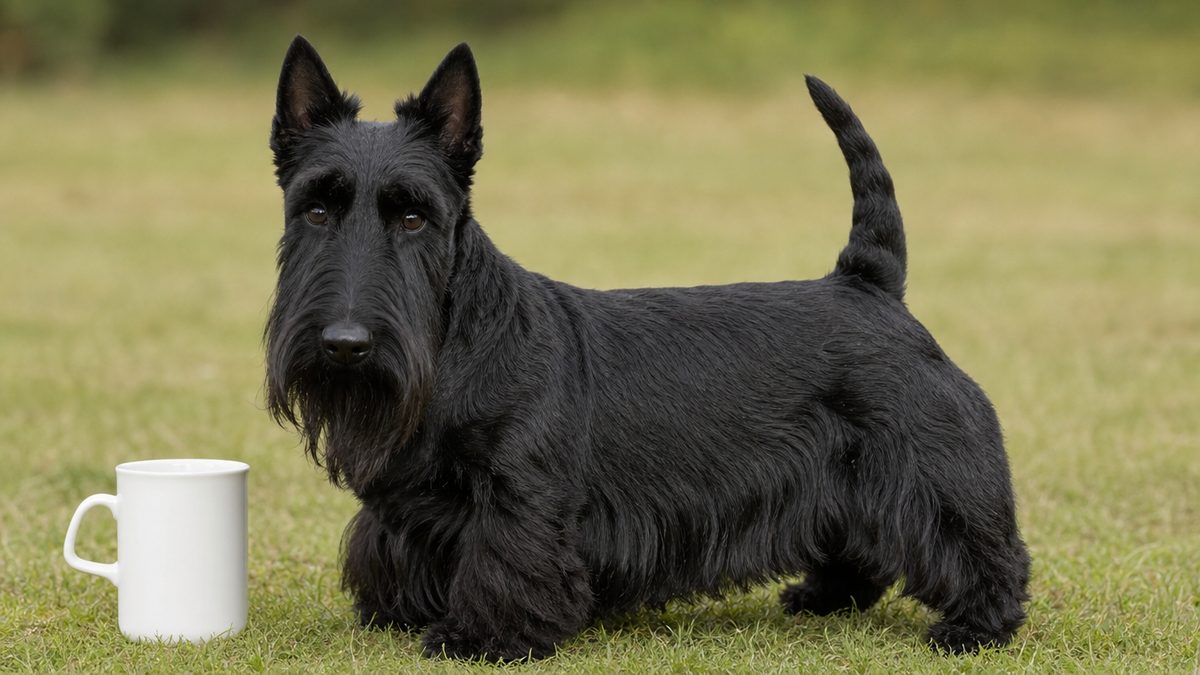
A Scottish Terrier is a small, thick-set, short-legged earth terrier from north-east Scotland, standing 25 to 28 cm at the withers and weighing 8.5 to 10.5 kg under its home registry's breed standard, with a harsh wiry outer coat over a soft undercoat and a head that looks long for the size of the dog.
The Royal Kennel Club's standard, last updated on 1 January 2025, opens by asking for a dog "thick set, of suitable size to go to ground, which would preclude dogs of excessive body weight, short legged, alert in carriage and suggestive of great power and activity in small compass". Two phrases in that sentence do real work. Suitable size to go to ground is a working specification, not a description: this is a dog built to enter a rock cairn or a badger sett after something that will fight back. Great power in small compass is why a 10 kg Scottie feels twice its weight on a lead.
The coat clause is the one an Indian buyer should read twice. The standard specifies a "close-lying, double coat; undercoat short, dense and soft; outer coat harsh, dense and wiry, together making a weather-resisting covering";. That is a rain jacket with a thermal liner, engineered for a place where the warmest month averages 14.06 degrees C. It is the single fact that decides how this breed does in Chennai.
The measurable facts, in one place
| Attribute | Royal Kennel Club standard | American Kennel Club | Measured or observed |
|---|---|---|---|
| Height at withers | 25 to 28 cm (10 to 11 ins) | 10 inches | Both agree at the floor |
| Weight | 8.5 to 10.5 kg (19 to 23 lbs) | 19 to 22 lb male, 18 to 21 lb female | AKC caps 1 lb lower |
| Coat | Close-lying double coat, harsh wiry outer, soft undercoat | Hard wiry outer, soft dense undercoat | Registry prints Sheds: Yes |
| Colour | Black, wheaten or brindle of any shade | Black, wheaten or brindle | Any other colour unacceptable |
| Life expectancy | Over 10 years (breed page) | 12 years | Median 12.7 years, 869 deaths |
| Kennel Club group | Terrier | Terrier | Filed Terrier in the Dogs Trust study |
| Skull shape | Long head, slight but distinct stop | Long head in proportion | Classified dolichocephalic |
Two of those rows are worth pausing on. The life expectancy row is where the marketing and the measurement part company: the Dogs Trust life-table study puts the median at 12.7 years with a 95 percent confidence interval of 12.5 to 12.9, from 869 recorded deaths among 1,747 dogs, while Google's knowledge panel and the top-ranked Indian seller both print 12 to 15 years. The skull shape row is a small surprise: the same study's classification table files this stubby-looking dog as dolichocephalic, or long-headed, which is exactly what the standard's "head gives impression of being long for size of dog" clause asks for.
A hardy, independent, alert 10 kg working terrier with a harsh coat, a very high prey drive, a barking habit, roughly twenty times the ordinary risk of bladder cancer, and no recommended pre-breeding health test anywhere in its home registry's health standard.
Two standards, and the places they disagree
The two standards that govern this breed agree on almost everything and disagree in three places worth knowing before you judge a puppy against a photograph.
The Royal Kennel Club gives 8.5 to 10.5 kg; the American Kennel Club gives 19 to 22 pounds for males and 18 to 21 for females, which is 8.2 to 10.0 kgAmerican Kennel Club. The British ceiling is therefore about half a kilogram higher, and the American floor about 300 g lower. Neither difference matters for a pet, and both matter if someone is telling you a 13 kg dog is correct. It is not, in either country.
On height the AKC prints a flat 10 inches while the RKC gives a 25 to 28 cm range, so a 28 cm dog is standard in Britain and above the stated American figure. On life expectancy they part company outright, the AKC printing 12 years and the RKC breed page printing the vaguer "Over 10 years";. The measured answer sits between them at 12.7.
What the standard bans, and why it matters in India
The colour clause is absolute. Black, wheaten or brindle of any shade are accepted; "any other colour or combination of colours unacceptable";. If an Indian seller offers you a white, particolour or black-and-tan Scottish Terrier, you are being sold something else, or a dog whose parentage nobody can verify. The Royal Kennel Club's own colour register lists exactly four accepted entries for the breed: black, black brindle, brindle and wheaten.
The ear clause is the second one to hold a photograph against. Ears must be "neat, fine texture, pointed, erect and set on top of skull but not too close together", with large wide-based ears specifically called undesirable. Erect ears in this breed are natural and never cropped, and cropping is in any case strictly forbidden in India under Second Schedule Part II paragraph 6(8) of the Prevention of Cruelty to Animals (Dog Breeding and Marketing) Rules 2017.
PetBuy's Indian breed page gives the Scottish Terrier a weight of 4 to 10 kg and a height of 20 to 35 cm. The floor is less than half the lightest dog either standard permits and the ceiling is 7 cm above the tallest. Those figures are not a measurement of anything; they are the same two numbers the site prints for seven other small terriers.
Where the Scottish Terrier came from, and what it was for
The Scottish Terrier was bred in north-east Scotland to go to ground after fox, badger and vermin, and it carried the name Aberdeen Terrier before it carried this one.
The Royal Kennel Club's own account is short and specific. "Like the other native Scottish breeds with which it shares its origins, the Scottish Terrier was bred to go to ground after fox and badger and other vermin. In its early days it was known as the Aberdeen terrier because of its proliferation in the area";. The registry dates the name change to 1879, credits it to Captain Gordon Murray, and puts the first breed club and the first written standard at 1882.
That places the Scottish Terrier inside a family rather than at the start of one. The Highland terriers, the Scottish, the Cairn, the West Highland White and the Skye, were separated out of one working population of small hard-coated Scottish earth dogs during the second half of the nineteenth century. Before the shows there were working strains and local types, not breeds. The Scottish Terrier is the one that ended up longest in the head and heaviest in the bone.
Why the working history still governs the pet
Everything an Indian owner finds difficult about this dog traces back to the job. A dog sent alone down a hole to face a badger has to be brave enough to keep going, independent enough to work with no instructions, and loud enough that a handler above ground can find it. Those three traits are the breed. They present in an apartment as a dog that will not recall off a squirrel, will not stop when told, and will bark.
The excavation is the same story. The word terrier comes from the Latin terra, meaning earth, and the Royal Kennel Club describes the whole group as "selectively bred to be extremely brave and tough, and to pursue fox, badger, rat and otter above and below ground";. A Scottish Terrier that decides to dig a hole in a Bengaluru garden is not misbehaving. It is doing the only thing four hundred years of selection asked of it.
The Scottish Terrier is At Watch, not Vulnerable, and the difference is 12 dogs
The Scottish Terrier sits on the Royal Kennel Club's At Watch list rather than its Vulnerable list, because it recorded 312 UK registrations in 2025 and the Vulnerable threshold is 300.
The Royal Kennel Club runs two bands for native British and Irish breeds. A breed with fewer than 300 annual registrations is Vulnerable; a breed between 300 and 450 is At Watch. The Scottish Terrier's registration figures for the last decade read 454, 453, 438, 468, 466, 656, 584, 406, 387 and 312 for 2016 to 2025, and they appear under the AT WATCH sub-heading of the club's own ten-year sheet, not under the vulnerable one.
| Year | Scottish Terrier | West Highland White | Cairn | Border Terrier |
|---|---|---|---|---|
| 2016 | 454 | 2,414 | 683 | 5,150 |
| 2017 | 453 | 2,143 | 589 | 5,130 |
| 2018 | 438 | 1,958 | 567 | 5,245 |
| 2019 | 468 | 1,556 | 464 | 4,353 |
| 2020 | 466 | 1,460 | 443 | 4,587 |
| 2021 | 656 | 1,445 | 498 | 5,930 |
| 2022 | 584 | 1,403 | 492 | 4,494 |
| 2023 | 406 | 1,183 | 437 | 4,018 |
| 2024 | 387 | 1,087 | 467 | 3,675 |
| 2025 | 312 | 1,083 | 447 | 3,181 |
Three things fall out of that table. The breed lost 31.3 percent of its annual registrations across the decade. The 2021 figure of 656 is a lockdown spike, not a recovery, and every breed in the column shows one. And the 2025 total of 312 leaves the Scottish Terrier twelve registrations above the vulnerable threshold, which is a rounding error in a national register.
The Royal Kennel Club's Scottish Terrier page prints Vulnerable native breed: No, and that is accurate rather than contradictory. The same field is genuinely wrong on the Foxhound and the Harrier, both of which appear in the vulnerable table itself. The test is the number: at 312 the Scottish Terrier is At Watch, so the field is right. Anyone calling this a registry error has skipped the band.
The quarterly sheet gives a third independent reading and confirms the annual one. The 2025 quarters read 63, 99, 34 and 116, summing to exactly 312. It also carries 2026 data: 81 registrations in the first quarter and 95 in the second, or 176 across the half year against 162 in the same half of 2025. On that reading the fall may have stopped. One half year is not a trend, and the direction is worth watching.
Scottish Terrier price in India, and what the sellers are actually offering
No trustworthy scottish terrier price in india exists today. Two Indian rupee bands are published and they disagree by a factor of five at the floor, four of the ten pages ranking for the query are American and quote dollars, and not one page-one seller has a Scottish Terrier in stock.
Start with what is on page one. The results, pulled from an India-located search, are Puppiezo at 1, Dog Breeds List at 2, Lancaster Puppies at 3, Mr n Mrs Pet at 4, Breed n Breeder at 5, Quora at 6, Wikipedia at 7, a second Puppiezo URL at 8, Hepper at 9 and Greenfield Puppies at 10. Four of those ten are United States pagesLancaster Puppies, Scottish Terrier. An Indian buyer searching an Indian query gets an American price list.
| Source | Figure printed | What it actually is |
|---|---|---|
| PetBuy.in | Rs 6,000 to Rs 25,000 | A template row shared with 7 other terriers, Listings 0 |
| Supertails | Rs 30,000 to Rs 80,000 | Entry 35 of a 40-breed table, and entries 34 and 36 print the same band |
| Puppiezo (rank 1) | no figure at all | The Price in India heading is followed by prose and no number |
| Mr n Mrs Pet (rank 4) | hidden behind sign-up | 3 Result Found, and all 3 results are French Bulldogs |
| Breed n Breeder (rank 5) | no figure | A phone number and an invitation to call Mr. Vansh |
| Dog Breeds List (rank 2) | USD 1,400 to 2,000 | A US breeder price, no rupee conversion offered |
| Lancaster Puppies (rank 3) | USD 1,000 to 2,500 | A Pennsylvania classifieds average |
| Hepper (rank 9) | USD 50 to 150 a month | A US running cost, on an Indian query |
Publish the disagreement rather than averaging it. Supertails' 30,000 to 80,000 rupee band is five times PetBuy's floor and more than three times its ceilingPetBuy.in breed page for the Scottish…, and the two cannot both describe the same market. Supertails says its figures come from breeder networks, Kennel Club of India registration data and marketplace surveys run in the first quarter of 2026, which is a more serious provenance claim than PetBuy makes; it also gives the identical band to the Bichon Frise and the Miniature Schnauzer immediately above and below the Scottish Terrier row, so it is a tier rather than an observation of this breed. The honest answer to "how expensive is a Scottish Terrier" in India is therefore in two halves. The purchase price is contested and unquotable, because the two published Indian bands do not overlap in any useful way and no verified Indian transaction is visible anywhere on page one. The running cost is knowable, is published by Indian clinics, and is the number that actually decides whether you can keep the dog. That half is worked through below.
We will not convert the American figures into rupees and present the result as an Indian price. Answer engines do exactly this, dividing a dollar band by whatever rate fits and printing the quotient as a local market rate. A converted foreign price is a foreign price with the units changed, and it tells an Indian buyer nothing about what anyone here has ever paid.
If you are set on this breed, the realistic Indian routes are a Kennel Club of India registered breeder found through the club rather than through a marketplace, an imported dog moving with a returning owner, or, best of all, a rehomed adult. All three are covered further down.
Testing the one Indian price figure: it is a template row, not an observation
PetBuy's Rs 6,000 to Rs 25,000 band is not a Scottish Terrier price. The same site prints the identical band, the identical weight of 4 to 10 kg and the identical height of 20 to 35 cm for eight small terriers, every one of them showing Listings 0.
The test the site's own pages fail is simple and repeatable. Pull an unrelated breed from the same site and compare the row to the rupee. We pulled thirteen pages in one session, six of them breeds this guide covers and the rest controls.
| Breed page | Price band printed | Weight | Height | Live listings |
|---|---|---|---|---|
| Scottish Terrier | Rs 6,000 to Rs 25,000 | 4 to 10 kg | 20 to 35 cm | 0 |
| Skye Terrier | Rs 6,000 to Rs 25,000 | 4 to 10 kg | 20 to 35 cm | 0 |
| Welsh Terrier | Rs 6,000 to Rs 25,000 | 4 to 10 kg | 20 to 35 cm | 0 |
| West Highland White Terrier | Rs 6,000 to Rs 25,000 | 4 to 10 kg | 20 to 35 cm | 0 |
| Soft Coated Wheaten Terrier | Rs 6,000 to Rs 25,000 | 4 to 10 kg | 20 to 35 cm | 0 |
| Cairn Terrier | Rs 6,000 to Rs 25,000 | 4 to 10 kg | 20 to 35 cm | 0 |
| Norwich Terrier | Rs 6,000 to Rs 25,000 | 4 to 10 kg | 20 to 35 cm | 0 |
| Border Terrier | Rs 6,000 to Rs 25,000 | 4 to 10 kg | 20 to 35 cm | 0 |
| Golden Retriever (control) | Rs 15,000 to Rs 45,000 | 25 to 34 kg | 51 to 61 cm | 30 |
| Beagle (control) | Rs 10,000 to Rs 28,000 | 9 to 14 kg | 33 to 41 cm | 30 |
| Shih Tzu (control) | Rs 15,000 to Rs 45,000 | 4 to 8 kg | 20 to 28 cm | 30 |
Read the last three rows against the first eight. Every breed the site stocks gets a distinct band, a distinct weight and thirty live listings. Every breed it does not stock gets the same band, the same weight and zero. The Soft Coated Wheaten Terrier row settles it beyond argument: that breed weighs 16 to 20 kg, and the page gives it 4 to 10 kg, the same figures as a Norwich.
It is not a converted dollar price either
Run the standard division tests on the band and none of them lands. Rs 6,000 divided by 84.38 is 71.11 and Rs 25,000 is 296.28, which is nothing. At 74 it gives 81.08 and 337.84. At a flat 80 it gives 75 and 312.50, and no seller anywhere prices a puppy at 312 dollars and 50 cents. The figures are rupee-native and arbitrary, which is a different problem from a converted list and needs saying differently: nobody converted anything, somebody typed two numbers into a template.
The history paragraph confirms the diagnosis from a second direction. PetBuy's Scottish Terrier history reads "Like most established breeds, the Scottish Terrier was shaped by the needs of the people who first kept it, from work and protection to companionship", and the identical sentence appears on its Skye, Welsh, West Highland White, Norwich and Border Terrier pages with only the breed name swapped. Its Golden Retriever page, by contrast, names Scottish shooting estates, and its Beagle page names hare hunting on foot in England. The site can write a real history. It writes one for breeds it sells.
The rank-one page has no price and a carousel of other people's dogs
Puppiezo holds position one for the commercial query. Its page carries a heading reading "Scottish Terrier Puppy Price in India", and underneath it the sentence "We are bringing you healthy, purebred Scottish Terrier puppies in India at competitive prices" and no figure of any kind. The only rupee numbers on the page sit in an Other Available Pets carousel: Rs 98,999 against a Maltipoo named Samy, Rs 76,499 against a Rottweiler, Rs 98,999 against a Doxiepoo, Rs 98,999 against a second Maltipoo, Rs 92,599 and Rs 92,599 against two Poodles, Rs 94,999 against a Cane Corso and Rs 120,000 against a Goldendoodle. Eight puppies, seven breeds, no Scottish Terrier.
That figure appears three times on this one page against three different animals, and has now been recorded on more than ten pages of the same site attached to whichever puppy happens to be in stock. It is not any breed's price. If you meet it quoted as a Scottish Terrier price anywhere, including in an AI-generated summary, you are reading a carousel, not a market.
Importing a Scottish Terrier into India, and the door that is closed
You can import a Scottish Terrier into India as your own pet and you cannot import one to breed from or to sell, because the Directorate General of Foreign Trade rejects those applications on their face.
Dogs enter India under ITC(HS) 01061900 as a Restricted import. Trade Notice 22/2022-23 of 19 December 2022 sets out the routes, and there are only three: a pet accompanying its owner with a valid pet book in the importer's name, research with a CPCSEA recommendation, and Defence or Police use. The notice states that applications for trading or breeding purposes shall be duly rejected, and it limits entry to a short list of named ports.
That is why there is no legal Indian supply chain for this breed and no Indian price to quote. A commercial importer cannot bring in breeding stock, so the only Scottish Terriers legally in the country arrived as somebody's pet or descend from dogs that did.
KCI registration and what it does and does not prove
India is a full member of the Federation Cynologique Internationale, represented by the Kennel Club of India in Chennai, so a KCI registration is a real pedigree document issued against international nomenclature. Two Indian sellers on page one advertise KCI papers for Scottish Terrier puppies they do not appear to haveMr n Mrs Pet, Scottish terrier Puppies….
A KCI registration certificate proves parentage was recorded. It does not prove a single health test was done, and for this breed that matters more than usual, because the Royal Kennel Club recommends no pre-breeding health screening at all. Ask to see the parents' von Willebrand factor results and their liver enzymes, and verify the papers against the KCI directly rather than against a photograph of a certificate.
Rule 8(1)(a) of the Prevention of Cruelty to Animals (Dog Breeding and Marketing) Rules 2017 states that a breeder shall ensure that pups less than eight weeks in age are not sold. Puppiezo's own page advertises 45-plus days old puppies, which is under seven weeks. Walk away from any seller offering a puppy under eight weeks, whatever the breed.
What a Scottish Terrier costs every month in India
Budget Rs 5,000 to Rs 9,000 a month for a 10 kg Scottish Terrier in an Indian metro, with grooming the line that decides where in that range you land.
Every figure below was read live from an Indian provider's own page. None is converted from a foreign currency, and none is an estimate dressed as a quotation.
| Line | Basis | Per month |
|---|---|---|
| Dry food | Royal Canin Mini Adult, stated for dogs up to 10 kg, roughly 150 to 180 g a day | Rs 2,400 to Rs 3,400 |
| Tick and flea control | One monthly chewable in the small-dog weight band | Rs 700 to Rs 1,100 |
| Deworming | Drontal Plus at Rs 754 for 6 tablets, 1 tablet per 10 kg, quarterly | Rs 42 |
| Vaccination, amortised | Vetic annual booster from Rs 3,199 spread over 12 months | Rs 267 |
| Grooming | Vetic haircut from Rs 1,359 every 8 to 10 weeks, plus home brushing | Rs 700 to Rs 1,700 |
| Consultation and contingency | Two routine visits a year plus a reserve | Rs 500 to Rs 1,500 |
| Total | Rs 4,600 to Rs 8,000 |
The vaccination line is the one Indian buyers most often get wrong, so here is what is actually published. Vetic's national page lists a puppy course starting at Rs 6,499 against a struck-through Rs 8,111, an annual booster starting at Rs 3,199 against Rs 3,806, a single anti-rabies dose at Rs 699, a 9-in-1 DHPPiL at Rs 899, canine corona at Rs 899 and kennel cough at Rs 1,349. Those are one chain's promotional floors, not a market average.
The three-way spread on one identical vaccine
- Government clinic route. Greater Chennai Corporation's six pet clinics provide all treatment and anti-rabies vaccination free of cost, and the corporation issued 9,115 pet animal licences during 2024 at Rs 50 each.
- Private clinic route. Vetic charges from Rs 699 for the same anti-rabies dose and from Rs 899 for the 9-in-1.
- Home-visit route. A vet-at-home service costs multiples of the clinic price once the visit fee is added.
The point is not that one route is right. It is that the price of an identical vaccine in India is a function of the delivery model, not the drug, and a first-time owner budgeting from a blog's national average will be wrong in both directions depending on which city and which route they use.
One-time costs an Indian owner should plan for
- Registration. Rs 500 for a new pet dog registration with the Municipal Corporation of Delhi, and Rs 500 to renew with a Rs 100 a month late fee. Rs 50 for a Greater Chennai Corporation pet licence.
- Microchipping. Rs 1,250 as a Chennai clinic's own transacted price.
- Puppy vaccination course. From Rs 6,499 at a Vetic clinic.
- Grooming kit. A stripping knife, a slicker and a metal comb, because you will be maintaining the furnishings between salon visits whatever else you decide.
Can a Scottish Terrier handle the Indian climate?
A Scottish Terrier manages the Indian climate in Bengaluru and Pune and struggles in Chennai, Mumbai, Kolkata and Delhi, because its home city's warmest month averages 14.06 degrees C and Chennai's coolest month averages 24.09.
Every figure below comes from NASA POWER's 2001 to 2020 climatology, queried by explicit latitude and longitude, with the grid-cell elevation echoed back and checked against each place's real elevation. Aberdeen's cell reads 18.28 m against a real 30 m, and every Indian cell used sits within 83 m of the town, so none of these numbers is a mountain artefact.
| Place | Cell elevation | Warmest month mean | Coolest month mean | Annual RH2M | Peak wet bulb |
|---|---|---|---|---|---|
| Aberdeen, Scotland | 18.28 m | 14.06 C (Aug) | 5.37 C (Feb) | 85.33 percent | 12.52 C (Aug) |
| Bengaluru | 841.72 m | 28.37 C (Apr) | 20.22 C (Dec) | 67.84 percent | 21.86 C (May) |
| Pune | 635.99 m | 28.93 C (Apr) | 19.62 C (Dec) | 66.68 percent | 22.97 C (Jun) |
| Mumbai | 97.15 m | 31.19 C (May) | 23.19 C (Jan) | 67.28 percent | 25.77 C (Jun) |
| Chennai | 48.95 m | 31.51 C (May) | 24.09 C (Jan) | 72.39 percent | 26.11 C (May) |
| Kolkata | 7.35 m | 31.53 C (May) | 17.31 C (Jan) | 73.84 percent | 27.09 C (Jun) |
| Delhi | 206.37 m | 35.88 C (Jun) | 13.61 C (Jan) | 45.51 percent | 26.50 C (Jul) |
The single most useful line in that table is the comparison nobody makes. Chennai's coolest month, at 24.09 degrees C, is warmer than the hottest single value NASA POWER recorded at Aberdeen in twenty years, which is 22.05 degrees C in July. A Chennai January is not a mild season for this dog. It is hotter than anything its home city has produced this century.
Humidity is not the problem, and this is where most breed pages get it wrong
The reflex claim about a British breed in India is that the humidity will finish it. The measurement says the opposite. Aberdeen runs 85.33 percent annual relative humidity, higher than Chennai's 72.39, Kolkata's 73.84, Mumbai's 67.28, Bengaluru's 67.84, Pune's 66.68 and far higher than Delhi's 45.51. This dog comes from a genuinely damp place and damp air alone is not new to it.
What is new is heat, and heat combined with humidity. The wet-bulb column is the honest measure of that, because it is what actually limits a panting animal. Aberdeen peaks at 12.52 degrees C; Kolkata peaks at 27.09. That is a gap of 14.57 degrees, and it is the reason a Scottish Terrier in a Kolkata June cannot shed heat at the rate its physiology assumes.
Aberdeen's 22.05 C is a PERIOD MAXIMUM, meaning the single hottest value in the twenty-year record, not an average summer afternoon. A typical Aberdeen August day peaks in the mid-teens. That makes the comparison with Chennai stronger, not weaker: Chennai's ordinary January mean beats Aberdeen's twenty-year record high.
The verdict, city by city, is a hardy dog in the wrong latitude. Bengaluru and Pune are workable, with April means near 28 to 29 degrees C, December nights near 20, and peak wet bulbs of 21.9 and 23.0. Mumbai, Chennai and Kolkata are hard, with wet bulbs between 25.8 and 27.1 for months at a time. Delhi is the split case, brutal from May to July at a 35.88 degrees C June mean, and then genuinely comfortable in January at 13.61.
Managing a harsh double coat through an Indian summer
Manage the heat by moving the walks, wetting the dog rather than shaving it, and treating exertion as the real risk, because exertional heat illness accounted for 652 of the 879 UK cases with a recorded trigger.
The largest study of canine heat-related illness available followed 905,543 UK dogs under primary veterinary care in 2016 and recorded 1,259 events from 1,222 dogs. Of the 879 events with a recorded trigger, 652, or 74.2 percent, were exertional, 113 were environmental and 46 involved confinement in a vehicle. The companion paper on the same cohort found a fatality rate of 14.18 percent among confirmed events.
Read that the way an Indian owner should. The dog left in a parked car is the story everyone tells, and it is the smallest of the three categories. The dog that overheats is usually the one that went for a walk, and in India that walk happens at a wet-bulb temperature its breed has never met.
The routine that actually works
- Move both walks outside the heat window. Before 06:30 and after 20:00 from March to June in Chennai, Mumbai and Kolkata, and April to June in Delhi. Test the pavement with the back of your hand for five seconds before you set out.
- Wet the dog, do not clip the jacket. Water on the belly, groin and feet moves far more heat than water on the back, because the harsh weather-resisting outer coat is designed to shed it.
- Watch the coat, not the thermometer. A Scottish Terrier that stops on a walk and will not move is not being stubborn; it is at its limit. Turn round.
- Keep exercise short and repeated. Two fifteen-minute outings beat one forty-minute one in an Indian April, and the breed's own registry rates its need at up to an hour a day in total.
- Never leave the dog in a parked vehicle, even briefly, and never in a balcony or a terrace enclosure without shade and moving air.
Second Schedule Part IV paragraph 21(1) of the Prevention of Cruelty to Animals (Dog Breeding and Marketing) Rules 2017 bars keeping in outdoor facilities, without the attending veterinary practitioner's written approval, dogs not accustomed to local temperatures and, in the gazette's own words, dog breeds that cannot tolerate the temperatures prevalent in the area or region in question, such as long-haired breeds in high temperature locations. A double-coated Scottish Terrier kept in an outdoor run through a Nagpur May is the case that clause describes.
One thing the heat rating is not is a verdict on the breed's toughness. This is a hardy working dog, and it is heat-sensitive for exactly the same reason it is weatherproof: the coat that made it useful in an Aberdeen winter is the coat it cannot take off in a Chennai May.
Temperament, and who should not buy this breed
The Scottish Terrier is dignified, independent and reserved rather than biddable and affectionate on demand, and it is the wrong dog for a household with a toddler or a shared wall and a noise complaint.
The breed standard describes the temperament in eleven words: "Loyal and faithful. Dignified, independent and reserved, but courageous and highly intelligent", with the temperament clause reading "Bold, but never aggressive";. The registry's own breed page is blunter still, calling the Scottie "a multum in parvo breed and with great character, independent to the point of stubbornness";.
Translate that into a flat in Pune. You get a dog that is deeply attached to its own family and completely uninterested in strangers, that will not perform for visitors, that decides for itself whether a command is worth obeying, and that is affectionate on its own schedule. Owners who wanted a Labrador in a smaller package are the ones who are disappointed.
Prey drive is the trait that gets Indian dogs killed
This is an earth terrier with a prey drive at the top of the scale. Street cats, rats, squirrels, mongoose, monkeys and chickens all trigger it, and an Indian city offers more of those per hundred metres than a Scottish glen ever did. The recall that works in your living room does not exist once the chase has started.
The practical rule is unconditional. A Scottish Terrier does not go off lead in any unfenced Indian space, at any age. Not in a park, not on a beach, not on a quiet lane at six in the morning. Use a long line if you want the dog to range.
Barking, and the flat you live in
Google's People Also Ask box for this breed carries the question "Do Scottish Terriers bark a lot?", which tells you what prospective owners are worried about. The answer is yes, and it is not a fault. A dog working underground has to give tongue so the handler can locate it. PetBuy's Indian page rates the breed's barking Low, which is the same template row that gives a Wheaten Terrier the weight of a Norwich.
An adult household or a family with children over about eight, in Bengaluru, Pune or a Delhi winter, that wants a small alert dog with a strong personality, is prepared to walk at dawn, does not need the dog to like visitors, and can absorb a bark or two at the lift door.
Training a Scottish Terrier, and the three things it will resist
To train a Scottish Terrier, pay for every repetition, keep sessions under five minutes, and finish before the dog decides it is finished, because this breed complies selectively rather than eagerly.
The starting point is that the breed is highly intelligent and unmotivated by your approval. That combination is often mislabelled as low trainability. It is not. A Scottish Terrier learns a new behaviour as fast as most gundogs and then asks what it is worth. Pay it, and it works. Repeat a cue for free, and it stops.
The three things it will resist, and what to do instead
- Recall away from prey. Do not train against a chase; you will lose. Train a stop-and-look on a long line, reward heavily at distance, and manage the environment so the chase never starts.
- Repetition drills. Five correct repetitions and stop. A Scottie that is asked for a fifteenth sit disengages, and re-engaging it costs more than the drill was worth.
- Being handled by strangers. This is a reserved breed and forcing greetings creates the snap that gets it a reputation. Teach a visitor to ignore the dog and let it approach.
What to socialise, on an Indian timetable
Use the socialisation window deliberately, because an Indian city presents inputs a Scottish breeder never had to plan for. Between about three and sixteen weeks, and continuing well past it, arrange calm, short, positive exposures to auto-rickshaw horns, temple bells and firecrackers at low volume, lift doors, marble floors, monsoon rain on a tin roof, cattle, street dogs seen at a distance, and men in helmets. Feed through each one.
The two-word summary of Scottie training is short sessions. The breed's own registry rates its exercise need at up to an hour a day and its trainability as workable rather than eager; the training equivalent is that ten five-minute sessions across a week will beat one Sunday hour, every time.
Teach a reliable 'leave it' before you teach anything else. In an Indian street the things this dog wants to pick up include chicken bones, discarded food and a dead rat, and a terrier that will trade an object for a treat is far safer than one that guards it.
How much exercise a Scottish Terrier actually needs
A Scottish Terrier needs up to an hour of exercise a day, split across two or three outings, and in an Indian summer that hour has to be taken before dawn and after dusk.
The Royal Kennel Club rates the breed's requirement at up to 1 hour per day and its home size need at a small house. That is a modest figure for a working terrier, and it is genuine: this is not a Border Collie that unravels without a job. It is also a floor rather than a target, because a Scottie that gets ten minutes a day will find its own entertainment, and its own entertainment is digging.
What the hour should contain
- Two walks of 20 to 25 minutes, on lead, at a pace the dog sets rather than one you set.
- Ten minutes of scent work indoors, which tires this breed more than distance does. Hide food in a rolled towel or scatter it in a cardboard box.
- A sanctioned place to dig. A tray of sand or loose earth on a balcony, seeded with a buried toy, redirects a drive that cannot be trained away.
- Short bursts of chase-and-tug, which suits a dog built for great activity in small compass rather than for distance running.
- No forced running. A 25 cm dog on a hot Indian pavement beside a jogging owner is the exertional heat case the literature describes.
The apartment question answers itself once the walks are covered. A 10 kg dog needs no floor area, and the breed's own registry says a small house is enough. What an Indian flat has to supply is the two outings, and the constraint on those is the pavement temperature, not the square footage.
A harsh double coat holds water at the skin. After a wet walk, towel to the skin and use moving air, because a Scottie left to dry naturally in Mumbai in July stays damp under the jacket for hours and that is where hot spots and ear trouble start.
Grooming a Scottish Terrier: strip the jacket, never clip it
Groom a Scottish Terrier by hand stripping the harsh jacket every six to ten weeks and brushing the long furnishings to the skin two or three times a week, because clipping permanently softens the coat that protects the dog.
The Royal Kennel Club's own breed page prints Grooming: Every day and Coat length: Long and Sheds: Yes. Those three fields together describe the real workload, which is not what most Indian buyers expect from a small dog.
The coat has two layers doing two jobs. The standard describes a close-lying double coat, undercoat short, dense and soft, outer coat harsh, dense and wiry, together making a weather-resisting covering. The harsh outer jacket sheds water and reflects sun. The soft undercoat insulates. The long furnishings on the beard, eyebrows, legs and skirt are cosmetic and are the part that mats.
Hand stripping, and what clipping actually does
Hand stripping pulls the dead outer hairs out at the root so a new harsh coat grows in behind them. A clipper cuts every hair at the same length, leaving the dead outer coat in place and the soft undercoat exposed. Repeat that a few times and the jacket comes back soft, open and pale, which is a permanent change and not a seasonal one.
For an Indian owner the consequence is direct. A clipped Scottish Terrier loses the layer that reflects sun and sheds monsoon water, so it is more heat-sensitive and more prone to skin trouble afterwards, not less. This is the opposite of the intuition that a shorter coat means a cooler dog.
| Task | Frequency | Why |
|---|---|---|
| Brush furnishings to the skin | 2 to 3 times a week | Beard, leg and skirt hair mats within days in humid air |
| Comb out the beard after every meal | Daily | Food and water sit in it and ferment in Indian heat |
| Hand strip or roll the jacket | Every 6 to 10 weeks | Keeps the outer coat harsh and weather-resisting |
| Full bath | Every 6 to 8 weeks | More often strips coat oils and softens the jacket |
| Dry actively after any wet walk | Every time | A damp undercoat in a Mumbai July is where hot spots start |
| Check and dry ears | Weekly | Erect ears drain well, which is one thing in this breed's favour |
| Nails | Every 3 to 4 weeks | Short legs and hard Indian pavements still do not wear them down |
Shaving to the skin removes the sun barrier, exposes pale skin under a black coat to Indian UV, does not reduce the dog's core temperature, and grows back soft and open so the following summer is worse. Clip the furnishings short if you must. Leave the jacket alone.
Can you get a Scottish Terrier hand stripped in India?
Almost certainly not, and that is the single most practical thing this page can tell an Indian buyer: the mainstream Indian grooming chains sell haircuts and baths, not stripping, so plan to learn it yourself.
Vetic operates one of the largest clinic-grooming networks in urban India. Its Delhi and Bengaluru grooming menus, read live on the same day, are identical: Haircut from Rs 1,359 against a struck-through Rs 1,599, Pet Bathing from Rs 934 against Rs 1,099, and Complete Bath and Styling from Rs 1,869 against Rs 2,199, with add-ons from Rs 99Vetic, Pet Grooming In Bengaluru. Hand stripping does not appear as a line item on either menu.
That is not a criticism of the provider. It is a market fact with a direct consequence: the default outcome for a Scottish Terrier in India is a clipped dog, because a clip is what is on sale. Most Indian Scotties will therefore carry a softer, paler, more open coat than the standard describes, and their owners will never be told why.
What to do instead
- Learn to roll the coat yourself. Rolling means pulling a few dead hairs at a time, weekly, rather than stripping the whole jacket twice a year. It needs a stripping knife, a rubber thumb and about fifteen minutes a week.
- Ask a groomer to clip furnishings only. Beard, legs and skirt short; jacket untouched. Most Indian groomers will do this if you ask specifically and show them where the line is.
- Accept a clipped dog if you must, and adjust the heat plan. A clipped Scottie needs shade discipline and shorter middays, because you have removed part of its sun protection.
- Budget the two costs separately. Roughly Rs 700 to Rs 1,700 a month covers a salon haircut every eight to ten weeks. Rolling at home costs a knife once and nothing after.
The ears are small, pointed and erect, set on top of the skull. That is genuinely useful in a monsoon climate, because an erect ear canal dries where a drop ear traps water. A Scottish Terrier is at less risk of humid-weather otitis than most spaniels and hounds, and its skin and beard are the parts to watch instead.
Scottish Terrier health: the issues, and what the screening registries actually show
The Scottish Terrier's health issues cluster in four places: the bladder, the nervous system, the clotting cascade and the liver. Its home registry recommends no pre-breeding test for any of them.
This section is longer than most breed pages allow, because the Scottish Terrier is one of the most-studied small breeds in veterinary medicine and the material is genuinely there. The four blocks below take the bladder, the neurological disorders, von Willebrand disease and the liver in turn, and a fifth block deals with the screening gap.
| Database | Rank | Evaluations | Normal | Abnormal or affected |
|---|---|---|---|---|
| Craniomandibular osteopathy | 2 of 3 breeds | 573 | 97.2 percent | 2.6 percent carrier, 0.2 percent affected |
| Von Willebrands (DNA) | 12 | 1,290 | 98.9 percent | 1.1 percent carrier, 0.0 percent affected |
| Patella | 32 | 1,126 | 94.6 percent | 5.4 percent (4.5 grade 1, 0.9 grade 2) |
| Thyroid | 55 | 306 | 84.3 percent | 12.1 percent idiopathically reduced |
| Eyes (summary line) | 42 | 510 | 92.2 percent | 7.8 percent abnormal |
| Congenital cardiac | 111 | 96 | 100.0 percent | 0.0 percent |
Two absences in that table are as informative as the entries. There is no OFA hip row and no OFA elbow row for the Scottish Terrier, because OFA publishes a breed only once it holds 100 hip evaluations, and this breed has never reached that. Read that as a gap in the evidence rather than as evidence of healthy hips.
The eye numbers contradict each other, and both are printed
OFA's eye summary line says 92.2 percent of 510 evaluations were normal. Its own detail rows, on a denominator of 510, record NORMAL (OTHER .000) in 204 dogs, which is 40.0 percent, alongside persistent pupillary membranes iris to iris in 154 (30.2 percent) and lens pigment foci in 195 (38.2 percent). A summary of 92.2 percent and a detail row of 40.0 percent on the same denominator cannot both be the rate of anything simple.
Part of the gap is explicable: the detail codes are not mutually exclusive, and a breeder-option finding such as a persistent pupillary membrane does not necessarily make a dog abnormal overall. Part of it is not, and the 52.2 point spread is far too wide to be rounding. Publish both, quote neither as the rate, and do the division yourself when a breeder shows you an eye certificate.
Everything in this health block is general information drawn from published studies and registry data. It is not a diagnosis. Take any Scottish Terrier with blood in the urine, straining to urinate, a change in gait, unexplained bruising or prolonged bleeding to your nearby veterinarian the same day.
Bladder cancer: the risk that defines this breed, and the one you can act on
Urothelial carcinoma of the bladder runs roughly twenty times higher in Scottish Terriers than in dogs generally, and the largest modifiable risk factor found in a screened cohort was living in a household with cigarette smokers.
The Scottish Terrier's bladder cancer risk is not a rumour that circulates on breed forums. It is the reason the breed is used as a research model. A 2024 cohort study opens by stating the breed-associated risk plainly: canine urothelial carcinoma risk is "20-fold higher in Scottish terriers";.
The study followed 120 Scottish Terriers aged six years and over through three years of twice-yearly bladder screening. Biopsy-confirmed urothelial carcinoma was found in 32 of the 120 dogs. Three factors reached significance in the multivariable model.
| Factor | Odds ratio | 95 percent CI | p |
|---|---|---|---|
| Living in a household with cigarette smokers | 6.34 | 1.16 to 34.69 | 0.033 |
| Living within a mile of a marsh or wetland | 21.23 | 3.64 to 123.69 | 0.001 |
| History of previous bladder infections | 3.87 | 1.00 to 14.98 | 0.050 |
The tobacco finding was then checked biochemically rather than by questionnaire alone. Urine cotinine, a nicotine metabolite, was measured by liquid chromatography mass spectrometry. Urothelial carcinoma was diagnosed in 18 of 51 dogs (35.3 percent) with quantifiable cotinine in their urine, against 6 of 40 dogs (15.0 percent) without it, p equals 0.0165. The authors' conclusion is one sentence: the main modifiable risk factor was exposure to second-hand tobacco smoke. It is worth adding what the wider cancer literature says about small breeds, because it cuts against the intuition that a small dog is a low-cancer dog: a 2024 analysis of cancer mortality across dog breeds found that inbreeding, not only body size, predicts cancer mortality. A 10 kg terrier is not exempt.
If you smoke and you own a Scottish Terrier, smoke outside and away from the dog. This is not a general wellness suggestion. It is a measured 6.34 odds ratio in the breed with roughly twenty times the baseline risk, verified against urine cotinine rather than self-report. Consult your nearby vet about a screening schedule for any Scottie over six.
What screening looks like, and one thing that mimics a tumour
Screening in the research setting is ultrasonography plus urinalysis at six-month intervals from age six. That is available in most Indian metros and is the single most useful thing an owner of a middle-aged Scottie can arrange.
One caution from the same research group. In 134 screened Scottish Terriers, eight (6 percent) carried an incidental nodule at the bladder apex with no other bladder disease: one per dog, 2 to 4 mm at the base, protruding 4 to 6 mm into the lumen, unchanged over up to 3.5 years, with cystoscopy in three dogs showing normal mucosa and no neoplastic features. Five of the eight stayed free of any bladder disease. An apex nodule on a Scottie's scan is therefore not automatically a tumour, and the finding is worth showing your vet.
Scottie cramp and hereditary ataxia: two different disorders, often confused
The Scottish Terrier carries two separate inherited movement disorders. Scottie cramp is a paroxysmal, non-progressive spasticity that usually improves with age; hereditary ataxia is a progressive cerebellar degeneration that does not.
The two are confused constantly, including by owners describing them, and the difference matters because one has a good outlook and the other does not.
Scottie cramp: what 31 owners actually described
The largest published clinical series recruited 31 affected dogs and used owner descriptions, medical records, pedigrees and videotapes of the episodes. Of the 31, 19 showed generalised spasticity and 12 showed only hind limb spasticity and skipping, which widens the recognised presentation beyond the classic whole-body cramp.
- Onset is early. Episodes were noted in the first year of life in 76 percent of dogs.
- Triggers are predictable. Excitement, stress and exercise, which is the practical handle an owner has.
- The outlook is good. Episode frequency and severity decreased over time, with behaviour modification and reduced exposure to triggers playing a role. One dog of the 31 was euthanased for severe refractory signs.
- Fluoxetine helped in 7 of 8 treated dogs, reducing frequency and duration, and did not help one severely affected dog.
- Females were over-represented, with only eight affected males in the cohort, and the presence of cerebellar degeneration in the same pedigrees suggests a more complex inheritance than previously reported.
Hereditary ataxia: a different disease with a different ending
Scottish Terriers have a high incidence of juvenile-onset hereditary ataxia that primarily destroys the Purkinje neurons of the cerebellar cortex and causes slowly progressive cerebellar dysfunction. The pathology has been mapped: Purkinje neuron loss with polyglucosan body accumulation.
The genetics study recruited 153 Scottish Terriers through the breed's American club and ran both linkage and genome-wide association mapping. Both approaches identified a region on the X chromosome, and homozygosity mapping narrowed it to a 4 Mb interval. Pedigree evaluation could not establish the mode of inheritance because litter information was incomplete.
There is still no commercial DNA test for either disorder, because the causal mutation on that 4 Mb region has not been identified. So you cannot test a puppy. You can ask a breeder directly whether any dog in the line has cramped or gone wobbly, and you can walk away from a breeder who says the question has never come up in a breed with a named cramp syndrome.
Von Willebrand disease: the Scottish Terrier has the severe form
Scottish Terriers carry type III von Willebrand disease, the most severe of the three types, in which affected dogs have essentially no von Willebrand factor at all rather than a reduced amount.
The distinction is the whole point. In a study of 260 clinically affected dogs across three breeds, the mean plasma von Willebrand factor antigen in affected Dobermans was 15 percent of normal. In affected Scottish Terriers it was 0 percent. A Doberman with von Willebrand disease has a mild bleeding tendency. A Scottish Terrier with it has a severe one.
| Breed | Dogs tested | Abnormal vWF antigen in 1988 | Mean age at diagnosis | Mean vWF antigen when affected |
|---|---|---|---|---|
| Doberman Pinscher | 5,554 | 73 percent | 4.6 years | 15 percent |
| Scottish Terrier | 1,363 | 30 percent | 1.7 years | 0 percent |
| Shetland Sheepdog | 4,279 | 28 percent | 1.9 years | 8 percent |
Two rows of that table are the ones to act on. Scottish Terriers were diagnosed at a mean age of 1.7 years, far younger than Dobermans, because a dog with no von Willebrand factor declares itself early. And the commonest site of mucosal bleeding in this breed was the oral or nasal cavity, not the urogenital tract.
The causal mutation in Scottish Terriers was identified in 2000, which means a definitive DNA test exists. OFA's published results show 1,290 Scottish Terriers tested at 98.9 percent normal, 1.1 percent carrier and 0.0 percent affected, rank 12 in its database. Compare that with the 30 percent abnormal antigen figure from 1988 and you are looking at what a DNA test plus three decades of breeder selection actually achieves.
Tell your vet the breed before a spay, a neuter, a dental or any procedure that will draw blood. A type III von Willebrand Scottish Terrier can bleed dangerously from routine surgery, and the DNA test is cheap, definitive and available. If the parents were tested clear, an affected puppy is impossible; if they were not, test the dog before the first anaesthetic.
The Scottish Terrier liver: raised alkaline phosphatase, vacuolar hepatopathy and cancer
A large proportion of apparently healthy Scottish Terriers carry raised alkaline phosphatase, and in the largest published series 39 of 114 dogs with progressive vacuolar hepatopathy also had hepatocellular carcinoma.
This is the breed problem an Indian vet is most likely to meet by accident, on a routine blood panel before a dental or a spay.
The base observation came first: hyperphosphatasaemia with concurrent adrenal gland dysfunction in apparently healthy Scottish Terriers. Raised alkaline phosphatase in this breed is common, is often present in dogs with no clinical signs at all, and is associated with abnormal adrenal steroid production rather than with the classic hyperadrenocorticism picture.
What the 114-case series found
The definitive series covered 114 Scottish Terriers with progressive vacuolar hepatopathy diagnosed between 1980 and 2013. Its findings, in the order that matters to an owner:
- 39 of 114 dogs, or 34 percent, had hepatocellular carcinoma found at surgery, at necropsy or on abdominal ultrasound.
- Histology suggested the cancer was preceded by dysplastic hepatocellular foci, which is why the authors recommend surveillance rather than watchful waiting.
- Clinicopathologic variables did not distinguish the dogs with cancer from those without, and neither did age at death. You cannot tell from the blood panel alone.
- 15 of 26 dogs with high hepatic copper concentrations had histologic features consistent with copper-associated hepatopathy, so copper is part of the picture in some dogs.
- Signs consistent with hyperadrenocorticism appeared in 46 of 114 dogs (40 percent), but a definitive diagnosis was inconsistently confirmed.
- Adrenal sex hormone testing after ACTH found high progesterone in 22 of 25 dogs (88 percent) and high androstenedione in 20 of 25 (80 percent), which is what links the liver disease to adrenal steroidogenesis.
The authors' recommendation is the practical output: in a Scottish Terrier with vacuolar hepatopathy, run frequent serum biochemical analysis and ultrasonographic surveillance for early tumour detection.
A raised alkaline phosphatase in a Scottish Terrier is a reason to investigate the liver and the adrenal axis, not a reason to assume Cushing's disease and start treatment. Ask your nearby vet for an abdominal ultrasound rather than a therapeutic trial, and repeat it. The 34 percent cancer figure is the reason surveillance beats waiting.
The screening gap: this breed's own registry recommends no test at all
The Royal Kennel Club recommends no pre-breeding health screening for the Scottish Terrier, and states it in two separate documents on the same day.
This is the most consequential single finding on the page for anyone buying a puppy, and no ranking page mentions it.
The February 2026 Royal Kennel Club Health Standard is a 33-page document listing recommended pre-breeding tests breed by breed, in two columns headed Good Practice and Best Practice. Read in layout-preserving mode so the columns stay apart, the Scottish Terrier's row is blank in both columns. Its immediate neighbours are not: the Sealyham Terrier one row below carries a DNA test for primary lens luxation as Good Practice and eye testing as Best Practice, and the Schnauzer one row above carries a dilated cardiomyopathy DNA test and hip scoring.
The registry's own breed page says the same thing in words. Under the heading Pre-breeding Health Screening it reads, verbatim: "At this time this breed does not have any recommended pre-breeding health screening in place, however breeders and puppy buyers should check frequently as this may change once new evidence and research becomes available";. Its Breed Watch entry is Category 1, meaning no points of concern for judges beyond those the standard covers routinely, and it has no breed-specific breeding restrictions.
| Breed | Good Practice | Best Practice |
|---|---|---|
| Scottish Terrier | none | none |
| Skye Terrier | none | none |
| West Highland White Terrier | none | none |
| Sealyham Terrier | DNA test for primary lens luxation | Eye testing, BVA/RKC/ISDS scheme |
| Welsh Terrier | DNA test for primary lens luxation | none |
| Soft Coated Wheaten Terrier | none | Eye testing and hip testing, plus a breed club kidney scheme |
The Scottish Terrier has a named cramp syndrome, a mapped X-linked ataxia, the severe form of von Willebrand disease, a documented liver and adrenal disorder and roughly twenty times the ordinary bladder cancer risk. None of those has a Royal Kennel Club recommended pre-breeding test, because two have no test at all, one is not routinely mapped to a breeding decision, and the fourth is a DNA test the registry has not formalised for this breed. Do not read the blank as reassurance.
What to ask an Indian breeder instead
- Von Willebrand DNA results for both parents. The mutation has been known since 2000 and the test is definitive.
- Alkaline phosphatase on both parents, with the number, not a verbal reassurance.
- Any history of cramping, skipping or wobbliness anywhere in the line, phrased as an open question rather than a yes or no.
- Whether any dog in the line has had bladder disease, and at what age.
- KCI registration papers verified with the club directly, not a photograph of a certificate.
How long a Scottish Terrier lives, measured rather than claimed
A Scottish Terrier's measured median lifespan is 12.7 years, with a 95 percent confidence interval of 12.5 to 12.9, from 869 recorded deaths among 1,747 UK dogs. That is 17th of the 23 Kennel Club terrier breeds in the same study.
The figure comes from the Dogs Trust life-table study of UK companion dogs, which is the largest breed-level survival dataset published. Its per-breed rows live in Supplementary Table S3, and the Scottish Terrier's reads 1,747 dogs, 869 deaths, median 12.7, lower 95 percent CI 12.5, upper 12.9, hazard ratio 0.84 (0.79, 0.90), p less than 0.001 against a crossbred median of 12.0 years.
The hazard ratio is the part most pages omit and the part that carries the meaning. A ratio of 0.84 with a confidence interval that does not cross 1 means the Scottish Terrier's risk of death at any point is genuinely lower than a crossbred dog's, by about 16 percent. It is a long-lived dog in absolute terms. It is not a long-lived terrier.
| Rank | Breed | Median | 95 percent CI | Hazard ratio | Deaths |
|---|---|---|---|---|---|
| 1 | Border Terrier | 14.2 | 14.1 to 14.3 | 0.53 | 2,427 |
| 2 | Lakeland Terrier | 14.2 | 13.9 to 14.5 | 0.66 | 601 |
| 3 | Cairn Terrier | 14.0 | 13.8 to 14.3 | 0.60 | 1,139 |
| 4 | Norwich Terrier | 14.0 | 13.5 to 15.1 | 0.56 | 45 |
| 5 | Parson Russell Terrier | 13.8 | 13.5 to 14.0 | 0.68 | 1,176 |
| 6 | Welsh Terrier | 13.8 | 13.5 to 14.6 | 0.54 | 146 |
| 7 | Bedlington Terrier | 13.7 | 13.4 to 14.0 | 0.67 | 549 |
| 8 | Soft Coated Wheaten Terrier | 13.7 | 13.2 to 14.4 | 0.61 | 173 |
| 12 | West Highland White Terrier | 13.4 | 13.3 to 13.5 | 0.73 | 6,730 |
| 14 | Sealyham Terrier | 13.1 | 12.3 to 16.0 | 0.58 | 33 |
| 17 | Scottish Terrier | 12.7 | 12.5 to 12.9 | 0.84 | 869 |
| 19 | Skye Terrier | 12.4 | 11.6 to 13.9 | 0.93 | 39 |
| 23 | Staffordshire Bull Terrier | 12.0 | 12.0 to 12.1 | 1.13 | 25,332 |
Only six of the 23 terrier breeds live shorter median lives than the Scottish Terrier, and four of the six are bull-type breeds. Among the small working terriers it is the shortest-lived of the group, 1.5 years behind the Border Terrier and 1.3 years behind the Cairn, on samples large enough that the confidence intervals do not overlap.
Why the sample sizes disagree between two tables of the same paper
Table S3 gives 1,747 dogs; Table S6 of the same paper gives 867 alive plus 869 deceased, a total of 1,736. That eleven-dog discrepancy appears across many breeds in this study and has no published explanation. The death count is identical in both tables, which is why every claim on this page is built on 869 deaths and the median with its interval, rather than on either cohort figure.
A median is not a promise. Half of Scottish Terriers in that dataset died before 12.7 years and half after, and the interventions on this page, keeping the dog out of tobacco smoke, screening the bladder from six, testing von Willebrand before surgery and watching the liver enzymes, are aimed squarely at the left half of that distribution.
The Indian health problems this breed will actually meet
In India a Scottish Terrier's day-to-day health risks are tick-borne disease, heat, and skin trouble under a damp double coat, none of which appears on a British breed page.
The inherited conditions above are what the breed brings. These are what India adds.
Tick-borne disease, with the denominators stated
Indian surveys of dogs presented to veterinary clinics find tick-borne infection at rates a British owner would not recognise. A West Bengal study screened 584 dogs and reported *Babesia gibsoni* in 76.54 percent, *Anaplasma* in 55.75 percent, and two or more pathogens in 72.9 percent of the 584 dogs screened. A Kerala study of 120 dogs found *Babesia* in 66.7 percent, or 80 of 120, with a pre-monsoon peak from March to May.
Both studies sampled dogs brought to veterinary clinics, which are sicker on average than the dog population. Say among dogs tested at veterinary clinics, not among Indian dogs. The figures still make the point that matters: a monthly tick preventive is not optional in India, and the 72.9 percent co-infection figure is of the 584 screened, not of the infected.
A Scottish Terrier's low ground clearance and dense undercoat make it a good tick platform. The undercoat hides attachment sites and the skirt sweeps grass. Use a monthly systemic preventive year-round rather than seasonally, and run your fingers through the coat to the skin after every walk in vegetation.
Skin, and the beard
Two Indian-specific problems. The beard collects food and water at every meal and ferments in heat, producing a smell, a stain and eventually a dermatitis. Comb it out after meals and dry it. The undercoat stays damp for hours after a monsoon walk, and a damp warm layer against skin is where hot spots begin. Towel to the skin and use a fan.
The erect ears are the one anatomical advantage. A pointed erect ear set on top of the skull drains and dries, so this breed is at lower risk of humid-weather otitis than a drop-eared spaniel or hound. Check them weekly anyway.
Heat, restated as a clinical risk
Exertional heat illness accounted for 652 of the 879 UK events with a recorded trigger, and 14.18 percent of confirmed heat events in the companion study were fatal. Neither study modelled Indian conditions, and both were done in a country where the peak wet bulb is 14 degrees below Kolkata's. Treat the walk, not the parked car, as the risk you manage.
Feeding a Scottish Terrier in India
Feed a 10 kg Scottish Terrier roughly 150 to 180 g a day of a small-breed adult dry food, split into two meals, and weigh the dog monthly, because a short-legged terrier hides weight gain better than almost any breed.
The breed's size band puts it squarely in the small-dog feeding range. Royal Canin Mini Adult, one of the most widely stocked options in Indian retail, is stated on its own product page as being for dogs up to 10 kg, which covers the whole of this breed's standard weight range of 8.5 to 10.5 kg.
Life stage by life stage
- 8 to 16 weeks. Four meals a day of a small-breed puppy food. Do not free feed; a terrier puppy will eat until it stops.
- 4 to 6 months. Three meals a day. This is when Indian owners most often over-supplement calcium, which a small breed does not need and can be harmed by.
- 6 to 12 months. Two meals a day, moving onto adult food at around ten to twelve months for a small breed.
- Adult. Two meals a day, roughly 150 to 180 g of a small-breed dry food, adjusted to the dog rather than to the bag.
- Senior, from about 8 years. Keep the protein, cut the calories, and weigh monthly. This is the age band where the bladder screening and the liver enzymes also start.
Body condition, and why it is harder to judge in this breed
A Scottish Terrier is short-legged, deep in rib and carries a skirt of long furnishings that hangs below the belly line. You cannot assess this dog's weight by looking at it. Run your hands along the ribs: you should feel each rib with light pressure, the way you feel your own knuckles through the back of your hand. If you have to press, the dog is overweight.
Weight matters here more than in most small breeds, because bodyweight at or above the breed and sex mean carried an odds ratio of 1.42 for heat-related illness in the UK cohort study. In an Indian summer that is a compounding risk on top of a double coat.
Feed the second meal after the evening walk, not before, so the dog is not exercising on a full stomach in heat. Keep water available all day and change it twice in summer, because a bowl left standing in a Chennai flat is warm by afternoon and dogs drink less warm water. Skip milk entirely; adult dogs handle it poorly and Indian households offer it reflexively.
Indian law on buying, breeding and keeping this dog
Four provisions of the Prevention of Cruelty to Animals (Dog Breeding and Marketing) Rules 2017 apply directly to a Scottish Terrier in India, and each was read from the gazette rather than from a summary.
The Rules run from 1 to 13 and are followed by a Second Schedule whose paragraphs are numbered continuously 1 to 30 across four Parts. Anything numbered above 13 that people call a Rule is actually a Second Schedule paragraph, which matters because a reader who looks up the wrong number finds nothing.
| Provision | What it says | Why it applies here |
|---|---|---|
| Rule 8(1)(a) | Every breeder shall ensure that pups less than eight weeks in age are not sold | The top-ranked Indian seller advertises 45-plus days old puppies, which is under seven weeks |
| Second Schedule Part II para 6(3) | In breeding and incest breeding are prohibited, naming uncle to niece, nephew to aunt, cousin to cousin, grandparents to grandchildren, parents to children and brother to sister | An At Watch breed with 312 UK registrations has a small gene pool, and this is the clause that limits how a breeder may manage it |
| Second Schedule Part II para 6(8) | There shall be no tail docking, ear cropping, de-barking, de-clawing, branding, dyeing, injecting substances to enhance visual appeal, and any change of appearance by artificial means is strictly forbidden | The Scottish Terrier's tail is naturally moderate and its ears naturally erect, so a docked or cropped example is both non-standard and unlawful |
| Second Schedule Part III para 8(10) | The dogs shall have been tested for genetic defects, including hip dysplasia, progressive retinal atrophy, night blindness, hypothyroidism, entropion, ectropion, overshot, undershot jaw, wry mouth, two or more missing teeth and cryptorchidism | Indian law names hypothyroidism explicitly, and OFA's thyroid table records 12.1 percent of 306 tested Scottish Terriers as idiopathically reduced |
| Second Schedule Part IV para 21(1) | Dogs not accustomed to local temperatures, and breeds that cannot tolerate them such as long-haired breeds in high temperature locations, shall not be kept in outdoor facilities without the attending veterinary practitioner's written approval | A double-coated Scottish Terrier in an outdoor run through an Indian summer is exactly the case described |
Two more clauses are worth knowing and are rarely quoted. Rule 8(1)(b) requires that dogs over six months in age are not sold without first being sterilised, unless sold to another licensed breeder. Second Schedule Part II paragraph 6(4) states that female dogs shall not be mated after the age of eight years.
What the Rules do not contain
Searching the whole 51,953-character gazette with a whitespace-tolerant pattern returns zero occurrences of patella, zero of BAER and zero of deaf. There is no Indian legal requirement for a patella grade or a hearing test on any breed. The only dentition hook is the phrase two or more missing teeth inside paragraph 8(10). Anyone telling you Indian law mandates a patella certificate is inventing it.
Paragraph 8(10) mandates hypothyroidism testing before breeding, and OFA's thyroid table shows 12.1 percent of 306 tested Scottish Terriers in the idiopathically reduced category. That is a high proportion, and it means a breeder complying with Indian law will meet the question early. Ask for the actual thyroid panel result, with the reference range, rather than a yes.
The first year with a Scottish Terrier puppy, month by month
Plan the first year around three fixed points: the socialisation window closing at about sixteen weeks, the coat changing at around eight to ten months, and the adolescent independence that arrives at seven to nine months and catches every first-time owner.
| Age | What is happening | What you do |
|---|---|---|
| Before 8 weeks | Legally not for sale in India under Rule 8(1)(a) | Walk away from any seller offering a younger puppy |
| 8 to 10 weeks | Puppy comes home; vaccination course starts or continues | Four meals a day. Start the Vetic course or its equivalent, from Rs 6,499. Begin handling the beard and feet daily |
| 10 to 16 weeks | The socialisation window is open and closing | Short calm exposures to horns, lifts, marble, monsoon rain on tin, cattle and helmets. Feed through each. This is the highest-value month of the year |
| 4 to 5 months | Teething; digging drive appears | Provide a sand tray. Teach leave it. Three meals a day |
| 5 to 6 months | Prey drive switches on properly | The long line goes on and never comes off in an unfenced space |
| 6 to 8 months | First real coat change; adolescent independence | Start rolling the jacket with a stripping knife. Expect the recall to get worse before it gets better |
| 8 to 10 months | Adult jacket coming in harsh; sexual maturity | First proper hand strip or roll. Discuss neutering timing with your nearby vet rather than defaulting to six months |
| 10 to 12 months | Adult food; adult coat | Two meals a day. Establish the 6 to 10 week stripping cycle now, because a coat left to blow is far harder to recover |
The two mistakes that happen in month four
The first is stopping socialisation once the vaccination course finishes, because the window has effectively closed by then. Carry the puppy through busy places before it can walk them, which is safe and is what the window is for. One breeding fact belongs here too, if you are choosing a breeder rather than a puppy: the UK survey of caesarean rates across purebred litters gives a per-breed figure that shows how much intervention a breed's whelping normally needs, and small working terriers sit at the low end rather than among the brachycephalic breeds where surgical delivery is close to routine. A Scottish Terrier bitch is expected to whelp naturally, and a breeder who books a caesarean by default is telling you something.
The second is punishing the digging. A terrier that is stopped from digging in one place digs in another; a terrier given a sand tray with a buried toy digs in the tray. Redirect the drive rather than fighting it.
If you cannot see DNA results for both parents, have the puppy tested before any procedure that draws blood, including a routine neuter. Scottish Terriers carry the type III form in which affected dogs have essentially no von Willebrand factor, and the first anaesthetic is exactly when that becomes visible.
Scottish Terrier against the breeds Indian buyers actually choose between
Indian buyers looking at a Scottish Terrier are usually also looking at a West Highland White, a Cairn, a Miniature Schnauzer or a Beagle, and the four differ most on availability, coat and heat.
| Scottish Terrier | West Highland White | Cairn Terrier | Beagle | |
|---|---|---|---|---|
| Weight, home standard | 8.5 to 10.5 kg | About 7 to 10 kg | 6 to 7.5 kg | 9 to 14 kg |
| Median lifespan measured | 12.7 years | 13.4 years | 14.0 years | 12.5 years |
| 95 percent CI | 12.5 to 12.9 | 13.3 to 13.5 | 13.8 to 14.3 | 12.4 to 12.6 |
| Deaths in the study | 869 | 6,730 | 1,139 | 1,552 |
| Hazard ratio vs crossbred | 0.84 | 0.73 | 0.60 | 0.95 |
| UK registrations 2025 | 312 (At Watch) | 1,083 | 447 (At Watch) | not on either list |
| Coat work | Hand strip, harsh jacket | Hand strip, harsh jacket | Hand strip, harsh jacket | Weekly brush, smooth |
| Heat tolerance rating | 2 of 5 | 2 of 5 | 2 of 5 | 3 of 5 |
| Live Indian listings on the largest marketplace | 0 | 0 | 0 | 274 |
| Signature health risk | Bladder cancer, about 20x | Craniomandibular osteopathy, OFA rank 1 | Krabbe disease, gene test exists | Obesity and ear disease |
Read that table as a buyer rather than as a breed enthusiast. On availability the comparison is not close. Mr n Mrs Pet, India's largest puppy marketplace, lists 274 Beagles and zero Scottish Terriers, Westies or Cairns. If you want a small terrier in India within a month, you will not get one of the three Scottish breeds.
On lifespan the Scottish Terrier is the shortest-lived of the three Highland terriers, at 12.7 years against the Westie's 13.4 and the Cairn's 14.0, with confidence intervals that do not overlap. That is a real 1.3-year difference against the Cairn, on 869 and 1,139 recorded deaths respectively.
On coat the three Scottish breeds are identical in workload and different in visibility. All three carry a harsh jacket that should be stripped rather than clipped. The Westie's white coat shows Indian dust and monsoon mud within one walk; the Scottie's black or brindle jacket hides both, which is a small but real advantage in a country with an eight-month dust season.
If your requirement is a small hardy terrier and you are flexible on breed, the Cairn lives longer and the Beagle is actually obtainable. If your requirement is specifically a Scottish Terrier, plan a long wait, a verified KCI pedigree, a von Willebrand test and a city with an April mean under 29 degrees C.
Nine mistakes Indian owners make with this breed
Nine mistakes come up repeatedly with Scottish Terriers in India, and eight of them are avoidable with information that is not on any page currently ranking for the breed.
- Paying a template price as though it were a market price. Rs 6,000 to Rs 25,000 is one row printed for eight breeds with zero listings against each. Neither number describes a transaction anyone has made.
- Shaving the dog for the summer. It removes the sun barrier, exposes pale skin, does not lower core temperature and grows back soft and open, so the next summer is worse.
- Smoking indoors. A 6.34 odds ratio for bladder cancer in a breed already carrying roughly twenty times the baseline risk, confirmed against urine cotinine rather than a questionnaire.
- Treating a raised alkaline phosphatase as Cushing's disease and starting therapy. In this breed it is often the vacuolar hepatopathy and adrenal steroid picture, and 39 of 114 dogs in the largest series had hepatocellular carcinoma.
- Booking a neuter without a von Willebrand test. The breed carries the type III form, in which affected dogs run 0 percent factor, and a definitive DNA test has existed since 2000Venta PJ, Li J, Yuzbasiyan-Gurkan V.
- Letting the dog off lead 'because the recall is good'. It is good until a street cat moves. This is an earth terrier with a top-of-scale prey drive and an Indian street offers a trigger every fifty metres.
- Assuming a blank health-screening row means a healthy breed. The Royal Kennel Club recommends no pre-breeding test for the Scottish Terrier and says so in two documents; that is a gap in the testing regime, not a verdict on the dog.
- Believing the hypoallergenic label. Google's own panel prints Hypoallergenic: Yes while the breed's home registry prints Sheds: Yes, and the measured evidence found more Can f 1 in the so-called hypoallergenic group, not less.
- Walking at 5 pm in April because it looks cloudy. Exertional cases were 652 of the 879 UK events with a recorded trigger, and Indian wet bulbs run 13 to 15 degrees above the ones in that study.
Most Indian Scottish Terriers end up clipped rather than stripped, and their owners are never told that this permanently changes the coat. The mainstream Indian grooming menus sell haircuts, baths and styling, and not one of them lists hand stripping. That is a market gap, not negligence, and the fix is to learn to roll the jacket at home.
Adoption and responsible sourcing
Adopt a Scottish Terrier if you can find one, and if you cannot, buy from a Kennel Club of India registered breeder you have verified with the club, never from a marketplace listing that shows no dog.
This breed reaches Indian rescue rarely, because there are very few of them in the country to surrender. What does turn up, and turns up regularly, is a wire-coated small terrier of uncertain parentage in a metro shelter, often described as a Scottish Terrier because of the beard and the harsh coat. Those dogs are usually excellent pets and are almost never Scottish Terriers.
The adoption route, in order
- Ask the breed community first. A breed with 312 UK registrations a year and no Indian listings has a small owner network, and rehomed adults move inside it rather than through public listings.
- Register with metro shelters and rescue networks in Bengaluru, Pune, Delhi and Mumbai, and describe the dog by coat type rather than by breed name.
- Consider the adult rather than the puppy. An adult Scottish Terrier's temperament is already visible, which matters more in a reserved independent breed than in a biddable one.
- Take the mixed-breed terrier seriously. A shelter dog with a harsh coat and a terrier temperament will give you the same personality, the same digging and the same barking, and it will already be adapted to the Indian climate.
If you buy, verify these five things
- The puppy is at least eight weeks old. This is Rule 8(1)(a) of the 2017 Rules, not a preference.
- You have seen the dam with the litter, in the place the litter was raised, not in a car park.
- KCI papers verified with the club, not a photograph of a certificate.
- Von Willebrand DNA results for both parents, and alkaline phosphatase figures with numbers.
- A written question about cramping and ataxia in the line, because neither has a commercial DNA test and the breeder's knowledge is the only screen available.
Three of the five Indian sellers on page one advertise Scottish Terrier puppies and show none. PetBuy prints Listings 0. Mr n Mrs Pet returns three results and all three are French Bulldogs. Puppiezo's carousel holds eight puppies of seven other breeds. A page that ranks for a breed it does not stock is an advertisement for a lead form, and the honest reading is that nobody visible in India has this dog for sale today.
Bonbeno does not broker puppy sales, does not recommend individual breeders and does not link to listings. Everything above is reported from published sources as editorial content. Adoption is the first route on this page because for this breed in this country it is genuinely the most likely one to work.
Scottish Terrier questions Indian buyers actually ask
Is a Scottish Terrier a good family dog?
A Scottish Terrier suits a family with older children and no toddlers. The Royal Kennel Club's own standard asks for a dog that is bold but never aggressive, dignified, independent and reserved, which describes an animal that tolerates handling rather than inviting it. It is loyal and affectionate with its own people and has little patience for being grabbed, so households with a crawling child should choose differently.
How expensive is a Scottish Terrier?
No verified Indian price exists for a Scottish Terrier, and the two published Indian bands disagree by a factor of five. PetBuy prints Rs 6,000 to Rs 25,000, a template row repeated for eight small terriers with Listings 0 against each; Supertails prints Rs 30,000 to Rs 80,000, the same band it gives the Bichon Frise and the Miniature Schnauzer. Four of the ten ranking pages are American and quote 1,000 to 2,500 US dollars. The running cost is the answerable half, and in India it lands near Rs 5,000 to Rs 9,000 a month.
Are Scottish Terriers high maintenance?
Scottish Terriers are high maintenance on grooming and low maintenance on exercise. The registry's own breed page prints Grooming: Every day and Exercise: Up to 1 hour per day. The harsh jacket is hand stripped every six to ten weeks by someone who knows how, and almost nobody in India offers that service, so most Indian Scotties end up clipped and permanently soft-coated.
Do Scottish Terriers bark a lot?
Yes. The Scottish Terrier is an alert earth terrier bred to work underground and to tell its handler where it is, and barking is part of the job description. PetBuy's Indian breed page rates its barking Low, which contradicts both the breed's function and the fact that Google's own People Also Ask box carries this exact question. Plan for a shared-wall flat accordingly.
How long does a Scottish Terrier live?
The measured median is 12.7 years, with a 95 percent confidence interval of 12.5 to 12.9, from 869 recorded deaths among 1,747 UK Scottish Terriers in the Dogs Trust life-table study. That is below the 12 to 15 years Google's knowledge panel and the top-ranked Indian seller both print, and close to the American Kennel Club's flat 12.
What is the biggest health risk in a Scottish Terrier?
Urothelial carcinoma of the bladder, which runs roughly twenty times the ordinary rate in this breed. In a cohort of 120 Scottish Terriers aged six and over, 32 developed biopsy-confirmed disease within three years of screening, and living in a household with cigarette smokers carried an odds ratio of 6.34. Blood in the urine or straining to urinate in a middle-aged Scottie is an urgent veterinary visit, never a urinary infection to treat blind.
Is the Scottish Terrier hypoallergenic?
No. Google's knowledge panel prints Hypoallergenic: Yes for this breed while the Royal Kennel Club's own page prints Sheds: Yes on the same day. The measured evidence sides with the registry: across 196 dogs of so-called hypoallergenic breeds against 160 controls, the hypoallergenic group carried more Can f 1 in hair and coat, not less, and the authors concluded there is no evidence for the classification.
Can a Scottish Terrier live in Chennai or Mumbai?
A Scottish Terrier can live in Chennai or Mumbai on a strict heat routine, and it will never be comfortable there. Chennai's coolest month averages 24.09 degrees C, which is warmer than the hottest single value NASA POWER recorded at Aberdeen across twenty years. Bengaluru and Pune, which peak in April at 28.37 and 28.93 degrees C, are the realistic Indian cities for this coat.
Is the Scottish Terrier a vulnerable native breed?
No, it is At Watch, which is the band immediately above Vulnerable. The Royal Kennel Club counts a breed as Vulnerable below 300 annual registrations and At Watch between 300 and 450. The Scottish Terrier recorded 312 in 2025, so the registry's Vulnerable native breed: No field is correct rather than contradictory, and the breed sits twelve registrations from the lower band.
What health tests should a Scottish Terrier breeder have done?
The Royal Kennel Club recommends none, and says so in writing. The breed's row in the February 2026 Health Standard is blank in both the Good Practice and Best Practice columns, and its own breed page states that the breed has no recommended pre-breeding health screening in place. That is a gap rather than a clean bill of health, so ask a breeder directly about von Willebrand factor, liver enzymes and cramping in the line.
How much does a Scottish Terrier cost per month in India?
Budget roughly Rs 5,000 to Rs 9,000 a month for a 10 kg dog in an Indian metro. That covers food, a monthly tick and flea tablet, routine deworming, and a share of annual vaccination at Vetic's published Rs 3,199 booster. Grooming is the variable that decides the top of the range, because a haircut starts at Rs 1,359 and proper hand stripping is barely available at any price.
Can you import a Scottish Terrier into India?
Only as your own pet, not as stock to breed or sell. Dogs sit under ITC(HS) 01061900 as a Restricted import, and the Directorate General of Foreign Trade's Trade Notice 22/2022-23 states that applications for trading or breeding purposes shall be duly rejected. A pet moving with its owner needs a valid pet book in the importer's name, and entry is limited to a short list of named ports.
Should I clip a Scottish Terrier in the Indian summer?
Clip the furnishings and leave the jacket alone. The breed standard describes a close-lying double coat whose harsh outer layer and soft undercoat together make a weather-resisting covering, and that covering reflects sun as well as it sheds rain. Shaving to the skin removes the barrier, exposes pale skin to Indian sun and grows back soft and open, so it makes the next summer worse rather than better.
Is a Scottish Terrier or a Westie better for an Indian home?
The West Highland White Terrier is the easier dog to find in India and the Scottish Terrier is the longer-lived of the two by a small margin, at 12.7 years against 13.4 in the same study. The Westie is more outgoing with strangers and children; the Scottie is more reserved and more insistent on its own space. Coat colour decides more than most buyers expect, because a white dog shows Indian dust and mud within one walk.
Compare with similar breeds
Scottish Terrier sits in 2 Bonbeno groups. Each one compares it directly against the breeds it is genuinely an alternative to, on the same figures.