
Dog breed profile
Border Terrier Price in India, Care and Full Breed Guide
The published Indian prices are for a dog nobody in India appears to be selling, and the breed carries a gluten-linked movement disorder better documented here than in any other breed.
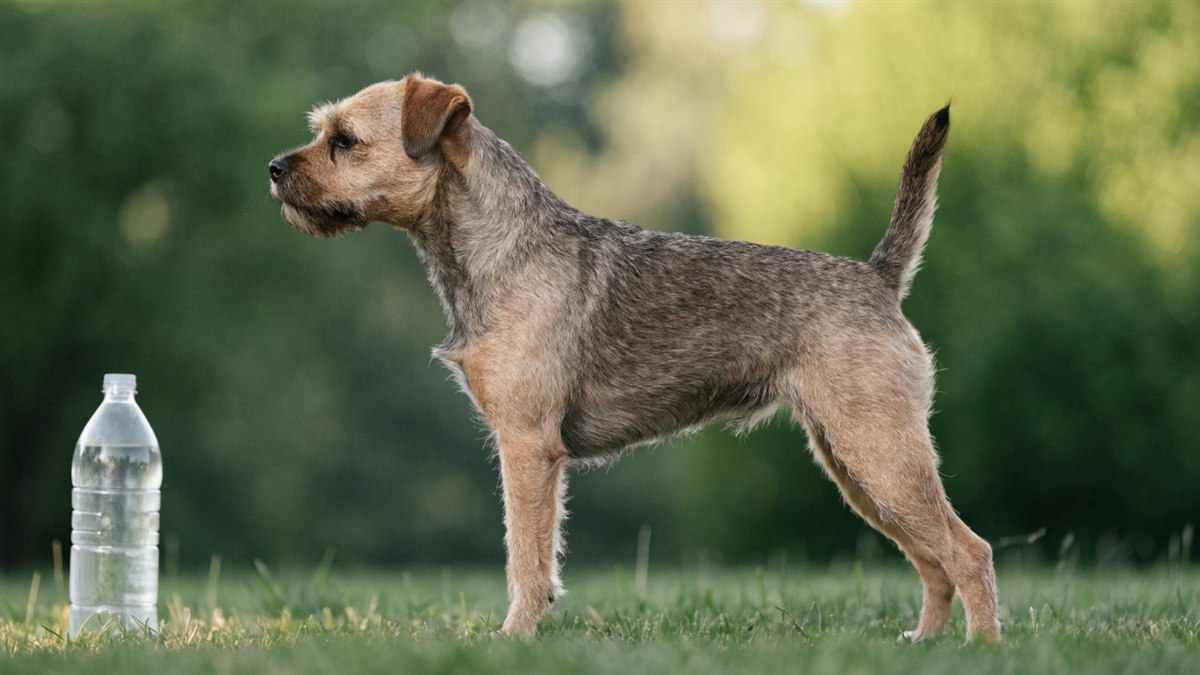
Quick answer
No honest Border Terrier price in India can be quoted, because no Border Terrier is on sale here. The pages ranking for the query print zero listings, an unbacked Rs 6,000 to Rs 25,000 band, or a Maltipoo at Rs 98,999. The breed itself is a 6 kg working earth terrier with a hand-stripped coat, a median lifespan of 14.2 years, and a gluten-linked movement disorder documented in no other breed.
This guide is general information for Indian pet owners and is not a diagnosis. Always consult a registered veterinarian near you before acting on anything you read here, and treat any sudden collapse, cramping episode or change in your dog's condition as urgent.
Border Terrier at a glance
What a Border Terrier actually is
A Border Terrier is a small British working earth terrier weighing 5.9 to 7.1 kg for dogs and 5.1 to 6.4 kg for bitches, built narrow enough to follow a fox underground and long enough in the leg to keep up with mounted hounds. The FCI describes it in four words, "essentially a working terrier", and every other line of the standard exists to protect that job.
The three standards that govern the breed agree almost word for word, which is unusual and useful. FCI-Standard No. 10 puts the breed in Group 3, Section 1, large and medium-sized terriers, and gives weights of 5.9 to 7.1 kg for dogs and 5.1 to 6.4 kg for bitches. The Royal Kennel Club prints 6 to 7 kg for dogs and 5 to 6.5 kg for bitches. The American Kennel Club states the same figures in pounds, 13 to 15.5 for dogs and 11.5 to 14 for bitches, and adds that these are weights "in hardworking condition" rather than a pet's comfortable weight.
Height is where the sources part company slightly. Purina India gives 33 to 41 cm at the withers for males and 27 to 36 cm for females. DogsIndia gives 25 to 28 cm. The kennel-club standards give no height at all, because the breed is judged on whether it can do the work rather than on a number. Take the range as roughly 28 to 40 cm and treat any Indian listing quoting a single exact height as copied rather than measured.
The span test, and why it matters
Both the FCI and the AKC define the body by a physical test rather than a measurement. The ribs are "carried well back, but not oversprung, as a terrier should be capable of being spanned by both hands behind the shoulder";. The AKC words it as "capable of being spanned by a man's hands behind the shoulders";. That single sentence is the whole breed. A dog whose chest a person cannot encircle with two hands cannot get down a fox earth, and a breeder who lets the chest broaden has lost the point of the animal even if the dog wins prizes.
The head is the second identifier. Every standard uses the same simile, a head "like that of an otter", moderately broad in skull with a short strong muzzle, dark eyes, and small V-shaped ears dropping forward close to the cheek. The muzzle is short but the dog is not brachycephalic, and that distinction matters more in Chennai than in Northumberland, because a dog that can pant properly can cool itself.
The coat is the other half of the definition
The Royal Kennel Club gives the coat in nine words, "Harsh and dense; with close undercoat. Skin must be thick";. The AKC expands it to "a short and dense undercoat covered with a very wiry and somewhat broken topcoat which should lie closely, but it must not show any tendency to curl or wave", and adds that the hide is "very thick and loose fitting";. The AKC also states what grooming the standard expects, "nothing more in the way of trimming being needed than a tidying up of the head, neck and feet". That is a description of a stripped coat, not a clipped one, and the grooming section of this page explains what that means for an owner in India.
| Point | FCI Standard No. 10 | Royal Kennel Club | American Kennel Club |
|---|---|---|---|
| Weight, dogs | 5.9 to 7.1 kg | 6 to 7 kg | 13 to 15.5 lb |
| Weight, bitches | 5.1 to 6.4 kg | 5 to 6.5 kg | 11.5 to 14 lb |
| Coat | Harsh and dense, close undercoat | Harsh and dense, close undercoat | Dense undercoat, very wiry broken topcoat |
| Skin | Must be thick | Must be thick | Very thick and loose fitting |
| Chest test | Spanned by both hands | Spanned by both hands | Spanned by a man's hands |
| Colour | Red, wheaten, grizzle and tan, blue and tan | Same four, any other unacceptable | Same four, small white chest patch allowed |
| Standard dated | 24 June 1987 | Updated 1 April 2026 | Approved 14 March 1950 |
Colour is worth knowing before you look at a photograph on an Indian listing site. The four accepted colours are red, wheaten, grizzle and tan, and blue and tan, and the Royal Kennel Club calls any other colour or combination unacceptable. English clinical records give a useful reality check on how those actually occur. Among 2,798 Border Terriers with colour recorded in the VetCompass study, the commonest were red at 993 dogs, grizzle at 678, wheaten at 513, black at 347 and blue at 255. Black is not a standard colour, so roughly one dog in eight in that English sample was recorded as a colour the standard does not accept.
A soft, fluffy or scissored coat is not a Border Terrier coat. Neither is a black-and-white dog, which is far more likely to be a Border Collie. Four of the ten pages ranking in India for this breed's price query are about the Border Collie rather than the Border Terrier, so confusion between the two starts at the search results and works its way down.
The working origin, and why it still governs the dog you get
The Border Terrier was bred on the Anglo-Scottish border by hill farmers and shepherds to bolt a fox from its earth and then cover ground behind mounted hounds all day. It carried two earlier local names, the Coquetdale Terrier and the Redesdale Terrier, before the Border Hunt of Northumberland gave it the name it kept, and The Kennel Club recognised it in 1920.
Two jobs pulled the breed in opposite directions and the compromise is the whole animal. Going to ground demands a narrow chest and a small frame. Following horses demands leg length and stamina. The AKC standard names both constraints in one sentence, "a working terrier of a size to go to ground and able, within reason, to follow a horse", and then forbids any deviation "which would impair his usefulness in running his quarry to earth and in bolting it therefrom";. The FCI reduces the second half to five words under Gait, "has the soundness to follow a horse";.
That history explains four traits an Indian buyer will meet in the first month.
- Digging, because the job was to reach an animal underground and a garden bed is the nearest available earth.
- Chasing, because a fox that ran was a fox to be followed, and an Indian street cat triggers the same circuit.
- Squeezing, because the standard demands a dog "capable of squeezing through narrow apertures", which in a Mumbai flat means a balcony grille gap.
- Enduring, because a dog bred to keep up with hounds for hours does not tire on a twenty-minute walk.
The breed is shrinking at home, not growing
Ownership of the Border Terrier is falling in the country that made it. VetCompass measured the annual birth proportion of Border Terriers among dogs under primary veterinary care in England and found it dropped from 1.46 percent in 2005 to 0.78 percent in 2014, close to a halving in a decade. The authors call that "a paradoxical trend towards decreasing ownership in recent years", paradoxical because the same study found the breed to be relatively long-lived and relatively healthy.
The practical consequence for India is supply. A breed whose home population is contracting produces fewer exportable puppies, and its breeders are the kind who health-test and vet buyers rather than ship abroad. The UK market is real and priced accordingly. Pets4Homes reports licensed-breeder prices of 1,200 to 1,500 pounds and individual-breeder prices of 900 to 1,300 pounds, with live adverts on the day this page was researched offering Kennel Club registered litters from five-star licensed breeders. Those are not dogs that leak into an Indian resale market.
A working terrier is not a small companion breed
Do not read "7 kg" as "lap dog". The AKC standard describes temperament in the same paragraph as conformation, calling the breed "good-tempered, affectionate, obedient, and easily trained" at home and, in the field, "hard as nails, game as they come and driving in attack";. Both halves are true at once. The affection is genuine and the drive is genuine, and the second one does not switch off because the dog now lives in Pune.
The FCI standard adds a detail Indian buyers should note before importing. Its disqualifying faults are only two, "aggressive or overly shy dogs" and "any dog clearly showing physical or behavioural abnormalities", and it closes by stating that "only functionally and clinically healthy dogs, with breed typical conformation should be used for breeding";. Temperament is a written part of the standard, not an optional extra, so a nervous or snappy dog sold as a Border Terrier is off-standard whatever its papers say.
The illustration credit inside FCI-Standard No. 10 reads "Bernese Mountain Dog", a template error on the FCI's own PDF. The body text is unambiguously the Border Terrier, headed FCI-Standard No. 10 BORDER TERRIER, origin Great Britain, Group 3. We flag it because this site has been caught before by a correct-looking document that turned out to be about another breed, and checking the heading rather than the caption is what settles it.
One last piece of the history matters for the health section further down. Because the breed was built by a small number of hill families working a small number of lines, it carries a set of disorders that are effectively unique to it. A gluten-sensitive movement disorder, a gall bladder disease with an 85-fold breed odds ratio, and a spongiform brain disease whose DNA test exists for this breed alone are all consequences of that closed origin Orthopedic Foundation for Animals. A buyer in India inherits all three.
Border Terrier price in India, and what the listings are actually selling
No verified Border Terrier was for sale in India on 23 August 2026. Every page ranking for "border terrier price in india" either prints zero listings, shows a different breed, or does not mention the breed at all. One page publishes a rupee band, PetBuy at Rs 6,000 to Rs 25,000, and prints "Listings 0" and a blank live average directly beneath it.
We checked the ranking set page by page and recorded what each one actually returns rather than what its title promises.
| Page | Border Terrier price shown | Border Terrier puppies shown | What it offers instead |
|---|---|---|---|
| PetBuy.in | Rs 6,000 to Rs 25,000 | Listings 0, live average blank | Nothing, the band has no listing behind it |
| Mr n Mrs Pet | None | "3 Result Found", none of them this breed | Bernese Mountain Dog, Weimaraner, Cavalier King Charles Spaniel |
| Asia Pets | None | "Showing 0 results" | Chihuahua, Yorkshire Terrier, Toy Pom |
| Puppiezo | None for this breed | None | Maltipoo, Poodle, Cane Corso, Goldendoodle, Rottweiler, Doxiepoo |
| Supertails price list | Zero mentions of the breed | Not a listing site | Ranks on its Border Collie row |
| WrapInFur price list | Zero mentions of the breed | Not a listing site | Ranks on its Border Collie row |
| DogsIndia | None | "There are no breeders listed currently under this breed" | Nothing |
The Rs 98,999 on the Puppiezo page is a Maltipoo
Puppiezo's Border Terrier page prints Rs 98,999 twice and neither figure belongs to a Border Terrier. Reading the page markup, each price sits immediately before the puppy's name and breed, and both Rs 98,999 entries resolve to "Fizey, Maltipoo, 8 weeks" and "Samy, Maltipoo, 8 weeks";. The other four prices on the same page resolve the same way, Rs 92,599 to a Poodle called Dugu, Rs 94,999 to a Cane Corso called Kazuka, Rs 120,000 to a Goldendoodle called Doir and Rs 76,499 to a Rottweiler called Tugi. Not one Border Terrier appears anywhere in the carousel.
This matters beyond one page. Bonbeno has now caught the same Rs 98,999 figure on five separate breed pages across Indian listing sites, almost always attached to a Maltipoo. It behaves as a house price point that the template attaches to whatever puppy is in stock, and it gets scraped and republished as though it were a breed price. If you see Rs 98,999 quoted as a Border Terrier price anywhere, that is where it came from.
Running the 84.38 test on every rupee figure
Indian breed pages routinely publish a "price" that is a US dollar figure passed through one exchange rate, and dividing by 84.38 exposes it because the result comes back as a round dollar amount. We ran that division on all six rupee figures found across the ranking set. None of them resolves cleanly.
| Rupee figure | Divided by 84.38 | Round dollar amount? | What it is attached to |
|---|---|---|---|
| Rs 6,000 | USD 71.11 | No | PetBuy "typical low", zero listings |
| Rs 25,000 | USD 296.28 | No | PetBuy "typical high", zero listings |
| Rs 76,499 | USD 906.60 | No | A Rottweiler on Puppiezo |
| Rs 92,599 | USD 1,097.40 | No | A Poodle on Puppiezo |
| Rs 94,999 | USD 1,125.85 | No | A Cane Corso on Puppiezo |
| Rs 98,999 | USD 1,173.25 | No | A Maltipoo on Puppiezo, twice |
So the PetBuy band is not a converted dollar price. It is something simpler and no more useful, a number generated for a template page that has never had a listing behind it. PetBuy's own panel says as much, printing "Typical Low Rs 6,000", "Typical High Rs 25,000", a blank next to "Live Avg (PetBuy)" and "Listings 0";. A price with zero transactions behind it is a placeholder, not a market.
Proving the absence with a control
A zero result is worthless unless you show the search works. Mr n Mrs Pet returns "3 Result Found" for the Border Terrier and the three cards rendered are other breeds, while the same page's "Most Popular Breeds" panel counts 650 Shih Tzu, 549 Siberian Husky, 487 Golden Retriever, 454 Labrador Retriever and 412 German Shepherd listings live on the same site. The platform plainly can hold hundreds of listings per breed. It holds none of this one.
DogsIndia gives the cleaner control because it is India's oldest breed directory and it publishes a breeders' list per breed. Its Border Terrier page states, verbatim, "There are no breeders listed currently under this breed";. Its Beagle page, fetched the same way in the same session, lists three named kennels with phone numbers and litters, including Sandstorm Kennels in Chennai and Hayesberg Beagles. The directory works. This breed is not in it.
In the UK, Pets4Homes reports 1,200 to 1,500 pounds from a licensed breeder and 900 to 1,300 pounds from an individual breeder, with live Kennel Club registered litters advertised on the day we checked. Anyone offering you a Border Terrier in India for Rs 6,000 is not selling you a Border Terrier.
Why no lawful Border Terrier supply chain can form in India
Indian law makes it impossible for a commercial Border Terrier pipeline to exist. Dogs sit under ITC (HS) 01061900 as a Restricted import, entry is permitted for only three purposes, and DGFT Trade Notice No. 22/2022-23 states in paragraph 6 that "any applications for trading/breeding purposes, or applications made on behalf of some another person/entity shall be duly rejected".
We read the trade notice in full rather than a summary of it, because summaries of Indian pet-import rules circulate with invented clause numbers. Here is what the document actually contains.
- Policy Condition 7 permits import of dogs for three purposes only, a pet dog with a valid pet book and records in the importer's name, dogs imported by R&D organisations with CPCSEA recommendation, and dogs for internal security by the Defence and Police Force.
- Policy Condition 8 states that import of commercial dogs for breeding or any other commercial activity beyond those purposes is not permitted.
- Paragraph 6 requires that trading and breeding applications, and applications made on behalf of another person, be duly rejected.
- Paragraph 7 limits entry to the airports and seaports of six cities, Delhi, Mumbai, Chennai, Hyderabad, Bangalore and Kolkata, with quarantine at the government station where required. DAHD added a seventh port, Cochin International Airport at Kochi, for pets arriving under the baggage rules in October 2024.
- Up to two pets may come as passenger baggage without DGFT authorisation, and only for a person transferring residence to India after two years of continuous stay abroad.
Read those together and the conclusion is arithmetic rather than opinion. The only lawful route for a Border Terrier to enter India is inside the baggage of a returning resident who already owned the dog abroad for the relevant period, or a Defence, Police or CPCSEA-recommended research import. No importer can bring in a breeding pair, and no importer can bring in puppies to sell. A founder population therefore cannot legally form, which is why DogsIndia's Border Terrier page has carried no breeders at all.
The paperwork a returning owner actually needs
For a permanent import the mandatory documents are a vaccination book, pet passport or pet book, a certificate for emotional support, and the pet's passport. A temporary import adds a copy of the return ticket or expected return date and an undertaking from a local host who accepts liability under the Foreign Trade (Development and Regulation) Act 1992 if the owner fails to take the animal back. Applications go through DGFT's Import Management System against the importer's own IEC, or against the permanent IEC number IIHIE0153E used for personal, non-trade imports.
Two timing rules catch people out. DGFT advises starting the authorisation process at least two months before travel. Separately, an Advance No Objection Certificate must be obtained from the Regional or Quarantine Officer at the port of entry seven days before travel, relaxable to three days in specific circumstances, and every disease test named on the health certificate has to be done in the exporting country with the reports travelling with the animal.
What this means for the Indian buyer in practice
Anyone in India who advertises Border Terrier puppies is describing something they cannot lawfully have imported for sale. That leaves three possibilities and none of them is a well-bred Border Terrier from a health-tested line.
- An auto-generated shell page with no dog behind it, which is what PetBuy's zero-listing price band and Asia Pets' "Showing 0 results" are Asia Pets, Border Terrier Puppies for Sale….
- A bait-and-switch to a different breed, which is what Puppiezo's Maltipoo carousel and Mr n Mrs Pet's three non-Border-Terrier cards are Mr n Mrs Pet, Border terrier Puppies….
- A mislabelled dog, most often a small wire-coated crossbreed or a Border Collie puppy, because two of the price lists ranking for this query carry a Border Collie row and no Border Terrier row at all WrapInFur, Dog Price List in India 2026.
There is no fourth category to hope for. If a seller cannot show you an import authorisation naming the dog's original owner, or a pet book that travelled with a returning resident, the animal did not enter India by the only route the law allows.
If the traits you want are a small, hardy, high-drive, low-maintenance dog that copes with Indian heat far better than a Border Terrier does, that animal is already here in large numbers and costs nothing to adopt. The adoption section at the end of this page sets out how to find one, and why it is a better answer than waiting for a breed the law will not let into the country.
Monthly cost of ownership in India, with the gaps named
Budget for a Border Terrier in India around three published Indian figures, a full groom at Rs 800 to Rs 1,500 for a small dog, a hydrolysed veterinary diet at Rs 2,337 for 2 kg, and a medicated anti-tick bath at Rs 1,000 to Rs 1,500. Everything beyond those is either unpriced in India or breed-specific, and this section says which is which rather than filling the gaps with invented numbers.
Grooming is the one recurring cost this breed changes materially, so start there. A 2026 survey of Indian grooming rates puts a full groom for a small breed at Rs 800 to Rs 1,500, with Bengaluru small-breed grooms starting around Rs 1,000, premium Gurugram salons charging Rs 1,850 to Rs 2,200 for a full groom, Mumbai the priciest metro, and tier-2 cities roughly 20 to 30 percent below metro rates. Home-visit grooming adds Rs 200 to Rs 500.
| Service | Published Indian rate | How often a Border Terrier needs it |
|---|---|---|
| Full groom, small breed | Rs 800 to Rs 1,500 | Not the right service for this coat, see grooming below |
| Basic bath and blow-dry | Rs 500 to Rs 1,250 | Only when genuinely dirty, not on a schedule |
| Nail trimming | Rs 200 to Rs 300 | Every 4 to 6 weeks in a flat with no rough ground |
| Ear cleaning | Rs 250 to Rs 400 | Monthly, and after every soaking in the monsoon |
| Haircut or trimming | Rs 800 to Rs 1,600 | Avoid, this is clipping and it damages a harsh coat |
| Medicated or anti-tick bath | Rs 1,000 to Rs 1,500 | As prescribed, tick pressure is an Indian reality |
| De-shedding treatment | Rs 200 to Rs 500 add-on | Not a substitute for stripping |
The cost line no Indian salon will quote you
Hand stripping now appears on a small number of Indian price lists, and the two published rates disagree by four times. ThePetNest lists breed-specific hand-stripping for terriers and schnauzers at Rs 800 to Rs 1,500 in Delhi, while Supertails prices it as a Rs 3,000 to Rs 6,000 show-quality add-on, and PatMyPets offers it at home in Gurgaon without publishing a rate. Three providers is not a market, and a fourfold spread is what a service looks like before it has settled on a price, so treat any quote as a negotiation rather than a rate card. We searched five Indian grooming price pages totalling over a million characters of service copy, covering Bangalore, Mumbai, Delhi NCR and a national survey, and found zero occurrences of "hand strip" or "hand-stripping" in any of them ThePetNest, Pet Grooming Cost in Bangalore…. The same search method found the term four times on an Indian grooming supplier's own article, so the query works. The cost of stripping in India is therefore either your own time with a stripping knife or a negotiated one-off with a groomer who has done the module, and we will not print a figure we cannot source.
Diet, where this breed can get expensive fast
A Border Terrier that turns out to be gluten-sensitive moves onto a therapeutic diet for life, and that is a real Indian cost you can price today. Royal Canin Veterinary Diet Hypoallergenic, a hydrolysed-protein rice-based diet, is stocked in India at Rs 2,337 for a 2 kg bag and Rs 7,225 for 7 kg, which is Rs 1,032 per kilogram. Work that against your own vet's feeding guide for a 6 kg dog rather than against a number we guess at.
One caution before you buy it. The Indian product page for that diet contains no mention of gluten or wheat, so it advertises hydrolysed protein rather than gluten exclusion. The diet used in the 2026 case report that resolved a Border Terrier's disseminated eosinophilia was specifically a gluten-free hydrolysed diet. Read the ingredient deck with your vet before assuming the two are the same thing.
What we could not price, and are not going to invent
- Gall bladder mucocele surgery in India. This breed's single largest catastrophic-cost risk has no published Indian rupee figure we could verify, and the UK case series reports a case fatality rate of 11.7 percent within seven days of surgery.
- A CECS diagnostic workup in India. The condition is diagnosed by exclusion after imaging and bloodwork, and no Indian clinic publishes a package price for it.
- Anti-gliadin IgG and transglutaminase-2 IgA serology in India. The published studies used UK and German laboratories, and we found no Indian laboratory offering the assay.
- The SLEM DNA test. It is ordered from the OFA and processed at the University of Missouri, so an Indian owner pays an overseas test fee plus shipping rather than a local rate.
For a general anchor on what a small dog costs a month where the breed is common, Pets4Homes puts ongoing UK monthly expenses at 50 to 85 pounds covering food, routine vet care and basic grooming, plus insurance of roughly 15 to 40 pounds a month. That is a UK figure and it does not transfer to India, but it is a useful reminder that the purchase price is the smallest number in the lifetime total for a dog that lives a median 14.2 years.
Heat tolerance, argued from the coat, the skull and the origin climate
A Border Terrier rates 2 out of 5 for heat tolerance in India. The argument is mechanical rather than impressionistic. The coat the standard requires is insulation built for a place whose warmest month averages 14.8 C, the skull the standard requires can still pant properly, and the body is small enough to shed heat well, so the breed is heat-limited rather than heat-endangered.
We queried one source by explicit latitude and longitude and checked the coordinates the API echoed back, so no other place can have been served by accident. The origin point is Otterburn in Redesdale, Northumberland, 55.2330 N and 2.1720 W, in the valley the breed was named for before the Border Hunt renamed it. NASA POWER returned that exact point at an elevation of 144 metres.
What the origin climate actually is
Redesdale's warmest month is July at a mean of 14.8 C, its coldest is January at 3.4 C, and its annual mean is 8.6 C. Relative humidity never drops below 82.9 percent in any month and peaks at 94.5 percent in December. That is the specification the coat was written against, a permanently damp, permanently cold hillside, which is why the standards demand a close undercoat under a harsh topcoat and a hide that is "very thick and loose fitting";.
Ten years of daily maxima make the point harder. Across 3,653 days from 1 January 2016 to 31 December 2025, the daily maximum at Redesdale exceeded 29.4 C exactly once, never reached 32 C, and topped out at 30.2 C. A Border Terrier's ancestors met a day above 29.4 C roughly once a decade.
| Place | Days above 29.4 C | Share of days | Coolest month mean | Above Redesdale's warmest month |
|---|---|---|---|---|
| Redesdale, Northumberland | 1 | 0.0% | 3.4 C (Jan) | reference |
| Chennai | 2,713 | 74.3% | 24.1 C (Jan) | +9.3 C |
| Mumbai | 2,640 | 72.3% | 23.2 C (Jan) | +8.4 C |
| Kolkata | 2,490 | 68.2% | 17.3 C (Jan) | +2.5 C |
| Delhi | 2,476 | 67.8% | 13.6 C (Jan) | -1.2 C |
| Hyderabad | 2,372 | 64.9% | 20.8 C (Dec) | +6.0 C |
| Bengaluru | 1,994 | 54.6% | 20.2 C (Dec) | +5.4 C |
| Pune | 1,435 | 39.3% | 19.6 C (Dec) | +4.8 C |
Read the last column first, because it is the one that decides whether a dog gets a rest. In Chennai and Mumbai the coolest month of the year is warmer than the warmest month the breed evolved in, by 9.3 C and 8.4 C. There is no season in which those two cities feel like Redesdale summer. Delhi is the interesting exception. Its January mean of 13.6 C sits 1.2 C below Redesdale's July, so a Delhi winter genuinely suits this dog, and then its June mean of 35.9 C runs 21.1 C above the same reference. Delhi is not a hot city for a Border Terrier, it is two cities.
Why the rating is 2 and not 1
Three features of the animal pull in different directions, and the honest rating is the net.
- The coat is against it. A dense undercoat plus a wiry topcoat plus a thick hide is a three-layer insulator, and it was never designed to be removed for a season.
- The skull is for it. The muzzle is "short and well filled" but the head is not brachycephalic, so the airway is normal and panting, which is a dog's only real cooling system, works at full efficiency.
- The size is for it. At 5.9 to 7.1 kg the dog has a high surface-area-to-volume ratio, so it dumps heat faster per kilogram than any large double-coated breed.
That is why a Border Terrier in Pune is a manageable proposition and a Siberian Husky in Pune is not. It is also why the rating stops at 2. The dog can cool itself, but it is doing so through a coat built for 8.6 C annual mean while carrying a working terrier's willingness to keep going past the point of sense.
Humidity is the multiplier, and it is worst where it is already hottest
Panting cools by evaporation, so it works less well as the air gets wetter. Mumbai's August mean relative humidity is 90.4 percent and Kolkata's September is 89.3 percent. Chennai never drops below 64.4 percent in any month. Delhi's May humidity of 23.4 percent means its very high temperatures at least allow evaporative cooling to work, while Mumbai's lower temperatures come with air that is nearly saturated. For a coated dog, a 32 C day in Mumbai in August is harder work than a 32 C day in Delhi in April.
An Indian grooming supplier's own guidance states that clipping or shaving a wire coat destroys its ability "to aerate and provide weatherproofing", leaving the dog "vulnerable to both cold and heat";. The coat is doing thermal work in both directions. The way to cool a Border Terrier in Chennai is to move the walks to before sunrise and after dark, not to take the coat off.
Temperament, prey drive and whether an Indian flat works
A Border Terrier is affectionate and biddable indoors and a working predator outdoors, and both are written into the standard. The AKC describes the same dog as "good-tempered, affectionate, obedient, and easily trained" at home and "hard as nails, game as they come and driving in attack" in the field. Neither half is marketing. You get both.
The two most useful sources on household fit flatly contradict each other, so we publish the disagreement instead of picking. Purina India lists the breed as "suitable for apartment living" and "good with children";. Pets4Homes lists it as "not recommended for apartment living or inexperienced dog owners due to exercise and behavioural needs";. Both are describing the same breed standard. The difference is what each assumes the owner will do with the other 22 hours.
Our reading is that the flat is not the problem and the routine is. A 6 kg dog does not need floor area. It needs 90 to 120 minutes of real work a day, and in an Indian metro that has to happen in the two hours around dawn and the two hours after dark, which is the constraint most buyers underestimate.
Prey drive is the trait that will actually cost you
This dog was bred to follow a fox underground and it has not been re-purposed since. Pets4Homes states the prey drive plainly, that smaller animals such as rodents and rabbits "are often seen as quarry", that recall is genuinely difficult, and that the breed should not be trusted alone with guinea pigs or rabbits. In Northumberland that means a fenced garden. In an Indian city it means something more specific.
- Street cats in a compound are quarry, and a terrier that catches one has both a vet bill and a residents' association problem.
- Monkeys on a terrace or boundary wall are a serious mismatch, because a 6 kg dog that commits to a chase against a troop will lose.
- Squirrels, mongoose and rats around a society garden trigger the same circuit ten times a walk.
- Free-ranging dogs on the route are the commonest flashpoint, because a terrier's response to a larger dog is confidence rather than avoidance.
Treat off-lead walking in an unfenced Indian setting as something this breed does not get, at any age, however good the recall looks on a quiet morning. The standard's own description of a dog "capable of squeezing through narrow apertures" applies to balcony grilles, gate gaps and society compound railings.
Digging and barking, the two flat-living frictions
Digging is not a behaviour problem in this breed, it is the job description. A dog bred to reach quarry underground will work on a terrace planter, a society flowerbed or a sofa cushion with the same commitment. Give it a sanctioned digging box, a sand tray or a plastic crate of soil on the balcony, and refill it, because the drive does not extinguish when you say no.
Barking is the one Purina India names directly, describing the breed as a "chatty and vocal dog" and a "guard dog" that "barks and alerts";. In a Mumbai or Bengaluru apartment society with shared walls and a watchman gate that opens forty times a day, an alert-barking terrier generates complaints. Plan for it before you buy, not after the first notice from the association.
With children and other pets
Purina India rates the breed good with children but notes it "may require training to live with kids" and "may require training to live with other pets";. Pets4Homes adds the age-specific caution that a lively terrier can knock over a toddler, and that supervision is not optional. Both are ordinary terrier advice and neither is a reason to rule the breed out for a family.
The UK breed health group's owner survey gives a rare look at how often temperament actually goes wrong. Across 87 completed questionnaires, the behavioural problems reported were aggression in one dog, excessive timidity in two and poor house training in two. That is five behavioural reports in 87 dogs, which is a low rate, and it is consistent with a breed whose standard disqualifies both aggression and excessive shyness.
A Border Terrier suits an Indian household that can commit to two hard exercise sessions a day outside daylight hours, will never let the dog off lead outside a fenced space, and has somewhere it is allowed to dig. If any one of those three is missing, this is the wrong breed and no amount of training will substitute.
Training a Border Terrier in India, and the one thing it will resist
Train a Border Terrier with short, varied, food-paid sessions and accept that recall around live prey will never be reliable. The breed is described in its own standard as "easily trained", and Pets4Homes qualifies that correctly, noting the dog is "sensitive to harsh correction" and that positive reinforcement is essential Pets4Homes UK, Border Terrier breed….
Start with what actually works, because this is a co-operative breed and most owners overcomplicate it. Six things carry the training programme.
- Pay in food, because a terrier bred to work independently does not work for praise alone.
- Keep sessions to five minutes, because a bored terrier invents its own curriculum.
- Vary the exercise every session, because repetition is what triggers the shutting-off Pets4Homes describes as easy distraction.
- Train before the heat, because a session at 11 am in Chennai is a session the dog cannot concentrate through.
- End on a win, because sensitive dogs generalise the last thirty seconds.
- Add nose work, because scent games satisfy the same drive the fox earth used to.
Recall is the exception, and it is a permanent one
Do not build a training plan that ends in off-lead freedom. The breed was selected for hundreds of years on its willingness to keep going after quarry regardless of what a human wanted, and Pets4Homes lists secure fencing and escape prevention as a key consideration rather than a training milestone. In an Indian city the failure mode is not a lost dog in a field, it is a dog under a moving vehicle on a service road, or a dog in a fight with a free-ranging pack it decided to challenge.
The practical rule is a long line of five to ten metres in any unfenced space, forever. Recall training still matters, because it buys you the two seconds that stop a chase from starting, but it is insurance rather than permission.
Socialisation in an Indian street environment
The socialisation window closes early and India offers unusually rich material. Expose a puppy deliberately to autorickshaw noise, temple bells and firecrackers, lift doors and metal grilles, watchmen in uniform, cattle, free-ranging dogs at a distance, and monkeys at a much greater distance. Indian law helps here in one specific way. Rule 8(1)(a) of the Dog Breeding and Marketing Rules 2017 states that "pups less than eight weeks in age are not sold", so a puppy that arrives legally still has four to six weeks of the sensitive period left.
A puppy offered to you at six weeks is being sold in breach of that rule, and the dog you get will be measurably harder to socialise. That is one of the few places where the legal test and the behavioural test give the same answer.
What Indian owners get wrong at the training stage
Two failures recur with terriers in Indian homes. The first is treating boredom as disobedience. A Border Terrier that shreds a cushion at 4 pm has not been naughty, it has been under-worked since a 6 am walk, and the standard Indian advice to "be firmer" makes it worse in a breed both sources agree is sensitive to correction. The second is the balcony compromise, where a dog gets a twenty-minute walk and free run of a balcony and is expected to settle. Purina India puts the requirement at roughly an hour of walking a day and Pets4Homes at 90 to 120 minutes of vigorous exercise, and the gap between those two figures is smaller than the gap between either of them and twenty minutes.
House training in 3 to 6 weeks with a consistent routine, because the breed is clean and quick. Reliable sit, down and settle in 4 to 8 weeks. Loose-lead walking past a street dog in 4 to 6 months, and only with distance work. Recall around a running cat, never. Plan the fencing and the long line around that last line rather than hoping to train past it.
One India-specific timing note closes this section. Every training session competes with the weather, and in Chennai the daily maximum exceeded 29.4 C on 2,713 of 3,653 days between 2016 and 2025. That is not a reason to train less, it is a reason to move the work indoors. Scent games, food puzzles, tidy-up-your-toys and stair recalls all run in an air-cooled room and all tire a terrier faster than a slow walk does.
Daily exercise, and the three-way disagreement about how much
Plan on 60 to 120 minutes of real exercise a day, split across two sessions outside daylight hours in an Indian metro. Three published sources give three different figures for this breed and the spread is four-fold, so we print all three rather than averaging them into a number none of them supports.
| Source | Stated daily requirement | What it is based on |
|---|---|---|
| Puppiezo (India) | 30 minutes daily | A spec card on a page selling other breeds |
| Purina India | Enjoys walking an hour a day, enjoys active walks | Breed library entry |
| Pets4Homes (UK) | 90 to 120 minutes of vigorous daily exercise | Breed guide in the country of origin |
The 30-minute figure comes from the same page whose Border Terrier carousel is full of Maltipoos, so treat it with the confidence that deserves. The honest floor is Purina India's hour. The honest target for a dog bred to follow mounted hounds all day is closer to the Pets4Homes range, and Pets4Homes is explicit that the exercise has to be vigorous rather than a stroll, listing running, agility, flyball, earthdog trials and running alongside a bicycle as appropriate outlets.
The Indian constraint is not distance, it is the clock
In Chennai the daily maximum exceeded 29.4 C on 2,713 of the 3,653 days from 2016 to 2025, and in Mumbai on 2,640. On roughly three days in four, the middle of the day is not available to a double-coated dog. That collapses the entire exercise budget into two windows.
- Before sunrise, roughly 5.15 am to 7 am, which is the longer and cooler of the two windows in every Indian metro.
- After dark, roughly 8 pm onward, which is shorter than it feels because tarmac and concrete hold heat for hours after sunset.
- Indoors during the day, where scent work, a flirt pole, stair recalls and a food puzzle do real work in a flat.
- A dig box on the balcony, which is exercise for this breed in a way it is not for most others.
Pune is the easiest large Indian city on this measure, with 1,435 days above 29.4 C over the same decade against Chennai's 2,713, and Bengaluru sits between them at 1,994. A Border Terrier in Pune or Bengaluru genuinely gets more usable outdoor hours per year than one in Chennai, Mumbai or Hyderabad, and that is a real reason to weigh city when deciding whether to take the breed on.
Under-exercise shows up on the scales, and it is measurable
The English clinical record makes the consequence concrete. Among 1,327 Border Terriers under primary veterinary care in 2013, overweight and obesity was the second most common diagnosis at 7.01 percent, behind only periodontal disease. The study notes that figure is close to the 6 percent recorded across dogs generally in England, so this is not a breed with an unusual metabolic problem. It is a breed with an unusual appetite for work that becomes an ordinary fat dog when the work stops.
Pets4Homes adds the mechanism, describing a tendency to overeat if allowed free access to food and recommending portion control and body condition scoring rather than free feeding. In an Indian household where the dog is also getting roti, biscuit and the occasional idli from three different family members, that tendency compounds fast.
Puppies and joints
Restrict exercise while the dog is growing. Pets4Homes advises controlled exercise for puppies with gradual increases to protect developing joints. That is not a formality in this breed. OFA has 4,372 Border Terrier hip evaluations on record, of which 4.0 percent are dysplastic, and 922 elbow evaluations of which 4.1 percent are dysplastic. Those are low figures by pedigree-dog standards, and the way to keep them low in your own dog is to avoid repetitive forced exercise before the growth plates close.
A correctly exercised Border Terrier is quiet indoors. If yours is patrolling, barking at the corridor, digging at the sofa or reorganising the shoe rack at 4 pm, the morning walk was too short or too slow. Add intensity before you add minutes, because ten minutes of a flirt pole does more than another thirty minutes of pavement.
The coat is stripped, not clipped, and the difference is permanent
A Border Terrier coat is maintained by hand stripping, which means plucking the dead guard hairs out of the follicle, and clipping it instead permanently changes its texture. The Royal Kennel Club specifies the coat in nine words, "Harsh and dense; with close undercoat. Skin must be thick", and every grooming decision follows from that sentence.
The AKC standard describes what a correctly maintained coat looks like without ever using the word stripping. It says the dog "should be able to be exhibited almost in his natural state, nothing more in the way of trimming being needed than a tidying up of the head, neck and feet";. That is only true of a coat whose dead hair has been removed at the root and is regrowing in stages. A clipped Border Terrier does not look almost natural, it looks like a different dog.
What hand stripping actually is
The mechanism is simple and is described plainly by an Indian grooming supplier. The wiry topcoat "is composed of long hairs that are loosely anchored in the follicles", and hand stripping is recommended "because it mimics the natural shedding process of these breeds";. The groomer takes a few hairs at a time between thumb and forefinger, or against a stripping knife, and pulls in the direction of growth. The same source states directly that "hand stripping should not cause pain to the dog" when the hair is ready to come out.
Frequency depends on which source you follow, and they differ in a way worth knowing. Purina India prescribes "regular brushing and biannual stripping", so twice a year. Pets4Homes says hand stripping "every few months" is advisable, and puts professional grooming visits at occasional rather than routine. PetPot India, which names the Border Terrier explicitly, suggests brushing once or twice a week and professional grooming every 6 to 10 weeks, adding that "if the coat is hand-stripped, the schedule may vary based on coat growth and the groomer's method". A reasonable Indian reading is a full strip twice a year, rolling maintenance every 6 to 10 weeks, and a brush twice a week in between.
What clipping does to a stripped coat, with a source
Four separate consequences are documented, and none of them reverses quickly.
- Texture is lost. Clipping cuts the guard hairs short along with the undercoat instead of removing them from the root, which "leads to undesirable changes in coat texture", leaving a coat that looks "curly and frizzy";.
- Colour fades. Guard hairs that regrow after clipping "might come in downy and soft, resembling the undercoat rather than the wiry texture", and because the undercoat is pale, the whole dog looks washed out.
- Weatherproofing goes. Clipping "disrupts this function" so the soft undercoat takes over, "compromising the coat's ability to aerate" and leaving the dog "vulnerable to both cold and heat";.
- Skin disease follows. A woolly regrown coat retains moisture, and "trapped moisture creates an environment conducive to skin issues" plus matting that leads to sores.
An Indian veterinary source says the same thing in clinical language. Cessna Lifeline, a hospital group operating in Bengaluru, Gurugram and Navi Mumbai, states that for wire and harsh coats, "clipping a wire coat, cutting rather than stripping the dead outer coat, alters the coat's natural texture over successive clips and is associated with post-clipping alopecia and a gradual loss" of coat quality. The phrase "over successive clips" is the important one. One clip is recoverable over a year or two of stripping. A dog clipped every eight weeks for three years is not.
Watch for a groomer or a price list offering a "haircut or trimming" for your Border Terrier at Rs 800 to Rs 1,600. That is a clipper service. It will be cheaper, faster and easier to book than stripping, and it is the single most common way an Indian owner destroys this coat without ever being told they did anything wrong.
One more coat rule that is India-specific rather than British. Never shave a Border Terrier for the summer. The coat is a two-way insulator and taking it off does not cool the dog, it removes the layer that keeps radiant heat off the skin while leaving the animal with a woolly regrowth that holds monsoon moisture against it. The correct response to Indian heat is timing and shade, which the climate section sets out.
Can you get a Border Terrier hand stripped in India? We checked
Only three Indian providers we could find advertise hand stripping at all, and not one of them is a general salon chain Supertails, Pomeranian Dog Price in India… PatMyPets, Pet Grooming Service at Home…. We searched five Indian grooming service and price pages covering Bengaluru, Mumbai, Delhi NCR and a national survey, totalling well over a million characters of service copy, and found zero occurrences of "hand strip" or "hand-stripping" in any of them ThePetNest, Pet Grooming Cost in Bangalore… ThePetNest, Pet Grooming Cost in Mumbai… Vetic, Pet Grooming In Mumbai Conbun, Dog Grooming Cost in India.
An absence is only worth reporting if the search that produced it demonstrably works, so here is the control. The same regular expression, run the same way in the same session, returned four matches for "hand stripping" on an Indian grooming supplier's article about wire coats, and two matches for "stripping" on an Indian grooming-cost guide, both of which turned out to be about shampoo stripping natural oils rather than coat work. The query catches the term when the term is there. It was not on any salon menu.
What Indian salon menus do list is consistent across cities. Full groom by size, basic bath and blow-dry, haircut or trimming, nail trimming, ear cleaning, teeth brushing, de-shedding treatment, medicated or anti-tick bath and spa packages. Every one of those is a bathing or clipping service. None of them maintains a harsh coat.
The skill is taught in India, on one syllabus, in one city
Hand stripping is not unknown to the Indian trade. Petgroomers, an Indian doorstep grooming service, runs a ten-module Dog Grooming Diploma Course whose Module 07, "Styling in Practice", teaches students to "apply advanced finishing techniques like hand stripping and carding";. The course costs Rs 14,999 plus 18 percent GST online, or Rs 20,000 plus GST for the version that includes five hands-on practical sessions, and those practical sessions run in Chennai only.
Read that carefully, because it is the actual state of the art. Hand stripping in India is one bullet point inside one advanced module of one online diploma, with practical work available in a single city. It is not a service on offer, it is a technique a small number of groomers have been introduced to. If you own a Border Terrier in India, assume you will be doing this yourself or paying a groomer to learn on your dog.
| Indian source | What it covers | Mentions hand stripping? |
|---|---|---|
| Wag n Bush grooming cost survey | National price bands, four cities | No |
| ThePetNest, Bangalore | Salon packages and pricing | No |
| ThePetNest, Mumbai | Salon packages and pricing | No |
| Vetic, Mumbai | Clinic grooming menu | No |
| Conbun grooming cost guide | National price guide | Only about shampoo stripping natural oils |
| ABK Grooming (supplier article) | Why not to clip a wire coat | Yes, four times |
| Petgroomers diploma syllabus | Module 07, Styling in Practice | Yes, as an advanced technique |
The hypoallergenic claim, and the page that refutes itself
Asia Pets sells the Border Terrier in India with the line "Their wiry coat is low-maintenance and hypoallergenic";. That is wrong twice over. Purina India's own page for the same breed lists it as a "Non hypoallergenic breed" and repeats "not hypoallergenic" under living considerations. Puppiezo's spec card for the breed prints "Shedding: Yes" on a page that is trying to sell it.
The underlying evidence is settled and does not need re-litigating per breed. Vredegoor and colleagues measured the major dog allergen Can f 1 in hair and homes across 196 dogs of so-called hypoallergenic breeds against 160 control dogs, and found the hypoallergenic group carried more allergen, not less, with 2.26 against 0.77 micrograms per gram of hair and 27.04 against 12.98 in coat samples, and no difference in airborne allergen. Their conclusion is one sentence, "There is no evidence for the classification of certain dog breeds as being hypoallergenic";. Neither the FCI nor the Royal Kennel Club standard says anything at all about shedding The Royal Kennel Club (UK.
PetPot India warns that "in warm and humid parts of India, moisture trapped in the coat can make skin irritation more likely" and that drying matters as much as washing. Cessna Lifeline reports that in a prospective audit of 312 dogs referred for dermatological assessment, 38 percent had a primary or significant contributing diagnosis directly attributable to inadequate grooming, and that the commonest presentation in warm humid months is recurrent hot spots at the lumbosacral region, dorsal neck and behind the ears. Dry this dog actively after every wet walk. Never let a thick double coat air dry in an Indian monsoon.
Lifespan and screening data, with the denominators attached
A Border Terrier's median life expectancy is 14.2 years, measured across a UK dataset of 584,734 dogs including 284,734 deceased animals from 18 sources, covering 155 breeds. That places the breed among the nine longest-lived in the study and gives it a hazard ratio of 0.5 for early death, meaning half the risk of the reference group.
We name the study and the sample because a lifespan printed without one is worthless. McMillan and colleagues published that figure in Scientific Reports in 2024, and a subsequent Author Correction altered only the Miniature Dachshund's value in the Figure 3 legend, leaving the Border Terrier's 14.2 years unchanged in both versions. Breeds were included only where more than 20 alive and more than 20 deceased individuals were available.
| Breed | Median life expectancy |
|---|---|
| Lancashire Heeler | 15.4 |
| Shiba Inu | 14.6 |
| Border Terrier | 14.2 |
| Miniature Dachshund | 14.0 |
| Border Collie | 13.1 |
| Labrador Retriever | 13.1 |
| All crossbreds | 12.0 |
| Pug | 11.6 |
| French Bulldog | 9.8 |
A second study gives a lower figure and the difference is instructive rather than contradictory. VetCompass reported a median longevity of 12.7 years for Border Terriers under primary veterinary care in England, with an interquartile range of 9.3 to 14.3 years and a full range of 1.0 to 17.5 years. That figure rests on only 66 deaths, 2.3 percent of the 2,841 Border Terriers in the study, recorded inside a single clinical window. McMillan's 14.2 comes from a national deceased-dog dataset. Where a longevity number rests on 66 deaths and another rests on hundreds of thousands, prefer the larger one and quote both.
The VetCompass paper adds context that makes the breed look better still. Its 12.7 years was longer than the 12.0 years reported across all dogs in England, and the authors conclude that "the longevity results do not provide specific evidence that poor health is limiting the lifespan of the breed any more than for dogs in general". Of the 61 deaths with information recorded, 54, or 88.5 percent, involved euthanasia.
OFA screening, every figure with its denominator
The Orthopedic Foundation for Animals holds the largest public screening dataset for this breed under registry code BRT, confirmed by reading the breed name printed on the returned page rather than guessing the code, and cross-checked row by row against OFA's separate all-breed disease-statistics tables. All figures below were retrieved on 23 August 2026 and will drift as evaluations are added, so the counts matter as much as the percentages.
| Screening | Evaluations | Normal | Abnormal | Breed rank |
|---|---|---|---|---|
| Eyes (ACVO) | 4,550 | 96.1% | 3.9% | 135 |
| Hips | 4,372 | 95.7% | 4.0% dysplastic | 193 |
| Patella | 3,148 | 97.9% | 2.1% | 84 |
| Congenital cardiac | 2,101 | 98.6% | 0.6% | 34 |
| SLEM DNA test | 2,052 | 90.5% | 9.3% carrier, 0.1% affected | 1 |
| Elbows | 922 | 95.8% | 4.1% dysplastic | 93 |
| Advanced cardiac | 696 | 94.5% | 3.6% | 62 |
| Legg-Calve-Perthes | 676 | 100.0% | 0 | 34 |
| Basic cardiac | 659 | 98.9% | 0.6% | 14 |
| Thyroid | 82 | 91.5% | 1.2% idiopathic hypothyroidism | 100 |
The hip breakdown is worth reading in full because 4.0 percent dysplastic is a good number for a pedigree breed. Of 4,372 hip evaluations, 966 graded Excellent at 22.1 percent, 2,883 Good at 65.9 percent and 335 Fair at 7.7 percent, with 147 mild, 24 moderate and 4 severe dysplastics making up the 175 abnormal results. Elbow dysplasia at 4.1 percent of 922 is likewise low.
Two caveats before anyone quotes the table. The thyroid row rests on 82 evaluations, which is too thin to describe a breed. And OFA's own trend data shows the SLEM clear rate has not improved, running 90.6 percent for dogs born 2006 to 2010 and 88.7 percent for those born 2021 onward.
What responsible breeders are asked to test
The OFA and the breed's parent club set five CHIC requirements for the Border Terrier, an annual ACVO eye examination until 96 months of age, a patellar luxation evaluation, a hip evaluation by OFA, PennHIP or BVA, a cardiac evaluation, and a SLEM DNA test, plus permanent identification by microchip or tattoo. Ask any seller for all five. In India, nobody will have them, which is itself the answer.
What Border Terriers actually get treated for, in clinic
The three commonest diagnoses in Border Terriers under primary veterinary care in England are periodontal disease at 17.63 percent, overweight and obesity at 7.01 percent and otitis externa at 6.71 percent. Those come from 1,327 Border Terriers under care during 2013 at 102 practices, of which 881, or 66.4 percent, had at least one disorder recorded that year.
Screening data tells you what breeders test for. Clinical data tells you what you will pay for. The two lists barely overlap, and the second is the one that matters to an owner.
| Diagnosis | One-year prevalence | 95% confidence interval |
|---|---|---|
| Periodontal disease | 17.63% | 15.62 to 19.79 |
| Overweight or obesity | 7.01% | 5.69 to 8.52 |
| Otitis externa | 6.71% | 5.42 to 8.19 |
| Nails overlong | 5.28% | not stated |
| Anal sac impaction | 4.75% | not stated |
| Vomiting | 4.37% | not stated |
Periodontal disease at 17.63 percent is more than twice the prevalence of the next condition, and the authors note it was recorded only where a clinical intervention was made, so the true figure is higher. For an Indian owner the takeaway is a toothbrush from week nine, because dental scaling under general anaesthetic is expensive everywhere and unpleasant in a 12-year-old dog. Anal sac impaction showed a sex difference, at 6.2 percent in females against 3.7 percent in males, with a p value of 0.036.
Neurological disease is the real breed signal
Seizure disorder was recorded in 1.81 percent of the same population and epilepsy in 1.58 percent, ranking 17th and 20th on the list. Those look unimportant until you notice that neither term appears at all in the equivalent list for dogs in England generally, which the authors say "suggests a true predisposition for neurological disease may exist in the Border Terrier".
A separate VetCompass study puts a number on that predisposition. Across 92 UK primary practices, 539 cases of epilepsy of unknown origin gave an overall prevalence of 0.62 percent, and among purebred dogs the Border Terrier carried 2.70 times the odds of the condition compared with crossbred dogs, with a 95 percent confidence interval of 1.57 to 4.62 and a p value below 0.001. Only the German Shepherd, at 1.90, came close among the breeds flagged.
The VetCompass breed paper draws the practical conclusion for a clinician, that "enhanced vigilance for CECS in the Border Terrier may result in more reliable diagnosis and management of this condition";. Some episodes recorded as seizures in this breed are not seizures at all, and the next two sections explain why that distinction changes the treatment.
Cardiac reference intervals now exist for this breed specifically
A 2025 study established breed-specific radiographic heart-size intervals, which removes a common source of over-diagnosis. Working from IDEXX telemedicine records for dogs radiographed between 1 January 2022 and 31 December 2023, the authors identified 504 Border Terriers, excluded 360 and analysed 144, producing a vertebral heart size reference interval of 9.3v to 11.6v and a vertebral left atrial size interval of 1.7v to 2.3v.
That is worth carrying to an Indian clinic. The generic canine VHS cut-off in wide use is around 10.5v, so a healthy Border Terrier can measure above it and be entirely normal. OFA's cardiac data supports the picture of a structurally sound breed, with 2,101 congenital cardiac evaluations returning 98.6 percent normal and 659 basic cardiac exams returning 98.9 percent normal.
Skin, and one condition named after the breed
Idiopathic generalised sebaceous gland hyperplasia is described in the veterinary literature as a Border Terrier problem. A morphometric study compared skin biopsies from five Border Terriers with the histologically confirmed condition against four unaffected Border Terriers and four other terrier breeds, and found significantly more sebaceous gland lobules per hair follicle and significantly more basal sebaceous cells in mitosis in the affected group. The authors conclude that Border Terriers "may be genetically predisposed" to it.
The sample is nine dogs, so treat it as a signal rather than a prevalence. What it means in India is that greasy, lumpy, waxy skin on a Border Terrier deserves a dermatology opinion rather than another medicated bath, particularly in the monsoon when every skin problem looks like the same skin problem.
Canine epileptoid cramping syndrome, the disorder this breed is defined by
Canine epileptoid cramping syndrome, once called Spike's disease and now usually called paroxysmal gluten-sensitive dyskinesia, is an episodic movement disorder documented in the Border Terrier more thoroughly than in any other breed. Four independent case series covering 29, 53, 110 and 45 dogs describe it, published between 2014 and 2018 Marioni-Henry K, Rusbridge C Stassen QEM, Koskinen LLE Lowrie M, Garden OA, Hadjivassiliou M.
An episode looks alarming and is easily mistaken for a seizure. The dog cramps, trembles, arches, may stagger or fall, salivates, and sometimes vomits, then stops as abruptly as it started and is normal again. The single feature that separates it from epilepsy is that the dog stays conscious. In the 53-dog series, 95 percent of owners reported that their dog could look them in the eyes during an episode.
What the four series agree on
| Finding | Black 2014 (n=29) | Marioni-Henry 2016 (n=53) | Stassen 2017 (n=110) |
|---|---|---|---|
| Age at onset | Mean and median 3.0 years, range 0.2 to 7.0 | Mean 3.1 years, median 3 | Median 2 years in western Europe, 3 in Finland |
| Sex bias | None, 15 male and 14 female of 29 | Not reported as significant | Not reported as significant |
| Episode duration | 2 to 30 minutes in 25 of 29, full range 0.5 to 150 minutes | 10 seconds to 2 hours | Not tabulated |
| Pattern | Clusters over days then weeks or months of normality, 15 of 29 | Episodic | Episodic |
| Gut signs | Vomiting and diarrhoea in 14 of 29, half of those around episodes | Autonomic signs in 26 of 46, 56 percent | Reported |
| Recruitment | Veterinary press appeal plus owner questionnaire | Online survey plus 17 clinical cases | Owner cohorts in six countries |
Onset in early adulthood is the most consistent finding. All three series put the median at two to three years, which means a Border Terrier can be bought, settled and fully grown before the first episode appears. No screening test predicts it, and no puppy can be certified free of it.
How common is it
The only prevalence figures come from Dutch owner surveys reported inside the Stassen study, which found paroxysmal dyskinesia in 7.6 percent of Border Terriers born between 1998 and 2001 and 4.8 percent of those born between 2003 and 2006. Those are survey estimates rather than clinical incidence, and they are the best numbers that exist. Roughly one Border Terrier in twenty is the honest order of magnitude.
Established, versus hypothesised
This distinction matters because Indian pages that mention CECS at all state it as settled fact. It is not.
- Established: the phenomenon exists, is breed-associated, and has a consistent phenotype across four independent series and two decades of veterinary correspondence Lowrie M, Garosi L. Classification….
- Established: consciousness is preserved during episodes, which is why the current classification treats it as a movement disorder rather than a seizure.
- Established: affected Border Terriers carry significantly higher anti-gliadin IgG and anti-transglutaminase-2 IgA than healthy Border Terriers and than Border Terriers with idiopathic epilepsy.
- Hypothesised: that the episodes are paroxysmal nonkinesigenic dyskinesia. Marioni-Henry and colleagues use the word "hypothesize" for exactly this.
- Hypothesised: that gluten causes the disorder. Every published finding is an association, and the next section sets out how strong it is.
- Unresolved: the genetics. A genome-wide association study on 82 western European cases, 73 controls, 28 Finnish cases and 55 Finnish controls using an array of over 170,000 markers found "no chromosome regions with significant association to the disorder", only a weak signal on chromosome 2, and no association at all with the human paroxysmal dyskinesia genes. The authors conclude inheritance "probably is complex";.
If a vet reads an episode as epilepsy, the dog goes on lifelong phenobarbital. Marioni-Henry reported improvement in 80 percent of dogs treated with phenobarbital, so the drug appears to help, but in an owner-reported survey of an episodic condition that improvement is hard to separate from natural variation. The VetCompass authors put it plainly, recommending "enhanced vigilance for CECS in the Border Terrier", because the alternative first-line intervention is a diet trial rather than an anticonvulsant.
The literature is genuinely small, and we checked how small. PubMed returns 35 records for "Border Terrier" and 8 for "canine epileptoid cramping syndrome". A control search for "Labrador Retriever" in the same session returned 1,107 records and a deliberately meaningless term returned zero, so the counts are real rather than a broken query. We opened all 35 Border Terrier records and confirmed each is a genuine veterinary paper rather than unrelated noise.
Does a gluten-free diet work? What the evidence actually supports
A gluten-free diet has real but low-grade evidence behind it in Border Terriers with CECS. The strongest interventional study enrolled six dogs, was prospective and unblinded with no control group, and reported clinical and serological improvement in all five that adhered strictly, with relapse in both dogs deliberately re-challenged with gluten.
Grade that honestly before acting on it. Six dogs is a case series, not a trial. There has never been a randomised, blinded, placebo-controlled dietary trial in this condition, and anyone who tells an Indian owner that gluten is proven to cause CECS is going beyond the literature.
The interventional evidence, study by study
| Study | Dogs | Design | Dietary result |
|---|---|---|---|
| Lowrie 2015 | 6 | Prospective, unblinded, no control group | Clinical and serological improvement in all 5 strict adherers at 9 months, relapse in both dogs re-challenged |
| Black 2014 | 29 | Owner questionnaire | 26 of 29 had changed diet, and 14 of those 26 felt episode frequency fell |
| Marioni-Henry 2016 | 53 | Owner survey plus clinical records | Only 5 owners, 12 percent, reported improvement on a diet change, though 2 dogs became episode-free for 1 and 8 years |
| Rogers 2023 | 31 dogs, mixed breeds | Retrospective serology | Of the serology-positive dogs, 5 stopped having episodes on a gluten-free diet, 3 had frequency fall by more than half, 2 had milder episodes |
Notice the disagreement in the middle two rows. Black's owners reported a diet response in 14 of 26, roughly 54 percent, while Marioni-Henry's reported it in 5 of about 42, roughly 12 percent Marioni-Henry K, Rusbridge C. Both are owner-reported, both are unblinded, and the four-fold gap between them is the reason nobody can quote a response rate with confidence. We publish both rather than the flattering one.
The serological evidence is stronger than the dietary evidence
The largest study measured antibodies rather than diet response, and it is the most solid thing in this field. Lowrie and colleagues tested 128 Border Terriers in four groups, 45 with paroxysmal dyskinesia, 28 with idiopathic epilepsy, 35 with other conditions and 20 healthy controls.
- Anti-gliadin IgG was raised above control values in 38 of the 45 affected dogs, 84.4 percent, with a median of 0.35 against a control median of 0.11.
- Anti-transglutaminase-2 IgA was raised in 41 of 45, 91.1 percent, with a median of 1.31 against a control median of 0.22.
- Both differences were significant against healthy controls at p below 0.0001, and anti-gliadin IgG separated the dyskinesia group from the epilepsy group at p equal to 0.012.
- Diagnostic performance was specificity 93.10 percent with sensitivity between 82.61 and 89.13 percent, which the authors summarise as markers that are "highly specific for PGSD but lack sensitivity".
The same authors conclude that gluten sensitivity in this breed appears to be part of a broader syndrome of intolerance affecting multiple organ systems rather than a purely neurological problem. Three single-case reports support that reading. A 2016 case combined neurological signs, atopy, positive serology and gastrointestinal pathology, all seemingly responsive to a gluten-free diet. A 2022 case in an 11-year-old Border Terrier with myositis and a mixed neuropathy resolved completely on a gluten-free diet. A 2026 case in a 15-month-old Border Terrier with marked eosinophilia and multi-organ eosinophilic infiltration was "successfully managed with dietary modification alone", using a gluten-free hydrolysed diet, where previous cases had needed prednisolone and hydroxyurea.
Two findings that cut the other way
First, this is probably not a Border Terrier monopoly. A 2023 study tested 31 dogs of various breeds presented for suspected paroxysmal dyskinesia and found 14, or 45 percent, positive for gluten sensitivity markers, 7 questionable and 10 negative, with only one Border Terrier in the cohort. The mechanism may be general and the Border Terrier may simply be where it was noticed.
Second, a gluten-free diet is not protective against this breed's other big problem. The UK breed health group reports that preliminary results from ongoing gall bladder mucocele research "do not show PGSD, diabetes, hypothyroidism or gluten free diets as being risk factors", while Cushing's syndrome is one. Do not put a Border Terrier on a gluten-free diet expecting it to protect the gall bladder.
For a Border Terrier with confirmed episodes, a strict gluten-free trial of at least nine months is a reasonable first intervention, because that is the duration over which the six-dog study saw both clinical and serological change. Strict means no wheat, barley or rye in food, treats, chews or table scraps, which in an Indian household means no roti, no biscuit and no rusk. Discuss it with your vet before starting, and expect that the antibody assays used in the studies are not available from Indian laboratories, so you will be judging the trial on episode frequency alone.
Gall bladder mucocele, the breed's largest single risk
Border Terriers develop gall bladder mucoceles at 85 times the odds of all other breeds, with a 95 percent confidence interval of 56.9 to 126.8. That figure comes from a case-control study of 99 dogs with ultrasound-confirmed mucoceles across three UK referral centres, of which 51, or 51.5 percent, were Border Terriers.
A gall bladder mucocele is an accumulation of thick immobile mucus that distends the gall bladder and can rupture it. It is a surgical disease and a middle-aged to older dog's disease, and it is the condition most likely to kill a Border Terrier that would otherwise have reached its median 14.2 years.
The numbers, and the survival gap
Allerton and colleagues drew cases from three centres over periods running from January 2010, January 2011 and January 2014 respectively to September 2017, and compared the 51 affected Border Terriers against 87 similar-aged Border Terriers without the condition. Two results matter to an owner.
| Outcome | Border Terriers | Other breeds |
|---|---|---|
| Survival to 7 days after surgery | 85% | 95% |
| Survival to 1 year | 76% | 88% |
| Share of all cases in the study | 51 of 99 | 48 of 99 |
Overall case fatality within seven days of surgery across the whole study group was 11.7 percent. Border Terriers did worse than other breeds at both time points, which means the breed both gets the disease far more often and survives it slightly less well.
A separate UK breed health survey puts the mortality higher still. Reporting on an ongoing study at a referral centre, the breed health group states that among 121 affected dogs the mortality rate was 27.6 percent.
What raises the risk, and what does not
The same breed health report is unusually useful because it names both. Cushing's syndrome was found in 14 of 121 affected dogs against 3 of 128 unaffected older control dogs, which the authors call a significant risk factor. In the same preliminary analysis, paroxysmal gluten-sensitive dyskinesia, diabetes, hypothyroidism and gluten-free diets were all found not to be risk factors. Allerton's study reached a compatible conclusion, finding "no differences in the frequencies of individual endocrinopathies" between affected and control Border Terriers.
The gluten link is nevertheless present in the serology, which is a genuinely odd finding. Barker and colleagues compared 15 Border Terriers with mucoceles, 17 non-Border Terriers with mucoceles and 14 control Border Terriers with non-biliary disease, using samples from two referral hospitals collected between 2011 and 2019. Median anti-transglutaminase-2 IgA in the affected Border Terriers was 0.73, range 0.18 to 1.67, against 0.41, range 0.07 to 1.14, in the control Border Terriers, a significant difference. Median cholecystokinin was 13 picograms per millilitre, range 6 to 45, against 103, range 9 to 397, in controls, significantly lower. There was no difference in anti-gliadin IgG, and the non-Border Terriers with mucoceles did not differ from either group.
So the serology says something is going on with gluten-sensitivity markers and gall bladder contraction hormones in this breed specifically, while the outcome data says a gluten-free diet does not prevent the disease. Both can be true. Publish them together and let the reader see that the question is open.
What an Indian owner should actually do
- Ask for an abdominal ultrasound at every annual check from about seven years of age, because mucoceles are frequently found before symptoms appear.
- Treat vomiting, inappetence, abdominal pain or jaundice in a middle-aged Border Terrier as an ultrasound question rather than a gastritis question.
- Screen for Cushing's syndrome if the dog is drinking more, urinating more, panting excessively or thinning on the flanks, because that is the one confirmed risk factor.
- Identify a surgical referral centre before you need one, because this is an emergency abdominal surgery with an 11.7 percent seven-day case fatality even in specialist UK hands.
This is the strongest argument against taking on a Border Terrier in India. The breed's defining surgical emergency needs an abdominal ultrasound, a specialist soft-tissue surgeon and post-operative intensive care, available in a small number of Indian cities and not at all in most. If you are more than an hour from a referral hospital that can do a cholecystectomy at night, this breed's most likely fatal event is one you cannot respond to in time.
Shaking puppy syndrome, the one thing you can test for before you buy
Spongiform leukoencephalomyelopathy, known as shaking puppy syndrome, is a recessive hereditary brain and spinal cord disease that exists in the Border Terrier and effectively nowhere else. A DNA test is available, puppies can be tested from about four weeks of age, and 9.3 percent of the 2,052 Border Terriers in the OFA register are carriers.
Affected puppies "show an uncontrollable shaking of their hind limbs as soon as they begin to stand and try to walk", and as they grow the shaking can spread to the whole body. It was first described in the veterinary literature in 2012, in Border Terrier puppies, in the Journal of Veterinary Internal Medicine.
What the seven-dog series added
A 2019 study followed seven affected dogs and produced the clinical picture that now defines the condition. Every case presented with cerebellar ataxia and severe generalised coarse body tremors starting at three weeks of age. Brainstem auditory evoked response testing showed a normal wave I, a reduced-amplitude wave II and complete absence of waves III to VII. MRI showed bilateral, symmetrical T2-weighted hyperintensities in the brainstem and cerebellar white matter, and histology confirmed spongiform change with decreased myelin in the cerebellum, brainstem and spinal cord.
One finding in that paper changes the prognosis. Of the seven dogs, the three that were not euthanased "showed slow but progressive improvement over several months", and the authors describe theirs as the first report of long-term improvement in this condition. A shaking Border Terrier puppy is not automatically a hopeless case, which is worth knowing before anyone in an Indian clinic recommends euthanasia at three weeks.
The carrier rate, and why it has not fallen
SLEM is the one disease where the Border Terrier ranks first in the entire OFA database, because the test exists for this breed. Of 2,052 dogs tested, 1,858 were clear at 90.5 percent, 191 were carriers at 9.3 percent and 3 were affected at 0.1 percent. Roughly one tested Border Terrier in eleven carries the mutation.
The trend data is the uncomfortable part. OFA's clear-rate by birth year runs 96.4 percent for dogs born 2001 to 2005, 90.6 percent for 2006 to 2010, 90.5 percent for 2011 to 2015, 91.6 percent for 2016 to 2020 and 88.7 percent for 2021 onward. Twenty years of testing has not reduced the carrier frequency, which is what you would expect from breeding advice that deliberately keeps carriers in the gene pool.
That advice is correct, incidentally. OFA states that "carriers of the mutant gene can be used for breeding, but should be bred to a dog that is tested clear of this mutation", so that no affected puppies are born while genetic diversity is preserved. The UK breed health group gives the same rule harder, that at least one member of a breeding pair must be clear and that carriers or dogs of unknown status must only be mated to a clear dog, adding that "to do anything else is highly irresponsible";.
Testing from India
The test is ordered through the OFA website, which ships a buccal swab kit that the owner collects at home with no veterinary appointment needed, and samples are processed by the Small Animal Molecular Genetics Lab at the University of Missouri College of Veterinary Medicine. An Indian owner therefore pays an overseas test fee plus international shipping, and there is no Indian laboratory alternative we could find.
Availability has been fragile even in Britain. When the Animal Health Trust closed in July 2020, the University of Missouri became the only laboratory offering the test anywhere, and UK testing resumed only in May 2021 through the Kennel Club Genetics Centre at Cambridge. In the eight months that followed, 375 test kits were distributed, 30 percent of them to overseas owners.
Ask for the sire's and dam's SLEM DNA results by certificate number. A genuine Border Terrier breeder anywhere in the world will produce them without hesitation, because it is one of five CHIC requirements for the breed. An Indian seller offering a Border Terrier at Rs 6,000 will not know what you are asking about. That single question resolves the transaction faster than any conversation about price.
Indian law, for its part, mandates genetic-defect testing but names the wrong defects for this breed. Second Schedule Part III paragraph 8(10) of the Dog Breeding and Marketing Rules 2017 requires that dogs "have been tested for genetic defects, including hip dysplasia, progressive retinal atrophy, night blindness, hypothyroidism, entropion, ectropion, overshot, undershot jaw, wry mouth, two or more missing teeth, unilateral cryptorchid or full cryptorchid males". Spongiform leukoencephalomyelopathy appears nowhere in the Rules, and neither does gall bladder mucocele or gluten sensitivity.
Feeding a Border Terrier in India, life stage by life stage
Feed a Border Terrier puppy three to four measured meals a day until about ten months, then two measured meals a day for life, and weigh the food rather than eyeballing it. Pets4Homes is explicit that the breed will overeat given free access, and the clinical record backs that up, with overweight and obesity the second commonest diagnosis in the breed at 7.01 percent O'Neill DG, Darwent EC, Church DB.
The target weight is written into the standards and it is a working weight, not a comfortable one. The AKC gives 13 to 15.5 pounds for dogs and 11.5 to 14 pounds for bitches and says explicitly that these are "appropriate weights for Border Terriers in hardworking condition". In kilograms, the FCI puts that at 5.9 to 7.1 and 5.1 to 6.4. English clinical records show real pet dogs running heavier, with a median adult bodyweight of 10.9 kg for 665 males and 9.1 kg for 496 females. That gap between the standard and the clinic is the fat.
Use the standard's own span test as a body condition check
The breed standard says the ribcage should be "capable of being spanned by both hands behind the shoulder";. That test was written to check conformation, and it doubles as the cheapest body condition score there is, because it stops working on a dog carrying extra weight. Do it monthly with the same pair of hands. If your span no longer closes and the dog has not grown, the portions are too large.
| Stage | Meals per day | What to watch |
|---|---|---|
| 8 weeks to 4 months | 4 | Weigh weekly, keep the puppy lean through the growth phase |
| 4 to 10 months | 3 | Introduce a gap between the last meal and the evening walk |
| 10 months to 7 years | 2, measured | Monthly span check, no free feeding, no table scraps |
| 7 years and older | 2, measured | Watch for increased thirst and appetite, which can signal Cushing's |
The gluten question at the food bowl
This is where an Indian household differs from a British one. A Border Terrier that develops CECS needs a strict gluten-free diet to be worth trying, and strict means eliminating wheat, barley and rye from every source. In an Indian home the sources are not only the kibble. They are roti, paratha, biscuit, rusk, bread, sooji, dalia and most commercial dog treats.
The evidence for making that change is set out in the CECS diet section above and it is genuine but low grade, resting on a six-dog uncontrolled study with two gluten re-challenges. Do not put a healthy Border Terrier on a gluten-free diet as a precaution. There is no published evidence that it prevents anything, and the UK breed health group specifically found gluten-free diets were not a protective factor against gall bladder mucocele.
If a trial is indicated, a hydrolysed veterinary diet is stocked in India. Royal Canin Veterinary Diet Hypoallergenic, which uses hydrolysed soy protein on a rice base, sells at Rs 2,337 for 2 kg and Rs 7,225 for 7 kg. Read the ingredient panel with your vet, because that product page never uses the word gluten and hydrolysed is not the same claim as gluten-free.
Three Indian feeding adjustments
- Feed the larger meal after the evening walk, not before, because the pre-dawn window is when the dog actually works and a full stomach in a deep-chested small terrier is worth avoiding.
- Keep water available at all times and refresh it twice a day in summer, because a coated dog in a city where the daily maximum passes 29.4 C on two days in three loses water faster than an owner expects.
- Protect the teeth from day one. Periodontal disease is the single commonest diagnosis in this breed at 17.63 percent, more than twice the next condition, so a daily brush and a hard chew do more for lifetime cost than any supplement.
Vomiting was recorded in 4.37 percent of Border Terriers under care in one year, and in the 29-dog CECS series 14 dogs were prone to vomiting and diarrhoea with half of those episodes falling immediately before or after a cramping episode. A Border Terrier that vomits repeatedly is telling you something about its gut, its gall bladder or its nervous system. Log the dates and take the log to the vet.
The first year, month by month, with the Indian legal dates
A Border Terrier puppy cannot lawfully be sold in India before eight weeks of age, must have started its vaccination course by seven to eight weeks, and cannot be sold after six months without first being sterilised. Those three dates come from the Prevention of Cruelty to Animals (Dog Breeding and Marketing) Rules, 2017, read clause by clause.
| Age | What happens | Anchor |
|---|---|---|
| 3 weeks | SLEM would show itself here if present, as cerebellar ataxia and coarse whole-body tremor when the pup first stands | Seven-dog case series, all onset at three weeks |
| 4 weeks | Earliest age at which the SLEM DNA test can be run on a puppy | OFA testing guidance |
| 7 to 8 weeks | Vaccination course starts and is usually completed by eighteen weeks | Second Schedule Part III, paragraph 8(9) |
| 8 weeks | Earliest lawful sale. A pup offered younger is being sold in breach | Rule 8(1)(a) |
| 8 to 16 weeks | Socialisation window. Street sounds, lifts, grilles, uniforms, cattle, distant dogs | Standard puppy development, reinforced by the eight-week floor |
| 3 to 6 months | House training completes, teeth-brushing habit established, digging box introduced | Periodontal disease is the breed's commonest diagnosis |
| 6 months | A dog sold after this age must have been sterilised first, unless sold to another licensed breeder | Rule 8(1)(b) |
| 6 to 9 months | Adult coat comes through. First hand-strip, done gradually rather than all at once | Purina India prescribes biannual stripping |
| 9 to 12 months | Exercise builds toward the adult 60 to 120 minutes, still controlled to protect joints | Pets4Homes puppy exercise guidance |
| 12 months | Earliest age for a PennHIP hip evaluation, one of the five CHIC screens | OFA CHIC requirements for the breed |
Growth, and what a normal weight curve looks like
The English clinical record gives the only large-sample growth data for this breed, built from 908 female and 1,180 male Border Terriers under primary veterinary care. The endpoint is a median adult bodyweight of 10.9 kg for males and 9.1 kg for females, against breed-standard weights of 5.9 to 7.1 kg and 5.1 to 6.4 kg.
Read that gap honestly rather than as a target. Real pet Border Terriers in England run three to four kilograms above the standard, which on a 6 kg dog is more than half its bodyweight again. Aim your puppy at the standard, not at the clinical median, and use the two-hand span behind the shoulders as the monthly check.
Three things that will not happen in year one
- CECS will almost certainly not appear. Median age at onset is two to three years across every published series, with the youngest recorded onset at 0.2 years Stassen QEM, Koskinen LLE. A clear first year proves nothing.
- Gall bladder mucocele will not appear. It is a middle-aged and older dog's disease.
- Recall will not become reliable off lead. Build the long-line habit in month three and keep it for life.
One legal point about appearance
The Border Terrier standard describes a natural, undocked tail, "moderately short, thick at the base, then tapering", and natural drop ears. If anyone offers you a docked or cropped dog of this or any breed in India, Second Schedule Part II paragraph 6(8) of the 2017 Rules states that "there shall be no tail docking, ear cropping, de-barking, de-clawing, branding, dyeing, injecting substances to enhance visual appeal" or "any other kind of mutilation", and that any change of appearance by artificial means "is strictly forbidden";. The next paragraph, 6(9), prohibits breeding to create new breeds or unusual looks.
Ask to see the litter with the dam, and ask for the sire's and dam's SLEM certificates and hip results. A breeder who has both will hand them over. A breeder who has neither is not a Border Terrier breeder, whatever the puppy looks like, and in India that describes every seller we found DogsIndia, Border Terrier breed page….
Border Terrier compared with what Indian buyers can actually get
The Border Terrier's closest cross-shop in India is not another terrier, it is the Border Collie, because four of the ten pages ranking for this breed's price query are about that breed instead. The Border Collie is available in India at Rs 20,000 to Rs 90,000 depending on which price list you read. The Border Terrier is available at no price, because there are no listings WrapInFur, Dog Price List in India 2026.
| Breed | Live listings on Mr n Mrs Pet | Supertails price band | WrapInFur price band | WrapInFur monthly cost |
|---|---|---|---|---|
| Border Terrier | 0 genuine | Not listed at all | Not listed at all | Not listed |
| Border Collie | Not in top ten | Rs 20,000 to Rs 60,000 | Rs 30,000 to Rs 90,000 | Rs 5,000 to Rs 10,000 |
| Beagle | 274 | Rs 15,000 to Rs 60,000 | Rs 15,000 to Rs 40,000 | Rs 3,500 to Rs 7,000 |
| Shih Tzu | 650 | Rs 20,000 to Rs 80,000 | Not compared here | Not compared here |
| Labrador Retriever | 454 | Not compared here | Not compared here | Not compared here |
| Siberian Husky | 549 | Not compared here | Rs 40,000 to Rs 1,00,000 | Rs 6,000 to Rs 12,000 |
Two things fall out of that table. The first is that the two biggest Indian price lists disagree about the Border Collie by Rs 30,000 at the top end, which is a useful reminder that these numbers are editorial rather than transactional. The second is that every breed with a real Indian market has hundreds of live listings, and this one has none.
Border Terrier versus Border Collie, since the search engine confuses them
These are not similar dogs and the shared word is a coincidence of geography. The Border Collie is a herding dog that both Indian price lists classify as medium, with a median life expectancy of 13.1 years WrapInFur, Dog Price List in India 2026. The Border Terrier is a 5.9 to 7.1 kg earth terrier with a harsh stripped jacket and a median life expectancy of 14.2 years. One was bred to control sheep at distance with eye contact, the other to go down a hole after a fox.
For an Indian buyer the practical difference is the failure mode. An under-worked Border Collie develops obsessive behaviour, shadow chasing and noise reactivity. An under-worked Border Terrier digs, barks and chases street animals. Neither is a good outcome, but the terrier's version is smaller, cheaper and easier to contain.
Border Terrier versus the terrier you can actually buy
If the appeal is the terrier temperament rather than this specific breed, several small terriers do have Indian availability, and the coat question is the one that separates them. A Border Terrier, a Wire Fox Terrier and a Miniature Schnauzer all carry harsh coats that need stripping rather than clipping, and none of that work is on an Indian salon menu PetPot India, How Often Should You Groom…. A Jack Russell or a smooth Fox Terrier gives you the same drive with a coat any Indian groomer can handle.
Border Terrier versus an Indian dog
The honest comparison, and the one no listing site will make, is against a free-ranging Indian dog from a shelter. On the four criteria that decide whether a small dog thrives in an Indian city, the Indie wins three.
- Heat. An Indian dog is adapted to a climate where the daily maximum passes 29.4 C on 54 to 74 percent of days depending on the city. A Border Terrier is adapted to a valley that crossed that threshold once in ten years.
- Coat. An Indian dog needs a brush. A Border Terrier needs a technique that is taught on one Indian diploma syllabus and sold by nobody.
- Availability. Every Indian city has adoptable dogs today. India has no Border Terriers, no breeders listed and no lawful commercial import route Directorate General of Foreign Trade.
- Predictability. This is the one the Border Terrier wins. A known breed brings a known health profile, and 4,372 OFA hip evaluations and 2,052 SLEM tests tell you what you are dealing with.
If you are returning to India after two or more years abroad and already own a Border Terrier, bring it. That is the route the law is built for, the dog is already yours, and everything on this page becomes a management problem rather than a purchase decision. If you are in India looking to acquire one, the answer is different, and it is set out in the adoption section.
Nine mistakes Indian owners make with this breed
The commonest Border Terrier mistake in India is buying one, because the animal on offer is almost never the breed. The eight that follow it are care errors, and every one of them has a source behind it rather than an opinion.
1. Paying for a dog that is not this breed
PetBuy publishes a Rs 6,000 to Rs 25,000 band with "Listings 0" printed beside it, Asia Pets prints "Showing 0 results", and Puppiezo's Border Terrier page prices two Maltipoos at Rs 98,999 each Asia Pets, Border Terrier Puppies for Sale… Puppiezo, Border Terrier Puppies For Sale. Verify the parents, the SLEM certificates and the import paperwork, or walk away.
2. Booking a full groom or a haircut
Indian salon menus offer a haircut or trimming at Rs 800 to Rs 1,600, which is a clipper service. Clipping a wire coat "alters the coat's natural texture over successive clips" and is associated with post-clipping alopecia, according to an Indian veterinary hospital group. Say the words hand stripping when you book, and expect to explain them.
3. Shaving the dog for the Indian summer
Removing the coat does not cool a Border Terrier. It destroys the coat's ability "to aerate and provide weatherproofing", leaving the dog "vulnerable to both cold and heat";. Shift the walks instead. In Chennai the daily maximum passed 29.4 C on 2,713 of 3,653 days over the last decade, so the middle of the day was never the answer anyway.
4. Reading a cramping episode as epilepsy
A Border Terrier that cramps, staggers and salivates while remaining conscious and able to make eye contact is showing the phenotype of paroxysmal gluten-sensitive dyskinesia, not a seizure, and 95 percent of owners in the 53-dog series reported that eye contact. Film the episode on a phone and take the video to the vet. The VetCompass authors specifically call for "enhanced vigilance for CECS in the Border Terrier";.
5. Putting a healthy dog on a gluten-free diet as insurance
There is no published evidence that a gluten-free diet prevents CECS in an unaffected dog, and the UK breed health group found gluten-free diets were not a risk factor either way for gall bladder mucocele. The diet is a treatment trial for an affected dog, not a precaution for a well one.
6. Letting the coat air dry after a monsoon walk
Trapped moisture under a thick double coat "creates an environment conducive to skin issues";, and an Indian clinical source reports that the commonest presentation from double-coat mismanagement is recurrent hot spots in warm humid months at the lumbosacral region, dorsal neck and behind the ears. Towel and blow dry every time, and dry inside the ears.
7. Believing the hypoallergenic claim
One Indian listing site describes the coat as "low-maintenance and hypoallergenic" while Purina India's page for the same breed says "non hypoallergenic breed" and Puppiezo's spec card prints "Shedding: Yes"; Purina India, Border Terrier Dog Breed… Puppiezo, Border Terrier Puppies For Sale. The underlying research measured more allergen on so-called hypoallergenic breeds, not less.
8. Under-working the dog and over-feeding it
Overweight and obesity was the second commonest diagnosis in 1,327 Border Terriers under veterinary care, at 7.01 percent, and the breed will overeat given free access. Real pet Border Terriers in England run a median 10.9 kg for males against a breed standard of 5.9 to 7.1 kg Federation Cynologique Internationale.
9. Skipping the teeth and skipping the seven-year ultrasound
Periodontal disease affects 17.63 percent of Border Terriers in a single year, more than twice the next diagnosis, and it starts young. Gall bladder mucocele carries 85 times the odds in this breed compared with all others, and it is a middle-aged dog's disease that an abdominal ultrasound finds before it becomes an emergency.
Verify the dog, strip the coat, walk before dawn, film any cramping episode, brush the teeth daily, ultrasound the abdomen from seven, and never shave. Those seven habits cover almost every avoidable problem this breed has in India.
Adoption and responsible sourcing, which for this breed is the whole answer
Adopt, because there is no lawful way to buy a Border Terrier in India. Trade Notice No. 22/2022-23 states that import applications "for trading/breeding purposes" shall be duly rejected, DogsIndia lists no breeders for the breed, and every ranking listing page shows zero genuine Border Terriers DogsIndia, Border Terrier breed page….
That leaves three honest routes and one dishonest one. The dishonest route is a seller who says the puppy is coming, takes a booking amount, and delivers something else. Everything on this page exists so that you recognise that conversation before you pay for it.
Route one, adopt an Indian dog with the traits you actually wanted
Most people asking about a Border Terrier want a small, hardy, clever, low-fuss dog with personality. That description fits an enormous number of adoptable Indian dogs, and they arrive with a decisive advantage this breed cannot match, which is a body adapted to the climate they will live in. Compare 3,653 days of daily maxima. Chennai crossed 29.4 C on 2,713 of them and the Border Terrier's home valley crossed it once.
Contact a registered shelter or a recognised rescue in your city, meet several dogs, and take the one whose energy matches your routine rather than the one that looks right. Ask for the sterilisation and vaccination record, and ask what the dog was like in foster.
Route two, breed rescue if you are already abroad
Border Terrier rescue is well organised in Britain, where the breed is common, and Pets4Homes lists breed-specific rescue and adoption as a standing option alongside purchase. That route is realistic only for someone already resident abroad who will later transfer residence to India, because the animal then travels as the owner's own pet under the passenger-baggage provision rather than as an import.
Route three, bring your own dog home
The lawful path is narrow and worth restating exactly. Up to two pets may enter as passenger baggage without a DGFT authorisation, and only for a person transferring residence to India after two years of continuous stay abroad. Anything else needs an import authorisation applied for at least two months ahead, an Advance No Objection Certificate from the quarantine officer seven days before travel, and entry through one of seven ports, Delhi, Mumbai, Chennai, Hyderabad, Bengaluru, Kolkata or, since October 2024, Kochi Department of Animal Husbandry…. The full route is set out in how to import a dog to India.
If you are offered a Border Terrier in India anyway
Run these six checks in order. Any single failure ends the conversation.
- Ask for the import authorisation or the pet book naming the original owner abroad. There is no other lawful way the founder animal entered India.
- Ask for the sire's and dam's SLEM DNA certificates, one of five CHIC requirements for this breed.
- Ask for hip results from OFA, PennHIP or BVA, and an ACVO eye examination.
- Check the puppy's age against Rule 8(1)(a), which prohibits selling pups under eight weeks.
- Look at the coat. A soft, fluffy, scissored or clipped jacket is not the harsh dense coat with close undercoat that all three standards require.
- Look at the price. Rs 6,000 is not a Border Terrier price anywhere on earth, and the breed sells for 900 to 1,500 pounds in its own country.
What Indian law asks of any breeder you deal with
The Prevention of Cruelty to Animals (Dog Breeding and Marketing) Rules, 2017 set a floor that most Indian sellers do not meet, and knowing three clauses is enough to test one. Only females that have reached their eighteenth month may be bred, and no female may be used in two consecutive breeding seasons. In-breeding and incest breeding are prohibited, with only out breeding and line breeding permitted. Tail docking, ear cropping, de-barking, de-clawing and "any change of appearance by artificial means" are strictly forbidden.
Bonbeno does not broker sales and does not recommend breeders. On the evidence gathered here, the Border Terrier has no Indian market, no Indian breeders, no lawful commercial import route, a defining surgical emergency that needs referral-level care, and a coat that no Indian salon maintains. Adopting an Indian dog is the better decision for almost every reader of this page, and it is not a consolation prize Allerton F, Swinbourne F, Barker L.
Border Terrier questions Indian buyers actually ask
What is the price of a Border Terrier in India?
No verified Border Terrier price in India exists. PetBuy prints a band of Rs 6,000 to Rs 25,000 with "Listings 0" and a blank live average beside it, Asia Pets prints "Showing 0 results", and DogsIndia states there are no breeders listed under this breed. In the UK, where the breed is common, Pets4Homes reports 900 to 1,500 pounds.
Are Border Terriers good pets?
Yes, with two conditions. The breed standard describes it as good-tempered, affectionate and easily trained, and Purina India rates it good with children. It also has a working terrier's prey drive, so it needs 60 to 120 minutes of daily exercise and must never be off lead in an unfenced Indian compound.
How do I buy a healthy Border Terrier in India?
You cannot, on the evidence we could find. There is no lawful commercial import route, because DGFT Trade Notice 22/2022-23 requires that import applications for trading or breeding purposes be duly rejected, and no Indian breeder is listed for the breed. The lawful path is bringing your own dog when transferring residence to India.
What breeds are available for border terrier puppies for sale in india?
Other breeds entirely. Puppiezo's Border Terrier page offers Maltipoo, Poodle, Cane Corso, Goldendoodle, Rottweiler and Doxiepoo puppies. Mr n Mrs Pet prints "3 Result Found" and rendered a Bernese Mountain Dog, a Weimaraner and a Cavalier King Charles Spaniel. Asia Pets offers a Chihuahua, a Yorkshire Terrier and a Toy Pom.
Are pets health checked and vaccinated?
Ask for documents rather than assurances. Indian law requires that pups less than eight weeks are not sold and that vaccination starts at seven to eight weeks. For this breed also demand the sire's and dam's SLEM DNA certificates, hip results and an ACVO eye examination, which are five CHIC requirements that no Indian listing page we examined provides.
Does the Kennel Club of India register Border Terriers?
We could not verify any Border Terrier KCI registration, and no Indian source we opened records one. The Kennel Club of India is the FCI member body for India and the FCI recognises the breed as Standard No. 10 in Group 3, so registration is theoretically possible, but with no listed breeders and no lawful import route there is nothing to register.
Can a Border Terrier cope with Indian heat?
Poorly, and we rate it 2 out of 5. Its home valley in Redesdale exceeded 29.4 C on one day in 3,653, while Chennai exceeded it on 2,713 and Mumbai on 2,640. The coolest month in Chennai runs 9.3 C warmer than the warmest month the breed evolved in, so there is no seasonal relief.
What is canine epileptoid cramping syndrome in Border Terriers?
It is an episodic movement disorder, once called Spike's disease and now usually called paroxysmal gluten-sensitive dyskinesia, in which the dog cramps, trembles and salivates while staying conscious. Median onset is two to three years, and 95 percent of owners in a 53-dog series reported their dog could make eye contact during an episode.
Does a gluten-free diet cure CECS?
It has supportive but low-grade evidence, not proof. The strongest study enrolled six dogs, was unblinded with no control group, and reported clinical and serological improvement in all five that adhered strictly over nine months, with both re-challenged dogs relapsing on gluten. No randomised controlled trial has ever been done in this condition.
Can you clip a Border Terrier instead of hand stripping?
You can, and the coat does not recover quickly. Clipping cuts guard hairs rather than removing them at the root, so the coat regrows curly, soft and faded, loses its weatherproofing, and holds moisture against the skin. An Indian veterinary group links repeated clipping of wire coats to post-clipping alopecia over successive clips.
Where can I get a Border Terrier hand stripped in India?
Nowhere we could find. We searched five Indian grooming service and price pages across Bengaluru, Mumbai and Delhi NCR and found zero mentions of hand stripping, while the same search found the term four times on an Indian grooming supplier's article. One Indian diploma course teaches it in Module 07, with practical sessions in Chennai only.
How long do Border Terriers live?
The median life expectancy is 14.2 years, measured across a UK dataset of 584,734 dogs including 284,734 deceased animals covering 155 breeds. That places the breed among the nine longest-lived in the study. A smaller English clinical study gave 12.7 years, but that figure rests on only 66 recorded deaths.
Are Border Terriers hypoallergenic?
No. Purina India lists the breed as a non hypoallergenic breed and Puppiezo's own spec card prints "Shedding: Yes", even though one Indian listing site calls the coat hypoallergenic. Research measuring the Can f 1 allergen across 196 dogs of so-called hypoallergenic breeds against 160 controls found more allergen, not less.
Do Border Terriers bark a lot?
Enough to matter in an apartment society. Purina India describes the breed as a chatty and vocal dog and a guard dog that barks and alerts. In a building with shared walls and a gate that opens dozens of times a day, plan for alert barking before you buy rather than after the first complaint.
What is the biggest health risk in a Border Terrier?
Gall bladder mucocele. A study of 99 dogs across three UK referral centres found the odds of the condition in a Border Terrier were 85 times those of all other breeds, with a confidence interval of 56.9 to 126.8. Seven-day survival after surgery was 85 percent for Border Terriers against 95 percent for other breeds.
What are the cons of a Border Terrier?
Five, and three of them are inherited. The breed carries an 85-fold odds ratio for gall bladder mucocele in a 99-dog UK referral study, a gluten-sensitive movement disorder called canine epileptoid cramping syndrome, and a spongiform brain disease whose DNA test exists for this breed alone. On top of that it has a working terrier's prey drive that makes off-lead walking in an unfenced Indian setting unsafe at any age, it is a chatty, vocal alert-barker, and nobody in India could be found who hand strips the coat.
Compare with similar breeds
Border Terrier sits in 2 Bonbeno groups. Each one compares it directly against the breeds it is genuinely an alternative to, on the same figures.