
Breed profile
Fell Terrier: A Working Type, Not a Registered Breed
Four registers were checked one by one, each with a control that returned a result in the same session, and none of them holds a fell terrier. The Patterdale that grew out of the same stock is registered by the United Kennel Club, the Lakeland by the Royal Kennel Club and the FCI, and neither set of measurements belongs to the fell terrier.
Quick answer
The fell terrier is a working type, not a breed. Four registers were checked and none lists it: the Royal Kennel Club, the American Kennel Club, the FCI definitive register and the FCI provisional register, each with a control that returned a result in the same session. The Patterdale Terrier that descends from it is recognised by the United Kennel Club, and the Lakeland Terrier by the Royal Kennel Club.
This guide summarises kennel club registers and breed standards, orthopaedic registry data, peer-reviewed veterinary literature, British and Indian animal law and satellite climate data as general information for Indian readers. It is not a diagnosis and it is not treatment advice. Consult a registered veterinarian near you before acting on anything you read here, and treat heavy panting that does not settle, collapse, sudden lameness or a painful, discharging ear as reasons to see a vet without delay.
Fell terrier trait ratings for Indian conditions
What a fell terrier actually is
A fell terrier is a regional working type of long-legged terrier from the fell country of northern England, bred for the ability to go to ground after fox in rock earths rather than to any written breed standard.
English Wikipedia states the position in its own infobox, and the wording is unusually blunt for an encyclopedia: breed status, 'Not recognized as a breed by any major kennel club', and under notes, 'Fell terrier is a type, not a breed'. The article's first line repeats it. A fell terrier is 'a regional type of long-legged working terrier, not a specific breed of dog';.
That is the answer, and this page spends the next several thousand words showing the working that produced it, because a claim of that kind is worth nothing unless somebody checks the registers. Bonbeno checked four of them, one at a time, each with a control query that returned a result in the same session so that a zero could not be an artefact of a broken search. None of them holds a fell terrier Federation Cynologique Internationale American Kennel Club, Terrier Group United Kennel Club, Breed Standards.
The shape of the dog, and why it is that shape
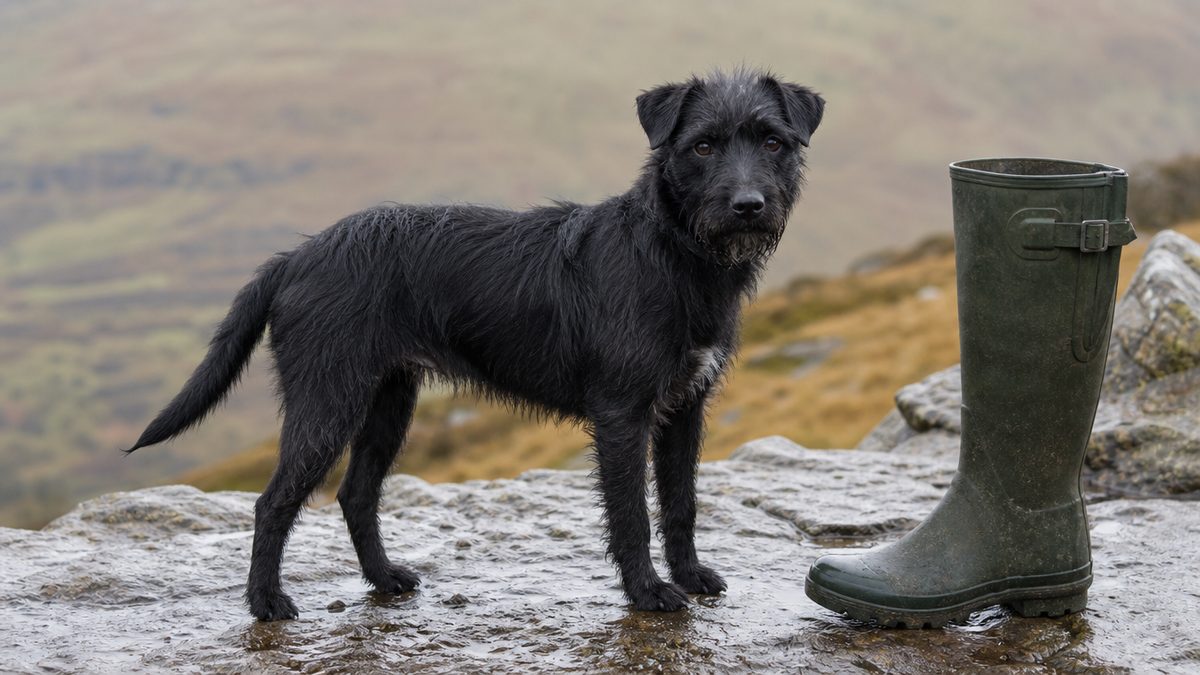
The type is defined by a job rather than a look, but the job forces a shape. A fell terrier is small, leggy and narrow through the ribs, because it has to get down a rock crevice behind a fox and then get out again. English Wikipedia gives a working weight of 10 to 15 pounds, adds a metric figure of 6.5 kg, and describes long legs, a narrow chest, and a rough textured coat that is often red or black.
Those two figures do not quite agree with each other, and it is worth saying so rather than repeating them. Ten pounds is 4.54 kg and fifteen pounds is 6.80 kg, so a single value of 6.5 kg sits near the top of the range rather than describing it. That is a small thing, but it is the first sign of what this page keeps running into: the numbers attached to the fell terrier are loose, uncited, and copied between pages that never open a register.
Type, and what the word is doing
A type is a group of dogs defined by function and locality, held together by what its keepers select for. A breed is a closed population with a written standard and a studbook. The fell terrier is the first thing. The Patterdale and the Lakeland Terrier are attempts, made at different times and by different people, to turn some of that material into the second thing.
The distinction is not academic for a reader in Chennai or Pune. If you are offered a fell terrier in India, there is no register anywhere in the world that can confirm the animal is what the seller says it is, because no register holds the name. There is a register for the Patterdale and there is a register for the Lakeland, and this page names both.
No kennel club anywhere recognises a fell terrier, so no paperwork can prove a dog is one. Any document offered with a puppy in India that claims to register a fell terrier is describing something that does not exist.
One more piece of vocabulary matters. The people who actually keep these dogs do not talk about a breed at all. The Fell and Moorland Working Terrier Club, founded in 1966 and still the largest club of its kind, lists among its four aims 'Improve the breeds of Working Terrier by retaining the old strains';. Plural breeds, and strains rather than a breed. That sentence is the type's own self-description, and it is more accurate than anything on the pages currently ranking for the term.
Type, breed and strain are three different things
Three words get used for this dog and they mean three different things, so the page separates them before going near a register.
A type is functional and geographic. Nobody owns it, nobody writes it down, and membership is decided by whether a dog can do the job in the place the job exists. Fell terrier, lurcher and feist are all types in this sense. English Wikipedia files the fell terrier in exactly that bucket, listing it under 'Types' in its terrier navigation box alongside fox terriers and working terriers, rather than in the alphabetical breed list.
A strain is a family within a type, usually named after the person who bred it. The fell terrier literature is almost entirely a literature of strains: Wilkinson's, Breay's, Buck's, Nuttall's. English Wikipedia's own account names Harry Hardisty, Sid Wilkinson, Fred and Anthony Barker, Cyril Breay, Frank Buck, Brian Nuttall, Garry Middleton and others as contributors to the type, which is a list of breeders rather than a description of a dog.
A breed is a closed population with a written standard, a studbook and a body that maintains both. The Lakeland Terrier is one. The Royal Kennel Club has a standard for it, last updated 1 April 2025, that specifies height, weight, coat, colour and faults. The Patterdale is one too, in the United Kennel Club's register, with a standard revised 1 December 2014.
Why the type keeps producing breeds
Every few decades somebody takes a slice of the fell terrier population, writes it down and asks a registry to accept it. English Wikipedia lists the Border Terrier, the Lakeland Terrier, the Patterdale Terrier, the Welsh Terrier and others as breeds developed from fell terrier stock, and notes that in Germany the Jagdterrier was built out of the same material in the 1920s.
The FCI does hold the German dog. Deutscher Jagdterrier sits in Group 3, Section 1, as standard 103, with a validity date of 19 March 2015 and a working trial requirement attached. So the fell terrier's German derivative is a fully recognised international breed while the fell terrier is not, which is a useful thing to keep in mind before assuming that non-recognition means the dogs are not worth writing down.
The Spanish Wikipedia article invents a place
The number one organic result for the bare term on a search located in India is not the English article but the Spanish one, and it contains a translation error worth naming because a reader in India may well land on it. Where the English text says fell terriers were 'developed in the fell country of Northern England', the Spanish text says they were 'desarrollados en Cartmell Fell', treating a landscape as a village.
The same article renders 'gameness', the specific quality of a terrier that will keep facing quarry after being hurt, as 'caracter jugueton', playful character. It lists a 'Scorrier terrier' among the breeds derived from the type where the English article lists the Scottish Terrier. And Wikipedia itself flags the page, filing it under the hidden maintenance category 'Wikipedia:Traducciones para mejorar', translations to improve.
If a page tells you the fell terrier comes from a village called Cartmell Fell, it has been machine-translated from English and the translator did not know that a fell is a hill. Treat everything else on that page with the same suspicion.
Four registers, checked one by one, each with a control
No register holds a fell terrier, and the way to say that honestly is to name each register, name what was found in it instead, and show a control query that returned a result in the same session.
An absence is only evidence if the instrument was working. This site has been caught out before by searches that returned zero because they were never really run, so each of the four checks below is paired with a control: a breed that should be in that register, looked for in the same document, on the same day, by the same method. All four controls returned results. All four searches for a fell terrier returned nothing.
| Register | Fell terrier | Patterdale | Control that did return a result |
|---|---|---|---|
| Royal Kennel Club, breed standards index, all seven groups | Absent | Absent | Lakeland Terrier present, one of 27 terriers listed |
| FCI, Group 3 Terriers, definitive nomenclature | Absent | Absent | Lakeland Terrier, standard 70, valid from 26 March 2009 |
| FCI, breeds recognised on a provisional basis | Absent | Absent | Ratonero Bodeguero Andaluz 371 and Gos Rater Valencia 370 |
| American Kennel Club, complete A to Z breed selector | Absent | Absent | Lakeland Terrier present, and so is the Lucas Terrier |
| AKC Foundation Stock Service standards, 513 pages | Absent | Absent | Brazilian Terrier, Jagdterrier and Japanese Terrier present |
| United Kennel Club, more than 300 breeds | Absent | Present | Lakeland Terrier and Patterdale Terrier both present |
The Royal Kennel Club
The Royal Kennel Club publishes one page listing every breed it recognises, arranged by group. Its Terrier group carries 27 entries, from Airedale to West Highland White. There is no Fell Terrier and no Patterdale Terrier in it, and none anywhere in the Gundog, Hound, Pastoral, Utility, Toy or Working lists either. The control is on the same page: Lakeland Terrier, with its own standard, which the club has maintained since it granted recognition in 1921.
The FCI, both registers
The FCI publishes its Group 3 nomenclature as a single complete document. Section 1, Great Britain, holds nine breeds: Airedale, Bedlington, Border, Fox Terrier smooth and wire, Lakeland at number 70, Manchester, Parson Russell and Welsh. No fell terrier, no Patterdale. The provisional register is a separate document and was read separately, because a breed can sit there for years before it reaches the definitive list. It holds 21 entries, the four most recent admitted on 11 February 2026, and neither name appears.
The FCI question also answers the Indian one. India is a full FCI member, represented by the Kennel Club of India, and the FCI maintains a country statistics page for it Federation Cynologique Internationale. Pedigrees issued in India run against FCI nomenclature, so a breed absent from both FCI registers has no route to an Indian pedigree either. That is a cleaner answer than trying to search the KCI's own site, which publishes no breed list at all.
The American Kennel Club, twice
The AKC was checked in two places because it maintains two lists. Its breed selector prints a complete A to Z of every breed it lists, recognised and Foundation Stock Service together, and it runs from Affenpinscher to Yorkshire Terrier. Lakeland Terrier is in it. So is the Lucas Terrier, which is about as obscure a working terrier as exists. Fell Terrier is not, and neither is Patterdale Terrier.
The second check was the Foundation Stock Service standards compilation, a 513-page PDF updated on 25 June 2026, which is where a rare breed being recorded by the AKC would appear. Extracted with pypdf it yields 709,108 characters and contains exactly three terrier standards: Brazilian Terrier, Deutscher Jagdterrier and Japanese Terrier. Searched case-insensitively, 'fell terrier' returns zero and 'patterdale' returns zero.
One page of the 513 would not yield text to pypdf. It sits between the Barbado da Terceira entry and a German scenthound standard, in the B to C run of an alphabetical compilation, so it cannot be a fell terrier page. The caveat is recorded rather than hidden.
The Patterdale and the Lakeland, and which of them a registry recognises
The Patterdale Terrier is registry-recognised by the United Kennel Club and by nobody else that matters; the Lakeland Terrier is recognised by the Royal Kennel Club, the FCI and the AKC. Both grew out of fell terrier stock, and neither one's measurements belong to the fell terrier.
The relationship is easiest to state from the registries' own words rather than from breed-site prose, because both registries describe it directly.
The United Kennel Club's Patterdale Terrier standard opens its history section like this: 'The Patterdale Terrier is descended mainly from the black, smooth-coated Fell Terrier which was developed in the harsh environment of Northern England. The Fell Terriers were used to control vermin that were predatory on sheep. They were bred to bolt the quarry out of the den or to dispatch it if it chose to fight.' The UKC recognised the Patterdale on 1 January 1995 and its current standard was revised on 1 December 2014.
The Royal Kennel Club's Lakeland Terrier page describes the same lineage from the other end: 'In the counties of Cumberland and Westmorland, an area known as the Lake District several different valleys developed their own type of working terrier and it is from these that the Lakeland Terrier was developed.' The first breed club formed in 1912 and Kennel Club recognition followed in 1921.
So which one is recognised
Both are, by different bodies, and the difference matters.
- Lakeland Terrier. Royal Kennel Club recognised since 1921, with a full breed standard. FCI standard 70 in Group 3 Section 1, valid from 26 March 2009. Listed by the American Kennel Club. Listed by the United Kennel Club. Four registries.
- Patterdale Terrier. United Kennel Club only, since 1 January 1995. Absent from the Royal Kennel Club's index, from both FCI registers, and from the AKC's A to Z list including its Foundation Stock Service. English Wikipedia adds two further American registries, the Patterdale Terrier Club of America, founded 1993, and the American Dog Breeders Association.
- Fell terrier. None of the above. No standard, no studbook, no register, in any of the four bodies checked.
Do not borrow their measurements
It is tempting to describe the fell terrier using the Lakeland standard, because the Lakeland standard exists and is precise. Doing so would be wrong, and the two sets of figures show why they cannot be interchanged.
| Dog | Height | Weight | Source of the figure |
|---|---|---|---|
| Lakeland Terrier | Not exceeding 37 cm (14.5 in) | Dogs about 8 kg (17 lb), bitches about 7 kg (15 lb) | Royal Kennel Club breed standard, updated 1 April 2025 |
| Patterdale Terrier | 10 to 15 in at the withers | Proportionate to height, no figure given | United Kennel Club standard, revised 1 December 2014 |
| Fell terrier | No standard exists | 10 to 15 lb quoted, with an inconsistent 6.5 kg conversion | Encyclopedic description, not a register |
Read across that table and the pattern is clear. The Lakeland has a maximum height and a target weight because a judge needs both. The Patterdale has a height range and refuses to give a weight, because the UKC standard cares about whether the dog can be spanned rather than what it weighs. The fell terrier has neither, because nobody is judging it.
The Lakeland's registry status carries a warning of its own. The Royal Kennel Club's own breed characteristics panel marks the Lakeland Terrier as a vulnerable native breed. So the registered descendant of the fell country terriers is in decline inside the registry, while the unregistered type it came from carries on outside it. Recognition and survival are not the same thing, and this pair of dogs is the clearest illustration of that on the whole terrier list.
Where the type comes from, and the names attached to it
The fell terrier's history is a history of hunts and of named breeders, not of a founding stud book, and the sources for it are three books rather than a registry archive.
Start with what the evidence actually is. English Wikipedia's fell terrier article rests on three works: Patricia Adams Lent's Sport with Terriers (Arner Publications, 1973), Captain Jocelyn Lucas's Hunt and Working Terriers, and David Brian Plummer's The Fell Terrier (Tideline Books, 2006). Several of the article's central claims carry a citation-needed tag, including the claim that fell terriers may be crossbred or purebred and the account of the type's development.
The one line the article does source cleanly is Lucas, quoted through Lent: 'Fell terriers have been bred for generations for work alone, and the only requisite points were their gameness.' A second quotation from the same source records that 'All the fell packs are hunted on foot';. Those two sentences carry more information than most of the modern pages ranking for the term, because they explain both the selection pressure and the terrain.
The fell packs, and why they hunt on foot
The Lake District fells are steep, wet and stony. Mounted hunting is impractical there, so the fell packs followed hounds on foot, and the terrier went in a bag or at heel until it was needed. The Royal Kennel Club, describing the Lakeland Terrier's origins, puts the requirement plainly: the dogs were developed 'to run with packs of hounds and their foot followers over the steep and rocky fells of the Lake District so stamina, agility and courage to bolt or kill fox or badger were required';.
The other half of the terrain matters more than most pages notice. English Wikipedia's Patterdale article explains that unlike the soft dirt earths of southern hunt country, 'the rocky dens found in the north do not allow much digging', so the terrier had to bolt the fox from the crevice or deal with it where it stood. Everything about the type follows from that sentence: the small compact frame, the narrow chest, the long legs and the willingness to keep working after being hurt.
The named breeders
The fell terrier's pedigree is oral and personal. English Wikipedia traces the original bloodlines to Harry Hardisty's Turk and Sid Wilkinson's Rock, itself bred down from Fred and Anthony Barker's terriers, and lists Garry Middleton, Brian Nuttall, John Park, Ken Gould, Frank Buck, Cyril Breay, Joe Armstrong, Maurice Bell, Anthony Chapman, John Cowen, Eddie Pool and Graham Ward among the people who shaped it.
The same article credits Joe Bowman, master of the Ullswater hunt and an early Border Terrier breeder, with developing the type by selecting the best red fell terriers available to him, though that claim carries no citation on either the fell terrier page or the Patterdale page Wikipedia, Patterdale Terrier. Bonbeno reports the attribution and the fact that it is unsourced, rather than repeating it as settled.
Cyril Breay is the name that connects the type to the modern Patterdale. English Wikipedia states that it is believed all current Patterdale Terriers descend from dogs Breay bred, and flags that belief as an unsupported attribution. If it is even approximately true, the modern Patterdale is a narrow slice of the fell terrier population rather than a summary of it, which is another reason not to read Patterdale figures back onto the type.
The Lakeland Terrier's first breed club formed in 1912 and Kennel Club recognition came in 1921. The Patterdale reached a registry in 1995, through the United Kennel Club in the United States. The type predates both, and neither date tells you anything about when fell terriers began.
The job the type was bred to do
A fell terrier was bred to enter a rock earth alone, find a fox in the dark, and either force it out or hold it there until people dug down, and every physical feature of the type exists to serve that one task.
English Wikipedia describes the sequence directly: a terrier follows the red fox underground into its den, 'where it either kills the fox, bolts it or holds it until the hunter (terrierman) digs the dog and fox up';. The United Kennel Club's Patterdale standard describes the same job in the language of a breed standard: the dogs 'were bred to bolt the quarry out of the den or to dispatch it if it chose to fight', producing 'an extremely game, tough as nails dog';.
Two things follow from that, and both are unwelcome for anyone thinking of the dog as a pet.
- Selection was for gameness, not tractability. A terrier that came out when it was frightened was not bred from. Several generations of that produces an animal with a very high threshold for backing down, which is a virtue underground and a problem in a lift.
- Selection was against a wide chest. The UKC standard makes the point mechanically. A Patterdale's chest 'should be capable of being spanned behind the shoulders by an average man's hands with the fingers of both hands touching', and judges physically span the dog and squeeze the underside of the ribcage to check it will compress.
- Selection had nothing to do with living with other dogs. Fell terriers worked singly. The UKC standard says outright that Patterdales 'are not a dog for the average pet owner' and require an owner who 'understands and can tolerate a real terrier temperament'.
What the club actually provides
The most revealing document about the working type is not a breed standard at all. It is the Fell and Moorland Working Terrier Club's own history page, which explains that the club was formed in 1966 by a group of friends 'to provide a much needed organised rescue service for terriers lost to ground in the course of their natural working activities';.
That is the club's first aim, ahead of shows, ahead of breeding. Its rescue service runs on a subscription of GBP 10 a year, area representatives organise the digs, and the club pays for heavy machinery when a representative judges it necessary. A dog type whose national club exists primarily to excavate members' dogs out of collapsed rock earths is telling you something about the risk profile of the work.
The club also records a piece of kit as compulsory. It 'has always recommended that all dogs being used to ground, wear a Locator collar', and notes that this 'is now a legal requirement';. An electronic locator collar is how a buried terrier gets found, and it is written into the statutory code the Hunting Act 2004 refers to.
The scars clause
Both American standards for the Patterdale contain a clause that no companion breed standard would carry. The UKC text reads: 'Scars resulting from wounds received while working are considered honorable and are not to be penalized.' It repeats the point for teeth, saying that teeth broken or incisors lost through work are not to be penalised, and again for coat damage from hunting scars or abrasions.
Read that as a buyer rather than as a judge. A standard that needs three separate clauses about injuries is describing a dog that gets injured routinely. That is worth knowing before an Indian household with children takes one on, and it is the kind of thing the ranking pages leave out.
The Hunting Act 2004 rewrote the job description
The work that defines a fell terrier, holding or killing a fox below ground, is no longer lawful in England and Wales, and what remains lawful is a much narrower activity set out in Schedule 1 paragraph 2 of the Hunting Act 2004.
This is the single most important fact about the type in 2026, and no page ranking for the term states it. The Act's Schedule 1 lists the forms of hunting that remain exempt. Paragraph 2, headed 'Use of dogs below ground to protect birds for shooting', permits a dog below ground only where every one of a set of conditions is met.
- The purpose is narrow. The flushing out must be 'for the purpose of preventing or reducing serious damage to game birds or wild birds ... which a person is keeping or preserving for the purpose of their being shot'. Protecting lambs is not on the list.
- Written permission must be carried. The person must have with him written evidence that the land is his or that he has permission, and must make it 'immediately available for inspection by a constable who asks to see it'.
- One dog below ground at a time. The condition is expressed exactly that way: the activity 'does not involve the use of more than one dog below ground at any one time'.
- The animal must be flushed and then shot. Reasonable steps must be taken to flush the mammal out as soon as possible after it is found, and to have it 'shot dead by a competent person' as soon as possible after that.
- The dog must be protected. Reasonable steps must be taken 'for the purpose of preventing injury to the dog', and the manner of use must comply with a code of practice issued or approved by the Secretary of State.
Set that against the historic job. A dog that kills the fox underground, or holds it while people dig down, satisfies none of those conditions. English Wikipedia's Patterdale article reaches the same conclusion in one line: the use of hard dogs to hunt foxes in that way 'was made illegal in England and Wales by the Hunting Act 2004, as it runs counter to the code of practice under the Act';.
The Fell and Moorland Working Terrier Club's own summary of the paragraph is stricter than most readers expect, and it is worth quoting because it comes from the people who do the work. 'The terrier's role is to locate and flush the mammal, not to fight with it. Only soft terriers which stand back, and bark are to be used.' And: 'It is not permitted to use a terrier to locate, dig down to and dispatch the quarry';.
What is still allowed
Two exemptions in the same Schedule are unrestricted by the below-ground conditions. Paragraph 3 exempts the hunting of rats and paragraph 4 exempts the hunting of rabbits, in each case on land belonging to the hunter or on land he has permission to use. Paragraph 1 permits stalking and flushing out for a longer list of purposes including protecting livestock, but caps it at two dogs and forbids a dog below ground except under paragraph 2.
A selection pressure with the tap turned off
The consequence for the type is easy to miss. A fell terrier was maintained by an activity that tested it. Dogs that would not face quarry did not get bred from, and dogs that got themselves killed did not either. The Act does not ban the dogs, but it removes most of the testing, and it explicitly rewards the opposite temperament: soft terriers that stand back and bark.
The National Working Terrier Federation, the umbrella body formed in April 1984 at Worcester Hunt Kennels, states that terrier work was 'the only form of hunting with dogs the Hunting Act (2004) does not seek to ban';. That is true as far as it goes. What it leaves out is that the surviving activity is a different activity, and a type defined by its job cannot be unaffected when the job changes.
Tail docking is lawful for a working terrier in England and prohibited outright in India
England permits a working terrier's tail to be docked under a certificate, and India prohibits tail docking entirely, which makes the traditional fell terrier appearance illegal to produce in India even though the dog itself is not.
English Wikipedia records that a fell terrier's tail 'traditionally is docked';. The Royal Kennel Club's Lakeland Terrier standard still carries both forms, printing 'Previously customarily docked' and then giving a docked and an undocked description. So the appearance a reader expects is a docked one.
What English law does
Section 6 of the Animal Welfare Act 2006 makes it an offence to remove the whole or any part of a dog's tail other than for medical treatment, and to permit another person to do so. Subsection (3) then carves out an exemption: subsections (1) and (2) 'do not apply if the dog is a certified working dog that is not more than 5 days old';.
The qualifying work is listed in subsection (5): law enforcement, activities of the armed forces, emergency rescue, lawful pest control, or the lawful shooting of animals. The 2007 Regulations gather those five into a single defined term, 'specified type of work';. Subsection (9) makes it a separate offence to show a docked dog at an event the public pays to enter, with subsection (10) excepting a dog shown only to demonstrate its working ability, and subsection (8) requires the docked dog to be microchipped before it is three months old.
The Docking of Working Dogs' Tails (England) Regulations 2007 fill in the machinery, and one detail in them is directly about this page's argument. Schedule 1, headed 'Specified Types of Dog', lists exactly three entries: 'Hunt point retrieve breeds of any type or combination of types', 'Spaniels of any type or combination of types', and 'Terriers of any type or combination of types';.
The only English law that regulates a fell terrier by category deliberately avoids breed names. It says 'Terriers of any type or combination of types'. Parliament wrote the rule the way the terrier men describe their dogs, not the way a kennel club does.
The same Regulations name the working terrier movement itself. Regulation 3(2)(c)(viii) lists the acceptable supporting evidence a vet may be shown, and among the people who can write the necessary letter it names 'a person representing the National Working Terrier Federation';. That is the federation the Fell and Moorland Working Terrier Club belongs to. English secondary legislation names the body, while no kennel club names the dog.
What Indian law does
India has no equivalent exemption. The Prevention of Cruelty to Animals (Dog Breeding and Marketing) Rules 2017, Second Schedule Part II paragraph 6(8), reads in the gazette text as follows: 'There shall be no tail docking, ear cropping de-barking, de-clawing, branding, dyeing, injecting substances to enhance visual appeal, performing a surgery or procedure to camouflage or hide any defect or infirmity or any other kind of mutilation of any body part of the pup and any change of appearance by artificial means is strictly forbidden';.
Note what that clause does not contain. There is no working-dog exemption, no five-day window, no certification route and no reference to pest control. The prohibition is flat. Read alongside the English exemption it produces a clean, quotable contrast, and it is the practical answer to an Indian reader who has seen photographs of docked working terriers.
| Question | England | India |
|---|---|---|
| Is docking a pet dog's tail lawful? | No, offence under s.6(1) Animal Welfare Act 2006 | No, Second Schedule Part II para 6(8) of the 2017 Rules |
| Is there a working exemption? | Yes, certified working dog under 5 days old, s.6(3) | No exemption of any kind appears in the Rules |
| Who certifies? | A veterinary surgeon, on the evidence in reg 3 | Not applicable |
| Which dogs qualify by category? | Terriers of any type or combination of types | Not applicable |
| Can a docked dog be shown? | Only to demonstrate working ability, s.6(9) and (10) | Not applicable |
One practical consequence for a buyer. If a dog offered in India has a docked tail, either it was docked abroad or somebody in India broke the 2017 Rules. Ask which, and treat a shrug as an answer.
Fell terrier price in India
No fell terrier price in India can be verified, because no Indian seller lists a fell terrier at all, and a control search run in the same session proves the search itself was working.
Start with the method, because a zero is only worth something if the instrument was tested. A search for 'fell terrier puppies for sale india price', located in India, returned ten results and not one of them was an Indian seller. Nine were Facebook posts from British, Irish and American terrier pages, mostly about Patterdale crossed with Pit Bull Terrier, and one was a US breed database.
The control, run through the identical tool in the same session, was 'labrador retriever puppies for sale india price'. It returned ten Indian selling pages, among them a directory publishing a band of Rs 30,000 to Rs 1,20,000 broken down by city across Hyderabad, Bangalore, Delhi, Chennai, Lucknow, Mumbai, Jaipur and Pune. So the search works, Indian dog listings are indexed, and the absence of fell terrier listings is a fact about the market rather than about the tool.
There is no fell terrier price in India, and Bonbeno will not publish one. Any rupee figure you find attached to this name was not derived from an Indian sale of a fell terrier, because no such sale is advertised anywhere the search index can see.
What an Indian search returns instead
Three things, and it is worth naming each. The Bing India results page captured on the same day says the same thing from the other direction: the string 'fell terrier' appears 51 times on it and 'patterdale' 85 times.
- Merchandise. Amazon.in and Flipkart both list Sean Frain's book The Patterdale Terrier, and Etsy's India storefront sells a Patterdale terrier plush. Those are the only transactions the term reliably produces in India.
- A different dog. Eight of the top ten results for 'fell terrier dog breed information' on an India-located search are pages about the Patterdale Terrier, and the number one result is Purina UK's Patterdale page rather than anything about the type.
- Crossbred working dogs abroad. The for-sale query surfaced Facebook posts advertising Patterdale crossed with Pit Bull Terrier, second-generation crosses, and a pair of foot beagles priced in euros in County Mayo. None of it is Indian and none of it is a fell terrier.
The one Indian rupee figure attached to this family of dogs
An Indian directory does publish a Patterdale Terrier cost in India of Rs 25,000 to Rs 50,000. Bonbeno reports it as a published figure and then tests it, because Indian breed prices are routinely converted foreign lists rather than observed sales.
| Rupee figure | Divided by 84.38 | Divided by 80.00 | Divided by 74.00 | Verdict |
|---|---|---|---|---|
| Rs 25,000 | USD 296.28 | USD 312.50 | USD 337.84 | No clean quotient at any rate |
| Rs 50,000 | USD 592.56 | USD 625.00 | USD 675.68 | No clean quotient at any rate |
Read the quotients rather than just the division. Nothing lands on a round dollar figure a seller would print, so this is not a converted American price list. It is a rupee-native number, which is a different and in some ways worse problem: somebody chose it. Given that no Indian seller lists the breed, the most defensible reading is that the band describes what the site expects a small imported terrier to fetch rather than what any Patterdale has ever sold for in India.
The same page carries a detail that undermines its own price. Its specification panel gives the breed's ideal weather as 10 to 25 C. Chennai's annual mean air temperature is 27.95 C. An Indian directory is quoting a purchase price for a dog whose stated comfort range its own country sits above for most of the year, in most of its cities.
Why no lawful supply chain can form in India
Two Indian instruments close the route independently, so even if a fell terrier existed as a registrable breed, a lawful Indian breeding supply could not form around it.
The first is trade policy. Dogs sit under ITC (HS) 01061900, 'Mammals: Other', with an import policy of Restricted, subject to Policy Condition 6 of the chapter. Restricted means an import authorisation is required, and the Directorate General of Foreign Trade's Trade Notice 22/2022-23 sets out exactly which purposes qualify.
Policy Condition (7) reads: 'Import of dogs is allowed only for the following specific purposes: i. Pet dog with valid pet book and relevant records/documents in the name of importer. ii. Dogs imported by the R&D Organisations for conducting research with the recommendation of CPCSEA. iii. For the internal security by the Defence and Police Force.' Policy Condition (8) adds: 'Import of commercial dogs for breeding or any other commercial activities other than the purposes mentioned above is not permitted';.
The notice then removes any doubt about how applications are handled. Paragraph 6: 'It may be noted that any applications for trading/breeding purposes, or applications made on behalf of some another person/entity shall be duly rejected.' Paragraph 7 limits entry to 'airports and seaports of Delhi, Mumbai, Chennai, Hyderabad, Bangalore and Kolkata', with quarantine at the government station of those ports where required. DAHD added a seventh port, Cochin International Airport at Kochi, for pets arriving under the baggage rules in October 2024. The full route is set out in how to import a dog to India.
The personal route, and its limits
One route does exist, and it is narrow. The same notice, following CBIC Circular 15/2013-Customs of 8 April 2013, allows up to two pets as passenger baggage without a DGFT authorisation, 'only to persons transferring their residence to India after two years of continuous stay abroad', and only cats and dogs. More than two animals, or an owner who has not completed two years abroad, needs an import authorisation.
So the only lawful way a fell terrier reaches India is in the baggage of a returning resident who already owned it. That produces individual dogs and never a population.
The second instrument, and why it matters more
Indian breeding law would apply to any dogs that did arrive. The Prevention of Cruelty to Animals (Dog Breeding and Marketing) Rules 2017 require registration of breeders and set conditions of sale. Rule 8(1)(a) requires that 'pups less than eight weeks in age are not sold', and Rule 8(1)(b) that 'dogs over six months in age are not sold without first being sterilised, unless they are being sold to another licensed breeder';.
Second Schedule Part II paragraph 6(3) then prohibits two named techniques outright: 'in breeding ... breeding between relatives of the 2nd to 4th grade in straight or side line within the first four generations e.g. uncle to niece, nephew to aunt, cousin to cousin, grandparents to grandchildren' and 'incest breeding, mating between parents and children or between brother and sister, i.e. 1st grade relatives';.
That clause is the one that closes the loop. A founding population arriving one dog at a time, in the baggage of unrelated returning residents, cannot be bred forward in India without either importing more dogs, which the trade notice forbids for breeding purposes, or breeding within four generations, which the Rules prohibit. There is no arithmetic that gets you a lawful Indian fell terrier population, and that is before you reach the fact that no register would recognise the result.
If somebody in India offers you a fell terrier puppy, the two questions worth asking are which port the parent stock entered through and under which policy condition. Neither question has a good answer, and asking it is faster than arguing about the dog.
What a dog this size costs to keep in India
Cost of ownership for a 5 to 7 kg working terrier in India is a structure rather than a figure, because no Indian household is keeping this type and the only published rupee numbers belong to a directory listing a breed it cannot supply.
One Indian directory does publish a monthly cost breakdown for the Patterdale Terrier, and its arithmetic at least reconciles, which is more than can be said for many. Food Rs 1,200 to 1,800, veterinary Rs 300 to 750 and grooming Rs 700 to 1,200 sum to the stated basic figure of Rs 2,200 and premium figure of Rs 3,750.
Bonbeno reproduces those figures as one site's published estimate for a small terrier in India, and not as a verified cost of keeping a fell terrier, because no fell terrier is being kept in India for anyone to cost. Two of the three lines are also likely to be wrong for this type in particular, for reasons the directory does not discuss.
| Line | Published range | What a working terrier changes |
|---|---|---|
| Food | Rs 1,200 to 1,800 | A dog bred for sustained work eats more per kilogram than a sedentary small breed of the same weight |
| Veterinary | Rs 300 to 750 | Understated in humid India, where ear disease and tick-borne infection are the recurring bills |
| Grooming | Rs 700 to 1,200 | Overstated for a harsh short coat that needs hand work rather than a salon |
| Total | Rs 2,200 to 3,750 | Reported as published, not verified |
The lines that a rupee figure cannot capture
Three real costs for this type in India do not appear on any breed directory's list.
- Secure fencing. A terrier selected for prey drive and for entering holes will dig under, climb over or squeeze through anything casual. This is a capital cost before the dog arrives, not a monthly one.
- Tick-borne disease. Indian veterinary literature puts the background pressure high. A PCR survey of 525 dogs across four Indian cities found 261, or 49.7 percent, infected with at least one tick-borne pathogen, and 39 percent of infected dogs carried more than one. A dog that spends its day nose-down in vegetation meets more ticks than one that walks on pavement.
- Cooling. Everything in the climate section below points the same way. In most Indian cities a dog of this type needs indoor cooling for a large part of the year, and electricity is the honest single largest line item that no breed directory prints.
There is one cost this type does not impose, and it is worth saying because most imported breeds do impose it. A harsh, short, weather-resisting coat does not need professional stripping every six weeks the way a show-trimmed Lakeland does. The Royal Kennel Club's own Lakeland Terrier panel asks for grooming more than once a week, while the United Kennel Club's Patterdale standard says 'Very little grooming is required to keep the coat healthy';. That difference is a real saving, and it is one of the few places where the working type is cheaper than its registered relatives.
Suitability for the Indian climate, measured rather than guessed
Heat tolerance rates 2 out of 5 for this type, because the fell country it comes from has an annual mean air temperature of 8.89 C against Chennai's 27.95 C, and because the gap in wet-bulb terms is larger still.
The climate figures on this page come from NASA POWER's MERRA-2 monthly climatology, queried by explicit latitude and longitude rather than by place name, because a place-name lookup can silently return a different location. Every figure below therefore carries the coordinates and elevation the service returned.
The home cell was queried at 54.5389 N, 2.9330 W, which is Patterdale village in Cumbria, and NASA POWER returned longitude -2.933, latitude 54.539, elevation 164.07 m. One honest caveat about resolution: a second query at Keswick, roughly 20 km away, returned the identical cell and the identical numbers, so what follows describes the central Lake District as one grid square rather than one valley.
| Location | Annual mean air temp | Hottest month air temp | Annual mean wet-bulb | Hottest month wet-bulb |
|---|---|---|---|---|
| Lake District (Patterdale cell, 164 m) | 8.89 | 14.71 (July) | 7.98 | 13.44 (July) |
| Chennai | 27.95 | 31.51 (May) | 24.94 | 27.36 (May) |
| Kolkata | 25.81 | 31.53 (May) | 22.85 | 27.86 (June) |
| Mumbai | 26.77 | 31.19 (May) | 22.73 | 26.55 (June) |
| Delhi | 25.60 | 35.88 (June) | 18.03 | 27.74 (July) |
| Pune | 23.86 | 28.93 (April) | 19.66 | 23.56 (June) |
| Bengaluru | 23.74 | 28.37 (April) | 19.80 | 22.66 (May) |
| Shimla (grid cell, 898 m) | 21.15 | 30.25 (June) | 14.87 | 24.16 (July) |
The comparison that actually matters
Air temperature understates the problem, because a dog sheds heat by evaporating water from its respiratory tract and evaporation slows as the air gets wetter. Wet-bulb temperature combines both, so it is the right axis for this question.
The Lake District's wet-bulb peak is 13.44 C, reached in July. Chennai's annual mean wet-bulb is 24.94 C, which is 11.50 C above the hottest thing the fells ever produce, on average, every month of the year. Kolkata's June wet-bulb of 27.86 C is 14.42 C above it. There is no Indian month in any of the seven cities above where the wet-bulb sits inside the range this type evolved in.
The fells are also permanently damp rather than dry-cold. Annual mean relative humidity in the Patterdale cell is 88.81 percent, rising to 93.38 percent in January. So the coat is built for wet cold, not dry cold, which matters for the grooming section: it is a coat designed to shed water while insulating, and insulation is exactly the wrong property in Chennai.
The rating is 2 rather than 1 because the dog is small, short-coated and light, which helps, and because Indian hill stations exist. It is not higher because every mainland Indian city measured here sits 9 to 15 C above the wet-bulb range the type was selected in, all year.
What the heat literature does and does not say about this dog
Two large VetCompass studies of UK dogs supply the physiology, and it is important to be exact about which one says what.
The Animals paper reports that of the 879 heat-related illness events with a recorded trigger, 652, or 74.2 percent, were exertional. That is the transferable finding for this type: heat illness in dogs is overwhelmingly something the dog does to itself while working or playing, not something that happens to it in a parked car. A terrier with a high drive to work will not self-regulate, which is the whole point of the temperament.
The Scientific Reports paper, on the same 905,543-dog cohort, found 395 confirmed events, an incidence of 0.04 percent and a fatality rate of 14.18 percent, and identified higher bodyweight relative to the breed and sex mean, brachycephalic skull shape, being over two years old, and weighing over 50 kg as risk factors.
Two of those do not transfer. A fell terrier is neither brachycephalic nor anywhere near 50 kg, and no fell terrier appears in either study's breed list, because no register defines the population that would let one appear. What does transfer is the bodyweight-relative-to-mean finding and the exertional dominance, and this page claims only those.
City by city, and the two places in India this type is least impossible
Gangtok is the only location tested where the climate resembles the fells, and even there the resemblance is an artefact of altitude that the reader needs to understand before relying on it.
Run the wet-bulb comparison across the whole set and one Indian cell comes out cooler than the Lake District. NASA POWER returns a July wet-bulb of 12.49 C and an annual mean of 4.70 C for the Gangtok coordinates, against the fells' 13.44 C and 7.98 C NASA POWER Climatology API. On paper, Sikkim is colder than Cumbria.
Read the elevation before acting on that. The cell NASA POWER returned for the Gangtok coordinates carries an elevation of 3,239.61 m, while the town itself sits far lower. MERRA-2 grid cells are large and mountainous terrain gets smoothed into a single representative height, so the figure describes the ridge system rather than the bazaar. The direction of travel is real, the magnitude is not usable for planning.
Shimla shows the same distortion in the other direction. Its returned cell sits at 897.65 m, well below the town, and gives an annual mean air temperature of 21.15 C and a July wet-bulb of 24.16 C. The real Shimla is cooler than that. So the honest reading of both hill entries is that they are directionally right and numerically unreliable, and this page will not pretend otherwise.
| City | Hottest-month wet-bulb | Degrees above the fells' peak | Practical reading |
|---|---|---|---|
| Kolkata | 27.86 (June) | +14.42 | Hardest of the set. Long, wet, hot pre-monsoon and monsoon. |
| Delhi | 27.74 (July) | +14.30 | Dry May is survivable with shade; July is not. |
| Chennai | 27.36 (May) | +13.92 | No cool season at all. Annual mean wet-bulb already 24.94. |
| Mumbai | 26.55 (June) | +13.11 | Coastal humidity keeps night-time recovery poor. |
| Shimla (cell at 898 m) | 24.16 (July) | +10.72 | Real town is higher and cooler than the cell suggests. |
| Pune | 23.56 (June) | +10.12 | Best mainland metro of the set, still ten degrees adrift. |
| Bengaluru | 22.66 (May) | +9.22 | Mildest mainland option measured here. |
| Gangtok (cell at 3,240 m) | 12.49 (July) | -0.95 | Only cell cooler than the fells, and the altitude is smoothed. |
What this means in practice
Bengaluru and Pune are the mainland cities where a small, short-coated working terrier would suffer least, and both still sit around ten degrees of wet-bulb above the type's home range in their hottest month. That is not a marginal difference. It is the difference between a dog that can work all day and a dog that must be exercised before sunrise and after dark for eight months of the year.
The genuinely suitable Indian locations are hill towns above roughly 1,800 m: Gangtok, Darjeeling, Shillong, Munnar, Ooty, Manali, Leh. Bonbeno is not going to publish a heat rating per hill station off a smoothed grid, but the principle is simple and checkable. Query NASA POWER at your own coordinates, look at the wet-bulb column, and compare it to 13.44 C.
Take the NASA POWER climatology endpoint, put in your own latitude and longitude, ask for T2MWET, and read the hottest month. If it is more than about six degrees above 13.44 C, this type will spend most of the year unable to do the only thing it was bred for.
Temperament and household fit
A fell terrier is bold, independent and very high in prey drive, and the registries that describe its closest relative say plainly that it is not a dog for the average pet owner.
The United Kennel Club's Patterdale standard is the most useful temperament document available for this family of dogs, because it was written by people who expected the dog to work. It says the dogs are 'extremely willing to work and have a high desire to please', that they 'are very active and have a strong prey drive', and then, unusually for a breed standard, that 'though they should be peaceful with humans, livestock and other dogs, they are not a dog for the average pet owner';.
It goes further: such a dog 'requires an owner with a sense of humor and one that understands and can tolerate a real terrier temperament'. Viciousness or extreme shyness are disqualifications, so the standard is not describing an aggressive animal. It is describing an animal with very little quit in it.
What high prey drive means in an Indian street
This is where a generic breed page and an Indian one part company. A terrier selected across generations to enter a hole after a fox does not distinguish between a fox and a cat, a squirrel, a monitor lizard or a rat in a drain. In a country where free-ranging dogs, street cats and urban wildlife are all normal, that trait is a daily management problem rather than an occasional one.
- Off-lead recall is unreliable once quarry is sighted. Plan for a long line and a secure enclosed space, not for an open maidan.
- Small pets are not compatible. A rabbit, hamster or bird in the same home is a risk, not a socialisation project.
- Encounters with free-ranging dogs escalate fast. A dog bred not to back down is the wrong animal to walk through a colony at feeding time.
- Digging is not a behaviour problem. It is the job. Fence lines, potted plants and any soft ground will be worked.
The good side, stated honestly
The same selection produces a genuinely good companion for the right household. These are small, hardy, uncomplicated dogs that are physically robust, mentally resilient and strongly attached to their people. The Royal Kennel Club's description of the Lakeland's characteristics catches the family resemblance: 'Gay, fearless demeanour, keen of expression, quick of movement, on the tip-toe of expectation', with a temperament that is 'Bold, friendly and self-confident';.
For an Indian household with a garden, a fence you have actually tested, older children, no small pets, and somebody at home who wants to train and socialise a dog every day, this type is manageable. For a flat in a metro with a lift, a balcony and a busy household, it is a poor choice, and no amount of training changes the underlying drive.
First-time owners, households with cats or small pets, anyone who wants a dog that can be trusted off-lead in public, and anyone who will be out for ten hours a day. The United Kennel Club says it in one sentence: not a dog for the average pet owner.
Training approach, and the one thing this type resists
Train a fell terrier by making the reward better than the quarry, because the one thing the type genuinely resists is being recalled off something it has decided to work.
Answer the heading directly. Everything else, sit, stay, loose-lead walking, crate settling, handling for grooming, is ordinary and comes quickly, because these dogs are quick and want a job. The one training problem that is structurally hard is interrupting a dog that has committed to prey. That is not disobedience and it is not a training failure. It is the selected trait doing exactly what generations of terrier men bred it to do.
A realistic first-year plan for India
- Weeks 8 to 16, socialise deliberately. Traffic, autos, lifts, tiled floors, the sound of a pressure cooker, monsoon rain on a metal roof, men in helmets, and calm adult dogs. Indian puppy classes are scarce outside the metros, so plan a structured list rather than hoping for exposure.
- Weeks 10 to 20, build the recall on food before you need it. Pay heavily, in the house first, then the gate, then a quiet lane at 6 am. Never call the dog to end something enjoyable.
- Months 4 to 8, add a controlled outlet for the drive. Flirt pole, scent games with a hidden food pot, and a permitted digging box filled with sand. The drive does not go away; it goes somewhere.
- Months 6 to 12, proof the emergency stop. A whistle or a single word that means lie down where you are. This is the command that will one day matter more than recall on an Indian road.
- Throughout, train in the cool hours. In most Indian cities that means before 7 am and after 8 pm for at least eight months of the year, for the reasons the climate section sets out.
What does not work
Harsh corrections do not work on this type, and they carry a specific risk. A dog selected for not backing down when hurt is the worst possible candidate for a training method that relies on discomfort, because the trait you are pushing against was deliberately made stronger than the pressure you can safely apply.
Equally, the traditional working test is not available as a training tool. English law now permits a dog below ground only to flush a mammal out for shooting, under written permission, one dog at a time, with the manner of use governed by a statutory code. In India the question does not arise at all. So an Indian owner has to manufacture the mental work the dog was built for, and scent work is the closest legitimate substitute.
Hide a sealed pot of strong-smelling food in a room, send the dog to find it, and build up to searching a garden. It uses the same nose, the same persistence and the same reward pathway as the original job, with nothing to catch at the end of it.
The daily exercise requirement, and what happens without it
Plan on 60 to 90 minutes of real activity a day, split across the cool hours, with at least half of it nose work rather than distance, because this type's exercise needs are as much mental as physical.
One Indian directory puts the Patterdale's exercise routine at 60 to 90 minutes and its energy level at high. That is a reasonable floor for a fell terrier in India, but the number on its own is misleading, because two dogs given the same hour can end up in completely different states.
The original job was not endurance running. It was hours of patient searching followed by a short, intense, high-stakes encounter underground. A dog built for that pattern is not satisfied by a long straight walk, and it is not tired by one either. What tires it is problem solving.
A workable Indian split
- Before 7 am, 30 to 40 minutes. Lead walk with sniffing allowed, on ground that is still cool. In Chennai or Kolkata this window closes early; check the surface with the back of your hand before you set out.
- Midday, 10 to 15 minutes indoors. Scent games, a food puzzle, a short training session in the coolest room in the house. This is the block most owners skip and the one that does the most work.
- After 8 pm, 20 to 30 minutes. Secure enclosed space, flirt pole or fetch, then a settled cool-down before the dog is fed.
- Once a week, a longer outing. Somewhere with unfamiliar smells. A hill, a scrubby edge, a friend's larger garden. Novelty is the point, not distance.
What under-exercise looks like in this type
It does not look like a bored Labrador chewing a shoe. An under-worked terrier of this kind escalates: sustained barking at every sound in the stairwell, systematic destruction of soft furnishings, digging through a lawn to the boundary wall, and an increasingly short fuse with other dogs. One Indian directory's own stress list for the Patterdale names excessive barking, pacing and decreased play, which is a reasonable early-warning set.
There is also a specifically Indian failure mode. Owners who cannot exercise the dog in the heat compensate by exercising it hard in the middle of the day when they finally have time, which is the single most dangerous thing you can do. Heat-related illness in dogs is overwhelmingly exertional: 652 of the 879 UK events with a recorded trigger, 74.2 percent, followed exercise rather than confinement. A driven terrier will not stop when it should, so the owner has to.
Never let this type choose its own stopping point in Indian heat. It will keep working past the point where it can shed the heat it is generating, and the study evidence says that is how dogs die of heatstroke.
Grooming and coat care in Indian humidity
Grooming a fell terrier is a weekly hand job rather than a salon appointment, and the real coat work in India is not the coat at all but the ears, the skin and the ticks.
Coat first. The type carries a rough or broken harsh jacket, described by English Wikipedia as 'a rough textured coat, often red or black in colour';. The United Kennel Club's Patterdale standard recognises three coat kinds, smooth, broken and rough, all with a short dense undercoat, and states that 'Very little grooming is required to keep the coat healthy';.
That standard also explains what the coat is for, which nobody else does: 'A correct coat is important for protection against the wet underground and briars', and it treats a soft, long or downy coat as a serious fault 'in any climate';. So a fell terrier's jacket is armour against wet rock and thorn, not insulation against a British winter, which is a small mercy in India.
Coat colour, and what the registries accept
The coat colour range is where the registered relatives disagree with each other, and it is a useful illustration of what a standard does. The UKC accepts black, red, liver or chocolate, grizzle, black and tan, and bronze for the Patterdale, either solid or with some white on chest and feet, and disqualifies 'any patch or spot of white marking on the body or head';. The Royal Kennel Club's Lakeland standard accepts black and tan, blue and tan, red, wheaten, red grizzle, liver, blue or black, tolerates small tips of white on feet and chest, and calls mahogany or deep tan highly undesirable.
The fell terrier has neither list. It is most often black or red because those were the colours the working strains happened to fix, not because a committee approved them.
The weekly routine in India
- Brush once a week with a stiff bristle brush or a rubber curry, more in a shedding period. A smooth-coated dog sheds more than a rough-coated one and still needs less work.
- Hand strip a rough or broken coat twice a year rather than clipping it. Clipping a harsh coat softens the regrowth and removes the water-shedding property that is the coat's whole purpose.
- Bathe rarely. Once every two or three months is enough for a working coat unless the dog has rolled in something. Over-bathing in humid conditions strips the skin and invites infection.
- Dry the ears every single time. This is the one non-negotiable, and it is where imported grooming advice fails in India.
- Check for ticks daily through the monsoon, along the ear margins, between the toes and under the collar.
Where overseas advice does not transfer
Advice written for a British working terrier assumes a dog that gets wet and then dries in cool air. An Indian monsoon does not dry anything. A dropped-eared terrier that swims, gets rained on or is bathed without the ear canals being dried is being set up for otitis externa, and that is a recurring Indian veterinary bill rather than a one-off.
The practical fix is simple and takes thirty seconds. Plug the ears with cotton wool before a bath, dry the canal opening with dry cotton afterwards, and never let a dog with folded ears air-dry in humid weather. If you groom nothing else on this dog, groom the ears.
Health issues, lifespan, and how little is actually known
No health data exists for the fell terrier as a population, and that is a finding rather than a gap, because the orthopaedic registries and the medical literature that generate such data are organised around registered breeds.
Three databases were searched, each with controls, and the result is consistent.
| Source | Fell terrier | Patterdale | Lakeland | Control |
|---|---|---|---|---|
| OFA published statistics tables | 0 rows | 0 rows | 14 rows, all eye | Labrador 109 mentions, Border Terrier 52 |
| PubMed | 0 genuine records | 1 to 2 records | 2 records | Labrador plus hip dysplasia, 52 records |
| Europe PMC | 0 genuine records | 47 hits, mostly incidental | 51 hits, mostly incidental | Border Terrier 418, Labrador 5,946 |
PubMed, and why the raw count lies
A search for 'fell terrier' on PubMed returns 7 records, which looks like literature and is not. PubMed's own query translation shows what it actually ran: '"fell"[All Fields] AND ("terrier"[All Fields] OR "terriers"[All Fields])'. All seven records were opened. They include a von Willebrand disease case in a Standard Dachshund, an elbow luxation in a Yorkshire Terrier puppy, a study of historical US demand for dog breeds, a shelter breed-testing paper, a 1997 cleft palate paper, a 1996 glaucoma report on German hunting terriers, and a 2021 paper on the 21-gene test for early-stage breast cancer in Latin America.
Not one of the seven is about a fell terrier. The honest count is zero, and the word 'fell' is doing all the work as a past-tense verb or a surname.
The contrast with the Lakeland is instructive. Searching 'lakeland terrier' returns a translation of '"lakeland terrier"[All Fields]', an intact phrase, and two genuine records: an ultrasonographic report of everted laryngeal saccules in a young Lakeland terrier from 1999, and a 1993 report of an osteochondroma causing progressive posterior paresis in a Lakeland terrier puppy. PubMed holds a phrase for the registered breed and does not hold one for the type.
The Patterdale sits in between, with one unambiguous paper: a 2017 imaging diagnosis of traction bronchiectasis secondary to pulmonary fibrosis in a Patterdale Terrier. The control confirms the tool worked, returning 52 records for Labrador Retriever with hip dysplasia in the same session. Europe PMC behaves the same way: a search for 'fell terrier' returns two hits whose printed titles are the single letters B and P, against 418 for Border Terrier and 5,946 for Labrador Retriever in the same session.
Life expectancy, which this page will not give you
No life expectancy figure exists for the fell terrier, and Bonbeno is not going to borrow one. The largest UK study of the question, built on 30,563 dogs that died between 1 January 2016 and 31 July 2020, reports an overall life expectancy at age 0 of 11.23 years, with the Jack Russell Terrier the longest-lived breed in the whole dataset at 12.72 years and the French Bulldog the shortest at 4.53 years.
The Jack Russell figure is the closest useful anchor, because it is a small working terrier of similar build, but it is that breed's number and not this type's. One Indian directory prints 12 to 15 years for the Patterdale with no source attached. Treat that as a guess.
A registered breed accumulates screening results because a registry asks for them. An unregistered working type does not, however healthy it may be. So the correct statement is that nobody has measured this population, not that it has been measured and found sound.
The Lakeland's own eye data contradicts itself by 28.9 percentage points
The Orthopedic Foundation for Animals publishes two views of the Lakeland Terrier's eye results that cannot both be right, and the gap between them is the largest this site has recorded.
The OFA disease statistics page was retrieved as 2,226,021 characters of markdown and searched case-insensitively alongside controls, because breed names on that page are printed in capitals and a case-sensitive search manufactures its own absence. Labrador returned 109 matches and Border Terrier 52, so the instrument was working. Patterdale returned zero, fell terrier returned zero, and Jagdterrier returned zero.
Lakeland Terrier returned 14 rows, and every one of them is in the eye tables. There is no Lakeland row in OFA's hip table at all, which matters because the control breed has one: Border Terrier appears there with 4,372 hip evaluations. OFA publishes a breed's hip statistics only once it has accumulated a threshold number of evaluations, so the correct statement is that the Lakeland has no row in OFA's published hip statistics, not that it is absent from the OFA database.
The two numbers that disagree
The summary row reads: Lakeland Terrier, rank 166, 97 evaluations, 96.9 percent normal, 0.0 percent breeder option, 3.1 percent abnormal.
The per-diagnosis rows, on the same 97 dogs and printed on the same page, tell a different story. The row headed NORMAL gives 66 of 97, which is 68.0 percent.
| Finding | Dogs | Percent |
|---|---|---|
| Normal | 66 | 68.0 |
| Persistent pupillary membranes, lens pigment | 14 | 14.4 |
| Persistent pupillary membranes, iris to iris | 10 | 10.3 |
| Distichiasis (eyelids) | 8 | 8.2 |
| Cataract, generalized or complete (lens 100.330) | 3 | 3.1 |
| Cataract, significance unknown (lens 100.210) | 2 | 2.1 |
| Punctate, posterior sutures | 2 | 2.1 |
| Dystrophy, epithelial or stromal (cornea) | 1 | 1.0 |
| Punctate, anterior cortex | 1 | 1.0 |
| Incipient, anterior cortex | 1 | 1.0 |
| Incipient, posterior cortex | 1 | 1.0 |
| Y-suture tip opacities | 1 | 1.0 |
| Other, suspected as not inherited | 1 | 1.0 |
Do the arithmetic. If 66 of 97 dogs are normal, then 31 are not, which is 32.0 percent. The summary line says 3.1 percent abnormal, which is 3 dogs. The two figures differ by 28.9 percentage points on the same breed, on the same denominator, on the same page.
Bonbeno publishes both and quotes neither as the rate. This is not a rounding artefact and it is not unique to this breed; the same shape of contradiction has been recorded here on the Field Spaniel, the English Shepherd, the Dandie Dinmont and the Clumber Spaniel. What is new is the size. At 28.9 points the Lakeland gap is the widest yet recorded on this site.
A page that tells you 96.9 percent of Lakeland Terriers have normal eyes is reading one line of a table whose own detail rows say 68.0 percent. Cite both, show the arithmetic, and let the reader see that the source is inconsistent with itself.
One further caution for a buyer. Ninety-seven evaluations is a small sample, and dogs submitted to a voluntary registry are not a random sample of the breed. So even the detail rows describe the eyes of dogs whose owners chose to have them examined, which is likely to be a healthier and better-bred subset than the population as a whole.
What Indian law requires, against what anybody actually screens for
Indian law requires a breeding dog to have been tested for a named list of genetic defects, and for a fell terrier that requirement is unsatisfiable, because no scheme exists that tests this population for any of them.
The clause is Second Schedule Part III paragraph 8(10) of the Prevention of Cruelty to Animals (Dog Breeding and Marketing) Rules 2017, and it reads in the gazette as follows: 'The dogs shall have been tested for genetic defects, including hip dysplasia, progressive retinal atrophy, night blindness, hypothyroidism, entropion, ectropion, overshot, undershot jaw (when incisors do not touch or mesh), wry mouth, two or more missing teeth, unilateral cryptorchid or full cryptorchid males';.
The word to notice is 'including'. The list is illustrative rather than closed, so a defect is not outside the clause merely because it is unlisted.
Three things the Rules do not require
Counted across all 14 pages of the gazette text, the following terms appear zero times: 'patella', 'BAER' and 'deaf';. So there is no Indian patella-grading requirement and no Indian hearing-test requirement, whatever a breed page may tell you.
That matters here because one Indian directory lists patellar luxation among the Patterdale's common health issues, attributing the list to an American consumer site rather than to any screening data. Patellar luxation may well occur in small terriers. It is simply not something Indian law asks a breeder to test for, and no page should imply otherwise.
The collision this type creates
Paragraph 8(10) presumes a testing infrastructure. For a registered breed that infrastructure exists: a hip scheme, an eye scheme, a DNA panel, a registry that records the results. For the fell terrier none of it exists, because there is no registry to organise it and no standard to define the population being tested.
So an Indian breeder of fell terriers, if one existed, could not comply with paragraph 8(10) even in good faith. The OFA holds zero rows for this type and zero for the Patterdale. There is no breed club scheme to substitute. The clause would bite on a dog that nobody can test.
The claim the working clubs make, and why it cannot be checked
The National Working Terrier Federation states on its own site that 'the modern-day working terrier displays none of the genetic and hereditary problems so commonplace in other breeds';. That is a strong claim and it may even be true, because a population selected hard on working soundness for a century has an obvious mechanism for staying sound.
It is also unfalsifiable as things stand. The evidence that would test it, screening percentages on a defined population, does not exist for exactly the reason the claim gestures at: these dogs are outside the registries that collect such evidence. Bonbeno reports the claim, reports that it is unevidenced, and declines to repeat it as fact.
The Indian disease pressure this type has never met
Whatever the type's inherited health, the acquired risks in India are the ones that will fill a case file. A PCR survey of 525 dogs across four Indian cities found 261, or 49.7 percent, carrying at least one tick-borne pathogen, with Hepatozoon canis at 30 percent, Ehrlichia canis at 20.6 percent, Mycoplasma haemocanis at 12.2 percent, Anaplasma platys at 6.5 percent and Babesia vogeli at 5.5 percent, and ticks were found on 278 of the dogs examined, 53 percent.
A dog whose entire behavioural repertoire involves pushing through undergrowth and into holes is a tick magnet. Year-round acaricide, daily physical checks and a low threshold for testing a lethargic dog are not optional for this type in India.
Feeding a small working terrier in India
Feed to body condition rather than to a chart, because no breed-specific feeding guidance exists for a type with no standard, and the size and weight figures floating around online belong to other dogs.
The starting point has to be the dog in front of you. English Wikipedia gives a working range of 10 to 15 pounds for the type, and a metric figure of 6.5 kg that does not convert cleanly from either end of it. The Royal Kennel Club's Lakeland standard gives average weights of 8 kg for dogs and 7 kg for bitches, and the United Kennel Club's Patterdale standard refuses to give a weight at all, requiring only that it be 'in proportion to height, with dogs always shown in hard, fit, working condition with no excess fat';.
That last phrase is the most useful feeding instruction on this page, and it comes from the register rather than from a food company.
Body condition, the only reliable metric
- Ribs. Easily felt under a thin layer of covering, not visible from three metres and not buried.
- Waist. Clearly visible from above, with a tuck-up from the side. A working terrier that has lost its waist has lost its chest compressibility too.
- The spanning test. The UKC requires a Patterdale's chest to be spannable behind the shoulders by an average adult's two hands with fingertips touching. A dog that has grown out of that span has usually gained fat, not bone.
- Weekly, not daily. Weigh once a week on the same scale and adjust portions by ten percent at a time.
Life stages
Puppies of this size do best on three to four meals a day to about four months, then three to about six months, then two. Adults stay on two meals. Splitting the ration matters more in India than in Britain, because a full stomach and a hot afternoon are a poor combination for an active dog.
One Indian directory puts monthly food for a Patterdale in India at Rs 1,200 to 1,800 and calorie needs at roughly 800 kcal for puppies and 600 kcal for adults. Bonbeno reproduces those as one site's published estimate. Calorie needs vary far more with activity than with breed, and a terrier getting 90 minutes of work will need more than one getting a lead walk.
The Indian adjustments that matter
Three practical points, none of which appear on overseas feeding pages.
- Feed after exercise, not before. In the hot months put at least an hour between the evening walk and the evening meal, and let the dog cool properly first.
- Water is the ration nobody counts. Multiple bowls, changed twice daily in the heat, and a bowl that free-ranging animals cannot reach if it is outdoors.
- Watch the store, not the bag. Indian summer storage degrades kibble fats quickly. Buy smaller packs more often, keep them sealed and cool, and discard anything that smells rancid.
There is no breed-specific diet here to recommend and this page will not invent one. A complete food appropriate to life stage, fed to condition, with the ribs and the waist as the judge, is the entire evidence-based answer for a dog of this type.
The first year, month by month
Plan the first year around three things in India: a legal minimum age of eight weeks at sale, a vaccination course that runs from seven to eighteen weeks, and a socialisation window that closes long before the dog is grown.
Indian law fixes the start point. Rule 8(1)(a) of the Prevention of Cruelty to Animals (Dog Breeding and Marketing) Rules 2017 requires that 'pups less than eight weeks in age are not sold';. Second Schedule Part III paragraph 8(9) sets the vaccination frame: 'All pups shall be vaccinated which can start at the age of seven-eight weeks, and are usually completed at the age of eighteen weeks';.
| Age | What is happening | What you do |
|---|---|---|
| 8 weeks | Legal minimum age of sale in India | Home visit, meet the dam, start the first vaccination course |
| 8 to 12 weeks | Socialisation window wide open | Traffic, lifts, tiled floors, monsoon rain noise, calm adult dogs, handling of ears and feet |
| 10 to 14 weeks | Second and third vaccinations | Short lead walks in the cool hours only, recall built on food indoors |
| 16 to 18 weeks | Vaccination course completes | Wider world, novel surfaces, first controlled meetings with unfamiliar dogs |
| 4 to 6 months | Teething, drive coming online | Chew provision, flirt pole, permitted digging box, no forced exercise |
| 6 to 9 months | Adolescence, recall degrades | Long line becomes standard, emergency stop trained daily |
| 9 to 12 months | Adult drive, adult stamina | Build to 60 to 90 minutes across the cool hours, keep half of it scent work |
| 12 months | Physically mature for the size | Reassess condition against the spanning test, not the scale alone |
The window that closes
The socialisation work between eight and sixteen weeks is the single highest-value thing an Indian owner will do with this type, and it cannot be caught up later. A terrier bred not to back down and socialised badly becomes a dog that cannot be walked past a colony gate. The same dog socialised deliberately becomes a small, confident, unbothered animal that ignores what it has learned is unremarkable.
One Indian constraint is real and worth planning around. Structured puppy classes exist in the larger metros and thinly elsewhere, so most owners will have to build the exposure list themselves. Write it down, tick it off, and treat it as training rather than as walks.
Do not exercise a puppy of this type in the middle of an Indian day at any age. Their surface-area-to-mass ratio helps, but their judgement does not exist, and the exertional pattern that dominates canine heat illness starts young.
Head to head against the terriers an Indian buyer can actually get
Compare the fell terrier against the registered terriers that are genuinely available in India, and the honest conclusion is that three of the four alternatives are better documented, better supported and easier to source.
The comparison that matters is not fell terrier against Patterdale. It is fell terrier against what an Indian buyer can lawfully acquire, register, insure and get breed-specific veterinary advice about.
| Dog | Registry status | Available in India | Published health data | Heat tolerance |
|---|---|---|---|---|
| Fell terrier | None, in any of four registers checked | No listings found, control passed | None at all | 2 of 5 |
| Patterdale Terrier | United Kennel Club since 1 Jan 1995 | Listed by directories, no verified sellers | Zero OFA rows, one clear paper | 2 of 5 |
| Lakeland Terrier | Royal Kennel Club 1921, FCI 70, AKC, UKC | Very rare, occasional imports | 97 OFA eye evaluations, no hip row | 2 of 5 |
| Jack Russell Terrier | FCI 345, Royal Kennel Club, UKC | Widely available in Indian cities | Longest-lived breed in the UK life tables at 12.72 years | 3 of 5 |
| Indian pariah / indie | None, and it does not need one | Free, in every Indian city | None breed-wide, but locally adapted | 5 of 5 |
Reading that table honestly
If what appeals is the shape and the character, the Jack Russell Terrier is the same idea with a registry behind it, a standard, an FCI number, real availability in Indian cities and the best life expectancy figure in a 30,563-dog UK study. Almost every reason to want a fell terrier is served better by a Jack Russell in India, and the exception is romantic rather than practical.
If what appeals is the working temperament, be careful what you are buying. Indian city life offers a terrier of this kind almost nothing to do that is legal, safe and satisfying, and the frustrated version of the dog is the one that ends up rehomed.
If what appeals is a hardy, low-maintenance, weather-proof small dog that is genuinely adapted to Indian conditions, the Indian pariah dog does the job better than any imported terrier, costs nothing, is available in every city, and does not require an import authorisation. Read the Border Terrier and Jack Russell Terrier guides alongside this one before deciding.
Where the working terriers do win
One column would favour them if it existed, and it is worth naming. A dog bred for a hundred years on function rather than appearance has never been selected for an exaggerated head, a shortened muzzle, an oversized eye or a coat that needs professional maintenance. Compare that with what conformation breeding has done to some registered terriers and the working type looks structurally sensible.
The problem is that this is an argument from mechanism rather than from data, and this page has already shown that the data to support it does not exist. Keep the argument, hold it loosely, and do not let anybody sell you a dog on it.
Mistakes Indian readers make with this name
Six mistakes account for almost everything that goes wrong when an Indian reader goes looking for a fell terrier, and five of them start before any dog is involved.
- Treating fell terrier as a breed name. It is a type. Four registers were checked and none holds it. Any pedigree, certificate or registration paper offered for a fell terrier in India is describing a thing that does not exist.
- Accepting a Patterdale as a fell terrier, or the reverse. The Patterdale is a registered breed with a United Kennel Club standard revised in 2014 and a recognition date of 1 January 1995. It descends from fell terrier stock and it is not the same thing. Its measurements are not the type's measurements.
- Borrowing the Lakeland's figures. The Royal Kennel Club standard's height limit of 37 cm and weights of 8 and 7 kg belong to the Lakeland Terrier. Reading them onto a fell terrier gives a false precision that the type has never had.
- Trusting the Spanish Wikipedia article. It is the number one organic result for the bare term on a search located in India, and it turns a landscape into a village called Cartmell Fell, renders gameness as playfulness, and carries Wikipedia's own translation-quality warning. There is no People Also Ask box on that results page either, although the identical endpoint returns one with four questions for 'labrador retriever' in the same session.
- Believing an Indian price band. One Indian directory quotes a Patterdale cost of Rs 25,000 to Rs 50,000 while its own specification panel gives the dog's ideal weather as 10 to 25 C, a range most Indian cities exceed for most of the year.
- Assuming a docked tail is normal. It is traditional in England under a certificate for a working dog, and prohibited outright in India by Second Schedule Part II paragraph 6(8) of the 2017 Rules.
The picture problem, which is worth its own paragraph
One Indian directory illustrates its Patterdale Terrier page with three photographs, and its own alt text describes all three dogs as having cropped ears. Ear cropping is named in the same clause as tail docking in the 2017 Rules and is equally forbidden.
So an Indian reader arriving at that page is shown, three times, an appearance that cannot lawfully be produced in India, on a page that also quotes a rupee purchase price. Bonbeno's own hero image brief for this page requires a natural, undocked tail and natural ears for exactly this reason.
And the mistake this page might tempt you into
Do not read this page as saying the fell terrier is a poor dog. It is a well-made, functional, admirably unexaggerated animal that has survived a century without a registry. What it is not is a documented breed, an available dog in India, or a sensible choice for an Indian city flat. Those three statements are the whole argument.
Adoption, and the honest route to a dog like this in India
You cannot adopt a fell terrier in India, so the useful question is what to do with the preference, and there are three real answers.
Start with the constraint. No Indian rescue lists this type, no Indian seller advertises it, and the search that would find either was proved working by a control in the same session that returned ten Indian Labrador listings. There is nothing to adopt.
Three routes that are actually open
- Adopt an Indian terrier-type street dog. Small, wiry, prick-eared or drop-eared ratting dogs are common in every Indian city and in most villages. They are heat-adapted, disease-experienced, free, and they do the same job the fell terrier was bred for. Any municipal shelter or local rescue network will have several.
- Adopt a Jack Russell Terrier through a breed-aware rescue. Jack Russells are common enough in Indian cities that they turn up in rescue, usually surrendered by owners who underestimated the drive. That is the closest registered equivalent, and the temperament briefing you get from a rescue is more honest than any breeder's.
- Bring your own dog with you. If you already own a fell terrier abroad and are moving to India after two years of continuous stay, the baggage route under the DGFT trade notice permits up to two pets without a separate import authorisation. That is the only lawful way one of these dogs reaches India.
If you are determined to import
Read the trade notice yourself rather than a summary of it. The relevant provisions are Policy Condition (7), which limits dog imports to a pet dog with a valid pet book in the importer's name, R&D with a CPCSEA recommendation, or Defence and Police use; Policy Condition (8), which forbids commercial import for breeding; paragraph 6, under which trading and breeding applications 'shall be duly rejected'; and paragraph 7, which limits entry to Delhi, Mumbai, Chennai, Hyderabad, Bangalore and Kolkata. DAHD added a seventh port, Cochin International Airport at Kochi, for pets arriving under the baggage rules in October 2024.
Start the application at least two months before travel, which is the notice's own advice, and expect quarantine at the port of entry where required.
Responsible sourcing, when there is nothing to source
The usual advice on this site is to verify the breeder, see the dam, ask for screening results and check the registration. None of that is available here. There is no registration to check, no screening scheme to ask about, and no Indian breeder whose premises could be visited.
That absence is itself the sourcing advice. If somebody in India offers you a fell terrier puppy, they are either selling you a crossbred dog under a name that no registry uses, or they have imported breeding stock in a way the trade notice does not permit. Neither is a transaction Bonbeno would tell a reader to complete.
Adopt an Indian street terrier type. It will be hardier, cheaper, better adapted to your climate, immediately available, and legally uncomplicated. If you want the paperwork as well, adopt or buy a Jack Russell Terrier from a rescue or a KCI-registered breeder you have visited.
Related reading on this site: the Denmark Feist page, which works through a similar name problem from the other end, and the English Shepherd page, whose own parent club calls it both a standardised breed and a landrace at once.
Fell terrier questions, answered from the registers
Is the fell terrier a recognised breed?
No. Four registers were checked and none holds it: the Royal Kennel Club's breed standards index across all seven groups, the FCI's definitive Group 3 nomenclature, the FCI's provisional register and the American Kennel Club's complete A to Z list including its Foundation Stock Service. Each check was paired with a control that returned a result in the same session.
Is a Fell Terrier the same as a Patterdale Terrier?
No, though they are closely related. The United Kennel Club's own Patterdale standard says the breed 'is descended mainly from the black, smooth-coated Fell Terrier which was developed in the harsh environment of Northern England'. The Patterdale is a registered breed with a written standard; the fell terrier is the older working type it came out of.
Which of the Patterdale and the Lakeland is registry-recognised?
Both, by different bodies. The Lakeland Terrier is recognised by the Royal Kennel Club since 1921, by the FCI as standard 70, and by the American and United Kennel Clubs. The Patterdale Terrier is recognised by the United Kennel Club only, since 1 January 1995, and is absent from the Royal Kennel Club, both FCI registers and the AKC.
How big is a fell terrier?
No standard exists, so no authoritative figure exists either. English Wikipedia quotes a working range of 10 to 15 pounds and adds a metric figure of 6.5 kg that does not convert cleanly from either end. Do not substitute the Lakeland's 37 cm height limit or the Patterdale's 10 to 15 inch range, because those belong to other dogs.
What is the fell terrier price in India?
There is none that can be verified, because no Indian seller lists the dog. A search for fell terrier puppies for sale in India returned ten results, none of them an Indian seller, while a Labrador Retriever control query through the same tool in the same session returned ten Indian selling pages with rupee bands.
Can a fell terrier be imported into India?
Only as a personal pet. DGFT Trade Notice 22/2022-23 places dogs under ITC (HS) 01061900 as Restricted and permits import only for a pet dog with a valid pet book in the importer's name, for R&D with a CPCSEA recommendation, or for Defence and Police use. Applications for trading or breeding purposes 'shall be duly rejected'.
Can a fell terrier cope with Indian heat?
Poorly. NASA POWER puts the Lake District grid cell at an annual mean of 8.89 C with a July wet-bulb peak of 13.44 C, while Chennai's annual mean wet-bulb alone is 24.94 C and Kolkata reaches 27.86 C in June. Heat tolerance rates 2 out of 5, and exercise has to move to the cool hours for most of the year.
Is tail docking legal for a fell terrier in India?
No. Second Schedule Part II paragraph 6(8) of the Prevention of Cruelty to Animals (Dog Breeding and Marketing) Rules 2017 states that there 'shall be no tail docking, ear cropping de-barking, de-clawing' and that 'any change of appearance by artificial means is strictly forbidden'. There is no working-dog exemption of the kind England provides for certified working terriers.
What health problems does a fell terrier have?
Nobody knows, and that is the honest answer. The Orthopedic Foundation for Animals holds zero rows for the fell terrier and zero for the Patterdale, against 109 Labrador matches in the same searched dump. PubMed returns no genuine record for the type. There is no breed club screening scheme because there is no breed club register.
What is the average lifespan of a Fell Terrier?
No life expectancy figure exists for the type and this page will not borrow one. For scale, the largest UK life-table study, built on 30,563 dogs, gives an overall life expectancy at birth of 11.23 years and puts the Jack Russell Terrier top of the whole dataset at 12.72 years, which is the nearest comparable small working terrier.
Can a fell terrier still be worked in England?
Only within narrow limits. Schedule 1 paragraph 2 of the Hunting Act 2004 permits a dog below ground solely to flush a wild mammal out to protect game birds being kept for shooting, with written permission carried, no more than one dog below ground at a time, and the mammal shot as soon as it is flushed. Holding or killing a fox underground is not permitted.
Is a fell terrier a good first dog?
No. The United Kennel Club's standard for its closest registered relative says these dogs 'are not a dog for the average pet owner' and need an owner who understands and can tolerate a real terrier temperament. Add a prey drive of 5 out of 5, a digging habit and a poor heat rating and it is a difficult first dog anywhere, and a bad one in an Indian city.
What should an Indian reader get instead?
An Indian street terrier type from a local rescue, which is heat-adapted, free and immediately available, or a Jack Russell Terrier if registration and a written standard matter to you. The Jack Russell is the same idea with an FCI number, real availability in Indian cities and the best life expectancy figure in the UK life tables.
Do Fell Terriers bark a lot?
An under-worked one does, and it escalates rather than settles: sustained barking at every sound in the stairwell, destruction of soft furnishings, digging to the boundary wall and a shortening fuse with other dogs. One Indian directory's own stress list for the Patterdale names excessive barking, pacing and decreased play as the early warnings. In England the Hunting Act now rewards the opposite dog, a soft terrier that stands back and barks, and in India de-barking is prohibited under the 2017 Rules, so the only remedy is work.
Is a Patterdale Terrier a pitbull?
No. The Patterdale Terrier is a registered breed with a written United Kennel Club standard, descended mainly from the black, smooth-coated Fell Terrier developed in the harsh environment of Northern England, and its working range is quoted at 10 to 15 pounds. The confusion comes from the market: an India-located search for fell terrier puppies returned British, Irish and American Facebook posts advertising Patterdale crossed with Pit Bull Terrier, and a cross is a cross, not the breed.
Compare with similar breeds
Fell Terrier sits in 2 Bonbeno groups. Each one compares it directly against the breeds it is genuinely an alternative to, on the same figures.