
Breed profile
Patterdale Terrier: The Breed Its Own Breeders Keep Out of the Show Ring
An English working terrier with three breed standards and a worldwide studbook, none of them held in England, and a Royal Kennel Club that has never listed it.
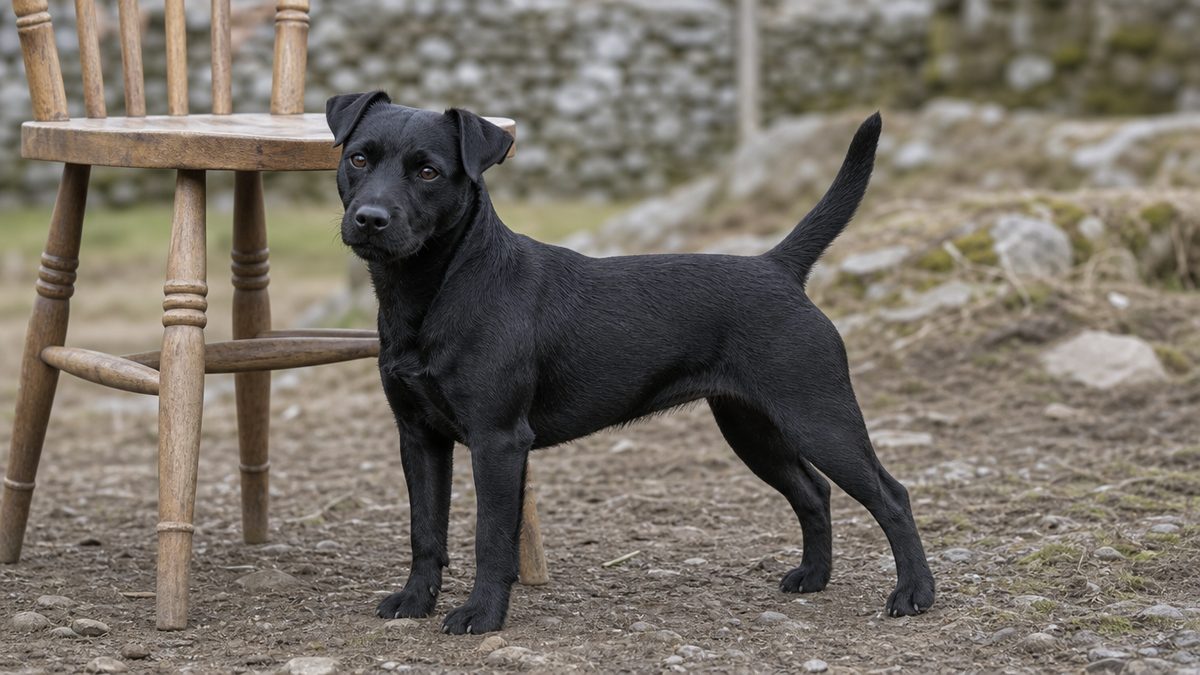
Quick answer
The Patterdale Terrier is a 10 to 15 inch black working terrier from the Cumbrian fells, bred to go to ground on fox. It has three written standards and a studbook, and every one of them is American: the United Kennel Club recognised it on 1 January 1995, and the Patterdale Terrier Club of America has kept a register since 1993. Britain's Royal Kennel Club does not list it, and its own breeders prefer that.
This guide is general information for Indian pet owners and is not a diagnosis. Always consult a registered veterinarian near you before acting on anything you read here. The published veterinary literature on this breed amounts to two single-dog case reports, so nothing on this page substitutes for an examination of the dog in front of you.
Patterdale Terrier at a glance
What the Patterdale Terrier is, and where its paperwork lives
The Patterdale Terrier is a compact black working terrier from the fell country of Cumbria in north-west England, standing 10 to 15 inches at the withers and bred to face a fox in a rock crevice. Its breed standard and its studbook both exist, and both are American.
Start with the place, because the dog is a product of it. Patterdale is a village a little south of Ullswater and a few miles east of Helvellyn, in country where the hills are called fells, the ground is steep and rocky, and the weather is cold, wet and windy. Sheep farming dominates because little else will grow there. Foxes prey on the sheep, the fells are too rough for horses, and the rock dens do not allow much digging, so a terrier there has to bolt the fox out of a crevice or deal with it where it stands. Because digging is barely an option in the north, the ADBA's own history says, northern dogs such as the Patterdale have to be tough as nails.
That is the whole design brief, and it explains every feature of the modern dog: the compact frame that can be spanned by a man's hands, the compressible chest, the muscular but flexible back, the coat that sheds rain, and the temperament the standards call game. The Patterdale of today refers to the mainly black smooth-coated fell terriers popularised by Cyril Breay of Kirkby Lonsdale and Frank Buck of Leyburn in the early 1950s, and line-bred from the early 1960s by Brian Nuttall of Holmes Chapel from Breay and Buck bloodlines.
The two-condition test, applied
A breed, as this site uses the word, needs two things: a written standard, and a studbook that records which animals meet it. Ask both questions of the Patterdale and both come back yes. Ask where and the answer is the interesting one.
- Written standard. Yes, three. The United Kennel Club recognised the breed on 1 January 1995 and publishes a full standard, revised 1 December 2014, covering head, body, spanning, coat, colour, gait, eliminating faults and disqualifications. The Patterdale Terrier Club of America publishes its own. The American Dog Breeders Association publishes a third.
- Studbook. Yes. The PTCA describes itself as established in 1993 as the world's first Patterdale and Fell Terrier registry, maintaining a comprehensive worldwide pedigree and registration database, with members across 47 US states and 14 countries. The UKC offers a second route through Single Registration.
- Where. All of it in the United States, for an English breed, while the English kennel club lists nothing.
Not all three standards are the same kind of document
This distinction matters and no ranking page makes it. Wikipedia's own article records the same three-standard position, naming the PTCA as the first club and registry in the history of the breed, the UKC and the ADBA, and noting that the United Kingdom Kennel Club does not recognise the breed. But only the UKC standard contains measurements. It gives a height range, a spanning test, a tail-length rule, three coat types and a colour list with disqualifications for albinism and for any patch of white on the body or head. The ADBA document, by contrast, contains no height, no weight and no anatomical description at all: it is history, temperament, care and training, and it opens with a disclaimer stating that the standard is not a breed identifier and may only be used to judge quality at ADBA-sanctioned events.
A page that says the Patterdale has three breed standards is technically right and practically misleading. One of the three declines to identify the breed in its own words, and a second is a club document rather than a registry's. If you want to know what a Patterdale is supposed to measure, there is exactly one document to read, and it is the United Kennel Club's.
What the UKC standard actually specifies
The physical description is short and unusually functional. Height is 10 to 15 inches at the withers, with weight simply in proportion and dogs shown in hard, fit, working condition with no excess fat. The chest must be capable of being spanned behind the shoulders by an average man's hands with the fingers of both hands touching, and must compress. The body is square or slightly longer than tall. Coat may be smooth, broken or rough, all with a short dense undercoat. Colours are black, red, liver or chocolate, grizzle, black and tan, and bronze, solid or with some white on chest and feet.
Two lines in that standard tell you more about the breed than the measurements do. Scars resulting from wounds received while working are considered honorable and are not to be penalized, and teeth broken or incisors lost through work are likewise not penalised. A show standard that protects a scarred dog is a standard written by people who expect the dog to be working on Saturday and shown on Sunday.
Recognition: absent from the Royal Kennel Club on purpose, not by accident
The Royal Kennel Club does not list the Patterdale Terrier, and this section proves that from the club's own index rather than asserting it. The reason is not that nobody has done the work. It is that the breed's own working breeders do not want the work done, and both the UKC standard and the club's own history say so.
Prove the absence properly first, because an unproven absence is not evidence. The Royal Kennel Club's own Breeds A to Z index was fetched and parsed on 8 September 2026. Its Terrier group holds exactly 27 entries, alphabetically Airedale Terrier through West Highland White Terrier, and there is no Patterdale among them.
| In the index | Not in the index |
|---|---|
| Lakeland Terrier, the Patterdale's nearest neighbour and closest show relative | Patterdale Terrier |
| Border Terrier, a working terrier admitted in 1920 | Fell Terrier |
| Jack Russell Terrier, a working terrier and the most recent terrier addition | Plummer Terrier |
| Parson Russell Terrier, its show-bred counterpart | Sporting Lucas Terrier |
| Bedlington, Cairn, Norfolk, Norwich and 19 more | Any other working fell type |
Those left-hand entries are the controls that make the right-hand column mean something. The page rendered completely, returning 27 terrier, 38 gundog and 39 hound entries with Retriever (Labrador) present, so nothing was truncated. And the presence of the Lakeland Terrier, carved from the same fell material at the same time, and of the Jack Russell Terrier, a working terrier admitted comparatively recently, shows the door is open to exactly this kind of dog. The Patterdale is not standing outside a locked door.
Why the breeders keep it out, in their own documents
The clearest statement comes from the standard that does exist. The United Kennel Club's Patterdale Terrier standard contains this sentence in its General Appearance section: "This breed is worked far more than it is shown, and breeders are primarily concerned with the practicality of the breed";. That is a registry writing down that its own breed's constituency does not care about the ring.
The rest of that standard reads the same way. Working scars are honourable and not to be penalised. Teeth broken or incisors lost while working are not penalised. Coat sections damaged by hunting scars or abrasions are not penalised as long as the texture can be judged. Spanning, a physical test of whether the dog can get down a hole, is described as an important part of the judging process, with the judge required to lift the front legs and squeeze the chest to confirm it compresses. This is a document trying to keep a show ring honest about work, which is a different project from breeding for a show ring.
The American club states the same purpose in its own words. The PTCA's mission is to preserve, protect and promote the true working Patterdale Terrier, to honour the breed's heritage and maintain its working purpose, and to run sanctioned digs, trials and seminars alongside its register. Its tagline is The Elite of Working Terriers. Nothing in it mentions conformation as an end.
This is not a breed nobody has documented. It is a breed documented deliberately outside the show registries by people who believe the show ring would change it. There is a written standard, there is a studbook, and both are held in the United States by bodies that centre working ability. The Royal Kennel Club absence is a choice by the breed's community, not a gap in the record, and those two verdicts should never be reported as the same thing.
The other registers, checked
- Federation Cynologique Internationale. Absent. The definitive letter-P index carries 27 breeds with the Parson Russell Terrier, Pekingese, Pug and Puli present as in-document controls, and no Patterdale. The provisional register carries 20 breeds and no Patterdale either.
- Kennel Club of India. No route. The FCI's members register lists India as a Full member represented by the Kennel Club of India, Chennai, so the KCI issues pedigrees against FCI nomenclature, and the FCI does not hold this breed.
- United Kennel Club. Held, in the Terrier group, with a full standard and a registration route.
- Patterdale Terrier Club of America. Held, in a worldwide pedigree database running since 1993.
For an Indian buyer that combination has one practical consequence worth stating plainly. A Patterdale Terrier cannot hold a Kennel Club of India pedigree, because the KCI works to FCI nomenclature and the FCI does not list the breed. Any Indian seller offering you KCI papers for a Patterdale is offering you something that cannot exist.
Patterdale Terrier price in India, and what the Indian figures actually are
No verified Patterdale Terrier price in India exists, because no Indian breeder or animal listing was found for the breed against a passing control. One Indian site prints Rs 25,000 to Rs 50,000, and its cost table is a template constant shared with an unrelated breed, which this section demonstrates rather than alleges.
Look at what an Indian search for this breed actually returns, because composition is better evidence than any count. The top Indian result is a paperback book: The Patterdale Terrier by Sean Frain, listed on Amazon.in at Rs 4,197.51. The rupee figures on that page are the book's price and payment-offer boilerplate, and the page mentions the breed 42 times without offering a dog. The next Indian-facing result is a Patterdale soft toy. The pages that do describe the dog are all foreign: an Australian retailer's guide whose living-with-a-Patterdale section is written for Australia, an American breed directory, and a working-terrier site in the United States that calls the breed the world's elite digging terrier. This is the merchandise trap in its purest form: a print, a book or a plush presents itself to a scraper, and to you, as the breed's Indian price.
The one Indian price page, taken apart
A single Indian breed-listing site publishes figures. Its Patterdale Terrier page gives a cost of buying of Rs 25,000 to Rs 50,000, monthly food of Rs 1,200 to Rs 1,800, average monthly expenses of Rs 2,200 basic and Rs 3,750 premium, an ideal weather band of 10 to 25 degrees C and a life expectancy of 12 to 15 years.
Now run the test this site runs on every such page: pull an unrelated breed from the same site and compare the lines to the rupee. The same site's Lakeland Terrier page prints Rs 2,200 basic and Rs 3,750 premium, identical to the rupee, and the same 12 to 15 year life expectancy, while giving a different buying price of Rs 80,000 to Rs 1,20,000 and a different ideal weather band of 5 to 20 degrees C.
| Field | Patterdale Terrier page | Lakeland Terrier page | Verdict |
|---|---|---|---|
| Avg monthly expenses, basic | Rs 2,200 | Rs 2,200 | Identical, a preset |
| Avg monthly expenses, premium | Rs 3,750 | Rs 3,750 | Identical, a preset |
| Monthly food | Rs 1,200 to Rs 1,800 | Rs 1,200 to Rs 1,800 | Identical, a preset |
| Life expectancy | 12 to 15 years | 12 to 15 years | Identical, a preset |
| Ideal weather | 10 to 25 C | 5 to 20 C | Differs; a per-breed field |
| Cost of buying | Rs 25,000 to Rs 50,000 | Rs 80,000 to Rs 1,20,000 | Differs; a per-breed field |
So the monthly cost figures for the Patterdale Terrier are not an observation of Patterdale Terriers. They are a shared template row that this site has now been recorded printing across a group of unrelated breeds, and the Patterdale is simply assigned to that tier. Quote the buying price if you must, and never quote the monthly figures as though somebody measured them.
Every rupee figure above was divided by 84.38, by 80 and by 74 to test for a disguised dollar price. None divides cleanly at 84.38 or 74. Rs 50,000 divided by 80 gives 625, but any rupee figure ending in three zeros divides cleanly at 80 by construction, and this site has separately recorded Rs 50,000 as a recurring ceiling on the same domain across unrelated breeds. So these are rupee-native template values rather than converted foreign prices, which is a different contamination mechanism and needs saying differently.
What the dog costs where it is actually bred
Foreign figures are reported here as foreign figures and are not converted. US listing sites quote roughly 1,000 to 2,500 dollars from individual breeders and 1,250 to 1,750 as a national range, while UK owners on breed forums report paying from about 150 to 600 pounds, with UK sale listings around 600 pounds. Those are three different markets with three different supply structures, and running any of them through today's exchange rate would produce an Indian price that nobody in India has ever charged.
The import position closes the question. DGFT Trade Notice No. 22/2022-23 files live dogs as a Restricted import, permitting entry only for a pet with a valid pet book in the importer's own name, for research with a CPCSEA recommendation, or for Defence and Police use, and states that applications for trading or breeding purposes shall be duly rejected. There is no lawful way to found an Indian breeding line, and no Indian line has formed.
What a 6 to 8 kg working terrier costs to keep in India
Budget roughly Rs 3,000 to Rs 6,500 a month for a small terrier in an Indian metro, built from published rate cards rather than a template row. The line that surprises people is grooming, because a broken or rough coat needs hand stripping that almost no Indian salon offers.
Every figure below was read off a page that was opened. None was converted from a foreign currency, and where a figure is a promotional floor from a single chain rather than a market average, that is said.
| Line | Published figure | Source and caveat |
|---|---|---|
| Anti-rabies, single dose | Rs 699 | Vetic clinic list price |
| 9-in-1 DHPPiL, single dose | Rs 899 | Vetic clinic list price |
| Kennel cough | Rs 1,349 | Vetic clinic list price, relevant for a dog that will board |
| Puppy core course | From Rs 6,499 | Vetic, a promotional floor; the same chain quotes differently on different city pages |
| Annual booster | From Rs 3,199 | Vetic, same caveat |
| Consultation | Rs 500 to Rs 1,000 | One data point, not two: two unrelated organisations publish this range byte-identically |
| Bath and styling | From Rs 1,869 | Vetic Delhi; see the hand-stripping problem below |
| Tick and flea | Rs 1,103 per month for 15 to 30 kg | NexGard Spectra; a smaller weight band costs less |
| Delhi pet dog registration | Rs 500 | MCD, new registration and renewal |
| Chennai pet licence | Rs 50 | Greater Chennai Corporation |
Two caveats travel with that table. The Rs 500 to Rs 1,000 consultation range is one data point rather than two, because a dog sanctuary and a general insurer publish it identically to the rupee along with an identical vaccination range, and exact agreement between unrelated organisations is evidence of copying rather than of corroboration. And Vetic's course prices differ between that chain's own city pages on the same day, so record which city a figure came from.
The grooming line is the one Indian owners get wrong
The UKC standard allows three coats: smooth, broken and rough. A smooth Patterdale costs nothing to groom, and Dogs Trust's advice of weekly brushing regardless of coat type covers it. A broken or rough coat is different: the ADBA guidance says those coats require hand stripping on the withers and back, with furnishings left on the face.
Hand stripping is a skill, not a machine setting, and very few Indian grooming salons offer it. What they will offer instead is clipping, which cuts the guard hairs rather than removing them and permanently softens and dulls a wire coat. So the honest Indian budget line for a rough-coated Patterdale is either learning to strip the dog yourself with a stripping knife, or accepting that the coat will change. Neither is expensive; only one preserves the jacket the standard describes.
Where the money actually goes for this breed
- Containment, the largest unbudgeted item. The ADBA guidance says plainly that the dog should not remain outside without a fenced yard and that if left unsupervised he can dig underneath the fence, which needs to be firm in the ground and high enough that he cannot jump it. A dug-in fence line is a one-off cost no rate card lists.
- Parasite control, unavoidable. A terrier working grass and undergrowth in India is a tick magnet, and monthly cover is not optional.
- Food, low. At 6 to 8 kg this is one of the cheapest dogs in India to feed, and the largest risk is quiet overfeeding rather than expense.
- Training or behaviour support, likely. Documented same-sex dog aggression and a strong prey drive mean a first-year behaviour budget is realistic rather than pessimistic.
Greater Chennai Corporation licenses pet animals at Rs 50 and its six municipal veterinary clinics provide treatment and anti-rabies vaccination free of cost. For a small, hardy, low-maintenance dog that is the single largest saving available in India, and it turns the biggest recurring veterinary line into almost nothing.
Indian climate suitability: the coldest homeland on this site
The Patterdale Terrier comes from the coldest place any breed on Bonbeno originates in. Its homeland cell runs an annual mean of 8.89 degrees C, and its hottest month, July, averages 14.71 degrees C, which is 5.5 degrees cooler than the coldest month in Bengaluru, India's mildest large city. That gap, not humidity, is the real problem.
Every figure here came from the NASA POWER climatology API queried by explicit latitude and longitude, with the grid cell's own reported elevation echoed for each point.
| Point | Cell elevation | Annual mean T2M | Hottest month mean | Annual mean RH2M |
|---|---|---|---|---|
| Patterdale, Cumbria | 164.07 m | 8.89 C | 14.71 C (July) | 88.81 % |
| Bengaluru | 841.72 m | 23.74 C | 28.37 C (April) | 67.94 % |
| Pune | 635.99 m | 23.86 C | 28.93 C (April) | 66.80 % |
| Delhi | 206.37 m | 25.60 C | 35.88 C (June) | 45.56 % |
| Kolkata | 7.35 m | 25.81 C | 31.53 C (May) | 73.93 % |
| Mumbai | 97.15 m | 26.77 C | 31.19 C (May) | 67.39 % |
| Chennai | 48.95 m | 27.95 C | 31.51 C (May) | 72.39 % |
Read the July figure against the Indian column and the scale of the change becomes obvious. The warmest month in the Patterdale's homeland is colder than the coldest month in every Indian city on that list. Bengaluru's coolest month, December, averages 20.2 degrees C; Patterdale's July averages 14.71. A dog whose entire selection history took place inside that band is being asked, in Chennai, to live 13 degrees warmer on the annual mean.
Humidity is not the shock. This one is worth getting right.
The instinct is to warn that Indian humidity will finish a British dog, and the data says the opposite. The Patterdale homeland cell runs 88.81 percent annual relative humidity, higher than Kolkata at 73.93, Chennai at 72.39, Bengaluru at 67.94, Mumbai at 67.39, Pune at 66.80 and Delhi at 45.56. Cumbria is a genuinely wet place. This dog has met damp air every day of its evolutionary life.
What it has never met is humidity at 30 degrees C rather than at 9. The correct way to frame the risk is wet-bulb load, not damp air. The homeland's peak monthly wet bulb is 13.03 degrees C in July. Kolkata reaches 27.09 in June, Delhi 26.50 in July and Chennai 26.11 in May. That is a 14 degree wet-bulb gap, and it is the single number that should decide whether you bring this breed to India.
NASA POWER returns a grid cell, not a point. Patterdale village and Keswick, about 15 km apart, returned byte-identical series on one cell reported at 164.07 m. Patterdale village sits near 150 m, so the cell describes the valley floor well, and describes the fells above it not at all: Helvellyn rises to about 950 m within a few kilometres of the same cell. The figures above are therefore a valley baseline. The ground this breed was actually selected on is several degrees colder still, which widens the Indian gap rather than narrowing it.
What this means city by city
- Delhi, Rajasthan and the north-west. The hardest placement in India. A June mean of 35.88 degrees C is 21 degrees above anything in the breed's history, and this is a dog with a working drive that will not self-regulate by lying down.
- Chennai, Mumbai and Kolkata. Survivable indoors with air conditioning, and genuinely unsafe outdoors for most of the year between 10 am and 5 pm.
- Bengaluru and Pune. The only realistic Indian placements, at 841 m and 636 m, with annual means near 23.8 degrees C and cool December nights.
- Hill stations. Genuinely suitable, and worth naming honestly: Ooty, Kodaikanal, Munnar, Shimla, Manali and Darjeeling produce the only Indian conditions this heat-sensitive breed would recognise.
Indian law reinforces the point. Second Schedule Part IV paragraph 21(1) of the Dog Breeding and Marketing Rules 2017 bars keeping in outdoor facilities, without the attending veterinary practitioner's written approval, dogs not accustomed to the temperatures prevalent in the area and breeds that cannot tolerate them. A Cumbrian fell terrier in an Indian plains summer is precisely the animal that clause describes.
Temperament and household fit: a standard that warns you off its own breed
The Patterdale Terrier suits an active household with land, a secure boundary and previous terrier experience. Its own breed standard says it is not a dog for the average pet owner, and that sentence is the most useful piece of temperament advice published about it anywhere.
Quote the standard rather than paraphrasing it, because the two halves matter equally. The United Kennel Club describes an extremely courageous working terrier, traditionally used to go to ground, extremely willing to work and with a high desire to please, very active with a strong prey drive, that should be peaceful with humans, livestock and other dogs. Then, without a paragraph break, it says they are not a dog for the average pet owner and require an owner with a sense of humour who understands and can tolerate a real terrier temperament.
The breed's American club adds the part the standard does not. The PTCA states that Patterdale Terriers can be aggressive with other dogs, particularly those of the same sex, and that it is crucial to manage their interactions carefully to prevent conflicts. That is a documented same-sex aggression risk published by the breed's own registry, which is worth more than a hundred owner anecdotes and which no ranking page puts in front of a prospective buyer.
| Household | Verdict | Why |
|---|---|---|
| Farmhouse or plot with a dug-in fence | Good fit, in Bengaluru or Pune | Space, a boundary and a climate the dog can survive |
| Independent house with a garden | Workable | Only with a dig-proof fence line and real daily exercise |
| Metro apartment | Wrong dog | Barks by design, digs by instinct, and cannot burn energy indoors |
| Home with an existing same-sex dog | High risk | The breed's own club flags same-sex aggression specifically |
| Home with cats, rabbits or poultry | High risk | This is a dog selected to kill vermin underground |
| First-time dog owner | Wrong dog | Its own standard says so |
| Family with school-age children | Workable | The dogs are people-friendly; the management burden falls on adults |
What Dogs Trust says, and what it pointedly does not
Britain's largest dog welfare charity describes the breed as typically energetic with a sturdy build, coats coarse or smooth, commonly black, chocolate, tan or red, and notes that digging, chasing, searching and retrieving all come naturally to it. On temperament it declines to generalise at all, saying every Patterdale temperament is different and that dogs develop their own likes and dislikes. For a charity that rehomes the breed in volume, that is a considered refusal to promise a family dog, and it should be read as one.
Barking is a feature, and in India it is a neighbour problem
A terrier that goes to ground must bay at its quarry so that the diggers above can locate it through several feet of rock. The trait that made the dog useful underground makes it loud in a Mumbai housing society. Google's own answer to the question, quoting Purina, is that Patterdale terriers can be quite chatty and make a lot of barking noises and would need training to become less yappy in an apartment. Training reduces it. Selection built it.
Indian streets contain free-ranging dogs, cats, poultry, monitor lizards and monkeys, and a working terrier off lead among them is not a recall problem, it is a management failure waiting to happen. The ADBA guidance says this breed should always be kept on a lead or in a fenced area, as he can be difficult to catch when he gets going. Take that literally and permanently, because it does not soften with age.
One thing this breed is genuinely good at, which deserves saying after all the warnings. Both American documents describe an affectionate, loyal, people-oriented dog: very independent yet loving, with great stamina, happy to work quarry all day or play all day with the children, and relaxed and quiet indoors once its needs are met. The Patterdale is not a difficult dog. It is an easy dog with hard requirements, and the difference decides whether the placement works.
Training a working terrier, and the two things it will not give you
Train a Patterdale Terrier by giving it work, and accept early that recall around prey and silence on demand are the two things you will never fully own. Everything else it learns quickly, because the standard is right that this is an intelligent dog with a high desire to please.
The training problem here is not stubbornness, it is competition. A dog selected for two centuries to keep working alone underground, out of sight and out of earshot, has been selected against handler dependence. That same selection produced the willingness to please that the standard describes, so the dog wants to work with you right up to the moment something more interesting goes into a hole.
A realistic first-year plan
- Weeks 8 to 16, socialise deliberately. Other dogs behind a barrier before other dogs face to face, given the documented same-sex aggression risk. Cattle, autos, traffic, crowds, and strangers handling the dog all over.
- Months 3 to 6, install the long line as normal life. Never let this dog rehearse ignoring you at distance. A 10 m line in open ground gives freedom without teaching self-employment.
- Months 4 to 8, teach a settle and a mat. More valuable than any obedience cue, because it gives you somewhere to put a terrier when the doorbell goes.
- Months 6 to 12, add real work. Scent games, dig boxes, flirt pole, terrier racing, and anything that lets the dog use its nose and its body with permission.
- Month 12 onward, manage rather than train the last 10 percent. A fence, a line and a muzzle taught as a game beat any attempt to train through selection pressure.
Give it somewhere legal to dig
This is the single most useful practical suggestion for a Patterdale in an Indian garden. The ADBA guidance is blunt that if left in the yard unsupervised the dog can dig underneath the fence, and that the fence must be firm in the ground and high enough that he cannot jump it. The management answer is not to stop the digging, which will not work, but to move it: a sand pit or a bounded patch with buried toys, rewarded when used, redirects the behaviour instead of suppressing it.
The barking, addressed honestly
You will not train a baying terrier into silence, and any trainer promising it is selling you something. What works is teaching the dog that barking is a cue that ends rather than a conversation that continues: a quiet cue trained as a positive interruption, a settle on a mat, and enough physical work that the dog is not barking out of frustration. In an Indian apartment, add soundproofing expectations to the budget rather than adding training sessions.
A dog with a documented same-sex aggression risk and a strong prey drive should be muzzle-trained as a puppy, taught as a game with food through the basket, long before you need it. The same goes for full-body handling, because an Indian vet will be examining a breed they have never seen, on a dog with a terrier's opinion about being restrained. Both are ten-minute-a-week projects that pay for themselves once.
One legal note that changes what training even means for this breed. In England and Wales the traditional job is now tightly bounded: Schedule 1 paragraph 2 of the Hunting Act 2004 permits a dog below ground only to protect birds being kept or preserved for shooting, with one dog below ground at a time and written land permission carried. Any Indian owner reading older working-terrier literature should know that the practice it describes is not the practice that is lawful in the breed's homeland today.
Daily exercise requirement, and why India halves the available hours
Give an adult Patterdale Terrier at least ninety minutes of real activity a day, and in India split it into a dawn session and a night session, because the middle of an Indian day is unusable for a dog from a place whose hottest month averages 14.71 degrees C.
Dogs Trust describes a typically high-energy dog needing lots of exercise to stay physically and mentally healthy, with daily walks plus plenty of time and opportunity to explore, burn energy and play, and says the breed suits people who love spending active time outdoors. The ADBA is blunter: the dog requires regular exercise and should not be left outside without a fenced yard.
| Slot | What | Why it works in India |
|---|---|---|
| 05:30 to 06:30 | Long line walk on soft ground, sniffing allowed | The coolest hour in every Indian city measured here |
| Midday | Nothing outdoors, at all | A homeland July mean of 14.71 C means this dog has no heat reserve to spend |
| Indoors, twice daily | Ten minutes of scent work or a dig box | Mental load substitutes for distance on the days heat wins |
| 20:00 to 21:00 | Second walk or flirt pole in a garden | Darkness and cooler ground; also avoids stray-dog encounters |
| Weekly | Terrier racing, a long off-lead run in a fenced field, or a swim | The only way a working terrier gets a genuinely tired day |
The Indian summer arithmetic, stated plainly
A dog that has never experienced a mean monthly temperature above 14.71 degrees C is being asked, in a Chennai May, to exercise at 31.51. That is not a matter of building tolerance; it is a matter of restricting hours. In the plains between March and June, treat anything outside the two cool windows as unavailable, and treat a hot pavement as a burn risk to the pads regardless of air temperature.
Bengaluru and Pune are the two Indian metros where a full exercise programme is realistic year round, at annual means of 23.74 and 23.86 degrees C and elevations of 841.72 m and 635.99 m. Everywhere else, the exercise plan is really a heat plan with walks attached.
What an under-exercised Patterdale does
- Digs. Under the fence, through the flower bed, into the sofa. The ADBA warns about exactly this.
- Barks. Frustration barking is on top of the baying the breed does anyway, and in an Indian apartment block it is the complaint that ends the placement.
- Hunts. Cats, poultry and other people's small dogs are all inside the template, and a bored terrier goes looking.
- Escapes. A fence that holds a Labrador will not hold a dog whose job description is getting into places dogs cannot get into.
It costs nothing, it can be done indoors at 2 pm in a Chennai May, it uses the part of the dog that a fell terrier was actually selected for, and twenty minutes of finding hidden food tires a terrier more reliably than an hour of pavement walking. For an Indian owner whose outdoor hours are cut in half by climate, it is the difference between a settled dog and a destructive one.
Grooming three different coats in Indian humidity
Grooming a Patterdale Terrier depends entirely on which of its three coats the dog has. A smooth coat needs a rubber brush and nothing else. A broken or rough coat needs hand stripping on the withers and back, and that is a skill almost no Indian salon offers.
The UKC standard recognises three coat types, all with a short dense undercoat. Smooth hair is coarse, dense and stiff, falling back into place when lifted, with no wave. Broken is an intermediate coat with longer, coarse, wiry guard hairs that may be wavy, and may or may not carry face furnishings forming a beard, moustache and eyebrows. Rough is coarse and longer overall, including on the face and ears. The standard makes a coat that is soft, long or downy in texture a serious fault in any climate, which is a phrase worth noticing on an Indian page.
| Coat | Routine | Indian practicality |
|---|---|---|
| Smooth | Rubber or firm bristle brush once a week | Trivial; no salon needed, ever |
| Broken | Weekly brush plus hand stripping on withers and back | Hard to buy; learn to do it yourself with a stripping knife |
| Rough | Weekly brush, hand stripping, furnishings left on the face | Hardest; most Indian salons will clip instead, which changes the coat |
The ADBA guidance says it directly: smooth-coated dogs need minimal grooming and a firm bristle or rubber brush to remove excess hair, while dogs with broken and rough coats require hand stripping on the withers and back, with furnishings left on the face. Dogs Trust simplifies to weekly brushing regardless of coat type, which is right for a pet-home smooth and incomplete for a wire.
Hand stripping pulls the dead guard hair out at the root so a new hard coat grows in. Clipping cuts the guard hair off and leaves the root, and the coat that regrows is softer, duller and less weatherproof each time. In India the default salon answer to any hairy dog is a clipper, so a rough-coated Patterdale owner has to say no explicitly, every visit, or learn the knife. Vetic's Delhi list prices a bath and styling from Rs 1,869, and none of that buys stripping.
The Indian additions to a British routine
British breed advice assumes a dog that gets wet often and dries in cool air. Two parts of that do not transfer. First, a coat left to air dry at 90 percent humidity and 27 degrees C is a different proposition from one drying at 85 percent and 14 degrees, and the parts that stay damp are the ones that cause problems: ears, armpits, groin and between the toes. Towel those by hand after every wet walk.
Second, ticks. The homeland's parasite pressure is nothing like India's, and a low-slung terrier working grass is the highest-exposure body shape there is. Indian clinic-based series report substantial tick-borne disease burdens, with one Odisha study finding Ehrlichia canis in 56 of 178 dogs tested, 31.46 percent, and 79 percent of infected animals having a tick history. Those figures describe dogs presented at veterinary clinics rather than the dog population, and read that way they still make monthly parasite cover non-negotiable.
The weekly five minutes
- Brush the whole dog, with a rubber curry on a smooth or a slicker plus stripping knife on a wire.
- Check the ears, which sit folded tightly above the skull and trap moisture and grass seed.
- Check between the toes and the pads, which take the most damage on Indian ground and stay damp longest in the monsoon.
- Run a hand over the whole dog for ticks, concentrating on the ears, neck, groin and under the tail.
- Clip the nails, and look at the teeth, which the standard expects to meet in a scissors or level bite.
Health: an evidence base of exactly two dogs
The entire published veterinary literature on the Patterdale Terrier is two single-dog case reports, both from one London teaching hospital. Britain's largest dog charity publishes a health section for the breed that names no condition at all. That is not an oversight by either of them; it is what the evidence looks like for a breed that has stayed outside the registries.
Count it precisely, because a claim this strong has to be earned. A PubMed search for the string Patterdale anywhere in the record returns four items. Two are noise created by the place name: a Malawian household-air-pollution study and a paper on helicopter hoist capability for mountain rescue in the UK, which is about the Patterdale mountain rescue team rather than the dog. The control query in the same session, Labrador retriever hip dysplasia, returned 126 records with a sane query translation, so the instrument was working.
| Record | What it is | n |
|---|---|---|
| Fitzgerald, Priestnall and Lamb 2017, Vet Radiol Ultrasound 58(4):E42-E44 | Traction bronchiectasis secondary to pulmonary fibrosis in an 8-year-old Patterdale, diagnosed by CT and histopathology | 1 dog |
| Steele et al. 2024, J Vet Intern Med 38(1):351-357 | Pituitary hypersomatotropism treated by transsphenoidal hypophysectomy in a 6-year-10-month male neutered Patterdale | 1 dog |
| Everything else naming Patterdale | A Malawi air-pollution study and a UK mountain-rescue paper | 0 dogs |
Both real records are case reports from the Royal Veterinary College, and neither says anything about breed predisposition. The 2017 dog presented with tachypnoea, exercise intolerance and weight loss, and its CT showed pneumomediastinum, diffuse ground-glass opacity and marked peripheral bronchial dilatation without thickened walls, with histopathology giving diffuse pulmonary interstitial fibrosis and type II pneumocyte hyperplasia. The 2024 dog presented with polyuria, polydipsia, progressive pharyngeal stertor, excessive hair growth and widened facial features and paws, with a serum IGF-1 of 1783 ng/mL, and later developed diabetes mellitus.
Nothing in either paper suggests the Patterdale is predisposed to pulmonary fibrosis or to pituitary tumours. They are reports of unusual presentations in dogs that happened to be Patterdales. Any page that turns them into a list of breed health risks has invented a pattern out of a sample of two, and this page will not.
What Dogs Trust does with the same problem
Dogs Trust's Patterdale Terrier page has a section headed Health issues. Its entire content is that it is important to know about possible health issues, that not every dog will suffer them, and that to find out more about potential health issues for Patterdale Terriers you should speak to your local vet. It names no condition, gives no prevalence and lists no screening test. For a charity that rehomes this breed at scale in Britain, that is a deliberate refusal to fill a gap with guesswork, and it independently corroborates what the literature search found.
Why the absence exists, and why it is not reassuring
A breed outside the show registries generates no health surveys, because health surveys are usually run by breed clubs through kennel clubs. There is no Royal Kennel Club breed health co-ordinator for the Patterdale, no vulnerable-native-breed statistics, no Breed Watch entry and no mandatory or recommended screening scheme. What that produces is not evidence of a healthy breed. It is an absence of evidence, and those two things are different.
There is a reasonable counter-argument, and it deserves stating fairly. A population selected for the ability to work hard in rough country, with no conformation fashion pulling it toward exaggeration, has structural reasons to be sound. The UKC standard actively guards against exaggeration, requiring a chest that can be spanned and compressed and penalising a body too cobby or barrel-shaped. That is a genuine argument for soundness. It is not a substitute for data, and no honest page should present it as one.
- Ask the breeder for their own line's history. With no registry health scheme, the breeder's records are the only data that exists.
- Ask what the parents died of and at what age. Three generations of that is worth more than any published breed average.
- Screen for the ordinary small-terrier concerns anyway, including patellae and eyes, and treat the absence of a breed scheme as a reason to check rather than a reason not to.
- Expect working injuries in a worked dog. The UKC standard treats scars, broken teeth and lost incisors as honourable, which tells you what a working career costs the animal.
Lifespan, the 584,734-dog study that omits the breed, and Indian risks
This page publishes no lifespan figure for the Patterdale Terrier. The 12 to 15 years you will see everywhere traces to secondary sources, and the largest UK study of companion-dog longevity, covering 584,734 dogs, never names the breed once while naming three of its closest relatives.
The check is cheap and decisive. McMillan and colleagues' 2024 paper in Scientific Reports, Longevity of companion dog breeds: those at risk from early death, was searched for the string Patterdale. It occurs zero times. In the same document, in the same read, Jack Russell occurs once, Lakeland once and Border Terrier twice, so the search was working and the breeds it does cover include the Patterdale's nearest neighbours. The cohort figure 584,734 appears seven times.
So the largest and most-cited UK longevity dataset does not carry this breed. That is exactly what you would predict for a dog that is not registered with the body most UK breed data flows through, and it explains why the figures circulating have no study behind them.
| Source | Figure | What is behind it |
|---|---|---|
| An Indian breed-listing site | 12 to 15 years | Identical to its Lakeland Terrier page; a template constant |
| A UK dog-sharing platform, via Google's answer box | Approximately 12 to 15 years | No study cited |
| Dogs Trust | No figure given | Declines to state one |
| McMillan 2024, 584,734 dogs | Breed not present | The breed is absent from the paper's text entirely |
| UKC breed standard | No figure given | Standards do not state lifespans |
Ask the breeder for the ages at death of their own last three generations, and ask what they died of. In a breed with no registry health scheme and no longevity cohort, that is not a poor substitute for data. It is the only data there is, and a breeder who cannot answer it has not been keeping records worth buying from.
The Indian risks that are measured
Everything above is about what is not known. What is known, and measured in India, applies to any dog living here and applies with extra force to a low-slung terrier that pushes through grass and undergrowth.
- Tick-borne disease. One Odisha clinic series found Ehrlichia canis in 56 of 178 dogs tested, 31.46 percent, with 79 percent of infected animals carrying a tick history. Read that as a figure about dogs presented at veterinary clinics rather than about the dog population.
- Heat. Not a disease but the leading avoidable risk for this breed in India, and covered in the climate section above.
- Working injuries and foreign bodies. A dog that goes into holes gets grass seed in ears and feet, punctures around the face, and torn nails. In India add the risk of what is already in the hole.
- Rabies exposure. A dog with a high prey drive that hunts on its own account in an Indian environment has a genuine exposure risk, and anti-rabies vaccination at Rs 699 privately or free at a Greater Chennai Corporation clinic is the cheapest insurance available Greater Chennai Corporation.
What Indian law would require of anyone breeding one here
Second Schedule Part III paragraph 8(10) of the Dog Breeding and Marketing Rules 2017 requires that breeding dogs have been tested for genetic defects, including hip dysplasia, progressive retinal atrophy, night blindness, hypothyroidism, entropion, ectropion, overshot and undershot jaw, wry mouth, two or more missing teeth, and unilateral or full cryptorchidism. The word is including, so the list is illustrative rather than closed.
Two of those align with the UKC standard, which disqualifies unilateral or bilateral cryptorchidism and requires a full complement of teeth meeting in a scissors or level bite, while explicitly excusing teeth broken or incisors lost through work. The Indian requirement and the American standard agree on what a breeding dog should have, and differ on what an honourable working injury means, which is a distinction worth understanding before anyone imports one.
Feeding a small working terrier in India, life stage by life stage
Feed a Patterdale Terrier as a small, very high-activity dog and keep it lean enough to pass the spanning test its own standard uses. Nutrition here is unusually simple because the dog is small, hard-coated and free of the digestive fragility that afflicts many pedigree breeds, and the only real risk is a fat terrier.
The standard gives no weight figure at all, which is deliberate. It says weight should be in proportion to height, with dogs always shown in hard, fit, working condition with no excess fat. At 10 to 15 inches at the withers, that puts most adults somewhere around 5 to 9 kg, and the standard's refusal to print a number is itself a statement: the correct weight is whatever leaves the dog able to do the job.
| Stage | Meals per day | What matters most |
|---|---|---|
| 8 to 16 weeks | 4 | Small-breed growth food; never free feed a terrier |
| 4 to 6 months | 3 | Keep the puppy lean; a fat terrier puppy is a joint problem later |
| 6 to 12 months | 2 to 3 | Adult food from around 9 to 10 months at this size |
| 1 to 8 years | 2 | Portion to the spanning test, not to the bowl |
| 8 years and older | 2 | Same volume, lower calories, watch topline muscle rather than the scale |
The spanning test is a body-condition tool, and it is free
This is the most useful feeding advice available for the breed and it comes straight out of the standard. A Patterdale should be capable of being spanned directly behind the shoulders by an average-sized man's hands with the fingers of both hands touching, and when spanned the chest must compress. Do it monthly. If your hands no longer meet, or the chest no longer gives, the dog is carrying weight, and no scale is needed to tell you.
Dogs Trust's body-condition description says the same thing in ordinary language: ribs felt easily with a minimal or thin fat covering, an obviously narrow waist viewed from above, and a belly that tucks in rather than being rounded when viewed from the side. On a short-coated dog you can see all three.
Indian practicalities
- Feed after the cool-hour walk, not before. In an Indian summer that means after the dawn session, which is also the safest ordering for any deep-chested dog.
- Weigh the food. Indian portioning is done by eye and by affection, and quiet overfeeding is the most common welfare problem this site sees in Indian pet dogs.
- Small dog, small budget. At 5 to 9 kg this is among the cheapest breeds in India to feed, which is genuinely a point in its favour.
- Water availability, not water quantity. A terrier that hunts a garden in a Chennai afternoon will not go and find one bowl; put several in shade.
- Treats count. Terriers are trained with food and a working terrier gets trained a lot. Take the treat allowance out of the daily ration rather than adding it on top.
There is no fashionable head shape here, no exaggerated skull, no shortened muzzle and no closed gene pool selected for looks. The UKC standard actively penalises a snipy or weak muzzle and a body too cobby or barrel-shaped, and requires a full complement of teeth in a scissors or level bite. A dog built to that description eats, chews and digests like a dog, which is more than can be said for several breeds sold in India at ten times the price.
Month by month through the first year
Plan a Patterdale Terrier's first year around three things: a fence built before month four, socialisation with other dogs done carefully rather than casually, and an Indian heat calendar that decides when the puppy can be outside at all.
| Age | Ordinary puppy work | The Patterdale and India addition |
|---|---|---|
| 8 to 10 weeks | Settle in, four meals, crate as a den, first vet visit | Start the monthly spanning habit now, so the adult accepts it |
| 10 to 14 weeks | Core vaccination course, handling, name games | Introduce the muzzle as a food game, years before you need it |
| 14 to 16 weeks | Socialisation sprint with people, traffic, cattle, autos | Dogs behind a barrier first, given the same-sex aggression risk |
| 4 to 6 months | Three meals, lead manners, long line | Dig-proof the fence base before the puppy discovers it can |
| 6 to 8 months | Adolescent recall collapse; keep the line on | Prey drive switches on; in India that means stray dogs and cats |
| 8 to 10 months | Two meals, adult food | First hand-stripping session if the coat is broken or rough |
| 10 to 12 months | Adult exercise load, real work introduced | Reassess the heat plan for the coming summer, city by city |
Socialising a terrier with a documented dog-aggression risk
The ordinary advice to socialise a puppy with as many dogs as possible needs modifying here. The breed's own club publishes that Patterdales can be aggressive with other dogs, particularly of the same sex, and that interactions need careful management. That is not a reason to skip dog socialisation; it is a reason to do it well. Parallel walks with calm adult dogs, barriers before contact, and short positive exposures beat a chaotic dog park every time, and an Indian dog park with free-ranging dogs outside the gate is chaotic by default.
The rest of the socialisation list is the ordinary Indian one, and it matters because a fell village and an Indian city share almost nothing. Auto-rickshaw engines, temple bells and loudspeakers, crowds, cattle on the road, construction noise, firecrackers at a distance in October, and a veterinary examination table with a stranger's hands on the dog.
Legal points that bite in the first year
- Never take a puppy under eight weeks. Rule 8(1)(a) of the Dog Breeding and Marketing Rules 2017 requires that pups less than eight weeks in age are not sold.
- Do not dock the tail, whatever the standard says. The UKC standard contemplates docking one quarter to one third, on the reasoning that the tail is sometimes the only means of pulling the dog out of a burrow. Second Schedule Part II paragraph 6(8) of the Indian Rules forbids tail docking, ear cropping, de-barking, de-clawing and any change of appearance by artificial means, and calls it strictly forbidden.
- Register the dog. Rs 500 in Delhi, Rs 50 in Chennai.
- Sterilisation before any resale. Rule 8(1)(b) bars selling a dog over six months of age without first sterilising it, unless the sale is to another licensed breeder.
Every owner who loses a working terrier through a boundary loses it at adolescence, and every one of them says the dog had never tried before. The ADBA guidance is explicit that the dog can dig underneath a fence if left unsupervised, and that the fence must be firm in the ground and high enough that he cannot jump it to find game. In India, add that the thing on the other side of your wall is usually another dog.
One India-specific timing note. If your puppy arrives between February and May in Delhi, Chennai, Mumbai or Kolkata, the socialisation window and the unusable-heat window overlap almost exactly. Plan the outings for dawn and after dark, use indoor exposure work in the middle of the day, and do not shorten the socialisation because the weather is inconvenient. The window does not reopen.
Patterdale Terrier compared with the terriers buyers cross-shop
An Indian buyer looking at a Patterdale Terrier is usually choosing between four small working terriers, and three of them are easier to obtain, easier to insure and better documented. The Patterdale wins on exactly one axis, which is working ability, and loses on every axis that involves paperwork.
| Patterdale Terrier | Lakeland Terrier | Border Terrier | Jack Russell Terrier | |
|---|---|---|---|---|
| Royal Kennel Club | Not listed | Listed | Listed | Listed |
| FCI | Not held | Held | Held | Held |
| Kennel Club of India pedigree possible | No | Yes | Yes | Yes |
| United Kennel Club | Recognised 1 January 1995 | Recognised | Recognised | Recognised |
| Named in McMillan 2024, 584,734 dogs | No | Yes | Yes | Yes |
| PubMed records naming the breed | 2 case reports | More | Many more | Many more |
| Coat work | Smooth, broken or rough; wires need stripping | Wire, needs stripping | Wire, needs stripping | Smooth, broken or rough |
That table is the argument. Three of the four are in the Royal Kennel Club's own terrier group, and the Patterdale is not. Three are named in the largest UK longevity study and the Patterdale is not. Three can hold a Kennel Club of India pedigree, because the KCI works to FCI nomenclature, and the Patterdale cannot, because the FCI does not list it.
The Lakeland comparison is the historically interesting one
The Lakeland Terrier and the Patterdale Terrier come from the same fells, the same decades and much the same dogs. One went into the show register and became a coated, trimmed, groomed breed with a Royal Kennel Club standard. The other stayed with the hunt terriermen and became the dog described by its own standard as worked far more than it is shown. Same raw material, two deliberate choices, and both are still around to compare.
The commercial consequence in India is odd and worth noticing. The one Indian site that prices both gives the Lakeland Terrier a buying price of Rs 80,000 to Rs 1,20,000 and the Patterdale Rs 25,000 to Rs 50,000, while giving them identical monthly costs to the rupee. The register is what the price is tracking, not the dog.
For an Indian buyer, the real comparison is closer to home
| Dog | Available in India | Heat suitability | Documentation |
|---|---|---|---|
| Patterdale Terrier | No verified Indian source | Poor outside Bengaluru, Pune and the hills | Three American standards, no KCI route |
| Border Terrier | Occasionally, with KCI papers | Poor to moderate, same northern origin | Full RKC and FCI documentation |
| Jack Russell Terrier | Yes, widely | Moderate | Full RKC and FCI documentation |
| Indian pariah dog | Free, everywhere, today | Excellent, locally adapted | None, and none needed |
The honest recommendation follows from that table rather than from any preference. If you want the working terrier temperament and can give it space and a cool climate, a Border Terrier or a Jack Russell gives you nearly the same dog with a register behind it and a vet who has seen one. If you want a small, hardy, low-cost dog for an Indian city, the Indian pariah dog beats every imported terrier on climate, on cost and on veterinary familiarity. The Patterdale is the right answer only for someone who is going to work it, in a place cool enough to work it.
One of the questions Google asks about this breed is about Patterjacks, the Patterdale crossed with a Jack Russell. That cross exists in volume, no register holds it, and nobody has studied it. It is a useful reminder that the working-terrier world runs on reputation and word of mouth rather than on paperwork, which is a functioning system in Cumbria and a completely unverifiable one from Chennai.
Mistakes Indian readers make about this breed
The commonest mistake is reading the Royal Kennel Club's absence as a verdict on the dog rather than a choice by its breeders. The second is buying a book, a toy or a photograph while believing you have found an Indian price. Both are avoidable in a couple of minutes.
1. Treating unrecognised as undocumented
The Royal Kennel Club does not list the Patterdale, and that is verifiable from its own index: 27 terrier breeds, Lakeland and Jack Russell among them, no Patterdale. What does not follow is that nobody has written the breed down. The United Kennel Club recognised it on 1 January 1995 and publishes a full standard, and the Patterdale Terrier Club of America has run a worldwide pedigree register since 1993. Unrecognised by one club is not the same claim as undocumented, and the difference is the whole page.
2. Buying merchandise and calling it a price
The top Indian search result for this breed is a paperback book at Rs 4,197.51 on Amazon.in, and the next is a soft toy. A scraper reads those as the breed's Indian price and so, occasionally, does a person. Before quoting any rupee figure for a dog, confirm the listing is for a live animal.
3. Quoting a template monthly cost as a measurement
One Indian site prints monthly expenses of Rs 2,200 and Rs 3,750 for the Patterdale Terrier. Its Lakeland Terrier page prints the same two figures to the rupee, along with the same food line and the same 12 to 15 year life expectancy. Those numbers are a shared template row assigned to a tier, not an observation of Patterdale Terriers, and the tell is that the fields which genuinely differ between the two pages are the buying price and the ideal weather band.
4. Believing a lifespan figure
No cohort has measured it. The largest UK companion-dog longevity study, covering 584,734 dogs, never names the breed while naming the Jack Russell, the Lakeland and the Border Terrier. Dogs Trust gives no figure. The standard gives no figure. Every 12 to 15 year claim you will meet is a secondary source repeating another secondary source.
5. Assuming Indian humidity is what will hurt the dog
It is not. The homeland cell runs 88.81 percent annual relative humidity, higher than every Indian city measured here, including Kolkata at 73.93 and Chennai at 72.39. Cumbria is a wet place and this dog is a wet-weather dog. What it has never met is heat: a homeland July mean of 14.71 degrees C against Chennai's May mean of 31.51. Frame the risk as heat, and specifically as wet-bulb load, not as damp air.
6. Docking the tail because the standard mentions it
The UKC standard does contemplate docking, and gives a working reason: the tail is sometimes the only means of pulling the dog out of a burrow, so only a quarter to a third should be removed. In India that is simply unlawful. Second Schedule Part II paragraph 6(8) of the Dog Breeding and Marketing Rules 2017 forbids tail docking, ear cropping, de-barking, de-clawing, branding, dyeing and any change of appearance by artificial means, calling it strictly forbidden. The UKC itself notes that no dog in any UKC event shall be penalised for a full tail or natural ears.
7. Putting a baying terrier in a housing society
This breed barks by design, because a dog working underground must be audible through rock. Its own answer to Google's downsides question is that it will not do well in small homes or apartments, being too active to be confined and prone to barking. In an Indian apartment block the consequence is not a training problem, it is a neighbour problem, and neighbours are how placements end.
Open the Royal Kennel Club's Breeds A to Z, filter to Terrier, and count. Then open ukcdogs.com and read the Patterdale Terrier standard, including the sentence saying the breed is worked far more than it is shown. Those two documents, in that order, take about two minutes and settle almost every dispute you will find in a comment thread about this dog.
Adoption and responsible sourcing
In Britain the Patterdale Terrier is one of the most commonly rehomed working dogs, and Dogs Trust runs a live list of them. In India there is no population to adopt from, so the honest recommendation is the local one, and this section says what to ask if you are sourcing the real breed anywhere.
Start with the Indian position. No Indian breeder, shelter listing or animal advertisement for this breed was found against a passing control, and the only Indian pages ranking for the term sell a book, a soft toy and a template cost table happypet.care, Patterdale Terrier breed…. Import is restricted: DGFT Trade Notice No. 22/2022-23 permits entry only for a pet with a valid pet book in the importer's own name, for research with a CPCSEA recommendation, or for Defence and Police use, and states that applications for trading or breeding purposes shall be duly rejected.
What to adopt in India instead
The functional description that draws people to a Patterdale is a small, hardy, low-maintenance, high-drive dog that is not fussy and not fragile. In India that describes the street-adapted local dog exactly, with the significant advantage that it is adapted to a climate the Patterdale has never experienced, costs nothing, and is a dog every Indian vet has treated hundreds of.
- Ask the shelter for an adult. Temperament is visible in an adult and guessed in a puppy, and in a high-drive dog that difference is the placement.
- Ask about the dog's history with cats and small animals, because prey drive is the trait that most often ends a terrier-type placement.
- Get the vaccination record and sterilisation certificate in writing. Anti-rabies is Rs 699 at a private clinic list price and free at a Greater Chennai Corporation municipal clinic.
- Register the dog, at Rs 500 in Delhi or Rs 50 in Chennai.
- Budget monthly parasite cover before you commit, because in India that is the recurring line that actually matters.
If you are outside India and sourcing the real breed
The questions change completely, and in a breed with no kennel-club health scheme they are all about the breeder rather than about paperwork. Ask which register the litter is recorded with, and expect the answer to be the Patterdale Terrier Club of America or the United Kennel Club rather than any British body United Kennel Club. Ask about same-sex aggression in the line, because the breed's own club publishes it as a known issue. Ask the ages at death of the last three generations, because with no longevity study covering the breed that is the only data that exists.
Ask one more thing that separates a working home from a fashion one: ask what the parents do. The UKC standard says this breed is worked far more than it is shown and that its breeders are primarily concerned with practicality, and the PTCA runs sanctioned digs and trials rather than only shows. A breeder who cannot tell you what their dogs are for is breeding something other than a Patterdale Terrier.
Dogs Trust maintains a live list of available Patterdale Terriers on its own breed page, alongside advice for anyone thinking of giving one a forever home. A working terrier that turns out to be too much dog for a pet household is a common story in Britain, and it is the single best argument for taking the breed's own warnings about itself seriously rather than reading them as marketing modesty.
Bonbeno does not recommend breeders, does not link puppy listings and does not broker sales. Everything above is editorial reporting of published prices, published standards and published rules. The recommendation this page makes is the free one: if you want this kind of dog and you live in India, go and meet the Indian dogs that already need homes.
Patterdale Terrier questions people actually ask Google
Are Patterdale Terriers aggressive to other dogs?
They can be, and the breed's own American club says so in writing rather than hiding it. The Patterdale Terrier Club of America states that Patterdales can be aggressive with other dogs, particularly those of the same sex, and that interactions need careful management. The UKC standard takes the opposite line as an ideal, saying they should be peaceful with humans, livestock and other dogs, while adding that this is not a dog for the average pet owner. Read those together as an ideal and a reality.
Are patterjacks aggressive?
Google asks this about the Patterjack, a Patterdale crossed with a Jack Russell, and the honest answer is that nobody knows because no register holds the cross and no study has looked at it. What you can say is that both parents are working terriers selected for gameness underground, and that a cross between two high-prey-drive terriers does not average their drive downward. Judge the individual dog and its upbringing, because there is no breed data to judge instead.
Are Patterdale Terriers difficult?
Difficult is the wrong frame; demanding is the right one. The United Kennel Club standard says the breed is extremely willing to work and has a high desire to please, then says in the same paragraph that they are not a dog for the average pet owner and require an owner with a sense of humour who can tolerate a real terrier temperament. A standard that warns you off its own breed is unusual, and it should be taken seriously.
What are the downsides of the Patterdale Terrier breed?
Four, and they are structural rather than fixable. It will not do well in a small home or an apartment, because it is too active to be confined and vocal enough to trouble shared walls. It has a prey drive that makes recall unreliable near small animals. It digs, and a fence that holds an ordinary dog will not hold it. And in India specifically it has almost no heat experience, because its homeland's hottest month averages 14.71 degrees C.
Do Patterdales bark a lot?
Yes, and it is a working feature rather than a fault. A terrier that goes to ground has to bay at its quarry so the diggers above can locate it, and the trait that made the dog useful underground makes it loud in a flat. Google's own answer, quoting Purina, is that Patterdale terriers can be quite chatty and make a lot of barking noises, and would need training to become less yappy in an apartment. In an Indian housing society that is a neighbour problem, not a training footnote.
What is the lifespan of a Patterdale dog?
No study has measured it, and the 12 to 15 years you will see quoted traces to secondary sources rather than to a cohort. The largest UK longevity study of companion dog breeds, covering 584,734 dogs, never names the Patterdale Terrier anywhere in its text, while naming the Jack Russell, the Lakeland and the Border Terrier. Ask a breeder for the ages at death of their own last three generations instead, which is a real answer.
Why is the Patterdale Terrier not recognised by the Kennel Club?
Because its breeders have not asked, and most of them do not want to. The Royal Kennel Club's own A to Z index lists 27 terrier breeds including the Lakeland, the Border, the Jack Russell and the Parson Russell, so the door is demonstrably open to working terriers. The UKC standard states the position from the other side: this breed is worked far more than it is shown, and its breeders are primarily concerned with the practicality of the breed.
Does the Patterdale Terrier have a breed standard?
Yes, three of them, and every one is American. The United Kennel Club recognised the breed on 1 January 1995 and publishes a full standard, revised 1 December 2014, with height, spanning, coat, colour and disqualifications. The Patterdale Terrier Club of America publishes its own. The American Dog Breeders Association publishes a third, which carries a disclaimer saying it is not a breed identifier and which contains no measurement of any kind.
Is there a Patterdale Terrier studbook anywhere?
Yes, and the oldest one is American. The Patterdale Terrier Club of America describes itself as established in 1993 as the world's first Patterdale and Fell Terrier registry, maintaining a comprehensive worldwide pedigree and registration database, with members across 47 US states and 14 countries. The United Kennel Club offers a second route through its Single Registration service. Neither is British, which is the striking part.
What is the Patterdale Terrier price in India?
No verified Indian price exists, because no Indian breeder or listing was found against a passing control. One Indian site prints Rs 25,000 to Rs 50,000, and the same site prints monthly costs of Rs 2,200 and Rs 3,750 that are identical to the rupee to its Lakeland Terrier page, which makes the cost table a template constant rather than an observation. The top Indian search result for the breed is a paperback book at Rs 4,197.51.
Can a Patterdale Terrier live in an Indian apartment?
Poorly, and the breed's own literature says so before this page does. It is a high-energy working terrier that barks by design, digs by instinct and was selected to work a fellside all day. Its homeland runs an annual mean of 8.89 degrees C, so an Indian summer is outside anything in its history. If you want a small hardy dog for an Indian flat, the honest recommendation is a street-adapted Indian dog rather than an imported fell terrier.
Is it legal to work a Patterdale Terrier below ground in England?
Only under one narrow exemption. Schedule 1 paragraph 2 of the Hunting Act 2004 permits a dog below ground during stalking or flushing out solely to prevent serious damage to game birds or wild birds being kept or preserved for shooting, with not more than one dog below ground at a time, written evidence of land permission carried and produced to a constable on request, reasonable steps to prevent injury to the dog, and the mammal shot dead as soon as possible once flushed.
Can I dock a Patterdale Terrier's tail in India?
No. The United Kennel Club standard contemplates docking, saying that if docked only one quarter to one third should be removed because the tail is sometimes the only means of pulling the dog out of a burrow. Indian law does not permit it: Second Schedule Part II paragraph 6(8) of the Dog Breeding and Marketing Rules 2017 states that there shall be no tail docking, ear cropping, de-barking, de-clawing or any change of appearance by artificial means, and calls it strictly forbidden.
Compare with similar breeds
Patterdale Terrier sits in 1 Bonbeno group. Each one compares it directly against the breeds it is genuinely an alternative to, on the same figures.