
Breed profile
Jagdterrier: The India Guide
Germany's only mandatory-working-trial terrier, measured against Indian heat, Indian law and a standard that describes a docked tail India does not allow.
Quick answer
The Jagdterrier, or Deutscher Jagdterrier, is a small German working terrier with no established presence in India and no verifiable Indian price. Its own breed club grants a breeding right only to members holding a valid German hunting licence, and of the 34 breeds in FCI Group 3 it is the only one required to pass a working trial. German breeders registered 547 puppies in 2025, more than any other terrier breed in Germany.
This guide summarises breed-standard documents, breed-club breeding regulations, kennel-club register data, peer-reviewed veterinary research, German and Indian law and satellite climate data as general information for Indian pet owners. It is not a diagnosis and it is not treatment advice. Consult a registered veterinarian near you before acting on anything you read here, and treat a suddenly painful or cloudy eye, dark brown urine after exercise, collapse, or straining to pass urine as an emergency that needs a vet the same day.
Jagdterrier at a glance
What the Jagdterrier actually is
The Jagdterrier is a small German hunting terrier registered by the FCI as Deutscher Jagdterrier, breed number 103, in Group 3 Section 1 among the large and medium sized terriers, accepted on a definitive basis on 2 December 1954 and subject to a working trial. Its purpose is stated in one line of the standard: a versatile hunting dog, suited in particular to the hunt under the ground and as a flushing dog.
The breed exists because a group of hunters walked out. After the First World War a number of them left the numerically strong Fox-Terrier Club with the aim of creating a breed whose sole purpose would be hunting performance, and the experienced hunters and cynologists Rudolf Friess, Walter Zangenberg and Carl-Erich Gruenewald set out to select a black and tan dog for work underground. A coincidence helped them: a zoo director presented Walter Zangenberg with four black and tan terriers said to come from pure-bred Fox Terrier lines, and those four dogs became the foundation stock. Dr Herbert Lackner joined the founders, and skilful crossings with the Old English Wirehaired Terrier and the Welsh Terrier fixed the appearance. The Deutscher Jagdterrier-Club e.V. was founded in 1926.
What they were breeding for is spelled out and it is worth quoting because it explains the dog you would live with. They put great emphasis on breeding a multitalented, well trainable, hard, tongue-giving and water-happy dog with an explicit hunting instinct, and the standard adds that breeders have continued to value the breed for its usefulness as a hunting dog, its steadiness of character, its courage and drive. Not one of those selection criteria is a companion trait.
Size, shape and the figure that is missing
The standard gives the height at the withers as 33 to 40 centimetres for males and 33 to 40 centimetres for females, an identical range for the two sexes, which is unusual and worth noticing. The proportions are given rather than the weight: chest circumference is 10 to 12 centimetres more than the height at the withers, the body is insignificantly longer than the height, and chest depth is about 55 to 60 percent of height. So the standard describes a small dog built like a barrel on short strong legs, which is precisely what a dog that works in a fox earth needs to be.
Weight is the missing figure and its absence matters. On weight the document says only that weight in males and females should be according to build, not too light nor too heavy, and searching the extracted English text for 'kg' returns zero occurrences. Any kilogram figure you see quoted for this breed therefore comes from an aggregator rather than from the standard. Life expectancy is missing for the same reason: the words 'life' and 'expectancy' appear zero times across all eight pages.
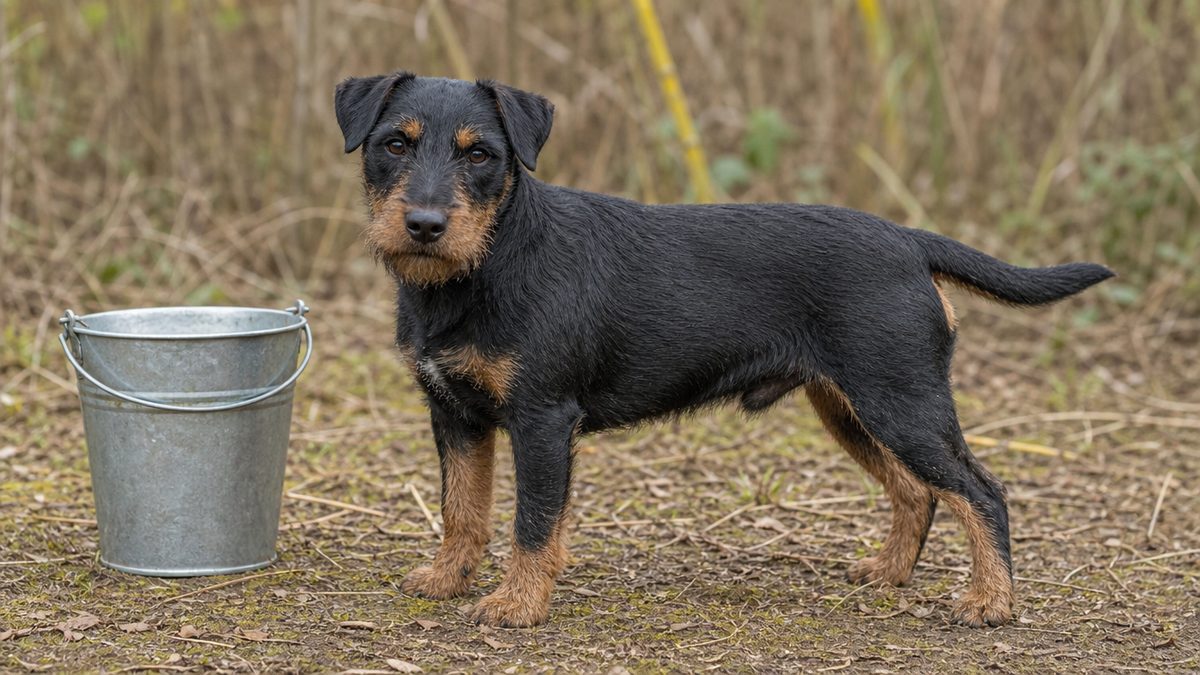
Colour is tightly specified. The coat is plain and dense, either hard rough hair or coarse smooth hair, and the colour is black, dark-brown or greyish-black with yellow-red clearly defined markings at the eyebrows, muzzle, chest, legs and, in the authentic German text, the vent. Light and dark masks are equally permitted and small white markings on the chest and toes are tolerated. Ears are set high, V-shaped and semi-drop, slightly touching, never erect. Eyes are dark, small, oval and deep set.
FCI breed URLs resolve on the trailing number and ignore the name in front of it, so a guessed address returns a real, complete standard for a different dog. The document behind number 103 prints DEUTSCHER JAGDTERRIER as its own heading, which is how the identity of every figure on this page was confirmed.
The only terrier the FCI makes prove it can work
Of the 34 breeds in FCI Group 3, the Deutscher Jagdterrier is the only one carrying an unqualified working-trial requirement. Reading the Group 3 register directly and counting the working-trial column, every other terrier is either blank or parenthesised, and a parenthesis means a trial applies only in countries that asked for one.
That single column tells you more about the breed than any temperament description. The Airedale Terrier, both Fox Terriers, the Parson Russell and the Jack Russell all carry the parenthesised marker, so their working requirement is optional and national. The Jagdterrier's is unqualified. In FCI terms, a champion title in this breed cannot be built on looks alone anywhere in the world, and that has been true since the breed was accepted.
| Breed | FCI number | Working trial | German puppies, 2025 |
|---|---|---|---|
| Deutscher Jagdterrier | 103 | Required | 547 |
| Parson Russell Terrier | 339 | Only where applied for | 540 |
| Jack Russell Terrier | 345 | Only where applied for | 221 |
| Fox Terrier (Wire) | 169 | Only where applied for | 197 |
| Fox Terrier (Smooth) | 12 | Only where applied for | 145 |
| Airedale Terrier | 7 | Only where applied for | 353 |
| Every other Group 3 breed | various | None | various |
The breed is also structurally isolated in its group. Group 3 Section 1 holds fifteen breeds, of which nine are British and four Irish; only the Brazilian Terrier and the Deutscher Jagdterrier come from anywhere else, and the Jagdterrier is the only German breed in the whole of Group 3. It is the odd one out in a group otherwise defined by the British terrier tradition, which is exactly what a breed created in 1920s Germany to be unlike the Fox Terrier would be.
Outside Europe the breed is registerable but not fully recognised. The American Kennel Club's Foundation Stock Service Terrier group contains only four breeds, and the Jagdterrier is one of them alongside the Brazilian Terrier, the Japanese Terrier and the Lucas Terrier, on the list revised 1 September 2026. India, as a Full FCI member represented by the Kennel Club of India in Chennai, sits downstream of the FCI nomenclature, so the breed is recognised in principle for Indian pedigree purposes and has no Indian population to register.
Read out of OFA's own markup, this breed appears twice under two codes: DJT, labelled DEUTSCHER JAGDTERRIER and filed under Foundation, and JGT, labelled JAGD TERRIER and filed under Terrier. The two entries even disagree about which AKC group the dog belongs to. A researcher who looks up one of them and stops has seen half the record.
Two places where the English standard drifts from the German
German is the authentic language of this standard, so where the English and German texts disagree the German governs, and on two points they do disagree. Both were found by extracting the two PDFs independently and comparing them line by line rather than reading either through a fetch tool's rendering.
| Passage | English text (26.05.2015) | German text, authentic |
|---|---|---|
| The zoo director who supplied the foundation dogs | 'A zoo director, Lutz Heck / Hagenberg' | 'Zoodirektor Lutz Heck/Hagenbeck' |
| Where the tan marking sits | 'the legs and at the base of the tail' | 'Läufen und Waidloch (After)', the legs and the vent |
The first is a spelling error with a real consequence. Hagenbeck is a name that means something in German zoo history; Hagenberg is not the same word, and an English reader tracing the breed's origin would be looking for the wrong person. The German is authentic and reads Hagenbeck.
The second changes an anatomical description. Waidloch is the German hunting term for the vent, and the standard glosses it in brackets as 'After', the anus. The English renders that as 'at the base of the tail', which is a different place on the dog. The German also describes the markings as 'sauberen', clean, which the English drops entirely. Neither divergence changes whether a dog passes or fails, but a judge or a buyer working from the English is looking at the wrong spot for one of the breed's defining markings.
What this means for reading anything about the breed
Take the general point rather than only these two examples. An FCI standard is a primary source for what the FCI says, and it is a translated document everywhere except in its authentic language. Measurements travel well; names, anatomy terms and history passages are translated prose and can drift. Where this page quotes a figure it has been checked in both texts, and where the texts differ the German is followed and the difference is printed rather than smoothed over.
The same discipline applied to the India-hosted page for this breed produced a third finding. Royal Canin India publishes a German Hunting Terrier profile that states 'Source: key facts and characteristics sourced from Fédération Cynologique Internationale (FCI)' and then prints an average life expectancy of 12 to 15 years and the claim that the breed is patient with children. Neither statement is in FCI Standard 103. Searching the extracted English text returns zero occurrences of 'life', 'expectancy' and 'children';. The citation is real and the figures are not from the document it names, which is precisely the failure mode an Indian reader has no way to detect.
Temperament: what the standard says, word for word
The breed standard's temperament clause reads, in full: 'BEHAVIOUR / TEMPERAMENT: Courageous and hard, takes pleasure in work, enduring, vital, full of temperament, reliable, sociable and trainable, neither shy nor aggressive.'; The authentic German reads 'Mutig und hart, arbeitsfreudig und ausdauernd, vital und temperamentvoll, zuverlaessig, umgaenglich und fuehrig, weder scheu noch aggressiv.';
Read those two sentences before reading anything else about this breed's character, because almost everything written about it in English is folklore layered on top of the word 'hard'. The standard uses hard in its German hunting sense of Haerte, meaning the willingness to keep working against a quarry that fights back, which is a working trait rather than a social one. In the same sentence the standard requires the dog to be reliable, sociable and, explicitly, 'neither shy nor aggressive'.
The disqualifying faults say the same thing from the other direction. The list opens with 'Aggressive or overly shy dogs' and continues with 'Any dog clearly showing physical or behavioural abnormalities';. A dog that behaves aggressively in the ring is not a poor specimen of the breed; under the standard it is disqualified from being judged as one at all.
One translation nuance worth knowing
The German word rendered as 'trainable' in the temperament clause is fuehrig, which means biddable or responsive to the handler rather than trainable in the sense of learning tasks. The history section of the same document separately says the founders bred for 'bester Abrichtefaehigkeit', best trainability, which the English also renders as 'well trainable'. Two distinct German words arrive in English as the same word, and the distinction matters: fuehrig describes a dog that stays connected to its handler, which is not the same claim as a dog that learns quickly.
The real risk, which is prey drive rather than aggression
The trait that will cause trouble in India is not aggression toward people. It is the drive the breed was built on: the standard defines its use as hunting under the ground and as a flushing dog, and the founders selected for an explicit hunting instinct. In a German forest that is the point of the dog. On an Indian street it means a small dog that will go after cats, poultry, monitor lizards, squirrels and free-ranging dogs, will follow them into drains and under vehicles, and will not recall off them reliably.
Royal Canin India's own profile for the breed puts it plainly enough, describing the dogs as brave, diligent and tenacious, full of life and reliable, and as sociable and obedient animals that are neither aggressive nor fearful, while listing 'needs a lot of exercise' among its key facts. Tenacity plus a lot of exercise is an accurate summary. It is also not a description of a flat dog.
- Buy this breed only if you hunt, work the dog in a legitimate scent or earthdog sport, or live rurally with a genuine daily job for it.
- Skip this breed if you keep cats, poultry or small pets, because the standard and the club's own tests select against exactly the restraint you would need.
- Skip this breed if you live in a dense housing society, because a vocal working terrier with unmet drive is a complaint waiting to be filed.
- Skip this breed if you want a small dog because small means easy. Nothing about this dog is easy except the coat.
One last point on the folklore. This page carries no claim that the Jagdterrier is dangerous, and it carries none that it is a family pet either, because the breed's own governing documents support neither. What they support is a small, courageous, hard-working, reliable dog bred for a job, disqualified from the ring if it is aggressive, and profoundly unsuited to being idle.
What the German club requires before a Jagdterrier may breed
To breed a Jagdterrier in Germany you must first hold a valid German annual hunting licence, and that is the club's opening condition rather than an afterthought. The Deutscher Jagdterrier-Club's Zuchtordnung states that breeding right and kennel protection are granted only to members who hold a valid German annual hunting licence, and requires in addition a club proof of expertise for breeders, sufficient time to care for a litter, and premises inspected on the club's binding kennel-control form.
That condition explains the breed's whole distribution. A pet buyer in Germany cannot breed this dog even by joining the club, so the population stays inside the hunting community, and no pet-market supply chain has ever formed to export from. It is the same architecture the Deutsch Drahthaar's club uses, and it is the mechanism that keeps both breeds out of countries with no equivalent hunting culture.
The tests, and the grades inside them
A bitch may not be approved for breeding until she has successfully taken part in a ZP I, the underground aptitude assessment, and a ZP II, work above ground, and she must carry a minimum grade of 3 for flushing, 2 for water enthusiasm, and the track-tongue mark. A lower flushing grade can be compensated by the hardness mark. From the fourth year of life, meaning 36 months and a day, both stud dogs and brood bitches must additionally hold a natural performance mark earned at earth or at boar. These are graded assessments run inside the JGHV framework, not club paperwork. A stud dog faces the same hunting test requirement, having to pass a ZP I and a ZP II before approval and to hold a natural performance mark with the hardness mark from the fourth year of life.
Conformation is graded asymmetrically between the sexes, which is unusual and worth stating. A stud dog must score at least 'sehr gut', very good, in both coat value and conformation value; a brood bitch needs only 'gut', good. Both must have a strong, complete and faultless scissor bite, with missing third molars not counted as a fault. Blood typing is a precondition of breeding approval for both sexes.
| Limit | What the rulebook says |
|---|---|
| Minimum breeding age | 15 months, dog and bitch alike |
| Stud dog use | Up to 6 litters per calendar year, to the end of the 7th year |
| Bitch upper age | May be mated only to the end of the 8th year |
| Bitch litter frequency | Not more than two litters within two calendar years |
| Foster-nursing | Generally forbidden, except where illness or death of the dam endangers the litter |
| Close inbreeding | Full siblings, father to daughter and mother to son need special permission |
| Colour rule | In every mating one partner must carry the black and tan colour |
| Tail | Shortened by about one third by the third day of life |
| Puppy release | Only after eight weeks of age |
Two of those rows collide with Indian law and are dealt with in the law section below. A third is worth flagging here. The club permits close inbreeding, including father to daughter and mother to son, on written application with the breeding advisory council's consent. Second Schedule Part II paragraph 6(3) of the Indian Rules prohibits exactly those matings outright, with no permission route at all.
What the club does not require, and the contrast that shows
Set against the other German hunting clubs on this site, the DJT-Club's health requirements are strikingly narrow in one direction and unusually deep in another. It requires no hip radiograph and no elbow grade: searching the extracted rulebook, the string HD appears three times and none of them establishes a screening requirement, where the Grosser Muensterlaender club's rules mention it sixteen times and make HD and ED grades a condition of breeding release. Deutscher Jagdterrier-Club e.V. Nor does it use a Haertenachweis, because hardness is scored inside the tests themselves as the Haertestrich.
What it does instead is run formal breeding plans against named hereditary diseases, and it publishes two of them as annexes to the breeding rules: Anlage 3 against primary lens luxation and Anlage 11 against myopathy. Very few breed clubs anywhere publish disease-specific breeding plans with dated compliance deadlines, and the next section is about the one that worked.
Primary lens luxation, and a breeding plan with dates in it
Primary lens luxation is the Jagdterrier's defining inherited disease, and the club has been eliminating it on a published timetable since 2010. Anlage 3 of the breeding regulations, headed 'Zuchtplan zur Bekaempfung der Erbkrankheit Primaere Linsenluxation beim Deutschen Jagdterrier', opens by stating that the breed is one of those in which primary lens luxation can occur, and grounds its measures in the club's own rules, the VDH breeding regulations and paragraph 11b of the German Animal Welfare Act.
The disease itself is worth understanding before the policy. In primary lens luxation the fibres suspending the lens fail and the lens slips out of position, which in a dog usually presents as a suddenly painful, cloudy or reddened eye and frequently causes secondary glaucoma. It is an emergency, not a wait-and-see problem, and the outcome depends heavily on how fast an ophthalmologist sees the animal.
The German literature on this breed shows what that looks like clinically. A 1996 case series reported primary glaucoma in a five-year-old and a six-year-old female German Hunting Terrier alongside a wire-haired Fox Terrier. In the five-year-old the right eye had absolute glaucoma and was enucleated, and the fellow eye became affected five months later; in the six-year-old the right eye had acute glaucoma and the left chronic glaucoma with seclusio pupillae, and after treatment the left eye is blind and vision reduced in the right. Both dogs lost sight in at least one eye.
How the club's plan works
The plan does not simply require a DNA test; it models risk across the pedigree. The club uses an estimated genotype probability method, drawing on information from all relatives, to give every dog a probability of being N/N normal, N/m carrier or m/m affected, and derives from that a P-value describing the risk that the mutated gene is passed on. Inputs are every known case of the disease plus the results of club-recognised gene tests, and from the plan's adoption onward a recorded case must be confirmed by a gene test. Data are distributed quarterly to the board, breeding council and regional breeding wardens, with online access to a live gene-test database.
| Date | Requirement |
|---|---|
| 1 January 2010 | The breeding plan takes effect, retroactively |
| 1 January 2013 | Only stud dogs proven free are newly admitted to breeding |
| 1 January 2018 | Only free dogs, PLL-N/N or hereditarily clear, may be used at all |
| Standing rule | Dogs of genotype m/m are excluded from breeding |
| Standing rule | A German stud dog may cover a foreign bitch only if he is homozygous normal |
Two features of the plan are unusual enough to name. Every puppy is issued a warranty certificate for PLL freedom, handed to the buyer with the pedigree. And the club maintains a Solidarkasse, a solidarity fund contributed to by breeders, from which the owner of an affected dog is financially supported, on the club's own reasoning that a residual risk cannot be fully calculated away. A breed club that puts money behind its own health guarantee is rare.
What the American figures show, and why they differ
OFA's statistics tell the other half of the story, from a population the German plan does not govern. The breed appears exactly once in the entire OFA disease dump, as JAGD TERRIER in the primary lens luxation table, and the row reads 78 evaluations, 52.6 percent normal, 43.6 percent carrier and 3.8 percent abnormal, ranked second worst of any breed in that table behind only the Miniature Bull Terrier at 7.1 percent abnormal across 2,748 evaluations. Against the all-breed row of 17,616 evaluations at 70.2 percent normal, 27.9 percent carrier and 1.9 percent abnormal, this breed carries roughly one and a half times the carrier rate and twice the affected rate.
Translate the percentages into dogs before drawing conclusions, because the denominator is small. Of 78 tested animals, 43.6 percent is about 34 carriers and 3.8 percent is about 3 affected. Seventy-eight is a thin sample and OFA publishes DNA-database breeds from 50 evaluations, so this row sits just above its own publication threshold and should be read as indicative. What it is not is a contradiction of the German plan. It is a different population, largely outside the DJT-Club's jurisdiction, and it is a fair picture of what the disease looks like where nobody has been running a timetable since 2010.
Ask for the primary lens luxation DNA result on both parents, in writing, with the laboratory name and date. The German club has required PLL-free breeding since 1 January 2018 and issues a warranty certificate with every pedigree, so a legitimately bred dog will have the paperwork. A seller who cannot produce it is either not connected to the club system or is not selling this breed.
Germany's most-registered terrier, and nobody outside Germany noticed
German breeders registered 547 Jagdterrier puppies with the VDH in 2025, more than any other terrier breed in the register. The full row runs 547 in 2025, 514 in 2024, 473 in 2023, 590 in 2022, 796 in 2021, 738 in 2020, 739 in 2019, 739 in 2018, 743 in 2017, 766 in 2016, 724 in 2015, 847 in 2014, 741 in 2013, 828 in 2012 and 907 in 2011.
Checked against every other terrier row in the same table for 2025, 547 is the highest. The nearest are the Parson Russell Terrier at 540 and the Miniature Bull Terrier at 475, then the West Highland White at 378, the Airedale at 353 and the Border Terrier at 344, with the Jack Russell at 221. Germany's most popular terrier is a hunting dog that almost nobody outside the hunting world has heard of, and that is a genuinely surprising fact about a country where the Yorkshire Terrier registers 225.
The trend is downward and steeper than the register as a whole, which is the reverse of the pattern this site found in the Large Munsterlander. Against 907 puppies in 2011, the 2025 figure of 547 is a fall of 39.7 percent, while the VDH's all-breeds total fell from 80,719 to 55,053 over the same period, a fall of 31.8 percent. So the breed's share of all German puppies slipped from 1.12 percent in 2011 to 0.99 percent in 2025. The low point in the series is 473 in 2023, and the last two years have risen from it.
That decline has a plausible mechanism sitting in the rulebook. A breeding right requires a valid German annual hunting licence, so the breed's population is capped by the size of the German hunting community rather than by demand for the dog. Where a pet-market breed can expand to meet interest, this one structurally cannot, and any long-run change in the number of licensed hunters shows up directly in the puppy row.
547 puppies a year in one country is a real, functioning population, which is why this breed's paperwork is worth chasing in a way that a truly rare breed's is not. If you are importing, dogs exist, the club system is intact, the health regime is documented and the certificates are real. What does not exist is an Indian source.
Jagdterrier price in India: there is no verifiable one
There is no Jagdterrier price in India that Bonbeno can verify, because no Indian breeder or classified listing for the breed could be found. A commercial search restricted to India returned ten results and not one offered an Indian dog.
Naming what did come back is more useful than any number. Eight of the ten were foreign: two American breed-list and puppy-marketplace pages quoting dollar bands, an Iowa outfitter, a Wisconsin-style kennel selling a puppy deposit in dollars, Facebook threads quoting euros from Finland and Serbia, an Instagram reel, a Pinterest pin and a Serbian classified. One was an Etsy India category page selling printed merchandise in rupees. The tenth is the interesting one: an Indian dog-price article covering the top 40 breeds, which ranks for the query without containing this breed at all.
The search was then repeated under Deutscher Jagdterrier, German Hunting Terrier and Jagd Terrier, because a zero on one name is not a zero. Those runs surfaced no Indian seller either, though they did find the single India-hosted editorial page for the breed, a Royal Canin India profile with no price on it. A Labrador Retriever control query in the same session returned ten genuine Indian pages including a published ladder of INR 30,000 to INR 1,20,000 with an eight-city table, so the instrument was working. The absence is real.
What you would actually be sold
Assume any Indian listing for this breed is another dog until proved otherwise, and the likely substitutions are specific. A black and tan smooth-coated Indian dog, a Jack Russell cross, a Rottweiler-marked pariah puppy, or a small Doberman cross will all photograph close enough to fool a buyer working from a phone screen. Verify against the standard instead. The ears must be set high, V-shaped and semi-drop, never erect; the height must be 33 to 40 centimetres; the chest circumference must exceed the height at the withers by 10 to 12 centimetres, which gives a barrel-chested outline no leggy terrier has.
The only price bands that exist for the breed are foreign, and this page converts none of them. Running a dollar or euro figure through an exchange rate produces a rupee number that describes no Indian transaction, and that arithmetic is exactly how fabricated Indian prices enter circulation. If you are shown a rupee figure for this breed, divide it by 84.38 and by 74 first; a clean quotient in dollars means you are reading converted arithmetic rather than an Indian market.
No Indian price exists for the Jagdterrier. That is the most useful thing this page can tell an Indian buyer, because it means any figure quoted to you came from somewhere other than a real Indian sale of this breed, and it tells you the transaction you are being offered is not what it appears to be.
What a Jagdterrier would cost to keep in India
The recurring monthly cost of keeping a small working terrier in India is checkable even though the purchase price is not, and the coat is the one line where this breed is genuinely cheap. A full puppy vaccination course runs 3,000 to 6,000 rupees across the first sixteen weeks, and the annual booster afterwards is roughly 1,000 to 2,000 rupees.
| Item | Published Indian range |
|---|---|
| DHPPi or 7-in-1 combined vaccine, per dose | Rs 500 to Rs 1,200 |
| 9-in-1 combined vaccine, per dose | Rs 800 to Rs 1,500 |
| Anti-rabies, per dose | Rs 300 to Rs 600 |
| Kennel cough (Bordetella), per dose | Rs 500 to Rs 900 |
| Full puppy course, first 16 weeks | Rs 3,000 to Rs 6,000 |
| Consultation or injection charge, per visit | Rs 300 to Rs 800 |
| Annual booster, DHPPi plus rabies | Rs 1,000 to Rs 2,000 |
| Parvovirus hospital stay, if it happens | Rs 15,000 to Rs 50,000 |
Those figures come from an Indian guide medically reviewed by a veterinarian and last reviewed in July 2026, and the page states that prices move with city, clinic and vaccine brand. Treat them as ranges to confirm locally. Note the last row against the rest: the whole first-year vaccine bill is smaller than the cheap end of a parvo admission, which is the arithmetic that should settle any hesitation about the schedule.
Where this breed is cheap, and where it is not
Grooming is where the Jagdterrier saves you money and it saves you a lot. The standard describes plain, dense, hard rough hair or coarse smooth hair with no feathering anywhere, and the India-hosted breed page lists minimal grooming among its key facts. Royal Canin India There is no hand-stripping bill, no professional groomer, no ear fringe to dry after every walk. Set against a long-coated German gundog that needs combing more than once a week, that is a real saving over a decade.
Two lines run the other way and both are specific rather than general. Ophthalmology is the first: a breed with a documented lens-luxation problem needs an eye that can be seen urgently, and specialist veterinary ophthalmology in India is concentrated in a handful of metro practices. Budget for the referral, and find the practice before you need it rather than at eleven at night. Tick and flea prevention is the second, and in India it is compulsory rather than seasonal: a Tamil Nadu study found 229 of 230 dogs examined, 99.6 percent, carrying ticks.
Indian breed sites publish running costs as shared template constants across groups of unrelated breeds, and the grouping is not the size label: a toy breed and a hand-stripped wire terrier have been found printing the identical grooming line. Before trusting an Indian monthly cost you are shown for this breed, open an unrelated breed on the same site and compare the rows to the rupee. If they match, it is boilerplate.
Bonbeno publishes no monthly rupee total for this breed. A total would rest either on an Indian cost table for a dog nobody keeps in India, or on a foreign figure converted at an exchange rate, and both are inventions. What the table above gives you is real: the vaccination line for a small dog, in India, in 2026.
Suitability for the Indian climate: the homeland numbers first
The Jagdterrier's heat tolerance is better than any long-coated German gundog's and still poor by Indian standards, because the homeland has no hot season at all. The FCI standard names only 'Germany' as the country of origin without a locality, so two north German lowland points were queried by explicit latitude and longitude: Berlin averages 9.43 degrees across the year and peaks at 20.25 degrees in July, and Muenster averages 9.66 degrees and peaks at 18.57. FCI-Standard N 103
Neither point has a single month averaging above 25 degrees. Chennai has ten, Mumbai nine, Kolkata eight and Delhi seven. More pointedly, Chennai's coolest month, January, averages 23.99 degrees, which is 3.7 degrees warmer than the hottest month Berlin has ever averaged. There is no season in coastal south India during which this dog experiences German summer conditions, let alone German working conditions.
Elevation was echoed back for every point and checked against the real ground, because the model returns a grid cell rather than a place. Berlin's cell sits at 48.98 metres against a city near 34 metres, a divergence of about 15 metres, so the cell is the city. That check matters because in mountainous terrain the same model can miss by more than a kilometre, and a wrong homeland baseline would corrupt every comparison built on it.
Wet-bulb is the number that governs a panting dog
Air temperature alone understates the Indian problem, because a dog cools by evaporation and evaporation stops working as humidity rises. Computed from the same two fields with Stull's 2011 approximation, Berlin's peak wet-bulb is 15.84 degrees in July. Kolkata's is 26.99 degrees in June, Delhi's 26.43 in July, Chennai's 26.03 in May and Mumbai's 25.68 in June. That gap of eleven degrees is the constraint, and it is why a small short-coated dog is still not a heat-adapted dog.
| Place | Annual mean T | Hottest month | Peak wet-bulb | Months above 25 C |
|---|---|---|---|---|
| Berlin, Germany | 9.43 C | 20.25 C (Jul) | 15.84 C | 0 of 12 |
| Muenster, Germany | 9.66 C | 18.57 C (Jul) | 15.40 C | 0 of 12 |
| Chennai | 27.90 C | 31.57 C (May) | 26.03 C | 10 of 12 |
| Mumbai | 26.65 C | 31.03 C (May) | 25.68 C | 9 of 12 |
| Kolkata | 25.82 C | 31.55 C (May) | 26.99 C | 8 of 12 |
| Delhi | 25.62 C | 35.95 C (Jun) | 26.43 C | 7 of 12 |
| Pune | 23.74 C | 28.74 C (Apr) | 22.90 C | 4 of 12 |
| Bengaluru | 23.64 C | 28.41 C (Apr) | 21.74 C | 3 of 12 |
The evidence on what heat does to dogs is UK-based and the mechanism travels. Reviewing 905,543 dogs under primary veterinary care in 2016, Hall and colleagues found exertional heat-related illness the predominant trigger at 74.2 percent of events, ahead of environmental heat at 12.9 percent and vehicular confinement at 5.2 percent. The companion analysis of the same cohort put the 2016 incidence at 0.04 percent and the event fatality rate at 14.18 percent, and specifically identified young male dogs as having greater odds of exertional heat-related illness.
That last detail lands harder here than on most breed pages. A young male Jagdterrier is exactly the animal an owner is most likely to work hardest, and it is the demographic the larger of the two studies singled out for exertional risk. Layer the breed's own documented exercise-induced myopathy on top and the heat section of this page stops being generic advice.
Indian buyers routinely assume a small short-coated dog copes with heat. Body size helps with heat dissipation, and it does not make a dog from a country with no month above 25 degrees into a tropical animal. Judge this breed on where it came from and what it was bred to do, not on how much of it there is.
Heat management city by city, and one figure this page will not print
Work this dog by the wet-bulb reading rather than the thermometer, and change the plan by city because the binding constraint differs. Delhi's problem is a dry 35.95-degree June; Kolkata's is a 26.99-degree wet-bulb in the same month, which is harder on a panting dog even though the air is cooler.
Chennai and Mumbai are the hardest cities and for the same reason. Chennai averages above 25 degrees in ten months of twelve and Mumbai in nine, and both are coastal and humid, which flattens the day-night swing and removes the cool early morning that inland cities keep. A Jagdterrier in either city works before six in the morning and after nine at night, and does nose work indoors for the rest of the day.
Delhi reverses on its owners every year and it is worth naming the trap. Its June average of 35.95 degrees at 35.3 percent humidity is punishing to stand in but still allows a dog to shed heat by panting. Then the monsoon arrives and July's wet-bulb climbs to 26.43 degrees, the highest of any month in the city, while the air temperature falls to 32.53. The dog that coped through dry May is the dog that collapses in humid July.
Bengaluru and Pune are genuinely easier and deserve to be named as such. Bengaluru averages above 25 degrees in only three months of twelve and peaks at a wet-bulb of 21.74 degrees; Pune manages four months and 22.90 degrees. Neither is Berlin, and neither makes this a sensible Indian breed, but both give several usable hours a day for most of the year rather than a two-hour window.
The hill-station figure this page will not print
Readers reach for hill stations when a breed struggles with heat, and one of the two checked here returned a figure that cannot be used. NASA POWER's cell for Dehradun reports an elevation of 1,403.86 metres against a town sitting near 640 metres in the Doon valley, a divergence of about 764 metres. The model is describing the ridge above the town rather than the town. At the standard lapse rate of roughly 6.5 degrees per 1,000 metres that cell runs about 5 degrees too cold, which would put Dehradun's real June nearer 31 degrees than the 26.21 the cell reports. This page therefore publishes no Dehradun figure as an observation, and labels the correction an estimate.
Shillong's cell diverges the other way, reporting 1,224.61 metres against a town near 1,496 metres, so its readings run roughly 1.8 degrees too warm. Corrected, Shillong is genuinely mild, and for a short-coated terrier its July relative humidity of 91.5 percent is much less of a problem than it would be for a feathered gundog. Of all the Indian places checked on this site, a north-eastern hill town is the closest thing to a workable home for this breed.
Every plains point checked here landed on its town: Kolkata within 2 metres, Delhi within 10, Chennai within 43, Pune within 76 and Mumbai within 83. Only the two hill points diverged, one by 764 metres and one by 271. The check costs nothing and it is only needed in the hills, which is exactly where a reader will look for somewhere a cold-climate breed could live.
Indian law reaches the outdoor-housing question directly, though the clause bites differently here than it does for a long-coated breed. Second Schedule Part IV paragraph 21(1) bars keeping in outdoor facilities, without the attending veterinary practitioner's written approval, dogs not accustomed to the temperatures prevalent in the area, breeds that cannot tolerate them 'such as long-haired breeds in high temperature locations', and sick, infirm, aged or young animals. The Jagdterrier's short hard coat keeps it out of the long-haired example, but limb (i), a dog not accustomed to local temperatures, catches an imported German working terrier squarely.
Training a dog bred to work out of sight
Train recall and impulse control before anything else with this breed, because the German test system that shaped it rewards a dog that keeps working when its handler cannot see it. The club's breeding approval turns on an underground aptitude assessment and an above-ground working test with named minimum grades, not on obedience.
Understand what the tests select for and the training problem becomes obvious. A dog graded on flushing, on water enthusiasm and on giving tongue on a track is a dog rewarded for pressing on alone, at distance, against something that fights back. Jagdgebrauchshundverband e.V. (JGHV) That is not disobedience when it happens on an Indian street; it is the breed doing its job in the wrong place. The standard describes a reliable, sociable and trainable dog, and it also describes one that is courageous and hard. Both halves are true at once.
What comes easily, and what does not
Nose work, problem-solving, confidence and physical courage come free. The founders bred deliberately for the best trainability alongside the hunting instinct, and the dog learns tasks fast. What does not come free is recall off live prey and a settled off switch indoors. Both take months rather than weeks, both need building before the dog is fast enough to ignore you, and neither survives neglect.
- Socialise from eight weeks to Indian street conditions specifically: traffic, cattle, autorickshaws, temple noise, cats at distance and free-ranging dogs at distance.
- Build recall on a long line before four months, and proof it against increasingly interesting distractions rather than against an empty field.
- Teach a trained quiet cue as an alternative behaviour rather than trying to suppress the voice, because the breed was selected to give tongue.
- Introduce water voluntarily and early, since the club's own tests score water enthusiasm and a dog forced in later often refuses for life.
- Run scent games indoors through the hot months, so the dog gets real mental work when physical work is unsafe.
- Train a settle on a mat with the same seriousness as recall, because in an Indian home the off switch is the skill you will use hourly.
One mistake specific to this breed is worth naming. Because it is small and it learns fast, Indian owners treat it as a companion terrier and under-exercise it while over-training it, and then find they have a dog that is obedient in the living room and uncontrollable outside the gate. That is not a training failure. It is an employment failure, and no obedience class fixes it.
A second point on where the breed is genuinely easy. This is a vocal dog and it is a hard dog, and it is not a fearful one: the standard disqualifies overly shy animals, and the club excludes from breeding any dog that shows unsoundness of nerve. So the training problems you will have are drive problems rather than fear problems, and drive problems are the more tractable kind if you give the drive somewhere to go.
Daily exercise, and the one risk that is unique to this breed
This breed's exercise needs are high and its exercise risk is unusual, because it carries a documented disorder in which exercise itself is the trigger. Royal Canin India's profile lists 'needs a lot of exercise' among its key facts, and the German literature describes an autosomal-recessive exercise-induced metabolic myopathy in the breed. Muehlhause F, Tipold A, Rohn K, Lepori V
Start with the ordinary requirement. A small hunting terrier needs mental work as much as distance, and in India both have to be fitted around the wet-bulb rather than around your working day. Chennai and Mumbai give you a pre-dawn and a late-evening window for most of the year; Bengaluru and Pune give you considerably more. Two sessions a day plus deliberate scent work is the shape of it, and a walk on a lead does not substitute for either.
| Season | Morning session | Evening session | Heat substitute |
|---|---|---|---|
| Cool months, December to February | 45 to 60 minutes from first light | 40 to 50 minutes after sunset | Not usually needed |
| Pre-monsoon heat, March to May | 35 to 45 minutes, finished before 06:30 | 30 minutes after 21:00 | Indoor scent games, 20 to 30 minutes |
| Monsoon, June to September | 30 to 40 minutes, judged on wet-bulb not on rain | 25 to 30 minutes | Swimming in clean water, plus puzzle work |
| Post-monsoon, October to November | 45 minutes | 40 minutes | Tapering off |
The symptom that means stop immediately
Learn one sign and treat it as an emergency. In the German follow-up study, affected dogs showed post-exercise weakness, muscle pain, a stiff and tetraparetic gait, and dark brownish discoloration of the urine. Dark brown urine after exercise is myoglobin from damaged muscle, and in a hot country a dog that has damaged muscle and is also dehydrated is at real risk to its kidneys. If you see it, stop the session, cool the dog, get water into it and go to a vet the same day.
This matters more in India than in Germany for a simple reason. Exertional heat-related illness was the predominant trigger of heat illness in a review of 905,543 dogs, at 74.2 percent of events, and young male dogs carried greater odds of it. A breed with an inherited exercise-triggered myopathy, worked hard by an enthusiastic owner, in a city where ten months average above 25 degrees, is stacking three independent risks on the same afternoon.
Swimming is the substitute worth building early, because it delivers hard work without the heat load and the club's own tests already select for water enthusiasm. The Indian caveats are the usual ones: clean water, no unknown water bodies, and a check of the ears afterwards every time.
Coat care in Indian humidity, which is the easy part
Groom this breed once a week and spend the time on ticks rather than on the coat. The standard describes plain, dense hair that is either hard rough hair or coarse smooth hair, with no feathering specified anywhere on the dog, and the India-hosted breed profile lists minimal grooming among its key facts. Royal Canin India
This is the single genuine Indian advantage the Jagdterrier has over every other German hunting breed on this site. There is no long ear fringe to dry after every swim, no leg feathering to mat in the monsoon, no hand-stripping schedule and no professional grooming bill. A dog with a smooth coat or a hard rough coat dries fast, which in a country with a four-month monsoon is worth more than it sounds.
Two things still need doing weekly and neither is about appearance. The first is a full-body tick check, and the Indian evidence for why is stark: in Tamil Nadu, 229 of 230 dogs examined were tick-infested with a mean intensity of 5.65, and 156 of 230, 67.8 percent, carried at least one vector-borne pathogen. A four-city Indian survey found 261 of 525 dogs, 49.7 percent, PCR-positive for at least one tick-borne pathogen, with Hepatozoon canis at 30 percent and Ehrlichia canis at 20.6 percent, and co-infection with more than one pathogen in 39 percent of cases. A dog that pushes through undergrowth collects more of them, not fewer.
The second is the ears, and here the breed's advantage is partial rather than total. The standard specifies semi-drop ears that slightly touch the head, so the canal is shaded and less ventilated than an erect ear even though it carries no fringe. An ear infection in an Indian monsoon compounds quickly, so dry inside the ear leather after every swim and every soaking, and look at both ears during the weekly check rather than waiting for the dog to shake its head.
- Brush once a week with a rubber curry or a short bristle brush, working against the lie of the coat and then with it.
- Run the weekly brush as a tick sweep: ears, neck, armpits, groin, between the toes and around the vent.
- Dry inside the ear leather after every swim and every downpour, without pushing anything into the canal.
- Bathe rarely, because the working coat sheds dirt well and frequent bathing strips it.
- Check the eyes at every grooming session, because this is a breed in which a suddenly cloudy or painful eye is an emergency rather than an irritation.
For most breeds on this site the weekly comb is about the coat. For this one it is about ticks and eyes, and the coat looks after itself. Ten minutes a week, done properly, catches the two things most likely to cost you money.
Health: three documented health issues and one very thin literature
The Jagdterrier has three well-documented inherited health issues, primary lens luxation, an exercise-induced metabolic myopathy and hyperuricosuria, and a published literature so small it can be read in an afternoon. Searching PubMed for the exact phrase 'Jagdterrier' returns zero records; searching 'German Hunting Terrier' returns five, against a Labrador and hip dysplasia control returning 47 in the same session.
That zero is worth pausing on, because it is exactly the failure this site warns about. A researcher who searched only the German name would have reported the breed as absent from the veterinary literature entirely, with a control that passed, and would have been completely wrong. The breed has a literature; it is indexed under its English name. Five records exist and every one of them is about a disease.
| Year | Subject | What it reports |
|---|---|---|
| 1996 | Primary glaucoma | Two female German Hunting Terriers, aged five and six, both losing sight in at least one eye |
| 2012 | Nonsuppurative encephalitis | A single case report in a dog of this breed |
| 2019 | Pseudorabies | MRI findings in a dog with confirmed infection |
| 2019 | Exercise-induced metabolic myopathy | Nine affected dogs followed for one year; a VLCAD nonsense variant |
| 2024 | Ammonium urate urolithiasis | First detection of the SLC2A9 p.C188F variant in the breed |
What screening is available, and what is not
The realistic screening list for this breed is short and it is led by DNA rather than radiography. A primary lens luxation DNA test is the one non-negotiable, and the German club has required PLL-free status of every breeding dog since 1 January 2018. Beyond that, the club blood-types every breeding animal for identity, and runs a second breeding plan against myopathy. What it does not require is a hip or elbow grade, which is a real difference from the German gundog clubs and reflects a small, well-built dog rather than an oversight.
OFA's data reflect the same narrowness from the other side. The breed appears exactly once in OFA's entire published disease dump, in the primary lens luxation table, and has no row at all in the hips, elbow, thyroid, eye or cardiac tables. OFA publishes a breed's hip row only once it has 100 hip evaluations, so the absence means too few dogs have been submitted rather than that the breed has perfect hips. Write it as 'no row in OFA's published statistics', not as 'absent from the database'.
One more registry caution belongs here because it would otherwise cost a reader an hour. OFA holds this breed under two separate codes, DJT labelled DEUTSCHER JAGDTERRIER and filed under Foundation, and JGT labelled JAGD TERRIER and filed under Terrier, and the statistics table uses the second. A search on the German name in the statistics dump returns nothing at all.
No life expectancy figure for this breed rests on anything checkable. The FCI standard contains none, and the India-hosted profile that prints 12 to 15 years attributes its key facts to the FCI, which does not carry that figure. Bonbeno therefore publishes no life expectancy for the Jagdterrier rather than repeating a number whose source does not contain it.
The exercise-induced myopathy, and why it matters more in India
The Jagdterrier carries an inherited disorder in which exercise itself triggers muscle damage, and there is no treatment that works. Exercise-induced metabolic myopathy in German Hunting Terriers is an autosomal-recessively inherited disorder caused by a nonsense variant in the gene encoding the very long-chain acyl-CoA dehydrogenase enzyme, and its clinical signs are exercise-induced fatigue, muscle pain and weakness.
The follow-up study is the useful one because it reports what happened over time. Nine affected dogs were examined at first presentation and again a year later, with clinical and neurological examinations, blood counts, clinical chemistry and NT-proBNP measured at both points. At the second examination the same post-exercise signs were present as at the first: dark brownish discoloration of the urine, weakness, myalgia, and a stiff and tetraparetic gait.
The treatment result is the part every owner should read. The dogs were treated symptomatically with oral L-carnitine, coenzyme Q10 and a diet low in long-chain fatty acids and high in carbohydrates, and after a year that regime produced no improvement in either clinical signs or laboratory parameters. Blood values and NT-proBNP stayed within reference ranges throughout, and creatine kinase and ALT activities did not differ significantly between the two time points. The disease also did not progress. The authors describe the prognosis as cautious, because long-term observations over several years are lacking.
What that means for an Indian owner
Read that finding together with the climate section and the practical consequence is clear. If your dog is affected, the management is not a supplement and not a special food; it is controlling how hard and how long the dog works. In India that control is harder than in Germany, because the temptation to make up for a lost hot afternoon with a long evening session is exactly the thing that triggers an episode, and because a dog that is simultaneously heat-stressed and rhabdomyolytic is in far more trouble than one that is only one of those.
- Treat dark brown urine after exercise as an emergency, not as a curiosity. It is myoglobin from damaged muscle.
- Stop the session at the first sign of a stiff gait, dragging hindlimbs or reluctance to continue, and cool the dog before you move it far.
- Do not increase workload to compensate for days lost to heat. Steady moderate work beats an occasional long session for this breed specifically.
- Ask the breeder directly whether the myopathy variant has been tested in the line, because the German club runs a formal breeding plan against it.
- Keep water available during and after every session, since dehydration compounds muscle injury.
One honest caveat about the terminology. The club's own annex is titled a breeding plan against 'Myopathie (CNM)', while the peer-reviewed description of the breed's exercise-induced metabolic myopathy identifies a VLCAD nonsense variant rather than centronuclear myopathy. Muehlhause F, Tipold A, Rohn K, Lepori V The two labels are not reconciled in the documents read for this page, and Bonbeno does not assert that they describe the same test. Ask the breeder which specific test was run and for which variant, rather than accepting 'myopathy tested' as an answer.
Urate stones, glaucoma and two infections worth knowing
The third inherited problem in this breed is hyperuricosuria, and its first published case is recent. A 2024 report describes the first detection of the SLC2A9 p.C188F gene defect in a German Hunting Terrier, in a 1.5-year-old intact male presented in 2018 with haematuria.
The case is a useful teaching example precisely because it took a year to diagnose. Abdominal ultrasound showed multiple hyperechogenic structures in the urinary bladder and urinalysis indicated severe crystalluria consistent with ammonium urate or xanthine. Only after a cystotomy and analysis of the calculi was ammonium urate urolithiasis confirmed, in 2019, and the dog then tested homozygous for the variant, which causes severe hyperuricaemia and hyperuricosuria. The authors close by encouraging practitioners to consider the possibility of this gene defect in breeds beyond the Dalmatian.
For an Indian owner the practical points are dehydration and diet. Urate stones form when urine is concentrated, and a dog panting through a Chennai afternoon concentrates urine all day. A dog with confirmed hyperuricosuria needs a purine-restricted diet for life and, above all, water intake high enough to keep the urine dilute. Straining to pass urine in a male dog of this breed is an emergency, because a small urethra and a urate stone are a bad combination.
There is a neat cross-breed connection here worth knowing if you are choosing between German breeds. The same SLC2A9 mutation is the reason the German Large Munsterlander club requires a hyperuricosuria DNA test before breeding release, and the reason the Royal Kennel Club restricted registration of imported Large Munsterlanders and litters from overseas sires with effect from 6 January 2025. Royal Kennel Club Two unrelated German hunting breeds, one a long-haired pointing dog and one a small terrier, converge on the same urate transporter gene.
Glaucoma, and the eye that follows the first eye
The 1996 case series is old and it is still the clearest clinical picture of what lens and angle disease does in this breed. In the five-year-old bitch the right eye had absolute glaucoma and was enucleated, the left eye showed a dysplastic pectinate ligament and a narrow iridocorneal angle, and the fellow eye became affected five months later. In the six-year-old the right eye had acute glaucoma and the left chronic glaucoma with seclusio pupillae; after cyclocryotherapy on both eyes the left is blind and vision is reduced in the right, though intraocular pressures are now normal.
Take one lesson from that: in this breed the second eye is at risk once the first is affected, and the interval can be months. An Indian owner whose dog has had one eye treated should be planning the second eye's monitoring, not hoping. That is also why the ophthalmology referral line in the cost section is not optional for this breed.
Two infectious case reports round out the literature and neither is a breed predisposition. A 2012 report describes nonsuppurative encephalitis in a dog of the breed, and a 2019 report describes MRI findings in a dog with confirmed pseudorabies infection. Engelhardt S and colleagues. [MRI in a dog… Both are listed here because they are two of only five published records naming this breed, not because an Indian pet faces a meaningful risk from either. What they illustrate is how thin the evidence base is: a breed registering more than five hundred puppies a year in Germany has generated five indexed papers in thirty years, two of which are single case reports of infections. Ask any source that offers you confident breed-specific health statistics where it got them.
Indian law, and the docking clause the breed's own rulebook prescribes
The sharpest collision between this breed and Indian law is the tail. The Deutscher Jagdterrier-Club's breeding regulations state at section 4.1, headed Kupieren, that tails shall as a rule be shortened by about one third of their length by the third day of life, and Second Schedule Part II paragraph 6(8) of the Indian Rules prohibits tail docking outright. Animal Welfare Board of India
The Indian clause is worth quoting in full because it is broader than most readers expect. It provides that there 'shall be no tail docking, ear cropping, de-barking, de-clawing, branding, dyeing, injecting substances to enhance visual appeal, performing a surgery or procedure to camouflage or hide any defect or infirmity or any other kind of mutilation of any body part of the pup and any change of appearance by artificial means is strictly forbidden';. There is no veterinary-approval route and no hunting exemption. Tail docking of a puppy in India is prohibited, full stop.
Germany reaches a different answer through a narrow exemption, and it is worth being precise about it rather than implying the German club is acting unlawfully. Paragraph 6(1) of the Tierschutzgesetz prohibits the complete or partial amputation of body parts of a vertebrate, and then disapplies the prohibition where, in the individual case, the procedure is indispensable for the intended use of a dog to be used for hunting and no veterinary objections stand against it. Such procedures must be carried out by a veterinarian. So German law permits docking for hunting dogs as an individual-case necessity assessed by a vet, while the club's rulebook frames shortening the tail as the normal practice, and Indian law permits it in no case at all.
| Instrument | Position on docking this breed |
|---|---|
| FCI Standard 103 | Describes the tail as 'docked for circa 1/3', and adds that in countries where docking is prohibited by law it may be left natural, carried horizontally or slightly sabre-formed |
| DJT-Club Zuchtordnung 4.1 | Tails shall as a rule be shortened by about one third by the third day of life |
| Tierschutzgesetz paragraph 6(1) | Amputation prohibited, disapplied where indispensable in the individual case for a dog to be used for hunting, no veterinary objection, and performed by a vet |
| Indian Rules, Second Schedule Part II paragraph 6(8) | No tail docking. No exemption, no approval route |
The standard itself provides the answer for an Indian dog, and it is the one this page follows. FCI Standard 103 states in brackets that in countries where tail docking is prohibited by law the tail can be left in its natural state and should be carried horizontally or slightly sabre-formed. An undocked Jagdterrier in India is therefore a correct dog under its own standard, and any Indian seller offering a docked puppy has committed an offence before you have paid for anything.
Three further clauses that apply
Second Schedule Part II paragraph 6(3) prohibits in-breeding, defined as breeding between relatives of the 2nd to 4th grade within the first four generations, and incest breeding, defined as mating between parents and children or between brother and sister. The DJT-Club permits exactly those close matings on written application with the breeding advisory council's consent. An Indian breeder following the German rulebook on that point would break Indian law, and this is the second German hunting-breed club this site has found with a permission route where India has a prohibition.
Second Schedule Part III paragraph 8(10) requires that dogs 'shall have been tested for genetic defects, including hip dysplasia, progressive retinal atrophy, night blindness, hypothyroidism, entropion, ectropion, overshot, undershot jaw (when incisors do not touch or mesh), wry mouth, two or more missing teeth, unilateral cryptorchid or full cryptorchid males';. That list overlaps this breed's disqualifying faults almost item for item: the standard disqualifies over- and undershot bite, wry mouth, pincer and cross-bite, missing teeth except the third molars, and entropion and ectropion. The word in the clause is 'including', so the list is illustrative rather than closed, and primary lens luxation is not excluded from it merely by being unlisted.
Second Schedule Part II paragraph 6(9) prohibits breeding to create new breeds of dogs or unusual looks. It does not touch the Jagdterrier, whose standard asks for nothing exaggerated: a functional working outline, a natural coat, no colour dilution and no extreme proportion anywhere. Where that clause bites on other breeds is precisely where this one is unremarkable.
The numbered Rules in this instrument run 1 to 13 and stop at Rule 13, No licence without registration. The string 'Rule 14' appears nowhere in the gazette. Everything numbered above 13 is a Second Schedule paragraph, so a source citing the docking prohibition as 'Rule 6(8)' or the outdoor-housing heat clause as 'Rule 21' is citing provisions that do not exist in that form.
One point of agreement closes the section. Rule 8(1)(a) requires every breeder to ensure that 'pups less than eight weeks in age are not sold', and the DJT-Club's own section 4.3 states that a puppy may be separated from its dam only after eight weeks of age, with exceptions only on veterinary determination. Deutscher Jagdterrier-Club e.V. A seller offering a six-week-old puppy of this breed has broken Indian law and the breed's own rulebook in the same transaction.
Feeding a small dog with an unusual metabolic risk
Feed this breed to body condition rather than to a bag chart, and remember that the breed standard gives no target weight to feed toward. It states only that weight should be according to build, neither too light nor too heavy, and the extracted text contains no kilogram figure anywhere.
That absence is more practical than it sounds. With no breed weight to aim at, the only honest target is the dog in front of you: ribs easy to feel under a thin fat cover, a visible waist from above, and a tuck-up from the side, which on a deep-chested terrier takes a little practice to read. Weigh monthly and record it. In the larger of the two UK heat studies, higher bodyweight relative to the breed and sex mean was a significant risk factor for heat-related illness, and in India that penalty is paid daily.
- Feed two meals a day rather than one, and leave an hour either side of hard work given the deep chest.
- Increase water rather than food through the hot months, and keep water available at every place the dog rests.
- Reassess intake twice a year as the Indian working window opens and closes, because this dog's energy expenditure swings hugely by season.
- Keep treats inside the daily ration, because a small dog reaches an overweight body condition on remarkably little.
- Establish a supply of your chosen food before the dog arrives, since availability outside the metros is thin.
Two diet questions that are specific to this breed
The first is purines. A dog that tests homozygous for the SLC2A9 variant needs a purine-restricted diet for life, and the case report that first identified the variant in this breed describes a dog that formed ammonium urate stones by 18 months. A home-cooked Indian diet built around liver and small whole fish is close to the worst possible plan for such a dog, and water intake matters as much as the ingredient list because the stones form when urine is concentrated.
The second is fat, and here the evidence is genuinely discouraging rather than reassuring. In the follow-up study of nine dogs affected by exercise-induced metabolic myopathy, a diet low in long-chain fatty acids and high in carbohydrates, combined with oral L-carnitine and coenzyme Q10, produced no improvement in clinical signs or laboratory parameters over a year. Bonbeno therefore does not present a special diet as a treatment for that condition, and an Indian owner should not be sold one as though it were.
For an unaffected dog, ordinary sound feeding applies and no exotic regime is needed. Do not confuse the two: the screening result determines the diet, so get the DNA results first and design the feeding around them rather than the other way round.
The first year, month by month
Plan the first year around three fixed points: the eight-week release, the sixteen-week vaccination backstop, and building recall before the puppy is fast enough to ignore you. Indian law and the German rulebook both set the first at eight weeks. Deutscher Jagdterrier-Club e.V.
| Age | What should be happening |
|---|---|
| 8 weeks | Earliest lawful release. Vaccination course already begun. PLL certificates for both parents in hand before money changes hands. |
| 8 to 12 weeks | Socialisation to Indian street life. Second DHPPi dose. Cats, poultry and small animals managed from day one rather than tested. |
| 12 to 16 weeks | Third DHPPi and first anti-rabies. Long-line recall work begins. Keep off unknown ground until a week after the final booster. |
| 4 to 6 months | Recall proofed against real distractions. Voluntary water introduction. Year-round tick prevention running. |
| 6 to 8 months | Adult teeth settled. Scent-sport foundations. Settle-on-a-mat trained as seriously as recall. |
| 8 to 12 months | Work increases in the cool hours. Watch for any stiff gait or dark urine after exertion and stop immediately if seen. |
| 12 months | Body condition scored monthly. Baseline eye examination if you have access to a veterinary ophthalmologist. |
| 12 to 15 months | Physically mature. In Germany, the earliest age at which the dog could be assessed for breeding at all. |
The vaccination backstop matters because parvovirus and distemper kill Indian puppies faster than anything on this page. The standard Indian schedule starts core vaccination at six to eight weeks and repeats every three to four weeks until at least sixteen weeks, with anti-rabies from around twelve weeks and a yearly booster afterwards. The final dose must land at or after sixteen weeks whatever came before it, because the mother's fading antibodies can block an earlier dose from taking, and an unfinished puppy should stay off unknown ground until about a week after that last booster.
Two Indian-specific additions belong in the first year and neither appears on a European puppy chart. Tick prevention starts immediately rather than at six months, given that a Tamil Nadu survey found 99.6 percent of examined dogs infested. And heat conditioning is a training subject in its own right: a puppy raised to rest through the middle of the day and work at the edges grows into an adult that does the same, while a puppy allowed to tear about at noon in its first cool season learns a habit that becomes dangerous in its first hot one, and dangerous in a very specific way for a breed with an exercise-triggered myopathy.
Head to head against the breeds an Indian buyer is really choosing between
Nobody in India is choosing between a Jagdterrier and another German hunting terrier, because there is only one. The real comparison is against the small working terriers an Indian household can actually buy, and on that comparison the Jagdterrier loses on availability before anything else is weighed.
| Breed | Coat | Heat tolerance | Indian availability | Main documented risk |
|---|---|---|---|---|
| Jagdterrier | Short, hard or coarse smooth | Low | None found | Primary lens luxation, exercise-induced myopathy |
| Jack Russell Terrier | Smooth, broken or rough | Low to moderate | Occasional, in metros | Primary lens luxation, at 1.2 percent affected in OFA data |
| Beagle | Short dense | Moderate | Widely available | Obesity and ear disease |
| Indian Pariah Dog | Short single | High, and the local baseline | Free, everywhere | Not applicable |
| Labrador Retriever | Short dense double | Low to moderate | Widely available at Rs 30,000 to Rs 1,20,000 | Hip and elbow dysplasia |
The Labrador row is the honest benchmark for what a functioning Indian market looks like. One Indian marketplace publishes a ladder of INR 30,000 to INR 1,20,000 across Basic, KCI Registered and Champion Bloodline tiers, with a city table covering eight cities, though all eight print the identical band so the table is city-labelled rather than city-specific. Multiple sellers, a visible price ladder, and screening you can actually ask for. The Jagdterrier has none of that in India.
Against the Jack Russell, which is the real question
The Jack Russell is the breed an Indian buyer is most likely to be shown when they ask for a Jagdterrier, and the comparison is closer than the folklore suggests but not close enough. Both are small working terriers and both carry the same lens-luxation mutation: in OFA's table the Jack Russell sits at 34.7 percent carrier and 1.2 percent affected across 1,972 evaluations, against the Jagdterrier's 43.6 percent and 3.8 percent across 78. The Jagdterrier's rates are worse and its sample is far smaller, so treat the gap as indicative rather than settled.
Where they genuinely differ is regulation. The Jack Russell carries only a parenthesised working-trial marker, meaning a trial applies solely in countries that asked for one, while the Jagdterrier's is unqualified; and the Jagdterrier's club restricts breeding to licensed hunters and runs two published disease breeding plans. Deutscher Jagdterrier-Club e.V. So the Jagdterrier is the harder dog to buy and the better documented one when you do.
Against the German hunting breeds on this site the contrast is about screening rather than temperament. The Grosser Muensterlaender's club requires hip and elbow grades, DNA storage and a hyperuricosuria test, caps a stud dog at eight lifetime matings and sets an inbreeding ceiling of 3.00 percent; the DJT-Club requires none of those and instead runs dated disease-elimination plans with a warranty certificate attached to every puppy. Deutscher Jagdterrier-Club e.V. Two defensible strategies, aimed at different problems.
What Indian buyers actually get wrong with this breed
The commonest mistake is buying a small dog and expecting a small dog's needs, and the second is accepting a docked puppy without realising an offence has been committed. Both are avoidable before any money moves.
- Assuming small means easy. At 33 to 40 centimetres this dog fits any Indian flat physically and none of them behaviourally. It was bred purely for hunting performance and nothing about that changes indoors.
- Accepting a docked tail. Tail docking is prohibited in India with no exemption, and the FCI standard itself says the tail may be left natural where the law prohibits docking. A docked puppy tells you what kind of seller you are dealing with.
- Believing the breed is aggressive, or believing it is a family pet. The standard says 'neither shy nor aggressive' and disqualifies aggressive dogs. It also says courageous and hard, and defines the breed's use as hunting under the ground. Both halves are true.
- Keeping cats, poultry or rabbits. The club's breeding tests reward exactly the drive you would need this dog to suppress. Manage the risk from day one rather than testing it.
- Ignoring dark brown urine after exercise. In this breed specifically that is a documented sign of an inherited myopathy, not a curiosity, and it needs a vet the same day.
- Skipping the lens-luxation test because the parents look fine. Carriers look fine by definition, and roughly two in five tested dogs in the OFA sample carry a copy.
Three mistakes that come from the internet rather than from the dog
The first is trusting a life expectancy figure. The India-hosted page for this breed attributes its key facts to the FCI and prints an average life expectancy of 12 to 15 years, which does not appear in FCI Standard 103. FCI-Standard N 103 The citation is genuine and the number is not from the document it names, which is the hardest kind of error for a reader to catch.
The second is trusting a weight figure. The standard gives none, so every kilogram range you will see quoted for this breed was written by somebody other than the breed's governing body. Treat a confident weight range as a signal that the page did not open the standard.
The third is trusting a converted price. Foreign price bands for this breed exist in dollars and euros, and running any of them through an exchange rate produces an Indian-looking figure describing no Indian transaction. If a rupee figure divides cleanly by 84.38 or by 74 into a round foreign price, you are looking at arithmetic rather than a market. An imported dog of this breed is genuinely expensive once quarantine, transport and paperwork are counted, and none of that cost is what a converted puppy price represents.
The most damaging decision is buying an energetic working terrier into an Indian apartment because the photographs look manageable. Royal Canin India's own page for the breed lists 'needs a lot of exercise' among three key facts, and the German club will not let the dog breed until it has worked underground under judges. Neither of those is visible in a photograph, and both decide how the next decade goes.
Adoption and responsible sourcing
Adopt an Indian dog if what you want is a companion, and import through a verified pedigree if what you want is specifically this breed. There is no third route, because no Indian breeder, no Indian breed club and no Indian rescue for the Jagdterrier could be found, so any local shortcut deserves suspicion rather than a deposit.
Ask the honest question first. Almost everything an Indian household wants from a small dog, alertness, companionship, a manageable size and tolerance of heat, is better delivered by an Indian pariah dog that is free to adopt and adapted to the climate this page has spent several sections describing. The Jagdterrier is a specialised hunting tool bought by people who intend to hunt with it. If you do not, adopt instead.
If you are set on the breed, verify these six things
- A pedigree from an FCI-affiliated registry, with the breed printed as Deutscher Jagdterrier and the number 103 traceable to the FCI nomenclature.
- The primary lens luxation DNA result for both parents, in writing, with the laboratory name and date. The club has required PLL-free breeding since 1 January 2018 and issues a warranty certificate with every puppy.
- Which myopathy test was run, and for which variant. The club's annex is titled CNM while the published disorder is a VLCAD variant, so 'myopathy tested' is not an answer.
- Evidence the parents passed the breeding tests, meaning named ZP I and ZP II results with the grades, not a generic 'working lines' claim.
- A natural, undocked tail, because docking is prohibited in India and the standard expressly permits the natural tail where the law prohibits the procedure.
- Age at release. Eight weeks is the floor under both Indian law and the German rulebook, and a seller offering younger has already told you what they are.
Verify the registry entry yourself rather than accepting a scan. India is a Full FCI member represented by the Kennel Club of India in Chennai, so an FCI-scheme pedigree means something here and an unaffiliated registry certificate does not. The FCI's own breed record for number 103 is public and takes a minute to check.
The rescue reality
There is no breed rescue for the Jagdterrier in India because there is no population to rescue from, and the consequence runs the way buyers never plan for. If this dog does not work out in your household, no specialist network exists to take it, and a high-drive working terrier that has learned to chase cats and poultry is among the harder animals to rehome in an Indian city. Assume you are the dog's only home for its whole life.
If you have already been sold something described as this breed and now doubt it, check three things against the standard before spending money on a DNA test. The ears must be set high, V-shaped and semi-drop, slightly touching, never erect. The height must fall between 33 and 40 centimetres. And the chest circumference must exceed the height at the withers by 10 to 12 centimetres, which produces a barrel-chested outline that a leggy Fox Terrier or a Jack Russell cross does not have. Those three observations resolve most Indian identification disputes for free.
Jagdterrier questions Indian buyers ask
What is the Jagdterrier price in India?
There is no verifiable Jagdterrier price in India, because no Indian breeder or classified listing for the breed could be found. A search restricted to India returned foreign sellers quoting dollars and euros, an Etsy India merchandise page, and one Indian price article covering the top 40 breeds that does not include this breed. A Labrador control returned genuine Indian pages in the same session.
Is the Jagdterrier aggressive?
The breed standard says the opposite, and says it twice. The temperament clause requires a dog that is 'reliable, sociable and trainable, neither shy nor aggressive', and the disqualifying faults list opens with 'aggressive or overly shy dogs'. What the breed does have is an extreme prey drive, which is a different problem and a real one in an Indian street environment.
How big is a Jagdterrier?
The standard gives 33 to 40 centimetres at the withers for both dogs and bitches, an identical range for the two sexes, which is unusual. It gives no weight in kilograms at all, stating only that weight should suit the build and be neither too light nor too heavy, so any kilogram figure you are quoted comes from somewhere other than the standard.
What is the Jagdterrier life expectancy?
No figure appears in the FCI standard, where the words life and expectancy occur zero times. Royal Canin India's page prints 12 to 15 years and attributes its key facts to the FCI, but that number is not in the FCI document. Bonbeno publishes no life expectancy for this breed rather than repeating an unsourced one.
Can a Jagdterrier handle the Indian climate?
Better than a long-coated German gundog and still not well. The short hard coat helps and the small body helps, but Berlin's hottest month averages 20.25 degrees against Chennai's coolest at 23.99, and the breed carries a documented exercise-induced metabolic myopathy that makes hard work in heat a specific risk rather than a general one.
Are Jagdterriers good with children?
The FCI standard does not say. It calls the breed sociable and neither shy nor aggressive, and says nothing about children anywhere in its eight pages. Royal Canin India's page states the breed is patient with children and attributes its key facts to the FCI, so that claim comes from somewhere other than the document it names.
Is tail docking of a Jagdterrier legal in India?
No. Second Schedule Part II paragraph 6(8) of the Dog Breeding and Marketing Rules 2017 states that there shall be no tail docking, ear cropping, de-barking, de-clawing or any other kind of mutilation, and that any change of appearance by artificial means is strictly forbidden. The breed's own German rulebook prescribes shortening the tail by about a third by the third day of life.
What health tests should a Jagdterrier have?
A primary lens luxation DNA test above everything else. The club has required PLL-free status of every breeding dog since 1 January 2018, and OFA's figures show why: across 78 evaluations, 43.6 percent were carriers and 3.8 percent affected, second worst of any breed in that table. Ask for the result on both parents.
What is exercise-induced metabolic myopathy in this breed?
It is an autosomal-recessive disorder caused by a nonsense variant in the gene encoding very long-chain acyl-CoA dehydrogenase, producing exercise-induced fatigue, muscle pain, weakness, a stiff gait and dark brown urine. In nine affected dogs followed for a year, L-carnitine, coenzyme Q10 and a modified diet produced no improvement in signs or laboratory values.
How much does it cost to keep a small dog in India per month?
The recurring vet line is checkable even though the puppy cost is not. A full puppy vaccination course runs 3,000 to 6,000 rupees, an anti-rabies dose 300 to 600 rupees, a DHPPi dose 500 to 1,200 rupees, and the annual booster around 1,000 to 2,000 rupees, with a consultation or injection charge of 300 to 800 rupees on top.
Is the Jagdterrier recognised in India or banned?
It is recognised in principle and banned nowhere. India is a Full FCI member represented by the Kennel Club of India in Chennai, and the FCI recognises the breed definitively as standard 103 accepted on 2 December 1954. No Indian law in force today bans owning, breeding or selling any dog breed.
Why is the Jagdterrier so common in Germany but unknown in India?
Because it is bred by hunters for hunting and its club keeps it that way. German breeders registered 547 puppies in 2025, more than any other terrier breed in the VDH register, but a breeding right is granted only to a member holding a valid German annual hunting licence, so the breed never developed a pet-market supply chain to export.
Are Jagdterriers good family dogs?
The breed's own documents support neither the family-pet claim nor the dangerous-dog folklore, so this page makes neither. The FCI standard requires a dog that is reliable, sociable and trainable, neither shy nor aggressive, and disqualifies aggressive dogs, but every selection criterion it lists is a hunting trait: multitalented, hard, tongue-giving, water-happy, with an explicit hunting instinct and extreme prey drive, and it says nothing about children anywhere in its eight pages. What it describes is a small, courageous working dog profoundly unsuited to being idle. If what you want is a companion, an Indian pariah dog delivers it better and is adapted to the climate.
Are Jagdterriers rare?
Not in Germany and completely in India. German breeders registered 547 Jagdterrier puppies with the VDH in 2025, more than any other terrier breed in the register, ahead of the Parson Russell Terrier at 540 and the Miniature Bull Terrier at 475, so the population, club system and health regime are real. In India no breeder, breed club or rescue for the breed could be found, because a breeding right is granted only to a club member holding a valid German hunting licence and the breed never developed a pet-market supply chain to export.
Compare with similar breeds
Jagdterrier sits in 2 Bonbeno groups. Each one compares it directly against the breeds it is genuinely an alternative to, on the same figures.