
Breed profile
Hovawart: The India Guide to a Rebuilt German Working Dog
A German working breed rebuilt from 1922 out of farm dogs, German Shepherds, Newfoundlands and Leonbergers, with excellent joints, a badly measured genetic test, and no Indian market at all.
Quick answer
The hovawart price in india is quoted at Rs 40,000 to Rs 80,000 by the single Indian page that publishes a figure, and no dog of the breed could be found for sale anywhere in India. It is a large long-haired German working dog rebuilt from 1922, with unusually sound joints at 4.4 per cent hip dysplasia, and two real genetic problems in hypothyroidism and degenerative myelopathy. Its own German club calls it a cold-loving winter dog.
This guide summarises breed-standard documents, kennel-club and breed-club rules, registry statistics, peer-reviewed veterinary research and Indian legal texts. It is general information and it is not a diagnosis or a treatment plan. Hypothyroidism, degenerative myelopathy, hip dysplasia, osteochondrosis dissecans, liver shunt, gastric dilatation and volvulus and heat-related illness all require examination by a veterinarian. Consult a registered veterinarian about your own dog before acting on anything here, and treat a distended abdomen with unproductive retching, sudden collapse or hind-limb weakness as an emergency needing immediate veterinary attention.
Hovawart at a glance
What the Hovawart actually is
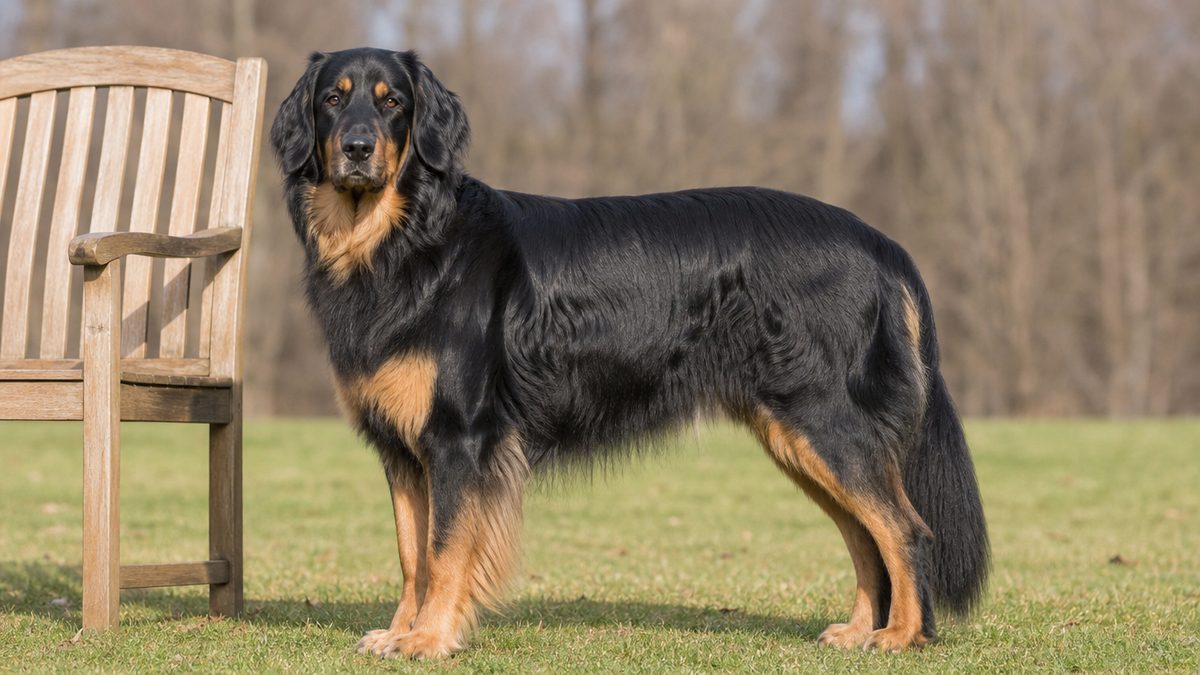
The Hovawart is a long-haired German working dog of 58 to 70 cm at the withers, recognised by the Federation Cynologique Internationale as breed 190 and subject to a working trial, whose current breed standard was published on 21 March 2025 and is five months old. FCI-Standard N 190 HOVAWART
The FCI files it in Group 2, Pinscher and Schnauzer, Molossoid and Swiss Mountain and Cattle Dogs, Section Molossian type, Subsection Mountain type. Its breed status is Recognized on a definitive basis, accepted 21 November 1955, with German as the official authentic language and Germany as the country of origin. The nomenclature page lists three varieties, printed there as BLACK-GOLD, BLACK and BLOND.
The breed number was taken from the FCI's own alphabetical index rather than assembled from the breed name, because an FCI nomenclature URL resolves on its trailing number and will serve a completely different breed's page at HTTP 200 without erroring. The returned document prints HOVAWART (190) as its own heading, which is the check that matters.
The standard describes a powerful, medium-large dog, slightly longer than tall, with the proportion of height at withers to length of body running 100:110 to 100:115. Males stand 63 to 70 cm and females 58 to 65 cm, and a bitch over 68 cm or a dog over 73 cm is disqualified. The standard states no weight at all, which is worth noticing because the Indian and American pages that sell this breed all print one.
The head, and why it is the opposite of a flat-faced breed
Muzzle and skull are of about the same length, the muzzle is straight and parallel to the skull, and the stop is well noticeable rather than deep. The bite is a strong scissor bite with 42 teeth, a pincer bite is permitted, and both an undershot and an overshot mouth are disqualifying faults. Ears are triangular, set high, hanging close to the head and reaching the corner of the mouth, and an erect, semi-erect, rose or off-standing ear is disqualifying.
That matters for an Indian reader in one specific way. Nothing in this standard contemplates ear cropping or tail docking, both of which are prohibited in India under Second Schedule Part II paragraph 6(8) of the Dog Breeding and Marketing Rules 2017. Unlike several European standards this site has examined, the Hovawart's creates no conflict with Indian law on either point.
The coat, described correctly
The standard says the long-haired coat is thick and slightly wavy, lies flat to the body, and has no much undercoat, with feathering on the front of the neck, underbody, backs of the forelegs and thighs and the underside of the tail, and short hair on the head and the fronts of the legs. A predominantly curly coat is disqualifying.
The single Indian page selling this breed says the opposite, telling readers the coat requires little maintenance because it has a thin coat, and attributing that to an American care site. Thick with little undercoat is not the same thing as thin, and the practical difference in an Indian summer is large. Bonbeno could not open the American page cited, which refused automated retrieval, so the accuracy of that attribution is untested here and is reported as untested rather than assumed.
The FCI's nomenclature page lists the varieties as BLACK-GOLD, BLACK and BLOND, while the FCI's own standard for the same breed calls them black and tan, black and blond. Nothing turns on it, and it is worth knowing before a buyer worries that a pedigree naming a black and tan dog describes a different variety from the one advertised.
What was actually reconstructed, and from what
The modern Hovawart was developed from 1922 using farm dogs of similar type crossed with German Shepherd Dogs, Newfoundlands and Leonbergers among others, and the source for that is not a breed club's origin story but the FCI standard itself.
The standard's Brief Historical Summary is short enough to quote almost in full, and it does two things at once that are worth separating. It opens by calling the Hovawart a very old German working dog in its original sense, and explains the name from Middle High German, Hova meaning Hof, a yard, farm or estate, and wart meaning Waechter, a guardian.
Then it dates the breed. Since 1922 he was developed with the use of dogs similar in type which were still found on farms, and through outcrossing with German Shepherd Dogs, Newfoundlands and Leonbergers among others, as a breed. In 1937 he was recognized as a breed and in 1964 as a working dog.
Read those two sentences together and the honest position emerges. The word is old and the dog is not. A medieval German legal vocabulary contained a term for a farm guardian; a twentieth-century breeding programme took that word and attached it to a new composite animal built from surviving farm dogs plus three named modern breeds. The standard does not claim an unbroken line, and neither should anyone selling the dog.
| Date | What happened | Source |
|---|---|---|
| From 1922 | Development begins from farm dogs of similar type plus outcrosses to German Shepherd Dogs, Newfoundlands and Leonbergers among others | FCI standard 190, historical summary |
| 1937 | Recognised as a breed | FCI standard 190 |
| 21 November 1955 | Accepted by the FCI on a definitive basis | FCI nomenclature entry for breed 190 |
| 1964 | Recognised as a working dog | FCI standard 190 |
| From the 1960s | Persistent selection on the characteristic free of hip dysplasia begins | FCI standard 190 |
| 2022 | The German club publishes a centenary volume, 100 Jahre Hovawart | RZV, cited in its own history article |
| 21 March 2025 | Current official valid standard published | FCI nomenclature entry for breed 190 |
One corroboration is worth noting because it is independent of the standard. The Rassezuchtverein's own history article records that Dr Jens Kerl is the main author of the jubilee publication 100 Jahre Hovawart, published in 2022. A centenary volume dated 2022 puts the founding at 1922 from a second direction. Bonbeno could not read that history article's body text, because it is published as a series of image files with no text layer, so nothing is quoted from it here beyond what the surrounding page states in machine-readable form.
Where the American aggregators agree
The US aggregator ranking second in India for this term gives the same account, saying the breed was nearly lost in the early twentieth century and that breeding was restored using dogs of the old type found on farms crossed with German Shepherds, Newfoundlands and Leonbergers, and it cites the FCI standard PDF as its reference. That is a page copying the standard correctly, which is worth saying because most of the claims this guide checks turn out the other way.
The standard also asserts that persistent selection from the 1960s on the characteristic free of hip dysplasia has almost entirely forced the disease back. That is exactly the kind of claim Bonbeno normally tests and finds inflated. It is not inflated here. The Orthopedic Foundation for Animals, an independent American database, records 4.4 per cent dysplastic across 317 Hovawart evaluations, ranking the breed 186th, against 19.3 per cent for the Golden Retriever across 192,946 evaluations. The claim is supported.
Where a ranking page disagrees with the standard
One Canadian page ranking in India for this breed tells the story differently, saying that breeders sought to revive the Hovawart in 1915 and that it was officially recognised in 1922 by the German Kennel Club. The FCI standard puts 1922 at the start of the development work and recognition as a breed in 1937, fifteen years later. Bonbeno follows the standard, because it is the governing document and the German club's own centenary volume in 2022 counts from the same year. The disagreement is recorded rather than smoothed over, and a reader who meets the 1922-recognition version elsewhere now knows where it diverges. The same page opens by calling the breed ancient and dating it to medieval times, which is the collapse of the distinction this section exists to draw.
Three German clubs, one breed, three different rulebooks
The Hovawart has three separate breeding clubs inside the Verband fuer das Deutsche Hundewesen, and they openly disagree about which health tests a dog must pass before it can breed. A buyer who does not know which club registered a litter does not know what was tested.
The three are the Rassezuchtverein fuer Hovawart-Hunde e.V. (RZV), the Hovawart Zuchtgemeinschaft Deutschland e.V. (HZD) and the HOVAWART-CLUB e.V. (HC). The RZV describes itself as internationally the oldest and by a wide margin the largest breeding club for the breed, and states that it is integrated in the VDH and the FCI.
On the genetic test for degenerative myelopathy, the RZV's own article sets out all three positions plainly, which is unusually candid publishing for a breed club.
| Club | Position on the SOD1 genetic test | Effect on matings |
|---|---|---|
| RZV | Not required for breeding approval. Many dogs are tested anyway and owners are asked to report results | Breeder's choice. The club relies on a broad breeding base and avoidance of inbreeding instead |
| HZD | Required as a condition of breeding approval | Only matings that cannot produce a homozygous carrier of the SOD1 mutation are permitted |
| HC | Has since relativised its recommendation to test | No absolute requirement |
The HZD's rule is the one the underlying science recommends. Zeng's 33,747-dog study across 222 breeds concluded that breeding to avoid the production of SOD1 c.118A homozygotes is a rational strategy. The RZV's reasons for declining are set out honestly in its article and are dealt with in full in the section on degenerative myelopathy below, because they are better than they first appear.
Where the clubs agree
On hypothyroidism the picture reverses. The RZV requires in its breeding rules only that breeding be with healthy Hovawarts, while the HZD and HC breeding rules explicitly exclude dogs with clinical hypothyroidism. The HC publishes its exclusion list openly, and it names hip dysplasia, liver shunt, osteochondrosis dissecans, progressive retinal atrophy and hypothyroidism as the hereditary conditions that bar a dog from breeding approval.
All three clubs also cooperate. A histological network to investigate degenerative myelopathy is being built jointly by the RZV, HZD and HC, with representatives from all three meeting in a VDH forum on 4 May 2021, because the disease can only be confirmed after death and post-mortem material is scarce.
A pedigree from a German club is not a single, uniform standard. A dog registered by the HZD has a SOD1 result behind it by rule; a dog registered by the RZV may or may not. If you import, the club name on the paperwork tells you which tests were compulsory, and asking which club registered the litter is a better first question than asking the price.
What a breeding Hovawart has to pass, in Germany and in America
To gain breeding approval in the HOVAWART-CLUB a dog must be free of hip dysplasia, carry two show gradings of at least very good, and pass a demanding temperament test, and its kennel must be inspected before a kennel name is even granted.
The HC's published rules give a level of detail that is worth setting out, because it is the standard against which any Indian breeding of this breed would have to be judged, and because nothing remotely like it exists in Indian law.
- Hips. Only HD-free animals may be bred. Matings with parents up to HD-B1 are possible, and so are matings where the calculated breeding value for the offspring is below 100.
- Excluded conditions. Hovawarts that themselves show, or have in their ancestry, hip dysplasia, liver shunt, osteochondrosis dissecans, progressive retinal atrophy or hypothyroidism are not admitted to breeding. The club states that this catalogue is continually extended on the basis of newer scientific investigation.
- Conformation. Two show results with a minimum grading of very good must be presented.
- Temperament. The core of the Koerung or Zuchttauglichkeitspruefung is a demanding temperament test, because the club breeds for a family-friendly, nerve-strong and physically robust companion.
- Kennel inspection. A breed warden visits before a first litter to check whether the spatial and organisational conditions for raising puppies can be met, and only after that inspection is a kennel name applied for.
- Litter inspection. The warden returns after whelping and again in the fifth and eighth weeks, a protocol is written for every puppy, and microchipping is checked at the final visit.
The American club's parallel protocol
The Hovawart Club of North America publishes its own list, and it is stricter on some points and looser on others. To obtain breeding status a dog must be shown at least twice with Very Good or Excellent evaluations, pass a temperament test after the age of 20 months, have hips radiographed after its second birthday and graded Good or Excellent by the OFA, have a CERF eye evaluation within a year of breeding, and have a full thyroid panel before breeding, with every mating authorised by the club's Breeding Director to ensure genetic diversity.
Note the internal tension. The same document that requires a full thyroid panel before every breeding also tells prospective buyers that there are no known issues of breed-specific diseases. A club does not mandate a thyroid panel for a breed with no thyroid problem.
The Indian comparison
India requires none of this. The Dog Breeding and Marketing Rules 2017 mandate that dogs shall have been tested for genetic defects including hip dysplasia, progressive retinal atrophy, night blindness, hypothyroidism, entropion, ectropion, overshot, undershot jaw, wry mouth, two or more missing teeth and cryptorchidism, under Second Schedule Part III paragraph 8(10). That clause does name hip dysplasia and hypothyroidism, which is more than most countries' rules do. What it does not do is set a passing grade, name a scheme, or require a breeding value, and the words patella and luxation appear zero times in the whole gazette.
The Hovawart is one of the FCI breeds marked subject to a working trial in the nomenclature, so a dog cannot take the international beauty championship title on looks alone. That is the same structure the German pointer and spaniel breeds use, and it is why a Hovawart pedigree from a German club carries more information than a pedigree from a registry that tests nothing.
Hovawart price in India, and the single page that publishes one
The only published hovawart price in india is Rs 40,000 to Rs 80,000, from one India-hosted page, and no dog of this breed could be found for sale anywhere in India on the day it was checked.
That single figure is the whole Indian market as far as the public web is concerned. Everything else ranking in India for this term is either American, a book on Amazon.in, or clip art on Etsy. This is a rare breed in the strict sense: not merely uncommon, but absent from the trade.
| Source | Published price | Country | Dogs of this breed offered |
|---|---|---|---|
| Happy Pet Care | Rs 40,000 to Rs 80,000 | India | None; the page is a breed profile, not a listing |
| Dog Breeds List | USD 1,200 to 3,500 average | United States | None; aggregator |
| Hovawart Club of North America | No price published | United States | None; states litters are infrequent and a waiting list applies |
| Amazon.in | Rs 1,276 for a book about the breed | India | Not applicable |
| Etsy India | Rs 161 to Rs 343 for Hovawart clip art | India | Not applicable |
The comparison worth drawing is between the Indian figure and the American one. The US band runs USD 1,200 to 3,500. The Indian figure of Rs 40,000 to Rs 80,000 converts, at the strong test rate of 84.38, to roughly USD 474 to 948, which is well below the bottom of the American range for a breed that must be imported to reach India at all. A price below the source-country floor for a dog that can only arrive by air freight is not a market price. It is a placeholder.
What the Rs 750 line actually buys
One rupee figure on this page is real and checkable, and it is not a puppy price. Kennel club registration through the Kennel Club of India costs Rs 750 per puppy for litter registration within 60 days, rising to Rs 1,200 between 61 and 120 days and Rs 2,000 between 121 and 180 days, while registration of an imported dog is Rs 2,500 and an export pedigree is Rs 2,000. Those are the only Hovawart-related prices in India that Bonbeno can verify against a published document.
A rare-breed page is shorter on price than a popular one, and that is correct. There is one Indian figure, it is unsupported by any listing, and inventing a range to fill the space would be fabrication. What follows instead is the arithmetic that shows what kind of number it is, and then the care costs that are genuinely real for a 40 kg dog living in an Indian city.
What the breed costs where it is actually sold
Four Western sources rank in India for this query and they do not agree with each other either, which is worth showing because it is the range the single Indian figure has to be compared against.
| Source | Country | Published price | Spread |
|---|---|---|---|
| Dog Breeds List | United States | USD 1,200 to 3,500 | USD 2,300 |
| Adopt a Pet | United States | USD 1,500 to 2,700 from a breeder, about USD 300 to adopt | USD 1,200 |
| Emma | Canada | USD 1,000 to 1,200 | USD 200 |
| Hovawart Club of North America | United States | No price published; waiting list | n/a |
The full Western band therefore runs USD 1,000 to 3,500, a 3.5-fold spread for a breed that everyone agrees is uncommon. Adopt a Pet, How much does a Hovawart… Emma, Hovawart: Character, Health, Feeding The one genuinely useful figure in that table is the adoption cost of about USD 300, because it is the only number anywhere that describes a transaction rather than an estimate.
Testing the Indian figures with arithmetic
Neither Indian figure for this breed divides cleanly into whole US dollars at the two strong exchange-rate tests, and the monthly cost table on the same page turns out to be one number multiplied by 1.5 across every line.
The strong test is 84.38, the rate that has caught converted price lists three times on this site. The secondary tests are 74.00 and a flat 80.00. A fourth rate, 66.67, is 200 divided by 3, so any multiple of 1,000 passes it automatically and it proves nothing alone.
| Rupee figure | at 84.38 | at 74.00 | at 80.00 | at 66.67 |
|---|---|---|---|---|
| Rs 40,000 | 474.05 | 540.54 | 500.00 | 599.97 |
| Rs 80,000 | 948.09 | 1,081.08 | 1,000.00 | 1,199.94 |
Neither divides to a whole dollar at 84.38 or at 74.00. Both divide cleanly at 80.00, to 500 and 1,000, and both are multiples of 2,000, so that clean division is arithmetic rather than evidence. The flat-80 test is structurally weak and must never be run alone, because 1,000 divided by 80 is 12.5, so any multiple of 2,000 passes by construction. The quotients of 500 and 1,000 are prices a seller might print, but they are far below the American band of 1,200 to 3,500 for the same breed. The verdict is that these are round rupee-native figures, chosen rather than converted.
The monthly cost table is a multiplication
The same page publishes basic and premium monthly expenses, and the relationship between the two columns is exact.
| Line | Basic | Premium | Premium divided by basic |
|---|---|---|---|
| Food | Rs 3,000 | Rs 4,500 | 1.50 |
| Veterinary | Rs 1,500 | Rs 2,250 | 1.50 |
| Grooming | Rs 1,200 | Rs 1,800 | 1.50 |
| Total | Rs 5,700 | Rs 8,550 | 1.50 |
Every line is exactly 1.5 times the line beside it. A premium standard of care does not cost precisely fifty per cent more than a basic one in food, in veterinary care and in grooming simultaneously. The basic column may well be a reasonable estimate for a 40 kg dog in an Indian metro; the premium column is that estimate with a multiplier applied, and it should not be read as a second observation. The totals do reconcile, with 3,000 plus 1,500 plus 1,200 giving 5,700 and 4,500 plus 2,250 plus 1,800 giving 8,550, so the arithmetic inside the table is sound even though the method is not.
Bonbeno carries the Rs 5,700 basic monthly figure as a plausible Indian starting point for a large long-haired dog, with its provenance stated, and discards the premium column as a derived number. What the table omits entirely is the line that dominates this breed's Indian cost, which is cooling.
Against the range where the breed is actually sold
The last check is whether the Indian figure could be any Western price converted. At the strong 84.38 rate, Rs 40,000 to Rs 80,000 gives USD 474 to 948. The Western band across three sources runs USD 1,000 to 3,500. Adopt a Pet, How much does a Hovawart… Emma, Hovawart: Character, Health, Feeding The entire Indian range sits below the entire Western range, with the top of the Indian figure landing 52 dollars short of even the lowest Western floor. For a breed that cannot be bred in India and can only arrive by air freight under a personal pet import, a price below the source-country floor is not a discount. It is a number that was never attached to a dog.
What an Indian search for this breed actually returns
A search for this breed's price in India returns poultry rates, broiler chicken prices, a live silver price and a mandi rate page, and Bing itself flags six of the ten results as missing the word hovawart.
That result deserves careful handling, because a substituted result set normally means a broken search tool rather than an absent breed, and this site has recorded four separate cases of Bing India returning ten results about something else entirely. The rule is that an absence counts only when a control succeeded in the same session.
The controls, and what they establish
| Query | Instrument | Result | What it establishes |
|---|---|---|---|
| german shepherd puppy price in india | Firecrawl, India | Ten genuine Indian selling pages with real rupee bands | The search tool finds Indian dog listings when they exist |
| brussels griffon price in india | Bing, country India | Clean on-topic set plus a real four-question People also ask box | Bing India returns breed price pages and question boxes when they exist |
| hovawart price in india | Bing, country India | Poultry, broiler, silver and mandi rates; six of ten flagged Missing: hovawart | No Indian Hovawart price content exists to return |
| hovawart dog breed | Bing, country India | Ten on-topic results led by AKC and Wikipedia, no Missing flags, no question box | The instrument works for this breed name; there is simply no Indian question box |
| hovawart price in india | Firecrawl, India | One Indian breed profile, one Amazon book, one Etsy clip-art market, seven US and Canadian pages | One India-hosted page publishes a price and nothing offers a dog |
Two of those five searches are controls and both succeeded. So the absence is real. Nobody in India is selling this breed, and nobody in India is asking about it in enough volume to generate a People Also Ask box.
The template seam on the one Indian page
The single India-hosted page carries a heading reading Prerequisites to pet a Hovawart, which is a template default with the breed name substituted into it rather than a heading a person wrote. Its similar-breeds panel offers a Greyhound, a Catahoula Leopard Dog, a Tornjak and a Shiloh Shepherd, a set that includes a sighthound and has no evident logic. Its health list omits the two conditions this breed is actually ranked tenth of all breeds for.
None of that makes the page worthless. Its Rs 40,000 to Rs 80,000 figure is the only Indian price that exists, its basic monthly column is plausible, and it gets one important thing right that the American sources get wrong: it prints an ideal weather band of 15 to 25 C. Chennai's annual mean is 27.91 C and its coolest month averages 23.99 C, so the page's own specification rules out its own market for most of the year.
Read the Happy Pet Care page as a whole and it advertises a dog whose stated ideal weather band excludes almost every Indian city for most of the year, whose stated ideal space is a house with a backyard, and whose price it sets below the American floor for a breed that can only reach India by air. Every one of those three facts is on the page. Only the price is in the headline.
Suitability for the Indian climate: the homeland numbers
The Hovawart's own German breed club calls it a cold-loving winter dog, and Chennai's coolest month averages 23.99 C against a July mean of 18.52 C in northern Germany, so the coolest Indian month is warmer than the warmest German one. NASA POWER climatology API queried…
The figures below come from NASA POWER queried by explicit latitude and longitude, because a place-name lookup on a climate site can silently serve a different city and this project has caught that happening six times. The service returns a grid cell rather than a point, so its reported elevation is echoed and checked against each place's real altitude before any figure is used.
| Place | Coordinates echoed | Cell elevation | Real elevation | Annual mean | Hottest month | Coolest month |
|---|---|---|---|---|---|---|
| Hannover | 9.732 E, 52.376 N | 79.35 m | about 55 m | 9.29 C | 18.52 C, July | 0.37 C, January |
| Harz foreland | 10.429 E, 51.906 N | 185.94 m | Goslar about 255 m | 8.85 C | 18.39 C, July | minus 0.32 C, January |
| Chennai | 80.271 E, 13.083 N | 48.95 m | about 6 m | 27.91 C | 31.57 C, May | 23.99 C, January |
| Delhi | 77.209 E, 28.614 N | 206.37 m | about 216 m | 25.65 C | 35.95 C, June | 13.83 C, January |
Three of those four elevation checks pass without consequence. The Hannover cell sits about 24 m too high, worth about 0.16 C at the standard lapse rate of 6.5 C per 1,000 m; the Chennai cell about 43 m too high, worth about 0.28 C; the Delhi cell about 10 m too low, which is nothing. NASA POWER climatology API queried… NASA POWER climatology API queried…
The Harz reading does need a correction stated. Its cell elevation is 185.94 m against Goslar's real elevation near 255 m, so the model is standing roughly 69 m too low and will read about 0.45 C too warm for the town beneath it. The uncorrected cell is used in the table and the direction of its error is stated here rather than hidden, because the real Harz uplands are colder than the figure shown, which strengthens rather than weakens the argument that follows.
The gap, stated plainly
- Annual mean. Chennai runs 18.62 C warmer than Hannover, 27.91 against 9.29.
- Hottest month against hottest month. Chennai's May at 31.57 C is 13.05 C above Hannover's July at 18.52 C.
- The comparison that settles it. Chennai's January, its coolest month, averages 23.99 C. Hannover's July, its hottest, averages 18.52 C. The coolest Indian month is 5.47 C warmer than the warmest German one.
- Delhi's peak. June averages 35.95 C, which is 17.43 C above the hottest month in the breed's homeland and 10.95 C above the top of the ideal weather band the Indian selling page itself publishes. NASA POWER climatology API queried…
The dog being asked to live in that is 63 to 70 cm at the withers with a thick, long, slightly wavy coat lying flat to the body. It is heat-sensitive by construction, and the honest answer to whether it can live in an Indian metro is that it can, in an air-conditioned home, with walks moved into darkness, and with the owner treating cooling as a permanent system rather than a summer measure.
Hall's 905,543-dog UK cohort found dogs over 50 kg carried 3.42 times the odds of heat-related illness against dogs under 10 kg, and bodyweight at or above the breed and sex mean carried odds of 1.42. The Hovawart was not individually modelled, because the breed variable only included breeds with at least five cases or five thousand dogs, so no breed-specific odds ratio exists and none is claimed here. A typical Hovawart also sits below the 50 kg band. What transfers is the bodyweight-relative-to-breed-mean finding, and the plain physiology of a long-haired working dog in 35 C air.
Heat management city by city, and what triggers the illness
Exertion, not a parked car, is what puts most dogs in front of a vet with heat-related illness, so the Indian intervention for a Hovawart is the timing of exercise rather than the avoidance of vehicles.
The companion paper to the UK incidence study analysed 1,259 heat-related illness events from 1,222 dogs in the same cohort. Of those, 380 had no trigger recorded, leaving 879 events with a recorded trigger, of which 652 were exertional, 113 environmental and 46 from vehicular confinement. So 652 of the 879 events with a recorded trigger, 74.2 per cent, followed exercise.
For a breed whose whole point is that it wants a job, that is the central Indian problem. The Hovawart Club of North America warns that a Hovawart likes to have a job to do or it will use its creative nature to find one. In Pune in April, the job has to be indoors.
| City | The problem period | The mechanism | What changes |
|---|---|---|---|
| Delhi and Gurugram | May and June at 35.1 C and 35.95 C monthly means | Dry extreme heat, with road surfaces radiating long after dark | One pre-dawn walk only. No evening walk in June. Indoor scent work instead |
| Chennai | All year; no month averages below 23.99 C | Sustained warmth at 72 per cent mean humidity, so panting sheds less heat | There is no recovery season. Air conditioning is a year-round fixed cost, not a summer one |
| Mumbai and Kolkata | May, then the monsoon | Humidity suppresses evaporative cooling exactly when the dog most needs it, and a thick coat holds moisture | Dehumidify the sleeping room. Dry the coat fully after any wetting |
| Bengaluru and Pune | April at 28.4 C and 28.7 C monthly means | The mildest Indian option, still around 19 C above the German annual mean | Early morning and late night work for most of the year here. This is where the breed is least unreasonable |
The practical protocol
- Walk in the dark, both sessions, from March to October in every metro except the Deccan cities.
- Test the tarmac with the back of your hand for five seconds before setting off.
- Never shave the coat. The outer coat shades the skin, and removing it exposes a dog bred for northern Germany to direct Indian sun.
- Cool the groin, armpits and paws, not the back. Wetting the top of a thick coat traps heat under it.
- Use a harness, never a narrow collar. The German club's veterinary article warns specifically against narrow collars, prong collars and check chains without a stop, because the thyroid lies directly against the trachea under this breed's heavy coat.
- Watch the weight. Bodyweight at or above the breed and sex mean carried 1.42 times the odds of heat-related illness in the UK cohort.
Second Schedule Part IV paragraph 21(1) of the Dog Breeding and Marketing Rules 2017 provides that dogs not accustomed to local temperatures, breeds that cannot tolerate them such as long-haired breeds in high temperature locations, and sick, infirm, aged or young animals shall not be kept in outdoor facilities without the attending veterinary practitioner's written approval. The clause names long-haired breeds in high temperature locations explicitly, which is this breed in this country. It is a Second Schedule paragraph and not a Rule; the string Rule 21 appears zero times in the gazette, and the Rules themselves stop at Rule 13.
Paragraph 15 of the same Schedule separately requires that the temperature inside indoor housing be ambient and comfortable depending on the breeds of dogs that are housed inside, and be such as provides for their health and well-being. For a cold-loving winter dog in Chennai, that is a demanding standard rather than a formality.
Temperament and who should not buy this dog
The Hovawart is a protective, loyal, intelligent and genuinely strong-willed working dog that the American parent club does not usually recommend for first-time owners, and the FCI classifies it as a recognised working dog for versatile usage.
The standard's own temperament clause is careful and worth taking literally. It describes a disposition that is good natured and even, with protectiveness, self-confidence and the ability to take stress, a medium temperament and a very good nose, and it names the resulting roles as companion, watch, guard, rescue and tracking dog. Disqualifying faults include aggressive dogs, anxious dogs, gun-shy dogs and lethargic dogs, which tells you the breed is selected against nerves in both directions.
The American club adds the practical translation. It describes an alert, faithful, trustworthy, extremely intelligent, fun-loving and stubborn dog that takes approximately two years to mature, and warns that a Hovawart likes to have a job to do or it will use its creative nature to find one. The US aggregator rates it reserved towards strangers and gives it five stars for watchdog ability.
The Indian page's own top five traits are protective, loyal, intelligent, fearless and athletic, and that list is fair. An athletic guarding breed that matures slowly is a demanding animal in any country, and the demand does not fall because the dog is affectionate at home.
Who this breed suits
- Experienced owners with a house and a fenced garden. Both American sources say apartments are not typically large enough.
- People who want a working partner. The FCI lists this breed as subject to a working trial, and the German club runs national championships in obedience and IGP.
- Families with older children. The US aggregator rates it four stars for child friendliness, while the American club notes that a dog of this size can knock a small child down in play.
- Households in Bengaluru or Pune with reliable cooling. Of the Indian metros these are the only ones where the climate is merely difficult rather than hostile.
Who should not buy one
- First-time dog owners. Said plainly by the breed's own American club, on grounds of the strong-willed personality, the guarding instincts and the intelligence.
- Apartment dwellers. This is the single clearest disqualifier for most Indian metro buyers.
- Anyone in Chennai, Kolkata or coastal India without year-round air conditioning. The breed's own club calls it a cold-loving winter dog.
- Anyone wanting a guard dog in the junkyard sense. The American club states explicitly that it does not encourage using Hovawarts this way and will not condone attempts to turn them into aggressive guard dogs, and that it recommends breeding defensive rather than aggressive dogs.
- Anyone who cannot wait years. There is no Indian supply, and even in North America litters remain infrequent.
The American club's formulation is the most useful one available. The guarding instinct is defensive rather than offensive, it will surface whenever the dog perceives a threat whether or not you want it to, and absent direction the dog will make its own decision. Its concrete advice is to greet a friend at the door rather than let someone walk in and surprise the dog. In an Indian home with domestic staff, delivery riders and frequent visitors, that single habit does more work than any amount of obedience training.
Training a dog bred to make its own decisions
To train a Hovawart, use consistent, positive, well-balanced methods from eight weeks and expect the job to run two full years, because the breed matures slowly and forms its own judgements when it is not given one.
The US aggregator rates trainability four stars out of five and describes the requirement precisely: a consistent, well-balanced and loving approach with positive reinforcement, plus firmness and patience, and it notes the breed is well suited to search and rescue or tracking. The American club's framing is complementary and blunter, that owning one can be quite a challenge and that the reward for the effort is a faithful companion.
Socialisation is the curriculum, not obedience
Socialise deliberately and early, because a guarding breed that has not learned which situations are normal will classify them for itself. The American club says this directly, that appropriate guarding instincts are a learned process and that dogs need educating by exposure so the intelligence produces a measured response. In an Indian city that means traffic, horns, crowded lifts, marble floors, cattle, other dogs at a distance, and above all the daily stream of people who legitimately come to the door.
- Weeks 8 to 16. Two short positive exposures a day, each ended before the puppy tires. Reward calm observation rather than approach.
- Months 4 to 8. Doorbell and visitor protocol. Teach a station and a release before the guarding instinct has anything to practise on.
- Months 6 to 14. Recall on a long line, and lead manners on a harness rather than a collar.
- Months 12 to 24. The adolescent guarding phase. Hold the standard rather than escalating; the German clubs assess temperament formally from 20 months and after the twelfth month.
The temperament test as a training target
Both the German and American clubs place a temperament test at the centre of breeding approval rather than at the edge, the HC calling the demanding Wesenstest the core of its Koerung and the HCNA requiring a pass after 20 months. Hovawart Club of North America Nothing equivalent exists in India, and no Indian buyer will ever sit one. It is still the best available description of what a finished Hovawart should be: nerve-strong, family-friendly, physically robust, defensive rather than aggressive.
Training is exertion, and exertion accounted for 652 of the 879 UK heat-related illness events with a recorded trigger. Move every session indoors from March to October in most Indian metros, keep them to ten minutes, and stop on the first change in breathing rather than the first sign of tiredness. A dog that wants a job will work past the point where it should stop, and this breed wants a job more than most.
One structural point closes the section. This is an FCI breed subject to a working trial, so in its own country a Hovawart cannot take the international beauty title without proving it can work. An owner who treats training as optional is keeping the dog on a standard its own registry does not recognise.
The daily exercise requirement, and when it becomes dangerous
Plan on 60 to 90 minutes a day for an adult Hovawart plus real mental work, and in India move all of it into darkness from March to October, because exertion is the leading trigger of heat-related illness in dogs.
The Indian page gives 60 to 90 minutes and a high energy level, and the US aggregator rates exercise needs three stars out of five. Those are consistent for a working breed of this size, and the figure is not the difficult part. The timing is.
Of 879 UK heat-related illness events with a recorded trigger, 652 were exertional, against 113 environmental and 46 from confinement in a vehicle. That ratio was measured in a country whose hottest month averages 18.5 C. In Delhi, whose June averages 35.95 C, the same mechanism operates with far more energy behind it.
| Period | Outdoor allowance | Indoor or substitute work |
|---|---|---|
| November to February, north India | Full 60 to 90 minutes, most daylight hours usable | Optional |
| November to February, Chennai and coastal south | Two sessions before 7 am and after 8 pm | Scent work on the warmest days |
| March to June, everywhere | One pre-dawn session of 30 to 45 minutes | Tracking games, food puzzles and obedience indoors for the balance |
| Monsoon | Short covered walks; watch humidity rather than temperature | Full indoor substitution when the coat cannot be dried afterwards |
| Any day above 30 C ambient | Nothing outdoors | Indoor only, in air conditioning |
Scent work is the substitute that genuinely satisfies this dog. The FCI standard names a very good nose among the breed's defining qualities and lists tracking among its uses, and the German club runs tracking activities as a mainstream member pursuit. Twenty minutes of searching an apartment for hidden food tires a Hovawart more thoroughly than forty minutes of walking, at almost no thermal cost.
What under-exercise produces
- Self-appointed guarding. The club's warning that the dog will find its own job is not a metaphor. An under-worked Hovawart starts policing the gate.
- Weight gain. Bodyweight at or above the breed and sex mean carried 1.42 times the odds of heat-related illness.
- Barking. The breed is rated an occasional barker at two stars, and that rating assumes it has something better to do.
- Joint stress in a growing dog. Osteochondrosis dissecans sits on the German club's exclusion list, and forced exercise on a fast-growing large-breed puppy is the owner-side contribution to it.
Stop at once for any change in breathing sound, a widened stance, a tongue that broadens and darkens, or a dog that lies down and will not move. Carry water and a wetting cloth for the groin and armpits on every walk from March onwards, and never let a long-haired working dog decide for itself when to stop, because a breed selected for the ability to take stress will keep going past the point where it should not.
Coat care in Indian humidity
Groom a Hovawart by brushing through the feathering once or twice a week and more during the seasonal moult, and never clip the coat, because the standard describes a thick, long, slightly wavy coat with little undercoat whose outer layer is what shades the skin.
The coat is genuinely low-maintenance by long-haired standards, and the sources agree. The US aggregator rates grooming two stars out of five, calls the coat easy to groom, and describes an average shedder needing occasional brushing and combing with extra care where tangles form. The Indian page rates shedding moderate.
One claim on the Indian page is wrong and worth correcting, because it changes what an owner does. It says the coat requires little maintenance because it has a thin coat, attributing this to an American care site. The FCI standard says the long-haired coat is thick and slightly wavy, lying flat to the body, with little undercoat. Thick with little undercoat is a different animal from thin, and the correct inference is not that the coat needs no work but that it mats less than a dense double coat would.
Where the feathering actually needs attention
The standard lists feathering on the front of the neck, the underbody, the backs of the forelegs and thighs and the underside of the tail, with short coat on the head and the fronts of the legs. Those feathered areas are where an Indian coat problem starts, because they are the parts that touch wet ground, trap monsoon mud and dry last.
- Dry the dog completely after any wetting, including the ear bases and the trouser feathering. Do not follow overseas advice to towel off and let the dog air dry, which assumes a German summer rather than an Indian July.
- Comb the trousers and tail underside weekly in the monsoon, daily if the dog has been in standing water.
- Check ears every week. They hang close to the head and reach the corner of the mouth, which is a warm closed environment in Indian humidity.
- Never shave for summer. Removing the outer coat exposes skin bred for northern Germany to direct tropical sun, and the coat does not protect against heat once it has grown back unevenly.
- Watch the coat as a diagnostic. Brittle hair, easy pulling, poor regrowth, thinning from the tail and trunk, and a black coat turning rust-coloured are early hypothyroid signs rather than grooming failures.
A black Hovawart going rust-coloured is a recognised hypothyroid sign, and the German club's own article notes in the same sentence that it can also follow a tyrosine deficiency in the diet, because tyrosine is needed both for thyroid hormone and for the black pigment melanin. So the finding points at two possible causes, one hormonal and one nutritional, and both are worth checking before either is assumed.
A second overseas page compounds the confusion from the other direction, describing a double coat whose undercoat is dense. The FCI standard says the opposite in plain words, that the long-haired coat lies flat to the body with no much undercoat. So an Indian reader comparing two ranking pages is told the coat is thin by one and densely double by the other, when the governing document says thick, flat-lying and light on undercoat. That third description is the one that predicts what the coat does in an Indian monsoon, which is to hold surface water in the feathering and dry slowly, while matting less than a true double coat would.
Health: the joints are genuinely excellent
The Hovawart records 4.4 per cent hip dysplasia across 317 evaluations and 0.7 per cent abnormal elbows across 135, ranking 186th and 152nd respectively, which makes it one of the orthopaedically soundest large breeds in the Orthopedic Foundation for Animals database.
Those figures were read from the printed breed label in OFA's disease statistics tables rather than from a breed code, because a guessed OFA code returns a complete and plausible table for a different breed and this project has been caught by that three times. The whole dump was searched case-insensitively with a Labrador Retriever control returning 109 rows in the same session.
| Measure | Hovawart | Rank | All breeds | Ratio |
|---|---|---|---|---|
| Hip evaluations | 317 | 186 | 1,712,643 | n/a |
| Hips, per cent dysplastic | 4.4 | 186 | 14.2 | 0.31 times |
| Hips, mild / moderate / severe | 2.2 / 1.6 / 0.6 | n/a | 8.8 / 4.6 / 0.8 | n/a |
| Hips, per cent excellent | 25.6 | n/a | 14.6, see caution | n/a |
| Elbow evaluations | 135 | 152 | 650,254 | n/a |
| Elbows, per cent abnormal | 0.7 | 152 | 12.0 | 0.06 times |
The breed row reconciles exactly, with mild 2.2 plus moderate 1.6 plus severe 0.6 giving the 4.4 dysplastic figure, and excellent 25.6 plus good 60.9 plus fair 8.2 giving 94.7 against a printed 94.6, which is rounding. The remaining 1.0 point is borderline.
OFA's ALL BREEDS hip row prints 84.3 per cent normal alongside Excellent 14.6, Good 0.0 and Fair 0.0, components that cannot sum to 84.3. Its dysplastic side is sound, with mild 8.8 plus moderate 4.6 plus severe 0.8 giving exactly 14.2. So the 14.2 per cent all-breeds dysplastic baseline used above is usable and the 84.3 per cent normal figure is not. Every individual breed row checked here sums correctly; only the aggregate fails.
The claim that is right, and the claim beside it that is wrong
The American Kennel Club's breed page states that hip dysplasia rates have been calculated at less than 5% and that for a large breed dog this is an exceptionally low rate, comparing the Golden Retriever at more than 20 per cent from OFA statistics kept between 1974 and 2003. Checked against the current OFA tables, the Hovawart figure is 4.4 per cent, so the claim holds, and the Golden Retriever now reads 19.3 per cent across 192,946 evaluations, so the comparison holds too with the figure slightly moved.
The sentence immediately before it does not hold. There are no known issues of breed-specific diseases is printed on the same page, and the Hovawart Club of North America prints the identical passage word for word. Two apparently independent American authorities are one authority, and four peer-reviewed breed-specific papers contradict them, which the next three sections work through.
One further OFA figure is worth stating because it is reassuring and rarely quoted. Nothing in Indian law requires any of this testing. The words patella and luxation appear zero times across the whole Dog Breeding and Marketing Rules gazette, so an Indian hip or elbow grade is voluntary and privately paid for.
One structural point explains why the American material is thin. A Canadian page states plainly that Hovawarts are not recognised by the American Kennel Club, and three independent signals agree with it: the AKC's own breed page carries no breed group and no recognition statement, and the US aggregator's popularity table is blank for every year from 2015 to 2022. American Kennel Club breed page… Dog Breeds List, Hovawart breed entry A breed outside the AKC's fully recognised roster gets a short page written from parent-club copy, which is exactly what the health passage turns out to be.
Degenerative myelopathy, and why the genetic test misreads this breed
Degenerative myelopathy is the condition this breed is most often warned about, and the honest picture is that four credible sources disagree with each other, one of them because the routine genetic test gets the wrong answer in this breed specifically.
The disease itself is a progressive, incurable degeneration of the spinal cord that affects older dogs, almost always from eight to ten years of age. The German club describes the presentation precisely: affected Hovawarts stumble, fall over and drag their toes, while urination, defecation and tail tone stay normal for a long time, and euthanasia in a large dog usually follows when the animal can no longer stand or walk.
Four sources, four different pictures
| Source | What it measures | The figure | What it means |
|---|---|---|---|
| OFA disease statistics | SOD1 genotype in dogs submitted for testing | 18.9 per cent at risk and 33.0 per cent carriers of 106 tested, rank 10 of all breeds | A genotype frequency in a self-selected sample, not a disease rate |
| Mandrioli 2021, J Comp Pathol | Confirmed neuropathology in three Hovawarts aged 9 to 12 | All three homozygous for c.118A, none carrying the SP110 risk haplotype | The breed is predisposed to the mutation and the disease is real in it |
| RZV club registry | Reported illness among dogs the club registered | 98 of 10,052 dogs born since 2000 showed hind-limb weakness with suspected DM, and only 4 have a histopathological finding | 0.97 per cent suspected, 0.04 per cent confirmed |
| Turba 2017, Animal Genetics | The reliability of the test itself in this breed | An insertion allele at 26.6 per cent allele frequency causes heterozygous dogs to be typed as homozygous | Some published at-risk counts for this breed are inflated |
The RZV's registry arithmetic checks out: 98 divided by 10,052 is 0.975 per cent, matching the 0.97 per cent the club prints. The gap between 98 suspected and 4 confirmed is not evasion; the club explains that diagnosis is only possible by post-mortem pathology within a narrow window before nervous tissue breaks down, and it is building a histological network with the HZD and HC to collect that material.
The finding that reconciles them
In 2016 and 2017 a group at the University of Bologna working with Hovawart Club Italia investigated why laboratories kept returning parent and offspring genotypes that could not both be true. They found a 54-nucleotide insertion in intron 2 of SOD1, made of a poly-T stretch plus 15 nucleotides duplicating the exon 2 to intron 2 junction. The insertion partially mismatches the reverse primer used in a direct sequencing assay, so that allele fails to amplify and drops out, and an actual heterozygote is reported as homozygous for the variant.
Two details make this decisive rather than academic. The insertion is in complete linkage disequilibrium with the normal c.118G allele, so the allele that vanishes is always the healthy one. And in Hovawarts it accounted for 26.6 per cent of allele frequency, against occasional appearances in Rough Collies and Standard Poodles. The German club rounds this to about 26 per cent of Hovawarts examined.
OFA's degenerative myelopathy table reports genotype, not disease, and it does not record which laboratory assay produced each result. Because a drop-out-prone assay converts carriers into apparent homozygotes, and because the affected allele frequency in this breed is 26.6 per cent, the direction of any error in the 18.9 per cent at-risk figure is upward and the 33.0 per cent carrier figure is correspondingly understated. Bonbeno publishes the OFA row because it is real, and publishes this caveat beside it because quoting the row alone would mislead. Neither number should be repeated without the other.
Why the largest club declines the test
The RZV sets out its reasoning openly. A dog that is heterozygous or even homozygous for the normal allele can still develop the disease, and it cites a University of Bern statement from 2018 that 6 per cent of dogs with the n/n genotype develop degenerative myelopathy, alongside a Manz and Krawczak probability for n/n dogs of 1 in 6,172. Those two figures cannot both describe the same population, since 1 in 6,172 is 0.016 per cent and 6 per cent is roughly 370 times larger, and the club prints them in adjacent bullets without reconciling them. Bonbeno reports both and adopts neither.
The club also cites a cross-breed average risk for homozygous carriers of 0.741 per cent, or 1 in 135, against a penetrance figure for the Hovawart specifically of 11 per cent calculated by Dr Pfeiffer. Its conclusion is that a test not validated for this breed should not drive mating decisions, and that a broad breeding base and avoidance of inbreeding serve better. Zeng's 33,747-dog study reached the opposite operational conclusion, that breeding to avoid producing homozygotes is a rational strategy, and the HZD follows Zeng while the RZV does not. Rassezuchtverein fuer Hovawart-Hunde e.V.
Hypothyroidism, the condition the breed actually carries
Hypothyroidism is described in the peer-reviewed literature as the most common disease with a proposed genetic background in the Hovawart, and it is heritable at 0.47 to 0.62, which is high enough that selection works.
The Finnish study is the best evidence available on this breed and nobody quotes it. Researchers at the University of Helsinki took pedigree data from the Finnish Kennel Club and disease data from the Finnish Hovawart Club, covering 4,953 dogs born between 1990 and 2010, of which 107 had hypothyroidism and 4,846 did not. That is 2.16 per cent of the cohort. Heritability came out at 0.47 with a standard error of 0.18 by restricted maximum likelihood and 0.62 with a standard deviation of 0.21 by Gibbs sampling.
Gender, birth year, birth month and level of inbreeding had no significant effect on susceptibility. The authors conclude that heritability is moderate to high, that prevalence could be decreased through selection, and that breeders should notify the breed association of affected dogs and avoid using them.
| Source | Measure | Figure |
|---|---|---|
| OFA thyroid table | Autoimmune thyroiditis plus compensative autoimmune thyroiditis, 136 evaluations | 2.9 plus 7.4, a combined 10.3 per cent, rank 10 of all breeds |
| OFA thyroid table, all breeds | Same two categories, 121,451 evaluations | 0.4 plus 4.5, a combined 4.9 per cent |
| Ahlgren and Uimari 2016 | Clinical hypothyroidism in 4,953 Finnish Hovawarts | 107 affected, 2.16 per cent, heritability 0.47 to 0.62 |
| Dog Breeds List | Editorial health note | An underactive thyroid is widespread in European lines |
| HOVAWART-CLUB e.V. | Conditions barring breeding approval | Hypothyroidism named on the exclusion list |
| Hovawart Club of North America | Pre-breeding requirement | A full thyroid panel before every breeding |
Six sources, five of them independent of one another, and every one points the same way. Ahlgren J, Uimari P. Heritability… Dog Breeds List, Hovawart breed entry HOVAWART-CLUB e.V., Zucht Hovawart Club of North America Against that stands the single sentence, printed by the AKC and by the American parent club in identical words, that there are no known issues of breed-specific diseases. Hovawart Club of North America It cannot stand.
What an Indian owner should actually do
The German club's veterinary article by Dr Claudia Veit is the most practical guidance available in any language, and three points from it transfer directly to India.
- Test the panel, not the single value. Measuring total T4 alone carries a higher risk of misdiagnosis. The article calls for T4, free T4 and TSH together, with thyroglobulin antibodies where relevant, and warns that antibodies turn negative again once thyroid tissue is largely destroyed.
- Know about Euthyroid Sick Syndrome. Liver, kidney, heart, metabolic and infectious disease all depress T4 without any thyroid disease being present, as do common painkillers, cortisone, anti-epileptics and some antibiotics and sulphonamides. Treating the underlying illness normalises the values.
- Use the same laboratory every time. Different calibrations produce values that are not directly comparable, which matters when you are tracking a dog over years.
The clinical picture starts with coat rather than behaviour. Hair becomes brittle, falls first from the tail and trunk, pulls out easily and regrows poorly; the coat thins and goes in patches; black dogs turn rust-coloured; skin becomes scaly and may darken, with itching, skin infections and ear infections becoming more frequent. Fluid retention and skin thickening around the face produce a sad-looking expression, the heart rate slows, weight rises on unchanged food, and the dog becomes lethargic. Most patients fall ill between the fourth and seventh year.
The German article notes, almost in passing, that hypothyroid dogs tolerate cold less well, and adds in brackets that this is unfortunate in a breed where the typical Hovawart is a cold-loving winter dog. Reverse that for India. A hypothyroid dog gains weight on unchanged food and becomes lethargic, and both of those make heat harder to survive. In a country where the coolest month in Chennai is warmer than the hottest month in Germany, an untreated thyroid is a heat problem as well as a coat problem.
The eye figures that contradict each other inside one database
OFA's own eye numbers for this breed disagree with themselves by 28.9 percentage points, and neither should be quoted as the rate without the other beside it.
The eye summary row reads 68 evaluations, 95.6 per cent normal, 4.4 per cent abnormal, ranking the breed 116th. The eye detail rows are computed on 69 tested dogs, and the row labelled NORMAL reads 46 of 69, which is 66.7 per cent. Both are OFA's, published on the same page, one dog apart in denominator.
46 divided by 69 is 0.6667, so the detail figure is arithmetically sound. The gap between 95.6 and 66.7 is not rounding, and Bonbeno has now recorded this same contradiction in the same shape on eight breeds, always with the summary flattering the breed.
Three parts that each exceed the whole
The proof that the two cannot be measuring the same thing is that three separate single diagnoses each exceed the summary's entire abnormal figure of 4.4 per cent.
| Finding | Affected | Per cent |
|---|---|---|
| Normal | 46 | 66.7 |
| Persistent pupillary membranes, iris to iris | 5 | 7.2 |
| Distichiasis | 4 | 5.8 |
| Cataract, significance unknown | 4 | 5.8 |
| Other, suspected as not inherited | 3 | 4.3 |
| Uveal cyst, single | 2 | 2.9 |
| Uveal cyst, multiple | 2 | 2.9 |
| Persistent pupillary membranes, lens pigment foci | 2 | 2.9 |
| Punctate cataract, anterior cortex | 2 | 2.9 |
| Micropapilla | 2 | 2.9 |
Persistent pupillary membranes alone reach 7.2 per cent, distichiasis 5.8 per cent and cataract of unknown significance 5.8 per cent, each of them larger than the 4.4 per cent the summary gives for all abnormalities combined. A part cannot exceed its whole.
The sample is also small. Sixty-eight or sixty-nine dogs is far below the denominators behind the hip and thyroid rows, and OFA's own publication threshold is 100 hip evaluations or 50 for its other databases, so this breed sits just above the floor for eye reporting. Treat the eye picture as thinly evidenced in both directions.
Quote the pair. The defensible sentence is that OFA's summary reports 95.6 per cent normal across 68 evaluations while its own detail rows report 46 of 69 normal, or 66.7 per cent, and that the two are inconsistent on a small sample. Then act on the club rules instead, because both the HOVAWART-CLUB and the American parent club require an eye examination before breeding, and progressive retinal atrophy sits on the HC's exclusion list.
For an Indian owner the practical instruction is unchanged by the statistical mess. Distichiasis, extra eyelashes growing where they rub the cornea, is the commonest finding in this table that actually hurts a dog, and it is treatable. Check the eyes weekly, and treat a squint, a held-shut eye or persistent tearing as same-day veterinary work rather than something to monitor.
The other conditions the German clubs actually screen for
Beyond hips, thyroid and degenerative myelopathy, the HOVAWART-CLUB bars three further conditions from breeding, and a fourth has been documented in a single Hovawart family in a leading haematology journal. Brenig B, Steingraeber L, Shan S
The HC's published exclusion list runs to five conditions: hip dysplasia, liver shunt, osteochondrosis dissecans, progressive retinal atrophy and hypothyroidism, and the club states the catalogue is continually extended on the basis of newer scientific investigation. The first and last are covered above. The middle three are worth explaining, because none of them appears on the Indian page selling this breed.
- Liver shunt. A portosystemic shunt routes blood past the liver so toxins are not cleared, producing poor growth, disorientation after meals and neurological signs. The RZV publishes an owner article on it. It is congenital, and it is the reason the club excludes affected lines rather than treating it as bad luck.
- Osteochondrosis dissecans. A defect of joint cartilage in a fast-growing large breed, usually showing as forelimb lameness in a young dog. This one has an Indian dimension, because it is driven partly by growth rate, and overfeeding a large-breed puppy is the commonest way an owner contributes to it.
- Progressive retinal atrophy. Inherited retinal degeneration ending in blindness. It is also one of the defects Indian law names by name in Second Schedule Part III paragraph 8(10), which requires that breeding dogs have been tested for genetic defects including progressive retinal atrophy.
Haemophilia B, and how to report it honestly
In 2019 a group across Goettingen, Bern and Hannover described a Hovawart family transmitting an X-linked bleeding disorder, with five males suffering recurrent haemorrhagic episodes and one showing only 2 per cent of the normal concentration of plasma factor IX. Sequencing found a single nucleotide deletion 73 base pairs upstream of the F9 start codon, in overlapping binding sites for hepatocyte nuclear factor 4-alpha and the androgen receptor, abolishing the former.
The way to report that responsibly is to give the denominator. The team genotyped 1,298 dogs including 720 Hovawarts, and the mutant allele was found only in that one family. So this is not a breed-wide risk and no buyer should be alarmed by it. It matters for one reason only: it is a documented, peer-reviewed, breed-specific genetic disease, and it exists in a breed whose most-read English page says there are none.
Bloat, which is the one that kills quickly
The Indian page lists bloat first among its health issues, and on that it is right. Gastric dilatation and volvulus is the classic emergency of deep-chested large breeds, and the FCI standard describes a chest that is broad, deep and powerful. The RZV publishes an owner article headed that every minute counts. Feed two or three smaller meals rather than one large one, avoid hard exercise for an hour either side of eating, and know before you need it which Indian clinic near you operates after midnight.
OFA's cardiac tables give the Hovawart no row at all, and the breed does not appear among the worst ranks on patella. Indian law mentions neither the patella nor hearing anywhere in the 2017 Rules gazette, so there is no Indian requirement to grade either. The honest summary is that this is a soundly built breed with two real genetic problems, one of which is measured badly, rather than a fragile breed with many.
Life expectancy, and the study that does not contain this breed
Every source gives a life expectancy of 10 to 14 years for the Hovawart, and none of them cites a study, because the largest UK longevity dataset, covering 584,734 dogs across 155 breeds, does not include this breed at all.
The convergence is real and shallow. The AKC gives 10 to 14 years, the American parent club gives 10 to 14, the US aggregator gives 10 to 14 and the Indian page gives 10 to 14. Hovawart Club of North America Dog Breeds List, Hovawart breed entry Happy Pet Care, Hovawart breed page Four sources repeating one figure that none of them sources is one claim, not four.
Searching McMillan's full text for this breed returns nothing. The word Hovawart appears zero times across 155 named breeds. So the breed-specific answer does not exist in the best dataset that could have supplied it, and Bonbeno will not manufacture one.
What does transfer
What that paper does publish is a partition by body size across the whole dataset, which is a conformation finding rather than a breed finding and therefore applies.
| Size category | Median survival | 95 per cent CI | n | Deaths |
|---|---|---|---|---|
| Small | 12.7 years | 12.7 to 12.8 | 223,222 | 112,063 |
| Medium | 12.5 years | 12.4 to 12.6 | 73,532 | 35,787 |
| Large | 11.9 years | 11.9 to 11.9 | 123,072 | 61,976 |
Large purebreds reached a median of 11.9 years, against 12.7 for small ones, on a sample of 123,072 dogs of which 61,976 had died. A 63 to 70 cm Hovawart is unambiguously in that large band, and 11.9 years sits inside the 10 to 14 range everyone quotes, which is the most that can honestly be said.
No verified breed-specific life expectancy exists for the Hovawart. The widely repeated 10 to 14 years appears in registry, club and commercial material with no study behind it. The only defensible evidence is the size-class finding above. A buyer should plan for a dog that may reach its early teens and should not treat 14 years as a figure anyone has measured in this breed.
One thing does bear on comfortable years rather than total years, and it points the right way for once. This breed's hips at 4.4 per cent dysplastic and elbows at 0.7 per cent abnormal are far better than the all-breeds baselines of 14.2 and 12.0 per cent. A large dog that reaches eleven or twelve on sound joints has a materially better old age than one that reaches the same age on dysplastic ones, and on that measure the sixty years of German selection the standard describes have paid off.
Feeding a large working dog, with the iodine problem stated
Feed an adult Hovawart twice a day on a large-breed formulation and check that the diet actually supplies iodine, because the breed's own German club warns that home-prepared and raw diets frequently under-supply it and that the popular algae supplements do not fix the gap.
That warning is the most useful feeding advice available for this breed and it does not appear on any Indian page. Thyroid hormone is built from iodine and the amino acid tyrosine, so a diet short of either has a direct route to the condition the breed is already predisposed to. Ahlgren J, Uimari P. Heritability…
- Good commercial food already contains added iodine. The club's position is that quality prepared food is normally adequately supplemented, so the problem is specific to home-cooked and raw feeding.
- Spirulina and chlorella do not supply iodine. The club states this explicitly, and the reason is simple: both are freshwater algae and fresh water is typically iodine-poor. Marine algae are rich in iodine, but the content varies and should be declared on the packaging.
- Tyrosine matters too. It is needed for thyroid hormone, for neurotransmitters and for the black pigment melanin, which is why a deficiency can show up as a dull coat colour as well as a hormonal problem. Pork, chicken breast and salmon are named as rich sources.
- Never feed throat, larynx, gullet or windpipe carelessly. Thyroid tissue adhering to those cuts is not inactivated by freezing, cooking or drying, and feeding it can produce clinical signs of an overactive thyroid in a dog whose own thyroid is fine.
That last point deserves emphasis for an Indian audience, because throat and windpipe are exactly the cheap offal cuts most likely to end up in a home-prepared Indian dog diet or a dried chew.
Life-stage feeding
| Stage | Meals per day | What to watch |
|---|---|---|
| 8 to 16 weeks | 4 | Growth rate, not growth size. Osteochondrosis dissecans is on the German club's exclusion list and overfeeding a large-breed puppy pushes toward it |
| 4 to 12 months | 3 | Keep the puppy lean enough to feel ribs easily. The breed takes about two years to mature and does not need to be pushed |
| 12 to 24 months | 2 | Adolescence and adult coat. Still a growing skeleton |
| Adult | 2 or 3 | Never one large meal. A broad, deep chest is the classic bloat conformation |
| Over 8 years | 2 or 3 | Weight creep on unchanged food is an early hypothyroid sign rather than simple ageing |
The Indian page gives monthly food expenses of Rs 3,000 to Rs 4,500 and calorie guidance of 1,500 kcal for puppies and 2,000 kcal for adults. The rupee figure is plausible for a 40 kg dog in an Indian metro on a mid-range large-breed diet, and Bonbeno carries it with two caveats. The page's premium column is the basic column multiplied by 1.5 across every line. And the figure is not specific to this breed at all: the same site prints the identical food, veterinary and grooming lines on its Tornjak page, so it is a large-dog default rather than a Hovawart observation. The calorie figures are generic and should be adjusted against the dog in front of you rather than followed.
Split meals, avoid hard exercise for an hour either side of eating, and use a slow feeder if the dog bolts. Gastric dilatation and volvulus in a deep-chested large breed is a surgical emergency measured in hours, and knowing which Indian clinic near you operates overnight is part of feeding this breed responsibly rather than a separate topic.
Indian law, and where it is weaker than the German club rules
Indian law names hip dysplasia, progressive retinal atrophy and hypothyroidism among the genetic defects a breeding dog must have been tested for, which is more than most countries require, and then sets no passing grade for any of them.
The gazette was extracted with pypdf in this session, giving 51,953 characters of real text across 14 pages, so every clause below was read rather than summarised. The Rules themselves run 1 to 13, ending at Rule 13, No licence without registration, and the Second Schedule runs to paragraph 30 across four Parts. Any citation reading Rule 14 or higher is wrong by construction, and the string Rule 21 appears zero times in the document.
The clause that names this breed's own conditions
Second Schedule Part III paragraph 8(10) provides that dogs shall have been tested for genetic defects, including hip dysplasia, progressive retinal atrophy, night blindness, hypothyroidism, entropion, ectropion, overshot, undershot jaw (when incisors do not touch or mesh), wry mouth, two or more missing teeth, unilateral cryptorchid or full cryptorchid males.
Three of those items are on the HOVAWART-CLUB's own exclusion list, namely hip dysplasia, progressive retinal atrophy and hypothyroidism. So on paper Indian law and the German club are asking about the same conditions. The difference is everything else. The German club sets a hip ceiling of HD-B1 and a breeding value below 100, requires two show gradings, a temperament test, a kennel inspection and three litter inspections. Indian law requires that testing have happened and stops there.
| Condition | HOVAWART-CLUB e.V. requirement | Indian requirement under the 2017 Rules |
|---|---|---|
| Hip dysplasia | Only HD-free animals bred; matings up to HD-B1 or breeding value below 100 | Tested for, under para 8(10). No grade specified, no scheme named |
| Progressive retinal atrophy | Barred from breeding | Tested for, under para 8(10). No scheme named |
| Hypothyroidism | Barred from breeding; HZD and HC exclude clinically affected dogs explicitly | Tested for, under para 8(10). No panel specified |
| Degenerative myelopathy | HZD requires the SOD1 test; RZV does not; HC has relativised its recommendation | Not mentioned anywhere in the Rules |
| Patellar luxation | Not on the exclusion list | Not mentioned. The words patella and luxation appear zero times in the gazette |
The clauses that protect the dog itself
Two further provisions bear directly on keeping this breed in India. Second Schedule Part IV paragraph 21(1) bars keeping in outdoor facilities, without the attending veterinary practitioner's written approval, dogs not accustomed to local temperatures, breeds that cannot tolerate them such as long-haired breeds in high temperature locations, and sick, infirm, aged or young animals. The clause names this breed's exact category. Paragraph 21(2) additionally requires roofed shelters plus separate outside areas of shade large enough for all the animals at once.
And Second Schedule Part II paragraph 6(8) forbids tail docking, ear cropping, de-barking, de-clawing, branding, dyeing and any change of appearance by artificial means. Unlike several European breeds this site covers, the Hovawart standard contemplates none of those procedures, so on this point Indian law and the breed standard simply agree.
Rule 8(1)(a) requires that pups less than eight weeks in age are not sold, which matches the German club's own practice exactly. Rule 8(1)(b) provides that dogs over six months in age are not sold without first being sterilised, unless the sale is to another licensed breeder. An adult Hovawart offered unsterilised to a pet home in India sits outside that rule.
What a Hovawart actually costs to keep in India
Budget roughly Rs 8,000 to Rs 16,000 a month for an adult Hovawart in an Indian metro, and treat electricity as a real line rather than an afterthought, because cooling a 40 kg long-haired working dog for six to eight months a year is the cost no overseas budget contains.
The only Indian monthly cost published for this breed is Rs 5,700 basic and Rs 8,550 premium, built from food, veterinary and grooming lines. The premium column is the basic column multiplied by exactly 1.5 on every line, so it is a derived number rather than a second observation, and the basic column omits several real categories. It is also not a Hovawart figure. Checked on 2 September 2026 against the same site's Tornjak page, an unrelated Bosnian livestock guardian: food, veterinary and grooming match to the rupee, and both totals are identical at Rs 5,700 and Rs 8,550. Both breeds are tagged Large Breed, while their buying prices and stated weather bands do differ, so the running costs are a size-band constant the site prints for every large dog rather than anything measured about this one. The table below keeps its plausible food figure, adds what it leaves out, and states the driver of each line.
| Line | Indicative monthly range | What actually drives it |
|---|---|---|
| Food | Rs 3,000 to Rs 4,500 | A 35 to 45 kg working dog on a large-breed diet. Carried from the one Indian figure published |
| Preventive veterinary care | Rs 1,500 to Rs 2,500 | Vaccination, monthly tick and flea control, deworming. Tick control is not optional in India |
| Grooming | Rs 1,200 to Rs 2,000 | Weekly brushing of the feathering plus proper drying. Higher in the monsoon |
| Cooling and electricity | Rs 1,500 to Rs 4,000 | Six to eight months a year in most metros for a cold-climate coat. This line appears on no European cost sheet |
| Thyroid monitoring | Rs 400 to Rs 900 | An annual full panel amortised, rising if the dog is ever medicated. The condition the breed actually carries |
| Enrichment and consumables | Rs 400 to Rs 1,200 | Long lines, tracking gear, food puzzles, harness replacement |
That totals roughly Rs 8,000 to Rs 16,000 a month, and the honest headline is that food is not the expensive part. Cooling and monitoring are, and both are consequences of keeping a northern European working breed in a tropical country.
The costs that are not monthly
- Import. There is no Indian supply, so acquisition means an overseas purchase plus air freight, quarantine and paperwork, and it is available only as a personal pet import rather than a commercial one.
- Registration. Rs 2,500 to register an imported dog with the Kennel Club of India, or Rs 750 per puppy for litter registration within 60 days if you later breed.
- Hip and elbow radiographs under sedation. Voluntary in India, since the Rules name no grade or scheme, and worth doing on a large breed even one with this breed's good baseline.
- A bloat emergency. Gastric dilatation and volvulus surgery in an Indian metro runs to tens of thousands of rupees and cannot be planned, only prepared for.
- Fencing. Both American sources say a fenced yard is the appropriate housing, and a guarding breed that patrols a boundary needs that boundary to be real.
Not one page selling or describing this breed to an Indian audience includes an electricity line, and it is plausibly the second largest recurring cost after food. Work it out for your own city before you commit rather than after. If running air conditioning for a dog through a Chennai summer is not something you would do, that is a complete and sufficient answer to whether this breed suits your household.
The first two years, stage by stage
A Hovawart takes approximately two years to mature, so the plan below runs to 24 months rather than 12, and its three fixed points are early socialisation, a first thyroid baseline, and never letting the dog work in Indian heat.
| Age | What is happening | What you do |
|---|---|---|
| Before 8 weeks | Rule 8(1)(a) prohibits sale, and the German club independently keeps puppies with the mother for at least eight weeks | Refuse earlier collection whatever reason is offered |
| 8 to 12 weeks | Arrival, four meals a day, vaccination course. Para 8(9) notes vaccination can start at seven to eight weeks and usually completes by eighteen | Start visitor and doorbell protocol on day one, before there is anything to guard |
| 12 to 16 weeks | The socialisation window is closing | Two short positive exposures daily. Traffic, lifts, marble floors, cattle, delivery riders. Reward calm watching |
| 4 to 6 months | Fast growth. Osteochondrosis dissecans risk period | Keep the puppy lean. No forced running, no stairs drills, no jumping |
| 6 months | Rule 8(1)(b) becomes relevant on any resale | Discuss neutering timing with your vet in light of a slow-maturing large breed |
| 6 to 12 months | First Indian hot season. Coat coming through | Establish the pre-dawn walk habit now so it is normal before it is necessary |
| 12 months | The German clubs run their first formal youth assessment from the twelfth month | Book a baseline full thyroid panel, T4, free T4 and TSH, at the same laboratory you will use later |
| 12 to 20 months | Adolescent guarding behaviour appears | Hold the standard. Station and release, not confrontation |
| 20 to 24 months | The age at which the American club tests temperament, and at which hips are radiographed | Consider hip radiographs after the second birthday, as the club protocol does |
| 24 months | Adult. Males 63 to 70 cm, females 58 to 65 cm | Settle into 60 to 90 minutes daily and annual thyroid checks |
The three appointments that matter
- At 12 months, a baseline thyroid panel. Not because the dog is likely to be ill at twelve months, but because most patients fall ill between the fourth and seventh year and a value from a healthy year is what makes a later value readable.
- After 24 months, hip and elbow radiographs. The American club requires them after the second birthday for breeding approval, and the same timing is right for information even if you never breed.
- An eye examination before any breeding. Both clubs require one, and progressive retinal atrophy is on the German exclusion list and in Indian law's paragraph 8(10). Prevention of Cruelty to Animals
Photograph your dog in the same light, in the same spot, on the same day each month, and weigh it on the same scale. Hypothyroidism in this breed shows first in the coat and in creeping weight on unchanged food, and both changes are invisible day to day and obvious across twelve monthly photographs. It is the closest thing an Indian owner has to the annual screening the German clubs run.
One thing not to do in the first two years is treat the dog as finished at twelve months. A breed that matures at two, is assessed for temperament at twenty months and is radiographed after its second birthday is telling you plainly that the adolescent in front of you is not the adult you will get.
Head to head against the breeds Indian buyers cross-shop
An Indian buyer considering a Hovawart is almost always also considering a German Shepherd, a Golden Retriever, a Labrador or a Rottweiler, and on the two orthopaedic measures that decide a large dog's comfortable years the Hovawart beats all four.
The table draws hip and elbow figures from one source, the Orthopedic Foundation for Animals disease statistics tables, matched on printed breed labels so the rows are comparable rather than assembled from whichever page published a number.
| Breed | Hip evaluations | Per cent dysplastic | Hip rank | Elbow evaluations | Per cent abnormal |
|---|---|---|---|---|---|
| Hovawart | 317 | 4.4 | 186 | 135 | 0.7 |
| Labrador Retriever | 324,780 | 11.3 | 121 | not compared here | n/a |
| Golden Retriever | 192,946 | 19.3 | 55 | 84,094 | 11.8 |
| All breeds | 1,712,643 | 14.2 | n/a | 650,254 | 12.0 |
The Hovawart's 4.4 per cent is less than a third of the all-breeds dysplastic rate of 14.2 per cent, and its elbow figure of 0.7 per cent abnormal across 135 evaluations is roughly one seventeenth of the all-breeds 12.0 per cent. On joints, this is one of the soundest large breeds in the database, and the FCI standard's account of sixty years of selection explains why.
Where the Hovawart loses the comparison
- Degenerative myelopathy. OFA ranks the Hovawart 10th of all breeds on genotype, with 18.9 per cent at risk and 33.0 per cent carriers of 106 tested, against a Golden Retriever figure of 0.3 per cent at risk across 3,622. That comparison is stark and it needs the caveats set out later on this page.
- Thyroid. OFA ranks the breed 10th on thyroid, with 2.9 per cent autoimmune thyroiditis plus 7.4 per cent compensative, a combined 10.3 per cent against an all-breeds 4.9 per cent.
- Availability in India. A German Shepherd can be bought in any Indian metro this afternoon. A Hovawart cannot be bought in India at all through any channel Bonbeno could find.
- Apartment life. The Hovawart Club of North America says plainly that apartments are not typically large enough for this breed, and the US aggregator rates it one star out of five for apartment friendliness. A Labrador tolerates a Mumbai flat. This dog does not.
The comparison that explains the breed
Set the Hovawart beside the Griffon Bruxellois and the FCI's own inconsistency becomes visible. The Hovawart's three colours are varieties of one breed, numbered 190. The Griffon Bruxellois, Griffon Belge and Petit Brabancon are three separate breeds, numbered 80, 81 and 82, distinguished from one another by exactly the same kind of variation, coat and colour. Same registry, same year of standard revision, opposite structural decision. Neither is wrong; the point is that registry structure is a choice rather than a fact of biology, and a buyer who is told a pedigree proves something should know that.
The German Shepherd is one of the three breeds the Hovawart was rebuilt from, is available everywhere in India, and carries a similar working temperament with a far worse orthopaedic profile. The honest trade is that you gain availability and lose joints. A Hovawart is the better-built dog and the one you will wait years for.
What Indian owners actually get wrong with this breed
The commonest mistake with a Hovawart in India is buying one at all without a plan for six hot months, because the breed's own German club describes it as a cold-loving winter dog and the single Indian page selling it states an ideal weather band of 15 to 25 C that no Indian metro meets for most of the year. Happy Pet Care, Hovawart breed page
- Trusting the sentence that there are no breed-specific diseases. The AKC prints it and the American parent club prints it verbatim, so it is one source wearing two hats. Four peer-reviewed papers say otherwise. Mandrioli L, Gandini G, Gentilini F Turba ME, Loechel R, Rombola E, Gandini G Brenig B, Steingraeber L, Shan S
- Skipping the thyroid panel because the dog looks fine. Most affected dogs fall ill between the fourth and seventh year, the onset is gradual over months to years, and the first sign is usually coat rather than behaviour. The American parent club requires a full thyroid panel before breeding, in the same document that says there are no breed-specific diseases.
- Measuring T4 alone. The German club's own veterinary article states that testing T4 without fT4 and TSH carries a higher risk of misdiagnosis, and that a single parameter is not enough for a reliable diagnosis. Ask your Indian vet for the panel, not the single value.
- Using a narrow collar. The thyroid sits directly against the trachea below the larynx, protected only by skin and this breed's heavy coat, and the German club advises against narrow collars, prong collars and check chains without a stop for exactly that reason. Use a harness.
- Reading a DM/DM genetic result as a diagnosis. It is not. Degenerative myelopathy can only be confirmed by post-mortem pathology, and the German club calls the DM/DM label misleading and ethically indefensible for the panic it causes.
- Home-cooking without an iodine plan. The German club's article notes that Germany is iodine-poor, that home-prepared and raw diets frequently under-supply iodine, and specifically that Spirulina and Chlorella are freshwater algae and contribute no iodine. Indian home-cooked diets have the same gap and the same false solutions on sale.
- Exercising at the wrong hour. Exertion accounted for 652 of the 879 UK heat-related illness events with a recorded trigger, against 46 from vehicular confinement. Delhi's June averages 35.95 C.
- Buying an apartment dog. Both American sources agree apartments are not typically large enough. This is a 63 to 70 cm working dog, not a large companion.
The mistake the Indian page encourages
The one India-hosted page publishing a Hovawart price lists eight common health issues, and they are bloat, hip dysplasia, heartworm, parasites, panosteitis, leptospirosis, Lyme disease and canine influenza. Four of those eight are infectious diseases that affect any dog, and Lyme disease and canine influenza are barely relevant to an Indian dog. Neither degenerative myelopathy nor hypothyroidism appears on the list, and those are precisely the two conditions the Orthopedic Foundation for Animals ranks this breed tenth of all breeds for.
Importing a dog from Europe, paying a European price plus quarantine and freight, and then keeping it in a Chennai flat with no cooling plan is the most expensive way to get this wrong. The purchase is the small number. Six months a year of air conditioning for a 40 kg long-haired working dog is the large one, and it recurs every year for a decade.
Adoption and responsible sourcing
There is no Indian source for a Hovawart, and the honest advice is to adopt an Indian dog that suits your home rather than to import a cold-climate working breed into an Indian city. Directorate General of Foreign Trade
The evidence for that absence was established with controls rather than assumed. A search for this breed's price in India returned about 126,000 results of which six of ten carried Bing's own Missing: hovawart flag, and the set contained poultry rate sheets, broiler chicken rates, a live silver price and a mandi rate page. A control query on the same instrument for a common breed returned a clean, on-topic Indian set, and a second query for hovawart dog breed returned ten entirely on-topic results with no missing flags, so the tool was working. The breed simply is not traded here.
Why no lawful supply chain can form
Two facts close the question together. Live dogs sit under ITC(HS) 01061900 as Restricted in DGFT Trade Notice 22/2022-23, which directs that applications for trading or breeding purposes shall be duly rejected, permitting entry only for a pet accompanying a transferee of residence with a valid pet book, for research with a CPCSEA recommendation, or for Defence and Police use. And Indian pedigrees are issued against FCI nomenclature, India being listed in the FCI's own members index, so a Hovawart bred in India would be registered as breed 190 and would need FCI-registered parents that are not here. Federation Cynologique Internationale
If you are determined to import one
- Understand which club's paperwork you are buying. The three German clubs impose different requirements, and only one of them requires the SOD1 genetic test. Ask which club registered the litter before anything else.
- Ask for the hip grade and the breeding value. The HOVAWART-CLUB permits matings only up to HD-B1 with a calculated breeding value below 100 for the offspring. A breeder in that club can show you both numbers.
- Ask for the thyroid panel. The American parent club requires a full panel before breeding, and the German clubs exclude clinically hypothyroid dogs. Nothing in Indian law requires either.
- Expect a wait. The American club says litters in North America are increasing but remain rather infrequent, and that a buyer must join a waiting list or import from Europe.
- Budget the cooling before the dog. This is the line that decides whether the animal has a good life in India, and it is the one line no seller mentions.
If a puppy is registered here, Kennel Club of India litter registration costs Rs 750 per puppy within 60 days, and registration of an imported dog costs Rs 2,500. Neither fee certifies any health screening, and no Indian rule requires a hip grade, an elbow grade or a thyroid panel from anybody.
We do not recommend breeders, link puppy listings or broker sales. The Indian price on this page is reported as published editorial content from the one page that publishes one, and it is reported alongside the fact that no dog of this breed could be found for sale in India on the day it was checked.
Rule 8(1)(a) of the 2017 Rules requires that pups less than eight weeks in age are not sold, and the German club independently states that newborn puppies remain with mother and breeder for at least eight weeks. On that one point, Indian law and German club practice agree exactly, which makes it an easy thing to insist on.
Hovawart: the questions an Indian buyer should be asking
How much is a Hovawart dog?
One India-hosted page publishes Rs 40,000 to Rs 80,000 and no page offers a dog. That figure converts at 84.38 to roughly USD 474 to 948, which sits below the American band of USD 1,200 to 3,500 for a breed that can only reach India by air freight. Treat it as a placeholder rather than a market price.
Can you actually buy a Hovawart in India?
Not through any channel Bonbeno could find. A search for the breed's price in India returned poultry rates, broiler prices, a live silver price and a mandi rate page, with six of ten results flagged by Bing itself as missing the word hovawart. Two controls run in the same session succeeded, so the absence is real rather than a broken search.
Is the Hovawart an ancient breed?
The name is old and the dog is not. The FCI standard explains the name from Middle High German, Hova meaning farm and wart meaning guardian, and then states that since 1922 the breed was developed from farm dogs of similar type crossed with German Shepherd Dogs, Newfoundlands and Leonbergers among others. It was recognised as a breed in 1937 and as a working dog in 1964.
Does the Hovawart have hip dysplasia?
Far less than most large breeds. The Orthopedic Foundation for Animals records 4.4 per cent dysplastic across 317 evaluations, ranking the breed 186th, against an all-breeds figure of 14.2 per cent and a Golden Retriever figure of 19.3 per cent across 192,946 evaluations. The FCI standard credits sustained selection since the 1960s, and the independent data supports the claim.
Is it true that Hovawarts have no breed-specific diseases?
No. That sentence appears on the AKC breed page and word for word on the American parent club's FAQ, so it is one source rather than two. Four peer-reviewed papers contradict it: a Finnish heritability study of hypothyroidism, an Italian pathology series on degenerative myelopathy, a Bologna genetics paper on SOD1 test failure in this breed, and a Haematologica report of haemophilia B in a Hovawart family.
What is the most common health problem in the Hovawart?
Hypothyroidism. A University of Helsinki study of 4,953 Finnish Hovawarts born between 1990 and 2010 found 107 affected and estimated heritability at 0.47 to 0.62, describing it as the most common disease with a proposed genetic background in the breed. The OFA independently ranks the breed tenth of all breeds on thyroid at 10.3 per cent against an all-breeds 4.9 per cent.
Should I get my Hovawart tested for degenerative myelopathy?
Discuss it with your vet, and know that the breed's three German clubs disagree. The HZD requires the SOD1 test, the RZV does not, and the HC has relativised its recommendation. A Bologna study found a 54-nucleotide insertion at 26.6 per cent allele frequency in Hovawarts that makes a routine assay report heterozygotes as homozygotes, so the test misreads this breed specifically.
How hot is too hot for a Hovawart?
The Indian page selling the breed gives an ideal weather band of 15 to 25 C, which excludes most Indian cities for most of the year. Chennai's coolest month averages 23.99 C and Delhi's June averages 35.95 C, against 18.52 C in the hottest German month. Keep the dog indoors and cooled above about 30 C ambient and move all exercise into darkness from March to October.
Can a Hovawart live in an Indian apartment?
Both American sources say no. The Hovawart Club of North America states that apartments are not typically large enough or have enough room for the activities the breed needs, and the US aggregator rates apartment friendliness one star out of five. This is a 63 to 70 cm guarding breed that patrols a boundary, and it needs a house with a secure garden.
How long do Hovawarts live?
No verified breed-specific figure exists. Four sources repeat 10 to 14 years without citing a study, and the largest UK longevity dataset, covering 584,734 dogs across 155 breeds, does not include this breed at all. What that dataset does show is that large purebreds reached a median 11.9 years against 12.7 for small ones.
Is a Hovawart a good first dog?
The breed's own American club says it does not usually recommend them for first-time owners, citing the strong-willed personality, the guarding instincts and the intelligence. It takes about two years to mature, and the German clubs place a demanding temperament test at the centre of breeding approval rather than at the edge of it.
Is it legal to import a Hovawart into India?
Only as your own pet, never to sell or breed from. DGFT Trade Notice 22/2022-23 places live dogs under ITC(HS) 01061900 as Restricted and directs that applications for trading or breeding purposes shall be duly rejected, permitting entry for a pet accompanying a transferee of residence with a valid pet book, for research with CPCSEA recommendation, or for Defence and Police use.
What does Indian law require a Hovawart breeder to test for?
Second Schedule Part III paragraph 8(10) of the Dog Breeding and Marketing Rules 2017 requires testing for genetic defects including hip dysplasia, progressive retinal atrophy and hypothyroidism, which covers three of the five conditions the German HOVAWART-CLUB excludes from breeding. What Indian law never does is set a passing grade, name a scheme or require a breeding value.
How much does a Hovawart cost to keep each month in India?
Budget roughly Rs 8,000 to Rs 16,000 a month. The one Indian figure published is Rs 5,700 basic, but its premium column is the basic column multiplied by exactly 1.5 on every line, and it omits electricity entirely. Cooling a 40 kg long-haired working dog for six to eight months a year is the second largest recurring cost after food and appears on no seller's page.
Is a Hovawart a good family dog?
For the right family, yes, and the breed's own documents say which family. The FCI standard describes a disposition that is good natured and even, with protectiveness, self-confidence and the ability to take stress, and disqualifies aggressive, anxious, gun-shy and lethargic dogs, so the breed is selected against nerves in both directions. The German HOVAWART-CLUB breeds for a family-friendly, nerve-strong and physically robust companion. The fit is a house with a secure garden and older children, because the American club notes a dog of this size can knock a small child down in play and does not usually recommend the breed for first-time owners.
Is a Hovawart a golden retriever?
No. It is a separate German working breed, and the FCI standard records that since 1922 it was developed from farm dogs of similar type crossed with German Shepherd Dogs, Newfoundlands and Leonbergers among others, recognised as a breed in 1937 and as a working dog in 1964. The Golden Retriever appears on this page only as a comparison: the Orthopedic Foundation for Animals records 4.4 per cent hip dysplasia across 317 Hovawart evaluations against 19.3 per cent for the Golden Retriever across 192,946.
Are Hovawarts rare?
In India, rare in the strict sense: not merely uncommon but absent from the trade. One India-hosted page publishes a price and no page offers a dog, and a search for the breed's price in India returned poultry rates, broiler prices, a live silver price and a mandi rate page, with six of ten results flagged by the engine as missing the word hovawart while two control queries in the same session succeeded. Abroad it is established enough for 317 OFA hip evaluations, three German breed clubs and a Finnish study of 4,953 dogs.
Compare with similar breeds
Hovawart sits in 1 Bonbeno group. Each one compares it directly against the breeds it is genuinely an alternative to, on the same figures.