
Reconstructed breed
German Pinscher in India: The Breed Rebuilt From Five Dogs
Germany's smooth-haired Pinscher came within one bitch of disappearing. The population alive today descends from five dogs registered in 1958, four of which were oversized Miniature Pinschers, and the genetics of that bottleneck are still measurable.
Quick answer
The German Pinscher is a 45 to 50 cm German watch and companion dog, FCI standard 184, whose living population descends from five dogs registered in 1958: one surviving German Pinscher bitch and four oversized Miniature Pinschers. That bottleneck is measurable, with a 12 percent carrier frequency for a fatal recessive liver disease across 208 genotyped dogs. No Indian source publishes a price for the breed, and India's largest puppy marketplace lists none.
This guide summarises breed-standard documents, kennel-club register data, peer-reviewed veterinary genetics, Indian breeding law and satellite climate data as general information for Indian pet owners. It is not a diagnosis and it is not treatment advice. Consult a registered veterinarian near you before acting on anything you read here, and treat collapse, a puppy that is weak, pot-bellied and worse after a missed meal, laboured panting that does not settle, or unexplained bruising as an emergency and go straight to a clinic.
German Pinscher at a glance
What the German Pinscher is, and what happened to it
The German Pinscher is a medium-sized smooth-haired German watch and companion dog, registered as the Deutscher Pinscher and recognised by the Federation Cynologique Internationale as standard 184 in Group 2, Section 1, without a working trial. It is also the clearest documented case in mainstream dog breeding of a breed that was rebuilt from almost nothing, twice.
The FCI accepted the breed on a definitive basis on 14 July 1955, names German as the official authentic language of its standard, and last published the valid standard on 6 March 2007. Two colour varieties are registered: self-coloured deer red through reddish-brown to dark red brown, and black and tan. Country of origin is Germany.
That much is ordinary. What is not ordinary is what sits behind the register. In 1956 the chief breed warden of the Pinscher-Schnauzer-Klub told his own annual general meeting that the studbooks had recorded no Pinscher litters since 1949, that he had waited a whole year for a response to his appeal, and that if the appeal went unanswered "we can spread the shroud over a legacy from the old days";. Two years later he restarted the breed himself, with five dogs, four of which were a different breed.
Why an Indian reader should care about a German studbook
Because a five-dog founder population is not history, it is genetics, and the consequences are measurable today. A fatal recessive liver disease of puppies, glycogen storage disease type Ia, was mapped to a German Pinscher-specific variant in 2021, and when 208 German Pinschers were genotyped the carrier frequency came back at 12 percent. The breed's own club made testing for it compulsory before breeding from 2025. A buyer who does not know the founder story cannot ask the right question.
It matters commercially too. The German Pinscher is genuinely rare in India, and the pages selling it are shells. India's largest puppy marketplace has a German Pinscher page carrying no German Pinscher at all, only two French Bulldogs and a Border Collie. The only rupee figure the Indian internet attaches to the breed name is a pet identity tag.
The names, and the one that causes the confusion
Deutscher Pinscher is the German register name and the FCI's own heading. German Pinscher is the English name. The Zwergpinscher, or Miniature Pinscher, is a separate FCI breed and is the animal an Indian buyer is most likely to meet. The Dobermann is a third relative entirely, developed by Louis Dobermann using German Pinscher stock among others. Indian search collapses all of this: the People Also Ask box on the query german pinscher price in india asks two questions about German Shepherds and two about dogs in general, and none about this breed.
India recognises the breed by the ordinary route. The Kennel Club of India is the FCI's Full member for India, listed at Nr 28, AA Block, First Street, Anna Nagar, Chennai 600 040, so a KCI pedigree is issued against FCI nomenclature and standard 184 applies here as it does in Germany.
India appears in the FCI's own members index among the national organisations of Asia, Africa and Oceania, which is the register to check rather than any seller's claim about recognition.
The breed standard, and the two things in it that changed recently
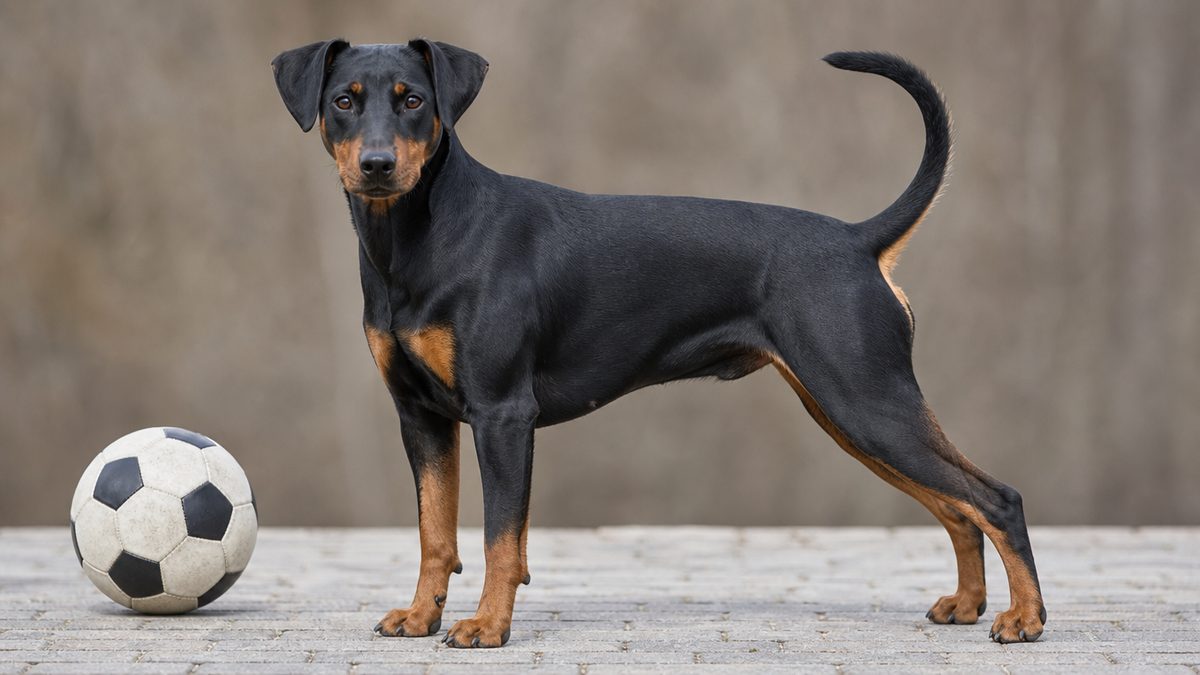
FCI Standard 184 sets height at 45 to 50 cm and weight at 14 to 20 kg for both dogs and bitches, describes an elegant, square, muscular smooth-coated dog, and prints its tail clause in bold to mark it as the most recent amendment.
The breed standard describes the general appearance as "smooth-haired, medium in size with proud carriage, flowing outlines, elegant and square build", strong like the Schnauzer, with well developed muscles clearly visible under the short coat, especially in movement. Proportions are as square as possible, and the head length equals half the length of the topline. Temperament is specified as "lively, spirited, self assured and evenly tempered" combined with intelligence and endurance.
| Point | What the standard requires |
|---|---|
| Height at withers | 45 to 50 cm, dogs and bitches alike |
| Weight | 14 to 20 kg, dogs and bitches alike |
| Coat | Short, dense, smooth, close and shiny, without bald patches |
| Colour | Self coloured deer red to dark red brown, or lacquer black with red or brown markings |
| Markings on black and tan | Above the eyes, throat, pasterns, feet, inside hind legs, under tail root, plus two even clearly separated triangles on the chest |
| Ears | Drop ears, set high, V-shaped, inner edges lying close to the cheeks, turned forward |
| Tail | Natural. A sabre or sickle carriage is sought after |
| Size faults | Over or under size up to 1 cm is a fault; more than 1 cm but under 3 cm is a serious fault; more than 3 cm disqualifies |
The tail clause is in bold, and that is the point
The standard ends with the line "The latest amendments are in bold characters", and the tail clause is the passage printed in bold: "Natural; a sabre or sickle carriage is sought after."; That is the FCI marking, in its own document, the moment this breed stopped being a docked breed. There is no docking instruction anywhere in the current text.
The German dates behind that are precise. Ear cropping was legally banned in Germany on 1 January 1987, and tail docking followed in the PSK from 1998. The 1987 change was not painless: registrations across all six PSK breeds fell by about 20 percent, and some breeders stopped breeding altogether rather than accept it. That is one of the few published figures anywhere quantifying what a cropping ban does to a breed's numbers.
The size has moved twice inside living memory
The German Pinscher's height in the standard was changed to 43 to 48 cm in 1973 and again to 45 to 50 cm in 1987. A breed rebuilt from oversized Miniature Pinschers grew, and the standard followed it upward rather than the other way round. When a seller tells you a dog is small for the breed, ask which decade's standard they have in mind.
One further change matters for coat colour. In 1984 the PSK excluded blue, isabella and chocolate Pinschers from breeding. Hold that thought until the founder section, because one of the four Miniature Pinschers the breed was rebuilt from was chocolate.
The first rescue, in 1920, and the terrier nobody mentions
The German Pinscher was already down to roughly thirty breeding animals in 1920, and it was saved that first time by crossing in Black and Tan Terriers. Almost no English-language page carries this, and it changes how the 1958 rebuild should be read.
The German account is blunt. By 1920 the smooth-haired Pinscher stood on a very weak breeding base, there were only about thirty breeding animals left, most of them in the area around Goeppingen, and Black-and-Tan Terriers were crossed in, which rescued the German Pinscher from extinction for the first time. The same source adds the reason: the genetic base had become so narrow that health problems would probably have destroyed the breed.
The American account agrees on the terrier without dating the crisis, describing the Black and Tan Terrier as having entered the mix in the 1600s and naming it among the Pinscher's extinct ancestors. Both accounts put terrier blood in the breed; they disagree about when and how much. Neither is hidden and neither is provable from a register, so both are stated here rather than merged.
Why a first bottleneck changes the reading of the second
A single genetic bottleneck is an accident. Two, thirty-eight years apart, in the same breed, is a pattern, and it tells you something structural: this dog has never had a large, stable population to draw on. When you read that the modern breed descends from five dogs, remember that those five themselves came out of a population that had already been rebuilt once, from about thirty animals, with an outcross.
This is the same discipline this site applied to the Dutch Smoushond, which was also rebuilt twice, once in the 1930s from a shrinking registered population and once from 1973 with no registered population at all. The lesson generalises. Where a breed's history contains one dramatic rescue, look for an earlier one, because a breed that nearly died once usually nearly died before.
What the register looked like on either side
The Pinscher-Schnauzer-Klub's own numbers give the scale. The first studbook was published at Christmas 1902 in an edition of 300 copies with 453 registered dogs across all Pinscher and Schnauzer types, and by 1924 the studbook held 13,474 entries. Those totals cover six breeds, so the smooth-haired Pinscher's share of them was always small, which is exactly consistent with the thirty animals reported for 1920.
It is worth naming who did the early work, because the club's foundation dates are themselves disputed. Josef Berta and G. Duderstadt laid down the principles of a new club in Nordhausen on 3 March 1895, and the founding assembly followed at Seesen am Harz on 23 May 1895. The Pinscher-Klub merged with the Schnauzerklub Muenchen in 1918 and the combined body was renamed Pinscher-Schnauzer-Klub 1895 e.V. in 1921. The AKC's history article dates the club to 1923, which does not match the German record, and this page uses the German dates.
The club itself is still the largest body of its kind for these breeds. The Pinscher-Schnauzer-Klub 1895 is registered in Cologne under VR 4373, keeps its head office in Remscheid, reports 10,761 members across 17 regional groups, and remains the single club for all six Pinscher and Schnauzer breeds. The AKC's history article dates the club's founding to 1923; the German register and the club's own name both say 1895.
1949 to 1958: the years with no litters, and the man who ended them
No German Pinscher litters were registered in West Germany between 1949 and 1958, and the breed was restarted by Werner Jung, then chief breed warden of the Pinscher-Schnauzer-Klub. How long that gap was depends on which source you read, and this page gives all three answers.
Jung's own report to the PSK annual general meeting in 1956 is quoted in German and it is the primary document. He said that after 1949 the club's studbooks showed no more Pinscher litters, that breeding had continued only in the Soviet zone in the districts of Schmalkalden and Erfurt in Thuringia and there with very few specimens, and that the oldest post-war Pinschers were now thirteen years old and the youngest nine. He then said his appeal should be understood as a last cry of distress, and that if it went unanswered "we can spread the shroud over a legacy from the old days". A year later he reported that he had listened for an echo and heard none.
| Source | What it says | Implied gap |
|---|---|---|
| Werner Jung, PSK AGM 1956, quoted in German | After 1949 the studbooks show no more Pinscher litters | 1949 to 1958, nine years |
| American Kennel Club | No litters were registered in West Germany from 1949 to 1958 | Nine years |
| German Wikipedia | In 1958 a litter was reported again after an eight-year pause | Eight years |
Eight or nine years is not a large disagreement, and it probably turns on whether you count from the last litter or from the first empty year. It is given here rather than smoothed because the same three sources disagree about other things too, and a reader should know how firm the ground is.
The East was failing at the same time, only later
The situation behind the Iron Curtain bought a few years and then collapsed as well. Pinscher breeding in the German Democratic Republic also came to a standstill, just a few years after the West: after 1955, when 18 puppies were bred, the year 1957 produced exactly one puppy. So the last reservoir was a single litter's worth of dogs in Thuringia, and Jung knew it.
What he gave up to do it
Jung was a Giant Schnauzer breeder and the German account says he abandoned his "most dearly loved giants" to gather up the last remnants of Pinscher breeding for a fresh start. The AKC adds the detail that makes the story travel: he located a black-and-red bitch in East Germany and risked his life to smuggle her into West Germany.
Two accounts, two spellings. The German source names her Kitti vom Bodestrand, born 22 May 1955 in the DDR, and calls her the only German Pinscher bitch available for the new beginning. The AKC prints Kitti v Bodestrang. One letter separates them and no register was consulted here that could settle it, so both are recorded. The German spelling is the more likely, since Bodestrand means the bank of the river Bode, which runs through the Harz.
The five founders, named and counted
The modern German Pinscher descends from five dogs: one German Pinscher bitch and four oversized Miniature Pinschers, all registered by the Pinscher-Schnauzer-Klub in 1958. Deutsche Pinscher vom Robinienhof The AKC states the consequence plainly: "Most, if not all, German Pinschers today are descendants of these five dogs."
| Dog | Breed | Sex | Colour | Recorded contribution |
|---|---|---|---|---|
| Kitti vom Bodestrand, born 22 May 1955 (AKC prints Kitti v Bodestrang) | German Pinscher | Bitch | Black and red | Three litters. The only German Pinscher in the programme, found in East Germany and smuggled out |
| Jutta, bred by Jung | Miniature Pinscher, oversized | Bitch | Black | Six litters |
| Fuerst, bred by Jung | Miniature Pinscher, oversized | Dog | Red | Sired one litter. Sire of the first reconstruction litter |
| Illo, of Fischer | Miniature Pinscher, oversized | Dog | Black | Sired one litter |
| Onzo, of Illgen | Miniature Pinscher, oversized | Dog | Chocolate | Sired one litter |
The first litter of the reconstruction fell on 19 December 1958, out of Kitti by Fuerst. So the breed alive today begins on a specific day, from a specific mating, between a smuggled bitch and an oversized dog of another breed.
Count the arithmetic, because it does not quite close
The AKC records that Kitti produced three litters and Jutta six, and that Jung's three Miniature Pinscher males each sired a litter. Three plus six is nine litters from the two bitches, while the three named males account for only three of them. Six litters were therefore sired by something else, most plausibly by sons of the founders, which is precisely the close-relative mating a five-founder rebuild forces. The gap is not an error to be tidied away. It is the shape of the bottleneck showing through the record.
Four fifths of the founding stock was a different breed
This is the sentence no Indian page carries. Four of the five founders were Miniature Pinschers, and the fifth was the last German Pinscher bitch anyone could find. Whatever proportion of the modern dog's genome traces to the pre-war German Pinscher, it passed through a single female in 1955.
The relationship runs in a circle, and the AKC says so in its own words: the ancient Pinscher contributed its genes to a new breed of small pinscher in the 1700s, which became the Miniature Pinscher, and two centuries later the Miniature Pinscher returned the favour and saved the German Pinscher from extinction. A breed rebuilt from its own miniaturised descendant is a genuinely unusual thing, and it explains a great deal about what the dog looks like now.
Onzo, one of the four Miniature Pinscher founders, was chocolate. In 1984 the PSK excluded blue, isabella and chocolate Pinschers from breeding, and the club's health discussions have since included Dilute in the Pinscher as a standing topic. Today a Dilute-Faktor DNA test is compulsory before a German Pinscher may be bred. That is a straight line from a 1958 founder to a 2025 mandatory test.
Continuity of type, or continuity of population? They are not the same
The German Pinscher's type is continuous and its population is not, and keeping those two claims apart is the only honest way to describe this breed. The written standard, the name and the studbook survived 1949; the dogs did not.
Set the two possible claims out plainly. Continuity of population would mean surviving pre-war German Pinschers, or their unregistered descendants, were gathered up and their line resumed. Continuity of type means a written description survived and dogs were bred toward it. Only the second is defensible here, because four of the five founders were Miniature Pinschers and the fifth was one bitch.
| Claim | Continuous? | Evidence |
|---|---|---|
| The written standard | Yes | Breed characteristics first set out in the Deutsches Hundestammbuch in 1880, revised since, never replaced |
| The breed name | Yes | Pinscher, later Deutscher Pinscher, in continuous use |
| The breed club | Yes | Pinscher-Schnauzer-Klub 1895, reorganised after 1945 but never dissolved |
| The studbook | Partly | The book continued; it simply recorded no Pinscher litters between 1949 and 1958 |
| The population itself | No | Restarted in 1958 from five dogs, four of them Miniature Pinschers |
Three statements are all true at once and a good page makes all three rather than choosing one. The German Pinscher is a genuine, definitively recognised FCI breed, accepted on 14 July 1955. Its type is continuous, because the characteristics set out in the Deutsches Hundestammbuch of 1880 were revised rather than abandoned. And its population is not continuous, because it was restarted from dogs of largely different ancestry.
Why this matters to a buyer rather than a historian
It changes what a pedigree means. In a long-closed studbook a pedigree traces back to a founding population; here every line converges on five animals registered in a single year. That is not a criticism of the dogs, which by the German account are sound and pleasant. It is a reason to treat any claim of ancient unbroken lineage, and any price premium attached to it, as marketing.
It also predicts the health picture, and the prediction turned out right. A five-dog founder base concentrates recessive alleles, and a recessive disease that kills puppies now runs at a 12 percent carrier frequency in the genotyped population. You do not need to accept any theory to see the link; you need only compare the founder count with the carrier rate.
There is a real argument on the other side. Jung's rebuild used a closely related breed rather than random look-alikes, which preserved type efficiently, and the club has since layered on compulsory screening: hip radiographs from 1979, tightened in 1983, and three compulsory DNA tests as of 2025. Pinscher-Schnauzer-Klub 1895 e.V. A rebuild followed by fifty years of mandatory screening may end up sounder than a large population with none, and the OFA hip figures for this breed support that reading.
How many German Pinschers exist, from the German register
German breeders registered 288 Deutscher Pinscher puppies with the VDH in 2025, against 251 in 2024, 246 in 2023, 224 in 2022 and 415 in the pandemic year 2021. Three different sources give three different annual figures for this breed, and all three are printed below rather than averaged.
The fifteen-year series shows a breed that has never recovered to a comfortable size. It ran at 407 in 2011 and 413 in 2013, dipped through the late 2010s, hit its low of 224 in 2022, and has climbed back to 288. For comparison, the Deutscher Schaeferhund registered 6,374 puppies in 2025 and the Teckel 4,508. This breed is at four percent of the German Shepherd's German output.
| Breed | 2025 | 2024 | 2023 | 2022 | 2021 |
|---|---|---|---|---|---|
| Deutscher Schaeferhund (German Shepherd) | 6,374 | 6,316 | 6,242 | 8,395 | 10,031 |
| Dobermann | 416 | 363 | 302 | 417 | 442 |
| Schnauzer | 246 | 271 | 265 | 381 | 541 |
| Deutscher Pinscher | 288 | 251 | 246 | 224 | 415 |
| Zwergpinscher (Miniature Pinscher) | 61 | 51 | 68 | 76 | 118 |
| Affenpinscher | 16 | 6 | 15 | 5 | 7 |
Note the last two rows. In Germany today the rebuilt breed registers roughly five times as many puppies as the Miniature Pinscher that rebuilt it, 288 against 61 in 2025. The rescuer is now much the rarer of the two.
Three sources, three annual figures
The VDH's own register table gives 288 for 2025. The VDH's own breed article, written for the PSK's 125th anniversary, says "about 399 puppies of this breed see the light of day annually". A German breeder's history page says the breed currently reaches "about 70 litters with about 470 puppies a year";. The register table shows no year at 470 in the last fifteen, and 399 matches no year exactly either, though 415 in 2021 is close.
The likeliest explanation is that the two prose figures were written at different moments and never revised, and that the 470 figure may count litters registered outside Germany. The register table is the document to trust, because it is the primary record and it is dated. The disagreement is published because the same VDH contradicts itself between its register and its article, and a reader quoting either should know that.
Endangered, officially
In 2003 the Gesellschaft zur Erhaltung alter und gefaehrdeter Haustierrassen presented the Deutscher Pinscher as breed of the year at the Gruene Woche in Berlin, and German Wikipedia records that the German Pinscher was declared an endangered domestic breed that year together with the Spitz. German Wikipedia, Deutscher Pinscher The German breeder's account credits that initiative with a real upswing in demand afterwards. The register does not obviously show one, which is worth noting.
There is no Indian equivalent of any of this. The Kennel Club of India publishes no breed-by-breed registration statistics, so no number exists for how many German Pinschers are registered in India, and any claim that one does should be treated as invented.
German Pinscher price in India
No Indian source publishes a German Pinscher puppy price, and India's largest puppy marketplace lists none for sale. That is the honest answer to the price in india question, and it is more useful than a number would have been.
Four Indian pages rank for the query and none of them prices the dog. Mr n Mrs Pet's German Pinscher page carries the usual sales copy about KCI registered, health-certified, verified breeders and pan-India shipping, and then shows no German Pinscher listing at all. The only animal cards on the page are two French Bulldogs and a Border Collie, and the pagination reads Page 1 of 1. Puppiezo's German Pinscher category carries a single card with no price, and its own breed filter offers only Golden Retriever, Labrador Retriever and Black Toy Poodle.
| Source | German Pinschers listed | Price shown | What is shown instead |
|---|---|---|---|
| Mr n Mrs Pet | 0 | None | Two French Bulldogs and a Border Collie |
| Puppiezo | 1 card | None | A breed filter that does not include the breed |
| Taggie Pet Store | Not a dog | Rs 1,748.25 | A customisable pet identity tag |
| Happy Pet | Miniature Pinscher page | Rs 15,000 to Rs 50,000 | A different, smaller breed |
| Bing India People Also Ask | Not applicable | Not applicable | Two questions about German Shepherds |
What you will be offered instead
Three substitutions are likely and you should be able to tell them apart. A Miniature Pinscher is the same shape at 25 to 30 cm rather than 45 to 50 cm, and Indian pages price it at Rs 15,000 to Rs 50,000. FCI-Standard N 184 A Dobermann is far larger and heavier. And an unregistered smooth red or black-and-tan dog of no particular breeding will look close enough to a German Pinscher in a photograph to sell.
The size test is the quick one. A German Pinscher stands 45 to 50 cm at the withers and weighs 14 to 20 kg, and more than 3 cm outside that height range is a disqualifying fault under the standard. A Miniature Pinscher is roughly half the weight. If a seller cannot or will not weigh and measure the parents in front of you, the conversation is over.
If you want the real thing
The only reliable supply is Germany and the countries around it, which puts an Indian buyer into the import route rather than the market route. Ask for the parents' PSK or equivalent papers, their hip grades, and their Dilute, degenerative myelopathy and GSDA1 DNA results, because a German-bred dog will have all three by rule since 2025. A seller in India who cannot produce them is not selling you a German-bred dog, whatever the pedigree says.
One control makes the zero meaningful. On the same marketplace, on the same day, the site's own Most Popular Breeds counters read 650 Shih Tzus, 549 Siberian Huskies, 487 Golden Retrievers, 454 Labrador Retrievers and 412 German Shepherds, and its German Shorthaired Pointer page returned three results. So the platform does list uncommon breeds when it has them. It has no German Pinschers.
The only rupee price for this breed in India is a name tag
Search for a German Pinscher price in India and the one product that returns an actual rupee figure is a pet identity tag with the breed's picture on it, at Rs 1,748.25 on the live page. Running the division tests on the few available figures confirms there is nothing to convert.
The tag is worth examining because it demonstrates the failure mode cleanly. The page is titled German Pinscher, it is a real Indian shop, it returns HTTP 200, and it has a price. It is a metal tag in a silicone cover, sold with add-ons at Rs 349 for a matching phone grip, Rs 89 for an easy clip ring, Rs 99 for a spare silicone ring and Rs 29 for a spare key ring. Any tool that harvests "German Pinscher" plus a rupee amount from the Indian web will find this before it finds a dog.
The search index and the live page disagree
There is a second lesson on the same page. The search index advertised the product at Rs 999; the live page on 31 August 2026 printed Rs 1,748.25. A snippet is a record of what a crawler saw at some past moment, not a live fetch, and the gap here is 75 percent. Never quote a price from a search result without opening the page.
| Rupee figure | What it actually is | Divided by 84.38 | Divided by 74 | Divided by 66.67 |
|---|---|---|---|---|
| Rs 1,748.25 | A pet identity tag, live page | 20.72 | 23.63 | 26.22 |
| Rs 999 | The same tag, as the search index showed it | 11.84 | 13.50 | 14.98 |
| Rs 349 | A matching phone grip | 4.14 | 4.72 | 5.24 |
| Rs 15,000 | Miniature Pinscher, low end | 177.77 | 202.70 | 225.00 |
| Rs 50,000 | Miniature Pinscher, high end | 592.56 | 675.68 | 750.00 |
Nothing divides cleanly at 84.38 or at 74. The 66.67 column produces round numbers on the two Miniature Pinscher figures, and that proves nothing at all: 66.67 is approximately 200 divided by 3, so dividing by it is the same as multiplying by three and dividing by two hundred, and every figure ending in four zeros lands on a round number by construction. Rs 15,000 becomes 225 and Rs 50,000 becomes 750 for arithmetic reasons, not for economic ones.
This is the same structural weakness this site has recorded for the flat-80 test, where 1,000 divided by 80 is 12.5 so any figure ending in three zeros passes automatically. Report the quotient, not the fact that it divided, and treat a rate as evidence only when the quotient is a price a human being would actually quote and when figures that are not round survive the same test.
The verdict for this breed is short. There is no Indian price list to contaminate. No converted dollar table exists because no Indian seller has published a German Pinscher price at all. Where the German Shorthaired Pointer's Indian pages carry rupee-native invented round numbers, this breed's pages carry nothing, and a page that says so is more useful than one that fills the gap.
For scale rather than as an Indian price: the breed appears in an Indian newspaper's list of expensive breeds at a US dollar figure rather than a rupee one. Converting a foreign price and printing it in rupees is exactly the practice this site has caught elsewhere at 84.38 and at 74, and doing it here would manufacture an Indian market that does not exist. No converted figure appears anywhere on this page.
What happens when you search for this breed in India
Searching german pinscher on Bing India returns ten results about learning the German language, at HTTP 200, with the correct page title and About 145,000 results printed above them. A control query run in the same session returned genuine results, so the engine was working and the result set for this breed was substituted.
The ten organic results were free German grammar exercises, vocabulary builders, an encyclopaedia entry on the German language as an Indo-European West Germanic language, a description of Germany as a developed country with the largest economy in Europe by nominal GDP, a language-learning app, and the Goethe-Institut. Not one of them mentioned a dog. Nothing errored, nothing looked broken, and the count looked authoritative.
The control is what makes this reportable. labrador retriever, run in the same session, in the same market, through the same tool, returned ten genuine Labrador results: an encyclopaedia entry on the British retriever gun dog, the AKC breed page, Indian puppy listings, care guides and an Indian breed guide for Indian pet parents. So the tool was working. Only this breed's results were replaced.
| Query | Status | Result count printed | What came back |
|---|---|---|---|
| german pinscher | HTTP 200 | About 145,000 | Ten results about learning the German language |
| labrador retriever | HTTP 200 | About 32,600 | Ten genuine Labrador Retriever results |
| german pinscher price in india | HTTP 200 | About 8,560 | On-topic results, plus a People Also Ask box with no German Pinscher question in it |
Notice the result counts. The substituted query printed the largest number of the three, 145,000 against 32,600 for the Labrador. A big count is not evidence of coverage; here it is evidence that the engine matched on the word German rather than on the breed.
The People Also Ask box is about a different dog
The commercial query did work and did return a People Also Ask module, and its four questions are recorded verbatim in this page's SERP data. They are: how much does a German Shepherd Dog cost in India, how much does a German Shepherd puppy cost, how much does a dog cost in India in 2026, and how much does a dog cost in India. Not one is about the German Pinscher. Three of the ten organic results on that same page were German Shepherd price articles.
That is the most precise available measure of Indian demand for this breed. A search engine builds its question box from what people actually ask, and for this query it had no German Pinscher question to show, so it showed German Shepherd questions instead. A page claiming a busy Indian market for this dog is contradicted by the search engine's own furniture.
The FAQ below answers those four questions in the words they were asked, because that is what a reader who typed this query is actually shown. Rewriting them into tidier German Pinscher questions would break the match and would misrepresent what the SERP contains. Each answer says plainly which breed it is about and points to the right guide.
Monthly cost of ownership in India
Budget roughly Rs 2,200 to Rs 3,750 a month to keep a dog of this size and coat type in an Indian metro, using the only comparable itemised Indian breakdown available, which is published for the Miniature Pinscher. No Indian source publishes a cost of ownership breakdown for the German Pinscher itself.
Say what the substitution costs you before using it. A German Pinscher weighs 14 to 20 kg against a Miniature Pinscher's 4 to 6, so food is the line that will not transfer: expect it to run two to three times the smaller breed's. Grooming, veterinary routine and consumables scale much less steeply, because a short smooth coat is a short smooth coat at any size.
| Line | Published, Miniature Pinscher | How it transfers |
|---|---|---|
| Food | Rs 1,200 to Rs 1,800 | Scales with bodyweight. Expect two to three times this |
| Veterinary, routine | Rs 300 to Rs 750 | Broadly transfers. Drug doses scale, consultations do not |
| Grooming | Rs 700 to Rs 1,200 | Transfers almost exactly. Both are short smooth coats |
| Total, basic lifestyle | Rs 2,200 | A realistic floor rather than a forecast |
| Total, premium lifestyle | Rs 3,750 | Before any breed-specific screening |
So a defensible working figure for a German Pinscher in an Indian metro is the published Rs 2,200 to Rs 3,750 with the food line roughly doubled, which lands somewhere near Rs 3,500 to Rs 5,500 a month before anything unusual happens. That is an estimate built by adjusting a published figure, not a published figure, and it is labelled as such.
The lines no Indian cost table for this breed includes
- Year-round tick and flea prevention. Not optional in India, and a recurring monthly cost every Indian breed table omits.
- Three DNA tests if you intend to breed or simply want to know: Dilute, degenerative myelopathy and glycogen storage disease type Ia, all three compulsory in Germany before breeding.
- Hip radiographs under sedation, which the German club has required for this breed since 1979.
- Import cost, which for most Indian buyers is the only route to a documented dog and dwarfs every other line here.
- Cooling through the hot months, which for a Chennai household is ten months of the year on the 30-year monthly means.
- An emergency fund. A puppy affected by glycogen storage disease type Ia needs intensive supportive care and the outcome is poor.
The honest summary is that the recurring cost of this breed in India is modest and the acquisition cost is the whole problem. A 14 to 20 kg short-coated dog is cheap to keep. Getting a documented one to India is not.
Suitability for the Indian climate
Goeppingen, where the last thirty German Pinschers sat in 1920, has no month whose 30-year mean temperature reaches 25 degrees Celsius, and its January mean is minus 1.12. Chennai has ten months above 25 and never falls below 23.99. That is the heat tolerance question answered with numbers.
The figures below come from NASA's Prediction Of Worldwide Energy Resources climatology, 1991 to 2020, queried by explicit latitude and longitude so that no place-name slug can quietly hand back a different city. Wet-bulb is computed from the same air temperature and humidity fields with Stull's approximation, and it matters more than air temperature for a dog, because panting cools by evaporation and evaporation stalls as air approaches saturation.
| Place | Annual mean C | Hottest month | Peak wet-bulb month | Months over 25 C |
|---|---|---|---|---|
| Goeppingen, Germany (48.703 N, 9.653 E) | 8.45 | Jul, 18.22 | Jul, 14.87 WB | 0 of 12 |
| Erfurt, Thuringia (50.985 N, 11.030 E) | 8.72 | Jul, 18.93 | Jul, 15.05 WB | 0 of 12 |
| Chennai (13.083 N, 80.271 E) | 27.91 | May, 31.57 | May, 26.03 WB | 10 of 12 |
| Mumbai (19.076 N, 72.878 E) | 26.65 | May, 31.03 | Jun, 25.68 WB | 9 of 12 |
| Kolkata (22.573 N, 88.364 E) | 25.83 | May, 31.55 | Jun, 26.99 WB | 8 of 12 |
| Hyderabad (17.385 N, 78.487 E) | 26.04 | May, 33.31 | Jun, 23.32 WB | 7 of 12 |
| Delhi (28.614 N, 77.209 E) | 25.65 | Jun, 35.95 | Jul, 26.43 WB | 7 of 12 |
| Pune (18.520 N, 73.857 E) | 23.74 | Apr, 28.74 | Jun, 22.90 WB | 4 of 12 |
| Shimla (31.105 N, 77.173 E) | 21.10 | Jun, 30.35 | Jul, 23.14 WB | 4 of 12 |
| Bengaluru (12.972 N, 77.595 E) | 23.63 | Apr, 28.41 | May, 21.74 WB | 3 of 12 |
Two places on that list deserve naming. Erfurt is one of the two Thuringian districts where the only post-war Pinscher breeding survived, and where the founder bitch Kitti was born in 1955. Its July wet-bulb mean is 15.05 C. Goeppingen is where the 1920 remnant sat, and its July wet-bulb mean is 14.87 C. Kolkata's June figure is 26.99. The gap between this breed's two documented refuges and an Indian monsoon city is roughly twelve wet-bulb points.
The short coat helps, and it is not the whole story
A short, dense, close-lying single coat is a genuine advantage in Indian heat compared with a double-coated breed, and the German register calls this dog robust and happy outdoors in any weather. That claim was written about German weather. Nothing in the breed's history involves heat, and no dog is heat-tolerant simply because its coat is short.
The transferable evidence is bodyweight rather than coat. In the UK heat-illness analysis, dogs at or above their breed and sex mean bodyweight carried an odds ratio of 1.42 for heat-related illness, with a confidence interval of 1.12 to 1.80. A German Pinscher weighs 14 to 20 kg, so it is nowhere near the over-50 kg high-risk band, and the breed itself was not modelled separately. The finding that applies is the weight one, and this is a breed with a visible waistline that makes overweight easy to spot.
The companion paper puts the trigger split in the right place. Of 1,259 heat-related illness events, 380 had no trigger recorded, leaving 879 with a recorded trigger, of which 652 were exertional, which is 74.2 percent, against 113 environmental and 46 from vehicular confinement. Those percentages are computed on 879, not on 1,259. For an Indian owner the practical reading is that the dog is likelier to overheat during exercise than sitting at home, so the fix is to move the walk, not to shorten it.
Where in India this breed is actually comfortable
Bengaluru, Pune and the hill stations are the Indian places where a German Pinscher can work outdoors most of the year; Chennai, Mumbai and Kolkata are the places where its exercise has to be moved to two windows a day, every day.
- Bengaluru. Three months above a 25 C monthly mean and a peak wet-bulb of 21.74 C in May, the mildest large-city figure in this table. A fit adult can walk and play at most hours for most of the year.
- Pune. Four months above 25 C, peak wet-bulb 22.90 C in June. Comfortable mornings almost year round.
- Shimla and the hills. Peak wet-bulb 23.14 C in July, which is higher than people expect because the monsoon saturates the air. Still the easiest Indian option outside the monsoon months.
- Delhi. Seven months above 25 C and a June air-temperature mean of 35.95 C, but dry heat, which a dog manages better than the July and August wet-bulb peak of 26.43 C and 26.13 C. Winter, at a January mean of 13.83 C, suits this breed well.
- Hyderabad. Seven months above 25 C, peak wet-bulb 23.32 C, drier than the coast and easier than Chennai for the same air temperature.
- Mumbai, Chennai and Kolkata. Nine, ten and eight months above 25 C respectively, and wet-bulb peaks of 25.68, 26.03 and 26.99 C. Work the dog before sunrise and after dark, all year, and treat the monsoon as a skin and ear season rather than a cool one.
The practical rules, in order of usefulness
Move the session rather than shorten it. A 45-minute walk at 5.30 am is a different physiological event from the same walk at 11 am, and the dog needs the exercise either way. Carry water on every session from March to October and offer it before the dog looks like it needs it. Keep the dog off hot tar and hot sand, because a 14 to 20 kg dog carries its whole body close to a radiating surface.
Know the emergency signs before you need them. Heavy panting that does not settle within a few minutes of stopping, brick-red gums, unsteadiness, and vomiting are an emergency rather than a rest break. Pour tap-temperature water over the whole body, get the dog into moving air, and drive to a clinic rather than waiting to see whether it improves.
The monsoon is the other half of the problem
Indian humidity does more to this breed than Indian heat does. The V-shaped drop ear folds forward against the cheek and traps moisture, and German Wikipedia records a specific breed weakness on top of that: the ears are only thinly covered with hair and the ear margins are very thin, so the dog injures its ear edges easily. A thin, damp, easily-split ear margin in a Mumbai August is a problem a German care guide has no reason to mention.
Dry the inside of the ear flap after every bath, every swim and every soaking walk. Check the ear margins weekly for splits and crusting. And treat a persistent head shake as a symptom rather than a habit, because in Indian conditions it usually is one.
Temperament and household fit
The German Pinscher is a watchful, energetic, self-assured house dog that announces visitors without being a barker, and the FCI standard specifies a lively, spirited, self assured and evenly tempered nature combined with intelligence and endurance.
The German description is consistent across sources. The VDH calls it companionable, affectionate and markedly playful, extremely watchful, letting no uninvited guest into its territory while not being a yapper, self-assured, clever and possessed of great endurance. German Wikipedia adds that it is a sparing barker, very attentive, quiet indoors and very lively outdoors, and that high self-confidence is a wanted trait in this breed which shows itself in how the dog behaves toward its owner.
Read that last clause carefully, because it is a warning written politely. A breed in which self-confidence toward the handler is a desired trait is a breed that will test you. The AKC's owners describe the same dog as intelligent, willing to learn, playful, curious, manipulative, assertive, possessive and protective of belongings, home and family, aloof to strangers, highly sight-responsive and with a strong prey drive.
Who this breed suits in India
- Households wanting a real watch dog in a 14 to 20 kg package rather than a 40 kg one.
- Owners who enjoy training and will keep doing it past the first year.
- Flats and small houses, provided the daily exercise genuinely happens. This is a compact dog that is quiet indoors.
- People who are home often. Both German sources stress that being included matters to this dog and that being left alone is close to intolerable for it.
Who it does not suit is the household that wants a dog to ignore. This breed notices everything, tells you about it, and gets into trouble when bored. The German account of it as a Rattenfaenger is not decorative: the talent for killing rats is described as genetically fixed and still visible today.
Prey drive on an Indian street
The prey drive that made this dog useful in a German stable is a liability in an Indian city. Free-roaming cats, poultry, goats and community dogs sit at densities no German suburb has, and a Pinscher that has locked onto a cat across a road is not listening. Keep it on a lead in every unfenced space until the recall is proof-tested under distraction, socialise it heavily to street animals from the day it comes home, and accept that some individuals never become reliable off lead in a city.
With other dogs it is variable rather than uniformly friendly, and it is not a naturally submissive animal. Early, careful, positive introductions matter more here than they would with a retriever, and a household already containing a pushy dog of the same sex is a poor place to add one.
Training approach, and what this breed resists
To train a German Pinscher, use short daily sessions with a real reward and start the recall on day one, because this is a fast learner that will just as quickly train you if you let it.
German Wikipedia puts it economically: Pinschers learn quickly and are adaptable, versatile and practical dogs. The VDH adds that the breed runs at full tilt in dog sport, scoring in turnier-hundsport, agility and many other disciplines. Both are describing a highly trainable animal, and both are describing what happens when you give it a job.
The four things to teach first, in order
- Recall, before anything else, paid every single time for the first year. This is the command that keeps a prey-driven dog alive on an Indian road.
- Settle on a mat, because a dog that cannot switch off indoors will not cope with the months when its exercise window is two hours a day.
- Quiet on cue, taught early. This breed is not a yapper by German account, but it is a serious alarm barker and a flat in a dense Indian neighbourhood gives it a great deal to alarm about.
- Loose-lead walking, taught while the puppy is under 8 kg rather than after it is 18 kg.
What the breed resists is repetition without purpose and correction without fairness. A dog bred to make its own decisions about rats will offer alternatives when a drill goes stale, and an owner who reads that as defiance and escalates gets an evasive dog. Keep sessions to five or ten minutes, end while the dog still wants more, and change the picture often.
Use the nose and the hunt, especially in the hot months
Scent games are the single most useful Indian adaptation for this breed. Twenty minutes spent finding six hidden pieces of food in a flat tires a Pinscher in a way a slow lead walk cannot, and it can be done indoors at two in the afternoon in May. Flirt-pole work, in short bursts and on a soft surface, gives the prey drive somewhere legitimate to go. So does a rat-shaped lure on a line, which is simply the breed's own job in miniature.
The Indian training market, honestly
You will not find a trainer in India who has worked this breed. There are effectively none here. Choose a trainer on method rather than on breed experience: reward-based, willing to work with prey drive rather than suppress it, and comfortable with a small confident dog that argues. A trainer who proposes a prong collar for a 16 kg Pinscher with a good nose has misdiagnosed the problem.
One more piece of German context worth carrying. Unlike the German Shorthaired Pointer, whose FCI entry says "with working trial", the German Pinscher's entry says explicitly that it is not subject to a working trial. Nobody has to prove this dog can work before breeding it, and that puts the whole burden of producing a trainable, stable animal on the individual breeder rather than on a test.
The real daily exercise requirement
Plan on 60 to 90 minutes of real activity a day for an adult German Pinscher, split across two sessions, with the mental half taken seriously. This is a compact dog with a working engine, not a lapdog that happens to be short-coated.
The German sources describe the exercise needs in terms of the dog's uses rather than in minutes. The VDH lists it as a keen competitor in turnier-hundsport and agility and says it is robust and gladly out in nature in any weather. German Wikipedia adds that it is usable as a riding-companion dog and in dog sport, that it is quiet in the flat and very lively outside, and that its inclination to explore its own patch independently is individually variable. Read together, that is a dog needing an hour or more.
For a lower bound, the closest itemised Indian figure is the Miniature Pinscher's published 30 to 60 minutes a day. A German Pinscher is three to four times the weight with the same temperament, so treat 60 to 90 minutes as the working figure and 30 as the number that produces a destructive dog.
| Activity | Where it works in India | Notes |
|---|---|---|
| Free running on a secure ground | Fenced terrace, gated layout park, farm | Highest value per minute. This dog will not be recalled off a cat |
| Flirt pole or lure work | Terrace, corridor, small garden | Legitimate outlet for the prey drive. Short bursts, soft surface |
| Scent and puzzle work | Anywhere, any hour | The summer and monsoon substitute. Tires the dog mentally |
| Agility and turnier-hundsport | Where a club exists, which in India is rare | The breed's own sport in Germany |
| Cycling or running alongside | Early morning service roads | Good on a fit adult over 15 months, never in heat |
| Lead walking | Everywhere | Necessary, and on its own nowhere near enough |
What an under-exercised German Pinscher does
It does not sulk. It patrols, barks at everything on the stairs, chews, digs into planters, escapes through gaps you did not know existed, and redirects onto other pets. Both German descriptions of a quiet indoor dog assume the outdoor half of the bargain has been kept. A Pinscher that has not been out is not a quiet indoor dog.
The Indian complication is seasonal rather than fatal. In Chennai the workable window is roughly 5 am to 7 am and after 8 pm for ten months of the year on the monthly means. Build the routine around those hours from the first week rather than discovering them in April, and use scent work to fill the middle of the day. A dog that gets its hour split into two cool sessions plus twenty minutes of nose work is a well exercised dog in any Indian city.
Grooming a smooth coat in Indian humidity
Groom a German Pinscher with a rubber mitt once a week and spend the rest of your grooming attention on the ears and the nails, because the coat is the easiest part of this dog and the ear margins are the hardest.
The standard describes the coat as short and dense, smooth, close and shiny, without bald patches. There is no undercoat to blow, no furnishings to mat and no trimming to book. A rubber curry mitt once a week lifts the loose hair, and a damp cloth handles dust. For an Indian household the practical grooming budget is the Rs 700 to Rs 1,200 a month published for the comparable smooth-coated Miniature Pinscher, and most of that is optional.
Shedding is real but low volume. A short single coat sheds fine hairs continuously rather than in seasonal drifts, and those hairs weave into upholstery. It is a smaller problem than a double coat presents and a larger one than the phrase low maintenance suggests.
The ear margins are the breed-specific job
German Wikipedia names a problem no English page carries: some German Pinschers struggle with the so-called Ohrrandproblem, the ear-margin problem, because the ears are only thinly covered with hair and the ear margins are very thin, so the dog easily injures the edge of its ear. Add Indian humidity, monsoon damp and a fly population and a split ear margin becomes a slow-healing, easily re-opened wound.
- Dry inside the ear flap after every bath, swim or soaking walk. Cotton wool, no water down the canal.
- Check the ear margins weekly for splits, crusts or thickening, especially along the outer edge.
- Treat a split margin as a veterinary problem rather than a scab. They re-open and get fly-struck in Indian conditions.
- Keep flies off with a veterinary-approved repellent rather than a household one, and never use a product not cleared for dogs.
- Trim the nails every two to three weeks. A cat-footed dog on hard Indian flooring wears its nails unevenly.
Every brushing session is a tick check
In a study of 230 free-ranging dogs across four areas of Chennai, 229 of 230, that is 99.6 percent, were infested with ticks, at a mean intensity of 5.6 ticks per dog, and 98.3 percent of the infestations were the brown dog tick. Those were street dogs, so the figure is an upper bound for a well-kept pet on a preventive, but the tick population is the same population and a short coat makes the dog easier to check rather than less exposed.
Run your hands over the ears, the neck, between the toes and under the tail every time you groom. On a smooth red or black-and-tan coat a feeding tick is easy to see, which is one genuine advantage this coat has in India.
Health screening and the numbers behind it
The German Pinscher records 2.7 percent hip dysplasia across 695 OFA hip evaluations, against 14.2 percent across 1,712,643 evaluations for all breeds combined, which makes it one of the structurally soundest breeds in the register. Forty-six years of compulsory German hip screening is the most likely reason.
Every figure below was read from the Orthopedic Foundation for Animals statistics tables, matched on the printed breed label GERMAN PINSCHER rather than on a guessed code. The code itself is GMP, read out of OFA's raw markup where the attribute reads value="GMP" data-name="GERMAN PINSCHER". The obvious guess, GP, belongs to the Great Pyrenees, which would have returned a complete and entirely wrong table. A Labrador Retriever control run against the same dump returned fourteen populated tables in the same session, so the instrument was working.
This breed's health issues fall into two groups that have to be read separately, because they point in opposite directions. The orthopaedic and screening record is excellent and is the product of half a century of compulsory German examination. The genetic record carries one severe recessive disease that the 1958 bottleneck concentrated. A page that reports only the first is selling; a page that reports only the second is scaremongering.
| Screen | GP evaluations | German Pinscher result | All breeds | All-breeds result |
|---|---|---|---|---|
| Hips | 695 | 96.4% normal, 2.7% dysplastic | 1,712,643 | 84.3% normal, 14.2% dysplastic |
| Elbows | 160 | 98.1% normal, 1.9% abnormal | 650,254 | 87.8% normal, 12.0% abnormal |
| Eyes | 1,087 | 94.5% normal, 5.5% abnormal | 887,398 | 93.4% normal, 6.5% abnormal |
| Congenital cardiac | 287 | 98.3% normal, 1.4% abnormal | 209,851 | 98.9% normal, 0.5% abnormal |
| Advanced cardiac | 190 | 93.2% normal, 3.7% abnormal | 93,487 | 91.2% normal, 5.4% abnormal |
| Thyroid | 117 | 83.8% normal, 12.8% equivocal | 121,451 | 84.8% normal, 10.0% equivocal |
| von Willebrand | 263 | 95.1% normal, 4.9% carrier, 0% affected | 17,766 | 93.3% normal, 5.9% carrier, 0.8% affected |
| Degenerative myelopathy | 68 | 95.6% normal, 4.4% carrier, 0% affected | 90,538 | 65.5% normal, 21.3% carrier, 13.2% affected |
The breed beats the all-breeds figure on hips, elbows, eyes, advanced cardiac, von Willebrand and degenerative myelopathy, and is slightly worse on congenital cardiac, at 1.4 percent abnormal of 287 against 0.5 percent of 209,851. Given a sample of 287, four abnormal dogs would produce that figure, so treat it as a signal to have a puppy's heart listened to rather than as an established breed problem.
Check the arithmetic, including OFA's own
The German Pinscher's hip row prints 20.3 percent excellent, 67.9 percent good and 8.2 percent fair, which sum exactly to the 96.4 percent normal. Its dysplastic components print 1.9 mild, 0.9 moderate and 0.0 severe, which sum to 2.8, against a printed dysplastic total of 2.7. That is a one-tenth-of-a-point rounding inconsistency inside a single published row, and it is worth flagging rather than repeating silently.
OFA's own all-breeds row is worse. It prints 84.3 percent normal while its component columns read 14.6 percent excellent, 0.0 percent good and 0.0 percent fair, which cannot sum to 84.3 and does sum correctly on every individual breed row in the same table. The comparison column above uses the number OFA prints, with that caveat attached. Add a source's percentages up before you build an argument on them.
Two limits to state plainly. Sample sizes here are small: 68 dogs for degenerative myelopathy and 117 for thyroid are not a population, and a single extra abnormal result would move those percentages by a point. And the eye figure is a summary line only, with no per-diagnosis detail reachable from this environment on 31 August 2026, so no claim is made here about which conditions the 5.5 percent were.
The disease the bottleneck left behind, with its denominator
Twelve percent of 208 genotyped German Pinschers carry the variant that causes glycogen storage disease type Ia, a fatal recessive liver disease of puppies, and the causal mutation was only identified in 2021. Christen M, Reineking W, Beineke That is the measurable consequence of a five-dog founder base.
Christen and colleagues, publishing in *Animal Genetics* in 2021, investigated two affected purebred German Pinscher puppies. Whole genome sequencing of one revealed a homozygous 76 base-pair insertion into exon 5 of the G6PC1 gene, consisting of 60 consecutive adenines plus a 16 base-pair duplication of the integration site, which probably causes a loss of function. The disease is a single-gene, autosomal recessive disorder, so a puppy must inherit the variant from both parents to be affected.
The prevalence figure is the one to carry away. Christen et al. genotyped 208 German Pinscher dogs for the German Pinscher variant and identified a carrier frequency of 12 percent. Roughly one dog in eight in that sample carried it. Under simple Hardy-Weinberg expectation, a random mating between two carriers produces a quarter affected puppies, so at that carrier frequency an untested breeding programme will produce affected litters.
What the disease does
Glycogen storage disease type Ia is not a manageable condition. Glucose-6-phosphatase catalyses the production of glucose from glucose-6-phosphate, and without it glycogen accumulates, particularly in the liver. Signs include severe hepatomegaly, poor body condition, lethargy, failure to thrive, coma and death, and affected animals become hypoglycaemic when fasted and develop lactic acidosis, hypertriglyceridaemia and hyperuricaemia. Onset is at birth. There is a genetic test.
The prognosis is the part that decides how seriously to take a carrier result. Affected puppies may first present at a few weeks old with an enlarged abdomen and poor weight gain since birth, and without intervention they rarely survive more than a few weeks; with palliative dietary therapy, a high-starch diet fed frequently through the day with only small amounts of protein and fat, some survive to adulthood but the long-term outlook stays guarded. Across one commercial testing population the variant is found in about 1 in 100,000 dogs of all breeds, which is the measure of how concentrated 12 percent inside one small breed really is.
The same OMIA entry records the only other breed in which this disease is documented, the Maltese, where a different mutation was identified in 1997 that leaves the enzyme with fifteen times less activity. Two breeds, two independent mutations in the same gene, and the German Pinscher's arrived through a population rebuilt from five dogs.
Germany made the test compulsory in 2025
The Pinscher-Schnauzer-Klub's implementing provisions, valid from 15 September 2025, list three DNA tests a Deutscher Pinscher must have before it may be bred: the Dilute factor, degenerative myelopathy from January 2025, and GSDA1, glycogen storage disease, from 15 July 2025. The permitted mating scheme is free by free, or free by carrier, and never carrier by carrier. A test counts only if a vet confirmed the dog's identity when the sample was taken, and where both parents are homozygous free the puppies inherit the status automatically.
One note on the document itself. The extraction of that PDF renders the degenerative myelopathy date both as 10.1.2025 and as 1.01.2025, and the GSDA1 date both as 15.07.2025 and as an impossible 10.57.2025. The dates used here are January 2025 and 15 July 2025, which are the readings consistent across the document, and the corruption is reported rather than hidden.
Ask for the sire's and dam's hip grades with the assessing body named. Ask for their GSDA1 result. Ask for their Dilute result. A German-bred dog registered after mid-2025 will have all three by rule. A seller who has never heard of glycogen storage disease type Ia is not breeding this breed responsibly, whatever else is on the pedigree.
The test itself is ordinary to obtain. A European laboratory lists it as test number 8322, run on 0.5 ml of EDTA blood or two cheek swabs, with a turnaround of 7 to 14 working days, and records the German Pinscher variant as an insertion in G6PC against the Maltese variant's single base substitution. There is no reason for a breeder anywhere to be unable to answer the question.
The Indian health load, and the screening history behind the good numbers
In India this breed's largest exposures are ticks and the diseases they carry, and a microscope will miss most of them. In Haryana, blood smears found 12.5 percent of 120 dogs positive while PCR on the same dogs found 64.16 percent.
Take the Haryana study first, because its lesson is procedural. Bhagwan and colleagues examined 120 suspected dogs in and around Hisar. Giemsa-stained thin blood smears found 15 dogs, 12.5 percent, positive for a canine tick-borne disease. PCR on the same animals found 77 dogs, 64.16 percent. Of the 77 PCR-positive dogs, 56 carried one haemoparasite and 21 carried two or more. *Hepatozoon canis* led at 35 percent, then *Ehrlichia canis* at 25.8 percent, *Babesia vogeli* at 20 percent and *Babesia gibsoni* at 2.5 percent, with H. canis plus E. canis the commonest co-infection at 7.5 percent. A negative smear misses roughly four infected dogs in five.
The Chennai series gives the exposure side. Of 230 free-ranging dogs, 229 carried ticks and 156, that is 67.8 percent, were positive for at least one vector-borne pathogen: *Hepatozoon canis* 37.8 percent, *Anaplasma platys* 22.6 percent, *Ehrlichia canis* 16.1 percent, *Babesia vogeli* 10 percent. Those were street dogs and the figures are an upper bound for a pet on a preventive, but the tick population does not distinguish.
- Use a veterinary-prescribed tick preventive year round rather than seasonally. The brown dog tick completes its cycle indoors in Indian conditions.
- Ask for PCR rather than a smear when a dog has unexplained fever, lethargy, pale gums or bruising. The Haryana gap is the reason.
- Check by hand after every outing, concentrating on ear margins, neck, between the toes and under the tail.
- Treat the environment as well as the dog. Kennel cracks, bedding seams and cane furniture are where the population actually lives.
- Watch the platelet count. *Anaplasma platys* and *Ehrlichia canis* both attack platelets and both are common in the Indian series above.
Why the German screening history matters to an Indian buyer
The OFA hip figure did not happen by accident. Hip radiography became compulsory for Giant Schnauzers, Schnauzers and German Pinschers in the PSK from 1979, initially admitting HD0, HD1 and HD2 to breeding, with HD2 permitted only if the partner graded HD1 or HD2. From 1983 only HD0 or HD1, which are today's A and B, were allowed. Forty-six years of that, on a small closed population, is what a 2.7 percent dysplastic rate across 695 evaluations looks like from the inside.
German Wikipedia summarises the current regime the same way from the other end: the German Pinscher is a breed burdened with only a few breeding-related hereditary diseases, with hip examination compulsory in breeding alongside voluntary preventive screening for hereditary eye disease, Dilute and von Willebrand disease. The PSK's own implementing provisions have since moved two of those from voluntary to compulsory.
So the honest verdict on this breed's health is two-sided and both sides should be said. A five-dog founder base left a 12 percent carrier frequency for a fatal recessive disease. Half a century of compulsory screening left one of the best hip records in the OFA register. Neither cancels the other.
Indian law, and why this breed could not have been rebuilt here
Rebuilding a breed the way the German Pinscher was rebuilt would breach Indian law twice over. Second Schedule Part II paragraph 6(9) of the Dog Breeding and Marketing Rules, 2017 prohibits breeding to create new breeds, and paragraph 6(3) prohibits the close matings that a five-founder rebuild requires.
Paragraph 6(9) is a single sentence and it is unqualified:
"(9) Breeding to create new breeds of dogs or unusual looks shall be strictly prohibited."
Note the citation form. This is a paragraph of the Second Schedule, not a Rule, so it is Second Schedule Part II para 6(9) and never "Rule 6(9)". The Rules do contain a genuine Rule 6, headed "Requirements to be met by breeders and establishments used for breeding or housing dogs for breeding", and its function is to make the Second Schedule binding. Citing a Schedule paragraph as a Rule sends anyone who checks to the wrong text.
Whether crossing four Miniature Pinschers into one German Pinscher bitch counts as creating a new breed is arguable. What is not arguable is the second clause, which bites without any interpretation at all:
"(3) The following two mating techniques are not permitted and are prohibited under these rules, namely:- (i) in breeding ... breeding between relatives of the 2nd to 4th grade in straight or side line within the first four generations e.g. uncle to niece, nephew to aunt, cousin to cousin, grandparents to grandchildren; (ii) incest breeding - mating between parents and children or between brother and sister, i.e. 1st grade relatives"
A population founded on five animals cannot avoid mating relatives of the second to fourth grade within four generations. It is arithmetically impossible: after two generations every dog descends from the same five, and cousin-to-cousin matings are the only ones available. The German Pinscher's own reconstruction would have been unlawful in India from its second generation onward, and that is worth stating plainly, because breed revival is a growing activity and an Indian reader inspired by this story would be walking into a named prohibition.
The clauses that do apply to a dog you own here
Two more provisions bear on this breed directly. Second Schedule Part II para 6(8) states that "There shall be no tail docking, ear cropping, de-barking, de-clawing, branding, dyeing, injecting substances to enhance visual appeal ... and any change of appearance by artificial means is strictly forbidden." Germany reached the same position by separate routes, banning ear cropping from 1 January 1987 and tail docking in the PSK from 1998. The current FCI standard requires a natural tail and drop ears, so a cropped or docked German Pinscher is wrong under the standard and unlawful under Indian law at the same time.
Second Schedule Part III para 8(10) requires that breeding dogs "shall have been tested for genetic defects, including hip dysplasia, progressive retinal atrophy, night blindness, hypothyroidism, entropion, ectropion, overshot, undershot jaw ... wry mouth, two or more missing teeth, unilateral cryptorchid or full cryptorchid males." Hip dysplasia is the breed's own compulsory German screen, and the standard's own disqualifying faults include over- and undershot bite and wry mouth. The word in the clause is "including", so the list is illustrative and glycogen storage disease is not excluded merely because it is unnamed.
Do not overclaim in the other direction either. Across all fourteen pages of the gazette the words patella and luxation appear zero times, dental and tooth appear zero times, and BAER and deaf appear zero times. There is no Indian patellar-grading requirement and no Indian hearing-test requirement, whatever a seller tells you. And Rule 8(1)(a), which is a genuine Rule, requires that pups under eight weeks are not sold.
Feeding and body condition
Feed an adult German Pinscher two measured meals a day and score the dog rather than the bowl, because a square, lean, visibly muscled breed makes a weight problem obvious weeks before a scale does.
The standard is unusually helpful here. It asks for a build as square as possible, with well developed muscles clearly visible under the short coat, especially in movement, and flanks not too tucked up forming a nicely curved line with the underside of the ribcage. That is a description of correct body condition written into the breed specification. If you cannot see the muscle definition and the underline curve, the dog is carrying too much.
No Indian feeding figures exist for this breed. The nearest published Indian food budget is the Miniature Pinscher's Rs 1,200 to Rs 1,800 a month at 4 to 6 kg. A German Pinscher at 14 to 20 kg needs roughly two to three times that, so plan on Rs 2,500 to Rs 5,000 a month depending on what you buy. That is an adjustment of a published figure, not a published figure.
Why weight matters more in India than in Germany
The UK heat-illness analysis found dogs at or above their breed and sex mean bodyweight carried an odds ratio of 1.42 for heat-related illness, with a confidence interval of 1.12 to 1.80. In an Indian summer an overweight Pinscher is not merely an unfit Pinscher. And the Indian trap is seasonal: exercise falls in April and May because the heat allows less of it, the food does not fall with it, and two kilograms go on before anyone notices. On a 16 kg dog that is 12 percent of bodyweight.
Weigh the dog monthly on the same scale and cut the ration when the trend moves, not when the shape changes. Do not free-feed. A measured bowl is the only way to catch a trend early and the only way to notice the day the dog stops eating.
The one feeding rule that is breed-specific
A puppy from untested parents needs its blood glucose taken seriously. Glycogen storage disease type Ia makes affected animals hypoglycaemic when fasted, with onset at birth, and the signs include failure to thrive, lethargy and coma. A German Pinscher puppy that is small, weak, pot-bellied and worse after a missed meal is a veterinary emergency and a reason to ask about the parents' GSDA1 status, not a fussy eater.
- Split the daily ration into two measured meals, three for a puppy under six months.
- Provide water constantly, and carry it on every session from March to October.
- Store dry food in a sealed container. Indian humidity turns an open bag rancid faster than the printed shelf life suggests.
- Introduce any change over seven to ten days.
- Keep treats inside the daily ration rather than on top of it. Training a clever dog uses a lot of food.
Month by month through the first year in India
Plan the first year around three fixed points: the socialisation window closes early, the ear carriage settles in the middle, and the Indian summer will interrupt whichever stage it lands on.
Weeks 8 to 12: home, and the window that closes
Indian law fixes the earliest date. Rule 8(1)(a) of the Dog Breeding and Marketing Rules 2017 requires that pups less than eight weeks in age are not sold. That one genuinely is a Rule rather than a Second Schedule paragraph, and it is why a seller offering a six-week-old puppy is breaking the law rather than cutting a corner.
Spend these four weeks on socialisation, because the window does not reopen and this is a breed whose confidence is a stated breed characteristic. Introduce traffic, lifts, tiled floors, street cats, cows, autorickshaws, other vaccinated dogs and handling of the ears, feet and mouth, in short calm doses. Carry the puppy into busy places rather than walking it there while its vaccination course is incomplete.
Months 3 to 6: the ears, the teeth and the first heat season
Drop ears settle during this period and there is nothing to do about them, which is the point. The current standard requires drop ears set high and V-shaped with the inner edges lying close to the cheeks, and any attempt to alter them is prohibited under Second Schedule Part II para 6(8). Animal Welfare Board of India If a breeder offers to fix a puppy's ears, walk away.
Feed three measured meals a day up to six months. Keep exercise to short free play rather than forced running, avoid stairs and jumping, and if these months land in April, May or June move everything to before sunrise and after dark. A puppy's heat tolerance is worse than an adult's, not better.
Months 6 to 12: the argument
This is when a confident breed becomes an adolescent that questions the recall it had perfectly at four months. Hold the training line, keep sessions to five or ten minutes, and add scent games as the mental load rises. Do not start road running or cycling with the dog before 15 months.
| Age | Focus | Exercise | Health |
|---|---|---|---|
| 8 to 12 weeks | Socialisation, name, toilet routine | Free play only, several short sessions | Primary vaccination course, deworming |
| 3 to 6 months | Recall, settle, quiet on cue | 15 to 20 min twice daily, no forced running | Boosters, rabies, start year-round tick prevention |
| 6 to 9 months | Hold the line, add scent games | 30 min twice daily, cool hours only | Weight tracking begins, ear-margin checks weekly |
| 9 to 12 months | Distraction proofing, lead manners | 40 to 50 min twice daily | Adult food transition, monthly weigh-in |
| 12 to 15 months | Dog sport if a club exists | 60 to 90 min daily | Hip radiographs if breeding or curious |
One Indian-specific note on the calendar. A puppy that arrives in October reaches its difficult adolescent months in April and May, exactly when the exercise window narrows to two hours a day. Plan for that rather than being surprised by it, and use the hot middle of the day for indoor nose work instead of writing it off.
Head to head against the breeds this one gets confused with
An Indian buyer looking at a German Pinscher is usually also looking at a Miniature Pinscher, a Dobermann or an Indian Pariah Dog, and the three comparisons turn on size, availability and heat rather than on temperament.
| Breed | Height | German 2025 registrations | Indian availability | Indian price published |
|---|---|---|---|---|
| German Pinscher | 45 to 50 cm | 288 | Zero listings on the largest marketplace | None published |
| Miniature Pinscher | 25 to 30 cm | 61 | Present | Rs 15,000 to Rs 50,000 |
| Dobermann | Much larger | 416 | Widely present | Quoted in lakhs by Indian sites |
| Schnauzer | 45 to 50 cm | 246 | Present | Not checked for this page |
| Indian Pariah Dog | Varies | Not registered by the VDH | Free to adopt everywhere | Nil |
Against the Miniature Pinscher
This is the substitution that will actually happen to you. The two breeds share a colour set, a coat, an outline and a temperament, and one of them stands at 25 to 30 cm while the other stands at 45 to 50. They also share ancestry in both directions: the Miniature Pinscher descends from the old Pinscher, and the modern German Pinscher descends four fifths from Miniature Pinschers.
For an Indian household the Miniature Pinscher is the more practical choice on almost every axis: it is available, it is priced, it eats a third as much, and it fits a flat more easily. Choose the German Pinscher because you want a 16 kg dog with real presence, not because you want the same dog in a bigger box.
Against the Dobermann
The Dobermann was developed by Louis Dobermann using German Pinscher stock among other breeds, so the resemblance is real ancestry rather than coincidence. In India the Dobermann is common, priced and understood, and it is a far larger dog with a far larger appetite and a heavier heat load. If what you want is a black-and-tan guarding companion in an Indian city, the Dobermann is the easier animal to actually obtain, and the German Pinscher is the easier one to live with in a flat.
Against the Indian Pariah Dog
This is the comparison nobody selling a puppy will make. An Indian Pariah Dog is heat-adapted, costs nothing to adopt, carries none of the inherited conditions discussed on this page, and is roughly the same size and energy level as a German Pinscher. If what you want is a healthy, alert, intelligent, medium-sized companion for an Indian city, it is the better answer for most households.
The honest case for the German Pinscher over all three is narrow and real. It is a compact, quiet-indoors, extremely watchful dog with an outstanding hip record and a breed club that has made three DNA tests compulsory. Pinscher-Schnauzer-Klub 1895 e.V. Choose it because you want that specific animal and can get a documented one, not because you saw a photograph.
What goes wrong with this breed in India
The commonest Indian mistake with a German Pinscher is buying one that is not a German Pinscher, and the second is buying one whose parents were never tested for the disease its founder bottleneck left behind.
1. Accepting a Miniature Pinscher as a German Pinscher
The two breeds share colour, coat and outline and differ by roughly 20 cm and 12 kg. Measure and weigh the parents. A German Pinscher stands 45 to 50 cm, and more than 3 cm outside that range is a disqualifying fault under the standard, so a 35 cm adult is not an undersized German Pinscher, it is a different breed.
2. Not asking about glycogen storage disease
Twelve percent of 208 genotyped German Pinschers carried the GSDA1 variant. The disease kills puppies and the test has existed since 2021. Germany made it compulsory before breeding from 15 July 2025. A seller who cannot produce the parents' results is offering you a one-in-eight-carrier lottery on each side.
3. Believing an Indian price you were shown
No Indian source publishes a German Pinscher puppy price. The only rupee figure attached to the breed name on the Indian web is a pet identity tag, and even that is quoted at Rs 999 by the search index and Rs 1,748.25 on the live page. Any Indian price you are quoted is a number somebody made up on the spot.
4. Reading a smooth coat as a low-maintenance dog
The coat is genuinely easy. The ears are not: the margins are thinly haired and very thin, and the dog injures them readily. In Indian humidity a split ear margin is a slow-healing, fly-prone wound. Check the edges weekly.
5. Cutting exercise in summer instead of moving it
The correct response to April in Chennai is to shift the sessions to 5.30 am and 9 pm and add scent work. The common response is to shorten the walks and keep the food the same, and dogs at or above their breed and sex mean bodyweight carried an odds ratio of 1.42 for heat-related illness in the UK data, interval 1.12 to 1.80. The summer weight gain is what makes the next summer worse.
6. Treating the alarm bark as a training failure
Extreme watchfulness is a breed characteristic, not a fault, and both German sources describe the dog as letting no uninvited guest into its territory while not being a yapper. German Wikipedia, Deutscher Pinscher Teach a quiet cue early rather than trying to suppress the alarm. In a dense Indian neighbourhood the difference decides whether the dog is tolerable to your neighbours.
7. Assuming an old breed means a large gene pool
This breed's characteristics were first set out in 1880, and its living population starts on 19 December 1958 with five dogs. American Kennel Club Age of type and depth of population are different things, and only one of them is relevant to your puppy's health.
8. Cropping or docking, or buying a dog that was
Both are prohibited under Second Schedule Part II para 6(8), the standard requires natural drop ears and a natural tail, and Germany banned them in 1987 and 1998 respectively. FCI-Standard N 184 Verband fuer das Deutsche Hundewesen (VDH) A cropped German Pinscher in India is evidence of an illegal procedure, not of a better dog.
Adoption, and how to verify a seller
Start with adoption, and be realistic: with zero listings on India's largest puppy marketplace, a purebred German Pinscher will almost never appear in an Indian shelter either. What will appear is a smooth red or black-and-tan dog of the right size and unknown breeding, and for most households that is a better animal than a doubtful pedigree.
Say the awkward thing first. If you want this specific breed with documentation, the realistic route from India is an import from Germany or a neighbouring country, with all the cost, paperwork and quarantine that implies. There is no Indian supply chain to shortcut. Anyone offering you a KCI-papered German Pinscher puppy in India today should be asked, politely and in writing, which kennel bred it and where its parents are.
Where to look if you are adopting
- Municipal and NGO shelters in your own city first, since transport across states adds cost and stress.
- Your own veterinary clinic, which frequently knows of a family struggling with a dog before any listing appears.
- Breed-agnostic rescue groups, and ask for a confident, watchful, medium-sized smooth-coated dog rather than for a breed name.
- Accept that a dog matching this description in India is far likelier to be an indie or an indie cross than a German Pinscher, and that this is not a downgrade.
If you are buying, verify these seven things
- The puppy's age in writing. Rule 8(1)(a) requires that pups under eight weeks are not sold.
- Both parents measured and weighed in front of you. The standard is 45 to 50 cm and 14 to 20 kg, and more than 3 cm out disqualifies.
- Hip grades for sire and dam with the assessing body named. Germany has required this for the breed since 1979 and admitted only A or B since 1983.
- A GSDA1 result for both parents, or at minimum for one, since the disease is recessive and the carrier frequency is 12 percent.
- A Dilute result, because blue, isabella and chocolate have been excluded from breeding since 1984 and the test is now compulsory in Germany. Pinscher-Schnauzer-Klub 1895 e.V.
- Registration papers you can read, naming the register. India's FCI Full member is the Kennel Club of India, so a KCI pedigree is issued against FCI nomenclature.
- Natural ears and a natural tail, both required by the standard and by Second Schedule Part II para 6(8). Animal Welfare Board of India
Warning signs that should end the conversation
A seller whose listing page shows you a different breed entirely is running a marketplace rather than a breeding programme, and the two largest Indian sites ranking for this breed both do exactly that: one shows two French Bulldogs and a Border Collie where its German Pinschers should be, the other carries a single unpriced card and a breed filter that does not include the breed. Puppiezo, German Pinscher Puppies for sale…
Be sceptical of urgency and of pan-India shipping offered as a feature. A genuine breeder of a rare breed has a waiting list and will interview you. A seller willing to put a puppy on a flight tomorrow has told you what kind of operation it is.
Ask what the sire and dam's GSDA1 status is. A breeder who answers with a result and a laboratory is worth talking to. A breeder who has never heard of glycogen storage disease type Ia has told you they do not know this breed's history, because the disease and the five-dog founder base are the same story.
German Pinscher questions people actually ask
How much does a German Shepherd Dog cost in India?
That question is about a different breed, and it is one of the four People Also Ask questions Bing India shows for the query german pinscher price in india, which tells you how thin Indian demand for the German Pinscher is. For the German Shepherd, see Bonbeno's German Shepherd guide. For the German Pinscher itself, no Indian source publishes a price at all.
How much does a German Shepherd puppy cost?
Again a German Shepherd question rather than a German Pinscher one, and again it is what Bing India actually shows on this query. Three of the ten organic results on the same page were German Shepherd price articles. Bonbeno's German Shepherd guide carries the Indian bands and the sources that disagree about them.
How much does a dog cost in India in 2026?
Indian puppy prices span roughly Rs 15,000 to well past Rs 1,00,000 depending on breed, registration and city, and monthly upkeep for a small to medium dog is published at Rs 2,200 basic to Rs 3,750 premium. Those figures come from an Indian care site's Miniature Pinscher breakdown and are the nearest comparable published numbers to this breed.
How much does a dog cost in India?
The recurring cost matters more than the purchase price. An Indian breakdown for a comparable smooth-coated breed puts food at Rs 1,200 to Rs 1,800 a month, veterinary care at Rs 300 to Rs 750 and grooming at Rs 700 to Rs 1,200, totalling Rs 2,200 to Rs 3,750. Scale the food line by bodyweight for a larger dog and add year-round tick prevention, which no Indian table includes.
What is the German Pinscher price in India?
No Indian source publishes one. India's largest puppy marketplace has a German Pinscher page with zero German Pinschers on it, showing two French Bulldogs and a Border Collie instead, and the second-ranking site carries one unpriced card. The only rupee figure the Indian web attaches to the breed name is a pet identity tag at Rs 1,748.25.
How many dogs is the German Pinscher descended from?
Five. Werner Jung restarted the breed in 1958 with one German Pinscher bitch, Kitti vom Bodestrand, born in East Germany in 1955 and smuggled west, plus four oversized Miniature Pinschers named Jutta, Fuerst, Illo and Onzo. The American Kennel Club states that most, if not all, German Pinschers today descend from these five dogs.
Is the German Pinscher a healthy breed?
On screening data, unusually so: 2.7 percent hip dysplasia across 695 OFA evaluations against 14.2 percent for all breeds, after forty-six years of compulsory German hip radiography. Against that, 12 percent of 208 genotyped German Pinschers carry the variant causing glycogen storage disease type Ia, a fatal recessive liver disease of puppies.
What is glycogen storage disease type Ia in a German Pinscher?
It is an autosomal recessive liver disease caused by a 76 base-pair insertion into exon 5 of the G6PC1 gene, identified in German Pinschers in 2021. Affected puppies show severe liver enlargement, failure to thrive, low blood sugar when fasted, coma and death, with onset at birth. A DNA test exists and Germany made it compulsory before breeding from 15 July 2025.
Can a German Pinscher handle the Indian climate?
Better than a double-coated breed and not comfortably on the coast. Goeppingen, in the breed's German heartland, has no month averaging above 25 degrees Celsius, while Chennai in Tamil Nadu has ten and Mumbai in Maharashtra has nine. Bengaluru in Karnataka, at three months above 25 C and a peak wet-bulb of 21.74 C, is the easiest large Indian city for this dog.
Is a German Pinscher the same as a Miniature Pinscher?
No, they are separate FCI breeds, but the modern German Pinscher descends four fifths from Miniature Pinschers. The size settles it: a German Pinscher stands 45 to 50 cm and weighs 14 to 20 kg, while a Miniature Pinscher stands 25 to 30 cm. More than 3 cm outside the German Pinscher's height range is a disqualifying fault.
Is a German Pinscher good for an apartment in India?
Yes, better than most working breeds. German sources describe it as quiet in the flat and very lively outside, and it is a compact 14 to 20 kg dog with a short single coat and no undercoat to shed in drifts. The conditions are a genuine daily hour of exercise and an early quiet cue, because it is an extremely watchful alarm barker.
Do German Pinschers bark a lot?
They alarm bark rather than yap. Both German sources describe a dog that lets no uninvited guest into its territory while being a sparing barker, very attentive and quiet indoors. In a dense Indian neighbourhood that still means plenty to announce, so teach a quiet cue in the first three months rather than trying to suppress the alarm later.
Is it legal to crop a German Pinscher's ears in India?
No. Second Schedule Part II paragraph 6(8) of the Dog Breeding and Marketing Rules 2017 states there shall be no tail docking, ear cropping, de-barking or de-clawing, and that any change of appearance by artificial means is strictly forbidden. Germany banned ear cropping on 1 January 1987 and tail docking in the breed club from 1998, and the current FCI standard requires natural drop ears and a natural tail.
How long do German Pinschers live?
No breed-specific life span figure exists, and the reason is a merge rather than an absence. McMillan 2024's Supplementary Table S5 records the German Pinscher as folded into the analysed row labelled Doberman Pinscher, and Table S3 gives that row a median survival of 11.2 years, 95 per cent CI 11.0 to 11.5, on 1,623 deaths for the two breeds together. Dobermans outnumber German Pinschers by a wide margin in a British population, so no German Pinscher life span is claimed here. The same study puts all dogs at 12.5 years and pure breeds at 12.7 across 473,681 individuals.
How many German Pinschers are there in Germany?
The VDH registered 288 puppies in 2025, 251 in 2024 and 246 in 2023, with a low of 224 in 2022 and a pandemic peak of 415 in 2021. Two other sources give about 399 and about 470 a year, neither of which matches the register in any recent year, so the register is the figure to use and the disagreement is worth knowing about.
Compare with similar breeds
German Pinscher sits in 2 Bonbeno groups. Each one compares it directly against the breeds it is genuinely an alternative to, on the same figures.