
Breed profile
Standard Schnauzer (FCI Schnauzer 182): The India Guide
The middle Schnauzer, priced in India as though it were the small one and screened as though it were the big one, with a heart gene that runs the opposite way to both.
Quick answer
No published Standard Schnauzer price in India exists, because no Indian price list carries this breed. India's largest pet retailer's 40-breed list has one Schnauzer row and it is the Miniature at Rs 30,000 to Rs 80,000. The Standard Schnauzer is the middle of three separate FCI breeds, at 45 to 50 cm and 14 to 20 kg, and the other two breeds' figures do not transfer to it.
This guide summarises breed-standard documents, kennel-club register data, peer-reviewed veterinary research, Indian breeding law and satellite climate data as general information for Indian pet owners. It is not a diagnosis and it is not a treatment plan. Cardiac screening, genetic testing, anaesthetic planning and any judgement about heat stress belong with a veterinarian who has examined your dog. Consult your nearby vet before acting on anything here, and treat sudden exercise intolerance, a cough at rest, laboured breathing or collapse in a young Schnauzer as an emergency.
Standard Schnauzer at a glance
What the Standard Schnauzer actually is
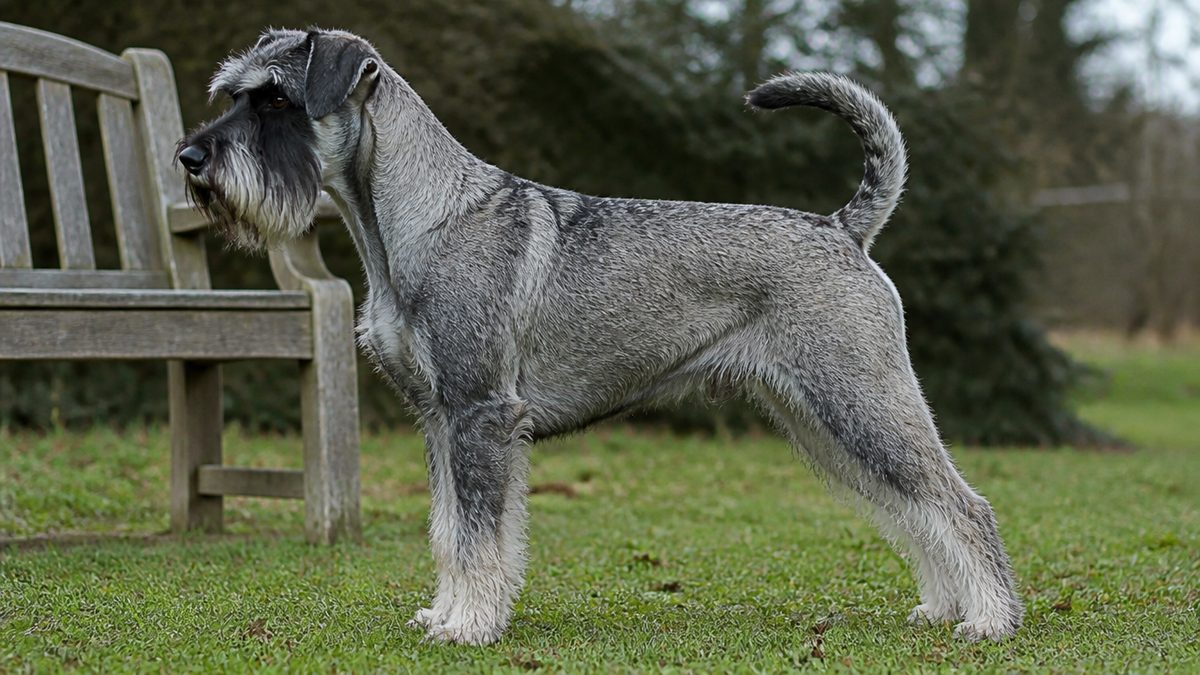
The Standard Schnauzer is a square, medium-sized German watch and companion dog standing 45 to 50 cm at the withers and weighing 14 to 20 kg, held by the Federation Cynologique Internationale simply as SCHNAUZER, standard 182, with a wiry harsh top coat over a dense undercoat in one of exactly two colours.
The name is the first thing to fix, because it is the root of everything Indian buyers get wrong about this dog. The FCI does not call it the Standard Schnauzer. Its record prints SCHNAUZER (182) as the heading and uses that unqualified name in all four of its published languages. The qualifier Standard exists in English precisely because two other numbers sit either side of it, 181 for the Giant and 183 for the Miniature, and English-speaking countries needed a way to say which one they meant. The FCI never needed one, because it uses three different names.
| Attribute | Value | Source document |
|---|---|---|
| FCI standard number | 182, Group 2, Section 1, subsection Schnauzer | FCI breed record 182 |
| Country of origin | Germany | FCI breed record 182 |
| Authentic language | German | FCI breed record 182 |
| Definitive acceptance | 13 July 1955 | FCI breed record 182 |
| Utilisation | Watch and Companion Dog | FCI Standard 182 |
| Working trial | Not subject to one | FCI breed record 182 |
| Height at withers | 45 to 50 cm, dogs and bitches alike | FCI Standard 182 |
| Weight | 14 to 20 kg, dogs and bitches alike | FCI Standard 182 |
| Colours | Two only: pure black, and pepper and salt | FCI Standard 182 |
| Tail | Natural, sabre or sickle carriage sought after | FCI Standard 182 |
| Disqualifying size fault | Over or under by more than 3 cm | FCI Standard 182 |
Two details in that table are unusual enough to be useful. First, the standard gives one height range and one weight range for both sexes rather than separate figures for dogs and bitches, which most breed standards do not. Second, the definitive acceptance date reads 7/13/1955, and the 13 in the second field proves the register's month-first format on its own face, so the date is 13 July 1955 rather than 7 December.
Square, harsh-coated and built by a specific job
The standard's general appearance is four words: medium sized, strong, stocky rather than slim, rough haired. Its important proportions require a square build in which the height at the withers is nearly equal to the body length, and a head whose length equals half the topline. Square is not decoration. It is what a dog that turned fast in a confined stable was selected for.
The history section says so plainly. Originally the Schnauzer was used in the region of Southern Germany as a stable dog, as he felt particularly at home in the company of horses, and he eagerly watched out for all rodents in order to kill them in a flash, which very early got him the appellation of Rattler. When the Pinscher-Schnauzer-Club was founded in 1895 he was entered under the name rough haired Pinscher.
The temperament the standard describes, in full
Breed pages quote the friendly half of this passage and drop the rest. The full text names a lively temperament coupled with placid composure, good nature, playfulness, a proverbial devotion to his master, love of children, incorruptibility, alertness yet not noisy, and then highly developed sense organs, intelligence, trainability, fearlessness, endurance and resistance to weather and diseases.
A dog bred to notice everything around a stable will notice everything around an Indian apartment corridor, and the standard's phrase describes the ideal rather than the average. A well-exercised Standard Schnauzer alerts and stops. An under-exercised one alerts and continues. Which of those you get is largely decided by the exercise section of this page, not by the pedigree.
The colours are the identification tool that matters most in India, and they are short enough to memorise. Pure black with a black undercoat, or pepper and salt, aiming at a medium shading with evenly distributed well pigmented pepper colouring and a grey undercoat, with shades from dark iron grey to silver grey all permitted. In all colour variations there must be a dark mask, and distinct light markings on head, chest and limbs are undesirable. That is the whole list. There is no white Standard Schnauzer and no black-and-silver Standard Schnauzer in the FCI standard.
Three Schnauzers, three FCI numbers, and why the middle one keeps getting the wrong data
The Standard, Giant and Miniature Schnauzer are three separate FCI breeds with three separate standards, and almost every figure an Indian reader will find for the Standard has been borrowed from one of the other two.
Establish the separation from the registry first, because it settles the question rather than arguing it. The FCI holds Riesenschnauzer as 181, Schnauzer as 182 and Zwergschnauzer as 183, each with its own published standard, its own height and weight, and its own colour list. Federation Cynologique Internationale
| Miniature (183) | Standard (182) | Giant (181) | |
|---|---|---|---|
| Height at withers | 30 to 35 cm | 45 to 50 cm | 60 to 70 cm |
| Weight | About 4 to 8 kg | 14 to 20 kg | 35 to 47 kg |
| Utilisation | Companion | Watch and Companion Dog | Utility and Companion Dog |
| Working trial | No | No | Yes |
| Permitted colours | Four: black, pepper and salt, black/silver, pure white | Two: black, pepper and salt | Two: black, pepper and salt |
| Size disqualification | Over or under by more than 2 cm | Over or under by more than 3 cm | Over or under by more than 3 cm |
| Origin job | Companion, from the Standard | Stable ratter, Southern Germany | Driving cattle, Southern Germany |
| Stud book from | Not stated in the standard | Pinscher-Schnauzer-Club, 1895 | 1913, working-dog recognition 1925 |
A Giant Schnauzer weighs about two and a half times what a Standard does and a Standard weighs about three times what a Miniature does. Those are not variations within a breed. They are three different dogs that share a coat texture and a face.
The decisive registry document is the crossing register, and it is unambiguous
The FCI publishes a register of breed varieties that may be crossed, whose entire purpose is to name the cases where two coats or two sizes are one breed. Its latest update is printed on its own face as 21 September 2023. It lists 181, 182 and 183 separately, each with its own colour varieties, and its separate list of different breed NUMBERS that may be crossed with each other, which does contain groups such as Griffon Belge (81) with Griffon Bruxellois (80) and Petit Brabancon (82), contains none of the three Schnauzers.
The crossing register and the breed standards agree exactly on the colour lists, which makes them a cross-checkable identification tool. 183 Zwergschnauzer has four colours including black and silver and pure white. 182 Schnauzer has two, black and pepper and salt. 181 Riesenschnauzer's own 2021 standard also lists two. So a white Schnauzer is a Miniature, and a black-and-silver Schnauzer is a Miniature under the FCI standards. If a seller in India offers you a white or black-and-silver Standard Schnauzer, one of those two words is wrong.
One genuine inconsistency inside the FCI's own documents is worth publishing rather than smoothing over. The crossing register lists three colours for 181, adding black and silver, and gives a breeding rule for it: avoid breeding pepper and salt to black and silver in order to preserve the recessive black and silver colour in the breed. FCI Standard 181, published 10 June 2021, lists only two colours and does not include black and silver at all. The crossing register is the more recently updated document of the two. Both are current and official, and they disagree.
How the Indian market performs the merge
The conflation is not theoretical here. India's largest online pet retailer publishes a 40-breed dog price list whose only Schnauzer row reads Miniature Schnauzer, Rs 30,000 to Rs 80,000, Small, with no Standard and no Giant row anywhere in it. India's largest breed-listing platform carries Miniature Schnauzer and Schnauzer as separate dropdown entries among more than 250 breeds, with no Standard Schnauzer entry at all. And the largest Indian breed-directory site returns a hard HTTP 404 for both /dog-breeds/standard-schnauzer and /dog-breeds/schnauzer while serving full pages for the Giant and the Miniature.
So an Indian reader searching for this breed is systematically handed the Miniature's price and, on health pages, the Giant's screening data. The rest of this guide keeps the three apart on every line.
Standard Schnauzer price in India
No Indian price list publishes a Standard Schnauzer price, and the rupee figures that do appear under the name belong to the Miniature Schnauzer, to a book and to merchandise.
Three checks establish it, and each is reproducible. Before any of them, three search engines were tested against a Labrador Retriever control in the same session, because a search that returns nothing because it was never run is not evidence of anything: Google returned no document at all through the retrieval path available here, Bing India substituted the result set for both the breed query and the control, and DuckDuckGo India was the one engine whose control passed.
- India's largest online pet retailer's Dog Price List in India 2026, covering the top 40 breeds with city-wise costs, has exactly one Schnauzer row and it reads Miniature Schnauzer, Rs 30,000 to Rs 80,000, Small.
- India's largest breed-listing platform enumerates more than 250 breeds in its own dropdown, carries Miniature Schnauzer and Schnauzer as separate entries, and has no Standard Schnauzer entry and no Giant Schnauzer entry.
- The largest Indian breed-directory site returns a hard 404 for standard-schnauzer and for schnauzer, while serving the Giant and the Miniature at 200.
What the six Indian listings that do exist actually show
One Indian platform does carry six Schnauzer listings, and reading them closely is more instructive than any price would be. Every one has a Breed field reading simply Schnauzer. Every one is Male. Every Age field renders as the bare word Weeks with no number attached. Every City field renders empty, while the listing images carry alt text naming Bangalore or Delhi. And no price is visible on any of them, because each View Price link resolves to a sign-up page.
A real inventory of six puppies would not be all one sex, and a listing that cannot render a city or an age has a database with empty fields behind it. This is not evidence of fraud and it is not evidence of supply either. It is evidence that the page is a lead-capture form wearing a catalogue, and that the price you are being asked to register for is not published anywhere you can compare it.
The rupee figures that do appear under this breed's name
| Figure | What it is actually for | Source |
|---|---|---|
| Rs 1,152 | Merchandise on a marketplace market page | Etsy India |
| Rs 471.45 | A Kindle edition of a 1990s breed book | Amazon.in |
| Rs 3,397 | The hardcover of the same book | Amazon.in |
| Rs 30,000 to Rs 80,000 | A Miniature Schnauzer, on a list with no Standard row | Supertails price list |
| Rs 25,000 to Rs 60,000 | A Miniature Schnauzer buying band | Happy Pet |
| Rs 30,000 to Rs 80,000 | A Giant Schnauzer buying band | Happy Pet |
Not one of those six figures is a Standard Schnauzer price. Amazon.in listing Happy Pet dog-breed directory Two are for a book, one is for merchandise, and three are for the other two breeds.
The United States figure, and why this page will not convert it
A United States breed directory states that the average price for a Standard Schnauzer normally ranges between 1,500 and 2,500 dollars per puppy. Run that through the three exchange rates Indian pages are caught using and you get Rs 1,26,570 to Rs 2,10,950 at 84.38, Rs 1,20,000 to Rs 2,00,000 at a flat 80, and Rs 1,11,000 to Rs 1,85,000 at 74. Three plausible-looking Indian bands, none of them an observation of anything happening in India.
Use that arithmetic in reverse whenever you meet an Indian figure for this breed. Divide the band by 84.38, by 80 and by 74, and look at the quotients rather than at whether the division was clean. A flat 80 divides any figure ending in three zeros cleanly by construction, so a clean division at 80 proves nothing on its own; what matters is whether the quotient is a number a real seller would print, like 1,500 or 2,500. If it is, you are reading a converted foreign price.
The honest position for an Indian buyer is that the Standard Schnauzer has no published Indian price because it has no measurable Indian market, and that any figure offered to you privately is a negotiation rather than a market rate. Verify the dog against the standard's height, weight and colour list before you discuss money at all.
Monthly cost of ownership in India
A 17 kg Standard Schnauzer costs between about Rs 7,000 and Rs 12,000 a month to keep in an Indian metro, and grooming is the line that makes it more expensive than a smooth-coated dog of the same weight.
The running cost of a dog is a function of its weight and your city, not of its rarity, so this section has firm answers where the price section does not. A 14 to 20 kg dog sits neatly inside the 15 to 30 kg band that Indian parasite products are dosed for.
| Line | Figure | Basis |
|---|---|---|
| Tick, flea and worm control | Rs 1,103 per month | NexGard Spectra 15 to 30 kg, 3 tablets at Rs 3,308 |
| Deworming, if dosed separately | Rs 189 to Rs 251 per treatment | Drontal Plus at Rs 125.67 a tablet, one per 10 kg |
| Annual booster, amortised | About Rs 267 per month | Vetic annual booster from Rs 3,199 |
| Anti-rabies, amortised | About Rs 58 per month | Vetic anti-rabies Rs 699 |
| Bath | Rs 934 upward per visit | Vetic grooming, Delhi |
| Hand-strip, two or three times a year | Rs 1,359 upward per visit | Vetic haircut price as the nearest published proxy |
| Boarding, when you travel | Rs 899 per 24 hours | PawSpace Bengaluru overnight rate |
| Municipal registration, Delhi | Rs 500 a year | MCD Delhi pet dog registration |
| Municipal licence, Chennai | Rs 50 | Greater Chennai Corporation |
Food is the line you must compute rather than copy, because it depends on the kibble you buy and the grams the pack specifies. A 17 kg moderately active dog typically eats 200 to 280 grams a day of a premium adult kibble, which at Indian prices lands between roughly Rs 3,500 and Rs 6,000 a month. Weigh the food rather than scooping it, and re-check the grams against the pack you actually buy.
Vaccination: the delivery model sets the price, not the drug
One identical nine-in-one vaccine costs Rs 600 at a Goa government veterinary hospital inclusive of the certificate, from Rs 899 at a private clinic chain, and from Rs 1,999 through a vet-at-home service that also charges a Rs 699 visit fee. Anti-rabies spans Rs 100 to Rs 1,199 across the same three routes. A 3.3-fold spread on one product is the most actionable fact in this section, because you can halve this line without changing the medicine.
Municipal routes go further still. Greater Chennai Corporation charges Rs 50 for a pet licence, issued 9,115 of them in 2024, and runs six municipal pet clinics that provide all treatment and anti-rabies vaccination free of cost. Delhi's Municipal Corporation charges Rs 500 to register a pet dog and Rs 500 to renew, with a Rs 100 per month late fee, and has issued 18,958 certificates since 2021. Register the dog either way: it is cheap, it is a legal obligation, and it is the only paperwork that connects your dog to you if it is ever lost.
Boarding varies most with city and operator. A Bengaluru facility publishes Rs 599 for up to four hours, Rs 799 for daycare to ten hours and Rs 899 for overnight to 24 hours. A widely-cited Indian welfare source gives a broader Rs 500 to Rs 2,000 per day, with consultation at Rs 500 to Rs 1,000 and grooming at Rs 300 to Rs 2,000; treat that as a single data point rather than two, because a large general insurer publishes byte-identical ranges for two separate quantities, which is evidence one copied the other.
The largest Indian breed directory has no Standard Schnauzer page at all, and the rows it does print for the other two are template constants. It gives the Giant Schnauzer Rs 5,700 to Rs 8,550 a month, the same row it prints for the German Wirehaired Pointer, and the Miniature Rs 3,300 to Rs 5,400. Rows on that site are assembled per breed from a small set of preset lines for food, health and grooming, which is why breeds of different sizes share totals. Pull one unrelated breed from the same site and compare the lines to the rupee before you believe any of them.
Heat tolerance: a Southern German stable dog in an Indian summer
The Standard Schnauzer has poor heat tolerance for the Indian plains, because it is a genuinely double-coated dog from a climate whose hottest month averages 20 C, and its medium size does not rescue it.
The coat description is the argument. The standard asks for a coat that is wiry, harsh and dense, consisting of a dense undercoat and a not too short top coat lying close to the body. Indian buyers read wiry and infer a light, open jacket. It is a double coat with a working outer layer, and the undercoat is what matters when the air stops taking up moisture. That makes this a heat-sensitive breed in the plains sense of the word, and its medium size does not offset it.
| Point | Cell elevation vs real | Annual mean C | Annual RH % | Hottest month |
|---|---|---|---|---|
| Stuttgart, Germany | 353.10 m vs 245 m, +108.1 m | 9.72 | 79.70 | July, 20.02 C |
| Munich, Germany | 616.07 m vs 520 m, +96.1 m | 8.47 | 83.20 | July, 18.32 C |
| Delhi | 206.37 m vs 216 m, -9.6 m | 25.60 | 45.56 | June, 35.88 C |
| Chennai | 48.95 m vs 6 m, +43.0 m | 27.95 | 72.39 | May, 31.51 C |
| Mumbai | 97.15 m vs 14 m, +83.2 m | 26.77 | 67.39 | May, 31.19 C |
| Bengaluru | 841.72 m vs 920 m, -78.3 m | 23.74 | 67.94 | April, 28.37 C |
| Pune | 635.99 m vs 560 m, +76.0 m | 23.86 | 66.80 | April, 28.93 C |
| Kolkata | 7.35 m vs 9 m, -1.7 m | 25.81 | 73.93 | May, 31.53 C |
Every cell sits within about 110 m of its town's real elevation, which is what a usable plains or low-hill reading looks like; a cell that is a kilometre out gives a right answer for the wrong place and this page would say so. The gap that matters is 9.72 C against 27.95 C. This breed was selected in a place whose whole summer averages what a Bengaluru winter morning does.
Humidity is not the shock, and saying it is gets the breed wrong
Munich runs 83.20 percent annual relative humidity and Stuttgart 79.70, both higher than Bengaluru's 67.94, Mumbai's 67.39 and Pune's 66.80, and higher than Delhi's 45.56 by a wide margin. Southern Germany is a humid place. What it is not is humid at thirty degrees. The correct framing is combined heat and humidity load, which is what the wet bulb column measures, and not a humidity shock that the homeland data does not support.
The one heat risk factor an owner controls
In a cohort of 905,543 UK dogs under primary veterinary care, bodyweight at or above the breed and sex mean carried odds of heat-related illness of 1.42, with an interval of 1.12 to 1.80. Neither the Standard Schnauzer nor the Giant appears in that paper's modelled breed list; the Miniature does, at an odds ratio of 1.08 that does not reach significance. The study's inclusion rule is a disjunction, five or more cases and/or 5,000 or more dogs, so the Standard simply had neither. This page therefore claims only the transferable bodyweight finding and no breed-specific odds ratio.
The trigger split from the companion paper is where the practical rule comes from. Of 1,259 heat-related illness events from 1,222 dogs, 380 had no recorded trigger, leaving 879 with one. Of those 879, 652 were exertional, which is 74.2 percent, against 113 environmental at 12.9 percent and 46 from vehicular confinement at 5.2 percent. Nearly three quarters of recorded heat emergencies happened because the dog was doing something.
If a Standard Schnauzer stops responding, wanders, or lies down mid-walk in the heat, stop immediately, move it into shade, pour room-temperature water over the neck, groin and paws, and move air across it. Do not use ice water and do not wrap the dog in a wet towel, which traps heat. Then call a veterinarian, because heat-related illness can deteriorate hours after the dog appears to have recovered.
City by city: where a Standard Schnauzer is comfortable in India
Bengaluru and Pune are the two Indian metros where a Standard Schnauzer is comfortable year-round, and Chennai and Mumbai are the two where it never gets a break, because neither has a cool season at all.
Wet-bulb temperature decides whether a panting dog can still shed heat, because panting is evaporative cooling and evaporative cooling fails as the air approaches saturation. The column below is Stull 2011 computed from NASA POWER's T2M and RH2M for the 2001 to 2020 window, labelled as such because a second wet-bulb method exists and the two disagree by up to about 1.5 degrees.
| City | Peak wet bulb C | Month | Coolest month mean C | Verdict for this coat |
|---|---|---|---|---|
| Kolkata | 27.09 | June | 17.31 (January) | Hardest of the six; a real winter, a brutal monsoon |
| Delhi | 26.50 | July | 13.61 (January) | The best Indian winter and the worst Indian June |
| Chennai | 26.11 | May | 24.09 (January) | No cool season. Indoor cooling is not optional |
| Mumbai | 25.77 | June | 23.19 (January) | Never drops below 23 C. Same verdict as Chennai |
| Hyderabad | 23.35 | June | 20.76 (December) | Workable November to February only |
| Pune | 22.97 | June | 19.62 (December) | Comfortable most of the year |
| Bengaluru | 21.86 | May | 20.22 (December) | The best Indian metro for this breed |
Three of those months catch people out and are worth stating, because getting the month wrong quietly corrupts every seasonal recommendation on a page. Delhi peaks in June at a mean of 35.88 C, not in May. Bengaluru peaks in April at 28.37 C and is coolest in December, not January. Pune peaks in April at 28.93 C and is likewise coolest in December. Chennai, Mumbai and Kolkata genuinely do peak in May.
The Chennai and Mumbai problem, stated precisely
Chennai's coolest month averages 24.09 C and Mumbai's 23.19 C. There is no month in either city in which a double-coated German working breed gets relief. That is a different problem from Delhi's, where the dog is genuinely uncomfortable for three months and genuinely comfortable for four. An owner in Chennai is committing to air conditioning as a permanent cost line rather than a summer one, and that belongs in the cost of ownership calculation before the dog arrives, not after.
Monsoon is a separate problem from heat, and this coat has both
A dense undercoat under a harsh top coat holds water, and a heavy beard stays wet for hours after a walk. Indian veterinary series report otitis externa concentrating heavily in the monsoon months, with bathing without protecting the ears named among the commonest causes. A Standard Schnauzer walking through an Indian July has a wet beard, a damp undercoat and folded ears, which is three exposures at once. Dry the dog properly rather than letting it air dry, which is what overseas breed-club guidance written for a German summer will tell you to do.
Second Schedule Part IV paragraph 21(1) of the Dog Breeding and Marketing Rules 2017 bars keeping in outdoor facilities, without the attending veterinary practitioner's written approval, dogs not accustomed to local temperatures, breeds that cannot tolerate them, naming long-haired breeds in high temperature locations, and sick, infirm, aged or young animals. A double-coated German breed in a Chennai May sits inside the first two limbs. Note the citation form: this is a Second Schedule paragraph, not a Rule, because the Rules themselves stop at 13 and there is no Rule 14.
Temperament and household fit
The Standard Schnauzer is an alert, affectionate, strong-willed medium-sized dog that suits an experienced owner in an active household, and its two hardest traits for Indian living are its watchfulness and its refusal to be bored.
The standard's list is worth reading twice because it contains a contradiction that is really a description: a lively temperament coupled with placid composure. That is a dog that is either fully switched on or fully switched off, with less middle ground than a Labrador has. Owners who like that describe it as easy. Owners who wanted a dog that idles find it exhausting.
Who this breed suits in India
- Households in Bengaluru, Pune or Delhi with a securable balcony or garden and a fixed daily routine.
- Owners who want a watchful dog and understand that watchful means vocal until trained otherwise.
- Families with children old enough to leave a resting dog alone, since the standard names love of children and not infinite patience.
- Owners willing to pay for hand-stripping two or three times a year rather than clipping the coat soft.
- Buyers who will screen the parents for the RBM20 cardiomyopathy variant and the TSEN54 leukodystrophy variant by name.
Who this breed does not suit
- Households where the dog is alone nine hours a day, because a devoted watch breed does not settle alone.
- Corridor-facing flats with heavy footfall, unless the owner will actively train an alert-and-stop response.
- Owners in Chennai or Mumbai without permanent indoor cooling.
- Anyone who wants a dog that will accept repetitive obedience drills without pushing back.
- Buyers who assume Schnauzer means the small one they saw online.
The Indian-specific issue is the barking, and it is manageable rather than fatal. A breed developed to notice everything moving around a stable is being asked to ignore a delivery rider, a security round, a neighbour's door and a lift chime, dozens of times a day. Train an alert-and-stop: let the dog bark twice, mark the silence, reward it, and build duration. Suppressing the alert entirely fights the breed; capping it works.
Unlike most of the working breeds Indian buyers cross-shop it against, the Standard Schnauzer was not selected to range. It was selected to work in a confined space, which is why the standard asks for a square build rather than a long, galloping one. Given real daily exercise, it settles in a flat far better than a versatile gundog of the same weight does. The constraint is the exercise, not the square footage.
Training approach and what this breed resists
To train a Standard Schnauzer, keep sessions short, vary the task, and pay well for the first repetition, because this breed learns quickly and then declines to prove it again.
The standard names intelligence, trainability and fearlessness alongside a proverbial devotion to his master. Read those together and you get the training profile exactly: this is a highly trainable dog that acquires behaviours in very few repetitions, will work hard for a handler it is bonded to, and has enough independence to decide that the eleventh repetition is beneath it.
| Age | Priority | Indian-specific note |
|---|---|---|
| 8 to 16 weeks | Socialisation, name, crate, handling for grooming | Handle the muzzle and legs daily now, or stripping at ten months becomes a fight |
| 16 to 24 weeks | Recall, loose lead, settle on a mat | Train at dawn; a hot puppy learns that recall ends the fun |
| 6 to 9 months | Alert-and-stop, door manners, thunder work | This is the window that decides whether you get a barker |
| 9 to 14 months | Impulse control, distance work, stay | Adolescent testing peaks here; hold the line without escalating |
| 14 to 24 months | Scent work, trick chains, real problem-solving | Substitutes for the ratting job the breed no longer has |
What it resists, specifically
- Repetition, which this breed reads as evidence you did not notice it already complied.
- Harsh correction, which produces a dog that argues rather than a dog that yields.
- Long static obedience, which is the format most Indian group classes are built around.
- Being ignored, since an unemployed watch breed will invent employment at the front door.
- Working in the middle of an Indian day, which looks like defiance and is physiology.
The most useful single exercise is teaching the dog to think rather than to comply. Puzzle feeders, scent games, find-the-object chains and shaping games all use the problem-solving the breed was built on. A Standard Schnauzer that gets fifteen minutes of that a day is markedly easier to live with than one that gets an extra half-hour of walking instead.
One, let the dog bark two or three times when someone passes; do not interrupt. Two, say a single cue word, once, and wait. Three, the moment the dog is quiet, mark it and reward. Four, extend the quiet interval by a second or two each session. Within a fortnight most dogs are alerting briefly and stopping on the cue. This works because it pays the dog for the behaviour you want rather than punishing the behaviour it was bred for.
Daily exercise requirement
A Standard Schnauzer needs about ninety minutes of activity a day, split around the heat, and at least a third of that should be mental work rather than walking.
The FCI gives utilisation as Watch and Companion Dog and attaches no working trial to this breed, which understates it. The same standard lists endurance and resistance to weather among the breed's typical characteristics, and the job it was actually bred for was patrolling and killing rats around stables through a working day. This is an athletic dog in a compact frame.
What ninety minutes looks like in an Indian city
- Thirty-five to forty-five minutes at first light, briskly, with recall or long-line work where the space allows.
- Fifteen to twenty minutes of scent, puzzle or shaping work indoors during the day.
- Thirty minutes after dark, including some off-pavement ground if you have it.
- One longer outing a week, an hour or more somewhere the dog can range and use its nose.
The indoor block is the part Indian owners skip and the part that pays best. Nose work costs the dog real energy and costs you no daylight, which matters enormously in a country where the usable hours are at the ends of the day. Ten minutes of searching for a hidden article settles a Schnauzer more reliably than twenty minutes of pavement walking at 34 C.
The heat rule, stated as a rule
- Exercise before sunrise and after full dark, and treat the middle of the day as unavailable rather than inconvenient.
- Test the pavement with the back of your hand; if you cannot hold it there for five seconds, the dog should not walk on it.
- Carry water on any session over twenty minutes and offer it every ten.
- Stop on behaviour rather than on a clock: a dog that drifts, slows or stops responding is already too hot.
- Cool with room-temperature water over the neck, groin and paws, never ice water, and move air across the dog.
Exertional heat illness accounted for 74.2 percent of the heat emergencies with a recorded trigger in a UK cohort of 905,543 dogs, against 5.2 percent from vehicular confinement. For an Indian owner that means the exercise plan and the heat plan are the same plan, and that the most likely cause of a heat emergency in this breed is a well-meaning owner extending a walk.
A young Standard Schnauzer with an undiagnosed RBM20 homozygous genotype can present its cardiomyopathy as exercise intolerance before anything else shows. In the published case series the median age at diagnosis was 1.6 years, which is exactly the age at which owners are increasing exercise. A young Schnauzer that suddenly tires, coughs at rest or refuses a walk it used to enjoy needs a veterinary cardiac examination that week, not a training plan.
Grooming a wire coat in Indian humidity
Grooming a Standard Schnauzer means hand-stripping the body coat two or three times a year rather than clipping it, combing the beard and eyebrows weekly, and drying the ears and beard properly after every bath, because the Indian monsoon punishes all three.
The standard describes a coat that should be wiry, harsh and dense, consisting of a dense undercoat and a not too short top coat lying close to the body, neither bristly nor wavy, with the not too soft beard on the muzzle and the bushy eyebrows as typical characteristics. That texture is the point of the coat, and clipping is what destroys it.
Why clipping is not a neutral choice
Clipping cuts the harsh outer hairs without removing the dead undercoat. The coat regrows softer, paler and denser after each clip, and the change is cumulative and permanent. In an Indian climate that matters more than it does in Germany, because a soft dense coat holds water longer through the monsoon and traps more heat in April. Stripping pulls the dead top coat out at the root and lets the new harsh coat come through.
| Task | Frequency | Indian cost basis |
|---|---|---|
| Comb the beard, eyebrows and leg furnishings | Weekly, twice weekly in the monsoon | Free, ten minutes |
| Hand-strip the body coat | Two or three times a year | Vetic haircut from Rs 1,359 as the nearest published rate |
| Bath | Every six to eight weeks | Vetic bathing from Rs 934 |
| Full bath and styling | Optional | Vetic complete bath and styling from Rs 1,869 |
| Dry and check the ears | After every bath | Free, and the most important line in this table |
| Wipe the beard after every meal | Daily | Free, and it prevents most beard skin problems |
| Nails | Monthly | Vetic add-ons from Rs 99 |
The beard is an Indian problem that overseas guides do not cover
A Schnauzer beard collects food and water at every meal, and in a humid Indian summer a permanently damp beard becomes a skin problem within weeks. The fix is trivial and has to be daily.
- Wipe the beard with a dry cloth after every meal and every drink, not just at bath time.
- Comb the beard through weekly so food particles do not mat into the base of the hair.
- Use a narrow, deep water bowl rather than a wide shallow one, which soaks less of the beard.
- Dry the beard fully after a bath instead of letting it drip onto the chest and neck.
- Check the skin under the beard monthly for redness, smell or thinning hair, and see a vet early rather than late.
Most Indian salons clip, because stripping is a hand technique that takes hours and cannot be rushed. Before you commit to this breed, phone two salons in your city and ask specifically whether they hand-strip terrier and Schnauzer coats. If neither does, learn to do it yourself with a stripping knife, which is entirely achievable with practice, or accept that the coat will soften over the years. Both are honest choices, and both are better than discovering the problem in year two.
One real advantage of this coat in India: it sheds very little into the house, and mud dries into clumps that fall out of a wire coat rather than smearing through a soft one. That is not a hypoallergenic claim and this page makes none. A controlled study measured Can f 1 across 196 dogs of so-called hypoallergenic breeds against 160 control dogs and found the hypoallergenic group higher rather than lower, concluding there is no evidence for the classification of certain dog breeds as hypoallergenic.
Health issues, screening and life expectancy
The Standard Schnauzer lives a median of 13.0 years, screens well on hips and elbows, and carries one serious breed-specific heart risk with a published genetic test, which is the single most important thing an Indian buyer can act on.
Start with the life expectancy figure, because this breed actually has one and most of this cluster does not. McMillan 2024 gives the Standard Schnauzer a median survival of 13.0 years with a 95 percent confidence interval of 12.7 to 13.2, computed on 435 deaths, and a hazard ratio against the crossbred group of 0.82 with an interval of 0.75 to 0.90 and p below 0.001. That is a breed living significantly longer than a crossbred dog, on a sample large enough to say so.
Table S3's first two columns carry blank headers, and the paper's own caption for the first one is wrong. Column one is total dogs and column two is deaths. For this breed they read 826 and 435. Read column one as the death count and you overstate the sample by nearly double. Table S6 gives 364 alive, 435 deceased and 799 total for the same breed, so the two tables disagree on sample size by 27 dogs and agree exactly on the deaths. Quote the deaths.
The three Schnauzers do not share a lifespan either
| Breed | Total dogs | Deaths | Median years | 95% CI | HR vs crossbreds |
|---|---|---|---|---|---|
| Miniature Schnauzer | 7,693 | 1,977 | 13.3 | 13.2 to 13.5 | 0.70, p < 0.001 |
| Standard Schnauzer | 826 | 435 | 13.0 | 12.7 to 13.2 | 0.82, p < 0.001 |
| Giant Schnauzer | 369 | 126 | 12.1 | 11.5 to 12.8 | 0.92, p = 0.33 |
| Labrador Retriever, for scale | 43,428 | 16,155 | 13.1 | 13.0 to 13.1 | 0.80, p < 0.001 |
The three medians span 1.2 years and the Giant's hazard ratio is the only one of the three that does not reach significance. Hand the Standard the Giant's 12.1 years, as any page that treats Schnauzer as one breed effectively does, and you have shortened the dog by nearly a year. All three are separate rows in Table S5, flagged Y for inclusion, and the Standard Schnauzer's reclassification column reads Schnauzer, which is the Kennel Club's own unqualified name for this same dog rather than a merge of two breeds. The paper itself carries an Author Correction that changes only a Miniature Dachshund figure in a figure legend, so nothing in it touches this breed.
Orthopaedic screening: good, and better than the Giant's
OFA's breed code for this dog is SC, read out of OFA's own advanced-search markup rather than guessed, and every figure below was matched on the printed breed label and on the disease marker row above it.
| Screen | Miniature (MSC) | Standard (SC) | Giant (GSC) |
|---|---|---|---|
| Hip evaluations | 324 | 5,560 | 5,908 |
| Hips normal % | 97.2 | 90.6 | 81.1 |
| Hips dysplastic % | 2.8 | 8.4 | 17.5 |
| Elbow evaluations | No published row | 786 | 1,706 |
| Elbows abnormal % | No published row | 6.9 | 9.9 |
| Eye evaluations | 14,487 | 2,055 | 1,191 |
| Eyes normal %, summary | 97.4 | 97.0 | 96.2 |
| Thyroid evaluations | See breed page | 395 | 1,566 |
| Thyroid normal % | See breed page | 89.1 | 80.8 |
| Patella evaluations | 1,567 at 99.3% normal | No published row | 67 at 100% normal |
The hip gradient is the cleanest single demonstration of why these three cannot be merged: 2.8 percent dysplastic in the Miniature, 8.4 in the Standard and 17.5 in the Giant, on 324, 5,560 and 5,908 evaluations respectively. Transfer the Giant's figure onto the Standard and you have doubled the risk. Transfer the Miniature's and you have cut it by two thirds.
The arithmetic checks out, which is worth doing before quoting any table. For the Standard's hips, 10.1 excellent plus 62.5 good plus 17.9 fair is 90.5 against a printed 90.6, and 6.5 mild plus 1.9 moderate plus 0.1 severe is 8.5 against a printed 8.4; both gaps are rounding on one decimal place. Ask a breeder for hips, elbows, a current eye certificate and the heart test described in the next section.
Dilated cardiomyopathy: the finding that runs opposite to the size gradient
The Standard Schnauzer sits second only to the Doberman in OFA's dilated cardiomyopathy table, with 17.0 percent of 2,408 evaluated dogs carrying the variant against the Giant Schnauzer's 3.8 percent, and a homozygous dog's median lifespan in the published series was 3.06 years.
Everything else on this page runs with the size gradient: the Giant has worse hips, worse elbows and a shorter median lifespan. The heart runs the other way, and that inversion is the reason a merged Schnauzer page is actively dangerous rather than merely imprecise.
| Breed | Rank | Evaluations | Normal % | Carrier % | Abnormal % |
|---|---|---|---|---|---|
| Doberman Pinscher | 1 | 1,099 | 55.1 | 36.2 | 8.7 |
| Standard Schnauzer | 2 | 2,408 | 82.7 | 17.0 | 0.3 |
| Giant Schnauzer | 3 | 499 | 96.2 | 3.8 | 0.0 |
| All breeds | 4,206 | 76.5 | 20.9 | 2.6 |
Every row sums to exactly 100.0, and the Standard Schnauzer has the largest tested population in the table, larger than the Doberman's. Note also that the three named rows sum to 4,006 evaluations against an all-breeds total of 4,206, leaving 200 in breeds below OFA's publication threshold.
The gene, the prevalence and the outcome
The variant sits in RBM20, the RNA-binding motif protein 20 gene. A study of samples from 2,136 dogs, including 1,834 Standard Schnauzers, 266 Giant Schnauzers and 36 dogs of other breeds submitted between November 2013 and May 2018, found the variant only in Standard and Giant Schnauzers and in no other breed.
| Measure | Standard Schnauzer | Giant Schnauzer |
|---|---|---|
| Dogs genotyped | 1,834 | 266 |
| Variant-positive | 389, 21.2 percent | 26, 9.8 percent |
| Heterozygous | 361, 19.7 percent | 23, 8.6 percent |
| Homozygous | 28, 1.5 percent | 3, 1.1 percent |
| Homozygotes with confirmed disease | 26 of 28, 92.9 percent | 3 of 3 |
| Median lifespan, homozygous | 3.06 years | Not separately reported |
| Median lifespan, heterozygous | 15.11 years | Not separately reported |
| Median lifespan, wild-type | 15.18 years | Not separately reported |
Read the last three rows together, because they are the whole clinical picture. A homozygous Standard Schnauzer's median lifespan was 3.06 years. A heterozygous one's was 15.11 years and a wild-type one's was 15.18. Carrying one copy cost these dogs 0.07 years of median lifespan, which is nothing. Carrying two cost them twelve years.
A recessive-acting variant with a published genetic test is entirely avoidable by never mating two carriers, and a heterozygous dog in the published data lived a normal lifespan. So the question to a breeder is not whether their dogs are clear, it is what both parents' RBM20 genotypes are, in writing. A carrier bred to a clear dog produces no affected puppies. A carrier bred to a carrier produces roughly one affected puppy in four. Consult your nearby vet or a veterinary cardiologist about interpreting a result before you act on it.
What the disease looks like when it arrives
A retrospective series of fifteen Standard Schnauzers with dilated cardiomyopathy gives the clinical shape. Median age at diagnosis was 1.6 years, and all fifteen dogs developed left-sided congestive heart failure. Median age of onset of heart failure was 1.6 years, significantly shorter in males at 1.5 years than in females at 2.35. Median survival after the diagnosis of congestive heart failure was 22 days, and again shorter in males at 13 days than in females at 62. Pedigree analysis confirmed common ancestry for all affected dogs, with a most likely autosomal recessive mode of inheritance.
Twenty-two days is not a chronic illness. It is a young dog dying quickly, and the median age at diagnosis of 1.6 years means it arrives before most owners have had the dog long enough to think of it as middle-aged. That is why a genetic test done before purchase is worth more here than any amount of monitoring afterwards.
That fifteen-case series is close to invisible to a normal literature search. Querying PubMed for Schnauzer together with cardiomyopathy in title or abstract returns exactly one record, and it is an unrelated amiodarone case report, because the series' own title carries the plural Schnauzers and the singular query does not match it. The singular and plural name forms return fifteen records each and overlap by only two, giving 28 distinct records between them, so either query alone loses about half the breed's literature. A Labrador Retriever control returned 1,109 records with a clean unrewritten translation line in the same session, so the instrument was working and the split is a property of PubMed's indexing rather than of the search.
The other named genetic findings, and one reputation the evidence does not support
The Standard Schnauzer has a second named recessive disease with a published variant, TSEN54 leukodystrophy, a breed-specific red-cell disorder whose cause three studies have failed to find, and a pancreatitis reputation borrowed from the Miniature that the evidence does not support.
TSEN54 leukodystrophy: the disease that kills puppies
Researchers reported a hereditary leukodystrophy in Standard Schnauzer puppies in which signs occurred shortly after birth or began under four weeks of age: apathy, dysphoric vocalisation, hypermetric ataxia, intention tremor, head tilt, circling, proprioceptive deficits, seizures and ventral strabismus. Magnetic resonance imaging showed diffuse white matter disease without mass effect, and histopathology showed severe multifocal reduction of myelin formation with moderate diffuse oedema and no inflammation.
Combined linkage analysis and homozygosity mapping in two related families narrowed the search to about 29 megabases, and comparing one affected dog's whole genome against 221 control genomes found a single private homozygous protein-changing variant in that interval: TSEN54:c.371G>A, p.(Gly124Asp). The genotypes were perfectly associated with the phenotype in 12 affected Standard Schnauzers and almost 1,000 control dogs from different breeds. In humans, several TSEN54 variants cause pontocerebellar hypoplasia.
Like the RBM20 heart variant, this is a recessive with a known sequence, which means a genetic test exists and affected puppies are entirely avoidable. The authors say so themselves: identifying the causative variant enables genetic testing so that the unintentional breeding of affected Standard Schnauzers can be avoided. Two named tests, both recessive, both cheap relative to the outcome. Ask for both parents' results in writing.
Stomatocytosis: a breed-specific finding nobody has explained
Standard Schnauzers carry a red-cell disorder that has now defeated three separate attempts to find its cause, which is itself worth publishing. Seven closely related Standard Schnauzers with stomatocytosis showed macrocytosis at 80.0 plus or minus 4.2 femtolitres against a reference interval of 60 to 76, a decreased mean corpuscular haemoglobin concentration at 29.3 against a reference 32 to 39, and stomatocytes ranging from 0.6 to 18.9 percent of all red cells, with intracellular sodium at 138.1 mmol per litre against a control 99.1. Parentage analysis suggested a hereditary component.
A second study excluded stomatin deficiency as the mechanism. A third excluded the three genes responsible for the analogous human disease: three novel coding polymorphisms in canine RhAG and three in canine SLC4A1 did not cosegregate with red-cell sodium content or corpuscular volume, and the GLUT1 sequence was normal.
The 2012 paper states plainly that stomatocytosis in Standard Schnauzers is usually asymptomatic and accompanied by minimal if any anaemia. So the practical importance for an owner is not the disease, it is the laboratory report: a Standard Schnauzer's routine blood panel can show an elevated mean corpuscular volume and a low haemoglobin concentration that would be abnormal in another breed and are unremarkable in this one. Tell your vet the breed before they interpret the numbers.
Pancreatitis: a Miniature Schnauzer reputation that does not transfer
Miniature Schnauzers are widely described as prone to pancreatitis, and Indian pages routinely extend that to every Schnauzer. The primary evidence does not support the extension and only weakly supports the original claim. A case-control study genotyped 17 Miniature Schnauzers with pancreatitis, 60 mature Miniature Schnauzers with no substantial gastrointestinal history and 31 Standard Schnauzers of unknown status for the SPINK1 c.74A>C variant.
The variant turned out to be the major allele in both breeds, at a frequency of 0.77 in Miniatures and 0.55 in Standards. Allele and genotype frequencies were similar between Miniature Schnauzers with and without a history of pancreatitis and did not impart an increased risk, and the authors state that they were unable to confirm a relationship between the variant and clinically detectable pancreatitis. Their conclusion is that it is a common polymorphism in the Schnauzer lineage.
Two more findings worth knowing about
Copy number variation in the KITLG gene has been investigated across all three Schnauzer breeds in relation to digital squamous cell carcinoma, the nail-bed tumour. Most dogs carried a copy number above 4, range 2.5 to 7.6, with no significant difference between Giant, Standard and Miniature Schnauzers. In black Giant Schnauzers, copy number was significantly higher in dogs with the tumour than in those without, p = 0.02, with values above 5.8 indicating increased risk. The authors explicitly call for further study of the variation's relevance in Standard Schnauzers, so this page reports the finding as a Giant Schnauzer result and not as a Standard Schnauzer one.
A separate 2022 study of breed predilections for subungual squamous cell carcinoma is one of the fifteen records the plural name form returns and the singular does not, which is a small illustration of how easily this breed's literature is missed. A 2025 case report describes a presumptive sporadic hypothalamic hamartoma in a Standard Schnauzer; it is a single case and carries no prevalence claim.
Indian law and this breed
Indian breeding law reaches this breed at four points, and unlike some breeds none of them puts the FCI standard in conflict with the law, because standard 182 asks for a natural tail and natural ears.
Get the citation form right first, because it is routinely got wrong and a reader who looks up a wrong number finds nothing. The Prevention of Cruelty to Animals (Dog Breeding and Marketing) Rules, 2017 run from Rule 1 to Rule 13 with no Rule 14. Everything numbered above 13 is a Second Schedule paragraph. The Second Schedule opens with the words See rules 5(2) and 6 and numbers its paragraphs continuously from 1 to 30 across four Parts.
Docking and cropping: the standard and the law agree here
Second Schedule Part II paragraph 6(8) states that there shall be no tail docking, ear cropping, de-barking, de-clawing, branding, dyeing, injecting substances to enhance visual appeal, performing a surgery or procedure to camouflage or hide any defect or infirmity or any other kind of mutilation of any body part of the pup, and that any change of appearance by artificial means is strictly forbidden.
FCI Standard 182 asks for a natural tail with a sabre or sickle carriage sought after, and describes the ears without any reference to cropping. So for this breed, unlike the traditionally docked and cropped breeds, the standard and Indian law point the same way. A cropped or docked Standard Schnauzer in India is outside both.
Since neither procedure is called for by the breed standard and both are prohibited outright by Indian law, a seller offering you a cropped or docked Schnauzer puppy has both broken the law and departed from the standard they are presumably charging you for. Treat that as information about everything else they have told you, including the parents' health testing.
Genetic-defect testing: what the Rules require and what they do not
Second Schedule Part III paragraph 8(10) requires that breeding dogs have been tested for genetic defects, including hip dysplasia, progressive retinal atrophy, night blindness, hypothyroidism, entropion, ectropion, overshot, undershot jaw, wry mouth, two or more missing teeth, and unilateral or full cryptorchidism. The operative word is including, so the list is illustrative rather than closed. Neither the RBM20 cardiomyopathy test nor the TSEN54 leukodystrophy test is named in it, and both sit well within its spirit.
Two absences in the gazette are citable rather than inferred, and both matter for a breed that is often marketed with claims about testing. Across the whole document, patella and luxation each appear zero times, so there is no Indian patellar-grading requirement for any breed. And BAER and deaf each appear zero times: hearing occurs once and it is an appeal hearing before the Secretary, Animal Husbandry.
Breeding practice
Second Schedule Part II paragraph 6(3) prohibits two named mating techniques. In-breeding is defined as breeding between relatives of the second to fourth grade in straight or side line within the first four generations, with uncle to niece, nephew to aunt, cousin to cousin and grandparent to grandchild given as examples. Incest breeding is defined as mating between parents and children or between brother and sister. For a breed whose serious disease is recessive and whose carrier rate is 21.2 percent, that prohibition is doing real protective work rather than merely regulating pedigrees.
Paragraph 6(9) prohibits breeding to create new breeds of dogs or unusual looks. That reaches any attempt to produce a Schnauzer in a colour the standard does not permit, which in India is worth knowing given how often a white or black-and-silver dog is offered as a Standard Schnauzer.
Rule 8(1)(a), a genuine Rule rather than a Schedule paragraph, prohibits the sale of pups less than eight weeks of age. It is the most commonly broken provision in Indian puppy sales and the easiest for a buyer to check, because it needs only a date of birth and a calendar.
Anaesthesia: what the current evidence says about breed risk
Owners of a breed with a cardiac predisposition often ask whether anaesthesia carries extra breed risk. The best current evidence says breed is largely the wrong question. In a prospective multicentre cohort of 54,542 anaesthetics with mixed-breed dogs as the benchmark, overall mortality was 0.69 percent, and after adjustment for ASA physical status excess risk persisted only for the Chihuahua at RR 1.80 and the Spanish Water Dog at RR 2.72, and explicitly not for the German Shepherd Dog or the Bulldog whose crude rates were higher. Brachycephalic dogs' higher crude rate of 0.82 against 0.65 percent attenuated to RR 1.19 with an interval of 0.96 to 1.47, which does not reach significance. The authors conclude that between-breed differences largely reflected case severity. Discuss your individual dog's cardiac status and ASA grade with your vet, not its breed.
Feeding a Standard Schnauzer in India
Feed a Standard Schnauzer to body condition rather than to a chart, keep it lean, and wipe the beard after every meal, because weight is the one heat risk factor an Indian owner controls and the beard is the one feeding problem overseas guides never mention.
The risk argument first. In a cohort of 905,543 UK dogs, bodyweight at or above the breed and sex mean carried odds of heat-related illness of 1.42, with an interval of 1.12 to 1.80. For a double-coated German breed in an Indian city, keeping the dog lean is a heat intervention rather than a cosmetic one, and it is far more within an owner's control than coat or climate.
Body condition, checked weekly
- Run both hands along the ribs with light pressure; you should feel each rib clearly under a thin fat cover without pressing.
- Look down at the standing dog; a waist should be visible behind the ribs.
- Look from the side; the abdomen should tuck up from the ribcage to the groin.
- If you cannot feel ribs without pressing, cut the daily ration by ten percent and re-check in a fortnight.
- Weigh the dog monthly on the same scale, because a five percent drift is invisible by eye.
| Stage | Meals per day | Focus | Indian note |
|---|---|---|---|
| 8 to 16 weeks | 4 | Medium-breed puppy formula | Split meals to the cool ends of the day in summer; do not free-feed |
| 4 to 9 months | 3 | Steady growth | Deworm on schedule; Drontal Plus is dosed one tablet per 10 kg |
| 9 to 15 months | 2 | Transition to adult formula | Adolescent appetite spikes; hold the ration and add exercise instead |
| 15 months to 7 years | 2 | Maintain a lean body condition | Cut the ration in the hot months when activity drops |
| 7 years and older | 2 | Joint support, protein maintained | Re-check weight monthly; a stiff dog moves less and gains quietly |
Compute the monthly food figure rather than copying one. Take the grams the pack specifies for your dog's weight and activity, multiply by 30, and divide the bag price by the bag weight. A 17 kg moderately active adult typically eats 200 to 280 grams a day, which at Indian premium kibble prices lands between roughly Rs 3,500 and Rs 6,000 a month.
The beard, which is a feeding problem before it is a grooming one
A Schnauzer's beard sits directly in the food bowl at every meal and in the water bowl at every drink. In an Indian summer that produces a permanently damp beard, and damp skin under hair in a humid climate becomes a dermatological problem within weeks. Two changes fix it: wipe the beard dry after every meal, and use a narrow deep water bowl rather than a wide shallow one so the beard dips less. Neither costs anything and both are habits rather than tasks.
Miniature Schnauzers are widely advised onto low-fat diets because of a pancreatitis reputation. The genetic evidence behind that reputation is weak even in the Miniature and does not extend to this breed. So there is no evidence-based reason to put a healthy Standard Schnauzer on a restricted-fat diet as a precaution. If your dog has actually had pancreatitis, that is a different matter entirely and the diet should be set by the veterinarian treating it. Consult your nearby vet rather than a breed forum.
One caution that applies to any deep-chested dog and has no breed-specific incidence figure here, so this page gives none: leave an hour between a full meal and hard exercise in either direction, and treat unproductive retching with a distended abdomen as an emergency.
The first year, month by month
A Standard Schnauzer puppy's first year has three decision points that outrank everything else, and two of them happen before you take the puppy home.
| Age | What happens | What you must do |
|---|---|---|
| Before you buy | The two decisions that cannot be undone | Get both parents' RBM20 and TSEN54 genotypes in writing, plus hips, elbows and a current eye certificate |
| Before you buy | Confirm which Schnauzer you are being sold | Measure the parents; 45 to 50 cm and 14 to 20 kg is a Standard, 30 to 35 cm is a Miniature |
| 8 weeks | Legal minimum sale age under Rule 8(1)(a) | Refuse any puppy offered younger; it needs only a date of birth and a calendar |
| 8 to 10 weeks | Core vaccination course begins | A puppy core course starts at Rs 6,499 at one clinic chain; nine-in-one alone is from Rs 899 |
| 8 to 16 weeks | Socialisation window, which does not reopen | Two-wheelers, cattle, thunder, lifts, crowds, delivery riders, other dogs behind gates |
| 10 to 16 weeks | Daily grooming handling starts now | Handle the muzzle, beard, feet and legs every day so stripping later is not a fight |
| 12 to 16 weeks | Anti-rabies | Rs 699 at a clinic, Rs 100 at a Goa government hospital, free at Chennai's municipal clinics |
| 4 months | Municipal registration becomes relevant | Delhi MCD Rs 500 a year; Chennai GCC Rs 50; register early rather than late |
| 4 to 7 months | Puppy coat begins turning to wire | Start combing weekly; book the first strip rather than the first clip |
| 6 to 9 months | Alerting behaviour appears | Train alert-and-stop now; this window decides whether you live with a barker |
| 9 to 14 months | Adolescent testing peaks | Hold boundaries without escalating; harsh correction produces argument in this breed |
| 12 to 20 months | The cardiac risk window opens | Median age at diagnosis of dilated cardiomyopathy in the published series was 1.6 years |
| 12 months | Annual booster and first adult check | Annual booster from Rs 3,199; ask for a baseline cardiac auscultation at the same visit |
The three decisions that actually matter
- Genetic screening before purchase. Once the puppy is home, the parents' RBM20 and TSEN54 status is no longer a choice you can make, and both diseases are recessive and therefore entirely avoidable.
- Socialisation between eight and sixteen weeks. Everything else on this list can be caught up later; this cannot, and in a dense Indian city the list of things to socialise to is long.
- The first strip rather than the first clip. A coat clipped once at seven months will never carry the harsh texture the breed standard describes.
In the published fifteen-case series the median age at diagnosis of dilated cardiomyopathy was 1.6 years and every dog developed left-sided congestive heart failure, with a median survival after heart failure of 22 days. That is the age at which most owners are increasing exercise rather than watching for illness. A young Standard Schnauzer that develops exercise intolerance, coughs at rest, breathes faster while sleeping or faints needs a cardiac examination the same week. Consult your nearby vet immediately rather than waiting for a routine appointment.
One practical Indian note on timing. A puppy arriving in March meets its first summer inside the socialisation window, which means outdoor socialisation has to happen at dawn and dusk and indoor socialisation has to carry the rest. A puppy arriving in September meets its first monsoon at four months, which is the right time to do deliberate thunder work and the wrong time to skip ear drying. Neither is a problem; both need the plan adjusted.
Standard Schnauzer compared with the breeds Indian buyers cross-shop
Against the Miniature and Giant Schnauzer and the two other medium wire-coated breeds kept in India, the Standard Schnauzer offers the longest hazard-ratio advantage of the three Schnauzers after the Miniature and the worst heart risk of all five, and its availability here is the weakest of the group.
| Standard Schnauzer | Miniature Schnauzer | Giant Schnauzer | Airedale Terrier | |
|---|---|---|---|---|
| FCI number | 182 | 183 | 181 | 7 |
| Height (cm) | 45 to 50 | 30 to 35 | 60 to 70 | See breed page |
| Weight (kg) | 14 to 20 | About 4 to 8 | 35 to 47 | See breed page |
| McMillan median (years) | 13.0 on 435 deaths | 13.3 on 1,977 deaths | 12.1 on 126 deaths | See breed page |
| HR vs crossbreds | 0.82, p < 0.001 | 0.70, p < 0.001 | 0.92, p = 0.33 | See breed page |
| OFA hips dysplastic % | 8.4 of 5,560 | 2.8 of 324 | 17.5 of 5,908 | See breed page |
| OFA DCM carrier % | 17.0 of 2,408 | No row | 3.8 of 499 | No row |
| Permitted colours | 2 | 4 | 2 in the standard, 3 in the crossing register | See breed page |
| Coat care | Hand-stripped | Hand-stripped | Hand-stripped | Hand-stripped |
| On India's largest platform | No entry | Yes | No entry | Yes |
Reading that honestly
The Miniature wins on almost every published number: the longest median at 13.3 years, the strongest hazard ratio at 0.70, the lowest hip dysplasia rate at 2.8 percent, and no row at all in the dilated cardiomyopathy table. It is also the only one of the three that is actually available in India and the only one on the national price list. For most Indian households the honest recommendation is the Miniature.
The Standard's case is that it is a real working-sized dog rather than a companion-sized one, in a frame that still fits an Indian flat, with a longer median than the Giant and a substantially better hip record. Against that sits a 17.0 percent carrier rate for a recessive that kills homozygous dogs at three years, which is manageable only if you can obtain the genetic results.
The Giant is the worst fit for India of the three by a clear margin. It is a 35 to 47 kg double-coated working dog with 17.5 percent hip dysplasia, the shortest median of the three at 12.1 years, and a hazard ratio that does not reach significance. Read the Giant Schnauzer page and the Miniature Schnauzer page before deciding which Schnauzer you actually want.
The Airedale Terrier is the other medium-large hand-stripped wire coat commonly kept in India, and it is easier to find here than a Standard Schnauzer. The German Pinscher comes from the same Pinscher-Schnauzer stock in the same FCI section with a smooth coat, which is a useful control for deciding how much of what you like is the coat and how much is the breed.
What Indian owners get wrong with this breed
Six mistakes account for most of what goes wrong with a Standard Schnauzer in India, and the first one happens before anyone has seen a dog.
1. Buying a Schnauzer without establishing which Schnauzer
Three FCI numbers, three heights, three weights and two different colour lists. Federation Cynologique Internationale Federation Cynologique Internationale India's largest platform lists Miniature Schnauzer and Schnauzer as separate dropdown entries with no Standard Schnauzer among 250-plus breeds, and its six Schnauzer listings show no price, no city and no age. Measure the parents before you pay anything.
2. Accepting an Indian price without asking which breed it prices
The only Schnauzer row on India's top-40 dog price list is the Miniature at Rs 30,000 to Rs 80,000. Any Indian figure presented as a Standard Schnauzer price is either that number wearing a different name or a converted United States figure. Divide the band by 84.38, 80 and 74 and look at whether the quotient is a price a real seller would print.
3. Not asking for the heart test by name
Seventeen percent of 2,408 evaluated Standard Schnauzers carry the RBM20 variant, and 26 of 28 homozygotes in the published study developed dilated cardiomyopathy with a median lifespan of 3.06 years. Leach SB, Briggs M, Hansen L Hips and elbows are the questions everyone knows to ask. RBM20 is the one that decides whether the dog reaches four.
4. Clipping the coat
Clipping cuts the harsh outer hairs without removing the dead undercoat, and the coat regrows softer and denser each time, permanently. In a monsoon country a softer coat holds water longer, which is precisely the wrong direction. Find a groomer who strips, or learn to strip the dog yourself.
5. Treating the barking as a fault rather than a job
The breed was developed to notice everything moving around a stable, and the standard's phrase alert, yet not noisy is a target rather than a description. Suppressing the alert fights three centuries of selection; capping it with an alert-and-stop protocol works within a fortnight. An under-exercised watch breed in a corridor-facing Indian flat will bark, and the cause is usually the exercise section rather than the temperament.
6. Exercising in the middle of an Indian day
Exertional heat illness accounted for 652 of 879 heat-related illness events with a recorded trigger in a UK cohort of 905,543 dogs, which is 74.2 percent, against 46 events at 5.2 percent from being shut in a vehicle. The dog is far more likely to be harmed by your walk than by anything else. Work at the ends of the day and treat the middle as unavailable.
The pancreatitis reputation does not belong to this breed and is weakly supported even in the Miniature. The SPINK1 c.74A>C variant is the major allele in both Schnauzers, at 0.55 in Standards, and the authors of the largest study of it could not confirm any relationship between it and clinically detectable pancreatitis. Feed a normal good-quality diet, keep the dog lean, and save your worry for the heart test.
Adoption and responsible sourcing in India
Adopting a Standard Schnauzer in India is close to impossible because there is no population to surrender from, so the practical work in this section is verifying any dog offered to you as one, and considering the Miniature or an Indian shelter dog instead.
The evidence that there is no Indian population is the same evidence that there is no Indian rescue pipeline. A breed absent from a 250-breed marketplace dropdown, absent from a national 40-breed price list, and returning a hard 404 on the largest Indian breed directory does not have a surrender stream. Happy Pet dog-breed directory Breed-specific rescue for this dog in India does not exist in any form this page could verify.
Verifying a dog offered to you as a Standard Schnauzer
Five checks, all from the breed standard, all doable in a first visit.
- Measure the parents at the withers. 45 to 50 cm is a Standard. 30 to 35 cm is a Miniature. 60 to 70 cm is a Giant. The standard disqualifies over or under by more than 3 cm.
- Weigh them if you can. 14 to 20 kg is a Standard; about 4 to 8 kg is a Miniature and 35 to 47 kg is a Giant.
- Check the colour against the list. Pure black or pepper and salt only. White and black-and-silver belong to the Miniature standard.
- Look for the dark mask, which the standard requires in all colour variations.
- Check the tail and ears are natural. Both procedures are prohibited in India and neither is asked for by the standard.
The paperwork to ask for, in order
- Both parents' RBM20 dilated cardiomyopathy genotypes, in writing.
- Both parents' TSEN54 leukodystrophy genotypes, in writing.
- Hip and elbow scores for both parents.
- A current eye certificate for both parents.
- The puppy's date of birth, so you can verify it is at least eight weeks old under Rule 8(1)(a).
- The pedigree, checkable against FCI nomenclature through the Kennel Club of India, since India is a full FCI member and the KCI issues pedigrees against FCI numbers.
If you want a Schnauzer in India, the Miniature is available, is on the national price list, has the longest median lifespan of the three at 13.3 years, the lowest hip dysplasia rate at 2.8 percent and no row in the dilated cardiomyopathy table at all. If you want a medium-sized alert watch dog with a beard, an Indian shelter will have several dogs with that temperament and none of the recessive risk. And if what you want is specifically the wire coat at this size, the Airedale Terrier is easier to find here. All three are better outcomes than importing a dog whose genotypes you cannot verify.
Whatever you bring home, register it. Delhi's Municipal Corporation charges Rs 500 to register a pet dog and Rs 500 to renew, with a Rs 100 per month late fee, and has issued 18,958 certificates since 2021 with 71 of 1,006 applications rejected in financial year 2026-27. Greater Chennai Corporation charges Rs 50 for a pet licence covering pet animals generally, issued 9,115 in 2024, and runs six municipal pet clinics providing all treatment and anti-rabies vaccination free of cost. For an owner of any breed in Chennai, that last fact is worth more than any price band on this page.
Standard Schnauzer questions Indian buyers actually ask
What is the Standard Schnauzer price in India?
No Indian price list publishes one. India's largest online pet retailer's top-40 dog price list for 2026 carries a Miniature Schnauzer row at Rs 30,000 to Rs 80,000 and no Standard Schnauzer row at all, and India's largest breed-listing platform has Miniature Schnauzer and Schnauzer as separate dropdown entries with no Standard Schnauzer among more than 250 breeds. Any Indian figure you find for this breed is a Miniature's price wearing the wrong name.
What is the difference between a Standard Schnauzer and a Miniature Schnauzer?
Three separate FCI breeds with three separate numbers, and the differences are measurable. The Standard is FCI 182 at 45 to 50 cm and 14 to 20 kg with exactly two permitted colours. The Miniature is FCI 183 at 30 to 35 cm and about 4 to 8 kg with four permitted colours, including black and silver and pure white, neither of which exists in the Standard's standard. A Standard weighs roughly three times what a Miniature does.
How long do Standard Schnauzers live?
A median of 13.0 years, with a 95 percent confidence interval of 12.7 to 13.2, computed on 435 deaths in McMillan 2024. Its hazard ratio against crossbred dogs is 0.82 with an interval of 0.75 to 0.90 and p below 0.001, so it lives significantly longer than a crossbred. The Giant Schnauzer's median in the same table is 12.1 years and the Miniature's is 13.3, so the three breeds span 1.2 years and their figures are not interchangeable.
Do Standard Schnauzers have heart problems?
Yes, and it is the breed's single most important health issue. OFA's dilated cardiomyopathy table has only four rows and the Standard Schnauzer is second, behind the Doberman: 2,408 evaluations at 82.7 percent normal, 17.0 percent carrier and 0.3 percent abnormal. The Giant Schnauzer in the same table sits at 3.8 percent carrier. A genetic test exists, and a homozygous dog's median lifespan in the published series was 3.06 years.
Is there a genetic test for Standard Schnauzer heart disease?
Yes. The variant is in RBM20, the RNA-binding motif protein 20 gene, and a study of 2,136 genotyped dogs found it only in Standard and Giant Schnauzers. Among 1,834 Standard Schnauzers, 21.2 percent carried it, 19.7 percent heterozygous and 1.5 percent homozygous, and dilated cardiomyopathy was confirmed in 26 of the 28 homozygotes. Ask any breeder for both parents' RBM20 result in writing.
Do Standard Schnauzers get pancreatitis like Miniature Schnauzers?
The evidence does not support transferring that reputation, and it does not fully support it in the Miniature either. The SPINK1 c.74A>C variant is the major allele in both breeds, at 0.77 in Miniatures and 0.55 in Standards, and the authors were unable to confirm any relationship between it and clinically detectable pancreatitis in Miniature Schnauzers. They describe it as a common polymorphism in the Schnauzer lineage rather than a risk marker.
Can Standard Schnauzers handle Indian heat?
Not well, and their size does not help. The breed standard describes a wiry harsh top coat over a dense undercoat, so this is a double-coated dog from Southern Germany. The NASA POWER cell covering Stuttgart returns an annual mean of 9.72 C and a hottest month of 20.02 C in July, against Chennai's annual 27.95 C and Delhi's June mean of 35.88 C. Bengaluru and Pune are the only Indian metros where this coat is comfortable year-round.
Are Standard Schnauzer ears cropped or tails docked?
Not lawfully in India, and the FCI standard does not ask for either. It says the tail is natural with a sabre or sickle carriage sought after, and Second Schedule Part II paragraph 6(8) of the Dog Breeding and Marketing Rules 2017 states that there shall be no tail docking or ear cropping and that any change of appearance by artificial means is strictly forbidden. A cropped or docked Schnauzer in India is outside both the standard and the law.
How much does it cost to keep a Standard Schnauzer per month in India?
Between roughly Rs 7,000 and Rs 12,000 for a 17 kg dog if you build it from named Indian rate cards. That is Rs 1,103 a month for NexGard Spectra at the 15 to 30 kg band, about Rs 3,500 to Rs 6,000 of food, an amortised Rs 3,199 annual booster, and grooming from Rs 934 a bath plus two or three strips a year. Grooming is the line that makes this breed more expensive than a smooth-coated dog of the same weight.
What colours does a Standard Schnauzer come in?
Exactly two under the FCI standard: pure black with a black undercoat, and pepper and salt, with a dark mask required in both. Black and silver and pure white are permitted colours for the Miniature Schnauzer and not for this breed, and the FCI's crossing register lists the same two colours for 182 against four for 183. A seller offering a white or black-and-silver Standard Schnauzer is describing a dog outside the standard.
Do Standard Schnauzers shed?
Very little into the house, and that is a property of the wire coat rather than a claim about allergies. The standard describes a dense undercoat under a harsh top coat that lies close to the body, and dead hair is removed by stripping rather than by shedding onto furniture. No breed is hypoallergenic: a controlled study measuring Can f 1 across 196 dogs of so-called hypoallergenic breeds against 160 controls found the hypoallergenic group higher, not lower.
Is the Standard Schnauzer good for a first-time owner in India?
Conditionally. The size and temperament are manageable, but three things are not obvious to a first-time buyer here. The coat needs hand-stripping, which most Indian salons do not offer. The breed has two named recessive diseases with published variants that a buyer must ask about by name. And the Indian market will keep offering a Miniature under a Standard's name, so you have to verify height and weight against the standard yourself.
What are the disadvantages of a Schnauzer?
Google's own AI Overview answers this by naming pancreatitis first and citing four Miniature Schnauzer sources, which is the merge trap in action rather than an answer about this breed. The Standard Schnauzer's real disadvantages are three: a wire coat that needs hand-stripping most Indian salons do not offer, a 17.0 percent carrier rate in OFA's dilated cardiomyopathy table, and a watchdog's alerting habit in a country of busy apartment corridors.
Are boy or girl Schnauzers better?
Neither, on temperament, and the published evidence names sex only once for this breed and not in a way that favours either. In the fifteen-case dilated cardiomyopathy series, median age of onset of congestive heart failure was significantly shorter in males at 1.5 years than in females at 2.35, and median survival after heart failure was 13 days in males against 62 in females. That is an argument for genetic testing rather than for choosing a sex.
Do Standard Schnauzers bark a lot?
They alert readily, because the FCI standard describes a breed developed to watch out for all rodents around Southern German stables and lists alertness among its typical characteristics with the qualifier alert, yet not noisy. Treat that qualifier as a target rather than a description. A well-exercised Standard Schnauzer alerts and stops; an under-exercised one alerts and continues, and in an Indian corridor-facing flat the difference is decided by the exercise plan.
What are the pros and cons of owning a Standard Schnauzer?
The pros are a 13.0-year median lifespan on 435 deaths, a hazard ratio of 0.82 against crossbreds, 8.4 percent hip dysplasia against the Giant's 17.5, and a square medium frame that suits an Indian flat. The cons are a hand-stripped coat, a 17.0 percent dilated cardiomyopathy carrier rate, a second recessive disease in TSEN54, and no Indian price list carrying the breed at all.
Compare with similar breeds
Standard Schnauzer sits in 2 Bonbeno groups. Each one compares it directly against the breeds it is genuinely an alternative to, on the same figures.