
Breed profile
Black Russian Terrier in India: Price, Size, Heat and Health
FCI-Standard No. 327 read from the FCI's own PDF, the foundation-breed count traced through four sources that disagree, OFA's live register parsed row against column header on 21 August 2026, and every published rupee price run through the dollar test.
Quick answer
No black russian terrier price in india can be verified from a single figure. Published rupee prices run from Rs 20,000 to Rs 18,00,000, the top-ranked Indian page lists no dogs at all, and one blog's Rs 20,000 sits inside a sentence that still reads Across North America. FCI-327 sets this dog at 50 to 60 kg, and OFA grades 37.7 percent of 1,336 hips dysplastic.
This guide is general information for Indian pet owners and is not a diagnosis. Consult a registered veterinarian near you before acting on anything you read here, and treat a distended abdomen with unproductive retching, or noisy laboured breathing in hot weather, as an emergency rather than something to observe.
Black Russian Terrier at a glance
What a Black Russian Terrier actually is
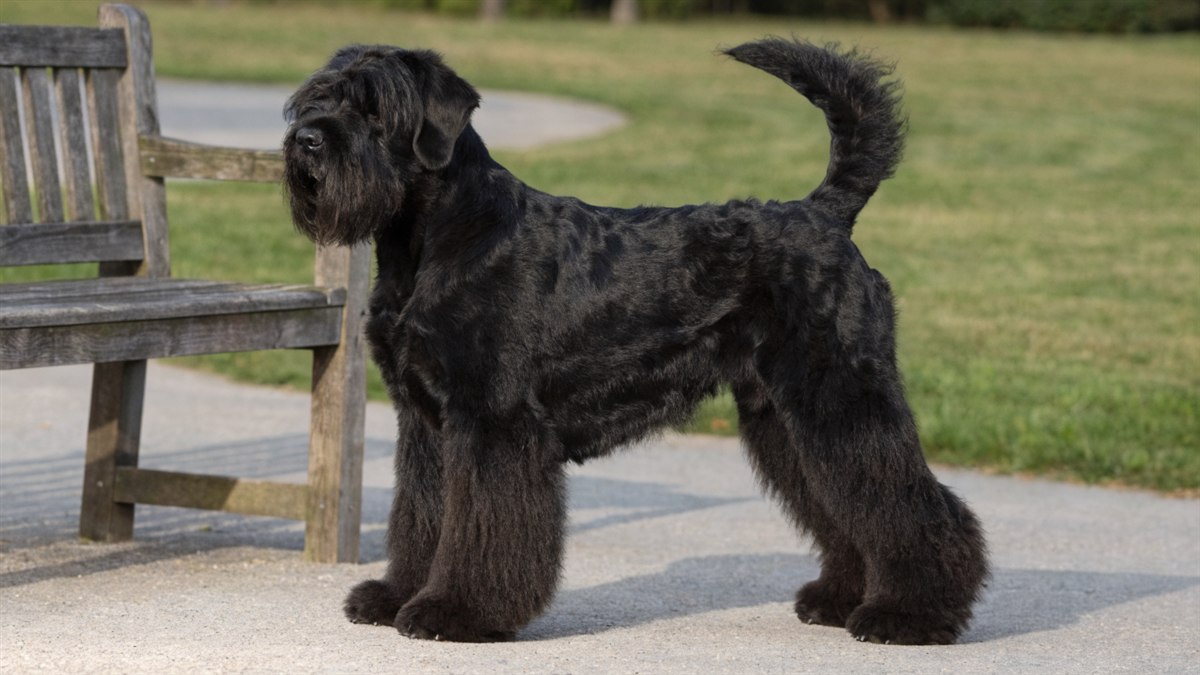
The Black Russian Terrier is a 50 to 60 kg Soviet military guard dog with a coarse black double coat, and it is not a terrier. FCI-Standard No. 327 registers it as Russkiy Tchiorny Terrier, origin Russia, in Group 2 Section 1.4 alongside the Pinschers and Schnauzers rather than in the terrier group at all.
The standard gives the breed's utilization as working dog, guarding dog, sporting and companion dog, and describes a large dog of robust type and hardy constitution with massive bone, powerful muscles, a large head and a deep chest. The AKC's own standard, approved 12 May 2009 and effective 1 July 2009, opens on the same note and adds that the dog must have a stable and reliable temperament possessing self-assurance and courage.
The name is the single most misleading thing about the breed. An Indian buyer searching for a terrier is picturing a Jack Russell or a Bull Terrier, and the SERP encourages the confusion: the fifth organic result for black russian terrier price in india is a Supertails article about the Jack Russell Terrier, a different breed at roughly a tenth of the weight. The Airedale Terrier is genuinely in this breed's ancestry, which is where the name comes from, but the Giant Schnauzer is the main ancestor and the standard says so in its own history paragraph.
What the two standards agree on
| Point | FCI-Standard No. 327 | AKC standard, 2009 |
|---|---|---|
| Height, male | 72 to 76 cm, never below 70 or above 78 | 27 to 30 inches, desired 27 to 29 |
| Height, female | 68 to 72 cm, never below 66 or above 74 | 26 to 29 inches, desired 26 to 28 |
| Weight | Males 50 to 60 kg, females 45 to 50 kg | Not stated anywhere in the standard |
| Head length | Not less than 40 percent of height at withers | Not less than 40 percent of height at withers |
| Coat | Rough thick double coat, natural length 5 to 15 cm | Double coat, natural length 1.5 to 6 inches |
| Colour | Black, or black with slight grey intermingling | Solid black, or black with scattered gray hairs |
| Ears | Hanging, set high, triangular, medium sized | Hanging, medium, and cropped ears are not acceptable |
| Tail | Traditionally docked in the country of origin, undocked has no influence on evaluation | Docked leaves 3 to 5 vertebrae, an undocked tail is not to be penalized |
Two things in that table matter more in India than anywhere else. The AKC standard states outright that cropped ears are not acceptable, and both standards make clear that an undocked tail costs the dog nothing in the ring. So an Indian owner is under no pressure from either standard to have anything cut off this dog, which is the correct outcome, because paragraph 6(8) of the Second Schedule to the Prevention of Cruelty to Animals (Dog Breeding and Marketing) Rules 2017 states that there shall be no tail docking, ear cropping, de-barking, de-clawing or any other kind of mutilation of any body part of the pup.
Where the ranking pages get the basics wrong
The page holding position 2 in India gives male height as 25 to 29 inches and weight as 80 to 143 pounds. Twenty-five inches is 63.5 cm. The FCI's absolute floor is 70 cm and the AKC's is 27 inches, so a dog at the bottom of that published range would be disqualified from the ring by height alone. Eighty pounds is 36 kg, which is 9 kg below the FCI minimum for a female.
The Indian price blog at Bing position 4 is worse, because it disagrees with itself. Its specification table says males weigh 50 to 60 kg. Its body text then says the breed can weigh 80 to 130 pounds, and two paragraphs later says adult dogs typically weigh 70 to 80 pounds and stand 22 to 28 inches tall. Seventy pounds is 32 kg. The same page lists Colors Available as black only and then says the breed also comes in gray and brown, when any colour other than black or black with scattered grey is a disqualifying fault under both standards American Kennel Club.
A 36 kg dog and a 60 kg dog are different animals in an Indian flat, on an Indian staircase and in an Indian veterinary bill. If a seller quotes you a weight under 45 kg for an adult of either sex, they are either describing a different dog or repeating a figure they never checked against the standard.
The Red Star origin, with real dates
The Black Russian Terrier was created at the Red Star (Krasnaya Zvezda) state kennel outside Moscow, part of the Central State School of Military Service Dog Breeding and Training, from a government directive issued in 1949. FCI-327 dates the work to the late 1940s and the early 1950s and names the kennel in the standard itself.
This is one of the very few breeds whose creation is a documented administrative act rather than a folk story, which makes the mythologising around it unnecessary. The dates below come from the breed's own standard, its AKC parent club and an account written by two breed-club officers, and where those three disagree the disagreement is printed rather than smoothed over.
| Date | What happened | Source, and any conflict |
|---|---|---|
| 1930s | Red Star military kennel in Moscow begins work toward a native security-forces dog | BRTCA, the AKC parent club |
| 1949 | Government directive to Red Star to create a military guard breed able to serve in all climatic conditions across the USSR | Showsight, Polonsky and Brown |
| Late 1940s to early 1950s | Selective interbreeding under the military cynological school outside Moscow | FCI-Standard No. 327, the standard's own history paragraph |
| 1955 | Breed group shown publicly; Red Star awarded the Gold Medal at the State Agricultural Exhibition | Showsight. Wikipedia records a Moscow exhibition the same year |
| 1956 | Dogs breeding true to type; Red Star begins releasing stock to private breeders | BRTCA. Wikipedia says Red Star bred them exclusively until 1957 |
| 1956 or 1958 | First breed standard published | Showsight says Red Star published it in the 1956 exhibition catalogue; BRTCA and Wikipedia both say the Red Army created it in 1958 |
| By end of the 1970s | Over 800 litters bred, more than four thousand puppies conforming to the standard | Showsight |
| 1981 | USSR Ministry of Agriculture officially recognises the breed | BRTCA and Showsight agree |
| 1984 | FCI recognition | FCI-327 states it in the standard, and BRTCA, Showsight and Wikipedia all agree |
| 1996 | RKF adopts a second standard; breed introduced to the UK | Wikipedia |
| 1998 | The Kennel Club adds the breed to its Import Register | Wikipedia |
| 2001 | AKC Miscellaneous Class | BRTCA and Showsight agree |
| 1 July 2004 | Admitted to the AKC Working Group | BRTCA and Showsight agree |
| 2020 | Full recognition in Canada, after being shown as a Miscellaneous breed since 2004 | Showsight |
The design brief said all climates, and it meant deserts
The 1949 directive is worth quoting because it is the root of every climate claim made about this breed since. Red Star was told to produce a dog able to serve in all climatic conditions across the USSR, because the Red Army had been relying on European breeds that were medium-sized and not adequately coated for the extreme weather of regions ranging from the hot desert sands of Kyrgyzstan to the deep snow of Siberia.
That brief is where FCI-327's line about a dog which adapts well to various climate conditions comes from. It is a design intention recorded in 1949, not a measurement. Kyrgyz desert heat is dry heat at altitude, and it is not Chennai in May at 64 percent humidity. The climate sections below test the claim against numbers rather than repeating it.
What the dogs were actually used for
Early Black Russian Terriers worked as military police dogs at border crossings, prisons and military installations. The parent club's own account of the tail explains the docking as a safety measure in exactly those settings, because an intact tail could be grabbed and broken by an assailant, and separately as a shortcut to uniformity, since the ancestor breeds' tails varied so widely that breeding for one tail type would have taken years.
That second reason is a candid admission of how young and how heterogeneous the breed was, and it is the honest frame for everything that follows. This is a dog assembled in about seven years from whatever quality stock a war-damaged country could assemble, for a job that no Indian pet owner is going to ask it to do.
Four foundation breeds, or seventeen, or over twenty
Count the foundation breeds and the sources split three ways. FCI-Standard No. 327 names exactly four, the AKC parent club names the same four and then asserts 17 in total, and a Showsight article by two breed-club officers asserts over twenty Black Russian Terrier Club of America Irena Polonsky and Jean Brown.
None of the higher counts names its source. That is the whole problem with this breed's origin story, and it is worth setting out plainly because an Indian buyer is routinely sold the seventeen-breed version as a selling point, as though genetic width were a warranty.
| Source | Count claimed | Breeds named | Evidence offered |
|---|---|---|---|
| FCI-Standard No. 327, the governing standard | Four, described as breeds like | Rottweiler, Giant Schnauzer, Airedale Terrier, Newfoundland, with the Giant Schnauzer as main ancestor | The standard's own history paragraph |
| BRTCA, the AKC parent club | 17 in total | The same four are listed; the other 13 are never named | None given |
| Showsight, Polonsky and Brown, 2024 | Over twenty | Names the four crossing groups and the sire Roy in detail | Described as the Red Star breeding groups |
| Wikipedia | About seventeen | Adds Caucasian Shepherd Dog and South Russian Shepherd Dog | Tagged by Wikipedia's own editors with a by-whom marker |
What the kennel's own crossing groups actually name
The Showsight account is the most useful of the four because it describes the four cross-bred groups Red Star established rather than quoting a total. Read that way, the breeds it actually names are countable.
- First group. A Giant Schnauzer named Roy bred to three Airedale Terrier bitches, all of them full siblings.
- Second group. The same Roy bred to Rottweiler bitches.
- Third group. Roy bred to the now extinct Moscow Water Dog, itself a mix of Newfoundland, Caucasian Shepherd and Eastern European Shepherd.
- Fourth group. Rottweilers bred to bitches descended from Roy's offspring, the Moscow Water Dog, the Moscow Dog (a Great Dane and Eastern European Shepherd mix), the Russian Hound and the Airedale Terrier.
That is eight named pure breeds, being Giant Schnauzer, Airedale Terrier, Rottweiler, Newfoundland, Caucasian Shepherd, Eastern European Shepherd, Great Dane and Russian Hound, plus two composite Soviet types. It is not four, and it is not seventeen or twenty either. A reader who wants a number that can be checked against a named source should use eight, and should note that one dog, Roy, sired three of the four founding groups.
The candour in the record is the reason to trust it
The same account records the founding stock's faults rather than hiding them. Roy had a straight or level bite, which is a departure from the scissors bite both standards now require. Another Giant Schnauzer used in the programme, Lasso F. Drachtenslucht, was a cryptorchid, a dog with one or both testicles undescended. Both standards now treat those as faults, and FCI-327 requires that males have two apparently normal testicles fully descended.
Post-war Europe had very little canine population left to choose from, and the programme used what it had. That is an honest explanation. It is also the reason the gene pool is narrow, which is exactly what the DNA sections below measure rather than assert.
Second Schedule Part II paragraph 6(3) of the Prevention of Cruelty to Animals (Dog Breeding and Marketing) Rules 2017 prohibits in breeding, defined as breeding between relatives of the 2nd to 4th grade within the first four generations, and incest breeding, defined as mating between parents and children or between brother and sister. Red Star founded this breed on one sire bred to three full-sibling bitches, and reached a true-breeding type by the fourth generation. An Indian breeder attempting the same programme today would be breaking the Rules Irena Polonsky and Jean Brown.
This is not an attack on the breed. It is the reason to insist on DNA-tested parents when buying one, because a founder population that small concentrates recessive alleles, and two of them are now measurable.
Size and substance, in an Indian household
An adult male Black Russian Terrier stands 72 to 76 cm at the withers and weighs 50 to 60 kg, and a female stands 68 to 72 cm and weighs 45 to 50 kg. In Indian terms that is a dog whose shoulder reaches an adult's hip and which outweighs a great many of the people who will be walking it.
The AKC standard gives no weight at all, only height, which is worth knowing if a seller quotes you an AKC figure and calls it a weight. The parent club fills the gap for buyers with a plain-English range of 26 to 30 inches at the shoulder and 80 to 130 plus pounds.
| Figure | FCI-327, the standard | Position 2 in India | Bing position 4 in India |
|---|---|---|---|
| Male height | 72 to 76 cm, floor 70 cm | 25 to 29 inches, so 64 to 74 cm | 72 to 76 cm in the table, 22 to 28 inches in the text |
| Male weight | 50 to 60 kg | 80 to 143 pounds, so 36 to 65 kg | 50 to 60 kg in the table, 70 to 80 pounds in the text |
| Female weight | 45 to 50 kg | Not split by sex | 40 to 50 kg |
| Lowest weight implied | 45 kg | 36 kg | 32 kg |
The lowest weight a reader could take away from those pages is 32 kg, which is 18 kg below the standard's floor for a female Federation Cynologique Internationale. That gap is not academic. It is the difference between a dog a 55 kg owner can physically restrain on a lead and one they cannot.
Six things a 55 kg dog changes in an Indian home
- Lift. A dog this size cannot be carried down a staircase during a lift breakdown, which in most Indian apartment buildings is a routine event rather than an emergency.
- Restrain. A large, protective guard dog that decides a delivery rider is a threat must be held by someone who can physically hold it. The parent club warns that the dog treats your home, yard, vehicle and belongings as its territory.
- Transport. Very few Indian autos and app cabs will take a 55 kg dog, so vet trips need a car you own or a pet ambulance booked in advance.
- Dose. Medication and preventive treatments are priced by body weight, so every tick preventive, every dewormer and every anaesthetic costs multiples of what a 12 kg dog costs.
- Floor. A 55 kg dog on smooth Indian granite or vitrified tile has no grip, which loads the hips of a breed already carrying a 37.7 percent dysplastic rate on OFA's register.
- Space. Air conditioning a room is a per-room cost, and this breed's own parent club expects it to spend much more time indoors in air conditioning during hot weather.
Only the last two are usually mentioned on Indian pages, and neither is quantified. The floor point is the one owners fix too late: rubber-backed runners on the routes the dog uses daily cost a few thousand rupees and are the cheapest joint insurance available to a growing giant-breed puppy.
The AKC standard measures height for males and females at maturity, defined as over 18 months of age. A seller showing you a five-month-old puppy cannot tell you what it will measure, and neither can you. Judge the parents.
Black Russian Terrier price in India, checked page by page
Published rupee figures for a Black Russian Terrier price in India run from Rs 20,000 to Rs 18,00,000, a ninety-fold spread, and the page ranking first in India publishes no price at all Mr n Mrs Pet, Black Russian Terrier Puppies…. That spread is the finding. Any page quoting one number for this breed has not looked at the others.
Bonbeno does not sell dogs, broker puppies or take breeder commissions. The figures below are reported as published editorial content, not as an offer, and every one of them was read on the page it is attributed to.
| Source | Position | Figure published | In rupees at 84.38 |
|---|---|---|---|
| Mr n Mrs Pet | 1 on Google India, 1 on Bing India | No price anywhere on the page | Nothing to convert |
| Dogbreedslist | 2 on Google India | 3,000 to 4,000 USD average; 2,000 to 4,500 USD across North America | Rs 2,53,140 to 3,37,520; Rs 1,68,760 to 3,79,710 |
| BarkJunction | 4 on Bing India | Rs 20,000 to Rs 30,000 | Already rupees |
| Puppiezo | 2 and 3 on Bing India | Rs 98,999, tier labelled Platinum | Already rupees |
| DNA, quoting Tegha Kennels, Delhi | Not ranking, found via the trade | Rs 18,00,000 | Already rupees |
| Financial Express | Not ranking | About 1,800 USD | Rs 1,51,884 |
The number one result publishes no price, and that is provable
The Mr n Mrs Pet page ranks first in India for this exact query and its meta description promises Black Russian Terrier puppies at affordable prices in India. The page itself says 3 Result Found and Page 1 of 1, and then renders three pet cards under a heading reading Similar breeds at other locations. Those three cards are an Australian Shepherd in Jaipur, a French Bulldog in Hyderabad and a Cavalier King Charles Spaniel in Kolkata. Not one is a Black Russian Terrier, and every price is hidden behind a View Price sign-up wall.
That could be a site-wide design choice rather than an absence, so it was controlled. The same site's Labrador Retriever page, on the identical template, publishes a full price structure: Rs 30,000 to Rs 1,20,000 overall, split into Basic quality at Rs 30,000 to 60,000, KCI Registered at Rs 60,000 to 90,000 and Champion Bloodline at Rs 90,000 to 1,20,000, plus a city table covering Hyderabad, Bangalore, Delhi, Chennai, Lucknow, Mumbai, Jaipur and Pune. The site publishes prices when it has stock. For this breed it has none.
The only figure with a named human behind it
The Rs 18,00,000 figure is the only price in this set attributed to a named Indian seller in a bylined publication. It comes from a DNA feature by Gargi Gupta, reproduced on Tegha Kennel's own media page, which quotes Harshdeep Singh Tegha of Tegha Kennels in Delhi naming his most expensive breeds as the Tosa Inu at Rs 35 lakh, the Scottish Deerhound at Rs 17 lakh and the Black Russian Terrier at Rs 18 lakh.
The same sentence is worth reading twice, because the seller volunteers the caveat: all three are dogs from cold climates, dogs bred for specific tasks, and the article adds that they are not quite geared to be the house-trained domestic pet. A Delhi kennel owner selling this breed at 18 lakh rupees is on the record saying it is not really a pet dog for this country.
Rs 20,000 and Rs 18,00,000 cannot both describe the same animal. One of them is describing a dog that is not a Black Russian Terrier, or a price that was never charged. Treat any quote below about Rs 1,00,000 for this breed as a claim to be verified against KCI papers and DNA-tested parents, not as a bargain.
Running the dollar test on every rupee figure
Divide every published rupee figure by 84.38 and see whether a round dollar amount falls out, because Indian pages routinely republish a US price with the currency symbol swapped. Two of the four rupee figures here survive that test, one fails a different and more damaging test, and the arithmetic is printed below so you can repeat it Puppiezo, Black Russian Terrier Price Gargi Gupta, Is the craze to own exotic dog….
The test works because a genuine Indian asking price is set in rupees and lands on Indian price points, while a converted figure lands on a round dollar number after division. Anyone can run it on a phone calculator.
| Rupee figure | Divided by 84.38 | Round dollar amount? | Verdict |
|---|---|---|---|
| Rs 18,00,000, Tegha Kennels via DNA | 21,332.07 USD | No | Genuine Indian pricing, named seller, bylined feature |
| Rs 98,999, Puppiezo | 1,173.25 USD | No | Not a Black Russian Terrier price. Re-checked at source on 21 August 2026: the breed's own availability block is empty and Rs 98,999 is the listed price of Fizey, an eight-week-old Maltipoo, in the Other Available Pets carousel |
| Rs 20,000, BarkJunction low end | 237.02 USD | No | Not a conversion, but see below |
| Rs 30,000, BarkJunction high end | 355.53 USD | No | Not a conversion, but see below |
| Rs 2,000, BarkJunction vet visit | 23.70 USD | No | Plausible Indian consulting fee |
| Rs 5,000, BarkJunction training session | 59.26 USD | No | Plausible Indian session fee |
BarkJunction fails a worse test than the exchange rate
The Rs 20,000 to Rs 30,000 range does not resolve to a round dollar figure, so it is not a straight conversion. It is something less defensible. The sentence carrying it reads, in full and verbatim, Across North America, Black Russian Terrier breeders charge anywhere from Rs 20000 to Rs 30000 for a puppy.
North American breeders do not charge in rupees. Compare the co-ranking Dogbreedslist page, which says Across North America, Black Russian Terrier breeders charge anywhere from 2,000 to 4,500 USD for a puppy. It could be more or it could be less, depending on the breeder, where the breeder lives, shipping costs. BarkJunction's next line is Depending on your location and the breeder's reputation, it could be more or less.
The sentence structure, the geography and the follow-on clause all match. The numbers and the currency symbol were replaced and the words around them were not. That is a find-and-replace artefact, and it means the headline Indian price on that page is a rewritten North American dollar range with no Indian transaction behind it.
The dollar figures Indian publications print without converting
The reverse pattern also runs here. Indian outlets publish this breed's price in US dollars and leave the reader to convert. The Financial Express puts it at about 1,800 USD, which is Rs 1,51,884 at 84.38. Dogbreedslist, ranking second in India for a query that literally contains the words in india, publishes only US dollars and North American context, and Bing itself flags that page with Missing: india Bing India results page for the query black….
One rupee figure survives scrutiny, and it is Rs 18,00,000 from a named Delhi kennel quoted in a newspaper. The Rs 98,999 that appears against this breed on an Indian listing site is not a price for it: re-checked at source on 21 August 2026, that page lists no Black Russian Terrier at all and Rs 98,999 belongs to a Maltipoo in its Other Available Pets carousel. That leaves a single verifiable figure, which is wide because the market is thin rather than because the dogs differ that much. Ask any seller for the KCI registration number, the parents' hip and elbow scores, and the hyperuricosuria and juvenile laryngeal paralysis DNA results before discussing money at all.
Why you cannot lawfully import one to breed from
Indian law permits you to bring your own Black Russian Terrier home as a pet and forbids you from importing one to breed or trade. DGFT Trade Notice No. 22/2022-23 of 19 December 2022 classifies dogs under ITC (HS) 01061900 as Restricted and states at paragraph 6 that any applications for trading or breeding purposes shall be duly rejected.
This matters more for a rare breed than a common one, because it is the mechanism that keeps the Indian population tiny and the price band wild. The notice was read in full from the DGFT's own five-page PDF, signed by Md. Moin Afaque, Deputy Director General of Foreign Trade.
The three permitted routes, verbatim
- Pet dog with a valid pet book and relevant records or documents in the name of the importer.
- Research, by R and D organisations conducting research with the recommendation of CPCSEA.
- Internal security, by the Defence and Police Force.
Policy Condition 8 closes the door explicitly: import of commercial dogs for breeding or any other commercial activity other than the purposes above is not permitted. Nothing in that list lets an Indian kennel import breeding stock, so no lawful commercial supply chain for this breed can form inside India.
What the pet route actually requires
Bringing your own dog in as a pet is a real route, and it is narrow. Permanent import as passenger baggage without a DGFT authorisation is allowed only to persons transferring their residence to India after two years of continuous stay abroad, and only for up to two pets. Anything else needs an import authorisation from DGFT, with applications examined by DAH and D. Entry is permitted only through the airports and seaports of Delhi, Mumbai, Chennai, Hyderabad, Bengaluru and Kolkata and, since October 2024, Kochi airport, and DGFT advises starting the application at least two months before travel Department of Animal Husbandry…. The full route is set out in how to import a dog to India.
An Advance No Objection Certificate must be obtained from the Regional or Quarantine Officer of those ports, seven days before travel and relaxable to three days, after submitting the DGFT licence and a health certificate from the exporting country's veterinarian, with all the prescribed disease testing done in the exporting country.
| You want to | Lawful? | What actually applies |
|---|---|---|
| Bring your own BRT home after living abroad two years | Yes | Passenger baggage, up to two pets, no DGFT authorisation, seven ports only |
| Import a BRT you bought online from a European kennel | Needs authorisation | DGFT import authorisation, examined by DAH and D, at least two months lead time |
| Import a pair to start breeding BRTs in India | No | Paragraph 6, applications for breeding purposes shall be duly rejected |
| Buy a BRT already in India | Yes if it exists | The number one Indian listing page has none in stock |
Read alongside the price section, that explains the ninety-fold spread. A market fed only by returning residents' pets and whatever descends from them is not a market with a clearing price. It is a handful of dogs, and a great many pages selling the idea of them.
A seller offering multiple Black Russian Terrier puppies in India should be able to show the import paperwork for the founding stock or KCI registration tracing to it. Anyone who cannot, and who is nevertheless offering a rare imported guard breed at Rs 20,000, is not selling you what the page says Directorate General of Foreign Trade.
The monthly cost of keeping a 55 kg dog in India
Budget for roughly 18 kg of dry food a month before anything else, because the breed's own parent club puts an adult male at approximately 40 pounds of dry food per month. Forty pounds is 18.14 kg, which works out at about 605 g a day, and that single figure drives most of the recurring cost of this dog in India.
That daily figure can be sanity-checked against a manufacturer's own Indian feeding tables rather than taken on trust. Royal Canin India's Giant Adult chart begins at 45 kg and gives 394 g a day at low activity, 457 g at medium and 519 g at high. A 55 to 60 kg working-bred dog eating around 605 g a day sits exactly where you would expect above that line.
This breed outgrows India's standard large-breed food
Royal Canin India's Maxi Adult, the default large-breed food on Indian shelves, states on its own product page that it is a complete feed for adult large breed dogs from 26 to 44 kg, from 15 months to 5 years old, and its feeding table stops at 44 kg. A male Black Russian Terrier at 50 to 60 kg is outside that range entirely.
So the correct product is the Giant formulation, not the Maxi one, and an Indian owner buying by the words large breed is under-specifying. This is a small point that costs nothing to get right and is made on no ranking page.
What the parent club budgets, converted for scale
| Item | BRTCA figure | At 84.38 | Note for India |
|---|---|---|---|
| Dry food, per month | 75 to 150 USD | Rs 6,329 to Rs 12,657 | Indian food prices differ; the 18 kg volume is the transferable number |
| Health testing, one off | 400 to 900 USD | Rs 33,752 to Rs 75,942 | Hips, elbows, heart, eyes and DNA, over and above the cost of the dog |
| Obedience training | One full year of lessons | Not priced by the club | Indian sessions were published at Rs 1,000 to Rs 5,000 by one low-authority blog |
| Professional grooming | Every 4 to 6 weeks | Not priced by the club | 8 to 13 visits a year for a 55 kg double-coated dog |
The club is explicit that size drives the veterinary bill, because medication dosages and some preventive treatments are based on body weight, and it lists routine care, vaccinations, preventive medications, emergency care, illness or injury, dental care and age-related expenses as separate lines to budget. On a 55 kg dog every one of those is a multiple of what a small breed costs.
The Indian lines nobody budgets for
- Cooling. The parent club expects the dog to spend much more time indoors in air conditioning during hot weather, which is a per-room electricity line for eight months of the year in most Indian cities.
- Grooming, professionally. A visit every 4 to 6 weeks is 8 to 13 appointments a year, and very few Indian groomers are set up to handle a 55 kg guarding breed that dislikes strangers handling it.
- Tick prevention, year round. A Punjab survey of 719 dogs found Babesia gibsoni in 8.9 percent by multiplex PCR, and dosing is by body weight.
- Transport. Vet visits for a dog this size usually mean a private car or a booked pet ambulance rather than an auto.
- Screening you will pay for twice. Hip and elbow radiographs need sedation in a dog this size, and the DNA tests for hyperuricosuria and juvenile laryngeal paralysis are separate again.
The ranking Indian price blog puts vet visits at Rs 2,000 to Rs 5,000 and training at Rs 1,000 to Rs 5,000 a session. Those are plausible Indian figures and neither resolves to a round dollar amount, so they are not converted, but they come from a page that contradicts itself on the dog's weight three times and should be treated as indicative only.
Heat tolerance, argued from the coat rather than asserted
Bonbeno rates the Black Russian Terrier 2 out of 5 for heat tolerance, and the rating is built from three mechanical facts about the dog rather than from adjectives. Two of them push the score down hard and the third is the only reason it is not a 1.
The sources disagree on this question, which is exactly why it needs arithmetic rather than opinion. FCI-327 says the breed adapts well to various climate conditions. Royal Canin India says it is able to adapt to different climates and cites the FCI as its source. The AKC parent club, writing for owners rather than for judges, says something different Royal Canin India Black Russian Terrier Club of America.
Under a heading reading Do You Live in a Hot Climate?, the Black Russian Terrier Club of America writes: Black Russian Terriers are cold-weather dogs and can be less tolerant of heat and humidity. If you live in a warm climate, you'll need to plan carefully for your BRT's comfort and safety. During hot weather, your BRT may spend much more time indoors in air conditioning.
That is the AKC parent club for the breed telling prospective owners it is a cold-weather dog. An Indian page repeating the FCI's climate-adaptation line without this is quoting a 1949 design brief over the people who actually keep the dogs.
Factor one, the coat, and it is compulsory
The standard does not merely permit heavy insulation, it requires it. FCI-327 specifies a rough and thick double coat made of a coarse, thick, slightly waved outer coat over a soft, short and dense undercoat, with a natural untrimmed length of 5 to 15 cm, very well developed head furnishings forming abundant eyebrows, moustaches and beard, and legs covered in long dense furnishing coat. No undercoat is listed as a fault, and a smooth guard coat without head, chest and leg furnishing is a disqualifying fault.
So a correct Black Russian Terrier cannot be a lightly coated one. You cannot breed the insulation off this dog and still have the breed. That is unusual, and it is why the coat weighs so heavily in the rating.
The standard also makes the colour compulsory. Black, or black with insignificant grey intermingling, is the only permitted coat, and any other colour is a disqualifying fault. Bonbeno found no study measuring solar gain by coat colour in dogs, so no figure is attached to that here, and it is left out of the rating rather than guessed at.
Mass, skull, and how the rating of 2 is built
Body mass drags this breed's heat tolerance down and skull structure holds it up. Those two factors, set against the compulsory coat, are what produce a rating of 2 out of 5 rather than a 1 or a 3.
Factor two, 50 to 60 kg of body mass
A large body sheds heat across a surface that grows more slowly than the mass generating it, and the veterinary evidence tracks that. A VetCompass study of heat-related illness in UK dogs found bodyweight among the risk factors associated with severe disease. From the other direction, an Israeli series of 54 heat-stroke cases found small breeds under 8 kg markedly underrepresented, at 2 percent of cases with an odds ratio of 0.08. A male Black Russian Terrier at 50 to 60 kg sits at the wrong end of that relationship.
Factor three, the skull, and this one helps
The breed is not brachycephalic, and that genuinely matters. FCI-327 gives a muzzle slightly shorter than the skull, and the AKC standard puts the back skull to muzzle ratio at approximately 5 to 4 American Kennel Club. The same VetCompass study found skull shape associated with fatal outcome, with the risk of death greater in dogs with a reduced capacity to thermoregulate, naming older and brachycephalic dogs.
A Black Russian Terrier therefore keeps a full, normally proportioned panting apparatus. It carries a cold-country coat on a heavy frame, but it can actually move air. That is the difference between a 2 and a 1 on this scale, and it is worth knowing because it means cooling measures work on this dog in a way they do not on a flat-faced breed.
| Factor | What the evidence says | Effect on the rating |
|---|---|---|
| Coat | Dense undercoat is compulsory; no undercoat is a fault; natural length 5 to 15 cm | Strongly down |
| Body mass | 50 to 60 kg males; bodyweight is a risk factor for severe heat illness | Strongly down |
| Skull | Mesocephalic, muzzle slightly shorter than skull, not brachycephalic | Up, and the reason it is not a 1 |
| Colour | Solid black is compulsory, any other colour disqualifies | Excluded, because no study of solar gain by coat colour in dogs was found |
| Parent club's own verdict | Cold-weather dogs, less tolerant of heat and humidity, may live indoors in air conditioning | Confirms the direction |
Unlike most double-coated breeds, this one's standards expect the coat to be trimmed. FCI-327 states that grooming in the correct form is required and describes the clipped coat, and the AKC standard says the trimmed length of coat and leg furnishings may vary from 0.2 to 6 inches depending on the location on the body. Zero point two inches is 5 mm. An Indian owner keeping the body coat near the short end of the standard's own trimmed range is following the standard, not breaking it. Shaving to bare skin is a different thing, removes the sun barrier, and is not what either standard describes.
Moscow against nine Indian cities, on one dataset
Moscow, the city this breed was built in, has an annual mean air temperature of 4.28 degrees Celsius. Chennai's is 27.95. That is a gap of 23.67 degrees, and every figure below comes from the same NASA POWER climatology on the same methodology so the cities are directly comparable.
Bonbeno queried NASA's POWER climatology API point by point on 21 August 2026 for the 2001 to 2020 period, taking mean air temperature at 2 metres, maximum air temperature at 2 metres and relative humidity at 2 metres. Using one dataset for every city avoids the usual trick of comparing a European average from one source against an Indian summer peak from another.
| City | Annual mean, C | Warmer than Moscow by | Peak recorded max, C | Annual mean humidity, % |
|---|---|---|---|---|
| Moscow, where the breed was made | 4.28 | reference | 35.06 in August | 87.5 |
| Shimla | 21.15 | 16.87 | 43.87 in June | 50.3 |
| Bengaluru | 23.74 | 19.46 | 40.38 in April | 67.9 |
| Pune | 23.86 | 19.58 | 43.20 in April | 66.8 |
| Delhi | 25.60 | 21.32 | 48.79 in June | 45.6 |
| Kolkata | 25.81 | 21.53 | 46.81 in May | 73.9 |
| Hyderabad | 26.10 | 21.82 | 45.00 in May | 60.3 |
| Mumbai | 26.77 | 22.49 | 44.91 in April | 67.4 |
| Ahmedabad | 27.57 | 23.29 | 48.58 in May | 48.3 |
| Chennai | 27.95 | 23.67 | 42.70 in May | 72.4 |
The comparison that should decide it
The VetCompass study of heat-related illness in UK dogs reports the median ambient temperature on days when those events happened as 16.9 degrees Celsius. That is not a heatwave figure. It is the middle of the days on which British dogs got into heat trouble.
Now line the Indian annual means against it. Shimla, the coolest city in the table, averages 21.15 degrees across the whole year, which is 4.25 degrees above the median day on which UK dogs developed heat-related illness. Chennai averages 27.95, which is 11.05 above it Hall EJ, Carter AJ, Chico G, Bradbury J. Moscow's annual mean sits 12.62 degrees below that median.
In other words, an average day anywhere in this table is hotter than the typical day a UK dog needed treating on, and the breed was assembled in a city whose average day is well below it. That is the whole climate argument, and it needs no adjectives.
Humidity is the part Indian pages miss
The parent club names heat and humidity together, and humidity is what defeats panting, because an evaporative cooling system works poorly when the air is already close to saturated. Kolkata's annual mean relative humidity is 73.9 percent and Chennai's is 72.4, against 45.6 in Delhi and 48.3 in Ahmedabad.
So the two hardest Indian cities for this breed are not the hottest ones. Delhi and Ahmedabad post the highest peaks, at 48.79 and 48.58 degrees, but they are dry, and a panting dog in dry air is still cooling. Kolkata pairs a 46.81 degree peak with 73.9 percent mean humidity, and Chennai pairs 27.95 degrees of year-round warmth with 72.4 percent. Those are the two where a 55 kg double-coated black dog has the least margin.
Moscow's annual mean humidity is 87.5 percent, higher than any Indian city in this table. Humidity only becomes a cooling problem when the dog needs to shed heat, and at an annual mean of 4.28 degrees it usually does not. Quoting humidity alone, without the temperature beside it, is how a page can make Moscow look harder than Chennai.
What Indian owners of cold-climate breeds actually do
The DNA feature that carries this breed's only named Indian price is also the best Indian evidence on the point. It describes a Caucasian Ovcharka, a breed that shares an ancestor line with the Black Russian Terrier through the Moscow Water Dog, living in a centrally air-conditioned west Delhi apartment where there's no way that Brutus can go outside in the searing heat, and a Bengaluru breeder who houses imported dogs in air-conditioned kennels to help them acclimatise to the hot Indian climate Irena Polonsky and Jean Brown.
That is what keeping this kind of dog in India looks like in practice, reported by an Indian newspaper about Indian owners. It matches the parent club's expectation that the dog will spend much more time indoors in air conditioning during hot weather, and it is a recurring electricity cost rather than a one-off purchase.
Temperament, and who should not buy one
The Black Russian Terrier is aloof with strangers by design, and its own parent club says so in the plainest possible terms. If you want a dog that enthusiastically welcomes every person who walks through your front door, the club writes, a BRT may not be the right breed for you.
That sentence does more work than any adjective, so this section is built from what the standards and the club actually say rather than from temperament words. Both standards describe the same animal and both make the extremes disqualifying.
| Source | What it says |
|---|---|
| AKC standard, 2009 | Calm, confident, courageous and self-assured. Highly intelligent and adapts well to training. Alert and responsive, instinctively protective, determined, fearless, deeply loyal to family, aloof and therefore does not relish intrusion by strangers into his personal space |
| AKC serious fault | Shyness or excessive excitability |
| FCI-327 | A dignified and confident dog, well controlled in all situations. When circumstances require, he immediately assumes an active-defensive posture, however, quickly calms down at the disappearance of threat |
| FCI-327 disqualifying fault | Aggressive or overly shy |
| FCI-327 severe fault | Timid or overexcited behaviour |
| Royal Canin India | Bred for work, strong willed and particularly distrustful of strangers, with an inclination toward strong defence |
Note what those clauses have in common. Both standards treat an aggressive dog and a shy dog as equally wrong, and FCI-327 specifically asks for a dog that goes into an active-defensive posture when it needs to and quickly calms down at the disappearance of threat. A dog that cannot switch off is not a correct Black Russian Terrier, whatever a seller tells you about guarding drive.
What the dog considers its territory
The parent club lists it explicitly, and the list is longer than most Indian buyers expect. A Black Russian Terrier treats as its territory you and your family, your home, your yard, your vehicle, your belongings and other spaces it considers its own.
The vehicle and the belongings are the ones that catch people out in Indian conditions. A dog that guards the car is a problem at a fuel stop and at a parking attendant's approach. A dog that guards belongings is a problem when a domestic worker moves a bag. The club adds that the protective instinct remains even with extensive socialization, so this is a management task, not something training removes.
Children, honestly
The club's answer is careful and worth reproducing rather than compressing. Black Russian Terriers can be wonderful family dogs and may be gentle and tolerant with children, but they are also large, powerful dogs, and one can unintentionally knock over or injure a small child simply through rough play or exuberance. Families with very young children, it says, may want to consider waiting until the children are older.
Royal Canin India puts it more warmly, saying the breed thrives on human contact and is very gentle when playing with children. Both can be true. The difference is that one of them is accounting for 55 kg of momentum in a corridor.
The claim that this is a dangerous breed in India
One Indian price page asserts that the Black Russian Terrier is also considered one of the most dangerous breeds in India, and offers no source, no incident data and no legal citation. The same page rates the breed's trainability as Easy and calls it Kids Friendly: Yes, three claims that cannot comfortably sit together.
There is no Indian breed ban that names this dog, and Bonbeno found no Indian bite-incidence data for it. The honest position is that it is a large guarding breed whose risk profile is a function of its size and its territory list, not of a legal designation.
Do not buy one if any of these is true. You want a dog that greets every visitor. You have a child under about six. You cannot physically restrain 55 kg on a lead. You live somewhere staff, delivery riders or neighbours pass through daily without notice. You intend to keep the dog outside, which the parent club rules out directly, saying these are not dogs that should simply be left outside, chained to a doghouse, or isolated in a fenced yard. Or you cannot air condition a room through an Indian summer.
Training a dog the standards call highly intelligent
Plan for a full year of formal obedience, because that is what the breed's own parent club asks for: one full year of obedience lessons, covering come, sit, stay, down and loose-leash walking. Both standards agree the raw material is good, with the AKC calling the breed highly intelligent and adapting well to training and FCI-327 saying it adapts well to training and is hard working and reliable Federation Cynologique Internationale.
So this is not a difficult dog to teach. It is a difficult dog to under-train, which is a different problem and the one Indian owners actually hit. A biddable 55 kg guarding breed that has learned nothing is far more dangerous than a stubborn 10 kg one.
Start at eight weeks, because Indian law starts there too
Rule 8(1)(a) of the Prevention of Cruelty to Animals (Dog Breeding and Marketing) Rules 2017 states that every breeder shall ensure that pups less than eight weeks in age are not sold. That is the earliest a puppy can lawfully reach you in India, and it lands inside the window when social exposure does the most work.
So the practical sequence is fixed by law at one end and by vaccination at the other. The same Rules record that all pups shall be vaccinated starting at the age of seven to eight weeks, usually completed at the age of eighteen weeks. The gap between those two dates is the period Indian owners most often waste, keeping a puppy indoors and unexposed until the course finishes.
What to train, in order
- Handling first. Grooming begins when the dog is young so it becomes comfortable being handled, which the parent club states directly. A 55 kg dog that objects to having its beard combed is untreatable at the vet as well as ungroomable.
- Loose-leash walking second. The club names it among the five core skills, and it is the one that decides whether you can walk this dog at all in Indian traffic.
- Recall third, built before the dog is strong enough to ignore it.
- Settle and switch-off fourth. FCI-327 asks for a dog that quickly calms down at the disappearance of threat, and that is a trained behaviour as much as a bred one.
- Introductions fifth. The club says owners must be prepared to manage introductions and unexpected visitors responsibly, which is a protocol you rehearse, not an instinct you suppress.
Early socialisation belongs across all five, and the club is honest about its limits: even with extensive socialization, the breed's natural protective instinct remains. You are shaping how the dog expresses that instinct, not deleting it.
Ignore the pack-leader framing on the ranking page
The page at position 2 in India tells readers that the dog must be made to know that they do not rank above the human members of its pack and that when walking it, it is imperative that the dog heel beside you and never lead, because in the dog's mind the leader is the one in front. No source is offered for any of it.
The same page rates the breed's intelligence at 2 stars while rating trainability at 4 and describing it as very eager to please, and a co-ranking Indian page rates trainability as Easy while calling the breed one of the most dangerous in India. When pages contradict themselves this openly, the safer guide is the parent club's concrete ask, which is a year of lessons and five named skills.
A guarding breed of this size needs a trainer who has worked one before, and there are not many in India who have. Line that up first. If the only trainers available near you offer bite work or protection sport as the headline service, that is the opposite of what this dog needs from its first year.
The daily requirement, and why Indian timing decides it
Give this breed a long daily walk plus real mental work, and give it before sunrise or after dark. Exertion is the trigger behind the majority of heat-related illness events in the VetCompass study of UK dogs, which makes the timing of exercise the single highest-leverage decision an Indian owner of this breed makes.
The sources agree on the volume and say nothing about the clock, because none of them was written for this country. Royal Canin India describes an active, even extremely energetic breed that is hardy, well balanced but lively, and well suited to agility activities and dog sports. The page at position 2 rates exercise needs at 4 out of 5 and says the breed is always ready for a long daily walk. The parent club asks for physical exercise and mental stimulation together.
What the heat evidence does to that schedule
Two independent series point the same way. VetCompass found that while the majority of heat-related illness events overall were triggered by exertion, the risk of severe disease was greater where dogs could not escape the heat source. The Israeli series of 54 cases found 63 percent, being 34 of 54, were exertional rather than environmental, and 78 percent, being 42 of 54, presented between June and August.
Neither study is about this breed, and neither is Indian. Both are about the mechanism, and the mechanism does not change: a heavily insulated dog doing work in warm air is the high-risk case. In a country whose coolest city in this page's table averages 21.15 degrees across the year, that means the walk moves to the edges of the day and stays there for most of the year.
| Slot | What it is | Why |
|---|---|---|
| Before sunrise | 45 to 60 minutes of walking at pace | Coolest air of the day and the lowest surface temperature underfoot |
| Mid-morning, indoors | 15 minutes of scent work or a food puzzle | Mental stimulation is half the club's requirement and costs no heat load |
| Afternoon | Nothing outdoors | Peak recorded maxima in this page's table run from 40.38 to 48.79 degrees |
| After dark | 30 to 45 minutes plus a short training session | Air has cooled, and this is where loose-leash practice happens |
| Weekly | One longer outing in a genuinely cool window | Endurance is in the standard, so build it when the weather allows |
Apartment living, and what the sources actually claim
The page at position 2 rates apartment friendliness at 3 out of 5 and argues that the breed will do okay in an apartment if it is sufficiently exercised, that these dogs are relatively inactive indoors, and that no matter how big your yard is they will be sitting at your front door waiting to come in. It adds that the breed does not do well living in a kennel and must have close human contact.
That last part is corroborated by the parent club, which states these are not dogs that should simply be left outside, chained to a doghouse, or isolated in a fenced yard. So apartment living is not automatically wrong for this breed, and a compound with the dog left outside is worse. What an Indian flat needs to supply is the exercise, the cooling and a lift plan for a 55 kg animal.
A giant-breed puppy's joints are still forming, and this breed carries a 37.7 percent dysplastic rate across 1,336 hip evaluations on OFA's register. Forced running, stairs and jumping before the growth plates close belong nowhere in the first year. Build duration, not intensity, and keep it off smooth tile.
Coat care on a double-coated dog in Indian humidity
Brush and comb weekly and book a professional groom every 4 to 6 weeks, which is what the breed's own parent club specifies. On a 55 kg dog carrying 5 to 15 cm of coat over a dense undercoat, that is 8 to 13 salon visits a year plus about 52 sessions you do yourself.
Both standards make grooming a requirement rather than an option. FCI-327 states that grooming in the correct form is required and that the clipped coat should emphasise the character of a strong and assured dog and by no means be excessively decorative. The AKC standard says trimming of the natural coat is needed for suitable shape and upkeep American Kennel Club.
The page at position 2 in India rates grooming as Moderate Maintenance and states No trimming or stripping needed. Both standards require trimming. That is not a difference of opinion, it is a page contradicting the documents that define the breed.
The shedding claim, and why it is wrong
The same position 2 page rates shedding at 1 star out of 5 and describes it as Minimal Shedding: This dog will shed a negligible amount, recommending the breed for owners who do not want to deal with dog hair in their cars and homes. On the same page, its own Health Issues row reads Hypoallergenic: No. The page refutes itself.
The parent club, which is made of people who live with the dogs, says the opposite twice: They also shed their undercoat. The amount of shedding varies between individual dogs depending on their coat and undercoat, and separately, BRTs also shed, and you may encounter tumbleweeds of dog hair.
On the allergy question the evidence is settled and does not need re-testing for this breed. Vredegoor and colleagues measured the major dog allergen Can f 1 across 196 dogs of so-called hypoallergenic breeds, a group that included the Airedale Terrier, against 160 control dogs. The hypoallergenic group came back higher, at 2.26 micrograms per gram in hair against 0.77 and 27.04 in coat against 12.98, with no difference in airborne allergen, and the authors conclude there is no evidence for the classification of certain dog breeds as being hypoallergenic. Neither breed standard says anything about low shedding American Kennel Club.
What weekly coat care actually involves here
- Brush to the skin, not across the top. A dense undercoat mats underneath an intact-looking outer coat, and a 5 to 15 cm coat hides it until it is a pelt.
- Work the friction points first. Behind the ears, the armpits, the groin and the leg furnishings mat before the back does.
- Dry completely after any wash. A humid Indian afternoon will not dry a dense undercoat on its own, and a damp undercoat under a warm outer coat is where skin trouble starts.
- Keep the body coat near the standard's short end in summer. The AKC standard's own trimmed range starts at 0.2 inches, which is 5 mm.
- Do not shave to skin. That is outside what either standard describes and removes the barrier between an Indian sun and black skin.
- Check for ticks every session. A Punjab survey of 719 dogs found tick-borne Babesia gibsoni in 8.9 percent by multiplex PCR, and a long coat hides attached ticks.
The parent club deliberately declines to prescribe one grooming style, stating that it does not support any one specific style of grooming and that priority should be given to the health and well being of the dog. In Indian conditions that instruction resolves cleanly: health and comfort mean shorter, and shorter is inside the standard Singh H, Padmaja M, Thomas AM, Panwar H.
The beard, the furnishings and the Indian monsoon
The beard is the part of this coat that causes the most daily work, and both standards make it compulsory. FCI-327 requires very well developed head furnishings forming abundant eyebrows, moustaches and beard, and a smooth guard coat lacking head, chest and leg furnishing is a disqualifying fault.
The AKC standard is equally clear, describing furnishings that form a fall over the eyes and a moustache and beard on the muzzle, and adding that the fall and muzzle furnishings may be longer than 6 inches. So a correct Black Russian Terrier walks around with more than 15 cm of hair around its mouth.
What the parent club warns you about
Under a heading it actually titles Let's Talk About the Beard, the club writes that BRTs have beards and those beards get wet, and that after drinking, water can end up on floors, walls, furniture, your clothes and you. It advises keeping towels and rags conveniently located around the house, and says that if wet floors, water splashes, dog hair and regular grooming are going to drive you crazy, you may want to consider another breed.
That is a housekeeping problem in a cold country. In an Indian summer it is also a hygiene one, because a permanently damp beard in warm humid air is a culture medium, and a 55 kg dog drinking heavily through eight hot months keeps it wetter for longer than a Moscow dog ever does.
| Furnishing | What the standard requires | What it does in Indian conditions |
|---|---|---|
| Beard and moustache | Compulsory, accentuates the muzzle; AKC allows over 6 inches | Holds water and food, stays damp in humid air, needs daily wiping and combing |
| Fall over the eyes | Compulsory under the AKC standard | Traps dust and sweat, and needs checking for eye irritation |
| Leg furnishings | Legs covered in long, dense furnishing coat | Collects mud and monsoon water and mats first |
| Undercoat | Soft, short and dense; absence is a fault | The layer that will not air dry, and the one that mats invisibly |
The care instruction that does not transfer
Overseas grooming guidance for heavy-coated breeds routinely ends with towel the dog and let it air dry. That instruction assumes dry air. It is written for a climate whose annual mean is 4.28 degrees, and it does not survive a monsoon afternoon on a dog whose undercoat is dense by breed definition.
Bonbeno found no Indian study of skin or ear disease in this breed specifically, and none is invented here. The mechanism, though, is not in dispute and follows from the coat the standard requires: a dense undercoat that stays wet under a warm outer coat is the condition every drying instruction exists to prevent. Force-dry to the skin, particularly at the beard, the armpits and the groin.
Keep a towel at the water bowl and wipe the beard after every drink. Use a stainless bowl with a narrow rim rather than a wide one, so less of the beard goes in. And run a dryer over the leg furnishings and beard after any monsoon walk rather than letting a humid room do it, because a humid room will not.
Hips and elbows, with the denominators printed
Hip dysplasia is this breed's largest measured problem. Of 1,336 Black Russian Terriers evaluated on the OFA register, 37.7 percent were graded dysplastic and 61.1 percent normal, which places the breed 19th worst of all breeds for hips. Elbow dysplasia is close behind, at 28.9 percent abnormal of 1,220 evaluations and a rank of 12th.
Every figure in this section is printed with the number of dogs behind it, because a percentage without a denominator is not a rate. OFA states in its own FAQ that breeds are not included in its statistics tables until a minimum number of individuals have been evaluated, that for hips, each breed must have at least 100 evaluations in the database, and that for all other databases, there must be at least 50. Every Black Russian Terrier figure below clears that bar, so each one is a population rate rather than an anecdote.
| Screen | Evaluations | Result | Rank among all breeds |
|---|---|---|---|
| Hips | 1,336 | 61.1% normal, being 7.1 excellent, 38.8 good, 15.2 fair; 37.7% dysplastic, being 21.9 mild, 13.7 moderate, 2.1 severe | 19th |
| Elbows | 1,220 | 70.9% normal, 28.9% abnormal, being 21.1 grade 1, 6.8 grade 2, 0.9 grade 3 | 12th |
| Eyes | 862 | 94.3% normal, 5.7% abnormal | 76th |
| Patella | 518 | 99.2% normal, 0.8% abnormal | 122nd |
| Thyroid | 214 | 85.0% normal, 13.1% equivocal, 1.4% compensative autoimmune thyroiditis, 0.5% idiopathic hypothyroidism, 0.0% autoimmune thyroiditis | 88th |
| Congenital cardiac | 561 | 100.0% normal | 93rd |
| Advanced cardiac | 82 | 96.3% normal, 2.4% equivocal, 1.2% abnormal | 104th |
| Dentition | 149 | 98.7% normal, 1.3% abnormal | 63rd |
| Degenerative myelopathy | 121 | 100.0% normal, 0.0% carrier | 110th |
The breed is worse on hips than every one of its foundation breeds
This is the comparison that gives the number meaning, and it is available on the same table, on the same day, on the same methodology.
| Breed | Hip evaluations | % dysplastic | Elbow evaluations | % abnormal |
|---|---|---|---|---|
| Black Russian Terrier | 1,336 | 37.7 | 1,220 | 28.9 |
| Newfoundland | 20,042 | 25.8 | 10,710 | 23.3 |
| Rottweiler | 108,931 | 21.1 | 27,340 | 38.8 |
| Giant Schnauzer | 5,901 | 17.5 | 1,700 | 9.9 |
| Airedale Terrier | 7,344 | 11.5 | 947 | 8.6 |
| Labrador Retriever, for scale | 324,642 | 11.3 | 148,525 | 9.9 |
The Black Russian Terrier is worse on hips than all four of the breeds FCI-327 names as its ancestors, including the Giant Schnauzer it calls the main ancestor Federation Cynologique Internationale. On elbows it is worse than three of the four and better only than the Rottweiler, which sits third worst of all breeds at 38.8 percent abnormal of 27,340 evaluations.
The register moves, so here is the drift
A Polish kennel page states that OFA research shows the breed ranking 16th for hip dysplasia and 12th for elbow dysplasia, with approximately 40 percent of more than 1,200 dogs diagnosed with hip dysplasia and almost 30 percent with elbow dysplasia. Bonbeno's own pull on 21 August 2026 gives 19th and 12th, 37.7 percent of 1,336 and 28.9 percent of 1,220.
The elbow rank is identical and the hip position has improved by three places as the sample grew. That is what a live register looks like, and it is the reason this page prints the date and the denominator next to every figure rather than a bare decimal.
Roughly two in five Black Russian Terriers radiographed have dysplastic hips. Ask for the OFA or equivalent hip and elbow certificates of both parents, and note that OFA certification requires the animal to be at least 24 months of age, so a certificate on a younger dog is a preliminary evaluation and not the same thing.
The two DNA tests that matter, with real carrier frequencies
Two inherited diseases in this breed are testable by DNA and both carry a measured carrier frequency. Of 966 Black Russian Terriers tested for juvenile laryngeal paralysis and polyneuropathy on the OFA register, 23.4 percent were carriers, and of 440 tested for hyperuricosuria, 30.9 percent were carriers and 0.7 percent affected.
Both diseases are recessive, so a carrier is a clinically normal dog. The risk is entirely in the mating. The parent club explains it plainly: if a carrier is bred to another carrier, some of the pups, 25 percent on average, will get a bad gene from each parent and develop the disease.
Juvenile laryngeal paralysis and polyneuropathy, and the Rottweiler link
OFA's table for this disease lists exactly two breeds in the world: the Rottweiler at rank 1 with 8,917 evaluations, 86.2 percent normal and 13.4 percent carrier, and the Black Russian Terrier at rank 2 with 966 evaluations, 76.6 percent normal, 23.4 percent carrier and 0.0 percent affected. Across all breeds OFA holds 9,894 tests, so this breed accounts for close to a tenth of every test ever run.
That pairing is not a coincidence, and the peer-reviewed literature closes the loop. A University of Missouri team identified a homozygous RAB3GAP1:c.743delC mutation in affected Black Russian Terriers, absent from 73 control canine whole genome sequences, with a further 12 affected dogs also homozygous and 249 unaffected Black Russian Terriers either heterozygous or homozygous for the reference allele. The same group then published the identical RAB3GAP1:c.743delC variant in Rottweilers.
The Rottweiler is one of the four breeds FCI-327 names as an ancestor of the Black Russian Terrier. So the most serious inherited disease in this breed traces to a named foundation breed, and OFA's own table shows the allele has ended up nearly twice as common in the derived breed as in the source, at 23.4 percent against 13.4 percent. No page ranking in India mentions any part of this.
The parent club's own description of the disease says the vocal folds vibrate noisily and can obstruct the flow of air into the lungs particularly when exercised or hot. An affected dog loses exactly the airway that its normal, non-brachycephalic skull would otherwise give it, in the country where it needs that airway most. Affected dogs also show an axonal neuropathy, microphthalmia, cataracts and miotic pupils.
Note also what the affected column says. Across 966 dogs tested, OFA records 0.0 percent affected. Testing is working, and the disease is being bred around rather than bred out.
Hyperuricosuria, and a carrier frequency that has genuinely fallen
Hyperuricosuria is the second testable disease in this breed and the one where the numbers have moved most. The carrier rate stands at 30.9 percent of 440 dogs tested on OFA's register, with 0.7 percent affected, and the underlying allele frequency has fallen by roughly two thirds since it was first measured in the breed.
Hyperuricosuria is caused by a mutation in the SLC2A9 urate transporter, first identified in the dog by a UC Davis group in 2008. It predisposes affected dogs to urate stones, and this breed ranks 4th of all breeds on OFA's table for it, behind the Dalmatian, the Wirehaired Vizsla and one other.
| Source and year | Dogs sampled | What was measured | Result |
|---|---|---|---|
| Karmi and colleagues, UC Davis, 2010 | 101 Black Russian Terriers | SLC2A9 Cys181Phe allele frequency | 0.51, with 27 percent of the breed population estimated hyperuricosuric |
| OFA register, 21 August 2026 | 440 Black Russian Terriers | Genotype distribution | 68.4% normal, 30.9% carrier, 0.7% affected |
| Implied allele frequency, 2026 | 440 | Affected plus half of carriers | About 0.16, down from 0.51 |
| Dalmatian, for scale, 2026 | 1,470 | Genotype distribution | 13.1% normal, 54.5% carrier, 32.4% affected |
| Giant Schnauzer, the main ancestor | 136 | Genotype distribution | 81.6% normal, 17.6% carrier, 0.7% affected |
The 2010 study sampled 101 Black Russian Terriers alongside 192 Bulldogs and reported the mutant allele at a frequency of 0.51, from which it estimated 27 percent of the breed population as hyperuricosuric. OFA's 2026 register puts affected dogs at 0.7 percent of 440, which implies an allele frequency near 0.16.
Two cautions before anyone celebrates. The 2010 sample deliberately included dogs with urate urolithiasis, so 0.51 is likely higher than the breed at large was, and OFA's register is self-selected breeding stock rather than a random sample, so 0.16 is likely lower. The direction is nonetheless real and is what a DNA test plus twelve years of breeder selection looks like Orthopedic Foundation for Animals.
The Giant Schnauzer, the breed FCI-327 calls the main ancestor, sits at 17.6 percent carrier of 136 evaluations, which is the plausible route by which this allele entered the breed.
Why an affected dog is harder to manage in India
An affected dog excretes excess uric acid and is predisposed to urate stones. The only breed-specific paper on that outcome is a 2004 Veterinary Record short communication titled High prevalence of urate urolithiosis in the Russian black terrier, from the Budapest Urolith Centre. PubMed carries its title, journal and authors but no abstract, so no prevalence figure is quoted here, because none could be read.
The management principle is not in dispute even without that figure. Urate stone risk falls with dilute urine and rises with concentration, and an Indian summer concentrates urine in a heavily coated 55 kg dog that is already losing water to panting. So an affected dog in Chennai or Ahmedabad needs water availability treated as a medical measure rather than a convenience, alongside whatever diet its veterinarian sets.
Hyperuricosuria and juvenile laryngeal paralysis are both single-variant DNA tests, run once on a cheek swab, valid for the dog's life. Between them they cover the two conditions with the highest measured carrier frequencies in this breed, and neither is named in the Indian Rules, so no seller is obliged to have done them. Ask anyway Prevention of Cruelty to Animals.
How little research exists, and the trap in the number
PubMed returns 9 records for this breed's name, and only three of them are actually about the dog. The rest are noise produced by a query PubMed silently rewrote, and an agent that trusted the count without opening the records would report the opposite of the truth.
Searching the exact phrase for this breed causes PubMed to translate it into MeSH terms for Black or African American people combined with Russian people, then match those against all fields. PubMed reports that translation in its own response, and it is the reason the result set contains a Tibetan Mastiff mitochondrial DNA study and a paper on erupted bilateral compound odontomas.
All nine records were opened by title. Three are genuinely about this breed.
| Paper | Year | What it contributes |
|---|---|---|
| Mhlanga-Mutangadura et al., Neurobiology of Disease, the RAB3GAP1 mutation | 2016 | The JLPP causal variant, 13 affected dogs, 249 unaffected screened |
| Karmi et al., American Journal of Veterinary Research, hyperuricosuria | 2010 | SLC2A9 allele frequency 0.51 in 101 dogs of this breed |
| Bende and Nemeth, Veterinary Record, urate urolithiasis | 2004 | Title asserts high prevalence; PubMed carries no abstract, so no figure is quoted here |
| Granger, The Veterinary Journal, inherited neuropathies in 22 breeds | 2011 | Describes a new degenerative neuropathy in two dogs of this breed, so n equals 2 |
| Everything else in the result set | various | Not about this breed |
The controls, because an absence has to be earned
Reporting that a breed has almost no literature is a strong claim, so the same tool was tested in the same session on queries that must return results. Labrador Retriever with hip dysplasia returned 54 records, Golden Retriever with lymphoma returned 53, and Giant Schnauzer returned 32. PubMed was working. The thinness is real.
Which means there is no verified life expectancy for this breed
No lifespan study, no mortality study and no Indian study of this breed was found. What circulates instead is a set of unsourced ranges that do not agree with each other.
- Royal Canin India, average life expectancy 10 to 12 years, sourcing its key facts to the FCI.
- Dogbreedslist, at position 2 in India, life span 10 to 14 years.
- BarkJunction, an Indian price blog, life span 9 to 14 years.
- Neither breed standard gives a life expectancy at all.
The honest summary is that the published range for this breed's life span runs from 9 to 14 years across sources, none of which cites a study, and Bonbeno prints no single figure because there is no study to print one from BarkJunction, Black Russian Terrier dog… Federation Cynologique Internationale.
Nine PubMed records is a measure of how much anyone has studied this dog, not of how well it is. The best evidence on this breed is not in journals at all, it is in OFA's register, where 1,336 hip evaluations and 966 JLPP tests give better-powered answers than the literature does.
What Indian law makes you test for, and what it forgets
Indian law mandates genetic-defect testing for this dog and names the wrong diseases for it. Second Schedule Part III paragraph 8(10) of the Dog Breeding and Marketing Rules 2017 requires that dogs have been tested for genetic defects including hip dysplasia, progressive retinal atrophy, night blindness, hypothyroidism, entropion, ectropion, overshot and undershot jaw, wry mouth, two or more missing teeth and cryptorchidism.
Read that list against what this breed actually carries and it hits some things squarely and misses the two biggest ones entirely.
| Named in Second Schedule Part III para 8(10)? | Condition | What OFA's register shows for this breed |
|---|---|---|
| Yes | Hip dysplasia | 37.7% dysplastic of 1,336 evaluations, 19th worst of all breeds |
| Yes | Hypothyroidism | 0.5% idiopathic hypothyroidism and 1.4% compensative autoimmune thyroiditis of 214 |
| Yes | Entropion | 9 of 861 eyes examined, being 1.0% |
| Yes | Ectropion | 3 of 861, being 0.3% |
| Yes | Two or more missing teeth | Dentition 98.7% normal of 149; also an AKC disqualifying fault |
| Yes | Cryptorchidism | A foundation Giant Schnauzer, Lasso F. Drachtenslucht, was a cryptorchid |
| No | Elbow dysplasia | 28.9% abnormal of 1,220 evaluations, 12th worst of all breeds |
| No | Hyperuricosuria | 30.9% carriers and 0.7% affected of 440 tested |
| No | Juvenile laryngeal paralysis and polyneuropathy | 23.4% carriers of 966 tested |
The gap is the point. The Rules name hip dysplasia but not elbow dysplasia, and this breed sits 12th worst of all breeds on elbows Prevention of Cruelty to Animals. They name progressive retinal atrophy, which has no measured frequency in this breed, and they do not name either of the two diseases that do, both of which have a cheap, definitive DNA test and carrier rates above 23 percent.
An Indian breeder can therefore comply fully with paragraph 8(10) and still produce a litter at 25 percent risk of juvenile laryngeal paralysis. Compliance is a floor, not a screening programme.
The eye findings the Rules do not reach
OFA's eye database holds 861 examined Black Russian Terriers, of which 692, being 80.4 percent, were recorded as normal with no other finding. The commonest specific findings were cataract of unknown significance in 52 dogs, being 6.0 percent, persistent pupillary membranes iris to iris in 20, being 2.3 percent, and distichiasis in 11, being 1.3 percent. Only two of those are named in the Rules.
One instruction in the AKC standard that Indian law forbids
The AKC standard states that front dewclaws should be removed and rear dewclaws should be removed. Paragraph 6(8) of the Second Schedule states that there shall be no tail docking, ear cropping, de-barking, de-clawing, branding, dyeing, injecting substances to enhance visual appeal, performing a surgery or procedure to camouflage or hide any defect or infirmity or any other kind of mutilation of any body part of the pup, and that any change of appearance by artificial means is strictly forbidden.
An Indian breeder following the AKC standard on that clause would be acting against the Rules. This is the same class of collision as docking, and the resolution is the same: FCI-327 simply describes the hindquarters as having no dewclaws rather than instructing anyone to remove them, and neither standard penalises the dog in the ring for what Indian law protects.
Hips and elbows on both parents, certified at 24 months or older rather than preliminary. A DNA result for juvenile laryngeal paralysis and polyneuropathy on both parents. A DNA result for hyperuricosuria on both parents. An eye examination. A thyroid panel. Two clear parents on the DNA tests mean no affected puppies, and a carrier bred to a clear dog is still a legitimate mating Orthopedic Foundation for Animals.
The Indian threats that are not in the breed's own literature
Heat stroke, tick-borne disease and parvovirus will do more damage to a Black Russian Terrier in India than anything in its breed-specific literature. None of the three is a breed problem, and all three are worse for a 55 kg dog in a dense black double coat Singh H, Padmaja M, Thomas AM, Panwar H Jyothi VP, Bhaskaran MS.
Heat stroke, and how fast it kills
An Israeli series of 54 dogs treated for heat stroke recorded an overall mortality of 50 percent despite appropriate treatment. Disseminated intravascular coagulation was diagnosed in 28 of the 54 and acute renal failure in 18 of 54, and both were risk factors for death. So were obesity and, critically, delayed admission beyond 90 minutes.
Ninety minutes is the actionable number. For an Indian owner of a 55 kg dog that is not a comfortable margin, because it has to include recognising the problem, finding transport that will take the dog, and reaching a clinic that can treat it. Work out that route before summer, not during it.
Ticks, with an Indian denominator
A survey at Guru Angad Dev Veterinary and Animal Sciences University in Ludhiana tested 719 canine blood samples by multiplex PCR and found Babesia gibsoni in 8.9 percent, Hepatozoon canis in 5.1 percent, Ehrlichia canis in 2.6 percent and Babesia vogeli in 1.1 percent. Microscopy alone found only 5.0, 1.0, 1.4 and 0.1 percent respectively, so roughly two in five Babesia gibsoni infections and four in five Hepatozoon canis infections were invisible to a smear.
That gap between PCR and microscopy is the practical finding. A negative blood smear on a dog with a fever is not a negative result. The study also found breed, sex and location significantly associated with Babesia gibsoni infection.
For this breed the coat compounds it. Leg furnishings that the standard requires to be long and dense hide attached ticks, and a weekly brush that does not reach the skin will miss them.
Parvovirus, and why the puppy timeline is legally fixed
An Indian review of canine parvovirus outbreaks from 2010 to 2023 reports the split between circulating variants as CPV-2a at 45 percent, CPV-2c at 36 percent, CPV-2b at 12 percent and CPV-2 at 7 percent, with CPV-2a the most prevalent. Those are shares among the variants recorded, not the share of Indian dogs infected, and this page does not present them as an infection rate.
The Dog Breeding and Marketing Rules 2017 record that all pups shall be vaccinated starting at seven to eight weeks and usually completed at eighteen weeks. In a country where parvovirus circulates as widely as that review describes, the weeks between those two dates are the ones to manage carefully rather than to improvise.
| Threat | The number that matters | What controls it |
|---|---|---|
| Heat stroke | 50 percent mortality of 54 cases; death risk rises past 90 minutes to admission | Exercise timing, air conditioning, coat length, a pre-planned route to a clinic |
| Tick-borne disease | Babesia gibsoni in 8.9 percent of 719 Punjab dogs by PCR | Year-round preventive dosed by weight, and brushing to the skin weekly |
| Parvovirus | CPV-2a is 45 percent of Indian variants recorded 2010 to 2023 | Complete the course to 18 weeks before unrestricted public exposure |
Every figure in this section comes from studies of dogs in general, in Punjab, in Israel or in the UK, and none of them is about the Black Russian Terrier. That is stated rather than hidden, because substituting another population's numbers and calling them breed data is how this subject usually goes wrong.
Feeding a giant breed, and the raised-bowl mistake
Feed this breed from a bowl on the floor, not a raised stand. A Purdue prospective cohort of 1,637 large and giant breed dogs found that approximately 52 percent of gastric dilatation-volvulus cases among the giant breeds were attributed to having a raised feed bowl. That is the opposite of the advice most Indian pet shops give with a large-breed dog.
Gastric dilatation-volvulus, in which the stomach distends and twists, is the acute emergency that kills deep-chested dogs. This breed has a chest the standard describes as deep, long and broad, extending to the elbows or below and not less than 50 percent of the dog's height at the withers.
What the incidence figures actually say
A companion Purdue study followed 1,914 dogs across 11 breeds and measured incidence as 23 cases per 1,000 dog-years at risk for the seven large breeds of 23 to 45 kg and 26 per 1,000 dog-years for the four giant breeds over 45 kg. Of the 105 dogs that developed the condition, 30, being 28.6 percent, died. Cumulative incidence across all breeds was 5.7 percent.
The Black Russian Terrier was not one of the 11 breeds studied, and this page does not pretend otherwise. Two of the breeds that were studied, the Newfoundland and the Rottweiler, are named ancestors of it, and a male of this breed at 50 to 60 kg falls inside the over-45 kg giant band Federation Cynologique Internationale.
| Risk factor | What to do about it |
|---|---|
| A raised feeding bowl | Feed from the floor. Roughly 52 percent of giant-breed cases were attributed to a raised bowl |
| Faster speed of eating | Use a slow-feeder bowl, and split the daily ration across two or three meals |
| A first-degree relative with a history of the condition | Ask the breeder about the parents and siblings, not just about hips |
| Increasing age | Not modifiable, but it means vigilance rises rather than falls as the dog matures |
How much, and which formulation
The parent club puts an adult male at approximately 40 pounds of dry food per month, which is 18.14 kg, or about 605 g a day. Royal Canin India's own Giant Adult feeding chart begins at 45 kg and gives 394 g at low activity, 457 g at medium and 519 g at high, so a 55 to 60 kg dog eating around 605 g daily is consistent with the manufacturer's own curve.
Buy the Giant formulation rather than the Maxi one. Royal Canin India states on its Maxi Adult page that the product is for adult large breed dogs from 26 to 44 kg, and its feeding table stops at 44 kg, which is below this breed's floor for a male Federation Cynologique Internationale.
Body condition beats the bag
Every feeding chart assumes an average dog, and this breed's healthy weight spans 45 to 60 kg across the sexes, so the chart cannot tell you which end yours belongs at. Feed to the ribs instead. You should feel them under a thin layer without pressing, and see a waist from above and a tuck from the side. FCI-327 asks for a belly moderately tucked up, which is a body condition instruction hiding in a conformation standard.
Keeping this dog lean matters twice over here. Obesity was a risk factor for death in the heat-stroke series, and a heavier dog carries more hip load in a breed already at 37.7 percent dysplastic of 1,336 evaluations Orthopedic Foundation for Animals.
Unproductive retching, a distended abdomen, restlessness and drooling in a deep-chested dog are a surgical emergency, not a wait-and-see. The heat-stroke series found delay past 90 minutes a risk factor for death, and the same urgency logic applies here.
The first eighteen months, with the Indian dates on it
Work to eighteen months rather than twelve, because that is when both standards start measuring this dog and when Indian law permits breeding from it. The AKC standard measures height at maturity, defined as over 18 months of age, and paragraph 6 of the Second Schedule permits breeding only from dogs that have reached their eighteenth month.
| Age | What happens | What you do |
|---|---|---|
| 7 to 8 weeks | Vaccination course may begin, per the 2017 Rules | Confirm the breeder has started it and holds records |
| 8 weeks | The earliest a pup may lawfully be sold in India, under Rule 8(1)(a) | Refuse any puppy offered younger, whatever the reason given |
| 8 to 12 weeks | Home, and the most valuable socialisation weeks of the dog's life | Socialise deliberately and safely; begin handling and beard combing now |
| To 18 weeks | Vaccination usually completed, per the 2017 Rules | Manage exposure carefully while parvovirus risk is highest |
| 4 to 6 months | Fast growth; joints still forming | Build walking duration, not intensity. No forced running, stairs or jumping |
| 6 months | Rule 8(1)(b) bars sale of a dog over six months without sterilisation, unless to another licensed breeder | Relevant if you are rehoming rather than buying |
| 6 to 9 months | First full Indian summer for a spring puppy | Set the dawn and after-dark exercise pattern now, and keep the coat short |
| 9 to 12 months | Adolescence, and guarding behaviour begins to surface | This is where the year of obedience lessons earns its money |
| 12 months | Minimum age for an OFA hip or elbow radiograph, and for cardiac certification | Preliminary evaluation is possible; certification is not yet |
| 18 months | Height measured at maturity; minimum breeding age under the 2017 Rules | Reassess body condition against the standard's 50 to 60 kg |
| 24 months | Minimum age for OFA hip and elbow certification | Do the certified radiographs now if you intend to breed |
Three things to get right in the first year
Handling comes before obedience. The parent club says grooming should begin when the dog is young so that it becomes comfortable with being handled, and the list of what needs handling is long: nail trimming or grinding, ear cleaning, dental care, brushing and combing and coat maintenance. A dog that accepts all of that at ten weeks is a manageable adult. One that does not is a 55 kg problem.
The first summer sets the pattern. A puppy that learns to expect its walk at 6 am will not fight you for a 2 pm one later. Exertion is the trigger behind the majority of heat-related illness events, and habits formed in the first year are the cheapest control you have.
Joints are the long game. Two in five dogs of this breed radiograph dysplastic, and while that is largely inherited, load during growth is the part you control. Grip on floors, controlled exercise and a lean body condition are all first-year decisions.
OFA certifies hips and elbows only from 24 months, and treats anything earlier as a preliminary evaluation. A breeder advertising certified parents on dogs younger than two is describing preliminaries. That is not fraud, but it is not certification either.
Against the Giant Schnauzer and the Rottweiler
The two breeds an Indian buyer should cross-shop this one against are its own ancestors. The Giant Schnauzer is the closest thing to a smaller, better-documented version of the same dog, and the Rottweiler is the one actually available in India, at a fraction of the price and with the same guarding brief Orthopedic Foundation for Animals.
| Point | Black Russian Terrier | Giant Schnauzer | Rottweiler |
|---|---|---|---|
| Relationship | The derived breed | Named main ancestor by FCI-327 | Named ancestor by FCI-327 |
| Hips, % dysplastic | 37.7 of 1,336 | 17.5 of 5,901 | 21.1 of 108,931 |
| Elbows, % abnormal | 28.9 of 1,220 | 9.9 of 1,700 | 38.8 of 27,340 |
| Hyperuricosuria carriers | 30.9% of 440 | 17.6% of 136 | Not listed on the table |
| JLPP carriers | 23.4% of 966 | Not listed on the table | 13.4% of 8,917 |
| Thyroid, % normal | 85.0 of 214 | 80.8 of 1,565 | 88.5 of 1,526 |
| Coat | Dense double coat, 5 to 15 cm, beard and furnishings compulsory | Harsh double coat with beard, shorter overall | Short double coat, no furnishings |
| Male weight | 50 to 60 kg | Lighter | Lighter |
| Grooming load | Weekly at home plus a salon visit every 4 to 6 weeks | High, but less coat to carry | Low |
| Availability in India | No stock on the top-ranked listing page | Limited | 162 listings on the same site's Rottweiler page |
What the table says if you read it straight
On the two orthopaedic screens that matter most for a giant guarding breed, the Giant Schnauzer beats the Black Russian Terrier on both, at 17.5 percent dysplastic hips against 37.7 and 9.9 percent abnormal elbows against 28.9. It also carries less coat to manage in Indian humidity while keeping the beard and the guarding temperament, and it is a lighter dog to restrain.
The Rottweiler is the honest comparison on availability. The same Indian listing site that shows no Black Russian Terriers in stock lists 162 Rottweilers, and the Rottweiler's short coat is a very large advantage in this climate. Its elbows are worse, at 38.8 percent abnormal, and it carries the same JLPP mutation at a lower carrier frequency.
The comparison nobody in India makes
The Black Russian Terrier's real competitor for an Indian buyer is not another imported guarding breed. It is the question of whether a 55 kg cold-weather dog belongs here at all. The Delhi kennel owner who prices this breed at 18 lakh rupees says on the record that it and its peers are dogs from cold climates, bred for specific tasks, and not quite geared to be the house-trained domestic pet.
That is the seller's own view. Set against a breed's parent club calling it a cold-weather dog that may need to live indoors in air conditioning, and OFA showing it worse on hips than every one of its ancestors, the case for choosing it over a Giant Schnauzer in India is thin Orthopedic Foundation for Animals.
What Indian buyers get wrong about this breed
The commonest mistake is buying the word terrier. The second is believing a rupee figure that no Indian transaction stands behind. Both are avoidable in about ten minutes with the documents named on this page BarkJunction, Black Russian Terrier dog….
Nine mistakes, and the correction for each
- Reading the name as a terrier. FCI-327 places this breed in Group 2 with the Pinschers and Schnauzers, not with terriers, and the dog weighs 50 to 60 kg. Correct it by reading the group, not the name.
- Trusting a single price. Published rupee figures run from Rs 20,000 to Rs 18,00,000. Correct it by asking which transaction the number describes.
- Believing the Minimal Shedding claim. The parent club describes tumbleweeds of dog hair and undercoat shedding. Correct it by budgeting for weekly brushing and a salon visit every 4 to 6 weeks.
- Believing the No trimming needed claim. Both standards require trimming. Correct it by keeping the body coat near the AKC's 0.2 inch trimmed floor through summer.
- Skipping the DNA tests because Indian law does not name them. Second Schedule Part III para 8(10) omits both hyperuricosuria and juvenile laryngeal paralysis, the two conditions with carrier rates above 23 percent in this breed. Correct it by asking for both regardless.
- Accepting preliminary hip results as certification. OFA certifies from 24 months. Correct it by checking the date of birth against the date of the evaluation.
- Feeding from a raised bowl. Roughly 52 percent of giant-breed gastric dilatation-volvulus cases were attributed to one. Correct it by putting the bowl on the floor.
- Buying Maxi food instead of Giant. Royal Canin India's Maxi Adult is formulated for 26 to 44 kg. Correct it by buying for the dog's actual adult weight.
- Walking the dog in the afternoon. Exertion triggers the majority of heat-related illness events. Correct it by moving the walk to before sunrise and after dark.
The two mistakes that come from good intentions
Shaving the dog to keep it cool. This is well meant and wrong. Both standards describe a trimmed coat with a floor of 0.2 inches, and the outer coat is a barrier between the sun and black skin. Short is right, bare is not Federation Cynologique Internationale.
Treating a guard dog as a training problem. Owners often try to socialise the guarding out of the dog. The parent club states plainly that even with extensive socialization, the breed's natural protective instinct remains, and asks owners to manage introductions and unexpected visitors responsibly instead. This breed is highly trainable, which is precisely why management, rather than suppression, works.
And one mistake that is really a sourcing failure
Some Indian pages describe a degenerative neuropathy in this breed as though it were well characterised. The only general review found describes new degenerative neuropathies in two Russian Black Terriers alongside two Cocker Spaniels and a Podhale Shepherd, which is a case series of two, not a prevalence. Wikipedia's entry, meanwhile, carries the seventeen-breed origin claim with its own editors' by-whom tag attached.
Ask for four documents: KCI registration, hip and elbow certificates dated at 24 months or later for both parents, DNA results for juvenile laryngeal paralysis and hyperuricosuria for both parents, and the import paperwork or the pedigree that traces to it. A seller who has all four is rare. A seller who has none of them is not selling a screened dog, whatever the purchase price says Directorate General of Foreign Trade.
Adoption, and how to verify what you are offered
Adopt rather than buy where you can, and start with the breed's own rescue network rather than a marketplace. The Black Russian Terrier Club of America runs a rescue programme, and a rare working breed's parent club is the only body with an incentive to place these dogs honestly rather than quickly.
Bonbeno does not broker sales, recommend breeders or link puppy listings. This section is about verification, and about the far larger option most Indian readers should weigh first.
The realistic Indian adoption picture
There is no Black Russian Terrier rescue in India, and Bonbeno found none during this research. What exists instead is a very large population of Indian street and shelter dogs, and a smaller flow of surrendered large breeds. A buyer drawn to this breed for guarding should know that watchfulness and territorial alerting are common in Indian street-descended dogs and come without a 55 kg cold-country coat attached.
If the specific breed is the point, the honest routes are narrow. A returning resident bringing their own dog is one, under the DGFT pet route. A surrendered adult from within India is another, and given how few dogs are here, that means networking through breed clubs rather than searching listings.
Verifying any dog you are offered
| Ask for | A straight answer | A warning sign |
|---|---|---|
| KCI registration | A number you can check, with the parents named | Papers coming later, or a photograph of a certificate |
| Hip and elbow certificates for both parents | Evaluations dated at 24 months or older | Preliminary results, or results for only one parent |
| JLPP DNA result for both parents | Clear, or one carrier bred to one clear | Carrier bred to carrier, or no test at all |
| Hyperuricosuria DNA result for both parents | Clear, or one carrier bred to one clear | The seller has not heard of it |
| Age of the puppy | Eight weeks or older, as Rule 8(1)(a) requires | Six or seven weeks, offered as a favour |
| Where the founding stock came from | Import paperwork or a pedigree that traces to it | Vagueness, given that breeding imports are barred |
| To meet the mother | The dam, with the litter, at the premises | Meeting at a car park or a third address |
Read the listing before you read the price
The single most useful verification test costs nothing. Open the page offering the dog and check whether it is offering this dog. India's top-ranked page for this breed says 3 Result Found and then shows an Australian Shepherd, a French Bulldog and a Cavalier King Charles Spaniel. A page at Bing position 4 prices the breed inside a sentence that reads Across North America while quoting rupees.
Neither page is hiding anything. Both simply reveal, on inspection, that they have no Black Russian Terrier to sell and no Indian transaction to report. Do that check first and the price question usually answers itself.
What a good home looks like, in the club's own terms
The parent club is unusually direct about it, and its list is the fairest summary available. These are not dogs to be left outside, chained to a doghouse or isolated in a fenced yard. They need close human contact, a year of obedience lessons, weekly grooming, a salon visit every 4 to 6 weeks and, in a warm climate, careful planning and air conditioning.
If you can offer all of that in an Indian city, this is a fine dog and a genuinely impressive one. If any line on that list is a stretch, the kindest decision is the one made before the puppy arrives, and a Giant Schnauzer or an Indian dog will thank you for it.
This page reports published prices as editorial content and takes no payment for placement in any breed guide. It does not sell dogs, broker puppies or recommend breeders. Every figure here carries a citation to a document that was opened and read, and where no reliable figure exists, the page says so instead of supplying one.
Black Russian Terrier questions Indian buyers actually ask
How much does a black Russian Terrier cost?
Published rupee figures for this breed in India run from Rs 20,000 to Rs 18,00,000, a ninety-fold spread, and the page ranking first in India publishes no price at all. The only figure attributed to a named Indian seller is Rs 18 lakh, quoted by a Delhi kennel owner in a DNA newspaper feature. An Indian listing site appears to show Rs 98,999 against the breed, but that page lists no Black Russian Terrier and the figure belongs to a Maltipoo in its carousel of other available pets.
When did a black Russian Terrier become a dog?
It became a recognised breed in stages. Red Star kennel near Moscow received the government directive in 1949, showed the dogs publicly in 1955, published a first standard in 1956 or 1958 depending on the source, gained USSR Ministry of Agriculture recognition in 1981, FCI recognition in 1984, and full AKC Working Group status on 1 July 2004.
What is a black Russian Terrier?
It is a 50 to 60 kg Soviet military guarding breed with a coarse black double coat, and it is not a terrier. FCI-Standard No. 327 places it in Group 2 with the Pinschers and Schnauzers, gives its origin as Russia, and names the Giant Schnauzer as its main ancestor.
How long does a black Russian Terrier last?
No lifespan study for this breed was found on PubMed, so no verified figure exists. Published claims disagree: Royal Canin India says 10 to 12 years, the page ranking second in India says 10 to 14, and an Indian price blog says 9 to 14. Neither breed standard gives a life expectancy at all.
Is a Black Russian Terrier suited to the Indian climate?
Its own parent club calls it a cold-weather dog that is less tolerant of heat and humidity and may need to spend much more time indoors in air conditioning. Moscow's annual mean temperature is 4.28 degrees Celsius against Chennai's 27.95, and every Indian city in this page's table averages warmer year-round than the median day on which UK dogs developed heat-related illness.
Do Black Russian Terriers shed?
Yes. The parent club states that they shed their undercoat and that you may encounter tumbleweeds of dog hair. The page ranking second in India rates shedding at one star and calls it negligible, which contradicts both the parent club and the standard's requirement for a soft, short and dense undercoat.
Is the Black Russian Terrier hypoallergenic?
No, and no dog breed is. Vredegoor and colleagues measured the major dog allergen Can f 1 across 196 dogs of so-called hypoallergenic breeds against 160 controls and found the hypoallergenic group higher, not lower, concluding there is no evidence for classifying any breed as hypoallergenic. Neither breed standard makes any low-shedding claim.
Can I import a Black Russian Terrier into India to breed from?
No. DGFT Trade Notice 22/2022-23 classifies dogs as Restricted and permits import only for a pet with a valid pet book in the importer's name, for research with CPCSEA recommendation, or for Defence and Police use. Paragraph 6 states that applications for trading or breeding purposes shall be duly rejected.
What health tests should a Black Russian Terrier breeder have done?
Hips and elbows certified at 24 months or older on both parents, plus DNA tests for juvenile laryngeal paralysis and polyneuropathy and for hyperuricosuria on both parents, plus an eye examination and a thyroid panel. Indian law mandates hip dysplasia testing but names neither DNA test, so a compliant breeder may still have skipped both.
How common is hip dysplasia in the Black Russian Terrier?
Of 1,336 dogs of this breed evaluated on the OFA register, 37.7 percent were graded dysplastic and 61.1 percent normal, placing the breed 19th worst of all breeds. That is worse than all four of the ancestor breeds FCI-327 names, including the Giant Schnauzer at 17.5 percent of 5,901 evaluations.
How much does a Black Russian Terrier eat in a month?
The breed's parent club puts an adult male at approximately 40 pounds of dry food per month, which is 18.14 kg or about 605 grams a day. Buy the giant-breed formulation rather than the large-breed one, because Royal Canin India's Maxi Adult is formulated for dogs of 26 to 44 kg.
Can a Black Russian Terrier live in an apartment in India?
It can, if the exercise, cooling and companionship needs are met, and the parent club is clear that leaving the dog outside or chained in a yard is worse. What an Indian flat must supply is a dawn and after-dark walking routine, an air-conditioned room through summer, and a plan for moving 55 kg when the lift fails.
Is docking or ear cropping allowed for this breed in India?
No. Paragraph 6(8) of the Second Schedule to the Dog Breeding and Marketing Rules 2017 states that tail docking, ear cropping, de-barking, de-clawing and any other kind of mutilation is strictly forbidden. Neither standard penalises a natural dog, with the AKC saying an undocked tail is not to be penalized and cropped ears are not acceptable.
Compare with similar breeds
Black Russian Terrier sits in 1 Bonbeno group. Each one compares it directly against the breeds it is genuinely an alternative to, on the same figures.