
Dog breed profile
Newfoundland Dog Price in India, Heat Risk and Full Care Guide
What a Newfoundland actually costs in India, why six published sources disagree by twenty to one, and why a 68 kg double-coated water dog from a homeland that averages 5.4 degrees C is the hardest giant on this site to keep alive in an Indian summer.
Quick answer
The Newfoundland dog price in India has no single answer. Six published Indian sources give bands from Rs 20,000 to Rs 4,00,000 for the same breed, a spread of twenty to one, and the first-ranking page carries no Newfoundland price at all. Treat Rs 60,000 to Rs 1,50,000 as the range most Indian sellers actually quote, and treat cooling, not purchase, as the real cost.
This guide is general information for Indian pet owners and is not a diagnosis. Always consult a registered veterinarian near you before acting on anything you read here, and treat collapse, heavy panting that will not settle, or a male straining to urinate without producing urine as an emergency.
Newfoundland trait ratings for Indian homes
What a Newfoundland actually is, and what the breed standard says
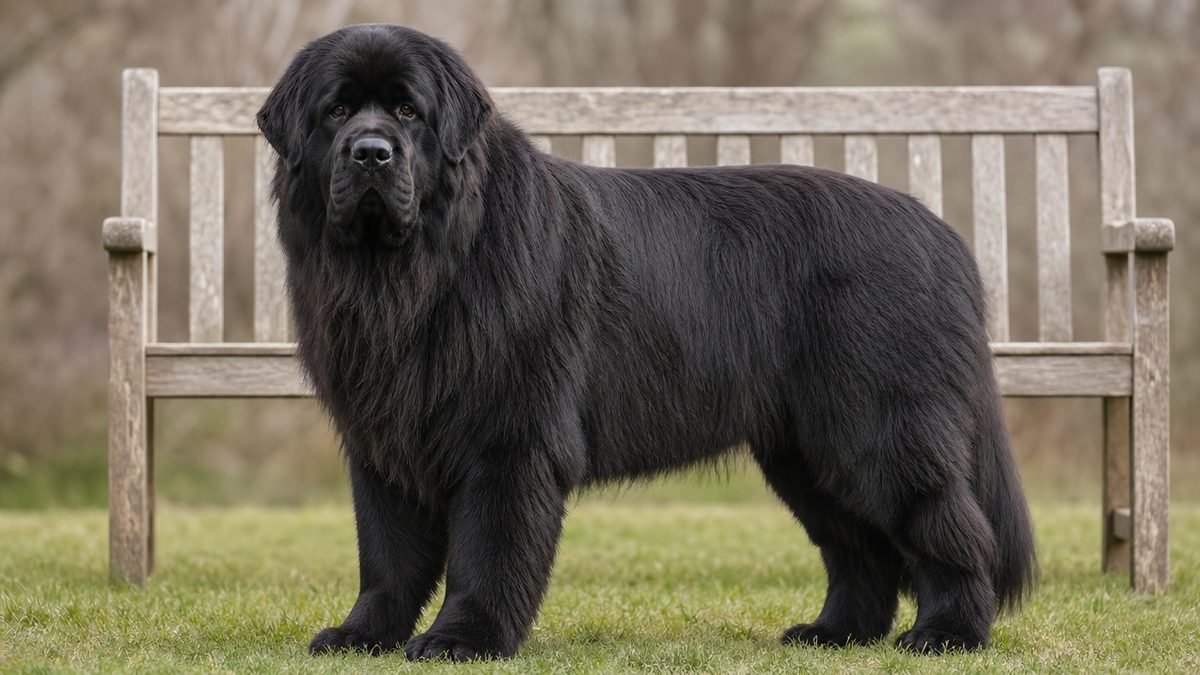
The Newfoundland is a giant Canadian water and draught dog, FCI Standard 50, averaging 71 cm and about 68 kg in males and 66 cm and about 54 kg in bitches, with a water-resistant double coat, webbed feet and a tail the standard describes as a rudder. Everything difficult about keeping one in India follows from those four facts.
The FCI's own nomenclature record files the breed as number 50, Group 2, Section Molossian type, Subsection Mountain type, with definitive acceptance on 4 August 1954, English as the authentic language, Canada as the country of origin and the FCI itself as the country of patronage. Bonbeno read the breed number off the FCI's own letter index rather than assembling a URL from a guess, because on fci.be the trailing number decides which document you get and the breed name in the URL is ignored.
The standard's utilization line is the single most useful sentence on the document, and almost no Indian selling page quotes it. It reads: sledge dog for heavy loads, water dog. This is an animal engineered to haul a load across cold ground and then swim in the North Atlantic. The general appearance clause is equally direct, opening with the words the Newfoundland is massive, with powerful body, well muscled and well coordinated in his movements. Water rescue is not a story attached to this breed afterwards; it is the job the standard names. The short historical summary says the same thing from the other end, describing features that allowed the dog to withstand the rigours of the extreme climate and the sea's adversity while pulling heavy loads on land.
The measurements, and where Indian sellers depart from them
FCI 50 gives averages rather than ranges: 71 cm (28 inches) for adult males, 66 cm (26 inches) for adult bitches, with average weights of approximately 68 kg and approximately 54 kg. The AKC prints the same heights and gives 130 to 150 lb for males and 100 to 120 lb for females. Indian selling pages drift from both.
| Source | Male height | Male weight | Female weight |
|---|---|---|---|
| FCI Standard 50 | 71 cm average | About 68 kg average | About 54 kg average |
| American Kennel Club | 28 in average | 130-150 lb (59-68 kg) | 100-120 lb (45-54 kg) |
| Mr n Mrs Pet (India) | 28 in | 60-70 kg | 45-55 kg |
| Premium Pet House (India) | 69-71 cm | 65-80 kg | 55-65 kg |
| Measured, 921 screened dogs | not reported | 55.0 kg median (IQR 50-60) | included in the same median |
The measured row is the interesting one. A 14-year French screening programme weighed 921 adult Newfoundlands and reported a median body weight of 55.0 kg with an interquartile range of 50 to 60 kg. That is a real population, not an ideal, and it sits well below the standard's 68 kg average because it pools both sexes. Premium Pet House's 80 kg top end matches no source Bonbeno could find.
Why the webbing and the coat matter more here than anywhere else
The standard specifies webbing of the toes as a required feature and lists lack of webbing between the toes as a fault. It also specifies a water-resistant double coat whose undercoat is soft and dense, denser in winter than in summer, but always found to some extent on the croup and chest. So even a summer-coated Newfoundland is never a single-coated dog, which is the assumption behind every Indian summer clipping decision this page argues against later.
A comparative study of swimming gait across breeds found that dogs converge on one stereotyped underwater paddle regardless of build, which is a useful corrective to the marketing claim that this breed swims in some unique way. What is genuinely breed-specific is the equipment: the webbed feet, the rudder tail and the coat that does not waterlog.
The Labrador Retriever also comes from Newfoundland and was also a fisherman's water dog, and the Kennel Club's own Labrador page says the breed originated there to retrieve nets and lost lines. If what appeals to you is a friendly, biddable, swimming-mad dog from the same island, the Labrador Retriever does it at a third of the bodyweight and a fraction of the coat load.
Club recognition: three registries, three different Newfoundlands
The registries do not agree on what colour a Newfoundland may be, and in India that disagreement decides whether the dog you buy can ever be shown. The FCI admits three colours and disqualifies every other; the American Kennel Club's registration table carries seven colour codes; every Indian seller Bonbeno checked copies the American list while selling KCI papers.
Start with which standard binds in India. The FCI's members register lists India as a full member represented by the Kennel Club of India at Nr 28 AA Block, First Street Anna Nagar, Chennai 600 040. The KCI therefore issues pedigrees against FCI nomenclature, which makes FCI Standard 50 the document an Indian pedigree dog is judged against. Bonbeno could not retrieve a published KCI breed list to confirm this from the KCI's own side and says so rather than reporting that absence as a finding.
The colour clause, and what it disqualifies
FCI 50's colour clause admits black, white and black, and brown, and nothing else. Its disqualifying faults include, verbatim, markings of any other colour than white on a black or brown dog, and any other colour than black or white and black or brown. The white-and-black variety is not a tolerated oddity: the standard calls it of historical significance for the breed and describes the pattern in full, a black head with a white blaze, a black saddle, and a black croup and upper tail.
The FCI's nomenclature record puts it more formally still, listing three varieties under breed 50: a) BLACK, b) WHITE AND BLACK, c) BROWN.
| Registry | Colours recognised | Anything else |
|---|---|---|
| FCI (and so the KCI) | Black; white and black; brown | Disqualifying fault |
| American Kennel Club | Seven registration codes: Black, Brown, Gray, White & Black, Beige, Black & Tan, White & Brown | Registrable |
| Mr n Mrs Pet (India) | Black, Black & White, Brown, Grey, Bi-colour | Advertised as KCI Registered stock |
Read those three rows together and the problem is obvious. A grey Newfoundland is registrable with the AKC and disqualified under the standard the KCI's own pedigree runs on, yet Grey appears on the colour line of an Indian marketplace that sells KCI Registered puppies at Rs 1,50,000 to Rs 2,50,000. If you intend ever to show the dog in India, the colour on the spec card is not a cosmetic choice.
The Landseer question, settled from both documents
The word Landseer means two different things depending on which register you open, and both are correct. The FCI carries Landseer (European Continental Type) as its own breed, number 226, Group 2, Section Molossian type, Subsection Mountain type, with definitive acceptance on 24 August 1960, German as the authentic language, and Germany and Switzerland as the country of origin. The same organisation simultaneously lists WHITE AND BLACK as one of three varieties of Newfoundland number 50. The AKC recognises no Landseer breed and prints the word only as a colour name for a black-and-white Newfoundland.
So the FCI is not the body that split the two. It is the body that recognises a white-and-black Newfoundland and a separate Landseer breed at the same time. Bonbeno verified this independently from both FCI documents while building this page, and it agrees with what the Landseer page established. The practical test on a real puppy is the pedigree: an ECT pedigree names Landseer (European Continental Type), a Newfoundland pedigree names Newfoundland whatever colour the dog is.
Ask which of the three FCI colours the puppy is, and ask to see both parents. A litter that throws black, brown and white-and-black puppies together is a Newfoundland litter. Grey, beige, black-and-tan or white-and-brown is an American registration category with no place in an FCI standard, and no Indian seller Bonbeno found flags that.
Newfoundland dog price in India: six sources, a twenty-to-one spread
The Newfoundland dog price in India cannot be given as one number, because six published Indian sources disagree by a factor of twenty. The bands run from Rs 20,000 at the bottom to Rs 4,00,000 at the top for the same breed, and the page that ranks first for this query contains no Newfoundland price at all.
Here is every published Indian figure Bonbeno could open, with the page's own wording. Each was read from the page's raw markup, not from a search snippet or an AI summary, because both have been caught inventing rupee figures for pages that contain none.
| Source | What the page prints | Notes |
|---|---|---|
| Premium Pet House | Rs 1,00,000 to Rs 4,00,000 | City table varies: Mumbai to 4,00,000, Delhi to 3,80,000, Kolkata and Chennai to 3,50,000 |
| Mr n Mrs Pet | Rs 1,20,000 to Rs 3,50,000+ | Basic 1,20,000-1,50,000; KCI Registered 1,50,000-2,50,000; Champion Bloodline 2,50,000-3,50,000 |
| Happy Pet Care | Rs 60,000 to Rs 1,50,000 | Labelled cost of buying |
| WhatsTheCost.in | Rs 30,000 to Rs 70,000 pet quality | Rs 80,000 to Rs 2,00,000 show quality |
| PetBuy.in | Rs 20,000 to Rs 90,000 | Identical band printed on its Neapolitan Mastiff page |
| Puppiezo (ranks first) | No Newfoundland price on the page | Only five rupee figures, all in a carousel of other breeds |
The first-ranking page has no price on it
Puppiezo ranks first in India for this query and its raw markup contains exactly five distinct rupee figures. All five sit inside an Other Available Pets carousel of eight animals: Rs 98,999 for Fizey a Maltipoo, Rs 92,599 for Kuzo a Poodle, Rs 92,599 for Dugu a Poodle, Rs 94,999 for Kazuka a Cane Corso, Rs 1,20,000 for Doir a Goldendoodle, Rs 98,999 for Samy a Maltipoo, Rs 76,499 for Tugi a Rottweiler and Rs 98,999 for Yoki a Doxiepoo. There is not one Newfoundland in the carousel and not one Newfoundland price on the page.
Bing India's own AI summary nonetheless attributes a Newfoundland show-quality band of Rs 80,000 to Rs 2,00,000 to that page. That figure appears nowhere in it. This is the answer-engine failure worth knowing about generally: the citation is real, the page loads, and the number is invented. Check that a quoted figure actually appears in the cited page's markup before you believe it.
Are these converted dollar prices? No, and here is the test
Indian breed sites routinely publish a US dollar list run through one exchange rate and present it as rupees. Bonbeno tested all fifteen Newfoundland figures above at 84.38, 74.00, 80.00 and 66.67 rupees to the dollar. Not one divides to a whole number of dollars at 84.38, at 74 or at 66.67. Twelve appear to divide at 80, but that test is worthless on its own, because 1,000 divided by 80 is 12.5, so any figure ending in three zeros passes by construction.
The quotients settle it. At 80 the Indian figures resolve to 375, 875, 1,875, 3,125 and 4,375 dollars. No seller anywhere prices a puppy at $4,375 or $1,875. These are rupee-native, arbitrary asking prices rather than a converted foreign list, and that matters because it means there is no underlying dollar reality to appeal to. The number is whatever the seller typed.
The city table that has no cities in it
Mr n Mrs Pet publishes a Newfoundland price table for eight Indian cities, and every one of the eight prints the identical band of Rs 1,20,000 to Rs 3,50,000: Hyderabad, Bangalore, Delhi, Chennai, Lucknow, Mumbai, Jaipur and Pune. A city-wise price table with zero city variation is a template, not an observation. Premium Pet House's table does vary between cities, which is one point in its favour.
PetBuy prints Rs 20,000 to Rs 90,000 as the typical Indian Newfoundland price, and the identical Rs 20,000 to Rs 90,000 band, with an identical 10 to 13 year life expectancy, on its Neapolitan Mastiff page. Two very different dogs, one number.
Bonbeno does not recommend breeders, link puppy listings, or quote a live price as an offer. The figures above are reported as editorial content. If you take one thing from this section, take the twenty-to-one spread itself: when the published range for a breed is that wide, the price you are quoted is a negotiating position and not a market rate.
Monthly cost of a Newfoundland in India, and the constant that is not real
Budget Rs 6,000 to Rs 16,000 a month before cooling, and treat the tidier figure Indian breed sites print as a template constant rather than an observation. Bonbeno tested that constant directly and it is shared, unchanged to the rupee, across six unrelated breeds.
Happy Pet Care's Newfoundland page prints Avg Monthly Expenses of Rs 5,700 basic to Rs 8,550 premium, and Monthly Food Expenses of Rs 3,000 to Rs 4,500. Those look like breed research. They are not.
The same figure on six different dogs
Bonbeno pulled five other breeds from the same site on the same day and compared the lines to the rupee. The Leonberger prints Rs 5,700 to Rs 8,550 and food Rs 3,000 to Rs 4,500. So does the Tibetan Mastiff. So do the Saint Bernard, the Hovawart and the Tornjak, checked in the same session.
| Breed | Size label | Monthly food | Avg monthly expenses |
|---|---|---|---|
| Newfoundland | Giant Breed | Rs 3,000-4,500 | Rs 5,700-8,550 |
| Leonberger | Giant Breed | Rs 3,000-4,500 | Rs 5,700-8,550 |
| Saint Bernard | Giant Breed | Rs 3,000-4,500 | Rs 5,700-8,550 |
| Tibetan Mastiff | Giant Breed | Rs 3,000-4,500 | Rs 5,700-8,550 |
| Hovawart | Large Breed | Rs 3,000-4,500 | Rs 5,700-8,550 |
| Tornjak | Large Breed | Rs 3,000-4,500 | Rs 5,700-8,550 |
| Great Dane | Giant Breed | Rs 3,000-4,500 | Rs 4,900-7,650 |
| Labrador Retriever | Large Breed | Rs 3,000-4,500 | Rs 4,900-7,650 |
Two things fall out of that table. The Rs 5,700 to Rs 8,550 set spans the site's own Large and Giant labels, so it is not a size band. And the Great Dane, also labelled Giant, prints something else entirely, while the Labrador, labelled Large, prints the Great Dane's set. The food line, meanwhile, is identical across all eight, so the rows are assembled from independent preset lines rather than copied whole.
What does vary per breed on that site is the buying price and the stated ideal weather band, which is exactly what makes the page look breed-specific while its cost table is boilerplate.
What an Indian owner will actually spend
WhatsTheCost puts monthly maintenance for this breed at Rs 6,000 to Rs 16,000, and Black Star Kennels itemises food at Rs 4,000 to Rs 6,000, professional grooming at Rs 2,000 to Rs 3,000 and routine veterinary care at Rs 2,000 to Rs 3,000 a month. Those are the same order of magnitude and are the numbers to plan against.
Vaccination is separately priced and reasonably well documented in India. A DHPPi or 7-in-1 dose runs about Rs 500 to Rs 1,200, an anti-rabies dose about Rs 300 to Rs 600, a full puppy course about Rs 3,000 to Rs 6,000 across all visits, and a consultation or injection charge of roughly Rs 300 to Rs 800 sits on top of each visit. The Blue Cross Society of Pune publishes a 9-in-1 dog vaccine at a nominal Rs 1,000 and free anti-rabies for Indian mixed-breed dogs, which is a useful floor for what these things can cost when a charity is doing it.
Not one of the six Indian sources Bonbeno opened puts a number on the electricity. A giant double-coated dog in Chennai or Mumbai needs cooling running for a large part of the year, and that bill is a real and recurring monthly cost of this specific breed. Price it yourself against your own tariff before you buy, because nobody selling you the dog will.
Indian climate and heat tolerance: the 22 degree problem
The Newfoundland is the hardest giant on this site to keep safely in the Indian climate, and the reason is a 22.6 degree gap between its homeland and Chennai. Its heat tolerance is rated 1 out of 5 here, the lowest rating Bonbeno gives, and that rating is built from measured climate data rather than adjectives.
Bonbeno queried NASA POWER by explicit latitude and longitude for the breed's homeland and for six Indian cities, using 20-year monthly climatologies for 2001 to 2020, and echoed the grid-cell elevation each time. Echoing elevation matters because POWER returns a grid cell rather than a point, and in hill terrain the cell can miss the town by more than a kilometre.
| Place | Cell elevation | Annual mean T | Coolest month | Hottest month | Annual mean RH |
|---|---|---|---|---|---|
| St John's, Newfoundland | 21.05 m | 5.38 C | Feb, -2.47 C | Aug, 15.76 C | 87.7 % |
| Chennai | 48.95 m | 27.95 C | Jan, 24.09 C | May, 31.51 C | 72.4 % |
| Mumbai | 97.15 m | 26.77 C | Jan, 23.19 C | May, 31.19 C | 67.4 % |
| Kolkata | 7.35 m | 25.81 C | not shown | May, 31.53 C | 73.9 % |
| Delhi | 206.37 m | 25.60 C | Jan, 13.61 C | Jun, 35.88 C | 45.6 % |
| Bengaluru | 841.72 m | 23.74 C | Dec, 20.22 C | Apr, 28.37 C | 67.9 % |
Read the coolest-month column, not the annual mean. Chennai's coolest month averages 24.09 degrees C, which is 8.3 degrees warmer than St John's hottest month. There is no time of year in Chennai that resembles a Newfoundland summer. Mumbai is the same story at 23.19 degrees C in January. Delhi and Bengaluru at least have a genuine cool season, and Bengaluru's December mean of 20.22 degrees C is the only Indian figure in the table that a Newfoundland would recognise.
The number the Indian seller printed, turned around
Happy Pet Care's own Newfoundland page states an Ideal Weather band of minus 10 to 25 degrees C. Take that at face value and check it against the data. Chennai's monthly mean is above 25 degrees C for ten months of the year and never drops below 24. Mumbai is above 25 for eight months. Delhi is above 25 for seven. The site selling the breed has published the number that rules its own product out for most of urban India, and no page Bonbeno read makes that check.
What the heat evidence actually says about a 68 kg dog
Two large VetCompass studies of the same 905,543-dog UK cohort give the numbers, and they are different papers that must not be mixed. Hall 2020 in *Scientific Reports* found that dogs over 50 kg had 3.42 times the odds of heat-related illness (95% CI 1.54 to 7.57) compared with dogs under 10 kg, that brachycephalic dogs had 2.10 times the odds (1.68 to 2.64) of mesocephalic dogs, and that purebred dogs had 1.86 times the odds (1.39 to 2.49) of crossbreds.
Two cautions on that, both of which matter. The words Newfoundland and Mastiff appear zero times in that paper, so the breed itself was not modelled; what transfers is the bodyweight band, and a breed averaging 68 kg with a measured population median of 55.0 kg sits inside it squarely. And the three odds ratios come from separate models that each replaced the breed variable, so they cannot be multiplied together. The Newfoundland is mesocephalic on McMillan's own classification, so the brachycephalic multiplier does not apply to it at all.
Hall 2020 in *Animals* adds the part that changes how you exercise the dog. Of 1,259 heat-related illness events from 1,222 dogs, 380 had no trigger recorded, leaving 879 with one, of which 652, or 74.2 percent, were exertional, 113 environmental and 46 vehicular confinement. The same paper records that none of the dogs weighing 50 kg or over was reported with environmental heat-related illness. For a giant, the danger is the walk, not the room.
Collapse. Panting that will not settle after fifteen minutes in shade with water. Brick-red or unusually pale gums. Vomiting or diarrhoea after exertion in heat. Any of those in a Newfoundland in an Indian summer is a same-day veterinary emergency, and cooling with tap-temperature water on the way is better than waiting.
Temperament and household fit: who should buy one, and who should not
Buy a Newfoundland only if you can supply three things at once, which are continuous cooling, daily grooming and a ground-floor home with space. The temperament is close to the best in the working group and is almost never the reason these placements fail in India.
FCI Standard 50 describes the temperament in unusually warm language for a breed standard. The expression reflects benevolence and softness; the dog is dignified, joyful and creative, and known for its sterling gentleness and serenity. Aggressiveness and shyness are both listed as faults of character, and aggressive or overly shy dogs are a disqualification. The AKC files the breed under devoted, sweet and patient.
That is not marketing. A dog bred to jump into the North Atlantic after a stranger cannot be suspicious of strangers, and the selection pressure shows.
The household this breed actually suits
- Ground-floor or lift-served homes with room for a 68 kg dog to lie flat somewhere cool. The Kennel Club files the breed as Country, large house, large garden.
- Households with an adult at home for much of the day, because this is a companion breed that does badly left alone for long stretches.
- Families with children old enough not to be knocked over, or willing to supervise every interaction until the child is.
- Homes that can run cooling for the greater part of the year without arguing about the bill.
- Owners who accept a heavy drool load and a coat that sheds into everything, every day.
The household this breed does not suit
- Anyone buying a guard dog. This breed is a poor watchdog and the standard treats suspicion as a fault.
- Anyone in a compact apartment without a lift, because stairs are a genuine joint risk during a long growth phase.
- Anyone in coastal Chennai, Mumbai or Kolkata without continuous cooling, on the climate evidence above.
- Anyone who wants a low-maintenance coat. Daily is the Kennel Club's own rating.
- Anyone who travels often, because boarding a 68 kg heat-sensitive dog in an Indian summer is expensive and hard to arrange safely.
The gap between Indian marketing and the standard is worth naming. Black Star Kennels' Newfoundland page carries the heading Are Newfoundland dogs a good guard dog, and Premium Pet House carries Do Newfoundland dogs make good guards. Both questions get asked because Indian buyers of giant breeds are often shopping for protection. The honest answer is that this is a calm, patient, gentle dog whose deterrent value is entirely visual.
The trait Indian owners report most and marketing mentions least is how much this breed leans on its people. A Newfoundland left alone in a flat all day is not a placid dog, it is a bored one, and boredom in a 68 kg animal is expensive furniture.
Training a Newfoundland in India: what works and what the body will not allow
Train a Newfoundland with reward-based work in short sessions during the cool hours, and let the joints, not the brain, set the pace. This is a biddable breed that learns quickly; the constraint in India is a long growth phase colliding with hard floors and a climate that closes most of the day.
Start the socialisation window early and treat it as non-negotiable. A dog that will reach 68 kg has to be comfortable with strangers, lifts, traffic, autorickshaws, vets and handling by the time it is heavy enough that fear becomes dangerous. The good news is that FCI 50's temperament clause is on your side: this is a breed selected against suspicion.
Why the growth phase limits what you can train
A Norwegian study of growing Newfoundland dogs examined risk factors for metaphyseal irregularities in the radius and ulna, which is bone remodelling in the growing forelimb. A separate radiographic series described a new type of bone remodelling in the distal radial and ulnar metaphysis in 54 Newfoundland dogs. Neither is a reason for alarm, and both are a reason to keep a growing giant off repetitive concrete work.
The practical rules that follow are simple. Do not train on marble or tile without a mat. Do not do repeated sit-to-stand drills on a hard floor. Do not use stairs as exercise. Do not teach a jump onto or off furniture. Save distance work until the dog is past its second year.
A workable Indian training week
- Two sessions a day of five to ten minutes each, both in the cool hours, both indoors on a non-slip surface where possible.
- Teach a reliable settle on a mat before anything else, because a giant dog that has an off switch is manageable in a small Indian home.
- Teach loose-lead walking early, while you can still physically out-muscle the dog, and use a well-fitted harness rather than a neck collar on a heavy puller.
- Socialise deliberately to lift doors, gully noise, two-wheelers and building watchmen, since these are the Indian-specific triggers no imported training book covers.
- Add scent games and food puzzles as the mental outlet, because they cost nothing in heat load and this breed needs a job.
Avoid harsh handling entirely. It is unnecessary with a breed this soft, and it produces a shut-down dog rather than a compliant one.
The swimming question, honestly
Swimming is the ideal exercise for this breed and is genuinely hard to arrange in India. A comparative study of the canine swimming gait found that dogs converge on one stereotyped paddle regardless of breed, so the Newfoundland's advantage is anatomical rather than technical: webbed feet, a rudder tail and a coat that does not waterlog. If you have safe, clean access to a pool or a calm water body, use it, because it is the only high-effort exercise a giant can take in an Indian summer without loading the joints.
The breed swims towards trouble by design. A Newfoundland that sees a struggling swimmer will go, and a dog that hits a current or an unseen drop in an Indian tank, quarry or river gets into difficulty like any other animal. Supervise every swim and dry and check the ears afterwards.
Daily exercise requirement, and what happens without it
A Newfoundland needs up to one hour of exercise a day, taken in two cool-hour sessions, and in India the timing matters more than the total. Exertional heat illness accounts for 652 of the 879 UK heat-illness events with a recorded trigger, so the walk is the risk rather than the resting dog.
The Kennel Club's own breed panel gives the requirement as up to 1 hour per day, which is modest for a working breed and reflects a dog built for slow, heavy pulling rather than for distance. Happy Pet Care's Indian page and Puppiezo both give a broadly similar figure, so the sources agree here for once.
The two windows that exist in an Indian summer
Chennai's monthly mean temperature never drops below 24.09 degrees C and reaches 31.51 degrees C in May. In practice that leaves two usable windows for a 68 kg double-coated dog: before sunrise, and at least an hour after dark once the pavement has released its heat. Test the ground with the back of your hand for five seconds before every walk. If you cannot hold it there, the dog cannot walk on it.
| City | Hottest month mean | Summer plan | Cool season plan |
|---|---|---|---|
| Chennai | 31.5 C in May | Two 15-minute walks, pre-dawn and late night, indoor games in between | Two 25-minute walks, still off the middle of the day |
| Mumbai | 31.2 C in May | Same, plus watch humidity: 90 percent in July and August blocks evaporative cooling | Two 25-minute walks |
| Delhi | 35.9 C in June | Pre-dawn only from April to June; treat the afternoon as indoors | Genuine winter, 13.6 C in January, is this breed's best Indian season |
| Bengaluru | 28.4 C in April | Two 20-minute walks, the mildest large-city option in the table | Two 30-minute walks |
| Kolkata | 31.5 C in May | Pre-dawn and late night; humidity peaks near 89 percent in August | Two 25-minute walks |
What happens without it
An under-exercised Newfoundland does not become destructive in the terrier sense. It becomes heavy, and weight is the thing that compounds every other risk this breed carries. Excess body weight loads hips already dysplastic in 25.8 percent of screened dogs and elbows abnormal in 23.3 percent, and it worsens heat load on a dog already in the highest-risk bodyweight band.
The alternative outlets that work in an Indian climate are swimming where it is available, short structured obedience sessions indoors, scent work, food puzzles and simple cart or drag work at a walk once the dog is fully grown. All of them are low heat load, which is the whole point.
The monsoon is often the best exercise season for this breed in coastal India, because temperatures drop even though humidity climbs. Use it, but dry the coat properly afterwards and plug or dry the ears, because a wet double coat in 90 percent humidity is how otitis and hot spots start.
Grooming a double coat in Indian humidity, and why clipping backfires
Brush a Newfoundland every day and do not clip the coat for summer, because a controlled study of clipped and unclipped Newfoundlands found the clipped dogs had a significantly thicker cornified layer and smaller sebocytes. That is the hyperkeratosis owners see as dull, scaly, textureless regrown coat, and it is the single most useful piece of grooming evidence available for this breed in a hot country.
The Kennel Club's own breed panel rates grooming as every day, its heaviest rating, and lists the coat as medium length and shedding. FCI 50 specifies a water-resistant double coat with a moderately long, straight outer coat and a soft, dense undercoat that is denser in winter than in summer but always present to some extent on the croup and chest. Note that clause carefully: there is no season in which this dog has no undercoat.
The clipping study, in full
Zur, Regal and Loeb examined 41 skin samples: 11 from Newfoundlands that had been clipped and showed visible coat changes, 16 from Newfoundlands that had never been clipped, and 14 from long-haired dogs of other breeds. By histopathology the clipped dogs had a thicker cornified layer (P=0.006) and smaller sebocytes (P=0.022) than the unclipped ones, and the authors concluded that hyperkeratosis and decreased sebocyte size may explain the observed coat changes after clipping.
The same study found something almost nobody quotes and which matters more in India than anywhere the study was run. Newfoundlands had larger and more epitrichial sweat glands than dogs of other long-haired breeds (P=0.0002 and P=0.036 respectively), and those glands were not affected by clipping. Canine sweat glands do very little thermoregulatory work, so this does not make the breed heat-adapted. What it does mean is that the skin under that coat is a moist environment by design, in a country where the ambient humidity in coastal cities runs from 67 to 88 percent as an annual mean. A dense undercoat that stays damp in a humid coastal flat is the starting condition for yeast, hot spots and otitis, and it is the reason a humid August in Mumbai is harder on this dog's skin than a dry May in Delhi.
A grooming routine that works in an Indian monsoon
- Brush daily with an undercoat rake and a slicker, working in sections down to the skin rather than skimming the top coat. Ten minutes a day beats an hour a week.
- Check the skin under the arms, behind the ears, on the belly and around the tail base every time you brush, because those are where hot spots start in humidity.
- Bathe only when needed, and dry the dog completely afterwards. Air-drying is standard advice from overseas clubs and it is wrong in an Indian monsoon; use a forced-air dryer or towels and a fan until the undercoat is dry to the touch.
- Dry the ears specifically and plug them before any bath. Wet ears in high humidity are the commonest avoidable cause of otitis in double-coated dogs.
- Trim only the feet, hocks and sanitary areas. FCI 50 says trimming and scissoring are not encouraged, and a clipped body coat is the mistake this section exists to prevent.
- Book a professional groom every six to eight weeks if you can, at roughly Rs 2,000 to Rs 3,000 a month by Indian published figures.
The care advice that does not transfer from a cold country
Overseas breed-club grooming guidance is written for Newfoundland weather and it is copied verbatim onto Indian pages. Two instructions in particular do not survive the trip. Letting a heavy double coat air-dry is safe in a cold, dry climate and is an invitation to yeast and bacterial overgrowth in Mumbai in August at 90 percent relative humidity. And leaving the coat entirely alone through a moult is workable where the moult is seasonal and sharp; in India it is diffuse and near-continuous, which is why the daily brush is not negotiable here.
Every Indian summer, groomers are asked to shave a Newfoundland down. Refuse it. The evidence says the regrown coat is measurably worse, the undercoat still exists in summer by the standard's own wording, and a shaved double coat removes the layer that reflects radiant heat while leaving pale skin exposed to Indian sun. Cool the room, not the dog's coat.
Health issues and life expectancy, with the disagreements shown
The Newfoundland's health profile is one of the best documented of any giant breed, and it turns on four things: subaortic stenosis, cystinuria, hips and elbows. UK primary-care data gives a median lifespan of 11.0 years from 633 recorded deaths, which is better than either kennel club prints.
Take life expectancy first, because three authorities disagree and the disagreement is worth seeing. McMillan and colleagues analysed UK companion-dog longevity across 155 recognised purebreds against a crossbred baseline and published the breed medians as supplementary tables. Working from that data, give the Newfoundland a median survival of 11.0 years (95% CI 10.9 to 11.6) with a hazard ratio of 1.2 (1.11 to 1.3) against crossbreds, whose median is 12 years. The Kennel Club's own breed page prints under 10 years. The American Kennel Club prints 9 to 10 years.
Bonbeno publishes the measured figure and names the disagreement rather than averaging the three. For context, life expectancy at age 0 across all UK dogs is 11.23 years, so this breed sits close to the national average and not, as its reputation suggests, far below it.
Two checks were run on that median before quoting it. Table S5 records the Newfoundland's phylogeny reclassification as NA, so the figure is breed-specific and not a merged one. And Table S6 gives 923 alive, 633 deceased and 1,556 total against Table S3's first column of 1,529, a documented discrepancy between the paper's own supplementary tables; the death count of 633 is identical in both, which is why this page quotes deaths rather than sample size.
Subaortic stenosis, and two studies that flatly disagree
Subaortic stenosis is the breed's signature cardiac disease and it usually leads to death in early adulthood. Reist-Marti and colleagues analysed pedigree data on more than 230,000 Newfoundland dogs from the European and North American populations reaching back to the 19th century, including 6,023 dogs with a diagnosis. They found incidence and prevalence much higher than earlier smaller studies reported, that affected dogs were more often inbred and more closely related to one another than unaffected dogs, that sex had no significant effect, and that the only simple mode of inheritance fitting the data was autosomal codominant with lethal homozygosity and a penetrance of one third in heterozygotes.
A 2025 French screening programme reads almost the opposite way. Over 14 years it screened 921 adult Newfoundlands by echocardiography, and found 913 of 921 (99.1 percent) free of aortic stenosis and 919 of 921 (99.8 percent) free of pulmonic stenosis, with no detection at all in the programme's final three years. The inbreeding coefficient did not differ significantly between affected and unaffected dogs (0.59 percent against 0.39 percent, P=0.86), which contradicts the Swiss pedigree finding directly. The authors state plainly that, unlike reports from other European and North American countries, their data suggest a low and decreasing prevalence in France.
Both papers are sound and they are measuring different things. One is a historical pedigree population; the other is a screened breeding population under 14 years of active selection. The honest reading is that screening works, and that is the most encouraging thing on this page for an Indian buyer: ask for the cardiac certificate and the risk is genuinely reducible.
The PICALM contradiction, unresolved
Two papers in the same journal, one year apart, disagree about the genetics. Stern and colleagues studied 93 prospectively recruited Newfoundlands and 180 control dogs of 30 breeds and identified a three-nucleotide exonic insertion in PICALM associated with the development of subvalvular aortic stenosis, supporting an autosomal dominant pattern. Droegemueller and colleagues then published a comment titled, in full, that a single codon insertion in the PICALM gene is not associated with subvalvular aortic stenosis in Newfoundland dogs.
Bonbeno publishes the conflict rather than picking a side. The practical consequence for a buyer is narrow and clear: a PICALM DNA result is not a substitute for an echocardiogram by a specialist, and no Indian seller offering a genetic clearance for this disease should be taken to have cleared the heart.
Collapse or panting that will not settle, which is heat. A male straining to urinate without producing urine, which may be a cystine stone obstructing. Sudden exercise intolerance or fainting in a young adult, which is cardiac until proven otherwise. And a bloated, restless, retching dog, which is gastric dilatation-volvulus and is measured in hours.
Screening: the four certificates to demand, and where OFA contradicts itself
Ask any Newfoundland breeder for four certificates on both parents, which are hips, elbows, a specialist cardiac exam and the cystinuria DNA test. Those are exactly the four the American Kennel Club's national breed club recommends, and OFA's published tables show why each one earns its place.
The AKC lists the national breed club's recommended health tests as hip evaluation, elbow evaluation, cardiac exam, and a cystinuria DNA test specific to the Newfoundland. Bonbeno read the corresponding OFA statistics rows from the full published dump on 2 September 2026, with a LABRADOR control returning 109 rows in the same retrieval to prove the search worked before any absence or figure was reported.
| Database | Evaluations | Normal % | What the row shows |
|---|---|---|---|
| Hips | 20,050 | 72.2 | 25.8 percent dysplastic: mild 13.5, moderate 9.7, severe 2.6 |
| Elbow | 10,718 | 76.4 | 23.3 percent abnormal: grade 1 15.7, grade 2 4.7, grade 3 3.0 |
| Congenital cardiac | 6,486 | 98.8 | 0.7 percent abnormal |
| Advanced cardiac | 1,677 | 91.5 | 4.6 percent abnormal, and 3.9 percent equivocal |
| Cystinuria DNA | 2,646 | 87.7 | 12.3 percent carriers, 0.0 percent affected |
| Patella | 3,771 | 99.4 | 0.6 percent abnormal |
| Thyroid | 1,225 | 93.9 | 1.1 percent compensative autoimmune thyroiditis |
| Shoulder | 165 | 90.9 | 9.1 percent abnormal, on a thin sample |
| Eyes, summary line | 1,630 | 94.0 | 6.0 percent abnormal, and see the contradiction below |
The hip row reconciles: excellent 9.8 plus good 46.0 plus fair 16.3 gives 72.1 against a printed 72.2, and mild 13.5 plus moderate 9.7 plus severe 2.6 gives exactly 25.8. The elbow row is one tenth out at 23.4 against a printed 23.3, which is ordinary rounding. These are screened dogs, not a random sample, so read 25.8 percent dysplastic as what breeders' own submitted films look like rather than as the breed's prevalence.
The eye table contradicts itself, and by how much
OFA's eye summary reports the Newfoundland at 94.0 percent normal across 1,630 evaluations. Its own per-diagnosis detail rows, on the identical denominator of 1,630, record 1,198 dogs as normal, which is 73.5 percent. That is a gap of 20.5 percentage points inside one registry's tables on one breed.
One comparison is worth keeping in view while reading these tables. The Kennel Club places the Newfoundland in Breed Watch Category 2, while the Neapolitan Mastiff sits in Category 3 with five named visible points of concern including turned eyelids and dermatitis in skin folds The Kennel Club, Breed Watch. The Newfoundland's eye numbers below are not in that league, and the difference is real. It gets sharper. The entropion detail row records 116 of 1,630, which is 7.1 percent, and the ectropion row 75 of 1,630, which is 4.6 percent. Entropion alone therefore exceeds the summary's entire 6.0 percent abnormal figure, and a part cannot be larger than its whole. The two numbers are not measuring the same thing, so Bonbeno publishes both with the arithmetic shown and quotes neither as the breed's eye rate. This is a known property of OFA's eye tables across many breeds rather than a Newfoundland problem.
Cystinuria, and the one thing this breed does differently
Cystinuria in the Newfoundland is autosomal recessive and severe, and it was traced to a nonsense mutation in the canine SLC3A1 gene. OFA's DNA table records 12.3 percent of 2,646 tested Newfoundlands as carriers and 0.0 percent as affected, which is roughly one tested dog in eight carrying it. Two carriers must never be bred together, and the test is definitive, which is why it sits on the national breed club's list.
One 2025 finding changes standard advice for this breed specifically. In a study of 5,477 dogs with cystine uroliths, 99 percent of which were male, intact males were overrepresented among stone formers in every breed except eight, and the Newfoundland is one of those eight, alongside the Akita, Belgian Malinois, Brussels Griffon, Cane Corso, Coonhound, Scottish Terrier and Silky Terrier. For most breeds castration reduces cystine stone risk. For this one the evidence does not support that, because the Newfoundland form is not androgen-dependent.
The rest of the list, and what is genuinely rare
Beyond the big four, the published Newfoundland literature includes a genome-wide association study identifying genomic regions associated with cruciate ligament rupture in the breed, and an association between early-onset myasthenia gravis in Newfoundlands and the canine major histocompatibility complex class I. Neither is common. Both are worth naming because an Indian owner presenting a weak, exercise-intolerant young Newfoundland deserves a vet who has heard of the second one.
- Hip and elbow certificates for both parents, with the registry, the number and the date. Verify each number against the issuing registry's own search rather than accepting a photograph.
- A cardiac certificate from a specialist doing echocardiography, not a general practitioner's stethoscope. Subaortic stenosis is missed on a routine listen, and the French programme shows what specialist screening achieves.
- The cystinuria DNA result for both parents, in writing.
- The breeder's own answer to what the litter's grandparents died of and at what age. No registry captures this and it is the most informative question you can ask.
- Confirmation of the colour against FCI Standard 50, if you ever intend to show the dog under KCI papers.
OFA counts change as evaluations are added, so the sample size is published beside every percentage above and a later reader can tell whether the number has moved. The figures were read on 2 September 2026 with a Labrador control confirming the search worked in the same session.
Feeding a Newfoundland in India, including one requirement unique to the breed
Feed a Newfoundland a large or giant-breed diet in two or three measured meals a day, keep it lean, and pay attention to sulphur amino acids, because this breed has a documented and unusual taurine problem that most feeding guides never mention.
Start with the finding that is genuinely breed-specific. A study of 216 privately owned Newfoundlands found plasma taurine low, at or below 40 micromol per litre, in 8 percent of dogs. Of nine taurine-deficient dogs that were clinically evaluated, three had dilated cardiomyopathy that was reversed by taurine supplementation and one had retinal degeneration.
The mechanism was measured directly. When six Newfoundlands (mean 52.5 kg) and six Beagles (mean 13.2 kg) were fed a diet apparently adequate in sulphur amino acids for three weeks, the Newfoundlands had lower plasma taurine (49 plus or minus 16 against 97 plus or minus 25 micromol per litre), less than half the de novo taurine synthesis (59 plus or minus 15 against 124 plus or minus 27 mg per kg to the power 0.75 per day), and greater faecal bile acid excretion. The authors concluded that Newfoundlands appear to have a higher dietary sulphur amino acid requirement than Beagles, the breed used to set nutrient requirements in the first place.
The practical Indian consequence is direct. A home-prepared rice-and-vegetable diet, or a low-protein or lamb-and-rice type formulation, is a worse bet for this breed than for most. If you feed home food, get the diet formulated by a veterinarian and discuss taurine explicitly.
How much, and how often
| Stage | Meals a day | Focus | Watch for |
|---|---|---|---|
| 8 weeks to 6 months | 3 to 4 | Large or giant-breed puppy food, controlled calcium, do not supplement | Growing too fast; a fat giant puppy is a damaged adult |
| 6 to 18 months | 2 to 3 | Still on a giant-breed growth diet, lean body condition | Front-limb lameness during growth spurts |
| 18 months to 7 years | 2 | Adult large-breed maintenance, measured not free-fed | Weight creep, which compounds hips, elbows and heat risk |
| 7 years and older | 2 | Joint support, adjusted calories, easier textures | Sudden appetite change, which is often cardiac or renal |
Indian published figures put monthly food for this breed at Rs 3,000 to Rs 4,500 on one site and Rs 4,000 to Rs 6,000 on another, so plan around Rs 4,000 to Rs 6,000 for a good-quality large-breed food at full adult weight.
Bloat, and the mealtime rules that follow
Gastric dilatation-volvulus is the acute risk that sits behind every giant-breed feeding rule. Feed two or three smaller meals rather than one large one, do not exercise for an hour either side of a meal, use a normal floor-level bowl unless your veterinarian advises otherwise, and slow a fast eater with a puzzle bowl. A dog that is restless, retching without producing anything, drooling and visibly distended in the abdomen is a surgical emergency measured in hours, not a stomach upset.
Keep water available everywhere, keep it cool but not iced, and change it several times a day in hot weather because a drooling giant fouls a bowl fast. A Newfoundland that stops drinking in an Indian May needs a vet, not encouragement.
The first year, month by month, on an Indian calendar
Plan a Newfoundland's first year around two clocks at once: the growth plates, which stay open far longer than in a medium breed, and the Indian season, which decides when the puppy can go outside at all. The single most consequential decision is what month you bring the puppy home.
Indian law sets the earliest date. Rule 8(1)(a) of the Prevention of Cruelty to Animals (Dog Breeding and Marketing) Rules 2017 requires every breeder to ensure that pups less than eight weeks in age are not sold. A seller offering a six-week-old Newfoundland is breaking that rule, and it is worth knowing the clause number when you say so.
| Age | What is happening | What to do in India |
|---|---|---|
| 8-10 weeks | Home, and legally the earliest it may be sold | Aim to bring the puppy home between November and February in most of India. Start the vaccination course; DHPPi Rs 500-1,200 a dose |
| 10-16 weeks | The socialisation window, and the most important weeks of the dog's life | Socialise indoors and in cool hours: lifts, watchmen, two-wheelers, autorickshaw noise, floor surfaces, handling |
| 4-6 months | Rapid growth, soft joints, clumsy body | No stairs as exercise, no jumping off furniture, non-slip mats on tile and marble. Complete the vaccination course, about Rs 3,000-6,000 in total |
| 6-9 months | Adolescence, and the first real summer for a winter puppy | Cut walk length, shift entirely to pre-dawn and post-dusk. Start daily brushing as a habit now, not later |
| 9-12 months | Still growing; the dog looks adult and is not | Keep exercise low-impact. Book hip and elbow baseline films only when your vet advises; formal scoring comes later |
| 12-24 months | Slow finish to full size and substance | Move to adult feeding, keep lean, and expect the coat to change texture through its first full Indian monsoon |
Why the growth phase is the whole argument
Research on growing Newfoundland dogs specifically examined risk factors affecting metaphyseal irregularities in the radius and ulna, which is remodelling in the growing forelimb of exactly this breed. That work is why the advice above is stricter than for a medium dog: the forelimb of a giant puppy is doing something a Labrador's is not, and repeated impact during that window is a poor bet on a breed that already screens 25.8 percent dysplastic on hips and 23.3 percent abnormal on elbows.
Timing the purchase to the Indian year
A puppy that comes home in November in Delhi gets a genuine cool season, at a January mean of 13.61 degrees C, before it ever meets an Indian summer. A puppy that comes home in April in Chennai meets a 30.5 degree month in its first fortnight. The breed's stated ideal weather band, printed by the Indian site that sells it, tops out at 25 degrees C.
Weak, floppy or reluctant to stand in its first months is not a slow starter, it is a veterinary neurology appointment. So is exercise intolerance or fainting in a young adult, which is cardiac until an echocardiogram says otherwise. Do not wait for a puppy to grow out of either.
Newfoundland against the giants Indian buyers cross-shop
Compare the Newfoundland against the four giants Indian buyers actually consider, and it wins on temperament and lifespan and loses on coat and heat. On UK mortality data it outlives the Saint Bernard, the Leonberger and the English Mastiff by between one and two years.
Every median below is from one source, one method and one cohort, which is what makes the comparison worth anything. All are Kaplan-Meier medians from UK primary-care records, quoted with the death count each rests on.
| Breed | Median lifespan | Deaths in study | Hazard ratio vs crossbred | OFA hips dysplastic |
|---|---|---|---|---|
| Crossbreed (baseline) | 12.0 years | 72,445 | reference | not applicable |
| Tibetan Mastiff | 13.3 years | 22 | 0.95 (0.63-1.45), p=0.83 | 16.7 % of 1,403 |
| Newfoundland | 11.0 years | 633 | 1.2 (1.11-1.3) | 25.8 % of 20,050 |
| Great Dane | 10.6 years | 864 | 1.2 (1.13-1.29) | not in this comparison |
| Bullmastiff | 10.2 years | 1,169 | 1.31 (1.24-1.39) | 25.7 % of 7,575 |
| Leonberger | 10.0 years | 321 | 1.61 (1.44-1.79) | not in this comparison |
| St Bernard | 9.3 years | 509 | 1.66 (1.52-1.81) | not in this comparison |
| Neapolitan Mastiff | 9.3 years | 210 | 1.77 (1.55-2.03) | 49.5 % of 277 |
| Mastiff | 9.0 years | 1,419 | 2.32 (2.2-2.44) | 20.3 % of 14,024 |
Read the Tibetan Mastiff row with care. Its 13.3-year median rests on 22 deaths and its hazard ratio is not statistically significant at p=0.83, so it is the least reliable figure in the table despite looking like the best. The Newfoundland's 11.0 years rests on 633 deaths, which is a serious sample.
Which of these actually copes with Indian heat
Coat type decides this, and it decides it more than size does. The Great Dane carries a short single coat and is the giant that copes best with an Indian summer. The Neapolitan Mastiff has a coat of 1.5 cm maximum but is brachycephalic, which carries its own 2.10 times odds of heat-related illness. The Newfoundland, the St Bernard, the Leonberger and the Tibetan Mastiff all carry heavy double coats and all sit in the over-50 kg band at 3.42 times the odds.
The Newfoundland is the only one of those four that is also a water dog with webbed feet, which gives it one exercise option in an Indian summer that the others do not have.
The honest cross-shop nobody offers
If what appeals is a gentle, biddable, water-loving dog from Newfoundland, the Labrador Retriever delivers the temperament at a third of the weight, a fraction of the coat, and a UK median of 13.1 years from 16,155 deaths. If what appeals is a big calm dog for an Indian climate, the Indian Pariah Dog is adapted to it, free to adopt and needs no cooling budget. Neither answer sells a Rs 1,50,000 puppy, which is why no ranking page gives it.
PetBuy prints Rs 20,000 to Rs 90,000 as the typical Indian price of a Newfoundland and the identical band, with an identical 10 to 13 year life expectancy, for the Neapolitan Mastiff. Their real UK medians differ by 1.7 years and their hip screening differs by 24 percentage points. When a comparison site gives two breeds the same numbers, it is not comparing them.
Eight mistakes Indian Newfoundland owners actually make
Most Newfoundland problems in India come from six predictable decisions, and every one of them is made in the first year. They are listed here in the order they usually happen, with what the evidence says instead.
1. Shaving the coat for summer
This is the commonest and the most counterproductive. Clipped Newfoundlands were found to have a significantly thicker cornified layer and smaller sebocytes than unclipped ones, which is why the regrown coat looks dull and scaly. The undercoat exists in summer anyway by the standard's own wording. Cool the room and brush daily instead.
2. Walking at the wrong hour
Exertional heat illness, not sitting in a hot room, is what harms giant dogs: 652 of the 879 UK heat-illness events with a recorded trigger were exertional, and no dog of 50 kg or over in that cohort was reported with environmental heat illness at all. An afternoon walk in Chennai in May, at a monthly mean of 31.51 degrees C, is the single most dangerous thing an owner of this breed does.
3. Buying on colour without checking the standard
Grey, beige, black-and-tan and white-and-brown are registrable with the AKC and disqualified under FCI Standard 50 Federation Cynologique Internationale. India runs on FCI nomenclature through the KCI, so a grey Newfoundland sold on KCI papers cannot be shown here. Ask the colour question before the price question.
4. Accepting a stethoscope as a cardiac clearance
Subaortic stenosis is missed on routine auscultation, and the French screening programme that got the breed to 99.1 percent free of aortic stenosis used echocardiography reviewed by a single board-certified cardiologist. A PICALM DNA result is not a substitute either, because two papers in the same journal disagree about whether that variant is associated with the disease at all Droegemueller M, Jagannathan V, Dolf G.
5. Castrating a male to prevent cystine stones
That is sound advice for most breeds and not for this one. In 5,477 dogs with cystine uroliths, intact males were overrepresented in every breed except eight, and the Newfoundland is one of the eight. Neuter for other reasons if you have them, but do not expect it to solve this.
6. Feeding a home diet without formulating it
Eight percent of 216 privately owned Newfoundlands had low plasma taurine, three of nine clinically evaluated deficient dogs had dilated cardiomyopathy that reversed on supplementation, and the breed synthesises less than half the taurine a Beagle does on the same diet. A rice-heavy Indian home diet is a worse gamble here than in almost any other breed.
7. Using stairs as exercise in the first year
Growing Newfoundlands have documented metaphyseal remodelling in the radius and ulna, and the breed screens 25.8 percent hip dysplastic and 23.3 percent elbow abnormal on OFA's own submitted films. Carry a puppy down stairs if you can, use the lift if you have one, and put mats on tile.
8. Letting the coat air-dry after a monsoon bath
Overseas breed-club guidance says towel off and let the dog air-dry, which is correct in a cold, dry climate. In Mumbai in August, at a monthly mean relative humidity near 90 percent, a wet double coat is a fermenting one. Dry to the skin, plug or dry the ears, and check the hot-spot sites the same day.
Indian owners of this breed are, on the evidence of every source Bonbeno read, unusually good at the temperament side. Nothing in the Indian material suggests aggression, guarding or child-safety problems with this breed. The failures are all environmental, and every one of them is fixable with a fan, a brush and a clock.
What Indian law says about breeding, selling and housing this breed
Four provisions of the Prevention of Cruelty to Animals (Dog Breeding and Marketing) Rules 2017 bear directly on a Newfoundland, and one of them makes an instruction printed in the breed's own FCI standard unlawful in India. Bonbeno read all four verbatim from the gazette text rather than from any summary.
The Rules run from Rule 1 to Rule 13, and everything numbered above 13 is a paragraph of the Second Schedule rather than a Rule. That matters because miscitations of the form Rule 21 are common and refer to a provision that does not exist; the string appears zero times in the gazette.
The eight-week rule, which is a Rule
Rule 8(1)(a), Conditions for sale, requires that every breeder shall ensure that pups less than eight weeks in age are not sold. This is one of the few provisions here that is a Rule proper rather than a Schedule paragraph, and it is the easiest for a buyer to enforce by simply asking for the date of birth.
The dewclaw collision, which nobody flags
FCI Standard 50 says of the hindfeet: dewclaws, if present, should have been removed. Second Schedule Part II paragraph 6(8) of the Indian Rules reads, verbatim: there shall be no tail docking, ear cropping, de-barking, de-clawing, branding, dyeing, injecting substances to enhance visual appeal, performing a surgery or procedure to camouflage or hide any defect or infirmity or any other kind of mutilation of any body part of the pup and any change of appearance by artificial means is strictly forbidden.
The word dewclaw appears zero times in the gazette, so this is not a clause written with this instruction in mind. But an Indian breeder who removes a hind dewclaw to satisfy the standard is performing exactly the kind of change of appearance by artificial means the paragraph forbids. An Indian Newfoundland may lawfully keep its hind dewclaws even though the breed standard asks for their removal, and a buyer should not treat their presence as a defect.
Genetic-defect testing, and what it does and does not name
Second Schedule Part III paragraph 8(10) reads: the dogs shall have been tested for genetic defects, including hip dysplasia, progressive retinal atrophy, night blindness, hypothyroidism, entropion, ectropion, overshot, undershot jaw (when incisors do not touch or mesh), wry mouth, two or more missing teeth, unilateral cryptorchid or full cryptorchid males.
Hip dysplasia is named, which matters for a breed screening 25.8 percent dysplastic on 20,050 OFA evaluations. The word is including, so the list is illustrative rather than closed, and a breeder cannot argue that subaortic stenosis or cystinuria fall outside it merely because they are unlisted. Note also what the Rules do not contain: across the whole gazette there is no patella requirement, no dental requirement, and the words BAER and deaf appear zero times.
Housing, and the clause written for exactly this dog
Second Schedule Part IV paragraph 21(1), Outdoor housing facilities, bars keeping certain categories of dog in outdoor facilities unless the practice is specifically approved by the attending veterinary practitioner in writing. The categories are: dogs that are not accustomed to the temperatures prevalent in the area or region in question; dog breeds that cannot tolerate the temperatures prevalent in the area or region in question, such as long-haired breeds in high temperature locations; and sick, infirm, aged or young animals.
That middle clause describes a double-coated 68 kg Canadian water dog in Chennai about as precisely as a general provision can. Second Schedule Part IV paragraph 15 adds that the temperature within indoor housing facilities shall be ambient and comfortable depending on the breeds of dogs housed inside, and such as provides for their health and well-being.
These provisions are widely miscited online, often as Rule 6(8) or Rule 21 rather than Second Schedule paragraphs. The Rules stop at Rule 13, and the two clauses above are Second Schedule Part II paragraph 6(8) and Part IV paragraph 21(1). If you are quoting them to a breeder or a shelter, quote them in that form.
Adoption and responsible sourcing in India
Exhaust adoption before you buy, because giant breeds are surrendered in India for exactly the reasons this page has spent 10,000 words describing. A Newfoundland that outgrew a flat, or whose owner could not sustain the cooling and grooming, is the dog most likely to be looking for a home.
Adoption is not a consolation prize for this breed. Every Indian source Bonbeno opened is a marketplace, and every one of them sells puppies. Nobody in that set has a commercial reason to tell you that an adult Newfoundland surrendered at three years old is a better bet for most Indian households than a puppy, and for many households it plainly is: the growth-plate window is already closed, the temperament is fully visible, and the coat load is known rather than promised.
Where to look
- Ask the breed-specific rescue networks first. Giant-breed surrenders in India move through informal networks and social groups rather than through listing sites, so a phone call is worth more than a search.
- Ask large-city shelters and veterinary hospitals directly, naming the breed. A surrendered giant is memorable and staff usually know where one went.
- Ask a KCI-affiliated breed club whether it operates or knows of a rehoming route. Clubs often place returned dogs quietly.
- Ask the seller you were about to buy from whether they take dogs back. A breeder who does not is telling you something.
- Consider the Indian Pariah Dog honestly before you commit. It is heat-adapted, free to adopt, and needs none of the cooling budget this page has been itemising.
If you buy, verify these five things before money moves
- Age. Rule 8(1)(a) of the 2017 Rules requires that pups under eight weeks are not sold. Ask for the date of birth in writing.
- Both parents, in person. Meet them, and watch how they behave with the breeder. A gentle breed with a fearful or snappy parent on site is a warning about how the litter was raised.
- Four certificates. Hips, elbows, a specialist cardiac exam and cystinuria DNA, on both parents, with numbers you verify against the issuing registry rather than photographs you are shown.
- Colour against the standard. Black, white and black, or brown. Anything else is disqualified under the standard the KCI's pedigree runs on.
- A written health guarantee that survives a vet check, plus your own independent veterinary examination inside 48 hours of taking the dog home.
What a seller cannot honestly promise you
Two claims recur across the Indian pages for this breed and neither is supportable. The first is a lifetime purity or replacement guarantee, which is a commercial promise about paperwork rather than a statement about the dog's health. The second is any implication that the breed is hypoallergenic; Vredegoor and colleagues measured more Can f 1 allergen in so-called hypoallergenic breeds than in controls, at 2.26 against 0.77 micrograms per gram of hair, and concluded there is no evidence for classifying any breed that way.
A third is subtler. Mr n Mrs Pet sells a Champion Bloodline tier at Rs 2,50,000 to Rs 3,50,000. A championship in an ancestor is a show result, not a health screen, and this page has just spent a section on why the health screen is the thing that moves the odds.
Ask yourself one question before you commit: can you keep a 68 kg dog below 25 degrees C for most of the year, brush it every day, and afford Rs 6,000 to Rs 16,000 a month plus the electricity, for eleven years? If the answer is yes, this is one of the finest-tempered dogs in the world. If it is no, the kindest version of wanting a Newfoundland is not owning one.
Newfoundland questions Indian buyers actually search
How much does a Newfoundland puppy cost in India?
Indian sellers most often quote Rs 60,000 to Rs 1,50,000 for a Newfoundland puppy, but the published range across six sources runs from Rs 20,000 to Rs 4,00,000, which is a spread of twenty to one for the same breed. Mr n Mrs Pet prints Rs 1,20,000 to Rs 3,50,000, Premium Pet House prints Rs 1,00,000 to Rs 4,00,000, WhatsTheCost prints Rs 30,000 to Rs 70,000 for pet quality, and PetBuy prints Rs 20,000 to Rs 90,000. No figure in that set divides cleanly into US dollars at any current rate, so these are rupee-native asking prices rather than converted foreign ones.
How much does a Newfoundland cost in India?
Budget the running cost, not the puppy price. WhatsTheCost puts monthly maintenance at Rs 6,000 to Rs 16,000 and Happy Pet Care prints Rs 5,700 basic to Rs 8,550 premium, but that second figure is a template constant this page shows is shared unchanged with the Leonberger, Saint Bernard, Hovawart, Tornjak and Tibetan Mastiff. Add electricity for continuous cooling, which no Indian source prices at all, and add Rs 3,000 to Rs 6,000 for the full puppy vaccination course.
Where can I buy a Newfoundland puppy?
Start by asking to see the pedigree and the parents' hip, elbow, cardiac and cystinuria certificates, then verify each certificate number against the issuing registry rather than accepting a photograph. Every Indian source Bonbeno opened is a marketplace rather than a breeder, and the first-ranking page for this query carries no Newfoundland in its own listing carousel at all. Bonbeno does not recommend breeders or link puppy listings, and adoption through a giant-breed rescue is worth exhausting before any purchase.
Are Newfoundland puppies good dogs?
Yes, by temperament. FCI Standard 50's own behaviour clause reads that the expression reflects benevolence and softness and that the breed is known for its sterling gentleness and serenity, and no Indian or overseas source disputes that. The honest caveat is physical rather than behavioural: a puppy that reaches about 68 kg needs a household that can supervise a toddler around it, and one that can keep it cool for the twelve or more years the buying decision commits to.
Is a Newfoundland dog built to survive the Indian climate?
No, not without engineered cooling. The breed's homeland at St John's averages 5.38 degrees C a year and never exceeds a monthly mean of 15.8 degrees C, while Chennai averages 27.95 degrees C and its coolest month still means 24.1 degrees C. Even the Indian site selling the breed prints an ideal weather band of minus 10 to 25 degrees C, which Chennai sits above every single month of the year.
Are Newfoundland dogs hypoallergenic?
No, and no dog breed is. Vredegoor and colleagues measured the Can f 1 allergen across 196 dogs of so-called hypoallergenic breeds against 160 control dogs and found more allergen in the hypoallergenic group, not less, at 2.26 against 0.77 micrograms per gram of hair. A heavily shedding double-coated giant is at the opposite end of that argument anyway, and Mr n Mrs Pet's own spec card rates the breed low on this.
Do Newfoundland dogs need extensive grooming?
Yes. The Kennel Club's own breed panel lists grooming as every day, which is the heaviest rating it gives. The Indian complication is that the obvious summer shortcut makes things worse: a controlled study of clipped and unclipped Newfoundlands found the clipped dogs had a significantly thicker cornified layer and smaller sebocytes, which is the hyperkeratosis owners see as dull, scaly regrown coat.
Are Newfoundland dogs suitable for compact apartments?
No. The Kennel Club files the breed as Country rather than town, needing a large house and a large garden, and Happy Pet Care's Indian page says house with backyard. A flat can be made to work only where cooling runs continuously and the dog gets its walk before sunrise, and even then the stairs and the lift are a genuine problem for a dog that should not be jumping down steps while its growth plates are open.
What is the lifespan of Newfoundland dog?
UK primary-care data gives a median of 11.0 years, drawn from 633 recorded Newfoundland deaths, with a 95 percent confidence interval of 10.9 to 11.6 years. That is notably better than the Kennel Club's own breed page, which prints under 10 years, and better than the American Kennel Club's 9 to 10 years. Bonbeno publishes the measured figure and names the disagreement rather than averaging the three.
Are Newfoundland dogs a good guard dog?
No, and the standard says so in its own way. FCI 50 describes a dignified, joyful, creative dog known for gentleness and serenity, and lists aggressiveness as a fault and aggressive or overly shy dogs as a disqualification. The breed's size deters at a distance, but a dog bred to pull a drowning fisherman out of the sea is not a protection dog and should not be bought as one.
Is Newfoundland dog available in India?
Yes, and unusually for a giant imported breed there is a real Indian market rather than an empty one. Mr n Mrs Pet listed nine live Newfoundland puppies on the day this page was written and PetBuy printed 30 listings, against zero listings on the same site's Neapolitan Mastiff page. The KCI issues pedigrees against FCI nomenclature, so a KCI-papered Newfoundland is judged against FCI Standard 50 and not the American standard most Indian sellers quote.
Are Newfoundland dogs easy to train?
Yes, comparatively. The breed is biddable and slow to anger, and responds to reward-based work, so basic obedience is rarely the problem. The two real training constraints in India are physical, not mental: heavy repetitive drilling on hard floors during a long growth phase is a joint risk, and every training session has to fit into the cool hours before sunrise or after dark.
Compare with similar breeds
Newfoundland sits in 1 Bonbeno group. Each one compares it directly against the breeds it is genuinely an alternative to, on the same figures.