
Breed profile
Pyrenean Mountain Dog in India: Price, Heat, Health and Registry
A giant French flock guardian whose breed standard requires double dewclaws on the hind legs, gives no weight at all, and comes from a valley whose warmest month averages 18.12 C.
Quick answer
No Pyrenean Mountain Dog price in India can be verified, because the pages that rank for the query quote rupee figures belonging to other dogs. The breed holds FCI standard 137, accepted definitively on 25 January 1955, and its measured median lifespan is 10.9 years. It is a giant, long-haired guardian from a homeland whose warmest month averages 18.12 C.
This page is reference information, not veterinary advice. The Pyrenean Mountain Dog is a giant, deep-chested, long-haired dog in a country where the hottest month in Delhi averages 35.88 C, and both heat stroke and gastric dilatation-volvulus in such a dog are same-hour emergencies. Nothing here replaces an examination by a registered veterinarian who has seen your animal.
How the Pyrenean Mountain Dog rates for an Indian home
What the Pyrenean Mountain Dog is
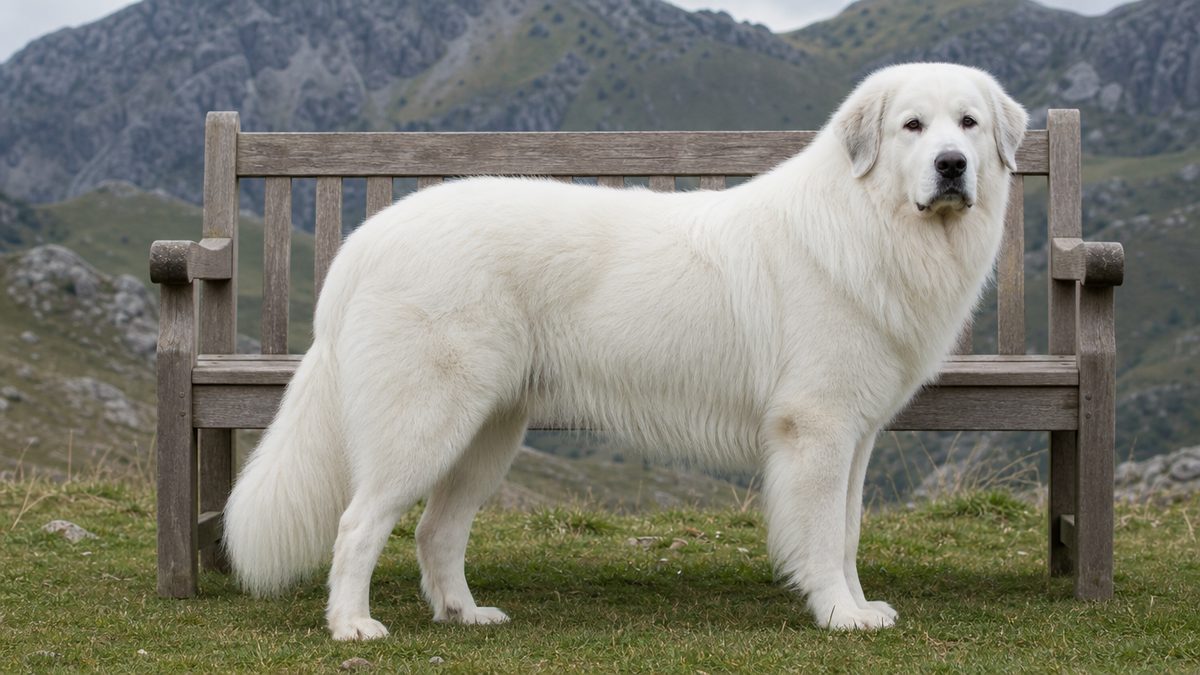
The Pyrenean Mountain Dog is a giant French livestock guardian, 70 to 80 cm at the withers for males, bred to stand alone against wolves on the French side of the Pyrenees and recognised by the FCI as standard 137.
Its own breed standard describes the job before it describes the dog. The FCI text reads that the breed was 'used on its own to guarantee the protection of flocks from attacks by predators', and that its selection 'depended on its aptitude for guarding and dissuading as much as on its attachment to the flock';. That single sentence explains almost every complaint a first-time owner will make. A dog selected to guard a flock at night, alone, will bark at night, alone, and will decide for itself whether the person at the gate is a threat.
The standard's own history section places it in the Pyrenees 'from time immemorial', names Gaston Phoebus mentioning it in the 14th century, dates the first detailed description to Count de Bylandt in 1897, and records that the Reunion des Amateurs de Chiens Pyrenees registered the official standard with the Societe Centrale Canine in 1923 at the instigation of Mr Bernard Senac-Lagrange. The Royal Kennel Club adds the parts a French standard would not: Louis XIV named it the Royal Dog of France, the French Army used it as a messenger and pack dog in the Second World War, and it is said to have carried smuggled goods over paths the customs officers could not reach.
The measurements, and the one the standard refuses to give
The FCI gives height and refuses weight. Males stand 70 to 80 cm at the withers and females 65 to 75 cm, with a tolerance of 2 cm above for perfectly typed specimens. The authentic French text agrees, printing 'une tolerance de 2 cm au-dessus', so the plus sign in the English is not a translator's slip in either direction. What the standard never gives is a weight: the string 'kg' appears zero times in the whole nine-page document.
The American Kennel Club supplies the weight the standard withholds, and its heights disagree with the FCI at both ends.
| Measure | FCI standard 137 | American Kennel Club |
|---|---|---|
| Male height | 70-80 cm (plus 2 cm tolerance) | 27-32 inches, about 68.6-81.3 cm |
| Female height | 65-75 cm (plus 2 cm tolerance) | 25-29 inches, about 63.5-73.7 cm |
| Male weight | Not stated anywhere in the standard | 100 pounds and up, about 45 kg and up |
| Female weight | Not stated anywhere in the standard | 85 pounds and up, about 38.5 kg and up |
| Stated life expectancy | Not stated | 10-12 years |
Read that table before you read a seller's spec card. The AKC's male floor sits 1.4 cm below the FCI's, its female ceiling sits 1.3 cm below the FCI's, and its weight figures have an open top end, which is why every Indian listing that quotes 'about 45 to 55 kg' is quoting an American convention rather than the standard the Kennel Club of India would judge against.
Coat and colour, in the standard's own words
The coat is 'well-furnished, flat, quite long and supple, rather crisp on the shoulders and back, longer on the tail and around the neck where it can be slightly wavy', with trouser hair that is finer and woollier, and a thick undercoat. The colour is white, or white with patches appearing grey (badger or wolf), pale yellow, or orange, on the head, ears, base of the tail and sometimes the body, and the standard says badger grey patches are the most appreciated. The Royal Kennel Club registers the French colour word directly, listing Blaireau and Blaireau & White among its breed standard colours.
A large white guardian with a clear dark mask on its face is not this breed. That is the Pyrenean Mastiff, FCI 92, a Spanish dog whose standard requires the mask. If an Indian seller's photograph shows a mask, either the photograph or the breed name is wrong.
Two more Pyrenean dogs share the range and are constantly confused with this one. The Pyrenean Sheepdog is the small herding dog that moved the same flocks this dog guarded, and it stands 42 to 48 cm rather than 70 to 80. The Pyrenean Mastiff is Spanish. All three are rare in India, and the confusion between them is not academic: Google's own question box for the sheepdog returns three questions about the Great Pyrenees.
Registry position, and why the breed's own name hides its data
The Pyrenean Mountain Dog holds definitive FCI recognition as standard 137, accepted on 25 January 1955, and it carries at least four working names that each unlock a different dataset.
Start with the date, because the FCI writes it two ways and both appear in this breed's own paperwork. The FCI's breed record prints the definitive acceptance as `1/25/1955` and the standard's publication as `3/13/2001`. Reading those as day-first gives an impossible 25th month, and the proof sits on the record's own face: the same page prints `3/31/2005`, `1/25/1955` and `5/17/2002`, whose second fields of 31, 25 and 17 cannot be months, while no first field exceeds 12. The record is therefore M/D/YYYY, and definitive acceptance is 25 January 1955.
The standard PDF then prints the same dates the other way round. Its English header reads `31.03.2005/EN` and its publication line reads `13.03.2001`, and here the first fields of 31 and 13 exceed 12, so this document is D.M.YYYY. The French authentic text repeats the pattern with a header of `02.04.2001 / FR` and the same `13.03.2001` publication line. Both formats resolve to the same two dates, 31 March 2005 and 13 March 2001, so the FCI's register and its own standard agree once each is read in its own format. That is worth stating plainly, because it is not always true: on other breeds the register and the standard genuinely disagree.
Do not carry an FCI date format from one document to the next. The register is M/D/YYYY and the standard is D.M.YYYY for this very breed, and the only reliable method is to look down the page for a field above 12 in either position.
Four names, four datasets
The breed's name changes with the body doing the recording, and searching the wrong one returns a confident zero.
| Body | Name used | What it holds |
|---|---|---|
| FCI | Chien de Montagne des Pyrenees | Standard 137, Group 2, definitive 25 January 1955 |
| The Kennel Club (UK) | Pyrenean Mountain Dog | Pastoral Group, Breed watch Category 1 |
| American Kennel Club | Great Pyrenees | Working Group, recognised 1933 |
| Orthopedic Foundation for Animals | GREAT PYRENEES, code GP | 7,501 hip evaluations and eleven other tables |
Searching the OFA for the FCI and Kennel Club name returns nothing. In a 2,232,040-character retrieval of the OFA's statistics tables on 8 September 2026 the string 'PYRENEAN MOUNTAIN DOG' appears zero times, while the control string LABRADOR appears 109 times in the same file. The data is all there under GREAT PYRENEES. An agent, a writer or a buyer who searches the breed's own European name and reports 'no OFA data' has manufactured an absence out of a naming convention.
The OFA's markup states the equivalence itself. The breed's checkbox carries `value="GP" data-name="GREAT PYRENEES" data-groups="AKC Working Group;CKC Working Group;UKC Guardian Dog Group;TKC Pastoral Group (PYRENEAN MOUNTAIN DOG)"`. The AKC's own history notes say the same thing from the other side, recording that the dog is known 'in most places in England and the Continent' as the Pyrenean Mountain Dog.
One code, checked rather than assumed
The OFA holds exactly one code for this breed, and that is a tested finding rather than a stopping point. Parsing the OFA advanced-search markup on 8 September 2026 yielded 478 distinct breed checkboxes, and the same parse returned two codes for the Pyrenean Mastiff, an orphan `MLP` labelled 'PIRINEOS MASTIFF' with no statistics and a populated `PMF`. A method that finds a second code where one exists, and finds only `GP` here, has produced a real negative rather than a lazy one. Stopping at the first code a registry offers is how a breed with data gets reported as having none.
Recognition in India
India is a full FCI member represented by the Kennel Club of India in Chennai, so the KCI issues pedigrees against FCI nomenclature and this breed's definitive FCI recognition effectively answers the Indian recognition question. The KCI publishes no public breed list, so a search of its site returns zero for this breed and zero for every control, which is an instrument limit rather than a finding. Any Indian seller advertising a 'KCI registered' puppy of this breed is making a claim you can only test by asking to see the pedigree document itself.
Pyrenean Mountain Dog price in India
No Pyrenean Mountain Dog price in India survives inspection, because every rupee figure Bonbeno could reach on 8 September 2026 either belongs to a different dog or has no listing behind it.
Two Indian sites rank for this query and both were opened and read from raw markup rather than from a search snippet.
Seller one: fourteen price tags, none of them this breed
Puppiezo's Great Pyrenees page carries fourteen WooCommerce price spans in its raw HTML. Every one is a figure Bonbeno has previously recorded on this site as a recurring house price point: Rs 98,999 six times, Rs 92,599 four times, Rs 76,499 twice, Rs 94,999 once and Rs 1,20,000 once. Not one of them is attached to a Pyrenean Mountain Dog. The page's carousel product-category classes read maltipoo four times, poodle four times, rottweiler twice, doxiepoo twice, cane-corso once and goldendoodle once.
The site's own image filenames name each animal and its actual breed, which is what turns a suspicion into a finding.
| Animal | Image filename in the site's markup | Actual breed |
|---|---|---|
| Tugi | Rottwieler-tugi | Rottweiler |
| Yoki | Dachshund-yoki | Dachshund |
| Samy | Maltipoo-samy | Maltipoo |
| Fizey | Maltipoo-Male-Fizzy | Maltipoo |
| Kuzo | Poodle-Kuzo-male | Poodle |
| Dugu | Poodle-Dugu | Poodle |
| Kazuka | Cane-corse-kazuka | Cane Corso |
| Doir | GD-Dior | Goldendoodle |
The only Great Pyrenees numbers on that page are Rs 35,000 and Rs 45,000, each appearing exactly once, in the descriptive prose and not inside a price span. That band is an editorial claim with no listing behind it. It is at least rupee-native rather than a converted dollar list: 35,000 divided by 84.38 is 414.79 and by 74 is 472.97, and 45,000 divided by 84.38 is 533.30 and by 74 is 608.11, none of them a number a shop would print. So the figure is not laundered from an American price sheet. It is simply unsupported.
Seller two: three results, three French Bulldogs
Mr n Mrs Pet advertises 'KCI registered Great Pyrenees puppies for sale in India' and prints '3 Result Found' at the head of its listing page. Its rendered content shows no Great Pyrenees listing, no city and no price for any Great Pyrenees, and the block beneath the heading, labelled 'Similar breeds at other locations', contains three French Bulldogs. The only rupee figures on the page are the site's own service-plan prices of 499 and 999 and its budget filter bands.
Search Puppiezo's sibling page for the Pyrenean Sheepdog and Google's snippet reads 'Price Rs 92,599 Platinum Dugu'. The raw markup shows Dugu is a Poodle. A price becomes a fact by being repeated, and this is the step where that happens.
What a buyer should conclude
Treat any quoted Pyrenean Mountain Dog price in India as unverified until you have seen the animal, the dam and a pedigree document. The honest position is that the breed has no established Indian supply chain at a price anyone can check, and that the figures circulating attach to Maltipoos and Poodles. Bonbeno reports published prices as editorial content and does not broker sales, recommend breeders or link listings.
The cost that is real, checkable and much larger is the cost of keeping the dog, and that is the next section.
Cost of ownership in India for a 45 kg dog
Budget the cost of ownership for a 45 kg dog rather than a breed price, because the recurring bill is the number that is actually sourceable in India and it dwarfs any purchase figure inside two years.
Every figure below was read from an Indian page and none of them is a breed price. Parasite control is the clearest example of scale: NexGard Spectra for a 15 to 30 kg dog is Rs 3,308 for three tablets, which is Rs 1,103 a month, and this breed sits above that weight band, so the heavier pack applies. Deworming with Drontal Plus runs Rs 125.67 a tablet dosed at one tablet per 10 kg, so a single deworming for a 45 kg dog is roughly Rs 566.
Vaccination has a spread rather than a price. One metro chain lists anti-rabies at Rs 699, the nine-in-one DHPPiL at Rs 899 and kennel cough at Rs 1,349, with an annual booster course starting at Rs 3,199 on its national page and Rs 3,299 on its Mumbai page for the same day. Those are promotional floors from one chain, not a market average, and the per-vaccine prices are the stable layer.
| Item | Published Indian figure | Frequency |
|---|---|---|
| Anti-rabies vaccine | Rs 699 | Annual |
| Nine-in-one DHPPiL | Rs 899 | Annual |
| Kennel cough | Rs 1,349 | Annual, if boarded |
| Annual booster course | From Rs 3,199 to Rs 3,299 by city page | Annual |
| Tick and flea, NexGard Spectra | Rs 1,103 per month at the 15-30 kg band | Monthly |
| Deworming, Drontal Plus | About Rs 566 per dose at 45 kg | Two to three times a year |
| Delhi MCD dog registration | Rs 500 new, Rs 500 renewal | Annual |
| Chennai GCC pet licence | Rs 50 | Annual |
Municipal fees are the only durable numbers in the table. Delhi's corporation charges Rs 500 to register a pet dog and Rs 500 to renew, with a late fee of Rs 100 a month, and its own counter records 18,958 certificates issued since 2021 and 71 of 1,006 applications rejected in 2026-27. Greater Chennai Corporation charges Rs 50, issued 9,115 licences in 2024, and runs six municipal pet clinics that provide treatment and anti-rabies vaccination free of cost. For a Chennai owner of a large dog, those six clinics are a better fact than any private rate card.
The line item nobody prices, and it is the biggest one
Air conditioning is the real cost of ownership for this breed in India, and no Indian page quotes it because it is not a product. A double-coated giant from a homeland whose warmest month averages 18.12 C cannot be kept comfortably through a Delhi June averaging 35.88 C without cooled indoor space for most of the day. Whatever your household spends to cool one room for eight months of the year is the honest headline figure, and it will exceed the vaccination, parasite and licensing lines combined.
This site does not publish a monthly kibble figure for a giant breed, because the retail bag prices it would rest on move within days and the grams per day depend on the individual dog. Weigh your dog, read the feeding chart on the pack you actually buy, and do the arithmetic yourself.
One further caution on Indian cost tables. Several Indian breed sites publish monthly running costs as shared preset lines, so the same food, health and grooming figures appear across unrelated breeds. If you meet a neat monthly total for this breed on an Indian site, pull one unrelated breed from the same site and compare the component lines to the rupee before you use it.
Indian climate: what the numbers actually say
The Pyrenean Mountain Dog is the most heat-sensitive large breed on this site, and the reason is a 27-degree gap between its homeland and Delhi's hottest month rather than anything to do with humidity.
Bonbeno pulled NASA POWER climatology by explicit latitude and longitude for six Pyrenean points and eight Indian ones on 8 September 2026, echoing the elevation of the grid cell the model actually used against the real elevation of each place. That check matters here more than almost anywhere, because the Pyrenees are precisely the terrain where the model collapses.
Five Pyrenean towns, one grid cell
Five of the six Pyrenean points returned a byte-identical series from a single cell at 980.73 m. Lourdes sits at about 410 m, Argeles-Gazost at 450 m, Bagneres-de-Bigorre at 551 m, Cauterets at 932 m, and the Pic du Midi de Bigorre at 2,877 m. One cell was simultaneously reporting a foothill town and a 2,877 m observatory summit, an error of 1,896 m at the top end.
Only Gavarnie returned its own cell, at 1,323.90 m against a real 1,375 m, an error of 51 m. Gavarnie is therefore the one Pyrenean point on this page that can be quoted, and it happens to sit at the working altitude the breed was made for. As controls in the same session, Ooty came back at 784.64 m against a real 2,240 m and Shimla at 897.65 m against 2,200 m, reproducing errors this site has recorded before, while every Indian plains city was accurate to within 85 m.
| Place | Cell elevation | Annual mean | Warmest month mean | Annual RH2M | Peak wet bulb |
|---|---|---|---|---|---|
| Gavarnie, French Pyrenees | 1,323.90 m | 8.60 C | 18.12 C (July) | 71.92% | 13.45 C (July) |
| Delhi | 206.37 m | 25.57 C | 35.88 C (June) | 45.51% | 26.50 C (July) |
| Kolkata | 7.35 m | 25.80 C | 31.53 C (May) | 73.84% | 27.09 C (June) |
| Chennai | 48.95 m | 27.94 C | 31.51 C (May) | 72.39% | 26.11 C (May) |
| Mumbai | 97.15 m | 26.77 C | 31.19 C (May) | 67.28% | 25.77 C (June) |
| Pune | 635.99 m | 23.86 C | 28.93 C (April) | 66.68% | 22.97 C (June) |
| Bengaluru | 841.72 m | 23.74 C | 28.37 C (April) | 67.84% | 21.86 C (May) |
The humidity argument is wrong, and the wet bulb argument is right
The Pyrenees are not dry. Gavarnie runs 71.92 percent annual relative humidity, which is above Mumbai at 67.28, Bengaluru at 67.84 and Pune at 66.68, and close to Chennai at 72.39. So the common claim that Indian humidity will finish this breed does not survive contact with the homeland's own numbers. What actually changes is heat, and heat combined with moisture.
Wet bulb is the honest measure, because it is the temperature a wet animal can cool itself down to by evaporation, and a panting dog is an evaporative cooler. Computed from mean temperature and mean relative humidity, the homeland's peak wet bulb is 13.45 C in July. Kolkata's is 27.09 C, Delhi's 26.50 C and Chennai's 26.11 C. That is a gap of 12.7 to 13.6 degrees in the one variable that governs whether panting works.
A two-year-old male Pyrenean Mountain Dog weighing 43 kg collapsed and died of heat stroke in Ontario on a day when the ambient temperature was about 30 C. He arrived at the clinic 45 minutes after being found, with a rectal temperature of 40.6 C, and did not survive intravenous fluids at shock rate, dexamethasone, antibiotics and surface cooling. Delhi's June mean is 35.88 C.
What the UK data adds
Size is itself the risk factor. In a cohort of 905,543 UK dogs, bodyweight at or above the breed and sex mean carried odds of heat-related illness of 1.42 (1.12 to 1.80), and dogs over 50 kg carried odds of 3.42 (1.54 to 7.57). A companion paper on the same cohort found that of 1,259 events from 1,222 dogs, 879 had a recorded trigger, and 652 of those 879 events, or 74.2 percent, were exertional rather than caused by a hot car. Exercise in heat, not confinement, is what puts most dogs in the clinic.
Neither paper modelled this breed by name, so treat the weight bands as the transferable part and the breed as unmodelled.
The practical answer for each Indian city
Bengaluru and Pune are the only mainland Indian cities where this dog is defensible without full-time cooling, at 23.74 C and 23.86 C annual means and April peaks under 29 C. Even there the peak wet bulb reaches 21.86 C and 22.97 C, roughly nine degrees above the homeland. Delhi, Chennai, Kolkata and Mumbai each combine a hotter peak with a wet bulb above 25 C, and in those cities the dog needs a cooled room as a default condition of keeping it, not a summer concession.
Double dewclaws, the breed standard and Indian law
FCI standard 137 requires double dewclaws on both hind legs, and removing them in India puts a breeder on the wrong side of the anti-mutilation clause in the Dog Breeding and Marketing Rules 2017.
The standard is unusually direct about this. Under Dewclaws it reads that 'the hind legs each have double well-formed dewclaws', adding that the front legs sometimes have single or double dewclaws. It then returns to the point in the eliminating faults, where 'no dewclaws or single dewclaw or atrophied double dewclaws on hind feet' sits alongside a non-black nose and yellow eyes as a fault that disqualifies the dog outright. Very few conformation points are treated that severely in any standard.
That matters in India for a specific reason. Double dewclaws on a giant dog are exactly the sort of feature a breeder or a first-time owner is tempted to remove for tidiness, and Indian law reaches the practice.
The clause, quoted from the gazette
Second Schedule Part II paragraph 6(8) of the Prevention of Cruelty to Animals (Dog Breeding and Marketing) Rules, 2017 reads in full: 'There shall be no tail docking, ear cropping de-barking, de-clawing, branding, dyeing, injecting substances to enhance visual appeal, performing a surgery or procedure to camouflage or hide any defect or infirmity or any other kind of mutilation of any body part of the pup and any change of appearance by artificial means is strictly forbidden';.
The word 'dewclaw' appears zero times in the gazette, counted with a whitespace-tolerant pattern over Bonbeno's own pypdf extraction of the 14-page, 51,953-character document. So the correct citation is de-clawing and the mutilation limb of paragraph 6(8), never a dewclaw provision. The string 'Rule 21' also appears zero times; the outdoor-housing heat clause is Second Schedule Part IV paragraph 21(1).
Paragraph 6(9) closes the other route, prohibiting 'breeding to create new breeds of dogs or unusual looks'. Between the two, an Indian breeder cannot lawfully produce a Pyrenean Mountain Dog with the dewclaws surgically removed and cannot lawfully breed away from the standard's requirement as a cosmetic project.
The heat clause names this breed's coat by description
Second Schedule Part IV paragraph 21(1) is the provision every Indian owner of a long-haired breed should read. It bars keeping in outdoor facilities, without the attending veterinary practitioner's written approval, three categories: dogs not accustomed to the temperatures prevalent in the area, 'dog breeds that cannot tolerate the temperatures prevalent in the area or region in question, such as long-haired breeds in high temperature locations', and sick, infirm, aged or young animals.
A white, long-haired, double-coated guardian from a valley averaging 8.60 C, kept outdoors in a Delhi summer, is the textbook case that clause describes. The clause binds breeding establishments rather than private homes, but it is the clearest statement in Indian law of what this coat means in this climate.
Two more things the Rules do and do not say
Rule 8(1)(a) requires that 'pups less than eight weeks in age are not sold', and Second Schedule Part III paragraph 8(10) requires that breeding dogs 'shall have been tested for genetic defects, including hip dysplasia';. That second clause is directly enforceable against anyone breeding this dog in India, and the OFA hip data in the health section is the sort of evidence it contemplates.
What the Rules do not contain is equally citable. Across all fourteen pages the strings BAER, deaf and patella each appear zero times, so there is no Indian statutory hearing test and no Indian statutory patella grade for any breed. Anyone telling you Indian law mandates either is wrong.
Temperament and who should not buy one
The Pyrenean Mountain Dog is calm indoors, independent by design and vocal at night, and the FCI standard says all three in a single sentence about how it was selected.
The standard's behaviour paragraph is the most useful temperament description written about this breed, because it explains the traits instead of listing them. It records that the dog was 'used on its own to guarantee the protection of flocks', that its qualities are 'strength and agility, allied to gentleness and attachment to those it is protecting', and that 'this protecting dog has a propensity for independence and a sense of initiative which demand a certain degree of authority from its owner';.
Read that last clause carefully. A sense of initiative is not a euphemism for stubbornness. It means the dog was selected to make decisions without a handler present, and it will keep doing that in a Bengaluru apartment block with couriers arriving at nine in the evening.
The three complaints, and which are fixable
Owners in the ranking discussions raise the same three issues, and Purina UK's breed page reaches the same conclusion from the other direction, stating that while the breed can be affectionate with its own family it is 'not advised for homes with children';.
- Barking at night. Not fixable, only manageable. A flock guardian's job was to announce a presence in the dark, and Indian apartment living puts a presence outside the door every hour.
- Independence under instruction. Not fixable. The AKC says standard obedience training 'will be met with great indifference' and that the dog shows boredom by responding slowly.
- Wariness of strangers. Partly fixable, and only by early work. This is the trait that decides whether the dog is safe around domestic help, deliveries and building staff, and it has to be built in the first six months.
Who this dog suits in India
It suits a household with a farmhouse or a large independent house, a large garden, an air-conditioned indoor space, an adult who wants a watchful companion rather than an obedient one, and no expectation of taking the dog to a cafe. The Royal Kennel Club's own requirement sheet asks for a large house and a large garden, and rates the breed as suitable for either town or country only against that background.
It does not suit a first-time owner, a flat, a household with toddlers who will be knocked over by a 45 kg dog moving normally, a family that travels and boards its dog often, or anyone in Delhi, Chennai, Kolkata or Mumbai without cooled indoor space.
The gentleness in the standard is not marketing. This dog is genuinely calm with its own children. The risk is physics: an animal that starts at 45 kg and has no upper weight limit in the standard can injure a small child by turning around.
Training a dog that was bred to ignore you
Train the Pyrenean Mountain Dog for co-operation rather than obedience, because the AKC states plainly that standard obedience work 'will be met with great indifference' in a breed selected to work without guidance.
The realistic goal is a dog that will recall reliably, walk on a loose lead at 45 kg, accept handling for grooming and veterinary work, and tolerate strangers entering the property when you say so. Competitive obedience is not a realistic goal and chasing it produces a frustrated handler and a slower dog.
The first sixteen weeks decide the stranger question
Socialise deliberately and early, because the trait you are shaping is threat assessment rather than friendliness. In an Indian home the list of people the dog must learn to accept is longer than in the homes these breed guides were written for: domestic help arriving daily, a cook, a driver, a maintenance technician, courier riders, the milk delivery, and building security. Every one of those is a person approaching a door repeatedly, which is exactly the pattern a guardian is built to challenge.
- Weeks 8 to 16: introduce every routine visitor by name and by repetition, with the puppy calm and fed, never at the gate and never barking.
- Weeks 8 to 16: teach a settle on a mat away from the door, so the default answer to a doorbell is a place rather than a challenge.
- Months 4 to 8: build recall on a long line in cool hours only, and never in an open unfenced space.
- Months 6 to 12: teach standing for grooming, nail work and dewclaw checks, because a 45 kg adult that objects cannot be overpowered.
- Months 9 to 18: expect the guarding instinct to switch on and hold the socialisation work steady through it.
What does not work
Force does not work and it is dangerous with a dog this size. Repetition without purpose does not work either, because the breed reads a pointless task as a pointless task. Short sessions with a real outcome, ending before the dog disengages, are the only approach that holds. The FCI standard's phrase about the owner needing 'a certain degree of authority' means calm consistency, not confrontation.
One Indian-specific caution. Training in April, May or June in a plains city is training in conditions where the dog cannot cool itself, and heat-related illness in UK dogs was overwhelmingly exertional rather than confinement-related, at 652 of the 879 events with a recorded trigger. Move all training to the coolest hour of the day from March onward.
Daily exercise, and why less is correct here
This breed needs up to one hour a day, split across the coolest hours, and the Royal Kennel Club's own requirement sheet says exactly that.
That is unusually modest for a giant, and it is a function of the job. The AKC explains it clearly: the breed is not highly active, it was developed to guard livestock, and when working it patrols its territory but 'tends to conserve their energy for fending off whatever may threaten their flock';. A guardian's economy of movement is a design feature.
In India that hour has to be split and timed. Two walks of twenty-five to thirty minutes, one before sunrise and one well after dark, will meet the requirement in Delhi, Chennai, Kolkata or Mumbai from March through October. In Bengaluru and Pune the window is wider, but the April peak still argues for early and late.
What happens without it, and what happens with too much
Under-exercised, this dog gains weight, and weight is the single measured risk factor that applies to it. In the UK cohort, bodyweight at or above the breed and sex mean carried odds of heat-related illness of 1.42, and dogs over 50 kg carried odds of 3.42. A heavy Pyrenean Mountain Dog in an Indian summer is carrying two risk multipliers at once.
Over-exercised in heat, it collapses. The clinical picture in the one published case report of heat stroke in this breed began with a dog found unconscious in lateral recumbency, arriving 45 minutes later at 40.6 C rectal, and progressing through petechiation, bradycardia, coma and death despite treatment. The paper notes that cellular damage begins as temperatures approach 42 C.
The case report is explicit: 'cold-hosing these animals is generally not recommended, as it causes peripheral vasoconstriction that impedes heat loss.' Use cool wet towels, get to a vet, and stop cooling before the temperature reaches normal because it continues to fall after you stop. Maximum heat loss occurs when the skin temperature is 22 to 28 C.
Useful work instead of distance
Give this dog a territory to hold rather than a distance to cover. Access to a shaded, secure garden it can patrol satisfies far more of the breed's need than a longer walk does, and it removes the exertion that drives most heat cases. Cart work and scent games suit the temperament; repetitive fetch does not.
Grooming a double coat in Indian humidity
Brush this dog at least twice a week and never shave it, because the once-a-week advice on every ranking page was written for a climate where the coat dries by itself.
The AKC's grooming guidance is the clearest example on this page of care advice that does not transfer. It states that 'for all their abundant fur, Pyrs don't require a lot of grooming, as their coat is dirt- and tangle-resistant', and recommends 'a thorough brushing with a pin brush or slicker brush at least once a week';. That is accurate in a North American winter. It is not accurate in Kolkata, where annual relative humidity is 73.84 percent and the coat over the trousers and behind the ears stays damp for hours.
The Royal Kennel Club is closer to the Indian reality, listing grooming for this breed as 'more than once a week';. Take that as the floor and go higher through the monsoon.
What the coat actually is
The standard describes a well-furnished, flat outer coat, quite long and supple, rather crisp over the shoulders and back and longer around the neck and on the tail, over trouser hair that is finer and woollier and very thick, with a thick undercoat beneath. That is a genuine double coat with two jobs: the outer coat sheds water and blocks sun, and the undercoat insulates. Both matter in India, and only one of them is obvious.
| Task | Frequency | Why it changes in India |
|---|---|---|
| Line brushing to the skin | Twice weekly, three times in the monsoon | Damp undercoat mats and holds moisture against the skin |
| Undercoat rake through the shed | Daily during the spring shed | The shed is heavy and a packed undercoat traps heat |
| Behind the ears and the trousers | Every session | The two places that stay wet longest and mat first |
| Dry the dog fully after any bath | Every bath | Air drying is the standard overseas advice and it is wrong in a monsoon |
| Check both hind dewclaws | Weekly | Double dewclaws catch and tear, and they cannot be removed lawfully |
| Nails | Every three to four weeks | Overlong nails on a 45 kg dog change how it stands |
Shaving removes the outer coat that blocks solar radiation and does not remove the undercoat that insulates, so the dog is left hotter and sunburn-prone. Remove the dead undercoat instead. This dog will shed heavily and that is the mechanism working, not a problem to solve with clippers.
Ears, skin and the monsoon
Plug the ears before a bath and dry them afterwards. The overseas guidance to towel a dog and let it air dry belongs to a dry climate; in an Indian monsoon a damp, drop-eared, long-haired dog is a predictable otitis case. The FCI standard describes ears that 'fall flat against the head', which means no ventilation and a warm, moist canal for most of the year in coastal India.
Ticks are the other monsoon problem and they are a health issue rather than a grooming one. Among 584 dogs screened at veterinary clinics in West Bengal, Babesia gibsoni was found in 76.54 percent and 72.9 percent of the 584 dogs screened carried two or more pathogens. A southern Indian series of 120 dogs found Babesia in 66.7 percent with a pre-monsoon March to May peak. Both sampled dogs presented at clinics rather than a random population, so the percentages describe the caseload rather than the street. On a long-haired dog you will not see the tick, which is why the monthly parasite tablet in the cost section is not optional here.
One claim to dismiss before a seller makes it. No dog breed is hypoallergenic, and this one is a heavy shedder besides. Can f 1 was measured across 196 dogs of so-called hypoallergenic breeds against 160 controls and came back higher in the hypoallergenic group on both hair and coat, with no difference in airborne allergen.
Health, screening and a lifespan that was actually measured
The Pyrenean Mountain Dog's median lifespan is 10.9 years, measured from 128 deaths, and its hip dysplasia rate of 9.5 percent across 7,501 OFA evaluations is low for a giant breed.
Start with the lifespan, because three bodies give three different answers and only one of them is a measurement. McMillan's 2024 UK study of 155 recognised purebreds gives this breed a median survival of 10.9 years with a 95 percent confidence interval of 10.5 to 11.3, from 260 dogs alive and 128 deaths, with a hazard ratio of 1.5 against the crossbred group's median of 12.0 years. The AKC prints 10 to 12 years, which brackets the measurement. The Royal Kennel Club prints 'under 10 years', which sits below it. Use the measured figure and its interval.
Searching the full text of McMillan 2024 for 'Pyrenean', 'Pyrenees' and 'Great Pyrenees' returns zero for each, against in-document controls of Labrador 3, Caucasian Shepherd 2, Cane Corso 2 and Border Collie 2. The breed is nonetheless present, in Supplementary Table S3. A body-text search of this paper produces a false absence, and that is worth knowing before anyone reports a breed as unstudied.
The paper's own supplementary tables disagree on sample size and agree on deaths. Table S3 gives 260 in its first column while Table S6 gives 144 alive and 272 total, and both give 128 deaths. Quote the death count and the median with its interval, and do not average the two sample sizes.
What the OFA has, and it has a lot
The Orthopedic Foundation for Animals holds twelve statistics tables for this breed under the code GP, on denominators that are large for any breed and unusually large for a giant one.
| Test | Evaluations | Result |
|---|---|---|
| Hips | 7,501 | 89.3% normal, 9.5% dysplastic (mild 5.7, moderate 3.4, severe 0.4) |
| Elbows | 1,831 | 98.0% normal, 2.0% dysplastic |
| Patellae | 1,625 | 99.0% normal |
| Shoulders | 167 | 98.2% normal |
| Thyroid | 250 | 91.6% normal |
| Cardiac, congenital | 620 | 99.2% normal |
| Canine multifocal retinopathy, DNA | 281 | 70.5% clear, 26.0% carrier, 3.6% affected |
| Degenerative myelopathy, DNA | 394 | 85.3% clear, 9.9% carrier, 4.8% affected |
| Neuronal degeneration, DNA | 417 | 90.9% clear, 8.2% carrier, 1.0% affected |
| Glanzmann's thrombasthenia, DNA | 199 | 98.0% clear, 2.0% carrier, 0% affected |
| Chondrodysplasia CDPA, DNA | 261 | 88.9% clear, 10.0% carrier, 1.1% affected |
The hip row sums exactly in both directions, 15.6 plus 61.4 plus 12.3 equals the 89.3 percent normal, and 5.7 plus 3.4 plus 0.4 equals the 9.5 percent dysplastic. That arithmetic is worth checking on any table before you quote it.
The standout number is canine multifocal retinopathy. More than one in four dogs DNA tested carries it, and 3.6 percent are affected, on a denominator of 281. The disease has been described in this breed by name, with fluorescein angiography and electron microscopy. Two other DNA tests have breed-specific literature behind them: a SACS deletion variant causing autosomal recessive neuronal degeneration, framed by its authors against the human disorder ARSACS, and Type I Glanzmann's thrombasthenia, a platelet bleeding disorder reported in a Pyrenean Mountain Dog. Chondrodysplasia has its own case series in five dogs of this breed.
The OFA eye tables contradict themselves, and this breed shows it clearly
The eye summary row reports 92.6 percent normal across 364 evaluations. The per-diagnosis detail rows on the same denominator of 364 report NORMAL at 214, which is 58.8 percent, a gap of 33.8 points. Worse, one detail row alone exceeds the summary's whole: persistent pupillary membranes iris-to-iris appears in 92 of 364 dogs, or 25.3 percent, against a summary abnormal rate of 7.4 percent. A part cannot exceed its whole, so the two figures are not measuring the same thing. Publish both, quote neither as 'the' rate, and read the detail rows because they name actual diagnoses.
Screening this breed properly in India
The AKC lists only two recommended tests from the national breed club, a patella evaluation and a hip evaluation. That list is thinner than the evidence supports. Ask a breeder for hips and elbows at minimum, and for the DNA panel covering multifocal retinopathy, degenerative myelopathy and neuronal degeneration, because all three have measurable carrier rates and named breed literature. Indian law already reaches part of this: Second Schedule Part III paragraph 8(10) requires that breeding dogs have been tested for genetic defects including hip dysplasia.
Gastric dilatation-volvulus, honestly bounded
Bloat is the emergency to plan for and there is no breed-specific number for it. The AKC states the breed is susceptible and recommends multiple small meals and no vigorous exercise around mealtimes. The best-known prospective cohort followed 1,914 dogs across eleven named breeds and found incidence of 23 cases per 1,000 dog-years for the seven large breeds of 23 to 45 kg and 26 per 1,000 for the four giant breeds over 45 kg, but the Pyrenean Mountain Dog is not one of the eleven. A PubMed search combining the breed name with volvulus, gastric dilatation and bloat returns zero records with the phrase honoured. So the size band applies and the breed itself is unmeasured, and this page will not borrow a number that was not measured on it.
The practical consequence is unchanged. Know the signs, know your nearest 24-hour surgical facility before you need it, and understand that surgical decompression is measured in hours, not days.
Feeding a giant that eats less than you expect
Feed this breed in multiple small meals on a large-breed formulation, because owners consistently report it eating a modest amount for its size and because meal size is one of the few gastric dilatation-volvulus levers an owner controls.
The AKC records the observation directly, noting that some owners find the Great Pyrenees seems to eat a relatively small amount for a dog of its size, and recommending a high-quality dry food formulated for large breeds. Do not read that as a licence to underfeed a growing giant. Read it as a warning that a bowl sized by eye from the dog's appearance will usually be too big.
Growth is the phase that matters
A dog reaching 70 to 80 cm at the withers builds most of that skeleton in its first year, and this is the breed with a published chondrodysplasia case series and a 9.5 percent hip dysplasia rate on 7,501 evaluations. Overfeeding a giant-breed puppy accelerates growth in a way orthopaedic development does not tolerate. Use a large-breed puppy formulation with controlled calcium, feed to a body condition score rather than to a chart, and resist the instinct to make a big dog bigger faster.
- Split the daily ration into three meals to twelve months and two thereafter, never one.
- Feed a large-breed formulation with controlled calcium through the whole growth phase.
- Rest the dog for an hour either side of every meal, because exertion around mealtimes is the classic bloat trigger the AKC names.
- Weigh the dog monthly through the first year and adjust by body condition, not by the pack chart alone.
- Keep water available at all times; the one published heat stroke case in this breed was a dog without access to water.
Indian availability and an honest gap
Large-breed dry formulations are widely available in Indian metros through the same retailers that sell the parasite products in the cost section. What this page will not give you is a monthly kibble figure in rupees. Indian retail bag prices for imported large-breed food moved within days the last time Bonbeno priced them, and grams per day for a dog with an open-ended weight range is arithmetic rather than a quoted price. Weigh your dog, read the chart on the bag you actually buy, and calculate it yourself.
A double-coated dog in a Chennai May will often eat less because it is hot, not because it needs less. Move the main meal to the coolest hour, keep the ration where the body condition says it should be, and watch weight monthly rather than trusting appetite as a guide.
Month by month through the first year in India
Plan the first year around three things in order: the socialisation window that closes at sixteen weeks, the heat calendar, and the growth that will take the dog past 45 kg.
| Age | What matters most | The Indian detail |
|---|---|---|
| Under 8 weeks | Stay with the litter | Rule 8(1)(a) makes selling a pup under eight weeks unlawful in India, so a seller offering one earlier is telling you something about themselves |
| 8-12 weeks | Core vaccination course begins | Anti-rabies at Rs 699 and nine-in-one at Rs 899 as single vaccines at one metro chain |
| 8-16 weeks | Socialisation window | Introduce every routine visitor: help, cook, driver, courier, security. This is the window that decides the adult dog |
| 3-4 months | First full shed of puppy coat | Start line brushing now so the adult dog accepts it at 45 kg |
| 4-6 months | Growth acceleration | Three meals a day, large-breed formulation, no forced exercise on hard surfaces |
| 6 months | Municipal registration | Delhi MCD Rs 500, Chennai GCC Rs 50 |
| 6-9 months | Guarding instinct appears | Hold the socialisation work steady rather than tightening control |
| 9-12 months | First Indian summer as a big dog | The cooled room stops being optional; walks move to before sunrise and after dark |
| 12-18 months | Skeletal maturity | Hip and elbow radiographs are only meaningful for OFA purposes at 24 months |
The heat calendar, by city
Time the puppy's arrival if you can. A puppy landing in a Delhi home in April meets a June averaging 35.88 C during its fastest growth phase; a puppy arriving in October has six workable months before that. Bengaluru and Pune, whose peaks fall in April at 28.37 C and 28.93 C, are the two mainland cities where the calendar is forgiving.
Two checks to make in month one
Check both hind legs for double dewclaws and photograph them. Their absence is an eliminating fault under FCI standard 137, and their surgical removal by an Indian breeder engages the anti-mutilation clause at Second Schedule Part II paragraph 6(8) The Prevention of Cruelty to Animals. If the pup you were shown had them and the pup you collected does not, you have a serious conversation to have.
Ask for the parents' screening results in writing. Hips and elbows at minimum, and ideally the DNA panel covering multifocal retinopathy, degenerative myelopathy and neuronal degeneration, given carrier rates of 26.0, 9.9 and 8.2 percent on the OFA's own tables.
How it compares with the giants Indian buyers cross-shop
Against the other white and giant guardians an Indian buyer considers, the Pyrenean Mountain Dog is the one with the most measured data and among the worst heat profiles.
| Breed | FCI number | Measured median lifespan | OFA hip dysplasia | Homeland warmest month |
|---|---|---|---|---|
| Pyrenean Mountain Dog | 137, definitive 1955 | 10.9 years (10.5-11.3), 128 deaths | 9.5% of 7,501 | 18.12 C, Gavarnie |
| Pyrenean Mastiff | 92 | Not in McMillan's 155 breeds | 34.6% of 104 | Spanish Pyrenees |
| Pyrenean Sheepdog | 141 and 138 | Not in McMillan's 155 breeds | 13.8% of 347 | 18.12 C, Gavarnie |
| Caucasian Shepherd Dog | 328 | 5.4 years, the shortest in the study | See breed page | Caucasus |
| Newfoundland | 50 | 11.0 years | See breed page | Atlantic Canada |
Three things follow from that table and each of them is a reason to prefer this breed or to reject it.
It is the best-evidenced of the Pyrenean three
Of the three Pyrenean breeds on this site, only this one appears in McMillan's 155-breed longevity table. The Pyrenean Mastiff and the Pyrenean Sheepdog are both absent, verified by searching the supplementary table itself rather than the article body. If you want a Pyrenean guardian whose lifespan is a measurement rather than a marketing band, this is the one.
Its hips are unusually good for its size
A 9.5 percent dysplastic rate on 7,501 evaluations is a genuinely large denominator and a genuinely low rate for a dog of this mass. For comparison within the same range, the much smaller Pyrenean Sheepdog runs 13.8 percent on 347 evaluations, which inverts the intuition that bigger dogs must have worse hips.
Its heat profile is close to the worst on this site
The homeland's warmest month averages 18.12 C and its peak wet bulb is 13.45 C, against Kolkata's 27.09 C and Delhi's 26.50 C. Combine that with a giant frame, a double coat and a published heat stroke death at 30 C ambient, and the honest comparison is that a Labrador Retriever of half the weight and a fraction of the coat is a far better Indian dog for almost every household that asks about this one.
Mistakes Indian owners actually make with this breed
Six mistakes account for most of the trouble Indian households have with this breed, and five of them are made before the dog arrives.
1. Believing a rupee price they found online
The two Indian sites that rank for this breed quote fourteen price tags between them and not one belongs to a Pyrenean Mountain Dog. One prints '3 Result Found' and shows three French Bulldogs. Treat every quoted price as unverified until you have seen the animal, the dam and a pedigree document.
2. Shaving the dog for the summer
This is the single most damaging thing an Indian owner does to a double-coated breed. Clipping removes the outer coat that blocks solar radiation while leaving the insulating undercoat packed against the skin, so the dog ends up hotter and exposed to sunburn. Rake the dead undercoat out instead and let the dog shed.
3. Cold-hosing a dog that has overheated
The instinct is right and the method is wrong. The published case report on this breed states that cold-hosing 'causes peripheral vasoconstriction that impedes heat loss', recommends cool wet towels, and notes that maximum heat loss occurs when the skin temperature is 22 to 28 C and that cooling continues after you stop. Cool with towels, move to a vet, and stop before normal.
4. Removing the hind dewclaws to tidy the dog up
FCI standard 137 makes their absence an eliminating fault, and Second Schedule Part II paragraph 6(8) of the 2017 Rules forbids de-clawing and 'any other kind of mutilation of any body part of the pup and any change of appearance by artificial means';. Check both hind legs when you collect the puppy and photograph them.
5. Buying the wrong Pyrenean
Three separate breeds carry Pyrenean names and Indian sellers mix them freely. A white giant with a clear dark facial mask is the Pyrenean Mastiff, FCI 92, a Spanish breed. A small shaggy herding dog at 42 to 48 cm is the Pyrenean Sheepdog. Google's own People also ask box confuses them so thoroughly that a query about the sheepdog returns three questions about this breed.
6. Reading American care advice as if it were universal
The AKC's once-a-week brushing recommendation and its advice that the coat is tangle-resistant were written for a dry continental climate. In Kolkata at 73.84 percent annual humidity the trousers and the hair behind the ears stay damp for hours, and the Royal Kennel Club's 'more than once a week' is closer to the Indian floor The Royal Kennel Club.
Owners often worry that the breed is failing its obedience class. It is not failing. The AKC says the breed meets standard obedience work with 'great indifference' and shows boredom by responding slowly to tasks it considers pointless. Change the goal, not the dog.
Adoption and responsible sourcing in India
Adopt rather than buy where you can, and where you cannot, verify four things before money changes hands: the pedigree document, the parents' screening results, the puppy's age and the hind dewclaws.
Breed-specific rescue for this dog barely exists in India, because the breed barely exists here. What does exist is a large population of large, heat-adapted Indian dogs in every municipal shelter in the country, and for most households that ask about a Pyrenean Mountain Dog, an Indian dog of similar size is a better animal for the climate and a shorter route to a home. Greater Chennai Corporation's six municipal pet clinics provide treatment and anti-rabies vaccination free of cost, which materially lowers the running cost of a rescued dog in that city.
If you are buying, verify these four things
- The pedigree document itself, in your hand. Several Indian sites advertise 'KCI registered' puppies of this breed while showing no listing at all. India is a full FCI member represented by the Kennel Club of India, so a genuine pedigree against FCI nomenclature is possible; a claim on a sales page is not evidence of one.
- The parents' hip and elbow results, in writing. Second Schedule Part III paragraph 8(10) of the 2017 Rules requires breeding dogs to have been tested for genetic defects including hip dysplasia.
- The puppy's age. Rule 8(1)(a) makes it unlawful to sell a pup under eight weeks, so an offer of a six-week-old puppy is a statement about the seller.
- Both hind legs, for double dewclaws. Their absence is an eliminating fault under the breed standard and their removal engages the anti-mutilation clause.
A genetics point worth raising with any breeder
The French population this breed descends from is narrower than its numbers suggest. Analysing pedigree data from the Livre des Origines Francais, the effective number of ancestors for Montagne des Pyrenees dogs born between 1997 and 2001 was 34.0, with an average coefficient of inbreeding of 4.0 percent. That is healthier than several French breeds in the same study, including the Pyrenean Sheepdog at 16.0 effective ancestors and 7.2 percent, but it is a real constraint on a small imported gene pool.
It also has a legal edge in India. Second Schedule Part II paragraph 6(3) permits only out breeding and line breeding and prohibits in breeding, defined as 'breeding between relatives of the 2nd to 4th grade in straight or side line within the first four generations e.g. uncle to niece, nephew to aunt, cousin to cousin, grandparents to grandchildren', and incest breeding between parents and children or brother and sister. Ask to see four generations of the pedigree, not two.
Bonbeno does not sell dogs, broker puppy sales, recommend breeders or link puppy listings. Published price ranges appear here as editorial content and as evidence about the market, never as an offer.
The honest recommendation
If you live in Bengaluru or Pune, have a large independent house with a garden and cooled indoor space, and want a calm watchful guardian rather than a companion that obeys, this breed can work in India. If any of those is missing, it will not, and the failure mode is a heat-stressed, under-socialised, vocal 45 kg dog in a flat. Everything on this page is reference information rather than veterinary advice, and a registered veterinarian who has examined your animal outranks all of it.
Questions Indian buyers actually ask about the Pyrenean Mountain Dog
Do Pyrenean Mountain dogs make good pets?
Pyrenean Mountain dogs make good pets for a household with a large house, a large garden and no expectation of obedience. The Royal Kennel Club asks for exactly that much space, and the American Kennel Club states that standard obedience training will be met with great indifference. In an Indian flat, with a June mean of 35.88 C in Delhi, the answer is no.
What is the #1 best family dog?
Google's own answer to this question names the Labrador Retriever, and for an Indian family that answer holds better than this breed does. The Labrador is the control breed behind every search on this page, it is sold and rescued everywhere in India, and it carries none of the giant-breed heat load. The Pyrenean Mountain Dog is a guardian, not a family all-rounder.
How long do Pyrenean Mountain dogs live?
Pyrenean Mountain dogs live a measured median of 10.9 years, with a 95 percent confidence interval of 10.5 to 11.3 years, from 128 recorded deaths in McMillan's 2024 UK study. That figure sits inside the American Kennel Club's stated 10 to 12 years and above the Royal Kennel Club's 'under 10 years'. The measured number is the one to trust.
Are Great Pyrenees on the aggressive dog list?
Great Pyrenees are on no Indian list, and no Indian list is in force. The March 2024 central circular naming so-called ferocious breeds was quashed by the Karnataka High Court and set aside by the Delhi High Court in April 2024, and the Centre told the Bombay High Court in January 2025 that it is not acting on it. No Indian law today bans owning this breed.
What is the Pyrenean Mountain Dog price in India?
No Pyrenean Mountain Dog price in India can be verified. The only Indian page quoting a band gives Rs 35,000 to Rs 45,000 in prose while its fourteen actual price tags belong to Maltipoos, Poodles, a Rottweiler, a Dachshund, a Cane Corso and a Goldendoodle, proved from the site's own image filenames. A second seller prints '3 Result Found' and shows three French Bulldogs.
Is the Great Pyrenees the same breed as the Pyrenean Mountain Dog?
Yes, the Great Pyrenees and the Pyrenean Mountain Dog are one breed under two names. The FCI's official name is Chien de Montagne des Pyrenees, number 137; the Kennel Club calls it the Pyrenean Mountain Dog; the AKC calls it the Great Pyrenees. The OFA's own markup records the equivalence, filing code GP under 'TKC Pastoral Group (PYRENEAN MOUNTAIN DOG)'.
Can a Pyrenean Mountain Dog survive in Indian heat?
A Pyrenean Mountain Dog can survive Indian heat only in an air-conditioned home with dawn and night walking, and the margin is thin. A 43 kg two-year-old of this breed died of heat stroke in Ontario on a day of about 30 C ambient. Delhi's June mean is 35.88 C and Kolkata's peak wet bulb is 27.09 C, so the routine Indian summer exceeds the day that killed it.
Why does the FCI breed standard require double dewclaws?
FCI standard 137 requires double dewclaws because they are a fixed breed characteristic of the mountain population, and the standard makes their absence decisive rather than cosmetic. It states that the hind legs each have double well-formed dewclaws, and it lists 'no dewclaws or single dewclaw or atrophied double dewclaws on hind feet' among the eliminating faults, which disqualifies the dog outright.
Is it legal to remove a Pyrenean Mountain Dog's dewclaws in India?
A breeder removing them is on the wrong side of the Dog Breeding and Marketing Rules 2017. Second Schedule Part II paragraph 6(8) forbids de-clawing by name and forbids 'any other kind of mutilation of any body part of the pup and any change of appearance by artificial means'. The word 'dewclaw' appears zero times in the gazette, so cite the mutilation clause, not a dewclaw clause.
How much does it cost to keep a Pyrenean Mountain Dog in India each month?
Budget the recurring cost of a 45 kg dog rather than a breed price. A monthly NexGard Spectra tablet for a 15 to 30 kg dog is Rs 1,103 and this breed needs a heavier band, deworming runs Rs 125.67 per tablet at one per 10 kg, and annual vaccination starts at Rs 3,199 at one metro chain. Air conditioning through April to June is the real line item.
Does the Kennel Club of India register the Pyrenean Mountain Dog?
The Kennel Club of India can issue pedigrees for this breed, because India is a full FCI member represented by the KCI in Chennai and the KCI issues pedigrees against FCI nomenclature. The breed holds definitive FCI recognition as standard 137. The KCI publishes no public breed list, so treat any claim that it does or does not hold a given breed as unverifiable from the outside.
How is the Pyrenean Mountain Dog different from the Pyrenean Mastiff?
The two differ by country, by mask and by FCI number. The Pyrenean Mountain Dog is French, FCI 137, and is white or white with faint patches. The Pyrenean Mastiff is Spanish, FCI 92, and its standard requires a well-defined darker mask on the face. A masked white giant sold in India as a Pyrenean Mountain Dog is either the wrong breed or the wrong photograph.
Compare with similar breeds
Pyrenean Mountain Dog sits in 1 Bonbeno group. Each one compares it directly against the breeds it is genuinely an alternative to, on the same figures.