
Breed profile
Komondor: price in India, corded coat and heat
A Hungarian corded livestock guardian, protected by Hungarian law as a national treasure, and one of the hardest coats in the world to keep dry in an Indian monsoon.
Quick answer
No honest komondor price in india can be quoted, because no Komondor is offered for sale here. Dogs India lists no breeder for the breed, the one Mr n Mrs Pet result is a Kombai, and the Puppiezo carousel holds eight dogs and no Komondor. The ranking band of Rs 50,000 to Rs 2,00,000 is an unsourced figure. Bonbeno rates heat tolerance 1 of 5.
This page reports published veterinary research and registry data for general information. It is not a diagnosis and it is not a treatment plan. Heat stress, bloat, ear infection and skin disease under a corded coat can all become emergencies within hours. Consult a qualified veterinarian in your own city before acting on anything here, and treat any collapsed, bloated, distressed or non-responsive dog as an immediate veterinary emergency.
Komondor at a glance
What a Komondor actually is
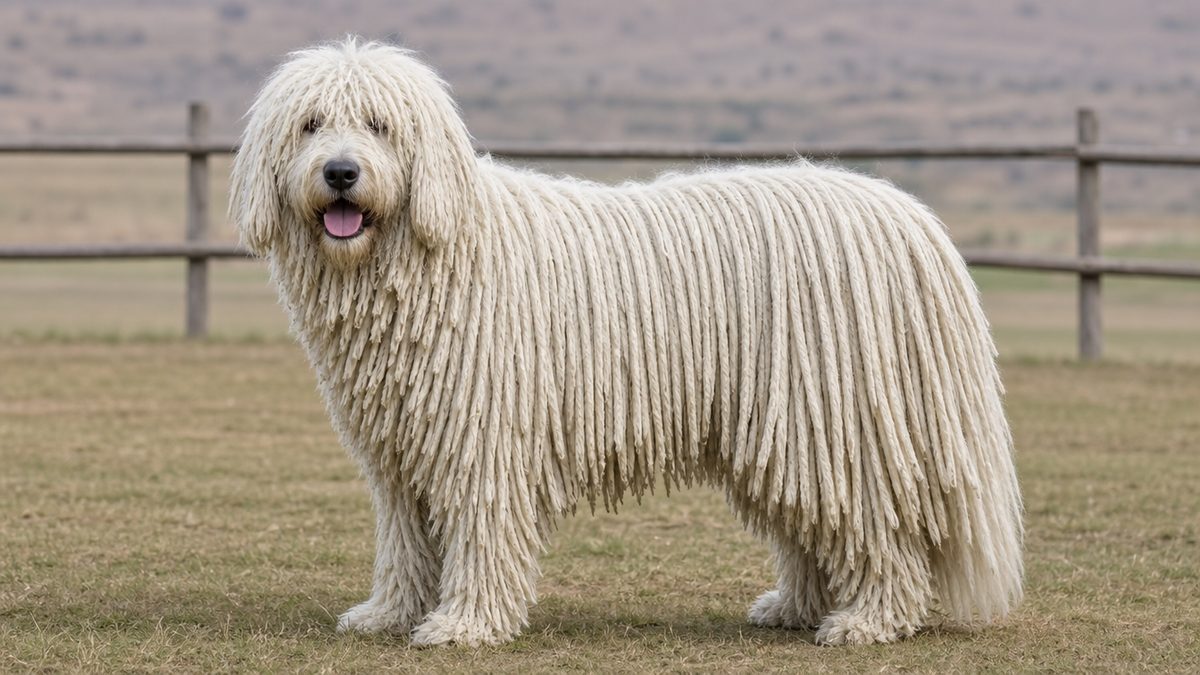
A Komondor is a large Hungarian livestock guardian dog whose adult coat felts into hanging cords, standing at least 70 cm at the withers and weighing 50 to 60 kg as a male. It is not a herding dog that gathers stock, and it is not a companion breed with unusual hair. It is a working guard that was left alone with a flock for months and expected to make its own decisions.
The Federation Cynologique Internationale holds the breed as standard 53, in Group 1, Section 1, Sheepdogs, accepted on a definitive basis on 9 August 1954, with Hungary as the country of origin and German as the official authentic language of the text. The standard itself is blunt about temperament in a way modern breed marketing is not. It says the dog has imperturbable courage, that he attacks silently, and that he regards his territory as his own property and will not tolerate any other living creature in it. Read that sentence twice before reading anything about the coat.
The measurements, from the standard rather than from a directory
FCI 53 gives males a minimum of 70 cm at the withers and a weight of 50 to 60 kg, and gives females a minimum of 65 cm and 40 to 50 kg. The American Kennel Club standard, approved on 13 June 1994, sets males at 27 and a half inches and up, which is 69.9 cm, and gives weight as approximately 100 pounds and up with no ceiling. The two documents agree on shape and disagree on how they bound it, and the difference matters later on this page, because the FCI male range sits entirely at or above 50 kg while the AKC floor of 100 pounds is 45.4 kg.
They also disagree about colour. FCI 53 says the coat colour is ivory. The AKC says the colour is white, but not always the pure white of a brushed coat, and makes any colour other than white a disqualification. Indian directory pages copy whichever they met first, which is why you will see the same dog described as white on one page and ivory on the next.
| Point | FCI Standard 53 | AKC standard, 1994 |
|---|---|---|
| Male height | Minimum 70 cm | 27.5 inches (69.9 cm) and up |
| Female height | Minimum 65 cm | 25.5 inches (64.8 cm) and up |
| Male weight | 50 to 60 kg | Approximately 100 lb (45.4 kg) and up, no ceiling |
| Female weight | 40 to 50 kg | Approximately 80 lb (36.3 kg) and up |
| Coat colour | Ivory | White; other colours disqualify |
| Cording deadline | Not specified | Failure to cord by two years disqualifies |
| Entropion and ectropion | Disqualifying faults | Not mentioned |
| Rear dewclaws | To be removed | Must be removed |
The coat, in centimetres
The corded coat is graded by length across the body, and the standard is specific. Hair is longest over the croup, the loin region and the rear of the upper thighs at 20 to 27 cm, medium on the back, the sides of the chest and the shoulder blades at 15 to 22 cm, shorter on the cheeks, eyebrows, top of the head, ears, neck and limbs at 10 to 18 cm, and shortest on the lips and lower limbs at 9 to 11 cm. That gradient is why a photograph flatters the breed and a tape measure does not. A quarter of a metre of felted hair over the hindquarters is a serious thermal and hygienic object, and the rest of this page is largely about what it does in India.
The standard also states a preference that is easy to miss and useful to quote at a groomer: neither a combed nor a completely neglected coat is desirable. A Komondor is not brushed. Doing so destroys the cords the standard requires.
A Hungarian national treasure, established from the Hungarian instrument
The Komondor is protected in Hungarian law, and the instrument is a parliamentary resolution rather than a breed club statement. Resolution 32/2004 (IV. 19.) of the National Assembly declares Hungary's protected indigenous and old Hungarian animal breeds a national treasure, and it has been in force since 4 May 2004. Its annex lists the breeds by species. Under the heading KUTYA, meaning dog, it names nine breeds, and it names the Komondor first, followed by the Kuvasz, Mudi, Puli, Pumi, Magyar agar, the short-haired and wire-haired Hungarian vizslas and the Erdelyi kopo.
Two clauses of that resolution are worth an Indian reader's attention. Paragraph 5 requires the Government to review the list at least every five years, so this is a maintained register rather than a one-off gesture. Paragraph 6 states that the listed breeds are considered Hungarian indigenous animals which are, in their names and in their pictorial representation, symbols of Hungary. No page ranking for this query in India cites the resolution, and several describe the status vaguely as a national treasure without saying who declared it or when.
The resolution declares status and commits the Hungarian state to support breeding and population maintenance. It does not create an export ban, and Bonbeno found nothing in the text restricting the movement of individual dogs. Do not repeat the claim, common on hobby forums, that Hungary forbids exporting its national breeds. The resolution says no such thing.
Recognition in India, and what it is worth
India is a full member of the FCI, represented by the Kennel Club of India in Chennai, so the KCI issues pedigrees against FCI nomenclature. That means the Komondor's FCI status settles the recognition question for India in principle: the breed holds standard 53 on a definitive basis and a KCI pedigree is possible. In practice a pedigree needs registered parents in the country, and the availability section below shows there are none to be found. Recognition and availability are different questions, and the ranking pages blur them.
History gives the same picture from the other direction. The parent club in the United States records that the breed was almost wiped out in Europe by the Second World War, that only a few dozen dogs remained afterwards, and that during the entire period from the war to 1960 only about 1,000 Komondors were registered in Hungary. A breed that thin at its source does not spread quietly into a country with no importing tradition for it.
Komondor price in India: there is nothing to price
There is no honest Komondor price in India, because Bonbeno could not find a single Komondor genuinely offered for sale in the country. That is not a gap in this page. It is the most useful thing an Indian buyer can be told, and it is established below from the listing sites themselves rather than from an empty search result.
Dogs India has run a breeder directory for Indian buyers for two decades. Its Komondor page carries a breed description, a photograph and then one line under Breeders' List: there are no breeders listed currently under this breed. That is a directory reporting its own emptiness, which is far stronger evidence than a search returning nothing.
What the three ranking listing pages are actually selling
Mr n Mrs Pet ranks fourth and ninth for this query and advertises KCI registered Komondor puppies for sale in India. Its Komondor page reports 1 Result Found. That result is titled Kombai puppies available, its image is labelled Komondor For Sale In Coimbatore, its link points at a kombai listing, and its own description reads Kombai puppies available without KCI certificate. So the single Komondor for sale in India is a Kombai, an Indian breed that sits one row from Komondor in the site's own alphabetical breed dropdown, and the listing contradicts the page's KCI promise in the same screen.
Puppiezo ranks second and its Komondor page is worse. The Available Komondor Puppies section is empty, and the price carousel beneath it holds eight animals: Fizey and Samy, both Maltipoos, at Rs 98,999; Kuzo and Dugu, both Poodles, at Rs 92,599; Kazuka, a Cane Corso, at Rs 94,999; Doir, a Goldendoodle, at Rs 1,20,000; Tugi, a Rottweiler, at Rs 76,499; and Yoki, a Doxiepoo, at Rs 98,999. Zero of the eight are Komondors. A reader arriving from a search for a Komondor price will read Rs 98,999 off that page and carry it away as one.
Bonbeno has now recorded Rs 98,999 attached to whichever puppy is in stock on this retailer across many breeds, including breeds it does not stock at all. It appears three times on this one Komondor page, on two Maltipoos and a Doxiepoo. It divides to USD 1,173.25 at 84.38, so it is not even a converted foreign price. It is a rupee charm price ending in 999. Never quote it as any breed's price.
The Rs 50,000 to Rs 2,00,000 band, tested
The figure most Indian pages repeat comes from Happy Pet, which ranks first and states that in India a Komondor might cost you around Rs 50,000 to Rs 2,00,000. The page names no breeder, no sale, no year and no source. Bonbeno ran the standard conversion tests on it. Neither figure divides to a whole dollar amount at 84.38, giving 592.56 and 2,370.23, and neither divides at 74, giving 675.68 and 2,702.70. Both divide exactly at a flat 80, giving 625 and 2,500.
A match at 80 proves very little on its own, because any rupee figure ending in three zeros divides cleanly by 80 by construction. The test that carries weight is whether the quotient is a price a seller would actually print. USD 2,500 is; USD 625 is not, and no source Bonbeno opened quotes it. The nearest published foreign bands are USD 800 to 1,500 from one breed directory and prices starting at USD 1,000 or more from another A-Z Animals, Komondor Prices. So the Indian band is unsourced, is not a clean conversion of any published foreign band, and should be treated as a placeholder rather than a price.
| Rupee figure | At 84.38 | At 74 | At flat 80 | Plausible as a seller's price? |
|---|---|---|---|---|
| Rs 50,000 | USD 592.56 | USD 675.68 | USD 625.00 | No |
| Rs 2,00,000 | USD 2,370.23 | USD 2,702.70 | USD 2,500.00 | Yes, at 80 only |
| Rs 98,999 (carousel) | USD 1,173.25 | USD 1,337.82 | USD 1,237.49 | No, a rupee charm price |
The monthly cost figures are arithmetic, not research
The same page publishes average monthly expenses of Rs 5,700 basic and Rs 8,550 premium, broken into food at Rs 3,000 or Rs 4,500, veterinary at Rs 1,500 or Rs 2,250 and grooming at Rs 1,200 or Rs 1,800. Divide the premium column by the basic column line by line and every single one returns exactly 1.5. The premium lifestyle was not priced. It was the basic column multiplied by one and a half. A table that cannot vary across its own rows was generated rather than researched, and the grooming line is the one that gives it away, because grooming is the cost this breed does not share with any ordinary dog.
The only lawful route in, and what it forbids
If no Indian Komondor exists, the only way to obtain one is import, and India regulates that tightly. The DGFT's guidelines for importing pet animals set out Policy Condition 7, which allows import of dogs only for a pet dog with a valid pet book and records in the importer's name, for research organisations with CPCSEA recommendation, or for internal security by the Defence and Police Force, and Policy Condition 8, which provides that import of commercial dogs for breeding or any other commercial activity is not permitted. Up to two pets may come as passenger baggage without DGFT authorisation, and only for a person transferring residence to India after two years of continuous stay abroad. So there is no lawful commercial pipeline that could create an Indian Komondor market, which is consistent with what the directories show. Anyone who tells you they can import a litter to sell is describing something the policy does not permit.
The practical answer for a reader who wants this dog is short and unwelcome. You cannot buy a Komondor in India today from any source Bonbeno can verify, the figures circulating are unsourced, and the pages carrying them are showing you other breeds. If you want a large white guardian that genuinely exists here, read the comparison section below.
The real cost of ownership, and the line no Indian price list contains
The recurring cost of a Komondor in India is dominated by one item that no Indian pet price list carries: drying the coat. Everything else about this dog is priced like any other giant breed, and the coat is priced like nothing at all, because the service does not exist here as a product.
Start with the only published Indian figures, and read them with their provenance attached. Happy Pet gives average monthly expenses of Rs 5,700 on a basic lifestyle and Rs 8,550 on a premium one, split into food, veterinary and grooming. As the price section showed, the premium column is the basic column multiplied by exactly 1.5 on every line, so it is arithmetic rather than pricing. The basic column may still be a reasonable guess at a large dog's monthly cost in an Indian city, and Bonbeno reports it as that: a guess, from a page that names no source.
| Line item | Basic | Premium | Premium divided by basic |
|---|---|---|---|
| Food | Rs 3,000 | Rs 4,500 | 1.5 |
| Veterinary | Rs 1,500 | Rs 2,250 | 1.5 |
| Grooming | Rs 1,200 | Rs 1,800 | 1.5 |
| Total | Rs 5,700 | Rs 8,550 | 1.5 |
A single multiplier across every row means no line was priced independently. Grooming is where that matters most, because grooming for this breed is not a variant of grooming for other breeds. Rs 1,200 a month buys a bath and a tidy for a Labrador. It does not buy what a corded coat needs.
Why the grooming line cannot be a normal grooming line
A bathed Komondor takes 12 to 18 hours to dry completely, and that is with noisy high speed fans and dryers rather than with towels. The AKC's own guide to corded breeds tells owners to avoid air drying because densely corded coats can remain damp for up to 48 hours, which leads to mildew and odour. Price that honestly against an Indian grooming salon. A parlour that turns over eight dogs a day cannot hold one animal on a dryer table for most of a day, and if it does, the cost is a day of the salon's capacity rather than a bath fee. Bonbeno found no Indian groomer publishing a corded-coat protocol or a corded-coat price, and will not invent one.
The realistic conclusion is that an Indian owner does this at home and buys the equipment. A high-velocity dryer is the non-negotiable purchase, and the running hours are the recurring cost. Bonbeno is not going to publish a rupee figure for equipment or electricity that it has not sourced, but the shape of the cost is clear and it is unlike any other breed on this site: the expensive part is not the product, it is the hours. For scale, an Indian rescue organisation's published cost guide puts a basic professional grooming session at Rs 300 to Rs 2,000 depending on breed and city. Neither end of that band buys twelve hours on a dryer table.
Costs that are real, sourced and foreign
The only itemised cost breakdown Bonbeno found for this breed is American. A-Z Animals gives a bed at USD 30 to 100, toys at USD 10 to 30 per month and grooming at USD 50 to 100 per month, against puppy prices typically starting at USD 1,000 or more. Those are printed here in dollars deliberately and are not converted, because converting a foreign cost list into rupees is exactly the mechanism that produced the fake Indian price band this page has already dismantled. Use them to understand the relative weight of grooming in the total, not to budget in India.
The veterinary line has a breed-specific loading
Three recurring veterinary costs sit higher for this breed than for a short-coated dog of the same size. Ear care is the first, because pendant ears over a hairy canal in a humid country produce otitis externa, and the Indian series show it concentrating in the wet months. Skin checks are the second, because the parent club warns that external parasites are a problem under the heavy coat and that it is easy to miss a spot where fleas hide. Anaesthesia is the third and the least known: the club states that like all stock guard dogs, Komondors are usually extremely sensitive to anaesthetics, which should be administered to effect and never by weight. Tell your veterinarian that before any procedure, because a 55 kg dog dosed on a body-weight chart is the exact scenario the warning describes.
There is also a genetic test that belongs in the budget rather than in the health section, because it is a one-off cost with a clear payoff. An allele-specific DNA test exists for the CUBN variant that causes inherited cobalamin malabsorption in this breed, and the paper describing it reports mutant allele frequencies of 8.3 percent in North American and 4.5 percent in Hungarian Komondors. Any Komondor reaching India will come from one of those two populations. Screen for it once, at purchase, rather than diagnosing it later in a puppy that is failing to thrive.
Feeding a Komondor is cheaper than its size suggests. The parent club reports that many adult Komondors eat no more than three cups of food per day in excellent health and weight, and warns that the portions printed on the bag are far too generous for this breed. A livestock guardian was selected for centuries to make efficient use of food. Budget for the coat, not for the bowl.
Suitability for the Indian climate, measured rather than asserted
The Komondor is the worst climate match Bonbeno has rated, alongside the Tibetan Mastiff and the Bergamasco, and the measurement that settles it is short: Chennai's coolest month is warmer than the hottest month in the breed's Hungarian homeland. Every other argument about heat tolerance follows from that gap.
Bonbeno queried NASA POWER by explicit latitude and longitude for the Hortobagy puszta, the Hungarian plain the breed worked, and for three Indian cities, and echoes the elevation each cell returned so a reader can check that the model was standing in the right place. Hortobagy came back at 47.58 N, 21.15 E and 96.82 m, which matches the real plain within a few metres. Chennai returned 48.95 m, Delhi 206.37 m and Bengaluru 841.72 m, all consistent with the actual cities. All four series differ from one another, so no cell was queried twice. These are plains and plateau points, where the model is reliable; the same query over an Indian hill station would need an elevation check before use.
| Place | Cell elevation | Annual mean | Hottest month mean | Coolest month mean | July humidity |
|---|---|---|---|---|---|
| Hortobagy, Hungary | 96.82 m | 11.44 C | 23.54 C (Jul) | -1.67 C (Jan) | 59.83% |
| Chennai | 48.95 m | 27.95 C | 31.51 C (May) | 24.09 C (Jan) | 67.47% |
| Delhi | 206.37 m | 25.60 C | 35.88 C (Jun) | 13.61 C (Jan) | 62.72% |
| Bengaluru | 841.72 m | 23.74 C | 28.37 C (Apr) | 20.22 C (Dec) | 76.76% |
Read the Chennai row against the Hortobagy row. The Hungarian July averages 23.54 C. Chennai's January, its coolest month of the year, averages 24.09 C. A Komondor in Chennai never experiences a month as cool as the warmest month its ancestors worked in, and the annual gap is 16.51 C. Delhi is cooler in winter and far hotter in summer, reaching a June mean of 35.88 C. Bengaluru is the least hostile Indian option on temperature, at 23.74 C annually.
Bengaluru is the trap, because temperature is not the binding constraint
Bengaluru looks like the answer and is not, because a corded coat is limited by drying rather than by heat alone. Bengaluru's July humidity is 76.76 percent and its August humidity 78.69 percent, against 59.83 percent in the Hungarian July. That is roughly seventeen to twenty points above the homeland in exactly the months the coat is wettest. Drying is driven by how much more water the air can hold, so the city that is kindest to the dog's body is the harshest to its coat. No ranking page makes this distinction, and it changes the answer for the one Indian city a buyer would otherwise pick.
Testing the parent club's own thermal claim
The Komondor Club of America states that the cords both insulate and cool, that they are open to the skin so they allow air to pass through, and that the density and length of the cords protect the animal underneath. That claim was written for the Hungarian plain and the American range, and Bonbeno neither dismisses nor simply repeats it. Two things about it transfer badly. An open coat convects heat away only while the air is cooler than the dog, and on a 35 C Delhi afternoon it is not. A coat that channels air also channels moisture, and in a monsoon the moisture does not leave.
The club's own page supplies the counterweight in its grooming text: hair which never dries can mildew, so cutting some of it off may lessen the problem. That is an admission, made in a temperate country, that never drying is a real failure mode. In Bengaluru in August it is the default state rather than the exception. Note also that the AKC's guide to corded coats, which is the most detailed corded-coat care document either registry publishes, does not contain the word humid anywhere. The guidance was not written for this climate and does not claim to be.
What the heat research supports, and what it does not
The largest study of heat-related illness in dogs analysed 905,543 UK dogs under primary veterinary care in 2016 and found 395 confirmed events, reporting that dogs at or above their breed and sex mean bodyweight had 1.42 times the odds of heat-related illness, 95 percent confidence interval 1.12 to 1.80, and that dogs over 50 kg had 3.42 times the odds, 95 percent confidence interval 1.54 to 7.57. The FCI male Komondor weighs 50 to 60 kg, so a standard-conforming male sits in or at the edge of that band. The AKC floor of 100 pounds is 45.4 kg, so an AKC-legal male could fall below it. That distinction is worth making rather than blurring.
Bonbeno claims only what transfers. The Komondor is far too rare to have been modelled individually in that study, so no Komondor-specific odds ratio exists and this page does not invent one. What applies is the bodyweight finding, which is a property of size rather than of breed. The companion paper by the same team, using the same cohort, reports 1,259 heat-related illness events from 1,222 dogs and records that of the 879 events with a recorded trigger, 652 were exertional, which is 74.2 percent. Exertion, not a parked car, is how most dogs overheat. For a Komondor in India that means the walk, not the afternoon.
Indian law addresses this breed directly
The Prevention of Cruelty to Animals (Dog Breeding and Marketing) Rules 2017 restrict exactly the arrangement a livestock guardian implies. Second Schedule, Part IV, paragraph 21(1), headed Outdoor housing facilities, provides that dogs shall not be kept in outdoor facilities unless specifically approved in writing by the attending veterinary practitioner, where the dogs are not accustomed to the temperatures prevalent in the area, or are of breeds that cannot tolerate those temperatures, such as long-haired breeds in high temperature locations, or are sick, infirm, aged or young. The clause names the Komondor's exact category without naming the breed.
That collides with the breed's own written purpose. The AKC standard opens by saying the working Komondor lives during the greater part of the year in the open. So the life the standard describes is the life Indian law restricts in a hot location without a veterinarian's written approval. An Indian owner who wants a Komondor to do its job outdoors needs that approval on paper, and a veterinarian in Chennai or Nagpur has a defensible reason to withhold it.
This provision is often written up as Rule 21. The 2017 Rules stop at Rule 13, and the string Rule 21 appears zero times in the gazette. The correct citation is Second Schedule, Part IV, paragraph 21(1). Bonbeno verified both facts by extracting the gazette text directly rather than reading a summary of it.
Temperament and household fit: who should not buy this dog
A Komondor suits a household with land, a fence, no through-traffic of strangers and an owner who has kept a guarding breed before. It is independent, suspicious of outsiders by design and physically capable of ending an argument, and the honest list of people it does not suit is longer than the list it does.
The FCI standard describes the temperament in terms a marketing page would never use. It says the dog has imperturbable courage in guarding the herds entrusted to him and the property and home of his master, that he attacks silently and enduringly, that he regards his territory as his own property and will not tolerate any other living creature in it, and that his nature is suspicious. It adds a working detail worth knowing before you plan your nights: during the day he likes to keep a lying position enabling him to control his area, and at night he is always on the move.
The parent club describes the same dog more warmly and does not contradict it. A Komondor is calm and steady when things are normal, extremely affectionate with its family, gentle with the children of the family and wary of strangers until it is clear no harm is meant. Both accounts are true. The guarding instinct is not aggression on a hair trigger, it is a standing decision the dog makes about who belongs, and the trouble arises when the household cannot control who appears. Purina's Indian breed library describes the same animal as alert and confident and bred to guard sheep and cattle, which an Indian buyer should read as a warning rather than as a selling point. A dog that is protective of a flock is protective of a doorway, and it will not distinguish between the two on your behalf.
The Indian housing question, answered plainly
This is a poor fit for almost every Indian urban living arrangement. A flat in a housing society delivers a stranger to the door several times a day: the maid, the cook, the courier, the plumber, the meter reader, the neighbour's child. A breed whose standard says it will not tolerate another living creature in its territory is being asked to accept a new one every hour. Add a deep bark that the rescue network describes as penetrating with an echo through a neighbourhood, and the complaint arrives before the bite does.
The workable Indian setting is a farmhouse, an orchard, a dairy or a walled bungalow plot with a gate that controls entry and a household that stays stable. That is the environment the breed was made for, and it is the environment in which its temperament is an asset rather than a liability.
Children, other dogs and the rest of the household
The distinction that matters is family versus visiting. A Komondor is described as gentle with the children of the family, and the same source stresses that once a person has been introduced into the family or flock the dog never forgets them, greeting someone it has not seen for years as though it had seen them yesterday. Visiting children are a different category, and a 55 kg dog does not need intent to injure a small child during a disagreement it thinks it is refereeing.
Other dogs are manageable with early work and are not automatic. The breed was selected to drive predators away from stock, and an unfamiliar dog entering the property reads as exactly that. Socialise the puppy deliberately and widely, and do not assume the calm you see at eight weeks is the temperament you will have at eighteen months.
Komondor Rescue publishes a set of headings that begin DO NOT GET A KOMONDOR. They include: if you have little time, because puppy classes are essential and a daily walk is not a substitute; if you cannot tolerate a long adolescence, which it puts at nine months to three and a half years; if you want a dog that befriends everyone; if you must have 100 percent obedience; if you must have a spotless dog; and if you believe in heavy handedness. That list was written by people who rehome the failures.
Who this breed is genuinely right for
Buy a Komondor if you have livestock or property that genuinely needs guarding, land it can patrol, a secure boundary, prior experience of a large independent breed, the time to separate cords weekly and the equipment to dry them, and a veterinarian who will handle a suspicious 55 kg dog. Do not buy one because the coat photographs well. The coat is the maintenance burden, not the feature, and the temperament is the reason most Komondors that need rehoming are adolescents given up by their owners.
Training a breed that was bred to ignore you
Train a Komondor by establishing rules early, keeping sessions short and varied, and accepting that a guardian bred to work alone will comply most of the time rather than always. This breed was selected for centuries to make decisions with no master present, and obedience is not what it was selected for.
Start at the beginning, because the window is narrow and the dog is large. The parent club recommends obedience training beginning at four to eight months and says the breed takes well to training if started early. The same source gives the constraint in the next line: Komondors become obstinate when bored, so training sessions must be upbeat and varied, and praise is essential alongside consistent, humane corrections.
Set a realistic target for compliance
The breed's rescue network states the target plainly. If you have raised a Komondor properly and earned its love and respect, you will have an adult that obeys your wishes about 75 percent of the time, and it adds, with some owners agreeing, if you are lucky. An owner who needs reliable recall in an unfenced Indian street should read that number and choose a different breed. A guardian that stops to evaluate a command is doing what it was built to do.
Repetition is the specific failure mode. The parent club notes that Komondors love to learn something new but that repetition bores them, that they can decide once a task is done it need never be done again, and that lagging on heeling is the biggest point loser in competition. So train in short blocks with new material rather than long blocks with drilling, and stop while the dog is still interested.
The one thing you must not do
Do not use force. The AKC standard itself warns that heavy-handed training will produce a stubborn, unhappy Komondor, and the rescue network puts it in capitals: absolutely do not get a Komondor if you believe in using heavy handedness with an obstinate dog, because excessive force results in a never-ending daily struggle. This matters in India specifically, because the prong collar and the rolled newspaper still circulate as advice among trainers handling large guarding breeds. On this breed that approach does not merely fail, it creates the dog everyone was afraid of.
Socialisation, and what it has to cover in an Indian city
Socialise this puppy harder than you would socialise a retriever, and socialise it at home. The parent club warns that a Komondor which is not properly socialised may react in an excessively aggressive manner when confronted with a new situation or person, and that puppies must meet as many non-family members as possible, especially at home. An Indian household has a standing cast of people who are neither family nor strangers, and every one of them needs to be in the dog's accepted list before the dog is old enough to decide for itself.
Build a written list and work through it: the domestic help, the cook, the driver, the security guard, the milk delivery, the courier, the gas cylinder man, the garbage collector, the society plumber and the electrician. Each should feed the puppy by hand at the gate. A guarding breed does not generalise from one friendly stranger to all strangers, so the list has to be worked individually.
The handling training nobody schedules and everybody needs
Teach this dog to be handled by other people, deliberately and repeatedly. The parent club records that many a Komondor who works well with sheep cannot be taken to the vet when the need arises, and that all dogs must be trained to be handled by the owner and by strangers when necessary. Add the grooming reality to that: an adult needs hands in its coat every week and a dryer over its whole body for most of a day. A dog that will not tolerate restraint turns every grooming session and every consultation into a sedation event, and sedation is precisely what this breed's anaesthetic sensitivity makes risky.
Komondor Rescue states that if you want to train a dog for Schutzhund, do not select a Komondor, because they do not work as attack dogs. A livestock guardian deters by presence and by decision, not by trained bite. Formal protection training on a dog that already thinks it owns the property is adding a technique to an animal that did not need one.
Daily exercise, and why the Indian schedule is the whole answer
A Komondor needs moderate daily exercise, roughly 45 to 90 minutes split across the day, and in India the timing of that exercise matters more than the amount. This is a patrolling guardian rather than an endurance athlete, so the risk is not an under-exercised dog going stir crazy, it is a well-meaning owner walking a 55 kg coated animal at the wrong hour.
The exercise requirement itself is unremarkable for the size. Indian directory pages that rank for this breed give 45 to 90 minutes and describe energy as medium, and a second ranking page gives 45 minutes per day at a medium energy level. Those figures are consistent with a livestock guardian's working pattern, which the FCI standard describes as lying in a position that controls the area during the day and moving continuously at night. The dog is not idle; it is on watch.
Walk before sunrise and after dark, and treat that as a rule
The heat research points at exertion rather than at ambient temperature alone. In the companion Hall paper, of the 879 heat-related illness events with a recorded trigger, 652 were exertional, which is 74.2 percent, against 113 environmental and 46 from confinement in a vehicle. Most dogs that overheat are doing something at the time. For an Indian Komondor owner that reframes the whole question: the danger is the walk you chose to take, and you control it completely.
Delhi's May mean temperature is 35.05 C and Chennai's is 31.51 C. A daytime walk in either is not exercise, it is a heat challenge on a dog carrying up to 27 cm of felted coat over its hindquarters and sitting in the bodyweight band the larger Hall paper associates with 3.42 times the odds of heat-related illness. Move the whole schedule to the dark. Pre-dawn and post-sunset walks are not a summer concession for this breed in the Indian plains, they are the year-round plan.
| Season | Morning | Evening | What to cut first |
|---|---|---|---|
| Winter, Dec to Feb | 45 min, after first light | 45 min | Nothing; this is the usable window |
| Pre-monsoon, Mar to May | 30 to 40 min, before sunrise | 30 to 40 min, well after dark | Midday anything, and all off-lead running |
| Monsoon, Jun to Sep | 30 min, on hard surface | 30 min | Wet grass and puddles, because the coat holds the water |
| Post-monsoon, Oct to Nov | 45 min | 45 min | Long sessions on humid still evenings |
The monsoon problem is not the exercise, it is the coat afterwards
A wet Komondor is a multi-hour drying job, and monsoon walking guarantees a wet Komondor. The corded coat takes 12 to 18 hours to dry fully even with high-speed dryers, and a coat that does not dry mildews. Walking a corded dog through wet grass twice a day in July is therefore a commitment to running dryers for most of the day, or to a dog that stays damp. Choose hard, drained surfaces in the wet months, and keep the walk short enough that the coat picks up rain rather than ground water.
Mental work substitutes badly for physical work in this breed and should still be offered. A guardian with a territory to watch is occupied by watching it, which is why the exercise number is lower than the size suggests. What the dog needs is a job and a boundary, not a longer run.
A breed whose adult compliance is described by its own rescue network as about 75 percent, and which treats an approaching dog or stranger as a decision for itself, cannot be exercised off-lead where free-roaming dogs and pedestrians are present. Secure fenced land or a long line. There is no third answer.
Grooming the corded coat in Indian humidity
Groom a Komondor by separating the cords by hand every week and by drying the coat completely whenever it gets wet, and understand that drying is the hard part in India rather than washing. This is the heaviest grooming load of any breed on Bonbeno, and Indian humidity attacks the one step that cannot be skipped.
The coat is not brushed and must never be brushed. The FCI standard states that neither a combed nor a completely neglected coat is desirable, and the AKC's corded-coat guide explains why: the coarse outer coat traps the soft woolly undercoat and forms permanent felt-like cords, and brushing that structure out destroys it. The work is separation instead. The parent club describes it precisely: follow the natural curl to find the separation points, keep the base of each cord about the size of a quarter, and work on the cords every week as new coat grows and clumps them together at the base.
The timeline, so you know what you are signing up for
Cords begin forming between eight and twelve months of age and continue to develop throughout the dog's life. The AKC standard makes the outcome a formal requirement: failure of the coat to cord by two years of age is a disqualification. So the first two years are the labour-intensive period, when a person is separating a felting coat by hand every week, and there is no shortcut through it.
Bathing and drying: the Indian bottleneck
Bathe rarely and dry completely. The rescue network describes a bath as a huge project requiring tubs full of water and loads of big towels, gives the drying time as 12 to 18 hours with noisy high-speed fans and dryers, and warns that a coat which is not 100 percent dry can smell horrible from mildew. The AKC adds the failure case: avoid air drying, because densely corded coats can remain damp for up to 48 hours, leading to mildew and odour, and it recommends blotting with absorbent towels rather than rubbing, and using cage dryers with care rather than strong-force dryers that tangle cords. The same source warns against frequent bathing, because the skin can become dry and irritated.
Now put those numbers against Indian air. Drying depends on how much more water the surrounding air can absorb, and the ranking pages' drying advice was written where the air is drier. Bengaluru's August humidity is 78.69 percent and its July humidity 76.76 percent, against 59.83 percent in the Hungarian July. Kolkata, Kochi and coastal Maharashtra run at similar levels through the monsoon. A 12 to 18 hour figure recorded in an American winter is a floor in India, not an estimate, and there are weeks in the monsoon when a fully dry coat is not achievable at all without a dehumidified room.
| Method | Time to dry | Source's climate | Failure if incomplete |
|---|---|---|---|
| Air drying | Damp up to 48 hours | United States, indoors | Mildew and odour |
| High-speed fans and dryers | 12 to 18 hours | United States, indoors | Mildew if not 100 percent dry |
| Either method, Indian monsoon | Longer than published, unquantified | 76 to 79 percent humidity | Mildew, skin disease, ear infection |
The ears, which are where the humidity actually bites
Ear care is a weekly job on this breed and a seasonal risk in India. The parent club warns that because Komondors have ears which hang down and prevent air circulation, it is especially necessary to keep them clean and hair-free, and notes that some ear canals are hairier than others. That is the exact risk profile a 1987 study of 8,975 dogs across fifteen North American teaching hospitals identified, finding significantly more otitis externa in dogs with pendulous ears and heavy ear canal hair.
The Indian evidence adds the season. A Palampur study screened 2,476 dogs between June 2022 and July 2023, diagnosed 81 with otitis externa for a hospital prevalence of 3.27 percent, which its authors set against the 7.3 percent recorded across UK primary care practice, and found 48 of those 81 cases, 59.25 percent, falling in the rainy season of July and August, against 18.51 percent in summer, 12.34 percent in winter and 9.87 percent in autumn. A Guwahati series found the same shape, with prevalence highest in the monsoon at 3.77 percent against 0.74 percent pre-monsoon. The Palampur paper also records excessive moisture as a predisposing factor in 20.98 percent of cases, which is precisely what a coat that holds water for a day and a half delivers to a hanging ear.
The Palampur paper's ear-carriage row prints pendulous ear breed as 53 cases and 69.13 percent. Bonbeno checked: 53 of 81 is 65.43 percent, and 53 plus the 25 erect-eared cases is 78 rather than 81. The percentage 69.13 implies 56 cases, and 56 plus 25 balances to 81. So the count appears to be the error and the percentage is the figure consistent with the rest of the table. The seasonal rows, which this page relies on, sum to 81 exactly and need no such caveat.
Where the Indian evidence disagrees with the foreign evidence, and why that matters
Pendulous ears raise the risk everywhere, but the monsoon peak is an Indian finding rather than a universal one. A six-year retrospective study of a veterinary practice in Cape Breton, Nova Scotia found the frequency of otitis externa significantly higher in breeds with pendulous ears, exactly as the Indian series do, but reported no seasonal patterns at all, with no significant difference across the four seasons at P equals 0.92 and an average seasonal incidence of 7.7 percent. Two conclusions follow. The ear shape is a breed problem the Komondor carries anywhere. The seasonal concentration is a monsoon problem, and it is the reason an Indian ear-care schedule cannot be copied from a North American one.
Practically: check and dry the ears after every wet walk, clip the hair out of the canal rather than leaving it, and raise your inspection frequency from June to September. If the ear smells before you have looked in it, you are already late.
Health risks, screening and life expectancy
The Komondor's documented health issues are hip dysplasia at 13.1 percent of 1,103 OFA-evaluated dogs, an inherited cobalamin malabsorption with a published DNA test, entropion, and the bloat risk that goes with any deep-chested giant. Its published life expectancy, by contrast, rests on nothing Bonbeno could trace to a study.
Take the hips first, because they are the best-evidenced figure on this page. OFA's published hip table gives the Komondor 1,103 evaluations, of which 85.8 percent are normal, split 12.3 percent excellent, 58.7 percent good and 14.8 percent fair, and 13.1 percent dysplastic, split 7.9 percent mild, 4.4 percent moderate and 0.8 percent severe. Both halves of that row reconcile exactly: 12.3 plus 58.7 plus 14.8 is 85.8, and 7.9 plus 4.4 plus 0.8 is 13.1. Bonbeno read the breed code KO out of OFA's own markup rather than guessing it, and 1,103 evaluations is comfortably above the 100-evaluation threshold OFA requires before publishing a breed at all.
The parent club and OFA give different numbers, so here are both
The Komondor Club of America states that there is some hip dysplasia in the breed, though the incidence is about 10 percent of all radiographs submitted, according to statistical studies of the OFA. OFA's current published table says 13.1 percent. Bonbeno is not going to average those or pick the friendlier one. The club's page appears to predate the current dataset, the gap is 3.1 percentage points, and a buyer should work from the registry's live figure while knowing the club quotes a lower one.
For scale, the same table's ALL BREEDS row gives a dysplastic rate of 14.2 percent across 1,712,643 evaluations. So the Komondor's hips are marginally better than the all-breed average, which is a genuinely counterintuitive result for a 55 kg dog and worth stating. One caution about that baseline: the ALL BREEDS row's normal-side components do not sum, printing 84.3 percent normal against Excellent 14.6, Good 0.0 and Fair 0.0. Its dysplastic components do sum, 8.8 plus 4.6 plus 0.8 equalling 14.2, so only the dysplastic half of that row is usable.
| Breed | Evaluations | Normal | Dysplastic |
|---|---|---|---|
| Komondor | 1,103 | 85.8% | 13.1% |
| All breeds | 1,712,643 | 84.3% (row does not reconcile) | 14.2% |
| Tibetan Mastiff | 1,403 | 82.1% | 16.7% |
| Bergamasco | 105 | 75.2% | 24.8% |
The eye registry contradicts itself, so neither figure is quoted as the rate
OFA's eye data for this breed does not hold together, and Bonbeno reports it rather than picking a side. The summary eye row gives 146 evaluations at 93.8 percent normal and 6.2 percent abnormal. The detail rows, on the same denominator of 146, give 124 normal, which is 84.9 percent. Those two cannot both be the normal rate on the same 146 dogs, and the gap is 8.9 percentage points. The per-diagnosis rows record 32 individual findings in total, the largest single one affecting 7 of 146 dogs at 4.8 percent. A dog can carry more than one diagnosis, which partly explains a findings count above the abnormal count, but it does not reconcile 93.8 with 84.9. Treat the breed's eye status as unsettled and screen the parents rather than trusting either number.
What the eye problem is, is not in dispute. The parent club names entropion, the inward curling of the eyelid that causes the lashes to abrade the cornea, says it is genetic in nature, and states that a dog with it should not be bred. FCI 53 goes further and makes entropion and ectropion outright disqualifying faults. The club also names juvenile cataracts as a documented genetic eye problem in the breed.
The one Komondor-specific disease in the literature, and it contradicts the club
The Komondor has exactly one breed-specific inherited disease described in the peer-reviewed literature, and it is a good one to know about. Fyfe and colleagues investigated three Komondors in one family plus three sporadic cases showing juvenile-onset failure to thrive, inappetence, vomiting or diarrhoea and weakness, with disordered blood cell production, methylmalonic acidaemia and serum cobalamin deficiency. Whole genome sequencing identified a pathogenic single-base change in the CUBN intron 55 splice donor sequence, inherited as an autosomal recessive, and a population study using an allele-specific DNA test found mutant allele frequencies of 8.3 percent among North American and 4.5 percent among Hungarian Komondors. All the clinical signs and metabolic abnormalities except proteinuria reversed with regular injected cobalamin.
Set that against the parent club's health page, which states that Komondors have few genetically linked problems, that there is no evidence of the retinal eye problems found in other breeds, and specifically that there is no dwarfism or hereditary blood disorders. A hereditary disorder producing disordered blood cell production, with a named gene, a published carrier frequency and a commercial DNA test, is a hereditary blood disorder. Bonbeno publishes the disagreement rather than reconciling it, and the practical instruction is unambiguous: verify the CUBN status of both parents before buying, whatever the club page says.
Bloat, and the one case report in the literature
A deep-chested dog of 50 to 60 kg carries gastric dilatation-volvulus risk, and the club acknowledges it while saying the incidence is no greater than in other large breeds. The literature contains one Komondor case, and finding it required searching the Hungarian plural. A 1987 report in the Journal of the American Veterinary Medical Association describes concomitant gastric and mesenteric volvulus in a five-year-old dog the authors call a Komondorok, which died fourteen hours after surgical correction of both displacements. Its lesson is diagnostic rather than statistical: the authors stress that radiography matters in suspected gastric volvulus to rule out other causes of acute abdominal distension.
PubMed returns 12 records for Komondor. Bonbeno opened every one. Eleven are the surname of a researcher publishing on frog fertilisation and health literacy, not the dog. Only the cobalamin paper is about the breed. Searching the Hungarian plural Komondorok returns one further record, the 1987 volvulus case, which the singular search misses entirely. So this breed has two papers, and a search on one spelling would have found one of them.
Life expectancy: the number everyone prints and nobody sources
No peer-reviewed breed-specific life expectancy exists for the Komondor that Bonbeno could find. Indian and international directory pages give 10 to 12 years Puppiezo, Komondor Puppies For Sale, and none of them cites a study. The two UK life-table papers that publish medians breed by breed are the places such a figure would live, and the Komondor is named nowhere in the main text of either, while the Labrador appears in both as a working control McMillan KM and others. Their breed-level detail sits in supplementary tables Bonbeno could not open in this session, so this is reported as what it is: no median found, in the two documents most likely to hold one. Treat 10 to 12 years as folklore with a plausible shape rather than as data.
What Indian law already requires you to screen for
Indian breeding law names most of this breed's problems by name. Second Schedule, Part III, paragraph 8(10) of the Dog Breeding and Marketing Rules 2017 requires that dogs shall have been tested for genetic defects, including hip dysplasia, progressive retinal atrophy, night blindness, hypothyroidism, entropion, ectropion, overshot and undershot jaw, wry mouth, two or more missing teeth and cryptorchidism. For a Komondor that clause covers the hips and both eyelid conditions, and the FCI standard independently disqualifies entropion and ectropion. The clause opens with including, so the list is illustrative rather than closed, and the CUBN test belongs in any responsible Indian screening panel even though the Rules predate the paper.
One thing the Rules do not require is worth knowing so you do not chase it: they contain no patella provision and no dental requirement beyond the missing-teeth wording inside 8(10). Nobody in India is legally obliged to grade this breed's patellae.
Hypoallergenic: the claim its own parent club makes, and the evidence against it
The Komondor is not hypoallergenic, and the claim needs meeting head-on because the parent club itself makes it, writing that like poodles, Komondors are a good breed for those who have allergies to dog hair and dander. The evidence says otherwise. Vredegoor and colleagues measured the major dog allergen Can f 1 across 196 dogs of so-called hypoallergenic breeds against 160 control dogs and found the hypoallergenic group higher rather than lower in both hair and coat samples, with no difference in airborne allergen, concluding that there is no evidence for the classification of certain dog breeds as hypoallergenic. An Indian buyer paying a premium for an allergy-safe dog is buying a claim the research does not support.
Two smaller practical notes from the club that matter more in India than elsewhere. Komondors are described as extremely sensitive to some anti-flea and tick preparations, and dips have been known to discolour the white coat, so spot-test before treating. And the breed is described as usually extremely sensitive to anaesthetics, which should be administered to effect and never by weight. In a country with high tick pressure and a habit of routine dipping, both warnings are live.
Feeding: a giant dog with a surprisingly small appetite
Feed an adult Komondor less than its size suggests, split across two meals, and measure by body condition rather than by the chart on the bag. This breed was selected for centuries to work on what a herdsman could spare, and its parent club warns that standard feeding guides overfeed it substantially.
The parent club is unusually direct about this. It states that as with all livestock guarding dogs, Komondors have been bred for many centuries to make efficient use of their food, that many adult Komondors eat no more than three cups of food per day and are in excellent health and weight, and that portions indicated on the dog food bag are generally far too generous. That is an unusual claim for a 50 to 60 kg dog, and it is the single most useful feeding fact on this page, because the default Indian instinct with a giant breed is to feed a giant amount.
It is also the reason the food line in the published Indian cost table looks low and may not be wrong. Happy Pet gives Rs 3,000 to Rs 4,500 a month for food, alongside daily calorie figures of 2,300 kcal for puppies and 2,800 kcal for adults. Bonbeno cannot verify where those calorie numbers came from, and notes that a puppy figure only 500 kcal below the adult figure is a shape worth questioning, since growing giant-breed puppies usually require more rather than less. Use them as a starting point and let body condition correct them.
Body condition on a corded dog, which you cannot see
You cannot assess a Komondor's weight by looking at it. Under 15 to 22 cm of felted coat on the ribs and up to 27 cm over the hindquarters, the outline tells you nothing at all. So condition scoring on this breed is done entirely by hand, and it has to be done deliberately every week when you separate the cords. Feel for the ribs under the coat: they should be findable with light pressure and not visible when the coat is parted. Feel for the waist behind the ribs and the tuck-up under the belly, which the standard describes as slightly drawn up.
Weigh the dog monthly if you can. A vet clinic's platform scale is worth the visit, because a coated giant can gain five kilograms without any owner noticing, and excess weight is the specific factor the heat research associates with elevated risk: dogs at or above their breed and sex mean bodyweight showed 1.42 times the odds of heat-related illness. On this breed, in this climate, letting the dog get heavy is a heat decision as much as a joint decision.
Feeding around bloat risk
Split the daily ration into two or three meals rather than one, and keep the dog quiet around eating. A deep-chested giant carries gastric dilatation-volvulus risk, which the parent club acknowledges as present in the breed, and the one published Komondor case involved concomitant gastric and mesenteric volvulus and ended in death fourteen hours after surgery. Nothing about feeding eliminates that risk. Smaller, more frequent meals and calm before and after them are the standard management for any large deep-chested dog, and the emergency plan matters more than the prevention: know which clinic near you can operate at night, before you need it.
Indian practicalities
Three things are specific to feeding this breed in India. Storage is first, because monsoon humidity spoils kibble quickly and a giant-breed bag lasts weeks; keep it sealed and off the floor. Water is second, and it matters more here than in Hungary: a coated dog in Chennai at an annual mean of 27.95 C needs constant access to cool water in more than one place, because a guardian that has chosen a post will not walk across a property to drink. Feeding position is third and the coat makes it awkward, because a dog with 10 to 18 cm of hair around its muzzle and neck carries food and water into the coat at every meal.
The parent club advises that trimming the hair around the mouth helps keep it dry and can lessen odour, while stressing that cords should be left on the muzzle. That is a real trade-off rather than a free improvement: a wet, food-soiled muzzle in Indian humidity is a skin problem waiting to happen, and a trimmed one moves the dog further from the show coat. For a working or companion dog in India, take the trim.
Month by month through the first year, and beyond it
A Komondor's first year is a socialisation project, not a coat project, because the cords do not begin forming until eight to twelve months and the temperament windows close much earlier. The single most common mistake is spending year one admiring a fluffy white puppy and year two discovering an unsocialised guardian.
Note before the timeline starts that this breed matures late. The parent club describes many Komondors as late bloomers, not fully mature until nearly three years of age, with adolescence marked by changes in temperament, eating habits, trainability and general attitude. The rescue network puts adolescence at nine months to three and a half years and warns that the adolescent will often ignore commands he mastered a month ago. Plan for three years, not one.
Weeks 0 to 8: before the puppy is legally allowed to leave
No pup should leave its litter before eight weeks, and in India that is law rather than etiquette. Rule 8(1)(a) of the Dog Breeding and Marketing Rules 2017 provides that pups less than eight weeks in age are not sold. This is a Rule in the main body of the instrument, distinct from the Second Schedule paragraphs cited elsewhere on this page. Any seller offering a six-week Komondor is breaking it, and given that no verified Indian Komondor breeder exists at all, a seller offering one is worth several more questions than usual.
| Age | What is happening | What you do |
|---|---|---|
| 8 to 12 weeks | Puppy coat, soft, showing a tendency to fall into cord-like curls | Introduce every regular visitor by name and by hand-feeding. Start the written list. |
| 3 to 4 months | Rapid growth, first fear periods | Vaccination course. Handling practice: ears, feet, mouth, every day. |
| 4 to 8 months | The parent club's recommended training window opens | Formal obedience class. Short, varied sessions. Never drilling. |
| 8 to 12 months | Cords begin to form; adolescence begins | Weekly hand separation starts. Expect obedience to regress. |
| 12 to 18 months | Intermediate coat, lumpy and awkward looking | Keep separating. Second obedience class. Guard behaviour appears. |
| 18 to 24 months | Coat approaching adult structure | Hip radiographs become meaningful at two years, not before. |
| 2 to 3.5 years | Physical maturity, temperament settles | Maintain socialisation. Do not assume the job is finished. |
The coat, month by month
The puppy coat is relatively soft and shows a tendency to fall into cord-like curls, and the young adult or intermediate coat consists of very short cords next to the skin which may be obscured by lumpy-looking fluff on the outer ends. That awkward intermediate stage is normal and is the point at which owners panic and clip. Cords begin forming between eight and twelve months and continue throughout life. The AKC standard also warns judges that coat length is a function of age and a younger dog must never be penalised for a shorter coat, while making failure to cord by two years a disqualification.
So the hand work starts at around eight months and the first two years are the heaviest grooming period of the dog's life. An Indian owner deciding whether to keep a full coat or to clip has until roughly the two-year mark to decide, and after that the show route is closed anyway.
Health checkpoints on the calendar
Two screening points sit in this timeline and neither is optional for a breeding animal. The CUBN cobalamin test can be run at any age, including on the parents before you buy, and should be, given mutant allele frequencies of 8.3 percent in North American and 4.5 percent in Hungarian Komondors. Hip certification cannot happen before the dog is over two years old, which is why an Indian buyer being shown a hip clearance on a fourteen-month puppy is being shown something that does not mean what it appears to.
Watch specifically for the cobalamin picture during the first year, because it presents exactly when a puppy is expected to be thriving: juvenile-onset failure to thrive, inappetence, vomiting or diarrhoea and weakness, with the metabolic abnormalities reversible on regular injected cobalamin. A Komondor puppy that is not growing is a puppy that needs this test rather than a diet change.
Coat mistakes are recoverable. A Komondor that reached twelve months without meeting the household's regular visitors is not, easily. Front-load the first six months with people and let the coat look untidy while you do it.
Head to head against the dogs an Indian buyer would actually consider
An Indian buyer drawn to the Komondor usually wants one of two different things: a serious property guardian, or the corded coat. Those point at completely different alternatives, and neither answer is the Komondor, because the Komondor cannot be obtained here.
Split the question honestly. If you want a large, imposing guardian for a farmhouse or a compound, the realistic Indian options are the Tibetan Mastiff, which has a genuine Indian market, and the Himalayan Sheepdog, which is an indigenous livestock guardian already living in the country. If what attracted you was the corded coat, the comparison is with the Bergamasco Shepherd and the Puli, and every one of those carries the same drying problem in Indian humidity.
| Breed | Available in India? | Male size | OFA hips dysplastic | Heat tolerance |
|---|---|---|---|---|
| Komondor | No verified breeder or listing | 70 cm min, 50 to 60 kg | 13.1% of 1,103 | 1 of 5 |
| Tibetan Mastiff | Yes, an active market | 66 cm min (FCI) | 16.7% of 1,403 | 1 of 5 |
| Himalayan Sheepdog | Yes, in the foothills | 51 to 76 cm, widely reported | No OFA row | 1 of 5 |
| Bergamasco Shepherd | No Indian breeding population | 60 cm ideal, 32 to 38 kg | 24.8% of 105 | 1 of 5 |
| Puli | Occasional imports only | Far smaller than a Komondor | Not assessed on this page | Not rated yet |
Komondor against Tibetan Mastiff
The Tibetan Mastiff is the comparison most Indian buyers are really making, because it is the giant guardian that exists here. On hips the Komondor is the better dog, at 13.1 percent dysplastic of 1,103 evaluations against 16.7 percent of 1,403. On climate they are equally poor and both sit in the bodyweight band the largest heat-illness study associates with 3.42 times the odds. On coat the Tibetan Mastiff is far easier, because a double coat sheds and dries, and a corded coat does neither. On availability the Tibetan Mastiff wins outright, and that is the only dimension on which the choice is actually live.
Komondor against the Himalayan Sheepdog
The Himalayan Sheepdog is the argument this site keeps making and the one the market keeps ignoring. It is an Indian livestock guardian doing the Komondor's job, obtainable at a fraction of the price, with no import question and no corded coat. Its own Bonbeno guide rates its heat tolerance as low as the Komondor's, because it is a high-altitude dog and the Indian plains are not its climate either. So this is not a free win: it is a better-adapted, cheaper, actually-available dog that still belongs in the hills rather than in Chennai.
Komondor against Bergamasco, and against the Puli
The Bergamasco Shepherd is the other corded breed with a Bonbeno guide, and the coats are not the same thing. A Bergamasco's coat forms flat, wide flocks rather than round cords, and its published drying time with active airflow is shorter than the Komondor's 12 to 18 hours with high-speed dryers. That is a real difference rather than a contradiction between the two pages: the Komondor simply carries more coat, up to 27 cm over the croup, and more coat takes longer to dry. On hips the Bergamasco is much worse, at 24.8 percent dysplastic, though on only 105 evaluations against the Komondor's 1,103.
The Puli is the breed the Komondor is most often confused with, and the confusion is a size error rather than a coat error. Both are Hungarian, both are corded, and both appear on the same national treasure annex. A Komondor male stands at least 70 cm and weighs 50 to 60 kg; a Puli is a fraction of that. The functional difference is larger still: a Komondor is a flock guardian and not a herder, while the Puli was developed to herd. A photograph with no scale reference cannot tell them apart, which is why any Indian listing showing a corded white dog and a price should be treated as unidentified until someone measures it.
Before committing to any corded breed in India, price and buy the high-velocity dryer, and find out whether any groomer within reach will take a corded dog at all. If the answer is no, you are the groomer, for 12 to 18 hours per bath, for the life of the dog. Make that decision before the dog arrives rather than in its second monsoon.
Mistakes Indian owners and sellers actually make with this breed
Five mistakes recur around the Komondor in India, and the most expensive one happens before the dog arrives: paying a rare-breed premium for a dog nobody in the country can supply. The others involve the coat, the law and a standard instruction that Indian rules forbid.
1. Paying a premium for a dog that is not there
The commonest and costliest mistake is treating a rare breed's scarcity as a reason the price is high rather than as a reason to doubt the offer. India's oldest breeder directory lists no Komondor breeder at all. The listing site that advertises KCI registered Komondor puppies returns one result, and that result is a Kombai whose own text says it comes without a KCI certificate. The site that ranks second shows a Komondor page whose price carousel contains two Maltipoos, two Poodles, a Cane Corso, a Goldendoodle, a Rottweiler and a Doxiepoo, and no Komondor. If someone quotes you a Komondor price in India, ask to see the dam, the sire and the registration, in person, before any deposit.
2. Clipping in panic, or refusing to clip on principle
Both extremes are mistakes and the middle needs a veterinarian rather than a forum. The reflex to shave a coated dog in an Indian summer is understandable, and a clipped Komondor loses the sun protection its coat provides and can never be shown, since failure of the coat to cord by two years is a disqualification. The opposite reflex, never clip a Komondor under any circumstances, is imported orthodoxy. Traditional Hungarian practice was less absolute: Dogs India's own description records that the working dog's coat was usually shorn when the sheep were shorn, which is an annual clip with centuries of precedent behind it.
So an annual or seasonal clip is a legitimate option for a companion or working Komondor in India, and the decision belongs with a veterinarian who has examined the dog's skin. What is not legitimate is deciding it from a US breed forum in either direction.
3. Repeating the standards' dewclaw instruction, which Indian law forbids
Both breed standards tell a breeder to remove the rear dewclaws, and an Indian breeder who complies is breaking the law. FCI 53 states under hind feet that dewclaws are to be removed, and the AKC standard states that rear dewclaws must be removed. The Dog Breeding and Marketing Rules 2017, Second Schedule, Part II, paragraph 6(8), provides that there shall be no tail docking, ear cropping, de-barking, de-clawing, branding, dyeing, injecting substances to enhance visual appeal, performing a surgery or procedure to camouflage or hide any defect or infirmity or any other kind of mutilation of any body part of the pup, and that any change of appearance by artificial means is strictly forbidden.
The clause names de-clawing directly, and its catch-all independently covers removing a digit from a puppy to satisfy an appearance standard. Either route reaches the same place. This is the sharpest collision on the page: a breed standard requires a procedure that Indian law prohibits, and an Indian-bred Komondor conforming to the standard's dewclaw instruction is evidence of an offence rather than of quality. State it plainly to any breeder who offers you one.
Both are Second Schedule paragraphs, not Rules. Write Second Schedule Part II paragraph 6(8) for the mutilation clause and Second Schedule Part III paragraph 8(10) for genetic-defect testing. The 2017 Rules themselves run only from 1 to 13. Rule 8(1)(a), the eight-week minimum sale age, is a genuine Rule and is a different provision from Second Schedule paragraph 8.
4. Bathing on an Indian schedule instead of a corded schedule
Indian owners bathe dogs often, and this is the breed where that habit does real damage. A corded coat should be bathed rarely, because frequent bathing dries and irritates the skin, and every bath commits you to 12 to 18 hours of drying with high-speed equipment, or up to 48 hours of dampness and then mildew if you let it air dry. Monthly bathing on this coat in a humid Indian city is a plan for chronic skin and ear disease. Rinse mud off with a hose, spot-clean, keep the dog out of standing water, and bathe seldom.
5. Believing the parent club's health page over the literature
The Komondor Club of America states that the breed has few genetically linked problems and specifically no hereditary blood disorders. A 2018 paper describes an autosomal recessive cobalamin malabsorption in Komondors caused by a CUBN splice site variant, producing disordered blood cell production, with mutant allele frequencies of 8.3 percent in North American and 4.5 percent in Hungarian dogs and a DNA test available to screen for it. The club's page also gives hip dysplasia as about 10 percent where OFA's current table gives 13.1 percent of 1,103 Komondor Club of America, About The Komondor. Parent clubs are excellent on husbandry and are not a substitute for the registry and the literature on health. Read all three.
6. Assuming a heavy coat means the dog is fine outdoors
The last mistake is the one Indian law anticipates. A Komondor looks built for weather, and the breed's own standard says the working dog lives during the greater part of the year in the open. In an Indian high-temperature location that arrangement needs the attending veterinary practitioner's written approval under Second Schedule Part IV paragraph 21(1), which covers dogs not accustomed to local temperatures and breeds that cannot tolerate them, such as long-haired breeds in high temperature locations. Get the approval or bring the dog inside. Do not assume the coat settles the question.
Adoption and responsible sourcing
You will not adopt a Komondor in India, because there are none here to adopt or to buy. That leaves three honest routes: adopt a different guardian that actually needs a home, import a pet lawfully under the personal pet route if you are relocating, or wait, and this section sets out what to verify in each case.
Start from the finding rather than from the aspiration. No Indian breeder is listed for this breed, the listings that claim to sell it are showing other dogs Puppiezo, Komondor Puppies For Sale, and India's commercial import policy for live dogs states that applications for trading or breeding purposes shall be duly rejected. There is therefore no lawful supply chain that could create an Indian Komondor rescue population, and any Indian rescue advertising one deserves the same verification a seller would.
Route one: adopt the dog that is actually available
If what you want is a guardian for property or livestock, India has them. Indian shelters and foothill communities have large indigenous guardian dogs, and the Himalayan Sheepdog is the closest functional equivalent to the Komondor already living in the country. An Indian free-ranging dog adopted as a young adult, raised on the property it will guard, does the territorial job a livestock guardian does, at no purchase price and with a coat that suits the climate. That is not a consolation prize. On climate alone it is the better dog for a plains household than any imported guardian on this page.
If what you want is the corded look, be honest about that with yourself and reconsider, because the look is the maintenance. Nothing about a corded coat gets easier because you adopted rather than bought.
Route two: the personal pet import, and its limits
A person relocating to India can bring their own dog under the personal pet route, which runs on the Livestock Importation Act 1898 and its notifications rather than on the commercial import policy. The DGFT guidelines allow up to two pets in as passenger baggage without a DGFT authorisation, but only for someone transferring residence to India after two years of continuous stay abroad, and more than two pets needs an authorisation. Quarantine and certification run through the Animal Quarantine and Certification Station. Anyone offering to import a Komondor for you to buy is describing the commercial route, and Policy Condition 8 provides that import of commercial dogs for breeding or any other commercial activity is not permitted.
Route three: if you are buying abroad, what to verify
For a buyer purchasing overseas and relocating, five checks matter and none is optional. Verify the CUBN cobalamin status of both parents by DNA test, because carrier frequencies run at 8.3 percent in North America and 4.5 percent in Hungary and the disease is autosomal recessive. Verify OFA or equivalent hip clearance on both parents, and remember certification is not meaningful before two years of age. Verify the eyes have been examined, because entropion and ectropion are disqualifying faults under FCI 53 and are named in Indian law's genetic-defect clause Prevention of Cruelty to Animals. Confirm the rear dewclaws have not been removed if the dog will be bred in India, since the procedure is prohibited here. And ask what the parents' anaesthetic history was, given the breed's reported sensitivity.
The rehoming pattern is a warning worth reading
The breed's own rescue network says most Komondors needing rescue assistance are adolescents given up by their owners. That is a specific and predictable failure: a household buys a white puppy, discovers at fourteen months that it has a suspicious, independent, 50 kilogram guardian with a coat that takes most of a day to dry, and gives up. Every element of that story is more likely in India, not less, because the climate is harder, the housing is denser and the grooming infrastructure does not exist.
If you have a farm, a fence, prior experience of a guarding breed and a dehumidified room, and you are relocating from a country where you can buy one properly, a Komondor can work in India in the cooler parts of the year with a great deal of management. For everyone else, the honest answer is that this is a magnificent dog and the wrong one, and the country has guardians that need homes today.
Bonbeno does not sell dogs, does not broker puppy sales and does not accept payment from breeders. If a page tells you where to buy a Komondor in India, check whether it is showing you a Komondor at all before you believe anything else on it.
Common questions
What is the Komondor price in India?
No verifiable Komondor price in India exists, because no Komondor is verifiably offered for sale here. Dogs India lists no breeder under the breed at all. The commonly quoted band of Rs 50,000 to Rs 2,00,000 comes from a directory page that cites no source, no sale and no breeder.
Do Komondors shed?
A mature Komondor does not shed loose hair the way a double-coated breed does, because the undercoat is trapped inside the cords instead of falling out. Adult dogs occasionally drop an entire cord. The parent club still reports white fuzz on the floor, so shed-free is the wrong word.
Are Komondors hypoallergenic?
No dog breed is hypoallergenic, and the Komondor is not an exception. Vredegoor and colleagues measured the Can f 1 allergen across 196 dogs of so-called hypoallergenic breeds against 160 controls and found the hypoallergenic group higher, not lower, concluding there is no evidence for the classification.
Can Komondors live in apartments?
A Komondor is a poor apartment dog in India for two independent reasons. It was bred to treat its territory as its own property and to challenge anything that enters, and a shared corridor delivers strangers all day. Its bark is deep enough to carry across a whole building.
How much exercise do Komondors need?
A Komondor needs moderate daily exercise rather than an athlete's workload, because it was bred to patrol and watch rather than to run. In India the binding limit is heat, not distance, so walk before sunrise and after dark and cut the session short on humid days.
What are common health issues in Komondors?
Hip dysplasia affects 13.1 percent of the 1,103 Komondors in OFA's published hip table. The breed also carries an inherited cobalamin malabsorption caused by a CUBN splice site variant, with a mutant allele frequency of 8.3 percent in North American dogs, and it is a deep-chested giant at risk of bloat.
Can a Komondor survive Indian heat?
A Komondor is among the worst climate matches available to an Indian buyer. Its homeland at Hortobagy averages 11.44 C a year against Chennai's 27.95 C, and Chennai's coolest month is warmer than the Hungarian July. Indian law separately restricts keeping long-haired breeds outdoors in hot locations.
Is it okay to shave a Komondor?
Clipping a Komondor is a decision to take with a veterinarian, not a rule to follow from an overseas breed club. Hungarian herdsmen shore the working coat when they shore the sheep, so an annual clip has traditional precedent, but a clipped dog loses sun protection and can never be shown.
How long does it take to dry a Komondor?
A bathed corded coat takes 12 to 18 hours to dry fully even with noisy high-speed dryers, and if it is not 100 percent dry it mildews. The AKC warns that an air-dried corded coat can stay damp for up to 48 hours. Indian monsoon humidity lengthens both figures.
Is the Komondor recognised by the Kennel Club of India?
India is a full FCI member represented by the Kennel Club of India, so the KCI issues pedigrees against FCI nomenclature, and the Komondor holds FCI standard 53 on a definitive basis since 9 August 1954. A KCI pedigree is therefore possible in principle and meaningless without a registered Indian parent.
Is the Komondor the same dog as the Puli?
No. Both are Hungarian corded breeds and both appear on the same national treasure list, but a Komondor male stands at least 70 cm and weighs 50 to 60 kg, while a Puli is a fraction of that. A Komondor guards livestock and a Puli herds it.
Why is the Komondor called a Hungarian national treasure?
Hungary's Parliament declared its protected indigenous and old Hungarian animal breeds a national treasure by Resolution 32/2004, in force from 4 May 2004. The annex names nine dog breeds and lists the Komondor first, and states that the listed breeds are symbols of Hungary in name and image.
How long do Komondors live?
No peer-reviewed breed-specific lifespan exists for the Komondor. The two UK life-table studies that publish medians by breed do not name the Komondor anywhere in their main texts, while naming the Labrador as a control. The widely repeated 10 to 12 years traces to no study Bonbeno could find.
Do Komondors hair naturally dread?
Yes. The coarse outer coat traps the soft woolly undercoat and felts into permanent cords on its own, which is why the coat is never brushed. Cords begin forming between eight and twelve months and develop throughout life, and the owner's job is to separate them by hand every week, keeping each base about the size of a quarter. The AKC standard makes it a requirement: a coat that has not corded by two years is a disqualification.
Do Komondor dogs smell?
A dry Komondor should not, and a damp one does. The rescue network warns that a bathed coat which is not 100 percent dry can smell horrible from mildew, and drying takes 12 to 18 hours with high-speed dryers. The AKC adds that an air-dried corded coat can stay damp for up to 48 hours, leading to mildew and odour. In Indian humidity that is the default risk, so bathe rarely, dry completely, trim the hair around the mouth and check the ears after every wet walk.
Are Komondor dogs good pets?
For a household with land, a secure fence, no through-traffic of strangers and prior experience of a guarding breed, yes. The parent club describes a dog that is calm and steady, extremely affectionate with its family and gentle with its own children, while the FCI standard says it regards its territory as its own property and will not tolerate any other living creature in it. That makes it a poor fit for an Indian flat, and most Komondors needing rehoming are adolescents given up by their owners.
Compare with similar breeds
Komondor sits in 1 Bonbeno group. Each one compares it directly against the breeds it is genuinely an alternative to, on the same figures.