
Breed profile
Pumi Dog Price in India: The Coat That Must Air Dry, and What That Means Here
A 41 to 47 cm Hungarian herding dog with corkscrew curls and ears that fold at the top third. Its own breed standard forbids blow-drying the coat, and India is where that instruction gets interesting.
Quick answer
One Indian page quotes a Pumi dog price in India, a band of Rs 1,50,000 to Rs 3,00,000, and it names no breeder, no listing and no date. Two long-running Indian breed directories carry the Puli and return 404 for the Pumi. What is worth planning for instead is the coat, because the breed's own AKC standard requires it to dry naturally and never be blown dry, and the one paper in world literature that names the Pumi found it over-represented among atopic dogs.
This page reports published veterinary literature and registry data. It is not veterinary advice and it cannot diagnose your dog. Skin disease in this breed is the risk worth watching in India, and itching, redness, ear trouble or hair loss needs a registered veterinarian rather than a web page. Discuss screening, vaccination, allergy testing and any medication with your own vet before acting on anything written here.
Pumi at a glance
What a Pumi is, and the ear test that settles it in one second
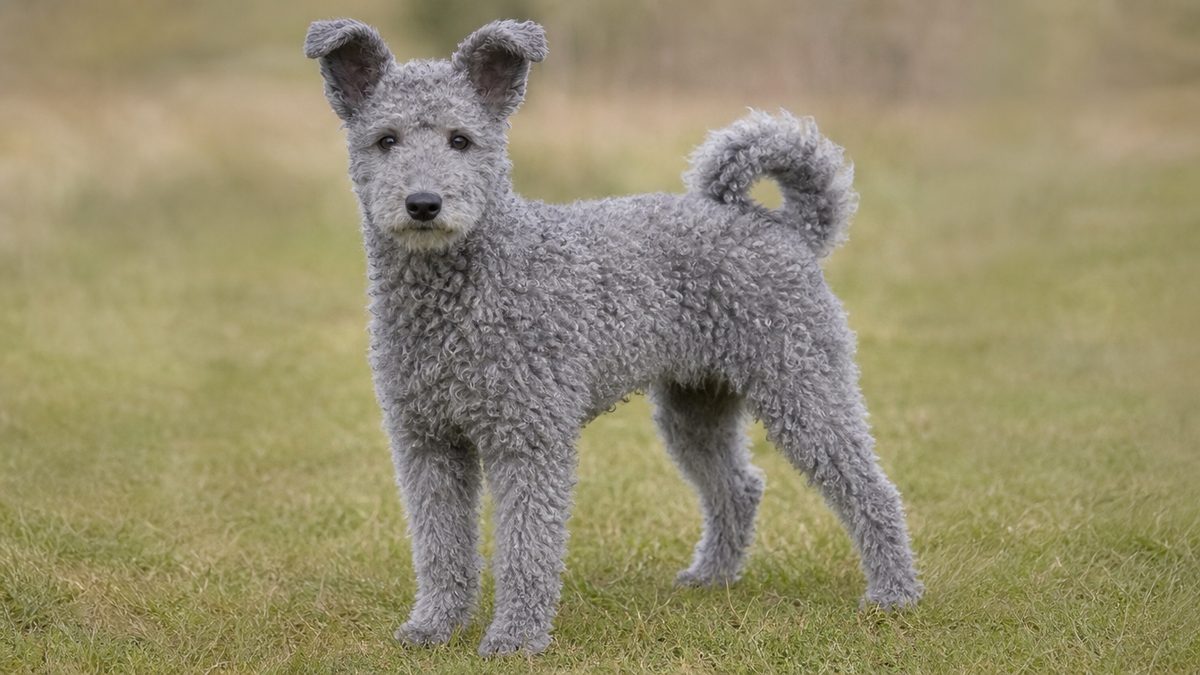
The Pumi is a medium-sized Hungarian herding dog of terrier type, 41 to 47 cm tall, recognised by the Federation Cynologique Internationale as breed standard 56 in Group 1 Section 1 Sheepdogs, with a square outline, a curly coat that stands off the body and ears carried two-thirds erect with the top third folding forward. Those ears are the whole identification.
Bonbeno took the breed number off the FCI's own Group 1 index rather than assembling a URL, because an fci.be address resolves on its trailing number and a guessed one serves a different breed with no warning. Hungary's block on that index lists Komondor 53, Kuvasz 54, Mudi 238, Puli 55 and Pumi 56, and the Pumi row carries four colour varieties, none of them marked for CACIB.
The physical characteristics that separate three breeds
The Pumi's ears are the only ones of the three that must be neither fully up nor fully down. The AKC standard makes both extremes disqualifying faults: prick ears or hanging ears, either one, puts the dog out of the ring. That is unusual, and it exists precisely because the breed had to be told apart from a Mudi on one side and a Puli on the other.
| Breed | FCI number | Ears | Coat | Muzzle as share of head |
|---|---|---|---|---|
| Pumi | 56 | Two-thirds erect, top third folding forward | Curly corkscrews, 4 to 7 cm, never corded | 40 to 50 percent |
| Puli | 55 | Hanging, V-shaped, hidden in coat | Corded, 20 to 30 cm on the loin | About one third |
| Mudi | 238 | Fully erect, reverse V | Wavy, 3 to 7 cm, short on the head | About 45 percent |
The muzzle row is the second test and it is measurable on a photograph. A Puli's muzzle is about a third of head length and a Pumi's is 40 to 50 percent, so the Pumi's head looks noticeably longer and narrower. The AKC standard makes a foreface shorter than 40 percent of head length a disqualifying fault, and describes the wrong head as a round, Puli-like head.
What the breed standard actually specifies
- Height males 41 to 47 cm with an ideal of 43 to 45 cm, females 38 to 44 cm with an ideal of 40 to 42 cm.
- Weight males 10 to 15 kg with an ideal of 12 to 13 kg, females 8 to 13 kg with an ideal of 10 to 11 kg.
- Coat wavy and curly, forming tufts, never smooth and never corded, averaging 4 to 7 cm and standing 1.5 to 3 inches off the body.
- Proportions square, with body length equal to height at the withers, and a neck 45 percent of the height at the withers.
- Tail high set, arching over the back in a full circle. Docking is not permitted and neither is a natural stumpy tail.
- Nose always black in every coat colour, and the coat colour must always be intense and solid.
The tail clause is the one that surprises people. The Mudi's standard treats a dog born with a natural stump tail as perfectly normal; the Pumi's forbids both a docked tail and a natural bobtail. So a short-tailed Hungarian herder is a normal Mudi and an unregisterable Pumi, and that is a checkable difference on a live puppy.
Where the Indian pages diverge from the standard
The Indian listing page for this breed gives a height of 15 to 18 inches, which is 38.1 to 45.7 cm, so its ceiling falls 1.3 cm short of the FCI male maximum of 47 cm, and a weight of 10 to 16 kg, which runs a kilogram over. Its life expectancy of 12 to 14 years is close to the AKC's 12 to 13. None of that would let a buyer correctly reject an oversized dog.
The Royal Kennel Club files the Hungarian Pumi as size small and the Hungarian Puli as medium, on the same site on the same day. Both those breeds' own standards say the opposite about height: the Pumi is 41 to 47 cm for males against the Puli's 39 to 45, and the AKC agrees by giving the Pumi 16 to 18.5 inches against the Puli's 17. The resolution is weight rather than height. The Pumi's ideal 12 to 13 kg sits below the Puli's 13 to 15, so the taller dog is the lighter one. Choose on the measurements, not on the size label.
History and origin: a Puli crossed with imported terriers, and thirty-four years of argument about when it became its own breed
The Pumi's origin is stated in its own FCI standard: it came into being during the 17th to the 18th century in Hungary by crossbreeding the primitive Puli with imported German and French dogs of terrier type with prick ears, and it has been recognised as an independent breed at the beginning of the 20th century. That last phrase is as precise as the FCI gets, and six other sources give six different years.
The mechanism behind the imported terriers is agricultural rather than cynological. Rising demand for finer wool brought western merino sheep into Hungary alongside the native racka, the flocks were walked in from their home countries, and the herding dogs often came with them and were sold with the flock. Hungarian herding stock therefore mixed with French terrier-type driving dogs, and a mixed population formed that became the basis of the modern breeds.
Naming lagged behind biology by a century. The first accurate description of a Pumi is in Pethe Ferenc's *Termeszet Historia* of 1815, and it is printed under the name kuvasz, describing a dog the size of a wolf cub with erect ears and somewhat shaggy hair. For a long time *pumi* and *mudi* simply meant a driving dog, and the Hungarian Puli club records that at the start of the twentieth century the names *pumi* and *puli* were mixed and used arbitrarily as labels for small differences of type.
The dates, all of them, side by side
| Date | What the source says happened | Source |
|---|---|---|
| 1815 | The word Pumi is first mentioned, used interchangeably with Puli | Hungarian Pumi Club of America |
| 1901 | Hungary's herding dogs reclassified as Canis familiaris domesticus hungaricus | Hungarian Pumi Club of America |
| 1902 | Puli and Pumi first described as separate breeds, and the Mudi identified at the same time | Hungarian Pumi Club of America |
| 1914 | Separation begins at the Budapest Zoo under Raitsits, the Pumi then regarded as the Transdanubian variety of the Puli | Magyar Mezogazdasag |
| 1920 | Pumik still shown as a regional variety of the Puli at Hungarian shows | Hungarian Pumi Club of America |
| 1921 | First outline of a Pumi standard | Hungarian Pumi Club of America |
| 1923 | Pumi appears as an independent breed at Hungarian shows | Hungarian Pumi Club of America |
| 1924 | Raitsits founds the Studbook of Hungarian Dog Breeds, splitting from MEOE | Hungaria Puli Klub |
| 1935 | Anghy publishes the first scientific description of the Pumi, naming it for the late Raitsits | Magyar Mezogazdasag |
| Beginning of the 20th century | Recognised as an independent breed | FCI Standard 56 itself |
| 1954 | The FCI accepts the Pumi and the Puli on a definitive basis, on the same day | FCI breed records 55 and 56 |
| 2016 | The AKC recognises the Pumi, eighty years after the Puli | American Kennel Club |
1914 is the earliest date attached to an actual programme rather than a description. Under Raitsits's leadership, the Pumi, at that point considered the Transdanubian variety of the Puli, began to be separated out at the Budapest Zoo and bred selectively. The word *variety* is the important one. In 1914 nobody thought these were two breeds; they thought they were two regional forms of one.
The geography supports that reading. Pumik came from Transdanubia, west of the Danube. Pulik came off the great plain. Mudik came from the southern plains. One population, three regions, three working styles, and eventually three studbook entries. Bonbeno's climate section below uses Kaposvar in Transdanubia as this breed's homeland baseline rather than a generic Hungarian point, for exactly that reason.
Dr Csaba Geza Anghy published the first scientific description of the Pumi in 1935 and named the breed after Emil Raitsits, who had died the previous year. That is the clearest single marker of when the Pumi stopped being a variety and became a breed with a describer, a type specimen and a name in the literature, and it lands one year before the Mudi's own separation in 1936.
The FCI's own register and its own standard disagree about this breed, by two months
The FCI accepted the Pumi on a definitive basis on 11 August 1954, the same day it accepted the Puli, and accepted the Mudi nine years later on 25 March 1963 Federation Cynologique Internationale breed… Federation Cynologique Internationale breed…. Getting those dates right takes one deliberate step, and doing it exposes a genuine conflict inside the FCI's own paperwork for this breed.
The trap is that FCI web records print dates as month/day/year while FCI standard PDFs print them as day.month.year. A date like 8/11/1954 is 11 August under one convention and 8 November under the other, and nothing on the page tells you which you are holding. The fix is to prove the format from the document in front of you, every time, by finding a date whose second field exceeds twelve.
| Document | Date in question | Proof inside that same document | Reading |
|---|---|---|---|
| FCI Group 1 index | Pumi standard valid 6/4/2000 | Rows read 10/29/2013, 6/24/1987, 8/18/1965 and 12/21/2019; 29, 24, 18 and 21 cannot be months | month/day/year |
| FCI record 56, Pumi | Acceptance 8/11/1954 | The same record prints 9/13/2000 for three standards and 9/29/2003 for the Spanish; 13 and 29 sit second | 11 August 1954 |
| FCI record 55, Puli | Acceptance 8/11/1954 | The same record prints 10/29/2013; 29 cannot be a month | 11 August 1954 |
| FCI record 238, Mudi | Acceptance 3/25/1963 | The same record prints 10/27/2023 and 9/25/2023 | 25 March 1963 |
| FCI Standard 56 PDF | Header 13.09.2000 | 13 sits in the FIRST field and cannot be a month | 13 September 2000, day.month.year |
Now check both ends, and the Pumi's two documents part company
The Puli is the control that establishes the convention. FCI record 55 gives its valid standard as 10/29/2013 and FCI Standard 55 prints 29.10.2013, which is 29 October 2013 read either way FCI-Standard N 55, PULI. So the register renders in month/day exactly what the PDF renders in day.month, and the two agree.
Apply the same convention to the Pumi and they do not.
| Document | What it prints | Read in that document's proven format |
|---|---|---|
| FCI breed record 56 | Date of publication of the official valid standard: 6/4/2000 | 4 June 2000 |
| FCI Standard N 56 PDF | DATE OF PUBLICATION OF THE OFFICIAL VALID STANDARD: 06.04.2000 | 6 April 2000 |
Two months apart, both documents current, both official, and no third document to settle it. Bonbeno publishes the conflict rather than picking the convenient one. It is worth noting exactly why it cannot be resolved: this is the only date pair across the six FCI documents read for this page and its sibling in which both fields are twelve or under, so it is the only one where the proof method has nothing to work with. Every other date on both breeds is provable.
This is not an isolated defect either. Bonbeno's own Montenegrin Mountain Hound work found FCI record 279 giving 6/24/1969 while FCI standard 279 says the breed was recognised on 8 May 1969, forty-seven days apart. Whenever a page dates anything about an FCI breed, check the register entry and the standard against each other, because they can and do disagree.
Three documents, three answers about which language governs
There is a second contradiction in the same file set, and it matters because where FCI translations differ, the authentic language decides.
- FCI breed record 56 says the official authentic language is German.
- The English standard prints 'TRANSLATION: Mrs C. Seidler and Mrs Elke Peper. Official language (DE)', agreeing with the register.
- The German standard prints 'UEBERSETZUNG: Peter Weit / Offizielle Originalsprache (EN)', describing itself as a translation from English.
- The French standard prints 'Langue faisant foi : (EN)', also naming English.
Every one of the three language versions calls itself a translation, and the document the register names as authentic denies being it. Bonbeno checked whether it changes any figure and it does not: heights, weights, the 4 to 7 cm coat, the 7 to 12 cm tail-underside hair and the 45 percent neck are identical across English, German and French.
The English text says the Pumi arose by crossbreeding the primitive Puli with imported German and French terrier-type dogs. The German text says the same: durch Kreuzung des primitiven Puli. The French text says the Pumi is the product of a cross between the primitive Pumi and those imported dogs. A breed cannot descend from itself, so the French version destroys the descent claim the whole paragraph exists to make. Two of three documents agree, the French names English as the authentic language, and nothing downstream appears to have noticed.
Pumi dog price in India: one number exists, and here is what it is worth
Exactly one Indian page quotes a Pumi dog price in India, a band of Rs 1,50,000 to Rs 3,00,000, and it names no breeder, no listing and no date. Bonbeno reports it, tests it, and explains why it cannot be confirmed either way.
That page ranks first in India for this query. It returns HTTP 200, runs to 299,645 bytes, and its price section is a paragraph rather than a listing: the price of a Pumi puppy in India can range from Rs 1,50,000 to Rs 3,00,000 depending on the breeder, lineage and import costs. There is no breeder named, no dog shown and no transaction behind it.
The division tests, run and reported honestly
Indian pages routinely publish a dollar figure run through one exchange rate and present it as a rupee price, so Bonbeno divides every suspicious rupee figure by the rates that have caught it before.
| Rupee figure | at 84.38 | at 80.00 | at 75.00 | at 74.00 |
|---|---|---|---|---|
| Rs 1,50,000 | 1,777.67 | 1,875.00 | 2,000.00 | 2,027.03 |
| Rs 3,00,000 | 3,555.34 | 3,750.00 | 4,000.00 | 4,054.05 |
The result is indeterminate and the honest verdict is to say so. Only a rate of 75.00 turns both ends into round dollars, and 2,000 to 4,000 dollars does bracket what the co-ranking American pages quote, which is 1,000 to 3,000 dollars from one and a flat 3,000 from another. But Rs 1,50,000 and Rs 3,00,000 are lakh-round Indian numbers, one and a half lakh to three lakh, and a lakh-round figure divides cleanly at many rates by construction. So the arithmetic cannot distinguish a converted American list from a writer typing a plausible Indian band. Neither reading can be proved, and the figure should be treated as unverified rather than as a market rate.
What else ranks on this query, and what those pages actually are
| Position | Site | What it actually is |
|---|---|---|
| 1 | hankpets.com | The only rupee figure, unsourced |
| 2 | gooddog.com | United States marketplace, quotes 3,000 dollars |
| 3 | dogbreedslist.info | United States, quotes 2,000 to 3,000 dollars |
| 4 | akc.org | The American Kennel Club breed page, no price |
| 5 | lancasterpuppies.com | Returns HTTP 403 to Indian traffic with the reason string banned-continent |
| 6 | thesprucepets.com | United States, quotes 1,000 to 3,000 dollars |
| 7 | etsy.com | Merchandise. Titled 'Buy Pumi Dog Online In India'; its rupee figures are for printable art |
| 8 | supertails.com | A Pomeranian price page. It does not mention the Pumi |
| 10 | royalcanin.com/in | Royal Canin India's breed page, no price of any kind |
Three of those rows are worth naming individually because each is a different way for a search result to be useless.
- The banned continent. Lancaster Puppies ranks fifth on an Indian search and refuses Indian traffic outright, returning HTTP 403 with the reason string banned-continent. Its headings are word-for-word the same template as its Hungarian Puli page with the breed name swapped.
- The merchandise trap. Etsy India ranks seventh under the title 'Buy Pumi Dog Online In India' and the figures it surfaces, Rs 1,599 reduced from Rs 2,285 and Rs 140 reduced from Rs 394, are prices for downloadable art. A scraper cannot tell those from a puppy price, and neither can a reader skimming.
- The substituted breed. Supertails ranks eighth with a page titled 'How Much Does a Pomeranian Cost in India?', which quotes Rs 15,000 to 25,000 for pet quality, Rs 25,000 to 40,000 for KCI-registered and Rs 40,000 to 80,000 plus for show quality. Those are real Indian figures for a real Indian breed, and none of them is about the Pumi.
The Indian listing page prints no price at all
The Indian classifieds site with a Pumi product page returns HTTP 200 across 491,592 bytes and contains zero rupee figures for a Pumi. Its 'Available Pumi Puppies For Sale' carousel is byte-identical to the one on its Puli page: a Maltipoo named Fizey at Rs 98,999 and Poodles named Kuzo and Dugu at Rs 92,599 each, with image files named Maltipoo-Male-Fizzy, Poodle-Kuzo-male and Poodle-Dugu, plus a Rottweiler, a Cane Corso and an Adobe Stock photograph. Rs 98,999 is a house price point attached to whichever puppy is in stock, and it has never belonged to a Pumi.
DogsIndia returns a complete Puli entry and HTTP 404 for a Pumi. Happy Pet Care serves a full Puli page including a cost table and returns HTTP 404 for a Pumi. Both sites cover rare European herding breeds and both stop at the Puli, which is a cleaner measure of this breed's Indian presence than any price band. Import for trading or breeding is barred anyway: DGFT Trade Notice 22/2022-23 states that applications for those purposes shall be duly rejected.
Cost of ownership in India, for a 10 to 15 kg dog with an easy coat
Budget a Pumi in India as an ordinary medium dog, because unlike its corded relative it adds no drying equipment, no dehumidifier and no four-hour post-bath schedule. The recurring lines below are the same ones any 10 to 15 kg dog in India carries, and they are the honest denominator for a breed with no verifiable purchase price.
| Item | Published Indian figure | Source and caveat |
|---|---|---|
| Anti-rabies, single dose | Rs 699 | Vetic clinic list price |
| 9-in-1 DHPPiL | Rs 899 | Vetic clinic list price |
| Canine corona | Rs 899 | Vetic clinic list price |
| Kennel cough | Rs 1,349 | Vetic clinic list price |
| Consultation | Rs 500 to 1,000 | VOSD. Treat as one data point, because an insurer's blog prints the identical range |
| Core vaccination course | Rs 1,500 to 3,000 | VOSD, same single-source caveat |
| Professional bath | from Rs 934 | Vetic, Delhi page, a promotional floor from one chain |
| Haircut or trim | from Rs 1,359 | Vetic, Delhi page |
Two warnings about that table. Vetic's figures are starting-at promotional floors from one chain on one city page, and Vetic quotes different course prices on different city pages on the same day, so a Mumbai figure and a Delhi figure are not a price change. And the VOSD consultation and vaccination ranges are printed byte-identically by a general insurer's blog, so one copied the other; two organisations agreeing to the rupee on two separate quantities is evidence against independence rather than for it.
The grooming line, which is where the Pumi saves money
The Royal Kennel Club gives the Pumi once a week grooming and files its coat as medium, against more than once a week and long for the Puli. That difference is the whole cost-of-ownership story between the two breeds.
- No forced dryer. The AKC standard requires the coat to be allowed to dry naturally and says it must never appear fluffed and blown dry, so the single most expensive item on the Puli's budget is not merely unnecessary here, it is against the standard.
- Hand stripping and scissors. The FCI standard says the desired coat preparation is achieved by hand trimming, with smaller corrections done with scissors on head and legs, and that preparing the entire coat with scissors is not desirable.
- A brush-out every few weeks. Hungarian guidance is to cut overgrown hair to length with scissors and to brush out dead hair every few weeks so the coat does not clump, and notes that once dry the coat is self-cleaning, with mud simply falling out.
- No mildew budget. There is no cord to hold water at its core, so a wet Pumi is a towel and an hour rather than a schedule.
A groomer who does not know the breed is the real risk to that budget. A Pumi presented at an Indian salon will usually be bathed and blown out straight, which the standard describes as the one thing that must never happen, and the curls take weeks to recover. Ask for a hand strip and a scissor tidy, and say plainly that the dog must not go under a stand dryer.
No Indian monthly cost table exists for this breed, and that is a finding
The Indian directory that publishes a monthly running cost for the Puli returns HTTP 404 for a Pumi page. That is convenient, because Bonbeno tested that directory's Puli row in the same session and it turned out not to be about the Puli either: five unrelated breeds print the identical Rs 4,650 to 6,600 monthly row and the identical Rs 2,250 to 3,000 food line, namely the Puli, Lagotto Romagnolo, Welsh Terrier, Kooikerhondje and Border Collie, while the Labrador prints Rs 4,900 to 7,650 and the Beagle Rs 2,200 to 3,750. Those are preset rows assembled from a shared table, not costings of any breed.
Take the vaccination and consultation lines above, add monthly parasite control, add food priced off your own pack rather than off a web page, and add a once-a-week grooming session you do yourself. That is a complete and honest Indian budget for this dog. Anyone quoting you a monthly figure for a Pumi in India is quoting a template, because no Indian directory publishes one at all.
Heat tolerance and the Indian climate, from the Pumi's own corner of Hungary
The Pumi's heat tolerance is moderate and better than either Hungarian relative's, and the measurement that bounds it is short: Chennai's coolest month is warmer than the hottest month in Transdanubia, where this breed was formed. Bonbeno measured the Pumi's own homeland rather than Hungary in general, because the three breeds came from three different regions.
Bonbeno queried NASA POWER by explicit latitude and longitude and echoed back the grid-cell elevation for every point, because POWER reports a cell rather than a place. Kaposvar, in southern Transdanubia, came back at 157.17 m against a real 153 m, an error of 4.17 m, which is the most accurate homeland cell in this whole sample. Szombathely in western Transdanubia returned 192.77 m against 220 m. Hortobagy on the great plain, the Puli's country, returned 96.82 m against 90 m. Budapest was set aside at 178.05 m against a real 102 m, a 76 m error that makes its temperatures too cool for the city.
| Place | Cell elevation | Annual mean | Hottest month | Coolest month | Annual RH |
|---|---|---|---|---|---|
| Kaposvar, Transdanubia | 157.17 m | 11.39 C | 23.32 C (Jul) | -0.80 C (Jan) | 74.37% |
| Szombathely, Transdanubia | 192.77 m | 10.90 C | 22.76 C (Jul) | -1.08 C (Jan) | 75.90% |
| Hortobagy, great plain | 96.82 m | 11.44 C | 23.54 C (Jul) | -1.67 C (Jan) | 73.33% |
| Chennai | 48.95 m | 27.95 C | 31.51 C (May) | 24.09 C (Jan) | 72.39% |
| Delhi | 206.37 m | 25.60 C | 35.88 C (Jun) | 13.61 C (Jan) | 45.56% |
| Mumbai | 97.15 m | 26.77 C | 31.19 C (May) | 23.19 C (Jan) | 67.39% |
| Kolkata | 7.35 m | 25.81 C | 31.53 C (May) | 17.31 C (Jan) | 73.93% |
| Bengaluru | 841.72 m | 23.74 C | 28.37 C (Apr) | 20.22 C (Dec) | 67.94% |
| Pune | 635.99 m | 23.86 C | 28.93 C (Apr) | 19.62 C (Dec) | 66.80% |
Read the Chennai row against the Kaposvar row. Transdanubian July averages 23.32 C. Chennai's January, its coolest month, averages 24.09 C. The gap is 0.77 C, and it is wider than the equivalent gap for the Puli's plain, because Transdanubia is very slightly cooler in summer than the puszta. A Pumi in Chennai never meets a month as cool as the warmest month its ancestors worked in, and the annual gap is 16.56 C.
The humidity claim, checked before it was repeated
Pages about European breeds routinely assert that Indian humidity will overwhelm them. Kaposvar runs at 74.37 percent annual relative humidity, which is higher than every Indian city in this sample: Kolkata 73.93, Chennai 72.39, Bengaluru 67.94, Mumbai 67.39, Pune 66.80, Delhi 45.56. Transdanubia is a humid place, and this breed evolved in it. Anyone telling you a Pumi cannot cope with damp air is describing something the dog's homeland does for eight months of the year.
What Hungary does not do is combine that humidity with heat. Kaposvar's wettest air arrives in December at 90.61 percent and minus 0.80 C. Kolkata's arrives in September at 89.34 percent and 27.69 C. So the load to measure is wet bulb, the combined heat and humidity a body has to shed.
| Place | Peak wet bulb | Month | Gap from Kaposvar |
|---|---|---|---|
| Kaposvar, Transdanubia | 17.63 C | July | - |
| Bengaluru | 21.86 C | May | +4.23 C |
| Pune | 22.97 C | June | +5.34 C |
| Mumbai | 25.77 C | June | +8.14 C |
| Chennai | 26.11 C | May | +8.48 C |
| Delhi | 26.50 C | July | +8.87 C |
| Kolkata | 27.09 C | June | +9.46 C |
Every figure in that column came from mean air temperature paired with mean relative humidity, never from a period-extreme maximum, because a wet bulb above about 35 C has never been recorded anywhere on Earth and a number approaching it is an arithmetic error rather than a finding. Bengaluru is the mildest Indian option for this breed at 4.23 C above the homeland; Kolkata is the hardest at 9.46 C above.
Second Schedule Part IV paragraph 21(1) of the 2017 Rules bars keeping dogs in outdoor facilities without the attending veterinary practitioner's written approval where they are not accustomed to local temperatures, or are breeds that cannot tolerate them, such as long-haired breeds in high temperature locations. Bonbeno extracted the gazette itself and that phrase appears exactly once. Whether a 4 to 7 cm curly coat counts as long-haired is a judgement for the attending vet, and it is a far weaker case than for the corded Puli. Note that the string 'Rule 21' appears zero times in the gazette, so cite the paragraph, not a rule.
Grooming and maintenance: the standard says never blow dry, and India tests that
Groom a Pumi by hand stripping the coat once a week, tidying head and legs with scissors, and letting it dry naturally, because the breed standard requires exactly that. The instruction is written into the standard rather than into a care guide, and it was written in a temperate country.
The AKC standard's coat clause is unusually prescriptive about method: the coat stands out from the body approximately 1.5 to 3 inches and is prepared using a combination of stripping and trimming, the eyes and foreface are free of long hair, and then this sentence. In order to achieve the characteristic corkscrews and curls in the coat, the hair is allowed to dry naturally. The coat must never appear fluffed and blown dry, obscuring the characteristic curls.
The FCI standard says the same thing from the other direction: the desired coat preparation is achieved by hand trimming, smaller corrections with scissors on head and legs are possible, and preparing the entire coat with scissors is not desirable. So the correct Pumi coat is hand-worked, scissor-tidied and air-dried, and any of the three shortcuts a busy salon reaches for will produce a dog the standard does not describe.
What a weekly session actually involves
- Brush through with a slicker or comb to lift dead undercoat out of the tufts, every one to three weeks. Hungarian guidance is a brush-out every few weeks so the coat does not clump.
- Strip by hand where the coat has grown long and dull, taking dead hair out rather than cutting live hair off.
- Trim the overgrown ends to length with scissors, and keep the eyes and foreface clear.
- Bathe only when needed, then towel and let the coat dry on its own so the curls reform.
- Check the ears, which carry dense wiry protective hair growing upwards, and the feet, which are cat feet with well-knit toes.
One genuinely useful Hungarian observation. Once dry, the coat is self-cleaning, and mud and dirt fall out of it. That is a real advantage in an Indian monsoon, and it is the reason a wet Pumi is a towel and a wait rather than the four to six hour forced-drying project a corded Puli becomes.
Where the air-dry instruction meets Indian air
Bonbeno's climate measurement changes how to read that clause without contradicting it. Kaposvar's annual relative humidity is 74.37 percent, higher than any Indian city measured, so there is no general humidity shock to worry about. What Transdanubia never delivers is warm saturated air for four consecutive months, and in Pune, Mumbai and Kolkata the monsoon does exactly that.
The practical answer is not a dryer. It is a dry room.
| Season | Where to dry the dog | Why |
|---|---|---|
| Oct to May, most of India | Anywhere with airflow | Indian air in these months is thirstier than a Hungarian summer's |
| Jun to Sep, Pune and Mumbai | An air-conditioned or dehumidified room | Monsoon air here holds roughly a third of the Hungarian summer's drying power |
| Jun to Sep, Kolkata | Air-conditioned room | Same problem, plus the highest wet-bulb load in the sample |
| Jun to Sep, Delhi and Chennai | Ordinary airflow is fine | Both dry a coat faster than Hungary even in the monsoon |
An air conditioner running in a closed room is a dehumidifier, which is why this is a cheap fix rather than an equipment purchase. Bathe in the morning, dry in the coolest driest room in the house, and do not let a damp Pumi sleep on a mattress.
Hand strip and scissor tidy, and do not put this dog under a stand dryer. Almost every Indian salon will bathe and blow out straight by default, which is the single thing the breed standard says must never happen, and the corkscrew curls take weeks of regrowth to recover. Write it down and hand it over, because it is not a preference, it is what the standard says.
Temperament and household fit, and the noise problem stated plainly
The Pumi is a bold, alert, restless working herder that is reserved with strangers and, in its own standard's words, rather noisy. It is the loudest of the three Hungarian herding breeds and that is the fact an Indian apartment buyer should read first.
The FCI standard is unusually candid. This rather lively herding dog has a restless temperament, is extremely bold and a little suspicious towards strangers, attracts attention always and everywhere, and the Pumi is rather noisy. Its whole appearance embodies thirst for action, all parts of its body are constantly on the move, it is always active and ready for duty, and shy or phlegmatic behaviour is untypical of the breed. The AKC standard compresses that to lively, alert, intelligent, bold and ready for duty, yet reserved with strangers, assessing each new situation.
The breed's own judges' education preserves a 1930s comparison of the two breeds that says it better than either standard. The Puli is the quieter, the Pumi a rather restless and therefore sharper dog. The Pumi is utterly watchful; noticing every noise, he pricks up his erect ears; he is louder than the Puli, barking at everything with endurance. Ninety years later the standard still says rather noisy, so this is a stable breed characteristic rather than a training failure.
Why the barking is structural
This dog was bred to herd by voice. The AKC standard describes a versatile stock dog working very close to the livestock and using his voice and quick movement to keep stock under control, on the small Hungarian pastures where livestock were driven to local fields. Barking is not a behaviour problem this breed developed; it is the tool it was selected for. You manage it, you place it on cue, and you do not remove it.
| Question | Royal Kennel Club | What it means in an Indian home |
|---|---|---|
| Size | Small | The label understates the height; see the overview |
| Size of home | Small house | An apartment works on space |
| Size of garden | Small or medium garden | A balcony plus two real walks substitutes |
| Town or country | Either | Not a country-only dog |
| Exercise | Up to one hour per day | Achievable before 8 am and after 7 pm |
| Grooming | Once a week | Half the Puli's published load |
Who it suits, and who it does not
- Suits an active household that wants a dog to do things with, has a tolerant building or a plot, and enjoys training.
- Suits a first-time owner who has genuinely read the noise line and has a plan for it, because the breed is otherwise straightforward and trainable.
- Does not suit a shared wall with a light sleeper. The standard's own phrase is rather noisy.
- Does not suit a household that is out ten hours a day. A dog whose body is constantly on the move does not switch off alone.
- Does not suit anyone who wants the look without the drive. This is a working terrier-type herder in a curly coat.
One thing the breed is not, and the standard says so: it is not a guard dog in the livestock-guardian sense. The FCI files it as a herding dog of terrier type whose scenting ability is well developed and which has proved its worth against wild beasts of prey and rodents, and adds that it is an excellent house pet that can definitely be kept indoors. That last clause is unusual in an FCI standard and it is worth weighing against the noise.
Training approach, with barking as the first project rather than the last
Train a Pumi with short varied reward-based sessions and start on the barking in week one, because the breed was selected to work by voice and the habit sets before most owners think to address it. Everything else about training this dog is easy by comparison.
The raw material is excellent. The FCI standard describes a bold dog of restless temperament, always active and ready for duty, and the AKC standard adds lively, alert and intelligent American Kennel Club. A dog that assesses each new situation, in the AKC's phrase, is a dog that learns fast and generalises. It is also a dog that will invent its own solution while you are deciding what to ask for.
The barking plan, in order
- Put barking on cue first. A behaviour you can start is a behaviour you can stop. Reward two barks, name it, then reward silence after the cue.
- Give the alert somewhere to go. Teach a mat by the door. The dog announces, goes to the mat, gets paid. The announcement is not suppressed, it is routed.
- Socialise the building deliberately. In an Indian apartment the trigger is the lift, the doorbell and the delivery rider, so pair each with food for the first eight weeks rather than waiting for a problem.
- Never reward the second minute. Attention that arrives after sustained barking teaches endurance, which the 1930s description already names as this breed's speciality.
- Exercise before you need quiet, because a Pumi with unspent drive barks at furniture.
Realistic timelines
| Goal | Realistic age | Note |
|---|---|---|
| Name response and hand target | 9 to 12 weeks | Very easy on this breed |
| Barking on cue and off cue | 4 to 6 months, and revisited for life | The first project, not the last |
| Settles on a mat while people arrive | 6 to 9 months | The single most useful apartment behaviour |
| Accepts weekly hand stripping calmly | 5 to 6 months | Ten minutes a week is enough to build it |
| Recall past a moving distraction | 10 to 14 months | A close-working herder near a moving target is a different dog |
| Reliable with strangers in the home | 12 months onward | Reserved with strangers is in the standard; managed, not removed |
A note on the advice you may be given about breeding
This applies to any numerically small breed whose overseas guidance an Indian owner might follow. Indian law prohibits two named mating techniques outright. Second Schedule Part II paragraph 6(3) of the 2017 Rules prohibits in-breeding, defined as breeding between relatives of the 2nd to 4th grade in straight or side line within the first four generations, giving uncle to niece, nephew to aunt, cousin to cousin and grandparent to grandchild as examples, and incest breeding, defined as mating between parents and children or between brother and sister. Only outbreeding and line breeding are permitted. A rare breed's overseas guidance sometimes takes a relaxed view of close matings; in India that is not a matter of opinion.
The FCI standard calls the Pumi an excellent companion and sporting dog and says it needs plenty of exercise. Agility, obedience and scentwork all fit a dog described as light-footed and harmonious that changes direction instantly, and all three can be done indoors or in a park at 7 am. A Pumi with a sport is a much quieter Pumi.
Daily exercise needs, and why the file card understates them
The Royal Kennel Club gives the Pumi up to one hour a day, and that is the floor rather than the answer, because the same registry gives the Puli the identical figure for a considerably less driven dog. In India the binding constraint is which hour, because exertion is how dogs actually overheat.
The published figure and the published description do not sit comfortably together. The Royal Kennel Club files up to one hour per day for the Hungarian Pumi, the same as for the Hungarian Puli The Royal Kennel Club, Hungarian Puli. The FCI standard describes a dog with a restless temperament and a thirst for action, all of whose body parts are constantly on the move, that needs plenty of exercise and is an excellent companion and sporting dog. Take the hour as a minimum and add mental work on top.
The number that should set your timetable is this. Of the 879 UK heat-related illness events with a recorded trigger in the largest study of the question, 652 were exertional, which is 74.2 percent, against 113 environmental and only 46 involving confinement in a vehicle. The dog that overheats in India is usually the dog that was taken out, and for a breed the standard calls always ready for duty that is a live risk.
The same research team's other paper, on the same 905,543-dog cohort, found dogs at or above their breed and sex mean bodyweight carrying 1.42 times the odds of heat-related illness, 95 percent confidence interval 1.12 to 1.80. The Pumi is too rare to have been modelled individually, so no breed-specific odds ratio exists and this page invents none. A Pumi held at 15 kg rather than its ideal 12 to 13 is carrying avoidable risk.
A workable Indian week
| Season | Morning | Evening | Add |
|---|---|---|---|
| Winter, Dec to Feb | 60 min walk plus training | 30 min | The season to build fitness |
| Pre-monsoon, Mar to May | Before 7 am, 40 min | After 7.30 pm, 30 min | Peak wet-bulb months in Chennai and Bengaluru |
| Monsoon, Jun to Sep | 30 min between showers | Indoor scentwork | Dry the coat in a dehumidified room in Pune, Mumbai and Kolkata |
| Post-monsoon, Oct to Nov | 45 to 60 min | 30 min | Chennai's own most humid month is November |
What to do instead of distance
- Scentwork indoors. The FCI standard says the breed's scenting ability is well developed, so this is playing to type rather than substituting for a walk.
- Agility or a home obstacle course. The AKC standard describes a light, spirited gait with moderate reach and drive that lets the dog change direction instantly.
- Shaping sessions of five minutes, three times a day. A bold dog that assesses each new situation is a dog that enjoys puzzles.
- Rodent-style toy work. The standard records the breed's proven worth against rodents and small predators, which is a polite way of describing what a flirt pole satisfies.
- Herding, if you can reach it. Rare in India, but the breed's own working test exists and nothing else tires this dog the same way.
Bonbeno publishes no Indian heat-stroke prevalence figure for dogs, because none is obtainable from the indexed veterinary literature; a PubMed search for canine heat stroke in India returns two records and neither is usable, while the control query returned 126 on-topic records in the same session. The statutory anchor is better: Second Schedule Part IV paragraph 21(1) of the 2017 Rules names breeds that cannot tolerate local temperatures directly.
Health problems, screening and life expectancy, with the real numbers
Screen a Pumi for hips, patellae, primary lens luxation and degenerative myelopathy, which are the four tests OFA's CHIC scheme requires for this breed, and note that primary lens luxation is on this panel and absent from the Puli's. The published OFA figures are good, and the one that is not good enough to ignore is the lens.
Bonbeno read the OFA breed code out of OFA's own markup rather than guessing it, because a guessed code returns a complete and plausible table for a different breed. The Pumi's code is PM, read verbatim from the attribute value=PM data-name=PUMI, and the returned page prints PUMI as its own heading.
| Registry | Evaluated or tested | Normal or clear | Affected or carrier | Detail |
|---|---|---|---|---|
| Hips | 379 | 340 (89.7%) | 36 dysplastic (9.5%) | Excellent 76, Good 235, Fair 29; mild 27, moderate 7, severe 2 |
| Patella | 272 | 261 (96.0%) | 11 (4.0%) | Graded veterinary evaluation |
| Elbow | 222 | 209 (94.1%) | 13 (5.9%) | Grade 1 twelve, grade 2 one, grade 3 none |
| Primary lens luxation | 245 | 215 (87.8%) | 30 carriers (12.2%) | DNA test; no dogs recorded at risk |
| Degenerative myelopathy | 245 | 223 (91.0%) | 22 carriers (9.0%) | DNA test; none at risk |
| Eyes (ACVO) | 159 | 158 (99.4%) | 1 (0.6%) | Optional under CHIC for this breed |
Those rows close arithmetically, which is worth checking and worth saying. The hip components sum exactly: 76 plus 235 plus 29 is 340, and 27 plus 7 plus 2 is 36. The two DNA rows each sum to 245. A table that adds up is a table you can quote.
The screening panel differs from the Puli's, and the difference is informative
| Test | Pumi | Puli |
|---|---|---|
| Hip dysplasia | Required | Required |
| Patellar luxation | Required | Required |
| Degenerative myelopathy, DNA | Required | Required |
| Primary lens luxation, DNA | Required | Not on the panel at all |
| ACVO eye examination | Optional | Required |
| Congenital deafness, BAER | Not listed | Optional |
| Elbow dysplasia | Optional | Optional |
Read that table as two different bets on the same eye. The Puli's panel wants an annual examination that catches retinal disease after it starts; the Pumi's wants a DNA test that identifies lens-luxation carriers before a mating. 12.2 percent of 245 Pumis tested are carriers, which is a rate high enough that two untested parents is a real gamble, and it is the single most useful question to ask a breeder about this breed.
On the joints the Pumi is the better bet of the two. Its hips come back 9.5 percent dysplastic across 379 evaluations against the Puli's 10.4 percent across 2,004, and its degenerative myelopathy carrier rate is 9.0 percent with none at risk against the Puli's 19.0 percent with 2.3 percent at risk Orthopedic Foundation for Animals. The Pumi's denominators are smaller, so read those as narrower estimates rather than as more precise ones.
Hungarian breeders describe the same two joint tests. The Magyar Pumi Klub's guidance, as reported in the Hungarian agricultural press, is that hip dysplasia and degenerative myelopathy are the two screens done before breeding, primarily to preserve the population long term rather than because either is a common clinical problem in the breed. That matches the OFA numbers.
Life expectancy, and why no study supports a figure
The AKC gives 12 to 13 years and the Royal Kennel Club gives over ten years. Hungarian sources are more optimistic, describing a dog not prone to illness that reaches 15 or 16 years without particular problems. None of those is a study.
McMillan 2024 names the Pumi and excludes it. Its Supplementary Table S5 lists the breed with the phylogeny abbreviation PUM and an inclusion flag of N, meaning it was in the breed table and never entered the survival analysis, so no median exists for it. That is a checked exclusion rather than an empty search, and the distinction matters: Pumi appears zero times in McMillan 2024's article text and zero times in Teng 2022's, against in-document controls of Labrador three and six times and Border Collie twice and four times, but Whippet also returns zero in the McMillan body and the Whippet is in the study Teng KT, Brodbelt DC, Pegram C, Church DB. A body-text zero proves nothing on its own. Take 12 to 13 years as a registry estimate and nothing more.
A PubMed search for 'Pumi dog' returns exactly one record, and 'Hungarian Pumi'[tiab] returns zero with a quotedphrasesnotfound warning. Searching 'Pumi'[tiab] alone returns 23 records, whose on-topic reading is an ethnobiology study of the Pumi people of northwest Yunnan in China. Controls in the same session returned 126 records for labrador retriever hip dysplasia, three for 'Puli dog' and six for 'Mudi dog', so the instrument was healthy. One paper is the entire modern veterinary literature on this dog, and the next section is about what it says.
The one paper that names this breed says it itches, and India makes that matter
The single record in the indexed world veterinary literature that names the Pumi is a Hungarian review of 600 dogs with atopic dermatitis, and it found the Pumi over-represented among atopic dogs relative to the general dog population. The commonest allergen in that study is a mite that thrives in warm humid homes, which is most Indian homes.
The study reviewed the medical records of 600 dogs diagnosed with atopic dermatitis and evaluated them for history, geography, breed predilection, clinical signs and positive intradermal test reactions. Four of its findings matter to an Indian reader.
| Finding | The figure | Why it matters in India |
|---|---|---|
| Breeds over-represented among atopic dogs | Hungarian Vizsla, Pumi, French bulldog, Doberman Pinscher, Bobtail | Two of the five are Hungarian herding or hunting breeds |
| Commonest positive reaction | *Dermatophagoides farinae*, then human dander | The house dust mite, which multiplies in warm humid homes |
| Age of onset | 4 months to 3 years in 66.6 percent | The disease starts young, so a first-year itch is not a passing thing |
| Geography within one country | Suburban Budapest dogs more sensitive to house dust mites, fleas and moulds, p less than 0.01 | Environment shifts the allergen even inside one city |
Take the over-representation carefully. This is one study, in one country, on a clinic caseload rather than a random population, and breed predilection measured against a city's breed distribution is a weaker design than a cohort study. It is also the only breed-level health signal that exists for the Pumi anywhere, and it points at the exact allergen an Indian home supplies most of.
Canine atopic dermatitis is an active Indian clinical problem
Indian veterinary groups are working on this disease, which means an Indian owner can get it recognised and treated rather than dismissed as a hot-weather itch.
- A study at DUVASU Mathura compared 17 dogs diagnosed with atopic dermatitis against six healthy dogs and found significantly higher circulating IL-17, IL-31 and total IgE at p less than 0.0001, together with higher total leukocyte counts and higher absolute neutrophil and eosinophil counts.
- A second study from the same group quantified filaggrin and involucrin skin-barrier gene expression in the lesional skin of eleven atopic dogs against three healthy controls, alongside IL-13, IL-31 and TNF-alpha in blood cells, finding the barrier proteins altered in atopic skin.
- Both are small studies, and both are stated here as what they are. Their value to an Indian reader is that IL-31 is the target of a drug class now used clinically, so this is a diagnosable and treatable condition in India rather than a foreign literature curiosity.
What an Indian Pumi owner should actually do
- Treat a first-year itch as a signal, not a season. Two thirds of the Hungarian cases began between four months and three years old.
- Reduce the house dust mite load rather than only treating the dog. Wash bedding hot and weekly, keep the dog off upholstered furniture, and run the air conditioner, which dries a room as well as cooling it.
- Rule out parasites first. Fleas and mites produce the same picture and are far commoner in India, so the diagnosis is one of exclusion.
- Ask for intradermal or serum allergy testing if the itch is seasonal or persistent. The Hungarian study's method was intradermal testing, and it is available in Indian referral practice.
- Do not shave the coat to stop the itch. The coat is not the cause, and the AKC standard's air-dry requirement exists because the curls are structural.
First, one study naming a breed among five over-represented in one country is a lead rather than a diagnosis, and Bonbeno is not claiming every Pumi will be atopic. Second, no Indian study has ever included a Pumi, because there is no Indian Pumi population to include. What is being joined here is a Hungarian breed-level observation and Indian evidence about the same disease and the same allergen class, and the join is stated rather than hidden.
Feeding and diet for a lean working herder
Feed a Pumi to the standard's ideal weight of 12 to 13 kg for males and 10 to 11 kg for females rather than to the wider permitted band, because the breed standard describes a body that is dry, lean and muscular and a page and a half of that standard is about how little flesh should be on it.
The FCI standard gives males 10 to 15 kg with an ideal of 12 to 13, and females 8 to 13 kg with an ideal of 10 to 11. The AKC gives ideal weights only, 27 to 29 pounds for males and 22 to 24 for females, which is 12.2 to 13.2 kg and 10.0 to 10.9 kg, and matches the FCI ideals almost exactly. Two registries agreeing on an ideal to within a hundred grams is unusual and worth using. Feed to that, not to the 15 kg ceiling.
The standard's body description is the reason. Well developed muscles, dry, exceptionally taut and tough; the breed is particularly lean and of harmonious appearance; the underline is tight and tucked up towards the rear. A Pumi carrying two extra kilograms is not a slightly heavier Pumi, it is outside the type the standard describes.
Why weight is a heat decision in India
Dogs at or above their breed and sex mean bodyweight carried 1.42 times the odds of heat-related illness in a study of 905,543 UK dogs, 95 percent confidence interval 1.12 to 1.80. On a coated working dog in an Indian summer that is the cheapest risk reduction available, and unlike almost everything else on this page it costs nothing.
The coat helps you here in a way the Puli's does not. A 4 to 7 cm curly coat that stands off the body still lets you feel a waist and ribs, so ordinary body condition scoring works. Run your hands over the last ribs weekly and weigh the dog monthly.
| Line | What to do | Indian note |
|---|---|---|
| Daily ration | Two meals, measured by weight against the pack's own chart | Published Indian food ranges vary by dog size; verify against your own pack |
| Target weight | 12 to 13 kg males, 10 to 11 kg females | Both registries agree on this, so use it rather than the wider band |
| Monthly food cost | Arithmetic from grams per day | Bonbeno publishes no monthly kibble figure; the retail source it verified went stale within days |
| Parasite control | Monthly, year round in most of India | A combined tick, flea and worm product covers two lines at once |
| Body check | Ribs weekly by hand, scale monthly | Free, and the most useful line on this table |
Bonbeno publishes no rupee-per-month food figure for this breed. A monthly figure is arithmetic over a retail price rather than a quoted price, and the last large-bag price this operation verified had moved within days of being recorded. Weigh your dog, read the grams per day off your own pack, and multiply. Any page giving you a single monthly food number for a breed with no Indian population has assembled it, and the section above shows what those assembled tables actually are.
One diet consideration specific to this breed
The single paper naming the Pumi found it over-represented among dogs with atopic dermatitis, and food allergy is one of the differentials any vet will work through for a persistently itchy dog. That does not mean a Pumi needs a hypoallergenic diet by default. It means that if this dog itches, an elimination diet is a reasonable early step in India rather than an exotic one, and it is worth keeping a simple record of what the dog eats from the first month so the trial has a baseline.
Hungarian guidance notes the coat is self-cleaning once dry, with mud falling out of it. What does not fall out is food. A dog with a 40 to 50 percent muzzle length and hair around the mouth will carry gravy in it, so a shallow wide bowl and a wipe after wet food keeps the foreface clean and the skin under it dry.
Month by month through the first year, ears and colour included
A Pumi puppy's first year runs an ordinary puppy schedule alongside two things that change in front of you: the ears settle into their fold, and the colour usually is not the colour you bought. Both are normal and both are written into the standard.
| Age | Dog | Coat and ears | Your job |
|---|---|---|---|
| 8 to 12 weeks | Home, vaccination course, socialisation window open | Puppy coat; ear carriage still unsettled | Two minutes of whole-body handling daily; pair the doorbell with food |
| 3 to 4 months | Learns fast; barking habit forming | Curls beginning to define | Put barking on cue now, before it is a habit |
| 4 to 6 months | Adolescence starting | Ear fold usually readable | Ten minutes of hand stripping a week, calmly |
| 6 to 9 months | Adult drive arriving | Black puppies begin fading to grey | Do not panic about colour; the standard expects it |
| 9 to 12 months | Physically close to adult | Coat standing 1.5 to 3 inches off the body | Weekly strip and scissor tidy; air dry every time |
| 12 months onward | Adult | Curls set | Maintenance, and a sport |
The colour change is normal and it is in both standards. The AKC says the greys are born black and fade to various shades of grey, and the fawns are born brownish black and may fade to some shade of fawn. The FCI puts it the same way, noting that in the grey variety the colour at birth is normally black, turning grey with time. A grey Pumi puppy that looks black is a grey Pumi puppy.
The three things to check on the actual puppy
- The tail. It must be a full natural tail that arches over the back. Docking is not permitted and neither is a naturally short or stumpy tail, which sets this breed apart from the Mudi where a natural bobtail is no fault at all.
- The ears. They should be set high and carried with the upper third bending forward. Fully erect ears and hanging ears are both disqualifying faults in this breed, so a seller telling you the ears will 'come up fully' is describing a different dog.
- The nose. Always black in every coat colour, in both standards. On some white dogs the pigment can fade, which the AKC calls undesirable rather than disqualifying.
What Indian law says about the puppy in front of you
- A puppy sold below eight weeks is unlawful. Rule 8(1)(a) of the 2017 Rules provides that pups less than eight weeks in age are not sold.
- Docking is prohibited. Second Schedule Part II paragraph 6(8) forbids tail docking, ear cropping, de-barking, de-clawing, branding, dyeing, injecting substances to enhance visual appeal and any change of appearance by artificial means. The breed's own standard forbids docking too, so a docked Pumi fails on both counts.
- Breeding dogs must have been tested for genetic defects. Second Schedule Part III paragraph 8(10) names hip dysplasia, progressive retinal atrophy, night blindness, hypothyroidism, entropion, ectropion, overshot and undershot jaw, wry mouth, two or more missing teeth and cryptorchidism. The word is 'including', so the list is illustrative rather than closed, and a breeder should be able to show you the hip and DNA results the CHIC panel calls for.
- Ear cropping has no possible excuse here. The correct ear is a folded ear; nothing about this breed's appearance can be improved by surgery, and the law forbids it regardless.
The breed's own judges' education tells judges that if there are any missing teeth, it will be premolars, and to check the sides of the mouth without opening it. Both standards disqualify one or more missing incisors, canines, premolars 2 to 4 or molars 1 to 2, disregard the third molars, and allow no more than two missing first premolars. That is a specific thing to look at rather than a general instruction to check the bite.
Pumi against its two siblings, and against what India will actually offer you
Cross-shop the Pumi against the Puli and the Mudi first, because the three are the same dog pulled apart a century ago and the differences between them decide the workload. On coat care the Pumi is the easiest of the three, and on noise it is the hardest.
| Pumi | Puli | Mudi | |
|---|---|---|---|
| FCI standard | 56 | 55 | 238 |
| FCI definitive acceptance | 11 Aug 1954 | 11 Aug 1954 | 25 Mar 1963 |
| Height, males | 41 to 47 cm | 39 to 45 cm | 41 to 47 cm |
| Ideal weight, males | 12 to 13 kg | 13 to 15 kg band | not stated in the standard |
| Ears | Two-thirds erect, tips folding | Hanging | Fully erect |
| Coat | Curly, 4 to 7 cm, never corded | Corded, 20 to 30 cm | Wavy, 3 to 7 cm |
| Royal Kennel Club grooming | Once a week | More than once a week | Once a week |
| AKC recognition | 2016 | 1936 | 2022 |
| AKC popularity | 169 of 210 | 177 of 210 | not listed here |
| Natural bobtail | Not permitted | Not mentioned | Permitted, not a fault |
Two rows in that table repay a second look. The Pumi is the taller dog than the Puli in both standards, 41 to 47 cm against 39 to 45, and the AKC agrees at 16 to 18.5 inches against 17 American Kennel Club. Yet the Royal Kennel Club files the Pumi as small and the Puli as medium The Royal Kennel Club, Hungarian Puli. The resolution is mass: the Pumi's ideal 12 to 13 kg sits below the Puli's 13 to 15, so the taller dog is the lighter one, and a size label alone gets the proportions backwards.
The popularity row is the more surprising one. The AKC recognised the Puli in 1936 and the Pumi in 2016, eighty years apart, and the newer breed already ranks 169 of 210 against the Puli's 177 American Kennel Club. An eighty-year head start has not held. The likeliest reason is the coat, and it is the same reason this page recommends the Pumi to most Indian households that were considering either.
What each coat actually costs you
| Breed | Weekly work | After a bath | Wet-walk penalty |
|---|---|---|---|
| Pumi | Hand strip and scissor tidy, once a week | Towel, then air dry, as the standard requires | None; the coat is self-cleaning once dry |
| Puli, corded | Hand separation, 20 to 30 min, for 3 to 4 years | 4 to 6 hours of forced drying | Mildew if the cord core stays damp |
| Puli, clipped | Slicker brush, minutes | Ordinary | None, but disqualified from the FCI ring |
| Mudi | Brushing, once a week | Ordinary | None |
| Border Collie | Brushing, twice a week | Ordinary | None |
Read across the Pumi row and the case is straightforward. This is the Hungarian herding dog whose coat was designed to look after itself, and its standard's air-dry clause is a description of that rather than a burden. The Puli row is the one that needs an Indian plan, and the Mudi row is the closest thing to the Pumi in workload.
Against what is actually available in India
No Indian directory carries a Pumi page, so the realistic comparison is against dogs you can obtain here.
- Border Collie gives you the same close-working herding brain with a real Indian market, and needs the same daily hour plus mental work.
- Miniature Schnauzer is the other hand-stripped terrier-type coat commonly kept in India, so it is the breed to look at if the coat routine is what appeals.
- Indian pariah dog gives you an alert, agile, vocal watchdog with no coat routine at all, and shelters in every metro have them.
- Mudi is the nearest genuine substitute if it is specifically the Hungarian herding type you want, and it is equally unobtainable here.
What Indian owners and Indian pages get wrong about this breed
Six mistakes account for almost everything that goes wrong with a Pumi in India, and most of them are made by a groomer or a search engine rather than by the owner. Each one below is corrected against a document rather than an opinion.
- Blow-drying the coat. The AKC standard states that the hair is allowed to dry naturally and that the coat must never appear fluffed and blown dry. An Indian salon will do it by default unless told not to, and the curls take weeks to recover.
- Scissoring the whole coat. The FCI standard says preparing the entire coat with scissors is not desirable; the method is hand stripping with small scissor corrections on head and legs.
- Treating barking as a training failure. The standard says the Pumi is rather noisy and the breed was selected to work stock by voice. Manage it and place it on cue; expecting silence from a dog bred to shout is expecting the wrong dog.
- Dismissing a first-year itch. The one paper naming this breed found the Pumi over-represented among atopic dogs, with onset between four months and three years in two thirds of cases.
- Buying on the price band. The only Indian rupee figure for this breed names no breeder, no listing and no date, and neither of the two Indian breed directories that carry the Puli has a Pumi page at all.
- Confusing the breed with its siblings. Fully erect ears mean a Mudi, hanging ears mean a Puli, and both are disqualifying faults here.
Four ways an Indian search result for this breed can be useless
These are worth naming because a buyer meets them before meeting a dog, and each is a different failure.
| Result | The problem | How to spot it |
|---|---|---|
| Lancaster Puppies, position 5 | Refuses Indian traffic with HTTP 403 and the reason string banned-continent, while ranking on an Indian query | The page will not open from India at all |
| Etsy India, position 7 | Merchandise. Titled 'Buy Pumi Dog Online In India'; its Rs 1,599 and Rs 140 figures are for printable art | The rupee figures are implausibly small for a dog |
| Supertails, position 8 | A Pomeranian page. It quotes Rs 15,000 to 25,000, Rs 25,000 to 40,000 and Rs 40,000 to 80,000 plus, and does not mention the Pumi | The title names a different breed |
| Puppiezo Pumi product page | Zero rupee figures for a Pumi. Its 'Available Pumi Puppies' carousel holds a Maltipoo at Rs 98,999 and two Poodles at Rs 92,599 | Read the breed name next to each price |
Rs 98,999 is a house price point. Bonbeno has recorded that exact figure attached to whichever puppy is in stock across many breed pages on that one site, including breeds it does not stock, and the animal it is usually attached to is a Maltipoo named Fizey. An AI answer quoting it as a Pumi price is repeating that carousel rather than reporting a market.
One mistake in the breed's own official record
The French text of FCI Standard 56 says the Pumi descends from the primitive Pumi crossed with imported German and French terrier-type dogs. The English and German texts both say the primitive Puli FCI Standard N 56, PUMI FCI-Standard Nr. 56, PUMI. A breed cannot descend from itself, so the French version is wrong, and it is wrong in the one sentence that establishes this breed's relationship to its parent stock. Anyone reading the French standard as their primary source has lost the descent claim entirely.
Before you act on anything a page tells you about this breed, check whether the page is about this breed. Read the title, read the breed name next to the price, and check whether the site will even open from India. On this SERP that one habit removes four of the ten results, which is a better filter than any amount of reading.
Adoption, responsible sourcing and the honest alternative
Adopt rather than import, because no Indian breed directory carries this dog and no lawful commercial route exists to bring one in. For almost every Indian household that wants a Pumi, the honest recommendation is a shelter dog with the same working temperament and no import problem.
Two checks close the sourcing question. Neither of the two long-running Indian breed directories has a Pumi page. DogsIndia returns HTTP 404 for a Pumi while returning complete entries for the Puli and the Komondor on the same path pattern, and Happy Pet Care serves a full Puli page with a cost table and returns 404 for the Pumi. Both sites cover rare European herding breeds; both stop short of this one.
And DGFT Trade Notice 22/2022-23 makes dogs a Restricted import, states that applications for trading or breeding purposes shall be duly rejected, and permits entry only for a pet accompanied by a valid pet book in the importer's own name, for research with CPCSEA recommendation, or for Defence and Police use, through six named ports. DAHD added a seventh port, Cochin International Airport at Kochi, for pets arriving under the baggage rules in October 2024. Read together with an empty domestic register, that means no lawful supply chain for a Pumi can form in India. The only route is a returning resident's own family pet. The full route is set out in how to import a dog to India.
If somebody offers you a Pumi in India, ask these five things
- Show me the ears and the tail on the actual dog. Two-thirds erect with the tips folding, and a full natural tail arching over the back. Prick ears, hanging ears and a stumpy tail each put the dog outside the standard.
- Which import route did this dog come through? A seller who cannot answer, or who says a breeding import, is describing a transaction the DGFT notice says shall be rejected.
- Show me the parents' primary lens luxation and degenerative myelopathy DNA results, plus hips and patellae. Primary lens luxation is the one that matters most, at 12.2 percent carriers across 245 dogs tested.
- How old is the puppy? Below eight weeks the sale is unlawful under Rule 8(1)(a) of the 2017 Rules.
- What is the price, in writing, beside a photograph of this dog? A carousel price attached to a different animal is not a quote, and Rs 98,999 attached to a Maltipoo is the specific thing to watch for.
The breed's own custodians are in Hungary
The Magyar Pumi Klub is the recognised breeding organisation, and as of 2020 it had been running for about twenty years with roughly forty members carrying out breeding work, alongside ten to fifteen breeders outside it. It runs performance and conformation assessments, breeding inspections and open days, and its stated priority is preserving the Pumi's original form and working ability, for which it needs livestock keepers willing to work registered dogs. A genuine enquiry about this breed starts there, and it will not end with a dog in India this year.
What to adopt instead, on the terms this page has measured
| What you wanted | Consider | Why it works |
|---|---|---|
| A close-working herding brain | Border Collie | Real Indian market, same daily hour plus mental work, ordinary coat |
| A hand-stripped terrier-type coat | Miniature Schnauzer | The same grooming routine, widely kept in India, easy to find a groomer who knows it |
| An alert, agile watchdog | Indian pariah dog | Short coat, no drying, no import problem, and available in every metro shelter |
| The Hungarian type specifically | Mudi | Equally unobtainable here, but the closest genuine relative in workload |
Three of those are already on this site, and the Indian pariah dog is the honest answer for most Indian households. A shelter dog with an alert temperament will do the watchdog job this standard describes, on a coat that needs nothing, at a cost of nothing, from a shelter that needs the space.
Bonbeno does not broker sales, recommend breeders or link puppy listings. This page exists so that an Indian reader who has just typed the breed name into a search box gets the registry documents, the breed standard's own coat instruction, the measured climate, the one paper in the literature and the law, rather than a price quoted on a page that will not open from India, or a Pomeranian.
Pumi questions Indian buyers actually ask
Is a Pumi a good family dog?
Yes for an active household, with one warning. The AKC standard describes a lively, alert, intelligent, bold dog ready for duty yet reserved with strangers, and the Royal Kennel Club files it as suitable for a small house with a small or medium garden. The warning is noise, because the FCI standard says plainly that the Pumi is rather noisy.
Do Pumi dogs bark a lot?
Yes, and both the breed's own standard and its historical record say so. The FCI standard states the Pumi is rather noisy and uses his voice to keep stock under control. A 1930s comparison preserved in the breed's judges' education puts it more bluntly: he is louder than the Puli, noticing every noise and barking at everything with endurance.
Are Pumi dogs rare?
Rare everywhere and effectively absent from India. The AKC recognised the breed only in 2016 and ranks it 169 of 210. In India, DogsIndia and Happy Pet Care both carry a Puli page and both return HTTP 404 for a Pumi one, and the entire indexed world veterinary literature contains a single paper that names the breed.
Do Pumi dogs shed hair?
Very little as loose hair, and the Royal Kennel Club records the breed as not shedding. That is a housekeeping fact rather than an allergy one. The largest study of the question measured Can f 1 across 196 dogs of so-called hypoallergenic breeds against 160 controls and found more allergen in the hypoallergenic group, not less, and concluded there is no evidence for calling any breed hypoallergenic.
How much does a Pumi cost in India?
One Indian page gives Rs 1,50,000 to Rs 3,00,000 and it is the only rupee figure for a live Pumi that this research found. It names no breeder, no listing and no date. Both ends are lakh-round numbers, so the usual division tests for a disguised dollar price cannot discriminate, and the figure should be treated as unverified rather than as a market rate.
What is the difference between a Pumi and a Puli?
The ears and the coat, in that order. A Puli's ears hang and are hidden in cords; a Pumi's are set high and carried two-thirds erect with the top third folding forward, and both fully prick and hanging ears are disqualifying faults. A Puli's coat cords to 20 to 30 cm; a Pumi's forms corkscrew curls of 4 to 7 cm and is never corded.
Is the Pumi easier to groom than the Puli?
Substantially. The Royal Kennel Club gives the Pumi once a week and the Puli more than once a week, and files the Pumi's coat as medium against the Puli's long. The Pumi's coat is prepared by hand stripping with small scissor corrections, and Hungarian sources describe it as self-cleaning once dry, with mud simply falling out.
Can a Pumi live in an Indian climate?
Better than either Hungarian relative, with the same two constraints every imported breed faces here. Kaposvar in the Pumi's Transdanubian homeland averages 23.32 C in July, while Chennai's coolest month averages 24.09 C, so the dog never meets a month as cool as its homeland's hottest. Exercise before 8 am and after 7 pm, and provide shade.
What health tests should a Pumi breeder have done?
Four, and OFA's CHIC scheme names them: hips, patellar luxation, a DNA test for primary lens luxation and a DNA test for degenerative myelopathy. Primary lens luxation matters most, because 30 of 245 Pumis tested came back carriers, which is 12.2 percent, and it is the test that is on this breed's panel and not on the Puli's.
Does the Pumi have skin problems?
It is the one health signal that is both breed-specific and India-relevant. A Hungarian review of 600 dogs with atopic dermatitis found the Pumi over-represented among atopic dogs relative to the general dog population of a large Hungarian city, with the house dust mite Dermatophagoides farinae the commonest positive intradermal reaction. Indian veterinary work confirms canine atopic dermatitis is an active clinical problem here.
When was the Pumi separated from the Puli?
Sources disagree across two decades. The FCI's own standard says only the beginning of the twentieth century. The breed's American judges' education dates the first separate description to 1902, the Pumi's appearance as an independent breed at Hungarian shows to 1923, and a Hungarian agricultural journal dates the start of the separation programme at the Budapest Zoo to 1914.
Can you blow dry a Pumi?
No, and the breed standard says so. The AKC standard states that in order to achieve the characteristic corkscrews and curls, the hair is allowed to dry naturally, and that the coat must never appear fluffed and blown dry. That instruction was written for a temperate country, and in an Indian monsoon it needs a dry room rather than a dryer.
Compare with similar breeds
Pumi sits in 1 Bonbeno group. Each one compares it directly against the breeds it is genuinely an alternative to, on the same figures.