
Breed profile
Mudi Dog: Price in India, Heat Tolerance and Health
A Hungarian herding breed that genuinely still works sheep, that English sources keep confusing with the Puli and the Pumi, and whose Indian search results are almost entirely puffed rice, hair extensions and a Kerala skin disease.
Quick answer
No honest mudi dog price in india can be quoted, because no Mudi is verifiably offered for sale here. DogsIndia returns a 404 for the breed while its Komondor page loads, Happy Pet Care has no Mudi page, and Puppiezo's Mudi carousel holds eight animals and no Mudi. Search 'mudi price in india' and you get puffed rice. This is a 41 to 47 cm Hungarian herding dog, FCI 238, and Bonbeno rates its heat tolerance 3 of 5.
This page reports published veterinary research and registry data for general information. It is not a diagnosis and it is not a treatment plan. Merle-to-merle breeding, heat stress and untreated ear or skin infection can all cause permanent harm, and a deaf or blind puppy cannot be undone. Consult a qualified veterinarian in your own city before acting on anything here, and treat any collapsed, distressed or non-responsive dog as an emergency rather than looking anything up.
Mudi at a glance
What a Mudi is, and the two-second test that tells it from a Puli
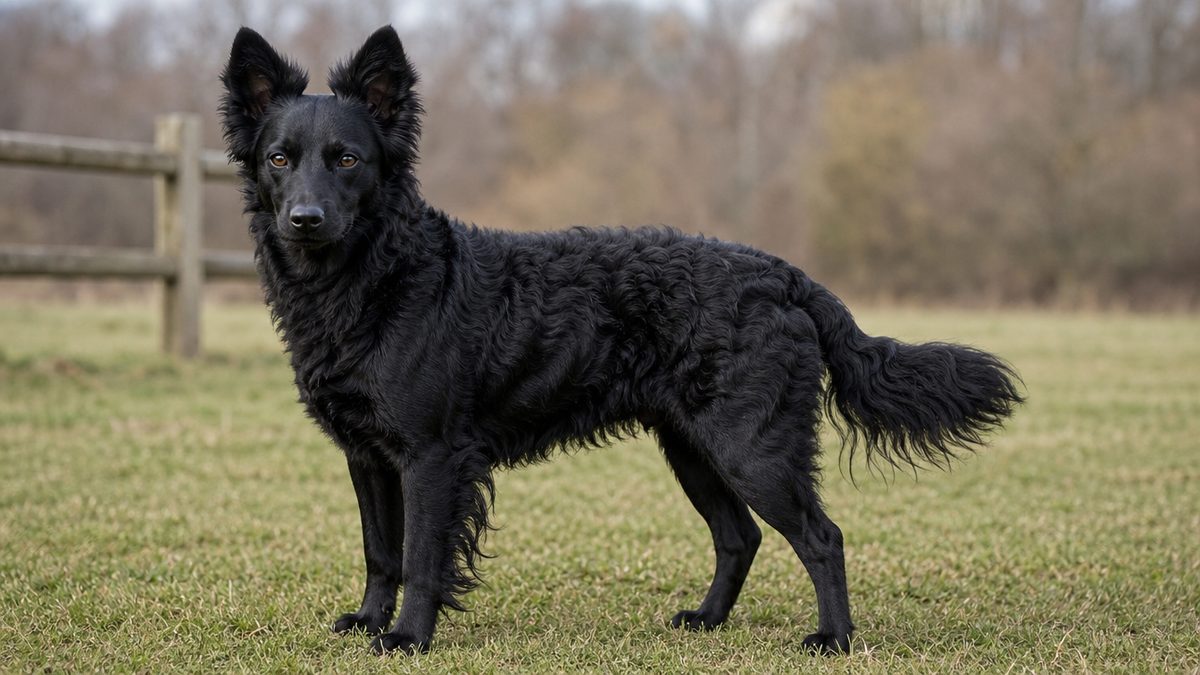
The Mudi is a medium-sized Hungarian herding dog of 41 to 47 cm, recognised by the Federation Cynologique Internationale as breed standard 238 in Group 1 Section 1 Sheepdogs, with erect prick ears, a wavy 3 to 7 cm coat and a topline that slopes distinctly to the rear. It is not a Puli and it is not a Pumi, and the difference is visible from across a room.
Bonbeno took the breed number off the FCI's own Group 1 index rather than assembling a URL, because an FCI address resolves on its trailing number and a guessed one serves another breed entirely. Hungary's entry on that index lists Komondor 53, Kuvasz 54, MUDI 238, Puli 55 and Pumi 56, and the Mudi row alone carries seven colour varieties. The register entry then confirms the detail: definitive acceptance on 25 March 1963, country of origin Hungary, not subject to a working trial, and an official authentic language of German.
The test: look at the head, not the body
Three Hungarian herders separated in the 1930s and English sources have been merging them ever since. The coat is what separates them, and the head is where you look first.
| Breed | FCI number | Coat on the head | Coat on the body | Ears |
|---|---|---|---|---|
| Mudi | 238 | Short, straight, smooth | Very wavy or slightly curled, 3 to 7 cm | Erect prick ears, reverse V |
| Puli | 55 | Corded, like the body | Felted cords hanging in ropes | Hanging, hidden in cords |
| Pumi | 56 | Curly, like the body | Curly and springy all over | Erect with tipped ends |
So the two-second test is this. If the head is short-coated and the body is wavy, it is a Mudi. If head and body are the same texture, it is one of the other two. The standard makes the point itself by disqualifying a Mudi with a short, smooth, flat coat on the whole body, a coat tending towards matting, wire hair, or long hair on the head. Each of those disqualifications is the standard pushing the breed away from a neighbour.
What the standard actually specifies
The measurements are unusually precise for a herding breed, and one figure is missing entirely.
- Height males 41 to 47 cm with an ideal of 43 to 45 cm, females 38 to 44 cm with an ideal of 40 to 42 cm.
- Weight is not stated. The FCI standard gives no weight figure at all, so every kilogram you read comes from somewhere else.
- Proportions length of body to height at withers 103 to 105 to 100, so the dog is only slightly longer than tall.
- Ears high set, erect, reverse V-shaped, roughly 10 to 15 percent longer than their width at the base, and able to turn independently of each other like a radar screen.
- Tail set at medium height, hanging in repose with the lower third raised almost to horizontal, carried in a sickle above the topline when the dog is alert.
- Bite complete scissor bite; anything else is a disqualifying fault.
Two clauses are worth flagging for an Indian reader. Dogs born with or without a natural stump tail are not regarded as a fault, so a bobtail Mudi is a normal Mudi and nobody has docked it. And drop ears are a disqualifying fault, which matters because a puppy's ears rise late and a seller can present an eight-week Mudi with soft ears as ordinary.
Where the weight figure comes from
Since the standard is silent, the only registry weight is the American Kennel Club's 18 to 29 pounds, which is 8.2 to 13.2 kg, alongside a height of 15 to 18.5 inches and a life expectancy of 12 to 14 years. The Indian listing page that ranks for this breed prints 12 to 20 kg instead. Its floor sits almost at the AKC's ceiling and its top is 51 percent above it, and its height range of 16 to 20 inches tops out at 50.8 cm, which is 3.8 cm above the maximum the breed standard permits for a male. Nobody could correctly reject a dog for being too small using that page, and nobody could correctly accept one either.
The page most Indian readers meet first dates FCI recognition to 1966. The FCI's own register says the breed was accepted on a definitive basis on 25 March 1963, and that register is the document that decides. The same page gives adult height as 14 to 18 inches while citing the AKC page, which prints 15 to 18.5 inches. Both errors are one click from being checked, and neither has been.
A breed nobody meant to make, and the Hungarian law that protects it
The Mudi came into being during the 18th to 19th century from crossing Hungarian herding dogs, most probably with various prick-eared German herding dogs, and it was not separated out as its own breed until 1936 The Royal Kennel Club. That late, accidental origin is exactly why the Hungarian Parliament's own wording matters.
The FCI standard's historical summary is one sentence long and it is candid: the breed arose from crossbreeding, the German contribution is admitted, and no ancient pedigree is claimed. The Royal Kennel Club puts the same point in plainer English, saying dogs resembling the Mudi have existed in Hungary since the 18th century but the breed was only formally recognised in 1936. The American Kennel Club adds the man and the mechanism: Dr Dezso Fenyes, born in Hungary in 1888 and died in Los Angeles in 1973, identified the type, and the breed is said to have evolved naturally from crosses of the Puli, Pumi and German Spitz. Then most of it was killed in the Second World War, which is why the modern population is small.
Resolution 32/2004, read in full
Hungary declared its listed animal breeds a national treasure by Parliamentary Resolution 32/2004 (IV. 19.) OGY, adopted at the National Assembly's sitting of 19 April 2004 and in force from 4 May 2004. Bonbeno read the complete Hungarian text on the National Legislation Database, annex included, rather than inheriting the finding from its own Komondor, Kuvasz and Magyar Agar pages.
| # | As printed in Hungarian | In English |
|---|---|---|
| 1 | Komondor | Komondor |
| 2 | Kuvasz | Kuvasz |
| 3 | Mudi | Mudi, this breed |
| 4 | Puli | Puli |
| 5 | Pumi | Pumi |
| 6 | Magyar agár | Hungarian sighthound |
| 7 | Rövidszőrű magyar vizsla | Short-haired Hungarian Vizsla |
| 8 | Drótszőrű magyar vizsla | Wire-haired Hungarian Vizsla |
| 9 | Erdélyi kopó | Transylvanian Hound |
That is nine entries, no more and no fewer, and the Mudi is third. Bonbeno's three earlier Hungarian pages recorded the identical list in the identical order, and this independent read finds no disagreement of any kind. One detail none of them recorded: the database's own change panel reads *nincs változás* under both 'has changed' and 'will change', so the resolution has never been amended in the twenty-two years since it came into force, despite paragraph 5 requiring the Government to review the list at least every five years.
Which of the resolution's three labels fits the Mudi
The instrument calls the same list three different things, and the difference decides how you should read a seller's 'national treasure' claim.
- The title says *védett őshonos vagy veszélyeztetett*, protected indigenous or endangered.
- Paragraph 1 says *védett őshonos és régi magyar*, protected indigenous and old Hungarian.
- Paragraph 6 flattens both, declaring everything in the annex to be Hungarian indigenous animals and symbols of Hungary.
The preamble settles it, and it settles it against the tidy reading. It states that species described as indigenous to the Carpathian Basin already had protection under the animal breeding act, but that the circle of old Hungarian domestic animal breeds is of a larger radius, because numerous breeds bred over a long period live in Hungary and form part of Hungarian national culture. The annex is deliberately the wider category.
The Mudi belongs in paragraph 1's 'old Hungarian' circle rather than paragraph 6's 'indigenous' one, and the evidence is the breed's own standard. A population that came into being in the 18th to 19th century by crossing local herders with German prick-eared dogs, and that was not identified as a breed until 1936, is a long-bred Hungarian breed of high genetic value. It is not an unbroken indigenous line. Our Magyar Agár page reached the same conclusion for that breed on the same reasoning, and the case is stronger here, because the Magyar Agár at least claims Magyar-conquest antiquity while the Mudi's standard dates the breed's origin itself to the last three centuries. This is not a criticism of the dog. It is a criticism of pages that quote 'national treasure' as though it certified a thousand-year pedigree.
One practical consequence. The resolution contains no provision at all about export, permits, prohibitions or moving an animal across a border. What it does contain is paragraph 2, committing the state to assist breeding and maintenance, and paragraph 3, calling on civil bodies, businesses and private individuals to join in. Nobody should be told a Mudi is unavailable in India because Hungary forbids it leaving. It is unavailable because nobody here breeds or imports one.
Mudi dog price in India: there is no price, and the search term is broken too
No honest mudi dog price in india exists, because no Mudi is verifiably offered for sale anywhere in the country. That is the first thing every ranking page fails to say, and the second thing none of them notices is that the obvious search term does not even return dogs.
Start with the search itself, because it explains why this breed is invisible here. Bonbeno ran 'mudi price in india' restricted to Indian results and got twelve results with not one dog among them: puffed rice from Varanasi, savuri mudi hair extensions from Chennai, jhal mudi snacks from Kanpur, and akki mudi, a Karnataka rice-storage measure. A labrador retriever price in india control run in the same session returned ten genuine Indian Labrador price pages, so the instrument was healthy and the emptiness belongs to the query.
The word collides four ways at once. It is *muri* or *mudi*, puffed rice, in Bengali; it is hair in Tamil and Telugu, which is what a savuri mudi hair extension is; it is a rice measure in Karnataka; and in the Indian medical literature mudi-chood is a hair-and-heat dermatosis of South Indian women, with case reports from Kerala going back decades. There is a fifth: Kora-Mudi is a tribal population in Paschim Medinipur, West Bengal, with its own published anthropometry. A breed name that means five other things in your own country is not a marketing problem. It is the reason the Indian internet has never written about this dog.
What the Indian pages that do rank are actually selling
Adding 'dog' to the query produces a real result set, and every Indian entry in it fails on inspection.
| Source | What it returned | Verdict |
|---|---|---|
| DogsIndia, the country's oldest breeder directory | HTTP 404, page title 'This Page Does Not Exist' | No page for the breed |
| DogsIndia Komondor page, the control | HTTP 200, full entry, 'There are no breeders listed currently under this breed' | URL pattern works, so the 404 is real |
| Happy Pet Care | HTTP 404, 'Our doggo tried really hard' | No page for the breed |
| Puppiezo, 'Mudi Puppies for Sale in India' | HTTP 200, eight animals in the carousel, zero Mudis | Selling other breeds |
| Good Dog, the top result for an Indian purchase search | HTTP 200, titled 'in Indiana' | Wrong country |
The Good Dog result deserves its own sentence. The number-one organic result for a search combining this breed with India is gooddog.com/mudi/in, whose page title reads '25 cute Mudi puppies for sale in Indiana' and whose own description promises 'Transportation to Indiana available';. The `/in` is the United States postal abbreviation for Indiana, not the country code for India. Bing itself flags the mismatch, annotating that result with 'Missing: india / Must include: india';.
The carousel, read row by row
Puppiezo's Mudi page returns HTTP 200 under the title 'Mudi Puppies for Sale in India - Limited Stock {Reserve Now}' and advertises 'KCI registered, responsible breeders'. Its block headed Available Mudi Puppies For Sale contains eight named animals, and Bonbeno read every row.
| Name | Breed the site itself gives | Price shown |
|---|---|---|
| Fizey | Maltipoo | ₹98,999 |
| Kuzo | Poodle | ₹92,599 |
| Dugu | Poodle | ₹92,599 |
| Kazuka | Cane Corso | ₹94,999 |
| Doir | Goldendoodle | ₹1,20,000 |
| Samy | Maltipoo | ₹98,999 |
| Tugi | Rottweiler | ₹76,499 |
| Yoki | Doxiepoo | ₹98,999 |
Eight animals, six breeds, no Mudi. And ₹98,999 appears three times on this one page, attached to two Maltipoos and a Doxiepoo. Bonbeno has now recorded that same figure, and this same cast of Fizey, Samy and Yoki, on a long series of unrelated breed pages on this site, including the Komondor and the Kuvasz. It is a house charm price attached to whatever puppy is in stock, not any breed's price, and it belongs to none of them.
The page's own images finish the argument. Both hero pictures are stock files, one named `istockphoto-1483086491-612x612-1.jpg` and the other an Adobe Stock number. A seller with a Mudi to sell photographs the Mudi.
Overseas breeders and clubs quote Mudi puppies in dollars and euros, and it would take one division to turn those into rupees. We will not, and neither should any page you read. A converted foreign price describes a foreign market with foreign transport, foreign veterinary costs and a supply chain that does not reach India. Bonbeno has caught Indian pages publishing dollar figures as rupees at 84.38, at 74 and at a flat 80, and one that simply deleted the dollar sign. The honest answer here is that there is no number, and a page that gives you one has made it up.
Could you import one, and what would Indian law say about breeding it
You could import a Mudi as your own pet and you could not import one to sell or breed, because the trade notice governing dog imports says applications for trading or breeding purposes shall be duly rejected. That single sentence is why no Indian supply chain for this breed can lawfully form.
Dogs sit under ITC(HS) 01061900 as a Restricted import. Entry is permitted for a pet accompanied by a valid pet book in the importer's own name, for research and development with a CPCSEA recommendation, or for Defence and Police use, and it is limited to seven named ports. So the route that exists is the route that ends with one dog living in one household. There is no lawful route that ends with Mudi puppies on an Indian classifieds site, which is worth remembering the next time one appears there. The full route is set out in how to import a dog to India.
The clause that lands squarely on this breed's own standard
Bonbeno downloaded the Prevention of Cruelty to Animals (Dog Breeding and Marketing) Rules 2017 gazette and extracted it with pypdf, 14 pages and 51,953 characters, then located each clause with a whitespace-tolerant search and read it in context. Two provisions matter here.
Second Schedule Part II paragraph 6(8) reads, verbatim: 'There shall be no tail docking, ear cropping de-barking, de-clawing, branding, dyeing, injecting substances to enhance visual appeal, performing a surgery or procedure to camouflage or hide any defect or infirmity or any other kind of mutilation of any body part of the pup and any change of appearance by artificial means is strictly forbidden.'
Now read the FCI standard's hindquarters clause: 'Dewclaws not desirable';. An overseas breeder reading that line removes them. An Indian breeder who did the same would be de-clawing, which paragraph 6(8) forbids outright. The word 'dewclaw' does not appear anywhere in the Rules, so nobody has carved out an exception, and the standard states a preference rather than a requirement. A Mudi in India keeps its dewclaws, and a judge who penalises it for that is asking an Indian owner to break the law.
The heat clause, and where it actually lives
The provision that governs keeping a heat-sensitive dog outdoors is Second Schedule Part IV paragraph 21(1), 'Outdoor housing facilities', and Bonbeno quotes it because it is routinely miscited as 'Rule 21'. The Rules themselves stop at Rule 13, so any citation numbered above that is wrong by construction; the string 'Rule 14' appears zero times in the gazette. Paragraph 21(1) bars keeping three categories in outdoor facilities without the attending veterinary practitioner's written approval:
- dogs that are not accustomed to the temperatures prevalent in the area or region in question;
- dog breeds that cannot tolerate those temperatures, 'such as long-haired breeds in high temperature locations'; and
- sick, infirm, aged or young animals.
A Mudi imported from a Hungarian winter falls into the first category on the day it lands, whatever you conclude about the second. Its coat is medium rather than long, so the illustration in limb (ii) does not obviously catch it, but limb (i) does not care about coat at all. Keep an imported Mudi indoors and get the written approval if you cannot.
And the clause that names the wrong things
Second Schedule Part III paragraph 8(10) lists the genetic defects a breeding dog must have been tested for, and Bonbeno read it verbatim: hip dysplasia, progressive retinal atrophy, night blindness, hypothyroidism, entropion, ectropion, overshot, undershot jaw, wry mouth, two or more missing teeth, and cryptorchidism.
The word 'merle' appears ZERO times in the whole gazette, and the word 'deaf' appears ZERO times as well. Bonbeno counted both in its own extraction. So Indian breeding law names night blindness and progressive retinal atrophy, which are eye conditions, while saying nothing about the coat gene that causes eye and hearing defects in this breed and nothing about hearing at all. The clause opens with 'including', so the list is illustrative rather than closed, and a careful breeder is not excused. But nobody can be prosecuted in India for producing a deaf double-merle puppy under a clause that never mentions deafness.
Rule 8(1)(a), a genuine Rule rather than a Schedule paragraph, separately requires that pups less than eight weeks in age are not sold. Any Indian seller offering an eight-week Mudi is quoting the legal minimum, not a recommendation.
Cost of ownership in India for an 8 to 13 kg working dog
Budget Rs 3,000 to Rs 6,000 a month to keep a Mudi-sized dog properly in an Indian metro, inside a national range of Rs 3,000 to Rs 10,000 that covers every size of dog. There is no breed price to add to that, so for once the cost of ownership is the whole financial question.
Bonbeno normally runs a template test here, because Indian breed directories publish running-cost tables that are shared constants across unrelated breeds rather than observations about any of them. That test cannot be run for the Mudi, and the reason is itself the finding: Happy Pet Care, the site whose tables Bonbeno has repeatedly caught reusing identical food, veterinary and grooming lines across breeds with nothing in common, returns HTTP 404 for this breed under the message 'Our doggo tried really hard';. There is no boilerplate cost table to expose, because the boilerplate machine has never been pointed at this dog.
What remains is better anyway. The figures below come from the Voice of Stray Dogs cost guide, an Indian source writing about Indian dogs in rupees, and they apply to any healthy 8 to 13 kg dog living here.
| Line | Published Indian range | What it means for this breed |
|---|---|---|
| Food, small to medium dog | Rs 500 to Rs 4,000 per month | A 10 kg active dog sits mid-range, near Rs 1,500 to Rs 2,500 |
| Routine consultation | Rs 500 to Rs 1,000 per visit | Twice a year for a healthy adult |
| Annual vaccination | Rs 1,500 to Rs 3,000 | Non-negotiable, and rabies is a legal expectation |
| Preventive care, done properly | Rs 5,000 to Rs 8,000 per year | Vaccines, deworming, tick and flea control, one blood profile |
| Grooming session | Rs 300 to Rs 2,000 | Low end for this coat; it needs a brush, not a clip |
| Basic training course | Rs 5,000 to Rs 15,000 | Train this breed or it trains itself, which costs more |
| Professional dog walker | Rs 3,000 to Rs 6,000 per month | Likely if nobody is home for the daily hour |
| Boarding | Rs 500 to Rs 2,000 per day | A ten-day trip is a real line item |
| Dental cleaning under anaesthesia | Rs 3,000 to Rs 8,000 | Relevant: OFA records dentition faults in 3.8% of 105 Mudis |
| One to three day hospitalisation | Rs 8,000 to Rs 30,000 | The reserve fund most owners never build |
The first year, and the whole life
The first month alone runs Rs 15,000 to Rs 25,000 before anything unexpected happens, covering a starter kit at Rs 2,000 to Rs 5,000 and the first vaccinations plus a health check at another Rs 2,000 to Rs 5,000. The first full year lands between Rs 30,000 and Rs 80,000, and across a 12 to 14 year life the total sits between Rs 3 lakh and Rs 10 lakh depending on city and standard of care.
City changes the answer by roughly three quarters. The same guide observes that a dog costing Rs 4,000 a month in Pune costs about Rs 7,000 in South Delhi for identical care, because veterinary, grooming and boarding fees all move together.
The two lines that are specific to this breed
Most of the table above is size-driven and would read the same for any 10 kg dog. Two lines are not.
- Screening you cannot buy locally. If you follow the OFA and the American parent club, a breeding Mudi needs hip and elbow radiographs, an ACVO eye examination, a patella grading and a cardiac evaluation. An ACVO-equivalent ophthalmologist examination and a confident orthopaedic grading are metro-only services in India, and there is no Indian scheme that records the results anywhere a future buyer could verify them.
- Enrichment, which is not optional here. A herding dog that gets a walk and nothing else invents work. Budget for puzzle feeders, a long line for scentwork in a park, and a sport class if one exists in your city. This is the cheapest line on the page and the one that decides whether the dog is pleasant to live with.
We are not going to give you a breed-specific Indian monthly figure to the rupee, because nobody in India has kept enough Mudis for such a figure to exist. Every number above is honestly a figure for a dog of this size in this country, and we would rather say that than manufacture precision.
Indian heat and humidity, measured by coordinate rather than asserted
The Mudi tolerates Indian heat better than any Hungarian guardian breed and far worse than any Indian one, which is why Bonbeno rates its heat tolerance 3 of 5. The decisive number is not the peak temperature, it is that Chennai's coolest month is warmer than the Hungarian plain's hottest.
Bonbeno queried NASA POWER by explicit latitude and longitude and recorded the grid-cell elevation each point returned, because that model answers for a cell rather than a place and has been caught reporting a hill station as a plain. On the Hungarian plain the cells are trustworthy: Hortobagy came back at 96.82 m against a real elevation near 90 m, Debrecen at 121.33 m against a real 121 m, and Budapest at 178.05 m against 102 m, a divergence of 76 m. Those are the tightest homeland figures Bonbeno has recorded for any breed.
| Place | Cell elevation | Annual mean | Coldest month | Hottest month | Annual humidity |
|---|---|---|---|---|---|
| Hortobagy, Hungary | 96.82 m | 11.44 C | Jan −1.67 C | Jul 23.54 C | 73.3% |
| Debrecen, Hungary | 121.33 m | 11.43 C | Jan −1.59 C | Jul 23.43 C | 73.3% |
| Chennai | 48.95 m | 27.95 C | Jan 24.09 C | May 31.51 C | 72.4% |
| Mumbai | 97.15 m | 26.77 C | Jan 23.19 C | May 31.19 C | 67.4% |
| Delhi | 206.37 m | 25.60 C | Jan 13.61 C | Jun 35.88 C | 45.6% |
| Kolkata | 7.35 m | 25.81 C | Jan 17.31 C | May 31.53 C | 73.9% |
| Bengaluru | 841.72 m | 23.74 C | Dec 20.22 C | Apr 28.37 C | 67.9% |
| Pune | 635.99 m | 23.86 C | Dec 19.62 C | Apr 28.93 C | 66.8% |
Read the Chennai row against the Hortobagy row. Chennai's coldest month averages 24.09 C. The Hungarian plain's hottest month averages 23.54 C. The coolest week of a Chennai year is warmer than the hottest week the breed's homeland has ever offered it, and the annual gap is 16.51 C.
The half of this that argues for the dog
Bonbeno is not going to pretend this is a Nordic breed, because the data says otherwise. The Great Hungarian Plain is a continental grassland with a real summer: the Hortobagy cell returns a July mean maximum of 41.22 C, and Kecskemet returns 41.60 C. A Mudi's ancestors worked sheep through that. Compare Chennai's May mean maximum of 42.70 C and the peaks are close.
Humidity is the same story. The Hungarian plain runs an annual mean relative humidity of 73.3 percent against Chennai's 72.4 and Kolkata's 73.9. This breed is not walking into an unfamiliar level of moisture in the air.
The half that decides it
What changes is duration and recovery. Hungary gives the dog four months below 6 C to shed load, moult and rebuild. Chennai's coldest month is 24.09 C and its warmest is 31.51 C, a spread of 7.4 C across an entire year, and Mumbai's is 8.0 C. There is no off-season. A double-coated working dog in Chennai is carrying a continental coat through a permanent Hungarian July, and the coat is 3 to 7 cm of dense wavy hair rather than a summer jacket it can take off.
The bodyweight evidence is worth stating precisely, because it is often stretched. Hall 2020 in *Scientific Reports* found that dogs at or above their breed and sex mean bodyweight carried odds of 1.42 for heat-related illness, 95% CI 1.12 to 1.80, across 905,543 UK dogs. The over-50 kg band from the same paper does not apply here at all, because a Mudi is nowhere near it. The transferable point is the one that fits: a fat Mudi is a heat-vulnerable Mudi, and body condition is the single risk factor an Indian owner fully controls.
The companion paper in *Animals* is where the mechanism sits. Of 1,259 heat-related illness events from 1,222 dogs, 879 had a recorded trigger, and 652 of those 879, or 74.2 percent, were exertional rather than caused by hot cars. That is a finding about a dog running, not a dog parked. An owner who takes an eager herding breed for a proper afternoon exercise session in April is running exactly the experiment that paper describes.
Shimla and Ooty look like the obvious answer for a temperate breed, and NASA POWER cannot give you an honest figure for either. The Shimla cell came back at 897.65 m against a real 2,200 m, understating the elevation by 1,302 m, and the Ooty cell at 784.64 m against 2,240 m, understating it by 1,455 m. Both cells therefore report a climate far warmer than the town. Applying the standard lapse rate of about 6.5 C per 1,000 m to Shimla's 21.15 C cell mean gives an estimate near 12.7 C, which is close to the Hungarian plain's 11.44 C. Bonbeno publishes that as an estimate and labels it one. If you live in a genuine hill station the breed's climate problem largely disappears, and we cannot measure your town for you with this instrument.
Temperament and household fit: the smartest dog on this site, and the loudest
The Mudi is an alert, vocal, intelligent working dog that bonds hard to its own family and announces everything else, and the FCI standard opens its temperament clause with the words 'extremely able to learn'. That is a gift in a house with a job for it and a problem in a flat without one.
The standard's full description runs: extremely able to learn, of lively temperament, courageous, watchful, keen to work, alert and adaptable. It then asks that the head give the impression of an alert, always energetic, cheerful and intelligent animal without any trace of timidity or aggressiveness, and disqualifies any dog that is aggressive or overly shy. Read those together and you get the intended dog: confident, busy, opinionated, not hard.
The intelligence is measured, not claimed
The American Kennel Club's own summary reaches for the same words, calling the Mudi an extremely versatile, intelligent, alert, agile, all-purpose Hungarian farm dog whose courage is useful for working the most stubborn livestock. An agile dog in a small flat is not a compliment; it is a warning about your furniture.
Almost every breed page on the internet calls its subject intelligent. For the Mudi there is a controlled study. Hungarian researchers gave English bulldogs, French bulldogs and Mudis a box containing a food reward and recorded who opened it. Both brachycephalic breeds were significantly less successful than the mudis and took longer, and they oriented less at the problem box and more at the humans present, while the Mudis worked the box.
That result is more useful in India than it looks. The two breeds the Mudi beat are among the flat-faced breeds Indian buyers actually own in numbers, and the paper's own reading is that the bulldogs' human-directed behaviour is read by owners as endearing dependence. A Mudi will not look at you for help. It will open the box. If you wanted a dog that defers, this is the wrong dog.
The barking is a documented feature
This breed is the reference animal for an entire line of canine bark research, which tells you something. A study analysing Mudi barks classified the caller's sex with 85.13 percent accuracy, age with 80.25 percent, the situation among seven contexts with 55.50 percent and the individual dog among eight with 67.63 percent, using acoustic features alone. Those are the numbers of a vocal repertoire carrying real information.
For an Indian apartment that translates directly. The Royal Kennel Club files the breed under town or country: country, with a small house and a small or medium garden. A corridor delivering a stranger every few minutes gives an alert herding dog something to report all day, and its ears, which the standard says turn independently like a radar screen, will find the lift before you do.
Who should buy this dog
- Households with ground-floor access or a garden, where the dog can patrol without narrating a shared corridor.
- Owners who want a sport partner, because the breed genuinely competes in agility, obedience, rally, flyball and herding trials.
- People home much of the day, since a bored Mudi is a destructive Mudi and there is no polite version of that sentence.
- Second-time owners at minimum. The Royal Kennel Club says outright that the breed is best suited to an experienced owner who can provide stimulation, structure and purpose.
Who should not
- Anyone in a noise-sensitive building. This is the single commonest reason a working herder is rehomed in an Indian city.
- Anyone whose plan is a twenty-minute walk. The requirement is an hour and it is not negotiable.
- Households wanting a first, easy family dog. A Indian Pariah Dog is easier, cheaper, heat-adapted and available.
- Anyone buying on rarity. A dog you cannot obtain, cannot verify and cannot screen is not a status purchase, it is an unknown.
The standard asks for no aggression and no timidity, and the breed is generally described as good with a family it knows. It is still a herding dog, which means the instinct to control movement fires at running children, cycles and scooters. That is manageable with early work and it does not go away. Nobody has published an Indian behavioural series on this breed, so treat every temperament claim here, including ours, as coming from a European standard and a handful of studies rather than from Indian households.
Training a dog that learns faster than you can correct it
Train a Mudi with short, varied, reward-based sessions and it will outpace you, because this is a breed the FCI standard describes as extremely able to learn and a study showed solving problems faster than the breeds most Indian owners keep. Drill it and it will get bored and start improvising.
Start from what the dog was for. The standard's utilisation clause says the breed is popular with shepherds for herding large and difficult livestock, is even used for the battue of wild boar, and makes an excellent guard, watch and alarm dog. The American parent club confirms that Hungarian shepherds still work Mudis on flocks of up to 500 sheep Mudi Club of America, the AKC parent club. That is a dog bred to make its own decisions at distance from its handler and to keep making them for hours.
What works
- Keep sessions short. Five minutes, several times a day, beats one long block. This breed reaches the answer early and then invents variations.
- Vary the task. Repetition is what loses a Mudi's attention, not difficulty.
- Pay well and pay fast. Timing matters more than the size of the reward with a dog this quick.
- Give the bark a job. Teach a 'speak' and a 'quiet' cue early, so that barking becomes something you can switch rather than something you suppress.
- Build a real recall before the prey drive matures. A herding dog that has learned chasing works is very hard to argue with afterwards.
What this breed resists
Correction-based handling, mostly. A dog described as courageous and without timidity does not shut down obligingly, and the standard disqualifies both aggression and excessive shyness, which tells you the breed was never selected to absorb pressure quietly. Push a Mudi and you get argument, not compliance.
The second resistance is to inactivity. There is no published Indian training literature on this breed at all, so what follows is inference from its own standard rather than observation: a dog with this much drive, in a flat, with one walk, will find work. Herding a household is work. Patrolling a balcony is work. Barking at the corridor is work.
The Indian timing problem, and how to solve it
The training constraint here is not the dog, it is the clock. The daily hour has to happen when it is safe to move, and in most Indian cities that means before sunrise and after full dark for eight months. That squeezes socialisation, because the puppy's critical window does not pause for the weather.
- Socialise indoors and in the dark. Car parks, stairwells, lift lobbies and quiet streets after 8 pm give you novelty without heat.
- Use scentwork as the substitute. A ten-minute indoor search tires a herding dog more than a mile of pavement, and it costs nothing.
- Do the thinking work in the middle of the day and the physical work at the edges. That single scheduling decision is what makes this breed liveable here.
If you ever consider a de-barking procedure for the noise, do not. Second Schedule Part II paragraph 6(8) of the Dog Breeding and Marketing Rules 2017 names de-barking alongside tail docking, ear cropping and de-clawing as strictly forbidden, and Bonbeno read that clause verbatim in the gazette. The bark is the breed. If you cannot live with it, this is not your dog.
Daily exercise: an hour, and almost none of it in daylight
Give a Mudi about an hour of real movement a day plus genuine mental work, and in most of India schedule that hour before sunrise and after full dark for eight months of the year. The Royal Kennel Club budgets up to one hour per day, and the Indian listing page that ranks for the breed prints 60 minutes on its own spec card Puppiezo, Mudi Puppies for Sale in India.
Those two sources agree, which is rare enough on this page to be worth noting. The disagreement is about what fills the hour. A herding breed that is walked for sixty minutes on a lead and given nothing to think about is exercised and not satisfied, and the difference shows up as barking, digging and door-charging rather than as tiredness.
What a week should contain
- Two walks a day, roughly 30 minutes each, at the cool ends of the day.
- Two or three scentwork sessions, ten minutes each, indoors. Hide food, let the dog find it, increase difficulty weekly.
- One long-line session in a safe open space per week, where the dog can gallop rather than pace.
- Daily trick or obedience practice, five minutes. This is the load-bearing item for a breed this quick.
- A sport class if your city has one. Agility, rally and flyball all suit the breed and all exist in Indian metros in small numbers.
The Indian walking window, city by city
The heat data decides the timetable. Using the NASA POWER monthly means, the windows look like this.
| City | Hottest month mean | Months needing a dawn and dusk schedule | Practical window |
|---|---|---|---|
| Chennai | May 31.51 C | All twelve | Before 6.30 am and after 8 pm, year round |
| Mumbai | May 31.19 C | All twelve | Before 6.30 am and after 8 pm, year round |
| Kolkata | May 31.53 C | March to October | Dawn and after dark for eight months |
| Delhi | Jun 35.88 C | March to October | Dawn only in May and June; winter is genuinely comfortable |
| Pune | Apr 28.93 C | March to May | Workable mornings and evenings for most of the year |
| Bengaluru | Apr 28.37 C | March to May | The easiest large Indian city for this breed |
Delhi is the interesting row. Its June mean of 35.88 C is the harshest number on the page, and its January mean of 13.61 C is the closest any Indian metro comes to a Hungarian spring. A Delhi Mudi has four genuinely good months and four genuinely dangerous ones, which is a different management problem from Chennai's flat, permanent warmth.
What happens without it
The failure mode is predictable and it is not subtle. An under-exercised herding dog herds the household: it circles children, nips at heels, blocks doorways and barks at movement. Owners read that as aggression and rehome the dog. It is not aggression, it is unemployment, and the FCI standard's own words for the breed, keen to work, describe exactly the appetite being frustrated.
Do not run this dog in Indian afternoon heat because it looks willing. It will look willing. Hall 2020 in Animals found that of 879 heat-related illness events with a recorded trigger, 652, or 74.2 percent, were exertional rather than caused by hot cars, and an eager working breed is precisely the animal that keeps going past the point it should stop. Test the pavement with the back of your hand before you set off.
Grooming a wavy coat in Indian humidity: less work than you expect
Brush a Mudi thoroughly once a week and dry it properly after every wetting, and that is essentially the whole routine. The Royal Kennel Club records grooming as once a week with a medium coat length, and the coat needs no trimming at all.
The standard describes what you are working with. The head and the front of the limbs carry short, straight, smooth hair. Everywhere else the coat is uniformly very wavy or slightly curled, dense, always shiny, and about 3 to 7 cm long, forming cow-licks and ridges at some spots and pronounced feathering on the backs of the forearms, the upper thighs and the bottom edge of the tail. Crucially, the standard disqualifies a coat tending towards matting. Unlike its corded cousin the Komondor, a correct Mudi coat is not supposed to felt, and a Mudi whose coat is matting has either a fault or an owner who has stopped brushing.
The weekly routine that works here
- Brush the whole body with a slicker, then a comb through the feathering behind the forearms, the breeches and under the tail. Those three places are where mats start.
- Skip the head and lower legs, which are short-coated and need nothing but a wipe.
- Check the ears weekly. Erect ears drain and ventilate well, which is a real advantage in an Indian monsoon, but check anyway.
- Dry the dog properly after any bath, swim or monsoon walk. Towel first, then air with a fan, and pay attention to the feathering where damp sits longest.
- Trim nothing. The coat is presented naturally and clipping a double coat in Indian heat removes insulation that works both ways.
Where overseas advice does not transfer
Put a number on the problem before deciding it is one. Mumbai and Pune both run above 89 percent relative humidity through July and August, and Chennai sits at 80 to 82 percent from October to November, so for roughly four months of the year an Indian coat is drying into air that is already humid enough to slow it down. A Hungarian autumn, at 74 percent in October, gives the same coat an easier job.
Breed-club grooming guidance for European and American owners routinely says to towel a dog and let it air dry. In a Hungarian autumn that is fine. In an Indian monsoon, with ambient humidity above 85 percent for weeks in Mumbai and Pune, a dense wavy coat left to air dry stays damp for hours, and damp dense coat against skin in warm air is where hot spots and pyoderma begin. Dry the dog actively, with a towel and a fan at minimum.
Shedding is honest here and nobody pretends otherwise. The Royal Kennel Club records 'sheds: yes' and the Indian listing page prints 'Shedding YES' on its own spec card, which is one of the few things that page gets right Puppiezo, Mudi Puppies for Sale in India. No breed is hypoallergenic, and the Mudi is not sold as one, which spares this page an argument it has had to have elsewhere.
The grooming risk nobody mentions
It is not the coat, it is the skin under it during the monsoon. A dense wavy coat over warm damp skin, on a dog exercising at dawn through wet grass, is a good environment for fungal and bacterial skin disease and for ticks. That is a general Indian dog problem rather than a Mudi problem, but the coat makes it easier to miss until it smells.
This is the low-maintenance coat of the Hungarian herding group, and by a wide margin. A Komondor's corded coat takes 12 to 18 hours to dry with high-speed dryers and has to be separated by hand every week. A Mudi takes a weekly brush and a towel. If a Hungarian breed is what you want and Indian humidity is what you have, the Mudi is the sane end of that family.
Health issues, screening, and two registries that flatly contradict each other
Screen a Mudi's hips, elbows, eyes, patellae and heart, because that is what the Orthopedic Foundation for Animals and the American parent club require for a health certificate, and the underlying numbers for this breed are genuinely good. The Royal Kennel Club, looking at the same dog, states that it has no recommended pre-breeding health screening in place at all.
Bonbeno read the OFA code out of OFA's own markup rather than guessing it. The Mudi is MDI, filed under Herding, and the adjacent entry `MU` belongs to the Munsterlander, which is exactly the collision that has served three previous agents on this project another breed's statistics. The page returned under that code prints MUDI as its own heading and carries MUDI as its page title, so the tables below are this breed's.
| Registry | Evaluations | Normal | Abnormal | Rank | Breakdown |
|---|---|---|---|---|---|
| Hips | 442 | 91.6% | 7.2% | 156 | Excellent 30.1, Good 55.0, Fair 6.6; Mild 5.9, Moderate 1.1, Severe 0.2 |
| Elbows | 442 | 98.6% | 1.4% | 134 | Every abnormal case is Grade 1; Grades 2 and 3 are zero |
| Eyes | 732 | 97.7% | 2.3% | 201 | Summary line only; per-diagnosis detail rows were not reachable |
| Patella | 418 | 96.2% | 3.8% | 54 | Grade 1 2.9, Grade 2 0.7, Grade 3 0.2 |
| Basic cardiac | 176 | 100.0% | 0 | 89 | No abnormal result on record |
| Dentition | 105 | 96.2% | 3.8% | 47 | |
| Thyroid | 76 | 90.8% | 1.3% | 98 | Autoimmune 0.0, compensative 0.0, idiopathic hypothyroidism 1.3, equivocal 7.9 |
Every row reconciles against its own counts, which is worth saying because Bonbeno has caught OFA tables failing exactly that check on other breeds. The hips row: 133 Excellent plus 243 Good plus 29 Fair equals the 405 normal dogs, and 26 mild plus 5 moderate plus 1 severe equals the 32 dysplastic, and 405 plus 32 plus 5 equivocal equals 442. The hip dysplasia figure of 7.2 percent sits well under OFA's all-breed rate, and it is roughly half the Kuvasz figure of 17.6 percent.
The contradiction, stated plainly
Two national registries publish opposite advice about the same breed on the same day.
| Registry | Recommended pre-breeding screening |
|---|---|
| Orthopedic Foundation for Animals, with the AKC parent club | Five required: hip radiograph or PennHIP, elbow radiograph, ACVO eye examination, patellar luxation grading, cardiac evaluation. Three optional: autoimmune thyroiditis, DNA-based MDR1, DNA repository |
| The Royal Kennel Club | 'At this time this breed does not have any recommended pre-breeding health screening in place' |
Bonbeno does not think either body is being careless. The OFA list is a CHIC programme built with an American parent club that has 442 hip evaluations behind it; the Royal Kennel Club recognised the breed only in 2025 and has not yet built a scheme. But an Indian buyer reading the British page would conclude no screening is needed, and that conclusion is wrong. Follow the OFA list.
The one screen that is easy to miss
The optional MDR1 multi-drug sensitivity DNA test is on the OFA's list for this breed, and it is the cheapest and most consequential item on it. MDR1 is a herding-breed gene, and a dog carrying two copies can be harmed by ordinary doses of common veterinary drugs including some antiparasitics. It is a one-off cheek swab that can be run from India on an imported sample, and it changes what a vet may safely prescribe for the rest of the dog's life. Test for it before you need to know.
OFA's eye registry publishes a summary line and a set of per-diagnosis detail rows, and on many breeds those two disagree sharply, with the summary reporting a far higher normal rate than the diagnoses beneath it. Bonbeno could not retrieve the Mudi's detail rows in this session. The 97.7 percent normal figure above is therefore the summary line and nothing more, and its absence of contradiction here is evidence about what we could see, not evidence that no contradiction exists.
The merle problem, and why it matters more in this breed than most
Merle is a recognised colour in the Mudi rather than a fault, which makes double-merle breeding a live risk rather than a theoretical one. The FCI lists Cifra (merle) as one of seven colour varieties, and a Hungarian study of 123 Mudis found the classic merle genotype in 61.8 percent of them Pelles Z, Gaspardy A, Zoldag L, Lenart X.
The standard is explicit about it. The colour clause names black, white, fawn from beige to red, ash (blue), liver (brown), ash-brown, and Cifra (merle), meaning pigmented patterns of the above colours diluted by the merle factor. It then adjusts the pigment rules accordingly: for merle varieties of liver and ash-liver the nose is brown, for ash and its merle varieties the nose is blue, and for merle colours partially or solid, blue eye colour is not a fault. A blue eye in a merle Mudi is correct, which is not true of most breeds.
One number frames the rest. Bonbeno saved OFA's full disease-statistics dump, 2,231,869 characters, and searched it case-insensitively: MUDI appears 34 times against a LABRADOR control of 109, so this breed is genuinely present in the registry rather than absent. A merle coat is therefore not an exotic outlier in a breed nobody records; it is a common, documented coat in a breed with 442 hip evaluations behind it.
What the study actually found
Pelles and colleagues at the University of Veterinary Medicine Budapest genotyped 123 Mudi samples from 11 countries, measuring the exact length of the merle allele insertion by automated fluorescent capillary fragment analysis rather than judging by eye.
| Genotype | Share of the sample |
|---|---|
| Classic merle (m/M) | 61.8% |
| Mosaic profiles | 17.9% |
| Harlequin (m/Mh) | 13.8% |
| Atypical (m/Ma and m/Ma+) | 5.7% |
| Double merle (M/M) | 0.8% |
The authors' own conclusion is the practical one, and it is the sentence every Mudi buyer should read: not only visibly merle dogs carry the insertion, but so do hidden merle individuals, where the merle phenotype is fully covered by a pheomelanin-dominated colouration, and those dogs are potentially capable of producing unintentionally homozygous double merle progeny with ophthalmologic, viability and auditory impairments.
Why a fawn Mudi can be a merle Mudi
That is the trap. In a breed whose recognised colours include fawn from beige to red, a merle pattern laid over red pigment can be effectively invisible. Two apparently non-merle fawn parents can both carry the allele. The resulting M/M puppies are the ones with the eye and hearing problems, and no coat inspection at any age would have predicted them.
The only defence is the DNA test, and it is a length measurement rather than a yes or no, because the study shows the allele comes in classic, atypical, harlequin and mosaic forms that behave differently. A breeder who says 'neither parent is merle' has told you what the dogs look like, not what they carry.
And here is where Indian law leaves the reader alone
Bonbeno searched the full gazette text of the Dog Breeding and Marketing Rules 2017, 51,953 characters extracted with pypdf, for the words that would make this a regulated risk in India.
| Term | Occurrences in the gazette |
|---|---|
| progressive retinal atrophy | 1, inside Second Schedule Part III para 8(10) |
| night blindness | 1, in the same clause |
| merle | 0 |
| deaf | 0 |
Indian breeding law requires a breeding dog to have been tested for two eye conditions and names neither the coat gene that causes eye and hearing defects in this breed nor hearing itself. Paragraph 8(10) opens with the word 'including', so the list is illustrative and a careful breeder is not excused by it. But an Indian buyer offered a merle-to-merle Mudi litter has no statutory protection to point at, and would have to make the argument from the paper rather than from the Rules.
Life expectancy, the five papers that exist, and the search that lies to you
Twelve to fourteen years is the life expectancy every registry prints, and none of it comes from a mortality study. What does exist is five genuine peer-reviewed papers naming this breed, and a PubMed search that returns 46 records of which most are about a Kerala skin disease.
Take the lifespan first, because it is the number buyers ask for. The American Kennel Club gives 12 to 14 years, the Indian listing page gives 12 to 14, and the Royal Kennel Club gives only 'over 10 years'; The Royal Kennel Club Puppiezo, Mudi Puppies for Sale in India. Those are breed-club and registry estimates, not cohort figures. The two large UK datasets this site leans on for longevity, the VetCompass life tables and the Dogs Trust breed-longevity work, do not carry a row for this breed McMillan KM, Bielby J, Williams CL. Bonbeno therefore publishes no cohort-derived median for the Mudi, and will not borrow a Border Collie's, because a herding breed of similar size is not the same population.
The five papers, and what each one is good for
Bonbeno ran the search through PubMed's own interface rather than a snippet, and read every abstract back before counting it. The query 'Mudi dog' returns six records under a clean translation, five of which genuinely concern this breed.
| Paper | Year | What it establishes |
|---|---|---|
| Pelles and colleagues, *Acta Veterinaria Hungarica* | 2019 | Merle genotypes in 123 Mudis from 11 countries, and the hidden-merle risk |
| Vörös and colleagues, *Acta Veterinaria Hungarica* | 2009 | Echocardiographic reference values from 28 Mudis among 95 Hungarian dogs |
| Larrañaga and colleagues, *Animal Cognition* | 2015 | Bark acoustics classify sex at 85.13% and age at 80.25% in this breed |
| Ujfalussy and colleagues, *Scientific Reports* | 2023 | The Mudi outperforms English and French bulldogs on a problem-solving task |
| Mihelić and colleagues, *Collegium Antropologicum* | 2013 | Early Bronze Age crania from Vučedol resemble a Croatian sheepdog or Hungarian Mudi type |
The Vörös study is the useful one clinically, because it gives an Indian vet something to measure against. It reports M-mode and two-dimensional echocardiographic reference values for three Hungarian breeds, and in Mudis specifically it found the left atrial to aortic diameter ratio correlated with body weight, with age, and with E point to septal separation. A vet reading a Mudi heart against generic canine reference ranges has no breed-specific baseline; this paper is the baseline.
The Mihelić paper is worth reading carefully rather than quoting loosely. It analyses seven crania and ten half-mandibles from an Early Bronze Age site in East Slavonia and concludes the dogs correspond in size and form to a smaller breed, 'in the first place a type of Croatian sheepdog or Hungarian Mudi';. That is a statement about resemblance of type, not a claim of ancestry, and anyone using it to argue that the Mudi is four thousand years old has read it wrong.
The search that returns everything except the dog
Searching the bare string is where this breed is unusual, and the failure is specifically Indian.
- `Mudi[tiab]` returns 46 records, and most of them are not about a dog.
- The largest single group is mudi-chood, a hair-and-heat dermatosis of South Indian women, with case reports and dermoscopy studies from Kerala and beyond.
- The next is Kora-Mudi, a tribal population in Paschim Medinipur, West Bengal, with published child undernutrition data.
- Then MUDI, the Male Urogenital Distress Inventory, a urology questionnaire with its own validation literature.
- Then Mudi, a bioinformatics web tool for identifying mutations from whole-genome sequence.
- Then Mudi RK, an author surname on control-systems papers.
A `labrador retriever hip dysplasia` control run in the same session returned 126 on-topic records, so the instrument was working. The 46 is real; it is simply not literature about this breed. A count is not coverage, and anyone reporting that the Mudi has forty-six papers has read a number instead of a result set.
That it is unusually well documented for a rare breed and unusually little discussed. There are 442 hip and elbow evaluations, 732 eye examinations, a full CHIC screening programme, and a 123-dog genotyping study of its riskiest coat colour. What there is not is a single Indian paper, a single Indian breeder, or a single Indian veterinary series. Everything on this page is European and North American data applied honestly to an Indian setting, and we would rather say that than pretend otherwise.
Feeding a 10 kg working dog in India, and the number that changes the risk
Feed a Mudi as a small-to-medium active dog, roughly Rs 1,500 to Rs 2,500 a month on quality food, and weigh it monthly, because body condition is the one heat risk factor an Indian owner completely controls.
Get the target weight straight first, because two sources disagree and neither is the breed standard. The FCI standard states no weight at all. The American Kennel Club publishes 18 to 29 pounds, which is 8.2 to 13.2 kg. The Indian listing page prints 12 to 20 kg. Follow the AKC range, because it is the only registry figure in the set, and treat your own dog's ribs as the real guide.
Why the weight number is a heat number
This is the practical link between the feeding section and the climate section, and it is the single most actionable sentence on the page. Hall 2020 in *Scientific Reports* found that dogs at or above the mean bodyweight for their breed and sex carried odds of 1.42 for heat-related illness, with a 95 percent confidence interval of 1.12 to 1.80, across 905,543 UK dogs. You cannot change your dog's coat, its breed or Chennai's climate. You can keep it at 10 kg rather than 13.
There is a second reason to care in India specifically. The AKC range's midpoint is about 10.7 kg, and an overweight Mudi at 15 kg is 40 percent above that, carrying the extra load through a climate with no cool season in which to recover.
Life-stage feeding
- 8 to 16 weeks: four meals a day of a growth diet for small-to-medium breeds. Do not use a large-breed puppy formula; this dog will not reach 25 kg and does not need the calcium restriction that formula is built for.
- 4 to 8 months: three meals a day. This is when a herding puppy's energy outruns its judgement, so measure rather than free-feed.
- 8 to 12 months: two meals a day, moving to adult food around ten to twelve months.
- Adult: two meals a day, split around the exercise sessions rather than immediately before them.
- Senior, from about nine years: the same food in smaller portions, plus a vet check for joints and thyroid, since OFA records 7.9 percent equivocal thyroid results in this breed.
What is actually available in India
Everything this dog needs is sold here, which is a change from most sections of this page. Indian and imported small-to-medium adult and puppy formulas are widely available in metros and online, and the Voice of Stray Dogs guide puts quality food for a dog this size at Rs 500 to Rs 4,000 a month depending on size and brand. A 10 kg active dog sits in the middle of that.
Home-cooked feeding is common in Indian households and workable here, with the usual caveat: a home diet without veterinary formulation drifts toward too much rice and too little calcium, and a growing herding puppy is the worst animal to get that wrong on. If you cook, get the ratios checked once by a vet and then keep them.
A dense-coated dog exercising at dawn in 80 percent humidity loses more than it looks like it is losing. Carry water on every walk from March onward, offer it before the dog asks, and watch for the early signs of heat stress rather than the late ones: a widening tongue, a change in gait, and a dog that stops checking in with you. Hall 2020 in Animals found 652 of 879 heat-illness events with a recorded trigger were exertional, which is to say they happened while the dog was moving and willing.
The first year, month by month, on an Indian calendar
Plan a Mudi's first year around two clocks at once: the puppy's development, and the Indian heat that decides when it can go outside. The socialisation window does not pause for April, which is the whole difficulty.
| Age | What is happening | What you do about it here |
|---|---|---|
| 8 weeks | The legal minimum age at which a pup may be sold in India, under Rule 8(1)(a) | Confirm the age. An eight-week pup is at the floor, not the ideal |
| 8 to 12 weeks | Vaccination course runs; ears are often still soft and folded | Socialise indoors and at dusk. Do not judge ear carriage yet |
| 3 to 4 months | Ears begin to lift; teething starts; the herding instinct appears as chasing | Introduce a long line. Give the chase an outlet before it finds one |
| 4 to 6 months | Growth is fast; the coat begins to wave rather than lie flat | Two short walks a day, dawn and after dark. Start weekly brushing |
| 6 to 8 months | Adolescent testing; barking becomes purposeful and frequent | Teach 'speak' and 'quiet' now. This is the window that decides your neighbours |
| 8 to 12 months | Near adult height, 41 to 47 cm for a male; energy peaks | Move to the full hour of daily exercise. Book the hip and elbow radiographs for after 12 months |
| 12 to 18 months | Physical maturity; adult coat texture settles | OFA hip and elbow evaluations are accepted from 12 months; test MDR1 any time |
| 18 to 24 months | Emotional maturity; the dog stops reacting to everything | Full sport work is now reasonable. Recall should be reliable |
The three things that go wrong in an Indian first year
- Socialisation gets skipped because of the weather. From March to October the safe outdoor window in Chennai or Mumbai is about two hours a day, split. A puppy that meets nothing new in its critical window becomes an adult that barks at everything, and in this breed that is a serious outcome.
- The bark is suppressed rather than shaped. Owners shout at a vocal puppy for six months and then find the dog barks anyway and no longer listens. Teaching a cued bark and a cued quiet at six to eight months is the single highest-return training decision here.
- Ear carriage is judged too early. A Mudi's prick ears may not stand until three or four months. Drop ears are a disqualifying fault in the adult, and a soft-eared twelve-week puppy tells you nothing at all.
What to book, and when
- MDR1 DNA test, any age. A cheek swab. Do it before the dog ever needs an antiparasitic dose.
- Eye examination, from 12 months and repeated. OFA's list requires an ACVO examination, and in India the nearest equivalent is a veterinary ophthalmologist in a metro.
- Hips and elbows, after 12 months. 442 Mudis are on OFA's books and 7.2 percent came back dysplastic, so this is a real screen rather than a formality.
- Patella grading and a cardiac exam at the same visit, which completes the CHIC set.
Quarantine, the pet book requirement and the seven permitted ports all apply, and the dog will land into a climate 16 C warmer than the one it left. Time the arrival for November or December if you have any choice, give the dog a full cool season to acclimatise before its first Indian summer, and expect a heavier moult than the breeder warned you about.
The Mudi against the dogs an Indian buyer can actually get
Cross-shop the Mudi honestly and it loses on availability to every breed in the table below, and wins on heat and grooming against every other Hungarian breed. If what attracts you is a rare European herder, read this table before you spend anything.
| Breed | Size | Coat | OFA hip dysplasia | Heat tolerance, Bonbeno | Available in India |
|---|---|---|---|---|---|
| Mudi | 41-47 cm, 8-13 kg | Wavy 3-7 cm, short head | 7.2% of 442 | 3 of 5 | No |
| Border Collie | Similar height, heavier | Rough or smooth double | See our breed page | 2 of 5 | Yes, with a real market |
| Indian Pariah Dog | Similar height | Short single | No registry data exists | 5 of 5 | Yes, free, everywhere |
| Komondor | Over 70 cm, 50-60 kg | Corded, 20-27 cm | 13.1% of 1,103 | 1 of 5 | No |
| Kuvasz | 71-76 cm, 48-62 kg | Wavy double | 17.6% of 2,127 | 2 of 5 | No |
Against the Border Collie
This is the comparison most buyers are really making, because the Border Collie is the herding breed with an Indian market. The Mudi is smaller, its coat is shorter and easier in humidity, and its bark is more frequent. Both are working dogs that need an hour a day and a job. The decisive difference is not temperament, it is that you can buy a Border Collie in India from a breeder you can visit, and you cannot buy a Mudi at all. A dog you can inspect beats a dog you cannot.
Against its own Hungarian relatives
Within the nine breeds on the Hungarian national treasure annex, the Mudi is the one best suited to an Indian household, and it is not close. It is a fifth the weight of a Komondor, its coat takes a weekly brush rather than hand-separated cords and 12 to 18 hours of drying, and its OFA hip figure of 7.2 percent is roughly half the Kuvasz's 17.6 percent. The Magyar Agár, accepted by the FCI four days after the Mudi in March 1963, is the only other one in the same practical league, and it needs somewhere to gallop.
Against the honest answer
The Indian Pariah Dog is the same size, is hardy in this climate in a way no European breed is, has a short single coat that asks nothing of a monsoon, costs nothing to acquire, and is available in every Indian city today. It will not win an agility title in a Hungarian style and it will not impress anyone at a dog show. For the great majority of Indian households reading this page, it is the better dog, and a page that would not say so is selling something.
There is one reasonable route and it is not an Indian classifieds site. Contact the American or Hungarian parent clubs directly, expect a wait measured in years, expect to import the dog yourself under the pet route with a valid pet book in your own name, and expect the breeder to ask you harder questions than you ask them. That is what acquiring a genuinely rare working breed looks like, and any Indian page offering you one next week is offering you something else.
What Indian buyers and Indian pages get wrong about this breed
The commonest mistake is believing that a Mudi offered in India is a Mudi. Every Indian listing Bonbeno checked was either a 404, a carousel of other breeds, or a page about the American state of Indiana.
Mistakes an Indian buyer makes
- Accepting the 'KCI registered' line at face value. Puppiezo's Mudi page advertises KCI-registered responsible breeders and then shows eight animals, none of them a Mudi, illustrated with two stock photographs. Ask which dog, and ask for the pedigree number.
- Treating ₹98,999 as the price. That exact figure appears three times on that one page, attached to two Maltipoos and a Doxiepoo, and Bonbeno has recorded it across a long series of unrelated breeds on this site. It is a house charm price, not a valuation of anything.
- Buying a merle because it looks striking. Merle is a correct colour in this breed, and that is precisely why double-merle litters are a live risk. Two apparently fawn parents can both carry a hidden merle allele.
- Judging a puppy's ears at eight weeks. Drop ears disqualify an adult Mudi, and a twelve-week puppy's soft ears predict nothing.
- Assuming a rare European breed must be delicate. It is not. Its OFA hip dysplasia rate is 7.2 percent, its elbow abnormality rate is 1.4 percent with no case worse than Grade 1, and its basic cardiac record is 176 evaluations with zero abnormal. This is a sound dog. The problem is the climate and the supply, not the constitution.
Mistakes Indian and international pages make
- Printing a size no registry gives. The Indian listing page publishes 12 to 20 kg and 16 to 20 inches. The AKC gives 8.2 to 13.2 kg and 15 to 18.5 inches, and the FCI gives no weight at all and caps males at 47 cm FCI-Standard N 238, MUDI.
- Dating FCI recognition to 1966. English Wikipedia says 1966; the FCI's own register says the breed was accepted on a definitive basis on 25 March 1963 Federation Cynologique Internationale breed….
- Misquoting a source that is one click away. The same Wikipedia article gives adult height as 14 to 18 inches and cites the AKC page, which prints 15 to 18.5 inches American Kennel Club.
- Reporting a PubMed count as literature. The bare string returns 46 records, most of them about mudi-chood dermatology, a West Bengal tribal population, a urology questionnaire and a bioinformatics tool. Five papers are genuinely about the dog.
- Telling readers the breed has no recommended health screening. The Royal Kennel Club says exactly that, and the OFA and the American parent club require five tests.
The mistake this page nearly made
Bonbeno's first search for this breed was 'mudi price in india', and it returned twelve results with no dog in any of them. The tempting conclusion was that the search instrument had failed, which is a documented failure mode. It had not. A Labrador control run in the same session returned ten genuine Indian Labrador price pages, so the tool was healthy and the query was simply ambiguous: mudi is puffed rice, hair, a rice measure, a Kerala skin disease and a West Bengal community, and every one of those outranks a Hungarian dog in India.
Our Komondor guide rates that breed 1 of 5 for heat tolerance on the strength of a felted 20 to 27 cm coat and a 50 to 60 kg frame. This page rates the Mudi 3 of 5 for the same homeland, and the difference is deliberate rather than inconsistent. The Hungarian plain is the same place in both, reaching a July mean maximum of 41.22 C. What differs is the dog on top of it: 10 kg against 55, and 3 to 7 cm of wavy coat against a felted curtain. A shared origin is not a shared heat rating, and pages that assign one per country get this wrong.
Adoption, verification, and the honest Indian route
Adopt rather than import if what you want is a medium-sized, intelligent, active dog in India, because there is no Mudi rescue here and there is no Mudi to rescue. If you specifically want this breed, the only sound route runs through the overseas parent clubs and takes years.
Bonbeno searched for any Indian Mudi rescue, breed club, owner group or rehoming listing and found none. That is unsurprising: with no breeders and no imports on record, there is no population to generate surrenders. A Mudi advertised as a rescue in India should be treated as a misidentified dog until proven otherwise, and the most likely candidates for the misidentification are a black village dog, a Border Collie cross or a Pumi.
How to verify a dog someone claims is a Mudi
Six checks, in the order that costs you least.
- Look at the head coat. Short, straight and smooth on the head and the fronts of the legs, wavy 3 to 7 cm everywhere else. Same texture head to tail means it is not a Mudi.
- Look at the ears. Erect, reverse-V, high set, hair reaching beyond the edges. Drop ears disqualify an adult of this breed.
- Measure the dog. 41 to 47 cm for a male, 38 to 44 cm for a female. A 55 cm dog is something else.
- Check the topline. The standard specifies a topline distinctly sloping towards the rear. A level back is a different dog.
- Ask for the pedigree and trace it. India's KCI issues pedigrees against FCI nomenclature, which includes standard 238, so a genuine imported dog has paper that leads somewhere. Ask for the registration number and the country of issue, not a photograph of a certificate.
- Ask for the merle test result, not the seller's opinion of the parents' colours.
What to adopt instead
The Indian dog that most closely matches what people want from a Mudi is the Indian Pariah Dog: 40 to 55 cm, short-coated, hardy in this climate, clever, alert, and available from every shelter and street in the country. It is not a herding specialist and it will not do what a Mudi does with sheep. In an Indian flat, neither will a Mudi.
- Shelters and municipal pounds in every metro carry medium-sized, healthy adult dogs whose temperament you can actually assess before committing.
- Breed-specific rescue exists in India for popular breeds, so if you want a herding dog specifically, a Border Collie or German Shepherd rescue is a genuine option where a Mudi rescue is not.
- Foster first if you are unsure. A month of fostering tells you more about whether you can live with a driven dog than any breed page can, including this one.
If you are determined to have a Mudi
Then do it properly. Approach the Mudi Club of America or a Hungarian club directly, be prepared for a wait and for a contract, and import the dog yourself as a pet with a valid pet book in your own name through one of the permitted ports. Ask the breeder for hip, elbow, eye, patella and cardiac results and for the merle genotype in writing. A breeder who has those will send them; one who has not is not the breeder you want.
We report published breed and price information as editorial content. We do not recommend breeders, link puppy listings, quote a live price as an offer, or take payment from anyone selling animals. Everything on this page is traceable to a source you can open and check for yourself, and where a figure does not exist we have said so rather than supplying one.
Mudi questions Indian buyers actually ask
How much does a mudi puppy cost?
No Indian price exists, and Bonbeno will not convert a foreign one. Every Indian page claiming to sell the breed either returns a 404, shows a carousel of other breeds, or is a United States page for the state of Indiana. Overseas breeder and club pages quote figures in dollars and euros, and those are prices in another market with another supply chain.
Who are Mudi puppies?
Mudi puppies are the young of a Hungarian herding breed recognised by the FCI as standard 238 and by the American Kennel Club since 2022. They grow into 41 to 47 cm dogs with erect prick ears, a wavy 3 to 7 cm coat and a topline that slopes to the rear, and Hungarian shepherds still work them on flocks of up to 500 sheep.
How much does a dog cost in India in 2026?
Between Rs 3,000 and Rs 10,000 a month for any dog kept properly, per the Voice of Stray Dogs cost guide, which puts the annual figure at Rs 25,000 to Rs 80,000 and the lifetime figure at Rs 3 lakh to Rs 10 lakh. A dog costing Rs 4,000 a month in Pune costs about Rs 7,000 in South Delhi for the same standard of care.
How do I find Mudi puppies for sale?
Not in India, on the evidence available. India's oldest breeder directory has no page for the breed, and the largest Indian listing site's Mudi page advertises eight animals of which none is a Mudi. Importing one for sale or breeding is separately barred, because applications for those purposes are to be duly rejected under the DGFT trade notice.
Why does searching 'mudi price in india' return puffed rice?
Because 'mudi' is an ordinary Indian word several times over. It is puffed rice in Bengali, hair in Tamil and Telugu, and a traditional rice-storage measure in Karnataka, so the first page of Indian results carries murmura, savuri mudi hair extensions and akki mudi rice. There is a fourth collision in the medical literature, where mudi-chood is a hair and heat dermatosis described in South Indian women.
Is the Mudi the same as a Puli or a Pumi?
No, and one look at the coat settles it. The Puli's coat cords into ropes and the Pumi is curly all over including the head, while the Mudi is short and smooth on the head and the fronts of the legs with a wavy 3 to 7 cm coat everywhere else. The three separated in the 1930s and the FCI now numbers them 55, 56 and 238.
Can a Mudi handle Indian heat?
Better than any Hungarian guardian breed and worse than any Indian one, which is why Bonbeno rates it 3 of 5. The Hungarian plain reaches a July mean maximum of 41.22 C, so the breed knows real summer heat, but Chennai's coolest month averages 24.09 C, which is warmer than the homeland's hottest month at 23.54 C. The problem is the length of the hot season, not its peak.
What health tests should a Mudi have?
Five, if you follow the OFA and the American parent club: hip and elbow radiographs, an ACVO eye examination, a patellar luxation grading and a cardiac evaluation, with autoimmune thyroiditis, an MDR1 drug-sensitivity test and DNA banking as options. The Royal Kennel Club, on the same breed, states that it has no recommended pre-breeding health screening in place, so the two registries flatly disagree.
Is a merle Mudi safe to buy?
A single merle is normal in this breed and a double merle is not. The FCI standard lists Cifra, meaning merle, as one of seven colour varieties, and a Hungarian study of 123 Mudis found classic merle in 61.8 percent and double merle in 0.8 percent. The danger is the hidden merle, a dog whose merle pattern is masked by a pheomelanin-dominated colour and which can still produce double-merle puppies with eye, hearing and viability problems.
What is the life expectancy of a Mudi?
Twelve to fourteen years is what both the American Kennel Club and the Indian listing pages print, and the Royal Kennel Club says only 'over 10 years'. None of those is a mortality study. The breed has no row in the UK life-table work behind the published breed longevity figures, so Bonbeno gives you the registry range and tells you plainly that no cohort-derived figure for this breed exists.
How much exercise does a Mudi need every day?
About an hour, and the sources agree for once. The Royal Kennel Club budgets up to one hour per day and the Indian listing page prints 60 minutes on its own spec card. In Chennai, Delhi or Mumbai that hour has to be split before sunrise and after full dark for most of the year, which is a scheduling decision you make before buying, not after.
Is the Mudi recognised in India by the Kennel Club of India?
The KCI publishes no breed list, so that question cannot be answered from its own site for any breed. What can be established is that India is a full FCI member represented by the KCI in Chennai, and the FCI recognises the Mudi on a definitive basis as standard 238 since 25 March 1963, so KCI pedigrees run against FCI nomenclature that includes this breed.
Is the Mudi a good first dog?
No, and the Royal Kennel Club says so in its own words, calling it best suited to an experienced owner who can supply stimulation, structure and purpose. It is a vocal, driven herding dog that learns faster than you can correct it, and the same intelligence that wins agility titles invents its own work when a household does not supply any.
Is the Mudi legally protected in Hungary, and does that stop export?
It is protected and that protection contains nothing about export. Hungarian Parliamentary Resolution 32/2004 declares nine dog breeds a national treasure, with the Mudi third on the list, and Bonbeno read the full text including the annex. The resolution commits the state to assist breeding, calls on private bodies to help and requires a review at least every five years, and it carries no provision at all on permits, prohibitions or moving an animal across a border.
Compare with similar breeds
Mudi sits in 1 Bonbeno group. Each one compares it directly against the breeds it is genuinely an alternative to, on the same figures.